WO2023038133A1 - イオン交換膜及び触媒層付きイオン交換膜の製造方法 - Google Patents
イオン交換膜及び触媒層付きイオン交換膜の製造方法 Download PDFInfo
- Publication number
- WO2023038133A1 WO2023038133A1 PCT/JP2022/034009 JP2022034009W WO2023038133A1 WO 2023038133 A1 WO2023038133 A1 WO 2023038133A1 JP 2022034009 W JP2022034009 W JP 2022034009W WO 2023038133 A1 WO2023038133 A1 WO 2023038133A1
- Authority
- WO
- WIPO (PCT)
- Prior art keywords
- exchange membrane
- ion
- producing
- ion exchange
- group
- Prior art date
- Legal status (The legal status is an assumption and is not a legal conclusion. Google has not performed a legal analysis and makes no representation as to the accuracy of the status listed.)
- Ceased
Links
Images
Classifications
-
- C—CHEMISTRY; METALLURGY
- C25—ELECTROLYTIC OR ELECTROPHORETIC PROCESSES; APPARATUS THEREFOR
- C25B—ELECTROLYTIC OR ELECTROPHORETIC PROCESSES FOR THE PRODUCTION OF COMPOUNDS OR NON-METALS; APPARATUS THEREFOR
- C25B11/00—Electrodes; Manufacture thereof not otherwise provided for
- C25B11/04—Electrodes; Manufacture thereof not otherwise provided for characterised by the material
- C25B11/051—Electrodes formed of electrocatalysts on a substrate or carrier
- C25B11/052—Electrodes comprising one or more electrocatalytic coatings on a substrate
-
- C—CHEMISTRY; METALLURGY
- C25—ELECTROLYTIC OR ELECTROPHORETIC PROCESSES; APPARATUS THEREFOR
- C25B—ELECTROLYTIC OR ELECTROPHORETIC PROCESSES FOR THE PRODUCTION OF COMPOUNDS OR NON-METALS; APPARATUS THEREFOR
- C25B11/00—Electrodes; Manufacture thereof not otherwise provided for
- C25B11/04—Electrodes; Manufacture thereof not otherwise provided for characterised by the material
- C25B11/051—Electrodes formed of electrocatalysts on a substrate or carrier
- C25B11/054—Electrodes comprising electrocatalysts supported on a carrier
-
- C—CHEMISTRY; METALLURGY
- C25—ELECTROLYTIC OR ELECTROPHORETIC PROCESSES; APPARATUS THEREFOR
- C25B—ELECTROLYTIC OR ELECTROPHORETIC PROCESSES FOR THE PRODUCTION OF COMPOUNDS OR NON-METALS; APPARATUS THEREFOR
- C25B11/00—Electrodes; Manufacture thereof not otherwise provided for
- C25B11/04—Electrodes; Manufacture thereof not otherwise provided for characterised by the material
- C25B11/051—Electrodes formed of electrocatalysts on a substrate or carrier
- C25B11/055—Electrodes formed of electrocatalysts on a substrate or carrier characterised by the substrate or carrier material
- C25B11/057—Electrodes formed of electrocatalysts on a substrate or carrier characterised by the substrate or carrier material consisting of a single element or compound
- C25B11/065—Carbon
-
- C—CHEMISTRY; METALLURGY
- C25—ELECTROLYTIC OR ELECTROPHORETIC PROCESSES; APPARATUS THEREFOR
- C25B—ELECTROLYTIC OR ELECTROPHORETIC PROCESSES FOR THE PRODUCTION OF COMPOUNDS OR NON-METALS; APPARATUS THEREFOR
- C25B11/00—Electrodes; Manufacture thereof not otherwise provided for
- C25B11/04—Electrodes; Manufacture thereof not otherwise provided for characterised by the material
- C25B11/051—Electrodes formed of electrocatalysts on a substrate or carrier
- C25B11/073—Electrodes formed of electrocatalysts on a substrate or carrier characterised by the electrocatalyst material
- C25B11/075—Electrodes formed of electrocatalysts on a substrate or carrier characterised by the electrocatalyst material consisting of a single catalytic element or catalytic compound
- C25B11/081—Electrodes formed of electrocatalysts on a substrate or carrier characterised by the electrocatalyst material consisting of a single catalytic element or catalytic compound the element being a noble metal
-
- C—CHEMISTRY; METALLURGY
- C25—ELECTROLYTIC OR ELECTROPHORETIC PROCESSES; APPARATUS THEREFOR
- C25B—ELECTROLYTIC OR ELECTROPHORETIC PROCESSES FOR THE PRODUCTION OF COMPOUNDS OR NON-METALS; APPARATUS THEREFOR
- C25B13/00—Diaphragms; Spacing elements
- C25B13/04—Diaphragms; Spacing elements characterised by the material
- C25B13/08—Diaphragms; Spacing elements characterised by the material based on organic materials
-
- C—CHEMISTRY; METALLURGY
- C25—ELECTROLYTIC OR ELECTROPHORETIC PROCESSES; APPARATUS THEREFOR
- C25B—ELECTROLYTIC OR ELECTROPHORETIC PROCESSES FOR THE PRODUCTION OF COMPOUNDS OR NON-METALS; APPARATUS THEREFOR
- C25B3/00—Electrolytic production of organic compounds
- C25B3/01—Products
- C25B3/03—Acyclic or carbocyclic hydrocarbons
-
- C—CHEMISTRY; METALLURGY
- C25—ELECTROLYTIC OR ELECTROPHORETIC PROCESSES; APPARATUS THEREFOR
- C25B—ELECTROLYTIC OR ELECTROPHORETIC PROCESSES FOR THE PRODUCTION OF COMPOUNDS OR NON-METALS; APPARATUS THEREFOR
- C25B3/00—Electrolytic production of organic compounds
- C25B3/20—Processes
- C25B3/25—Reduction
-
- C—CHEMISTRY; METALLURGY
- C25—ELECTROLYTIC OR ELECTROPHORETIC PROCESSES; APPARATUS THEREFOR
- C25B—ELECTROLYTIC OR ELECTROPHORETIC PROCESSES FOR THE PRODUCTION OF COMPOUNDS OR NON-METALS; APPARATUS THEREFOR
- C25B9/00—Cells or assemblies of cells; Constructional parts of cells; Assemblies of constructional parts, e.g. electrode-diaphragm assemblies; Process-related cell features
Definitions
- the present invention relates to an ion exchange membrane and a method for producing an ion exchange membrane with a catalyst layer.
- a method for producing a hydrogenated organic substance eg, cyclohexane, methylcyclohexane, decahydronaphthalene, etc.
- a method of adding hydrogen to an aromatic compound eg, benzene, toluene, naphthalene, etc.
- an electrolytic hydrogenation method for an aromatic compound has been studied as an alternative to the above-mentioned method, because the production of hydrogenated organic substances can be simplified.
- Electrolytic hydrogenation of aromatic compounds is carried out using an electrolytic hydrogenation apparatus having a structure in which a cathode chamber and an anode chamber are separated by an ion exchange membrane.
- An ion exchange membrane in an electrolytic hydrogenation apparatus is required to have proton conductivity. Moreover, since it is used in contact with aromatic compounds such as benzene, chemical resistance is required. Due to its proton conductivity and chemical resistance, perfluorosulfonic acid polymers such as Nafion (registered trademark) and Flemion (registered trademark) have been used as materials for ion-exchange membranes in electrolytic hydrogenation equipment ( Patent document 1).
- the perfluorosulfonic acid polymer mentioned in Patent Document 1 does not have sufficient heat resistance, and an aromatic such as toluene is used. It will swell due to the compound. As a result, it may become difficult to continue electrolysis.
- a method for producing an ion-exchange membrane for producing a hydrogenated organic substance which separates a cathode chamber for hydrogenating an aromatic compound to produce a hydrogenated organic substance and an anode chamber for electrolyzing water to produce oxygen, comprising: , A method of polymerizing a monomer solution filled in a base material to produce a precursor resin, and then introducing a sulfonic acid-type ion exchange group into the precursor resin,
- the substrate is any one of a nonwoven fabric, a woven fabric, and a porous membrane made of one or more resins selected from polyolefins and fluororesins,
- the monomer solution contains one or more ion-exchange group-introducing monomers selected from styrene, ⁇ -methylstyrene, vinylnaphthalene, and vinyltoluene, and one or more crosslinkable monomers selected from divinylbenzene and divinylnaphthalene.
- a method for producing an ion-exchange membrane [2] The method for producing an ion-exchange membrane according to [1] above, wherein the substrate is composed of one or more resins selected from polyethylene and polypropylene. [3] The method for producing an ion-exchange membrane according to [1] above, wherein the base material is a nonwoven fabric composed of two-layer composite fibers having polypropylene as a core material and polyethylene as a sheath material.
- the base material is a copolymer containing ethylene units and tetrafluoroethylene units, a copolymer containing ethylene units and chlorotrifluoroethylene units, polytetrafluoroethylene, and tetrafluoroethylene units and perfluoropropyl
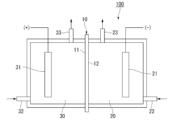
- FIG. 1 is a schematic diagram showing an example of an electrolytic hydrogenation apparatus using an ion-exchange membrane obtained by the present invention
- An "ion exchange membrane” is a membrane comprising a polymer having ion exchange groups.
- An "ion-exchange group” is a group that can exchange at least part of the ions contained in this group with other ions.
- “Sulfonic acid-type ion exchange group” means a sulfonic acid group (--SO 3 H) or a sulfonic acid group (--SO 3 M 2 , where M 2 is an alkali metal or quaternary ammonium group). means.
- a “precursor resin” is a resin comprising a polymer having groups that can be converted to ion exchange groups.
- “Monomer” means a compound with a polymerizable carbon-carbon double bond.
- a “unit” means a portion derived from a monomer that is present in a polymer to make up the polymer. For example, when a unit is produced by addition polymerization of a monomer having a carbon-carbon unsaturated double bond, the unit derived from this monomer is a divalent unit produced by cleavage of this unsaturated double bond.
- the units may also be units obtained by chemically converting, for example hydrolyzing, the units after forming a polymer having the structure of the units. In some cases, a structural unit derived from an individual monomer is indicated by a name obtained by adding "unit" to the name of the monomer.
- a “fluororesin” means a resin having a fluorine atom in its molecule.
- (meth) acrylic acid means one or both of acrylic acid and methacrylic acid
- (meth) acrylonitrile means one or both of acrylonitrile and methacrylonitrile
- (meth) Acrylamide refers to one or both of acrylamide and methacrylamide
- (meth)N-substituted alkylacrylamide refers to one or both of N-substituted alkylacrylamide and N-substituted alkylmethacrylamide.
- " ⁇ " indicating a numerical range means that the numerical values before and after it are included as lower and upper limits.
- the method for producing an ion-exchange membrane of the present invention is a method of polymerizing a monomer solution filled in a substrate to produce a precursor resin, and then introducing sulfonic acid-type ion-exchange groups into the precursor resin.
- the ion-exchange membrane obtained by the method for producing an ion-exchange membrane of the present invention is divided into a cathode chamber for hydrogenating an aromatic compound to produce a hydrogenated organic substance and an anode chamber for electrolyzing water to produce oxygen. It is used as an ion exchange membrane for the production of hydrogenated organics.
- Base material any one of nonwoven fabric, woven fabric and porous membrane composed of one or more resins selected from polyolefin and fluororesin can be used. Two or more kinds of resins constituting the substrate may be used in combination.
- polyethylene and polypropylene are preferred.
- Polypropylene is particularly preferred for use at high temperatures of 80° C. or higher.
- a nonwoven fabric made of polyolefin it is preferable to use a nonwoven fabric made of a two-layer composite fiber having a core made of polypropylene and a sheath made of polyethylene, because high strength can be obtained.
- the fluororesin is not particularly limited as long as it is a general fluororesin, but a copolymer containing ethylene units and tetrafluoroethylene units (hereinafter also referred to as "ETFE”), ethylene units and chlorotrifluoroethylene units (hereinafter also referred to as "ECTFE”), polytetrafluoroethylene (hereinafter also referred to as "PTFE”), and a copolymer containing tetrafluoroethylene units and perfluoropropyl vinyl ether units (hereinafter referred to as "PFA ) is preferably composed of one or more resins selected from the above from the viewpoint of heat resistance and chemical resistance.
- ETFE ethylene units and tetrafluoroethylene units
- ECTFE ethylene units and chlorotrifluoroethylene units
- PTFE polytetrafluoroethylene
- PFA perfluoropropyl vinyl ether units
- Non-woven fabrics composed of ETFE or ECTFE.
- Woven fabrics composed of PFA, PTFE, ETFE, or ECTFE.
- Porous membranes composed of ETFE, ECTFE, or PTFE.
- the film thickness of the substrate is preferably 50-500 ⁇ m, more preferably 50-300 ⁇ m, and particularly preferably 50-200 ⁇ m. If the film thickness is equal to or higher than the lower limit of the preferred range, the required practical film strength can be maintained. If it is equal to or less than the upper limit, the electrical resistance can be kept low.
- the substrate used in the present invention is not particularly limited, but the volume per unit area occupied by the entire substrate (if it is a nonwoven fabric or a porous membrane, the volume obtained by the average film thickness ⁇ unit area, the woven fabric If so, place the woven fabric on a flat surface, and the volume fraction occupied by the base material itself in the average thickness between the bottom surface and the vertex of the woven fabric on the opposite side ⁇ the volume obtained by the unit area) is 10 ⁇ 90% is preferred, 20-80% is more preferred, and 30-70% is particularly preferred.
- volume fraction of the base material is equal to or higher than the lower limit, the electric resistance is kept low, and if it is equal to or lower than the upper limit, practical strength is maintained.
- the volume fraction of the substrate is obtained from the ratio of the volume occupied by the entire substrate per unit area and the volume of the substrate itself per unit area.
- the volume of the base material itself per unit area can be obtained from the weight of the base material per unit area and the specific gravity of the base material itself.
- the monomer solution contains an ion-exchange group-introducing monomer and a crosslinkable monomer.
- the ion-exchange group-introducing monomer is a monomer selected from styrene, ⁇ -methylstyrene, vinylnaphthalene, and vinyltoluene, and two or more of these may be used in combination.
- Each of the ion-exchange group-introducing monomers has one polymerizable group in the molecule, and is a monomer capable of introducing a sulfonic acid-type ion-exchange group by reaction with a sulfonating agent after polymerization.
- the crosslinkable monomer is a monomer selected from divinylbenzene and divinylnaphthalene, and these may be used in combination.
- Divinylbenzene may be m-divinylbenzene, p-divinylbenzene or o-divinylbenzene. All crosslinkable monomers have two polymerizable groups in the molecule.
- a crosslinkable monomer By using a crosslinkable monomer, a crosslinked structure can be introduced into the precursor resin obtained after polymerization.
- the monomer solution may contain monomers other than the ion-exchange group-introducing monomer and the crosslinkable monomer. That is, a monomer other than the above-mentioned ion-exchange group-introducing monomer, which has one polymerizable group and is capable of introducing a sulfonic acid-type ion-exchange group by reaction with a sulfonating agent after polymerization, the above-mentioned ion-exchange group-introducing monomer.
- Examples of monomers other than the above-mentioned ion-exchange group-introducing monomers having groups convertible to ion-exchange groups by known treatments such as hydrolysis treatment and acidification treatment include vinyl xylene, ⁇ -halogenated vinylsulfonic acid, ⁇ , ⁇ , ⁇ '-Halogenated vinylsulfonic acid, styrenesulfonic acid, vinylsulfonic acid, maleic acid, itaconic acid, styrenephosphonilic acid, maleic anhydride, vinylphosphoric acid, and salts and esters thereof. These may be used singly together with the monomer for introducing ion-exchange groups, or two or more copolymerizable monomers may be used in combination with the above-mentioned monomers for introducing ion-exchange groups.
- Examples of monomers having two or more polymerizable groups in the molecule other than the crosslinkable monomers include divinyl compounds such as divinylbiphenyl, divinylsulfone, butadiene, chloroprene, isoprene, trivinylbenzene, diallylamine, triallylamine, and divinylpyridine. is mentioned. These may be used singly in combination with the above-mentioned crosslinkable monomer, or in combination of two or more kinds which are copolymerizable with each other, and may be used together with the above-mentioned crosslinkable monomer.
- divinyl compounds such as divinylbiphenyl, divinylsulfone, butadiene, chloroprene, isoprene, trivinylbenzene, diallylamine, triallylamine, and divinylpyridine. is mentioned. These may be used singly in combination with the above-mentioned crosslinkable monomer, or in combination of two or more
- the ratio of the ion-exchange group-introducing monomer to the total monomer in the monomer solution is preferably 30 to 99.9% by mass, more preferably 40 to 80% by mass. If the ratio of the ion-exchange group-introducing monomer is at least the lower limit of the preferable range, the membrane resistance can be lowered. If it is less than the upper limit, it is possible to obtain chemical resistance and mechanical strength that are practically necessary for the film.
- the proportion of the crosslinkable monomer in the total monomers in the monomer solution is preferably 0.1 to 60% by mass, more preferably 1 to 40% by mass. If the proportion of the crosslinkable monomer is at least the lower limit of the preferred range, the film will have practically necessary chemical resistance, heat resistance, and strength. If it is equal to or less than the upper limit, the practically necessary toughness of the film can be obtained.
- a polymerization initiator is blended in the monomer solution in addition to the monomers described above.
- a radical polymerization initiator is used as the polymerization initiator.
- the polymerization initiator known ones such as peroxides and azo compounds can be used.
- Specific examples of polymerization initiators include p-menthane hydroperoxide, diisopropylbenzene hydroperoxide, ⁇ , ⁇ '-bis(tert-butylperoxy-m-isopropyl)benzene, di-tert-butylperoxide, tert - butyl hydroperoxide, di-tert-amyl peroxide, tert-butyl cumyl peroxide, dicumyl peroxide, 2,5-dimethyl-2,5-di(tert-butylperoxy)hexane, 2,5- Dimethyl-2,5-di(tert-butylperoxy)hexyne-3, cumene hydroperoxide, 1,1,
- the monomer solution further contains a viscosity-adjusting polymer.
- Blending a viscosity-adjusting polymer gives the monomer solution an appropriate viscosity and prevents the liquid from flowing out or dripping when it is filled in the base material or during polymerization.
- the effect of improving the toughness of the resulting film can also be expected.
- Preferred polymers include elastomers such as polybutadiene, hydrogenated polybutadiene, styrene-diene copolymers, styrene-hydrogenated diene copolymers, butadiene-styrene-acrylonitrile copolymers (NBR).
- the diene referred to here refers to diene monomers such as butadiene and isoprene.
- the copolymer may be a random copolymer or a block copolymer, but a block copolymer is preferred.
- Particularly preferred polymers include styrene-butadiene block copolymers or hydrogenated products thereof, styrene-isoprene block copolymers or hydrogenated products thereof, and the like. Among them, hydrogenated ones are preferable from the viewpoint of heat resistance and chemical resistance stability.
- the molecular weight of the viscosity-adjusting polymer is not particularly limited, but it is preferably arbitrarily adjusted according to the desired physical properties of the film and the viscosity of the monomer solution.
- the polymer for viscosity adjustment is preferably 0.1 to 50 parts by mass, more preferably 5 to 40 parts by mass, based on 100 parts by mass of all monomers in the monomer solution. If the viscosity-adjusting polymer is contained in a ratio within a preferred range with respect to the total monomers in the monomer solution, effects such as easily imparting an appropriate viscosity to the monomer solution and improving the toughness of the polymer film can be obtained.
- a particularly suitable amount of elastomer varies depending on the molecular weight of the elastomer.
- the monomer solution may optionally contain plasticizers such as dioctyl phthalate, dibutyl phthalate, tributyl phosphate, styrene oxide, alcohol esters of fatty acids or aromatic acids, and organic solvents.
- plasticizers such as dioctyl phthalate, dibutyl phthalate, tributyl phosphate, styrene oxide, alcohol esters of fatty acids or aromatic acids, and organic solvents.
- organic solvents examples include hydrocarbons such as benzene, xylene, toluene and hexane; alcohols such as methanol, ethanol and isopropyl alcohol; ketones such as acetone, methylisopropyl ketone and cyclohexane; ethers such as dioxane and tetrahydrofuran; Esters such as ethyl and butyl acetate, and solvents such as nitrogen-containing compounds such as isopropylamine, diethanolamine, N--methylformamide and N,N--dimethylformamide. Two or more of these may be used in combination.
- hydrocarbons such as benzene, xylene, toluene and hexane
- alcohols such as methanol, ethanol and isopropyl alcohol
- ketones such as acetone, methylisopropyl ketone and cyclohexane
- ethers such as dioxane and
- Forming the substrate with the monomer solution can be carried out by known means such as roll coater, flow coater, knife coater, comma coater, spray, dipping, and the like.
- the base material filled with the monomer solution (hereinafter also referred to as "polymerizable sheet") may be subjected to polymerization as it is. From the standpoint of continuous productivity, it is preferable to take up the film and introduce the take-up roller into a polymerization apparatus for polymerization. In that case, in order to control the thickness of the film, the thickness may be controlled by winding together a spacer tape for maintaining a desired thickness on the outside of both ends in the width direction of the substrate.
- Such a release film can be used without any limitation as long as it has heat resistance that can withstand the polymerization process and can be easily peeled off after polymerization.
- Styrenic resins, polyvinyl compounds, polyamides, biodegradable resins, mixtures thereof, and the like can be used depending on the types of monomers in the monomer solution.
- a polyester film such as polyethylene terephthalate (hereinafter also referred to as “PET”) is preferable in that it has particularly good heat resistance and releasability.
- PET polyethylene terephthalate
- the release film may be biaxially stretched.
- the polymerization temperature varies depending on the polymerization initiator used, but is generally set in consideration of the melting point of the base material and the solubility of the base material in the monomer. For example, when using a polyethylene base material, it is desirable to carry out polymerization at 50° C. to 120° C. for 4 to 12 hours, and when using a polypropylene base material, it is preferable to perform polymerization at 50° C. to 140° C. for 4 to 12 hours. It is desirable to carry out the polymerization at Below this temperature range, the dissolution of the base material in the monomer paste is low, resulting in insufficient adhesion between the base material and the resin. Conversely, if the temperature is higher than this range, the base material may be excessively dissolved in the monomer paste or the base material may be deformed, resulting in a decrease in strength. Polymerization results in a film of the precursor resin reinforced by the substrate.
- sulfonic acid type ion exchange groups are introduced. As a result, an ion exchange membrane reinforced by the substrate is obtained.
- the sulfonic acid type ion exchange groups can be introduced by a known method of immersing the precursor resin membrane in a sulfonating agent and reacting it. For example, the following method 1 and method 2 can be adopted.
- Method 1 A method in which a polymer membrane is immersed in a chlorosulfonic acid solution with a concentration of 1% by mass to 50% by mass using 1,2-dichloroethane, dichloromethane, chlorobenzene, or the like as a solvent at 25 to 80° C. for about 1 to 72 hours for reaction.
- Method 2 A method in which a polymer film is immersed in concentrated sulfuric acid or fuming sulfuric acid at 25 to 80° C. for about 1 to 72 hours to react.
- the obtained membrane can be washed with water as it is to obtain a sulfonic acid type membrane. After thorough washing with water, the membrane is repeatedly treated with an acid solution such as sulfuric acid or hydrochloric acid to obtain a membrane having sulfonic acid type ion exchange groups.
- the amount of sulfonic acid-type ion-exchange groups introduced is not particularly limited, but the amount of sulfonic acid-type ion-exchange groups per 1 g of dry membrane (meq/g) is preferably 0.1 to 4.0 meq/g. , from 1.0 to 3.5 meq/g.
- inorganic particle layer It is also preferable to form an inorganic particle layer containing inorganic particles or inorganic particles and a binder on the first surface of the ion exchange membrane.
- the first surface is the surface facing the anode chamber in the electrolytic hydrogenation apparatus.
- the electrolysis voltage increases during the electrolytic hydrogenation of the aromatic compound.
- Forming an inorganic particle layer on the first surface is preferable because it suppresses adhesion of oxygen gas generated by electrolysis of the aqueous electrolyte solution to the surface of the ion-exchange membrane and suppresses an increase in electrolysis voltage.
- the inorganic particles those having hydrophilicity are preferable. Specifically, at least one selected from the group consisting of oxides, nitrides and carbides of Group 4 elements or Group 14 elements is preferred, SiO 2 , SiC, ZrO 2 and ZrC are more preferred, and ZrO 2 is particularly preferred. preferable.
- the average particle size of the inorganic particles is preferably 0.01 to 10 ⁇ m, more preferably 0.01 to 5 ⁇ m, even more preferably 0.5 to 3 ⁇ m. If the average particle size of the inorganic particles is at least the above lower limit, a high effect of suppressing gas adhesion can be obtained. If the average particle size of the inorganic particles is equal to or less than the above upper limit, the inorganic particles are excellent in resistance to falling off.
- the average particle size of the inorganic particles is measured by measuring a dispersion of inorganic particles in a solvent with a known particle size distribution measuring device (laser diffraction/scattering type particles manufactured by Microtrac Bell Co., Ltd.) using a laser diffraction/scattering method as a measurement principle It is a 50% diameter value ( D50 ) obtained by calculating the volume average from the particle size distribution measured by a diameter distribution measuring device (or a device equivalent thereto).
- a known particle size distribution measuring device laser diffraction/scattering type particles manufactured by Microtrac Bell Co., Ltd.
- binder commonly used binder polymers such as cellulose-based polymers can be used. Moreover, those having hydrophilicity are also preferable, and fluorine-containing polymers having a carboxylic acid group or a sulfonic acid group are preferable, and fluorine-containing polymers having a sulfonic acid group are more preferable.
- the fluoropolymer may be a homopolymer of a monomer having a carboxylic acid group or a sulfonic acid group, or a copolymer of a monomer having a carboxylic acid group or a sulfonic acid group and a monomer copolymerizable with this monomer. good too.
- the mass ratio of the binder to the total mass of the inorganic particles and binder in the inorganic particle layer is preferably 0.1 to 0.5.
- the binder ratio in the inorganic particle layer is at least the above lower limit, the inorganic particles are excellent in resistance to falling off. If the binder ratio in the inorganic particle layer is equal to or less than the above upper limit, a high effect of suppressing gas adhesion can be obtained.
- the thickness of the inorganic particle layer is preferably 1 to 50 ⁇ m, more preferably 1 to 30 ⁇ m, particularly preferably 1 to 20 ⁇ m, in order to further reduce the electrolysis voltage.
- the method for forming the inorganic particle layer is not particularly limited, but a method of applying an inorganic particle dispersion containing inorganic particles, a binder and a solvent to the first surface of the ion exchange membrane and drying the applied layer of the inorganic particle dispersion is employed. mentioned. Coating conditions and drying conditions are not particularly limited, and known conditions can be employed. The inorganic particles and binder contained in the inorganic particle dispersion are as described above.
- the solvent contained in the inorganic particle dispersion liquid is not particularly limited, and for example, water or an organic solvent can be used.
- the formation of the inorganic particle layer may be performed on the polymerizable sheet filled with the monomer solution, or after the monomer solution of the polymerizable sheet is polymerized and before the sulfonic acid-type ion exchange groups are introduced, the layer is reinforced with the base material. It may be carried out on the membrane of the precursor resin which has been prepared, or may be carried out on the ion exchange membrane after introduction of the sulfonic acid type ion exchange groups. It is preferable to carry out the treatment on the polymerizable sheet filled with the monomer solution, since the adhesion of the inorganic particle layer to the base material can be easily increased.
- a release film is attached to both surfaces of a polymerizable sheet and polymerization is performed, one of the release films on which an inorganic particle layer is formed in advance is used, and this release film is peeled off after polymerization.
- a method of transferring the inorganic particle layer to the first surface of the ion exchange membrane is preferable.
- a layer of perfluoroionomer is formed on the first surface of the ion-exchange membrane, and then the inorganic particle layer is formed. preferably. It is preferable to interpose a layer of perfluoroionomer as a base of the inorganic particle layer between the substrate and the inorganic particle layer, since the adhesion of the inorganic particle layer to the substrate can be enhanced and the film resistance can be reduced.
- An electrolytic hydrogen device can be manufactured by arranging the ion-exchange membrane obtained by the method for producing an ion-exchange membrane of the present invention so as to separate a cathode chamber in which a cathode is arranged and an anode chamber in which an anode is arranged.
- FIG. 1 shows a schematic diagram of an electrolytic hydrogenation apparatus using an ion-exchange membrane obtained by the method for producing an ion-exchange membrane of the present invention.
- an electrolytic hydrogenation apparatus 100 includes a cathode chamber 20 having a cathode 21, an anode chamber 30 having an anode 31, and an ion exchange membrane 10 separating the cathode chamber 20 and the anode 31.
- the first surface 11 of the ion exchange membrane 10 faces the anode compartment 30 and the second surface 12 opposite the first surface 11 faces the cathode compartment 20 .
- the ion exchange membrane 10 is an ion exchange membrane obtained by the manufacturing method of the present invention, and may have an inorganic particle layer on the first surface 11 .
- the cathode chamber 20 is provided with a cathode chamber inlet 22 and a cathode chamber outlet 23 so that the catholyte flows from the cathode chamber inlet 22 to the cathode chamber outlet 23 .
- the anode chamber 30 is provided with an anode chamber inlet 32 and an anode chamber outlet 33 so that the anolyte flows from the anode chamber inlet 32 to the anode chamber outlet 33 .
- Stainless steel, nickel, and the like are preferable as materials for forming the cathode chamber 20 and the anode chamber 30 .
- a preferred embodiment includes a configuration comprising a catalyst layer and an electrode substrate in order from the ion exchange membrane 10 side.
- the catalyst layer and the electrode substrate may be arranged in contact with each other or may be arranged with a gap therebetween.
- Stainless steel, nickel, and the like are preferable as the material constituting the electrode base material.
- the surface of the electrode substrate is preferably coated with, for example, ruthenium oxide, iridium oxide, or the like.
- the catalyst layer is preferably placed in contact with the second surface 12 of the ion exchange membrane 10 .
- the catalyst layer contains a reduction catalyst for hydrogenating aromatic compounds in the catholyte to produce hydrogenated organics.
- the reduction catalyst for example, metal particles selected from the group consisting of Pt, Ru, Pd, Ir, and alloys containing at least one of these are used.
- the reduction catalyst is preferably carried by a catalyst carrier made of an electron-conductive material.
- the catalyst carrier includes, for example, an electron conductive material containing any one of porous carbon (such as mesoporous carbon), porous metal, and porous metal oxide as a main component. It is preferable to coat the catalyst carrier with an ionomer because it improves the ionic conductivity of the cathode 21 .
- the cathode 21, which consists of a catalyst layer and an electrode base material, is formed by coating the electrode base material with catalyst component powder, a hydrophobic resin that is a gas-permeable material, water, a solvent, and a catalyst ink mixed with an ionomer, followed by drying. It can be manufactured by
- the catalyst layer of the cathode 21 may be formed on the ion exchange membrane 10 .
- an ion-exchange membrane with a catalyst layer which is a composite of the cathode catalyst layer and the ion-exchange membrane 10
- an ion-exchange membrane with a catalyst layer can be produced by spraying catalyst ink onto the second surface 12 of the ion-exchange membrane 10 and drying the solvent component in the catalyst ink.
- the specific configuration of the anode 31 is not particularly limited, but in a preferred embodiment, it is preferably made of an electrode base material such as stainless steel or nickel. Moreover, the surface of the electrode substrate is preferably coated with, for example, ruthenium oxide, iridium oxide, or the like.
- the ion exchange membrane 10, the anode 31, and the cathode 21 may be arranged in contact with each other or may be arranged with a gap between them.
- the anode 31 may have a catalyst layer on the ion exchange membrane 10 side. .
- an electrolytic aqueous solution is supplied as an anolyte to the anode chamber 30 in which the anode 31 is arranged, and a cathode is supplied to the cathode chamber 20 in which the cathode 21 is arranged.
- An aromatic compound is supplied as a liquid.
- aromatic compounds include benzene, toluene, and naphthalene.
- An aqueous electrolyte solution is a solution in which an electrolyte is dissolved in water. Examples of electrolytes include sulfuric acid, nitric acid, and the like. The electrolyte concentration is not particularly limited.
- protons (H + ) produced by electrolysis of the electrolyte aqueous solution in the anode chamber 30 move to the cathode chamber 20 side through the ion exchange membrane 10 .
- hydrogenation of the aromatic compound by protonation takes place to obtain a hydrogenated organic substance in the cathode chamber 20 .
- hydrogenated organic substances include cyclohexane, methylcyclohexane, decahydronaphthalene, and the like.
- the catholyte flowing out from the cathode chamber outlet 23 of the cathode chamber 20 contains a hydrogenated organic substance.
- a hydrogenated organic substance can be separated and recovered from the catholyte flowing out from the cathode chamber outlet 23 .
- the remaining catholyte from which the hydrogenated organic matter has been separated may be circulated to flow into the cathode chamber 20 through the cathode chamber inlet 22 again.
- Examples 1 to 5 are working examples, and examples 6 and 7 are comparative examples.
- the electrolytic voltage and current efficiency of the membrane electrode assembly obtained in each example were evaluated by the following methods.
- the membrane electrode assembly of each example was placed in a test electrolytic cell having an effective current-carrying area of 1.5 dm 2 (electrolytic surface size: 150 mm long x 100 mm wide), with the surface on which no catalyst layer was formed facing the anode chamber side. was placed.
- an electrode in which ruthenium-containing Raney nickel was electrodeposited on a punched metal made of SUS304 (minor diameter: 5 mm, major diameter: 10 mm) was used.
- the diffusion layer of the anode and the membrane electrode assembly were placed in direct contact with each other without creating a gap.
- the electrolysis voltage (V) was obtained by measuring the potential between the cathode and the anode. It can be said that when the electrolysis voltage is low, the power consumption is low when the other conditions and characteristics are the same, and the result of better energy efficiency is obtained.
- the current efficiency (%) was obtained from the ratio between the actual amount of methylcyclohexane produced and the theoretical amount of methylcyclohexane that should be produced from the amount of coulombs supplied. When the current efficiency is high, it can be said that more energy efficient results can be obtained because more electrolysis reactants can be generated with the same amount of current when other conditions and characteristics are the same. .
- Example 1 [Production of ion exchange membrane] A solution consisting of 50 parts by mass of styrene, 20 parts by mass of chloromethylstyrene, 10 parts by mass of divinylbenzene, 20 parts by mass of n-butyl acrylate, and 15 parts by mass of a hydrogenated styrene-butadiene block copolymer was prepared. A monomer solution was prepared by mixing 2 parts by mass of oxide (manufactured by NOF Co., Ltd., trade name: Nyper BO).
- a polyethylene cloth (thickness: 140 ⁇ m, basis weight: 40 g/m 2 ) that had been subjected to corona discharge treatment was impregnated with the obtained monomer solution, sandwiched between PET films, wound on a roll with a diameter of 20 cm, and heated at 90°C. After polymerization for 10 hours at , the PET films on both sides were peeled off to obtain a film-like body with a thickness of 150 ⁇ m. Next, the resulting film-like material was immersed in a 98% by mass sulfuric acid solution at 60° C. for 24 hours for sulfonation. After repeated washing, a sulfonic acid type cation exchange membrane I was obtained.
- Tetrafluoroethylene hereinafter also referred to as “TFE”
- CF 2 CF-O-CF 2 CF(CF 3 )-O-CF 2 CF 2 -SO 2 F
- Example 2 [Production of ion exchange membrane] Example 1 except that instead of the polyethylene cloth, a non-woven fabric (100 ⁇ m thick, basis weight 60 g/m 2 ) made of short fibers having a polypropylene core coated with polyethylene was used after corona treatment. Polymerization was carried out in the same manner to obtain a membrane having a thickness of 110 ⁇ m.
- the obtained film-like material was immersed in a 1,2-dichloroethane solution containing 3% by mass of chlorosulfonic acid at room temperature for 24 hours for sulfonation, washed with water, and immersed in a 1% NaOH aqueous solution for neutralization. , and 1N hydrochloric acid aqueous solution to obtain a sulfonic acid type cation exchange membrane II.
- Membrane electrode assembly II was obtained in the same manner as in Example 1, except that cation exchange membrane II was used instead of cation exchange membrane I.
- the cathode area of membrane electrode assembly II was 25 cm 2 .
- Example 3 [Production of inorganic particle layer] Mix 29.0% by mass of zirconium oxide (average particle size: 1 ⁇ m), 1.3% by mass of methylcellulose, 4.6% by mass of cyclohexanol, 1.5% by mass of cyclohexane and 63.6% by mass of water Then, an inorganic particle paste Q1 was obtained. The resulting inorganic particle paste Q1 was coated on one side of a PET film so that the amount of zirconium oxide adhered was 20 g/m 2 and dried at 100°C to form an inorganic particle layer on one side of the PET film. A decal Q1 was obtained.
- Example 4 [Production of inorganic particle layer] 29.0% by mass of silicon oxide (SiO 2 , average particle size: 1 ⁇ m), 1.3% by mass of methylcellulose, 4.6% by mass of cyclohexanol, 1.5% by mass of cyclohexane and 63.6% by mass of water % to obtain an inorganic particle paste Q2.
- the resulting inorganic particle paste Q2 was coated on one side of a PET film so that the amount of silicon oxide deposited was 20 g/m 2 and dried at 100°C to form an inorganic particle layer on one side of the PET film. A decal Q2 was obtained.
- a non-woven fabric (thickness: 100 ⁇ m, basis weight: 60 g/m 2 ) made of staple fibers in which a polypropylene core material is coated with polyethylene was impregnated with a monomer solution prepared in the same manner as in Example 1, It was sandwiched between the PET film and the decal Q2, wound on a roll with a diameter of 20 cm, and polymerized at 90° C. for 10 hours. . Next, the resulting film-like material was immersed in a 98% by mass sulfuric acid solution at 60° C. for 24 hours for sulfonation. After repeated washing, a sulfonic acid type cation exchange membrane IV having an inorganic particle layer on one side was obtained.
- a membrane electrode assembly IV was obtained in the same manner as in Example 3, except that the cation exchange membrane IV obtained above was used in place of the cation exchange membrane III.
- the cathode area of the membrane electrode assembly IV was 25 cm 2 .
- An ion-exchange membrane V with a catalyst layer was prepared in the same manner as in Example 3, except that the cation-exchange membrane V obtained above was used instead of the cation-exchange membrane III. Carbon felt was bonded as a diffusion layer to the surface of the catalyst layer of the obtained ion-exchange membrane V with catalyst layer to obtain a membrane electrode assembly V.
- the cathode area of the membrane electrode assembly V was 25 cm 2 .
- Example 6 [Production of ion exchange membrane]
- 50 g of polyphenylsulfone having the structure of the following formula 2 and having a melt flow rate of 19.5 g/10 min as measured according to ASTM method D1328 was dissolved, and the ion exchange capacity was adjusted to 2.0 mmol/g.
- Chlorosulfonic acid was added so that the After water was added to the obtained reactant, trimethylamine gas was bubbled until the pH of the aqueous layer became weakly alkaline.
- n is the number of repetitions.
- a non-woven fabric made of staple fibers in which a polypropylene core material is coated with polyethylene is coated with the above polymer solution A1, and the voids are filled and filled several times. Drying was repeated to completely fill the voids with the polymer to obtain a membrane having a thickness of 150 ⁇ m. Then, the resulting membrane-like body was repeatedly treated with a 1N hydrochloric acid aqueous solution to obtain a sulfonic acid-type cation exchange membrane VI.
- a membrane electrode assembly VI was obtained in the same manner as in Example 1, except that the cation exchange membrane VI obtained above was used in place of the cation exchange membrane I.
- the cathode area of the membrane electrode assembly VI was 25 cm 2 .
- Example 7 Polymer solution A1 was obtained in the same manner as in Example 6. To this polymer solution A1, a 10% dimethylformamide solution of the same polyphenylsulfone having the structure of formula 2 used in Example 6 was added in an amount equivalent to 1/2 of the polymer solid content in polymer solution A1. to obtain a polymer solution A2. A sulfonic acid type cation exchange membrane VII was obtained in the same manner as in Example 6, except that polymer solution A2 was used instead of polymer solution A1.
- a membrane electrode assembly VII was obtained in the same manner as in Example 1, except that the cation exchange membrane VII obtained above was used in place of the cation exchange membrane I.
- the cathode area of membrane electrode assembly VII was 25 cm 2 .
- Table 1 shows the evaluation results of the electrolytic voltage and current efficiency of the membrane electrode assembly of each example.
- the membrane electrode assemblies of Examples 1 to 5 using the ion exchange membrane of the present invention did not swell with toluene. It was also found to have good characteristics in terms of electric field voltage and current efficiency.
- the ion exchange membrane had an inorganic particle layer, even better characteristics were obtained in terms of electric field voltage and current efficiency (Examples 3 to 5).
- Examples 6 and 7 swelling due to toluene occurred and film leakage occurred.
- Electrolytic hydrogenation apparatus 10 Ion exchange membrane 11 First surface 12 Second surface 20 Cathode chamber 21 Cathode 22 Cathode chamber inlet 23 Cathode chamber outlet 30 Anode chamber 31 Anode 32 Anode chamber inlet 33 Anode chamber outlet 100 Electrolytic hydrogenation apparatus
Landscapes
- Chemical & Material Sciences (AREA)
- Organic Chemistry (AREA)
- Engineering & Computer Science (AREA)
- Chemical Kinetics & Catalysis (AREA)
- Electrochemistry (AREA)
- Materials Engineering (AREA)
- Metallurgy (AREA)
- Manufacture Of Macromolecular Shaped Articles (AREA)
Priority Applications (2)
| Application Number | Priority Date | Filing Date | Title |
|---|---|---|---|
| JP2023547018A JPWO2023038133A1 (https=) | 2021-09-13 | 2022-09-12 | |
| CN202280061825.7A CN117999381A (zh) | 2021-09-13 | 2022-09-12 | 离子交换膜和带催化剂层的离子交换膜的制造方法 |
Applications Claiming Priority (2)
| Application Number | Priority Date | Filing Date | Title |
|---|---|---|---|
| JP2021-148398 | 2021-09-13 | ||
| JP2021148398 | 2021-09-13 |
Publications (1)
| Publication Number | Publication Date |
|---|---|
| WO2023038133A1 true WO2023038133A1 (ja) | 2023-03-16 |
Family
ID=85506480
Family Applications (1)
| Application Number | Title | Priority Date | Filing Date |
|---|---|---|---|
| PCT/JP2022/034009 Ceased WO2023038133A1 (ja) | 2021-09-13 | 2022-09-12 | イオン交換膜及び触媒層付きイオン交換膜の製造方法 |
Country Status (3)
| Country | Link |
|---|---|
| JP (1) | JPWO2023038133A1 (https=) |
| CN (1) | CN117999381A (https=) |
| WO (1) | WO2023038133A1 (https=) |
Cited By (2)
| Publication number | Priority date | Publication date | Assignee | Title |
|---|---|---|---|---|
| WO2024193079A1 (zh) * | 2023-03-21 | 2024-09-26 | 国家能源投资集团有限责任公司 | 用于碱性电解水制氢的膜电极及其制备方法和电解槽 |
| WO2026014355A1 (ja) * | 2024-07-10 | 2026-01-15 | 株式会社アストム | カチオン交換膜及びその製造方法 |
Families Citing this family (1)
| Publication number | Priority date | Publication date | Assignee | Title |
|---|---|---|---|---|
| CN121496428B (zh) * | 2026-01-13 | 2026-04-14 | 杭州水处理技术研究开发中心有限公司 | 一种次氯酸钠发生装置 |
Citations (6)
| Publication number | Priority date | Publication date | Assignee | Title |
|---|---|---|---|---|
| JPS60238328A (ja) * | 1984-05-11 | 1985-11-27 | Asahi Glass Co Ltd | イオン交換膜を製造する方法 |
| JP2003012835A (ja) * | 2001-07-02 | 2003-01-15 | Asahi Glass Co Ltd | 陽イオン交換膜の製造方法 |
| JP2009215499A (ja) * | 2008-03-12 | 2009-09-24 | Solt Industry Center Of Japan | 陽イオン交換膜及びその製造方法 |
| WO2017179672A1 (ja) * | 2016-04-14 | 2017-10-19 | 株式会社アストム | バイポーラ膜 |
| WO2018047700A1 (ja) * | 2016-09-06 | 2018-03-15 | 株式会社アストム | イオン交換膜 |
| WO2021157639A1 (ja) * | 2020-02-06 | 2021-08-12 | Agc株式会社 | 触媒層付きイオン交換膜、イオン交換膜および電解水素化装置 |
-
2022
- 2022-09-12 CN CN202280061825.7A patent/CN117999381A/zh active Pending
- 2022-09-12 WO PCT/JP2022/034009 patent/WO2023038133A1/ja not_active Ceased
- 2022-09-12 JP JP2023547018A patent/JPWO2023038133A1/ja active Pending
Patent Citations (6)
| Publication number | Priority date | Publication date | Assignee | Title |
|---|---|---|---|---|
| JPS60238328A (ja) * | 1984-05-11 | 1985-11-27 | Asahi Glass Co Ltd | イオン交換膜を製造する方法 |
| JP2003012835A (ja) * | 2001-07-02 | 2003-01-15 | Asahi Glass Co Ltd | 陽イオン交換膜の製造方法 |
| JP2009215499A (ja) * | 2008-03-12 | 2009-09-24 | Solt Industry Center Of Japan | 陽イオン交換膜及びその製造方法 |
| WO2017179672A1 (ja) * | 2016-04-14 | 2017-10-19 | 株式会社アストム | バイポーラ膜 |
| WO2018047700A1 (ja) * | 2016-09-06 | 2018-03-15 | 株式会社アストム | イオン交換膜 |
| WO2021157639A1 (ja) * | 2020-02-06 | 2021-08-12 | Agc株式会社 | 触媒層付きイオン交換膜、イオン交換膜および電解水素化装置 |
Cited By (2)
| Publication number | Priority date | Publication date | Assignee | Title |
|---|---|---|---|---|
| WO2024193079A1 (zh) * | 2023-03-21 | 2024-09-26 | 国家能源投资集团有限责任公司 | 用于碱性电解水制氢的膜电极及其制备方法和电解槽 |
| WO2026014355A1 (ja) * | 2024-07-10 | 2026-01-15 | 株式会社アストム | カチオン交換膜及びその製造方法 |
Also Published As
| Publication number | Publication date |
|---|---|
| JPWO2023038133A1 (https=) | 2023-03-16 |
| CN117999381A (zh) | 2024-05-07 |
Similar Documents
| Publication | Publication Date | Title |
|---|---|---|
| WO2023038133A1 (ja) | イオン交換膜及び触媒層付きイオン交換膜の製造方法 | |
| JP3901457B2 (ja) | 電極−膜接合体及びその製造方法 | |
| US8735023B2 (en) | Fuel cell with layered electrode | |
| JP6077774B2 (ja) | イオン伝導性付与剤並びにカソード触媒層並びに該触媒層を用いて形成する膜−電極接合体並びに陰イオン交換膜型燃料電池及びその運転方法 | |
| CN101680101B (zh) | 季铵碱的制备方法 | |
| KR20050009161A (ko) | 적층체, 그 제조 방법 및 그 용도 | |
| JP2020145210A (ja) | 電極の製造方法、これによって製造された電極、前記電極を含む膜−電極アセンブリー、そして前記膜−電極アセンブリーを含む燃料電池 | |
| CN108878898B (zh) | 具有分离的电解质分布的燃料电池及其制造方法 | |
| JP4284463B2 (ja) | 電解質膜および当該電解質膜を用いた燃料電池 | |
| WO2018216356A1 (ja) | 有機ハイドライド製造装置 | |
| CN100536036C (zh) | 电解质膜和膜电极接合体的制造方法以及燃料电池 | |
| CN108780898A (zh) | 高分子电解质膜燃料电池用纳米结构电极及其制造方法 | |
| JP2016106371A (ja) | 混合炭素粒子を含む膜電極接合体 | |
| JP2005032535A (ja) | 接合体 | |
| JP7693476B2 (ja) | イオン交換膜及び触媒層付きイオン交換膜の製造方法 | |
| US20050112435A1 (en) | Polymer electrolyte membrane and polymer electrolyte fuel cell | |
| JP4870328B2 (ja) | 膜―電極接合体の製造方法 | |
| JP2003059507A (ja) | 燃料電池用電解質膜−電極接合体、その製造方法、および高分子電解質型燃料電池 | |
| JP2012181961A (ja) | 触媒層形成用組成物、及び、触媒層の製造方法 | |
| KR20060132749A (ko) | 전해질막 및 연료전지 | |
| JP2005032536A (ja) | 接合体の製造方法 | |
| JP2003288903A (ja) | 膜/電極接合体、並びに、それを用いた燃料電池、オゾン発生装置及び脱酸素装置 | |
| JP2014044940A (ja) | イオン伝導性付与剤、アノード触媒層、該触媒層を用いて形成する膜−電極接合体、並びに陰イオン交換膜型燃料電池及びその運転方法 | |
| WO2008059734A1 (en) | Polymer electrolyte membrane and method for producing polymer electrolyte membrane | |
| JP2007213988A (ja) | 高分子電解質型燃料電池用電極触媒層、その製造方法および高分子電解質型燃料電池 |
Legal Events
| Date | Code | Title | Description |
|---|---|---|---|
| 121 | Ep: the epo has been informed by wipo that ep was designated in this application |
Ref document number: 22867454 Country of ref document: EP Kind code of ref document: A1 |
|
| WWE | Wipo information: entry into national phase |
Ref document number: 2023547018 Country of ref document: JP |
|
| WWE | Wipo information: entry into national phase |
Ref document number: 202280061825.7 Country of ref document: CN |
|
| NENP | Non-entry into the national phase |
Ref country code: DE |
|
| 122 | Ep: pct application non-entry in european phase |
Ref document number: 22867454 Country of ref document: EP Kind code of ref document: A1 |