WO2023032522A1 - バルーンカテーテル - Google Patents
バルーンカテーテル Download PDFInfo
- Publication number
- WO2023032522A1 WO2023032522A1 PCT/JP2022/028567 JP2022028567W WO2023032522A1 WO 2023032522 A1 WO2023032522 A1 WO 2023032522A1 JP 2022028567 W JP2022028567 W JP 2022028567W WO 2023032522 A1 WO2023032522 A1 WO 2023032522A1
- Authority
- WO
- WIPO (PCT)
- Prior art keywords
- balloon
- tip
- protrusion
- distal end
- distal
- Prior art date
- Legal status (The legal status is an assumption and is not a legal conclusion. Google has not performed a legal analysis and makes no representation as to the accuracy of the status listed.)
- Ceased
Links
Images














Classifications
-
- A—HUMAN NECESSITIES
- A61—MEDICAL OR VETERINARY SCIENCE; HYGIENE
- A61B—DIAGNOSIS; SURGERY; IDENTIFICATION
- A61B17/00—Surgical instruments, devices or methods
- A61B17/22—Implements for squeezing-off ulcers or the like on inner organs of the body; Implements for scraping-out cavities of body organs, e.g. bones; for invasive removal or destruction of calculus using mechanical vibrations; for removing obstructions in blood vessels, not otherwise provided for
-
- A—HUMAN NECESSITIES
- A61—MEDICAL OR VETERINARY SCIENCE; HYGIENE
- A61M—DEVICES FOR INTRODUCING MEDIA INTO, OR ONTO, THE BODY; DEVICES FOR TRANSDUCING BODY MEDIA OR FOR TAKING MEDIA FROM THE BODY; DEVICES FOR PRODUCING OR ENDING SLEEP OR STUPOR
- A61M25/00—Catheters; Hollow probes
- A61M25/10—Balloon catheters
- A61M25/1002—Balloon catheters characterised by balloon shape
-
- A—HUMAN NECESSITIES
- A61—MEDICAL OR VETERINARY SCIENCE; HYGIENE
- A61M—DEVICES FOR INTRODUCING MEDIA INTO, OR ONTO, THE BODY; DEVICES FOR TRANSDUCING BODY MEDIA OR FOR TAKING MEDIA FROM THE BODY; DEVICES FOR PRODUCING OR ENDING SLEEP OR STUPOR
- A61M25/00—Catheters; Hollow probes
- A61M25/10—Balloon catheters
- A61M25/104—Balloon catheters used for angioplasty
-
- A—HUMAN NECESSITIES
- A61—MEDICAL OR VETERINARY SCIENCE; HYGIENE
- A61B—DIAGNOSIS; SURGERY; IDENTIFICATION
- A61B17/00—Surgical instruments, devices or methods
- A61B17/22—Implements for squeezing-off ulcers or the like on inner organs of the body; Implements for scraping-out cavities of body organs, e.g. bones; for invasive removal or destruction of calculus using mechanical vibrations; for removing obstructions in blood vessels, not otherwise provided for
- A61B2017/22001—Angioplasty, e.g. PCTA
-
- A—HUMAN NECESSITIES
- A61—MEDICAL OR VETERINARY SCIENCE; HYGIENE
- A61B—DIAGNOSIS; SURGERY; IDENTIFICATION
- A61B17/00—Surgical instruments, devices or methods
- A61B17/22—Implements for squeezing-off ulcers or the like on inner organs of the body; Implements for scraping-out cavities of body organs, e.g. bones; for invasive removal or destruction of calculus using mechanical vibrations; for removing obstructions in blood vessels, not otherwise provided for
- A61B2017/22051—Implements for squeezing-off ulcers or the like on inner organs of the body; Implements for scraping-out cavities of body organs, e.g. bones; for invasive removal or destruction of calculus using mechanical vibrations; for removing obstructions in blood vessels, not otherwise provided for with an inflatable part, e.g. balloon, for positioning, blocking, or immobilisation
-
- A—HUMAN NECESSITIES
- A61—MEDICAL OR VETERINARY SCIENCE; HYGIENE
- A61M—DEVICES FOR INTRODUCING MEDIA INTO, OR ONTO, THE BODY; DEVICES FOR TRANSDUCING BODY MEDIA OR FOR TAKING MEDIA FROM THE BODY; DEVICES FOR PRODUCING OR ENDING SLEEP OR STUPOR
- A61M25/00—Catheters; Hollow probes
- A61M25/10—Balloon catheters
- A61M2025/1043—Balloon catheters with special features or adapted for special applications
- A61M2025/1086—Balloon catheters with special features or adapted for special applications having a special balloon surface topography, e.g. pores, protuberances, spikes or grooves
-
- A—HUMAN NECESSITIES
- A61—MEDICAL OR VETERINARY SCIENCE; HYGIENE
- A61M—DEVICES FOR INTRODUCING MEDIA INTO, OR ONTO, THE BODY; DEVICES FOR TRANSDUCING BODY MEDIA OR FOR TAKING MEDIA FROM THE BODY; DEVICES FOR PRODUCING OR ENDING SLEEP OR STUPOR
- A61M25/00—Catheters; Hollow probes
- A61M25/10—Balloon catheters
- A61M2025/1043—Balloon catheters with special features or adapted for special applications
- A61M2025/109—Balloon catheters with special features or adapted for special applications having balloons for removing solid matters, e.g. by grasping or scraping plaque, thrombus or other matters that obstruct the flow
-
- A—HUMAN NECESSITIES
- A61—MEDICAL OR VETERINARY SCIENCE; HYGIENE
- A61M—DEVICES FOR INTRODUCING MEDIA INTO, OR ONTO, THE BODY; DEVICES FOR TRANSDUCING BODY MEDIA OR FOR TAKING MEDIA FROM THE BODY; DEVICES FOR PRODUCING OR ENDING SLEEP OR STUPOR
- A61M25/00—Catheters; Hollow probes
- A61M25/10—Balloon catheters
- A61M25/1006—Balloons formed between concentric tubes
Definitions
- the present invention relates to balloon catheters.
- Patent Document 1 discloses a balloon catheter in which a linear protrusion is provided on the balloon.
- the linear protruding portion is provided in the entire axial direction of the balloon over the proximal side cone region, the straight pipe region, and the distal side cone region of the balloon.
- the linear projection projects outward from the outer surface of the balloon.
- An object of the present invention is to provide a balloon catheter that can improve the passageability of the balloon even when the protrusion is provided at the distal end of the balloon.
- a balloon catheter according to the present invention has a catheter shaft extending in an extending direction between a first proximal end and a first distal end, and a distance between the first proximal end of the catheter shaft and the distance between the first proximal end and the catheter shaft.
- a balloon connected to a position where the distance between the first tip portion and the first tip portion is shorter, the inflatable portion having a cylindrical shape extending in the extending direction, and both end portions of the inflatable portion in the extending direction,
- a portion extending from a second tip portion, which is an end portion close to the first tip portion, to the side opposite to the inflatable portion, and the diameter of the end portion connected to the inflatable portion is equal to the diameter of the end portion connected to the inflatable portion.
- a tip connecting portion that is larger than the diameter of a third tip portion that is the end opposite to the portion and that is connected to the catheter shaft at the third tip portion; a projecting portion projecting radially outward from the balloon, the first projecting portion provided at the distal end connecting portion of the balloon, and the third distal end portion and the first distal end portion of the balloon in the extending direction.
- the protrusion including at least one of the second protrusions provided on the tip extension portion that is a portion between It is characterized by having at least a region having a projection amount smaller than that of the projecting portion between the closest end portion and the second tip portion.
- the size of the area where the protrusion is provided in the tip connecting portion can be made smaller than when the protrusion is provided over the entire tip connecting portion. Therefore, even when the balloon catheter is provided with the protruding portion, it is possible to improve the passageability of the balloon through the blood vessel.
- the protrusion may include the first protrusion.
- the balloon catheter can cause the first protruding portion to act on the lesion in the process of repeatedly inflating/deflating the balloon to dilate the lesion in the blood vessel.
- the balloon catheter can gradually advance the balloon to a lesion with a small lumen, the lesion can be effectively dilated.
- the first protrusion includes a first vertex that protrudes most outward in the radial direction, and a first tip slope that extends from the end on the side close to the third tip toward the first vertex. and a first proximal sloped portion extending from the end adjacent to the second distal end toward the first vertex, wherein the angle of the first distal sloped portion with respect to the distal connecting portion is greater than the angle , the angle of the first proximal ramp portion with respect to the distal connecting portion may be greater.
- the balloon catheter can suppress the resistance received from the lesion when the balloon is advanced. For this reason, the balloon catheter can reduce the pushing back of the balloon due to the resistance received from the lesion in the process of advancing the balloon.
- the first projecting portion may be provided in a portion including the third tip portion.
- the balloon catheter enters the lesion in the blood vessel and the lesion is expanded by repeating inflation/deflation of the balloon in this state, the balloon is pushed back in the direction opposite to the advancing direction. This can be suppressed by the first projecting portion of the third distal end portion.
- the protrusion further includes a third protrusion provided on the inflating portion of the balloon, extending between the first protrusion and the third protrusion, and An inner projecting portion projecting radially inwardly from an inner surface of the connecting portion may be provided.
- the rigidity of the portion of the balloon provided with the inner protruding portion can be made equal to the rigidity of the portion of the balloon provided with the first protruding portion. Therefore, when the balloon is inflated, the inner protrusion can prevent the first protrusion from receiving stress from the lesion and being pushed back in the direction toward the central axis.
- the inner protruding portion protrudes inward from the inner surface of the distal end connecting portion, it is possible to suppress deterioration of the passageability of the balloon.
- the first projecting portion may have an annular shape extending in the circumferential direction around the central axis.
- the balloon catheter can cause the first projection to act on the lesion over a wide range in the circumferential direction at the tip connecting portion. Therefore, the balloon catheter can suppress the movement of the balloon in the extending direction while the first projecting portion acts on the lesion when the balloon is inflated.
- the first projecting portion may have a spiral shape extending in the circumferential direction around the central axis.
- the balloon catheter can allow the first protrusion to act on the lesion over a wide range in the circumferential direction and the extension direction of the tip connecting portion. Therefore, the balloon catheter can suppress the movement of the balloon in the extending direction while the first projecting portion acts on the lesion when the balloon is inflated.
- the tip connecting portion has a plurality of inclined portions, and the plurality of inclined portions have a direction extending from the second tip portion side toward the third tip portion side along each At least two sloped portions having different slope angles with respect to the central axis may be included, and the first protrusion may be provided on the sloped portion having the smallest slope angle among the plurality of sloped portions. good.
- the moving direction of the first projecting portion that moves when the balloon is inflated can be brought closer to the radial direction.
- the balloon catheter can cause the first projecting portion to act appropriately on the lesion.
- the protrusion may include the second protrusion.
- the balloon catheter can act on the lesion with the second projecting portion of the distal extension portion during the process of advancing the balloon within the blood vessel.
- the balloon catheter can advance the balloon even within lesions with small lumens.
- the second protruding portion of the distal extension portion suppresses the balloon from being pushed back in the direction opposite to the traveling direction. can.
- the second protrusion may have a plurality of protrusions, and the amount of protrusion of each of the plurality of protrusions may be larger as it approaches the third tip.
- the balloon catheter can suppress the resistance received from the lesion when the balloon is advanced. Therefore, the balloon catheter can reduce the pushback of the balloon in the direction opposite to the advancing direction due to the resistance received from the lesion during the process of the balloon entering the lesion.
- the second protruding portion includes a second vertex that protrudes most outward in the radial direction, and a second tip slope that extends from the end on the side close to the first tip portion toward the second vertex. and a second basal sloped portion extending from the end adjacent to the third tip portion toward the second vertex, wherein the angle of the second sloped tip portion with respect to the distal extension portion is Also, the angle of the second proximal inclined portion with respect to the distal extension portion may be larger.
- the balloon catheter can reduce the possibility that the second projecting portion is caught in the blood vessel and the progress is hindered when the balloon is advanced within the blood vessel.
- the distal end extending portion has a projection amount smaller than that of the projection portion between the end portion of the projecting portion that is closest to the first distal end portion and the first distal end portion. It may have at least a region where In this case, in the balloon catheter, the size of the area where the projecting portion is provided on the distal end extension portion can be made smaller than when the projecting portion is provided over the entire area of the distal end extending portion. Therefore, even when the balloon catheter is provided with the protruding portion, it is possible to improve the passageability of the balloon through the blood vessel.
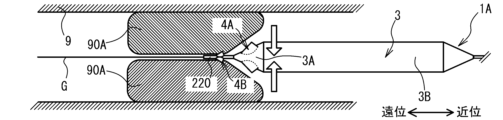
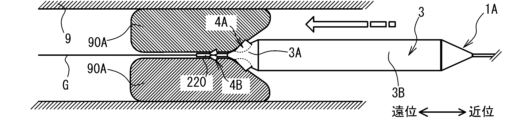
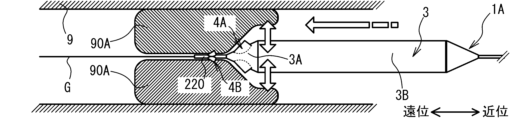
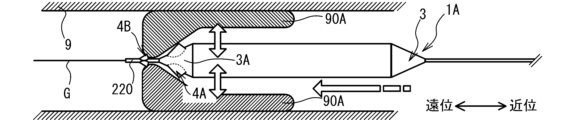
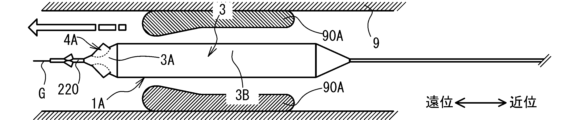
- FIG. 10 is a diagram for explaining a usage example of the balloon catheter 1A;
- FIG. 10 is a diagram for explaining a usage example of the balloon catheter 1A;
- FIG. 10 is a diagram for explaining a usage example of the balloon catheter 1A;
- FIG. 10 is a diagram for explaining a usage example of the balloon catheter 1A;
- FIG. 10 is a diagram for explaining a usage example of the balloon catheter 1A;
- FIG. 10 is a diagram for explaining a usage example of the balloon catheter 1A;
- FIG. 10 is a diagram for explaining a usage example of the balloon catheter 1A;
- FIG. 10 is a diagram for explaining a usage example of the balloon catheter 1A;
- FIG. 10 is a diagram for explaining a usage example of the balloon catheter 1A;
- FIG. 10 is a diagram for explaining a usage example of the balloon catheter 1A;
- FIG. 10 is a diagram for explaining a usage example of the balloon catheter 1A;
- FIG. 10 is a diagram for explaining a usage
- FIG. 10 is a diagram for explaining a usage example of the balloon catheter 1A;
- FIG. 10 is a diagram for explaining a usage example of the balloon catheter 1A;
- FIG. 10 is a diagram for explaining a usage example of the balloon catheter 1A;
- FIG. 10 is a diagram for explaining a usage example of the balloon catheter 1A;
- FIG. 10 is a diagram for explaining a usage example of the balloon catheter 1A;
- FIG. 10 is a diagram for explaining a usage example of the balloon catheter 1A;
- FIG. 10 is a diagram for explaining a usage example of the balloon catheter 1A;
- It is the figure which expanded the vicinity of 3 A of front-end
- It is the figure which expanded the vicinity of 3 A of front-end
- FIG. 2A is a side view of the balloon catheter 1F, and a cross-sectional view taken along the line AA in the direction of the arrow.
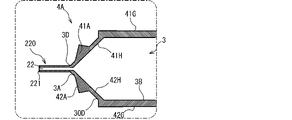
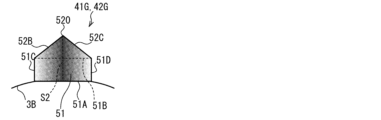
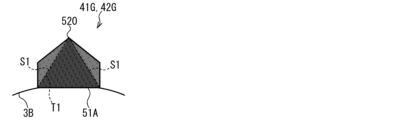
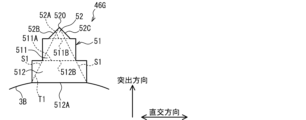
- FIG. 10 is a diagram showing a modified example of the balloon catheter 1F; It is a figure which shows the modification of protrusions 41G and 42G. It is a figure which shows the modification of protrusions 41G and 42G. It is a figure which shows the modification of protrusions 41G and 42G. It is a figure which shows the modification of protrusions 41G and 42G. It is a figure which shows the protrusion 46G.
- Fig. 4 is an enlarged cross-sectional view of the vicinity of the distal end connecting portion 3A of the balloon catheter 1H. It is a sectional view showing cover tube 7B. It is a sectional view showing cover tube 7C. It is a sectional view showing cover tube 7D.
- Embodiments (balloon catheters 1A to 1H) of the balloon catheter 1 according to the present invention will be described with reference to the drawings.
- the referenced drawings are used to explain technical features that the present invention can employ.
- the configuration and the like of the described apparatus are not intended to limit the scope of the present invention, but merely illustrative examples.
- the balloon catheter 1 can dilate a stenotic lesion formed in a blood vessel by means of the balloon 3, and act on the blood vessel with protrusions 4 (protrusions 4A to 4E, 4G, and 4I), which will be described later.
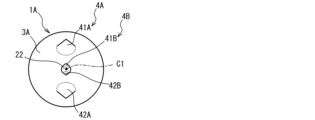
- FIG. A balloon catheter 1A has a catheter shaft 2, a balloon 3, and protrusions 4A and 4B.
- the catheter shaft 2 has a tubular shape.
- a balloon 3 is connected near one end of the catheter shaft 2 .
- a hub (not shown) is connected to the other end of the catheter shaft 2 .
- the hub can supply compressed fluid to the balloon 3 through the catheter shaft 2 .
- a direction extending along the catheter shaft 2 is referred to as an "extending direction”.
- An axis passing through the center of the catheter shaft 2 and extending in the extending direction is referred to as a "central axis C1".
- the cross section taken along a plane orthogonal to the central axis C1 hereinafter simply referred to as “the cross section"
- the side closer to the central axis C1 in the radial direction centering on the central axis C1 is referred to as the "inner side.”
- the side away from the central axis C1 is called the "outside”.
- the catheter shaft 2 has an outer tube 21 and an inner tube 22.
- the outer tube 21 and the inner tube 22 each have flexibility.
- the inner diameter of the outer tube 21 is larger than the outer diameter of the inner tube 22 .
- the inner tube 22 is arranged in the lumen of the outer tube 21 except for a predetermined portion on the distal end side.
- a predetermined portion on the distal end side of the inner tube 22 protrudes toward the distal side from the distal end of the outer tube 21 (hereinafter referred to as “distal portion 211”).
- the distal end of the inner tube 22 (hereinafter referred to as the “distal portion 221 ”) is located closer to the distal side than the distal portion 211 of the outer tube 21 .
- a predetermined portion on the distal end side of the inner tube 22 is hereinafter referred to as a "protruding portion 225".
- a proximal end of the outer tube 21 is referred to as a "proximal portion 212".
- a proximal end of the inner tube 22 is referred to as a "proximal portion 222".
- a hub is connected to at least the proximal end 212 of the outer tube 21 .
- the material of the outer tube 21 and the inner tube 22 is not particularly limited, polyamide-based resin is used as an example.
- a compressed fluid supplied from the hub flows through a space other than the inner tube 22 lumen of the outer tube 21 .
- a guide wire (not shown) is passed through the lumen of the inner tube 22 .
- the balloon 3 can be deformed between a deflated state and an inflated state by changing the internal pressure depending on whether compressed fluid is supplied by a hub (not shown).
- Figure 1 shows the balloon 3 in an inflated state.
- distal end 3D The distal end of the balloon 3 (hereinafter referred to as “distal end 3D") is connected to a portion of the projecting portion 225 of the inner tube 22 that is closer to the proximal side than the distal end 221 by heat welding.
- distal end 3D the portion between the distal end portion 221 and the portion to which the distal end portion 3D of the balloon 3 is connected among the projecting portions 225 of the inner tube 22 is referred to as the "extended distal end portion 220".
- base end 3P The proximal end of the balloon 3 (hereinafter referred to as “base end 3P”) is connected to the vicinity of the distal end 211 of the outer tube 21 by heat welding.
- the distance between the distal end 3D of the balloon 3 and the distal end 221 of the inner tube 22 is shorter than the distance between the proximal end 3P of the balloon 3 and the proximal end 222 of the inner tube 22.
- the balloon 3 covers the projecting portion 225 of the inner tube 22 from the outside.
- the material of the balloon 3 is not particularly limited, polyamide-based resin is used as an example.
- a distal connecting portion 3A, an expanding portion 3B, and a proximal connecting portion 3C are defined.
- the distal connecting portion 3A is a region extending from the distal end portion 3D toward the proximal end portion 3P of the inflated balloon 3 while increasing in diameter.
- the proximal connecting portion 3C is a region extending from the proximal end portion 3P toward the distal end portion 3D of the inflated balloon 3 while increasing in diameter.
- the inflatable portion 3B is a region sandwiched between the distal end connecting portion 3A and the proximal end connecting portion 3C in the inflated balloon 3, and has substantially the same diameter in the extending direction.
- the inflatable portion 3B In the inflated state, the inflatable portion 3B has a tubular shape extending in the extending direction.
- the side close to the distal end portion 221 of the inner tube 22 of the catheter shaft 2, that is, the distal end portion is referred to as a "distal portion 30D".
- the side close to the proximal end portion 222 of the inner tube 22 of the catheter shaft 2, that is, the end portion on the proximal side is referred to as the "base end portion 30P".
- the distal end connecting portion 3A extends toward the distal end portion 3D from the end portion connected to the distal end portion 30D of the expansion portion 3B.
- the diameter of the cross section of the distal end connecting portion 3A is the largest at the end portion connected to the distal end portion 30D of the expansion portion 3B and the smallest at the distal end portion 3D.
- the base end connecting portion 3C extends toward the base end portion 3P from the end portion that is connected to the base end portion 30P of the expansion portion 3B.
- the cross-sectional diameter of the base end connecting portion 3C is the largest at the end portion connected to the base end portion 30P of the expansion portion 3B and the smallest at the base end portion 3P.
- the protruding portion 4A is provided on the outer surface of the distal end connecting portion 3A of the balloon 3 and protrudes outward.
- the protrusion 4A has protrusions 41A and 42A.
- the protrusions 41A and 42A face each other across the central axis C1.
- Projections 41A and 42A each have a conical shape. Apices 410 of the protrusions 41A and 42A protrude outward most in the protrusions 41A and 42A.
- the bottoms of the projecting bodies 41A and 42A are connected to the outer surface of the tip connecting portion 3A of the balloon 3. As shown in FIG. Projections 41A and 42A have the same shape.
- the shortest distance between the bottom surface of each of the protrusions 41A and 41B and the apex 410 corresponds to the amount of protrusion of the protrusion 4A.
- the shape of the projecting portion 4A will be described below using the projecting body 41A as an example.
- a tip portion 415 is a portion of the bottom of the projecting body 41A that is closest to the tip portion 3D of the tip connecting portion 3A.
- a portion of the side surface of the projecting body 41A corresponding to the generatrix connecting the vertex 410 and the tip portion 415 is referred to as a "tip slope portion 411".
- the tapered tip portion 411 extends from the tip portion 415 toward the apex 410 along the side surface of the protrusion 41A.
- a base end portion 416 is a portion of the bottom portion of the projecting body 41A that is closest to the distal end portion 30D of the inflatable portion 3B.
- a portion of the side surface of the projecting body 41A corresponding to the generatrix connecting the vertex 410 and the base end portion 416 is referred to as a "base sloped portion 412".
- the proximal sloped portion 412 extends from the proximal portion 416 toward the apex 410 along the side surface of the protrusion 41A.
- the angle ⁇ 12 of the proximal inclined portion 412 with respect to the distal connecting portion 3A is larger than the angle ⁇ 11 of the distal inclined portion 411 with respect to the distal connecting portion 3A ( ⁇ 11 ⁇ 12).
- a base end portion 416 of each of the projecting bodies 41A and 42A is separated from the distal end portion 30D of the inflatable portion 3B of the balloon 3 toward the distal end side. Therefore, in the distal end connecting portion 3A of the balloon 3, a region W1 in which the projecting portion 4A is not provided between the portion connected to the distal end portion 30D of the inflatable portion 3B and the proximal end portion 416 of the projecting portion 4A in the extending direction. is included.
- the distal end portion 415 of each of the projecting bodies 41A and 42A is spaced apart from the distal end portion 3D of the distal end connecting portion 3A of the balloon 3 toward the proximal side. Therefore, the distal end connecting portion 3A of the balloon 3 includes a region W2 in which the projecting portion 4A is not provided between the distal end portion 3D and the distal end portion 415 of the projecting portion 4A in the extending direction.
- the protruding portion 4B is provided on the outer surface of the distal end extension portion 220 of the inner tube 22 and protrudes outward.
- the protrusion 4B has protrusions 41B and 42B.
- the protrusions 41B and 42B face each other across the central axis C1.
- Each of the protrusions 41B and 42B has a conical shape.
- Apices 420 of the protrusions 41B and 42B project outward most in the protrusions 41B and 42B.
- the bottoms of the protruding bodies 41B and 42B are connected to the outer surface of the tip extending portion 220. As shown in FIG. Projections 41B and 42B have the same shape.
- the projection amount of the projecting portion 4B is smaller than the projecting amount of the projecting portion 4A.
- the shape of the projecting portion 4B will be described below by exemplifying the projecting body 41B.
- a portion of the bottom of the projecting body 41B that is closest to the tip 221 of the inner tube 22 is called a tip 425 .
- a portion of the side surface of the projecting body 41B corresponding to the generatrix connecting the vertex 420 and the tip portion 425 is referred to as a "tip slope portion 421".
- a tip ramp 421 extends along the side of protrusion 41B from tip 425 toward apex 420 .
- a portion of the bottom of the projecting body 41B that is closest to the distal end 3D of the distal connecting portion 3A of the balloon 3 is called a proximal end 426. As shown in FIG.
- a portion of the side surface of the projecting body 41B corresponding to the generatrix connecting the vertex 420 and the base end portion 426 is referred to as a "base end inclined portion 422".
- the proximal sloped portion 422 extends from the proximal portion 426 toward the apex 420 along the side surface of the protrusion 41B.
- the angle ⁇ 22 of the proximal sloped portion 422 with respect to the distal extended portion 220 is larger than the angle ⁇ 21 of the distal sloped portion 421 with respect to the distal extended portion 220 ( ⁇ 21 ⁇ 22).
- a proximal end portion 426 of each of the projecting bodies 41B and 42B is spaced apart from the distal end portion 3D of the distal end connecting portion 3A of the balloon 3 toward the distal end side. For this reason, in the distal end extending portion 220 of the inner tube 22, between the portion where the distal end portion 3D of the distal end connecting portion 3A of the balloon 3 is connected and the proximal end portion 426 of the projecting portion 4B in the extension direction, the projecting portion 4B A region W3 in which is not provided is included.
- a distal end portion 425 of each of the protrusions 41B and 42B is spaced proximally from the distal end portion 221 of the inner tube 22 .
- the distal end extending portion 220 of the inner tube 22 includes a region W4 in which the projecting portion 4B is not provided between the distal end portion 221 and the distal end portion 425 of the projecting portion 4B in the extending direction.
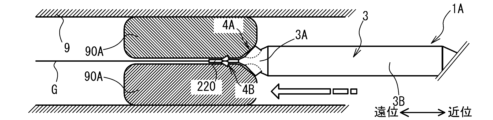
- ⁇ Usage example> A usage example of the balloon catheter 1A will be described. A case in which the balloon catheter 1A is used to dilate a stenotic lesion 90A that has developed in part of the inner wall of a blood vessel 9 is illustrated. The lumen at the stenotic lesion 90A is very narrow, the diameter of the lumen being smaller than the diameter of the balloon 3 in its deflated state.
- a guide wire G is passed through the blood vessel 9 .
- a balloon catheter 1A with a deflated balloon 3 is prepared. As shown in FIG. 3A, a portion of the balloon catheter 1A including at least the balloon 3 is placed inside the blood vessel 9. As shown in FIG. A guide wire G is passed through the inner tube 22 of the balloon catheter 1A.
- the balloon catheter 1A is pushed into the blood vessel 9 along the guide wire G by manipulating the proximal end of the balloon catheter 1A.
- the balloon catheter 1A moves distally in the blood vessel 9 toward the stenotic lesion 90A with the balloon 3 positioned at the head in the moving direction.
- the tip connecting portion 3A of the balloon 3 reaches the vicinity of the proximal end portion of the stenotic lesion 90A.
- FIG. 3(B) only a part of the distal connecting portion 3A on the distal side of the balloon 3 enters the proximal end of the lumen of the stenotic lesion 90A. Thereafter, movement of the balloon catheter 1A toward the distal side is stopped.
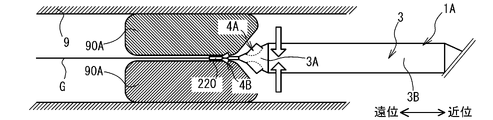
- the supply of compressed fluid to the balloon 3 is started, and the balloon 3 is inflated.
- the protruding portion 4A provided on the distal connecting portion 3A bites into the inner wall of the stenotic lesion 90A.
- the balloon 3 expands the vicinity of the proximal end of the lumen of the stenosed lesion 90A by the distal end connecting portion 3A. Since the tip connecting portion 3A expands in diameter toward the proximal side, a force in the proximal direction acts on the balloon 3 from the stenotic lesion 90A as the balloon 3 changes to the inflated state. .
- the projecting portion 4A bites into the stenotic lesion 90A, movement of the balloon 3 toward the proximal side is suppressed. Furthermore, the protruding portion 4B is caught in the lumen of the stenotic lesion 90A, thereby suppressing the pushback of the balloon 3 toward the proximal side.
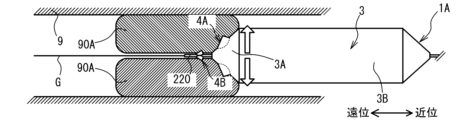
- the supplied compressed fluid is removed from the balloon 3, and the balloon 3 is contracted.
- the balloon catheter 1A is moved distally by manipulating its proximal end.
- the distal connecting portion 3A of the balloon 3 enters from the proximal end portion of the stenosed lesion 90A that is dilated toward a deeper portion of the lumen. After that, movement of the balloon catheter 1A is stopped.
- the supply of compressed fluid to the balloon 3 is started, and the balloon 3 is inflated.
- the protruding portion 4A provided on the distal connecting portion 3A bites into the inner wall of the stenotic lesion 90A.
- the balloon 3 expands a portion of the stenotic lesion 90A on the distal side of the portion expanded in FIGS.
- the balloon 3 expands the portion of the stenotic lesion 90A expanded in FIGS. This causes the balloon 3 to dilate a wider portion of the lumen of the stenosed lesion 90A.
- the projecting portion 4A bites into the stenotic lesion 90A, and the projecting portion 4B is caught in the lumen of the stenotic lesion 90A. Therefore, even if a force directed toward the proximal side acts on the balloon 3 as the balloon 3 changes to the inflated state, movement of the balloon 3 toward the proximal side is suppressed.
- FIG. 4(C), Fig. 4(D), Fig. 4(E) A procedure similar to the above is repeatedly executed (Fig. 4(C), Fig. 4(D), Fig. 4(E)).
- the balloon 3 of the balloon catheter 1A gradually moves distally through the lumen of the stenosed lesion 90A.
- FIGS. 5(A), 5(B), and 5(C) the lumen of the stenotic lesion 90A gradually increases from near the proximal end toward the distal side.
- FIG. 5(D) the entire lumen of the stenotic lesion 90A is dilated by the balloon 3 .
- the proximal end of the balloon catheter 1A is operated, and the balloon catheter 1A moves proximally.
- the treatment is completed by pulling out the balloon catheter 1A from the blood vessel 9 to the outside.
- the balloon catheter 1A can dilate the stenosed lesion 90A with a small lumen by gradually advancing the balloon 3 distally while repeatedly changing between the inflated state and the deflated state.
- the distal end connecting portion 3A of the balloon 3 is provided with the projecting portion 4A
- the distal end extending portion 220 of the inner tube 22 is provided with the projecting portion 4B.
- the protruding portions 4A and 4B prevent the balloon 3 from moving proximally even if the balloon 3 receives a proximally directed force from the stenotic lesion 90A when the balloon 3 is inflated. Therefore, the balloon catheter 1A can appropriately dilate even the stenotic lesion 90A with a small lumen by gradually moving the balloon 3 toward the distal side while repeatedly changing between the inflated state and the deflated state. It becomes possible.
- the tip connecting portion 3A of the balloon 3 includes regions W1 and W2 where the projecting portion 4A is not provided. For this reason, the size of the region of the distal end connecting portion 3A where the projecting portion 4A is provided is smaller than in the case where the projecting portion 4A is provided throughout the extending direction of the distal end connecting portion 3A. Further, the distal extension portion 220 of the inner tube 22 includes regions W3 and W4 where the projecting portion 4B is not provided. Therefore, the size of the region of the distal end extension portion 220 where the projecting portion 4B is provided is smaller than in the case where the projecting portion 4B is provided over the entire area of the distal end extension portion 220 in the extending direction. Therefore, the balloon catheter 1A can improve the passageability of the balloon 3 through the blood vessel 9 as compared with the case where the protruding portions 4A and 4B are provided over the entire distal end connecting portion 3A and the distal extending portion 220.
- the protruding portion 4A provided at the distal end connecting portion 3A of the balloon 3 can bite into the stenotic lesion 90A. can.
- the balloon catheter 1A can dilate the stenosed lesion 90A with a small lumen while gradually advancing the balloon 3, so that the stenosed lesion 90A with a small lumen can be dilated efficiently.
- the angle ⁇ 12 of the proximal inclined portion 412 with respect to the distal connecting portion 3A is larger than the angle ⁇ 11 of the distal inclined portion 411 with respect to the distal connecting portion 3A.
- the balloon catheter 1A can reduce the pushing back of the balloon 3 to the proximal side due to the resistance received from the stenotic lesion 90A in the process of the balloon 3 entering the stenotic lesion 90A.
- the balloon catheter 1A is designed so that the balloon 3 is pushed back proximally when the balloon 3 is repeatedly inflated/deflated to dilate the stenotic lesion 90A in the blood vessel 9. can be suppressed by
- the angle ⁇ 22 of the proximal sloped portion 422 with respect to the distal extended portion 220 is larger than the angle ⁇ 21 of the distal sloped portion 421 with respect to the distal extended portion 220 .
- the balloon catheter 1A can reduce the possibility that the protruding portion 4B is caught on the blood vessel 9 when the balloon 3 is advanced within the blood vessel 9 and the advancement is hindered.
- the shape, number, and arrangement of the protrusions 4A and 4B are not limited to the above embodiment.
- the number of protrusions in each of the protrusions 4A and 4B may be one, or may be three or more.
- the three or more protrusions may be arranged in the circumferential direction around the central axis C1.
- the shape of each protrusion of the protrusions 4A and 4B may be a pyramid, a truncated cone, a truncated pyramid, or the like, or may be a prism.
- one of the side surfaces is connected to the distal connecting portion 3A of the balloon 3, and the remaining two side surfaces are the distal inclined portion 411 and the proximal end.
- a sloped portion 412 may be formed and the intersection of the remaining two sides may form the vertex 410 .
- the protrusions 41B and 42B of the protrusion 4B are shaped like a triangular prism, one of the side surfaces is connected to the tip extending portion 220 of the inner tube 22, and the remaining two side surfaces are the tip inclined portions 421. and a proximal ramp 422 , and the intersection of the remaining two sides may form an apex 420 .
- a plurality of protrusions of the protruding part 4A may be arranged in the extending direction along the tip connecting part 3A of the balloon 3.
- a plurality of protrusions may be arranged along each of a plurality of imaginary lines radially extending from the central axis C1.
- the protrusion amount of each of the plurality of protrusions may not be the same.
- the amount of protrusion of each of the plurality of protrusions may be defined according to the distance from the central axis C1.
- a first connecting portion that connects the protrusions 41A and 41B may be provided.
- a second connection portion may be provided that connects the protrusions 42A and 42B.
- the first connecting portion and the second connecting portion may protrude outward from the outer surface of the distal connecting portion 3A of the balloon 3 and the outer surface of the distal extending portion 220 of the inner tube 22, respectively. That is, the protrusions 41A and 41B and the protrusions 42A and 42B may be integrated to form one protrusion.
- the positions in the extending direction of the base end portions 416 of the projecting bodies 41A and 42A of the projecting portion 4A may coincide with the portions of the distal end connecting portion 3A that are connected to the distal end portion 30D of the expansion portion 3B.
- the positions in the extending direction of the tip portions 415 of the projecting bodies 41A and 42A of the projecting portion 4A may coincide with the tip portion 3D of the tip connecting portion 3A.
- the protruding bodies 41B and 42B of the protruding part 4B may each be provided over a portion of the tip extending part 220 where the tip part 221 of the inner tube 22 and the tip part 3D of the tip connecting part 3A are connected.
- the position of the distal end 425 of each of the protrusions 41B, 42B may coincide with the position of the distal end 221 of the inner tube 22 .
- the proximal end 426 of each of the protrusions 41B, 42B may coincide with the position of the distal end 3D of the distal connecting part 3A.
- the tip extending portion 220 of the inner tube 22 may be provided with the protruding portion 4B over the entire area in the extending direction. In this case, regions W3 and W4 in which the protruding portion 4B is not provided in the extension direction of the tip extending portion 220 of the inner tube 22 may be omitted.
- the balloon catheter 1A may have only one of the protrusions 4A and 4B.
- the balloon catheter 1A may have only the protruding portion 4A and may not have the protruding portion 4B.
- the balloon catheter 1A may have only the projecting portion 4B and not have the projecting portion 4A.
- the angle ⁇ 11 of the distal inclined portion 411 with respect to the distal connecting portion 3A and the angle ⁇ 12 of the proximal inclined portion 412 with respect to the distal connecting portion 3A may be the same. can also be large. Either one of the angles ⁇ 11 and ⁇ 12 may be orthogonal to the tip connecting portion 3A.
- the angle ⁇ 21 of the distal sloped portion 421 with respect to the distal extended portion 220 and the angle ⁇ 22 of the proximal sloped portion 422 with respect to the distal extended portion 220 may be the same, or the angle ⁇ 21 may be larger. It may be larger than ⁇ 22. Either one of the angles ⁇ 21 and ⁇ 22 may be perpendicular to the tip extension portion 220 .
- the regions W1 and W2 of the distal end connecting portion 3A of the balloon 3 may be provided with first projections having a projection amount smaller than that of the projecting portion 4A. Further, the regions W3 and W4 of the distal end extension portion 220 may be provided with second projections having a projection amount smaller than that of the projection portion 4B.
- the ratio of the amount of protrusion of the first protrusion to the amount of protrusion of the protrusion 4A and the ratio of the amount of protrusion of the second protrusion to the amount of protrusion of the protrusion 4B are not particularly limited, but as an example, 50% or less, more preferably 10% or less.
- the first convex portion is the portion of the distal end connecting portion 3A of the balloon 3 that is connected to the distal end portion 30D of the inflatable portion 3B and the distal end portion. It may be provided over the entire area between the part 3D. Also, the amount of protrusion of the first protrusion may be smaller than the amount of protrusion of the protrusion 4B.
- the second projecting portion includes the distal end portion 221 and the portion of the distal end extending portion 220 that connects to the distal end portion 3D of the balloon 3. may be provided over the entire area between Also, the amount of protrusion of the second protrusion may be smaller than the amount of protrusion of the protrusion 4A.
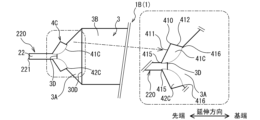
- the balloon catheter 1B will be described with reference to FIG.
- the balloon catheter 1B differs from the balloon catheter 1A in that it does not have the protrusion 4B and has a protrusion 4C instead of the protrusion 4A.
- explanations of the balloon catheter 1B that are the same as those of the balloon catheter 1A will be omitted.
- the protrusion 4C has 41C and 42C having the same shape as the protrusions 41A and 41B of the protrusion 4A.
- the protrusions 41C and 42C are provided on the outer surface of the distal end connecting portion 3A of the balloon 3 at a portion including the distal end portion 3D.
- a portion of the distal end side of each of the projections 41C and 42C is provided on the outer surface of the distal extension portion 220 of the inner tube 22, and a portion of the proximal end of each of the projections 41C and 42C is provided on the balloon.
- 3 is provided on the outer surface of the tip connecting portion 3A.
- each of the projecting bodies 41C and 42C is located on the distal side of the distal end portion 3D of the distal end connecting portion 3A of the balloon 3, and the proximal end portion 416 of each projecting body 41C and 42C is positioned closer to the balloon 3 than the distal end portion 3D of the distal end connecting portion 3A. is positioned closer to the proximal end than the distal end portion 3D of the distal end connecting portion 3A.
- the balloon 3 is inflated with the distal end portion 3D of the balloon 3 entering the stenotic lesion 90A in the blood vessel 9, thereby dilating the stenotic lesion 90A.
- the protrusion 4C can prevent the balloon 3 from being pushed back in the direction opposite to the advancing direction.
- the balloon catheter 1B can be used to clear the stenotic lesion 90A by repeatedly inflating and deflating the balloon 3. Expandable.
- the projecting portion 4A according to the first embodiment may be provided on the tip connecting portion 3A.
- the projecting portion 4B according to the first embodiment may be provided on the tip extending portion 220.
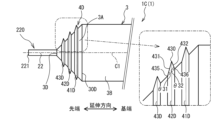
- the balloon catheter 1C will be described with reference to FIG.
- the balloon catheter 1C differs from the balloon catheter 1A in that it does not have the protrusion 4B and has a protrusion 4D instead of the protrusion 4A.
- explanations of the balloon catheter 1C that are the same as those of the balloon catheter 1A will be omitted.
- the protrusion 4D has protrusions 41D, 42D, and 43D.
- the protrusions 41D to 43D are provided on the outer surface of the tip connecting portion 3A of the balloon 3 and protrude outward.
- Each of the protrusions 41D to 43D has an annular shape extending in the circumferential direction around the central axis C1. Projections 41D, 42D, and 43D are arranged in this order toward the tip side.
- the diameters of the protrusions 41D, 42D, and 43D around the central axis C1 are gradually reduced in the order of the protrusions 41D, 42D, and 43D.
- Each of the projecting bodies 41D to 43D has a planar tip inclined portion 431 and a proximal inclined portion 432 extending outward from the outer surface of the tip connecting portion 3A.
- the projecting body 42D will be described as an example.
- a portion of the protruding body 42D that is connected to the tip connecting portion 3A and that is close to the tip portion 3D of the tip connecting portion 3A is referred to as a tip portion 435.
- the distal sloped portion 431 extends from the distal end portion 435 while being inclined toward the proximal side with respect to the radial direction.
- a portion of the protruding body 42D that is connected to the tip connecting portion 3A and that is close to the tip portion 30D of the expansion portion 3B is referred to as a base end portion 436.
- the proximal sloped portion 432 extends from the proximal portion 436 while being inclined toward the distal side with respect to the radial direction.
- the end portion of the distal inclined portion 431 opposite to the distal portion 435 and the end portion of the proximal inclined portion 432 opposite to the proximal portion 436 are connected at a vertex 430 .
- the angle ⁇ 32 of the proximal inclined portion 432 with respect to the distal connecting portion 3A is larger than the angle ⁇ 31 of the distal inclined portion 431 with respect to the distal connecting portion 3A.
- the balloon catheter 1C can allow the projecting portion 4D to bite into the stenotic lesion 90A over a wide range in the circumferential direction of the distal end connecting portion 3A. Therefore, when the balloon 3 is inflated, the balloon catheter 1C can prevent the balloon 3 from moving in the direction opposite to the direction of approach to the stenotic lesion 90A by the projecting portion 4D.
- the number and shape of the protrusions in the protrusion 4D are not limited to those in the above embodiment.
- the apex 430 of each of the projections 41D-43D may be convexly curved outward.
- An annular protrusion extending in the circumferential direction around the central axis C1 may also be provided on the distal extension portion 220 of the inner tube 22 .
- a connecting portion connecting the protrusions 41D to 43D may extend in the extending direction along the outer surface of the tip connecting portion 3A.
- Balloon catheter 1D differs from balloon catheter 1C in that it has projections 4E instead of projections 4D. In the following, explanations of the balloon catheter 1D that are the same as those of the balloon catheter 1C will be omitted.
- the protruding part 4E is provided on the outer surface of the tip connecting part 3A of the balloon 3 and protrudes outward.
- the projecting portion 4E has a spiral shape extending in the circumferential direction around the central axis C1.
- a proximal end portion 447 of the protruding portion 4E is located near the distal end side of the distal end portion 30D of the inflatable portion 3B of the balloon 3 .
- the distal end portion 448 of the projecting portion 4E is located near the proximal side with respect to the distal end portion 3D of the distal connecting portion 3A.
- a portion of the projecting portion 4E that is connected to the tip connecting portion 3A and that is close to the tip portion 3D of the tip connecting portion 3A is referred to as a tip portion 445.
- a planar portion extending from the distal end portion 445 with an inclination toward the proximal side with respect to the radial direction is referred to as a distal inclined portion 441 .
- a portion of the protruding portion 4E that is connected to the distal end connecting portion 3A and that is close to the distal end portion 30D of the expansion portion 3B is referred to as a proximal end portion 446. As shown in FIG.
- a planar portion extending from the proximal end portion 446 to the distal side with respect to the radial direction is referred to as a proximal inclined portion 442 .
- the end portion of the distal inclined portion 441 opposite to the distal portion 445 and the end portion of the proximal inclined portion 442 opposite to the proximal portion 446 are connected at a vertex 440 .
- the angle ⁇ 42 of the proximal inclined portion 442 with respect to the distal connecting portion 3A is larger than the angle ⁇ 41 of the distal inclined portion 441 with respect to the distal connecting portion 3A.
- the balloon catheter 1D allows the projecting portion 4E to act on the stenotic lesion 90A over a wide range in the circumferential direction and extending direction of the distal end connecting portion 3A. Therefore, in the balloon catheter 1D, when the balloon 3 is inflated, the protrusion 4E can prevent the balloon 3 from moving in the direction opposite to the direction of approach to the stenotic lesion 90A.
- the shape of the projecting portion 4E is not limited to the above embodiment.
- the apex 440 of the protrusion 4E may be convexly curved outward.
- a spiral protrusion extending in the circumferential direction around the central axis C1 may also be provided on the distal extension portion 220 of the inner tube 22 .
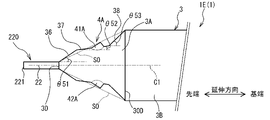
- the balloon catheter 1E will be described with reference to FIG.
- the balloon catheter 1E is different from the balloon catheter 1A in that the tip extending portion 220 is not provided with the projecting portion 4B.
- the shape of the distal end connecting portion 3A of the balloon 3 is different from that of the balloon catheter 1A.
- explanations of the balloon catheter 1E that are the same as those of the balloon catheter 1A will be omitted.
- the tip connecting portion 3A of the balloon 3 has inclined portions 36, 37, and 38.
- the inclined portion 36 extends from the distal end portion 3D of the distal end connecting portion 3A toward the proximal end side while increasing in diameter.
- the inclined portion 37 extends from the end of the inclined portion 36 opposite to the end connected to the distal end portion 3D in the extending direction toward the base end while expanding in diameter.
- the inclined portion 38 extends from the end of the inclined portion 37 opposite to the end connected to the inclined portion 36 in the extending direction toward the base end while increasing in diameter.
- the angle formed between the extending direction and the direction extending from the end portion close to the tip portion 3D toward the end portion close to the tip portion 30D is defined as an inclination angle.
- the inclination angle at the inclined portion 36 is denoted as ⁇ 51
- the inclination angle at the inclined portion 37 is denoted as ⁇ 52
- the inclination angle at the inclined portion 38 is denoted as ⁇ 53.
- the tilt angles ⁇ 51, ⁇ 52, and ⁇ 53 are different from each other.
- the inclination angles ⁇ 51 to ⁇ 53 have a magnitude relation of ⁇ 52 ⁇ 51 ⁇ 53.
- the inclination angle ⁇ 53 is the largest and the inclination angle ⁇ 52 is the smallest.
- protrusions 41A and 42A of the protrusion 4A is the same as that of the balloon catheter 1A.
- Projections 41A and 42A are provided on inclined portion 37, which has the smallest inclination angle ⁇ 52 among inclined portions 36-38.
- a virtual plane S0 connecting the distal end portion 30D of the inflatable portion 3B of the balloon 3 and the distal end portion 3D of the balloon 3 is defined.
- the projecting bodies 41A and 41B are located on the side of the virtual plane S0 that is close to the central axis C1, that is, on the inner side of the virtual plane S0.
- the projecting portion 4A is provided on the inclined portion 37 having a relatively small inclination angle ⁇ 52.
- the projecting portion 4A moves in a direction orthogonal to the inclined portion 37.
- the inclination angle ⁇ 52 is defined as the angle of the inclined portion 37 with respect to the stretching direction, when the inclination angle ⁇ 52 is small, the movement of the projecting portion 4A in the direction perpendicular to the inclined portion 37, that is, when the balloon 3 is inflated. The angle between the direction and the radial direction perpendicular to the draw direction is also reduced.
- the protruding portion 4A moves in a direction that approximates the radial direction. Therefore, in the balloon catheter 1E, when the balloon 3 is inflated, the projecting portion 4A can be properly bitten into the stenotic lesion 90A.
- the shape of the projecting portion 4A provided on the inclined portion 37 is not limited to the above embodiment.
- the protrusion may have the shape (ring) of the protrusion 4D in the third embodiment or the shape (spiral) of the protrusion 4E in the fourth embodiment.
- the inclination angles ⁇ 51 and 53 may be the same.
- the number of inclined portions of the tip connecting portion 3A is not limited to three, and may be two or four or more. When there are three or more inclined portions, protrusions may be provided on a plurality of inclined portions with inclination angles smaller than a predetermined threshold value.
- the protruding portion 4A may protrude outward with respect to the virtual plane S0.
- the balloon catheter 1F will be described with reference to FIG.
- the balloon catheter 1F differs from the balloon catheter 1A in that it has protrusions 4G and 4H in addition to the protrusion 4A and does not have the protrusion 4B.
- the description of the balloon catheter 1F that is the same as that of the balloon catheter 1A will be omitted.
- the protruding part 4G is provided on the outer surface of the inflating part 3B of the balloon 3 and protrudes outward.
- the protrusion 4G has protrusions 41G and 42G.
- the projecting bodies 41G and 42G each extend in the extension direction between the distal end portion 30D and the proximal end portion 30P of the expansion portion 3B.
- the protrusions 41G and 42G face each other about the central axis C1.
- the positions of the protrusions 41A and 41G in the circumferential direction match.
- the positions of the protrusions 42A and 42G in the circumferential direction match.
- the projections 41G and 42G have the same shape. The shape will be described below by taking the projecting body 41G as an example.
- the protrusion 41G has a base portion 51 and a tip portion 52 .
- the base portion 51 has a square prism shape and extends in the extension direction.
- a side surface 51A of the base portion 51 is connected to the outer surface of the inflatable portion 3B of the balloon 3 .
- the tip portion 52 has a triangular prism shape and extends in the extension direction.
- a side surface 52A of the tip portion 52 is connected to a side surface 51B of the base portion 51 that faces the side surface 51A.
- Side surfaces 52B and 52C other than the side surface 52A of the distal end portion 52 are connected at a vertex 520 .
- the distance between the side surfaces 51A and 52B of the base portion 51 and the distance between the side surface 52A of the tip portion 52 and the vertex 520 are equal.
- both end portions 510 of the side surface 51A are defined in the direction orthogonal to the extending direction. Also, two imaginary virtual line segments S1 connecting each of the end portions 510 and the vertex 520 are defined. In this case, a part of each of the base portion 51 and the tip portion 52 of the projecting body 41G is a virtual triangle defined by two virtual line segments S1 and the side surface 51A (hereinafter referred to as "virtual triangle T1"). placed outside of the
- the protruding part 4H is provided on the inner surface of the tip connecting part 3A of the balloon 3 and protrudes inward.
- the protrusion 4H has protrusions 41H and 42H.
- the projecting body 41H extends between the distal end of the projecting body 41G and the projecting body 41A.
- the projecting body 42H extends between the distal end of the projecting body 42G and the projecting body 42A.
- the projecting portion 4H is interposed between the projecting portions 4A and 4G and connects the projecting portions 4A and 4G inside the balloon 3 .
- the rigidity of the portion of the balloon 3 provided with the protruding portion 4H and the rigidity of the portion of the balloon 3 provided with the protruding portion 4A can be made equal. Therefore, when the balloon 3 is inflated, the projecting portion 4H can prevent the projecting portion 4A from being pushed back in the direction toward the central axis C1 due to stress from the stenotic lesion 90A.
- the protruding portion 4H protrudes inward from the inner surface of the tip connecting portion 3A of the balloon 3 and does not protrude outward from the outer surface. Therefore, the balloon catheter 1F can suppress deterioration in the passageability of the balloon 3 due to the provision of the projecting portion 4H.
- the protruding portions 4H can appropriately form wings in the deflated balloon 3, so that the diameter of the deflated balloon 3 can be reduced.
- a third protrusion projecting outward may be provided on the outer surface of the portion where the protruding portion 4H is provided on the inner surface.
- the protrusion amount of the third protrusion is smaller than the protrusion amount of the protrusion 4A.
- the ratio of the amount of protrusion of the third protrusion to the amount of protrusion of the protrusion 4A is not particularly limited, but is, for example, 50% or less, more preferably 10% or less.
- the projecting portion 4H may further extend between the distal end of the projecting portion 4G and the distal end portion 3D of the balloon 3.
- the projecting portion 4H may be provided between the distal end portion of the projecting portion 4G on the inner surface of the distal end connecting portion 3A of the balloon 3 and the distal end portion 3D of the balloon 3 .
- the protruding part 4G may be provided on the inner surface of the expansion part 3B of the balloon 3 and protrude inward.
- the projecting portion 4G may be annularly formed along the circumferential direction about the central axis C1. In this case, the projecting portion 4G may be formed only in the vicinity of the distal end portion 30D of the inflatable portion 3B of the balloon 3.
- the projecting portion 4H may be provided on the entire inner surface of the distal end connecting portion 3A of the balloon 3 on the proximal end side relative to the projecting portion 4A in the extending direction.
- the hardness of each of the projecting bodies 41G and 42G of the projecting portion 4G may be uniform over the entire area or may be different for each portion.
- the hardness of each of the protrusions 41G and 42G may gradually increase from the side surface 51A toward the vertex 520.
- the projections 41G and 42G, especially near the apex 520 can be prevented from collapsing even when an external force is applied, so that the projection 4G can be properly bitten into the stenotic lesion 90A when the balloon 3 is inflated.
- flexibility can be maintained in the vicinity of the portions of the projecting bodies 41G and 42G that are connected to the balloon 3 . Therefore, when the balloon 3 passes through the blood vessel 9, it is possible to reduce the possibility that the projecting portion 4G is caught on the inner wall and the passageability is lowered.
- a virtual center S2 which is a virtual line segment passing through the vertex 520 and extending in the radial direction, is defined for the protrusions 41G and 42G.
- Sides 51C and 51D excluding sides 51A and 51B are defined for the respective base portions 51 of the protrusions 41G and 42G.
- the hardness of each of the protrusions 41G and 42G may gradually increase from each of the side surfaces 51C, 51D, 52B and 51C toward the virtual center S2.
- the hardness of the portions arranged inside the imaginary triangle T1 is the same as that arranged outside the imaginary triangle T1. It may be higher than the hardness of the part.
- the protruding portion 4G is stably arranged with respect to the outer surface of the balloon 3, and is unlikely to fall even when an external force acts. Therefore, when the balloon 3 is inflated, the projecting portion 4G can be properly bitten into the stenotic lesion 90A.
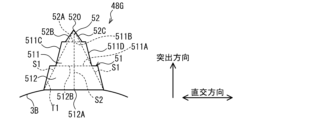
- the shape of the projecting portion 4G is not limited to the above embodiment. Modifications (projections 46G (see FIG. 13A), 47G (see FIG. 13B), and 48G (see FIG. 13C)) relating to the shapes of the protrusions 41G and 42G of the protrusion 4G will be described. .
- the direction extending radially from the central axis C1 of the balloon 3 through the apex 520 will be referred to as the "projection direction”.
- a direction perpendicular to the extending direction and perpendicular to the projecting direction is referred to as a “perpendicular direction”.
- a projecting body 46G shown in FIG. 13(A) has base elements 511 and 512 as a base portion 51 .
- Each of the base elements 511, 512 has the shape of a quadrangular prism and extends in the extension direction.
- Side 512A of base element 512 connects to inflation portion 3B of balloon 3 .
- Side 511A of base element 511 connects to side 512B of base element 512 opposite side 512A.
- a side surface 52A of the distal end portion 52 is connected to a side surface 511B of the base element 511 that faces the side surface 511A.
- the length of the foundation element 511 in the orthogonal direction is shorter than the length of the foundation element 512 in the orthogonal direction.
- the length of the side surface 52A of the tip portion 52 is shorter than the length of the base element 511 in the orthogonal direction.
- a portion including both ends of the base elements 511, 512 and the tip portion 52 in the orthogonal direction is arranged outside the imaginary triangle T1.
- the length of the base portion 51 in the projecting direction is longer than the length of the tip portion 52 in the projecting direction.
- the projecting body 46G can stably support the distal end portion 52 with the base portion 51. Therefore, when the balloon 3 is inflated, the projecting body 46G can appropriately bite the distal end portion 52 of the projecting body 46G into the stenotic lesion 90A.
- a projecting body 47G shown in FIG. 13(B) differs from the projecting body 46G (see FIG. 13(A)) in the shape of the base element 512 .
- the shape of the base element 512 is a prism with a trapezoidal cross section.
- Side 512B of base element 512 is shorter than side 512A. Note that side 512B is longer than side 511A of base element 511 .
- side surfaces 512C and 512D excluding side surfaces 512A and 512B are defined.
- the direction extending from the side surface 512A side to the side surface 512B side along the side surfaces 512C and 512D is inclined in a direction that passes through the vertex 520 and approaches the imaginary center S2.
- a part including both ends in the orthogonal direction of the base elements 511, 512 and the tip 52 are arranged outside the imaginary triangle T1.
- a projecting body 48G shown in FIG. 13(C) differs from the projecting body 47G (see FIG. 13(B)) in the shape of the base element 511 .
- the shape of the base element 511 is a prism with a trapezoidal cross section.
- Side 511B of base element 511 is shorter than side 511A. Note that the side surface 511B is longer than the side surface 52A of the distal end portion 52 .
- side surfaces 511C and 511D excluding side surfaces 511A and 511B are defined.
- the direction extending from the side surface 511A side to the side surface 511B side along the side surfaces 511C and 511D inclines toward the imaginary center S2 passing through the vertex 520 .
- a portion including both ends of the base elements 511, 512 and the tip portion 52 in the orthogonal direction is arranged outside the imaginary triangle T1.
- the base portion 51 can support the tip portion 52 more stably. Therefore, when the balloon 3 is inflated, the projecting bodies 47G and 48G can appropriately act on the stenotic lesion 90A with the respective distal end portions 52 thereof.
- the protrusions 47G and 48G can reduce the steps of the side surfaces in the orthogonal direction, the protrusions 47G and 48G are less likely to fall even if the amount of protrusion of the protrusions 47G and 48G is increased. Therefore, by increasing the amount of protrusion of the protrusions 47G and 48G, the protrusions 47G and 48G can be properly bitten into the stenotic lesion 90A when the balloon 3 is inflated.
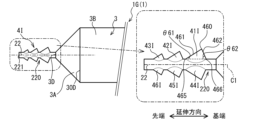
- the balloon catheter 1G will be described with reference to FIG.
- the balloon catheter 1G differs from the balloon catheter 1A in that it does not have the protrusion 4A and has a protrusion 4I instead of the protrusion 4B.
- the description of the balloon catheter 1G that is the same as that of the balloon catheter 1A will be omitted.
- the protrusion 4I has protrusions 41I, 42I, 43I, 44I, 45I, and 46I.
- the protrusions 41I to 46I are provided on the outer surface of the distal extension portion 220 of the inner tube 22 and protrude outward.
- Projections 41I, 42I, and 43I are arranged along the stretching direction.
- the positions of the protrusions 41I, 42I, and 43I in the circumferential direction match.
- the protrusions 44I, 45I, 46I are arranged along the extending direction.
- the positions of the protrusions 44I, 45I, and 46I in the circumferential direction match.
- Projections 41I and 44I are close to tip 30D of balloon 3 .
- Protrusions 43I, 46I are proximate distal end 221 of inner tube 22 .
- the protrusions 41I and 44I face each other about the central axis C1.
- the protrusions 42I and 45I face each other about the central axis C1.
- the protrusions 41I and 44I face each other about the central axis C1.
- the shapes of the protrusions 41I to 46I and the shapes of the protrusions 41B and 42B of the protrusion 4B of the balloon catheter 1A are similar.
- the distal end portion 465, the proximal end portion 466, the distal sloped portion 461, the proximal sloped portion 462, the apex 460, and the angles ⁇ 61 and ⁇ 62 of each of the protrusions 41I to 46I are the same as those of the protrusions 41B and 42B of the protrusion 4B.
- the angle ⁇ 62 of the proximal sloped portion 462 with respect to the distal extended portion 220 is larger than the angle ⁇ 61 of the distal sloped portion 461 with respect to the distal extended portion 220 .
- the protrusions 41I, 42I, and 43I differ from each other in the distance from the tip extension portion 220 to the vertex 460, that is, the amount of protrusion.
- the protrusion 43I closest to the distal end portion 221 of the inner tube 22 has the smallest protrusion amount
- the protrusion 41I closest to the distal end portion 3D of the balloon 3 has the largest protrusion amount.
- the amount of protrusion of each of the protrusions 41I, 42I, and 43I increases as it approaches the distal end portion 3D of the balloon 3 .
- the protrusions 44I, 45I, and 46I differ from each other in the amount of protrusion.
- the protrusion 46I closest to the distal end portion 221 of the inner tube 22 has the smallest protrusion amount
- the protrusion 44I closest to the distal end portion 3D of the balloon 3 has the largest protrusion amount.
- the amount of protrusion of each of the protrusions 44I, 45I, and 46I increases as it approaches the distal end portion 3D of the balloon 3 .
- the balloon catheter 1G it is possible to suppress the resistance force that the projecting portion 4I receives from the stenotic lesion 90A in the process of advancing the distal end extending portion 220 of the inner tube 22 through the lumen of the stenotic lesion 90A. Therefore, the balloon catheter 1G can reduce the pushing back of the balloon 3 due to the resistance force that the projecting portion 4I receives from the stenotic lesion 90A.
- the balloon catheter 1G has protrusions 41I to 43I and 44I to 46I aligned in the extending direction. For this reason, compared to the balloon catheter 1A having only the protrusions 41A and 41B, when the distal end extending portion 220 of the inner tube 22 is advanced through the lumen of the stenotic lesion 90A, resistance is received from the stenotic lesion 90A. Hard to push back. Therefore, the balloon catheter 1G can more efficiently perform the operation of gradually advancing the balloon 3 distally while repeatedly changing between the inflated state and the deflated state.
- the protrusions 41I to 46I may have the same amount of protrusion.
- the protrusions 42I, 43I, 45I and 46I may have the same protrusion amount, and the protrusions 41I and 44I may have a smaller protrusion amount than the protrusions 42I, 43I, 45I and 46I.
- the positions of the protrusions 41I to 43I in the circumferential direction may be different.
- the circumferential position of each of the projections 44I-46I may be different.
- the balloon catheter 1G may have a projecting portion 4A at the tip connecting portion 3A of the balloon 3. FIG.
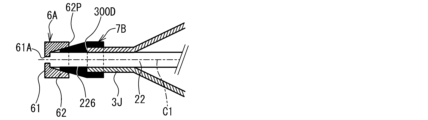
- the balloon catheter 1H will be described with reference to FIG.
- the balloon catheter 1H is a balloon catheter in that the balloon 3 has a distal joint portion 3J, has only a projection 4A and does not have a projection 4B, and further has a distal tip 6A and a cover tube 7A. 1A (see FIG. 1). In the following, the description of the balloon catheter 1H that is the same as that of the balloon catheter 1A will be omitted.
- the balloon 3 of the balloon catheter 1H has a tip joint portion 3J extending from the tip portion 3D of the tip connecting portion 3A toward the tip side.
- the tip joint portion 3J extends along the outer surface of the inner tube 22 and is joined to the inner tube 22. As shown in FIG.
- the tip-side end portion of the tip joint portion 3J is referred to as a "tip portion 300D".
- a distal tip 6A is provided at the distal end portion 221 of the inner tube 22 .
- the distal tip 6A is made of flexible resin. The distal tip 6A prevents the blood vessel 9 from being damaged when the distal end portion 221 of the inner tube 22 collides with the inner wall of the blood vessel 9.
- the distal tip 6A has a covering portion 61 and an extending portion 62.
- the covering portion 61 covers the distal end portion 221 of the inner tube 22 from the distal end side.
- the covering portion 61 is provided with a through hole 61A for passing a guide wire inserted through the inner tube 22 .
- the diameter of the through hole 61A is smaller than the diameter of the lumen of the inner tube 22 .
- the extending portion 62 extends from the outer end portion of the covering portion 61 toward the proximal side along the outer surface of the inner tube 22 .
- a proximal end portion of the extended portion 62 (hereinafter referred to as a “proximal end portion 62P”) is separated from the distal end portion 300D of the distal joint portion 3J of the balloon 3 toward the distal end side.
- a portion of the inner tube 22 on the proximal side of the proximal end portion 62P and on the distal side of the distal end portion 300D in the extending direction is not covered by the distal tip 6A and the distal joint portion 3J.
- the portion of the inner tube 22 that is not covered by the distal tip 6A and the distal joint portion 3J is referred to as an "exposed portion 226".
- the cover tube 7A has a cylindrical shape.
- the cover tube 7A covers a portion near the base end 62P of the extended portion 62 of the distal tip 6A, a portion near the distal end 300D of the distal joining portion 3J of the balloon 3, and the exposed portion 226 of the inner tube 22 on the outside. cover from The hardness of the cover tube 7A is uniform.
- the cover tube 7A, distal tip 6A, and balloon 3 are melted by heat.
- the balloon catheter 1H is heated in the vicinity of its distal end in the state shown in FIG.
- the cover tube 7A, the portion near the base end 62P of the extended portion 62 of the distal tip 6A, and the portion near the distal end 300D of the distal joining portion 3J of the balloon 3 are melted and welded to each other. Therefore, in FIG. 15, the cover tube 7A and the portion near the base end 62P of the extended portion 62 of the distal tip 6A, and the step near the distal end 300D of the distal joining portion 3J of the balloon 3 are shown. is eliminated when the cover tube 7A melted by heating enters the stepped portion.
- FIGS. 16(A), 16(B), and 16(C) which will be described later.
- the hardness of the portion of the balloon catheter 1H on the distal end side of the distal end portion 3D of the balloon 3 is the region W6 on the distal side of the proximal end portion 62P in the extending direction, the proximal end portion 62P and the distal end portion 300D, and a region W8 on the proximal side of the distal end portion 300D.
- the hardness of the region W7 is softer than the hardness of the regions W6 and W8.
- the inner tube 22 and the distal tip 6A are arranged in the region W6, and the inner tube 22 and the distal joint portion 3J are arranged in the region W8, whereas only the inner tube 22 is arranged in the region W7. It is for the sake of being.
- a cover tube 7A is provided at a position overlapping the region W7.
- the hardness of the region W7 is higher than that of the region W6, and the hardness of the region W8 is higher than that of the region W7 (hardness of the region W6 ⁇ hardness of the region W7 ⁇ region W8 hardness). Since the hardness of the region W7 is increased by the cover tube 7A, the difference in hardness between the regions W6 and W8 and the region W7 can be reduced. Therefore, the balloon catheter 1H can improve the trackability of the tip portion to the guide wire.
- the cover tube 7B shown in FIG. 16A is different from the cover tube 7A in that the diameter of a part of the outer surface expands toward the proximal side, and the tip end of the cover tube 7B is This is the point located inside the extended portion 62 of the distal tip 6A.
- the proximal end of the cover tube 7B is located outside the distal joint portion 3J of the balloon 3, and covers the portion near the distal end portion 300D of the distal joint portion 3J from the outside.
- the cover tube 7C shown in FIG. 16B differs from the cover tube 7A in that the distal end of the cover tube 7C is located inside the extended portion 62 of the distal tip 6A, and that the cover tube The point is that the proximal end of 7C is positioned inside the distal joint 3J. In this case, the cover tube 7C extends in the extending direction along the outer surface of the inner tube 22 over the entire area.
- the difference between the cover tube 7D shown in FIG. 16(C) and the cover tube 7A is that the hardness is not uniform.
- the hardness of the cover tube 7D is higher in the portion corresponding to the region W7 than in the portions corresponding to the regions W6 and W8.
- the cover tube 7D may be formed of different materials in the regions W6 to W8 having different hardnesses.
- the hardness of portions of the cover tube 7D made of a common material corresponding to the regions W6 to W8 may be adjusted by differentiating physical properties.
- Additives may be added to the cover tubes 7A to 7D to improve slidability.
- the base ends 212 and 222 are examples of the "first base end” of the present invention.
- the tip portion 221 is an example of the “first tip portion” of the present invention.
- the tip portion 30D is an example of the “second tip portion” of the present invention.
- the tip 3D is an example of the “third tip” of the present invention.
- the protrusions 4A, 4C to 4E are examples of the "first protrusion” of the present invention.
- the projecting portions 4B and 4I are examples of the "second projecting portion” of the present invention.
- Vertex 410 is an example of the "first vertex” of the present invention.
- the sloped tip portion 411 is an example of the "first sloped tip portion” of the present invention.
- the proximal sloped portion 412 is an example of the "first proximal sloped portion” of the present invention.
- the protrusion 4G is an example of the “third protrusion” of the present invention.
- the projecting portion 4H is an example of the “inner projecting portion” of the present invention.
- Vertex 420 is an example of the “second vertex” of the present invention.
- the sloped tip portion 421 is an example of the “second sloped tip portion” of the present invention.
- the proximal sloped portion 422 is an example of the "second proximal sloped portion" of the present invention.
Landscapes
- Health & Medical Sciences (AREA)
- Life Sciences & Earth Sciences (AREA)
- Heart & Thoracic Surgery (AREA)
- Animal Behavior & Ethology (AREA)
- Veterinary Medicine (AREA)
- Public Health (AREA)
- General Health & Medical Sciences (AREA)
- Engineering & Computer Science (AREA)
- Biomedical Technology (AREA)
- Child & Adolescent Psychology (AREA)
- Biophysics (AREA)
- Pulmonology (AREA)
- Anesthesiology (AREA)
- Hematology (AREA)
- Surgery (AREA)
- Vascular Medicine (AREA)
- Molecular Biology (AREA)
- Medical Informatics (AREA)
- Nuclear Medicine, Radiotherapy & Molecular Imaging (AREA)
- Orthopedic Medicine & Surgery (AREA)
- Media Introduction/Drainage Providing Device (AREA)
Priority Applications (7)
| Application Number | Priority Date | Filing Date | Title |
|---|---|---|---|
| CA3228244A CA3228244A1 (en) | 2021-08-31 | 2022-07-25 | Balloon catheter |
| EP22864110.6A EP4397348A4 (en) | 2021-08-31 | 2022-07-25 | BALLOON CATHETER |
| AU2022338382A AU2022338382B2 (en) | 2021-08-31 | 2022-07-25 | Balloon catheter |
| JP2023545159A JP7610016B2 (ja) | 2021-08-31 | 2022-07-25 | バルーンカテーテル |
| KR1020247005686A KR20240037301A (ko) | 2021-08-31 | 2022-07-25 | 벌룬 카테터 |
| CN202280021617.4A CN116981494B (zh) | 2021-08-31 | 2022-07-25 | 球囊导管 |
| US18/441,720 US20240181226A1 (en) | 2021-08-31 | 2024-02-14 | Balloon catheter |
Applications Claiming Priority (2)
| Application Number | Priority Date | Filing Date | Title |
|---|---|---|---|
| JP2021-140754 | 2021-08-31 | ||
| JP2021140754 | 2021-08-31 |
Related Child Applications (1)
| Application Number | Title | Priority Date | Filing Date |
|---|---|---|---|
| US18/441,720 Continuation US20240181226A1 (en) | 2021-08-31 | 2024-02-14 | Balloon catheter |
Publications (1)
| Publication Number | Publication Date |
|---|---|
| WO2023032522A1 true WO2023032522A1 (ja) | 2023-03-09 |
Family
ID=85412155
Family Applications (1)
| Application Number | Title | Priority Date | Filing Date |
|---|---|---|---|
| PCT/JP2022/028567 Ceased WO2023032522A1 (ja) | 2021-08-31 | 2022-07-25 | バルーンカテーテル |
Country Status (8)
| Country | Link |
|---|---|
| US (1) | US20240181226A1 (https=) |
| EP (1) | EP4397348A4 (https=) |
| JP (1) | JP7610016B2 (https=) |
| KR (1) | KR20240037301A (https=) |
| CN (1) | CN116981494B (https=) |
| AU (1) | AU2022338382B2 (https=) |
| CA (1) | CA3228244A1 (https=) |
| WO (1) | WO2023032522A1 (https=) |
Cited By (1)
| Publication number | Priority date | Publication date | Assignee | Title |
|---|---|---|---|---|
| WO2025216010A1 (ja) * | 2024-04-11 | 2025-10-16 | 株式会社グッドマン | バルーンカテーテル |
Citations (7)
| Publication number | Priority date | Publication date | Assignee | Title |
|---|---|---|---|---|
| US20080132836A1 (en) * | 2006-11-03 | 2008-06-05 | Cook Incorporated | Balloon catheter having improved balloon folding capability |
| JP2017123928A (ja) * | 2016-01-12 | 2017-07-20 | テルモ株式会社 | 医療用長尺体 |
| JP2020000677A (ja) * | 2018-06-29 | 2020-01-09 | 日本ゼオン株式会社 | 内視鏡用バルーンカテーテル |
| WO2020012851A1 (ja) * | 2018-07-09 | 2020-01-16 | 株式会社グッドマン | バルーンカテーテル |
| WO2020012850A1 (ja) | 2018-07-09 | 2020-01-16 | 株式会社グッドマン | バルーンカテーテル |
| JP2020110419A (ja) * | 2019-01-15 | 2020-07-27 | テルモ株式会社 | バルーンカテーテル |
| WO2022102766A1 (ja) * | 2020-11-16 | 2022-05-19 | 株式会社カネカ | バルーンカテーテル用バルーン |
Family Cites Families (16)
| Publication number | Priority date | Publication date | Assignee | Title |
|---|---|---|---|---|
| US5324260A (en) * | 1992-04-27 | 1994-06-28 | Minnesota Mining And Manufacturing Company | Retrograde coronary sinus catheter |
| JPH08257139A (ja) * | 1995-03-28 | 1996-10-08 | Nippon Zeon Co Ltd | バルーンカテーテル |
| US6027510A (en) * | 1997-12-08 | 2000-02-22 | Inflow Dynamics Inc. | Stent delivery system |
| EP1292444B1 (en) * | 1999-11-24 | 2006-05-03 | Pierce Chemical Company | Pelletized chromatography media |
| US7306616B2 (en) * | 2003-05-05 | 2007-12-11 | Boston Scientific Scimed, Inc. | Balloon catheter and method of making same |
| US20060182873A1 (en) * | 2005-02-17 | 2006-08-17 | Klisch Leo M | Medical devices |
| EP2566562A1 (en) * | 2010-05-07 | 2013-03-13 | Cook Medical Technologies LLC | Balloon with integral segmented dilation elements |
| US9005163B2 (en) * | 2010-08-03 | 2015-04-14 | Bayer Pharma Aktiengesellschaft | Balloon catheter with external delivery tube |
| JP6442229B2 (ja) * | 2014-10-30 | 2018-12-19 | 株式会社グッドマン | バルーンカテーテル |
| ES2802244T3 (es) * | 2015-04-10 | 2021-01-18 | Goodman Co Ltd | Catéter balón |
| KR20180030674A (ko) * | 2015-08-27 | 2018-03-23 | 가부시키가이샤 굿맨 | 카테터용 벌룬, 벌룬 카테터 및 성형 금형 |
| US10470905B2 (en) * | 2016-03-25 | 2019-11-12 | Ostial Corporation | Balloon catheters and methods for use |
| JP2018153452A (ja) * | 2017-03-17 | 2018-10-04 | テルモ株式会社 | バルーンカテーテルおよびバルーンカテーテルを使用した生体管腔の病変部位の治療方法 |
| JP2021036924A (ja) * | 2017-12-27 | 2021-03-11 | テルモ株式会社 | バルーンカテーテル |
| CN109363808B (zh) * | 2018-08-21 | 2020-09-08 | 陈绍良 | 一种扩张导管用球囊 |
| CN210963508U (zh) * | 2019-07-04 | 2020-07-10 | 江西三鑫医疗科技股份有限公司 | 一种带螺纹筋的球囊扩张导管 |
-
2022
- 2022-07-25 CA CA3228244A patent/CA3228244A1/en active Pending
- 2022-07-25 KR KR1020247005686A patent/KR20240037301A/ko active Pending
- 2022-07-25 JP JP2023545159A patent/JP7610016B2/ja active Active
- 2022-07-25 CN CN202280021617.4A patent/CN116981494B/zh active Active
- 2022-07-25 AU AU2022338382A patent/AU2022338382B2/en active Active
- 2022-07-25 WO PCT/JP2022/028567 patent/WO2023032522A1/ja not_active Ceased
- 2022-07-25 EP EP22864110.6A patent/EP4397348A4/en active Pending
-
2024
- 2024-02-14 US US18/441,720 patent/US20240181226A1/en active Pending
Patent Citations (7)
| Publication number | Priority date | Publication date | Assignee | Title |
|---|---|---|---|---|
| US20080132836A1 (en) * | 2006-11-03 | 2008-06-05 | Cook Incorporated | Balloon catheter having improved balloon folding capability |
| JP2017123928A (ja) * | 2016-01-12 | 2017-07-20 | テルモ株式会社 | 医療用長尺体 |
| JP2020000677A (ja) * | 2018-06-29 | 2020-01-09 | 日本ゼオン株式会社 | 内視鏡用バルーンカテーテル |
| WO2020012851A1 (ja) * | 2018-07-09 | 2020-01-16 | 株式会社グッドマン | バルーンカテーテル |
| WO2020012850A1 (ja) | 2018-07-09 | 2020-01-16 | 株式会社グッドマン | バルーンカテーテル |
| JP2020110419A (ja) * | 2019-01-15 | 2020-07-27 | テルモ株式会社 | バルーンカテーテル |
| WO2022102766A1 (ja) * | 2020-11-16 | 2022-05-19 | 株式会社カネカ | バルーンカテーテル用バルーン |
Non-Patent Citations (1)
| Title |
|---|
| See also references of EP4397348A4 |
Cited By (1)
| Publication number | Priority date | Publication date | Assignee | Title |
|---|---|---|---|---|
| WO2025216010A1 (ja) * | 2024-04-11 | 2025-10-16 | 株式会社グッドマン | バルーンカテーテル |
Also Published As
| Publication number | Publication date |
|---|---|
| US20240181226A1 (en) | 2024-06-06 |
| JP7610016B2 (ja) | 2025-01-07 |
| CN116981494B (zh) | 2026-04-14 |
| JPWO2023032522A1 (https=) | 2023-03-09 |
| AU2022338382A1 (en) | 2024-03-14 |
| CA3228244A1 (en) | 2023-03-09 |
| AU2022338382B2 (en) | 2025-10-16 |
| EP4397348A1 (en) | 2024-07-10 |
| EP4397348A4 (en) | 2025-08-13 |
| CN116981494A (zh) | 2023-10-31 |
| KR20240037301A (ko) | 2024-03-21 |
Similar Documents
| Publication | Publication Date | Title |
|---|---|---|
| JP6975857B2 (ja) | バルーンカテーテル | |
| JP6975858B2 (ja) | バルーンカテーテル | |
| US12023456B2 (en) | Balloon catheter | |
| JP7359853B2 (ja) | バルーンカテーテル | |
| US7857786B2 (en) | Balloon catheter having improved balloon folding capability | |
| JPH01501042A (ja) | 拡大可能なバルーンを有する膨張カテーテル | |
| US7879005B2 (en) | Device and method for collapsing an angioplasty balloon | |
| WO2023032522A1 (ja) | バルーンカテーテル | |
| JP7547634B2 (ja) | バルーンカテーテル | |
| WO2022137764A1 (ja) | バルーンカテーテル用バルーン | |
| JPWO2019107206A1 (ja) | バルーンカテーテルおよびその製造方法 | |
| CN116744998B (en) | Balloon for balloon catheter | |
| JP7606053B2 (ja) | バルーンカテーテル | |
| CN117042831B (zh) | 导管用球囊 | |
| WO2025216010A1 (ja) | バルーンカテーテル | |
| WO2024116711A1 (ja) | バルーンカテーテル及びバルーンカテーテルの製造方法 | |
| JP2025176718A (ja) | バルーンカテーテル | |
| WO2022137763A1 (ja) | バルーンカテーテル用バルーン | |
| HK40043640B (zh) | 球囊导管 | |
| JP2018068529A (ja) | バルーンカテーテル | |
| JP2024501177A5 (https=) | ||
| CN119867879A (zh) | 一种心脑血管护理用介入导管组件 |
Legal Events
| Date | Code | Title | Description |
|---|---|---|---|
| 121 | Ep: the epo has been informed by wipo that ep was designated in this application |
Ref document number: 22864110 Country of ref document: EP Kind code of ref document: A1 |
|
| WWE | Wipo information: entry into national phase |
Ref document number: 202280021617.4 Country of ref document: CN |
|
| WWE | Wipo information: entry into national phase |
Ref document number: 2023545159 Country of ref document: JP |
|
| WWE | Wipo information: entry into national phase |
Ref document number: 3228244 Country of ref document: CA |
|
| ENP | Entry into the national phase |
Ref document number: 20247005686 Country of ref document: KR Kind code of ref document: A |
|
| WWE | Wipo information: entry into national phase |
Ref document number: 1020247005686 Country of ref document: KR |
|
| WWE | Wipo information: entry into national phase |
Ref document number: 2022338382 Country of ref document: AU Ref document number: AU2022338382 Country of ref document: AU |
|
| REG | Reference to national code |
Ref country code: BR Ref legal event code: B01A Ref document number: 112024002860 Country of ref document: BR |
|
| WWE | Wipo information: entry into national phase |
Ref document number: 202417015292 Country of ref document: IN |
|
| ENP | Entry into the national phase |
Ref document number: 2022338382 Country of ref document: AU Date of ref document: 20220725 Kind code of ref document: A |
|
| WWE | Wipo information: entry into national phase |
Ref document number: 2022864110 Country of ref document: EP |
|
| NENP | Non-entry into the national phase |
Ref country code: DE |
|
| ENP | Entry into the national phase |
Ref document number: 2022864110 Country of ref document: EP Effective date: 20240402 |
|
| ENP | Entry into the national phase |
Ref document number: 112024002860 Country of ref document: BR Kind code of ref document: A2 Effective date: 20240214 |