WO2023008167A1 - インクジェット記録装置 - Google Patents
インクジェット記録装置 Download PDFInfo
- Publication number
- WO2023008167A1 WO2023008167A1 PCT/JP2022/027300 JP2022027300W WO2023008167A1 WO 2023008167 A1 WO2023008167 A1 WO 2023008167A1 JP 2022027300 W JP2022027300 W JP 2022027300W WO 2023008167 A1 WO2023008167 A1 WO 2023008167A1
- Authority
- WO
- WIPO (PCT)
- Prior art keywords
- container
- ink
- head
- wiper
- liquid
- Prior art date
- Legal status (The legal status is an assumption and is not a legal conclusion. Google has not performed a legal analysis and makes no representation as to the accuracy of the status listed.)
- Ceased
Links
Images














Classifications
-
- B—PERFORMING OPERATIONS; TRANSPORTING
- B41—PRINTING; LINING MACHINES; TYPEWRITERS; STAMPS
- B41J—TYPEWRITERS; SELECTIVE PRINTING MECHANISMS, i.e. MECHANISMS PRINTING OTHERWISE THAN FROM A FORME; CORRECTION OF TYPOGRAPHICAL ERRORS
- B41J2/00—Typewriters or selective printing mechanisms characterised by the printing or marking process for which they are designed
- B41J2/005—Typewriters or selective printing mechanisms characterised by the printing or marking process for which they are designed characterised by bringing liquid or particles selectively into contact with a printing material
- B41J2/01—Ink jet
- B41J2/135—Nozzles
- B41J2/165—Prevention or detection of nozzle clogging, e.g. cleaning, capping or moistening for nozzles
- B41J2/16517—Cleaning of print head nozzles
- B41J2/16535—Cleaning of print head nozzles using wiping constructions
- B41J2/16538—Cleaning of print head nozzles using wiping constructions with brushes or wiper blades perpendicular to the nozzle plate
-
- B—PERFORMING OPERATIONS; TRANSPORTING
- B41—PRINTING; LINING MACHINES; TYPEWRITERS; STAMPS
- B41J—TYPEWRITERS; SELECTIVE PRINTING MECHANISMS, i.e. MECHANISMS PRINTING OTHERWISE THAN FROM A FORME; CORRECTION OF TYPOGRAPHICAL ERRORS
- B41J2/00—Typewriters or selective printing mechanisms characterised by the printing or marking process for which they are designed
- B41J2/005—Typewriters or selective printing mechanisms characterised by the printing or marking process for which they are designed characterised by bringing liquid or particles selectively into contact with a printing material
- B41J2/01—Ink jet
- B41J2/17—Ink jet characterised by ink handling
- B41J2/1721—Collecting waste ink; Collectors therefor
-
- B—PERFORMING OPERATIONS; TRANSPORTING
- B41—PRINTING; LINING MACHINES; TYPEWRITERS; STAMPS
- B41J—TYPEWRITERS; SELECTIVE PRINTING MECHANISMS, i.e. MECHANISMS PRINTING OTHERWISE THAN FROM A FORME; CORRECTION OF TYPOGRAPHICAL ERRORS
- B41J2/00—Typewriters or selective printing mechanisms characterised by the printing or marking process for which they are designed
- B41J2/005—Typewriters or selective printing mechanisms characterised by the printing or marking process for which they are designed characterised by bringing liquid or particles selectively into contact with a printing material
- B41J2/01—Ink jet
-
- B—PERFORMING OPERATIONS; TRANSPORTING
- B41—PRINTING; LINING MACHINES; TYPEWRITERS; STAMPS
- B41J—TYPEWRITERS; SELECTIVE PRINTING MECHANISMS, i.e. MECHANISMS PRINTING OTHERWISE THAN FROM A FORME; CORRECTION OF TYPOGRAPHICAL ERRORS
- B41J2/00—Typewriters or selective printing mechanisms characterised by the printing or marking process for which they are designed
- B41J2/005—Typewriters or selective printing mechanisms characterised by the printing or marking process for which they are designed characterised by bringing liquid or particles selectively into contact with a printing material
- B41J2/01—Ink jet
- B41J2/135—Nozzles
- B41J2/165—Prevention or detection of nozzle clogging, e.g. cleaning, capping or moistening for nozzles
- B41J2/16505—Caps, spittoons or covers for cleaning or preventing drying out
-
- B—PERFORMING OPERATIONS; TRANSPORTING
- B41—PRINTING; LINING MACHINES; TYPEWRITERS; STAMPS
- B41J—TYPEWRITERS; SELECTIVE PRINTING MECHANISMS, i.e. MECHANISMS PRINTING OTHERWISE THAN FROM A FORME; CORRECTION OF TYPOGRAPHICAL ERRORS
- B41J2/00—Typewriters or selective printing mechanisms characterised by the printing or marking process for which they are designed
- B41J2/005—Typewriters or selective printing mechanisms characterised by the printing or marking process for which they are designed characterised by bringing liquid or particles selectively into contact with a printing material
- B41J2/01—Ink jet
- B41J2/135—Nozzles
- B41J2/165—Prevention or detection of nozzle clogging, e.g. cleaning, capping or moistening for nozzles
- B41J2/16517—Cleaning of print head nozzles
- B41J2/16535—Cleaning of print head nozzles using wiping constructions
- B41J2/16541—Means to remove deposits from wipers or scrapers
-
- B—PERFORMING OPERATIONS; TRANSPORTING
- B41—PRINTING; LINING MACHINES; TYPEWRITERS; STAMPS
- B41J—TYPEWRITERS; SELECTIVE PRINTING MECHANISMS, i.e. MECHANISMS PRINTING OTHERWISE THAN FROM A FORME; CORRECTION OF TYPOGRAPHICAL ERRORS
- B41J2/00—Typewriters or selective printing mechanisms characterised by the printing or marking process for which they are designed
- B41J2/005—Typewriters or selective printing mechanisms characterised by the printing or marking process for which they are designed characterised by bringing liquid or particles selectively into contact with a printing material
- B41J2/01—Ink jet
- B41J2/135—Nozzles
- B41J2/165—Prevention or detection of nozzle clogging, e.g. cleaning, capping or moistening for nozzles
- B41J2/16517—Cleaning of print head nozzles
- B41J2/16535—Cleaning of print head nozzles using wiping constructions
- B41J2/16544—Constructions for the positioning of wipers
- B41J2/16547—Constructions for the positioning of wipers the wipers and caps or spittoons being on the same movable support
-
- B—PERFORMING OPERATIONS; TRANSPORTING
- B41—PRINTING; LINING MACHINES; TYPEWRITERS; STAMPS
- B41J—TYPEWRITERS; SELECTIVE PRINTING MECHANISMS, i.e. MECHANISMS PRINTING OTHERWISE THAN FROM A FORME; CORRECTION OF TYPOGRAPHICAL ERRORS
- B41J2/00—Typewriters or selective printing mechanisms characterised by the printing or marking process for which they are designed
- B41J2/005—Typewriters or selective printing mechanisms characterised by the printing or marking process for which they are designed characterised by bringing liquid or particles selectively into contact with a printing material
- B41J2/01—Ink jet
- B41J2/135—Nozzles
- B41J2/165—Prevention or detection of nozzle clogging, e.g. cleaning, capping or moistening for nozzles
- B41J2/16517—Cleaning of print head nozzles
- B41J2/16552—Cleaning of print head nozzles using cleaning fluids
-
- B—PERFORMING OPERATIONS; TRANSPORTING
- B41—PRINTING; LINING MACHINES; TYPEWRITERS; STAMPS
- B41J—TYPEWRITERS; SELECTIVE PRINTING MECHANISMS, i.e. MECHANISMS PRINTING OTHERWISE THAN FROM A FORME; CORRECTION OF TYPOGRAPHICAL ERRORS
- B41J2/00—Typewriters or selective printing mechanisms characterised by the printing or marking process for which they are designed
- B41J2/005—Typewriters or selective printing mechanisms characterised by the printing or marking process for which they are designed characterised by bringing liquid or particles selectively into contact with a printing material
- B41J2/01—Ink jet
- B41J2/17—Ink jet characterised by ink handling
- B41J2/1721—Collecting waste ink; Collectors therefor
- B41J2/1728—Closed waste ink collectors
-
- B—PERFORMING OPERATIONS; TRANSPORTING
- B41—PRINTING; LINING MACHINES; TYPEWRITERS; STAMPS
- B41J—TYPEWRITERS; SELECTIVE PRINTING MECHANISMS, i.e. MECHANISMS PRINTING OTHERWISE THAN FROM A FORME; CORRECTION OF TYPOGRAPHICAL ERRORS
- B41J2/00—Typewriters or selective printing mechanisms characterised by the printing or marking process for which they are designed
- B41J2/005—Typewriters or selective printing mechanisms characterised by the printing or marking process for which they are designed characterised by bringing liquid or particles selectively into contact with a printing material
- B41J2/01—Ink jet
- B41J2/21—Ink jet for multi-colour printing
- B41J2/2107—Ink jet for multi-colour printing characterised by the ink properties
- B41J2/2114—Ejecting specialized liquids, e.g. transparent or processing liquids
-
- B—PERFORMING OPERATIONS; TRANSPORTING
- B41—PRINTING; LINING MACHINES; TYPEWRITERS; STAMPS
- B41J—TYPEWRITERS; SELECTIVE PRINTING MECHANISMS, i.e. MECHANISMS PRINTING OTHERWISE THAN FROM A FORME; CORRECTION OF TYPOGRAPHICAL ERRORS
- B41J2/00—Typewriters or selective printing mechanisms characterised by the printing or marking process for which they are designed
- B41J2/005—Typewriters or selective printing mechanisms characterised by the printing or marking process for which they are designed characterised by bringing liquid or particles selectively into contact with a printing material
- B41J2/01—Ink jet
- B41J2/135—Nozzles
- B41J2/165—Prevention or detection of nozzle clogging, e.g. cleaning, capping or moistening for nozzles
- B41J2/16505—Caps, spittoons or covers for cleaning or preventing drying out
- B41J2/16508—Caps, spittoons or covers for cleaning or preventing drying out connected with the printer frame
-
- B—PERFORMING OPERATIONS; TRANSPORTING
- B41—PRINTING; LINING MACHINES; TYPEWRITERS; STAMPS
- B41J—TYPEWRITERS; SELECTIVE PRINTING MECHANISMS, i.e. MECHANISMS PRINTING OTHERWISE THAN FROM A FORME; CORRECTION OF TYPOGRAPHICAL ERRORS
- B41J2/00—Typewriters or selective printing mechanisms characterised by the printing or marking process for which they are designed
- B41J2/005—Typewriters or selective printing mechanisms characterised by the printing or marking process for which they are designed characterised by bringing liquid or particles selectively into contact with a printing material
- B41J2/01—Ink jet
- B41J2/21—Ink jet for multi-colour printing
- B41J2/2107—Ink jet for multi-colour printing characterised by the ink properties
- B41J2/2114—Ejecting specialized liquids, e.g. transparent or processing liquids
- B41J2/2117—Ejecting white liquids
Definitions
- the present invention relates to an inkjet recording apparatus equipped with a head that ejects liquid.
- An inkjet recording apparatus such as an inkjet printer includes a head that ejects liquid such as ink for image formation and processing liquid toward a recording medium.
- an inkjet recording apparatus includes a maintenance area for performing predetermined processing on the head in addition to a print area for performing print processing.
- processing for removing clogging of nozzles for ejecting liquid and removing contamination, etc., from the nozzle arrangement surface of the head is performed.
- a purge operation for discharging pressurized liquid from the nozzles a wiping operation for wiping the nozzle array surface with a wiper having a wiping member such as a blade, and the like are performed.
- the maintenance area is provided with a container for collecting the liquid that drops from the head during the purging operation or the wiping operation.
- Patent Document 1 discloses a technique in which a container arranged in a maintenance area is partitioned into two collection chambers by a partition extending linearly in one direction.
- a reaction may occur between the liquids, resulting in agglomeration.
- Such agglomeration prevents liquid from draining from the container.
- a collection chamber dedicated to each of a plurality of liquids that are likely to react is secured.
- the inkjet recording apparatus of the present disclosure includes at least one head for ejecting a liquid, a container body provided with an opening for receiving the liquid ejected from the at least one head, and a partition for partitioning the container body into a plurality of independent regions.
- a container having a portion, wherein the partition includes at least one first portion that partitions the container body in a first direction and at least one partition that partitions the container body in a second direction that intersects with the first direction; and a second portion.
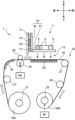
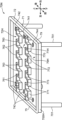
- FIG. 1 is a perspective view showing the overall configuration of an inkjet printer according to one embodiment of the present disclosure.
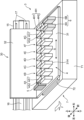
- FIG. 2 is a schematic cross-sectional view taken along line II-II of FIG. 3 is an enlarged perspective view of the carriage and maintenance unit shown in FIG. 1;
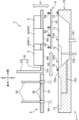
- FIG. 4 is a schematic cross-sectional view of the carriage and maintenance unit.
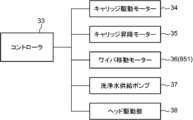
- FIG. 5 is a block diagram showing the control configuration of the inkjet printer.
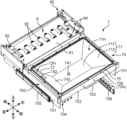
- FIG. 6 is an overall perspective view of the maintenance unit.
- FIG. 7 is a perspective view of the maintenance unit shown in FIG. 6 with the cleaning unit removed.
- 8A is a perspective view of the state in which the wiping unit is further removed from the state of FIG. 7;
- FIG. 8B is an enlarged view of the vicinity of the treatment liquid container in FIG. 8A.
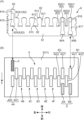
- FIG. 9 is a diagram combining a plan view (area A) of the wiping unit and a plan view (area B) showing the arrangement of the ink heads mounted on the carriage.
- FIG. 10 is a perspective view of one wiper included in the wiping unit.
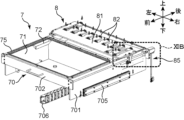
- FIG. 11A is a perspective view of the maintenance unit with a perspective direction different from that of FIG. 7;
- FIG. 11B is an enlarged view of the drive system portion of the wiping unit of FIG. 11A.
- FIG. 12 is a perspective view for explaining the moving direction of the wiping unit.
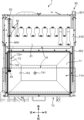
- FIG. 13 is a top view of the maintenance unit showing the movement path of the wiping unit.
- FIG. 14A is a schematic cross-sectional view in the left-right direction showing an example of arrangement of the treatment liquid container, avoiding the position directly above the opening of the ink container.
- FIG. 14B is a schematic cross-sectional view in the left-right direction showing an example of arrangement of the treatment liquid container, avoiding the position directly above the opening of the ink container.
- FIG. 14C is a schematic cross-sectional view in the left-right direction showing an example of the arrangement of the treatment liquid container avoiding the position directly above the opening of the ink container.
- FIG. 14D is a schematic top view showing an arrangement example of the treatment liquid container avoiding the position directly above the opening of the ink container.
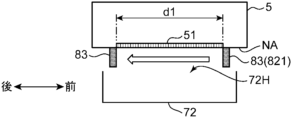
- FIG. 15A is a schematic diagram for explaining the movement range of the treatment liquid wiper during wiping.
- FIG. 15A is a schematic diagram for explaining the movement range of the treatment liquid wiper during wiping.
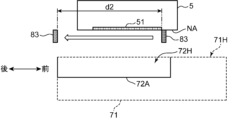
- FIG. 15B is a schematic diagram for explaining the movement range of the treatment liquid wiper during wiping.
- FIG. 15C is a schematic diagram for explaining the movement range of the treatment liquid wiper during wiping.
- FIG. 16A is a schematic side view showing an ink wiper and its cleaning member; 16B is a perspective view of main parts of the maintenance unit showing the arrangement of the cleaning members shown in FIG. 16A;
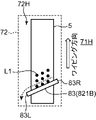
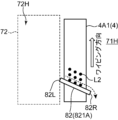
- FIG. 17 is a plan view showing the inclined arrangement of the ink blade and the treatment liquid blade.
- FIG. 18A is a diagram showing a wiping situation of the head with a non-tilted blade.
- FIG. 18B is a diagram showing a wiping state of the head by a treatment liquid blade and an ink blade having an inclination.
- FIG. 18C is a diagram showing a wiping state of the head by a treatment liquid blade and an ink blade having an inclination.
- 19 is a perspective view of a container unit according to a first modified embodiment of the present disclosure
- FIG. FIG. 20 is a perspective view of a container unit according to a second modified embodiment of the present disclosure
- FIG. 21 is a perspective view of a container unit according to a third modified embodiment of the present disclosure
- FIG. 22 is a perspective view of a container unit according to a fourth modified embodiment of the present disclosure
- FIG. 23 is a perspective view of a container unit according to a fifth modified embodiment of the present disclosure
- FIG. 24 is a perspective view of a container unit according to a sixth modified embodiment of the present disclosure.
- an inkjet printer equipped with an ink head for ejecting ink for image formation onto a wide and long recording medium will be exemplified.
- the inkjet printer of the present embodiment is suitable for digital textile printing, in which images such as characters and patterns are printed on a recording medium made of fabric such as woven fabric or knitted fabric by an inkjet method.
- the inkjet recording apparatus according to the present disclosure can also be used for printing various inkjet images on recording media such as paper sheets and resin sheets.
- FIG. 1 is a perspective view showing the overall configuration of an inkjet printer 1 according to one embodiment of the present disclosure
- FIG. 2 is a schematic cross-sectional view taken along line II-II of FIG.
- the inkjet printer 1 is a printer that prints an image on a wide and long work W by an inkjet method, and includes a device frame 10 and a work transport section 20 and a carriage 3 incorporated in the device frame 10 .
- the horizontal direction is the main scanning direction in printing on the work W
- the direction from the rear to the front is the sub-scanning direction, which is the conveying direction F of the work W.
- the device frame 10 forms a framework for mounting various components of the inkjet printer 1 .
- the work conveying unit 20 is a mechanism that intermittently feeds the work W so that the work W advances in the conveying direction F from the rear to the front in the printing area where the inkjet printing process is performed.
- the carriage 3 carries an ink head 4, a pre-processing head 5, a post-processing head 6, and sub-tanks (not shown), and reciprocates in the horizontal direction during the ink jet printing process.
- the device frame 10 includes a center frame 111, a right frame 112 and a left frame 113.
- the central frame 111 forms a framework for mounting various components of the inkjet printer 1 , and has a lateral width corresponding to the work transport section 20 .
- the right frame 112 and the left frame 113 are erected on the right and left sides of the center frame 111 and the center frame 111, respectively.
- the area between the right frame 112 and the left frame 113 is the print area 12 where the work W is printed.
- the right frame 112 forms the maintenance area 13.
- the maintenance area 13 is an area in which the carriage 3 is retracted when the printing process is not executed.
- a maintenance unit 7 is arranged in the maintenance area 13 .
- the maintenance unit 7 is positioned below the retracted carriage 3 .
- the maintenance unit 7 is a unit for performing a wiping process for wiping the lower surfaces (nozzle array surfaces) of the ink head 4, the pretreatment head 5, and the posttreatment head 6, and a nozzle purging process.
- the maintenance unit 7 also functions as a cap that prevents the heads 4, 5, and 6 from drying when they are at rest.
- the left frame 113 forms a folding area 14 for the carriage 3 .
- the turn-around area 14 is an area where the carriage 3 that has scanned the print area 12 from right to left in the printing process temporarily enters before scanning in the reverse direction.
- a carriage guide 15 is assembled on the upper side of the device frame 10 to allow the carriage 3 to reciprocate in the left-right direction.
- the carriage guide 15 is a flat plate-shaped member elongated in the left-right direction, and is arranged above the work transport section 20 .
- a timing belt 16 is attached to the carriage guide 15 so as to be rotatably movable in the horizontal direction (main scanning direction).
- the timing belt 16 is an endless belt, and is driven by a drive source (not shown) so as to circulate leftward or rightward.
- the carriage guide 15 is equipped with a pair of upper and lower guide rails 17 extending in parallel in the horizontal direction.
- the carriage 3 has engaging portions for the guide rails 17 .
- Carriage 3 is fixed to timing belt 16 . As the timing belt 16 revolves leftward or rightward, the carriage 3 moves leftward or rightward along the carriage guide 15 while being guided by the guide rail 17 .
- the work conveying unit 20 includes a feed roller 21 for feeding the work W before printing, and a winding roller 22 for winding the work W after printing.
- the delivery roller 21 is arranged at the rear lower part of the device frame 10 and is a winding shaft of the delivery roll WA, which is a wound body of the work W before printing.
- the winding roller 22 is arranged in the lower front portion of the device frame 10 and serves as a winding shaft for a winding roll WB, which is a wound body of the work W after printing processing.
- the winding roller 22 is provided with a first motor M1 that rotates the winding roller 22 about its axis and causes the workpiece W to be wound up.
- the path between the delivery roller 21 and the take-up roller 22 and passing through the printing area 12 is the work W transport path.
- a first tension roller 23, a work guide 24, a conveying roller 25, a pinch roller 26, a folding roller 27, and a second tension roller 28 are arranged in this conveying path in this order from the upstream side.
- the first tension roller 23 applies a predetermined tension to the work W on the upstream side of the transport roller 25 .
- the work guide 24 changes the conveying direction of the work W from the upward direction to the forward direction, and carries the work W into the printing area 12 .
- the transport roller 25 generates a transport force that intermittently feeds the work W in the printing area 12 .
- the transport roller 25 is rotationally driven around its axis by a second motor M2.
- the transport roller 25 intermittently transports the work W forward (transport direction F) so that the work W passes through the printing area 12 facing the carriage 3 .
- the pinch roller 26 is arranged to face the transport roller 25 from above and forms a transport nip portion together with the transport roller 25 .
- the return roller 27 changes the conveying direction of the work W that has passed through the printing area 12 from the forward direction to the downward direction, and guides the work W after the printing process to the take-up roller 22 .
- the second tension roller 28 applies a predetermined tension to the work W on the downstream side of the transport roller 25 .
- a platen 29 is arranged below the transport path of the work W in the printing area 12 .
- the carriage 3 reciprocates in the main scanning direction (horizontal direction) intersecting the transport direction F while being cantilevered by the guide rail 17 .
- the carriage 3 includes a carriage frame 30, an ink head 4 mounted on the carriage frame 30, a pre-processing head 5, a post-processing head 6, and sub-tanks (not shown).
- a carriage frame 30 includes a head support frame 31 and a back frame 32 .
- a head support frame 31 is a horizontal plate that holds the heads 4 to 6 described above.
- the back frame 32 is a vertical plate extending upward from the rear edge of the head support frame 31 .
- the timing belt 16 is fixed to the back frame 32 and the guide rail 17 is engaged.
- FIG. 3 is an enlarged perspective view of the carriage 3 shown in FIG. 1, with the maintenance unit 7 also shown. 3 shows a conveying direction F (sub-scanning direction) of the workpiece W and a main scanning direction S, which is the moving direction of the carriage 3.
- a carriage 3 is equipped with a plurality of ink heads 4 for ejecting ink for image formation onto a work W, and a pre-treatment head 5 and a post-treatment head 6 for ejecting a non-color-forming treatment liquid. example.
- a plurality of sub-tanks for supplying the ink and the processing liquid to these heads 4, 5 and 6 are also mounted on the actual carriage 3.
- the number of heads is not limited to the above, and at least one head may be arranged.
- Each of the ink heads 4 includes a large number of nozzles that eject ink droplets by an ejection method such as a piezo method using a piezo element or a thermal method using a heating element, and an ink passage that guides ink to the nozzles.
- an ejection method such as a piezo method using a piezo element or a thermal method using a heating element
- an ink passage that guides ink to the nozzles.
- the ink for example, a water-based pigment ink containing a water-based solvent, a pigment, and a binder resin can be used.
- the plurality of ink heads 4 in this embodiment includes first to eighth ink heads 4A to 4H that eject inks of eight different colors.
- the ink heads 4A to 4H for each color are mounted on the head support frame 31 of the carriage 3 so as to be aligned in the main scanning direction S.
- Each color ink head 4A to 4H has two heads.
- the first ink head 4A is arranged at an upstream head 4A1 arranged on the upstream side in the transport direction F and a position downstream of the upstream head 4A1 and shifted to the left side in the main scanning direction S. It is composed of the arranged downstream head 4A2.
- the upstream heads of these ink heads 4B to 4H are aligned in the main scanning direction S at the same position in the transport direction F as the upstream head 4A1. They are arranged in a row in the main scanning direction S at the same position.
- the pre-processing head 5 (processing liquid head) and the post-processing head 6 (processing liquid head) are arranged at different positions from the ink head 4 in the transport direction F.
- the pretreatment head 5 is arranged on the upstream side in the transport direction F of the ink head 4 .
- FIG. 3 shows an example in which one pretreatment head 5 is arranged near the left end of the array of ink heads 4 .
- the post-processing head 6 is arranged downstream of the ink head 4 in the transport direction F.
- FIG. 3 shows an example in which two post-processing heads 6A and 6B are arranged side by side in the main scanning direction S near the right end of the array of ink heads 4.
- FIG. 3 shows an example in which two post-processing heads 6A and 6B are arranged side by side in the main scanning direction S near the right end of the array of ink heads 4.
- the pretreatment head 5 ejects a pretreatment liquid (treatment liquid) for performing a predetermined pretreatment on the work W.
- the pretreatment liquid is ejected from the pretreatment head 5 onto a position of the work W to which ink has not yet been ejected from the ink head 4 .
- the pretreatment liquid is a non-color-developing treatment liquid that does not develop color even if it adheres to the work W.
- the pretreatment liquid is a treatment liquid that develops a function of enhancing the fixability of ink to the work W and the cohesion of ink pigments. .
- a treatment liquid in which a binding resin is mixed with a solvent, or a treatment liquid in which a positively charged cationic resin is mixed in a solvent, or the like can be used.
- the post-treatment head 6 ejects a post-treatment liquid (treatment liquid) for performing a predetermined post-treatment on the work W to which ink has adhered.
- the post-treatment liquid is ejected from the post-treatment head 6 onto a position on the workpiece W after the ink is ejected from the ink head 4 .
- the post-treatment liquid is a non-color-developing treatment liquid that does not develop color even if it adheres to the work W, and exhibits the function of improving the fixability and fastness of the ink image printed on the work W by the ink head 4. It is a processing liquid that The robustness means resistance to rubbing and scraping.
- a silicone-based treatment liquid or the like can be used as such a post-treatment liquid.
- the non-color-developing treatment liquid refers to a liquid that cannot be recognized as colored by the naked eye when printed alone on a recording medium.
- the color includes black, white, gray, and the like, which have a saturation of 0.
- a non-color-forming treatment liquid is basically a transparent liquid, but when one liter of the treatment liquid is viewed as a liquid, it is not completely transparent and may appear slightly white. . Such colors are very faint, and when printed on a recording medium alone, they cannot be recognized with the naked eye. Note that depending on the type of treatment liquid, when the recording medium is printed alone, there may be changes such as glossiness on the recording medium, but such a state is not color development.
- An opening 31H is provided at the position of the head support frame 31 where the head is arranged.
- the ink heads 4A to 4F, the pre-processing head 5 and the post-processing head 6 are mounted on the head support frame 31 so as to be fitted into their respective openings 31H.
- Nozzles arranged on the lower end surfaces of the heads 4, 5 and 6 are exposed from the respective openings 31H.
- the inkjet printer 1 is an all-in-one printer in which three types of heads, the ink head 4, the preprocessing head 5, and the postprocessing head 6, are mounted on one carriage 3.
- this printer 1 for example, in a digital textile printing process in which inkjet printing is performed on a fabric, a pretreatment liquid ejection process and a posttreatment liquid ejection process can be integrally executed. Therefore, the textile printing process can be simplified and the textile printing apparatus can be made compact.
- FIG. 4 is a schematic cross-sectional view along the front and rear of the carriage 3 and the maintenance unit 7.
- FIG. Maintenance unit 7 includes container unit 70 , wiping unit 8 and cleaning unit 9 .
- the maintenance area 13 (FIG. 1) is an area for removing clogged nozzles of the heads 4, 5, and 6 and removing stains from the nozzle arrangement surface NA of the heads 4, 5, and 6, and the like. For this process, a purge operation, a wiping operation, and a cleaning operation are performed in the maintenance area 13 .
- the purge operation is an operation for forcibly ejecting pressurized ink, pretreatment liquid, and posttreatment liquid from the ink head 4, pretreatment head 5, and posttreatment head 6, respectively.
- the container unit 70 collects the ink, pretreatment liquid, and posttreatment liquid ejected from the heads 4, 5, and 6 during the purge operation.
- the wiping operation is an operation of wiping the nozzle array surface NA with a wiper having a wiping member such as a blade.
- a wiping unit 8 is a unit that performs the wiping operation.
- the cleaning operation is an operation for cleaning the wiping unit 8 that has become dirty due to the execution of the wiping operation.
- the cleaning unit 9 is a unit that performs the cleaning operation. Note that the container unit 70 also collects the cleaning liquid used in the cleaning operation.
- the container unit 70 has a structure that separates and collects the pretreatment liquid, the ink, and the posttreatment liquid.
- a treatment liquid that enhances the fixability of ink and the cohesion of ink pigments is used as the pretreatment liquid. Therefore, when the pretreatment liquid and the ink are mixed, the mixed liquid aggregates, which may hinder recovery to the waste liquid tank.
- the post-treatment liquid used in this embodiment does not cause aggregation or the like even when mixed with the ink. This is the reason for the separate collection in the container unit 70 .
- the container unit 70 includes an ink container 71, a pretreatment liquid container 72 (treatment liquid container), and a cleaning liquid tray 73 (cleaning container section).
- the ink container 71 is a container for collecting the ink and the post-treatment liquid ejected from the ink head 4 and the post-treatment head 6 in the purge operation.
- the ink container 71 has a first opening 71H for receiving the ink and the post-treatment liquid on its upper surface.
- the first opening 71H opens upward at a position facing at least the nozzle array surface NA of the ink head 4 and the post-processing head 6 in the vertical direction.
- the ink container 71 also collects ink and post-treatment liquid wiped from the nozzle array surface NA in the wiping operation.
- the pretreatment liquid container 72 is arranged at a position covering a portion above the first opening 71H.
- the pretreatment liquid container 72 is a container for collecting the pretreatment liquid discharged from the pretreatment head 5 in the purge operation.
- the pretreatment liquid container 72 has a second opening 72H for receiving the pretreatment liquid on its upper surface.
- the second opening 72H opens upward at a position facing at least the nozzle array surface NA of the pretreatment head 5 in the vertical direction.
- the pretreatment liquid container 72 also collects the pretreatment liquid wiped from the nozzle array surface NA in the wiping operation.
- the cleaning liquid tray 73 is a container for collecting (receiving) the cleaning liquid 9A that is jetted from the cleaning liquid cleaning unit 9 and passed through each wiper in the cleaning operation.
- the container unit 70 has an overflow passage 741, a processing liquid passage 742 and a relay passage 743 for circulation of the recovered liquid.
- the overflow passage 741 is a passage that has a starting end opening on the bottom surface of the ink container 71 and a terminal side that leads to a waste liquid container (not shown).
- the treatment liquid passage 742 is a passage that has a start end opening near the bottom surface of the pretreatment liquid container 72 and a terminal side that leads to the waste liquid container.
- the relay passage 743 is a passage that has a start end opening on the bottom surface of the cleaning liquid tray 73 and an end opening near the bottom surface of the ink container 71 . That is, the cleaning liquid 9A collected in the cleaning liquid tray 73 is once introduced into the ink container 71 and then collected in the waste liquid container through the overflow passage 741.
- a cap rubber 75 is attached to the upper surface 70A of the container unit 70.
- the cap rubber 75 is arranged so as to surround the periphery of the first opening 71 ⁇ /b>H of the ink container 71 .
- the carriage 3 can move vertically as indicated by an arrow A1 in the drawing. When the carriage 3 is in standby mode in the maintenance area 13 or when the printer 1 is at rest, the carriage 3 is lowered and the lower surface 311 of the head support frame 31 is brought into contact with the cap rubber 75 . As a result, the nozzle arrangement surfaces NA of the heads 4, 5 and 6 are sealed.
- the wiping unit 8 includes a wiper support plate 81 (support member), an ink wiper 82 supported by the wiper support plate 81, a pretreatment liquid wiper 83 (treatment liquid wiper), and a posttreatment liquid wiper 84.
- the wiping unit 8 can move forward and backward as indicated by an arrow A2 in the drawing.
- the wiper support plate 81 is a plate-like member and moves in the front-rear direction between the carriage 3 and the cleaning unit 9 and the container unit 70 .
- the ink wiper 82 wipes the nozzle array surface NA of the ink head 4 by moving backward while in contact with the nozzle array surface NA.
- the pretreatment liquid wiper 83 and the posttreatment liquid wiper 84 wipe the nozzle arrangement surfaces NA of the pretreatment head 5 and the posttreatment head 6, respectively.
- the heads 4, 5, and 6 eject only ink, pretreatment liquid, and posttreatment liquid, respectively. and a nozzle that ejects at least one of them.
- at least the nozzles that eject the ink and the nozzles that eject the pretreatment liquid are arranged separately in different regions and wiped by different wipers. Since the heads 4, 5, and 6 eject only the ink, the pretreatment liquid, and the posttreatment liquid, respectively, the possibility of mixing the ink with the pretreatment liquid or the posttreatment liquid can be reduced.
- the cleaning unit 9 includes a nozzle holding plate 91 and a plurality of cleaning nozzles 92 (injection units) held by this nozzle holding plate 91 .
- the nozzle holding plate 91 is made of a flat member and is fixedly arranged so as to face the cleaning liquid tray 73 of the container unit 70 .
- a plurality of cleaning nozzles 92 are arranged at positions corresponding to each of the ink wiper 82 , the pre-treatment liquid wiper 83 and the post-treatment liquid wiper 84 mounted on the wiper support plate 81 .
- the cleaning nozzles 92 are held by the nozzle holding plate 91 at positions facing the wipers 82, 83, and 84 from above.
- the cleaning nozzle 92 radiates (injects) the cleaning liquid 9A in a fan-shaped spray.
- the cleaning nozzle 92 is supplied with the cleaning liquid 9A from a cleaning liquid tank (not shown) through a cleaning liquid hose 93 .
- FIG. 5 is a block diagram showing part of the control configuration of the printer 1. As shown in FIG.
- the printer 1 includes a controller 33 , and a carriage drive motor 34 , a carriage elevation motor 35 , a wiper movement motor 36 , a cleaning water supply pump 37 and a head drive section 38 whose operations are controlled by the controller 33 .
- the carriage drive motor 34 generates driving force to move the carriage 3 in the left-right direction within the range of the turn-back area 14, the print area 12 and the maintenance area 13 (FIG. 1).
- Carriage drive motor 34 drives timing belt 16 (FIGS. 1-3).
- the carriage lift motor 35 generates driving force for moving the carriage 3 vertically in the maintenance area 13 .
- the wiper movement motor 36 generates driving force for moving the wiping unit 8 in the front-rear direction.
- the cleaning water supply pump 37 is connected to the cleaning liquid hose 93 and supplies the cleaning liquid 9A to the cleaning nozzle 92 at a predetermined pressure.
- the head drive unit 38 executes the operation of ejecting ink, pretreatment liquid, and posttreatment liquid from the heads 4, 5, and 6.
- the controller 33 controls the wiper movement motor 36 to move the wiping unit 8 backward to the retracted position below the cleaning unit 9 .
- the controller 33 controls the head driving section 38 to eject the ink, the pre-treatment liquid and the post-treatment liquid from the heads 4, 5 and 6 at high pressure to clean the nozzles.
- the ink and post-treatment liquid ejected by the purge operation are recovered in an ink container 71, and the pre-treatment liquid is recovered in a pre-treatment liquid container 72, respectively.
- the controller 33 controls the wiper movement motor 36 to move the wiping unit 8 to the most forward wiping start position.
- the controller 33 controls the carriage elevation motor 35 to lower the nozzle arrangement surface NA of each head 4 , 5 , 6 to a height position in contact with the wipers 82 , 83 , 84 of the wiping unit 8 .
- the controller 33 moves the wiping unit 8 rearward.
- the ink and post-treatment liquid wiped from the nozzle array surface NA by the wiping of the ink wiper 82 and the post-treatment liquid wiper 84 are recovered in the ink container 71 .
- the pretreatment liquid wiped from the nozzle arrangement surface NA by wiping of the pretreatment liquid wiper 83 is recovered in the pretreatment liquid container 72 .
- the controller 33 controls the wiper movement motor 36 to move the wiping unit 8 backward to the retracted position below the cleaning unit 9 .
- the controller 33 controls the cleaning water supply pump 37 to supply the cleaning liquid 9A to the cleaning nozzle 92 through the cleaning liquid hose 93 .
- the cleaning liquid 9A is sprayed onto each of the wipers 82, 83, 84 of the wiping unit 8, and the foreign matter adhered by the wiping is removed.
- the cleaning liquid 9A is collected in a cleaning liquid tray 73. As shown in FIG.
- FIG. 6 is an overall perspective view of the maintenance unit 7
- FIG. 7 is a perspective view with the cleaning unit 9 removed from FIG. 6
- FIG. 8A is a perspective view with the wiping unit 8 removed from the state of FIG. 8B is an enlarged view of the vicinity of the pretreatment liquid container 72 of FIG. 8A.
- FIGS. 6 and 7 show a state in which the wiping unit 8 is in a standby state waiting for a wiping command or a state in which the cleaning operation is being executed, and the wiping unit 8 is moved to the rearmost side.
- the maintenance unit 7 includes the container unit 70, the wiping unit 8 and the cleaning unit 9 (cleaning section).
- the container unit 70 is attached to the apparatus frame 10 (FIG. 1) so as to be able to be drawn forward in the maintenance area 13 .
- the wiping unit 8 is attached to the container unit 70 so as to be movable in the front-rear direction.
- the cleaning unit 9 is fixedly attached to the device frame 10 .
- the container unit 70 includes a frame structure 700 having a rectangular parallelepiped shape slightly elongated in the front-rear direction, an ink container 71 and a pretreatment liquid container 72 arranged in front of the frame structure 700, and a cleaning liquid tray 73 (cleaning section) disposed on the side.
- the frame structure 700 includes a pair of left and right side frames 701 extending in the front-rear direction, and a front frame 702 connecting the front ends of the side frames 701 together.
- a handle 703 for drawing out the container unit 70 forward is attached to the front frame 702 .
- a plurality of waste liquid hoses 704 are pulled out from below the front frame 702 .
- the waste liquid hose 704 connects an overflow passage 741 communicating with the cavity of the ink container 71, a processing liquid passage 742 communicating with the cavity of the pretreatment liquid container 72, and a waste liquid tank (not shown).
- Sliders 705 are attached to the outer side surfaces of the pair of side frames 701 .
- the slider 705 engages with a guide rail (not shown) fixed to the device frame 10 to allow the container unit 70 to be pulled forward from the device frame 10 (housing).
- the wiping unit 8 which will be described in detail later, can also be pulled out integrally with the container unit 70. As shown in FIG. Therefore, the container unit 70 and the wiping unit 8 can be easily cleaned and maintained. Note that in other embodiments, the cleaning unit 9 may also be pulled out integrally.
- a chain protector 706 for accommodating electrical cables and hoses is provided below the frame structure 700 . The chain protector 706 deforms as the container unit 70 is pulled out.
- the ink container 71 is a saucer-shaped container having a rectangular first opening 71H elongated in the left-right direction on the upper surface.
- the ink container 71 includes a rectangular bottom surface 711 elongated in the left-right direction, four tapered surfaces 712 extending upward from four edges of the bottom surface 711, and an upper end flange 708 formed along the periphery of the first opening 71H. .
- the ink container 71 is separate from the frame structure 700 and is fitted into the frame structure 700 .
- a top flange 708 of the ink container 71 is supported by the side frame 701 and the front frame 702 .
- a starting end opening of the overflow passage 741 protrudes upward from the bottom surface 711 by a predetermined length.
- a terminal opening of the relay passage 743 protrudes from near the lower end of the tapered surface 712 on the left side.
- the size of the first opening 71H in the left-right direction is substantially equal to the distance between the pair of side frames 701.
- the size of the first opening 71 ⁇ /b>H in the front-rear direction is slightly larger than half of the front-rear width of the container unit 70 .
- a cap rubber 75 is attached to the upper surface of the upper end flange 708 so as to surround the first opening 71H.
- the upper end flange 708 is a portion corresponding to the upper surface 70A shown in the schematic diagram of FIG.
- the head support frame 31 of the carriage 3 has a size larger than the area surrounded by the cap rubber 75 .
- the arrangement area of the heads 4, 5, 6 held by the head support frame 31 is slightly smaller than the size of the first opening 71H.
- the container unit 70 also serves as a head cap capable of capping the ink head 4 , the pretreatment head 5 and the posttreatment head 6 .
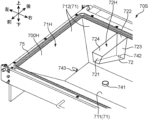
- the pretreatment liquid container 72 is arranged at the left rear position of the ink container 71 so as to partially cover the first opening 71H.
- the arrangement position of the pretreatment liquid container 72 is the position where the pretreatment head 5 held by the carriage 3 faces directly during wiping. As will be described later, if the pretreatment head 5 is arranged in the center or near the right end of the head support frame 31, the pretreatment liquid container 72 is also arranged at a corresponding position.
- the pretreatment liquid container 72 has a rectangular second opening 72H elongated in the front-rear direction so as to correspond to the shape of the nozzle array surface NA of the pretreatment head 5 on its upper surface. In this embodiment, the second opening 72H is at the same height position as the first opening 71H. In other words, the second opening 72H occupies part of the area of the original first opening 71H.
- the pretreatment liquid container 72 is formed by a front wall 721 , a rear wall 722 , a right wall 723 and a left wall 724 .
- the rear wall 722 uses the upper end portion of the rear tapered surface 712 of the ink container 71
- the left wall 724 uses the upper end portion of the left tapered surface 712 .
- the front wall 721 is a wall near the upper end of the left tapered surface 712 and protrudes rightward from near the center in the front-rear direction.
- the right wall 723 is a wall that connects the right edges of the front wall 721 and the rear wall 722 .
- the right wall 723 is inclined upward and to the right at a slight angle from the left tapered surface 712, which is inclined downward and to the right.
- the container unit 70 includes a container body 700H (FIGS. 8A and 8B) having openings for receiving the liquid discharged from a plurality of heads, and a plurality of container bodies 700H. and a partition that partitions into independent regions of
- the front wall 721 and right wall 723 in FIG. 8B correspond to the partition.
- the partition section partitions the container main body 700H into the ink container 71 and the pretreatment liquid container 72 .
- the front wall 721 (first portion) partitions the container body 700H in the front-rear direction
- the right wall 723 (second portion) is connected to the front wall 721 and partitions the container body 700H in the left-right direction. ing.
- the partition section partitions the container body 700H of the container unit 70 along two directions.
- the degree of freedom of arrangement can increase the degree of freedom of arrangement.
- each head can be An ink container 71 and a pretreatment liquid container 72 can be arranged below it.
- receiving the liquid here means receiving the liquid falling from above.
- Liquid flows into the ink container 71 from the cleaning liquid tray 73 through the relay passage 743, but this is not included in the aforementioned receiving.
- the liquid flowing from the cleaning liquid tray 73 contains a small amount of ink, pre-treatment liquid and post-treatment liquid in addition to the cleaning liquid.
- a partition may be provided in the cleaning liquid tray 73 so that only the liquid that does not contain the pretreatment liquid flows into the ink container 71 .
- the pretreatment liquid is collected in the exclusive pretreatment liquid container 72, and the ink and the posttreatment liquid are collected in the ink container 71, whereby the ink of the pretreatment liquid, which easily aggregates when mixed with the ink, is collected. It is possible to prevent the mixing of the two types of processing liquids and facilitate the discharge of both types of processing liquids.
- the bottom surface of the pretreatment liquid container 72 is arranged above the bottom surface of the ink container 71 . That is, the depth of the pretreatment liquid container 72 is shallower than the depth of the ink container 71 . Therefore, the pretreatment liquid, which is discharged in a relatively small amount, is less likely to stick to the inner wall of the pretreatment liquid container 72 , and the pretreatment liquid can be easily discharged from the pretreatment liquid container 72 .
- the depth of the pretreatment liquid container 72 is the depth from the upper end of the partition separating the pretreatment liquid container 72 and the ink container 71 to the lowest portion of the pretreatment liquid container 72 .
- the depth of the ink container 71 is the depth from the upper end of the partition portion to the lowest portion of the ink container 71 .
- the container body 700H of the container unit 70 has an inclined surface (tapered surface 712 on the left side in FIG. 8B) that defines the ink container 71 together with the partition.
- a portion of the inclined surface further defines the pretreatment liquid container 72 (left wall 724) above the bottom surface 711 of the ink container 71, so that the depth of the pretreatment liquid container 72 is equal to the depth of the ink container 71. It is set shallower than the height.
- the pretreatment liquid container 72 is formed using the area from the upper edge of the left tapered surface 712 to the middle of the tapered surface 712 .
- the ink container 71 and the pretreatment liquid container 72 can be formed using the above-described inclined surfaces, and the pretreatment liquid container 72 is attached to the ink container 71, thereby forming a pretreatment liquid container.
- the stiffness of 72 can be increased. Therefore, compared with the case where all the walls defining the pretreatment liquid container 72 are completely independent of the ink container 71, deformation of the pretreatment liquid container 72 under the influence of gravity is suppressed. can.
- the left wall 724 (FIG. 8B) of the pretreatment liquid container 72 can guide the pretreatment liquid received from the pretreatment head 5 rightward (predetermined direction) as it proceeds downward. It is slanted like Similarly, the right wall 723 is inclined so that the pretreatment liquid received from the pretreatment head 5 can be guided leftward (predetermined direction) as it proceeds downward. The pretreatment liquid guided along the right wall 723 and the left wall 724 is collected at the intersection of the two and discharged from the treatment liquid passage 742 . In addition, each inner surface of the right wall 723 and the left wall 724 corresponds to the bottom surface of the pretreatment liquid container 72 that is visually recognized in the plan view of the pretreatment liquid container 72 .
- the cleaning liquid tray 73 is a container with a shallower depth than the ink container 71, having a rectangular top opening that is elongated in the left-right direction.
- the bottom surface of the cleaning liquid tray 73 includes an inclined surface 731 and a liquid collection surface 732 .
- the inclined surface 731 is a surface that slopes gently downward from the right end of the cleaning liquid tray 73 toward the left end.
- the liquid collecting surface 732 is positioned near the left end of the cleaning liquid tray 73 and is a flat surface forming the deepest part of the bottom surface.
- the left edge of the inclined surface 731 continues to the right edge of the liquid collecting surface 732 .
- the starting end of the relay passage 743 is open to the liquid collecting surface 732 .
- the wiping unit 8 includes a wiper support plate 81 , an ink wiper 82 , a pretreatment liquid wiper 83 (treatment liquid wiper), a posttreatment liquid wiper 84 (treatment liquid wiper), and a wiper driving section 85 .
- FIG. 9 is a plan view (area A) of the wiper support plate 81 holding the wipers 82, 83, 84, and a plane showing the arrangement of the ink head 4, the pre-processing head 5 and the post-processing head 6 mounted on the carriage 3.
- FIG. 4 is a view combined with a plan view (region B) showing the correspondence with wipers 82, 83, and 84.
- FIG. The layout of the heads 4, 5, and 6 shown in FIG. 9 (region B) is the same as that exemplified in FIG.
- the wiper support plate 81 is formed by punching a thin flat plate member, and has a plurality of strip-shaped projecting plates 811 .
- the plurality of convex plates 811 protrude in the rearward direction, which is the movement direction during wiping.
- a recess 812 recessed forward is formed between adjacent convex plates 811 .
- An ink wiper 82 for wiping the nozzle arrangement surface NA of the ink head 4 is attached to the edge (rear edge) of the convex plate 811 and the edge of the recess 812 .
- the ink wiper 82 arranged at the edge of the convex plate 811 is for wiping the upstream head of each color ink head 4, such as the ink wiper 82A1 arranged for the upstream head 4A1 of the first ink head 4A.
- the ink wiper 82 arranged at the edge of the recess 812 is for wiping the downstream head of each color ink head 4, such as the ink wiper 82A2 arranged for the downstream head 4A2.
- the support area supporting the pretreatment liquid wiper 83 that wipes the nozzle array surface NA of the pretreatment head 5 projects more rearward in the movement direction during wiping than the other area of the wiper support plate 81. It is placed in the position where Specifically, a convex piece 814 extends further rearward from the rear end of the leftmost convex plate 811 .
- the pretreatment liquid wiper 83 is attached to the edge (rear end) of the projecting piece 814 .
- a window portion 815 corresponding to the recess 812 is provided on the front side of the projecting piece 814 .
- the pretreatment liquid wiper 83 is arranged to be supported at a portion of the wiper support plate 81 that protrudes most in the moving direction, the pretreatment liquid wiped by the pretreatment liquid wiper 83 during wiping is applied to the wiper support plate 81 . becomes difficult to adhere to other parts of the
- the pretreatment head 5 and the downstream head 4A2 of the first ink head 4A overlap each other in the movement direction (backward direction) during wiping. are placed in That is, the preprocessing head 5 and the downstream head 4A2 are arranged side by side on the upstream side and the downstream side in the transport direction F at the same position in the left-right direction of the head support frame 31 .
- the path through which the ink wiper 82A2 passes when heading from the wiping area to the cleaning unit 9 overlaps the path wiped by the pretreatment liquid wiper 83.
- FIG. Therefore, it is possible to reduce the risk of the pretreatment liquid dripping onto the ink wiper 82A2 and causing aggregation.
- the pretreatment head 5 and the downstream head 4A2 are arranged in a positional relationship in which they completely overlap in the moving direction during wiping, they may be arranged so as to be slightly shifted in the left-right direction. .
- the right end side of the wiper support plate 81 is a support area that supports a post-treatment liquid wiper 84 that wipes the nozzle array surface NA of the post-treatment head 6 .
- two post-processing heads 6A and 6B are arranged side by side in the main scanning direction.
- the post-processing head 6A on the left side is the upstream head 4G1 of the seventh ink head 4G
- the post-processing head 6B on the right side is the upstream head 4H1 of the eighth ink head 4H. side and downstream side.
- the wiper support plate 81 has a pair of holding pieces 816 and a window portion 817 near its right end.
- the holding piece 816 supports ink wipers 82G1 and 82H1 for wiping the upstream heads 4G1 and 4H1 at its rear edge.
- Ink wipers 82G2 and 82H2 for wiping the downstream heads 4G2 and 4H2 are supported at the edge of the recess 812 adjacent to the left side of each holding piece 816.
- the window 817 is an opening arranged in front of the holding piece 816 .
- Post-treatment liquid wipers 84 (84A, 84B) for wiping the post-treatment heads 6A, 6B are respectively supported at the opening edge on the front side of the window portion 817. As shown in FIG.
- the wiper support plate 81 has a plurality of protrusions 813 arranged in association with each of the wipers 82, 83, 84 described above.
- the convex portion 813 is connected to the rear end of the convex plate 811, the proximal edge of the recess 812, the rear end of the convex piece 814, and the proximal edge of the window portion 817, respectively.
- These protrusions 813 are small protrusions that protrude in the direction of movement during wiping when viewed from above.
- the wipers 82 , 83 , 84 are arranged on the associated projections 813 . Such an arrangement makes it difficult for the ink or treatment liquid adhering to the wipers 82 , 83 , 84 to adhere to the wiper support plate 81 .
- FIG. 10 is a perspective view showing the detailed structure of the ink wiper 82.
- FIG. The pre-treatment liquid wiper 83 and the post-treatment liquid wiper 84 also have the same structure as the ink wiper 82 shown here.
- the ink wiper 82 includes a wiper blade 821 (ink blade or treatment liquid blade), a first holder 822 and a second holder 823 .
- the wiper blade 821 is a plate member that actually comes into contact with the nozzle array surface NA to perform a wiping operation.
- the upper end of wiper blade 821 is located at a position protruding upward from the upper surface of wiper support plate 81 .
- the first holder 822 and the second holder 823 are members that sandwich and hold the wiper blade 821 .
- the first holder 822 is fitted into a recess provided in the projection 813 and fixed with screws to support the lower back surface of the wiper blade 821 .
- the second holder 823 is attached to the front lower portion of the wiper blade 821 .
- the second holder 823 has a pair of openings 824
- the wiper blade 821 also has through holes at the same positions as the openings 824 .
- the first holder 822 has a pair of claws 825 .
- the claw portion 825 is inserted through the through hole and the opening 824 and locks the second holder 823 at the periphery of the opening 824 .
- the wiper blade 821 is sandwiched between the first holder 822 and the second holder 823 by this locking force.
- the wiper blade 821 is held at a position that protrudes further than the projecting end face of the projection 813 .
- the pretreatment liquid wiper 83 and the posttreatment liquid wiper 84 may have the same structure, shape and material as the ink wiper 82 shown in FIG. good.
- the shape and material of the wiper blade 821 and the support structure of the wiper blade 821 may be different from the ink wiper 82 for the pre-treatment liquid wiper 83 and/or the post-treatment liquid wiper 84 depending on the properties of the ink and treatment liquid.
- the wiper blade 821 a blade made of rubber or resin material having a predetermined rigidity is used.
- the pretreatment liquid has the property of drying faster than the ink and is relatively difficult to wipe off.
- the wiper blade 821 of the pretreatment liquid wiper 83 it is desirable to use a blade having higher rigidity than that of the ink wiper 82, or to increase the protrusion height of the wiper blade 821 to increase the wiping power. .
- FIG. 11A is a perspective view of the maintenance unit 7 with a perspective direction different from that of FIG. 7, and is a diagram for explaining the wiper drive section 85.
- FIG. FIG. 11B is an enlarged view of the XIB portion enclosed by the dotted line in FIG. 11A.
- the wiper drive unit 85 is a mechanism for moving the wiper support plate 81 holding the wipers 82, 83, 84 in the front-rear direction.
- the wiper driver 85 includes a servomotor 851 , a ball screw 852 and a slider 853 .
- a servo motor 851 is a motor corresponding to the wiper moving motor 36 shown in FIG.
- the servomotor 851 generates driving force to move the wiper support plate 81 .
- a servo motor 851 is attached to the right end of the rear plate 707 of the container unit 70 .
- the ball screw 852 is driven to rotate forward or backward around its axis by a servomotor 851 .
- the ball screw 852 extends in the front-rear direction along the right side frame 701 .
- a guide bar (not shown) extending in the front-rear direction is attached to the left side frame 701 .
- the slider 853 contains a nut member that is screwed onto the ball screw 852 . When the ball screw 852 rotates forward or backward, the slider 853 moves back and forth along the ball screw 852 .
- the slider 853 is connected to the wiper support plate 81.
- a connecting plate 818 made of an elongated flat plate member is attached to the upper portion of the slider 853 .
- the right end portion 81E of the wiper support plate 81 is placed on the connecting plate 818, and both are fastened with a fixing screw 819.
- the left end of the wiper support plate 81 is also supported by members equivalent to the connecting plate 818 and the slider 853 and guided along the guide bar.
- the movement range of the wiper support plate 81 is between the front end (wiping area) and the rear end (cleaning area) of the container unit 70 .
- the servomotor 851 is driven to rotate forward by the controller 33, the slider 853 is sent forward, and the wiper support plate 81 fixed to the slider 853 also moves forward.
- the wiper support plate 81 moves backward.
- the ink container 71 can receive ink falling from the ink head 4 during wiping of the ink wiper 82 through the first opening 71H. Further, the ink container 71 can also receive ink that drops from the post-treatment head 6 during wiping of the post-treatment liquid wiper 84 through the first opening 71H. On the other hand, the pretreatment liquid container 72 can receive the treatment liquid dropped from the pretreatment head 5 during wiping of the pretreatment liquid wiper 83 through the second opening 72H.
- the container unit 70 and the wiping unit 8 can be integrally pulled out from the device frame 10 (housing).
- the direction in which the wiping unit 8 is pulled out is the direction along the movement direction when each wiper wipes each head. Therefore, when the wiping unit 8 is moved in and out, the direction of acceleration applied to the liquid adhering to each wiper is along the direction of movement of the wipers. can.
- cleaning unit 9 includes nozzle holding plate 91 and a plurality of cleaning nozzles 92 .
- the nozzle holding plate 91 is a U-shaped frame member including a top plate 911 (top plate portion) and a pair of left and right side plates 912 .
- the top plate 911 is a flat plate having a width slightly larger than the lateral width of the container unit 70 .
- a pair of side plates 912 are flat plates hanging down from the left and right ends of the top plate 911 and face the left and right side frames 701 respectively.
- the nozzle holding plate 91 is fixed in place on the device frame 10 (Fig. 1). In a state where the container unit 70 is loaded at a predetermined position on the apparatus frame 10, the nozzle holding plate 91 has a positional relationship such that it is fitted into the rear region of the container unit 70 from above. A portion where the nozzle holding plate 91 covers the container unit 70 serves as a cleaning area for cleaning the ink wiper 82 , the pretreatment liquid wiper 83 and the posttreatment liquid wiper 84 .
- the top plate 911 vertically faces the cleaning liquid tray 73 of the container unit 70 with a predetermined gap therebetween. The gap has a vertical width that allows the wiping unit 8 to enter between the top plate 911 and the cleaning liquid tray 73 . In this embodiment, since the cleaning liquid tray 73 is pulled out together with the container unit 70, leaving the cleaning unit 9, the cleaning of the cleaning liquid tray 73 is further facilitated.
- a plurality of cleaning nozzles 92 are arranged at appropriate positions on the top plate 911 so as to match the layout of the wipers 82 , 83 , 84 on the wiper support plate 81 .
- the plurality of cleaning nozzles 92 includes nozzles 92A for cleaning the ink wiper 82, nozzles 92B for cleaning the pretreatment liquid wiper 83, and nozzles 92C for cleaning the posttreatment liquid wiper 84.
- FIG. These nozzles 92A, 92B, and 92C eject the cleaning liquid 9A in fan-shaped sprays from their lower end surfaces (see FIG. 4) to clean the wipers 82, 83, and 84. As shown in FIG.
- FIG. 12 is a perspective view showing the initial position of the wiping unit 8 during wiping.
- the wiping unit 8 moves backward from the initial position so as to face the cleaning area where the cleaning unit 9 is arranged.
- Wiping areas where the wipers 82 , 83 , 84 wipe the heads 4 , 5 , 6 are above the first opening 71 ⁇ /b>H of the ink container 71 and the second opening 72 ⁇ /b>H of the pretreatment liquid container 72 .
- the preprocessing head 5 is supported by the carriage 3 at the leftmost position alongside the downstream head 4A2 of the first ink head 4A. Accordingly, the pretreatment liquid wiper 83 is also arranged at the leftmost position on the wiper support plate 81 .
- the pretreatment liquid wiper 83 is positioned closer to the print area 12 than the other ink wipers 82 except for the ink wiper 82A2 for the downstream head 4A2. are placed.
- the pretreatment liquid container 72 is naturally arranged near the left end of the ink container 71 . In this case, it is possible to realize an arrangement in which the pretreatment head 5 does not pass through the first opening 71H of the ink container 71 during the pit-in. Therefore, the pretreatment liquid attached to the pretreatment head 5 can be made difficult to drop into the ink container 71 .
- the arrangement of the pretreatment liquid container 72 also produces the above effect. That is, in the present embodiment, the pretreatment liquid container 72 is arranged at a position closer to the printing area than the ink container 71 in the moving direction in which the carriage 3 having the pretreatment head 5 moves from the printing area to the wiping area. It is Therefore, on the premise that the pretreatment liquid wiper 83 wipes the pretreatment head 5 above the pretreatment liquid container 72, the pretreatment head 5 penetrates deep into the wiping area and the pretreatment liquid adhering to the pretreatment head 5 is removed. Adhesion of the liquid to the ink container 71 or the like can be reduced.
- the pretreatment liquid wiper 83 is supported by the wiper support plate 81 at a position closest to the cleaning area among the wipers 82, 83, and 84 in the movement direction from the wiping area to the cleaning area. That is, as shown in FIG. 9 (region A), the pretreatment liquid wiper 83 is arranged on the end edge of the convex piece 814 that protrudes most rearward in the wiper support plate 81 when viewed from above. Therefore, it is possible to introduce the pretreatment liquid wiper 83 into the cleaning area as soon as possible to carry out the cleaning process. For example, when the pretreatment liquid has a property of quick-drying, if the nozzle 92B (FIG. 6) for cleaning the pretreatment liquid wiper 83 is arranged at the most front side of the nozzle holding plate 91, it can be immediately dried. It becomes possible to clean the pretreatment liquid wiper 83 .
- the arrangement of the pretreatment liquid container 72 also produces the above effect. That is, in the present embodiment, the entire pretreatment liquid container 72 is arranged at a position closer to the cleaning area (cleaning unit 9, cleaning section) than the entire ink container 71 is. Therefore, on the assumption that the pretreatment liquid wiper 83 wipes the pretreatment head 5 above the pretreatment liquid container 72, the pretreatment liquid wiper 83 can be cleaned quickly. Note that the pretreatment liquid container 72 may be arranged so as to protrude further toward the cleaning area than the ink container 71 .
- FIG. 13 is a top view of the maintenance unit 7 showing the movement path MW of the wiping unit 8 during wiping.
- the position indicated by the dotted line in the drawing is the initial position of the wiping unit 8 and the pretreatment liquid wiper 83 during wiping.
- the positions of the wiping unit 8 indicated by solid lines are the wiping completion position where the wipers 82, 83, and 84 are cleaned, and the waiting position for waiting for a wiping operation execution instruction.
- the movement path MW (movement range) during wiping of the pretreatment liquid wiper 83 is set at a position avoiding the position directly above the first opening 71H of the ink container 71 .
- the first opening 71 ⁇ /b>H of the ink container 71 is arranged at a position avoiding the movement path MW of the pretreatment liquid wiper 83 .
- the range of movement of the pretreatment liquid wiper 83 during the wiping operation in the wiping area is set immediately above the second opening 72 ⁇ /b>H of the pretreatment liquid container 72 .
- the first opening 71H does not substantially exist directly below the area where the pretreatment liquid wiper 83 wipes the nozzle array surface NA of the pretreatment head 5, and most or all of the area is the second opening 71H. It is arranged to face the opening 72H in the vertical direction. In other words, the first opening 71H of the ink container 71 is located outside the entire movement path MW of the pretreatment liquid wiper 83 when viewed from above. With this arrangement, the pretreatment liquid wiped by the pretreatment liquid wiper 83 during wiping can be reduced from entering the ink container 71 through the first opening 71H. Therefore, it is possible to suppress the occurrence of chemical reactions such as aggregation of ink.
- the ink container 71 and the pretreatment liquid container 72 are viewed in the direction along the movement path MW (the front-rear direction), a portion of the first opening 71H (left front portion) and the second opening 72H are arranged in series. It can be said that there is (see FIG. 13). That is, the arrangement is such that a part of the first opening 71H is on the front side and the second opening 72H is on the rear side.
- the orientation direction of the movement path MW that is, the movement direction of the pretreatment liquid wiper 83 is from the front side to the rear side. In other words, the moving direction of the pretreatment liquid wiper 83 is the direction away from the first opening 71H.
- FIG. 13 The orientation direction of the movement path MW, that is, the movement direction of the pretreatment liquid wiper 83 is from the front side to the rear side. In other words, the moving direction of the pretreatment liquid wiper 83 is the direction away from the first opening 71H.
- the rear edge (rear wall 722) of the pretreatment liquid container 72 is flush with the rear edge (rear tapered surface 712) of the ink container 71.
- the first opening 71H is not interposed between the rear edge of the pretreatment liquid container 72 and the cleaning area on the movement path MW. Therefore, it is possible to reduce the amount of pretreatment liquid that may scatter when the pretreatment liquid wiper 83 finishes wiping the pretreatment head 5 and separates from the nozzle array surface NA from entering the ink container 71 .
- the orientation direction of the movement path MW is the direction in which the cleaning area in which the cleaning unit 9 is arranged is located.
- Such an arrangement also contributes to preventing the pretreatment liquid from scattering. That is, when the pretreatment liquid wiper 83 is separated from the nozzle array surface NA of the pretreatment head 5, even if the pretreatment liquid adhering to the pretreatment liquid wiper 83 scatters, the scatter destination becomes the cleaning area. In the cleaning area, the scattered pretreatment liquid is diluted with a relatively large amount of cleaning liquid and collected by the cleaning liquid tray 73 . Therefore, it is possible to realize an operation in which droplets of the pretreatment liquid are less likely to enter the ink container 71 .
- FIG. 14A to 14D are schematic diagrams showing various layout examples of the pretreatment liquid container 72, avoiding the position directly above the first opening 71H of the ink container 71.
- FIG. 14A, 14B, and 14C are schematic cross-sectional views of the maintenance unit 7 in the horizontal direction
- FIG. 14D is a top view.
- “A position avoiding the position directly above” means a position outside the upper space of the first opening 71H, and another member intervening between a partial region of the first opening 71H and the pretreatment liquid wiper 83. including positions where
- FIG. 14A shows an example in which the pretreatment liquid container 72 is arranged at a position covering part of the first opening 71H, so that the movement range of the pretreatment liquid wiper 83 is set to a position that avoids being directly above the first opening 71H. is shown.
- the example of FIG. 14A is similar to the example shown in FIG. 8A above.
- the movement range of the pretreatment liquid wiper 83 is set above the first opening 71H, and the second opening 72H of the pretreatment liquid container 72 is arranged below the movement range. "A position avoiding the position directly above the opening 71H" is achieved.
- FIG. 14B simply shows an example in which the movement range of the pretreatment liquid wiper 83 is set to a position outside the space above the first opening 71H.
- the pretreatment liquid container 72 is naturally arranged at a position not vertically overlapping the first opening 71H.
- 14C shows an example in which another member is interposed between the first opening 71H and the pretreatment liquid wiper 83.
- the pretreatment liquid container 72 is arranged adjacent to the ink container 71 .
- the pretreatment liquid wiper 83 is positioned above the first opening 71H for wiping of the pretreatment head 5 arranged above the first opening 71H.
- a guide plate 76 is arranged below the pretreatment liquid wiper 83 so as to be inclined downward toward the second opening 72H. The pretreatment liquid wiped from the pretreatment head 5 by the pretreatment liquid wiper 83 is guided through the guide plate 76 to the second opening 72H.
- FIG. 14D shows an example in which "the position avoiding the position directly above the first opening 71H" is achieved by devising the shape of the ink container 71.
- the ink container 71 has a notch portion 713 at a position corresponding to the lower portion of the arrangement area of the pretreatment head 5 . Therefore, the movement range of the pretreatment liquid wiper 83 is out of the first opening 71H.
- a pretreatment liquid container 72 is arranged in the notch 713 .
- the first opening 71H of the ink container 71 is set at a position avoiding being directly under the entire moving path of the pretreatment liquid wiper 83. . In either case, it is possible to reduce the pretreatment liquid entering the ink container 71 as the pretreatment liquid wiper 83 moves.
- the “position avoiding the position directly below” includes the case where the first opening 71H of the ink container 71 is positioned outside the space below the movement path of the pretreatment liquid wiper 83, the position obliquely below, and the first opening 71H. It includes a position where another member is interposed between a partial region of one opening 71 ⁇ /b>H and the pretreatment liquid wiper 83 .
- FIG. 15A shows the actual wiping range d1 in which the pretreatment liquid wiper 83 substantially performs the wiping operation.
- the actual wiping range d1 corresponds to the width of the nozzle array portion 51 in which a large number of nozzles for ejecting the pretreatment liquid are arranged in the pretreatment head 5 .
- d1 is the length from the upstream end (front end) to the downstream end (rear end) of the nozzle array portion 51 in the moving direction of the pretreatment liquid wiper 83 .
- the nozzle array portion 51 is a portion to which the pretreatment liquid actually adheres. Therefore, the period during which the actual wiping range d1 is moved is a section in which the pretreatment liquid wiper 83 (wiper blade 821) substantially performs the work of wiping the pretreatment liquid.
- the wiped pretreatment liquid drops from the wiper blade 821 along the second holder 823 (see FIG. 10). The dropped pretreatment liquid is received by the pretreatment liquid container 72 .
- a pretreatment liquid container 72 having a second opening 72H having a front-to-rear width covering the actual wiping range d1 and the thickness of the pretreatment liquid wipers 83 in front and behind thereof is positioned below the pretreatment head 5.
- FIG. An example of placement is shown.
- the second opening 72 ⁇ /b>H may have the same size as or slightly larger than the actual wiping range d1.
- FIG. 15B shows the container area range d2 where the pretreatment liquid wiper 83 exits the wiping area from the actual wiping start position.
- the actual wiping start position is the upstream end of the nozzle array portion 51, as in FIG. 15A. Since the wiping area is the range covered by the first opening 71H of the ink container 71 in this embodiment, the position where the wiping area passes is the rear edge of the first opening 71H.
- FIG. 15B shows an example in which a pretreatment liquid container 72A having a second opening 72H covering such a container area range d2 is arranged below the pretreatment head 5. As shown in FIG.
- the pretreatment liquid dripping from the pretreatment liquid wiper 83 while heading to the cleaning area after the completion of the actual wiping is collected in the pretreatment liquid container 72A. be able to.
- FIG. 15C shows the entire range d3 of the predetermined movement path MW (FIG. 13) along which the pretreatment liquid wiper 83 moves when performing wiping.
- the rear end of the movement path MW is the standby position and operation completion position of the pretreatment liquid wiper 83 .
- the front end of the movement path MW is the position where the pretreatment liquid wiper 83 moves most forward in a series of wiping operations. That is, the pretreatment liquid wiper 83 advances from the rear end to the front end of the movement path MW during the wiping operation, and after the carriage 3 descends and the nozzle array surface NA reaches a predetermined wiping height, the movement path MW is reached. Move back from the front end to the rear end.
- the space between the front edge of the pretreatment head 5 and the upstream end of the nozzle array section 51 is defined as the front end of the movement path MW. Also good.
- FIG. 15C shows an example in which a pretreatment liquid container 72B having a second opening 72H covering the entire range d3 is arranged below the pretreatment head 5.
- the pretreatment liquid container 72B has a partition plate 725 at the boundary between the wiping area and the cleaning area. The rear portion of the pretreatment liquid container 72B enters the cleaning area. By providing the partition plate 725, the pretreatment liquid recovered in the wiping area can be isolated and recovered through an independent path.
- the ink wiper 82A2 (FIG. 9) arranged for the downstream head 4A2 located on the leftmost side is the ink wiper 82A2 (FIG. 9), which is located in the pretreatment liquid container 72 when the wiping unit 8 heads toward the cleaning area. It passes over the second opening 72H. During this passage, the ink adhering to the ink wiper 82A2 may drop into the pretreatment liquid container 72 and cause aggregation or the like. An example that addresses this deficiency is shown in FIGS. 16A and 16B.
- FIG. 16A is a schematic side view showing the periphery of the ink wiper 82A2.
- the wiper blade 821 of the ink wiper 82A2 is supported by the protrusion 813 of the wiper support plate 81 while being held by the first holder 822 and the second holder 823 .
- the ink wiper 82A2 wipes the downstream head 4A2 of the first ink head 4A, the wiped ink or the like may remain as deposits T without dropping from the lower end of the ink wiper 82A2.
- FIG. 16B is a perspective view of main parts of the container unit 70 showing the arrangement of the sponges 77 shown in FIG. 16A.
- the second opening 72H is arranged downstream of the first opening 71H in the moving direction of the ink wiper 82A2 toward the cleaning area.
- the sponge 77 is arranged upstream of the second opening 72H at a height position contacting the lower end surface of the ink wiper 82A2.
- a support plate 78 protrudes near the upper end of the left tapered surface 712 of the ink container 71 and upstream of the second opening 72H.
- a lower end of the sponge 77 is fixed to the upper surface of the support plate 78 .
- the deposit T containing ink is removed by the sponge 77 before the ink wiper 82A2 reaches the second opening 72H. Therefore, it is possible to prevent ink from entering the pretreatment liquid container 72 .
- FIG. 17 is a plan view showing the inclined arrangement of the ink wiper 82 and the pretreatment liquid wiper 83.
- the ink wiper 82 has a wiper blade 821A (ink blade) extending in a direction (horizontal direction) that intersects the moving direction (front-rear direction) during wiping.
- the pretreatment liquid wiper 83 also has a wiper blade 821B (treatment liquid blade) extending in the left-right direction.
- the wiper blade 821A of the ink wiper 82 is arranged at an angle so that its left end side protrudes more than its right end side in the moving direction of the ink wiper 82 during wiping.
- the ink wiper 82A1 that wipes the upstream head 4A1 of the first ink head 4A located to the right of the pretreatment head 5.
- FIG. 18C the wiper blade 821A of the ink wiper 82A1 has a left end 82L (first end) on the side where the pretreatment liquid container 72 exists and a right end 82R (second end) on the opposite side. ) in the moving direction.
- the post-treatment liquid wipers 84A, 84B for wiping the post-treatment heads 6A, 6B are also inclined so that the left end protrudes in the moving direction more than the right end.
- the wiper blade 821B of the pretreatment liquid wiper 83 is inclined so that its right end side protrudes more than its left end side in the moving direction of the pretreatment liquid wiper 83 .
- the wiper blade 821B of the pretreatment liquid wiper 83 has a right end 83R (third end) on the side adjacent to the first opening 71H of the ink container 71 on the right, and a left end on the opposite side. It is arranged at an angle so as to protrude further in the movement direction than the portion 83L (fourth end portion).
- FIG. 18A is a diagram showing wiping of the head 40 by the non-tilted wiper blade 8210.
- FIG. A liquid L adheres to the head 40 .
- Wiper blade 8210 is arranged to extend in a direction perpendicular to the wiping direction.
- the liquid L wiped from the head 40 drips from the left and right sides of the head 40 as indicated by the arrows in the drawing.
- the wiper blade 8210 is applied to the pretreatment liquid wiper 83
- the pretreatment liquid dripping from the right side of the pretreatment head 5 may enter the ink container 71 .
- the wiper blade 8210 is applied to the upstream head 4A1 of the first ink head 4A, there is a risk that the ink dripping from the left side of the upstream head 4A1 may enter the pretreatment liquid container 72.
- FIG. 18B is a diagram showing the wiping of the pretreatment head 5 by the pretreatment liquid wiper 83 having an inclined wiper blade 821B.
- the wiper blade 821B has an inclination such that the right end portion 83R protrudes in the wiping direction. Therefore, the pretreatment liquid L1 wiped from the pretreatment head 5 by the wiper blade 821B drips exclusively from the left side of the pretreatment head 5 . Therefore, it is possible to reduce the possibility that the pretreatment liquid L1 drips into the first opening 71H of the ink container 71 adjacent to the right side of the second opening 72H of the pretreatment liquid container 72 .
- FIG. 18C is a diagram showing how the ink head 4 (upstream head 4A1) is wiped by the ink wiper 82 having the tilted wiper blade 821A.
- the wiper blade 821A has an inclination such that the left end 82L protrudes in the wiping direction. Therefore, the ink L2 wiped from the upstream head 4A1 by the wiper blade 821A drops exclusively from the right side of the upstream head 4A1. Therefore, it is possible to reduce the possibility of the ink L2 dripping into the second opening 72H during wiping.
- the inclined arrangement of the wiper blades 821A and 821B makes it possible to control the dropping destinations of the pretreatment liquid L1 and ink L2 wiped by wiping. Therefore, it is possible to reduce the possibility that the pretreatment liquid L1 and the ink L2 are mixed in the ink container 71 or the pretreatment liquid container 72 .
- the tilted arrangement of the wiper blades 821A and 821B can suppress the mixing of the pretreatment liquid L1 and the ink L2, then part or all of the movement range during wiping of the pretreatment liquid wiper 83 is the first opening 71H. may be set immediately above the .
- FIG. 19 is a perspective view of a container unit 70M (container) according to the first modified embodiment of the present disclosure.
- members having functions common to those of the previous embodiment are assigned the same reference numerals as in FIGS. 1 to 18.
- FIG. The same applies to other modified embodiments described later.
- the container unit 70M has a container main body 700H, a plurality of side frames 701, and partitions 760. As in the previous embodiment, above the container unit 70M are an ink head 4 that ejects ink (liquid), a pretreatment head 5 that ejects pretreatment liquid (liquid), and a posttreatment liquid (liquid). A post-processing head 6 is supported by the carriage 3 .
- the container main body 700H has a rectangular shape in plan view, and has openings on its upper surface for receiving the liquid discharged from the plurality of heads.
- the partition part 760 partitions the container body 700H into a plurality of independent regions.
- the partition part 760 partitions the container body 700H into two front and rear regions.
- An ink container 71 (ink container portion) is formed on the front side of the partition portion 760
- a pretreatment liquid container 72 (treatment liquid container portion) is formed on the rear side of the partition portion 760 .
- the ink container 71 has a first opening 71 ⁇ /b>H that receives the ink ejected from the ink head 4
- the pretreatment liquid container 72 includes a second opening 71 ⁇ /b>H that receives the pretreatment liquid (the other treatment liquid) ejected from the pretreatment head 5 . It has an opening 72H.
- the first opening 71H of the ink container 71 also receives the post-treatment liquid (one of the treatment liquids) discharged from the post-treatment head 6 .
- the overflow passage 741 and the relay passage 743 are opened in the ink container 71, and the processing liquid passage 742 (discharge port) and the relay passage 743 (cleaning liquid supply portion) are opened in the pretreatment liquid container 72.
- the cleaning liquid that has passed through the wiper flows into the ink container 71 and the pretreatment liquid container 72 from the cleaning liquid tray 73 (cleaning section) (FIG. 8A), and the ink and post-treatment liquid mixed with the cleaning liquid, or The pretreatment liquid is discharged respectively. Therefore, the cleaning liquid can be used effectively, and the fluidity of the cleaning liquid can be used to efficiently discharge the ink, the pretreatment liquid, and the posttreatment liquid.
- the partition part 760 has a plurality of horizontal plates 761 and a plurality of horizontal plates 762 (first portion), and a plurality of vertical plates 763 (second portion) connected to these horizontal plates.
- Each horizontal plate 761 and each horizontal plate 762 partition the container body 700H in the front-rear direction (first direction).
- each vertical plate 763 partitions the container body 700H in the left-right direction (second direction crossing the first direction).
- the direction in which the horizontal plate 761, the horizontal plate 762, and the vertical plate 763 partition is the horizontal direction.
- one horizontal plate and one vertical plate may be arranged.
- the partition 760 partitions the container main body 700H not linearly, but two-dimensionally. and the front ends of the pretreatment liquid containers 72 are arranged in a staggered manner. For this reason, the upstream heads 4A1 to 4H1 of the ink head 4 in FIG. , the pretreatment head 5 can be arranged above it, and the flexibility of arrangement of the ink head 4 and the pretreatment head 5 can be increased as shown in FIG. 9 (area B). In the example of FIG. 19, the position of the preprocessing head 5 in FIG. 9 (region B) can be moved rightward between adjacent upstream heads 4A1 to 4H1. A plurality of pretreatment heads 5 can also be arranged at these positions.
- the partition part 760 partitions the container main body 700H of the container unit 70 along two directions, so that a plurality of types of liquids to be avoided from mixing can be separately recovered, It is possible to further increase the degree of freedom in arranging the head to be used.
- the number of horizontal plates 761, horizontal plates 762, and vertical plates 763 in FIG. 19 may be appropriately set according to the arrangement and number of heads as exemplified in FIG. 9 (region B). The same applies to modified embodiments described later.
- FIG. 20 is a perspective view of a container unit 70N (container) according to the second modified embodiment of the present disclosure.
- This modified embodiment differs from the first modified embodiment in that the container unit 70N further has a partition portion 770 .
- the partitioning portion 770 has the same structure as the partitioning portion 760, and the portion of the container main body 700H on the front side of the pretreatment liquid container 72 (pretreatment container portion) is divided into the ink container 71 (ink container portion) and the post-treatment liquid container 71 (ink container portion). It is partitioned into a container 79 (post-treatment container section).
- the post-treatment container 79 has a second opening 79 ⁇ /b>H for receiving the post-treatment liquid discharged from the post-treatment head 6 .
- a processing liquid passage 744 is formed in the post-treatment container 79 .
- the processing liquid passage 744 is an opening through which the post-processing liquid mixed with the cleaning liquid is discharged.
- the partitions 760 and 770 are arranged independently with respect to the pretreatment liquid container 72 for receiving the pretreatment liquid discharged from the pretreatment head 5 and the pretreatment liquid container 72 for post-treatment.
- the container main body 700H of the container unit 70N is partitioned so as to form a post-treatment container 79 for receiving the post-treatment liquid discharged from the head 6 .
- the partition 770 includes a plurality of horizontal plates 771 and a plurality of horizontal plates 772 (first portion) and a plurality of vertical plates 773 (second portion) connected to these horizontal plates. ) and The partition part 770 does not partition the container body 700H linearly, but partitions it two-dimensionally. More specifically, around the partition 770, the rear end of the ink container 71 and the front end of the post-processing container 79 are arranged in a zigzag pattern. For this reason, the downstream heads 4A2 to 4H2 of the ink head 4 in FIG.
- the post-processing head 6 can be arranged above it, and the flexibility of arrangement of the pre-processing head 5, the ink head 4 and the post-processing head 6 can be increased as shown in FIG. 9 (area B). can.
- FIG. 9 area B
- One or more post-treatment heads 6 can also be arranged at these positions.
- each ink wiper 82 moves along a predetermined moving path when wiping the ink head 4, but the second opening 79H of the post-processing container 79 is It is arranged at a position avoiding being directly under the entire movement path, specifically, in front of the movement path. Therefore, with such a configuration, it is possible to reduce ink entering the post-treatment container 79 when the ink wiper 82 is moved. Therefore, it is useful when the ink and the post-treatment liquid are likely to react.
- FIG. 21 is a perspective view of a container unit 70P (container) according to the third modified embodiment of the present disclosure.
- the pretreatment liquid container 72 is formed at the right rear corner of the container main body 700H, and the ink container 71 is formed at the other portion. Ink and post-treatment liquid are collected in the ink container 71 .
- the ink container 71 and the pretreatment liquid container 72 are partitioned by a partition portion 760.
- the partition portion 760 includes a plurality of horizontal plates 761 and one horizontal plate 762 (any of the first portions). It has one longitudinal plate 764 (second part) connected to the .
- two pretreatment heads 5 can be arranged above the concave portions on both the left and right sides of the horizontal plate 762 .
- FIG. 22 is a perspective view of a container unit 70Q (container) according to the fourth modified embodiment of the present disclosure.
- the post-processing container 79 is formed at the left front corner of the container main body 700H, and the ink container 71 is formed at the other portion.
- the first opening 71H of the ink container 71 receives the ink and the pretreatment liquid (one of the treatment liquids), and the second opening 79H of the posttreatment container 79 receives only the posttreatment liquid (the other treatment liquid).
- the ink container 71 and the post-processing container 79 are partitioned by a partition portion 770.
- the partition portion 770 consists of one horizontal plate 771 (first portion) and one vertical plate 773 (second portion) connected thereto. have.
- one post-treatment head 6 can be arranged above the post-treatment container 79 .
- the post-processing container 79 is formed at the right front corner of the container body 700H.
- the post-processing head 6B shown in FIG. 9 region B
- Each ink wiper 82 moves along a predetermined movement path when wiping the ink head 4, but the second opening 79H of the post-processing container 79 avoids being directly under the entire movement path of the ink wiper 82. placed in position. Therefore, even in such a configuration, it is possible to reduce ink entering the post-processing container 79 when the ink wiper 82 is moved.
- FIG. 23 is a perspective view of a container unit 70R (container) according to the fifth modified embodiment of the present disclosure.
- the pretreatment liquid container 72 in the previous embodiment shown in FIGS. 8A and 8B is moved to the right side.
- the position of the preprocessing head 5 in FIG. 9 (area B) can be moved between adjacent upstream heads 4A1 to 4H1.
- the front wall 721 partitions the container unit 70R in the front-rear direction
- the right wall 723 and the left wall 724 partition the container unit 70R in the left-right direction.
- a processing liquid passage 742 is opened at the bottom of the pretreatment liquid container 72, and the pretreatment liquid discharged through the processing liquid passage 742 flows to the tapered surface 712 on the rear side of the container unit 70R through the relay pipe 74P. be guided. After that, the discharged pretreatment liquid joins the waste liquid hose 704 (FIG. 8A).
- FIG. 24 is a perspective view of a container unit 70S (container) according to the sixth modified embodiment of the present disclosure.
- the main difference between this modified embodiment and the fifth modified embodiment is that the bottom surface of the pretreatment liquid container 72 is inclined. That is, the bottom surface of the pretreatment liquid container 72 is inclined downward and rearward, and the pretreatment liquid is discharged from the pretreatment liquid container 72 at the intersection line between the bottom surface and the tapered surface 712 on the rear side.
- a processing liquid passage 742 discharge hole
- the collected pretreatment liquid can be smoothly guided to the treatment liquid passage 742 by the slope of the bottom portion, so that the recovery of the pretreatment liquid, the aggregation in the pretreatment liquid container 72, etc. can be suppressed.
- the treatment liquid passage 742 is arranged at a portion (downstream end) of the pretreatment liquid container 72 on the downstream side in the moving direction when the pretreatment liquid wiper 83 wipes the pretreatment head 5 . ing.
- the processing liquid passage 742 near the place where the pretreatment liquid drips from the pretreatment liquid wiper 83 , and the pretreatment liquid adheres to the inside of the pretreatment liquid container 72 .
- fixation of the pretreatment liquid in the pretreatment liquid container 72 can be reduced.
- the bottom surface of the pretreatment liquid container 72 has a portion that becomes deeper downstream in the moving direction of the pretreatment liquid wiper 83 . Therefore, the collected pretreatment liquid can be discharged more easily.
- the cap rubber 75 may be attached not only to the outer peripheral edge of the ink container 71 but also to the outer peripheral edge of the pretreatment liquid container 72 .
- the container unit 70 also serves as a head cap capable of capping the ink head 4, the post-processing head 6, and the pre-processing head 5 independently (individually). Therefore, even if the volatile component of the pretreatment liquid mixes with the ink and may aggregate, such aggregation can be reduced. Only the pretreatment head 5 may be capped independently as described above, or the posttreatment head 6 may be capped independently.
- the pretreatment liquid container 72 overlaps the ink container 71 in plan view. are placed in Furthermore, a part of the pretreatment liquid container 72 is formed using the wall surface (tapered surface 712) that is one surface of the container unit 70R and the container unit 70S. As a result, in plan view, one side of the pretreatment liquid container 72 is shared with the container units 70R and 70S, and the other three sides are arranged so as to float in the air.
- the rigidity of the pretreatment liquid container 72 is reduced. can be increased, and deformation of the pretreatment liquid container 72 due to the influence of gravity can be prevented.
- the partition structure of the container units 70 to 70S described in each of the above embodiments is not limited to containers for collecting the liquid (ink, treatment liquid) dripping during wiping.
- the container units 70 to 70S may be flushing containers capable of receiving ink and treatment liquid ejected from the ink head 4 and treatment liquid heads (pretreatment head 5, posttreatment head 6) during flushing. good.
- the degree of freedom in arranging the heads can be increased, and mixing of ink and treatment liquid during flushing can be reduced.
- the container body may be partitioned by a partition extending linearly in one direction. The one direction may be the moving direction of the carriage 3 or a direction perpendicular to the moving direction of the carriage 3 .
- Inkjet printer 10 Device frame (housing) 12 Print area 13 Maintenance area 14 Folding area 20 Work transport unit 3 Carriage 30 Carriage frame 31 Head support frame 32 Back frame 33 Controller 4 Ink head 4A First ink head 4A1 Upstream head 4A2 Downstream head 5 Pretreatment head (treatment liquid head) 6 post-processing head (processing liquid head) 7 maintenance unit 70, 70N, 70N, 70P, 70Q, 70R, 70S container unit (container) 700 frame structure 700H container main body 71 ink container (ink container portion) 71H First opening 711 Bottom surface 712 Tapered surface (inclined surface) 72 pretreatment liquid container (pretreatment container section) 72H, 79H Second opening 721 Front wall 722 Rear wall 723 Right wall 724 Left wall 73 Cleaning liquid tray (cleaning part, cleaning container part) 741 overflow passage (exhaust port) 742, 744 processing liquid passages (discharge holes) 743 relay passage (cleaning liquid supply unit) 74P relay pipe 75 cap rubber 760 partitions 7
Landscapes
- Ink Jet (AREA)
Priority Applications (5)
| Application Number | Priority Date | Filing Date | Title |
|---|---|---|---|
| EP22849231.0A EP4357141B1 (en) | 2021-07-29 | 2022-07-11 | Inkjet recording apparatus |
| JP2023538408A JP7676551B2 (ja) | 2021-07-29 | 2022-07-11 | インクジェット記録装置 |
| CN202280052701.2A CN117715762A (zh) | 2021-07-29 | 2022-07-11 | 喷墨记录装置 |
| US18/291,920 US20240253355A1 (en) | 2021-07-29 | 2022-07-11 | Inkjet recording device |
| JP2025075399A JP2025105889A (ja) | 2021-07-29 | 2025-04-30 | インクジェット記録装置 |
Applications Claiming Priority (2)
| Application Number | Priority Date | Filing Date | Title |
|---|---|---|---|
| JP2021124065 | 2021-07-29 | ||
| JP2021-124065 | 2021-07-29 |
Publications (1)
| Publication Number | Publication Date |
|---|---|
| WO2023008167A1 true WO2023008167A1 (ja) | 2023-02-02 |
Family
ID=85086759
Family Applications (1)
| Application Number | Title | Priority Date | Filing Date |
|---|---|---|---|
| PCT/JP2022/027300 Ceased WO2023008167A1 (ja) | 2021-07-29 | 2022-07-11 | インクジェット記録装置 |
Country Status (5)
| Country | Link |
|---|---|
| US (1) | US20240253355A1 (https=) |
| EP (1) | EP4357141B1 (https=) |
| JP (2) | JP7676551B2 (https=) |
| CN (1) | CN117715762A (https=) |
| WO (1) | WO2023008167A1 (https=) |
Cited By (1)
| Publication number | Priority date | Publication date | Assignee | Title |
|---|---|---|---|---|
| US12285957B2 (en) * | 2022-03-25 | 2025-04-29 | Konica Minolta, Inc. | Inkjet recording apparatus and program |
Families Citing this family (4)
| Publication number | Priority date | Publication date | Assignee | Title |
|---|---|---|---|---|
| KR20190006091A (ko) | 2009-10-29 | 2019-01-16 | 가부시키가이샤 한도오따이 에네루기 켄큐쇼 | 반도체 장치 |
| EP3550604A1 (en) | 2009-12-25 | 2019-10-09 | Semiconductor Energy Laboratory Co., Ltd. | Semiconductor device |
| US9312257B2 (en) | 2012-02-29 | 2016-04-12 | Semiconductor Energy Laboratory Co., Ltd. | Semiconductor device |
| JP2024164920A (ja) * | 2023-05-16 | 2024-11-28 | セイコーエプソン株式会社 | 液体吐出装置、液体吐出装置の制御方法 |
Citations (6)
| Publication number | Priority date | Publication date | Assignee | Title |
|---|---|---|---|---|
| JP2009012382A (ja) * | 2007-07-06 | 2009-01-22 | Seiko Epson Corp | 流体噴射装置及び流体噴射装置におけるフラッシング処理方法 |
| JP2012200975A (ja) * | 2011-03-25 | 2012-10-22 | Brother Industries Ltd | 液体吐出装置 |
| JP2013184406A (ja) * | 2012-03-08 | 2013-09-19 | Brother Industries Ltd | 液体カートリッジ及び液滴噴射装置 |
| JP2014008628A (ja) | 2012-06-28 | 2014-01-20 | Canon Inc | インクジェット記録装置 |
| JP2017189963A (ja) * | 2016-04-15 | 2017-10-19 | キヤノン株式会社 | プリント装置 |
| JP2019018503A (ja) * | 2017-07-20 | 2019-02-07 | セイコーエプソン株式会社 | 液体噴射装置 |
Family Cites Families (8)
| Publication number | Priority date | Publication date | Assignee | Title |
|---|---|---|---|---|
| JP2872431B2 (ja) * | 1991-04-22 | 1999-03-17 | キヤノン株式会社 | インクジェット記録装置 |
| JP2008246786A (ja) * | 2007-03-29 | 2008-10-16 | Fujifilm Corp | インクジェット記録装置及びインクジェット記録方法 |
| JP2013256102A (ja) * | 2012-05-14 | 2013-12-26 | Seiko Epson Corp | インクジェット記録装置 |
| JP6492585B2 (ja) * | 2014-11-28 | 2019-04-03 | セイコーエプソン株式会社 | 液体噴射装置及び液体噴射装置の制御方法 |
| DE102019104579A1 (de) * | 2019-02-22 | 2020-08-27 | Koenig & Bauer Ag | Druckmaschine |
| JP7403312B2 (ja) * | 2019-12-26 | 2023-12-22 | ローランドディー.ジー.株式会社 | インクジェットプリンタ |
| JP7415565B2 (ja) * | 2020-01-07 | 2024-01-17 | セイコーエプソン株式会社 | 液体噴射装置、液体噴射装置のメンテナンス方法 |
| JP7565743B2 (ja) * | 2020-10-09 | 2024-10-11 | キヤノン株式会社 | 液体吐出装置及び廃液タンク |
-
2022
- 2022-07-11 JP JP2023538408A patent/JP7676551B2/ja active Active
- 2022-07-11 US US18/291,920 patent/US20240253355A1/en active Pending
- 2022-07-11 CN CN202280052701.2A patent/CN117715762A/zh active Pending
- 2022-07-11 EP EP22849231.0A patent/EP4357141B1/en active Active
- 2022-07-11 WO PCT/JP2022/027300 patent/WO2023008167A1/ja not_active Ceased
-
2025
- 2025-04-30 JP JP2025075399A patent/JP2025105889A/ja active Pending
Patent Citations (6)
| Publication number | Priority date | Publication date | Assignee | Title |
|---|---|---|---|---|
| JP2009012382A (ja) * | 2007-07-06 | 2009-01-22 | Seiko Epson Corp | 流体噴射装置及び流体噴射装置におけるフラッシング処理方法 |
| JP2012200975A (ja) * | 2011-03-25 | 2012-10-22 | Brother Industries Ltd | 液体吐出装置 |
| JP2013184406A (ja) * | 2012-03-08 | 2013-09-19 | Brother Industries Ltd | 液体カートリッジ及び液滴噴射装置 |
| JP2014008628A (ja) | 2012-06-28 | 2014-01-20 | Canon Inc | インクジェット記録装置 |
| JP2017189963A (ja) * | 2016-04-15 | 2017-10-19 | キヤノン株式会社 | プリント装置 |
| JP2019018503A (ja) * | 2017-07-20 | 2019-02-07 | セイコーエプソン株式会社 | 液体噴射装置 |
Non-Patent Citations (1)
| Title |
|---|
| See also references of EP4357141A4 |
Cited By (1)
| Publication number | Priority date | Publication date | Assignee | Title |
|---|---|---|---|---|
| US12285957B2 (en) * | 2022-03-25 | 2025-04-29 | Konica Minolta, Inc. | Inkjet recording apparatus and program |
Also Published As
| Publication number | Publication date |
|---|---|
| JP2025105889A (ja) | 2025-07-10 |
| JPWO2023008167A1 (https=) | 2023-02-02 |
| EP4357141A4 (en) | 2024-10-09 |
| US20240253355A1 (en) | 2024-08-01 |
| JP7676551B2 (ja) | 2025-05-14 |
| EP4357141B1 (en) | 2025-10-15 |
| CN117715762A (zh) | 2024-03-15 |
| EP4357141A1 (en) | 2024-04-24 |
Similar Documents
| Publication | Publication Date | Title |
|---|---|---|
| JP7676551B2 (ja) | インクジェット記録装置 | |
| CN101092081A (zh) | 成像装置和驱动成像装置的方法 | |
| US9427971B2 (en) | Printer with a cleanable nozzle surface | |
| JP2025065513A (ja) | インクジェット記録装置 | |
| JP5899968B2 (ja) | 画像形成装置 | |
| US9878542B2 (en) | Print device | |
| US20080278536A1 (en) | Inkjet image-forming apparatus and method thereof | |
| KR20060001713A (ko) | 클리닝액 분사 수단을 갖는 잉크 카트리지 및 잉크젯 프린터 | |
| US10195854B2 (en) | Print device | |
| JP2009073001A (ja) | 液体噴射装置 | |
| US7416296B2 (en) | Platen plate and liquid discharging device | |
| CN102205724B (zh) | 液体喷射头以及液体喷射装置 | |
| JP2010058473A (ja) | ヘッドクリーニング装置及びこれを用いた画像形成装置 | |
| CN118144427A (zh) | 液体喷出装置 | |
| JP2005022318A (ja) | プラテン板及び液体吐出装置 | |
| US10981378B2 (en) | Image-forming apparatus, non-transitory computer-readable medium storing computer-readable instructions, and method for discharging deposits on a filter of an image-forming apparatus | |
| JP2004130693A (ja) | インクジェット記録装置 | |
| JP2025005790A (ja) | 印刷装置 | |
| JP2004074733A (ja) | ワイピング装置、液体噴射装置、インクジェット式記録装置 | |
| JP2026001429A (ja) | 液体吐出装置及びクリーニング方法 | |
| WO2024252720A1 (ja) | インクジェット式プリンターおよびヘッドユニットの清掃方法 | |
| JP2005022317A (ja) | 液体吐出装置及びその制御方法 | |
| JP2025043572A (ja) | インクジェット記録装置 | |
| JP2001030505A (ja) | インクジェットプリンタ | |
| JP2001030502A (ja) | インクジェットプリンタにおけるワイピング装置 |
Legal Events
| Date | Code | Title | Description |
|---|---|---|---|
| 121 | Ep: the epo has been informed by wipo that ep was designated in this application |
Ref document number: 22849231 Country of ref document: EP Kind code of ref document: A1 |
|
| WWE | Wipo information: entry into national phase |
Ref document number: 2023538408 Country of ref document: JP |
|
| WWE | Wipo information: entry into national phase |
Ref document number: 2022849231 Country of ref document: EP |
|
| WWE | Wipo information: entry into national phase |
Ref document number: 18291920 Country of ref document: US |
|
| WWE | Wipo information: entry into national phase |
Ref document number: 202280052701.2 Country of ref document: CN |
|
| ENP | Entry into the national phase |
Ref document number: 2022849231 Country of ref document: EP Effective date: 20240119 |
|
| NENP | Non-entry into the national phase |
Ref country code: DE |
|
| WWG | Wipo information: grant in national office |
Ref document number: 2022849231 Country of ref document: EP |