WO2022259981A1 - 組成物、並びに、金属張積層体及びその製造方法 - Google Patents
組成物、並びに、金属張積層体及びその製造方法 Download PDFInfo
- Publication number
- WO2022259981A1 WO2022259981A1 PCT/JP2022/022650 JP2022022650W WO2022259981A1 WO 2022259981 A1 WO2022259981 A1 WO 2022259981A1 JP 2022022650 W JP2022022650 W JP 2022022650W WO 2022259981 A1 WO2022259981 A1 WO 2022259981A1
- Authority
- WO
- WIPO (PCT)
- Prior art keywords
- composition
- metal
- layer
- inorganic filler
- clad laminate
- Prior art date
- Legal status (The legal status is an assumption and is not a legal conclusion. Google has not performed a legal analysis and makes no representation as to the accuracy of the status listed.)
- Ceased
Links
Images



Classifications
-
- C—CHEMISTRY; METALLURGY
- C08—ORGANIC MACROMOLECULAR COMPOUNDS; THEIR PREPARATION OR CHEMICAL WORKING-UP; COMPOSITIONS BASED THEREON
- C08L—COMPOSITIONS OF MACROMOLECULAR COMPOUNDS
- C08L27/00—Compositions of homopolymers or copolymers of compounds having one or more unsaturated aliphatic radicals, each having only one carbon-to-carbon double bond, and at least one being terminated by a halogen; Compositions of derivatives of such polymers
- C08L27/02—Compositions of homopolymers or copolymers of compounds having one or more unsaturated aliphatic radicals, each having only one carbon-to-carbon double bond, and at least one being terminated by a halogen; Compositions of derivatives of such polymers not modified by chemical after-treatment
- C08L27/12—Compositions of homopolymers or copolymers of compounds having one or more unsaturated aliphatic radicals, each having only one carbon-to-carbon double bond, and at least one being terminated by a halogen; Compositions of derivatives of such polymers not modified by chemical after-treatment containing fluorine atoms
-
- B—PERFORMING OPERATIONS; TRANSPORTING
- B05—SPRAYING OR ATOMISING IN GENERAL; APPLYING FLUENT MATERIALS TO SURFACES, IN GENERAL
- B05D—PROCESSES FOR APPLYING FLUENT MATERIALS TO SURFACES, IN GENERAL
- B05D7/00—Processes, other than flocking, specially adapted for applying liquids or other fluent materials to particular surfaces or for applying particular liquids or other fluent materials
- B05D7/14—Processes, other than flocking, specially adapted for applying liquids or other fluent materials to particular surfaces or for applying particular liquids or other fluent materials to metal, e.g. car bodies
-
- B—PERFORMING OPERATIONS; TRANSPORTING
- B32—LAYERED PRODUCTS
- B32B—LAYERED PRODUCTS, i.e. PRODUCTS BUILT-UP OF STRATA OF FLAT OR NON-FLAT, e.g. CELLULAR OR HONEYCOMB, FORM
- B32B15/00—Layered products comprising a layer of metal
- B32B15/04—Layered products comprising a layer of metal comprising metal as the main or only constituent of a layer, which is next to another layer of the same or of a different material
- B32B15/08—Layered products comprising a layer of metal comprising metal as the main or only constituent of a layer, which is next to another layer of the same or of a different material of synthetic resin
- B32B15/082—Layered products comprising a layer of metal comprising metal as the main or only constituent of a layer, which is next to another layer of the same or of a different material of synthetic resin comprising vinyl resins; comprising acrylic resins
-
- C—CHEMISTRY; METALLURGY
- C08—ORGANIC MACROMOLECULAR COMPOUNDS; THEIR PREPARATION OR CHEMICAL WORKING-UP; COMPOSITIONS BASED THEREON
- C08K—Use of inorganic or non-macromolecular organic substances as compounding ingredients
- C08K3/00—Use of inorganic substances as compounding ingredients
- C08K3/18—Oxygen-containing compounds, e.g. metal carbonyls
- C08K3/20—Oxides; Hydroxides
- C08K3/22—Oxides; Hydroxides of metals
-
- C—CHEMISTRY; METALLURGY
- C08—ORGANIC MACROMOLECULAR COMPOUNDS; THEIR PREPARATION OR CHEMICAL WORKING-UP; COMPOSITIONS BASED THEREON
- C08K—Use of inorganic or non-macromolecular organic substances as compounding ingredients
- C08K3/00—Use of inorganic substances as compounding ingredients
- C08K3/34—Silicon-containing compounds
- C08K3/36—Silica
-
- C—CHEMISTRY; METALLURGY
- C08—ORGANIC MACROMOLECULAR COMPOUNDS; THEIR PREPARATION OR CHEMICAL WORKING-UP; COMPOSITIONS BASED THEREON
- C08K—Use of inorganic or non-macromolecular organic substances as compounding ingredients
- C08K9/00—Use of pretreated ingredients
- C08K9/04—Ingredients treated with organic substances
- C08K9/06—Ingredients treated with organic substances with silicon-containing compounds
-
- H—ELECTRICITY
- H05—ELECTRIC TECHNIQUES NOT OTHERWISE PROVIDED FOR
- H05K—PRINTED CIRCUITS; CASINGS OR CONSTRUCTIONAL DETAILS OF ELECTRIC APPARATUS; MANUFACTURE OF ASSEMBLAGES OF ELECTRICAL COMPONENTS
- H05K1/00—Printed circuits
- H05K1/02—Details
- H05K1/03—Use of materials for the substrate
-
- B—PERFORMING OPERATIONS; TRANSPORTING
- B05—SPRAYING OR ATOMISING IN GENERAL; APPLYING FLUENT MATERIALS TO SURFACES, IN GENERAL
- B05D—PROCESSES FOR APPLYING FLUENT MATERIALS TO SURFACES, IN GENERAL
- B05D2202/00—Metallic substrate
- B05D2202/40—Metallic substrate based on other transition elements
- B05D2202/45—Metallic substrate based on other transition elements based on Cu
-
- B—PERFORMING OPERATIONS; TRANSPORTING
- B05—SPRAYING OR ATOMISING IN GENERAL; APPLYING FLUENT MATERIALS TO SURFACES, IN GENERAL
- B05D—PROCESSES FOR APPLYING FLUENT MATERIALS TO SURFACES, IN GENERAL
- B05D2506/00—Halogenated polymers
- B05D2506/10—Fluorinated polymers
-
- C—CHEMISTRY; METALLURGY
- C08—ORGANIC MACROMOLECULAR COMPOUNDS; THEIR PREPARATION OR CHEMICAL WORKING-UP; COMPOSITIONS BASED THEREON
- C08K—Use of inorganic or non-macromolecular organic substances as compounding ingredients
- C08K3/00—Use of inorganic substances as compounding ingredients
- C08K3/18—Oxygen-containing compounds, e.g. metal carbonyls
- C08K3/20—Oxides; Hydroxides
- C08K3/22—Oxides; Hydroxides of metals
- C08K2003/2227—Oxides; Hydroxides of metals of aluminium
-
- C—CHEMISTRY; METALLURGY
- C08—ORGANIC MACROMOLECULAR COMPOUNDS; THEIR PREPARATION OR CHEMICAL WORKING-UP; COMPOSITIONS BASED THEREON
- C08K—Use of inorganic or non-macromolecular organic substances as compounding ingredients
- C08K3/00—Use of inorganic substances as compounding ingredients
- C08K3/18—Oxygen-containing compounds, e.g. metal carbonyls
- C08K3/20—Oxides; Hydroxides
- C08K3/22—Oxides; Hydroxides of metals
- C08K2003/2237—Oxides; Hydroxides of metals of titanium
-
- C—CHEMISTRY; METALLURGY
- C08—ORGANIC MACROMOLECULAR COMPOUNDS; THEIR PREPARATION OR CHEMICAL WORKING-UP; COMPOSITIONS BASED THEREON
- C08K—Use of inorganic or non-macromolecular organic substances as compounding ingredients
- C08K3/00—Use of inorganic substances as compounding ingredients
- C08K3/18—Oxygen-containing compounds, e.g. metal carbonyls
- C08K3/20—Oxides; Hydroxides
- C08K3/22—Oxides; Hydroxides of metals
- C08K2003/2237—Oxides; Hydroxides of metals of titanium
- C08K2003/2241—Titanium dioxide
-
- C—CHEMISTRY; METALLURGY
- C08—ORGANIC MACROMOLECULAR COMPOUNDS; THEIR PREPARATION OR CHEMICAL WORKING-UP; COMPOSITIONS BASED THEREON
- C08K—Use of inorganic or non-macromolecular organic substances as compounding ingredients
- C08K2201/00—Specific properties of additives
- C08K2201/002—Physical properties
- C08K2201/005—Additives being defined by their particle size in general
-
- C—CHEMISTRY; METALLURGY
- C08—ORGANIC MACROMOLECULAR COMPOUNDS; THEIR PREPARATION OR CHEMICAL WORKING-UP; COMPOSITIONS BASED THEREON
- C08K—Use of inorganic or non-macromolecular organic substances as compounding ingredients
- C08K2201/00—Specific properties of additives
- C08K2201/002—Physical properties
- C08K2201/006—Additives being defined by their surface area
-
- C—CHEMISTRY; METALLURGY
- C08—ORGANIC MACROMOLECULAR COMPOUNDS; THEIR PREPARATION OR CHEMICAL WORKING-UP; COMPOSITIONS BASED THEREON
- C08K—Use of inorganic or non-macromolecular organic substances as compounding ingredients
- C08K7/00—Use of ingredients characterised by shape
- C08K7/16—Solid spheres
- C08K7/18—Solid spheres inorganic
-
- C—CHEMISTRY; METALLURGY
- C08—ORGANIC MACROMOLECULAR COMPOUNDS; THEIR PREPARATION OR CHEMICAL WORKING-UP; COMPOSITIONS BASED THEREON
- C08L—COMPOSITIONS OF MACROMOLECULAR COMPOUNDS
- C08L2205/00—Polymer mixtures characterised by other features
- C08L2205/02—Polymer mixtures characterised by other features containing two or more polymers of the same C08L -group
- C08L2205/025—Polymer mixtures characterised by other features containing two or more polymers of the same C08L -group containing two or more polymers of the same hierarchy C08L, and differing only in parameters such as density, comonomer content, molecular weight, structure
Definitions
- the present invention relates to a composition, a metal-clad laminate, and a method for producing the same.
- a substrate material for forming a substrate of a printed wiring board used in various electronic devices is required to have a low dielectric constant and a low dielectric loss tangent in order to reduce dielectric loss.
- a composition containing a fluororesin which has excellent dielectric properties among resin materials (that is, has a low dielectric constant and a low dielectric loss tangent), is used in the core portion of a copper clad laminate (CCL).
- a fluororesin is used in the core portion of a copper-clad laminate, although the dielectric properties are good, there is a problem that the adhesiveness to the copper foil is low.
- the composition containing these fluororesins increases the surface roughness of the copper foil to obtain an anchor effect (for example, Patent Document 1 See), providing an adhesive layer (primer layer) between a composition layer made of a composition containing a fluororesin and a copper foil (see, for example, Patent Document 2), a composition layer made of a composition containing a fluororesin are plasma-treated to activate the composition layer surface (see, for example, Patent Document 3).
- Patent Document 1 the transmission loss of the metal-clad laminate may increase. Further, in Patent Document 2, since the dielectric loss of the adhesive layer is large, it may not be possible to obtain a metal-clad laminate with a reduced dielectric loss tangent. Furthermore, in Patent Document 3, since the resin layer is plasma-treated, the composition layer material may become brittle. As described above, there is a strong demand for the development of a composition capable of forming a metal-clad laminate having a low dielectric constant and a low dielectric loss tangent and having improved adhesiveness of the resin layer to the metal foil.
- the present invention provides a composition capable of obtaining a metal-clad laminate having a low dielectric constant and dielectric loss tangent and improved adhesion of the composition layer to the metal layer, and a composition comprising the composition.
- An object of the present invention is to provide a metal-clad laminate having a material layer and a method for manufacturing the same.
- the inventors of the present invention have made intensive studies to solve the above problems, and found that when the fluorine-containing polymer A1, which is an adhesive fluororesin, and an inorganic filler having specific properties are mixed in a specific ratio, the above-described The inventors have found that the problem can be solved and completed the present invention.
- the reason why the adhesion of the composition layer to the metal layer is improved when the fluoropolymer A1, which is an adhesive fluororesin, and the inorganic filler having a specific property are mixed in a specific ratio is It is presumed that this is because the composition has a suitable viscosity when applied and voids are less likely to occur in the metal layer/fluoropolymer A1/inorganic filler.
- a composition comprising a fluoropolymer A1 containing units based on a fluoroolefin and units based on a monomer having an adhesive functional group, and an inorganic filler having a specific surface area of less than 5.5 m 2 /g ,
- the composition wherein the content of the inorganic filler in the solid content of the composition is 55% by volume or more with respect to the total volume of the solid content of the composition.
- the composition of [1] further comprising a fluoropolymer A2 containing units based on a fluoroolefin and not containing units based on a monomer having an adhesive functional group.
- the content of the inorganic filler in the solid content of the composition is 85% by volume or less with respect to the total solid content of the composition.
- composition [9] The composition according to any one of [1] to [8], wherein the inorganic filler has a surface adsorbed water content of 500 mass ppm or less.
- a metal-clad laminate comprising a composition layer made of the composition according to any one of [1] to [9] and a metal layer.
- the metal-clad laminate according to [10] further comprising an adhesive layer containing the fluorine-containing polymer A1 and having a specific surface area of less than 5.5 m 2 /g and containing no inorganic filler.
- the adhesive layer further includes an inorganic filler having a specific surface area of 5.5 m 2 /g or more, and the content of the inorganic filler relative to the total volume of the adhesive layer is The metal-clad laminate according to [11], which is 85% by volume or less.
- a composition that provides a metal-clad laminate having a low dielectric constant and a low dielectric loss tangent and having improved adhesion of the composition layer to the metal layer, and a composition layer comprising the composition. It is possible to provide a metal-clad laminate and a method for manufacturing the same.
- FIG. 1 is a schematic cross-sectional view showing an example of the metal-clad laminate of the present invention.
- FIG. 2 is a schematic cross-sectional view showing another example of the metal-clad laminate of the present invention.
- FIG. 3 is a schematic cross-sectional view showing still another example of the metal-clad laminate of the present invention.
- FIG. 4 is a schematic cross-sectional view showing an example of the resin-coated metal foil used when manufacturing the metal-clad laminate of the present invention.
- FIG. 5 is a schematic cross-sectional view showing an example of a wiring board manufactured using the metal-clad laminate of the present invention.
- any definition of preferable can be adopted, and it can be said that a combination of preferable ones is more preferable.
- the description "XX to YY” means “XX or more and YY or less”.
- the lower and upper limits described stepwise can be independently combined. For example, from the statement “preferably 10 to 90, more preferably 30 to 60", combining "preferred lower limit (10)” and “more preferred upper limit (60)” to “10 to 60” can also Moreover, in the numerical ranges described in this specification, the upper and lower limits of the numerical ranges may be replaced with the values shown in the examples.
- a unit based on a monomer is a general term for an atomic group directly formed by polymerization of one molecule of a monomer and an atomic group obtained by chemically converting a part of this atomic group.
- units based on monomer A are also referred to as monomer A units.
- not containing units based on a monomer having an adhesive functional group means that "the content of monomer units having an adhesive functional group is 0.05 based on the total units contained in the polymer.
- the term "solid content of the composition” means components constituting the composition layer other than the solvent, if the composition is a slurry containing a solvent.
- the content of the polymer A1 (% by volume), the content of the polymer A2 (% by volume), and the content of the inorganic filler with respect to the total volume of the "composition layer, adhesive layer, or intermediate layer” (% by volume) is obtained by measuring the mass of each of the polymer A1, the polymer A2, and the inorganic filler before mixing (preparing) them, and converting the respective specific gravities into volume.
- composition contains a fluoropolymer A1 and an inorganic filler, and if necessary, further contains a fluoropolymer A2, a thermoplastic elastomer, a solvent and other components.
- fluoropolymer A1 a fluoropolymer A1 and an inorganic filler, and if necessary, further contains a fluoropolymer A2, a thermoplastic elastomer, a solvent and other components.
- the fluoropolymer A1 contains units based on a fluoroolefin and units having an adhesive functional group, and if necessary, units based on other monomers other than the fluoroolefin and the monomer having an adhesive functional group.
- tetrafluoroethylene and perfluoroalkyl vinyl ether are preferable because of their low dielectric loss tangent.
- CF 2 CFOCF 2 CF 2 CF 3 is preferred.
- the content of the fluoroolefin-based units in the fluoropolymer A1 is not particularly limited, but is preferably 90.0 to 99.9 mol% relative to the total molar amount of all units in the fluoropolymer A1. , more preferably 95.0 to 99.8 mol%, particularly preferably 97.0 to 99.7 mol%.
- a composition layer having a low dielectric constant and low dielectric loss tangent can be obtained.
- the "adhesive functional group" in the "monomer having an adhesive functional group” includes, for example, a carbonyl group, a hydroxy group, an epoxy group, an amide group, an amino group, an isocyanate group, and the like. These may be used individually by 1 type, and may be used 2 or more types. Among these, a carbonyl group is preferable from the viewpoint of excellent adhesiveness of the composition layer to the metal layer.
- Examples of the "monomer having an adhesive functional group” include, for example, a cyclic hydrocarbon monomer having a dicarboxylic anhydride group and a polymerizable unsaturated group in the ring (hereinafter simply referred to as “cyclic hydrocarbon monomer” abbreviated) are preferably mentioned.
- the above-mentioned "cyclic hydrocarbon monomer” is a cyclic hydrocarbon consisting of one or more five-membered or six-membered rings, and a polymerizable compound having a dicarboxylic anhydride group and an intracyclic polymerizable unsaturated group.
- cyclic hydrocarbons cyclic hydrocarbons having one or more bridged polycyclic hydrocarbons are preferred.
- a cyclic hydrocarbon consisting of a bridged polycyclic hydrocarbon, a cyclic hydrocarbon in which two or more bridged polycyclic hydrocarbons are condensed, or a cyclic hydrocarbon in which a bridged polycyclic hydrocarbon and another cyclic hydrocarbon are condensed
- a cyclic hydrocarbon consisting of a bridged polycyclic hydrocarbon, a cyclic hydrocarbon in which two or more bridged polycyclic hydrocarbons are condensed, or a cyclic hydrocarbon in which a bridged polycyclic hydrocarbon and another cyclic hydrocarbon are condensed
- the cyclic hydrocarbon monomer has one or more endocyclic polymerizable unsaturated groups, that is, one or more polymerizable unsaturated groups present between carbon atoms constituting the hydrocarbon ring.
- This cyclic hydrocarbon monomer further has a dicarboxylic anhydride group (--CO--O--CO--), and the dicarboxylic anhydride group may be bonded to two carbon atoms constituting a hydrocarbon ring, It may be bonded to two outer carbon atoms.
- the dicarboxylic anhydride group is a carbon atom that constitutes the ring of the cyclic hydrocarbon and is bonded to two adjacent carbon atoms.
- hydrogen atoms instead of hydrogen atoms, halogen atoms, alkyl groups, halogenated alkyl groups, and other substituents may be bonded to the carbon atoms that constitute the ring of the cyclic hydrocarbon.
- R in formulas (2), (5) to (8) is a lower alkyl group having 1 to 6 carbon atoms; a halogen atom selected from a fluorine atom, a chlorine atom, a bromine atom, and an iodine atom; or A halogenated alkyl group in which a hydrogen atom in the lower alkyl group is substituted with a halogen atom;
- the cyclic hydrocarbon monomer is preferably 5-norbornene-2,3-dicarboxylic anhydride (hereinafter referred to as “NAH”) represented by formula (1); a cyclic hydrocarbon monomer that is an acid anhydride represented; a cyclic hydrocarbon monomer in which the substituent R is a methyl group in the formulas (2) and (5) to (8); and more preferably NAH .
- NAH 5-norbornene-2,3-dicarboxylic anhydride
- the content of units based on a monomer having an adhesive functional group in the fluoropolymer A1 is not particularly limited, but is preferably 0.01 to 0.01 based on the total molar amount of all units in the fluoropolymer A1. 5 mol %, more preferably 0.03 to 3 mol %, particularly preferably 0.05 to 2 mol %.
- a composition layer having excellent adhesiveness to a metal layer can be obtained.
- Other monomers include, for example, olefins having 2 to 4 carbon atoms such as ethylene, propylene and isobutene; vinyl esters such as vinyl acetate; vinyl ethers such as ethyl vinyl ether and cyclohexyl vinyl ether; These may be used individually by 1 type, and may be used 2 or more types.
- the content of the units derived from other monomers in the fluoropolymer A1 is not particularly limited, but is preferably 0.1 to 10 mol% relative to the total molar amount of all units in the fluoropolymer A1. More preferably 0.5 to 5 mol %, particularly preferably 1 to 3 mol %.
- the adhesiveness of the composition layer to the metal layer can be improved.
- the melting point of the fluoropolymer A1 is not particularly limited, and is preferably 150°C or higher and 320°C or lower, more preferably 200°C or higher and 310°C or lower.
- the melting point can be adjusted by appropriately selecting the content ratios of units based on fluoroolefin, units based on a monomer having an adhesive functional group, and units based on other monomers.
- the volumetric flow rate (hereinafter referred to as Q value) of the fluoropolymer A is not particularly limited, and is preferably 5 to 500 mm 3 /sec, more preferably 10 to 200 mm 3 /sec.
- the Q value is an index representing the melt fluidity of the fluoropolymer A1 and serves as a measure of the molecular weight. A large Q value indicates a low molecular weight, and a small Q value indicates a high molecular weight.
- the Q value is obtained by using a flow tester manufactured by Shimadzu Corporation and extruding the fluoropolymer A1 through an orifice having a diameter of 2.1 mm and a length of 8 mm under a load of 7 kg at a temperature 50°C higher than the melting point of the fluoropolymer A1. is the extrusion speed. If the Q value is too small, molding becomes difficult, and if it is too large, the mechanical strength of the fluoropolymer A1 decreases.
- the method for producing the fluoropolymer A1 is not particularly limited, and it can be produced by a known method.
- the fluoropolymer A1 obtained by a known production method can be obtained in the form of pellets, powder, and other forms according to standard methods. Since the fluoropolymer A1 has excellent moldability, it can be molded into a desired shape by injection molding, extrusion molding, press molding, or the like.
- the fluoropolymer A1 can be produced as described above, but a commercially available product can also be used. Commercial products of the fluoropolymer A1 are not particularly limited, and examples thereof include EA-2000 manufactured by AGC Corporation.
- the content of the fluoropolymer A1 in the solid content of the composition of the present invention is not particularly limited as long as it is 45% by volume or less with respect to the total solid content of the composition. From the viewpoint of mechanical strength, it is preferably 15 to 45% by volume, more preferably 20 to 40% by volume, and particularly preferably 30 to 40% by volume. When the content of the fluoropolymer A1 in the solid content of the composition of the present invention is within the above preferable range, the adhesiveness of the composition layer to the metal layer can be improved without impairing the strength of the substrate. .
- inorganic fillers include silicon oxides such as spherical silica; metal oxides such as titanium oxide, alumina and mica; metal hydroxides such as aluminum hydroxide and magnesium hydroxide; talc; aluminum borate; barium sulfate; calcium; and the like.
- the inorganic filler may be hollow inorganic microspheres such as glass microspheres, ceramic microspheres and the like.
- the glass microspheres preferably comprise silica glass or borosilicate glass.
- the ceramic microspheres comprise barium titanate, particularly barium titanate doped with neodymium or zinc oxide.
- Hollow inorganic microspheres may be non-porous or porous, crystalline or non-crystalline.
- Hollow inorganic microspheres include phenyltrimethoxysilane, phenyltriethoxysilane, (3,3,3-trifluoropropyl)trimethoxysilane, (tridecafluoro-1,1,2,2-tetrahydrooctyl)-1 , 1-triethoxysilane, (heptadecafluoro-1,1,2,2-tetrahydrodecyl)-1-triethoxysilane and other silane coupling agents; neopentyl(diallyl)oxytri(dioctyl)pyrophosphate zirconate, zirconates such as neopentyl(diallyl)oxytri(N-ethylenediamino)ethylzirconate; neopentyl(diallyl)oxytri-neodecanoyl titanate, neopentyl(diallyl)oxytri(dodecyl)benzene-sul
- the specific surface area of the inorganic filler is not particularly limited as long as it is less than 5.5 m 2 /g, preferably less than 4.5 m 2 /g, more preferably less than 3.5 m 2 /g, particularly preferably 3 less than .0 m 2 /g.
- the composition layer has sufficient adhesiveness to the metal layer.
- the "specific surface area" here is measured by the same method as in the examples.
- the sphericity of the inorganic filler is not particularly limited, but is preferably 0.80 or more, more preferably 0.83 or more, and particularly preferably 0.85 or more. When the sphericity of the inorganic filler is within the above preferable range, through-hole plating quality can be improved.
- the "sphericity" here is measured by the same method as in the examples.
- the median diameter (average particle diameter D50) of the inorganic filler is not particularly limited, but is preferably less than 20 ⁇ m, more preferably less than 15 ⁇ m, and particularly preferably less than 10 ⁇ m.
- the composition layer is excellent in homogeneity and drillability.
- the “median diameter (average particle diameter D50)" here is measured by the same method as in the examples.
- the amount of water adsorbed on the surface of the inorganic filler is not particularly limited, but is preferably 500 mass ppm or less, more preferably 400 mass ppm or less, and particularly preferably 300 mass ppm or less. When the amount of water adsorbed on the surface of the inorganic filler is within the above preferred range, the dielectric loss tangent of the composition layer can be reduced.
- the "surface adsorbed water content" is measured in the same manner as in the examples.
- the content of the inorganic filler in the solid content of the composition is not particularly limited as long as it is 55% by volume or more with respect to the total solid content of the composition, but the thermal expansion coefficient of the composition layer is suppressed. From this point of view, the content is preferably 63% by volume or more, more preferably 65% by volume or more. By increasing the content of the inorganic filler, the rigidity of the composition layer and the coefficient of thermal expansion CTE, which will be described later, can be made smaller, which is preferable.
- the upper limit of the content of the inorganic filler in the solid content of the composition is not particularly limited, but from the viewpoint of suppressing the thermal expansion coefficient of the composition layer, it is preferably 85% by volume or less, more preferably 75% by volume. % by volume or less, particularly preferably 73% by volume or less.
- the optional fluoropolymer A2 contains units based on a fluoroolefin and does not contain units based on a monomer having an adhesive functional group, and contains other monomers other than the fluoroolefin and the monomer having an adhesive functional group. May contain units based on.
- the "fluoroolefin-based unit”, the “monomer-based unit having an adhesive functional group”, and the “other monomer-based unit” are as described in the "fluoropolymer A1" section.
- the content of the fluoroolefin-based units in the fluoropolymer A2 is not particularly limited, but is preferably 90 to 100 mol%, more preferably 90 to 100 mol%, based on the total molar amount of all units in the fluoropolymer A2. 95 to 100 mol %, particularly preferably 97 to 100 mol %.
- a composition layer having a low dielectric constant and low dielectric loss tangent can be obtained.
- the content of units derived from other monomers in the fluoropolymer A2 is not particularly limited, but is preferably 0 to 10 mol%, more preferably 0 to 10 mol%, based on the total molar amount of all units in the fluoropolymer A2. is 0 to 5 mol %, particularly preferably 0 to 3 mol %.
- the fluoropolymer A2 contains units based on fluoroolefin and does not contain units based on a monomer having an adhesive functional group, the dielectric loss tangent of the composition layer can be lowered.
- a commercially available product can also be used as the fluoropolymer A2.
- Commercially available products of the fluoropolymer A2 are not particularly limited, but examples thereof include Fluon FL1710 manufactured by AGC Corporation.
- the content of the fluoropolymer A2 is not particularly limited. More preferably 20 to 80% by volume, particularly preferably 40 to 70% by volume. When the content of the fluoropolymer A2 is within the above preferred range, the fluorine units are increased, so that the dielectric loss tangent can be further improved.
- solvents examples include toluene, xylene, methyl ethyl ketone, methyl isobutyl ketone, cyclohexanone, ethyl acetate, butyl acetate, dimethylformamide, dimethylacetamide, and N-methylpyrrolidone. These may be used individually by 1 type, and may be used 2 or more types. Among these, toluene, methyl ethyl ketone, N-methylpyrrolidone, and cyclohexanone are preferred from the viewpoint of the solubility and handleability of the composition.
- the content of the solvent in the composition of the present invention is not particularly limited. 400 parts by mass, more preferably 100 to 300 parts by mass, particularly preferably 150 to 250 parts by mass.
- the content of the solvent is at least the above lower limit value, the composition is easy to handle, and when it is at most the above upper limit value, a composition layer having a predetermined thickness can be obtained.
- ⁇ Other ingredients> include, for example, surfactants; antifoaming agents such as silicone antifoaming agents and acrylate ester antifoaming agents; heat stabilizers; antistatic agents; ultraviolet absorbers; dyes; a lubricant; a dispersant such as a wetting and dispersing agent; These may be used individually by 1 type, and may be used 2 or more types. Among these, surfactants are preferable from the viewpoint of mechanical properties.
- surfactants include nonionic fluorine-based surfactants, silicone-based surfactants, and hydrocarbon-based surfactants. These may be used individually by 1 type, and may be used 2 or more types. Among these, nonionic fluorine-based surfactants are preferred from the viewpoint of dispersibility of the fluoropolymer A1.
- the content of the surfactant is not particularly limited. More preferably 10 to 20 parts by mass.
- composition of the present invention is cured, for example, by heating the composition at 330 to 380° C. for 5 to 60 minutes to form a composition layer to be described later.
- the metal-clad laminate of the present invention comprises a composition layer made of the composition of the present invention, a metal layer, and, if necessary, an adhesive layer and an intermediate layer.
- FIG. 1 is a schematic cross-sectional view showing an example of the metal-clad laminate of the present invention.
- the metal-clad laminate 11 comprises a composition layer (insulating layer) 12 made of the composition of the present invention and metal layers 13 disposed on both sides of the composition layer (insulating layer) 12.
- the metal-clad laminate of the present invention may be a double-sided metal foil-clad laminate in which metal layers 13 are arranged on both sides of a composition layer 12.
- a single-sided metal foil-clad laminated plate having a metal layer 13 disposed on one side of 12 may also be used (see FIG. 4 described later).
- the metal-clad laminate of the present invention may have a structure in which a number of laminated structures composed of the metal layers 13 and the composition layers 12 are laminated.
- a single-sided metal-foiled laminate using copper foil as the metal layer 13 is called a resin-coated copper foil (RCC), and a double-sided metal-foiled laminate using copper foil as the metal layer 13. is called a copper clad laminate (CCL).
- the thermal expansion coefficient CTE of the composition layer is preferably 10-25 ppm/°C.
- the coefficient of thermal expansion CTE (ppm/° C.) is obtained by measuring the coefficient of thermal expansion CTE below the glass transition temperature of the evaluation sample (composition layer) using a thermomechanical analyzer (TMA402FA Hyperion manufactured by NETZSCH). did.
- the coefficient of thermal expansion CTE below the glass transition temperature was measured at a heating rate of 5°C/min in the range of -20°C to 240°C.
- a metal-clad laminate is obtained that allows a substrate with sufficiently reduced dielectric loss to be produced.
- FIG. 2 is a schematic cross-sectional view showing another example of the metal-clad laminate of the present invention.
- the metal clad laminate 21 includes a composition layer 12 made of the composition of the present invention, a metal layer 13 disposed on both outer surfaces of the composition layer 12, a composition layer 12 and a metal layer. and an adhesive layer (primer layer) 14 disposed between the layers 13 . That is, the metal-clad laminate 21 has a metal layer 13, an adhesive layer 14, and a composition layer 12 in this order, the adhesive layer 14 being provided on the surface of the metal layer 13, and the composition layer 12 being , is provided on the surface of the adhesive layer 14 .
- FIG. 3 is a schematic cross-sectional view showing still another example of the metal-clad laminate of the present invention.
- the metal-clad laminate 31 is similar to the metal-clad laminate 21 of FIG. 2 except that it further includes an intermediate layer 15 that divides the composition layer 12 into two.
- a composition layer is a layer which consists of the composition of this invention.
- the thickness of the composition layer is not particularly limited, but is preferably 50 ⁇ m or more, more preferably 70 ⁇ m or more, and particularly preferably 100 ⁇ m or more from the viewpoint of preventing disconnection of circuit wiring due to deformation or bending.
- the thickness of the composition layer is not particularly limited, but is preferably 300 ⁇ m or less, more preferably 200 ⁇ m or less, and particularly preferably 150 ⁇ m or less from the viewpoint of flexibility, size reduction, and weight reduction of the wiring board to be produced. .
- the dielectric loss tangent Df of the composition layer at a frequency of 10 GHz is preferably 0.0020 or less, more preferably 0.0015 or less, and particularly preferably 0.0010 or less.
- the "dielectric loss tangent Df" here is measured by the same method as in the examples.
- the dielectric constant Dk of the composition layer at a frequency of 10 GHz is preferably 2.0 or higher, more preferably 2.2 or higher, and particularly preferably 2.4 or higher, from the viewpoint of ease of production and widening options. Further, the dielectric constant Dk of the composition layer at a frequency of 10 GHz is preferably 4.0 or less, more preferably 3.5 or less, particularly preferably 3.2 or less, from the viewpoint of suppressing transmission loss.
- the "relative permittivity Dk" here is measured by the same method as in the examples.
- a conductive metal foil such as a copper foil, a silver foil, a gold foil and an aluminum foil having a low electric resistance can be used, and a copper foil is preferably used.
- the metal layer may be composed of one kind of metal by using one kind of metal alone, or may be composed of two or more kinds of metals by using two or more kinds of metals together.
- a method for using a plurality of kinds of metals in combination a method of plating a metal foil with a metal can be used.
- a gold-plated copper foil can be used as the metal foil.
- a carrier-attached metal foil having a peeling layer and a carrier may be used to improve handling.
- the metal layer may be a metal foil (raw foil) as it has been electrolytically manufactured or rolled, or may be surface-treated on one side or both sides. Examples of the surface treatment include rust prevention treatment, silane treatment, surface roughening treatment, and barrier formation treatment.
- TQ-M4-VSP (trade name, manufactured by Mitsui Kinzoku Mining Co., Ltd., copper foil, Rzjis: 0.6 ⁇ m, thickness: 18 ⁇ m) can be used.
- the thickness of the metal layer is not particularly limited, it is preferably 0.1 to 100 ⁇ m, more preferably 0.2 to 50 ⁇ m, and particularly preferably 1.0 to 30 ⁇ m. As long as the thickness of the metal layer is within the above preferable range, it is possible to easily adopt a normal wiring pattern forming method for wiring substrates, such as the MSAP (modified semi-additive) method and the subtractive method.
- MSAP modified semi-additive
- the ten-point average roughness (Rzjis) of the surface of the metal layer on the composition layer side is not particularly limited, but is preferably 2.0 ⁇ m or less, more preferably 1.0 ⁇ m or less, and particularly preferably 0.8 ⁇ m or less. be. These upper limits are preferable from the viewpoint of reducing transmission loss by reducing conductor loss caused by the metal layer, which may increase due to the skin effect of the metal foil during use in a high frequency region.
- the skin effect means a phenomenon in which a high-frequency electric signal flows only near the surface of a metal layer. Due to the skin effect, electrical signals flow following the irregularities on the surface of the metal layer. Therefore, the more rough the metal layer, the longer the electrical signal transmission distance, and the worse the conductor loss.
- the ten-point average roughness (Rzjis) of the surface of the metal foil on the composition layer side is not particularly limited, but is preferably 0.10 ⁇ m or more, more preferably 0.15 ⁇ m or more, and particularly preferably 0.20 ⁇ m or more. be. These lower limits are preferable from the viewpoint of improving the adhesion between the metal layer and the composition layer or the adhesive layer described below.
- the "ten-point average roughness (Rzjis)" here is measured by the same method as in the examples.
- the peel strength (adhesion) at the interface between the metal layer and the composition layer or adhesive layer is preferably 8.1 N/cm or more, more preferably 9 N/cm or more, and particularly preferably 10 N/cm or more. Generally, the higher the peel strength, the better, but from the viewpoint of mass production of products, it is preferably 30 N/cm or less, more preferably 20 N/cm or less.
- the "peel strength (adhesion)" here is measured by the same method as in the examples.
- the adhesive layer contains the fluoropolymer A1 described above, and if necessary, an inorganic filler and other components. It is preferable not to include an inorganic filler having a specific surface area of less than 5.5 m 2 /g.
- the adhesion layer is preferably a layer that functions as a primer layer for improving adhesion between the metal layer and the composition layer.
- the fluoropolymer A1 contained in the adhesive layer is the same as the fluoropolymer A1 contained in the composition forming the composition layer.
- Other components that can be contained in the adhesive layer are the same as other components that can be contained in the composition forming the composition layer.
- the specific surface area of the inorganic filler that can be contained in the adhesive layer is preferably 5.5 m 2 /g or more, more preferably 5.5 to 30 m 2 /g, still more preferably 5.5 to 25 m 2 /g, especially It is preferably 5.5 to 20 m 2 /g.
- the specific surface area of the inorganic filler in the adhesive layer is within the above preferred range, the thickness of the adhesive layer can be reduced and the amount of inorganic filler added can be increased.
- the "specific surface area" here is measured by the same method as in the examples.
- the median diameter (average particle diameter D50) of the inorganic filler that can be contained in the adhesive layer is not particularly limited. 0.1 to 2 ⁇ m. When the median diameter (average particle diameter D50) of the inorganic filler in the adhesive layer is within the preferred range, a thin and uniform adhesive layer can be obtained.
- the “median diameter (average particle diameter D50)" here is measured by the same method as in the examples.
- the inorganic filler that can be contained in the adhesive layer differs from the inorganic filler contained in the composition that constitutes the composition layer only in terms of specific surface area and median diameter (average particle diameter D50), and is otherwise the same. be.
- the content of the inorganic filler in the adhesive layer is not particularly limited, but is preferably 85% by volume or less, more preferably 40 to 85% by volume, and even more preferably 50 to 75% by volume, based on the total volume of the adhesive layer. %, particularly preferably 55 to 70% by volume.
- the relative dielectric constant Dk of the adhesive layer can be brought close to the Dk of the composition layer.
- the thickness of the adhesive layer is preferably 12 ⁇ m or less, more preferably 7 ⁇ m or less, and particularly preferably 4 ⁇ m or less, from the viewpoint of reducing transmission loss in a high frequency region and suppressing warping and peeling.
- the thickness of the adhesive layer is preferably 0.1 ⁇ m or more, more preferably 0.3 ⁇ m or more, and particularly preferably 1 ⁇ m or more, from the viewpoint of improving adhesion between the metal foil and the composition layer.
- the dielectric loss tangent Df of the adhesive layer at a frequency of 10 GHz is preferably 0.003 or less, more preferably 0.0025 or less, and particularly preferably 0.002 or less.
- the "dielectric loss tangent Df" here is measured by the same method as in the examples.
- the dielectric constant Dk of the adhesive layer at a frequency of 10 GHz is preferably 2.0 or higher, more preferably 2.2 or higher, and particularly preferably 2.4 or higher, from the viewpoint of ease of production and widening options. Also, the dielectric constant Dk of the adhesive layer at a frequency of 10 GHz is preferably 4.0 or less, more preferably 3.5 or less, and particularly preferably 3.2 or less, from the viewpoint of suppressing transmission loss.
- the "relative permittivity Dk" here is measured by the same method as in the examples.
- an intermediate layer containing the fluoropolymer A2 described above but not the fluoropolymer A1 described above and containing other components as necessary may be provided.
- an intermediate layer it is preferably provided between composition layers. That is, it is preferably a layer that functions as a layer that divides the composition layer to improve the adhesiveness.
- the method for producing the metal-clad laminate of the present invention is not particularly limited, and conventionally known methods can be used as appropriate.
- a method of press hardening to obtain a metal-clad laminate can also be used.
- a laminate molding method or the like can also be used.
- the coating device used for coating can be appropriately selected according to the film thickness of the metal foil to be formed. be done. These may be used individually by 1 type, and may be used 2 or more types.
- the metal-clad laminate of the present invention using a resin-coated metal foil, which will be described later, for example, two resin-coated metal foils are laminated so that the resin sides face each other, and then heat-pressed to form a laminated body.
- the heating and pressing conditions can be appropriately set according to the thickness of the laminate to be produced, the type of composition, etc.
- the temperature can be 300 to 400° C.
- the pressure can be 5 to 10 MPa
- the time can be 30 to 100 minutes.
- the viscosity of the composition used in the method for producing the metal-clad laminate of the present invention at a temperature of 23° C. is not particularly limited, and is preferably 10 to 200 mPa ⁇ s, more preferably 20 to 160 mPa ⁇ s, particularly preferably 30 to 30 mPa ⁇ s. It is 120 mPa ⁇ s.
- the viscosity of the composition at a temperature of 23° C. is within the above preferred range, the adhesion between the metal layer and the composition layer can be strengthened.
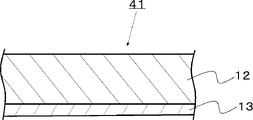
- FIG. 4 is a schematic cross-sectional view showing an example of the resin-coated metal foil used when manufacturing the metal-clad laminate of the present invention.
- the resin-coated metal foil 41 has a structure in which a composition layer 12 made of the composition of the present invention and a metal layer 13 are laminated.
- the resin-coated metal foil 41 may include the composition layer 12 made of the composition before curing and the metal layer 13, and the composition layer 12 made of the semi-cured composition and the metal layer 13 may be provided. may be provided. According to the configuration as described above, it is possible to obtain a resin-coated metal foil from which a metal-clad laminate with sufficiently reduced dielectric loss can be produced.
- Examples of the method of manufacturing the resin-coated metal foil 41 include a method of applying a composition to the surface of the metal foil 13 such as a copper foil and then drying the composition.
- the coating device used for coating can be appropriately selected according to the film thickness of the metal foil to be formed. be done. These may be used individually by 1 type, and may be used 2 or more types.
- the composition or the semi-cured composition may be obtained by drying or heat-drying the composition.
- the conditions for drying or heat drying in the manufacturing method of the resin-coated metal foil 41 are not particularly limited, and it is preferable that the heating temperature is 300 to 400° C. and the heating time is about 5 to 60 minutes.
- the solvent is volatilized, the solvent is reduced or removed, and the resin-coated metal foil 41 in a pre-cured or semi-cured state is obtained.
- a wiring board is manufactured by arranging a wiring circuit on the surface of the metal-clad laminate of the present invention.
- Conventionally known methods can be used as appropriate for the method of forming a wiring circuit on the surface of the metal-clad laminate of the present invention to manufacture a wiring board. can be used, such as a subtractive method of etching the surface or an MSAP method of plating the surface.
- FIG. 5 is a schematic cross-sectional view showing an example of a wiring board manufactured using the metal-clad laminate of the present invention.
- a wiring circuit 16 is formed by etching (partially removed).
- Examples 1 to 9, 11, and 14 to 21 are examples, and Examples 10, 12, and 13 are comparative examples.
- Fluoropolymer A1 EA-2000 (product of AGC Co., Ltd., fluoropolymer containing units based on fluoroolefin and units based on a monomer having an adhesive functional group, melting point 300 ° C. by DSC measurement)
- Fluorine-containing polymer A2 Fluon FL1710 (product of AGC Co., Ltd., polytetrafluoroethylene, a fluoropolymer containing units based on fluoroolefin and not containing units based on a monomer having an adhesive functional group)
- Inorganic filler B1 FB-950XFC (Denka Co., Ltd.
- Inorganic filler B2 FB-25SX (Denka Co., Ltd. product, spherical silica particles, median diameter (average particle diameter D50): 17.3 ⁇ m, specific surface area 3.9 m 2 /g, surface adsorbed water content 483 mass ppm)
- Inorganic filler B3 FB-7SDC (Denka Co., Ltd.
- Inorganic filler B4 FB-304 (Denka Co., Ltd.
- Inorganic filler B5 FB-950FD (product of Denka Co., Ltd., spherical silica particles, median diameter (average particle diameter D50): 24.2 ⁇ m, specific surface area 1.4 m 2 /g, sphericity 0.85 or more, surface adsorbed moisture Amount 173 mass ppm)
- Inorganic filler B6 FB-8C (product of Denka Co., Ltd., spherical silica particles, median diameter (average particle diameter D50): 8.3 ⁇ m, specific surface area 1.6 m 2 /g, sphericity 0.85 or more, surface adsorbed moisture Amount 198 mass ppm)
- Inorganic filler B7 FB-7SDX (Denka Co., Ltd.
- Inorganic filler B8 FB-302X (Denka Co., Ltd. product, spherical silica particles, median diameter (average particle diameter D50): 5.9 ⁇ m, specific surface area 3.5 m 2 /g, surface adsorbed water content 433 mass ppm)
- Inorganic filler B9 FB-105X (Denka Co., Ltd.
- Inorganic filler B10 FB-100XFD (Denka Co., Ltd.
- Inorganic filler B11 FB-950XFD (product of Denka Co., Ltd., spherical silica particles, median diameter (average particle diameter D50): 13.0 ⁇ m, specific surface area 2.0 m 2 /g, surface adsorbed water content 247 mass ppm)
- Examples 1-21 A total of 200 g of each component and 137 g of cyclohexanone described in the component column of the composition in Tables 1 and 2 below were put into a pot, and the mixture was stirred for 20 minutes while applying an acceleration of about 80 G with a low-frequency resonance acoustic mixer (LabMAS II) manufactured by Resodyne. Vibration mixing was carried out to obtain a slurry composition.
- a low-frequency resonance acoustic mixer (LabMAS II) manufactured by Resodyne. Vibration mixing was carried out to obtain a slurry composition.
- the slurry was applied to the surface of a 18 ⁇ m thick copper foil (TQ-M4-VSP, manufactured by Mitsui Mining & Smelting Co., Ltd.) by a doctor blade method to a thickness of 100 ⁇ m, dried for 12 hours in an atmospheric environment at room temperature, and then nitrogen.
- a composition layer was formed by heat drying at 350° C. for 20 minutes in an atmosphere.
- a single-sided metal-clad laminate having a composition layer and a metal layer made of copper foil was obtained. Two of the single-sided metal-clad laminates were stacked with the resin sides facing each other and pressed for 60 minutes at a temperature of 330° C.
- the ratio of the total volume of the polymer and the inorganic filler to the total volume of the composition layer was 100% by volume, and the thickness of the composition layer was 125 ⁇ m.
- the double-sided metal-clad laminate of each example was evaluated as described below. Results are shown in Tables 1 and 2.
- G-CPW grounded coplanar line
- the impedance is 50 ⁇ .
- ⁇ Ten point average roughness Rzjis> The roughened surface of the copper foil was measured using a surfcoder SE600 manufactured by Kosaka Laboratory according to the method specified in Annex JA of JIS B 0601:2013.
- ⁇ Relative permittivity Dk and dielectric loss tangent Df> The dielectric constant Dk and dielectric loss tangent Df of the composition layer (thickness 125 ⁇ m) were measured at 25° C. and 10 GHz according to the method specified in JIS R 1641:2007 using a cavity resonator and a vector network analyzer. In many cases, it is preferable that both the dielectric constant Dk and the dielectric loss tangent Df are small, but depending on the application, it may be better to adjust them to predetermined values.
- thermomechanical analyzer TMA402 FA Hyperion manufactured by NETZSCH
- CTE coefficient of thermal expansion
- the peel strengths of Examples 1-9, 11, 12, and 14-21 are 8.1-19.3 (N/cm), which are all higher than the peel strength of Example 10, 8.0 (N/cm). it was high. Among these, Example 1 (15.5 N/cm), Example 5 (19.3 N/cm), and Example 11 (17.7 N/cm) were particularly high and good.
- the transmission loss for Examples 1-11 and 14-21 was -0.4 dB/cm.
- the transmission loss of Example 12 could not be measured because the composition layer had a high CTE and a transmission line could not be formed.
- the transmission loss of Example 13 could not be measured because the copper foil peeling strength was weak and a transmission path could not be formed.
- the ten-point average roughness of the roughened surface of each of the copper foils of Examples 1 to 21 was 0.6 ⁇ m.
- the dielectric loss tangents Df of Examples 1-12, 15-17, 19 and 21 were all 0.001.
- the dielectric loss tangents Df of Examples 13 and 14 were both 0.0008.
- the dielectric loss tangents Df of Examples 18 and 20 were both 0.0009.
- the dielectric constants Dk of Examples 1 to 14 were all 2.75.
- the dielectric constants Dk of Examples 15-21 were 2.8-2.9.
- a solid By using a composition in which the content of the inorganic filler per minute is 55% by volume or more with respect to the total solid content of the composition, the dielectric constant and dielectric loss tangent are low, and the composition for the metal layer It was found that a metal-clad laminate with improved adhesiveness between layers can be obtained. Further, in the above composition, instead of the fluoropolymer A1 containing units based on fluoroolefin-based units and units based on a monomer having an adhesive functional group, It has been found that when a fluoropolymer containing no units is used, sufficient peel strength cannot be obtained, and transmission loss cannot be measured.
- the present invention has wide industrial applicability in technical fields related to electronic materials and various devices using them.
- Metal-clad laminate 12 Composition layer (insulating layer) 13: Metal layer 14: Adhesive layer (primer layer) 15: Intermediate layer 16: Wiring circuit 41: Metal foil with resin
Landscapes
- Chemical & Material Sciences (AREA)
- Organic Chemistry (AREA)
- Health & Medical Sciences (AREA)
- Chemical Kinetics & Catalysis (AREA)
- Medicinal Chemistry (AREA)
- Polymers & Plastics (AREA)
- Engineering & Computer Science (AREA)
- Microelectronics & Electronic Packaging (AREA)
- Life Sciences & Earth Sciences (AREA)
- Wood Science & Technology (AREA)
- Laminated Bodies (AREA)
- Inorganic Chemistry (AREA)
Priority Applications (4)
| Application Number | Priority Date | Filing Date | Title |
|---|---|---|---|
| JP2023527838A JPWO2022259981A1 (https=) | 2021-06-11 | 2022-06-03 | |
| KR1020237042092A KR20240019121A (ko) | 2021-06-11 | 2022-06-03 | 조성물, 그리고 금속 피복 적층체 및 그 제조 방법 |
| CN202280041658.XA CN117461392A (zh) | 2021-06-11 | 2022-06-03 | 组合物以及覆金属层叠体及其制造方法 |
| US18/527,512 US20240124698A1 (en) | 2021-06-11 | 2023-12-04 | Composition, as well as metal-clad laminate and method for its production |
Applications Claiming Priority (2)
| Application Number | Priority Date | Filing Date | Title |
|---|---|---|---|
| JP2021097909 | 2021-06-11 | ||
| JP2021-097909 | 2021-06-11 |
Related Child Applications (1)
| Application Number | Title | Priority Date | Filing Date |
|---|---|---|---|
| US18/527,512 Continuation US20240124698A1 (en) | 2021-06-11 | 2023-12-04 | Composition, as well as metal-clad laminate and method for its production |
Publications (1)
| Publication Number | Publication Date |
|---|---|
| WO2022259981A1 true WO2022259981A1 (ja) | 2022-12-15 |
Family
ID=84425980
Family Applications (1)
| Application Number | Title | Priority Date | Filing Date |
|---|---|---|---|
| PCT/JP2022/022650 Ceased WO2022259981A1 (ja) | 2021-06-11 | 2022-06-03 | 組成物、並びに、金属張積層体及びその製造方法 |
Country Status (5)
| Country | Link |
|---|---|
| US (1) | US20240124698A1 (https=) |
| JP (1) | JPWO2022259981A1 (https=) |
| KR (1) | KR20240019121A (https=) |
| CN (1) | CN117461392A (https=) |
| WO (1) | WO2022259981A1 (https=) |
Cited By (2)
| Publication number | Priority date | Publication date | Assignee | Title |
|---|---|---|---|---|
| WO2024165388A1 (en) | 2023-02-07 | 2024-08-15 | Solvay Specialty Polymers Usa, Ll | Composite films for mobile electronic device components |
| WO2025005148A1 (ja) * | 2023-06-29 | 2025-01-02 | Agc株式会社 | 水性プライマー組成物、プライマー層の形成方法、及び成形物 |
Citations (4)
| Publication number | Priority date | Publication date | Assignee | Title |
|---|---|---|---|---|
| JP2019183005A (ja) * | 2018-04-11 | 2019-10-24 | Agc株式会社 | フッ素樹脂シート、積層体及びそれらの製造方法 |
| WO2019203243A1 (ja) * | 2018-04-20 | 2019-10-24 | Agc株式会社 | ロールフィルム、ロールフィルムの製造方法、銅張積層体の製造方法、及びプリント基板の製造方法 |
| WO2020145133A1 (ja) * | 2019-01-11 | 2020-07-16 | ダイキン工業株式会社 | フッ素樹脂組成物、フッ素樹脂シート、積層体及び回路用基板 |
| WO2021095662A1 (ja) * | 2019-11-11 | 2021-05-20 | Agc株式会社 | 非水系分散液、積層体の製造方法及び成形物 |
Family Cites Families (4)
| Publication number | Priority date | Publication date | Assignee | Title |
|---|---|---|---|---|
| JPH0286172A (ja) | 1988-09-22 | 1990-03-27 | Hitachi Ltd | 化合物半導体デバイス |
| JP4377867B2 (ja) | 2005-09-30 | 2009-12-02 | 日本ピラー工業株式会社 | 銅張積層板、プリント配線板及び多層プリント配線板並びにこれらの製造方法 |
| JP2017002115A (ja) | 2015-06-04 | 2017-01-05 | Apc株式会社 | フッ素樹脂フィルム、積層体及び積層体の製造方法 |
| KR102353961B1 (ko) * | 2016-07-22 | 2022-01-21 | 에이지씨 가부시키가이샤 | 액상 조성물, 그리고 그 액상 조성물을 사용한, 필름 및 적층체의 제조 방법 |
-
2022
- 2022-06-03 KR KR1020237042092A patent/KR20240019121A/ko active Pending
- 2022-06-03 CN CN202280041658.XA patent/CN117461392A/zh active Pending
- 2022-06-03 JP JP2023527838A patent/JPWO2022259981A1/ja active Pending
- 2022-06-03 WO PCT/JP2022/022650 patent/WO2022259981A1/ja not_active Ceased
-
2023
- 2023-12-04 US US18/527,512 patent/US20240124698A1/en active Pending
Patent Citations (4)
| Publication number | Priority date | Publication date | Assignee | Title |
|---|---|---|---|---|
| JP2019183005A (ja) * | 2018-04-11 | 2019-10-24 | Agc株式会社 | フッ素樹脂シート、積層体及びそれらの製造方法 |
| WO2019203243A1 (ja) * | 2018-04-20 | 2019-10-24 | Agc株式会社 | ロールフィルム、ロールフィルムの製造方法、銅張積層体の製造方法、及びプリント基板の製造方法 |
| WO2020145133A1 (ja) * | 2019-01-11 | 2020-07-16 | ダイキン工業株式会社 | フッ素樹脂組成物、フッ素樹脂シート、積層体及び回路用基板 |
| WO2021095662A1 (ja) * | 2019-11-11 | 2021-05-20 | Agc株式会社 | 非水系分散液、積層体の製造方法及び成形物 |
Cited By (2)
| Publication number | Priority date | Publication date | Assignee | Title |
|---|---|---|---|---|
| WO2024165388A1 (en) | 2023-02-07 | 2024-08-15 | Solvay Specialty Polymers Usa, Ll | Composite films for mobile electronic device components |
| WO2025005148A1 (ja) * | 2023-06-29 | 2025-01-02 | Agc株式会社 | 水性プライマー組成物、プライマー層の形成方法、及び成形物 |
Also Published As
| Publication number | Publication date |
|---|---|
| JPWO2022259981A1 (https=) | 2022-12-15 |
| US20240124698A1 (en) | 2024-04-18 |
| KR20240019121A (ko) | 2024-02-14 |
| CN117461392A (zh) | 2024-01-26 |
Similar Documents
| Publication | Publication Date | Title |
|---|---|---|
| JP7368769B2 (ja) | 積層体及び回路用基板 | |
| US20200404782A1 (en) | Metal-clad laminate and manufacturing method of the same | |
| JP6819579B2 (ja) | プリント基板用材料、金属積層板、それらの製造方法およびプリント基板の製造方法 | |
| TWI720206B (zh) | 適於高頻電路之雙面電路用基板 | |
| US20150296614A1 (en) | Crosslinked fluoropolymer circuit materials, circuit laminates, and methods of manufacture thereof | |
| US20240124698A1 (en) | Composition, as well as metal-clad laminate and method for its production | |
| JP7421156B1 (ja) | 誘電体及びその製造方法 | |
| JP7568991B2 (ja) | フッ素樹脂シート、銅張積層体、回路用基板及びアンテナ | |
| WO2021075504A1 (ja) | 非水系分散液及び積層体の製造方法 | |
| JP2023002495A (ja) | 誘電体材料、及びこれを備えた可撓性銅張積層板 | |
| US20250358931A1 (en) | Dielectric, copper-clad laminate and method for producing same | |
| WO2024128221A1 (ja) | 組成物、シート及びその製造方法 | |
| JP2025079056A (ja) | 組成物、並びに、金属張積層体及びその製造方法 | |
| JP7846386B2 (ja) | 誘電体、銅張積層体及びそれらの製造方法 | |
| KR101797724B1 (ko) | 연성 금속 적층체 | |
| JP2024030218A (ja) | プリント配線板の製造方法 | |
| TW202440775A (zh) | 介電體、覆銅積層體及其等之製造方法 | |
| JP2025039524A (ja) | シート、金属張積層体、回路用基板及びアンテナ | |
| JP2024142753A (ja) | 両面金属張積層板の製造方法 | |
| JP2020093196A (ja) | 処理金属基板の製造方法 |
Legal Events
| Date | Code | Title | Description |
|---|---|---|---|
| 121 | Ep: the epo has been informed by wipo that ep was designated in this application |
Ref document number: 22820162 Country of ref document: EP Kind code of ref document: A1 |
|
| WWE | Wipo information: entry into national phase |
Ref document number: 2023527838 Country of ref document: JP |
|
| WWE | Wipo information: entry into national phase |
Ref document number: 202280041658.X Country of ref document: CN |
|
| NENP | Non-entry into the national phase |
Ref country code: DE |
|
| 122 | Ep: pct application non-entry in european phase |
Ref document number: 22820162 Country of ref document: EP Kind code of ref document: A1 |