WO2022259326A1 - コーティング組成物、コーティング膜および物品、光学機器、照明機器 - Google Patents
コーティング組成物、コーティング膜および物品、光学機器、照明機器 Download PDFInfo
- Publication number
- WO2022259326A1 WO2022259326A1 PCT/JP2021/021603 JP2021021603W WO2022259326A1 WO 2022259326 A1 WO2022259326 A1 WO 2022259326A1 JP 2021021603 W JP2021021603 W JP 2021021603W WO 2022259326 A1 WO2022259326 A1 WO 2022259326A1
- Authority
- WO
- WIPO (PCT)
- Prior art keywords
- coating film
- fine particles
- mass
- coating composition
- coating
- Prior art date
- Legal status (The legal status is an assumption and is not a legal conclusion. Google has not performed a legal analysis and makes no representation as to the accuracy of the status listed.)
- Ceased
Links
Images




Classifications
-
- C—CHEMISTRY; METALLURGY
- C09—DYES; PAINTS; POLISHES; NATURAL RESINS; ADHESIVES; COMPOSITIONS NOT OTHERWISE PROVIDED FOR; APPLICATIONS OF MATERIALS NOT OTHERWISE PROVIDED FOR
- C09D—COATING COMPOSITIONS, e.g. PAINTS, VARNISHES OR LACQUERS; FILLING PASTES; CHEMICAL PAINT OR INK REMOVERS; INKS; CORRECTING FLUIDS; WOODSTAINS; PASTES OR SOLIDS FOR COLOURING OR PRINTING; USE OF MATERIALS THEREFOR
- C09D7/00—Features of coating compositions, not provided for in group C09D5/00; Processes for incorporating ingredients in coating compositions
- C09D7/40—Additives
- C09D7/60—Additives non-macromolecular
- C09D7/61—Additives non-macromolecular inorganic
-
- C—CHEMISTRY; METALLURGY
- C09—DYES; PAINTS; POLISHES; NATURAL RESINS; ADHESIVES; COMPOSITIONS NOT OTHERWISE PROVIDED FOR; APPLICATIONS OF MATERIALS NOT OTHERWISE PROVIDED FOR
- C09D—COATING COMPOSITIONS, e.g. PAINTS, VARNISHES OR LACQUERS; FILLING PASTES; CHEMICAL PAINT OR INK REMOVERS; INKS; CORRECTING FLUIDS; WOODSTAINS; PASTES OR SOLIDS FOR COLOURING OR PRINTING; USE OF MATERIALS THEREFOR
- C09D1/00—Coating compositions, e.g. paints, varnishes or lacquers, based on inorganic substances
-
- C—CHEMISTRY; METALLURGY
- C09—DYES; PAINTS; POLISHES; NATURAL RESINS; ADHESIVES; COMPOSITIONS NOT OTHERWISE PROVIDED FOR; APPLICATIONS OF MATERIALS NOT OTHERWISE PROVIDED FOR
- C09D—COATING COMPOSITIONS, e.g. PAINTS, VARNISHES OR LACQUERS; FILLING PASTES; CHEMICAL PAINT OR INK REMOVERS; INKS; CORRECTING FLUIDS; WOODSTAINS; PASTES OR SOLIDS FOR COLOURING OR PRINTING; USE OF MATERIALS THEREFOR
- C09D5/00—Coating compositions, e.g. paints, varnishes or lacquers, characterised by their physical nature or the effects produced; Filling pastes
- C09D5/16—Antifouling paints; Underwater paints
- C09D5/1606—Antifouling paints; Underwater paints characterised by the anti-fouling agent
- C09D5/1612—Non-macromolecular compounds
- C09D5/1618—Non-macromolecular compounds inorganic
-
- C—CHEMISTRY; METALLURGY
- C09—DYES; PAINTS; POLISHES; NATURAL RESINS; ADHESIVES; COMPOSITIONS NOT OTHERWISE PROVIDED FOR; APPLICATIONS OF MATERIALS NOT OTHERWISE PROVIDED FOR
- C09D—COATING COMPOSITIONS, e.g. PAINTS, VARNISHES OR LACQUERS; FILLING PASTES; CHEMICAL PAINT OR INK REMOVERS; INKS; CORRECTING FLUIDS; WOODSTAINS; PASTES OR SOLIDS FOR COLOURING OR PRINTING; USE OF MATERIALS THEREFOR
- C09D7/00—Features of coating compositions, not provided for in group C09D5/00; Processes for incorporating ingredients in coating compositions
- C09D7/20—Diluents or solvents
-
- C—CHEMISTRY; METALLURGY
- C09—DYES; PAINTS; POLISHES; NATURAL RESINS; ADHESIVES; COMPOSITIONS NOT OTHERWISE PROVIDED FOR; APPLICATIONS OF MATERIALS NOT OTHERWISE PROVIDED FOR
- C09D—COATING COMPOSITIONS, e.g. PAINTS, VARNISHES OR LACQUERS; FILLING PASTES; CHEMICAL PAINT OR INK REMOVERS; INKS; CORRECTING FLUIDS; WOODSTAINS; PASTES OR SOLIDS FOR COLOURING OR PRINTING; USE OF MATERIALS THEREFOR
- C09D7/00—Features of coating compositions, not provided for in group C09D5/00; Processes for incorporating ingredients in coating compositions
- C09D7/40—Additives
- C09D7/65—Additives macromolecular
-
- C—CHEMISTRY; METALLURGY
- C09—DYES; PAINTS; POLISHES; NATURAL RESINS; ADHESIVES; COMPOSITIONS NOT OTHERWISE PROVIDED FOR; APPLICATIONS OF MATERIALS NOT OTHERWISE PROVIDED FOR
- C09D—COATING COMPOSITIONS, e.g. PAINTS, VARNISHES OR LACQUERS; FILLING PASTES; CHEMICAL PAINT OR INK REMOVERS; INKS; CORRECTING FLUIDS; WOODSTAINS; PASTES OR SOLIDS FOR COLOURING OR PRINTING; USE OF MATERIALS THEREFOR
- C09D7/00—Features of coating compositions, not provided for in group C09D5/00; Processes for incorporating ingredients in coating compositions
- C09D7/40—Additives
- C09D7/66—Additives characterised by particle size
- C09D7/67—Particle size smaller than 100 nm
-
- F—MECHANICAL ENGINEERING; LIGHTING; HEATING; WEAPONS; BLASTING
- F21—LIGHTING
- F21V—FUNCTIONAL FEATURES OR DETAILS OF LIGHTING DEVICES OR SYSTEMS THEREOF; STRUCTURAL COMBINATIONS OF LIGHTING DEVICES WITH OTHER ARTICLES, NOT OTHERWISE PROVIDED FOR
- F21V3/00—Globes; Bowls; Cover glasses
-
- G—PHYSICS
- G02—OPTICS
- G02B—OPTICAL ELEMENTS, SYSTEMS OR APPARATUS
- G02B1/00—Optical elements characterised by the material of which they are made; Optical coatings for optical elements
- G02B1/10—Optical coatings produced by application to, or surface treatment of, optical elements
-
- C—CHEMISTRY; METALLURGY
- C08—ORGANIC MACROMOLECULAR COMPOUNDS; THEIR PREPARATION OR CHEMICAL WORKING-UP; COMPOSITIONS BASED THEREON
- C08K—Use of inorganic or non-macromolecular organic substances as compounding ingredients
- C08K3/00—Use of inorganic substances as compounding ingredients
- C08K3/18—Oxygen-containing compounds, e.g. metal carbonyls
- C08K3/20—Oxides; Hydroxides
- C08K3/22—Oxides; Hydroxides of metals
- C08K2003/2231—Oxides; Hydroxides of metals of tin
-
- C—CHEMISTRY; METALLURGY
- C08—ORGANIC MACROMOLECULAR COMPOUNDS; THEIR PREPARATION OR CHEMICAL WORKING-UP; COMPOSITIONS BASED THEREON
- C08K—Use of inorganic or non-macromolecular organic substances as compounding ingredients
- C08K2201/00—Specific properties of additives
- C08K2201/002—Physical properties
- C08K2201/005—Additives being defined by their particle size in general
-
- C—CHEMISTRY; METALLURGY
- C08—ORGANIC MACROMOLECULAR COMPOUNDS; THEIR PREPARATION OR CHEMICAL WORKING-UP; COMPOSITIONS BASED THEREON
- C08K—Use of inorganic or non-macromolecular organic substances as compounding ingredients
- C08K3/00—Use of inorganic substances as compounding ingredients
- C08K3/18—Oxygen-containing compounds, e.g. metal carbonyls
- C08K3/20—Oxides; Hydroxides
- C08K3/22—Oxides; Hydroxides of metals
-
- C—CHEMISTRY; METALLURGY
- C08—ORGANIC MACROMOLECULAR COMPOUNDS; THEIR PREPARATION OR CHEMICAL WORKING-UP; COMPOSITIONS BASED THEREON
- C08K—Use of inorganic or non-macromolecular organic substances as compounding ingredients
- C08K3/00—Use of inorganic substances as compounding ingredients
- C08K3/34—Silicon-containing compounds
- C08K3/36—Silica
Definitions
- the present disclosure relates to coating compositions, coating films and articles, optical devices, and lighting devices that contain silica microparticles.
- Patent Document 1 discloses a method of forming a thin film of metal oxide exhibiting photocatalytic activity with a film thickness of 10 to 200 nm on the surface of glass. ing.
- the present disclosure has been made in view of the above, and provides a coating composition that can quickly eliminate fogging of the substrate due to the fogging phenomenon and maintain high transparency of the coating film as compared with the conventional one. , coating films and articles, optical equipment, lighting equipment.
- the coating composition of the present disclosure includes silica fine particles having an average particle size of 3 nm or more and 25 nm or less, metal oxide fine particles, and a boiling point of 150 ° C. or more and 300 ° C. or less. and water.
- the content of silica fine particles is 0.1% by mass or more and 5% by mass or less.
- the content of the solvent is 20% by mass or more and 70% by mass or less.
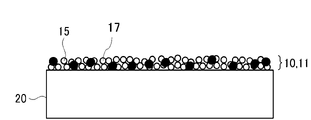
- FIG. 1 is a cross-sectional view schematically showing an example of the structure of a coating film using the coating composition according to Embodiment 1.
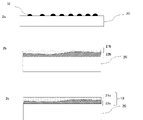
- FIG. FIG. 5 is a diagram for explaining the effect of a coating film using the coating composition according to Embodiment 1;
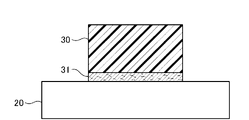
- 1 is a cross-sectional view schematically showing an example of a method for producing a coating film using the coating composition according to Embodiment 1.
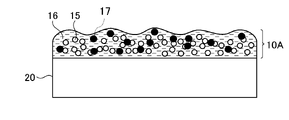
- FIG. 1 is a cross-sectional view schematically showing an example of the procedure of a method for producing a coating film using the coating composition according to Embodiment 1.
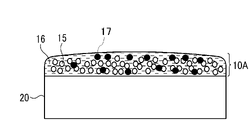
- FIG. 1 is a cross-sectional view schematically showing an example of the procedure of a method for producing a coating film using the coating composition according to Embodiment 1.
- FIG. 1 is a cross-sectional view schematically showing an example of the procedure of a method for producing a coating film using the coating composition according to Embodiment 1.
- FIG. 1 is a cross-sectional view schematically showing an example of the procedure of a method for producing a coating film using the coating composition according to Embodiment 1.
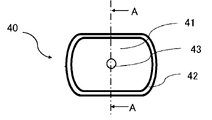
- FIG. FIG. 10 is a front view showing an example of an optical device having a coating film according to Embodiment 2;
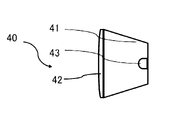
- FIG. 8 is a cross-sectional view taken along the line AA of FIG. 7;
- FIG. 10 is a front view showing an example of an optical device having a coating film according to Embodiment 2;
- FIG. 10 is a cross-sectional view taken along the line BB of FIG. 9;
- FIG. 10 is a front view showing an example of an optical device having a coating film according to Embodiment 2;
- FIG. 12 is a sectional view taken along line CC of FIG. 11;
- FIG. 10 is a front view showing an example of an optical device having a coating film according to Embodiment 2;
- FIG. 14 is a cross-sectional view taken along line DD of FIG. 13;
- FIG. 11 is a front view showing an example of lighting equipment having a coating film according to Embodiment 3;
- FIG. 16 is a cross-sectional view taken along line EE of FIG. 15; It is a figure which put together the evaluation result of an Example and a comparative example.
- Embodiment 1 contains silica microparticles, metal oxide microparticles, a high-boiling solvent, and water. Moreover, the coating composition according to Embodiment 1 may further include fluororesin particles and a non-volatile hydrophilic organic substance. The components contained in the coating composition are described below.
- the silica fine particles contained in the coating composition according to Embodiment 1 are the base component of the coating film.
- the silica fine particles and the metal oxide fine particles in the coating composition it is possible to form and maintain a highly transparent hydrophilic surface in the coating film formed by the coating composition.
- the coating film formed by the coating composition of the first embodiment is formed by agglomeration of silica fine particles and metal oxide fine particles, it is porous in terms of nanometer order. Since the surface of the coating film is hydrophilic, the ability to suppress the adhesion of hydrophobic dirt can be improved, and the adhered water can easily spread and flow off. In addition, since the adhering water spreads well, the water enters between the membrane surface and the dirt, making it easier for the dirt to flow off.
- the coating film formed by the coating composition of Embodiment 1 which is based on silica fine particles, is porous and has a low density, the interaction between the coating film surface and deposits such as dust is reduced. As it becomes smaller, it becomes difficult for dirt to adhere.
- organic matter that causes fogging due to the fogging phenomenon adheres to the coating film formed by the coating composition of Embodiment 1, the organic matter penetrates into the silica fine particles, so the fogging is quickly eliminated and transparency is improved. can be maintained.
- fogging due to the fogging phenomenon means that unevenness of organic substances such as plasticizers and solvents adhering to the surface of the coating film scatters light and appears cloudy white.
- the metal oxide fine particles are contained, even if the absorption of the organic substance 18 becomes uneven, visibility is not affected, and high transparency and uniformity are maintained.
- Silica fine particles have a lower refractive index than other inorganic particles, and have a refractive index close to that of glass and transparent resins such as plastics that are commonly used as substrates. If the refractive index of the base material and the coating film are about the same, it is suppressed that the base material looks white due to light reflection at their interface and surface, and the color tone of the base material is less likely to be damaged.
- the average particle diameter of the silica fine particles is preferably 3 nm or more and 25 nm or less, and particularly preferably 4 nm or more and 10 nm or less.
- the average particle size means the value of the average particle size of primary particles when measured with a laser light scattering type or dynamic scattering type particle size distribution meter.
- the primary particles are the smallest units of particles and are particles that are not divided further.
- An aggregate of primary particles in which a plurality of primary particles are aggregated is called a secondary particle.
- the average particle diameter of the silica fine particles When the average particle diameter of the silica fine particles is larger than 25 nm, the unevenness of the surface of the coating film becomes too large, and white turbidity tends to occur. Moreover, the average particle size of the silica fine particles is 3 nm or more and 25 nm or less, and the coating film contains metal oxide fine particles. As a result, the coating film has an appropriate degree of density, and the organic substances that cause fogging due to the fogging phenomenon can easily permeate the surface of the coating film. Cloudiness is eliminated and high transparency can be maintained. In addition, since the contact area between the surface of the coating film and dirt such as dust is small, sufficient antifouling properties can be obtained.
- the antifouling property means a property that makes it difficult for dirt to adhere or a property that adhered dirt can be easily removed.
- the content of silica fine particles in the coating composition is preferably 0.1% by mass or more and 5% by mass or less, and preferably 0.5% by mass or more and 2% by mass or less.
- the content of the silica fine particles in the coating composition is less than 0.1% by mass, the formed coating film becomes too thin, and the desired antifouling property may not be obtained.
- the content of the silica fine particles in the coating composition is more than 5% by mass, the coating film becomes too thick, cracks and irregularities occur, and the coating composition tends to become cloudy.
- the content of the silica fine particles in the coating composition is preferably 0.1% by mass or more and 5% by mass or less. In particular, when the content of silica fine particles in the coating composition is 0.5% by mass or more and 2% by mass or less, a uniform coating film having an appropriate thickness can be formed, and sufficient antifouling can be achieved. You can get sex.
- Silica fine particles having the characteristics described above can be prepared according to known methods.
- colloidal silica prepared from an aqueous solution of sodium silicate or prepared by a sol-gel method can be used as silica microparticles.
- Silica fine particles may be spherical, or may be irregularly shaped such as hollow, scale-like, and rod-like.
- the obtained film strength tends to be high. Therefore, the use of scaly silica fine particles provides favorable results for applications that require abrasion resistance.
- silica fine particles connected in a beaded shape may be used.
- the metal oxide fine particles contained in the coating composition of Embodiment 1 preferably exhibit a high refractive index and exhibit transparency when formed as a coating film.
- fine particles of metal oxide with a high refractive index it has the effect of making unevenness inconspicuous when organic matter that causes fogging due to fogging phenomenon penetrates into the coating film, contributing to the transparency and uniformity of the coating film.
- the coating film based on silica microparticles is porous, the refractive index of the coating film takes air into account.
- the refractive index of the coating film is higher than that of a silica fine particle layer consisting only of silica fine particles.
- the difference between the refractive index of the film containing the metal oxide fine particles and the refractive index of the organic substance becomes small, and unevenness when the organic substance permeates the coating film becomes less noticeable, and the transparency and uniformity of the coating film can be realized.
- the refractive index of the metal oxide fine particles is preferably 1.6 or more. If the refractive index of the metal oxide is 1.6 or more, when a coating film is formed from the coating composition of Embodiment 1, unevenness caused by permeation of the organic substance into the coating film is reduced.
- metal oxides those exhibiting high photocatalytic activity can also be used.
- the organic substances that permeate the coating film are decomposed under the irradiation environment of sunlight or artificial light. Furthermore, since it exhibits hydrophilicity, it has a self-cleaning property to wash away stains adhering to the surface.
- the metal oxide may be a single metal oxide, a solid solution of two or more kinds of oxides, or a composite oxide.
- single metal oxides include aluminum oxide, titanium oxide, zirconium oxide, indium oxide, zinc oxide, tin oxide, lanthanum oxide, yttrium oxide, cerium oxide, and magnesium oxide.
- solid solutions of two or more oxides include indium tin oxide.
- the composite oxide is, for example, barium titanate, perovskite, spinel, or the like.
- the coating film formed from the coating composition of Embodiment 1 containing a metal oxide having photocatalytic action is applied to the surface of a base material formed of a resin, for example, if it is an apatite-coated titanium oxide, the resin is decomposed. I have nothing to do.
- the average particle size of the metal oxide fine particles is preferably 1 nm or more and 25 nm or less, and particularly preferably 2 nm or more and 10 nm or less.
- the average particle size means the value of the average particle size of primary particles when measured with a laser light scattering type or dynamic scattering type particle size distribution meter. If the particle size is larger than 25 nm, light scattering on the surface of the coating film may increase, resulting in an increase in haze.
- the average particle diameter of the metal oxide fine particles is 1 nm or less, the coating film becomes too dense, and it may become difficult for organic substances that cause fogging due to the fogging phenomenon to permeate.
- the average particle diameter of the metal oxide fine particles is 2 nm or more and 10 nm or less, the coating film has a moderate density, and the organic substances that cause fogging due to the fogging phenomenon are more likely to permeate.
- the content of the metal oxide fine particles in the coating composition is preferably 80% by mass or less and 2% by mass or more, particularly preferably 50% by mass or less and 5% by mass or more, relative to the silica fine particles. If it is 80% by mass or less and 2% by mass or more with respect to the silica fine particles, the refractive index can be adjusted appropriately, and the effect of suppressing unevenness when organic matter that causes fogging due to the fogging phenomenon penetrates into the coating film can be obtained. Cheap.
- the shape of the metal oxide fine particles includes spherical, granular, hollow, elliptical, cubic, cuboid, needle, columnar, rod, cylindrical, scale, and the like. Considering the formation of a porous coating film, the shape is preferably spherical, oval, columnar, or the like.
- the high boiling point solvent contained in the coating composition according to Embodiment 1 is a solvent having a boiling point higher than normal temperature, and as described later, a solvent having a boiling point of 150° C. or higher and 300° C. or lower.
- the high boiling point solvent can control the drying rate of the coating composition during the coating film formation process. As a result, the liquid film can be formed while maintaining the initial concentration of the silica fine particles in the coating composition, and aggregation of the silica fine particles during coating can be prevented. Furthermore, by changing the content of the high-boiling solvent so as to prolong the drying time, it is possible to level the liquid film after coating. A uniform coating film can be obtained by these effects.
- the boiling point of the high boiling point solvent is preferably 150°C or higher and 300°C or lower. If the boiling point of the high-boiling solvent is less than 150° C., the drying speed becomes too fast, and the effect of preventing aggregation of silica fine particles and leveling the liquid film after coating cannot be obtained. On the other hand, if the boiling point of the high-boiling solvent exceeds 300° C., the solvent tends to remain in the coating film, making it impossible to obtain a coating film having desired properties. From the above, the boiling point of the high boiling point solvent is preferably 150° C. or higher and 300° C. or lower.
- solubility of the high-boiling solvent in water is not particularly limited, it is preferably 70% by mass or more. This is because if the solubility in water is less than 70% by mass, it becomes easy to separate in water.
- high-boiling solvents examples include ethylene glycol, propylene glycol, propylene glycol propylene glycol monomethyl ether, ethylene glycol monomethyl ether, ethylene glycol monomethyl ether acetate, ethyl lactate, diethylene glycol dimethyl ether, dipropylene glycol dimethyl ether, dipropylene glycol dimethyl ether, gelatin.
- ethylene glycol ethyl methyl ether diethylene glycol isopropyl methyl ether, dipropylene glycol monomethyl ether, diethylene glycol diethyl ether, diethylene glycol monomethyl ether, diethylene glycol butyl methyl ether, tripropylene glycol dimethyl ether, triethylene glycol dimethyl ether, Diethylene glycol monobutyl ether, ethylene glycol monophenyl ether, triethylene glycol monomethyl ether, diethylene glycol monodibutyl ether, triethylene glycol butyl methyl ether, polyethylene glycol dimethyl ether, tetraethylene glycol dimethyl ether, polyethylene glycol monomethyl ether, N-methyl -2-pyrrolidone and the like. Also, these can be used singly or in combination of one or more as the high boiling point solvent.
- the content of the high boiling point solvent in the coating composition is 20% by mass or more and 70% by mass or less, preferably 30% by mass or more and 50% by mass or less. If the content of the high-boiling solvent is less than 20% by mass, the effect of preventing aggregation of the fine silica particles and the effect of leveling the liquid film after coating cannot be sufficiently obtained. On the other hand, when the content of the high-boiling solvent is more than 70% by mass, the solubility of the fine silica particles and the fluororesin particles that can be optionally contained in the coating composition is lowered, and they tend to agglomerate. As described above, the content of the high-boiling solvent in the coating composition is preferably 20% by mass or more and 70% by mass or less.
- the content of the high boiling point solvent in the coating composition is 30% by mass or more and 50% by mass or less, the dispersion state of the silica fine particles and the fluororesin particles in the liquid film by the coating composition is maintained, and the liquid film leveling effect can be obtained, a uniform and highly transparent coating film can be formed.
- Water contained in the coating composition according to Embodiment 1 is not particularly limited, and may be tap water, pure water, RO (Reverse Osmosis) water, deionized water, or the like.
- RO water is water obtained by removing impurities from tap water using a reverse osmosis membrane.
- water contains less ionic impurities such as calcium ions or magnesium ions.
- the divalent or higher ionic impurities contained in water are preferably 200 ppm or less, more preferably 50 ppm or less.
- the content of divalent or higher ionic impurities is more than 200 ppm, aggregation of silica fine particles may occur, which may lead to deterioration of coating composition due to deterioration of fluidity of the coating composition and deterioration of transparency of the coating film. be.
- the water content in the coating composition is not particularly limited, it is preferably 25% by mass or more and 80% by mass or less, and more preferably 50% by mass or more and 70% by mass or less. If the water content is less than 25% by mass, the silica fine particles and optionally included fluororesin particles in the coating composition may be less soluble and tend to aggregate. Also, if the water content is less than 25% by mass, the coating film becomes thick, and defects such as cracks are likely to occur. On the other hand, if the water content exceeds 80% by mass, the amount of solids in the composition becomes too small, making it difficult to efficiently form a coating film. As described above, the water content in the coating composition is preferably 25% by mass or more and 80% by mass or less.
- the water content in the coating composition is 50% by mass or more and 70% by mass or less, the dispersion state of the silica fine particles and the fluororesin particles in the liquid film by the coating composition can be maintained, and the thickness is moderate. uniform and highly transparent coating film can be formed.
- the coating composition according to Embodiment 1 can also contain fluororesin particles.
- fluororesin particles By blending fluororesin particles, a hydrophobic surface can be partially formed on the formed coating film. This can improve the ability to prevent the adhesion of dirt.
- lubricity can be imparted to the surface of the coating film formed by the fluororesin particles. This can improve the wear resistance of the coating film.
- the fluororesin particles are not particularly limited, but examples include PTFE (polytetrafluoroethylene), FEP (tetrafluoroethylene-hexafluoropropylene copolymer), PFA (tetrafluoroethylene-perfluoroalkyl vinyl ether copolymer), ETFE.
- PTFE polytetrafluoroethylene
- FEP tetrafluoroethylene-hexafluoropropylene copolymer
- PFA tetrafluoroethylene-perfluoroalkyl vinyl ether copolymer
- ETFE tetrafluoroethylene-perfluoroalkyl vinyl ether copolymer
- ethylene/tetrafluoroethylene copolymer ethylene/tetrafluoroethylene copolymer
- ECTFE ethylene/chlorotrifluoroethylene copolymer
- PVDF polyvinylidene fluoride
- PCTFE polychlorotrifluoroethylene
- PVF polyvinyl fluoride
- fluoroethylene/vinyl ether examples include particles formed from polymers, fluoroethylene-vinyl ester copolymers, copolymers and mixtures thereof, and mixtures of these fluororesins with other resins.
- the average particle size of the fluororesin particles is preferably 80 nm or more and 550 nm or less, more preferably 100 nm or more and 500 nm or less. If the average particle diameter of the fluororesin particles is less than 80 nm, it may not be possible to form sufficient hydrophobic portions on the surface of the coating film. On the other hand, when the particle size of the fluororesin particles exceeds 550 nm, the surface of the coating film becomes uneven, and dirt tends to be caught on the surface of the coating film. In addition, irregularities on the surface of the coating film may cause light scattering, resulting in clouding of the coating film.
- the average particle size of the fluororesin particles is preferably 80 nm or more and 550 nm or less.
- the average particle diameter of the fluororesin particles is 100 nm or more and 500 nm or less, a coating film having a hydrophobic surface and moderate unevenness due to the fluororesin particles can be obtained, so that sufficient antifouling properties can be obtained.
- the transparency of the coating film can be improved by minimizing the irregularities on the surface of the coating film formed using the rod-shaped or scale-shaped fluororesin particles.
- a dispersion of fluororesin particles that contains a low-molecular-weight component or a solvent, etc. has flexibility at the time of coating, and that these components volatilize and solidify after coating, the smoothness of the resulting film is improved. and transparency can be improved.
- Fluororesin particles can be prepared according to a known method.
- a commercially available fluororesin particle dispersed in water can be used as a raw material for the coating composition.
- the content of the fluororesin particles in the coating composition is preferably 5% by mass or more and 50% by mass or less, particularly preferably 10% by mass or more and 30% by mass or less, relative to the content of the silica fine particles. If the content of the fluororesin particles is less than 5% by mass relative to the content of the silica fine particles in the coating composition, the proportion of the hydrophobic surface in the surface of the coating film will be low, and the desired antifouling property will not be obtained. There is On the other hand, if the content of the fluororesin particles is more than 50% by mass with respect to the content of the silica fine particles, dust tends to easily adhere to the coating film, which is undesirable.
- the content of the fluororesin particles relative to the content of the silica fine particles in the coating composition is preferably 5% by mass or more and 50% by mass or less.
- the coating film has a hydrophilic surface and a hydrophobic surface in an appropriate ratio. Therefore, sufficient antifouling property can be obtained.
- the coating composition according to Embodiment 1 can also contain non-volatile hydrophilic organics, which are non-volatile hydrophilic organics.
- non-volatile hydrophilic organics which are non-volatile hydrophilic organics.
- the non-volatile hydrophilic organic substance is not particularly limited, but various non-volatile organic substances that do not have deliquescence can be used.
- Examples of non-volatile hydrophilic organics are polyethylene glycol, polypropylene glycol, polytetramethylene glycol, dimethicone copolyols, and mixtures thereof.
- a surfactant can also be used as the non-volatile hydrophilic organic substance.
- the surfactant is not particularly limited, a nonionic surfactant that hardly causes aggregation of silica fine particles is preferable.
- anionic surfactants and cationic surfactants can also be used if attention is paid to the amount to be added, the pH of the solvent, and the like.
- nonionic surfactants include polyoxyethylene alkyl ethers, polyoxyethylene alkylphenol ethers, polyoxyethylene alkyl esters, polyoxyethylene alkylamines, polyoxyethylene alkylamides, sorbitan alkyl esters, polyoxyethylene sorbitan alkyl esters, and the like. mentioned.
- anionic surfactants include higher alcohol sulfates (Na salts or amine salts), alkylallylsulfonates (Na salts or amine salts), alkylnaphthalenesulfonates (Na salts or amine salts), and alkylnaphthalenesulfonates. Condensates, alkyl phosphates, dialkyl sulfosuccinates, rosin soaps, fatty acid salts (Na salts or amine salts) and the like.
- cationic surfactants include octadecylamine acetate, imidazoline derivative acetate, polyalkylenepolyamine derivatives or salts thereof, octadecyltrimethylammonium chloride, triethylaminoethylalkylamide halide, alkylpyridinium sulfate, and alkyltrimethylammonium halide. be done.
- the non-volatile hydrophilic organic substance is not particularly limited, one with an average molecular weight of 400 or more and 500,000 or less can be used, and one with an average molecular weight of 700 or more and 100,000 or less is preferable. If the average molecular weight is less than 400, the amount of non-volatile hydrophilic organic matter added may increase dust adhesion, which is not preferred. On the other hand, when the average molecular weight exceeds 500,000, the fluidity of the coating liquid may be lowered, making uniform coating difficult. From the above, it is desirable that the average molecular weight of the non-volatile hydrophilic organic substance is 400 or more and 500,000 or less.
- the average molecular weight of the non-volatile hydrophilic organic substance is 700 or more and 100,000 or less, it has moderate fluidity, so that it is possible to obtain a highly transparent coating film in which voids in the coating film are filled. can.
- the content of the nonvolatile hydrophilic organic substance in the coating composition is preferably 10% by mass or more and 40% by mass or less, particularly 10% by mass or more and 30% by mass or less, relative to the content of the silica fine particles. is preferred. If the content of the nonvolatile hydrophilic organic matter relative to the content of the silica fine particles in the coating composition is less than 10% by mass, the voids inside the formed coating film cannot be sufficiently filled, or the coating composition spreadability may be lowered, and the transparency of the coating film may be insufficient. On the other hand, if the content of the non-volatile hydrophilic organic matter is more than 40% by mass with respect to the content of the silica fine particles, the coating film may become too soft, resulting in insufficient durability.
- the content of the non-volatile hydrophilic organic matter with respect to the content of the silica fine particles in the coating composition is 10% by mass or more and 40% by mass or less.
- the content of the non-volatile hydrophilic organic substance in the coating composition is 10% by mass or more and 30% by mass or less, the effect of sufficiently filling the voids in the coating film is obtained, resulting in a highly transparent coating.
- a film can be formed.
- the coating composition according to Embodiment 1 can contain components known in the art from the viewpoint of imparting various properties to the coating composition within a range that does not impair the effects of the present disclosure.
- examples of such components include coupling agents, silane compounds, and the like.
- the blending amount of these components is not particularly limited as long as it does not impair the effects of the present disclosure, and may be appropriately adjusted according to the types of components used.
- the method for producing the coating composition according to Embodiment 1 containing the components as described above is not particularly limited, and can be carried out according to methods known in the art. Specifically, the coating composition can be prepared by blending and mixing the above components.
- a coating film is formed by applying the coating composition according to Embodiment 1 onto a substrate and drying it.
- FIG. 1 is a cross-sectional view schematically showing an example of the structure of a coating film using a coating composition according to Embodiment 1.
- the coating composition contains silica fine particles, metal oxide fine particles, a high boiling point solvent, water, fluororesin particles, and a non-volatile hydrophilic organic substance is taken as an example.
- the coating film 10 is arranged on the substrate 20 and has a silica fine particle layer 11 formed by agglomeration of silica fine particles 15 (shown in FIG. 6 and the like described later) and metal oxide fine particles 17 .
- the fluororesin particles 12 may or may not be exposed on the surface of the coating film 10 , that is, the surface of the silica fine particle layer 11 . That is, the fluororesin particles 12 are partially exposed on the surface of the coating film 10 and arranged in a dispersed state in the silica fine particle layer 11 .
- FIG. 1 schematically shows cracks 13, which are an example of defects formed by agglomeration of silica fine particles 15 during drying of the applied liquid film of the coating composition.
- these defects scatter light and cause the film to become cloudy.
- these defects are filled with the non-volatile hydrophilic organic matter 14 . This suppresses light scattering and increases the transparency of the coating film 10 .
- the addition of the non-volatile hydrophilic organic substance 14 also has the effect of suppressing the occurrence of these defects.
- the surface of coating film 10 using the coating composition according to Embodiment 1 has a hydrophilic portion caused by silica fine particles 15 and a hydrophobic portion caused by fluororesin particles 12.
- the coating composition according to Embodiment 1 contains a high boiling point solvent, so that the coating composition is applied to the substrate 20 to form a liquid film and then dried to form the coating film 10. It takes longer than before. Therefore, the applied liquid film is leveled, and the coating film 10 is formed in this state. As a result, the coating film 10 having smoothed surface unevenness can be obtained, and the transparency can be improved as compared with the conventional one.
- the film thickness of the coating film 10 is preferably 20 nm or more and 250 nm or less. If the film thickness is less than 20 nm, the coating film is too thin to obtain desired antifouling properties. Moreover, when the film thickness is thicker than 250 nm, the unevenness of the surface of the coating film 10 becomes large and may become cloudy. From the above, the film thickness of the coating film 10 is preferably 20 nm or more and 250 nm or less. In addition, when the thickness of the coating film 10 is 80 nm or more and 150 nm or less, particularly when it is around 100 nm, the antireflection function can be imparted to the coating film 10, and the base material 20 to which the coating film 10 is applied. Transmittance can be improved.
- FIG. 2 is a diagram for explaining the effect of a coating film using the coating composition according to Embodiment 1.
- FIG. 2a shows a state in which organic substances that cause fogging due to the fogging phenomenon are attached directly to a base material such as glass without applying a coating film.
- the organic matter 18 that causes fogging due to the fogging phenomenon adheres to the surface of the base material 20 as fine droplets, which scatter light and cause the base material to become cloudy.
- FIG. 2b shows an example of a coating film using a conventional coating composition, in which an organic substance 18 that causes fogging due to the fogging phenomenon adheres to a substrate in which a film consisting of only silica fine particles is formed. showing. Since the organic substance 18 is absorbed by the silica fine particle layer 11, it does not form droplets on the base material as described with reference to FIG. 2a, and does not cause large light scattering. However, since the difference in refractive index between the portion 21b that has absorbed the organic matter 18 in FIG. It causes unevenness of the ratio, impairs the transparency, and causes glare.
- the refractive index of the film is a value that takes into consideration the refractive index of air.
- the portion 21b in FIG. 2b that has absorbed the organic matter 18 has a value that takes into consideration the refractive index of the organic matter. Therefore, the difference in refractive index becomes large between the portion 21b that has absorbed the organic matter 18 and the portion 22b that has not absorbed the organic matter 18 in FIG. 2b.
- the transmittance of the coating film will also be different if there are portions where the amount of absorption of the organic matter 18 differs due to the exposure conditions to the organic matter such as air currents or the temperature difference of the base material. .
- FIG. 2c shows a coating film using the coating composition according to Embodiment 1, in which an organic substance 18 that causes fogging due to the fogging phenomenon adheres to the coating film.
- the coating film using the coating composition according to Embodiment 1 contains metal oxide fine particles with a high refractive index
- the refractive index of the film is higher than that of the conventional coating film made only of silica fine particles described in FIG. It has a high value, that is, a value close to the refractive index of organic matter. Therefore, the difference in refractive index between the portion 21c that has absorbed the organic matter 18 in FIG. It becomes smaller compared to the case of the film composed only of the silica fine particles described above. Therefore, even if the absorption of the organic substance 18 becomes uneven, visibility is not affected, and high transparency and uniformity are maintained.
- a substrate is a member on which a coating film is to be formed.
- the substrate is a member that constitutes an article.
- transparent glass or transparent plastic can be used as the substrate.
- the transparency of the base material is not deteriorated, and by properly designing the thickness of the coating film, an antireflection effect can be obtained and the light transmittance can be improved.
- the treatment can be performed without changing the color tone of the base material. In the case of a glossy surface, the effect of improving the depth or vividness of the color can also be obtained due to the antireflection effect described above.
- ⁇ Manufacturing method> 3 is a cross-sectional view schematically showing an example of a method for producing a coating film using the coating composition according to Embodiment 1.
- FIG. A cloth 31 impregnated with the coating composition is fixed to a block 30 that is a coater, and the surface of the cloth 31 fixed is brought into close contact with the substrate 20 and slid to spread the coating composition onto the substrate 20. is applied. As a result, a liquid film of the coating composition is formed on the substrate 20 .
- a small amount of the coating composition can be applied onto the substrate 20 while applying a uniform pressure to the cloth-like material 31, thereby forming a uniform coating film.
- the thickness of the cloth-like material 31 is preferably 5 mm or less. This is because if the thickness is more than 5 mm, the impregnation amount of the coating composition becomes too large, and uniform coating may not be possible.
- the cloth-like material 31 refers to a woven fabric, a non-woven fabric, paper, or the like, in which fibers are accumulated.
- the material of the cloth-like material 31 is not particularly limited as long as it can be impregnated with the coating composition.
- An example of the cloth-like object 31 is a rayon cloth. It should be noted that, if fiber waste is generated, the coating will be defective, so it is preferable to use one that does not contain short fibers as much as possible.
- the shape of the block 30 is not particularly limited, but one that can be slid along the surface of the base material 20 is preferable. That is, it is preferable to use a block 30 having a surface shaped along the surface of the base material 20 .
- the material of the block 30 is not particularly limited. In one example, the material of block 30 is polycarbonate. Also, as the material of the block 30, a material that can be impregnated with the coating composition can be used. Sponges made of various materials having communicating holes can be used as the block 30.
- the holes of the sponge preferably have a hole diameter of 0.05 mm or more and 2 mm or less, and more preferably 0.1 mm or more and 1.5 mm or less. More preferred. If the pore size is less than 0.05 mm, it is difficult to apply sufficient coating composition. On the other hand, if the pore size exceeds 2 mm, the amount of the coating composition applied is too large, which is not preferable because the liquid film tends to be uneven. From the above, it is preferable that the pores of the sponge have a diameter of 0.05 mm or more and 2 mm or less.
- the coating method described above is a method for stably coating a large area, but other coating methods include dipping, brush coating, spray coating, and various coaters. A coating method or the like can be used. Alternatively, the coating composition can be applied by pouring onto the substrate 20 .
- FIG. 4 to 6 are cross-sectional views schematically showing an example of the procedure of the method for producing a coating film using the coating composition according to Embodiment 1.
- FIG. 4 shows the initial state of the liquid film 10A immediately after applying the coating composition onto the substrate 20. As shown in FIG. As shown in FIG. 4, in the initial state, the thickness of the liquid film 10A due to the applied coating composition is uneven. In the liquid film 10A, the silica fine particles 15 and the metal oxide fine particles 17 are dispersed in the solvent 16 without aggregation.
- a drying step is performed to dry the liquid film 10A in this state.
- the solvent 16 in the coating composition does not volatilize immediately after coating, and the content of the high-boiling solvent Over time, the solvent 16 volatilizes.
- the liquid film 10A is gradually leveled so that the upper surface of the liquid film 10A becomes flat.
- the silica fine particles 15 and the metal oxide fine particles 17 do not agglomerate in the liquid film 10A and maintain a dispersed state.
- the silica fine particles 15 and the metal oxide fine particles 17 aggregate to form the coating film 10 having the silica fine particle layer 11 as shown in FIG.
- the coating composition As a method for drying the coating composition, it is important not to cause temperature unevenness on the surface of the coated liquid film 10A. It is preferable to dry naturally after application. When drying is accelerated by an air stream, it is preferable not to use an air stream having a temperature higher than the temperature of the substrate 20 by 15° C. or higher. If an air current having a temperature of 15° C. or higher than the temperature of the base material 20 is used, temperature unevenness occurs on the surface of the coated liquid film 10A, and unevenness also occurs in the coating film 10 obtained after drying.
- the speed of the airflow is not particularly limited, it is preferably 25 m/sec or less. This is because if the speed of the airflow exceeds 25 m/sec, the liquid film 10A before drying may be disturbed and a uniform coating film 10 may not be obtained.
- the coating composition contains silica fine particles, metal oxide fine particles, a high-boiling solvent, and water.
- the average particle diameter of the silica fine particles is 3 nm or more and 25 nm or less, and the content of the silica fine particles in the coating composition is 0.1 mass % or more and 5 mass % or less.
- the boiling point of the high boiling point solvent is 150° C. or more and 300° C. or less, and the content of the high boiling point solvent in the coating composition is 20% by mass or more and 70% by mass or less.
- the organic substances permeate the silica fine particles, so that the fogging is quickly eliminated. , can maintain transparency.
- the metal oxide fine particles are contained, even if the absorption of the organic substance 18 is uneven, the visibility is not affected and high transparency is maintained.
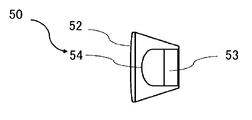
- FIG. 9 is a front view of a headlight 50 having a lens and an outer, which shows an example of an optical device having a coating film according to Embodiment 2
- FIG. 10 is a cross-sectional view taken along the line BB in FIG.
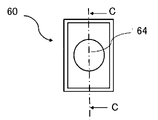
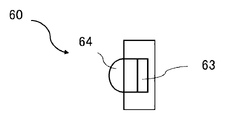
- 11 is a front view of a headlight 60 showing an example of an optical device having a coating film according to Embodiment 2
- FIG. 12 is a sectional view taken along line CC of FIG.
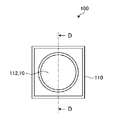
- FIG. 13 is a front view of camera 100 showing an example of an optical device having a coating film according to Embodiment 2
- FIG. 14 is a cross-sectional view taken along line DD of FIG.
- the headlight has light sources 43, 53, 63, as shown in FIGS.
- Other configurations include a headlight 40 having a reflector 41 inside an outer 42 covering a light source, a headlight 50 having a lens 54 covered with the outer 52, and a headlight having no outer and having the lens 64 exposed. 60 can be mentioned. Since the headlight is sealed and heated to a high temperature, organic substances volatilize from the members inside the headlight, and fogging may occur due to the fogging phenomenon in which the inner side of the outer and the surface of the lens are fogged. Therefore, by forming the coating film 10 on the inner side of the outer that constitutes the headlight and on the surface of the lens, it is possible to maintain transparency without fogging caused by the fogging phenomenon.
- the coating film 10 on the outer surface of the outer lens or on the surface of the exposed lens, a hydrophilic effect can be obtained.
- the water droplets act as a lens, and the light distribution value may change. If it is hydrophilic, water spreads and water droplets do not form, so the light distribution value can be maintained.
- a coating film on the outside of the outer and on the surface of the exposed lens, it is possible to obtain an antifouling effect and prevent changes in the light distribution value due to contamination.
- the film thickness of the coating film so as to have an antireflection function, it is also possible to improve the transmittance of the member to which the coating film is applied.
- the camera 100 includes a camera body 111 and a lens 112 inside a housing 110 .
- dirt may adhere to the surface of the lens 112 . Therefore, by forming the coating film 10 described in Embodiment 1 on the surface of the lens 112, it is possible to prevent the adhesion of dirt for a long period of time without affecting the image captured by the camera 100.
- FIG. 1 illustrates the coating film 10 described in Embodiment 1 on the surface of the lens 112 .
- the coating film 10 is formed on the lens 112 of the camera 100 . Since the coating film 10 has higher transparency than the conventional one, it is possible to expect the same light condensing performance of the lens 112 as before the application of the coating film 10 . Also, by adjusting the film thickness of the coating film 10 so as to have an antireflection function, the transmittance of the lens 112 coated with the coating film 10 can be improved.
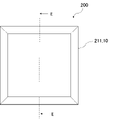
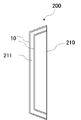
- FIG. 15 is a front view showing an example of lighting equipment having a coating film according to Embodiment 3
- FIG. 16 is a cross-sectional view taken along line EE of FIG.
- lighting device 200 includes body portion 210 that emits light, and lighting cover 211 that covers body portion 210 .
- thermally decomposed products and compounds volatilize from parts and adhere to the inside of the lighting cover 211, causing fogging due to the fogging phenomenon.
- volatile organic matter in the environment may adhere to the outside of the lighting cover 211, causing fogging due to the fogging phenomenon.
- Forming a coating film from the coating composition described in Embodiment 1 on the inside and outside of the lighting cover 211 can suppress the occurrence of fogging and maintain the transparency for a long period of time. Further, by forming a coating film of the coating composition described in Embodiment 1 on the outside of the illumination cover 211, an antifouling effect against dust and the like from the outside can be obtained.
- Example 1 Colloidal silica containing silica fine particles with an average particle size of 12 nm (NH4+ stable alkaline sol, ST-N, manufactured by Nissan Chemical Industries, Ltd.) and tin oxide fine particles, which are metal oxide fine particles with an average particle size of 2 nm.
- tin oxide sol manufactured by Taki Kagaku Co., Ltd., Ceramace S-8
- diethylene glycol monobutyl ether having a boiling point of 230° C. as a high boiling point solvent and deionized water as water are blended, mixed and stirred.
- a coating composition is prepared.
- the content of silica fine particles is 1% by mass
- the content of tin oxide fine particles is 0.2% by mass
- the content of diethylene glycol monobutyl ether is 50% by mass
- the content of deionized water is Remainder.
- the resulting coating composition is impregnated into a nonwoven fabric (manufactured by Kuraray Kuraflex Co., Ltd., product name: Kuraclean (registered trademark) wiper, fibers used: rayon) and fixed to a polycarbonate block.
- the surface of the non-woven fabric is adhered to a glass substrate (50 mm ⁇ 50 mm ⁇ 1 mm) and slid, and then dried at 25° C. for 24 hours to form a coating film.
- Example 2 A coating composition is prepared in the same manner as in Example 1, except that the content of diethylene glycol monobutyl ether as a high-boiling solvent is changed to 20% by mass. Also, in the same manner as in Example 1, a coating film is formed on the glass substrate.
- Example 3 A coating composition is prepared in the same manner as in Example 1, except that the content of diethylene glycol monobutyl ether as a high-boiling solvent is changed to 21% by mass. Also, in the same manner as in Example 1, a coating film is formed on the glass substrate.
- Example 4 A coating composition is prepared in the same manner as in Example 1, except that the content of diethylene glycol monobutyl ether as a high-boiling solvent is changed to 55 % by mass. Also, in the same manner as in Example 1, a coating film is formed on the glass substrate.
- Example 5 A coating composition is prepared in the same manner as in Example 1, except that the content of diethylene glycol monobutyl ether as a high-boiling solvent is changed to 69% by mass. Also, in the same manner as in Example 1, a coating film is formed on the glass substrate.
- Example 6 A coating composition is prepared in the same manner as in Example 1, except that the content of diethylene glycol monobutyl ether as a high-boiling solvent is changed to 70% by mass. Also, in the same manner as in Example 1, a coating film is formed on the glass substrate.
- Example 7 A coating composition is prepared in the same manner as in Example 1, except that dipropylene glycol dimethyl ether having a boiling point of 171° C. is used instead of diethylene glycol monobutyl ether as a high-boiling solvent. Also, in the same manner as in Example 1, a coating film is formed on the glass substrate.
- Example 8 A coating composition is prepared in the same manner as in Example 1, except that the content of silica fine particles is changed to 0.2% by mass. Also, in the same manner as in Example 1, a coating film is formed on the glass substrate.
- Example 9 A coating composition is prepared in the same manner as in Example 1, except that the content of silica fine particles is changed to 4% by mass. Also, in the same manner as in Example 1, a coating film is formed on the glass substrate.
- Example 10 A coating composition is prepared in the same manner as in Example 1, except that the average particle size of the silica fine particles is changed to 5 nm. Also, in the same manner as in Example 1, a coating film is formed on the glass substrate.
- Example 11 A coating composition is prepared in the same manner as in Example 1, except that the average particle size of the silica fine particles is changed to 20 nm. Also, in the same manner as in Example 1, a coating film is formed on the glass substrate.
- Example 12 A coating composition is prepared in the same manner as in Example 1, except that the content of tin oxide fine particles is changed to 0.7% by mass. Also, in the same manner as in Example 1, a coating film is formed on the glass substrate.
- Example 13 A coating composition is prepared in the same manner as in Example 1, except that the tin oxide sol is changed to a zirconium oxide dispersion containing zirconium oxide having an average particle size of 10 nm (Sakai Chemical Industry Co., Ltd., SZR-GCW). Also, in the same manner as in Example 1, a coating film is formed on the glass substrate.
- Example 14 A coating composition is prepared in the same manner as in Example 1, except that the tin oxide sol is changed to a cerium oxide sol (manufactured by Taki Chemical Co., Ltd., B-10) having an average particle size of 8 nm. Also, in the same manner as in Example 1, a coating film is formed on the glass substrate.
- Example 15 A coating composition is prepared in the same manner as in Example 1, except that PTFE particles (manufactured by DuPont Fluorochemicals Co., Ltd., product name: 31JR) as fluororesin particles are added in an amount of 10% by mass relative to the silica fine particles.
- the average particle size of the PTFE particles is 0.25 ⁇ m.
- a coating film is formed on the glass substrate.
- Example 16 A coating composition is prepared in the same manner as in Example 1, except that 40% by mass of PTFE particles (manufactured by DuPont Fluorochemicals Co., Ltd., product name: 31JR) as fluororesin particles are added to the silica fine particles.
- the average particle size of the PTFE particles is 0.25 ⁇ m.
- a coating film is formed on the glass substrate.
- Example 17 A coating composition was prepared in the same manner as in Example 1, except that polyethylene glycol (manufactured by Tokyo Chemical Industry Co., Ltd., product name: polyethylene glycol 400) was added as a non-volatile hydrophilic organic substance in an amount of 15% by mass with respect to the silica fine particles. Prepare. The average molecular weight of polyethylene glycol is 380 or more and 420 or less. Also, in the same manner as in Example 1, a coating film is formed on the glass substrate.
- polyethylene glycol manufactured by Tokyo Chemical Industry Co., Ltd., product name: polyethylene glycol 400
- Example 18 A coating composition was prepared in the same manner as in Example 1, except that polyethylene glycol (manufactured by Tokyo Chemical Industry Co., Ltd., product name: polyethylene glycol 400) was added as a non-volatile hydrophilic organic substance in an amount of 35% by mass with respect to the silica fine particles. Prepare. The average molecular weight of polyethylene glycol is 380 or more and 420 or less. Also, in the same manner as in Example 1, a coating film is formed on the glass substrate.
- polyethylene glycol manufactured by Tokyo Chemical Industry Co., Ltd., product name: polyethylene glycol 400
- Example 19 A coating film is formed in the same manner as in Example 1, except that the coating composition of Example 1 is applied to an acrylic substrate (ABS (Acrylonitrile Butadiene Styrene), 50 mm ⁇ 50 mm ⁇ 2 mm).
- ABS Acrylonitrile Butadiene Styrene
- Example 20 After spray coating the coating composition of Example 1 onto a glass substrate (50 mm ⁇ 50 mm ⁇ 1 mm), it is dried at 25° C. for 24 hours to form a coating film.
- Example 1 A coating composition is prepared in the same manner as in Example 1, except that the content of diethylene glycol monobutyl ether as a high-boiling solvent is changed to 15% by mass. Also, in the same manner as in Example 1, a coating film is formed on the glass substrate.
- Example 2 A coating composition is prepared in the same manner as in Example 1, except that the content of diethylene glycol monobutyl ether as a high-boiling solvent is changed to 19% by mass. Also, in the same manner as in Example 1, a coating film is formed on the glass substrate.
- Example 3 A coating composition is prepared in the same manner as in Example 1, except that the content of diethylene glycol monobutyl ether as a high-boiling solvent is changed to 71% by mass. Also, in the same manner as in Example 1, a coating film is formed on the glass substrate.
- Example 4 A coating composition is prepared in the same manner as in Example 1, except that the content of diethylene glycol monobutyl ether as a high-boiling solvent is changed to 75% by mass. Also, in the same manner as in Example 1, a coating film is formed on the glass substrate.
- Example 5 A coating composition is prepared in the same manner as in Example 1, except that ethanol having a boiling point of 87° C. is used in place of the high-boiling solvent diethylene glycol monobutyl ether. Also, in the same manner as in Example 1, a coating film is formed on the glass substrate.
- Example 6 A coating composition is prepared in the same manner as in Example 1, except that lithium silicate (manufactured by Nissan Chemical Industries, Ltd., product name: Lithium Silicate 45) is used instead of the fine silica particles. Also, in the same manner as in Example 1, a coating film is formed on the glass substrate.
- lithium silicate manufactured by Nissan Chemical Industries, Ltd., product name: Lithium Silicate 45
- Example 7 A coating composition is prepared in the same manner as in Example 1, except that the average particle size of the silica fine particles is changed to 30 nm. Also, in the same manner as in Example 1, a coating film is formed on the glass substrate.
- Example 8 A coating composition is prepared in the same manner as in Example 1, except that the content of silica fine particles is changed to 0.05% by mass. Also, in the same manner as in Example 1, a coating film is formed on the glass substrate.
- Example 9 A coating composition is prepared in the same manner as in Example 1, except that the content of silica fine particles is changed to 7% by mass. Also, in the same manner as in Example 1, a coating film is formed on the glass substrate.
- Example 10 A coating composition is prepared in the same manner as in Example 1, except that tin oxide fine particles are not added. Also, in the same manner as in Example 1, a coating film is formed on the glass substrate.
- Example 11 A coating composition is prepared in the same manner as in Example 1, except that 60% by mass of PTFE particles (Mitsui-DuPont Fluorochemical Co., Ltd., product name: 31JR) are added to the silica fine particles as fluororesin particles.
- the average particle size of the PTFE particles is 0.25 ⁇ m. Also, in the same manner as in Example 1, a coating film is formed on the glass substrate.
- Example 12 A coating composition was prepared in the same manner as in Example 1 except that polyethylene glycol (manufactured by Tokyo Chemical Industry Co., Ltd., product name: polyethylene glycol 400), which is a non-volatile hydrophilic organic substance, was added in an amount of 50% by mass with respect to the silica fine particles. to prepare.
- the average molecular weight of polyethylene glycol is 380 or more and 420 or less. Also, in the same manner as in Example 1, a coating film is formed on the glass substrate.
- the coating films formed from the coating compositions of Examples 1 to 20 and Comparative Examples 1 to 12 were measured for film thickness, evaluated for transparency, evaluated for fogging resistance, evaluated for appearance after the fogging test, and further evaluated for transparency and Evaluate the antifouling property.
- ⁇ Measurement of film thickness A portion of the coating film formed on the base material is scraped off, and a 3D measurement laser microscope (manufactured by Olympus Corporation) is used to measure the difference in level between the coating film and the base material. to measure.
- the measurement results of the film thickness of the coating film are classified according to the following criteria. 1: Thickness less than 20 nm 2: Thickness 20 nm or more and 250 nm or less 3: Thickness over 250 nm
- Appearance Evaluation after Fogging Test Haze Guard i (manufactured by BYK) is used to measure the clarity of the coating film after the fogging test.
- the measurement results of the clarity of the coating film are evaluated according to the following criteria, and a clarity of 90% or more is judged to be highly transparent. 1: Clarity of 95% or more 2: Clarity of less than 95% and 90% or more 3: Clarity of less than 90% or more
- ⁇ Evaluation of antifouling performance the adherence of dust, which is a hydrophilic fouling substance, to the coating film is evaluated. Specifically, under the conditions of a temperature of 25 ° C. and a humidity of 50%, Kanto loam dust, which is a JIS (Japanese Industrial Standards) test powder with a median particle size of 1 ⁇ m or more and 3 ⁇ m or less, is blown onto the coating film with air. . After that, the Kanto loam dust sprayed on the coating film is transferred to a mending tape (manufactured by Sumitomo 3M Co., Ltd.).
- a mending tape manufactured by Sumitomo 3M Co., Ltd.
- Absorbance at a wavelength of 550 nm is measured with a spectrophotometer (manufactured by Shimadzu Corporation, product name: UV-3100PC) on another transparent substrate to which the dust-transferred tape is attached. Absorbance is evaluated according to the following criteria, and if the absorbance is less than 0.3, it is judged that the antifouling property is high. 1: Absorbance less than 0.2 2: Absorbance 0.2 or more and less than 0.3 3: Absorbance 0.3 or more
- FIG. 17 is a diagram summarizing the evaluation results of Examples 1 to 20 and Comparative Examples 1 to 12.
- the average particle size of the silica fine particles was in the range of 3 nm or more and 25 nm or less, and the content of the silica fine particles in the coating composition was 0.1 mass. % or more and 5 mass % or less.
- the coating compositions of Examples 1 to 14 contain metal oxide fine particles.
- the boiling point of the high boiling point solvent is in the range of 150 ° C. or more and 300 ° C. or less, and the content of the high boiling point solvent in the coating composition is 20% by mass or more and 70% by mass or less. in the range of Therefore, coating films formed using these coating compositions have excellent transparency, anti-fogging properties, transparency after fogging test, and antifouling properties.
- the coating compositions of Examples 15 and 16 contained the fluororesin particles in the range of 5% by mass or more and 50% by mass or less with respect to the silica fine particles. , and good antifouling properties.
- the coating compositions of Examples 17 and 18 contain a non-volatile hydrophilic organic substance in a range of 10% by mass or more and 40% by mass or less with respect to the silica fine particles, so that transparency , fogging resistance, transparency after fogging test, and antifouling property.
- the coating film formed on the acrylic substrate in Example 19 and the coating film formed by spray coating in Example 20 also had transparency, anti-fogging properties, appearance evaluation after the fogging test, and antifouling properties. Good. That is, the coating film has good transparency, fogging resistance, transparency after the fogging test, and antifouling property regardless of whether the base material is glass or acrylic. Both the coating film formed by coating with a nonwoven fabric and the coating film formed by spray coating are excellent in transparency, anti-fogging property, transparency after the fogging test, and antifouling property.
- Comparative Examples 1 and 2 evaluations of transparency, transparency after fogging test, and antifouling property are low. It is considered that this is because the addition amount of the high boiling point solvent is insufficient, so that the effect of forming a uniform film cannot be sufficiently obtained.
- Comparative Examples 3 and 4 evaluations of transparency, transparency after fogging test, and antifouling property are low. This is probably because the addition amount of the high boiling point solvent is excessive, so that the dispersibility of the silica fine particles and the metal oxide is lowered, and the unevenness of the surface of the coating film is increased.
- Comparative Example 5 evaluations of transparency, anti-fogging property, transparency after fogging test, and antifouling property are low. This is probably because ethanol used as the solvent has a boiling point of 87° C., which is lower than the boiling points of other high boiling point solvents.
- Comparative Example 6 since the film was dense, the evaluation of transparency, anti-fogging property, transparency after fogging test, and antifouling property was low.
- Comparative Example 7 since the particle size of the silica fine particles is too large, the transparency, the transparency after the fogging test, and the antifouling property are evaluated low.
- Comparative Example 8 the amount of silica fine particles added was small and the film formed a thin film, so that the fogging resistance, the transparency after the fogging test, and the antifouling property were evaluated low.
- Comparative Example 9 a large amount of silica fine particles was added, resulting in a thick film, so that the transparency, the transparency after the fogging test, and the antifouling property were evaluated low.
- Comparative Example 10 the evaluation of transparency after the fogging test is low. This is because the coating film does not contain a metal oxide, and unevenness is conspicuous when organic matter that causes fogging penetrates. In Comparative Example 11, the evaluation of transparency and transparency after the fogging test is low.
- Example 21 After impregnating a non-woven fabric (manufactured by Kuraray-Kuraflex Co., Ltd., product name: Kura-clean wiper, fibers used: rayon) with the coating composition of Example 1, and applying the non-woven fabric in close contact with the inner side of the outer headlight and sliding it. , and air-dried at 25° C. for 24 hours to form a coating film.
- a non-woven fabric manufactured by Kuraray-Kuraflex Co., Ltd., product name: Kura-clean wiper, fibers used: rayon
- Example 22 The coating composition of Example 1 is sprayed onto the inside of a glass lighting cover and allowed to air dry at 25° C. for 24 hours.
- Example 21 and 22 coating films were formed on the respective substrates, but there was no change in the appearance of the substrates. That is, the coating films formed in Examples 21 and 22 have high transparency.
- Kanto loam dust which is a JIS test powder with a median particle size of 1 ⁇ m or more and 3 ⁇ m or less, is blown with air, and then each article is lightly shaken. .
Landscapes
- Chemical & Material Sciences (AREA)
- Engineering & Computer Science (AREA)
- Wood Science & Technology (AREA)
- Life Sciences & Earth Sciences (AREA)
- Materials Engineering (AREA)
- Organic Chemistry (AREA)
- Inorganic Chemistry (AREA)
- Physics & Mathematics (AREA)
- Optics & Photonics (AREA)
- General Engineering & Computer Science (AREA)
- General Physics & Mathematics (AREA)
- Nanotechnology (AREA)
- Paints Or Removers (AREA)
- Application Of Or Painting With Fluid Materials (AREA)
- Laminated Bodies (AREA)
Priority Applications (5)
| Application Number | Priority Date | Filing Date | Title |
|---|---|---|---|
| JP2023527170A JP7566150B2 (ja) | 2021-06-07 | 2021-06-07 | コーティング組成物、コーティング膜および物品、光学機器、照明機器 |
| CN202180098603.8A CN117355580A (zh) | 2021-06-07 | 2021-06-07 | 涂布组合物、涂布膜和物品、光学设备、照明设备 |
| DE112021007781.3T DE112021007781T5 (de) | 2021-06-07 | 2021-06-07 | Beschichtungszusammensetzung, Beschichtungsfilm und Artikel, optisches Gerät und Beleuchtungseinrichtung |
| US18/566,100 US20240360327A1 (en) | 2021-06-07 | 2021-06-07 | Coating composition, coating film and article, optical device, and lighting device |
| PCT/JP2021/021603 WO2022259326A1 (ja) | 2021-06-07 | 2021-06-07 | コーティング組成物、コーティング膜および物品、光学機器、照明機器 |
Applications Claiming Priority (1)
| Application Number | Priority Date | Filing Date | Title |
|---|---|---|---|
| PCT/JP2021/021603 WO2022259326A1 (ja) | 2021-06-07 | 2021-06-07 | コーティング組成物、コーティング膜および物品、光学機器、照明機器 |
Publications (1)
| Publication Number | Publication Date |
|---|---|
| WO2022259326A1 true WO2022259326A1 (ja) | 2022-12-15 |
Family
ID=84424959
Family Applications (1)
| Application Number | Title | Priority Date | Filing Date |
|---|---|---|---|
| PCT/JP2021/021603 Ceased WO2022259326A1 (ja) | 2021-06-07 | 2021-06-07 | コーティング組成物、コーティング膜および物品、光学機器、照明機器 |
Country Status (5)
| Country | Link |
|---|---|
| US (1) | US20240360327A1 (cg-RX-API-DMAC7.html) |
| JP (1) | JP7566150B2 (cg-RX-API-DMAC7.html) |
| CN (1) | CN117355580A (cg-RX-API-DMAC7.html) |
| DE (1) | DE112021007781T5 (cg-RX-API-DMAC7.html) |
| WO (1) | WO2022259326A1 (cg-RX-API-DMAC7.html) |
Families Citing this family (1)
| Publication number | Priority date | Publication date | Assignee | Title |
|---|---|---|---|---|
| US12466962B1 (en) * | 2024-10-30 | 2025-11-11 | Valeo Vision | Illuminated body panels including optics having coating with bubbles and method |
Citations (6)
| Publication number | Priority date | Publication date | Assignee | Title |
|---|---|---|---|---|
| JP2006265462A (ja) * | 2005-03-25 | 2006-10-05 | Ishihara Chem Co Ltd | 親水防汚コーティング組成物、それを用いた被膜の形成方法及び用途 |
| JP2011246603A (ja) * | 2010-05-26 | 2011-12-08 | Panasonic Electric Works Co Ltd | 防汚性を付与する塗料組成物とそれを用いた塗装品ならびに塗装品の製造方法 |
| JP2013032421A (ja) * | 2011-08-01 | 2013-02-14 | Mitsubishi Electric Corp | コーティング組成物及びその製造方法、並びに防汚性多孔質物品及びその製造方法 |
| WO2014034514A1 (ja) * | 2012-09-03 | 2014-03-06 | 三菱電機株式会社 | 防汚コーティング、それを備えた熱交換器及びその製造方法 |
| WO2016181676A1 (ja) * | 2015-05-14 | 2016-11-17 | 三菱電機株式会社 | コーティング組成物、その製造方法、コーティング膜、換気扇及び空気調和機 |
| CN108329856A (zh) * | 2017-12-28 | 2018-07-27 | 广州华夏职业学院 | 一种用于汽车玻璃的防雾贴膜配方及其制备工艺 |
Family Cites Families (2)
| Publication number | Priority date | Publication date | Assignee | Title |
|---|---|---|---|---|
| JPH09235140A (ja) | 1996-03-04 | 1997-09-09 | Toyota Central Res & Dev Lab Inc | ガラス |
| CN105566953B (zh) * | 2014-10-29 | 2018-10-02 | 三菱电机株式会社 | 涂覆组合物、防污性部件、空气调节器及换气扇 |
-
2021
- 2021-06-07 CN CN202180098603.8A patent/CN117355580A/zh active Pending
- 2021-06-07 US US18/566,100 patent/US20240360327A1/en not_active Abandoned
- 2021-06-07 WO PCT/JP2021/021603 patent/WO2022259326A1/ja not_active Ceased
- 2021-06-07 JP JP2023527170A patent/JP7566150B2/ja active Active
- 2021-06-07 DE DE112021007781.3T patent/DE112021007781T5/de not_active Withdrawn
Patent Citations (6)
| Publication number | Priority date | Publication date | Assignee | Title |
|---|---|---|---|---|
| JP2006265462A (ja) * | 2005-03-25 | 2006-10-05 | Ishihara Chem Co Ltd | 親水防汚コーティング組成物、それを用いた被膜の形成方法及び用途 |
| JP2011246603A (ja) * | 2010-05-26 | 2011-12-08 | Panasonic Electric Works Co Ltd | 防汚性を付与する塗料組成物とそれを用いた塗装品ならびに塗装品の製造方法 |
| JP2013032421A (ja) * | 2011-08-01 | 2013-02-14 | Mitsubishi Electric Corp | コーティング組成物及びその製造方法、並びに防汚性多孔質物品及びその製造方法 |
| WO2014034514A1 (ja) * | 2012-09-03 | 2014-03-06 | 三菱電機株式会社 | 防汚コーティング、それを備えた熱交換器及びその製造方法 |
| WO2016181676A1 (ja) * | 2015-05-14 | 2016-11-17 | 三菱電機株式会社 | コーティング組成物、その製造方法、コーティング膜、換気扇及び空気調和機 |
| CN108329856A (zh) * | 2017-12-28 | 2018-07-27 | 广州华夏职业学院 | 一种用于汽车玻璃的防雾贴膜配方及其制备工艺 |
Also Published As
| Publication number | Publication date |
|---|---|
| US20240360327A1 (en) | 2024-10-31 |
| JPWO2022259326A1 (cg-RX-API-DMAC7.html) | 2022-12-15 |
| JP7566150B2 (ja) | 2024-10-11 |
| CN117355580A (zh) | 2024-01-05 |
| DE112021007781T5 (de) | 2024-03-28 |
Similar Documents
| Publication | Publication Date | Title |
|---|---|---|
| US9556338B2 (en) | Silica coating for enhanced hydrophilicity/transmittivity | |
| JP5254042B2 (ja) | コーティング組成物及びその製造方法、熱交換器、並びに空気調和機 | |
| JP5624036B2 (ja) | 親水性/透過率を高めるための針状シリカコーティング | |
| JP5614288B2 (ja) | 親水性塗膜を基材表面に有する物品 | |
| JP5968469B2 (ja) | 無機酸化物ナノ粒子及び有機塩基を含む塩基性組成物、コーティングされた基材、物品、及び方法 | |
| US20140308529A1 (en) | Coating Composition And Antireflective Coating Prepared Therefrom | |
| US20130224478A1 (en) | Acicular silica coating for enhanced hydrophilicity/transmittivity | |
| JP6381483B2 (ja) | コーティング組成物、防汚性部材、空気調和機及び換気扇 | |
| WO2017056405A1 (ja) | コーティング膜付きガラス板及びその製造方法 | |
| JP7566150B2 (ja) | コーティング組成物、コーティング膜および物品、光学機器、照明機器 | |
| JPWO2017126230A1 (ja) | 不透視膜付き透明基材 | |
| US20150252196A1 (en) | Coatable Composition, Wear-Resistant Composition, Wear-Resistant Articles, and Methods of Making the Same | |
| JP7366244B2 (ja) | コーティング組成物、コーティング膜、物品、光学機器、照明機器、空気調和機およびコーティング膜の製造方法 | |
| CN105566953B (zh) | 涂覆组合物、防污性部件、空气调节器及换气扇 | |
| CN104098935A (zh) | 用于提高亲水性/透射率的二氧化硅涂层 | |
| TWI441854B (zh) | 用於提高親水性/透射率的二氧化矽塗層 | |
| JP5340128B2 (ja) | コーティング組成物及びその製造方法、並びにコーティング物品 | |
| JP2011115751A (ja) | 防汚性部材の製造方法、及び空気調和機 | |
| JP4986916B2 (ja) | 水系コーティング組成物、コーティング方法、及びコーティング膜の評価方法 | |
| WO2016063777A1 (ja) | 表面処理剤 | |
| JP2008020917A (ja) | 鏡を浴室用防曇鏡とせしめるための塗布液 | |
| TW201323546A (zh) | 塗料組合物以及由其製備之減反射塗層 |
Legal Events
| Date | Code | Title | Description |
|---|---|---|---|
| 121 | Ep: the epo has been informed by wipo that ep was designated in this application |
Ref document number: 21945007 Country of ref document: EP Kind code of ref document: A1 |
|
| WWE | Wipo information: entry into national phase |
Ref document number: 2023527170 Country of ref document: JP |
|
| WWE | Wipo information: entry into national phase |
Ref document number: 202180098603.8 Country of ref document: CN |
|
| WWE | Wipo information: entry into national phase |
Ref document number: 112021007781 Country of ref document: DE |
|
| 122 | Ep: pct application non-entry in european phase |
Ref document number: 21945007 Country of ref document: EP Kind code of ref document: A1 |