WO2022250017A1 - 内燃機関用潤滑油組成物 - Google Patents
内燃機関用潤滑油組成物 Download PDFInfo
- Publication number
- WO2022250017A1 WO2022250017A1 PCT/JP2022/021114 JP2022021114W WO2022250017A1 WO 2022250017 A1 WO2022250017 A1 WO 2022250017A1 JP 2022021114 W JP2022021114 W JP 2022021114W WO 2022250017 A1 WO2022250017 A1 WO 2022250017A1
- Authority
- WO
- WIPO (PCT)
- Prior art keywords
- mass
- less
- lubricating oil
- oil composition
- internal combustion
- Prior art date
- Legal status (The legal status is an assumption and is not a legal conclusion. Google has not performed a legal analysis and makes no representation as to the accuracy of the status listed.)
- Ceased
Links
Classifications
-
- C—CHEMISTRY; METALLURGY
- C10—PETROLEUM, GAS OR COKE INDUSTRIES; TECHNICAL GASES CONTAINING CARBON MONOXIDE; FUELS; LUBRICANTS; PEAT
- C10M—LUBRICATING COMPOSITIONS; USE OF CHEMICAL SUBSTANCES EITHER ALONE OR AS LUBRICATING INGREDIENTS IN A LUBRICATING COMPOSITION
- C10M167/00—Lubricating compositions characterised by the additive being a mixture of a macromolecular compound, a non-macromolecular compound and a compound of unknown or incompletely defined constitution, each of these compounds being essential
-
- C—CHEMISTRY; METALLURGY
- C10—PETROLEUM, GAS OR COKE INDUSTRIES; TECHNICAL GASES CONTAINING CARBON MONOXIDE; FUELS; LUBRICANTS; PEAT
- C10M—LUBRICATING COMPOSITIONS; USE OF CHEMICAL SUBSTANCES EITHER ALONE OR AS LUBRICATING INGREDIENTS IN A LUBRICATING COMPOSITION
- C10M129/00—Lubricating compositions characterised by the additive being an organic non-macromolecular compound containing oxygen
- C10M129/02—Lubricating compositions characterised by the additive being an organic non-macromolecular compound containing oxygen having a carbon chain of less than 30 atoms
- C10M129/26—Carboxylic acids; Salts thereof
- C10M129/48—Carboxylic acids; Salts thereof having carboxyl groups bound to a carbon atom of a six-membered aromatic ring
- C10M129/54—Carboxylic acids; Salts thereof having carboxyl groups bound to a carbon atom of a six-membered aromatic ring containing hydroxy groups
-
- C—CHEMISTRY; METALLURGY
- C10—PETROLEUM, GAS OR COKE INDUSTRIES; TECHNICAL GASES CONTAINING CARBON MONOXIDE; FUELS; LUBRICANTS; PEAT
- C10M—LUBRICATING COMPOSITIONS; USE OF CHEMICAL SUBSTANCES EITHER ALONE OR AS LUBRICATING INGREDIENTS IN A LUBRICATING COMPOSITION
- C10M169/00—Lubricating compositions characterised by containing as components a mixture of at least two types of ingredient selected from base-materials, thickeners or additives, covered by the preceding groups, each of these compounds being essential
- C10M169/04—Mixtures of base-materials and additives
-
- C—CHEMISTRY; METALLURGY
- C10—PETROLEUM, GAS OR COKE INDUSTRIES; TECHNICAL GASES CONTAINING CARBON MONOXIDE; FUELS; LUBRICANTS; PEAT
- C10M—LUBRICATING COMPOSITIONS; USE OF CHEMICAL SUBSTANCES EITHER ALONE OR AS LUBRICATING INGREDIENTS IN A LUBRICATING COMPOSITION
- C10M2207/00—Organic non-macromolecular hydrocarbon compounds containing hydrogen, carbon and oxygen as ingredients in lubricant compositions
- C10M2207/02—Hydroxy compounds
- C10M2207/023—Hydroxy compounds having hydroxy groups bound to carbon atoms of six-membered aromatic rings
- C10M2207/026—Hydroxy compounds having hydroxy groups bound to carbon atoms of six-membered aromatic rings with tertiary alkyl groups
-
- C—CHEMISTRY; METALLURGY
- C10—PETROLEUM, GAS OR COKE INDUSTRIES; TECHNICAL GASES CONTAINING CARBON MONOXIDE; FUELS; LUBRICANTS; PEAT
- C10M—LUBRICATING COMPOSITIONS; USE OF CHEMICAL SUBSTANCES EITHER ALONE OR AS LUBRICATING INGREDIENTS IN A LUBRICATING COMPOSITION
- C10M2207/00—Organic non-macromolecular hydrocarbon compounds containing hydrogen, carbon and oxygen as ingredients in lubricant compositions
- C10M2207/26—Overbased carboxylic acid salts
- C10M2207/262—Overbased carboxylic acid salts derived from hydroxy substituted aromatic acids, e.g. salicylates
-
- C—CHEMISTRY; METALLURGY
- C10—PETROLEUM, GAS OR COKE INDUSTRIES; TECHNICAL GASES CONTAINING CARBON MONOXIDE; FUELS; LUBRICANTS; PEAT
- C10M—LUBRICATING COMPOSITIONS; USE OF CHEMICAL SUBSTANCES EITHER ALONE OR AS LUBRICATING INGREDIENTS IN A LUBRICATING COMPOSITION
- C10M2209/00—Organic macromolecular compounds containing oxygen as ingredients in lubricant compositions
- C10M2209/02—Macromolecular compounds obtained by reactions only involving carbon-to-carbon unsaturated bonds
- C10M2209/08—Macromolecular compounds obtained by reactions only involving carbon-to-carbon unsaturated bonds containing monomers having an unsaturated radical bound to a carboxyl radical, e.g. acrylate type
- C10M2209/084—Acrylate; Methacrylate
-
- C—CHEMISTRY; METALLURGY
- C10—PETROLEUM, GAS OR COKE INDUSTRIES; TECHNICAL GASES CONTAINING CARBON MONOXIDE; FUELS; LUBRICANTS; PEAT
- C10M—LUBRICATING COMPOSITIONS; USE OF CHEMICAL SUBSTANCES EITHER ALONE OR AS LUBRICATING INGREDIENTS IN A LUBRICATING COMPOSITION
- C10M2215/00—Organic non-macromolecular compounds containing nitrogen as ingredients in lubricant Compositions
- C10M2215/02—Amines, e.g. polyalkylene polyamines; Quaternary amines
- C10M2215/06—Amines, e.g. polyalkylene polyamines; Quaternary amines having amino groups bound to carbon atoms of six-membered aromatic rings
- C10M2215/064—Di- and triaryl amines
-
- C—CHEMISTRY; METALLURGY
- C10—PETROLEUM, GAS OR COKE INDUSTRIES; TECHNICAL GASES CONTAINING CARBON MONOXIDE; FUELS; LUBRICANTS; PEAT
- C10M—LUBRICATING COMPOSITIONS; USE OF CHEMICAL SUBSTANCES EITHER ALONE OR AS LUBRICATING INGREDIENTS IN A LUBRICATING COMPOSITION
- C10M2215/00—Organic non-macromolecular compounds containing nitrogen as ingredients in lubricant Compositions
- C10M2215/24—Organic non-macromolecular compounds containing nitrogen as ingredients in lubricant Compositions having hydrocarbon substituents containing thirty or more carbon atoms, e.g. nitrogen derivatives of substituted succinic acid
- C10M2215/28—Amides; Imides
-
- C—CHEMISTRY; METALLURGY
- C10—PETROLEUM, GAS OR COKE INDUSTRIES; TECHNICAL GASES CONTAINING CARBON MONOXIDE; FUELS; LUBRICANTS; PEAT
- C10M—LUBRICATING COMPOSITIONS; USE OF CHEMICAL SUBSTANCES EITHER ALONE OR AS LUBRICATING INGREDIENTS IN A LUBRICATING COMPOSITION
- C10M2219/00—Organic non-macromolecular compounds containing sulfur, selenium or tellurium as ingredients in lubricant compositions
- C10M2219/06—Thio-acids; Thiocyanates; Derivatives thereof
- C10M2219/062—Thio-acids; Thiocyanates; Derivatives thereof having carbon-to-sulfur double bonds
- C10M2219/066—Thiocarbamic type compounds
- C10M2219/068—Thiocarbamate metal salts
-
- C—CHEMISTRY; METALLURGY
- C10—PETROLEUM, GAS OR COKE INDUSTRIES; TECHNICAL GASES CONTAINING CARBON MONOXIDE; FUELS; LUBRICANTS; PEAT
- C10M—LUBRICATING COMPOSITIONS; USE OF CHEMICAL SUBSTANCES EITHER ALONE OR AS LUBRICATING INGREDIENTS IN A LUBRICATING COMPOSITION
- C10M2223/00—Organic non-macromolecular compounds containing phosphorus as ingredients in lubricant compositions
- C10M2223/02—Organic non-macromolecular compounds containing phosphorus as ingredients in lubricant compositions having no phosphorus-to-carbon bonds
- C10M2223/04—Phosphate esters
- C10M2223/045—Metal containing thio derivatives
-
- C—CHEMISTRY; METALLURGY
- C10—PETROLEUM, GAS OR COKE INDUSTRIES; TECHNICAL GASES CONTAINING CARBON MONOXIDE; FUELS; LUBRICANTS; PEAT
- C10N—INDEXING SCHEME ASSOCIATED WITH SUBCLASS C10M RELATING TO LUBRICATING COMPOSITIONS
- C10N2010/00—Metal present as such or in compounds
- C10N2010/04—Groups 2 or 12
-
- C—CHEMISTRY; METALLURGY
- C10—PETROLEUM, GAS OR COKE INDUSTRIES; TECHNICAL GASES CONTAINING CARBON MONOXIDE; FUELS; LUBRICANTS; PEAT
- C10N—INDEXING SCHEME ASSOCIATED WITH SUBCLASS C10M RELATING TO LUBRICATING COMPOSITIONS
- C10N2020/00—Specified physical or chemical properties or characteristics, i.e. function, of component of lubricating compositions
- C10N2020/01—Physico-chemical properties
- C10N2020/02—Viscosity; Viscosity index
-
- C—CHEMISTRY; METALLURGY
- C10—PETROLEUM, GAS OR COKE INDUSTRIES; TECHNICAL GASES CONTAINING CARBON MONOXIDE; FUELS; LUBRICANTS; PEAT
- C10N—INDEXING SCHEME ASSOCIATED WITH SUBCLASS C10M RELATING TO LUBRICATING COMPOSITIONS
- C10N2030/00—Specified physical or chemical properties which is improved by the additive characterising the lubricating composition, e.g. multifunctional additives
-
- C—CHEMISTRY; METALLURGY
- C10—PETROLEUM, GAS OR COKE INDUSTRIES; TECHNICAL GASES CONTAINING CARBON MONOXIDE; FUELS; LUBRICANTS; PEAT
- C10N—INDEXING SCHEME ASSOCIATED WITH SUBCLASS C10M RELATING TO LUBRICATING COMPOSITIONS
- C10N2030/00—Specified physical or chemical properties which is improved by the additive characterising the lubricating composition, e.g. multifunctional additives
- C10N2030/02—Pour-point; Viscosity index
-
- C—CHEMISTRY; METALLURGY
- C10—PETROLEUM, GAS OR COKE INDUSTRIES; TECHNICAL GASES CONTAINING CARBON MONOXIDE; FUELS; LUBRICANTS; PEAT
- C10N—INDEXING SCHEME ASSOCIATED WITH SUBCLASS C10M RELATING TO LUBRICATING COMPOSITIONS
- C10N2030/00—Specified physical or chemical properties which is improved by the additive characterising the lubricating composition, e.g. multifunctional additives
- C10N2030/40—Low content or no content compositions
- C10N2030/42—Phosphor free or low phosphor content compositions
-
- C—CHEMISTRY; METALLURGY
- C10—PETROLEUM, GAS OR COKE INDUSTRIES; TECHNICAL GASES CONTAINING CARBON MONOXIDE; FUELS; LUBRICANTS; PEAT
- C10N—INDEXING SCHEME ASSOCIATED WITH SUBCLASS C10M RELATING TO LUBRICATING COMPOSITIONS
- C10N2030/00—Specified physical or chemical properties which is improved by the additive characterising the lubricating composition, e.g. multifunctional additives
- C10N2030/54—Fuel economy
-
- C—CHEMISTRY; METALLURGY
- C10—PETROLEUM, GAS OR COKE INDUSTRIES; TECHNICAL GASES CONTAINING CARBON MONOXIDE; FUELS; LUBRICANTS; PEAT
- C10N—INDEXING SCHEME ASSOCIATED WITH SUBCLASS C10M RELATING TO LUBRICATING COMPOSITIONS
- C10N2040/00—Specified use or application for which the lubricating composition is intended
- C10N2040/25—Internal-combustion engines
-
- C—CHEMISTRY; METALLURGY
- C10—PETROLEUM, GAS OR COKE INDUSTRIES; TECHNICAL GASES CONTAINING CARBON MONOXIDE; FUELS; LUBRICANTS; PEAT
- C10N—INDEXING SCHEME ASSOCIATED WITH SUBCLASS C10M RELATING TO LUBRICATING COMPOSITIONS
- C10N2040/00—Specified use or application for which the lubricating composition is intended
- C10N2040/25—Internal-combustion engines
- C10N2040/255—Gasoline engines
Definitions
- the present invention relates to a lubricating oil composition for internal combustion engines. More particularly, it relates to a lubricating oil composition for internal combustion engines which is excellent in fuel saving performance.
- the present inventors have diligently studied lubricating oil compositions for internal combustion engines that have fuel-saving performance.
- the inventors of the present invention have found that the above problems can be solved by adopting the following configuration, and have completed the invention.
- the present invention has been made based on such findings, and is as follows. ⁇ 1> (A) lubricating base oil, (B) magnesium salicylate; A lubricating oil composition for an internal combustion engine comprising (C) calcium salicylate and (D) a viscosity index improver, wherein the HTHS viscosity at 150°C is 1.7 or more and 2.3 mPa s or less; A lubricating oil composition for an internal combustion engine, having an HTHS viscosity at 100°C of 4.8 mPa ⁇ s or less.
- the total content of (B) magnesium salicylate and (C) calcium salicylate is 1400 ppm by mass or more and 2000 ppm by mass or less as a metal content based on the total amount of the composition, ⁇ 1> or ⁇ 2>, wherein the content of (B) / (content of (B) + content of (C)) is 0.05 or more and 0.95 or less on a mass ppm basis
- the lubricating oil composition for internal combustion engines according to any one of ⁇ 1> to ⁇ 3>, which has an HTHS viscosity of 4.2 mPa ⁇ s or less at 100°C.
- the lubricating oil composition for an internal combustion engine of the present invention it is possible to provide a lubricating oil composition for an internal combustion engine having good fuel economy performance.
- Lubricating base oil In the lubricating oil composition of the present invention, it is preferable to use a mineral base oil as the lubricating base oil.
- Mineral base oils used in the lubricating oil composition of the present invention include distillates obtained by atmospheric distillation of crude oil. Alternatively, a lubricating oil fraction obtained by further refining the distillate obtained by vacuum distillation of this distillate by various refining processes can also be used. As the refining process, hydrorefining, solvent extraction, solvent dewaxing, hydrodewaxing, sulfuric acid washing, clay treatment, and the like can be appropriately combined.
- a lubricating base oil that can be used in the present invention can be obtained by combining these refining processes in an appropriate order. Mixtures of refined oils with different properties obtained by subjecting different crude oils or distillates to different combinations of refining processes can also be used.
- API Group III base oils are mineral base oils having a sulfur content of 0.03 wt.% or less, a saturates content of 90 wt.% or more, and a viscosity index of 120 or more. Multiple types of Group III base oils may be used, or only one type may be used.
- the lubricating oil composition of the present invention may contain only a mineral base oil as the lubricating base oil, or may contain other lubricating base oils.
- the content of the mineral base oil is based on the lubricating base oil, for example, 50% by mass or more, 60% by mass or more, 70% by mass or more, 80% by mass Above, it can be 90% by mass or more, 95% by mass or more, or 99% by mass or more.
- a synthetic base oil may be used as the lubricating base oil in the lubricating oil composition of the present invention.
- Synthetic base oils include poly- ⁇ -olefins and their hydrides, isobutene oligomers and their hydrides, isoparaffins, alkylbenzenes, alkylnaphthalenes, diesters (ditridecylglutarate, di-2-ethylhexyladipate, diisodecyladipate, ditridecyladipate , di-2-ethylhexyl sebacate, etc.), polyol esters (trimethylolpropane caprylate, trimethylolpropane pelargonate, pentaerythritol 2-ethylhexanoate, pentaerythritol pelargonate, etc.), polyoxyalkylene glycol, dialkyldiphenyl ether, polyphenyl ethers, mixtures thereof,
- poly- ⁇ -olefin is preferred.
- Poly- ⁇ -olefins typically include oligomers or co-oligomers of ⁇ -olefins having 2 to 32 carbon atoms, preferably 6 to 16 carbon atoms (1-octene oligomer, decene oligomer, ethylene-propylene co-oligomer, etc.). and their hydrogenation products.
- the kinematic viscosity at 100° C. of the lubricating base oil contained in the lubricating oil composition of the present invention is preferably less than 4.2 mm 2 /s.
- the kinematic viscosity at 100° C. of the lubricating base oil of the present invention is preferably 2.5 mm 2 /s or higher, more preferably 3.0 mm 2 /s or higher, still more preferably 3.4 mm 2 /s or higher.
- the upper limit is more preferably 4.1 mm 2 /s or less, still more preferably 4.0 mm 2 /s or less.
- a specific range is preferably 2.5 mm 2 /s or more and 4.1 mm 2 /s or less, more preferably 3.0 mm 2 /s or more and 4.0 mm 2 /s or less, still more preferably 3.4 mm 2 / s. s or more and 4.0 mm 2 /s or less.
- the kinematic viscosity at 100° C. of the lubricating base oil is less than 4.2 mm 2 /s, more sufficient fuel saving performance can be obtained.
- kinematic viscosity at 100° C. means the kinematic viscosity in a state in which all the lubricating base oils are mixed, that is, the kinematic viscosity of the base oil as a whole. That is, it does not mean the kinematic viscosity of a specific lubricating base oil when a plurality of base oils are included.
- kinematic viscosity at 100°C means kinematic viscosity at 100°C measured according to ASTM D-445.
- the content of the lubricating base oil is based on the total amount of the lubricating oil composition, for example, 50% by mass or more and 95% by mass or less, preferably 60% by mass or more and 95% by mass or less, more preferably is 70% by mass or more and 95% by mass or less, more preferably 80% by mass or more and 95% by mass or less, and most preferably 85% by mass or more and 95% by mass or less.
- [B] Magnesium Salicylate and [C] Calcium Salicylate Metallic Detergents
- [B] magnesium salicylate and [C] calcium salicylate are used as metallic detergents.
- other metallic detergents may be included, but preferably include only two types, magnesium salicylate and calcium salicylate.
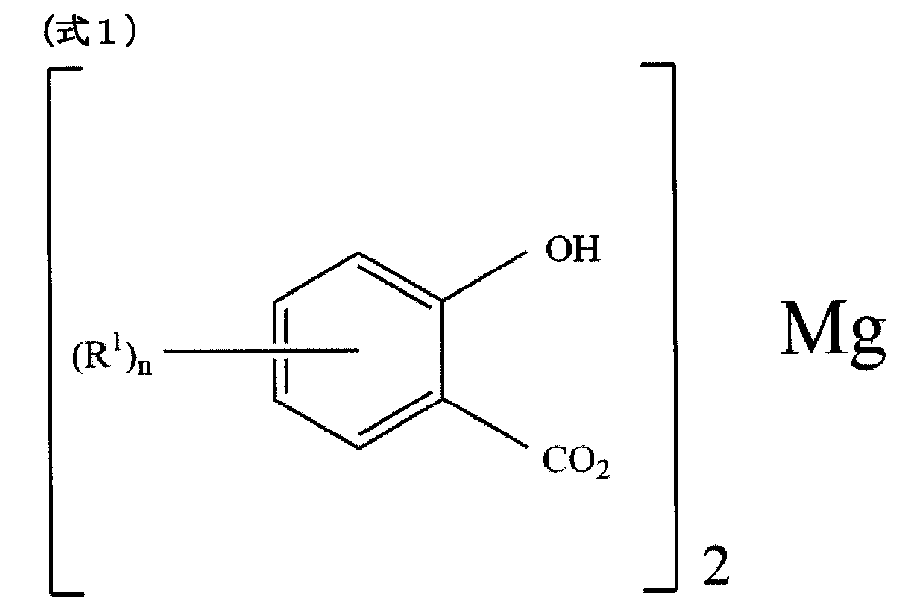
- magnesium salicylate examples include compounds represented by the following formula (1).
- the magnesium salicylate may be carbonate overbased or borate overbased.
- the content of magnesium salicylate contained in the lubricating oil composition of the present invention is 0.01% by mass or more, preferably 0.05% by mass or more, more preferably 0.1% by mass or more, based on the total amount of the lubricating oil composition. More preferably, it is 0.15% by mass or more.
- the upper limit is 10% by mass or less, preferably 8% by mass or less, more preferably 5% by mass or less, and even more preferably 2% by mass or less.
- a specific range is 0.01% by mass or more and 10% by mass or less, preferably 0.05% by mass or more and 8% by mass or less, more preferably 0.1% by mass or more and 5% by mass or less, and still more preferably 0.1% by mass or more and 5% by mass or less. It is 15 mass % or more and 2 mass % or less.
- the amount of magnesium derived from magnesium salicylate contained in the lubricating oil composition of the present invention is preferably 50 ppm by mass or more, more preferably 100 ppm by mass or more, based on the total amount of the lubricating oil composition.
- the upper limit is preferably 2000 mass ppm or less, more preferably 1000 mass ppm or less.
- a specific range is preferably 50 mass ppm or more and 2000 mass ppm or less, more preferably 100 mass ppm or more and 1000 mass ppm or less.
- the magnesium salicylate contained in the lubricating oil composition of the present invention preferably has a base number of 140 mgKOH/g or more, more preferably 180 mgKOH/g or more, and still more preferably 200 mgKOH/g or more.
- the upper limit is preferably 500 mgKOH/g or less, more preferably 400 mgKOH/g or less, still more preferably 350 mgKOH/g or less.
- a specific range is preferably 140 mgKOH/g or more and 500 mgKOH/g or less, more preferably 180 mgKOH/g or more and 400 mgKOH/g or less, and still more preferably 200 mgKOH/g or more and 350 mgKOH/g or less.
- the base number is a value measured according to JIS K 2501 5.2.3.
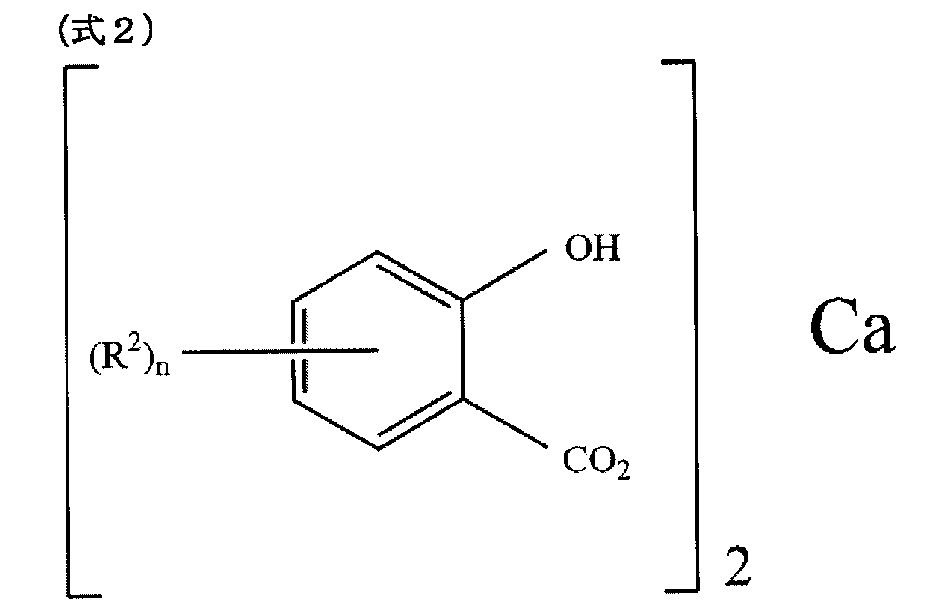
- Examples of calcium salicylate include compounds represented by the following formula (2).
- each R 2 independently represents an alkyl or alkenyl group having 14 to 30 carbon atoms, and n represents 1 or 2.
- the calcium salicylate may be carbonate overbased or borate overbased.
- the content of calcium salicylate contained in the lubricating oil composition of the present invention is 0.1% by mass or more, preferably 0.2% by mass or more, more preferably 0.3% by mass or more, based on the total amount of the lubricating oil composition. More preferably, it is 0.5% by mass or more.
- the upper limit is 10% by mass or less, preferably 8% by mass or less, more preferably 5% by mass or less, and even more preferably 4% by mass or less.
- a specific range is 0.1% by mass or more and 10% by mass or less, preferably 0.2% by mass or more and 8% by mass or less, more preferably 0.3% by mass or more and 5% by mass or less, and still more preferably 0.3% by mass or more and 5% by mass or less. It is 5 mass % or more and 4 mass % or less.
- the amount of calcium derived from calcium salicylate contained in the lubricating oil composition of the present invention is preferably 300 mass ppm or more, more preferably 500 mass ppm or more, based on the total amount of the lubricating oil composition.
- the upper limit is preferably 2500 mass ppm or less, more preferably 2000 mass ppm or less.
- a specific range is preferably 300 mass ppm or more and 2500 mass ppm or less, more preferably 500 mass ppm or more and 2000 mass ppm or less.
- the magnesium salicylate contained in the lubricating oil composition of the present invention preferably has a base number of 140 mgKOH/g or more, more preferably 180 mgKOH/g or more, and still more preferably 200 mgKOH/g or more.
- the upper limit is preferably 500 mgKOH/g or less, more preferably 400 mgKOH/g or less, still more preferably 300 mgKOH/g or less.
- a specific range is preferably 140 mgKOH/g or more and 500 mgKOH/g or less, more preferably 180 mgKOH/g or more and 400 mgKOH/g or less, and still more preferably 200 mgKOH/g or more and 300 mgKOH/g or less.
- the lubricating oil composition of the present invention may contain metal-based detergents other than calcium salicylate and magnesium salicylate, such as phenate-based detergents and sulfonate-based detergents, within the range that does not impair the effects of the present invention. It preferably contains only two salicylates and magnesium salicylates.
- the total content of calcium salicylate and magnesium salicylate is preferably 800 mass ppm or more, more preferably 1000 mass ppm or more, further preferably 1200 mass ppm or more, as a metal content based on the total amount of the composition. It is at least 1400 ppm by mass, most preferably at least 1400 ppm by mass.
- the upper limit is preferably 3000 mass ppm or less, more preferably 2500 mass ppm or less, even more preferably 2200 mass ppm or less, most preferably 2000 mass ppm or less.
- a specific range is preferably 800 mass ppm or more and 3000 mass ppm or less, more preferably 1000 mass ppm or more and 2500 mass ppm or less, still more preferably 1200 mass ppm or more and 2200 mass ppm or less, most preferably 1400 mass ppm or more and 2000 mass ppm or more. Mass ppm or less.
- the ratio of the content of (B) magnesium salicylate to the total content of (B) magnesium salicylate and (C) magnesium salicylate is preferably 0.05 or more and 0.95 or less, more preferably 0.05 or more and 0.75 or less, and still more preferably 0.05 or more and 0.95 or less, more preferably 0.05 or more and 0.75 or less. 05 or more and 0.50 or less.
- the ratio is within the above range, the fuel saving performance is further improved.
- the lubricating oil composition of the present invention contains a viscosity index improver.
- a viscosity index improver those commonly used in the field of lubricating oil compositions for internal combustion engines can be used. Specifically, polymethacrylates, olefin copolymers, polybutene, polyisobutene, polyisobutylene, polystyrene, ethylene-propylene copolymers, styrene-diene copolymers and hydrogenated products thereof can be used. Polymethacrylate is preferred.
- the weight average molecular weight of the viscosity index improver contained in the lubricating oil composition of the present invention is preferably 10,000 or more, more preferably 100,000 or more, and still more preferably 200,000 or more.
- the upper limit is preferably 1,000,000 or less, more preferably 800,000 or less, even more preferably 600,000 or less.
- a specific range is preferably 10,000 or more and 1,000,000 or less, more preferably 100,000 or more and 800,000 or less, and still more preferably 200,000 or more and 600,000 or less.
- the weight average molecular weight of a high molecular weight polymer means a value (molecular weight obtained by polystyrene conversion) determined by gel permeation chromatography (GPC).
- the content of the viscosity index improver contained in the lubricating oil composition of the present invention is such that the HTHS viscosity of the lubricating oil composition at 150°C is 1.7 or more and 2.3 mPa s or less, and the HTHS viscosity at 100°C is , 4.8 mPa ⁇ s or less.
- the content of the viscosity index improver contained in the lubricating oil composition of the present invention is 0.1% by mass or more, preferably 0.2% by mass or more, more preferably 0.3% by mass based on the total amount of the lubricating oil composition. Above, more preferably 0.5% by mass or more.
- the upper limit is 10% by mass or less, preferably 8% by mass or less, more preferably 5% by mass or less, and even more preferably 4% by mass or less.
- a specific range is 0.1% by mass or more and 10% by mass or less, preferably 0.2% by mass or more and 8% by mass or less, more preferably 0.3% by mass or more and 5% by mass or less, and still more preferably 0.3% by mass or more and 5% by mass or less. It is 5 mass % or more and 4 mass % or less.
- the lubricating oil composition of the present invention preferably further contains (E) a molybdenum-based friction modifier as a friction modifier.
- a molybdenum-based friction modifier as a friction modifier.
- MoDTC molybdenum dithiocarbamate
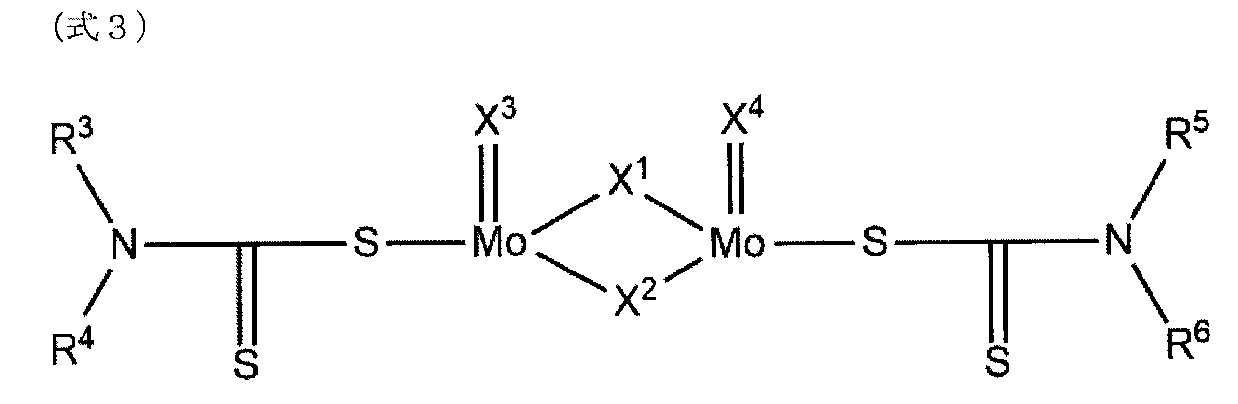
- MoDTC for example, a compound represented by the following formula (3) can be used.
- R 3 to R 6 may be the same or different, and are alkyl groups having 2 to 24 carbon atoms or (alkyl)aryl groups having 6 to 24 carbon atoms, preferably 4 to 4 carbon atoms. 13 alkyl groups or (alkyl)aryl groups having 10 to 15 carbon atoms.
- the alkyl group may be a primary alkyl group, secondary alkyl group or tertiary alkyl group, and may be linear or branched.
- “(alkyl)aryl group” means "aryl group or alkylaryl group". In the alkylaryl group, the substitution position of the alkyl group on the aromatic ring is arbitrary.
- X 1 to X 4 are each independently a sulfur atom or an oxygen atom, and at least one of X 1 to X 4 is a sulfur atom.
- Molybdenum-based friction modifiers other than MoDTC include, for example, molybdenum dithiophosphate, molybdenum oxide, molybdic acid, molybdates such as ammonium salts, molybdenum disulfide, molybdenum sulfide, molybdenum sulfide, organic molybdenum compounds containing sulfur, and the like. can be mentioned.
- the lubricating oil composition of the present invention contains a molybdenum-based friction modifier
- its content is 0.01% by mass or more, preferably 0.1% by mass or more, more preferably 0, based on the total amount of the lubricating oil composition. 0.2% by mass or more, more preferably 0.5% by mass or more.
- the upper limit is 10% by mass or less, preferably 8% by mass or less, more preferably 5% by mass or less, and even more preferably 2% by mass or less.
- a specific range is 0.01% by mass to 10% by mass, preferably 0.1% by mass to 8% by mass, more preferably 0.5% by mass to 5% by mass, and still more preferably 0.5% by mass to 8% by mass. It is 5 mass % or more and 2 mass % or less.
- the amount of molybdenum derived from the molybdenum-based friction modifier contained in the lubricating oil composition of the present invention is preferably 100 ppm by mass or more, more preferably 500 ppm by mass or more, based on the total amount of the lubricating oil composition.
- the upper limit is preferably 2000 mass ppm or less, more preferably 1000 mass ppm or less.
- a specific range is preferably 100 mass ppm or more and 2000 mass ppm or less, more preferably 500 mass ppm or more and 1000 mass ppm or less.
- the lubricating oil composition of the present invention may further contain antiwear agents, antioxidants or dispersants.
- zinc dialkyldithiophosphate As an antiwear agent, it is preferable to add zinc dialkyldithiophosphate (ZnDTP).
- ZnDTP zinc dialkyldithiophosphate
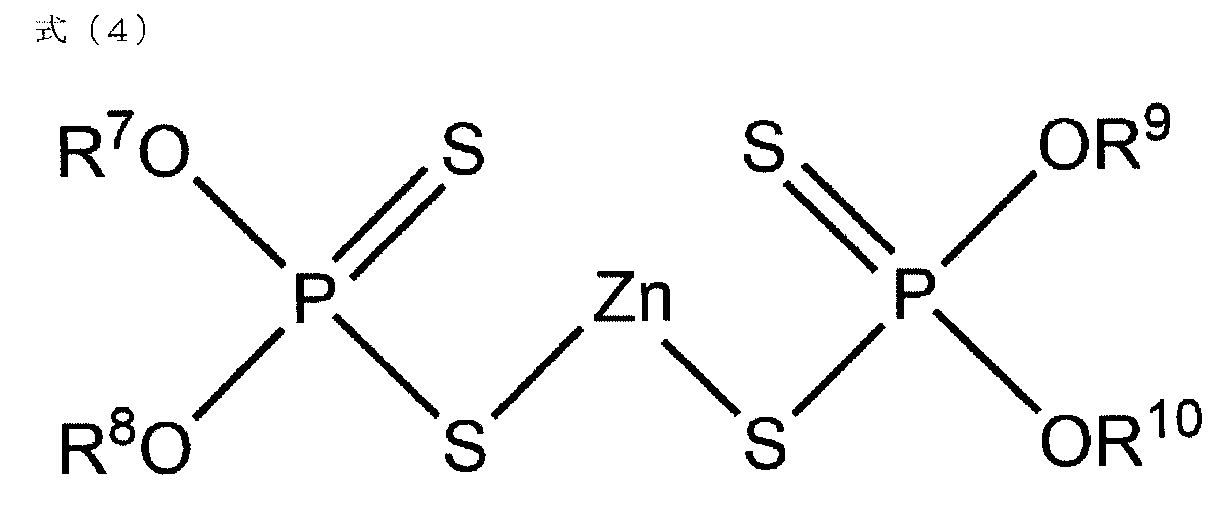
- Examples of zinc dialkyldithiophosphates include compounds represented by the following general formula (4).
- R 7 to R 10 in the general formula (4) each independently represent a hydrogen atom or a linear or branched alkyl group having 1 to 24 carbon atoms, and at least one of R 7 to R 10 One is a linear or branched alkyl group having 1 to 24 carbon atoms.
- the alkyl group can be primary, secondary or tertiary.
- one of these zinc dialkyldithiophosphates may be used alone, or two or more thereof may be used in combination.
- the zinc dialkyldithiophosphate is preferably a zinc dithiophosphate having a primary alkyl group (primary ZnDTP) or a zinc dithiophosphate having a secondary alkyl group (secondary ZnDTP).
- a material containing zinc dithiophosphate as a main component is preferable because it enhances wear resistance.
- the lubricating oil composition of the present invention contains zinc dialkyldithiophosphate
- its content is 0.01% by mass or more, preferably 0.1% by mass or more, more preferably 0.1% by mass or more, based on the total amount of the lubricating oil composition. It is 2% by mass or more, more preferably 0.5% by mass or more.
- the upper limit is 10% by mass or less, preferably 8% by mass or less, more preferably 5% by mass or less, and even more preferably 2% by mass or less.
- a specific range is 0.01% by mass to 10% by mass, preferably 0.1% by mass to 8% by mass, more preferably 0.5% by mass to 5% by mass, and still more preferably 0.5% by mass to 8% by mass. It is 5 mass % or more and 2 mass % or less.
- the amount of phosphorus derived from zinc dialkyldithiophosphate contained in the lubricating oil composition of the present invention is preferably 100 ppm by mass or more, more preferably 500 ppm by mass or more, based on the total amount of the composition.
- the upper limit is preferably 2000 mass ppm or less, more preferably 1000 mass ppm or less.
- a specific range is preferably 100 mass ppm or more and 2000 mass ppm or less, more preferably 500 mass ppm or more and 1000 mass ppm or less.
- antioxidants such as phenol antioxidants and amine antioxidants can be used.
- examples include aminic antioxidants such as alkylated diphenylamine, phenyl- ⁇ -naphthylamine, alkylated- ⁇ -naphthylamine, 2,6-di-t-butyl-4-methylphenol, 4,4′-methylenebis( 2,6-di-t-butylphenol) and other phenolic antioxidants.
- the lubricating oil composition contains an antioxidant, its content is usually 5.0% by mass or less, preferably 3.0% by mass or less, and preferably 0, based on the total amount of the lubricating oil composition. .1% by mass or more, more preferably 0.5% by mass or more.
- Dispersants include ashless dispersants such as succinimide or benzylamine.
- ashless dispersants such as succinimide or benzylamine.
- its content is usually 5.0% by mass or less, preferably 0.1% by mass or more, based on the total amount of the lubricating oil composition.
- the lubricating oil composition of the present invention can contain other additives commonly used in lubricating oils depending on the purpose in order to further improve its performance.
- additives include additives such as wear inhibitors or extreme pressure agents, pour point depressants, corrosion inhibitors, rust inhibitors, metal deactivators, antifoaming agents, and the like.
- the HTHS viscosity at 150°C of the lubricating oil composition of the present invention is 1.7 or more and 2.3 mPa ⁇ s or less.
- the HTHS viscosity at 150°C is 2.3 mPa ⁇ s or less, good fuel economy performance can be obtained. If it is less than 1.7 mPa ⁇ s, lubricity may be insufficient.
- the lubricating oil composition of the present invention is more preferably 1.7 mPa s or more and 2.2 mPa s or less, more preferably 1.7 mPa s or more and 2.1 mPa s or less, still more preferably It is 1.7 mPa ⁇ s or more and 2.0 mPa ⁇ s or less.
- the HTHS viscosity at 150°C indicates the high temperature high shear viscosity at 150°C defined in ASTM D4683.
- the HTHS viscosity at 100° C. of the lubricating oil composition of the present invention is 4.8 mPa ⁇ s or less. If the HTHS viscosity at 100° C. exceeds 4.8 mPa ⁇ s, there is a possibility that sufficient fuel saving performance cannot be obtained.
- the HTHS viscosity at 100° C. of the lubricating oil composition of the present invention is preferably 3.0 mPa s or more and 4.5 mPa s or less, more preferably 3.2 mPa s or more and 4.2 mPa s or less, still more preferably 3 .4 mPa ⁇ s or more and 4.0 mPa ⁇ s or less.
- the HTHS viscosity at 100°C indicates the high temperature high shear viscosity at 100°C specified in ASTM D4683.
- the HTHS viscosity (100°C)/HTHS viscosity (150°C) is preferably 1.95 or more and less than 2.20, more preferably 2.00 or more and less than 2.20.
- the viscosity index of the lubricating oil composition of the present invention is preferably 140 or more and 240 or less, more preferably 140 or more and 220 or less.
- the viscosity index of the lubricating oil composition is 140 or more, fuel economy performance can be improved while maintaining a low HTHS viscosity at 150°C.
- the viscosity index of the lubricating oil composition exceeds 240, the evaporability may deteriorate.
- the viscosity index means a viscosity index measured according to JIS K 2283-1993.
- the kinematic viscosity at 40° C. of the lubricating oil composition of the present invention is preferably 10 mm 2 /s or more, more preferably 14 mm 2 /s or more, still more preferably 16 mm 2 /s or more, most preferably 18 mmmm 2 /s or more.
- the upper limit is preferably 30 mm 2 /s or less, more preferably 28 mm 2 /s or less, even more preferably 26 mm 2 /s or less, most preferably 25 mm 2 /s or less.
- a specific range is preferably 10 mm 2 /s or more and 30 mm 2 /s or less, more preferably 14 mm 2 /s or more and 28 mm 2 /s or less, still more preferably 16 mm 2 /s or more and 26 mm 2 /s or less, most preferably is 18 mm 2 /s or more and 25 mm 2 /s or less.
- the kinematic viscosity at 40° C. of the lubricating oil composition is 30 mm 2 /s or less, sufficient fuel saving performance can be obtained.
- kinematic viscosity at 40°C means kinematic viscosity at 40°C measured according to ASTM D-445.
- the kinematic viscosity at 100° C. of the lubricating oil composition of the present invention is preferably 3 mm 2 /s or more, more preferably 4 mm 2 /s or more.
- the upper limit is preferably 7 mm 2 /s or less, more preferably 6 mm 2 /s or less.
- a specific range is preferably 3 mm 2 /s or more and 7 mm 2 /s or less, more preferably 4 mm 2 /s or more and 6 mm 2 /s or less.
- the density ( ⁇ 15) at 15°C of the lubricating oil composition of the present invention is preferably 0.860 or less, more preferably 0.850 or less.
- the density at 15°C means the density measured at 15°C according to JIS K 2249-1995.
- the NOACK evaporation at 250°C is preferably 30% by mass or less. If the NOACK evaporation amount of the lubricating base oil component exceeds 30% by mass, the evaporation loss of the lubricating oil is large, which causes an increase in viscosity and the like, which is not preferable.
- the NOACK evaporation amount is the evaporation amount of lubricating oil measured according to ASTM D5800.
- the lower limit of the NOACK evaporation amount of the lubricating oil composition at 250° C. is not particularly limited, but is usually 5% by mass or more.
- Lubricating oil compositions for testing were prepared by blending base oils and additives at the blending ratios shown in Tables 1 and 2 for each example and each comparative example. The following evaluations were performed on the obtained lubricating oil composition for test. Evaluation results are shown in Tables 1 and 2.
- Lubricating base oil / base oil 1 Group III base oil (mineral oil) Kinematic viscosity 3.3 mm 2 /s (100 ° C.), viscosity index 112 ⁇ Base oil 2: Group III base oil (mineral oil) kinematic viscosity 4.3 mm 2 /s (100°C), viscosity index 123 Lubricating base oils were prepared by mixing base oils at the mass ratios shown in Tables 1 and 2. In the table, the numerical value of the base oil represents the mass ratio based on the total amount of the base oil.
- Anti-wear agent 1 zinc dialkyldithiophosphate (zinc content 9.3% by mass, phosphorus content 9.3% by mass, sulfur content 17.6% by mass, secondary ZnDTP) - Dispersant 1: Polyimide succinate (nitrogen content 1.75% by mass) ⁇ Antioxidant 1: amine antioxidant ⁇ Antioxidant 2: phenolic antioxidant
- each test lubricating oil composition is shown in Tables 1 and 2 below.
- the density at 15° C. of each test lubricating oil composition of Examples 1 to 8 and Comparative Example 1 is all 0.850 or less.
- Examples 1 to 8 torque was reduced compared to Comparative Example 1 under all conditions of 1000 rpm, 2000 rpm and 3000 rpm. Therefore, Examples 1 to 8 are superior to Comparative Example 1 in fuel saving performance.
- the lubricating oil composition for an internal combustion engine of the present invention it is possible to provide a lubricating oil composition for an internal combustion engine that exhibits good fuel economy performance.
Landscapes
- Chemical & Material Sciences (AREA)
- Chemical Kinetics & Catalysis (AREA)
- General Chemical & Material Sciences (AREA)
- Oil, Petroleum & Natural Gas (AREA)
- Organic Chemistry (AREA)
- Lubricants (AREA)
Abstract
Description
潤滑油による燃費改善には、使用粘度の低減による粘性抵抗を下げることが行われてきた(例えば、特許文献1を参照。)。しかし内燃機関の潤滑には必要な粘度が存在し、おのずと限界がある。また内燃機関油はバルブの駆動などの油圧源としても使用されており、油圧の維持には一定の粘度が必要である。このため、低粘度化にも限界があった。これを打開するため、内燃機関のヒートマネージメントが導入されつつある。例えば、内燃機関の使用目的や使用条件により内燃機関油の最高使用温度を低くすることや、内燃機関ポンプの改良によりポンプに必要な油圧を小さくすることで、必要粘度をさらに低減することが可能となる。これにより一段の省燃費化を図ることができる。
<1>
(A)潤滑油基油、
(B)マグネシウムサリシレート、
(C)カルシウムサリシレート、および
(D)粘度指数向上剤、を含む内燃機関用潤滑油組成物であって、150℃のHTHS粘度が、1.7以上2.3mPa・s以下であり、
100℃のHTHS粘度が、4.8mPa・s以下である内燃機関用潤滑油組成物。
<2>
(A)潤滑油基油の100℃における動粘度が4.2mm2/s未満であり、潤滑油組成物の粘度指数が140以上である、<1>に記載の内燃機関用潤滑油組成物。
<3>
前記(B)マグネシウムサリシレートおよび(C)カルシウムサリシレートの含有量の合計が、組成物全量基準で、金属量として1400質量ppm以上2000質量ppm以下であり、
(B)の含有量/((B)の含有量+(C)の含有量)が、質量ppm基準で、0.05以上0.95以下である、<1>または<2>に記載の内燃機関用潤滑油組成物。
<4>
150℃のHTHS粘度が、1.7以上2.0mPa・s以下であり、
100℃のHTHS粘度が、4.2mPa・s以下である、<1>~<3>のいずれかに記載の内燃機関用潤滑油組成物。
本発明の潤滑油組成物においては、潤滑油基油として鉱油系基油を用いることが好ましい。本発明の潤滑油組成物に用いられる鉱油系基油としては、原油を常圧蒸留して得られる留出油が挙げられる。または、この留出油をさらに減圧蒸留して得られる留出油を、各種の精製プロセスで精製した潤滑油留分も使用することができる。精製プロセスとしては、水素化精製、溶剤抽出、溶剤脱ろう、水素化脱ろう、硫酸洗浄、白土処理などを、適宜組み合わせることができる。これらの精製プロセスを適宜の順序で組み合わせて処理することにより、本発明で使用できる潤滑油基油を得ることができる。異なる原油あるいは留出油を異なる精製プロセスの組合せに供することにより得られた、性状の異なる複数の精製油の混合物も使用可能である。
前記の100℃における動粘度は、全ての潤滑油基油を混合した状態での動粘度、すなわち、基油全体としての動粘度を意味する。すなわち、複数の基油が含まれる場合の、特定の1つの潤滑油基油の動粘度を意味するものではない。
なお、本明細書において「100℃における動粘度」とは、ASTM D-445に準拠して測定された100℃での動粘度を意味する。
本発明の潤滑油組成物では、金属系清浄剤として、〔B〕マグネシウムサリシレートおよび〔C〕カルシウムサリシレートを用いる。マグネシウムサリシレートおよびカルシウムサリシレートに加えて、他の金属系清浄剤を含むことができるが、マグネシウムサリシレートおよびカルシウムサリシレートの2種類のみを含むことが好ましい。
本発明の潤滑油組成物に含まれるマグネシウムサリシレートの塩基価は、好ましくは140mgKOH/g以上、より好ましくは180mgKOH/g以上、さらに好ましくは200mgKOH/g以上である。上限は、好ましくは500mgKOH/g以下、より好ましくは400mgKOH/g以下、さらに好ましくは350mgKOH/g以下である。具体的な範囲としては、好ましくは140mgKOH/g以上500mgKOH/g以下、より好ましくは180mgKOH/g以上400mgKOH/g以下、さらに好ましくは200mgKOH/g以上350mgKOH/g以下である。
本明細書において、塩基価は、JIS K 2501 5.2.3により測定される値である。
本発明の潤滑油組成物に含まれるマグネシウムサリシレートの塩基価は、好ましくは140mgKOH/g以上、より好ましくは180mgKOH/g以上、さらに好ましくは200mgKOH/g以上である。上限は、好ましくは500mgKOH/g以下、より好ましくは400mgKOH/g以下、さらに好ましくは300mgKOH/g以下である。具体的な範囲としては、好ましくは140mgKOH/g以上500mgKOH/g以下、より好ましくは180mgKOH/g以上400mgKOH/g以下、さらに好ましくは200mgKOH/g以上300mgKOH/g以下である。
本発明の潤滑油組成物は、粘度指数向上剤を含む。粘度指数向上剤としては、内燃機関用潤滑油組成物の分野で一般に使用されているものを使用することができる。具体的には、ポリメタクリレート、オレフィンコポリマー、ポリブテン、ポリイソブテン、ポリイソブチレン、ポリスチレン、エチレン-プロピレン共重合体、およびスチレン-ジエン共重合体およびその水素化物等が使用できる。ポリメタクリレートが好ましい。
高分子ポリマーの重量平均分子量は、それぞれゲルパーミエーションクロマトグラフィー(GPC)で求められる値(ポリスチレン換算により得られた分子量)を意味する。
本発明の潤滑油組成物は、(E)モリブデン系摩擦調整剤を摩擦調整剤としてさらに含むことが好ましい。成分(E)としては、モリブデンジチオカーバメート(以下、単にMoDTCと称することがある。)が好ましい。
本発明の潤滑油組成物は、さらに、摩耗防止剤、酸化防止剤または分散剤を含むことができる。
本発明の潤滑油組成物においては、これらのジアルキルジチオリン酸亜鉛は一種を単独で用いてもよく、二種以上を組み合わせて用いてもよい。ジアルキルジチオリン酸亜鉛としては、第1級アルキル基を有するジチオリン酸亜鉛(プライマリーZnDTP)または第2級アルキル基を含有するジチオリン酸亜鉛(セカンダリーZnDTP)が好ましく、特には、第2級のアルキル基のジチオリン酸亜鉛を主成分とするものが、耐摩耗性を高めるため好ましい。
潤滑油組成物が酸化防止剤を含む場合、その含有量は、潤滑油組成物全量基準で、通常5.0質量%以下であり、好ましくは3.0質量%以下であり、また好ましくは0.1質量%以上であり、より好ましくは0.5質量%以上である。
潤滑油組成物が分散剤を含む場合、その含有量は、潤滑油組成物全量基準で、通常5.0質量%以下であり、また好ましくは0.1質量%以上である。
本発明の潤滑油組成物の150℃におけるHTHS粘度は、1.7以上2.3mPa・s以下である。150℃におけるHTHS粘度が2.3mPa・s以下であることにより、良好な省燃費性能を得ることができる。1.7mPa・sを下回ると、潤滑性不足となる可能性がある。
本発明の潤滑油組成物の150℃におけるHTHS粘度は、より好ましくは1.7mPa・s以上2.2mPa・s以下、より好ましくは1.7mPa・s以上2.1mPa・s以下、さらに好ましくは1.7mPa・s以上2.0mPa・s以下である。
本明細書において、150℃におけるHTHS粘度とは、ASTM D 4683に規定される150℃での高温高せん断粘度を示す。
本発明の潤滑油組成物の100℃におけるHTHS粘度は、好ましくは3.0mPa・s以上4.5mPa・s以下、より好ましくは3.2mPa・s以上4.2mPa・s以下、さらに好ましくは3.4mPa・s以上4.0mPa・s以下である。
本明細書において、100℃におけるHTHS粘度とは、ASTM D4683に規定される100℃での高温高せん断粘度を示す。
なお、本明細書において粘度指数とは、JIS K 2283-1993に準拠して測定された粘度指数を意味する。
なお、本明細書において「40℃における動粘度」とは、ASTM D-445に準拠して測定された40℃での動粘度を意味する。
各実施例および各比較例について表1~2に示す配合割合で、基油および添加剤を配合することによって、試験用潤滑油組成物を調製した。得られた試験用潤滑油組成物に対して、次に示す評価を行った。評価結果を表1~2に示す。
・基油1:グループIII基油(鉱油) 動粘度3.3mm2/s(100℃)、粘度指数 112
・基油2:グループIII基油(鉱油) 動粘度4.3mm2/s(100℃)、粘度指数 123
表1~2に示した質量比で基油を混合し、潤滑油基油を調製した。表中、基油の数値は基油全量基準での質量比を表している。
表1~2に記載の通り、添加剤を添加した。添加剤の詳細は以下の通りである。添加剤の配合量は、潤滑油組成物全量基準である。
(B)金属系清浄剤1:カルシウムサリシレート(カルシウム含有量が8.0質量%、塩基価:225mgKOH/g)
(C)金属系清浄剤2:マグネシウムサリシレート(マグネシウム含有量が7.4質量%、塩基価:342mgKOH/g)
(D)粘度指数向上剤
・粘度指数向上剤1:ポリメタクリレート(重量平均分子量520,000)
(E)摩擦調整剤
・摩擦調整剤1:モリブデンジチオカーバメート(モリブデン含有量が9.1質量%、硫黄含有量が10.8質量%)
・分散剤1:コハク酸ポリイミド(窒素含有量1.75質量%)
・酸化防止剤1:アミン系酸化防止剤
・酸化防止剤2:フェノール系酸化防止剤
(1)省燃費性能
各試験用潤滑油組成物について、モータリングエンジントルク試験を行った。各試験用潤滑油組成物について、当該潤滑油組成物(油温80℃)により潤滑されたDOHCエンジン(排気量1.2L)の出力軸を電動モータにより一定速度で回転させるのに必要なトルクを測定した。測定は1000rpm、2000rpm、および3000rpmで行い、比較例1における測定値に対するトルクの低減率を算出した。トルクの低減率が高いほど省燃費性能に優れることを意味する。


Claims (4)
- (A)潤滑油基油、
(B)マグネシウムサリシレート、
(C)カルシウムサリシレート、および
(D)粘度指数向上剤、
を含む内燃機関用潤滑油組成物であって、
150℃のHTHS粘度が、1.7以上2.3mPa・s以下であり、
100℃のHTHS粘度が、4.8mPa・s以下である
ことを特徴とする内燃機関用潤滑油組成物。 - (A)潤滑油基油の100℃における動粘度が4.2mm2/s未満であり、
潤滑油組成物の粘度指数が140以上である、請求項1に記載の内燃機関用潤滑油組成物。 - 前記(B)マグネシウムサリシレートおよび(C)カルシウムサリシレートの含有量の合計が、潤滑油組成物全量基準で、金属量として1400質量ppm以上2000質量ppm以下であり、
(B)の含有量/((B)の含有量+(C)の含有量)が、質量ppm基準で、0.05以上0.95以下である、請求項1または2に記載の内燃機関用潤滑油組成物。 - 150℃のHTHS粘度が、1.7以上2.0mPa・s以下であり、
100℃のHTHS粘度が、4.2mPa・s以下である、
請求項1~3のいずれかに記載の内燃機関用潤滑油組成物。
Priority Applications (2)
| Application Number | Priority Date | Filing Date | Title |
|---|---|---|---|
| CN202280035615.0A CN117321180A (zh) | 2021-05-25 | 2022-05-23 | 内燃机用润滑油组合物 |
| US18/561,773 US20240240102A1 (en) | 2021-05-25 | 2022-05-23 | Lubricating oil composition for internal combustion engine |
Applications Claiming Priority (2)
| Application Number | Priority Date | Filing Date | Title |
|---|---|---|---|
| JP2021087451A JP2022180775A (ja) | 2021-05-25 | 2021-05-25 | 内燃機関用潤滑油組成物 |
| JP2021-087451 | 2021-05-25 |
Publications (1)
| Publication Number | Publication Date |
|---|---|
| WO2022250017A1 true WO2022250017A1 (ja) | 2022-12-01 |
Family
ID=84228820
Family Applications (1)
| Application Number | Title | Priority Date | Filing Date |
|---|---|---|---|
| PCT/JP2022/021114 Ceased WO2022250017A1 (ja) | 2021-05-25 | 2022-05-23 | 内燃機関用潤滑油組成物 |
Country Status (4)
| Country | Link |
|---|---|
| US (1) | US20240240102A1 (ja) |
| JP (1) | JP2022180775A (ja) |
| CN (1) | CN117321180A (ja) |
| WO (1) | WO2022250017A1 (ja) |
Families Citing this family (1)
| Publication number | Priority date | Publication date | Assignee | Title |
|---|---|---|---|---|
| JP7652621B2 (ja) * | 2021-05-25 | 2025-03-27 | Eneos株式会社 | 内燃機関用潤滑油組成物 |
Citations (5)
| Publication number | Priority date | Publication date | Assignee | Title |
|---|---|---|---|---|
| CN105349225A (zh) * | 2015-11-11 | 2016-02-24 | 龙蟠润滑新材料(天津)有限公司 | 一种全效节能型润滑油组合物 |
| WO2017099140A1 (ja) * | 2015-12-07 | 2017-06-15 | エクソンモービル リサーチ アンド エンジニアリング カンパニー | 潤滑油組成物 |
| WO2018021559A1 (ja) * | 2016-07-29 | 2018-02-01 | エクソンモービル リサーチ アンド エンジニアリング カンパニー | 潤滑油組成物 |
| WO2018212339A1 (ja) * | 2017-05-19 | 2018-11-22 | Jxtgエネルギー株式会社 | 内燃機関用潤滑油組成物 |
| WO2019221296A1 (ja) * | 2018-05-18 | 2019-11-21 | Jxtgエネルギー株式会社 | 内燃機関用潤滑油組成物 |
Family Cites Families (16)
| Publication number | Priority date | Publication date | Assignee | Title |
|---|---|---|---|---|
| JP5727713B2 (ja) * | 2010-03-19 | 2015-06-03 | 出光興産株式会社 | 内燃機関用潤滑油組成物 |
| US20180334636A1 (en) * | 2015-12-07 | 2018-11-22 | Jxtg Nippon Oil & Energy Corporation | Lubricating oil composition for internal combustion engine |
| JP6716360B2 (ja) * | 2016-06-24 | 2020-07-01 | Jxtgエネルギー株式会社 | 内燃機関用潤滑油組成物 |
| US20180258365A1 (en) * | 2017-03-08 | 2018-09-13 | Chevron Japan Ltd. | Low viscosity lubricating oil composition |
| WO2018212340A1 (ja) * | 2017-05-19 | 2018-11-22 | Jxtgエネルギー株式会社 | 内燃機関用潤滑油組成物 |
| CA3068707C (en) * | 2017-06-30 | 2024-03-05 | Chevron Oronite Company Llc | Low viscosity engine oils containing isomerized phenolic-based detergents |
| JP7021908B2 (ja) * | 2017-11-07 | 2022-02-17 | Emgルブリカンツ合同会社 | 潤滑油組成物 |
| JP7320935B2 (ja) * | 2018-11-07 | 2023-08-04 | Eneos株式会社 | 潤滑油組成物 |
| US11193084B2 (en) * | 2018-11-16 | 2021-12-07 | Chevron Japan Ltd. | Low viscosity lubricating oil compositions |
| JP6913704B2 (ja) * | 2019-03-29 | 2021-08-04 | 出光興産株式会社 | 潤滑油組成物 |
| JP7442287B2 (ja) * | 2019-09-26 | 2024-03-04 | Eneos株式会社 | 内燃機関用潤滑油組成物 |
| JP7589172B2 (ja) * | 2019-12-27 | 2024-11-25 | 出光興産株式会社 | 潤滑油組成物 |
| US11987766B2 (en) * | 2020-08-31 | 2024-05-21 | Eneos Corporation | Lubricating oil composition for internal combustion engine |
| US11732207B2 (en) * | 2020-08-31 | 2023-08-22 | Eneos Corporation | Lubricating oil composition for internal combustion engine |
| EP4317370B1 (en) * | 2021-03-31 | 2026-05-06 | Idemitsu Kosan Co.,Ltd. | Lubricant composition |
| JP7652621B2 (ja) * | 2021-05-25 | 2025-03-27 | Eneos株式会社 | 内燃機関用潤滑油組成物 |
-
2021
- 2021-05-25 JP JP2021087451A patent/JP2022180775A/ja active Pending
-
2022
- 2022-05-23 CN CN202280035615.0A patent/CN117321180A/zh active Pending
- 2022-05-23 US US18/561,773 patent/US20240240102A1/en not_active Abandoned
- 2022-05-23 WO PCT/JP2022/021114 patent/WO2022250017A1/ja not_active Ceased
Patent Citations (5)
| Publication number | Priority date | Publication date | Assignee | Title |
|---|---|---|---|---|
| CN105349225A (zh) * | 2015-11-11 | 2016-02-24 | 龙蟠润滑新材料(天津)有限公司 | 一种全效节能型润滑油组合物 |
| WO2017099140A1 (ja) * | 2015-12-07 | 2017-06-15 | エクソンモービル リサーチ アンド エンジニアリング カンパニー | 潤滑油組成物 |
| WO2018021559A1 (ja) * | 2016-07-29 | 2018-02-01 | エクソンモービル リサーチ アンド エンジニアリング カンパニー | 潤滑油組成物 |
| WO2018212339A1 (ja) * | 2017-05-19 | 2018-11-22 | Jxtgエネルギー株式会社 | 内燃機関用潤滑油組成物 |
| WO2019221296A1 (ja) * | 2018-05-18 | 2019-11-21 | Jxtgエネルギー株式会社 | 内燃機関用潤滑油組成物 |
Also Published As
| Publication number | Publication date |
|---|---|
| JP2022180775A (ja) | 2022-12-07 |
| CN117321180A (zh) | 2023-12-29 |
| US20240240102A1 (en) | 2024-07-18 |
Similar Documents
| Publication | Publication Date | Title |
|---|---|---|
| JP5649675B2 (ja) | 内燃機関用潤滑油組成物 | |
| JP7198748B2 (ja) | 内燃機関用潤滑油組成物 | |
| JP6472262B2 (ja) | 内燃機関用潤滑油組成物 | |
| JP5809582B2 (ja) | 潤滑油組成物 | |
| WO2011083601A1 (ja) | 潤滑油組成物 | |
| WO2010140446A1 (ja) | 潤滑油組成物 | |
| WO2016159006A1 (ja) | 潤滑油組成物 | |
| JPWO2018212340A1 (ja) | 内燃機関用潤滑油組成物 | |
| WO2019221296A1 (ja) | 内燃機関用潤滑油組成物 | |
| WO2011083602A1 (ja) | 潤滑油組成物 | |
| WO2010140392A1 (ja) | 潤滑油組成物 | |
| WO2011027730A1 (ja) | 潤滑油組成物 | |
| TWI836351B (zh) | 內燃機用潤滑油組合物 | |
| JP5744771B2 (ja) | 潤滑油組成物 | |
| JP2017066220A (ja) | 潤滑油組成物 | |
| JP2011021056A (ja) | 潤滑油組成物 | |
| JP7652621B2 (ja) | 内燃機関用潤滑油組成物 | |
| WO2022250017A1 (ja) | 内燃機関用潤滑油組成物 | |
| JP2014196518A (ja) | 潤滑油組成物 | |
| JP5815809B2 (ja) | 潤滑油組成物 | |
| JP2023004313A (ja) | 内燃機関用潤滑油組成物 | |
| JP7603538B2 (ja) | 内燃機関用潤滑油組成物 | |
| JP2023004316A (ja) | 内燃機関用潤滑油組成物 | |
| JP2023004315A (ja) | 内燃機関用潤滑油組成物 | |
| WO2023190101A1 (ja) | 内燃機関用潤滑油組成物 |
Legal Events
| Date | Code | Title | Description |
|---|---|---|---|
| 121 | Ep: the epo has been informed by wipo that ep was designated in this application |
Ref document number: 22811287 Country of ref document: EP Kind code of ref document: A1 |
|
| WWE | Wipo information: entry into national phase |
Ref document number: 202280035615.0 Country of ref document: CN |
|
| WWE | Wipo information: entry into national phase |
Ref document number: 18561773 Country of ref document: US |
|
| NENP | Non-entry into the national phase |
Ref country code: DE |
|
| 122 | Ep: pct application non-entry in european phase |
Ref document number: 22811287 Country of ref document: EP Kind code of ref document: A1 |