WO2022224599A1 - 四肢動物用の生体情報計測衣類、四肢動物用の衣類型生体情報計測装置、四肢動物の異常呼吸検知方法、および四肢動物の異常呼吸検知装置 - Google Patents
四肢動物用の生体情報計測衣類、四肢動物用の衣類型生体情報計測装置、四肢動物の異常呼吸検知方法、および四肢動物の異常呼吸検知装置 Download PDFInfo
- Publication number
- WO2022224599A1 WO2022224599A1 PCT/JP2022/009671 JP2022009671W WO2022224599A1 WO 2022224599 A1 WO2022224599 A1 WO 2022224599A1 JP 2022009671 W JP2022009671 W JP 2022009671W WO 2022224599 A1 WO2022224599 A1 WO 2022224599A1
- Authority
- WO
- WIPO (PCT)
- Prior art keywords
- respiration
- abnormal
- biological information
- quadruped
- base fabric
- Prior art date
- Legal status (The legal status is an assumption and is not a legal conclusion. Google has not performed a legal analysis and makes no representation as to the accuracy of the status listed.)
- Ceased
Links
Images


Classifications
-
- A—HUMAN NECESSITIES
- A01—AGRICULTURE; FORESTRY; ANIMAL HUSBANDRY; HUNTING; TRAPPING; FISHING
- A01K—ANIMAL HUSBANDRY; AVICULTURE; APICULTURE; PISCICULTURE; FISHING; REARING OR BREEDING ANIMALS, NOT OTHERWISE PROVIDED FOR; NEW BREEDS OF ANIMALS
- A01K13/00—Devices for grooming or caring of animals, e.g. curry-combs; Fetlock rings; Tail-holders; Devices for preventing crib-biting; Washing devices; Protection against weather conditions or insects
-
- A—HUMAN NECESSITIES
- A01—AGRICULTURE; FORESTRY; ANIMAL HUSBANDRY; HUNTING; TRAPPING; FISHING
- A01K—ANIMAL HUSBANDRY; AVICULTURE; APICULTURE; PISCICULTURE; FISHING; REARING OR BREEDING ANIMALS, NOT OTHERWISE PROVIDED FOR; NEW BREEDS OF ANIMALS
- A01K29/00—Other apparatus for animal husbandry
Definitions
- the present invention relates to clothing capable of measuring biological information of a quadruped, a clothing-type device capable of measuring biological information of a quadruped, a method of detecting abnormal breathing of a quadruped, and an apparatus for detecting abnormal breathing of a quadruped.
- Patent Document 1 an electrode section made of a flexible conductive material, a connector section, and a wiring section that electrically connects the electrode section and the connector section are provided on the first surface of a flexible substrate. and an electrode member provided with a member for attaching to the clothing on the second surface of the flexible substrate.
- non-human quadrupeds can cough and sneeze when their health deteriorates. Coughing and sneezing are often intermittent and often go unnoticed by owners, especially in the early stages of poor health. Therefore, if the occurrence of coughing and sneezing can be measured as biological information, changes in the health condition of tetrapods can be recognized at an early stage when the health condition of the tetrapod deteriorates, and appropriate treatment can be given to the tetrapod. It is thought that it can suppress the deterioration of
- the present invention has been made in view of the circumstances described above, and its object is to provide a garment capable of measuring the biological information of a quadruped and a clothing-type apparatus capable of measuring the biological information of the quadruped. It is in. It is another object of the present invention to provide a method for detecting abnormal respiration in a quadruped and a device capable of detecting abnormal respiration in a quadruped.
- the present invention is as follows. [1] It has a base fabric arranged around the torso and a stretch sensor provided in the base fabric, and the base fabric is stretched by 20% in the direction around the torso measured under the following conditions.
- a biological information measuring garment for quadruped animals characterized by having a strength of 0.3 N/cm or more and 3.0 N/cm or less.
- the biological information measurement clothing according to [1], wherein the stretch sensor is detachable from the base fabric.
- a garment for measuring biological information for quadrupeds characterized by having a tensile strength of 0.3 N/cm or more and 3.0 N/cm or less at 20% elongation in the direction around the trunk.
- the center of the belt-shaped fabric is placed in the center between the chucks, and the belt-shaped fabric is clamped so that the distance between the chucks is 50 mm, and the strip is stretched at a tensile speed of 100 mm/min.
- the biological information measurement clothing according to any one of [1] to [8], wherein the base fabric has electrodes on the side of the skin.
- a clothing-type biological information measuring device for a quadruped animal comprising: a calculation unit for calculating data received by a device; and electrodes arranged on the side of the skin of the base fabric.
- a four-limbed animal obtains a temporal variation waveform of the depth of respiration, which continuously has a maximum value indicating a turning point from inspiration to expiration and a minimum value indicating a turning point from expiration to inspiration. and the time at which the waveform becomes the maximum value are T 1 , T 2 , . . . , T i , .
- a method for detecting abnormal respiration in a four-legged animal comprising the step of detecting that abnormal respiration has occurred when the condition becomes.
- a four-limbed animal obtains a temporal variation waveform of the depth of respiration, which continuously has a maximum value indicating a turning point from inspiration to expiration and a minimum value indicating a turning point from expiration to inspiration. and the time at which the waveform becomes the maximum value are T 1 , T 2 , . . . , T i , .
- a four-limbed animal obtains a temporally varying waveform of the depth of respiration, which continuously has a maximum value indicating a turning point from inspiration to expiration and a minimum value indicating a turning point from expiration to inspiration. and the time at which the waveform becomes the maximum value are T 1 , T 2 , . . . , T i , .
- a quadruped animal is provided with a time-varying waveform of the depth of respiration, which continuously has a maximum value indicating a turning point from inspiration to expiration and a minimum value indicating a turning point from expiration to inspiration. T 1 , T 2 , . . .
- a four-limbed animal obtains a temporally fluctuating waveform of the depth of respiration, which continuously has a maximum value indicating a turning point from inspiration to expiration and a minimum value indicating a turning point from expiration to inspiration.
- T i ⁇ T i ⁇ 1 for a plurality of points continuously, an average value calculating unit for calculating the average value of the calculated time differences, the average value of the calculated time differences, and the time difference (T i ⁇ and a detection unit for detecting occurrence of abnormal respiration when the difference from T i-1 ) is 0.8 seconds or more.
- a quadruped animal with a temporal variation waveform of the depth of respiration which continuously has a maximum value indicating a turning point from inspiration to expiration and a minimum value indicating a turning point from expiration to inspiration.
- a time difference calculation unit that continuously calculates T i ⁇ T i ⁇ 1 ) for a plurality of locations, an average value calculation unit that calculates an average value of the calculated time differences, and a time difference (T i ⁇ and a detection unit for detecting occurrence of abnormal respiration when the value of T i-1 ) is 80% or less.
- the belt-like fabric that constitutes the clothing to be worn by the quadruped animal, or a member that is separate from the base fabric is used. Since the stretch sensor is provided in the fabric and the base fabric or the belt-shaped fabric is given a predetermined stretchability, it is possible to measure the biometric information derived from the respiration of the tetrapod, among the tetrapod's biometric information. According to the method for detecting abnormal breathing in a quadruped and the device for detecting abnormal breathing in a quadruped according to the present invention, abnormal breathing in a quadruped can be detected.
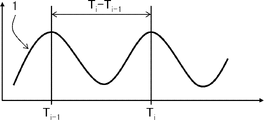
- FIG. 1 is a schematic diagram for explaining the difference (T i -T i-1 ) between time T i and time T i-1 .
- FIG. 2 is a graph showing an example of temporal variation waveforms of respiration depth acquired from a quadruped animal.
- FIG. 3 is a schematic diagram of a quadruped animal wearing an exemplary embodiment of the second garment.
- a biological information measurement garment for quadrupeds has a base fabric arranged around the body and a stretch sensor provided on the base fabric, and the base fabric is measured under the following conditions. It is characterized by a tensile strength of 0.3 N/cm or more and 3.0 N/cm or less at 20% elongation in the direction around the trunk.
- the biological information measurement clothing for quadrupeds having the stretch sensor on the base fabric may be referred to as the first clothing.
- another biological information measurement garment for quadrupeds has a base fabric arranged around the trunk, a belt-like cloth arranged around the trunk, and a stretch sensor provided on the belt-shaped cloth.
- the belt-shaped fabric has a tensile strength of 0.3 N / cm or more and 3.0 N / cm or less when stretched 20% in the direction around the torso measured under the following conditions.
- the biological information measurement clothing for quadrupeds in which the stretch sensor is provided on the belt-shaped fabric may be referred to as the second clothing.
- the first garment and the second garment are the same in that they have a base fabric arranged around the torso and a stretch sensor, and the second garment further has a belt-like shape arranged around the torso. It has fabric.
- the stretch sensor in the first clothing is provided in the base fabric, while the stretch sensor in the second clothing is provided in the belt-shaped fabric. There is a difference.
- the first garment has a base fabric arranged around the torso and a stretch sensor, the stretch sensor being provided on the base fabric.
- the base fabric is the fabric that makes up the clothing worn by the quadruped and is placed around the torso of the quadruped.
- Torso circumference means the circumference of the torso, including the back and abdomen of a quadruped.
- the base fabric in the lengthwise direction of the quadruped may, for example, cover the area from the withers to the waist.
- the base fabric may also cover the prothorax of the tetrapod.
- Knitted fabrics include weft knitted fabrics or warp knitted fabrics.
- the weft knitted fabric includes a circular knitted fabric.
- Weft knitted fabrics include, for example, jersey knitting (flat knitting), bare jersey knitting, welted jersey knitting, milling knitting (rubber knitting), pearl knitting, single bag knitting, smooth knitting, tuck knitting, float knitting, and single knitting. Examples include hem knitting, lace knitting, and additional hair knitting.
- warp knitted fabrics include single denby knitting, open denby knitting, single atlas knitting, double cord knitting, half knitting, half base knitting, satin knitting, single tricot knitting, double tricot knitting, half tricot knitting, single Russell knitting, Examples include double Russell knitting and jacquard knitting.
- woven fabrics include woven fabrics formed by plain weave, twill weave, satin weave, and the like.
- the woven fabric is not limited to a single woven fabric, and may be a multiple woven fabric such as a double woven fabric or a triple woven fabric.
- the base fabric may be formed in a mesh shape.
- Knitted fabrics and woven fabrics preferably contain at least one type of fiber selected from the group consisting of natural fibers, synthetic fibers, regenerated fibers, and semi-synthetic fibers.
- Natural fibers include, for example, cotton, hemp, wool, and silk. Among these, cotton is preferred. Moisture absorption, water absorption, heat retention, etc. are improved by including cotton.
- the natural fibers may be used as they are, or may be subjected to post-processing such as hydrophilic treatment and antifouling treatment.
- Examples of synthetic fibers include acrylic; polyesters such as polyethylene terephthalate, polyethylene naphthalate, polybutylene terephthalate, polytrimethylene terephthalate, polyethylene isophthalate, polylactic acid, and polyacrylate; polyamides such as nylon 6 and nylon 66; be done.
- Examples of regenerated fibers include rayon such as modal, cupra, polynosic, and lyocell.
- Examples of semi-synthetic fibers include acetate, triacetate, and the like. These may use only 1 type, and may use 2 or more types.
- the extension sensor is a sensor that can detect the degree of extension and contraction, and is not particularly limited as long as it is a sensor that can measure changes in the chest circumference based on respiration of the quadruped animal by extension and retraction.
- the stretch sensor includes, for example, a stretchable capacitor.
- a stretchable capacitor is an element whose capacitance changes due to expansion and contraction, and the change in the capacitance can be used to measure the respiratory state of a quadruped animal.
- the expansion/contraction sensor preferably has at least a capacitor element whose capacitance changes due to expansion and contraction, and a skin contact electrode.
- the capacitor element whose capacitance changes due to expansion and contraction is a capacitor-type element having at least a structure in which at least a first stretchable conductor layer, an stretchable dielectric layer, and a second stretchable conductor layer are laminated in this order. is preferred.
- the skin contact surface of the skin contact electrode is preferably an elastic conductor layer.
- a stretch sensor is provided on the base fabric, and the stretch sensor is arranged so as to be able to detect the stretch in the direction around the trunk of the tetrapod, thereby measuring the degree of stretch around the trunk based on the respiration of the tetrapod. can be detected.
- the base fabric with the stretch sensor has a tensile strength of 0.3 N/cm or more and 3.0 N/cm or less when stretched 20% in the direction around the torso.
- the stretch sensor can be fixed at a desired position of the quadruped animal, so that the measurement accuracy can be improved. Therefore, the tensile strength at 20% elongation is 0.3 N/cm or more, preferably 0.5 N/cm or more, more preferably 1.0 N/cm or more.
- the tensile strength at 20% elongation exceeds 3.0 N/cm, the base fabric is difficult to stretch, so the stretch sensor is also difficult to stretch, resulting in poor measurement accuracy. Therefore, the tensile strength at 20% elongation is 3.0 N/cm or less, preferably 2.5 N/cm or less, more preferably 2.0 N/cm or less.
- the tensile strength at 20% elongation in the direction around the body was measured by placing the center of the test piece made of the base fabric in the center between the chucks of the tensile tester and chucking the test piece so that the distance between the chucks was 50 mm. It can be measured by pinching and elongating at a tensile speed of 100 mm/min.
- the ratio of the area covered with the base fabric to the body surface area of the quadruped is, for example, preferably 30% or more, more preferably 40% or more, and even more preferably 50% or more.
- the upper limit of the ratio of the area covered with the base fabric is, for example, preferably 70% or less, more preferably 65% or less, still more preferably 60% or less.
- the base fabric preferably has electrodes on the side of the skin. By having electrodes on the lateral side of the skin, it is also possible to measure temporal fluctuations in the heart rate as biological information of the tetrapod.
- the position where the electrodes are placed should be close to the heart of the tetrapod.
- the stretch sensor may be fixed to the base fabric, but it is preferably removable. By making it detachable, the base fabric can be washed with the expansion/contraction sensor removed. In addition, since the stretch sensor is detachable, the stretch sensor can be used in common even if the wearer has a plurality of clothes.
- the expansion/contraction sensor can be detachable using, for example, hook-and-loop fasteners such as Velcro (registered trademark) and Free Velcro (registered trademark).
- the second garment has a base fabric arranged around the torso, a strip-shaped fabric arranged around the torso, and a stretch sensor, and the stretch sensor is provided on the strip-shaped fabric.
- the base fabric like the first clothing, is a fabric that constitutes the clothing worn by the tetrapod, and is arranged around the body of the tetrapod.
- the belt-shaped fabric is a separate member from the base fabric, and is a circular fabric that is arranged around the body of the tetrapod.
- Torso circumference means the circumference of the torso, including the back and abdomen of a quadruped.
- the width of the belt-shaped fabric is preferably 5% or more, more preferably 10% or more, still more preferably 15% or more and 30% or less with respect to the width of the base fabric in the body length direction of the tetrapod. is preferably 25% or less, and still more preferably 20% or less.
- the strip-shaped fabric may be partially or entirely laminated on the base fabric.
- both ends of the strip-shaped fabric are laminated on the base fabric.
- a configuration example is given.
- the material of the base fabric can be referred to, and the material of the strip-shaped fabric may be the same as or different from the material of the base fabric.
- the belt-like fabric may be formed in a mesh shape.
- a stretch sensor is provided on the belt-shaped fabric, and by arranging the stretch sensor so as to be able to detect the stretch in the direction around the trunk of the quadruped animal, the degree of stretch around the trunk based on the respiration of the quadruped animal can be measured. can be detected.
- the description of the stretch sensor the description of the first garment can be referred to.
- the belt-shaped fabric provided with the stretch sensor has a tensile strength of 0.3 N/cm or more and 3.0 N/cm or less when stretched 20% in the direction around the torso.
- the stretch sensor can be fixed at a desired position of the quadruped animal, so that the measurement accuracy can be improved. Therefore, the tensile strength at 20% elongation is 0.3 N/cm or more, preferably 0.5 N/cm or more, more preferably 1.0 N/cm or more.
- the tensile strength at 20% elongation exceeds 3.0 N/cm, the belt-shaped fabric is difficult to stretch, so the stretch sensor also becomes difficult to stretch, resulting in poor measurement accuracy. Therefore, the tensile strength at 20% elongation is 3.0 N/cm or less, preferably 2.5 N/cm or less, more preferably 2.0 N/cm or less.
- the tensile strength at 20% elongation in the direction around the body was measured by placing the center of a strip-shaped fabric test piece in the center between chucks using a tensile tester, and placing the test piece so that the distance between chucks was 50 mm. It can be measured by pinching with a chuck and elongating at a tensile speed of 100 mm/min.
- the tensile strength at 20% elongation in the direction around the torso of the base fabric in the second clothing is not particularly limited, and the tensile strength at 20% elongation may be less than 0.3 N/cm. Although it may exceed 0 N/cm, it preferably satisfies the range of 0.3 N/cm or more and 3.0 N/cm or less.
- the tensile strength at 20% elongation in the direction around the torso of the base fabric satisfies the range of 0.3 N / cm or more and 3.0 N / cm or less
- the tensile strength at 20% elongation in the direction around the torso of the base fabric may be different or the same, and are preferably the same. By being the same, there is no difference in the degree of expansion and contraction between the belt-shaped fabric and the base fabric, so the measurement accuracy can be improved.
- the stretch sensor may be fixed to the belt-shaped fabric, but it is preferably removable. By making it detachable, it is possible to wash the belt-like fabric with the expansion/contraction sensor removed. In addition, since the stretch sensor is detachable, the stretch sensor can be used in common even if the wearer has a plurality of clothes.
- the expansion/contraction sensor can be detachable using, for example, hook-and-loop fasteners such as Velcro (registered trademark) and Free Velcro (registered trademark).
- the belt-shaped fabric may be fixed to the base fabric, but it is preferably removable. By making it detachable, the belt-like fabric and the base fabric can be washed separately. In addition, since the belt-like fabric is detachable, the belt-like fabric and clothing can be used in any combination.
- the belt-like fabric can be made removable using, for example, hook-and-loop fasteners such as Velcro (registered trademark) and Free Velcro (registered trademark), buckles, hooks, buttons, and the like.
- Tetrapods are amphibians, reptiles, or mammals, with mammals being preferred. Examples of mammals other than humans include dogs, cats, cows, horses, and pigs, preferably dogs, cats, or cows.
- the present invention also includes a clothing-type biological information measuring device for quadrupeds.
- the clothing-type biological information measuring device for quadrupeds according to the present invention transmits the biological information measuring clothing (that is, the first clothing or the second clothing) and the data detected by the stretch sensor to a receiver.
- the present invention is characterized in that it has a transmitter that transmits data, a receiver that receives data transmitted from the transmitter, and a computing unit that computes the data received by the receiver.
- the extension sensor is electrically connected to the transmitter by wiring or the like.
- the transmitter and the receiver are wirelessly connected.
- the transmitter is preferably provided on the base fabric in the first garment, and preferably provided on the belt-shaped fabric in the second garment.
- the receiver and the arithmetic unit may be provided on the base fabric or the belt-like fabric, but preferably they are not provided on the base fabric or the belt-like fabric and are separately provided. By separating them, the weight of the clothing-type biological information measuring device can be reduced, so that the load on the quadrupeds can be reduced.
- the calculation unit detects whether abnormal respiration has occurred in the quadruped animal based on the data detected by the extension sensor.
- a calculation unit for example, at least a central processing unit (CPU) or the like may be provided. It is also preferable to have a storage unit (for example, memory) for storing ecological information data obtained from the quadruped.
- CPU central processing unit
- storage unit for example, memory
- the clothing-type biological information measuring device for quadrupeds further includes electrodes arranged on the side of the skin of the base fabric.
- electrodes arranged on the side of the skin of the base fabric it is also possible to measure temporal fluctuations in the heart rate as biological information of the quadruped animal.
- Examples of the abnormal breathing detection method for quadrupeds according to the present invention include the following three methods.
- the first detection method is a time-varying waveform of the depth of breathing, which continuously has a maximum value indicating a turning point from inspiration to expiration and a minimum value indicating a turning point from expiration to inspiration.
- a step of acquiring a waveform from a quadruped animal (hereinafter sometimes referred to as a measurement respiratory waveform acquisition step), and a time at which the waveform has a maximum value T 1 , T 2 , . . . , T i , . . .
- a step of continuously calculating the time difference (T i ⁇ T i ⁇ 1 ) for a plurality of locations (hereinafter sometimes referred to as a time difference calculation step); If the difference between the time difference (T i -T i-1 ) and the time difference (T i-1 -T i-2 ) is 1 second or more, the step of detecting that abnormal breathing has occurred (hereinafter referred to as the first (sometimes referred to as an abnormal respiration detection step).
- the second detection method is a time-varying waveform of the depth of breathing, which continuously has a maximum value indicating a turning point from inspiration to expiration and a minimum value indicating a turning point from expiration to inspiration.
- the third detection method is a time-varying waveform of the depth of breathing, which has a maximum value indicating a turning point from inspiration to expiration and a minimum value indicating a turning point from expiration to inspiration in succession.
- the first detection method to the third detection method are identical in that they have a measured respiratory waveform acquisition step, a time difference calculation step, and an abnormal breathing detection step.
- T i-1 and the time difference (T i-1 ⁇ T i-2 ) to determine whether abnormal breathing has occurred. Based on the difference between (T i -T i - 1 ), it is determined whether abnormal breathing has occurred.
- ) is different in that it is determined whether or not abnormal respiration has occurred based on the rate of decrease in the value of .
- a temporal variation waveform of respiration depth (hereinafter sometimes referred to as a measured respiration wave) is acquired from the quadruped animal.
- the measured respiratory wave has successive maxima and minima, the maxima indicating the turning point from inspiration (inhalation) to expiration (exhalation), and the minima from expiration (exhalation) to inspiration (inhalation). It shows the turning point to
- Time difference calculation step In the time difference calculating step, when the times T 1 , T 2 , . . . , T i , .
- the time difference (T i -T i-1 ) between the time T i at which the respiratory wave reaches its maximum value and the time T i -1 at which the measured respiratory wave reaches its maximum value is continuously calculated for a plurality of points. do.
- the number of times the time difference is measured is not particularly limited, and is preferably 2 or more, more preferably 3 or more, and the upper limit is preferably 5 or less, more preferably 4 or less.
- curve 1 indicated by a solid line indicates the measured respiratory waveform obtained from a quadruped animal. i-1 , and the difference between the time T i at which the measured respiratory waveform reaches its maximum value and the time T i -1 is the time difference (T i -T i-1 ).
- the horizontal axis indicates time, and the vertical axis indicates the depth of breathing.
- the present invention focuses on the time at which the measured respiratory waveform reaches its maximum value, not the time at which the measured respiratory waveform reaches its minimum value. By measuring the time difference at the position where the measured respiration waveform has the maximum value, the measurement accuracy is higher than measuring the time difference at the position where the minimum value t is obtained.
- Seconds or more (preferably 1.2 seconds or more, more preferably 1.5 seconds or more) is detected as occurrence of abnormal respiration.
- any one of coughing, sneezing, belching, vomiting, and spitting can be detected as abnormal respiration.
- Time difference calculation step For the time difference calculation step in the second detection method, the description of the time difference calculation step in the first detection method can be referred to.
- Average calculation step an average value of the time differences for a plurality of locations calculated in the time difference calculation step is calculated.
- the difference between the average value of the time differences calculated in the average value calculation step and the time difference (T i ⁇ T i-1 ) is calculated, and the difference is 0.8 seconds or more (preferably is 1.0 seconds or more, preferably 1.2 seconds or more), it is detected that abnormal respiration has occurred. Breathing differs depending on the species of tetrapods , and there are individual differences even within the same species. It is possible to detect whether or not abnormal breathing is occurring by taking into account the breathing that is occurring.
- Time difference calculation step For the time difference calculation step in the third detection method, the description of the time difference calculation step in the first detection method can be referred to.
- Average calculation step For the average value calculation step in the third detection method, the description of the average value calculation step in the second detection method can be referred to.
- the value of the time difference (T i ⁇ T i-1 ) is 80% or less (preferably 75% or less, more preferably 75% or less, more preferably 70% or less), it is detected that abnormal respiration has occurred. Breathing differs depending on the type of tetrapods , and there are individual differences even within the same type. It is possible to detect whether or not abnormal breathing is occurring by taking into account the breathing that is occurring.
- the first to third detection methods may be used individually, or two or more may be used in any combination.
- Fig. 2 shows an example of the temporal fluctuation waveform of the respiration depth obtained from a quadruped. Breathing depth was measured using a stretch sensor with a stretchable capacitor whose capacitance changes with stretching. The horizontal axis of FIG. 2 indicates time (seconds), and the vertical axis indicates the depth of breathing. The depth of respiration was indicated by capacitance (unit: pF).
- the present invention also includes a device that detects abnormal respiration of a quadruped using any one of the first to third detection methods described above.
- An abnormal respiration detection device includes a respiration sensor that detects the depth of respiration, and a computing unit that computes data detected by the respiration sensor.
- this device may be referred to as the first abnormal respiration detection device.
- another abnormal breathing detection device includes a breathing sensor for detecting the depth of breathing, a transmitter for transmitting data detected by the breathing sensor to a receiver, and data transmitted from the transmitter. and a calculator for calculating the data received by the receiver.
- this device may be referred to as a second abnormal breathing detection device.
- a known respirometer may be used as the respiration sensor.
- the depth of respiration can be detected by using the above-described extension sensor.
- the calculation unit calculates the data detected by the respiration sensor, and detects abnormal respiration of the quadruped animal using any of the first to third detection methods described above.
- calculation unit for example, at least a central processing unit (CPU) or the like may be provided. It is also preferable to have a storage unit (for example, memory) for storing data obtained from the quadruped.
- CPU central processing unit
- storage unit for example, memory
- a known respirometer may be used as the respiration sensor.
- the depth of respiration can be detected by using the stretchable sensor described above.
- the second abnormal respiration detection device transfers the data detected by the respiration sensor from the transmitter to the receiver.
- the data received by the receiver is calculated by the calculation unit, and any one of the above first detection method to third detection method may be used to detect abnormal respiration of the quadruped animal.
- the calculation unit for example, at least a central processing unit (CPU) or the like may be provided. It is also preferable to have a storage unit (for example, memory) for storing data obtained from the quadruped.
- the present invention also includes the following third to fifth abnormal respiration detection devices.
- the third abnormal breathing detection device is a time-varying waveform of the depth of breathing, and has a maximum value indicating a turning point from inspiration to expiration and a minimum value indicating a turning point from expiration to inspiration in succession.
- a time difference calculator that continuously calculates the time difference (T i -T i-1 ) for a plurality of locations, and the time difference (T i -T i-1 ) and the time difference (T i-1 -T i- 2 ), and a detection unit that detects occurrence of abnormal respiration when the difference from the time is one second or more.
- the fourth abnormal breathing detection device is a time-varying waveform of the depth of breathing, and has a maximum value indicating a turning point from inspiration to expiration and a minimum value indicating a turning point from expiration to inspiration in succession.
- a time difference calculation unit that continuously calculates the time difference (T i ⁇ T i-1 ) for a plurality of locations, an average value calculation unit that calculates the average value of the calculated time differences, and the average value of the calculated time differences , and the time difference (T i -T i-1 ) is 0.8 seconds or more, it detects that abnormal respiration has occurred.
- the fifth abnormal breathing detection device is a time-varying waveform of the depth of breathing, and has a maximum value indicating a turning point from inspiration to expiration and a minimum value indicating a turning point from expiration to inspiration in succession.
- a time difference calculation unit that continuously calculates the time difference (T i ⁇ T i-1 ) for a plurality of locations, an average value calculation unit that calculates the average value of the calculated time differences, and the calculated average value and a detection unit for detecting occurrence of abnormal respiration when the value of the time difference (T i -T i-1 ) is 80% or less.
- the temporal fluctuation waveform of the depth of respiration which is a maximum value indicating a turning point from inspiration to expiration and a minimum value indicating a turning point from expiration to inspiration, is continuously obtained.
- a respiration sensor can be used, and a known respiration meter may be used.
- the depth of respiration can be detected by using the stretch sensor described above.
- the time at which the waveform obtained by the acquisition unit has the maximum value is defined as T 1 , T 2 , . . . , Ti , . Then, the time difference (T i -T i-1 ) is continuously calculated for a plurality of points.
- the difference between the time difference (T i ⁇ T i-1 ) calculated by the time difference calculation unit and the time difference (T i-1 ⁇ T i-2 ) is 1 second or more. (Preferably 1.2 seconds or longer, more preferably 1.5 seconds or longer) is detected as occurrence of abnormal respiration.
- the average value calculation unit calculates the average value of the time differences calculated by the time difference calculation unit.
- the difference between the average value of the time differences calculated by the time difference calculation unit and the time difference (T i ⁇ T i-1 ) is 0.8 seconds or more (preferably 1.0 seconds or more, preferably 1.2 seconds or more), it is detected that abnormal respiration has occurred.
- the acquisition unit, the time difference calculation unit, and the average value calculation unit in the fifth abnormal respiration detection device are equivalent to the acquisition unit, the time difference calculation unit, and the average value calculation in the above third abnormal respiration detection device and the fourth abnormal respiration detection device. You can refer to the description of the part.
- the value of the time difference (T i ⁇ T i-1 ) is 80% or less (preferably 75% or less, more preferably 75% or less, more preferably 70% or less), it is detected that abnormal respiration has occurred.
- FIG. 3 is a schematic diagram showing an example of the quadruped animal 10 wearing the second clothing 2.
- the tetrapod 10 is a dog, and the arrow X indicates the lengthwise direction of the tetrapod.
- the second garment 2 is composed of a base fabric 21 arranged around the trunk of the quadruped 10, a belt-like cloth 22 arranged around the trunk, and a stretch sensor 23 provided on the belt-like cloth 22. - ⁇
- the base fabric 21 is arranged around the body so as to cover the back, abdomen, and rib cage of the quadruped animal 10 .
- a part of the base fabric 21 covers the front chest of the quadruped 10
- the base fabric 21 arranged around the end of the base fabric 21a covering the front chest and the body of the quadruped animal 10 covers the shoulders of the quadruped. It is connected using a buckle 24 in the vicinity.
- a strip-shaped fabric 22 is provided on the side opposite to the skin side of the base fabric 21, and the strip-shaped fabric 22 is provided with an expansion/contraction sensor 23. is detected by the extension sensor 23, the biological information of the tetrapod 10 can be measured.
- the strip-shaped fabric 22 is provided along the thorax between the back and abdomen of the quadruped 10, but the placement position of the strip-shaped fabric 22 is not limited to this. It may be placed on the back or in the direction connecting the back and the chest.
- connection member 25 with a transmitter (not shown) that transmits data detected by the extension sensor 23 to a receiver.
- a clasp for example, can be used as the connecting member.
- the clasp may be, for example, a metal snap hook, preferably a stainless steel snap hook.
- An electrical connection can be made between the conductor and the transmitter through the clasp.
- electrodes are provided on the side of the skin of the base fabric 21a covering the front chest of the tetrapod 10, and data detected by the electrodes are provided on the side opposite to the side of the skin.
- a connection 26 with a transmitter is provided for transmitting to the receiver.
- Reference Signs List 1 measured respiratory waveform obtained from a quadruped animal 2 second clothing 10 tetrapod 21 base fabric 21a base fabric covering the fore chest 22 strip fabric 23 stretch sensor 24 buckle 25 connecting member 26 connecting part
Landscapes
- Life Sciences & Earth Sciences (AREA)
- Environmental Sciences (AREA)
- Animal Husbandry (AREA)
- Biodiversity & Conservation Biology (AREA)
- Zoology (AREA)
- Measurement Of The Respiration, Hearing Ability, Form, And Blood Characteristics Of Living Organisms (AREA)
Priority Applications (1)
| Application Number | Priority Date | Filing Date | Title |
|---|---|---|---|
| JP2023516319A JPWO2022224599A1 (https=) | 2021-04-20 | 2022-03-07 |
Applications Claiming Priority (2)
| Application Number | Priority Date | Filing Date | Title |
|---|---|---|---|
| JP2021071156 | 2021-04-20 | ||
| JP2021-071156 | 2021-04-20 |
Publications (1)
| Publication Number | Publication Date |
|---|---|
| WO2022224599A1 true WO2022224599A1 (ja) | 2022-10-27 |
Family
ID=83722812
Family Applications (1)
| Application Number | Title | Priority Date | Filing Date |
|---|---|---|---|
| PCT/JP2022/009671 Ceased WO2022224599A1 (ja) | 2021-04-20 | 2022-03-07 | 四肢動物用の生体情報計測衣類、四肢動物用の衣類型生体情報計測装置、四肢動物の異常呼吸検知方法、および四肢動物の異常呼吸検知装置 |
Country Status (2)
| Country | Link |
|---|---|
| JP (1) | JPWO2022224599A1 (https=) |
| WO (1) | WO2022224599A1 (https=) |
Citations (14)
| Publication number | Priority date | Publication date | Assignee | Title |
|---|---|---|---|---|
| JPH09187521A (ja) * | 1994-09-21 | 1997-07-22 | Medtronic Inc | 上部気道筋肉の剌激装置、上部気道筋肉の刺激制御装置、呼吸運動波形の供給装置、呼吸運動波形の初期化装置、呼吸運動波形の妥当性決定装置、及び閉塞性睡眠無呼吸処理用のための医療用装置 |
| JP2007097678A (ja) * | 2005-09-30 | 2007-04-19 | Hokkaido Univ | 情報処理装置、心拍情報取得解析装置、睡眠時無呼吸症候群防止装置、プログラム、記録媒体、及び呼吸間隔算出方法 |
| JP2008068019A (ja) * | 2006-09-15 | 2008-03-27 | Gac Corp | 呼気時間を出力可能な装置および方法 |
| JP3144383U (ja) * | 2008-06-16 | 2008-08-28 | 琢 横山 | 四足ペット用衣服 |
| JP2011098214A (ja) * | 2004-03-24 | 2011-05-19 | Dainippon Sumitomo Pharma Co Ltd | センサを有する生体情報計測用衣服、生体情報計測システムおよび生体情報計測装置、および装置制御方法 |
| US20130066409A1 (en) * | 2010-03-31 | 2013-03-14 | Teresa Hilton | Protective clothing and apparel for pets and animals and method of use |
| JP2016165362A (ja) * | 2015-03-09 | 2016-09-15 | 富士通株式会社 | 食事時間推定方法、食事時間推定装置及び食事時間推定プログラム |
| JP2017056042A (ja) * | 2015-09-17 | 2017-03-23 | 富士通株式会社 | 眠気検知装置、眠気検知方法および眠気検知プログラム |
| JP2018114059A (ja) * | 2017-01-17 | 2018-07-26 | 東洋紡株式会社 | 身体測定用器具および身体サイズの測定方法、着衣選択システム、オーダーメイド着衣設計システム |
| JP2018527969A (ja) * | 2015-08-06 | 2018-09-27 | エクスヘイル アシュアランス インコーポレイティッド | フォトプレチスモグラフィセンサを用いた呼吸を監視するための方法および装置 |
| JP2018187090A (ja) * | 2017-05-08 | 2018-11-29 | 有限会社アルファ | 呼吸検知装置、呼吸検知方法およびコンピュータプログラム |
| WO2019035420A1 (ja) * | 2017-08-16 | 2019-02-21 | 東洋紡株式会社 | 生体情報計測用の電極部材、生体情報計測装置、生体情報計測用衣服、生体情報計測用の電極部材の取り付け方法および生体情報計測方法 |
| JP2019072048A (ja) * | 2017-10-13 | 2019-05-16 | 東洋紡株式会社 | 着用型生体情報計測装置および生体情報計測方法 |
| JP2020191799A (ja) * | 2019-05-27 | 2020-12-03 | 東洋紡株式会社 | 動物用衣類、および動物用生体情報計測装置 |
-
2022
- 2022-03-07 WO PCT/JP2022/009671 patent/WO2022224599A1/ja not_active Ceased
- 2022-03-07 JP JP2023516319A patent/JPWO2022224599A1/ja active Pending
Patent Citations (14)
| Publication number | Priority date | Publication date | Assignee | Title |
|---|---|---|---|---|
| JPH09187521A (ja) * | 1994-09-21 | 1997-07-22 | Medtronic Inc | 上部気道筋肉の剌激装置、上部気道筋肉の刺激制御装置、呼吸運動波形の供給装置、呼吸運動波形の初期化装置、呼吸運動波形の妥当性決定装置、及び閉塞性睡眠無呼吸処理用のための医療用装置 |
| JP2011098214A (ja) * | 2004-03-24 | 2011-05-19 | Dainippon Sumitomo Pharma Co Ltd | センサを有する生体情報計測用衣服、生体情報計測システムおよび生体情報計測装置、および装置制御方法 |
| JP2007097678A (ja) * | 2005-09-30 | 2007-04-19 | Hokkaido Univ | 情報処理装置、心拍情報取得解析装置、睡眠時無呼吸症候群防止装置、プログラム、記録媒体、及び呼吸間隔算出方法 |
| JP2008068019A (ja) * | 2006-09-15 | 2008-03-27 | Gac Corp | 呼気時間を出力可能な装置および方法 |
| JP3144383U (ja) * | 2008-06-16 | 2008-08-28 | 琢 横山 | 四足ペット用衣服 |
| US20130066409A1 (en) * | 2010-03-31 | 2013-03-14 | Teresa Hilton | Protective clothing and apparel for pets and animals and method of use |
| JP2016165362A (ja) * | 2015-03-09 | 2016-09-15 | 富士通株式会社 | 食事時間推定方法、食事時間推定装置及び食事時間推定プログラム |
| JP2018527969A (ja) * | 2015-08-06 | 2018-09-27 | エクスヘイル アシュアランス インコーポレイティッド | フォトプレチスモグラフィセンサを用いた呼吸を監視するための方法および装置 |
| JP2017056042A (ja) * | 2015-09-17 | 2017-03-23 | 富士通株式会社 | 眠気検知装置、眠気検知方法および眠気検知プログラム |
| JP2018114059A (ja) * | 2017-01-17 | 2018-07-26 | 東洋紡株式会社 | 身体測定用器具および身体サイズの測定方法、着衣選択システム、オーダーメイド着衣設計システム |
| JP2018187090A (ja) * | 2017-05-08 | 2018-11-29 | 有限会社アルファ | 呼吸検知装置、呼吸検知方法およびコンピュータプログラム |
| WO2019035420A1 (ja) * | 2017-08-16 | 2019-02-21 | 東洋紡株式会社 | 生体情報計測用の電極部材、生体情報計測装置、生体情報計測用衣服、生体情報計測用の電極部材の取り付け方法および生体情報計測方法 |
| JP2019072048A (ja) * | 2017-10-13 | 2019-05-16 | 東洋紡株式会社 | 着用型生体情報計測装置および生体情報計測方法 |
| JP2020191799A (ja) * | 2019-05-27 | 2020-12-03 | 東洋紡株式会社 | 動物用衣類、および動物用生体情報計測装置 |
Also Published As
| Publication number | Publication date |
|---|---|
| JPWO2022224599A1 (https=) | 2022-10-27 |
Similar Documents
| Publication | Publication Date | Title |
|---|---|---|
| CA2604969C (en) | Systems and methods for non-invasive physiological monitoring of non-human animals | |
| US11253203B2 (en) | Object, method, and system for detecting heartbeat or whether or not electrodes are in proper contact | |
| ES2968214T3 (es) | Prenda de detección de bioseñales | |
| EP2716172B1 (en) | Item of clothing | |
| US7762953B2 (en) | Systems and methods for non-invasive physiological monitoring of non-human animals | |
| TWI837181B (zh) | 生物體信號監視衣物 | |
| JP2008503287A (ja) | 統合センサーシステムを有する衣服 | |
| HK1222785A1 (zh) | 接触传感器 | |
| US12433509B2 (en) | Elongation sensor and wearable article including the elongation sensor | |
| US12070316B2 (en) | Wearable electrode | |
| WO2022224599A1 (ja) | 四肢動物用の生体情報計測衣類、四肢動物用の衣類型生体情報計測装置、四肢動物の異常呼吸検知方法、および四肢動物の異常呼吸検知装置 | |
| JP7308313B1 (ja) | 四肢動物用の衣類 | |
| JP2023112597A (ja) | 衣類、及びその用途 | |
| JP6516356B2 (ja) | 飲み込み検出衣服および飲み込み検出器 | |
| NL2028936B1 (en) | Knitted strain sensor | |
| KR102891466B1 (ko) | 반려견용 무선 심전도 측정 스마트웨어 | |
| WO2023013249A1 (ja) | 生体情報計測用衣類 | |
| Catarino et al. | Biosignal monitoring implemented in a swimsuit for athlete performance evaluation | |
| KR20220119228A (ko) | 헬스케어용 웨어러블 장치 | |
| JP2020162946A (ja) | 生体情報計測装置 |
Legal Events
| Date | Code | Title | Description |
|---|---|---|---|
| 121 | Ep: the epo has been informed by wipo that ep was designated in this application |
Ref document number: 22791380 Country of ref document: EP Kind code of ref document: A1 |
|
| ENP | Entry into the national phase |
Ref document number: 2023516319 Country of ref document: JP Kind code of ref document: A |
|
| NENP | Non-entry into the national phase |
Ref country code: DE |
|
| 32PN | Ep: public notification in the ep bulletin as address of the adressee cannot be established |
Free format text: NOTING OF LOSS OF RIGHTS PURSUANT TO RULE 112(1) EPC (EPO FORM 1205N DATED 12/12/2023) |
|
| 122 | Ep: pct application non-entry in european phase |
Ref document number: 22791380 Country of ref document: EP Kind code of ref document: A1 |