WO2022210557A1 - 食品用澱粉組成物 - Google Patents
食品用澱粉組成物 Download PDFInfo
- Publication number
- WO2022210557A1 WO2022210557A1 PCT/JP2022/015051 JP2022015051W WO2022210557A1 WO 2022210557 A1 WO2022210557 A1 WO 2022210557A1 JP 2022015051 W JP2022015051 W JP 2022015051W WO 2022210557 A1 WO2022210557 A1 WO 2022210557A1
- Authority
- WO
- WIPO (PCT)
- Prior art keywords
- composition
- mass
- starch
- food
- component
- Prior art date
- Legal status (The legal status is an assumption and is not a legal conclusion. Google has not performed a legal analysis and makes no representation as to the accuracy of the status listed.)
- Ceased
Links
Classifications
-
- A—HUMAN NECESSITIES
- A23—FOODS OR FOODSTUFFS; TREATMENT THEREOF, NOT COVERED BY OTHER CLASSES
- A23C—DAIRY PRODUCTS, e.g. MILK, BUTTER OR CHEESE; MILK OR CHEESE SUBSTITUTES; PREPARATION THEREOF
- A23C13/00—Cream; Cream preparations; Making thereof
- A23C13/12—Cream preparations
- A23C13/14—Cream preparations containing milk products or non-fat milk components
-
- A—HUMAN NECESSITIES
- A23—FOODS OR FOODSTUFFS; TREATMENT THEREOF, NOT COVERED BY OTHER CLASSES
- A23L—FOODS, FOODSTUFFS OR NON-ALCOHOLIC BEVERAGES, NOT OTHERWISE PROVIDED FOR; PREPARATION OR TREATMENT THEREOF
- A23L13/00—Meat products; Meat meal; Preparation or treatment thereof
- A23L13/60—Comminuted or emulsified meat products, e.g. sausages; Reformed meat from comminuted meat product
-
- A—HUMAN NECESSITIES
- A23—FOODS OR FOODSTUFFS; TREATMENT THEREOF, NOT COVERED BY OTHER CLASSES
- A23L—FOODS, FOODSTUFFS OR NON-ALCOHOLIC BEVERAGES, NOT OTHERWISE PROVIDED FOR; PREPARATION OR TREATMENT THEREOF
- A23L17/00—Food-from-the-sea products; Fish products; Fish meal; Fish-egg substitutes; Preparation or treatment thereof
-
- A—HUMAN NECESSITIES
- A23—FOODS OR FOODSTUFFS; TREATMENT THEREOF, NOT COVERED BY OTHER CLASSES
- A23L—FOODS, FOODSTUFFS OR NON-ALCOHOLIC BEVERAGES, NOT OTHERWISE PROVIDED FOR; PREPARATION OR TREATMENT THEREOF
- A23L29/00—Foods or foodstuffs containing additives; Preparation or treatment thereof
- A23L29/20—Foods or foodstuffs containing additives; Preparation or treatment thereof containing gelling or thickening agents
- A23L29/206—Foods or foodstuffs containing additives; Preparation or treatment thereof containing gelling or thickening agents of vegetable origin
- A23L29/212—Starch; Modified starch; Starch derivatives, e.g. esters or ethers
-
- A—HUMAN NECESSITIES
- A23—FOODS OR FOODSTUFFS; TREATMENT THEREOF, NOT COVERED BY OTHER CLASSES
- A23L—FOODS, FOODSTUFFS OR NON-ALCOHOLIC BEVERAGES, NOT OTHERWISE PROVIDED FOR; PREPARATION OR TREATMENT THEREOF
- A23L35/00—Foods or foodstuffs not provided for in groups A23L5/00 - A23L33/00; Preparation or treatment thereof
Definitions
- the present invention relates to food starch compositions.
- Patent Document 1 Japanese Patent Application Laid-Open No. 2019-154279 describes an agar composition having a structure in which molecules of agar, a starch hydrolyzate having a weight average molecular weight of 8000 to 800000, and a polymerized phosphate are entangled with each other. (Claim 1).
- the present invention provides a composition that, when applied to food, does not easily form lumps in the food, and provides a food that is excellent in production yield and texture.
- the following food starch composition and method for producing the same are provided.
- the component (a) has a peak molecular weight of 2.7 ⁇ 10 5 or more and 2.3 ⁇ 10 6 or less
- the component (b) is at least one selected from the group consisting of monoglycerin fatty acid esters and sucrose fatty acid esters with an HLB of 4 or more and 16 or less
- the free enthalpy per dry mass of the composition of the amylose-lipid complex measured by differential scanning calorimetry is 0.1 J / g or more and 20 J / g or less
- the food starch composition has a cold water swelling degree of 5.0 or more and 40 or less at 25 ° C.
- a starch composition for food, wherein the soluble fraction amount of the starch composition for food at 25°C is
- the component (a) is one or two or more starches selected from the group consisting of tapioca starch, crosslinked tapioca starch, pea starch, potato starch, wheat starch and corn starch [1] or [2] The food starch composition according to .
- a method for producing a food starch composition comprising: [5] The content of the component (b) in the step of obtaining the mixture is 0.1 parts by mass or more and 10 parts by mass or less with respect to 100 parts by mass of the component (a). Production method.
- [6] The production method according to [4] or [5], wherein in the step of obtaining the mixture, the amount of the component (a) is 75% by mass or more and 99.8% by mass or less based on the total composition. .
- the production according to any one of [4] to [6], wherein the step of obtaining a starch composition for food includes a step of granulating the mixture by heating and pressurizing it with an extruder.
- the present invention it is possible to provide a composition that, when applied to food, does not easily form lumps in the food, and provides a food that is excellent in production yield and texture.
- composition can contain each component individually or in combination of 2 or more types.
- the food starch composition (hereinafter also simply referred to as "composition") contains the following components (a) and (b), and at least part of component (a) and component (b) at least a portion of which form an amylose-lipid complex in the composition.
- (b) Emulsifier Component (a) has a peak molecular weight of 2.7 ⁇ 10 5 or more and 2.3 ⁇ 10 6 or less.
- Component (b) is at least one selected from the group consisting of monoglycerin fatty acid esters and sucrose fatty acid esters with an HLB of 4 to 16.
- the free enthalpy per dry mass of the composition of the amylose-lipid complex measured by differential scanning calorimetry is 0.1 J/g or more and 20 J/g or less.
- the cold water swelling degree of the food starch composition at 25°C is 5.0 or more and 40 or less, and the soluble fraction amount of the food starch composition at 25°C is more than 0% by mass and 20% by mass or less.
- the composition comprises components (a) and (b), wherein at least a portion of component (a) and at least a portion of component (b) form amylose-lipid complexes in the composition.
- the peak molecular weight of component (a), the type of component (b) in the composition, and the free enthalpy of amylose-lipid complexes are each within specific ranges, and the cold water swelling degree and soluble fraction amount of the composition are are each in a specific range.
- composition of the present embodiment when used, syneresis can be effectively suppressed at least either during production or over time, so that a food with a favorable texture can be obtained with an excellent production yield. be able to.
- this embodiment for example, by applying it to foods, it is possible to obtain foods that can preferably retain moisture and oil at the same time.
- the components contained in the composition will be described below.
- Component (a) is starch.
- Component (a) is, for example, a food grade starch.
- Component (a) one having a peak molecular weight within the above range is used.
- Component (a) is preferably one or more starches selected from the group consisting of tapioca starch (starch derived from cassava), pea starch, potato starch, wheat starch and corn starch, and modified starches thereof, and more One or more starches selected from the group consisting of tapioca starch, crosslinked tapioca starch, pea starch, potato starch, wheat starch and corn starch are preferred.
- component (a) may be a modified starch such as the above-mentioned crosslinked starch, but from the viewpoint of improving the water absorption rate, it is preferably a starch that has not been acid-treated, oxidized or enzymatically treated.
- the peak molecular weight of component (a) is 2.7 ⁇ 10 5 or more, preferably 2.8 ⁇ 10 5 or more, more preferably 2.9 ⁇ 10 5 or more, still more preferably 2.9 ⁇ 10 5 or more, from the viewpoint of improving water absorption. 4.0 ⁇ 10 5 or more. From the viewpoint of stickiness control, the peak molecular weight of component (a) is 2.3 ⁇ 10 6 or less, preferably 2.0 ⁇ 10 6 or less, more preferably 1.6 ⁇ 10 6 or less.
- the content of component (a) in the composition is preferably 75% by mass or more, more preferably 80% by mass or more, and still more preferably It is 85% by mass or more, still more preferably 90% by mass or more, even more preferably 92% by mass or more, and still more preferably 94% by mass or more.
- the content of component (a) in the composition is, for example, 99.9% by mass or less, preferably 99.8% by mass or less, based on the total composition. , more preferably 99.7% by mass or less, still more preferably 99.5% by mass.
- Component (b) is an emulsifier and is at least one selected from the group consisting of monoglycerol fatty acid esters and sucrose fatty acid esters having an HLB of 4 to 16.
- Monoglycerin fatty acid esters include, for example, esters of glycerin and fatty acids having 6 to 24 carbon atoms, and more specifically, glycerin monocaprate, glycerin monopalmitate, glycerin monostearate, glycerin monostearate. Behenic acid esters may be mentioned.
- the number of carbon atoms in the fatty acid in the monoglycerin fatty acid ester is, for example, 6 or more, preferably 10 or more, more preferably 14 or more, from the viewpoint of improving yield and texture of food. From the same point of view, the number of carbon atoms in the fatty acid in the monoglycerin fatty acid ester is, for example, 24 or less, preferably 22 or less, and more preferably 20 or less.
- the fatty acid in the monoglycerin fatty acid ester is preferably saturated fatty acid or monounsaturated fatty acid, more preferably saturated fatty acid.
- the HLB of the monoglycerol fatty acid ester is preferably 0 or more, more preferably 1 or more from the same viewpoint. Moreover, from the viewpoint of improving the yield of food, the HLB of the monoglycerin fatty acid ester is preferably 16 or less, more preferably 9 or less, and still more preferably 6 or less.
- sucrose fatty acid esters include, for example, esters of sucrose and fatty acids having 10 to 24 carbon atoms, more specifically, sucrose stearate, sucrose palmitate, Examples include sucrose myristate, sucrose oleate, sucrose behenate, and sucrose erucate.
- the number of carbon atoms in the fatty acid in the sucrose fatty acid ester is not limited, it is, for example, 10 or more, preferably 12 or more, more preferably 14 or more, and even more preferably 16 or more.
- the number of carbon atoms in the fatty acid in the sucrose fatty acid ester is, for example, 24 or less, preferably 22 or less, more preferably 20 or less, and even more preferably 18 or less.
- the fatty acid in the sucrose fatty acid ester is preferably saturated fatty acid or monounsaturated fatty acid, more preferably saturated fatty acid, from the viewpoint of improving the yield of food.
- Sucrose fatty acid esters may include any of mono-, di-, tri- and polyesters of fatty acids.
- the HLB of the sucrose fatty acid ester is 4 or more, preferably 6 or more, more preferably 8 or more, from the viewpoint of food yield and texture improvement. From the same point of view, the HLB of the sucrose fatty acid ester is 16 or less, preferably 14 or less, more preferably 11 or less.
- the content of component (b) in the composition is preferably 0.1% by mass or more, more preferably 0.2% by mass or more, relative to the entire composition, from the viewpoint of improving food yield and texture. , more preferably 0.3% by mass or more.
- the content of component (b) in the composition is preferably 10% by mass or less, more preferably 8% by mass or less, and still more preferably 6% by mass with respect to the entire composition. It is below.
- amylose-lipid complex The amylose-lipid complex is specifically formed by at least part of components (a) and (b) incorporated in the composition.
- the free enthalpy of an amylose-lipid complex is the endothermic peak that occurs when the complex of amylose and lipid components in the amylose-lipid complex melts.
- the free enthalpy is an index that reflects the amount of amylose-lipid complexes formed in the composition, and the larger this value, the greater the amount of amylose-lipid complexes formed in the composition.
- the lipid component specifically includes a lipophilic group (for example, a lipid portion) in the component (b) blended in the composition.
- the present inventors have newly found that such free enthalpy is effective as an index of the ability of the composition to retain water and oil at the same time and improve texture.
- the free enthalpy of the amylose-lipid complex per dry mass of the composition is 0.1 J/g or more, preferably 0.5 J/g or more, more preferably 0, from the viewpoint of stickiness control and oil retention rate upon water absorption. 0.6 J/g or more, more preferably 0.7 J/g or more, still more preferably 0.8 J/g or more.
- the free enthalpy of the amylose-lipid complex is 20 J/g or less, preferably 15 J/g or less, more preferably 10 J/g or less, and still more preferably 8 J/g. Below, more preferably 5 J/g or less.
- the free enthalpy of amylose-lipid complexes is measured by differential scanning calorimetry. A specific measuring method will be described later in Examples.
- the composition may contain components other than components (a) and (b), or is composed of components (a) and (b), at least a portion of which forms an amylose-lipid complex. can be anything.
- Other ingredients include insoluble salts such as calcium carbonate and calcium sulfate. The addition of insoluble salts also makes it possible to further stabilize the cell structure of the composition and improve manufacturing stability.
- the content of the insoluble salt in the composition is preferably 0.1% by mass or more, more preferably 0.1% by mass or more, based on the entire composition, from the viewpoint of improving production stability. It is 2% by mass or more, more preferably 0.5% by mass or more.
- the content of the insoluble salt in the composition is preferably 5% by mass or less, more preferably 3% by mass or less, more preferably 3% by mass or less, based on the total composition. It is 2% by mass or less.
- the cold water swelling degree of the composition at 25° C. is 5.0 or more, preferably 6 or more, more preferably 8 or more, and still more preferably 10 or more, from the viewpoint of improving water absorption. From the same viewpoint, the cold water swelling degree of the composition at 25° C. is 40 or less, preferably 30 or less, more preferably 20 or less, still more preferably 18 or less, and even more preferably 16 or less. is.
- the method for measuring the cold water swelling degree of the composition will be described later in the section of Examples.
- the soluble fraction amount of the composition at 25 ° C. is more than 0% by mass, preferably 1% by mass or more, more preferably 2% by mass or more, relative to the entire composition, from the viewpoint of improving food yield and texture. , more preferably 3% by mass or more, and even more preferably 5% by mass or more.
- the soluble fraction amount of the composition at 25 ° C. is specifically 20% by mass or less, preferably 18% by mass, relative to the entire composition. Below, more preferably 16% by mass or less, still more preferably 14% by mass or less, and even more preferably 12% by mass or less.
- the soluble fraction amount is an index showing the stickiness (stickiness) of the composition. A method for measuring the soluble fraction amount will be described later in Examples.
- the degree of gelatinization of the composition is specifically 35% or more, preferably 40% or more, more preferably 45% or more, still more preferably 45% or more, from the viewpoint of moderately increasing the water absorption rate of foods containing the composition. is 50% or more, even more preferably 60% or more. Further, the degree of alpha conversion of the composition is specifically 100% or less. From the viewpoint of further suppressing the occurrence of lumps when applied to foods and the viewpoint of suppressing stickiness of foods, the degree of gelatinization of the composition is preferably 95% or less, more preferably 90% or less, and even more preferably 90% or less. is 85% or less, even more preferably 80% or less.
- the degree of alpha conversion of the composition is specifically measured by the ⁇ -amylase-pullulanase (BAP) method. A more specific measuring method will be described later in Examples.
- the shape of the composition is, for example, powdery or granular.
- powdery and granular materials include at least one of powdery materials and granular materials, and may include both powdery materials and granular materials.
- the particle size of the composition can be adjusted, for example, based on the form, size, etc. of the food or drink in which the composition is blended. For example, the under-sieve fraction of a 0.5 mm sieve and the over-sieve fraction of a 0.15 mm sieve according to the JIS-Z8801-1 standard may be used.
- the content of the fraction under the sieve with an opening of 0.25 mm and the fraction above the sieve with an opening of 0.038 mm in the JIS-Z8801-1 standard 60% by mass or more and 100% by mass or less.
- the content of the fraction under a sieve with a mesh size of 0.25 mm and above a sieve with a mesh size of 0.075 mm is 60% by mass or more and 100% by mass or less.
- the content of the fraction under a sieve with a mesh size of 0.5 mm and above a sieve with a mesh size of 0.075 mm is 60% by mass or more and 100 % by mass or less.
- the bulk specific gravity of the composition measured according to JIS K-6720 is, for example, 0.15 g/mL or more, preferably 0.25 g/mL or more, more preferably 0.30 g/mL. or more, and is, for example, 0.8 g/mL or less, preferably 0.7 g/mL or less, more preferably 0.65 g/mL or less.
- the bulk specific gravity of the composition is measured according to JIS K-6720. A specific measuring method will be described later in Examples.
- the water absorption rate of the composition at 25°C is preferably 500% or more, more preferably 700% or more, and more preferably 800% or more, from the viewpoint of improving the yield of food.
- a method for measuring the water absorption rate of the composition will be described later in Examples.
- oil retention rate when water is absorbed The oil retention rate at 25° C. of the composition upon water absorption (oil absorption rate upon water absorption) is, for example, 60% or more, preferably 90% or more, more preferably 100% or more, and still more preferably, from the viewpoint of improving food yield. 120% or more. There is no upper limit to the oil retention rate of the composition upon absorption of water at 25° C., and the higher the better.
- the oil retention rate upon water absorption is the rate at which oil is retained without being released when starch absorbs water.
- Conventional starch having water absorption (for example, starch that has been subjected to only drum drying pregelatinization treatment) releases oil when it absorbs water, so the oil retention rate is low when water is absorbed, whereas the composition of the present embodiment has this property. It has a high oil retention rate when absorbing water, that is, it is excellent in retaining both water and oil at the same time.
- by setting the free enthalpy of amylose-lipid complex per dry mass of starch within a specific range it is possible to increase the oil retention rate upon water absorption. The method for measuring the oil retention rate of the composition upon water absorption will be described later in the section of Examples.
- Step 1 Step of obtaining a mixture containing components (a) and (b)
- Step 2 Step of obtaining the composition of the present embodiment by pregelatinizing the mixture to form an amylose-lipid complex
- step 1 the ratio between the components (a) and (b) is adjusted, and in step 2, the components (a) and (b) are allowed to coexist and are subjected to the alpha treatment. , the cold water swelling degree, the soluble fraction amount, and the free enthalpy of the amylose-lipid complex can be stably obtained.
- step 1 components (a) and (b) and other raw material ingredients are blended to obtain a mixture.
- the blending amount of component (a) is preferably 75% by mass or more, more preferably 80% by mass, based on the total composition of the raw material components blended in the mixture, from the viewpoint of improving the yield and texture of the food. % by mass or more, more preferably 85% by mass or more, even more preferably 90% by mass or more, and even more preferably 95% by mass or more.
- the amount of component (a) is preferably 99.8% by mass or less, more preferably 99.0% by mass or less, and further Preferably, it is 98.5% by mass or less.
- the amount of component (b) is preferably 0.1 part by mass or more, more preferably 0.1 part by mass or more per 100 parts by mass of component (a), from the viewpoint of improving the yield and texture of the food product. is 0.2 parts by mass or more, more preferably 0.5 parts by mass or more, and even more preferably 1.5 parts by mass or more. From the viewpoint of lumpiness, the amount of component (b) is preferably 10 parts by mass or less, more preferably 5 parts by mass or less, and still more preferably 3 parts by mass or less per 100 parts by mass of component (a). is.
- a composition is obtained by pregelatinizing the mixture to form an amylose-lipid complex.
- a general method used for heat gelatinization of starch can be used for the gelatinization treatment.
- a method of pregelatinization treatment specifically, a method using a machine such as a drum dryer, a jet cooker, an extruder, or a spray dryer is known. From the viewpoint of more reliably obtaining a composition having a body free enthalpy within the above range, heat gelatinization using an extruder or a drum dryer is preferred, and extruder treatment is more preferred.
- step 2 preferably includes a step of granulating the mixture by heating and pressurizing it with an extruder.
- a composition that satisfies specific conditions of cold water swelling degree and soluble fraction amount of the composition and free enthalpy of the amylose-lipid complex can be obtained as a granulated product.
- the barrel temperature is 30 to 200°C
- the outlet temperature is 80 to 180°C
- the screw rotation speed is 100 to 1.
- Heat expansion is performed under conditions of 000 rpm and a heat treatment time of 5 to 60 seconds.
- Preferred conditions for each condition in the extruder treatment are as follows.
- Moisture content preferably 12 to 40% by mass, more preferably 15 to 30% by mass, still more preferably 17 to 27% by mass.
- Barrel temperature preferably 30 to 190°C, more preferably 30 to 180°C, still more preferably 30 to 170°C.
- Exit temperature preferably 90 to 170°C, more preferably 100 to 165°C, still more preferably 110 to 160°C.
- Screw rotation speed preferably 120 to 1,000 rpm, more preferably 140 to 1,000 rpm, still more preferably 150 to 1,000 rpm.
- Heat treatment time preferably 7 to 50 seconds, more preferably 10 to 45 seconds.
- the obtained granules are, if necessary, pulverized, sieved, and appropriately adjusted in size to obtain the desired size as the composition. It is also possible to obtain fine granules, powders or mixtures thereof.
- the composition obtained in this embodiment can be suitably used as a food quality improver as it is or in combination with other ingredients.
- the formation of lumps when used in food is suitably suppressed, so that the texture of food can be preferably improved, for example.
- the production yield of food can be improved.
- the composition of the present embodiment for example, the retention of water in food can be enhanced. It is also possible to
- Examples of foods to which the composition of the present embodiment is applied include paste foods, marinated foods, soups, whipped cream, and the like.
- the food to which the composition is applied may be provided as a food itself, or may be provided as a part of the food, for example, as a filling for prepared bread or as a decoration for baked goods.
- paste foods include livestock meat paste foods such as hamburgers, meatballs, nuggets, sausages, dumplings, shumai, and baozi; meat-like paste foods in which the meat of livestock meat paste products is replaced with vegetable protein; and fish balls, fish sausages, and the like. Fishery paste foods are mentioned.
- Other specific examples of food pastes include food pastes derived from plant materials, such as wasabi paste, mustard paste, plum paste, and sesame paste.
- the plant material-derived paste food may be a paste tube product filled in a tube container.
- Specific examples of aemono include salads such as potato salad and tuna salad; and fillings such as tuna dressed with mayonnaise (tuna mayonnaise).
- soup include potage soup, cream soup, minestrone, and the like.
- the method for producing a food product includes the step of adding the composition of this embodiment to the food product.
- the present invention includes the following aspects. 1.
- the component (a) has a peak molecular weight of 2.7 ⁇ 10 5 or more and 2.3 ⁇ 10 6 or less
- the component (b) is at least one selected from the group consisting of monoglycerin fatty acid esters and sucrose fatty acid esters with an HLB of 4 or more and 16 or less
- the free enthalpy per dry mass of the composition of the amylose-lipid complex measured by differential scanning calorimetry is 0.5 J / g or more and 20 J / g or less
- the food starch composition has a cold water swelling degree of 5.0 or more and 40 or less at 25 ° C.
- the component (a) is starch that has not been acid-treated, oxidized or enzymatically treated.
- the component (a) is one or more starches selected from the group consisting of tapioca starch, crosslinked tapioca starch, pea starch, potato starch, wheat starch and corn starch. or 2.
- the food starch composition according to . 4. 1. to 3. A method for producing the food starch composition according to any one of the above, obtaining a mixture comprising said components (a) and (b); obtaining the food starch composition by pregelatinizing the mixture to form the amylose-lipid complex; A method for producing a food starch composition, comprising: 5. 3.
- the amount of component (b) is 0.1 parts by mass or more and 10 parts by mass with respect to 100 parts by mass of component (a);
- the amount of component (a) is 75% by mass or more and 99.8% by mass or less based on the total composition; or 5.
- the step of obtaining a starch composition for food comprises the step of granulating the mixture by heating and pressurizing it with an extruder; to 6. The manufacturing method according to any one of the above.
- (starch) Crosslinked tapioca starch: Actobody TP-2, manufactured by J-Oil Mills Co., Ltd., peak molecular weight 9.10 ⁇ 10 5
- Pea starch Puris Pea, manufactured by Puris Fod, peak molecular weight 2.97 ⁇ 10 5
- Raw tapioca starch Narive Tapioca Starch, manufactured by SIAM STARCH, peak molecular weight 1.29 ⁇ 10 6 Wheat starch: WS-525, manufactured by Chiba Flour Mills Co., Ltd.
- Corn starch Cornstarch Y, manufactured by J-Oil Mills Co., Ltd., peak molecular weight: 5.40 ⁇ 10 5
- Waxy Corn Starch Waxy Corn Starch Y, manufactured by J-Oil Mills Co., Ltd., peak molecular weight 2.42 ⁇ 10 6
- Sucrose fatty acid ester 1 Ryoto sugar ester S-370, constituent fatty acid C18 series, HLB3, Mitsubishi Chemical Foods sucrose fatty acid ester 2: Ryoto sugar ester S-570, constituent fatty acid C18 series, HLB5, Mitsubishi Chemical Foods Sucrose fatty acid ester 3: Ryoto sugar ester S-770, constituent fatty acid C18 series, HLB7, Mitsubishi Chemical Foods sucrose fatty acid ester 4: Ryoto sugar ester S-970, constituent fatty acid C18 series, HLB9, Mitsubishi Chemical Foods sucrose fatty acid ester 5: Ryoto sugar ester S-1170, constituent fatty acid C18 series, HLB11, Mitsubishi Chemical Foods sucrose fatty acid ester 6: Ryoto sugar ester S-1670, constituent fatty acid C18 series, HLB16 , Mitsubishi Chemical Foods sucrose fatty acid ester 7: Ryoto sugar ester P-1670, constituent fatty acid C16 series, HLB16, Mitsubishi Chemical Foods monogly
- sweet corn Sweet corn, creaming powder manufactured by Natural Kitchen: KN-30, lactose manufactured by J-Oil Mills Co., Ltd.: Bubble Star, onion powder manufactured by lactose: onion powder, concentrated whey manufactured by GABAN: FONDOLAC SL, chicken extract manufactured by Megret: CPR, "Ajinomoto” manufactured by Riken Vitamin Co., Ltd.: “Ajinomoto” (registered trademark), manufactured by Ajinomoto Co., Inc.
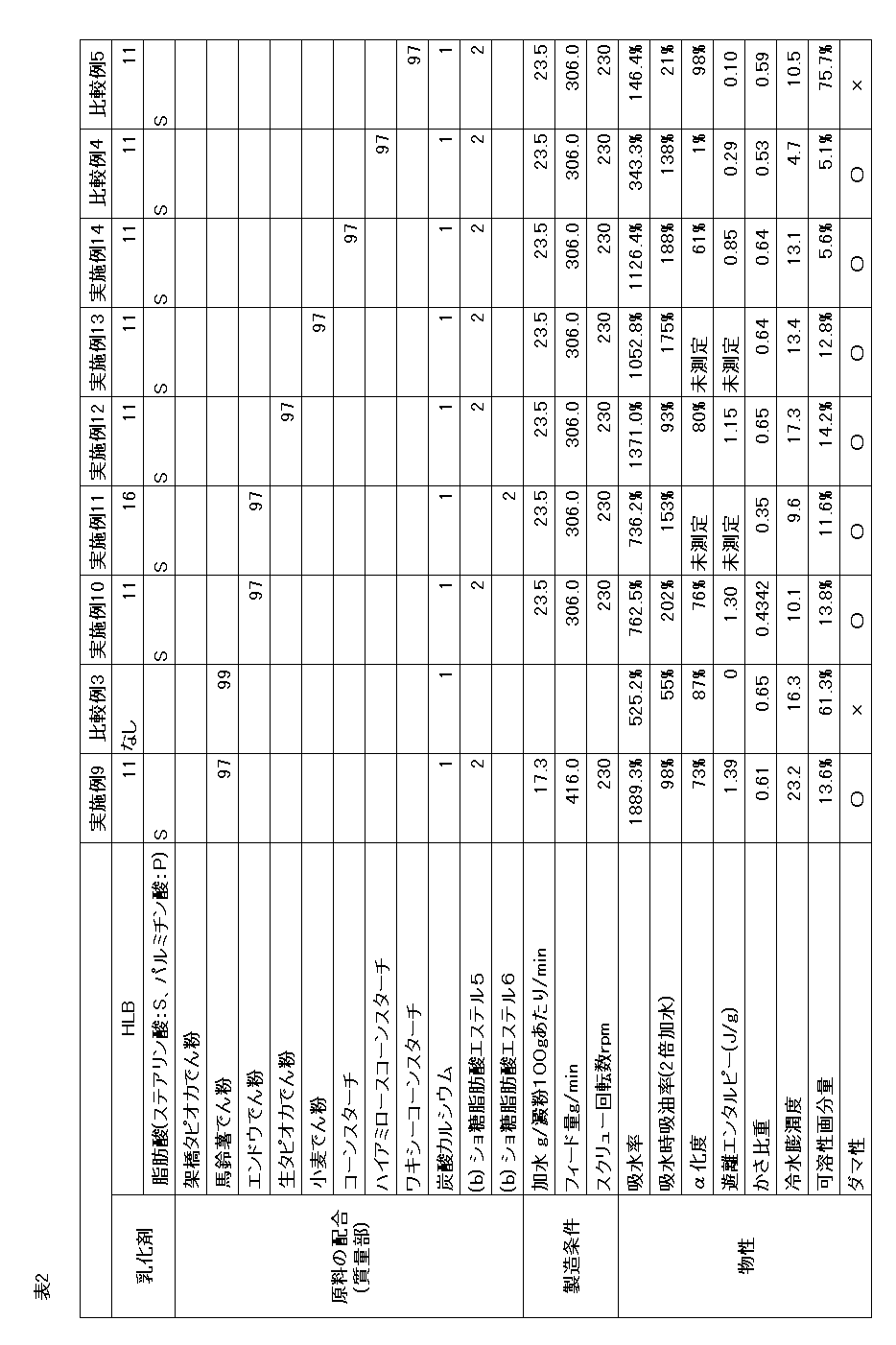
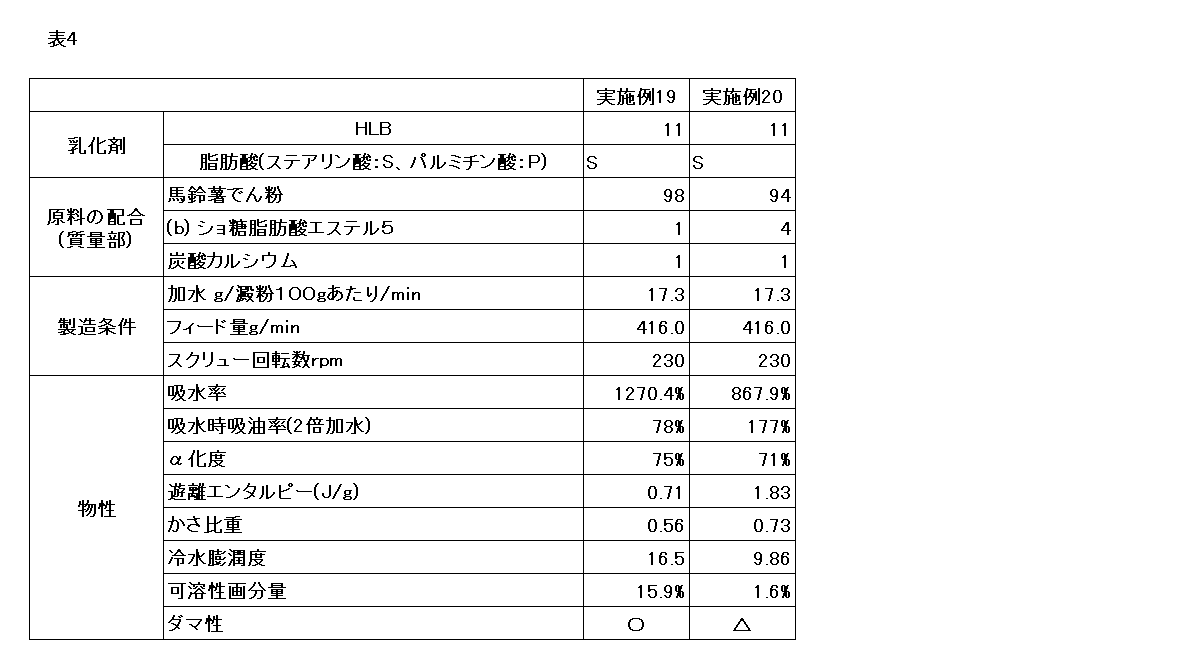
- Examples 1 to 20, Comparative Examples 1 to 5 raw materials were mixed according to the components and formulations shown in Tables 1 to 4, and compositions were prepared by the following method. That is, in each example, raw material components were mixed in a bag until sufficiently uniform to obtain a mixture. Using a twin-screw extruder (KEI-45 manufactured by Kowa Kogyo Co., Ltd.), the above mixture was pressurized and heated. Processing conditions are as follows. Raw material supply: quantity shown in each table Water addition: quantity shown in each table Barrel temperature: 30°C, 60°C, 90°C and 130°C from raw material inlet to outlet Outlet temperature: 130-150°C Number of screw revolutions: Quantity shown in each table
- the heated gelatinized material thus obtained by extruder treatment was dried at 110° C. to adjust the water content to about 10% by mass.
- the dried heated gelatinized material was pulverized with a desktop cutter pulverizer, and then sieved with a JIS-Z8801-1 standard sieve to obtain a fraction above the 0.15 mm sieve under the 0.5 mm sieve. I made it. was used as the composition of each example.
- the composition of each example was pulverized with a desktop cutter pulverizer and then sieved with a JIS-Z8801-1 standard sieve to obtain a 0.15 mm sieve fraction. was used for measurement.
- the ⁇ -amylase-pullulanase (BAP) method was used to measure the degree of alpha conversion of starch in the granules. 1. The composition was pulverized in advance and the particle size was adjusted to have an opening of 0.15 mm or less, which was used as a measurement sample. 2. According to the method described in Starch Science, Vol. 28, No. 4, pp. 235-240 (1981), "A new method for measuring the degree of starch gelatinization and aging using the ⁇ -amylase-pullulanase (BAP) system" Accordingly, the degree of gelatinization of starch in the granules was measured.
- the amount of heat measured from the endothermic peak area having the peak top in the following temperature range is defined as the amylose-lipid complex free enthalpy per dry mass of the composition (hereinafter also simply referred to as "free enthalpy").
- free enthalpy the amylose-lipid complex free enthalpy per dry mass of the composition.
- ⁇ Composition containing sucrose fatty acid ester 80 to 100 ° C
- Composition containing monoglycerin fatty acid ester 115 to 125°C
- Other compositions 80 to 100°C or 115 to 125°C
- the oil retention rate of the composition upon water absorption (“Water absorption upon water absorption (twice with water)” in Tables 1 to 4) was determined by the following procedure. 1. 4 g of rapeseed oil (manufactured by J-Oil Mills Co., Ltd.) was added to 1 g of the composition and mixed well with a plastic cup. 2. 2 g of water was added and mixed until the dough was uniform. 3. A cercle with a diameter of 32 mm was placed on a flat plate, and the dough was uniformly put there. 4. The cercle was removed and the flat plate was tilted to about 30 degrees. 5. Set aside for 10 minutes. 6.
- Oil retention rate at water absorption (mass%) ((A-1-2) / 1) / (1-moisture %) x 100
- the lumpiness was evaluated according to the following procedures:1. 28.5 g of water was added at once to 1.5 g of the composition. 2. The mixture was immediately mixed with a spoon for 10 seconds, and the lumpiness was evaluated according to the following criteria. ⁇ : No lumps ⁇ : 1-2 lumps ⁇ : 3 or more lumps
- compositions obtained in each example had an excellent balance of water absorption, oil absorption upon water absorption, and lump suppression.
- Examples 21-28 Comparative Examples 6-12
- the composition was applied to tuna with mayonnaise (tuna mayo).
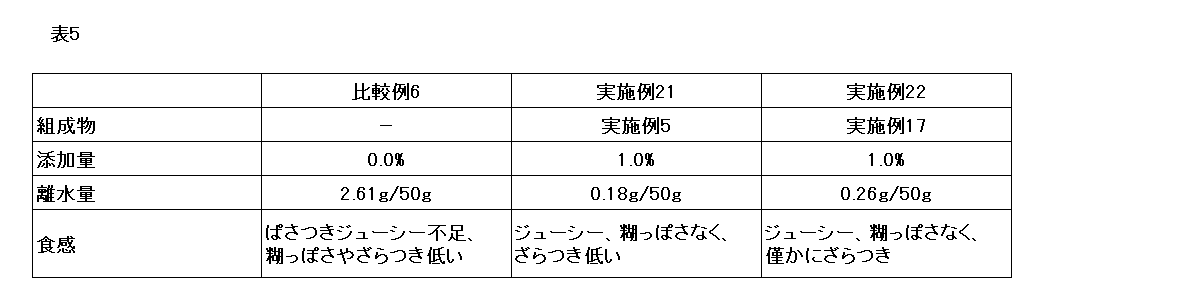
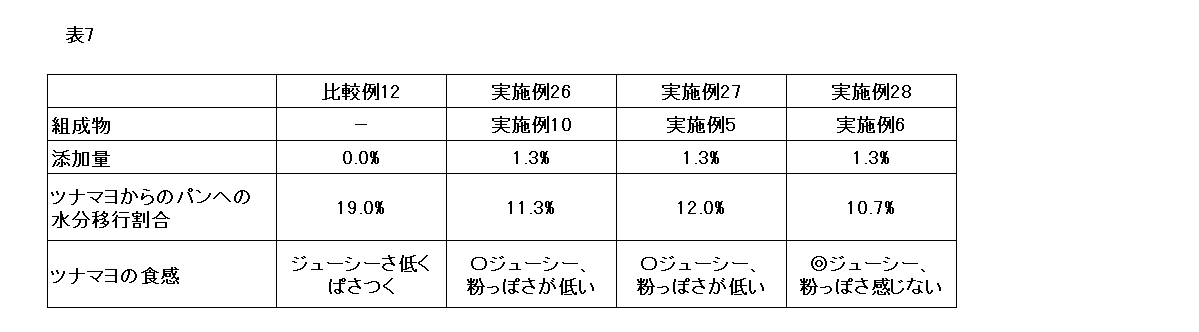
- Tables 5 to 7 show the compositions used in each example and the evaluation results.
- tuna mayonnaise Method for producing tuna mayonnaise 1. Cut the onion into 5 mm cubes and boil in hot water for 2 minutes. 2. The boiled onions were lightly drained and weighed. 3.2. Squeeze the onion to 85% of its mass and drain. 4. 5.3. 4. and mayonnaise and seasoning mixed well 6.5. , each composition was added at the addition ratio shown in each table with respect to the weight of tuna mayo and mixed well to make tuna mayo
- tuna mayonnaise sandwich Method for producing tuna mayonnaise sandwich
- the tuna mayonnaise was placed in a plastic cup with a lid and stored in a refrigerator overnight, and then subjected to sensory evaluation.
- the texture was evaluated by one panelist, and those with favorable juiciness, gummyness and low roughness were evaluated as acceptable.
- the tuna mayonnaise sandwich was stored in the refrigerator overnight, the tuna mayonnaise was removed, and the texture was evaluated by one panelist. did.
- Example 8 shows the types of compositions blended in each example and the evaluation results.
- Example 9 shows the types of compositions blended in each example and the evaluation results.
- Examples 33, 34 and Comparative Examples 17-20 In this example, the composition was applied to whipped cream.
- Table 10 shows the types of compositions blended in each example and the evaluation results.
- the amount of syneresis of the resulting whipped cream during refrigerated storage was measured by the following method. 7 g of whipped cream was squeezed out in a radius of 2.2 cm from the center of two layers of filter paper and stored in a refrigerator for 18 hours. After storage, the whipped cream was removed, and "the weight of the filter paper after storage - the weight of the filter paper before storage" was measured as the water separation amount.
- Example 35 and 36 In this example, the method of Example 1 was followed except that the ingredients and raw materials listed in Table 11 were mixed, and Poly twin BCTG62 manufactured by Buehler Co., Ltd. was used as a twin-screw extruder in the heat and pressure treatment. A composition was prepared accordingly. The obtained composition was measured and evaluated according to the method of Example 1. The results are also shown in Table 11.
Landscapes
- Chemical & Material Sciences (AREA)
- Life Sciences & Earth Sciences (AREA)
- Engineering & Computer Science (AREA)
- Food Science & Technology (AREA)
- Polymers & Plastics (AREA)
- Health & Medical Sciences (AREA)
- Nutrition Science (AREA)
- Dispersion Chemistry (AREA)
- Marine Sciences & Fisheries (AREA)
- Zoology (AREA)
- Grain Derivatives (AREA)
- Jellies, Jams, And Syrups (AREA)
Abstract
Description
特許文献1(特開2019-154279号公報)には、寒天、重量平均分子量が8000~800000である澱粉加水分解物及び重合リン酸塩の分子が互いに絡み合った構造を有する寒天組成物について記載されている(請求項1)。
本発明は、食品に適用する際に食品中でダマになりにくいとともに、製造歩留まりおよび食感に優れる食品が得られる組成物を提供する。
(a)澱粉、
(b)乳化剤
を含む食品用澱粉組成物であって、
前記成分(a)の少なくとも一部と前記成分(b)の少なくとも一部とが当該食品用澱粉組成物中でアミロース-脂質複合体を形成しており、
前記成分(a)のピーク分子量が2.7×10⁵以上2.3×10⁶以下であり、
前記成分(b)が、モノグリセリン脂肪酸エステルおよびHLB4以上16以下のショ糖脂肪酸エステルからなる群から選択される少なくとも1種であり、
示差走査熱量測定にて測定される前記アミロース-脂質複合体の組成物乾燥質量当たりの遊離エンタルピーが0.1J/g以上20J/g以下であり、
当該食品用澱粉組成物の25℃における冷水膨潤度が、5.0以上40以下であり、
当該食品用澱粉組成物の25℃における可溶性画分量が、0質量%超20質量%以下である、食品用澱粉組成物。
[2] 前記成分(a)が、酸処理、酸化処理および酵素処理をいずれもなされていない澱粉である、[1]に記載の食品用澱粉組成物。
[3] 前記成分(a)が、タピオカ澱粉、架橋タピオカ澱粉、エンドウ澱粉、馬鈴薯澱粉、小麦澱粉およびコーンスターチからなる群から選択される1または2以上の澱粉である、[1]または[2]に記載の食品用澱粉組成物。
[4] [1]乃至[3]いずれか1つに記載の食品用澱粉組成物の製造方法であって、
前記成分(a)および(b)を含む混合物を得る工程と、
前記混合物をα化処理して前記アミロース-脂質複合体を形成することにより、前記食品用澱粉組成物を得る工程と、
を含む、食品用澱粉組成物の製造方法。
[5] 混合物を得る前記工程において前記成分(b)の配合量は、前記成分(a)100質量部に対して、0.1質量部以上10質量部以下である、[4]に記載の製造方法。
[6] 混合物を得る前記工程において、前記成分(a)の配合量が、全組成に対して75質量%以上99.8質量%以下である、[4]または[5]に記載の製造方法。
[7] 食品用澱粉組成物を得る前記工程が、前記混合物を、エクストルーダーにより加熱および加圧処理して造粒する工程を含む、[4]乃至[6]いずれか1つに記載の製造方法。
本実施形態において、食品用澱粉組成物(以下、単に「組成物」とも呼ぶ。)は以下の成分(a)および(b)を含み、成分(a)の少なくとも一部と成分(b)の少なくとも一部とが組成物中でアミロース-脂質複合体を形成している。
(a)澱粉
(b)乳化剤
成分(a)のピーク分子量は2.7×10⁵以上2.3×10⁶以下である。成分(b)は、モノグリセリン脂肪酸エステルおよびHLB4以上16以下のショ糖脂肪酸エステルからなる群から選択される少なくとも1種である。示差走査熱量測定にて測定されるアミロース-脂質複合体の組成物乾燥質量当たりの遊離エンタルピーが0.1J/g以上20J/g以下である。そして、食品用澱粉組成物の25℃における冷水膨潤度が、5.0以上40以下であり、食品用澱粉組成物の25℃における可溶性画分量が、0質量%超20質量%以下である。
以下、まず、組成物に含まれる成分について説明する。
成分(a)は、澱粉である。
成分(a)は、たとえば食品用の澱粉である。成分(a)としてはピーク分子量が上述の範囲にあるものが用いられる。
成分(a)は、好ましくは、タピオカ澱粉(キャッサバ由来の澱粉)、エンドウ澱粉、馬鈴薯澱粉、小麦澱粉およびコーンスターチならびにこれらの加工澱粉からなる群から選択される1または2以上の澱粉であり、より好ましくはタピオカ澱粉、架橋タピオカ澱粉、エンドウ澱粉、馬鈴薯澱粉、小麦澱粉およびコーンスターチからなる群から選択される1または2以上の澱粉である。
また、べたつき抑制の観点から、成分(a)のピーク分子量は、2.3×10⁶以下であり、好ましくは2.0×10⁶以下、より好ましくは1.6×10⁶以下である。
また、食品の歩留まりおよび食感向上の観点から、組成物中の成分(a)の含有量は、組成物全体に対してたとえば99.9質量%以下であり、好ましくは99.8質量%以下、より好ましくは99.7質量%以下、さらに好ましくは99.5質量%である。
成分(b)は、乳化剤であり、モノグリセリン脂肪酸エステルおよびHLB4以上16以下のショ糖脂肪酸エステルからなる群から選択される少なくとも1種である。
モノグリセリン脂肪酸エステルにおける脂肪酸の炭素数は、食品の歩留まりおよび食感向上の観点から、たとえば6以上であり、好ましくは10以上、より好ましくは14以上である。
また、同様の観点から、モノグリセリン脂肪酸エステルにおける脂肪酸の炭素数は、たとえば24以下であり、好ましくは22以下、より好ましくは20以下である。
また、食品の歩留まり向上の観点から、モノグリセリン脂肪酸エステルのHLBは、好ましくは16以下であり、より好ましくは9以下、さらに好ましくは6以下である。
ショ糖脂肪酸エステルにおける脂肪酸の炭素数に制限はないが、たとえば10以上であり、好ましくは12以上、より好ましくは14以上、さらに好ましくは16以上である。
また、制限はないが、ショ糖脂肪酸エステルにおける脂肪酸の炭素数は、たとえば24以下であり、好ましくは22以下、より好ましくは20以下、さらに好ましくは18以下である。
ショ糖脂肪酸エステルは、脂肪酸のモノ、ジ、トリおよびポリエステルのいずれを含んでもよい。
また、同様の観点から、ショ糖脂肪酸エステルのHLBは、16以下であり、好ましくは14以下、さらに好ましくは11以下である。
また、ダマ性の観点から、組成物中の成分(b)の含有量は、組成物全体に対して好ましくは10質量%以下であり、より好ましくは8質量%以下、さらに好ましくは6質量%以下である。
アミロース-脂質複合体は、具体的には、組成物に配合された成分(a)および(b)の少なくとも一部により形成されている。
本発明者らは、組成物が水分と油分を同時に保持し、食感を向上できることの指標として、かかる遊離エンタルピーが有効であることを新たに見出した。
また、吸水率向上の観点から、アミロース-脂質複合体の上記遊離エンタルピーは、20J/g以下であり、好ましくは15J/g以下であり、より好ましくは10J/g以下、さらに好ましくは8J/g以下、さらにより好ましくは5J/g以下である。
アミロース-脂質複合体の遊離エンタルピーは、示差走査熱量測定により測定される。具体的な測定方法については実施例の項にて後述する。
組成物は、成分(a)および(b)以外の成分を含んでもよいし、成分(a)および(b)から構成されるとともに少なくともこれらの一部がアミロース-脂質複合体を形成しているものであってもよい。
その他の成分として、たとえば炭酸カルシウム、硫酸カルシウムなどの不溶性塩が挙げられる。不溶性塩を添加することにより、組成物の気泡構造をさらに安定化し、製造安定性を改善することも可能となる。
組成物が不溶性塩を含むとき、組成物中の不溶性塩の含有量は、製造安定性向上の観点から、組成物全体に対して好ましくは0.1質量%以上であり、より好ましくは0.2質量%以上、さらに好ましくは0.5質量%以上である。
また、食品の歩留まりおよび食感向上の観点から、組成物中の不溶性塩の含有量は、組成物全体に対して好ましくは5質量%以下であり、より好ましくは3質量%以下、さらに好ましくは2質量%以下である。
(冷水膨潤度)
組成物の25℃における冷水膨潤度は、吸水率を向上する観点から、5.0以上であり、好ましくは6以上、より好ましくは8以上であり、さらに好ましくは10以上である。
また、同様の観点から、組成物の25℃における冷水膨潤度は、40以下であり、好ましくは30以下であり、より好ましくは20以下であり、さらに好ましくは18以下、さらにより好ましくは16以下である。
ここで、組成物の冷水膨潤度の測定方法については、実施例の項で後述する。
組成物の25℃における可溶性画分量は、食品の歩留まりおよび食感向上の観点から、組成物全体に対して、0質量%超であり、好ましくは1質量%以上、より好ましくは2質量%以上、さらに好ましくは3質量%以上、さらにより好ましくは5質量%以上である。
また、べたつき抑制の観点およびこれによる食感向上の観点から、組成物の25℃における可溶性画分量は、組成物全体に対して、具体的には20質量%以下であり、好ましくは18質量%以下、より好ましくは16質量%以下、さらに好ましくは14質量%以下、さらにより好ましくは12質量%以下である。
ここで、可溶性画分量とは、組成物の糊っぽさ(べたつき)を示す指標である。可溶性画分量の測定方法については実施例の項で後述する。
組成物のα化度は、組成物が配合された食品の吸水率を適度に高める観点から、具体的には35%以上であり、好ましくは40%以上、より好ましくは45%以上、さらに好ましくは50%以上、さらにより好ましくは60%以上である。
また、組成物のα化度は、具体的には100%以下である。食品に適用する際のダマの発生をさらに抑制する観点および食品のべたつきを抑制する観点からは、組成物のα化度は、好ましくは95%以下であり、より好ましくは90%以下、さらに好ましくは85%以下、さらにより好ましくは80%以下である。
ここで、組成物のα化度は、具体的にはβ-アミラーゼ・プルラナーゼ(BAP)法により測定される。より具体的な測定方法については実施例の項にて後述する。
組成物の形状は、たとえば粉粒状物である。ここで、粉粒状物とは、粉状物および粒状物のうち少なくとも一方を含むものであり、粉状物および粒状物の両方を含むものであってもよい。
組成物の粒度については、たとえば組成物が配合される飲食品の形態、大きさなどを踏まえて調整することができる。たとえば、JIS-Z8801-1規格における目開き0.5mmの篩の篩下かつ0.15mmの篩の篩上の画分を用いてもよい。
また、たとえば、ツナマヨなどのフィリングに用いる場合には、JIS-Z8801-1規格における「目開き0.25mmの篩の篩下かつ目開き0.038mmの篩の篩上の画分の含有量を60質量%以上100質量%以下」とすることが好ましい。また、「目開き0.25mmの篩の篩下かつ目開き0.075mmの篩の篩上の画分の含有量を60質量%以上100質量%以下」とすることも好ましい。
また、ハンバーグなどの練りこみ食品およびスープに用いる場合には、「目開き0.5mmの篩の篩下かつ目開き0.075mmの篩の篩上の画分の含有量を60質量%以上100質量%以下」とすることが好ましい。
食品の歩留まりを高める観点では、JIS K-6720に従って測定される組成物のかさ比重は、たとえば0.15g/mL以上であり、好ましくは0.25g/mL以上、より好ましくは0.30g/mL以上であり、また、たとえば0.8g/mL以下であり、好ましくは0.7g/mL以下であり、より好ましくは0.65g/mL以下である。
組成物の25℃における吸水率は、食品の歩留まり向上の観点から、好ましくは500%以上であり、より好ましくは700%以上、より好ましくは800%以上である。
組成物の25℃における吸水率の上限値に制限はなく、高いほど好ましいが、たとえば2000%以下、またはたとえば1500%以下であってもよい。
なお、組成物の吸水率の測定方法については実施例の項で後述する。
組成物の25℃における吸水時油保持率(吸水時吸油率)は、食品の歩留まり向上の観点から、たとえば60%以上であり、好ましくは90%以上、より好ましくは100%以上、さらに好ましくは120%以上である。
組成物の25℃における吸水時油保持率の上限値に制限はなく、高いほど好ましいが、たとえば250%以下、またはたとえば220%以下であってよい。
なお、組成物の吸水時油保持率の測定方法については実施例の項で後述する。
次に、組成物の製造方法を説明する。
本実施形態において、組成物の製造方法は、たとえば以下の工程を含む。
(工程1)成分(a)および(b)を含む混合物を得る工程
(工程2)混合物をα化処理してアミロース-脂質複合体を形成することにより、本実施形態における組成物を得る工程
以下、各工程をさらに具体的に説明する。
工程1において、成分(a)の配合量は、食品の歩留まりおよび食感向上の観点から、混合物に配合される原料成分の全組成に対して好ましくは75質量%以上であり、より好ましくは80質量%以上、さらに好ましくは85質量%以上、さらにより好ましくは90質量%以上、よりいっそう好ましくは95質量%以上である。
また、食品の歩留まりおよび食感向上の観点から、成分(a)の配合量は、上記全組成に対して好ましくは99.8質量%以下であり、より好ましくは99.0質量%以下、さらに好ましくは98.5質量%以下である。
ダマ性の観点から、成分(b)の配合量は、成分(a)100質量部に対して、好ましくは10質量部以下であり、より好ましくは5質量部以下、さらに好ましくは3質量部以下である。
α化処理には、澱粉の加熱糊化に使用されている一般的な方法を用いることができる。α化処理の方法として、具体的には、ドラムドライヤー、ジェットクッカー、エクストルーダー、スプレードライヤーなどの機械を使用した方法が知られているが、本実施形態において、冷水膨潤度およびアミロース-脂質複合体遊離エンタルピーがそれぞれ前述の範囲にある組成物をより確実に得る観点から、エクストルーダーやドラムドライヤーによる加熱糊化が好ましく、エクストルーダー処理がより好ましい。
エクストルーダー処理する場合は、通常、原料に加水して水分含量を10~50質量%程度に調整した後、たとえばバレル温度30~200℃、出口温度80~180℃、スクリュー回転数100~1,000rpm、熱処理時間5~60秒の条件で、加熱膨化させる。
エクストルーダー処理における各条件の好適条件は、以下のとおりである。
水分含量:好ましくは12~40質量%であり、より好ましくは15~30質量%、さらに好ましくは17~27質量%である。
バレル温度:好ましくは30~190℃であり、より好ましくは30~180℃、さらに好ましくは30~170℃である。
出口温度:好ましくは90~170℃であり、より好ましくは100~165℃、さらに好ましくは110~160℃である。
スクリュー回転数:好ましくは120~1,000rpmであり、より好ましくは140~1,000rpm、さらに好ましくは150~1,000rpmである。
熱処理時間:好ましくは7~50秒であり、より好ましくは10~45秒である。
また、工程2において組成物を造粒物として得るとき、得られた造粒物を、必要に応じて、粉砕し、篩い分けをし、大きさを適宜調整して、組成物として所望の大きさの粒状物、粉状物またはこれらの混合物を得ることもできる。
本実施形態の組成物においては、食品に用いる際にダマが生じることが好適に抑制されるため、たとえば、食品の食感を好ましく改良することができる。また、食品の製造歩留まりを向上させることができる。
また、本実施形態の組成物を用いることにより、たとえば、食品中の水分の保持性を高めることができ、具体的には、離水を抑制したり、これによる他の食材への水分移行を防止することも可能となる。
組成物が適用される食品は、それ自体で食品として提供されてもよいし、食品の一部として、たとえば惣菜パンの中具等のフィリング、焼菓子のデコレーションとして提供されてもよい。
フィッシュボール、魚肉ソーセージ等の水産練り食品が挙げられる。
練り食品の他の具体例として、練りわさび、練り辛子、練り梅、練りごま等の植物素材由来の練り食品が挙げられる。植物素材由来の練り食品は、チューブ容器に充填されてなる練りチューブ製品であってよい。
和え物の具体例として、ポテトサラダ、ツナサラダ等のサラダ;およびツナのマヨネーズ和え(ツナマヨ)等のフィリングが挙げられる。
スープの具体例として、ポタージュスープ、クリームスープ、ミネストローネ等が挙げられる。
1. 以下の成分(a)および(b):
(a)澱粉、
(b)乳化剤
を含む食品用澱粉組成物であって、
前記成分(a)の少なくとも一部と成分(b)の少なくとも一部とが当該食品用澱粉組成物中でアミロース-脂質複合体を形成しており、
前記成分(a)のピーク分子量が2.7×10⁵以上2.3×10⁶以下であり、
前記成分(b)が、モノグリセリン脂肪酸エステルおよびHLB4以上16以下のショ糖脂肪酸エステルからなる群から選択される少なくとも1種であり、
示差走査熱量測定にて測定される前記アミロース-脂質複合体の組成物乾燥質量当たりの遊離エンタルピーが0.5J/g以上20J/g以下であり、
当該食品用澱粉組成物の25℃における冷水膨潤度が、5.0以上40以下であり、
当該食品用澱粉組成物の25℃における可溶性画分量が、0質量%超20質量%以下である、食品用澱粉組成物。
2. 前記成分(a)が、酸処理、酸化処理および酵素処理をいずれもなされていない澱粉である、1.に記載の食品用澱粉組成物。
3. 前記成分(a)が、タピオカ澱粉、架橋タピオカ澱粉、エンドウ澱粉、馬鈴薯澱粉、小麦澱粉およびコーンスターチからなる群から選択される1または2以上の澱粉である、1.または2.に記載の食品用澱粉組成物。
4. 1.乃至3.いずれか1つに記載の食品用澱粉組成物の製造方法であって、
前記成分(a)および(b)を含む混合物を得る工程と、
前記混合物をα化処理して前記アミロース-脂質複合体を形成することにより、前記食品用澱粉組成物を得る工程と、
を含む、食品用澱粉組成物の製造方法。
5. 混合物を得る前記工程において、成分(b)の配合量は、成分(a)100質量部に対して、0.1質量部以上10質量部である、4.に記載の製造方法。
6. 混合物を得る前記工程において、成分(a)の配合量が、全組成に対して75質量%以上99.8質量%以下である、4.または5.に記載の製造方法。
7. 食品用澱粉組成物を得る前記工程が、前記混合物を、エクストルーダーにより加熱および加圧処理して造粒する工程を含む、4.乃至6.いずれか1つに記載の製造方法。
(澱粉)
架橋タピオカでん粉:アクトボディTP-2、株式会社J-オイルミルズ製、ピーク分子量9.10×10⁵
馬鈴薯でん粉:BP-200、株式会社J-オイルミルズ製、ピーク分子量1.85×10⁶
ハイアミロースコーンスターチ:ハイアミロースコーンスターチHS-7、株式会社J-オイルミルズ製、ピーク分子量2.73×10⁵
エンドウでん粉:Puris Pea、Puris Fod社製、ピーク分子量2.97×10⁵
生タピオカでん粉:Narive Tapioca Starch、SIAM STARCH社製、ピーク分子量1.29×10⁶
小麦でん粉:WS-525、千葉製粉社製
コーンスターチ:コーンスターチY、株式会社J-オイルミルズ製、ピーク分子量5.40×10⁵
ワキシーコーンスターチ:ワキシーコーンスターチY、株式会社J-オイルミルズ製、ピーク分子量2.42×10⁶
ショ糖脂肪酸エステル1:リョートーシュガーエステルS-370、構成脂肪酸C18系、HLB3、三菱ケミカルフーズ社製
ショ糖脂肪酸エステル2:リョートーシュガーエステルS-570、構成脂肪酸C18系、HLB5、三菱ケミカルフーズ社製
ショ糖脂肪酸エステル3:リョートーシュガーエステルS-770、構成脂肪酸C18系、HLB7、三菱ケミカルフーズ社製
ショ糖脂肪酸エステル4:リョートーシュガーエステルS-970、構成脂肪酸C18系、HLB9、三菱ケミカルフーズ社製
ショ糖脂肪酸エステル5:リョートーシュガーエステルS-1170、構成脂肪酸C18系、HLB11、三菱ケミカルフーズ社製
ショ糖脂肪酸エステル6:リョートーシュガーエステルS-1670、構成脂肪酸C18系、HLB16、三菱ケミカルフーズ社製
ショ糖脂肪酸エステル7:リョートーシュガーエステルP-1670、構成脂肪酸C16系、HLB16、三菱ケミカルフーズ社製
モノグリセリン脂肪酸エステル1:エマルジーMS、構成脂肪酸C16(40%)、C18(60%)、理研ビタミン社製
モノグリセリン脂肪酸エステル2:ポエムP(V)S、構成脂肪酸C16(60%)、C18(40%)、理研ビタミン社製
炭酸カルシウム:コロカルソーEX、白石カルシウム社製
ツナフレーク:ライトツナスーパーノンオイル、いなば食品社製
マヨネーズ:ピュアセレクトマヨネーズ、味の素食品社製
増粘剤1:サンシノグリカン、DSP五協フード&ケミカル社製
スイートコーン:スイートコーン、ナチュラルキッチン社製
クリーミングパウダー:KN-30、株式会社J-オイルミルズ製
乳糖:バブルスター、乳糖社製
オニオンパウダー:オニオンパウダー、GABAN社製
濃縮ホエイ:FONDOLAC SL、メグレ社製
チキンエキス:CPR、理研ビタミン社製
「味の素」:「味の素」(登録商標)、味の素社製
本例では、表1~表4に記載の成分および配合で原料を混合し、以下の方法で組成物を調製した。
すなわち、各例において、原料成分を充分に均一になるまで袋内で混合し、混合物を得た。2軸エクストルーダー(幸和工業社製、KEI-45)を用いて、上記混合物を加圧加熱処理した。処理条件は、以下の通りである。
原料供給:各表に示した数量
加水:各表に示した数量
バレル温度:原料入口から出口に向かって30℃、60℃、90℃および130℃
出口温度:130~150℃
スクリューの回転数:各表に示した数量
次いで、乾燥した加熱糊化物を、卓上カッター粉砕機で粉砕した後、JIS-Z8801-1規格の篩で篩分けして、0.5mm篩下0.15mm篩上の画分を各例の組成物とした。て各例の組成物とした。
ただし、α化度および遊離エンタルピーの測定においては、各例の組成物を卓上カッター粉砕機で粉砕した後、JIS-Z8801-1規格の篩で篩分けして、0.15mm篩下の画分を測定に供した。
ピーク分子量の測定は、東ソー社製HPLCユニットを使用しておこなった(ポンプDP-8020、RI検出器RS-8021、脱気装置SD-8022)。
(1)試料を粉砕し、JIS-Z8801-1規格の篩で、目開き0.15mm篩下の画分を回収した。この回収画分を移動相に1mg/mLとなるように懸濁し、懸濁液を100℃3分間加熱して完全に溶解した。0.45μmろ過フィルター(ADVANTEC社製、DISMIC-25HP PTFE 0.45μm)を用いてろ過をおこない、ろ液を分析試料とした。
(2)以下の分析条件で分子量を測定した。
カラム:TSKgel α-M(7.8mmφ、30cm)(東ソー社製)、2本
流速:0.5mL/min
移動相:5mM NaNO3含有90%(v/v)ジメチルスルホキシド溶液
カラム温度:40℃
分析量:0.2mL
(3)検出器データを、ソフトウェア(マルチステーションGPC-8020modelIIデータ収集ver5.70、東ソー社製)にて収集し、分子量ピークを計算した。
検量線には、分子量既知のプルラン(Shodex Standard P-82、昭和電工社製)を使用した。
粒状物中の澱粉のα化度測定は、β-アミラーゼ-プルラナーゼ(BAP)法により行なった。
1.事前に組成物を粉砕し、目開き0.15mm以下に粒度を調整したものを測定試料として用いた。
2.澱粉科学第28巻第4号第235~240頁(1981年)の「β-アミラーゼ-プルラナーゼ(BAP)系を用いた澱粉の糊化度、老化度の新測定法」に記載される方法に準じて、粒状物中の澱粉のα化度を測定した。
DSC 7000-X(日立製作所社製)を用いて、Al簡易密封パン(メトクローム処理)に、組成物を2mgと水9.5mgを加えて封をした。これを室温(25℃、以下同じ。)で3時間以上放置し、吸水させた。
リファレンスにはブランクセルを用いた。昇温は10℃から140℃まで3℃/minの速度で行った(測定点:0.5秒ごと)。
得られたDSCチャートについて、下記温度範囲にピークトップを持つ吸熱ピーク面積より測定される熱量を組成物乾燥質量当たりのアミロース-脂質複合体遊離エンタルピー(以下、単に「遊離エンタルピー」ともいう。)として定義した。
・ショ糖脂肪酸エステルを含む組成物:80~100℃
・モノグリセリン脂肪酸エステルを含む組成物:115~125℃
・その他の組成物:80~100℃または115~125℃
1.試料1g(A)を50mLファルコンチューブに秤量し、質量をAとした。
2.ボルテックスをかけながら、チューブ目盛り50mLまで水を加えた。
3.5回転倒混和させ、沈殿を分散させた後、10秒ボルテックスして室温で30分静置した。
4.4000rpmで30分間遠心分離を行い、沈殿層と上澄み層に分けた。
(遠心分離機:日立工機社製、日立卓上遠心機CT6E型;ローター:T4SS型スイングローター;アダプター:50TC×2Sアダプタ)
5.上澄みをピペットで取り除いて、沈殿層の質量を測定し、これをBとした。
6.沈殿層を乾固(105℃、24時間)した時の質量を測定し、これをCとした。
7.以下の式に基づき、組成物の冷水膨潤度、可溶性画分量および吸水率を求めた。
冷水膨潤度=B/C
可溶性画分(%)=(A-C)/A×100
吸水率(%)=(B-A)/A×100
各例で得られた組成物を篩い分けして0.5mm篩下0.25mm篩上の画分を得た。この画分80gを測りとり、JIS規格K-6720に従い、カサ比重測定器(蔵持科学器械製作所社製)を用いてかさ比重を測定した。
以下の手順で組成物の吸水時油保持率(表1~表4における「吸水時吸水率(2倍加水)」)を求めた。
1.組成物1gに対して、菜種油(株式会社J-オイルミルズ製)4gを加えてプラカップで良く混ぜた。
2.水2gを加えて、生地が均一になるまで混ぜた。
3.平板に直径32mmのセルクルを置き、ここに生地が均一になるように入れた。
4.セルクルを外し、平板を約30度まで傾けた。
5.10分間静置した。
6.ドリップした油を良くふき取った後、吸水・吸油生地を回収し、質量を測定した(この量を(A)とした)。以下の式により吸水時油保持率を算出した。
吸水時油保持率(質量%)=((A-1-2)/1)/(1-水分%)×100
以下の手順でダマ性を評価した
1.組成物1.5gに対して、水28.5gを一度に加えた。
2.すぐにさじで10秒間混合し、ダマ性を以下の基準で評価した。
〇:ダマができない
△:ダマが1~2個できる
×:ダマが3個以上できる


本例では、ツナのマヨネーズ和え(ツナマヨ)に組成物を適用した。各例で用いた組成物および評価結果を表5~表7に示す。
原料 配合(質量%)
ツナフレーク 59.1
たまねぎ(茹で、水切り) 18.0
マヨネーズ 20.9
調味料*1 2.0
合計 100
*1 調味料:塩、砂糖よび胡椒を1:1:0.1の質量比で配合したもの
1.玉ねぎを5mm角にカットし、熱湯で2分ゆでた。
2.ゆで後の玉ねぎを、軽く水を切り質量を測定した。
3.2.の質量の85%まで玉ねぎを搾り、水を切った。
4.ツナフレークをザルの上で20分静置させて水をきった
5.3.、4.およびマヨネーズと調味料を良く混合した
6.5.に対して、各組成物をツナマヨ重量に対して各表に記載の添加比率で添加し良く混合しツナマヨとした
サンドイッチ用パンに22.5gの蒸気ツナマヨを挟んだ後、ラップで包んでツナマヨサンドイッチとした
ツナマヨを蓋つきプラスチックカップに入れて一晩冷蔵保管した後、ツナマヨの入った容器を傾けて2時間静置し、離水した水分を集めて測定し離水量(g)とした。
1.ツナマヨサンドイッチを一晩冷蔵保管した。
2.ツナマヨサンドイッチからツナマヨを取り除き、「((一晩保管後のパン重量)-(サンドイッチ作製前のパン重量))/(サンドイッチ作製前のパン重量))」をフィリングからパンへの水分移行割合を測定した。
ツナマヨを蓋つきプラスチックカップに入れて一晩冷蔵保管した後、官能評価を行った。
表5に記載の例では、パネラー1名で食感について評価し、ジューシーさ、糊っぽさおよびざらつきの低さが好ましいものを合格とした。
表6の評価に記載の例では、パネラー3名が以下の基準で採点し、平均点により評価した。糊っぽさの評点が4.0以上かつざらつきの評点が3.0以上の例を合格とした。
表7に記載の例では、ツナマヨサンドイッチを一晩冷蔵庫で保管し、ツナマヨを取り出してパネラー1名で食感を評価し、ジューシーさ、粉っぽさおよびざらつきの低さが好ましいものを合格とした。
5:糊っぽさなく自然な食感
4:僅かに糊っぽい
3:やや糊っぽい
2:糊っぽい
1:かなり糊っぽい
5:ざらつきを全く感じない
4:僅かにざらつきを感じる
3:少しざらつきを感じる
2:ざらつきを感じる
1:かなりざらつきを感じる

本例では、組成物をハンバーグに適用した。表8に各例で配合した組成物の種類および評価結果を示す。
原材料 配合
(1)牛肉(赤身80%) 33.0質量%
(1)鶏肉(鶏むね) 18.0質量%
(1)豚肉 5.0質量%
(1)食塩 0.60質量%
(1)豚脂 4.0質量%
(2)たまねぎ(生) 23.5質量%
(2)卵白 8.0質量%
(2)コーンスターチY 0.60質量%
(2)砂糖 0.10質量%
(2)胡椒 0.10質量%
(2)「味の素」 0.10質量%
(3)水 2.5質量%
(4)パン粉 2.0質量%
(4)組成物 2.5質量%
合計 100.00質量%
1.上記「ハンバーグの配合」の(1)の材料をすべてボウルに入れ手で混ぜた。
2.ケンミックスミキサー(愛工舎製作所社製)の強度2で3分混ぜた。
3.(2)の材料を加えて手で混ぜた後、ケンミックスミキサー(愛工舎製作所社製)の強度2で1分混ぜた。
4.(3)の材料を入れて、よく手で混ぜた。
5.事前に混合しておいた(4)の材料を加え、ダマが出来ないように手でよく混ぜた。
6.120g計量し成形した。
7.成形した生地を200℃のホットプレートで両面を1分ずつ焼成した。
8.コンベクションオーブンの鉄板に網を載せて、網の上に上記手順7.で焼成後の生地を置いて200℃9分焼成しハンバーグを得た。
9.焼成後の重量を測定し、焼成後の重量/焼成前の重量(手順6.)を焼成歩留まりとした。歩留まり75%以上を合格とした。
10.得られたハンバーグを-20℃で1週間保管した。
冷凍保管したハンバーグ3個を皿に並べてラップをし、電子レンジにて700W、3分間加熱した。加熱解凍したハンバーグのジューシーさ、硬さ、糊っぽさおよび肉粒感をパネラー3名が以下の基準で採点し、平均点により評価した。すべての項目の評点が3以上である例を合格とした。
5:かなりジューシー
4:ジューシー
3:ややジューシー
2:ややぱさつく
1:ぱさつく
(硬さ)
5:肉らしい硬さがかなり強い
4:肉らしい硬さが強い
3:肉らしい硬さがある
2:柔らかい
1:かなり柔らかい
(糊っぽさ)
4:糊っぽさを感じない
3:糊っぽさをほぼ感じない
2:糊っぽい
1:かなり糊っぽい
(肉粒感)
5:かなり肉粒感を感じる
4:肉粒感を感じる
3:やや肉粒感を感じる
2:肉粒感がやや低い
1:肉粒感が低い

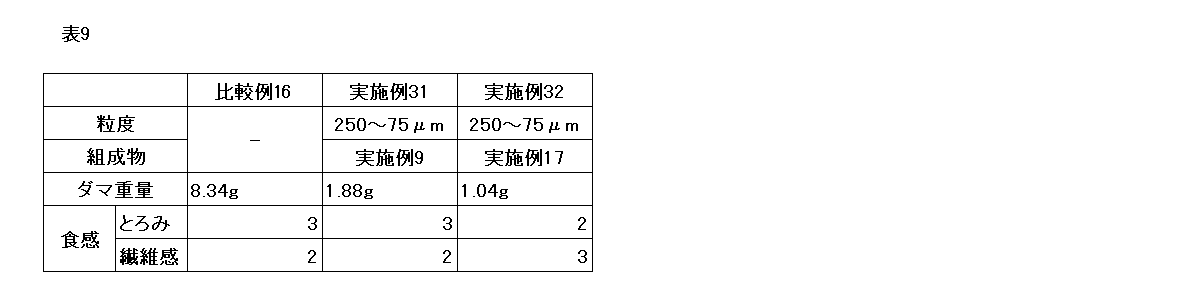
本例では、組成物をスープに適用した。表9に各例で配合した組成物の種類および評価結果を示す。
原材料 配合
スイートコーン 29質量%
馬鈴薯でん粉 16質量%
組成物または馬鈴薯でん粉 6質量%
砂糖 22質量%
クリーミングパウダー 18質量%
食塩 3質量%
乳糖 2質量%
全粉乳 1質量%
オニオンパウダー 0.5質量%
濃縮ホエイ 0.2質量%
チキンエキス 0.6質量%
ホワイトペッパー 0.1質量%
「味の素」 1.6質量%
合計 100質量%
1.上記「粉末スープの配合」の配合割合になるように原材料を混合した。
2.流動層造粒装置(パウレック社製、FD-MP-01D/PLS)で以下の条件にて造粒・乾燥した。
バインダー:10%デキストリン(サンデックス100溶液)80mL・対粉400g
給気風量:0.6m3/minターゲット
給気温度:70℃
排気温度:約30℃
ローター回転:120rpm
噴霧スプレーエア:90g/min
噴霧流量:10g/min
造粒時間:約10min+造粒後乾燥5min
払い落し条件:0.3s/インターバル1.0s
粉末スープ17.6gに98℃設定でポット調温したお湯150gを加え、すぐに15回(1秒あたり回転の速さで)さじで攪拌した。
得られたスープを目開き1mmの篩に通し、篩上の重量をダマ重量とした。
得られたスープのとろみさおよび繊維感をパネラー2名が以下の基準で採点し、合議により評価した。評点が2以上を合格とした。
3:好ましい適度なとろみがある
2:ややとろみが不足する
1:とろみが不足する
(繊維感)
3:繊維感を感じる
2:やや繊維感を感じる
1:繊維感を感じない
本例では、組成物をホイップクリームに適用した。表10に各例で配合した組成物の種類および評価結果を示す。
原材料 配合
上白糖 10質量%
生クリーム 80質量%
水+組成物 *2 10質量%
合計 100質量%
1.水および組成物を混合して上記「ホイップクリームの配合」における「水+組成物」を調製した。
このとき、表10の実施例33、34では、組成物に対して所定の水を加えてさじで攪拌し調製した。
比較例17~20では、ダマができやすいため、ホモミキサーでダマができないように十分に攪拌した。
2.すべての材料を合わせて、氷浴中にてハンドミキサーでホイップ(1速1分後、2速で3分以上 *3)し、各例のホイップクリームを得た。
*3 各試験区のオーバーラン(泡立て後重量/泡立て前重量)が1.8~2.1程度になるように調整した。ただし、表10の比較例18では、増粘剤1(サクシノグリカン)のみ泡立たちにくくオーバーランが1.4程度となった。
得られたホイップクリームの冷蔵保管時の離水量を以下の方法で測定した。
ホイップクリーム7gを、2枚重ねにしたろ紙の中心から半径2.2cm範囲に絞りだし、冷蔵で18時間保管した。
保管後、ホイップクリームを取り除き、「保管後のろ紙重量ー保管前のろ紙重量」を離水量として測定した。
得られたホイップクリームを冷蔵(4℃)で18時間保管時の口溶けおよびぱさつき・ざらつきをパネラー2名が以下の基準で採点し、合議により評価した。口溶けおよびぱさつき・ざらつきの両項目の評点が3以上である例を合格とした。
3:口溶け良い
2:やや口溶け悪く口残りする
1:口溶け悪く口残りする
(ぱさつき・ざらつき)
3:ぱさつきやざらつきを感じない
2:ややぱさつきやざらつきを感じない
1:ぱさつきやざらつきを感じる

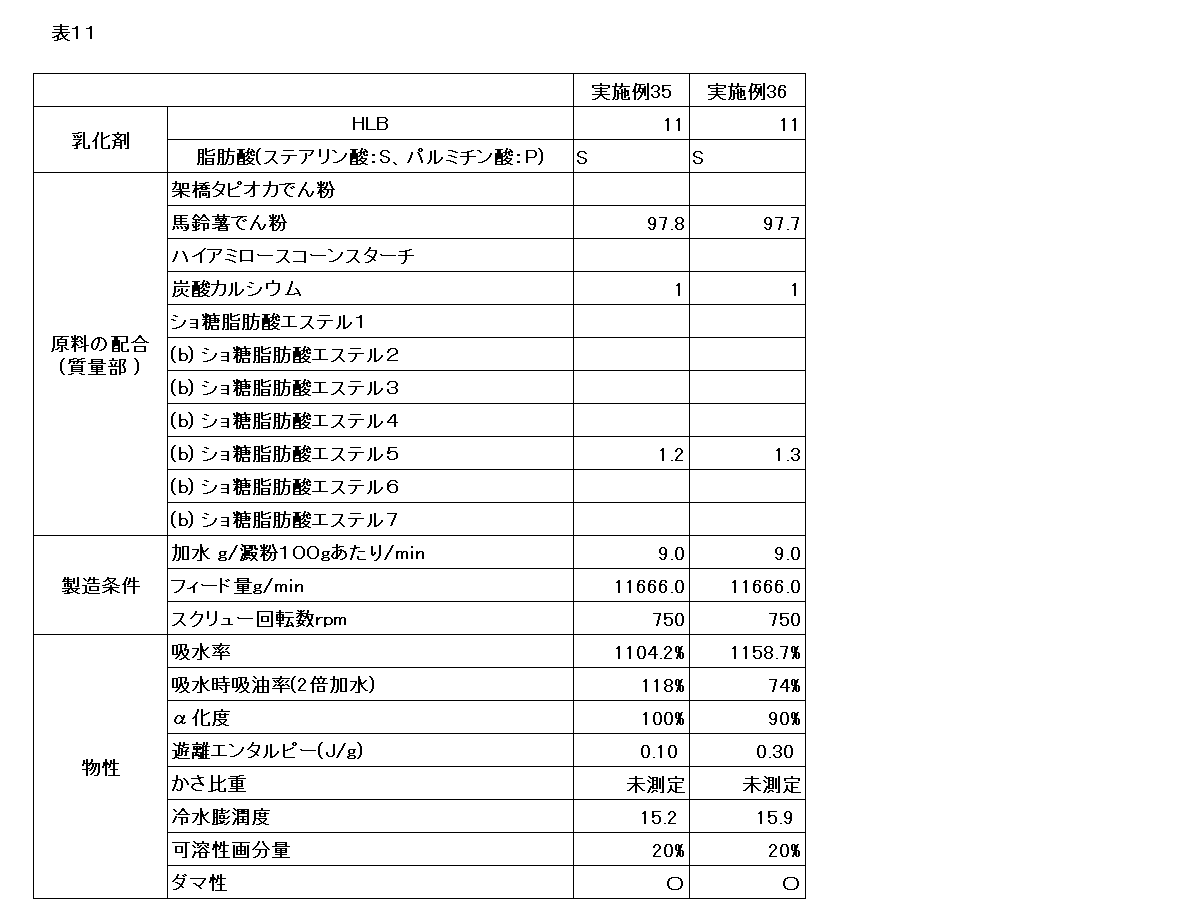
本例では、表11に記載の成分および原料を混合したこと、および、加熱加圧処理において2軸エクストルーダーとしてPoly twin BCTG62、ビューラー株式会社製を用いたこと以外は、実施例1の方法に準じて組成物を調製した。得られた組成物について実施例1の方法に準じて測定および評価をおこなった。結果を表11にあわせて示す。
Claims (7)
- 以下の成分(a)および(b):
(a)澱粉、
(b)乳化剤
を含む食品用澱粉組成物であって、
前記成分(a)の少なくとも一部と前記成分(b)の少なくとも一部とが当該食品用澱粉組成物中でアミロース-脂質複合体を形成しており、
前記成分(a)のピーク分子量が2.7×10⁵以上2.3×10⁶以下であり、
前記成分(b)が、モノグリセリン脂肪酸エステルおよびHLB4以上16以下のショ糖脂肪酸エステルからなる群から選択される少なくとも1種であり、
示差走査熱量測定にて測定される前記アミロース-脂質複合体の組成物乾燥質量当たりの遊離エンタルピーが0.1J/g以上20J/g以下であり、
当該食品用澱粉組成物の25℃における冷水膨潤度が、5.0以上40以下であり、
当該食品用澱粉組成物の25℃における可溶性画分量が、0質量%超20質量%以下である、食品用澱粉組成物。 - 前記成分(a)が、酸処理、酸化処理および酵素処理をいずれもなされていない澱粉である、請求項1に記載の食品用澱粉組成物。
- 前記成分(a)が、タピオカ澱粉、架橋タピオカ澱粉、エンドウ澱粉、馬鈴薯澱粉、小麦澱粉およびコーンスターチからなる群から選択される1または2以上の澱粉である、請求項1または2に記載の食品用澱粉組成物。
- 請求項1乃至3いずれか1項に記載の食品用澱粉組成物の製造方法であって、
前記成分(a)および(b)を含む混合物を得る工程と、
前記混合物をα化処理して前記アミロース-脂質複合体を形成することにより、前記食品用澱粉組成物を得る工程と、
を含む、食品用澱粉組成物の製造方法。 - 混合物を得る前記工程において、前記成分(b)の配合量は、前記成分(a)100質量部に対して、0.1質量部以上10質量部以下である、請求項4に記載の製造方法。
- 混合物を得る前記工程において、前記成分(a)の配合量が、全組成に対して75質量%以上99.8質量%以下である、請求項4または5に記載の製造方法。
- 食品用澱粉組成物を得る前記工程が、前記混合物を、エクストルーダーにより加熱および加圧処理して造粒する工程を含む、請求項4乃至6いずれか1項に記載の製造方法。
Priority Applications (2)
| Application Number | Priority Date | Filing Date | Title |
|---|---|---|---|
| JP2023511273A JPWO2022210557A1 (ja) | 2021-03-31 | 2022-03-28 | |
| JP2026000140A JP2026053691A (ja) | 2021-03-31 | 2026-01-05 | 食品用澱粉組成物 |
Applications Claiming Priority (2)
| Application Number | Priority Date | Filing Date | Title |
|---|---|---|---|
| JP2021061388 | 2021-03-31 | ||
| JP2021-061388 | 2021-03-31 |
Publications (1)
| Publication Number | Publication Date |
|---|---|
| WO2022210557A1 true WO2022210557A1 (ja) | 2022-10-06 |
Family
ID=83456368
Family Applications (1)
| Application Number | Title | Priority Date | Filing Date |
|---|---|---|---|
| PCT/JP2022/015051 Ceased WO2022210557A1 (ja) | 2021-03-31 | 2022-03-28 | 食品用澱粉組成物 |
Country Status (2)
| Country | Link |
|---|---|
| JP (2) | JPWO2022210557A1 (ja) |
| WO (1) | WO2022210557A1 (ja) |
Citations (4)
| Publication number | Priority date | Publication date | Assignee | Title |
|---|---|---|---|---|
| JPH0731414A (ja) * | 1993-07-15 | 1995-02-03 | Kao Corp | マヨネーズ様食品 |
| JPH089871A (ja) * | 1994-06-28 | 1996-01-16 | Honen Corp | 澱粉由来の食品用素材およびこれを用いた食品 |
| JP2007070580A (ja) * | 2005-09-09 | 2007-03-22 | San-Ei Sucrochemical Co Ltd | 複合化改質澱粉の製造方法及び複合化改質澱粉 |
| JP2015013819A (ja) * | 2013-07-03 | 2015-01-22 | 富士フイルム株式会社 | アスタキサンチンを有効成分として含有する皮膚の水分蒸散量低減剤 |
Family Cites Families (6)
| Publication number | Priority date | Publication date | Assignee | Title |
|---|---|---|---|---|
| JPS6147162A (ja) * | 1984-08-09 | 1986-03-07 | Aageru Shokuhin Kk | 加工食品の品質改良剤 |
| JP2558494B2 (ja) * | 1988-03-30 | 1996-11-27 | 雪印乳業株式会社 | 膨化食品の製造方法 |
| JPH0463563A (ja) * | 1990-07-03 | 1992-02-28 | Terumo Corp | 抗肥満性食品およびその製造方法 |
| JPH04179433A (ja) * | 1990-11-13 | 1992-06-26 | Aageru Shokuhin Kk | 冷凍加工食品の品質改良法 |
| JPH0523125A (ja) * | 1991-07-15 | 1993-02-02 | Terumo Corp | 膨化食品の製造方法 |
| US10212950B2 (en) * | 2013-02-26 | 2019-02-26 | J-Oil Mills, Inc. | Composition, batter material using same, food or drink and feed, and method of producing composition |
-
2022
- 2022-03-28 WO PCT/JP2022/015051 patent/WO2022210557A1/ja not_active Ceased
- 2022-03-28 JP JP2023511273A patent/JPWO2022210557A1/ja active Pending
-
2026
- 2026-01-05 JP JP2026000140A patent/JP2026053691A/ja active Pending
Patent Citations (4)
| Publication number | Priority date | Publication date | Assignee | Title |
|---|---|---|---|---|
| JPH0731414A (ja) * | 1993-07-15 | 1995-02-03 | Kao Corp | マヨネーズ様食品 |
| JPH089871A (ja) * | 1994-06-28 | 1996-01-16 | Honen Corp | 澱粉由来の食品用素材およびこれを用いた食品 |
| JP2007070580A (ja) * | 2005-09-09 | 2007-03-22 | San-Ei Sucrochemical Co Ltd | 複合化改質澱粉の製造方法及び複合化改質澱粉 |
| JP2015013819A (ja) * | 2013-07-03 | 2015-01-22 | 富士フイルム株式会社 | アスタキサンチンを有効成分として含有する皮膚の水分蒸散量低減剤 |
Also Published As
| Publication number | Publication date |
|---|---|
| JP2026053691A (ja) | 2026-03-25 |
| JPWO2022210557A1 (ja) | 2022-10-06 |
Similar Documents
| Publication | Publication Date | Title |
|---|---|---|
| US10212950B2 (en) | Composition, batter material using same, food or drink and feed, and method of producing composition | |
| TWI887271B (zh) | 組成物 | |
| DE69011691T2 (de) | Kaloriearme fleischprodukte und verfahren zu ihrer herstellung. | |
| US20180199607A1 (en) | Granular material and method for producing same, and food, forage and edible meat product employing same | |
| JP7318152B1 (ja) | 凝固卵様食品、加工食品、凝固卵様食品の製造方法、および加工食品の製造方法 | |
| US3769038A (en) | Fat sponge | |
| TW202209979A (zh) | 食品用組成物之製造方法 | |
| TR201900267T4 (tr) | İnorganik tuz, yağ ve gellan sakızı içeren iştah açıcı konsantrat. | |
| WO2005112662A1 (ja) | 脱脂大豆粉末を基材とする粉末食品添加物製剤 | |
| WO2022210557A1 (ja) | 食品用澱粉組成物 | |
| WO2024101073A1 (ja) | 加熱調理食品用半膨化澱粉組成物 | |
| JP7844166B2 (ja) | 肉様食品用食感改良組成物 | |
| JP2023151955A (ja) | バッターミックス、バッター液および衣付き食品 | |
| CZ323298A3 (cs) | Potravinové kompozice, vázající vodu | |
| JP5839537B2 (ja) | サラダ | |
| JP7312744B2 (ja) | 食品用組成物 | |
| WO2022185889A1 (ja) | 畜肉様加工食品の製造方法 | |
| JP2023144495A (ja) | 水中油型乳化油脂組成物 | |
| JP4642806B2 (ja) | 乾燥澱粉麺様食品及びその製造方法 | |
| JPS61177957A (ja) | 加工食品及び/又は加工食品品質改良剤の製造法 | |
| JP7455759B2 (ja) | 食品の製造方法 | |
| JP4173950B2 (ja) | ドーナッツ食品改質剤及びドーナッツ食品の改質方法 | |
| JP2025132364A (ja) | 生魚肉加工食品用改良剤、生魚肉加工食品、生魚肉加工食品用改良剤の製造方法、生魚肉加工食品の製造方法、および生魚肉加工食品の離水を低減する方法 | |
| WO2023234142A1 (ja) | 全卵代替用組成物 | |
| KR20250155118A (ko) | 바삭한 식감이 유지되는 냉동 치킨 제조방법 |
Legal Events
| Date | Code | Title | Description |
|---|---|---|---|
| 121 | Ep: the epo has been informed by wipo that ep was designated in this application |
Ref document number: 22780768 Country of ref document: EP Kind code of ref document: A1 |
|
| WWE | Wipo information: entry into national phase |
Ref document number: 2301005796 Country of ref document: TH |
|
| WWE | Wipo information: entry into national phase |
Ref document number: 2023511273 Country of ref document: JP |
|
| WWE | Wipo information: entry into national phase |
Ref document number: 11202306809Q Country of ref document: SG |
|
| NENP | Non-entry into the national phase |
Ref country code: DE |
|
| 122 | Ep: pct application non-entry in european phase |
Ref document number: 22780768 Country of ref document: EP Kind code of ref document: A1 |