WO2022209331A1 - 熱可塑性樹脂と抗菌剤とを含有する成形体の製造方法 - Google Patents
熱可塑性樹脂と抗菌剤とを含有する成形体の製造方法 Download PDFInfo
- Publication number
- WO2022209331A1 WO2022209331A1 PCT/JP2022/005141 JP2022005141W WO2022209331A1 WO 2022209331 A1 WO2022209331 A1 WO 2022209331A1 JP 2022005141 W JP2022005141 W JP 2022005141W WO 2022209331 A1 WO2022209331 A1 WO 2022209331A1
- Authority
- WO
- WIPO (PCT)
- Prior art keywords
- thermoplastic resin
- antibacterial
- antibacterial agent
- mass
- bis
- Prior art date
- Legal status (The legal status is an assumption and is not a legal conclusion. Google has not performed a legal analysis and makes no representation as to the accuracy of the status listed.)
- Ceased
Links
Images
Classifications
-
- A—HUMAN NECESSITIES
- A01—AGRICULTURE; FORESTRY; ANIMAL HUSBANDRY; HUNTING; TRAPPING; FISHING
- A01N—PRESERVATION OF BODIES OF HUMANS OR ANIMALS OR PLANTS OR PARTS THEREOF; BIOCIDES, e.g. AS DISINFECTANTS, AS PESTICIDES OR AS HERBICIDES; PEST REPELLANTS OR ATTRACTANTS; PLANT GROWTH REGULATORS
- A01N25/00—Biocides, pest repellants or attractants, or plant growth regulators, characterised by their forms, or by their non-active ingredients or by their methods of application, e.g. seed treatment or sequential application; Substances for reducing the noxious effect of the active ingredients to organisms other than pests
- A01N25/08—Biocides, pest repellants or attractants, or plant growth regulators, characterised by their forms, or by their non-active ingredients or by their methods of application, e.g. seed treatment or sequential application; Substances for reducing the noxious effect of the active ingredients to organisms other than pests containing solids as carriers or diluents
- A01N25/10—Macromolecular compounds
-
- A—HUMAN NECESSITIES
- A01—AGRICULTURE; FORESTRY; ANIMAL HUSBANDRY; HUNTING; TRAPPING; FISHING
- A01N—PRESERVATION OF BODIES OF HUMANS OR ANIMALS OR PLANTS OR PARTS THEREOF; BIOCIDES, e.g. AS DISINFECTANTS, AS PESTICIDES OR AS HERBICIDES; PEST REPELLANTS OR ATTRACTANTS; PLANT GROWTH REGULATORS
- A01N59/00—Biocides, pest repellants or attractants, or plant growth regulators containing elements or inorganic compounds
- A01N59/16—Heavy metals; Compounds thereof
-
- A—HUMAN NECESSITIES
- A01—AGRICULTURE; FORESTRY; ANIMAL HUSBANDRY; HUNTING; TRAPPING; FISHING
- A01P—BIOCIDAL, PEST REPELLANT, PEST ATTRACTANT OR PLANT GROWTH REGULATORY ACTIVITY OF CHEMICAL COMPOUNDS OR PREPARATIONS
- A01P3/00—Fungicides
-
- C—CHEMISTRY; METALLURGY
- C08—ORGANIC MACROMOLECULAR COMPOUNDS; THEIR PREPARATION OR CHEMICAL WORKING-UP; COMPOSITIONS BASED THEREON
- C08F—MACROMOLECULAR COMPOUNDS OBTAINED BY REACTIONS ONLY INVOLVING CARBON-TO-CARBON UNSATURATED BONDS
- C08F2/00—Processes of polymerisation
- C08F2/44—Polymerisation in the presence of compounding ingredients, e.g. plasticisers, dyestuffs, fillers
-
- C—CHEMISTRY; METALLURGY
- C08—ORGANIC MACROMOLECULAR COMPOUNDS; THEIR PREPARATION OR CHEMICAL WORKING-UP; COMPOSITIONS BASED THEREON
- C08F—MACROMOLECULAR COMPOUNDS OBTAINED BY REACTIONS ONLY INVOLVING CARBON-TO-CARBON UNSATURATED BONDS
- C08F20/00—Homopolymers and copolymers of compounds having one or more unsaturated aliphatic radicals, each having only one carbon-to-carbon double bond, and only one being terminated by only one carboxyl radical or a salt, anhydride, ester, amide, imide or nitrile thereof
- C08F20/02—Monocarboxylic acids having less than ten carbon atoms, Derivatives thereof
- C08F20/10—Esters
Definitions
- the present disclosure relates to a method for manufacturing a molded body containing a thermoplastic resin and an antibacterial agent.
- Patent Document 1 describes an antibacterial resin composition containing an antibacterial zeolite obtained by replacing some or all of the ion-exchangeable ions in the zeolite with hydrogen ions and silver ions, and a thermoplastic resin. It is described that the antibacterial resin composition is applied to the surfaces of paints and building materials to impart antibacterial properties to these surfaces.
- Patent Document 1 The method described in Patent Document 1 above requires a complicated process of coating the surface with an antibacterial resin composition in order to impart antibacterial properties to the surface of the paint or building material.
- the present disclosure is capable of imparting antibacterial properties to the surface of a molded article containing a thermoplastic resin and an antibacterial material by a simple method, and manufacturing a molded article having excellent antibacterial properties on the surface.
- the purpose is to provide a method.
- thermoplastic resin a thermoplastic resin and an antibacterial agent
- the production method according to [1] wherein the content of the antibacterial agent is 0.01% by mass to 15% by mass.
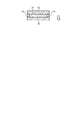
- FIG. 1 is a diagram for explaining cast polymerization.
- Method for manufacturing molded body A method for producing a molded article containing the thermoplastic resin of the present disclosure and an antibacterial agent (hereinafter also referred to as “the method for producing a molded article of the present disclosure”) will be described.
- the method for producing a molded article of the present disclosure includes a step of allowing a mixture containing a thermoplastic resin monomer and an antibacterial agent to stand to allow the antibacterial agent to settle, and a thermoplastic resin monomer in a state where the antibacterial agent has settled. and polymerizing to obtain a thermoplastic resin.
- thermoplastic resin monomer means "a monomer that is a raw material of a thermoplastic resin".
- the thermoplastic resin monomer and the antibacterial agent are mixed, and the antibacterial agent is dispersed under conditions that do not initiate the polymerization of the thermoplastic resin monomer. At least part of the antibacterial agent should settle when the resulting dispersion is allowed to stand.
- a thermoplastic resin monomer may be used by mixing with a thermoplastic resin.
- the cup viscosity of the thermoplastic resin monomer is preferably 0.1 seconds or more and 18 seconds or less, more preferably 0.5 seconds or more and 15 seconds or less, even more preferably 1 second or more and 13 seconds or less. It is below. If the cup viscosity of the thermoplastic resin monomer is less than 0.1 seconds, the antimicrobial agent will settle in a short time. Second, the antimicrobial agent settles to the bottom of the compounding vessel and a predetermined amount of antimicrobial agent cannot be transferred to the polymerization vessel.
- cup viscosity of the thermoplastic resin monomer is more than 18 seconds, the antibacterial agent will not settle in the polymerization vessel, resulting in poor antibacterial properties of molded articles produced by, for example, cast polymerization.
- a thermoplastic resin monomer before heating used in cast polymerization was used as a sample, and the time required for the sample to pass through a cylinder having a truncated cone shape was defined as the cup viscosity.
- the cylinder having the shape of a truncated cone was made of stainless steel, and had an upper surface inner diameter of 37 mm, a lower surface inner diameter of 5 mm, and a height of 65 mm.
- the molded article of the present disclosure is produced by allowing a mixture of a thermoplastic resin monomer and an antimicrobial agent to stand, allowing the antimicrobial agent to settle vertically downward, and then polymerizing and molding. .
- FIG. 1 is a diagram for explaining cast polymerization. More specifically, as shown in FIG. 1, two support plates 12, typically two glass plates and a gasket 13, are prepared and placed opposite each other at a predetermined distance. By sandwiching the gasket 13 between them, a space (hereinafter also referred to as a "cell") into which the raw material (dispersion liquid) 11 is poured is formed.
- the distance between the support plates 12 can be appropriately adjusted so as to obtain a structure with a desired thickness.
- the distance between the support plates 12 can be preferably 0.3-100 mm, more preferably 0.5-20 mm, even more preferably 1-10 mm, more preferably 1-5 mm.
- the dispersion can be obtained by mixing a liquid thermoplastic resin monomer and an antibacterial agent, degassing the mixture, and dispersing the antibacterial agent using ultrasonic waves or the like.
- the dispersion may contain other components such as a polymerization initiator.
- the dispersion liquid obtained above is poured into the cell and left to stand with one support plate facing downward in the vertical direction (the direction indicated by the white arrow) and the other supporting plate facing upward in the vertical direction.
- the standing is carried out under conditions that do not initiate the polymerization of the thermoplastic resin monomer until the antibacterial agent in the dispersion near the support plate settles to a desired density.
- the shorter the time required for production, the better, and the stationary state may be performed for a shorter time than the dispersion liquid reaches a steady state.
- the viscosity and standing time of the dispersion may be selected to achieve the desired density.
- a molded body After standing still, a molded body can be obtained by molding by polymerizing the thermoplastic resin monomer. Polymerization conditions can be appropriately set according to the raw materials used.
- the sedimented antibacterial agent is unevenly distributed on one surface (lower surface) side.
- thermoplastic resin in the manufacturing method of the molded article of the present disclosure will be described.
- the thermoplastic resin may be a transparent thermoplastic resin.
- thermoplastic resins examples include (meth)acrylic resins, polycarbonate resins, polyetherimide resins, polyester resins, polystyrene resins, polyethersulfone resins, fluorine resins, ABS (acrylonitrile-butadiene-styrene) resins, AS ( acrylonitrile-styrene) resins, polyvinyl chloride and polyolefin resins.
- the thermoplastic resin may be appropriately selected according to the properties required.
- the thermoplastic resin may be of one type or a mixture of two or more types.
- the thermoplastic resin is preferably a (meth)acrylic resin, more preferably a methacrylic resin, from the viewpoint of transparency and scratch resistance.
- (meth)acrylic resin includes acrylic resins and methacrylic resins.
- methacrylic resin is a polymer having structural units derived from a monomer having a methacrylic group.
- the methacrylic resin includes, for example, a methacrylic homopolymer containing only structural units derived from an alkyl methacrylate having an alkyl group having 1 to 4 carbon atoms; a structure derived from an alkyl methacrylate having an alkyl group having 1 to 4 carbon atoms. 85% by mass or more and less than 100% by mass of units, and more than 0% by mass and less than 15% by mass of structural units derived from other vinyl monomers copolymerizable with alkyl methacrylate having an alkyl group having 1 to 4 carbon atoms. and a methacrylic copolymer containing.
- Alkyl methacrylate having an alkyl group having 1 to 4 carbon atoms is a compound represented by CH 2 ⁇ CH(CH 3 )COOR (R is an alkyl group having 1 to 4 carbon atoms).
- R is an alkyl group having 1 to 4 carbon atoms.
- a vinyl monomer copolymerizable with an alkyl methacrylate having an alkyl group having 1 to 4 carbon atoms is a vinyl monomer that is copolymerizable with an alkyl methacrylate having an alkyl group having 1 to 4 carbon atoms and has a vinyl group. is a monomer having
- alkyl methacrylates having an alkyl group having 1 to 4 carbon atoms include methyl methacrylate, ethyl methacrylate, n-propyl methacrylate, isopropyl methacrylate, n-butyl methacrylate, tert-butyl methacrylate, and methacrylic acid. sec-butyl, and isobutyl methacrylate.
- Alkyl methacrylate having an alkyl group of 1 to 4 carbon atoms is preferably methyl methacrylate.
- Alkyl methacrylates may be used alone or in combination of two or more.
- Examples of vinyl monomers copolymerizable with alkyl methacrylate having an alkyl group of 1 to 4 carbon atoms include cyclohexyl methacrylate, benzyl methacrylate, 2-ethylhexyl methacrylate, 2-hydroxyethyl methacrylate, and methacrylic acid.
- methacrylic acid esters such as monoglycerol methacrylate (excluding alkyl methacrylate having an alkyl group of 1 to 4 carbon atoms); methyl acrylate, ethyl acrylate, propyl acrylate, butyl acrylate, acrylic acid Acrylic acid esters such as 2-ethylhexyl, 2-hydroxyethyl acrylate, 2-hydroxypropyl acrylate, monoglycerol acrylate; saturated carboxylic acids or their acid anhydrides; nitrogen-containing monomers such as acrylamide, methacrylamide, acrylonitrile, methacrylonitrile, diacetone acrylamide, dimethylaminoethyl methacrylate; epoxies such as allyl glycidyl ether, glycidyl acrylate, glycidyl methacrylate Group-containing monomer; Styrenic monomers such as styrene and ⁇ -methylstyrene
- a method for producing a methacrylic resin includes an alkyl methacrylate having an alkyl group having 1 to 4 carbon atoms and, if necessary, a vinyl monomer copolymerizable with the alkyl methacrylate having an alkyl group having 1 to 4 carbon atoms. are polymerized by methods such as bulk polymerization (for example, the above-described cast polymerization), solution polymerization, suspension polymerization, and emulsion polymerization.
- polycarbonate resin refers to a polycarbonate resin containing a structural unit derived from a dihydroxy compound.
- Polycarbonate resins that can be used as thermoplastic resins in the present disclosure are obtained by, for example, reacting a dihydroxy compound such as dihydric phenol or isosorbide with a carbonylating agent by an interfacial polycondensation method, a melt transesterification method, or the like. a resin obtained by polymerizing a carbonate prepolymer by a solid-phase transesterification method or the like; and a resin obtained by polymerizing a cyclic carbonate compound by a ring-opening polymerization method.
- dihydric phenols examples include hydroquinone, resorcinol, 4,4′-dihydroxydiphenyl, bis(4-hydroxyphenyl)methane, bis ⁇ (4-hydroxy-3,5-dimethyl)phenyl ⁇ methane, 1,1- bis(4-hydroxyphenyl)ethane, 1,1-bis(4-hydroxyphenyl)-1-phenylethane, 2,2-bis(4-hydroxyphenyl)propane (commonly known as bisphenol A), 2,2-bis ⁇ (4-hydroxy-3-methyl)phenyl ⁇ propane, 2,2-bis ⁇ (4-hydroxy-3,5-dimethyl)phenyl ⁇ propane, 2,2-bis ⁇ (4-hydroxy-3,5-dibromo ) phenyl ⁇ propane, 2,2-bis ⁇ (3-isopropyl-4-hydroxy)phenyl ⁇ propane, 2,2-bis ⁇ (4-hydroxy-3-phenyl)phenyl ⁇ propane, 2,2-bis(4 -hydroxypheny
- bisphenol A 2,2-bis ⁇ (4-hydroxy-3-methyl)phenyl ⁇ propane, 2,2-bis(4-hydroxyphenyl)butane, 2,2-bis(4 -hydroxyphenyl)-3-methylbutane, 2,2-bis(4-hydroxyphenyl)-3,3-dimethylbutane, 2,2-bis(4-hydroxyphenyl)-4-methylpentane, 1,1-bis (4-Hydroxyphenyl)-3,3,5-trimethylcyclohexane and ⁇ , ⁇ '-bis(4-hydroxyphenyl)-m-diisopropylbenzene are preferred.
- bisphenol A alone and bisphenol A together with 1,1-bis(4-hydroxyphenyl)-3,3,5-trimethylcyclohexane, 2,2-bis ⁇ (4-hydroxy-3-methyl)phenyl ⁇ is preferably used in combination with at least one selected from the group consisting of propane and ⁇ , ⁇ '-bis(4-hydroxyphenyl)-m-diisopropylbenzene.
- carbonylating agents examples include carbonyl halides (such as phosgene), carbonate esters (such as diphenyl carbonate), and haloformates (such as dihaloformates of dihydric phenols). These may be used alone or in combination of two or more.
- the content of the thermoplastic resin is preferably 85% by mass to 99.99% with respect to the total 100% by mass of the content of the thermoplastic resin and the content of the antibacterial agent. % by mass, more preferably 98% by mass to 99.8% by mass.
- Antibacterial agent The antibacterial agent in the manufacturing method of the molded article of the present disclosure will be described.
- antibacterial agents examples include zeolite antibacterial agents, organic antibacterial agents, and inorganic antibacterial agents.
- the antibacterial agent is preferably a zeolite antibacterial agent or an organic antibacterial agent, more preferably a zeolite antibacterial agent.
- zeolite-based antibacterial agents include compounds in which antibacterial metal ions such as silver, copper, and zinc are supported on zeolite.
- organic antibacterial agents examples include imidazole antibacterial agents such as thiazolylbenzimidazole, quaternary ammonium antibacterial agents such as benzalkonium chloride, thiazoline antibacterial agents such as 2-methyl-isothiazolin-3-one, Alcohol antibacterial agents such as ethyl alcohol, biguanide antibacterial agents, phenol antibacterial agents, pyridine antibacterial agents, nitrile antibacterial agents, isothiazoline antibacterial agents, organic copper antibacterial agents, organic iodine antibacterial agents, other natural antibacterial agents agents (eg, polyphenols such as catechin, acidic or basic polysaccharides such as pectic acid, chitosan, etc., basic peptides or proteins such as protamine, polylysine, nisin, etc.).
- an imidazole antibacterial agent, a quaternary ammonium antibacterial agent, or an alcohol antibacterial agent is preferable.
- inorganic antibacterial agents include compounds having photocatalytic functions such as titanium oxide and zinc oxide; antibacterial metals such as silver, copper, zinc and nickel; oxides and chlorides of these antibacterial metals; sulfides and iodides.
- the content of the antibacterial agent is preferably 0.01% by mass to 15% by mass with respect to the total 100% by mass of the content of the thermoplastic resin and the content of the antibacterial agent. %, more preferably 0.1% by mass to 10% by mass, and still more preferably 0.2% by mass to 2% by mass.
- ultraviolet absorbers In the method for producing a molded body of the present disclosure, ultraviolet absorbers, antioxidants, release agents, antistatic agents, flame retardants, etc. may be used as necessary.
- ultraviolet absorbers examples include benzophenone ultraviolet absorbers, cyanoacrylate-based ultraviolet absorbers, benzotriazole-based ultraviolet absorbers, malonic acid ester-based ultraviolet absorbers, and oxalanilide-based ultraviolet absorbers.
- antioxidants examples include phenol-based antioxidants, sulfur-based antioxidants, and phosphorus-based antioxidants.
- release agents include higher fatty acid esters, higher fatty alcohols, higher fatty acids, higher fatty acid amides, higher fatty acid metal salts, and fatty acid derivatives.
- antistatic agents examples include tertiary amines, quaternary ammonium salts, cationic acrylic acid ester derivatives, and cationic vinyl ether derivatives.
- flame retardants include cyclic nitrogen compounds, phosphorus-based flame retardants, silicon-based flame retardants, cage-like silsesquioxanes and their partially cleaved structures, and silica-based flame retardants.
- colorants such as dyes and pigments may be used as necessary.
- a coloring agent impairs the transparency, but the molded article has good color development properties and can be colored in various colors.
- coloring agents include perylene dyes, perinone dyes, pyrazolone dyes, methine dyes, coumarin dyes, quinophthalone dyes, quinoline dyes, anthraquinone dyes, anthraquinone dyes, asdrapyridone dyes, and thioindigo dyes.
- the thickness of the molded article obtained by the manufacturing method of the present disclosure is preferably 0.3 to 100 mm, more preferably 0.5 to 20 mm, even more preferably 1 to 10 mm, and more preferably 1 to 5 mm. By setting the thickness of the molded body within the above range, the molded body has excellent strength and transparency.
- the molded body has a thickness of 0.3 to 100 mm, more preferably 0.5 to 20 mm, still more preferably 1 to 10 mm, more preferably 1 to 5 mm, and the haze measured according to JIS K7136 is , 4% or less, preferably 3% or less, more preferably 1% or less.
- the molded article has a thickness of 1 to 5 mm and a haze of 3% or less, preferably 1% or less, as measured according to JIS K7136.
- the antibacterial agent is unevenly distributed on at least one surface (lower surface) side of the molded article.
- the antibacterial agent is preferably unevenly distributed in a range from the surface of the molded body to a depth of 100 ⁇ m, more preferably a depth of 20 ⁇ m, still more preferably a depth of 10 ⁇ m, and even more preferably a depth of 5 ⁇ m.
- the thickness of the region where the antibacterial agent is present is preferably 100 ⁇ m or less, more preferably 20 ⁇ m or less, still more preferably 10 ⁇ m or less, and even more preferably 5 ⁇ m or less.
- the antibacterial agent in the molded article preferably accounts for 80% mass or more, more preferably 90% mass or more, still more preferably 95% mass or more, particularly preferably 98% mass or more, Most preferably substantially all of the antimicrobial agent is meant to be in the vicinity of the predetermined area, eg the lower surface.
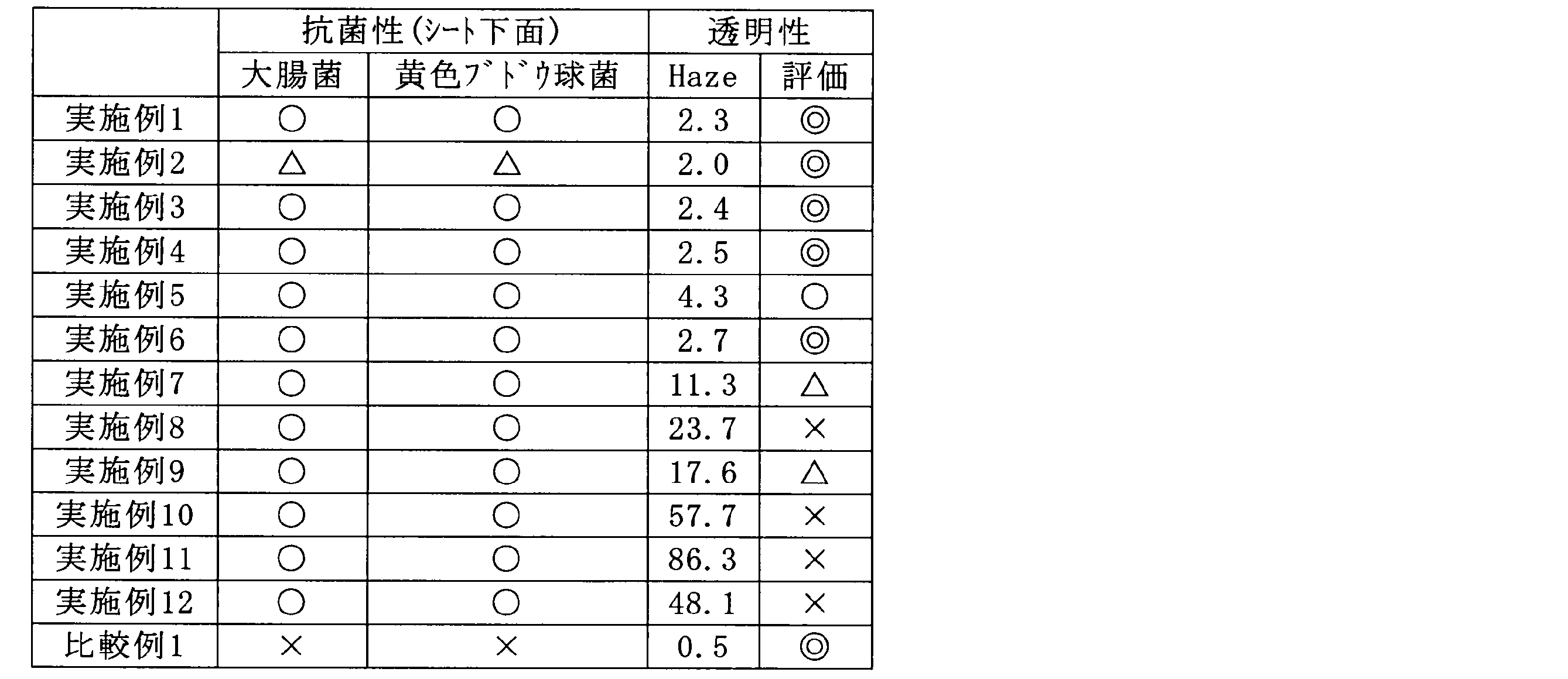
- the antibacterial activity value was 3 or more, and the propagation of the target fungi was greatly suppressed: ⁇ (good)
- the antibacterial activity value was 2 or more and less than 3, and a slight inhibitory effect was expressed on the growth of the target fungi: ⁇ (acceptable)
- the antibacterial activity value was less than 2, and no effect was confirmed on the propagation of the target fungi: ⁇ (impossible)
- Haze is less than 3.0% (transparent or almost transparent): ⁇ (excellent) Haze is 3.0% or more and less than 10.0% (slightly cloudy): ⁇ (good) Haze is 10.0% or more and less than 20.0% (cloudy): ⁇ (acceptable) Haze is 20.0% or more (remarkably cloudy): ⁇ (impossible)
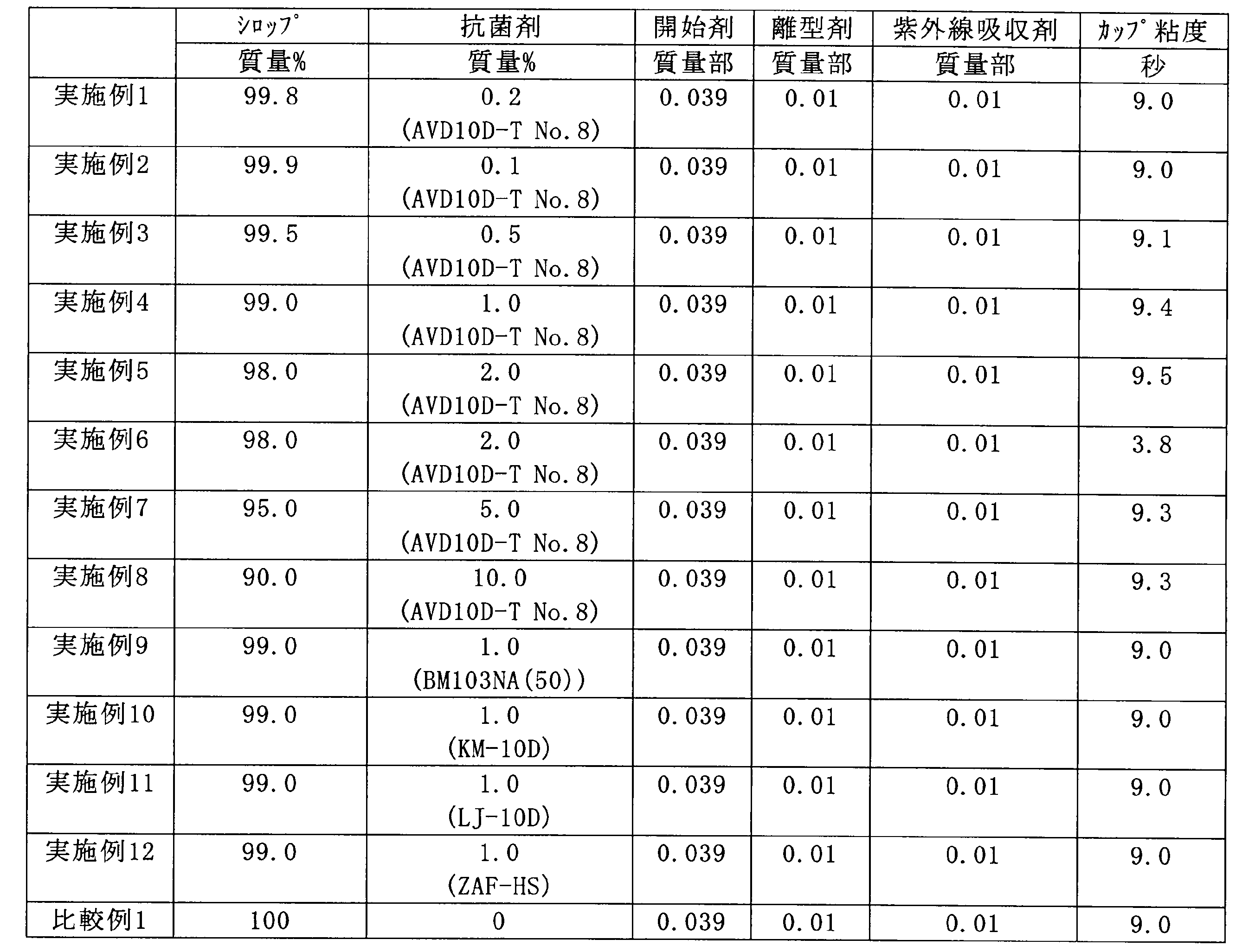
- Example 1 Syrup 99.80% by mass containing methyl methacrylate and polymethyl methacrylate adjusted so that the cup viscosity of the syrup is 9.0 (seconds), antibacterial agent (manufactured by Sinanen Zeomic Co., Ltd. "AV10D- T No. 8", silver zeolite antibacterial agent) 0.2% by mass, 2,2'-azobis (isobutyronitrile) 0.039 parts by mass as an initiator, mold release agent 0.01 part by mass, and ultraviolet rays A mixture was obtained by mixing 0.01 part by mass of absorbent. This mixture is poured into a cell composed of two glass plates and a vinyl chloride gasket with a gap of 3.8 mm, and polymerized by heating at 60° C.
- antibacterial agent manufactured by Sinanen Zeomic Co., Ltd. "AV10D- T No. 8"
- silver zeolite antibacterial agent 0.2% by mass
- 2,2'-azobis (isobutyronitrile) 0.039 parts by mass as an
- Examples 2 to 8 and Comparative Example 1 A sheet with a thickness of 3 mm was obtained in the same manner as in Example 1, except that the viscosity of the syrup or the contents of the syrup and the antibacterial agent were changed. The composition and evaluation results are shown in Tables 1 and 2.
- Example 9 BM103NA (50) manufactured by Fuji Chemical Co., Ltd. (silver glass antimicrobial agent) was used at 1.0% by mass instead of 0.2% by mass of the antimicrobial agent ("AV10D-T No. 8" manufactured by Sinanen Zeomic Co., Ltd.). A 3 mm sheet was obtained in the same manner as in Example 1 except for the above. The composition and evaluation results are shown in Tables 1 and 2.
- Example 10 > 1.0% by mass of KM-10D (silver glass antibacterial agent) manufactured by Sinanen Zeomic Co., Ltd. was used instead of 0.2% by mass of the antimicrobial agent ("AV10D-T No. 8" manufactured by Sinanen Zeomic Co., Ltd.)
- a sheet having a thickness of 3 mm was obtained in the same manner as in Example 1 except for the above.
- the composition and evaluation results are shown in Tables 1 and 2.
- Example 11 1.0% by mass of LJ-10D (silver zeolite antibacterial agent) manufactured by Sinanen Zeomic Co., Ltd. instead of 0.2% by mass of the antimicrobial agent ("AV10D-T No. 8" manufactured by Sinanen Zeomic Co., Ltd.)
- LJ-10D silver zeolite antibacterial agent
- AV10D-T No. 8 the antimicrobial agent
- Example 12 > 1.0% by mass of ZAF-HS (silver glass antibacterial agent) manufactured by Ishizuka Glass Co., Ltd. was used instead of 0.2% by mass of the antimicrobial agent ("AV10D-T No. 8" manufactured by Sinanen Zeomic Co., Ltd.)
- ZAF-HS silver glass antibacterial agent
- AV10D-T No. 8 the antimicrobial agent
- a sheet having a thickness of 3 mm was obtained in the same manner as in Example 1 except for the above.
- the composition and evaluation results are shown in Tables 1 and 2.
Landscapes
- Life Sciences & Earth Sciences (AREA)
- Chemical & Material Sciences (AREA)
- Health & Medical Sciences (AREA)
- Plant Pathology (AREA)
- Zoology (AREA)
- General Health & Medical Sciences (AREA)
- Environmental Sciences (AREA)
- Wood Science & Technology (AREA)
- Chemical Kinetics & Catalysis (AREA)
- Engineering & Computer Science (AREA)
- Pest Control & Pesticides (AREA)
- Agronomy & Crop Science (AREA)
- Organic Chemistry (AREA)
- Dentistry (AREA)
- Polymers & Plastics (AREA)
- Medicinal Chemistry (AREA)
- Inorganic Chemistry (AREA)
- General Chemical & Material Sciences (AREA)
- Microbiology (AREA)
- Mycology (AREA)
- Toxicology (AREA)
- Compositions Of Macromolecular Compounds (AREA)
- Polymerisation Methods In General (AREA)
- Agricultural Chemicals And Associated Chemicals (AREA)
- Addition Polymer Or Copolymer, Post-Treatments, Or Chemical Modifications (AREA)
- Graft Or Block Polymers (AREA)
Abstract
熱可塑性樹脂と抗菌材とを含有する成形体の表面に簡易な方法で抗菌機能を付与することが可能であり、かつ、その表面の抗菌性にも優れる成形体の製造方法を提供する。熱可塑性樹脂と抗菌剤とを含有する成形体の製造方法であって、熱可塑性樹脂単量体と抗菌剤とを含む混合物を静置して、抗菌剤を沈降させる工程と、抗菌剤が沈降した状態で熱可塑性樹脂単量体を重合して、熱可塑性樹脂を得る工程とを含む、製造方法。
Description
本開示は、熱可塑性樹脂と抗菌剤とを含有する成形体の製造方法に関する。
熱可塑性樹脂と抗菌剤とを含有する抗菌性樹脂組成物は、様々な分野で利用できることが知られている。例えば、下記特許文献1には、ゼオライト中のイオン交換可能なイオンの一部または全部を水素イオンおよび銀イオンと置換した抗菌性ゼオライトと、熱可塑性樹脂とを含む抗菌性樹脂組成物が記載されており、該抗菌性樹脂組成物を塗料や建築材の表面にコーティングしてこれらの表面に抗菌性を付与することが記載されている。
上記特許文献1に記載の方法は、塗料や建築材の表面に抗菌性を付与するために抗菌性樹脂組成物を表面にコーティングするという煩雑な工程が必要であった。
そこで、本開示は、熱可塑性樹脂と抗菌材とを含有する成形体の表面に簡易な方法で抗菌性を付与することが可能であり、かつ、その表面の抗菌性にも優れる成形体の製造方法を提供することを目的とする。
本開示は、以下の態様を含む。
〔1〕熱可塑性樹脂と抗菌剤とを含有する成形体の製造方法であって、
熱可塑性樹脂単量体と抗菌剤とを含む混合物を静置して、抗菌剤を沈降させる工程と、
抗菌剤が沈降した状態で熱可塑性樹脂単量体を重合して、熱可塑性樹脂を得る工程とを含む、製造方法。
〔2〕前記熱可塑性樹脂の含有量と前記抗菌剤の含有量との合計100質量%に対して、
抗菌剤の含有量が0.01質量%~15質量%である、〔1〕に記載の製造方法。
〔3〕前記熱可塑性樹脂が(メタ)アクリル樹脂である、〔1〕または〔2〕に記載の製造方法。
〔4〕前記抗菌剤がゼオライト系抗菌剤である、〔1〕~〔3〕のいずれか一つに記載の製造方法。
〔5〕〔1〕~〔4〕のいずれか一つに記載の製造方法で得られた成形体からなる抗菌シート。
本開示によれば、熱可塑性樹脂と抗菌材とを含有する成形体の表面に簡易な方法で抗菌性を付与することが可能であり、かつ、その表面の抗菌性にも優れる成形体の製造方法を提供することができる。
〔成形体の製造方法〕
本開示の熱可塑性樹脂と抗菌剤とを含有する成形体の製造方法(以下、「本開示の成形体の製造方法」ともいう)について説明する。
本開示の熱可塑性樹脂と抗菌剤とを含有する成形体の製造方法(以下、「本開示の成形体の製造方法」ともいう)について説明する。
本開示の成形体の製造方法は、熱可塑性樹脂単量体と抗菌剤とを含む混合物を静置して、抗菌剤を沈降させる工程と、抗菌剤が沈降した状態で熱可塑性樹脂単量体を重合して、熱可塑性樹脂を得る工程とを含む。
本明細書において、用語「熱可塑性樹脂単量体」は、「熱可塑性樹脂の原料である単量体」を意味する。本開示の成形体の製造方法では、抗菌剤を沈降させる工程において、熱可塑性樹脂単量体と抗菌剤とを混合し、熱可塑性樹脂単量体の重合が開始されない条件下で抗菌剤を分散させ、得られた分散液を静置した場合に、抗菌剤のうちの少なくとも一部が沈降すればよい。熱可塑性樹脂単量体は、熱可塑性樹脂と混合して用いてもよい。
好ましい態様において、熱可塑性樹脂単量体のカップ粘度は、好ましくは0.1秒以上18秒以下であり、より好ましくは0.5秒以上15秒以下であり、さらに好ましくは1秒以上13秒以下である。熱可塑性樹脂単量体のカップ粘度が0.1秒未満だと抗菌剤が短時間で沈降してしまうため、調合容器から重合容器に抗菌剤を分散させた熱可塑性樹脂単量体を移す際に、調合容器の底に抗菌剤が沈降してしまい、所定の量の抗菌剤を重合容器に移すことができない。熱可塑性樹脂単量体のカップ粘度が18秒より大きいと、重合容器内で抗菌剤が沈降せず、例えばキャスト重合により製造される成形体の抗菌性が劣る。ここで、キャスト重合において使用する加熱前の熱可塑性樹脂単量体をサンプルとし、下記の手順に従い、このサンプルが円錐台の形状を有する筒を通過するのにかかる時間をカップ粘度とした。上記円錐台の形状を有する筒は、ステンレス製であり、上面内径が37mm、下面内径が5mm、高さが65mmであった。
具体的な手順を以下に示す。内径100mm、高さ110mmの円柱型のビーカーに、液面の高さが80mm以上になるまで上記サンプルを注ぎ、上記円錐台の形状を有する筒をサンプルの液面より下になるように浸し、円錐台の形状を有する筒の中をサンプルで満たした。その後、円錐台の形状を有する筒をビーカーに入っているサンプルの液面よりも上になるように垂直に引き上げた。引き上げた瞬間から、円錐台の形状を有する筒の中のサンプルが流れ出るまでの時間を計測し、カップ粘度(単位:秒)とした。
好ましい態様において、本開示の成形体は、熱可塑性樹脂単量体と抗菌剤との混合物を静置し、抗菌剤を鉛直方向下側に沈降させ、その後重合して成形することにより製造される。かかる態様において、成形体の製造方法としては、キャスト重合法を用いることが好ましい。
ここで、図1を参照して、本開示のキャスト重合法について説明する。図1は、キャスト重合を説明するための図である。
より具体的には、図1に示されるように、二枚の支持板12、典型的には二枚のガラス板とガスケット13を準備し、所定の距離で対向させた二枚の支持板12の間にガスケット13を挟みこむことにより、原料(分散液)11を流し込む空間(以下、「セル」ともいう)を形成する。支持板12同士間の距離は、所望の厚さの構造体が得られるように適宜調整することができる。一の態様において、支持板12同士間の距離は、好ましくは0.3~100mm、より好ましくは0.5~20mm、さらに好ましくは1~10mm、より好ましくは1~5mmであり得る。
より具体的には、図1に示されるように、二枚の支持板12、典型的には二枚のガラス板とガスケット13を準備し、所定の距離で対向させた二枚の支持板12の間にガスケット13を挟みこむことにより、原料(分散液)11を流し込む空間(以下、「セル」ともいう)を形成する。支持板12同士間の距離は、所望の厚さの構造体が得られるように適宜調整することができる。一の態様において、支持板12同士間の距離は、好ましくは0.3~100mm、より好ましくは0.5~20mm、さらに好ましくは1~10mm、より好ましくは1~5mmであり得る。
別途、セルに注入する分散液を調製する。分散液は、液状の熱可塑性樹脂単量体と抗菌剤を混合し、脱気して、超音波などにより抗菌剤を分散させることにより得ることができる。該分散液は、他の成分、例えば重合開始剤等を含有していてもよい。
上記で得られた分散液を、セル内に注入し、一方の支持板を鉛直方向(白抜き矢印で示される方向)下側に、他方の支持板を鉛直方向上側にして静置する。静置は、熱可塑性樹脂単量体の重合が開始されない条件下で、支持板近傍における分散液中の抗菌剤が所望の密度になるように沈降するまで行う。抗菌性に優れた成形体を得るためには、支持板近傍における分散液中の抗菌剤の密度が高くなるほどよく、分散液が定常状態に達するまで静置をおこなえばよい。生産効率を優先させる場合には、生産に要する時間が短いほうが好ましく、分散液が定常状態に達するより短い時間静置を行えばよい。上記所望の密度を達成するために、分散液の粘度および静置時間を選択すればよい。
静置後、熱可塑性樹脂単量体を重合させることにより成形して成形体を得ることができる。重合条件は、用いる原料に応じて適宜設定することができる。
本開示の成形体の製造方法により得られる成形体は、沈降した抗菌剤が一方の面(下面)側に偏在する。
〔熱可塑性樹脂〕
本開示の成形体の製造方法における熱可塑性樹脂について説明する。
本開示の成形体の製造方法における熱可塑性樹脂について説明する。
熱可塑性樹脂は、透明な熱可塑性樹脂であってもよい。
熱可塑性樹脂としては、例えば、(メタ)アクリル樹脂、ポリカーボネート樹脂、ポリエーテルイミド樹脂、ポリエステル樹脂等、ポリスチレン樹脂、ポリエーテルスルホン樹脂、フッ素系樹脂、ABS(アクリロニトリル-ブタジエン-スチレン)樹脂、AS(アクリロニトリル-スチレン)樹脂、ポリ塩化ビニルおよびポリオレフィン樹脂が挙げられる。熱可塑性樹脂は、要求される特性に応じて適宜選択すればよい。熱可塑性樹脂は、1種であってもよく、2種以上の混合物であってもよい。熱可塑性樹脂は、透明性および耐擦傷性の観点から、(メタ)アクリル樹脂が好ましく、メタクリル樹脂がより好ましい。
本明細書において、用語「(メタ)アクリル樹脂」は、アクリル樹脂およびメタクリル樹脂を包含する。
(メタクリル樹脂)
メタクリル樹脂は、メタクリル基を有する単量体に由来する構造単位を有する重合体である。
メタクリル樹脂は、メタクリル基を有する単量体に由来する構造単位を有する重合体である。
メタクリル樹脂としては、例えば、炭素数1~4のアルキル基を有するメタクリル酸アルキルに由来する構造単位のみを含むメタクリル単独重合体;炭素数1~4のアルキル基を有するメタクリル酸アルキルに由来する構造単位を85質量%以上100質量%未満と、炭素数1~4のアルキル基を有するメタクリル酸アルキルと共重合可能な他のビニル単量体に由来する構造単位を0質量%超15質量%以下とを含むメタクリル共重合体が挙げられる。
「炭素数1~4のアルキル基を有するメタクリル酸アルキル」とは、CH2=CH(CH3)COOR(Rは炭素数1~4のアルキル基)で表される化合物である。炭素数1~4のアルキル基を有するメタクリル酸アルキルと共重合可能なビニル単量体とは、炭素数1~4のアルキル基を有するメタクリル酸アルキルと共重合可能であり、且つ、ビニル基を有する単量体である。
炭素数1~4のアルキル基を有するメタクリル酸アルキルとしては、例えば、メタクリル酸メチル、メタクリル酸エチル、メタクリル酸n-プロピル、メタクリル酸イソプロピル、メタクリル酸n-ブチル、メタクリル酸tert-ブチル、メタクリル酸sec-ブチル、およびメタクリル酸イソブチルが挙げられる。炭素数1~4のアルキル基を有するメタクリル酸アルキルは、好ましくはメタクリル酸メチルである。メタクリル酸アルキルは、単独で使用してもよく、2種以上を混合して使用してもよい。
炭素数1~4のアルキル基を有するメタクリル酸アルキルと共重合可能なビニル単量体としては、例えば、メタクリル酸シクロヘキシル、メタクリル酸ベンジル、メタクリル酸2-エチルヘキシル、メタクリル酸2-ヒドロキシエチル、メタクリル酸ヒドロキシプロピル、メタクリル酸モノグリセロールなどのメタクリル酸エステル(但し、炭素数1~4のアルキル基を有するメタクリル酸アルキルを除く);アクリル酸メチル、アクリル酸エチル、アクリル酸プロピル、アクリル酸ブチル、アクリル酸2-エチルヘキシル、アクリル酸2-ヒドロキシエチル、アクリル酸2-ヒドロキシプロピル、アクリル酸モノグリセロール等のアクリル酸エステル;アクリル酸、メタクリル酸、マレイン酸、イタコン酸、無水マレイン酸、無水イタコン酸などの不飽和カルボン酸またはこれらの酸無水物;アクリルアミド、メタクリルアミド、アクリロニトリル、メタクリロニトリル、ジアセトンアクリルアミド、メタクリル酸ジメチルアミノエチル等の窒素含有モノマー;アリルグリシジルエーテル、アクリル酸グリシジル、メタクリル酸グリシジルなどのエポキシ基含有単量体;スチレン、α-メチルスチレンなどのスチレン系単量体が挙げられる。
メタクリル樹脂の製造方法としては、炭素数1~4のアルキル基を有するメタクリル酸アルキルと、必要に応じて、炭素数1~4のアルキル基を有するメタクリル酸アルキルと共重合可能なビニル単量体とを、塊状重合(例えば上述のキャスト重合)、溶液重合、懸濁重合、乳化重合等の方法で重合する方法が挙げられる。
(ポリカーボネート樹脂)
本明細書において、「ポリカーボネート樹脂」とは、ジヒドロキシ化合物に由来する構造単位を含むポリカーボネート樹脂である。本開示において熱可塑性樹脂として用いることができるポリカーボネート樹脂としては、例えば、二価フェノールやイソソルバイドなどのジヒドロキシ化合物とカルボニル化剤とを界面重縮合法や溶融エステル交換法などで反応させることにより得られた樹脂;カーボネートプレポリマーを固相エステル交換法などで重合させることにより得られた樹脂;および、環状カーボネート化合物を開環重合法で重合させることにより得られた樹脂が挙げられる。
本明細書において、「ポリカーボネート樹脂」とは、ジヒドロキシ化合物に由来する構造単位を含むポリカーボネート樹脂である。本開示において熱可塑性樹脂として用いることができるポリカーボネート樹脂としては、例えば、二価フェノールやイソソルバイドなどのジヒドロキシ化合物とカルボニル化剤とを界面重縮合法や溶融エステル交換法などで反応させることにより得られた樹脂;カーボネートプレポリマーを固相エステル交換法などで重合させることにより得られた樹脂;および、環状カーボネート化合物を開環重合法で重合させることにより得られた樹脂が挙げられる。
二価フェノールとしては、例えば、ハイドロキノン、レゾルシノール、4,4'-ジヒドロキシジフェニル、ビス(4-ヒドロキシフェニル)メタン、ビス{(4-ヒドロキシ-3,5-ジメチル)フェニル}メタン、1,1-ビス(4-ヒドロキシフェニル)エタン、1,1-ビス(4-ヒドロキシフェニル)-1-フェニルエタン、2,2-ビス(4-ヒドロキシフェニル)プロパン(通称ビスフェノールA)、2,2-ビス{(4-ヒドロキシ-3-メチル)フェニル}プロパン、2,2-ビス{(4-ヒドロキシ-3,5-ジメチル)フェニル}プロパン、2,2-ビス{(4-ヒドロキシ-3,5-ジブロモ)フェニル}プロパン、2,2-ビス{(3-イソプロピル-4-ヒドロキシ)フェニル}プロパン、2,2-ビス{(4-ヒドロキシ-3-フェニル)フェニル}プロパン、2,2-ビス(4-ヒドロキシフェニル)ブタン、2,2-ビス(4-ヒドロキシフェニル)-3-メチルブタン、2,2-ビス(4-ヒドロキシフェニル)-3,3-ジメチルブタン、2,4-ビス(4-ヒドロキシフェニル)-2-メチルブタン、2,2-ビス(4-ヒドロキシフェニル)ペンタン、2,2-ビス(4-ヒドロキシフェニル)-4-メチルペンタン、1,1-ビス(4-ヒドロキシフェニル)シクロヘキサン、1,1-ビス(4-ヒドロキシフェニル)-4-イソプロピルシクロヘキサン、1,1-ビス(4-ヒドロキシフェニル)-3,3,5-トリメチルシクロヘキサン、9,9-ビス(4-ヒドロキシフェニル)フルオレン、9,9-ビス{(4-ヒドロキシ-3-メチル)フェニル}フルオレン、α,α’-ビス(4-ヒドロキシフェニル)-o-ジイソプロピルベンゼン、α,α’-ビス(4-ヒドロキシフェニル)-m-ジイソプロピルベンゼン、α,α’-ビス(4-ヒドロキシフェニル)-p-ジイソプロピルベンゼン、1,3-ビス(4-ヒドロキシフェニル)-5,7-ジメチルアダマンタン、4,4'-ジヒドロキシジフェニルスルホン、4,4'-ジヒドロキシジフェニルスルホキシド、4,4'-ジヒドロキシジフェニルスルフィド、4,4'-ジヒドロキシジフェニルケトン、4,4'-ジヒドロキシジフェニルエーテル、および4,4'-ジヒドロキシジフェニルエステルが挙げられる。これらは単独で用いてもよく、2種以上を併用してもよい。
これらの二価フェノールの中でも、ビスフェノールA、2,2-ビス{(4-ヒドロキシ-3-メチル)フェニル}プロパン、2,2-ビス(4-ヒドロキシフェニル)ブタン、2,2-ビス(4-ヒドロキシフェニル)-3-メチルブタン、2,2-ビス(4-ヒドロキシフェニル)-3,3-ジメチルブタン、2,2-ビス(4-ヒドロキシフェニル)-4-メチルペンタン、1,1-ビス(4-ヒドロキシフェニル)-3,3,5-トリメチルシクロヘキサン、およびα,α’-ビス(4-ヒドロキシフェニル)-m-ジイソプロピルベンゼンが好ましい。特に、ビスフェノールAの単独使用や、ビスフェノールAと、1,1-ビス(4-ヒドロキシフェニル)-3,3,5-トリメチルシクロヘキサン、2,2-ビス{(4-ヒドロキシ-3-メチル)フェニル}プロパン、およびα,α’-ビス(4-ヒドロキシフェニル)-m-ジイソプロピルベンゼンからなる群より選択される少なくとも1種との併用が好ましい。
カルボニル化剤としては、例えばカルボニルハライド(ホスゲンなど)、カーボネートエステル(ジフェニルカーボネートなど)、およびハロホルメート(二価フェノールのジハロホルメートなど)が挙げられる。これらは単独で用いてもよく、2種以上を併用してもよい。
本開示の成形体の製造方法において、熱可塑性樹脂の含有量は、熱可塑性樹脂の含有量と前記抗菌剤の含有量との合計100質量%に対して、好ましくは85質量%~99.99質量%であり、より好ましくは98質量%~99.8質量%である。
〔抗菌剤〕
本開示の成形体の製造方法における抗菌剤について説明する。
本開示の成形体の製造方法における抗菌剤について説明する。
抗菌剤としては、例えば、ゼオライト系抗菌剤、有機系抗菌剤、無機系抗菌材が挙げられる。抗菌剤としては、ゼオライト系抗菌剤または有機系抗菌剤が好ましく、ゼオライト系抗菌剤がより好ましい。
ゼオライト系抗菌剤としては、例えば、銀、銅、亜鉛等の抗菌性金属イオンをゼオライトに担持させた化合物が挙げられる。
有機系抗菌剤としては、例えば、チアゾリルベンツイミダゾールなどのイミダゾール系抗菌剤、塩化ベンザルコニウムなどの4級アンモニウム系抗菌剤、2-メチル-イソチアゾリン-3-オンなどのチアゾリン系抗菌剤、エチルアルコールなどのアルコール系抗菌剤、ビグアナイド系抗菌剤、フェノール系抗菌剤、ピリジン系抗菌剤、ニトリル系抗菌剤、イソチアゾリン系抗菌剤、有機銅系抗菌剤、有機ヨード系抗菌剤、その他天然系抗菌剤(例えば、カテキンなどのポリフェノール、ペクチン酸、キトサン等などの酸性または塩基性多糖、プロタミン、ポリリジン、ナイシンなどの塩基性ペプチドまたはタンパク質)が挙げられる。有機系抗菌剤としては、イミダゾール系抗菌剤、4級アンモニウム系抗菌剤またはアルコール系抗菌剤が好ましい。
無機抗菌剤としては、例えば、酸化チタン、酸化亜鉛などに代表される光触媒機能を有する化合物、銀、銅、亜鉛、ニッケルなどの抗菌性金属、さらにはこれら抗菌性金属の酸化物、塩化物、硫化物、ヨウ化物が挙げられる。
本開示の成形体の製造方法において、抗菌剤の含有量は、熱可塑性樹脂の含有量と前記抗菌剤の含有量との合計100質量%に対して、好ましくは0.01質量%~15質量%であり、より好ましくは0.1質量%~10質量%であり、さらに好ましくは0.2質量%~2質量%である。
〔その他の成分〕
本開示の成形体の製造方法におけるその他の成分について説明する。
本開示の成形体の製造方法におけるその他の成分について説明する。
本開示の成形体の製造方法では、必要に応じて、紫外線吸収剤、酸化防止剤、離型剤、帯電防止剤、難燃剤等を用いてもよい。
紫外線吸収剤としては、例えば、ベンゾフェノン紫外線吸収剤、シアノアクリレート系紫外線吸収剤、ベンゾトリアゾール系紫外線吸収剤、マロン酸エステル系紫外線吸収剤、オキサルアニリド系紫外線吸収剤が挙げられる。
酸化防止剤としては、例えば、フェノール系酸化防止剤、硫黄系酸化防止剤、リン系酸化防止剤が挙げられる。
離型剤としては、例えば、高級脂肪酸エステル、高級脂肪族アルコール、高級脂肪酸、高級脂肪酸アミド、高級脂肪酸金属塩、脂肪酸誘導体が挙げられる。
帯電防止剤としては、例えば、第3級アミン、第4級アンモニウム塩、カチオン系アクリル酸エステル誘導体、カチオン系ビニルエーテル誘導体が挙げられる。
難燃剤としては、例えば、環状窒素化合物、リン系難燃剤、シリコン系難燃剤、籠状シルセスキオキサンおよびその部分開裂構造体、並びに、シリカ系難燃剤が挙げられる。
本開示の成形体の製造方法では、必要に応じて、染料や顔料などの着色剤を用いてもよい。着色剤を含有することで透明性は損なわれるが、成形体は良好な発色性を有するため、様々な色に着色できる。
着色剤としては、例えば、ペリレン系染料、ペリノン系染料、ピラゾロン染料、メチン系染料、クマリン染料、キノフタロン系染料、キノリン系染料、アントラキノン系染料、アンスラキノン系染料、アスドラピリドン系染料、チオインジゴ系染料、クマリン系染料、イソインドリノン系顔料、シケトピロロピロール系顔料、縮合アゾ系顔料、ベンズイミダゾロン系顔料、ジオキサジン系顔料、銅フタロシアニン系顔料、キナクリドン系顔料、ニッケル錯体系化合物、ステアリン酸亜鉛、ステアリン酸マグネシウム、ステアリン酸カルシウム、ステアリン酸アルミニウム、ポリメチルシルセスキオキサン、ハロゲン化銅フタロシアニン、エチレンビスステアリン酸アマイド、群青、群青バイオレット、ケッチェンブラック、アセチレンブラック、ファーネスブラック、カーボンブラック、流動パラフィン、シリコンオイルが挙げられる。
〔成形体〕
本開示の成形体の製造方法で得られる成形体の厚みは、好ましくは0.3~100mm、より好ましくは0.5~20mm、さらに好ましくは1~10mm、より好ましくは1~5mmである。成形体の厚みを上記の範囲の厚みとすることにより、強度と透明度に優れた成形体となる。
本開示の成形体の製造方法で得られる成形体の厚みは、好ましくは0.3~100mm、より好ましくは0.5~20mm、さらに好ましくは1~10mm、より好ましくは1~5mmである。成形体の厚みを上記の範囲の厚みとすることにより、強度と透明度に優れた成形体となる。
一の態様において、成形体の厚みは、0.3~100mm、より好ましくは0.5~20mm、さらに好ましくは1~10mm、より好ましくは1~5mmであり、JIS K7136に従って測定されるヘイズは、4%以下、好ましくは3%以下、より好ましくは1%以下である。好ましい態様において、成形体の厚みは1~5mmであり、JIS K7136に従って測定されるヘイズは3%以下、好ましくは1%以下である。
一の態様において、本開示の成形体の製造方法で得られる成形体において、抗菌剤は、成形体の少なくとも1つの面(下面)側に偏在する。抗菌剤は、好ましくは成形体の表面から深さ100μmまで、より好ましくは深さ20μmまで、さらに好ましくは深さ10μmまで、さらにより好ましくは5μmまでの範囲に偏在する。換言すれば、成形体において、抗菌剤が存在する領域の厚さは、好ましくは100μm以下、より好ましくは20μm以下、さらに好ましくは10μm以下、さらにより好ましくは5μm以下である。ここに、「偏在する」とは、成形体中の抗菌剤のうち、好ましくは80%質量以上、より好ましくは90%質量以上、さらに好ましくは95%質量以上、特に好ましくは98%質量以上、最も好ましくは実質的にすべての抗菌剤が、所定の範囲、例えば下面の近傍に存在することを意味する。
以下、実施例により本開示の樹脂組成物を説明するが、本開示の内容はこれらの実施例に特に限定されるものではない。
<抗菌性の評価>
実施例で作製したシートの下面表面(セルでの重合時に下面に位置する表面)に対して、大腸菌および黄色ブドウ球菌を対象として「JIS Z2801抗菌加工製品-抗菌性試験方法・抗菌効果5.項 試験方法」に準拠し、試験を実施した。なお、試験片(試験対象表面)は抗菌製品技術協議会持続性基準に準拠した耐水処理[区分1]の試験前処理を実施したものとする。
実施例で作製したシートの下面表面(セルでの重合時に下面に位置する表面)に対して、大腸菌および黄色ブドウ球菌を対象として「JIS Z2801抗菌加工製品-抗菌性試験方法・抗菌効果5.項 試験方法」に準拠し、試験を実施した。なお、試験片(試験対象表面)は抗菌製品技術協議会持続性基準に準拠した耐水処理[区分1]の試験前処理を実施したものとする。
抗菌試験において、抗菌活性値が3以上であり、対象菌類の繁殖が大幅に抑制された:○(良)
抗菌試験において、抗菌活性値が2以上3未満であり、対象菌類の繁殖に軽微な抑制効果が発現した:△(可)
抗菌試験において、抗菌活性値が2未満であり、対象菌類の繁殖に効果が確認されなかった:×(不可)
抗菌試験において、抗菌活性値が2以上3未満であり、対象菌類の繁殖に軽微な抑制効果が発現した:△(可)
抗菌試験において、抗菌活性値が2未満であり、対象菌類の繁殖に効果が確認されなかった:×(不可)
<透明性の評価>
実施例で作製したシートを、JIS K7136(2000)透明材料のヘーズの求め方に記載の方法に準拠して測定した。
実施例で作製したシートを、JIS K7136(2000)透明材料のヘーズの求め方に記載の方法に準拠して測定した。
Hazeが3.0%未満(透明またはほぼ透明である) :◎(優)
Hazeが3.0%以上10.0%未満(やや白濁している):○(良)
Hazeが10.0%以上20.0%未満(白濁している) :△(可)
Hazeが20.0%以上(顕著に白濁している) :×(不可)
Hazeが3.0%以上10.0%未満(やや白濁している):○(良)
Hazeが10.0%以上20.0%未満(白濁している) :△(可)
Hazeが20.0%以上(顕著に白濁している) :×(不可)
<実施例1>
シロップのカップ粘度が9.0(秒)になるように調整した、メタクリル酸メチルと、ポリメタクリル酸メチルとを含むシロップ99.80質量%、抗菌剤(シナネンゼオミック社製株式会社製「AV10D-T No.8」、銀ゼオライト系抗菌剤)0.2質量%、開始剤として2,2’-アゾビス(イソブチロニトリル)0.039質量部、離型剤0.01質量部、および紫外線吸収剤0.01質量部を混合して混合物を得た。この混合物を、2枚のガラス板と塩化ビニル製ガスケットから構成される空隙の間隔が3.8mmのセルに流し込み、60℃にて6時間、次いで100℃にて1時間加熱して重合させ、厚さ3mmの板状のシートを得た。得られた厚さ3mmの板状の樹脂組成物のシートは、その下面(表面)に抗菌性を有していた。組成および評価の結果を表1および2に示す。
シロップのカップ粘度が9.0(秒)になるように調整した、メタクリル酸メチルと、ポリメタクリル酸メチルとを含むシロップ99.80質量%、抗菌剤(シナネンゼオミック社製株式会社製「AV10D-T No.8」、銀ゼオライト系抗菌剤)0.2質量%、開始剤として2,2’-アゾビス(イソブチロニトリル)0.039質量部、離型剤0.01質量部、および紫外線吸収剤0.01質量部を混合して混合物を得た。この混合物を、2枚のガラス板と塩化ビニル製ガスケットから構成される空隙の間隔が3.8mmのセルに流し込み、60℃にて6時間、次いで100℃にて1時間加熱して重合させ、厚さ3mmの板状のシートを得た。得られた厚さ3mmの板状の樹脂組成物のシートは、その下面(表面)に抗菌性を有していた。組成および評価の結果を表1および2に示す。
<実施例2~8および比較例1>
シロップ粘度または、シロップおよび抗菌剤の含有量を変更した以外は、実施例1と同様にして、厚さ3mmのシートを得た。組成および評価の結果を表1および2に示す。
シロップ粘度または、シロップおよび抗菌剤の含有量を変更した以外は、実施例1と同様にして、厚さ3mmのシートを得た。組成および評価の結果を表1および2に示す。
<実施例9>
抗菌剤(シナネンゼオミック社製株式会社製「AV10D-T No.8」)0.2質量%の代わりに富士ケミカル社製BM103NA(50)(銀ガラス系抗菌剤)を1.0質量%用いたこと以外は、実施例1と同様の方法にて3mmのシートを得た。組成および評価の結果を表1および2に示す。
抗菌剤(シナネンゼオミック社製株式会社製「AV10D-T No.8」)0.2質量%の代わりに富士ケミカル社製BM103NA(50)(銀ガラス系抗菌剤)を1.0質量%用いたこと以外は、実施例1と同様の方法にて3mmのシートを得た。組成および評価の結果を表1および2に示す。
<実施例10>
抗菌剤(シナネンゼオミック社製株式会社製「AV10D-T No.8」)0.2質量%の代わりにシナネンゼオミック社製KM-10D(銀ガラス系抗菌剤)を1.0質量%用いたこと以外は実施例1と同様にして、厚さ3mmのシートを得た。組成および評価の結果を表1および2に示す。
抗菌剤(シナネンゼオミック社製株式会社製「AV10D-T No.8」)0.2質量%の代わりにシナネンゼオミック社製KM-10D(銀ガラス系抗菌剤)を1.0質量%用いたこと以外は実施例1と同様にして、厚さ3mmのシートを得た。組成および評価の結果を表1および2に示す。
<実施例11>
抗菌剤(シナネンゼオミック社製株式会社製「AV10D-T No.8」)0.2質量%の代わりにシナネンゼオミック社製LJ-10D(銀ゼオライト系抗菌剤)を1.0質量%用いたこと以外は実施例1と同様にして、厚さ3mmのシートを得た。組成および評価の結果を表1および2に示す。
抗菌剤(シナネンゼオミック社製株式会社製「AV10D-T No.8」)0.2質量%の代わりにシナネンゼオミック社製LJ-10D(銀ゼオライト系抗菌剤)を1.0質量%用いたこと以外は実施例1と同様にして、厚さ3mmのシートを得た。組成および評価の結果を表1および2に示す。
<実施例12>
抗菌剤(シナネンゼオミック社製株式会社製「AV10D-T No.8」)0.2質量%の代わりに石塚硝子社製ZAF-HS(銀ガラス系抗菌剤)を1.0質量%用いたこと以外は実施例1と同様にして、厚さ3mmのシートを得た。組成および評価の結果を表1および2に示す。
抗菌剤(シナネンゼオミック社製株式会社製「AV10D-T No.8」)0.2質量%の代わりに石塚硝子社製ZAF-HS(銀ガラス系抗菌剤)を1.0質量%用いたこと以外は実施例1と同様にして、厚さ3mmのシートを得た。組成および評価の結果を表1および2に示す。
本開示によれば、熱可塑性樹脂と抗菌剤とを含有する成形体の表面に簡易な方法で抗菌性を付与することが可能であり、かつ、その表面の抗菌性にも優れる成形体の製造方法を提供することができる。
11 原料
12 支持板
13 ガスケット
12 支持板
13 ガスケット
Claims (5)
- 熱可塑性樹脂と抗菌剤とを含有する成形体の製造方法であって、
熱可塑性樹脂単量体と抗菌剤とを含む混合物を静置して、抗菌剤を沈降させる工程と、
抗菌剤が沈降した状態で熱可塑性樹脂単量体を重合して、熱可塑性樹脂を得る工程とを含む、製造方法。 - 前記熱可塑性樹脂の含有量と前記抗菌剤の含有量との合計100質量%に対して、
抗菌剤の含有量が0.01質量%~15質量%である、請求項1に記載の製造方法。 - 前記熱可塑性樹脂が(メタ)アクリル樹脂である、請求項1または2に記載の製造方法。
- 前記抗菌剤がゼオライト系抗菌剤である、請求項1~3のいずれか一項に記載の製造方法。
- 請求項1~4のいずれか一項に記載の製造方法で得られた成形体からなる抗菌シート。
Applications Claiming Priority (2)
| Application Number | Priority Date | Filing Date | Title |
|---|---|---|---|
| JP2021-055379 | 2021-03-29 | ||
| JP2021055379A JP2024072898A (ja) | 2021-03-29 | 2021-03-29 | 熱可塑性樹脂と抗菌剤とを含有する成形体の製造方法 |
Publications (1)
| Publication Number | Publication Date |
|---|---|
| WO2022209331A1 true WO2022209331A1 (ja) | 2022-10-06 |
Family
ID=83455895
Family Applications (1)
| Application Number | Title | Priority Date | Filing Date |
|---|---|---|---|
| PCT/JP2022/005141 Ceased WO2022209331A1 (ja) | 2021-03-29 | 2022-02-09 | 熱可塑性樹脂と抗菌剤とを含有する成形体の製造方法 |
Country Status (3)
| Country | Link |
|---|---|
| JP (1) | JP2024072898A (ja) |
| TW (1) | TW202300576A (ja) |
| WO (1) | WO2022209331A1 (ja) |
Citations (5)
| Publication number | Priority date | Publication date | Assignee | Title |
|---|---|---|---|---|
| JP2002327005A (ja) * | 2001-05-02 | 2002-11-15 | Mitsubishi Rayon Co Ltd | 光硬化性樹脂組成物及びその樹脂積層体 |
| JP2004143374A (ja) * | 2002-10-28 | 2004-05-20 | Mitsubishi Rayon Co Ltd | 光硬化性樹脂組成物及びその硬化樹脂積層体 |
| JP2012208169A (ja) * | 2011-03-29 | 2012-10-25 | Konica Minolta Holdings Inc | ハードコートフィルムと、それを用いた熱線遮断フィルム及び有機素子デバイス |
| JP2015074672A (ja) * | 2013-10-07 | 2015-04-20 | 日本合成化学工業株式会社 | プラスチックシート及びディスプレイ用保護シート、並びにプラスチックシートの製造方法 |
| JP2020045454A (ja) * | 2018-09-20 | 2020-03-26 | 株式会社ネオス | 硬化性組成物、硬化塗膜ならびに硬化塗膜を備えた物品および抗菌方法 |
-
2021
- 2021-03-29 JP JP2021055379A patent/JP2024072898A/ja active Pending
-
2022
- 2022-02-09 WO PCT/JP2022/005141 patent/WO2022209331A1/ja not_active Ceased
- 2022-03-22 TW TW111110481A patent/TW202300576A/zh unknown
Patent Citations (5)
| Publication number | Priority date | Publication date | Assignee | Title |
|---|---|---|---|---|
| JP2002327005A (ja) * | 2001-05-02 | 2002-11-15 | Mitsubishi Rayon Co Ltd | 光硬化性樹脂組成物及びその樹脂積層体 |
| JP2004143374A (ja) * | 2002-10-28 | 2004-05-20 | Mitsubishi Rayon Co Ltd | 光硬化性樹脂組成物及びその硬化樹脂積層体 |
| JP2012208169A (ja) * | 2011-03-29 | 2012-10-25 | Konica Minolta Holdings Inc | ハードコートフィルムと、それを用いた熱線遮断フィルム及び有機素子デバイス |
| JP2015074672A (ja) * | 2013-10-07 | 2015-04-20 | 日本合成化学工業株式会社 | プラスチックシート及びディスプレイ用保護シート、並びにプラスチックシートの製造方法 |
| JP2020045454A (ja) * | 2018-09-20 | 2020-03-26 | 株式会社ネオス | 硬化性組成物、硬化塗膜ならびに硬化塗膜を備えた物品および抗菌方法 |
Also Published As
| Publication number | Publication date |
|---|---|
| JP2024072898A (ja) | 2024-05-29 |
| TW202300576A (zh) | 2023-01-01 |
Similar Documents
| Publication | Publication Date | Title |
|---|---|---|
| KR102130433B1 (ko) | 메타크릴계 수지 조성물, 및 성형체 | |
| US10597524B2 (en) | Methacrylic resin, methacrylic resin composition, film, and production method | |
| TWI573837B (zh) | A resin composition and a molded article formed therefrom | |
| JP5736187B2 (ja) | 樹脂組成物の製造方法、樹脂組成物及び成形体 | |
| TW200911909A (en) | Composition having increased stress cracking resistance | |
| KR101980418B1 (ko) | 수지 조성물, 수지 조성물의 제조 방법 및 성형체 | |
| JP2014506612A (ja) | 抗微生物性アクリル材料の製造方法 | |
| JP2017101230A (ja) | メタクリル系樹脂、メタクリル系樹脂組成物、フィルム | |
| KR101958719B1 (ko) | 중합용 분산제를 이용하여 제조된 가교 고분자 입자를 포함하는 광확산 수지 조성물 및 이를 포함하는 광확산 성형체 | |
| JP2014509669A (ja) | 自動車又は商用車用の窓として使用されるプラスチック成形品 | |
| JP6204789B2 (ja) | 弾球遊技機用樹脂基盤 | |
| JP2024072898A (ja) | 熱可塑性樹脂と抗菌剤とを含有する成形体の製造方法 | |
| JP4711796B2 (ja) | 光拡散性ポリカーボネート系樹脂組成物及び光拡散剤 | |
| CN104559002B (zh) | 树脂组合物、其制造方法、成形体和导光板 | |
| CN108928075A (zh) | 曲面状树脂层叠体 | |
| JP6761301B2 (ja) | メタクリル系樹脂、及びメタクリル系樹脂組成物 | |
| JP2023094527A (ja) | 樹脂組成物及びその成形品 | |
| CN104520377B (zh) | 树脂组合物、树脂组合物的制造方法及成形体 | |
| JP6680213B2 (ja) | 樹脂組成物 | |
| JP2007108727A (ja) | 光学部品 | |
| JP2014125571A (ja) | 表層材用ポリカーボネート樹脂組成物 | |
| JPWO2020105741A1 (ja) | 細胞培養容器、その製造方法、及びそれを用いた細胞の製造方法 | |
| JP2007204554A (ja) | 光学用樹脂成形品およびそれからなる導光板および拡散板 | |
| JP2008031339A (ja) | 透明押出成形品および各種成形品 | |
| JP2008031338A (ja) | 透明帯電防止樹脂成形品および各種成形品 |
Legal Events
| Date | Code | Title | Description |
|---|---|---|---|
| 121 | Ep: the epo has been informed by wipo that ep was designated in this application |
Ref document number: 22779560 Country of ref document: EP Kind code of ref document: A1 |
|
| NENP | Non-entry into the national phase |
Ref country code: DE |
|
| 122 | Ep: pct application non-entry in european phase |
Ref document number: 22779560 Country of ref document: EP Kind code of ref document: A1 |
|
| NENP | Non-entry into the national phase |
Ref country code: JP |