WO2022202941A1 - 電極およびその製造方法 - Google Patents
電極およびその製造方法 Download PDFInfo
- Publication number
- WO2022202941A1 WO2022202941A1 PCT/JP2022/013729 JP2022013729W WO2022202941A1 WO 2022202941 A1 WO2022202941 A1 WO 2022202941A1 JP 2022013729 W JP2022013729 W JP 2022013729W WO 2022202941 A1 WO2022202941 A1 WO 2022202941A1
- Authority
- WO
- WIPO (PCT)
- Prior art keywords
- electrode
- conductive carbon
- base film
- carbon layer
- sputtering
- Prior art date
- Legal status (The legal status is an assumption and is not a legal conclusion. Google has not performed a legal analysis and makes no representation as to the accuracy of the status listed.)
- Ceased
Links
Images

Classifications
-
- C—CHEMISTRY; METALLURGY
- C23—COATING METALLIC MATERIAL; COATING MATERIAL WITH METALLIC MATERIAL; CHEMICAL SURFACE TREATMENT; DIFFUSION TREATMENT OF METALLIC MATERIAL; COATING BY VACUUM EVAPORATION, BY SPUTTERING, BY ION IMPLANTATION OR BY CHEMICAL VAPOUR DEPOSITION, IN GENERAL; INHIBITING CORROSION OF METALLIC MATERIAL OR INCRUSTATION IN GENERAL
- C23C—COATING METALLIC MATERIAL; COATING MATERIAL WITH METALLIC MATERIAL; SURFACE TREATMENT OF METALLIC MATERIAL BY DIFFUSION INTO THE SURFACE, BY CHEMICAL CONVERSION OR SUBSTITUTION; COATING BY VACUUM EVAPORATION, BY SPUTTERING, BY ION IMPLANTATION OR BY CHEMICAL VAPOUR DEPOSITION, IN GENERAL
- C23C14/00—Coating by vacuum evaporation, by sputtering or by ion implantation of the coating forming material
- C23C14/06—Coating by vacuum evaporation, by sputtering or by ion implantation of the coating forming material characterised by the coating material
- C23C14/0605—Carbon
-
- C—CHEMISTRY; METALLURGY
- C23—COATING METALLIC MATERIAL; COATING MATERIAL WITH METALLIC MATERIAL; CHEMICAL SURFACE TREATMENT; DIFFUSION TREATMENT OF METALLIC MATERIAL; COATING BY VACUUM EVAPORATION, BY SPUTTERING, BY ION IMPLANTATION OR BY CHEMICAL VAPOUR DEPOSITION, IN GENERAL; INHIBITING CORROSION OF METALLIC MATERIAL OR INCRUSTATION IN GENERAL
- C23C—COATING METALLIC MATERIAL; COATING MATERIAL WITH METALLIC MATERIAL; SURFACE TREATMENT OF METALLIC MATERIAL BY DIFFUSION INTO THE SURFACE, BY CHEMICAL CONVERSION OR SUBSTITUTION; COATING BY VACUUM EVAPORATION, BY SPUTTERING, BY ION IMPLANTATION OR BY CHEMICAL VAPOUR DEPOSITION, IN GENERAL
- C23C14/00—Coating by vacuum evaporation, by sputtering or by ion implantation of the coating forming material
- C23C14/02—Pretreatment of the material to be coated
- C23C14/024—Deposition of sublayers, e.g. to promote adhesion of the coating
-
- C—CHEMISTRY; METALLURGY
- C23—COATING METALLIC MATERIAL; COATING MATERIAL WITH METALLIC MATERIAL; CHEMICAL SURFACE TREATMENT; DIFFUSION TREATMENT OF METALLIC MATERIAL; COATING BY VACUUM EVAPORATION, BY SPUTTERING, BY ION IMPLANTATION OR BY CHEMICAL VAPOUR DEPOSITION, IN GENERAL; INHIBITING CORROSION OF METALLIC MATERIAL OR INCRUSTATION IN GENERAL
- C23C—COATING METALLIC MATERIAL; COATING MATERIAL WITH METALLIC MATERIAL; SURFACE TREATMENT OF METALLIC MATERIAL BY DIFFUSION INTO THE SURFACE, BY CHEMICAL CONVERSION OR SUBSTITUTION; COATING BY VACUUM EVAPORATION, BY SPUTTERING, BY ION IMPLANTATION OR BY CHEMICAL VAPOUR DEPOSITION, IN GENERAL
- C23C14/00—Coating by vacuum evaporation, by sputtering or by ion implantation of the coating forming material
- C23C14/06—Coating by vacuum evaporation, by sputtering or by ion implantation of the coating forming material characterised by the coating material
- C23C14/14—Metallic material, boron or silicon
- C23C14/20—Metallic material, boron or silicon on organic substrates
- C23C14/205—Metallic material, boron or silicon on organic substrates by cathodic sputtering
-
- C—CHEMISTRY; METALLURGY
- C23—COATING METALLIC MATERIAL; COATING MATERIAL WITH METALLIC MATERIAL; CHEMICAL SURFACE TREATMENT; DIFFUSION TREATMENT OF METALLIC MATERIAL; COATING BY VACUUM EVAPORATION, BY SPUTTERING, BY ION IMPLANTATION OR BY CHEMICAL VAPOUR DEPOSITION, IN GENERAL; INHIBITING CORROSION OF METALLIC MATERIAL OR INCRUSTATION IN GENERAL
- C23C—COATING METALLIC MATERIAL; COATING MATERIAL WITH METALLIC MATERIAL; SURFACE TREATMENT OF METALLIC MATERIAL BY DIFFUSION INTO THE SURFACE, BY CHEMICAL CONVERSION OR SUBSTITUTION; COATING BY VACUUM EVAPORATION, BY SPUTTERING, BY ION IMPLANTATION OR BY CHEMICAL VAPOUR DEPOSITION, IN GENERAL
- C23C14/00—Coating by vacuum evaporation, by sputtering or by ion implantation of the coating forming material
- C23C14/22—Coating by vacuum evaporation, by sputtering or by ion implantation of the coating forming material characterised by the process of coating
- C23C14/34—Sputtering
-
- C—CHEMISTRY; METALLURGY
- C23—COATING METALLIC MATERIAL; COATING MATERIAL WITH METALLIC MATERIAL; CHEMICAL SURFACE TREATMENT; DIFFUSION TREATMENT OF METALLIC MATERIAL; COATING BY VACUUM EVAPORATION, BY SPUTTERING, BY ION IMPLANTATION OR BY CHEMICAL VAPOUR DEPOSITION, IN GENERAL; INHIBITING CORROSION OF METALLIC MATERIAL OR INCRUSTATION IN GENERAL
- C23C—COATING METALLIC MATERIAL; COATING MATERIAL WITH METALLIC MATERIAL; SURFACE TREATMENT OF METALLIC MATERIAL BY DIFFUSION INTO THE SURFACE, BY CHEMICAL CONVERSION OR SUBSTITUTION; COATING BY VACUUM EVAPORATION, BY SPUTTERING, BY ION IMPLANTATION OR BY CHEMICAL VAPOUR DEPOSITION, IN GENERAL
- C23C14/00—Coating by vacuum evaporation, by sputtering or by ion implantation of the coating forming material
- C23C14/22—Coating by vacuum evaporation, by sputtering or by ion implantation of the coating forming material characterised by the process of coating
- C23C14/34—Sputtering
- C23C14/35—Sputtering by application of a magnetic field, e.g. magnetron sputtering
-
- C—CHEMISTRY; METALLURGY
- C23—COATING METALLIC MATERIAL; COATING MATERIAL WITH METALLIC MATERIAL; CHEMICAL SURFACE TREATMENT; DIFFUSION TREATMENT OF METALLIC MATERIAL; COATING BY VACUUM EVAPORATION, BY SPUTTERING, BY ION IMPLANTATION OR BY CHEMICAL VAPOUR DEPOSITION, IN GENERAL; INHIBITING CORROSION OF METALLIC MATERIAL OR INCRUSTATION IN GENERAL
- C23C—COATING METALLIC MATERIAL; COATING MATERIAL WITH METALLIC MATERIAL; SURFACE TREATMENT OF METALLIC MATERIAL BY DIFFUSION INTO THE SURFACE, BY CHEMICAL CONVERSION OR SUBSTITUTION; COATING BY VACUUM EVAPORATION, BY SPUTTERING, BY ION IMPLANTATION OR BY CHEMICAL VAPOUR DEPOSITION, IN GENERAL
- C23C14/00—Coating by vacuum evaporation, by sputtering or by ion implantation of the coating forming material
- C23C14/22—Coating by vacuum evaporation, by sputtering or by ion implantation of the coating forming material characterised by the process of coating
- C23C14/56—Apparatus specially adapted for continuous coating; Arrangements for maintaining the vacuum, e.g. vacuum locks
- C23C14/564—Means for minimising impurities in the coating chamber such as dust, moisture, residual gases
-
- H—ELECTRICITY
- H01—ELECTRIC ELEMENTS
- H01J—ELECTRIC DISCHARGE TUBES OR DISCHARGE LAMPS
- H01J37/00—Discharge tubes with provision for introducing objects or material to be exposed to the discharge, e.g. for the purpose of examination or processing thereof
- H01J37/32—Gas-filled discharge tubes
- H01J37/32431—Constructional details of the reactor
- H01J37/32733—Means for moving the material to be treated
- H01J37/32752—Means for moving the material to be treated for moving the material across the discharge
- H01J37/32761—Continuous moving
- H01J37/3277—Continuous moving of continuous material
-
- G—PHYSICS
- G01—MEASURING; TESTING
- G01N—INVESTIGATING OR ANALYSING MATERIALS BY DETERMINING THEIR CHEMICAL OR PHYSICAL PROPERTIES
- G01N27/00—Investigating or analysing materials by the use of electric, electrochemical, or magnetic means
- G01N27/26—Investigating or analysing materials by the use of electric, electrochemical, or magnetic means by investigating electrochemical variables; by using electrolysis or electrophoresis
- G01N27/28—Electrolytic cell components
- G01N27/30—Electrodes, e.g. test electrodes; Half-cells
- G01N27/308—Electrodes, e.g. test electrodes; Half-cells at least partially made of carbon
Definitions
- the present invention relates to electrodes and manufacturing methods thereof.
- Patent Document 1 A method of manufacturing an electrode by arranging a conductive carbon layer on one surface in the thickness direction of a base film by sputtering is known (see, for example, Patent Document 1 below).
- Electrodes are required to have better durability.
- the method described in Patent Document 1 has limitations. Note that the durability includes the ability to prevent deterioration of electrode performance even after long-term storage.
- the present invention provides an electrode with excellent durability of electrode activity and a manufacturing method thereof.
- the present invention (1) comprises a substrate film, a metal base layer, and a conductive carbon layer in order toward one side in the thickness direction, and the ratio of oxygen to carbon measured using X-ray photoelectron spectroscopy.
- ratio of oxygen to carbon (O/C) at a position 4.5 nm from one side of the conductive carbon layer toward the other side in the thickness direction is less than 0.01.
- the present invention (2) includes the electrode according to (1), wherein the oxygen to carbon ratio (O/C) on one side of the conductive carbon layer is 0.1 or less.
- the present invention (3) includes the electrode according to (1) or (2), wherein the conductive carbon layer has sp 2 bonds and sp 3 bonds.
- the present invention (4) is a method for producing an electrode according to any one of (1) to (3), comprising: a first step of preparing a base film; A second step of disposing on one side in the thickness direction, and sputtering a conductive carbon layer on one side in the thickness direction of the metal underlayer in an atmosphere with a partial pressure of water of 1.40 ⁇ 10 -4 Pa or less. and a third step of placing by.
- the material of the base film is a resin
- a fourth step of heating the base film under a reduced pressure atmosphere further comprising:
- a fifth step of disposing a second conductive carbon layer on one side in the thickness direction of the base film by sputtering Further comprising the electrode manufacturing method according to (4) or (5), wherein the fifth step, the second step, and the third step use a roll-to-roll method and a common chamber. .
- the present invention (7) includes the electrode manufacturing method according to any one of (4) to (6), wherein in the first step, the base film having a thickness of 10 ⁇ m or more and 500 ⁇ m or less is prepared.
- the electrode obtained by the manufacturing method of the present invention has excellent durability of electrode activity.
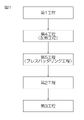
- FIG. 1 is a flow chart of one embodiment of the electrode manufacturing method of the present invention.
- 2A to 2D are manufacturing process diagrams based on FIG. FIG. 2 shows the first step and the fourth step.
- FIG. 2B is the fifth step.
- FIG. 2C is the second step.
- FIG. 2D is the third step.
- the electrode 1 has a thickness. Electrode 1 extends in the plane direction. The plane direction is perpendicular to the thickness direction. The electrode 1 has a film shape extending in the plane direction.
- the electrode 1 includes a base film 2, a metal base layer 3, and a conductive carbon layer 4 in order toward one side in the thickness direction.
- the base film 2 has a film shape extending in the surface direction.
- Materials for the base film 2 include, for example, resins and ceramic materials (eg, silicon). Resin is preferred from the viewpoint of ensuring excellent flexibility.
- resins examples include polyester resins, acetate resins, polyethersulfone resins, polycarbonate resins, polyamide resins, polyimide resins, polyolefin resins (e.g., polyethylene, polypropylene, polycycloolefin polymers), (meth)acrylic resins, and polyvinyl chloride.
- Resins include polyvinylidene chloride resins, polystyrene resins, polyvinyl alcohol resins, polyarylate resins, and polyphenylene sulfide resins.
- Polyester resins are preferred. Polyester resins include, for example, polyethylene terephthalate, polybutylene terephthalate, and polyethylene naphthalate.
- the resin is a polyester resin (more preferably, polyethylene terephthalate), the flexibility of the base film 2 is excellent, but the partial pressure of water in the atmosphere tends to increase in the subsequent third step. This is because the polyester resin has a relatively high moisture content.
- the increase in the partial pressure of water in the third step can be suppressed by the fourth step (heating step).
- the thickness of the base film 2 is, for example, 2 ⁇ m or more, preferably 10 ⁇ m or more, and is, for example, 1000 ⁇ m or less, preferably 500 ⁇ m or less. If the thickness of the base film 2 is within the above range, the roll-to-roll method can be carried out with excellent transportability.
- the metal base layer 3 is arranged on one surface of the base film 2 in the thickness direction.
- the material of the metal underlying layer 3 is not limited.
- Materials for the metal underlayer 3 include, for example, titanium, tantalum, chromium, molybdenum, and tungsten. From the viewpoint of the stability of the electrode 1, titanium is preferred.
- the thickness of the metal underlayer 3 is, for example, 5 nm or more, preferably 6 nm or more, and is, for example, 50 nm or less, preferably 20 nm or less.
- the conductive carbon layer 4 is arranged on one surface of the metal underlayer 3 in the thickness direction.
- the physical properties of the conductive carbon layer 4 are not limited.
- the conductive carbon layer 4 comprises sp 2 and sp 3 bonds. That is, the conductive carbon layer 4 has carbon having sp2 bonds and carbon having sp3 bonds as main components. That is, the conductive carbon layer 4 is a layer having a graphite type structure and a diamond structure.
- the ratio of the number of sp 3 -bonded atoms to the sum of the number of sp 3 -bonded atoms and the number of sp 2 -bonded atoms is not limited.
- the ratio of the number of sp 3 bond atoms to the sum of the number of sp 3 bond atoms and the number of sp 2 bond atoms is, for example, 0.1 or more and 0.9 or less.
- the ratio of oxygen to carbon (O/C) at a position advanced by 4.5 nm from one side of the conductive carbon layer 4 toward the other side in the thickness direction is less than 0.01.
- the ratio of oxygen to carbon (O/C) at a position advanced by 4.5 nm from one side of the conductive carbon layer 4 in the thickness direction to the other side is 0.01 or more, the durability of the electrode 1 is reduced. , especially after long-term storage, the activity of the electrode 1 with respect to ferricyanide is reduced.
- the oxygen to carbon ratio (O/C) at the position of 4.5 nm is preferably 0.009 or less, more preferably 0.007 or less, even more preferably 0.005 or less, and particularly preferably 0.005 or less. 003 or less.
- the lower limit of the oxygen to carbon ratio (O/C) is not limited.
- the lower limit of the oxygen to carbon ratio (O/C) at 4.5 nm is, for example, 0.000.
- the oxygen to carbon ratio is measured using X-ray photoelectron spectroscopy (ESCA).
- the ratio is the elemental ratio of oxygen [atomic%] to the elemental ratio of carbon [atomic%]. Measurement conditions for X-ray photoelectron spectroscopy are described in Examples.
- the ratio of oxygen to carbon (O/C) on one side of the conductive carbon layer 4 is, for example, 0.1 or less, preferably 0.07 or less, more preferably 0.05 or less.
- the ratio of oxygen to carbon (O/C) on one surface of the conductive carbon layer 4 is, for example, 0.00 or more, preferably 0.01 or more.
- the ratio of oxygen to carbon (O/C) on one surface of the conductive carbon layer 4 is equal to or less than the upper limit described above, it is possible to suppress the decrease in activity of the electrode 1 with respect to ferricyanide after long-term storage.
- the thickness of the conductive carbon layer 4 is not limited.
- the thickness of the conductive carbon layer 4 is, for example, 0.1 nm or more, preferably 1 nm or more, and 100 nm or less, preferably 50 nm or less.
- the method for manufacturing the electrode 1 includes a first step, a second step, and a third step as essential steps. Moreover, the manufacturing method of the electrode 1 includes a fourth step and a fifth step as optional steps. Specifically, in the method for manufacturing the electrode 1, a first step, a fourth step, a fifth step, a second step, and a third step are performed in order. Also, each step is carried out, for example, by a roll-to-roll method. Further, all the first to fifth steps are performed using, for example, a common chamber 13 (see FIGS. 2A to 2D, which will be described later).
- a base film 2 is prepared.
- the base film 2 is long in the first direction.
- the first direction is one direction included in the planar direction.
- the first direction is the longitudinal direction.
- the base film 2 is prepared in roll form.
- the base film 2 includes a preliminary area 5 and a product area 6 in order in the first direction.
- the preliminary area 5 is not provided as a product, but is a preliminary area for forming the second conductive carbon layer 7 described later.
- the preliminary region 5 is specifically a region on one side of the base film 2 in the first direction.
- the preliminary region 5 is a region in which the metal underlayer 3 and the conductive carbon layer 4, which will be described later, are not disposed, and the second conductive carbon layer 7 is preliminarily disposed before the conductive carbon layer 4 is formed. be.
- the product area 6 is an area that is provided as a product.
- the product area 6 is, for example, the other side area of the base film 2 in the first direction.
- a metal base layer 3 and a conductive carbon layer 4, which will be described in detail later, are arranged.
- a fourth step is a heating step.
- the pressure in the reduced pressure atmosphere is not limited.
- the pressure is, for example, 10 Pa or less, preferably 1 Pa or less, more preferably 0.5 Pa or less, or, for example, greater than 0 Pa.
- the heating of the substrate film 2 under a reduced pressure atmosphere is performed in a sputtering apparatus 10 having a heating section 8 and a chamber 13 .
- the base film 2 is heated by the heating unit 8 provided in the sputtering device 10 .
- the heating unit 8 for example, a film forming roll 15 equipped with a temperature control device (not shown) can be used.
- the base film 2 is heated by bringing the base film 2 into contact with the surface of the film forming roll 15 described above.
- a second conductive carbon layer 7 as a conductive carbon layer is arranged on one side of the base film 2 in the thickness direction by sputtering.
- one surface in the thickness direction of the preliminary region 5 of the base film 2 is arranged by sputtering.
- the second conductive carbon layer 7 is arranged on one surface of the preliminary region 5 of the base film 2 in the thickness direction.
- the second conductive carbon layer 7 is not arranged on one side in the thickness direction of the product region 6 of the base film 2 .
- sputtering is performed under a reduced pressure atmosphere.
- the chamber 13 of the sputtering device 10 in the fifth step and the chamber 13 of the sputtering device 10 in the fourth step are common.
- the sputtering conditions for the fifth step are not limited, and may be the same as the sputtering conditions for the third step, for example. At least, power is applied to the target 16 made of sintered carbon.
- the base film 2 may be heated.
- a heating temperature is not limited.
- the conveying speed of the base film 2 is controlled so that only the preliminary region 5 of the long base film 2 is sputtered.
- the second conductive carbon layer 7 arranged in the fifth step contacts one surface of the preliminary region 5 of the base film 2 in the thickness direction.
- the second conductive carbon layer 7 may or may not have the same configuration and physical properties as the conductive carbon layer 4 described later. However, the second conductive carbon layer 7 does not have to act on the electrode 1 .
- the sputtering of the second conductive carbon layer 7 described above can be called "pre-sputtering", since it is carried out before the sputtering of the conductive carbon layer 4 acting on the electrode 1 . Therefore, the fifth step is a pre-sputtering step.
- the metal base layer 3 is arranged on one surface of the base film 2 in the thickness direction.
- the metal base layer 3 is formed on at least one surface of the product region 6 of the base film 2 in the thickness direction.
- the metal underlying layer 3 is not formed on the second conductive carbon layer 7 in the preliminary region 5 .
- the method for forming the metal underlayer 3 is not limited. For example, sputtering using the sputtering apparatus 10 described above may be used.
- power is applied to the target 16 made of the material of the metal underlayer 3 .
- the metal base layer 3 is formed on one surface in the thickness direction of the product region 6 of the base film 2 . That is, the base film 2 is placed in the first direction so that the portion of the long base film 2 where the second conductive carbon layer 7 is not yet formed faces the film forming roll 15 and the target 16 . Convey to one side.
- the preliminary area 5 and the product area 6 are all wound up on a second roll 12 (described later).
- the conductive carbon layer 4 is arranged on one side of the base film 2 in the thickness direction by sputtering.
- the partial pressure of water in the chamber is, for example, 3.00 ⁇ 10 ⁇ 4 Pa or less, preferably 2.00 ⁇ 10 ⁇ 4 Pa or less, more preferably 1.50 ⁇ 10 ⁇ 4 Pa or less, More preferably 1.45 ⁇ 10 ⁇ 4 Pa or less, particularly preferably 1.40 ⁇ 10 ⁇ 4 Pa or less, and 1.34 ⁇ 10 ⁇ 4 Pa or less, 1.30 ⁇ 10 ⁇ 4 Pa Below, 1.20 ⁇ 10 ⁇ 4 Pa or less is preferable. If the partial pressure of water is equal to or less than the above upper limit, the durability of the obtained electrode 1 can be improved.
- the lower limit of the partial pressure of water is not limited.
- the lower limit of the partial pressure of water is, for example, 0.01 ⁇ 10 ⁇ 4 Pa, further 0.05 ⁇ 10 ⁇ 4 Pa.
- a sputtering device 10 is used for sputtering.
- the sputtering apparatus 10 includes, for example, a first housing portion 21, a film forming portion 22, and a second housing portion 23. As shown in FIG. The sputtering apparatus 10 also includes a chamber 13 and a partition wall 14 .
- the partition 14 divides the chamber 13 into three spaces.
- the sputtering device 10 is provided with a first accommodation portion 21 , a film formation portion 22 , and a second accommodation portion 23 , each including three spaces.
- the first storage section 21 has a first roll 11 .
- the first roll 11 can wind up and unwind the base film 2 .
- the film forming section 22 is adjacent to the first accommodating section 21 .
- the chamber of the film forming section 22 is a film forming chamber.
- the film forming section 22 includes a film forming roll 15 , a target 16 and a vacuum pump 17 .
- the film-forming roll 15 is equipped with a temperature control device (not shown).
- the temperature control device can heat and cool the surface of the film forming roll 15 .
- the target 16 contains sintered carbon.
- the second accommodation section 23 is adjacent to the film forming section 22 .
- the second housing portion 23 is arranged on the side opposite to the first housing portion 21 with respect to the film forming portion 22 .
- the second storage section 23 includes the second roll 12 .
- the second roll 12 can wind up and unwind the base film 2 .
- the mode of sputtering is not limited.
- Sputtering includes, for example, magnetron sputtering, unbalanced magnetron sputtering, high power pulse sputtering, electron cyclotron resonance sputtering, RF sputtering, DC pulse sputtering, and ion beam sputtering.
- Magnetron sputtering is preferred.
- the film forming section 22 is provided with a magnet (not shown). The magnet is placed on the opposite side of the film forming roll 15 with respect to the target 16 .
- sputtering gases examples include inert gases.
- Inert gases include, for example, argon.
- the surface temperature of the film forming roll 15 is, for example, 0° C. or higher, preferably 25° C. or higher, more preferably 70° C. or higher, still more preferably 100° C. or higher, and for example, 200° C. or lower, preferably , 150° C. or less.
- the pressure of the sputtering gas is, for example, 1 Pa or less and, for example, 0.1 Pa or more.
- the electrode 1 having the base film 2, the metal base layer 3, and the conductive carbon layer 4 in order toward one side in the thickness direction is obtained.
- the electrode 1 includes the base film 2 and the second conductive carbon layer 7 in order in the preliminary region 5 toward one side in the thickness direction.
- the electrode 1 comprising the product region 6 can then be used as a variety of electrodes, preferably an electrode for electrochemical measurements that carry out electrochemical measurements, specifically cyclic voltammetry (CV). It can be used as a working electrode (working electrode) and as a working electrode (working electrode) for performing anodic-stripping-voltammetry (ASV).
- CV cyclic voltammetry
- ASV anodic-stripping-voltammetry
- the ratio of oxygen to carbon (O/C) at a position 4.5 nm away from one side of the conductive carbon layer 4 in the thickness direction toward the other side is less than 0.01. 1 and the object to be measured (more specifically, the anion of ferricyanide) can be reduced. Therefore, the electrode 1 has excellent activity with respect to the measurement target (ferricyan anion) even after long-term storage.
- the ratio of oxygen to carbon (O/C) at a position advanced by 4.5 nm from one side of the conductive carbon layer 4 toward the other side is less than 0.01, and the conductive If the oxygen to carbon ratio (O/C) on one side of the carbon layer 4 is 0.1 or less, the charge on one side of the electrode 1 is reduced to reduce the repulsion with ferricyanide, thereby increasing the activity. can be maintained.
- the conductive carbon layer 4 has sp 2 bonds and sp 3 bonds, so that the electrode 1 has a widened potential window while having high conductivity.
- the conductive carbon layer 4 is formed on one side of the base film 2 in the thickness direction by sputtering in an atmosphere with a water partial pressure of 1.40 ⁇ 10 ⁇ 4 Pa or less.
- the moisture content in the conductive carbon layer 4 can be reduced. Therefore, the durability of electrode activity is excellent.
- using this electrode 1 from ⁇ Ep when CV measurement for ferricyanide is performed, using the electrode 1 after a long time in a high temperature atmosphere, leaving when CV measurement for ferricyanide is performed The rate of change to ⁇ Ep later can be reduced. A method for calculating the rate of change will be described later in Examples. Furthermore, ⁇ Ep after standing can be kept high.
- the roll-to-roll method can be carried out smoothly because the base film 2 has excellent flexibility.
- the base film 2 contains a small amount of water, so the partial pressure of water tends to increase in the subsequent third step.
- the base film in the subsequent fourth step, the base film is heated under a reduced pressure atmosphere, so the moisture content of the base film 2 can be reduced. Therefore, deterioration in the durability of the electrode 1 due to the high partial pressure of water in the third step can be suppressed.
- the fifth step pre-sputtering
- water inside the chamber 13 used in the fifth step can be removed.
- the second conductive carbon layer 7 is formed in the preliminary region 5 by preliminary sputtering using the common chamber 13 and the common target before the second step. , can remove water near the target. Therefore, deterioration in the durability of the electrode 1 due to the high partial pressure of water in the third step can be suppressed.
- the metal underlayer 3 is arranged on one side of the base film 2 in the thickness direction, so that the electrode 1 having even higher conductivity can be manufactured.
- the roll-to-roll method can be carried out with excellent transportability.
- the timing of the 4th step is not limited as long as it is performed between the 1st step and the 3rd step.
- the 4th step and/or the 5th step may not be performed.
- the second step and the fifth step may be performed in order.
- the fifth step and the second step are performed in order.
- the metal underlying layer 3 can be formed using the chamber 13 from which water has been removed.
- the second conductive carbon layer 7 and the conductive carbon layer 4 are formed on one base film 2, they can be formed on separate base films 2 in a modified example.
- Examples and comparative examples are shown below to describe the present invention more specifically.
- the present invention is not limited to Examples and Comparative Examples.
- specific numerical values such as the mixing ratio (content ratio), physical property values, and parameters used in the following description are the corresponding mixing ratios ( Content ratio), physical properties, parameters, etc. be able to.
- Example 1 As shown in FIG. 2A, first, a roll-shaped film made of polyethylene terephthalate and having a thickness of 188 ⁇ m was prepared as the base film 2 (first step). The length of the base film 2 in the first direction was 50 m.
- the base film 2 was set in the sputtering device 10 as indicated by the solid line arrow and broken line arrow in FIG. 2A.
- the surface temperature of the film-forming roll 15 was set to 60 degreeC, and it was conveyed under vacuum (pressure of 0.1 Pa) for 9 hours (4th process, heating process). As a result, water in the base film 2 was removed.
- pre-sputtering was performed for 2 hours under the same conditions as the sputtering in the third step, which will be detailed later.
- the second conductive carbon layer 7 was formed on one surface in the thickness direction of the preliminary region 5 of the base film 2 (fifth step, pre-sputtering step).
- the first-direction length of the second conductive carbon layer 7 in the preliminary region 5 was 20 m.
- a metal base layer 3 made of titanium was formed on one side in the thickness direction of the product region 6 of the base film 2 using a magnetron sputtering method (second step).
- the conditions of the magnetron sputtering method are as follows.
- Target material Titanium Target power: 3.3 W/cm 2
- Sputtering gas Argon Sputtering chamber pressure: 0.3 Pa
- the thickness of the metal underlayer 3 was 7 nm.
- a conductive carbon layer 4 was formed on one side in the thickness direction of the metal base layer 3 in the product region 6 by magnetron sputtering (third step).
- the conditions of the magnetron sputtering method are as follows.
- Target material sintered carbon Argon gas pressure: 0.4 Pa
- Target power 3.3 W/cm 2
- the partial pressure of water in the atmosphere inside the sputtering apparatus 10 was 1.13 ⁇ 10 ⁇ 4 Pa.
- the thickness of the conductive carbon layer 4 was 10 nm.
- the electrode 1 having the substrate film 2, the metal base layer 3, and the conductive carbon layer 4 in order toward one side in the thickness direction was manufactured.
- Electrode 1 was manufactured in the same manner as in Example 1.
- the partial pressure of water in the second step in Examples 2 to 6 was as shown in Table 1.
- Examples 2 to 6 and Comparative Example 1 conditions different from Example 1 are described. These are also listed in Table 1, along with the partial pressure of water.
- Example 2 In Example 2, the pre-sputtering time in the fifth step was changed from 2 hours to 1 hour and 30 minutes.
- Example 3 In Example 3, the pre-sputtering time in the fifth step was changed from 2 hours to 1 hour.
- Example 4 In Example 4, the fifth step (pre-sputtering) was not performed.
- Example 5 In Example 5, the fourth step was not performed, and the pre-sputtering time in the fifth step was changed from 2 hours to 3 hours.
- pre-sputtering was performed for 3 hours under the same conditions as the sputtering in the third step.
- the second conductive carbon layer 7 was formed on one surface in the thickness direction of the preliminary region 5 of the base film 2 (fifth step, pre-sputtering step).
- the first-direction length of the second conductive carbon layer 7 in the preliminary region 5 was 20 m.
- a metal base layer 3 made of titanium was formed on one side in the thickness direction of the product region 6 of the base film 2 using a magnetron sputtering method (second step).
- the conditions of the magnetron sputtering method are as follows.
- Target material Titanium Target power: 3.3 W/cm 2 Sputtering gas: Argon Sputtering chamber pressure: 0.2 Pa
- the thickness of the metal underlayer 3 was 7 nm.
- a conductive carbon layer 4 was formed on one side in the thickness direction of the metal base layer 3 in the product region 6 by magnetron sputtering (third step).
- the conditions of the magnetron sputtering method are as follows.
- Target material sintered carbon Argon gas pressure: 0.2 Pa
- Target power 3.3 W/cm 2
- the partial pressure of water in the atmosphere inside the sputtering apparatus 10 was 1.25 ⁇ 10 ⁇ 4 Pa.
- the thickness of the conductive carbon layer 4 was 10 nm.
- the electrode 1 having the substrate film 2, the metal base layer 3, and the conductive carbon layer 4 in order toward one side in the thickness direction was manufactured.
- Example 8 In Example 8, the pre-sputtering time in the fifth step was 30 minutes.
- Ratio (O/C) by X-ray photoelectron spectroscopy (ESCA) ⁇ Sample preparation and calculation method> A sample of 1 cm square was cut out from the electrode 1 of each of Examples 1 to 8 and Comparative Example 1. The sample was fixed on the sample table. After that, the sample is subjected to wide scan measurement for qualitative analysis, and further depth profile measurement by Ar ion etching is performed to determine the element ratio (atomic %) was calculated. From this, the ratio O/C was calculated. The analyzer and measurement conditions are described below.
- a sample electrode having a known electrode area was attached to one surface of the conductive carbon layer 4 to prepare a sample electrode having a known electrode area. Cyclic voltammetry (CV) was performed using this sample electrode as a working electrode. Specifically, the sample electrode was immersed in a 1M KCl aqueous solution. In addition, 1 mM [Fe(CN) 6 ] 4 ⁇ (ferricyanide ion) was added to the aqueous solution as an electrode active substance. In the CV measurement, the potential sweep was started from 0V and the potential was swept from positive to negative in the range of -0.1 to 0.5V. The potential sweep rate was 0.1 V/s. CV measurements were performed at 23°C. The number of CV measurements was 3. The average value of the 3 ⁇ Ep values in the CV measurements was taken as the initial ⁇ Ep
- ⁇ Ep after standing was measured in the same manner as above. This ⁇ Ep was determined as the ferricyanide activity after the change. The unit of ⁇ Ep is [mV]. A low ⁇ Ep means that the electrode 1 has high activity (excellent durability) after long-term storage.
- Electrodes are used for electrochemical measurements.
Landscapes
- Chemical & Material Sciences (AREA)
- Chemical Kinetics & Catalysis (AREA)
- Engineering & Computer Science (AREA)
- Mechanical Engineering (AREA)
- Organic Chemistry (AREA)
- Metallurgy (AREA)
- Materials Engineering (AREA)
- Health & Medical Sciences (AREA)
- Life Sciences & Earth Sciences (AREA)
- Analytical Chemistry (AREA)
- Physics & Mathematics (AREA)
- Molecular Biology (AREA)
- Electrochemistry (AREA)
- Biochemistry (AREA)
- General Health & Medical Sciences (AREA)
- General Physics & Mathematics (AREA)
- Immunology (AREA)
- Pathology (AREA)
- Plasma & Fusion (AREA)
- Physical Vapour Deposition (AREA)
Priority Applications (4)
| Application Number | Priority Date | Filing Date | Title |
|---|---|---|---|
| US18/283,593 US12344928B2 (en) | 2021-03-23 | 2022-03-23 | Electrode and method of producing the electrode |
| JP2023509270A JPWO2022202941A1 (https=) | 2021-03-23 | 2022-03-23 | |
| CN202280022655.1A CN116997673A (zh) | 2021-03-23 | 2022-03-23 | 电极及其制造方法 |
| EP22775723.4A EP4317521A4 (en) | 2021-03-23 | 2022-03-23 | Electrode, and its production process |
Applications Claiming Priority (4)
| Application Number | Priority Date | Filing Date | Title |
|---|---|---|---|
| JP2021048725 | 2021-03-23 | ||
| JP2021-048725 | 2021-03-23 | ||
| JP2022046632 | 2022-03-23 | ||
| JP2022-046632 | 2022-03-23 |
Publications (1)
| Publication Number | Publication Date |
|---|---|
| WO2022202941A1 true WO2022202941A1 (ja) | 2022-09-29 |
Family
ID=83395777
Family Applications (1)
| Application Number | Title | Priority Date | Filing Date |
|---|---|---|---|
| PCT/JP2022/013729 Ceased WO2022202941A1 (ja) | 2021-03-23 | 2022-03-23 | 電極およびその製造方法 |
Country Status (3)
| Country | Link |
|---|---|
| US (1) | US12344928B2 (https=) |
| JP (1) | JPWO2022202941A1 (https=) |
| WO (1) | WO2022202941A1 (https=) |
Cited By (1)
| Publication number | Priority date | Publication date | Assignee | Title |
|---|---|---|---|---|
| WO2025182769A1 (ja) * | 2024-02-28 | 2025-09-04 | 日東電工株式会社 | 電極、バイオセンサーおよび電極の製造方法 |
Families Citing this family (1)
| Publication number | Priority date | Publication date | Assignee | Title |
|---|---|---|---|---|
| CN116134306A (zh) * | 2020-07-22 | 2023-05-16 | 日东电工株式会社 | 电极 |
Citations (8)
| Publication number | Priority date | Publication date | Assignee | Title |
|---|---|---|---|---|
| JPH02133593A (ja) * | 1988-11-11 | 1990-05-22 | Mitsui Eng & Shipbuild Co Ltd | 炭素質電極 |
| JP2005310995A (ja) * | 2004-04-20 | 2005-11-04 | Mitsubishi Gas Chem Co Inc | 電気二重層キャパシタ電極用炭素材料およびその製造法 |
| JP2011109942A (ja) * | 2009-11-25 | 2011-06-09 | Mitsui Eng & Shipbuild Co Ltd | 生化学反応用炭素電極 |
| WO2016013478A1 (ja) | 2014-07-22 | 2016-01-28 | 東洋紡株式会社 | 薄膜積層フィルム |
| JP2017122261A (ja) * | 2016-01-06 | 2017-07-13 | 株式会社アルバック | 成膜方法 |
| JP2018155728A (ja) * | 2017-03-15 | 2018-10-04 | 学校法人東京理科大学 | 導電性ダイヤモンドライクカーボンマイクロ電極 |
| JP2020144116A (ja) * | 2019-02-28 | 2020-09-10 | 日東電工株式会社 | 電極および電気化学測定システム |
| JP2021056205A (ja) * | 2019-03-28 | 2021-04-08 | 日東電工株式会社 | 電極および電気化学測定システム |
Family Cites Families (7)
| Publication number | Priority date | Publication date | Assignee | Title |
|---|---|---|---|---|
| CN1061472C (zh) * | 1996-12-25 | 2001-01-31 | 中国科学院化学研究所 | 锂二次电池碳负极材料及其制备方法 |
| JP5122670B2 (ja) * | 2010-11-05 | 2013-01-16 | 日東電工株式会社 | 透明導電性フィルムの製造方法 |
| GB201203219D0 (en) * | 2012-02-24 | 2012-04-11 | Teer Coatings Ltd | Coating with conductive and corrosion resistance characteristics |
| CN105874545B (zh) * | 2014-03-31 | 2017-07-21 | 株式会社钟化 | 透明导电膜的制造方法 |
| CN106460153B (zh) * | 2014-04-30 | 2019-05-10 | 日东电工株式会社 | 透明导电性膜及其制造方法 |
| WO2017212363A1 (en) * | 2016-06-06 | 2017-12-14 | Semiconductor Energy Laboratory Co., Ltd. | Sputtering apparatus, sputtering target, and method for forming semiconductor film with the sputtering apparatus |
| JP7337498B2 (ja) * | 2017-12-11 | 2023-09-04 | 日東電工株式会社 | 電極フィルムおよび電気化学測定システム |
-
2022
- 2022-03-23 JP JP2023509270A patent/JPWO2022202941A1/ja active Pending
- 2022-03-23 US US18/283,593 patent/US12344928B2/en active Active
- 2022-03-23 WO PCT/JP2022/013729 patent/WO2022202941A1/ja not_active Ceased
Patent Citations (8)
| Publication number | Priority date | Publication date | Assignee | Title |
|---|---|---|---|---|
| JPH02133593A (ja) * | 1988-11-11 | 1990-05-22 | Mitsui Eng & Shipbuild Co Ltd | 炭素質電極 |
| JP2005310995A (ja) * | 2004-04-20 | 2005-11-04 | Mitsubishi Gas Chem Co Inc | 電気二重層キャパシタ電極用炭素材料およびその製造法 |
| JP2011109942A (ja) * | 2009-11-25 | 2011-06-09 | Mitsui Eng & Shipbuild Co Ltd | 生化学反応用炭素電極 |
| WO2016013478A1 (ja) | 2014-07-22 | 2016-01-28 | 東洋紡株式会社 | 薄膜積層フィルム |
| JP2017122261A (ja) * | 2016-01-06 | 2017-07-13 | 株式会社アルバック | 成膜方法 |
| JP2018155728A (ja) * | 2017-03-15 | 2018-10-04 | 学校法人東京理科大学 | 導電性ダイヤモンドライクカーボンマイクロ電極 |
| JP2020144116A (ja) * | 2019-02-28 | 2020-09-10 | 日東電工株式会社 | 電極および電気化学測定システム |
| JP2021056205A (ja) * | 2019-03-28 | 2021-04-08 | 日東電工株式会社 | 電極および電気化学測定システム |
Non-Patent Citations (1)
| Title |
|---|
| MITSUNOBU TAKEMOTO, TOMOYUKI KAMATA, DAI KATO, MASAHIKO HARA: "Controlling Surface Oxygen Concentration of a Nanocarbon Film Electrode for Improvement of Target Analytes", ANALYTICAL SCIENCES, vol. 36, no. 4, 10 April 2020 (2020-04-10), pages 441 - 446, XP055969234, ISSN: 0910-6340, DOI: 10.2116/analsci.19P375 * |
Cited By (1)
| Publication number | Priority date | Publication date | Assignee | Title |
|---|---|---|---|---|
| WO2025182769A1 (ja) * | 2024-02-28 | 2025-09-04 | 日東電工株式会社 | 電極、バイオセンサーおよび電極の製造方法 |
Also Published As
| Publication number | Publication date |
|---|---|
| JPWO2022202941A1 (https=) | 2022-09-29 |
| US12344928B2 (en) | 2025-07-01 |
| US20240167146A1 (en) | 2024-05-23 |
Similar Documents
| Publication | Publication Date | Title |
|---|---|---|
| TWI821534B (zh) | 電極及電化學測定系統 | |
| Windisch Jr et al. | Mott–Schottky analysis of thin ZnO films | |
| JP2019105637A (ja) | 電極フィルムおよび電気化学測定システム | |
| WO2022202941A1 (ja) | 電極およびその製造方法 | |
| CN109689880B (zh) | 通过物理气相沉积制备的生物传感器电极 | |
| US6136704A (en) | Method for forming porous platinum films | |
| JPWO2004065656A1 (ja) | Ito薄膜、その成膜方法、透明導電性フィルム及びタッチパネル | |
| CN107740058A (zh) | 具有垂直阵列结构的金属/非金属复合薄膜的制备方法 | |
| Hamdi et al. | Electrodeposition study of silver: Nucleation process and theoretical analysis | |
| WO2019117112A1 (ja) | 電極フィルムおよび電気化学測定システム | |
| Schlesinger et al. | Development of thin film electrodes based on sputtered amorphous carbon | |
| JP2026042820A (ja) | 電極 | |
| Wang et al. | Enhanced capacitive performance and stability of on-chip micro-supercapacitor electrode films via TiN-Mo2N alloying and laminating strategies | |
| Bettini et al. | Electrochemical impedance spectroscopy on nanostructured carbon electrodes grown by supersonic cluster beam deposition | |
| Zhang et al. | A universal method for the preparation of functional ITO electrodes with ultrahigh stability | |
| TW201631205A (zh) | 溼式薄膜沈積法 | |
| CN116997673A (zh) | 电极及其制造方法 | |
| KR101695590B1 (ko) | 티타늄금속기판 위에 다이아몬드 코팅층이 형성된 수처리용 구조재 및 그 제조 방법 | |
| WO2022210387A1 (ja) | 電極 | |
| JP2023152904A (ja) | 電極および電気化学測定システム | |
| JP2996922B2 (ja) | 水素感知用酸化スズ薄膜センサおよびその製造方法 | |
| KR20150107684A (ko) | 투명 도전성 기판의 제조방법 | |
| KR101582446B1 (ko) | 다층계면구조를 갖는 수처리용 DLC/Ti 전극 제조 방법 | |
| WO2024180988A1 (ja) | 電極および電気化学測定システム | |
| KR100444028B1 (ko) | 은-염화은 전극 제조방법 |
Legal Events
| Date | Code | Title | Description |
|---|---|---|---|
| 121 | Ep: the epo has been informed by wipo that ep was designated in this application |
Ref document number: 22775723 Country of ref document: EP Kind code of ref document: A1 |
|
| WWE | Wipo information: entry into national phase |
Ref document number: 2023509270 Country of ref document: JP |
|
| WWE | Wipo information: entry into national phase |
Ref document number: 202280022655.1 Country of ref document: CN |
|
| WWE | Wipo information: entry into national phase |
Ref document number: 18283593 Country of ref document: US |
|
| WWE | Wipo information: entry into national phase |
Ref document number: 2022775723 Country of ref document: EP |
|
| NENP | Non-entry into the national phase |
Ref country code: DE |
|
| ENP | Entry into the national phase |
Ref document number: 2022775723 Country of ref document: EP Effective date: 20231023 |
|
| WWG | Wipo information: grant in national office |
Ref document number: 18283593 Country of ref document: US |