WO2022202079A1 - ガラスクロス - Google Patents
ガラスクロス Download PDFInfo
- Publication number
- WO2022202079A1 WO2022202079A1 PCT/JP2022/007656 JP2022007656W WO2022202079A1 WO 2022202079 A1 WO2022202079 A1 WO 2022202079A1 JP 2022007656 W JP2022007656 W JP 2022007656W WO 2022202079 A1 WO2022202079 A1 WO 2022202079A1
- Authority
- WO
- WIPO (PCT)
- Prior art keywords
- glass cloth
- glass
- mass
- weft
- warp
- Prior art date
- Legal status (The legal status is an assumption and is not a legal conclusion. Google has not performed a legal analysis and makes no representation as to the accuracy of the status listed.)
- Ceased
Links
Images


Classifications
-
- D—TEXTILES; PAPER
- D06—TREATMENT OF TEXTILES OR THE LIKE; LAUNDERING; FLEXIBLE MATERIALS NOT OTHERWISE PROVIDED FOR
- D06M—TREATMENT, NOT PROVIDED FOR ELSEWHERE IN CLASS D06, OF FIBRES, THREADS, YARNS, FABRICS, FEATHERS OR FIBROUS GOODS MADE FROM SUCH MATERIALS
- D06M15/00—Treating fibres, threads, yarns, fabrics, or fibrous goods made from such materials, with macromolecular compounds; Such treatment combined with mechanical treatment
- D06M15/19—Treating fibres, threads, yarns, fabrics, or fibrous goods made from such materials, with macromolecular compounds; Such treatment combined with mechanical treatment with synthetic macromolecular compounds
- D06M15/37—Macromolecular compounds obtained otherwise than by reactions only involving carbon-to-carbon unsaturated bonds
-
- D—TEXTILES; PAPER
- D06—TREATMENT OF TEXTILES OR THE LIKE; LAUNDERING; FLEXIBLE MATERIALS NOT OTHERWISE PROVIDED FOR
- D06M—TREATMENT, NOT PROVIDED FOR ELSEWHERE IN CLASS D06, OF FIBRES, THREADS, YARNS, FABRICS, FEATHERS OR FIBROUS GOODS MADE FROM SUCH MATERIALS
- D06M13/00—Treating fibres, threads, yarns, fabrics or fibrous goods made from such materials, with non-macromolecular organic compounds; Such treatment combined with mechanical treatment
- D06M13/10—Treating fibres, threads, yarns, fabrics or fibrous goods made from such materials, with non-macromolecular organic compounds; Such treatment combined with mechanical treatment with compounds containing oxygen
- D06M13/165—Ethers
- D06M13/17—Polyoxyalkyleneglycol ethers
-
- D—TEXTILES; PAPER
- D06—TREATMENT OF TEXTILES OR THE LIKE; LAUNDERING; FLEXIBLE MATERIALS NOT OTHERWISE PROVIDED FOR
- D06M—TREATMENT, NOT PROVIDED FOR ELSEWHERE IN CLASS D06, OF FIBRES, THREADS, YARNS, FABRICS, FEATHERS OR FIBROUS GOODS MADE FROM SUCH MATERIALS
- D06M13/00—Treating fibres, threads, yarns, fabrics or fibrous goods made from such materials, with non-macromolecular organic compounds; Such treatment combined with mechanical treatment
- D06M13/50—Treating fibres, threads, yarns, fabrics or fibrous goods made from such materials, with non-macromolecular organic compounds; Such treatment combined with mechanical treatment with organometallic compounds; with organic compounds containing boron, silicon, selenium or tellurium atoms
- D06M13/51—Compounds with at least one carbon-metal or carbon-boron, carbon-silicon, carbon-selenium, or carbon-tellurium bond
- D06M13/513—Compounds with at least one carbon-metal or carbon-boron, carbon-silicon, carbon-selenium, or carbon-tellurium bond with at least one carbon-silicon bond
-
- D—TEXTILES; PAPER
- D06—TREATMENT OF TEXTILES OR THE LIKE; LAUNDERING; FLEXIBLE MATERIALS NOT OTHERWISE PROVIDED FOR
- D06M—TREATMENT, NOT PROVIDED FOR ELSEWHERE IN CLASS D06, OF FIBRES, THREADS, YARNS, FABRICS, FEATHERS OR FIBROUS GOODS MADE FROM SUCH MATERIALS
- D06M15/00—Treating fibres, threads, yarns, fabrics, or fibrous goods made from such materials, with macromolecular compounds; Such treatment combined with mechanical treatment
- D06M15/19—Treating fibres, threads, yarns, fabrics, or fibrous goods made from such materials, with macromolecular compounds; Such treatment combined with mechanical treatment with synthetic macromolecular compounds
- D06M15/37—Macromolecular compounds obtained otherwise than by reactions only involving carbon-to-carbon unsaturated bonds
- D06M15/643—Macromolecular compounds obtained otherwise than by reactions only involving carbon-to-carbon unsaturated bonds containing silicon in the main chain
- D06M15/6433—Macromolecular compounds obtained otherwise than by reactions only involving carbon-to-carbon unsaturated bonds containing silicon in the main chain containing carboxylic groups
-
- D—TEXTILES; PAPER
- D06—TREATMENT OF TEXTILES OR THE LIKE; LAUNDERING; FLEXIBLE MATERIALS NOT OTHERWISE PROVIDED FOR
- D06M—TREATMENT, NOT PROVIDED FOR ELSEWHERE IN CLASS D06, OF FIBRES, THREADS, YARNS, FABRICS, FEATHERS OR FIBROUS GOODS MADE FROM SUCH MATERIALS
- D06M15/00—Treating fibres, threads, yarns, fabrics, or fibrous goods made from such materials, with macromolecular compounds; Such treatment combined with mechanical treatment
- D06M15/19—Treating fibres, threads, yarns, fabrics, or fibrous goods made from such materials, with macromolecular compounds; Such treatment combined with mechanical treatment with synthetic macromolecular compounds
- D06M15/37—Macromolecular compounds obtained otherwise than by reactions only involving carbon-to-carbon unsaturated bonds
- D06M15/643—Macromolecular compounds obtained otherwise than by reactions only involving carbon-to-carbon unsaturated bonds containing silicon in the main chain
- D06M15/6436—Macromolecular compounds obtained otherwise than by reactions only involving carbon-to-carbon unsaturated bonds containing silicon in the main chain containing amino groups
-
- D—TEXTILES; PAPER
- D06—TREATMENT OF TEXTILES OR THE LIKE; LAUNDERING; FLEXIBLE MATERIALS NOT OTHERWISE PROVIDED FOR
- D06M—TREATMENT, NOT PROVIDED FOR ELSEWHERE IN CLASS D06, OF FIBRES, THREADS, YARNS, FABRICS, FEATHERS OR FIBROUS GOODS MADE FROM SUCH MATERIALS
- D06M2101/00—Chemical constitution of the fibres, threads, yarns, fabrics or fibrous goods made from such materials, to be treated
-
- D—TEXTILES; PAPER
- D10—INDEXING SCHEME ASSOCIATED WITH SUBLASSES OF SECTION D, RELATING TO TEXTILES
- D10B—INDEXING SCHEME ASSOCIATED WITH SUBLASSES OF SECTION D, RELATING TO TEXTILES
- D10B2101/00—Inorganic fibres
- D10B2101/02—Inorganic fibres based on oxides or oxide ceramics, e.g. silicates
- D10B2101/06—Glass
Definitions
- the present invention relates to glass cloth and prepreg.
- a laminate such as a printed wiring board comprises an insulating layer and a conductor layer formed thereon.
- a glass fiber reinforced resin reinforced with a glass fiber base material such as glass cloth is usually used.
- Patent Document 1 even if the average number of stages is less than 3.00, it is possible to suppress the occurrence of pinholes in a prepreg using glass cloth, and the prepreg is excellent because the glass cloth has less fluff. A glass cloth that can maintain appearance quality is described. Specifically, in Patent Document 1, as the configuration of the glass cloth, 14 to 55 long glass fibers having a diameter in the range of 3.0 to 4.2 ⁇ m are bundled from warps and wefts.
- the weaving density of the warp and weft is in the range of 86 to 140 / 25 mm, the thickness is in the range of 7.5 to 12.0 ⁇ m, and the mass is in the range of 6.0 to 10.0 g per 1 m 2
- the value obtained by dividing the thickness of the glass cloth by the average value of the diameter of the long glass fiber of the warp and the diameter of the long glass fiber of the weft (thickness of the glass cloth / ⁇ (diameter of the long glass fiber of the warp + weft
- the glass cloth is surface-treated with a silane coupling agent in order to improve the impregnation and adhesion of the matrix resin to the glass cloth in the prepreg and the printed wiring board obtained from the prepreg.
- a surface-treated glass fiber fabric comprising a glass fiber fabric as the surface-treated glass cloth and a treatment agent adhered to the glass fiber fabric, wherein the treatment agent contains a silane compound and water-soluble polyurethane.
- a surface-treated glass fiber fabric is known (see Patent Document 2, for example). According to the surface-treated glass fiber fabric, it is possible to provide a surface-treated glass fiber fabric that causes less misalignment even when it is made thinner and has sufficient rigidity, and a method for producing the same. It is said that
- prepregs and printed wiring boards have become thinner in order to meet the demand for smaller electronic devices and higher mounting of printed wiring boards for the purpose of higher functionality.
- a thin glass cloth is required to make prepregs and printed wiring boards thinner.
- glass fibers used in prepregs and printed wiring boards to have a low dielectric constant.
- low dielectric constant glass eg, NE glass, L glass, LU glass manufactured by Unitika Ltd., etc.
- NE glass, L glass, LU glass manufactured by Unitika Ltd., etc. is used as the glass material constituting the glass fiber.
- a thin glass cloth or a glass cloth using a low dielectric constant glass has a lower tensile strength and is more likely to break than a glass cloth using a relatively thick general-purpose E glass. There is a problem.
- the glass cloth used for prepregs and printed wiring boards is surface-treated with a surface treatment agent containing a silane coupling agent.
- the surface treatment process is carried out in the final process of glass cloth.
- the surface treatment is performed by impregnating a glass cloth continuous in the warp direction with a surface treatment agent containing a silane coupling agent or the like, adjusting the amount of the surface treatment agent adhered with a nip roll, and drying.
- the dried glass cloth is wound into a glass cloth roll, and the glass cloth roll is rewound and impregnated with a matrix resin to form a prepreg.
- the "bending stress in the weft direction B It has been found that it is important to set the residual curvature 2HB/B, which is the ratio of the bending hysteresis 2HB in the weft direction to 0.5 (cm -1 ) or less.
- the residual curvature 2HB/B is calculated from the bending hysteresis (2HB) obtained from the hysteresis curve in the bending characteristics measured with a pure bending tester and the bending stiffness (B), and is used in the process of recovery deformation from bending deformation.
- the energy loss is captured by the amount of residual strain, and the restoring force is quantified by the value of 2HB/B.
- the residual curvature 2HB/B can be regarded as the residual strain in the process of recovery deformation from bending deformation, and the smaller the residual strain, the higher the restoring force.
- the present inventors have found that by setting the residual curvature 2HB/B to 0.5 (cm -1 ) or less, deflection, waviness, etc. are less likely to occur during the glass cloth manufacturing process, and streaks during passage through the nip rolls during the process. It was found that the occurrence of can be easily prevented.
- the "shear stress in the weft direction" obtained by using a tensile shear tester, which is a type of texture measuring instrument, under the conditions described later It is important that the residual shear strain rate 2HG/G, which is the ratio of the shear hysteresis 2HG (gf/cm) in the weft direction to G (gf/cm/deg), is 1.4 (deg -1 ) or less.
- the residual shear strain rate 2HG/G is calculated from the shear hysteresis (2HG) and the shear stress (G) obtained from the hysteresis curve in the shear characteristics measured with a tensile shear tester, and is calculated from the recovery deformation from the shear deformation.
- the energy loss in the process is captured by the amount of residual strain, and the restoring force is quantified by the value of 2HG/G. In other words, this value can be regarded as residual strain in the process of recovery deformation from shear deformation, and the smaller the residual strain, the higher the restoring force.
- the present inventors found that by setting the residual shear strain rate to 1.4 (deg -1 ) or less, the strain inherent in the glass cloth is easily relaxed during the surface treatment process, and oblique wrinkles are not formed during winding. It was found that it becomes easier to prevent the occurrence.
- the present invention solves the above problem, and the residual curvature 2HB/B, which is the ratio of the bending hysteresis 2HB in the weft direction to the bending stress B in the weft direction, is 0.5 (cm ⁇ 1 ) or less, and A glass cloth whose residual shear strain rate 2HG/G, which is the ratio of the shear hysteresis 2HG (gf/cm) in the weft direction to the shear stress G (gf/cm/deg) of the glass cloth, is 1.4 (deg -1 ) or less.
- the main task is to provide Another object of the present invention is to provide a glass cloth in which the occurrence of transverse streaks and oblique wrinkles is suppressed.
- the inventors of the present invention have considered the above problem.
- the surface treatment step the surface containing (A) a polyoxyalkylene bisphenol A ether and (B) a silane coupling agent having an acrylic group or a methacrylic group
- a silane coupling agent having an acrylic group or a methacrylic group we have learned that it is important to apply the treatment agent to the glass cloth.
- the inventors have found that increasing the amount of surface treatment agent attached is effective in increasing the bending rigidity B.
- the present inventors applied (A) polyoxyalkylene bisphenol A ether to at least a part of the surface of the long glass fiber in the glass cloth composed of a plurality of long glass fibers as warp and weft. and (B) containing a silane coupling agent having an acrylic or methacrylic group, setting the warp and weft densities of the glass cloth to 70/25 mm or more, and setting the carbon content of the glass cloth to 0.4 to 1.5 mm.
- the residual curvature 2HB/B is 0.5 (cm -1 ) or less
- the residual shear strain rate 2HG/G is 1.4 (deg -1 ) or less. It has been found that wrinkles can be suppressed.
- the present invention is an invention that was completed through extensive research based on such findings.
- Section 1 A glass cloth composed of warp and weft glass yarns made of a plurality of long glass fibers, containing (A) a polyoxyalkylenebisphenol A ether and (B) a silane coupling agent having an acrylic group or a methacrylic group on at least a portion of the surface of the long glass fiber;
- the glass cloth has a warp density and a weft density of 70 threads/25 mm or more, A glass cloth having a carbon content of 0.4 to 1.5% by mass.
- Section 2. Item 1. The glass cloth according to item 1, which has a tensile strength in the warp direction of 20 to 120 N/25 mm.
- Item 3. Item 3.
- the glass cloth according to item 1 or 2 which has a thickness of 5 to 30 ⁇ m.
- Section 4. The glass cloth according to any one of Items 1 to 3, which is a roll-shaped long glass cloth obtained by winding the glass cloth around a winding core.
- Item 5. A prepreg comprising the glass cloth according to any one of Items 1 to 4 and a thermosetting resin impregnated in the glass cloth.
- the residual curvature 2HB/B is reduced to 0.5 (cm ⁇ 1 ) or less and a residual shear strain rate 2HG/G of 1.4 (deg ⁇ 1 ) or less can be satisfied, and the generation of transverse streaks and oblique wrinkles can be effectively suppressed.
- (a) shows a schematic diagram when measuring residual curvature 2HB/B using a pure bending tester, and (b) shows an example of a bending hysteresis curve obtained using a pure bending tester.
- (a) shows a schematic diagram when measuring the residual shear strain rate 2HG/G using a tensile shear tester, and (b) shows an example of a shear hysteresis curve obtained using a tensile shear tester. show.
- the glass cloth of the present invention is a glass cloth composed of a plurality of glass filaments made of glass filaments as warp and weft yarns, wherein (A) a polyoxy-oxygen compound is added to at least a part of the surface of the filaments. Alkylene bisphenol A ether and (B) a silane coupling agent having an acrylic group or a methacrylic group are included, the glass cloth has a weave density of 70 fibers/25 mm or more, and the glass cloth has a carbon content of 0.4 to 1. 0.5 mass %.
- the glass cloth of the present invention will be described in detail below.
- Glass Thread Constituting Glass Cloth In the glass cloth of the present invention, glass yarns composed of a plurality of long glass fibers are used as warp yarns and weft yarns.
- the glass material constituting the long glass fibers is not particularly limited.
- E-glass, T-glass, S-glass, UT-glass, D-glass, NE-glass, L-glass, LU-glass manufactured by Unitika Ltd. under trade names
- C-glass, or AR-glass can be used.
- the E-glass composition comprises SiO 2 in the range of 52-56% by weight, B 2 O 3 in the range of 5-10% by weight, and Al 2 O in the range of 12-16% by weight, based on the total amount of glass fibers. 3 , a total of CaO and MgO in the range of 20 to 25 mass %, and a total of Li 2 O, K 2 O and Na 2 O in the range of 0 to 1 mass %.
- the glass yarn contains SiO 2 in the range of 60 to 66% by mass and Al in the range of 20 to 26% by mass with respect to the total amount of the glass fiber. 2 O 3 and MgO in the range of 10 to 15 mass %).
- the glass yarns should be SiO 2 in the range of 45 to 60% by mass and SiO 2 in the range of 15 to 35% by mass with respect to the total amount of glass fibers.
- B 2 O 3 Al 2 O 3 of 10 to 20% by mass, and CaO of 1 to 15% by mass.
- the glass composition is measured by ICP emission spectrometry.
- the Si content and B content are determined by melting a weighed glass cloth sample with sodium carbonate, dissolving it with dilute nitric acid to a constant volume, and measuring the resulting sample by ICP emission spectrometry. obtain.
- the Fe content is obtained by dissolving a weighed glass cloth sample by an alkaline dissolution method to a constant volume, and measuring the obtained sample by ICP emission spectrometry.
- the Al content, Ca content, and Mg content were measured by thermally decomposing the weighed glass cloth sample with sulfuric acid, nitric acid, and hydrogen fluoride, and then dissolving it in dilute nitric acid to a constant volume. Obtained by spectrophotometry.
- the ICP emission spectrometer iCAP6300Duo manufactured by Thermo Fisher Co. can be used.
- the average fiber diameter of the long glass fibers is not particularly limited.
- the average fiber diameter of the long glass fibers is, for example, 2 to 7 ⁇ m, preferably 2.5 to 5.5 ⁇ m, more preferably 3 to 5 ⁇ m, from the viewpoint of making it easier to achieve the effects of the present invention. .
- the number of long glass fibers constituting the glass yarn is not particularly limited.
- it is 20 to 200, preferably 20 to 100, more preferably 20 to 50 or 30 to 50, from the viewpoint of making it easier to achieve the effects of the present invention.
- the average fiber diameter and number of long glass fibers are measured and calculated as follows. That is, two pieces of glass cloth to be measured are cut into 30 cm squares, one for warp observation and the other for weft observation, and each is embedded in epoxy cold embedding resin and cured. Next, the glass cloth embedded in the epoxy-based cold embedding resin is polished to the extent that the warp or weft can be observed, and the average fiber diameter is measured using SEM (trade name JSM-6390A manufactured by JEOL Ltd.). Observe at a magnification of 2000 times and the number of lines at a magnification of 500 times.
- Average fiber diameter of glass yarn ( ⁇ m) 30 warps and wefts are selected at random, and the cross section of the long fibers contained in each of the 30 glass yarns is observed to measure the diameter, and the average value is calculated to determine the glass length of the warp and weft. It is the average fiber diameter of the fiber.
- Number (pieces) Thirty warps and wefts are randomly selected, and the number of long fibers contained in each of the thirty glass threads is measured to calculate the average value, which is used as the number of warps and wefts.
- the count of the glass yarn is not particularly limited.
- 0.5 to 25 tex can be mentioned, and from the viewpoint of making it easier to achieve the effects of the present invention, 0.5 to 12 tex is preferable, 0.5 to 5 tex is more preferable, and 0.8 to 3.2 tex is preferable. More preferred.
- the count of glass yarn is a value measured and calculated according to the method specified in "7.1 count” of Japanese Industrial Standards JIS R 3420 2013 "Glass fiber general test method".
- the glass cloth of the present invention has a warp density and a weft density of 70/25 mm or more. Thereby, the shear stress G in the weft direction of the glass cloth can be increased, and the residual shear strain rate 2HG/G can easily satisfy 1.4 (deg ⁇ 1 ) or less.
- the warp density and the weft density are preferably 85 threads/25 mm or more.
- the upper limits of the warp density and the weft density are not particularly limited, they are preferably 130/25 mm or less, more preferably 120/25 mm or less, from the viewpoint of further reducing the mass of the glass cloth.
- the warp density and the weft density are 70 to 130 threads/25 mm, preferably 85 to 120 threads/25 mm.
- the warp density and the weft density are measured and calculated according to the method specified in "7.9 Density (woven density)" of Japanese Industrial Standard JIS R 3420 2013 "Glass fiber general test method”. value.
- the glass cloth is manufactured in a state where the warp threads are more tensioned than the weft threads. Therefore, since the weft yarns of the glass cloth are manufactured with a relatively weak tension, the yarn width unevenness when viewed from the plane direction of the glass cloth is larger than that of the warp yarns. Therefore, in the present invention, the weft can also be defined as the glass yarn having the greater unevenness of the yarn width when viewed from the plane direction, out of the warp and the weft.
- the weave structure of the glass cloth is not particularly limited, but examples thereof include plain weave, satin weave, twill weave, basket weave, and ridge weave. Among them, plain weave is preferable.
- the glass cloth of the present invention contains (A) a polyoxyalkylenebisphenol A ether and (B) a silane coupling agent having an acrylic group or a methacrylic group on at least part of the surfaces of long glass fibers.
- Polyoxyalkylenebisphenol A ether is a compound represented by the following general formula (1).
- R 1 and R 2 are the same or different and represent an alkylene group.
- the number of carbon atoms in the alkylene group is, for example, 2 to 4, preferably 2 or 3, more preferably 2.
- n 1 and n 2 represent the average number of added moles of alkylene oxide. Examples of n 1 and n 2 include 2 to 50, preferably 4 to 30, more preferably 6 to 20. Although n 1 and n 2 may be different numerical values, they may be approximately the same numerical value.
- One embodiment of the polyoxyalkylenebisphenol A ether is general formula (1), in which R 1 and R 2 are the same alkylene group, and n 1 and n 2 have approximately the same numerical value.
- the polyoxyalkylene bisphenol A ether used in the present invention preferably includes polyoxyethylene bisphenol A ether or polyoxypropylene bisphenol A ether. Among them, polyoxyethylene bisphenol A ether is more preferable from the viewpoint of excellent lubricity and easy reduction of fluffing of the glass cloth.
- the average number of added moles of alkylene oxide in the polyoxyalkylenebisphenol A ether used in the present invention is, for example, 2-40, preferably 4-30, more preferably 6-20.
- the average added mole number of alkylene oxide in the polyoxyalkylenebisphenol A ether is the average value of the total number of alkylene oxides contained in the two polyalkylene oxide chains constituting the polyoxyalkylenebisphenol A ether. .
- Silane coupling agents having an acryl group or a methacryl group include compounds represented by the following general formula (2).
- R3 represents a hydrogen atom or a methyl group.
- R 4 is an alkylene group having 1 to 6 carbon atoms.
- R 4 is preferably an alkylene group having 1 to 4 carbon atoms, more preferably an alkylene group having 2 to 4 carbon atoms, and still more preferably an alkylene group having 3 carbon atoms.
- the alkylene group for R 4 may be linear or branched, preferably branched.
- R 5 and R 6 each independently represent an alkyl group having 1 to 5 carbon atoms.
- R 5 and R 6 are preferably alkyl groups having 1 to 3 carbon atoms, more preferably alkyl groups having 1 or 2 carbon atoms, and still more preferably methyl groups.
- m represents an integer of 0 or more and 2 or less. m is preferably 0 or 1, more preferably 0.
- silane coupling agent having an acrylic group or a methacrylic group specifically, 3-acryloxypropyltrimethoxysilane (in general formula (2), R 3 is H, R 4 is —C 3 H 6 —, m is 0 and R 6 is —CH 3 ), 3-methacryloxypropyltrimethoxysilane (in general formula (2), R 3 is —CH 3 , R 4 is —C 3 H 6 —, m is 0 , R 6 is —CH 3 ), 3-acryloxypropylmethyldimethoxysilane (in general formula (2), R 3 is H, R 4 is —C 3 H 6 —, m is 1, R 5 and 3-methacryloxypropylmethyldimethoxysilane (in general formula (2), R 3 is —CH 3 , R 4 is —C 3 H 6 —, m is 1 , R 5 is and R 6 is —CH 3 ), 3-acryloxypropyltriethoxysilane (in general formula (2), R
- the ratio of (A) the polyoxyalkylene bisphenol A ether and (B) the silane coupling agent having an acrylic group or a methacrylic group is, for example, the total amount of (A) the polyoxyalkylene bisphenol A ether Per 100 parts by weight, the total amount of (B) a silane coupling agent having an acrylic group or a methacrylic group is 1 to 1000 parts by weight, preferably 10 to 500 parts by weight, and more preferably 50 to 400 parts by weight.
- the mass ratio of (A) polyoxyalkylenebisphenol A ether per 100 parts by mass of the total amount of components adhering to the surfaces of the long glass fibers is, for example, 10 to 90 parts by mass, It is preferably 10 to 80 parts by mass, more preferably 10 to 50 parts by mass, still more preferably 15 to 45 parts by mass.
- the mass ratio of (B) the silane coupling agent having an acrylic group or methacrylic group per 100 parts by mass of the total amount of the components adhering to the surfaces of the long glass fibers is, for example, 10 to 90 parts by mass, preferably 20 to 80 parts by mass.
- At least part of the surfaces of the long glass fibers can contain (B) a silane coupling agent other than a silane coupling agent having an acrylic group or a methacrylic group.
- silane coupling agents other than silane coupling agents having an acrylic group or a methacrylic group include silane coupling agents having an amino group, silane coupling agents having a vinyl group, silane coupling agents having a phenyl group, A silane coupling agent having a glycidoxy group, a silane coupling agent having an isocyanate group, a silane coupling agent having a mercapto group, a silane coupling agent having a styryl group, a silane coupling agent having a ureido group, and the like.
- Silane coupling agents having an organic functional group containing an amino group include compounds represented by the following general formula (3) and salts thereof.
- X represents an organic functional group having one or more amino groups.
- p represents an integer of 0 or more and 2 or less. P is preferably 0 or 1, more preferably 0.
- R 7 and R 8 each independently represent an alkyl group having 1 to 5 carbon atoms. R 7 and R 8 are preferably alkyl groups having 1 to 3 carbon atoms, more preferably alkyl groups having 1 or 2 carbon atoms.
- silane coupling agent having an amino group examples include N- ⁇ -(N-vinylbenzylaminoethyl)- ⁇ -aminopropyltrimethoxysilane and its hydrochloride, N- ⁇ -(N-vinylbenzyl aminoethyl)- ⁇ -aminopropyltriethoxysilane and its hydrochloride, N- ⁇ -(N-benzylaminoethyl)- ⁇ -aminopropyltrimethoxysilane and its hydrochloride, N- ⁇ -(N-benzylaminoethyl )- ⁇ -aminopropyltriethoxysilane and its hydrochloride, ⁇ -(2-aminoethyl)aminopropyltrimethoxysilane, ⁇ -(2-aminoethyl)aminopropyltriethoxysilane, 3-aminopropyltrimethoxysilane, single compounds such as ⁇ -(
- N- ⁇ -(N-vinylbenzylaminoethyl)- ⁇ -aminopropyltrimethoxysilane and its hydrochloride N- ⁇ -(N-vinylbenzylaminoethyl)- ⁇ -aminopropyltriethoxysilane and its hydrochloride
- N- ⁇ -(N-benzylaminoethyl)- ⁇ -aminopropyltriethoxysilane and its hydrochloride Salt is more preferred.
- Silane coupling agents having a vinyl group or a styryl group include compounds represented by the following general formula (4).
- Y represents an organic functional group containing one or more vinyl groups or styryl groups.
- R 9 is an alkyl group having 1 to 8 carbon atoms, preferably a methyl group, ethyl group, n-propyl group, isopropyl group, n-butyl group or t-butyl group.
- OR 10 is an optionally substituted alkoxy group having 1 to 8 carbon atoms, preferably a methoxy group, an ethoxy group or a methoxyethoxy group.
- q is an integer of 0 to 2, preferably 0.
- silane coupling agents having a vinyl group or a styryl group include vinyltrimethoxysilane, vinyltriethoxysilane, vinyltris(2-methoxyethoxy)silane, and styryltrimethoxysilane.
- the mass ratio of the total amount of the silane coupling agent per 100 parts by mass of the total amount of components adhering to the surfaces of the long glass fibers is, for example, 10 to 90 parts by mass, preferably 40 to 90 parts. parts by mass, more preferably 45 to 85 parts by mass.
- the total amount of the silane coupling agent is the total mass of (B) the silane coupling agent having an acrylic group or a methacrylic group and other silane coupling agents optionally included.
- the mass ratio of (B) the silane coupling agent having an acrylic group or methacrylic group per 100 parts by mass of the total amount of the silane coupling agent adhering to the surfaces of the long glass fibers is: For example, 10 to 100 parts by mass, preferably 30 to 100 parts by mass, more preferably 50 to 100 parts by mass.
- the total amount of the silane coupling agent is the total mass of (B) the silane coupling agent having an acrylic group or a methacrylic group and other silane coupling agents optionally included.
- At least part of the surfaces of the long glass fibers may contain a softening agent, an antistatic agent, or a surfactant, if necessary.
- a softening agent, an antistatic agent, and a surfactant may be appropriately selected depending on the type of surface treatment agent to be used.
- the glass cloth of the present invention has a carbon content of 0.4 to 1.5% by mass.
- the carbon content is an index of the adhesion amount of the surface treatment agent including (A) polyoxyalkylene bisphenol A ether and (B) a silane coupling agent having an acrylic group or a methacrylic group.
- the flexural rigidity B can be effectively increased, and the residual curvature 2HB/B can be made 0.5 (cm ⁇ 1 ) or less.
- the carbon content is more preferably 0.5 to 1.2% by mass, more preferably 0.6 to 1.1% by mass, from the viewpoint that the adhesion to the matrix resin when forming a prepreg is more likely to be improved. preferable.
- the carbon content is a value measured by the following procedure. First, using a total carbon measuring device, glass cloth was combusted and reduced under oxygen circulation at a reaction temperature of 850°C and a reduction temperature of 600°C. Quantify with a detector (TCD). Next, the carbon content of the glass cloth is calculated from a calibration curve prepared using an elemental quantitative standard sample acetanilide as a standard sample.
- the ignition loss is not particularly limited. 0.4 mass % is more preferred, and 1.05 to 1.3 mass % is even more preferred.
- the ignition loss is a value measured according to the method specified in "7.3.2 Ignition loss" of Japanese Industrial Standards JIS R 3420:2013 "Glass fiber general test method”. .
- the mass of the glass cloth of the present invention is not particularly limited, it is, for example, 5 to 50 g/m 2 , preferably 5 to 30 g/m 2 , more preferably 5 to 20 g/m 2 .
- the mass of the glass cloth is measured in accordance with the method specified in Japanese Industrial Standard JIS R 3420:2013 "Glass fiber general test method", "7.2 Mass of cloth and mat (mass)". value.
- the thickness ( ⁇ m) of the glass cloth of the present invention is not particularly limited, it is, for example, 5 to 50 ⁇ m, preferably 5 to 30 ⁇ m, more preferably 9 to 25 ⁇ m.
- the thickness of the glass cloth is measured using an electronic micrometer with a minimum display value of 0.001 mm, and the Japanese Industrial Standard JIS R3420: 2013 "Glass fiber general test method" "7.10.1 cloth It is a value measured according to B method specified in "thickness of".
- the tensile strength in the warp direction is 20 to 120 N/25 mm, preferably 25 to 110 N/25 mm, more preferably 30 to 100 N/25 mm.
- the above tensile strength was measured in accordance with the method specified in "7.4.2 Cloth" of the Japanese Industrial Standards JIS R 3420:2013 "Glass fiber general test method", constant speed elongation type tensile test Using a machine, the length of the test piece is 25 cm, the width of the test piece (width before loosening the thread from both ends) is 30 mm, the interval between grips is 15 cm, the width of the test piece (width after loosening the thread from both ends) 25 mm, the constant tensile speed is 200 mm / min, the warp direction of the glass cloth is measured 5 times, and the average value is the tensile strength in the warp direction of the glass cloth (N / 25 mm).
- the sizing agent and sizing agent required for weaving the warp and weft are deoiled.
- the deoiling treatment is called heat cleaning treatment.
- the glass cloth that has undergone the heat cleaning process has a tensile strength that is reduced to about half or less of that before the heat cleaning process.
- the preferred tensile strength range of 20 to 120 N/25 mm described above indicates the tensile strength of the heat-cleaned glass cloth, which is significantly different from that of the non-heat-cleaned glass cloth. be.
- the glass cloth of the present invention is a glass cloth composed of a plurality of glass long fibers as warp and weft, wherein (A) polyoxyalkylene bisphenol A ether, and (B) a silane coupling agent having an acrylic group or a methacrylic group, the glass cloth having a weave density of 70 fibers/25 mm or more, and a carbon content of 0.4 to 1.5% by mass. Based on a certain fact, it is possible to satisfy a residual curvature 2HB/B of 0.5 cm ⁇ 1 or less and a residual shear strain rate 2HG/G of 1.4 (deg ⁇ 1 ) or less.
- a more preferable range of the residual curvature 2HB/B of the glass cloth of the present invention is 0.1 cm -1 or more and 0.5 cm -1 or less, and more preferably 0.2 cm -1 or more and 0.45 cm -1 or less. preferable.
- a more preferable range of the residual shear strain rate 2HG/G included in the glass cloth of the present invention is preferably 0.1 deg -1 or more and 1.4 deg -1 or less, and 0.5 deg -1 or more and 1.2 deg -1 The following is more preferable, and 0.7 deg -1 or more and 1.1 deg -1 or less is even more preferable.
- the residual curvature 2HB/B of the glass cloth is a value measured using a KES-FB2 pure bending tester manufactured by Kato Tech Co., Ltd.
- a method for measuring the residual curvature 2HB/B of the glass cloth will be described with reference to FIG.
- the left figure of FIG. 1(a) is a schematic diagram of the state in which the glass cloth is bent into an arc by the pure bending tester, and the right figure of FIG. FIG. 10 is a diagram schematically showing a bending moment (M) generated in a bent state.
- FIG. 1(b) is an example of a bending hysteresis curve obtained using a pure bending tester.
- a bending test was performed by bending in an arc to the opposite side at a constant speed (deformation rate (0.5 -1 /sec)) until -2.5 cm -1 and then returning to the original position. Bending moment is measured (Fig. 1(a)).
- a bending test is performed for one cycle, and a bending hysteresis curve (vertical axis: bending moment, horizontal axis: curvature) as shown in FIG. 1(b) is obtained as a bending characteristic value.
- the bending stiffness B (gf ⁇ cm 2 /cm) per unit length and the hysteresis width 2HB (gf ⁇ cm/cm) are obtained. This measurement is carried out in an environment of 23° C. and 50% RH.
- KES-FB SYSTEM (Ver.7.18WJ) data measurement program
- B and 2HB are calculated using KES-FB CALC (Ver.7.07J) data calculation program.
- the measurement is repeated 5 times using 10 different glass cloth samples, and the average value of the residual shear strain rate 2HB/B, which is the ratio of the bending hysteresis 2HB in the weft direction to the bending stress B in the weft direction, is obtained.
- the residual shear strain rate 2HG/G of the glass cloth is a value measured using a KES-FB1 tensile shear tester manufactured by Kato Tech Co., Ltd.
- a method for measuring the residual shear strain rate 2HG/G of the glass cloth will be described with reference to FIG.
- FIG. 2(a) is a schematic diagram of a state in which the glass cloth is sheared to a shear angle ⁇ by a tensile shear tester
- FIG. 2(b) is a shear hysteresis curve obtained using the tensile shear tester. This is an example.
- the shear force applied is measured (see Fig. 2(a)).
- One cycle of the shear test is performed, and a shear hysteresis curve (vertical axis: shear force, horizontal axis: shear angle) as shown in FIG.
- the shear stress G (gf/cm/deg) in the weft direction and the hysteresis width 2HG (gf/cm) are obtained. This measurement is carried out in an environment of 23° C. and 50% RH.
- KES-FB SYSTEM (Ver.7.18WJ) data measurement program is used to measure
- KES-FB CALC (Ver.7.07J) data calculation program is used to calculate G and 2HG. be able to.
- the measurement was performed 5 times using 10 different glass cloth samples, and the residual shear strain, which is the ratio of the shear hysteresis 2HG (gf/cm) in the weft direction to the shear stress G (gf/cm/deg) in the weft direction Find the average value of the ratio 2HG/G.
- a glass cloth is woven using glass yarns made of a plurality of long glass fibers as warp yarns and weft yarns.
- any conventionally known method may be adopted. Tying using a sulzer loom, a rapier loom, or the like can be mentioned.
- an opening treatment and/or a heat cleaning treatment can be applied.
- the method of fiber-opening treatment include the fiber-opening treatment of the obtained glass cloth by the pressure of a water stream, and water (e.g., degassed water, ion-exchanged water, deionized water, electrolytic cation water, electrolytic anion water, etc.).
- Examples include fiber opening processing by high-frequency vibration using a medium such as a fiber, processing processing by pressure with a roll, and the like. Such opening treatment may be performed simultaneously with weaving, or may be performed after weaving.
- the fiber-opening treatment may be performed before or after the heat cleaning treatment, or at the same time as the heat cleaning treatment, or may be performed at the same time as the surface treatment described later or after the surface treatment described later.
- a known method can be adopted, such as a method of adjusting the warp tension, a pinch expander, a curved rubber roller, a rotating perimeter roller, a Mirabo roller, or a method of adjusting the warp tension.
- a method such as a tenter is employed to adjust and impart a tension balance between the warp direction and the weft direction while the fibers are opened, or a combination of these methods can be used.
- the woven glass cloth has a substance (for example, a sizing agent, etc.) that inhibits the adhesion and impregnation of the matrix resin when making it into a prepreg or a printed wiring board, it can be removed by, for example, a heat cleaning treatment. Material removal is preferred.
- the heat cleaning treatment may be omitted for the glass cloth woven from the glass yarns to which the surface treatment agent described later is added to the primary and secondary sizing agents.
- the temperature conditions for the heat cleaning treatment are preferably 350°C or higher, more preferably 350°C to 500°C, and still more preferably 380°C to 450°C.
- the time for the heat cleaning treatment may be appropriately set according to the temperature conditions to be adopted. When the product is subjected to heat cleaning treatment, it takes 20 to 60 hours, preferably 24 to 48 hours, more preferably 24 to 36 hours.
- the prepared glass cloth is subjected to surface treatment.
- a treatment agent is prepared.
- the treatment agent to be prepared contains a component and a solvent to be attached to the surface of the long glass fiber, and specifically includes (A) polyoxyalkylene bisphenol A ether and/or (B) acrylic group or methacrylic group A processing agent containing a silane coupling agent and a solvent.
- the type of solvent is not particularly limited, but examples include water.
- the content of (A) polyoxyalkylenebisphenol A ether in the treatment agent is not particularly limited, but is, for example, 1 to 30 g/L, preferably 2 to 20 g/L, more preferably 3 to 15 g/L. .
- the content of (B) the silane coupling agent having an acrylic group or a methacrylic group in the treatment agent is not particularly limited, but is, for example, 3 to 40 g/L, preferably 5 to 35 g/L, more preferably 10 g/L. ⁇ 30 g/L.
- the mass ratio of (A) polyoxyalkylenebisphenol A ether in the mass of all non-volatile components contained in the treatment agent is not particularly limited, but examples thereof include 10 to 90% by mass, and 20 to 80% by mass. Preferred is 10 to 50% by mass, and even more preferably 15 to 45% by mass.
- the mass ratio of (B) the silane coupling agent having an acrylic group or a methacrylic group in the mass of all non-volatile components contained in the treatment agent is not particularly limited, but may be, for example, 10 to 90% by mass. ⁇ 80% by mass is preferred.
- the mass ratio of the total silane coupling agent to the mass of all non-volatile components contained in the treatment agent is not particularly limited, but may be, for example, 10 to 90% by mass, preferably 40 to 90% by mass. and more preferably 45 to 85% by mass. Further, the ratio of the total mass of the silane coupling agent having an acrylic group or a methacrylic group to the total 100 parts by mass of all the silane coupling agents contained in the treatment agent is not particularly limited, but is, for example, 10 to 100 parts by mass. 30 to 100 parts by mass is preferable, and 50 to 100 parts by mass is more preferable.
- the "non-volatile component" is an absolute dry component after heat treatment at 110 ° C. under normal pressure to remove the solvent and the like and reaching a constant weight, and finally the glass cloth of the present invention. It is a component that remains attached to the surface of the long fibers.
- the glass cloth can be surface-treated by applying the treatment agent to the glass cloth by a method such as impregnating, coating, or spraying the prepared treatment agent on the glass cloth, and then drying it.
- a treatment agent obtained by mixing the above (A) and (B) may be applied to the prepared glass cloth and dried to treat the surface, or the above (A) and the above (B) may be used for the surface treatment. may be applied and dried in two stages as separate treatment agents.
- An embodiment of the glass cloth of the present invention is provided as a roll-shaped long glass cloth in which the glass cloth is wound around a winding core.
- the length and width of the glass cloth are not particularly limited. up to 2000 m, with a width of 10 to 200 cm, preferably 30 to 150 cm, more preferably 50 to 130 cm.
- the glass cloth of the present invention is suitably used as a fiber base material for prepreg. Above all, the glass cloth of the present invention is particularly suitable as a fiber base material for prepregs for printed wiring boards. A prepreg using the glass cloth of the present invention will be described later.
- the prepreg of the present invention comprises the glass cloth and the thermosetting resin impregnated in the glass cloth.
- thermosetting resin is not particularly limited as long as it is a resin that is cured by heat. resins, benzocyclobutene resins, vinyl resins, bismaleimide triazine resins, phenol resins, thermosetting polyphenylene ether resins, and the like.
- a thermosetting resin may be used individually by 1 type, or may use 2 or more types together.
- the prepreg of the present invention can contain an inorganic filler.
- inorganic fillers include silicas such as natural silica, fused silica, amorphous silica and hollow silica; boehmite; molybdenum compounds such as molybdenum oxide and zinc molybdate; alumina, talc, calcined talc, mica, short glass fibers, Glass fillers such as spherical glass (glass fillers using E glass, T glass, UT glass, S glass, D glass, NE glass, L glass, LU glass, etc. as glass materials), and the like.
- the prepreg of the present invention can be suitably used as a constituent material for printed wiring boards.
- Measurement and evaluation method 1-1 Average Fiber Diameter and Number of Long Glass Fibers
- the average fiber diameter of long glass fibers and the number of long glass fibers constituting the glass yarn were measured as follows. That is, two sheets of the obtained glass cloth were cut into 30 cm squares, one for warp observation and the other for weft observation. It was embedded in Specifix-40) and cured. Next, the glass cloth embedded in the epoxy-based cold embedding resin is polished to an extent that the warp or weft can be observed, and a scanning electron microscope (SEM) (trade name JSM-6390A manufactured by JEOL Ltd.) is used to The average fiber diameter was measured by observing at a magnification of 2000 times and the number of fibers was measured at a magnification of 500 times.
- SEM scanning electron microscope
- Average fiber diameter of long glass fibers ( ⁇ m) 30 warps and wefts are selected at random, and the cross section of the long fibers contained in each of the 30 glass yarns is observed to measure the diameter, and the average value is calculated to determine the glass length of the warp and weft. It was taken as the average fiber diameter of the fibers.
- Number of long glass fibers (fibers) 30 warps and wefts were randomly selected, and the total number of long fibers contained in each of the 30 glass yarns was measured, and the average value was calculated as the number of glass long fibers of the warp and weft.
- the glass yarn count of the glass cloth was measured according to the method specified in Japanese Industrial Standard JIS R 3420 2013 "Glass fiber general test methods", "7.1 count”. Specifically, first, 500 m of glass thread was collected from the thread winding device and used as a test piece. After laying the test piece flat and placing it in a muffle furnace and firing at 625° C. for 25 minutes, it was allowed to cool in a desiccator and the mass of the test piece was measured. The count was calculated according to the following formula.
- Mass of glass cloth The mass of the glass cloth was measured according to the method specified in Japanese Industrial Standard JIS R 3420:2013 "Glass fiber general test method", "7.2 Mass of cloth and mat (mass)". . Specifically, a square test piece with an area of 100 cm 2 was taken from a place 50 mm or more away from the edge of the glass cloth, dried at 105 ° C. for 1 hour, and then the mass of the test piece was measured. , the mass per m 2 was calculated according to the following formula:
- Thickness of glass cloth The thickness of the glass cloth was measured according to the B method specified in "7.10.1 Cloth thickness" of the Japanese Industrial Standard JIS R3420: 2013 "Glass fiber general test method”. . Specifically, the thickness at both ends and at a location 50 mm or more inward from the edge was measured using an electronic micrometer with a minimum display value of 0.001 mm.
- Ignition loss of glass cloth The ignition loss of glass cloth is measured according to the method specified in "7.3.2 Ignition loss" of Japanese Industrial Standard JIS R 3420: 2013 "Glass fiber general test method”. did. Specifically, a test piece of 100 cm 2 or more was cut out from a corner or a portion 10 mm or more inside from the edge, placed in a drier at 105° C., and dried for 30 minutes. After drying, the test piece was transferred into a desiccator, allowed to cool to room temperature, and weighed. Drying, cooling, and measurement were repeated until the mass became constant, and the mass of the test piece after drying was obtained. The dried specimens were then placed in a muffle furnace adjusted to 625° C. and heated for 10 minutes or longer.
- the tensile strength of glass cloth is determined according to the method specified in "7.4.2 Cloth" of the Japanese Industrial Standard JIS R 3420: 2013 "Glass fiber general test method”. Using a fast elongation type tensile tester (manufactured by Intesco Co., Ltd.), the test piece length is 25 cm, the test piece width (width before loosening the thread from both ends) is 30 mm, the grip interval is 15 cm, the test piece width (both ends The width after loosening the thread from the part) is 25 mm, the constant tensile speed is 200 mm / min, and the breaking strength is measured 5 times in the warp direction of the glass cloth, and the average value of the measured values is the tensile strength of the glass cloth. (N/25 mm).
- Residual curvature 2HB/B The residual curvature 2HB/B was measured using a KES-FB2 pure bending tester manufactured by Kato Tech Co., Ltd. as a bending tester. Specifically, two sheets of glass cloth were cut into 20 cm ⁇ 20 cm pieces, and the two sheets were stacked so that the warp and weft threads were in the same direction to obtain a test sample. The test sample was fixed so that the chuck-to-chuck distance was 1 cm. When fixing, the weft of the test sample was evenly wound around the chuck from both ends in the length direction. Next, as shown in FIG.
- a bending test was performed by bending in an arc to the opposite side at a constant speed (deformation rate (0.5 -1 /sec)) until -2.5 cm -1 and then returning to the original position. The bending moment was measured (Fig. 1(a)).
- a bending test was performed for one cycle, and a bending hysteresis curve as shown in FIG . 1(b) was obtained as a bending characteristic value. ⁇ cm/cm) was obtained. This measurement was performed under an environment of 23° C.
- measurement was performed using the KES-FB SYSTEM (Ver.7.18WJ) data measurement program, and B and 2HB were calculated using the KES-FB CALC (Ver.7.07J) data calculation program. The measurement was performed five times using ten different glass cloth samples, and the average value of the residual shear strain rate 2HB/B was obtained.
- Residual shear strain rate 2HG/G The residual shear strain rate 2HG/G was measured using KES-FB1 manufactured by Kato Tech Co., Ltd. as a tensile shear tester. Specifically, two sheets of glass cloth were cut into 20 cm ⁇ 20 cm pieces, and the two sheets were stacked so that the warp and weft threads were in the same direction to obtain a test sample. The test sample was fixed so that the chuck-to-chuck distance was 5 cm. When fixing, the weft of the test sample was evenly wound around the chuck from both ends in the length direction. Next, as shown in FIG.
- the shear force applied was measured (see FIG. 2(a)).
- the shear test was performed for one cycle, and a shear hysteresis curve as shown in FIG. 2(b) was obtained as a shear characteristic value.
- KES-FB SYSTEM (Ver.7.18WJ) data measurement program was used to measure
- KES-FB CALC (Ver.7.07J) data calculation program was used to calculate G and 2HG. The measurement was performed five times using ten different glass cloth samples, and the average value of the residual shear strain rate 2HG/G was obtained.
- the obtained glass cloth was visually inspected randomly for a length of 1000 m to observe the number of streaks, and the number of streaks generated per 100 m length was calculated. Evaluation was made according to the following criteria. The streaks having a length of 100 cm or more were counted. A: The number of streaks generated was 0.0/100 m. B: The number of streaks generated was 0.1 to 0.5/100m. C: The number of streaks generated exceeded 0.6/100 m.
- glass cloth Example 1 As warp and weft, composition: SiO2 : 51% by mass , Al2O3 : 13% by mass, CaO: 8 % by mass , B2O3: 23% by mass, balance 5% by mass, low dielectric constant/low dielectric
- a treatment agent of formulation 1 was prepared as a surface treatment agent.
- Table 1 shows the composition ratio of the non-volatile components of the processing agent.
- N- ⁇ -(N-vinylbenzylaminoethyl)- ⁇ -aminopropyltrimethoxysilane hydrochloride (trade name Sila Ace (registered trademark) S-350 manufactured by JNC Co., Ltd., non-volatile component 30%): 9.0 g/L 3-methacryloxypropyltrimethoxysilane (trade name Sila Ace (registered trademark) S-710 manufactured by JNC Co., Ltd., non-volatile component 98%): 13.5 g / L
- Polyoxyethylene bisphenol A ether manufactured by Yoshimura Yukagaku Co., Ltd. trade name GF690, non-volatile component 70%
- 5.2 g / L Balance pure water
- the heat-cleaned glass cloth is impregnated with the treatment agent of prescription 1 while applying a tension of 150 N/m in the length direction of the warp (the direction in which the warp continues), and a nip roll with a nip pressure of 35 N/cm 2 . and dried at a temperature of 120°C. Then, after being subjected to fiber opening treatment by high-pressure spraying, the fiber was impregnated again with the treatment agent of formula 1, squeezed with nip rolls having a nip pressure of 35 N/cm 2 , and dried at a temperature of 120°C to obtain glass cloth.
- the wefts have greater unevenness in yarn width than the warps
- the warp direction tensile strength is 96 N/25 mm
- the residual curvature 2HB/B in the weft direction is 0.41 (cm -1 )
- the residual shear in the weft direction is The strain rate 2HG/G was 0.99 (deg ⁇ 1 )
- the ignition loss was 1.16% by mass
- the carbon content was 0.72% by mass.
- Example 2 As warp and weft, composition: SiO2 : 51% by mass , Al2O3 : 13% by mass, CaO: 8 % by mass , B2O3: 23% by mass, balance 5% by mass, low dielectric constant/low dielectric
- a glass thread made of a tangent glass material, having an average fiber diameter of 4.0 ⁇ m and 100 long glass fibers was used. Glass threads were woven by an air jet loom to obtain a plain weave glass cloth roll with a warp density of 75/25 mm and a weft density of 76/25 mm. Then, the obtained glass cloth roll was subjected to a heat cleaning treatment by heating for 30 hours at an atmospheric temperature of 400°C. After the heat cleaning treatment, the glass cloth did not have any transverse streaks or oblique wrinkles.
- Table 1 shows the composition ratio of the non-volatile components of the processing agent.
- Prescription 2 3-methacryloxypropyltrimethoxysilane (trade name Sila Ace (registered trademark) S710 manufactured by JNC Co., Ltd., non-volatile component 98%): 6.75 g / L Vinyltrimethoxysilane (trade name Sila Ace (registered trademark) S210 manufactured by JNC Co., Ltd., nonvolatile component 99%): 6.0 g / L Polyoxyethylene bisphenol A ether (trade name GF690 manufactured by Yoshimura Yukagaku Co., Ltd., non-volatile component 70%): 15.7 g / L Polyalkylene polyamine fatty acid amide (trade name KSK-2240 manufactured by Lion Specialty Chemicals Co., Ltd., non-volatile component 30%): 5.0 g / L Balance: pure water
- the heat-cleaned glass cloth was impregnated with the treatment agent of prescription 2 while applying a tension of 150 N/m in the length direction of the warp, squeezed with a nip roll having a nip pressure of 35 N/cm 2 , and heated at 120 ° C. Dried. Then, after being subjected to fiber opening treatment by high-pressure spraying, the fiber was impregnated again with the treatment agent of formula 2, squeezed with nip rolls having a nip pressure of 35 N/cm 2 , and dried at a temperature of 120° C. to obtain glass cloth.
- the wefts have greater unevenness in yarn width than the warps
- the warp direction tensile strength is 81 N/25 mm
- the residual curvature 2HB/B in the weft direction is 0.36 (cm -1 )
- the residual shear in the weft direction is The strain rate 2HG/G was 0.94 (deg ⁇ 1 )
- the ignition loss was 1.25% by mass
- the carbon content was 0.96% by mass.
- Example 3 As warp and weft, composition: SiO2 : 51% by mass , Al2O3 : 13% by mass, CaO: 8 % by mass , B2O3: 23% by mass, balance 5% by mass, low dielectric constant/low dielectric
- a glass thread made of a tangent glass material, having an average fiber diameter of 4.0 ⁇ m and 100 long glass fibers was used. Glass threads were woven by an air jet loom to obtain a plain weave glass cloth roll with a warp density of 75/25 mm and a weft density of 76/25 mm. Then, the obtained glass cloth roll was subjected to a heat cleaning treatment by heating for 30 hours at an atmospheric temperature of 400°C. After the heat cleaning treatment, the glass cloth did not have any transverse streaks or oblique wrinkles.
- Table 1 shows the composition ratio of the non-volatile components of the processing agent.
- Prescription 3 3-methacryloxypropyltrimethoxysilane (trade name Sila Ace (registered trademark) S-710 manufactured by JNC Co., Ltd., non-volatile component 98%): 13.5 g / L
- Polyoxyethylene bisphenol A ether manufactured by Yoshimura Yukagaku Co., Ltd. trade name GF690, non-volatile component 70%
- 5.2 g / L Balance pure water
- the heat-cleaned glass cloth was impregnated with the treatment agent of formulation 3 while applying a tension of 150 N/m in the length direction of the warp, squeezed with nip rolls with a nip pressure of 35 N/cm 2 , and heated at 120 ° C. Dried. Then, after being subjected to fiber opening treatment by high-pressure spraying, the fiber was impregnated again with the treatment agent of formulation 3, squeezed with nip rolls having a nip pressure of 35 N/cm 2 , and dried at a temperature of 120° C. to obtain glass cloth.
- the wefts had greater unevenness in yarn width than the warps
- the warp direction tensile strength was 84 N/25 mm
- the residual curvature 2HB/B in the weft direction was 0.34 (cm -1 )
- the residual shear in the weft direction was 0.34 (cm -1 ).
- the strain rate 2HG/G was 1.02 (deg ⁇ 1 )
- the ignition loss was 1.10% by mass
- the carbon content was 0.65% by mass.
- Example 4 As warp and weft, composition: SiO2 : 49% by mass, Al2O3 : 14% by mass, CaO: 6 % by mass , B2O3: 28% by mass, and a low dielectric constant containing the balance of 3 % by mass
- a glass thread made of a tangent glass material, having an average fiber diameter of 4.0 ⁇ m and 50 long glass fibers was used. Glass threads were woven by an air jet loom to obtain a plain weave glass cloth roll with a warp density of 95/25 mm and a weft density of 95/25 mm. Then, the obtained glass cloth roll was subjected to a heat cleaning treatment by heating for 30 hours at an atmospheric temperature of 400°C. After the heat cleaning treatment, the glass cloth did not have any transverse streaks or oblique wrinkles.
- Table 1 shows the composition ratio of the non-volatile components of the processing agent.
- the heat-cleaned glass cloth was impregnated with the treatment agent of formulation 1 while applying a tension of 150 N/m in the length direction of the warp, squeezed with nip rolls with a nip pressure of 35 N/cm 2 , and heated to 120 ° C. Dried. Then, after being subjected to fiber opening treatment by high-pressure spraying, the fiber was impregnated again with the treatment agent of formula 1, squeezed with nip rolls having a nip pressure of 35 N/cm 2 , and dried at a temperature of 120°C to obtain glass cloth.
- the wefts have greater unevenness in yarn width than the warps
- the tensile strength in the warp direction is 49 N/25 mm
- the residual curvature 2HB/B in the weft direction is 0.40 (cm -1 )
- the residual shear in the weft direction is The strain rate 2HG/G was 0.96 (deg ⁇ 1 )
- the ignition loss was 1.13% by mass
- the carbon content was 0.64% by mass.
- Example 5 As warp and weft, composition: SiO2 : 49% by mass, Al2O3 : 14% by mass, CaO: 6 % by mass , B2O3: 28% by mass, and a low dielectric constant containing the balance of 3 % by mass
- a glass thread made of a tangent glass material, having an average fiber diameter of 4.0 ⁇ m and 50 long glass fibers was used. Glass threads were woven by an air jet loom to obtain a plain weave glass cloth roll with a warp density of 95/25 mm and a weft density of 95/25 mm. Then, the obtained glass cloth roll was subjected to a heat cleaning treatment by heating for 30 hours at an atmospheric temperature of 400°C. After the heat cleaning treatment, the glass cloth did not have any transverse streaks or oblique wrinkles.
- Table 1 shows the composition ratio of the non-volatile components of the treatment agent.
- the heat-cleaned glass cloth was impregnated with the treatment agent of prescription 2 while applying a tension of 150 N/m in the length direction of the warp, squeezed with a nip roll having a nip pressure of 35 N/cm 2 , and heated at 120 ° C. Dried.
- the treatment agent of formulation 2 squeezed with nip rolls having a nip pressure of 35 N/cm 2 , and dried at a temperature of 120°C to obtain glass cloth.
- the weft yarn has greater unevenness in yarn width than the warp yarn, the tensile strength in the warp yarn direction is 50 N/25 mm, the residual curvature 2HB/B in the weft yarn direction is 0.43 (cm -1 ), and the residual shear in the weft yarn direction is
- the strain rate 2HG/G was 0.93 (deg ⁇ 1 ), the ignition loss was 1.35% by mass, and the carbon content was 1.06% by mass.
- Example 6 As warp and weft, composition: SiO2 : 49% by mass, Al2O3 : 14% by mass, CaO: 6 % by mass , B2O3: 28% by mass, and a low dielectric constant containing the balance of 3 % by mass
- a glass thread made of a tangent glass material, having an average fiber diameter of 4.0 ⁇ m and 50 long glass fibers was used. Glass threads were woven by an air jet loom to obtain a plain weave glass cloth roll with a warp density of 95/25 mm and a weft density of 95/25 mm. Then, the obtained glass cloth roll was subjected to a heat cleaning treatment by heating for 30 hours at an atmospheric temperature of 400°C. After the heat cleaning treatment, the glass cloth did not have any transverse streaks or oblique wrinkles.
- Table 2 shows the composition ratio of the non-volatile components of the processing agent.
- the heat-cleaned glass cloth was impregnated with the treatment agent of formulation 3 while applying a tension of 150 N/m in the length direction of the warp, squeezed with nip rolls with a nip pressure of 35 N/cm 2 , and heated at 120 ° C. Dried. Then, after being subjected to fiber opening treatment by high-pressure spraying, it was impregnated again with the treatment agent of formulation 3, squeezed with nip rolls having a nip pressure of 35 N/cm 2 , and dried at a temperature of 120°C to obtain glass cloth. .
- the weft yarn has greater yarn width unevenness than the warp yarn, the warp direction tensile strength is 52 N/25 mm, the residual curvature 2HB/B in the weft direction is 0.41 (cm ⁇ 1 ), and the residual shear in the weft direction is
- the strain rate 2HG/G was 1.07 (deg ⁇ 1 ), the ignition loss was 1.06% by mass, and the carbon content was 0.70% by mass.
- Example 7 Warp and weft yarns, composition: SiO2 : 50% by mass, Al2O3 : 15% by mass, CaO: 5 % by mass , B2O3: 27% by mass, and a low dielectric constant containing the balance of 3 % by mass
- a glass thread made of a tangent glass material, having an average fiber diameter of 4.0 ⁇ m and 40 long glass fibers was used. Glass threads were woven by an air jet loom to obtain a plain weave glass cloth roll with a warp density of 95/25 mm and a weft density of 95/25 mm. Then, the obtained glass cloth roll was subjected to a heat cleaning treatment by heating for 30 hours at an atmospheric temperature of 400°C. After the heat cleaning treatment, the glass cloth did not have any transverse streaks or oblique wrinkles.
- the treatment agent of Formula 1 was prepared as a surface treatment agent.
- Table 2 shows the composition ratio of the non-volatile components of the treatment agent.
- the heat-cleaned glass cloth was impregnated with the treatment agent of formulation 1 while applying a tension of 150 N/m in the length direction of the warp, squeezed with nip rolls with a nip pressure of 35 N/cm 2 , and heated to 120 ° C. Dried. Then, after being subjected to fiber opening treatment by high-pressure spraying, the fiber was impregnated again with the treatment agent of formula 1, squeezed with nip rolls having a nip pressure of 35 N/cm 2 , and dried at a temperature of 120°C to obtain glass cloth.
- the wefts have greater unevenness in yarn width than the warps, the warp direction tensile strength is 36 N/25 mm, the residual curvature 2HB/B in the weft direction is 0.44 (cm -1 ), and the residual shear in the weft direction is
- the strain rate 2HG/G was 0.89 (deg ⁇ 1 ), the ignition loss was 1.17% by mass, and the carbon content was 0.80% by mass.
- Example 8 Warp and weft yarns, composition: SiO2 : 50% by mass, Al2O3 : 15% by mass, CaO: 5 % by mass , B2O3: 27% by mass, and a low dielectric constant containing the balance of 3 % by mass
- a glass thread made of a tangent glass material, having an average fiber diameter of 4.0 ⁇ m and 40 long glass fibers was used. Glass threads were woven by an air jet loom to obtain a plain weave glass cloth roll with a warp density of 95/25 mm and a weft density of 95/25 mm. Then, the obtained glass cloth roll was subjected to a heat cleaning treatment by heating for 30 hours at an atmospheric temperature of 400°C. After the heat cleaning treatment, the glass cloth did not have any transverse streaks or oblique wrinkles.
- Table 2 shows the composition ratio of the non-volatile components of the processing agent.
- the heat-cleaned glass cloth was impregnated with the treatment agent of prescription 2 while applying a tension of 150 N/m in the length direction of the warp, squeezed with a nip roll having a nip pressure of 35 N/cm 2 , and heated at 120 ° C. Dried.
- the treatment agent of formulation 2 squeezed with nip rolls having a nip pressure of 35 N/cm 2 , and dried at a temperature of 120°C to obtain glass cloth.
- the wefts have greater unevenness in yarn width than the warps, the warp direction tensile strength is 36 N/25 mm, the residual curvature 2HB/B in the weft direction is 0.49 (cm -1 ), and the residual shear in the weft direction is
- the strain rate 2HG/G was 0.89 (deg ⁇ 1 ), the ignition loss was 1.30% by mass, and the carbon content was 0.92% by mass.
- Example 9 Warp and weft yarns, composition: SiO2 : 50% by mass, Al2O3 : 15% by mass, CaO: 5 % by mass , B2O3: 27% by mass, and a low dielectric constant containing the balance of 3 % by mass
- a glass thread made of a tangent glass material, having an average fiber diameter of 4.0 ⁇ m and 40 long glass fibers was used. Glass threads were woven by an air jet loom to obtain a plain weave glass cloth roll with a warp density of 95/25 mm and a weft density of 95/25 mm. Then, the obtained glass cloth roll was subjected to a heat cleaning treatment by heating for 30 hours at an atmospheric temperature of 400°C. After the heat cleaning treatment, the glass cloth did not have any transverse streaks or oblique wrinkles.
- the treatment agent of Formula 3 was prepared as a surface treatment agent.
- Table 2 shows the composition ratio of the non-volatile components of the treatment agent.
- the heat-cleaned glass cloth was impregnated with the treatment agent of formulation 3 while applying a tension of 150 N/m in the length direction of the warp, squeezed with nip rolls with a nip pressure of 35 N/cm 2 , and heated at 120 ° C. Dried. Then, after being subjected to fiber opening treatment by high-pressure spraying, it was impregnated again with the treatment agent of formulation 3, squeezed with nip rolls having a nip pressure of 35 N/cm 2 , and dried at a temperature of 120°C to obtain glass cloth. .
- the wefts have greater unevenness in yarn width than the warps
- the warp direction tensile strength is 39 N/25 mm
- the residual curvature 2HB/B in the weft direction is 0.49 (cm -1 )
- the residual shear in the weft direction is The strain rate 2HG/G was 1.01 (deg ⁇ 1 )
- the ignition loss was 1.18% by mass
- the carbon content was 0.66% by mass.
- Example 10 Composition of warp and weft: SiO2 : 54% by mass , Al2O3 : 14% by mass, CaO: 23% by mass, MgO: 1% by mass, B2O3: 6 % by mass, balance 2 % by mass
- a glass thread composed of E glass, having an average fiber diameter of 3.6 ⁇ m and 38 long glass fibers was used. Glass threads were woven by an air jet loom to obtain a plain weave glass cloth roll with a warp density of 105/25 mm and a weft density of 110/25 mm. Then, the obtained glass cloth roll was subjected to a heat cleaning treatment by heating for 30 hours at an atmospheric temperature of 400°C. After the heat cleaning treatment, the glass cloth did not have any transverse streaks or oblique wrinkles.
- the treatment agent of Formula 1 was prepared as a surface treatment agent.
- Table 2 shows the composition ratio of the non-volatile components of the treatment agent.
- the heat-cleaned glass cloth was impregnated with the treatment agent of formulation 1 while applying a tension of 150 N/m in the length direction of the warp, squeezed with nip rolls with a nip pressure of 35 N/cm 2 , and heated to 120 ° C. Dried. Then, after being subjected to fiber opening treatment by high-pressure spraying, the fiber was impregnated again with the treatment agent of formula 1, squeezed with nip rolls having a nip pressure of 35 N/cm 2 , and dried at a temperature of 120°C to obtain glass cloth.
- the wefts have greater unevenness in yarn width than the warps
- the warp direction tensile strength is 51 N/25 mm
- the residual curvature 2HB/B in the weft direction is 0.48 (cm -1 )
- the residual shear in the weft direction is The strain rate 2HG/G was 1.03 (deg ⁇ 1 )
- the ignition loss was 0.61% by mass
- the carbon content was 0.73% by mass.
- composition SiO2 : 51% by mass , Al2O3 : 13% by mass, CaO: 8 % by mass , B2O3: 23% by mass, balance 5% by mass, low dielectric constant/low dielectric
- a treatment agent of prescription 4 was prepared as a surface treatment agent.
- Table 3 shows the composition ratio of the non-volatile components of the treatment agent.
- N- ⁇ -(N-vinylbenzylaminoethyl)- ⁇ -aminopropyltrimethoxysilane hydrochloride (trade name Sila Ace (registered trademark) S-350 manufactured by JNC Co., Ltd., non-volatile component 30%): 9.0 g/L Trimethoxyphenylsilane (trade name Z6124 manufactured by DuPont Toray Specialty Materials Co., Ltd., non-volatile component 90%): 14.7 g / L Balance: pure water
- the heat-cleaned glass cloth was impregnated with the treatment agent of prescription 4 while applying a tension of 150 N/m in the length direction of the warp, squeezed with a nip roll with a nip pressure of 35 N/cm 2 , and heated at 120 ° C. Dried. Then, after being subjected to fiber opening treatment by high-pressure spraying, the fiber was impregnated again with the treatment agent of formula 4, squeezed with nip rolls having a nip pressure of 35 N/cm 2 , and dried at a temperature of 120°C to obtain glass cloth.
- the wefts have greater unevenness in yarn width than the warps
- the warp direction tensile strength is 96 N/25 mm
- the residual curvature 2HB/B in the weft direction is 0.34 (cm -1 )
- the residual shear in the weft direction is
- the strain rate 2HG/G was 2.96 (deg ⁇ 1 )
- the ignition loss was 0.99% by mass
- the carbon content was 0.43% by mass.
- composition SiO2 : 51% by mass , Al2O3 : 13% by mass, CaO: 8 % by mass , B2O3: 23% by mass, balance 5% by mass, low dielectric constant/low dielectric
- a treatment agent of formulation 5 was prepared as a surface treatment agent.
- Table 3 shows the composition ratio of the non-volatile components of the treatment agent.
- Prescription 5 N- ⁇ -(N-vinylbenzylaminoethyl)- ⁇ -aminopropyltrimethoxysilane hydrochloride (trade name Sila Ace (registered trademark) S-350 manufactured by JNC Co., Ltd., non-volatile component 30%): 9.0 g/L Balance: pure water
- the heat-cleaned glass cloth was impregnated with the treatment agent of formulation 5 while applying a tension of 150 N/m in the length direction of the warp, squeezed with a nip roll with a nip pressure of 35 N/cm 2 , and heated at 120 ° C. Dried. Then, after being subjected to fiber opening treatment by high-pressure spraying, it was impregnated again with the treatment agent of formulation 5, squeezed with nip rolls having a nip pressure of 35 N/cm 2 , and dried at a temperature of 120°C to obtain glass cloth.
- the weft yarn has greater unevenness in yarn width than the warp yarn, the warp direction tensile strength is 78 N/25 mm, the residual curvature 2HB/B in the weft direction is 0.62 (cm -1 ), and the residual shear in the weft direction is
- the strain rate 2HG/G was 1.83 (deg ⁇ 1 ), the ignition loss was 0.63% by mass, and the carbon content was 0.14% by mass.
- composition SiO2 : 51% by mass , Al2O3 : 13% by mass, CaO: 8 % by mass , B2O3: 23% by mass, balance 5% by mass, low dielectric constant/low dielectric
- a treatment agent of formulation 6 was prepared as a surface treatment agent.
- Table 3 shows the composition ratio of the non-volatile components of the treatment agent.
- N- ⁇ -(N-vinylbenzylaminoethyl)- ⁇ -aminopropyltrimethoxysilane hydrochloride product name Sila Ace (registered trademark) S-350 manufactured by JNC Co., Ltd., non-volatile component 30%
- Polyoxyethylene bisphenol A ether manufactured by Yoshimura Yukagaku Co., Ltd. trade name GF690, non-volatile component 70%
- 5.2 g / L Balance pure water
- the heat-cleaned glass cloth was impregnated with the treatment agent of prescription 6 while applying a tension of 150 N/m in the length direction of the warp, squeezed with a nip roll with a nip pressure of 35 N/cm 2 , and heated at 120 ° C. Dried.
- the treatment agent of formula 6 squeezed with nip rolls having a nip pressure of 35 N/cm 2 , and dried at a temperature of 120°C to obtain glass cloth.
- the wefts have greater unevenness in yarn width than the warps, the warp direction tensile strength is 92 N/25 mm, the residual curvature 2HB/B in the weft direction is 1.42 (cm -1 ), and the residual shear in the weft direction is
- the strain rate 2HG/G was 1.09 (deg ⁇ 1 ), the ignition loss was 0.85% by mass, and the carbon content was 0.24% by mass.
- composition SiO2 : 49% by mass, Al2O3 : 14% by mass, CaO: 6 % by mass , B2O3: 28% by mass, and a low dielectric constant containing the balance of 3 % by mass
- a glass thread made of a tangent glass material, having an average fiber diameter of 4.0 ⁇ m and 50 long glass fibers was used. Glass threads were woven by an air jet loom to obtain a plain weave glass cloth roll with a warp density of 95/25 mm and a weft density of 95/25 mm. Then, the obtained glass cloth roll was subjected to a heat cleaning treatment by heating for 30 hours at an atmospheric temperature of 400°C. After the heat cleaning treatment, the glass cloth did not have any transverse streaks or oblique wrinkles.
- the treatment agent of prescription 5 was prepared as a surface treatment agent.
- Table 3 shows the composition ratio of the non-volatile components of the treatment agent.
- the heat-cleaned glass cloth was impregnated with the treatment agent of formulation 5 while applying a tension of 150 N/m in the length direction of the warp, squeezed with a nip roll with a nip pressure of 35 N/cm 2 , and heated at 120 ° C. Dried.
- the treatment agent of formulation 5 squeezed with nip rolls having a nip pressure of 35 N/cm 2 , and dried at a temperature of 120°C to obtain glass cloth.
- the wefts have greater unevenness in yarn width than the warps, the tensile strength in the warp direction is 53 N/25 mm, the residual curvature 2HB/B in the weft direction is 0.58 (cm -1 ), and the residual shear in the weft direction is 0.58 (cm -1 ).
- the strain rate 2HG/G was 1.79 (deg ⁇ 1 ), the ignition loss was 0.65% by mass, and the carbon content was 0.12% by mass.
- the treatment agent of prescription 5 was prepared as a surface treatment agent.
- Table 3 shows the composition ratio of the non-volatile components of the treatment agent.
- the heat-cleaned glass cloth was impregnated with the treatment agent of formulation 5 while applying a tension of 150 N/m in the length direction of the warp, squeezed with a nip roll with a nip pressure of 35 N/cm 2 , and heated at 120 ° C. Dried.
- the treatment agent of formulation 5 squeezed with nip rolls having a nip pressure of 35 N/cm 2 , and dried at a temperature of 120°C to obtain glass cloth.
- the weft yarn has greater unevenness in yarn width than the warp yarn, the warp direction tensile strength is 30 N/25 mm, the residual curvature 2HB/B in the weft direction is 0.56 (cm ⁇ 1 ), and the residual shear in the weft direction is
- the strain rate 2HG/G was 1.63 (deg ⁇ 1 ), the ignition loss was 0.65% by mass, and the carbon content was 0.12% by mass.
- the treatment agent of prescription 5 was prepared as a surface treatment agent.
- Table 3 shows the composition ratio of the non-volatile components of the treatment agent.
- the heat-cleaned glass cloth was impregnated with the treatment agent of formulation 5 while applying a tension of 150 N/m in the length direction of the warp, squeezed with a nip roll with a nip pressure of 35 N/cm 2 , and heated at 120 ° C. Dried.
- the treatment agent of formulation 5 squeezed with nip rolls having a nip pressure of 35 N/cm 2 , and dried at a temperature of 120°C to obtain glass cloth.
- the wefts have greater unevenness in yarn width than the warps, the warp direction tensile strength is 43 N/25 mm, the residual curvature 2HB/B in the weft direction is 0.79 (cm -1 ), and the residual shear in the weft direction is
- the strain rate 2HG/G was 1.59 (deg ⁇ 1 ), the ignition loss was 0.23% by mass, and the carbon content was 0.21% by mass.
- the glass cloths of Examples 1 to 10 are glass cloths composed of glass yarns made of a plurality of long glass fibers as warp and weft yarns, and at least a part of the surface of the glass long fibers is coated with (A) polyoxy Alkylene bisphenol A ether and (B) a silane coupling agent having an acrylic group or a methacrylic group are included, the glass cloth has a weave density of 70 fibers/25 mm or more, and the glass cloth has a carbon content of 0.4 to 1. 0.5% by mass, a glass cloth having a residual curvature 2HB/B of 0.5 (cm ⁇ 1 ) or less and a residual shear strain rate 2HG/G of 1.4 (deg ⁇ 1 ) or less can be obtained. was possible.
- the glass cloths of Examples 1 to 10 were able to suppress the occurrence of vertical wrinkles and oblique wrinkles.
- the glass cloth of Comparative Example 1 had a carbon content of 0.4% by mass or more, (A) polyoxyalkylene bisphenol A ether and (B) acrylic group were formed on at least a part of the surface of the long glass fiber.
- the residual shear strain rate 2HG/G exceeded 1.4 (deg ⁇ 1 ).
- the glass cloth of Comparative Example 1 was unable to suppress oblique wrinkles.
- the glass cloths of Comparative Examples 2 and 4 to 6 had a carbon content of less than 0.4% by mass, and (A) polyoxyalkylenebisphenol A ether and (B) were added to at least part of the surfaces of the long glass fibers. Since it did not contain a silane coupling agent having an acrylic group or a methacrylic group, the residual curvature 2HB/B exceeded 0.5 (cm -1 ), and the residual shear strain rate 2HG/G was It exceeded 1.4 (deg -1 ). The glass cloths of Comparative Examples 2 and 4 to 6 could not suppress the occurrence of vertical streaks and oblique wrinkles.
- the glass cloth of Comparative Example 3 had a carbon content of less than 0.4% by mass and did not contain (B) a silane coupling agent having an acrylic group or a methacrylic group on at least part of the surface of the long glass fiber. Therefore, the residual shear strain rate 2HG/G exceeded 1.4 (deg ⁇ 1 ). The glass cloth of Comparative Example 3 could not suppress the occurrence of vertical streaks.
Landscapes
- Engineering & Computer Science (AREA)
- Textile Engineering (AREA)
- Chemical & Material Sciences (AREA)
- Chemical Kinetics & Catalysis (AREA)
- Inorganic Chemistry (AREA)
- Organic Chemistry (AREA)
- Woven Fabrics (AREA)
- Reinforced Plastic Materials (AREA)
- Treatments For Attaching Organic Compounds To Fibrous Goods (AREA)
Abstract
Description
項1. 複数本のガラス長繊維からなるガラス糸を、経糸及び緯糸として構成されたガラスクロスであって、
前記ガラス長繊維の表面の少なくとも一部に(A)ポリオキシアルキレンビスフェノールAエーテル、及び(B)アクリル基又はメタクリル基を有するシランカップリング剤を含み、
前記ガラスクロスの経糸密度及び緯糸密度が70本/25mm以上であり、
前記ガラスクロスの炭素量が0.4~1.5質量%である、ガラスクロス。
項2. 経糸方向の引張強さが20~120N/25mmである、項1に記載のガラスクロス。
項3. 厚さが5~30μmである、項1又は2に記載のガラスクロス。
項4. 巻き芯にガラスクロスが巻かれてなるロール状長尺ガラスクロスである、項1~3のいずれかに記載のガラスクロス。
項5. 項1~4のいずれか1項に記載のガラスクロスと、該ガラスクロスに含浸された状態で含まれる熱硬化性樹脂を含む、プリプレグ。
本発明のガラスクロスは、複数本のガラス長繊維からなるガラス糸を、経糸及び緯糸として構成されたガラスクロスであって、前記ガラス長繊維の表面の少なくとも一部に(A)ポリオキシアルキレンビスフェノールAエーテル、及び(B)アクリル基又はメタクリル基を有するシランカップリング剤を含み、前記ガラスクロスの織密度が70本/25mm以上であり、前記ガラスクロスの炭素量が0.4~1.5質量%である。以下、本発明のガラスクロスについて詳述する。
本発明のガラスクロスは、複数本のガラス長繊維からなるガラス糸が、経糸及び緯糸として使用されている。
(1)ガラス糸の平均繊維直径(μm)
経糸及び緯糸それぞれについて無作為に30本選び、該30本のガラス糸のそれぞれに含まれる長繊維の断面を観察して直径を測定し、その平均値を算出して、経糸及び緯糸のガラス長繊維の平均繊維直径とする。
(2)本数(本)
経糸及び緯糸それぞれについて無作為に30本選び、30本のガラス糸のそれぞれに含まれる長繊維数を測定して平均値を算出し、経糸及び緯糸の本数とする。
本発明のガラスクロスは、経糸密度及び緯糸密度が70本/25mm以上である。これにより、ガラスクロスの緯糸方向のせん断応力Gを高めて、残留せん断歪み率2HG/Gが1.4(deg-1)以下を満たし易くすることができる。同様の観点から、経糸密度及び緯糸密度は、85本/25mm以上が好ましい。経糸密度及び緯糸密度の上限値としては、特に制限されないが、ガラスクロスをより低質量化させるという観点から、130本/25mm以下が好ましく、120本/25mm以下とすることがより好ましい。経糸密度及び緯糸密度として、具体的には、70~130本/25mm、好ましくは85~120本/25mmが挙げられる。なお、本発明において、経糸密度及び緯糸密度は、日本工業規格JIS R 3420 2013「ガラス繊維一般試験方法」の「7.9 密度(織り密度)」に規定されている方法に従い、測定、算出される値である。
本発明のガラスクロスは、ガラス長繊維の表面の少なくとも一部に(A)ポリオキシアルキレンビスフェノールAエーテル、及び(B)アクリル基又はメタクリル基を有するシランカップリング剤を含む。これらを含むことにより、ガラスクロスの緯糸方向の曲げヒステリシス2HBを小さくし、残留曲率2HB/Bを0.5(cm-1)以下とすることができる。また、これらを含むことにより、ガラスクロスの緯糸方向のせん断ヒステリシス2HGを小さくし、残留せん断歪み率2HG/Gが1.4(deg-1)以下とすることができる。




本発明のガラスクロスは、炭素量が0.4~1.5質量%である。当該炭素量は、(A)ポリオキシアルキレンビスフェノールAエーテル、及び(B)アクリル基又はメタクリル基を有するシランカップリング剤を含む、表面処理剤の付着量の指標となるものである。炭素量を前記範囲とすることにより効果的に曲げ剛性Bを高めることができ、残留曲率2HB/Bが0.5(cm-1)以下とすることが可能となる。前記炭素量は、プリプレグとする際のマトリックス樹脂との密着性がより向上しやすくなるという観点から、0.5~1.2質量%がより好ましく、0.6~1.1質量%が更に好ましい。本発明において、当該炭素量は、以下の手順で測定される値である。先ず、全炭素測定装置を用いて、ガラスクロスを反応温度850℃、還元温度600℃で酸素循環下にて燃焼及び還元させ、ポーラスポリマービーズ充填カラムでクロマト分離した全有機体炭素を熱伝導度検出器(TCD)にて定量する。次いで、標準試料として元素定量標準試料アセトアニリドを使用して作成した検量線から、ガラスクロスの炭素量を算出する。
次に、本発明のガラスクロスの製造方法の一例について説明する。まず、複数本のガラス長繊維からなるガラス糸を経糸及び緯糸としたガラスクロスを織成する。織成方法は、従来公知の任意の方法を採用すればよく、例えば、経糸を整経工程及び糊付工程を施した後、緯糸をジェット織機(例えば、エアージェット織機、ウォータージェット織機等)、スルザー織機、レピヤー織機等を用いて打ち込むことが挙げられる。
本発明のガラスクロスの一実施形態では、巻き芯にガラスクロスが巻かれたロール状長尺ガラスクロスとして提供される。本発明のガラスクロスがロール状長尺ガラスクロスである場合、ガラスクロスの長さ及び幅については、特に制限されないが、例えば、長さが10~4000m、好ましくは50~3000m、より好ましくは100~2000mが挙げられ、幅が10~200cm、好ましくは30~150cm、より好ましくは50~130cmが挙げられる。
本発明のプリプレグは、前記のガラスクロスと、前記ガラスクロスに含浸された状態で含まれる熱硬化性樹脂を含む。
1-1.ガラス長繊維の平均繊維直径及び本数
ガラス長繊維の平均繊維直径、及びガラス糸を構成するガラス長繊維の本数は次のように測定した。すなわち、得られたガラスクロスを30cm角にカットしたものを2枚用意し、一方を経糸観察用、他方を緯糸観察用として、それぞれをエポキシ系冷間埋設樹脂(ストルアス株式会社製商品名エポキシ樹脂スペシフィックス-40)に包埋して硬化させた。次いで、エポキシ系冷間埋設樹脂に包埋させたガラスクロスを、経糸又は緯糸が観察可能な程度に研磨し、走査電子顕微鏡(SEM)(日本電子株式会社製商品名JSM-6390A)を用い、平均繊維直径は倍率2000倍で、本数は倍率500倍で観察することにより測定した。
(1)ガラス長繊維の平均繊維直径(μm)
経糸及び緯糸それぞれについて無作為に30本選び、該30本のガラス糸のそれぞれに含まれる長繊維の断面を観察して直径を測定し、その平均値を算出して、経糸及び緯糸のガラス長繊維の平均繊維直径とした。
(2)ガラス長繊維本数(本)
経糸及び緯糸それぞれについて無作為に30本選び、30本のガラス糸のそれぞれに含まれる長繊維の総数を測定して平均値を算出し、経糸及び緯糸のガラス長繊維本数とした。
ガラスクロスの織密度は、日本工業規格JIS R 3420:2013「ガラス繊維一般試験方法」の「7.9 密度(織り密度)」に規定されている方法に準じて測定した。具体的には、ガラスクロスの端及び耳から50mm以上離れた位置を測定対象とし、測定間隔を10mm以上200mm以下に設定し、設定した測定間隔内にある全部の糸本数を測定した。これを1回の測定とし、前に測定した糸が含まれない他の位置に移して、同様の方法で測定間隔内にある全部の糸本数を更に2回測定した。3回の測定毎に、以下の式に従って25mm当たりの糸本数を求め、3回の測定値の平均値を算出した。
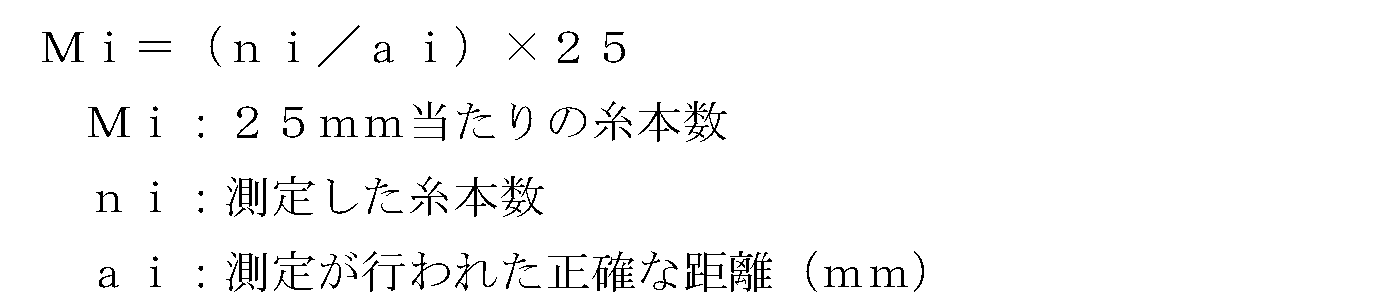
ガラスクロスにおけるガラス糸の番手は、日本工業規格JIS R 3420 2013「ガラス繊維一般試験方法」の「7.1 番手」に規定されている方法に準じて測定した。具体的には、先ず、糸巻き装置から500mのガラス糸を採取し、これを試験片とした。試験片を平らに置いてマッフル炉に入れて、625℃で25分間焼成した後に、デシケータ中で放冷して、試験片の質量を測定した。以下の式に従って番手を算出した。

ガラスクロスの質量は、日本工業規格JIS R 3420:2013「ガラス繊維一般試験方法」の「7.2 クロス及びマットの質量(質量)」に規定されている方法に準じて測定した。具体的には、ガラスクロスの耳端から50mm以上離れたところから、面積100cm2の正方形の試験片を採取し、試験片を105℃で1時間乾燥させた後に、試験片の質量を測定し、以下の式に従って1m2当たりの質量を算出した。

ガラスクロスの厚さは、日本工業規格JIS R3420:2013「ガラス繊維一般試験方法」の「7.10.1 クロスの厚さ」に規定されているB法に準じて測定した。具体的には、両端及び耳端から50mm以上内側の場所の厚さを、最小表示値が0.001mmである電子式マイクロメータを用いて測定した。
ガラスクロスの強熱減量は、日本工業規格JIS R 3420:2013「ガラス繊維一般試験方法」の「7.3.2 強熱減量」に規定されている方法に準じて測定した。具体的には、角又は端から10mm以上内側の部分から、100cm2以上の試験片を切り出し、105℃の乾燥機の中に入れ、30分間乾燥した。乾燥後、試験片をデシケータ内に移して室温まで放冷し、質量を測定した。質量が一定になるまで乾燥、冷却及び測定を繰り返し、乾燥後の試験片の質量を求めた。次いで、乾燥した試験片を625℃に調節したマッフル炉の中に入れて10分間以上加熱した。マッフル炉から試験片を取り出した後、デシケータに移して放冷し、試験片の質量を測定した。質量が一定になるまで加熱、冷却及び測定を繰り返し、乾燥及び加熱後の試験片の質量を求めた。以下の式に従って強熱減量(%)を算出した。

ガラスクロスの引張強さは、日本工業規格JIS R 3420:2013「ガラス繊維一般試験方法」の「7.4.2 クロスの場合」に規定されている方法に準じ、定速伸長型引張試験機(インテスコ株式会社製)を用い、試験片長さを25cm、試験片の幅(両端部から糸をほぐす前の幅)を30mm、つかみ間隔を15cm、試験片の幅(両端部から糸をほぐした後の幅)を25mm、定速引張速度を200mm/minとし、ガラスクロスの経糸方向について、5回破断強度を測定し、測定値の平均値をガラスクロスの引張強さ(N/25mm)とした。
全炭素測定装置(住化分析センター製SUMIGRAPH(登録商標)NCH-22F)を用いて、ガラスクロスを反応温度850℃、還元温度600℃で酸素循環下にて燃焼及び還元させ、ポーラスポリマービーズ充填カラムでクロマト分離した全有機体炭素を熱伝導度検出器(TCD)にて定量した。標準試料として元素定量標準試料アセトアニリドを使用して作成した検量線から、ガラスクロスの炭素量を算出した。
糸幅のムラは、ガラスクロスを20cm×20cmにカットし、光学顕微鏡等で平面方向から観察し、経糸を構成するガラス糸を1本任意に選択し、3本それぞれについて、端からガラス糸の長さ方向に1cmの箇所の糸幅を測定し、その地点からガラス糸の長さ方向に1cm毎に測定を残り18回繰り返し、合計19か所の糸幅を測定し、当該19か所の糸幅の変動係数CV値(=標準偏差/平均値)を求めた。この測定は経糸を構成するガラス糸3本について行い、経糸3本のCV値の平均値を求めた。また、同様の方法で緯糸を構成するガラス糸の糸幅のCV値についても求めた。CV値が大きい程が、糸幅のムラが大きいと判定される。
残留曲率2HB/Bは、曲げ測定の試験機としてカトーテック株式会社製KES-FB2純曲げ試験機を使用して測定した。具体的には、ガラスクロスを20cm×20cmにカットしたものを2枚準備し、当該2枚をそれぞれの経糸と緯糸が同じ方向になるように重ねて、試験サンプルとした。チャック間距離が1cmとなるように、試験サンプルを固定した。固定の際には、試験サンプルの緯糸の長さ方向の両端から均等にチャックに巻き付けた。次いで、図1(a)の様に緯糸が曲率K=+2.5cm-1になるまで等速度(変形速度(0.5-1/sec))で円弧状に曲げ、次に緯糸が最大曲率-2.5cm-1になるまで等速度(変形速度(0.5-1/sec))で反対側に円弧状に曲げた後に元に戻すことによって曲げ試験を行い、曲率の変化と共に発生する曲げモーメントを測定した(図1(a))。曲げ試験は1サイクルとし、曲げ特性値として図1(b)に示すような曲げヒステリシス曲線を得て、単位長さ当たりの曲げ剛性B(gf・cm2/cm)及びヒステリシスの幅2HB(gf・cm/cm)を求めた。本測定は、23℃、50%RH環境下で実施した。なお、本発明において、Bは曲率K=+0.5cm-1から+1.5cm-1の間で測定された曲げモーメント(M)の微分値の平均傾斜、2HBは曲率K=+1.0cm-1におけるヒステリシスの幅(図1(b)参照)として算出した。本試験では、KES-FB SYSTEM(Ver.7.18WJ)データ計測プログラムを用いて測定を行い、KES-FB CALC(Ver.7.07J)データ計算プログラムを用いてB及び2HBを算出した。異なるガラスクロスサンプル10枚を用いて前記測定を5回実施し、残留せん断歪み率2HB/Bの平均値を求めた。
残留せん断歪み率2HG/Gは、引張りせん断試験機としてカトーテック株式会社製KES-FB1を使用して測定した。具体的には、ガラスクロスを20cm×20cmにカットしたものを2枚準備し、当該2枚を、それぞれの経糸と緯糸が同じ方向になるように重ねて、試験サンプルとした。チャック間距離が5cmとなるように、試験サンプルを固定した。固定の際には、試験サンプルの緯糸の長さ方向の両端から均等にチャックに巻き付けた。次いで、図2のように、緯糸の長さ方向(すなわち、緯糸が連続する方向)に強制荷重(W)10gf/cmをかけた状態で経糸の長さ方向(すなわち、経糸が連続する方向)にせん断角度φ=+8°まで等速度(0.00834°/sec)で変形させ、その後逆方向にせん断角度φ=-8°まで変形させたのちに再び元に戻し、せん断角度の変化と共に発生するせん断力を測定した(図2(a)参照)。せん断試験は1サイクルとし、せん断特性値として図2(b)に示すようなせん断ヒステリシス曲線を得て、緯糸方向のせん断応力G(gf/cm/deg)、ヒステリシスの幅2HG(gf/cm)を求めた。本測定は、23℃、50%RH環境下で実施した。なお、Gはせん断角度φ=+0.5から+2.5の間で測定されたせん断力(Fs)の微分値の平均傾斜、2HGはせん断角度φ=+0.5におけるヒステリシスの幅(図2(b)参照)として算出した。本測定では、KES-FB SYSTEM(Ver.7.18WJ)データ計測プログラムを用いて測定を行い、KES-FB CALC(Ver.7.07J)データ計算プログラムを用いてG及び2HGを算出した。異なるガラスクロスサンプル10枚を用いて前記測定を5回実施し、残留せん断歪み率2HG/Gの平均値を求めた。
得られたガラスクロスについて無作為に長さ1000mを目視検査して経スジの数を観察し、長さ100mあたりの経スジの発生数を算出して、以下の基準により評価した。なお、経スジは長さ100cm以上のものをカウントした。
A:経スジの発生数が0.0個/100mであった。
B:経スジの発生数が0.1~0.5個/100mであった。
C:経スジの発生数が0.6個/100mを越えるものであった。
得られたガラスクロスについて無作為に長さ1000mを目視検査して斜めシワの数を観察し、斜めシワの有無を評価した。なお、斜めシワは長さ10cm以上のものをカウントした。
A:斜めシワの発生数がみられなかった。
B:斜めシワの発生数がみられた。
実施例1
経糸及び緯糸として、組成:SiO2:51質量%、Al2O3:13質量%、CaO:8質量%、B2O3:23質量%、残部5質量%を含む低誘電率・低誘電正接ガラス材料から構成され、平均繊維直径が4.0μm、本数が100本であるガラス長繊維からなるガラス糸を用いた。ガラス糸をエアージェット織機で織成し、経糸密度が75本/25mm、緯糸密度が76本/25mmの平織のガラスクロスロール(長尺ガラスクロスが巻き芯に巻かれたロール状長尺ガラスクロス)を得た。次いで、得られたガラスクロスロールを、雰囲気温度400℃の条件で30時間加熱することによりヒートクリーニング処理を施した。ヒートクリーニング処理後のガラスクロスでは経スジ及び斜めシワの発生はなかった。
(処方1)
N-β-(N-ビニルベンジルアミノエチル)-γ-アミノプロピルトリメトキシシラン塩酸塩(JNC株式会社製商品名サイラエース(登録商標)S-350、不揮発成分30%):9.0g/L
3-メタクリロキシプロピルトリメトキシシラン(JNC株式会社製商品名サイラエース(登録商標)S-710、不揮発成分98%):13.5g/L
ポリオキシエチレンビスフェノールAエーテル(吉村油化学株式会社製商品名GF690、不揮発成分70%):5.2g/L
残部:純水
経糸及び緯糸として、組成:SiO2:51質量%、Al2O3:13質量%、CaO:8質量%、B2O3:23質量%、残部5質量%を含む低誘電率・低誘電正接ガラス材料から構成され、平均繊維直径が4.0μm、本数が100本であるガラス長繊維からなるガラス糸を用いた。ガラス糸をエアージェット織機で織成し、経糸密度が75本/25mm、緯糸密度が76本/25mmの平織のガラスクロスロールを得た。次いで、得られたガラスクロスロールを、雰囲気温度400℃の条件で30時間加熱することによりヒートクリーニング処理を施した。ヒートクリーニング処理後のガラスクロスでは経スジ及び斜めシワの発生はなかった。
(処方2)
3-メタクリロキシプロピルトリメトキシシラン(JNC株式会社製商品名サイラエース(登録商標)S710、不揮発成分98%):6.75g/L
ビニルトリメトキシシラン(JNC株式会社製商品名サイラエース(登録商標)S210、不揮発成分99%):6.0g/L
ポリオキシエチレンビスフェノールAエーテル(吉村油化学株式会社製商品名GF690、不揮発成分70%):15.7g/L
ポリアルキレンポリアミン脂肪酸アミド(ライオン・スペシャリティ・ケミカルズ株式会社製商品名KSK-2240、不揮発成分30%):5.0g/L
残部:純水
経糸及び緯糸として、組成:SiO2:51質量%、Al2O3:13質量%、CaO:8質量%、B2O3:23質量%、残部5質量%を含む低誘電率・低誘電正接ガラス材料から構成され、平均繊維直径が4.0μm、本数が100本であるガラス長繊維からなるガラス糸を用いた。ガラス糸をエアージェット織機で織成し、経糸密度が75本/25mm、緯糸密度が76本/25mmの平織のガラスクロスロールを得た。次いで、得られたガラスクロスロールを、雰囲気温度400℃の条件で30時間加熱することによりヒートクリーニング処理を施した。ヒートクリーニング処理後のガラスクロスでは経スジ及び斜めシワの発生はなかった。
(処方3)
3-メタクリロキシプロピルトリメトキシシラン(JNC株式会社製商品名サイラエース(登録商標)S-710、不揮発成分98%):13.5g/L
ポリオキシエチレンビスフェノールAエーテル(吉村油化学株式会社製商品名GF690、不揮発成分70%):5.2g/L
残部:純水
経糸及び緯糸として、組成:SiO2:49質量%、Al2O3:14質量%、CaO:6質量%、B2O3:28質量%、残部3質量%を含む低誘電率・低誘電正接ガラス材料から構成され、平均繊維直径が4.0μm、本数が50本であるガラス長繊維からなるガラス糸を用いた。ガラス糸をエアージェット織機で織成し、経糸密度が95本/25mm、緯糸密度が95本/25mmの平織のガラスクロスロールを得た。次いで、得られたガラスクロスロールを、雰囲気温度400℃の条件で30時間加熱することによりヒートクリーニング処理を施した。ヒートクリーニング処理後のガラスクロスでは経スジ及び斜めシワの発生はなかった。
経糸及び緯糸として、組成:SiO2:49質量%、Al2O3:14質量%、CaO:6質量%、B2O3:28質量%、残部3質量%を含む低誘電率・低誘電正接ガラス材料から構成され、平均繊維直径が4.0μm、本数が50本であるガラス長繊維からなるガラス糸を用いた。ガラス糸をエアージェット織機で織成し、経糸密度が95本/25mm、緯糸密度が95本/25mmの平織のガラスクロスロールを得た。次いで、得られたガラスクロスロールを、雰囲気温度400℃の条件で30時間加熱することによりヒートクリーニング処理を施した。ヒートクリーニング処理後のガラスクロスでは経スジ及び斜めシワの発生はなかった。
経糸及び緯糸として、組成:SiO2:49質量%、Al2O3:14質量%、CaO:6質量%、B2O3:28質量%、残部3質量%を含む低誘電率・低誘電正接ガラス材料から構成され、平均繊維直径が4.0μm、本数が50本であるガラス長繊維からなるガラス糸を用いた。ガラス糸をエアージェット織機で織成し、経糸密度が95本/25mm、緯糸密度が95本/25mmの平織のガラスクロスロールを得た。次いで、得られたガラスクロスロールを、雰囲気温度400℃の条件で30時間加熱することによりヒートクリーニング処理を施した。ヒートクリーニング処理後のガラスクロスでは経スジ及び斜めシワの発生はなかった。
経糸及び緯糸として、組成:SiO2:50質量%、Al2O3:15質量%、CaO:5質量%、B2O3:27質量%、残部3質量%を含む低誘電率・低誘電正接ガラス材料から構成され、平均繊維直径が4.0μm、本数が40本であるガラス長繊維からなるガラス糸を用いた。ガラス糸をエアージェット織機で織成し、経糸密度が95本/25mm、緯糸密度が95本/25mmの平織のガラスクロスロールを得た。次いで、得られたガラスクロスロールを、雰囲気温度400℃の条件で30時間加熱することによりヒートクリーニング処理を施した。ヒートクリーニング処理後のガラスクロスでは経スジ及び斜めシワの発生はなかった。
経糸及び緯糸として、組成:SiO2:50質量%、Al2O3:15質量%、CaO:5質量%、B2O3:27質量%、残部3質量%を含む低誘電率・低誘電正接ガラス材料から構成され、平均繊維直径が4.0μm、本数が40本であるガラス長繊維からなるガラス糸を用いた。ガラス糸をエアージェット織機で織成し、経糸密度が95本/25mm、緯糸密度が95本/25mmの平織のガラスクロスロールを得た。次いで、得られたガラスクロスロールを、雰囲気温度400℃の条件で30時間加熱することによりヒートクリーニング処理を施した。ヒートクリーニング処理後のガラスクロスでは経スジ及び斜めシワの発生はなかった。
経糸及び緯糸として、組成:SiO2:50質量%、Al2O3:15質量%、CaO:5質量%、B2O3:27質量%、残部3質量%を含む低誘電率・低誘電正接ガラス材料から構成され、平均繊維直径が4.0μm、本数が40本であるガラス長繊維からなるガラス糸を用いた。ガラス糸をエアージェット織機で織成し、経糸密度が95本/25mm、緯糸密度が95本/25mmの平織のガラスクロスロールを得た。次いで、得られたガラスクロスロールを、雰囲気温度400℃の条件で30時間加熱することによりヒートクリーニング処理を施した。ヒートクリーニング処理後のガラスクロスでは経スジ及び斜めシワの発生はなかった。
経糸及び緯糸として、組成:SiO2:54質量%、Al2O3:14質量%、CaO:23質量%、MgO:1質量%、B2O3:6質量%、残部2質量%を含むEガラスから構成され、平均繊維直径が3.6μm、本数が38本であるガラス長繊維からなるガラス糸を用いた。ガラス糸をエアージェット織機で織成し、経糸密度が105本/25mm、緯糸密度が110本/25mmの平織のガラスクロスロールを得た。次いで、得られたガラスクロスロールを、雰囲気温度400℃の条件で30時間加熱することによりヒートクリーニング処理を施した。ヒートクリーニング処理後のガラスクロスでは経スジ及び斜めシワの発生はなかった。
経糸及び緯糸として、組成:SiO2:51質量%、Al2O3:13質量%、CaO:8質量%、B2O3:23質量%、残部5質量%を含む低誘電率・低誘電正接ガラス材料から構成され、平均繊維直径が4.0μm、本数が100本であるガラス長繊維からなるガラス糸を用いた。ガラス糸をエアージェット織機で織成し、経糸密度が75本/25mm、緯糸密度が76本/25mmの平織のガラスクロスロールを得た。次いで、得られたガラスクロスロールを、雰囲気温度400℃の条件で30時間加熱することによりヒートクリーニング処理を施した。ヒートクリーニング処理後のガラスクロスでは経スジ及び斜めシワの発生はなかった。
(処方4)
N-β-(N-ビニルベンジルアミノエチル)-γ-アミノプロピルトリメトキシシラン塩酸塩(JNC株式会社製商品名サイラエース(登録商標)S-350、不揮発成分30%):9.0g/L
トリメトキシフェニルシラン(デュポン・東レ・スペシャルティ・マテリアル株式会社製商品名Z6124、不揮発成分90%):14.7g/L
残部:純水
経糸及び緯糸として、組成:SiO2:51質量%、Al2O3:13質量%、CaO:8質量%、B2O3:23質量%、残部5質量%を含む低誘電率・低誘電正接ガラス材料から構成され、平均繊維直径が4.0μm、本数が100本であるガラス長繊維からなるガラス糸を用いた。ガラス糸をエアージェット織機で織成し、経糸密度が75本/25mm、緯糸密度が76本/25mmの平織のガラスクロスロールを得た。次いで、得られたガラスクロスロールを、雰囲気温度400℃の条件で30時間加熱することによりヒートクリーニング処理を施した。ヒートクリーニング処理後のガラスクロスでは経スジ及び斜めシワの発生はなかった。
(処方5)
N-β-(N-ビニルベンジルアミノエチル)-γ-アミノプロピルトリメトキシシラン塩酸塩(JNC株式会社製商品名サイラエース(登録商標)S-350、不揮発成分30%):9.0g/L
残部:純水
経糸及び緯糸として、組成:SiO2:51質量%、Al2O3:13質量%、CaO:8質量%、B2O3:23質量%、残部5質量%を含む低誘電率・低誘電正接ガラス材料から構成され、平均繊維直径が4.0μm、本数が100本であるガラス長繊維からなるガラス糸を用いた。ガラス糸をエアージェット織機で織成し、経糸密度が75本/25mm、緯糸密度が76本/25mmの平織のガラスクロスロールを得た。次いで、得られたガラスクロスロールを、雰囲気温度400℃の条件で30時間加熱することによりヒートクリーニング処理を施した。ヒートクリーニング処理後のガラスクロスでは経スジ及び斜めシワの発生はなかった。
(処方6)
N-β-(N-ビニルベンジルアミノエチル)-γ-アミノプロピルトリメトキシシラン塩酸塩(JNC株式会社製商品名サイラエース(登録商標)S-350、不揮発成分30%):3.0g/L
ポリオキシエチレンビスフェノールAエーテル(吉村油化学株式会社製商品名GF690、不揮発成分70%):5.2g/L
残部:純水
経糸及び緯糸として、組成:SiO2:49質量%、Al2O3:14質量%、CaO:6質量%、B2O3:28質量%、残部3質量%を含む低誘電率・低誘電正接ガラス材料から構成され、平均繊維直径が4.0μm、本数が50本であるガラス長繊維からなるガラス糸を用いた。ガラス糸をエアージェット織機で織成し、経糸密度が95本/25mm、緯糸密度が95本/25mmの平織のガラスクロスロールを得た。次いで、得られたガラスクロスロールを、雰囲気温度400℃の条件で30時間加熱することによりヒートクリーニング処理を施した。ヒートクリーニング処理後のガラスクロスでは経スジ及び斜めシワの発生はなかった。
経糸及び緯糸として、組成:SiO2:50質量%、Al2O3:15質量%、CaO:5質量%、B2O3:27質量%、残部3質量%を含む低誘電率・低誘電正接ガラス材料から構成され、平均繊維直径が4.0μm、本数が40本であるガラス長繊維からなるガラス糸を用いた。ガラス糸をエアージェット織機で織成し、経糸密度が95本/25mm、緯糸密度が95本/25mmの平織のガラスクロスロールを得た。次いで、得られたガラスクロスロールを、雰囲気温度400℃の条件で30時間加熱することによりヒートクリーニング処理を施した。ヒートクリーニング処理後のガラスクロスでは経スジ及び斜めシワの発生はなかった。
経糸及び緯糸として、組成:SiO2:54質量%、Al2O3:14質量%、CaO:23質量%、MgO:1質量%、B2O3:6質量%、残部2質量%を含むEガラスから構成され、平均繊維直径が3.6μm、本数が38本であるガラス長繊維からなるガラス糸を用いた。ガラス糸をエアージェット織機で織成し、経糸密度が105本/25mm、緯糸密度が110本/25mmの平織のガラスクロスロールを得た。次いで、得られたガラスクロスロールを、雰囲気温度400℃の条件で30時間加熱することによりヒートクリーニング処理を施した。ヒートクリーニング処理後のガラスクロスでは経スジ及び斜めシワの発生はなかった。
各ガラスクロスについて、使用したガラス糸に含まれるガラス長繊維の平均繊維直径及び本数、織密度、使用したガラス糸の番手、質量、厚さ、強熱減量、引張強さ及び炭素量、残留曲率2HB/B、残留せん断歪み率2HG/G、経スジの発生、並びに斜めシワの発生について評価した。評価結果を表1、表2及び表3に示す。


Claims (5)
- 複数本のガラス長繊維からなるガラス糸を、経糸及び緯糸として構成されたガラスクロスであって、
前記ガラス長繊維の表面の少なくとも一部に(A)ポリオキシアルキレンビスフェノールAエーテル、及び(B)アクリル基又はメタクリル基を有するシランカップリング剤を含み、
前記ガラスクロスの経糸密度及び緯糸密度が70本/25mm以上であり、
前記ガラスクロスの炭素量が0.4~1.5質量%である、ガラスクロス。 - 経糸方向の引張強さが20~120N/25mmである、請求項1に記載のガラスクロス。
- 厚さが5~30μmである、請求項1又は2に記載のガラスクロス。
- 巻き芯にガラスクロスが巻かれてなるロール状長尺ガラスクロスである、請求項1~3のいずれかに記載のガラスクロス。
- 請求項1~4のいずれか1項に記載のガラスクロスと、該ガラスクロスに含浸された状態で含まれる熱硬化性樹脂を含む、プリプレグ。
Priority Applications (3)
| Application Number | Priority Date | Filing Date | Title |
|---|---|---|---|
| KR1020237029131A KR20230159386A (ko) | 2021-03-24 | 2022-02-24 | 유리 클로스 |
| CN202280017470.1A CN116964267A (zh) | 2021-03-24 | 2022-02-24 | 玻璃布 |
| JP2023508833A JPWO2022202079A1 (ja) | 2021-03-24 | 2022-02-24 |
Applications Claiming Priority (2)
| Application Number | Priority Date | Filing Date | Title |
|---|---|---|---|
| JP2021050435 | 2021-03-24 | ||
| JP2021-050435 | 2021-03-24 |
Publications (1)
| Publication Number | Publication Date |
|---|---|
| WO2022202079A1 true WO2022202079A1 (ja) | 2022-09-29 |
Family
ID=83397075
Family Applications (1)
| Application Number | Title | Priority Date | Filing Date |
|---|---|---|---|
| PCT/JP2022/007656 Ceased WO2022202079A1 (ja) | 2021-03-24 | 2022-02-24 | ガラスクロス |
Country Status (5)
| Country | Link |
|---|---|
| JP (1) | JPWO2022202079A1 (ja) |
| KR (1) | KR20230159386A (ja) |
| CN (1) | CN116964267A (ja) |
| TW (1) | TW202244343A (ja) |
| WO (1) | WO2022202079A1 (ja) |
Cited By (3)
| Publication number | Priority date | Publication date | Assignee | Title |
|---|---|---|---|---|
| WO2023171680A1 (ja) * | 2022-03-08 | 2023-09-14 | 旭化成株式会社 | ガラスクロス、プリプレグ、及びプリント配線板 |
| JP7429826B1 (ja) * | 2022-03-08 | 2024-02-08 | 旭化成株式会社 | ガラスクロス、プリプレグ、及びプリント配線板 |
| WO2026042371A1 (ja) * | 2024-08-21 | 2026-02-26 | 日東紡績株式会社 | ガラスクロス、プリプレグ及びプリント配線板 |
Citations (5)
| Publication number | Priority date | Publication date | Assignee | Title |
|---|---|---|---|---|
| JPS6257586B2 (ja) * | 1981-12-24 | 1987-12-01 | Ppg Industries Inc | |
| JPS6358774B2 (ja) * | 1979-09-04 | 1988-11-16 | ||
| JP2002060252A (ja) * | 2000-08-21 | 2002-02-26 | Nippon Electric Glass Co Ltd | ガラス繊維 |
| WO2015056529A1 (ja) * | 2013-10-15 | 2015-04-23 | ユニチカ株式会社 | 水系サイズ剤、ならびにそれを用いたガラス繊維およびガラス繊維クロス |
| WO2017168921A1 (ja) * | 2016-08-03 | 2017-10-05 | 日東紡績株式会社 | ガラスクロス |
Family Cites Families (5)
| Publication number | Priority date | Publication date | Assignee | Title |
|---|---|---|---|---|
| JP2006342445A (ja) | 2005-06-07 | 2006-12-21 | Nitto Boseki Co Ltd | 表面処理ガラス繊維織物及びその製造方法並びにプリプレグ |
| JP6345404B2 (ja) * | 2013-10-15 | 2018-06-20 | ユニチカ株式会社 | ガラス繊維用集束剤、それが塗布されたガラス繊維及びガラス繊維製品並びにガラスクロスの製造方法。 |
| CN113337934B (zh) * | 2017-02-10 | 2022-12-02 | 旭化成株式会社 | 玻璃布、预浸料、及印刷电路板 |
| CN108686907A (zh) * | 2017-04-10 | 2018-10-23 | 上海臻辉光电技术有限公司 | 用于固化光纤上的涂料的系统和方法 |
| KR102500919B1 (ko) * | 2018-02-05 | 2023-02-16 | 닛토덴코 가부시키가이샤 | 점착 시트 및 점착 시트 박리 방법 |
-
2022
- 2022-02-24 KR KR1020237029131A patent/KR20230159386A/ko active Pending
- 2022-02-24 WO PCT/JP2022/007656 patent/WO2022202079A1/ja not_active Ceased
- 2022-02-24 TW TW111106872A patent/TW202244343A/zh unknown
- 2022-02-24 CN CN202280017470.1A patent/CN116964267A/zh active Pending
- 2022-02-24 JP JP2023508833A patent/JPWO2022202079A1/ja active Pending
Patent Citations (5)
| Publication number | Priority date | Publication date | Assignee | Title |
|---|---|---|---|---|
| JPS6358774B2 (ja) * | 1979-09-04 | 1988-11-16 | ||
| JPS6257586B2 (ja) * | 1981-12-24 | 1987-12-01 | Ppg Industries Inc | |
| JP2002060252A (ja) * | 2000-08-21 | 2002-02-26 | Nippon Electric Glass Co Ltd | ガラス繊維 |
| WO2015056529A1 (ja) * | 2013-10-15 | 2015-04-23 | ユニチカ株式会社 | 水系サイズ剤、ならびにそれを用いたガラス繊維およびガラス繊維クロス |
| WO2017168921A1 (ja) * | 2016-08-03 | 2017-10-05 | 日東紡績株式会社 | ガラスクロス |
Cited By (4)
| Publication number | Priority date | Publication date | Assignee | Title |
|---|---|---|---|---|
| WO2023171680A1 (ja) * | 2022-03-08 | 2023-09-14 | 旭化成株式会社 | ガラスクロス、プリプレグ、及びプリント配線板 |
| JP7361993B1 (ja) * | 2022-03-08 | 2023-10-16 | 旭化成株式会社 | ガラスクロス、プリプレグ、及びプリント配線板 |
| JP7429826B1 (ja) * | 2022-03-08 | 2024-02-08 | 旭化成株式会社 | ガラスクロス、プリプレグ、及びプリント配線板 |
| WO2026042371A1 (ja) * | 2024-08-21 | 2026-02-26 | 日東紡績株式会社 | ガラスクロス、プリプレグ及びプリント配線板 |
Also Published As
| Publication number | Publication date |
|---|---|
| CN116964267A (zh) | 2023-10-27 |
| TW202244343A (zh) | 2022-11-16 |
| KR20230159386A (ko) | 2023-11-21 |
| JPWO2022202079A1 (ja) | 2022-09-29 |
Similar Documents
| Publication | Publication Date | Title |
|---|---|---|
| WO2022202079A1 (ja) | ガラスクロス | |
| TWI680150B (zh) | 玻璃布、預浸體及玻璃纖維強化樹脂成形品 | |
| CN113235204B (zh) | 玻璃布、预浸料、及印刷电路板 | |
| JP6020764B1 (ja) | ガラスクロス | |
| JP7371122B2 (ja) | ガラスクロス、プリプレグ、及びプリント配線板 | |
| JP7626402B2 (ja) | ガラスクロス | |
| TWI785369B (zh) | 玻璃布、預浸體及玻璃纖維強化樹脂成形品 | |
| JP6454135B2 (ja) | 石英ガラス繊維用集束剤、石英ガラス繊維、石英ガラスヤーン、並びに石英ガラスクロス | |
| JP2024119957A (ja) | ガラスクロスの製造方法及びガラス糸 | |
| JP6536764B1 (ja) | ガラスクロス、プリプレグ、及び、ガラス繊維強化樹脂成形品 | |
| JP7425393B1 (ja) | ガラスクロス、プリプレグ、及び、プリント配線板 | |
| JP7274159B1 (ja) | ガラスクロス及びガラスクロスの製造方法 | |
| JP7462257B2 (ja) | ガラスクロス | |
| JP2023034712A (ja) | ガラスクロス、プリプレグ、及びプリント配線板 | |
| JP2024035134A (ja) | ガラスクロス、プリプレグ、及びプリント配線板 | |
| CN117917490A (zh) | 玻璃布、预浸料及印刷布线板 | |
| JP2025054507A (ja) | ガラスクロスロール | |
| WO2024203751A1 (ja) | ガラスクロス、プリプレグおよびプリント配線板 | |
| HK1248289B (zh) | 玻璃布 | |
| WO2026042371A1 (ja) | ガラスクロス、プリプレグ及びプリント配線板 | |
| JP2024073103A (ja) | ガラスクロス、ガラスクロスの製造方法、プリプレグ、プリント配線板 |
Legal Events
| Date | Code | Title | Description |
|---|---|---|---|
| 121 | Ep: the epo has been informed by wipo that ep was designated in this application |
Ref document number: 22774877 Country of ref document: EP Kind code of ref document: A1 |
|
| WWE | Wipo information: entry into national phase |
Ref document number: 202280017470.1 Country of ref document: CN |
|
| WWE | Wipo information: entry into national phase |
Ref document number: 2023508833 Country of ref document: JP |
|
| NENP | Non-entry into the national phase |
Ref country code: DE |
|
| 122 | Ep: pct application non-entry in european phase |
Ref document number: 22774877 Country of ref document: EP Kind code of ref document: A1 |