WO2022201513A1 - 熱伝導性樹脂組成物及びその硬化物、並びに、熱伝導性シート及びその製造方法 - Google Patents
熱伝導性樹脂組成物及びその硬化物、並びに、熱伝導性シート及びその製造方法 Download PDFInfo
- Publication number
- WO2022201513A1 WO2022201513A1 PCT/JP2021/012940 JP2021012940W WO2022201513A1 WO 2022201513 A1 WO2022201513 A1 WO 2022201513A1 JP 2021012940 W JP2021012940 W JP 2021012940W WO 2022201513 A1 WO2022201513 A1 WO 2022201513A1
- Authority
- WO
- WIPO (PCT)
- Prior art keywords
- thermally conductive
- polyol compound
- conductive sheet
- resin composition
- parts
- Prior art date
- Legal status (The legal status is an assumption and is not a legal conclusion. Google has not performed a legal analysis and makes no representation as to the accuracy of the status listed.)
- Ceased
Links
Classifications
-
- C—CHEMISTRY; METALLURGY
- C08—ORGANIC MACROMOLECULAR COMPOUNDS; THEIR PREPARATION OR CHEMICAL WORKING-UP; COMPOSITIONS BASED THEREON
- C08G—MACROMOLECULAR COMPOUNDS OBTAINED OTHERWISE THAN BY REACTIONS ONLY INVOLVING UNSATURATED CARBON-TO-CARBON BONDS
- C08G18/00—Polymeric products of isocyanates or isothiocyanates
- C08G18/06—Polymeric products of isocyanates or isothiocyanates with compounds having active hydrogen
- C08G18/08—Processes
-
- C—CHEMISTRY; METALLURGY
- C08—ORGANIC MACROMOLECULAR COMPOUNDS; THEIR PREPARATION OR CHEMICAL WORKING-UP; COMPOSITIONS BASED THEREON
- C08G—MACROMOLECULAR COMPOUNDS OBTAINED OTHERWISE THAN BY REACTIONS ONLY INVOLVING UNSATURATED CARBON-TO-CARBON BONDS
- C08G18/00—Polymeric products of isocyanates or isothiocyanates
- C08G18/06—Polymeric products of isocyanates or isothiocyanates with compounds having active hydrogen
- C08G18/28—Polymeric products of isocyanates or isothiocyanates with compounds having active hydrogen characterised by the compounds used containing active hydrogen
- C08G18/40—High-molecular-weight compounds
- C08G18/42—Polycondensates having carboxylic or carbonic ester groups in the main chain
- C08G18/44—Polycarbonates
-
- C—CHEMISTRY; METALLURGY
- C08—ORGANIC MACROMOLECULAR COMPOUNDS; THEIR PREPARATION OR CHEMICAL WORKING-UP; COMPOSITIONS BASED THEREON
- C08J—WORKING-UP; GENERAL PROCESSES OF COMPOUNDING; AFTER-TREATMENT NOT COVERED BY SUBCLASSES C08B, C08C, C08F, C08G or C08H
- C08J5/00—Manufacture of articles or shaped materials containing macromolecular substances
- C08J5/18—Manufacture of films or sheets
-
- C—CHEMISTRY; METALLURGY
- C08—ORGANIC MACROMOLECULAR COMPOUNDS; THEIR PREPARATION OR CHEMICAL WORKING-UP; COMPOSITIONS BASED THEREON
- C08K—Use of inorganic or non-macromolecular organic substances as compounding ingredients
- C08K3/00—Use of inorganic substances as compounding ingredients
- C08K3/18—Oxygen-containing compounds, e.g. metal carbonyls
- C08K3/20—Oxides; Hydroxides
- C08K3/22—Oxides; Hydroxides of metals
-
- C—CHEMISTRY; METALLURGY
- C08—ORGANIC MACROMOLECULAR COMPOUNDS; THEIR PREPARATION OR CHEMICAL WORKING-UP; COMPOSITIONS BASED THEREON
- C08K—Use of inorganic or non-macromolecular organic substances as compounding ingredients
- C08K7/00—Use of ingredients characterised by shape
- C08K7/16—Solid spheres
- C08K7/18—Solid spheres inorganic
-
- C—CHEMISTRY; METALLURGY
- C08—ORGANIC MACROMOLECULAR COMPOUNDS; THEIR PREPARATION OR CHEMICAL WORKING-UP; COMPOSITIONS BASED THEREON
- C08L—COMPOSITIONS OF MACROMOLECULAR COMPOUNDS
- C08L75/00—Compositions of polyureas or polyurethanes; Compositions of derivatives of such polymers
- C08L75/04—Polyurethanes
-
- C—CHEMISTRY; METALLURGY
- C09—DYES; PAINTS; POLISHES; NATURAL RESINS; ADHESIVES; COMPOSITIONS NOT OTHERWISE PROVIDED FOR; APPLICATIONS OF MATERIALS NOT OTHERWISE PROVIDED FOR
- C09K—MATERIALS FOR MISCELLANEOUS APPLICATIONS, NOT PROVIDED FOR ELSEWHERE
- C09K5/00—Heat-transfer, heat-exchange or heat-storage materials, e.g. refrigerants; Materials for the production of heat or cold by chemical reactions other than by combustion
- C09K5/08—Materials not undergoing a change of physical state when used
- C09K5/14—Solid materials, e.g. powdery or granular
Definitions
- the present disclosure relates to a thermally conductive resin composition and its cured product, as well as a thermally conductive sheet and a method for producing the same.
- thermoly conductive sheet between the heat generating member and the cooling member in order to facilitate heat transfer from the heat generating member to the cooling member in these products.
- the thermally conductive sheet is sometimes required to be flexible in order to reduce thermal resistance (contact resistance) by increasing adhesion to the heat generating member and the cooling member (for example, Patent Document 1 (Patent No. 6732145)).
- Patent Document 2 Patent No. 5989219 describes the use of a sealing material with excellent heat dissipation and flexibility for electrical and electronic components that generate heat.
- the thermally conductive sheet described in Patent Document 1 and the sealing material described in Patent Document 2 contain a filler. Fillers are sometimes used for the purpose of improving electrical insulation and thermal conductivity. When the content of the filler in the thermally conductive sheet and the encapsulating material is increased in order to improve the thermal conductivity, the hardness of the thermally conductive sheet and the encapsulating material increases, and the flexibility may decrease. In addition, thermally conductive sheets and sealing materials are required to have excellent heat resistance that can withstand use under high temperature conditions.
- An object of the present disclosure is to provide a thermally conductive resin composition capable of obtaining a cured product having excellent flexibility, excellent thermal conductivity, and excellent heat resistance, and a thermally conductive sheet containing the same. .
- the thermally conductive resin composition of the present disclosure contains a polycarbonate polyol compound (A) having a hydroxyl equivalent of 200 g/eq to 800 g/eq, a polyisocyanate compound (B), and a spherical alumina filler (C), and a plasticizer (D) may be included.
- A polycarbonate polyol compound having a hydroxyl equivalent of 200 g/eq to 800 g/eq
- B polyisocyanate compound
- C spherical alumina filler
- D plasticizer
- the equivalent ratio (isocyanate group/hydroxyl group) of the isocyanate group in the polyisocyanate compound (B) to the hydroxyl group in the polycarbonate polyol compound (A) is 0.26 or more and 0.40 or less.
- the content of the spherical alumina filler (C) is , 400 parts by mass or more and 900 parts by mass or less, and the content of the plasticizer (D) is 30 parts by mass or less.
- thermally conductive resin composition of the present disclosure it is possible to provide a cured product having excellent flexibility, excellent thermal conductivity, and excellent heat resistance, and a thermally conductive sheet containing the cured product.
- Embodiment 1 The thermally conductive resin composition of the present embodiment (hereinafter sometimes referred to as "this composition") comprises a polycarbonate polyol compound (A), a polyisocyanate compound (B), and a spherical alumina filler (C). and may contain a plasticizer (D).
- the composition may further contain one or more components other than the polycarbonate polyol compound (A), the polyisocyanate compound (B), the spherical alumina filler (C), and the plasticizer (D).
- Polycarbonate polyol compound (A) The composition contains a polycarbonate polyol compound (A) (hereinafter sometimes referred to as "polyol compound (A)").
- the hydroxyl equivalent of the polyol compound (A) is 200 g/eq or more and 800 g/eq or less.
- the polyol compound (A) contained in the present composition may be one kind or two or more kinds.
- the polyol compound (A) is a compound having two or more hydroxyl groups in one molecule and a polycarbonate structure in the molecule.
- the hydroxyl groups contained in the polyol compound (A) react with the isocyanate groups contained in the polyisocyanate compound (B) to form urethane bonds.
- a crosslinked structure can be introduced into the cured product of the present composition, so that the cured product obtained using the present composition can have excellent electrical insulation and excellent heat resistance.
- the number of hydroxyl groups contained in the polyol compound (A) is not particularly limited as long as it is 2 or more per molecule, but 2 is preferred.
- the number of hydroxyl groups per molecule contained in the polyol compound (A) increases, the crosslink density of the cured product of the present composition tends to increase, the hardness of the cured product increases, and the flexibility of the cured product tends to decrease. It is in.
- the number of hydroxyl groups per molecule contained in the polyol compound (A) decreases, the cross-linking reaction between the hydroxyl groups and the isocyanate groups tends to proceed more slowly, making it difficult to sufficiently cure the present composition.
- Hardness in this specification refers to Asker C hardness.
- the hydroxyl equivalent of the polyol compound (A) is 200 g/eq or more, preferably 300 g/eq or more, may be 350 g/eq or more, and is 800 g/eq or less and 700 g/eq or less. and may be 650 g/eq or less.
- the hydroxyl equivalent of the polyol compound (A) is reduced, the crosslink density of the cured product of the composition tends to increase, the hardness of the cured product increases, and the flexibility of the cured product tends to decrease.
- the hydroxyl equivalent of the polyol compound (A) increases, the cross-linking reaction between the hydroxyl groups and the isocyanate groups becomes difficult to proceed, and the present composition tends to be difficult to sufficiently cure.
- the hydroxyl group equivalent of the polyol compound (A) can be measured by the method described in Examples below.
- the polycarbonate structure contained in the polyol compound (A) is a structure having polymer chains bonded via carbonate bonds.
- the polycarbonate structure is contained in the polyol compound (A).
- the polycarbonate structure is preferably contained in the main chain structure of the polyol compound (A), and more preferably the main chain structure is the polycarbonate structure.
- a known compound can be used as the polyol compound (A).
- a reaction product of a compound having two or more hydroxyl groups in one molecule and at least one of carbonate ester and phosgene can be used.
- compounds having two or more hydroxyl groups in one molecule include ethylene glycol, propylene glycol, 1,3-propanediol, 2-methyl-1,3-propanediol, 2-ethyl-2-butyl-1,3 -propanediol, 1,4-butanediol, 1,3-butanediol, 1,2-butanediol, 1,5-pentanediol, 1,7-heptanediol, 3-methyl-1,5-pentanediol, 1,6-hexanediol, 1,8-octanediol, 1,9-nonanediol, 1,8-nonanediol, 1,10-de
- Carbonic acid esters include, for example, dimethyl carbonate, diethyl carbonate, dipropyl carbonate, diisopropyl carbonate, dibutyl carbonate, ethylbutyl carbonate, ethylene carbonate, propylene carbonate, diphenyl carbonate, dibenzyl carbonate and the like.
- the content of the polyol compound (A) in the composition can be adjusted by the types of the polyol compound (A) and the polyisocyanate compound (B) contained in the composition.
- the content of the polyol compound (A) in the composition is, for example, 40 parts by mass or more with respect to 100 parts by mass of the total amount of the polyol compound (A), the polyisocyanate compound (B), and the plasticizer (D). It may be 50 parts by mass or more, may be 60 parts by mass or more, may be 90 parts by mass or less, may be 80 parts by mass or less, or may be 70 parts by mass It may be below.
- the composition contains a polyisocyanate compound (B).
- the polyisocyanate compound (B) is a compound having two or more isocyanate groups in one molecule.
- the polyisocyanate compound (B) contained in the present composition may be one kind or two or more kinds.
- the isocyanate groups contained in the polyisocyanate compound (B) react with the hydroxyl groups contained in the polyol compound (A) to form urethane bonds.
- a crosslinked structure can be introduced into the cured product of the present composition, so that the cured product can have excellent electrical insulation and excellent heat resistance.
- the number of isocyanate groups contained in the polyisocyanate compound (B) is not particularly limited as long as it is 2 or more per molecule, but 3 is preferred.
- the number of isocyanate groups per molecule contained in the polyisocyanate compound (B) increases, the crosslink density of the cured product of the present composition tends to increase, so the hardness of the cured product increases and the flexibility of the cured product increases. tend to decline.
- the number of isocyanate groups per molecule contained in the polyisocyanate compound (B) is reduced, the cross-linking reaction between the hydroxyl groups and the isocyanate groups becomes difficult to proceed, and the composition tends to be difficult to sufficiently cure.
- a known compound can be used as the polyisocyanate compound (B), and examples thereof include aliphatic polyisocyanate compounds, alicyclic polyisocyanate compounds, aromatic polyisocyanate compounds, isocyanurate-type polyisocyanate compounds, and the like.
- the polyisocyanate compound (B) is preferably an isocyanurate-type polyisocyanate compound.
- the isocyanate group equivalent of the polyisocyanate compound (B) may be, for example, 52 g/eq or more, 80 g/eq or more, 100 g/eq or more, or 120 g/eq or more. It may be 320 g/eq or less, 250 g/eq or less, or 200 g/eq or less.
- the isocyanate group equivalent of the polyisocyanate compound (B) can be measured by the method described in Examples below.
- the content of the polyisocyanate compound (B) in the composition can be adjusted by the types of the polyol compound (A) and the polyisocyanate compound (B) contained in the composition.
- the content of the polyol compound (A) in the composition is, for example, 1 part by mass or more with respect to 100 parts by mass of the total amount of the polyol compound (A), the polyisocyanate compound (B), and the plasticizer (D). It may be 3 parts by mass or more, may be 5 parts by mass or more, may be 25 parts by mass or less, may be 20 parts by mass or less, or may be 15 parts by mass It may be below.
- composition composition of polyol compound (A) and polyisocyanate compound (B)
- content of the polyol compound (A) and the polyisocyanate compound (B) in the present composition is such that the equivalent ratio (isocyanate group/hydroxyl group) of the isocyanate group in the polyisocyanate compound (B) to the hydroxyl group in the polyol compound (A) is , 0.26 or more and 0.40 or less.
- the equivalent ratio may be 0.30 or more, or may be 0.35 or less.
- the flexibility of the cured product obtained using the present composition can be improved.
- the content of the spherical alumina filler (C) in the present composition is increased, the increase in hardness of the cured product is suppressed, resulting in a cured product with excellent flexibility. Obtainable.
- the equivalent ratio is large, the hardness of the cured product increases and the flexibility of the cured product tends to decrease.
- the composition contains a spherical alumina filler (C) (hereinafter sometimes referred to as "filler (C)").
- the content of the filler (C) in the present composition is 400 parts by mass or more and 900 parts by mass or less with respect to 100 parts by mass of the total amount of the polyol compound (A), the polyisocyanate compound (B), and the plasticizer (D). is.
- the filler (C) is composed of alumina (aluminum oxide), it has electrical insulation and excellent thermal conductivity. Therefore, the cured product obtained using the present composition containing the filler (C) can have excellent thermal conductivity and excellent electrical insulation.
- the filler (C) is spherical.
- Spherical in the present specification means that the average sphericity is 0.80 or more.
- the average sphericity is preferably 0.82 or more, more preferably 0.85 or more.
- Average sphericity can be measured by the following microscopy method. That is, a particle image taken with an electron microscope or the like is taken into an image analyzer, and the projected area (a) and the circumference of one particle in the taken particle image are measured. The area of a perfect circle having the same perimeter as the measured perimeter is defined as (b), and the sphericity of the particle is determined as a/b.
- the particle size is determined by the above procedure. and its arithmetic mean value is taken as the average sphericity.
- the spherical filler (C) can reduce the surface area compared to an amorphous (non-spherical) alumina filler. Therefore, in the present composition, the contact area between the filler (C) and the resin such as the polyol compound (A) and the polyisocyanate compound (B) can be reduced, thereby suppressing an increase in the viscosity of the present composition. can do. As a result, when the present composition is molded into a sheet or the like, a molded article having a good appearance can be obtained. On the other hand, when an amorphous (non-spherical) alumina filler is used, the viscosity of the composition tends to increase, which may cause cracks in the molded product, resulting in poor appearance.
- the average particle size of the filler (C) is not particularly limited.
- the composition may contain two or more fillers (C) having different average particle sizes.
- the average particle size of the filler (C) is, for example, 3 ⁇ m or more, may be 5 ⁇ m or more, may be 40 ⁇ m or more, may be 50 ⁇ m or more, or may be 60 ⁇ m or more, and It may be 100 ⁇ m or less, 80 ⁇ m or less, 20 ⁇ m or less, or 10 ⁇ m or less.
- the average particle size of the filler (C) having a relatively large average particle size may be, for example, 40 ⁇ m or more, or 50 ⁇ m or more. 60 ⁇ m or more, 100 ⁇ m or less, or 80 ⁇ m or less.
- the average particle size of the filler (C) having a relatively small average particle size is, for example, 3 ⁇ m or more, may be 5 ⁇ m or more, may be 20 ⁇ m or less, or may be 10 ⁇ m or less.
- the average particle size of the filler (C) can be measured by the method described in Examples below.
- the content of the filler (C) in the composition is 400 parts by mass or more with respect to 100 parts by mass of the total amount of the polyol compound (A), the polyisocyanate compound (B), and the plasticizer (D). It may be at least 900 parts by mass, may be at most 750 parts by mass, and is preferably at most 650 parts by mass.
- the cured product obtained using the present composition can have excellent thermal conductivity and excellent electrical insulation.
- the thermal conductivity of the cured product tends to decrease.
- the filler (C) may be surface-treated.
- the surface treatment include a treatment for modifying the surface of spherical alumina particles using a titanate coupling agent; a silane coupling agent; a surfactant; an organic acid such as oleic acid or stearic acid.
- filler (C) for example, those obtained by flame spraying of aluminum hydroxide powder, Bayer method, ammonium alum pyrolysis method, organoaluminum hydrolysis method, aluminum underwater discharge method, freeze-drying method, etc. can be used. can.
- the composition may or may not contain a plasticizer (D), but preferably contains a plasticizer (D).
- the plasticizer (D) contained in the present composition may be one kind or two or more kinds. By including the plasticizer (D) in the present composition, it becomes easier to obtain a cured product with low hardness and excellent flexibility.
- the content of the plasticizer (D) in the present composition is the total amount of the polyol compound (A), the polyisocyanate compound (B), and the plasticizer (D) 100 With respect to parts by mass, it is 30 parts by mass or less, may be 25 parts by mass or less, may be more than 0 parts by mass, may be 10 parts by mass or more, and may be 20 parts by mass or more. There may be.
- the content of the plasticizer (D) contained in the composition increases, the reactivity between the polyol compound (A) and the polyisocyanate compound (B) decreases, and the composition tends to be difficult to cure.
- a known material can be used as the plasticizer (D), but it is preferably an aromatic carboxylic acid ester.
- aromatic carboxylic acid esters include benzoic acid ester plasticizers, phthalic acid plasticizers, and trimellitic acid plasticizers, and benzoic acid ester plasticizers are preferred.
- the composition may contain components other than the polyol compound (A), the polyisocyanate compound (B), the filler (C), and the plasticizer (D).
- Other components include curing accelerators, flame retardants, flame retardant aids, colorants, antioxidants, UV absorbers, heat stabilizers, crystallization accelerators, dispersants, surface conditioners, antifoaming agents, and adhesion. Imparting agents, solvents such as organic solvents, and the like are included.
- the composition may contain one or more other ingredients.
- the present composition is produced by, for example, mixing the polyol compound (A), the filler (C), and other components as necessary to remove water, and then mixing the polyisocyanate compound (B). can do.
- the mixing device for mixing these components is not particularly limited, and kneaders such as mixing rolls, kneaders, Banbury mixers and planetary mixers; vacuum defoaming stirrers and the like can be used. If air bubbles are entrapped during mixing of the above components, mechanical properties such as tensile strength and tear strength of the cured product of the present composition may be lowered, and thermal conductivity may be lowered.
- the mixing device it is preferable to use a planetary mixer or a vacuum stirrer that can suppress the inclusion of air bubbles, and it is more preferable to use a rotation-revolution vacuum stirrer or a planetary mixer under vacuum conditions. preferable.
- Embodiment 2 The cured product of the present embodiment is obtained by curing the present composition described in the first embodiment. Curing of the present composition can be carried out by various methods, for example, a method of thermally polymerizing the present composition by heating, a method of polymerizing the present composition at room temperature, and the like. Since the present composition can be cured at a low temperature, it is possible to reduce environmental load when obtaining a cured product using the present composition.
- the heating temperature is, for example, 70°C or higher and 100°C or lower, or may be 70°C or higher and 90°C or lower.
- the heating time is, for example, 0.05 hours or more and 72 hours or less, and may be 0.1 hours or more and 10 hours or less.
- the room temperature can be 15° C. or higher and 40° C. or lower, and the curing time at room temperature is preferably 12 hours or longer and 72 hours or shorter.
- the curing treatment of the present composition may be performed in an air atmosphere, in a nitrogen atmosphere, in an argon atmosphere, or under vacuum conditions.
- the shape of the cured product is not particularly limited.
- the cured product may be formed into, for example, a film, sheet, plate, cylinder, prism, or the like, and the composition is formed by applying the composition to a desired position. It may have an irregular shape.
- the cured product contains this composition, it has excellent thermal conductivity and excellent heat resistance while improving flexibility. Therefore, the cured product can be used in electronic products and electrical products. and heat-dissipating spacer; can be used for sealing parts of electronic products and electric products.
- the thermally conductive sheet of the present embodiment contains the cured product described in the second embodiment, and may be composed only of the cured product.
- a thermally conductive sheet can be obtained, for example, by forming the present composition described in Embodiment 1 into a sheet and curing the sheet.
- the thermally conductive sheet contains the cured product of this composition, it has excellent flexibility and thermal conductivity, as well as excellent heat resistance.
- the present composition contains a relatively large amount of filler (C) in order to improve thermal conductivity. hydroxyl group) is adjusted to a predetermined range, it is possible to suppress an increase in the hardness of the thermally conductive sheet.
- the Asker C hardness of the thermally conductive sheet is preferably 40 or less, may be less than 40, may be 35 or less, may be 30 or less, or may be 1 or more. It may be 5 or more, or 10 or more.
- a thermally conductive sheet having an Asker C hardness within the above range has good flexibility and a small compressive stress when the thermally conductive sheet is compressed. This makes it easier to bring the thermally conductive sheet into close contact with the member to be attached, thereby reducing thermal resistance.
- the Asker C hardness of the thermally conductive sheet increases, a large compressive stress is required to compress the thermally conductive sheet.
- the Asker C hardness can be measured by the method described in Examples below.
- the thermal conductivity of the thermally conductive sheet is preferably 2.0 W/(mK) or more, may be 2.1 W/(mK) or more, and may be 2.2 W/(mK). ) or more, and usually 6.0 W/(m ⁇ K) or less.
- a thermally conductive sheet having a thermal conductivity within the above range has excellent thermal conductivity, and therefore can exhibit good thermal conductivity when attached to a member to be attached.
- the thermally conductive sheet has an Asker C hardness within the range described above, it is possible to improve the adhesion to the attached member, so when the thermally conductive sheet is attached to the attached member, the heat conduction It is possible to further improve the properties.
- the thermal conductivity can be measured by the method described in Examples below.
- the thickness of the thermally conductive sheet is not particularly limited.
- the thickness of the thermally conductive sheet is preferably 0.1 mm or more, more preferably 0.3 mm or more, and preferably 10 mm or less, more preferably 5 mm or less. When the thickness of the thermally conductive sheet becomes small, the handleability of the thermally conductive sheet may deteriorate.
- Embodiment 4 Method for producing thermally conductive sheet
- the method for producing a thermally conductive sheet according to the present embodiment includes the steps of obtaining a sheet-like molded product obtained by molding the present composition described in Embodiment 1 into a sheet, and curing the sheet-like molded product by heating. ,including.
- a step of cutting out a thermally conductive sheet from the cured sheet-like molding may be included.
- the thermally conductive sheet described in the third embodiment can be suitably manufactured.
- the step of obtaining the sheet-shaped molding can be performed by a method capable of molding the present composition into a sheet, and the method is not particularly limited.
- the method for forming the present composition into a sheet include press molding; roll molding; bar coater molding; extrusion molding; and the like.
- a roll forming method is more preferable from the viewpoint of properties.
- the present composition In the step of obtaining a sheet-like molded product, it is preferable to mold the present composition into a sheet while the surface is protected with release paper or a release film. In the step of obtaining the sheet-like molding, it is preferable to obtain the sheet-like molding having a release paper or a release film laminated on one or both sides thereof.
- the curing step examples include a method of thermally polymerizing the sheet-like molding by heating, a method of polymerizing the present composition at room temperature, and the like.
- the heating temperature can be, for example, 70° C. or higher and 100° C. or lower, preferably 70° C. or higher and 90° C. or lower, and the heating time is, for example, 0.05 hours or longer. It can be 72 hours or more, preferably 0.1 hour or more and 10 hours or less.
- the room temperature can be 15° C. or higher and 40° C. or lower, and the curing time at room temperature is preferably 12 hours or longer and 72 hours or shorter.
- the curing step may be performed in an air atmosphere, in a nitrogen atmosphere, in an argon atmosphere, or under vacuum conditions. Since the present composition can be cured at a low temperature, it is possible to reduce the environmental load when producing a thermally conductive sheet using the present composition.
- the curing temperature is, for example, 60°C or higher and 90°C or lower
- the curing time is, for example, 0.5 hours or longer and 72 hours or shorter.
- the curing step may be performed in an air atmosphere, in a nitrogen atmosphere, in an argon atmosphere, or under vacuum conditions.
- the step of cutting out the thermally conductive sheet is, for example, a method of punching out a hardened or cured sheet-like molding by a press using a punching die; and the like.
- the step of cutting out the thermally conductive sheet may be performed before or after the curing step.
- the kneaded material was taken out from the vacuum dryer, and the kneaded material and the polyisocyanate compound (B) were kneaded using a rotation-revolution vacuum stirrer to obtain a resin composition.
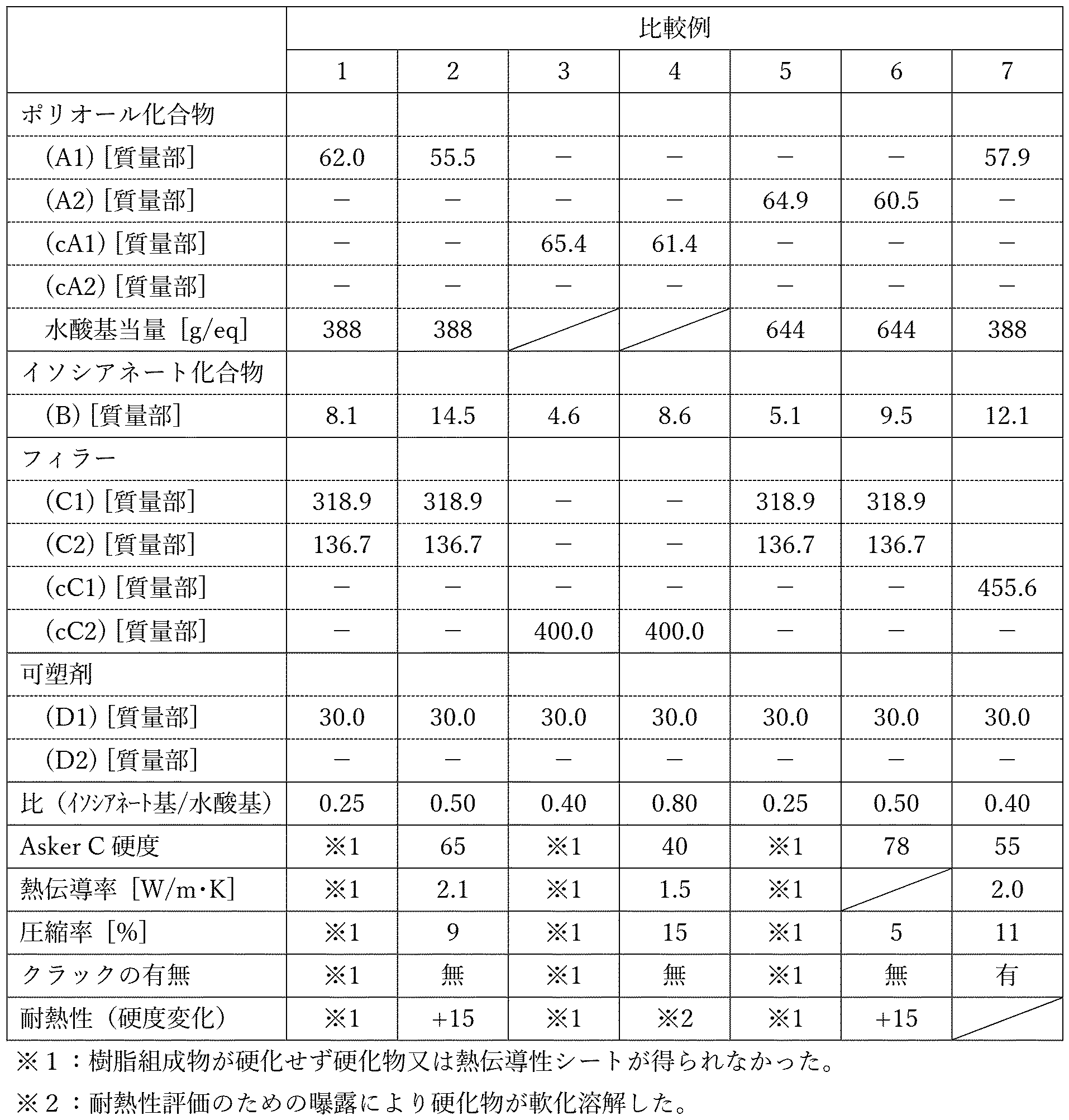
- Tables 1 to 3 Each material shown in Tables 1 to 3 is as follows.
- polyether polyol compound obtained by copolymerizing tetrahydrofuran (THF) having a hydroxyl group and neopentyl glycol (NPG).
- - Polyol compound (cA2) Poly-bd (manufactured by Idemitsu Kosan Co., Ltd.). It is a polybutadiene polyol compound having hydroxyl groups.
- ⁇ Filler (cC2) BX153T manufactured by Nippon Light Metal Co., Ltd.
- the resin composition obtained above was poured into a fluororesin beaker having a volume of 100 mL so that the thickness after curing would be 10 mm, and cured by heating at a temperature of 90° C. to prepare a cured product.
- thermoly conductive sheet After coating the resin composition obtained above on a fluororesin sheet using a bar coater so that the thickness after curing is 2.0 mm, it is cured by heating at a temperature of 90° C. to form a thermally conductive sheet. made.
- the particle size distribution of the filler was measured by particle size distribution measurement using a laser diffraction scattering method, and the particle size at 50% volume accumulation was defined as the average particle size of the filler.
- the cured products obtained using the resin compositions of Examples 1 to 7 had low hardness, excellent flexibility, and excellent thermal conductivity and heat resistance.
- Comparative Example 3 it is considered that the resin composition could not be cured even if the equivalent ratio (isocyanate group/hydroxyl group) was 0.40 because the resin composition did not contain a polycarbonate polyol compound.
- the cured product of the resin composition of Comparative Example 4 had high hardness, poor compressibility and flexibility, and poor thermal conductivity and heat resistance.
- Comparative Example 7 the resin composition increased in viscosity due to the large contact area between the amorphous alumina filler used as the filler and the resin.
- Comparative Example 8 it is believed that the resin composition thickened because the hydroxyl group of aluminum hydroxide reacted with the isocyanate compound (B). Therefore, it is considered that both the thermally conductive sheets obtained using the resin compositions of Comparative Examples 7 and 8 had cracks.
- the cured products of the resin compositions of Comparative Examples 9 and 10 are considered to be inferior in heat resistance because the resin compositions do not contain a polycarbonate polyol compound.
Landscapes
- Chemical & Material Sciences (AREA)
- Chemical Kinetics & Catalysis (AREA)
- Organic Chemistry (AREA)
- Medicinal Chemistry (AREA)
- Health & Medical Sciences (AREA)
- Polymers & Plastics (AREA)
- Engineering & Computer Science (AREA)
- Materials Engineering (AREA)
- Manufacturing & Machinery (AREA)
- Combustion & Propulsion (AREA)
- Thermal Sciences (AREA)
- Physics & Mathematics (AREA)
- Polyurethanes Or Polyureas (AREA)
Abstract
熱伝導性樹脂組成物は、ポリカーボネートポリオール化合物(A)、ポリイソシアネート化合物(B)、及び、球状アルミナフィラー(C)を含み、可塑剤(D)を含んでいてもよい。ポリカーボネートポリオール化合物(A)の水酸基当量は、200g/eq以上800g/eq以下である。ポリカーボネートポリオール化合物(A)中の水酸基に対するポリイソシアネート化合物(B)中のイソシアネート基の当量比(イソシアネート基/水酸基)は、0.26以上0.40以下である。ポリカーボネートポリオール化合物(A)、ポリイソシアネート化合物(B)、及び可塑剤(D)の総量100質量部に対して、球状アルミナフィラー(C)の含有量は、400質量部以上900質量部以下であり、可塑剤(D)の含有量は、30質量部以下である。
Description
本開示は、熱伝導性樹脂組成物及びその硬化物、並びに、熱伝導性シート及びその製造方法に関する。
電子製品、電気製品、及びこれらに含まれる部品は、使用時に発生する熱によって特性が劣化したり、破損が生じたりするおそれがある。そのため、これらの製品の発熱部材から冷却部材への熱移動を促進するために、発熱部材と冷却部材との間に熱伝導性シートを介在させることが知られている。熱伝導性シートには、発熱部材及び冷却部材への密着性を高めて熱抵抗(接触抵抗)を低減する等のために、柔軟性が要求されることがある(例えば、特許文献1(特許第6732145号公報))。
特許文献2(特許第5989219号公報)には、放熱性及び柔軟性等に優れる封止材を、発熱を伴う電気電子部品に用いることが記載されている。
特許文献1に記載の熱伝導性シート及び特許文献2に記載の封止材にはフィラーが含まれている。フィラーは、電気絶縁性及び熱伝導性の向上を目的として用いられることがある。熱伝導性を向上するために、熱伝導性シート及び封止材においてフィラーの含有量を増やすと、熱伝導性シート及び封止材の硬度が大きくなり、柔軟性が低下することがあった。また、熱伝導性シート及び封止材には、高温条件下での使用にも耐え得る優れた耐熱性も求められている。
本開示の目的は、柔軟性に優れながらも熱伝導性に優れ、耐熱性にも優れる硬化物及びそれを含む熱伝導性シートを得ることができる熱伝導性樹脂組成物を提供することにある。
本開示の熱伝導性樹脂組成物は、水酸基当量が200g/eq以上800g/eq以下のポリカーボネートポリオール化合物(A)、ポリイソシアネート化合物(B)、及び、球状アルミナフィラー(C)を含み、可塑剤(D)を含んでいてもよいものである。
本開示の熱伝導性樹脂組成物において、ポリカーボネートポリオール化合物(A)中の水酸基に対するポリイソシアネート化合物(B)中のイソシアネート基の当量比(イソシアネート基/水酸基)は、0.26以上0.40以下である。本開示の熱伝導性樹脂組成物において、ポリカーボネートポリオール化合物(A)、ポリイソシアネート化合物(B)、及び可塑剤(D)の総量100質量部に対して、球状アルミナフィラー(C)の含有量は、400質量部以上900質量部以下であり、可塑剤(D)の含有量は、30質量部以下である。
本開示の熱伝導性樹脂組成物によれば、柔軟性に優れながらも優れた熱伝導性を有し、耐熱性にも優れる硬化物及びそれを含む熱伝導性シートを提供することができる。
実施の形態1.
(熱伝導性樹脂組成物)
本実施の形態の熱伝導性樹脂組成物(以下、「本組成物」ということがある。)は、ポリカーボネートポリオール化合物(A)、ポリイソシアネート化合物(B)、及び、球状アルミナフィラー(C)を含み、可塑剤(D)を含んでいてもよい。本組成物は、さらに、ポリカーボネートポリオール化合物(A)、ポリイソシアネート化合物(B)、球状アルミナフィラー(C)、及び可塑剤(D)以外のその他の成分を1種以上含んでいてもよい。
(熱伝導性樹脂組成物)
本実施の形態の熱伝導性樹脂組成物(以下、「本組成物」ということがある。)は、ポリカーボネートポリオール化合物(A)、ポリイソシアネート化合物(B)、及び、球状アルミナフィラー(C)を含み、可塑剤(D)を含んでいてもよい。本組成物は、さらに、ポリカーボネートポリオール化合物(A)、ポリイソシアネート化合物(B)、球状アルミナフィラー(C)、及び可塑剤(D)以外のその他の成分を1種以上含んでいてもよい。
(ポリカーボネートポリオール化合物(A))
本組成物は、ポリカーボネートポリオール化合物(A)(以下、「ポリオール化合物(A)」ということがある。)を含む。ポリオール化合物(A)の水酸基当量は、200g/eq以上800g/eq以下である。本組成物に含まれるポリオール化合物(A)は、1種であってもよく、2種以上であってもよい。
本組成物は、ポリカーボネートポリオール化合物(A)(以下、「ポリオール化合物(A)」ということがある。)を含む。ポリオール化合物(A)の水酸基当量は、200g/eq以上800g/eq以下である。本組成物に含まれるポリオール化合物(A)は、1種であってもよく、2種以上であってもよい。
ポリオール化合物(A)は、1分子中に水酸基を2以上有し、分子中にポリカーボネート構造を有する化合物である。
ポリオール化合物(A)に含まれる水酸基は、ポリイソシアネート化合物(B)に含まれるイソシアネート基と反応することにより、ウレタン結合を形成する。これにより、本組成物の硬化物に架橋構造を導入することができるため、本組成物を用いて得られる硬化物は、優れた電気絶縁性、及び優れた耐熱性を有することができる。
ポリオール化合物(A)に含まれる水酸基の数は、1分子あたり2以上であれば特に限定されないが、2であることが好ましい。ポリオール化合物(A)に含まれる1分子あたりの水酸基の数が多くなると、本組成物の硬化物の架橋密度が大きくなりやすく、硬化物の硬度が大きくなって硬化物の柔軟性が低下する傾向にある。ポリオール化合物(A)に含まれる1分子あたりの水酸基の数が少なくなると、水酸基とイソシアネート基との架橋反応が進行しにくくなり、本組成物を十分に硬化させにくくなる傾向にある。本明細書における硬度は、Asker C硬度をいう。
ポリオール化合物(A)の水酸基当量は、200g/eq以上であり、300g/eq以上であることが好ましく、350g/eq以上であってもよく、また、800g/eq以下であり、700g/eq以下であることが好ましく、650g/eq以下であってもよい。ポリオール化合物(A)の水酸基当量が小さくなると、本組成物の硬化物の架橋密度が大きくなりやすく、硬化物の硬度が大きくなって硬化物の柔軟性が低下する傾向にある。ポリオール化合物(A)の水酸基当量が大きくなると、水酸基とイソシアネート基との架橋反応が進行しにくくなり、本組成物を十分に硬化させにくくなる傾向にある。ポリオール化合物(A)の水酸基当量は、後述する実施例に記載の方法によって測定することができる。
ポリオール化合物(A)に含まれるポリカーボネート構造は、カーボネート結合を介して結合したポリマー鎖を有する構造である。ポリカーボネート構造は、ポリオール化合物(A)に含まれるポリカーボネート構造は、ポリオール化合物(A)の主鎖構造に含まれることが好ましく、主鎖構造がポリカーボネート構造であることがより好ましい。ポリオール化合物(A)が分子中にポリカーボネート構造を有することにより、本組成物を用いて得られる硬化物に優れた耐熱性を付与することができる。
ポリオール化合物(A)は公知の化合物を用いることができ、例えば、1分子中に水酸基を2以上有する化合物と、炭酸エステル及びホスゲンのうちの少なくとも1つとの反応物を用いることができる。1分子中に水酸基を2以上有する化合物としては、例えば、エチレングリコール、プロピレングリコール、1,3-プロパンジオール、2-メチル-1,3-プロパンジオール、2-エチル-2-ブチル-1,3-プロパンジオール、1,4-ブタンジオール、1,3-ブタンジオール、1,2-ブタンジオール、1,5-ペンタンジオール、1,7-ヘプタンジオール、3-メチル-1,5-ペンタンジオール、1,6-ヘキサンジオール、1,8-オクタンジオール、1,9-ノナンジオール、1,8-ノナンジオール、1,10-デカンジオール、1,12-ドデカンジオール、1,4-シクロヘキサンジメタノール、1,3-シクロヘキサンジメタノール、ネオペンチルグリコール、ジエチレングリコール、ジプロピレングリコール、トリメチロールエタン、グリセリン等が挙げられる。炭酸エステルとしては、例えば、炭酸ジメチル、炭酸ジエチル、炭酸ジプロピル、炭酸ジイソプロピル、炭酸ジブチル、炭酸エチルブチル、エチレンカーボネート、プロピレンカーボネート、炭酸ジフェニル、炭酸ジベンジル等が挙げられる。
本組成物中のポリオール化合物(A)の含有量は、本組成物に含まれるポリオール化合物(A)及びポリイソシアネート化合物(B)の種類等によって調整することができる。本組成物中のポリオール化合物(A)の含有量は、例えば、ポリオール化合物(A)、ポリイソシアネート化合物(B)、及び可塑剤(D)の総量100質量部に対して、40質量部以上とすることができ、50質量部以上であってもよく、60質量部以上であってもよく、また、90質量部以下であってもよく、80質量部以下であってもよく、70質量部以下であってもよい。
(ポリイソシアネート化合物(B))
本組成物は、ポリイソシアネート化合物(B)を含む。ポリイソシアネート化合物(B)は、1分子中にイソシアネート基を2以上有する化合物である。本組成物に含まれるポリイソシアネート化合物(B)は、1種であってもよく、2種以上であってもよい。
本組成物は、ポリイソシアネート化合物(B)を含む。ポリイソシアネート化合物(B)は、1分子中にイソシアネート基を2以上有する化合物である。本組成物に含まれるポリイソシアネート化合物(B)は、1種であってもよく、2種以上であってもよい。
上記したように、ポリイソシアネート化合物(B)に含まれるイソシアネート基は、ポリオール化合物(A)に含まれる水酸基と反応することにより、ウレタン結合を形成する。これにより、本組成物の硬化物に架橋構造を導入することができるため、硬化物は、優れた電気絶縁性、及び優れた耐熱性を有することができる。
ポリイソシアネート化合物(B)に含まれるイソシアネート基の数は、1分子あたり2以上であれば特に限定されないが、3であることが好ましい。ポリイソシアネート化合物(B)に含まれる1分子あたりのイソシアネート基の数が多くなると、本組成物の硬化物の架橋密度が大きくなりやすいため、硬化物の硬度が大きくなって硬化物の柔軟性が低下する傾向にある。ポリイソシアネート化合物(B)に含まれる1分子あたりのイソシアネート基の数が少なくなると、水酸基とイソシアネート基との架橋反応が進行しにくくなり、本組成物を十分に硬化させにくくなる傾向にある。
ポリイソシアネート化合物(B)は公知の化合物を用いることができ、例えば、脂肪族ポリイソシアネート化合物、脂環式ポリイソシアネート化合物、芳香族ポリイソシアネート化合物、イソシアヌレート型ポリイソシアネート化合物等が挙げられる。ポリイソシアネート化合物(B)は、イソシアヌレート型ポリイソシアネート化合物であることが好ましい。
ポリイソシアネート化合物(B)のイソシアネート基当量は、例えば、52g/eq以上であってもよく、80g/eq以上であってもよく、100g/eq以上であってもよく、120g/eq以上であってもよく、また、320g/eq以下であってもよく、250g/eq以下であってもよく、200g/eq以下であってもよい。ポリイソシアネート化合物(B)のイソシアネート基当量は、後述する実施例に記載の方法によって測定することができる。
本組成物中のポリイソシアネート化合物(B)の含有量は、本組成物に含まれるポリオール化合物(A)及びポリイソシアネート化合物(B)の種類等によって調整することができる。本組成物中のポリオール化合物(A)の含有量は、例えば、ポリオール化合物(A)、ポリイソシアネート化合物(B)、及び可塑剤(D)の総量100質量部に対して、1質量部以上とすることができ、3質量部以上であってもよく、5質量部以上であってもよく、また、25質量部以下であってもよく、20質量部以下であってもよく、15質量部以下であってもよい。
(ポリオール化合物(A)及びポリイソシアネート化合物(B)の含有量)
本組成物におけるポリオール化合物(A)及びポリイソシアネート化合物(B)の含有量は、ポリオール化合物(A)中の水酸基に対するポリイソシアネート化合物(B)中のイソシアネート基の当量比(イソシアネート基/水酸基)が、0.26以上0.40以下となるように調整される。
本組成物におけるポリオール化合物(A)及びポリイソシアネート化合物(B)の含有量は、ポリオール化合物(A)中の水酸基に対するポリイソシアネート化合物(B)中のイソシアネート基の当量比(イソシアネート基/水酸基)が、0.26以上0.40以下となるように調整される。
上記当量比は、0.30以上であってもよく、また、0.35以下であってもよい。上記当量比を上記の範囲に調整することにより、本組成物を用いて得られる硬化物の柔軟性を向上することができる。また、熱伝導性を向上させるために、本組成物における球状アルミナフィラー(C)の含有量を増やした場合にも、硬化物の硬度が大きくなることを抑制し、柔軟性に優れる硬化物を得ることができる。一方、上記当量比が大きくなると、硬化物の硬度が大きくなって硬化物の柔軟性が低下する傾向にあり、上記当量比が小さくなると、本組成物を十分に硬化させにくくなる傾向にある。
(球状アルミナフィラー(C))
本組成物は、球状アルミナフィラー(C)(以下、「フィラー(C)」ということがある。)を含む。本組成物中のフィラー(C)の含有量は、ポリオール化合物(A)、ポリイソシアネート化合物(B)、及び可塑剤(D)の総量100質量部に対して、400質量部以上900質量部以下である。
本組成物は、球状アルミナフィラー(C)(以下、「フィラー(C)」ということがある。)を含む。本組成物中のフィラー(C)の含有量は、ポリオール化合物(A)、ポリイソシアネート化合物(B)、及び可塑剤(D)の総量100質量部に対して、400質量部以上900質量部以下である。
フィラー(C)はアルミナ(酸化アルミニウム)で構成されているため、電気絶縁性を有し、優れた熱伝導性を有する。そのため、フィラー(C)を含有する本組成物を用いて得られる硬化物は、優れた熱伝導性、及び優れた電気絶縁性を有することができる。
フィラー(C)は球状である。本明細書における球状は、平均球形度が0.80以上であることをいう。平均球形度は、好ましくは0.82以上、より好ましくは0.85以上である。平均球形度は、次の顕微鏡法により測定することができる。すなわち、電子顕微鏡等にて撮影した粒子像を画像解析装置に取り込み、取り込んだ粒子像の中の1つの粒子について投影面積(a)及び周囲長を測定する。測定した周囲長と同一の周囲長をもつ真円の面積を(b)とし、当該粒子の球形度をa/bとして決定する。取り込んだ粒子像に含まれる粒子のうち、投影面積の周囲長と同一の周囲長をもつ真円の径が1μm以上300μm以下の範囲にある任意の粒子200個について、上記の手順で粒径度を求め、その相加平均値を平均球形度とする。
フィラー(C)が球形であることにより、不定形(非球状)のアルミナフィラーに比較して表面積を低減することができる。そのため、本組成物においてフィラー(C)と、ポリオール化合物(A)及びポリイソシアネート化合物(B)等の樹脂との接触面積を低減することができるため、本組成物の粘度が上昇することを抑制することができる。これにより、本組成物をシート状等に成形した場合等に、外観が良好な成形物を得ることができる。一方、不定形(非球状)のアルミナフィラーを用いた場合には、組成物の粘度が上昇しやすいため、成形物にクラックが発生する等により外観不良を引き起こすことがある。
フィラー(C)の平均粒子径は特に限定されない。本組成物は、平均粒子径の異なる2種以上のフィラー(C)を含んでいてもよい。フィラー(C)の平均粒子径は、例えば3μm以上であり、5μm以上であってもよく、40μm以上であってもよく、50μm以上であってもよく、60μm以上であってもよく、また、100μm以下であってもよく、80μm以下であってもよく、20μm以下であってもよく、10μm以下であってもよい。
本組成物が平均粒子径の異なる2種のフィラー(C)を含む場合、相対的に平均粒子径の大きいフィラー(C)の平均粒子径は、例えば40μm以上であってもよく、50μm以上であってもよく、60μm以上であってもよく、また、100μm以下であってもよく、80μm以下であってもよい。相対的に平均粒子径の小さいフィラー(C)の平均粒子径は、例えば3μm以上であり、5μm以上であってもよく、また、20μm以下であってもよく、10μm以下であってもよい。フィラー(C)の平均粒子径は、後述する実施例に記載の方法によって測定することができる。
本組成物中のフィラー(C)の含有量は、ポリオール化合物(A)、ポリイソシアネート化合物(B)、及び可塑剤(D)の総量100質量部に対して、400質量部以上であり、430質量部以上であってもよく、また、900質量部以下であり、750質量部以下であってもよく、650質量部以下であることが好ましい。フィラー(C)の含有量が上記の範囲であることにより、本組成物を用いて得られる硬化物は、優れた熱伝導性、及び優れた電気絶縁性を有することができる。フィラー(C)の含有量が小さくなると、硬化物の熱伝導性が低下する傾向にある。フィラー(C)の含有量が大きくなると、本組成物中にフィラー(C)が均一に分散しにくくなったり、均一に分散した場合であっても硬化物の硬度が大きくなって硬化物の柔軟性が低下したりする傾向にある。あるいは、シート状に成形した硬化物に全てのフィラー(C)を充填することが困難となる傾向にある。
フィラー(C)は、表面処理が施されたものであってもよい。表面処理としては、チタネートカップリング剤;シランカップリング剤;界面活性剤;オレイン酸、ステアリン酸等の有機酸等を用いて、球状のアルミナ粒子の表面を修飾する処理が挙げられる。フィラー(C)に表面処理を行うことにより、本組成物の硬化物中でのフィラー(C)の分散性を向上することができる。これにより、硬化物の引張強度及び引裂き強度等の機械的特性を向上し、熱伝導性を向上することができる。表面処理が施されたフィラー(C)は、本組成物を用いて得られる硬化物への充填性が良好であるため、硬化物の熱伝導性をさらに向上することができる。
フィラー(C)は、例えば、水酸化アルミニウム粉末の火炎溶射法、バイヤー法、アンモニウムミョウバン熱分解法、有機アルミニウム加水分解法、アルミニウム水中放電法、凍結乾燥法等によって得られたものを用いることができる。
(可塑剤(D))
本組成物は、可塑剤(D)を含んでいてもよく、含んでいなくてもよいが、可塑剤(D)を含むことが好ましい。本組成物に含まれる可塑剤(D)は、1種であってもよく、2種以上であってもよい。本組成物が可塑剤(D)を含むことにより、硬度が小さい、柔軟性に優れた硬化物が得られやすくなる。
本組成物は、可塑剤(D)を含んでいてもよく、含んでいなくてもよいが、可塑剤(D)を含むことが好ましい。本組成物に含まれる可塑剤(D)は、1種であってもよく、2種以上であってもよい。本組成物が可塑剤(D)を含むことにより、硬度が小さい、柔軟性に優れた硬化物が得られやすくなる。
本組成物が可塑剤(D)を含む場合、本組成物中の可塑剤(D)の含有量は、ポリオール化合物(A)、ポリイソシアネート化合物(B)、及び可塑剤(D)の総量100質量部に対して、30質量部以下であり、25質量部以下であってもよく、また、0質量部超であってもよく、10質量部以上であってもよく、20質量部以上であってもよい。本組成物に含まれる可塑剤(D)の含有量が大きくなると、ポリオール化合物(A)とポリイソシアネート化合物(B)との反応性が低下し、本組成物を硬化させにくくなる傾向にある。
可塑剤(D)は公知の材料を用いることができるが、芳香族カルボン酸エステルであることが好ましい。芳香族カルボン酸エステルとしては、例えば、安息香酸エステル系可塑剤、フタル酸系可塑剤、トリメリット酸系可塑剤等が挙げられ、安息香酸エステル系可塑剤であることが好ましい。
(その他の成分)
本組成物は、ポリオール化合物(A)、ポリイソシアネート化合物(B)、フィラー(C)、及び可塑剤(D)以外のその他の成分を含んでいてもよい。その他の成分としては、硬化促進剤、難燃剤、難燃助剤、着色剤、酸化防止剤、紫外線吸収剤、熱安定剤、結晶促進剤、分散剤、表面調整剤、消泡剤、密着性付与剤、有機溶剤等の溶剤等が挙げられる。本組成物は、その他の成分を1種又は2種以上を含むことができる。
本組成物は、ポリオール化合物(A)、ポリイソシアネート化合物(B)、フィラー(C)、及び可塑剤(D)以外のその他の成分を含んでいてもよい。その他の成分としては、硬化促進剤、難燃剤、難燃助剤、着色剤、酸化防止剤、紫外線吸収剤、熱安定剤、結晶促進剤、分散剤、表面調整剤、消泡剤、密着性付与剤、有機溶剤等の溶剤等が挙げられる。本組成物は、その他の成分を1種又は2種以上を含むことができる。
(熱伝導性樹脂組成物の製造方法)
本組成物は、例えば、ポリオール化合物(A)、フィラー(C)、及び、必要に応じてその他の成分を混合し水分を除去した後、これにポリイソシアネート化合物(B)を混合することによって製造することができる。これらの成分を混合する混合装置は特に限定されず、ミキシングロール、ニーダー、バンバリーミキサ、プラネタリーミキサ等の混練機;真空脱泡撹拌機等を用いることができる。上記成分の混合時に気泡が混入すると、本組成物の硬化物の引張強度及び引裂き強度等の機械的特性が低下し、熱伝導性が低下するおそれがある。そのため、混合装置としては、気泡の混入を抑制できるプラネタリーミキサ又は真空撹拌機を用いることが好ましく、自公転式真空撹拌機を用いる、又は、真空条件下においてプラネタリーミキサを使用することがより好ましい。
本組成物は、例えば、ポリオール化合物(A)、フィラー(C)、及び、必要に応じてその他の成分を混合し水分を除去した後、これにポリイソシアネート化合物(B)を混合することによって製造することができる。これらの成分を混合する混合装置は特に限定されず、ミキシングロール、ニーダー、バンバリーミキサ、プラネタリーミキサ等の混練機;真空脱泡撹拌機等を用いることができる。上記成分の混合時に気泡が混入すると、本組成物の硬化物の引張強度及び引裂き強度等の機械的特性が低下し、熱伝導性が低下するおそれがある。そのため、混合装置としては、気泡の混入を抑制できるプラネタリーミキサ又は真空撹拌機を用いることが好ましく、自公転式真空撹拌機を用いる、又は、真空条件下においてプラネタリーミキサを使用することがより好ましい。
実施の形態2.
(硬化物)
本実施の形態の硬化物は、実施の形態1において説明した本組成物を硬化してなるものである。本組成物の硬化は種々の方法で行うことができ、例えば、本組成物を加熱することにより熱重合させる方法、本組成物を室温で重合させる方法等が挙げられる。本組成物は、低温で硬化することができるため、本組成物を用いて得られる硬化物を得る際の環境負荷を低減することができる。
(硬化物)
本実施の形態の硬化物は、実施の形態1において説明した本組成物を硬化してなるものである。本組成物の硬化は種々の方法で行うことができ、例えば、本組成物を加熱することにより熱重合させる方法、本組成物を室温で重合させる方法等が挙げられる。本組成物は、低温で硬化することができるため、本組成物を用いて得られる硬化物を得る際の環境負荷を低減することができる。
本組成物の熱重合により硬化物を得る場合、加熱温度は、例えば70℃以上であり100℃以下であり、70℃以上90℃以下であってもよい。この場合、加熱時間は、例えば0.05時間以上72時間以下であり、0.1時間以上10時間以下であってもよい。本組成物を室温で重合させる場合、室温の温度は15℃以上40℃以下とすることができ、室温で硬化させる時間は12時間以上72時間以下であることが好ましい。本組成物の硬化処理は、大気雰囲気中で行ってもよく、窒素雰囲気中、アルゴン雰囲気中、又は真空条件下で行ってもよい。
硬化物の形状は特に限定されない。硬化物は、例えばフィルム状、シート状、板状、円柱状、角柱状等のように成形されたものであってもよく、本組成物を所望の位置に塗布する等のように成形していない不定形状を有するものであってもよい。
硬化物は、本組成物を含むため、柔軟性を向上しながらも優れた熱伝導性を有し、耐熱性にも優れる。そのため、硬化物は、電子製品及び電気製品に用いることができ、例えば、これらの製品に含まれる、発熱部材とヒートシンカー等の冷却部材との間の熱移動を促進するための熱伝導性シート及び放熱スペーサ;電子製品及び電気製品の封止部等に用いることができる。
実施の形態3.
(熱伝導性シート)
本実施の形態の熱伝導性シートは、実施の形態2において説明した硬化物を含むものであり、当該硬化物のみから構成されるものであってもよい。熱伝導性シートは、例えば、実施の形態1において説明した本組成物をシート状に成形して硬化させることによって得ることができる。
(熱伝導性シート)
本実施の形態の熱伝導性シートは、実施の形態2において説明した硬化物を含むものであり、当該硬化物のみから構成されるものであってもよい。熱伝導性シートは、例えば、実施の形態1において説明した本組成物をシート状に成形して硬化させることによって得ることができる。
熱伝導性シートは、本組成物の硬化物を含むため、優れた柔軟性及び熱伝導性を有し、耐熱性にも優れる。特に、本組成物は、熱伝導性を向上するために比較的多くのフィラー(C)を含有するが、上記したように、フィラー(C)が球状アルミナフィラーであり、当量比(イソシアネート基/水酸基)が所定の範囲に調整されているため、熱伝導性シートの硬度が大きくなることを抑制することができる。熱伝導性シートの硬度が小さいほど、熱伝導性シートは良好な柔軟性を有し、また、圧縮応力を低減することができる。そのため、熱伝導性シートは、熱伝導性シートが取付けられる発熱部材及び冷却部材等の被取付部材の表面の凹凸に追従して変形することができるため、被取付部材に密着することができる。これにより、熱伝導性シートと被取付部材との間に空気が噛み込まれて熱伝導性が低下し、熱抵抗が増加することを抑制することができるため、熱伝導性シートと被取付部材との間での熱移動を促進することができる。また、被取付部材の間に熱伝導性シートを挟み込む場合、熱伝導性シートを圧縮しやすくなるため、熱伝導性シートを取付けた被取付部材の周辺にある基板等の周辺部材が反ったり歪んだりする等の不具合の発生を抑制することができる。
熱伝導性シートのAsker C硬度は、40以下であることが好ましく、40未満であってもよく、35以下であってもよく、30以下であってもよく、また、1以上であってもよく、5以上であってもよく、10以上であってもよい。Asker C硬度が上記の範囲である熱伝導性シートは良好な柔軟性を有し、また、熱伝導性シートを圧縮したときの圧縮応力が小さい。これにより、熱伝導性シートを被取付部材に密着させやすくなるため、熱抵抗を低減することができる。一方、熱伝導性シートのAsker C硬度が大きくなると、熱伝導性シートを圧縮させるために大きな圧縮応力を要するため、被取付部材に熱伝導性シートを取付ける際に圧縮しにくくなる。これにより、上記周辺部材への反力が大きくなり、周辺部材に上記した不具合が生じやすくなるため、熱伝導性シートの取扱い性が低下する。Asker C硬度は、後述する実施例に記載の方法によって測定することができる。
熱伝導性シートの熱伝導率は、2.0W/(m・K)以上であることが好ましく、2.1W/(m・K)以上であってもよく、2.2W/(m・K)以上であってもよく、通常6.0W/(m・K)以下である。熱伝導率が上記の範囲である熱伝導性シートは、優れた熱伝導性能を有するため、被取付部材に取付けたときに良好な熱伝導性を発揮することができる。特に、熱伝導性シートが上記した範囲のAsker C硬度を有する場合には、被取付部材への密着性を向上することもできるため、熱伝導性シートを被取付部材に取付けた場合の熱伝導性をより一層向上することができる。熱伝導率は、後述する実施例に記載の方法によって測定することができる。
熱伝導性シートの厚みは特に限定されない。熱伝導性シートの厚みは、好ましくは0.1mm以上であり、より好ましくは0.3mm以上であり、また、好ましくは10mm以下であり、より好ましくは5mm以下である。熱伝導性シートの厚みが小さくなると、熱伝導性シートの取扱性が低下することがあり、熱伝導性シートの厚みが大きくなると、熱抵抗が大きくなって熱伝導性が低下する傾向にある。
実施の形態4.
(熱伝導性シートの製造方法)
本実施の形態の熱伝導性シートの製造方法は、実施の形態1において説明した本組成物をシート状に成形したシート状成形物を得る工程と、シート状成形物を加熱により硬化させる工程と、を含む。熱伝導性シートの製造方法は、上記硬化させる工程よりも後に必要に応じて、硬化させたシート状成形物を養生させる工程、及び、熱伝導性シートの形状及びサイズのうちの少なくとも一方を調整するために、硬化させたシート状成形物から熱伝導性シートを切出す工程等を含んでいてもよい。本実施の形態の熱伝導性シートの製造方法によれば、実施の形態3において説明した熱伝導性シートを好適に製造することができる。
(熱伝導性シートの製造方法)
本実施の形態の熱伝導性シートの製造方法は、実施の形態1において説明した本組成物をシート状に成形したシート状成形物を得る工程と、シート状成形物を加熱により硬化させる工程と、を含む。熱伝導性シートの製造方法は、上記硬化させる工程よりも後に必要に応じて、硬化させたシート状成形物を養生させる工程、及び、熱伝導性シートの形状及びサイズのうちの少なくとも一方を調整するために、硬化させたシート状成形物から熱伝導性シートを切出す工程等を含んでいてもよい。本実施の形態の熱伝導性シートの製造方法によれば、実施の形態3において説明した熱伝導性シートを好適に製造することができる。
上記シート状成形物を得る工程は、本組成物をシート状に成形することができる方法によって行うことができ、その方法は特に限定されない。本組成物をシート状に成形する方法としては、例えば、プレス成形法;ロール成形法;バーコーター成形法;押出成形法等が挙げられるが、バーコーター成形法又はロール成形法が好ましく、生産効率性の観点からはロール成形法がより好ましい。
シート状成形物を得る工程では、離型紙又は離型フィルムによってその表面が保護された状態で、本組成物をシート状に成形することが好ましい。シート状成形物を得る工程では、片面又は両面に離型紙又は離型フィルムが積層された状態のシート状成形物を得ることが好ましい。
上記硬化させる工程は、シート状成形物を加熱することにより熱重合させる方法、本組成物を室温で重合させる方法等が挙げられる。硬化させる工程を熱重合法によって行う場合、加熱温度は、例えば70℃以上100℃以下とすることができ、70℃以上90℃以下とすることが好ましく、加熱時間は、例えば0.05時間以上72時間以上とすることができ、0.1時間以上10時間以下とすることが好ましい。硬化させる工程を室温で行う場合、室温の温度は15℃以上40℃以下とすることができ、室温で硬化させる時間は12時間以上72時間以下であることが好ましい。上記硬化させる工程は、大気雰囲気中で行ってもよく、窒素雰囲気中、アルゴン雰囲気中、又は真空条件下で行ってもよい。本組成物は低温で硬化することができるため、本組成物を用いて熱伝導性シートを製造する際の環境負荷を低減することができる。
上記養生させる工程において、養生温度は例えば60℃以上90℃以下であり、養生時間は例えば0.5時間以上72時間以下である。養生させる工程は、大気雰囲気中で行ってもよく、窒素雰囲気中、アルゴン雰囲気中、又は真空条件下で行ってもよい。
上記熱伝導性シートを切出す工程は、例えば、硬化させた又は養生させたシート状成形物を、打抜き型を用いたプレス等によって打抜く方法;カッター、超音波カッター、又はレーザー加工等によって裁断する方法等が挙げられる。熱伝導性シートを切出す工程は、養生させる工程の前に行ってもよく、後に行ってもよい。
以下、実施例及び比較例等により、本開示をさらに詳しく説明するが、本開示はこれらの例に限定されるものではない。
〔実施例1~7、比較例1~14〕
(樹脂組成物の調製)
表1~表3の配合のとおり、ポリイソシアネート化合物(B)を除く各材料を秤量、混合し、自公転式真空撹拌機(V-mini300、株式会社EME製)を用いて混練し、温度110℃の真空乾燥機中で1時間以上乾燥した。真空乾燥機から混練物を取り出し、混練物とポリイソシアネート化合物(B)とを、自公転式真空撹拌機を用いて混練し、樹脂組成物を得た。表1~表3に示す各材料は、次のとおりである。
〔実施例1~7、比較例1~14〕
(樹脂組成物の調製)
表1~表3の配合のとおり、ポリイソシアネート化合物(B)を除く各材料を秤量、混合し、自公転式真空撹拌機(V-mini300、株式会社EME製)を用いて混練し、温度110℃の真空乾燥機中で1時間以上乾燥した。真空乾燥機から混練物を取り出し、混練物とポリイソシアネート化合物(B)とを、自公転式真空撹拌機を用いて混練し、樹脂組成物を得た。表1~表3に示す各材料は、次のとおりである。
<ポリオール化合物>
・ポリオール化合物(A1):
パンデックスGCB-71(DIC株式会社製)。水酸基を有するポリカーボネートポリオール化合物であり、水酸基当量は388である。
・ポリオール化合物(A2):
パンデックスGCB-51(DIC株式会社製)。水酸基を有するポリカーボネートポリオール化合物であり、水酸基当量は644である。
・ポリオール化合物(cA1):
パンデックスGCB-41(DIC株式会社製)。水酸基を有するテトラハイドロフラン(THF)とネオペンチルグリコール(NPG)とを共重合させたポリエーテルポリオール化合物である。
・ポリオール化合物(cA2):
Poly-bd(出光興産株式会社製)。水酸基を有するポリブタジエンポリオール化合物である。
・ポリオール化合物(A1):
パンデックスGCB-71(DIC株式会社製)。水酸基を有するポリカーボネートポリオール化合物であり、水酸基当量は388である。
・ポリオール化合物(A2):
パンデックスGCB-51(DIC株式会社製)。水酸基を有するポリカーボネートポリオール化合物であり、水酸基当量は644である。
・ポリオール化合物(cA1):
パンデックスGCB-41(DIC株式会社製)。水酸基を有するテトラハイドロフラン(THF)とネオペンチルグリコール(NPG)とを共重合させたポリエーテルポリオール化合物である。
・ポリオール化合物(cA2):
Poly-bd(出光興産株式会社製)。水酸基を有するポリブタジエンポリオール化合物である。
<イソシアネート化合物>
・イソシアネート化合物(B):
パンデックスGCA-12(DIC株式会社製)。イソシアヌレート型ポリイソシアネートである。
・イソシアネート化合物(B):
パンデックスGCA-12(DIC株式会社製)。イソシアヌレート型ポリイソシアネートである。
<フィラー>
・フィラー(C1):
DAW-70(デンカ株式会社製)。平均粒子径が71μmの球状アルミナフィラーである。
・フィラー(C2):
DAW-05(デンカ株式会社製)。平均粒子径が8.2μmの球状アルミナフィラーである。
・フィラー(cC1):
LS-210B(日本軽金属株式会社製)。不定形(非球状)のアルミナフィラーである。
・フィラー(cC2)
BX153T(日本軽金属株式会社製)。チタネートカップリング剤によって表面処理が施された水酸化アルミニウムフィラーである。
・フィラー(C1):
DAW-70(デンカ株式会社製)。平均粒子径が71μmの球状アルミナフィラーである。
・フィラー(C2):
DAW-05(デンカ株式会社製)。平均粒子径が8.2μmの球状アルミナフィラーである。
・フィラー(cC1):
LS-210B(日本軽金属株式会社製)。不定形(非球状)のアルミナフィラーである。
・フィラー(cC2)
BX153T(日本軽金属株式会社製)。チタネートカップリング剤によって表面処理が施された水酸化アルミニウムフィラーである。
<可塑剤>
・可塑剤(D1):
W-83(DIC株式会社製)。安息香酸エステル系可塑剤である。
・可塑剤(D2):
PB-3A(DIC株式会社製)。安息香酸エステル系可塑剤である。
・可塑剤(D1):
W-83(DIC株式会社製)。安息香酸エステル系可塑剤である。
・可塑剤(D2):
PB-3A(DIC株式会社製)。安息香酸エステル系可塑剤である。
(硬化物の作製)
上記で得た樹脂組成物を、容量100mLのフッ素樹脂製ビーカーに、硬化後の厚みが10mmとなるように注ぎ込み、温度90℃で加熱硬化させて硬化物を作製した。
上記で得た樹脂組成物を、容量100mLのフッ素樹脂製ビーカーに、硬化後の厚みが10mmとなるように注ぎ込み、温度90℃で加熱硬化させて硬化物を作製した。
(熱伝導性シートの作製)
フッ素樹脂シート上に、バーコーターを用いて、硬化後の厚みが2.0mmとなるように上記で得た樹脂組成物を塗布した後、温度90℃で加熱硬化させて、熱伝導性シートを作製した。
フッ素樹脂シート上に、バーコーターを用いて、硬化後の厚みが2.0mmとなるように上記で得た樹脂組成物を塗布した後、温度90℃で加熱硬化させて、熱伝導性シートを作製した。
実施例及び比較例で用いた材料、並びに、実施例及び比較例で得た樹脂組成物の硬化物及び熱伝導性シートについて、次の手順で評価を行った。
[ポリオール化合物の水酸基当量]
ポリオール化合物(A)の水酸基当量は、JIS K-1557-1に準拠して測定した。結果を表1~表3に示す。
[ポリオール化合物の水酸基当量]
ポリオール化合物(A)の水酸基当量は、JIS K-1557-1に準拠して測定した。結果を表1~表3に示す。
[当量比]
ポリイソシアネート化合物のイソシアネート当量は、JIS K1603-1に準拠して測定した。上記で測定したポリオール化合物中の水酸基、及び、ポリイソシアネート化合物中のイソシアネート基に基づいて、当量比(イソシアネート基/水酸基)を算出した。結果を表1~表3に示す。
ポリイソシアネート化合物のイソシアネート当量は、JIS K1603-1に準拠して測定した。上記で測定したポリオール化合物中の水酸基、及び、ポリイソシアネート化合物中のイソシアネート基に基づいて、当量比(イソシアネート基/水酸基)を算出した。結果を表1~表3に示す。
[フィラーの平均粒子径]
レーザー回折散乱法による粒度分布測定によってフィラーの粒度分布を測定し、体積累積50%での粒径をフィラーの平均粒子径とした。
レーザー回折散乱法による粒度分布測定によってフィラーの粒度分布を測定し、体積累積50%での粒径をフィラーの平均粒子径とした。
[Asker C硬度]
Asker C硬度計(高分子計器株式会社製)を用い、JIS K 7312に準拠して、上記で作製した硬化物のAsker C硬度を測定した。結果を表1~表3に示す。
Asker C硬度計(高分子計器株式会社製)を用い、JIS K 7312に準拠して、上記で作製した硬化物のAsker C硬度を測定した。結果を表1~表3に示す。
[熱伝導率の測定]
上記で作製した熱伝導性シートから、一辺の長さが20mmの正方形状に測定サンプルを切出した。TCM1001(レスカ社製)を用いた定常法により、JIS H 7903、ASTM D5470-1に準拠して、測定サンプルの熱伝導率[W/(m・K)]を測定した。
上記で作製した熱伝導性シートから、一辺の長さが20mmの正方形状に測定サンプルを切出した。TCM1001(レスカ社製)を用いた定常法により、JIS H 7903、ASTM D5470-1に準拠して、測定サンプルの熱伝導率[W/(m・K)]を測定した。
[圧縮率の評価]
上記で作製した熱伝導性シートの厚みを測定し、これを圧縮前の厚みとした。この熱伝導性シートに250Nの荷重を負荷し、このときの熱伝導性シートの厚みを圧縮後の厚みとした。下記式に基づいて、圧縮率を算出した。結果を表1~表3に示す。
圧縮率[%]={(圧縮前の厚み-圧縮後の厚み)/圧縮前の厚み}×100
上記で作製した熱伝導性シートの厚みを測定し、これを圧縮前の厚みとした。この熱伝導性シートに250Nの荷重を負荷し、このときの熱伝導性シートの厚みを圧縮後の厚みとした。下記式に基づいて、圧縮率を算出した。結果を表1~表3に示す。
圧縮率[%]={(圧縮前の厚み-圧縮後の厚み)/圧縮前の厚み}×100
[熱伝導性シートの観察]
上記で作製した熱伝導性シートを目視で観察し、クラックの有無を確認した。結果を表1~表3に示す。
上記で作製した熱伝導性シートを目視で観察し、クラックの有無を確認した。結果を表1~表3に示す。
[耐熱性の評価]
上記で作製した硬化物を温度150℃の乾燥機で120時間曝露した後、上記した方法にしたがって、曝露後の硬化物のAsker C硬度を測定した。下記式に基づいて硬度変化を測定した。結果を表1~表3に示す。
硬度変化=曝露後のAsker C硬度-曝露前のAsker C硬度
上記で作製した硬化物を温度150℃の乾燥機で120時間曝露した後、上記した方法にしたがって、曝露後の硬化物のAsker C硬度を測定した。下記式に基づいて硬度変化を測定した。結果を表1~表3に示す。
硬度変化=曝露後のAsker C硬度-曝露前のAsker C硬度


実施例1~7の樹脂組成物を用いて得られた硬化物は、硬度が小さく、柔軟性に優れており、また、熱伝導性及び耐熱性にも優れていた。
比較例1、2、5、及び6の結果から、当量比(イソシアネート基/水酸基)が0.26を下回ると、樹脂組成物を硬化させることができず、上記当量比が0.40を超えると、樹脂組成物の硬化物の硬度が大きくなり、圧縮率及び柔軟性に劣ると考えられる。
比較例3では、樹脂組成物がポリカーボネートポリオール化合物を含んでいないため、当量比(イソシアネート基/水酸基)が0.40であっても樹脂組成物を硬化させることができなかったと考えられる。比較例4の樹脂組成物の硬化物は、硬度が大きく、圧縮率及び柔軟性に劣り、熱伝導率及び耐熱性にも劣るものであった。
比較例7では、フィラーとして用いた不定形アルミナフィラーと樹脂との接触面積が大きいために樹脂組成物が増粘したと考えられる。比較例8では、水酸化アルミニウムの水酸基がイソシアネート化合物(B)と反応したために樹脂組成物が増粘したと考えられる。そのため、比較例7及び8の樹脂組成物を用いて得た熱伝導性シートには、いずれもクラックが発生したと考えられる。
比較例9及び10の樹脂組成物の硬化物は、樹脂組成物がポリカーボネートポリオール化合物を含んでいないため、いずれも耐熱性に劣ると考えられる。
比較例11及び12の結果から、球状アルミナフィラーの含有量が400質量部を下回ると、硬化物の熱伝導率が低下し、上記含有量が900質量部を超えると、フィラー量が多すぎるために、全てのフィラーが充填されたシート状の硬化物を得ることができなかったと考えられる。
比較例13及び14では、可塑剤の含有量が30質量部を超えているため、樹脂組成物を硬化させることができなかったと考えられる。
今回開示された実施の形態及び実施例はすべての点で例示であって制限的なものではないと考えられるべきである。本開示の範囲は上記した説明ではなくて請求の範囲によって示され、請求の範囲と均等の意味及び範囲内でのすべての変更が含まれることが意図される。
Claims (6)
- ポリカーボネートポリオール化合物(A)、ポリイソシアネート化合物(B)、及び、球状アルミナフィラー(C)を含み、可塑剤(D)を含んでいてもよい熱伝導性樹脂組成物であって、
前記ポリカーボネートポリオール化合物(A)の水酸基当量は、200g/eq以上800g/eq以下であり、
前記ポリカーボネートポリオール化合物(A)中の水酸基に対する前記ポリイソシアネート化合物(B)中のイソシアネート基の当量比(イソシアネート基/水酸基)は、0.26以上0.40以下であり、
前記ポリカーボネートポリオール化合物(A)、前記ポリイソシアネート化合物(B)、及び前記可塑剤(D)の総量100質量部に対して、前記球状アルミナフィラー(C)の含有量は、400質量部以上900質量部以下であり、前記可塑剤(D)の含有量は、30質量部以下である、熱伝導性樹脂組成物。 - 前記熱伝導性樹脂組成物は、前記可塑剤(D)を含む、請求項1に記載の熱伝導性樹脂組成物。
- 前記可塑剤(D)は、芳香族カルボン酸エステルである、請求項1又は2に記載の熱伝導性樹脂組成物。
- 請求項1~3のいずれか1項に記載の熱伝導性樹脂組成物の硬化物。
- 請求項4に記載の硬化物を含む熱伝導性シート。
- 熱伝導性シートの製造方法であって、
請求項1~3のいずれか1項に記載の熱伝導性樹脂組成物をシート状に成形したシート状成形物を得る工程と、
前記シート状成形物を加熱により硬化させる工程と、を含む、熱伝導性シートの製造方法。
Priority Applications (2)
| Application Number | Priority Date | Filing Date | Title |
|---|---|---|---|
| PCT/JP2021/012940 WO2022201513A1 (ja) | 2021-03-26 | 2021-03-26 | 熱伝導性樹脂組成物及びその硬化物、並びに、熱伝導性シート及びその製造方法 |
| JP2023508388A JPWO2022201513A1 (ja) | 2021-03-26 | 2021-03-26 |
Applications Claiming Priority (1)
| Application Number | Priority Date | Filing Date | Title |
|---|---|---|---|
| PCT/JP2021/012940 WO2022201513A1 (ja) | 2021-03-26 | 2021-03-26 | 熱伝導性樹脂組成物及びその硬化物、並びに、熱伝導性シート及びその製造方法 |
Publications (1)
| Publication Number | Publication Date |
|---|---|
| WO2022201513A1 true WO2022201513A1 (ja) | 2022-09-29 |
Family
ID=83396537
Family Applications (1)
| Application Number | Title | Priority Date | Filing Date |
|---|---|---|---|
| PCT/JP2021/012940 Ceased WO2022201513A1 (ja) | 2021-03-26 | 2021-03-26 | 熱伝導性樹脂組成物及びその硬化物、並びに、熱伝導性シート及びその製造方法 |
Country Status (2)
| Country | Link |
|---|---|
| JP (1) | JPWO2022201513A1 (ja) |
| WO (1) | WO2022201513A1 (ja) |
Cited By (3)
| Publication number | Priority date | Publication date | Assignee | Title |
|---|---|---|---|---|
| JP2021055028A (ja) * | 2019-10-02 | 2021-04-08 | Dic株式会社 | 熱硬化性ウレタン樹脂組成物 |
| JP2021055029A (ja) * | 2019-10-02 | 2021-04-08 | Dic株式会社 | 熱硬化性ウレタン樹脂組成物 |
| WO2024053089A1 (ja) * | 2022-09-09 | 2024-03-14 | 三菱電機株式会社 | 熱伝導性樹脂組成物及びその硬化物、並びに、熱伝導性シート及びその製造方法 |
Citations (5)
| Publication number | Priority date | Publication date | Assignee | Title |
|---|---|---|---|---|
| JPH111675A (ja) * | 1997-06-16 | 1999-01-06 | Nitto Denko Corp | 熱伝導性感圧接着剤とその接着シ―ト類 |
| JP2017035802A (ja) * | 2015-08-07 | 2017-02-16 | 昭和電工株式会社 | 絶縁放熱シートの製造方法、絶縁放熱シート及びヒートスプレッダー |
| CN107880243A (zh) * | 2017-11-23 | 2018-04-06 | 广东元星工业新材料有限公司 | 一种高耐热高性能聚氨酯弹性体及其制备方法 |
| JP2019172935A (ja) * | 2018-03-29 | 2019-10-10 | Jnc株式会社 | 2成分型熱伝導樹脂組成物、熱伝導シート、金属製品、電子機器 |
| WO2020240703A1 (ja) * | 2019-05-28 | 2020-12-03 | 三菱電機株式会社 | 熱伝導性樹脂組成物、熱伝導性シートおよび製造方法 |
Family Cites Families (1)
| Publication number | Priority date | Publication date | Assignee | Title |
|---|---|---|---|---|
| JP7820901B2 (ja) * | 2019-10-02 | 2026-02-26 | Dic株式会社 | 熱硬化性ウレタン樹脂組成物 |
-
2021
- 2021-03-26 JP JP2023508388A patent/JPWO2022201513A1/ja active Pending
- 2021-03-26 WO PCT/JP2021/012940 patent/WO2022201513A1/ja not_active Ceased
Patent Citations (5)
| Publication number | Priority date | Publication date | Assignee | Title |
|---|---|---|---|---|
| JPH111675A (ja) * | 1997-06-16 | 1999-01-06 | Nitto Denko Corp | 熱伝導性感圧接着剤とその接着シ―ト類 |
| JP2017035802A (ja) * | 2015-08-07 | 2017-02-16 | 昭和電工株式会社 | 絶縁放熱シートの製造方法、絶縁放熱シート及びヒートスプレッダー |
| CN107880243A (zh) * | 2017-11-23 | 2018-04-06 | 广东元星工业新材料有限公司 | 一种高耐热高性能聚氨酯弹性体及其制备方法 |
| JP2019172935A (ja) * | 2018-03-29 | 2019-10-10 | Jnc株式会社 | 2成分型熱伝導樹脂組成物、熱伝導シート、金属製品、電子機器 |
| WO2020240703A1 (ja) * | 2019-05-28 | 2020-12-03 | 三菱電機株式会社 | 熱伝導性樹脂組成物、熱伝導性シートおよび製造方法 |
Cited By (4)
| Publication number | Priority date | Publication date | Assignee | Title |
|---|---|---|---|---|
| JP2021055028A (ja) * | 2019-10-02 | 2021-04-08 | Dic株式会社 | 熱硬化性ウレタン樹脂組成物 |
| JP2021055029A (ja) * | 2019-10-02 | 2021-04-08 | Dic株式会社 | 熱硬化性ウレタン樹脂組成物 |
| WO2024053089A1 (ja) * | 2022-09-09 | 2024-03-14 | 三菱電機株式会社 | 熱伝導性樹脂組成物及びその硬化物、並びに、熱伝導性シート及びその製造方法 |
| JPWO2024053089A1 (ja) * | 2022-09-09 | 2024-03-14 |
Also Published As
| Publication number | Publication date |
|---|---|
| JPWO2022201513A1 (ja) | 2022-09-29 |
Similar Documents
| Publication | Publication Date | Title |
|---|---|---|
| JP6274014B2 (ja) | 窒化ホウ素凝集粒子、凝集bn粒子含有樹脂組成物及び放熱シート | |
| WO2022201513A1 (ja) | 熱伝導性樹脂組成物及びその硬化物、並びに、熱伝導性シート及びその製造方法 | |
| EP3269682B1 (en) | Agglomerated boron nitride particles, composition containing said particles, and three-dimensional integrated circuit having layer comprising said composition | |
| KR101550083B1 (ko) | 방열 시트 및 방열 장치 | |
| JP6156337B2 (ja) | 熱伝導シート、及びその熱伝導シートの製造方法 | |
| JP2022544819A (ja) | 樹脂組成物 | |
| JP2011162642A (ja) | 熱伝導シート、その製造方法及び熱伝導シートを用いた放熱装置 | |
| JP2022544966A (ja) | 樹脂組成物 | |
| CN111868921B (zh) | 散热片、散热构件和半导体器件 | |
| US12101912B2 (en) | Method for manufacturing heat dissipation sheet | |
| JP6732145B1 (ja) | 熱伝導性樹脂組成物、熱伝導性シートおよび製造方法 | |
| JP7469408B2 (ja) | 気泡多孔体及びその製造方法 | |
| CN110741034B (zh) | 导热片 | |
| JP7119440B2 (ja) | 複合材料シートの製造方法 | |
| JP7361909B2 (ja) | 硬化シート及びその製造方法 | |
| JP2008189835A (ja) | 熱伝導性組成物及びその製造方法 | |
| WO2024053089A1 (ja) | 熱伝導性樹脂組成物及びその硬化物、並びに、熱伝導性シート及びその製造方法 | |
| JP7198398B1 (ja) | 表面処理無機粒子、無機粒子含有組成物、熱伝導性硬化物、構造体および積層体 | |
| JP2012214776A (ja) | 透明基板用エポキシ組成物、プリプレグ、及び透明基板 | |
| CN115210300B (zh) | 复合粒子、复合粒子的制造方法、液态组合物、层叠体的制造方法及膜的制造方法 | |
| WO2021241699A1 (ja) | 硬化シート及びその製造方法 | |
| JP7739510B1 (ja) | 樹脂組成物、および、該樹脂組成物を用いたシートの製造方法 | |
| JP7438442B1 (ja) | 窒化ホウ素凝集粒子、シート部材および窒化ホウ素凝集粒子の製造方法 | |
| JP2025168272A (ja) | 熱伝導シート及び熱伝導シートの製造方法 | |
| JP5294025B2 (ja) | 紫外線遮断性無機粒子−有機ポリマー複合ペースト、及び紫外線遮断性無機粒子−有機ポリマー複合材料 |
Legal Events
| Date | Code | Title | Description |
|---|---|---|---|
| 121 | Ep: the epo has been informed by wipo that ep was designated in this application |
Ref document number: 21933118 Country of ref document: EP Kind code of ref document: A1 |
|
| ENP | Entry into the national phase |
Ref document number: 2023508388 Country of ref document: JP Kind code of ref document: A |
|
| NENP | Non-entry into the national phase |
Ref country code: DE |
|
| 122 | Ep: pct application non-entry in european phase |
Ref document number: 21933118 Country of ref document: EP Kind code of ref document: A1 |