WO2022190825A1 - タッチパネル用導電部材及びタッチパネル用導電部材の製造方法 - Google Patents
タッチパネル用導電部材及びタッチパネル用導電部材の製造方法 Download PDFInfo
- Publication number
- WO2022190825A1 WO2022190825A1 PCT/JP2022/006745 JP2022006745W WO2022190825A1 WO 2022190825 A1 WO2022190825 A1 WO 2022190825A1 JP 2022006745 W JP2022006745 W JP 2022006745W WO 2022190825 A1 WO2022190825 A1 WO 2022190825A1
- Authority
- WO
- WIPO (PCT)
- Prior art keywords
- touch panel
- transparent insulating
- conductive member
- insulating layer
- layer
- Prior art date
- Legal status (The legal status is an assumption and is not a legal conclusion. Google has not performed a legal analysis and makes no representation as to the accuracy of the status listed.)
- Ceased
Links
Images




Classifications
-
- G—PHYSICS
- G06—COMPUTING OR CALCULATING; COUNTING
- G06F—ELECTRIC DIGITAL DATA PROCESSING
- G06F3/00—Input arrangements for transferring data to be processed into a form capable of being handled by the computer; Output arrangements for transferring data from processing unit to output unit, e.g. interface arrangements
- G06F3/01—Input arrangements or combined input and output arrangements for interaction between user and computer
- G06F3/03—Arrangements for converting the position or the displacement of a member into a coded form
- G06F3/041—Digitisers, e.g. for touch screens or touch pads, characterised by the transducing means
- G06F3/044—Digitisers, e.g. for touch screens or touch pads, characterised by the transducing means by capacitive means
-
- G—PHYSICS
- G06—COMPUTING OR CALCULATING; COUNTING
- G06F—ELECTRIC DIGITAL DATA PROCESSING
- G06F3/00—Input arrangements for transferring data to be processed into a form capable of being handled by the computer; Output arrangements for transferring data from processing unit to output unit, e.g. interface arrangements
- G06F3/01—Input arrangements or combined input and output arrangements for interaction between user and computer
- G06F3/03—Arrangements for converting the position or the displacement of a member into a coded form
- G06F3/041—Digitisers, e.g. for touch screens or touch pads, characterised by the transducing means
-
- G—PHYSICS
- G06—COMPUTING OR CALCULATING; COUNTING
- G06F—ELECTRIC DIGITAL DATA PROCESSING
- G06F3/00—Input arrangements for transferring data to be processed into a form capable of being handled by the computer; Output arrangements for transferring data from processing unit to output unit, e.g. interface arrangements
- G06F3/01—Input arrangements or combined input and output arrangements for interaction between user and computer
- G06F3/03—Arrangements for converting the position or the displacement of a member into a coded form
- G06F3/041—Digitisers, e.g. for touch screens or touch pads, characterised by the transducing means
- G06F3/044—Digitisers, e.g. for touch screens or touch pads, characterised by the transducing means by capacitive means
- G06F3/0445—Digitisers, e.g. for touch screens or touch pads, characterised by the transducing means by capacitive means using two or more layers of sensing electrodes, e.g. using two layers of electrodes separated by a dielectric layer
-
- G—PHYSICS
- G06—COMPUTING OR CALCULATING; COUNTING
- G06F—ELECTRIC DIGITAL DATA PROCESSING
- G06F3/00—Input arrangements for transferring data to be processed into a form capable of being handled by the computer; Output arrangements for transferring data from processing unit to output unit, e.g. interface arrangements
- G06F3/01—Input arrangements or combined input and output arrangements for interaction between user and computer
- G06F3/03—Arrangements for converting the position or the displacement of a member into a coded form
- G06F3/041—Digitisers, e.g. for touch screens or touch pads, characterised by the transducing means
- G06F3/044—Digitisers, e.g. for touch screens or touch pads, characterised by the transducing means by capacitive means
- G06F3/0446—Digitisers, e.g. for touch screens or touch pads, characterised by the transducing means by capacitive means using a grid-like structure of electrodes in at least two directions, e.g. using row and column electrodes
-
- G—PHYSICS
- G06—COMPUTING OR CALCULATING; COUNTING
- G06F—ELECTRIC DIGITAL DATA PROCESSING
- G06F2203/00—Indexing scheme relating to G06F3/00 - G06F3/048
- G06F2203/041—Indexing scheme relating to G06F3/041 - G06F3/045
- G06F2203/04103—Manufacturing, i.e. details related to manufacturing processes specially suited for touch sensitive devices
-
- G—PHYSICS
- G06—COMPUTING OR CALCULATING; COUNTING
- G06F—ELECTRIC DIGITAL DATA PROCESSING
- G06F2203/00—Indexing scheme relating to G06F3/00 - G06F3/048
- G06F2203/041—Indexing scheme relating to G06F3/041 - G06F3/045
- G06F2203/04112—Electrode mesh in capacitive digitiser: electrode for touch sensing is formed of a mesh of very fine, normally metallic, interconnected lines that are almost invisible to see. This provides a quite large but transparent electrode surface, without need for ITO or similar transparent conductive material
Definitions
- the present invention relates to a conductive member for a touch panel used in a touch panel and a method for manufacturing the conductive member for a touch panel.
- a touch panel for input operation of A touch panel usually has a conductive member formed with a plurality of detection electrodes or the like for detecting a touch operation by a finger, a stylus pen, or the like.
- the detection electrode is made of a transparent conductive oxide such as ITO (Indium Tin Oxide), metal, or the like.
- ITO Indium Tin Oxide
- Metals have advantages over transparent conductive oxides in that they are easier to pattern, have superior flexibility, and have lower electrical resistance. For this reason, metals such as copper and silver are used in touch panels for conductive thin wires that constitute detection electrodes.
- Patent Document 1 describes a touch panel in which a transparent plastic film substrate, a light-colored layer with a thickness of 1 to 50 nm, a conductive layer made of copper, and a positive photosensitive layer with a dry thickness of 0.5 to 5 ⁇ m are laminated in this order.
- a transparent conductive film for a touch panel is described in which a conductive layer is processed into a mesh-like electrode wiring having a line width of 1 to 10 ⁇ m by a photolithography method comprising pattern exposure, development, and etching processes for a conductive laminate for a sensor.
- An object of the present invention is to provide a conductive member for a touch panel and a method for manufacturing a conductive member for a touch panel that achieves both low electrical resistance and bendability of metal thin wires.
- one aspect of the present invention provides a transparent insulating substrate, an undercoat layer disposed on the transparent insulating substrate, a first thin metal wire disposed on the undercoat layer, and a first thin metal wire disposed on the undercoat layer.
- a conductive member for a touch panel having a transparent insulating layer covering the fine metal wires, wherein the thickness of the first fine metal wires is 350 to 1000 nm, and the direction perpendicular to the direction in which the first fine metal wires extend. 10 cross-sectional images of the conductive member are obtained, and when one first metal fine wire is observed at each location, there are 6 or more locations where there is a gap between the side surface of the first metal fine wire and the transparent insulating layer. An observable conductive member for a touch panel is provided.
- a mesh pattern is formed by the first fine metal wires, and the width of the first fine metal wires is preferably 1.5 to 4.0 ⁇ m.
- a second thin metal wire is further disposed on the transparent insulating layer, and the transparent insulating layer preferably has a thickness of 1.0 to 5.0 ⁇ m.
- a mesh pattern is formed by the second fine metal wires, and the width of the second fine metal wires is preferably 1.5 to 4.0 ⁇ m.
- the first thin metal wire is preferably copper
- the second thin metal wire is preferably copper. It is preferable that the transparent insulating substrate is a substrate containing a polyester-based resin and has a thickness of 10 to 60 ⁇ m.
- One aspect of the present invention comprises: a first step of forming an undercoat layer on a transparent insulating substrate; a second step of forming a first metal fine wire on the undercoat layer; and a third step of forming an insulating layer, wherein the thickness of the first metal fine wire is 350 to 1000 nm, the undercoat layer contains a surfactant containing at least one of a fluorine atom and a silicon atom, and is surface active
- a method for producing a conductive member for a touch panel wherein the content of the agent is 0.01 to 5% by mass with respect to the total mass of the undercoat layer.
- the third step is preferably a step of applying a composition for forming a transparent insulating layer onto the first thin metal wires to form a transparent insulating layer.
- the second step preferably includes a step of forming the first thin metal wires in a mesh pattern. It is preferable to have a fourth step of forming a second fine metal wire on the transparent insulating layer.
- the fourth step preferably includes forming the second thin metal wires in a mesh pattern.
- the first thin metal wire is preferably copper
- the second thin metal wire is preferably copper.
- a conductive member for a touch panel that achieves both a reduction in the electrical resistance of the fine metal wire and a bendability.
- FIG. 2 is a schematic cross-sectional view showing a second example of an image display device having a touch panel conductive member according to an embodiment of the present invention. It is a schematic diagram which shows the electrically-conductive member for touchscreens for bendability evaluation.
- the term "transparent" means that the light transmittance is 40% or more, preferably 80% or more, and more preferably 90% or more in the visible light wavelength range of 380 to 780 nm. .
- the light transmittance is measured using “Plastics—Determination of Total Light Transmittance and Total Light Reflectance” defined in JIS (Japanese Industrial Standard) K 7375:2008.
- insulation means electrical insulation unless otherwise specified.
- the insulating substrate is a substrate having electrical insulation properties, and has an electrical resistance depending on the intended use. For example, when conductive lines are formed on both sides of an insulating substrate, the conductive lines formed on both sides are not electrically connected.
- FIG. 1 is a schematic cross-sectional view showing a first example of an image display device having a touch panel conductive member according to an embodiment of the present invention.
- the image display device 10 of the first example shown in FIG. The image display device 10 can detect that an area such as an image displayed on the image display unit 14 is touched.
- the touch panel 12 and the image display section 14 are laminated with the first transparent insulating layer 15 interposed therebetween.
- the touch panel 12 has a cover layer 16 provided on a touch panel conductive member 18 with a second transparent insulating layer 17 interposed therebetween.
- the first transparent insulating layer 15 is provided over the entire display surface 14 a of the image display section 14 .
- the touch panel conductive member 18 and the second transparent insulating layer 17 have the same size.
- the image display portion 14 is smaller than the touch panel conductive member 18, and the image display portion 14 and the first transparent insulating layer 15 have the same size.
- the first transparent insulating layer 15 is arranged on the display surface 14a side of the image display unit 14 so that a display object (not shown) displayed on the display surface 14a of the image display unit 14 can be visually recognized.
- the touch panel conductive member 18, the second transparent insulating layer 17, and the cover layer 16 are all preferably transparent.
- the cover layer 16 is called a cover glass if it is composed of glass.
- a surface 16a of the cover layer 16 is a touch surface of the image display device 10 and an operation surface.
- the image display device 10 is operated for input using the surface 16a of the cover layer 16 as an operation surface.
- the touch surface is a surface with which a finger, a stylus pen, or the like comes into contact.
- a surface 16a of the cover layer 16 serves as a visible surface of a display (not shown) displayed on the display surface 14a of the image display section 14.
- a controller 13 is provided on the rear surface 14 b of the image display section 14 .
- the touch panel conductive member 18 and the controller 13 are electrically connected by a flexible wiring member such as a flexible circuit board 19, for example.
- a decorative layer (not shown) having a light shielding function may be provided on the back surface 16b of the cover layer 16.
- the decorative layer is provided, for example, along the outer edge of the cover layer 16 when viewed from the surface 16 a side of the cover layer 16 .
- a region provided with the decorative layer is called a frame portion. Due to the decorative layer, the frame portion does not allow the underlying components such as electrode terminals and peripheral wiring of the touch panel conductive member 18 to be described later to be visible.
- the controller 13 is composed of a known device that is used to detect contact of a finger or the like on the surface 16a of the cover layer 16, which is a touch surface.
- the controller 13 detects the position where the capacitance changes in the touch panel conductive member 18 due to the touch of a finger or the like on the surface 16a of the cover layer 16, which is the touch surface.
- the capacitive touch panel includes a mutual capacitive touch panel and a self-capacitance touch panel, but is not particularly limited.
- the cover layer 16 protects the touch panel conductive member 18 .
- the structure of the cover layer 16 is not particularly limited.
- the cover layer 16 is preferably transparent so that a display (not shown) displayed on the display surface 14a of the image display unit 14 can be visually recognized.
- the cover layer 16 is made of, for example, a glass plate, chemically strengthened glass, alkali-free glass, or the like. It is preferable to appropriately select the thickness of the cover layer 16 according to each application.
- a plastic film, a plastic plate, or the like is used in addition to the glass plate.
- polyesters such as polyethylene terephthalate (PET) and polyethylene naphthalate (PEN); polyethylene (PE), polypropylene (PP), polystyrene, EVA (vinyl acetate copolymer polyethylene ) and other polyolefin resins; vinyl resins; other polycarbonate (PC) resins, polyamide resins, polyimide resins, (meth) acrylic resins, triacetyl cellulose (TAC), cycloolefin resins (COP), polyvinylidene fluoride (PVDF ), polyarylate (PAR), polyethersulfone (PES), fluorene derivatives, crystalline COP, and the like can be used.
- PET polyethylene terephthalate
- PEN polyethylene naphthalate
- PE polyethylene
- PP polypropylene
- EVA vinyl acetate copolymer polyethylene
- vinyl resins other polycarbonate (PC) resins, polyamide resins, polyimide resins, (
- (Meth)acrylic resin is a general term including acrylic resin and methacrylic resin.
- the cover layer 16 may be configured to have a polarizing plate, a circularly polarizing plate, or the like. Since the surface 16a of the cover layer 16 serves as a touch surface as described above, a hard coat layer may be provided on the surface 16a as necessary.
- the thickness of the cover layer 16 is, for example, 0.1 to 1.3 mm, preferably 0.1 to 0.7 mm.
- the configuration of the first transparent insulating layer 15 is particularly limited as long as the first transparent insulating layer 15 is transparent, has electrical insulation, and can stably fix the touch panel 12 and the image display unit 14. not a thing
- an optically transparent adhesive OCA, Optical Clear Adhesive
- an optically transparent resin OCR, Optical Clear Resin
- the first transparent insulating layer 15 may be partially hollow.
- the touch panel 12 may be provided on the display surface 14a of the image display unit 14 with a gap therebetween without providing the first transparent insulating layer 15. FIG. This gap is also called an air gap.
- the second transparent insulating layer 17 is transparent and has electrical insulating properties and can stably fix the touch panel conductive member 18 and the cover layer 16, the configuration thereof is as follows. It is not particularly limited. The same material as the first transparent insulating layer 15 can be used for the second transparent insulating layer 17 .
- the image display unit 14 has a display surface 14a for displaying a display object such as an image, and is, for example, a liquid crystal display device.
- the image display unit 14 is not limited to a liquid crystal display device, and may be an organic EL (organic electro luminescence) display device.
- the image display unit 14 can be a cathode ray tube (CRT) display, a vacuum fluorescent display (VFD), a plasma display panel (PDP), a surface field display (SED), a field emission display (FED), and an electronic Paper or the like can be used.
- the image display unit 14 is appropriately used depending on its application, but in order to make the image display device 10 thin, it is preferable to use a panel such as a liquid crystal display panel or an organic EL panel. .
- FIG. 2 is a schematic plan view showing an example of the touch panel conductive member according to the embodiment of the present invention. 2, the same components as those of the image display device 10 shown in FIG. 1 are denoted by the same reference numerals, and detailed description thereof will be omitted.
- the touch panel 12 will be described below with reference to FIGS. 1 and 2.
- FIG. The touch panel 12 has a controller 13 , a touch panel conductive member 18 , and a cover layer 16 .
- the touch panel conductive member 18 functions as a touch sensor.
- the touch panel conductive member 18 includes, for example, a transparent insulating substrate 24, an undercoat layer 25 disposed on the transparent insulating substrate 24, thin metal wires 35 (see FIG. 3) disposed on the undercoat layer 25, and thin metal wires 35. and a transparent insulating layer 27 covering the .
- a first conductive layer 11A having a plurality of first peripheral wirings 23a provided with first external connection terminals 26a is provided on the surface 25a of the undercoat layer 25, a first detection electrode layer 29A having a plurality of first detection electrodes 30, one end electrically connected to the first detection electrode 30 of the first detection electrode layer 29A, and the other end
- a first conductive layer 11A having a plurality of first peripheral wirings 23a provided with first external connection terminals 26a is provided on the surface 25a of the undercoat layer 25 .
- the flexible circuit board 19 is electrically connected to the first external connection terminal 26 a and connected to the controller 13 .
- a fine metal wire 35 is further arranged on the transparent insulating layer 27 .
- the second detection electrode 32 is composed of a fine metal wire 35 .
- a second detection electrode layer 29B having a plurality of second detection electrodes 32, one end of which is electrically connected to the second detection electrodes 32, and the other end of which is provided with a second external connection terminal 26b are provided on the transparent insulating layer 27. and a second conductive layer 11B having a plurality of second peripheral wirings 23b.
- the flexible circuit board 19 is electrically connected to the second external connection terminal 26b and connected to the controller 13. As shown in FIG.
- the second detection electrode 32 is composed of a thin metal wire 35 (see FIG. 3).
- the thin metal wire 35 forming the second detection electrode 32 is called a second thin metal wire.
- the second thin metal wires are arranged on the transparent insulating layer 27 .
- the first detection electrode 30 is referred to as the first metal thin wire
- the second detection electrode 32 is referred to as the second metal thin wire.
- the first thin metal wire and the second thin metal wire are collectively referred to as a thin metal wire 35 .
- the thin metal wire 35 includes a first thin metal wire and a second thin metal wire.
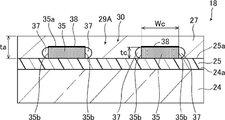
- FIG. FIG. 3 is a schematic cross-sectional view showing an example of the touch panel conductive member according to the embodiment of the present invention. 3, the same components as those of the image display device 10 shown in FIG. 1 are denoted by the same reference numerals, and detailed description thereof will be omitted.
- the touch panel conductive member 18 is a portion that functions as a touch sensor of the touch panel 12, and includes a detection portion 20 that is a detection region E1 in which a user can perform an input operation, and a peripheral region E that is positioned outside the detection region E1. 2 has a peripheral wiring portion 22 .
- the detection unit 20 has, for example, a first detection electrode layer 29A and a second detection electrode layer 29B.
- 29 A of 1st detection electrode layers and the 2nd detection electrode layer 29B are arrange
- the first detection electrode layer 29A and the second detection electrode layer 29B are electrically insulated by the transparent insulating layer 27 .
- the transparent insulating layer 27 functions as an electrical insulating layer.
- the first detection electrode layer 29A is arranged between the plurality of first detection electrodes 30 and the adjacent first detection electrodes 30, and is insulated from the first detection electrodes 30 by a plurality of first dummy electrodes. 31a.
- the plurality of first detection electrodes 30 are strip-shaped electrodes extending parallel to each other in the X direction, spaced apart in the Y direction perpendicular to the X direction, and electrically insulated from each other in the Y direction. 25 is provided on the surface 25a (see FIG. 1). In addition, the plurality of first dummy electrodes 31a are arranged between the first detection electrodes 30 and are provided on the surface 25a (see FIG. 1) of the undercoat layer 25 while being electrically insulated from the first detection electrodes 30. ing. Each of the first detection electrodes 30 is provided with a first electrode terminal 33 at at least one end in the X direction.
- the second detection electrode layer 29B has a plurality of second dummy electrodes 31b arranged between the plurality of second detection electrodes 32 and adjacent second detection electrodes 32 and insulated from the second detection electrodes 32 .
- the plurality of second detection electrodes 32 are strip-shaped electrodes extending parallel to each other in the Y direction, are spaced from each other in the X direction, and are electrically insulated from each other in the X direction on the surface 27a of the transparent insulating layer 27. (See FIG. 1).
- the plurality of second dummy electrodes 31b are arranged between the second detection electrodes 32 and provided on the surface 27a (see FIG. 1) of the transparent insulating layer 27 while being electrically insulated from the second detection electrodes 32. It is Each of the second detection electrodes 32 is provided with a second electrode terminal 34 at one end in the Y direction.
- the plurality of first detection electrodes 30 and the plurality of second detection electrodes 32 are provided orthogonally, but are electrically insulated from each other by the transparent insulating layer 27 as described above.
- the first dummy electrode 31a and the second dummy electrode 31b in the first detection electrode 30 and the second detection electrode 32 are separated from the first detection electrode 30 or the second detection electrode 32 by a disconnection portion, and are electrically It is an unconnected region. Therefore, as described above, the plurality of first detection electrodes 30 are electrically insulated from each other in the Y direction, and the plurality of second detection electrodes 32 are electrically insulated from each other in the X direction. be. As shown in FIG.
- the detection unit 20 is provided with six first detection electrodes 30 and five second detection electrodes 32, but the number is not particularly limited, and a plurality of electrodes is sufficient.
- 29 A of 1st detection electrode layers and the 2nd detection electrode layer 29B are comprised by the metal thin wire 35 (refer FIG. 3) as mentioned above.
- the first detection electrode 30 and the second detection electrode 32 are metal mesh having a mesh pattern of fine metal wires 35
- the first dummy electrode 31a and the second dummy electrode 31b are also metal mesh having a mesh pattern of fine metal wires 35.
- the electrode width of the first detection electrode 30 and the electrode width of the second detection electrode 32 are, for example, 1 to 5 mm, and the electrode pitch is 3 to 6 mm.
- the electrode width of the first detection electrodes 30 is the maximum length in the Y direction
- the electrode width of the second detection electrodes 32 is the maximum length in the X direction.
- the peripheral wiring section 22 includes peripheral wiring (first peripheral wiring 23a, second peripheral wiring 23a, second peripheral This is the area where the wiring 23b) is arranged.
- the peripheral wiring section 22 has a plurality of first peripheral wirings 23a and a plurality of second peripheral wirings 23b.
- One end of the first peripheral wiring 23a is electrically connected to the first detection electrode 30 via the first electrode terminal 33, and the other end is electrically connected to the first external connection terminal 26a.
- the second peripheral wiring 23b has one end electrically connected to the second detection electrode 32 via the second electrode terminal 34, and the other end electrically connected to the second external connection terminal 26b.
- the first electrode terminal 33 and the second electrode terminal 34 may have a solid film shape, or may have a mesh shape as disclosed in Japanese Unexamined Patent Application Publication No. 2013-127658.
- a preferable range of the widths of the first electrode terminals 33 and the second electrode terminals 34 is 1 ⁇ 3 times or more and 1.2 times or less the electrode widths of the first detection electrodes 30 and the
- the first detection electrode 30, the first dummy electrode 31a, the first electrode terminal 33, and the first peripheral wiring 23a of the first conductive layer 11A are integrally constructed from the viewpoint of electrical resistance and resistance to disconnection. It is preferable that there is one, and it is more preferable that they are made of the same metal material. In this case, the first conductive layer 11A is formed by, for example, lithography. Similarly, the second detection electrode 32, the second dummy electrode 31b, the second electrode terminal 34, and the second peripheral wiring 23b of the second conductive layer 11B are integrated from the viewpoint of electrical resistance and resistance to disconnection. It is preferable that they have the same structure, and more preferably that they are made of the same metal material. In this case, the second conductive layer 11B is formed by, for example, lithography.
- FIG. 3 is a diagram showing the touch panel conductive member 18, but a part of it is omitted, and the transparent insulating substrate 24, the undercoat layer 25, and the thin metal wires of the first detection electrodes 30 of the first detection electrode layer 29A are shown. 35 and the transparent insulating layer 27 are shown.
- the thin metal wire 35 shown in FIG. 3 is the first thin metal wire.
- cross-sectional images of the touch panel conductive member 18 in a direction perpendicular to the direction in which the metal wires 35 extend are obtained at 10 locations, and one metal wire 35 is observed at each location. Six or more places where there is a gap 37 between the side surface 35b of the fine wire 35 and the transparent insulating layer 27 are observed.
- the touch panel conductive member 18 is formed in the bending region Bf of the peripheral wiring portion 22 shown in FIG. and the second external connection terminal 26b is bent outward.
- a flexible circuit board 19 electrically connected to the first external connection terminals 26a and the second external connection terminals 26b is arranged on the rear surface 14b side of the image display section 14 opposite to the display surface 14a side.
- the first peripheral wiring 23 a existing in the bending region Bf has a gap (not shown) between the side surface (not shown) and the transparent insulating layer 27 .
- the gap of the first peripheral wiring 23a is the same as the gap 37 of the fine metal wire 35 shown in FIG.
- the first peripheral wiring 23a and the second peripheral wiring 23b can be composed of thin metal wires 35 as described later.
- the number of voids 37 is preferably 8 or more, more preferably 10 or more, in order to achieve a better balance between the reduction in electric resistance of the metal thin wire and the bendability.
- the upper limit is not particularly limited, 20 sites can be mentioned.
- the cross-sectional image is in a direction orthogonal to the direction in which the fine metal wires 35 extend, but when the fine metal wires 35 form a mesh pattern, the extending direction of the fine metal wires 35 may differ. Even if the extending direction of the metal thin wire 35 is different, the cross-sectional image of the cross section in the direction perpendicular to the extending direction of the metal thin wire 35 is acquired for each of the metal thin wires 35 to be measured.
- the porosity which is the percentage of voids, is preferably 10% to 80%, more preferably 30% to 70%, and even more preferably 40% to 70%.
- the porosity can be determined by cross-sectional observation using a scanning electron microscope (SEM) to determine whether or not there are voids on each of 20 side surfaces in total of 10 thin metal wires. That is, the ratio calculated from the number of voids present in the 20 sides is the porosity.
- the gap 37 only needs to exist in the cross-sectional image, and does not need to exist along the direction extending to the side surface 35 b of the fine metal wire 35 . Therefore, the voids 37 may exist continuously or discontinuously along the direction extending along the side surface 35 b of the fine metal wire 35 .
- a cross-sectional image of the touch panel conductive member 18 can be acquired using, for example, a scanning electron microscope (SEM).
- the gap 37 has a size of 50% or more of the thickness tc of the fine metal wire 35 .
- the void 37 exists on the side of the interface with the transparent insulating layer 27 of the thin metal wire 35 on the transparent insulating substrate 24 side.
- the void 37 is the void 37 that is in contact with the undercoat layer 25 and the side surface 35b of the fine metal wire 35 .
- the shape of the gap 37 is not particularly limited as long as it satisfies the above conditions.
- the thickness tc of the thin metal wire 35 is 350-1000 nm, preferably 600-900 nm. If the thickness tc of the metal fine wire 35 is 350 to 1000 nm, the electrical resistance of the metal fine wire 35 is small. It is more preferable that the thickness tc of the fine metal wire 35 is 600 to 900 nm, because the electrical resistance of the fine metal wire 35 is smaller. Moreover, when the thickness tc of the metal fine wire 35 is large, the voids increase and the bendability is improved. Therefore, the thickness tc of the metal fine wire 35 is preferably large.
- the width Wc of the thin metal wire 35 is preferably 1.5 to 4.0 ⁇ m, more preferably 1.5 to 3.0 ⁇ m, even more preferably 1.5 to 2.5 ⁇ m.
- the width Wc of the thin metal wire 35 is 1.5 to 4.0 ⁇ m, it becomes difficult to be visually recognized, and moiré and the like are suppressed. That is, visibility is excellent.
- the width Wc of the metal fine wire 35 is small, the gap increases and the bendability is improved, so the width Wc of the metal fine wire 35 is preferably small.
- the fine metal wires 35 constitute a mesh pattern (see FIG. 4), and the fine metal wires 35 are arranged in a mesh pattern (see FIG. 4).
- the thickness tc of the metal fine wire 35 and the width Wc of the metal fine wire 35 are measured by cutting the touch panel conductive member 18 and using a cross-sectional image of the cut cross section using a scanning electron microscope (SEM). In the cross-sectional image, the length corresponding to the thickness tc and the width Wc of the metal fine wire 35 is measured at 10 locations in the image region corresponding to the metal fine wire 35, and the average value of the measured values at the 10 locations is obtained.
- the thickness tc and the width Wc of the fine metal wire 35 are the average values of the ten measurement values described above.
- a touch panel mounted on a tablet or a notebook PC which is larger than a smartphone, detects a touch operation by contact or proximity with a finger or a stylus pen.
- a resistance a lower fine wire resistance is required.
- the wire resistance is preferably 80 ⁇ /mm or less, more preferably 60 ⁇ /mm, and particularly preferably 40 ⁇ /mm.
- the fine wire resistance of the fine metal wire described above is obtained by measuring the electrical resistance of the fine metal wire and normalizing it to the electrical resistance of 1 mm length ( ⁇ /mm). The electric resistance can be measured, for example, with a resistance meter (RM3544 manufactured by Hioki Electric Co., Ltd., HIOKI).
- the surface 35a of the fine metal wire 35 may be blackened by sulfurizing or oxidizing to form the blackened layer 38.
- FIG. The blackening layer 38 reduces the reflectance of the fine metal wires 35, for example.
- the blackening layer 38 can be composed of copper nitride, copper oxide, copper oxynitride, molybdenum oxide, AgO, Pd, carbon or other nitrides or oxides, or the like.
- the blackened layer 38 is disposed on the visible side of the metal wire 35 , ie, the surface 35 a of the metal wire 35 opposite the undercoat layer 25 . A configuration without the blackened layer 38 may be used.
- an adhesion layer (not shown) may be provided at the interface between the fine metal wires 35 and the undercoat layer 25 .
- the adhesion layer is made of copper oxide.
- the thickness ta of the transparent insulating layer 27 is preferably 1.0 to 5.0 ⁇ m. If the thickness ta of the transparent insulating layer 27 is 1.0 to 5.0 ⁇ m, both insulating properties and bendability can be achieved. Moreover, the thickness ta of the transparent insulating layer 27 is more preferably 2 to 5 ⁇ m, more preferably 2.5 to 4.5 ⁇ m. The thickness ta of the transparent insulating layer 27 is measured by cutting the touch panel conductive member 18 and using a cross-sectional image of the cut cross section using a scanning electron microscope (SEM).
- SEM scanning electron microscope
- the length corresponding to the thickness of the transparent insulating layer is measured at 10 points in the image area corresponding to the transparent insulating layer, and the average value of the measured values at 10 points is obtained.
- the thickness ta of the transparent insulating layer is the average value of the ten measurement values described above.
- the transparent insulating substrate supports the thin metal wires, and supports the first detection electrodes and the second detection electrodes composed of the thin metal wires. Also, the transparent insulating substrate supports the first peripheral wiring and the second peripheral wiring. Further, if the first detection electrode is arranged on one surface of the two surfaces of the transparent insulating substrate and the second detection electrode is arranged on the other surface, the first detection electrode and the second detection electrode are electrically connected.
- the transparent insulating substrate preferably has a thickness of 10 to 60 ⁇ m. Examples of materials for the transparent insulating substrate include transparent resin materials and transparent inorganic materials.
- transparent resin materials include acetylcellulose resins such as triacetylcellulose, polyester resins such as polyethylene terephthalate (PET) and polyethylene naphthalate (PEN), polyethylene (PE), polymethylpentene, Olefin resins such as cycloolefin polymer (COP) and cycloolefin copolymer (COC), (meth)acrylic resins such as polymethyl methacrylate, polyurethane resins, polyether sulfone, polycarbonate, polysulfone, polyether, polyether ketone , acrylonitrile, and methacrylonitrile.
- acetylcellulose resins such as triacetylcellulose
- polyester resins such as polyethylene terephthalate (PET) and polyethylene naphthalate (PEN)
- PET polyethylene
- PE polymethylpentene
- Olefin resins such as cycloolefin polymer (COP) and cycloolefin copoly
- PET is preferable because it has good adhesion to the first detection electrode, the second detection electrode, the first peripheral wiring, and the second peripheral wiring.
- transparent inorganic materials include glasses such as non-alkali glass, alkali glass, chemically strengthened glass, soda glass, potash glass, and lead glass, and translucent piezoelectric ceramics (PLZT (lead lanthanum zirconate titanate). )), quartz, fluorite and sapphire.
- the transparent insulating substrate is preferably a substrate containing a polyester-based resin.
- the total light transmittance of the transparent insulating substrate is preferably 40-100%, more preferably 85-100%. The total light transmittance is measured using, for example, "Plastics-Determination of total light transmittance and total light reflectance" defined in JIS K 7375:2008.
- the undercoat layer further improves the adhesion of the first detection electrode, the second detection electrode, the first peripheral wiring, and the second peripheral wiring.
- the undercoat layer contains a surfactant containing at least one of a fluorine atom and a silicon atom.
- the content of the surfactant in the undercoat layer is 0.01 to 5% by weight, preferably 0.04 to 1.50% by weight, based on the total weight of the undercoat layer. If the content of the surfactant in the undercoat layer is 0.01 to 5% by mass with respect to the total mass of the undercoat layer, a total of 20 side surfaces 35b Among them, the configuration can be such that there are six or more gaps 37 .
- the type of surfactant is not particularly limited, and known surfactants can be used. Specifically, at least one surfactant selected from silicone-based surfactants and fluorine-based surfactants is used. preferable. It should be noted that the surfactant is preferably an oligomer or polymer rather than a low-molecular-weight compound.
- the surfactant When a surfactant is added, the surfactant quickly migrates to the surface of the applied coating film and becomes unevenly distributed, and even after the coating film dries, the surfactant will remain unevenly distributed on the surface.
- the surface energy of the added film is lowered by the surfactant. From the viewpoint of preventing film thickness non-uniformity, repelling, and unevenness, it is preferable that the surface energy of the film is low.
- silicone-based surfactants include polymers or oligomers containing a plurality of dimethylsilyloxy units as repeating units and having substituents on terminals and/or side chains.
- a polymer or oligomer containing dimethylsilyloxy as a repeating unit may contain repeating units other than dimethylsilyloxy.
- the substituents may be the same or different, and a plurality of substituents is preferred. Examples of preferred substituents include groups including polyether groups, alkyl groups, aryl groups, aryloxy groups, aryl groups, cinnamoyl groups, oxetanyl groups, fluoroalkyl groups, polyoxyalkylene groups, and the like.
- the number average molecular weight of the silicone surfactant is not particularly limited, it is preferably 100,000 or less, more preferably 50,000 or less, even more preferably 1,000 to 30,000, and 1,000 to 20,000. is particularly preferred.
- silicone surfactants examples include X22-3710, X22-162C, X22-3701E, X22160AS and X22170DX manufactured by Shin-Etsu Chemical Co., Ltd., which are commercially available silicone surfactants having no ionizing radiation curing group.
- a fluorosurfactant has a fluoroaliphatic group and, for example, an amphiphilic group that contributes to affinity for various compositions such as coatings and molding materials when the surfactant is used as an additive. in the same molecule, and such compounds can generally be obtained by copolymerizing a monomer having a fluoroaliphatic group and a monomer having an hydrophilic group.
- monomers having hydrophilic groups to be copolymerized with monomers having fluoroaliphatic groups include poly(oxyalkylene) acrylates and poly(oxyalkylene) methacrylates.
- Preferred commercially available fluorine-based surfactants that do not have an ionizing radiation curing group include Megafac series (MCF350-5, F472, F476, F445, F444, F443, F178, F470, F475, F479, manufactured by DIC Corporation). , F477, F482, F486, TF1025, F478, F178K, F-784-F, etc.); Futagent series manufactured by Neos Co., Ltd.
- those having an ionizing radiation curing group include OPTOOL DAC manufactured by Daikin Industries, Ltd.; ), RS series (RS71, RS101, RS102, RS103, RS104, RS105, RS-56, etc.).
- a surfactant having an ionizing radiation-curable group is preferred from the viewpoint of remaining on the surface of the undercoat layer.
- the undercoat layer may contain other materials in addition to the surfactants described above.
- the undercoat layer may contain a resin (binder resin).
- the resin functions as a binder for the undercoat layer.
- the type of resin is not particularly limited, and known resins can be used. Examples of resins include polyester resins, polyether resins, (meth)acrylic resins, epoxy resins, urethane resins, alkyd resins, spiroacetal resins, polybutadiene resins, and polythiolpolyene resins, with (meth)acrylic resins being preferred.
- the content of the resin in the undercoat layer is not particularly limited, it is preferably 40 to 95% by mass, more preferably 50 to 90% by mass, even more preferably 50 to 80% by mass, based on the total mass of the undercoat layer.
- the undercoat layer may further contain inorganic particles.
- the type of inorganic particles is not particularly limited, and examples include inorganic particles containing at least one selected from the group consisting of silica, titanium oxide, zirconium oxide, and aluminum oxide.
- the particle diameter of the inorganic particles is not particularly limited, it is preferably 5 to 100 nm, more preferably 10 to 80 nm.
- the content of the inorganic particles in the undercoat layer is not particularly limited, but is preferably 5 to 60% by mass, more preferably 10 to 50% by mass, and even more preferably 10 to 45% by mass, based on the total mass of the undercoat layer.
- the method for forming the undercoat layer is not particularly limited, examples thereof include a method of applying a composition for forming an undercoat layer, as described later.
- the undercoat layer-forming composition contains the above-described surfactant. The content of the surfactant is adjusted so that the content of the surfactant in the undercoat layer is within the above range.
- the undercoat layer-forming composition may contain other materials in addition to the surfactant. Other materials include the resins and inorganic particles described above. Other materials also include solvents. Solvents include water and organic solvents.
- the composition for forming an undercoat layer may contain a monomer.
- the undercoat layer can be formed by applying an undercoat layer-forming composition containing a monomer and subjecting the coating film to curing treatment (for example, light irradiation treatment and heat treatment).
- the composition for forming an undercoat layer may further contain a polymerization initiator.
- the polymerization initiator includes known photopolymerization initiators and thermal polymerization initiators.
- the type of monomer is not particularly limited, and a monomer that can constitute the resin described above is selected. Among them, a compound having a photopolymerizable functional group is preferable as the monomer.
- the photopolymerizable functional group include polymerizable unsaturated groups (carbon-carbon unsaturated double bond groups) such as (meth)acryloyl groups, vinyl groups, styryl groups, and allyl groups. ) acryloyl groups are preferred.
- compounds having a polymerizable unsaturated group include alkylene glycol (meth)acrylic acid diesters such as neopentyl glycol acrylate, 1,6-hexanediol (meth)acrylate, and propylene glycol di(meth)acrylate; Polyoxyalkylene glycol (meth)acrylic acid diesters such as triethylene glycol di(meth)acrylate, dipropylene glycol di(meth)acrylate, polyethylene glycol di(meth)acrylate, and polypropylene glycol di(meth)acrylate; (meth)acrylic acid diesters of polyhydric alcohols such as pentaerythritol di(meth)acrylate; (Meth)acrylic diesters of ethylene oxide or propylene oxide adducts such as 2,2-bis ⁇ 4-(acryloxy-diethoxy)phenyl ⁇ propane and 2-2-bis ⁇ 4-(acryloxy-polypropoxy)phenyl ⁇ propane
- epoxy (meth)acrylates, urethane (meth)acrylates, and polyester (meth)acrylates are also preferably used as compounds having photopolymerizable functional groups.
- esters of polyhydric alcohol and (meth)acrylic acid are preferred. More preferably, it contains at least one polyfunctional monomer having 3 or more (meth)acryloyl groups in one molecule.
- esters of polyhydric alcohol and (meth)acrylic acid are preferred. More preferably, it contains at least one polyfunctional monomer having 3 or more (meth)acryloyl groups in one molecule.
- pentaerythritol tetra(meth)acrylate pentaerythritol tri(meth)acrylate, trimethylolpropane tri(meth)acrylate, EO (ethylene oxide)-modified trimethylolpropane tri(meth)acrylate, PO (propylene oxide)-modified trimethylol Propane tri(meth)acrylate, EO-modified phosphoric acid tri(meth)acrylate, trimethylolethane tri(meth)acrylate, ditrimethylolpropane tetra(meth)acrylate, dipent
- polyfunctional acrylate compounds having a (meth)acryloyl group include Nippon Kayaku Co., Ltd. KAYARADDPHA, DPHA-2C, PET-30, TMPTA, TPA-320, TPA-330, Same RP-1040, Same T-1420, Same D-310, Same DPCA-20, Same DPCA-30, Same DPCA-60, Same GPO-303, Osaka Organic Chemical Industry Co., Ltd. V#3PA, V#400, Esterified products of polyol and (meth)acrylic acid such as V#36095D, V#1000 and V#1080 can be mentioned.
- UV-1400B the same UV-1700B, the same UV-6300B, the same UV-7550B, the same UV-7600B, the same UV-7605B, the same UV-7610B, the same UV-7620EA, the same UV-7630B, the same UV-7640B , UV-6630B, UV-7000B, UV-7510B, UV-7461TE, UV-3000B, UV-3200B, UV-3210EA, UV-3310EA, UV-3310B, UV-3500BA , Same UV-3520TL, Same UV-3700B, Same UV-6100B, Same UV-6640B, Same UV-2000B, Same UV-2010B, Same UV-2250EA, Same UV-2750B (manufactured by Nippon Synthetic Chemical Co., Ltd.), UA -306H, UA-306I, UA-306T, UL-503LN (manufactured by Kyoeisha Chemical Co., Ltd.), Unidic 17-806, 17-813, V-4030, V
- the thin metal wires 35 constitute the first detection electrodes 30 (see FIG. 2) and the second detection electrodes 32 (see FIG. 2) as described above.
- the fine metal wire 35 is composed of, for example, a single piece of metal or a laminate of metals. A method for forming the thin metal wires will be described later.
- Examples of the metal contained in the thin metal wire 35 include metals or alloys such as gold (Au), silver (Ag), copper (Cu), and aluminum (Al). Among these, silver and copper are preferable, and copper is more preferable, because the thin metal wire has excellent electrical conductivity.
- the thin metal wire is not limited to a single metal, and may have a multi-layer structure.
- the thin metal wire has, for example, a structure in which a copper oxynitride layer, a copper layer, and a copper oxynitride layer are sequentially laminated, or a structure in which molybdenum (Mo), aluminum (Al), and molybdenum (Mo) are sequentially laminated, Alternatively, a structure in which molybdenum (Mo), copper (Cu), and molybdenum (Mo) are sequentially laminated can be employed.
- the first detection electrode 30 and the second detection electrode 32 are composed of the fine metal wires 35 as described above.
- the first detection electrodes 30 and the second detection electrodes 32 form, for example, a mesh pattern in which a plurality of thin metal wires 35 intersect, as shown in FIG.
- the mesh pattern composed of the fine metal wires 35 preferably has an aperture ratio of 90% or more, more preferably 95% or more, from the viewpoint of visible light transmittance. more preferred.
- the aperture ratio corresponds to the ratio of the transparent portion excluding the thin metal wires in the region provided with the conductive layer, that is, the ratio of the openings to the entire region provided with the conductive layer.
- the first peripheral wiring 23 a and the second peripheral wiring 23 b can also have the same configuration as the first detection electrode 30 and the second detection electrode 32 , and can be composed of thin metal wires 35 .
- the first peripheral wiring 23a and the second peripheral wiring 23b may have a mesh pattern in which a plurality of thin metal wires 35 intersect.
- the pattern of the mesh pattern is not particularly limited.
- Triangles such as triangles and right triangles, quadrilaterals such as squares, rectangles, rhombuses, parallelograms, and trapezoids, (regular) n-gons such as (regular) hexagons and (regular) octagons, circles, ellipses, stars, etc. Interlocking geometric figures are preferred.
- mesh of mesh pattern is intended a shape containing a plurality of openings 36 constituted by intersecting thin metal wires 35, as shown in FIG.
- the opening 36 is an open area surrounded by the fine metal wires 35 .
- the opening 36 has a diamond shape, but other shapes are possible.
- polygonal shapes eg, triangles, squares, hexagons, and random polygons
- the shape of one side may be curved, or arc-shaped, instead of linear.
- an arc shape for example, two opposing sides may be arcuately convex outward, and the other two opposing sides may be arcuately convex inward.
- the shape of each side may be a wavy line shape in which an outwardly convex circular arc and an inwardly convex circular arc are continuous.
- the shape of each side may be a sine curve.
- the mesh pattern is not particularly limited, and may be a random pattern, a regular pattern, or a regular mesh pattern in which a plurality of congruent shapes are repeatedly arranged.
- the length of one side of the rhombus that is, the length W of one side of the opening 36 is preferably 50 to 1500 ⁇ m, more preferably 150 to 800 ⁇ m, and even more preferably 200 to 600 ⁇ m from the viewpoint of visibility.
- the touch panel conductive member 18 is connected to the image display portion 14 (FIG. 1). (see FIG. 1), the display can be viewed without discomfort.
- the mesh pattern of fine metal wires can be observed and measured using an optical microscope (Digital Microscope VHX-7000 manufactured by Keyence Corporation).
- a method for forming the thin metal wire is not particularly limited.
- a method for forming the fine metal wires for example, a plating method, a printing method, a vapor deposition method, or the like can be appropriately used.
- a method for forming thin metal wires by plating will be described.
- the fine metal wire can be composed of a metal plating film formed on the undercoat layer by electroless plating on the undercoat layer. In this case, after patterning a catalyst ink containing at least metal fine particles on a base material, the base material is immersed in an electroless plating bath to form a metal plating film.
- the method for producing a metal coated base material described in JP-A-2014-159620 can be used. Also, after forming a pattern of a resin composition having a functional group capable of interacting with at least a metal catalyst precursor on a substrate, a catalyst or catalyst precursor is applied, and the substrate is immersed in an electroless plating bath. , are formed by forming a metal plating film. More specifically, the method for producing a metal coating substrate described in JP-A-2012-144761 can be applied. The pattern includes a mesh pattern.
- the plating method may be only electroless plating, or electroplating may be performed after electroless plating.
- An additive method can be used for the plating method.
- the additive method is a method of forming fine metal wires by applying plating or the like only to a portion of a transparent substrate where the fine metal wires are to be formed. From the point of view of productivity and the like, the additive method is preferable.
- a subtractive method can also be used to form the thin metal wires.
- the subtractive method is a method in which a conductive layer is formed on a transparent substrate and unnecessary portions are removed by etching such as chemical etching to form fine metal wires.
- a method for forming fine metal wires by a printing method will be described.
- a conductive paste containing conductive powder is applied to a substrate in the same pattern as the thin metal wires, and then heat treatment is performed to form the thin metal wires.
- Pattern formation using a conductive paste is performed by, for example, an inkjet method or a screen printing method.
- the conductive paste more specifically, the conductive paste described in JP-A-2011-28985 can be used.
- a method for forming thin metal wires by vapor deposition will be described. First, a film of metal such as copper is formed by vapor deposition, and fine metal wires can be formed from the metal film by photolithography. For example, fine metal wires can be formed in a mesh pattern.
- the mesh pattern is composed of thin metal wires.
- Electrolytic copper foil can be used for the metal film such as thin metal wire copper, in addition to the copper foil layer formed by vapor deposition. More specifically, the process of forming a copper wiring described in JP-A-2014-29614 can be used.
- a well-known method is mentioned as a formation method of the metal film for forming a metal fine wire.
- methods using wet processes such as coating methods, inkjet methods, coating methods, and dipping methods, vapor deposition methods such as resistance heating methods and EB (electron beam) methods, and sputtering methods and CVD (Chemical Vapor Deposition) methods.
- vapor deposition methods such as resistance heating methods and EB (electron beam) methods
- sputtering methods and CVD (Chemical Vapor Deposition) methods A method using a dry process and the like can be mentioned.
- the sputtering method is preferably applied. By etching the metal film by photolithography, thin metal wires can be formed in a desired pattern.
- Photolithography is the process of applying a resist, forming a resist film, exposing, developing and rinsing the resist film, etching the metal film, and stripping the resist film to process the metal film into a desired pattern.
- the resist can be either positive or negative resist.
- preheating or prebaking can be performed as necessary.
- a pattern mask having a desired pattern is arranged, and light having a wavelength suitable for the resist used, generally ultraviolet rays, is irradiated thereon.
- development can be performed with a developer compatible with the resist used.
- the development is stopped with a rinse liquid such as water, and the resist pattern is formed by washing.
- the resist pattern is, for example, a pattern corresponding to a mesh pattern.
- the formed resist pattern is subjected to pretreatment or post-baking as necessary, and then etching is performed to form a pattern corresponding to the resist pattern on the metal film.
- etching one that can be used as an etchant for copper, such as an aqueous solution of ferric chloride, can be appropriately selected.
- the remaining resist film is peeled off to obtain thin metal wires having a desired pattern.
- the photolithographic method is a method generally recognized by those skilled in the art, and a specific application mode thereof can be easily selected by those skilled in the art according to the intended purpose.
- the transparent insulating layer 27 is a layer that covers the first fine metal wires, and is transparent and has electrical insulating properties.
- the transparent insulating layer 27 is different from the first transparent insulating layer 15 and the second transparent insulating layer 17 described above.
- the transparent insulating layer 27 is not particularly limited as long as it can maintain electrical insulation without allowing the thin metal wires 35, which are originally in an electrically insulated state, to conduct each other when the touch panel conductive member 18 is used.
- the transparent insulating layer 27 is made of inorganic material such as silicon dioxide, silicon nitride, silicon oxynitride, and aluminum oxide.
- the transparent insulating layer 27 is made of organic material such as (meth)acrylic resin, urethane resin, and polyimide resin.
- the transparent insulating layer 27 is preferably made of an organic material, and particularly preferably a (meth)acrylic resin, in terms of ease of formation and ease of control of the film thickness.
- a composition for forming a transparent insulating layer it is preferable to use a composition for forming a transparent insulating layer as described later.
- the components contained in the composition for forming a transparent insulating layer are not particularly limited, it preferably contains a monomer.
- the monomer examples include monomers that may be contained in the undercoat layer-forming composition described above, preferably a polymerizable compound having a (meth)acryloyl group, and a polyfunctional polymerizable compound having a (meth)acryloyl group ( A polymerizable compound having two or more (meth)acryloyl groups)) is more preferred.
- the composition for forming a transparent insulating layer may contain a polymerization initiator and a solvent in addition to the above monomers. Although the content of the monomer in the composition for forming a transparent insulating layer is not particularly limited, it is preferably 40 to 95% by mass with respect to the total amount of components excluding the solvent in the composition for forming a transparent insulating layer.
- the content of the polymerization initiator in the composition for forming a transparent insulating layer is not particularly limited, but is 0.1 to 10% by mass with respect to the total amount of components excluding the solvent in the composition for forming a transparent insulating layer. preferable.
- a method for manufacturing the touch panel conductive member 18 will be described below.
- a PET substrate is used as the transparent insulating substrate.
- the undercoat layer 25 is formed on the surface 24a of the transparent insulating substrate 24 as shown in FIG.
- the undercoat layer 25 contains a surfactant containing at least one of a fluorine atom and a silicon atom as described above.
- the content of the surfactant is 0.01 to 5% by weight based on the total weight of the undercoat layer.
- a surfactant containing at least one of a fluorine atom and a silicon atom in the undercoat layer 25 the surface tension of the undercoat layer 25 is lowered, wettability is lowered when the transparent insulating layer 27 is formed, and voids are formed. considered to be easy to form.
- the method for forming the undercoat layer 25 is not particularly limited, and examples thereof include a method of applying a composition for forming an undercoat layer and, if necessary, performing a curing treatment. Examples of coating methods include spin coating, gravure coating, reverse coating, die coating, blade coating, roll coating, air knife coating, screen coating, bar coating, curtain coating, and the like. A coating method can be used. In addition, you may implement a hardening process after application
- the curing treatment includes photocuring treatment and heat treatment.
- the second step is a step of forming the first fine metal wires on the surface 25a of the undercoat layer 25. Since the first fine metal wires are formed by the method for forming the fine metal wires described above, the details thereof are as follows. Description is omitted.
- the second step preferably includes a step of forming the first fine metal wires in a mesh pattern (see FIG. 4). Since the step of forming the mesh pattern is also the same as the method of forming the fine metal wires described above, detailed description thereof will be omitted.
- a first detection electrode 30 (see FIG. 2) is formed by the first thin metal wire.
- a first detection electrode 30 (see FIG. 2) is formed on the undercoat layer 25 .
- the third step is to form a transparent insulating layer 27 covering the first thin metal wires.
- a (meth)acrylic resin is used for the transparent insulating layer 27 .
- the thickness of the transparent insulating layer 27 is preferably 1.0 to 5.0 ⁇ m.
- a method for forming the transparent insulating layer 27 is not particularly limited. A method of forming a transparent insulating layer (coating method), or a method of forming a transparent insulating layer on a temporary substrate and transferring it to the surface 25a of the undercoat layer 25 so as to cover the fine metal wires (transfer method). .
- the third step is preferably a step of applying a composition for forming a transparent insulating layer onto the first thin metal wires to form the transparent insulating layer 27 . That is, from the viewpoint of easy control of the thickness of the transparent insulating layer 27, it is preferable to use a coating method.
- the coating method for applying the composition for forming a transparent insulating layer is not particularly limited, and known methods such as gravure coater, comma coater, bar coater, knife coater, die coater or roll coater, etc. An inkjet method, a screen printing method, or the like can be used. In addition, you may implement a hardening process after application
- the curing treatment includes photocuring treatment and heat treatment.
- a fourth step of further forming a second thin metal wire on the transparent insulating layer 27 may be included. Since the second thin metal wire in the fourth step is formed by the method for forming the thin metal wire described above, detailed description thereof will be omitted. In addition, in order to form a mesh pattern (see FIG. 4) with the fine metal wires 35, the second fine metal wires may be formed in a mesh pattern (see FIG. 4) also in the fourth step.
- the second thin metal wire forms the second detection electrode 32 (see FIG. 2).
- a second sensing electrode is formed on the transparent insulating layer 27 .
- the second peripheral wiring 23b electrically connected to the second detection electrode 32 is also formed by the second fine metal wire.
- a second transparent insulating layer 17 may be formed on the second detection electrodes 32 and the second peripheral wiring 23b.
- the second transparent insulating layer 17 uses, for example, an optically transparent adhesive (OCA) and has flexibility. Since the second transparent insulating layer 17 is flexible, it is not necessary to provide the gap 37 (see FIG. 3) of the metal fine wire 35 in the second metal fine wire.
- a shield electrode may be provided on the second transparent insulating layer 17 .
- FIG. 6 is a schematic cross-sectional view showing a second example of an image display device having a touch panel conductive member according to an embodiment of the present invention. are denoted by the same reference numerals, and detailed description thereof will be omitted.
- the image display device 10a of the second example shown in FIG. The difference is that a layer 29B is provided. Undercoat layers 25 are provided on the front surface 24a and the back surface 24b of the transparent insulating substrate 24, respectively.
- a second detection electrode layer 29B is provided on the undercoat layer 25 on the front surface 24a side, and a first detection electrode layer 29A is provided on the undercoat layer 25 on the back surface 24b side.
- the transparent insulating substrate 24 electrically insulates the first detection electrode layer 29A from the second detection electrode layer 29B. That is, the first detection electrode 30 and the second detection electrode 32 are electrically insulated by the transparent insulating substrate 24 .
- a transparent insulating layer 52 is provided to cover the peripheral wiring insulating layer 50 on the first detection electrode layer 29A and the first peripheral wiring 23a.
- a transparent insulating layer 27 is provided on the undercoat layer 25 on the surface 24 a side of the transparent insulating substrate 24 to cover the second detection electrode layer 29 B, and the cover layer 16 is provided on the transparent insulating layer 27 .
- the image display unit 14 is connected to the transparent insulating layer 52 with the display surface 14a facing.
- the transparent insulating layer 52 has the same configuration as the transparent insulating layer 27 described above.
- the first fine metal wires forming the first detection electrode layer 29A and the second fine metal wires forming the second detection electrode layer 29B both have the same configuration as the fine metal wires 35 shown in FIG. In cross-sectional observation of ten metal fine wires 35, six or more gaps 37 are found among a total of twenty side faces 35b.
- the peripheral wiring insulating layer 50 is formed on the first peripheral wiring 23a for the purpose of preventing migration and corrosion of the extraction wiring.
- the peripheral wiring insulating layer 50 for example, an organic film such as (meth)acrylic resin or urethane resin is used.
- the film thickness of the peripheral wiring insulating layer 50 is preferably 1 to 30 ⁇ m.
- the present invention is basically configured as described above. As described above, the conductive member for a touch panel and the method for manufacturing the conductive member for a touch panel of the present invention have been described in detail. However, the present invention is not limited to the above-described embodiments, and various modifications or It is of course possible to make changes.
- Example 1 The touch panel electrode member of Example 1 will be described.
- a 50 ⁇ m-thick PET film (Cosmo Shine A4300, manufactured by Toyobo Co., Ltd.) having easy-adhesion layers formed on both sides was prepared.
- UCL1 shown in Table 1 below as a composition for forming an undercoat layer was applied using a spin coating method so that the dry film thickness was 1.5 ⁇ m.
- a 120 W high-pressure mercury lamp was used to irradiate the composition with ultraviolet light having a light intensity of 400 mJ for curing, thereby producing an undercoat layer (UC1).
- a copper oxide film was formed as an adhesion layer on one surface of the undercoat layer (UC1).
- the copper oxide film was formed by using copper as a target, and while introducing a mixed gas of oxygen gas (flow rate 90 sccm (standard cubic centimeter per minute)) and argon gas (flow rate 270 sccm) into the sputtering apparatus, the pressure in the deposition chamber was set to 0.0.
- the film was formed by sputtering under the conditions of 4 Pa, power density of 1.7 W/cm 2 , and temperature during film formation of 90°C.
- the film thickness of the obtained copper oxide film was 20 nm.
- 90 sccm is 152.1 ⁇ 10 ⁇ 3 Pa ⁇ m 3 /sec
- 270 sccm is 456.3 ⁇ 10 ⁇ 3 Pa ⁇ m 3 /sec.
- a copper film was formed on the formed copper oxide film.
- argon gas flow rate 270 sccm (456.3 ⁇ 10 ⁇ 3 Pa ⁇ m 3 /sec)
- the pressure in the deposition chamber was 0.4 Pa and the power density was 4.0 Pa.
- the film was formed by sputtering under conditions of 2 W/cm 2 and a temperature of 90° C. during film formation. In the laminate thus obtained, the film thickness of the copper film was 350 nm.
- MP1 regular mesh pattern
- the laminate with the resist film placed thereon was developed by immersing it in an aqueous sodium hydroxide solution with a concentration of 3%, A resist film having a pattern corresponding to the mesh pattern (MP1) was obtained.
- the copper oxide film and the copper film were simultaneously etched using a 5% ferric chloride aqueous solution to pattern the fine metal wires.
- the remaining resist film was peeled off to obtain the first fine metal wires arranged in a mesh pattern (MP1).
- the composition for forming a transparent insulating layer was applied so as to cover the first thin metal wires, thereby forming a transparent insulating layer made of an acrylic resin and having a thickness of 3.0 ⁇ m.
- the transparent insulating layer-forming composition contained 97% by mass of NK Ester A-9300 manufactured by Shin-Nakamura Chemical Co., Ltd. and 3% by mass of Irgacure 907 manufactured by IGM Resins BV.
- a copper film having a thickness of 350 nm was formed on the transparent insulating layer as described above.
- a second fine metal wire having a mesh pattern (MP2) was produced in the same manner as the first fine metal wire arranged in the mesh pattern (MP1).
- a conductive member for a touch panel was obtained.
- the rhombus lattices of the mesh pattern MP1 and the mesh pattern MP2 are shifted by 300 ⁇ m from each other, and the rhombuses of the mesh pattern MP2 are arranged so that the intersections of the diagonal lines of the rhombus lattices of the mesh pattern MP1 come to the vertices of the rhombus of the mesh pattern MP2.
- Example 1 the cross section of 10 fine metal wires was observed using a scanning electron microscope (SEM) to determine whether or not there were voids on each side surface (a total of 20 side surfaces).
- Example 1 had a porosity of 40%. That is, voids were present at 8 locations among the 20 sides. The porosity is a ratio calculated from the number of voids present in the 20 sides. Table 1 below shows the porosity and the number of voids. In addition, the voids were determined based on the criteria shown below. -standard- The size to be determined as the void is 50% or more of the height of the fine metal wire.
- the void exists on the interface side of the thin metal wire on the side of the transparent insulating substrate. The void refers to a void in contact with the undercoat layer and the side surface of the metal fine wire, and does not refer to a specific shape.
- Example 2 is the same as Example 1 except that the thickness of the fine metal wire is 600 nm and the porosity is 50%. In Example 2, voids were present in 10 of the 20 sides.
- Example 3 is the same as Example 1 except that the width of the metal fine wire is 1.5 ⁇ m, the thickness of the metal fine wire is 600 nm, and the porosity is 55% compared to Example 1. is the same as In Example 3, voids were present in 11 of the 20 sides.
- Example 4 is different from Example 1 except that the width of the metal fine wire is 1.5 ⁇ m, the thickness of the metal fine wire is 900 nm, and the porosity is 60%. is the same as In Example 4, voids were present at 12 locations out of 20 sides.
- Example 5 Compared to Example 1, Example 5 uses UCL2 in Table 1 below for the undercoat layer-forming composition, and the amount of surfactant in the undercoat layer is 1.50% by mass. It is the same as Example 1 except that the width is 3.0 ⁇ m, the thickness of the fine metal wire is 600 nm, and the porosity is 60%. In Example 5, voids were present in 12 of the 20 sides.
- Example 6 Compared to Example 1, Example 6 uses UCL2 in Table 1 below for the undercoat layer-forming composition, and the amount of surfactant in the undercoat layer is 1.50% by mass. It is the same as Example 1 except that the width is 1.5 ⁇ m, the thickness of the fine metal wire is 600 nm, and the porosity is 70%.
- Example 6 had voids in 14 of the 20 sides.
- Example 7 uses UCL2 in Table 1 below for the undercoat layer-forming composition, and the amount of surfactant in the undercoat layer is 1.50% by mass. It is the same as Example 1 except that the width is 1.5 ⁇ m, the thickness of the fine metal wire is 900 nm, and the porosity is 70%.
- Example 7 had voids in 14 of the 20 sides.
- Example 8 Compared to Example 1, Example 8 uses UCL3 in Table 1 below for the undercoat layer-forming composition, and the amount of surfactant in the undercoat layer is 0.04% by mass. It is the same as Example 1 except that the width is 3.0 ⁇ m and the porosity is 30%. In Example 8, voids were present in 6 of the 20 sides.
- Example 9 Compared to Example 1, Example 9 uses UCL3 in Table 1 below for the undercoat layer-forming composition, and the amount of surfactant in the undercoat layer is 0.04% by mass. It is the same as Example 1 except that the width is 3.0 ⁇ m, the thickness of the fine metal wire is 600 nm, and the porosity is 35%. In Example 9, voids were present at 7 locations out of 20 sides.
- Example 10 Compared to Example 1, Example 10 uses UCL5 in Table 1 below for the undercoat layer-forming composition, and the amount of surfactant in the undercoat layer is 4.02% by mass. It is the same as Example 1 except that the width is 1.5 ⁇ m, the thickness of the fine metal wire is 600 nm, and the porosity is 80%. Example 10 had voids in 16 of the 20 sides. (Example 11) Example 11 is the same as Example 1 except that the width of the metal fine wire is 5.0 ⁇ m, the thickness of the metal fine wire is 600 nm, and the porosity is 50% compared to Example 1. is the same as Example 11 had voids in 10 of the 20 sides.
- Example 12 is different from Example 1 except that the width of the metal fine wire is 1.0 ⁇ m, the thickness of the metal fine wire is 600 nm, and the porosity is 50%. is the same as Example 12 had voids in 10 of the 20 sides.
- Comparative Example 1 Compared to Example 1, Comparative Example 1 uses UCL4 in Table 1 below for the undercoat layer-forming composition, and the amount of surfactant in the undercoat layer is 0.0% by mass. It is the same as Example 1 except that the width is 5.0 ⁇ m and the porosity is 5%. In Comparative Example 1, one void was present in 20 sides.
- Comparative example 2 Compared to Example 1, Comparative Example 2 uses UCL4 in Table 1 below for the undercoat layer-forming composition, and the amount of surfactant in the undercoat layer is 0.0% by mass. It is the same as Example 1 except that the width is 3.0 ⁇ m and the porosity is 0%. Comparative Example 2 did not have voids.
- Comparative Example 3 Compared to Example 1, Comparative Example 3 uses UCL4 in Table 1 below for the undercoat layer-forming composition, and the amount of surfactant in the undercoat layer is 0.0% by mass. It is the same as Example 1 except that the width is 4.0 ⁇ m, the thickness of the fine metal wire is 600 nm, and the porosity is 15%. In Comparative Example 3, voids were present at three locations among the 20 sides.
- Comparative Example 4 Compared to Example 1, Comparative Example 4 uses UCL4 in Table 1 below for the undercoat layer-forming composition, and the amount of surfactant in the undercoat layer is 0.0% by mass.
- Comparative Example 5 It is the same as Example 1 except that the width is 1.5 ⁇ m, the thickness of the fine metal wire is 250 nm, and the porosity is 0%. Comparative Example 4 did not have voids. (Comparative Example 5) Compared to Example 1, Comparative Example 5 uses UCL2 in Table 1 below for the undercoat layer-forming composition, and the amount of surfactant in the undercoat layer is 1.50% by mass. It is the same as Example 1 except that the width is 3.0 ⁇ m, the thickness of the fine metal wire is 1100 nm, and the porosity is 65%. Comparative Example 5 had voids in 13 of the 20 sides.
- urethane acrylate is manufactured by Mitsubishi Chemical Corporation, Shikou UV7600B, solid content: 100% by mass.
- the photopolymerization initiator is Irgacure 907 solid content: 100% by mass, manufactured by IGM Resins BV.
- the surfactant is MEGAFACE RS-56 solid content: 40% by mass, manufactured by DIC Corporation.
- MIBK is methyl isobutyl ketone.
- the amount of surfactant indicates the amount in terms of solid content and can be calculated as follows.
- UCL4 does not contain surfactants.
- the electrode members for a touch panel of Examples 1 to 12 and Comparative Examples 1 to 5 were evaluated for bendability, thin wire resistance, and visibility.
- Table 2 below shows the evaluation results of bendability, fine wire resistance, and visibility. The bendability, fine wire resistance, and visibility will be described below.
- a transparent insulating film (not shown) is formed so as not to cover the extraction electrode 39c, and a rhombic mesh pattern of 600 ⁇ m on a side surrounded by second thin metal wires 39b (see FIG. 7) is formed on the transparent insulating film. is shifted 300 ⁇ m from the rhombus lattice formed by the first fine metal wires 39a to form a mesh pattern of 5 mm long and 48 mm wide, and a touch panel conductive member 40 for bendability evaluation (see FIG. 7) was created. .
- the mesh-patterned first fine metal wires 39a shown in FIG. 7 are arranged below the mesh-patterned second fine metal wires 39b.
- the first mesh-patterned fine metal wires 39a shown in FIG. 7 are bent 180 degrees at the center of the long side of the mesh-patterned region, with the second mesh-patterned fine metal wires 39b facing outward. ° Mountain folding was carried out. When folded, the mesh-patterned second thin metal wires 39b are on the outside.
- the electrical resistance between lead-out electrodes at both ends of the mesh pattern region was measured before and after bending to obtain the resistance change rate of the electrical resistance before and after bending.
- the electrical resistance was measured using a resistance meter (RM3544 manufactured by Hioki Electric Co., Ltd.).
- the bendability was evaluated according to the following evaluation criteria A to C.
- C Resistance change rate of 20% or more
- the electrical resistance of the first fine metal wire was measured and normalized ( ⁇ /mm) to the electrical resistance of 1 mm length. This was performed with ten first fine metal wires (one side forming a mesh cell), and the average value of the ten first fine metal wires was taken as the fine wire resistance.
- the electrical resistance of the first thin metal wire was measured using a resistance meter (RM3544 manufactured by Hioki Electric Co., Ltd., HIOKI).
- a touch panel electrode member was arranged on a liquid crystal display module having a liquid crystal display and a controller for controlling image display on the liquid crystal display.
- an evaluator of the visibility evaluation observes the electrode member for the touch panel arranged on the liquid crystal display module, and moire is visually recognized. Visibility was evaluated by whether or not. Twenty evaluators were used to evaluate the visibility. The evaluator evaluated the visibility based on the evaluation criteria A to D below. A: None of the 20 people recognized moire. B: Of 20 people, 1 or more and 3 or less recognized moire. C: Of 20 people, 4 or more and 9 or less recognized moire.
- D More than 10 out of 20 people recognized moire.
- the evaluation "D” is a level with practical problems, and the evaluation “C” or higher is a level with no practical problems.
- a “B” rating is a better level and an “A” rating is an excellent level.
- Reference Signs List 10 10a image display device 11A first conductive layer 11B second conductive layer 12 touch panel 13 controller 14 image display section 14a display surface 14b, 16b, 24b rear surface 15 first transparent insulating layer 16 cover layer 16a, 24a, 25a, 27a , 35a surface 17 second transparent insulating layer 18 conductive member for touch panel 19 flexible circuit board 20 detecting section 22 peripheral wiring section 23a first peripheral wiring 23b second peripheral wiring 24 transparent insulating substrate 25 undercoat layer 26a first external connection terminal 26b Second external connection terminal 27 Transparent insulating layer 29A First detection electrode layer 29B Second detection electrode layer 30 First detection electrode 31a First dummy electrode 31b Second dummy electrode 32 Second detection electrode 33 First electrode terminal 34 Second electrode Terminal 35 Thin metal wire 35b Side surface 36 Opening 37 Void 38 Blackened layer 39a First thin metal wire 39b Second thin metal wire 39c Extraction electrode 40 Touch panel conductive member for bendability evaluation 50 Peripheral wiring insulating layer 52 Transparent insulating layer Bf Bending area E 1 detection area E 2 peripheral area
Landscapes
- Engineering & Computer Science (AREA)
- General Engineering & Computer Science (AREA)
- Theoretical Computer Science (AREA)
- Human Computer Interaction (AREA)
- Physics & Mathematics (AREA)
- General Physics & Mathematics (AREA)
- Position Input By Displaying (AREA)
Priority Applications (3)
| Application Number | Priority Date | Filing Date | Title |
|---|---|---|---|
| CN202280019338.4A CN116917848A (zh) | 2021-03-11 | 2022-02-18 | 触控面板用导电部件及触控面板用导电部件的制造方法 |
| JP2023505260A JPWO2022190825A1 (https=) | 2021-03-11 | 2022-02-18 | |
| US18/461,203 US20230409150A1 (en) | 2021-03-11 | 2023-09-05 | Touch panel conductive member and method for producing touch panel conductive member |
Applications Claiming Priority (2)
| Application Number | Priority Date | Filing Date | Title |
|---|---|---|---|
| JP2021-039550 | 2021-03-11 | ||
| JP2021039550 | 2021-03-11 |
Related Child Applications (1)
| Application Number | Title | Priority Date | Filing Date |
|---|---|---|---|
| US18/461,203 Continuation US20230409150A1 (en) | 2021-03-11 | 2023-09-05 | Touch panel conductive member and method for producing touch panel conductive member |
Publications (1)
| Publication Number | Publication Date |
|---|---|
| WO2022190825A1 true WO2022190825A1 (ja) | 2022-09-15 |
Family
ID=83227706
Family Applications (1)
| Application Number | Title | Priority Date | Filing Date |
|---|---|---|---|
| PCT/JP2022/006745 Ceased WO2022190825A1 (ja) | 2021-03-11 | 2022-02-18 | タッチパネル用導電部材及びタッチパネル用導電部材の製造方法 |
Country Status (4)
| Country | Link |
|---|---|
| US (1) | US20230409150A1 (https=) |
| JP (1) | JPWO2022190825A1 (https=) |
| CN (1) | CN116917848A (https=) |
| WO (1) | WO2022190825A1 (https=) |
Cited By (1)
| Publication number | Priority date | Publication date | Assignee | Title |
|---|---|---|---|---|
| JP7592927B1 (ja) | 2024-08-27 | 2024-12-02 | 日東電工株式会社 | 導電性フィルム |
Families Citing this family (1)
| Publication number | Priority date | Publication date | Assignee | Title |
|---|---|---|---|---|
| JP2024005532A (ja) * | 2022-06-30 | 2024-01-17 | 富士フイルム株式会社 | 導電性フィルム |
Citations (3)
| Publication number | Priority date | Publication date | Assignee | Title |
|---|---|---|---|---|
| WO2014034920A1 (ja) * | 2012-09-03 | 2014-03-06 | コニカミノルタ株式会社 | 透明電極およびその製造方法ならびに有機電子デバイス |
| WO2020027162A1 (ja) * | 2018-07-30 | 2020-02-06 | 旭化成株式会社 | 導電性フィルム、並びに、それを用いた導電性フィルムロール、電子ペーパー、タッチパネル、及びフラットパネルディスプレイ |
| JP2020123110A (ja) * | 2019-01-30 | 2020-08-13 | 富士フイルム株式会社 | タッチパネルおよび導電性フィルム |
Family Cites Families (4)
| Publication number | Priority date | Publication date | Assignee | Title |
|---|---|---|---|---|
| US6251470B1 (en) * | 1997-10-09 | 2001-06-26 | Micron Technology, Inc. | Methods of forming insulating materials, and methods of forming insulating materials around a conductive component |
| JP2004501503A (ja) * | 2000-03-07 | 2004-01-15 | マイクロン・テクノロジー・インコーポレーテッド | 集積回路におけるほとんど平坦な絶縁膜の形成方法 |
| KR100905828B1 (ko) * | 2007-09-17 | 2009-07-02 | 주식회사 하이닉스반도체 | 반도체 소자의 금속 배선 및 그 형성 방법 |
| JP6689451B2 (ja) * | 2017-03-30 | 2020-04-28 | 富士フイルム株式会社 | 光学フィルムならびにこれを有する画像表示装置の前面板、画像表示装置、画像表示機能付きミラ−、抵抗膜式タッチパネルおよび静電容量式タッチパネル |
-
2022
- 2022-02-18 JP JP2023505260A patent/JPWO2022190825A1/ja not_active Abandoned
- 2022-02-18 CN CN202280019338.4A patent/CN116917848A/zh active Pending
- 2022-02-18 WO PCT/JP2022/006745 patent/WO2022190825A1/ja not_active Ceased
-
2023
- 2023-09-05 US US18/461,203 patent/US20230409150A1/en not_active Abandoned
Patent Citations (3)
| Publication number | Priority date | Publication date | Assignee | Title |
|---|---|---|---|---|
| WO2014034920A1 (ja) * | 2012-09-03 | 2014-03-06 | コニカミノルタ株式会社 | 透明電極およびその製造方法ならびに有機電子デバイス |
| WO2020027162A1 (ja) * | 2018-07-30 | 2020-02-06 | 旭化成株式会社 | 導電性フィルム、並びに、それを用いた導電性フィルムロール、電子ペーパー、タッチパネル、及びフラットパネルディスプレイ |
| JP2020123110A (ja) * | 2019-01-30 | 2020-08-13 | 富士フイルム株式会社 | タッチパネルおよび導電性フィルム |
Cited By (2)
| Publication number | Priority date | Publication date | Assignee | Title |
|---|---|---|---|---|
| JP7592927B1 (ja) | 2024-08-27 | 2024-12-02 | 日東電工株式会社 | 導電性フィルム |
| JP2026042211A (ja) * | 2024-08-27 | 2026-03-11 | 日東電工株式会社 | 導電性フィルム |
Also Published As
| Publication number | Publication date |
|---|---|
| CN116917848A (zh) | 2023-10-20 |
| JPWO2022190825A1 (https=) | 2022-09-15 |
| US20230409150A1 (en) | 2023-12-21 |
Similar Documents
| Publication | Publication Date | Title |
|---|---|---|
| JP4780254B2 (ja) | 導電性基板およびその製造方法ならびにタッチパネル | |
| TWI514033B (zh) | 透明導電性積層體之製造方法 | |
| TWI466138B (zh) | Transparent conductive film, transparent conductive laminate and touch panel, and method for manufacturing transparent conductive film | |
| JP6470040B2 (ja) | 透明導電性フィルム、透明導電性フィルム積層体及びタッチパネル | |
| JP5958476B2 (ja) | 透明導電体及びタッチパネル | |
| KR101628445B1 (ko) | 투명 도전성 소자, 입력 장치 및 표시 장치 | |
| JP6070356B2 (ja) | タッチパネル用導電シートの製造方法、及びタッチパネル用導電シート | |
| WO2012005271A1 (ja) | 透明導電性フィルムおよび製造方法 | |
| JP6052330B2 (ja) | 透明導電体及びその製造方法、並びにタッチパネル | |
| US20230409150A1 (en) | Touch panel conductive member and method for producing touch panel conductive member | |
| JP6433707B2 (ja) | 透明導電性積層体およびその製造方法、透明導電性フィルムの製造方法、ならびに透明導電性フィルム巻回体の製造方法 | |
| JP5962995B2 (ja) | タッチパネル用透明導電性フィルムのベースフィルムおよびタッチパネル用透明導電性フィルム | |
| KR20140109180A (ko) | 전도성 필름 및 이의 제조 방법, 그리고 이를 포함하는 전자 장치 | |
| JP2024077918A (ja) | タッチセンサ | |
| KR20130037943A (ko) | 터치패널 및 그 제조방법 | |
| CN116324688A (zh) | 触摸面板用导电部件的制造方法及触摸面板用导电部件 | |
| TWI597742B (zh) | Transparent conductive body and touch panel | |
| JP2012216084A (ja) | 情報入力装置 | |
| KR20170081571A (ko) | 회로기판의 제조방법 | |
| CN112119331A (zh) | 防牛顿环膜以及其制造方法及用途 | |
| JP6626996B2 (ja) | 透明導電性フィルム、透明導電性フィルム積層体及びタッチパネル | |
| KR20190065187A (ko) | 광 투과성 도전 필름 및 패턴형의 도전층을 갖는 광 투과성 도전 필름의 제조 방법 | |
| KR20160006893A (ko) | 터치패널의 제조방법 | |
| JP2008250312A (ja) | 表示素子の製造方法 | |
| TWI794430B (zh) | 牛頓環防止薄膜以及其製造方法及用途 |
Legal Events
| Date | Code | Title | Description |
|---|---|---|---|
| 121 | Ep: the epo has been informed by wipo that ep was designated in this application |
Ref document number: 22766788 Country of ref document: EP Kind code of ref document: A1 |
|
| WWE | Wipo information: entry into national phase |
Ref document number: 2023505260 Country of ref document: JP |
|
| WWE | Wipo information: entry into national phase |
Ref document number: 202280019338.4 Country of ref document: CN |
|
| NENP | Non-entry into the national phase |
Ref country code: DE |
|
| 122 | Ep: pct application non-entry in european phase |
Ref document number: 22766788 Country of ref document: EP Kind code of ref document: A1 |