WO2022158444A1 - 成形用樹脂組成物 - Google Patents
成形用樹脂組成物 Download PDFInfo
- Publication number
- WO2022158444A1 WO2022158444A1 PCT/JP2022/001594 JP2022001594W WO2022158444A1 WO 2022158444 A1 WO2022158444 A1 WO 2022158444A1 JP 2022001594 W JP2022001594 W JP 2022001594W WO 2022158444 A1 WO2022158444 A1 WO 2022158444A1
- Authority
- WO
- WIPO (PCT)
- Prior art keywords
- resin composition
- molding
- less
- molding resin
- temperature
- Prior art date
- Legal status (The legal status is an assumption and is not a legal conclusion. Google has not performed a legal analysis and makes no representation as to the accuracy of the status listed.)
- Ceased
Links
Classifications
-
- C—CHEMISTRY; METALLURGY
- C08—ORGANIC MACROMOLECULAR COMPOUNDS; THEIR PREPARATION OR CHEMICAL WORKING-UP; COMPOSITIONS BASED THEREON
- C08L—COMPOSITIONS OF MACROMOLECULAR COMPOUNDS
- C08L63/00—Compositions of epoxy resins; Compositions of derivatives of epoxy resins
-
- C—CHEMISTRY; METALLURGY
- C08—ORGANIC MACROMOLECULAR COMPOUNDS; THEIR PREPARATION OR CHEMICAL WORKING-UP; COMPOSITIONS BASED THEREON
- C08G—MACROMOLECULAR COMPOUNDS OBTAINED OTHERWISE THAN BY REACTIONS ONLY INVOLVING UNSATURATED CARBON-TO-CARBON BONDS
- C08G59/00—Polycondensates containing more than one epoxy group per molecule; Macromolecules obtained by polymerising compounds containing more than one epoxy group per molecule using curing agents or catalysts which react with the epoxy groups
- C08G59/18—Macromolecules obtained by polymerising compounds containing more than one epoxy group per molecule using curing agents or catalysts which react with the epoxy groups ; e.g. general methods of curing
- C08G59/20—Macromolecules obtained by polymerising compounds containing more than one epoxy group per molecule using curing agents or catalysts which react with the epoxy groups ; e.g. general methods of curing characterised by the epoxy compounds used
-
- C—CHEMISTRY; METALLURGY
- C08—ORGANIC MACROMOLECULAR COMPOUNDS; THEIR PREPARATION OR CHEMICAL WORKING-UP; COMPOSITIONS BASED THEREON
- C08G—MACROMOLECULAR COMPOUNDS OBTAINED OTHERWISE THAN BY REACTIONS ONLY INVOLVING UNSATURATED CARBON-TO-CARBON BONDS
- C08G59/00—Polycondensates containing more than one epoxy group per molecule; Macromolecules obtained by polymerising compounds containing more than one epoxy group per molecule using curing agents or catalysts which react with the epoxy groups
- C08G59/18—Macromolecules obtained by polymerising compounds containing more than one epoxy group per molecule using curing agents or catalysts which react with the epoxy groups ; e.g. general methods of curing
- C08G59/20—Macromolecules obtained by polymerising compounds containing more than one epoxy group per molecule using curing agents or catalysts which react with the epoxy groups ; e.g. general methods of curing characterised by the epoxy compounds used
- C08G59/32—Epoxy compounds containing three or more epoxy groups
- C08G59/38—Epoxy compounds containing three or more epoxy groups together with di-epoxy compounds
-
- H—ELECTRICITY
- H10—SEMICONDUCTOR DEVICES; ELECTRIC SOLID-STATE DEVICES NOT OTHERWISE PROVIDED FOR
- H10W—GENERIC PACKAGES, INTERCONNECTIONS, CONNECTORS OR OTHER CONSTRUCTIONAL DETAILS OF DEVICES COVERED BY CLASS H10
- H10W74/00—Encapsulations, e.g. protective coatings
- H10W74/40—Encapsulations, e.g. protective coatings characterised by their materials
- H10W74/47—Encapsulations, e.g. protective coatings characterised by their materials comprising organic materials, e.g. plastics or resins
-
- C—CHEMISTRY; METALLURGY
- C08—ORGANIC MACROMOLECULAR COMPOUNDS; THEIR PREPARATION OR CHEMICAL WORKING-UP; COMPOSITIONS BASED THEREON
- C08G—MACROMOLECULAR COMPOUNDS OBTAINED OTHERWISE THAN BY REACTIONS ONLY INVOLVING UNSATURATED CARBON-TO-CARBON BONDS
- C08G2190/00—Compositions for sealing or packing joints
Definitions
- the present invention relates to a molding resin composition.
- Patent Document 1 Japanese Unexamined Patent Application Publication No. 48-066200 describes a technique related to molding resin compositions.
- a low-shrinkage resin composition obtained by adding a specific amount of a specific bis-maleimide to a mixture containing specific amounts of a bisphenol-type epoxy resin, epoxidized soybean oil, an aromatic diamine, and a liquid acid anhydride. is described.
- a molding resin composition comprising The ratio (CTE1/CTE2) of the linear expansion coefficient CTE1 at a temperature below the glass transition temperature of the molding resin composition and the linear expansion coefficient CTE2 at a temperature above the glass transition temperature, measured by the following method, is 0.
- a resin composition for molding is provided, which is 40 or more and 1 or less. (Method for measuring coefficient of linear expansion) Using a transfer molding machine, the molding resin composition was injection molded at a mold temperature of 175°C, an injection pressure of 9.8 MPa, and a curing time of 120 seconds. ⁇ A test piece with a thickness of 4 mm is obtained.
- the test piece After post-curing the test piece at 175° C. for 4 hours, it is measured using a thermomechanical analyzer in compression mode under the conditions of a measurement temperature range of 0° C. to 320° C. and a heating rate of 5° C./min. . From the measurement results, the average coefficient of linear expansion from 40° C. to 80° C. is calculated as CTE1, and the average coefficient of linear expansion from 190° C. to 230° C. is CTE2.
- an electronic device obtained by sealing an electronic component or a semiconductor package with the molding resin composition of the present invention.
- a molding resin composition capable of suppressing shrinkage during molding can be obtained.
- composition can contain each component alone or in combination of two or more.
- "-" indicating a numerical range represents above and below, and includes both numerical values at both ends.
- the resin composition for molding contains the following components (A) to (C).
- (A) Epoxy resin B) Curing agent (C) Inorganic filler
- the ratio (CTE1/CTE2) to the coefficient of linear expansion CTE2 in is 0.40 or more and 1 or less.
- Method for measuring linear expansion coefficient Using a transfer molding machine, the resin composition for molding was injection molded at a mold temperature of 175°C, an injection pressure of 9.8 MPa, and a curing time of 120 seconds.
- test specimen with a thickness of 4 mm is obtained. After the test piece is post-cured at 175°C for 4 hours, it is measured using a thermomechanical analyzer in compression mode under conditions of a measurement temperature range of 0°C to 320°C and a heating rate of 5°C/min. From the measurement results, the average coefficient of linear expansion from 40°C to 80°C is calculated as CTE1, and the average coefficient of linear expansion from 190°C to 230°C is CTE2.
- the resin composition for molding contains components (A) to (C), and (CTE1/CTE2) is within a specific range. Therefore, rapid shrinkage of the molding resin composition at a glass transition temperature (Tg) or higher can be suppressed, and shrinkage during molding can be suppressed even with a molding resin composition having a low Tg. Moreover, according to this embodiment, for example, it is possible to suppress the stress generated between the cured product of the molding resin composition and the adjacent material. Moreover, according to the present embodiment, for example, it is possible to obtain a molding material having excellent reliability in a temperature cycle test.
- the kneadability is improved, the content of the component (C) can be increased, and even in the case of a molding resin composition having a high content of the component (C) It is also possible to show high liquidity.
- Component (A) is an epoxy resin.
- Epoxy resins include, for example, biphenyl-type epoxy resins; bisphenol-type epoxy resins such as bisphenol A-type epoxy resins, bisphenol F-type epoxy resins and tetramethylbisphenol F-type epoxy resins; stilbene-type epoxy resins; Novolac type epoxy resins such as type epoxy resins; Polyfunctional epoxy resins such as triphenylmethane type epoxy resins exemplified by triphenolmethane type epoxy resins and alkyl-modified triphenolmethane type epoxy resins; Phenol aralkyl type having a phenylene skeleton Phenol aralkyl-type epoxy resins such as epoxy resins, naphthol aralkyl-type epoxy resins having a phenylene skeleton, phenol aralkyl-type epoxy resins having a biphenylene skeleton, and naphthol aralkyl-type epoxy resins having a
- component (A) preferably contains an epoxy group (oxirane ring)-containing acylglycerol and another epoxy resin, more preferably an epoxy group (oxirane ring)-containing acylglycerol, a biphenyl-type epoxy resin, trisphenylmethane and at least one selected from type epoxy resins and biphenyl aralkyl type epoxy resins.
- component (A) preferably contains an epoxy group (oxirane ring)-containing acylglycerol, more preferably epoxidized. At least one selected from the group consisting of soybean oil and epoxidized linseed oil.
- component (A) contains an epoxy group (oxirane ring)-containing acylglycerol, for example, it is possible to reduce the coefficient of linear expansion CTE2 at a temperature equal to or higher than the glass transition temperature.
- component (A) contains an epoxy group (oxirane ring)-containing acylglycerol, for example, it is possible to increase the amount of component (C) to be blended.
- the epoxy group (oxirane ring)-containing acylglycerol is specifically an epoxy group (oxirane ring)-modified acylglycerol, and more specifically, an epoxy group ( oxirane ring).
- the acylglycerol corresponding to the epoxy group (oxirane ring)-containing acylglycerol is specifically at least one of monoglyceride, diglyceride and triglyceride.
- triglycerides corresponding to epoxy group (oxirane ring)-containing triglycerides include soybean oil, linseed oil, enno oil, paulownia oil, orticia oil, safflower oil, poppy oil, hemp oil, cottonseed oil, sunflower oil, rapeseed oil, Higher oleic triglycerides, lighthouse triglycerides, peanut oil, olive oil, olive kernel oil, almond oil, kapok oil, hazelnut oil, apricot kernel oil, beech seed oil, lupine oil, corn oil, sesame oil, grapeseed oil, Olefinically unsaturated bonds of lallemantia oil, castor oil, herring oil, sardine oil, menhaden oil, whale oil, tallow and their derivatives, also higher unsaturated derivatives obtained by subsequent dehydrogenation of said triglycerides.
- the above triglyceride is a compound obtained by transesterification of glycerin with one or more fatty acids, and part or all of the olefinic unsaturated bonds of the transesterification compound are replaced with epoxy groups (oxirane rings). It may be denatured.
- the fatty acids include oleic acid, vaccenic acid, linoleic acid, linolenic acid, eleostearic acid, mead acid, arachidonic acid, and nervonic acid.
- component (A) may be, for example, a compound represented by the following general formula (3).
- Ep is a group represented by formula (4) below.
- R 1 , R 2′ and R 3 are each independently a monovalent organic group or H.
- a, a', b, b', c and c' are each independently an integer of 0 to 20.
- x, x', y, y', z and z' are each independently 0 or more is an integer of 5 or less, but at least one of x, x', y, y', z and z' is an integer of 1 or more and 5 or less, and n is a number of 0 to 5.
- Ep in general formula (3) is a divalent group containing an epoxy group (oxirane ring).
- a, a', b, b', c and c' are integers, each independently from the viewpoint of improving compatibility with other resins, for example 0 or more, It is preferably 1 or more, more preferably 2 or more, and is, for example, 20 or less, preferably 15 or less, more preferably 10 or less.
- x, x', y, y', z and z' are integers, each independently from the viewpoint of improving compatibility with other resins and reactivity, for example 0 or more, preferably 1 or more , more preferably 2 or more, and, for example, 5 or less, more preferably 4 or less.
- n is, for example, 0 or more, more preferably 1 or more, and for example, 5 or less, more preferably 2 or less.
- R 1 , R 2′ and R 3 are each independently a monovalent organic group or H.
- R 1 , R 2′ and R 3 may contain functional groups.
- the functional group include an ethylene glycol chain and a phenyl group.
- the functional group may be a reactive functional group such as a carboxyl group, maleic anhydride, amine, or hydroxyl group.
- the number of carbon atoms in R 1 , R 2′ and R 3 is each independently preferably 1 or more, more preferably 3 or more, and preferably 15 or less, from the viewpoint of compatibility. It is preferably 10 or less.
- Preferred examples of R 1 , R 2′ and R 3 include alkyl chains and ethylene glycol chains.
- the compound represented by the general formula (3) can be produced, for example, by a method using an alkene oxidation reaction. Epoxidation can also be carried out by reaction with hydrogen peroxide in the presence of an alkyl hydroperoxide or in the presence of a peracid such as performic acid or peracetic acid.
- the content of component (A) in the molding resin composition is preferably 1% by mass or more, more preferably 2% by mass or more, and further preferably Preferably, it is 3% by mass or more. Further, from the viewpoint of suppressing shrinkage during molding, the content of component (A) in the molding resin composition is preferably 15% by mass or less, more preferably 10% by mass, relative to the entire molding resin composition. % or less, more preferably 8 mass % or less, and even more preferably 6 mass % or less.
- Component (B) is a curing agent.
- Curing agents include, for example, linear aliphatic diamines having 2 to 20 carbon atoms such as ethylenediamine, trimethylenediamine, tetramethylenediamine, hexamethylenediamine, metaphenylenediamine, paraphenylenediamine, paraxylenediamine, 4,4' -diaminodiphenylmethane, 4,4'-diaminodiphenylpropane, 4,4'-diaminodiphenyl ether, 4,4'-diaminodiphenyl sulfone, 4,4'-diaminodicyclohexane, bis(4-aminophenyl)phenylmethane, 1 ,5-diaminonaphthalene, metaxylenediamine, paraxylenediamine, 1,1-bis(4-aminophenyl)cyclohexane
- the content of component (B) in the molding resin composition is preferably 0.3% by mass or more, more preferably 0.5% by mass, relative to the entire molding resin composition, from the viewpoint of improving curing properties. % or more, more preferably 1 mass % or more, still more preferably 1.5 mass % or more.
- the content of component (B) in the molding resin composition is preferably 10.0% by mass or less with respect to the entire molding resin composition. Yes, more preferably 7.0% by mass or less, still more preferably 5.0% by mass or less, and even more preferably 3.0% by mass or less.
- Component (C) is an inorganic filler.
- component (C) include silica such as fused silica and crystalline silica; alumina; talc; titanium oxide; silicon nitride;
- component (C) preferably contains silica, more preferably silica.
- Examples of the shape of silica include spherical silica such as fused spherical silica, and crushed silica.
- the component (C) preferably contains alumina, more preferably alumina.
- the shape of alumina include spherical alumina such as fused spherical alumina, and crushed alumina.
- the content of the component (C) in the molding resin composition is preferably 70% by mass or more, more preferably 80% by mass or more, still more preferably 80% by mass or more, relative to the entire molding resin composition, from the viewpoint of suppressing warpage. is 85% by mass or more, and more preferably 90% by mass or more.
- the content of component (C) in the molding resin composition is preferably 98% by mass or less with respect to the entire molding resin composition. It is preferably 96% by mass or less, more preferably 95% by mass or less, and even more preferably 92% by mass or less.
- the present embodiment is compared with a conventional molding resin composition that does not contain an epoxy group (oxirane ring)-containing acylglycerol.
- Component (C) can be filled at a high concentration by using a structure in which component (A) contains an epoxy group (oxirane ring)-containing acylglycerol.
- the average particle size d 50 of component (C) is preferably 0.5 ⁇ m or more, more preferably 1.0 ⁇ m or more, from the viewpoint of shrinkage suppression during molding.
- the average particle size d50 of component (C) is preferably 20 ⁇ m or less, more preferably 15 ⁇ m or less, still more preferably 12 ⁇ m or less, and even more preferably 10 ⁇ m or less. is.
- the average particle diameter d 50 of component (C) is the average particle diameter (number average diameter) measured with a commercially available laser particle size distribution analyzer (eg, SALD-7000 manufactured by Shimadzu Corporation).
- the maximum particle size (filler cut point) of component (C) is preferably 150 ⁇ m or less, more preferably 100 ⁇ m or less, and still more preferably 50 ⁇ m or less, from the viewpoint of improving fluidity and filling properties during molding. Even more preferably, it is 30 ⁇ m or less. Also, the maximum particle size (filler cut point) of component (C) may be, for example, 3 ⁇ m or more.
- the molding resin composition may contain components other than components (A) to (C).
- the molding resin composition may further contain one or more selected from the group consisting of curing accelerators, coupling agents, release agents, ion catchers, colorants and other additives.
- curing accelerator for example, one that accelerates the cross-linking reaction between the component (A) epoxy resin and the component (B) curing agent can be used.
- curing accelerators include phosphorus atom-containing compounds such as organic phosphines, tetrasubstituted phosphonium compounds, phosphobetaine compounds, adducts of phosphine compounds and quinone compounds, adducts of phosphonium compounds and silane compounds; 1,8-diazabicyclo [5.4.0]
- the content of the curing accelerator in the molding resin composition is preferably 0.05% by mass or more, more preferably 0.1, relative to the entire molding resin composition. % by mass or more.
- the content of the curing accelerator in the molding resin composition is preferably 1% by mass or less, more preferably It is 0.5% by mass or less, more preferably 0.3% by mass or less.
- Coupling agents include, for example, epoxysilane, mercaptosilane, aminosilanes such as phenylaminosilane, alkylsilanes, ureidosilanes, vinylsilanes, various silane compounds such as methacrylsilane; titanium compounds; aluminum chelates; aluminum/zirconium compounds, etc. can contain one or more selected from known coupling agents.
- the coupling agent is preferably a silane coupling agent, more preferably a silane coupling agent having an alkylene group bonded to the Si atom.
- the content of the coupling agent in the molding resin composition is preferably 0.1% by mass or more, more preferably 0.2% by mass, based on the entire molding resin composition. It is at least 0.3% by mass, more preferably at least 0.3% by mass.
- the content of the coupling agent in the molding resin composition is preferably 2% by mass or less, more preferably It is 1% by mass or less, more preferably 0.7% by mass or less.
- Release agents include, for example, natural waxes such as carnauba wax; oxidized polyethylene wax, montan acid ester wax, reaction products of polycondensates of 1-alkene (C>10) and maleic anhydride with stearyl alcohol, and the like. Synthetic waxes; higher fatty acids such as zinc stearate and metal salts thereof; and one or more selected from paraffin.
- the content of the release agent in the resin composition for molding is preferably 0.05% by mass or more with respect to the entire resin composition for molding, from the viewpoint of more preferable mold releasability and curing characteristics. , more preferably 0.1% by mass or more, preferably 2% by mass or less, and more preferably 1% by mass or less.
- Ion catchers include, for example, hydroxytalcite.
- the content of the ion catcher in the molding resin composition is preferably 0.01% by mass or more, more preferably 0.01% by mass or more, based on the entire molding resin composition. 05% by mass or more, preferably 1% by mass or less, and more preferably 0.5% by mass or less.
- Colorants include, for example, one or more selected from the group consisting of carbon black, black titanium oxide, red iron oxide, organic pigments, and the like.
- the content of the coloring agent in the resin composition for molding is preferably 0.05% by mass or more, more preferably 0.05% by mass or more, based on the entire resin composition for molding, from the viewpoint of making the appearance of the cured product more preferable. is 0.1% by mass or more, preferably 1% by mass or less, and more preferably 0.5% by mass or less.
- additives include, for example, flame retardants, stress reducing agents, and antioxidants.
- the ratio (CTE1/CTE2) of the linear expansion coefficient CTE1 at a temperature below the glass transition temperature of the molding resin composition and the linear expansion coefficient CTE2 at a temperature above the glass transition temperature (CTE1/CTE2) is 0.40 or more from the viewpoint of improving reliability. is preferably 0.48 or more, more preferably 0.50 or more, and still more preferably 0.55 or more. From the same point of view, (CTE1/CTE2) is 1 or less, preferably 0.9 or less, more preferably 0.8 or less, and even more preferably 0.7 or less. (CTE1/CTE2) is measured by the method described above.
- the flexural modulus at 260° C. of the cured product of the resin composition for molding is preferably 200 N/mm 2 or more, more preferably 500 N/mm 2 or more, still more preferably 800 N, from the viewpoint of improving the mechanical strength of the cured product. /mm 2 or more, more preferably 1000 N/mm 2 or more. Further, from the viewpoint of improving reliability, the flexural modulus at 260° C. of the cured product of the resin composition for molding may be, for example, 3000 N/mm 2 or less, preferably 1500 N/mm 2 or less, more preferably 1500 N/mm 2 or less. It is 1450 N/mm 2 or less, more preferably 1400 N/mm 2 or less.
- the flexural modulus at 25° C. of the cured product of the resin composition for molding is preferably 1000 N/mm 2 or more, more preferably 3000 N/mm 2 or more, still more preferably 4000 N/mm 2 from the viewpoint of improving handling properties. That's it.
- the flexural modulus of the cured product of the molding resin composition at 25° C. is preferably 30000 N/mm 2 or less, more preferably 25000 N/mm 2 or less, and still more preferably 15000 N/mm. 2 or less.
- the bending strength at 260° C. of the cured product of the resin composition for molding is preferably 5 N/mm 2 or more, more preferably 10 N/mm 2 or more, still more preferably 15 N/mm 2 or more, from the viewpoint of improving reliability. is. Also, the bending strength at 260° C. may be, for example, 50 N/mm 2 or less.
- the bending strength at 25° C. of the cured product of the resin composition for molding is preferably 50 N/mm 2 or more, more preferably 65 N/mm 2 or more, and still more preferably 80 N/mm 2 or more, from the viewpoint of improving reliability. is. Also, the bending strength at 25° C. may be, for example, 200 N/mm 2 or less.
- the flexural modulus and flexural strength of the cured product are measured by the following methods.
- the molding resin composition is injection molded at a mold temperature of 175° C., an injection pressure of 9.8 MPa, and a curing time of 120 seconds to obtain a molded product of width 10 mm ⁇ thickness 4 mm ⁇ length 80 mm.
- the resulting molded article is post-cured at 175° C. for 4 hours to obtain a test piece.
- the flexural modulus of the obtained test piece at 25°C or 260°C and the flexural strength at 25°C or 260°C are measured according to JIS K 6911.
- the softening point (° C.) of the cured product of the molding resin composition which is measured by the following method in accordance with JIS K 7244-1, is preferably 50° C. or higher, more preferably 50° C. or higher, from the viewpoint of improving heat resistance. is 65° C. or higher, more preferably 80° C. or higher. From the viewpoint of stress relaxation, the softening point is preferably 160° C. or lower, more preferably 140° C. or lower, and even more preferably 120° C. or lower.
- the molding resin composition is injection molded at a mold temperature of 175° C., an injection pressure of 9.8 MPa, and a curing time of 120 seconds to obtain a molded product of width 10 mm ⁇ thickness 4 mm ⁇ length 80 mm.
- the resulting molded article is post-cured at 175° C. for 4 hours to obtain a test piece.
- the resulting test piece is measured in the bending mode of dynamic mechanical analysis (DMA) at a temperature range of 30° C. to 300° C. at a heating rate of 5° C./min, a load of 800 g, and a frequency of 10 Hz. From the obtained results, the softening point is defined as the intersection of the tangent line at 40 to 60° C. and the tangent line at the temperature at which the rate of change in elastic modulus is maximum.
- DMA dynamic mechanical analysis
- the Tg (°C) of the cured product of the resin composition for molding is preferably 90°C or higher, more preferably 100°C or higher, and still more preferably 110°C or higher, from the viewpoint of improving heat resistance. Further, the Tg (°C) of the cured product of the resin composition for molding may be, for example, 300°C or less.
- the storage modulus E' of the cured product of the resin composition for molding at 35°C is preferably 3 GPa or more, more preferably 4 GPa or more, and still more preferably 5 GPa or more, from the viewpoint of improving handling. From the viewpoint of suppressing warpage, E′ is preferably 30 GPa or less, more preferably 29 GPa or less, and even more preferably 28 GPa or less.
- the storage modulus E′ of the cured product of the resin composition for molding at 260° C. is preferably 0.1 GPa or more, more preferably 0.5 GPa or more, and still more preferably 1.0 GPa or more, from the viewpoint of improving mechanical strength. is. From the viewpoint of improving reliability, E′ is preferably 6 GPa or less, more preferably 5 GPa or less, and even more preferably 4 GPa or less. E' at each temperature and the aforementioned Tg are measured by the following method.
- Tg Tg ⁇ ⁇ ⁇ ⁇ ⁇ ⁇ ⁇ ⁇ ⁇ ⁇ ⁇ ⁇ ⁇ ⁇ ⁇ ⁇ ⁇ ⁇ ⁇ ⁇ ⁇ ⁇ ⁇ ⁇ ⁇ ⁇ ⁇ ⁇ ⁇ ⁇ ⁇ ⁇ ⁇ ⁇ ⁇ ⁇ ⁇ ⁇ ⁇ ⁇ ⁇ ⁇ ⁇ ⁇ ⁇ ⁇ ⁇ ⁇ ⁇ ⁇ ⁇ ⁇ ⁇ ⁇ length 80 mm.
- the resulting molded article is post-cured at 175° C. for 4 hours to obtain a test piece.
- the resulting test piece was measured in the bending mode of dynamic mechanical analysis (DMA) at a temperature range of 30 ° C. to 300 ° C. at a heating rate of 5 ° C./min, a load of 800 g, and a frequency of 10 Hz.
- DMA dynamic mechanical analysis
- the appearance of the compression molded product of the molding resin composition has a good uniform surface appearance, and the appearance evaluation result of the compression molded product is preferable. More preferably, it is the item of 0 below.
- the appearance is considered to be affected by the compatibility of the components in the resin composition for molding.
- ⁇ uniform appearance on most of the surface
- most of the surface is black and uniform, and there are some dot-like discolored portions and color unevenness.
- x “Irregular” uniform appearance on most of the surface
- most of the surface has dot-like discolored portions, color unevenness, and the like.
- the resin composition for molding was kneaded with a Labo Plastomill (manufactured by Toyo Seiki Seisakusho Co., Ltd.) and the hardness of the resin at the time of kneading was evaluated. It reflects the kneadability in a kneader such as a kneader, and softer is preferable. That is, from the viewpoint of kneadability, the hardness of the resin is preferably the item of ⁇ below, and more preferably the item of ⁇ below.
- the resin composition for molding is kneaded for 30 seconds at 100° C. and 30 rpm in Laboplastomill (manufactured by Toyo Seiki Seisakusho Co., Ltd.), and the hardness of the resin during kneading is evaluated in 3 stages.
- ⁇ The hardness of the resin immediately after kneading is soft: The minimum melting torque is 0.01 N ⁇ m or more and 4.9 N ⁇ m or less when kneading with a Laboplastomill.
- ⁇ The hardness of the resin immediately after kneading is normal: The minimum melting torque is 5.0 N ⁇ m or more and 9.9 N ⁇ m or less when kneading with a Laboplastomill.
- x The hardness of the resin immediately after kneading is hard: The minimum melting torque is 10.0 N ⁇ m or more and 50.0 N ⁇ m or less when kneading with a Laboplastomill.
- the resin composition for molding is, for example, in the form of particles or sheets.
- Specific examples of the particulate resin composition for molding include those in the form of tablets or granules.
- the resin composition is powdery or granular means that it is either powdery or granular.
- the resin composition for molding can be prepared, for example, by mixing each of the components described above by known means, further melt-kneading with a kneader such as a roll, a kneader, or an extruder, cooling, and pulverizing. Obtainable. If necessary, after pulverization in the above method, a resin composition in the form of particles may be obtained by pressing into tablets. Also, after pulverization in the above method, a sheet-like resin composition may be obtained by, for example, vacuum lamination molding or compression molding. Further, the degree of dispersion, fluidity, and the like of the obtained resin composition may be appropriately adjusted.
- the molding resin composition obtained in this embodiment is suitably used for molding wafer level packages (WLP), panel level packages (PLP) or mold underfills (MUF), for example.
- WLP wafer level packages
- PLP panel level packages
- UMF mold underfills
- Examples 1-10 and Comparative Examples 1-5) For each example, each component shown in Tables 1 to 3 was mixed with a mixer. Next, the resulting mixture was roll-kneaded, cooled, and pulverized to obtain a molding resin composition in the form of powder.
- Inorganic filler 1 silica, TS-6026, manufactured by Micron, average particle size 9.0 ⁇ m
- Inorganic filler 2 Silica, MUF-4, manufactured by Tatsumori Co., Ltd., average particle size 3.8 ⁇ m
- Inorganic filler 3 silica, SC-2500-SQ, manufactured by Admatechs, average particle size 0.5 ⁇ m
- Inorganic filler 4 silica, SC-5500-SQ, manufactured by Admatechs, average particle size 1.5 ⁇ m
- Coloring agent 1 carbon black, ESR-2001, manufactured by Tokai Carbon Co., Ltd.
- Coupling agent 1 Phenylaminopropyltrimethoxysilane, CF-4083, manufactured by Dow Corning Toray Co., Ltd.
- Coupling agent 2 Hydrolyzate of ⁇ -glycidoxypropylmethyldimethoxysilane, KE-6137, manufactured by Kyushu Sumitomo Bakelite Co., Ltd.
- Epoxy resin 1 4,4'-biphenyl type epoxy resin, YX-4000K, Mitsubishi Chemical Corporation epoxy resin 2: A mixture of trisphenylmethane type epoxy resin and biphenyl type epoxy resin, YL6677, Mitsubishi Chemical Corporation epoxy resin 3: Epoxidized soybean oil, O-130P, ADEKA epoxy resin 4: biphenyl aralkyl type epoxy resin, NC3000L, Nippon Kayaku Co., Ltd.
- Curing agent 1 Phenol novolac resin, PR-55617, manufactured by Sumitomo Bakelite Co., Ltd.
- Curing agent 2 HE910-20: Trisphenylmethane mixed phenolic resin, manufactured by Air Water Co., Ltd.
- Curing agent 3 Biphenylaralkyl type phenolic resin, MEH-7851SS , manufactured by Meiwa Kasei Co., Ltd.
- Release agent 1 diethanolamine dimontan acid ester, Recomont TP NC 133, manufactured by Clariant
- Curing accelerator 1 Tetraphenylphosphonium/4,4'-sulfonyldiphenolate
- Curing accelerator 2 Tetraphenylphosphonium bis(naphthalene-2,3-dioxy)phenylsilicate
- Silicone 1 polyether-modified silicone oil, FZ-3730, manufactured by Dow Corning Toray Co., Ltd.
- ⁇ uniform appearance on the majority of the surface As an example, in this example, the majority of the surface is black and uniform, and there are some dot-like discolored portions and color unevenness.
- x “Uneven” Appearance on Most of the Surface As an example, in this example, most of the surface has dot-like discolored portions, color unevenness, and the like.
- the resin composition for molding was kneaded for 30 seconds at 110° C. and 30 rpm in Laboplastomill (manufactured by Toyo Seiki Seisakusho Co., Ltd.), and the hardness of the resin immediately after kneading was evaluated in 3 stages. The following ⁇ and ⁇ were regarded as acceptable. Evaluation criteria are shown below.
- ⁇ The hardness of the resin immediately after kneading is soft: The minimum melting torque is 0.01 N ⁇ m or more and 4.9 N ⁇ m or less when kneading with a Laboplastomill.
- ⁇ The hardness of the resin immediately after kneading is normal: The minimum melting torque is 5.0 N ⁇ m or more and 9.9 N ⁇ m or less when kneading with a Laboplastomill.
- x The hardness of the resin immediately after kneading is hard: The minimum melting torque is 10.0 N ⁇ m or more and 50.0 N ⁇ m or less when kneading with a Laboplastomill.
- the softening point (° C.) was defined as the intersection of the tangent line at 40 to 60° C. and the tangent line at the temperature at which the rate of change in the elastic modulus was maximum.
- the molding resin composition was injection molded at a mold temperature of 175° C., an injection pressure of 9.8 MPa, and a curing time of 120 seconds to obtain a molded product having a width of 10 mm, a thickness of 4 mm, and a length of 80 mm. .
- the resulting molded article was post-cured at 175° C. for 4 hours to obtain a test piece.
- the resulting test piece was measured in the bending mode of dynamic mechanical analysis (DMA) at a temperature range of 30 ° C. to 300 ° C. at a heating rate of 5 ° C./min, a load of 800 g, and a frequency of 10 Hz.
- DMA dynamic mechanical analysis
- the resin composition obtained in each example is injection molded using a transfer molding apparatus at a mold temperature of 175°C, an injection pressure of 9.8 MPa, and a curing time of 120 seconds to form a 10 mm wide x 4 mm thick x 80 mm long. got the goods
- the resulting molded article was post-cured at 175° C. for 4 hours to obtain a test piece.
- the flexural modulus at 25° C. and 260° C. and the flexural strength at 25° C. and 260° C. of the obtained test piece were measured according to JIS K 6911.
- the resulting resin composition for molding was molded into a disk-shaped cured product having a diameter of 100 mm and a thickness of 3 mm under conditions of a mold temperature of 175° C., a molding pressure of 14 MPa, and a curing time of 120 seconds.
- the shrinkage ratio was calculated using the following formula (1). More specifically, first, the dimensions of the disk-shaped mold at room temperature were measured at four points, and the average value was calculated.
- the encapsulating resin composition was put into a mold to mold a disk-shaped cured product, and the diameter (outer dimension) of the obtained disk-shaped cured product at 25 ° C. was measured with the mold. was measured at four locations corresponding to , and the average value was calculated. The obtained numerical value was applied to the following formula (1) to obtain the shrinkage rate asm (%).
- Shrinkage rate asm (%) ⁇ (inner diameter of mold cavity at 175°C) - (outer diameter of the disk-shaped cured product at 25°C) ⁇ /(inner diameter of mold cavity at 175°C) ⁇ 100 (%) (1)
- Tables 1 and 2 “examples with a shrinkage ratio asm of 0 or less were accepted, and those exceeding 0 were rejected”.
- Table 3 “examples with a shrinkage rate asm of 0.12 or less were accepted, and examples exceeding 0.12 were rejected”.
- the resulting resin composition for molding was molded into a disk-shaped cured product having a diameter of 100 mm and a thickness of 3 mm under conditions of a mold temperature of 175° C., a molding pressure of 14 MPa, and a curing time of 120 seconds. After the disk-shaped cured product was cooled to room temperature, it was post-cured at 175° C. for 4 hours. In addition, the diameter (outer dimension) of the obtained disk-shaped cured product at 25° C. was measured at four corresponding points before and after post-curing, and the average value was calculated. The obtained numerical value was applied to the following formula (2) to obtain the shrinkage rate pmc (%).
- Shrinkage rate pmc (%) ⁇ (inner diameter of mold cavity at 175°C) - (outer diameter of hardened disk-shaped PMC at 25°C) ⁇ /(inner diameter of mold cavity at 175°C) ⁇ 100 (%) (2)
- Tables 1 and 2 “examples with a shrinkage rate pmc of -0.08 or less were accepted, and those exceeding -0.08 were rejected”.
- Table 3 “examples with a shrinkage rate pmc of 0.03 or less were accepted, and those exceeding 0.03 were rejected”.
Landscapes
- Chemical & Material Sciences (AREA)
- Health & Medical Sciences (AREA)
- Chemical Kinetics & Catalysis (AREA)
- Medicinal Chemistry (AREA)
- Polymers & Plastics (AREA)
- Organic Chemistry (AREA)
- Compositions Of Macromolecular Compounds (AREA)
- Epoxy Resins (AREA)
- Structures Or Materials For Encapsulating Or Coating Semiconductor Devices Or Solid State Devices (AREA)
Abstract
Description
(A)エポキシ樹脂、
(B)硬化剤、および
(C)無機充填材、
を含む成形用樹脂組成物であって、
以下の方法で測定される、当該成形用樹脂組成物のガラス転移温度未満の温度における線膨張係数CTE1とガラス転移温度以上の温度における線膨張係数CTE2との比(CTE1/CTE2)が、0.40以上1以下である、成形用樹脂組成物が提供される。
(線膨張係数の測定方法)トランスファー成形機を用いて金型温度175℃、注入圧力9.8MPa、硬化時間120秒で、当該成形用樹脂組成物を注入成形し、長辺15mm×短辺4mm×厚さ4mmの試験片を得る。前記試験片を175℃、4時間で後硬化した後、熱機械分析装置を用いて、圧縮モードで、測定温度範囲0℃~320℃、昇温速度5℃/分の条件下で測定をおこなう。測定結果から、40℃から80℃までの平均線膨張係数を算出して前記CTE1とし、190℃から230℃までの平均線膨張係数を前記CTE2とする。
本明細書において、数値範囲を示す「~」は、以上、以下を表し、両端の数値をいずれも含む。
本実施形態において、成形用樹脂組成物(以下、単に「樹脂組成物」とも呼ぶ。)は、以下の成分(A)~(C)を含む。
(A)エポキシ樹脂
(B)硬化剤
(C)無機充填材
そして、以下の方法で測定される、成形用樹脂組成物のガラス転移温度未満の温度における線膨張係数CTE1とガラス転移温度以上の温度における線膨張係数CTE2との比(CTE1/CTE2)が、0.40以上1以下である。
(線膨張係数の測定方法)トランスファー成形機を用いて金型温度175℃、注入圧力9.8MPa、硬化時間120秒で、成形用樹脂組成物を注入成形し、長辺15mm×短辺4mm×厚さ4mmの試験片を得る。試験片を175℃、4時間で後硬化した後、熱機械分析装置を用いて、圧縮モードで、測定温度範囲0℃~320℃、昇温速度5℃/分の条件下で測定をおこなう。測定結果から、40℃から80℃までの平均線膨張係数を算出してCTE1とし、190℃から230℃までの平均線膨張係数をCTE2とする。
また、本実施形態によれば、たとえば、成形用樹脂組成物の硬化物と隣接する材料間で発生する応力を抑制することも可能となる。
また、本実施形態によれば、たとえば、温度サイクル試験における信頼性に優れる成形材料を得ることも可能となる。
さらに、本実施形態によれば、たとえば、混練性が向上し、成分(C)の含有量を高くすることができ、且つ、成分(C)の含有量が高い成形用樹脂組成物の場合でも高い流動性を示すことも可能となる。
以下、成形用樹脂組成物の構成成分について具体例を挙げて説明する。
成分(A)は、エポキシ樹脂である。
エポキシ樹脂は、たとえば、ビフェニル型エポキシ樹脂;ビスフェノールA型エポキシ樹脂、ビスフェノールF型エポキシ樹脂、テトラメチルビスフェノールF型エポキシ樹脂等のビスフェノール型エポキシ樹脂;スチルベン型エポキシ樹脂;フェノールノボラック型エポキシ樹脂、クレゾールノボラック型エポキシ樹脂等のノボラック型エポキシ樹脂;トリフェノールメタン型エポキシ樹脂、アルキル変性トリフェノールメタン型エポキシ樹脂等に例示されるトリフェニルメタン型エポキシ樹脂等の多官能エポキシ樹脂;フェニレン骨格を有するフェノールアラルキル型エポキシ樹脂、フェニレン骨格を有するナフトールアラルキル型エポキシ樹脂、ビフェニレン骨格を有するフェノールアラルキル型エポキシ樹脂、ビフェニレン骨格を有するナフトールアラルキル型エポキシ樹脂等のフェノールアラルキル型エポキシ樹脂;ジヒドロキシナフタレン型エポキシ樹脂、ジヒドロキシナフタレンの2量体をグリシジルエーテル化して得られるエポキシ樹脂等のナフトール型エポキシ樹脂;トリグリシジルイソシアヌレート、モノアリルジグリシジルイソシアヌレート等のトリアジン核含有エポキシ樹脂;ジシクロペンタジエン変性フェノール型エポキシ樹脂等の有橋環状炭化水素化合物変性フェノール型エポキシ樹脂;およびエポキシ基(オキシラン環)含有アシルグリセロールからなる群から選択される1種または2種以上である。
また、成分(A)は、好ましくはエポキシ基(オキシラン環)含有アシルグリセロールと他のエポキシ樹脂とを含み、より好ましくはエポキシ基(オキシラン環)含有アシルグリセロールと、ビフェニル型エポキシ樹脂、トリスフェニルメタン型エポキシ樹脂およびビフェニルアラルキル型エポキシ樹脂から選ばれる少なくとも1種とを含む。
また、成分(A)がエポキシ基(オキシラン環)含有アシルグリセロールを含むことにより、たとえば、ガラス転移温度以上の温度における線膨張係数CTE2を小さくすることも可能となる。
また、成分(A)がエポキシ基(オキシラン環)含有アシルグリセロールを含むことにより、たとえば、成分(C)の配合量を高めることも可能となる。
上記エポキシ基(オキシラン環)含有アシルグリセロールに対応するアシルグリセロールは、具体的には、モノグリセリド、ジグリセリドおよびトリグリセリドの少なくとも1つである。
エポキシ基(オキシラン環)含有トリグリセリドに対応するトリグリセリドの一例として、大豆油、亜麻仁油、エノ油、キリ油、オルティシア油(olticia oil)、ベニバナ油、ケシ油、麻油、綿実油、ヒマワリ油、菜種油、高級オレイン系トリグリセリド、燈台草類植物のトリグリセリド、ピーナッツ油、オリーブ油、オリーブ核油、アーモンド油、カポック油、ヘーゼルナッツ油、アプリコット核油、ブナ実油、ルピナス油、トウモロコシ油、ゴマ油、ブドウ種油、ラレマンティア油(lallemantia oil)、ヒマシ油、ニシン油、イワシ油、メンヘーデン油、クジラ油、獣脂およびそれらの誘導体、また、上記トリグリセリドの続く脱水素反応により得られる高級不飽和誘導体のオレフィン系不飽和結合の一部、または、すべてをエポキシ基(オキシラン環)に変性したものが挙げられる。
また、上記のトリグリセリドは、グリセリンを1種または2種以上の脂肪酸でエステル交換した化合物、および、そのエステル交換化合物のオレフィン系不飽和結合の一部、または、すべてをエポキシ基(オキシラン環)に変性したものでもよい。上記脂肪酸の一例としては、オレイン酸、バクセン酸、リノール酸、リノレン酸、エレオステアリン酸、ミード酸、アラキドン酸、ネルボン酸が挙げられる。
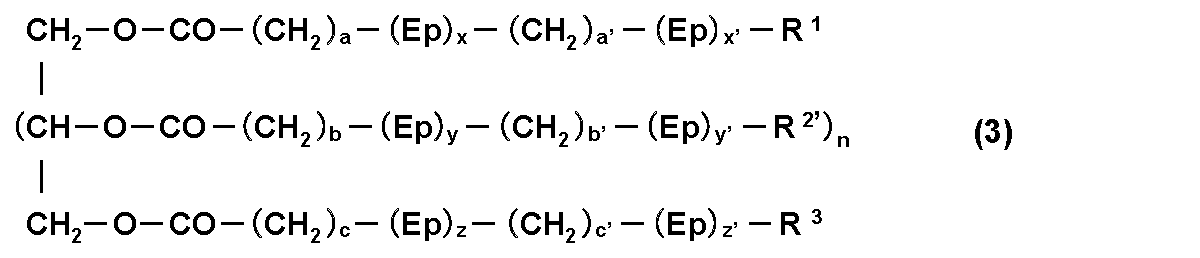

一般式(3)において、a、a'、b、b'、cおよびc'は、整数であり、それぞれ独立して、他の樹脂との相溶性向上の観点から、たとえば0以上であり、好ましくは1以上、より好ましくは2以上であり、また、たとえば20以下であり、好ましくは15以下、より好ましくは10以下である。
x、x'、y、y'、zおよびz'は、整数であり、それぞれ独立して、他の樹脂との相溶性向上および反応性の観点から、たとえば0以上であり、好ましくは1以上であり、より好ましくは2以上であり、また、たとえば5以下であり、より好ましくは4以下である。
nは、他の樹脂との相溶性の観点から、たとえば0以上であり、より好ましくは1以上であり、また、たとえば5以下であり、より好ましくは2以下である。
R1、R2'およびR3の炭素数は、それぞれ独立して、相溶性の観点から、好ましくは1以上であり、より好ましくは3以上であり、また、好ましくは15以下であり、より好ましくは10以下である。また、R1、R2'およびR3の好ましい例として、アルキル鎖やエチレングリコール鎖が挙げられる。
また、成形時の収縮抑制の観点から、成形用樹脂組成物中の成分(A)の含有量は、成形用樹脂組成物全体に対し、好ましくは15質量%以下であり、より好ましくは10質量%以下、さらに好ましくは8質量%以下、さらにより好ましくは6質量%以下である。
成分(B)は、硬化剤である。
硬化剤としては、たとえば、エチレンジアミン、トリメチレンジアミン、テトラメチレンジアミン、ヘキサメチレンジアミン等の炭素数2~20の直鎖脂肪族ジアミン、メタフェニレンジアミン、パラフェニレンジアミン、パラキシレンジアミン、4,4'-ジアミノジフェニルメタン、4,4'-ジアミノジフェニルプロパン、4,4'-ジアミノジフェニルエーテル、4,4'-ジアミノジフェニルスルホン、4,4'-ジアミノジシクロヘキサン、ビス(4-アミノフェニル)フェニルメタン、1,5-ジアミノナフタレン、メタキシレンジアミン、パラキシレンジアミン、1,1-ビス(4-アミノフェニル)シクロヘキサン、ジシアノジアミド等のアミノ類;
アニリン変性レゾール樹脂やジメチルエーテルレゾール樹脂等のレゾール型フェノール樹脂;フェノールノボラック樹脂、クレゾールノボラック樹脂、tert-ブチルフェノールノボラック樹脂、ノニルフェノールノボラック樹脂等のノボラック型フェノール樹脂;
トリヒドロキシフェニルメタン型フェノール樹脂等の多官能型フェノール樹脂;
フェニレン骨格含有フェノールアラルキル樹脂、ビフェニレン骨格含有フェノールアラルキル樹脂等のフェノールアラルキル樹脂;
ナフタレン骨格やアントラセン骨格のような縮合多環構造を有するフェノール樹脂;
上記以外のフェノール樹脂;
ポリパラオキシスチレン等のポリオキシスチレン;
ヘキサヒドロ無水フタル酸(HHPA)、メチルテトラヒドロ無水フタル酸(MTHPA)等の脂環族酸無水物、無水トリメリット酸(TMA)、無水ピロメリット酸(PMDA)、ベンゾフェノンテトラカルボン酸(BTDA)等の芳香族酸無水物等を含む酸無水物等;
ポリサルファイド、チオエステル、チオエーテル等のポリメルカプタン化合物;
イソシアネートプレポリマー、ブロック化イソシアネート等のイソシアネート化合物;ならびに
カルボン酸含有ポリエステル樹脂等の有機酸類からなる群から選択される1種または2種以上が挙げられる。
また、成分(B)は、好ましくはフェノールノボラック樹脂、トリスフェニルメタン混合型フェノール樹脂およびビフェニルアラルキル型フェノール樹脂からなる群から選択される少なくとも1種を含む。
また、成形時の流動性や充填性を向上する観点から、成形用樹脂組成物中の成分(B)の含有量は、成形用樹脂組成物全体に対し、好ましくは10.0質量%以下であり、より好ましくは7.0質量%以下、さらに好ましくは5.0質量%以下、さらにより好ましくは3.0質量%以下である。
成分(C)は、無機充填材である。成分(C)として、たとえば、溶融シリカ、結晶シリカ等のシリカ;アルミナ;タルク;酸化チタン;窒化珪素;窒化アルミニウムが挙げられる。
成分(C)は、汎用性に優れている観点から、好ましくはシリカを含み、より好ましくはシリカである。
シリカの形状の一例として、溶融球状シリカ等の球状シリカ、破砕シリカが挙げられる。
また、熱伝導性に優れ、かつ、汎用性に優れる観点から、成分(C)は、好ましくはアルミナを含み、より好ましくはアルミナである。
アルミナの形状の一例として、溶融球状アルミナ等の球状アルミナ、破砕アルミナが挙げられる。
また、成形時の流動性や充填性向上の観点から、成形用樹脂組成物中の成分(C)の含有量は、成形用樹脂組成物全体に対し、好ましくは98質量%以下であり、より好ましくは96質量%以下、さらに好ましくは95質量%以下、さらにより好ましくは92質量%以下である。
また、成形時の充填性を向上する観点から、成分(C)の平均粒径d50は、好ましくは20μm以下であり、より好ましくは15μm以下、さらに好ましくは12μm以下、さらにより好ましくは10μm以下である。
また、成分(C)の最大粒径(フィラーカットポイント)は、たとえば3μm以上であってもよい。
硬化促進剤として、たとえば、成分(A)のエポキシ樹脂と成分(B)の硬化剤との架橋反応を促進させるものを用いることができる。硬化促進剤の一例として、有機ホスフィン、テトラ置換ホスホニウム化合物、ホスホベタイン化合物、ホスフィン化合物とキノン化合物との付加物、ホスホニウム化合物とシラン化合物との付加物等のリン原子含有化合物;1,8-ジアザビシクロ[5.4.0]ウンデセン-7、ベンジルジメチルアミン、2-メチルイミダゾール等が例示されるアミジンや3級アミン、上記アミジンやアミンの4級塩等の窒素原子含有化合物から選択される1種類または2種類以上を含むことができる。
また、硬化物の製造安定性を高める観点から、成形用樹脂組成物中の硬化促進剤の含有量は、成形用樹脂組成物全体に対して、好ましくは1質量%以下であり、より好ましくは0.5質量%以下、さらに好ましくは0.3質量%以下である。
カップリング剤は、たとえば、エポキシシラン、メルカプトシラン、フェニルアミノシラン等のアミノシラン、アルキルシラン、ウレイドシラン、ビニルシラン、メタクリルシラン等の各種シラン系化合物;チタン系化合物;アルミニウムキレート類;アルミニウム/ジルコニウム系化合物等の公知のカップリング剤から選択される1種類または2種類以上を含むことができる。
硬化物の強度および靭性をバランス良く向上する観点から、カップリング剤は、好ましくはシランカップリング剤であり、Si原子に結合するアルキレン基を有するシランカップリング剤であることがより好ましい。
また、硬化物の製造安定性を高める観点から、成形用樹脂組成物中のカップリング剤の含有量は、成形用樹脂組成物全体に対して、好ましくは2質量%以下であり、より好ましくは1質量%以下、さらに好ましくは0.7質量%以下である。
成形用樹脂組成物中の離型剤の含有量は、離型性および硬化特性をより好ましいものとする観点から、成形用樹脂組成物全体に対して、好ましくは0.05質量%以上であり、より好ましくは0.1質量%以上であり、また、好ましくは2質量%以下であり、より好ましくは1質量%以下である。
成形用樹脂組成物中のイオンキャッチャーの含有量は、硬化物の信頼性向上の観点から、成形用樹脂組成物全体に対して、好ましくは0.01質量%以上であり、より好ましくは0.05質量%以上であり、また、好ましくは1質量%以下であり、より好ましくは0.5質量%以下である。
成形用樹脂組成物中の着色剤の含有量は、硬化物の外観をより好ましいものとする観点から、成形用樹脂組成物全体に対して、好ましくは0.05質量%以上であり、より好ましくは0.1質量%以上であり、また、好ましくは1質量%以下であり、より好ましくは0.5質量%以下である。
次に、成形用樹脂組成物またはその硬化物の性質を説明する。
成形用樹脂組成物のガラス転移温度未満の温度における線膨張係数CTE1とガラス転移温度以上の温度における線膨張係数CTE2との比(CTE1/CTE2)は、信頼性向上の観点から、0.40以上であり、好ましくは0.48以上、さらに好ましくは0.50以上、さらにより好ましくは0.55以上である。
また、同様の観点から、(CTE1/CTE2)は、1以下であり、好ましくは0.9以下、さらに好ましくは0.8以下、さらにより好ましくは0.7以下である。
(CTE1/CTE2)は、前述の方法で測定される。
成形用樹脂組成物の硬化物の260℃における曲げ弾性率は、硬化物の機械強度向上の観点から、好ましくは200N/mm2以上であり、より好ましくは500N/mm2以上、さらに好ましくは800N/mm2以上、さらにより好ましくは1000N/mm2以上である。
また、信頼性向上の観点から、成形用樹脂組成物の硬化物の260℃における曲げ弾性率は、たとえば3000N/mm2以下であってよく、好ましくは1500N/mm2以下であり、より好ましくは1450N/mm2以下、さらに好ましくは1400N/mm2以下である。
また、反り抑制の観点から、成形用樹脂組成物の硬化物の25℃における曲げ弾性率は、好ましくは30000N/mm2以下であり、より好ましくは25000N/mm2以下、さらに好ましくは15000N/mm2以下である。
成形用樹脂組成物の硬化物の260℃における曲げ強度は、信頼性向上の観点から、好ましくは5N/mm2以上であり、より好ましくは10N/mm2以上、さらに好ましくは15N/mm2以上である。
また、260℃における曲げ強度は、たとえば50N/mm2以下であってもよい。
また、25℃における曲げ強度は、たとえば200N/mm2以下であってもよい。
硬化物の曲げ弾性率および曲げ強度は、以下の方法で測定される。
トランスファー成形装置を用いて金型温度175℃、注入圧力9.8MPa、硬化時間120秒間で、成形用樹脂組成物を注入成形し、幅10mm×厚さ4mm×長さ80mmの成形品を得る。得られた成形品を175℃、4時間で後硬化して、試験片を得る。得られた試験片の25℃または260℃における曲げ弾性率ならびに25℃または260℃における曲げ強度をJIS K 6911に準拠して測定する。
また、応力緩和の観点から、上記軟化点は、好ましくは160℃以下であり、より好ましくは140℃以下、さらに好ましくは120℃以下である。
トランスファー成形装置を用いて金型温度175℃、注入圧力9.8MPa、硬化時間120秒で、成形用樹脂組成物を注入成形し、幅10mm×厚さ4mm×長さ80mmの成形品を得る。得られた成形品を175℃、4時間で後硬化して、試験片を得る。得られた試験片を、動的機械分析(DMA)の曲げモードにて、昇温速度5℃/minで30℃~300℃の温度範囲、荷重800g、周波数10Hzで測定する。得られた結果から、40~60℃の接線と弾性率の変化率が最大となる温度の接線との交点を軟化点とする。
成形用樹脂組成物の硬化物のTg(℃)は、耐熱性向上の観点から、好ましくは90℃以上であり、より好ましくは100℃以上、さらに好ましくは110℃以上である。
また、成形用樹脂組成物の硬化物のTg(℃)は、たとえば300℃以下であってもよい。
成形用樹脂組成物の硬化物の35℃における貯蔵弾性率E'は、ハンドリング向上の観点から、好ましくは3GPa以上であり、より好ましくは4GPa以上、さらに好ましくは5GPa以上である。
また、反りの抑制の観点から、上記E'は、好ましくは30GPa以下であり、より好ましくは29GPa以下、さらに好ましくは28GPa以下である。
また、信頼性向上の観点から、上記E'は、好ましくは6GPa以下であり、より好ましくは5GPa以下、さらに好ましくは4GPa以下である。
各温度におけるE'および前述のTgは以下の方法で測定される。
トランスファー成形装置を用いて金型温度175℃、注入圧力9.8MPa、硬化時間120秒で、成形用樹脂組成物を注入成形し、幅10mm×厚さ4mm×長さ80mmの成形品を得る。得られた成形品を175℃、4時間で後硬化して、試験片を得る。得られた試験片を、動的機械分析(DMA)の曲げモードにて、昇温速度5℃/minで30℃~300℃の温度範囲、荷重800g、周波数10Hzで、貯蔵弾性率E'および損失弾性率E''を測定する。得られた結果から、損失正接(tanδ=損失弾性率E''/貯蔵弾性率E')が最大となる温度をTgとする。
成形用樹脂組成物の圧縮形型物の外観は、レーザーマーキング性や意匠性をより好ましいものとする観点から、均一な表面外観が良く、圧縮成形物外観評価結果が好ましくは以下△の項目、より好ましくは以下〇の項目である。外観には、成形用樹脂組成物における成分の相溶性が影響していると考えられる。
ストリップサイズ成形用の圧縮成形機(TOWA社製PMC)を用いて、240×77.5×0.4mmの42アロイの基板上面に、235×71×0.5mmのサイズとなるよう、成形用樹脂組成物を成形する。成形条件は成形温度150℃、成形時間300秒、成形圧力は10MPaとする。
得られた成形基板の成形用樹脂表面を目視による官能検査により評価する。
〇:表面全体が均一な外観
一例としては、本実施形態では、表面全体が黒色で均一であり、ドット状の変色部や色むら等の外観異常がない状態である。
△:表面の大部分において、均一な外観
一例としては、本実施形態では、表面の大部分が黒色で均一であり、一部にドット状の変色部や色むら等がある状態である。
×:表面の大部分において、"不"均一な外観
一例としては、本実施形態では、表面の大部分において、ドット状の変色部や色むら等がある状態である。
成形用樹脂組成物をラボプラストミル(東洋精機製作所社製)で混練し、混練時の樹脂の硬さを評価した際の混練直後の樹脂の硬さは、製造時のロール、ニーダーまたは押出機等の混練機での混練性を反映しており、柔らかい方が好ましい。つまり、混練性の観点から、前記樹脂の硬さは、好ましくは以下△の項目、より好ましくは以下〇の項目である。
成形用樹脂組成物をラボプラストミル(東洋精機製作所社製)で100℃、30rpmの条件で30秒間混練し、混練時の樹脂の硬さを3段階で評価する。
〇:混練直後の樹脂の硬さが柔らかい:ラボプラストミルで混練した際の、最低溶融トルクが0.01N・m以上であり、4.9N・m以下である。
△:混練直後の樹脂の硬さがふつう:ラボプラストミルで混練した際の、最低溶融トルクが5.0N・m以上であり、9.9N・m以下である。
×:混練直後の樹脂の硬さが硬い:ラボプラストミルで混練した際の、最低溶融トルクが10.0N・m以上であり、50.0N・m以下である。
成形用樹脂組成物は、たとえば粒子状またはシート状である。
粒子状の成形用樹脂組成物として、具体的には、タブレット状または粉粒体のものが挙げられる。ここで、樹脂組成物が粉粒体であるとは、粉末状または顆粒状のいずれかである場合を指す。
ここで、たとえば、成形用樹脂組成物に含まれる成分および含有量を調整するとともに、成分(A)の配合量を制御し、製造工程における混練状態を制御することにより、(CTE1/CTE2)が所望の範囲にある成形用樹脂組成物を得ることができる。
各例について、表1~表3に示す各成分をミキサーにより混合した。次いで、得られた混合物を、ロール混練した後、冷却、粉砕して粉粒体である成形用樹脂組成物を得た。
また、各例で得られた樹脂組成物について、圧縮成形時の外観、混練後の樹脂状態、樹脂封止(表1~表3中「asm」:as Mold)および本硬化(表1~表3中「pmc」:Post Mold Cure)を想定した各条件における硬化物の収縮率を評価した。
測定結果および評価結果を表1~表3にあわせて示す。
(無機充填材)
無機充填材1:シリカ、TS-6026、マイクロン社製、平均粒径9.0μm
無機充填材2:シリカ、MUF-4、龍森社製、平均粒径3.8μm
無機充填材3:シリカ、SC-2500-SQ、アドマテックス社製、均粒径0.5μm
無機充填材4:シリカ、SC-5500-SQ、アドマテックス社製、平均粒径1.5μm
(着色剤)
着色剤1:カーボンブラック、ESR-2001、東海カーボン社製
(カップリング剤)
カップリング剤1:フェニルアミノプロピルトリメトキシシラン、CF-4083、東レ・ダウコーニング社製
カップリング剤2:γ-グリシドキシプロピルメチルジメトキシシランの加水分解物、KE-6137、九州住友ベークライト社製
エポキシ樹脂1:4、4'-ビフェニル型エポキシ樹脂、YX-4000K、三菱ケミカル社製
エポキシ樹脂2:トリスフェニルメタン型エポキシ樹脂とビフェニル型エポキシ樹脂の混合物、YL6677、三菱ケミカル社製
エポキシ樹脂3:エポキシ化大豆油、O-130P、ADEKA社製
エポキシ樹脂4:ビフェニルアラルキル型エポキシ樹脂、NC3000L、日本化薬社製
硬化剤1:フェノールノボラック樹脂、PR-55617、住友ベークライト社製
硬化剤2:HE910-20:トリスフェニルメタン混合型フェノール樹脂、エア・ウォーター社製
硬化剤3:ビフェニルアラルキル型フェノール樹脂、MEH-7851SS、明和化成社製
離型剤1:ジエタノールアミン・ジモンタン酸エステル、リコモント TP NC 133、クラリアント社製
硬化促進剤1:テトラフェニルホスホニウム・4,4'-スルフォニルジフェノラート
硬化促進剤2:テトラフェニルホスホニウムビス(ナフタレン-2,3-ジオキシ)フェニルシリケート
シリコーン1:ポリエーテル変性シリコーンオイル、FZ-3730、東レ・ダウコーニング社製
(線膨張係数)
各例で得られた樹脂組成物を、トランスファー成形機を用いて金型温度175℃、注入圧力9.8MPa、硬化時間120秒で、注入成形し、長辺15mm×短辺4mm×厚さ4mmの試験片を得た。
得られた試験片を175℃、4時間で後硬化した後、熱機械分析装置(セイコー電子工業社製、TMA100)を用いて、圧縮モードで、測定温度範囲0℃~320℃、昇温速度5℃/分の条件下で測定をおこなった。
測定結果から、40℃から80℃までの平均線膨張係数を算出してCTE1とし、190℃から230℃までの平均線膨張係数をCTE2とし、線膨張係数比(CTE1/CTE2)を算出した。
ストリップサイズ成形用の圧縮成形機(TOWA社製PMC)を用いて、240×77.5×0.4mmの42アロイの基板上面に、235×71×0.5mmのサイズとなるよう、成形用樹脂組成物を成形した。成形条件は成形温度150℃、成形時間300秒、成形圧力は10MPaとした。
得られた成形基板の成形用樹脂表面を目視による官能検査により評価した。
評価基準を以下に示す。以下の○および△のものを合格とした。
〇:表面全体が均一な外観
一例としては、本実施例では、表面全体が黒色で均一であり、ドット状の変色部や色むら等の外観異常がない状態である。
△:表面の大部分において、均一な外観
一例としては、本実施例では、表面の大部分が黒色で均一であり、一部にドット状の変色部や色むら等がある状態である。
×:表面の大部分において、"不"均一な外観
一例としては、本実施例では、表面の大部分において、ドット状の変色部や色むら等がある状態である。
成形用樹脂組成物をラボプラストミル(東洋精機製作所社製)で110℃、30rpmの条件で30秒間混練し、混練直後の樹脂の硬さを3段階で評価した。以下の○および△のものを合格とした。
評価基準を以下に示す。
〇:混練直後の樹脂の硬さが柔らかい:ラボプラストミルで混練した際の、最低溶融トルクが0.01N・m以上であり、4.9N・m以下である。
△:混練直後の樹脂の硬さがふつう:ラボプラストミルで混練した際の、最低溶融トルクが5.0N・m以上であり、9.9N・m以下である。
×:混練直後の樹脂の硬さが硬い:ラボプラストミルで混練した際の、最低溶融トルクが10.0N・m以上であり、50.0N・m以下である。
各例で得られた樹脂組成物について、低圧トランスファー成形機(コータキ精機社製、「KTS-15」)を用いて、EMMI-1-66に準じたスパイラルフロー測定用の金型に金型温度175℃、注入圧力6.9MPa、硬化時間120秒の条件で各例の樹脂組成物を注入し、流動長(cm)を測定した。
175℃の熱板上に各例の樹脂組成物を載せ、スパチュラで約1回/秒のストロークで練り、樹脂組成物が熱により溶解してから硬化するまでに要した時間を測定することによりゲルタイム(秒)を求めた。
JIS K 7244-1に準拠して以下の方法で測定した。
すなわち、各例で得られた樹脂組成物を、トランスファー成形装置を用いて金型温度175℃、注入圧力9.8MPa、硬化時間120秒で注入成形し、幅10mm×厚さ4mm×長さ80mmの成形品を得た。得られた成形品を175℃、4時間で後硬化して、試験片を得た。
得られた試験片を、動的機械分析(DMA)(「DDV-25GP」A&D company, Ltd.社製)の曲げモードにて、昇温速度5℃/minで30℃~300℃の温度範囲、荷重800g、周波数10Hzで測定した。得られた結果から、40~60℃の接線と弾性率の変化率が最大となる温度の接線との交点を軟化点(℃)とした。
トランスファー成形装置を用いて金型温度175℃、注入圧力9.8MPa、硬化時間120秒で、成形用樹脂組成物を注入成形し、幅10mm×厚さ4mm×長さ80mmの成形品を得た。得られた成形品を175℃、4時間で後硬化して、試験片を得た。得られた試験片を、動的機械分析(DMA)の曲げモードにて、昇温速度5℃/minで30℃~300℃の温度範囲、荷重800g、周波数10Hzで、貯蔵弾性率E'および損失弾性率E''を測定した。得られた結果から、損失正接(tanδ=損失弾性率E''/貯蔵弾性率E')が最大となる温度をガラス転移温度Tgとした。各例の35℃および260℃における貯蔵弾性率E'およびTgを表1~表3に示す。
各例で得られた樹脂組成物を、トランスファー成形装置を用いて金型温度175℃、注入圧力9.8MPa、硬化時間120秒間で注入成形し、幅10mm×厚さ4mm×長さ80mmの成形品を得た。得られた成形品を175℃、4時間で後硬化して、試験片を得た。
得られた試験片の25℃および260℃における曲げ弾性率ならびに25℃および260℃における曲げ強度をJIS K 6911に準拠して測定した。
(収縮率:asm)
得られた成形用樹脂組成物を金型温度175℃、成形圧力14MPa、硬化時間120秒の条件下、成形した直径100mm、厚さ3mmの円盤状硬化物を成形した。得られた円盤状硬化物を用いて、以下(1)式を用いて収縮率を算出した。
より具体的には、まず、円盤状の金型の室温における寸法を4箇所測定し、その平均値を算出した。続けて、金型に当該封止用樹脂組成物を投入して円盤状硬化物を成形し、得られた円盤状硬化物の25℃における直径(外形寸法)を、当該金型で測定した箇所に対応する4箇所で測定し、その平均値を算出した。得られた数値を以下の式(1)に当てはめ、収縮率asm(%)を求めた。
収縮率asm(%)={(175℃での金型キャビティの内径寸法)-(25℃での前記円盤状硬化物の外径寸法)}/(175℃での金型キャビティの内径寸法)×100(%) (1)
評価基準として、表1および表2の場合、「収縮率asmが、0以下の例を合格、0より超える例を不合格」とした。また、表3の場合は、「収縮率asmが、0.12以下の例を合格、0.12より超える例を不合格」とした。
得られた成形用樹脂組成物を金型温度175℃、成形圧力14MPa、硬化時間120秒の条件下、成形した直径100mm、厚さ3mmの円盤状硬化物を成形した。当該円盤状硬化物を室温まで冷却したあと、さらに175℃で4時間ポストキュアを行った。
また、得られた円盤状硬化物の25℃における直径(外形寸法)について、ポストキュア前の後それぞれにおいて対応する4箇所を測定し、その平均値を算出した。
得られた数値を以下の式(2)に当てはめ、収縮率pmc(%)を求めた。
収縮率pmc(%)={(175℃での金型キャビティの内径寸法)-(25℃での円盤状PMC硬化物の外径寸法)}/(175℃での金型キャビティの内径寸法)×100(%) (2)
評価基準として、表1および表2の場合、「収縮率pmcが、-0.08以下の例を合格、-0.08より超える例を不合格」とした。また、表3の場合は、「収縮率pmcが、0.03以下の例を合格、0.03より超える例を不合格」とした。
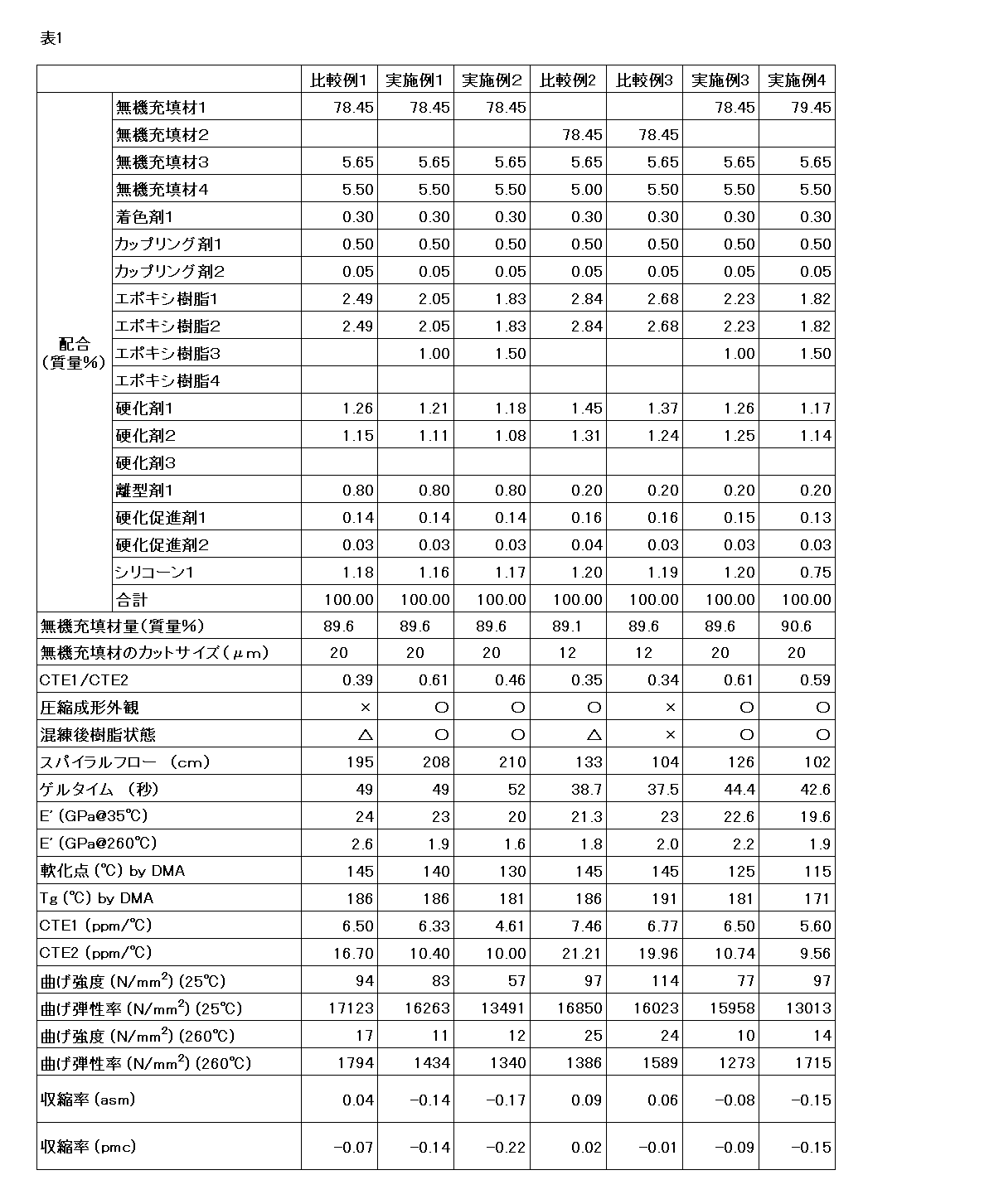

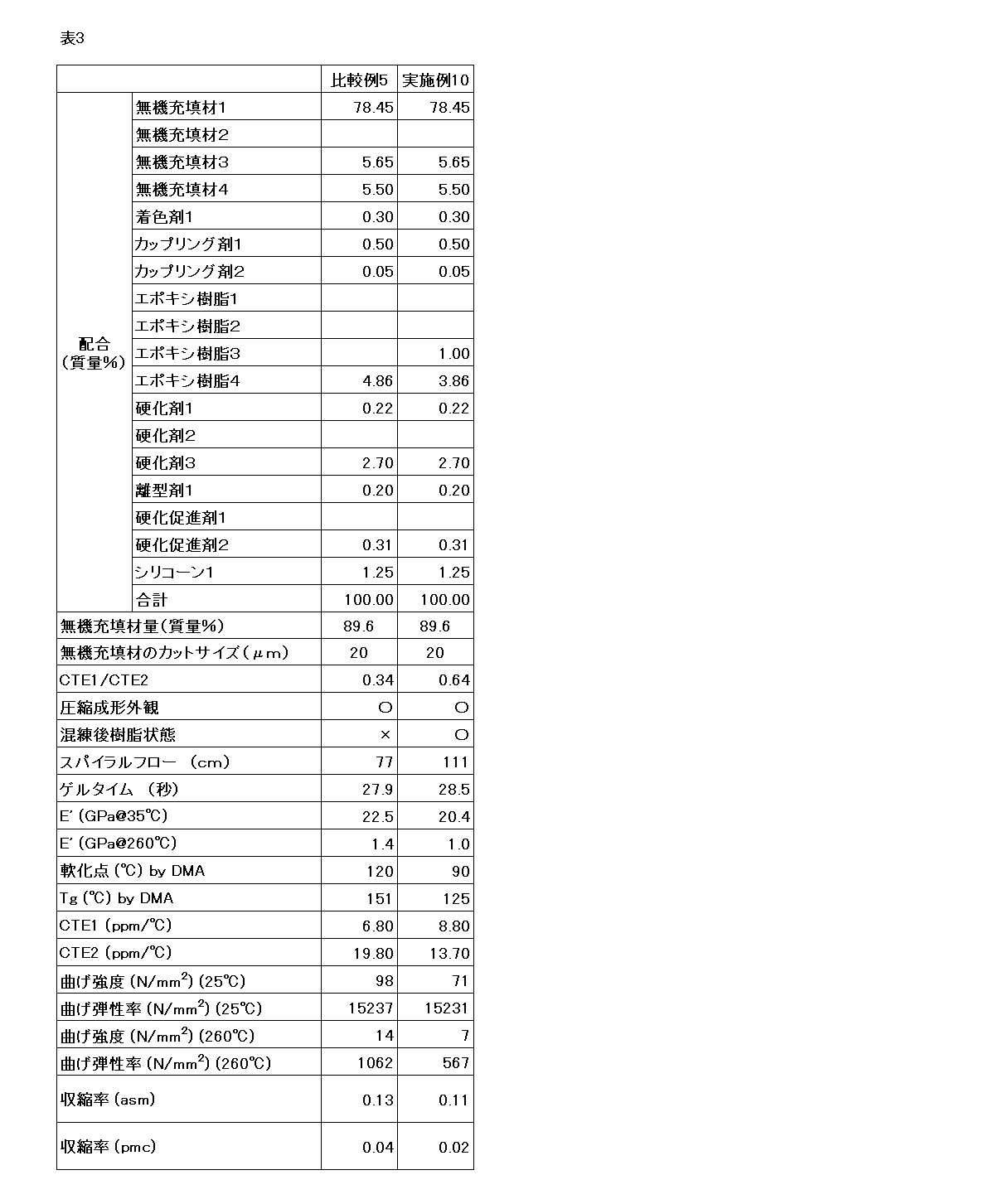
また、表1~表3より、各実施例においては、混練後の樹脂状態および圧縮成形により得られた成形品の外観に優れていた。
Claims (7)
- (A)エポキシ樹脂、
(B)硬化剤、および
(C)無機充填材、
を含む成形用樹脂組成物であって、
以下の方法で測定される、当該成形用樹脂組成物のガラス転移温度未満の温度における線膨張係数CTE1とガラス転移温度以上の温度における線膨張係数CTE2との比(CTE1/CTE2)が、0.40以上1以下である、成形用樹脂組成物。
(線膨張係数の測定方法)トランスファー成形機を用いて金型温度175℃、注入圧力9.8MPa、硬化時間120秒で、当該成形用樹脂組成物を注入成形し、長辺15mm×短辺4mm×厚さ4mmの試験片を得る。前記試験片を175℃、4時間で後硬化した後、熱機械分析装置を用いて、圧縮モードで、測定温度範囲0℃~320℃、昇温速度5℃/分の条件下で測定をおこなう。測定結果から、40℃から80℃までの平均線膨張係数を算出して前記CTE1とし、190℃から230℃までの平均線膨張係数を前記CTE2とする。 - 前記成分(A)が、エポキシ基(オキシラン環)含有アシルグリセロールを含む、請求項1に記載の成形用樹脂組成物。
- 前記成分(A)が、エポキシ化大豆油およびエポキシ化亜麻仁油からなる群から選択される少なくとも1種を含む、請求項1または2に記載の成形用樹脂組成物。
- 前記成分(A)が、下記一般式(3)で表される化合物を含む、請求項1に記載の成形用樹脂組成物。


- 以下の方法で測定される、当該成形用樹脂組成物の硬化物の260℃における曲げ弾性率が、200N/mm2以上1500N/mm2以下である、請求項1乃至4いずれか1項に記載の成形用樹脂組成物。
(曲げ弾性率の測定方法)
トランスファー成形装置を用いて金型温度175℃、注入圧力9.8MPa、硬化時間120秒間で、当該成形用樹脂組成物を注入成形し、幅10mm×厚さ4mm×長さ80mmの成形品を得、前記成形品を175℃、4時間で後硬化して、試験片を得る。前記試験片の260℃における曲げ弾性率をJIS K 6911に準拠して測定する。 - JIS K 7244-1に準拠して以下の方法で測定される、当該成形用樹脂組成物の硬化物の軟化点(℃)が、50℃以上160℃以下である、請求項1乃至5いずれか1項に記載の成形用樹脂組成物。
(軟化点の測定方法)トランスファー成形装置を用いて金型温度175℃、注入圧力9.8MPa、硬化時間120秒で、当該成形用樹脂組成物を注入成形し、幅10mm×厚さ4mm×長さ80mmの成形品を得、前記成形品を175℃、4時間で後硬化して、試験片を得る。前記試験片を、動的機械分析(DMA)の曲げモードにて、昇温速度5℃/minで30℃~300℃の温度範囲、荷重800g、周波数10Hzで測定する。得られた結果から、40~60℃の接線と弾性率の変化率が最大となる温度の接線との交点を前記軟化点とする。 - ウェーハレベルパッケージ(WLP)、パネルレベルパッケージ(PLP)またはモールドアンダーフィル(MUF)の成形に用いられる、請求項1乃至6いずれか1項に記載の成形用樹脂組成物。
Priority Applications (3)
| Application Number | Priority Date | Filing Date | Title |
|---|---|---|---|
| CN202280011242.3A CN116724068A (zh) | 2021-01-22 | 2022-01-18 | 成型用树脂组合物 |
| JP2022539766A JP7193042B1 (ja) | 2021-01-22 | 2022-01-18 | 成形用樹脂組成物 |
| KR1020237020734A KR20230131830A (ko) | 2021-01-22 | 2022-01-18 | 성형용 수지 조성물 |
Applications Claiming Priority (2)
| Application Number | Priority Date | Filing Date | Title |
|---|---|---|---|
| JP2021-009150 | 2021-01-22 | ||
| JP2021009150 | 2021-01-22 |
Publications (1)
| Publication Number | Publication Date |
|---|---|
| WO2022158444A1 true WO2022158444A1 (ja) | 2022-07-28 |
Family
ID=82549449
Family Applications (1)
| Application Number | Title | Priority Date | Filing Date |
|---|---|---|---|
| PCT/JP2022/001594 Ceased WO2022158444A1 (ja) | 2021-01-22 | 2022-01-18 | 成形用樹脂組成物 |
Country Status (5)
| Country | Link |
|---|---|
| JP (1) | JP7193042B1 (ja) |
| KR (1) | KR20230131830A (ja) |
| CN (1) | CN116724068A (ja) |
| TW (1) | TW202235529A (ja) |
| WO (1) | WO2022158444A1 (ja) |
Citations (6)
| Publication number | Priority date | Publication date | Assignee | Title |
|---|---|---|---|---|
| WO2014129342A1 (ja) * | 2013-02-19 | 2014-08-28 | 株式会社ダイセル | ウェハレベルレンズ用硬化性組成物、ウェハレベルレンズの製造方法及びウェハレベルレンズ、並びに光学装置 |
| JP2015195319A (ja) * | 2014-03-31 | 2015-11-05 | 日本電気株式会社 | モジュール部品及びその製造方法 |
| JP2015213101A (ja) * | 2014-05-01 | 2015-11-26 | 住友ベークライト株式会社 | 封止用樹脂組成物、半導体装置、および構造体 |
| JP2017132914A (ja) * | 2016-01-28 | 2017-08-03 | 住友ベークライト株式会社 | 封止用樹脂組成物および半導体装置 |
| JP2018002886A (ja) * | 2016-07-01 | 2018-01-11 | 味の素株式会社 | 樹脂組成物 |
| JP2020172653A (ja) * | 2016-07-01 | 2020-10-22 | 味の素株式会社 | 樹脂組成物 |
Family Cites Families (2)
| Publication number | Priority date | Publication date | Assignee | Title |
|---|---|---|---|---|
| JPS4866200A (ja) | 1971-12-14 | 1973-09-11 | ||
| JP6583278B2 (ja) * | 2014-09-24 | 2019-10-02 | 住友ベークライト株式会社 | 半導体封止用樹脂組成物、半導体装置および構造体 |
-
2022
- 2022-01-18 WO PCT/JP2022/001594 patent/WO2022158444A1/ja not_active Ceased
- 2022-01-18 KR KR1020237020734A patent/KR20230131830A/ko not_active Ceased
- 2022-01-18 JP JP2022539766A patent/JP7193042B1/ja active Active
- 2022-01-18 CN CN202280011242.3A patent/CN116724068A/zh active Pending
- 2022-01-20 TW TW111102368A patent/TW202235529A/zh unknown
Patent Citations (6)
| Publication number | Priority date | Publication date | Assignee | Title |
|---|---|---|---|---|
| WO2014129342A1 (ja) * | 2013-02-19 | 2014-08-28 | 株式会社ダイセル | ウェハレベルレンズ用硬化性組成物、ウェハレベルレンズの製造方法及びウェハレベルレンズ、並びに光学装置 |
| JP2015195319A (ja) * | 2014-03-31 | 2015-11-05 | 日本電気株式会社 | モジュール部品及びその製造方法 |
| JP2015213101A (ja) * | 2014-05-01 | 2015-11-26 | 住友ベークライト株式会社 | 封止用樹脂組成物、半導体装置、および構造体 |
| JP2017132914A (ja) * | 2016-01-28 | 2017-08-03 | 住友ベークライト株式会社 | 封止用樹脂組成物および半導体装置 |
| JP2018002886A (ja) * | 2016-07-01 | 2018-01-11 | 味の素株式会社 | 樹脂組成物 |
| JP2020172653A (ja) * | 2016-07-01 | 2020-10-22 | 味の素株式会社 | 樹脂組成物 |
Also Published As
| Publication number | Publication date |
|---|---|
| JPWO2022158444A1 (ja) | 2022-07-28 |
| KR20230131830A (ko) | 2023-09-14 |
| TW202235529A (zh) | 2022-09-16 |
| JP7193042B1 (ja) | 2022-12-20 |
| CN116724068A (zh) | 2023-09-08 |
Similar Documents
| Publication | Publication Date | Title |
|---|---|---|
| JP6090614B2 (ja) | 半導体封止用液状エポキシ樹脂組成物及び樹脂封止半導体装置 | |
| TWI763877B (zh) | 半導體密封用熱硬化性環氧樹脂薄片、半導體裝置及其製造方法 | |
| TWI911350B (zh) | 成形用樹脂組成物及電子零件裝置 | |
| JP2009097014A (ja) | 封止用液状樹脂組成物、電子部品装置及びウエハーレベルチップサイズパッケージ | |
| TW201634569A (zh) | 半導體封裝用樹脂組成物及使用該樹脂組成物之半導體封裝方法 | |
| TW202542229A (zh) | 密封用環氧樹脂組成物及電子零件裝置 | |
| KR101939429B1 (ko) | 에폭시 수지 조성물 및 전자 부품 장치 | |
| TWI488912B (zh) | 半導體密封用環氧樹脂組成物及使用其之半導體裝置 | |
| JP7193042B1 (ja) | 成形用樹脂組成物 | |
| TW201806043A (zh) | 大面積的搭載有半導體元件的基材的封裝方法 | |
| JPH02228354A (ja) | 半導体封止用エポキシ樹脂組成物 | |
| JP2022183713A (ja) | 封止用樹脂組成物およびウェーハレベルパッケージ | |
| JP2023179928A (ja) | 半導体素子を搭載した基板の半導体素子搭載面又は半導体素子を形成したウエハの半導体素子形成面を封止する樹脂組成物及びその使用 | |
| JP7777061B2 (ja) | 封止用樹脂組成物およびこれを用いた電子装置 | |
| JP2021195480A (ja) | 封止用樹脂組成物及び電子部品装置 | |
| JP7571407B2 (ja) | 封止用樹脂組成物及び電子部品装置 | |
| JP7452287B2 (ja) | 封止用樹脂組成物の製造方法、封止用樹脂組成物、電子部品装置の製造方法、及び電子部品装置 | |
| JP7536406B2 (ja) | 半導体装置の製造方法 | |
| JP7533439B2 (ja) | 硬化性樹脂組成物及び電子部品装置 | |
| JP4835851B2 (ja) | 半導体封止用エポキシ樹脂組成物及び半導体装置 | |
| KR102659602B1 (ko) | 반도체 소자 밀봉용 에폭시 수지 조성물 및 이를 이용하여 밀봉된 반도체 소자 | |
| JP2023183768A (ja) | 封止用樹脂組成物 | |
| WO2026038312A1 (ja) | 硬化性組成物及び電子部品装置 | |
| JP2023113250A (ja) | 封止用樹脂組成物 | |
| TW202502955A (zh) | 成形用樹脂組成物及電子零件裝置 |
Legal Events
| Date | Code | Title | Description |
|---|---|---|---|
| ENP | Entry into the national phase |
Ref document number: 2022539766 Country of ref document: JP Kind code of ref document: A |
|
| 121 | Ep: the epo has been informed by wipo that ep was designated in this application |
Ref document number: 22742566 Country of ref document: EP Kind code of ref document: A1 |
|
| WWE | Wipo information: entry into national phase |
Ref document number: 202280011242.3 Country of ref document: CN |
|
| NENP | Non-entry into the national phase |
Ref country code: DE |
|
| 122 | Ep: pct application non-entry in european phase |
Ref document number: 22742566 Country of ref document: EP Kind code of ref document: A1 |