WO2022153362A1 - ステータ、モータ、圧縮機および冷凍サイクル装置 - Google Patents
ステータ、モータ、圧縮機および冷凍サイクル装置 Download PDFInfo
- Publication number
- WO2022153362A1 WO2022153362A1 PCT/JP2021/000673 JP2021000673W WO2022153362A1 WO 2022153362 A1 WO2022153362 A1 WO 2022153362A1 JP 2021000673 W JP2021000673 W JP 2021000673W WO 2022153362 A1 WO2022153362 A1 WO 2022153362A1
- Authority
- WO
- WIPO (PCT)
- Prior art keywords
- coil
- sides
- teeth
- phase
- stator core
- Prior art date
- Legal status (The legal status is an assumption and is not a legal conclusion. Google has not performed a legal analysis and makes no representation as to the accuracy of the status listed.)
- Ceased
Links
Images








Classifications
-
- H—ELECTRICITY
- H02—GENERATION; CONVERSION OR DISTRIBUTION OF ELECTRIC POWER
- H02K—DYNAMO-ELECTRIC MACHINES
- H02K3/00—Details of windings
- H02K3/04—Windings characterised by the conductor shape, form or construction, e.g. with bar conductors
-
- H—ELECTRICITY
- H02—GENERATION; CONVERSION OR DISTRIBUTION OF ELECTRIC POWER
- H02K—DYNAMO-ELECTRIC MACHINES
- H02K3/00—Details of windings
- H02K3/04—Windings characterised by the conductor shape, form or construction, e.g. with bar conductors
- H02K3/12—Windings characterised by the conductor shape, form or construction, e.g. with bar conductors arranged in slots
-
- H—ELECTRICITY
- H02—GENERATION; CONVERSION OR DISTRIBUTION OF ELECTRIC POWER
- H02K—DYNAMO-ELECTRIC MACHINES
- H02K3/00—Details of windings
- H02K3/04—Windings characterised by the conductor shape, form or construction, e.g. with bar conductors
- H02K3/18—Windings for salient poles
-
- H—ELECTRICITY
- H02—GENERATION; CONVERSION OR DISTRIBUTION OF ELECTRIC POWER
- H02K—DYNAMO-ELECTRIC MACHINES
- H02K3/00—Details of windings
- H02K3/46—Fastening of windings on the stator or rotor structure
- H02K3/50—Fastening of winding heads, equalising connectors, or connections thereto
Definitions
- the present disclosure relates to stators, motors, compressors and refrigeration cycle devices.
- the motor stator has an annular stator core having a plurality of teeth and a three-phase coil wound around the teeth. Each phase coil has a plurality of coil portions wound in one tooth. The coils are connected to each other by crossovers at the axial ends of the stator core.
- Patent Document 1 discloses a stator in which a crossover wire of a U-phase coil and a crossover wire of a V-phase coil are arranged at one end in the axial direction of a stator core, and a crossover wire of a W-phase coil is arranged at the other end of the stator core. ing.
- the present disclosure has been made to solve the above problems, and an object of the present disclosure is to reduce the vibration and noise of the motor.
- the stator according to the present disclosure is an annular stator core centered on an axis, and includes a stator core having a plurality of teeth in the circumferential direction centered on the axis, and a first wiring arranged at one end of the stator core in the axial direction. It has a second wire arranged at the other end in the axial direction of the stator core, and a three-phase coil wound around the stator core and connected to the first wire and the second wire.
- Each of the three-phase coils has N coil sides (N is an integer of 2 or more) on one side of one of the teeth, and N-1 on the other side of the teeth. Has a coil side of.
- the N coil sides and the other N coil sides are arranged at positions symmetrical to each other with respect to the reference plane which is a plane including the axis.
- the N-1 coil side and another N-1 coil side are arranged at positions symmetrical with respect to the reference plane.
- each coil side is arranged.
- the magnetic field generated by the current flowing through the coil is symmetrical with respect to the reference plane. Therefore, the exciting force acting on the rotor can be reduced, and the vibration and noise of the motor can be reduced.
- FIG. It is sectional drawing which shows the motor of Embodiment 1.
- FIG. It is sectional drawing which shows the stator of Embodiment 1.
- FIG. It is sectional drawing (A) which shows the division core, insulation part and coil of Embodiment 1, and schematic diagram (B) which shows the holding part of insulation film.
- FIG. It is a figure which shows the stator core of Embodiment 1 and each coil part.
- FIG. 1 shows the stator core of Embodiment 1 and each coil part. It is a top view which shows the connection state of each coil part of Embodiment 1 together with a stator core. It is a top view which shows the connection state of each coil part of Embodiment 1.
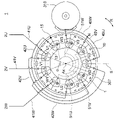
- FIG. It is a top view which shows the stator core of Embodiment 1, each coil part, and the accumulator of a compressor. It is a figure which shows the connection state of the coil of the comparative example. It is a figure which shows the stator core and each coil part of the comparative example. It is the top view which shows the connection state of each coil part of a comparative example together with a stator core.
- FIG. 2 It is a figure which shows the connection state of the coil of Embodiment 2. It is a figure which shows the stator core of Embodiment 2 and each coil part. It is a top view which shows the connection state of each coil part of Embodiment 2.
- FIG. It is a figure which shows the connection state of the coil of Embodiment 3.
- FIG. It is a figure which shows the stator core of Embodiment 3 and each coil part.
- FIG. It is a vertical sectional view which shows the compressor to which the motor of each embodiment is applicable. It is a figure which shows the refrigeration cycle apparatus provided with the compressor of FIG.
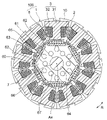
- FIG. 1 is a cross-sectional view showing the motor 100 of the first embodiment.
- the motor 100 is a three-phase motor driven by an inverter, and is used, for example, in a compressor 300 (FIG. 21). Further, the motor 100 is a permanent magnet embedded motor in which a permanent magnet 65 is embedded in a rotor 6.
- the motor 100 has a stator 1 and a rotor 6 rotatably provided inside the stator 1.
- An air gap of, for example, 0.3 to 1.0 mm is provided between the stator 1 and the rotor 6.
- the rotor 6 has a cylindrical rotor core 60 and a permanent magnet 65 attached to the rotor core 60.
- the rotor core 60 is formed by laminating a plurality of electromagnetic steel sheets in the direction of the rotation axis and fixing them by caulking or the like.
- the thickness of the electromagnetic steel sheet is, for example, 0.1 to 0.7 mm.
- a circular shaft hole 64 is formed at the center of the rotor core 60 in the radial direction.
- the shaft 7 is fixed to the shaft hole 64 by shrink fitting, press fitting, or the like.
- the axis Ax which is the central axis of the shaft 7, defines the rotation axis of the rotor 6.
- the direction of the axis Ax which is the rotation axis of the rotor 6, is referred to as "axial direction”.
- the circumferential direction centered on the axis Ax (indicated by the arrow R in FIG. 1 and the like) is referred to as a “circumferential direction”.
- the radial direction centered on the axis Ax is referred to as "diameter direction”.
- a plurality of magnet insertion holes 61 are formed at equal intervals in the circumferential direction along the outer circumference of the rotor core 60.
- the number of magnet insertion holes 61 is 6 here.
- the magnet insertion hole 61 also penetrates the rotor core 60 in the axial direction.
- One magnet insertion hole 61 corresponds to one magnetic pole of the rotor 6.
- the number of poles of the rotor 6 is six.
- the number of poles of the rotor 6 may be 2 or more.
- the magnet insertion hole 61 extends linearly in the direction orthogonal to the radial center, that is, the radial straight line (also referred to as the magnetic pole center line) passing through the polar center. However, the magnet insertion hole 61 may extend in a V shape that is convex toward the axis Ax side.
- a permanent magnet 65 is arranged inside the magnet insertion hole 61.
- One permanent magnet 65 is arranged in one magnet insertion hole 61.
- a plurality of permanent magnets 65 may be arranged in one magnet insertion hole 61.
- the permanent magnet 65 is composed of a rare earth magnet containing neodymium (Nd), iron (Fe) and boron (B).
- the permanent magnet 65 has a flat plate shape, has a rectangular cross section in a plane orthogonal to the axial direction, and has a thickness in the radial direction.
- the thickness of the permanent magnet 65 is, for example, 2.0 mm.
- the permanent magnet 65 is magnetized in the thickness direction.
- the outer peripheral surface of the permanent magnet 65 is also referred to as a magnetic pole surface.
- Flux barriers 62 which are voids, are formed on both sides of the magnet insertion hole 61 in the circumferential direction.
- a thin wall portion is formed between the flux barrier 62 and the outer circumference of the rotor core 60.
- the thickness of the thin portion is set to be the same as the thickness of the electromagnetic steel plate of the rotor core 60, for example.
- a slit 63 is formed on the radial outer side of the magnet insertion hole 61.
- the slit 63 is long in the radial direction and has a width of, for example, 1 mm in the circumferential direction.
- the slit 63 is formed to control the magnetic flux density distribution on the surface of the rotor 6 and suppress torque pulsation.
- the seven slits 63 are formed symmetrically with respect to the magnetic pole center line.
- the number and arrangement of the slits 63 are arbitrary.
- the rotor core 60 does not necessarily have to be provided with the slit 63.
- Through holes 66 and 67 are formed inside the magnet insertion hole 61 in the radial direction.
- the through holes 66 and 67 penetrate the rotor core 60 and are used as a flow path for the refrigerant.
- the circumferential position of the through hole 66 coincides with the center of the pole, and the circumferential position of the through hole 67 coincides with the distance between the poles, but the position is not limited to these positions.
- the rotor core 60 does not necessarily have to be provided with through holes 66 and 67.
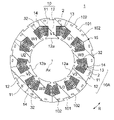
- FIG. 2 is a cross-sectional view showing the stator 1.
- the stator 1 has a stator core 10 and a coil 2 wound around the stator core 10 in a concentrated winding manner.
- the stator core 10 is formed by laminating a plurality of electromagnetic steel sheets in the axial direction and fixing them by caulking or the like.
- the thickness of the electromagnetic steel sheet is, for example, 0.1 to 0.7 mm.
- the stator core 10 has an annular yoke 11 and a plurality of teeth 12 extending radially inward from the yoke 11.
- the number of teeth 12 is 9 here, but is not limited to 9.
- Slots 13 are formed between the teeth 12 adjacent to each other in the circumferential direction.
- the slot 13 is a portion for accommodating the coil 2 wound around the teeth 12.
- the number of slots 13 is the same as the number of teeth 12, which is 9 here. As described above, since the number of poles of the rotor 6 is 6 and the number of slots of the stator 1 is 9, the ratio of the number of poles to the number of slots is 2: 3.
- the coil 2 has a U-phase coil 2U as a first-phase coil, a V-phase coil 2V as a third-phase coil, and a W-phase coil 2W as a second-phase coil (see FIG. 6).
- the coils 2U, 2V, and 2W of each phase are all composed of magnet wires having a wire diameter of 0.8 mm, and are wound around the teeth 12 in a concentrated winding manner. The number of turns will be described later.
- the magnet wire constituting the coils 2U, 2V, 2W is, for example, an aluminum wire or a copper wire.
- the wire diameters and the number of turns of the coils 2U, 2V, and 2W are set according to the required characteristics (rotation speed, torque, etc.) of the motor 100, the supply voltage, and the cross-sectional area of the slot 13.
- the portion wound around one tooth 12 is referred to as a coil portion.
- the U-phase coil 2U has three coil portions U1, U2, U3. These coil portions U1, U2, U3 are connected in series.
- the V-phase coil 2V has three coil portions V1, V2, and V3. These coil portions V1, V2, and V3 are connected in series.
- the W-phase coil 2W has three coil portions W1, W2, and W3. These coil portions W1, W2, and W3 are connected in series.
- the code of the coil portion is written on the teeth 12 around which the coil portion is wound.
- the coil portions U1, V1, W1, U2, V2, W2, U3, V3, W3 are arranged in order in a counterclockwise direction about the axis Ax.
- the arrangement of the coil portions is not limited to this order.
- the stator core 10 is formed by connecting a plurality of divided cores 10A for each tooth 12 in an annular shape.
- the dividing core 10A is a block containing one tooth 12, and is divided by a dividing surface 14 formed on the yoke 11.
- the stator core 10 has nine divided cores 10A here.
- the number of the divided cores 10A is not limited to 9, and can be appropriately changed according to the number of teeth 12. Further, the stator core 10 is not limited to the one in which the divided cores 10A are connected, and may be a stator core integrally formed in an annular shape.
- an insulating portion 3 is provided to insulate the stator core 10 and the coil 2.
- the insulating portion 3 has an insulator 31 provided at the axial end of the stator core 10 and an insulating film 32 provided on the inner surface of the slot 13.
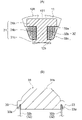
- FIG. 3A is a top view showing the split core 10A, the coil 2, the insulator 31, and the insulating film 32.
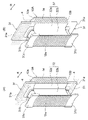
- FIG. 4A is a perspective view showing the split core 10A, the insulator 31 and the insulating film 32.
- the divided core 10A is composed of a laminated body of electromagnetic steel sheets.
- Insulators 31 are attached to both ends of the split core 10A in the axial direction.
- the insulator 31 is, for example, a resin molded product such as polybutylene terephthalate (PBT).
- PBT polybutylene terephthalate
- the insulator 31 has an outer wall portion 31a located on the yoke 11, a body portion 31b located on the teeth 12, and an inner wall portion 31c located on the tooth tip portion of the teeth 12.
- the insulating film 32 is fixed to the inner surface of the slot 13.
- the insulating film 32 is made of, for example, a resin such as polyethylene terephthalate (PET) and has a thickness of 0.1 to 0.2 mm.
- PET polyethylene terephthalate
- the insulating film 32 includes an inner peripheral portion 32a fixed to the inner peripheral surface of the yoke 11, a side surface portion 32b fixed to the side surface of the teeth 12, and a folded portion 32c folded back into the slot from the tooth tip portion of the teeth 12. And have.
- the folded-back portion 32c is omitted in FIG. 4 (A).
- the insulator 31 may be provided with a holding portion for holding the insulating film 32.
- FIG. 3B is a cross-sectional view of the insulator 31 on a plane orthogonal to the extending direction of the teeth 12.
- holding portions 33 for holding the insulating film 32 are provided on both sides of the body portion 31b of the insulator 31 in the circumferential direction.
- the holding portion 33 has a groove portion 33a into which the end portion of the insulating film 32 is inserted.
- the insulating film 32 may be fixed to the inner surface of the slot 13 by adhesion.
- the coil 2 is wound around the teeth 12 via the insulator 31 and the insulating film 32.
- the outer wall portion 31a and the inner wall portion 31c of the insulator 31 guide each coil portion of the coil 2 and the wiring 4 (described later) from both sides in the radial direction.
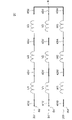
- FIG. 5 is a diagram showing a state in which the stator core 10 is spread out in a straight line.
- the insulator 31 and the insulating film 32 are omitted.
- the split cores 10A constituting the stator core 10 are connected to each other by a thin portion on the outer peripheral side of the split surface 14.
- the insulator 31 and the insulating film 32 are attached to the split core 10A in a state where the split core 10A is linearly spread as shown in FIG. 5, and the coil 2 is wound around the split core 10A.
- the stator 1 shown in FIG. 2 can be obtained by bending the split core 10A around which the coil 2 is wound in an annular shape and welding the split cores 10A at both ends at the welded portion 15.
- welding method for example, TIG welding using a tungsten electrode and an inert gas is used.
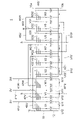
- FIG. 6 is a diagram showing a connection state of the U-phase coil 2U, the V-phase coil 2V, and the W-phase coil 2W.
- the inverter that drives the motor 100 has output terminals 8U, 8V, and 8W.
- the coil portion U1 of the U-phase coil 2U is connected to the output terminal 8U by the top surface wiring 41U.
- the coil portion U1 and the coil portion U2 are connected by a top surface wiring 42U.
- the coil portion U2 and the coil portion U3 are connected by a bottom surface wiring 51U.
- the upper surface wirings 41U and 42U are arranged on the upper surface 10a (FIG. 4A) side of the stator core 10, and the lower surface wiring 51U is arranged on the lower surface 10b (FIG. 4A) side of the stator core 10.
- the upper surface wirings 41U and 42U and the lower surface wirings 51U are formed of continuous conducting wires with the coil portions U1, U2, and U3.
- the conductor is, for example, an aluminum wire. However, a conducting wire different from the coil portions U1, U2, and U3 may be connected and used.
- the coil portion V1 of the V-phase coil 2V is connected to the output terminal 8V by the top surface wiring 41V.
- the coil portion V1 and the coil portion V2 are connected by a top surface wiring 42V.
- the coil portion V2 and the coil portion V3 are connected by a bottom surface wiring 51V.
- the upper surface wirings 41V and 42V are arranged on the upper surface 10a side of the stator core 10, and the lower surface wiring 51V is arranged on the lower surface 10b side of the stator core 10.
- the upper surface wirings 41V and 42V and the lower surface wirings 51V are formed by conducting wires continuous with the coil portions V1, V2 and V3. However, a conducting wire different from the coil portions V1, V2 and V3 may be connected and used.
- the coil portion W1 of the W-phase coil 2W is connected to the output terminal 8W by the top surface wiring 41W.
- the coil portion W1 and the coil portion W2 are connected by a top surface wiring 42W.
- the coil portion W2 and the coil portion W3 are connected by a bottom surface wiring 51W.
- the upper surface wirings 41W and 42W are arranged on the upper surface 10a side of the stator core 10, and the lower surface wiring 51W is arranged on the lower surface 10b side of the stator core 10.
- the upper surface wiring 41W, 42W and the lower surface wiring 51W are formed of continuous conducting wires with the coil portions W1, W2, W3. However, a conducting wire different from the coil portions W1, W2 and W3 may be connected and used.
- the coil portions U3, V3, W3 are connected to the common neutral point N by the upper surface wirings 45U, 45V, 45W arranged on the upper surface 10a side of the stator core 10. That is, the U-phase coil 2U, the V-phase coil 2V, and the W-phase coil 2W are connected by a Y connection.
- the upper surface 10a of the stator core 10 is one end surface of the stator core 10 in the axial direction, and is also referred to as a first end surface.
- the lower surface 10b of the stator core 10 is the other end surface of the stator core 10 in the axial direction, and is also referred to as a second end surface.
- the upper surface 10a and the lower surface 10b are based on the top and bottom of the compressor 300 (FIG. 21).
- the top surface wiring 41U, 41V, 41W, 42U, 42V, 42W, 45U, 45V, 45W are also referred to as the first wiring.
- the bottom surface wirings 51U, 51V, and 51W are also referred to as second wirings. These top surface wiring and bottom surface wiring are guided and held by the wall portions 31a and 31c of the insulator 31 shown in FIG. 4 (A). In FIG. 4A, the upper surface wiring and the lower surface wiring are indicated by reference numerals 4.
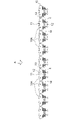
- FIG. 7 is a view of the stator core 10 and the coils 2U, 2V, 2W of each phase from the direction indicated by the arrow A in FIG. 5, that is, a view from the outer peripheral side of the stator core 10. Each coil portion is wound around the teeth 12 in the clockwise direction in FIG. 7.
- each coil portion the portion extending in the axial direction along the side surface of the teeth 12 is referred to as a coil side.
- the number of each coil side is indicated by a reference numeral T such as “69T” and “70T”.
- the right side of the teeth 12 in FIG. 7 is simply referred to as “the right side of the teeth 12”
- the left side of the teeth 12 in FIG. 7 is simply referred to as “the left side of the teeth 12”.
- the expressions "right side” and “left side” do not limit the actual winding method of each coil portion.
- the coil portions U1, V1 and W1 are all wound around the teeth 12 for 70 turns.
- the coil portions U2, V2, W2, U3, V3, and W3 are all wound around the teeth 12 for 69 turns, and the winding is completed in the middle of the 70th turn.
- the coil portion U1 has 70 coil sides U11 on the right side of the teeth 12 and 70 coil sides U12 on the left side.
- the coil side U11 is connected to the upper surface wiring 41U
- the coil side U12 is connected to the upper surface wiring 42U.
- the coil portion V1 has 70 coil sides V11 on the right side of the teeth 12 and 70 coil sides V12 on the left side.
- the coil side V11 is connected to the upper surface wiring 41V
- the coil side V12 is connected to the upper surface wiring 42V.
- the coil portion W1 has 70 coil sides W11 on the right side of the teeth 12 and 70 coil sides W12 on the left side.
- the coil side W11 is connected to the upper surface wiring 41W
- the coil side W12 is connected to the upper surface wiring 42W.
- the coil portion U2 has 70 coil sides U21 on the right side of the teeth 12 and 69 coil sides U22 on the left side.
- the coil side U21 is connected to the upper surface wiring 42U, and the coil side U22 is connected to the lower surface wiring 51U.
- the coil portion V2 has 70 coil sides V21 on the right side of the teeth 12 and 69 coil sides V22 on the left side.
- the coil side V21 is connected to the upper surface wiring 42V, and the coil side V22 is connected to the lower surface wiring 51V.
- the coil portion W2 has 70 coil sides W21 on the right side of the teeth 12 and 69 coil sides W22 on the left side.
- the coil side W21 is connected to the upper surface wiring 42W, and the coil side W22 is connected to the lower surface wiring 51W.
- the coil portion U3 has 69 coil sides U31 on the right side of the teeth 12 and 70 coil sides U32 on the left side.
- the coil side U31 is connected to the lower surface wiring 51U, and the coil side U32 is connected to the upper surface wiring 45U.
- the coil portion V3 has 69 coil sides V31 on the right side of the teeth 12 and 70 coil sides V32 on the left side.
- the coil side V31 is connected to the lower surface wiring 51V, and the coil side V32 is connected to the upper surface wiring 45V.
- the coil portion W3 has 69 coil sides W31 on the right side of the teeth 12 and 70 coil sides W32 on the left side.
- the coil side W31 is connected to the lower surface wiring 51W, and the coil side W32 is connected to the upper surface wiring 45W.
- the coil portions that is, the coil portions U1, V1, W1 connected to the two upper surface wirings have the same number N of coil sides on both sides in the circumferential direction of the teeth 12.
- the coil portion that is, the coil portion U2, V2, W2, U3, V3, W3 connected to the upper surface wiring and the lower surface wiring is wound in half of the final turn, so that one of the circumferential directions of the teeth 12 is completed.
- the number of coil sides on the other side is N-1, which is one less than the number N on the coil side on the other side.
- N is an integer of 2 or more.
- the coil sides U21, V21, W21, U32, V32, and W32 having 70 (N) coil sides are also referred to as first coil sides.
- the coil sides U22, V22, W22, U31, V31, and W31 having 69 coils (N-1) are also referred to as second coil sides.
- FIG. 8 is a view of another example of the winding pattern of the coils 2U, 2V, and 2W of each phase as viewed from the outer peripheral side of the stator core 10.
- the winding patterns of the coil portions U1, V1 and W1 are as described with reference to FIG. 7.
- the coil portions U2, V2, W2, U3, V3, and W3 are all wound around the teeth 12 for 70 turns, and the winding is completed in the middle of the 71st turn.
- the coil portion U2 has 71 coil sides U21 on the right side of the teeth 12 and 70 coil sides U22 on the left side.
- the coil portion V2 has 71 coil sides V21 on the right side of the teeth 12 and 70 coil sides V22 on the left side.
- the coil portion W2 has 71 coil sides W21 on the right side of the teeth 12 and 70 coil sides W22 on the left side.
- the coil portion U3 has 70 coil sides U31 on the right side of the teeth 12 and 71 coil sides U32 on the left side.
- the coil portion V3 has 70 coil sides V31 on the right side of the teeth 12 and 71 coil sides V32 on the left side.
- the coil portion W3 has 70 coil sides W31 on the right side of the teeth 12 and 71 coil sides W32 on the left side.
- the coil portion (that is, the coil portion U2, V2, W2, U3, V3, W3) connected to the upper surface wiring and the lower surface wiring is wound in half of the final turn, so that the teeth
- the number of coil sides on one side in the circumferential direction of 12 is N
- the number of coil sides on the other side is N-1, which is one less than the number N.
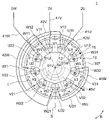
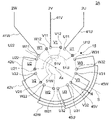
- FIG. 9 is a top view showing the stator core 10 and the coils 2U, 2V, 2W of each phase.
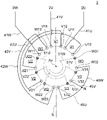
- FIG. 10 is a top view showing the coils 2U, 2V, and 2W of each phase taken out from FIG. 9.
- the coil side having 70 coils for example, coil side U11
- the coil side having 69 coils for example, coil side U22
- the plane including the axis Ax is defined as the reference plane S.
- the reference plane S passes through the center of the circumferential direction of the teeth 12 around which the coil portion V1 is wound, and is an intermediate position in the circumferential direction between the teeth 12 around which the coil portion W2 is wound and the teeth 12 around which the coil portion U3 is wound. It is a plane passing through.
- the 69 coil sides are symmetrical with respect to the reference plane S.
- the coil sides U22 and W31 are at positions symmetrical with respect to the reference surface S
- the coil sides V22 and V31 are at positions symmetrical with respect to the reference surface S
- the coil sides W22 and U31 are at positions symmetrical with respect to the reference surface S. It is in a symmetrical position with respect to.
- the 70 coil sides are symmetrical with respect to the reference plane S.
- the coil sides V11 and V12 are at positions symmetrical with respect to the reference surface S
- the coil sides W12 and U11 are at positions symmetrical with respect to the reference surface S
- the coil sides W11 and U12 are at positions symmetrical with respect to the reference surface S. It is in a symmetrical position.
- the coil sides U21 and W32 are at positions symmetrical with respect to the reference surface S
- the coil sides V21 and V32 are at positions symmetrical with respect to the reference surface S
- the coil sides W21 and U32 are at positions symmetrical with respect to the reference surface S. It is in a symmetrical position.
- the coil sides having the same number are arranged at positions symmetrical with respect to the reference plane S, the magnetic field generated by the current flowing through the coil sides is also symmetrical with respect to the reference plane S.
- the magnetic attraction force with respect to the rotor 6 becomes symmetrical with respect to the reference plane S, and the exciting force for vibrating the rotor 6 is reduced. That is, the vibration and noise of the motor 100 are suppressed.
- the reference surface S is set as a surface that passes through the center of the teeth 12 around which the coil portion V1 is wound.
- the coil portion V1 is located at the center of the coil portions U1, V1 and W1 arranged in the circumferential direction, and has the same number of coil sides V11 and V12 on both sides of the teeth 12. Therefore, by setting the reference plane S in this way, it is possible to realize a symmetrical coil arrangement centered on the reference plane S.
- FIG. 11 is a diagram showing the relationship between the stator core 10 and the coils 2U, 2V, 2W of each phase and the members around them.
- the motor 100 is attached to the inside of the cylindrical closed container 307 of the compressor 300 (FIG. 21) described later.
- An accumulator 310 is attached to the outside of the closed container 307.
- the accumulator 310 has a sound deadening effect as well as a function of storing the liquid refrigerant, and is also called a suction muffler.
- the configuration of the accumulator 310 will be described later with reference to FIG.
- the magnetic attraction force acting on the rotor 6 is symmetrical with respect to the reference plane S, but a minute exciting force is generated on the reference plane S.
- the accumulator 310 it is desirable to arrange the accumulator 310 so that the angle from the reference plane S centered on the axis Ax is larger than ⁇ / 2. In other words, it is desirable to arrange the accumulator 310 outside the range of the angle ⁇ with the reference plane S as a reference (center).
- the angle ⁇ is the arrangement interval of the teeth 12 centered on the axis Ax, and is also the arrangement interval of the divided cores 10A centered on the axis Ax.
- the angle ⁇ is 30 degrees.
- the accumulator 310 If the accumulator 310 is arranged outside the range of the angle ⁇ with the reference surface S as the reference (center), the accumulator 310 will be located outside the split core 10A located on the reference surface S in the circumferential direction. Therefore, the transmission of vibration to the accumulator 310 can be suppressed.
- the stator core 10 is integrated by bending the split core 10A in an annular shape and welding it at the welded portion 15. Therefore, the stator core 10 has a lower strength than the stator core integrally formed in an annular shape. Further, the welded portion 15 has the lowest strength among the stator cores 10. Therefore, it is desirable that the welded portion 15 is arranged at a position away from the reference surface S.
- the welded portion 15 it is desirable to provide the welded portion 15 so that the angle from the reference plane S centered on the axis Ax is larger than ⁇ / 2. In other words, it is desirable that the welded portion 15 is provided outside the range of the angle ⁇ with the reference surface S as a reference (center). As a result, the exciting force is less likely to be applied to the welded portion 15, and the vibration and noise of the motor 100 can be reduced.
- FIG. 12 is a diagram showing a connection state of the coils 2U, 2V, and 2W of each phase in the coil 2C of the comparative example.
- the coil portion U1 of the U-phase coil 2U is connected to the output terminal 8U by the top surface wiring 41U.
- the coil portion U1 and the coil portion U2 are connected by a top surface wiring 42U.
- the coil portion U2 and the coil portion U3 are connected by a top surface wiring 43U.
- the upper surface wirings 41U, 42U, and 43U are arranged on the upper surface 10a side of the stator core 10.
- the coil portion V1 of the V-phase coil 2V is connected to the output terminal 8V by the top surface wiring 41V.
- the coil portion V1 and the coil portion V2 are connected by a top surface wiring 42V.
- the coil portion V2 and the coil portion V3 are connected by a top surface wiring 43V.
- the upper surface wirings 41V, 42V, and 43V are arranged on the upper surface 10a side of the stator core 10.
- the coil portion W1 of the W-phase coil 2W is connected to the output terminal 8W by the top surface wiring 41W.
- the coil portion W1 and the coil portion W2 are connected by a top surface wiring 42W.
- the coil portion W2 and the coil portion W3 are connected by a top surface wiring 43W.
- the upper surface wirings 41W, 42W, and 43W are arranged on the upper surface 10a side of the stator core 10.
- the coil portions U3, V3, W3 are connected to the common neutral point N by the upper surface wirings 45U, 45V, 45W arranged on the upper surface 10a side of the stator core 10. That is, in the comparative example, all the wirings connecting the coil portions are arranged on the upper surface 10a side of the stator core 10.
- FIG. 13 is a view of the stator core 10 of the comparative example and the coils 2U, 2V, 2W of each phase as viewed from the outer peripheral side of the stator core 10.
- the upper surface wirings 41U to 43U, 41V to 43V, and 41W to 43W are all arranged on the upper surface 10a side of the stator core 10. Therefore, the coil portions U1 to U3, V1 to U3, and W1 to W3 are all wound around the teeth 12 for 70 turns.
- the coil portion U1 has 70 coil sides U11 on the right side of the teeth 12 and 70 coil sides U12 on the left side.
- the coil portion V1 has 70 coil sides V11 on the right side of the teeth 12 and 70 coil sides V12 on the left side.
- the coil portion W1 has 70 coil sides W11 on the right side of the teeth 12 and 70 coil sides W12 on the left side.
- the coil portion U2 has 70 coil sides U21 on the right side of the teeth 12 and 70 coil sides U22 on the left side.
- the coil portion V2 has 70 coil sides V21 on the right side of the teeth 12 and 70 coil sides V22 on the left side.
- the coil portion W2 has 70 coil sides W21 on the right side of the teeth 12 and 70 coil sides W22 on the left side.
- the coil portion U3 has 70 coil sides U31 on the right side of the teeth 12 and 70 coil sides U32 on the left side.
- the coil portion V3 has 70 coil sides V31 on the right side of the teeth 12 and 70 coil sides V32 on the left side.
- the coil portion W3 has 70 coil sides W31 on the right side of the teeth 12 and 70 coil sides W32 on the left side.
- FIG. 14 is a top view showing the stator core 10 of the comparative example and the coils 2U, 2V, 2W of each phase.
- the number of coil sides is 70 as described above, non-uniformity of the magnetic attraction force with respect to the rotor 6 is unlikely to occur.
- the wiring connecting the coil portions of the coils 2U, 2V, 2W of each phase that is, the upper surface wirings 41U to 43U, 41V to 43V, 41W to 43W All are arranged on the upper surface 10a side of the stator core 10. Therefore, in order to avoid mutual interference of the top surface wiring, the length of each top surface wiring must be increased.
- the wiring is on the upper surface 10a side and the lower surface 10b side of the stator core 10. Be distributed. Therefore, it becomes easy to arrange the wirings without interfering with each other, and the length of each wiring can be shortened.
- the portion where N coil sides for example, coil side U21
- the portion where N-1 coil sides for example, coil side U22
- a magnetic field is generated, and a force that magnetically attracts the rotor 6, that is, a magnetic attraction force is generated.
- the strength of this magnetic field is proportional to the number of coil sides. Therefore, depending on the arrangement of the N coil sides and the N-1 coil sides, the magnetic attraction force with respect to the rotor 6 becomes non-uniform, and an exciting force that vibrates the rotor 6 is generated.
- the coil sides having N numbers are arranged at positions symmetrical with respect to the reference plane S, and the coil sides having N-1 numbers are arranged.
- the coil sides U21 and W32 are arranged at positions symmetrical with respect to the reference plane S. Therefore, the magnetic field generated by the current flowing on the coil side is also symmetrical with respect to the reference plane S, and the magnetic attraction force with respect to the rotor 6 is also symmetrical with respect to the reference plane S. As a result, the exciting force acting on the rotor 6 can be reduced, and the vibration and noise of the motor 100 can be reduced.
- the accumulator 310 attached to the compressor 300 is arranged outside the range of the angle ⁇ with the reference surface S as the reference (center), the accumulator 310 It is possible to suppress the transmission of vibration to.
- the welded portion 15 of the stator core 10 is arranged outside the range of the angle ⁇ with the reference surface S as the reference (center), the influence of the exciting force on the welded portion 15 is less likely to be exerted, and the vibration of the motor 100 and the vibration of the motor 100 The noise can be further reduced. Further, since the fixing strength of the welded portion 15 can be relaxed, deterioration of magnetic characteristics due to welding can be suppressed.
- the three-phase coils 2U, 2V, and 2W all have N coil sides (that is, coil sides U21, V21, W21, U32, V32) on one side of the teeth 12. , W32), and has N-1 coil sides (that is, coil sides U22, V22, W22, U31, V31, W31) on the other side of the teeth 12.
- the first coil side (coil side U21, W21) and another first coil side (coil side W32, U32) are arranged at positions symmetrical with respect to the reference plane S.
- the second coil side (coil side U22, W22) and another second coil side (coil side W31, U31) are arranged at positions symmetrical with respect to the reference plane S.
- the magnetic field generated by the current flowing through the coil sides is also symmetrical with respect to the reference plane S, and the magnetism with respect to the rotor 6 is achieved.
- the target suction force is also symmetrical with respect to the reference plane S.
- the wiring is dispersed on the upper surface 10a side and the lower surface 10b side of the stator core 10, the length of each wiring can be shortened. As a result, copper loss can be reduced and motor efficiency can be improved. In addition, the wiring work becomes easy, and the productivity of the motor 100 can be improved. Further, as compared with the case where the wiring is concentrated on the upper surface 10a side of the stator core 10 (FIG. 4B), the height of the outer wall portion 31a of the insulator 31 can be lowered, and the size of the motor 100 can be reduced. Can be done.
- the coil sides W32 and W21) are arranged at positions symmetrical with respect to the reference plane S
- N-1 coil sides for example, coil sides U22, of the first phase coil (for example, U-phase coil 2U)
- N coil sides (for example, coil sides V21 and V32) of the third phase coil are arranged at positions symmetrical with each other with respect to the reference plane S, and the two N- One coil side (for example, V22, V31) is arranged at a position symmetrical with respect to the reference plane. Since it is configured in this way, it is possible to realize a symmetrical arrangement of the coil sides in the three-phase coils 2U, 2V, and 2W.
- first wiring for example, upper surface wiring 41U, 41V, 41W, 42U, 42V, 42W
- second wiring for example, lower surface wiring 51U, 51V, 51W
- the stator core 10 has a plurality of divided cores 10A arranged at equal intervals of angles ⁇ about the axis Ax, and the welded portion 15 of the stator core 10 is centered on the axis Ax with reference to the reference surface S. It is arranged outside the range of the angle ⁇ . Therefore, the influence of the exciting force on the welded portion 15 is less likely to be exerted, and the vibration and noise of the motor 100 can be further reduced.
- the reference surface S is a plane passing through the circumferential center of the teeth 12 in which a coil portion (for example, coil portion 21V) connected only to the upper surface wiring (for example, upper surface wiring 41V, 42V) and not connected to the lower surface wiring is wound. Is. Therefore, as described above, the symmetrical arrangement of the coil sides in the three-phase coils 2U, 2V, and 2W can be realized.
- a coil portion for example, coil portion 21V
- the upper surface wiring for example, upper surface wiring 41V, 42V
- the ratio of the number of poles of the rotor 6 to the number of slots of the stator 1 is 2: 3
- a configuration in which the U-phase, V-phase, and W-phase coil portions are arranged in order in the circumferential direction is adopted.
- the length of each wiring becomes long in order to avoid mutual interference of the wirings.
- the length of each wiring can be shortened by using the upper surface wiring and the lower surface wiring.
- the number of coil sides is a combination of 69 and 70 (or a combination of 70 and 71) has been described, but the number of coil sides is not limited to these.
- the coil portions are arranged in the order of U phase, V phase, and W phase in the circumferential direction, but the arrangement of the coil portions is not limited to this order.
- the reference surface S is set so as to pass through the center of the teeth 12 around which the W phase coil portion is wound. ..
- FIG. 15 is a diagram showing a connection state of the coils 2U, 2V, and 2W of each phase in the coil 2A of the stator 1A of the second embodiment.
- the arrangement of the bottom surface wirings 51U, 51V, 51W is different from that of the first embodiment.
- the coil portion U1 of the U-phase coil 2U is connected to the output terminal 8U by the top surface wiring 41U.
- the coil portion U1 and the coil portion U2 are connected by a bottom surface wiring 51U.
- the coil portion U2 and the coil portion U3 are connected by a top surface wiring 42U.
- the coil portion V1 of the V-phase coil 2V is connected to the output terminal 8V by the top surface wiring 41V.
- the coil portion V1 and the coil portion V2 are connected by a bottom surface wiring 51V.
- the coil portion V2 and the coil portion V3 are connected by a top surface wiring 42V.
- the coil portion W1 of the W-phase coil 2W is connected to the output terminal 8W by the top surface wiring 41W.
- the coil portion W1 and the coil portion W2 are connected by a bottom surface wiring 51W.
- the coil portion W2 and the coil portion W3 are connected by a top surface wiring 42W.
- the coil portions U3, V3, W3 are connected to the common neutral point N by the top surface wirings 45U, 45V, 45W.
- FIG. 16 is a view of the stator core 10 and the coils 2U, 2V, 2W of each phase as viewed from the outer peripheral side of the stator core 10.
- the coil portions U1, V1, W1, U2, V2, and W2 are all wound around the teeth 12 for 69 turns, and the winding is completed in the middle of the 70th turn.
- the coil portions U3, V3 and W3 are all wound around the teeth 12 for 70 turns.
- the coil portion U1 has 70 coil sides U11 on the right side of the teeth 12 and 69 coil sides U12 on the left side.
- the coil side U11 is connected to the upper surface wiring 41U, and the coil side U12 is connected to the lower surface wiring 51U.
- the coil portion V1 has 70 coil sides V11 on the right side of the teeth 12 and 69 coil sides V12 on the left side.
- the coil side V11 is connected to the upper surface wiring 41V, and the coil side V12 is connected to the lower surface wiring 51V.
- the coil portion W1 has 70 coil sides W11 on the right side of the teeth 12 and 69 coil sides W12 on the left side.
- the coil side W11 is connected to the upper surface wiring 41W
- the coil side W12 is connected to the lower surface wiring 51W.
- the coil portion U2 has 69 coil sides U21 on the right side of the teeth 12 and 70 coil sides U22 on the left side.
- the coil side U21 is connected to the lower surface wiring 51U, and the coil side U22 is connected to the upper surface wiring 42U.
- the coil portion V2 has 69 coil sides V21 on the right side of the teeth 12 and 70 coil sides V22 on the left side.
- the coil side V21 is connected to the lower surface wiring 51V, and the coil side V22 is connected to the upper surface wiring 42V.
- the coil portion W2 has 69 coil sides W21 on the right side of the teeth 12 and 70 coil sides W22 on the left side.
- the coil side W21 is connected to the lower surface wiring 51W, and the coil side W22 is connected to the upper surface wiring 42W.
- the coil portion U3 has 70 coil sides U31 on the right side of the teeth 12 and 70 coil sides U32 on the left side.
- the coil side U31 is connected to the upper surface wiring 42U, and the coil side U32 is connected to the upper surface wiring 45U.
- the coil portion V3 has 70 coil sides V31 on the right side of the teeth 12 and 70 coil sides V32 on the left side.
- the coil side V31 is connected to the upper surface wiring 42V, and the coil side V32 is connected to the upper surface wiring 45V.
- the coil portion W3 has 70 coil sides W31 on the right side of the teeth 12 and 70 coil sides W32 on the left side.
- the coil side W31 is connected to the upper surface wiring 42W, and the coil side W32 is connected to the upper surface wiring 45W.
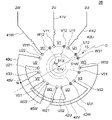
- FIG. 17 is a top view showing the connection state of the coils 2U, 2V, and 2W of each phase, and the stator core 10 is omitted.
- the reference plane S passes through the circumferential center of the teeth 12 (FIG. 16) around which the coil portion V3 is wound, and the teeth 12 around which the coil portion W1 is wound and the teeth around which the coil portion U2 is wound. It is a plane passing through an intermediate position in the circumferential direction with 12.
- the 69 coil sides are symmetrical with respect to the reference plane S. That is, the coil sides U21 and W12 are at positions symmetrical with respect to the reference surface S, the coil sides V21 and V12 are at positions symmetrical with respect to the reference surface S, and the coil sides W21 and U12 are at positions symmetrical with respect to the reference surface S. It is in a symmetrical position.
- the 70 coil sides are symmetrical with respect to the reference plane S.
- the coil sides U22 and W11 are at positions symmetrical with respect to the reference surface S
- the coil sides V22 and V11 are at positions symmetrical with respect to the reference surface S
- the coil sides W22 and U11 are at positions symmetrical with respect to the reference surface S. It is in a symmetrical position.
- the coil sides U32 and W31 are at positions symmetrical with respect to the reference surface S
- the coil sides U31 and W32 are at positions symmetrical with respect to the reference surface S
- the coil sides V32 and V31 are at positions symmetrical with respect to the reference surface S. It is in a symmetrical position.
- stator 1A of the second embodiment is configured in the same manner as the stator 1 of the first embodiment.
- the magnetic field generated by the current flowing through the coil sides is also symmetrical with respect to the reference plane S.
- the magnetic attraction force with respect to the rotor 6 becomes symmetrical with respect to the reference plane S, the exciting force acting on the rotor 6 is reduced, and the vibration and noise of the motor 100 can be reduced.
- each of the coil portions U1, V1, W1, U2, V2, W2 has 69 coil sides on one side of the teeth 12 and 70 coil sides on the opposite side.
- the teeth 12 may have 70 coil sides on one side and 71 coil sides on the other side.
- FIG. 18 is a diagram showing a connection state of the U-phase coil 2U, the V-phase coil 2V, and the W-phase coil 2W in the coil 2B of the stator 1B of the third embodiment.
- the third embodiment is different from the first embodiment in that the coil portions U3 (V3, W3) are connected between the coil portions U1 (V1, W1) and the coil portions U2 (V2, W2).
- the coil portion U1 of the U-phase coil 2U is connected to the output terminal 8U by the top surface wiring 41U.
- the coil portion U1 and the coil portion U3 are connected by a bottom surface wiring 51U.
- the coil portion U3 and the coil portion U2 are connected by a top surface wiring 42U.
- the coil portion V1 of the V-phase coil 2V is connected to the output terminal 8V by the top surface wiring 41V.
- the coil portion V1 and the coil portion V3 are connected by a bottom surface wiring 51V.
- the coil portion V3 and the coil portion V2 are connected by a top surface wiring 42V.
- the coil portion W1 of the W-phase coil 2W is connected to the output terminal 8W by the top surface wiring 41W.
- the coil portion W1 and the coil portion W3 are connected by a bottom surface wiring 51W.
- the coil portion W3 and the coil portion W2 are connected by a top surface wiring 42W.
- the coil portions U2, V2 and W2 are connected to the common neutral point N by the top surface wirings 45U, 45V and 45W.
- FIG. 19 is a view of the stator core 10 and the coils 2U, 2V, 2W of each phase as viewed from the outer peripheral side of the stator core 10.
- the coil portions U1, V1, W1, U3, V3, and W3 are all wound around the teeth 12 for 69 turns, and the winding is completed in the middle of the 70th turn.
- the coil portions U2, V2 and W2 are all wound around the teeth 12 for 70 turns.
- the coil portion U1 has 70 coil sides U11 on the right side of the teeth 12 and 69 coil sides U12 on the left side.
- the coil side U11 is connected to the upper surface wiring 41U, and the coil side U12 is connected to the lower surface wiring 51U.
- the coil portion V1 has 70 coil sides V11 on the right side of the teeth 12 and 69 coil sides V12 on the left side.
- the coil side V11 is connected to the upper surface wiring 41V, and the coil side V12 is connected to the lower surface wiring 51V.
- the coil portion W1 has 70 coil sides W11 on the right side of the teeth 12 and 69 coil sides W12 on the left side.
- the coil side W11 is connected to the upper surface wiring 41W
- the coil side W12 is connected to the lower surface wiring 51W.
- the coil portion U2 has 70 coil sides U21 on the right side of the teeth 12 and 70 coil sides U22 on the left side.
- the coil side U21 is connected to the upper surface wiring 42U, and the coil side U22 is connected to the upper surface wiring 45U.
- the coil portion V2 has 70 coil sides V21 on the right side of the teeth 12 and 70 coil sides V22 on the left side.
- the coil side V21 is connected to the upper surface wiring 42V, and the coil side V22 is connected to the upper surface wiring 45V.
- the coil portion W2 has 70 coil sides W21 on the right side of the teeth 12 and 70 coil sides W22 on the left side.
- the coil side W21 is connected to the upper surface wiring 42W
- the coil side W22 is connected to the upper surface wiring 45W.
- the coil portion U3 has 69 coil sides U31 on the right side of the teeth 12 and 70 coil sides U32 on the left side.
- the coil side U31 is connected to the lower surface wiring 51U, and the coil side U32 is connected to the upper surface wiring 42U.
- the coil portion V3 has 69 coil sides V31 on the right side of the teeth 12 and 70 coil sides V32 on the left side.
- the coil side V31 is connected to the lower surface wiring 51V, and the coil side V32 is connected to the upper surface wiring 42V.
- the coil portion W3 has 69 coil sides W31 on the right side of the teeth 12 and 70 coil sides W32 on the left side.
- the coil side W31 is connected to the lower surface wiring 51W, and the coil side W32 is connected to the upper surface wiring 42W.
- FIG. 20 is a top view showing the connection state of the coils 2U, 2V, and 2W of each phase, and the stator core 10 is omitted.
- the reference plane S passes through the circumferential center of the teeth 12 (FIG. 19) around which the coil portion V2 is wound, and the teeth 12 around which the coil portion U1 is wound and the teeth around which the coil portion W3 is wound. It is a plane passing through an intermediate position in the circumferential direction with 12.
- the 69 coil sides are symmetrical with respect to the reference plane S. That is, the coil sides U31 and W12 are at positions symmetrical with respect to the reference surface S, the coil sides V31 and V12 are at positions symmetrical with respect to the reference surface S, and the coil sides W31 and U12 are at positions symmetrical with respect to the reference surface S. It is in a symmetrical position.
- the 70 coil sides are symmetrical with respect to the reference plane S.
- the coil sides V21 and V22 are at positions symmetrical with respect to the reference surface S
- the coil sides W22 and U21 are at positions symmetrical with respect to the reference surface S
- the coil sides W21 and U22 are at positions symmetrical with respect to the reference surface S. It is in a symmetrical position.
- the coil sides U32 and W11 are at positions symmetrical with respect to the reference surface S
- the coil sides V32 and W11 are at positions symmetrical with respect to the reference surface S
- the coil sides W32 and U11 are at positions symmetrical with respect to the reference surface S. It is in a symmetrical position.
- stator 1B of the third embodiment is configured in the same manner as the stator 1 of the first embodiment.
- the magnetic field generated by the current flowing through the coil sides is also relative to the reference surface S. Become symmetric.
- the magnetic attraction force with respect to the rotor 6 becomes symmetrical with respect to the reference plane S, the exciting force acting on the rotor 6 is reduced, and the vibration and noise of the motor 100 can be reduced.
- the welded portion 15 of the stator core 10 is located on the reference surface S. Since a minute exciting force is generated on the reference surface S, it is desirable that the welded portion 15 having a low strength among the stator cores 10 is not provided on the reference surface S. Therefore, from the viewpoint of suppressing the vibration and noise of the motor 100, it is desirable that the welded portion 15 is provided outside the range of the angle ⁇ with respect to the reference surface S as in the first or second embodiment.
- each of the coil portions U1, V1, W1, U3, V3, W3 has 69 coil sides on one side of the teeth 12 and 70 coil sides on the opposite side.
- the teeth 12 may have 70 coil sides on one side and 71 coil sides on the other side.
- FIG. 21 is a cross-sectional view showing the compressor 300.
- the compressor 300 is a rotary compressor here, and includes a closed container 307, a compression mechanism 301 arranged in the closed container 307, and a motor 100 for driving the compression mechanism 301.
- the compression mechanism 301 includes a cylinder 302 having a cylinder chamber 303, a shaft 7 of the motor 100, a rolling piston 304 fixed to the shaft 7, and a vane that divides the inside of the cylinder chamber 303 into a suction side and a compression side (not shown). And an upper frame 305 and a lower frame 306 into which the shaft 7 is inserted to close the axial end face of the cylinder chamber 303.
- An upper discharge muffler 308 and a lower discharge muffler 309 are mounted on the upper frame 305 and the lower frame 306, respectively.
- the closed container 307 is a cylindrical container. Refrigerating machine oil (not shown) that lubricates each sliding portion of the compression mechanism 301 is stored in the bottom of the closed container 307.
- the shaft 7 is rotatably held by an upper frame 305 and a lower frame 306 as bearing portions.
- the cylinder 302 is provided with a cylinder chamber 303 inside, and the rolling piston 304 rotates eccentrically in the cylinder chamber 303.
- the shaft 7 has an eccentric shaft portion, and a rolling piston 304 is fitted to the eccentric shaft portion.
- the stator 1 of the motor 100 is incorporated inside the frame of the closed container 307 by a method such as shrink fitting, press fitting, or welding. Power is supplied to the coil 2 of the stator 1 from the glass terminal 311 fixed to the closed container 307.
- the shaft 7 is fixed to the shaft hole 64 of the rotor 6.
- An accumulator 310 is attached to the outside of the closed container 307.
- the accumulator 310 has a suction pipe 314 into which the refrigerant gas flows from the refrigerant circuit, and a liquid refrigerant storage unit 315 for storing the liquid refrigerant.
- the liquid refrigerant flows in from the suction pipe 314 together with the refrigerant gas, the liquid refrigerant is stored in the liquid refrigerant storage unit 315, and the refrigerant gas is supplied to the compressor 300. Since the accumulator 310 has a muffling effect, it is also called a suction muffler.
- a suction pipe 313 is fixed to the closed container 307, and refrigerant gas is supplied from the accumulator 310 to the cylinder 302 via the suction pipe 313. Further, a discharge pipe 312 for discharging the refrigerant to the outside is provided above the closed container 307.
- refrigerant of the compressor 300 for example, R410A, R407C, R22, or the like may be used, but from the viewpoint of preventing global warming, it is desirable to use a refrigerant having a low GWP (global warming potential).
- GWP global warming potential
- the refrigerant having a low GWP for example, the following refrigerants can be used.
- the GWP of HFO-1234yf is 4.
- a hydrocarbon having a carbon double bond in the composition for example, R1270 (propylene) may be used.
- the GWP of R1270 is 3, which is lower than HFO-1234yf but higher in flammability than HFO-1234yf.
- a mixture containing at least one of a halogenated hydrocarbon having a carbon double bond in the composition or a hydrocarbon having a carbon double bond in the composition for example, a mixture of HFO-1234yf and R32.
- the operation of the compressor 300 is as follows.
- the refrigerant gas supplied from the accumulator 310 is supplied into the cylinder chamber 303 of the cylinder 302 through the suction pipe 313.
- the motor 100 is driven by the energization of the inverter and the rotor 6 rotates, the shaft 7 rotates together with the rotor 6.
- the rolling piston 304 fitted to the shaft 7 rotates eccentrically in the cylinder chamber 303, and the refrigerant is compressed in the cylinder chamber 303.
- the refrigerant compressed in the cylinder chamber 303 passes through the discharge mufflers 308 and 309, and further passes through the through holes 66 and 67 of the rotor 6 (FIG. 1) and rises in the closed container 307.
- the refrigerant rising in the closed container 307 is discharged from the discharge pipe 312 and supplied to the high pressure side of the refrigeration cycle.
- the motor 100 of the compressor 300 reduces vibration and noise and has high motor efficiency as described in the first to third embodiments, the quietness and operating efficiency of the compressor 300 can be improved.
- the motors 100 of the first to third embodiments can be used not only for the rotary compressor but also for other types of compressors.
- FIG. 22 is a diagram showing a refrigeration cycle device 400 provided with the compressor 300 shown in FIG. 21.
- the refrigeration cycle device 400 is an air conditioner here, and evaporates the compressor 300, the four-way valve 401 as a switching valve, the condenser 402 for condensing the refrigerant, the decompression device 403 for depressurizing the refrigerant, and the refrigerant. It is equipped with an evaporator 404.
- the compressor 300, the condenser 402, the decompression device 403 and the evaporator 404 are connected by a refrigerant pipe 407 to form a refrigerant circuit. Further, the compressor 300 includes an outdoor blower 405 facing the condenser 402 and an indoor blower 406 facing the evaporator 404.
- the operation of the refrigeration cycle device 400 is as follows.
- the compressor 300 compresses the sucked refrigerant and sends it out as a high-temperature and high-pressure refrigerant gas.
- the four-way valve 401 switches the flow direction of the refrigerant, and during the cooling operation, as shown by the solid line in FIG. 22, the refrigerant sent out from the compressor 300 flows to the condenser 402.
- the condenser 402 exchanges heat between the refrigerant sent from the compressor 300 and the outdoor air sent by the outdoor blower 405, condenses the refrigerant, and sends it out as a liquid refrigerant.
- the decompression device 403 expands the liquid refrigerant sent out from the condenser 402 and sends it out as a low-temperature low-pressure liquid refrigerant.
- the evaporator 404 exchanges heat between the low-temperature low-pressure liquid refrigerant sent from the decompression device 403 and the indoor air, evaporates the refrigerant, and sends it out as a refrigerant gas.
- the air whose heat has been taken away by the evaporator 404 is supplied to the room by the indoor blower 406.
- the four-way valve 401 sends the refrigerant sent from the compressor 300 to the evaporator 404.
- the evaporator 404 functions as a condenser
- the condenser 402 functions as an evaporator.
- the refrigeration cycle device 400 is an air conditioner here, but is not limited to the air conditioner, and may be, for example, a refrigerator or the like.
- the quietness and operating efficiency of the refrigeration cycle device 400 can be improved.
- the compressor having the motors of the first to third embodiments can also be used for other refrigeration cycle devices.
- stator 1,2A, 2B coil, 2UU phase coil (1st phase coil), 2V V phase coil (2nd phase coil), 2WW phase coil (3rd phase coil), 3 insulation part, 4 wiring, 6 rotor, 7 shaft, 10 stator core, 10A split core, 10a upper surface (one end in the axial direction), 10b lower surface (the other end in the axial direction), 11 yoke, 12 teeth, 13 slots, 14 split surfaces, 15 welds.
Landscapes
- Engineering & Computer Science (AREA)
- Power Engineering (AREA)
- Windings For Motors And Generators (AREA)
- Insulation, Fastening Of Motor, Generator Windings (AREA)
Priority Applications (2)
| Application Number | Priority Date | Filing Date | Title |
|---|---|---|---|
| PCT/JP2021/000673 WO2022153362A1 (ja) | 2021-01-12 | 2021-01-12 | ステータ、モータ、圧縮機および冷凍サイクル装置 |
| JP2022574882A JP7486613B2 (ja) | 2021-01-12 | 2021-01-12 | ステータ、モータ、圧縮機および冷凍サイクル装置 |
Applications Claiming Priority (1)
| Application Number | Priority Date | Filing Date | Title |
|---|---|---|---|
| PCT/JP2021/000673 WO2022153362A1 (ja) | 2021-01-12 | 2021-01-12 | ステータ、モータ、圧縮機および冷凍サイクル装置 |
Publications (1)
| Publication Number | Publication Date |
|---|---|
| WO2022153362A1 true WO2022153362A1 (ja) | 2022-07-21 |
Family
ID=82447018
Family Applications (1)
| Application Number | Title | Priority Date | Filing Date |
|---|---|---|---|
| PCT/JP2021/000673 Ceased WO2022153362A1 (ja) | 2021-01-12 | 2021-01-12 | ステータ、モータ、圧縮機および冷凍サイクル装置 |
Country Status (2)
| Country | Link |
|---|---|
| JP (1) | JP7486613B2 (https=) |
| WO (1) | WO2022153362A1 (https=) |
Citations (3)
| Publication number | Priority date | Publication date | Assignee | Title |
|---|---|---|---|---|
| JP2008061331A (ja) * | 2006-08-30 | 2008-03-13 | Nippon Densan Corp | ブラシレスモータ |
| JP2010074889A (ja) * | 2008-09-16 | 2010-04-02 | Asmo Co Ltd | ステータ及びステータの製造方法 |
| WO2017090514A1 (ja) * | 2015-11-27 | 2017-06-01 | 日立オートモティブシステムズエンジニアリング株式会社 | 回転電機および回転電機システム |
-
2021
- 2021-01-12 WO PCT/JP2021/000673 patent/WO2022153362A1/ja not_active Ceased
- 2021-01-12 JP JP2022574882A patent/JP7486613B2/ja active Active
Patent Citations (3)
| Publication number | Priority date | Publication date | Assignee | Title |
|---|---|---|---|---|
| JP2008061331A (ja) * | 2006-08-30 | 2008-03-13 | Nippon Densan Corp | ブラシレスモータ |
| JP2010074889A (ja) * | 2008-09-16 | 2010-04-02 | Asmo Co Ltd | ステータ及びステータの製造方法 |
| WO2017090514A1 (ja) * | 2015-11-27 | 2017-06-01 | 日立オートモティブシステムズエンジニアリング株式会社 | 回転電機および回転電機システム |
Also Published As
| Publication number | Publication date |
|---|---|
| JP7486613B2 (ja) | 2024-05-17 |
| JPWO2022153362A1 (https=) | 2022-07-21 |
Similar Documents
| Publication | Publication Date | Title |
|---|---|---|
| KR102549047B1 (ko) | 전동기, 압축기 및 공기 조화 장치 | |
| JP6053910B2 (ja) | 永久磁石埋込型電動機、圧縮機、および冷凍空調装置 | |
| JP7023408B2 (ja) | モータ、圧縮機および空気調和装置 | |
| JPWO2015083274A1 (ja) | 永久磁石埋込型電動機、圧縮機及び冷凍空調装置 | |
| WO2017077590A1 (ja) | ステータ、電動機、圧縮機、及び冷凍空調装置 | |
| US11296560B2 (en) | Motor, compressor, and air conditioner | |
| WO2017208291A1 (ja) | 固定子、電動機、圧縮機、及び冷凍空調装置 | |
| WO2019215865A1 (ja) | ロータ、電動機、圧縮機および空気調和装置 | |
| US11949291B2 (en) | Motor having rotor with different core regions, compressor, and air conditioner having the motor | |
| US12040680B2 (en) | Compressor and air conditioner | |
| US20240120787A1 (en) | Motor, compressor, and refrigeration cycle apparatus | |
| WO2023032134A1 (ja) | 電動機、圧縮機および冷凍サイクル装置 | |
| JP7433419B2 (ja) | ロータ、モータ、圧縮機、空気調和装置およびロータの製造方法 | |
| JP7486613B2 (ja) | ステータ、モータ、圧縮機および冷凍サイクル装置 | |
| JP6223568B2 (ja) | 永久磁石埋込型電動機、圧縮機及び冷凍空調装置 | |
| WO2023181238A1 (ja) | 固定子、電動機、圧縮機および冷凍サイクル装置 | |
| JP7433420B2 (ja) | ロータ、モータ、圧縮機および空気調和装置 | |
| US20210152039A1 (en) | Stator, motor, compressor, and refrigerating and air conditioning apparatus | |
| WO2024089866A1 (ja) | 固定子、電動機、圧縮機および冷凍サイクル装置 | |
| JP7286019B2 (ja) | 固定子、電動機、圧縮機、冷凍サイクル装置及び空気調和装置 | |
| JP7292424B2 (ja) | モータ、圧縮機および空気調和装置 | |
| WO2024004202A1 (ja) | 固定子、電動機、圧縮機および冷凍サイクル装置 | |
| WO2023233629A1 (ja) | ステータ、電動機、圧縮機および冷凍サイクル装置 |
Legal Events
| Date | Code | Title | Description |
|---|---|---|---|
| 121 | Ep: the epo has been informed by wipo that ep was designated in this application |
Ref document number: 21919258 Country of ref document: EP Kind code of ref document: A1 |
|
| ENP | Entry into the national phase |
Ref document number: 2022574882 Country of ref document: JP Kind code of ref document: A |
|
| NENP | Non-entry into the national phase |
Ref country code: DE |
|
| 122 | Ep: pct application non-entry in european phase |
Ref document number: 21919258 Country of ref document: EP Kind code of ref document: A1 |