WO2022145377A1 - 樹脂組成物、プリプレグ、積層板、樹脂フィルム、プリント配線板及び半導体パッケージ - Google Patents
樹脂組成物、プリプレグ、積層板、樹脂フィルム、プリント配線板及び半導体パッケージ Download PDFInfo
- Publication number
- WO2022145377A1 WO2022145377A1 PCT/JP2021/048276 JP2021048276W WO2022145377A1 WO 2022145377 A1 WO2022145377 A1 WO 2022145377A1 JP 2021048276 W JP2021048276 W JP 2021048276W WO 2022145377 A1 WO2022145377 A1 WO 2022145377A1
- Authority
- WO
- WIPO (PCT)
- Prior art keywords
- group
- component
- carbon atoms
- resin
- resin composition
- Prior art date
- Legal status (The legal status is an assumption and is not a legal conclusion. Google has not performed a legal analysis and makes no representation as to the accuracy of the status listed.)
- Ceased
Links
Classifications
-
- C—CHEMISTRY; METALLURGY
- C08—ORGANIC MACROMOLECULAR COMPOUNDS; THEIR PREPARATION OR CHEMICAL WORKING-UP; COMPOSITIONS BASED THEREON
- C08J—WORKING-UP; GENERAL PROCESSES OF COMPOUNDING; AFTER-TREATMENT NOT COVERED BY SUBCLASSES C08B, C08C, C08F, C08G or C08H
- C08J5/00—Manufacture of articles or shaped materials containing macromolecular substances
- C08J5/24—Impregnating materials with prepolymers which can be polymerised in situ, e.g. manufacture of prepregs
- C08J5/249—Impregnating materials with prepolymers which can be polymerised in situ, e.g. manufacture of prepregs characterised by the additives used in the prepolymer mixture
-
- C—CHEMISTRY; METALLURGY
- C08—ORGANIC MACROMOLECULAR COMPOUNDS; THEIR PREPARATION OR CHEMICAL WORKING-UP; COMPOSITIONS BASED THEREON
- C08F—MACROMOLECULAR COMPOUNDS OBTAINED BY REACTIONS ONLY INVOLVING CARBON-TO-CARBON UNSATURATED BONDS
- C08F257/00—Macromolecular compounds obtained by polymerising monomers on to polymers of aromatic monomers as defined in group C08F12/00
- C08F257/02—Macromolecular compounds obtained by polymerising monomers on to polymers of aromatic monomers as defined in group C08F12/00 on to polymers of styrene or alkyl-substituted styrenes
-
- B—PERFORMING OPERATIONS; TRANSPORTING
- B32—LAYERED PRODUCTS
- B32B—LAYERED PRODUCTS, i.e. PRODUCTS BUILT-UP OF STRATA OF FLAT OR NON-FLAT, e.g. CELLULAR OR HONEYCOMB, FORM
- B32B15/00—Layered products comprising a layer of metal
- B32B15/04—Layered products comprising a layer of metal comprising metal as the main or only constituent of a layer, which is next to another layer of the same or of a different material
- B32B15/08—Layered products comprising a layer of metal comprising metal as the main or only constituent of a layer, which is next to another layer of the same or of a different material of synthetic resin
-
- B—PERFORMING OPERATIONS; TRANSPORTING
- B32—LAYERED PRODUCTS
- B32B—LAYERED PRODUCTS, i.e. PRODUCTS BUILT-UP OF STRATA OF FLAT OR NON-FLAT, e.g. CELLULAR OR HONEYCOMB, FORM
- B32B15/00—Layered products comprising a layer of metal
- B32B15/04—Layered products comprising a layer of metal comprising metal as the main or only constituent of a layer, which is next to another layer of the same or of a different material
- B32B15/08—Layered products comprising a layer of metal comprising metal as the main or only constituent of a layer, which is next to another layer of the same or of a different material of synthetic resin
- B32B15/088—Layered products comprising a layer of metal comprising metal as the main or only constituent of a layer, which is next to another layer of the same or of a different material of synthetic resin comprising polyamides
-
- B—PERFORMING OPERATIONS; TRANSPORTING
- B32—LAYERED PRODUCTS
- B32B—LAYERED PRODUCTS, i.e. PRODUCTS BUILT-UP OF STRATA OF FLAT OR NON-FLAT, e.g. CELLULAR OR HONEYCOMB, FORM
- B32B7/00—Layered products characterised by the relation between layers; Layered products characterised by the relative orientation of features between layers, or by the relative values of a measurable parameter between layers, i.e. products comprising layers having different physical, chemical or physicochemical properties; Layered products characterised by the interconnection of layers
- B32B7/02—Physical, chemical or physicochemical properties
- B32B7/022—Mechanical properties
-
- C—CHEMISTRY; METALLURGY
- C08—ORGANIC MACROMOLECULAR COMPOUNDS; THEIR PREPARATION OR CHEMICAL WORKING-UP; COMPOSITIONS BASED THEREON
- C08F—MACROMOLECULAR COMPOUNDS OBTAINED BY REACTIONS ONLY INVOLVING CARBON-TO-CARBON UNSATURATED BONDS
- C08F285/00—Macromolecular compounds obtained by polymerising monomers on to preformed graft polymers
-
- C—CHEMISTRY; METALLURGY
- C08—ORGANIC MACROMOLECULAR COMPOUNDS; THEIR PREPARATION OR CHEMICAL WORKING-UP; COMPOSITIONS BASED THEREON
- C08J—WORKING-UP; GENERAL PROCESSES OF COMPOUNDING; AFTER-TREATMENT NOT COVERED BY SUBCLASSES C08B, C08C, C08F, C08G or C08H
- C08J5/00—Manufacture of articles or shaped materials containing macromolecular substances
- C08J5/24—Impregnating materials with prepolymers which can be polymerised in situ, e.g. manufacture of prepregs
-
- C—CHEMISTRY; METALLURGY
- C08—ORGANIC MACROMOLECULAR COMPOUNDS; THEIR PREPARATION OR CHEMICAL WORKING-UP; COMPOSITIONS BASED THEREON
- C08K—Use of inorganic or non-macromolecular organic substances as compounding ingredients
- C08K5/00—Use of organic ingredients
- C08K5/16—Nitrogen-containing compounds
- C08K5/34—Heterocyclic compounds having nitrogen in the ring
- C08K5/3412—Heterocyclic compounds having nitrogen in the ring having one nitrogen atom in the ring
- C08K5/3415—Five-membered rings
-
- C—CHEMISTRY; METALLURGY
- C08—ORGANIC MACROMOLECULAR COMPOUNDS; THEIR PREPARATION OR CHEMICAL WORKING-UP; COMPOSITIONS BASED THEREON
- C08L—COMPOSITIONS OF MACROMOLECULAR COMPOUNDS
- C08L101/00—Compositions of unspecified macromolecular compounds
- C08L101/12—Compositions of unspecified macromolecular compounds characterised by physical features, e.g. anisotropy, viscosity or electrical conductivity
-
- C—CHEMISTRY; METALLURGY
- C08—ORGANIC MACROMOLECULAR COMPOUNDS; THEIR PREPARATION OR CHEMICAL WORKING-UP; COMPOSITIONS BASED THEREON
- C08L—COMPOSITIONS OF MACROMOLECULAR COMPOUNDS
- C08L15/00—Compositions of rubber derivatives
-
- C—CHEMISTRY; METALLURGY
- C08—ORGANIC MACROMOLECULAR COMPOUNDS; THEIR PREPARATION OR CHEMICAL WORKING-UP; COMPOSITIONS BASED THEREON
- C08L—COMPOSITIONS OF MACROMOLECULAR COMPOUNDS
- C08L25/00—Compositions of, homopolymers or copolymers of compounds having one or more unsaturated aliphatic radicals, each having only one carbon-to-carbon double bond, and at least one being terminated by an aromatic carbocyclic ring; Compositions of derivatives of such polymers
- C08L25/02—Homopolymers or copolymers of hydrocarbons
- C08L25/04—Homopolymers or copolymers of styrene
- C08L25/08—Copolymers of styrene
-
- C—CHEMISTRY; METALLURGY
- C08—ORGANIC MACROMOLECULAR COMPOUNDS; THEIR PREPARATION OR CHEMICAL WORKING-UP; COMPOSITIONS BASED THEREON
- C08L—COMPOSITIONS OF MACROMOLECULAR COMPOUNDS
- C08L51/00—Compositions of graft polymers in which the grafted component is obtained by reactions only involving carbon-to-carbon unsaturated bonds; Compositions of derivatives of such polymers
- C08L51/06—Compositions of graft polymers in which the grafted component is obtained by reactions only involving carbon-to-carbon unsaturated bonds; Compositions of derivatives of such polymers grafted on to homopolymers or copolymers of aliphatic hydrocarbons containing only one carbon-to-carbon double bond
-
- H—ELECTRICITY
- H05—ELECTRIC TECHNIQUES NOT OTHERWISE PROVIDED FOR
- H05K—PRINTED CIRCUITS; CASINGS OR CONSTRUCTIONAL DETAILS OF ELECTRIC APPARATUS; MANUFACTURE OF ASSEMBLAGES OF ELECTRICAL COMPONENTS
- H05K1/00—Printed circuits
- H05K1/02—Details
- H05K1/03—Use of materials for the substrate
- H05K1/0313—Organic insulating material
- H05K1/0353—Organic insulating material consisting of two or more materials, e.g. two or more polymers, polymer + filler, + reinforcement
-
- H—ELECTRICITY
- H05—ELECTRIC TECHNIQUES NOT OTHERWISE PROVIDED FOR
- H05K—PRINTED CIRCUITS; CASINGS OR CONSTRUCTIONAL DETAILS OF ELECTRIC APPARATUS; MANUFACTURE OF ASSEMBLAGES OF ELECTRICAL COMPONENTS
- H05K1/00—Printed circuits
- H05K1/02—Details
- H05K1/03—Use of materials for the substrate
- H05K1/0313—Organic insulating material
- H05K1/0353—Organic insulating material consisting of two or more materials, e.g. two or more polymers, polymer + filler, + reinforcement
- H05K1/0366—Organic insulating material consisting of two or more materials, e.g. two or more polymers, polymer + filler, + reinforcement reinforced, e.g. by fibres, fabrics
-
- H—ELECTRICITY
- H05—ELECTRIC TECHNIQUES NOT OTHERWISE PROVIDED FOR
- H05K—PRINTED CIRCUITS; CASINGS OR CONSTRUCTIONAL DETAILS OF ELECTRIC APPARATUS; MANUFACTURE OF ASSEMBLAGES OF ELECTRICAL COMPONENTS
- H05K1/00—Printed circuits
- H05K1/18—Printed circuits structurally associated with non-printed electric components
-
- H—ELECTRICITY
- H05—ELECTRIC TECHNIQUES NOT OTHERWISE PROVIDED FOR
- H05K—PRINTED CIRCUITS; CASINGS OR CONSTRUCTIONAL DETAILS OF ELECTRIC APPARATUS; MANUFACTURE OF ASSEMBLAGES OF ELECTRICAL COMPONENTS
- H05K3/00—Apparatus or processes for manufacturing printed circuits
- H05K3/46—Manufacturing multilayer circuits
-
- H—ELECTRICITY
- H05—ELECTRIC TECHNIQUES NOT OTHERWISE PROVIDED FOR
- H05K—PRINTED CIRCUITS; CASINGS OR CONSTRUCTIONAL DETAILS OF ELECTRIC APPARATUS; MANUFACTURE OF ASSEMBLAGES OF ELECTRICAL COMPONENTS
- H05K3/00—Apparatus or processes for manufacturing printed circuits
- H05K3/46—Manufacturing multilayer circuits
- H05K3/4644—Manufacturing multilayer circuits by building the multilayer layer by layer, i.e. build-up multilayer circuits
- H05K3/4652—Adding a circuit layer by laminating a metal foil or a preformed metal foil pattern
-
- B—PERFORMING OPERATIONS; TRANSPORTING
- B32—LAYERED PRODUCTS
- B32B—LAYERED PRODUCTS, i.e. PRODUCTS BUILT-UP OF STRATA OF FLAT OR NON-FLAT, e.g. CELLULAR OR HONEYCOMB, FORM
- B32B2305/00—Condition, form or state of the layers or laminate
- B32B2305/07—Parts immersed or impregnated in a matrix
- B32B2305/076—Prepregs
-
- B—PERFORMING OPERATIONS; TRANSPORTING
- B32—LAYERED PRODUCTS
- B32B—LAYERED PRODUCTS, i.e. PRODUCTS BUILT-UP OF STRATA OF FLAT OR NON-FLAT, e.g. CELLULAR OR HONEYCOMB, FORM
- B32B2457/00—Electrical equipment
- B32B2457/08—PCBs, i.e. printed circuit boards
-
- C—CHEMISTRY; METALLURGY
- C08—ORGANIC MACROMOLECULAR COMPOUNDS; THEIR PREPARATION OR CHEMICAL WORKING-UP; COMPOSITIONS BASED THEREON
- C08J—WORKING-UP; GENERAL PROCESSES OF COMPOUNDING; AFTER-TREATMENT NOT COVERED BY SUBCLASSES C08B, C08C, C08F, C08G or C08H
- C08J2323/00—Characterised by the use of homopolymers or copolymers of unsaturated aliphatic hydrocarbons having only one carbon-to-carbon double bond; Derivatives of such polymers
- C08J2323/02—Characterised by the use of homopolymers or copolymers of unsaturated aliphatic hydrocarbons having only one carbon-to-carbon double bond; Derivatives of such polymers not modified by chemical after treatment
- C08J2323/18—Homopolymers or copolymers of hydrocarbons having four or more carbon atoms
-
- C—CHEMISTRY; METALLURGY
- C08—ORGANIC MACROMOLECULAR COMPOUNDS; THEIR PREPARATION OR CHEMICAL WORKING-UP; COMPOSITIONS BASED THEREON
- C08J—WORKING-UP; GENERAL PROCESSES OF COMPOUNDING; AFTER-TREATMENT NOT COVERED BY SUBCLASSES C08B, C08C, C08F, C08G or C08H
- C08J2335/00—Characterised by the use of homopolymers or copolymers of compounds having one or more unsaturated aliphatic radicals, each having only one carbon-to-carbon double bond, and at least one being terminated by a carboxyl radical, and containing at least one other carboxyl radical in the molecule, or of salts, anhydrides, esters, amides, imides or nitriles thereof; Derivatives of such polymers
-
- C—CHEMISTRY; METALLURGY
- C08—ORGANIC MACROMOLECULAR COMPOUNDS; THEIR PREPARATION OR CHEMICAL WORKING-UP; COMPOSITIONS BASED THEREON
- C08J—WORKING-UP; GENERAL PROCESSES OF COMPOUNDING; AFTER-TREATMENT NOT COVERED BY SUBCLASSES C08B, C08C, C08F, C08G or C08H
- C08J2351/00—Characterised by the use of graft polymers in which the grafted component is obtained by reactions only involving carbon-to-carbon unsaturated bonds; Derivatives of such polymers
- C08J2351/06—Characterised by the use of graft polymers in which the grafted component is obtained by reactions only involving carbon-to-carbon unsaturated bonds; Derivatives of such polymers grafted on to homopolymers or copolymers of aliphatic hydrocarbons containing only one carbon-to-carbon double bond
-
- C—CHEMISTRY; METALLURGY
- C08—ORGANIC MACROMOLECULAR COMPOUNDS; THEIR PREPARATION OR CHEMICAL WORKING-UP; COMPOSITIONS BASED THEREON
- C08L—COMPOSITIONS OF MACROMOLECULAR COMPOUNDS
- C08L2203/00—Applications
- C08L2203/16—Applications used for films
-
- C—CHEMISTRY; METALLURGY
- C08—ORGANIC MACROMOLECULAR COMPOUNDS; THEIR PREPARATION OR CHEMICAL WORKING-UP; COMPOSITIONS BASED THEREON
- C08L—COMPOSITIONS OF MACROMOLECULAR COMPOUNDS
- C08L2203/00—Applications
- C08L2203/20—Applications use in electrical or conductive gadgets
Definitions
- the present embodiment relates to a resin composition, a prepreg, a laminated board, a resin film, a printed wiring board, and a semiconductor package.
- the speed and capacity of signals used are increasing year by year.
- the substrate material of the printed wiring board mounted on these electronic devices has a dielectric property that can reduce the transmission loss of a high frequency signal [hereinafter, may be referred to as "high frequency characteristic”. ], That is, a low relative permittivity and a low dielectric loss tangent are required.
- the ITS Intelligent Transport Systems
- the practical application or practical planning of new systems handling high-frequency wireless signals has progressed. There is. Therefore, it is expected that the need for substrate materials having excellent high-frequency characteristics will increase for printed wiring boards used in these fields in the future.
- Patent Document 1 describes at least an inorganic filler and an N-substituted maleimide group as an object of providing a thermosetting resin composition having low dielectric tangent, low thermal expansion, and excellent wire embedding property and flatness.
- a technique for blending a polybutadiene-based elastomer modified with an acid anhydride in a thermosetting resin composition containing a polyimide compound having two structural units derived from a maleimide compound and a structural unit derived from a diamine compound is disclosed. ing.
- thermosetting resin composition disclosed in Patent Document 1 is excellent in dielectric properties, there is room for improvement in terms of achieving both even better dielectric properties and adhesiveness to a conductor.
- the present embodiment is a resin composition having excellent dielectric properties and adhesiveness to a conductor in a high frequency band of 10 GHz or higher, a prepreg using the resin composition, a laminated board, a resin film, and a printed wiring.
- An object of the present invention is to provide a plate and a semiconductor package.
- the present embodiment relates to the following [1] to [11].
- [1] One or more selected from the group consisting of a maleimide compound having a fused ring of an aromatic ring and an aliphatic ring in its molecular structure and having two or more N-substituted maleimide groups and a derivative thereof.
- (B) A resin having a tensile elastic modulus of 10 GPa or less at 25 ° C.
- a resin composition containing [2] The resin composition according to the above [1], wherein the fused ring is an indane ring.
- Ra1 has an alkyl group having 1 to 10 carbon atoms, an alkyloxy group having 1 to 10 carbon atoms, an alkylthio group having 1 to 10 carbon atoms, an aryl group having 6 to 10 carbon atoms, and 6 to 10 carbon atoms.
- aryloxy group an arylthio group having 6 to 10 carbon atoms, a cycloalkyl group having 3 to 10 carbon atoms, a halogen atom, a hydroxyl group or a mercapto group
- n1 is an integer of 0 to 3
- R a2 to R a4 are integers of 0 to 3.
- Each independently is an alkyl group having 1 to 10 carbon atoms. * Represents a bond site.
- the component (B) is a polyolefin-based resin obtained by modifying a conjugated diene polymer having a vinyl group in the side chain (b1) with a maleimide compound having two or more N-substituted maleimide groups (b2).
- a prepreg containing the resin composition according to any one of the above [1] to [6] or a semi-cured product of the resin composition.
- a semiconductor package comprising the printed wiring board according to the above [10] and a semiconductor element.
- a resin composition having excellent dielectric properties and adhesiveness to a conductor in a high frequency band of 10 GHz or higher, a prepreg, a laminated board, a resin film, a printed wiring board, and a semiconductor package using the resin composition are provided. Can be provided.
- the numerical range indicated by using "-" indicates a range including the numerical values before and after "-" as the minimum value and the maximum value, respectively.
- the lower and upper limits of the numerical range described herein are optionally combined with the lower and upper limits of the other numerical ranges, respectively.
- the upper limit value or the lower limit value of the numerical range may be replaced with the value shown in the examples.
- each component and material exemplified in the present specification may be used alone or in combination of two or more.
- the content of each component in the resin composition is such that when a plurality of substances corresponding to each component are present in the resin composition, the plurality of substances present in the resin composition are not specified unless otherwise specified. Means the total amount of.
- An embodiment in which the items described in the present specification are arbitrarily combined is also included in the present embodiment.
- the mechanism of action described herein is speculative and does not limit the mechanism by which the resin composition according to this embodiment is effective.
- phase in the present specification means that the resins are miscible in nano units, micro units, or in appearance, even if they are not necessarily compatible in molecular units.
- the "semi-cured product” is synonymous with the resin composition in the B-stage state in JIS K 6800 (1985), and the "cured product” is C- in JIS K 6800 (1985). It is synonymous with the resin composition in the stage state.
- the number average molecular weight in the present specification means a value measured in polystyrene conversion by gel permeation chromatography (GPC; Gel Permeation Chromatography). Specifically, the number average molecular weight in the present specification can be measured by the method described in Examples.
- the resin composition of this embodiment is (A) One or more selected from the group consisting of a maleimide compound having a fused ring of an aromatic ring and an aliphatic ring in its molecular structure and having two or more N-substituted maleimide groups and a derivative thereof [hereinafter, "" It may be referred to as "(A) component”. ]When, (B) Tension elastic modulus at 25 ° C. [Hereinafter, it may be simply referred to as "25 ° C. tensile elastic modulus”. ] Is 10 GPa or less [hereinafter, may be referred to as “(B) component”. ]When, It is a resin composition containing.
- the resin composition of the present embodiment has dielectric properties in a high frequency band of 10 GHz or higher and adhesiveness to a conductor [hereinafter, may be referred to as "conductor adhesiveness”. ] Is not clear, but it is presumed as follows.
- the component (A) contained in the resin composition of the present embodiment is a maleimide compound containing a fused ring of an aromatic ring and an aliphatic ring in its molecular structure. Since the fused ring contains an aliphatic ring having low polarity in its structure, it contributes to the reduction of the dielectric loss tangent of the cured product obtained from the resin composition of the present embodiment, and its bulky three-dimensional structure has a relative permittivity. It is thought that it contributes to the reduction.
- the component (A) since the condensed ring contained in the component (A) locally lowers the polarity of the maleimide compound, the component (A) is excellent in compatibility not only with a compound having a high polarity but also with a compound having a low polarity. There is a tendency. As a result, the homogeneity of the entire cured product obtained from the resin composition of the present embodiment is improved, and it is considered that the conductor adhesiveness is also improved. Further, the component (B) contained in the resin composition of the present embodiment has a tensile elastic modulus at 25 ° C. of 10 GPa or less. The resin satisfying the 25 ° C. tensile elastic modulus can contribute to the improvement of the dielectric property while having excellent compatibility with the component (A) in terms of rigidity, molecular weight, polarity, etc. of the resin. It is considered that the dielectric properties have been further improved.
- the component (A) is one or more selected from the group consisting of a maleimide compound having two or more N-substituted maleimide groups and a derivative thereof, which contains a fused ring of an aromatic ring and an aliphatic ring in the molecular structure. be.
- the component (A) one type may be used alone, or two or more types may be used in combination.
- the component (A) is preferably one or more compounds selected from the group consisting of the following (i) and (ii) from the viewpoint of dielectric properties and conductor adhesiveness.
- (I) Maleimide compound (a1) containing a fused ring of an aromatic ring and an aliphatic ring in its molecular structure and having two or more N-substituted maleimide groups [hereinafter, "maleimide compound (a1)” or "(a1)” ) Ingredients.
- aminomaleimide compound (A1) An aminomaleimide compound having a structural unit derived from the maleimide compound (a1) and a structural unit derived from the diamine compound (a2) [hereinafter, may be referred to as "aminomaleimide compound (A1)” or “component (A1)”. be. ]
- the component (a1) contains a fused ring of an aromatic ring and an aliphatic ring in the molecular structure from the viewpoint of dielectric properties, conductor adhesiveness and heat resistance, and has two or more N-substituted maleimide groups. Maleimide compounds are preferred. Further, as the component (a1), an aromatic bismaleimide compound containing a fused ring of an aromatic ring and an aliphatic ring in the molecular structure and having two N-substituted maleimide groups is more preferable.
- aromatic maleimide compound means a compound having an N-substituted maleimide group directly bonded to the aromatic ring
- aromatic bismaleimide compound is directly bonded to the aromatic ring. It means a compound having two N-substituted maleimide groups.
- the condensed ring contained in the component (a1) is preferably one having a condensed bicyclic structure, and more preferably an indane ring, from the viewpoint of dielectric properties, conductor adhesiveness and ease of manufacture.
- an aromatic bismaleimide compound containing an indane ring is preferable.
- the indane ring means a fused bicyclic structure of an aromatic 6-membered ring and a saturated aliphatic 5-membered ring. At least one carbon atom among the ring-forming carbon atoms forming the indane ring has a bonding group for bonding to another group constituting the component (a1).
- the ring-forming carbon atom having the bonding group and other ring-forming carbon atoms may not have a bonding group, a substituent, etc. in addition to the above-mentioned bonding group, but by having a bonding group other than the above, 2 It preferably forms a valence group.
- the indane ring is preferably contained as a divalent group represented by the following general formula (a1-1).
- Ra1 has an alkyl group having 1 to 10 carbon atoms, an alkyloxy group having 1 to 10 carbon atoms, an alkylthio group having 1 to 10 carbon atoms, an aryl group having 6 to 10 carbon atoms, and 6 to 10 carbon atoms.
- aryloxy group an arylthio group having 6 to 10 carbon atoms, a cycloalkyl group having 3 to 10 carbon atoms, a halogen atom, a hydroxyl group or a mercapto group
- n1 is an integer of 0 to 3
- R a2 to R a4 are integers of 0 to 3.
- Each independently is an alkyl group having 1 to 10 carbon atoms. * Represents a bond site.
- Examples of the alkyl group having 1 to 10 carbon atoms represented by R a1 in the above general formula (a1-1) include a methyl group, an ethyl group, a propyl group, a butyl group, a pentyl group, a hexyl group and a heptyl group. Examples thereof include an octyl group, a nonyl group and a decyl group. These alkyl groups may be linear or branched. Examples of the alkyl group contained in the alkyloxy group having 1 to 10 carbon atoms and the alkylthio group having 1 to 10 carbon atoms represented by Ra 1 include the same as the alkyl group having 1 to 10 carbon atoms.
- Examples of the aryl group having 6 to 10 carbon atoms represented by Ra 1 include a phenyl group and a naphthyl group.
- Examples of the aryl group contained in the aryloxy group having 6 to 10 carbon atoms and the arylthio group having 6 to 10 carbon atoms represented by Ra 1 include the same aryl group as the aryl group having 6 to 10 carbon atoms.
- Examples of the cycloalkyl group having 3 to 10 carbon atoms represented by R a1 include a cyclopropyl group, a cyclobutyl group, a cyclopentyl group, a cyclohexyl group, a cycloheptyl group, a cyclooctyl group, a cyclononyl group, a cyclodecyl group and the like. ..
- n1 in the above general formula (a1-1) is an integer of 1 to 3
- R a1 has an alkyl group having 1 to 4 carbon atoms and 3 to 6 carbon atoms from the viewpoint of solvent solubility and reactivity.
- a cycloalkyl group and an aryl group having 6 to 10 carbon atoms are preferable, and an alkyl group having 1 to 4 carbon atoms is more preferable.
- Examples of the alkyl group having 1 to 10 carbon atoms represented by R a2 to R a4 include a methyl group, an ethyl group, a propyl group, a butyl group, a pentyl group, a hexyl group, a heptyl group, an octyl group, a nonyl group and a decyl group. The group etc. can be mentioned. These alkyl groups may be linear or branched.
- R a2 to R a4 are preferably an alkyl group having 1 to 4 carbon atoms, more preferably a methyl group and an ethyl group, and even more preferably a methyl group.
- N1 in the above general formula (a1-1) is an integer of 0 to 3, and when n1 is 2 or 3, a plurality of Ra1s may be the same or different. ..
- the divalent group represented by the above general formula (a1-1) has the following formula (a1) in which n1 is 0 and R a2 to R a4 are methyl groups from the viewpoint of ease of manufacture.
- a divalent group represented by -1') is preferable.
- the component (a1) containing a divalent group represented by the general formula (a1-1) is described in the following general formula (a1-2) from the viewpoint of dielectric properties, conductor adhesiveness, heat resistance and ease of manufacture.
- the one represented by is preferable.
- R a1 to R a4 and n1 are the same as those in the above general formula (a1-1).
- R a5 is an alkyl group having 1 to 10 carbon atoms and 1 to 10 carbon atoms, respectively. 10 alkyloxy groups, 1-10 carbons alkylthio groups, 6-10 carbons aryl groups, 6-10 carbons aryloxy groups, 6-10 carbons arylthio groups, 3-10 carbons cyclo It is an alkyl group, a halogen atom, a nitro group, a hydroxyl group or a mercapto group, n2 is an independently integer of 0 to 4, and n3 is a number of 0.95 to 10.0.)
- a plurality of Ra1s , a plurality of n1s , a plurality of Ra5s, and a plurality of n2s may be the same or different from each other.
- n3 exceeds 1 the plurality of Ra2s , the plurality of Ra3s , and the plurality of Ra4s may be the same or different from each other.
- Examples of the alkyl group having 1 to 10 carbon atoms represented by R a5 in the above general formula (a1-2) include a methyl group, an ethyl group, a propyl group, a butyl group, a pentyl group, a hexyl group, a heptyl group and an octyl group. , Nonyl group, decyl group and the like. These alkyl groups may be linear or branched.
- Examples of the alkyl group contained in the alkyloxy group having 1 to 10 carbon atoms and the alkylthio group having 1 to 10 carbon atoms represented by R a5 are the same as those of the above-mentioned alkyl group having 1 to 10 carbon atoms.
- Examples of the aryl group having 6 to 10 carbon atoms represented by R a5 include a phenyl group and a naphthyl group.
- Examples of the aryl group contained in the aryloxy group having 6 to 10 carbon atoms and the arylthio group having 6 to 10 carbon atoms represented by R a5 include the same aryl group as the aryl group having 6 to 10 carbon atoms.
- Examples of the cycloalkyl group having 3 to 10 carbon atoms represented by R a5 include a cyclopropyl group, a cyclobutyl group, a cyclopentyl group, a cyclohexyl group, a cycloheptyl group, a cyclooctyl group, a cyclononyl group, a cyclodecyl group and the like. ..
- Ra5 is preferably an alkyl group having 1 to 4 carbon atoms, a cycloalkyl group having 3 to 6 carbon atoms, and an aryl group having 6 to 10 carbon atoms, from the viewpoint of solvent solubility and ease of production. Alkyl groups of numbers 1 to 3 are more preferable, and methyl groups are even more preferable.
- N2 in the above general formula (a1-2) is an integer of 0 to 4, and is preferably 0 to 3 from the viewpoint of compatibility with other resins, dielectric properties, conductor adhesiveness, and ease of manufacture. It is an integer, more preferably 0 or 2.
- n2 is 1 or more, the benzene ring and the N-substituted maleimide group have a twisted conformation, and the solvent solubility tends to be further improved by suppressing stacking between molecules.
- the substitution position of Ra5 is preferably the ortho position with respect to the N-substituted maleimide group.
- n3 in the general formula (a1-2) is preferably a value of 0.98 to 8.0, more preferably 1. It is a value of 0 to 7.0, more preferably a value of 1.1 to 6.0.
- n3 represents the average value of the number of structural units including an indane ring.
- the component (a1) represented by the general formula (a1-2) is represented by the following general formula (a1-3) from the viewpoint of dielectric properties, conductor adhesiveness, solvent solubility and ease of manufacture. Alternatively, it is more preferably represented by the following general formula (a1-4).
- R a1 to R a5 and n1 and n3 are the same as those in the above general formula (a1-2).
- R a1 to R a4 and n1 and n3 are the same as those in the above general formula (a1-2).
- Examples of the component (a1) represented by the general formula (a1-3) include a compound represented by the following general formula (a1-3-1) and a compound represented by the following general formula (a1-3-2). Examples thereof include compounds represented by the following general formula (a1-3-3).
- n3 is the same as that in the above general formula (a1-2).
- Examples of the compound represented by the above general formula (a1-4) include compounds represented by the following general formula (a1-4-1).
- n3 is the same as that in the above general formula (a1-2).
- the number average molecular weight of the component (a1) is not particularly limited, but is preferably 600 to 3,000, more preferably 800 to 2,000, from the viewpoint of compatibility with other resins, conductor adhesiveness, and heat resistance. , More preferably 1,000 to 1,500.
- the component (a1) is, for example, an intermediate amine compound containing a fused ring of an aromatic ring and an aliphatic ring [hereinafter, may be simply abbreviated as "intermediate amine compound”. ] And maleic anhydride are reacted [hereinafter, may be referred to as "maleimidization reaction”. ] Can be manufactured by the method of making.
- the intermediate amine compound of the maleimide compound containing an indane ring may be, for example, a compound represented by the following general formula (a1-5) [hereinafter, may be referred to as “Compound A”. ] And the compound represented by the following general formula (a1-6) [hereinafter, may be referred to as "Compound B”. ] And the reaction in the presence of an acid catalyst [hereinafter, may be referred to as "cyclization reaction”. ], It can be obtained as a compound represented by the following general formula (a1-7).
- R a1 and n1 are the same as those in the above general formula (a1-1).
- R a6 are independently each of the above formula (a1-5-1) or the above formula (a1-5). It is a group represented by -2), and the ortho position of at least one of the two Ra6s is a hydrogen atom.
- R a5 and n2 are the same as those in the above general formula (a1-2). However, at least one of the ortho and para positions of the amino group is a hydrogen atom.
- R a1 , R a5 and n1 to n3 are the same as those in the above general formula (a1-2).
- Examples of the compound A include p- or m-diisopropenylbenzene, p- or m-bis ( ⁇ -hydroxyisopropyl) benzene, 1- ( ⁇ -hydroxyisopropyl) -3-isopropenylbenzene, 1- ( ⁇ ). -Hydroxyisopropyl) -4-isopropenylbenzene, mixtures thereof, nuclear alkyl group substituents of these compounds, nuclear halogen substituents of these compounds and the like.
- Examples of the nuclear alkyl group substituent include diisopropenyltoluene and bis ( ⁇ -hydroxyisopropyl) toluene.
- Examples of the nuclear halogen substituent include chlorodiisopropenylbenzene and chlorobis ( ⁇ -hydroxyisopropyl) benzene. These compounds A may be used alone or in combination of two or more.
- Examples of compound B include aniline, dimethylaniline, diethylaniline, diisopropylaniline, ethylmethylaniline, cyclobutylaniline, cyclopentylaniline, cyclohexylaniline, chloroaniline, dichloroaniline, toluidine, xylidine, phenylaniline, nitroaniline and aminophenol. , Methoxyaniline, ethoxyaniline, phenoxyaniline, naphthoxyaniline, aminothiol, methylthioaniline, ethylthioaniline, phenylthioaniline and the like. These compounds B may be used alone or in combination of two or more.
- the molar ratio of compound A and compound B is preferably 0.1 to 2.0, more preferably 0.15 to 1.5, still more preferable. Is charged at a ratio of 0.2 to 1.0, and the first-stage reaction is carried out. Next, the compound B to be further added is preferably added in terms of the molar ratio (compound B / compound A to be added) to the previously added compound A, preferably 0.5 to 20, more preferably 0.6 to 10, and even more preferably 0. It is preferable to add in a ratio of 7. to 5 and carry out the second step reaction.
- Examples of the acid catalyst used in the cyclization reaction include inorganic acids such as phosphoric acid, hydrochloric acid and sulfuric acid; organic acids such as oxalic acid, benzenesulfonic acid, toluenesulfonic acid, methanesulfonic acid and fluoromethanesulfonic acid; Solid acids such as acidic clay, silica alumina, zeolite, and strongly acidic ion exchange resin; heteropolyhydrochloride and the like can be mentioned. These may be used individually by 1 type and may be used in combination of 2 or more type.
- inorganic acids such as phosphoric acid, hydrochloric acid and sulfuric acid
- organic acids such as oxalic acid, benzenesulfonic acid, toluenesulfonic acid, methanesulfonic acid and fluoromethanesulfonic acid
- Solid acids such as acidic clay, silica alumina, zeolite, and strongly acidic ion
- the amount of the acid catalyst to be blended is preferably 5 to 40 parts by mass, more preferably 5 to 35 parts by mass with respect to 100 parts by mass of the total amount of the first compound A and the compound B to be charged. , More preferably 5 to 30 parts by mass.
- the reaction temperature of the cyclization reaction is preferably 100 to 300 ° C., more preferably 130 to 250 ° C., still more preferably 150 to 230 ° C. from the viewpoint of reaction rate and reaction uniformity.
- the reaction time of the cyclization reaction is preferably 2 to 24 hours, more preferably 4 to 16 hours, still more preferably 8 to 12 hours from the viewpoint of productivity and sufficient progress of the reaction.
- these reaction conditions can be appropriately adjusted according to the type of raw material used and the like, and are not particularly limited.
- a solvent such as toluene, xylene, chlorobenzene or the like may be used, if necessary.
- the dehydration reaction may be promoted by using a solvent capable of azeotropic dehydration.
- the component (a1) can be obtained by carrying out this maleimideization reaction.
- the equivalent ratio of maleic anhydride to the primary amino group equivalent of the intermediate amine compound in the maleimidization reaction is not particularly limited, but the amount of unreacted primary amino group. And from the viewpoint of reducing the amount of unreacted maleic anhydride, it is preferably 1.0 to 1.5, more preferably 1.05 to 1.3, and even more preferably 1.1 to 1.2.
- the amount of the organic solvent used in the maleimidization reaction is not particularly limited, but is preferably 50 to 5,000 with respect to 100 parts by mass of the total amount of the intermediate amine compound and maleic anhydride from the viewpoint of reaction rate and reaction uniformity. It is by mass, more preferably 70 to 2,000 parts by mass, and even more preferably 100 to 500 parts by mass.
- the reaction temperature in the first step reaction is preferably 10 to 100 ° C, more preferably 20 to 70 ° C, and even more preferably 30 to 50 ° C.
- the reaction time in the first step reaction is preferably 0.5 to 12 hours, more preferably 0.7 to 8 hours, still more preferably 1 to 4 hours.
- the second-step reaction is preferably carried out after the completion of the first-step reaction and the addition of a catalyst such as toluenesulfonic acid.
- the reaction temperature in the second stage reaction is preferably 90 to 130 ° C, more preferably 100 to 125 ° C, and even more preferably 105 to 120 ° C.
- the reaction time in the second step reaction is preferably 2 to 24 hours, more preferably 4 to 15 hours, still more preferably 6 to 10 hours.
- the above reaction conditions can be appropriately adjusted according to the type of raw material used and the like, and are not particularly limited. After the reaction, unreacted raw materials, other impurities and the like may be removed by purifying with water or the like, if necessary.
- the component (a1) obtained by the above method may contain a maleimide compound containing no indane ring as a by-product.
- the maleimide compound containing no indane ring is, for example, a compound in which n3 is 0 in the above general formula (a1-2).
- the content of the maleimide compound containing no indane ring, which is a by-product, in the reaction product can be measured, for example, by measuring the GPC of the reaction product. Specifically, for example, after preparing a calibration line of the elution time for the number of n3 using each of the compounds in which n3 is 0 to 4 in the above general formula (a1-2), a GPC chart of the reaction product is created.
- the component (a1) preferably has a small content of a maleimide compound that does not contain an indane ring as a by-product. Therefore, in the GPC chart of the reaction product, the area ratio of the maleimide compound containing no indane ring as a by-product to the peak area of the entire reaction product is preferably 40% or less, more preferably 30% or less. It is more preferably 20% or less, and particularly preferably 10% or less.
- the aminomaleimide compound (A1) is an aminomaleimide compound having a structural unit derived from the maleimide compound (a1) and a structural unit derived from the diamine compound (a2).
- the component (A1) corresponds to a derivative of the maleimide compound (a1).
- one type may be used alone, or two or more types may be used in combination.
- the structural unit derived from the component (a1) for example, at least one N-substituted maleimide group among the N-substituted maleimide groups of the component (a1) has a Michael addition reaction with the amino group of the diamine compound (a2).
- the structural unit derived from the component (a1) contained in the component (A1) may be one type alone or two or more types.
- the content of the structural unit derived from the component (a1) in the aminomaleimide compound (A1) is not particularly limited, but is preferably 5 to 95% by mass, more preferably 30 to 93% by mass, and further preferably 60 to 90% by mass. %.
- the content of the structural unit derived from the component (a1) in the component (A1) is within the above range, the dielectric property and the film handleability tend to be better.
- the structural unit derived from the component (a2) for example, of the two amino groups possessed by the component (a2), one or both amino groups are added to the N-substituted maleimide group possessed by the maleimide compound (a1) and Michael addition. Examples thereof include structural units formed by reaction.
- the structural unit derived from the component (a2) contained in the component (A1) may be one type alone or two or more types.
- the amino group contained in the component (a2) is preferably a primary amino group.
- Examples of the structural unit derived from the diamine compound (a2) having two primary amino groups include a group represented by the following general formula (a2-1) and a group represented by the following general formula (a2-2). And so on.
- Xa1 in the general formulas (a2-1) and ( a2-2 ) is a divalent organic group, and corresponds to a divalent group obtained by removing two amino groups from the component (a2).
- X a1 in the general formula (a2-1) and the general formula (a2-2) is a divalent group represented by the following general formula (a2-3).
- R a11 and R a12 are independently aliphatic hydrocarbon groups having 1 to 5 carbon atoms, alkoxy groups having 1 to 5 carbon atoms, hydroxyl groups or halogen atoms.
- X a2 has 1 carbon atom.
- P1 and p2 are independently integers of 0 to 4. * Represents a binding site.
- R a13 and R a14 are independently aliphatic hydrocarbon groups or halogen atoms having 1 to 5 carbon atoms.
- X a3 is an alkylene group having 1 to 5 carbon atoms and 2 to 5 carbon atoms. Alkylidene group, m-phenylenediisopropylidene group, p-phenylenediisopropyridene group, ether group, sulfide group, sulfonyl group, carbonyloxy group, keto group or single bond.
- P3 and p4 are 0 independently. It is an integer of ⁇ 4. * represents the binding site.
- R a15 is an aliphatic hydrocarbon group or a halogen atom having 1 to 5 carbon atoms.
- X a4 and X a5 are independently alkylene groups having 1 to 5 carbon atoms and 2 to 5 carbon atoms, respectively. Alkylidene group, ether group, sulfide group, sulfonyl group, carbonyloxy group, keto group or single bond.
- P5 is an integer of 0 to 4. * Represents the bond site.
- Examples of the aliphatic hydrocarbon group 1 to 5 include a methyl group, an ethyl group, an n-propyl group, an isopropyl group, an n-butyl group, an isobutyl group, a t-butyl group, an n-pentyl group and the like having 1 carbon atom.
- Alkyl groups of up to 5; alkenyl groups having 2 to 5 carbon atoms, alkynyl groups having 2 to 5 carbon atoms, and the like can be mentioned.
- the aliphatic hydrocarbon group having 1 to 5 carbon atoms may be linear or branched.
- an aliphatic hydrocarbon group having 1 to 3 carbon atoms is preferable, an alkyl group having 1 to 3 carbon atoms is more preferable, and a methyl group and an ethyl group are further preferable.
- the halogen atom include a fluorine atom, a chlorine atom, a bromine atom, an iodine atom and the like.
- the number of carbon atoms represented by X a2 in the general formula (a2-3), X a3 in the general formula (a2-3-1), and X a4 and X a5 in the general formula (a2-3-2) is 1.
- the alkylene group to 5 include a methylene group, a 1,2-dimethylene group, a 1,3-trimethylene group, a 1,4-tetramethylene group, a 1,5-pentamethylene group and the like.
- an alkylene group having 1 to 5 carbon atoms an alkylene group having 1 to 3 carbon atoms is preferable, an alkylene group having 1 or 2 carbon atoms is more preferable, and a methylene group is further preferable.
- alkylidene group of 2 to 5 include an etylidene group, a propyridene group, an isopropylidene group, a butylidene group, an isobutylidene group, a pentylidene group, an isopentylidene group and the like.
- alkylidene group having 2 to 5 carbon atoms an alkylidene group having 2 to 4 carbon atoms is preferable, an alkylidene group having 2 or 3 carbon atoms is more preferable, and an isopropylidene group is further preferable.
- P1 and p2 in the above general formula (a2-3) are independently integers of 0 to 4, and from the viewpoint of availability, both are preferably integers of 0 to 3, more preferably 0 to 3. An integer of 2, more preferably 0 or 2.
- p1 or p2 is an integer of 2 or more, the plurality of Ra 11s or the plurality of Ra 12s may be the same or different from each other.
- P3 and p4 in the above general formula (a2-3-1) are independently integers of 0 to 4, and from the viewpoint of availability, both are preferably integers of 0 to 2, more preferably. It is 0 or 1, more preferably 0.
- p3 or p4 is an integer of 2 or more, the plurality of Ra 13s or the plurality of Ra 14s may be the same or different from each other.
- P5 in the above general formula (a2-3-2) is an integer of 0 to 4, preferably an integer of 0 to 2, more preferably 0 or 1, and even more preferably 0 from the viewpoint of availability. be.
- p5 is an integer of 2 or more, the plurality of Ra 15s may be the same or different from each other.
- the content of the structural unit derived from the component (a2) in the aminomaleimide compound (A1) is not particularly limited, but is preferably 5 to 95% by mass, more preferably 7 to 70% by mass, and further preferably 10 to 40% by mass. %.
- the content of the structural unit derived from the component (a2) in the aminomaleimide compound (A1) is within the above range, the dielectric properties, heat resistance, flame retardancy and glass transition temperature tend to be better.
- Examples of the component (a2) include 4,4'-diaminodiphenylmethane, 4,4'-diamino-3,3'-dimethyldiphenylmethane, 4,4'-diamino-3,3'-diethyldiphenylmethane, 4,4.
- the component (a2) includes 4,4'-diaminodiphenylmethane and 4,4'-diamino from the viewpoint of excellent solubility in an organic solvent, reactivity with the maleimide compound (a1), and heat resistance.
- the component (a2) is preferably 3,3'-dimethyl-5,5'-diethyl-4,4'-diaminodiphenylmethane from the viewpoint of excellent dielectric properties and low water absorption.
- the component (a2) is preferably 2,2-bis [4- (4-aminophenoxy) phenyl] propane from the viewpoint of excellent mechanical properties such as high adhesiveness to a conductor, elongation, and breaking strength.
- the component (a2) is excellent in solubility in an organic solvent, reactivity at the time of synthesis, heat resistance, high adhesion to a conductor, and also excellent in dielectric properties and low hygroscopicity. 4,4'-[1,3-phenylenebis (1-methylethylidene)] bisaniline and 4,4'-[1,4-phenylenebis (1-methylethylidene)] bisaniline are preferable.
- the equivalent ratio (Ta2 / Ta1) with the total equivalent of the groups (Ta1) is not particularly limited, but is preferably 0.05 to 10 from the viewpoint of dielectric properties, heat resistance, flame retardancy and glass transition temperature. Is 0.5 to 7, more preferably 1 to 5.
- the group derived from the N-substituted maleimide group of the maleimide compound (a1) includes the N-substituted maleimide group itself.
- the number average molecular weight of the aminomaleimide compound (A1) is not particularly limited, but is preferably 400 to 10,000, more preferably 500 to 5,000, still more preferably 600 to 2, from the viewpoint of handleability and moldability. It is 000.
- the component (A1) can be produced, for example, by reacting a maleimide compound (a1) with a diamine compound (a2) in an organic solvent. By reacting the maleimide compound (a1) and the diamine compound (a2), the aminomaleimide compound (A1) obtained by the Michael addition reaction between the maleimide compound (a1) and the diamine compound (a2) is obtained.
- reaction catalyst When the maleimide compound (a1) and the diamine compound (a2) are reacted, a reaction catalyst may be used if necessary.
- the reaction catalyst include acidic catalysts such as p-toluenesulfonic acid; amines such as triethylamine, pyridine and tributylamine; imidazoles such as methylimidazole and phenylimidazole; and phosphorus catalysts such as triphenylphosphine. .. These may be used alone or in combination of two or more.
- the amount of the reaction catalyst to be blended is not particularly limited, but is preferably 0.01 to 5 with respect to 100 parts by mass of the total amount of the maleimide compound (a1) and the diamine compound (a2) from the viewpoint of reaction rate and reaction uniformity. It is by mass, more preferably 0.05 to 3 parts by mass, and even more preferably 0.1 to 2 parts by mass.
- the reaction temperature of the Michael addition reaction is preferably 50 to 160 ° C, more preferably 60 to 150 ° C, still more preferably 70 to 140, from the viewpoints of workability such as reaction rate and suppression of gelation of the product during the reaction. °C.
- the reaction time of the Michael addition reaction is preferably 0.5 to 10 hours, more preferably 1 to 8 hours, still more preferably 2 to 6 hours from the viewpoint of productivity and sufficient progress of the reaction.
- these reaction conditions can be appropriately adjusted according to the type of raw material used and the like, and are not particularly limited.
- the solid content concentration and solution viscosity of the reaction solution may be adjusted by adding or concentrating an organic solvent.
- the solid content concentration of the reaction solution is not particularly limited, but is preferably 10 to 90% by mass, more preferably 15 to 85% by mass, and further preferably 20 to 80% by mass.
- the solid content concentration of the reaction raw material is at least the above lower limit value, a good reaction rate is obtained, and the productivity tends to be better.
- the solid content concentration of the reaction raw material is not more than the above upper limit value, better solubility is obtained, stirring efficiency is improved, and gelation of the product during the reaction tends to be further suppressed.
- the resin composition of the present embodiment contains a resin having a tensile elastic modulus at 25 ° C. of 10 GPa or less as the component (B), and thus has excellent dielectric properties and conductor adhesiveness.
- the resin corresponding to the component (A) is not included in the component (B).
- the component (B) one type may be used alone, or two or more types may be used in combination.
- the 25 ° C. tensile elastic modulus is a value measured by the following method. (Measuring method of 25 ° C tensile elastic modulus) A test piece having a width of 10 mm, a length of 80 mm, and a thickness of 0.2 mm is prepared from the resin to be measured, and the length of the test piece is set so that the distance between the gripping tools is 60 mm with the upper and lower grippers. Sandwich both ends in the side direction. Next, using a tensile tester, the tensile elastic modulus of the test piece at 25 ° C. is obtained under the condition of a tensile speed of 5 mm / min under a room temperature environment adjusted to 25 ° C. The tensile elastic modulus is calculated in accordance with the international standard ISO5271 (1993).
- the "resin having a 25 ° C tensile elastic modulus of 10 GPa or less" in the present embodiment means a resin from which the above-mentioned test piece cannot be produced because the 25 ° C tensile elastic modulus is too low, and the same reason. Therefore, even if the above-mentioned test piece can be produced, the tensile test cannot be carried out under the above-mentioned conditions.
- the 25 ° C. tensile elastic modulus of the component (B) is 10 GPa or less, preferably 7 GPa or less, more preferably 5 GPa or less, still more preferably 3 GPa or less, still more preferably 2 GPa or less, particularly preferably 1 GPa or less, and most preferably. It is 0.6 GPa or less.
- the 25 ° C. tensile elastic modulus of the component (B) is not more than the above upper limit value, the dielectric property and the conductor adhesiveness of the obtained resin composition tend to be excellent.
- tensile elastic modulus of the component (B) is not particularly limited, but is preferably 0.005 GPa or more, more preferably 0.01 GPa or more, and further preferably 0.03 GPa or more.
- the 25 ° C. tensile elastic modulus of the component (B) is at least the above lower limit value, the heat resistance and the like of the obtained resin composition tend to be kept good.
- the number average molecular weight of the component (B) is not particularly limited, but is preferably 400 to 500,000, more preferably 600 to 350,000, and even more preferably 700 to 200,000.
- the number average molecular weight of the component (B) is at least the above lower limit value, the heat resistance of the obtained resin composition tends to be kept good. Further, when the number average molecular weight of the component (B) is not more than the above upper limit value, the dielectric property and the conductor adhesiveness of the obtained resin composition tend to be excellent.
- thermoplastic resin and a modified product thereof are preferably mentioned.
- the component (B) may be a thermosetting resin, but the component (B), which is a thermosetting resin, is preferably an elastomer.
- elastomer as used herein means a polymer having a glass transition temperature of 25 ° C. or lower as measured by differential scanning calorimetry according to JIS K 6240: 2011.
- the component (B) examples include a polyolefin resin, a polyphenylene ether resin, a silicone resin, an epoxy resin, a polyurethane resin, a polyester resin, a polyamide resin, and a polyacrylic resin.
- the component (B) is selected from the group consisting of a polyolefin resin, a polyphenylene ether resin, a silicone resin and an epoxy resin from the viewpoint of compatibility with the component (A), dielectric properties and conductor adhesiveness. It is preferable to contain one or more of them, more preferably one or more selected from the group consisting of a polyolefin resin and a polyphenylene ether resin, and further preferably containing a polyolefin resin.
- the polyolefin-based resin is not particularly limited as long as it is a polyolefin-based resin having a tensile elastic modulus at 25 ° C. of 10 GPa or less.
- the polyolefin-based resin one type may be used alone, or two or more types may be used in combination.
- Examples of the polyolefin-based resin include homopolymers or copolymers such as monoolefins and diolefins, and modified products thereof.
- Examples of the monoolefin include ethylene, propylene, 1-butene, 1-hexene, 4-methyl-1-pentene, styrene and the like.
- Examples of the diolefin include non-conjugated diene compounds such as dicyclopentadiene, 1,4-hexadiene, cyclooctadiene, methylenenorbornene, and ethylidenenorbornene; 1,3-butadiene, isoprene, 1,3-pentadiene, 2,3. Examples thereof include conjugated diene compounds such as -dimethyl-1,3-butadiene, 2-phenyl-1,3-butadiene, and 1,3-hexadiene.
- the polyolefin-based resin may be referred to as a conjugated diene polymer (B1) [hereinafter, "(B1) component” from the viewpoint of compatibility with other resins, dielectric properties, and conductor adhesiveness. ], Modified conjugated diene polymer (B2) [hereinafter, may be referred to as "(B2) component”. ], Styrene-based elastomer (B3) [hereinafter, may be referred to as "(B3) component”. ] Is preferable.
- the component (B1) may be a polymer of one kind of conjugated diene compound or a polymer of two or more kinds of conjugated diene compounds. Further, the component (B1) may be obtained by copolymerizing one or more kinds of conjugated diene compounds and one or more kinds of monomers other than the conjugated diene compounds.
- the polymerization mode when the component (B1) is a copolymer is not particularly limited, and may be any of random polymerization, block polymerization and graft polymerization. As the component (B1), one type may be used alone, or two or more types may be used in combination.
- a conjugated diene polymer having a vinyl group in the side chain is preferable, and a conjugated diene having a plurality of vinyl groups in the side chain is preferable from the viewpoint of compatibility with other resins, dielectric properties and conductor adhesion. Polymers are more preferred.
- the number of vinyl groups contained in one molecule of the component (B1) is not particularly limited, but is preferably 3 or more, more preferably 5 from the viewpoint of compatibility with other resins, dielectric properties and conductor adhesion. More than 10 pieces, more preferably 10 pieces or more.
- the upper limit of the number of vinyl groups that the component (B1) has in one molecule is not particularly limited, but may be 100 or less, 80 or less, or 60 or less.
- Examples of the component (B1) include polybutadiene having a 1,2-vinyl group, a butadiene-styrene copolymer having a 1,2-vinyl group, and polyisoprene having a 1,2-vinyl group.
- polybutadiene having a 1,2-vinyl group and a butadiene-styrene copolymer having a 1,2-vinyl group are preferable, and polybutadiene having a 1,2-vinyl group is preferable from the viewpoint of dielectric properties and heat resistance. More preferred.
- a polybutadiene having a 1,2-vinyl group a polybutadiene homopolymer having a 1,2-vinyl group is preferable.
- the 1,2-vinyl group contained in the component (B1) is a vinyl group contained in a structural unit derived from butadiene represented by the following formula (B1-1).
- the content of the structural unit having a 1,2-vinyl group with respect to all the structural units derived from butadiene constituting the polybutadiene [hereinafter, "vinyl”. It may be referred to as "group content”. ] Is not particularly limited, but is preferably 50 mol% or more, more preferably 70 mol% or more, still more preferably 85 mol, from the viewpoint of compatibility with other resins, dielectric properties, conductor adhesiveness and heat resistance. % Or more. Further, the upper limit of the vinyl group content is not particularly limited, and may be 100 mol% or less, 95 mol% or less, or 90 mol% or less.
- the structural unit having a 1,2-vinyl group a structural unit derived from butadiene represented by the above formula (B1-1) is preferable.
- the polybutadiene having a 1,2-vinyl group is preferably a 1,2-polybutadiene homopolymer.
- the 25 ° C. tensile elastic modulus of the component (B1) is within the preferable range of the 25 ° C. tensile elastic modulus of the component (B) described above, but further improves the dielectric properties and conductor adhesiveness of the obtained resin composition. It is preferably 0.005 to 0.5 GPa, more preferably 0.01 to 0.3 GPa, and further preferably 0.03 to 0.1 GPa from the viewpoint of allowing the heat resistance to be maintained.
- the number average molecular weight of the component (B1) is not particularly limited, but is preferably 400 to 3,000, more preferably 600 to 3,000 from the viewpoint of compatibility with other resins, dielectric properties, conductor adhesion and heat resistance. It is 2,000, more preferably 800 to 1,500.
- the component (B) preferably contains a modified conjugated diene polymer (B2) as a polyolefin resin, and is used in the side chain (b1) from the viewpoint of compatibility with other resins, dielectric properties and conductor adhesion.
- a conjugated diene polymer having a vinyl group [hereinafter, may be referred to as "component (b1)”.
- component (b2) May be referred to as (b2) a maleimide compound having two or more N-substituted maleimide groups [hereinafter, “(b2) component”.
- the component (B2) one type may be used alone, or two or more types may be used in combination.
- component (b1) a conjugated diene polymer having a vinyl group in the side chain described as the component (B1) can be used, and the preferred embodiment is also the same.
- component (b1) one type may be used alone, or two or more types may be used in combination.
- the component (b2) is not particularly limited as long as it is a maleimide compound having two or more N-substituted maleimide groups.
- As the component (b2) one type may be used alone, or two or more types may be used in combination.
- the component (b2) includes an aromatic ring and an aliphatic ring in the molecular structure described as the maleimide compound (a1) from the viewpoint of compatibility with other resins, dielectric properties and conductor adhesion.
- Maleimide compounds containing a fused ring and having two or more N-substituted maleimide groups are preferred.
- the preferred embodiment of the maleimide compound is the same as the preferred embodiment of the maleimide compound (a1) described above.
- the component (b2) may be referred to as a maleimide compound other than the maleimide compound (a1) [hereinafter, “(b2i) component”. ] May be.
- a maleimide compound represented by the following general formula (b2-1) is preferable.
- X b1 is a divalent organic group that does not contain a condensed ring of an aromatic ring and an aliphatic ring.
- X b1 in the above general formula (b2-1) is a divalent organic group that does not contain a fused ring of an aromatic ring and an aliphatic ring, and contains two N-substituted maleimide groups from the component (b2i). Corresponds to the excluded divalent group.
- Examples of the divalent organic group represented by X b1 in the above general formula (b2-1) include a divalent group represented by the following general formula (b2-2) and the following general formula (b2-3).
- R b1 is an aliphatic hydrocarbon group or a halogen atom having 1 to 5 carbon atoms.
- Q1 is an integer of 0 to 4. * Represents a bond site.
- Examples of the aliphatic hydrocarbon group having 1 to 5 carbon atoms represented by R b1 in the above general formula (b2-2) include a methyl group, an ethyl group, an n-propyl group, an isopropyl group, an n-butyl group, and an isobutyl.
- Examples thereof include an alkyl group having 1 to 5 carbon atoms such as a group, a t-butyl group and an n-pentyl group; an alkenyl group having 2 to 5 carbon atoms and an alkynyl group having 2 to 5 carbon atoms.
- the aliphatic hydrocarbon group having 1 to 5 carbon atoms may be linear or branched.
- aliphatic hydrocarbon group having 1 to 5 carbon atoms an aliphatic hydrocarbon group having 1 to 3 carbon atoms is preferable, an alkyl group having 1 to 3 carbon atoms is more preferable, and a methyl group is further preferable.
- the halogen atom include a fluorine atom, a chlorine atom, a bromine atom, an iodine atom and the like.
- Q1 in the general formula (b2-2) is an integer of 0 to 4, preferably an integer of 0 to 2, more preferably 0 or 1, and even more preferably 0 from the viewpoint of availability.
- q1 is an integer of 2 or more, the plurality of R b1s may be the same or different.
- R b2 and R b3 are independently aliphatic hydrocarbon groups or halogen atoms having 1 to 5 carbon atoms.
- X b2 is an alkylene group having 1 to 5 carbon atoms and 2 to 5 carbon atoms.
- Q2 and q3 are, respectively. Independently, it is an integer from 0 to 4. * Represents the binding site.
- Examples of the aliphatic hydrocarbon group having 1 to 5 carbon atoms represented by R b2 and R b3 in the above general formula (b2-3) include a methyl group, an ethyl group, an n-propyl group, an isopropyl group and an n-butyl.
- Alkyl groups having 1 to 5 carbon atoms such as groups, isobutyl groups, t-butyl groups and n-pentyl groups; alkenyl groups having 2 to 5 carbon atoms, alkynyl groups having 2 to 5 carbon atoms and the like can be mentioned.
- the aliphatic hydrocarbon group having 1 to 5 carbon atoms may be linear or branched.
- an aliphatic hydrocarbon group having 1 to 5 carbon atoms an aliphatic hydrocarbon group having 1 to 3 carbon atoms is preferable from the viewpoint of compatibility with other resins and suppression of gelation of the product during the reaction.
- An alkyl group having 1 to 3 carbon atoms is more preferable, and a methyl group and an ethyl group are further preferable.
- the halogen atom include a fluorine atom, a chlorine atom, a bromine atom, an iodine atom and the like.
- Examples of the alkylene group having 1 to 5 carbon atoms represented by X b2 in the above general formula (b2-3) include a methylene group, a 1,2-dimethylene group, a 1,3-trimethylene group and a 1,4-tetramethylene group. Groups, 1,5-pentamethylene groups and the like can be mentioned.
- an alkylene group having 1 to 5 carbon atoms an alkylene group having 1 to 3 carbon atoms is preferable, an alkylene group having 1 or 2 carbon atoms is more preferable, and a methylene group is further preferable.
- Examples of the alkylidene group having 2 to 5 carbon atoms represented by X b2 in the above general formula (b2-3) include an ethylidene group, a propyridene group, an isopropylidene group, a butylidene group, an isobutylidene group, a pentylidene group and an isopentylidene group. And so on.
- an alkylidene group having 2 to 4 carbon atoms is preferable, an alkylidene group having 2 or 3 carbon atoms is more preferable, and an isopropylidene group is further preferable.
- Q2 and q3 in the above general formula (b2-3) are independently integers of 0 to 4, and both are easily available, compatible with other resins, and gel of the product during the reaction. From the viewpoint of suppressing the conversion, it is preferably an integer of 1 to 3, more preferably 1 or 2, and even more preferably 2.
- q2 + q3 is preferably an integer of 1 to 8, more preferably an integer of 2 to 6, and even more preferably 4 from the viewpoint of availability, compatibility with other resins, and suppression of gelation of the product during the reaction. Is.
- the plurality of R b2s or the plurality of R b3s may be the same or different from each other.
- the divalent group represented by the general formula (b2-3-1) represented by X b2 in the general formula (b2-3) is as follows.
- R b4 and R b5 are independently aliphatic hydrocarbon groups or halogen atoms having 1 to 5 carbon atoms.
- X b3 is an alkylene group having 1 to 5 carbon atoms and 2 to 5 carbon atoms. It is an alkylidene group, an ether group, a sulfide group, a sulfonyl group, a carbonyloxy group, a keto group or a single bond.
- Q4 and q5 are independently integers of 0 to 4. * Represents a bond site.
- Examples of the aliphatic hydrocarbon group having 1 to 5 carbon atoms represented by R b4 and R b5 in the above general formula (b2-3-1) include a methyl group, an ethyl group, an n-propyl group, an isopropyl group, and n.
- -Alkyl groups having 1 to 5 carbon atoms such as butyl groups, isobutyl groups, t-butyl groups and n-pentyl groups; alkenyl groups having 2 to 5 carbon atoms, alkynyl groups having 2 to 5 carbon atoms and the like can be mentioned.
- the aliphatic hydrocarbon group having 1 to 5 carbon atoms may be linear or branched.
- an aliphatic hydrocarbon group having 1 to 5 carbon atoms an aliphatic hydrocarbon group having 1 to 3 carbon atoms is preferable, an alkyl group having 1 to 3 carbon atoms is more preferable, and a methyl group is further preferable.
- the halogen atom include a fluorine atom, a chlorine atom, a bromine atom, an iodine atom and the like.
- Examples of the alkylene group having 1 to 5 carbon atoms represented by X b3 in the above general formula (b2-3-1) include a methylene group, a 1,2-dimethylene group, a 1,3-trimethylene group, and 1,4-. Examples thereof include a tetramethylene group and a 1,5-pentamethylene group.
- an alkylene group having 1 to 5 carbon atoms an alkylene group having 1 to 3 carbon atoms is preferable, an alkylene group having 1 or 2 carbon atoms is more preferable, and a methylene group is further preferable.
- Examples of the alkylidene group having 2 to 5 carbon atoms represented by X b3 in the above general formula (b2-3-1) include an ethylidene group, a propyridene group, an isopropylidene group, a butylidene group, an isobutylidene group, a pentylidene group and an isopenti. Examples include the reden group. Among these, an alkylidene group having 2 to 4 carbon atoms is preferable, an alkylidene group having 2 or 3 carbon atoms is more preferable, and an isopropylidene group is further preferable.
- an alkylidene group having 2 to 5 carbon atoms is preferable, an alkylidene group having 2 to 4 carbon atoms is more preferable, and an isopropylidene group is further preferable. preferable.
- Q4 and q5 in the above general formula (b2-3-1) are independently integers of 0 to 4, and from the viewpoint of availability, both are preferably integers of 0 to 2, more preferably. It is 0 or 1, more preferably 0.
- q4 or q5 is an integer of 2 or more, the plurality of R b4s or the plurality of R b5s may be the same or different from each other.
- the X b2 in the general formula (b2-3) includes an alkylene group having 1 to 5 carbon atoms, an alkylidene group having 2 to 5 carbon atoms, and the general formula (b2-3-1).
- the divalent group to be used is preferable, an alkylene group having 1 to 5 carbon atoms is more preferable, and a methylene group is further preferable.
- q6 is preferably an integer of 0 to 5, more preferably an integer of 0 to 4, and even more preferably an integer of 0 to 3 from the viewpoint of availability.
- R b6 and R b7 are each independently a hydrogen atom or an aliphatic hydrocarbon group having 1 to 5 carbon atoms.
- Q8 is an integer of 1 to 8; * represents a bond site.
- Examples of the aliphatic hydrocarbon group having 1 to 5 carbon atoms represented by R b6 and R b7 in the above general formula (b2-6) include a methyl group, an ethyl group, an n-propyl group, an isopropyl group and an n-butyl. Examples thereof include an alkyl group having 1 to 5 carbon atoms such as a group, an isobutyl group, a t-butyl group and an n-pentyl group; an alkenyl group having 2 to 5 carbon atoms and an alkynyl group having 2 to 5 carbon atoms.
- the aliphatic hydrocarbon group having 1 to 5 carbon atoms may be linear or branched.
- q8 is an integer of 1 to 8, preferably an integer of 1 to 5, more preferably an integer of 1 to 3, and even more preferably 1.
- q8 is an integer of 2 or more, the plurality of R b6s or the plurality of R b7s may be the same or different from each other.
- Examples of the component (b2i) include an aromatic bismaleimide compound having two N-substituted maleimide groups bonded to the aromatic ring, and an aromatic polymaleimide compound having three or more N-substituted maleimide groups bonded to the aromatic ring. , An aliphatic maleimide compound having an N-substituted maleimide group bonded to an aliphatic group, and the like.
- Specific examples of the component (b2i) include N, N'-ethylene bismaleimide, N, N'-hexamethylene bismaleimide, N, N'-(1,3-phenylene) bismaleimide, N, N'-[.
- the modified conjugated diene polymer (B2) is a substituent formed by reacting a vinyl group of the conjugated diene polymer (b1) with an N-substituted maleimide group of the maleimide compound (b2) in the side chain [hereinafter, "" It may be referred to as "substituent (x)". ] It is preferable to have.
- the substituent (x) has the following general formula (B2-11) or (B2) as a structure derived from the maleimide compound (b2) from the viewpoint of compatibility with other resins, dielectric properties, low thermal expansion and heat resistance. It is preferable that the group contains the structure represented by -12).
- X B1 is a divalent group consisting of the component (b2) minus two N-substituted maleimide groups
- * B1 is a carbon derived from the vinyl group of the component (b1) in the side chain. It is a site that binds to an atom.
- * B2 is a site that bonds to another atom.
- the modified conjugated diene polymer (B2) preferably has a substituent (x) and a vinyl group (y) in the side chain.
- the extent to which the substituent (x) is present in the modified conjugated diene polymer (B2) is the degree to which the vinyl group of the component (b1) is modified by the component (b2) [hereinafter, "vinyl group modification rate". May be called. ] Can be used as an index.
- the vinyl group modification rate is not particularly limited, but is preferably 20 to 70%, more preferably 30 to 60%, still more preferably, from the viewpoint of compatibility with other resins, dielectric properties, low thermal expansion and heat resistance. Is 35 to 50%.
- the vinyl group modification rate is a value obtained by the method described in Examples.
- the vinyl group (y) is preferably a 1,2-vinyl group having a structural unit derived from butadiene.
- the 25 ° C. tensile elastic modulus of the component (B2) is within the preferable range of the 25 ° C. tensile elastic modulus of the component (B) described above, but the dielectric properties and conductor adhesiveness of the obtained resin composition are further improved. It is preferably 0.01 to 1 GPa, more preferably 0.03 to 0.5 GPa, and further preferably 0.05 to 0.15 GPa from the viewpoint of allowing the heat resistance to be maintained.
- the number average molecular weight of the component (B2) is not particularly limited, but is preferably 700 to 6,000, more preferably 800 to 6,000 from the viewpoint of compatibility with other resins, dielectric properties, low thermal expansion and heat resistance. It is 5,000, more preferably 1,000 to 2,500.
- the component (B2) can be produced by reacting a conjugated diene polymer (b1) with a maleimide compound (b2).
- the method for reacting the conjugated diene polymer (b1) with the maleimide compound (b2) is not particularly limited.
- the component (B2) is obtained by charging a conjugated diene polymer (b1), a maleimide compound (b2), a reaction catalyst, and an organic solvent into a reaction vessel and reacting them with heating, heat retention, stirring, etc., if necessary. Can be done.
- the reaction temperature of the above reaction is preferably 70 to 120 ° C., more preferably 80 to 110 ° C., still more preferably 85 to 105 ° C.
- the reaction time of the above reaction is preferably 0.5 to 15 hours, more preferably 1 to 10 hours, still more preferably 3 to 7 hours from the viewpoint of productivity and sufficient progress of the reaction.
- these reaction conditions can be appropriately adjusted according to the type of raw material used and the like, and are not particularly limited.
- organic solvent used in the above reaction examples include alcohol solvents such as methanol, ethanol, butanol, butyl cellosolve, ethylene glycol monomethyl ether and propylene glycol monomethyl ether; and ketone solvents such as acetone, methyl ethyl acetate, methyl isobutyl ketone and cyclohexanone.
- alcohol solvents such as methanol, ethanol, butanol, butyl cellosolve, ethylene glycol monomethyl ether and propylene glycol monomethyl ether
- ketone solvents such as acetone, methyl ethyl acetate, methyl isobutyl ketone and cyclohexanone.
- Aromatic hydrocarbon solvents such as toluene, xylene, mesitylen; ester solvents such as methoxyethyl acetate, ethoxyethyl acetate, butoxyethyl acetate, ethyl acetate; N, N-dimethylformamide, N, N-dimethylacetamide, N Examples thereof include a nitrogen atom-containing solvent such as methyl-2-pyrrolidone.
- the organic solvent one kind may be used alone, or two or more kinds may be used in combination. Among these, toluene is preferable from the viewpoint of resin solubility.
- the total content of the conjugated diene polymer (b1) and the maleimide compound (b2) in the reaction solution is not particularly limited, but is preferably 10 to 70% by mass, more preferably 15 to. It is 60% by mass, more preferably 20 to 50% by mass.
- the total content of the conjugated diene polymer (b1) and the maleimide compound (b2) is at least the above lower limit, a good reaction rate is obtained and the productivity tends to be better.
- the total content of the conjugated diene polymer (b1) and the maleimide compound (b2) is not more than the above upper limit value, better solubility is obtained, stirring efficiency is improved, and gelation of the product during the reaction is performed. Tends to be more suppressive.
- reaction catalyst an organic peroxide is preferable from the viewpoint of obtaining sufficient reactivity while suppressing gelation of the product during the reaction, and ⁇ , ⁇ '-bis (t-butylperoxy) diisopropyl is preferable. Benzene is more preferred.
- reaction catalyst one type may be used alone, or two or more types may be used in combination.
- the amount of the reaction catalyst used is not particularly limited, but is preferably 0.01 to 1 with respect to 100 parts by mass of the total amount of the conjugated diene polymer (b1) and the maleimide compound (b2) from the viewpoint of reaction rate and reaction uniformity. It is by mass, more preferably 0.03 to 0.5 parts by mass, and even more preferably 0.05 to 0.2 parts by mass.
- the ratio of the number of moles (M m ) of the N-substituted maleimide group of the maleimide compound (b2) to the number of moles (M v ) of the side chain vinyl group of the conjugated diene polymer (b1) in carrying out the above reaction ( M m / M v ) is not particularly limited, but is preferably 0.001 to 0. From the viewpoint of compatibility of the obtained (B2) component with other resins and suppression of gelation of the product during the reaction. 5, more preferably 0.005 to 0.1, still more preferably 0.008 to 0.05.
- the component (B) preferably contains a styrene-based elastomer (B3) as the polyolefin-based resin.
- the component (B3) is not particularly limited as long as it is an elastomer having a tensile elastic modulus at 25 ° C. of 10 GPa or less and having a structural unit derived from a styrene compound.
- one type may be used alone, or two or more types may be used in combination.
- component (B3) a component having a structural unit derived from a styrene-based compound represented by the following general formula (B3-1) is preferable.
- R b8 is a hydrogen atom or an alkyl group having 1 to 5 carbon atoms
- R b9 is an alkyl group having 1 to 5 carbon atoms
- K is an integer of 0 to 5).
- Examples of the alkyl group having 1 to 5 carbon atoms represented by R b8 and R b9 in the above general formula (B3-1) include a methyl group, an ethyl group, an n-propyl group, an isopropyl group, an n-butyl group and an isobutyl. Examples include a group, a t-butyl group, an n-pentyl group and the like.
- the alkyl group having 1 to 5 carbon atoms may be either linear or branched. Among these, an alkyl group having 1 to 3 carbon atoms is preferable, an alkyl group having 1 or 2 carbon atoms is more preferable, and a methyl group is further preferable.
- K1 in the general formula (B3-1) is an integer of 0 to 5, preferably an integer of 0 to 2, more preferably 0 or 1, and even more preferably 0.
- Examples of the structural unit other than the structural unit derived from the styrene compound contained in the component (B3) include a structural unit derived from butadiene, a structural unit derived from isoprene, a structural unit derived from maleic acid, a structural unit derived from maleic anhydride, and the like. Can be mentioned.
- the structural unit derived from butadiene and the structural unit derived from isoprene may be hydrogenated.
- the structural unit derived from butadiene is a structural unit in which ethylene units and butylene units are mixed
- the structural unit derived from isoprene is a structural unit in which ethylene units and propylene units are mixed.
- the components (B3) include hydrogenated additives (SEBS, SBBS) and styrene-isoprene of a styrene-butadiene-styrene block copolymer from the viewpoints of dielectric properties, conductor adhesiveness, heat resistance, glass transition temperature and low thermal expansion.
- SEBS hydrogenated additives
- SBBS styrene-isoprene of a styrene-butadiene-styrene block copolymer
- One or more selected from the group consisting of the hydrogenated product of the styrene block copolymer (SEPS) and the styrene-maleic anhydride copolymer (SMA) is preferable, and hydrogenation of the styrene-butadiene-styrene block copolymer is preferable.
- SEBS styrene-isoprene-styrene block copolymer
- SEBS hydrogenated product of a styrene-butadiene-styrene block copolymer
- styrene content the content of structural units derived from styrene
- styrene content Is not particularly limited, but is preferably 5 to 60% by mass, more preferably 7 to 40% by mass, still more preferably 10 from the viewpoint of dielectric properties, conductor adhesiveness, heat resistance, glass transition temperature and low thermal expansion. It is about 20% by mass.
- the melt flow rate (MFR) of SEBS is not particularly limited, but is 230 ° C. and a load of 2.16 kgf (21.2 N) from the viewpoint that the 25 ° C. tensile elastic modulus of the component (B3) can be easily adjusted within a suitable range.
- the measurement conditions are preferably 0.1 to 20 g / 10 min, more preferably 1 to 10 g / 10 min, and even more preferably 3 to 7 g / 10 min.
- the 25 ° C. tensile elastic modulus of the component (B3) is within the preferable range of the 25 ° C. tensile elastic modulus of the component (B) described above, but further improves the dielectric properties and conductor adhesiveness of the obtained resin composition. It is preferably 0.02 to 4 GPa, more preferably 0.05 to 2 GPa, and further preferably 0.1 to 1 GPa from the viewpoint of allowing the heat resistance to be maintained.
- the number average molecular weight of the component (B3) is not particularly limited, but is preferably 10,000 to 500,000, more preferably 10,000 to 500,000 from the viewpoint that the 25 ° C. tensile elastic modulus of the component (B3) can be easily adjusted within a suitable range. It is 50,000 to 350,000, more preferably 100,000 to 200,000.
- the content of one or more selected from the group consisting of the component (B1), the component (B2) and the component (B3) in the total amount of the component (B) is not particularly limited, but has dielectric properties and conductor adhesiveness. From the viewpoint, it is preferably 60% by mass or more, more preferably 80% by mass or more, and further preferably 90% by mass or more.
- the content of one or more selected from the group consisting of the component (B1), the component (B2) and the component (B3) in the total amount of the component (B) is not particularly limited, but is 100% by mass or less. It may be 98% by mass or less, or 95% by mass or less.
- the component (B) preferably contains the component (B2) and the component (B3) as a polyolefin resin from the viewpoint of dielectric properties and conductor adhesiveness.
- the polyolefin resin contains the component (B2) and the component (B3)
- the content ratio of the component (B2) to the component (B3) [(B2) component / (B3) component] is not particularly limited. From the viewpoint of compatibility, dielectric properties and conductor adhesiveness, it is preferably 0.1 to 10, more preferably 0.2 to 5, and even more preferably 0.5 to 1.
- the component (B) may be referred to as a polyphenylene ether-based resin (B4) [hereinafter, “component (B4)”. ], Silicone resin (B5) [hereinafter, may be referred to as “(B5) component”. ], Epoxy resin (B6) [hereinafter, may be referred to as "(B6) component”. ] Is also preferable.
- the component (B4) is not particularly limited as long as it is a polyphenylene ether-based resin having a tensile elastic modulus at 25 ° C. of 10 GPa or less.
- the phenylene group contained in the "polyphenylene ether” in the present specification is a concept including not only an unsubstituted phenylene group but also a phenylene group substituted with a substituent.
- the component (B4) one type may be used alone, or two or more types may be used in combination.
- the component (B4) also has at least a phenylene ether bond, and preferably has a structural unit represented by the following general formula (B4-1).
- R b10 is an aliphatic hydrocarbon group or a halogen atom having 1 to 5 carbon atoms.
- S1 is an integer of 0 to 4.
- Examples of the aliphatic hydrocarbon group having 1 to 5 carbon atoms represented by R b10 in the above general formula (B4-1) include a methyl group, an ethyl group, an n-propyl group, an isopropyl group and an n-butyl group.
- Alkyl groups having 1 to 5 carbon atoms such as isobutyl groups, t-butyl groups and n-pentyl groups; alkenyl groups having 2 to 5 carbon atoms, alkynyl groups having 2 to 5 carbon atoms and the like can be mentioned.
- the aliphatic hydrocarbon group having 1 to 5 carbon atoms may be linear or branched.
- aliphatic hydrocarbon group having 1 to 5 carbon atoms an aliphatic hydrocarbon group having 1 to 3 carbon atoms is preferable, a methyl group and an ethyl group are more preferable, and a methyl group is further preferable.
- the halogen atom include a fluorine atom, a chlorine atom, a bromine atom, an iodine atom and the like.
- s1 is an integer of 0 to 4, preferably an integer of 0 to 2, more preferably 1 or 2, and even more preferably 2.
- the plurality of R b10s may be the same or different from each other.
- s1 is 1 or 2, it is preferable to replace R b10 with the ortho position on the benzene ring (provided that the substitution position of the oxygen atom is used as a reference).
- the structural unit represented by the general formula (B4-1) is preferably a structural unit represented by the following general formula (B4-2).
- the component (B4) may have a structural unit other than the phenylene ether unit, but may not have a structural unit other than the phenylene ether unit.
- the component (B4) may have a phenolic hydroxyl group at one end or both ends.
- the average number of phenolic hydroxyl groups per molecule of the component (B4) is preferably 1 to 2, more preferably 1.4 to 1.9, and even more preferably 1.6 to 1.85.
- the 25 ° C. tensile elastic modulus of the component (B4) is preferably 0 from the viewpoint of improving the dielectric properties and conductor adhesiveness of the obtained resin composition, from the viewpoint of maintaining good heat resistance, and from the viewpoint of availability. It is .5 to 7 GPa, more preferably 1 to 5 GPa, and even more preferably 1.5 to 3 GPa.
- the number average molecular weight of the component (B4) is not particularly limited, but is preferably 1,000 to 50,000, more preferably 1,000 to 50,000, from the viewpoint that the 25 ° C. tensile elastic modulus of the component (B4) can be easily adjusted within a suitable range. It is 5,000 to 20,000, more preferably 8,000 to 15,000.
- the component (B5) is not particularly limited as long as it is a silicone-based resin having a tensile elastic modulus at 25 ° C. of 10 GPa or less.
- the component (B5) one type may be used alone, or two or more types may be used in combination.
- the component (B5) has at least a siloxane bond, and preferably has a structural unit represented by the following general formula (B5-1).
- R b11 and R b12 are each independently a phenyl group having an alkyl group, a phenyl group or a substituent having 1 to 5 carbon atoms.
- Examples of the alkyl group having 1 to 5 carbon atoms represented by R b11 and R b12 in the above general formula (B5-1) include a methyl group, an ethyl group, an n-propyl group, an isopropyl group, an n-butyl group and an isobutyl. Examples include a group, a t-butyl group, an n-pentyl group and the like.
- the alkyl group having 1 to 5 carbon atoms may be either linear or branched. As the alkyl group, an alkyl group having 1 to 3 carbon atoms is preferable, a methyl group and an ethyl group are more preferable, and a methyl group is further preferable.
- Examples of the substituent having the phenyl group in the phenyl group having the substituent represented by R b11 and R b12 in the above general formula (B5-1) include an alkyl group having 1 to 5 carbon atoms and 2 to 5 carbon atoms. Examples thereof include an alkenyl group and an alkynyl group having 2 to 5 carbon atoms. Examples of the alkyl group having 1 to 5 carbon atoms include a methyl group, an ethyl group, an n-propyl group, an isopropyl group, an n-butyl group, an isobutyl group, a t-butyl group and an n-pentyl group.
- Examples of the alkenyl group having 2 to 5 carbon atoms include a vinyl group and an allyl group.
- Examples of the alkynyl group having 2 to 5 carbon atoms include an ethynyl group and a propargyl group.
- the alkyl group having 1 to 5 carbon atoms, the alkenyl group having 2 to 5 carbon atoms and the alkynyl group having 2 to 5 carbon atoms may be either linear or branched.
- R b11 and R b12 in the above general formula (B5-1) are preferably alkyl groups having 1 to 5 carbon atoms, more preferably methyl groups or ethyl groups, and are methyl groups. Is even more preferable. That is, the structural unit represented by the above general formula (B5-1) is preferably a dimethylsiloxane unit.
- the component (B5) may be a linear silicone-based resin or a branched-chain silicone-based resin, but a linear silicone-based resin is preferable.
- the component (B5) may have a reactive group in its molecular structure.
- the reactive group may be one introduced into a part of the side chain of the polysiloxane, or may be introduced into one end or both ends of the polysiloxane. Further, the reactive group may be one introduced into one end or both ends in addition to the side chain of polysiloxane.
- the reactive group examples include an epoxy group, an amino group, a vinyl group, a hydroxyl group, a methacrylic group, a mercapto group, a carboxy group, an alkoxy group, a silanol group and the like.
- the component (B5) may contain one or more of the above reactive groups.
- an amino group and a vinyl group are preferable.
- the amino group a primary amino group and a secondary amino group are preferable, and a primary amino group is more preferable.
- the component (B5) when the component (B5) has an amino group, the component (B5) preferably has one or two primary amino groups, preferably one or two, from the viewpoint of compatibility with other resins. It is more preferable to have two primary amino groups, and it is further preferable to have a diaminopolysiloxane having one primary amino group at each end.
- the 25 ° C. tensile elastic modulus of the component (B5) is within the preferable range of the 25 ° C. tensile elastic modulus of the component (B) described above, but the dielectric properties and conductor adhesiveness of the obtained resin composition are further improved. It is preferably 0.01 to 1 GPa, more preferably 0.03 to 0.5 GPa, and further preferably 0.05 to 0.15 GPa from the viewpoint of allowing the heat resistance to be maintained.
- the reactive group equivalent thereof is not particularly limited, but is preferably 200 to 3,000 g / mol, more preferably 300 to 1,000 g / mol, and further preferably 400 to 400. It is 600 g / mol.
- the component (B6) is not particularly limited as long as it is an epoxy resin having a tensile elastic modulus at 25 ° C. of 10 GPa or less.
- the component (B6) one type may be used alone, or two or more types may be used in combination.
- an epoxy resin having two or more epoxy groups is preferable.
- Epoxy resins are classified into glycidyl ether type epoxy resins, glycidyl amine type epoxy resins, glycidyl ester type epoxy resins and the like. Among these, glycidyl ether type epoxy resin is preferable.
- Examples of the component (B6) include an aliphatic chain epoxy resin, a rubber-modified epoxy resin, and an epoxy resin having an alicyclic skeleton.
- an epoxy resin having an alicyclic skeleton is preferable from the viewpoint of improving the dielectric properties and conductor adhesiveness of the obtained resin composition.
- the alicyclic skeleton contained in the component (B6) is not particularly limited, but an alicyclic skeleton having 5 to 20 ring-forming carbon atoms is preferable, and an alicyclic skeleton having 6 to 18 ring-forming carbon atoms is more preferable.
- An alicyclic skeleton having 8 to 14 carbon atoms is particularly preferable.
- the alicyclic skeleton is preferably composed of two or more rings, more preferably 2 to 4 rings, and further preferably 3 rings.
- the alicyclic skeleton composed of two or more rings include a norbornane skeleton, a decalin skeleton, a bicycloundecane skeleton, a dicyclopentadiene skeleton, and the like.
- a dicyclopentadiene skeleton is preferable.
- Examples of the epoxy resin having an alicyclic skeleton include an epoxy resin represented by the following general formula (B6-1).
- R b13 is an alkyl group having 1 to 12 carbon atoms and may be substituted anywhere in the alicyclic skeleton.
- R b14 is an alkyl group having 1 to 12 carbon atoms.
- Examples of the alkyl group having 1 to 12 carbon atoms represented by R b13 in the above general formula (B6-1) include a methyl group, an ethyl group, a propyl group, a butyl group, a pentyl group, a hexyl group, a heptyl group and an octyl group. , Nonyl group, decyl group and the like. These alkyl groups may be linear or branched. As the alkyl group, an alkyl group having 1 to 6 carbon atoms is preferable, an alkyl group having 1 to 3 carbon atoms is more preferable, and a methyl group is further preferable.
- M1 in the above general formula (B6-1) is an integer of 0 to 6, preferably an integer of 0 to 5, more preferably an integer of 0 to 2, and even more preferably 0.
- m1 is an integer of 2 or more
- the plurality of R b13s may be the same or different from each other. Further, the plurality of R b13s may be substituted on the same carbon atom to the extent possible, or may be substituted on different carbon atoms.
- Examples of the alkyl group having 1 to 12 carbon atoms represented by R b14 in the above general formula (B6-1) include a methyl group, an ethyl group, a propyl group, a butyl group, a pentyl group, a hexyl group, a heptyl group and an octyl group. , Nonyl group, decyl group and the like. These alkyl groups may be linear or branched. As the alkyl group, an alkyl group having 1 to 6 carbon atoms is preferable, an alkyl group having 1 to 3 carbon atoms is more preferable, and a methyl group is further preferable.
- M2 in the above general formula (B6-1) is an integer of 0 to 3, preferably 0 or 1, and more preferably 0. When m2 is an integer of 2 or more, the plurality of R b14s may be the same or different from each other.
- R in the above general formula (B6-1) represents the number of repetitions of the structural unit in parentheses, and is a number of 0 to 10, preferably 2 to 10.
- the epoxy resin represented by the above general formula (B6-1) is a mixture of those having different numbers of repetitions of the structural units in parentheses, r is expressed as the average value of the mixture.
- the 25 ° C. tensile elastic modulus of the component (B6) is preferably 1 from the viewpoint of improving the dielectric properties and conductor adhesiveness of the obtained resin composition, from the viewpoint of maintaining good heat resistance, and from the viewpoint of availability. It is ⁇ 7 GPa, more preferably 1.5 to 5 GPa, still more preferably 2 to 3 GPa.
- the epoxy group equivalent of the component (B6) is not particularly limited, but is preferably 150 to 1,000 g / mol, more preferably 200 to 500 g / mol, and even more preferably 250 to 300 g / mol.
- component (B) other than the above examples include one or more selected from the group consisting of polyurethane-based resins, polyester-based resins, polyamide-based resins, and polyacrylic-based resins.
- polyurethane resin examples include those having a hard segment composed of a low molecular weight diol and a diisocyanate and a soft segment composed of a high molecular weight diol and a diisocyanate.
- small molecule diol examples include ethylene glycol, propylene glycol, 1,4-butanediol, bisphenol A and the like.
- polymer diol examples include polypropylene glycol, polytetramethylene oxide, poly (1,4-butylene adipate), poly (ethylene-1,4-butylene adipate), polycaprolactone, and poly (1,6-hexylene carbonate).
- Poly (1,6-hexylene-neopentylene adipate) and the like are examples of polyurethane resins.
- one kind may be used alone, or two or more kinds may be used in combination.
- One type of polyurethane resin may be used alone, or two or more types may be used in combination.
- polyester resin examples include those obtained by polycondensing a dicarboxylic acid or a derivative thereof and a diol compound or a derivative thereof.
- dicarboxylic acid examples include aromatic dicarboxylic acids such as terephthalic acid, isophthalic acid, and naphthalenedicarboxylic acid; an aromatic in which the hydrogen atom of the aromatic nucleus of these aromatic dicarboxylic acids is replaced with a methyl group, an ethyl group, a phenyl group, or the like.
- dicarboxylic acids aliphatic dicarboxylic acids having 2 to 20 carbon atoms such as adipic acid, sebacic acid and dodecanedicarboxylic acid; alicyclic dicarboxylic acids such as cyclohexanedicarboxylic acid and the like can be mentioned. These dicarboxylic acids may be used alone or in combination of two or more. Examples of the diol compound include aliphatic diols such as ethylene glycol, 1,3-propanediol, 1,4-butanediol, 1,6-hexanediol and 1,10-decanediol; and fats such as 1,4-cyclohexanediol.
- Cyclic diols examples include aromatic diols such as bisphenol A, bis (4-hydroxyphenyl) methane, bis (4-hydroxy-3-methylphenyl) propane, and resorcin. These diol compounds may be used alone or in combination of two or more. Further, a multi-block copolymer having an aromatic polyester moiety such as polybutylene terephthalate as a hard segment component and an aliphatic polyester moiety such as polytetramethylene glycol as a soft segment component may be used. As the polyester resin, one type may be used alone, or two or more types may be used in combination.
- polyamide resin polyamide is used as a hard segment component, polybutadiene, butadiene-acrylonitrile copolymer, styrene-butadiene copolymer, polyisoprene, ethylenepropylene copolymer, polyether, polyester, polybutadiene, polycarbonate, polyacrylate, poly.
- block copolymers containing methacrylate, polyurethane, silicone rubber and the like as soft segment components As the polyamide resin, one type may be used alone, or two or more types may be used in combination.
- acrylic resin examples include a polymer obtained by polymerizing a raw material monomer containing an acrylic acid ester as a main component.
- acrylic acid ester examples include ethyl acrylate, butyl acrylate, methoxyethyl acrylate, and ethoxyethyl acrylate.
- cross-linking point monomer glycidyl methacrylate, allyl glycidyl ether or the like may be used as a raw material, or acrylonitrile, ethylene or the like may be copolymerized.
- acrylic resin one type may be used alone, or two or more types may be used in combination.
- the content of the component (A) is not particularly limited, but is preferably 10 to 90 parts by mass with respect to 100 parts by mass of the total of the resin components in the resin composition of the present embodiment. , More preferably 20 to 80 parts by mass, still more preferably 25 to 75 parts by mass.
- the content of the component (A) is at least the above lower limit value, the heat resistance, moldability, processability, flame retardancy and conductor adhesiveness tend to be better. Further, when the content of the component (A) is not more than the above upper limit value, the dielectric property tends to be better.
- the content of the component (A) is not particularly limited, but from the viewpoint of further improving the heat resistance and the like, the total amount of the resin components in the resin composition of the present embodiment is 100 parts by mass. It may be 30 parts by mass or more, 40 parts by mass or more, or 50 parts by mass or more.
- the content of the component (A) is not particularly limited, but from the viewpoint of further improving the dielectric properties and the like, the total amount of the resin components in the resin composition of the present embodiment is 100 parts by mass. It may be 70 parts by mass or less, 60 parts by mass or less, 50 parts by mass or less, or 40 parts by mass or less.
- the "resin component” means a resin and a compound that forms a resin by a curing reaction, and for example, the component (A) and the component (B) correspond to the resin component.
- the resin composition of the present embodiment contains, as an optional component, a resin or a compound that forms a resin by a curing reaction in addition to the component (A) and the component (B), these optional components are also included in the resin component. Is done.
- the components (C), (D) and (E), which will be described later, are not included in the resin component.
- the content of the component (B) is not particularly limited, but is preferably 10 to 90 parts by mass with respect to 100 parts by mass of the total of the resin components in the resin composition of the present embodiment. , More preferably 20 to 80 parts by mass, still more preferably 25 to 75 parts by mass.
- the content of the component (B) is at least the above lower limit value, the dielectric property tends to be better. Further, when the content of the component (B) is not more than the above upper limit value, the heat resistance, moldability, processability, flame retardancy and conductor adhesiveness tend to be better.
- the content of the component (B) is not particularly limited, but from the viewpoint of further improving the dielectric properties and the like, the total amount of the resin components in the resin composition of the present embodiment is 100 parts by mass. It may be 30 parts by mass or more, 40 parts by mass or more, or 50 parts by mass or more.
- the content of the component (B) is not particularly limited, but from the viewpoint of further improving heat resistance and the like, the total amount of the resin components in the resin composition of the present embodiment is 100 parts by mass. It may be 70 parts by mass or less, 60 parts by mass or less, 50 parts by mass or less, or 40 parts by mass or less.
- the content ratio [(A) / (B)] of the component (A) to the component (B) is not particularly limited, but is preferably 0.1 to 9 on a mass basis. , More preferably 0.25 to 4, still more preferably 0.3 to 3.
- the content ratio [(A) / (B)] of the component (A) to the component (B) is at least the above lower limit, heat resistance, moldability, processability, flame retardancy and conductor adhesiveness are deteriorated. It tends to be better.
- the content ratio [(A) / (B)] of the component (A) to the component (B) is not more than the above upper limit value, the dielectric property tends to be better.
- the content ratio [(A) / (B)] of the component (A) to the component (B) is not particularly limited, but from the viewpoint of further improving the heat resistance and the like, it is based on the mass. It may be 0.5 or more, 1 or more, or 1.5 or more.
- the content ratio [(A) / (B)] of the component (A) to the component (B) is not particularly limited, but from the viewpoint of further improving the dielectric properties and the like, it is based on the mass. It may be 7 or less, 2 or less, 1 or less, or 0.6 or less.
- the content of the resin component in the resin composition of the present embodiment is not particularly limited, but is preferably 10 to 70% by mass from the viewpoint of low thermal expansion property, elastic modulus, heat resistance, flame retardancy and conductor adhesiveness. It is more preferably 20 to 65% by mass, still more preferably 30 to 60% by mass.
- the resin composition of the present embodiment may further contain other components depending on the desired performance.
- the inorganic filler (C) [hereinafter, may be referred to as “(C) component”. ]
- Flame Retardant (D) [Hereinafter, it may be referred to as "(D) component”.
- the curing accelerator (E) [hereinafter, may be referred to as "(E) component”. ]
- the resin composition of the present embodiment contains at least one selected from the group consisting of the inorganic filler (C), the flame retardant (D) and the curing accelerator (E), depending on the desired performance. It does not have to be.
- these components will be described in detail.
- the resin composition of the present embodiment tends to have higher low thermal expansion property, elastic modulus, heat resistance and flame retardancy.
- the inorganic filler (C) may be used alone or in combination of two or more.
- Examples of the inorganic filler (C) include silica, alumina, titanium oxide, mica, verilia, barium titanate, potassium titanate, strontium titanate, calcium titanate, aluminum carbonate, magnesium hydroxide, aluminum hydroxide, and silicate.
- Examples thereof include aluminum acetate, calcium carbonate, calcium silicate, magnesium silicate, silicon nitride, boron nitride, clay, talc, aluminum borate, silicon carbide and the like.
- silica, alumina, mica, and talc are preferable, silica and alumina are more preferable, and silica is further preferable, from the viewpoints of low thermal expansion, elastic modulus, heat resistance, and flame retardancy.
- silica examples include precipitated silica produced by a wet method and having a high water content, and dry silica produced by a dry method and containing almost no bound water or the like. Further, examples of the dry method silica include crushed silica, fumed silica, molten silica, and the like, depending on the manufacturing method.
- the average particle size of the inorganic filler (C) is not particularly limited, but is preferably 0.01 to 20 ⁇ m, more preferably 0.1 to 10 ⁇ m, still more preferably 0.2, from the viewpoint of dispersibility and fine wiring. It is about 1 ⁇ m, particularly preferably 0.3 to 0.8 ⁇ m.
- the average particle diameter of the inorganic filler (C) is the particle diameter at a point corresponding to a volume of 50% when the cumulative frequency distribution curve by the particle diameter is obtained with the total volume of particles as 100%. be.
- the particle size of the inorganic filler (C) can be measured by, for example, a particle size distribution measuring device using a laser diffraction / scattering method.
- Examples of the shape of the inorganic filler (C) include a spherical shape, a crushed shape, and the like, and the shape is preferably spherical.
- the content of the inorganic filler (C) in the resin composition is not particularly limited, but has low thermal expansion property, elastic modulus, heat resistance and heat resistance. From the viewpoint of flame retardancy, it is preferably 10 to 70% by mass, more preferably 20 to 65% by mass, and further preferably 30 to 60% by mass with respect to the total solid content (100% by mass) of the resin composition. ..
- a coupling agent may be used for the purpose of improving the dispersibility of the inorganic filler (C) and the adhesion with the organic component.
- the coupling agent include a silane coupling agent, a titanate coupling agent and the like.
- a silane coupling agent is preferable.
- the silane coupling agent include an aminosilane coupling agent, a vinylsilane coupling agent, an epoxysilane coupling agent, and the like.
- the inorganic filler (C) is blended in the resin composition, and then the coupling agent is added. It may be an integral blend treatment method, or it may be a method of surface-treating a coupling agent on the inorganic filler (C) in advance by a dry method or a wet method. Among these, from the viewpoint of being able to more effectively exhibit the features of the inorganic filler (C), a method of surface-treating the inorganic filler (C) with a coupling agent in a dry or wet manner is preferable.
- the inorganic filler (C) may be in the state of a slurry dispersed in an organic solvent in advance and then mixed with other components.
- the resin composition of the present embodiment tends to further improve the flame retardancy of the resin composition by containing the flame retardant (D).
- the flame retardant (D) may be used alone or in combination of two or more. Further, the resin composition of the present embodiment may contain a flame retardant aid, if necessary.
- Examples of the flame retardant (D) include phosphorus-based flame retardants, metal hydrates, halogen-based flame retardants, and the like, and phosphorus-based flame retardants and metal hydrates are preferable from the viewpoint of environmental problems.
- the phosphorus-based flame retardant is not particularly limited as long as it contains a phosphorus atom among those generally used as a flame retardant, and may be an inorganic phosphorus-based flame retardant or an organic-based flame retardant. It may be a phosphorus flame retardant.
- the phosphorus-based flame retardant preferably does not contain a halogen atom from the viewpoint of environmental problems.
- inorganic phosphorus-based flame retardant examples include red phosphorus; ammonium phosphate such as monoammonium phosphate, diammonium phosphate, triammonium phosphate, and ammonium polyphosphate; and inorganic nitrogen-containing phosphorus compounds such as phosphate amide. Phosphoric acid; phosphine oxide and the like.
- organic phosphorus-based flame retardant examples include aromatic phosphoric acid esters, mono-substituted phosphonic acid diesters, 2-substituted phosphinic acid esters, metal salts of 2-substituted phosphinic acid, organic nitrogen-containing phosphorus compounds, and cyclic organic phosphorus compounds.
- aromatic phosphate ester compounds and metal salts of disubstituted phosphinic acid are preferable.
- the metal salt include lithium salt, sodium salt, potassium salt, calcium salt, magnesium salt, aluminum salt, titanium salt, zinc salt and the like.
- aluminum salts are preferable.
- aromatic phosphoric acid esters are preferable.
- aromatic phosphate ester examples include triphenyl phosphate, tricresyl phosphate, trixylenyl phosphate, cresyldiphenyl phosphate, cresyldi-2,6-xylenyl phosphate, resorcinolbis (diphenyl phosphate), 1,3. -Phenylene bis (di-2,6-xylenyl phosphate), bisphenol A-bis (diphenyl phosphate), 1,3-phenylene bis (diphenyl phosphate) and the like can be mentioned.
- Examples of the mono-substituted phosphonic acid diester include divinyl phenylphosphonate, diallyl phenylphosphonate, and bis (1-butenyl) phenylphosphonate.
- Examples of the disubstituted phosphinic acid ester include phenyl diphenylphosphine acid and methyl diphenylphosphine acid.
- Examples of the metal salt of disubstituted phosphinic acid include a metal salt of dialkylphosphinic acid, a metal salt of diallylphosphinic acid, a metal salt of divinylphosphinic acid, a metal salt of diarylphosphinic acid and the like. As these metal salts, aluminum salts are preferable.
- organic nitrogen-containing phosphorus compound examples include phosphazene compounds such as bis (2-allylphenoxy) phosphazene and dicredylphosphazene; melamine phosphate; melamine pyrophosphate; melamine polyphosphate; and melam polyphosphate.
- phosphazene compounds such as bis (2-allylphenoxy) phosphazene and dicredylphosphazene
- melamine phosphate melamine pyrophosphate
- melamine polyphosphate examples include melam polyphosphate.
- Examples of the cyclic organic phosphorus compound include 9,10-dihydro-9-oxa-10-phosphaphenanthrene-10-oxide, 10- (2,5-dihydroxyphenyl) -9,10-dihydro-9-oxa-. Examples thereof include 10-phosphaphenanthrene-10-oxide.
- aromatic phosphate esters and metal salts of disubstituted phosphinic acid are preferable, and 1,3-phenylenebis (di-2,6-xylenyl phosphate) and dialkylphosphinic acid are preferable.
- the aluminum salt of is more preferred, and aluminum trisdiethylphosphinate is even more preferred.
- Metal hydrate examples include aluminum hydroxide hydrate and magnesium hydroxide hydrate.
- halogen-based flame retardant examples include chlorine-based flame retardants and brominated flame retardants.
- chlorine-based flame retardant examples include chlorinated paraffin and the like.
- the content of the flame retardant (D) is not particularly limited, but the total amount of the resin components in the resin composition of the present embodiment is 100 parts by mass. On the other hand, it is preferably 1 to 15 parts by mass, more preferably 4 to 12 parts by mass, and further preferably 6 to 10 parts by mass.
- the content of the flame retardant (D) is at least the above lower limit value, the flame retardancy tends to be better. Further, when the content of the flame retardant (D) is not more than the above upper limit value, the moldability, the conductor adhesiveness, the heat resistance and the glass transition temperature tend to be better.
- the flame-retardant aid examples include inorganic flame-retardant aids such as antimony trioxide and zinc molybdate.
- the content thereof is not particularly limited, but is preferably 0 with respect to 100 parts by mass of the total resin components in the resin composition of the present embodiment. It is 0.01 to 20 parts by mass, more preferably 0.05 to 10 parts by mass, and further preferably 0.1 to 5 parts by mass.
- the content of the flame retardant aid is within the above range, better chemical resistance tends to be obtained.
- the resin composition of the present embodiment tends to have improved curability by containing the curing accelerator (E), and have better dielectric properties, heat resistance, conductor adhesiveness, elastic modulus and glass transition temperature. ..
- the curing accelerator (E) may be used alone or in combination of two or more.
- curing accelerator (E) examples include acidic catalysts such as p-toluenesulfonic acid; amine compounds such as triethylamine, pyridine and tributylamine; imidazole compounds such as methylimidazole and phenylimidazole; hexamethylenediisocyanate resin and 2-ethyl.
- acidic catalysts such as p-toluenesulfonic acid
- amine compounds such as triethylamine, pyridine and tributylamine
- imidazole compounds such as methylimidazole and phenylimidazole
- hexamethylenediisocyanate resin examples of the curing accelerator (E) include acidic catalysts such as p-toluenesulfonic acid; amine compounds such as triethylamine, pyridine and tributylamine; imidazole compounds such as methylimidazole and phenylimidazole; he
- Isocyanate masked imidazole compounds such as addition reactants of -4-methylimidazole; tertiary amine compounds; quaternary ammonium compounds; phosphorus compounds such as triphenylphosphine; dicumyl peroxide, 2,5-dimethyl-2, 5-bis (t-butylperoxy) hexin-3, 2,5-dimethyl-2,5-bis (t-butylperoxy) hexane, t-butylperoxyisopropyl monocarbonate, ⁇ , ⁇ '-bis ( Organic peroxides such as t-butylperoxy) diisopropylbenzene; carboxylates such as manganese, cobalt and zinc can be mentioned.
- imidazole compounds isocyanate masked imidazole compounds, organic peroxides and carboxylates are preferable, organic peroxides are more preferable, and dicumyl peroxide is preferable from the viewpoint of heat resistance, glass transition temperature and storage stability. More preferred.
- the content of the curing accelerator (E) is not particularly limited, but the total mass of the resin components in the resin composition of the present embodiment is 100% by mass. It is preferably 0.01 to 10 parts by mass, more preferably 0.1 to 7 parts by mass, and further preferably 0.5 to 5 parts by mass with respect to parts.
- the content of the curing accelerator (E) is at least the above lower limit value, the dielectric properties, heat resistance, conductor adhesiveness, elastic modulus and glass transition temperature tend to be better. Further, when the content of the curing accelerator (E) is not more than the above upper limit value, the storage stability tends to be better.
- the resin composition of the present embodiment further comprises a resin material other than the above components, an antioxidant, a heat stabilizer, an antistatic agent, an ultraviolet absorber, a pigment, a colorant, a lubricant and other additions, if necessary. It may contain one or more optional components selected from the group consisting of agents. For each of the above optional components, one type may be used alone, or two or more types may be used in combination.
- the content of the above-mentioned optional component in the resin composition of the present embodiment is not particularly limited, and may be used as necessary within a range that does not impair the effects of the present embodiment. Further, the resin composition of the present embodiment may not contain the above-mentioned optional components, depending on the desired performance.
- the resin composition of the present embodiment may contain an organic solvent from the viewpoint of facilitating handling and the viewpoint of facilitating the production of a prepreg described later.
- an organic solvent one kind may be used alone, or two or more kinds may be used in combination.
- the resin composition containing an organic solvent may be referred to as a resin varnish.
- organic solvent examples include alcohol solvents such as ethanol, propanol, butanol, methyl cellosolve, butyl cellosolve, and propylene glycol monomethyl ether; ketone solvents such as acetone, methyl ethyl ketone, methyl isobutyl ketone, and cyclohexanone; ether solvents such as tetrahydrofuran; Aromatic hydrocarbon solvents such as toluene, xylene and mesitylen; nitrogen atom-containing solvents such as dimethylformamide, dimethylacetamide and N-methylpyrrolidone; sulfur atom-containing solvents such as dimethylsulfoxide; ester solvents such as ⁇ -butyrolactone Can be mentioned.
- alcohol solvents such as ethanol, propanol, butanol, methyl cellosolve, butyl cellosolve, and propylene glycol monomethyl ether
- ketone solvents such as acetone, methyl
- alcohol-based solvents ketone-based solvents, nitrogen atom-containing solvents, and aromatic hydrocarbon-based solvents are preferable, aromatic hydrocarbon-based solvents are more preferable, and toluene is even more preferable.
- the solid content concentration of the resin composition is not particularly limited, but is preferably 30 to 90% by mass, more preferably 35 to 80% by mass, and further preferably 40. It is about 60% by mass.
- the solid content concentration is within the above range, the handleability of the resin composition tends to be easy, the impregnation property into the base material and the appearance of the produced prepreg tend to be better.
- the solid content concentration of the resin in the prepreg which will be described later, can be easily adjusted, and the production of a prepreg having a desired thickness tends to be easier.
- the resin composition of the present embodiment can be produced by mixing the component (A), the component (B), and other components used in combination as necessary by a known method.
- each component may be dissolved or dispersed with stirring.
- the conditions such as the order in which the raw materials are mixed, the mixing temperature, and the mixing time are not particularly limited, and may be arbitrarily set according to the type of the raw materials and the like.
- the relative permittivity (Dk) of the cured product of the present embodiment at 10 GHz is not particularly limited, but is preferably 3.0 or less, more preferably 2.9 or less, and further, from the viewpoint of low transmission loss. It is preferably 2.8 or less.
- the conditions for obtaining a cured product from the resin composition of the present embodiment can be the conditions described in Examples.
- the above-mentioned relative permittivity (Dk) is a value based on the cavity resonator perturbation method, and more specifically, it is a value measured by the method described in Examples.
- the dielectric loss tangent (Df) of the cured product of the present embodiment at 10 GHz is not particularly limited, but is preferably 0.0040 or less, more preferably 0.0030 or less, still more preferably, from the viewpoint of low transmission loss. Is 0.0020 or less.
- the conditions for obtaining a cured product from the resin composition of the present embodiment can be the conditions described in Examples.
- the dielectric loss tangent (Df) is a value based on the cavity resonator perturbation method, and more specifically, a value measured by the method described in Examples.
- the prepreg of the present embodiment is a prepreg containing the resin composition of the present embodiment or a semi-cured product of the resin composition. That is, it can be said that the prepreg of the present embodiment contains the resin composition of the present embodiment. In addition, in this specification, "being contained” means the thing formed through at least the state which contains.
- the prepreg of the present embodiment contains, for example, the resin composition of the present embodiment or a semi-cured product of the resin composition and a sheet-like fiber base material.
- the sheet-shaped fiber base material is not particularly limited, but is preferably a sheet-shaped fiber reinforced base material used for the purpose of reinforcing the prepreg, for example.
- the sheet-shaped fiber base material contained in the prepreg of the present embodiment a known sheet-shaped fiber base material used for various laminated plates for electrical insulating materials can be used.
- the material of the sheet-like fiber base material include inorganic fibers such as E glass, D glass, S glass and Q glass; organic fibers such as polyimide, polyester and tetrafluoroethylene; and a mixture thereof.
- These sheet-like fiber base materials have shapes such as woven fabrics, non-woven fabrics, robinks, chopped strand mats, and surfaced mats.
- the thickness of the sheet-like fiber base material is not particularly limited, but is preferably 0.01 to 0.5 mm, more preferably 0.02 to 0.3 mm, still more preferably 0.02 to 0.3 mm, from the viewpoint of mechanical strength and thinning of the prepreg. It is 0.03 to 0.1 mm.
- the sheet-like fiber base material may be surface-treated with a coupling agent or the like from the viewpoints of impregnation property of the resin composition, heat resistance when formed into a laminated board, hygroscopicity and processability, and may be mechanically treated. It may be the one which has been subjected to the fiber opening treatment.
- the prepreg of the present embodiment can be produced, for example, by impregnating or applying the resin composition of the present embodiment to a sheet-like fiber base material and then drying it, if necessary.
- a method of impregnating or applying the resin composition to the sheet-shaped fiber base material for example, a hot melt method, a solvent method, or the like can be adopted.
- the hot melt method is a method of impregnating or applying a resin composition containing no organic solvent to a sheet-shaped fiber base material.
- One aspect of the hot melt method is a method in which the resin composition is once coated on coated paper having good peelability, and then the coated resin composition is laminated on a sheet-like fiber base material.
- the solvent method is a method of impregnating or applying a resin composition containing an organic solvent to a sheet-like fiber base material. Specifically, for example, a method of immersing the sheet-like fiber base material in a resin composition containing an organic solvent and then drying it can be mentioned. By drying, the organic solvent is removed and the resin composition is semi-cured (B-staged) to obtain the prepreg of the present embodiment.
- the solid content concentration derived from the resin composition in the prepreg of the present embodiment is not particularly limited, but is preferably 20 to 90% by mass, more preferably 20 to 90% by mass, from the viewpoint of obtaining better moldability when the laminated board is formed. It is 25 to 80% by mass, more preferably 30 to 75% by mass.
- the thickness of the prepreg of the present embodiment is not particularly limited, but is preferably 0.01 to 0.5 mm, more preferably 0.02 to 0.3 mm, from the viewpoint of formability and enabling high-density wiring. More preferably, it is 0.03 to 0.1 mm.
- the resin film of the present embodiment is a resin film containing the resin composition of the present embodiment or a semi-cured product of the resin composition. That is, it can be said that the resin film of the present embodiment contains the resin composition of the present embodiment.
- the resin film of the present embodiment can be produced, for example, by applying the resin composition of the present embodiment containing an organic solvent, that is, a resin varnish, to a support and then heating and drying.
- the support include a plastic film, a metal foil, a release paper, and the like.
- the plastic film include a polyolefin film such as polyethylene, polypropylene, and polyvinyl chloride; polyethylene terephthalate [hereinafter, may be referred to as "PET".
- Polyester film such as polyethylene naphthalate; polycarbonate film, polyimide film and the like can be mentioned.
- the metal foil include copper foil and aluminum foil.
- the support may be surface-treated such as matte treatment and corona treatment. Further, the support may be one that has been subjected to a mold release treatment with a silicone resin-based mold release agent, an alkyd resin-based mold release agent, a fluororesin-based mold release agent, or the like.
- the thickness of the support is not particularly limited, but is preferably 10 to 150 ⁇ m, more preferably 20 to 100 ⁇ m, and even more preferably 25 to 50 ⁇ m from the viewpoint of handleability and economy.
- a coating device for coating the resin varnish for example, a coating device known to those skilled in the art such as a comma coater, a bar coater, a kiss coater, a roll coater, a gravure coater, and a die coater can be used. These coating devices may be appropriately selected according to the film thickness to be formed.
- the drying conditions after applying the resin varnish may be appropriately determined according to the content of the organic solvent, the boiling point, and the like, and are not particularly limited. For example, in the case of a resin varnish containing 40 to 60% by mass of an aromatic hydrocarbon solvent, the drying temperature is not particularly limited, but the productivity and the resin composition of the present embodiment are appropriately B-staged.
- the drying time is not particularly limited, but is preferably 1 to 30 minutes, more preferably 2 from the viewpoint of productivity and appropriate B-stage formation of the resin composition of the present embodiment. It is ⁇ 15 minutes, more preferably 3-10 minutes.
- the laminated board of the present embodiment is a laminated board having a cured product of the resin composition of the present embodiment or a cured product of a prepreg, and a metal foil. That is, it can be said that the laminated board of the present embodiment contains the resin composition or prepreg of the present embodiment and the metal foil.
- the laminated board having a metal foil may be referred to as a metal-clad laminated board.
- the metal of the metal foil is not particularly limited, but from the viewpoint of conductivity, copper, gold, silver, nickel, platinum, molybdenum, ruthenium, aluminum, tungsten, iron, titanium, chromium, and one or more of these metal elements are used.
- the alloy contained is preferable, copper and aluminum are more preferable, and copper is further preferable.
- the laminated board of the present embodiment can be manufactured, for example, by arranging a metal foil on one side or both sides of the prepreg of the present embodiment and then heat-pressing molding. At that time, only one prepreg may be used, or two or more prepregs may be laminated and used.
- the heating temperature for heat-press molding is not particularly limited, but is preferably 100 to 300 ° C, more preferably 150 to 280 ° C, and even more preferably 200 to 250 ° C.
- the heating and pressurizing time of the heat and pressure molding is not particularly limited, but is preferably 10 to 300 minutes, more preferably 30 to 200 minutes, and further preferably 80 to 150 minutes.
- the pressure for heat-press molding is not particularly limited, but is preferably 1.5 to 5 MPa, more preferably 1.7 to 3 MPa, and even more preferably 1.8 to 2.5 MPa. However, these conditions can be appropriately adjusted according to the type of raw material used and the like, and are not particularly limited.
- the printed wiring board of the present embodiment is a printed wiring board having one or more selected from the group consisting of a cured product of the resin composition of the present embodiment, a cured product of the prepreg of the present embodiment, and a laminated board of the present embodiment. It is a board. That is, it can be said that the printed wiring board of the present embodiment contains one or more selected from the group consisting of the resin composition of the present embodiment, the prepreg of the present embodiment, and the laminated board of the present embodiment. ..
- the printed wiring board of the present embodiment has at least a structure and a conductor circuit layer containing the cured product of the resin composition of the present embodiment, the cured product of the prepreg of the present embodiment, or the laminated board of the present embodiment.
- the printed wiring board of the present embodiment is, for example, a group consisting of a cured product of the resin composition of the present embodiment, a cured product of the prepreg of the present embodiment, a cured product of the resin film of the present embodiment, and a laminated board of the present embodiment. It can be manufactured by forming a conductor circuit by a known method for one or more kinds selected from the above.
- a multi-layer printed wiring board by subjecting it to a multi-layer adhesive process or the like, if necessary.
- the conductor circuit can be formed, for example, by appropriately performing drilling, metal plating, etching of a metal foil, or the like.
- the semiconductor package of this embodiment is a semiconductor package including the printed wiring board of this embodiment and a semiconductor element.
- the semiconductor package of the present embodiment can be manufactured, for example, by mounting a semiconductor element, a memory, or the like on the printed wiring board of the present embodiment by a known method.
- the number average molecular weight was measured by the following procedure. (Measurement method of number average molecular weight) The number average molecular weight was converted from the calibration curve using standard polystyrene by gel permeation chromatography (GPC).
- the calibration curve is standard polystyrene: TSKstandard POLYSTYRENE (Type; A-2500, A-5000, F-1, F-2, F-4, F-10, F-20, F-40) [manufactured by Tosoh Corporation, Product name] was used for approximation by a cubic equation.
- the measurement conditions of GPC are shown below.
- test piece having a width of 10 mm, a length of 80 mm, and a thickness of 0.2 mm is prepared from the resin to be measured, and the length of the test piece is set so that the distance between the gripping tools is 60 mm with the upper and lower grippers. I sandwiched both ends in the side direction.
- an autograph manufactured by Shimadzu Corporation, AG-X
- the tensile elastic modulus of the test piece at 25 ° C. was obtained under the condition of a tensile speed of 5 mm / min under a room temperature environment adjusted to 25 ° C. did. Five similar samples were prepared, the tensile elastic modulus at 25 ° C.
- the resin powder obtained above is put into a Teflon (registered trademark) sheet cut into a size of 1 mm in thickness ⁇ 50 mm in length ⁇ 35 mm in width, and low profile copper foil (Mitsui Mining & Smelting Co., Ltd.) with a thickness of 18 ⁇ m is placed above and below the sheet.
- Low profile copper foil Mitsubishi Chemical Company, Ltd.
- the low profile copper foil was arranged with the M side facing the resin powder side.
- the laminate before heat and pressure molding is heat and pressure molded under the conditions of a temperature of 230 ° C., a pressure of 2.0 MPa, and a time of 120 minutes, and the resin powder is molded and cured on a resin plate to obtain double-sided copper.
- a resin plate with foil was produced.
- the thickness of the resin plate portion of the obtained resin plate with double-sided copper foil was 1 mm.
- tensile elastic modulus 0.05 GPa ⁇ (B2) component> -Modified conjugated diene polymer 1: Modified conjugated diene polymer obtained in Production Example 1, 25 ° C.
- Tension modulus 0.1 GPa
- Modified conjugated diene polymer 2 Modified conjugated diene polymer 2 obtained in Production Example 2, 25 ° C.
- the resin compositions obtained in Examples 1 to 8 of this embodiment have low relative permittivity and dielectric loss tangent, and high peel strength is obtained. From this, it can be seen that the resin composition of the present embodiment is excellent in dielectric properties and conductor adhesiveness in a high frequency band of 10 GHz band or higher. On the other hand, the resin compositions obtained in Comparative Examples 1 to 3 were inferior in any of the relative permittivity, the dielectric loss tangent and the peel strength, and both the dielectric property and the conductor adhesiveness were insufficient.
- the cured product produced from the resin composition of the present embodiment is excellent in dielectric properties and conductor adhesiveness in a high frequency band of 10 GHz band or higher. Therefore, the resin composition of the present embodiment is used for a fifth generation mobile communication system (5G) antenna in which radio waves in the frequency band exceeding 6 GHz are used, and a millimeter-wave radar in which radio waves in the frequency band of 30 to 300 GHz are used. It is useful for printed wiring boards and the like.
- 5G fifth generation mobile communication system
Landscapes
- Chemical & Material Sciences (AREA)
- Engineering & Computer Science (AREA)
- Medicinal Chemistry (AREA)
- Health & Medical Sciences (AREA)
- Chemical Kinetics & Catalysis (AREA)
- Polymers & Plastics (AREA)
- Organic Chemistry (AREA)
- Materials Engineering (AREA)
- Microelectronics & Electronic Packaging (AREA)
- Manufacturing & Machinery (AREA)
- Mechanical Engineering (AREA)
- Macromolecular Compounds Obtained By Forming Nitrogen-Containing Linkages In General (AREA)
- Reinforced Plastic Materials (AREA)
- Compositions Of Macromolecular Compounds (AREA)
- Laminated Bodies (AREA)
Abstract
Description
近年、上述した電子機器の他にも、自動車、交通システム関連等のITS(Intelligent Transport Systems)分野及び室内の近距離通信分野でも、高周波無線信号を扱う新規システムの実用化又は実用計画が進んでいる。そのため、今後、これらの分野で使用するプリント配線板に対しても、高周波特性に優れる基板材料の必要性が高まると予想される。
伝送損失を低減する方法として、絶縁層と該絶縁層上に形成された導体との接触面積を低減する方法も有効である。しかしながら、絶縁層と導体との接触面積の低下は、絶縁層と導体との接着性の低下の原因となり得る。そのため、誘電特性と導体に対する接着性とを高度に両立させることは困難であった。
特許文献1に開示されている熱硬化性樹脂組成物は、誘電特性に優れているものの、より一層優れた誘電特性と、導体に対する接着性との両立という点については改善の余地がある。
すなわち、本実施形態は、下記[1]~[11]に関する。
[1](A)分子構造中に芳香族環と脂肪族環との縮合環を含み、N-置換マレイミド基を2個以上有するマレイミド化合物及びその誘導体からなる群から選択される1種以上と、
(B)25℃における引張弾性率が10GPa以下である樹脂と、
を含有する、樹脂組成物。
[2]前記縮合環が、インダン環である、上記[1]に記載の樹脂組成物。
[3]前記インダン環が、下記一般式(a1-1)で表される2価の基として前記(A)成分に含まれる、上記[2]に記載の樹脂組成物。
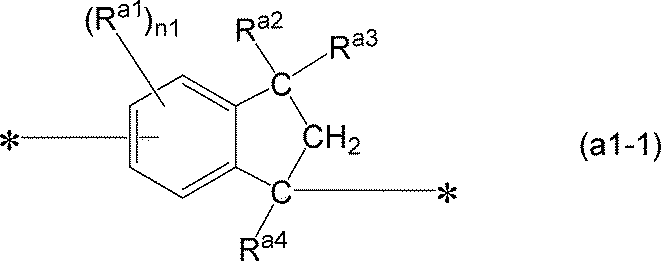
(式中、Ra1は、炭素数1~10のアルキル基、炭素数1~10のアルキルオキシ基、炭素数1~10のアルキルチオ基、炭素数6~10のアリール基、炭素数6~10のアリールオキシ基、炭素数6~10のアリールチオ基、炭素数3~10のシクロアルキル基、ハロゲン原子、水酸基又はメルカプト基であり、n1は0~3の整数である。Ra2~Ra4は、各々独立に、炭素数1~10のアルキル基である。*は結合部位を表す。)
[4]前記(B)成分が、ポリオレフィン系樹脂、ポリフェニレンエーテル系樹脂、シリコーン系樹脂及びエポキシ樹脂からなる群から選択される1種以上を含有する、上記[1]~[3]のいずれかに記載の樹脂組成物。
[5]前記(B)成分が、前記ポリオレフィン系樹脂として、(b1)側鎖にビニル基を有する共役ジエンポリマーを、(b2)N-置換マレイミド基を2個以上有するマレイミド化合物で変性してなる変性共役ジエンポリマーを含有する、上記[4]に記載の樹脂組成物。
[6]前記(B)成分が、前記ポリオレフィン系樹脂として、スチレン系エラストマーを含有する、上記[4]又は[5]に記載の樹脂組成物。
[7]上記[1]~[6]のいずれかに記載の樹脂組成物又は前記樹脂組成物の半硬化物を含有するプリプレグ。
[8]上記[1]~[6]のいずれかに記載の樹脂組成物の硬化物又は上記[7]に記載のプリプレグの硬化物と、金属箔と、を有する積層板。
[9]上記[1]~[6]のいずれかに記載の樹脂組成物又は前記樹脂組成物の半硬化物を含有する樹脂フィルム。
[10]上記[1]~[6]のいずれかに記載の樹脂組成物の硬化物、上記[7]に記載のプリプレグの硬化物、及び上記[8]に記載の積層板からなる群から選択される1種以上を有するプリント配線板。
[11]上記[10]に記載のプリント配線板と、半導体素子と、を有する半導体パッケージ。
本明細書中に記載されている数値範囲の下限値及び上限値は、それぞれ他の数値範囲の下限値又は上限値と任意に組み合わせられる。
本明細書中に記載されている数値範囲において、その数値範囲の上限値又は下限値は、実施例に示されている値に置き換えてもよい。
本明細書に例示する各成分及び材料は、特に断らない限り、1種を単独で使用してもよいし、2種以上を併用してもよい。
本明細書において、樹脂組成物中の各成分の含有量は、樹脂組成物中に各成分に該当する物質が複数存在する場合、特に断らない限り、樹脂組成物中に存在する当該複数の物質の合計量を意味する。
本明細書における記載事項を任意に組み合わせた態様も本実施形態に含まれる。
本明細書に記載されている作用機序は推測であって、本実施形態に係る樹脂組成物の効果を奏する機序を限定するものではない。
本実施形態の樹脂組成物は、
(A)分子構造中に芳香族環と脂肪族環との縮合環を含み、N-置換マレイミド基を2個以上有するマレイミド化合物及びその誘導体からなる群から選択される1種以上[以下、「(A)成分」と称する場合がある。]と、
(B)25℃における引張弾性率[以下、単に「25℃引張弾性率」と称する場合がある。]が10GPa以下である樹脂[以下、「(B)成分」と称する場合がある。]と、
を含有する、樹脂組成物である。
本実施形態の樹脂組成物が含有する(A)成分は、分子構造中に芳香族環と脂肪族環との縮合環を含むマレイミド化合物である。該縮合環は、極性が低い脂肪族環を構造に含むものであるため、本実施形態の樹脂組成物から得られる硬化物の誘電正接の低減に寄与するとともに、その嵩高い立体構造が比誘電率の低減に寄与していると考えられる。また、(A)成分が有する縮合環は、マレイミド化合物の極性を局所的に低下させるため、(A)成分は、極性が高い化合物のみならず、極性が低い化合物との相容性にも優れる傾向にある。これによって本実施形態の樹脂組成物から得られる硬化物全体の均質性が向上するため、導体接着性も向上したと考えられる。
また、本実施形態の樹脂組成物が含有する(B)成分は、25℃引張弾性率が10GPa以下である。該25℃引張弾性率を充足する樹脂は、樹脂の剛直性、分子量、極性等が、(A)成分との相容性に優れつつも、誘電特性の向上に寄与し得るものになるため、より一層、誘電特性が向上したと考えられる。
(A)成分は、分子構造中に芳香族環と脂肪族環との縮合環を含み、N-置換マレイミド基を2個以上有するマレイミド化合物及びその誘導体からなる群から選択される1種以上である。
(A)成分は、1種を単独で用いても、2種以上を組み合わせて用いてもよい。
(i)分子構造中に芳香族環と脂肪族環との縮合環を含み、N-置換マレイミド基を2個以上有するマレイミド化合物(a1)[以下、「マレイミド化合物(a1)」又は「(a1)成分」と称する場合がある。]
(ii)マレイミド化合物(a1)由来の構造単位とジアミン化合物(a2)由来の構造単位とを有するアミノマレイミド化合物[以下、「アミノマレイミド化合物(A1)」又は「(A1)成分」と称する場合がある。]
(a1)成分としては、誘電特性、導体接着性及び耐熱性の観点から、分子構造中に芳香族環と脂肪族環との縮合環を含み、N-置換マレイミド基を2個以上有する芳香族マレイミド化合物が好ましい。また、(a1)成分としては、分子構造中に芳香族環と脂肪族環との縮合環を含み、N-置換マレイミド基を2個有する芳香族ビスマレイミド化合物がより好ましい。
なお、本明細書中、「芳香族マレイミド化合物」とは、芳香環に直接結合するN-置換マレイミド基を有する化合物を意味し、「芳香族ビスマレイミド化合物」とは、芳香環に直接結合するN-置換マレイミド基を2個有する化合物を意味する。
インダン環を含む(a1)成分としては、インダン環を含む芳香族ビスマレイミド化合物が好ましい。
なお、本明細書中、インダン環とは芳香族6員環と飽和脂肪族5員環の縮合二環式構造を意味する。インダン環を形成する環形成炭素原子のうち少なくとも1個の炭素原子は、(a1)成分を構成する他の基に結合するための結合基を有する。該結合基を有する環形成炭素原子及びその他の環形成炭素原子は上記結合基以外に、結合基、置換基等を有していなくてもよいが、上記以外の結合基を有することで、2価の基を形成していることが好ましい。
(a1)成分において、インダン環は、下記一般式(a1-1)で表される2価の基として含まれることが好ましい。
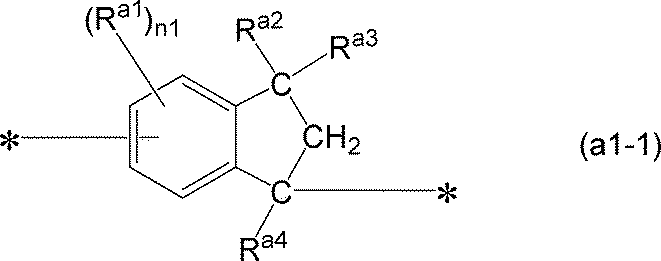
(式中、Ra1は、炭素数1~10のアルキル基、炭素数1~10のアルキルオキシ基、炭素数1~10のアルキルチオ基、炭素数6~10のアリール基、炭素数6~10のアリールオキシ基、炭素数6~10のアリールチオ基、炭素数3~10のシクロアルキル基、ハロゲン原子、水酸基又はメルカプト基であり、n1は0~3の整数である。Ra2~Ra4は、各々独立に、炭素数1~10のアルキル基である。*は結合部位を表す。)
Ra1で表される炭素数1~10のアルキルオキシ基、炭素数1~10のアルキルチオ基に含まれるアルキル基としては、上記炭素数1~10のアルキル基と同じものが挙げられる。
Ra1で表される炭素数6~10のアリール基としては、例えば、フェニル基、ナフチル基等が挙げられる。
Ra1で表される炭素数6~10のアリールオキシ基及び炭素数6~10のアリールチオ基に含まれるアリール基としては、上記炭素数6~10のアリール基と同じものが挙げられる。
Ra1で表される炭素数3~10のシクロアルキル基としては、例えば、シクロプロピル基、シクロブチル基、シクロペンチル基、シクロヘキシル基、シクロヘプチル基、シクロオクチル基、シクロノニル基、シクロデシル基等が挙げられる。
上記一般式(a1-1)中のn1が1~3の整数である場合、Ra1は、溶媒溶解性及び反応性の観点から、炭素数1~4のアルキル基、炭素数3~6のシクロアルキル基、炭素数6~10のアリール基が好ましく、炭素数1~4のアルキル基がより好ましい。
上記一般式(a1-1)中のn1は、0~3の整数であり、n1が2又は3である場合、複数のRa1同士は、同一であってもよいし、異なっていてもよい。
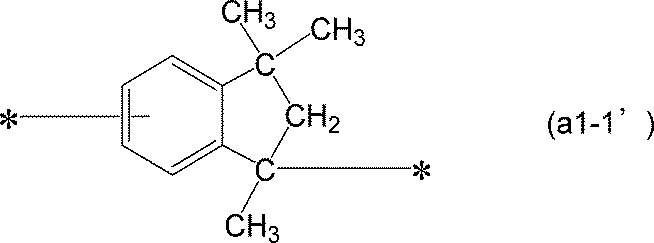
(式中、*は結合部位を表す。)
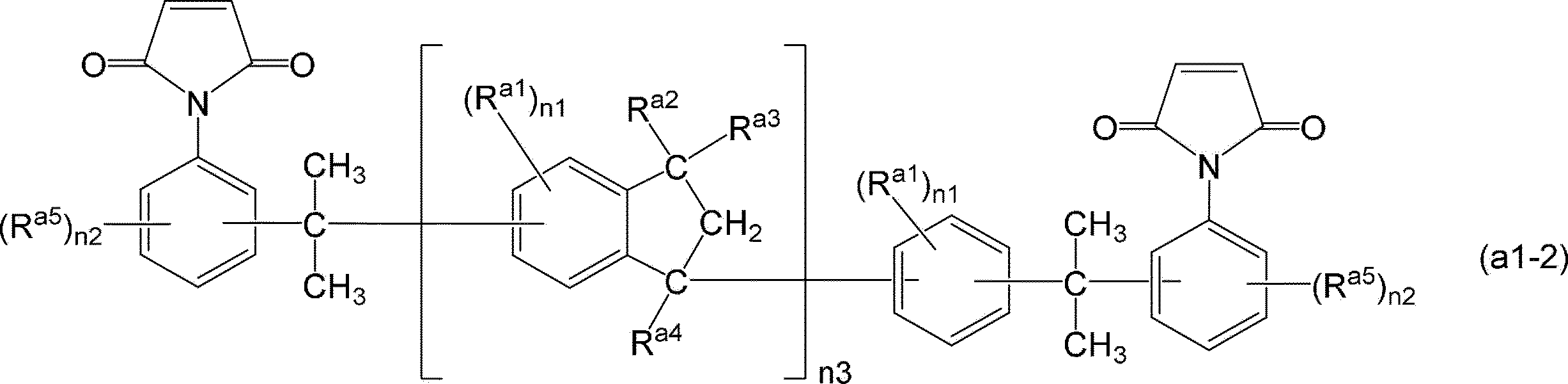
(式中、Ra1~Ra4及びn1は、上記一般式(a1-1)中のものと同じである。Ra5は、各々独立に、炭素数1~10のアルキル基、炭素数1~10のアルキルオキシ基、炭素数1~10のアルキルチオ基、炭素数6~10のアリール基、炭素数6~10のアリールオキシ基、炭素数6~10のアリールチオ基、炭素数3~10のシクロアルキル基、ハロゲン原子、ニトロ基、水酸基又はメルカプト基であり、n2は、各々独立に、0~4の整数であり、n3は、0.95~10.0の数である。)
n3が1を超える場合、複数のRa2同士、複数のRa3同士及び複数のRa4同士は、各々について、同一であってもよいし、異なっていてもよい。
Ra5で表される炭素数1~10のアルキルオキシ基、炭素数1~10のアルキルチオ基に含まれるアルキル基としては、上記炭素数1~10のアルキル基と同じものが挙げられる。
Ra5で表される炭素数6~10のアリール基としては、例えば、フェニル基、ナフチル基等が挙げられる。
Ra5で表される炭素数6~10のアリールオキシ基及び炭素数6~10のアリールチオ基に含まれるアリール基としては、上記炭素数6~10のアリール基と同じものが挙げられる。
Ra5で表される炭素数3~10のシクロアルキル基としては、例えば、シクロプロピル基、シクロブチル基、シクロペンチル基、シクロヘキシル基、シクロヘプチル基、シクロオクチル基、シクロノニル基、シクロデシル基等が挙げられる。
これらの中でも、Ra5は、溶媒溶解性及び製造容易性の観点から、炭素数1~4のアルキル基、炭素数3~6のシクロアルキル基、炭素数6~10のアリール基が好ましく、炭素数1~3のアルキル基がより好ましく、メチル基がさらに好ましい。
なお、n2が1以上であることにより、ベンゼン環とN-置換マレイミド基とがねじれた配座を有するものになり、分子間のスタッキング抑制によって溶媒溶解性がより向上する傾向にある。分子間のスタッキングを抑制するという観点から、n2が1以上である場合、Ra5の置換位置は、N-置換マレイミド基に対してオルト位であることが好ましい。
上記一般式(a1-2)中のn3は、誘電特性、導体接着性、溶媒溶解性、ハンドリング性及び耐熱性の観点から、好ましくは0.98~8.0の値、より好ましくは1.0~7.0の値、さらに好ましくは1.1~6.0の値である。なお、n3は、インダン環を含む構造単位の数の平均値を表す。
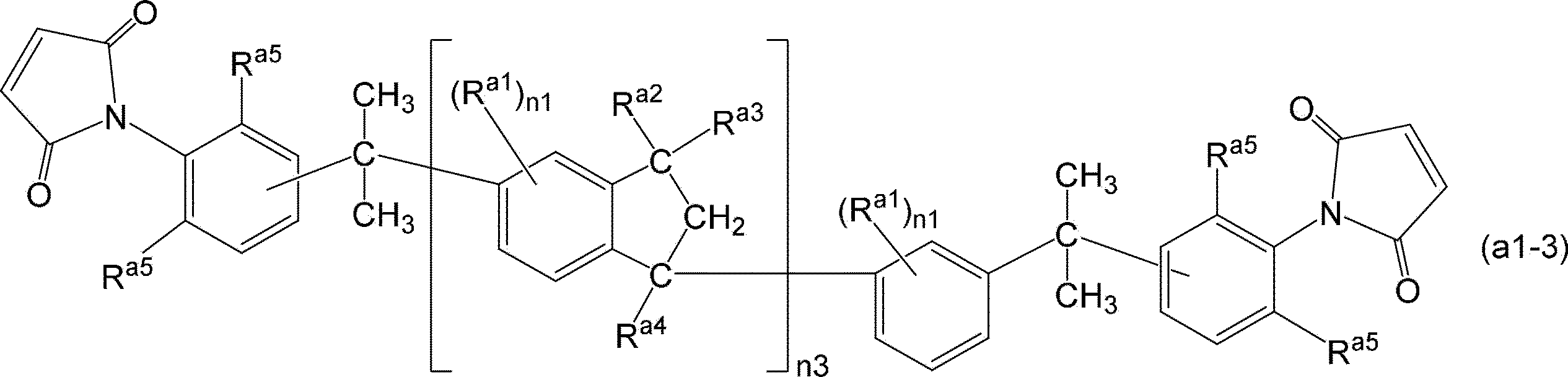
(式中、Ra1~Ra5及びn1及びn3は、上記一般式(a1-2)中のものと同じである。)
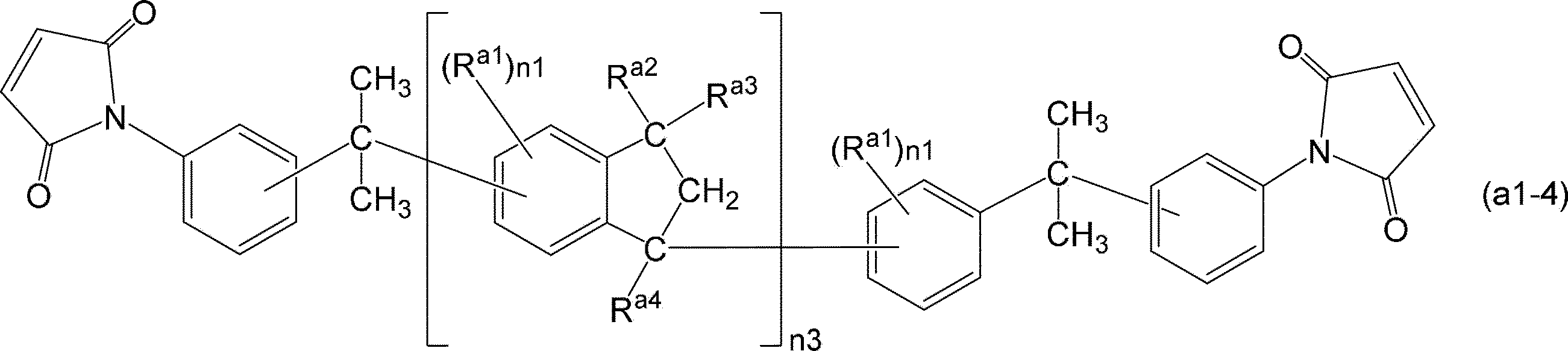
(式中、Ra1~Ra4及びn1及びn3は、上記一般式(a1-2)中のものと同じである。)
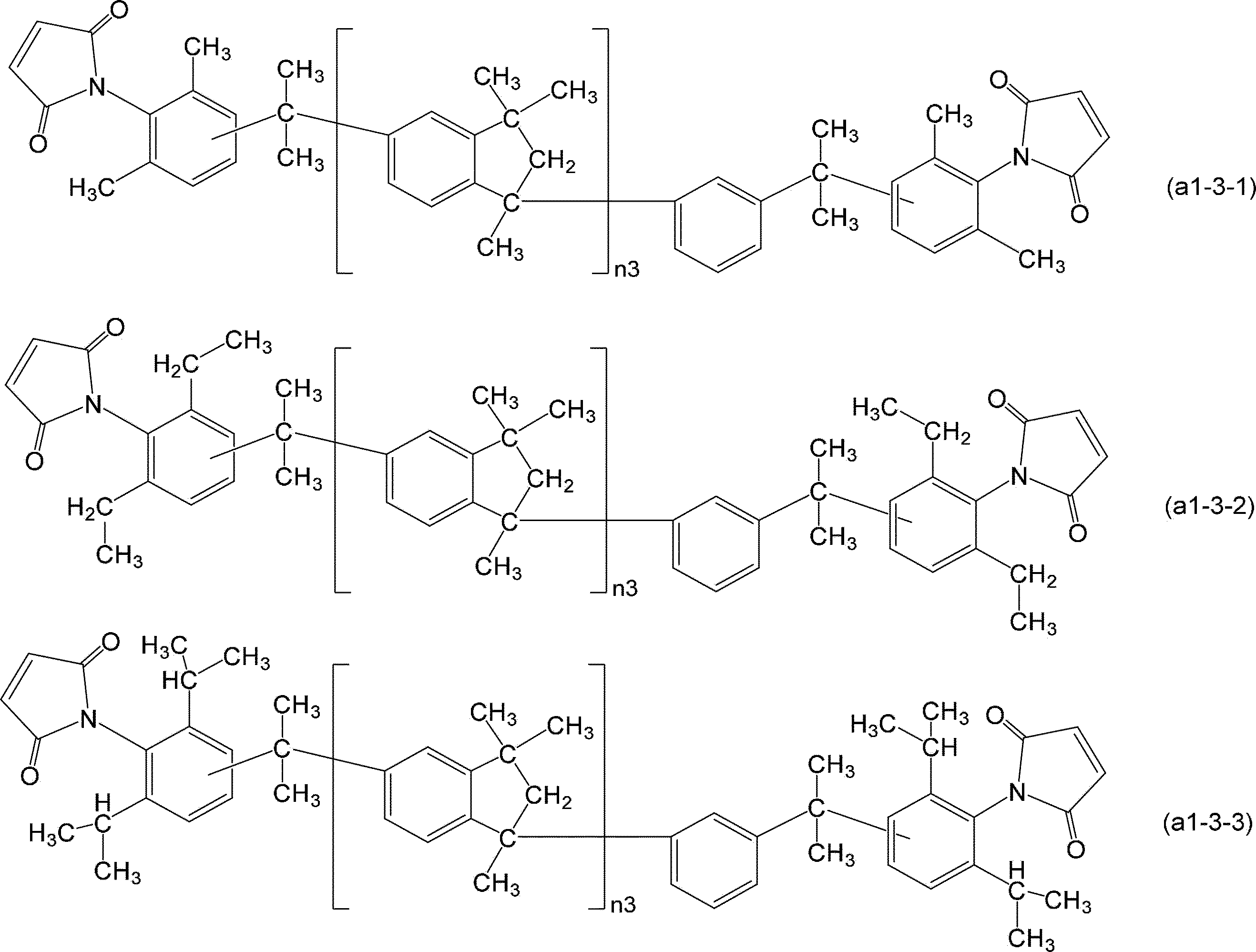
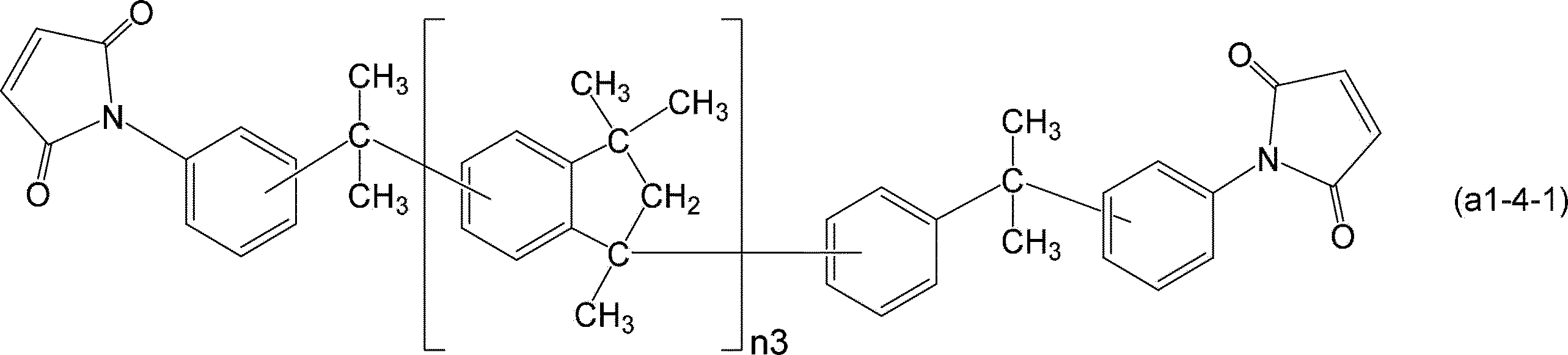
(式中、n3は、上記一般式(a1-2)中のものと同じである。)
インダン環を含むマレイミド化合物の中間体アミン化合物は、例えば、下記一般式(a1-5)で表される化合物[以下、「化合物A」と称する場合がある。]と、下記一般式(a1-6)で表される化合物[以下、「化合物B」と称する場合がある。]とを、酸触媒存在下で反応[以下、「環化反応」と称する場合がある。]させることにより、下記一般式(a1-7)で表される化合物として得ることができる。
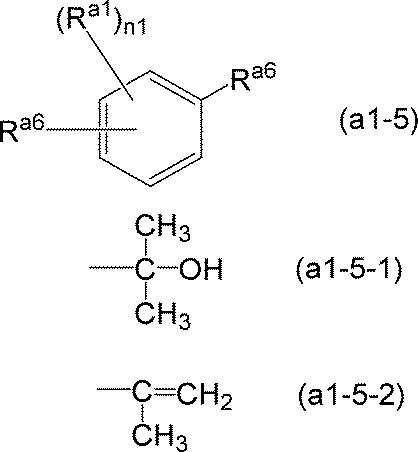
(式中、Ra1及びn1は、上記一般式(a1-1)中のものと同じである。Ra6は、各々独立に、上記式(a1-5-1)又は上記式(a1-5-2)で表される基であり、2つのRa6の少なくとも一方のRa6のオルト位が水素原子である。)
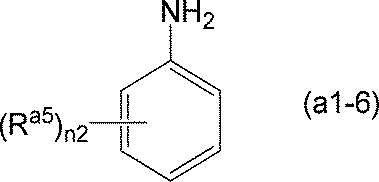
(式中、Ra5及びn2は、上記一般式(a1-2)中のものと同じである。但し、アミノ基のオルト位及びパラ位のうち、少なくとも1つは水素原子である。)
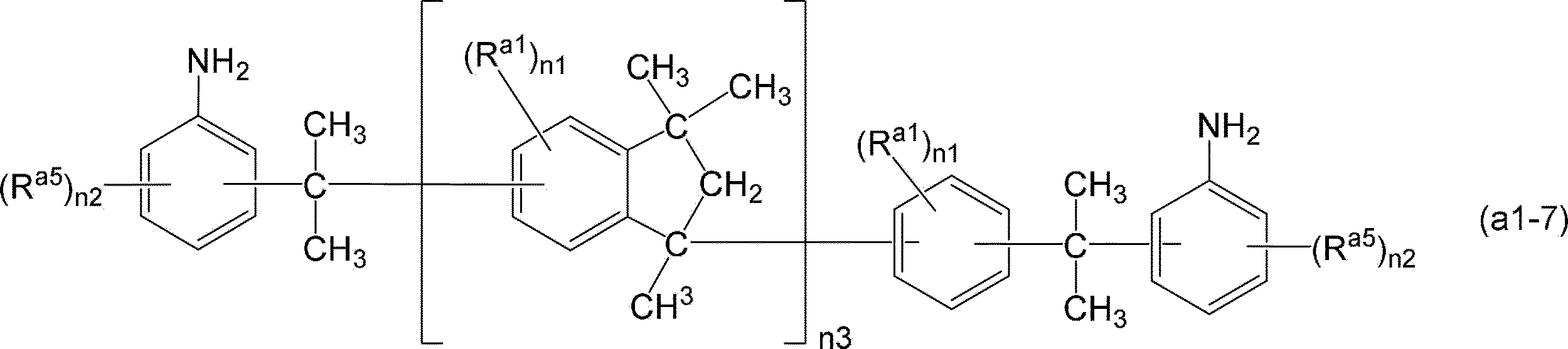
上記核アルキル基置換体としては、例えば、ジイソプロペニルトルエン、ビス(α-ヒドロキシイソプロピル)トルエン等が挙げられる。
上記核ハロゲン置換体としては、例えば、クロロジイソプロペニルベンゼン、クロロビス(α-ヒドロキシイソプロピル)ベンゼン等が挙げられる。
これらの化合物Aは、1種を単独で用いてもよく、2種以上を組み合わせて用いてもよい。
次いで、さらに追加する化合物Bを、先に加えた化合物Aに対するモル比(追加する化合物B/化合物A)で、好ましくは0.5~20、より好ましくは0.6~10、さらに好ましくは0.7~5となる比率で加え、2段階目の反応を行うことが好ましい。
酸触媒の配合量は、反応速度及び反応均一性の観点から、最初に仕込む化合物A及び化合物Bの総量100質量部に対して、好ましくは5~40質量部、より好ましくは5~35質量部、さらに好ましくは5~30質量部である。
環化反応の反応時間は、生産性及び十分に反応を進行させるという観点から、好ましくは2~24時間、より好ましくは4~16時間、さらに好ましくは8~12時間である。
但し、これらの反応条件は、使用する原料の種類等に応じて適宜調整することができ、特に限定されない。
なお、環化反応の際、必要に応じて、トルエン、キシレン、クロロベンゼン等の溶媒を用いてもよい。また、環化反応の際、副生成物として水が生成する場合は、共沸脱水可能な溶媒を使用することによって、脱水反応を促進させてもよい。
マレイミド化反応における中間体アミン化合物の第1級アミノ基当量に対する無水マレイン酸の当量比(無水マレイン酸/第1級アミノ基)は、特に限定されないが、未反応の第1級アミノ基の量及び未反応の無水マレイン酸の量を低減するという観点から、好ましくは1.0~1.5、より好ましくは1.05~1.3、さらに好ましくは1.1~1.2である。
マレイミド化反応における有機溶媒の使用量は、特に限定されないが、反応速度及び反応均一性の観点から、中間体アミン化合物と無水マレイン酸の総量100質量部に対して、好ましくは50~5,000質量部、より好ましくは70~2,000質量部、さらに好ましくは100~500質量部である。
1段階目の反応における反応温度は、好ましくは10~100℃、より好ましくは20~70℃、さらに好ましくは30~50℃である。
1段階目の反応における反応時間は、好ましくは0.5~12時間、より好ましくは0.7~8時間、さらに好ましくは1~4時間である。
2段階目の反応は、1段階目の反応終了後、トルエンスルホン酸等の触媒を加えてから実施することが好ましい。
2段階目の反応における反応温度は、好ましくは90~130℃、より好ましくは100~125℃、さらに好ましくは105~120℃である。
2段階目の反応における反応時間は、好ましくは2~24時間、より好ましくは4~15時間、さらに好ましくは6~10時間である。
但し、上記の反応条件は、使用する原料の種類等に応じて適宜調整することができ、特に限定されない。
反応後、必要に応じて、水洗等の精製を行うことによって、未反応の原料、他の不純物等を除去してもよい。
反応生成物中における副生成物であるインダン環を含まないマレイミド化合物の含有量は、例えば、反応生成物のGPCを測定することによって、測定することができる。具体的には、例えば、上記一般式(a1-2)中のn3が0~4である化合物を各々用いてn3の数に対する溶出時間の検量線を作成した上で、反応生成物のGPCチャートに見られるピークの溶出時間から反応生成物に含まれる化合物のn3の数及びその平均値を把握することができる。また、各々のピークの面積比によって、該ピークが表すn3の数を有する化合物の含有割合を把握することができる。
(a1)成分は、副生成物としてのインダン環を含まないマレイミド化合物の含有量が小さいものが好ましい。そのため、上記反応生成物のGPCチャートにおいて、反応生成物全体のピーク面積に対する、副生成物としてのインダン環を含まないマレイミド化合物の面積割合は、好ましくは40%以下、より好ましくは30%以下、さらに好ましくは20%以下、特に好ましくは10%以下である。
アミノマレイミド化合物(A1)は、マレイミド化合物(a1)由来の構造単位とジアミン化合物(a2)由来の構造単位とを有するアミノマレイミド化合物である。なお、(A1)成分はマレイミド化合物(a1)の誘導体に相当する。
(A1)成分は、1種を単独で用いてもよく、2種以上を組み合わせて用いてもよい。
(a1)成分由来の構造単位としては、例えば、(a1)成分が有するN-置換マレイミド基のうち、少なくとも1つのN-置換マレイミド基が、ジアミン化合物(a2)が有するアミノ基とマイケル付加反応してなる構造単位が挙げられる。
(A1)成分中に含まれる(a1)成分由来の構造単位は、1種単独であってもよく、2種以上であってもよい。
(a2)成分由来の構造単位としては、例えば、(a2)成分が有する2個のアミノ基のうち、一方又は両方のアミノ基が、マレイミド化合物(a1)が有するN-置換マレイミド基とマイケル付加反応してなる構造単位が挙げられる。
(A1)成分中に含まれる(a2)成分由来の構造単位は、1種単独であってもよく、2種以上であってもよい。
第1級アミノ基を2個有するジアミン化合物(a2)由来の構造単位としては、例えば、下記一般式(a2-1)で表される基、下記一般式(a2-2)で表される基等が挙げられる。

(式中、Xa1は2価の有機基であり、*は他の構造への結合位置を示す。)

(式中、Ra11及びRa12は、各々独立に、炭素数1~5の脂肪族炭化水素基、炭素数1~5のアルコキシ基、水酸基又はハロゲン原子である。Xa2は、炭素数1~5のアルキレン基、炭素数2~5のアルキリデン基、エーテル基、スルフィド基、スルホニル基、カルボニルオキシ基、ケト基、フルオレニレン基、単結合、又は下記一般式(a2-3-1)若しくは(a2-3-2)で表される2価の基である。p1及びp2は、各々独立に、0~4の整数である。*は結合部位を表す。)
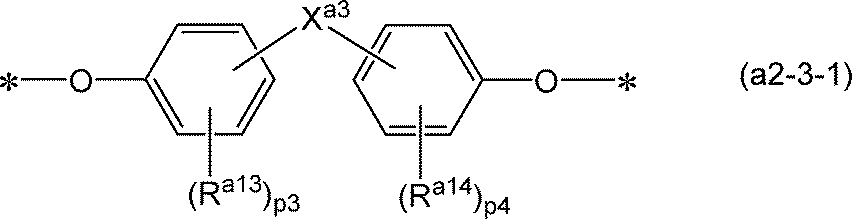
(式中、Ra13及びRa14は、各々独立に、炭素数1~5の脂肪族炭化水素基又はハロゲン原子である。Xa3は炭素数1~5のアルキレン基、炭素数2~5のアルキリデン基、m-フェニレンジイソプロピリデン基、p-フェニレンジイソプロピリデン基、エーテル基、スルフィド基、スルホニル基、カルボニルオキシ基、ケト基又は単結合である。p3及びp4は、各々独立に、0~4の整数である。*は結合部位を表す。)

(式中、Ra15は、炭素数1~5の脂肪族炭化水素基又はハロゲン原子である。Xa4及びXa5は、各々独立に、炭素数1~5のアルキレン基、炭素数2~5のアルキリデン基、エーテル基、スルフィド基、スルホニル基、カルボニルオキシ基、ケト基又は単結合である。p5は0~4の整数である。*は結合部位を表す。)
ハロゲン原子としては、例えば、フッ素原子、塩素原子、臭素原子、ヨウ素原子等が挙げられる。
p1又はp2が2以上の整数である場合、複数のRa11同士又は複数のRa12同士は、それぞれ同一であってもよいし、異なっていてもよい。
p3又はp4が2以上の整数である場合、複数のRa13同士又は複数のRa14同士は、それぞれ同一であってもよいし、異なっていてもよい。
p5が2以上の整数である場合、複数のRa15同士は、それぞれ同一であってもよいし、異なっていてもよい。
(A1)成分は、例えば、マレイミド化合物(a1)とジアミン化合物(a2)とを有機溶媒中で反応させることで製造することができる。
マレイミド化合物(a1)とジアミン化合物(a2)とを反応させることで、マレイミド化合物(a1)とジアミン化合物(a2)とがマイケル付加反応してなるアミノマレイミド化合物(A1)が得られる。
反応触媒としては、例えば、p-トルエンスルホン酸等の酸性触媒;トリエチルアミン、ピリジン、トリブチルアミン等のアミン類;メチルイミダゾール、フェニルイミダゾール等のイミダゾール類;トリフェニルホスフィン等のリン系触媒などが挙げられる。これらは1種を単独で用いても、2種以上を組み合わせて用いてもよい。
反応触媒の配合量は、特に限定されないが、反応速度及び反応均一性の観点から、マレイミド化合物(a1)及びジアミン化合物(a2)の合計量100質量部に対して、好ましくは0.01~5質量部、より好ましくは0.05~3質量部、さらに好ましくは0.1~2質量部である。
マイケル付加反応の反応時間は、生産性及び十分に反応を進行させるという観点から、好ましくは0.5~10時間、より好ましくは1~8時間、さらに好ましくは2~6時間である。
但し、これらの反応条件は、使用する原料の種類等に応じて適宜調整することができ、特に限定されない。
本実施形態の樹脂組成物は、(B)成分として25℃引張弾性率が10GPa以下である樹脂を含有することで、誘電特性及び導体接着性に優れたものとなる。
なお、本実施形態の樹脂組成物において、(A)成分に該当する樹脂は、(B)成分には含まれないものとする。
(B)成分は、1種を単独で用いても、2種以上を組み合わせて用いてもよい。
(25℃引張弾性率の測定方法)
測定対象である樹脂から、幅10mm、長さ80mm、厚さ0.2mmの試験片を作製し、該試験片を上下つかみ具で、つかみ具の間隔が60mmとなるように該試験片の長辺方向両端を挟む。次いで、引張試験機を用いて、25℃に調整した室温環境下、引張速度5mm/分の条件において上記試験片の25℃の引張弾性率を取得する。なお、引張弾性率の算出は、国際規格ISO5271(1993)に準拠して行う。
(B)成分の25℃引張弾性率は、特に限定されないが、好ましくは0.005GPa以上、より好ましくは0.01GPa以上、さらに好ましくは0.03GPa以上である。(B)成分の25℃引張弾性率が、上記下限値以上であると、得られる樹脂組成物の耐熱性等を良好に保つことができる傾向にある。
なお、(B)成分は、熱硬化性を有する樹脂であってもよいが、熱硬化性を有する樹脂である(B)成分は、その硬化物がエラストマーになるものが好ましい。なお、ここでの「エラストマー」とは、JIS K 6240:2011に従って示差走査熱量測定で測定したガラス転移温度が25℃以下である高分子を意味する。
これらの中でも、(B)成分は、(A)成分との相容性、誘電特性及び導体接着性の観点から、ポリオレフィン系樹脂、ポリフェニレンエーテル系樹脂、シリコーン系樹脂及びエポキシ樹脂からなる群から選択される1種以上を含有することが好ましく、ポリオレフィン系樹脂及びポリフェニレンエーテル系樹脂からなる群から選択される1種以上を含有することがより好ましく、ポリオレフィン系樹脂を含有することがさらに好ましい。
ポリオレフィン系樹脂としては、25℃引張弾性率が10GPa以下であるポリオレフィン系樹脂であれば特に制限はない。
ポリオレフィン系樹脂としては、1種を単独で用いてもよく、2種以上を組み合わせて用いてもよい。
モノオレフィンとしては、例えば、エチレン、プロピレン、1-ブテン、1-ヘキセン、4-メチル-1-ペンテン、スチレン等が挙げられる。
ジオレフィンとしては、例えば、ジシクロペンタジエン、1,4-ヘキサジエン、シクロオクタジエン、メチレンノルボルネン、エチリデンノルボルネン等の非共役ジエン化合物;1,3-ブタジエン、イソプレン、1,3-ペンタジエン、2,3-ジメチル-1,3-ブタジエン、2-フェニル-1,3-ブタジエン、1,3-ヘキサジエン等の共役ジエン化合物などが挙げられる。
(B1)成分は、1種の共役ジエン化合物の重合体であってもよく、2種以上の共役ジエン化合物の重合体であってもよい。
また、(B1)成分は、1種以上の共役ジエン化合物と、1種以上の共役ジエン化合物以外のモノマーと、を共重合させたものであってもよい。
(B1)成分が共重合体である場合の重合様式は特に限定されず、ランダム重合、ブロック重合又はグラフト重合のいずれであってもよい。
(B1)成分は、1種を単独で用いてもよく、2種以上を組み合わせて用いてもよい。
(B1)成分が1分子中に有するビニル基の数は、特に限定されないが、他の樹脂との相容性、誘電特性及び導体密着性の観点から、好ましくは3個以上、より好ましくは5個以上、さらに好ましくは10個以上である。(B1)成分が1分子中に有するビニル基の数の上限は特に限定されないが、100個以下であってもよく、80個以下であってもよく、60個以下であってもよい。
(B1)成分が有する1,2-ビニル基とは、下記式(B1-1)で表されるブタジエン由来の構造単位に含まれるビニル基である。
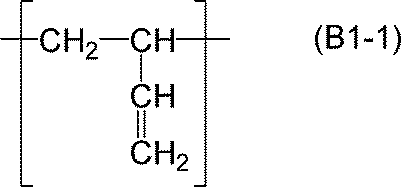
同様の観点から、1,2-ビニル基を有するポリブタジエンは、1,2-ポリブタジエンホモポリマーであることが好ましい。
(B)成分は、ポリオレフィン系樹脂として、変性共役ジエンポリマー(B2)を含有することが好ましく、他の樹脂との相容性、誘電特性及び導体密着性の観点から、(b1)側鎖にビニル基を有する共役ジエンポリマー[以下、「(b1)成分」と称する場合がある。]を、(b2)N-置換マレイミド基を2個以上有するマレイミド化合物[以下、「(b2)成分」と称する場合がある。]で変性してなる変性共役ジエンポリマーを含有することがより好ましい。
(B2)成分は、1種を単独で用いてもよく、2種以上を組み合わせて用いてもよい。
(b1)成分は、1種を単独で用いてもよいし、2種以上を組み合わせて用いてもよい。
(b2)成分は、1種を単独で用いてもよいし、2種以上を組み合わせて用いてもよい。
(b2i)成分としては、下記一般式(b2-1)で表されるマレイミド化合物が好ましい。
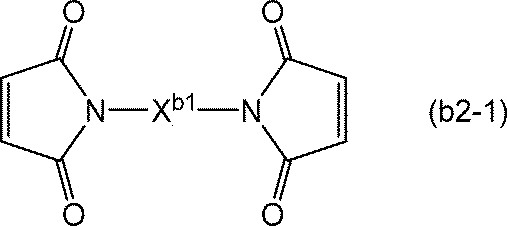
(式中、Xb1は、芳香族環と脂肪族環との縮合環を含まない2価の有機基である。)
上記一般式(b2-1)中のXb1が表す2価の有機基としては、例えば、下記一般式(b2-2)で表される2価の基、下記一般式(b2-3)で表される2価の基、下記一般式(b2-4)で表される2価の基、下記一般式(b2-5)で表される2価の基、下記一般式(b2-6)で表される2価の基等が挙げられる。
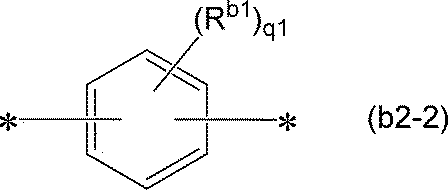
(式中、Rb1は、炭素数1~5の脂肪族炭化水素基又はハロゲン原子である。q1は0~4の整数である。*は結合部位を表す。)
ハロゲン原子としては、例えば、フッ素原子、塩素原子、臭素原子、ヨウ素原子等が挙げられる。
上記一般式(b2-2)中のq1は0~4の整数であり、入手容易性の観点から、好ましくは0~2の整数、より好ましくは0又は1、さらに好ましくは0である。
q1が2以上の整数である場合、複数のRb1同士は同一であってもよいし、異なっていてもよい。
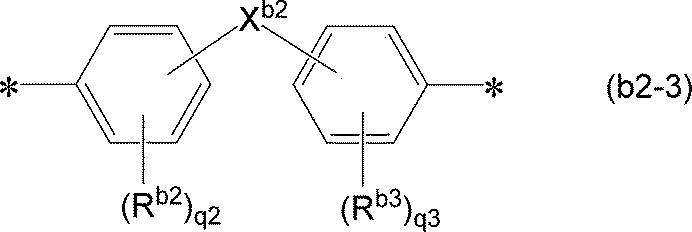
(式中、Rb2及びRb3は、各々独立に、炭素数1~5の脂肪族炭化水素基又はハロゲン原子である。Xb2は炭素数1~5のアルキレン基、炭素数2~5のアルキリデン基、エーテル基、スルフィド基、スルホニル基、カルボニルオキシ基、ケト基、単結合、又は下記一般式(b2-3-1)で表される2価の基である。q2及びq3は、各々独立に、0~4の整数である。*は結合部位を表す。)
ハロゲン原子としては、例えば、フッ素原子、塩素原子、臭素原子、ヨウ素原子等が挙げられる。
q2+q3は、入手容易性、他の樹脂との相容性及び反応中における生成物のゲル化抑制の観点から、好ましくは1~8の整数、より好ましくは2~6の整数、さらに好ましくは4である。
q2又はq3が2以上の整数である場合、複数のRb2同士又は複数のRb3同士は、それぞれ同一であってもよいし、異なっていてもよい。
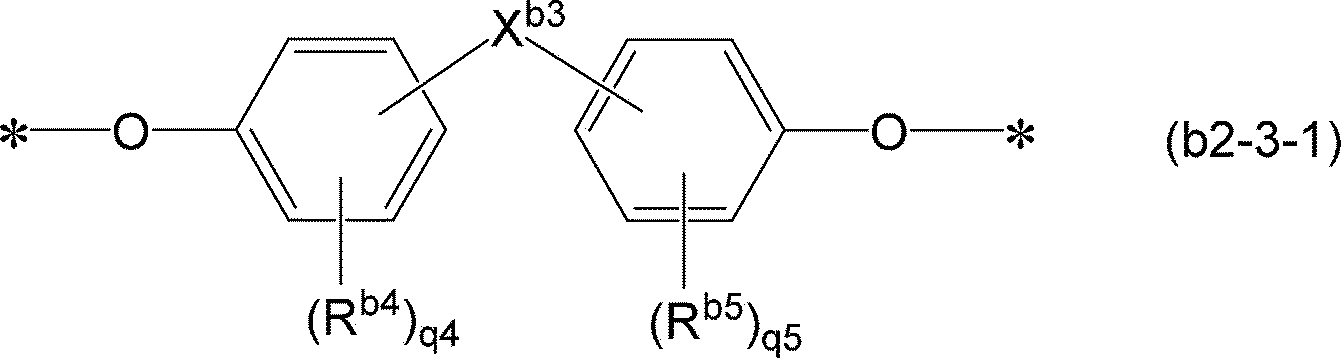
(式中、Rb4及びRb5は、各々独立に、炭素数1~5の脂肪族炭化水素基又はハロゲン原子である。Xb3は炭素数1~5のアルキレン基、炭素数2~5のアルキリデン基、エーテル基、スルフィド基、スルホニル基、カルボニルオキシ基、ケト基又は単結合である。q4及びq5は、各々独立に、0~4の整数である。*は結合部位を表す。)
ハロゲン原子としては、例えば、フッ素原子、塩素原子、臭素原子、ヨウ素原子等が挙げられる。
q4又はq5が2以上の整数である場合、複数のRb4同士又は複数のRb5同士は、それぞれ同一であってもよいし、異なっていてもよい。

(式中、q6は0~10の整数である。*は結合部位を表す。)

(式中、q7は0~5の数である。*は結合部位を表す。)

(式中、Rb6及びRb7は、各々独立に、水素原子又は炭素数1~5の脂肪族炭化水素基である。q8は1~8の整数である。*は結合部位を表す。)
上記一般式(b2-6)中のq8は1~8の整数であり、好ましくは1~5の整数、より好ましくは1~3の整数、さらに好ましくは1である。q8が2以上の整数である場合、複数のRb6同士又は複数のRb7同士は、それぞれ同一であってもよいし、異なっていてもよい。
(b2i)成分の具体例としては、N,N’-エチレンビスマレイミド、N,N’-ヘキサメチレンビスマレイミド、N,N’-(1,3-フェニレン)ビスマレイミド、N,N’-[1,3-(2-メチルフェニレン)]ビスマレイミド、N,N’-[1,3-(4-メチルフェニレン)]ビスマレイミド、N,N’-(1,4-フェニレン)ビスマレイミド、ビス(4-マレイミドフェニル)メタン、ビス(3-メチル-4-マレイミドフェニル)メタン、ビス(3-エチル-5-メチル-4-マレイミドフェニル)メタン、ビス(4-マレイミドフェニル)エーテル、ビス(4-マレイミドフェニル)スルホン、ビス(4-マレイミドフェニル)スルフィド、ビス(4-マレイミドフェニル)ケトン、ビス(4-マレイミドシクロヘキシル)メタン、1,4-ビス(4-マレイミドフェニル)シクロヘキサン、1,4-ビス(マレイミドメチル)シクロヘキサン、1,4-ビス(マレイミドメチル)ベンゼン、1,3-ビス(4-マレイミドフェノキシ)ベンゼン、1,3-ビス(3-マレイミドフェノキシ)ベンゼン、ビス[4-(3-マレイミドフェノキシ)フェニル]メタン、ビス[4-(4-マレイミドフェノキシ)フェニル]メタン、1,1-ビス[4-(3-マレイミドフェノキシ)フェニル]エタン、1,1-ビス[4-(4-マレイミドフェノキシ)フェニル]エタン、1,2-ビス[4-(3-マレイミドフェノキシ)フェニル]エタン、1,2-ビス[4-(4-マレイミドフェノキシ)フェニル]エタン、2,2-ビス[4-(3-マレイミドフェノキシ)フェニル]プロパン、2,2-ビス[4-(4-マレイミドフェノキシ)フェニル]プロパン、2,2-ビス[4-(3-マレイミドフェノキシ)フェニル]ブタン、2,2-ビス[4-(4-マレイミドフェノキシ)フェニル]ブタン、2,2-ビス[4-(3-マレイミドフェノキシ)フェニル]-1,1,1,3,3,3-ヘキサフルオロプロパン、2,2-ビス[4-(4-マレイミドフェノキシ)フェニル]-1,1,1,3,3,3-ヘキサフルオロプロパン、4,4-ビス(3-マレイミドフェノキシ)ビフェニル、4,4-ビス(4-マレイミドフェノキシ)ビフェニル、ビス[4-(3-マレイミドフェノキシ)フェニル]ケトン、ビス[4-(4-マレイミドフェノキシ)フェニル]ケトン、ビス(4-マレイミドフェニル)ジスルフィド、ビス[4-(3-マレイミドフェノキシ)フェニル]スルフィド、ビス[4-(4-マレイミドフェノキシ)フェニル]スルフィド、ビス[4-(3-マレイミドフェノキシ)フェニル]スルホキシド、ビス[4-(4-マレイミドフェノキシ)フェニル]スルホキシド、ビス[4-(3-マレイミドフェノキシ)フェニル]スルホン、ビス[4-(4-マレイミドフェノキシ)フェニル]スルホン、ビス[4-(3-マレイミドフェノキシ)フェニル]エーテル、ビス[4-(4-マレイミドフェノキシ)フェニル]エーテル、1,4-ビス[4-(4-マレイミドフェノキシ)-α,α-ジメチルベンジル]ベンゼン、1,3-ビス[4-(4-マレイミドフェノキシ)-α,α-ジメチルベンジル]ベンゼン、1,4-ビス[4-(3-マレイミドフェノキシ)-α,α-ジメチルベンジル]ベンゼン、1,3-ビス[4-(3-マレイミドフェノキシ)-α,α-ジメチルベンジル]ベンゼン、1,4-ビス[4-(4-マレイミドフェノキシ)-3,5-ジメチル-α,α-ジメチルベンジル]ベンゼン、1,3-ビス[4-(4-マレイミドフェノキシ)-3,5-ジメチル-α,α-ジメチルベンジル]ベンゼン、1,4-ビス[4-(3-マレイミドフェノキシ)-3,5-ジメチル-α,α-ジメチルベンジル]ベンゼン、1,3-ビス[4-(3-マレイミドフェノキシ)-3,5-ジメチル-α,α-ジメチルベンジル]ベンゼン、ポリフェニルメタンマレイミド、ビフェニルアラルキル型マレイミド化合物等が挙げられる。
置換基(x)は、他の樹脂との相容性、誘電特性、低熱膨張性及び耐熱性の観点から、マレイミド化合物(b2)由来の構造として、下記一般式(B2-11)又は(B2-12)で表される構造を含む基であることが好ましい。
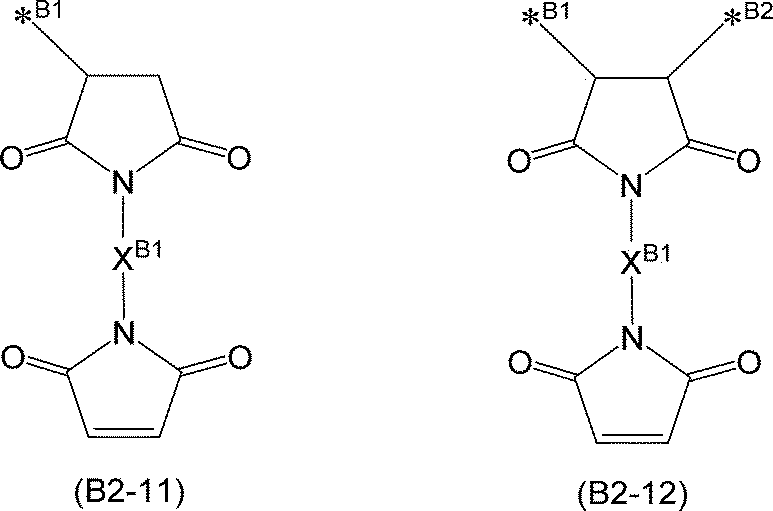
(式中、XB1は、(b2)成分から2個のN-置換マレイミド基を除いてなる2価の基であり、*B1は、(b1)成分が側鎖に有するビニル基由来の炭素原子に結合する部位である。*B2は、他の原子に結合する部位である。)
変性共役ジエンポリマー(B2)中に置換基(x)がどの程度存在するかは、(b1)成分のビニル基が(b2)成分によってどの程度変性されたのか[以下、「ビニル基変性率」と称する場合がある。]を指標とすることができる。
ビニル基変性率は、特に限定されないが、他の樹脂との相容性、誘電特性、低熱膨張性及び耐熱性の観点から、好ましくは20~70%、より好ましくは30~60%、さらに好ましくは35~50%である。ここで、ビニル基変性率は、実施例に記載の方法によって求めた値である。
ビニル基(y)は、ブタジエン由来の構造単位が有する1,2-ビニル基であることが好ましい。
共役ジエンポリマー(b1)とマレイミド化合物(b2)とを反応させる方法は特に限定されない。例えば、共役ジエンポリマー(b1)、マレイミド化合物(b2)、反応触媒及び有機溶媒を反応容器に仕込み、必要に応じて、加熱、保温、撹拌等しながら反応させることによって(B2)成分を得ることができる。
上記反応の反応温度は、作業性及び反応中における生成物のゲル化抑制の観点から、好ましくは70~120℃、より好ましくは80~110℃、さらに好ましくは85~105℃である。
上記反応の反応時間は、生産性及び反応を十分に進行させるという観点から、好ましくは0.5~15時間、より好ましくは1~10時間、さらに好ましくは3~7時間である。
但し、これらの反応条件は、使用する原料の種類等に応じて適宜調整することができ、特に限定されない。
有機溶媒は、1種を単独で用いてもよく、2種以上を組み合わせて用いてもよい。これらの中でも、樹脂溶解性の観点から、トルエンが好ましい。
反応触媒は、1種を単独で用いてもよく、2種以上を組み合わせて用いてもよい。
反応触媒の使用量は、特に限定されないが、反応速度及び反応均一性の観点から、共役ジエンポリマー(b1)及びマレイミド化合物(b2)の総量100質量部に対して、好ましくは0.01~1質量部、より好ましくは0.03~0.5質量部、さらに好ましくは0.05~0.2質量部である。
(B)成分は、ポリオレフィン系樹脂として、スチレン系エラストマー(B3)を含有することが好ましい。
(B3)成分としては、25℃引張弾性率が10GPa以下であって、スチレン系化合物由来の構造単位を有するエラストマーであれば特に制限はない。
(B3)成分は、1種を単独で用いても、2種以上を組み合わせて用いてもよい。

(式中、Rb8は水素原子又は炭素数1~5のアルキル基であり、Rb9は、炭素数1~5のアルキル基である。kは、0~5の整数である。)
上記一般式(B3-1)中のk1は、0~5の整数であり、好ましくは0~2の整数、より好ましくは0又は1、さらに好ましくは0である。
上記ブタジエン由来の構造単位及び上記イソプレン由来の構造単位は、水素添加されていてもよい。水素添加されている場合、ブタジエン由来の構造単位はエチレン単位とブチレン単位とが混合した構造単位となり、イソプレン由来の構造単位はエチレン単位とプロピレン単位とが混合した構造単位となる。
ポリオレフィン系樹脂が(B2)成分と(B3)成分とを含有する場合、(B2)成分と(B3)成分との含有量比[(B2)成分/(B3)成分]は、特に限定されないが、相容性、誘電特性及び導体接着性の観点から、好ましくは0.1~10、より好ましくは0.2~5、さらに好ましくは0.5~1である。
(B4)成分としては、25℃引張弾性率が10GPa以下であるポリフェニレンエーテル系樹脂であれば、特に制限はない。
なお、本明細書における「ポリフェニレンエーテル」に含まれるフェニレン基とは、無置換のフェニレン基のみならず、置換基によって置換されたフェニレン基も含む概念である。
(B4)成分は、1種を単独で用いても、2種以上を組み合わせて用いてもよい。
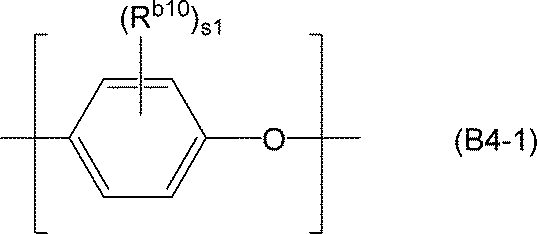
(式中、Rb10は、炭素数1~5の脂肪族炭化水素基又はハロゲン原子である。s1は0~4の整数である。)
ハロゲン原子としては、例えば、フッ素原子、塩素原子、臭素原子、ヨウ素原子等が挙げられる。
s1が1又は2である場合、Rb10はベンゼン環上のオルト位(但し、酸素原子の置換位置を基準とする。)に置換することが好ましい。
上記一般式(B4-1)で表される構造単位は、下記一般式(B4-2)で表される構造単位であることが好ましい。

(B4)成分は、片末端又は両末端にフェノール性水酸基を有するものであってもよい。(B4)成分が有する1分子当たりの平均フェノール性水酸基数は、好ましくは1~2、より好ましくは1.4~1.9、さらに好ましくは1.6~1.85である。
(B5)成分としては、25℃引張弾性率が10GPa以下であるシリコーン系樹脂であれば、特に制限はない。
(B5)成分は、1種を単独で用いても、2種以上を組み合わせて用いてもよい。
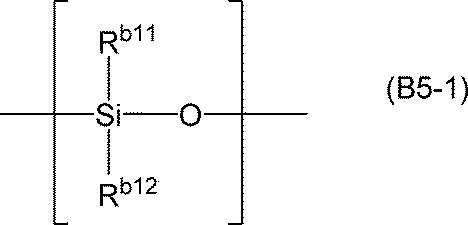
(式中、Rb11及びRb12は、各々独立に、炭素数1~5のアルキル基、フェニル基又は置換基を有するフェニル基である。)
すなわち、上記一般式(B5-1)で表される構造単位は、ジメチルシロキサン単位であることが好ましい。
(B5)成分は、分子構造中に反応性基を有するものであってもよい。該反応性基としては、ポリシロキサンの側鎖の一部に導入されたものであってもよいし、ポリシロキサンの片末端又は両末端に導入されたものであってもよい。また、反応性基は、ポリシロキサンの側鎖に加えて、片末端又は両末端に導入されたものであってもよい。
上記反応性基としては、例えば、エポキシ基、アミノ基、ビニル基、水酸基、メタクリル基、メルカプト基、カルボキシ基、アルコキシ基、シラノール基等が挙げられる。(B5)成分は、上記反応性基のうちの1種又は2種以上を含有していてもよい。
これらの中でも、反応性基としては、アミノ基、ビニル基が好ましい。アミノ基としては、第1級アミノ基、第2級アミノ基が好ましく、第1級アミノ基がより好ましい。
(B6)成分としては、25℃引張弾性率が10GPa以下であるエポキシ樹脂であれば、特に制限はない。
(B6)成分は、1種を単独で用いても、2種以上を組み合わせて用いてもよい。
(B6)成分が有する脂環式骨格としては、特に限定されないが、環形成炭素数5~20の脂環式骨格が好ましく、環形成炭素数6~18の脂環式骨格がさらに好ましく、環形成炭素数8~14の脂環式骨格が特に好ましい。
また、前記脂環式骨格は、2環以上からなることが好ましく、2~4環からなることがより好ましく、3環からなることがさらに好ましい。2環以上からなる脂環式骨格としては、例えば、ノルボルナン骨格、デカリン骨格、ビシクロウンデカン骨格、ジシクロペンタジエン骨格等が挙げられる。
前記脂環式骨格としては、ジシクロペンタジエン骨格が好ましい。
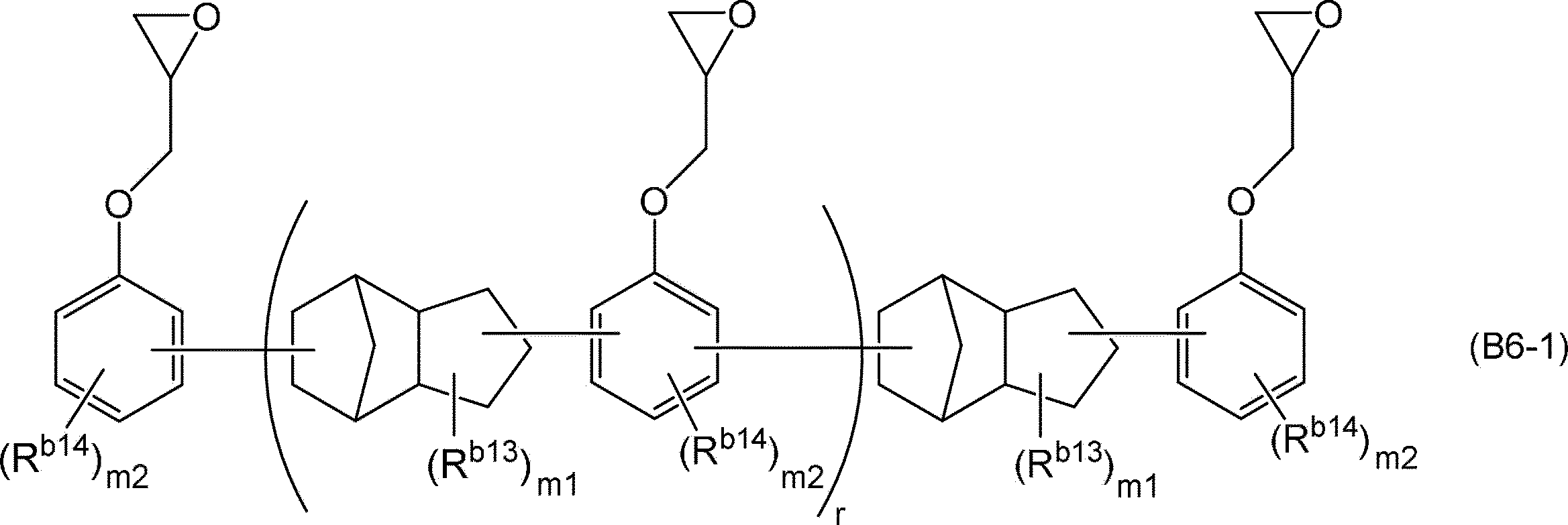
(式中、Rb13は、炭素数1~12のアルキル基であり、上記脂環式骨格中のどこに置換していてもよい。Rb14は、炭素数1~12のアルキル基である。m1は0~6の整数、m2は0~3の整数である。rは0~10の数である。)
上記一般式(B6-1)中のm1は、0~6の整数であり、好ましくは0~5の整数、より好ましくは0~2の整数、さらに好ましくは0である。
m1が2以上の整数である場合、複数のRb13同士は、それぞれ同一であってもよいし、異なっていてもよい。さらに、複数のRb13は、可能な範囲で同一炭素原子上に置換していてもよいし、異なる炭素原子上に置換していてもよい。
上記一般式(B6-1)中のm2は0~3の整数であり、好ましくは0又は1、より好ましくは0である。
m2が2以上の整数である場合、複数のRb14同士は、それぞれ同一であってもよいし、異なっていてもよい。
上記以外の(B)成分としては、例えば、ポリウレタン系樹脂、ポリエステル系樹脂、ポリアミド系樹脂及びポリアクリル系樹脂からなる群から選択される1種以上が挙げられる。
低分子ジオールとしては、例えば、エチレングリコール、プロピレングリコール、1,4-ブタンジオール、ビスフェノールA等が挙げられる。高分子ジオールとしては、例えば、ポリプロピレングリコール、ポリテトラメチレンオキサイド、ポリ(1,4-ブチレンアジペート)、ポリ(エチレン-1,4-ブチレンアジペート)、ポリカプロラクトン、ポリ(1,6-ヘキシレンカーボネート)、ポリ(1,6-へキシレン-ネオペンチレンアジペート)等が挙げられる。低分子ジオール及び高分子ジオールは、各々について、1種を単独で用いてもよく、2種以上を組み合わせて用いてもよい。
ポリウレタン系樹脂は、1種を単独で用いてもよく、2種以上を組み合わせて用いてもよい。
ジカルボン酸としては、例えば、テレフタル酸、イソフタル酸、ナフタレンジカルボン酸等の芳香族ジカルボン酸;これらの芳香族ジカルボン酸の芳香核の水素原子がメチル基、エチル基、フェニル基等で置換された芳香族ジカルボン酸;アジピン酸、セバシン酸、ドデカンジカルボン酸等の炭素数2~20の脂肪族ジカルボン酸;シクロヘキサンジカルボン酸等の脂環式ジカルボン酸などが挙げられる。これらのジカルボン酸は1種を単独で用いても、2種以上を組み合わせて用いてもよい。
ジオール化合物としては、エチレングリコール、1,3-プロパンジオール、1,4-ブタンジオール、1,6-ヘキサンジオール、1,10-デカンジオール等の脂肪族ジオール;1,4-シクロヘキサンジオール等の脂環式ジオール;ビスフェノールA、ビス(4-ヒドロキシフェニル)メタン、ビス(4-ヒドロキシ-3-メチルフェニル)プロパン、レゾルシン等の芳香族ジオールなどが挙げられる。これらのジオール化合物は1種を単独で用いても、2種以上を組み合わせて用いてもよい。
また、ポリブチレンテレフタレート等の芳香族ポリエステル部分をハードセグメント成分に、ポリテトラメチレングリコール等の脂肪族ポリエステル部分をソフトセグメント成分にしたマルチブロック共重合体を用いてもよい。
ポリエステル系樹脂は、1種を単独で用いてもよく、2種以上を組み合わせて用いてもよい。
ポリアミド系樹脂は、1種を単独で用いてもよく、2種以上を組み合わせて用いてもよい。
アクリル系樹脂は、1種を単独で用いてもよく、2種以上を組み合わせて用いてもよい。
本実施形態の樹脂組成物において、(A)成分の含有量は、特に限定されないが、本実施形態の樹脂組成物中の樹脂成分の総和100質量部に対して、好ましくは10~90質量部、より好ましくは20~80質量部、さらに好ましくは25~75質量部である。(A)成分の含有量が上記下限値以上であると、耐熱性、成形性、加工性、難燃性及び導体接着性がより良好になる傾向にある。また、(A)成分の含有量が上記上限値以下であると、誘電特性がより良好になる傾向にある。
さらに、(A)成分の含有量は、特に限定されないが、耐熱性等をより一層良好にするという観点からは、本実施形態の樹脂組成物中の樹脂成分の総和100質量部に対して、30質量部以上であってもよく、40質量部以上であってもよく、50質量部以上であってもよい。
また、(A)成分の含有量は、特に限定されないが、誘電特性等をより一層良好にするという観点からは、本実施形態の樹脂組成物中の樹脂成分の総和100質量部に対して、70質量部以下であってもよく、60質量部以下であってもよく、50質量部以下であってもよく、40質量部以下であってもよい。
さらに、(B)成分の含有量は、特に限定されないが、誘電特性等をより一層良好にするという観点からは、本実施形態の樹脂組成物中の樹脂成分の総和100質量部に対して、30質量部以上であってもよく、40質量部以上であってもよく、50質量部以上であってもよい。
また、(B)成分の含有量は、特に限定されないが、耐熱性等をより一層良好にするという観点からは、本実施形態の樹脂組成物中の樹脂成分の総和100質量部に対して、70質量部以下であってもよく、60質量部以下であってもよく、50質量部以下であってもよく、40質量部以下であってもよい。
さらに、(A)成分と(B)成分との含有量比[(A)/(B)]は、特に限定されないが、耐熱性等をより一層良好にするという観点からは、質量基準で、0.5以上であってもよく、1以上であってもよく、1.5以上であってもよい。
また、(A)成分と(B)成分との含有量比[(A)/(B)]は、特に限定されないが、誘電特性等をより一層良好にするという観点からは、質量基準で、7以下であってもよく、2以下であってもよく、1以下であってもよく、0.6以下であってもよい。
本実施形態の樹脂組成物は、所望する性能に応じて、さらにその他の成分を含有するものであってもよい。
その他の成分としては、例えば、無機充填材(C)[以下、「(C)成分」と称する場合がある。]、難燃剤(D)[以下、「(D)成分」と称する場合がある。]及び硬化促進剤(E)[以下、「(E)成分」と称する場合がある。]からなる群から選択される1種以上が挙げられる。
ただし、本実施形態の樹脂組成物は、所望する性能に応じて、無機充填材(C)、難燃剤(D)及び硬化促進剤(E)からなる群から選択される1種以上を含有しなくてもよい。
以下、これらの成分について詳述する。
本実施形態の樹脂組成物は、無機充填材(C)を含有することで、低熱膨張性、弾性率、耐熱性及び難燃性がより向上する傾向にある。
無機充填材(C)は、1種を単独で用いても、2種以上を組み合わせて用いてもよい。
シリカとしては、例えば、湿式法で製造され含水率の高い沈降シリカと、乾式法で製造され結合水等をほとんど含まない乾式法シリカ等が挙げられる。乾式法シリカとしては、さらに、製造法の違いにより、例えば、破砕シリカ、フュームドシリカ、溶融シリカ等が挙げられる。
本明細書において、無機充填材(C)の平均粒子径は、粒子の全体積を100%として粒子径による累積度数分布曲線を求めたとき、体積50%に相当する点の粒子径のことである。無機充填材(C)の粒径は、例えば、レーザー回折散乱法を用いた粒度分布測定装置等で測定することができる。
無機充填材(C)の形状としては、例えば、球状、破砕状等が挙げられ、球状であることが好ましい。
無機充填材(C)は、樹脂組成物への分散性を向上させる目的で、予め有機溶媒中に分散させたスラリーの状態にしてから、他の成分と混合してもよい。
本実施形態の樹脂組成物は、難燃剤(D)を含有することで、樹脂組成物の難燃性がより向上する傾向にある。
難燃剤(D)は、1種を単独で用いてもよく、2種以上を組み合わせて用いてもよい。
また、本実施形態の樹脂組成物は、必要に応じて難燃助剤を含有していてもよい。
リン系難燃剤としては、一般的に難燃剤として使用されるもののうち、リン原子を含有するものであれば特に限定されず、無機系のリン系難燃剤であってもよいし、有機系のリン系難燃剤であってもよい。なお、リン系難燃剤は、環境問題の観点から、ハロゲン原子を含有しないものが好ましい。
2置換ホスフィン酸エステルとしては、例えば、ジフェニルホスフィン酸フェニル、ジフェニルホスフィン酸メチル等が挙げられる。
金属水和物としては、例えば、水酸化アルミニウムの水和物、水酸化マグネシウムの水和物等が挙げられる。
ハロゲン系難燃剤としては、例えば、塩素系難燃剤、臭素系難燃剤等が挙げられる。塩素系難燃剤としては、例えば、塩素化パラフィン等が挙げられる。
本実施形態の樹脂組成物が難燃助剤を含有する場合、その含有量は、特に限定されないが、本実施形態の樹脂組成物中の樹脂成分の総和100質量部に対して、好ましくは0.01~20質量部、より好ましくは0.05~10質量部、さらに好ましくは0.1~5質量部である。難燃助剤の含有量が上記範囲内であると、より良好な耐薬品性が得られる傾向にある。
本実施形態の樹脂組成物は、硬化促進剤(E)を含有することで硬化性が向上し、誘電特性、耐熱性、導体接着性、弾性率及びガラス転移温度がより良好になる傾向にある。
硬化促進剤(E)は、1種を単独で用いてもよく、2種以上を組み合わせて用いてもよい。
これらの中でも、耐熱性、ガラス転移温度及び保存安定性の観点から、イミダゾール化合物、イソシアネートマスクイミダゾール化合物、有機過酸化物、カルボン酸塩が好ましく、有機過酸化物がより好ましく、ジクミルパーオキサイドがさらに好ましい。
上記の任意成分は、各々について、1種を単独で使用してもよく、2種以上を組み合わせて用いてもよい。
本実施形態の樹脂組成物中における上記の任意成分の含有量は特に限定されず、必要に応じて、本実施形態の効果を阻害しない範囲で使用すればよい。
また、本実施形態の樹脂組成物は、所望する性能に応じて、上記の任意成分を含有しないものであってもよい。
本実施形態の樹脂組成物は、取り扱いを容易にするという観点及び後述するプリプレグを製造し易くするという観点から、有機溶媒を含有していてもよい。
有機溶媒は、1種を単独で用いてもよく、2種以上を組み合わせて用いてもよい。
なお、本明細書中、有機溶媒を含有する樹脂組成物を、樹脂ワニスと称することがある。
これらの中でも、溶解性の観点から、アルコール系溶媒、ケトン系溶媒、窒素原子含有溶媒、芳香族炭化水素系溶媒が好ましく、芳香族炭化水素系溶媒がより好ましく、トルエンがさらに好ましい。
本実施形態の樹脂組成物から硬化物を得る条件は実施例に記載の条件とすることができる。
上記の比誘電率(Dk)は、空洞共振器摂動法に準拠した値であり、より詳細には、実施例に記載する方法によって測定された値である。
本実施形態の樹脂組成物から硬化物を得る条件は実施例に記載の条件とすることができる。
上記の誘電正接(Df)は、空洞共振器摂動法に準拠した値であり、より詳細には、実施例に記載する方法によって測定された値である。
本実施形態のプリプレグは、本実施形態の樹脂組成物又は前記樹脂組成物の半硬化物を含有するプリプレグである。
すなわち、本実施形態のプリプレグは、本実施形態の樹脂組成物を含有してなるものとも言える。なお、本明細書中、「含有してなる」とは、少なくとも含有する状態を経て形成されたものを意味する。
本実施形態のプリプレグは、例えば、本実施形態の樹脂組成物又は前記樹脂組成物の半硬化物とシート状繊維基材とを含有するものである。
シート状繊維基材は、特に限定されないが、例えば、プリプレグを補強する目的で使用するシート状繊維補強基材であることが好ましい。
本実施形態のプリプレグが含有するシート状繊維基材としては、各種の電気絶縁材料用積層板に用いられている公知のシート状繊維基材を使用することができる。
シート状繊維基材の材質としては、例えば、Eガラス、Dガラス、Sガラス、Qガラス等の無機物繊維;ポリイミド、ポリエステル、テトラフルオロエチレン等の有機繊維;これらの混合物などが挙げられる。これらのシート状繊維基材は、例えば、織布、不織布、ロービンク、チョップドストランドマット、サーフェシングマット等の形状を有する。
シート状繊維基材の厚さは、特に限定されないが、機械強度及びプリプレグの薄型化の観点から、好ましくは0.01~0.5mm、より好ましくは0.02~0.3mm、さらに好ましくは0.03~0.1mmである。
シート状繊維基材は、樹脂組成物の含浸性、積層板とした際の耐熱性、耐吸湿性及び加工性の観点から、カップリング剤等で表面処理したものであってもよく、機械的に開繊処理を施したものであってもよい。
樹脂組成物をシート状繊維基材に含浸又は塗布する方法としては、例えば、ホットメルト法、ソルベント法等を採用できる。
本実施形態の樹脂フィルムは、本実施形態の樹脂組成物又は前記樹脂組成物の半硬化物を含有する樹脂フィルムである。
すなわち、本実施形態の樹脂フィルムは、本実施形態の樹脂組成物を含有してなるものとも言える。
本実施形態の樹脂フィルムは、例えば、有機溶媒を含有する本実施形態の樹脂組成物、つまり樹脂ワニスを支持体へ塗布してから、加熱乾燥させることによって製造することができる。
支持体としては、例えば、プラスチックフィルム、金属箔、離型紙などが挙げられる。
プラスチックフィルムとしては、例えば、ポリエチレン、ポリプロピレン、ポリ塩化ビニル等のポリオレフィンのフィルム;ポリエチレンテレフタレート[以下、「PET」と称する場合がある。]、ポリエチレンナフタレート等のポリエステルフィルム;ポリカーボネートフィルム、ポリイミドフィルムなどが挙げられる。
金属箔としては、例えば、銅箔、アルミニウム箔等が挙げられる。
支持体は、マット処理、コロナ処理等の表面処理を施したものであってもよい。また、支持体は、シリコーン樹脂系離型剤、アルキッド樹脂系離型剤、フッ素樹脂系離型剤等による離型処理を施したものであってもよい。
支持体の厚さは、特に限定されないが、取り扱い性及び経済性の観点から、好ましくは10~150μm、より好ましくは20~100μm、さらに好ましくは25~50μmである。
樹脂ワニスを塗布した後の乾燥条件は、有機溶媒の含有量、沸点等に応じて適宜決定すればよく、特に限定されない。
例えば、40~60質量%の芳香族炭化水素系溶媒を含有する樹脂ワニスの場合、乾燥温度は、特に限定されないが、生産性及び本実施形態の樹脂組成物を適度にB-ステージ化させるという観点から、好ましくは50~200℃、より好ましくは100~190℃、さらに好ましくは150~180℃である。
また、上記樹脂ワニスの場合、乾燥時間は、特に限定されないが、生産性及び本実施形態の樹脂組成物を適度にB-ステージ化させるという観点から、好ましくは1~30分間、より好ましくは2~15分間、さらに好ましくは3~10分間である。
本実施形態の積層板は、本実施形態の樹脂組成物の硬化物又はプリプレグの硬化物と、金属箔と、を有する積層板である。
すなわち、本実施形態の積層板は、本実施形態の樹脂組成物又はプリプレグと、金属箔と、を含有してなるものとも言える。
なお、金属箔を有する積層板は、金属張積層板と称されることもある。
金属箔の金属としては、特に限定されないが、導電性の観点から、銅、金、銀、ニッケル、白金、モリブデン、ルテニウム、アルミニウム、タングステン、鉄、チタン、クロム、これらの金属元素を1種以上含有する合金が好ましく、銅、アルミニウムがより好ましく、銅がさらに好ましい。
加熱加圧成形の加熱温度は、特に限定されないが、好ましくは100~300℃、より好ましくは150~280℃、さらに好ましくは200~250℃である。
加熱加圧成形の加熱加圧時間は、特に限定されないが、好ましくは10~300分間、より好ましくは30~200分間、さらに好ましくは80~150分間である。
加熱加圧成形の圧力は、特に限定されないが、好ましくは1.5~5MPa、より好ましくは1.7~3MPa、さらに好ましくは1.8~2.5MPaである。
但し、これらの条件は、使用する原料の種類等に応じて適宜調整することができ、特に限定されない。
本実施形態のプリント配線板は、本実施形態の樹脂組成物の硬化物、本実施形態のプリプレグの硬化物、及び本実施形態の積層板からなる群から選択される1種以上を有するプリント配線板である。
すなわち、本実施形態のプリント配線板は、本実施形態の樹脂組成物、本実施形態のプリプレグ、及び本実施形態の積層板からなる群から選択される1種以上を含有してなるものとも言える。
本実施形態のプリント配線板は、少なくとも、本実施形態の樹脂組成物の硬化物、本実施形態のプリプレグの硬化物、又は本実施形態の積層板を含有する構造と導体回路層とを有する。
本実施形態のプリント配線板は、例えば、本実施形態の樹脂組成物の硬化物、本実施形態のプリプレグの硬化物、本実施形態の樹脂フィルムの硬化物及び本実施形態の積層板からなる群から選択される1種以上に対して、公知の方法によって、導体回路形成を行うことによって製造することができる。また、さらに必要に応じて多層化接着加工等を施すことによって多層プリント配線板を製造することもできる。導体回路は、例えば、穴開け加工、金属めっき加工、金属箔のエッチング等を適宜施すことによって形成することができる。
本実施形態の半導体パッケージは、本実施形態のプリント配線板と、半導体素子と、を有する半導体パッケージである。本実施形態の半導体パッケージは、例えば、公知の方法によって、本実施形態のプリント配線板上に、半導体素子、メモリ等を搭載することによって製造することができる。
(数平均分子量の測定方法)
数平均分子量はゲル浸透クロマトグラフィー(GPC)により、標準ポリスチレンを用いた検量線から換算した。検量線は、標準ポリスチレン:TSKstandard POLYSTYRENE(Type;A-2500、A-5000、F-1、F-2、F-4、F-10、F-20、F-40)[東ソー株式会社製、商品名]を用いて3次式で近似した。GPCの測定条件を、以下に示す。
〔GPCの測定条件〕
装置:高速GPC装置 HLC-8320GPC
検出器:紫外吸光検出器 UV-8320[東ソー株式会社製]
カラム:ガードカラム;TSK Guardcolumn SuperHZ-L+カラム;TSKgel SuperHZM-N+TSKgel SuperHZM-M+TSKgel SuperH-RC(すべて東ソー株式会社製、商品名)
カラムサイズ:4.6×20mm(ガードカラム)、4.6×150mm(カラム)、6.0×150mm(リファレンスカラム)
溶離液:テトラヒドロフラン
試料濃度:10mg/5mL
注入量:25μL
流量:1.00mL/分
測定温度:40℃
後述する製造例において、反応開始前の(b1)成分及び(b2)成分を含む溶液と、反応後の溶液について、上記方法によってGPCを測定し、反応前後における(b2)成分に由来するピーク面積を求めた。次いで、下記式により(b2)成分のビニル基変性率を計算した。なお、ビニル基変性率は、反応による(b2)成分に由来するピーク面積の減少率に相当するものである。
ビニル基変性率(%)=[(反応開始前の(b2)成分に由来するピーク面積)-(反応終了後の(b2)成分に由来するピーク面積)]×100/(反応開始前の(b2)成分に由来するピーク面積)
測定対象である樹脂から、幅10mm、長さ80mm、厚さ0.2mmの試験片を作製し、該試験片を上下つかみ具で、つかみ具の間隔が60mmとなるように該試験片の長辺方向両端を挟んだ。次いで、オートグラフ(株式会社島津製作所社製、AG-X)を用いて、25℃に調整した室温環境下、引張速度5mm/分の条件において、上記試験片の25℃の引張弾性率を取得した。同様の試料を5個作製し、上記と同様の条件で25℃における引張弾性率を取得し、その平均値を該樹脂の25℃引張弾性率とした。その他の詳細な条件及び引張弾性率の算出方法は、国際規格ISO5271(1993)に準じて行った。
製造例1~2
温度計、還流冷却管及び撹拌装置を備えた加熱及び冷却可能な容積2Lのガラス製フラスコ容器に、表1に示す量の各原料及び有機溶媒としてのトルエンを投入した。次いで、窒素雰囲気下、90~100℃で5時間、撹拌しながら反応させることによって、変性共役ジエンポリマー1及び2の溶液(固形分濃度:35質量%)を得た。得られた変性共役ジエンポリマーのビニル基変性率及び数平均分子量を表1に示す。

[(b1)成分]
・ポリブタジエン1:1,2-ポリブタジエンホモポリマー、数平均分子量=1,200、ビニル基含有率=85%以上
[(b2)成分]
・ビスマレイミド化合物1:インダン環を含む芳香族ビスマレイミド化合物(数平均分子量=1,300)
・ビスマレイミド化合物2:ビス(3-エチル-5-メチル-4-マレイミドフェニル)メタン
[反応触媒]
・有機過酸化物:α,α’-ビス(t-ブチルパーオキシ)ジイソプロピルベンゼン
実施例1~8、比較例1~3
表2に記載の各成分を、トルエンと共に表2に記載の配合量に従って配合した後、25℃で又は50~80℃に加熱しながら撹拌及び混合することによって、固形分濃度が約50質量%の樹脂組成物を調製した。なお、表2中、各成分の配合量の単位は質量部であり、溶液の場合は、固形分換算の質量部を意味する。
各例で得た樹脂組成物を、厚さ38μmのPETフィルム(帝人株式会社製、商品名:G2-38)に塗布した後、170℃で5分間加熱乾燥することによって、B-ステージ状態の樹脂フィルムを作製した。該樹脂フィルムをPETフィルムから剥離した後、粉砕してB-ステージ状態の樹脂粉末を得た。
上記で得た樹脂粉末を、厚さ1mm×長さ50mm×幅35mmのサイズに型抜きしたテフロン(登録商標)シートに投入し、その上下に厚さ18μmのロープロファイル銅箔(三井金属鉱業株式会社製、商品名:3EC-VLP-18)を配置した。なおロープロファイル銅箔は、M面を樹脂粉末側にして配置した。続いて、この加熱加圧成形前の積層物を、温度230℃、圧力2.0MPa、時間120分間の条件で加熱加圧成形し、樹脂粉末を樹脂板に成形及び硬化させることによって、両面銅箔付き樹脂板を作製した。得られた両面銅箔付き樹脂板の樹脂板部分の厚さは1mmであった。
上記実施例及び比較例で得られた両面銅箔付き樹脂板を用いて、下記方法に従って各測定及び評価を行った。結果を表2に示す。
各例で得た両面銅箔付き樹脂板を銅エッチング液である過硫酸アンモニウム(三菱ガス化学株式会社製)10質量%溶液に浸漬することによって銅箔を除去し、2mm×50mmの試験片を作製した。次いで、空洞共振器摂動法に準拠して、雰囲気温度25℃、10GHz帯にて、上記試験片の比誘電率(Dk)及び誘電正接(Df)を測定した。
各例で得た両面銅箔付き樹脂板の銅箔をエッチングにより5mm幅の直線ラインに加工した後、105℃で1時間乾燥したものを試験片とした。次いで、JIS C6481:1996に準拠して、上記試験片に形成した直線ライン状の銅箔を90°方向に引き剥がすことによって銅箔のピール強度を測定した。なお、測定は株式会社島津製作所製の「EZ-Test/CE」を用いて行い、銅箔を引き剥がす際の引っ張り速度は50mm/minとした。

[(A)成分]
・インダン環を含む芳香族ビスマレイミド化合物:数平均分子量=1,300
[(A’)成分]
・ビフェニルアラルキル型マレイミド化合物:商品名「MIR-3000」(日本化薬株式会社製)
[(B)成分]
<(B1)成分>
・共役ジエンポリマー:1,2-ポリブタジエンホモポリマー、数平均分子量=1,200、ビニル基含有率=85%以上、25℃引張弾性率=0.05GPa
<(B2)成分>
・変性共役ジエンポリマー1:製造例1で得た変性共役ジエンポリマー1、25℃引張弾性率=0.1GPa
・変性共役ジエンポリマー2:製造例2で得た変性共役ジエンポリマー2、25℃引張弾性率=0.1GPa
<(B3)成分>
・スチレン系エラストマー:商品名「タフテック(登録商標)H1221」(旭化成株式会社製)、水添スチレン系熱可塑性エラストマー(SEBS;スチレン-エチレン-ブチレン-スチレン共重合体)、スチレン含有率=12質量%、230℃、荷重2.16kgfの測定条件におけるMFR=4.5g/10min、数平均分子量=170,000、25℃引張弾性率=0.5GPa
<(B4)成分>
・ポリフェニレンエーテル系樹脂:商品名「S203A」(旭化成株式会社製)、数平均分子量=12,000、1分子当たりの平均フェノール性水酸基数=1.8個、25℃引張弾性率=2.2GPa
<(B5)成分>
・シリコーン系樹脂:商品名「X-22-9412」(信越化学工業株式会社製)、ビニル基を有するポリシロキサンジアミン、反応性基当量=430g/mol、25℃引張弾性率=0.1GPa
<(B6)成分>
・エポキシ樹脂:商品名「HP-7200H」(DIC株式会社)、ジシクロペンタジエン型エポキシ樹脂(脂環式骨格を有するエポキシ樹脂)、25℃引張弾性率=2.8GPa
Claims (11)
- (A)分子構造中に芳香族環と脂肪族環との縮合環を含み、N-置換マレイミド基を2個以上有するマレイミド化合物及びその誘導体からなる群から選択される1種以上と、
(B)25℃における引張弾性率が10GPa以下である樹脂と、
を含有する、樹脂組成物。 - 前記縮合環が、インダン環である、請求項1に記載の樹脂組成物。
- 前記インダン環が、下記一般式(a1-1)で表される2価の基として前記(A)成分に含まれる、請求項2に記載の樹脂組成物。
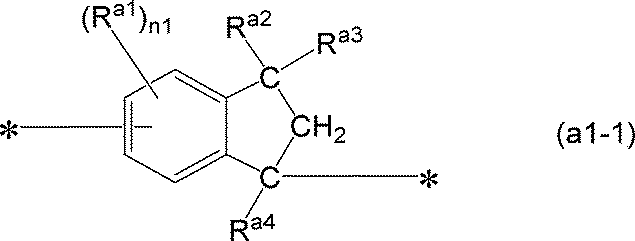
(式中、Ra1は、炭素数1~10のアルキル基、炭素数1~10のアルキルオキシ基、炭素数1~10のアルキルチオ基、炭素数6~10のアリール基、炭素数6~10のアリールオキシ基、炭素数6~10のアリールチオ基、炭素数3~10のシクロアルキル基、ハロゲン原子、水酸基又はメルカプト基であり、n1は0~3の整数である。Ra2~Ra4は、各々独立に、炭素数1~10のアルキル基である。*は結合部位を表す。) - 前記(B)成分が、ポリオレフィン系樹脂、ポリフェニレンエーテル系樹脂、シリコーン系樹脂及びエポキシ樹脂からなる群から選択される1種以上を含有する、請求項1~3のいずれか1項に記載の樹脂組成物。
- 前記(B)成分が、前記ポリオレフィン系樹脂として、(b1)側鎖にビニル基を有する共役ジエンポリマーを、(b2)N-置換マレイミド基を2個以上有するマレイミド化合物で変性してなる変性共役ジエンポリマーを含有する、請求項4に記載の樹脂組成物。
- 前記(B)成分が、前記ポリオレフィン系樹脂として、スチレン系エラストマーを含有する、請求項4又は5に記載の樹脂組成物。
- 請求項1~6のいずれか1項に記載の樹脂組成物又は前記樹脂組成物の半硬化物を含有するプリプレグ。
- 請求項1~6のいずれか1項に記載の樹脂組成物の硬化物又は請求項7に記載のプリプレグの硬化物と、金属箔と、を有する積層板。
- 請求項1~6のいずれか1項に記載の樹脂組成物又は前記樹脂組成物の半硬化物を含有する樹脂フィルム。
- 請求項1~6のいずれか1項に記載の樹脂組成物の硬化物、請求項7に記載のプリプレグの硬化物、及び請求項8に記載の積層板からなる群から選択される1種以上を有するプリント配線板。
- 請求項10に記載のプリント配線板と、半導体素子と、を有する半導体パッケージ。
Priority Applications (5)
| Application Number | Priority Date | Filing Date | Title |
|---|---|---|---|
| KR1020237021646A KR20230128282A9 (ko) | 2020-12-28 | 2021-12-24 | 수지 조성물, 프리프레그, 적층판, 수지 필름, 프린트 배선판 및 반도체 패키지 |
| US18/259,444 US20230391939A1 (en) | 2020-12-28 | 2021-12-24 | Resin composition, prepreg, laminated plate, resin film, printed wiring board, and semiconductor package |
| CN202180087673.3A CN116685634B (zh) | 2020-12-28 | 2021-12-24 | 树脂组合物、预浸料、层叠板、树脂膜、印刷线路板和半导体封装体 |
| JP2022573059A JP7722392B2 (ja) | 2020-12-28 | 2021-12-24 | 樹脂組成物、プリプレグ、積層板、樹脂フィルム、プリント配線板及び半導体パッケージ |
| JP2025126294A JP2025158998A (ja) | 2020-12-28 | 2025-07-29 | 樹脂組成物、プリプレグ、積層板、樹脂フィルム、プリント配線板及び半導体パッケージ |
Applications Claiming Priority (2)
| Application Number | Priority Date | Filing Date | Title |
|---|---|---|---|
| JP2020218893 | 2020-12-28 | ||
| JP2020-218893 | 2020-12-28 |
Publications (1)
| Publication Number | Publication Date |
|---|---|
| WO2022145377A1 true WO2022145377A1 (ja) | 2022-07-07 |
Family
ID=82259368
Family Applications (1)
| Application Number | Title | Priority Date | Filing Date |
|---|---|---|---|
| PCT/JP2021/048276 Ceased WO2022145377A1 (ja) | 2020-12-28 | 2021-12-24 | 樹脂組成物、プリプレグ、積層板、樹脂フィルム、プリント配線板及び半導体パッケージ |
Country Status (6)
| Country | Link |
|---|---|
| US (1) | US20230391939A1 (ja) |
| JP (2) | JP7722392B2 (ja) |
| KR (1) | KR20230128282A9 (ja) |
| CN (1) | CN116685634B (ja) |
| TW (1) | TW202231766A (ja) |
| WO (1) | WO2022145377A1 (ja) |
Cited By (4)
| Publication number | Priority date | Publication date | Assignee | Title |
|---|---|---|---|---|
| CN116970169A (zh) * | 2023-09-20 | 2023-10-31 | 苏州生益科技有限公司 | 胺化合物改性马来酰亚胺预聚物、树脂组合物及其应用 |
| WO2025074977A1 (ja) * | 2023-10-03 | 2025-04-10 | 株式会社レゾナック | 樹脂組成物、プリプレグ、積層板、プリント配線板及び半導体パッケージ |
| WO2025164387A1 (ja) * | 2024-02-01 | 2025-08-07 | パナソニックIpマネジメント株式会社 | 樹脂組成物、プリプレグ、樹脂付きフィルム、樹脂付き金属箔、金属張積層板、及び配線板 |
| KR20250138124A (ko) | 2024-03-11 | 2025-09-19 | 아지노모토 가부시키가이샤 | 수지 조성물 |
Citations (9)
| Publication number | Priority date | Publication date | Assignee | Title |
|---|---|---|---|---|
| JPH06192478A (ja) * | 1992-10-28 | 1994-07-12 | Nippon Soda Co Ltd | 硬化性樹脂組成物並びにそれを用いたプリプレグ、積層板及び成形材料 |
| WO2019230943A1 (ja) * | 2018-06-01 | 2019-12-05 | 三菱瓦斯化学株式会社 | 樹脂組成物、プリプレグ、金属箔張積層板、樹脂シート及びプリント配線板 |
| WO2020095422A1 (ja) * | 2018-11-08 | 2020-05-14 | 日立化成株式会社 | 樹脂組成物、樹脂組成物の硬化物、プリプレグ、積層板、樹脂フィルム、多層プリント配線板、ミリ波レーダー用多層プリント配線板及びポリフェニレンエーテル誘導体 |
| WO2020217678A1 (ja) * | 2019-04-26 | 2020-10-29 | Dic株式会社 | 硬化性樹脂組成物 |
| WO2020217675A1 (ja) * | 2019-04-26 | 2020-10-29 | Dic株式会社 | 硬化性樹脂組成物 |
| WO2020217672A1 (ja) * | 2019-04-26 | 2020-10-29 | Dic株式会社 | 硬化性樹脂組成物 |
| WO2020217676A1 (ja) * | 2019-04-26 | 2020-10-29 | Dic株式会社 | 硬化性樹脂組成物 |
| JP2021161325A (ja) * | 2020-04-01 | 2021-10-11 | 味の素株式会社 | 樹脂組成物 |
| JP2021161323A (ja) * | 2020-04-01 | 2021-10-11 | 味の素株式会社 | 樹脂組成物 |
Family Cites Families (5)
| Publication number | Priority date | Publication date | Assignee | Title |
|---|---|---|---|---|
| JP2018012747A (ja) | 2016-07-19 | 2018-01-25 | 日立化成株式会社 | 熱硬化性樹脂組成物、層間絶縁用樹脂フィルム、複合フィルム、プリント配線板及びその製造方法 |
| US12264224B2 (en) * | 2019-06-25 | 2025-04-01 | Resonac Corporation | Maleimide resin composition, prepreg, laminated board, resin film, multilayer printed wiring board, and semiconductor package |
| JP7808777B2 (ja) * | 2020-09-01 | 2026-01-30 | パナソニックIpマネジメント株式会社 | 樹脂組成物、並びに、それを用いたプリプレグ、樹脂付きフィルム、樹脂付き金属箔、金属張積層板及び配線基板 |
| JP7756324B2 (ja) * | 2020-09-11 | 2025-10-20 | パナソニックIpマネジメント株式会社 | 樹脂組成物、プリプレグ、樹脂付きフィルム、樹脂付き金属箔、金属張積層板、及び配線板 |
| KR20230108275A (ko) * | 2020-11-16 | 2023-07-18 | 가부시끼가이샤 레조낙 | 말레이미드 수지 조성물, 프리프레그, 적층판, 수지 필름, 프린트 배선판 및 반도체 패키지 |
-
2021
- 2021-12-24 JP JP2022573059A patent/JP7722392B2/ja active Active
- 2021-12-24 WO PCT/JP2021/048276 patent/WO2022145377A1/ja not_active Ceased
- 2021-12-24 KR KR1020237021646A patent/KR20230128282A9/ko active Pending
- 2021-12-24 CN CN202180087673.3A patent/CN116685634B/zh active Active
- 2021-12-24 US US18/259,444 patent/US20230391939A1/en active Pending
- 2021-12-28 TW TW110149056A patent/TW202231766A/zh unknown
-
2025
- 2025-07-29 JP JP2025126294A patent/JP2025158998A/ja active Pending
Patent Citations (9)
| Publication number | Priority date | Publication date | Assignee | Title |
|---|---|---|---|---|
| JPH06192478A (ja) * | 1992-10-28 | 1994-07-12 | Nippon Soda Co Ltd | 硬化性樹脂組成物並びにそれを用いたプリプレグ、積層板及び成形材料 |
| WO2019230943A1 (ja) * | 2018-06-01 | 2019-12-05 | 三菱瓦斯化学株式会社 | 樹脂組成物、プリプレグ、金属箔張積層板、樹脂シート及びプリント配線板 |
| WO2020095422A1 (ja) * | 2018-11-08 | 2020-05-14 | 日立化成株式会社 | 樹脂組成物、樹脂組成物の硬化物、プリプレグ、積層板、樹脂フィルム、多層プリント配線板、ミリ波レーダー用多層プリント配線板及びポリフェニレンエーテル誘導体 |
| WO2020217678A1 (ja) * | 2019-04-26 | 2020-10-29 | Dic株式会社 | 硬化性樹脂組成物 |
| WO2020217675A1 (ja) * | 2019-04-26 | 2020-10-29 | Dic株式会社 | 硬化性樹脂組成物 |
| WO2020217672A1 (ja) * | 2019-04-26 | 2020-10-29 | Dic株式会社 | 硬化性樹脂組成物 |
| WO2020217676A1 (ja) * | 2019-04-26 | 2020-10-29 | Dic株式会社 | 硬化性樹脂組成物 |
| JP2021161325A (ja) * | 2020-04-01 | 2021-10-11 | 味の素株式会社 | 樹脂組成物 |
| JP2021161323A (ja) * | 2020-04-01 | 2021-10-11 | 味の素株式会社 | 樹脂組成物 |
Cited By (4)
| Publication number | Priority date | Publication date | Assignee | Title |
|---|---|---|---|---|
| CN116970169A (zh) * | 2023-09-20 | 2023-10-31 | 苏州生益科技有限公司 | 胺化合物改性马来酰亚胺预聚物、树脂组合物及其应用 |
| WO2025074977A1 (ja) * | 2023-10-03 | 2025-04-10 | 株式会社レゾナック | 樹脂組成物、プリプレグ、積層板、プリント配線板及び半導体パッケージ |
| WO2025164387A1 (ja) * | 2024-02-01 | 2025-08-07 | パナソニックIpマネジメント株式会社 | 樹脂組成物、プリプレグ、樹脂付きフィルム、樹脂付き金属箔、金属張積層板、及び配線板 |
| KR20250138124A (ko) | 2024-03-11 | 2025-09-19 | 아지노모토 가부시키가이샤 | 수지 조성물 |
Also Published As
| Publication number | Publication date |
|---|---|
| CN116685634A (zh) | 2023-09-01 |
| JPWO2022145377A1 (ja) | 2022-07-07 |
| KR20230128282A (ko) | 2023-09-04 |
| TW202231766A (zh) | 2022-08-16 |
| KR20230128282A9 (ko) | 2024-11-15 |
| US20230391939A1 (en) | 2023-12-07 |
| JP7722392B2 (ja) | 2025-08-13 |
| JP2025158998A (ja) | 2025-10-17 |
| CN116685634B (zh) | 2026-04-21 |
Similar Documents
| Publication | Publication Date | Title |
|---|---|---|
| JP7732216B2 (ja) | 樹脂組成物、プリプレグ、積層板、樹脂フィルム、多層プリント配線板、半導体パッケージ、樹脂組成物の製造方法及び変性共役ジエンポリマー | |
| JP7722392B2 (ja) | 樹脂組成物、プリプレグ、積層板、樹脂フィルム、プリント配線板及び半導体パッケージ | |
| US12024624B2 (en) | Maleimide resin composition, prepreg, laminated board, resin film, printed wiring board, and semiconductor package | |
| JP7484909B2 (ja) | マレイミド樹脂組成物、プリプレグ、積層板、樹脂フィルム、多層プリント配線板及び半導体パッケージ | |
| JP7631673B2 (ja) | 樹脂組成物、プリプレグ、積層板、樹脂フィルム、多層プリント配線板及び半導体パッケージ | |
| WO2020095422A1 (ja) | 樹脂組成物、樹脂組成物の硬化物、プリプレグ、積層板、樹脂フィルム、多層プリント配線板、ミリ波レーダー用多層プリント配線板及びポリフェニレンエーテル誘導体 | |
| JP7782133B2 (ja) | マレイミド樹脂組成物、プリプレグ、樹脂フィルム、積層板、多層プリント配線板及び半導体パッケージ | |
| JP2020169273A (ja) | 樹脂組成物、プリプレグ、積層板、多層プリント配線板及び半導体パッケージ | |
| JP2020169274A (ja) | 樹脂組成物、プリプレグ、積層板、多層プリント配線板及び半導体パッケージ | |
| WO2022102782A1 (ja) | マレイミド樹脂組成物、プリプレグ、積層板、樹脂フィルム、プリント配線板及び半導体パッケージ | |
| JP2021138849A (ja) | 樹脂組成物、プリプレグ、積層板、樹脂フィルム、プリント配線板、半導体パッケージ及び樹脂組成物の製造方法 | |
| JP2021187889A (ja) | 熱硬化性樹脂組成物、プリプレグ、積層板、多層プリント配線板及び半導体パッケージ | |
| JP2020169276A (ja) | 樹脂組成物、プリプレグ、積層板、多層プリント配線板及び半導体パッケージ | |
| WO2022131151A1 (ja) | 熱硬化性樹脂組成物の相容性評価方法、熱硬化性樹脂組成物、プリプレグ、樹脂フィルム、積層板、多層プリント配線板及び半導体パッケージ | |
| JP2022061729A (ja) | 樹脂組成物、樹脂付き金属箔、プリプレグ、積層板、多層プリント配線板及び半導体パッケージ | |
| WO2022102780A1 (ja) | マレイミド樹脂組成物、プリプレグ、樹脂フィルム、積層板、プリント配線板及び半導体パッケージ | |
| WO2022075221A1 (ja) | 樹脂組成物、樹脂付き金属箔、プリプレグ、積層板、多層プリント配線板及び半導体パッケージ | |
| JP2020169277A (ja) | 樹脂組成物、プリプレグ、積層板、多層プリント配線板及び半導体パッケージ | |
| TWI921408B (zh) | 馬來醯亞胺樹脂組成物、預浸體、積層板、樹脂薄膜、印刷線路板及半導體封裝體 | |
| JP2020169275A (ja) | 樹脂組成物、プリプレグ、積層板、多層プリント配線板及び半導体パッケージ | |
| JP2021187888A (ja) | 樹脂組成物、プリプレグ、積層板、樹脂フィルム、プリント配線板、半導体パッケージ、樹脂組成物の製造方法及びプリント配線板用プレポリマー | |
| JP2022166670A (ja) | 樹脂組成物、樹脂フィルム、樹脂付き金属箔、プリプレグ、積層板、多層プリント配線板及び半導体パッケージ | |
| WO2025074977A1 (ja) | 樹脂組成物、プリプレグ、積層板、プリント配線板及び半導体パッケージ |
Legal Events
| Date | Code | Title | Description |
|---|---|---|---|
| 121 | Ep: the epo has been informed by wipo that ep was designated in this application |
Ref document number: 21915237 Country of ref document: EP Kind code of ref document: A1 |
|
| ENP | Entry into the national phase |
Ref document number: 2022573059 Country of ref document: JP Kind code of ref document: A |
|
| WWE | Wipo information: entry into national phase |
Ref document number: 202180087673.3 Country of ref document: CN |
|
| NENP | Non-entry into the national phase |
Ref country code: DE |
|
| 122 | Ep: pct application non-entry in european phase |
Ref document number: 21915237 Country of ref document: EP Kind code of ref document: A1 |