WO2022130964A1 - 乳化化粧料 - Google Patents
乳化化粧料 Download PDFInfo
- Publication number
- WO2022130964A1 WO2022130964A1 PCT/JP2021/043864 JP2021043864W WO2022130964A1 WO 2022130964 A1 WO2022130964 A1 WO 2022130964A1 JP 2021043864 W JP2021043864 W JP 2021043864W WO 2022130964 A1 WO2022130964 A1 WO 2022130964A1
- Authority
- WO
- WIPO (PCT)
- Prior art keywords
- oil
- mass
- water
- less
- skin
- Prior art date
- Legal status (The legal status is an assumption and is not a legal conclusion. Google has not performed a legal analysis and makes no representation as to the accuracy of the status listed.)
- Ceased
Links
Images



Classifications
-
- A—HUMAN NECESSITIES
- A61—MEDICAL OR VETERINARY SCIENCE; HYGIENE
- A61K—PREPARATIONS FOR MEDICAL, DENTAL OR TOILETRY PURPOSES
- A61K8/00—Cosmetics or similar toiletry preparations
- A61K8/02—Cosmetics or similar toiletry preparations characterised by special physical form
- A61K8/04—Dispersions; Emulsions
- A61K8/06—Emulsions
-
- A—HUMAN NECESSITIES
- A61—MEDICAL OR VETERINARY SCIENCE; HYGIENE
- A61K—PREPARATIONS FOR MEDICAL, DENTAL OR TOILETRY PURPOSES
- A61K8/00—Cosmetics or similar toiletry preparations
- A61K8/18—Cosmetics or similar toiletry preparations characterised by the composition
- A61K8/30—Cosmetics or similar toiletry preparations characterised by the composition containing organic compounds
- A61K8/31—Hydrocarbons
-
- A—HUMAN NECESSITIES
- A61—MEDICAL OR VETERINARY SCIENCE; HYGIENE
- A61K—PREPARATIONS FOR MEDICAL, DENTAL OR TOILETRY PURPOSES
- A61K8/00—Cosmetics or similar toiletry preparations
- A61K8/18—Cosmetics or similar toiletry preparations characterised by the composition
- A61K8/72—Cosmetics or similar toiletry preparations characterised by the composition containing organic macromolecular compounds
- A61K8/81—Cosmetics or similar toiletry preparations characterised by the composition containing organic macromolecular compounds obtained by reactions involving only carbon-to-carbon unsaturated bonds
-
- A—HUMAN NECESSITIES
- A61—MEDICAL OR VETERINARY SCIENCE; HYGIENE
- A61Q—SPECIFIC USE OF COSMETICS OR SIMILAR TOILETRY PREPARATIONS
- A61Q1/00—Make-up preparations; Body powders; Preparations for removing make-up
- A61Q1/02—Preparations containing skin colorants, e.g. pigments
-
- A—HUMAN NECESSITIES
- A61—MEDICAL OR VETERINARY SCIENCE; HYGIENE
- A61Q—SPECIFIC USE OF COSMETICS OR SIMILAR TOILETRY PREPARATIONS
- A61Q19/00—Preparations for care of the skin
Definitions
- This disclosure relates to emulsified cosmetics.
- Patent Document 1 discloses a moisture-permeable film containing a collagen powder composed of a matrix resin and crosslinked regenerated collagen, which has a communication degree of 1 to 95% and is used for clothing and the like. Has been done.
- Patent Document 2 discloses a bed wound environment adjusting sheet applied to a skin wound affected area using a moisture-permeable hydrogel sheet.
- the humidity of the outdoor environment tends to be high during the rainy season, while the humidity tends to be considerably low during the winter when there is little rain.
- the humidity may be considerably low even in an indoor work environment or a shopping center. In such a low humidity environment, the moisture from the skin evaporates and the skin loses its moisture, and skin troubles such as rough skin and wrinkles tend to occur.
- a moisturizer such as glycerin is generally applied to the skin.
- the moisturizer component applied to the skin temporarily retains the moisture generated from the skin and exhibits moisturizing performance, if the humidity of the outside air is low, the retained moisture will be in the outside air over time. It was not possible to obtain a sufficient moisturizing effect because it evaporates.
- the occlusal effect of the spread moisturizer makes it difficult for the sweat to evaporate into the outside air, making it easy to give a sticky discomfort. rice field.
- the subject of the present disclosure is an emulsified cosmetic that can moisturize the skin and enhance the beauty effect in a low humidity environment while reducing sticky discomfort in a high humidity environment or in a sweaty state. To provide.
- the content of the polyvinyl alcohol is 0.5% by mass or more with respect to the total amount of the emulsified cosmetic.
- the cosmetic according to any one of aspects 1 to 10 which is smaller than the coefficient.
- an emulsified cosmetic that can moisturize the skin and enhance the beauty effect in a low humidity environment while reducing sticky discomfort in a high humidity environment or in a sweaty state is provided. be able to.
- the emulsified cosmetics of the present disclosure include an aqueous phase containing water and polyvinyl alcohol, and an oil phase containing oil, and the content of polyvinyl alcohol is 0.5% by mass or more with respect to the total amount of the emulsified cosmetics. Is.
- the emulsified cosmetics of the present disclosure moisturize the skin in a low humidity environment while reducing sticky discomfort in a high humidity environment or in a sweaty state.
- the principle of action that can enhance the beauty effect is as follows.
- polyvinyl alcohol may be abbreviated as "PVA”.
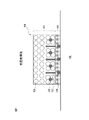
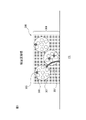
- the emulsified cosmetics of the present disclosure when applied to the skin, are applied to the skin in the configuration shown in FIG. 1 or FIG.
- the first configuration 100 shown in FIG. 1 is separated into a hydrophilic PVA layer 101 and a hydrophobic oil layer 109.
- an oil layer 109 is formed on the skin surface, which is generally hydrophobic, because oil is more easily adsorbed than PVA, and on the other hand, it is difficult to be compatible with such an oil phase.
- the hydrophilic PVA layer 101 being formed above the oil layer 109, it is considered that the configuration as shown in FIG. 1 can be obtained. It is considered that this composition is likely to be formed when the viscosity of the emulsified cosmetic is relatively low and the emulsified particles are easy to move, or when the oil-in-water emulsified cosmetic is used.
- PVA has an excellent affinity with water.
- the water vaporized from the skin is partially shielded by the oil layer 109.
- the oil layer 109 formed by the emulsified cosmetics of the present disclosure is a thin layer, it is considered that some water can pass through the oil layer 109. It is considered that the water that has passed through the oil layer 109 binds to the PVA molecules 103 in the PVA layer 101, and the PVA molecules 103 move so as to attract each other around the water 105, resulting in a gap 107 through which the water passes.
- the gap 107 through which the moisture passes is not formed because the movement of the PVA molecule 103 based on the moisture does not easily occur near the outermost surface of the PVA layer 101.
- the moisture evaporated from the skin stays below the outermost surface of the PVA layer 101 and is not evaporated into the atmosphere, so that the skin can be sufficiently moisturized even in a low humidity environment. I think I can do it.
- the function of producing the moisturizing component created by the skin itself is improved, and the turnover disorder in the stratum corneum is also improved, so that it is considered that skin troubles such as rough skin are less likely to occur and the beauty effect is enhanced.
- the thickness of the layer is usually thin.
- the oil layer 109 as shown in FIG. 1 if the oil layer 109 as shown in FIG. 1 is not present, for example, when the skin has a large amount of water, a gap through which water can pass is formed even in a low humidity environment, and the skin is squeezed. Moisture may evaporate.
- the emulsified cosmetic of the present disclosure is applied to the skin, as shown in FIG. 1, it is considered that an oil layer 109 capable of partially suppressing water from the skin can be simultaneously arranged below the PVA layer 101 layer. Therefore, it is considered that the formation of gaps through which moisture can pass can be suppressed even in a thin PVA layer in a low humidity environment.
- the PVA molecule 203 near the outermost surface of the PVA layer 201 also moves so as to attract each other around the water 205.
- a gap 207 for passing moisture is generated in the entire area of the PVA layer 201 in the thickness direction.
- excess water such as sweat can be evaporated from the skin, and it is considered that the sticky discomfort can be reduced.
- the moisture in the environment can be provided to the skin through the PVA layer 201.
- the second configuration 300 shown in FIG. 3 constitutes an oil layer 309 containing PVA particles in a state in which PVA particles 301 are dispersed in the oil component. It is considered that this structure is likely to be formed when the viscosity of the emulsified cosmetic is relatively high and the emulsified particles are difficult to move, or when the water-in-oil emulsified cosmetic is used.
- the water evaporated from the skin binds to the PVA molecule 303 in the PVA particles 301 located on the side closer to the skin, and the PVA molecule 303 is attracted by the water 305. It is believed that the movement to fit results in a passage 307 through which moisture can pass.
- the humidity of the external environment is low, it is considered that the PVA particles 301 near the outermost surface of the oil layer 309 containing the PVA particles do not easily move the PVA molecules 303, so that the passage 307 through which water can pass is not formed. Be done.
- the moisture evaporated from the skin stays below the outermost surface of the oil layer 309 containing PVA particles and is not evaporated into the atmosphere, so that the skin is sufficiently kept even in a low humidity environment. I think it can be moisturized.
- humidity responsiveness means the ability to change the amount of water evaporation according to changes in the humidity environment. Specifically, the moisture permeation coefficient in a low humidity environment is high humidity. It means the performance that is smaller than the moisture permeation coefficient in the environment.
- the "low humidity environment” is the relative humidity at 23 ° C or 28 ° C under atmospheric pressure, which is less than 50% RH, 45% RH or less, 40% RH or less, 35% RH or less, and 30% RH.
- it means an environment of 25% RH or less or 20% RH or less.
- the lower limit of the relative humidity is not particularly limited, but may be, for example, 3% RH or more, 5% RH or more, 7% RH or more, or 10% RH or more.
- such relative humidity can be converted into, for example, weight absolute humidity that is not affected by temperature, and the weight absolute humidity is 8.7 g / kg or less, 7.9 g / kg or less, 7.0 g / kg.
- it can be 6.1 g / kg or less, 5.4 g / kg or less, 5.2 g / kg or less, 5.0 g / kg or less, or 4.8 g / kg or less, and 0.52 g / kg or less. As mentioned above, it can be 0.86 g / kg or more, 1.2 g / kg or more, or 1.7 g / kg or more.
- the "high humidity environment” is the relative humidity at 28 ° C. under atmospheric pressure, 50% RH or more, 55% RH or more, 60% RH or more, 65% RH or more, 70% RH or more, or It means an environment of 75% RH or more.
- the upper limit of the relative humidity is not particularly limited, but may be, for example, 100% RH or less or less than 100% RH.
- such relative humidity can be converted into, for example, weight absolute humidity that is not affected by temperature, and the weight absolute humidity is 12 g / kg or more, 13 g / kg or more, 14 g / kg or more, 15 g / kg or more. , 17 g / kg or more, or 18 g / kg or more, and 24 g / kg or less or less than 24 g / kg.
- cosmetics or “cosmetology method” means to apply the emulsified cosmetics of the present disclosure to the body surface to beautify and beautify the condition of the body surface, or to beautify the condition of the body surface. It means a method of surgery, which is different from the method of surgery, treatment or diagnosis of a human being.
- body surface means the skin surface of the body.
- the emulsified cosmetics of the present disclosure can exhibit humidity responsiveness at the application site when such cosmetics are applied to the body surface.
- humidity responsiveness can be evaluated by a moisture permeability coefficient (sometimes referred to simply as "permeation coefficient") calculated based on a moisture evaporation test.
- the amount of water evaporation (g / hour) is determined by covering the open portion of a vial containing 20 mL of water with a filter paper and applying an emulsified cosmetic to the entire surface of the filter paper, for example, at 28 ° C. 20.
- the amount of decrease in water is measured, and the amount of decrease in water per unit area and unit time is measured.
- the permeability coefficient (mol ⁇ m / m 2 ⁇ s ⁇ Pa) can be calculated from the following formula 1 using the amount of water evaporation.
- the emulsified cosmetics of the present disclosure have a permeability coefficient of 28 ° C. and 70% when evaluated in a water evaporation test described later, for example, when measured in a low humidity environment of 23 ° C. 40% RH or 28 ° C. 20% RH. It is possible to exhibit a humidity responsiveness that is smaller than the permeability coefficient when measured in a high humidity environment of RH.
- the permeability coefficient when measured in a low humidity environment of 23 ° C. 40% RH or 28 ° C. 20% RH is 28 ° C. 70% RH. It is larger than the permeability coefficient when measured in a high humidity environment.
- the atmosphere of the measurement environment is, for example, an environment where the humidity is lower than the environment of 23 ° C. and 40% RH
- the emulsified cosmetics of the present disclosure can further suppress the evaporation of water. Therefore, the difference in the permeability coefficient of water tends to increase as the difference in the humidity environment of the atmosphere to be measured increases.
- the emulsified cosmetics disclosed in the present disclosure may be any emulsified cosmetics containing an aqueous phase and an oil phase, and may be either an oil-in-water type or a water-in-oil type.
- the oil-in-water emulsified cosmetic of the present disclosure contains a dispersion medium containing water and polyvinyl alcohol as an aqueous phase, and oil droplets containing oil dispersed in the dispersion medium as an oil phase, and is composed of polyvinyl alcohol.
- the content is 0.5% by mass or more with respect to the total amount of the emulsified cosmetic.
- such an oil-in-water emulsified cosmetic can exhibit humidity responsiveness at the application site when applied to the body surface.
- the dispersion medium in the oil-in-water emulsified cosmetic of the present disclosure includes water and polyvinyl alcohol.
- Water that can be used in the oil-in-water emulsified cosmetics disclosed in the present disclosure is not particularly limited, and water used in cosmetics, quasi-drugs, etc. can be used.
- water used in cosmetics, quasi-drugs, etc. can be used.
- ion-exchanged water distilled water, ultrapure water, and tap water can be used.
- the amount of water to be blended is not particularly limited, and may be, for example, 30% by mass or more, 35% by mass or more, or 40% by mass or more, and 90% by mass or less, 80% by mass, based on the total amount of the emulsified cosmetic. It can be mass% or less, 70 mass% or less, 60 mass% or less, or 50 mass% or less.
- polyvinyl alcohol that can be used in the oil-in-water emulsified cosmetics of the present disclosure is not particularly limited as long as the site to which the emulsified cosmetics are applied exhibits humidity responsiveness, and polyvinyl alcohol or a derivative thereof may be used alone or in two. It can be used in combination with more than seeds.
- the polyvinyl alcohol derivative include modified polyvinyl alcohol, polyvinyl acetate, polyvinyl butyral and the like. From the viewpoint of humidity responsiveness, unmodified polyvinyl alcohol and / or modified polyvinyl alcohol are preferable.
- polyvinyl alcohol examples include fully saponified polyvinyl alcohol having a saponification degree of 99% or more, partially saponified polyvinyl alcohol having a saponification degree of 90% or more and less than 99%, and partially saponifying having a saponification degree of 70% or more and less than 90%.
- Type polyvinyl alcohol can be used. These polyvinyl alcohols can be used alone or in combination of two or more. Of these, fully saponified polyvinyl alcohol and partially saponified polyvinyl alcohol are preferable, and fully saponified polyvinyl alcohol is more preferable, from the viewpoint of humidity responsiveness, particularly the effect of suppressing water evaporation in a low humidity environment.
- the polyvinyl alcohol denaturation treatment include diol denaturation, anion denaturation, and cation denaturation.
- unmodified polyvinyl alcohol or diol-modified polyvinyl alcohol is preferable, and unmodified polyvinyl alcohol is more preferable.
- Examples of the unmodified completely saponified polyvinyl alcohol include Gosenol (trademark) NL-05 (manufactured by Mitsubishi Chemical Co., Ltd.), KURARAY POVAL (trademark) PVA-117H (manufactured by Kuraray Co., Ltd.), and KURARAY POVAL (trademark) PVA-. 124 (manufactured by Kuraray Co., Ltd.) can be mentioned, and examples of the completely saponified polyvinyl alcohol for anion modification include Gosenex TM T-330H (manufactured by Mitsubishi Chemical Co., Ltd.), which is completely diol-modified. Examples of the saponified polyvinyl alcohol include Nichigo G Polymer (trademark) OKS-1089 and Nichigo G Polymer (trademark) OKS-1109 (both manufactured by Mitsubishi Chemical Corporation).
- Examples of the unmodified partially saponified polyvinyl alcohol include KURARAY POVAL TM PVA-617 (manufactured by Kuraray Co., Ltd.), and examples of the diol-modified partially saponified polyvinyl alcohol include Nichigo G Polymer (Nichigo G Polymer). Trademark) OKS-8096 (manufactured by Mitsubishi Chemical Co., Ltd.) can be mentioned.
- Examples of the unmodified partially saponified polyvinyl alcohol include Gosenol TM GM-14, Gosenol TM PVA EG-05, Gosenol TM PVA EG-40 (all manufactured by Mitsubishi Chemical Co., Ltd.), and KURARAY. POVAL (trademark) PVA-235 (manufactured by Kuraray Co., Ltd.) can be mentioned, and examples of the partially saponified polyvinyl alcohol for cation modification include Gosenol (trademark) PVA K-434 (manufactured by Mitsubishi Chemical Co., Ltd.). be able to.
- the blending amount of polyvinyl alcohol is 0.7% by mass or more, 1.0% by mass or more, 1.5% by mass or more, 2.0 with respect to the total amount of emulsified cosmetics from the viewpoint of humidity responsiveness, application performance, etc. It can be mass% or more, 2.5% by mass or more, 3.0% by mass or more, 3.5% by mass or more, or 4.0% by mass or more, and 6.0% by mass or less, 5.5. It can be mass% or less, 5.0 mass% or less, 4.5 mass% or less, or 4.0 mass% or less. In the case of an oil-in-water emulsified cosmetic, the blending amount of polyvinyl alcohol is preferably 2.5% by mass or more.
- Oil droplets as an oil phase or a dispersed phase in oil-in-water emulsified cosmetics contain oils and typically surfactants.
- Oil content The oil content that can be used in the oil-in-water emulsified cosmetics of the present disclosure is not particularly limited, and volatile oils and / or non-volatile oils can be used. It preferably contains non-volatile oil. Specific examples thereof include non-polar oil (for example, non-polar hydrocarbon oil) and polar oil. The oil content can be used alone or in combination of two or more. Of these, non-polar hydrocarbon oils are preferable, and non-polar non-polar hydrocarbon oils are more preferable, from the viewpoint of humidity responsiveness.
- non-volatile is intended to exhibit a volatile content of 5% or less when left at 105 ° C. for 3 hours under atmospheric pressure. In contrast, “volatile” is intended to have a volatile content of more than 5.0% by weight after being left at 105 ° C. for 3 hours under atmospheric pressure.
- the non-polar hydrocarbon oil is not particularly limited, and is, for example, vaseline, liquid paraffin, tetraisobutane, hydrogenated polydecene, microcrystalline wax, olefin oligomer, isododecane, isohexadecane, squalane, polybutene, hydrogenated polybutene, polyisobutene, and water. Hydrocarbonate may be mentioned.
- Non-polar hydrocarbon oils can be used alone or in combination of two or more. Among them, petrolatum, microcrystalline wax, and olefin oligomer are preferable, and petrolatum is more preferable, from the viewpoint of the overall humidity responsiveness of the part to which the emulsified cosmetic is applied to the skin.
- the oil content other than the non-polar hydrocarbon oil is not limited to the following, but for example, liquid fats and oils, solid fats and oils, waxes, silicone oils, synthetic ester oils and the like can be used. These can be used alone or in combination of two or more.
- Liquid fats and oils include, for example, avocado oil, camellia oil, turtle oil, macadamia nut oil, corn oil, mink oil, olive oil, rapeseed oil, egg yolk oil, sesame oil, persic oil, wheat germ oil, southern ka oil, castor oil, and flaxseed oil. , Saflower oil, cottonseed oil, eno oil, soybean oil, peanut oil, teaseed oil, kaya oil, rice bran oil, cinnamon oil, Japanese millet oil, jojoba oil, germ oil, and triglycerin.
- solid fats and oils include coconut oil, palm oil, horse fat, hardened palm oil, palm oil, beef fat, sheep fat, hardened beef fat, palm kernel oil, pork fat, beef bone fat, mokurou kernel oil, hardened oil, and beef.
- Examples include leg oil, coconut oil, and hydrogenated castor oil.
- waxes examples include beeswax, candelilla wax, cotton wax, carnauba wax, bayberry wax, ibotarou, whale wax, montan wax, nukarou, lanolin, capoc wax, lanolin acetate, liquid lanolin, sugar cane, lanolin fatty acid isopropyl, and hexyl laurate.
- waxes examples include reduced lanolin, jojobaro, hard lanolin, cellac wax, POE lanolin alcohol ether, POE lanolin alcohol acetate, POE cholesterol ether, lanolin fatty acid polyethylene glycol, POE hydrogenated lanolin alcohol ether and the like.
- silicone oil examples include chain silicones such as dimethylpolysiloxane (dimethicone), methylphenylpolysiloxane, and methylhydrogenpolysiloxane; and cyclics such as octamethylcyclotetrasiloxane, decamethylcyclopentasiloxane, and dodecamethylcyclohexasiloxane.
- chain silicones such as dimethylpolysiloxane (dimethicone), methylphenylpolysiloxane, and methylhydrogenpolysiloxane
- cyclics such as octamethylcyclotetrasiloxane, decamethylcyclopentasiloxane, and dodecamethylcyclohexasiloxane.
- silicone examples include silicone.
- Examples of the synthetic ester oil include isopropyl myristate, cetyl octanate, octyldodecyl myristate, isopropyl palmitate, butyl stearate, hexyl laurate, myristyl myristate, decyl oleate, hexyl dimethyloctanoate, and cetyl lactic acid.
- Myristyl Lactate Lanolin Acetate, Isocetyl Stearate, Isocetyl Isostearate, Cholesteryl 12-Hydroxystearate, Ethylene Glycol Di-2-ethylhexanoate, Dipentaerythritol Fatty Acid Estel, N-alkylglycol Monoisostearate, Neopentyl Glycol Dicaprate , Diisostearyl malate, Glycerin di-2-heptylundecanoate, Trimethylolpropane tri-2-ethylhexanoate, Trimethylolpropane triisostearate, Pentaerythritol tetra-2-ethylhexanoate, Tri-2-ethylhexane Glycerin acid, glycerin trioctanoate, glycerin triisopalmitate, trimethylolpropane triisostearate, cetyl 2-eth
- Such synthetic ester oil corresponds to polar oil.
- Polar oils and non-polar oils can be distinguished by the IOB value.
- the IOB value of the polar oil can be, for example, 0.10 or more, 0.11 or more, 0.12 or more, or 0.13 or more, and 0.50 or less, 0.45 or less, or 0.40. It can be as follows.
- the “organic value” is 20 for one carbon atom in the molecule, the “inorganic value” is 100 for one hydroxyl group, and so on.
- “Inorganic value” and “organic value” are set according to the atom or functional group, and the “inorganic value” and “organic value” of all atoms and functional groups in the organic compound are integrated. Can be used to calculate the IOB value of the organic compound (see, for example, Yoshio Koda, "Organic Conceptual Diagram-Basics and Applications-", pp. 11-17, Sankyo Publishing, 1984).
- an ultraviolet absorber having an IOB of 0.10 or more can be regarded as a polar oil.
- UV absorbers satisfying such conditions include octylmethoxycinnamate (ethylhexyl methoxycinnamate), octocrylene, polysilicone-15, t-butylmethoxydibenzoylmethane, ethylhexyltriazone, and bisethylhexyloxyphenol.
- UV absorbers such as methoxyphenyltriazine, hexyl diethylaminohydroxybenzoylbenzoate, oxybenzon-3, methylenebisbenzotriazolyltetramethylbutylphenol, homosalate, and ethylhexyl salicylate. These UV absorbers can be used alone or in combination of two or more.
- the content of the oil content in the oil-in-water emulsified cosmetics of the present disclosure is not particularly limited. It can be 10% by mass or more, 13% by mass or more, or 15% by mass or more, and 50% by mass or less, 40% by mass or less, 30% by mass or less, 25% by mass or less, or 20% by mass or less. Can be.
- the proportion of the non-volatile oil in the oil is, for example, 10% by mass or more, 20% by mass or more, 30% by mass or more, 35% by mass or more, 40% by mass or more, and 45% by mass. Or more, or 50% by mass or more, and 100% by mass or less, less than 100% by mass, 95% by mass or less, 90% by mass or less, 85% by mass or less, 80% by mass or less, 75% by mass or less, Alternatively, it can be 70% by mass or less.
- the oil content in the emulsified cosmetic may remain on the skin together with PVA as shown in FIG. 1 or 3 after the emulsified cosmetic is applied to the skin and the water volatilizes.
- polar oil and silicone oil have the ability to easily permeate water as compared with non-polar hydrocarbon oil.
- non-polar hydrocarbons have appropriate waterproof performance and moisture permeability as compared with polar oils and silicone oils.
- the oil contains a non-polar hydrocarbon oil from the viewpoint of obtaining good humidity responsiveness at the site where the emulsified cosmetic is applied to the skin.
- the ratio of non-polar hydrocarbon oil in the oil content is 10% by mass or more, 15% by mass or more, 20% by mass or more, 25% by mass or more, and 30% by mass. % Or more, 35% by mass or more, or 40% by mass or more, and 90% by mass or less, 85% by mass or less, 80% by mass or less, 75% by mass or less, 70% by mass or less, 65% by mass or less. , 60% by mass or less, 55% by mass or less, 50% by mass or less, 45% by mass or less, or 40% by mass or less.
- the mass ratio of polyvinyl alcohol to non-polar hydrocarbon oil is 0.01 or more, 0, from the viewpoint of obtaining good humidity responsiveness at the site where the emulsified cosmetic is applied to the skin. It is preferably 0.03 or more, 0.05 or more, 0.07 or more, 0.10 or more, 0.15 or more, 0.20 or more, 0.25 or more, or 0.30 or more.
- the upper limit of the mass ratio is not particularly limited, and may be, for example, 1.0 or less, 0.80 or less, 0.60 or less, 0.50 or less, or 0.40 or less.
- the overall humidity responsiveness of the site where the emulsified cosmetic is applied to the skin can be contributed by the balance between the PVA layer or PVA particles and the remaining oil content.
- the desired humidity responsiveness can be obtained by appropriately adjusting the mass ratio of polyvinyl alcohol to the oil content (nonvolatile oil content) remaining when the emulsified cosmetic is applied to the skin.
- the mass ratio (PVA / non-volatile oil content) is 0.01 or more, 0.03 or more, 0.05 or more, 0.07 or more, 0.10 or more, 0.15 or more, 0.20 or more, 0.25 or more, 0.30 or more, 0.35 or more, 0.40 or more, 0.45 or more, 0.50 or more, 0.55 or more, 0.60 or more, 0.65 or more, or 0.70 or more It can also be 1.5 or less, 1.3 or less, 1.0 or less, 0.90 or less, 0.80 or less, or 0.70 or less. In the case of oil-in-water emulsified cosmetics, the mass ratio is particularly preferably 0.60 or more.
- polar oils and silicone oils have the ability to easily permeate moisture compared to non-polar hydrocarbon oils, so the overall humidity response of the part to which the emulsified cosmetic is applied to the skin is , PVA layer or PVA particles and the remaining polar oil and / or silicone oil may contribute.
- the desired humidity responsiveness can be obtained by appropriately adjusting the mass ratio of polyvinyl alcohol to the polar oil or silicone oil (nonvolatile polar oil and silicone oil) remaining when the emulsified cosmetic is applied to the skin. ..
- the mass ratio PVA / non-volatile polar oil or PVA / non-volatile silicone oil
- the mass ratio is 0.01 or more, 0.05 or more, 0.10 or more, 0.20 or more, 0, respectively.
- the mass ratio of PVA / polar oil is preferably 0.25 or more, and the mass ratio of PVA / silicone oil is preferably 0.90 or more. ..
- the surfactant that can be used in the oil-in-water emulsified cosmetics of the present disclosure is not particularly limited, and examples thereof include an ionic surfactant and a nonionic surfactant. Surfactants can be used alone or in combination of two or more.
- the ionic surfactant is not particularly limited, and anionic, cationic, or amphoteric ionic surfactants can be used. Above all, it is preferable to use an anionic surfactant from the viewpoint of emulsion stability and the like.
- the anionic surfactant is not limited to the following, and for example, at least one selected from a carboxylate type, a sulfonate type, a sulfate ester salt type, and a phosphate ester salt type can be used.
- the form of the salt is not particularly limited, but includes alkali metal salts such as sodium salt, potassium salt, and lithium salt, alkaline earth metal salts such as magnesium salt, and calcium salt, ammonium salt, amino acid salt, and the like.
- the morphology can be exemplified.
- Nonionic surfactants include, but are not limited to, polyoxyethylene alkyl ethers, polyglycerin fatty acid esters, polyoxyethylene glycerin fatty acid esters, polyoxyethylene sorbitan fatty acid esters, and polyoxyethylene sorbit fatty acid esters.
- Polyoxyethylene lanolin / lanolin alcohol / beeswax derivative, polyoxyethylene castor oil / hardened castor oil, polyoxyethylene sterol / hydrogenated sterol, polyethylene glycol fatty acid ester, polyoxyethylene glyceryl isostearate can be used.
- polyoxyethylene alkyl ether it is preferable to use polyoxyethylene alkyl ether.
- the content of the surfactant in the oil-in-water emulsified cosmetic is not particularly limited, and is, for example, 0.1% by mass or more, 0.3% by mass or more, or 0.5% by mass with respect to the total amount of the emulsified cosmetic. % Or more, and 5.0% by mass or less, 4.0% by mass or less, 3.0% by mass or less, or 2.0% by mass or less.
- the water-in-oil emulsified cosmetic of the present disclosure contains a dispersion medium containing oil as an oil phase, and water droplets dispersed in the dispersion medium as an aqueous phase, and the water droplets are water, polyvinyl alcohol and typical. Contains a surfactant, and the content of polyvinyl alcohol is 0.5% by mass or more with respect to the total amount of the emulsified cosmetic.
- such a water-in-oil emulsified cosmetic can also exhibit humidity responsiveness at the application site when applied to the body surface.
- water-in-oil emulsified cosmetics those used in the above-mentioned oil-in-water emulsified cosmetics can also be used in the same manner.
- the content of water in the water-in-oil emulsified cosmetic is not particularly limited. For example, 1% by mass or more, 5% by mass or more, 10% by mass or more, 15% by mass or more, based on the total amount of the emulsified cosmetic. Alternatively, it can be 20% by mass or more, and can be 50% by mass or less, 40% by mass or less, 30% by mass or less, 25% by mass or less, or 20% by mass or less.
- the content of polyvinyl alcohol in the water-in-oil emulsified cosmetic is 0.7% by mass or more, 1.0% by mass or more, and 1.5% by mass or more from the viewpoint of humidity responsiveness, coating performance, and the like. It can be 0% by mass or more, 2.5% by mass or more, 3.0% by mass or more, 3.5% by mass or more, or 4.0% by mass or more, and 6.0% by mass or less. It can be 5% by mass or less, 5.0% by mass or less, 4.5% by mass or less, or 4.0% by mass or less.
- the blending amount of polyvinyl alcohol should be 5.0% by mass or less from the viewpoint of suppressing the aggregation of the powder. Is preferable.
- the content of the surfactant in the water-in-oil emulsified cosmetic is not particularly limited, and is, for example, 0.1% by mass or more, 0.3% by mass or more, or 0.5 with respect to the total amount of the emulsified cosmetic. It can be 5.0% by mass or less, 4.0% by mass or less, 3.0% by mass or less, or 2.0% by mass or less.
- the content of oil in the water-based emulsified cosmetics in oil is not particularly limited.
- the proportion of the non-volatile oil in the oil is, for example, 10% by mass or more, 20% by mass or more, 30% by mass or more, 35% by mass or more, 40% by mass or more, and 45% by mass. Or more, or 50% by mass or more, and 100% by mass or less, less than 100% by mass, 95% by mass or less, 90% by mass or less, 85% by mass or less, 80% by mass or less, 75% by mass or less, Alternatively, it can be 70% by mass or less.
- the oil should contain non-polar hydrocarbon oil from the viewpoint of obtaining good humidity responsiveness at the site where the water-in-oil emulsified cosmetics are applied to the skin.
- the ratio of non-polar hydrocarbon oil in the oil content is 10% by mass or more, 15% by mass or more, 20% by mass or more, 25% by mass or more, and 30% by mass. % Or more, 35% by mass or more, 40% by mass or more, 45% by mass or more, or 50% by mass or more, and 90% by mass or less, 85% by mass or less, 80% by mass or less, 75% by mass or less. , 70% by mass or less, 65% by mass or less, 60% by mass or less, 55% by mass or less, or 50% by mass or less.
- the mass ratio of polyvinyl alcohol to the non-polar hydrocarbon oil is 0.01 or more. It is preferably 0.03 or more, 0.05 or more, 0.07 or more, 0.10 or more, 0.15 or more, 0.20 or more, 0.25 or more, or 0.30 or more.
- the upper limit of the mass ratio is not particularly limited, and may be, for example, 1.0 or less, 0.80 or less, 0.60 or less, 0.50 or less, or 0.40 or less.
- the mass ratio is preferably 0.03 or more.
- the overall humidity response of the part to which the water-in-oil emulsified cosmetics are applied to the skin can be contributed by the balance between the PVA layer or PVA particles and the remaining oil content.
- the desired humidity responsiveness can be obtained by appropriately adjusting the mass ratio of polyvinyl alcohol to the oil content (nonvolatile oil content) remaining when the emulsified cosmetic is applied to the skin.
- the mass ratio (PVA / non-volatile oil content) is 0.01 or more, 0.03 or more, 0.05 or more, 0.07 or more, 0.10 or more, 0.15 or more, 0.20 or more, 0.25 or more, 0.30 or more, 0.35 or more, 0.40 or more, 0.45 or more, 0.50 or more, 0.55 or more, 0.60 or more, 0.65 or more, or 0.70 or more It can also be 1.5 or less, 1.3 or less, 1.0 or less, 0.90 or less, 0.80 or less, or 0.70 or less. In the case of water-in-oil emulsified cosmetics, the mass ratio is particularly preferably 0.03 or more.
- polar oils and silicone oils have the ability to easily permeate water compared to non-polar hydrocarbon oils, so that the entire area where the water-in-oil emulsified cosmetic is applied to the skin
- the balance between the PVA layer or PVA particles and the remaining polar oil and / or silicone oil can contribute to the humidity responsiveness.
- the desired humidity responsiveness can be obtained by appropriately adjusting the mass ratio of polyvinyl alcohol to the polar oil or silicone oil (nonvolatile polar oil and silicone oil) remaining when the emulsified cosmetic is applied to the skin. ..
- the mass ratios are 0.01 or more, 0.05 or more, 0.10 or more, 0.20 or more, and 0. It can be 30 or more, 0.40 or more, 0.50 or more, 0.60 or more, 0.70 or more, 0.80 or more, 0.90 or more, or 1.0 or more, and 7.0 or less. , 6.5 or less, 6.0 or less, 5.5 or less, 5.0 or less, 4.5 or less, 4.0 or less, 3.5 or less, 3.0 or less, 2.5 or less, 2.0 or less , 1.5 or less, or 1.0 or less.
- the mass ratio of PVA / polar oil is preferably 0.05 or more, and the mass ratio of PVA / silicone oil is 0.05 or more. preferable.
- the amount of the emulsified cosmetic of the present disclosure applied to the skin is not particularly limited, and can be appropriately adjusted so as to obtain a desired humidity responsiveness.
- the emulsified cosmetics (oil-in-water emulsified cosmetics or water-in-oil emulsified cosmetics) of the present disclosure are usually used for cosmetics, for example, to the extent that they do not affect the effects of the present invention, in addition to the various components described above.
- Various additive components that can be blended can be blended.
- moisturizing agents such as 1,3-butylene glycol, propylene glycol, and dynamite glycerin
- film-forming agents such as water-soluble polymers, oil-soluble polymers, and siliconeized polysaccharides, metal ion sequestering agents, neutralizing agents, ethanol, etc.
- UV scattering agents such as titanium oxide, pH adjusters, skin nutrients, vitamins, pharmaceuticals, non-pharmaceutical products, water-soluble agents applicable to cosmetics, antioxidants, shock absorbers, preservatives, antioxidant aids Agents, thickeners, dispersants, propellants, usable powders, pigments, pearling agents, dyes, pigments, fragrances, acid components, and alkaline components can be mentioned. These optional components can be used alone or in combination of two or more, and can be appropriately blended in the oil phase or the aqueous phase.
- the emulsified cosmetic of the present disclosure can contain various inorganic particles that can be used as an ultraviolet scattering agent, a usable powder, a pigment, a pearlizing agent, and the like.
- the inorganic particles are preferably blended in the oil phase from the viewpoint of suppressing a decrease in humidity responsiveness based on the PVA layer or PVA particles as shown in FIG. 1 or FIG.
- Inorganic particles typically have a hydroxyl group on the surface of the particles. Since this hydroxyl group is easily compatible with PVA, if inorganic particles are highly blended, PVA may be adsorbed on the inorganic particles and consumed, and good humidity responsiveness may not be obtained. Therefore, the content of the inorganic particles is 30% by mass or less, 25% by mass or less, 20% by mass or less, 15% by mass or less, 10% by mass or less, 8% by mass or less, and 5% by mass with respect to the total amount of the emulsified cosmetic. Hereinafter, it is preferably 3% by mass or less, 1% by mass or less, or 0.5% by mass or less. With such a content, the emulsified cosmetics of the present disclosure can provide good humidity responsiveness while imparting various performances based on inorganic particles.
- the dosage form of the emulsified cosmetic of the present disclosure is not particularly limited, and examples thereof include liquid, milky liquid, cream, gel, mist, spray, aerosol, and mousse.
- the product form of the emulsified cosmetics of the present disclosure is not particularly limited, and for example, skin care cosmetics such as milky lotion, cream, face oil, body oil, and beauty liquid; foundation, makeup base, lipstick, cheek red, eye shadow, mascara, mascara. Makeup cosmetics such as base; sunscreen cosmetics can be mentioned. Above all, it is advantageous to use it as a makeup base to be used before foundation.
- the emulsified cosmetics of the present disclosure can be prepared by a known method such as a dispersion method or an agglutination method.
- the dispersion method is a method of refining a mass of dispersed phases by mechanical force. Specifically, it is a method of emulsifying using the crushing force of an emulsifying machine, and examples of such a method include a high-pressure emulsification method in which a high shearing force is applied using a high-pressure homogenizer.
- the agglomeration method is a colloid preparation method that utilizes surface chemical properties, and is a method in which a uniformly fused state is supersaturated by some means to produce a dispersed phase.
- an HLB temperature emulsification method, a phase inversion emulsification method, a non-water emulsification method, a D-phase emulsification method, a liquid crystal emulsification method and the like are known.
- the cosmetological method using the emulsified cosmetics of the present disclosure includes applying the emulsified cosmetics to the body surface.
- the emulsified cosmetic of the present disclosure can reduce or suppress the evaporation of water from the skin in a low humidity environment, and sufficiently moisturize the skin even in a low humidity environment. be able to.
- the function of producing moisturizing ingredients created by the skin itself is improved, and the turnover disorder in the stratum corneum is also improved, so that skin troubles such as rough skin are less likely to occur, and the beauty effect can be enhanced. ..
- the means for applying the emulsified cosmetic to the body surface is not particularly limited, and for example, the emulsified cosmetic can be applied to the body surface.
- the cosmetic may be sprayed on the skin from a spray container containing the cosmetic, or the cosmetic may be applied to a container having no spray function. You may put it in, collect an appropriate amount of cosmetics from such a container on your fingers, etc., and spread it on the body surface.
- the emulsified cosmetics of the present disclosure can be applied to the surface of the skin in any part of the body, that is, any part of the body surface.
- it can be appropriately applied to the skin surface such as face (lips, eyes, nose, cheeks, forehead, etc.), neck, ears, hands, arms, legs, legs, chest, abdomen, back and the like.
- the skin also includes nails and the like in which the keratin of the epidermis of the skin is changed and hardened.
- Examples 1 to 5 and Comparative Examples 1 to 2 Oil-in-water emulsified cosmetic (cream) >> Using the formulations shown in Table 1, oil-in-water emulsified cosmetics were prepared by a conventional method. These were evaluated for humidity responsiveness by the water evaporation test 1 shown below. The results are shown in Table 1. The test sample of Comparative Example 1 was prepared by applying only filter paper to the open portion of a vial containing 20 mL of water.
- ⁇ Evaluation method> (Moisture evaporation test 1: Humidity response) Cover the open part (area: 0.000177 m 2 ) of the vial bottle filled with 20 mL of water with filter paper (ADVANTEC, # 133, basis weight 14 mg / cm 2 ), and apply emulsified cosmetics to the entire surface of this filter paper.
- the vial was placed in a constant temperature bath under predetermined temperature and humidity conditions. After allowing to stand for about 2 to 3 days until the amount of evaporation becomes almost constant with respect to time, the amount of decrease in water in the vial is measured, and the amount of decrease in water per unit area and unit time is used. A certain amount of water evaporation (g / hour) was calculated.
- Permeation coefficient (mol ⁇ m / m 2 ⁇ s ⁇ Pa) [ ⁇ (28 ° C. and water vapor evaporation amount under predetermined humidity (g / hour) / 18/3600 / permeation area (m 2 ) ⁇ / (28 ° C.) And water vapor pressure at 100% RH (Pa) -28 ° C. and water vapor pressure at a predetermined humidity (Pa)] ⁇ film thickness of filter paper (m) ... Equation 2
- Equation 1 the permeation area is 0.000177 m 2 , the water vapor pressure (Pa) at 28 ° C. and 20% RH is 756.2 Pa, and the water vapor pressure (Pa) at 28 ° C. and 80% RH ( Pa) is 3024.7 Pa, the water vapor pressure (Pa) at 28 ° C. and 100% RH is 3780.9 Pa, and the film thickness of the filter paper is 0.000175 m.
- the humidity response was evaluated according to the following criteria.
- the C rating can be considered a failure:
- Reference Examples 1 to 3 and Reference Comparative Examples 1 to 2 Polyvinyl alcohol film >> As a reference, regarding a self-standing polyvinyl alcohol film such as a wrap film obtained by the production methods described in Reference Examples 1 to 3, a filter paper (Reference Comparative Example 1) and a polylactic acid film (Reference Comparative Example 2). The humidity responsiveness was evaluated by the water evaporation test 2 shown below. The results are shown in Table 5. As a reference example, Table 5 shows the results of the open system sample.
- ⁇ Evaluation method> (Moisture evaporation test 2: Humidity response) Cover the circular open part (radius: 0.7 cm, area: 1.54 cm 2 ) of the vial bottle filled with 20 mL of water with each measurement sample, and place the vial bottle at a constant temperature under predetermined temperature and humidity conditions. It was allowed to stand in the tank. After allowing to stand for about 2 to 3 days until the amount of evaporation becomes almost constant with respect to time, the amount of decrease in water in the vial is measured, and the amount of decrease in water per unit area and unit time is used. A certain amount of water evaporation was calculated. Here, the test was carried out in two environments, a low humidity environment of 23 ° C. and 40% RH and a high humidity environment of 28 ° C. and 70% RH.
- KURARAY POVAL TM PVA-117H manufactured by Kuraray Co., Ltd.
- Kuraray Co., Ltd. which is an unmodified completely saponified polyvinyl alcohol, and ion-exchanged water are placed in a 10 mL vial so that the concentration of polyvinyl alcohol is 5.0% by mass.
- the composition was mixed and stirred to prepare a composition for preparing a polyvinyl alcohol film.
- 3.0 g of the obtained composition of the 5.0% by mass aqueous solution was added to a petri dish having a substantially circular shape with an area of 19.6 cm 2 and dried, and the sample for measurement was about 60 ⁇ m in thickness and tsubo.
- a polyvinyl alcohol film having an amount of about 7.6 mg / cm 2 was prepared.
- ⁇ Reference comparison example 2> Using a 0.1% by mass polylactic acid solution prepared using tetrahydrofuran, a polylactic acid film having a thickness of about 200 nm and a basis weight of about 0.025 mg / cm 2 was prepared by a spin coating method. Two layers of this polylactic acid film were used as a measurement sample of Reference Comparative Example 2.
- Reference Example 4 The polyvinyl alcohol film (thickness of about 10 ⁇ m) obtained in Reference Example 2 was attached to the skin surface inside the left arm of a human.
- Vaseline (Sun White P-1, manufactured by Nikko Rica Co., Ltd.) is applied to the skin surface inside the left arm of a human at a ratio of about 1.5 mg / cm 2 , and is waterproof and transparent corresponding to the oil layer 109 shown in FIG. A wet layer was formed, and the polyvinyl alcohol film (thickness of about 10 ⁇ m) obtained in Reference Example 2 was bonded onto the wet layer.
- This configuration corresponds to a two-layer configuration as shown in FIG.
- the emulsified cosmetic of the present disclosure may exhibit a configuration similar to that of Reference Example 5 when applied to the skin, such an action and effect are similarly exhibited in the emulsified cosmetic of the present disclosure. It is conceivable that.
- the amount of water evaporation in Reference Example 4 is larger than the amount of water evaporation in Reference Comparative Example 3, but this is the measurement point of the bare skin of Reference Comparative Example 3 and the reference implementation. It is considered that the cause was that the points where the PVA film of Example 4 was applied to the bare skin were different, that is, the amount of water evaporation from the bare skin was different at each measurement point.
- Example of prescription of emulsified cosmetics >> The following are examples of prescriptions for the emulsified cosmetics of the present disclosure, but the present invention is not limited to these examples.
- the facial gels of the following prescription examples were found to have good humidity responsiveness.
- aqueous phase components (1) to (5) and (10) to (12) and the oil phase components (6) to (9) are stirred and mixed to make the aqueous phase portion and the oil phase uniform. Part was prepared. Then, while adding the aqueous phase portion to the oil phase portion, the mixture was stirred and mixed to prepare a facial gel of a water-in-oil emulsified composition.
Landscapes
- Health & Medical Sciences (AREA)
- Life Sciences & Earth Sciences (AREA)
- Animal Behavior & Ethology (AREA)
- General Health & Medical Sciences (AREA)
- Public Health (AREA)
- Veterinary Medicine (AREA)
- Birds (AREA)
- Epidemiology (AREA)
- Dermatology (AREA)
- Chemical & Material Sciences (AREA)
- Dispersion Chemistry (AREA)
- Cosmetics (AREA)
Priority Applications (3)
| Application Number | Priority Date | Filing Date | Title |
|---|---|---|---|
| CN202180076651.7A CN116568260A (zh) | 2020-12-14 | 2021-11-30 | 乳化化妆品 |
| JP2022569836A JPWO2022130964A1 (https=) | 2020-12-14 | 2021-11-30 | |
| JP2026007405A JP2026063279A (ja) | 2020-12-14 | 2026-01-20 | 乳化化粧料 |
Applications Claiming Priority (2)
| Application Number | Priority Date | Filing Date | Title |
|---|---|---|---|
| JP2020207067 | 2020-12-14 | ||
| JP2020-207067 | 2020-12-14 |
Publications (1)
| Publication Number | Publication Date |
|---|---|
| WO2022130964A1 true WO2022130964A1 (ja) | 2022-06-23 |
Family
ID=82059077
Family Applications (1)
| Application Number | Title | Priority Date | Filing Date |
|---|---|---|---|
| PCT/JP2021/043864 Ceased WO2022130964A1 (ja) | 2020-12-14 | 2021-11-30 | 乳化化粧料 |
Country Status (3)
| Country | Link |
|---|---|
| JP (2) | JPWO2022130964A1 (https=) |
| CN (1) | CN116568260A (https=) |
| WO (1) | WO2022130964A1 (https=) |
Citations (4)
| Publication number | Priority date | Publication date | Assignee | Title |
|---|---|---|---|---|
| JP2002308729A (ja) * | 2001-04-04 | 2002-10-23 | Kansai Koso Kk | 乳化組成物、それを含む乳化化粧料及び薬剤、並びに抗アレルギー剤 |
| JP2004026731A (ja) * | 2002-06-26 | 2004-01-29 | Shiseido Co Ltd | 首用皮膚外用剤 |
| US20050019291A1 (en) * | 2003-07-24 | 2005-01-27 | Yelena Zolotarsky | Emulsion composition of polyvinyl alcohol which forms a peelable film on skin |
| JP2011148716A (ja) * | 2010-01-19 | 2011-08-04 | Shiseido Co Ltd | 乳化皮膚外用剤 |
Family Cites Families (7)
| Publication number | Priority date | Publication date | Assignee | Title |
|---|---|---|---|---|
| JPS5939825A (ja) * | 1982-08-30 | 1984-03-05 | Terumo Corp | 外用基剤組成物 |
| JP3774162B2 (ja) * | 2002-03-26 | 2006-05-10 | 株式会社コーセー | ピーリング化粧料 |
| DE102005033520B4 (de) * | 2005-07-14 | 2007-12-20 | Schwan-Stabilo Cosmetics Gmbh & Co. Kg | Zubereitung, insbesondere kosmetische Zubereitung, Verfahren zu ihrer Herstellung und ihre Verwendung |
| JP4968722B2 (ja) * | 2006-09-22 | 2012-07-04 | 株式会社 資生堂 | 水中油型乳化皮膚化粧料 |
| WO2019131484A1 (ja) * | 2017-12-27 | 2019-07-04 | 株式会社コーセー | 皮膚貼付用ゲルシート |
| CN110354009A (zh) * | 2019-06-28 | 2019-10-22 | 新法丽赛尔(山东)化妆品有限公司 | 一种净肤清洁霜及其制备工艺 |
| CN111821217A (zh) * | 2020-06-27 | 2020-10-27 | 深圳名仕堂贸易有限公司 | 一种化妆品组合物、化妆品及其制备方法 |
-
2021
- 2021-11-30 JP JP2022569836A patent/JPWO2022130964A1/ja active Pending
- 2021-11-30 CN CN202180076651.7A patent/CN116568260A/zh active Pending
- 2021-11-30 WO PCT/JP2021/043864 patent/WO2022130964A1/ja not_active Ceased
-
2026
- 2026-01-20 JP JP2026007405A patent/JP2026063279A/ja active Pending
Patent Citations (4)
| Publication number | Priority date | Publication date | Assignee | Title |
|---|---|---|---|---|
| JP2002308729A (ja) * | 2001-04-04 | 2002-10-23 | Kansai Koso Kk | 乳化組成物、それを含む乳化化粧料及び薬剤、並びに抗アレルギー剤 |
| JP2004026731A (ja) * | 2002-06-26 | 2004-01-29 | Shiseido Co Ltd | 首用皮膚外用剤 |
| US20050019291A1 (en) * | 2003-07-24 | 2005-01-27 | Yelena Zolotarsky | Emulsion composition of polyvinyl alcohol which forms a peelable film on skin |
| JP2011148716A (ja) * | 2010-01-19 | 2011-08-04 | Shiseido Co Ltd | 乳化皮膚外用剤 |
Also Published As
| Publication number | Publication date |
|---|---|
| JP2026063279A (ja) | 2026-04-10 |
| JPWO2022130964A1 (https=) | 2022-06-23 |
| CN116568260A (zh) | 2023-08-08 |
Similar Documents
| Publication | Publication Date | Title |
|---|---|---|
| CN102665650B (zh) | 具有高含量稳定油相的化妆品组合物 | |
| CN101919791B (zh) | 减少眼部刺激的个人护理防晒剂组合物 | |
| EP3000459B1 (en) | Antiperspirant compositions | |
| CN111615379A (zh) | 包括含有高含量的神经酰胺的粒子的化妆料组合物及其制造方法 | |
| EP2174639B1 (en) | Body cosmetics for wetted skin | |
| CN101686911B (zh) | 囊泡组合物及皮肤外用剂 | |
| US20130345317A1 (en) | Water-releasing cosmetic composition including a hydrophobic silica and a co-emulsifier | |
| KR102323105B1 (ko) | 다공성 다면체 파우더를 포함하는 유중수형 화장료 조성물 | |
| JP3659395B2 (ja) | 親水性の増粘化合物と多糖類アルキルエーテルを含有するエマルション及び該エマルションを含有する組成物及びその用途 | |
| WO2013081055A1 (ja) | デオドラント組成物 | |
| US9549894B2 (en) | Water-releasing cosmetic composition including a hydrophobic silica | |
| JP7298863B2 (ja) | 乳化化粧料 | |
| JPH09315937A (ja) | ゲル化組成物、乳化組成物及び皮膚外用剤 | |
| EP3034131A1 (en) | Antiperspirant composition | |
| WO2022130964A1 (ja) | 乳化化粧料 | |
| JP2003095844A (ja) | 化粧料 | |
| CN114144158A (zh) | 含润肤剂的油包水乳剂及其使用方法 | |
| CN112004518A (zh) | 气凝胶及其在化妆品应用中的用途 | |
| JP2008266275A (ja) | 水中油型化粧料 | |
| JP7496206B2 (ja) | 水中油型乳化組成物 | |
| JP7475785B2 (ja) | 水中油型乳化組成物 | |
| JP2000178118A (ja) | 保湿剤及び皮膚化粧料並びに入浴剤 | |
| WO2020137220A1 (ja) | 高内油相水中油型乳化組成物 | |
| JP7304274B2 (ja) | 化粧料組成物 | |
| KR100681704B1 (ko) | 지방산 및 셀룰로오스 알킬 에테르를 유효성분으로함유하는 유중수형 화장료 조성물 |
Legal Events
| Date | Code | Title | Description |
|---|---|---|---|
| 121 | Ep: the epo has been informed by wipo that ep was designated in this application |
Ref document number: 21906327 Country of ref document: EP Kind code of ref document: A1 |
|
| ENP | Entry into the national phase |
Ref document number: 2022569836 Country of ref document: JP Kind code of ref document: A |
|
| WWE | Wipo information: entry into national phase |
Ref document number: 202180076651.7 Country of ref document: CN |
|
| NENP | Non-entry into the national phase |
Ref country code: DE |
|
| 122 | Ep: pct application non-entry in european phase |
Ref document number: 21906327 Country of ref document: EP Kind code of ref document: A1 |