WO2022130632A1 - ガイドワイヤの製造方法およびガイドワイヤ - Google Patents
ガイドワイヤの製造方法およびガイドワイヤ Download PDFInfo
- Publication number
- WO2022130632A1 WO2022130632A1 PCT/JP2020/047510 JP2020047510W WO2022130632A1 WO 2022130632 A1 WO2022130632 A1 WO 2022130632A1 JP 2020047510 W JP2020047510 W JP 2020047510W WO 2022130632 A1 WO2022130632 A1 WO 2022130632A1
- Authority
- WO
- WIPO (PCT)
- Prior art keywords
- guide wire
- layer
- functional group
- fluororesin
- resin
- Prior art date
- Legal status (The legal status is an assumption and is not a legal conclusion. Google has not performed a legal analysis and makes no representation as to the accuracy of the status listed.)
- Ceased
Links
Images


Classifications
-
- A—HUMAN NECESSITIES
- A61—MEDICAL OR VETERINARY SCIENCE; HYGIENE
- A61M—DEVICES FOR INTRODUCING MEDIA INTO, OR ONTO, THE BODY; DEVICES FOR TRANSDUCING BODY MEDIA OR FOR TAKING MEDIA FROM THE BODY; DEVICES FOR PRODUCING OR ENDING SLEEP OR STUPOR
- A61M25/00—Catheters; Hollow probes
- A61M25/01—Introducing, guiding, advancing, emplacing or holding catheters
- A61M25/09—Guide wires
Definitions
- the present invention relates to a method for manufacturing a guide wire and a guide wire.
- a guide wire is used to guide the medical device to the treatment site.
- a fluororesin such as PTFE or PFA is applied to the outermost surface of the metal core wire so that the guide wire can smoothly proceed in a branched or curved blood vessel and reach the treatment site smoothly.
- a coating technique has been proposed (see, for example, Patent Document 1).
- an adhesive layer for adhering the core wire and the fluororesin is provided.
- the frictional force can be reduced by suppressing the chemical bonding force between the outermost surface of the guide wire and the inner peripheral surface of the blood vessel, and the improvement of the slidability makes it possible to reduce the frictional force in the body cavity. Smooth operation is expected.
- the present invention is to provide a method for manufacturing a guide wire and a guide wire capable of further improving the slidability in a body cavity.
- One aspect of the present disclosure is (1) [A] Using particles formed of a fluororesin having an adhesive functional group and having an average particle size of 1 ⁇ m or less specified in JIS Z 8825, the particles are coated on a metal core wire. And the process to do [B] After the step [A], a step of forming the first layer by firing the core wire coated with the particles, and a step of forming the first layer. [C] A guide comprising, after the step [B], a step of forming a second layer on the outer peripheral surface of the first layer using a resin different from the fluororesin having the adhesive functional group.
- the method for producing the wire, and (2) the resin different from the fluororesin having the adhesive functional group is polytetrafluoroethylene (PTFE), tetrafluoroethylene / perfluoroalkoxyethylene copolymer (PFA), and four.
- PTFE polytetrafluoroethylene
- PFA perfluoroalkoxyethylene copolymer
- a metal core wire, a first resin layer formed on the outer periphery of the core wire, and a second resin layer formed on the outer periphery of the first resin layer are provided.
- the first resin layer has a fluororesin having an adhesive functional group and has.
- the fluororesin having an adhesive functional group is a guide wire composed of particles having an average particle size of 1 ⁇ m or less specified in JIS Z 8825.
- a metal core wire, a first resin layer formed on the outer periphery of the core wire, and a second resin layer formed on the outer periphery of the first resin layer are provided.
- the first resin layer has a fluororesin having an adhesive functional group and has.
- the "fluororesin having an adhesive functional group” refers to a functional group that may be involved in adhesion to a material such as an adjacent resin or metal (hereinafter, also referred to as "adhesive functional group”). It means a fluororesin having. Further, the "resin different from the fluororesin having an adhesive functional group” means a resin containing no fluororesin having an adhesive functional group.
- the present invention can provide a method for manufacturing a guide wire and a guide wire capable of improving slidability in a body cavity.
- a fluororesin having an adhesive functional group having adhesiveness to both a metal and a fluororesin as a material constituting an adhesive layer for adhering the core wire and the outer layer resin is used.
- the particle size of the fluororesin particles having the adhesive functional group is relatively coarse, an uneven shape is likely to occur on the surface of the adhesive layer, and as a result, an uneven shape appears on the outermost surface, depending on the size of the uneven shape. May not provide sufficient slidability.
- a melting process at a high temperature can be considered.
- the method of performing the above-mentioned melting treatment causes a long manufacturing time.
- the fluororesin having an adhesive functional group is melted at a high temperature, the melted resin may be washed away or the melted resin may be attracted by gravity to cause a difference in thickness between the upper and lower sides.
- An object of the present disclosure is to provide a method for manufacturing a guide wire and a guide wire that can further improve the slidability in a body cavity by suppressing the unevenness appearing on the outermost surface of the guide wire.
- a resin different from the fluororesin having the adhesive functional group (hereinafter, also referred to as “coating resin”) is used, and the second layer is formed on the outer peripheral surface of the first layer. It has a forming process.
- coating resin a resin different from the fluororesin having the adhesive functional group
- Step A particles (adhesive resin particles) having an average particle size of 1 ⁇ m or less specified in JIS Z 8825, which are particles formed of a fluororesin (adhesive resin) having an adhesive functional group, are used. This is the process of applying particles onto a metal core wire.
- the core wire is a metal wire that serves as the core material of the guide wire.
- the material constituting the core wire for example, stainless steel such as SUS304, superelastic alloy such as Ni—Ti alloy, etc. are used from the viewpoint of improving the flexibility of the guide wire and imparting antithrombotic property and biocompatibility. Can be adopted.
- the dimensions of the core wire are, for example, a total length of 1,800 to 3,000 mm and an outer diameter of 0.03 mm to 0.46 mm.
- the adhesive resin is a fluororesin having an adhesive functional group.
- the adhesive resin can be composed of, for example, a polymer having a fluorine-containing ethylenic monomer unit.
- the core wire and the second layer described later can be strongly adhered by interposing the first layer formed of the adhesive resin particles between the core wire and the second layer. ..
- the polymer constituting the adhesive resin can be used alone or in combination of two or more.
- fluorine-containing ethylenic monomer examples include ethylene tetrafluoride, vinylidene fluoride, chlorotrifluoroethylene, vinyl fluoride, hexafluoropropylene, hexafluoroisobutene, and per.
- Fluorines (alkyl vinyl ethers), monomers represented by the following formula (1) and the like can be mentioned.
- CH 2 CX 1 (CF 2 ) n X 2 ... (1)
- X 1 represents a hydrogen atom or a fluorine atom
- X 2 represents a hydrogen atom, a fluorine atom or a chlorine atom
- n represents an integer of 1 to 10.
- the polymer constituting the adhesive resin may have, for example, a fluorine-free monomer unit such as a fluorine-free ethylenic monomer unit together with the fluorine-containing ethylenic monomer unit.
- a fluorine-free monomer unit such as a fluorine-free ethylenic monomer unit together with the fluorine-containing ethylenic monomer unit.
- fluorine-free ethylenic monomer giving the fluorine-free ethylenic monomer unit examples include ethylene, propylene, 1-butene, 2-butene, vinyl chloride, vinylidene chloride and the like.
- the polymer constituting the adhesive resin is preferably a tetrafluoroethylene / perfluoroalkoxyethylene copolymer (PFA).
- PFA tetrafluoroethylene / perfluoroalkoxyethylene copolymer
- the tetrafluoroethylene / perfluoroalkoxyethylene copolymer has a high melting point, good compatibility with polytetrafluoroethylene (PTFE), and high mechanical properties.
- the adhesive functional group in the adhesive resin is a functional group that can be involved in adhesion to an adjacent material such as a resin or metal.
- the adhesive functional group include a functional group capable of reacting with a polar functional group possessed by an adjacent material such as a resin or a metal, a functional group capable of intermolecular interaction such as a hydrogen bond, and the like.
- the adhesive functional group may be at least one of the main chain end and the side chain in the fluororesin.
- the adhesive functional group preferably has a carbonyl group.
- halogen atom constituting the halogenoformyl group examples include a fluorine atom and a chlorine atom.
- the carbonate group and the halogenoformyl group are preferable as the adhesive functional group from the viewpoint of improving the reactivity (adhesiveness) with the adjacent material.
- the adhesive resin particles used in this step are particles having an average particle size of 1 ⁇ m or less based on JIS Z 8825: 2013 (“particle size analysis-laser diffraction / scattering method”).
- the upper limit of the average particle size of the adhesive resin particles is preferably 0.8 ⁇ m. This makes it possible to further reduce the unevenness of the outermost surface of the guide wire.
- the lower limit of the average particle size of the adhesive resin particles is preferably 0.1 ⁇ m from the viewpoint of ease of production.
- the particle size distribution of the adhesive resin particles is preferably 0.2 to 1 ⁇ m from the viewpoint of dispersibility.
- Adhesive resin particles may be produced by mixing a polymerization initiator, a chain transfer agent, a solvent and the like in a desired ratio and polymerizing the above-mentioned monomers.
- Examples of the adhesive functional group-containing ethylenic monomer include fluorine such as perfluoroacrylic acid fluoride, 1-fluoroacrylic acid fluoride, acrylate fluoride, 1-trifluoromethacrylic acid fluoride, and perfluorobutenoic acid. Quantities: Acrylic acid, methacrylic acid, acrylic acid chloride, vinylene carbonate and the like.
- polymerization initiator examples include diisopropyl peroxydicarbonate, di-n-propylperoxydicarbonate, t-butylperoxyisopropylcarbonate, bis (4-t-butylcyclohexyl) peroxydicarbonate, and di-2-.
- peroxycarbonate such as ethylhexyl peroxydicarbonate.
- the chain transfer agent is added, for example, to adjust the molecular weight.
- examples of the chain transfer agent include hydrocarbons such as isopentane, n-pentane, n-hexane and cyclohexane; alcohols such as methanol and ethanol; halogenated hydrocarbons such as carbon tetrachloride, chloroform, methylene chloride and methyl chloride. Can be mentioned.
- Examples of the solvent include hydrochlorofluoroalkanes such as CH 3 CClF 2 , CH 3 CCl 2 F, CF 3 CF 2 CCl 2 H, CF 2 ClCF 2 CF HCl; CF 2 ClCFClCF 2 CF 3 , CF 3 CFClCFClCF 3 and the like. Chlorofluoroalkanes; CF 3 CF 2 CF 2 CF 3 , CF 3 CF 2 CF 2 CF 2 CF 3 , CF 3 CF 2 CF 2 CF 2 CF 3 and other perfluoroalkanes; Examples thereof include perfluorocycloalkanes.
- hydrochlorofluoroalkanes such as CH 3 CClF 2 , CH 3 CCl 2 F, CF 3 CF 2 CCl 2 H, CF 2 ClCF 2 CF HCl; CF 2 ClCFClCF 2 CF 3 , CF 3 CFClCFClCF 3 and the like
- polymerization method examples include solution polymerization, bulk polymerization, emulsion polymerization, suspension polymerization and the like.
- the adhesive resin particles used in [Step A] of the present disclosure may be produced, for example, by further pulverizing the particles obtained by the above polymerization method, if necessary.
- Examples of the crushing method include a method of crushing using a crushing device such as a high-pressure collision crushing device and a high-speed shear stirrer.
- the method of applying the adhesive resin particles onto the metal core wire is not particularly limited as long as the first layer having a predetermined thickness can be formed.
- a coating method for example, adhesive resin particles are dispersed in a dispersion medium to prepare a dispersion liquid, and the core wire is immersed in the dispersion liquid to coat the adhesive resin particles on the core wire (immersion method). ), A method of preparing a dispersion liquid in the same manner as described above, and spraying and applying the dispersion liquid onto the core wire (spray method) and the like.
- Step B This step is a step of forming the first layer by firing the core wire coated with the particles after the step [A].
- the strong adhesive force (adhesiveness) between the first layer and the core wire and the coating resin of the second layer has high reactivity (adhesiveness) between the adhesive functional group of the adhesive resin and the metal material constituting the core wire.
- reactivity with polar groups such as carboxy groups or hydroxyl groups present on the surface of metal core wires
- high reactivity with the coating resin constituting the second layer for example, carboxy groups or carboxy groups present on the surface of the coating resin. It is considered that this is due to the strong bonding force associated with (reactivity with polar groups such as hydroxyl groups).
- This step is a step of forming the second layer on the outer peripheral surface of the first layer by using a resin (coating resin) different from the fluororesin having the adhesive functional group after the step [B].
- resins other than the above fluororesin include nylon, urethane and the like.
- the method for forming the second layer is not particularly limited as long as a layer of a coating resin having a predetermined thickness can be formed.
- a method for forming the second layer for example, a granular coating resin is dispersed in a dispersion medium to prepare a dispersion liquid, and the core wire after forming the first layer obtained in [Step B] is placed in the dispersion liquid.
- a method of forming a second layer by immersing and drying, a dispersion liquid is prepared in the same manner as described above, sprayed onto the core wire after forming the first layer, applied, and then dried to form the second layer. How to do it, etc.
- the same firing as in the above-mentioned [Step B] may be performed.
- the firing conditions such as firing temperature, firing time, and atmosphere can be appropriately selected depending on the material constituting the second layer.
- FIGS. 1 and 2 are schematic cross-sectional views showing an embodiment of a guide wire.
- the guide wire 1 is roughly composed of a core wire 11, a first resin layer 21, and a second resin layer 31.
- the configurations of the core wire 11, the first resin layer 21, and the second resin layer 31 are the same as the configurations of the core wire, the first layer, and the second layer described in the section ⁇ Manufacturing method of guide wire>, respectively. Therefore, detailed description here will be omitted.
- the first resin layer 21 is a resin layer formed on the outer periphery of the core wire 11.
- the first resin layer 21 has a fluororesin having an adhesive functional group.
- the fluororesin having an adhesive functional group is composed of particles having an average particle size of 1 ⁇ m or less specified in JIS Z8825.
- the second resin layer 31 is a resin layer formed on the outer periphery of the first resin layer 21.
- the method for manufacturing the guide wire for example, the method described in the section ⁇ Manufacturing method for guide wire> can be adopted.
- the first resin layer has a fluororesin having an adhesive functional group, and the surface roughness on the outer surface of the second resin layer is 1 ⁇ m in the arithmetic average roughness (Ra) specified in JIS B 0601: 1994. Is less than.
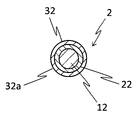
- the core wire 12 is a metal wire that serves as a core material for the guide wire 2.
- the second resin layer 32 is a resin layer formed on the outer periphery of the first resin layer 22.
- the surface roughness of the outer surface 32a of the second resin layer 32 is less than 1 ⁇ m in the arithmetic mean roughness (Ra) specified in JIS B 0601: 1994.
- the method for manufacturing the guide wire 2 for example, the method described in the section ⁇ Manufacturing method for guide wire> can be adopted.
- a method for manufacturing a guide wire has been described by exemplifying a compound such as a specific monomer.
- the method for producing the guide wire of the present disclosure is not limited to the above-exemplified compounds and the like.
Landscapes
- Health & Medical Sciences (AREA)
- Life Sciences & Earth Sciences (AREA)
- Biophysics (AREA)
- Pulmonology (AREA)
- Engineering & Computer Science (AREA)
- Anesthesiology (AREA)
- Biomedical Technology (AREA)
- Heart & Thoracic Surgery (AREA)
- Hematology (AREA)
- Animal Behavior & Ethology (AREA)
- General Health & Medical Sciences (AREA)
- Public Health (AREA)
- Veterinary Medicine (AREA)
- Media Introduction/Drainage Providing Device (AREA)
Priority Applications (2)
| Application Number | Priority Date | Filing Date | Title |
|---|---|---|---|
| PCT/JP2020/047510 WO2022130632A1 (ja) | 2020-12-18 | 2020-12-18 | ガイドワイヤの製造方法およびガイドワイヤ |
| JP2022569673A JPWO2022130632A1 (https=) | 2020-12-18 | 2020-12-18 |
Applications Claiming Priority (1)
| Application Number | Priority Date | Filing Date | Title |
|---|---|---|---|
| PCT/JP2020/047510 WO2022130632A1 (ja) | 2020-12-18 | 2020-12-18 | ガイドワイヤの製造方法およびガイドワイヤ |
Publications (1)
| Publication Number | Publication Date |
|---|---|
| WO2022130632A1 true WO2022130632A1 (ja) | 2022-06-23 |
Family
ID=82059393
Family Applications (1)
| Application Number | Title | Priority Date | Filing Date |
|---|---|---|---|
| PCT/JP2020/047510 Ceased WO2022130632A1 (ja) | 2020-12-18 | 2020-12-18 | ガイドワイヤの製造方法およびガイドワイヤ |
Country Status (2)
| Country | Link |
|---|---|
| JP (1) | JPWO2022130632A1 (https=) |
| WO (1) | WO2022130632A1 (https=) |
Citations (6)
| Publication number | Priority date | Publication date | Assignee | Title |
|---|---|---|---|---|
| JP2004130123A (ja) * | 2002-09-20 | 2004-04-30 | Ist:Kk | 医療用ガイドワイヤー及びその製造方法 |
| JP2008220789A (ja) * | 2007-03-14 | 2008-09-25 | Terumo Corp | ガイドワイヤ |
| JP2013192885A (ja) * | 2012-03-22 | 2013-09-30 | Terumo Corp | 医療用具およびその製造方法 |
| JP2013255694A (ja) * | 2012-06-13 | 2013-12-26 | Asahi Intecc Co Ltd | ガイドワイヤ |
| JP2015100664A (ja) * | 2013-11-28 | 2015-06-04 | 住友電気工業株式会社 | フッ素コートワイヤー |
| WO2018181187A1 (ja) * | 2017-03-30 | 2018-10-04 | テルモ株式会社 | 医療用具 |
-
2020
- 2020-12-18 JP JP2022569673A patent/JPWO2022130632A1/ja active Pending
- 2020-12-18 WO PCT/JP2020/047510 patent/WO2022130632A1/ja not_active Ceased
Patent Citations (6)
| Publication number | Priority date | Publication date | Assignee | Title |
|---|---|---|---|---|
| JP2004130123A (ja) * | 2002-09-20 | 2004-04-30 | Ist:Kk | 医療用ガイドワイヤー及びその製造方法 |
| JP2008220789A (ja) * | 2007-03-14 | 2008-09-25 | Terumo Corp | ガイドワイヤ |
| JP2013192885A (ja) * | 2012-03-22 | 2013-09-30 | Terumo Corp | 医療用具およびその製造方法 |
| JP2013255694A (ja) * | 2012-06-13 | 2013-12-26 | Asahi Intecc Co Ltd | ガイドワイヤ |
| JP2015100664A (ja) * | 2013-11-28 | 2015-06-04 | 住友電気工業株式会社 | フッ素コートワイヤー |
| WO2018181187A1 (ja) * | 2017-03-30 | 2018-10-04 | テルモ株式会社 | 医療用具 |
Also Published As
| Publication number | Publication date |
|---|---|
| JPWO2022130632A1 (https=) | 2022-06-23 |
Similar Documents
| Publication | Publication Date | Title |
|---|---|---|
| JPH09157578A (ja) | 含フッ素塗料用材料およびそれを用いた被覆方法 | |
| JP4144020B2 (ja) | フッ素樹脂粉体塗料用粉末及びそれを用いた塗料組成物 | |
| CN106459233B (zh) | 乙烯/四氟乙烯共聚物、其制造方法、粉体涂料、以及成形体 | |
| CN111801359A (zh) | 含氟聚合物的制造方法 | |
| WO2010123002A1 (ja) | エチレン/テトラフルオロエチレン共重合体、電線及び回転成形用フッ素樹脂粉末 | |
| CN1226315C (zh) | 用改进的水乳浊液聚合工艺制备含氟聚合物 | |
| WO2018070437A1 (ja) | 積層体およびその製造方法 | |
| US5662972A (en) | Tubular laminate and process for producing the same | |
| WO2022130632A1 (ja) | ガイドワイヤの製造方法およびガイドワイヤ | |
| WO2002051875A1 (fr) | Procede de production de fluoropolymeres | |
| JP6477709B2 (ja) | 樹脂被覆金属管およびその製造方法 | |
| Kostov et al. | Synthesis and characterizations of photo-cross-linkable telechelic diacrylate poly (vinylidene fluoride-co-perfluoromethyl vinyl ether) copolymers | |
| JP4744669B2 (ja) | 硬化性含フッ素共重合体ならびにその製造方法及び組成物 | |
| JP7533467B2 (ja) | フッ素樹脂の表面改質方法 | |
| JP5165184B2 (ja) | 中空物品の内部表面をロトライニングするためのフルオロポリマー組成物 | |
| JPWO2005033150A1 (ja) | 含フッ素重合体組成物製造方法及び含フッ素重合体組成物 | |
| JP2611498B2 (ja) | 含フッ素ゴム組成物 | |
| JP2005212318A (ja) | フッ素樹脂被膜を含む積層体及び被膜形成性フッ素樹脂 | |
| CN102264778A (zh) | 使用含氢的支链氟代醚表面活性剂的氟化单体的含水聚合反应 | |
| JP2008525616A (ja) | フルオロポリマー組成物、コートされた物品、およびその製造方法 | |
| JPH04131167A (ja) | 弗素化された熱可塑性樹脂を用いた粉末被覆法 | |
| JPH0811268A (ja) | フッ素樹脂積層体 | |
| JPWO2004065504A1 (ja) | 粉体塗料、塗膜形成方法及び積層体 | |
| US20070026222A1 (en) | Laminate with fluoropolymer film and film-forming fluoropolymer | |
| JP5746463B2 (ja) | 電気めっき治具及びその製造方法 |
Legal Events
| Date | Code | Title | Description |
|---|---|---|---|
| 121 | Ep: the epo has been informed by wipo that ep was designated in this application |
Ref document number: 20966018 Country of ref document: EP Kind code of ref document: A1 |
|
| ENP | Entry into the national phase |
Ref document number: 2022569673 Country of ref document: JP Kind code of ref document: A |
|
| NENP | Non-entry into the national phase |
Ref country code: DE |
|
| 122 | Ep: pct application non-entry in european phase |
Ref document number: 20966018 Country of ref document: EP Kind code of ref document: A1 |