WO2022102778A1 - 積層体 - Google Patents
積層体 Download PDFInfo
- Publication number
- WO2022102778A1 WO2022102778A1 PCT/JP2021/041955 JP2021041955W WO2022102778A1 WO 2022102778 A1 WO2022102778 A1 WO 2022102778A1 JP 2021041955 W JP2021041955 W JP 2021041955W WO 2022102778 A1 WO2022102778 A1 WO 2022102778A1
- Authority
- WO
- WIPO (PCT)
- Prior art keywords
- layer
- silicone
- laminate
- polyimide
- less
- Prior art date
- Legal status (The legal status is an assumption and is not a legal conclusion. Google has not performed a legal analysis and makes no representation as to the accuracy of the status listed.)
- Ceased
Links
Classifications
-
- B—PERFORMING OPERATIONS; TRANSPORTING
- B32—LAYERED PRODUCTS
- B32B—LAYERED PRODUCTS, i.e. PRODUCTS BUILT-UP OF STRATA OF FLAT OR NON-FLAT, e.g. CELLULAR OR HONEYCOMB, FORM
- B32B27/00—Layered products comprising a layer of synthetic resin
- B32B27/28—Layered products comprising a layer of synthetic resin comprising synthetic resins not wholly covered by any one of the sub-groups B32B27/30 - B32B27/42
- B32B27/281—Layered products comprising a layer of synthetic resin comprising synthetic resins not wholly covered by any one of the sub-groups B32B27/30 - B32B27/42 comprising polyimides
-
- B—PERFORMING OPERATIONS; TRANSPORTING
- B32—LAYERED PRODUCTS
- B32B—LAYERED PRODUCTS, i.e. PRODUCTS BUILT-UP OF STRATA OF FLAT OR NON-FLAT, e.g. CELLULAR OR HONEYCOMB, FORM
- B32B27/00—Layered products comprising a layer of synthetic resin
-
- B—PERFORMING OPERATIONS; TRANSPORTING
- B32—LAYERED PRODUCTS
- B32B—LAYERED PRODUCTS, i.e. PRODUCTS BUILT-UP OF STRATA OF FLAT OR NON-FLAT, e.g. CELLULAR OR HONEYCOMB, FORM
- B32B27/00—Layered products comprising a layer of synthetic resin
- B32B27/06—Layered products comprising a layer of synthetic resin as the main or only constituent of a layer, which is next to another layer of the same or of a different material
- B32B27/08—Layered products comprising a layer of synthetic resin as the main or only constituent of a layer, which is next to another layer of the same or of a different material of synthetic resin
-
- B—PERFORMING OPERATIONS; TRANSPORTING
- B32—LAYERED PRODUCTS
- B32B—LAYERED PRODUCTS, i.e. PRODUCTS BUILT-UP OF STRATA OF FLAT OR NON-FLAT, e.g. CELLULAR OR HONEYCOMB, FORM
- B32B27/00—Layered products comprising a layer of synthetic resin
- B32B27/18—Layered products comprising a layer of synthetic resin characterised by the use of special additives
-
- B—PERFORMING OPERATIONS; TRANSPORTING
- B32—LAYERED PRODUCTS
- B32B—LAYERED PRODUCTS, i.e. PRODUCTS BUILT-UP OF STRATA OF FLAT OR NON-FLAT, e.g. CELLULAR OR HONEYCOMB, FORM
- B32B27/00—Layered products comprising a layer of synthetic resin
- B32B27/28—Layered products comprising a layer of synthetic resin comprising synthetic resins not wholly covered by any one of the sub-groups B32B27/30 - B32B27/42
- B32B27/283—Layered products comprising a layer of synthetic resin comprising synthetic resins not wholly covered by any one of the sub-groups B32B27/30 - B32B27/42 comprising polysiloxanes
-
- B—PERFORMING OPERATIONS; TRANSPORTING
- B32—LAYERED PRODUCTS
- B32B—LAYERED PRODUCTS, i.e. PRODUCTS BUILT-UP OF STRATA OF FLAT OR NON-FLAT, e.g. CELLULAR OR HONEYCOMB, FORM
- B32B27/00—Layered products comprising a layer of synthetic resin
- B32B27/34—Layered products comprising a layer of synthetic resin comprising polyamides
-
- B—PERFORMING OPERATIONS; TRANSPORTING
- B32—LAYERED PRODUCTS
- B32B—LAYERED PRODUCTS, i.e. PRODUCTS BUILT-UP OF STRATA OF FLAT OR NON-FLAT, e.g. CELLULAR OR HONEYCOMB, FORM
- B32B37/00—Methods or apparatus for laminating, e.g. by curing or by ultrasonic bonding
- B32B37/14—Methods or apparatus for laminating, e.g. by curing or by ultrasonic bonding characterised by the properties of the layers
- B32B37/26—Methods or apparatus for laminating, e.g. by curing or by ultrasonic bonding characterised by the properties of the layers with at least one layer which influences the bonding during the lamination process, e.g. release layers or pressure equalising layers
-
- B—PERFORMING OPERATIONS; TRANSPORTING
- B32—LAYERED PRODUCTS
- B32B—LAYERED PRODUCTS, i.e. PRODUCTS BUILT-UP OF STRATA OF FLAT OR NON-FLAT, e.g. CELLULAR OR HONEYCOMB, FORM
- B32B7/00—Layered products characterised by the relation between layers; Layered products characterised by the relative orientation of features between layers, or by the relative values of a measurable parameter between layers, i.e. products comprising layers having different physical, chemical or physicochemical properties; Layered products characterised by the interconnection of layers
- B32B7/02—Physical, chemical or physicochemical properties
- B32B7/022—Mechanical properties
-
- B—PERFORMING OPERATIONS; TRANSPORTING
- B32—LAYERED PRODUCTS
- B32B—LAYERED PRODUCTS, i.e. PRODUCTS BUILT-UP OF STRATA OF FLAT OR NON-FLAT, e.g. CELLULAR OR HONEYCOMB, FORM
- B32B7/00—Layered products characterised by the relation between layers; Layered products characterised by the relative orientation of features between layers, or by the relative values of a measurable parameter between layers, i.e. products comprising layers having different physical, chemical or physicochemical properties; Layered products characterised by the interconnection of layers
- B32B7/02—Physical, chemical or physicochemical properties
- B32B7/027—Thermal properties
-
- B—PERFORMING OPERATIONS; TRANSPORTING
- B32—LAYERED PRODUCTS
- B32B—LAYERED PRODUCTS, i.e. PRODUCTS BUILT-UP OF STRATA OF FLAT OR NON-FLAT, e.g. CELLULAR OR HONEYCOMB, FORM
- B32B7/00—Layered products characterised by the relation between layers; Layered products characterised by the relative orientation of features between layers, or by the relative values of a measurable parameter between layers, i.e. products comprising layers having different physical, chemical or physicochemical properties; Layered products characterised by the interconnection of layers
- B32B7/04—Interconnection of layers
- B32B7/06—Interconnection of layers permitting easy separation
-
- C—CHEMISTRY; METALLURGY
- C08—ORGANIC MACROMOLECULAR COMPOUNDS; THEIR PREPARATION OR CHEMICAL WORKING-UP; COMPOSITIONS BASED THEREON
- C08K—Use of inorganic or non-macromolecular organic substances as compounding ingredients
- C08K3/00—Use of inorganic substances as compounding ingredients
- C08K3/01—Use of inorganic substances as compounding ingredients characterized by their specific function
- C08K3/013—Fillers, pigments or reinforcing additives
-
- C—CHEMISTRY; METALLURGY
- C08—ORGANIC MACROMOLECULAR COMPOUNDS; THEIR PREPARATION OR CHEMICAL WORKING-UP; COMPOSITIONS BASED THEREON
- C08K—Use of inorganic or non-macromolecular organic substances as compounding ingredients
- C08K3/00—Use of inorganic substances as compounding ingredients
- C08K3/18—Oxygen-containing compounds, e.g. metal carbonyls
- C08K3/20—Oxides; Hydroxides
- C08K3/22—Oxides; Hydroxides of metals
-
- C—CHEMISTRY; METALLURGY
- C08—ORGANIC MACROMOLECULAR COMPOUNDS; THEIR PREPARATION OR CHEMICAL WORKING-UP; COMPOSITIONS BASED THEREON
- C08L—COMPOSITIONS OF MACROMOLECULAR COMPOUNDS
- C08L83/00—Compositions of macromolecular compounds obtained by reactions forming in the main chain of the macromolecule a linkage containing silicon with or without sulfur, nitrogen, oxygen or carbon only; Compositions of derivatives of such polymers
- C08L83/04—Polysiloxanes
-
- C—CHEMISTRY; METALLURGY
- C23—COATING METALLIC MATERIAL; COATING MATERIAL WITH METALLIC MATERIAL; CHEMICAL SURFACE TREATMENT; DIFFUSION TREATMENT OF METALLIC MATERIAL; COATING BY VACUUM EVAPORATION, BY SPUTTERING, BY ION IMPLANTATION OR BY CHEMICAL VAPOUR DEPOSITION, IN GENERAL; INHIBITING CORROSION OF METALLIC MATERIAL OR INCRUSTATION IN GENERAL
- C23C—COATING METALLIC MATERIAL; COATING MATERIAL WITH METALLIC MATERIAL; SURFACE TREATMENT OF METALLIC MATERIAL BY DIFFUSION INTO THE SURFACE, BY CHEMICAL CONVERSION OR SUBSTITUTION; COATING BY VACUUM EVAPORATION, BY SPUTTERING, BY ION IMPLANTATION OR BY CHEMICAL VAPOUR DEPOSITION, IN GENERAL
- C23C26/00—Coating not provided for in groups C23C2/00 - C23C24/00
-
- B—PERFORMING OPERATIONS; TRANSPORTING
- B32—LAYERED PRODUCTS
- B32B—LAYERED PRODUCTS, i.e. PRODUCTS BUILT-UP OF STRATA OF FLAT OR NON-FLAT, e.g. CELLULAR OR HONEYCOMB, FORM
- B32B37/00—Methods or apparatus for laminating, e.g. by curing or by ultrasonic bonding
- B32B37/14—Methods or apparatus for laminating, e.g. by curing or by ultrasonic bonding characterised by the properties of the layers
- B32B37/26—Methods or apparatus for laminating, e.g. by curing or by ultrasonic bonding characterised by the properties of the layers with at least one layer which influences the bonding during the lamination process, e.g. release layers or pressure equalising layers
- B32B2037/268—Release layers
-
- C—CHEMISTRY; METALLURGY
- C08—ORGANIC MACROMOLECULAR COMPOUNDS; THEIR PREPARATION OR CHEMICAL WORKING-UP; COMPOSITIONS BASED THEREON
- C08K—Use of inorganic or non-macromolecular organic substances as compounding ingredients
- C08K3/00—Use of inorganic substances as compounding ingredients
- C08K3/18—Oxygen-containing compounds, e.g. metal carbonyls
- C08K3/20—Oxides; Hydroxides
- C08K3/22—Oxides; Hydroxides of metals
- C08K2003/2237—Oxides; Hydroxides of metals of titanium
- C08K2003/2241—Titanium dioxide
Definitions
- the present invention relates to a laminate having at least two resin layers, which is used for, for example, a mold release material, a cushioning material, a non-slip material, etc., and has a silicone layer and a polyimide layer.
- silicones typified by silicone rubbers and silicone resins, especially silicone rubbers such as mirable type, have excellent heat resistance and electrical properties, and are therefore widely used in applications such as mold release materials, cushioning materials, and non-slip materials.
- mold release materials such as press molding, a cushioning material, or the like.
- non-slip material for transport carriers in reflow processes and the like.
- silicone composed of a single silicone layer such as silicone rubber is used as it is as a release material for press molding, deformation occurs, assembly dimensional accuracy deteriorates, and wrinkles occur, which causes problems in workability. Therefore, it is known that silicone is used as a laminate by compositely integrating a plastic film.
- the plastic film for example, as disclosed in Patent Document 1, a polyester resin film or the like is used. Further, the silicone is often laminated on the polyester resin film via an undercoat layer or the like in order to improve the adhesiveness.
- press molding performed on all-solid-state batteries, semiconductors, etc. tends to have a high molding temperature and molding pressure.
- press working may be performed at a temperature of about 100 to 300 ° C. and a pressure of about 50 to 1000 MPa.
- the press molding temperature tends to be high also in the manufacturing process of FPC.
- the silicone film (silicone layer) is integrated with another plastic film such as a polyester film and used repeatedly by press molding in a high temperature environment, the silicone film itself becomes brittle and has cushioning properties. Cannot be maintained, and problems such as being unable to be used repeatedly for a long period of time occur.
- a silicone film laminated on a metal plate is often used, but from the viewpoint of weight reduction, a resin sheet is used instead of the metal plate.
- a resin sheet is used instead of the metal plate.
- the transport carrier is also heated to a high temperature, which makes the silicone film brittle and causes dimensional changes in the polyester film, making it difficult to use for a long period of time and practical use.
- the present inventor has used a polyimide layer as a resin layer integrated with a silicone layer, or a resin layer (A) having a tensile storage elastic modulus that can be suitably used in a specific application.
- a polyimide layer as a resin layer integrated with a silicone layer, or a resin layer (A) having a tensile storage elastic modulus that can be suitably used in a specific application.
- B) and using a silicone layer or a resin layer (A) having a low weight loss rate even when heated at a high temperature and completed the following invention. That is, the present invention provides the following [1] to [16].
- [1] A laminate having a silicone layer and a polyimide layer.
- a laminate comprising a resin layer (A) having a tensile storage elastic modulus of 100 MPa or less at 23 ° C. and a resin layer (B) having a tensile storage elastic modulus of 1 GPa or more at 23 ° C.
- a laminate comprising a resin layer (A) having a tensile storage elastic modulus of 100 MPa or less at 23 ° C. and a resin layer (B) having a tensile storage elastic modulus of 1 GPa or more at 23 ° C.
- a laminate comprising a resin layer (A) having a tensile storage elastic modulus of 100 MPa or less at 23 ° C. and a resin layer (B) having a tensile storage elastic modulus of 1 GPa or more at 23 ° C.
- the cover film When used as a mold release material or a cushioning material at the time of molding, the cover film is peeled off, the polyimide layer side is arranged on the molding mold side, and the silicone layer side is arranged on the molded body side. ]. How to use the laminate according to any one of.
- the present invention it is possible to provide a laminate having a silicone layer, which can be used for a long period of time without embrittlement of the silicone layer even when used in a high temperature environment. Further, according to the present invention, it is possible to provide a laminate that is suppressed from embrittlement even when used in a high temperature environment, can be used for a long period of time, and is suitably used for a specific application.
- the term "main component” includes the meaning of allowing other components to be contained within a range that does not interfere with the function of the main component, unless otherwise specified.
- the main component is 50% by mass or more, preferably 60% by mass or more, more preferably 70% by mass or more, and further preferably 80% by mass in the composition. As mentioned above, it occupies 90% by mass or more (including 100%) particularly preferably.
- X to Y when expressed as "X to Y" (X and Y are arbitrary numbers), unless otherwise specified, it means “X or more and Y or less", and “preferably larger than X” and “preferably larger than X”. Includes the meaning of "smaller than Y”. Further, in the present invention, when expressed as “X or more” (X is an arbitrary number), it includes the meaning of “preferably larger than X” and “Y or less” (Y is an arbitrary number) unless otherwise specified. When expressed as, it includes the meaning of "preferably smaller than Y” unless otherwise specified.
- the laminate of the present invention is a laminate including a silicone layer and a polyimide layer.
- the polyimide layer in addition to the silicone layer, wrinkles and bending are less likely to occur, and the heat resistance is improved. Therefore, for example, the productivity of the molded product when used as a mold release material such as press molding, vacuum forming, pressure forming, or a cushioning material is improved. Further, for example, when it is used as a carrier film for transporting, it is possible to appropriately transport the work even when it is used in a high temperature environment. Furthermore, the laminate can be used repeatedly for a long period of time in a high temperature environment.
- the silicone layer of the present invention has a weight loss rate of 9% by mass or less at 380 ° C. by thermogravimetric analysis.
- the weight reduction rate at 380 ° C. exceeds 9% by mass, the silicone layer becomes brittle when the laminate is used in a high temperature environment, the performance such as cushioning property cannot be maintained, and dimensional changes are likely to occur. Therefore, there are problems such as the laminated body cannot be used repeatedly for a long period of time in a high temperature environment. From the viewpoint of suppressing embrittlement of the silicone layer in a high temperature environment and enabling the laminated body to be used for a longer period of time, the weight reduction rate at 380 ° C.
- the weight loss rate at 380 ° C. is preferably 7% by mass or less, more preferably 6% by mass or less. 5% by mass or less is more preferable.
- the weight loss rate at 380 ° C. by thermal weight measurement indicates the ratio of the weight loss rate at 380 ° C. to the initial weight by heating the sample collected from the silicone layer at a constant temperature rise rate in the atmosphere. For details, the measurement can be performed by the method described in Examples.
- the silicone layer preferably has a tensile fracture stress retention rate of 10% or more after being heat-treated at 300 ° C. for 3 hours, more preferably 20% or more, further preferably 30% or more, still more preferably 35%, and particularly preferably. Is 40% or more, most preferably 45% or more.
- a tensile fracture stress retention rate of 10% or more after being heat-treated at 300 ° C. for 3 hours, more preferably 20% or more, further preferably 30% or more, still more preferably 35%, and particularly preferably. Is 40% or more, most preferably 45% or more.
- the silicone layer preferably has a tensile fracture strain retention rate of 10% or more, more preferably 30% or more, still more preferably 40% or more, still more preferably 50% or more after being heat-treated at 300 ° C. for 3 hours. It is particularly preferably 60% or more, and most preferably 70% or more.
- the tensile fracture strain retention rate during high-temperature heating becomes high as described above, the cushioning property of the silicone layer is maintained even after heating at high temperature for a long period of time, and the laminate can be used for a long period of time.
- the tensile fracture stress retention rate and the tensile fracture strain retention rate were measured at the initial stage before the heat treatment and after heat treatment at 300 ° C. for 3 hours, and then a tensile test was performed at each to measure the stress and elongation at the time of tensile fracture before and after the heat treatment.
- the ratio of the fracture stress and the fracture strain after the heat treatment to the initial fracture stress and the initial fracture strain before the heat treatment is shown as a percentage.
- the tensile direction may be the resin flow direction (MD), but if the MD is unknown, the fracture stress and fracture strain are measured by pulling in the direction in which the initial fracture stress is highest. good.
- the measurement may be performed on a test piece cut out from the silicone layer of the laminated body, and if it is difficult to cut out, a sample prepared by the same method as the method for forming the silicone layer in the laminated body (thickness is also the same as that of the laminated body). It may be measured for the same as the silicone layer).
- the tensile storage elastic modulus which will be described later, may be measured in the same manner.
- the initial fracture stress of the silicone layer is not particularly limited, but is preferably 3 MPa or more, more preferably 5 MPa or more, further preferably 8 MPa or more, and for example, 25 MPa or less, preferably 20 MPa or less, more preferably 15 MPa or less.
- the initial fracture strain of the silicone layer is not particularly limited, but is preferably 200% or more, more preferably 250% or more, further preferably 300% or more, particularly preferably 350% or more, and for example, 1400% or less. It is preferably 1300% or less.
- the silicone layer of the present invention is a layer containing silicone as a main component.
- the silicone preferably contains a silicone having a siloxane skeleton represented by the following formula (1).
- a silicone having a siloxane skeleton represented by the following formula (1) in addition to polydimethylsiloxane in which all Rs in the formula are methyl groups, a part of the methyl group (for example, about 30 mol% or less, preferably about 20 mol% or less) is another.
- Various polydimethylsiloxanes substituted with one or more of an alkyl group, a vinyl group, a phenyl group, a fluoroalkyl group and the like can also be appropriately selected.
- n in the equation is a positive integer of 1 or more, preferably 3 to 5000.
- the silicone is preferably a silicone elastomer resin. Therefore, the silicone layer preferably contains a silicone elastomer resin, and more preferably contains a silicone elastomer resin as a main component. As an example of the silicone elastomer resin, a silicone elastomer resin containing polydimethylsiloxane as a main component is preferably mentioned.
- the silicone elastomer resin particularly polydimethylsiloxane, preferably contains a vinyl group.
- a vinyl group By containing a vinyl group, the compression set becomes smaller, the thickness tends to be less likely to change even after repeated use during press molding, etc., sufficient cushioning property is maintained, and durability tends to be excellent.
- the content of the vinyl group with respect to the total amount of the silicone elastomer resin is preferably 0.05 to 5 mol%, more preferably 0.5 to 4 mol%, and 1 to 3 mol. % Is more preferable.
- the content of the vinyl group is at least the above lower limit value, it becomes easy to adjust the crosslink density of the silicone elastomer resin, and it tends to be easy to obtain a silicone elastomer resin having a desired compression set.
- it is at least the above upper limit value it is preferable because the silicone elastomer resin is not excessively crosslinked.
- the silicone elastomer resin may contain a silicone elastomer resin containing no vinyl group from the viewpoint of adjusting the cross-linking point, and the silicone elastomer resin containing a vinyl group and the silicone elastomer resin containing no vinyl group may be contained. It may be used together.
- the silicone elastomer resin is preferably a mirabable type.
- the mirabable silicone elastomer resin is a non-liquid (for example, solid or paste) having no self-fluidity at room temperature (25 ° C.) in an uncrosslinked state, but is mixed with other components in a kneader or the like. It can be mixed uniformly with additives and the like described later. Further, since the silicone elastomer resin is a mirable type, the productivity is improved.
- the silicone elastomer resin is crosslinked in the silicone layer.
- the silicone elastomer layer By cross-linking the silicone elastomer layer, cushioning properties and the like are easily imparted, and compression set and the like are improved, so that the silicone elastomer layer can be suitably used as a mold release material, a cushioning material, etc. at the time of press molding.
- the silicone layer is more preferably a radiation crosslinked body crosslinked by radiation.
- the silicone layer of the present invention preferably contains a metal oxide.
- the metal oxide include titanium oxide, iron oxide, cerium oxide and the like, and among these, titanium oxide and iron oxide are preferable. Further, in particular, iron oxide is more preferable from the viewpoint of maintaining a high tensile fracture strain retention rate, and titanium oxide is more preferable from the viewpoint of appearance such as coloring.
- the metal oxide may be used alone or in combination of two or more.
- the content of the metal oxide in the silicone layer is preferably 0.1 to 10% by mass, more preferably 0.3 to 7% by mass, further preferably 0.5 to 5% by mass, and 0.7 to 3% by mass. Is particularly preferable.
- the heat resistance is appropriately improved, and the weight loss rate at the above-mentioned 380 ° C. is sufficiently lowered.
- the value can be improved without impairing the performance such as the cushioning property of the silicone layer.
- the silicone layer of the present invention preferably contains carbon black.
- carbon black By containing carbon black in the silicone layer, the heat resistance is improved and the weight loss rate at 380 ° C. described above is lowered. Then, the tensile fracture stress retention rate and the tensile fracture strain retention rate after the above heat treatment can be increased. In addition, flame resistance can be improved.
- Examples of carbon black include graphitized carbon, furnace black, acetylene black, and ketjen black, and among these, furnace black is preferable from the viewpoint of availability and price.
- One type of carbon black may be used alone, or two or more types may be used in combination.
- the content of carbon black in the silicone layer is preferably 0.05 to 10% by mass, more preferably 0.1 to 5% by mass, further preferably 0.2 to 3% by mass, and 0.3 to 2% by mass. Especially preferable.
- the heat resistance is appropriately improved, and the weight loss rate at the above-mentioned 380 ° C. is sufficiently lowered.
- the value is set to the upper limit or less, the heat resistance and the flame resistance can be improved without impairing the performance such as the cushioning property of the silicone layer.
- the silicone layer contains reinforcing fillers such as fumed silica, precipitated silica, diatomaceous earth, and quartz powder, various processing aids, heat resistance improvers, and various additives that give functionality to the elastomer. It may be contained. These can be used alone or in combination of two or more. Examples of the additive include a flame retardant-imparting agent, a heat-dissipating filler, a conductive filler and the like.
- reinforcing fillers such as fumed silica, precipitated silica, diatomaceous earth, and quartz powder, various processing aids, heat resistance improvers, and various additives that give functionality to the elastomer. It may be contained. These can be used alone or in combination of two or more. Examples of the additive include a flame retardant-imparting agent, a heat-dissipating filler, a conductive filler and the like.
- the type A durometer hardness of the silicone layer is preferably 3 or more, more preferably 5 or more, further preferably 15 or more, particularly preferably 25 or more, and 35 or more. Is particularly preferable, and 45 or more is most preferable. Further, the type A durometer hardness is preferably 90 or less, more preferably 80 or less, further preferably 70 or less, and particularly preferably 60 or less.
- the hardness of the type A durometer can be measured according to JIS K6253-3: 2012.
- Examples of the method for adjusting the hardness of the Type A durometer include a method of adjusting the filling amount of a filler such as silica to be blended in the silicone layer as a filler, a method of appropriately selecting the type of the raw material silicone, and the like.
- the silicone layer has a tensile storage elastic modulus of, for example, 100 MPa or less at 23 ° C., preferably 100 MPa or less, from the viewpoints of followability to the molded body during press molding, adhesion, and surface tackiness of the silicone layer. It is 70 MPa or less, more preferably 50 MPa or less, still more preferably 30 MPa or less, and particularly preferably 10 MPa or less. Further, it is preferably 0.1 MPa or more, more preferably 0.5 MPa or more, and further preferably 1 MPa or more.
- silicone elastomer resin a commercially available silicone elastomer resin containing a metal oxide as a heat resistance improver can also be used.
- Commercially available products include “X-30-3888-U” manufactured by Shin-Etsu Chemical Industry Co., Ltd., which contains about 1 to 3% by mass of iron oxide as a metal oxide, and about 1 to 10% by mass of titanium oxide as a metal oxide. Examples thereof include “TSE2323-5U” manufactured by Momentive Performance Materials Co., Ltd., and “TSE2323-7U” manufactured by Momentive Performance Materials Co., Ltd. containing about 0.1 to 1% by mass of titanium oxide.
- the thickness of the silicone layer may be appropriately selected depending on the intended use, but is preferably 3 mm or less, more preferably 1 mm or less, further preferably 800 ⁇ m or less, and particularly preferably 600 ⁇ m or less. It is particularly preferably 400 ⁇ m or less. Further, from the viewpoint of appropriate elasticity, long-term use and repeated use, the lower limit is preferably 10 ⁇ m, more preferably 20 ⁇ m, further preferably 30 ⁇ m, and particularly preferably 50 ⁇ m. ..
- the polyimide layer of the present invention contains polyimide as a main component.
- the polyimide layer of the present invention preferably has a temperature of 2% weight loss by thermogravimetric analysis of 260 ° C. or higher.
- the temperature is 260 ° C. or higher, the heat resistance of the polyimide layer is improved, and when used in combination with the above-mentioned silicone layer, the heat resistance of the laminated body is further improved. Therefore, in various applications used in a high temperature environment, the laminated body can be repeatedly used for a long period of time without deteriorating the performance of the laminated body.
- the temperature of 2% weight reduction by thermogravimetric analysis is more preferably 275 ° C or higher, further preferably 350 ° C or higher, further preferably 400 ° C or higher, still more preferably 450 ° C or higher, from the viewpoint of heat resistance, durability and the like. Preferably, 500 ° C. or higher is particularly preferable, and 540 ° C. or higher is most preferable.
- the temperature of the 2% weight reduction by thermogravimetric measurement of the polyimide layer is not particularly limited, but is, for example, 750 ° C. or lower, and may be 700 ° C. or lower.
- the temperature of 2% weight loss by thermogravimetric analysis is a temperature at which the sample collected from the polyimide layer is heated in the atmosphere and the weight loss with respect to the initial weight is 2%, and the details can be measured by the method described in Examples. ..
- the polyimide layer of the present invention preferably has a tensile storage elastic modulus of 2 GPa or more at 300 ° C.
- the tensile storage elastic modulus at 300 ° C. is 2 GPa or more, dimensional changes such as the laminated body extending in the plane direction are suppressed even if pressure is applied to the laminated body by press molding or the like at a high temperature. Therefore, even if distortion occurs with the silicone layer, it does not peel off, and the laminated body can be easily used repeatedly in a higher temperature environment. From the viewpoint of reducing dimensional changes even when pressure is applied in a high temperature environment, the tensile storage elastic modulus at 300 ° C.
- the tensile storage elastic modulus at 300 ° C. is not limited with respect to the upper limit, and may be, for example, 10 GPa or less, 7 GPa or less, or 6 GPa or less.
- the polyimide layer preferably has a tensile storage elastic modulus at 23 ° C. higher than that of the silicone layer at 23 ° C. Further, the polyimide layer preferably has a tensile storage elastic modulus at 23 ° C. of 3.7 GPa or more.
- the tensile storage elastic modulus of the polyimide layer at room temperature is high as described above, the handling property becomes good, and for example, it becomes easy to set the molded body at the time of molding. Further, when manufacturing a laminate by a laminating method or the like, tension is likely to act even if it is thin, the production is easy, and the obtained laminate tends to have less wrinkles and the like.
- the tensile storage elastic modulus at 23 ° C. is preferably 4 GPa or more, more preferably 4.5 GPa or more, still more preferably 5 GPa or more, particularly preferably 6 GPa or more, and most preferably 7 GPa or more. be.
- the tensile storage elastic modulus at 23 ° C. is not limited with respect to the upper limit, and may be, for example, 15 GPa or less, 13 GPa or less, or 11 GPa or less.
- the tensile storage elastic modulus of the silicone layer at 23 ° C. may also be measured by using a viscoelastic spectrometer to measure the tensile storage elastic modulus with respect to the single layer of the silicone layer.
- the tensile storage elastic modulus may be a value measured in the resin flow direction (MD: Machine Direction), but when the MD is unknown, the value in the direction in which the tensile storage elastic modulus is highest is used. You can adopt it.
- the polyimide layer preferably has a coefficient of linear expansion of 33 ⁇ 10 -6 / ° C. or less.
- the linear expansion coefficient of the polyimide layer is 33 ⁇ 10 -6 / ° C. or less, the dimensional change is small even after the temperature is changed from a low temperature to a high temperature and repeated use, and the dimensional stability is improved. Therefore, it can be suitably used for various applications used in a high temperature environment.
- the coefficient of linear expansion of the polyimide layer is preferably 27 ⁇ 10 -6 / ° C or less, more preferably 22 ⁇ 10 -6 / ° C or less, even more preferably 18 ⁇ 10 -6 / ° C or less, and 14 ⁇ 10 -6 / ° C.
- the coefficient of linear expansion of the polyimide layer is not particularly limited, but may be, for example, 5 ⁇ 10 -6 / ° C. or higher, and may be 8 ⁇ 10 -6 / ° C. or higher.
- the outermost surface of the laminate composed of the polyimide layer preferably has an arithmetic mean roughness (Ra) of 26 nm or less.
- Ra arithmetic mean roughness
- the polyimide layer comes into contact with the molding die side of the press plate or the like, but if the arithmetic average roughness (Ra) is 26 nm or less, the polyimide layer is in contact with the molding die such as the press plate when an initial pressure is applied. It becomes difficult to shift, and the moldability becomes good when it is used as a mold release material, a cushioning material, or the like.
- the arithmetic average roughness (Ra) of both outermost surfaces is 26 nm or less. Is preferable.
- both outermost surfaces of the laminated body are polyimide layers, for example, one is in contact with a molding die such as a press plate and the other is in contact with the molded body. Therefore, when the arithmetic mean roughness of both outermost surfaces becomes smaller, not only the molding die such as a press plate but also the molded body is less likely to be displaced, and the moldability when used as a mold release material, a cushioning material, etc. is further improved.
- the arithmetic mean roughness (Ra) is more preferably 20 nm or less, still more preferably 17 nm or less, still more preferably 13 nm or less, and particularly preferably 10 nm or less, from the viewpoint of preventing deviation from the molded product or a mold such as a press plate. Is.
- the lower limit of the arithmetic mean roughness (Ra) is not particularly limited, but is, for example, 0.5 nm, preferably 1 nm, more preferably 1.5 nm, and even more preferably 2 nm.
- the arithmetic average roughness is 0.5 nm or more
- the convex portions are in point contact with each other, so that the laminated bodies are suppressed from adhering to each other, and a laminated body having excellent peelability can be obtained. Easy to get rid of.
- the handleability tends to be excellent when the laminated bodies are taken out one by one. Further, after press molding, when the molding die such as a press plate is opened and the molded body is taken out, the problem that the laminated body adheres to the molding die side such as the press plate is improved, and the productivity tends to be improved.
- both outermost surfaces of the laminated body are polyimide layers, there is an advantage that the contact state with the molded body can be appropriately improved and the alignment on the molded body becomes easy.
- the surface roughness (Ra) is measured by a three-dimensional non-contact surface shape measuring machine, and may be measured under the measurement conditions described in the examples.
- the method for adjusting the arithmetic average roughness is not particularly limited, but for example, in a casting process in which a polyimide layer is applied onto a support, dried, and heat-treated, a mirror-polished metal roll or an endless metal belt used as the support is used. A method of appropriately adjusting the surface roughness of the polymer film or the like is preferably mentioned.
- the polyimide contained in the polyimide layer of the present invention may be any as long as it is obtained by polymerizing a tetracarboxylic acid or a tetracarboxylic acid dianhydride with a diamine, and an aromatic polyimide is preferably used, specifically, the polyimide is used.
- the aliphatic diamine contains an alicyclic diamine.
- the polyimide contained in the polyimide layer of the present invention for example, the polyimide represented by the following general formula (2) is used.
- R 1 is a tetravalent organic group containing an aromatic ring
- R 2 is a divalent organic group containing an aromatic ring
- m is an integer of 1 or more.
- the tetravalent organic group of R 1 may have an aromatic ring, and examples thereof include organic groups having 6 to 24 carbon atoms, preferably 6 to 18 carbon atoms, and more preferably 6 to 12 carbon atoms.
- Examples of R 1 include tetracarboxylic acid residues having an aromatic substance, and specific examples thereof include the following formulas (3-1) to (3-5).
- any of the formulas (3-1) and (3-2) is preferable, and among them, the organic group represented by any of the following (3-1') and (3-2') is preferable. It is more preferable that it is an organic group represented by the following (3-1').
- the polyimide represented by the general formula (2) contains, for example, 50 mol% or more, preferably 70, of the organic group represented by any of the above (3-1') and (3-2') in R1 . It is contained in a proportion of mol% or more, more preferably 90 mol% or more, and most preferably 100 mol%.
- the divalent organic group of R2 may have an aromatic ring, and examples thereof include organic groups having 6 to 24 carbon atoms, preferably 6 to 18 carbon atoms, and more preferably 6 to 15 carbon atoms.
- the divalent organic group of R2 is preferably an organic group represented by any of the following formulas (4) and (5).
- R 3 and R 4 are independently one of a hydrogen atom, a methyl group, and a halogen atom.
- the group represented by X is a single bond or oxygen.
- Atom, sulfur atom, C O, -CH 2- , -CH (CH 3 )-, -C (CH 3 ) 2- , -SO 2- , and -C (CF 3 ) 2- .
- R 5 , R 6 , R 7 and R 8 are each independently one of a hydrogen atom, a methyl group, and a halogen atom.
- R 2 of the polyimide represented by the general formula (2) is an organic group represented by the formula (4). Since at least a part of R 2 of the polyimide represented by the general formula (2) is an organic group represented by the formula (4), the heat resistance is high and the temperature of 2% weight loss is also high. Become. Further, the tensile storage elastic modulus at 300 ° C. becomes high, and further, the linear expansion coefficient of the polyimide layer becomes easy to be lowered.
- the above formula (4) preferably has a bond position at the 1st or 4th position from the viewpoint of heat resistance and low coefficient of linear expansion, and R 3 and R 4 are both hydrogen atoms. It is preferable to have. Therefore, it is more preferable that at least a part of R 2 in the formula (2) is an organic group represented by the following formula (4-1).
- the polyimide represented by the general formula (2) contains, for example, 10 mol% or more, preferably 30 mol% or more, more preferably 50 mol% of the organic group represented by the above formula (4-1) in R2 . It may be contained in the above ratio, 70 mol% or more, or 100 mol% or more.
- R 2 is an organic group represented by the above formula (4) (preferably the formula (4-1)), and a part of R 2 is the above formula (4).
- R 2 May be an organic group having an aromatic ring.
- R 2 other than the above formula (4) include divalent organic groups having 12 to 24 carbon atoms, preferably 12 to 18 carbon atoms, and more preferably 12 to 15 carbon atoms.
- the organic group represented by the above formula (5) is preferable.
- X is preferably an oxygen atom
- R 5 , R 6 , R 7 and R 8 are all preferably hydrogen atoms.
- the bonding position in the formula (5) is preferably the 4,4'position. Therefore, the organic group represented by the formula (5) is more preferably the organic group represented by the following formula (5-1).
- at least a part of R 2 is an organic group represented by the above formula (4) (preferably the formula (4-1)), and the rest are as follows. It is an organic group represented by the formula (5-1).
- the polyimide is preferably obtained by polymerizing 3,3', 4,4'-biphenyltetracarboxylic acid or its acid dianhydride with 1,4-phenylenediamine, and more specifically, the following.
- the polyimide represented by the formula (6) is preferable.
- the heat resistance is good and the temperature at which the weight of the polyimide layer is reduced by 2% is increased. Further, it becomes easy to obtain a polyimide layer having a low linear expansion coefficient and a high tensile storage elastic modulus at 300 ° C.
- a commercially available product can also be used, and specific examples thereof include "UPIREX-S" manufactured by Ube Kosan Co., Ltd.
- the polyimide a polyamide obtained by copolymerizing pyromellitic acid or an acid dianhydride thereof with paraphenylenediamine and 4,4'-diaminodiphenyl ether is also preferable, and specifically, the above formula (specifically, the above formula ( In 2), R 1 is an organic group of the formula (3-2'), a part of R 2 is an organic group of the formula (4-1), and the rest is an organic group of the formula (5-1). It is preferably a copolymer polyimide. By controlling the combination of monomers (sequence control), the copolymer polyimide can be a polyimide having relatively good heat resistance while lowering the coefficient of linear expansion.
- the coefficient of linear expansion is low and the heat resistance is excellent.
- Polyimide can be obtained. Therefore, the tensile storage elastic modulus of the polyimide layer at 300 ° C. and the temperature of 2% weight loss are likely to be increased.
- the copolymer polyimide a commercially available product can also be used, and examples thereof include "Apical NPI" manufactured by Kaneka Corporation.
- the polyimide does not need to have at least a part of R 2 an organic group represented by the above formula (4), and R 2 is a polyimide having the above formula (5), preferably the above formula (5-1). In that case, it is more preferable that R 1 is of the formula (3-2').
- a polyimide a commercially available product may be used, and specific examples thereof include "Apical AH” manufactured by Kaneka Corporation and "Kapton” manufactured by Toray DuPont.
- the polyimide layer of the present invention includes other resins, fillers, and various additives such as heat stabilizers, ultraviolet absorbers, light stabilizers, nucleating agents, and coloring agents, as long as the gist of the present invention is not exceeded. Agents, lubricants, flame retardants and the like may be appropriately blended.
- the content of the other resin is not particularly limited, but may be, for example, about 50 parts by mass or less, 30 parts by mass or less, or 10 parts by mass or less with respect to 100 parts by mass of the polyimide.
- the resin in the polyimide layer is preferably made of polyimide.
- the thickness of the polyimide layer may be appropriately selected depending on the intended use, but it should be 150 ⁇ m or less from the viewpoint of imparting desired heat resistance and dimensional stability to the laminate without impairing the cushioning property imparted by the silicone layer. It is more preferably 130 ⁇ m or less, further preferably 100 ⁇ m or less, particularly preferably 80 ⁇ m or less, particularly preferably 60 ⁇ m or less, and preferably 3 ⁇ m or more, 5 ⁇ m. It is more preferably 10 ⁇ m or more, and particularly preferably 15 ⁇ m or more.
- the thickness of the polyimide layer is the thickness of each polyimide layer provided on both sides of the silicone layer when the polyimide layers are provided on both sides of the silicone layer.
- the thickness ratio of the silicone layer: polyimide layer is preferably 99: 1 to 20:80.
- the thickness ratio of the laminated body is within the above range, heat resistance is improved and appropriate elasticity is obtained, so that the laminated body can be suitably used as a mold release material and a cushioning material.
- the thickness ratio is more preferably 95: 5 to 30:70, further preferably 90:10 to 40:60, and particularly preferably 85:15 to 50:50.
- the thickness of the polyimide layer referred to here means the thickness of the polyimide layer provided on one side of the silicone layer, and when the polyimide layers are provided on both sides of the silicone layer, they are provided on both sides of the silicone layer.
- the thickness of the polyimide layer is preferably within the above range.
- the laminate of the present invention may include a polyimide layer and a silicone layer, and may have a laminate structure in which the polyimide layer is provided on only one side of the silicone layer. That is, the laminated body of the present invention may have a laminated structure of a polyimide layer / a silicone layer. In the laminated structure, the polyimide layer may form one outermost surface of the laminated body, and the silicone layer may form the other outermost surface. More specifically, the laminate may have a two-kind two-layer structure, or may have a structure in which a primer layer described later is provided between the polyimide layer and the silicone layer in addition to the two-kind two-layer structure. ..
- the polyimide layer side is arranged on the molding mold side such as a press plate, and the silicone layer side is the molded body side. It is good to place it in. According to such an arrangement, the polyimide layer makes it difficult for the laminate to be displaced from the mold, while the silicone layer improves the mold releasability to the mold.
- the laminated body of the present invention may have a laminated structure in which polyimide layers are provided on both sides of the silicone layer. That is, the laminated body of the present invention may have a laminated structure of a polyimide layer / a silicone layer / a polyimide layer. In the laminated structure, the polyimide layer may form both outermost surfaces of the laminated body. More specifically, the laminate may have a two-kind three-layer structure, or in addition to the two-kind three-layer structure, one or both of the polyimide layer and the silicone layer have a primer layer described later. It may be a structure.
- the polyimide layer makes it difficult for the molded body and the molded body to be displaced, and the surface is smooth. It becomes easy to obtain a highly high-quality molded product.
- a low molecular weight siloxane component such as a low molecular weight cyclic siloxane may be precipitated by heating and adhere to a molding die or a obtained molded body to be contaminated.
- a polyimide layer should be provided on both sides.
- the precipitation of the low molecular weight siloxane component is prevented, and the contamination by the low molecular weight siloxane component is suppressed.
- the silicone film is used as a mold release material or a cushioning material
- the low molecular weight siloxane component adhering to the mold may be removed by heat treatment or the like, but the polyimide layers are provided on both sides. It is also possible to reduce the frequency of heat treatment.
- a laminate in which the polyimide layer is provided on only one side of the silicone layer is used.
- a method may be adopted in which the silicone layer side is arranged on the molding die side such as a press plate, and the polyimide layer side is arranged on the molded body side.
- the polyimide layer may be laminated directly on the silicone layer, or may be laminated via a primer layer.
- the primer layer preferably contains a silicone resin, and more preferably contains a silicone resin as a main component, from the viewpoint of ensuring adhesiveness to the silicone layer.
- the silicone resin that can be used for the primer layer include an addition type silicone resin, a condensation type silicone resin, a UV curable silicone resin, and the like, and among them, the addition type silicone resin is preferable. These can be used alone or in combination of two or more.
- Examples of the addition type silicone resin include those obtained by using polydimethylsiloxane containing a vinyl group as a base polymer, blending polymethylhydrogensiloxane as a cross-linking agent, and reaction-curing in the presence of a platinum catalyst.
- Examples of the condensed silicone resin include those obtained by using polydimethylsiloxane containing a silanol group at the terminal as a base polymer, blending polymethylhydrogensiloxane as a cross-linking agent, and heat-curing in the presence of an organic tin catalyst. ..
- the UV curable silicone resin includes a polydimethylsiloxane containing an acryloyl group or a methacryloyl group as a base polymer, a polydimethylsiloxane containing a mercapto group and a vinyl group as a base polymer, and the above-mentioned addition type silicone resin.
- a photopolymerization initiator may be added to a polydimethylsiloxane base polymer containing an epoxy group that is cured by a cationic curing mechanism, and the polymer may be cured by irradiating with UV light.
- the primer layer may appropriately contain a silane coupling agent, an adhesion improver and the like, if necessary.
- Examples of the silane coupling agent include compounds represented by the general formula ZSiX 3 .
- Z is an organic group having a functional group such as a vinyl group, an epoxy group, an amino group and a mercapto group and having about 1 to 20 carbon atoms
- X is a hydrolyzable group such as a methoxy group and an ethoxy group. It is a functional group or an alkyl group.
- the silane coupling agent is preferably a compound represented by the general formula YRSiX 3 , where Y is a functional group such as a vinyl group, an epoxy group, an amino group or a mercapto group, and R is a methylene, ethylene, propylene or the like.
- the alkylene group and X are preferably a hydrolyzable functional group such as a methoxy group or an ethoxy group or an alkyl group.
- silane coupling agent examples include vinyl triethoxysilane, vinyl trimethoxysilane, ⁇ -glycidylpropyltrimethoxysilane, ⁇ -glycidylpropyltriethoxysilane, and N- ⁇ (aminoethyl) - ⁇ -aminopropyltrimethoxysilane. , N- ⁇ (aminoethyl) - ⁇ -aminopropylmethyldimethoxysilane, ⁇ -mercaptopropyltrimethoxysilane and the like. These can be used alone or in combination of two or more.
- siloxane having an epoxy group at the end of the molecular chain or the side chain is preferably mentioned.
- the thickness of the primer layer is preferably 0.01 to 1 ⁇ m, more preferably 0.03 to 0.7 ⁇ m, and even more preferably 0.05 to 0.5 ⁇ m.
- the thickness is at least the above lower limit value, a cured film having a uniform thickness can be obtained, and a sufficient adhesive force with the silicone layer tends to be obtained.
- the silicone resin constituting the primer layer is generally not so strong in film strength, but if the thickness is not more than the upper limit value, it is easy to suppress the cohesive failure of the primer layer and increase the strength of the laminated body.
- the laminate of the present invention may have a cover film attached to the surface of the silicone layer on which the polyimide layer is not provided.
- the cover film may be made of a resin film other than the polyimide layer and the silicone layer.
- the material of the cover film is not particularly limited, but for example, a polyolefin resin, a styrene resin, a polyester resin, a polycarbonate resin, a polyamide resin, a polyphenylene sulfide resin, a polyphenylene ether resin, and a polyaryl ether ketone type. Examples thereof include resins and liquid crystal polymer resins. Among these, from the viewpoint of heat resistance and mechanical strength, it is preferable to contain a polyester resin, and it is more preferable to contain the polyester resin as a main component.
- polyester resins it is preferable to use a crystalline polyester resin, and examples of the crystalline polyester resin include polyethylene terephthalate and polyethylene naphthalate. Of these, polyethylene terephthalate is preferable from the viewpoints of heat resistance, film strain, smoothness, availability for commercial use, and the like. These can be used alone or in combination of two or more.
- the cover film may contain additives such as an ultraviolet absorber, a light stabilizer, an antioxidant, a plasticizer, a nucleating agent, a lubricant, a pigment, and a dye as long as the effects of the present invention are not impaired. From the viewpoint of mechanical strength, it is preferably stretched to at least one axis, and more preferably to two axes.
- the cover film may be a process film used when forming the silicone layer during manufacturing, or may be a protective film that protects the silicone layer during transportation, storage, and the like. The cover film may be removed from the laminate before it is used as a release material, cushioning material, non-slip material, carrier film and the like.
- the thickness of the cover film is not particularly limited, but is preferably 10 to 350 ⁇ m, more preferably 15 to 300 ⁇ m, and even more preferably 20 to 250 ⁇ m.
- the method for producing the laminated body of the present invention is not particularly limited as long as the polyimide layer can be laminated on at least one surface of the silicone layer, and a known method can be used as the laminating method.
- a polyimide layer may be prepared, a silicone layer may be separately prepared and laminated, or a polyimide layer may be prepared, a silicone layer may be prepared on the polyimide layer, and these may be laminated.
- a silicone layer may be prepared, a polyimide layer may be formed and laminated on the silicone layer, or the polyimide layer and the silicone layer may be laminated while being formed.
- a cover film may be appropriately laminated on the surface of the silicone layer where the polyimide layer is not provided.
- the polyimide layer and the silicone layer are laminated with the silicone layer uncrosslinked to form a laminated body, and then the silicone layer is crosslinked.
- the silicone layer is crosslinked.
- the polyimide layer and the silicone layer can be laminated by a coextrusion method, a laminating method, or the like.
- the coextrusion method the polyimide layer and the silicone layer may be kneaded at the same time by a feed block method, a multi-manifold method, or the like, and coextruded and laminated.
- a laminating method there is a method in which a polyimide layer and a silicone layer are separately produced to obtain a polyimide layer and a silicone layer, and then the polyimide layer and the silicone layer are laminated and laminated.
- a silicone layer may be formed and laminated on the polyimide layer prepared in advance.
- a primer layer may be provided between the polyimide layer and the silicone layer as described above.
- a primer agent is applied to the polyimide layer, and the primer agent is appropriately dried and cured. It is advisable to form a primer layer with. Then, it is preferable that the silicone layer is laminated on the polyimide layer on which the primer layer is formed.
- the primer agent contains a base polymer for forming a primer layer, a cross-linking agent, a photopolymerization initiator, a catalyst, a silane coupling agent, an adhesion improver, etc., which are blended as necessary, and is diluted with a solvent. It is good.
- the surface of the silicone layer and / or the polyimide layer coated with the primer agent may be subjected to surface treatment such as corona treatment in advance.
- the primer is not particularly limited, but may be cured by heating at a temperature of, for example, about 50 to 150 ° C.
- the laminated body of the present invention is preferably manufactured by the laminating method.
- silicone mixed with a metal oxide or other additives as needed by a kneader or the like, preferably a silicone elastomer resin is uncrosslinked, and is fed out from two directions, respectively. It is put into a pair of polyimide films to be a polyimide layer, or between a polyimide film and a cover film.
- the silicone may be inserted between the films by extruding it from a T-die or the like using, for example, an extruder.
- the thickness is adjusted in the gaps between the rolls to obtain a laminated body in which a silicone layer, preferably a non-crosslinked silicone layer, is formed between the films.
- the cover film may be omitted as appropriate.
- uncrosslinked silicone it is preferable to crosslink the silicone, but it is preferable that the crosslinking is performed after laminating the silicone layer and the polyimide layer as described above.
- the method of cross-linking include a method of adding a cross-linking agent or the like to silicone in advance and cross-linking with light such as heat or ultraviolet rays, moisture in the air, or the like, and a method of cross-linking by irradiation with radiation.
- the silicone layer is crosslinked by irradiation.
- Cross-linking by irradiation is preferable because there is no concern that the heat resistance due to the residue of the cross-linking agent or the like is impaired, and wrinkles or the like do not occur at the time of cross-linking unlike the cross-linking by heating. It is also preferable to ensure the adhesion between the silicone layer and the polyimide layer.
- Examples of radiation include electron beams, X-rays, ⁇ -rays, and the like. These radiations are also widely used industrially, are readily available and are energy efficient methods. Among them, it is preferable to use ⁇ -rays from the viewpoint of almost no absorption loss and high transparency.
- the irradiation dose of ⁇ -rays can be appropriately selected and determined depending on the type of resin, the amount of cross-linking groups, and the type of radiation source.
- the irradiation dose of ⁇ -rays is preferably 20 to 150 kGy, more preferably 30 to 120 kGy, further preferably 40 to 110 kGy, and particularly preferably 50 to 100 kGy.
- the irradiation dose is at least the above lower limit value, the silicone layer can be sufficiently crosslinked, and as a result, the desired compression set and durometer hardness tend to be easily obtained.
- the irradiation dose is not more than the upper limit value, the decomposition reaction does not occur and the increase of the low molecular weight siloxane component can be suppressed.
- the laminate of the present invention can be used for various purposes by taking advantage of the characteristics of silicone, for example, in the case of a silicone elastomer resin, characteristics such as appropriate adhesion to various parts and followability.
- the laminate of the present invention is preferably used, for example, in the manufacturing process of various molded bodies, particularly in press molding, vacuum forming, pneumatic molding, etc., in which case, a mold release material, a cushioning material, a non-slip material (sealing material), etc. It is good to use as.
- the laminated body can also be used as a carrier film for transporting the work, a protective film for protecting the work, and the like.
- the laminate is preferably used as a mold release material or a cushioning material in various molding steps such as press molding, vacuum forming, and compressed air forming. Specifically, in the molding process, it is placed between the molding die (mold) and the molded body and used as a cushioning material that evenly disperses the pressure applied to the molded body, or from the molding die of the molded body. It is recommended to use it for the purpose of ensuring releasability. Further, among the above, the laminated body is more preferably used as a cushioning material for press molding and a mold release material. In press molding, the laminate may be arranged between the work and the press plate when the molded body (work) is pressed by the press plate.
- the polyimide layer side is arranged on the press plate side and the silicone layer side is arranged on the work side.
- the temperature during press molding is not particularly limited, but is, for example, 50 to 350 ° C, preferably 100 to 350 ° C, more preferably 200 to 350 ° C, and even more preferably 250 to 320 ° C.
- press molding include hydraulic / hydraulic press molding, roll press molding, and belt press molding.
- the laminate of the present invention is preferably used when molding a circuit board, a semiconductor, other electronic components, etc. incorporated in an electric or electronic product as a molded body.
- the press molding is not particularly limited, but is preferably a step performed in the process of manufacturing, for example, an FPC and further, a component constituting an all-solid-state battery, and an ACF (anisotropic conductive film). It is also preferable that the process is performed when crimping the circuit board.
- the laminate of the present invention has a polyimide layer, it is less likely to wrinkle or bend and has high heat resistance, so that it can be used in various molding processes to improve the productivity of the molded product.
- the silicone layer has high heat resistance, is less likely to be embrittled, can maintain good cushioning properties for a long period of time under high temperature heating, and can suppress dimensional changes. Therefore, the laminate of the present invention can be repeatedly used for a long period of time as a mold release material, a cushioning material, and the like.
- the laminate of the present invention is used as a carrier film.
- the laminate When the laminate is used as a carrier film, it preferably has a laminated structure of a silicone layer / polyimide layer, and when the conveyed material is placed on the silicone layer constituting the outermost surface and the conveyed material is conveyed. good. Since the silicone layer has a slight adhesiveness particularly when the silicone is a silicone elastomer resin, it can be used as a non-slip material by using it as the outermost surface of the carrier film.
- the laminate (carrier film) is not particularly limited, but is conveyed by, for example, a belt conveyor.
- the polyimide layer may be used as a support for the silicone layer.
- a carrier film having a silicone layer as the outermost surface generally uses a metal plate as a support, but by using a polyimide layer instead of the metal plate, the weight of the transport carrier can be reduced.
- the polyimide layer has high rigidity, it can be appropriately used as a support instead of a metal plate.
- the polyimide layer of the present invention is used as described above, which has high heat resistance, is not easily deformed by heating, and has a low coefficient of linear expansion, it can be used in a high temperature environment (for example, about 200 to 350 ° C.).
- the carrier film is preferably a reflow carrier in which a reflow process is performed with a conveyed object (work) mounted on the carrier film.
- the laminate may be heated to 200 ° C. or higher, but as described above, the laminate of the present invention can be repeatedly used even in a high temperature environment, and can be particularly preferably used as a reflow carrier.
- the present invention provides a laminate (X1) used as any of a release material, a cushioning material, and a non-slip material.
- the laminate (X1) is a laminate including a resin layer (A) having a tensile storage elastic modulus of 100 MPa or less at 23 ° C. and a resin layer (B) having a tensile storage elastic modulus of 1 GPa or more at 23 ° C.
- the weight loss rate of the resin layer (A) at 380 ° C. by thermal weight measurement is 9% by mass or less.
- the resin layer (A) since the resin layer (A) has a tensile storage elastic modulus of 100 MPa or less at 23 ° C., it has good followability, adhesion, and surface tackiness to the molded body during press molding and the like. It becomes. Further, when the tensile storage elastic modulus of the resin layer (B) at 23 ° C. is 1 GPa or more, the handleability is improved. Therefore, the present laminated body (X1) can be suitably used as a mold release material, a cushioning material, and a non-slip material.
- the details of the mold release material, the cushioning material, and the non-slip material are as described above, and it is preferable to use the resin layer (A) instead of the silicone layer and the resin layer (B) instead of the polyimide layer.
- the weight loss rate of the resin layer (A) at 380 ° C. is 9% by mass or less, so that the resin layer (A) is prevented from becoming embrittlement, and the above-mentioned applications are used.
- the laminated body (X1) can be repeatedly used for a long period of time in a high temperature environment.
- the weight loss rate at 380 ° C. is low.
- the resin layer (A) has a tensile storage elastic modulus of preferably 70 MPa or less at 23 ° C. from the viewpoint of followability to the molded body during press molding, adhesion, and surface tackiness of the resin layer (A). It is more preferably 50 MPa or less, further preferably 30 MPa or less, and particularly preferably 10 MPa or less. Further, it is preferably 0.1 MPa or more, more preferably 0.5 MPa or more, and further preferably 1 MPa or more.
- the resin constituting the resin layer (A) is not particularly limited, and for example, silicone, olefin-based elastomer, styrene-based elastomer, polyester-based elastomer, urethane-based resin, epoxy-based resin, fluoroelastomer, or the like is used.
- silicone it is preferable to use silicone as a main component in the resin layer (A) from the viewpoint of excellent electrical properties such as heat resistance and insulating properties, and mold releasability.
- silicone it is preferable to use the silicone as described above, and the resin layer (A) is the same as the silicone layer described above.
- the resin layer (B) has a tensile storage elastic modulus at 23 ° C., preferably 3 GPa or more, from the viewpoint of improving handleability and dimensional accuracy such as suppressing deformation of the laminate when used as a mold release material during press molding. It is more preferably 3.7 GPa or more, further preferably 4.5 GPa or more, particularly preferably 5 GPa or more, particularly preferably 6 GPa or more, and most preferably 7 GPa or more. Further, it is preferably 15 GPa or less, more preferably 13 GPa or less, and further preferably 11 GPa or less.
- the resin constituting the resin layer (B) is not particularly limited, and is, for example, a curable resin such as polyimide, bismaleimide, or benzoxazine, a thermoplastic polyimide, a polyamideimide, an olefin resin, a styrene resin, or a polyester.
- Resins polycarbonate resins, polyamide resins, polyetherimide resins, polyphenylene sulfide resins, polyphenylene ether resins, polyether ketone resins such as polyether ether ketones, polytetrafluoroethylene resins (PTFE), tetrafluoroethylene pers
- thermoplastic resins such as fluoroalkoxyethylene copolymer resin (PFA) and liquid crystal polymers.
- curable resins such as polyimide, bismaleimide and benzoxazine, and non-crystalline thermoplastic resins having a glass transition temperature (Tg) of 300 ° C. or higher such as thermoplastic polyimides and polyamideimides.
- Polyether ketone resin such as polyether ether ketone, polytetrafluoroethylene resin (PTFE), tetrafluoroethylene / perfluoroalkoxyethylene copolymer resin (PFA), crystal melting temperature (Tm) of liquid crystal polymer, etc.
- PTFE polytetrafluoroethylene resin
- PFA tetrafluoroethylene / perfluoroalkoxyethylene copolymer resin
- Tm crystal melting temperature of liquid crystal polymer, etc.
- a crystalline thermoplastic resin having a temperature of 300 ° C. or higher is preferable, and among them, it is more preferable to use polyimide as the main component resin from the viewpoint of excellent heat resistance, rigidity and the like.
- Tg and Tm are values obtained from the DSC curve at the time of re-heating measured by a differential scanning calorimeter according to JIS K7121: 2012.
- the resin layer (B) is the same as the above-mentioned polyimide layer.
- Various characteristics such as average roughness (Ra) and thickness are the same as those of the polyimide layer described above, and the description thereof will be omitted.
- the resin layer (A) the tensile fracture stress retention rate after heat treatment at 300 ° C. for 3 hours, the tensile fracture strain retention rate after heat treatment at 300 ° C. for 3 hours, initial fracture stress, initial fracture strain, type A durometer.
- the resin layer (B) may be laminated directly on the resin layer (A), or may be laminated via another layer such as a primer layer.
- the primer layer preferably contains a silicone resin from the viewpoint of ensuring adhesiveness to the primer layer (A), and contains a silicone resin as a main component. Is more preferable.
- the details of the primer layer containing the silicone resin are as described above.
- the resin layer (B) may be provided on only one surface of the resin layer (A) or may be provided on both sides. When the resin layer (B) is provided on only one surface of the resin layer (A), the cover film described above may be provided on the other surface.
- the present invention provides a laminate (X2) used for any of press molding, vacuum forming, and compressed air forming.
- the laminate (X2) is a laminate including a resin layer (A) having a tensile storage elastic modulus of 100 MPa or less at 23 ° C. and a resin layer (B) having a tensile storage elastic modulus of 1 GPa or more at 23 ° C.
- the weight loss rate of the resin layer (A) at 380 ° C. by thermal weight measurement is 9% by mass or less.
- the resin layer (A) has a tensile storage elastic modulus of 100 MPa or less at 23 ° C., the followability and adhesion to the molded body in press molding, vacuum forming, and pressure forming.
- the surface tackiness is good.
- the tensile storage elastic modulus of the resin layer (B) at 23 ° C. is 1 GPa or more, the handleability is improved, and it can be suitably used as a mold release material or a cushioning material in each of these moldings.
- the details of press molding, vacuum forming, pressure forming, mold release material or cushioning material are as described above, and the resin layer (A) is used instead of the silicone layer, and the resin layer (B) is used instead of the polyimide layer. Should be used.
- the weight loss rate of the resin layer (A) at 380 ° C. by thermogravimetric analysis is 9% by mass or less, so that the resin layer (A) is prevented from becoming embrittlement.
- the laminate can be used repeatedly for a long period of time in a high temperature environment.
- the configuration of the laminated body (X2) in this embodiment is as described in the above-mentioned laminated body (X1), and detailed description thereof will be omitted.
- the present invention provides, as yet another aspect, a laminate (X3) used for a carrier film.
- the laminate (X3) is a laminate including a resin layer (A) having a tensile storage elastic modulus of 100 MPa or less at 23 ° C. and a resin layer (B) having a tensile storage elastic modulus of 1 GPa or more at 23 ° C.
- the weight loss rate of the resin layer (A) at 380 ° C. by thermal weight measurement is 9% by mass or less.
- the resin layer (A) has a tensile storage elastic modulus of 100 MPa or less at 23 ° C., the surface tackiness of the resin layer (A) is improved and the resin layer (B) is formed.
- the tensile storage elastic modulus of is 1 GPa or more, a certain strength can be secured, and it can be suitably used as a carrier film.
- the details of the carrier film are as described above, and it is preferable to use the resin layer (A) instead of the silicone layer and the resin layer (B) instead of the polyimide layer.
- the weight loss rate of the resin layer (A) at 380 ° C.
- the laminated body (X) can be repeatedly used for a long period of time in a high temperature environment, and is also suitable as a reflow carrier or the like.
- the configuration of the laminated body (X3) in this embodiment is as described in the above-mentioned laminated body (X1), and detailed description thereof will be omitted.
- Weight loss rate at 380 ° C A sample collected from the silicone layer is heated using a differential thermal weight simultaneous measuring device (TG-DSC) under the following conditions, and the weight loss at 380 ° C. is measured. The rate of weight loss at 380 ° C. to the initial weight was calculated.
- Measuring device "STA200RV", manufactured by Hitachi High-Tech Science Corporation Measurement conditions: Measured by raising the temperature from 35 ° C to 800 ° C at 20 ° C / min. Conducted in an atmospheric atmosphere.
- the ratio of the tensile fracture stress after the heat treatment to the initial tensile fracture stress was defined as the tensile fracture stress retention rate after the heat treatment at 300 ° C. for 3 hours.
- the ratio of the tensile fracture strain after the heat treatment to the initial tensile fracture strain was defined as the tensile fracture strain retention rate after the heat treatment at 300 ° C. for 3 hours.
- the content of the low molecular weight cyclic siloxane was measured by gas chromatography (GC) under the following measurement conditions.
- GC gas chromatography
- Tension storage elastic modulus Compliant with JIS K7244-4: 1999 for a polyimide film forming a polyimide layer or a film (thickness 100 ⁇ m) made of a silicone resin raw material forming a silicone layer produced by the method described below. Then, the tensile storage elastic modulus at 23 ° C. and 300 ° C. was measured under the following conditions using a viscoelastic spectrometer. Measuring device name: "DVA-200", manufactured by IT Measurement Control Co., Ltd. Chuck distance: 25 mm Distortion: 0.07% Width: Approximately 4 mm Temperature: -50 to 350 ° C Frequency: 1Hz Measurement method: Tensile temperature rise rate: 3 ° C / min Measurement direction: MD
- thermogravimetric measurement temperature of 2% weight loss
- TG-DSC differential thermal weight simultaneous measuring device
- the polyimide film forming the polyimide layer was measured under the following measurement conditions using a thermomechanical analyzer. Measuring device: "TMA / SS7100", manufactured by Hitachi High-Tech Science Corporation Width of test piece: 3 mm Distance between chucks: 10 mm Mode: Tension Measurement direction: MD Temperature conditions: When the temperature was raised from 15 to 330 ° C. at a rate of 5 ° C./min and then lowered to 15 ° C. at a rate of 5 ° C./min, the sample lengths at 300 ° C. and 30 ° C. at the time of temperature reduction were measured. The coefficient of linear expansion (1 / ° C.) was calculated. The measurement direction was MD.
- Arithmetic mean roughness (Ra) of the polyimide layer The arithmetic average roughness (Ra) of the polyimide layer constituting the outermost surface of the laminated body is 5 times by using a three-dimensional non-contact surface shape measuring instrument (trade name "VertScan2.0 R5200G” manufactured by Ryoka System Co., Ltd.). The measurement was performed under the conditions of an objective lens and a measurement range of 948.76 ⁇ m ⁇ 711.61 ⁇ m.
- Silicone resin shown in Table 1 between two cover films (biaxially stretched PET film, "Diafoil T-100" manufactured by Mitsubishi Chemical Co., Ltd., thickness: 100 ⁇ m) supplied along two 100 mm diameter calendars. Each raw material of the layer was supplied, and a bank was formed on the roll under the condition of a roll temperature of 80 ° C. to prepare a laminate composed of a cover film / silicone layer / cover film.
- the obtained laminate with a cover film is irradiated with ⁇ -rays so that the absorption dose is 50 kGy to crosslink the silicone elastomer resin of the silicone layer, the cover film is peeled off from the crosslinked laminate, and the silicone for evaluation is used. It was made into a film.
- Example 1 A polyimide film (“UPIREX-S” manufactured by Ube Kosan Co., Ltd., thickness: 25 ⁇ m) contains an add-on silicone resin, an adhesion improver, and a curing catalyst, and a primer agent diluted with solvent toluene is dried by a roll coat method. After coating to a thickness of 0.3 ⁇ m, the film was dried at 120 ° C. for 30 seconds and heat-treated to obtain a polyimide film having a primer layer on one side.
- UPIREX-S manufactured by Ube Kosan Co., Ltd., thickness: 25 ⁇ m
- a primer agent diluted with solvent toluene is dried by a roll coat method. After coating to a thickness of 0.3 ⁇ m, the film was dried at 120 ° C. for 30 seconds and heat-treated to obtain a polyimide film having a primer layer on one side.
- a spontaneous silicone elastomer resin (“TSE2323-5U” manufactured by Momentive Performance Materials Co., Ltd., contains titanium oxide as a metal oxide (1.1% by mass), and has a tensile storage elasticity of 2. Using 6 MPa (23 ° C), type A durometer hardness 50 (manufacturer's nominal value)), and supplied along a two calendar with a diameter of 100 mm, on the primer layer of the polyimide film and on the biaxial as a cover film.
- the above silicone elastomer resin is supplied between the stretched PET film (“Diafoil T-100” manufactured by Mitsubishi Chemical Co., Ltd., thickness: 100 ⁇ m), and a bank is formed on the roll under the condition of a roll temperature of 80 ° C. to form a polyimide layer / silicone. A laminate consisting of layers was produced. A cover film was attached to the silicone layer.
- the obtained laminate with a cover film was irradiated with ⁇ -rays so that the absorbed dose was 50 kGy, and the silicone elastomer resin was crosslinked to obtain a laminate in which the polyimide layer and the silicone layer were integrated.
- the thickness of the silicone layer was 100 ⁇ m.
- the cover film was peeled off from the obtained laminate to obtain a laminate for evaluation.
- the weight loss rate at 380 ° C., the tensile fracture stress retention rate and the tensile fracture strain retention rate after heat treatment at 300 ° C. for 3 hours were evaluated for the laminate. The results are shown in Table 1. Further, when the polyimide layer was evaluated, the tensile storage elastic modulus at 300 ° C.
- the arithmetic average roughness (Ra) of the outermost surface composed of the polyimide layer of the laminated body was 2.6 nm.
- Example 2 As a raw material for the silicone resin layer, a spontaneous silicone elastomer resin (“TSE2323-7U” manufactured by Momentive Performance Materials Co., Ltd.) contains titanium oxide as a metal oxide (0.8% by mass), and has a tensile storage elastic modulus of 5. A laminate was produced in the same manner as in Example 1 except that 7 MPa (23 ° C.) and a type A durometer hardness of 70 (manufacturer's nominal value) were used.
- TSE2323-7U manufactured by Momentive Performance Materials Co., Ltd.
- Example 3 As a raw material for the silicone resin layer, a spontaneous silicone elastomer resin (“X-30-3888-U” manufactured by Shin-Etsu Chemical Industry Co., Ltd. (iron oxide (2.4% by mass) as a metal oxide) and carbon black 0.3 to 1 are used. A laminate was produced in the same manner as in Example 1 except that (contained in% by mass), the tensile storage elasticity was 5.2 MPa (23 ° C.), and the type A durometer hardness was 60 (manufacturer's nominal value)).
- Example 4 instead of the cover film, a polyimide film having a primer layer formed in the same manner as in Example 1 on one side is used, a silicone layer is formed between the primer layers of the two polyimide films, and the polyimide layer / silicone layer / polyimide layer is used. It was carried out in the same manner as in Example 1 except that the laminated body was obtained.
- Example 5 Laminated in the same manner as in Example 4 except that a spontaneous silicone elastomer resin (“TSE2233-7U” manufactured by Momentive Performance Materials, containing 0.8% by mass of titanium oxide) was used as a raw material for the silicone resin layer. The body was made.
- a spontaneous silicone elastomer resin (“TSE2233-7U” manufactured by Momentive Performance Materials, containing 0.8% by mass of titanium oxide) was used as a raw material for the silicone resin layer. The body was made.
- Example 6 As a raw material for the silicone resin layer, a spontaneous silicone elastomer resin (“X-30-3888-U” manufactured by Shin-Etsu Chemical Co., Ltd., containing 2.4% by mass of iron oxide and 0.3 to 1% by mass of carbon black) was used. A laminated body was produced in the same manner as in Example 4 except for the points.
- Comparative Example 1 A laminate was produced in the same manner as in Example 1 except that a spontaneous silicone elastomer resin (“TSE2571-5U” manufactured by Momentive Performance Materials, no metal oxide) was used as a raw material for the silicone resin layer. ..
- the thickness (dimensional change) due to press molding was larger than that in the examples. Therefore, it is difficult to repeatedly use it as a mold release material, a cushioning material, a carrier film, etc. in a high temperature environment for a long period of time.
Landscapes
- Chemical & Material Sciences (AREA)
- Organic Chemistry (AREA)
- Chemical Kinetics & Catalysis (AREA)
- Health & Medical Sciences (AREA)
- Medicinal Chemistry (AREA)
- Polymers & Plastics (AREA)
- Thermal Sciences (AREA)
- Physics & Mathematics (AREA)
- Engineering & Computer Science (AREA)
- Mechanical Engineering (AREA)
- Materials Engineering (AREA)
- Metallurgy (AREA)
- Laminated Bodies (AREA)
Abstract
シリコーン層とポリイミド層を備える積層体であって、前記シリコーン層の熱重量測定による380℃における重量減少率が9質量%以下である積層体。
Description
本発明は、樹脂層を少なくとも2層有する積層体であって、例えば、離型材、緩衝材、滑り止め材などに使用され、シリコーン層及びポリイミド層を有する積層体に関する。
従来、シリコーンゴムやシリコーンレジンに代表されるシリコーン、中でもミラブル型等のシリコーンゴムは、耐熱性や電気的性質に優れていることから、離型材、緩衝材、滑り止め材等の用途に広く使用されている。例えば、フレキシブル回路基板(FPC)、全固体電池、半導体などの製造において、プレス成形などの離型材、又は緩衝材などとして使用されることが知られている。また、リフロー工程などにおける搬送キャリアの滑り止め材として使用されることもある。
シリコーンゴム等のシリコーン層単体からなるシリコーンをそのままプレス成形の離型材等として使用すると、変形が生じ、組みつけ寸法精度が悪くなったり、しわが生じたりして、作業性に問題がある。そのため、シリコーンは、プラスチックフィルムを複合一体化して積層体として使用されることが知られている。この際、プラスチックフィルムとしては、例えば特許文献1に開示されるように、ポリエステル樹脂フィルムなどが使用される。また、シリコーンは、接着性向上のために、ポリエステル樹脂フィルムに対して、下塗り層などを介して積層されることが多い。
近年、全固体電池、半導体等において行われるプレス成形は、成形温度、成形圧力が高くなる傾向にあり、例えば温度100~300℃程度、圧力50~1000MPa程度でプレス加工される場合もある。また、シリコーンフィルムは、FPCの製造工程において離型材として使用されることも検討されているが、FPCの製造工程でもプレス成型温度が高くなる傾向にある。
しかし、シリコーンフィルム(シリコーン層)は、ポリエステルフィルムなどの他のプラスチックフィルムに一体化され積層体としても、高温環境下でプレス成型などにより繰り返し使用されると、シリコーンフィルム自体が脆化してクッション性が維持できなくなり、長期にわたって繰り返し使用できないなどの不具合が生じる。
また、リフロー工程における搬送キャリアとして使用される場合、金属板の上にシリコーンフィルムが積層されたものが使用されることが多いが、重量削減などの観点から、金属板の代わりに樹脂シートを使用することも検討されており、例えば、上記したシリコーンフィルムとポリエステルフィルムの積層体を使用することも考えられる。
しかし、リフロー工程では、搬送キャリアも高温に加熱されるため、シリコーンフィルムが脆化したり、ポリエステルフィルムに寸法変化が生じるなどして、長期にわたって使用することが困難であり実用化が難しい。
しかし、リフロー工程では、搬送キャリアも高温に加熱されるため、シリコーンフィルムが脆化したり、ポリエステルフィルムに寸法変化が生じるなどして、長期にわたって使用することが困難であり実用化が難しい。
そこで、本発明においては、高温環境下で使用しても、シリコーン層の脆化が抑えられ、長期にわたって使用可能である、シリコーン層を有する積層体を提供することを課題とする。
また、本発明においては、高温環境下で使用しても脆化が抑えられ、長期にわたって使用可能であり、かつ特定の用途に好適に使用できる、積層体を提供することを課題とする。
また、本発明においては、高温環境下で使用しても脆化が抑えられ、長期にわたって使用可能であり、かつ特定の用途に好適に使用できる、積層体を提供することを課題とする。
本発明者は、鋭意検討を重ねた結果、シリコーン層に一体化する樹脂層としてポリイミド層を使用し、或いは、特定の用途において好適に使用できる引張貯蔵弾性率を有する樹脂層(A),(B)を使用するとともに、高温で加熱されても重量減少率が低いシリコーン層又は樹脂層(A)を使用することで、上記課題を解決できることを見出し、以下の本発明を完成させた。すなわち、本発明は、以下の[1]~[16]を提供する。
[1]シリコーン層とポリイミド層を備える積層体であって、
前記シリコーン層の熱重量測定による380℃における重量減少率が9質量%以下である積層体。
[2]前記シリコーン層の両面にポリイミド層が設けられる上記[1]に記載の積層体。
[3]前記シリコーン層の片面のみに前記ポリイミド層を備え、該シリコーン層のもう一方側にカバーフィルムを備える上記[1]に記載の積層体。
[4]前記シリコーン層は酸化チタンを0.1~10質量%含む、上記[1]~[3]のいずれかに記載の積層体。
[5]前記シリコーン層の23℃における引張貯蔵弾性率よりも前記ポリイミド層の23℃における引張貯蔵弾性率が大きい、上記[1]~[4]のいずれかに記載の積層体。
[6]前記シリコーン層の300℃で3時間熱処理した後の引張破壊応力保持率が10%以上である上記[1]~[5]のいずれかにに記載の積層体。
[7]前記シリコーン層の300℃で3時間熱処理した後の引張破壊ひずみ保持率が10%以上である上記[1]~[6]のいずれかに記載の積層体。
[8]シリコーン層:ポリイミド層の厚み比が、99:1~20:80である上記[1]~[7]のいずれかに記載の積層体。
[9]離型材、緩衝材、及び滑り止め材のいずれかとして用いる上記[1]~[8]のいずれかに記載の積層体。
[10]プレス成形、真空成形、及び圧空成形のいずれかに用いる上記[1]~[8]のいずれかに記載の積層体。
[11]キャリアフィルムとして用いる上記[1]~[8]のいずれかに記載の積層体。
[12]23℃における引張貯蔵弾性率が100MPa以下である樹脂層(A)と、23℃における引張貯蔵弾性率が1GPa以上である樹脂層(B)を備える積層体であって、
前記樹脂層(A)の熱重量測定による380℃における重量減少率が9質量%以下であり、離型材、緩衝材、及び滑り止め材のいずれかとして用いる積層体。
[13]23℃における引張貯蔵弾性率が100MPa以下である樹脂層(A)と、23℃における引張貯蔵弾性率が1GPa以上である樹脂層(B)を備える積層体であって、
前記樹脂層(A)の熱重量測定による380℃における重量減少率が9質量%以下であり、プレス成形、真空成形、及び圧空成形のいずれかに用いる積層体。
[14]23℃における引張貯蔵弾性率が100MPa以下である樹脂層(A)と、23℃における引張貯蔵弾性率が1GPa以上である樹脂層(B)を備える積層体であって、
前記樹脂層(A)の熱重量測定による380℃における重量減少率が9質量%以下であり、キャリアフィルムとして用いる積層体。
[15]成形時の離型材または緩衝材として使用する、上記[1]~[8]のいずれかに記載の積層体の使用方法。
[16]成形時の離型材または緩衝材として使用する際、カバーフィルムを剥がして、ポリイミド層側を成形型側に配置し、シリコーン層側を成形体側に配置する、上記[3]~[8]のいずれかに記載の積層体の使用方法。
本発明によれば、高温環境下で使用してもシリコーン層の脆化が抑えられ、長期にわたって使用可能である、シリコーン層を有する積層体を提供できる。
また、本発明によれば、高温環境下で使用しても脆化が抑えられ、長期にわたって使用可能であり、かつ特定の用途に好適に使用される、積層体を提供できる。
また、本発明によれば、高温環境下で使用しても脆化が抑えられ、長期にわたって使用可能であり、かつ特定の用途に好適に使用される、積層体を提供できる。
以下、本発明を詳しく説明するが、本発明は以下に説明する実施形態に限定されるものではない。なお、本発明において「主成分」と表現した場合、特に記載しない限り、当該主成分の機能を妨げない範囲で他の成分を含有することを許容する意を包含する。この際、当該主成分の含有割合を特定するものではないが、主成分は組成物中の50質量%以上、好ましくは60質量%以上、より好ましくは70質量%以上、さらに好ましくは80質量%以上、特に好ましくは90質量%以上(100%含む)を占めるものである。
また、本発明において、「X~Y」(X,Yは任意の数字)と表現した場合、特に断らない限り「X以上Y以下」の意と共に、「好ましくはXより大きい」及び「好ましくはYより小さい」の意を包含する。
また、本発明において、「X以上」(Xは任意の数字)と表現した場合、特に断らない限り「好ましくはXより大きい」の意を包含し、「Y以下」(Yは任意の数字)と表現した場合、特に断らない限り「好ましくはYより小さい」の意を包含する。
また、本発明において、「X以上」(Xは任意の数字)と表現した場合、特に断らない限り「好ましくはXより大きい」の意を包含し、「Y以下」(Yは任意の数字)と表現した場合、特に断らない限り「好ましくはYより小さい」の意を包含する。
<積層体>
本発明の積層体は、シリコーン層とポリイミド層を備える積層体である。本発明では、シリコーン層に加えて、ポリイミド層を有することで、しわや折れ曲がりが生じにくく、耐熱性が向上する。そのため、例えば、プレス成形、真空成形、圧空成形等の離型材、緩衝材として使用した際の成形体の生産性が向上する。また、例えば、搬送用のキャリアフィルムとして使用すると、高温環境下で使用してもワークを適切に搬送することが可能である。さらに、積層体は、高温環境下で長期にわたって繰り返し使用できるようになる。
本発明の積層体は、シリコーン層とポリイミド層を備える積層体である。本発明では、シリコーン層に加えて、ポリイミド層を有することで、しわや折れ曲がりが生じにくく、耐熱性が向上する。そのため、例えば、プレス成形、真空成形、圧空成形等の離型材、緩衝材として使用した際の成形体の生産性が向上する。また、例えば、搬送用のキャリアフィルムとして使用すると、高温環境下で使用してもワークを適切に搬送することが可能である。さらに、積層体は、高温環境下で長期にわたって繰り返し使用できるようになる。
[シリコーン層]
本発明のシリコーン層は、熱重量測定による380℃における重量減少率が9質量%以下である。380℃における重量減少率が9質量%を超えると、積層体を高温環境下で使用するとシリコーン層が脆化して、クッション性などの性能が維持できなくなり、寸法変化なども生じやすくなる。そのため、積層体を高温環境下で長期にわたって繰り返し使用できないなどの不具合が生じる。高温環境下におけるシリコーン層の脆化を抑え、積層体をより長期で使用できるようにする観点から、上記380℃における重量減少率は、7質量%以下が好ましく、6質量%以下がより好ましく、5質量%以下がさらに好ましい。380℃における重量減少率は、低ければ低いほどよく、0質量%以上であればよいが、シリコーン層を形成するシリコーンの特性からすると一定値以上となり、例えば1質量%以上である。
なお、熱重量測定による380℃における重量減少率は、シリコーン層から採取した試料を大気下で一定の昇温速度で加熱し、初期重量に対する380℃における重量減少の比率をパーセントで示すものであり、詳しくは実施例に記載の方法で測定できる。
シリコーン層は、300℃で3時間熱処理した後の引張破壊応力保持率が10%以上であることが好ましく、より好ましくは20%以上、さらに好ましく30%以上、よりさらに好ましくは35%、特に好ましくは40%以上であり、最も好ましくは45%以上である。高温加熱時の引張破壊応力保持率が上記のとおり高くなると、長期間高温で加熱した際のシリコーン層の脆化などが抑えられ、積層体を長期間にわたって使用できるようになる。上記引張破壊応力保持率は、高ければ高いほどよく、100%以下であればよいが、通常は70%以下程度である。
また、シリコーン層は、300℃で3時間熱処理した後の引張破壊ひずみ保持率が10%以上であることが好ましく、より好ましくは30%以上、さらに好ましく40%以上、よりさらに好ましくは50%以上であり、特に好ましくは60%以上、最も好ましくは70%以上である。高温加熱時の引張破壊ひずみ保持率が上記のとおり高くなると、長期間高温で加熱した後でもシリコーン層のクッション性などが維持され、積層体を長期間にわたって使用できるようになる。上記引張破壊ひずみ保持率は、高ければ高いほどよく、100%以下であればよいが、通常は95%以下程度である。
なお、引張破壊応力保持率及び引張破壊ひずみ保持率は、熱処理前の初期、及び300℃で3時間熱処理した後、それぞれにおいて引張試験を行い、熱処理前後の引張破壊時の応力及び伸びを測定し、熱処理前の初期破壊応力及び初期破壊ひずみそれぞれに対する、熱処理後の破壊応力及び破壊ひずみの割合をパーセントで示したものである。なお、引張方向は、樹脂の流れ方向(MD)を採用すればよいが、MDが不明である場合には、初期の破壊応力が最も高くなる方向に引っ張って、破壊応力及び破壊ひずみを測定するとよい。また、測定は積層体のシリコーン層から切り出した試験片について行ってもよいし、切り出しが難しい場合には、積層体におけるシリコーン層の成形方法と同等の方法で作製した試料(厚みも積層体のシリコーン層と同じ)に対して測定してもよい。後述する引張貯蔵弾性率などについても同様に測定してもよい。
シリコーン層は、初期破壊応力が、特に限定されないが、3MPa以上が好ましく、5MPa以上がより好ましく、8MPa以上がさらに好ましく、また、例えば25MPa以下、好ましくは20MPa以下、より好ましくは15MPa以下である。
また、シリコーン層は、初期破壊ひずみが、特に限定されないが、200%以上が好ましく、250%以上がより好ましく、300%以上がさらに好ましく、350%以上が特に好ましく、また、例えば1400%以下、好ましくは1300%以下である。
シリコーン層は、初期破壊応力及び初期破壊ひずみが一定値以上であることで、良好なクッション性を確保でき、機械強度も優れたものとなる。
また、シリコーン層は、初期破壊ひずみが、特に限定されないが、200%以上が好ましく、250%以上がより好ましく、300%以上がさらに好ましく、350%以上が特に好ましく、また、例えば1400%以下、好ましくは1300%以下である。
シリコーン層は、初期破壊応力及び初期破壊ひずみが一定値以上であることで、良好なクッション性を確保でき、機械強度も優れたものとなる。
本発明のシリコーン層は、シリコーンを主成分として含有する層である。シリコーンとしては、下記式(1)で示されるシロキサン骨格を有するシリコーンを含有することが好ましい。下記式(1)において、式中のRの全てがメチル基であるポリジメチルシロキサンの他に、メチル基の一部(例えば、30モル%以下程度、好ましくは20モル%以下程度)が他のアルキル基、ビニル基、フェニル基、フルオロアルキル基等の1種又は2種以上で置換された各種ポリジメチルシロキサンを適宜選択することもできる。また、式中のnは1以上の正の整数であり、好ましくは3~5000である。

上記シリコーンは、好ましくはシリコーンエラストマー樹脂である。したがって、シリコーン層は、シリコーンエラストマー樹脂を含有することが好ましく、シリコーンエラストマー樹脂を主成分として含有することがさらに好ましい。シリコーンエラストマー樹脂の例としては、ポリジメチルシロキサンを主成分とするシリコーンエラストマー樹脂が好ましく挙げられる。
上記シリコーンエラストマー樹脂、特にポリジメチルシロキサンは、ビニル基を含有することも好ましい。ビニル基を含有することで圧縮永久歪みが小さくなり、プレス成形時等で繰り返し使用されても厚みが変化しにくい傾向となり、充分なクッション性が維持され耐久性に優れる傾向となる。
ビニル基を含有する場合、シリコーンエラストマー樹脂全量に対するビニル基の含有量は、0.05~5モル%であることが好ましく、0.5~4モル%であることがより好ましく、1~3モル%であることがさらに好ましい。ビニル基の含有量が前記下限値以上であれば、シリコーンエラストマー樹脂の架橋密度を調整しやすくなり、所望の圧縮永久歪みを有するシリコーンエラストマー樹脂を得やすい傾向がある。一方、前記上限値以下であれば、シリコーンエラストマー樹脂が過度に架橋されることがないため好ましい。
ビニル基を含有する場合、シリコーンエラストマー樹脂全量に対するビニル基の含有量は、0.05~5モル%であることが好ましく、0.5~4モル%であることがより好ましく、1~3モル%であることがさらに好ましい。ビニル基の含有量が前記下限値以上であれば、シリコーンエラストマー樹脂の架橋密度を調整しやすくなり、所望の圧縮永久歪みを有するシリコーンエラストマー樹脂を得やすい傾向がある。一方、前記上限値以下であれば、シリコーンエラストマー樹脂が過度に架橋されることがないため好ましい。
また、シリコーンエラストマー樹脂は、架橋点を調整するという観点から、ビニル基を含有しないシリコーンエラストマー樹脂を含有してもよく、ビニル基を含有するシリコーンエラストマー樹脂と、ビニル基を含有しないシリコーンエラストマー樹脂を併用してもよい。
シリコーンエラストマー樹脂は、ミラブル型であることが好ましい。ミラブル型のシリコーンエラストマー樹脂は、未架橋状態において、室温(25℃)で自己流動性がない非液状(例えば、固体状又はペースト状)ではあるが、混練機などにおいては他の成分と混合することができ、後述する添加剤などと均一に混合させることができる。また、シリコーンエラストマー樹脂は、ミラブル型であることで生産性が良好となる。
また、シリコーン層において、シリコーンエラストマー樹脂は架橋されていることが好ましい。シリコーンエラストマー層は、架橋されることで、クッション性などが付与されやすく、また、圧縮永久歪みなどが向上して、プレス成形時の離型材、緩衝材などとして好適に使用できる。また、シリコーン層は、後述する通り、放射線により架橋された放射線架橋体であることがより好ましい。
本発明のシリコーン層は、金属酸化物を含有することが好ましい。シリコーン層は、金属酸化物を含有することで、耐熱性が向上し、上記した380℃における重量減少率が低くなる。そして、上記した熱処理した後の引張破壊応力保持率及び引張破壊ひずみ保持率を高くできる。
金属酸化物としては、酸化チタン、酸化鉄、酸化セリウム等が挙げられ、これらの中では、酸化チタン及び酸化鉄が好ましい。また、特に、引張破壊ひずみ保持率を高く維持する観点からは酸化鉄がより好ましく、着色等の外観性などの観点からは酸化チタンがより好ましい。金属酸化物は、1種単独で使用してもよいし、2種以上を併用してもよい。
金属酸化物としては、酸化チタン、酸化鉄、酸化セリウム等が挙げられ、これらの中では、酸化チタン及び酸化鉄が好ましい。また、特に、引張破壊ひずみ保持率を高く維持する観点からは酸化鉄がより好ましく、着色等の外観性などの観点からは酸化チタンがより好ましい。金属酸化物は、1種単独で使用してもよいし、2種以上を併用してもよい。
シリコーン層における金属酸化物の含有量は、0.1~10質量%が好ましく、0.3~7質量%がより好ましく、0.5~5質量%がさらに好ましく、0.7~3質量%が特に好ましい。上記下限値以上とすることで、耐熱性が適切に向上して、上記した380℃における重量減少率が十分に低くなる。一方で、上限値以下とすることで、シリコーン層のクッション性などの性能を損なうことなく、耐熱性を向上させることができる。
さらに、本発明のシリコーン層は、カーボンブラックを含有することも好ましい。シリコーン層は、カーボンブラックを含有することで、耐熱性が向上し、上記した380℃における重量減少率が低くなる。そして、上記した熱処理した後の引張破壊応力保持率及び引張破壊ひずみ保持率を高くできる。また、耐燃性も向上させることができる。
カーボンブラックとしては、黒鉛化カーボン、ファーネスブラック、アセチレンブラック、ケッチェンブラック等が挙げられ、これらの中では、入手性、価格の点から、ファーネスブラックが好ましい。カーボンブラックは、1種単独で使用してもよいし、2種以上を併用してもよい。
カーボンブラックとしては、黒鉛化カーボン、ファーネスブラック、アセチレンブラック、ケッチェンブラック等が挙げられ、これらの中では、入手性、価格の点から、ファーネスブラックが好ましい。カーボンブラックは、1種単独で使用してもよいし、2種以上を併用してもよい。
シリコーン層におけるカーボンブラックの含有量は、0.05~10質量%が好ましく、0.1~5質量%がより好ましく、0.2~3質量%がさらに好ましく、0.3~2質量%が特に好ましい。上記下限値以上とすることで、耐熱性が適切に向上して、上記した380℃における重量減少率が十分に低くなる。一方で、上限値以下とすることで、シリコーン層のクッション性などの性能を損なうことなく、耐熱性、耐燃性を向上させることができる。
また、シリコーン層には、フュームドシリカ、沈殿シリカ、ケイソウ土、石英粉等の補強性充填剤や各種加工助剤、耐熱性向上剤等の他、エラストマーに機能性を持たせる各種添加剤を含有させてもよい。これらは単独でもしくは2種以上併せて用いることができる。添加剤としては、例えば、難燃性付与剤、放熱性フィラー、導電性フィラー等が挙げられる。
シリコーン層は、タイプAデュロメータ硬さが3以上であることが好ましく、5以上であることがより好ましく、15以上であることがさらに好ましく、25以上であることが特に好ましく、35以上であることがとりわけ好ましく、45以上であることが最も好ましい。また、タイプAデュロメータ硬さは90以下であることが好ましく、80以下であることより好ましく、70以下であることがさらに好ましく、60以下であることが特に好ましい。タイプAデュロメータ硬さを前記下限値以上とすることにより、例えばプレス成形時等で繰り返し使用してもシリコーン成形体の厚みが変化しにくい傾向となり、充分なクッション性が維持され耐久性に優れる。また、シリコーン成形体表面のタック性が適度に抑制され取扱い性が向上しやすい傾向となる。一方、タイプAデュロメータ硬さを前記上限値以下とすることにより、プレス成形時等のプレス製品への追従性、密着性が向上しやすい傾向となる。
なお、タイプAデュロメータ硬さは、JIS K6253-3:2012に準拠して測定することができる。
タイプAデュロメータ硬さを調整する方法としては、例えば、シリコーン層に充填剤として配合するシリカ等のフィラーの充填量を調整する方法、原料のシリコーンの種類を適宜選択する方法等が挙げられる。
また、シリコーン層は、プレス成形時等の成形体への追従性、密着性、さらにはシリコーン層の表面タック性などの観点から、23℃における引張貯蔵弾性率が例えば100MPa以下であり、好ましくは70MPa以下であり、より好ましくは50MPa以下であり、さらに好ましくは30MPa以下であり、特に好ましくは10MPa以下である。また、好ましくは0.1MPa以上であり、より好ましくは0.5MPa以上であり、さらに好ましくは1MPa以上である。
シリコーンエラストマー樹脂としては、耐熱性向上剤として金属酸化物を含有する、市販品のシリコーンエラストマー樹脂も使用可能である。市販品としては、金属酸化物として酸化鉄を1~3質量%程度含有する信越化学工業社製の「X-30-3888-U」や、金属酸化物として酸化チタンを1~10質量%程度含有するモメンティブ・パフォーマンス・マテリアルズ社製の「TSE2323―5U」、酸化チタンを0.1~1質量%程度含有するモメンティブ・パフォーマンス・マテリアルズ社製の「TSE2323-7U」などが挙げられる。
シリコーン層の厚みは、用途により適宜選択すればよいが、3mm以下であることが好ましく、1mm以下であることがより好ましく、800μm以下であることがさらに好ましく、600μm以下であることが特に好ましく、400μm以下であることが殊に好ましい。また、適度な弾性、長時間の使用や繰り返し使用の点から、下限は、10μmであることが好ましく、20μmであることがより好ましく、30μmであることがさらに好ましく、50μmであることが特に好ましい。
[ポリイミド層]
本発明のポリイミド層は、ポリイミドを主成分として含有する。本発明のポリイミド層は、熱重量測定による2%重量減少の温度が260℃以上であることが好ましい。該温度が260℃以上であることで、ポリイミド層の耐熱性が向上し、上記したシリコーン層と併用することで、積層体の耐熱性がより一層向上する。そのため、高温環境下で使用される各種用途において、積層体の性能を低下させることなく、積層体を長期にわたって繰り返し使用できるようになる。熱重量測定による2%重量減少の温度は、耐熱性、耐久性などの観点から、275℃以上がより好ましく、350℃以上がさらに好ましく、400℃以上がよりさらに好ましく、450℃以上がよりさらに好ましく、500℃以上が特に好ましく、540℃以上が最も好ましい。
ポリイミド層の熱重量測定による2%重量減少の温度は、特に限定されないが、例えば750℃以下であり、700℃以下であってもよい。
熱重量測定による2%重量減少の温度は、ポリイミド層から採取した試料を大気下で加熱し、初期重量に対する重量減少が2%となる温度であり、詳しくは実施例に記載の方法で測定できる。
本発明のポリイミド層は、300℃における引張貯蔵弾性率が2GPa以上であることが好ましい。300℃における引張貯蔵弾性率が2GPa以上となると、高温下においてプレス成形などにより積層体に圧力が作用されても、積層体が面方向に伸びるなどの寸法変化が抑制される。そのため、シリコーン層との間で歪みが発生しても剥がれず、積層体をより一層高温環境下で繰り返し使用しやすくなる。高温環境下において、圧力が作用されても寸法変化を少なくする観点から、300℃における引張貯蔵弾性率は、好ましくは2.3GPa以上、より好ましくは2.6GPa以上、さらに好ましくは3GPa以上、特に好ましくは3.5GPa以上である。
上記300℃における引張貯蔵弾性率は、上限に関しては限定されず、例えば10GPa以下であればよく、7GPa以下であってもよく、6GPa以下であってもよい。
上記300℃における引張貯蔵弾性率は、上限に関しては限定されず、例えば10GPa以下であればよく、7GPa以下であってもよく、6GPa以下であってもよい。
ポリイミド層は、23℃における引張貯蔵弾性率が、シリコーン層の23℃における引張貯蔵弾性率よりも大きいことが好ましい。また、ポリイミド層は、23℃における引張貯蔵弾性率が、3.7GPa以上であることが好ましい。このように常温時のポリイミド層の引張貯蔵弾性率が高いと、ハンドリング性が良好となり、例えば成形加工時に成形体に対してセッティングがしやすくなる。また、ラミネート法等により積層体を製造する際には、薄くても張力が作用しやすく、製造が容易となり、得られる積層体もしわ等の発生が少ないものとなりやすい。
ハンドリング性及び製造容易性の観点から、23℃における引張貯蔵弾性率は、好ましくは4GPa以上、より好ましくは4.5GPa以上、さらに好ましくは5GPa以上、特に好ましくは6GPa以上、最も好ましくは7GPa以上である。
23℃における引張貯蔵弾性率は、上限に関しては限定されず、例えば15GPa以下であればよく、13GPa以下であってもよく、11GPa以下であってもよい。
なお、ポリイミド層の23℃及び300℃における引張貯蔵弾性率は、ポリイミド層単層に対する引張貯蔵弾性率を、粘弾性スペクトロメーターを用いて測定すればよい。シリコーン層の23℃における引張貯蔵弾性率も、シリコーン層単層に対する引張貯蔵弾性率を、粘弾性スペクトロメーターを用いて測定すればよい。また、引張貯蔵弾性率は、樹脂の流れ方向(MD:Machine Direction)に測定した値を採用すればよいが、MDが不明である場合には、引張貯蔵弾性率が最も高くなる方向の値を採用すればよい。
ポリイミド層は、線膨張係数が33×10-6/℃以下であることが好ましい。ポリイミド層の線膨張係数が33×10-6/℃以下であることで、低温から高温に温度変化させて繰り返し使用した後でも寸法変化が少なくなり、寸法安定性が高くなる。したがって、高温環境下で使用される各種用途に好適に使用できるようになる。ポリイミド層の線膨張係数は、27×10-6/℃以下が好ましく、22×10-6/℃以下がさらに好ましく、18×10-6/℃以下がよりさらに好ましく、14×10-6/℃以下が特に好ましい。ポリイミド層の線膨張係数は、特に限定されないが、例えば5×10-6/℃以上であり、8×10-6/℃以上であってもよい。
ポリイミド層により構成される積層体の最表面は、算術平均粗さ(Ra)が26nm以下であることが好ましい。ポリイミド層は、例えばプレス成形ではプレス板などの成形型側に接触するが、上記算術平均粗さ(Ra)が26nm以下であると、初期圧が掛かるときなどにおいてプレス板などの成形型に対してズレにくくなり、離型材、緩衝材などとして使用する場合の成形性が良好となる。
また、後述するように、シリコーン層の両面にポリイミド層が設けられ、かつ積層体の両方の最表面がポリイミド層である場合には、両方の最表面の算術平均粗さ(Ra)が26nm以下であることが好ましい。積層体は、両最表面がポリイミド層である場合、例えば、一方がプレス板などの成形型、他方が成形体に接触する。したがって、両最表面の算術平均粗さが小さくなると、プレス板などの成形型のみならず、成形体に対してもズレにくくなり、離型材、緩衝材などとして使用する場合の成形性がより一層良好となる。
成形体又はプレス板などの成形型に対するズレを防止する観点から、上記算術平均粗さ(Ra)は、より好ましく20nm以下、さらに好ましくは17nm以下、よりさらに好ましくは13nm以下、特に好ましくは10nm以下である。
また、上記算術平均粗さ(Ra)の下限は特に限定されないが、例えば0.5nmであり、1nmであることが好ましく、1.5nmであることがより好ましく、2nmであることがさらに好ましい。算術平均粗さが0.5nm以上であると、本発明の積層体同士を重ねた際、凸部が点接触することにより積層体同士の付着が抑制され、剥離性に優れた積層体が得られやすい。また、積層体を1枚ずつ取り出す際等の取扱い性にも優れる傾向となる。また、プレス成形後、プレス板等の成形型を開いて成形体を取り出す際に、積層体がプレス板等の成形型側に付着する問題も改善され、生産性も向上する傾向となる。さらに、積層体の両最表面がポリイミド層である場合は、成形体への接触状態を適度に良好にでき、成形体上での位置合わせがしやすくなるといった利点もある。
なお、表面粗さ(Ra)は、三次元非接触表面形状計測機により測定されたものであり、実施例記載の測定条件により測定されるとよい。
算術平均粗さの調整方法は特に限定されないが、例えば、ポリイミド層を支持体上に塗布、乾燥、熱処理することによる流延工程においては、支持体として用いる鏡面研磨した金属ロール、エンドレス金属ベルト、高分子フィルム等の表面粗さを適宜調整する方法が好ましく挙げられる。
本発明のポリイミド層に含有されるポリイミドは、テトラカルボン酸又はテトラカルボン酸二無水物とジアミンとを重合して得られるものであればよく、好ましくは芳香族ポリイミドが使用され、具体的には、芳香族テトラカルボン酸又は芳香族テトラカルボン酸二無水物と芳香族ジアミン及び/又は脂肪族ジアミンとを重合して得られるものなどが挙げられる。なお、脂肪族ジアミンは、脂環族ジアミンを含むものである。
本発明のポリイミド層に含有されるポリイミドとしては、例えば、以下の一般式(2)で表されるポリイミドを使用する。
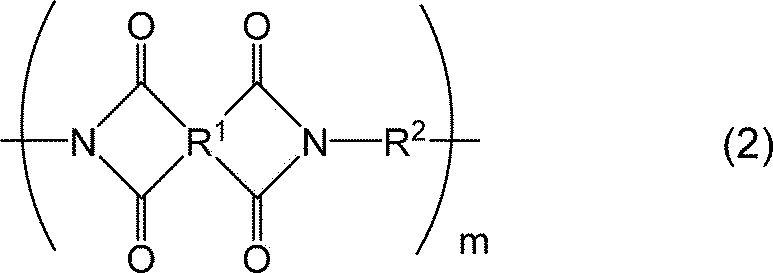
(なお、式(2)において、R1が芳香環を含む4価の有機基、R2が芳香環を含む2価の有機基、mは1以上の整数である。)
(なお、式(2)において、R1が芳香環を含む4価の有機基、R2が芳香環を含む2価の有機基、mは1以上の整数である。)
R1の4価の有機基は、芳香族環を有すればよく、例えば炭素数6~24、好ましくは炭素数6~18、より好ましくは炭素数6~12の有機基が挙げられる。R1としては、芳香族を有するテトラカルボン酸残基が挙げられ、具体的には、以下の式(3-1)~(3-5)が挙げられる。

上記の中では、式(3-1)、(3-2)のいずれかが好ましく、中でも、以下の(3-1’)及び(3-2’)のいずれかで表される有機基が好ましく、以下の(3-1’)で表される有機基であることがより好ましい。
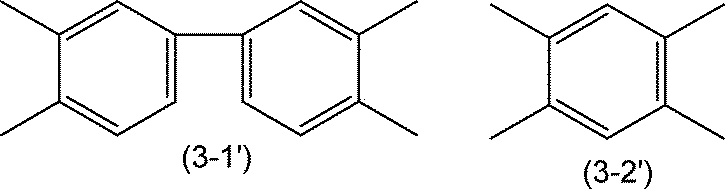
一般式(2)で表されるポリイミドは、R1のうち、上記(3-1’)及び(3-2’)のいずれかで表される有機基を例えば50モル%以上、好ましくは70モル%以上、より好ましくは90モル%以上、最も好ましくは100モル%の割合で含有する。
R2の2価の有機基は、芳香族環を有すればよく、例えば炭素数6~24、好ましくは炭素数6~18、より好ましくは炭素数6~15の有機基が挙げられる。R2の2価の有機基は、好ましくは以下の式(4)及び式(5)のいずれかで表される有機基である。

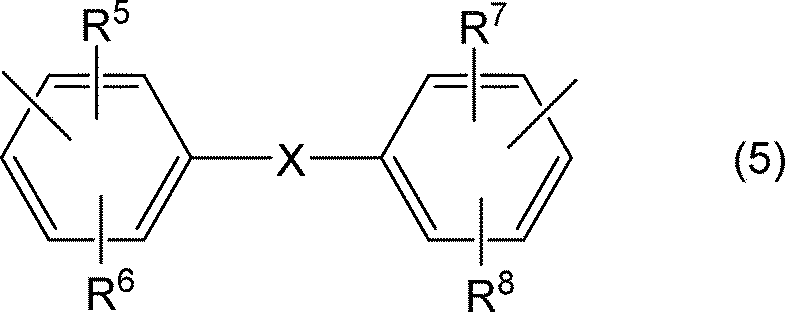
(なお、式(4)において、R3及びR4はそれぞれ独立に水素原子、メチル基、及びハロゲン原子のいずれかである。式(5)において、Xで示される基は、単結合、酸素原子、硫黄原子、C=O、-CH2-、-CH(CH3)-、-C(CH3)2-、-SO2-、及び-C(CF3)2-のいずれかである。R5、R6、R7、及びR8はそれぞれ独立に、水素原子、メチル基、及びハロゲン原子のいずれかである。)
一般式(2)で表されるポリイミドは、R2のうち少なくとも一部が式(4)で表される有機基であることが好ましい。上記一般式(2)で表されるポリイミドは、R2のうち少なくとも一部が式(4)で表される有機基であることで、耐熱性が高くなり、2%重量減少の温度も高くなる。また、300℃における引張貯蔵弾性率が高くなり、さらに、ポリイミド層の線膨張係数を低くしやすくなる。
式(2)において、上記式(4)は、耐熱性、低線膨張係数の観点から、結合位置が1,4位であることが好ましく、また、R3、R4はいずれも水素原子であることが好ましい。したがって、式(2)におけるR2の少なくとも一部は以下の式(4-1)で表される有機基であることがより好ましい。
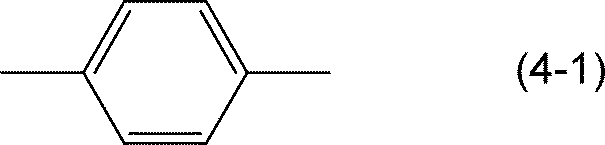
式(2)において、上記式(4)は、耐熱性、低線膨張係数の観点から、結合位置が1,4位であることが好ましく、また、R3、R4はいずれも水素原子であることが好ましい。したがって、式(2)におけるR2の少なくとも一部は以下の式(4-1)で表される有機基であることがより好ましい。
一般式(2)で表されるポリイミドは、R2のうち、上記式(4-1)で表される有機基を例えば10モル%以上、好ましくは30モル%以上、より好ましくは50モル%以上の割合で含有し、また、70モル%以上含有してもよいし、100モル%の割合で含有してもよい。
式(2)においては、R2の少なくとも一部が上記式(4)(好ましくは式(4-1))で表される有機基であるとともに、R2の一部は、上記式(4)以外の芳香族環を有する有機基であってもよい。上記式(4)以外のR2は、例えば炭素数12~24、好ましくは炭素数12~18、より好ましくは炭素数12~15の2価の有機基が挙げられる。具体的には、上記式(5)で示される有機基が好ましい。
式(5)においてXは酸素原子が好ましく、R5、R6、R7、及びR8はいずれも水素原子が好ましい。また、式(5)における結合位置は、4,4’位であることが好ましい。したがって、式(5)で表される有機基は、以下の式(5-1)で表される有機基であることがより好ましい。
そして、式(2)の化合物の好ましい一態様は、R2の少なくとも一部が上記式(4)(好ましくは式(4-1))で表される有機基であるとともに、残りが以下の式(5-1)で表される有機基である。
そして、式(2)の化合物の好ましい一態様は、R2の少なくとも一部が上記式(4)(好ましくは式(4-1))で表される有機基であるとともに、残りが以下の式(5-1)で表される有機基である。

ポリイミドは、好ましくは3,3’,4,4’-ビフェニルテトラカルボン酸又はその酸二無水物と1,4-フェニレンジアミンとを重合して得られたポリイミドが好ましく、具体的には、以下の式(6)で表されるポリイミドが好ましい。以下の式(6)で表されるポリイミドを使用することで、耐熱性が良好で、ポリイミド層の2%重量減少の温度が高くなる。また、線膨張係数が低く、かつ300℃における引張貯蔵弾性率が高いポリイミド層を得やすくなる。式(6)で表されるポリイミドは、市販品も使用可能であり、具体的には宇部興産社製の「ユーピレックス-S」が挙げられる。
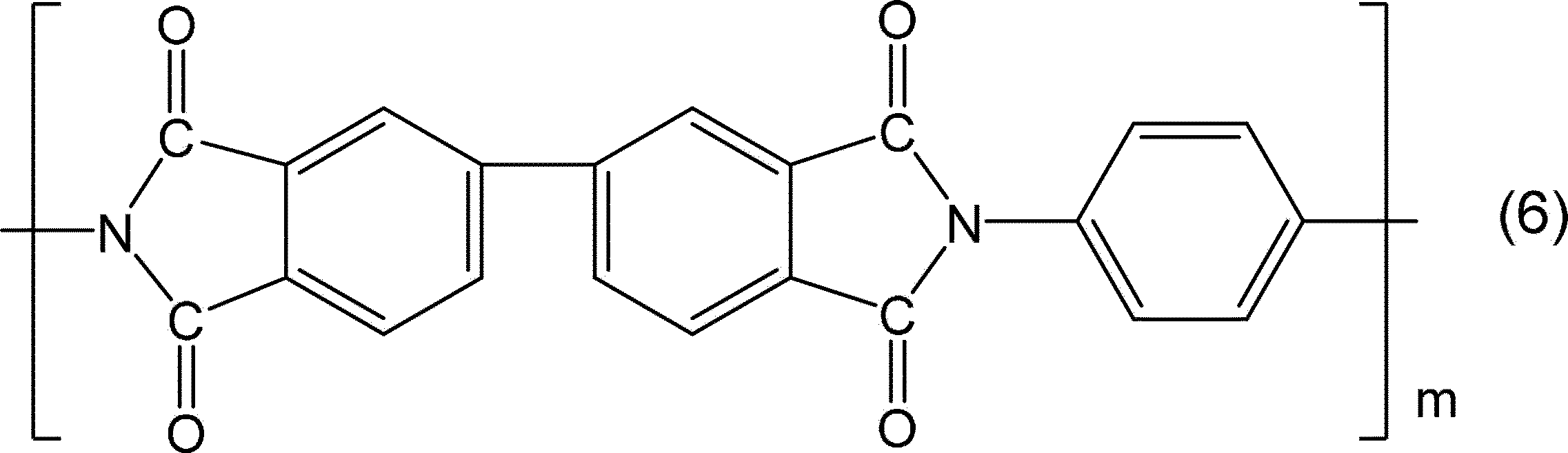
なお、式(6)においてmは上記と同様である。
また、ポリイミドは、ピロメリット酸又はその酸二無水物と、パラフェニレンジアミン、及び4,4’-ジアミノジフェニルエーテルとを共重合体して得られたポリアミドも好ましく、具体的には、上記式(2)において、R1が式(3-2’)の有機基であり、かつR2の一部が式(4-1)の有機基、残りが式(5-1)の有機基である共重合体ポリイミドであることが好ましい。
該共重合体ポリイミドは、モノマーの組み合わせを制御(シーケンスコントロール)することにより、線膨張係数を低くしつつ、耐熱性などが比較的良好なポリイミドとすることができる。具体的には、4,4’-ジアミノジフェニルエーテルとピロメリット酸二無水物を予め反応させておき、その後パラフェニレンジアミンを添加する手順を取ることで、線膨張係数が低く、耐熱性などに優れるポリイミドを得ることができる。そのため、ポリイミド層の300℃における引張貯蔵弾性率や、2%重量減少の温度も高くしやすくなる。該共重合体ポリイミドとしては、市販品を使用することもでき、例えばカネカ社製の「アピカルNPI」が挙げられる。
該共重合体ポリイミドは、モノマーの組み合わせを制御(シーケンスコントロール)することにより、線膨張係数を低くしつつ、耐熱性などが比較的良好なポリイミドとすることができる。具体的には、4,4’-ジアミノジフェニルエーテルとピロメリット酸二無水物を予め反応させておき、その後パラフェニレンジアミンを添加する手順を取ることで、線膨張係数が低く、耐熱性などに優れるポリイミドを得ることができる。そのため、ポリイミド層の300℃における引張貯蔵弾性率や、2%重量減少の温度も高くしやすくなる。該共重合体ポリイミドとしては、市販品を使用することもでき、例えばカネカ社製の「アピカルNPI」が挙げられる。
また、ポリイミドは、R2の少なくとも一部が上記式(4)で示される有機基である必要はなく、R2が上記式(5)、好ましくは上記式(5-1)からなるポリイミドであってもよく、その場合、R1が式(3-2’)であるとより好ましい。そのようなポリイミドとしては市販品でよく、具体的には、カネカ社製の「アピカルAH」や、を東レ・デュポン社製の「カプトン」などが挙げられる。
本発明のポリイミド層は、ポリイミド以外に、本発明の趣旨を超えない範囲で、その他の樹脂や充填材、各種添加剤、例えば、熱安定剤、紫外線吸収剤、光安定剤、核剤、着色剤、滑剤、難燃剤等を適宜配合してもよい。その他の樹脂の含有量は、特に限定されないが、ポリイミド100質量部に対して、例えば50質量部以下程度であればよいし、30質量部以下であってもよく、10質量部以下であってもよいが、ポリイミド層における樹脂は、ポリイミドからなることが好ましい。
ポリイミド層の厚みは、用途により適宜選択すればよいが、シリコーン層によって付与されるクッション性などを損なわずに所望の耐熱性、寸法安定性を積層体に付与する観点から、150μm以下であることが好ましく、130μm以下であることがより好ましく、100μm以下であることがさらに好ましく、80μm以下であることが特に好ましく、60μm以下であることが特に好ましく、また、3μm以上であることが好ましく、5μm以上であることがより好ましく、10μm以上であることがさらに好ましく、15μm以上であることが特に好ましい。なお、ポリイミド層の厚みとは、シリコーン層の両面にポリイミド層が設けられる場合には、シリコーン層の両面それぞれに設けられる、各ポリイミド層の厚みである。
また、本発明の積層体において、シリコーン層:ポリイミド層の厚み比は、99:1~20:80であることが好ましい。積層体は、厚み比が上記範囲内であることで、耐熱性が良好になりつつ、適度な弾性が得られて離型材、緩衝材として好適に使用できるようになる。これら観点から、厚み比は、95:5~30:70であることがより好ましく、90:10~40:60であることがさらに好ましく、85:15~50:50であることが特に好ましい。
なお、ここでいうポリイミド層の厚みは、シリコーン層の片面に設けられるポリイミド層の厚みを意味し、シリコーン層の両面にポリイミド層が設けられる場合には、シリコーン層の両面それぞれに設けられる、各ポリイミド層の厚みが上記範囲内であるとよい。
なお、ここでいうポリイミド層の厚みは、シリコーン層の片面に設けられるポリイミド層の厚みを意味し、シリコーン層の両面にポリイミド層が設けられる場合には、シリコーン層の両面それぞれに設けられる、各ポリイミド層の厚みが上記範囲内であるとよい。
[積層構造]
本発明の積層体は、ポリイミド層とシリコーン層とを備えるとよく、シリコーン層の片面のみにポリイミド層が設けられた積層構造を有してもよい。すなわち、本発明の積層体は、ポリイミド層/シリコーン層の積層構造を有してもよい。該積層構造においては、ポリイミド層が積層体の一方の最外面を構成し、シリコーン層が他方の最外面を構成するとよい。より具体的には、積層体は、2種2層構造であってもよいし、2種2層構造に加え、ポリイミド層とシリコーン層の間に後述するプライマー層がある構造であってもよい。以上の積層構造においては、積層体がプレス成形などによる成形時の離型材、緩衝材として使用する場合には、ポリイミド層側をプレス板などの成形型側に配置し、シリコーン層側を成形体側に配置するとよい。このような配置によると、積層体は、ポリイミド層によって成形型に対するズレが生じにくくなる一方で、シリコーン層によって成形体に対する離型性が良好となる。
本発明の積層体は、ポリイミド層とシリコーン層とを備えるとよく、シリコーン層の片面のみにポリイミド層が設けられた積層構造を有してもよい。すなわち、本発明の積層体は、ポリイミド層/シリコーン層の積層構造を有してもよい。該積層構造においては、ポリイミド層が積層体の一方の最外面を構成し、シリコーン層が他方の最外面を構成するとよい。より具体的には、積層体は、2種2層構造であってもよいし、2種2層構造に加え、ポリイミド層とシリコーン層の間に後述するプライマー層がある構造であってもよい。以上の積層構造においては、積層体がプレス成形などによる成形時の離型材、緩衝材として使用する場合には、ポリイミド層側をプレス板などの成形型側に配置し、シリコーン層側を成形体側に配置するとよい。このような配置によると、積層体は、ポリイミド層によって成形型に対するズレが生じにくくなる一方で、シリコーン層によって成形体に対する離型性が良好となる。
また、本発明の積層体は、シリコーン層の両面にポリイミド層が設けられた積層構造を有してもよい。すなわち、本発明の積層体は、ポリイミド層/シリコーン層/ポリイミド層の積層構造を有してもよい。該積層構造においては、ポリイミド層が積層体の両最外面を構成するとよい。より具体的には、積層体は、2種3層構造であってもよいし、2種3層構造に加え、ポリイミド層とシリコーン層の間のいずれか一方又は両方に後述するプライマー層がある構造であってもよい。以上のような積層構造によると、積層体は、プレス成形などによる成形時の離型材、緩衝材として使用される場合には、ポリイミド層によって成形型及び成形体に対するズレが生じにくくなり、表面平滑性の高い成形体が得られやすくなる。また、シリコーン層は、加熱により、低分子量環状シロキサンなどの低分子量シロキサン成分が析出して、成形型や得られる成形体等に付着して汚染することがあるが、両面にポリイミド層を設けることで、低分子量シロキサン成分の析出を防止して、低分子量シロキサン成分による汚染を抑制する。また、シリコーンフィルムを、離型材や緩衝材として使用する場合には、熱処理などをして、成形型に付着した低分子量シロキサン成分を除去させることがあるが、両面にポリイミド層が設けられることで熱処理を行う頻度を減らしたりすることもできる。
上述したような低分子量シロキサン成分の析出により成形体が汚染することを抑制し、表面平滑性の高い成形体を容易に得る方法として、シリコーン層の片面のみにポリイミド層が設けられた積層体を使用し、シリコーン層側をプレス板などの成形型側に配置し、ポリイミド層側を成形体側に配置する方法を採用してもよい。
(プライマー層)
また、各積層構造において、ポリイミド層は、シリコーン層に直接積層されてもよいが、プライマー層を介して積層されてもよい。プライマー層は、シリコーン層に対する接着性を確保する観点から、シリコーン樹脂を含むことが好ましく、シリコーン樹脂を主成分として含むことがより好ましい。
プライマー層に使用可能なシリコーン樹脂の例として、例えば、付加型シリコーン樹脂、縮合型シリコーン樹脂、UV硬化型シリコーン樹脂等が挙げられ、なかでも、付加型シリコーン樹脂が好ましい。これらは単独でもしくは2種以上併せて用いることができる。
また、各積層構造において、ポリイミド層は、シリコーン層に直接積層されてもよいが、プライマー層を介して積層されてもよい。プライマー層は、シリコーン層に対する接着性を確保する観点から、シリコーン樹脂を含むことが好ましく、シリコーン樹脂を主成分として含むことがより好ましい。
プライマー層に使用可能なシリコーン樹脂の例として、例えば、付加型シリコーン樹脂、縮合型シリコーン樹脂、UV硬化型シリコーン樹脂等が挙げられ、なかでも、付加型シリコーン樹脂が好ましい。これらは単独でもしくは2種以上併せて用いることができる。
付加型シリコーン樹脂としては、ビニル基を含有するポリジメチルシロキサンをベースポリマーとし、架橋剤としてポリメチルハイドロジェンシロキサンを配合し、白金触媒の存在下で反応硬化させて得られるものが挙げられる。
縮合型シリコーン樹脂としては、末端にシラノール基を含有するポリジメチルシロキサンをベースポリマーとし、架橋剤としてポリメチルハイドロジェンシロキサンを配合し、有機スズ触媒存在下で加熱硬化して得られるものが挙げられる。
UV硬化型シリコーン樹脂としては、アクリロイル基あるいはメタクリロイル基を含有するポリジメチルシロキサンをベースポリマーとするもの、メルカプト基とビニル基を含有するポリジメチルシロキサンをベースポリマーとするもの、前述の付加型シリコーン樹脂、あるいはカチオン硬化機構で硬化するエポキシ基を含有するポリジメチルシロキサンをベースポリマーとするもの等に光重合開始剤を配合し、UV光を照射することによって硬化させるものが挙げられる。
また、プライマー層は、必要に応じて、シランカップリング剤、密着向上剤などを適宜含んでいてもよい。
シランカップリング剤は、例えば、一般式ZSiX3で表される化合物が挙げられる。
なお、上記一般式においてZはビニル基、エポキシ基、アミノ基、メルカプト基等の官能基を有する、炭素数1~20程度の有機基であり、Xはメトキシ基、エトキシ基等の加水分解性官能基又はアルキル基である。
また、シランカップリング剤は、一般式YRSiX3で表される化合物であることが好ましく、Yはビニル基、エポキシ基、アミノ基、メルカプト基等の官能基、Rはメチレン、エチレン、プロピレン等のアルキレン基、Xはメトキシ基、エトキシ基等の加水分解性官能基又はアルキル基であることが好ましい。
なお、上記一般式においてZはビニル基、エポキシ基、アミノ基、メルカプト基等の官能基を有する、炭素数1~20程度の有機基であり、Xはメトキシ基、エトキシ基等の加水分解性官能基又はアルキル基である。
また、シランカップリング剤は、一般式YRSiX3で表される化合物であることが好ましく、Yはビニル基、エポキシ基、アミノ基、メルカプト基等の官能基、Rはメチレン、エチレン、プロピレン等のアルキレン基、Xはメトキシ基、エトキシ基等の加水分解性官能基又はアルキル基であることが好ましい。
シランカップリング剤としては、例えば、ビニルトリエトキシシラン、ビニルトリメトキシシラン、γ-グリシジルプロピルトリメトキシシラン、γ-グリシジルプロピルトリエトキシシラン、N-β(アミノエチル)-γ-アミノプロピルトリメトキシシラン、N-β(アミノエチル)-γ-アミノプロピルメチルジメトキシシラン、γ-メルカプトプロピルトリメトキシシラン等が挙げられる。これらは単独でもしくは2種以上併せて用いることができる。
密着向上剤としては、分子鎖末端や側鎖にエポキシ基を有するシロキサンが好ましく挙げられる。
プライマー層の厚みは、0.01~1μmであることが好ましく、0.03~0.7μmがより好ましく、0.05~0.5μmがさらに好ましい。厚みが前記下限値以上であれば、均一な厚みの硬化被膜が得られ、かつ、シリコーン層との接着力も充分に得られる傾向がある。また、プライマー層を構成するシリコーン樹脂は一般に膜強度がそれほど強くないが、厚みが前記上限値以下であれば、プライマー層の凝集破壊を抑制し、積層体の強度を高くしやすい。
(カバーフィルム)
本発明の積層体は、シリコーン層の片面のみにポリイミド層が設けられる積層構造の場合には、ポリイミド層が設けられないシリコーン層の表面にカバーフィルムが取り付けられてもよい。カバーフィルムは、ポリイミド層、シリコーン層以外の樹脂フィルムからなるとよい。カバーフィルムの材料としては、特に限定されるものではないが、例えば、ポリオレフィン系樹脂、スチレン系樹脂、ポリエステル樹脂、ポリカーボネート系樹脂、ポリアミド系樹脂、ポリフェニレンサルファイド樹脂、ポリフェニレンエーテル樹脂、ポリアリールエーテルケトン系樹脂、液晶ポリマー樹脂等が挙げられる。これらの中では、耐熱性や機械的強度の観点から、ポリエステル樹脂を含有することが好ましく、ポリエステル樹脂を主成分として含有することがより好ましい。
本発明の積層体は、シリコーン層の片面のみにポリイミド層が設けられる積層構造の場合には、ポリイミド層が設けられないシリコーン層の表面にカバーフィルムが取り付けられてもよい。カバーフィルムは、ポリイミド層、シリコーン層以外の樹脂フィルムからなるとよい。カバーフィルムの材料としては、特に限定されるものではないが、例えば、ポリオレフィン系樹脂、スチレン系樹脂、ポリエステル樹脂、ポリカーボネート系樹脂、ポリアミド系樹脂、ポリフェニレンサルファイド樹脂、ポリフェニレンエーテル樹脂、ポリアリールエーテルケトン系樹脂、液晶ポリマー樹脂等が挙げられる。これらの中では、耐熱性や機械的強度の観点から、ポリエステル樹脂を含有することが好ましく、ポリエステル樹脂を主成分として含有することがより好ましい。
ポリエステル樹脂の中でも、結晶性ポリエステル樹脂を用いることが好ましく、結晶性ポリエステル樹脂としては、例えば、ポリエチレンテレフタレート、ポリエチレンナフタレート等が挙げられる。なかでも、耐熱性、フィルムのこし、平滑性、商業的入手のしやすさ等の観点から、ポリエチレンテレフタレートであることが好ましい。これらは単独でもしくは2種以上併せて用いることができる。
また、カバーフィルムは、本発明の効果を損なわない範囲で、紫外線吸収剤、光安定剤、酸化防止剤、可塑剤、核剤、滑剤、顔料、染料等の添加剤を含んでいてもよい。機械的強度の観点から、少なくとも1軸に延伸されていることが好ましく、2軸に延伸されていることがより好ましい。
カバーフィルムは、製造時にシリコーン層を形成する際に使用される工程フィルムであってもよいし、運送時、保管時などにおいてシリコーン層を保護する保護フィルムであってもよい。カバーフィルムは、積層体が離型材、緩衝材、滑り止め材、キャリアフィルムなどとして使用される前に積層体から取り外されるとよい。
カバーフィルムは、製造時にシリコーン層を形成する際に使用される工程フィルムであってもよいし、運送時、保管時などにおいてシリコーン層を保護する保護フィルムであってもよい。カバーフィルムは、積層体が離型材、緩衝材、滑り止め材、キャリアフィルムなどとして使用される前に積層体から取り外されるとよい。
カバーフィルムの厚みは、特に限定されないが、10~350μmが好ましく、15~300μmがより好ましく、20~250μmがさらに好ましい。
<積層体の製造方法>
本発明の積層体の製造方法は、シリコーン層の少なくとも一方の面に、ポリイミド層を積層できる方法であれば特に限定はなく、その積層方法は公知の方法を用いることができる。
本発明の積層体の製造方法は、シリコーン層の少なくとも一方の面に、ポリイミド層を積層できる方法であれば特に限定はなく、その積層方法は公知の方法を用いることができる。
例えば、ポリイミド層を作製し、これとは別にシリコーン層を作製し、これらを積層してもよく、ポリイミド層を作製し、このポリイミド層上にシリコーン層を作製すると共にこれらを積層してもよく、逆にシリコーン層を作製し、このシリコーン層上にポリイミド層を作製すると共に積層してもよく、ポリイミド層とシリコーン層を作製しつつこれらを積層してもよい。また、ポリイミド層がシリコーン層の片面に設けられる場合には、シリコーン層のポリイミド層が設けられない面には、カバーフィルムが適宜積層されてもよい。
ポリイミド層とシリコーン層は、シリコーン層を未架橋のまま積層し、積層体とした後に、シリコーン層を架橋することが好ましい。シリコーン層とポリイミド層とを積層した後に、シリコーン層を架橋すると、ポリイミド層をシリコーン層に対して、高い接着強度で積層一体化することができる。
ポリイミド層とシリコーン層は、共押出法、ラミネート法等により積層することができる。共押出法においては、フィードブロック方式又はマルチマニホールド方式等によりポリイミド層とシリコーン層を同時に混練、共押出して積層するとよい。
また、ラミネート法としては、ポリイミド層とシリコーン層の作製をそれぞれ別々に行いポリイミド層とシリコーン層とを得た後、それらをラミネートして積層する方法が挙げられる。また、予め作製したポリイミド層上に、シリコーン層を形成しつつラミネートしてもよい。
また、ラミネート法としては、ポリイミド層とシリコーン層の作製をそれぞれ別々に行いポリイミド層とシリコーン層とを得た後、それらをラミネートして積層する方法が挙げられる。また、予め作製したポリイミド層上に、シリコーン層を形成しつつラミネートしてもよい。
また、ポリイミド層と、シリコーン層の間には、上記の通りプライマー層が設けられてもよく、その場合、ポリイミド層にプライマー剤を塗布して、プライマー剤を、適宜乾燥し、かつ硬化することでプライマー層を形成するとよい。そして、プライマー層が形成されたポリイミド層の上に、シリコーン層が積層されるとよい。
プライマー剤は、プライマー層を形成するためのベースポリマーと、必要に応じて配合される、架橋剤、光重合開始剤、触媒、シランカップリング剤、密着向上剤などを含み、溶剤により希釈されるとよい。プライマー剤のレベリング性や密着性を向上させる目的で、シリコーン層及び/又はポリイミド層のプライマー剤塗布面に予めコロナ処理等の表面処理を施してもよい。また、プライマー剤は、特に限定されないが、例えば50~150℃程度の温度で加熱されることで硬化されるとよい。
プライマー剤は、プライマー層を形成するためのベースポリマーと、必要に応じて配合される、架橋剤、光重合開始剤、触媒、シランカップリング剤、密着向上剤などを含み、溶剤により希釈されるとよい。プライマー剤のレベリング性や密着性を向上させる目的で、シリコーン層及び/又はポリイミド層のプライマー剤塗布面に予めコロナ処理等の表面処理を施してもよい。また、プライマー剤は、特に限定されないが、例えば50~150℃程度の温度で加熱されることで硬化されるとよい。
本発明の積層体は、ラミネート法で製造することが好ましい。ラミネート法では、混練機などで必要に応じて金属酸化物、その他の添加剤などと混合されたシリコーン、好ましくはシリコーンエラストマー樹脂が、好ましくは未架橋の状態で、二方向から繰り出した、それぞれがポリイミド層となる一対のポリイミドフィルム、又はポリイミドフィルムとカバーフィルムの間に投入する。ここで、シリコーンは、例えば、押出機などを使用してTダイなどから押し出すことで、フィルム間に投入するとよい。その後、必要に応じてロールの間隙にて厚みを調整し、フィルム間にシリコーン層、好ましくは未架橋状態のシリコーン層が形成された、積層体を得る。ただし、この際、カバーフィルムは、適宜省略してもよい。
また、未架橋状態のシリコーンに対しては、シリコーンを架橋するとよいが、架橋は、上記の通りシリコーン層とポリイミド層とを積層した後に行うことが好ましい。架橋する方法としては、シリコーンに架橋剤等を予め添加しておき、熱や紫外線等の光、空気中の水分等により架橋する方法、放射線照射により架橋する方法等が挙げられる。
なかでも、シリコーン層は、放射線照射によって架橋することが好ましい。放射線照射による架橋は、架橋剤の残渣等による耐熱性などを損なう懸念がなく、また、加熱による架橋のように架橋時に皴などが発生したりすることもないため好ましい。また、シリコーン層とポリイミド層との密着性を確保するためにも好ましい。
放射線としては、例えば、電子線、X線、γ線等が挙げられる。これらの放射線は工業的にも広く利用されているものであり、容易に利用可能であり、エネルギー効率の良い方法である。なかでも、吸収損失がほとんどなく、透過性が高いという観点から、γ線を利用することが好ましい。
放射線としては、例えば、電子線、X線、γ線等が挙げられる。これらの放射線は工業的にも広く利用されているものであり、容易に利用可能であり、エネルギー効率の良い方法である。なかでも、吸収損失がほとんどなく、透過性が高いという観点から、γ線を利用することが好ましい。
γ線の照射線量は、樹脂種や架橋基の量、そして線源の種類により、適宜選択して決定することができる。例えば、γ線の照射線量は、20~150kGyであることが好ましく、30~120kGyであることがより好ましく、40~110kGyであることがさらに好ましく、50~100kGyであることが特に好ましい。照射線量が前記下限値以上であれば、シリコーン層を充分に架橋させることができ、結果として所望の圧縮永久歪みやデュロメータ硬さを得やすい傾向がある。一方、照射線量が前記上限値以下であれば、分解反応が生じず、低分子量シロキサン成分の増加を抑制できる。
<用途>
本発明の積層体は、シリコーンの特性、例えば、シリコーンエラストマー樹脂の場合には各種部品への適度な密着性と追従性等の特性を活かして、様々な用途に使用することができる。本発明の積層体は、例えば、各種成形体の製造工程、特にプレス成形、真空成形、圧空成形等において使用することが好ましく、その際、離型材、緩衝材、滑り止め材(シール材)などとして使用するとよい。
また、積層体は、ワークの搬送のためのキャリアフィルム、ワークの保護のための保護フィルム等にも使用できる。
本発明の積層体は、シリコーンの特性、例えば、シリコーンエラストマー樹脂の場合には各種部品への適度な密着性と追従性等の特性を活かして、様々な用途に使用することができる。本発明の積層体は、例えば、各種成形体の製造工程、特にプレス成形、真空成形、圧空成形等において使用することが好ましく、その際、離型材、緩衝材、滑り止め材(シール材)などとして使用するとよい。
また、積層体は、ワークの搬送のためのキャリアフィルム、ワークの保護のための保護フィルム等にも使用できる。
積層体は、上記した中では、プレス成形、真空成形、圧空成形等の各種成形工程において、離型材、緩衝材として使用することが好ましい。具体的には、成形工程において、成形型(金型)と成形体の間に配置され、成形体に作用される圧力を均等に分散させる緩衝材として使用したり、成形体の成形型からの離型性を確保したりする用途に使用するとよい。
また、積層体は、上記の中では、プレス成形の緩衝材、離型材として使用することがより好ましい。プレス成形において、積層体は、成形体(ワーク)をプレス板によりプレスする際に、ワークとプレス板の間に配置されるとよい。この際、例えば、ポリイミド層がシリコーン層の片面のみに設けられる場合には、ポリイミド層側がプレス板側に配置され、シリコーン層側がワーク側に配置されるとよい。
プレス成形時の温度は、特に限定されないが、例えば50~350℃であるが、好ましくは100~350℃、より好ましくは200~350℃、さらに好ましくは250~320℃である。また、プレス成形としては、水圧・油圧プレス成形、ロールプレス成形、ベルトプレス成形などが挙げられる。
また、本発明の積層体は、電気ないし電子製品に組み込まれる、回路基板、半導体、その他の電子部品等を成形体として成形する際に使用することが好ましい。また、プレス成形は、特に限定されないが、例えばFPC、さらには、全固体電池を構成する部品などを製造する過程で行われる工程であることが好ましく、また、ACF(異方導電性フィルム)を回路基板に圧着させる際に行われる工程であることも好ましい。
本発明の積層体は、ポリイミド層を有することで、しわや折れ曲がりが生じにくく、耐熱性も高いため、各種の成形工程に使用されることで成形体の生産性が向上する。また、シリコーン層は、耐熱性が高く、脆化などしにくく、高温加熱下で長期にわたって良好なクッション性を維持でき、寸法変化も抑制できる。そのため、本発明の積層体は、離型材、緩衝材などとして、長期にわたって繰り返し使用することができる。
本発明の積層体は、キャリアフィルムとして使用されることも好ましい。積層体は、キャリアフィルムとして使用される場合には、シリコーン層/ポリイミド層の積層構造を有することが好ましく、最表面を構成するシリコーン層の上に搬送物を載せて、搬送物を搬送させるとよい。シリコーン層は、特にシリコーンがシリコーンエラストマー樹脂であると、微粘着性を有するので、キャリアフィルムの最表面として使用することで滑り止め材として使用できる。積層体(キャリアフィルム)は、特に限定されないが、例えばベルトコンベヤにて搬送される。
キャリアフィルムにおいて、ポリイミド層は、シリコーン層の支持体として使用するとよい。シリコーン層を最表面とするキャリアフィルムは一般的に金属板を支持体とすることが多いが、金属板の代わりにポリイミド層を使用することで、搬送キャリアの軽量化が図れる。また、ポリイミド層は、剛性が高いので、金属板の代わりに支持体として適切に使用できる。さらに、本発明のポリイミド層として、上述のような、耐熱性が高く加熱により変形が生じにくく、かつ線膨張係数も低くできるものを使用すれば、高温環境下(例えば、200~350℃程度、好ましくは250~320℃程度)で使用されても、熱劣化しにくく、かつシリコーン層がポリイミド層から剥がれるなどの不具合も生じにくく、より長期にわたって繰り返し使用が可能になる。
搬送物は、電気ないし電子製品に組み込まれる、回路基板、半導体、その他の電子部品等が挙げられるが、特に限定されない。また、キャリアフィルムは、搬送物(ワーク)を載せた状態で、リフロー工程を行うリフローキャリアであることが好ましい。リフロー工程では、例えば200℃以上に加熱されることがあるが、本発明の積層体は、上記のとおり、高温環境下でも繰り返し使用が可能であり、リフローキャリアとして特に好適に使用できる。
[離型材、緩衝材、滑り止め材]
本発明は、別の態様として、離型材、緩衝材、及び滑り止め材のいずれかとして用いる積層体(X1)を提供する。該積層体(X1)は、23℃における引張貯蔵弾性率が100MPa以下である樹脂層(A)と、23℃における引張貯蔵弾性率が1GPa以上である樹脂層(B)を備える積層体であって、該樹脂層(A)の熱重量測定による380℃における重量減少率が9質量%以下である。
本発明は、別の態様として、離型材、緩衝材、及び滑り止め材のいずれかとして用いる積層体(X1)を提供する。該積層体(X1)は、23℃における引張貯蔵弾性率が100MPa以下である樹脂層(A)と、23℃における引張貯蔵弾性率が1GPa以上である樹脂層(B)を備える積層体であって、該樹脂層(A)の熱重量測定による380℃における重量減少率が9質量%以下である。
本積層体(X1)においては、樹脂層(A)が23℃における引張貯蔵弾性率が100MPa以下であることで、プレス成形時等の成形体への追従性、密着性、表面タック性が良好となる。また、樹脂層(B)の23℃における引張貯蔵弾性率が1GPa以上であることで、ハンドリング性が良好となる。そのため、本積層体(X1)は、離型材、緩衝材、及び滑り止め材として好適に使用できる。なお、離型材、緩衝材、及び滑り止め材の詳細は、上記のとおりであり、シリコーン層の代わりに樹脂層(A)を、ポリイミド層の代わりに樹脂層(B)を使用するとよい。
そして、本積層体(X1)では、樹脂層(A)の380℃における重量減少率が9質量%以下であることで、樹脂層(A)が脆化などすることが防止され、上記各用途において、積層体(X1)を高温環境下で長期にわたって繰り返し使用できるようになる。
樹脂層(A)の380℃における上記重量減少率は、7質量%以下が好ましく、6質量%以下がより好ましく、5質量%以下がさらに好ましく、また、380℃における重量減少率は、低ければ低いほどよく、0質量%以上であればよいが、例えば1質量%以上である。
そして、本積層体(X1)では、樹脂層(A)の380℃における重量減少率が9質量%以下であることで、樹脂層(A)が脆化などすることが防止され、上記各用途において、積層体(X1)を高温環境下で長期にわたって繰り返し使用できるようになる。
樹脂層(A)の380℃における上記重量減少率は、7質量%以下が好ましく、6質量%以下がより好ましく、5質量%以下がさらに好ましく、また、380℃における重量減少率は、低ければ低いほどよく、0質量%以上であればよいが、例えば1質量%以上である。
樹脂層(A)は、プレス成形時等の成形体への追従性、密着性や樹脂層(A)の表面タック性の観点から、23℃における引張貯蔵弾性率が好ましくは70MPa以下であり、より好ましくは50MPa以下であり、さらに好ましくは30MPa以下であり、特に好ましくは10MPa以下である。また、好ましくは0.1MPa以上であり、より好ましくは0.5MPa以上であり、さらに好ましくは1MPa以上である。
樹脂層(A)を構成する樹脂は特に限定されるものではなく、例えば、シリコーン、オレフィン系エラストマー、スチレン系エラストマー、ポリエステル系エラストマー、ウレタン系樹脂、エポキシ系樹脂、フッ素系エラストマー等を使用することができるが、耐熱性、絶縁性等の電気的特性、離型性等に優れる点から、樹脂層(A)においては、シリコーンを主成分として使用することが好ましい。
シリコーンを使用する場合、シリコーンとしては上記で説明したとおりのものを使用するとよく、樹脂層(A)は上記したシリコーン層と同様である。
シリコーンを使用する場合、シリコーンとしては上記で説明したとおりのものを使用するとよく、樹脂層(A)は上記したシリコーン層と同様である。
樹脂層(B)は、プレス成形時、離型材等として使用する際の積層体変形抑制等のハンドリング性や寸法精度を向上させる観点から、23℃における引張貯蔵弾性率が、好ましくは3GPa以上であり、より好ましくは3.7GPa以上、さらに好ましくは4.5GPa以上、特に好ましくは5GPa以上、とりわけ好ましくは6GPa以上、最も好ましくは7GPa以上である。また、好ましくは15GPa以下であり、より好ましくは13GPa以下、さらに好ましくは11GPa以下である。
樹脂層(B)を構成する樹脂は、特に限定されるものではなく、例えば、ポリイミド、ビスマレイミド、ベンゾオキサジン等の硬化性樹脂、熱可塑性ポリイミド、ポリアミドイミド、オレフィン系樹脂、スチレン系樹脂、ポリエステル樹脂、ポリカーボネート系樹脂、ポリアミド系樹脂、ポリエーテルイミド樹脂、ポリフェニレンサルファイド樹脂、ポリフェニレンエーテル樹脂、ポリエーテルエーテルケトン等のポリエーテルケトン系樹脂、ポリテトラフロロエチレン樹脂(PTFE)、四フッ化エチレン・パーフロロアルコキシエチレン共重合体樹脂(PFA)、液晶ポリマー等の熱可塑性樹脂が挙げられる。中でも、耐熱性や機械的強度の観点から、ポリイミド、ビスマレイミド、ベンゾオキサジン等の硬化性樹脂、熱可塑性ポリイミド、ポリアミドイミド等のガラス転移温度(Tg)が300℃以上の非結晶性熱可塑性樹脂、ポリエーテルエーテルケトン等のポリエーテルケトン系樹脂、ポリテトラフロロエチレン樹脂(PTFE)、四フッ化エチレン・パーフロロアルコキシエチレン共重合体樹脂(PFA)、液晶ポリマー等の結晶融解温度(Tm)が300℃以上の結晶性熱可塑性樹脂が好ましく、中でも、耐熱性、剛性等に優れる点から、ポリイミドを主成分樹脂として使用することがより好ましい。なお、Tg、Tmは、JIS K7121:2012に準じて、示差走査熱量計にて測定される再昇温時のDSC曲線から求める値を言う。
ポリイミドを使用する場合、ポリイミドとしては上記で説明したとおりのものを使用するとよく、樹脂層(B)は上記したポリイミド層と同様である。
ポリイミドを使用する場合、ポリイミドとしては上記で説明したとおりのものを使用するとよく、樹脂層(B)は上記したポリイミド層と同様である。
そして、樹脂層(B)における熱重量測定による2%重量減少の温度、23℃、300℃における引張貯蔵弾性率、線膨張係数、樹脂層(B)により構成される積層体の最表面の算術平均粗さ(Ra)、及び厚みなどの各種特性は、上記で述べたポリイミド層と同じであり、その説明は省略する。また、樹脂層(A)における、300℃で3時間熱処理した後の引張破壊応力保持率、300℃で3時間熱処理した後の引張破壊ひずみ保持率、初期破壊応力、初期破壊ひずみ、タイプAデュロメータ硬さ、厚みなどの各種特性は、上記で述べたシリコーン層と同じであり、樹脂層(A):樹脂層(B)の厚み比は、シリコーン層:ポリイミド層の厚み比と同じであり、これらの説明も省略する。
また、樹脂層(B)は、樹脂層(A)に直接積層されてもよいが、プライマー層などの他の層を介して積層されてもよい。なお、プライマー層は、樹脂層(A)がシリコーン層である場合には、プライマー層(A)に対する接着性を確保する観点から、シリコーン樹脂を含むことが好ましく、シリコーン樹脂を主成分として含むことがより好ましい。なお、シリコーン樹脂を含むプライマー層の詳細は上記のとおりである。また、積層体(X1)において、樹脂層(B)は、樹脂層(A)の一方の面のみに設けられてもよいし、両面に設けられてもよい。樹脂層(B)が、樹脂層(A)の一方の面のみに設けられる場合には、他方の面に上述したカバーフィルムが設けられてもよい。
[プレス成形、真空成型、及び圧空成形用積層体]
本発明は、さらに別の態様として、プレス成形、真空成型、及び圧空成形のいずれかに用いる積層体(X2)を提供する。該積層体(X2)は、23℃における引張貯蔵弾性率が100MPa以下である樹脂層(A)と、23℃における引張貯蔵弾性率が1GPa以上である樹脂層(B)を備える積層体であって、該樹脂層(A)の熱重量測定による380℃における重量減少率が9質量%以下である。
本発明は、さらに別の態様として、プレス成形、真空成型、及び圧空成形のいずれかに用いる積層体(X2)を提供する。該積層体(X2)は、23℃における引張貯蔵弾性率が100MPa以下である樹脂層(A)と、23℃における引張貯蔵弾性率が1GPa以上である樹脂層(B)を備える積層体であって、該樹脂層(A)の熱重量測定による380℃における重量減少率が9質量%以下である。
本積層体(X2)においては、樹脂層(A)が23℃における引張貯蔵弾性率が100MPa以下であることで、プレス成形、真空成型、及び圧空成形における成形体への追従性、密着性、表面タック性が良好となる。また、樹脂層(B)の23℃における引張貯蔵弾性率が1GPa以上であることで、ハンドリング性が良好となり、これら各成形において離型材又は緩衝材として好適に使用できる。なお、プレス成形、真空成形、又は圧空成形や、離型材又は緩衝材の詳細は、上記のとおりであり、シリコーン層の代わりに樹脂層(A)を、ポリイミド層の代わりに樹脂層(B)を使用するとよい。
そして、本積層体(X2)では、樹脂層(A)の熱重量測定による380℃における重量減少率が9質量%以下であることで、樹脂層(A)が脆化などすることが防止され、積層体を高温環境下で長期にわたって繰り返し使用できるようになる。
本態様における積層体(X2)の構成は、上記の積層体(X1)において説明したとおりであり、その詳細の説明は省略する。
そして、本積層体(X2)では、樹脂層(A)の熱重量測定による380℃における重量減少率が9質量%以下であることで、樹脂層(A)が脆化などすることが防止され、積層体を高温環境下で長期にわたって繰り返し使用できるようになる。
本態様における積層体(X2)の構成は、上記の積層体(X1)において説明したとおりであり、その詳細の説明は省略する。
[キャリアフィルム]
本発明は、さらに別の態様として、キャリアフィルムに用いる積層体(X3)を提供する。該積層体(X3)は、23℃における引張貯蔵弾性率が100MPa以下である樹脂層(A)と、23℃における引張貯蔵弾性率が1GPa以上である樹脂層(B)を備える積層体であって、前記樹脂層(A)の熱重量測定による380℃における重量減少率が9質量%以下である。
本発明は、さらに別の態様として、キャリアフィルムに用いる積層体(X3)を提供する。該積層体(X3)は、23℃における引張貯蔵弾性率が100MPa以下である樹脂層(A)と、23℃における引張貯蔵弾性率が1GPa以上である樹脂層(B)を備える積層体であって、前記樹脂層(A)の熱重量測定による380℃における重量減少率が9質量%以下である。
本積層体(X3)においては、樹脂層(A)が23℃における引張貯蔵弾性率が100MPa以下であることで、樹脂層(A)の表面タック性が良好となるとともに、樹脂層(B)の引張貯蔵弾性率が1GPa以上であることで一定の強度を確保でき、キャリアフィルムとして好適に使用できる。キャリアフィルムの詳細は上記のとおりであり、シリコーン層の代わりに樹脂層(A)を、ポリイミド層の代わりに樹脂層(B)を使用するとよい。
そして、本積層体(X3)では、樹脂層(A)の熱重量測定による380℃における重量減少率が9質量%以下であることで、樹脂層(A)が脆化などすることが防止され、積層体(X)を高温環境下で長期にわたって繰り返し使用できるようになり、リフローキャリアなどとしても好適となる。
本態様における積層体(X3)の構成は、上記の積層体(X1)において説明したとおりであり、その詳細の説明は省略する。
そして、本積層体(X3)では、樹脂層(A)の熱重量測定による380℃における重量減少率が9質量%以下であることで、樹脂層(A)が脆化などすることが防止され、積層体(X)を高温環境下で長期にわたって繰り返し使用できるようになり、リフローキャリアなどとしても好適となる。
本態様における積層体(X3)の構成は、上記の積層体(X1)において説明したとおりであり、その詳細の説明は省略する。
以下に実施例でさらに詳しく説明するが、これらにより本発明は何ら制限を受けるものではない。
本実施例、比較例では以下のように評価を行った。
(1)380℃における重量減少率
シリコーン層から採取した試料を、以下の条件で示差熱熱重量同時測定装置(TG-DSC)を用いて加熱して、380℃における重量減少を測定して、初期重量に対する、380℃における重量減少の割合を算出した。
測定装置:「STA200RV」、株式会社日立ハイテクサイエンス製
測定条件:35℃から20℃/minで800℃まで昇温して測定。大気雰囲気下で実施。
シリコーン層から採取した試料を、以下の条件で示差熱熱重量同時測定装置(TG-DSC)を用いて加熱して、380℃における重量減少を測定して、初期重量に対する、380℃における重量減少の割合を算出した。
測定装置:「STA200RV」、株式会社日立ハイテクサイエンス製
測定条件:35℃から20℃/minで800℃まで昇温して測定。大気雰囲気下で実施。
(2)引張破壊応力保持率及び引張破壊ひずみ保持率
下記記載の方法で作製した積層体のシリコーン層を形成するシリコーン原料からなるフィルムについて、JIS K7127:1999を参考に、10mm幅の短冊状試験片をつかみ具間距離20mmで固定し、23℃、50RH%の環境下で、引張試験機(島津製作所社製、オートグラフAGS-X)にて500mm/分の引張速度で引っ張り、初期の引張破壊応力と引張破壊ひずみを測定した。
また、同様に試料片について、300℃に温調した恒温槽にて、3時間加熱することで熱処理して、熱処理後の試験片に対しても同様に引張破壊応力、及び引張破壊ひずみを測定して、熱処理後の引張破壊応力、及び引張破壊ひずみとした。なお、測定はMDについて行った。
初期の引張破壊応力に対する、熱処理後の引張破壊応力の割合を、300℃で3時間熱処理した後の引張破壊応力保持率とした。また、初期の引張破壊ひずみに対する、熱処理後の引張破壊ひずみの割合を、300℃で3時間熱処理した後の引張破壊ひずみ保持率とした。
(3)低分子量環状シロキサン成分の転写量
(プレス成形)
得られた実施例1及び4の積層体にクリーン紙を重ね、温度100℃、圧力10MPaの条件でプレス機にて10分間プレスし、クリーン紙への低分子量環状シロキサンの転写量を評価した。片面ポリイミド層の積層体の場合は、シリコーン層面にクリーン紙を重ね、両面ポリイミド層の積層体の場合は、一方の面のポリイミド層にクリーン紙を重ねて行った。
(プレス成形)
得られた実施例1及び4の積層体にクリーン紙を重ね、温度100℃、圧力10MPaの条件でプレス機にて10分間プレスし、クリーン紙への低分子量環状シロキサンの転写量を評価した。片面ポリイミド層の積層体の場合は、シリコーン層面にクリーン紙を重ね、両面ポリイミド層の積層体の場合は、一方の面のポリイミド層にクリーン紙を重ねて行った。
(低分子量環状シロキサンの定量)
内部標準溶液として、デカメチルシクロペンタシロキサン(環状シロキサン5量体(D5シロキサン))5mgを精秤し、100mLのメスフラスコに入れてアセトンでメスアップしたものを用いた。
プレス後のクリーン紙25cm2を切り出して試料を精秤し、それをサンプル瓶に入れた。そこへ上記の内部標準溶液10mLを秤り入れた。サンプル瓶に蓋をした後パラフィルムを瓶の周りに巻いて、室温の温度条件で16時間浸漬して抽出処理を行った。その後、サンプル瓶内のアセトン溶液について、ガスクロマトグラフィー(GC)で以下の測定条件で、低分子量環状シロキサンの含有量を測定した。なお、カラム温度は70℃で1分間保持したのち、25℃/分の速度で昇温して320℃まで上げ5分間保持した後に測定を行った。
(測定条件)
・測定装置:GC-2010Plus(島津製作所社製)
・カラム:Ultra ALLOY Capillary Column-UA1(MS/HT)(100%ジメチルポリシロキサン、長さ30m、内径0.25mm、膜厚0.1μm)
・キャリアガス:ヘリウム
・流速:1mL/分
・検出器:FID
・測定装置:GC-2010Plus(島津製作所社製)
・カラム:Ultra ALLOY Capillary Column-UA1(MS/HT)(100%ジメチルポリシロキサン、長さ30m、内径0.25mm、膜厚0.1μm)
・キャリアガス:ヘリウム
・流速:1mL/分
・検出器:FID
(環状シロキサン含有量の計算方法)
内部標準のD5シロキサン量とGCピーク面積を基準とし、各環状シロキサンDn(DnはD4~D20シロキサンで、ジメチルシロキサン単位を有する環状シロキサン)由来のピーク面積から、各環状シロキサンD4~D20のそれぞれの定量を行い、その合計含有量で評価した。なお、D5シロキサンについては、内部標準のD5シロキサン分を減算して定量を行った。また、含有量が30質量ppm未満を検出限界値「ND」とした。
内部標準のD5シロキサン量とGCピーク面積を基準とし、各環状シロキサンDn(DnはD4~D20シロキサンで、ジメチルシロキサン単位を有する環状シロキサン)由来のピーク面積から、各環状シロキサンD4~D20のそれぞれの定量を行い、その合計含有量で評価した。なお、D5シロキサンについては、内部標準のD5シロキサン分を減算して定量を行った。また、含有量が30質量ppm未満を検出限界値「ND」とした。
(4)プレス後の厚み変化
得られた実施例1及び比較例1の積層体から切り出した大きさ10cm×10cmの試験片について、高温真空プレス機(北川精機社製)を用いて、真空下、温度300℃、プレス圧100kg/cm2、保持時間10分の条件でプレス成形を行い、プレス前の厚みとプレス後の厚みをそれぞれ任意の5点で測定し、5点の平均値を用いて厚み変化の値を算出した。
得られた実施例1及び比較例1の積層体から切り出した大きさ10cm×10cmの試験片について、高温真空プレス機(北川精機社製)を用いて、真空下、温度300℃、プレス圧100kg/cm2、保持時間10分の条件でプレス成形を行い、プレス前の厚みとプレス後の厚みをそれぞれ任意の5点で測定し、5点の平均値を用いて厚み変化の値を算出した。
(5)引張貯蔵弾性率
ポリイミド層を形成するポリイミドフィルム、又は下記記載の方法で作製したシリコーン層を形成するシリコーン樹脂原料からなるフィルム(厚み100μm)に対して、JIS K7244-4:1999に準拠し、粘弾性スペクトロメーターを用いて以下の条件で、23℃、及び300℃における引張貯蔵弾性率を測定した。
測定装置名:「DVA-200」、アイティ計測制御株式会社製
チャック間距離:25mm 歪み:0.07% 幅:約4mm
温度:-50~350℃ 周波数:1Hz
測定法:引張 昇温速度:3℃/min
測定方向:MD
ポリイミド層を形成するポリイミドフィルム、又は下記記載の方法で作製したシリコーン層を形成するシリコーン樹脂原料からなるフィルム(厚み100μm)に対して、JIS K7244-4:1999に準拠し、粘弾性スペクトロメーターを用いて以下の条件で、23℃、及び300℃における引張貯蔵弾性率を測定した。
測定装置名:「DVA-200」、アイティ計測制御株式会社製
チャック間距離:25mm 歪み:0.07% 幅:約4mm
温度:-50~350℃ 周波数:1Hz
測定法:引張 昇温速度:3℃/min
測定方向:MD
(6)熱重量測定(2%重量減少の温度)
熱重量測定は、ポリイミド層から採取した試料を、以下の条件で示差熱熱重量同時測定装置(TG-DSC)を用いて加熱して、初期重量に対する重量減少が2%となる温度を読み取った。
測定装置:「STA200RV」、株式会社日立ハイテクサイエンス製
測定条件:35℃から20℃/minで800℃まで昇温して測定。大気雰囲気下で実施。
熱重量測定は、ポリイミド層から採取した試料を、以下の条件で示差熱熱重量同時測定装置(TG-DSC)を用いて加熱して、初期重量に対する重量減少が2%となる温度を読み取った。
測定装置:「STA200RV」、株式会社日立ハイテクサイエンス製
測定条件:35℃から20℃/minで800℃まで昇温して測定。大気雰囲気下で実施。
(7)線膨張係数
ポリイミド層を形成するポリイミドフィルムに対して、熱機械分析装置を用いて以下の測定条件により測定した。
測定装置:「TMA/SS7100」、株式会社日立ハイテクサイエンス製
試験片幅:3mm チャック間距離:10mm
モード:引張 測定方向:MD
温度条件:15~330℃まで速度5℃/分で昇温し、その後、速度5℃/分で15℃まで降温した際の、降温時の300℃と30℃のサンプル長を計測して、線膨張係数(1/℃)を算出した。なお、測定方向はMDとした。
ポリイミド層を形成するポリイミドフィルムに対して、熱機械分析装置を用いて以下の測定条件により測定した。
測定装置:「TMA/SS7100」、株式会社日立ハイテクサイエンス製
試験片幅:3mm チャック間距離:10mm
モード:引張 測定方向:MD
温度条件:15~330℃まで速度5℃/分で昇温し、その後、速度5℃/分で15℃まで降温した際の、降温時の300℃と30℃のサンプル長を計測して、線膨張係数(1/℃)を算出した。なお、測定方向はMDとした。
(8)ポリイミド層の算術平均粗さ(Ra)
積層体の最外面を構成するポリイミド層の算術平均粗さ(Ra)は、三次元非接触表面形状計測機(菱化システム社製の商品名「VertScan2.0 R5200G」)を用いて、5倍対物レンズ、測定範囲948.76μm×711.61μmの条件で測定した。
積層体の最外面を構成するポリイミド層の算術平均粗さ(Ra)は、三次元非接触表面形状計測機(菱化システム社製の商品名「VertScan2.0 R5200G」)を用いて、5倍対物レンズ、測定範囲948.76μm×711.61μmの条件で測定した。
(引張破壊応力保持率、引張破壊ひずみ及び引張貯蔵弾性率評価用シリコーンフィルムの作製方法)
直径100mmの2本カレンダーに沿って供給された2枚のカバーフィルム(二軸延伸PETフィルム、三菱ケミカル社製「ダイアホイルT-100」、厚み:100μm)の間に表1に記載のシリコーン樹脂層の各原料を供給し、ロール温度80℃の条件でロールにバンクを形成させ、カバーフィルム/シリコーン層/カバーフィルムからなる積層体を作製した。
得られたカバーフィルム付き積層体に、吸収線量が50kGyとなるようにγ線を照射してシリコーン層のシリコーンエラストマー樹脂を架橋させ、架橋後の積層体からカバーフィルムを剥離し、評価用のシリコーンフィルムとした。
直径100mmの2本カレンダーに沿って供給された2枚のカバーフィルム(二軸延伸PETフィルム、三菱ケミカル社製「ダイアホイルT-100」、厚み:100μm)の間に表1に記載のシリコーン樹脂層の各原料を供給し、ロール温度80℃の条件でロールにバンクを形成させ、カバーフィルム/シリコーン層/カバーフィルムからなる積層体を作製した。
得られたカバーフィルム付き積層体に、吸収線量が50kGyとなるようにγ線を照射してシリコーン層のシリコーンエラストマー樹脂を架橋させ、架橋後の積層体からカバーフィルムを剥離し、評価用のシリコーンフィルムとした。
実施例1
ポリイミドフィルム(宇部興産社製「ユーピレックス-S」、厚み:25μm)に、付加型シリコーン樹脂、密着性向上剤、及び硬化触媒を含み、溶媒トルエンで希釈したプライマー剤をロールコート方式により、乾燥後の厚みが0.3μmになるように塗工した後、120℃で30秒乾燥して熱処理することにより、片面にプライマー層を有するポリイミドフィルムを得た。
ポリイミドフィルム(宇部興産社製「ユーピレックス-S」、厚み:25μm)に、付加型シリコーン樹脂、密着性向上剤、及び硬化触媒を含み、溶媒トルエンで希釈したプライマー剤をロールコート方式により、乾燥後の厚みが0.3μmになるように塗工した後、120℃で30秒乾燥して熱処理することにより、片面にプライマー層を有するポリイミドフィルムを得た。
シリコーン樹脂層の原料として、ミラブル型シリコーンエラストマー樹脂(モメンティブ・パフォーマンス・マテリアルズ社製「TSE2323-5U」、金属酸化物として酸化チタンを含有(1.1質量%)、引張貯蔵弾性率が2.6MPa(23℃)、タイプAデュロメータ硬さは50(メーカー公称値))を使用し、直径100mmの2本カレンダーに沿って供給された、ポリイミドフィルムのプライマー層上と、カバーフィルムとしての二軸延伸PETフィルム(三菱ケミカル社製「ダイアホイルT-100」、厚み:100μm)との間に上記シリコーンエラストマー樹脂を供給し、ロール温度80℃の条件でロールにバンクを形成させ、ポリイミド層/シリコーン層からなる積層体を作製した。なお、シリコーン層には、カバーフィルムが貼付されていた。
得られたカバーフィルム付き積層体に、吸収線量が50kGyとなるようにγ線を照射し、シリコーンエラストマー樹脂を架橋させ、ポリイミド層とシリコーン層とが一体化された積層体を得た。シリコーン層の厚みは100μmであった。
得られた積層体からカバーフィルムを剥離し、評価用の積層体とした。積層体について、380℃での重量減少率、300℃で3時間熱処理後の引張破壊応力保持率及び引張破壊ひずみ保持率を評価した。結果を表1に示す。
また、ポリイミド層について評価したところ、300℃における引張貯蔵弾性率が4.0GPa、23℃における引張貯蔵弾性率が9.7GPa、2%重量減少の温度が588℃であり、線膨張係数が11×10-6/℃であった。また、積層体のポリイミド層により構成される最表面の算術平均粗さ(Ra)は2.6nmであった。
得られた積層体からカバーフィルムを剥離し、評価用の積層体とした。積層体について、380℃での重量減少率、300℃で3時間熱処理後の引張破壊応力保持率及び引張破壊ひずみ保持率を評価した。結果を表1に示す。
また、ポリイミド層について評価したところ、300℃における引張貯蔵弾性率が4.0GPa、23℃における引張貯蔵弾性率が9.7GPa、2%重量減少の温度が588℃であり、線膨張係数が11×10-6/℃であった。また、積層体のポリイミド層により構成される最表面の算術平均粗さ(Ra)は2.6nmであった。
実施例2
シリコーン樹脂層の原料として、ミラブル型シリコーンエラストマー樹脂(モメンティブ・パフォーマンス・マテリアルズ社製「TSE2323-7U」、金属酸化物として酸化チタンを含有(0.8質量%)、引張貯蔵弾性率が5.7MPa(23℃)、タイプAデュロメータ硬さは70(メーカー公称値))を使用した点を除いて実施例1と同様に積層体を作製した。
シリコーン樹脂層の原料として、ミラブル型シリコーンエラストマー樹脂(モメンティブ・パフォーマンス・マテリアルズ社製「TSE2323-7U」、金属酸化物として酸化チタンを含有(0.8質量%)、引張貯蔵弾性率が5.7MPa(23℃)、タイプAデュロメータ硬さは70(メーカー公称値))を使用した点を除いて実施例1と同様に積層体を作製した。
実施例3
シリコーン樹脂層の原料として、ミラブル型シリコーンエラストマー樹脂(信越化学工業社製「X-30-3888-U」(金属酸化物として酸化鉄(2.4質量%)、カーボンブラックを0.3~1質量%含有)、引張貯蔵弾性率が5.2MPa(23℃)、タイプAデュロメータ硬さは60(メーカー公称値))を使用した点を除いて実施例1と同様に積層体を作製した。
シリコーン樹脂層の原料として、ミラブル型シリコーンエラストマー樹脂(信越化学工業社製「X-30-3888-U」(金属酸化物として酸化鉄(2.4質量%)、カーボンブラックを0.3~1質量%含有)、引張貯蔵弾性率が5.2MPa(23℃)、タイプAデュロメータ硬さは60(メーカー公称値))を使用した点を除いて実施例1と同様に積層体を作製した。
実施例4
カバーフィルムの代わりに、実施例1と同様に形成したプライマー層を片面に有するポリイミドフィルムを使用し、2枚のポリイミドフィルムのプライマー層間にシリコーン層を形成し、ポリイミド層/シリコーン層/ポリイミド層からなる積層体を得た点を除いて実施例1と同様に実施した。
カバーフィルムの代わりに、実施例1と同様に形成したプライマー層を片面に有するポリイミドフィルムを使用し、2枚のポリイミドフィルムのプライマー層間にシリコーン層を形成し、ポリイミド層/シリコーン層/ポリイミド層からなる積層体を得た点を除いて実施例1と同様に実施した。
実施例5
シリコーン樹脂層の原料として、ミラブル型シリコーンエラストマー樹脂(モメンティブ・パフォーマンス・マテリアルズ社製「TSE2323-7U」、酸化チタン0.8質量%含有)を使用した点を除いて実施例4と同様に積層体を作製した。
シリコーン樹脂層の原料として、ミラブル型シリコーンエラストマー樹脂(モメンティブ・パフォーマンス・マテリアルズ社製「TSE2323-7U」、酸化チタン0.8質量%含有)を使用した点を除いて実施例4と同様に積層体を作製した。
実施例6
シリコーン樹脂層の原料として、ミラブル型シリコーンエラストマー樹脂(信越化学工業社製「X-30-3888-U」、酸化鉄2.4質量%、カーボンブラック0.3~1質量%含有)を使用した点を除いて実施例4と同様に積層体を作製した。
シリコーン樹脂層の原料として、ミラブル型シリコーンエラストマー樹脂(信越化学工業社製「X-30-3888-U」、酸化鉄2.4質量%、カーボンブラック0.3~1質量%含有)を使用した点を除いて実施例4と同様に積層体を作製した。
比較例1
シリコーン樹脂層の原料として、ミラブル型シリコーンエラストマー樹脂(モメンティブ・パフォーマンス・マテリアルズ社製「TSE2571-5U」、金属酸化物なし)を使用した点を除いて実施例1と同様に積層体を作製した。
シリコーン樹脂層の原料として、ミラブル型シリコーンエラストマー樹脂(モメンティブ・パフォーマンス・マテリアルズ社製「TSE2571-5U」、金属酸化物なし)を使用した点を除いて実施例1と同様に積層体を作製した。
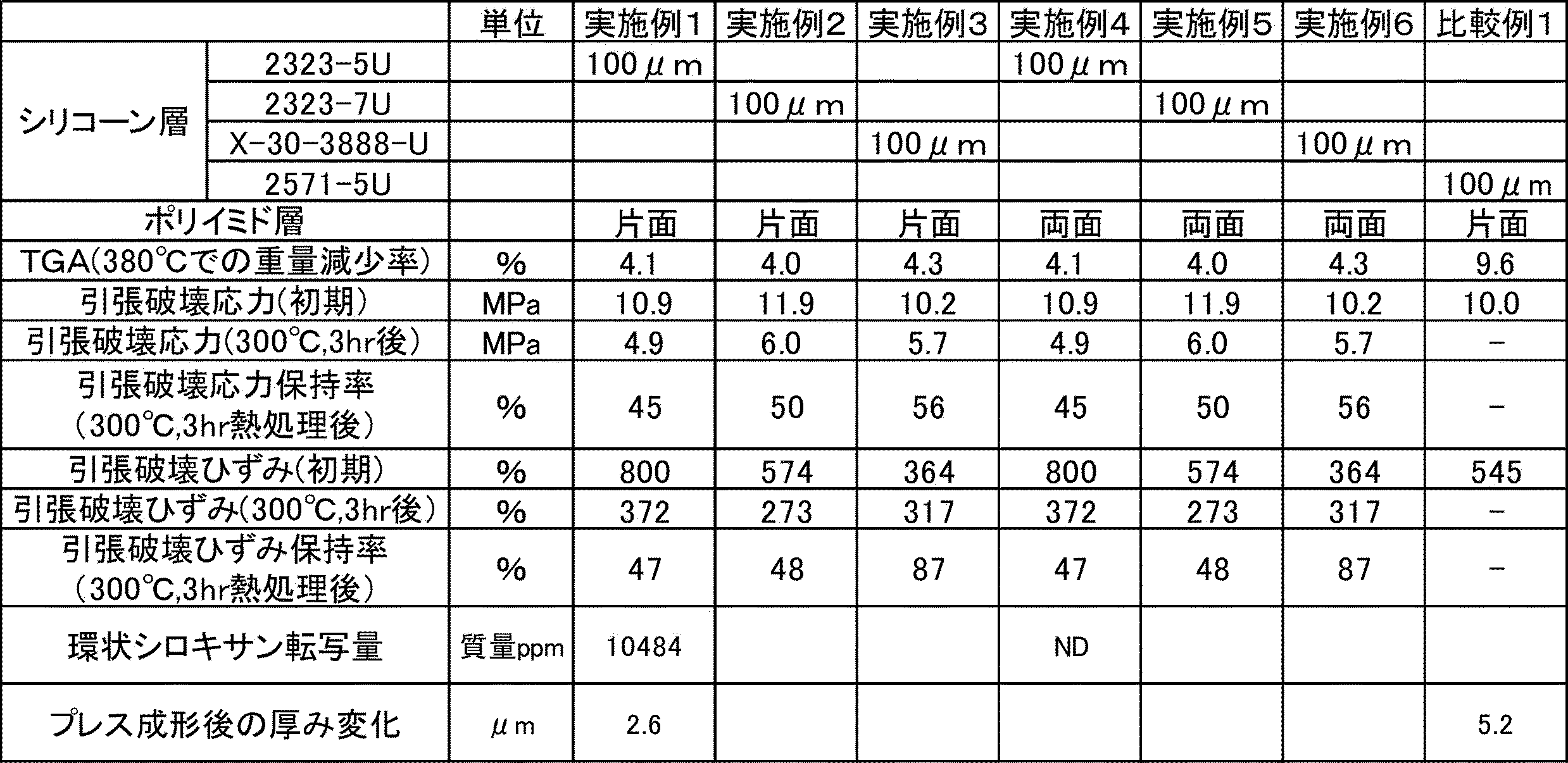
※比較例1における“-”は測定できなかったことを示す。
表1に記載の通り、実施例1~6では、シリコーン層の380℃における重量減少率が低く耐熱性が高いため、熱処理後の破壊応力保持率及び破壊ひずみ保持率が高くなり、高温環境下において、長期にわたって繰り返し使用しても高い性能が維持される。そのため、積層体は、離型材、緩衝材、キャリアフィルムなどとして高温環境下で繰り返し使用されても、シリコーン層のクッション性が失われず、また、脆化したりすることも防止される。
また、実施例4~6で示したように、ポリイミド層が両面に設けられる場合、プレス試験においてプレス機への低分子量シロキサンの付着量が少なくなり、成形体や成形型を汚染しにくいことが理解できる。
さらに、プレス成形による厚み変化(寸法変化)が抑えられており、プレス成形時等で繰り返し使用されても厚みが変化しにくく、充分なクッション性が維持され耐久性に優れるものであることが理解できる。
一方で、比較例1では、シリコーン層の380℃における重量減少率が高く耐熱性が低いため、熱処理後に脆化して、破壊応力及び破壊ひずみが測定できなかった。また、プレス成形による厚み(寸法変化)が実施例に比べ大きいものであった。そのため、離型材、緩衝材や、キャリアフィルムなどとして高温環境下で長期にわたって繰り返し使用することが難しい。
Claims (16)
- シリコーン層とポリイミド層を備える積層体であって、
前記シリコーン層の熱重量測定による380℃における重量減少率が9質量%以下である積層体。 - 前記シリコーン層の両面にポリイミド層が設けられる請求項1に記載の積層体。
- 前記シリコーン層の片面のみに前記ポリイミド層を備え、該シリコーン層のもう一方側にカバーフィルムを備える請求項1に記載の積層体。
- 前記シリコーン層は酸化チタンを0.1~10質量%含む、請求項1~3のいずれか1項に記載の積層体。
- 前記シリコーン層の23℃における引張貯蔵弾性率よりも前記ポリイミド層の23℃における引張貯蔵弾性率が大きい、請求項1~4のいずれか1項に記載の積層体。
- 前記シリコーン層の300℃で3時間熱処理した後の引張破壊応力保持率が10%以上である請求項1~5のいずれか1項に記載の積層体。
- 前記シリコーン層の300℃で3時間熱処理した後の引張破壊ひずみ保持率が10%以上である請求項1~6のいずれか1項に記載の積層体。
- シリコーン層:ポリイミド層の厚み比が、99:1~20:80である請求項1~7のいずれか1項に記載の積層体。
- 離型材、緩衝材、及び滑り止め材のいずれかとして用いる請求項1~8のいずれか1項に記載の積層体。
- プレス成形、真空成形、及び圧空成形のいずれかに用いる請求項1~8のいずれか1項に記載の積層体。
- キャリアフィルムとして用いる請求項1~8のいずれか1項に記載の積層体。
- 23℃における引張貯蔵弾性率が100MPa以下である樹脂層(A)と、23℃における引張貯蔵弾性率が1GPa以上である樹脂層(B)を備える積層体であって、
前記樹脂層(A)の熱重量測定による380℃における重量減少率が9質量%以下であり、
離型材、緩衝材、及び滑り止め材のいずれかとして用いる積層体。 - 23℃における引張貯蔵弾性率が100MPa以下である樹脂層(A)と、23℃における引張貯蔵弾性率が1GPa以上である樹脂層(B)を備える積層体であって、
前記樹脂層(A)の熱重量測定による380℃における重量減少率が9質量%以下であり、
プレス成形、真空成形、及び圧空成形のいずれかに用いる積層体。 - 23℃における引張貯蔵弾性率が100MPa以下である樹脂層(A)と、23℃における引張貯蔵弾性率が1GPa以上である樹脂層(B)を備える積層体であって、
前記樹脂層(A)の熱重量測定による380℃における重量減少率が9質量%以下であり、
キャリアフィルムとして用いる積層体。 - 成形時の離型材または緩衝材として使用する、請求項1~8のいずれか1項に記載の積層体の使用方法。
- 成形時の離型材または緩衝材として使用する際、カバーフィルムを剥がして、ポリイミド層側を成形型側に配置し、シリコーン層側を成形体側に配置する、請求項3~8のいずれか1項に記載の積層体の使用方法。
Priority Applications (2)
| Application Number | Priority Date | Filing Date | Title |
|---|---|---|---|
| CN202180076372.0A CN116406333B (zh) | 2020-11-16 | 2021-11-15 | 层叠体 |
| KR1020237016307A KR20230125172A (ko) | 2020-11-16 | 2021-11-15 | 적층체 |
Applications Claiming Priority (2)
| Application Number | Priority Date | Filing Date | Title |
|---|---|---|---|
| JP2020190564 | 2020-11-16 | ||
| JP2020-190564 | 2020-11-16 |
Publications (1)
| Publication Number | Publication Date |
|---|---|
| WO2022102778A1 true WO2022102778A1 (ja) | 2022-05-19 |
Family
ID=81601364
Family Applications (1)
| Application Number | Title | Priority Date | Filing Date |
|---|---|---|---|
| PCT/JP2021/041955 Ceased WO2022102778A1 (ja) | 2020-11-16 | 2021-11-15 | 積層体 |
Country Status (4)
| Country | Link |
|---|---|
| JP (2) | JP7757723B2 (ja) |
| KR (1) | KR20230125172A (ja) |
| TW (1) | TWI924726B (ja) |
| WO (1) | WO2022102778A1 (ja) |
Citations (9)
| Publication number | Priority date | Publication date | Assignee | Title |
|---|---|---|---|---|
| JP2012077128A (ja) * | 2010-09-30 | 2012-04-19 | Unitika Ltd | オルガノシロキサン共重合樹脂 |
| JP2015170690A (ja) * | 2014-03-06 | 2015-09-28 | 信越化学工業株式会社 | Ledチップ圧着用熱伝導性複合シート及びその製造方法 |
| WO2017073507A1 (ja) * | 2015-10-29 | 2017-05-04 | 東レ株式会社 | 仮貼り用積層体フィルム、仮貼り用積層体フィルムを用いた基板加工体および積層基板加工体の製造方法、ならびにこれらを用いた半導体装置の製造方法 |
| JP2017100397A (ja) * | 2015-12-03 | 2017-06-08 | 三井化学東セロ株式会社 | プロセス用離型フィルム、その用途、及びそれを用いた樹脂封止半導体の製造方法 |
| WO2017195711A1 (ja) * | 2016-05-12 | 2017-11-16 | 住友ベークライト株式会社 | 半導体基板加工用粘着テープ |
| JP2017214501A (ja) * | 2016-06-01 | 2017-12-07 | 東レ株式会社 | 電磁波シールド用接着材、電磁波シールド材、および同軸ケーブル、ならびに同軸ケーブルの製造方法 |
| WO2018016564A1 (ja) * | 2016-07-22 | 2018-01-25 | モメンティブ・パフォーマンス・マテリアルズ・ジャパン合同会社 | 熱伝導性ポリオルガノシロキサン組成物 |
| JP2018053260A (ja) * | 2017-12-21 | 2018-04-05 | 信越化学工業株式会社 | 熱伝導性シリコーン組成物及び硬化物並びに複合シート |
| JP2020136600A (ja) * | 2019-02-25 | 2020-08-31 | 東レ株式会社 | 半導体または電子部品製造用粘着フィルムならびに半導体または電子部品の製造方法 |
Family Cites Families (4)
| Publication number | Priority date | Publication date | Assignee | Title |
|---|---|---|---|---|
| JP3041213B2 (ja) * | 1994-12-26 | 2000-05-15 | 信越化学工業株式会社 | 耐熱熱伝導性シリコーンゴム複合シート |
| JP3589833B2 (ja) | 1997-06-30 | 2004-11-17 | 三菱樹脂株式会社 | シリコーンゴム複合体 |
| JP4301468B2 (ja) | 1999-07-07 | 2009-07-22 | 信越化学工業株式会社 | 耐熱熱伝導性シリコーンゴム複合シート及びその製造方法 |
| TWI723093B (zh) * | 2015-12-03 | 2021-04-01 | 日商三井化學東賽璐股份有限公司 | 製程用離型薄膜,其用途,及使用其的樹脂封裝半導體的製造方法 |
-
2021
- 2021-11-15 JP JP2021185945A patent/JP7757723B2/ja active Active
- 2021-11-15 KR KR1020237016307A patent/KR20230125172A/ko active Pending
- 2021-11-15 WO PCT/JP2021/041955 patent/WO2022102778A1/ja not_active Ceased
- 2021-11-16 TW TW110142509A patent/TWI924726B/zh active
-
2025
- 2025-10-03 JP JP2025167618A patent/JP2025182056A/ja active Pending
Patent Citations (9)
| Publication number | Priority date | Publication date | Assignee | Title |
|---|---|---|---|---|
| JP2012077128A (ja) * | 2010-09-30 | 2012-04-19 | Unitika Ltd | オルガノシロキサン共重合樹脂 |
| JP2015170690A (ja) * | 2014-03-06 | 2015-09-28 | 信越化学工業株式会社 | Ledチップ圧着用熱伝導性複合シート及びその製造方法 |
| WO2017073507A1 (ja) * | 2015-10-29 | 2017-05-04 | 東レ株式会社 | 仮貼り用積層体フィルム、仮貼り用積層体フィルムを用いた基板加工体および積層基板加工体の製造方法、ならびにこれらを用いた半導体装置の製造方法 |
| JP2017100397A (ja) * | 2015-12-03 | 2017-06-08 | 三井化学東セロ株式会社 | プロセス用離型フィルム、その用途、及びそれを用いた樹脂封止半導体の製造方法 |
| WO2017195711A1 (ja) * | 2016-05-12 | 2017-11-16 | 住友ベークライト株式会社 | 半導体基板加工用粘着テープ |
| JP2017214501A (ja) * | 2016-06-01 | 2017-12-07 | 東レ株式会社 | 電磁波シールド用接着材、電磁波シールド材、および同軸ケーブル、ならびに同軸ケーブルの製造方法 |
| WO2018016564A1 (ja) * | 2016-07-22 | 2018-01-25 | モメンティブ・パフォーマンス・マテリアルズ・ジャパン合同会社 | 熱伝導性ポリオルガノシロキサン組成物 |
| JP2018053260A (ja) * | 2017-12-21 | 2018-04-05 | 信越化学工業株式会社 | 熱伝導性シリコーン組成物及び硬化物並びに複合シート |
| JP2020136600A (ja) * | 2019-02-25 | 2020-08-31 | 東レ株式会社 | 半導体または電子部品製造用粘着フィルムならびに半導体または電子部品の製造方法 |
Also Published As
| Publication number | Publication date |
|---|---|
| JP2022079444A (ja) | 2022-05-26 |
| CN116406333A (zh) | 2023-07-07 |
| TW202224951A (zh) | 2022-07-01 |
| KR20230125172A (ko) | 2023-08-29 |
| JP2025182056A (ja) | 2025-12-11 |
| JP7757723B2 (ja) | 2025-10-22 |
| TWI924726B (zh) | 2026-05-11 |
Similar Documents
| Publication | Publication Date | Title |
|---|---|---|
| JP5302309B2 (ja) | 積層体及び回路配線基板 | |
| CN109476128B (zh) | 热传导性硅酮橡胶复合片材 | |
| JP7131017B2 (ja) | シリコーンゴム複合体 | |
| JP7204658B2 (ja) | 単層フィルム及びそれを用いた耐熱粘着テープ | |
| JP2016127091A (ja) | 半導体モールド用離型フィルム | |
| JP3599634B2 (ja) | イオン注入機用静電チャック | |
| JP2018052024A (ja) | シリコーンゴム複合体 | |
| JP2012059846A (ja) | 半導体製造用粘着フィルム及びその製造方法 | |
| JP7045500B2 (ja) | 積層体の製造方法及び樹脂層付金属箔 | |
| JP7757723B2 (ja) | 積層体 | |
| JP7859034B2 (ja) | 積層体 | |
| KR20140079064A (ko) | 내열성 실리콘 이형필름 | |
| KR20180079695A (ko) | 실리콘계 점착 테이프 및 이의 제조 방법 | |
| JP7665939B2 (ja) | シリコーン成形体、シリコーン複合体、及びシリコーン成形体の製造方法 | |
| KR101992493B1 (ko) | 실리콘 경화도가 우수하고 전사율이 낮은 실리콘 이형필름 | |
| JP6691194B2 (ja) | 半導体モールド用離型フィルム | |
| TWI914459B (zh) | 脫模薄膜 | |
| JP7081217B2 (ja) | シリコーンゴム成形体及びその製造方法 | |
| JP7631707B2 (ja) | 離型フィルム | |
| JP2022167967A (ja) | シリコーンゴム複合体及びそれを使用した成形体の製造方法 | |
| JP2009170487A (ja) | 基板搬送治具用粘着ゴムシートおよび基板搬送治具 | |
| CN116867645A (zh) | 膜及其制造方法、以及半导体封装件的制造方法 | |
| JP2020157618A (ja) | シリコーンゴム複合体、およびその製造方法 | |
| JP2014233967A (ja) | 離型ポリエステルフィルム | |
| JP2009188278A (ja) | 基板搬送治具用粘着ゴムシートおよび基板搬送治具 |
Legal Events
| Date | Code | Title | Description |
|---|---|---|---|
| 121 | Ep: the epo has been informed by wipo that ep was designated in this application |
Ref document number: 21892023 Country of ref document: EP Kind code of ref document: A1 |
|
| NENP | Non-entry into the national phase |
Ref country code: DE |
|
| 122 | Ep: pct application non-entry in european phase |
Ref document number: 21892023 Country of ref document: EP Kind code of ref document: A1 |