WO2022097717A1 - 樹脂組成物、電池用バインダー、電池用電極合材層、電解質層、電池用シート、電池及び樹脂組成物の製造方法 - Google Patents
樹脂組成物、電池用バインダー、電池用電極合材層、電解質層、電池用シート、電池及び樹脂組成物の製造方法 Download PDFInfo
- Publication number
- WO2022097717A1 WO2022097717A1 PCT/JP2021/040760 JP2021040760W WO2022097717A1 WO 2022097717 A1 WO2022097717 A1 WO 2022097717A1 JP 2021040760 W JP2021040760 W JP 2021040760W WO 2022097717 A1 WO2022097717 A1 WO 2022097717A1
- Authority
- WO
- WIPO (PCT)
- Prior art keywords
- battery
- resin composition
- compound
- mass
- composition according
- Prior art date
- Legal status (The legal status is an assumption and is not a legal conclusion. Google has not performed a legal analysis and makes no representation as to the accuracy of the status listed.)
- Ceased
Links
Images
Classifications
-
- H—ELECTRICITY
- H01—ELECTRIC ELEMENTS
- H01B—CABLES; CONDUCTORS; INSULATORS; SELECTION OF MATERIALS FOR THEIR CONDUCTIVE, INSULATING OR DIELECTRIC PROPERTIES
- H01B1/00—Conductors or conductive bodies characterised by the conductive materials; Selection of materials as conductors
- H01B1/06—Conductors or conductive bodies characterised by the conductive materials; Selection of materials as conductors mainly consisting of other non-metallic substances
- H01B1/10—Conductors or conductive bodies characterised by the conductive materials; Selection of materials as conductors mainly consisting of other non-metallic substances sulfides
-
- C—CHEMISTRY; METALLURGY
- C08—ORGANIC MACROMOLECULAR COMPOUNDS; THEIR PREPARATION OR CHEMICAL WORKING-UP; COMPOSITIONS BASED THEREON
- C08K—Use of inorganic or non-macromolecular organic substances as compounding ingredients
- C08K3/00—Use of inorganic substances as compounding ingredients
- C08K3/32—Phosphorus-containing compounds
-
- C—CHEMISTRY; METALLURGY
- C08—ORGANIC MACROMOLECULAR COMPOUNDS; THEIR PREPARATION OR CHEMICAL WORKING-UP; COMPOSITIONS BASED THEREON
- C08L—COMPOSITIONS OF MACROMOLECULAR COMPOUNDS
- C08L53/00—Compositions of block copolymers containing at least one sequence of a polymer obtained by reactions only involving carbon-to-carbon unsaturated bonds; Compositions of derivatives of such polymers
- C08L53/02—Compositions of block copolymers containing at least one sequence of a polymer obtained by reactions only involving carbon-to-carbon unsaturated bonds; Compositions of derivatives of such polymers of vinyl-aromatic monomers and conjugated dienes
-
- H—ELECTRICITY
- H01—ELECTRIC ELEMENTS
- H01M—PROCESSES OR MEANS, e.g. BATTERIES, FOR THE DIRECT CONVERSION OF CHEMICAL ENERGY INTO ELECTRICAL ENERGY
- H01M10/00—Secondary cells; Manufacture thereof
- H01M10/05—Accumulators with non-aqueous electrolyte
- H01M10/052—Li-accumulators
-
- H—ELECTRICITY
- H01—ELECTRIC ELEMENTS
- H01M—PROCESSES OR MEANS, e.g. BATTERIES, FOR THE DIRECT CONVERSION OF CHEMICAL ENERGY INTO ELECTRICAL ENERGY
- H01M10/00—Secondary cells; Manufacture thereof
- H01M10/05—Accumulators with non-aqueous electrolyte
- H01M10/056—Accumulators with non-aqueous electrolyte characterised by the materials used as electrolytes, e.g. mixed inorganic/organic electrolytes
- H01M10/0561—Accumulators with non-aqueous electrolyte characterised by the materials used as electrolytes, e.g. mixed inorganic/organic electrolytes the electrolyte being constituted of inorganic materials only
- H01M10/0562—Solid materials
-
- H—ELECTRICITY
- H01—ELECTRIC ELEMENTS
- H01M—PROCESSES OR MEANS, e.g. BATTERIES, FOR THE DIRECT CONVERSION OF CHEMICAL ENERGY INTO ELECTRICAL ENERGY
- H01M4/00—Electrodes
- H01M4/02—Electrodes composed of, or comprising, active material
- H01M4/13—Electrodes for accumulators with non-aqueous electrolyte, e.g. for lithium-accumulators; Processes of manufacture thereof
-
- H—ELECTRICITY
- H01—ELECTRIC ELEMENTS
- H01M—PROCESSES OR MEANS, e.g. BATTERIES, FOR THE DIRECT CONVERSION OF CHEMICAL ENERGY INTO ELECTRICAL ENERGY
- H01M4/00—Electrodes
- H01M4/02—Electrodes composed of, or comprising, active material
- H01M4/62—Selection of inactive substances as ingredients for active masses, e.g. binders, fillers
- H01M4/621—Binders
- H01M4/622—Binders being polymers
-
- H—ELECTRICITY
- H01—ELECTRIC ELEMENTS
- H01M—PROCESSES OR MEANS, e.g. BATTERIES, FOR THE DIRECT CONVERSION OF CHEMICAL ENERGY INTO ELECTRICAL ENERGY
- H01M4/00—Electrodes
- H01M4/02—Electrodes composed of, or comprising, active material
- H01M4/62—Selection of inactive substances as ingredients for active masses, e.g. binders, fillers
- H01M4/621—Binders
- H01M4/622—Binders being polymers
- H01M4/623—Binders being polymers fluorinated polymers
-
- C—CHEMISTRY; METALLURGY
- C08—ORGANIC MACROMOLECULAR COMPOUNDS; THEIR PREPARATION OR CHEMICAL WORKING-UP; COMPOSITIONS BASED THEREON
- C08K—Use of inorganic or non-macromolecular organic substances as compounding ingredients
- C08K3/00—Use of inorganic substances as compounding ingredients
- C08K3/32—Phosphorus-containing compounds
- C08K2003/329—Phosphorus containing acids
-
- C—CHEMISTRY; METALLURGY
- C08—ORGANIC MACROMOLECULAR COMPOUNDS; THEIR PREPARATION OR CHEMICAL WORKING-UP; COMPOSITIONS BASED THEREON
- C08L—COMPOSITIONS OF MACROMOLECULAR COMPOUNDS
- C08L2203/00—Applications
- C08L2203/20—Applications use in electrical or conductive gadgets
-
- C—CHEMISTRY; METALLURGY
- C08—ORGANIC MACROMOLECULAR COMPOUNDS; THEIR PREPARATION OR CHEMICAL WORKING-UP; COMPOSITIONS BASED THEREON
- C08L—COMPOSITIONS OF MACROMOLECULAR COMPOUNDS
- C08L2207/00—Properties characterising the ingredient of the composition
- C08L2207/04—Thermoplastic elastomer
-
- H—ELECTRICITY
- H01—ELECTRIC ELEMENTS
- H01M—PROCESSES OR MEANS, e.g. BATTERIES, FOR THE DIRECT CONVERSION OF CHEMICAL ENERGY INTO ELECTRICAL ENERGY
- H01M2300/00—Electrolytes
- H01M2300/0017—Non-aqueous electrolytes
- H01M2300/0065—Solid electrolytes
- H01M2300/0068—Solid electrolytes inorganic
-
- Y—GENERAL TAGGING OF NEW TECHNOLOGICAL DEVELOPMENTS; GENERAL TAGGING OF CROSS-SECTIONAL TECHNOLOGIES SPANNING OVER SEVERAL SECTIONS OF THE IPC; TECHNICAL SUBJECTS COVERED BY FORMER USPC CROSS-REFERENCE ART COLLECTIONS [XRACs] AND DIGESTS
- Y02—TECHNOLOGIES OR APPLICATIONS FOR MITIGATION OR ADAPTATION AGAINST CLIMATE CHANGE
- Y02E—REDUCTION OF GREENHOUSE GAS [GHG] EMISSIONS, RELATED TO ENERGY GENERATION, TRANSMISSION OR DISTRIBUTION
- Y02E60/00—Enabling technologies; Technologies with a potential or indirect contribution to GHG emissions mitigation
- Y02E60/10—Energy storage using batteries
Definitions
- the present invention manufactures a resin composition, a battery binder, a battery electrode mixture layer, an electrolyte layer, a battery sheet, a battery, and a resin composition that can be used as a battery binder and can suppress a decrease in ionic conductivity. Regarding the method.
- An all-solid-state battery such as an all-solid-state lithium-ion battery usually includes a positive electrode layer, a solid electrolyte layer (sometimes referred to simply as an "electrolyte layer"), and a negative electrode layer.
- a binder By containing a binder in these layers, each layer or a laminate thereof can be made into a sheet.
- Non-Patent Documents 1 and 2 disclose the polymerization of PS4 on the surface of the electrode active material. Further, Non-Patent Document 3 discloses a change in the chemical structure of 70Li 2 S-30P 2 S 5 due to heat treatment.
- PVDF polyvinylidene fluoride
- CMC carboxymethyl cellulose
- the binder has a problem that the ionic conductivity is lowered when the addition amount is increased in order to obtain the binding property between the materials constituting the layer (for example, the electrode mixture).
- One of the objects of the present invention is to provide a resin composition that can be used as a binder for a battery and can suppress a decrease in ionic conductivity.
- a resin composition containing a compound containing phosphorus and sulfur as constituent elements and having a disulfide bond and a thermoplastic resin can be used as a binder having ionic conductivity.
- the present invention has been completed. According to the present invention, the following resin compositions and the like can be provided. 1. 1. A resin composition containing a compound containing phosphorus and sulfur as constituent elements and having a disulfide bond, and a thermoplastic resin. 2. 2. The resin composition according to 1, wherein the compound is obtained by oxidizing a raw material compound containing phosphorus and sulfur as constituent elements with an oxidizing agent. 3. 3. 3.
- X is a halogen. N is an integer.
- the thermoplastic resin is a styrene / butadiene thermoplastic elastomer, cellulose ether, carboxymethyl cellulose, fluororesin, polyethers, polyacrylonitrile, polyvinyl acetate, polymethylmethacrylate, polyphosphazene, polyvinylpyrrolidone, polyethylene oxide, poly.
- a binder for a battery which comprises the resin composition according to any one of 10.1 to 9.
- a battery sheet comprising one or more selected from the group consisting of the battery electrode mixture layer and the electrolyte layer according to 11.11 or 12.
- a battery comprising the resin composition according to any one of 14.1 to 9.
- a resin composition comprising adding an oxidizing agent to a raw material compound containing phosphorus and sulfur as constituent elements to oxidize the raw material compound, and mixing the compound obtained by the oxidation with a thermoplastic resin. Manufacturing method.
- x to y represents a numerical range of "x or more and y or less”. The upper and lower limits described for the numerical range can be combined arbitrarily. A form in which two or more of the individual forms of the present invention described below are combined is also a form of the present invention.
- the resin composition according to one aspect of the present invention contains a compound containing phosphorus and sulfur as constituent elements and having a disulfide bond (hereinafter, also referred to as “compound ⁇ ”), and a thermoplastic resin.
- compound ⁇ a compound containing phosphorus and sulfur as constituent elements and having a disulfide bond
- thermoplastic resin a thermoplastic resin
- Such a resin composition can be widely used as a binder having ionic conductivity in various applications such as a battery.
- Compound ⁇ contains phosphorus and sulfur as constituent elements and has a disulfide bond. In one embodiment, compound ⁇ has a peak derived from a disulfide bond that binds two phosphorus elements in Raman spectroscopy.
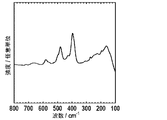
- compound ⁇ peaks in the range of Raman shift 425 cm -1 or more and 500 cm -1 or less, preferably 440 cm -1 or more and 490 cm -1 or less, more preferably 460 cm -1 or more and 480 cm -1 or less in Raman spectroscopy. (Hereinafter, also referred to as “peak A”), and Raman shift 370 cm -1 or more and less than 425 cm -1 , preferably 380 cm -1 or more and 423 cm -1 or less, more preferably 390 cm -1 or more and 420 cm -1 or less. It can be identified by having a peak (hereinafter, also referred to as “peak B”) in the range of.
- the fact that the compound ⁇ according to the embodiment of the present invention has a disulfide bond (SS) may be identified by having a peak A.
- Peak A is derived from a disulfide bond (SS) that binds two phosphorus elements in compound ⁇ .
- Peak B is derived from the symmetric expansion and contraction of the PS 4 3- unit (also referred to as the PS 4 structure) due to the PS bond.
- Raman spectroscopic analysis of compound ⁇ is performed by the method described in Examples. At this time, it is important to measure the compound ⁇ after treating it with toluene. This is to remove elemental sulfur that may be mixed in compound ⁇ . Elemental sulfur has a peak at a position where it can overlap with peak A. Therefore, by removing the elemental sulfur, the peak A derived from the compound ⁇ can be satisfactorily measured. Toluene treatment is carried out according to the procedure described in Examples.
- the compound ⁇ according to the embodiment of the present invention preferably contains one or more elements selected from the group consisting of lithium, sodium and magnesium as constituent elements. In one embodiment, these constituent elements are bonded to S in compound ⁇ by an ionic bond.
- thermoplastic resin contained in the resin composition is not particularly limited.
- the thermoplastic resin is a cellulose derivative represented by a styrene / butadiene thermoplastic elastomer (SBS), ethyl cellulose, carboxymethyl cellulose (CMC), etc., a polyvinylidene fluoride or a polyvinylidene fluoride-hexafluoropropylene copolymer.
- SBS styrene-butadiene thermoplastic elastomer
- the mass ratio of the compound ⁇ to the thermoplastic resin in the resin composition is not particularly limited. In one embodiment, the mass ratio of compound ⁇ to the thermoplastic resin (compound ⁇ : thermoplastic resin) in the resin composition is 99: 1 to 1:99, 95: 5 to 5:95, 90:10 to 10. : 90, 85:15 to 15:85, 80:20 to 20:80, 75:25 to 25:75 or 70:30 to 30:70.
- the resin composition further comprises a halogen (halogen-containing substance).
- the halogen may be a halogen derived from an oxidizing agent or the like used in producing the compound ⁇ .
- the halogen is one or more selected from the group consisting of iodine, fluorine, chlorine and bromine.
- the halogen is one or more selected from the group consisting of iodine and bromine.
- the form of the halogen described above is not particularly limited, and is, for example, a salt of one or more elements selected from the group consisting of lithium, sodium, magnesium and aluminum and a halogen, and one or more selected from the group consisting of simple substances of halogen. possible.
- the salt include LiI, NaI, MgI 2 , AlI 3 , LiBr, NaBr, MgBr 2 , AlBr 3 and the like. Among these, LiI and LiBr are preferable from the viewpoint of ion conductivity.
- the halogen simple substance include iodine (I 2 ), fluorine (F 2 ), chlorine (Cl 2 ), bromine (Br 2 ) and the like.
- the battery binder (A) may have higher ionic conductivity by including the halogen as the salt described above.
- the content of the halogen-containing substance (halogen simple substance and halogen compound) in the resin composition is not particularly limited.
- the entire resin composition When the mass of 100% by mass is 100% by mass or less, 50% by mass or less, 40% by mass or less, 30% by mass or less, 20% by mass or less, 15% by mass or less, 10% by mass or less, 8% by mass or less, 5% by mass or less. , 3% by mass or less, 2% by mass or less, 1% by mass or less, 0.5% by mass or less, 0.1% by mass or less, 0.05% by mass or less, or 0.01% by mass or less.
- the contents of the compound ⁇ , the resin composition and the halogen-containing substance in the resin composition are not particularly limited.
- the resin composition is 50% by mass or more, 60% by mass or more, 70% by mass or more, 80% by mass or more, 85% by mass or more, 90% by mass or more, 95% by mass or more, 98% by mass or more, 99% by mass or more, 99.5% by mass or more, 99.8% by mass or more, 99.9% by mass or more, or substantially 100% by mass is the compound ⁇ and the resin composition, or the compound ⁇ is thermoplastic. It is a resin and a halogen-containing substance. In the case of "substantially 100% by mass", unavoidable impurities may be contained.
- the battery binder according to one aspect of the present invention includes the above-mentioned resin composition.
- the battery binder (A) comprises the resin composition described above.
- the battery binder (A) can be used for various batteries.
- the battery include a secondary battery such as a lithium ion battery.
- the battery can be an all-solid-state battery.
- the "binder” is compounded in one or more selected from the group consisting of any element, for example, an electrode mixture layer for a battery and an electrolyte layer in such a battery, and another component contained in the element (for example, a layer). It is possible to exert a binding property (also referred to as "bonding force” or "adhesive force”) for binding each other and maintaining unity.
- the conventional electrode mixture layer for batteries for example, the positive electrode or the negative electrode described later
- the electrolyte layer close to the battery electrode mixture layer may also cause problems such as deterioration due to the influence of the volume change of the battery electrode mixture layer.
- the battery electrode mixture layer or the electrolyte layer can absorb the volume change due to the flexibility of the battery binder (A) and prevent capacity deterioration and the like. .. As a result, the battery can exhibit excellent cycle characteristics.
- the battery binder (A) itself can have ionic conductivity, the amount of the battery binder (A) added is increased in order to improve the binding property between the materials constituting the layer (for example, the electrode mixture). However, the decrease in ionic conductivity can be suppressed and the battery characteristics can be exhibited satisfactorily. Further, in one embodiment, the battery binder (A) has excellent heat resistance as compared with a normal organic binder or a polymer solid electrolyte (for example, polyethylene oxide), so that the operating temperature range of the battery can be expanded.
- a normal organic binder or a polymer solid electrolyte for example, polyethylene oxide
- the thermoplastic resin functions as a thickener, it has an effect of improving the coatability.
- a coating liquid (slurry) obtained by adding a solvent described later to the battery binder (A) an effect of excellent coatability can be obtained. This also has the effect of improving the uniformity of the coating film.
- the battery binder (A) can adjust the ionic conductivity by selecting the thermoplastic resin.
- the ion conductivity can be improved by selecting a polymer electrolyte such as a polyethylene oxide composite material containing an electrolyte salt as the thermoplastic resin.
- the battery electrode mixture layer or electrolyte layer includes the above-mentioned battery binder (A).
- the battery binder (A) is unevenly distributed or uniformly distributed (dispersed) in the battery electrode mixture layer or the electrolyte layer.
- the battery binder (A) is uniformly distributed (dispersed) in the layer, so that the integrity of the layer is better maintained.
- the battery electrode mixture layer or electrolyte layer preferably contains a solid electrolyte (hereinafter referred to as solid electrolyte (B)) other than the battery binder (A).
- solid electrolyte (B) is not particularly limited, and for example, an oxide solid electrolyte and a sulfide solid electrolyte can be used.
- the sulfide solid electrolyte is preferable, and specifically, the algyrodite type crystal structure, the Li 3 PS 4 crystal structure, the Li 4 P 2 S 6 crystal structure, the Li 7 P 3 S 11 crystal structure, and the Li 4-x Ge 1 -X P x S 4 series thio-LISION Region II (thio-LISION Region II) type crystal structure, similar to Li 4-x Ge 1-x P x S 4 series thio-LISION Region II (thio-LISION Region II) type Examples thereof include a sulfide solid electrolyte having a crystal structure such as a crystal structure (hereinafter, may be abbreviated as RII type crystal structure).
- the electrode mixture layer for a battery examples include a positive electrode, a negative electrode, and the like.
- the positive electrode may further contain a positive electrode active material.
- the positive electrode active material is a substance capable of inserting and removing lithium ions, and a substance known as a positive electrode active material in the battery field can be used.
- the positive electrode active material examples include metal oxides and sulfides. Sulfides include metallic sulfides and non-metallic sulfides.
- the metal oxide is, for example, a transition metal oxide.
- metal sulfide examples include lithium sulfide (Li 2 S), lithium polysulfide (Li 2 Sx, 1 ⁇ x ⁇ 8), titanium sulfide (TiS 2 ), molybdenum sulfide (MoS 2 ), and iron sulfide (FeS, FeS 2 ). ), Copper sulfide (CuS), nickel sulfide (Ni 3 S 2 ) and the like.
- metal oxide include bismuth oxide (Bi 2 O 3 ) and bismuth lead acid (Bi 2 Pb 2 O 5 ).
- non-metal sulfides include elemental sulfur, organic disulfide compounds, carbon sulfide compounds and the like.
- niobium selenate (NbSe 3 ) indium metal, and sulfur can also be used as the positive electrode active material.
- the negative electrode may further contain a negative electrode active material.
- Negative electrode active materials are carbon materials such as graphite, natural graphite, artificial graphite, hard carbon, and soft carbon; polyacene-based conductive polymers, composite metal oxides such as lithium titanate; silicon, silicon alloys, silicon composite oxides, etc. Materials usually used in lithium ion secondary batteries such as tin, tin alloys and other compounds that form an alloy with lithium can be used.
- the negative electrode active material preferably contains one or more selected from the group consisting of Si (silicon, silicon alloy, silicon-graphite composite, silicon composite oxide, etc.) and Sn (tin, tin alloy). ..
- One or both of the positive electrode and the negative electrode may contain a conductive auxiliary agent.
- a conductive additive When the electron conductivity of the active material is low, it is preferable to add a conductive additive. This makes it possible to improve the rate characteristics of the battery.
- the conductive auxiliary agent are preferably carbon materials, nickel, copper, aluminum, indium, silver, cobalt, magnesium, lithium, chromium, gold, ruthenium, platinum, beryllium, iridium, molybdenum, niobium, osnium, rhodium, etc.
- the carbon material include carbon black such as Ketjen black, acetylene black, denka black, thermal black, and channel black; graphite, carbon fiber, activated carbon, etc., which may be used alone or in combination of two or more. It is possible. Of these, acetylene black and ketjen black, including denka black, which has high electron conductivity, are preferable.
- the electrolyte layer contains a battery binder (A), and may contain a solid electrolyte (B) other than the battery binder (A) as an optional component.
- the battery binder (A) can also serve as a solid electrolyte. 30% by mass or more, 50% by mass or more, 80% by mass or more, 90% by mass or more, 95% by mass or more, 98% by mass or more, 99% by mass or more or 99.9% by mass or more of the electrolyte layer is a solid electrolyte (B).
- the battery binder (A) the battery binder (A).
- the method of forming a layer containing the compound ⁇ and the thermoplastic resin for example, the method of forming each layer constituting the above-mentioned battery is not particularly limited, and examples thereof include a coating method.
- a coating liquid in which the components contained in each layer are dissolved or dispersed in a solvent can be used.
- Solvents contained in the coating liquid include chain, cyclic or aromatic ethers (eg, dimethyl ether, dibutyl ether, tetrahydrofuran, anisole, etc.), esters (eg, ethyl acetate, ethyl propionate, etc.), alcohols (eg, methanol, etc.).
- a layer (dried coating film) is formed by drying the solvent after coating.
- Anisole is preferable from the viewpoint of easiness of drying the solvent.
- the drying method is not particularly limited, and for example, one or more means selected from the group consisting of heat drying, blast drying and vacuum drying (including vacuum drying) can be used.
- the members to be coated with the coating liquid are not particularly limited.
- the formed layer may be used for the battery together with the member, or the formed layer may be peeled off from the member and used for the battery.
- the coating liquid for forming the positive electrode is applied onto the positive electrode current collector.
- the coating liquid for forming the negative electrode is applied onto the negative electrode current collector.
- the coating liquid for forming the electrolyte layer is applied on the positive electrode or the negative electrode.
- the coating liquid for forming the electrolyte layer is applied on the easily peelable member, and then the formed layer is peeled off from the easily peelable member and placed between the positive electrode and the negative electrode.
- the press may be one that presses and compresses the layer.
- the press can be applied to reduce the porosity in the layer.
- the press device is not particularly limited, and for example, a roll press, a uniaxial press, or the like can be used.
- the temperature at the time of pressing is not particularly limited, and may be about room temperature (23 ° C.), or may be lower or higher than room temperature.
- the press may be applied layer by layer, or the plurality of layers (for example, "battery sheet” described later) may be pressed so as to be pressed in the stacking direction.
- the plurality of layers for example, "battery sheet” described later
- the battery sheet according to one aspect of the present invention includes one or more selected from the group consisting of the electrode mixture layer and the electrolyte layer described above.
- the battery sheet By containing the compound ⁇ and the thermoplastic resin or the battery binder (A), the battery sheet exhibits excellent flexibility and is prevented from breaking or peeling from the current collector.
- the battery according to one aspect of the present invention includes the above-mentioned resin composition.
- the battery is an all-solid-state battery.
- the all-solid-state battery includes a laminate comprising a positive electrode current collector, a positive electrode, an electrolyte layer, a negative electrode, and a negative electrode current collector in this order.
- a plate-like body or a foil-like body made of copper, magnesium, stainless steel, titanium, iron, cobalt, nickel, zinc, aluminum, germanium, indium, lithium, or an alloy thereof can be used.
- the battery preferably contains one or more of the above-mentioned resin compositions selected from the group consisting of a positive electrode, an electrolyte layer and a negative electrode.
- the resin composition according to the present invention is used for a battery has been mainly described, but the present invention is not limited thereto. Since the resin composition according to the present invention is excellent in flexibility, ionic conductivity and the like, it can be widely applied to various uses.
- the method for producing the compound ⁇ described above includes adding an oxidizing agent to a raw material compound containing phosphorus and sulfur as constituent elements, and reacting the raw material compound with the oxidizing agent. By reacting the above-mentioned raw material compound with an oxidizing agent, compound ⁇ is obtained as a product.
- the compound ⁇ is formed by oxidizing a raw material compound containing phosphorus and sulfur as constituent elements with an oxidizing agent.
- the raw material compound (hereinafter referred to as raw material compound (C)) contains phosphorus and sulfur as constituent elements.
- the raw material compound (C) preferably contains one or more elements selected from the group consisting of lithium, sodium, magnesium and aluminum as constituent elements.
- the raw material compound (C) preferably contains a PS4 structure. Examples of the raw material compound containing the PS 4 structure include Li 3 PS 4 , Li 4 P 2 S 7, Na 3 PS 4 , Na 4 P 2 S 7 , and the like.
- the raw material compound (C) may contain two or more PS4 structures, such as Li 4 P 2 S 7 , Na 4 P 2 S 7 , and the like.
- Li 3 PS 4 can be produced, for example, by reacting Li 2 S and P 2 S 5 in the presence of a dispersion medium by a mechanochemical method (mechanical milling).
- the dispersion medium include n-heptane and the like.
- a mechanochemical method for example, a planetary ball mill or the like can be used.
- the compound ⁇ is prepared by reacting Li 2 S, P 2 S 5 , and an oxidizing agent in the presence of a dispersion medium (for example, n-heptane or the like) by a mechanochemical method (mechanical milling). Can be manufactured.
- a planetary ball mill or the like can be used for the mechanochemical method.
- Na 2 S may be used instead of Li 2 S.
- oxidizing agent examples include halogen alone, oxygen and ozone, oxides (Fe 2 O 3 , MnO 2 , Cu 2 O, Ag 2 O, etc.), and oxo salts (chlorates, hypochlorites, iodine).
- Acid salts bromine salts, chromate salts, permanganate salts, vanazine salts, bismuth salts, etc.), peroxides (lithium peroxide, sodium peroxide, etc.), halide salts (AgI, CuI, PbI 2 ) , AgBr, CuCl, etc.), cyanide salts (AgCN, etc.), thiocyanates (AgSCN, etc.), sulfoxides (dimethylsulfoxide, etc.) and the like.
- the oxidizing agent is preferably a halogen alone from the viewpoint of enhancing ionic conductivity by a metal halide generated as a by-product.
- the "metal halide” is a salt of one or more elements selected from the group consisting of lithium, sodium, magnesium and aluminum derived from the raw material compound (C) and a halogen (for example, the raw material compound (C) contains lithium. If it is included, it may be lithium halide) or the like.
- the halogen simple substance include iodine (I 2 ), fluorine (F 2 ), chlorine (Cl 2 ) and bromine (Br 2 ).
- the halogen alone is preferably iodine (I 2 ) or bromine (Br 2 ) from the viewpoint of obtaining higher ionic conductivity.
- the oxidizing agent one type may be used alone or a plurality of types may be used in combination.
- reaction formulas (1) to (3) proceeds. ..
- compound ⁇ has a PSS chain (a chain consisting of repeating repeating units consisting of PSS) (reaction formulas (1) and (2)).
- the PSS chain of compound ⁇ forms a branch (branch) (reaction equation (3)).
- two phosphorus elements and a disulfide bond that binds these two phosphorus elements form a PS chain.
- X is a halogen.
- N is an integer.
- the compound ⁇ contains a disulfide bond formed by any of the reaction formulas (1) to (3).
- X in the reaction formulas (1) to (3) is iodine (I), fluorine (F), chlorine (Cl) or bromine (Br). In one embodiment, X in reaction equations (1) to (3) is iodine (I).
- the molar ratio of (blended) Li 3 PS 4 to I 2 (Li 3 PS 4 : I 2 ) to be subjected to the reaction is not particularly limited, for example, 10: 1 to 1:10, 5: 1 to. It can be 1: 5, 3: 1 to 1: 3, 2: 1 to 1: 2, 4: 3 to 3: 4, 5: 4 to 4: 5 or 8: 7 to 7: 8.
- the blending amount of I 2 is 0.1 mol or more, 0.2 mol or more, 0.5 mol or more, 0.7 mol or more, or 1 part or more with respect to 100 mol parts of Li 3 PS 4 .
- It can be more than 300 mol parts, and can be 300 mol parts or less, 250 mol parts or less, 200 mol parts or less, 180 mol parts or less, 150 mol parts or less, 130 mol parts or less, 100 mol parts or less, 80 mol parts or less, 50 parts. It can be less than or equal to 3 moles, less than 30 moles, less than 20 moles, less than 15 moles, less than 10 moles, less than 8 moles, less than 5 moles, less than 3 moles or less than 2 moles. The larger the proportion of I 2 , the longer the PS chain can be extended.
- the raw material compound (C) and the oxidizing agent are reacted with one or more energies selected from the group consisting of physical energy, thermal energy and chemical energy. Is preferable.
- the reaction step it is preferable to react the raw material compound (C) and the oxidizing agent with energy including physical energy.
- Physical energy can be supplied, for example, by using the mechanochemical method (mechanical milling).
- mechanochemical method for example, a planetary ball mill or the like can be used.
- the treatment conditions are not particularly limited, for example, the rotation speed may be 100 rpm to 700 rpm, the treatment time may be 1 hour to 100 hours, and the ball diameter may be 1 mm to 10 mm in diameter. Can be.
- the reaction step it is preferable to react the raw material compound (C) and the oxidizing agent in a liquid.
- the raw material compound (C) and the oxidizing agent can be reacted in the presence of a dispersion medium.
- the dispersion medium examples include an aprotic liquid and the like.
- the aprotonic liquid is not particularly limited, and is preferably an aromatic hydrocarbon such as n-heptane or the like, preferably a chain or cyclic alkane having 5 or more carbon atoms, benzene, toluene, xylene, anisole or the like, a dimethyl ether, and the like.
- chain or cyclic ethers such as dibutyl ether and tetrahydrofuran, alkyl halides such as chloroform and methylene chloride, and esters such as ethyl propionate.
- one or both of the raw material compound (C) and the oxidizing agent when the raw material compound (C) and the oxidizing agent are reacted in a liquid, one or both of the raw material compound (C) and the oxidizing agent can be reacted in a mixed state with a solvent.
- a solvent among the above-mentioned dispersion media, those capable of dissolving one or both of the raw material compound (C) and the oxidizing agent can be used, and for example, anisole, dibutyl ether and the like are suitable.
- the raw material compound (C) and the oxidizing agent are reacted with one or more energies selected from the group consisting of physical energy such as stirring, milling, ultrasonic vibration and the like, thermal energy and chemical energy. Can be made to.
- the solution when using thermal energy, the solution can be heated.
- the heating temperature is not particularly limited and may be, for example, 40 to 200 ° C, 50 to 120 ° C or 60 to 100 ° C.
- compound ⁇ can be produced by oxidizing the raw material compound (C) with an oxidizing agent.
- the liquid (dispersion medium or solvent) can be removed as needed.
- a solid (powder) of compound ⁇ can be obtained.
- the method for removing the liquid is not particularly limited, and examples thereof include drying, solid-liquid separation, and the like, and two or more of these may be combined.
- compound ⁇ may be reprecipitated.
- the liquid containing the compound ⁇ can be added to a poor solvent (poor solvent for the compound ⁇ ) or a non-solvent (a solvent that does not dissolve the compound ⁇ ), and the compound ⁇ can be recovered as a solid (solid phase).
- a method of adding anisole solution containing compound ⁇ to n-heptane, which is a poor solvent, for solid-liquid separation can be mentioned.
- the solid-liquid separation means is not particularly limited, and examples thereof include an evaporation method, a filtration method, and a centrifugal separation method. When solid-liquid separation is used, the effect of improving purity can be obtained.
- LiI is by-produced with the formation of compound ⁇ .
- This LiI may or may not be separated from the compound ⁇ .
- compound ⁇ may have higher ionic conductivity.
- the crystal phase of LiI can be, for example, c-LiI (cubic crystal) (ICSD 414244), h-LiI (hexagonal crystal) (ICSD 414242) or the like.
- the mechanochemical method mechanical milling
- h- It becomes LiI (hexagonal crystal).
- Crystal phase LiI is can be determined by powder X-ray diffraction or solid 7 Li-NMR measurement.
- solid 7 Li-NMR measurement if a peak derived from LiI (chemical shift -4.57 ppm) is observed, it is determined to be c-LiI, and if a peak derived from LiI is not observed, it is determined to be h-LiI. Judge that there is.
- the method for producing the resin composition according to one aspect of the present invention is not particularly limited.
- an oxidizing agent is added to a raw material compound containing phosphorus and sulfur as constituent elements to oxidize the raw material compound, and the compound obtained by the oxidation is combined with heat. Includes mixing with a plastic resin. Thereby, the resin composition according to one aspect of the present invention can be produced.
- one or more components other than the compound obtained by oxidation, the thermoplastic resin, the compound ⁇ described in “3. Battery electrode mixture layer or electrolyte layer” above, and the thermoplastic resin. Mix with electrolyte etc.). This makes it possible to produce a resin composition suitable for the electrode mixture layer for batteries or the electrolyte layer.
- Example 1 (1) Manufacture of Li 3 PS 4 glass Li 2 S (manufactured by Furuuchi Chemical Co., Ltd., 3N powerer 200 Mesh) 1.379 g and P 2 S 5 (manufactured by Merck Co., Ltd.) 2.222 g are used as a dispersion medium (n-heptane).
- the reaction was carried out under the following conditions by a mechanochemical method (mechanical milling) using a planetary ball mill (premium line PL-7 (fritsch)). The dispersion medium was then removed by drying to give Li 3 PS 4 glass (powder).
- the Raman spectrum obtained by microscopic Raman spectroscopy is shown in FIG. A peak near the Raman shift 475 cm -1 was confirmed, which was derived from the disulfide (SS) bond of the PS chain.
- Li 3 PS 4 solid electrolyte Li 3 PS 4 glass obtained in "(1) Production of Li 3 PS 4 glass” above
- Compound ⁇ 3.5 parts by mass styrene / butadiene heat Thermoplastic elastomer (SBS) (JSR's "TR2000”): 1.5 parts by mass
- Anisole 81 parts by mass with respect to 100 parts by mass of the total amount of the above three components (solid content)
- SBS was dissolved in anisole to prepare an SBS solution having a concentration of 20% by mass. Then, 0.06 g of SBS solution and 0.400 mL of anisole were added to 0.028 g of compound ⁇ (powder) and dissolved. Next, 0.76 g of Li 3 PS 4 solid electrolyte was added to the solution, and the mixture was kneaded under the following kneading conditions using a planetary stirring defoaming device (“MAZERUSTAR KK-250S” manufactured by Kurabo Industries Ltd.).
- a planetary stirring defoaming device (“MAZERUSTAR KK-250S” manufactured by Kurabo Industries Ltd.).
- Example 2 In Example 1, the composition was the same as in Example 1 except that the composition of the coating liquid was changed to the following.
- [Composition of coating liquid] Li 3 PS 4 Solid electrolyte: 95 parts by mass Compound ⁇ (powder): 2.5 parts by mass Styrene-butadiene thermoplastic elastomer (SBS): 2.5 parts by mass Anisole: 100% by mass of the above three components (solid content) 85 parts by mass with respect to the part
- Example 3 In Example 1, the composition was the same as in Example 1 except that the composition of the coating liquid was changed to the following.
- Example 1 In Example 1, the composition was the same as in Example 1 except that the composition of the coating liquid was changed to the following.
- [Composition of coating liquid] Li 3 PS 4 Solid electrolyte: 95 parts by mass Styrene-butadiene thermoplastic elastomer (SBS): 5.0 parts by mass Anisole: 82 parts by mass with respect to 100 parts by mass of the total amount of the above two components (solid content)
- Example 2 In Example 1, an attempt was made to prepare a battery sheet by the same operation as in (5) of Example 1 except that the composition of the coating liquid was changed to the following, but the solid electrolyte sheet was peeled off from the aluminum foil. It was not possible to evaluate each physical property.
- composition of coating liquid Li 3 PS 4 solid electrolyte: 100 parts by mass Anisole: 99 parts by mass with respect to 100 parts by mass of the above Li 3 PS 4 solid electrolyte (solid content)
- Example 3 In Example 1, the composition was the same as in Example 1 except that the composition of the coating liquid was changed to the following.
- Example 4 (A) Manufacture of argilodite type solid electrolyte Li 2S (manufactured by Furuuchi Chemical Co., Ltd., 3N powder 200Mesh ) 0.492 g, P2 S 5 ( manufactured by Merck Co., Ltd.) 0.626 g, LiCl (manufactured by Nakaraitesk Co., Ltd.) 0. 382 g was reacted under the following conditions by a mechanochemical method (mechanical milling) using a planetary ball mill (P-7, manufactured by Fritsch) to obtain a precursor of an argylodite type solid electrolyte.
- a mechanochemical method mechanical milling
- P-7 manufactured by Fritsch
- the above mechanical milling was performed twice to obtain a precursor of about 2.6 g of an algyrodite-type solid electrolyte.
- the precursor was placed in a quartz tube and heat-treated at 430 ° C. for 8 hours under an argon flow atmosphere to produce an argylodite-type solid electrolyte.
- the miniaturization treatment was performed in two steps.
- Sample mass 1.5 g Format: Wet Milling (Toluene: 15.5 mL, Isobutyronitrile: 3.9 mL) Ball: Material ZrO 2 , diameter 0.5 mm, total mass 34 g Pot: Material ZrO 2 , Capacity 45 mL Milling conditions: 1st stage 370 rpm for 30 minutes 2nd stage 150 rpm for 1 hour
- the sample was vacuum dried at 100 ° C. for 1 hour.
- the dried sample was placed in a desiccator having a relative humidity of about 40% to 50%, and the hydrolysis reaction was allowed to proceed for 10 hours.
- the sample after the reaction was heat-treated at 350 ° C. for 1 hour to obtain LiNi 1/3 Co 1/3 Mn 1/3 O 2 (LiNbO 3 -coated NMC) coated with LiNbO 3 .
- the LiNbO 3 content in the obtained LiNbO 3 -coated NMC was 3% by mass.
- LiNbO 3 -coated NMC LiNbO 3 -coated NMC, argylodite-type solid electrolyte (SE) and acetylene black (AB) (manufactured by Denka) obtained in the above (A)
- LiNbO 3 -coated NMC: SE: AB The mixture was mixed at a mass ratio of 85:15: 1 (total mass 1 g). The binder solution was added to the obtained mixture.
- the obtained slurry was applied onto an Al foil of 5 ⁇ 10 cm to form a coating film.
- the coating film was dried at 60 ° C. for 10 hours and then vacuum dried at 160 ° C. for 3 hours.
- the obtained sheet was punched out to obtain a positive electrode sheet having a diameter of 9.9 mm.
- the positive electrode sheet did not break or peel off from the Al foil even when wound around a cylinder having a diameter of 16 mm. Further, the positive electrode sheet could be satisfactorily punched by punching.
- Example 5 ⁇ Manufacturing of all-solid-state battery> An algyrodite-type solid electrolyte (100 mg) prepared in the same manner as in Example 4 (A) was placed in a cylindrical container having SUS shafts on both sides and dusted to form a solid electrolyte layer. Next, the positive electrode sheet obtained in Example 4 was placed in a cylindrical container so as to overlap the solid electrolyte layer, and an In foil and a Li foil were further placed on the opposite side of the electrode sheet in the solid electrolyte layer in the cylindrical container. The cells were put in this order and laminated by pressing to prepare an all-solid-state battery (test cell). The AC impedance was measured by restraining the cell with a special jig.
- Example 6 A positive electrode sheet was prepared in the same manner as in Example 4 except that the compound ⁇ was 0.0445 g, the SBS solution was 0.0247 g, and the anisole was 0.5 mL. The positive electrode sheet did not break or peel off from the Al foil even when wound around a cylinder having a diameter of 16 mm. Further, the positive electrode sheet could be satisfactorily punched by punching. Moreover, when the interfacial resistance was measured using this positive electrode sheet in the same manner as in Example 5, it was 15 ⁇ .
- Example 4 A positive electrode sheet was prepared in the same manner as in Example 4 except that the compound ⁇ was 0.0495 g and the anisole was 0.5 mL without using SBS. The positive electrode sheet did not break or peel off from the Al foil even when wound around a cylinder with a diameter of 16 mm, and the positive electrode sheet could be punched by punching, but peeling was observed at the punched end and binding was possible. Was not enough. Moreover, when the interfacial resistance was measured using this positive electrode sheet in the same manner as in Example 5, it was 15 ⁇ .
- a positive electrode sheet was prepared by the method described in Example 4 except that the SBS solution was 0.0495 g and the anisole was 0.4 mL without using the compound ⁇ .
- the positive electrode sheet did not break or peel off from the Al foil even when wound around a cylinder with a diameter of 16 mm, and the positive electrode sheet could be punched by punching, but peeling was observed at the punched end and binding was possible. Was not enough.
- the interfacial resistance was measured using this positive electrode sheet in the same manner as in Example 5, it was 34 ⁇ .
- Example 5 Comparative Example 4 and Comparative Example 5, it was found that by using the compound ⁇ and SBS in combination, it is possible to improve the bondability of the electrode mixture layer and reduce the cell interface resistance at the same time. rice field.
- Example 7 ⁇ Preparation of solid electrolyte sheet using composite binder of compound ⁇ and cellulose ether> (1) Preparation of coating solution Cellulose ether (“Etocell” manufactured by Nissin Kasei Co., Ltd.) was dissolved in anisole to prepare a cellulose ether solution having a concentration of 20% by mass. To 0.1 g of this solution, 0.76 g of Li 3 PS 4 solid electrolyte and 0.7 mL of anisole were added and stirred, and then 0.1 g of anisole solution (concentration 20% by mass) of compound ⁇ was added and dissolved.
- the kneaded sample was treated with an ultrasonic cleaner for 5 minutes and then re-kneaded under the same kneading conditions as described above.
- 0.2 mL of anisole was added to the sample and further kneaded under the same kneading conditions as described above to obtain a slurry-like resin composition (slurry solid content concentration 48% by mass).
- PEO Poly (ethylene oxide) average Mv 600,000” manufactured by Sigma-Aldrich
Landscapes
- Chemical & Material Sciences (AREA)
- Chemical Kinetics & Catalysis (AREA)
- Electrochemistry (AREA)
- General Chemical & Material Sciences (AREA)
- Engineering & Computer Science (AREA)
- Manufacturing & Machinery (AREA)
- Health & Medical Sciences (AREA)
- Organic Chemistry (AREA)
- Polymers & Plastics (AREA)
- Medicinal Chemistry (AREA)
- Physics & Mathematics (AREA)
- Condensed Matter Physics & Semiconductors (AREA)
- General Physics & Mathematics (AREA)
- Inorganic Chemistry (AREA)
- Materials Engineering (AREA)
- Battery Electrode And Active Subsutance (AREA)
- Secondary Cells (AREA)
- Conductive Materials (AREA)
Priority Applications (4)
| Application Number | Priority Date | Filing Date | Title |
|---|---|---|---|
| CN202180072679.3A CN116438262A (zh) | 2020-11-09 | 2021-11-05 | 树脂组合物、电池用粘结剂、电池用电极复合材料层、电解质层、电池用片材、电池及树脂组合物的制造方法 |
| US18/251,966 US20240010813A1 (en) | 2020-11-09 | 2021-11-05 | Resin composition, binder for battery, electrode mixture layer for battery, electrolyte layer, sheet for battery, battery, and resin composition production method |
| EP21889269.3A EP4242267A4 (en) | 2020-11-09 | 2021-11-05 | Resin composition, binder for battery, electrode mixture layer for battery, electrolyte layer, film for battery, battery and resin composition manufacturing process |
| JP2022560823A JPWO2022097717A1 (https=) | 2020-11-09 | 2021-11-05 |
Applications Claiming Priority (2)
| Application Number | Priority Date | Filing Date | Title |
|---|---|---|---|
| JP2020186337 | 2020-11-09 | ||
| JP2020-186337 | 2020-11-09 |
Publications (1)
| Publication Number | Publication Date |
|---|---|
| WO2022097717A1 true WO2022097717A1 (ja) | 2022-05-12 |
Family
ID=81458322
Family Applications (1)
| Application Number | Title | Priority Date | Filing Date |
|---|---|---|---|
| PCT/JP2021/040760 Ceased WO2022097717A1 (ja) | 2020-11-09 | 2021-11-05 | 樹脂組成物、電池用バインダー、電池用電極合材層、電解質層、電池用シート、電池及び樹脂組成物の製造方法 |
Country Status (5)
| Country | Link |
|---|---|
| US (1) | US20240010813A1 (https=) |
| EP (1) | EP4242267A4 (https=) |
| JP (1) | JPWO2022097717A1 (https=) |
| CN (1) | CN116438262A (https=) |
| WO (1) | WO2022097717A1 (https=) |
Citations (8)
| Publication number | Priority date | Publication date | Assignee | Title |
|---|---|---|---|---|
| JPS61166844A (ja) * | 1985-01-19 | 1986-07-28 | Sumitomo Chem Co Ltd | ゴム組成物 |
| JPH05331479A (ja) * | 1992-05-28 | 1993-12-14 | Asahi Denka Kogyo Kk | 潤滑油添加剤 |
| JP2018029058A (ja) * | 2016-08-12 | 2018-02-22 | 出光興産株式会社 | 硫化物固体電解質 |
| JP2018152290A (ja) * | 2017-03-14 | 2018-09-27 | 出光興産株式会社 | 固体電解質の製造方法 |
| JP2018186077A (ja) * | 2017-04-27 | 2018-11-22 | パナソニックIpマネジメント株式会社 | 固体電解質材料、電極材料、正極、及び電池 |
| WO2019140368A1 (en) * | 2018-01-12 | 2019-07-18 | University Of Houston System | Solid electrolyte for sodium batteries |
| WO2021010479A1 (ja) * | 2019-07-18 | 2021-01-21 | 出光興産株式会社 | 化合物及びそれを含む電池 |
| JP2021086796A (ja) * | 2019-11-29 | 2021-06-03 | Agc株式会社 | リチウムイオン二次電池に用いられる硫化物系固体電解質粉末、その製造方法、固体電解質層、及びリチウムイオン二次電池 |
Family Cites Families (3)
| Publication number | Priority date | Publication date | Assignee | Title |
|---|---|---|---|---|
| EP0345825B1 (en) * | 1985-01-19 | 1993-08-11 | Sumitomo Chemical Company, Limited | Rubber composition |
| JP2016033917A (ja) * | 2014-07-29 | 2016-03-10 | 富士フイルム株式会社 | 全固体二次電池、電池用電極シート、電池用電極シートの製造方法、固体電解質組成物、固体電解質組成物の製造方法、および全固体二次電池の製造方法 |
| KR20220123557A (ko) * | 2017-02-20 | 2022-09-07 | 카티바, 인크. | 향상된 광 아웃커플링을 갖는 발광 소자를 위한 잉크젯 인쇄 시스템 및 기술 |
-
2021
- 2021-11-05 JP JP2022560823A patent/JPWO2022097717A1/ja active Pending
- 2021-11-05 WO PCT/JP2021/040760 patent/WO2022097717A1/ja not_active Ceased
- 2021-11-05 US US18/251,966 patent/US20240010813A1/en active Pending
- 2021-11-05 EP EP21889269.3A patent/EP4242267A4/en active Pending
- 2021-11-05 CN CN202180072679.3A patent/CN116438262A/zh active Pending
Patent Citations (8)
| Publication number | Priority date | Publication date | Assignee | Title |
|---|---|---|---|---|
| JPS61166844A (ja) * | 1985-01-19 | 1986-07-28 | Sumitomo Chem Co Ltd | ゴム組成物 |
| JPH05331479A (ja) * | 1992-05-28 | 1993-12-14 | Asahi Denka Kogyo Kk | 潤滑油添加剤 |
| JP2018029058A (ja) * | 2016-08-12 | 2018-02-22 | 出光興産株式会社 | 硫化物固体電解質 |
| JP2018152290A (ja) * | 2017-03-14 | 2018-09-27 | 出光興産株式会社 | 固体電解質の製造方法 |
| JP2018186077A (ja) * | 2017-04-27 | 2018-11-22 | パナソニックIpマネジメント株式会社 | 固体電解質材料、電極材料、正極、及び電池 |
| WO2019140368A1 (en) * | 2018-01-12 | 2019-07-18 | University Of Houston System | Solid electrolyte for sodium batteries |
| WO2021010479A1 (ja) * | 2019-07-18 | 2021-01-21 | 出光興産株式会社 | 化合物及びそれを含む電池 |
| JP2021086796A (ja) * | 2019-11-29 | 2021-06-03 | Agc株式会社 | リチウムイオン二次電池に用いられる硫化物系固体電解質粉末、その製造方法、固体電解質層、及びリチウムイオン二次電池 |
Non-Patent Citations (7)
| Title |
|---|
| CHOI SEON-JOO, CHOI SUN-HWA, BUI ANH DINH, LEE YOU-JIN, LEE SANG-MIN, SHIN HEON-CHEOL, HA YOON-CHEOL: "LiI-Doped Sulfide Solid Electrolyte: Enabling a High-Capacity Slurry-Cast Electrode by Low-Temperature Post-Sintering for Practical All-Solid-State Lithium Batteries", APPLIED MATERIALS & INTERFACES, AMERICAN CHEMICAL SOCIETY, US, vol. 10, no. 37, 19 September 2018 (2018-09-19), US , pages 31404 - 31412, XP055927405, ISSN: 1944-8244, DOI: 10.1021/acsami.8b11244 * |
| HU PING-FANG, LI SHOU-CHENG, CHENG WAN-YI : "RESEARCHES ON ORGANO-PHOSPHORUS COMPOUNDS——Ⅰ.THE CHLORINATION OF O, O-DIETHYLDITHIOPHOSPHORIC ACID", ACTA CHIM. SINICA; US: AMERICAN CHEMICAL SOCIETY, RETRIEVED FROM: STN, ACCESSION NO.1958:34680, vol. 22, 1 January 1956 (1956-01-01), pages 49 - 54, XP055927401 * |
| LIU DONG, LIU JIANHONG, TIAN DEYU, HONG WEILIANG, ZHOU XIAOMIN, YU JIMMY C.: "Polymeric membrane silver-ion selective electrodes based on bis(dialkyldithiophosphates)", ANALYTICA CHIMICA ACTA, ELSEVIER, AMSTERDAM, NL, vol. 416, no. 2, 1 July 2000 (2000-07-01), AMSTERDAM, NL , pages 139 - 144, XP055927395, ISSN: 0003-2670, DOI: 10.1016/S0003-2670(00)00902-8 * |
| MASATO SUMITA: "Possible Polymerization of PS at a Li PS /FePO interface with Reduction of the FePO Phase", THE JOURNAL OF PHYSICAL CHEMISTRY C, vol. 121, 24 April 2017 (2017-04-24), pages 9698 - 9704 |
| See also references of EP4242267A4 |
| TAKASHI HAKARI: "Structural and Electronic-State Changes of a Sulfide Solid Electrolyte during the Li Deinsertion-Insertion Processes", CHEMISTRY OF MATERIALS, vol. 29, 3 May 2017 (2017-05-03), pages 4768 - 4774 |
| YUICHI HASEGAWA: "Chemical Structural Analysis of Sulfide-based Solid Electrolyte 70LJ S-30P S", 1 February 2018, TORAY RESEARCH CENTER, INC. |
Also Published As
| Publication number | Publication date |
|---|---|
| JPWO2022097717A1 (https=) | 2022-05-12 |
| CN116438262A (zh) | 2023-07-14 |
| US20240010813A1 (en) | 2024-01-11 |
| EP4242267A1 (en) | 2023-09-13 |
| EP4242267A4 (en) | 2025-04-30 |
Similar Documents
| Publication | Publication Date | Title |
|---|---|---|
| JP7618556B2 (ja) | 固体電解質、固体電解質層及び固体電解質電池 | |
| US11495826B2 (en) | Graphene compound and manufacturing method thereof, electrolyte, and power storage device | |
| US10529980B2 (en) | Graphene compound, method for forming graphene compound, and power storage device | |
| WO2020045633A1 (ja) | 硫化物固体電解質及び全固体電池 | |
| WO2017169616A1 (ja) | 非水電解質二次電池用負極活物質 | |
| JP2023543227A (ja) | 固体電解質材料及びそれを使用して製造される固体電池 | |
| JP7074362B2 (ja) | 全固体電池及び負極 | |
| EP3807947A1 (en) | All sulfide electrochemical cell | |
| CN110323412B (zh) | 负极和硫化物固体电池 | |
| CN101388460A (zh) | 物质和包含该物质的电池 | |
| WO2014091687A1 (ja) | 複合金属酸化物、複合金属酸化物の製造方法およびナトリウム二次電池 | |
| JPWO2020075749A1 (ja) | 固体電解質組成物、全固体二次電池用シート、全固体二次電池用電極シート及び全固体二次電池 | |
| JP7620292B2 (ja) | 化合物及びそれを含む電池 | |
| Nagulapati et al. | Effect of binders and additives to tailor the electrochemical performance of Sb2Te3-TiC alloy anodes for high-performance sodium-ion batteries | |
| WO2020067002A1 (ja) | 負極用組成物、全固体二次電池用負極シート及び全固体二次電池、並びに、全固体二次電池用負極シート若しくは全固体二次電池の製造方法 | |
| US20240128502A1 (en) | Solid Electrolyte Having Excellent Moisture Stability and Method for Preparing Same | |
| JP7692271B2 (ja) | 活物質層、負極及び全固体電池 | |
| US10230093B2 (en) | Method for manufacturing storage battery electrode | |
| US20190372106A1 (en) | All solid state battery | |
| CN117242591A (zh) | 用于电化学电池的流变改性的浆液和由其制造的组分 | |
| WO2022097717A1 (ja) | 樹脂組成物、電池用バインダー、電池用電極合材層、電解質層、電池用シート、電池及び樹脂組成物の製造方法 | |
| US20240222633A1 (en) | Compound and battery containing same | |
| JP7245847B2 (ja) | 電極用組成物、全固体二次電池用電極シート及び全固体二次電池、並びに、電極用組成物、全固体二次電池用電極シート及び全固体二次電池の各製造方法 | |
| JP2016207477A (ja) | イオン伝導性材料とそれを用いた全固体電池及びその製造方法 | |
| JP2018116853A (ja) | 全固体電池用電極材料、及びそれを用いた全固体電池 |
Legal Events
| Date | Code | Title | Description |
|---|---|---|---|
| 121 | Ep: the epo has been informed by wipo that ep was designated in this application |
Ref document number: 21889269 Country of ref document: EP Kind code of ref document: A1 |
|
| ENP | Entry into the national phase |
Ref document number: 2022560823 Country of ref document: JP Kind code of ref document: A |
|
| WWE | Wipo information: entry into national phase |
Ref document number: 18251966 Country of ref document: US |
|
| WWE | Wipo information: entry into national phase |
Ref document number: 2021889269 Country of ref document: EP |
|
| NENP | Non-entry into the national phase |
Ref country code: DE |
|
| ENP | Entry into the national phase |
Ref document number: 2021889269 Country of ref document: EP Effective date: 20230609 |