WO2022085530A1 - 外来性核酸を検出する方法に供する試料の調製のための前処理方法 - Google Patents
外来性核酸を検出する方法に供する試料の調製のための前処理方法 Download PDFInfo
- Publication number
- WO2022085530A1 WO2022085530A1 PCT/JP2021/037851 JP2021037851W WO2022085530A1 WO 2022085530 A1 WO2022085530 A1 WO 2022085530A1 JP 2021037851 W JP2021037851 W JP 2021037851W WO 2022085530 A1 WO2022085530 A1 WO 2022085530A1
- Authority
- WO
- WIPO (PCT)
- Prior art keywords
- sample
- nucleic acid
- solution
- aqueous solution
- serine protease
- Prior art date
- Legal status (The legal status is an assumption and is not a legal conclusion. Google has not performed a legal analysis and makes no representation as to the accuracy of the status listed.)
- Ceased
Links
Images

Classifications
-
- C—CHEMISTRY; METALLURGY
- C12—BIOCHEMISTRY; BEER; SPIRITS; WINE; VINEGAR; MICROBIOLOGY; ENZYMOLOGY; MUTATION OR GENETIC ENGINEERING
- C12Q—MEASURING OR TESTING PROCESSES INVOLVING ENZYMES, NUCLEIC ACIDS OR MICROORGANISMS; COMPOSITIONS OR TEST PAPERS THEREFOR; PROCESSES OF PREPARING SUCH COMPOSITIONS; CONDITION-RESPONSIVE CONTROL IN MICROBIOLOGICAL OR ENZYMOLOGICAL PROCESSES
- C12Q1/00—Measuring or testing processes involving enzymes, nucleic acids or microorganisms; Compositions therefor; Processes of preparing such compositions
- C12Q1/34—Measuring or testing processes involving enzymes, nucleic acids or microorganisms; Compositions therefor; Processes of preparing such compositions involving hydrolase
- C12Q1/37—Measuring or testing processes involving enzymes, nucleic acids or microorganisms; Compositions therefor; Processes of preparing such compositions involving hydrolase involving peptidase or proteinase
-
- C—CHEMISTRY; METALLURGY
- C12—BIOCHEMISTRY; BEER; SPIRITS; WINE; VINEGAR; MICROBIOLOGY; ENZYMOLOGY; MUTATION OR GENETIC ENGINEERING
- C12Q—MEASURING OR TESTING PROCESSES INVOLVING ENZYMES, NUCLEIC ACIDS OR MICROORGANISMS; COMPOSITIONS OR TEST PAPERS THEREFOR; PROCESSES OF PREPARING SUCH COMPOSITIONS; CONDITION-RESPONSIVE CONTROL IN MICROBIOLOGICAL OR ENZYMOLOGICAL PROCESSES
- C12Q1/00—Measuring or testing processes involving enzymes, nucleic acids or microorganisms; Compositions therefor; Processes of preparing such compositions
- C12Q1/68—Measuring or testing processes involving enzymes, nucleic acids or microorganisms; Compositions therefor; Processes of preparing such compositions involving nucleic acids
- C12Q1/6806—Preparing nucleic acids for analysis, e.g. for polymerase chain reaction [PCR] assay
-
- C—CHEMISTRY; METALLURGY
- C12—BIOCHEMISTRY; BEER; SPIRITS; WINE; VINEGAR; MICROBIOLOGY; ENZYMOLOGY; MUTATION OR GENETIC ENGINEERING
- C12Q—MEASURING OR TESTING PROCESSES INVOLVING ENZYMES, NUCLEIC ACIDS OR MICROORGANISMS; COMPOSITIONS OR TEST PAPERS THEREFOR; PROCESSES OF PREPARING SUCH COMPOSITIONS; CONDITION-RESPONSIVE CONTROL IN MICROBIOLOGICAL OR ENZYMOLOGICAL PROCESSES
- C12Q1/00—Measuring or testing processes involving enzymes, nucleic acids or microorganisms; Compositions therefor; Processes of preparing such compositions
- C12Q1/68—Measuring or testing processes involving enzymes, nucleic acids or microorganisms; Compositions therefor; Processes of preparing such compositions involving nucleic acids
- C12Q1/6844—Nucleic acid amplification reactions
- C12Q1/686—Polymerase chain reaction [PCR]
-
- C—CHEMISTRY; METALLURGY
- C07—ORGANIC CHEMISTRY
- C07K—PEPTIDES
- C07K14/00—Peptides having more than 20 amino acids; Gastrins; Somatostatins; Melanotropins; Derivatives thereof
- C07K14/005—Peptides having more than 20 amino acids; Gastrins; Somatostatins; Melanotropins; Derivatives thereof from viruses
- C07K14/08—RNA viruses
-
- C—CHEMISTRY; METALLURGY
- C07—ORGANIC CHEMISTRY
- C07K—PEPTIDES
- C07K14/00—Peptides having more than 20 amino acids; Gastrins; Somatostatins; Melanotropins; Derivatives thereof
- C07K14/005—Peptides having more than 20 amino acids; Gastrins; Somatostatins; Melanotropins; Derivatives thereof from viruses
- C07K14/08—RNA viruses
- C07K14/11—Orthomyxoviridae, e.g. influenza virus
-
- C—CHEMISTRY; METALLURGY
- C07—ORGANIC CHEMISTRY
- C07K—PEPTIDES
- C07K14/00—Peptides having more than 20 amino acids; Gastrins; Somatostatins; Melanotropins; Derivatives thereof
- C07K14/005—Peptides having more than 20 amino acids; Gastrins; Somatostatins; Melanotropins; Derivatives thereof from viruses
- C07K14/08—RNA viruses
- C07K14/115—Paramyxoviridae, e.g. parainfluenza virus
-
- C—CHEMISTRY; METALLURGY
- C07—ORGANIC CHEMISTRY
- C07K—PEPTIDES
- C07K14/00—Peptides having more than 20 amino acids; Gastrins; Somatostatins; Melanotropins; Derivatives thereof
- C07K14/005—Peptides having more than 20 amino acids; Gastrins; Somatostatins; Melanotropins; Derivatives thereof from viruses
- C07K14/08—RNA viruses
- C07K14/165—Coronaviridae, e.g. avian infectious bronchitis virus
-
- Y—GENERAL TAGGING OF NEW TECHNOLOGICAL DEVELOPMENTS; GENERAL TAGGING OF CROSS-SECTIONAL TECHNOLOGIES SPANNING OVER SEVERAL SECTIONS OF THE IPC; TECHNICAL SUBJECTS COVERED BY FORMER USPC CROSS-REFERENCE ART COLLECTIONS [XRACs] AND DIGESTS
- Y02—TECHNOLOGIES OR APPLICATIONS FOR MITIGATION OR ADAPTATION AGAINST CLIMATE CHANGE
- Y02A—TECHNOLOGIES FOR ADAPTATION TO CLIMATE CHANGE
- Y02A50/00—TECHNOLOGIES FOR ADAPTATION TO CLIMATE CHANGE in human health protection, e.g. against extreme weather
- Y02A50/30—Against vector-borne diseases, e.g. mosquito-borne, fly-borne, tick-borne or waterborne diseases whose impact is exacerbated by climate change
Definitions
- the present invention relates to a pretreatment method for the preparation of a sample to be used in a method for detecting an exogenous nucleic acid. More specifically, the present invention relates to a method for quickly and easily extracting nucleic acid from a sample sample and preparing a sample suitable for subject to a nucleic acid amplification method, a nucleic acid detection method using the sample, and the like.
- Detecting microorganisms contained in biological samples is important in clinical diagnosis and the like. Therefore, a method is performed in which nucleic acid in a biological sample is amplified by PCR or the like, the amplified nucleic acid is detected, and a microorganism is identified.
- the biological sample contains various biological substances in addition to nucleic acid, if nucleic acid amplification is performed without purifying the biological sample, amplification inhibition and detection inhibition occur, and in most cases, correct measurement results are obtained. Cannot be obtained. Therefore, when detecting a microorganism contained in a biological sample, it is common to apply a pretreatment to the biological sample instead of using the biological sample as it is for detection.
- nucleic acid purification capable of almost removing components other than nucleic acid is performed (Patent Document 1).
- Patent Document 1 nucleic acid purification has problems that the operation is very complicated, the operation time is long, an organic solvent is used, and the reagent cost is high.
- Non-Patent Document 1 a method of decomposing contaminants in a biological sample using proteinase K, which is a proteolytic enzyme, is also used.
- Proteinase K is known to improve enzyme activity in the presence of some surfactants (Non-Patent Document 1).
- the surfactant itself has an action of dissolving biological components such as proteins and lipids
- Non-Patent Document 2 a method of treating a sample by using proteinase K and a surfactant in combination is also known.
- a method of using a protein denaturing agent such as a chaotropic salt or urea instead of the surfactant (Patent Document 2).
- nucleic acid amplification methods such as PCR
- a large amount of surfactant or protein denaturing agent can denature DNA polymerase and significantly inhibit nucleic acid amplification.
- proteinase K having enzyme activity remains in the sample after pretreatment
- the DNA polymerase in the nucleic acid amplification reagent is decomposed by the action of proteinase K when the sample and the nucleic acid amplification reagent are mixed. Therefore, there is concern that nucleic acid amplification may be significantly inhibited.
- an object of the present invention is to provide a method for preparing a sample capable of stable nucleic acid amplification by a simple pretreatment method using a specific proteolytic enzyme.
- the present inventors have found that it is possible to provide an analytical sample suitable for the nucleic acid amplification method by adding a step of heating after treatment with serine protease and then adding an alkaline solution.
- the present invention has been completed. That is, the outline of the present invention is as follows.
- a method for pretreating a sample to be used in a method for detecting an exogenous nucleic acid which comprises the following steps (A) to (D): (A) Step of preparing a mixed solution containing a sample and a serine protease, (B) A step of performing an enzymatic reaction with a serine protease in the mixed solution prepared in the above step (A). (C) A step of heating the mixed solution subjected to the enzymatic reaction in the step (B), and (D) A step of mixing the mixed solution heat-treated in the step (C) with an alkaline solution.
- the sample used in the step (A) is a biological sample, or at least one solvent selected from the group consisting of a biological sample and water, physiological saline, a liquid medium, and a buffer solution.
- Item 2. The method according to Item 1, which is a mixture with and.
- Item 3 The method according to Item 2, wherein the biological sample is a human-derived biological sample.
- the buffer solution is at least one selected from the group consisting of Tris buffer solution, phosphate buffer solution, citrate phosphate buffer solution, phosphate buffered saline, Hanks solution, and Good Buffer. , Item 2 or 3.
- [Item 5] The method according to any one of Items 1 to 4, wherein the enzymatic reaction in the step (B) is carried out by reacting the mixed solution at 50 to 70 ° C. for 1 to 10 minutes.
- [Item 6] The method according to any one of Items 1 to 5, wherein the heating in the step (C) is a heat treatment at 90 to 100 ° C. for 1 to 10 minutes.
- [Item 7] Item 1 to any one of Items 1 to 6, wherein the mixed solution heat-treated in the step (C) is cooled to a temperature lower than the reaction temperature in the step (B), and then the step (D) is performed. The method described.
- [Item 8] The method according to any one of Items 1 to 7, wherein the serine protease is proteinase K.
- the alkaline solution is an aqueous solution of potassium hydroxide, an aqueous solution of sodium hydroxide, an aqueous solution of lithium hydroxide, an aqueous solution of magnesium hydroxide, an aqueous solution of calcium hydroxide, an aqueous solution of barium hydroxide, an aqueous solution of potassium carbonate, an aqueous solution of sodium carbonate, an aqueous solution of magnesium carbonate, and the like.
- the alkaline solution is an aqueous solution of potassium hydroxide, an aqueous solution of sodium hydroxide, an aqueous solution of lithium hydroxide, an aqueous solution of magnesium hydroxide, an aqueous solution of calcium hydroxide, an aqueous solution of barium hydroxide, an aqueous solution of potassium carbonate, an aqueous solution of sodium carbonate, an aqueous solution of magnesium carbonate, and the like.
- [Item 11] The method according to any one of Items 1 to 10, wherein in the step (A), serine protease is mixed in a ratio of 1 ⁇ g to 4 ⁇ g with respect to 1 ⁇ L of the sample.
- Item 12. The method according to any one of Items 1 to 11, wherein in the step (A), serine protease is mixed at a ratio of 0.03 U to 0.12 U with respect to 1 ⁇ L of the sample.
- Item 6. The method according to any one of Items 1 to 12, wherein the exogenous nucleic acid is a nucleic acid of an enveloped virus.
- [Item 14] From the group consisting of coronavirus family virus, orthomixovirus family virus, flavivirus family virus, togavirus family virus, bunyavirus family virus, paramyxovirus family virus, and phyllovirus family virus.
- Item 6. The method according to Item 13, which is at least one selected.
- Item 15] In a sample, which comprises a step of mixing a sample subjected to the pretreatment method according to any one of Items 1 to 14 with a nucleic acid amplification reagent and amplifying an exogenous nucleic acid that may be contained in the sample. A method for detecting an exogenous nucleic acid.
- the method according to Item 15 further comprising the step of detecting the amplified nucleic acid.
- Item 17 The method according to Item 16, wherein the detection step is performed by melting curve analysis.
- the present invention it becomes possible to easily prepare a sample suitable for a nucleic acid detection method.
- the prepared sample may be directly subjected to nucleic acid amplification without further nucleic acid purification treatment, and the foreign nucleic acid in the sample can be amplified and detected with good sensitivity.
- the present invention is suitable, for example, as a method for pretreating a biological sample used for detecting foreign nucleic acids of microorganisms such as bacteria and viruses contained in the biological sample.
- sample pretreatment method One of the embodiments of the present invention is a method of pretreating a sample to be used in a method for detecting an exogenous nucleic acid.
- the method of the present invention is characterized by including at least the following steps (A) to (D).
- C A step of heating the mixed solution subjected to the enzymatic reaction in the step (B), and
- D A step of mixing the mixed solution heat-treated in the step (C) with an alkaline solution.
- the sample in the step (A) can be any sample for which it is desired to confirm the presence or absence of foreign nucleic acid.
- it may be a biological sample, an environmental sample, etc., but is not limited thereto.
- a biological sample is preferred.
- a sample collected from the living body may be used as it is, or a biological sample, a biological sample, water (for example, purified water, distilled water, ion-exchanged water, pure water, etc.), physiological saline, a liquid medium, and a biological sample.
- a mixture such as a suspension or solution with at least one solvent selected from the group consisting of a buffer for example, a mixture of a biological sample and purified water, a mixture of a biological sample and a physiological saline solution, a biological sample and a liquid medium.
- a buffer for example, a mixture of a biological sample and purified water, a mixture of a biological sample and a physiological saline solution, a biological sample and a liquid medium.
- a mixture of a biological sample and a buffer solution, etc. can also be used as a biological sample.
- the biological sample is not particularly limited as long as it is a sample derived from a living body, and examples thereof include animal and plant tissues, body fluids, excrement, and cells. More specifically, intraoral scrapes, pharyngeal swabs, nasal swabs, nasopharyngeal swabs, nasal aspirates, sputum, bronchial lavage fluids, alveolar lavage fluids, rectal wipes, vaginal secretions, cervical mucus, urinary tract Scraped material, stool suspension, blood, plasma, serum, blood culture solution, urine, saliva, sheep water, pus, mucus, pleural effusion, tissue section, skin, vomitus, feces, tympanic membrane incision, gastric lavage, intestinal lavage , Organ extract, tissue extract isolated culture colony, catheter lavage fluid, etc.
- a preferred biological sample or suspension or solution thereof comprises a group consisting of intraoral scrapes, pharyngeal swabs, nasal swabs, nasopharyngeal swabs, nasal aspirates, sputum, saliva, bronchial lavage fluids, and alveolar lavage fluids. At least one selected.
- the biological sample is, for example, a sample derived from a human or a non-human animal.
- non-human animals include non-human mammals, such as dogs, cats, mice, rats, guinea pigs, hamsters, rabbits, pigs, cows, sheep and goats, and preferably dogs and cats. It is preferably a human-derived sample.
- the method for collecting a sample from a living body is not particularly limited, and a known method can be used depending on the type, size, and purpose of the sample.
- a collection method using a collection tool such as a cotton swab, a swab, a platinum loop, a dropper, a spatula, and a spoon.
- the collected biological sample may be used as a liquid for the purpose of diluting or storing biological substances, for example. It can also be mixed with a liquid form such as a suspension.
- a mixture such as a suspension or a solution is also used as a sample in the step (A).
- the liquid medium is not particularly limited as long as it is a liquid medium.
- LB medium bouillon medium, minimal medium, virus transport medium (VTM), general purpose transport medium (UTM), Ames medium, carry blare medium, Stuart medium, DMEM, MEM, or improved versions of these liquid media.
- VTM virus transport medium
- UDM general purpose transport medium
- Ames medium carry blare medium, Stuart medium, DMEM, MEM, or improved versions of these liquid media.
- LB medium bouillon medium
- VTM virus transport medium
- UDMEM general purpose transport medium
- Ames medium carry blare medium
- Stuart medium DMEM
- MEM or improved versions of these liquid media.
- the buffer solution is not particularly limited as long as it is a liquid having a buffering ability, and if it is generally used as a buffer solution in the fields of biochemistry and molecular biology, it can be used as a buffer solution in the present invention. can.
- the buffer solution is preferably a Tris buffer solution, a phosphate buffer solution, a citrate phosphate buffer solution, a phosphate buffered saline solution, a Hanks solution, or a good buffer.
- a simple operation before subjecting the sample to the step (A) of the present invention.
- a simple operation centrifuge the biological sample to settle impurities and collect only the supernatant to prepare a sample for the pretreatment method of the present invention, or centrifuge the biological sample to leave only the lower layer or precipitate.
- the sample components and the concentrated bacteria and viruses contained in the sample are used as the sample to be used for the pretreatment method of the present invention, and the biological sample is mixed with the liquid medium and / or the buffer solution and then centrifuged. Examples include, but are not limited to, collecting the supernatant, the lower layer, or the precipitate and using it as a sample to be used for the pretreatment method of the present invention.
- the serine protease used in the present invention is a well-known proteolytic enzyme having a serine residue in the active center.
- Serine proteases are classified into subtilisin-like serine proteases, chymotrypsin-like serine proteases and the like, all of which can be used in the present invention, but are preferably subtilisin-like serine proteases.
- subtilisin-like serine protease for example, proteinase K can be mentioned as a preferable example, but the subtilisin-like serine protease is not limited thereto.
- the proteinase K used in the present invention is a serine protease derived from Tritiracium album (Engyodontium album).
- the proteinase K used in the present invention may be directly extracted from Tritiracium album, or may be produced by using a gene recombination technique (for example, recombinant from the same host cell or another host cell). It may be the one obtained by expressing it).
- the properties of proteinase K used in the present invention are not particularly limited, and either liquid or solid can be used. It is preferably Proteinase K prepared in a liquid form.
- proteinase K may be described interchangeably with protease K, Proteinase K or PK.
- the step (A) in the present invention is a step of mixing the sample and the serine protease. This step prepares a mixed solution of the sample and serine protease.
- the amount of serine protease used in the present invention is not particularly limited as long as the effects of the present invention can be achieved.
- the ratio of the serine protease (for example, proteinase K) in step (A) to the sample is preferably mixed at a ratio of 0.01 ⁇ g to 15 ⁇ g of the serine protease to 1 ⁇ L of the sample.
- the ratio of the serine protease (for example, proteinase K) in step (A) to the sample is such that the serine protease is 0.015 U to 0.3 U per 1 ⁇ L of the sample. It is better, and more preferably, the serine protease is mixed in a ratio of 0.03U to 0.12U.
- the work of centrifuging the mixed solution of the sample and the serine protease and collecting the supernatant may be added.
- the liquid portion can be recovered by the operation, and a part or all of the recovered liquid (mixed liquid) can be provided to the step (B).
- the sample processing method of the present invention has an advantage that it is not always necessary to use a surfactant, a chaotropic salt, and urea in combination for the purpose of increasing the processing efficiency of the sample.
- the use of a serine protease solution containing a small amount of surfactant for the purpose of storing or stabilizing serine protease is also within the scope of the present invention.
- the step (B) in the present invention is a step of performing an enzymatic reaction with a serine protease.
- this step some or all of the proteins in the sample are degraded by serine protease.
- This step is usually carried out by heating to a temperature at which the serine protease used is active.
- the temperature at the time of heating in this step is not particularly limited as long as the proteinase K can exert the enzyme activity, and is preferably 25 to 75 ° C., for example. Is 37 to 75 ° C, more preferably 50 to 70 ° C, and even more preferably 55 to 65 ° C.
- the time for heating to the temperature is not particularly limited, but is preferably 1 to 15 minutes, more preferably 1 to 10 minutes, and even more preferably 3 to 10 minutes. Further, when heating is accompanied in the step (B), the temperature does not necessarily have to be fixed at a specific temperature, and may be changed as long as it is within the temperature range in which the serine protease can exert its activity.
- the step (C) in the present invention is a step of heating the mixed solution subjected to the enzymatic reaction in the step (B). By heating in this step, some or all of the serine protease is inactivated, and some or all of the nucleolytic enzymes and proteolytic enzymes contained in the sample are inactivated, and the sample is inactivated. It is expected that some or all of the microorganisms and viruses will be killed. However, it is not necessary to kill all proteins, microorganisms, viruses, etc. in this step, and it is not required to measure whether enzyme inactivation or killing of microorganisms, etc. occurs in this step.
- the heating temperature in this step is not particularly limited as long as it is higher than the temperature to which the mixed solution is exposed in step (B), but is preferably 80 to 100 ° C, more preferably 90 to 100 ° C, and further. It is preferably 95 to 100 ° C.
- the heating time is not particularly limited, but is preferably 1 to 15 minutes, more preferably 1 to 10 minutes, and even more preferably 3 to 10 minutes. Further, the heating temperature in the step (C) does not necessarily have to be fixed at a specific temperature, and may be changed.
- a step of cooling the mixed solution may be added after the step (C) is completed.
- the cooling temperature is not particularly limited, but when heating is performed in the step (B), it is desirable to cool to a temperature lower than the heating temperature. For example, it is preferable to cool to a temperature lower than 55 ° C, preferably to a temperature lower than 50 ° C, more preferably to a temperature lower than 37 ° C, and even more preferably to a temperature lower than 25 ° C.
- the cooling time here is not particularly limited, and may be, for example, 1 to 15 minutes, preferably 1 to 10 minutes, and more preferably 3 to 10 minutes.
- the cooling method of this step is not particularly limited, and is allowed to stand at room temperature, stand in a refrigerator or freezer, stand on ice, cool using a temperature changing device such as an incubator or a water bath, and the like. It is possible in any way.
- the alkaline solution used in step (D) in the present specification is not particularly limited as long as it is an alkaline solution.
- the alkaline solution include potassium hydroxide aqueous solution, sodium hydroxide aqueous solution, lithium hydroxide aqueous solution, magnesium hydroxide aqueous solution, calcium hydroxide aqueous solution, barium hydroxide aqueous solution, potassium carbonate aqueous solution, sodium carbonate aqueous solution, magnesium carbonate aqueous solution, and calcium carbonate.
- Examples thereof include an aqueous solution, which can be used alone or in combination of two or more.
- the preferable alkaline solution is at least one selected from the group consisting of an aqueous solution of potassium hydroxide, an aqueous solution of sodium hydroxide, and an aqueous solution of lithium hydroxide. More preferred alkaline solutions are potassium hydroxide aqueous solution and / or sodium hydroxide aqueous solution.
- the alkaline concentration is a volume molar concentration (M or mol / L), and an alkaline substance contained in 1 L of the alkaline solution (for example, an alkaline substance such as potassium hydroxide and / or sodium hydroxide as described above). It can be specified by the molar amount of).
- the alkaline concentration in the mixed solution after the addition of the alkaline solution is not particularly limited as long as the effect of the present invention is exhibited.
- the alkali concentration in the mixed solution after the addition of the alkaline solution in the step (D) is preferably, for example, 0.1 to 50 mM, preferably 0.5 to 0.5 mM. It is preferably 40 mM, more preferably 1 to 30 mM, still more preferably 5 to 30 mM, even more preferably 10 to 30 mM, particularly preferably 15 to 30 mM, and particularly preferably 20 to 30 mM.
- the method of mixing the alkaline solution in the step (D) is not particularly limited, and the alkaline solution may be added to the container containing the mixed solution of the sample and the serine protease that have undergone the steps (A) to (C) with a micropipette or the like.
- the alkaline solution may be dispensed into another container in advance and the mixed solution may be added thereto, and the order of addition thereof does not matter.
- stirring may be performed after adding the alkaline solution.
- the method is not particularly limited as long as the mixed solution and the alkaline solution can be sufficiently mixed, and overturning stirring, stirring with a vortex mixer, or the like is possible. Stirring conditions such as stirring strength and time can be appropriately set by those skilled in the art based on common general technical knowledge.
- One of the embodiments of the present invention is to mix a sample pretreated by the method including the above steps (A) to (D) as a sample for analysis with a nucleic acid amplification reagent, and to obtain an exogenous nucleic acid that can be contained in the sample.
- a method for detecting an exogenous nucleic acid in a sample which comprises a step of performing amplification.
- mixing with a nucleic acid amplification reagent means further nucleic acid from a pretreated sample, such as nucleic acid purification with a column or removal of contaminants with an organic solvent after the step (D) is completed. It refers to mixing with a nucleic acid amplification reagent without performing a separation and purification step.
- a step that does not involve separation and purification of nucleic acid such as transferring a part of the pretreated sample to another tube in an amount necessary for mixing with the nucleic acid amplification reagent, may be performed, and an embodiment including this step is also possible. It is within the scope of the present invention.
- the exogenous nucleic acid refers to any nucleic acid that is not derived from the sample and is of unknown origin whether or not it can be normally contained in the sample.
- the sample is a biological sample, it is a nucleic acid derived from a species other than the biological species from which the biological sample is derived.
- nucleic acids of non-human species are referred to as exogenous nucleic acids.
- the origin of the exogenous nucleic acid is not particularly limited, and examples thereof include bacteria, viruses, phages, fungi, parasites, and amoebas. Bacteria and viruses are more preferable, and viruses are more preferable.
- the present invention is suitable for detecting such exogenous nucleic acid, and when the exogenous nucleic acid is detected by the method of the present invention, the sample contains the organism from which the exogenous nucleic acid is derived or the nucleic acid itself. It can mean that.
- the present invention can be used in the detection of any exogenous nucleic acid, but is preferably suitable for the detection of viruses, especially enveloped viruses.
- An enveloped virus is a virus in which genomic nucleic acid is encapsulated in an envelope composed of a lipid bilayer.
- enveloped viruses include coronavirus family viruses (eg, SARS coronavirus, MERS coronavirus, SARS-CoV-2 coronavirus); orthomixoviridae viruses (eg, influenza A virus, influenza B virus, etc.).
- Flavivirus family virus eg, hepatitis C virus, Japanese encephalitis virus, decavirus, pig fever virus
- Togavirus family virus eg, ruin virus, Chikungunia virus
- Rabdovir family virus eg) , Mad dog disease virus
- Bunyavirus family virus eg, Crimea-Congo fever virus, Hunter virus
- Paramyxovirus family virus eg, measles virus, human RS virus
- Phyllovirus family virus eg, Ebola virus
- the present invention is preferably detection of a coronavirus family virus or an orthomyxoviridae virus, and more preferably SARS coronavirus, MERS coronavirus, SARS-CoV-2. It is useful in detecting coronavirus, influenza A virus, influenza B virus, and influenza C virus.
- a known nucleic acid amplification method can be used as the method used for nucleic acid amplification in the above method.
- nucleic acid amplification methods include PCR method, LAMP method, LCR method, TMA method, SDA method, RT-PCR method, RT-LAMP method, NASBA method, TRC method, TMA method and the like. These techniques have already been established in the relevant technical field, and the method can be selected according to the purpose.
- the nucleic acid amplification method performed in the present invention is preferably, but is not limited to, the PCR method (including the RT-PCR method) from the viewpoint that a higher effect can be more reliably obtained.
- the nucleic acid amplification reagent used in the above method is not particularly limited as long as it is a reagent containing components necessary for nucleic acid amplification.
- the contents may usually include DNA polymerases, nucleic acid primers, dNTPs, magnesium ions and the like.
- the nucleic acid amplification reagent may be provided in a form in which one or a plurality of components are divided and encapsulated, and in that case, two or more reagents and the analysis sample are used in a mixed form. Be done.
- the shape of the nucleic acid amplification reagent is not particularly limited, but it is preferably a liquid nucleic acid amplification reagent.
- One of the embodiments of the present invention is a method in which the nucleic acid detection method further includes a step of detecting the amplified nucleic acid after nucleic acid amplification.
- the mode of this detection step is not particularly limited, and can be carried out by any method known in the art. From the viewpoint that a higher effect can be more reliably obtained, the detection or melting curve analysis method by a real-time PCR method (including a real-time RT-PCR method) is preferable in the present invention. Further, in the detection, it is preferable to use a nucleic acid probe capable of specifically detecting the nucleic acid amplification product.
- a probe labeled with a fluorescent quenching dye also referred to as a guanine quenching probe
- fluorescent quenching dyes include 4,4-difluoro-5.7-dimethyl-4-bora-3a, 4a-diaza-s-indacene-3-propionic acid (BODIPY-FL), and carboxyrhodamine 6G.
- a probe in which one end is labeled with a fluorescent substance and the other end is labeled with a quenching substance.
- a fluorescent substance include rhodamine-based compounds; fluorosane-based compounds (for example, FAM (carboxyfluorescein)), and examples of the quenching substance include BHQ1 (BHQ: Black Hole Quencher (registered trademark)). ), BHQ2, BHQ3 and the like, but are not limited thereto.
- a further embodiment of the present invention is a kit for performing a sample pretreatment method used in a method for detecting an exogenous nucleic acid including the steps (A) to (D).
- the kit contains some or all of the reagents used in performing the steps (A)-(D), for example, one containing a serine protease and / or an alkaline solution, both of which are included. It is particularly preferable to include it.
- Another embodiment of the present invention is for nucleic acid amplification for mixing a sample pretreated through the steps (A) to (D) with a nucleic acid amplification reagent as a sample for analysis and performing nucleic acid amplification.
- a nucleic acid amplification reagent as a sample for analysis and performing nucleic acid amplification.
- It is a kit for detecting a foreign nucleic acid in a sample containing a reagent.
- the composition of the kit is not particularly limited as long as it is a kit containing the nucleic acid amplification reagent.
- the nucleic acid amplification reagent may contain components necessary for detecting further amplified nucleic acid.
- kits of may include, but is not limited to, for example, serine proteases, alkaline solutions, and / or nucleic acid amplification reagents, and may contain additional components as appropriate depending on the intended purpose.
- the kit for performing the pretreatment method as described above, the kit for detecting the exogenous nucleic acid, and the kit for performing both of them are genes capable of detecting or quantifying the presence of a specific exogenous nucleic acid. It can optionally include a test reagent and / or an instruction manual or the like explaining how to use it.
- the components of the nucleic acid amplification reagent are divided into two or more and enclosed in separate containers, or all the components are enclosed in one container, for example, packed in one package and used in the kit. It can be provided in an embodiment including information on the method. Further, a positive control solution or a negative control solution can also be included.
- Example 1 Confirmation of the effect of the pretreatment method and the nucleic acid amplification method on the treated sample]
- sample 30 ⁇ L of SARS-CoV-2 negative saliva sample, 55 ⁇ L of 10 mM Tris-HCl (pH 7.5), and 15 ⁇ L of NATtrol SARS-CoV-2 (recombinant) Stock (ZEPTOMETRIX) are mixed in a 1.5 mL tube, and simulated. 100 ⁇ L of SARS-CoV-2 positive sample was prepared.
- the NATtrol SARS-CoV-2 (recombinant) Stock is equivalent to a sample in which the SARS-CoV-2 gene artificially synthesized in bacterial cells is encapsulated and imitates the enveloped virus SARS-CoV-2. do.
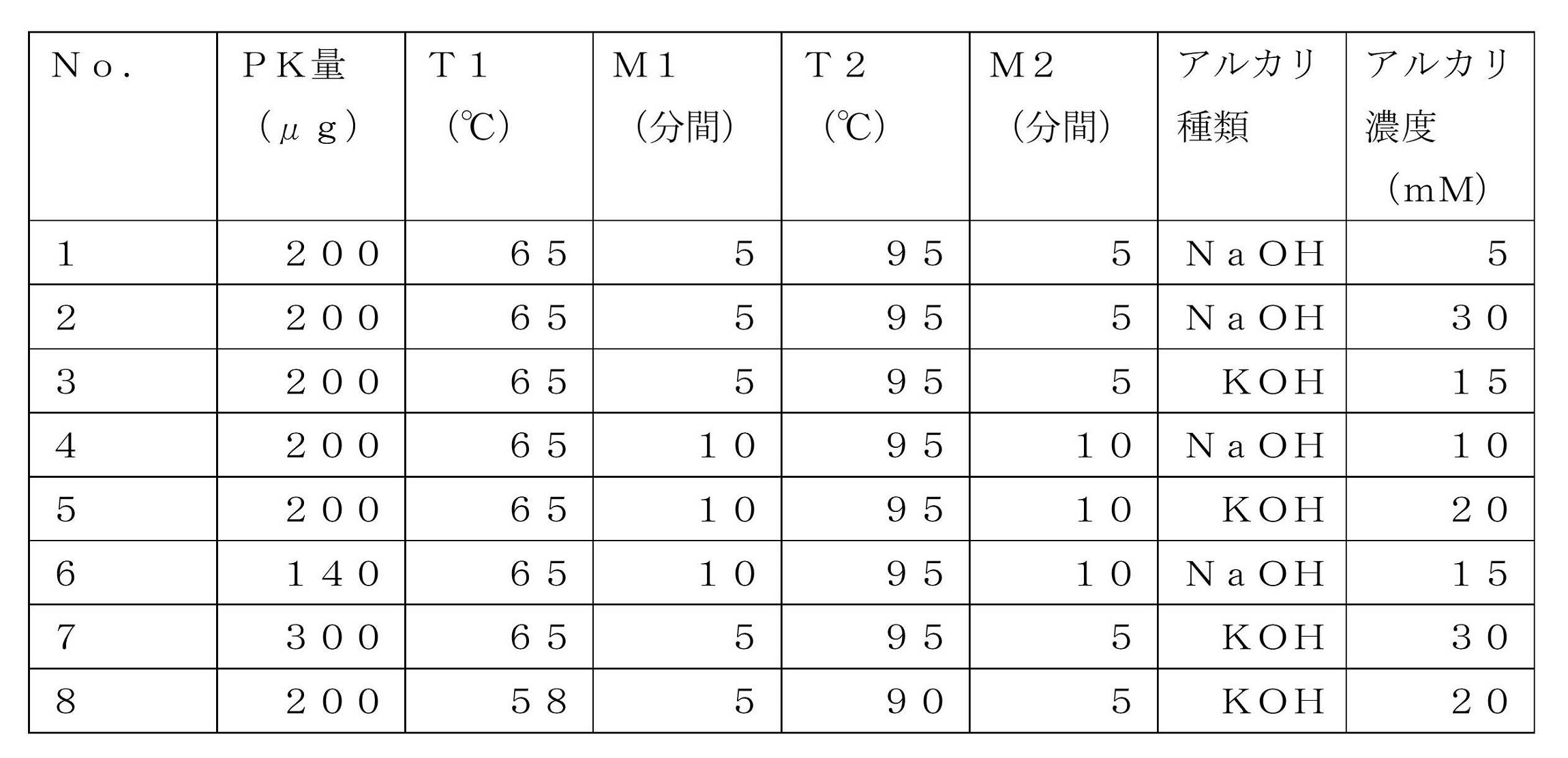
- (2) Pretreatment method The pretreatment method of the present invention was performed on the above sample. Specifically, a mixed solution was prepared by adding a proteinase K solution (20 mg / mL, manufactured by Kanto Chemical Co., Inc.) to the sample in a PK amount, and heated at a temperature of T1 for M1 minutes. Then, it was heated at the temperature T2 for M2 minutes.
- Reverse transcription, nucleic acid amplification and melting curve analysis 42 ° C for 2 minutes 97 ° C for 15 seconds (More than 1 cycle) 97 ° C for 1 second 58 ° C for 3 seconds 63 ° C for 5 seconds (More than 50 cycles) 94 ° C for 30 seconds 39 ° C for 30 seconds 40 ° C to 75 ° C (temperature rises at 0.09 ° C / sec)
- FIG. 1 shows No. It is the result of having measured the pretreated analysis sample of 1.
- a clear detection peak indicating the detection of SARS-CoV-2 has been obtained, and the SARS-CoV-2 Stock bacterial cells (sample imitating the envelope) mixed with the biological sample are treated by the pretreatment method of the present invention. It can be seen that the exposed SARS-CoV-2 gene was detected.
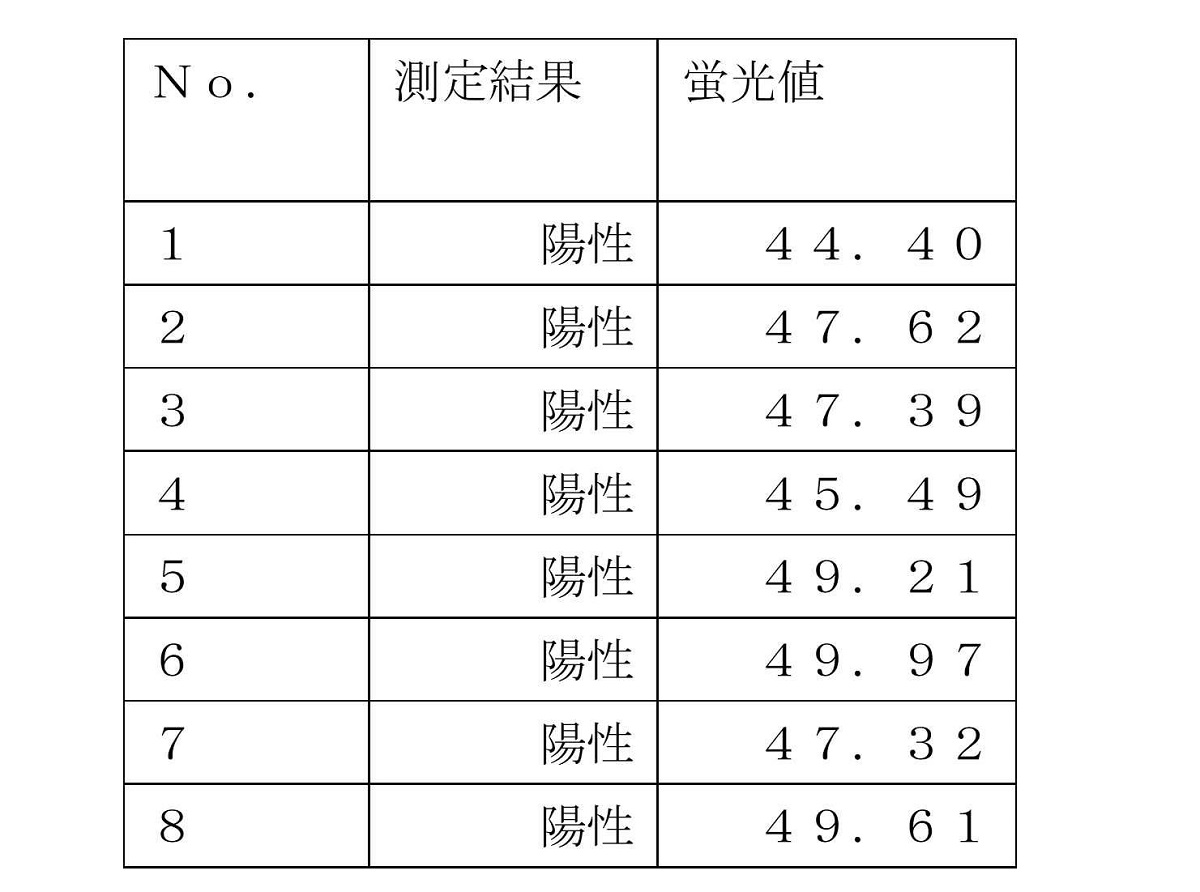
- No. The detection results of 1 to 8 are shown in Table 2. All pretreated analytical samples were positive for SARS-CoV-2, with the amount of proteinase K, temperature T1, time M1, temperature T2, time M2, alkaline aqueous solution type, and alkaline concentration. It was clarified that the effect of the present invention can be obtained even if each element is changed.
- Example 2 Nucleic acid detection from pretreated sample by real-time RT-PCR
- (2) Real-time RT-PCR and determination Each of the above samples was added to the following reagents, and SARS-CoV-2 was detected under the following conditions. Rotor-Gene Q (QIAGEN) was used for real-time RT-PCR. The judgment was positive when the rising edge of the amplification curve was recognized and Ct was calculated.
- QIAGEN Rotor-Gene Q
- reagent A solution containing the following reagents was prepared.
- 2XReaction Buffer TUNDERBIRD (R) PROBE One-Step qRT-PCR Kit, manufactured by Toyobo) 10 ⁇ L DNA Polymerase (same as above, manufactured by Toyobo) 1 ⁇ L RT Enzyme Mix (same as above, manufactured by Toyobo) 1 ⁇ L 10 ⁇ M Primer shown in SEQ ID NO: 1 1 ⁇ L 10 ⁇ M Primer shown in SEQ ID NO: 2 1 ⁇ L 10 ⁇ M Probe indicated by SEQ ID NO: 3 (labeled 5'end with FAM, 3'end labeled with BHQ1) 0.25 ⁇ L Purified water 1.75 ⁇ L Sample 5 ⁇ L
- Real-time RT-PCR 50 ° C for 15 minutes 95 ° C for 2 minutes (More than 1 cycle) 95 ° C for 3 seconds Fluorescence detection at 55 ° C for 30 seconds (More than 45 cycles)
- Result Table 3 is a table summarizing the results of real-time RT-PCR performed under the above conditions. No. Rising of the amplification curve was observed in all the pretreated analytical samples 1 to 8, and Ct was calculated. In addition, no amplification was observed in purified water, which was a negative control. From the above, it was confirmed that nucleic acids can be detected by real-time PCR or real-time RT-PCR from the sample treated by the pretreatment method of the present invention without the need for further nucleic acid purification treatment.
- Example 3 Pretreatment of nasopharyngeal specimen
- a biological sample was obtained by suspending a nasopharyngeal swab collected by a swab from a patient with SARS-CoV-2 infection in a general-purpose transport medium UTM (COPNA).
- COPNA general-purpose transport medium UTM
- a mixed solution was prepared by adding 10 ⁇ L (about 6 U) of a proteinase K solution (20 mg / mL, manufactured by Kanto Chemical Co., Inc.) to 100 ⁇ L of the biological sample. The mixture was heated at 65 ° C. for 5 minutes and then at 95 ° C. for 5 minutes.
- Reverse transcription, nucleic acid amplification and melting curve analysis 42 ° C for 2 minutes 97 ° C for 15 seconds (More than 1 cycle) 97 ° C for 1 second 58 ° C for 3 seconds 63 ° C for 5 seconds (More than 50 cycles) 94 ° C for 30 seconds 39 ° C for 30 seconds 40 ° C to 75 ° C (temperature rises at 0.09 ° C / sec)
- the pretreatment of the present invention is also effective for a sample derived from a clinical sample, and SARS-CoV-2 can be detected with high sensitivity from a nasopharyngeal sample, which is a biological sample, without requiring further nucleic acid purification. It has been shown.
- Example 4 Pretreatment of sputum sample
- the pretreatment method of the present invention it is possible to quickly and easily treat a biological sample and expose the foreign nucleic acid contained in the sample. Moreover, since nucleic acid amplification can be performed as it is on a measurement sample containing exposed foreign nucleic acid, rapid genetic testing becomes possible by using the present invention.
Landscapes
- Chemical & Material Sciences (AREA)
- Organic Chemistry (AREA)
- Life Sciences & Earth Sciences (AREA)
- Zoology (AREA)
- Wood Science & Technology (AREA)
- Proteomics, Peptides & Aminoacids (AREA)
- Health & Medical Sciences (AREA)
- Engineering & Computer Science (AREA)
- Analytical Chemistry (AREA)
- Biophysics (AREA)
- Immunology (AREA)
- Microbiology (AREA)
- Molecular Biology (AREA)
- Biotechnology (AREA)
- Physics & Mathematics (AREA)
- Chemical Kinetics & Catalysis (AREA)
- Biochemistry (AREA)
- Bioinformatics & Cheminformatics (AREA)
- General Engineering & Computer Science (AREA)
- General Health & Medical Sciences (AREA)
- Genetics & Genomics (AREA)
- Measuring Or Testing Involving Enzymes Or Micro-Organisms (AREA)
Abstract
外来性核酸の検出方法に供する試料の簡便な調製方法を提供することを目的とする。本発明は、(A)試料とセリンプロテアーゼとを含む混合液を調製する工程、(B)前記工程(A)で調製した混合液においてセリンプロテアーゼによる酵素反応を行う工程、(C)前記工程(B)で酵素反応を行った混合液を加熱する工程、及び(D)前記工程(C)で加熱処理を行った混合液とアルカリ性溶液とを混合する工程を含む、外来性核酸を検出する方法に供される試料の前処理方法を提供する。
Description
本発明は、外来性核酸を検出する方法に供する試料の調製のための前処理方法に関する。より具体的には、検体試料から迅速、簡便に核酸を抽出し、核酸増幅法に供するのに適した試料を調製するための方法及び当該試料を用いた核酸検出方法等に関する。
生体試料に含まれる微生物を検出することは臨床診断などにおいて重要である。そこで、生体試料中の核酸をPCR等で増幅し、増幅した核酸を検出し、微生物を特定する方法が行われている。しかし、生体試料中には核酸のほかに様々な生体由来物質が含まれているため、生体試料を精製することなく核酸増幅を実行すると増幅阻害や検出阻害が生じ、ほとんどの場合、正しい測定結果が得られない。そこで、生体試料中に含まれる微生物を検出する際に、生体試料をそのまま検出に供するのではなく、生体試料に前処理を加えることが一般的である。
前処理としては、例えば核酸以外の成分をほぼ除去できる核酸精製が行われている(特許文献1)。しかしながら、核酸精製は、操作が非常に複雑、操作時間が長い、有機溶媒を使用する、試薬コストが高いという課題があった。
また、別の前処理としてタンパク質分解酵素であるプロテイナーゼKを用いて生体試料中の夾雑物を分解させる方法も用いられている。プロテイナーゼKは一部の界面活性剤の存在下では酵素活性が向上することが知られている(非特許文献1)。また、界面活性剤自身にもタンパク質や脂質などの生体成分を溶解する作用があるため、プロテイナーゼKと界面活性剤を併用して試料を処理する方法も知られている(非特許文献2)。また、界面活性剤の代わりにカオトロピック塩あるいは尿素のようなタンパク質変性剤を使用する方法も存在する(特許文献2)。
しかしながら、前記のような方法で前処理が行われた試料を分析に用いる場合に、残存した界面活性剤やタンパク質変性剤が分析結果に影響を及ぼす懸念がある。とりわけPCR等の核酸増幅法においては、多量の界面活性剤やタンパク質変性剤がDNAポリメラーゼを変性させ、核酸増幅を著しく阻害しうる。また、酵素活性を有したプロテイナーゼKが前処理後の試料中に多量に残存した場合には、試料と核酸増幅試薬とを混合した際にプロテイナーゼKの働きによって核酸増幅試薬中のDNAポリメラーゼが分解され、核酸増幅を著しく阻害しうることが懸念される。
以上から、煩雑な操作を行わず、かつ安定的な核酸増幅を可能にする、更なる有用な試料の前処理法の開発が求められている。
非イオン界面活性剤によるプロテアーゼの活性上昇の速度論的研究 小ノ澤 他 日本家政学会誌 1990 Vol.41 No.11 1061~1070 A Polymerase Chain Reaction Assay for the Detection of Leptospira spp. in Bovine Semen. Masri et al. Can J Vet Res 1997 61 15~20
本発明は、かかる従来技術の課題を背景になされたものである。すなわち、本発明の目的は、特定のタンパク質分解酵素を用いた簡便な前処理法によって安定的に核酸増幅が可能な試料を調製する方法の提供である。
本発明者等は鋭意研究の結果、セリンプロテアーゼによる処理後に加熱を行い、その後アルカリ性溶液を添加する工程を加えることで、核酸増幅法に適した分析用試料の提供が可能であることを見出し、本発明を完成させるに至った。即ち、本発明の概要は以下の通りである。
[項1] 以下の工程(A)~(D)を含む、外来性核酸を検出する方法に供される試料の前処理方法:
(A)試料とセリンプロテアーゼとを含む混合液を調製する工程、
(B)前記工程(A)で調製した混合液においてセリンプロテアーゼによる酵素反応を行う工程、
(C)前記工程(B)で酵素反応を行った混合液を加熱する工程、及び
(D)前記工程(C)で加熱処理を行った混合液とアルカリ性溶液とを混合する工程。
[項2] 前記工程(A)で用いられる試料が、生体試料であるか、又は、生体試料と水、生理食塩水、液体培地、及び緩衝液からなる群より選択される少なくとも1種の溶媒との混合物である、項1に記載の方法。
[項3] 前記生体試料がヒト由来の生体試料である、項2に記載の方法。
[項4] 前記緩衝液が、トリス緩衝液、リン酸緩衝液、クエン酸リン酸緩衝液、リン酸緩衝生理食塩水、ハンクス液、及びグッドバッファーからなる群より選択される少なくとも1種である、項2または3に記載の方法。
[項5] 前記工程(B)における酵素反応が、前記混合液を50~70℃で1~10分間反応させることにより行われる、項1~4のいずれかに記載の方法。
[項6] 前記工程(C)における加熱が、90~100℃で1~10分間の加熱処理である、項1~5のいずれかに記載の方法。
[項7] 前記工程(C)の加熱処理を行った混合液を、工程(B)における反応温度よりも低い温度まで冷却してから工程(D)を行う、項1~6のいずれかに記載の方法。
[項8] 前記セリンプロテアーゼがプロテイナーゼKである、項1~7のいずれかに記載の方法。
[項9] 前記工程(D)において、アルカリ性溶液を添加後の混合液中のアルカリ濃度が1~30mMである、項1~8のいずれかに記載の方法。
[項10] 前記アルカリ性溶液が水酸化カリウム水溶液、水酸化ナトリウム水溶液、水酸化リチウム水溶液、水酸化マグネシウム水溶液、水酸化カルシウム水溶液、水酸化バリウム水溶液、炭酸カリウム水溶液、炭酸ナトリウム水溶液、炭酸マグネシウム水溶液、及び炭酸カルシウム水溶液からなる群より選択される少なくとも1種である、項1~9のいずれかに記載の方法。
[項11] 前記工程(A)において、試料1μLに対してセリンプロテアーゼが1μg~4μgとなる比率で混合する、項1~10のいずれかに記載の方法。
[項12] 前記工程(A)において、試料1μLに対してセリンプロテアーゼが0.03U~0.12Uとなる比率で混合する、項1~11のいずれかに記載の方法。
[項13] 前記外来性核酸が、エンベロープ型ウイルスの核酸である、項1~12のいずれかに記載の方法。
[項14] 前記エンベロープ型ウイルスが、コロナウイルス科ウイルス、オルトミクソウイルス科ウイルス、フラビウイルス科ウイルス、トガウイルス科ウイルス、ブニヤウイルス科ウイルス、パラミクソウイルス科ウイルス、及びフィロウイルス科ウイルスからなる群より選択される少なくとも1種である項13に記載の方法。
[項15] 項1~14のいずれかに記載の前処理方法を行った試料を核酸増幅用試薬と混合し、試料に含まれうる外来性核酸の増幅を行う工程を包含する、試料中の外来性核酸の検出方法。
[項16] 増幅された核酸を検出する工程を更に包含する、項15に記載の方法。
[項17] 前記検出工程が融解曲線解析によって行われる、項16に記載の方法。
[項18] セリンプロテアーゼ及びアルカリ性溶液を含む、項1~14のいずれかに記載の前処理方法を行うためのキット。
[項19] 核酸増幅用試薬を含む、項15~18のいずれかに記載の試料中の外来性核酸の検出方法を行うためのキット。
本発明により、核酸検出法に適した試料を簡便に調製することが可能になる。調製された試料は、更なる核酸精製処理を行わずに、直接核酸増幅に供されてもよく、試料中の外来性核酸が良好な感度で増幅され検出され得る。本発明は例えば、生体試料中に含まれる細菌やウイルス等の微生物の外来性核酸を検出するために用いる生体試料の前処理方法として好適である。
以下、本発明の実施形態を示しつつ、本発明についてさらに詳説するが、本発明はこれらに限定されるものではない。なお、本明細書中に記載された非特許文献および特許文献の全てが、本明細書中において参考として援用される。また本明細書中の「~」は「以上、以下」を意味し、例えば明細書中で「X~Y」と記載されていれば「X以上、Y以下」を示す。また本明細書中の「及び/又は」は、いずれか一方または両方を意味する。
[試料の前処理方法]
本発明の実施態様の一つは、外来性核酸を検出する方法に供される試料を前処理する方法である。本発明の方法は、少なくとも以下の工程(A)~(D)を含むことを特徴とする。
(A)試料とセリンプロテアーゼとを含む混合液を調製する工程、
(B)前記工程(A)で調製した混合液においてセリンプロテアーゼによる酵素反応を行う工程、
(C)前記工程(B)で酵素反応を行った混合液を加熱する工程、及び
(D)前記工程(C)で加熱処理を行った混合液とアルカリ性溶液とを混合する工程。
[試料]
前記工程(A)における試料とは、外来性核酸の有無を確認することが望まれる任意の試料であり得る。例えば、生体試料、環境試料等であり得るがこれらに限定されない。好ましくは、生体試料である。生体試料は、生体から採取した試料をそのまま用いてもよいし、生体試料と生体試料と水(例えば、精製水、蒸留水、イオン交換水、純水等)、生理食塩水、液体培地、及び緩衝液からなる群より選択される少なくとも1種の溶媒との懸濁液又は溶解液等の混合物(例えば、生体試料と精製水の混合物、生体試料と生理食塩水の混合物、生体試料と液体培地の混合物、生体試料と緩衝液の混合物等)も生体試料として用いることができる。
本明細書において生体試料は、生体由来の試料であれば特に限定されないが、例えば動植物組織、体液、排泄物、細胞が挙げられる。より具体的には、口腔内擦過物、咽頭拭い液、鼻腔拭い液、鼻咽頭拭い液、鼻腔吸引液、喀痰、気管支洗浄液、肺胞洗浄液、直腸拭い液、膣分泌物、子宮頸管粘液、尿道擦過物、便懸濁液、血液、血漿、血清、血液培養液、尿、唾液、羊水、膿、髄液、胸水、組織切片、皮膚、吐瀉物、糞便、鼓膜切開液、胃洗浄液、腸洗浄液、臓器抽出液、組織抽出液分離培養コロニー、カテーテル洗浄液などが挙げられ、1種単独又は2種以上組み合わせて使用できる。好ましい生体試料又はその懸濁液若しくは溶解液は、口腔内擦過物、咽頭拭い液、鼻腔拭い液、鼻咽頭拭い液、鼻腔吸引液、喀痰、唾液、気管支洗浄液、及び肺胞洗浄液からなる群から選択される少なくとも1種である。
また、生体試料は、例えばヒト又は非ヒト動物由来の試料である。非ヒト動物としては非ヒト哺乳動物が挙げられ、例えばイヌ、ネコ、マウス、ラット、モルモット、ハムスター、ウサギ、ブタ、ウシ、ヒツジ、ヤギなどであり、好ましくはイヌ、ネコなどである。好ましくはヒト由来の試料である。
生体からの試料の採取方法は、特に制限されず、試料の種類、大きさ、目的に応じて公知の方法を用いることができる。例えば綿棒、スワブ、白金耳、スポイト、へら、さじなどの採取具を用いた採取方法である。
生体から生体試料を採取後、生体試料が直ちに劣化する場合、採取後検出までに長時間を要する場合などには、採取した生体試料を、例えば生体由来物を希釈、保存等する目的で、液体に混合し、懸濁物などの液状形態とすることもできる。本発明においては生体試料と水(例えば、精製水、蒸留水、イオン交換水、純水等)、生理食塩水、液体培地、及び緩衝液からなる群より選択される少なくとも1種の溶媒との懸濁液又は溶解液等の混合物も、前記工程(A)における試料として用いられる。
前記液体培地とは、液体状の培地であれば特に制限されない。一例を挙げるとLB培地、ブイヨン培地、最少培地、ウイルス輸送液(VTM)、汎用輸送培地(UTM)、アミーズ培地、キャリー・ブレア培地、スチュアート培地、DMEM、MEM、またはこれら液体培地の改良品が挙げられる。
前記緩衝液とは、緩衝能を有する液体であれば特に制限されず、生化学や分子生物学の分野で一般的に緩衝液として用いられるものであれば、本発明において緩衝液として用いることができる。前記緩衝液は好ましくは、トリス緩衝液、リン酸緩衝液、クエン酸リン酸緩衝液、リン酸緩衝生理食塩水、ハンクス液、グッドバッファーである。
また、試料を本発明の工程(A)に供する前に、簡単な操作を加えることは本発明の範囲内である。簡単な操作としては、生体試料を遠心して夾雑物を沈降させ、上清のみを回収して本発明の前処理法に供する試料とすること、あるいは生体試料を遠心して下層または沈殿のみを残すことで試料成分や試料に含まれる細菌やウイルス等を濃縮させたものを、本発明の前処理法に供する試料とすること、生体試料と前記液体培地および/または前記緩衝液と混合後に遠心を行い上清あるいは下層または沈殿を回収し、本発明の前処理法に供する試料とすること、などが例示されるが、これらに限定されない。
本発明において用いられるセリンプロテアーゼは、活性中心にセリン残基を有するものとして周知のタンパク質分解酵素である。セリンプロテアーゼは、サブチリシン様セリンプロテアーゼ 、キモトリプシン様セリンプロテアーゼ等に分類され、そのいずれも本発明に用いられ得るが、好ましくはサブチリシン様セリンプロテアーゼである。サブチリシン様セリンプロテアーゼとしては、例えば、プロテイナーゼKを好ましい例として挙げることができるが、これに限定されない。
本発明において用いられるプロテイナーゼKとはTritirachium album(Engyodontium album)に由来するセリンプロテアーゼである。本発明で用いるプロテイナーゼKは、Tritirachium albumから直接抽出されたものであってもよいし、あるいは遺伝子組換え技術を用いて産生させたもの(例えば、同一の宿主細胞又は別の宿主細胞から組換え発現させて得たもの)であってもよい。本発明において用いられるプロテイナーゼKの性状も特に限定されず、液体、固体のいずれも使用可能である。好ましくは液状に調製されたプロテイナーゼKである。なお、本明細書において、プロテイナーゼKは、プロテアーゼK、ProteinaseKまたはPKとも互換可能に表記されうる。
本発明における工程(A)は前記試料とセリンプロテアーゼを混合する工程である。本工程により前記試料とセリンプロテアーゼとの混合液が調製される。本発明において用いられるセリンプロテアーゼの量は、本発明の効果を奏し得る限り特に限定されない。一つの実施形態において、好ましくは、工程(A)のセリンプロテアーゼ(例えば、プロテイナーゼK)の試料に対する割合は、試料1μLに対してセリンプロテアーゼが0.01μg~15μgとなる比率で混合するのがよく、さらに好ましくは0.1μg~10μgとなる比率で混合するのがよく、より好ましくはセリンプロテアーゼが1μg~4μgとなる比率で混合するのがよい。更に他の実施形態において、好ましくは、工程(A)のセリンプロテアーゼ(例えば、プロテイナーゼK)の試料に対する割合は、試料1μLに対してセリンプロテアーゼが0.015U~0.3Uとなる比率で混合するのがよく、より好ましくはセリンプロテアーゼが0.03U~0.12Uの割合であるとなる比率で混合するのがよい。工程(A)において、このような比率で混合することにより、より高感度な核酸検出が可能となる分析用試料を調製することが可能となる。
本発明においては、工程(A)を終えた後、工程(B)を開始する前に、試料とセリンプロテアーゼとの混合液を遠心し上清を回収する作業を追加してもよい。例えば混合液中に固形物がある場合、該作業により液性部分のみを回収し、回収した液体(混合液)の一部または全部を工程(B)に提供することができる。
前記の通り、従来、プロテイナーゼKを用いたタンパク質分解工程においてはしばしば界面活性剤やカオトロピック塩あるいは尿素と併用することで、試料の処理効率を高める試みがなされていた。一方、本発明の試料処理法においては、試料の処理効率を高める目的での界面活性剤、カオトロピック塩、尿素の併用は必ずしも行わなくてよいというメリットがある。しかしながら、セリンプロテアーゼ(プロテイナーゼK)を保管もしくは安定化する目的で少量の界面活性剤を含むセリンプロテアーゼ溶液を使用しても、本発明の範囲内である。
本発明における工程(B)は、セリンプロテアーゼによる酵素反応を行う工程である。本工程により、試料中のタンパク質の一部又は全部をセリンプロテアーゼにより分解する。この工程は通常、使用するセリンプロテアーゼが活性を発揮する温度に加温することで実施される。例えば、セリンプロテアーゼとしてプロテイナーゼKを使用する場合、本工程で加温する際の温度はプロテイナーゼKが酵素活性を発揮しうる温度であれば特に制限されず、例えば、25~75℃であり、好ましくは37~75℃であり、より好ましくは50~70℃であり、さらに好ましくは55~65℃である。該温度に加温する時間は特に制限されないが、好ましくは1~15分間であり、より好ましくは1~10分間であり、さらに好ましくは3~10分間である。また、工程(B)において加温を伴う場合、その温度は必ずしも特定の温度で固定する必要はなく、セリンプロテアーゼが活性を発揮しうる温度の範囲内であれば変化させてもよい。
本発明における工程(C)は、前記工程(B)で酵素反応を行った混合液を加熱する工程である。本工程で加熱することにより、セリンプロテアーゼの一部または全部が失活すること、その他試料中に含まれていた核酸分解酵素やたんぱく質分解酵素の一部または全部が失活すること、試料中の微生物やウイルス等の一部または全部が死滅することが期待される。ただし、本工程では全てのタンパク質、微生物やウイルス等が死滅する必要はなく、本工程において酵素の失活や微生物等の死滅が発生するかどうかを計測することは要求されない。本工程における加熱温度は、工程(B)にて混合液が晒される温度よりも高温であれば特に制限されないが、好ましくは80~100℃であり、より好ましくは90~100℃であり、さらに好ましくは95~100℃である。加熱する時間は特に制限されないが、好ましくは1~15分間であり、より好ましくは1~10分間であり、さらに好ましくは3~10分間である。また、工程(C)における加熱の温度は必ずしも特定の温度で固定する必要はなく、変化させてもよい。
本発明においては、工程(C)を終えた後で前記混合液を冷却する工程を追加してもよい。冷却する温度は特に制限されないが、工程(B)において加温を行う場合は該加温温度未満に冷却することが望ましい。例えば、55℃より低い温度まで、好ましくは50℃より低い温度まで、より好ましくは37℃より低い温度まで、更に好ましくは25℃より低い温度まで冷却することが好ましい。ここで冷却する時間は特に限定されず、例えば、1~15分間、好ましくは1~10分間、より好ましくは3~10分間であり得る。なお、本工程を終えた後の試料の温度を計測する必要はなく、工程(B)における加温温度よりも低い温度まで低下したと触覚的に又は経験的に判断できる程度でよい。本工程の冷却方法は特に制限されず、室温での静置、冷蔵庫あるいは冷凍庫での静置、氷上での静置、インキュベーターやウォーターバス等の変温装置を用いた冷却、およびこれらの類似の任意の方法で可能である。
本明細書における工程(D)で用いられるアルカリ性溶液はアルカリ性の溶液であれば特に限定されない。アルカリ性溶液としては、例えば水酸化カリウム水溶液、水酸化ナトリウム水溶液、水酸化リチウム水溶液、水酸化マグネシウム水溶液、水酸化カルシウム水溶液、水酸化バリウム水溶液、炭酸カリウム水溶液、炭酸ナトリウム水溶液、炭酸マグネシウム水溶液、炭酸カルシウム水溶液などが挙げられ、1種単独又は2種以上組み合わせて使用できる。本発明の効果がより確実に得られ易いという観点から、好ましいアルカリ性溶液は、水酸化カリウム水溶液、水酸化ナトリウム水溶液、及び水酸化リチウム水溶液からなる群より選択される少なくとも1種である。より好ましいアルカリ性溶液は、水酸化カリウム水溶液及び/又は水酸化ナトリウム水溶液である。
本明細書において、アルカリ濃度は体積モル濃度(M又はmol/L)であり、アルカリ性溶液1L中に含まれるアルカリ性物質(例えば、上記のような水酸化カリウム及び/又は水酸化ナトリウムなどのアルカリ性物質の総量)のモル量で規定できる。
本発明における工程(D)において、アルカリ性溶液を添加後の混合液中のアルカリ濃度は、本発明の効果を奏する限り特に限定されない。より一層高い効果を得られ易いという観点から、工程(D)におけるアルカリ性溶液添加後の混合液中のアルカリ濃度は、例えば、0.1~50mMであるのがよく、好ましくは、0.5~40mM、より好ましくは1~30mM、さらに好ましくは5~30mM、さらにより好ましくは10~30mM、なかでも好ましくは15~30mM、特に好ましくは20~30mMであるのがよい。
工程(D)においてアルカリ性溶液を混合する方法は特に限定されず、工程(A)~(C)を経た試料とセリンプロテアーゼの混合液が入った容器にアルカリ性溶液をマイクロピペット等で添加してもよいし、あらかじめ別の容器にアルカリ性溶液を分注しておき、そこに前記混合液を加えてもよく、これらの添加順序は問わない。またアルカリ性溶液を添加した後で撹拌を行ってもよい。撹拌を行う場合は、混合液とアルカリ性溶液とを十分に混和できる限り、その方法は特に制限されず、転倒撹拌、ボルテックスミキサーによる撹拌などが可能である。攪拌強度や時間等の攪拌条件は技術常識に基づいて、当業者が適宜設定できる。
本発明の実施態様の一つは、前記工程(A)~(D)を含む方法で前処理された試料を分析用試料として核酸増幅用試薬と混合し、試料に含まれうる外来性核酸の増幅を行う工程を包含する、試料中の外来性核酸の検出方法である。
本明細書において、「核酸増幅用試薬と混合し」とは、工程(D)を終えた後で、カラムによる核酸精製や有機溶媒による夾雑物の除去など、前処理された試料から核酸をさらに分離精製する工程を行わずに核酸増幅用試薬と混合することを指す。ただし、前処理された試料の一部を核酸増幅試薬と混合するために必要な量だけ別のチューブに移すなどの核酸の分離精製を伴わない工程は行ってもよく、この工程を含む態様も本発明の範囲内である。
前記外来性核酸とは、試料に由来しない任意の核酸であって、試料中に通常含まれうるかどうか不明な外来性由来の核酸を指す。具体的には、試料が生体試料である場合は、その生体試料の由来となる生物種以外に由来する核酸である。例えば、生体試料がヒト由来であれば、ヒト以外の生物種の核酸を外来性核酸と称する。外来性核酸の由来については特に制限されず、例えば、細菌、ウイルス、ファージ、真菌、寄生虫、アメーバなどが挙げられる。より好ましくは細菌、ウイルスであり、さらに好ましくはウイルスである。本発明は、このような外来性核酸の検出に好適であり、本発明の方法により外来性核酸が検出された場合、それは試料中に外来性核酸の由来となる生物あるいは核酸そのものが含まれていたことを意味し得る。
本発明は、任意の外来性核酸の検出において用いられ得るが、好ましくはウイルス、なかでもエンベロープ型ウイルスの検出に好適である。エンベロープ型ウイルスは、脂質二重層で構成されるエンベロープにゲノム核酸が内包されたウイルスである。エンベロープ型ウイルスとしては、例えば、コロナウイルス科ウイルス(例えば、SARSコロナウイルス、MERSコロナウイルス、SARS-CoV-2コロナウイルス);オルトミクソウイルス科ウイルス(例えば、A型インフルエンザウイルス、B型インフルエンザウイルス、C型インフルエンザウイルス);フラビウイルス科ウイルス(例えば、C型肝炎ウイルス、日本脳炎ウイルス、ジカウイルス、豚熱ウイルス);トガウイルス科ウイルス(例えば、風疹ウイルス、チクングニアウイルス);ラブドウイルス科ウイルス(例えば、狂犬病ウイルス);ブニヤウイルス科ウイルス(例えば、クリミヤ・コンゴ熱ウイルス、ハンタウイルス);パラミクソウイルス科ウイルス(例えば、麻疹ウイルス、ヒトRSウイルス);フィロウイルス科ウイルス(例えば、エボラウイルス)、などが挙げられるが、特に限定されない。感度良好な検出が得られ易いという観点から、本発明は、好ましくは、コロナウイルス科ウイルス又はオルトミクソウイルス科ウイルスの検出であり、より好ましくはSARSコロナウイルス、MERSコロナウイルス、SARS-CoV-2コロナウイルス、A型インフルエンザウイルス、B型インフルエンザウイルス、C型インフルエンザウイルスの検出において有用である。
前記方法において核酸の増幅に用いられる方法は公知の核酸増幅法を用いることができる。そのような核酸増幅法としてはPCR法、LAMP法、LCR法、TMA法、SDA法、RT-PCR法、RT-LAMP法、NASBA法、TRC法、TMA法等が挙げられる。これらの技術は既に当該技術分野において確立されており、目的に合わせて方法を選択することができる。より確実に高い効果が得られ易いという観点から、本発明で行う核酸増幅法はPCR法(RT-PCR法を含む)が好ましいが、これに限定されない。
前記方法に用いられる核酸増幅用試薬は、核酸増幅に必要な成分が入った試薬であれば内容物は特に制限されない。内容物としては通常、DNAポリメラーゼ、核酸プライマー、dNTPs、マグネシウムイオン等が含まれうる。他には、対象となる核酸の種類や検出法等に応じて、増幅された核酸の検出に必要な核酸プローブまたはインターカレーター、逆転写酵素、各種の添加剤、緩衝液等を含むことも好ましい。また、核酸増幅用試薬は一つまたは複数の構成成分ごとに分割して封入された形状で提供されてもよく、その場合は二つ以上の試薬と前記分析用試料とを混合する形で用いられる。
本発明において前記核酸増幅用試薬の形状は特に制限されないが、好ましくは液状の核酸増幅用試薬である。
本発明の実施態様の一つは、前記核酸の検出方法が、核酸増幅の後で増幅された核酸を検出する工程をさらに包含する方法である。
この検出する工程の態様は特に限定されず、当該分野で公知の任意の方法で実施することができる。より確実に高い効果が得られ易いという観点から、本発明では、リアルタイムPCR法(リアルタイムRT-PCR法を含む)による検出または融解曲線解析法が好ましい。また、検出においては核酸増幅産物を特異的に検出可能な核酸プローブを使用することが好ましい。
一つの実施形態において、融解曲線解析では、例えば、グアニンとの相互作用により消光する蛍光消光色素で標識されたプローブ(グアニン消光プローブともいう)を用いることが好ましい。このような蛍光消光色素としては、例えば、4,4-ジフルオロ-5.7-ジメチル-4-ボラ-3a、4a-ジアザ-s-インダセン-3-プロピオン酸(BODIPY-FL)、カルボキシローダミン6G,TAMRA,ローダミン6G,テトラブロモスルホンフルオレセイン(TBSF)、及び2-オキソ-6,8-ジフルオロ-7-ジヒドロキシ-2H-1-ベンゾピラン-3-カルボン酸(Pacific Blue)等が挙げられるがこれらに限定されない。
別の実施形態において、リアルタイムPCR法(リアルタイムRT-PCR法を含む)により検出する場合は、一方の末端を蛍光物質で標識し、他方の末端を消光物質で標識したプローブを用いることが好ましい。このような蛍光物質としては、例えば、ローダミン系化合物;フルオロセイン系化合物(例えば、FAM(カルボキシフルオレセイン)等が挙げられ、また消光物質としては、例えば、BHQ1(BHQ:Black Hole Quencher(登録商標))、BHQ2、BHQ3等が挙げられるが、これらに限定されない。
本発明の更なる実施形態は、前記工程(A)~(D)を含む外来性核酸を検出する方法に供される試料の前処理方法を行うためのキットである。本キットは、前記工程(A)~(D)を実施する際に使用する試薬の一部又は全部を含むものであり、例えば、セリンプロテアーゼ及び/又はアルカリ性溶液を含むものであり、その両方を含むことが特に好ましい。
本発明の別の実施態様は、前記(A)~(D)の工程を経て前処理が行われた試料を分析用試料として核酸増幅用試薬と混合して核酸増幅を行うための核酸増幅用試薬を含む、試料中の外来性核酸の検出方法を行うためのキットである。前記キットは前記核酸増幅用試薬を含むキットであれば構成物は特に制限されない。例えば、核酸増幅用試薬中にさらに増幅された核酸を検出するために必要な成分を含んでもよい。
更に別の実施態様は、前記工程(A)~(D)を含む前処理方法と、それにより得られた分析用試料を用いて試料中の外来性核酸の検出を行う方法の両方に用いるためのキットである。本キットは、例えば、セリンプロテアーゼ、アルカリ性溶液、及び/又は核酸増幅用試薬等を含み得るがこれらに限定されず、目的に応じて更なる成分を適宜含んでいてもよい。
前記のような前処理方法を行うためのキット、外来性核酸の検出を行うためのキット、及びそれらを両方行うためのキットは、特定の外来性核酸の存在を検出又は定量することができる遺伝子検査試薬及び/又は使用方法等を説明する使用説明書等を任意に含むことができる。例えば、核酸増幅用試薬の構成成分を二つ以上に分けて別々の容器に封入したものまたは構成成分のすべてを一つの容器に封入したもの、例えば一つの包装体に梱包し、当該キットの使用方法に関する情報を含む態様で提供することができる。また、陽性コントロール液や陰性コントロール液を含めることもできる。
以下、本発明の実施例に基づき具体的に説明する。本発明は下記実施例に限定されるものではない。
〔実施例1:前処理法および処理済み試料に対する核酸増幅法の効果確認〕
(1)試料の調製
SARS-CoV-2陰性の唾液検体30μLと10mM Tris-HCl(pH7.5)55μL、NATtrol SARS-CoV-2(recombinant)Stock(ZEPTOMETRIX社)15μLを1.5mLチューブにて混合し、疑似的なSARS-CoV-2陽性試料100μLを作成した。なお、NATtrol SARS-CoV-2(recombinant)Stockとは細菌細胞内に人工的に合成されたSARS-CoV-2遺伝子を封入し、エンベロープ型ウイルスであるSARS-CoV-2を模したサンプルに相当する。
(2)前処理法
上記試料に対し本発明の前処理法を行った。具体的には、試料にプロテイナーゼK溶液(20mg/mL、関東化学製)をPK量加えた混合液を調製し、温度T1でM1分間加温した。その後温度T2でM2分間加熱した。加熱が終了した混合液は氷冷し、十分に温度が冷却されたことを確認してから、混合液のうち25μLを採取して、0.5mLチューブに分注した。分注後のチューブに所定濃度の水酸化ナトリウム水溶液または水酸化カリウム水溶液を25μL添加した。
前処理法の各パラメータ(PK量、T1、M1、T2、M2)は表1に記載した通りである。また、水酸化ナトリウム水溶液又は水酸化カリウム水溶液を添加後の混合液中のアルカリ濃度も表1に並記した。
(3)逆転写、核酸増幅、融解曲線解析、及び判定
上記の通り前処理を行った各試料をそれぞれ下記試薬に添加して、下記条件によりSARS-CoV-2の検出を行った。逆転写、核酸増幅(PCR)および融解曲線解析には東洋紡製GENECUBE(登録商標)を使用した。判定は、融解曲線解析にてピークが得られた場合に陽性と判定した。
試薬
KOD Mix(ジーンキューブ(R)テストベーシック、東洋紡製)3μL
PPD Mix(ジーンキューブ(R)テストベーシック、東洋紡製)1μL
IC Mix(ジーンキューブ(R)テストベーシック、東洋紡製)1μL
10μM 配列番号1で示されるプライマー 0.25μL
10μM 配列番号2で示されるプライマー 1.5μL
10μM 配列番号4で示されるプローブ(3’末端をBODIPY-FLで標識) 0.125μL
5U/μL 逆転写酵素(東洋紡製) 0.5μL
試料4μL
逆転写、核酸増幅および融解曲線解析
42℃・2分
97℃・15秒
(以上1サイクル)
97℃・1秒
58℃・3秒
63℃・5秒
(以上50サイクル)
94℃・30秒
39℃・30秒
40℃~75℃(0.09℃/秒で温度上昇)
(3)結果
図1はNo.1の前処理済み分析用試料を測定した結果である。SARS-CoV-2の検出を示す明確な検出ピークが得られており、生体試料に混合したSARS-CoV-2 Stockの細菌細胞(エンベロープを模したサンプル)が本発明の前処理法によって処理され、露出したSARS-CoV-2遺伝子が検出されたことが分かる。
また、No.1~8の検出結果を表2として示す。いずれの前処理済み分析用試料を測定してもSARS-CoV-2陽性となっており、プロテイナーゼKの量、温度T1、時間M1、温度T2、時間M2、アルカリ水溶液の種類、そしてアルカリ濃度の各要素を変化させても本発明の効果が奏されることが明らかとなった。
〔実施例2:リアルタイムRT-PCRによる前処理済み試料からの核酸検出〕
(1)試料の調製
実施例1で前処理を行った試料No.1~8の残余を用いた。また、陰性対照として精製水を試料として用いた。
(2)リアルタイムRT-PCRおよび及び判定
上記試料をそれぞれ下記試薬に添加して、下記条件によりSARS-CoV-2の検出を行った。リアルタイムRT-PCRにはRotor-Gene Q(QIAGEN社)を使用した。判定は、増幅曲線の立ち上がりが認められCtが算出された場合に陽性とした。
試薬
以下の試薬を含む溶液を調製した。
2XReaction Buffer(THUNDERBIRD(R) PROBE One-Step qRT-PCR Kit、東洋紡製)10μL
DNA Polymerase(同上、東洋紡製)1μL
RT Enzyme Mix(同上、東洋紡製)1μL
10μM 配列番号1で示されるプライマー 1μL
10μM 配列番号2で示されるプライマー 1μL
10μM 配列番号3で示されるプローブ(5’末端をFAMで標識、3’末端をBHQ1で標識) 0.25μL
精製水 1.75μL
試料5μL
リアルタイムRT-PCR
50℃・15分
95℃・2分
(以上1サイクル)
95℃・3秒
55℃・30秒 蛍光検出
(以上45サイクル)
(3)結果
下記の表3は、上記の条件でリアルタイムRT-PCRを行い、結果をまとめた表である。No.1~8の全ての前処理済み分析用試料で増幅曲線の立ち上がりが認められ、Ctが算出された。また、陰性対照である精製水では増幅は認められなかった。以上から、本発明の前処理法で処理した試料から、更なる核酸の精製処理を必要とせずに、リアルタイムPCRまたはリアルタイムRT-PCRによる核酸の検出が可能であることを確認した。

〔実施例3:鼻咽頭検体の前処理〕
(1)試料の調製
SARS-CoV-2感染症患者からスワブで採取された鼻咽頭ぬぐい液を汎用輸送培地UTM(COPNA社)に懸濁したものを生体試料とした。
(2)前処理法
前記生体試料100μLにプロテイナーゼK溶液(20mg/mL、関東化学製)を10μL(約6U)加えた混合液を調製した。該混合液を65℃で5分間加温し、その後95℃で5分間加熱した。加熱後の混合液の温度が十分低下してから、混合液50μLを分取し、アルカリ終濃度が約20mMとなるように水酸化カリウム水溶液と混和した。以上の処理を行った試料を測定用試料とした。
(2)逆転写、核酸増幅、融解曲線解析、及び判定
上記の測定用試料を下記試薬に添加して、下記条件によりSARS-CoV-2の検出を行った。逆転写、核酸増幅および融解曲線解析には東洋紡製GENECUBE(登録商標)を使用した。判定は、融解曲線解析にてピークが得られた場合に陽性と判定した。
試薬
KOD Mix(ジーンキューブ(R)テストベーシック、東洋紡製)3μL
PPD Mix(ジーンキューブ(R)テストベーシック、東洋紡製)1μL
IC Mix(ジーンキューブ(R)テストベーシック、東洋紡製)1μL
10μM 配列番号1で示されるプライマー 0.25μL
10μM 配列番号2で示されるプライマー 1.5μL
10μM 配列番号4で示されるプローブ(3’末端をBODIPY-FLで標識) 0.125μL
5U/μL 逆転写酵素(東洋紡製) 0.5μL
試料4μL
逆転写、核酸増幅および融解曲線解析
42℃・2分
97℃・15秒
(以上1サイクル)
97℃・1秒
58℃・3秒
63℃・5秒
(以上50サイクル)
94℃・30秒
39℃・30秒
40℃~75℃(0.09℃/秒で温度上昇)
(3)結果
融解曲線解析の結果、図1と同様にSARS-CoV-2遺伝子の検出を表すピークが認められた。以上から、本発明の前処理は臨床検体に由来する試料にも有効であり、更なる核酸精製を必要とせずに、生体試料である鼻咽頭検体からSARS-CoV-2を高感度に検出できることが示された。
〔実施例4:喀痰検体の前処理〕
(1)試料の調製
喀痰約100μLとリン酸緩衝生理食塩水270μLを混合したものを生体試料とした。
(2)前処理法
前記生体試料約370μLに試料にプロテイナーゼK溶液(20mg/mL、関東化学製)を30μL(約18U)加えた混合液を調製した。該混合液を13000×gで3分間遠心し、遠心上清のうち100μLを別のチューブに移した。これを65℃で5分間加温し、その後95℃で5分間加熱した。加熱後の混合液の温度が十分低下してから、混合液50μLを分取し、アルカリ終濃度が約20mMとなるように水酸化カリウム水溶液と混和した。該混和液にDx SARS-CoV-2 Standard(Bio-Rad社)を終濃度が約2.5コピー/μLとなるよう添加した。これを測定用試料とした。
(2)逆転写、核酸増幅、融解曲線解析、及び判定
上記の測定用試料を下記試薬に添加して、実施例3と同様にして逆転写、核酸増幅、融解曲線解析を行った。
(3)結果
融解曲線解析の結果、図1と同様にSARS-CoV-2遺伝子の検出を表すピークが認められた。以上から、本発明の前処理法により処理された喀痰は、核酸増幅および検出を阻害しなくなることが明らかになった。すなわち、本発明の方法により、更なる核酸精製を必要とせずに、生体試料である喀痰からSARS-CoV-2を検出できることが確認された。
本発明の前処理法を用いることで生体試料を迅速かつ簡便に処理し、試料中に含まれる外来性核酸を露出されることが可能である。かつ、露出させた外来性核酸を含む測定用試料に対してそのまま核酸増幅を行うことが可能であるため、本発明を利用することで迅速な遺伝子検査が可能になる。
Claims (19)
-
以下の工程(A)~(D)を含む、外来性核酸を検出する方法に供される試料の前処理方法:
(A)試料とセリンプロテアーゼとを含む混合液を調製する工程、
(B)前記工程(A)で調製した混合液においてセリンプロテアーゼによる酵素反応を行う工程、
(C)前記工程(B)で酵素反応を行った混合液を加熱する工程、及び
(D)前記工程(C)で加熱処理を行った混合液とアルカリ性溶液とを混合する工程。
-
前記工程(A)で用いられる試料が、生体試料であるか、又は、生体試料と水、生理食塩水、液体培地、及び緩衝液からなる群より選択される少なくとも1種の溶媒との混合物である、請求項1に記載の方法。
-
前記生体試料がヒト由来の生体試料である、請求項2に記載の方法。
-
前記緩衝液が、トリス緩衝液、リン酸緩衝液、クエン酸リン酸緩衝液、リン酸緩衝生理食塩水、ハンクス液、及びグッドバッファーからなる群より選択される少なくとも1種である、請求項2または3に記載の方法。
-
前記工程(B)における酵素反応が、前記混合液を50~70℃で1~10分間反応させることにより行われる、請求項1~4のいずれかに記載の方法。
-
前記工程(C)における加熱が、90~100℃で1~10分間の加熱処理である、請求項1~5のいずれかに記載の方法。
-
前記工程(C)の加熱処理を行った混合液を、工程(B)における反応温度よりも低い温度まで冷却してから工程(D)を行う、請求項1~6のいずれかに記載の方法。
-
前記セリンプロテアーゼがプロテイナーゼKである、請求項1~7のいずれかに記載の方法。
-
前記工程(D)において、アルカリ性溶液を添加後の混合液中のアルカリ濃度が1~30mMである、請求項1~8のいずれかに記載の方法。
-
前記アルカリ性溶液が水酸化カリウム水溶液、水酸化ナトリウム水溶液、水酸化リチウム水溶液、水酸化マグネシウム水溶液、水酸化カルシウム水溶液、水酸化バリウム水溶液、炭酸カリウム水溶液、炭酸ナトリウム水溶液、炭酸マグネシウム水溶液、及び炭酸カルシウム水溶液からなる群より選択される少なくとも1種である、請求項1~9のいずれかに記載の方法。
-
前記工程(A)において、試料1μLに対してセリンプロテアーゼが1μg~4μgとなる比率で混合する、請求項1~10のいずれかに記載の方法。
-
前記工程(A)において、試料1μLに対してセリンプロテアーゼが0.03U~0.12Uとなる比率で混合する、請求項1~11のいずれかに記載の方法。
-
前記外来性核酸が、エンベロープ型ウイルスの核酸である、請求項1~12のいずれかに記載の方法。
-
前記エンベロープ型ウイルスが、コロナウイルス科ウイルス、オルトミクソウイルス科ウイルス、フラビウイルス科ウイルス、トガウイルス科ウイルス、ブニヤウイルス科ウイルス、パラミクソウイルス科ウイルス、及びフィロウイルス科ウイルスからなる群より選択される少なくとも1種である請求項13に記載の方法。
-
請求項1~14のいずれかに記載の前処理方法を行った試料を核酸増幅用試薬と混合し、試料に含まれうる外来性核酸の増幅を行う工程を包含する、試料中の外来性核酸の検出方法。
-
増幅された核酸を検出する工程を更に包含する、請求項15に記載の方法。
-
前記検出工程が融解曲線解析によって行われる、請求項16に記載の方法。
-
セリンプロテアーゼ及びアルカリ性溶液を含む、請求項1~14のいずれかに記載の前処理方法を行うためのキット。
-
核酸増幅用試薬を含む、請求項15~18のいずれかに記載の試料中の外来性核酸の検出方法を行うためのキット。
Priority Applications (1)
| Application Number | Priority Date | Filing Date | Title |
|---|---|---|---|
| JP2022557034A JPWO2022085530A1 (ja) | 2020-10-19 | 2021-10-13 |
Applications Claiming Priority (2)
| Application Number | Priority Date | Filing Date | Title |
|---|---|---|---|
| JP2020-175466 | 2020-10-19 | ||
| JP2020175466 | 2020-10-19 |
Publications (1)
| Publication Number | Publication Date |
|---|---|
| WO2022085530A1 true WO2022085530A1 (ja) | 2022-04-28 |
Family
ID=81290755
Family Applications (1)
| Application Number | Title | Priority Date | Filing Date |
|---|---|---|---|
| PCT/JP2021/037851 Ceased WO2022085530A1 (ja) | 2020-10-19 | 2021-10-13 | 外来性核酸を検出する方法に供する試料の調製のための前処理方法 |
Country Status (2)
| Country | Link |
|---|---|
| JP (1) | JPWO2022085530A1 (ja) |
| WO (1) | WO2022085530A1 (ja) |
Citations (2)
| Publication number | Priority date | Publication date | Assignee | Title |
|---|---|---|---|---|
| JPH11332562A (ja) * | 1998-04-28 | 1999-12-07 | Ortho Clinical Diagnostics Inc | 組織試料およびパラフィン包埋組織から核酸を抽出するための改良方法 |
| JP2011188856A (ja) * | 2010-03-11 | 2011-09-29 | Samsung Techwin Co Ltd | リアルタイムpcrのための核酸テンプレートの製造 |
Family Cites Families (2)
| Publication number | Priority date | Publication date | Assignee | Title |
|---|---|---|---|---|
| JP4852807B2 (ja) * | 2001-08-21 | 2012-01-11 | Jsr株式会社 | ウイルス検出方法 |
| JP4058623B2 (ja) * | 2002-10-28 | 2008-03-12 | Jsr株式会社 | ウイルス検出方法 |
-
2021
- 2021-10-13 WO PCT/JP2021/037851 patent/WO2022085530A1/ja not_active Ceased
- 2021-10-13 JP JP2022557034A patent/JPWO2022085530A1/ja active Pending
Patent Citations (2)
| Publication number | Priority date | Publication date | Assignee | Title |
|---|---|---|---|---|
| JPH11332562A (ja) * | 1998-04-28 | 1999-12-07 | Ortho Clinical Diagnostics Inc | 組織試料およびパラフィン包埋組織から核酸を抽出するための改良方法 |
| JP2011188856A (ja) * | 2010-03-11 | 2011-09-29 | Samsung Techwin Co Ltd | リアルタイムpcrのための核酸テンプレートの製造 |
Also Published As
| Publication number | Publication date |
|---|---|
| JPWO2022085530A1 (ja) | 2022-04-28 |
Similar Documents
| Publication | Publication Date | Title |
|---|---|---|
| AU2010239385B2 (en) | Biological specimen collection/transport compositions and methods | |
| JP5290987B2 (ja) | 核酸増幅用サンプルの調製方法及び調製キット | |
| ES2971094T3 (es) | Detección de uno o más patógenos | |
| CN108546736A (zh) | 用于检测和鉴定生物样品中的核酸序列的组合物和方法 | |
| JP2016525359A (ja) | 細菌汚染を検出するための方法および組成物 | |
| JPWO2005012518A1 (ja) | 核酸検出用キット | |
| JP2020156470A (ja) | 非特異増幅が抑制された核酸増幅法 | |
| JP7140762B2 (ja) | 非エンベロープ型rnaウイルスの有無を検出する方法 | |
| WO2022024935A1 (ja) | 非特異的な核酸増幅を抑制する方法 | |
| CN115605609A (zh) | 使用rt-pcr的病毒感染的快速检测 | |
| JP2024026545A (ja) | 改良された核酸検出方法 | |
| JP2013521804A (ja) | 室温での溶解のためのアクロモペプチダーゼの使用 | |
| CN114080456A (zh) | Rna病毒检测方法 | |
| EP4274912A2 (en) | Methods for detection of nucleic acids | |
| ES2573405T3 (es) | Detección de bacterias y hongos | |
| TWI874625B (zh) | 新型冠狀病毒的檢測方法和檢測試劑 | |
| KR20110060156A (ko) | 핵산 추출용 조성물과 이를 이용한 핵산 추출방법 및 핵산의 증폭방법 | |
| JP7329912B2 (ja) | 微生物の検出方法 | |
| ES2850324T3 (es) | Método de detección de hemoplasmas | |
| JP2018166410A (ja) | 生体試料中の核酸の長期保存方法 | |
| JP2003310265A (ja) | 核酸抽出法 | |
| JP7434742B2 (ja) | 核酸の検出方法 | |
| CN103562411A (zh) | 细环病毒诊断学 | |
| JP2012157295A (ja) | 遺伝子の増幅方法、特定遺伝子の検出方法 | |
| US20250084473A1 (en) | Methods for sample preparation |
Legal Events
| Date | Code | Title | Description |
|---|---|---|---|
| 121 | Ep: the epo has been informed by wipo that ep was designated in this application |
Ref document number: 21882671 Country of ref document: EP Kind code of ref document: A1 |
|
| ENP | Entry into the national phase |
Ref document number: 2022557034 Country of ref document: JP Kind code of ref document: A |
|
| NENP | Non-entry into the national phase |
Ref country code: DE |
|
| 122 | Ep: pct application non-entry in european phase |
Ref document number: 21882671 Country of ref document: EP Kind code of ref document: A1 |