WO2022085490A1 - 熱伝導性添加剤、熱伝導性複合材料、およびワイヤーハーネス - Google Patents
熱伝導性添加剤、熱伝導性複合材料、およびワイヤーハーネス Download PDFInfo
- Publication number
- WO2022085490A1 WO2022085490A1 PCT/JP2021/037354 JP2021037354W WO2022085490A1 WO 2022085490 A1 WO2022085490 A1 WO 2022085490A1 JP 2021037354 W JP2021037354 W JP 2021037354W WO 2022085490 A1 WO2022085490 A1 WO 2022085490A1
- Authority
- WO
- WIPO (PCT)
- Prior art keywords
- metal
- conjugated
- conductive additive
- electron system
- thermally conductive
- Prior art date
- Legal status (The legal status is an assumption and is not a legal conclusion. Google has not performed a legal analysis and makes no representation as to the accuracy of the status listed.)
- Ceased
Links
Images


Classifications
-
- C—CHEMISTRY; METALLURGY
- C09—DYES; PAINTS; POLISHES; NATURAL RESINS; ADHESIVES; COMPOSITIONS NOT OTHERWISE PROVIDED FOR; APPLICATIONS OF MATERIALS NOT OTHERWISE PROVIDED FOR
- C09K—MATERIALS FOR MISCELLANEOUS APPLICATIONS, NOT PROVIDED FOR ELSEWHERE
- C09K5/00—Heat-transfer, heat-exchange or heat-storage materials, e.g. refrigerants; Materials for the production of heat or cold by chemical reactions other than by combustion
- C09K5/08—Materials not undergoing a change of physical state when used
- C09K5/14—Solid materials, e.g. powdery or granular
-
- C—CHEMISTRY; METALLURGY
- C07—ORGANIC CHEMISTRY
- C07C—ACYCLIC OR CARBOCYCLIC COMPOUNDS
- C07C49/00—Ketones; Ketenes; Dimeric ketenes; Ketonic chelates
- C07C49/04—Saturated compounds containing keto groups bound to acyclic carbon atoms
- C07C49/12—Ketones containing more than one keto group
- C07C49/14—Acetylacetone, i.e. 2,4-pentanedione
-
- C—CHEMISTRY; METALLURGY
- C07—ORGANIC CHEMISTRY
- C07C—ACYCLIC OR CARBOCYCLIC COMPOUNDS
- C07C49/00—Ketones; Ketenes; Dimeric ketenes; Ketonic chelates
- C07C49/20—Unsaturated compounds containing keto groups bound to acyclic carbon atoms
- C07C49/213—Unsaturated compounds containing keto groups bound to acyclic carbon atoms containing six-membered aromatic rings
-
- C—CHEMISTRY; METALLURGY
- C07—ORGANIC CHEMISTRY
- C07C—ACYCLIC OR CARBOCYCLIC COMPOUNDS
- C07C49/00—Ketones; Ketenes; Dimeric ketenes; Ketonic chelates
- C07C49/76—Ketones containing a keto group bound to a six-membered aromatic ring
- C07C49/78—Acetophenone
-
- C—CHEMISTRY; METALLURGY
- C07—ORGANIC CHEMISTRY
- C07C—ACYCLIC OR CARBOCYCLIC COMPOUNDS
- C07C49/00—Ketones; Ketenes; Dimeric ketenes; Ketonic chelates
- C07C49/76—Ketones containing a keto group bound to a six-membered aromatic ring
- C07C49/782—Ketones containing a keto group bound to a six-membered aromatic ring polycyclic
-
- C—CHEMISTRY; METALLURGY
- C07—ORGANIC CHEMISTRY
- C07C—ACYCLIC OR CARBOCYCLIC COMPOUNDS
- C07C49/00—Ketones; Ketenes; Dimeric ketenes; Ketonic chelates
- C07C49/76—Ketones containing a keto group bound to a six-membered aromatic ring
- C07C49/782—Ketones containing a keto group bound to a six-membered aromatic ring polycyclic
- C07C49/784—Ketones containing a keto group bound to a six-membered aromatic ring polycyclic with all keto groups bound to a non-condensed ring
-
- C—CHEMISTRY; METALLURGY
- C07—ORGANIC CHEMISTRY
- C07C—ACYCLIC OR CARBOCYCLIC COMPOUNDS
- C07C49/00—Ketones; Ketenes; Dimeric ketenes; Ketonic chelates
- C07C49/76—Ketones containing a keto group bound to a six-membered aromatic ring
- C07C49/782—Ketones containing a keto group bound to a six-membered aromatic ring polycyclic
- C07C49/788—Ketones containing a keto group bound to a six-membered aromatic ring polycyclic with keto groups bound to a condensed ring system
-
- C—CHEMISTRY; METALLURGY
- C07—ORGANIC CHEMISTRY
- C07C—ACYCLIC OR CARBOCYCLIC COMPOUNDS
- C07C49/00—Ketones; Ketenes; Dimeric ketenes; Ketonic chelates
- C07C49/76—Ketones containing a keto group bound to a six-membered aromatic ring
- C07C49/82—Ketones containing a keto group bound to a six-membered aromatic ring containing hydroxy groups
- C07C49/825—Ketones containing a keto group bound to a six-membered aromatic ring containing hydroxy groups all hydroxy groups bound to the ring
-
- C—CHEMISTRY; METALLURGY
- C07—ORGANIC CHEMISTRY
- C07C—ACYCLIC OR CARBOCYCLIC COMPOUNDS
- C07C49/00—Ketones; Ketenes; Dimeric ketenes; Ketonic chelates
- C07C49/76—Ketones containing a keto group bound to a six-membered aromatic ring
- C07C49/82—Ketones containing a keto group bound to a six-membered aromatic ring containing hydroxy groups
- C07C49/83—Ketones containing a keto group bound to a six-membered aromatic ring containing hydroxy groups polycyclic
-
- C—CHEMISTRY; METALLURGY
- C07—ORGANIC CHEMISTRY
- C07C—ACYCLIC OR CARBOCYCLIC COMPOUNDS
- C07C49/00—Ketones; Ketenes; Dimeric ketenes; Ketonic chelates
- C07C49/76—Ketones containing a keto group bound to a six-membered aromatic ring
- C07C49/84—Ketones containing a keto group bound to a six-membered aromatic ring containing ether groups, groups, groups, or groups
-
- C—CHEMISTRY; METALLURGY
- C08—ORGANIC MACROMOLECULAR COMPOUNDS; THEIR PREPARATION OR CHEMICAL WORKING-UP; COMPOSITIONS BASED THEREON
- C08K—Use of inorganic or non-macromolecular organic substances as compounding ingredients
- C08K5/00—Use of organic ingredients
- C08K5/0091—Complexes with metal-heteroatom-bonds
-
- C—CHEMISTRY; METALLURGY
- C08—ORGANIC MACROMOLECULAR COMPOUNDS; THEIR PREPARATION OR CHEMICAL WORKING-UP; COMPOSITIONS BASED THEREON
- C08K—Use of inorganic or non-macromolecular organic substances as compounding ingredients
- C08K9/00—Use of pretreated ingredients
- C08K9/04—Ingredients treated with organic substances
-
- C—CHEMISTRY; METALLURGY
- C08—ORGANIC MACROMOLECULAR COMPOUNDS; THEIR PREPARATION OR CHEMICAL WORKING-UP; COMPOSITIONS BASED THEREON
- C08L—COMPOSITIONS OF MACROMOLECULAR COMPOUNDS
- C08L101/00—Compositions of unspecified macromolecular compounds
-
- C—CHEMISTRY; METALLURGY
- C09—DYES; PAINTS; POLISHES; NATURAL RESINS; ADHESIVES; COMPOSITIONS NOT OTHERWISE PROVIDED FOR; APPLICATIONS OF MATERIALS NOT OTHERWISE PROVIDED FOR
- C09C—TREATMENT OF INORGANIC MATERIALS, OTHER THAN FIBROUS FILLERS, TO ENHANCE THEIR PIGMENTING OR FILLING PROPERTIES ; PREPARATION OF CARBON BLACK ; PREPARATION OF INORGANIC MATERIALS WHICH ARE NO SINGLE CHEMICAL COMPOUNDS AND WHICH ARE MAINLY USED AS PIGMENTS OR FILLERS
- C09C1/00—Treatment of specific inorganic materials other than fibrous fillers; Preparation of carbon black
- C09C1/02—Compounds of alkaline earth metals or magnesium
- C09C1/028—Compounds containing only magnesium as metal
-
- C—CHEMISTRY; METALLURGY
- C09—DYES; PAINTS; POLISHES; NATURAL RESINS; ADHESIVES; COMPOSITIONS NOT OTHERWISE PROVIDED FOR; APPLICATIONS OF MATERIALS NOT OTHERWISE PROVIDED FOR
- C09C—TREATMENT OF INORGANIC MATERIALS, OTHER THAN FIBROUS FILLERS, TO ENHANCE THEIR PIGMENTING OR FILLING PROPERTIES ; PREPARATION OF CARBON BLACK ; PREPARATION OF INORGANIC MATERIALS WHICH ARE NO SINGLE CHEMICAL COMPOUNDS AND WHICH ARE MAINLY USED AS PIGMENTS OR FILLERS
- C09C3/00—Treatment in general of inorganic materials, other than fibrous fillers, to enhance their pigmenting or filling properties
- C09C3/08—Treatment with low-molecular-weight non-polymer organic compounds
-
- H—ELECTRICITY
- H01—ELECTRIC ELEMENTS
- H01B—CABLES; CONDUCTORS; INSULATORS; SELECTION OF MATERIALS FOR THEIR CONDUCTIVE, INSULATING OR DIELECTRIC PROPERTIES
- H01B7/00—Insulated conductors or cables characterised by their form
- H01B7/0045—Cable-harnesses
-
- H—ELECTRICITY
- H01—ELECTRIC ELEMENTS
- H01B—CABLES; CONDUCTORS; INSULATORS; SELECTION OF MATERIALS FOR THEIR CONDUCTIVE, INSULATING OR DIELECTRIC PROPERTIES
- H01B7/00—Insulated conductors or cables characterised by their form
- H01B7/42—Insulated conductors or cables characterised by their form with arrangements for heat dissipation or conduction
- H01B7/421—Insulated conductors or cables characterised by their form with arrangements for heat dissipation or conduction for heat dissipation
-
- C—CHEMISTRY; METALLURGY
- C01—INORGANIC CHEMISTRY
- C01P—INDEXING SCHEME RELATING TO STRUCTURAL AND PHYSICAL ASPECTS OF SOLID INORGANIC COMPOUNDS
- C01P2004/00—Particle morphology
- C01P2004/01—Particle morphology depicted by an image
- C01P2004/02—Particle morphology depicted by an image obtained by optical microscopy
-
- C—CHEMISTRY; METALLURGY
- C01—INORGANIC CHEMISTRY
- C01P—INDEXING SCHEME RELATING TO STRUCTURAL AND PHYSICAL ASPECTS OF SOLID INORGANIC COMPOUNDS
- C01P2004/00—Particle morphology
- C01P2004/10—Particle morphology extending in one dimension, e.g. needle-like
-
- C—CHEMISTRY; METALLURGY
- C01—INORGANIC CHEMISTRY
- C01P—INDEXING SCHEME RELATING TO STRUCTURAL AND PHYSICAL ASPECTS OF SOLID INORGANIC COMPOUNDS
- C01P2006/00—Physical properties of inorganic compounds
- C01P2006/32—Thermal properties
-
- C—CHEMISTRY; METALLURGY
- C08—ORGANIC MACROMOLECULAR COMPOUNDS; THEIR PREPARATION OR CHEMICAL WORKING-UP; COMPOSITIONS BASED THEREON
- C08K—Use of inorganic or non-macromolecular organic substances as compounding ingredients
- C08K2201/00—Specific properties of additives
- C08K2201/001—Conductive additives
Definitions
- the present disclosure relates to thermally conductive additives, thermally conductive composite materials, and wire harnesses.
- a heat conductive additive may be added to an organic polymer material for the purpose of improving heat dissipation and suppressing the influence of heat generation due to energization or the like.
- a heat conductive filler made of particles of an inorganic compound having high heat conductivity such as alumina, aluminum nitride, and boron nitride is generally used.
- a heat conductive filler made of an inorganic compound is added to an organic polymer material as a heat conductive additive, it is necessary to bring the particles of the heat conductive filler close to each other or bring them into contact with each other to form a heat conductive path. Therefore, in order to obtain sufficient thermal conductivity, the amount of the thermally conductive filler added is large. It may be necessary to add a large amount of thermally conductive filler to the organic polymer, such as 50% by volume or more. When such a large amount of an inorganic compound is added to an organic polymer, problems such as an influence on the properties of the organic polymer such as strength, an increase in specific gravity, and a decrease in insulating property occur, and the desired high material properties can be obtained. It can be difficult to secure.
- a method of increasing the thermal conductivity of the organic polymer material by means other than the addition of the thermally conductive filler is also used.
- a method is known in which the thermal conductivity of the organic polymer itself is increased, or the thermal conductivity is improved by adding a thermally conductive additive composed of an organic material to the organic polymer.
- a method of introducing a rigid and highly oriented site such as a mesogen group or a liquid crystal structure into the molecule may be used as a specific example.
- Patent Document 1 discloses a cured epoxy resin using an epoxy resin monoma having a mesogen as a cured product of a thermosetting resin.
- Patent Document 2 a magnetic field is applied in a certain direction to an epoxy resin composition containing a liquid crystal epoxy resin having a mesogen group in the molecule to cure the epoxy resin, and heat conduction having a predetermined degree of orientation. It is described that a sex epoxy resin molded body is produced.
- Patent Document 3 describes that a predetermined liquid liquid thermoplastic resin containing a mesogen group in the structure is used as the organic heat conductive additive added when imparting heat conductivity to the plastic. ..
- Patent Documents 4 and 5 also disclose a resin having a liquid crystal property and a resin into which a mesogen group is introduced, although the improvement of thermal conductivity is not mentioned.
- the orientation of those sites is utilized to make it organic. It is possible to improve the thermal conductivity of the polymer.
- highly oriented sites such as mesogen groups are introduced into the molecular structure, the processability of organic polymers and additives tends to be lowered due to the intramolecular interaction associated with the orientation of those sites. For example, if a highly oriented portion is introduced into a thermoplastic organic polymer, the melting point of the organic polymer becomes high, and it is necessary to heat it to a high temperature in order to perform molding.
- the additive when an additive having a high molecular orientation is used, the additive is likely to have a decrease in solubility in a solvent and crystal precipitation, which limits the use of the additive. ..
- By devising the molecular structure of these organic polymers and additives it is possible to reduce the intermolecular interaction and increase the meltability and solubility, but in that case, the orientation decreases and the intermolecular distance increases. Will occur, making it difficult to sufficiently increase thermal conductivity.
- the heat conductive additive of the present disclosure contains an organic component and a metal-containing component, and the organic component has a coordination portion capable of multidentate coordination with a metal and is bonded to the coordination portion. It is configured as an organic compound having at least one functional group having a conjugated ⁇ -electron system, and the organic component is coordinated to a metal atom constituting the metal-containing component in the coordination portion to be coordinated. Form a body.
- the heat conductive composite material of the present disclosure includes the heat conductive additive and the matrix material, and the heat conductive additive is dispersed in the matrix material.
- the wire harness of the present disclosure includes the heat conductive composite material.
- the heat conductive additive according to the present disclosure is a heat conductive additive having an excellent effect of improving heat conductivity and high processability. Further, the heat conductive composite material and the wire harness according to the present disclosure include such a heat conductive additive.
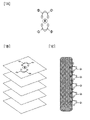
- FIG. 1A-1C are schematic views illustrating the structure of a thermally conductive additive according to an embodiment of the present disclosure.
- FIG. 1A shows a coordinated body in which an organic component is coordinated to a metal atom.
- FIG. 1B shows an orientation state in which a plurality of coordination bodies are stacked. Each coordination body is displayed as a plane.
- FIG. 1C shows a state in which a coordinate body is formed on the surface of the particles of the metal-containing component.
- FIG. 2 is a side view showing a wire harness according to an embodiment of the present disclosure.
- 3A and 3B show observation images of the additives PB-Mg and PB-MOS prepared in the examples with a polarizing microscope.
- FIG. 4 shows an FT-IR spectrum of the additive PB-Mg prepared in the examples.
- the thick solid line is the spectrum of PB-Mg prepared, the broken line is the spectrum of the raw material PB, and the thin solid line is the spectrum of the raw material MgCO3.
- the heat conductive additive according to the present disclosure includes an organic component and a metal-containing component, and the organic component has a coordination portion capable of multidentate coordination with a metal and is bonded to the coordination portion. It has at least one functional group having a conjugated ⁇ -electron system, and the organic component coordinates with a metal atom constituting the metal-containing component in the coordination portion to form a coordinated body. Form.
- the conjugated ⁇ is coupled between a plurality of adjacent coordination bodies.
- the electronic system is regularly arranged.
- a ⁇ - ⁇ interaction can act between the conjugated ⁇ -electron systems.
- the ⁇ - ⁇ interaction aligns the organic components of adjacent coordinators.
- the structure in which the coordination body containing the organic component is oriented with the intramolecular interaction exhibits a high effect of improving thermal conductivity. Therefore, when the heat conductive additive is added to a matrix material such as an organic polymer, the heat conductivity is effectively improved.
- an organic component coordinates with a metal-containing component to form a coordinator, and a large number of coordinators are regularly aggregated to form a coordinator between the organic components of adjacent coordinators.
- the interaction works reversibly, and the strong and irreversible intermolecular interaction does not work in the organic component itself. Therefore, irreversible strong intramolecular interactions do not cause a decrease in solubility or meltability, or an excessive increase in crystallinity. That is, it is unlikely that these phenomena will reduce the processability and handleability of the heat conductive additive itself or the composite material to which the heat conductive additive is added to the matrix material.
- the heat conductive additive has both an excellent effect of improving heat conductivity and high workability.
- the organic component interacts with the functional group having the conjugated ⁇ -electron system between the adjacent coordinators.
- the heat conductive additive if the ⁇ - ⁇ interaction is left between the coordinators, the effect of improving the heat conductivity due to the ⁇ - ⁇ interaction can be efficiently obtained.
- a thermally conductive compound is prepared in advance in such a state that a ⁇ - ⁇ interaction is formed between the coordinated bodies, it can be easily dispersed in a matrix material such as an organic polymer and has thermal conductivity. An improvement effect can be obtained.
- the formation of the ⁇ - ⁇ interaction is reversible, and even when the ⁇ - ⁇ interaction is formed in advance, high workability can be ensured by appropriately heating or the like.
- the functional group provided with the conjugated ⁇ -electron system may contain an aromatic ring or a condensed aromatic ring.
- a functional group containing an aromatic ring or a fused aromatic ring is easily stacked in a plane with a strong ⁇ - ⁇ interaction, and thus is a thermally conductive additive having a particularly excellent effect of improving thermal conductivity.
- the functional group provided with the conjugated ⁇ -electron system may contain only one aromatic ring or condensed aromatic ring. Then, the solubility and meltability of the thermally conductive additive are effective due to the ⁇ - ⁇ interaction between the functional groups and the excessive increase in orientation due to the inclusion of a plurality of aromatic rings or fused aromatic rings. It is unlikely that the situation will not be improved.
- the organic component may have at least one hydrocarbon group or alkoxy group having 1 or more carbon atoms and no conjugated ⁇ -electron system in addition to the functional group having the conjugated ⁇ -electron system. Then, due to the presence of a hydrocarbon group or an alkoxy group having no conjugated ⁇ -electron system, the thermally conductive additive becomes easily melted or dissolved in various organic polymers and in a solvent, and the processability is improved. High effect can be obtained.
- the coordination portion may have a ⁇ -diketone structure.
- the ⁇ -diketone structure is a structure capable of stably coordinating with various metal atoms, and it is easy to form a planar coordination structure. Due to the ⁇ - ⁇ interaction between the planar coordination bodies and the accompanying formation of the stack-like orientation, the thermally conductive additive exhibits a high effect of improving thermal conductivity.
- various functional groups can be bonded to the ⁇ -diketone structure, including those provided with a conjugated ⁇ -electron system, making it easy to prepare various thermally conductive additives.
- the organic component may have a structure represented by the formula (A).
- R 1 and R 2 are independently functional groups having a conjugated ⁇ -electron system, or hydrocarbon groups or alkoxy groups having 1 or more carbon atoms and 8 or less carbon atoms and not having a conjugated ⁇ -electron system, respectively
- R 3 Is a functional group having a conjugated ⁇ - electron system, a hydrocarbon group having 1 or more carbon atoms and 8 or less carbon atoms and not having a conjugated ⁇ - electron system, an alkoxy group , or a hydrogen atom.
- At least one is a functional group with a conjugated ⁇ -electron system.
- R 1 , R 2 and R 3 are connected to each other by a ring structure.
- the structure of the above formula (A) is compared with a functional group having a conjugated ⁇ -electron system as R1 , R2 , and R3 in addition to a coordination portion having a ⁇ -diketone structure and without a conjugated ⁇ -electron system. It has a hydrocarbon group or alkoxy group with a small number of carbon atoms, or a hydrogen atom, and the contribution of the conjugated ⁇ -electron system improves thermal conductivity based on the orientation with ⁇ - ⁇ interaction between the coordinators. It has an excellent balance between the effect and the high solubility and meltability mainly due to the contribution of parts other than the conjugated ⁇ -electron system.
- the metal-containing component is composed of a fibrous metal compound.
- Many fibrous metal compounds have high thermal conductivity, and a thermally conductive additive containing such a metallic compound is particularly excellent in the effect of improving thermal conductivity.
- a thermally conductive additive can be easily prepared by coordinating an organic component having a coordination portion and a functional group having a conjugated ⁇ -electron system to a metal atom on the surface of a fibrous metal compound. can.
- the heat conductive composite material according to the present disclosure includes the heat conductive additive and the matrix material, and the heat conductive additive is dispersed in the matrix material.
- the heat conductive composite material contains the heat conductive additive according to the embodiment of the present disclosure described above.
- a thermally conductive additive an organic component having a coordination portion and a functional group having a conjugated ⁇ -electron system and a metal-containing component form a coordination body, whereby ⁇ - ⁇ mutual between the coordination bodies.
- the orientation of the organic components with action improves the thermal conductivity of the composite material.
- the reversibility of this ⁇ - ⁇ interaction allows the thermally conductive additive to be easily dissolved or melted in the matrix material. Therefore, even if a heat conductive additive is added, high processability can be ensured in the composite material.
- the matrix material may contain an organic polymer. Although many organic polymers have low thermal conductivity, high heat dissipation can be ensured as a whole of the thermally conductive composite material by mixing the above-mentioned thermally conductive additive. Thermally conductive composites contain organic components and show high affinity for many organic polymers.
- the wire harness according to the present disclosure includes the heat conductive composite material.
- the wire harness contains the heat conductive composite material described above, the high heat conductivity and workability of the heat conductive composite material can be utilized. Therefore, high heat dissipation can be obtained in the wire harness, and even if heat is generated by energizing the electric wires constituting the wire harness, the influence of the heat generation can be suppressed to a small extent. At the same time, it is possible to easily manufacture a wire harness including a step of processing a heat conductive composite material into a predetermined shape.
- the thermally conductive composite material according to the embodiment of the present disclosure is configured by comprising the thermally conductive additive according to the embodiment of the present disclosure.
- the wire harness according to the embodiment of the present disclosure is configured by including the heat conductive composite material according to the embodiment of the present disclosure.
- a certain component is a main component of a certain material means a state in which the component occupies 50% by mass or more with respect to the mass of all the components constituting the material.
- the "organic polymer” also includes those having a low degree of polymerization such as oligomers.
- the thermally conductive additive (hereinafter, may be simply referred to as an additive) according to one embodiment of the present disclosure includes an organic component and a metal-containing component.
- the organic component is configured as an organic compound having a coordinating portion capable of polydentation on a metal and having at least one functional group bonded to the coordinating portion and having a conjugated ⁇ -electron system.
- the organic component can be represented by the structure of the following formula (1), where C is the coordination portion and F1 is a functional group having a conjugated ⁇ -electron system. F1-C (1) However, the functional group F1 may be directly bonded to the coordination portion C or may be bonded via a linking group (excluding those provided with a conjugated ⁇ -electron system).
- the number of functional groups F1 bonded to one coordination portion C may be only one or plural, and when there are a plurality of functional groups, the functional groups are the same as each other. However, they may have different structures, each having a conjugated ⁇ -electron system. Further, a functional group other than the functional group F1 having a conjugated ⁇ -electron system may also be bonded to the coordination portion C.
- the organic component may contain only one kind of the organic component represented by the formula (1), or may contain two or more kinds.
- the metal-containing component contained in the heat conductive additive may be a metal compound containing only a metal element or a metal element and a non-metal element. From the viewpoint of ease of coordination of the organic component, convenience as a heat conductive additive, and the like, the metal-containing component is preferably a metal compound.
- the metal-containing component contained in the heat conductive additive may be only one kind or two or more kinds.
- the organic component is coordinated to a metal atom constituting the metal-containing component (including the case where it is in an ionic state; the same applies hereinafter) to form a coordinated body in the coordination portion.
- the metal atom constituting the metal-containing component is M
- the organic component represented by the above formula (1) forms a coordinate body represented by the following formula (2).
- the dotted line represents a polydentate coordination bond.
- a plurality of organic components represented by the formula (1) may be coordinate-bonded to one metal atom M.
- the plurality of organic components have different structures even if they have the same structure as each other, that is, at least one of the functional group F1 and other functional groups, and the coordination portion C.
- the structures may be different from each other.
- another type of ligand may be coordinated to the metal atom M.
- the organic component of the adjacent coordinator may be used.
- a ⁇ - ⁇ interaction acts between functional groups having a conjugated ⁇ -electron system, resulting in functional group orientation. That is, the functional groups of a plurality of coordination bodies are aligned and a constant orientation angle is obtained.
- the heat conductive additive may be such that the organic component and the metal-containing component form a coordinate at least in the state at the time of use, for example, in the state after being added to the matrix material such as an organic polymer. In the state before use, for example, in the state before adding to the matrix material, it is not always necessary to form a coordinate, and the organic component and the metal-containing component may be in an independent state.
- the metal-containing component may be a metal compound containing only a metal element or a metal element and a non-metal element, but the organic component coordinates with a metal atom to form a coordinated body.
- the heat conductive additive as a whole, including the coordinator becomes charge-neutral and takes a solid state.
- the charge state of the coordinator is not limited. That is, a neutral complex may be formed in a state where an organic component is coordinated to a metal atom, and a solid state may be formed only by the neutral complex.
- the state in which the organic component is coordinated to the metal atom is a complex ion with a positive charge, and forms a solid state together with the counterion derived from the non-metal element in the metal-containing component. May be good.
- the specific shape taken by the metal-containing component in the state where the organic component is coordinated to the metal atom is not particularly specified, and a series of arbitrary shapes such as particles can be used as long as it can be dispersed in a desired matrix material. It suffices to make up the body.
- a particle shape that can be easily dispersed in the matrix material an amorphous granular shape, a fibrous shape, a rod shape, or the like can be exemplified.
- the metal atoms of the metal-containing component constituting the continuum the metal atom to which the organic component is coordinated and forms the coordinated body may be a whole or a part of the metal atom.
- the organic component is coordinated to the metal atom occupying the entire area of the continuum of the metal-containing component such as particles, and the coordinated body is formed.
- the organic component is coordinated to form a coordinated body only on the surface of the metal-containing component continuum such as particles and the metal atoms occupying the vicinity thereof, while the inside of the continuum is formed.
- a form in which the organic component is not coordinated can be exemplified.
- a coordination body is formed in a state where the metal-containing component is dissolved or finely dispersed in a solvent, and then the coordination body is formed by precipitation or the like.
- the latter form can be suitably formed by a method of forming a coordinate body by contact with a solution containing an organic component while keeping the metal-containing component in a solid state having a predetermined shape.
- a coordination body is formed on the surface of particles in which metal atoms are arranged in a predetermined structure in advance, the orientation of organic components due to intramolecular interaction and the continuity in orientation are enhanced.
- Cheap since a coordination body is formed on the surface of particles in which metal atoms are arranged in a predetermined structure in advance, the orientation of organic components due to intramolecular interaction and the continuity in orientation are enhanced. Cheap.
- the organic component constituting the heat conductive additive according to the present embodiment is, as represented by the formula (1), a conjugated ⁇ -electron system on the coordination portion C capable of multidentate coordination with the metal. That is, it has a structure in which at least one functional group F1 having a structure in which carbon-carbon double bonds and single bonds are alternately arranged as a partial or whole structure is bonded.
- the specific structure of the organic component is not particularly limited, but a suitable structure of the organic component will be described below.
- the type of the functional group having the conjugated ⁇ -electron system possessed by the organic component is not particularly limited, and the conjugated ⁇ -electron system may have a chain-like one or a cyclic one. Further, it may have both a chain portion and an annular portion. However, from the viewpoint of stability of the conjugated state and the like, the conjugated ⁇ -electron system preferably contains a cyclic structure.
- the conjugated ⁇ -electron system contained in the functional group of the organic component is composed of an aromatic ring or a condensed aromatic ring.
- aromatic rings and fused aromatic rings are excellent in the stability of the conjugated state, have a planar structure, and can efficiently form ⁇ - ⁇ interactions between the organic components of adjacent coordinators.
- the aromatic ring contained in the conjugated ⁇ -electron system (aromatic ring contained alone or an aromatic ring constituting a fused aromatic ring) may be a benzene ring, but may be a pyrrole ring, a thiophene ring, or any other aromatic ring. It may have a ring structure.
- the aromatic ring constituting the conjugated ⁇ -electron system is a benzene ring.
- the functional group having a conjugated ⁇ -electron system may be an aryl group or a substituted aryl group.
- the aryl group and the substituted aryl group include a phenyl group and a substituted phenyl group, a naphthyl group and a substituted naphthyl group, an anthryl group and a substituted anthryl group, a phenanthryl group and a substituted phenanthryl group.
- a phenyl group and a substituted phenyl group, a naphthyl group and a substituted naphthyl group are particularly preferable from the viewpoint of obtaining an intramolecular interaction having an appropriate size.
- the substituent constituting the substituted aryl group is not particularly limited, and examples thereof include an alkyl group, an alkenyl group, and an alkoxy group.
- an aryl group may be introduced as a substituent, and in this case, the functional group including the conjugated ⁇ -electron system has a structure in which a plurality of (condensed) benzene rings are increased in number via a single bond.
- the number of carbon atoms in these substituents is preferably 1 or more and 4 or less from the viewpoint of ensuring the flatness of the functional group.
- Substituents such as alkenyl groups may form a conjugated ⁇ -electron system continuous with the aromatic ring.
- the functional group containing the conjugated ⁇ -electron system may have a structure in which a plurality of (condensed) benzene rings are increased in number via a single bond, and even in that case. , ⁇ - ⁇ interaction exerts the effect of improving orientation, but rather than the structure in which multiple (condensed) aromatic rings are contained in one functional group, each functional group of the organic component has such an effect.
- a structure containing only one aromatic ring or fused aromatic ring is more preferable. That is, a form in which a single functional group (F1) is not condensed with each other and does not contain a plurality of aromatic rings is more preferable.
- the interaction and orientation between the organic components of adjacent coordinators does not become too strong. As such, it can be suppressed moderately.
- high solubility and meltability are ensured by the intramolecular interaction that orients the molecules does not work so strongly in the organic component itself. Therefore, it is preferable to keep the intermolecular interaction and orientation of a single functional group small to some extent.
- Some functional groups containing a plurality of aromatic rings that are not condensed with each other are known as mesogen groups such as a biphenyl group and a phenylbenzoate group.
- the organic component does not have a mesogen group.
- the organic component contains hydrogen-binding substituents such as an ester group, an amide group, and an imide group, except for those contained in the coordination portion. It is preferable that there is no such thing. More preferably, the organic component does not contain a hydrogen-bonding substituent even in the coordination portion.
- the number of carbon atoms per functional group is preferably 4 or more, preferably 6 or more, from the viewpoint of ensuring the interaction between the organic components.
- the number of carbon atoms per functional group is preferably 24 or less, preferably 12 or less.
- the organic component may have a functional group having no conjugated ⁇ -electron system in addition to the functional group having a conjugated ⁇ -electron system. Since the organic component contains a functional group that does not have a conjugated ⁇ -electron system, the functional groups contained in the organic component are mutual between the molecules of the organic component as compared with the case where only those having a conjugated ⁇ -electron system are included. It becomes easy to suppress the action to a moderately small size. Then, it becomes easy to secure the solubility and meltability of the heat conductive additive.
- Specific types and structures of functional groups that do not have a conjugated ⁇ -electron system are not limited, but preferred examples include alkyl groups, hydrocarbon groups such as cycloalkyl groups, and alkoxy groups. can.
- the carbon number of these functional groups is preferably 1 or more and 8 or less from the viewpoint of not inhibiting the intramolecular interaction in the functional group having a conjugated ⁇ -electron system.
- the functional group is particularly preferably an alkyl group or an alkoxy group having a carbon number in the range.
- the coordination portion contained in the organic component is not particularly limited as long as it can coordinate with a metal atom in multiple positions, and may be coordinated in two positions or in three or more positions. In any case, it is preferable that the coordination portion can coordinate with respect to the metal atom in a plane.
- the structure of the bidentate coordination is ⁇ -diketone ( ⁇ -diketonato at the time of coordination), ethylenediamine, bipyridine, diphosphines, phenanthroline, glycine (glycinato at the time of coordination), and catechol (catecholato at the time of coordination). Can be exemplified with those having.
- a coordinating portion capable of coordinating in a plane with three or more constellations
- a macrocycle structure such as porphyrin, phthalocyanine, crown ether and the like
- the distinction between the coordination part and the other functional base part may not be clear.
- the coordination portion is preferably bidentate-coordinated, and particularly preferably has a ⁇ -diketone structure.
- the ⁇ -diketone structure can stably coordinate to various metal atoms in a plane, and can bond various functional groups.
- the coordination portion may have a resonance structure (tautomer) such as an enol structure with respect to the ⁇ -diketone structure. Further, a part of the structure of the coordination portion may be continuous with the functional group to form a conjugated ⁇ -electron system.
- R 1 and R 2 are independent functional groups having a conjugated ⁇ -electron system or no conjugated ⁇ -electron system
- R 3 is a functional group having a conjugated ⁇ -electron system and conjugated. It is either a functional group having no ⁇ -electron system or a hydrogen atom, and at least one of R 1 , R 2 , and R 3 is a functional group having a conjugated ⁇ -electron system. It also includes the case where at least two of R 1 , R 2 and R 3 are connected to each other by a ring structure.
- the form contained in the ring structure is also included.
- the form in which the ring structure forms a conjugated ⁇ -electron system such as an aromatic ring or a condensed aromatic ring is also included (HAN of the example). See).
- R 1 , R 2 , and R 3 are selected from either a functional group having a conjugated ⁇ -electron system or a functional group not having a conjugated ⁇ -electron system, respectively.
- R 3 it may be a hydrogen atom.
- at least one of the three R 1 , R 2 , and R 3 is a functional group having a conjugated ⁇ -electron system.
- one of the three may be a functional group without a conjugated ⁇ -electron system.
- the functional group having a conjugated ⁇ -electron system and the functional group not having a conjugated ⁇ -electron system those described above as suitable examples are preferably applied.
- the functional group having a conjugated ⁇ -electron system one having an aromatic ring or a condensed aromatic ring is preferable.
- a hydrocarbon group having 1 or more carbon atoms and 8 or less carbon atoms or an alkoxy group is preferable.
- R 1 , R 2 , and R 3 two of which are functional groups having a conjugated ⁇ -electron system are particularly preferable.
- R 1 and R 2 at both ends are functional groups having a conjugated ⁇ -electron system.
- the central R 3 is a functional group having a conjugated ⁇ -electron system.
- the type of the metal-containing component constituting the heat conductive additive according to the present embodiment is not particularly limited as long as it contains a metal element, and even if it is composed of only the metal element, it is a metal. It may be a metal compound containing an element and a non-metal element, but it is preferably composed of a metal compound.
- the metal-containing component takes a solid state such as particles. Preferred metal compounds include metal hydroxides, chlorides, carbonates, sulfates, alkoxides and the like.
- the metal elements constituting the metal-containing component are not particularly limited.
- preferable metal elements include alkaline earth metals such as Mg and Ca, and Al and Zn.
- a metal compound containing these metal elements has a relatively high thermal conductivity, and when used as a thermal conductivity additive together with an organic component, it exhibits a high thermal conductivity improving effect. Further, the metal compound containing these metal elements has a relatively small specific gravity, and it is easy to obtain a heat conductive additive having a small specific gravity.
- the shape of the metal-containing component is not particularly limited as long as it can take the state of solid particles.
- the particle shape include amorphous powder, rod shape, and fibrous shape.
- it is preferable to take a shape with high anisotropy such as a rod shape or a fibrous shape. This is because metal compound particles having high anisotropy often exhibit high thermal conductivity, and even when organic components are coordinated to form a thermal conductivity additive, they exhibit high thermal conductivity. ..
- the metal compound is preferably fibrous.
- a fibrous metal compound exhibiting high thermal conductivity basic magnesium sulfate can be exemplified.
- the particle size of the metal-containing component is not particularly limited, but from the viewpoint of enhancing the dispersibility in the matrix material, the particle size (long diameter in the case of an anisotropic shape such as rod or fiber) is generally large. , 50 ⁇ m or less.
- the organic component provided with the conjugated ⁇ -electron system is co-ordinated to the constituent metal of the metal-containing component at the coordination portion. , Form a coordination body. Since the coordination portion is polydentated with respect to the metal in the metal-containing component, the coordinated body contains a functional group having a conjugated ⁇ -electron system as compared with the case of monodentate coordination.
- the organic component is stably bonded to the metal atom in a predetermined positional relationship and angular arrangement.
- FIG. 1A schematically shows the structure of the coordinated body, taking as an example the case where the coordinated portion has a ⁇ -diketone structure.
- M represents a metal atom
- ⁇ represents a functional group having an aromatic ring or a condensed aromatic ring.
- FIG. 1A the case of four coordination is assumed.
- the organic components are regularly arranged with respect to the metal atoms in a predetermined positional relationship to form a coordination bond. Then, due to the crystallinity of the metal-containing component, a large number of coordinated bodies can form an aggregate in a state where the metal atoms are regularly arranged. In this way, when a large number of coordinators formed by coordinating organic components to metal atoms are arranged in a regular manner, attractive interactions occur between the organic components of adjacent coordinators. It can occur. That is, a ⁇ - ⁇ interaction occurs between the conjugated ⁇ -electron systems contained in the organic components of the coordinated bodies arranged adjacent to each other. Further, the ⁇ - ⁇ interaction aligns and orients the organic components of adjacent coordinators in a predetermined direction.
- the coordinated body shown in FIG. 1A has a planar structure, and conjugated ⁇ electrons are distributed in the vertical direction of the surface of the coordinated body displayed as a quadrangular plane in FIG. 1B. Then, a ⁇ - ⁇ interaction acts between the faces of adjacent coordination bodies. Then, as shown in FIG. 1B, due to the attractive interaction acting between the faces, the adjacent coordinators are oriented with each other in the direction of aligning the faces of the coordinators in parallel, and a large number of coordinators are stacked. Take the structure.
- an organic component is coordinated to a metal atom (not shown) on the surface of a solid particle-like metal-containing component (displayed with a hatch) to form a coordinated body.
- a ⁇ - ⁇ interaction acts between the organic components coordinated adjacently. Due to this ⁇ - ⁇ interaction, the organic component takes a structure oriented in a specific direction on the surface of the metal-containing component. In FIG. 1C, in order to simplify the display, only one organic component is displayed per coordinate body.
- the coordinated body in such an oriented state functions as a heat conductive additive, and by mixing with a matrix material such as an organic polymer material, the heat conductivity of the material is improved.
- the specific orientation structure of the coordination body is not particularly limited as long as the orientations are aligned between the coordination bodies, but the planes constituting the conjugated ⁇ -electron system are stacked in parallel. A form having an oriented structure is particularly preferable. When the conjugated ⁇ -electron system is composed of an aromatic ring or a condensed aromatic ring, a stack-like oriented structure is likely to be formed.
- the thermally conductive additive according to the present embodiment does not exert the effect of improving thermal conductivity by the structure in one molecule and by the strong or highly irreversible interaction acting between the molecules, but is coordinated.
- the structure through relatively weak and reversible intramolecular interactions such as binding and ⁇ - ⁇ interaction exerts the effect of improving thermal conductivity. Therefore, the thermally conductive additive according to the present embodiment is excellent in solubility in a solvent and meltability at the time of heating, and by utilizing the dissolution in a solvent and the melting by heating, a matrix of an organic polymer or the like is used. Excellent processability can be obtained when adding, mixing and kneading the material. Unnecessary crystallization is unlikely to occur.
- the heat conductive additive is uniformly dispersed in the matrix material, and the ⁇ - ⁇ interaction between the coordinators and the accompanying orientation form a state in which the heat conductivity improving effect is exhibited. be able to.
- dissolution in a solvent or melting by heating not only the ⁇ - ⁇ interaction but also the coordination bond between the organic component and the metal-containing component is eliminated, or the organic component and the metal-containing component are independent.
- the organic component and the metal-containing component constituting the heat conductive additive have higher solubility and meltability. Can be melted or melted.
- additives and organic polymers configured as organic molecules containing mesogen groups and liquid crystal structures are also intermolecular, like the thermally conductive additives according to the present embodiment.
- the effect of improving thermal conductivity based on the suppression of phonon scattering can be exerted.
- it has a mesogen group or a liquid crystal structure strong intramolecular interaction works, so that it is difficult to dissolve in a solvent or by heating, and the processability is often lowered.
- the heat conductivity is improved based on the coordination structure in which the organic component is coordinated with the metal-containing component. By exhibiting the effect, the workability becomes excellent.
- the metal-containing component to be used is dissolved in a solvent such as a highly polar solvent together with the organic component, or finely dispersed in the form of fine particles that do not retain the shape of the metal-containing component of the raw material.
- the organic component is coordinated to the metal atom of the metal-containing component by mixing the solution while appropriately performing operations such as heating, stirring, and addition of the reactant.
- the solvent is removed from the prepared reaction solution by volatilization or the like, and the metal-containing component in which the organic component is coordinated to form a coordinated body is produced in a solid state by precipitation or the like.
- the prepared reaction solution is first dispersed in the matrix material, and then the solvent is removed.
- a metal-containing component and an organic component in a state where a coordinate is not formed are appropriately added to the matrix material together with a solvent and dispersed, and the mixture is added to the matrix material.
- a coordinate body may be formed.
- the composition of the metal-containing component constituting the obtained product is different from that of the metal-containing component initially used as a raw material, even if it is the same, after undergoing a reaction such as coordination. May be good.
- a method of coordinating an organic component to a dissolved or finely dispersed metal-containing component to form a coordinator and then forming a coordinator in a solid state, or a coordinator in a matrix material According to the method of forming the solid metal-containing component, a thermally conductive additive can be easily obtained in a state where a coordinator is formed in almost the entire area of the solid metal-containing component. That is, as shown in FIG. 1B, particles of the thermally conductive additive can be easily obtained as an aggregate in which a large number of coordinated bodies are aggregated in a predetermined orientation such as a stack shape by ⁇ - ⁇ interaction. ..
- the production method in which the metal-containing component is dissolved or finely dispersed and then the organic component is coordinated is different from that in the examples shown below, in which the basic magnesium sulfate inorganic fiber is used as the metal-containing component. Has been applied.
- the metal-containing component is brought into contact with the organic component while maintaining the original particle shape without dissolving or finely dispersing the particles so as to eliminate the initial particle shape.
- This also makes it possible to produce a thermally conductive additive.
- the organic component may be brought into contact with the metal-containing component in a state of being dissolved in the solvent.
- the organic components can be in a predetermined orientation due to the ⁇ - ⁇ interaction between the coordinated bodies formed adjacent to each other.
- the production method of coordinating the organic component while maintaining the particle shape of the metal-containing component can be suitably adopted when the sparingly soluble metal-containing component is used, and in the examples shown later, It is applied to the case where a basic magnesium sulfate inorganic fiber is used as a metal-containing component.
- the fact that the orientation by the ⁇ - ⁇ interaction is achieved in the formed coordinate is, for example, observation using a polarizing microscope or infrared absorption spectroscopy (FT-IR). ) Can be confirmed by spectral measurement.
- FT-IR infrared absorption spectroscopy
- the obtained particles of the heat conductive additive are observed with a polarizing microscope, the particles are arranged in a specific direction according to the polarization, or some parts of one particle are other particles.
- the fact that the organic components are observed to be remarkably brighter than those of other parts is an indicator that the organic components are oriented in a predetermined direction.
- the wavenumber shift of the infrared absorption peak derived from the organic component may be associated with the ⁇ - ⁇ interaction.
- thermally conductive composite material (hereinafter, may be simply referred to as a composite material) according to an embodiment of the present disclosure will be described.
- the thermally conductive composite material according to the present embodiment includes the thermally conductive additive according to the embodiment of the present disclosure described above and the matrix material. Thermally conductive additives are dispersed in the matrix material.
- the organic components contained in the coordinator constituting the added thermally conductive additive form a ⁇ - ⁇ interaction between adjacent ones. Furthermore, due to the ⁇ - ⁇ interaction, they are aligned in a predetermined orientation. Since the effect of improving thermal conductivity is exhibited by this orientation, the thermally conductive composite material according to the present embodiment exhibits high thermal conductivity. Further, in the heat conductive composite material, when the particles of the metal-containing component constituting the heat conductive additive are in contact with each other via the organic component as appropriate, the metal-containing component itself is thermally conductive. By forming a path and functioning as a heat conductive filler, the heat conductivity of the heat conductive composite material is also improved.
- the heat conductive additive contains an organic component and the effect of improving the heat conductivity by the ⁇ - ⁇ interaction in the organic component can be utilized, it contains a metal-containing component as compared with the case where only the metal-containing component is used as the heat conductive filler. Even if the amount added as the metal component itself is suppressed to a small amount, a high effect of improving thermal conductivity can be obtained. As a result, thermal conductivity is effectively suppressed while suppressing the effects that may occur when a large amount of metal-containing components are added, such as an increase in specific gravity, deterioration of the characteristics of the matrix material such as material strength, and deterioration of insulating properties. Can be achieved.
- the organic component By arranging the organic component on the surface of the metal-containing component, the effect of enhancing the affinity between the metal-containing component and the matrix material made of the organic material can also be obtained.
- the type of the matrix material is not particularly limited, but the matrix material preferably contains an organic polymer, and more preferably any one containing an organic polymer as a main component.
- the organic polymer constituting the matrix material include various resins, thermoplastic elastomers, rubber and the like.
- a resin material when used as the matrix material, it may be a curable resin, a thermoplastic resin, or a plastic soluble in a solvent, depending on the desired application.
- Examples of the types of resins constituting the matrix material include olefin resins such as polyethylene and polypropylene, halogen resins such as polyvinyl chloride, polylactic acid, polystyrene resins, polyvinyl acetate, ABS resins, AS resins, and acrylic resins. , Methacrylic resin, polyamide resin, urethane resin, silicone resin, fluororesin, polyvinyl alcohol, polyimide, polyacetal, polycarbonate, modified polyphenylene ether (PPE), polyethylene terephthalate, polybutylene terephthalate, polyphenylene sulfide, and epoxy resin, or resins thereof. Examples thereof include copolymers of each other and polymer alloys.
- olefin resins such as polyethylene and polypropylene
- halogen resins such as polyvinyl chloride, polylactic acid, polystyrene resins, polyvinyl acetate, ABS resins, AS resins, and acrylic resins.
- the matrix material may contain only one type of organic polymer or may contain a plurality of organic polymers.
- the matrix material preferably does not contain a mesogen group or a liquid crystal structure in its molecular structure.
- the matrix material may appropriately contain additives such as flame retardants, fillers and colorants in addition to the organic polymer. However, it is preferable that additives having the effect of improving thermal conductivity of other types, such as inorganic fillers, are not added to the thermally conductive composite material except for unavoidable impurities.
- the content of the heat conductive additive may be appropriately determined so that the desired heat conductivity can be obtained as the whole heat conductive composite material.
- the content of the heat conductive additive is set so that the thermal conductivity of the composite material is 1.5 times or more, further 2.0 times or more, 2.5 times or more the thermal conductivity of the matrix material. You just have to decide.
- the higher the thermal conductivity of the thermally conductive composite material the more preferable it is.
- the thermal conductivity of the composite material is the thermal conductivity.
- the content of the heat conductive additive may be determined so that the heat conductivity of the matrix material to which no sex additive is added is 5 times or less, and further 4 times or less.
- the content of the additive may be determined so that the specific gravity of the composite material is 1.5 times or less, further 1.2 times or less the specific gravity of the matrix material to which the heat conductive additive is not added.
- the content of the heat conductive additive is specified by the ratio of the additive to the whole heat conductive composite material
- the content of the heat conductive additive is sufficient for the heat conductivity of the heat conductive composite material.
- it may be generally 20% by volume or more, or 30% by volume or more.
- it may be 60% by volume or less, or 50% by volume or less.
- a heat conductive additive containing a coordination body of a metal-containing component and an organic component which is produced by the production method described above, is used as a matrix material in a predetermined compounding ratio. It can be manufactured by adding, mixing and kneading.
- a thermally conductive composite material may be produced by dispersing the metal-containing component and the organic component in a state not constituting the coordinate body in the matrix material and forming the coordinate body in the matrix material. good.
- the coordination body and the organic component can be easily dispersed in the matrix material, and high processability can be obtained. At this time, even higher processability can be obtained by using a solvent or heating the material.
- a solvent is used in the manufacturing process of the thermally conductive composite material, it is advisable to appropriately heat-dry or degas after the manufacturing to remove the solvent.
- the produced thermally conductive composite material may be used as it is, or may be used after being formed into a desired shape through steps such as melting, melting, and curing.
- the thermally conductive composite material according to the present embodiment has both high thermal conductivity and low specific gravity, and is excellent in processability. Therefore, this thermally conductive composite material can be easily manufactured and processed and used as a suitable material for constituting a member that is required to have both light weight and heat dissipation.
- the specific use of the thermally conductive composite material is not particularly limited, but next, the case where it is used as a constituent material of a wire harness will be illustrated in detail.
- the wire harness according to the present embodiment includes the heat conductive composite material according to the embodiment of the present disclosure described above.
- the wire harness 5 is provided with a connector 52 including a connection terminal (not shown) at a terminal portion of an insulated wire 51 having an insulating coating on the outer periphery of the wire conductor.
- a plurality of insulated wires 51 may be bundled, and in this case, the tape 53 can be used as an exterior material for bundling the insulated wires 51.
- the heat conductive composite material according to the embodiment of the present disclosure described above can constitute various members that are required to have heat dissipation.
- a heat conductive composite material in which a heat conductive additive is added to an organic polymer as a matrix material as a constituent material of an insulating member.
- an insulating member an insulating coating constituting the insulated wire 51, an exterior material such as a tape 53 or a protective tube arranged outside the insulated wire 51, and an adhesive used for fixing or stopping water between the constituent members.
- the connector housing and the like constituting the connector 52 can be exemplified.
- a heat conductive composite material may be arranged between the protective tube such as a corrugated tube and the insulated wire 51.
- weight reduction of constituent members is an important issue, and by using the heat conductive composite material having a small specific gravity, it is possible to contribute to weight reduction of the wire harness 5. Further, by utilizing the high processability of the heat conductive composite material, various constituent members having various shapes and arrangements can be easily manufactured.
- thermally conductive additive containing a coordinated body in which an organic component is coordinated with a metal-containing component is produced, and the state of the thermally conductive additive and the thermally conductive composite material containing the thermally conductive additive are prepared.
- the specific gravity and thermal conductivity of the material were evaluated.
- samples are prepared and evaluated in the air at room temperature.
- ⁇ PB-Mg After stirring and homogenizing 10 g (61.7 mmol) of PB and 3.10 g (31 mmol) of MgCO3 in an isopropanol / water solvent for 30 minutes, the solvent was distilled off by an evaporator and the mixture was vacuum dried.
- ⁇ PB-Zn After stirring and homogenizing 10 g (61.7 mmol) of PB and 3.44 g (31 mmol) of ZnCO3 in an isopropanol / water solvent for 30 minutes, the solvent was distilled off by an evaporator and the mixture was vacuum dried.
- PB-MOS After stirring and homogenizing 10 g (61.7 mmol) of PB and 10 g (130 mmol) of MOS in isopropanol / water solvent for 30 minutes, the solvent was distilled off by an evaporator, and the mixture was vacuum dried.
- ⁇ DPP-Al After stirring and homogenizing 10 g (44.6 mmol) of DPP and 3.04 g (14.9 mmol) of Al-IP in an isopropanol / toluene solvent for 30 minutes, the solvent was distilled off by an evaporator, and the mixture was vacuum dried.
- ⁇ BMPP-Mg After stirring and homogenizing 10 g (35.2 mmol) of BMPP and 1.76 g (17.6 mmol) of MgCO3 in isopropanol / water solvent for 30 minutes, the solvent was distilled off by an evaporator, and the mixture was vacuum dried.
- ⁇ BMPP-MOS After stirring and homogenizing 10 g (35.2 mmol) of BMPP and 10 g (130 mmol) of MOS in isopropanol / water solvent for 30 minutes, the solvent was distilled off by an evaporator, and the mixture was vacuum dried.
- ⁇ PP-Mg After stirring and homogenizing 10 g (56.8 mmol) of PP and 2.84 g (28.4 mmol) of MgCO3 in an isopropanol / water solvent for 30 minutes, the solvent was distilled off by an evaporator and the mixture was vacuum dried.
- ⁇ PP-MOS After stirring and homogenizing 10 g (56.8 mmol) of PP and 10 g (130 mmol) of MOS in isopropanol / water solvent for 30 minutes, the solvent was distilled off by an evaporator, and the mixture was vacuum dried.
- HPB-Mg After stirring and homogenizing 10 g (50.5 mmol) of HPB and 2.53 g (25.3 mmol) of MgCO3 in an isopropanol / water solvent for 30 minutes, the solvent was distilled off by an evaporator and the mixture was vacuum dried.
- HPB-MOS After stirring and homogenizing 10 g (50.5 mmol) of HPB and 10 g (130 mmol) of MOS in isopropanol / water solvent for 30 minutes, the solvent was distilled off by an evaporator, and the mixture was vacuum dried.
- ⁇ HAN-Mg After stirring and homogenizing 10 g (53.7 mmol) of HAN and 2.69 g (26.9 mmol) of MgCO3 in isopropanol / water solvent for 30 minutes, the solvent was distilled off by an evaporator, and the mixture was vacuum dried.
- ⁇ HAN-MOS After stirring and homogenizing 10 g (53.7 mmol) of HAN and 10 g (130 mmol) of MOS in isopropanol / water solvent for 30 minutes, the solvent was distilled off by an evaporator, and the mixture was vacuum dried.
- ⁇ AA-Mg After stirring and homogenizing 10 g (99.9 mmol) of AA and 4.9 g (49.9 mmol) of MgCO3 in isopropanol / water solvent for 30 minutes, the solvent was distilled off by an evaporator, and the mixture was vacuum dried.
- ⁇ AA-MOS After stirring and homogenizing 10 g (99.9 mmol) of AA and 10 g (130 mmol) of MOS in isopropanol / water solvent for 30 minutes, the solvent was distilled off by an evaporator, and the mixture was vacuum dried.
- a resin cured product test piece (10 mm ⁇ 10 mm ⁇ 1 mm) was produced by cutting out a portion of the produced cured product in which bubbles were not visually confirmed.
- the blending amount per volume is 30% by volume based on the content (unit: mass%) of each additive shown in Table 1 and the specific gravity measured in the following evaluation test. It is set as such.
- a cured resin test piece was prepared from only the epoxy resin without adding any additive.
- Table 1 for other additives such as PB and MgCO3 in which the abbreviations of the raw material substances are described as they are, each raw material substance does not go through the preparation of the additive by mixing the organic component and the metal-containing component. Is added to the epoxy resin as it is.
- FT-IR measurement was performed on PB-Mg, and the interaction between organic components was examined.
- the raw materials MgCO3 and PB were measured by the total internal reflection attenuation method (ATR method), respectively.
- the specific gravity and thermal conductivity were measured for each of the cured resin test pieces prepared as the composite material above.
- the specific gravity was measured by the underwater substitution method.
- the thermal conductivity was measured by a laser flash method using a thermal conductivity device (“LFA447” manufactured by NETZSCH).
- the measurement direction of the thermal conductivity was the direction perpendicular to the surface of the cured resin test piece.
- FIGS. 3A and 3B show observation images of additives PB-Mg and PB-MOS, respectively, with a polarizing microscope. From the left, the prepared additives (PB-Mg, PB-MOS), the raw material metal compound particles (MgCO3, MOS), and the raw material PB were observed, respectively. Regarding PB, the same image is shown in FIGS. 3A and 3B. In observation using a polarizing microscope, when a substance is oriented in a specific direction, there are some spots in the image that are observed brighter than the surrounding area.
- FIGS. 3A and 3B with respect to the raw material PB, brightly observed crystal grains are observed in a part, and it is confirmed that the PB has a certain degree of orientation.
- MgCO3 has a certain degree of orientation as in PB, but for MOS, fibrous particles are observed with uniform darkness as a whole. It is considered that the crystal structure of the particles does not have high orientation.
- particles that are observed to be remarkably bright are present in both PB-Mg in FIG. 3A and PB-MOS in FIG. 3B. Furthermore, even among a single particle, there are particles in which a bright region and a dark region coexist.
- the constituent materials are oriented in a certain direction with high orientation in any of the additives.
- the organic components (PB) constituting the additive interact with each other in ⁇ - ⁇ between adjacent molecules, and the attractive force of the interaction causes the surfaces of the conjugated ⁇ -electron system to interact with each other. It is considered that the organic components are oriented in the direction in which they are aligned and stacked.
- the size and shape of the particles did not change significantly as compared with the case of only MOS, whereas in the image of PB-Mg, it was the case of only MgCO3. In comparison, the particles have become smaller in diameter and the particle shape has become anisotropic.
- PB-MOS it is considered that the particle shape of the raw material MOS particles did not change in the solvent at the time of manufacture, and PB was coordinated only on the particle surface.
- PB-Mg the raw material MgCO3 was finely dispersed in the solvent during production, and after the particle shape of the raw material was once eliminated, PB was coordinated and new PB-Mg particles were generated.
- the size and shape of the particles have changed from the original MgCO3 raw material. It is considered that the ⁇ - ⁇ interaction between the coordinated PB molecules contributes to the increase in the anisotropy of the particle shape.
- those using MOS as the metal-containing component were all formed with the same initial particle shape as PB-MOS. On the other hand, in all cases where a metal-containing component other than MOS was used, the initial particle shape was once eliminated and an additive was formed, as in PB-Mg.
- FIG. 4 shows the measurement results of FT-IR for the additive PB-Mg.
- the thick solid line is the prepared PB-Mg
- the broken line is the raw material PB
- the thin solid line is the raw material MgCO3 spectrum
- the horizontal axis represents the wave number
- the vertical axis represents the transmittance (T).
- Table 1 summarizes the measurement results of the composition and characteristics of the composite materials related to samples A1 to A16 and samples B1 to B8.
- the upper part shows the compounding ratio (unit: mass%) of the additive and the matrix material, and also indicates the compounding amount (unit: volume%) of the additive.
- the lower row summarizes the measurement results of specific gravity and thermal conductivity.
- the left column of the table also shows the measured values of the specific gravity of each additive.
- an additive prepared from a metal-containing component and an organic component having a coordination portion and a conjugated ⁇ -electron system is added to the matrix material.
- the thermal conductivity is more than twice that of the sample B1 to which no additive is added, and the addition of the additive gives a good effect of improving the thermal conductivity. If the thermal conductivity is doubled by the addition of the additive, it can be said that it is practically sufficiently useful as a thermal conductivity additive.
- the organic component coordinates with the metal constituting the metal-containing component to form a coordinator, and further, ⁇ - ⁇ interaction between the conjugated ⁇ -electron systems of adjacent coordinators. Can be interpreted as a result of the orientation of the coordination body to the stack shape. This is in agreement with the analysis result of the state of the additive using the polarizing microscope and FT-IR described above.
- the specific gravity of the composite material is suppressed to 1.1 times or less as compared with the sample B1. This is because the amount of the additive added is small, and the additive is composed of not only a metal-containing component having a large specific gravity but also an organic component having a low specific gravity.
- the heat conductive additive containing a predetermined organic component and a metal-containing component imparts a high effect of improving heat conductivity without significantly increasing the specific gravity of the material.
- the samples A5, A8, A10, A12, A14, and A16 are 0.50 W / (m ⁇ K) or more, that is, 2.8 times that of the sample B1.
- the additive used contains MOS as a metal-containing component. This means that, in addition to the fact that the MOS itself is a metal compound having a high thermal conductivity, in the case of the MOS, unlike the case of other metal-containing components, the surface of the MOS maintains the fibrous particle shape. It is presumed that this is because the organic components are coordinated, so that the orientation of the organic components and the continuity of the orientation are excellent.
- the samples B2 to B8 will be examined.
- the metal-containing component is not used, and the organic component is added alone to the matrix material.
- no improvement in thermal conductivity is observed as compared with sample B1. That is, even if the organic component has a conjugated ⁇ -electron system, the effect of improving the thermal conductivity based on the intramolecular interaction and the molecular orientation cannot be obtained only by dispersing it in the matrix material. From this, in order for the organic component having a conjugated ⁇ -electron system to exert the effect of improving thermal conductivity, the organic component coordinates with the metal atom of the metal-containing component to form a coordination body, and the coordination thereof is performed.
- the organic component is not used, and the metal-containing component is added alone to the matrix material.
- an increase in thermal conductivity is observed as compared with sample B1, but the value is as small as 1.2 to 1.3 times that of sample B1. That is, the effect of improving the thermal conductivity is limited only by dispersing the metal-containing component in the matrix material.
- the particles of the metal-containing component can function as a heat conductive filler and give a slight effect of improving the heat conductivity.
- the adjacent particles are in contact with each other. It is necessary to form a heat conduction path. It can be said that the addition amount of 30% by volume adopted here is insufficient for forming a heat conduction path.
- the amount of the metal-containing component added is increased, a high effect of improving thermal conductivity may be obtained, but in that case, the specific gravity of the composite material may be increased and the characteristics may be further deteriorated. ..
- a high thermal conductivity improving effect was obtained even with the same addition amount of 30% by volume as in the samples B4 and B5. It can be said that the metal-containing component does not simply function as a heat conductive filler, but the effect of improving the heat conductivity by the contribution of the organic component coordinated to the metal-containing component is dominant.
- acetylacetone (AA) is used as an organic component constituting the additive.
- Acetylacetone does not have a functional group with a conjugated ⁇ -electron system.
- the measurement result of the thermal conductivity is higher than that of the sample B1, but it is only about 1.3 times that of the sample B1, and the sample B4 which does not use the organic component is used.
- B5 has almost the same value. That is, in the samples B6 and B7, the effect of improving the thermal conductivity by using the additive in which the organic component is coordinated with the metal-containing component is very limited.
- the organic component does not have a conjugated ⁇ -electron system, so even if a coordinator is formed, it does not show a strong attractive interaction between adjacent coordinators, and thermal conductivity due to the orientation accompanying the interaction. It is interpreted that the effect of improvement is hardly obtained. That is, in order to improve the thermal conductivity, it is important that the organic component coordinated to the metal-containing component has a conjugated ⁇ -electron system.
- sample B8 the organic component PB and the metal-containing component MgCO3 are independently added to the matrix material.
- This sample B8 contains the same amount of PB and MgCO3 as the sample A3.
- the thermal conductivity is 2.4 times that of the sample B1, whereas in the sample B8, the thermal conductivity is obtained.
- the rate is only 1.2 times that of sample B1.
- the organic component and the metal-containing component are mixed in advance to form a heat conductive additive containing a coordinate, and then added to the matrix material, whereas in sample B8, such is the case. No coordinate is formed.
Landscapes
- Chemical & Material Sciences (AREA)
- Organic Chemistry (AREA)
- Chemical Kinetics & Catalysis (AREA)
- Health & Medical Sciences (AREA)
- Medicinal Chemistry (AREA)
- Polymers & Plastics (AREA)
- Engineering & Computer Science (AREA)
- Physics & Mathematics (AREA)
- Combustion & Propulsion (AREA)
- Thermal Sciences (AREA)
- Materials Engineering (AREA)
- Compositions Of Macromolecular Compounds (AREA)
Abstract
熱伝導性向上効果に優れ、かつ高い加工性を有する熱伝導性添加剤、また、そのような熱伝導性添加剤を含んだ熱伝導性複合材料およびワイヤーハーネスを提供する。 有機成分と、含金属成分と、を含み、前記有機成分は、金属に多座配位可能な配位部を有するとともに、前記配位部に結合され、共役π電子系を備えた官能基を、少なくとも1つ有する有機化合物として構成されており、前記有機成分が、前記配位部において、前記含金属成分を構成する金属原子に配位して、配位体を形成する、熱伝導性添加剤とする。また、前記熱伝導性添加剤と、マトリクス材料と、を含み、前記熱伝導性添加剤が前記マトリクス材料中に分散されている、熱伝導性複合材料とする。さらに、前記熱伝導性複合材料を含む、ワイヤーハーネスとする。
Description
本開示は、熱伝導性添加剤、熱伝導性複合材料、およびワイヤーハーネスに関する。
電気電子部品を構成する絶縁性部材において、放熱性を高め、通電等による発熱の影響を小さく抑える目的で、有機ポリマー材料に、熱伝導性添加剤が添加される場合がある。熱伝導性添加剤としては、アルミナや窒化アルミニウム、窒化ホウ素等、熱伝導性の高い無機化合物の粒子よりなる熱伝導性フィラーが一般的である。
熱伝導性添加剤として、無機化合物よりなる熱伝導性フィラーを有機ポリマー材料に添加する場合には、熱伝導性フィラーの粒子を相互に接近または接触させて、熱伝導パスを形成する必要があるため、十分な熱伝導性を得るためには、熱伝導性フィラーの添加量が多くなってしまう。50体積%以上のように多量の熱伝導性フィラーを、有機ポリマー中に配合する必要が生じる場合もある。このように多量の無機化合物を有機ポリマーに添加すると、強度をはじめとする有機ポリマーが有する特性への影響や、比重の増大、絶縁性の低下等の問題が発生し、所望の高い材料特性を確保するのが難しくなる場合がある。
一方、熱伝導性フィラーの添加以外の手段で、有機ポリマー材料の熱伝導性を高める方法も用いられている。例えば、有機ポリマー自体の熱伝導性を高めることや、有機材料より構成される熱伝導性添加剤を有機ポリマーに添加することで、熱伝導性の向上を図るという手法が知られている。そのように、有機分子の熱伝導性を高める手段として、分子内に、メソゲン基や液晶構造等、剛直で高い配向性を有する部位を導入するという方法が用いられる場合がある。具体例として、特許文献1に、熱伝導性樹脂硬化物として、メソゲンを有するエポキシ樹脂モノマを用いたエポキシ樹脂硬化物が開示されている。また、特許文献2に、分子内にメソゲン基を有する液晶性エポキシ樹脂を含有するエポキシ樹脂組成物に、磁場を一定方向に印加させ、エポキシ樹脂を硬化させて、所定の配向度を有する熱伝導性エポキシ樹脂成形体を製造することが記載されている。特許文献3には、プラスチックに熱伝導性を付与する際に添加される有機熱伝導性添加剤として、構造中にメソゲン基を含んだ所定の液晶性熱可塑性樹脂を用いることが記載されている。特許文献4,5にも、熱伝導性の向上には言及されていないものの、液晶性を有する樹脂や、メソゲン基を導入した樹脂についての開示がある。
上記のように、有機ポリマー自体、あるいは有機ポリマーに添加する有機化合物よりなる添加剤に、メソゲン基や、液晶性を有する部位を導入することで、それらの部位の配向性を利用して、有機ポリマーの熱伝導性を向上させることが可能である。しかし、メソゲン基等、配向性の高い部位を分子構造中に導入すると、それらの部位の配向に伴う分子間相互作用によって、有機ポリマーや添加剤の加工性が低くなりやすい。例えば、熱可塑性の有機ポリマーに配向性の高い部位を導入すると、有機ポリマーの融点が高くなってしまい、成形を行うために、高温まで加熱することが必要となる。また、添加剤として、分子配向性の高いものを用いる場合には、添加剤において、溶剤への溶解性の低下や、結晶の析出が起こりやすくなり、添加剤の用途が制限されることになる。それら有機ポリマーや添加剤の分子構造の工夫により、分子間相互作用を低減し、溶融性や溶解性を高めることも考えられるが、その場合には、配向性の低下や、分子間距離の増大が起こり、熱伝導性を十分に高めることが難しくなる。
そこで、熱伝導性向上効果に優れ、かつ高い加工性を有する熱伝導性添加剤、またそのような熱伝導性添加剤を含んだ熱伝導性複合材料、およびワイヤーハーネスを提供することを課題とする。
本開示の熱伝導性添加剤は、有機成分と、含金属成分と、を含み、前記有機成分は、金属に多座配位可能な配位部を有するとともに、前記配位部に結合され、共役π電子系を備えた官能基を、少なくとも1つ有する有機化合物として構成されており、前記有機成分が、前記配位部において、前記含金属成分を構成する金属原子に配位して、配位体を形成する。
本開示の熱伝導性複合材料は、前記熱伝導性添加剤と、マトリクス材料と、を含み、前記熱伝導性添加剤が前記マトリクス材料中に分散されている。
本開示のワイヤーハーネスは、前記熱伝導性複合材料を含む。
本開示にかかる熱伝導性添加剤は、熱伝導性向上効果に優れ、かつ高い加工性を有する熱伝導性添加剤となる。また、本開示にかかる熱伝導性複合材料およびワイヤーハーネスは、そのような熱伝導性添加剤を含んだものとなる。
[本開示の実施形態の説明]
最初に、本開示の実施形態を列記して説明する。
最初に、本開示の実施形態を列記して説明する。
本開示にかかる熱伝導性添加剤は、有機成分と、含金属成分と、を含み、前記有機成分は、金属に多座配位可能な配位部を有するとともに、前記配位部に結合され、共役π電子系を備えた官能基を、少なくとも1つ有しており、前記有機成分が、前記配位部において、前記含金属成分を構成する金属原子に配位して、配位体を形成する。
上記熱伝導性添加剤においては、金属原子に対する有機成分の配位構造の規則性により、また、含金属成分における金属原子の配列の規則性により、隣接する複数の配位体間で、共役π電子系が、規則的に配列される。すると、隣接する配位体において、共役π電子系の間に、π-π相互作用が働きうる。π-π相互作用により、隣接する配位体の有機成分の配向が揃うようになる。このように、有機成分を含む配位体が、分子間相互作用を伴って配向した構造は、高い熱伝導性向上効果を示すものとなる。よって、熱伝導性添加剤を、有機ポリマー等のマトリクス材料に添加すると、熱伝導性が効果的に向上される。
この熱伝導性添加剤は、有機成分が含金属成分に配位して配位体を形成し、さらに配位体が規則的に多数集合することで、隣接する配位体の有機成分の間に、相互作用が可逆的に働くものであり、有機成分そのものにおいて、強く、また不可逆的な分子間相互作用が働くものではない。よって、不可逆的な強い分子間相互作用によって、溶解性や溶融性の低下、また過剰な結晶性の上昇を起こすものではない。つまり、それらの現象によって、熱伝導性添加剤自体や、熱伝導性添加剤をマトリクス材料に添加した複合材料の加工性や取り扱い性が低くなる事態は、生じにくい。このように、上記熱伝導性添加剤は、優れた熱伝導性向上効果と、加工性の高さを両立するものとなる。
ここで、隣接する前記配位体の間で、前記有機成分が、前記共役π電子系を備えた官能基において相互作用しているとよい。熱伝導性添加剤において、配位体の間でπ-π相互作用が生じた状態としておくと、そのπ-π相互作用による熱伝導性向上の効果を、効率的に得ることができる。あらかじめそのように配位体間でπ-π相互作用が形成された状態で熱伝導性化合物を調製しておけば、有機ポリマー等のマトリクス材料に対して、容易に分散させて、熱伝導性向上効果を得ることができる。π-π相互作用の形成は可逆的であり、π-π相互作用をあらかじめ形成しておいた場合でも、適宜加熱等を行うことで、高い加工性を確保することができる。
前記共役π電子系を備えた官能基は、芳香環または縮合芳香環を含むとよい。芳香環や縮合芳香環を含む官能基は、強いπ-π相互作用を伴って、平面的にスタックしやすいため、熱伝導性向上効果に特に優れた熱伝導性添加剤となる。
この場合に、前記共役π電子系を備えた官能基は、芳香環または縮合芳香環を1つのみ含むとよい。すると、官能基が複数の芳香環または縮合芳香環を含むことによる、官能基間のπ-π相互作用や配向性の過度の上昇により、熱伝導性添加剤の溶解性や溶融性を効果的に向上させられなくなる事態が、起こりにくい。
前記有機成分は、前記共役π電子系を備えた官能基に加えて、炭素数1以上8以下で、共役π電子系を備えない炭化水素基またはアルコキシ基を少なくとも1つ有するとよい。すると、共役π電子系を備えない炭化水素基またはアルコキシ基の存在により、熱伝導性添加剤が、多様な有機ポリマー中、また溶媒中で、溶融または溶解しやすいものとなり、加工性の向上に高い効果が得られる。
前記配位部は、βジケトン構造を有するとよい。βジケトン構造は、種々の金属原子に対して安定に二座配位できる構造であり、また平面状の配位構造を取りやすい。平面状の配位体間におけるπ-π相互作用と、それに伴うスタック状の配向の形成によって、熱伝導性添加剤が、高い熱伝導性向上効果を示すものとなる。また、βジケトン構造には、共役π電子系を備えるものを含め、多様な官能基を結合させることができ、多様な熱伝導性添加剤を準備しやすい。
この場合に、前記有機成分は、式(A)で表される構造を有するとよい。

ただし、R1,R2は、それぞれ独立して、共役π電子系を備えた官能基、あるいは炭素数1以上8以下で共役π電子系を備えない炭化水素基またはアルコキシ基であり、R3は、共役π電子系を備えた官能基、炭素数1以上8以下で共役π電子系を備えない炭化水素基またはアルコキシ基、水素原子のいずれかであり、R1,R2,R3の少なくとも1つは共役π電子系を備えた官能基である。R1,R2,R3のうち少なくとも2つが、環構造によって相互に連結されている場合も含む。
上記式(A)の構造は、βジケトン構造よりなる配位部に加え、R1,R2,R3として、共役π電子系を備えた官能基と、共役π電子系を備えず、比較的炭素数の少ない炭化水素基またはアルコキシ基、あるいは水素原子を有するものであり、共役π電子系の寄与による、配位体間でのπ-π相互作用を伴った配向に基づく熱伝導性向上効果と、主に共役π電子系以外の部位の寄与による溶解性、溶融性の高さのバランスに優れたものとなる。
上記式(A)の構造は、βジケトン構造よりなる配位部に加え、R1,R2,R3として、共役π電子系を備えた官能基と、共役π電子系を備えず、比較的炭素数の少ない炭化水素基またはアルコキシ基、あるいは水素原子を有するものであり、共役π電子系の寄与による、配位体間でのπ-π相互作用を伴った配向に基づく熱伝導性向上効果と、主に共役π電子系以外の部位の寄与による溶解性、溶融性の高さのバランスに優れたものとなる。
前記含金属成分が、繊維状の金属化合物として構成されているとよい。繊維状の金属化合物には、高い熱伝導性を有するものが多く、そのような金属化合物を含む熱伝導性添加剤は、熱伝導性向上効果に特に優れたものとなる。繊維状の金属化合物の表面の金属原子に、配位部と共役π電子系を備えた官能基とを有する有機成分を配位させることで、熱伝導性添加剤を、簡便に調製することができる。
本開示にかかる熱伝導性複合材料は、前記熱伝導性添加剤と、マトリクス材料と、を含み、前記熱伝導性添加剤が前記マトリクス材料中に分散されている。
上記熱伝導性複合材料は、上記で説明した、本開示の実施形態にかかる熱伝導性添加剤を含有している。熱伝導性添加剤において、配位部と共役π電子系を備えた官能基とを有する有機成分と、含金属成分が、配位体を形成することにより、配位体間におけるπ-π相互作用を伴う有機成分の配向によって、複合材料の熱伝導性が向上される。このπ-π相互作用の可逆性により、熱伝導性添加剤を、マトリクス材料中で、容易に溶解または溶融させることができる。よって、熱伝導性添加剤を添加しても、複合材料において、高い加工性を確保することができる。
ここで、前記マトリクス材料は、有機ポリマーを含むとよい。多くの有機ポリマーは、熱伝導性が低いが、上記熱伝導性添加剤を混合することで、熱伝導性複合材料全体として、高い放熱性を確保することができる。熱伝導性複合材料は、有機成分を含むものであり、多くの有機ポリマーに対して高い親和性を示す。
本開示にかかるワイヤーハーネスは、前記熱伝導性複合材料を含んでいる。
上記ワイヤーハーネスは、上記で説明した熱伝導性複合材料を含んでいるため、熱伝導性複合材料が有する高い熱伝導性と加工性を利用することができる。よって、ワイヤーハーネスにおいて、高い放熱性が得られ、ワイヤーハーネスを構成する電線への通電等によって発熱が起こっても、その発熱の影響を、小さく抑えることができる。同時に、熱伝導性複合材料を所定の形状に加工する工程を含むワイヤーハーネスの製造を、簡便に行うことができる。
[本開示の実施形態の詳細]
以下に、本開示の実施形態にかかる熱伝導性添加剤、熱伝導性複合材料、およびワイヤーハーネスについて、図面を用いて詳細に説明する。本開示の実施形態にかかる熱伝導性添加剤を含んで、本開示の実施形態にかかる熱伝導性複合材料が構成される。また、本開示の実施形態にかかる熱伝導性複合材料を含んで、本開示の実施形態にかかるワイヤーハーネスが構成される。
以下に、本開示の実施形態にかかる熱伝導性添加剤、熱伝導性複合材料、およびワイヤーハーネスについて、図面を用いて詳細に説明する。本開示の実施形態にかかる熱伝導性添加剤を含んで、本開示の実施形態にかかる熱伝導性複合材料が構成される。また、本開示の実施形態にかかる熱伝導性複合材料を含んで、本開示の実施形態にかかるワイヤーハーネスが構成される。
本明細書において、各種物性値は、特記しない限り、室温、大気中にて計測されるものとする。また、本明細書において、ある成分が、ある材料の主成分であるとは、その成分が、その材料を構成する全成分の質量に対して、50質量%以上を占めている状態を指す。さらに、本明細書において、「有機ポリマー」には、オリゴマー等、低重合度のものも含む。
<熱伝導性添加剤>
まず、本開示の一実施形態にかかる熱伝導性添加剤について説明する。
まず、本開示の一実施形態にかかる熱伝導性添加剤について説明する。
(組成の概要)
本開示の一実施形態にかかる熱伝導性添加剤(以下、単に添加剤と称する場合がある)は、有機成分と、含金属成分とを含んでいる。有機成分は、金属に多座配位可能な配位部を有するとともに、その配位部に結合され、共役π電子系を備えた官能基を少なくとも1つ有する有機化合物として、構成されている。配位部をC、共役π電子系を備えた官能基をF1として、有機成分は、以下の式(1)の構造で表現することができる。
F1-C (1)
ただし、官能基F1は、配位部Cに、直接結合されていても、連結基(共役π電子系を備えるものを除く)を介して結合されていてもよい。1つの配位部Cに結合されている官能基F1の数は、1つのみであっても、複数であってもよく、複数である場合には、それらの官能基は、相互に同じものであっても、それぞれ共役π電子系を備えた、異なる構造のものであってもよい。また、配位部Cには、共役π電子系を備える官能基F1以外の官能基も、合わせて結合していてもよい。有機成分は、式(1)で表されるものを、1種のみ含んでいても、2種以上を含んでいてもよい。
本開示の一実施形態にかかる熱伝導性添加剤(以下、単に添加剤と称する場合がある)は、有機成分と、含金属成分とを含んでいる。有機成分は、金属に多座配位可能な配位部を有するとともに、その配位部に結合され、共役π電子系を備えた官能基を少なくとも1つ有する有機化合物として、構成されている。配位部をC、共役π電子系を備えた官能基をF1として、有機成分は、以下の式(1)の構造で表現することができる。
F1-C (1)
ただし、官能基F1は、配位部Cに、直接結合されていても、連結基(共役π電子系を備えるものを除く)を介して結合されていてもよい。1つの配位部Cに結合されている官能基F1の数は、1つのみであっても、複数であってもよく、複数である場合には、それらの官能基は、相互に同じものであっても、それぞれ共役π電子系を備えた、異なる構造のものであってもよい。また、配位部Cには、共役π電子系を備える官能基F1以外の官能基も、合わせて結合していてもよい。有機成分は、式(1)で表されるものを、1種のみ含んでいても、2種以上を含んでいてもよい。
熱伝導性添加剤に含有される含金属成分は、金属元素のみよりなっても、金属元素と非金属元素を含む金属化合物であってもよい。有機成分の配位させやすさ、熱伝導性添加剤としての利便性等の観点から、好ましくは、含金属成分は、金属化合物であるとよい。熱伝導性添加剤に含有される含金属成分は、1種のみでも、2種以上であってもよい。
熱伝導性添加剤において、有機成分は、配位部において、含金属成分を構成する金属原子(イオン状態にある場合も含む;以降においても同様)に配位して配位体を形成する。含金属成分を構成する金属原子をMとすると、上記式(1)で表される有機成分は、下の式(2)で表される配位体を形成する。
F1-C…M (2)
ここで、点線は、多座配位結合を表す。1つの金属原子Mに、式(1)で表される有機成分が複数、配位結合していてもよい。この場合に、複数の有機成分は、相互に同一の構造を有するものであっても、異なる構造を有するもの、つまり官能基F1および他の官能基、また配位部Cのうち、少なくとも一つの構造が相互に異なるものであってもよい。また、金属原子Mには、式(1)で表される有機成分に加え、別の種類の配位子が配位していてもよい。
F1-C…M (2)
ここで、点線は、多座配位結合を表す。1つの金属原子Mに、式(1)で表される有機成分が複数、配位結合していてもよい。この場合に、複数の有機成分は、相互に同一の構造を有するものであっても、異なる構造を有するもの、つまり官能基F1および他の官能基、また配位部Cのうち、少なくとも一つの構造が相互に異なるものであってもよい。また、金属原子Mには、式(1)で表される有機成分に加え、別の種類の配位子が配位していてもよい。
本実施形態にかかる熱伝導性添加剤においては、後に詳しく説明するように、上記式(2)のような配位体が複数隣接している場合に、隣接する配位体の有機成分において、共役π電子系を備える官能基の間に、π-π相互作用が働き、官能基の配向が起こる。つまり複数の配位体の官能基が揃って、一定の配向角を取るようになる。なお、熱伝導性添加剤は、少なくとも、使用時の状態、例えば、有機ポリマー等のマトリクス材料に添加した後の状態において、有機成分と含金属成分が配位体を構成していればよい。使用前の状態、例えばマトリクス材料に添加する前の状態では、必ずしも配位体を構成していなくてもよく、有機成分と含金属成分が、独立した状態にあってもよい。
上記のように、含金属成分は、金属元素のみよりなっても、金属元素と非金属元素を含む金属化合物であってもよいが、有機成分が金属原子に配位して配位体となった状態で、配位体を含む熱伝導性添加剤全体として、電荷中性となり、固体状態をとる。固体状態において、配位体の電荷状態は、限定されるものではない。つまり、金属原子に有機成分が配位した状態で、中性錯体を形成し、その中性錯体のみで固体状態を形成するものであってもよい。あるいは、金属原子に有機成分が配位した状態が、正電荷を帯びた錯イオンとなっており、含金属成分中の非金属元素に由来する対イオンとともに、固体状態を形成するものであってもよい。
有機成分が金属原子に配位した状態で、含金属成分がとる具体的な形状は、特に指定されるものではなく、所望のマトリクス材料に分散可能な範囲において、粒子等、任意の形状の連続体を構成していればよい。マトリクス材料に分散させやすい粒子形状として、不定形の粒状、繊維状、棒状等の形状を例示することができる。連続体を構成する含金属成分の金属原子のうち、有機成分が配位し、配位体を形成している金属原子は、全体であっても、一部であってもよい。全体である場合には、粒子等、含金属成分の連続体の全域を占める金属原子に、有機成分が配位し、配位体が形成されている。一部である場合としては、粒子等、含金属成分の連続体の表面およびその近傍を占める金属原子にのみ、有機成分が配位して配位体が形成される一方、連続体の内側の領域を占める金属原子には、有機成分が配位していない形態を例示することができる。後に熱伝導性添加剤の製造方法として詳しく説明するが、前者の形態は、含金属成分を溶媒に溶解または微分散させた状態で、配位体を形成した後に、析出等により、配位体を固体状態で得る方法により、好適に形成することができる。後者の形態は、含金属成分を所定の形状を有する固体状態に保ったままで、有機成分を含む溶液との接触等により、配位体を形成する方法で、好適に形成することができる。特に、後者の場合には、あらかじめ所定の構造に金属原子が配列された粒子の表面に、配位体を形成するので、分子間相互作用による有機成分の配向性、および配向における連続性を高めやすい。
(有機成分の詳細)
上記のとおり、本実施形態にかかる熱伝導性添加剤を構成する有機成分は、式(1)で表されるように、金属に多座配位可能な配位部Cに、共役π電子系、つまり炭素-炭素二重結合と単結合が交互に配置された構造を、一部または全体の構造として備えた官能基F1が、少なくとも1つ結合された構造をとっている。このような構成を有するかぎりにおいて、有機成分の具体的な構造は、特に限定されるものではないが、以下に、有機成分の好適な構造について説明する。
上記のとおり、本実施形態にかかる熱伝導性添加剤を構成する有機成分は、式(1)で表されるように、金属に多座配位可能な配位部Cに、共役π電子系、つまり炭素-炭素二重結合と単結合が交互に配置された構造を、一部または全体の構造として備えた官能基F1が、少なくとも1つ結合された構造をとっている。このような構成を有するかぎりにおいて、有機成分の具体的な構造は、特に限定されるものではないが、以下に、有機成分の好適な構造について説明する。
有機成分が有する共役π電子系を備えた官能基の種類は特に限定されるものではなく、共役π電子系として、鎖状のものを有していても、環状のものを有していても、また、鎖状部と環状部をともに有するものであってもよい。しかし、共役状態の安定性等の観点から、共役π電子系は、環状構造を含むものであることが好ましい。
特に、有機成分の官能基に含まれる共役π電子系が、芳香環または縮合芳香環によって構成されていることが好ましい。芳香環や縮合芳香環は、共役状態の安定性に優れるうえ、平面構造をとり、隣接する配位体の有機成分の間で、π-π相互作用を効率的に形成できるからである。共役π電子系に含まれる芳香環(単独で含まれる芳香環、または縮合芳香環を構成する芳香環)は、ベンゼン環であっても、ピロール環、チオフェン環等、芳香性を有する他種の環構造であってもよい。縮合芳香環の場合には、複数の種類の芳香環が縮合していてもよい。好ましくは、共役π電子系を構成する芳香環が、ベンゼン環であるとよい。つまり、共役π電子系を備える官能基は、アリール基または置換アリール基であるとよい。アリール基および置換アリール基としては、フェニル基および置換フェニル基、ナフチル基および置換ナフチル基、アントリル基および置換アントリル基、フェナントリル基および置換フェナントリル基を例示することができる。有機成分において、適度な大きさの分子間相互作用を得る等の観点から、特に、フェニル基および置換フェニル基、ナフチル基および置換ナフチル基が好ましい。置換アリール基を構成する置換基は、特に限定されないが、アルキル基、アルケニル基、アルコキシ基を例示することができる。あるいは、置換基としてアリール基が導入されてもよく、この場合には、共役π電子系を含む官能基全体として、複数の(縮合)ベンゼン環が単結合を介して多量化した構造をとる。それら置換基における炭素数は、官能基の平面性の確保等の観点から、1以上、4以下であることが好ましい。アルケニル基等の置換基が、芳香環と連続した共役π電子系を形成するものであってもよい。
本実施形態において、上記のように、共役π電子系を含む官能基は、複数の(縮合)ベンゼン環が単結合を介して多量化した構造をとるものであってもよく、その場合にも、π-π相互作用による配向性向上の効果を発揮するが、そのように複数の(縮合)芳香環が、1つの官能基の中に含まれる構造よりは、有機成分の各官能基には、芳香環や縮合芳香環が、1つのみ含まれる構造の方が、より好ましい。つまり、単一の官能基(F1)に、互いに縮合していない状態で、複数の芳香環が含まれていない形態が、より好ましい。単一の官能基の中に、互いに縮合していない複数の芳香環が含まれないようにすることで、隣接する配位体の有機成分の間の相互作用および配向性を、強くなりすぎないように、適度に抑えることができる。後に詳しく説明するように、本実施形態にかかる熱伝導性添加剤では、有機成分それ自体においては、分子を配向させる分子間相互作用がそれほど強く働かないことにより、高い溶解性、溶融性が確保されるので、単一の官能基における分子間相互作用や配向性を、ある程度小さく抑えておくことが好ましい。互いに縮合していない複数の芳香環が含まれる官能基には、ビフェニル基、フェニルベンゾエート基等、メソゲン基として知られているものもある。それらに限らず、本実施形態においては、有機成分が、メソゲン基を備えない方が好ましい。同様に、分子間相互作用や配向性をある程度小さく抑える観点から、有機成分は、配位部に含まれるものを除いて、エステル基、アミド基、イミド基等、水素結合性の置換基を含まないものであることが好ましい。さらに好ましくは、有機成分は、配位部にも水素結合性の置換基を含まないものであるとよい。
共役π電子系を備える官能基においては、有機成分の間の相互作用の確保等の観点から、官能基1つあたりの炭素数が、4以上、好ましくは6以上であるとよい。一方、有機成分間の相互作用の過剰な増大を避ける等の観点から、官能基1つあたりの炭素数は、24以下、好ましくは12以下であるとよい。有機成分が分子内に、共役π電子系を備えた官能基を複数有する場合には、それら共役π電子系を備えた複数の官能基が、相互に連結され、配位部を含めて、環構造を形成していてもよい。また、有機成分が、分子内に、共役π電子系を備えた官能基に加えて、共役π電子系を備えない官能基を含有する場合に、それら2種の官能基が相互に連結されていてもよい。
有機成分は、上記のように、共役π電子系を備えた官能基に加え、共役π電子系を備えない官能基を有していてもよい。有機成分に、共役π電子系を備えない官能基が含まれることで、有機成分に含まれる官能基が共役π電子系を備えるもののみである場合と比較して、有機成分の分子間における相互作用を、適度に小さく抑えやすくなる。すると、熱伝導性添加剤の溶解性、溶融性を確保しやすくなる。共役π電子系を備えない官能基の具体的な種類および構造は、限定されるものではないが、好適な例として、アルキル基、シクロアルキル基等の炭化水素基、およびアルコキシ基を挙げることができる。これらの官能基の炭素数は、共役π電子系を備える官能基における分子間相互作用を阻害しない等の観点から、1以上、8以下であることが好ましい。官能基は、特に、その範囲の炭素数を有するアルキル基またはアルコキシ基であることが好ましい。
有機成分に含まれる配位部は、金属原子に多座配位できるものであれば、特に限定されず、二座配位するものでも、三座以上で配位するものであってもよい。いずれの場合にも、配位部が、金属原子に対して、平面的に配位できるものであることが好ましい。二座配位する配位部としては、βジケトン(配位時はβジケトナト)、エチレンジアミン、ビピリジン、ジホスフィン、フェナントロリン、グリシン(配位時はグリシナト)、カテコール(配位時はカテコラト)の各構造を有するものを例示することができる。三座以上で平面状に配位可能な配位部としては、ポルフィリン、フタロシアニン、クラウンエーテル等の大員環構造を例示することができる。なお、大員環構造においては、配位部とそれ以外の官能基部の区別が明確でない場合もある。官能基の結合の自由度および有機成分の準備の簡便性等の観点から、配位部は、二座配位するものであることが好ましく、βジケトン構造を有することが、特に好ましい。βジケトン構造は、種々の金属原子に、安定に平面的に配位することができ、また多様な官能基を結合させることができる。配位部は、βジケトン構造に対するエノール構造等、共鳴構造(互変異性体)をとっていてもよい。また、配位部の構造の一部が、官能基と連続して、共役π電子系を構成するものであってもよい。
配位部としてβジケトン構造を備えた有機成分の好適な例として、下記の式(A)で表される分子を挙げることができる。

R1,R2は、それぞれ独立して、共役π電子系を備えた官能基、あるいは共役π電子系を備えない官能基であり、R3は、共役π電子系を備えた官能基、共役π電子系を備えない官能基、水素原子のいずれかであり、R1,R2,R3の少なくとも1つは共役π電子系を備えた官能基である。R1,R2,R3のうち少なくとも2つが、環構造によって相互に連結されている場合も含む。ここで、複数の官能基が環構造によって連結されている形態には、βジケトン構造を構成する炭素原子(O=C-C-C=Oの構造に含まれるC原子)が、官能基がなす環構造に含まれている形態も、含むものとする。また、その場合に、βジケトン構造の共鳴により生じたエノール体において、それらの環構造が、芳香環または縮合芳香環等の共役π電子系を形成する形態についても、含むものとする(実施例のHANを参照)。
上記のように、R1,R2,R3は、それぞれ、共役π電子系を備えた官能基または共役π電子系を備えない官能基のいずれかより選択される。R3については、さらに水素原子であってもよい。ただし、R1,R2,R3の3つのうち少なくとも1つは、共役π電子系を備えた官能基である。さらに、それら3つのうち1つは、共役π電子系を備えない官能基であるとよい。共役π電子系を備える官能基、および共役π電子系を備えない官能基としては、それぞれ、上記で好適な例として説明したものを適用することが好ましい。具体的には、共役π電子系を備える官能基としては、芳香環または縮合芳香環を有するものが好ましい。また、共役π電子系を備えない官能基としては、炭素数1以上8以下の炭化水素基またはアルコキシ基が好ましい。R1,R2,R3の3つのうち、2つが共役π電子系を備えた官能基である形態が、特に好ましい。この形態において、2つの共役π電子系を備えた官能基が相互に連結されていない場合には、両端のR1とR2が共役π電子系を備えた官能基であるとよい。一方、共役π電子系を備えた官能基の数が1つである場合には、中央のR3が共役π電子系を備えた官能基であるとよい。
(含金属成分の詳細)
上記のように、本実施形態にかかる熱伝導性添加剤を構成する含金属成分は、金属元素を含有するものであれば、その種類は特に限定されず、金属元素のみよりなっても、金属元素と非金属元素を含む金属化合物であってもよいが、金属化合物より構成されることが好ましい。熱伝導性添加剤において、含金属成分は、粒子等、固体の状態をとる。好ましい金属化合物として、金属の水酸化物、塩化物、炭酸塩、硫酸塩、アルコキシド等を例示することができる。
上記のように、本実施形態にかかる熱伝導性添加剤を構成する含金属成分は、金属元素を含有するものであれば、その種類は特に限定されず、金属元素のみよりなっても、金属元素と非金属元素を含む金属化合物であってもよいが、金属化合物より構成されることが好ましい。熱伝導性添加剤において、含金属成分は、粒子等、固体の状態をとる。好ましい金属化合物として、金属の水酸化物、塩化物、炭酸塩、硫酸塩、アルコキシド等を例示することができる。
含金属成分を構成する金属元素も、特に限定されるものではない。好ましい金属元素としては、Mg,Ca等のアルカリ土類金属や、Al,Zn等を例示することができる。これらの金属元素を含む金属化合物は、比較的高い熱伝導性を有し、有機成分とともに熱伝導性添加剤とした際に、高い熱伝導性向上効果を発揮するものとなる。また、これらの金属元素を含む金属化合物は、比較的比重が小さく、熱伝導性添加剤として、比重の小さいものを得やすい。
含金属成分は、固体粒子の状態をとることができれば、粒子形状は特に限定されるものではない。粒子形状としては、不定形粉末、棒状、繊維状等を例示することができる。特に、棒状、繊維状等、異方性の高い形状をとることが好ましい。異方性の高い金属化合物粒子は、高い熱伝導性を示すことが多く、有機成分を配位させて熱伝導性添加剤とした際にも、高い熱伝導性を示すものとなるからである。特に、金属化合物は、繊維状であることが好ましい。高い熱伝導性を示す繊維状の金属化合物として、塩基性硫酸マグネシウムを例示することができる。含金属成分の粒子サイズは、特に限定されるものではないが、マトリクス材料への分散性を高める等の観点から、おおむね、粒径(棒状や繊維状等、異方形状の場合は長径)が、50μm以下であるとよい。
(配位体における相互作用)
以上に説明したように、本実施形態にかかる熱伝導性添加剤においては、共役π電子系を備えた有機成分が、配位部にて、含金属成分の構成金属に多座配位して、配位体を形成する。配位部が、含金属成分中の金属に対して多座配位していることで、単座配位の場合と比較して、配位体において、共役π電子系を備えた官能基を含む有機成分が、金属原子に対して、所定の位置関係および角度配置をとって、安定して結合される。
以上に説明したように、本実施形態にかかる熱伝導性添加剤においては、共役π電子系を備えた有機成分が、配位部にて、含金属成分の構成金属に多座配位して、配位体を形成する。配位部が、含金属成分中の金属に対して多座配位していることで、単座配位の場合と比較して、配位体において、共役π電子系を備えた官能基を含む有機成分が、金属原子に対して、所定の位置関係および角度配置をとって、安定して結合される。
図1Aに、配位部がβジケトン構造をとる場合を例にとり、配位体の構造を模式的に示す。ここで、Mは金属原子を示し、φは芳香環または縮合芳香環を有する官能基を示している。図1Aでは、四配位の場合を想定している。
配位体においては、金属原子に対して、有機成分が、所定の位置関係で、規則的に配置された状態で、配位結合を形成している。そして、含金属成分の結晶性により、金属原子が規則的に配列された状態で、多数の配位体が集合体を形成しうる。このように、金属原子に有機成分が配位して形成された配位体が、規則的な配置をとって、多数集合すると、隣接する配位体の有機成分の間に、引力相互作用が発生しうる。つまり、隣接して配置された配位体の有機成分に含まれる共役π電子系の相互間に、π-π相互作用が発生する。さらに、π-π相互作用によって、隣接する配位体の有機成分が、所定の方向に揃って、配向される。
例えば、図1Aに示した配位体は、平面状の構造を有しており、図1Bにおいて四角形の平面として表示した配位体の面の上下方向に、共役π電子が分布する。そして、隣接する配位体の面と面の間に、π-π相互作用が働く。すると、その面間に働く引力相互作用によって、図1Bに示すように、配位体の面を平行に揃える方向に、隣接する配位体が、相互に配向し、配位体が多数スタックした構造をとる。あるいは、図1Cに示すように、固体粒子状の含金属成分(ハッチングを付して表示)の表面部の金属原子(図略)に、有機成分が配位して配位体を構成し、この際に、隣接して配位した有機成分の間に、π-π相互作用が働く。このπ-π相互作用により、有機成分が、含金属成分の表面で、特定の方向に配向した構造をとる。なお、図1Cにおいては、表示を簡略化するため、配位体1つあたり、有機成分を1つのみ表示している。
このように、複数の配位体の有機成分の間で、相互に引力相互作用を及ぼし、所定の方向に配向の揃った共役π電子系を有する官能基は、集合体として、フォノン散乱の抑制によって、熱伝導性を向上させる役割を果たす。よって、このように配向した状態の配位体は、熱伝導性添加剤として機能するものとなり、有機ポリマー材料等のマトリクス材料に混合することで、材料の熱伝導性を向上させるものとなる。配位体の具体的な配向構造は、配位体間で配向が揃っていれば、特に限定されるものではないが、共役π電子系を構成する面が、平行に積層されたスタック状の配向構造をとる形態が、特に好ましい。共役π電子系が芳香環または縮合芳香環によって構成されている場合には、スタック状の配向構造を形成しやすい。
本実施形態にかかる熱伝導性添加剤は、1つの分子内の構造によって、また分子間に働く、強いあるいは不可逆性の高い相互作用によって、熱伝導性向上効果を発揮するのではなく、配位結合およびπ-π相互作用という、比較的弱く、かつ可逆的な分子間相互作用を介した構造によって、熱伝導性向上効果を発揮する。よって、本実施形態にかかる熱伝導性添加剤は、溶剤への溶解性や、加熱時の溶融性に優れており、溶剤への溶解や、加熱による溶融を利用して、有機ポリマー等のマトリクス材料に対して、添加および混合・混練する際に、優れた加工性が得られる。不要な結晶化も起こしにくい。
図1Bや図1Cのように、隣接する配位体の有機成分の間にπ-π相互作用が形成された状態で、熱伝導性添加剤をマトリクス材料に添加して混合する際に、適宜、溶媒の使用や加熱を行うことで、配位体間のπ-π相互作用を、容易に低減または解消することができる。その状態で、混合、混練等の操作を行えば、π-π相互作用による配位体の集合化の影響を低減して、配位体の溶解や溶融を、容易に進めることができる。その後、適宜、揮発等による溶媒の除去や、加熱の停止を行えば、再度、隣接する配位体間で、π-π相互作用を形成することができる。すると、熱伝導性添加剤が、マトリクス材料中に均一性高く分散され、かつ配位体間のπ-π相互作用と、それに伴う配向によって、熱伝導性向上効果を発揮する状態を、形成することができる。溶媒への溶解や、加熱による溶融に伴って、π-π相互作用のみならず、有機成分と含金属成分の間の配位結合まで解消される場合や、有機成分と含金属成分を、独立にマトリクス材料または溶剤に添加してから、マトリクス材料内で配位体を形成させる場合には、熱伝導性添加剤を構成する有機成分および含金属成分を、さらに高い溶解性および溶融性をもって、溶解または溶融させることができる。
特許文献1~5に開示されるもののように、メソゲン基や液晶構造を含んだ有機分子として構成された添加剤や有機ポリマーも、本実施形態にかかる熱伝導性添加剤と同様に、分子間相互作用およびそれに伴う分子配向によって、フォノン散乱の抑制に基づく熱伝導性向上効果を発揮しうる。しかし、メソゲン基や液晶構造を有する場合には、強い分子間相互作用が働くため、溶媒への溶解や加熱による溶融が起こりにくく、加工性が低くなってしまう場合も多い。このような形態と比較して、上記のように、本開示の実施形態にかかる熱伝導性添加剤においては、有機成分が含金属成分に配位した配位構造を基礎として、熱伝導性向上効果が発揮されることにより、加工性に優れたものとなる。
(熱伝導性添加剤の製造方法)
次に、上記で説明した本開示の実施形態にかかる熱伝導性添加剤の製造方法の一例について説明する。まず、使用する含金属成分を、有機成分とともに、高極性溶媒等の溶媒中に、溶解させるか、原料の含金属成分の形状を留めない微細粒子の状態で、微分散させる。そして、加熱や攪拌、反応剤の添加等の操作を適宜行いながら、溶液を混合することで、有機成分を、含金属成分の金属原子に配位させる。その後、揮発等によって、調製した反応液から溶媒を除去し、有機成分が配位して配位体の状態となった含金属成分を、析出等によって、固体状で生成させる。あるいは調製した反応液を先にマトリクス材料に分散させた後で、溶媒を除去する。あるいは、熱伝導性添加剤の別の製造方法として、配位体を形成していない状態の含金属成分と有機成分を、適宜溶媒とともに、マトリクス材料に添加して分散させ、マトリクス材料中で、配位体を形成させればよい。これらの場合に、得られる生成物を構成する含金属成分の組成は、最初に原料として用いた含金属成分と、同じであっても、配位等の反応を経て、異なるものとなっていてもよい。
次に、上記で説明した本開示の実施形態にかかる熱伝導性添加剤の製造方法の一例について説明する。まず、使用する含金属成分を、有機成分とともに、高極性溶媒等の溶媒中に、溶解させるか、原料の含金属成分の形状を留めない微細粒子の状態で、微分散させる。そして、加熱や攪拌、反応剤の添加等の操作を適宜行いながら、溶液を混合することで、有機成分を、含金属成分の金属原子に配位させる。その後、揮発等によって、調製した反応液から溶媒を除去し、有機成分が配位して配位体の状態となった含金属成分を、析出等によって、固体状で生成させる。あるいは調製した反応液を先にマトリクス材料に分散させた後で、溶媒を除去する。あるいは、熱伝導性添加剤の別の製造方法として、配位体を形成していない状態の含金属成分と有機成分を、適宜溶媒とともに、マトリクス材料に添加して分散させ、マトリクス材料中で、配位体を形成させればよい。これらの場合に、得られる生成物を構成する含金属成分の組成は、最初に原料として用いた含金属成分と、同じであっても、配位等の反応を経て、異なるものとなっていてもよい。
このように、溶解または微分散させた含金属成分に、有機成分を配位させて配位体を形成したうえで、配位体を固体状で生成させる方法や、マトリクス材料中で配位体を形成させる方法によると、固体状の含金属成分のほぼ全域において、配位体が形成された状態で、熱伝導性添加剤が得られやすい。つまり、図1Bに示すように、多数の配位体が、π-π相互作用によって、スタック状等、所定の配向をとって集合した集合体として、熱伝導性添加剤の粒子が得られやすい。このように、含金属成分を溶解または微分散させたうえで有機成分を配位させる製造方法は、後に示す実施例においては、含金属成分として塩基性硫酸マグネシウム無機繊維を用いたもの以外に対して、適用されている。
あるいは、含金属成分の粒子に対して、溶解や、当初の粒子形状を解消するような微分散を行うことなく、当初の粒子形状を保ったままで、その含金属成分を、有機成分に接触させることでも、熱伝導性添加剤を製造することができる。この際、有機成分を、溶媒に溶解させた状態で、含金属成分に接触させてもよい。ただし、溶媒としては、含金属成分を溶解しないものを選択する必要がある。これらの方法により、含金属成分を有機成分に接触させると、図1Cに示すように、含金属成分の粒子の表面の金属原子に、有機成分が配位し、配位体が形成される。そして、隣接して形成された配位体の間で、π-π相互作用によって、有機成分が所定の配向をとる状態となりうる。このように、含金属成分の粒子形状を保ったまま、有機成分を配位させる製造方法は、難溶性の含金属成分を用いる場合に、好適に採用することができ、後に示す実施例では、含金属成分として塩基性硫酸マグネシウム無機繊維を用いる場合について、適用されている。
いずれの方法を用いた場合でも、形成された配位体において、π-π相互作用による配向が達成されていることは、例えば、偏光顕微鏡を用いた観察や、赤外吸収分光(FT-IR)のスペクトル計測によって、確認することができる。例えば、得られた熱伝導性添加剤の粒子を偏光顕微鏡で観察した際に、偏光に応じた特定の方向に配置された粒子、あるいは1つの粒子の中の一部の部位が、他の粒子や他の部位に比較して、ひときわ明るく観察されることが、有機成分が所定の方向に配向していることの指標となる。あるいは、FT-IR測定において、有機成分に由来する赤外吸収ピークの波数シフトを、π-π相互作用に対応付けられる場合もある。
<熱伝導性複合材料>
次に、本開示の一実施形態にかかる熱伝導性複合材料(以下、単に複合材料と称する場合がある)について説明する。本実施形態にかかる熱伝導性複合材料は、上記で説明した本開示の実施形態にかかる熱伝導性添加剤と、マトリクス材料とを含んでいる。マトリクス材料の中に、熱伝導性添加剤が分散されている。
次に、本開示の一実施形態にかかる熱伝導性複合材料(以下、単に複合材料と称する場合がある)について説明する。本実施形態にかかる熱伝導性複合材料は、上記で説明した本開示の実施形態にかかる熱伝導性添加剤と、マトリクス材料とを含んでいる。マトリクス材料の中に、熱伝導性添加剤が分散されている。
本実施形態にかかる熱伝導性複合材料においては、添加されている熱伝導性添加剤を構成する配位体に含まれる有機成分が、隣接するものどうしで、π-π相互作用を形成し、さらに、そのπ-π相互作用によって、所定の配向に揃っている。この配向性によって、熱伝導性向上効果が発揮されるため、本実施形態にかかる熱伝導性複合材料は、高い熱伝導性を示すものとなる。さらに、熱伝導性複合材料において、熱伝導性添加剤を構成する含金属成分の粒子が、適宜有機成分を介して、相互に接触している場合には、含金属成分自体が、熱伝導性パスを形成し、熱伝導性フィラーとして機能することによっても、熱伝導性複合材料の熱伝導性が向上される。しかし、熱伝導性添加剤が有機成分を含み、有機成分におけるπ-π相互作用による熱伝導性向上効果を利用できることで、含金属成分のみを熱伝導性フィラーとして用いる場合と比較して、含金属成分自体としての添加量を少なく抑えても、高い熱伝導性向上効果が得られる。その結果、比重の増大や、材料強度等、マトリクス材料の特性の悪化、絶縁性の低下等、多量の含金属成分を添加した場合に生じうる影響を、抑制しながら、効果的に熱伝導性の向上を達成することができる。含金属成分の表面に、有機成分が配置されることで、含金属成分と、有機材料よりなるマトリクス材料との間の親和性を高める効果も得られる。
マトリクス材料の種類は、特に限定されるものではないが、マトリクス材料は、有機ポリマーを含むことが好ましく、有機ポリマーを主成分とするものであれば、より好ましい。マトリクス材料を構成する有機ポリマーの具体例としては、各種樹脂、熱可塑性エラストマー、ゴム等を挙げることができる。マトリクス材料として樹脂材料を用いる場合には、所望の用途に応じて、硬化性樹脂でも、熱可塑性樹脂でも、溶剤に溶解可能なプラスチックでもよい。マトリクス材料を構成する樹脂の種類としては、例えば、ポリエチレン、ポリプロピレン等のオレフィン系樹脂、ポリ塩化ビニル等のハロゲン系樹脂、ポリ乳酸、ポリスチレン系樹脂、ポリ酢酸ビニル、ABS樹脂、AS樹脂、アクリル樹脂、メタクリル樹脂、ポリアミド樹脂、ウレタン樹脂、シリコーン樹脂、フッ素樹脂、ポリビニルアルコール、ポリイミド、ポリアセタール、ポリカーボネート、変性ポリフェニレンエーテル(PPE)、ポリエチレンテレフタレート、ポリブチレンテレフタレート、ポリフェニレンスルフィド、およびエポキシ樹脂、またはこれらの樹脂同士の共重合体やポリマーアロイが挙げられる。マトリクス材料は、有機ポリマーを1種のみ含むものであっても、複数含むものであってもよい。なお、マトリクス材料は、分子構造中に、メソゲン基や液晶構造を含まないものであることが好ましい。マトリクス材料は、有機ポリマーの他に、難燃剤、充填剤、着色剤等の添加剤を適宜含んでいてもよい。ただし、無機フィラー等、他種の熱伝導性向上効果を有する添加剤は、不可避的不純物を除いて、熱伝導性複合材料に添加されない方が好ましい。
本実施形態にかかる熱伝導性複合材料において、熱伝導性添加剤の含有量は、熱伝導性複合材料全体として、所望の熱伝導性が得られるように、適宜定めればよい。熱伝導性添加剤の含有量を多くするほど、複合材料の熱伝導性が高くなる。例えば、複合材料の熱伝導率が、マトリクス材料の熱伝導率の1.5倍以上、さらには2.0倍以上、2.5倍以上となるように、熱伝導性添加剤の含有量を定めればよい。なお、熱伝導性複合材料の熱伝導率は高いほど好ましいものではあるが、熱伝導性添加剤の過剰な添加による比重の増大を避ける観点から、例えば、複合材料の熱伝導率が、熱伝導性添加剤を添加しないマトリクス材料の熱伝導率の5倍以下、さらには4倍以下となるように、熱伝導性添加剤の含有量を定めればよい。あるいは、複合材料の比重が、熱伝導性添加剤を添加しないマトリクス材料の比重の1.5倍以下、さらには1.2倍以下となるように、添加剤の含有量を定めればよい。
熱伝導性添加剤の含有量を、熱伝導性複合材料全体に添加剤が占める割合で規定する場合には、熱伝導性添加剤の含有量は、熱伝導性複合材料の熱伝導性の十分な向上を図る観点から、おおむね、20体積%以上、また30体積%以上とすればよい。一方、熱伝導性複合材料の比重の増大を抑える観点から、60体積%以下、また50体積%以下とすればよい。
本実施形態にかかる熱伝導性複合材料は、上記で説明した製造方法により製造された、含金属成分と有機成分の配位体を含む熱伝導性添加剤を、所定の配合比でマトリクス材料に添加し、混合・混練することにより、製造することができる。あるいは、配位体を構成していない状態の含金属成分と有機成分を、マトリクス材料に分散させ、マトリクス材料中で、配位体を形成させることで、熱伝導性複合材料を製造してもよい。これらの方法によって、マトリクス材料中に、配位体を含む熱伝導性複合材料を分散または形成する際に、有機成分の間に形成されるπ-π相互作用、さらには有機成分と含金属成分の間の配位結合の形成と解消が、可逆的であることにより、マトリクス材料中での配位体や有機成分の分散が行いやすく、高い加工性が得られる。この際、溶媒の使用や材料の加熱により、さらに高い加工性が得られる。熱伝導性複合材料の製造工程において、溶媒を使用した場合には、適宜、製造後に、加熱乾燥や脱気を行い、溶媒を除去しておくとよい。製造された熱伝導性複合材料は、そのまま使用に供しても、溶融、溶解、硬化等の工程を経て、所望の形状に成形してから、使用に供してもよい。
以上のように、本実施形態にかかる熱伝導性複合材料は、高熱伝導性と低比重を両立するものであり、かつ加工性に優れる。よって、本熱伝導性複合材料は、軽量性と放熱性の両方が求められる部材を構成する好適な材料として、簡便に製造および加工して、用いることができる。熱伝導性複合材料の具体的な用途は特に限定されるものではないが、次に、ワイヤーハーネスの構成材料として用いる場合について、詳しく例示する。
<ワイヤーハーネス>
最後に、本開示の実施形態にかかるワイヤーハーネスについて説明する。本実施形態にかかるワイヤーハーネスは、上記で説明した本開示の実施形態にかかる熱伝導性複合材料を含むものである。図2に示すように、ワイヤーハーネス5は、電線導体の外周に絶縁被覆を設けた絶縁電線51の端末部に、接続端子(不図示)を含んだコネクタ52が設けられたものである。ワイヤーハーネス5において、絶縁電線51が複数束ねられていてもよく、この場合に、絶縁電線51を束ねる外装材として、テープ53を用いることができる。
最後に、本開示の実施形態にかかるワイヤーハーネスについて説明する。本実施形態にかかるワイヤーハーネスは、上記で説明した本開示の実施形態にかかる熱伝導性複合材料を含むものである。図2に示すように、ワイヤーハーネス5は、電線導体の外周に絶縁被覆を設けた絶縁電線51の端末部に、接続端子(不図示)を含んだコネクタ52が設けられたものである。ワイヤーハーネス5において、絶縁電線51が複数束ねられていてもよく、この場合に、絶縁電線51を束ねる外装材として、テープ53を用いることができる。
本実施形態にかかるワイヤーハーネス5において、上記で説明した本開示の実施形態にかかる熱伝導性複合材料は、放熱性が求められる種々の部材を構成することができる。主に、マトリクス材料としての有機ポリマーに熱伝導性添加剤が添加された熱伝導性複合材料を、絶縁性の部材の構成材料として用いることが好ましい。そのような絶縁性の部材として、絶縁電線51を構成する絶縁被覆、絶縁電線51の外側に配置されるテープ53や保護管等の外装材、構成部材間の固定や止水に用いられる接着剤、コネクタ52を構成するコネクタハウジング等を例示することができる。また、コルゲートチューブ等の保護管と、絶縁電線51の間に、熱伝導性複合材料を配置してもよい。
近年、自動車分野において、中でも電気自動車やハイブリッド車において、電線に流される電流が大きくなり、それに伴って、電線から発生する熱量が大きくなる傾向がある。また、多数の電線や電気接続部材が近接して配置されるようになってきている。これらの場合に、ワイヤーハーネス5を構成する各種部材が、高い放熱性を有することが、電線や電気接続部材からの放熱の影響を小さく抑える観点から、重要である。ワイヤーハーネス5において、そのように放熱の影響を受ける可能性のある部材を、高い熱伝導性を有する上記熱伝導性複合材料を用いて構成することにより、効率的に放熱を行うことが可能となる。また、自動車分野において、構成部材の軽量化は重要な課題であり、比重が小さく抑えられた上記熱伝導性複合材料を用いることで、ワイヤーハーネス5の軽量化にも貢献することができる。さらに、熱伝導性複合材料の高い加工性を利用して、様々な形状および配置を有する各種構成部材を、簡便に製造することができる。
以下、実施例を示す。本発明はこれら実施例によって限定されるものではない。ここでは、含金属成分に有機成分が配位した配位体を含む熱伝導性添加剤を作製し、熱伝導性添加剤の状態、また、熱伝導性添加剤を含有する熱伝導性複合材料の比重および熱伝導性を評価した。以下、特記しない限り、試料の作製および評価は、大気中、室温にて行っている。
[試験方法]
(1)添加剤の作製
まず、含金属成分に有機成分が配位した配位体を含む添加剤として、複数のものを調製した。
(1)添加剤の作製
まず、含金属成分に有機成分が配位した配位体を含む添加剤として、複数のものを調製した。
(1-1)用いた有機成分
以下に、添加剤の調製に有機成分として用いた化合物の名称および略称(< >にて表示)、分子量(MW)、構造式を列挙する。HBPおよびHANについては、共鳴構造も共に示している。
・1-フェニル-1,3-ブタンジオン <PB> MW:162.2

・1,3-ジフェニル-1,3-プロパンジオン <DPP> MW:224.3

・1,3-ビス(4-メトキシフェニル)-1,3-プロパンジオン <BMPP> MW:284.3

・3-フェニル-2,4-ペンタジオン <PP> MW:176.2

・2-ヒドロキシベンゾフェノン <HBP> MW:198.2

・1’-ヒドロキシ-2’-アセトナフトン <HAN> MW:186.2

・アセチルアセトン <AA> MW:100.1

以下に、添加剤の調製に有機成分として用いた化合物の名称および略称(< >にて表示)、分子量(MW)、構造式を列挙する。HBPおよびHANについては、共鳴構造も共に示している。
・1-フェニル-1,3-ブタンジオン <PB> MW:162.2
(1-2)用いた含金属成分
以下に、添加剤の調製に含金属成分として用いた金属化合物の名称および略称(< >にて表示)、金属元素のモル含量を列挙する。
・カルシウムメトキシド <Ca-MET> (9.8mmolCa/g)
・アルミニウムイソプロポキシド <Al-IP> (4.9mmolAl/g)
・塩基性炭酸マグネシウム <MgCO3> (10mmolMg/g)
・塩基性炭酸亜鉛 <ZnCO3> (9.0mmolZn/g)
・塩基性硫酸マグネシウム無機繊維 <MOS> (13mmolMg/g)
以下に、添加剤の調製に含金属成分として用いた金属化合物の名称および略称(< >にて表示)、金属元素のモル含量を列挙する。
・カルシウムメトキシド <Ca-MET> (9.8mmolCa/g)
・アルミニウムイソプロポキシド <Al-IP> (4.9mmolAl/g)
・塩基性炭酸マグネシウム <MgCO3> (10mmolMg/g)
・塩基性炭酸亜鉛 <ZnCO3> (9.0mmolZn/g)
・塩基性硫酸マグネシウム無機繊維 <MOS> (13mmolMg/g)
(1-3)添加剤の調製方法
上で列挙した材料を組み合わせて、以下のように、添加剤を調製した。添加剤の名称と、調製方法を列記する。
・PB-Ca
PB 10g(61.7mmol)とCa-MET 3.16g(31mmol)をイソプロパノール/メタノール溶媒中で30分撹拌均一化した後、エバポレータにて溶媒留去し、真空乾燥した。
・PB-Al
PB 10g(61.7mmol)とAl-IP 4.29g(21mmol)をイソプロパノール/トルエン溶媒中で30分撹拌均一化した後、エバポレータにて溶媒留去し、真空乾燥した。
・PB-Mg
PB 10g(61.7mmol)とMgCO3 3.10g(31mmol)をイソプロパノール/水溶媒中で30分撹拌均一化した後、エバポレータにて溶媒留去し、真空乾燥した。
・PB-Zn
PB 10g(61.7mmol)とZnCO3 3.44g(31mmol)をイソプロパノール/水溶媒中で30分撹拌均一化した後、エバポレータにて溶媒留去し、真空乾燥した。
・PB-MOS
PB 10g(61.7mmol)とMOS 10g(130mmol)をイソプロパノール/水溶媒中で30分撹拌均一化した後、エバポレータにて溶媒留去し、真空乾燥した。
・DPP-Al
DPP 10g(44.6mmol)とAl-IP 3.04g(14.9mmol)をイソプロパノール/トルエン溶媒中で30分撹拌均一化した後、エバポレータにて溶媒留去し、真空乾燥した。
・DPP-Mg
DPP 10g(44.6mmol)とMgCO3 2.23g(22.3mmol)をイソプロパノール/水溶媒中で30分撹拌均一化した後、エバポレータにて溶媒留去し、真空乾燥した。
・DPP-MOS
DPP 10g(44.6mmol)とMOS 10g(130mmol)をイソプロパノール/水溶媒中で30分撹拌均一化した後、エバポレータにて溶媒留去し、真空乾燥した。
・BMPP-Mg
BMPP 10g(35.2mmol)とMgCO3 1.76g(17.6mmol)をイソプロパノール/水溶媒中で30分撹拌均一化した後、エバポレータにて溶媒留去し、真空乾燥した。
・BMPP-MOS
BMPP 10g(35.2mmol)とMOS 10g(130mmol)をイソプロパノール/水溶媒中で30分撹拌均一化した後、エバポレータにて溶媒留去し、真空乾燥した。
・PP-Mg
PP 10g(56.8mmol)とMgCO3 2.84g(28.4mmol)をイソプロパノール/水溶媒中で30分撹拌均一化した後、エバポレータにて溶媒留去し、真空乾燥した。
・PP-MOS
PP 10g(56.8mmol)とMOS 10g(130mmol)をイソプロパノール/水溶媒中で30分撹拌均一化した後、エバポレータにて溶媒留去し、真空乾燥した。
・HPB-Mg
HPB 10g(50.5mmol)とMgCO3 2.53g(25.3mmol)をイソプロパノール/水溶媒中で30分撹拌均一化した後、エバポレータにて溶媒留去し、真空乾燥した。
・HPB-MOS
HPB 10g(50.5mmol)とMOS 10g(130mmol)をイソプロパノール/水溶媒中で30分撹拌均一化した後、エバポレータにて溶媒留去し、真空乾燥した。
・HAN-Mg
HAN 10g(53.7mmol)とMgCO3 2.69g(26.9 mmol)をイソプロパノール/水溶媒中で30分撹拌均一化した後、エバポレータにて溶媒留去し、真空乾燥した。
・HAN-MOS
HAN 10g(53.7mmol)とMOS 10g(130mmol)をイソプロパノール/水溶媒中で30分撹拌均一化した後、エバポレータにて溶媒留去し、真空乾燥した。
・AA-Mg
AA 10g(99.9mmol)とMgCO3 4.99g(49.9mmol)をイソプロパノール/水溶媒中で30分撹拌均一化した後、エバポレータにて溶媒留去し、真空乾燥した。
・AA-MOS
AA 10g(99.9mmol)とMOS 10g(130mmol)をイソプロパノール/水溶媒中で30分撹拌均一化した後、エバポレータにて溶媒留去し、真空乾燥した。
上で列挙した材料を組み合わせて、以下のように、添加剤を調製した。添加剤の名称と、調製方法を列記する。
・PB-Ca
PB 10g(61.7mmol)とCa-MET 3.16g(31mmol)をイソプロパノール/メタノール溶媒中で30分撹拌均一化した後、エバポレータにて溶媒留去し、真空乾燥した。
・PB-Al
PB 10g(61.7mmol)とAl-IP 4.29g(21mmol)をイソプロパノール/トルエン溶媒中で30分撹拌均一化した後、エバポレータにて溶媒留去し、真空乾燥した。
・PB-Mg
PB 10g(61.7mmol)とMgCO3 3.10g(31mmol)をイソプロパノール/水溶媒中で30分撹拌均一化した後、エバポレータにて溶媒留去し、真空乾燥した。
・PB-Zn
PB 10g(61.7mmol)とZnCO3 3.44g(31mmol)をイソプロパノール/水溶媒中で30分撹拌均一化した後、エバポレータにて溶媒留去し、真空乾燥した。
・PB-MOS
PB 10g(61.7mmol)とMOS 10g(130mmol)をイソプロパノール/水溶媒中で30分撹拌均一化した後、エバポレータにて溶媒留去し、真空乾燥した。
・DPP-Al
DPP 10g(44.6mmol)とAl-IP 3.04g(14.9mmol)をイソプロパノール/トルエン溶媒中で30分撹拌均一化した後、エバポレータにて溶媒留去し、真空乾燥した。
・DPP-Mg
DPP 10g(44.6mmol)とMgCO3 2.23g(22.3mmol)をイソプロパノール/水溶媒中で30分撹拌均一化した後、エバポレータにて溶媒留去し、真空乾燥した。
・DPP-MOS
DPP 10g(44.6mmol)とMOS 10g(130mmol)をイソプロパノール/水溶媒中で30分撹拌均一化した後、エバポレータにて溶媒留去し、真空乾燥した。
・BMPP-Mg
BMPP 10g(35.2mmol)とMgCO3 1.76g(17.6mmol)をイソプロパノール/水溶媒中で30分撹拌均一化した後、エバポレータにて溶媒留去し、真空乾燥した。
・BMPP-MOS
BMPP 10g(35.2mmol)とMOS 10g(130mmol)をイソプロパノール/水溶媒中で30分撹拌均一化した後、エバポレータにて溶媒留去し、真空乾燥した。
・PP-Mg
PP 10g(56.8mmol)とMgCO3 2.84g(28.4mmol)をイソプロパノール/水溶媒中で30分撹拌均一化した後、エバポレータにて溶媒留去し、真空乾燥した。
・PP-MOS
PP 10g(56.8mmol)とMOS 10g(130mmol)をイソプロパノール/水溶媒中で30分撹拌均一化した後、エバポレータにて溶媒留去し、真空乾燥した。
・HPB-Mg
HPB 10g(50.5mmol)とMgCO3 2.53g(25.3mmol)をイソプロパノール/水溶媒中で30分撹拌均一化した後、エバポレータにて溶媒留去し、真空乾燥した。
・HPB-MOS
HPB 10g(50.5mmol)とMOS 10g(130mmol)をイソプロパノール/水溶媒中で30分撹拌均一化した後、エバポレータにて溶媒留去し、真空乾燥した。
・HAN-Mg
HAN 10g(53.7mmol)とMgCO3 2.69g(26.9 mmol)をイソプロパノール/水溶媒中で30分撹拌均一化した後、エバポレータにて溶媒留去し、真空乾燥した。
・HAN-MOS
HAN 10g(53.7mmol)とMOS 10g(130mmol)をイソプロパノール/水溶媒中で30分撹拌均一化した後、エバポレータにて溶媒留去し、真空乾燥した。
・AA-Mg
AA 10g(99.9mmol)とMgCO3 4.99g(49.9mmol)をイソプロパノール/水溶媒中で30分撹拌均一化した後、エバポレータにて溶媒留去し、真空乾燥した。
・AA-MOS
AA 10g(99.9mmol)とMOS 10g(130mmol)をイソプロパノール/水溶媒中で30分撹拌均一化した後、エバポレータにて溶媒留去し、真空乾燥した。
(2)複合材料の調製
上記で作製した各添加剤をマトリクス材料に分散させ、試料A1~A16および試料B1~B8にかかる複合材料を調製した。ここで、複合材料を構成するマトリクス材料は、以下の2液系エポキシ樹脂の硬化物とした。
・エポキシ主剤:ビスフェノールAのグリシジルエーテル(三菱化学社製「jER828」;エポキシ当量:190g/eq.)
・エポキシ硬化剤:アミンタイプ(三菱化学社製「ST12」;アミン価:345~385KOHmg/g)
上記で作製した各添加剤をマトリクス材料に分散させ、試料A1~A16および試料B1~B8にかかる複合材料を調製した。ここで、複合材料を構成するマトリクス材料は、以下の2液系エポキシ樹脂の硬化物とした。
・エポキシ主剤:ビスフェノールAのグリシジルエーテル(三菱化学社製「jER828」;エポキシ当量:190g/eq.)
・エポキシ硬化剤:アミンタイプ(三菱化学社製「ST12」;アミン価:345~385KOHmg/g)
後の表1に示す質量比で、各種添加剤とエポキシ主剤、エポキシ硬化剤を、常温にてメノウ乳鉢で混合し、常温真空下で1分間脱泡した。そして、混合物を、熱プレス成形機により、100℃にて10分間加熱し、硬化させた。ここで、試料A1~A16については、100℃にて加熱している間、添加剤の粒子形状の一部が変化するのが、目視にて観察され、添加剤に含まれる有機成分の集合状態(スタック構造)が、加熱時に一旦解消したものと考えられる。
作製した硬化体のうち、目視にて気泡が確認されない部分を切り出して、樹脂硬化物試験片(10mm×10mm×1mm)を作製した。試料B1以外については、表1に示した各添加剤の含有量(単位:質量%)と、下記の評価試験で測定された比重とに基づいて、体積当たりの配合量が30体積%となるように、設定したものである。試料B1については、添加剤を添加せず、エポキシ樹脂のみから樹脂硬化物試験片を作製した。表1中、その他の添加剤として、PBやMgCO3等、原料物質の略称をそのまま記載しているものについては、有機成分と含金属成分の混合による添加剤の調製を経ることなく、各原料物質をそのままエポキシ樹脂に添加している。
(3)添加剤の状態および複合材料の特性の評価
上記で作製した添加剤のうち、代表として、PB-MgおよびPB-MOSについて、偏光顕微鏡による観察を行い、構成成分の配向状態を確認した。この際、調製した添加剤(PB-Mg,PB-MOS)に加え、原料の含金属成分(MgCO3,MOS)および有機成分(PB)のそれぞれについて、流動パラフィンに分散させたうえで、観察を行った。
上記で作製した添加剤のうち、代表として、PB-MgおよびPB-MOSについて、偏光顕微鏡による観察を行い、構成成分の配向状態を確認した。この際、調製した添加剤(PB-Mg,PB-MOS)に加え、原料の含金属成分(MgCO3,MOS)および有機成分(PB)のそれぞれについて、流動パラフィンに分散させたうえで、観察を行った。
さらに、PB-Mgについて、FT-IR測定を行い、有機成分間の相互作用について検討した。この際、調製したPB-Mgに加え、原料のMgCO3およびPBについて、それぞれ、粉末全反射減衰法(ATR法)によって、測定を行った。
また、上記で複合材料として作製した各樹脂硬化物試験片に対して、比重および熱伝導率を測定した。比重は水中置換法によって測定した。熱伝導率は、熱伝導装置(NETZSCH社製「LFA447」)を用い、レーザーフラッシュ法にて測定した。熱伝導率の測定方向は、樹脂硬化物試験片の面に対し垂直方向とした。
[試験結果]
(1)添加剤の状態
図3A,3Bに、それぞれ添加剤PB-MgおよびPB-MOSについて、偏光顕微鏡による観察像を示している。それぞれ、左から、調製された添加剤(PB-Mg,PB-MOS)、原料の金属化合物粒子(MgCO3,MOS)、原料のPBを観察したものである。PBに関しては、図3Aと図3Bで同じ像を掲載している。偏光顕微鏡を用いた観察においては、特定の方向に物質が配向していると、像内に、周囲の領域に比べて、明るく観察される箇所が生じる。
(1)添加剤の状態
図3A,3Bに、それぞれ添加剤PB-MgおよびPB-MOSについて、偏光顕微鏡による観察像を示している。それぞれ、左から、調製された添加剤(PB-Mg,PB-MOS)、原料の金属化合物粒子(MgCO3,MOS)、原料のPBを観察したものである。PBに関しては、図3Aと図3Bで同じ像を掲載している。偏光顕微鏡を用いた観察においては、特定の方向に物質が配向していると、像内に、周囲の領域に比べて、明るく観察される箇所が生じる。
図3Aおよび図3Bにおいて、原料のPBについては、一部に、明るく観察される結晶粒が見られ、ある程度の配向性を有することが確認される。原料の含金属成分に関しては、MgCO3については、PBと同様に、ある程度の配向性を有しているが、MOSに関しては、繊維状の粒子が、全体で、均一な暗さで観察されており、粒子の結晶構造が高い配向性を有していないと考えられる。一方で、調製された添加剤においては、図3AのPB-Mgと図3BのPB-MOSのいずれにおいても、ひときわ明るく観察される粒子が存在している。さらに、単一の粒子の中でも、明るい領域と暗い領域が共存している粒子もある。これらの結果は、いずれの添加剤においても、構成材料が高い配向性をもって、一定の方向に配向していることを示している。添加剤を構成している有機成分(PB)が、共役π電子系において、隣接する分子間でπ-π相互作用し、その相互作用による引力の効果で、共役π電子系の面を相互に揃えてスタックされる方向に、有機成分が配向していると考えられる。
ここで、PB-MOSの像においては、MOSのみの場合と比較して、粒子の大きさおよび形状が大きくは変化していないのに対し、PB-Mgの像においては、MgCO3のみの場合と比較して、粒子が細径化するとともに、粒子形状が異方的になっている。PB-MOSにおいては、製造時に、原料のMOS粒子の粒子形状が、溶媒中で変化せず、粒子表面にのみPBが配位したものと考えられる。一方、PB-Mgにおいては、製造時に、原料のMgCO3が溶媒中に微分散し、原料の粒子形状が一旦解消されたうえで、PBが配位し、PB-Mgの粒子が新たに生成したために、当初のMgCO3原料から、粒子の大きさおよび形状が変化したものと考えられる。粒子形状の異方性の上昇には、配位したPB分子間のπ-π相互作用が寄与していると考えられる。なお、上記で調製した各種の添加剤のうち、含金属成分としてMOSを用いたものについてはいずれも、PB-MOSと同様に、当初の粒子形状を維持したまま、添加剤が形成された。一方、含金属成分としてMOS以外を用いたものについてはいずれも、PB-Mgと同様に、当初の粒子形状が一旦解消されて、添加剤が形成された。
図4に、添加剤PB-Mgについて、FT-IRの測定結果を示している。太い実線が調製されたPB-Mg、破線が原料のPB、細い実線が原料のMgCO3のスペクトルであり、横軸が波数、縦軸が透過率(T)を表している。PBおよびPB-Mgのスペクトルにおいて、1550~1400cm-1の領域にC=C伸縮振動、760~680cm-1の領域にC=C-H面外変角振動に対応付けられる吸収ピークが観測されている。しかし、図中に矢印で示すように、いずれのピークも、PBに比べて、PB-Mgにおいて、低波数側にシフトしている。これらのピークシフトは、PB中の芳香環において、スタックされた隣接する分子間で、π-π相互作用が起こっていることを示唆している。特に、C=C-H面外変角振動の低波数シフトは、分子間相互作用により、芳香環の面外振動が制限される現象に対応づけることができる。
(2)複合材料の特性
表1に、試料A1~A16および試料B1~B8にかかる複合材料ついて、組成と特性の計測結果をまとめる。上段には、添加剤およびマトリクス材料の配合比(単位:質量%)を示しており、合わせて、添加剤の配合量(単位:体積%)も表示している。下段には、比重および熱伝導率の計測結果をまとめている。表の左欄には、各添加剤の比重の測定値も示している。
表1に、試料A1~A16および試料B1~B8にかかる複合材料ついて、組成と特性の計測結果をまとめる。上段には、添加剤およびマトリクス材料の配合比(単位:質量%)を示しており、合わせて、添加剤の配合量(単位:体積%)も表示している。下段には、比重および熱伝導率の計測結果をまとめている。表の左欄には、各添加剤の比重の測定値も示している。
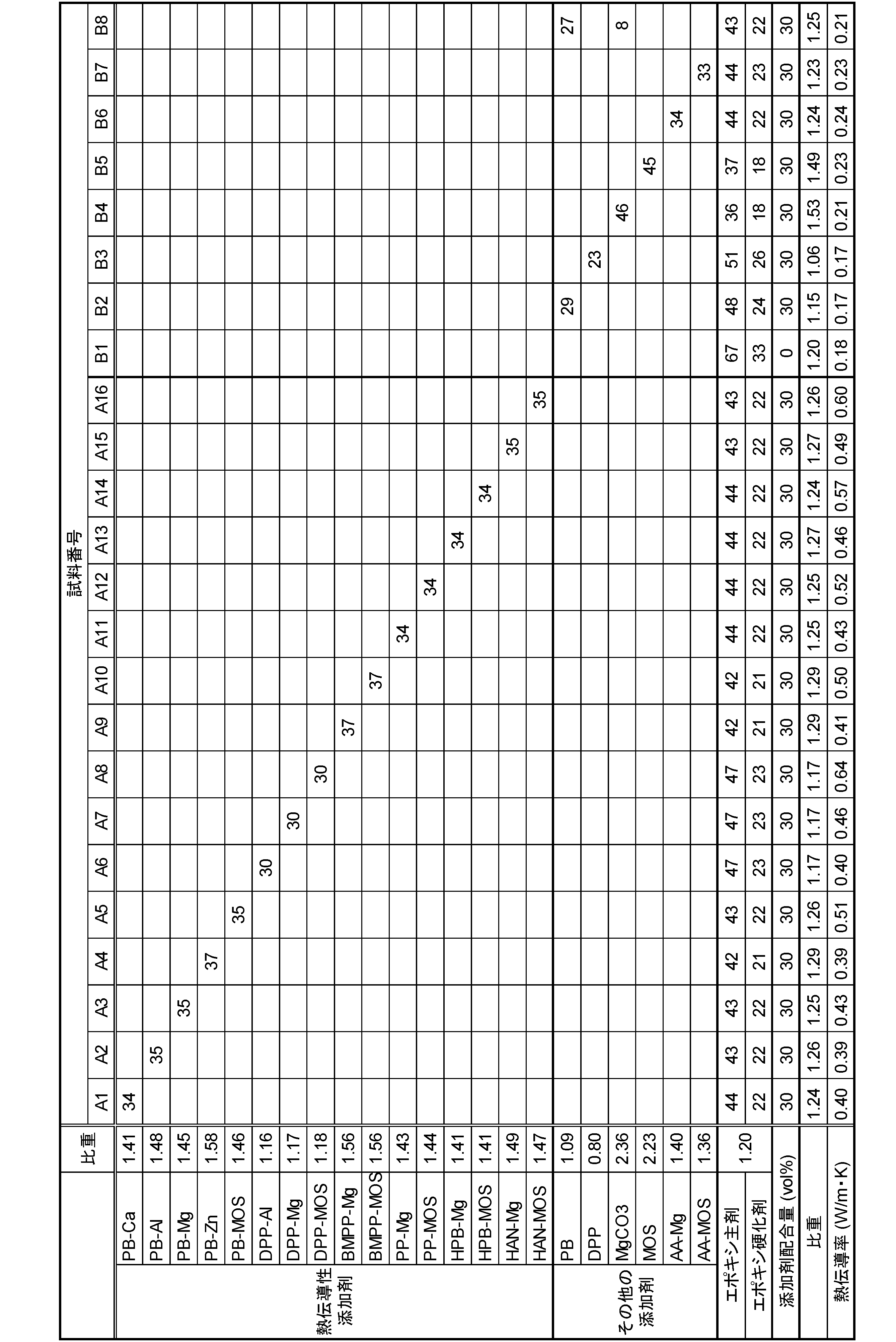
試料A1~A16は、いずれも、含金属成分と、配位部と共役π電子系を備えた有機成分とから調製した添加剤を、マトリクス材料に添加している。それらいずれの試料においても、熱伝導率が、添加剤を添加していない試料B1の2倍以上に上昇しており、添加剤の添加により、良好な熱伝導性向上効果が得られている。添加剤の添加により、熱伝導率が2倍程度に上昇していれば、熱伝導性添加剤として、実用上、十分に有用であると言える。熱伝導率の向上は、有機成分が含金属成分を構成する金属に配位して配位体を形成し、さらに、隣接する配位体の共役π電子系の間で、π-π相互作用が生じ、それに伴って、スタック形状への配位体の配向が起こっていることの結果であると解釈できる。このことは、上記で説明した偏光顕微鏡およびFT-IRを用いた添加剤の状態の解析結果とも、合致している。
さらに、試料A1~A16では、試料B1と比較して、複合材料の比重が、1.1倍以下に抑えられている。これは、添加剤の添加量が少なく済んでいるとともに、添加剤が、比重の大きい含金属成分だけでなく、比重の小さい有機成分を含んで構成されていることによる。このように、所定の有機成分と含金属成分を含む熱伝導性添加剤は、材料の比重を大きく増大させることなく、高い熱伝導性向上効果を付与するものとなっている。
試料A1~A16の熱伝導率の測定結果を相互に比較すると、試料A5,A8,A10,A12,A14,A16で、0.50W/(m・K)以上、つまり試料B1の2.8倍以上であり、かつ他の試料よりも高い熱伝導率が得られている。これらの試料においては、いずれも、用いている添加剤が、含金属成分として、MOSを含んでいる。このことは、MOS自体が高い熱伝導率を有する金属化合物であることに加え、MOSの場合には、他の含金属成分の場合とは異なり、繊維状の粒子形状を維持したまま、表面に有機成分が配位していることにより、有機成分の配向性、および配向の連続性に優れているためであると推測される。
次に、試料B2~B8について検討する。試料B2,B3では、含金属成分が用いられず、有機成分が単独で、マトリクス材料に添加されている。これらの試料においては、試料B1と比較して、熱伝導率の向上が見られない。つまり、共役π電子系を備える有機成分であっても、マトリクス材料に分散させるだけでは、分子間相互作用と分子配向に基づく熱伝導性向上効果が得られない。このことから、共役π電子系を備える有機成分が、熱伝導性向上効果を発揮するには、有機成分が、含金属成分の金属原子に配位して配位体を形成し、その配位体が集合した状態で、隣接する有機成分どうしが、規則正しい相対配置をとって、かつ十分に接近することが必要であると言える。すると、有機成分の共役π電子系の間において、π-π相互作用が働き、配向を揃えることが可能となる。
試料B4,B5では、有機成分が用いられず、含金属成分が単独で、マトリクス材料に添加されている。これらの試料においては、試料B1と比較すると、熱伝導率の上昇が見られているが、試料B1の場合の1.2~1.3倍程度の小さな値に留まっている。つまり、含金属成分をマトリクス材料に分散させるだけでは、熱伝導性の向上効果は限定的である。含金属成分の粒子は、熱伝導性フィラーとして機能可能なものであり、若干の熱伝導性向上効果を与えているが、高い熱伝導性向上効果を与えるためには、隣接する粒子同士が接触して熱伝導パスを形成する必要がある。ここで採用している30体積%との添加量では、熱伝導パスの形成に不十分であると言える。さらに含金属成分の添加量を多くすると、高い熱伝導性向上効果が得られる可能性があるが、その場合には、複合材料の比重の増大が起こり、さらに特性の劣化も起こる可能性がある。これに対し、試料A1~A16では、試料B4,B5と同じ30体積%の添加量でも、高い熱伝導性向上効果が得られており、試料B4,B5との対比から、試料A1~A16では、含金属成分が単に熱伝導性フィラーとして機能しているのではなく、含金属成分に配位した有機成分の寄与による熱伝導性向上の効果が支配的であると言える。
試料B6,B7では、添加剤を構成する有機成分として、アセチルアセトン(AA)を用いている。アセチルアセトンは、共役π電子系を備えた官能基を有していない。これらの試料において、熱伝導率の測定結果は、試料B1と比較して、上昇してはいるものの、試料B1の場合の1.3倍程度に留まっており、有機成分を用いていない試料B4,B5の場合とほぼ同等の値となっている。つまり、試料B6,B7では、有機成分を含金属成分に配位させた添加剤を用いることによる熱伝導性向上効果は、ごく限定されている。これは、有機成分が共役π電子系を備えないことにより、配位体を形成しても、隣接する配位体間で、強い引力相互作用を示さず、相互作用に伴う配向による熱伝導性向上の効果が、ほぼ得られないためであると解釈される。つまり、熱伝導性の向上には、含金属成分に配位させる有機成分が、共役π電子系を備えていることが重要である。
試料B8では、マトリクス材料に、有機成分PBと含金属成分MgCO3を独立に添加している。この試料B8は、試料A3と、PBおよびMgCO3をそれぞれ同量含むものであるが、試料A3では、試料B1の2.4倍の熱伝導率が得られているのに対し、試料B8では、熱伝導率は、試料B1の1.2倍に過ぎない。試料A3では、有機成分と含金属成分を、あらかじめ混合して、配位体を含む熱伝導性添加剤を形成したうえで、マトリクス材料に添加しているのに対し、試料B8では、そのような配位体は形成されていない。このことから、共役π電子系を備える有機成分と含金属成分とが、マトリクス材料中で単に共存するだけでは、高い熱伝導性向上効果は得られず、両者が配位体を形成し、配位体間で、π-π相互作用の形成と、それによる配向を起こしていることが、熱伝導性の向上に重要であると言える。
5 ワイヤーハーネス
51 絶縁電線
52 コネクタ
53 テープ
51 絶縁電線
52 コネクタ
53 テープ
Claims (11)
- 有機成分と、含金属成分と、を含み、
前記有機成分は、
金属に多座配位可能な配位部を有するとともに、
前記配位部に結合され、共役π電子系を備えた官能基を、少なくとも1つ有する有機化合物として構成されており、
前記有機成分が、前記配位部において、前記含金属成分を構成する金属原子に配位して、配位体を形成する、熱伝導性添加剤。 - 隣接する前記配位体の間で、前記有機成分が、前記共役π電子系を備えた官能基において相互作用している、請求項1に記載の熱伝導性添加剤。
- 前記共役π電子系を備えた官能基は、芳香環または縮合芳香環を含む、請求項1または請求項2に記載の熱伝導性添加剤。
- 前記共役π電子系を備えた官能基は、芳香環または縮合芳香環を1つのみ含む、請求項3に記載の熱伝導性添加剤。
- 前記有機成分は、前記共役π電子系を備えた官能基に加えて、炭素数1以上8以下で、共役π電子系を備えない炭化水素基またはアルコキシ基を少なくとも1つ有する、請求項1から請求項4のいずれか1項に記載の熱伝導性添加剤。
- 前記配位部は、βジケトン構造を有する、請求項1から請求項5のいずれか1項に記載の熱伝導性添加剤。
- 前記有機成分は、式(A)で表される構造を有する、請求項6に記載の熱伝導性添加剤。

- 前記含金属成分が、繊維状の金属化合物として構成されている、請求項1から請求項7のいずれか1項に記載の熱伝導性添加剤。
- 請求項1から請求項8のいずれか1項に記載の熱伝導性添加剤と、マトリクス材料と、を含み、
前記熱伝導性添加剤が前記マトリクス材料中に分散されている、熱伝導性複合材料。 - 前記マトリクス材料は、有機ポリマーを含む、請求項9に記載の熱伝導性複合材料。
- 請求項9または請求項10のいずれか1項に記載の熱伝導性複合材料を含む、ワイヤーハーネス。
Priority Applications (2)
| Application Number | Priority Date | Filing Date | Title |
|---|---|---|---|
| CN202180070233.7A CN116323790B (zh) | 2020-10-19 | 2021-10-08 | 导热性添加剂、导热性复合材料和线束 |
| US18/029,287 US20230365851A1 (en) | 2020-10-19 | 2021-10-08 | Thermally conductive additive, thermally conductive composite material, and wire harness |
Applications Claiming Priority (2)
| Application Number | Priority Date | Filing Date | Title |
|---|---|---|---|
| JP2020175469A JP7441772B2 (ja) | 2020-10-19 | 2020-10-19 | 熱伝導性添加剤、熱伝導性複合材料、およびワイヤーハーネス |
| JP2020-175469 | 2020-10-19 |
Publications (1)
| Publication Number | Publication Date |
|---|---|
| WO2022085490A1 true WO2022085490A1 (ja) | 2022-04-28 |
Family
ID=81290736
Family Applications (1)
| Application Number | Title | Priority Date | Filing Date |
|---|---|---|---|
| PCT/JP2021/037354 Ceased WO2022085490A1 (ja) | 2020-10-19 | 2021-10-08 | 熱伝導性添加剤、熱伝導性複合材料、およびワイヤーハーネス |
Country Status (4)
| Country | Link |
|---|---|
| US (1) | US20230365851A1 (ja) |
| JP (1) | JP7441772B2 (ja) |
| CN (1) | CN116323790B (ja) |
| WO (1) | WO2022085490A1 (ja) |
Citations (3)
| Publication number | Priority date | Publication date | Assignee | Title |
|---|---|---|---|---|
| JP2011074368A (ja) * | 2009-09-03 | 2011-04-14 | Univ Of Tokyo | 蓄熱材及びそれを利用した熱利用システム |
| JP2016056301A (ja) * | 2014-09-10 | 2016-04-21 | 国立大学法人 東京大学 | 蓄熱材ならびにそれを用いた蓄熱方法及び熱利用システム |
| JP2019116595A (ja) * | 2017-12-27 | 2019-07-18 | 富士フイルム株式会社 | 熱伝導材料形成用組成物、熱伝導材料、熱伝導層付きデバイス |
Family Cites Families (6)
| Publication number | Priority date | Publication date | Assignee | Title |
|---|---|---|---|---|
| US4512388A (en) * | 1981-06-19 | 1985-04-23 | Institute Of Gas Technology | High-temperature direct-contact thermal energy storage using phase-change media |
| JP5392178B2 (ja) * | 2010-05-13 | 2014-01-22 | 日立化成株式会社 | 高熱伝導性複合粒子及びそれを用いた放熱材料 |
| JP5708522B2 (ja) * | 2011-02-15 | 2015-04-30 | 信越化学工業株式会社 | レジスト材料及びこれを用いたパターン形成方法 |
| US20140076628A1 (en) * | 2012-09-20 | 2014-03-20 | Icore International, Inc. | Rigidified non-conduited electrical harnesses |
| JP7037494B2 (ja) * | 2016-10-21 | 2022-03-16 | デンカ株式会社 | 球状窒化ホウ素微粉末、その製造方法及びそれを用いた熱伝導樹脂組成物 |
| CN110093011A (zh) * | 2019-04-02 | 2019-08-06 | 安徽省欣雨环卫机械有限公司 | 一种环卫电动车电池专用导热绝缘材料及其制备方法 |
-
2020
- 2020-10-19 JP JP2020175469A patent/JP7441772B2/ja active Active
-
2021
- 2021-10-08 US US18/029,287 patent/US20230365851A1/en active Pending
- 2021-10-08 WO PCT/JP2021/037354 patent/WO2022085490A1/ja not_active Ceased
- 2021-10-08 CN CN202180070233.7A patent/CN116323790B/zh active Active
Patent Citations (3)
| Publication number | Priority date | Publication date | Assignee | Title |
|---|---|---|---|---|
| JP2011074368A (ja) * | 2009-09-03 | 2011-04-14 | Univ Of Tokyo | 蓄熱材及びそれを利用した熱利用システム |
| JP2016056301A (ja) * | 2014-09-10 | 2016-04-21 | 国立大学法人 東京大学 | 蓄熱材ならびにそれを用いた蓄熱方法及び熱利用システム |
| JP2019116595A (ja) * | 2017-12-27 | 2019-07-18 | 富士フイルム株式会社 | 熱伝導材料形成用組成物、熱伝導材料、熱伝導層付きデバイス |
Also Published As
| Publication number | Publication date |
|---|---|
| JP7441772B2 (ja) | 2024-03-01 |
| CN116323790A (zh) | 2023-06-23 |
| US20230365851A1 (en) | 2023-11-16 |
| CN116323790B (zh) | 2025-08-12 |
| JP2022066877A (ja) | 2022-05-02 |
Similar Documents
| Publication | Publication Date | Title |
|---|---|---|
| KR102108990B1 (ko) | 에폭시 수지 조성물, 반경화 에폭시 수지 조성물, 경화 에폭시 수지 조성물, 성형물 및 성형 경화물 | |
| KR102155924B1 (ko) | 대전방지성 액정질 중합체 조성물 | |
| JP5256716B2 (ja) | 樹脂組成物およびそれから得られる成形品 | |
| TWI521001B (zh) | 高熱傳導性熱塑性樹脂、樹脂組合物及成形體 | |
| JP6436249B2 (ja) | ポリアミド樹脂組成物およびそれを含む成形品 | |
| JPWO2018230195A1 (ja) | 液晶性ポリエステル樹脂組成物およびそれからなる成形品 | |
| CN110461937B (zh) | 树脂组合物、树脂片、树脂固化物、树脂基板以及层叠基板 | |
| JP4419529B2 (ja) | 樹脂組成物、それから得られる成形品 | |
| JP6729562B2 (ja) | 樹脂組成物、樹脂シート、樹脂硬化物および樹脂基板 | |
| JP7441772B2 (ja) | 熱伝導性添加剤、熱伝導性複合材料、およびワイヤーハーネス | |
| JP2016147919A (ja) | ポリアミド樹脂組成物およびそれを成形してなる成形品 | |
| JP2020019861A (ja) | ポリアミド樹脂組成物およびそれを含む成形品 | |
| WO2023063267A1 (ja) | 封止材用マレイミド樹脂混合物、マレイミド樹脂組成物およびその硬化物 | |
| JP5595629B2 (ja) | 誘電性樹脂組成物およびそれから得られる成形品 | |
| JP2019064089A (ja) | エポキシ樹脂シート、エポキシ樹脂シートの製造方法、絶縁体の製造方法及び電気機器の製造方法 | |
| Lee et al. | A star-shaped crystalline curing agent for thermally conductive epoxy composites: Synthesis and thermal management performance | |
| JP5082304B2 (ja) | 熱伝導性樹脂材料およびその成形体 | |
| JP5947504B2 (ja) | 高融点難燃剤結晶の製造方法、該難燃剤含有エポキシ樹脂組成物の製造方法、該組成物を用いたプリプレグ及び難燃性積層板の製造方法 | |
| JP2009249536A (ja) | 液晶性樹脂射出成形材料およびその製造方法 | |
| JP3692732B2 (ja) | 難燃化液晶ポリエステル組成物 | |
| TW201127898A (en) | High thermal conductivity, halogen-free flame-retardant resin composition and its pre-impregnated body and coating materials for printed circuit boards | |
| TW202328155A (zh) | 基於磷之阻燃劑和含有彼之熱塑性樹脂組成物 | |
| WO2021065248A1 (ja) | 熱伝導性フィラー、熱伝導性複合材料、ワイヤーハーネス、および熱伝導性フィラーの製造方法 | |
| WO2018096603A1 (ja) | 回転電機用コイル、回転電機用コイルの製造方法、マイカテープ、マイカテープの硬化物及び絶縁層付き物品 | |
| WO2018096601A1 (ja) | 回転電機用コイル、回転電機用コイルの製造方法、マイカテープ、マイカテープの硬化物及び絶縁層付き物品 |
Legal Events
| Date | Code | Title | Description |
|---|---|---|---|
| 121 | Ep: the epo has been informed by wipo that ep was designated in this application |
Ref document number: 21882631 Country of ref document: EP Kind code of ref document: A1 |
|
| NENP | Non-entry into the national phase |
Ref country code: DE |
|
| 122 | Ep: pct application non-entry in european phase |
Ref document number: 21882631 Country of ref document: EP Kind code of ref document: A1 |
|
| WWG | Wipo information: grant in national office |
Ref document number: 202180070233.7 Country of ref document: CN |