WO2022080403A1 - 熱硬化性組成物およびその用途 - Google Patents
熱硬化性組成物およびその用途 Download PDFInfo
- Publication number
- WO2022080403A1 WO2022080403A1 PCT/JP2021/037857 JP2021037857W WO2022080403A1 WO 2022080403 A1 WO2022080403 A1 WO 2022080403A1 JP 2021037857 W JP2021037857 W JP 2021037857W WO 2022080403 A1 WO2022080403 A1 WO 2022080403A1
- Authority
- WO
- WIPO (PCT)
- Prior art keywords
- group
- ring
- different
- thermosetting
- same
- Prior art date
- Legal status (The legal status is an assumption and is not a legal conclusion. Google has not performed a legal analysis and makes no representation as to the accuracy of the status listed.)
- Ceased
Links
Images
Classifications
-
- C—CHEMISTRY; METALLURGY
- C08—ORGANIC MACROMOLECULAR COMPOUNDS; THEIR PREPARATION OR CHEMICAL WORKING-UP; COMPOSITIONS BASED THEREON
- C08F—MACROMOLECULAR COMPOUNDS OBTAINED BY REACTIONS ONLY INVOLVING CARBON-TO-CARBON UNSATURATED BONDS
- C08F290/00—Macromolecular compounds obtained by polymerising monomers on to polymers modified by introduction of aliphatic unsaturated end or side groups
- C08F290/02—Macromolecular compounds obtained by polymerising monomers on to polymers modified by introduction of aliphatic unsaturated end or side groups on to polymers modified by introduction of unsaturated end groups
- C08F290/06—Polymers provided for in subclass C08G
-
- C—CHEMISTRY; METALLURGY
- C08—ORGANIC MACROMOLECULAR COMPOUNDS; THEIR PREPARATION OR CHEMICAL WORKING-UP; COMPOSITIONS BASED THEREON
- C08K—Use of inorganic or non-macromolecular organic substances as compounding ingredients
- C08K5/00—Use of organic ingredients
- C08K5/04—Oxygen-containing compounds
- C08K5/10—Esters; Ether-esters
- C08K5/101—Esters; Ether-esters of monocarboxylic acids
- C08K5/103—Esters; Ether-esters of monocarboxylic acids with polyalcohols
-
- C—CHEMISTRY; METALLURGY
- C08—ORGANIC MACROMOLECULAR COMPOUNDS; THEIR PREPARATION OR CHEMICAL WORKING-UP; COMPOSITIONS BASED THEREON
- C08K—Use of inorganic or non-macromolecular organic substances as compounding ingredients
- C08K5/00—Use of organic ingredients
- C08K5/16—Nitrogen-containing compounds
- C08K5/34—Heterocyclic compounds having nitrogen in the ring
- C08K5/3467—Heterocyclic compounds having nitrogen in the ring having more than two nitrogen atoms in the ring
- C08K5/3477—Six-membered rings
-
- C—CHEMISTRY; METALLURGY
- C08—ORGANIC MACROMOLECULAR COMPOUNDS; THEIR PREPARATION OR CHEMICAL WORKING-UP; COMPOSITIONS BASED THEREON
- C08L—COMPOSITIONS OF MACROMOLECULAR COMPOUNDS
- C08L71/00—Compositions of polyethers obtained by reactions forming an ether link in the main chain; Compositions of derivatives of such polymers
-
- C—CHEMISTRY; METALLURGY
- C08—ORGANIC MACROMOLECULAR COMPOUNDS; THEIR PREPARATION OR CHEMICAL WORKING-UP; COMPOSITIONS BASED THEREON
- C08L—COMPOSITIONS OF MACROMOLECULAR COMPOUNDS
- C08L71/00—Compositions of polyethers obtained by reactions forming an ether link in the main chain; Compositions of derivatives of such polymers
- C08L71/08—Polyethers derived from hydroxy compounds or from their metallic derivatives
- C08L71/10—Polyethers derived from hydroxy compounds or from their metallic derivatives from phenols
- C08L71/12—Polyphenylene oxides
Definitions
- the present invention relates to a thermosetting composition containing a thermosetting polyarylene ether-based resin and its use.
- thermosetting resin such as an epoxy resin has been used for such an application, but since a hydroxyl group is contained in the polymer network and intramolecular polarization occurs, signal propagation delay and transmission loss become large.
- a resin having a polyphenylene ether skeleton having excellent dielectric properties has been used as a material capable of reducing the dielectric constant and the dielectric loss tangent of the wiring board with small signal propagation delay and transmission loss.
- a resin composition containing at least one crosslinked curing agent selected from the group consisting of two or more polyfunctional vinyl compounds and a flame retardant is disclosed (Patent Document 1).
- Patent Document 1 when a polyfunctional methacrylate compound and a polyfunctional vinyl compound are used as the crosslinkable curing agent, the dielectric properties are deteriorated.
- 4G 4th generation mobile communication system
- 5G next-generation mobile communication systems
- the resin composition of Patent Document 1 cannot realize sufficient low dielectric properties for applications required for high-speed communication in recent years.
- an object of the present invention is to provide a thermosetting composition and its use capable of easily and efficiently producing a molded product having excellent heat resistance and mechanical properties and low dielectric properties.
- thermosetting polyarylene ether-based resin a thermosetting polyarylene ether-based resin and a bifunctional (meth) acrylate having a 9,9-bisarylfluorene skeleton.
- the present invention has been completed by finding that a molded product having excellent properties and mechanical properties and low dielectric properties can be easily and efficiently produced.
- thermosetting composition of the present invention contains a thermosetting polyarylene ether-based resin and a fluorene compound represented by the following formula (1).
- Rings Z1 and Z2 represent arene rings, identical or different from each other.
- a 1 and A 2 represent an alkylene group that is the same as or different from each other.
- n1 and n2 represent integers greater than or equal to 0, which are the same as or different from each other.
- R 1 and R 2 represent hydrogen atoms or methyl groups that are the same or different from each other.
- R 3 and R 4 indicate substituents that are the same or different from each other.
- m1 and m2 represent integers greater than or equal to 0, either identical or different from each other.
- R 5 indicates a substituent and represents a substituent.
- k indicates an integer from 0 to 8).
- thermosetting polyarylene ether-based resin is a resin having an arylene ether group as a repeating unit, and among them, for example, a polyphenylene ether-based resin having an ⁇ , ⁇ -ethylenic unsaturated double bond at the terminal is preferable. In particular, it may be a resin represented by the following formula (2).
- X 3 and X 4 exhibit polymerizable groups that are the same as or different from each other.
- R 6 to R 9 represent alkyl groups, which are the same or different, respectively.
- p1 to p4 represent integers of 0 to 4, which are the same or different, respectively.
- s1 and s2 represent integers greater than or equal to 1 and are identical or different from each other.
- Y represents a linking group selected from the group of the following formula (3).
- R 10 and R 11 represent hydrogen atoms or alkyl groups that are the same or different from each other. q indicates an integer of 1 or more. R 12 indicates a hydrogen atom or an alkyl group)].
- thermosetting composition of the present invention may further contain an isocyanurate compound having a polymerizable group and an isocyanate ring.
- the total ratio of the fluorene compound and the isocyanate compound may be 10 to 100 parts by mass with respect to 100 parts by mass of the thermosetting polyarylene ether-based resin.
- the present invention also includes a cured product of the thermosetting composition.
- the present invention also includes a method for producing the cured product, which is produced by heating at a temperature of 135 ° C. or lower.
- C 1 alkyl group means an alkyl group having 1 carbon atom
- C 6-10 aryl group means an aryl group having 6 to 10 carbon atoms.
- (meth) acryloyl group is used to mean that both an acryloyl group and a methacryloyl group are included.
- the "polymerizable group” means a group having an ⁇ , ⁇ -ethylenically unsaturated double bond.
- the thermosetting polyarylene ether-based resin and the bifunctional (meth) acrylate having a 9,9-bisarylfluorene skeleton are combined, the curing temperature can be lowered. Therefore, even if a resin having a polyarylene ether skeleton having excellent heat resistance and mechanical properties and low dielectric properties is used, the molded product can be easily and efficiently manufactured.
- the crosslink density can be improved by combining the bifunctional (meth) acrylate with an isocyanurate compound having a polymerizable group and an isocyanate ring as a curing agent, so that the heat resistance of the cured product and the machine can be improved.
- the target characteristics can be further improved.
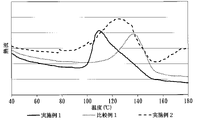
- FIG. 1 is a DSC curve obtained by measuring the thermosetting compositions obtained in Examples 1 and 2 and Comparative Example 1 with a differential scanning calorimeter (DSC) at a heating rate of 10 ° C./min.
- DSC differential scanning calorimeter
- thermosetting polyarylene ether resin examples include a repeating unit represented by the following formula (4).
- Z represents an arene ring
- R represents an alkyl group
- t represents an integer of 0 or more
- the allene ring (or aromatic hydrocarbon ring) represented by ring Z may be a benzene ring or the like. It is roughly classified into a monocyclic aromatic hydrocarbon ring (monocyclic arene ring) and a polycyclic aromatic hydrocarbon ring (polycyclic arene ring). Examples of the polycyclic aromatic hydrocarbon ring include a fused polycyclic aromatic hydrocarbon ring (condensed polycyclic arene ring) and a ring-assembled aromatic hydrocarbon ring (ring-aggregated arene ring).
- Examples of the fused polycyclic arene ring include fused bicyclic and tetracyclic arene rings such as fused bicyclic arene ring and condensed tricyclic arene ring.
- Examples of the fused bicyclic arene ring include a fused bicyclic C 10-16 arene ring such as a naphthalene ring and an indene ring.
- Examples of the fused tricyclic arene ring include an acenaphthylene ring, a fluorene ring, a phenalene ring, an anthracene ring, and a phenanthrene ring.
- Examples of the fused tetracyclic arene ring include a pyrene ring and a naphthacene ring.
- Examples of the ring-set arene ring include a beerene ring such as a bi-C 6-12 arene ring, a tellerene ring such as a tel C 6-12 arene ring, and the like.
- Examples of the bi-C 6-12 arene ring include a biphenyl ring; a binaphthyl ring; a phenylnaphthalene ring such as a 1-phenylnaphthalene ring and a 2-phenylnaphthalene ring, and the like.
- Examples of the terC 6-12 arene ring include a terphenyl ring (terphenyl ring) and the like.
- a "ring-aggregated arene ring” is a ring in which two or more ring systems (alene ring systems) are directly connected by a single bond (single bond) or a double bond, and the rings are directly connected. It means that the number of bonds is only one less than the number of ring systems.
- a phenylnaphthalene ring, a binaphthyl ring, or the like has a fused polycyclic allene ring skeleton but is a ring aggregate alley ring. It is clearly distinguished from “condensed polycyclic allene rings” such as naphthalene rings (acyclic allane rings).
- benzene rings can be used alone or in combination of two or more. Of these arene rings, a benzene ring and a biphenyl ring are preferable, and a benzene ring is particularly preferable.
- the phenylene group in which the ring Z is a benzene ring may be any of a 1,2-phenylene group, a 1,3-phenylene group, and a 1,4-phenylene group, but contains at least a 1,4-phenylene group. Is preferable, and a 1,4-phenylene group is particularly preferable because a linear polyphenylene ether-based resin can be formed to improve mechanical properties.
- the ratio of the 1,4-phenylene group may be 50 mol% or more in the unit represented by the above formula (4), preferably 70. It is mol% or more, more preferably 90 mol% or more, and most preferably 100 mol%.
- the alkyl group represented by R includes a linear or branched C 1 such as a methyl group, an ethyl group, a propyl group, an isopropyl group, an n-butyl group, an isobutyl group, an s-butyl group, and a t-butyl group.
- -6 Alkyl group and the like can be mentioned. These alkyl groups can be used alone or in combination of two or more. Of these, a C 1-4 alkyl group such as a methyl group is preferable, and a methyl group is particularly preferable.
- the substitution number t of R may be an integer of 0 or more, and may be appropriately selected depending on the type of ring Z. For example, it may be an integer of 0 to 8, and when ring Z is a benzene ring, it is preferable. It is 0 to 3, more preferably 1 to 3, and even more preferably 2.
- the substitution position of R is preferably the ortho position of the —O— group (ether group).
- the ratio of the repeating unit represented by the above formula (4) may be 50 mol% or more, preferably 80 mol% or more, and more preferably 90 in all the constituent units. More than mol%.
- the thermosetting polyarylene ether-based resin contains one or more polymerizable groups in the molecule, and examples of the polymerizable group include a vinyl group, an allyl group, and a (meth) acryloyl group. Of these, the (meth) acryloyl group is preferable, and the methacryloyl group is particularly preferable.
- the number of the polymerizable group may be one or more in the molecule, but it is preferable to have two or more, and it is particularly preferable to have two polymerizable groups. When the molecule has two polymerizable groups, it is preferable to have the two polymerizable groups at both ends of a polyarylene ether-based resin such as a polyphenylene ether-based resin.
- thermosetting polyarylene ether-based resin is preferably a thermosetting polyphenylene ether-based resin from the viewpoint of mechanical properties and heat resistance, and the thermosetting polyphenylene ether-based resin represented by the above formula (2) is preferable.
- the polymerizable group of X3 and X4 may be a vinyl group or an allyl group, but a (meth) acryloyl group is preferable, and a methacryloyl group is particularly preferable, from the viewpoint of thermosetting. ..
- the alkyl groups of R 6 to R 9 are the same as the alkyl groups exemplified as R of the above formula (4), including preferred embodiments.
- the alkyl groups of R 6 to R 9 may be different kinds of alkyl groups, but it is preferable that they are the same, and it is preferable that they are all methyl groups.
- substitution numbers p1 to p4 of R 6 to R 9 are also the same as the substitution numbers t of R in the above formula (4), including the preferred embodiment.
- the substitution numbers p1 to p4 may be different substitution numbers, but the same substitution number is preferable.
- R 6 and R 9 are replaced with the 2-position and the 6-position when the substitution position of the X3 - O-group or the X4 - O-group is the 1-position. It is preferable that R 7 and R 8 are substituted at the 3-position and the 5-position when the substitution position of the linking group Y is at the 1-position.
- the number of substitutions s1 and s2 of the phenylene ether group may be 1 or more, respectively, and can be selected from a range of, for example, about 1 to 100. It is 20, 4 to 15, 5 to 12, and most preferably 5 to 10.
- the substitution number s1 may be different from the substitution number s2, but is preferably the same.
- Examples of the alkyl group in R 10 and R 11 of the linking group Y include a linear or branched C 1-6 alkyl group such as a methyl group, an ethyl group, a propyl group, an isopropyl group and an n-butyl group. .. Preferred R 10 and R 11 are C 1-3 alkyl groups such as hydrogen atom, methyl group, ethyl group and the like. R 10 may be different from R 11 but is preferably the same.
- the q in ⁇ (CH 2 ) q ⁇ of the linking group Y may be an integer of 1 or more, but is preferably 1 to 10, more preferably 1 to 6, and more preferably 2 to 4.
- Examples of the alkyl group in R 12 of the linking group Y include a linear or branched C 1-6 alkyl group such as a methyl group, an ethyl group, a propyl group, an isopropyl group and an n-butyl group.
- Preferred R 12 is a C 1-3 alkyl group such as a hydrogen atom, a methyl group, an ethyl group and the like.
- connecting groups Y ether group (-O- group), -CO- group, -CR 10 R 11- group, -from the viewpoint of electrical stability when used for printed wiring boards and the like.
- (CH 2 ) q -group, -NR 12 -group is preferable, and a linking group (-CR 10 R 11 -group) in which the ether group, R 10 and R 11 are hydrogen atoms or C 1-3 alkyl groups is more preferable.
- R 10 and a linking group in which R 11 is a methyl group (-CR 10 R 11- group) are particularly preferred.
- the number average molecular weight (Mn) of the thermosetting polyarylene ether resin is, for example, 1000 to 100,000, preferably 1200 to 10000, more preferably 1500 to 5000, more preferably 1600 to 3000, and most preferably 1800 to 2500. .. If the molecular weight is too small, the mechanical properties and heat resistance of the thermosetting composition may be deteriorated, and conversely, if the molecular weight is too large, the reactivity and mechanical properties may be deteriorated.
- the range of the number average molecular weight may be the range of the number average molecular weight of the thermosetting polyphenylene ether-based resin.
- the number average molecular weight of the thermosetting polyarylene ether-based resin can be measured by using gel permeation chromatography (reference resin: polystyrene).
- the glass transition temperature of the thermosetting polyarylene ether resin is, for example, 80 to 250 ° C., preferably 100 to 200 ° C., more preferably 130 to 190 ° C., more preferably 140 to 180 ° C., and most preferably 145 to 170 ° C. Is. If the glass transition temperature is too low, the heat resistance may decrease, and conversely, if it is too high, the productivity may decrease.
- the range of the glass transition temperature may be the range of the glass transition temperature of the thermosetting polyphenylene ether-based resin.
- the glass transition temperature of the thermosetting polyarylene ether-based resin can be measured by using a differential scanning calorimeter (DSC).
- DSC differential scanning calorimeter
- the ratio of the thermosetting polyarylene ether-based resin may be 10% by mass or more in the cured product, for example, 10 to 99% by mass, preferably 30 to 95% by mass, and more preferably 40 to 90% by mass. It is preferably 50 to 85% by mass, and most preferably 60 to 80% by mass. If the proportion of the thermosetting polyarylene ether-based resin is too small, the mechanical properties may deteriorate.
- the ratio may be the ratio of the thermosetting polyphenylene ether-based resin.
- thermosetting composition of the present invention contains a fluorene compound represented by the above formula (1) as a curing agent for a thermosetting polyarylene ether-based resin.
- the curing agent contains the fluorene compound
- the curing temperature of the thermosetting composition can be lowered, so that the productivity of the molded product can be improved. It is difficult to predict the curing temperature depending on the type of curing agent in the curing system, but surprisingly, in the present invention, the low temperature effect is obtained despite the fact that it is bifunctional rather than trifunctional or more functional. I was able to realize it. Further, since the fluorene compound itself is excellent in heat resistance and mechanical properties, the heat resistance and mechanical properties can be further improved.
- the arene ring (or aromatic hydrocarbon ring) represented by the rings Z 1 and Z 2 is roughly classified into a monocyclic allene ring such as a benzene ring and a polycyclic alley ring. ..
- Examples of the polycyclic arene ring include a condensed polycyclic arene ring and a ring-assembled arene ring.
- fused polycyclic arene ring and the ring-assembled arene ring examples include the fused polycyclic arene ring and the ring-assembled arene ring exemplified as the ring Z in the above formula (4).
- the type of ring Z 1 may be different from the type of ring Z 2 , but is preferably the same.
- a C6-24 arene ring such as a benzene ring, a naphthalene ring, or a biphenyl ring is preferable, and a monocyclic C 6-12 arene such as a benzene ring is excellent in terms of dielectric properties and productivity of a molded product.
- a C12-24 ring aggregate arene ring such as a ring or a biphenyl ring is more preferable, and a benzene ring or a biphenyl ring is more preferable.
- the alkylene groups A 1 and A 2 are linear such as an ethylene group, a propylene group (1,2-propanediyl group), a trimethylene group, a 1,2-butanediyl group, and a tetramethylene group.
- a branched C 2-6 alkylene group and the like can be mentioned.
- a linear or branched C 2-3 alkylene group is preferable, a linear or branched C 2-3 alkylene group is more preferable, and an ethylene group is most preferable.
- the alkylene group A 1 may be different from the alkylene group A 2 , but is preferably the same.
- the number of repetitions (number of added moles) n1 and n2 of the oxyalkylene group (OA 1 ) and the oxyalkylene group (OA 2 ) may be integers of 0 or more, respectively, and can be selected from integers in the range of about 0 to 20. For example, it may be an integer of 0 to 15, but the preferable range of the number of repetitions n1 and n2 is set from the viewpoint of compatibility with the thermosetting polyarylene ether-based resin, heat resistance of the cured product, and mechanical properties. In the following steps, they are integers of 1 to 10, 1 to 5, 1 to 3, and 1 to 2, respectively, and most preferably 1.
- n1 and n2 are too large, the heat resistance and mechanical properties of the cured product may deteriorate.
- the 2 or more oxyalkylene groups (OA 1 ) or oxyalkylene groups (OA 2 ) may be different from each other, but are preferably the same.
- the "repetition number (additional number of moles)" may be an average value (arithmetic mean value, arithmetic mean value) or an average number of additional moles, and a preferred embodiment is preferable. Similar to the range of integers.
- the groups R 1 and R 2 may be either a hydrogen atom or a methyl group, but a methyl group is preferable from the viewpoint of reducing low dielectric properties.
- the group R 1 may be different from the group R 2 , but is preferably the same.
- substitution position of the (meth) acryloyl - containing group is not particularly limited and can be substituted at an appropriate position of the ring Z1 and the ring Z2.
- the substitution position may be any of 2 to 6 positions, including 2-position, 3-position, 4-position, and the like, and 3-position or 4-position. It is preferable to replace it with, and it is particularly preferable to replace it with 4-position.
- the substitution position is often the 5th to 8th positions of the naphthyl group, and the 1st position of the naphthalene ring or the 1st position of the naphthalene ring with respect to the 9th position of the fluorene ring.
- the 2-position is substituted (replaced by the relationship of 1-naphthyl or 2-naphthyl), and the substitution positions are substituted by the relationship of the 1,5-position, 2,6-position, and 2,6. It is particularly preferable to replace them in terms of position.
- the ring Z1 and the ring Z2 are biphenyl rings and the 3 -position of the biphenyl ring is bonded to the fluorene ring, the 2-position, 4-position, 5-position, 6-position, 2'position and 3 of the biphenyl ring are formed.
- The'position, 4'and the like are mentioned, and it is preferable to replace it at any of the 6th and 4'positions, and it is particularly preferable to replace it with the 6th position.
- the substituents represented by the groups R 3 and R 4 include a halogen atom, a hydrocarbon group, an alkoxy group, a cycloalkyloxy group, an aryloxy group, an aralkyloxy group, an alkylthio group and a cycloalkylthio. Examples thereof include a group, an arylthio group, an aralkylthio group, an acyl group, a nitro group, a cyano group and the like.
- R 3 and R 4 include an alkyl group, a cycloalkyl group, an aryl group, an aralkyl group, an alkoxy group and the like, and examples of the alkyl group include a linear or branched C 1-6 alkyl such as a methyl group.
- Examples of the group include a C 5-8 cycloalkyl group such as a cyclohexyl group, and examples of the aralkyl group include C 6-10aryl -C 1-4 such as a benzyl group and a phenethyl group.
- Examples of the alkyl group include a C 6-14 aryl group such as a phenyl group, and examples of the alkoxy group include a linear or branched C 1-4 alkoxy group such as a methoxy group.
- the type of the substituent R 3 may be different from the type of the substituent R 4 , but is preferably the same. Of these, an alkyl group is preferable, and a linear or branched C 1-4 alkyl group such as a methyl group is particularly preferable.
- substitution numbers m1 and m2 of R 3 and R 4 may be integers of 0 or more, and may be appropriately selected depending on the type of ring Z 1 and ring Z 2 , and may be integers of 0 to 8, for example. Often, the preferred substitution numbers m1 and m2 are, step by step, an integer of 0 to 4, an integer of 0 to 3, an integer of 0 to 2, 0 or 1, with 0 being most preferred. The number of substitutions m1 and the number of substitutions m2 may be different, but the same number of substitutions is preferable. Further, when the substitution numbers m1 and m2 are 2 or more, the types of R3 or R4 having 2 or more may be different, but it is preferable that they are the same. Further, the substitution positions of R 3 and R 4 are not particularly limited, and may be substituted at positions other than the binding positions of ring Z 1 and ring Z 2 , the (meth) acryloyl-containing group, and fluorene.
- Examples of the substituent represented by R5 in the above formula ( 1 ) include a hydrocarbon group, a cyano group, a halogen atom and the like.
- Examples of the hydrocarbon group include an alkyl group and an aryl group.
- Examples of the alkyl group include a linear or branched C 1-6 alkyl group such as a methyl group, an ethyl group, a propyl group, an isopropyl group, an n-butyl group and a t-butyl group.
- Examples of the aryl group include a C6-10 aryl group such as a phenyl group.
- Examples of the halogen atom include a fluorine atom, a chlorine atom, a bromine atom and the like. These substituents can be used alone or in combination of two or more.
- an alkyl group, a cyano group, and a halogen atom are preferable, an alkyl group is more preferable, and a linear or branched C 1-4 alkyl group such as a methyl group is more preferable, and C 1- .
- the 2 -alkyl group is most preferred.
- the substitution number k of the substituent R 5 may be an integer of 0 to 8, and the preferable range is as follows, in a stepwise manner, an integer of 0 to 6, an integer of 0 to 5, an integer of 0 to 4, and an integer of 0 to 4. It is an integer of 3, an integer of 0 to 2, 0 or 1, with 0 being most preferred.
- the number of substitutions thereof may be the same or different from each other.
- the types of the substituent R5 to be substituted with the different benzene rings may be different from each other, but the same is preferable.
- the types of the two or more groups R5 substituting for the same or different benzene rings may be the same or different from each other.
- the substitution position of the substituent R5 is not particularly limited, and may be, for example, a substitution position selected from the 2nd to 7th positions of the fluorene ring, and a substitution selected from the 2nd, 3rd and 7th positions. Position is preferred.
- Specific fluorene compounds include 9,9-bis (4- (meth) acryloyloxyphenyl) fluorene, 9,9-bis (3-methyl-4- (meth) acryloyloxyphenyl) fluorene, 9,9-. 9,9-bis ((meth) acryloyloxyaryl such as bis (6- (meth) acryloyloxy-2-naphthyl) fluorene, 9,9-bis (4- (meth) acryloyloxy-3-phenylphenyl) fluorene, etc.
- the fluorene compound can be used alone or in combination of two or more.
- 9,9-bis [(meth) acryloyloxymono or triethoxyphenyl] fluorene such as 9,9-bis [4- (2- (meth) acryloyloxyethoxy) phenyl] fluorene
- 9, 9,9-bis ((meth) acryloyloxymono or triethoxy-phenylphenyl) fluorene such as 9-bis [4- (2- (meth) acryloyloxyethoxy) -3-phenylphenyl] fluorene is preferable and has dielectric properties.
- 9,9-bis (methacryloyloxymono to triethoxyphenyl) fluorene and 9,9-bis [4- (2-methacryloyloxymono to triethoxy) -3-phenylphenyl] fluorene are more preferable.
- the glass transition temperature (Tg) of the fluorene compound can be selected from, for example, in the range of about 150 to 300 ° C., for example, 170 to 250 ° C., preferably 180 to 230 ° C., more preferably 190 to 220 ° C., and most preferably 200 to 200 ° C. It is 215 ° C. If the glass transition temperature Tg is too high, the handleability may decrease, and if it is too low, the productivity of the molded product may decrease.
- the glass transition temperature of the fluorene compound can be measured by using a differential scanning calorimeter (DSC).
- DSC differential scanning calorimeter
- the fluorene compound has a high thermal decomposition temperature, and the 5% mass reduction temperature of its own cured product may be 350 ° C. or higher, for example, 350 to 500 ° C., preferably 380 to 450 ° C., and more preferably 390 to. It is 430 ° C, most preferably 400 to 420 ° C.
- the 5% mass reduction temperature of the cured product of the fluorene compound can be measured by a conventional method using a thermogravimetric-differential thermal analyzer (TG-DTA).
- TG-DTA thermogravimetric-differential thermal analyzer
- the proportion of the fluorene compound may be 10% by mass or more in the curing agent, and can be selected from the range of, for example, about 10 to 90% by mass, preferably 20 to 80% by mass, and more preferably 30 to 70% by mass. More preferably, it is 40 to 60% by mass. If the proportion of the fluorene compound is too small, the productivity of the molded product may decrease.
- thermosetting composition of the present invention can obtain mechanical properties, heat resistance and dielectric properties of a cured product by combining the fluorene compound and an isocyanurate compound having a polymerizable group and an isocyanate ring as a curing agent. It can be improved in a well-balanced manner, and surprisingly, the heat flow rate (heat capacity) in the reactivity and the curing reaction can be increased.
- the progress of the crosslinking reaction with an increase in the heat flow rate can be promoted as compared with the case where the fluorene compound and the isocyanurate compound are used alone as a curing agent, and the curing can be promoted.
- the crosslink density of an object can be improved.
- the mechanical properties and heat resistance of the cured product can be further improved.
- the isocyanurate compound does not have a sufficiently high thermal decomposition temperature with respect to the curing temperature of the thermosetting polyarylene ether-based resin, when the isocyanate compound is used alone as a curing agent, a curing reaction occurs.
- the curing agent volatilizes violently in the above, and the productivity of the cured product (molded body) decreases, but the productivity of the cured product can also be improved by combining with the fluorene compound.
- the isocyanate compound may be an isocyanurate compound represented by the following formula (5).
- X 5 to X 7 represent a hydrogen atom, an alkyl group, an aryl group or a polymerizable group, respectively, which are the same or different, and at least one of X 5 to X 7 is a polymerizable group. ).
- examples of the alkyl group of X5 to X7 include C1-3alkyl such as methyl and ethyl groups, and examples of the aryl group of X5 to X7 include C such as phenyl group. 6-10 aryl groups and the like can be mentioned.
- examples of the polymerizable group of X5 to X7 include a vinyl group, an allyl group, a (meth) acryloyl group and the like.
- a preferred polymerizable group is an allyl group.
- X 5 to X 7 at least one may be a polymerizable group, but it is preferable that two or more are polymerizable groups, and it is further preferable that all of X 5 to X 7 are polymerizable groups. Most preferably, all of 5 to X7 are allyl groups.
- the isocyanate compound may be an oligomer obtained by polymerizing an isocyanurate compound in which all of X5 to X7 are polymerizable groups in the formula (5).
- isocyanurate compounds an isocyanurate compound or an oligomer thereof in which all of X5 to X7 are allyl groups in the above formula (5) is preferable, and all of X5 to X7 in the above formula (5) are allyl groups. Isocyanurate compounds are particularly preferred.
- thermosetting composition of the present invention in addition to the fluorene compound and the isocyanate compound, a conventional curing agent used in radical polymerization can be used.
- Conventional curing agents include monofunctional (meth) acrylates such as (meth) acrylic acid, methyl (meth) acrylate, ethyl (meth) acrylate, butyl (meth) acrylate, and hydroxyethyl (meth) acrylate; styrene, t.
- -Aromatic vinyl compounds such as butyl-vinylbenzene and divinylbenzene; heterocyclic vinyl compounds such as vinylpyrrolidone; bifunctional (meth) such as ethylene glycol di (meth) acrylate and propylene glycol di (meth) acrylate.
- the ratio of the other curing agent may be 30% by mass or less, preferably 20% by mass or less, more preferably 10% by mass, and more preferably 5% by mass or less in the curing agent. If the proportion of other curing agents is too high, the productivity of the molded product may decrease.
- the ratio of the curing agent can be selected from the range of about 1 to 200 parts by mass with respect to 100 parts by mass of the thermosetting polyarylene ether-based resin, for example, 10 to 100 parts by mass, preferably 20 to 80 parts by mass, and more preferably. It is 30 to 70 parts by mass, more preferably 35 to 60 parts by mass, and most preferably 40 to 50 parts by mass. If the proportion of the curing agent is too small, the productivity of the molded product, the heat resistance of the cured product and the mechanical properties may be deteriorated, and conversely, if the ratio is too large, the mechanical properties of the cured product may be deteriorated.
- the ratio of the curing agent may be the total ratio of the fluorene compound and the isocyanate compound.
- the thermosetting polyarylene ether-based resin may be a thermosetting polyphenylene ether-based resin.
- thermosetting composition of the present invention may further contain a thermal polymerization initiator.
- the thermal polymerization initiator includes organic peroxides, azo compounds and the like.
- the organic peroxide include dialkyl peroxides such as di-t-butyl peroxide, 2,5-dimethyl-2,5- (t-butylperoxy) hexin-3, and di (t-butylperoxyisopropyl) benzene.
- diacyl peroxides such as lauroyl peroxide, benzoyl peroxide (benzoyl peroxide), bis- (1,1-dimethylbenzoyl) peroxide; t-butylhydroperoxide, cumenehydroperoxide, t-peracetic acid Peracids (or peracid esters) such as butyl; ketone peroxides; peroxycarbonates; peroxyketals and the like can be mentioned.
- the azo compound include azonitrile compounds such as 2,2-azobis (isobutyronitrile); azoamide compounds; and azoamidine compounds.
- These thermal polymerization initiators can be used alone or in combination of two or more.
- diacyl peroxides such as benzoyl peroxide are preferable because they can promote low-temperature curing.
- the ratio of the thermal polymerization initiator is, for example, 0.1 to 15 parts by mass, preferably 0.5 to 10 parts by mass, more preferably 0.5 parts by mass, based on 100 parts by mass of the total of the thermosetting polyarylene ether-based resin and the curing agent. It is 1 to 5 parts by mass, most preferably 1.5 to 3 parts by mass.
- the thermosetting polyarylene ether-based resin may be a thermosetting polyphenylene ether-based resin.
- thermosetting composition of the present invention may further contain a solvent, if necessary.
- the solvent is not particularly limited, and is not particularly limited. Dialkyl ketones such as methyl ethyl ketone (MEK), diisopropyl ketone and methyl isobutyl ketone; cyclic ketones such as cyclohexanone; chain ethers such as diethyl ether and diisopropyl ether; tetrahydrofuran (THF), dioxane and the like.
- MEK methyl ethyl ketone
- THF tetrahydrofuran
- Cyclic ethers alkylene glycol monoalkyl ether acetates such as methyl cellosolve acetate and propylene glycol monomethyl ether acetate; esters such as methyl acetate, ethyl acetate, propyl acetate, isopropyl acetate, butyl acetate and amyl acetate; nitriles such as acetonitrile; Amidos such as dimethylformamide, dimethylacetamide, N-methylpyrrolidone; sulfoxides; aliphatic hydrocarbons such as hexane and heptane; alicyclic hydrocarbons such as cyclohexane; aromatics such as toluene, xylene, ethylbenzene and anisole.
- Hydrocarbons examples thereof include halogen-based hydrocarbons such as methylene chloride, chloroform and 1,2-dichloroethane. These solvents can also be used alone or in combination of two or more as a mixed solvent. Of these, it is preferable to contain aromatic hydrocarbons such as toluene, and a mixed solvent of aromatic hydrocarbons alone or aromatic hydrocarbons and a dialkyl ketone such as MEK and / or a cyclic ether such as THF is used. Especially preferable.
- the ratio of the solvent can be selected from the range of, for example, about 1 to 1000 parts by mass (for example, 1 to 100 parts by mass) with respect to 100 parts by mass of the total of the thermosetting polyarylene ether resin and the curing agent, and is preferably 10 to 10 parts by mass. It is 500 parts by mass, more preferably 30 to 300 parts by mass, still more preferably 50 to 200 parts by mass. If the proportion of the solvent is too small, the handleability of the thermosetting composition may be deteriorated, and if it is too large, the moldability may be deteriorated.
- the thermosetting polyarylene ether-based resin may be a thermosetting polyphenylene ether-based resin.
- the thermosetting composition of the present invention may further contain a conventional additive as another component.
- Conventional additives include curing accelerators, antioxidants, UV absorbers, heat stabilizers, granular or fibrous fillers or reinforcing agents, silane coupling agents, colorants (pigments), flame retardants, and flame retardants. Examples include flame retardants, plasticizers, lubricants, mold release agents, dispersants, flow regulators, leveling agents, defoaming agents, surface modifiers, low stress agents, nucleating agents, crystallization accelerators and the like. These additives can be used alone or in combination of two or more. The total ratio of these additives may be 50% by mass or less, preferably 30% by mass or less, more preferably 20% by mass, and more preferably 10% by mass or less in the thermosetting composition. For example, it may be 0.1 to 10% by mass.
- the thermosetting composition of the present invention is easily cured by applying thermal energy.
- the heating temperature can be selected from, for example, in the range of about 50 to 200 ° C., but may be as low as 135 ° C. or lower, for example, 80 to 135 ° C., preferably 90 to 130 ° C., more preferably 100 to 125 ° C. It is more preferably 105 to 120 ° C, and most preferably 105 to 115 ° C.
- the curing reaction may be carried out in an air atmosphere or an inert gas atmosphere, or may be carried out under normal pressure, pressure or reduced pressure. Examples of the inert gas atmosphere include a nitrogen atmosphere and a noble gas atmosphere such as helium and argon.
- thermosetting composition of the present invention has an exothermic peak temperature corresponding to the heating temperature.
- the exothermic peak temperature can be measured by the method described in Examples described later.
- the cured product which is one of the preferred embodiments of the present invention, can be produced with high productivity and has low dielectric properties.
- the dielectric constant ( ⁇ ) of the cured product at a frequency of 1 GHz may be 3 or less, for example, 2 to 3, preferably 2.1 to 2.8, more preferably 2.3 to 2.7, and most preferably 2. It is .5-2.65.
- the dielectric constant of the cured product at a frequency of 10 GHz may be 2.8 or less, for example, 1.8 to 2.8, preferably 1.9 to 2.6, more preferably 2 to 2.5, and most preferably. It is 2.1 to 2.4.
- the dielectric loss tangent (tan ⁇ ) of the cured product at a frequency of 1 GHz may be 0.01 or less, for example, 0.007 or less, preferably 0.006 or less, still more preferably 0.0055 or less.
- the dielectric loss tangent (tan ⁇ ) of the cured product at a frequency of 10 GHz may be 0.008 or less, for example, 0.006 or less, preferably 0.005 or less, and more preferably 0.004 or less.
- the dielectric properties and the productivity of the cured product can be controlled by adjusting the ratio of the fluorene compound and the isocyanate compound as the curing agent, depending on the purpose.
- the ratio of the isocyanate compound may be adjusted significantly, and conversely, in applications where productivity of the cured product is important, the ratio of the fluorene compound may be adjusted significantly.
- the dielectric constant ( ⁇ ) and the dielectric loss tangent (tan ⁇ ) can be measured by the method described in Examples described later.
- the molded product which is one of the preferred embodiments of the present invention, is formed of a cured product of the thermosetting composition, and can be molded by a conventional molding method.
- the conventional molding method include a method of casting and coating on a support and curing, a casting method of injecting into a mold and curing, and the like.
- the shape of the obtained molded body is not particularly limited and can be selected according to the application.
- One-dimensional structure such as linear or thread-like; two-dimensional structure such as film-like, sheet-like, plate-like; block Three-dimensional structures such as a rod shape, a tubular shape, a tubular shape, a hollow shape, and the like can be mentioned. Of these, a two-dimensional structure such as a sheet is widely used.
- the exothermic peak temperature was measured using a DSC measuring device [“DSC 6220” manufactured by SII Nanotechnology Co., Ltd.] at a temperature of 30 to 220 ° C. and a heating rate of 10 ° C./min.
- Permittivity ( ⁇ ) and dielectric loss tangent (tan ⁇ ) Permittivity ( ⁇ ) and dielectric loss tangent (tan ⁇ ) are measured by a cavity resonator perturbation method (frequency 1 GHz, 10 GHz) in accordance with IEC62810 using a PNA-L network analyzer [“N5230A” manufactured by Agilent Technologies, Inc.]. Can be measured.
- Thermosetting PPE Noril (registered trademark) SA-9000 (manufactured by SABIC)
- TAIC Triallyl Isocyanurate, "Tyke (registered trademark)” manufactured by Mitsubishi Chemical Corporation
- Thermal polymerization initiator Benzoyl peroxide BPEF-A: 9,9-bis [4- (2-acryloyloxyethoxy) phenyl] fluorene
- BOPPEF-MA obtained in the following synthetic example: obtained in the following synthetic example 9,9-Bis [4- (2-methacryloyloxyethoxy) -3-phenylphenyl] fluorene
- BNEF-A 9,9-Bis [6- (2-acryloyloxyethoxy)-” obtained in the following synthetic example.
- thermosetting compositions obtained in Examples 1 and 2 and Comparative Example 1 were shown in FIG. 1, and the exothermic peak temperatures of the thermosetting compositions obtained in Examples 1 to 4 and Comparative Example 1 are shown.
- the measurement results are shown in Table 1.
- thermosetting composition the raw materials of the thermosetting composition are mixed at room temperature at the mass ratios shown in Table 1, the solvent is heated on a hot plate at 80 ° C. for 10 minutes to distill off the solvent, and then vacuum pressed at 120 ° C. for 1 hour to 80 mm.
- Table 1 also shows the results of cutting ⁇ 1.8 mm ⁇ 0.1 mm and measuring the dielectric constant ( ⁇ ) and the dielectric loss tangent (tan ⁇ ).
- thermosetting compositions of Examples 1 to 4 have a lower exothermic peak temperature and higher reactivity than the thermosetting compositions of Comparative Example 1, and therefore, at a low temperature. Reaction is possible.
- Example 2 Comparing Example 1 and Example 2, the exothermic peak temperature in Example 2 in which BPEF-A and TAIC were combined as a curing agent was compared with Example 1 in which BPEF-A was used alone as a curing agent. Increased slightly, but the dielectric properties improved.
- thermosetting composition of Example 2 the exothermic peak is larger than that of Example 1 and Comparative Example 1, and the integrated value of the exothermic peak is also larger than that of Example 1 and Comparative Example 1. Therefore, it can be confirmed that the thermosetting composition of Example 2 is more crosslinked than that of Example 1 and Comparative Example 1. Therefore, it can be easily understood that the cured product of Example 2 is excellent in heat resistance and mechanical properties.
- Example 3 Comparing Example 2 and Example 3, although the exothermic peak temperature was the same, the dielectric property of Example 3 in which BOPPEF-MA was used instead of BPEF-A was improved.
- Example 1 using BPEF-A as a curing agent has a higher temperature reactivity and dielectric property than Example 4 using BNEF-A. Can be confirmed to be excellent.
- thermosetting composition of the present invention is excellent in mechanical properties, heat resistance and low dielectric properties, it is a molded body in the electric / electronic field such as an electric laminate, an insulating varnish, an interlayer insulating film, and an anisotropic conductive film. It can be used for insulating films such as insulating films, transparent plastic substrates, optical materials such as optical waveguides, resin modifiers, encapsulants, adhesives, films, and materials for base station antennas, and is used for Wi-Fi communication and 4G or 5G communication. It is also useful as a material for printed wiring boards.
Landscapes
- Chemical & Material Sciences (AREA)
- Health & Medical Sciences (AREA)
- Chemical Kinetics & Catalysis (AREA)
- Medicinal Chemistry (AREA)
- Polymers & Plastics (AREA)
- Organic Chemistry (AREA)
- Macromonomer-Based Addition Polymer (AREA)
- Compositions Of Macromolecular Compounds (AREA)
- Laminated Bodies (AREA)
Priority Applications (1)
| Application Number | Priority Date | Filing Date | Title |
|---|---|---|---|
| JP2022557036A JPWO2022080403A1 (https=) | 2020-10-16 | 2021-10-13 |
Applications Claiming Priority (2)
| Application Number | Priority Date | Filing Date | Title |
|---|---|---|---|
| JP2020174699 | 2020-10-16 | ||
| JP2020-174699 | 2020-10-16 |
Publications (1)
| Publication Number | Publication Date |
|---|---|
| WO2022080403A1 true WO2022080403A1 (ja) | 2022-04-21 |
Family
ID=81209149
Family Applications (1)
| Application Number | Title | Priority Date | Filing Date |
|---|---|---|---|
| PCT/JP2021/037857 Ceased WO2022080403A1 (ja) | 2020-10-16 | 2021-10-13 | 熱硬化性組成物およびその用途 |
Country Status (3)
| Country | Link |
|---|---|
| JP (1) | JPWO2022080403A1 (https=) |
| TW (1) | TW202227555A (https=) |
| WO (1) | WO2022080403A1 (https=) |
Cited By (2)
| Publication number | Priority date | Publication date | Assignee | Title |
|---|---|---|---|---|
| JP2024011810A (ja) * | 2022-07-15 | 2024-01-25 | 信越化学工業株式会社 | 熱硬化性樹脂組成物、熱硬化性樹脂組成物を用いたプリプレグ、及び熱硬化性樹脂組成物の硬化物を有する基板 |
| WO2025203802A1 (ja) * | 2024-03-27 | 2025-10-02 | 大阪ガスケミカル株式会社 | フルオレン化合物とその製造方法および用途 |
Citations (11)
| Publication number | Priority date | Publication date | Assignee | Title |
|---|---|---|---|---|
| JP2005162785A (ja) * | 2003-11-28 | 2005-06-23 | Osaka Gas Co Ltd | フルオレン骨格含有樹脂組成物およびその成形体 |
| JP2007501876A (ja) * | 2003-08-07 | 2007-02-01 | ゼネラル・エレクトリック・カンパニイ | 熱硬化性組成物、その製造方法及び製品 |
| JP2014218659A (ja) * | 2013-04-10 | 2014-11-20 | 大阪瓦斯株式会社 | 強度向上剤 |
| CN106633035A (zh) * | 2016-12-17 | 2017-05-10 | 衢州普信新材料有限公司 | 一种用作聚酰胺助剂的聚醚化合物的制备方法 |
| US20170174835A1 (en) * | 2015-12-18 | 2017-06-22 | Elite Electronic Material (Kunshan) Co., Ltd. | Fluorenylidene-diphenol-containing polyphenylene oxide |
| CN107163244A (zh) * | 2016-03-07 | 2017-09-15 | 江苏和成新材料有限公司 | 覆铜板用聚苯醚树脂 |
| JP2020136546A (ja) * | 2019-02-21 | 2020-08-31 | パナソニックIpマネジメント株式会社 | 封止用材料、積層シート、硬化物、半導体装置、及び半導体装置の製造方法 |
| JP2021031530A (ja) * | 2019-08-20 | 2021-03-01 | 信越化学工業株式会社 | 熱硬化性樹脂組成物、並びにこれを用いた接着剤、フィルム、プリプレグ、積層板、回路基板及びプリント配線板 |
| WO2021153315A1 (ja) * | 2020-01-31 | 2021-08-05 | 京セラ株式会社 | 樹脂組成物、プリプレグ、金属張積層板および配線基板 |
| WO2021166847A1 (ja) * | 2020-02-18 | 2021-08-26 | パナソニックIpマネジメント株式会社 | 熱硬化性樹脂組成物、樹脂シート、樹脂付き金属箔、金属張積層板及びプリント配線板 |
| JP2021127438A (ja) * | 2020-02-17 | 2021-09-02 | 信越化学工業株式会社 | 熱硬化性樹脂組成物、熱硬化性接着剤、熱硬化性樹脂フィルム並びに前記熱硬化性樹脂組成物を用いた積層板、プリプレグ、及び回路基板 |
-
2021
- 2021-10-13 JP JP2022557036A patent/JPWO2022080403A1/ja active Pending
- 2021-10-13 WO PCT/JP2021/037857 patent/WO2022080403A1/ja not_active Ceased
- 2021-10-15 TW TW110138390A patent/TW202227555A/zh unknown
Patent Citations (11)
| Publication number | Priority date | Publication date | Assignee | Title |
|---|---|---|---|---|
| JP2007501876A (ja) * | 2003-08-07 | 2007-02-01 | ゼネラル・エレクトリック・カンパニイ | 熱硬化性組成物、その製造方法及び製品 |
| JP2005162785A (ja) * | 2003-11-28 | 2005-06-23 | Osaka Gas Co Ltd | フルオレン骨格含有樹脂組成物およびその成形体 |
| JP2014218659A (ja) * | 2013-04-10 | 2014-11-20 | 大阪瓦斯株式会社 | 強度向上剤 |
| US20170174835A1 (en) * | 2015-12-18 | 2017-06-22 | Elite Electronic Material (Kunshan) Co., Ltd. | Fluorenylidene-diphenol-containing polyphenylene oxide |
| CN107163244A (zh) * | 2016-03-07 | 2017-09-15 | 江苏和成新材料有限公司 | 覆铜板用聚苯醚树脂 |
| CN106633035A (zh) * | 2016-12-17 | 2017-05-10 | 衢州普信新材料有限公司 | 一种用作聚酰胺助剂的聚醚化合物的制备方法 |
| JP2020136546A (ja) * | 2019-02-21 | 2020-08-31 | パナソニックIpマネジメント株式会社 | 封止用材料、積層シート、硬化物、半導体装置、及び半導体装置の製造方法 |
| JP2021031530A (ja) * | 2019-08-20 | 2021-03-01 | 信越化学工業株式会社 | 熱硬化性樹脂組成物、並びにこれを用いた接着剤、フィルム、プリプレグ、積層板、回路基板及びプリント配線板 |
| WO2021153315A1 (ja) * | 2020-01-31 | 2021-08-05 | 京セラ株式会社 | 樹脂組成物、プリプレグ、金属張積層板および配線基板 |
| JP2021127438A (ja) * | 2020-02-17 | 2021-09-02 | 信越化学工業株式会社 | 熱硬化性樹脂組成物、熱硬化性接着剤、熱硬化性樹脂フィルム並びに前記熱硬化性樹脂組成物を用いた積層板、プリプレグ、及び回路基板 |
| WO2021166847A1 (ja) * | 2020-02-18 | 2021-08-26 | パナソニックIpマネジメント株式会社 | 熱硬化性樹脂組成物、樹脂シート、樹脂付き金属箔、金属張積層板及びプリント配線板 |
Cited By (2)
| Publication number | Priority date | Publication date | Assignee | Title |
|---|---|---|---|---|
| JP2024011810A (ja) * | 2022-07-15 | 2024-01-25 | 信越化学工業株式会社 | 熱硬化性樹脂組成物、熱硬化性樹脂組成物を用いたプリプレグ、及び熱硬化性樹脂組成物の硬化物を有する基板 |
| WO2025203802A1 (ja) * | 2024-03-27 | 2025-10-02 | 大阪ガスケミカル株式会社 | フルオレン化合物とその製造方法および用途 |
Also Published As
| Publication number | Publication date |
|---|---|
| JPWO2022080403A1 (https=) | 2022-04-21 |
| TW202227555A (zh) | 2022-07-16 |
Similar Documents
| Publication | Publication Date | Title |
|---|---|---|
| KR101754509B1 (ko) | 수지 조성물 및 그 용도 | |
| JP6514405B2 (ja) | ポリフェニレンエーテル樹脂組成物、それを含むプリプレグ、積層板及びプリント回路基板 | |
| JP6457187B2 (ja) | ビニルベンジルエーテル樹脂、その製造方法、これを含有する硬化性樹脂組成物、硬化物 | |
| JP3615742B2 (ja) | 硬化性ビニルベンジル化合物およびその製造方法 | |
| TWI799662B (zh) | 無規共聚物化合物、末端改質高分子化合物及含有此等化合物的樹脂組成物 | |
| WO2022080403A1 (ja) | 熱硬化性組成物およびその用途 | |
| JP7547426B2 (ja) | 樹脂組成物 | |
| KR20190004131A (ko) | 다관능성 라디칼 경화형 폴리 페닐렌 에테르 수지 및 이의 제조 방법 | |
| JP2019178310A (ja) | 硬化性樹脂組成物、その硬化物、硬化性複合材料、樹脂付き金属箔、及び回路基板材料用樹脂材料 | |
| KR20240075714A (ko) | 경화성 조성물 | |
| JP7474048B2 (ja) | 硬化性組成物 | |
| CN118159585A (zh) | 氟树脂 | |
| JP2013209571A (ja) | 芳香族ジヒドロキシ化合物、ビニルベンジルエーテル系化合物、及びこれを含有する硬化性組成物 | |
| KR102346010B1 (ko) | 말단이 불포화기로 캡핑된 인 함유 수지, 이의 제조방법 및 상기 말단이 불포화기로 캡핑된 인 함유 수지를 포함하는 수지 조성물 | |
| WO2019203112A1 (ja) | ランダム共重合体化合物、末端変性高分子化合物及びこれらの化合物を含む樹脂組成物 | |
| JP2025018158A (ja) | 樹脂組成物、プリプレグ、樹脂フィルム、金属張積層板、プリント配線板、及び半導体パッケージ | |
| JP2023120458A (ja) | 樹脂組成物、プリプレグ、樹脂付き金属箔、樹脂付きフィルム、金属張積層板、及び配線基板、並びに、変性ポリフェニレンエーテルの製造方法 | |
| JP2009256631A (ja) | 樹脂組成物、樹脂膜及び半導体装置 | |
| JP2020111744A (ja) | フルオレン含有共重合体、硬化物ならびにそれらの原料およびそれらの製造方法 | |
| JP2026019380A (ja) | 化合物、硬化性組成物、硬化物、及び、電子部品 | |
| WO2024226888A1 (en) | Fluorine-containing compounds for use in high-frequency substrates | |
| CN120289950A (zh) | 固化性组合物、聚马来酰亚胺树脂、固化物、预浸料、电路基板、积层膜、半导体密封材料及半导体装置 | |
| WO2026074762A1 (ja) | ナフチレンエーテル樹脂、樹脂組成物、硬化物、プリプレグ、回路基板、ビルドアップフィルム、半導体封止材、半導体装置、ナフチレンエーテル樹脂の製造方法、及びフェノール樹脂の製造方法 | |
| JP2025178104A (ja) | ポリフェニレンエーテル樹脂組成物並びにポリフェニレンエーテル硬化物及びその製造方法 | |
| WO2025234476A1 (ja) | 樹脂組成物、硬化物、プリプレグ、銅張積層板および層間絶縁フィルム |
Legal Events
| Date | Code | Title | Description |
|---|---|---|---|
| 121 | Ep: the epo has been informed by wipo that ep was designated in this application |
Ref document number: 21880141 Country of ref document: EP Kind code of ref document: A1 |
|
| ENP | Entry into the national phase |
Ref document number: 2022557036 Country of ref document: JP Kind code of ref document: A |
|
| NENP | Non-entry into the national phase |
Ref country code: DE |
|
| 122 | Ep: pct application non-entry in european phase |
Ref document number: 21880141 Country of ref document: EP Kind code of ref document: A1 |