WO2022075382A1 - エステル化合物及び樹脂組成物 - Google Patents
エステル化合物及び樹脂組成物 Download PDFInfo
- Publication number
- WO2022075382A1 WO2022075382A1 PCT/JP2021/037063 JP2021037063W WO2022075382A1 WO 2022075382 A1 WO2022075382 A1 WO 2022075382A1 JP 2021037063 W JP2021037063 W JP 2021037063W WO 2022075382 A1 WO2022075382 A1 WO 2022075382A1
- Authority
- WO
- WIPO (PCT)
- Prior art keywords
- group
- fluorine
- ring
- resin composition
- substituted
- Prior art date
- Legal status (The legal status is an assumption and is not a legal conclusion. Google has not performed a legal analysis and makes no representation as to the accuracy of the status listed.)
- Ceased
Links
Images






Classifications
-
- C—CHEMISTRY; METALLURGY
- C08—ORGANIC MACROMOLECULAR COMPOUNDS; THEIR PREPARATION OR CHEMICAL WORKING-UP; COMPOSITIONS BASED THEREON
- C08G—MACROMOLECULAR COMPOUNDS OBTAINED OTHERWISE THAN BY REACTIONS ONLY INVOLVING UNSATURATED CARBON-TO-CARBON BONDS
- C08G59/00—Polycondensates containing more than one epoxy group per molecule; Macromolecules obtained by polymerising compounds containing more than one epoxy group per molecule using curing agents or catalysts which react with the epoxy groups
- C08G59/18—Macromolecules obtained by polymerising compounds containing more than one epoxy group per molecule using curing agents or catalysts which react with the epoxy groups ; e.g. general methods of curing
- C08G59/40—Macromolecules obtained by polymerising compounds containing more than one epoxy group per molecule using curing agents or catalysts which react with the epoxy groups ; e.g. general methods of curing characterised by the curing agents used
- C08G59/42—Polycarboxylic acids; Anhydrides, halides or low molecular weight esters thereof
- C08G59/4223—Polycarboxylic acids; Anhydrides, halides or low molecular weight esters thereof aromatic
-
- C—CHEMISTRY; METALLURGY
- C08—ORGANIC MACROMOLECULAR COMPOUNDS; THEIR PREPARATION OR CHEMICAL WORKING-UP; COMPOSITIONS BASED THEREON
- C08G—MACROMOLECULAR COMPOUNDS OBTAINED OTHERWISE THAN BY REACTIONS ONLY INVOLVING UNSATURATED CARBON-TO-CARBON BONDS
- C08G59/00—Polycondensates containing more than one epoxy group per molecule; Macromolecules obtained by polymerising compounds containing more than one epoxy group per molecule using curing agents or catalysts which react with the epoxy groups
- C08G59/18—Macromolecules obtained by polymerising compounds containing more than one epoxy group per molecule using curing agents or catalysts which react with the epoxy groups ; e.g. general methods of curing
- C08G59/40—Macromolecules obtained by polymerising compounds containing more than one epoxy group per molecule using curing agents or catalysts which react with the epoxy groups ; e.g. general methods of curing characterised by the curing agents used
- C08G59/62—Alcohols or phenols
-
- C—CHEMISTRY; METALLURGY
- C07—ORGANIC CHEMISTRY
- C07C—ACYCLIC OR CARBOCYCLIC COMPOUNDS
- C07C69/00—Esters of carboxylic acids; Esters of carbonic or haloformic acids
- C07C69/003—Esters of saturated alcohols having the esterified hydroxy group bound to an acyclic carbon atom
-
- C—CHEMISTRY; METALLURGY
- C07—ORGANIC CHEMISTRY
- C07C—ACYCLIC OR CARBOCYCLIC COMPOUNDS
- C07C69/00—Esters of carboxylic acids; Esters of carbonic or haloformic acids
- C07C69/76—Esters of carboxylic acids having a carboxyl group bound to a carbon atom of a six-membered aromatic ring
-
- C—CHEMISTRY; METALLURGY
- C07—ORGANIC CHEMISTRY
- C07C—ACYCLIC OR CARBOCYCLIC COMPOUNDS
- C07C69/00—Esters of carboxylic acids; Esters of carbonic or haloformic acids
- C07C69/76—Esters of carboxylic acids having a carboxyl group bound to a carbon atom of a six-membered aromatic ring
- C07C69/78—Benzoic acid esters
-
- C—CHEMISTRY; METALLURGY
- C08—ORGANIC MACROMOLECULAR COMPOUNDS; THEIR PREPARATION OR CHEMICAL WORKING-UP; COMPOSITIONS BASED THEREON
- C08G—MACROMOLECULAR COMPOUNDS OBTAINED OTHERWISE THAN BY REACTIONS ONLY INVOLVING UNSATURATED CARBON-TO-CARBON BONDS
- C08G59/00—Polycondensates containing more than one epoxy group per molecule; Macromolecules obtained by polymerising compounds containing more than one epoxy group per molecule using curing agents or catalysts which react with the epoxy groups
- C08G59/18—Macromolecules obtained by polymerising compounds containing more than one epoxy group per molecule using curing agents or catalysts which react with the epoxy groups ; e.g. general methods of curing
- C08G59/182—Macromolecules obtained by polymerising compounds containing more than one epoxy group per molecule using curing agents or catalysts which react with the epoxy groups ; e.g. general methods of curing using pre-adducts of epoxy compounds with curing agents
-
- C—CHEMISTRY; METALLURGY
- C08—ORGANIC MACROMOLECULAR COMPOUNDS; THEIR PREPARATION OR CHEMICAL WORKING-UP; COMPOSITIONS BASED THEREON
- C08G—MACROMOLECULAR COMPOUNDS OBTAINED OTHERWISE THAN BY REACTIONS ONLY INVOLVING UNSATURATED CARBON-TO-CARBON BONDS
- C08G59/00—Polycondensates containing more than one epoxy group per molecule; Macromolecules obtained by polymerising compounds containing more than one epoxy group per molecule using curing agents or catalysts which react with the epoxy groups
- C08G59/18—Macromolecules obtained by polymerising compounds containing more than one epoxy group per molecule using curing agents or catalysts which react with the epoxy groups ; e.g. general methods of curing
- C08G59/40—Macromolecules obtained by polymerising compounds containing more than one epoxy group per molecule using curing agents or catalysts which react with the epoxy groups ; e.g. general methods of curing characterised by the curing agents used
- C08G59/42—Polycarboxylic acids; Anhydrides, halides or low molecular weight esters thereof
- C08G59/423—Polycarboxylic acids; Anhydrides, halides or low molecular weight esters thereof containing an atom other than oxygen belonging to a functional groups to C08G59/42, carbon and hydrogen
-
- C—CHEMISTRY; METALLURGY
- C08—ORGANIC MACROMOLECULAR COMPOUNDS; THEIR PREPARATION OR CHEMICAL WORKING-UP; COMPOSITIONS BASED THEREON
- C08G—MACROMOLECULAR COMPOUNDS OBTAINED OTHERWISE THAN BY REACTIONS ONLY INVOLVING UNSATURATED CARBON-TO-CARBON BONDS
- C08G59/00—Polycondensates containing more than one epoxy group per molecule; Macromolecules obtained by polymerising compounds containing more than one epoxy group per molecule using curing agents or catalysts which react with the epoxy groups
- C08G59/18—Macromolecules obtained by polymerising compounds containing more than one epoxy group per molecule using curing agents or catalysts which react with the epoxy groups ; e.g. general methods of curing
- C08G59/40—Macromolecules obtained by polymerising compounds containing more than one epoxy group per molecule using curing agents or catalysts which react with the epoxy groups ; e.g. general methods of curing characterised by the curing agents used
- C08G59/62—Alcohols or phenols
- C08G59/621—Phenols
-
- C—CHEMISTRY; METALLURGY
- C08—ORGANIC MACROMOLECULAR COMPOUNDS; THEIR PREPARATION OR CHEMICAL WORKING-UP; COMPOSITIONS BASED THEREON
- C08G—MACROMOLECULAR COMPOUNDS OBTAINED OTHERWISE THAN BY REACTIONS ONLY INVOLVING UNSATURATED CARBON-TO-CARBON BONDS
- C08G8/00—Condensation polymers of aldehydes or ketones with phenols only
- C08G8/28—Chemically modified polycondensates
- C08G8/32—Chemically modified polycondensates by organic acids or derivatives thereof, e.g. fatty oils
-
- C—CHEMISTRY; METALLURGY
- C08—ORGANIC MACROMOLECULAR COMPOUNDS; THEIR PREPARATION OR CHEMICAL WORKING-UP; COMPOSITIONS BASED THEREON
- C08J—WORKING-UP; GENERAL PROCESSES OF COMPOUNDING; AFTER-TREATMENT NOT COVERED BY SUBCLASSES C08B, C08C, C08F, C08G or C08H
- C08J5/00—Manufacture of articles or shaped materials containing macromolecular substances
- C08J5/18—Manufacture of films or sheets
-
- C—CHEMISTRY; METALLURGY
- C09—DYES; PAINTS; POLISHES; NATURAL RESINS; ADHESIVES; COMPOSITIONS NOT OTHERWISE PROVIDED FOR; APPLICATIONS OF MATERIALS NOT OTHERWISE PROVIDED FOR
- C09D—COATING COMPOSITIONS, e.g. PAINTS, VARNISHES OR LACQUERS; FILLING PASTES; CHEMICAL PAINT OR INK REMOVERS; INKS; CORRECTING FLUIDS; WOODSTAINS; PASTES OR SOLIDS FOR COLOURING OR PRINTING; USE OF MATERIALS THEREFOR
- C09D163/00—Coating compositions based on epoxy resins; Coating compositions based on derivatives of epoxy resins
-
- H—ELECTRICITY
- H05—ELECTRIC TECHNIQUES NOT OTHERWISE PROVIDED FOR
- H05K—PRINTED CIRCUITS; CASINGS OR CONSTRUCTIONAL DETAILS OF ELECTRIC APPARATUS; MANUFACTURE OF ASSEMBLAGES OF ELECTRICAL COMPONENTS
- H05K1/00—Printed circuits
- H05K1/02—Details
- H05K1/03—Use of materials for the substrate
-
- H—ELECTRICITY
- H05—ELECTRIC TECHNIQUES NOT OTHERWISE PROVIDED FOR
- H05K—PRINTED CIRCUITS; CASINGS OR CONSTRUCTIONAL DETAILS OF ELECTRIC APPARATUS; MANUFACTURE OF ASSEMBLAGES OF ELECTRICAL COMPONENTS
- H05K1/00—Printed circuits
- H05K1/02—Details
- H05K1/03—Use of materials for the substrate
- H05K1/0313—Organic insulating material
- H05K1/032—Organic insulating material consisting of one material
- H05K1/0326—Organic insulating material consisting of one material containing O
-
- H—ELECTRICITY
- H05—ELECTRIC TECHNIQUES NOT OTHERWISE PROVIDED FOR
- H05K—PRINTED CIRCUITS; CASINGS OR CONSTRUCTIONAL DETAILS OF ELECTRIC APPARATUS; MANUFACTURE OF ASSEMBLAGES OF ELECTRICAL COMPONENTS
- H05K1/00—Printed circuits
- H05K1/02—Details
- H05K1/03—Use of materials for the substrate
- H05K1/0313—Organic insulating material
- H05K1/032—Organic insulating material consisting of one material
- H05K1/034—Organic insulating material consisting of one material containing halogen
-
- H—ELECTRICITY
- H05—ELECTRIC TECHNIQUES NOT OTHERWISE PROVIDED FOR
- H05K—PRINTED CIRCUITS; CASINGS OR CONSTRUCTIONAL DETAILS OF ELECTRIC APPARATUS; MANUFACTURE OF ASSEMBLAGES OF ELECTRICAL COMPONENTS
- H05K1/00—Printed circuits
- H05K1/02—Details
- H05K1/03—Use of materials for the substrate
- H05K1/0313—Organic insulating material
- H05K1/0353—Organic insulating material consisting of two or more materials, e.g. two or more polymers, polymer + filler, + reinforcement
- H05K1/0373—Organic insulating material consisting of two or more materials, e.g. two or more polymers, polymer + filler, + reinforcement containing additives, e.g. fillers
-
- H—ELECTRICITY
- H05—ELECTRIC TECHNIQUES NOT OTHERWISE PROVIDED FOR
- H05K—PRINTED CIRCUITS; CASINGS OR CONSTRUCTIONAL DETAILS OF ELECTRIC APPARATUS; MANUFACTURE OF ASSEMBLAGES OF ELECTRICAL COMPONENTS
- H05K3/00—Apparatus or processes for manufacturing printed circuits
- H05K3/46—Manufacturing multilayer circuits
-
- H—ELECTRICITY
- H10—SEMICONDUCTOR DEVICES; ELECTRIC SOLID-STATE DEVICES NOT OTHERWISE PROVIDED FOR
- H10W—GENERIC PACKAGES, INTERCONNECTIONS, CONNECTORS OR OTHER CONSTRUCTIONAL DETAILS OF DEVICES COVERED BY CLASS H10
- H10W74/00—Encapsulations, e.g. protective coatings
- H10W74/40—Encapsulations, e.g. protective coatings characterised by their materials
-
- H—ELECTRICITY
- H10—SEMICONDUCTOR DEVICES; ELECTRIC SOLID-STATE DEVICES NOT OTHERWISE PROVIDED FOR
- H10W—GENERIC PACKAGES, INTERCONNECTIONS, CONNECTORS OR OTHER CONSTRUCTIONAL DETAILS OF DEVICES COVERED BY CLASS H10
- H10W74/00—Encapsulations, e.g. protective coatings
- H10W74/40—Encapsulations, e.g. protective coatings characterised by their materials
- H10W74/47—Encapsulations, e.g. protective coatings characterised by their materials comprising organic materials, e.g. plastics or resins
-
- H—ELECTRICITY
- H10—SEMICONDUCTOR DEVICES; ELECTRIC SOLID-STATE DEVICES NOT OTHERWISE PROVIDED FOR
- H10W—GENERIC PACKAGES, INTERCONNECTIONS, CONNECTORS OR OTHER CONSTRUCTIONAL DETAILS OF DEVICES COVERED BY CLASS H10
- H10W74/00—Encapsulations, e.g. protective coatings
- H10W74/40—Encapsulations, e.g. protective coatings characterised by their materials
- H10W74/47—Encapsulations, e.g. protective coatings characterised by their materials comprising organic materials, e.g. plastics or resins
- H10W74/473—Encapsulations, e.g. protective coatings characterised by their materials comprising organic materials, e.g. plastics or resins containing a filler
-
- C—CHEMISTRY; METALLURGY
- C08—ORGANIC MACROMOLECULAR COMPOUNDS; THEIR PREPARATION OR CHEMICAL WORKING-UP; COMPOSITIONS BASED THEREON
- C08J—WORKING-UP; GENERAL PROCESSES OF COMPOUNDING; AFTER-TREATMENT NOT COVERED BY SUBCLASSES C08B, C08C, C08F, C08G or C08H
- C08J2363/00—Characterised by the use of epoxy resins; Derivatives of epoxy resins
-
- H—ELECTRICITY
- H05—ELECTRIC TECHNIQUES NOT OTHERWISE PROVIDED FOR
- H05K—PRINTED CIRCUITS; CASINGS OR CONSTRUCTIONAL DETAILS OF ELECTRIC APPARATUS; MANUFACTURE OF ASSEMBLAGES OF ELECTRICAL COMPONENTS
- H05K2201/00—Indexing scheme relating to printed circuits covered by H05K1/00
- H05K2201/02—Fillers; Particles; Fibers; Reinforcement materials
- H05K2201/0203—Fillers and particles
- H05K2201/0206—Materials
- H05K2201/0209—Inorganic, non-metallic particles
-
- H—ELECTRICITY
- H10—SEMICONDUCTOR DEVICES; ELECTRIC SOLID-STATE DEVICES NOT OTHERWISE PROVIDED FOR
- H10W—GENERIC PACKAGES, INTERCONNECTIONS, CONNECTORS OR OTHER CONSTRUCTIONAL DETAILS OF DEVICES COVERED BY CLASS H10
- H10W72/00—Interconnections or connectors in packages
- H10W72/30—Die-attach connectors
- H10W72/321—Structures or relative sizes of die-attach connectors
- H10W72/325—Die-attach connectors having a filler embedded in a matrix
-
- H—ELECTRICITY
- H10—SEMICONDUCTOR DEVICES; ELECTRIC SOLID-STATE DEVICES NOT OTHERWISE PROVIDED FOR
- H10W—GENERIC PACKAGES, INTERCONNECTIONS, CONNECTORS OR OTHER CONSTRUCTIONAL DETAILS OF DEVICES COVERED BY CLASS H10
- H10W72/00—Interconnections or connectors in packages
- H10W72/30—Die-attach connectors
- H10W72/351—Materials of die-attach connectors
- H10W72/353—Materials of die-attach connectors not comprising solid metals or solid metalloids, e.g. ceramics
-
- H—ELECTRICITY
- H10—SEMICONDUCTOR DEVICES; ELECTRIC SOLID-STATE DEVICES NOT OTHERWISE PROVIDED FOR
- H10W—GENERIC PACKAGES, INTERCONNECTIONS, CONNECTORS OR OTHER CONSTRUCTIONAL DETAILS OF DEVICES COVERED BY CLASS H10
- H10W72/00—Interconnections or connectors in packages
- H10W72/30—Die-attach connectors
- H10W72/351—Materials of die-attach connectors
- H10W72/353—Materials of die-attach connectors not comprising solid metals or solid metalloids, e.g. ceramics
- H10W72/354—Materials of die-attach connectors not comprising solid metals or solid metalloids, e.g. ceramics comprising polymers
-
- H—ELECTRICITY
- H10—SEMICONDUCTOR DEVICES; ELECTRIC SOLID-STATE DEVICES NOT OTHERWISE PROVIDED FOR
- H10W—GENERIC PACKAGES, INTERCONNECTIONS, CONNECTORS OR OTHER CONSTRUCTIONAL DETAILS OF DEVICES COVERED BY CLASS H10
- H10W74/00—Encapsulations, e.g. protective coatings
- H10W74/01—Manufacture or treatment
- H10W74/019—Manufacture or treatment using temporary auxiliary substrates
-
- H—ELECTRICITY
- H10—SEMICONDUCTOR DEVICES; ELECTRIC SOLID-STATE DEVICES NOT OTHERWISE PROVIDED FOR
- H10W—GENERIC PACKAGES, INTERCONNECTIONS, CONNECTORS OR OTHER CONSTRUCTIONAL DETAILS OF DEVICES COVERED BY CLASS H10
- H10W74/00—Encapsulations, e.g. protective coatings
- H10W74/10—Encapsulations, e.g. protective coatings characterised by their shape or disposition
- H10W74/111—Encapsulations, e.g. protective coatings characterised by their shape or disposition the semiconductor body being completely enclosed
- H10W74/114—Encapsulations, e.g. protective coatings characterised by their shape or disposition the semiconductor body being completely enclosed by a substrate and the encapsulations
Definitions
- the present invention relates to a novel ester compound, an epoxy resin curing agent, a method for producing the same, a product obtained thereof, and a resin composition containing the same. Further, the present invention relates to a cured product obtained by using the resin composition, a sheet-like laminated material, a resin sheet, a printed wiring board, and a semiconductor device.
- Resin compositions containing epoxy resins and their curing agents have been widely used as materials for electronic components such as semiconductors and printed wiring boards because they can impart excellent insulating properties, heat resistance, adhesion, etc. to the cured products.
- resin compositions containing epoxy resins and their curing agents have been widely used as materials for electronic components such as semiconductors and printed wiring boards because they can impart excellent insulating properties, heat resistance, adhesion, etc. to the cured products.
- high-speed communication such as 5G
- Patent Document 1 discloses a resin composition using an active ester compound containing an aliphatic fluorine-containing group such as a trifluoromethyl group as an epoxy curing agent.
- an active ester compound containing an aliphatic fluorine-containing group such as a trifluoromethyl group
- the cured product using the compound of Patent Document 1 as a curing agent exhibits excellent dielectric properties as compared with the case where a general phenolic curing agent is used, it cannot always be said to be at a satisfactory level and is cured.
- Development of a new ester compound useful as a curing agent for epoxy resins has been required, as a curing agent having excellent properties such as properties, heat resistance, and moisture resistance is required.
- An object of the present invention is to provide a novel ester compound useful as an epoxy resin curing agent.
- the present inventors are diligently focusing on the introduction structure of the fluorine atom in the ester compound, that is, where and what kind of structure the fluorine group should be introduced to develop the dielectric property at the highest order.
- the introduction of a fluorine-substituted arylcarbonyloxy group in which a fluorine atom is directly bonded to an aromatic ring is a means for achieving the above effect at an even higher level, and the present invention has been completed.
- the present invention includes the following contents.
- Rings Ar each independently represent an aromatic ring that may have a substituent; X each independently represents an arylcarbonyloxy group or a hydroxy group which may have a substituent, and at least two Xs bonded to different rings Ar are fluorine-substituted arylcarbonyloxy groups. ; Z independently represents a single bond or a divalent organic group; n represents an integer greater than or equal to 1; m represents an integer of 1 to 3 independently of each other.
- Rings Ar each independently represent an aromatic ring that may have a substituent; X each independently represents an arylcarbonyloxy group or a hydroxy group which may have a substituent, and at least two Xs bonded to different rings Ar are fluorine-substituted arylcarbonyloxy groups.
- Y 1 is independently single-bonded, -C (R 1 ) 2- , -O-, -CO-, -S-, -SO-, -SO 2- , -CONH-, -NHCO-, Indicates -COO- or -OCO-;
- R 1 independently represents a hydrogen atom, an alkyl group which may have a substituent, or an aryl group which may have a substituent;
- Ring Y 2 independently represents an aromatic ring which may have a substituent or a non-aromatic ring which may have a substituent;
- a independently indicate an integer of 0 to 3;
- n represents an integer greater than or equal to 1;
- m represents an integer of 1 to 3 independently of each other.
- R f1 and R f2 independently represent a hydrogen atom or a fluorine atom, and at least one of R f1 and R f2 is a fluorine atom; * indicates a binding site with an aromatic ring. Is shown.
- a method for producing a compound having two or more aromatic rings to which a carbonyloxy group is directly bonded A product obtained by reacting a fluorine-substituted arylcarboxylic acid, an acid halide thereof, an acid anhydride thereof, or a salt thereof with a compound having two or more aromatic rings to which a hydroxy group is directly bonded.
- the semiconductor device according to the above [22] which is a fan-out type semiconductor device.
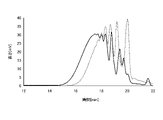
- FIG. 1 shows a GPC chart of a product (A-1) (solid line) and a raw material (bisphenol A) (dotted line) in Example A-1.
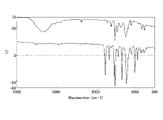
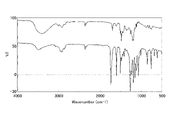
- FIG. 2 shows an IR chart of the product (A-1) (lower curve) and the raw material (bisphenol A) (upper curve) in Example A-1.
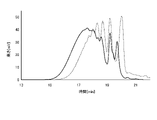
- FIG. 3 shows a GPC chart of the product (A-2) (solid line) and the raw material (phenol novolac resin) (dotted line) in Example A-2.
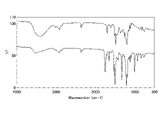
- FIG. 4 shows an IR chart of the product (A-2) (lower curve) and the raw material (phenol novolac resin) (upper curve) in Example A-2.
- FIG. 1 shows a GPC chart of a product (A-1) (solid line) and a raw material (bisphenol A) (dotted line) in Example A-1.
- FIG. 2 shows an IR chart of the product (A-1) (lower curve) and the raw material (bisphenol A) (upper curve) in Example A-1.
- FIG. 3 shows a
- FIG. 5 shows a GPC chart of the product (A-3) (solid line) and the raw material (phenol novolac resin) (dotted line) in Example A-3.
- FIG. 6 shows an IR chart of the product (A-3) (lower curve) and the raw material (phenol novolac resin) (upper curve) in Example A-3.
- FIG. 7 shows a GPC chart of the product (A-4) (solid line) and the raw material (o-cresol novolak resin) (dotted line) in Example A-4.
- FIG. 8 shows an IR chart of the product (A-4) (lower curve) and the raw material (o-cresol novolak resin) (upper curve) in Example A-4.
- FIG. 9 shows a GPC chart of the product (A-5) (solid line) and the raw material (o-cresol novolak resin) (dotted line) in Example A-5.
- FIG. 10 shows an IR chart of the product (A-5) (lower curve) and the raw material (o-cresol novolak resin) (upper curve) in Example A-5.
- FIG. 11 shows a GPC chart of the product (A-6) (solid line) and the raw material (biphenyl aralkyl resin) (dotted line) in Example A-6.
- FIG. 12 shows an IR chart of the product (A-6) (lower curve) and the raw material (biphenyl aralkyl resin) (upper curve) in Example A-6.
- FIG. 13 shows a GPC chart of the product (A-7) (solid line) and the raw material (bisphenol AF) (dotted line) in Example A-7.
- FIG. 14 shows an IR chart of the product (A-7) (lower curve) and the raw material (bisphenol AF) (upper curve) in Example A-7.
- the present invention provides a compound having two or more aromatic rings to which a fluorine-substituted arylcarbonyloxy group is directly bonded (hereinafter, may be referred to as "ester compound (A)").
- the fluorine-substituted arylcarbonyloxy group is, in a preferred embodiment, directly attached to the aromatic carbon atom of the aromatic ring.
- the aromatic ring directly bonded to the fluorine-substituted arylcarbonyloxy group is via a single bond with another one or more aromatic rings directly bonded to the fluorine-substituted arylcarbonyloxy group, respectively.
- organic groups are one or more selected from carbon atoms, oxygen atoms, nitrogen atoms, and sulfur atoms (for example, 1 to 3000, 1 to 1000, 1 to 100, 1 to 50). It is an organic group consisting of skeleton atoms.
- such an organic group may have a halogen atom in addition to or in place of a hydrogen atom as a non-skeleton atom.
- Such organic groups include linear, branched and / or cyclic structures.
- Such an organic group may be an organic group that does not contain an aromatic ring or an organic group that contains an aromatic ring.
- the aromatic ring means a ring according to Hückel's law in which the number of electrons contained in the ⁇ -electron system on the ring is 4p + 2 (p is a natural number).
- the aromatic ring may be an aromatic carbocycle having a carbon atom as a ring-constituting atom, or an aromatic heterocycle having a heteroatom such as an oxygen atom, a nitrogen atom, and a sulfur atom in addition to the carbon atom as the ring-constituting atom.
- it is preferably an aromatic carbon ring.
- the aromatic ring is preferably a 5- to 14-membered aromatic ring, more preferably a 5- to 10-membered aromatic ring, and even more preferably a 5- or 6-membered aromatic ring.
- Suitable specific examples of the aromatic ring include a benzene ring, a furan ring, a thiophene ring, a pyrrol ring, a pyrazole ring, an oxazole ring, an isooxazole ring, a thiazole ring, an imidazole ring, a pyridine ring, a pyridazine ring, a pyrimidine ring, a pyrazine ring and the like.
- a fused aromatic ring obtained by condensing two or more monocyclic aromatic rings such as a benzothiazole ring, a quinoline ring, an isoquinolin ring, a quinoxalin ring, an acridin ring, a quinazoline ring, a cinnoline ring, and a phthalazine ring can be mentioned.
- An aromatic carbocycle is preferable, a benzene ring or a naphthalene ring is more preferable, and a benzene ring is particularly
- the fluorine-substituted arylcarbonyloxy group is a group to which aryl is bonded via carbonyloxy, and means a group in which one or more hydrogen atoms on an aromatic carbon atom in the aryl are substituted with a fluorine atom.
- Aryl (group) means a monovalent aromatic ring group excluding one hydrogen atom in the aromatic ring.
- Aryl (group) is an aryl (group) having a carbon atom as a ring-constituting atom, or a heteroaryl (group) having a heteroatom such as an oxygen atom, a nitrogen atom, or a sulfur atom in addition to a carbon atom as a ring-constituting atom.
- an aryl (group) having a carbon atom as a ring-constituting atom is preferable.
- the number of ring-constituting atoms of the aryl (group) is preferably 5 to 14, more preferably 5 to 10, and even more preferably 5 or 6 in one embodiment.
- the aryl (group) include an aryl (group) having a carbon atom such as a phenyl group, a naphthyl group, an anthryl group, and a phenanthrenyl group as a ring-constituting atom; a frill group, a thienyl group, a pyrrolyl group, and a pyrazolyl group.
- Oxazolyl group isooxazolyl group, thiazolyl group, imidazolyl group, pyridyl group, pyridadinyl group, pyrimidinyl group, pyrazinyl group, benzofuranyl group, isobenzofuranyl group, indolyl group, isoindryl group, benzothiophenyl group, benzoimidazolyl group, indazolyl group, Heteroatomic atoms are added to carbon atoms as ring-constituting atoms such as benzoxazolyl group, benzoisoxazolyl group, benzothiazolyl group, quinolyl group, isoquinolyl group, quinoxalinyl group, acridinyl group, quinazolinyl group, cinnolinyl group, and phthalazinyl group.
- Heteroaryl (group) having is mentioned, and in one embodiment, it is preferably an aryl (group) having a carbon atom as a ring-constituting atom, and more preferably naphthyl (group) or phenyl (group). Particularly preferred is phenyl (group).
- the aryl of the fluorine-substituted arylcarbonyloxy group is on an aromatic carbon atom at the ortho position (an aromatic carbon atom adjacent to the aromatic carbon atom at the carbonyl bond position) from the viewpoint of obtaining the desired effect of the present invention more remarkably. It is preferable that at least one or more of the hydrogen atoms are substituted with a fluorine atom, and more preferably two are substituted with a fluorine atom.
- the number of fluorine atoms in the fluorine-substituted arylcarbonyloxy group is 1 or more, and is preferably 2 or more, more preferably 3 or more, and further preferably 4 or more from the viewpoint of obtaining the desired effect of the present invention more remarkably.
- the fluorine-substituted arylcarbonyloxy group has the formulas (F1-1) to (F1-3): in one embodiment.
- R f1 and R f2 independently represent a hydrogen atom or a fluorine atom, and at least one of R f1 and R f2 is a fluorine atom; * indicates a binding site with an aromatic ring. Is shown. ], It is preferable that it is a group represented by any of the above, and it is more preferable that it is a group represented by the formula (F-1).
- R f1 and R f2 are preferably in one embodiment, preferably at least two of R f1 and R f2 are fluorine atoms, and more preferably. At least 3 of R f1 and R f2 are fluorine atoms, more preferably at least 4 of R f1 and R f2 are fluorine atoms and at least 5 of R f1 and R f2 . It is a fluorine atom.
- R f1 and R f2 are preferably in one embodiment, preferably when there are two R f1 , one of R f1 is a fluorine atom and R f1 .
- the other and R f2 are hydrogen atoms or fluorine atoms, and when R f1 is one, R f1 is a fluorine atom and R f2 is a hydrogen atom or a fluorine atom. More preferably, R f1 is a fluorine atom and R f2 is a hydrogen atom or a fluorine atom.
- R f1 is a fluorine atom
- R f2 is a hydrogen atom or a fluorine atom
- at least one of R f2 is a fluorine atom.
- R f1 and R f2 are fluorine atoms.
- fluorine-substituted arylcarbonyloxy group examples include formulas (F2-1) to (F2-19) :.
- the ester compound (A) may have an aromatic ring directly bonded to a hydroxy group (aromatic ring having a phenolic hydroxy group) in addition to an aromatic ring directly bonded to a fluorine-substituted arylcarbonyloxy group. ..
- the molar ratio of the fluorine-substituted arylcarbonyloxy group to the phenolic hydroxy group is not particularly limited, but in one embodiment, it is solvent-soluble and fluid.
- the viewpoint of obtaining a better balance of property groups such as curability, dielectric property and heat resistance it is preferably 20:80 to 100: 0, more preferably 30:70 to 100: 0, and even more preferably 40:60.
- the molar ratio of the fluorine-substituted arylcarbonyloxy group to the phenolic hydroxy group may be arbitrarily adjusted by those skilled in the art to a desired range by adjusting the type of raw material and the reaction ratio in the production method described later.
- an arylcarbonyloxy group having another substituent and / or a (unsubstituted) arylcarbonyloxy group is directly bonded. It may have an aromatic ring.
- the substituent of the "arylcarbonyloxy group having another substituent” is the same as the substituent in the "arylcarbonyloxy group which may have a substituent" of X described below (substitution). Except when the group is only a fluorine atom).
- Fluorosubstituted aryl in an arylcarbonyloxy group which may have a substituent ie, a fluorine-substituted arylcarbonyloxy group, a sum of arylcarbonyloxy groups having other substituents and (unsubstituted) arylcarbonyloxy groups.
- the ratio of the carbonyloxy group (fluorine-substituted arylcarbonyloxy group / fluorine-substituted arylcarbonyloxy group which may have a substituent) is not particularly limited, but is preferably 50% or more in one embodiment. , More preferably 70% or more, still more preferably 80% or more, even more preferably 90% or more, and particularly preferably 100%.
- the ratio of the fluorine-substituted arylcarbonyloxy group in the fluorine-substituted arylcarbonyloxy group which may have a substituent is desired by those skilled in the art by adjusting the type of raw material and the reaction ratio in the production method described later. It may be arbitrarily adjustable to the range.
- the content of fluorine atoms contained in the ester compound (A) is preferably 3% by mass or more, more preferably 5% by mass or more, still more preferably 10% by mass, from the viewpoint of obtaining the desired effect of the present invention more remarkably. % Or more, more preferably 15% by mass or more, and particularly preferably 20% by mass or more.
- the upper limit is not particularly limited, but may be, for example, 60% by mass or less.
- the content of fluorine atoms can be arbitrarily adjusted by those skilled in the art to a desired range by adjusting the type of raw material and the reaction ratio in the production method described later.
- the molecular weight of the ester compound (A) (weight average molecular weight when n is 2 or more) is not particularly limited, but in one embodiment, it is preferably 200,000 or less, more preferably 100,000 or less, and more preferably 50,000. Below, it may be more preferably 30,000 or less.
- the lower limit of the molecular weight of the ester compound (A) (weight average molecular weight when n is 2 or more) is not particularly limited, but may be, for example, 400 or more, 450 or more, 500 or more, and the like.
- the weight average molecular weight can be measured as a polystyrene-equivalent value by a gel permeation chromatography (GPC) method.
- fluorine-substituted arylester group equivalent is not particularly limited, but is preferably 5000 g / g. eq. Below, more preferably 2000 g / eq. Hereinafter, more preferably 1000 g / eq. Hereinafter, even more preferably, 800 g / eq. Hereinafter, particularly preferably 600 g / eq. Hereinafter, most preferably 500 g / eq.
- the lower limit of the fluorine-substituted aryl ester group equivalent of the ester compound (A) is not particularly limited, but is, for example, 150 g / eq. As mentioned above, 180 g / eq. As mentioned above, 200 g / eq. It can be the above.
- Arylcarbonyloxy groups which may have a substituent directly bonded to the aromatic ring of the ester compound (A) (fluorine-substituted arylcarbonyloxy group, arylcarbonyloxy group having other substituents and (unsubstituted) arylcarbonyl
- the total equivalent of the hydroxy group) and the hydroxy group directly bonded to the aromatic ring (that is, the phenolic hydroxy group) (hereinafter, may be referred to as “functional group equivalent”) is not particularly limited, but is preferably 5000 g / g. eq. Below, more preferably 2000 g / eq. Hereinafter, more preferably 1000 g / eq.
- the lower limit of the functional group equivalent of the ester compound (A) is not particularly limited, but is, for example, 150 g / eq. As mentioned above, 180 g / eq. As mentioned above, 200 g / eq. It can be the above.
- the ester compound (A) is a compound having two or more aromatic rings to which a hydroxy group is directly bonded (hereinafter, may be referred to as "polyvalent aromatic hydroxy compound (B)") and a fluorine-substituted arylcarboxylic acid (that is, one or more). It can be an ester of (arylcarboxylic acid substituted with a fluorine atom) (the raw material for production may be a halide, an anhydride, etc.) (arylcarboxylic acid having other substituents in addition to the fluorine-substituted arylcarboxylic acid).
- polyvalent aromatic hydroxy compound (B) which may be an acid or a mixed ester of a carboxylic acid containing a (unsubstituted) aryl carboxylic acid
- a wide range of known phenolic compounds can be used, and the present invention is particularly limited.
- the polyaromatic hydroxy compound (B) is a polyaromatic hydroxy compound containing a high concentration of fluorine atoms (for example, bisphenol AF, etc.) from the viewpoint of further improving properties such as dielectric properties.
- a polyaromatic hydroxy compound having an alicyclic skeleton (for example, a polyaddition reaction product of dicyclopentadiene and phenols) is preferable, but is not particularly limited.
- ester compound (A) is preferably of the formula (A1) :.
- the rings Ar each independently represent an aromatic ring which may have a substituent;
- X is an arylcarbonyloxy group which may independently have a substituent, or
- Two Xs that represent a hydroxy group and are attached to at least different rings Ar are fluorine-substituted arylcarbonyloxy groups;
- Z each independently represents a single-bonded or divalent organic group;
- n is. Indicates an integer of 1 or more;
- m indicates an integer of 1 to 3 independently of each other.
- the n unit may be the same or different for each structural unit.
- the m unit may be the same or different for each structural unit.
- Ring Ar indicates an aromatic ring that may independently have a substituent.
- the substituent in the aromatic ring of ring Ar is not particularly limited, but is, for example, a halogen atom, an amino group, a mercapto group, a nitro group, a cyano group, -R, -OR, -SR, -SO 2 R. , -NHR, -NR 2 , -COR, -CO-OR, -CO-NHR, -CO-NR 2 , -NH-COR, -NR-COR, and -N (COR) 2 .
- a halogen atom an amino group, a mercapto group, a nitro group, a cyano group, -R, -OR, -SR, -SO 2 R. , -NHR, -NR 2 , -COR, -CO-OR, -CO-NHR, -CO-NR 2 , -NH-COR, -NR-COR, and -N (COR) 2 .
- R is, for example, (1) halogen atom, hydroxy group, amino group, mercapto group, nitro group, cyano group, -R a , -OR b , -SR b , -SO 2 R b , -NHR b , -N.
- Ra is a halogen atom, a substituted or unsubstituted aryl group, or the like, and specifically, a halogen atom, an aryl group, a halogen-substituted aryl group, or an alkyl-aryl group (aryl substituted with one or more alkyl groups). Group), aryl-aryl group (aryl group substituted with one or more aryl groups) and the like.
- R b is a halogen atom, a substituted or unsubstituted alkyl group, a substituted or unsubstituted alkenyl group, a substituted or unsubstituted aryl group and the like, and specifically, a halogen atom, an alkyl group, an alkenyl group and an aryl group. , Halogen-substituted alkyl groups, halogenated alkenyl groups, halogen-substituted aryl groups, alkyl-aryl groups, aryl-aryl groups, aryl-alkyl groups (alkyl groups substituted with one or more aryl groups) and the like.
- Alkyl (group) refers to a linear, branched and / or cyclic monovalent saturated hydrocarbon group. Unless otherwise specified, the alkyl (group) is preferably an alkyl (group) having 1 to 14 carbon atoms, more preferably 1 to 10 carbon atoms, and further preferably 1 to 6 carbon atoms.
- alkyl (group) examples include a methyl group, an ethyl group, a propyl group, an isopropyl group, a butyl group, an isobutyl group, a sec-butyl group, a tert-butyl group, a pentyl group, a hexyl group, a heptyl group, an octyl group and a nonyl group.
- decyl group cyclopentyl group, cyclohexyl group, 2-methylcyclohexyl group, 3-methylcyclohexyl group, 4-methylcyclohexyl group, 3,3-dimethylcyclohexyl group, 3,3,5-trimethylcyclohexyl group, cyclopentylmethyl group , Cyclohexylmethyl group, 2-cyclohexylethyl group and the like.
- the alkenyl (group) refers to a linear, branched and / or cyclic monovalent aliphatic unsaturated hydrocarbon group having at least one carbon-carbon double bond. Unless otherwise specified, the alkenyl (group) is preferably an alkenyl (group) having 2 to 14 carbon atoms, more preferably 2 to 10 carbon atoms, and further preferably 2 to 6 carbon atoms.
- alkenyl (group) examples include a vinyl group, a 1-propenyl group, a 2-propenyl group (allyl group), an isopropenyl group, a 2-methyl-2-propenyl group, a 1-butenyl group and a 2-butenyl group, 3 -Butenyl group, 2-pentenyl group, 3-pentenyl group, 4-pentenyl group, 1-methyl-1-butenyl group, 2-methyl-1-butenyl group, 2-methyl-2-butenyl group, 3-methyl- 2-butenyl group, 3-methyl-3-butenyl group, 1-pentenyl group, 2-pentenyl group, 3-pentenyl group, 4-pentenyl group, 4-methyl-4-pentenyl group, 1-hexenyl group, 2- Hexenyl group, 3-hexenyl group, 4-hexenyl group, 5-hexenyl group, 1-cyclopentenyl group, 2-cyclopentenyl group, 3-cyclopenteny
- halogen atom is a fluorine atom, a chlorine atom, a bromine atom, or an iodine atom, and is preferably a fluorine atom unless otherwise specified.
- Halogen-substituted alkyl groups, halogen-substituted alkenyl groups, and halogen-substituted aryl groups are, respectively, an alkyl group substituted with one or more halogen atoms, an alkenyl group substituted with one or more halogen atoms, and one or more.
- the fluorine-substituted alkyl group, the fluorine-substituted alkenyl group, and the fluorine-substituted aryl group are an alkyl group substituted with one or more fluorine atoms, an alkenyl group substituted with one or more fluorine atoms, and one or more. It means an aryl group substituted with a fluorine atom.
- Ring Ar is, in one embodiment, an aromatic carbon ring that may have a substituent independently of each other, preferably.
- the ring Ar is a benzene ring which may have a substituent or a naphthalene ring which may have a substituent, respectively, independently of each other.
- the ring Ar is independent of each other, and more preferably, (1) (a) a halogen atom; (b) an alkyl group which may have a substituent selected from a halogen atom and an aryl group; (C) Alkyl-oxy group (ie, alkoxy group) which may have a substituent selected from a halogen atom and an aryl group; (d) May have a substituent selected from a halogen atom and an aryl group.
- Alkenyl group (e) an aryl group which may have a substituent selected from a halogen atom, an aryl group, an alkenyl group and an alkyl group; and (f) selected from a halogen atom, an aryl group, an alkenyl group and an alkyl group.
- a benzene ring may have a substituent selected from an aryl-oxy group which may have a substituent, or (2) (a) a halogen atom; (b) a substitution selected from a halogen atom and an aryl group.
- An alkyl group which may have a group; (c) an alkyl-oxy group which may have a substituent selected from a halogen atom and an aryl group; (d) a substituent selected from a halogen atom and an aryl group. May have alkenyl groups; (e) aryl groups may have substituents selected from halogen atoms, aryl groups, alkenyl groups and alkyl groups; and (f) halogen atoms, aryl groups, alkenyl groups. And a naphthalene ring which may have a substituent selected from an aryl-oxy group and may have a substituent selected from an alkyl group.
- the ring Ar is independent and even more preferably (1) a halogen atom, an aryl group, an alkyl group, an aryl-oxy group, an alkyl-oxy group, a halogen-substituted aryl group and a halogen-substituted alkyl group. It may have a substituent selected from (2) a halogen atom, an aryl group, an alkyl group, an aryl-oxy group, an alkyl-oxy group, a halogen-substituted aryl group and a halogen-substituted alkyl group. It is a naphthalene ring which may have a substituent.
- the ring Ar independently has a substituent selected from (1) a fluorine atom, an aryl group, an alkyl group, a fluorine-substituted aryl group and a fluorine-substituted alkyl group.
- X each independently represents an arylcarbonyloxy group or a hydroxy group which may have a substituent, and at least two Xs bonded to different rings Ar are fluorine-substituted arylcarbonyloxy groups. ..
- each of the two Xs independently and preferably preferably represents a fluorine-substituted arylcarbonyloxy group, a (unsubstituted) arylcarbonyloxy group, or a hydroxy group and is attached to at least different rings Ar. Is a fluorine-substituted arylcarbonyloxy group.
- each of the two Xs independently and more preferably represents a fluorine-substituted arylcarbonyloxy group or a hydroxy group, and at least two Xs bonded to different ring Ars are fluorine-substituted arylcarbonyloxy groups.
- X particularly preferably represents a fluorine-substituted arylcarbonyloxy group.
- the substituent in the "arylcarbonyloxy group which may have a substituent" of X is not particularly limited, but for example, a halogen atom, an amino group, a mercapto group, a nitro group, a cyano group, and-.
- R, -OR, -SR, -SO 2 R, -NHR, -NR 2 , -COR, -CO-OR, -CO-NHR, -CO-NR 2 , -NH-COR, -NR-COR, and -Examples include groups selected from N (COR) 2 .
- R is the same as above.
- the ratio of the fluorine-substituted arylcarbonyloxy group to the hydroxy group in X is not particularly limited, but is solvent-soluble, fluid, curable, dielectric property, and heat resistant. From the viewpoint of obtaining a better balance of the characteristic group such as sex, it is preferably 20:80 to 100: 0, more preferably 30:70 to 100: 0, still more preferably 40:60 to 100: 0, and particularly preferably. It is from 50:50 to 100: 0.
- the ratio of the fluorine-substituted arylcarbonyloxy group to the arylcarbonyloxy group which may have a substituent in X is not particularly limited, but in one embodiment, it is preferably 50% or more, more preferably 50% or more. It can be 70% or more, more preferably 80% or more, even more preferably 90% or more, and particularly preferably 100%.
- the divalent organic group in Z independently represents a single bond or a divalent organic group.
- the divalent organic group in Z is one or more selected from a carbon atom, an oxygen atom, a nitrogen atom, and a sulfur atom (for example, 1 to 3000, 1 to 1000, 1 to 100, 1). It is preferably a divalent organic group consisting of up to 50) skeleton atoms.
- the divalent organic group in Z may have a halogen atom in addition to or in place of a hydrogen atom as a non-skeleton atom.
- the divalent organic group in Z comprises a linear structure, a branched chain structure and / or a cyclic structure.
- the divalent organic group in Z may be a divalent organic group containing no aromatic ring or a divalent organic group containing an aromatic ring.
- N indicates an integer of 1 or more.
- n is preferably an integer of 1 to 500, more preferably an integer of 1 to 200, further preferably an integer of 1 to 100, and an integer of 1 to 50. It is even more preferable, and it is particularly preferable that it is an integer of 1 to 20.
- n is preferably 1.
- n is preferably an integer of 2 to 500, more preferably an integer of 2 to 200, still more preferably an integer of 2 to 100, and an integer of 2 to 50. Is even more preferable, and an integer of 2 to 20 (including an integer of 3 to 20 and an integer of 4 to 20 and an integer of 5 to 20) is particularly preferable.
- M indicates an integer of 1 to 3 independently of each other.
- m is preferably 1 or 2 independently of each other, and particularly preferably 1.
- ester compound (A) is more preferably the formula (A2) :.
- Y 1 is independently single-bonded, -C (R 1 ) 2- , -O-, -CO-, -S-, -SO-, -SO 2- , -CONH-, -NHCO-, -COO-, or -OCO-; each R 1 independently has a hydrogen atom, an alkyl group which may have a substituent, or an aryl which may have a substituent. Representing a group; ring Y 2 independently represents an aromatic ring which may have a substituent or a non-aromatic ring which may have a substituent; a independently represents a non-aromatic ring. Indicates an integer from 0 to 3; other symbols are the same as in equation (A1). ] It is a compound represented by.
- the unit a may be the same or different for each structural unit.
- the n units may be the same or different for each structural unit.
- the m unit may be the same or different for each structural unit.
- Y 1 is independently single-bonded, -C (R 1 ) 2- , -O-, -CO-, -S-, -SO-, -SO 2- , -CONH-, -NHCO-, Indicates -COO- or -OCO-.
- Y 1 is independent and preferably single bond, -C (R 1 ) 2- , -O-, -CO-, -S-, -SO-, -SO 2- , -CONH- or -NHCO-, more preferably single bond, -C (R 1 ) 2- , or -O-, and particularly preferably single bond, or -C (R 1 ) 2- Is.
- R 1 independently represents a hydrogen atom, an alkyl group which may have a substituent, or an aryl group which may have a substituent.
- the substituent in the "aryl group which may have a substituent" of R 1 is not particularly limited, but is, for example, a halogen atom, a hydroxy group, an amino group, a mercapto group, a nitro group, or a cyano group.
- the substituent in the "alkyl group which may have a substituent" of R 1 is not particularly limited, but is, for example, a halogen atom, a hydroxy group, an amino group, a mercapto group, a nitro group, or a cyano group.
- Examples thereof include a group selected from COR, -NR-COR, and -N (COR) 2 .
- R is the same as above, and R'is, for example, a halogen atom, a hydroxy group, an amino group, a mercapto group, a nitro group, a cyano group, -R b , -OR b , -SR b , -SO 2 R b , -NHR b , -N (R b ) 2 , -COR b , -CO-OR b , -CO-NHR b , -CO-N (R b ) 2 , -O-COR b , -NH-COR b , -NR b -COR b , and an aryl group which may be substituted with a group selected from -N (COR b ) 2 .
- R b is the same as above.
- R 1 is independently and preferably (1) a hydrogen atom; (2) a halogen atom, a hydroxy group, and an aryl group (the aryl group is a halogen atom, a hydroxy group, and a fluorine-substituted arylcarbonyl).
- An oxy group, an (unsubstituted) arylcarbonyloxy group, an aryl group, an alkenyl group and an alkyl group may have a substituent selected from the group), an aryl-oxy group (the aryl-oxy group is a halogen atom, hydroxy).
- It may have a substituent selected from a group, a fluorine-substituted arylcarbonyloxy group, a (unsubstituted) arylcarbonyloxy group, an aryl group, an alkenyl group and an alkyl group), and a substituent selected from an alkyl-oxy group.
- An alkyl group may have; or (3) a halogen atom, a hydroxy group, an aryl group (the aryl group is a halogen atom, a hydroxy group, a fluorine-substituted arylcarbonyloxy group, a (unsubstituted) arylcarbonyloxy group, It may have a substituent selected from an aryl group, an alkenyl group and an alkyl group), an alkenyl group, an alkyl group and an aryl-oxy group (the aryl-oxy group is a halogen atom, a hydroxy group and a fluorine-substituted arylcarbonyl).
- R 1 is independently, more preferably a hydrogen atom, an aryl group, an alkyl group, a halogen-substituted aryl group, or a halogen-substituted alkyl group.
- R 1 is independently, more preferably, a hydrogen atom, an aryl group, an alkyl group, a fluorine-substituted aryl group, or a fluorine-substituted alkyl group. In one embodiment, R 1 is independently, particularly preferably a hydrogen atom, a methyl group, or a trifluoromethyl group.
- Ring Y 2 independently represents an aromatic ring which may have a substituent or a non-aromatic ring which may have a substituent.
- the non-aromatic ring means a ring other than the aromatic ring.
- the non-aromatic ring is a non-aromatic carbocycle having a carbon atom as a ring-constituting atom, or a non-aromatic heterocycle having a heteroatom such as an oxygen atom, a nitrogen atom, and a sulfur atom in addition to a carbon atom as a ring-constituting atom.
- it is preferably a non-aromatic carbon ring.
- the non-aromatic ring may be a saturated ring or an unsaturated non-aromatic ring, but in one embodiment, it is preferably a saturated ring.
- the non-aromatic ring is preferably a non-aromatic ring having 3 to 15 members in one embodiment.
- non-aromatic carbocycle examples include (a1) a monocyclic non-aromatic carbocycle, (a2) a bridged carbocycle consisting of two or more rings sharing two or more atoms, and (a3) 1.
- examples thereof include an aromatic ring-non-aromatic ring composite fused carbon ring in which one or more aromatic carbon rings are condensed with one or more monocyclic non-aromatic carbon rings and / or bridged carbon rings.
- the monocyclic non-aromatic carbon ring is a monocyclic non-aromatic ring having a carbon atom as a ring constituent atom, may have a carbon-carbon double bond, and has a single ring having 3 to 15 carbon atoms.
- the formula non-aromatic carbocycle is preferable, and the monocyclic non-aromatic carbocycle having 3 to 8 carbon atoms is more preferable.
- Cycloalkene rings (monocyclic non-aromatic saturated carbon rings) such as cyclodecane ring, cycloundecane ring, cyclododecane ring; cyclobutene ring, cyclopentene ring, cyclohexene ring, cycloheptene ring, cyclooctene ring, cyclononen ring, cyclodecene ring, Cycloalkene rings (monocyclic non-aromatic unsaturated carbocycles) such as cycloundecene ring, cyclododecene ring, cyclopentadiene ring, 1,3-cyclohexadiene ring, and 1,4-cyclohexadiene ring can be mentioned.
- the cross-linked carbon ring is a cross-linked ring having a carbon atom as a ring-constituting atom, and may have a carbon-carbon double bond, and a cross-linked carbon ring having 8 to 15 carbon atoms is preferable, for example.
- Saturated cross-linked carbon ring such as pentadecane ring (tetrahydrotricyclopentadiene ring) and other saturated cross-linked carbon ring; Bicyclo [2.2.1] Hepta-2-ene ring (norbornene ring) ), Bicyclo [2.2.1] hepta-2,5-diene ring (norborneadiene ring), bicyclo [2.2.2] octa-5-ene ring, bicyclo [4.4.0] deca-2- Unsaturated cross-linked carbon ring of bicyclic system such as en ring; unsaturated of tricyclic system such as tricyclo [5.2.1.0 2,6 ] deca-3,8-diene ring (dicyclopentadiene ring) An unsaturated bridged carbon ring such as a bridged carbon ring can be mentioned.
- the aromatic ring-non-aromatic ring composite fused carbon ring is a composite fused ring having a carbon atom as a ring constituent atom, and an aromatic ring-non-aromatic ring composite condensed carbon ring having 8 to 15 carbon atoms is preferable, for example, indan.
- Bicyclic composite fused carbon rings such as rings, inden rings, tetralin rings, 1,2-dihydronaphthalene rings, 1,4-dihydronaphthalene rings; fluorene rings, 9,10-dihydroanthracene rings, 9,10-dihydro Tricyclic composite fused carbon rings such as phenanthrene ring; tetracyclic composite fused carbon rings such as 2,3-benzofluorene ring; pentacyclic composite fused carbon such as 2,3,6,7-dibenzofluorene Rings and the like can be mentioned.
- non-aromatic heterocycle examples include (b1) a monocyclic non-aromatic heterocycle, (b2) a bridged heterocycle consisting of two or more rings sharing two or more atoms, and (b3) 1. 1 for one or more monocyclic aromatic rings (monocyclic aromatic carbocycles and / or monocyclic non-aromatic heterocycles) and / or bridged rings (bridged carbocycles and / or bridged heterocycles) Examples thereof include an aromatic ring-non-aromatic ring composite fused heterocycle in which more than one aromatic ring (aromatic carbocycle and / or aromatic heterocycle) is condensed.
- the monocyclic non-aromatic heterocycle is a monocyclic non-aromatic ring having a heterocycle such as an oxygen atom, a nitrogen atom, and a sulfur atom in addition to a carbon atom as a ring-constituting atom, and is a carbon-carbon double bond. And / or may have a nitrogen-carbon double bond, a 3- to 15-membered monocyclic non-aromatic heterocycle is preferred, and a 3- to 8-membered monocyclic non-aromatic heterocycle is more preferred.
- the cross-linking heterocycle is a cross-linking ring having a heteroatom such as an oxygen atom, a nitrogen atom, and a sulfur atom in addition to a carbon atom as a ring-constituting atom, and is a carbon-carbon double bond and / or a nitrogen-carbon dicycle. It may have a double bond, preferably an 8- to 15-membered cross-linked heterocycle, for example, 7-oxabicyclo [4.1.0] heptane ring (1,2-epoxycyclohexane ring), 1-azabicyclo.
- the aromatic ring-non-aromatic ring complex fused heterocycle is a complex fused ring having heteroatoms such as an oxygen atom, a nitrogen atom, and a sulfur atom in addition to a carbon atom as a ring-constituting atom, and is an 8- to 15-membered aromatic ring.
- non-aromatic complex fused heterocycle is preferred, for example, 2,3-dihydrobenzofuran ring, 1,3-dihydroisobenzofuran ring, 2H-chromen ring, 4H-chromen ring, 1H-isochromen ring, 3H-isochromen ring, Two such as indolin ring, isoindolin ring, 2,3-dihydrobenzothiophene ring, 1,2-dihydroquinoline ring, 3,4-dihydroquinoline ring, 1,2,3,4-tetrahydroquinoline ring, benzoxazine ring and the like.
- Heterocyclic complex fused heterocycles examples thereof include tricyclic complex fused heterocycles such as 1,2,3,4-tetrahydrocarbazole ring and 1,2,3,4-dibenzofuran ring.
- non-aromatic ring in one embodiment, among them, a monocyclic non-aromatic carbocycle, a bridged carbocycle, an aromatic ring-non-aromatic ring composite fused carbon ring, a monocyclic non-aromatic heterocyclic ring, and a bridged complex are used. Rings and aromatic ring-non-aromatic complex fused complex rings are more preferred; monocyclic non-aromatic carbon rings, bridged carbon rings, and aromatic ring-non-aromatic ring composite fused carbon rings are even more preferred; monocyclic non-aromatic rings. Aromatic carbocycles and bridging carbocycles are particularly preferred.
- the substituent in the "aromatic ring which may have a substituent" of ring Y 2 is not particularly limited, but for example, a halogen atom, an amino group, a mercapto group, a nitro group, a cyano group, and-.
- R, -OR, -SR, -SO 2 R, -NHR, -NR 2 , -COR, -CO-OR, -CO-NHR, -CO-NR 2 , -NH-COR, -NR-COR, and -Examples include groups selected from N (COR) 2 .
- the substituent in the "non-aromatic ring which may have a substituent" of ring Y 2 is not particularly limited, but for example, a halogen atom, a hydroxy group, an amino group, a mercapto group, a nitro group, and the like.
- R is the same as above.
- Ring Y 2 is, in one embodiment, an aromatic carbocycle which may have a substituent or a non-aromatic carbocycle which may have a substituent, respectively, independently of each other.
- ring Y 2 is an alkyl group that may independently have a substituent selected from (1) (a) halogen atom; (b) halogen atom and aryl group, respectively.
- C Alkyl-oxy group which may have a substituent selected from a halogen atom and an aryl group;
- An alkenyl group which may have a substituent selected from a halogen atom and an aryl group;
- An aromatic carbocycle which may have a substituent selected from an aryl-oxy group which may be used, or (2) (a) a halogen atom; (b) a substituent selected from a halogen atom and an aryl group. May have an alkyl group; (c) an alkyl-oxy group that may have a substituent selected from a halogen atom and an aryl group; (d) a substituent selected from a halogen atom and an aryl group.
- ring Y 2 has an independent substituent, more preferably (1) a substituent selected from a halogen atom, an aryl group, an alkyl group, a halogen-substituted aryl group and a halogen-substituted alkyl group.
- a non-aromatic carbon ring which may have a substituent selected from (2) a halogen atom, an aryl group, an alkyl group, a halogen-substituted aryl group, a halogen-substituted alkyl group and an oxo group. be.
- ring Y 2 has an independent substituent selected from (1) a fluorine atom, an aryl group, an alkyl group, a fluorine-substituted aryl group and a fluorine-substituted alkyl group. It may have an aromatic carbocycle, or (2) a non-aromatic carbocycle selected from a fluorine atom, an aryl group, an alkyl group, a fluorine-substituted aryl group, a fluorine-substituted alkyl group and an oxo group. Is.
- the ring Y 2 is an aromatic carbocycle, which may have a substituent selected from (1) a fluorine atom, an alkyl group and a fluorine-substituted alkyl group, independently of each other, and particularly preferably.
- a non-aromatic carbon ring which may have a substituent selected from a fluorine atom, an alkyl group and a fluorine-substituted alkyl group.
- Each of a independently indicates an integer of 0 to 3, and in one embodiment, it is preferably an integer of 0 to 2, and more preferably 0 or 1. Independently, a is particularly preferably 0 in one embodiment of the first embodiment.
- ester compound (A) is more preferably of the formula (A3-1) or (A3-2) :.
- R 2 independently indicates a substituent; t independently indicates an integer of 0 or 1 or more; other symbols are the same as those of the formulas (A1) and (A2). be. ] It is a compound represented by.
- the unit a may be the same or different for each structural unit.
- the n units may be the same or different for each structural unit.
- the t unit may be the same or different for each structural unit.
- R 2 independently indicate a substituent.
- R 2 is not particularly limited, but is, for example, a halogen atom, an amino group, a mercapto group, a nitro group, a cyano group, -R, -OR, -SR, -SO 2 R, -NHR. , -NR 2 , -COR, -CO-OR, -CO-NHR, -CO-NR 2 , -NH-COR, -NR-COR, and -N (COR) 2 .
- R is the same as above.
- R2 preferably has (a) a halogen atom; (b) an alkyl group optionally having a substituent selected from a halogen atom and an aryl group; (c) a halogen.
- An alkyl-oxy group which may have a substituent selected from an atom and an aryl group; (d) an alkenyl group which may have a substituent selected from a halogen atom and an aryl group; (e) a halogen atom, It may have an aryl group selected from an aryl group, an alkenyl group and an alkyl group; or (f) it may have a substituent selected from a halogen atom, an aryl group, an alkenyl group and an alkyl group.
- R 2 is more preferably an independent halogen atom, an aryl group, an alkyl group, an aryl-oxy group, an alkyl-oxy group, a halogen-substituted aryl group or a halogen-substituted alkyl group.
- R 2 is more preferably a fluorine atom, an aryl group, an alkyl group, an aryl-oxy group, an alkyl-oxy group, a fluorine-substituted aryl group or a fluorine-substituted alkyl group, each independently.
- R 2 is particularly preferably an independent fluorine atom, an aryl group, an alkyl group, a fluorine-substituted aryl group or a fluorine-substituted alkyl group.
- t independently represents an integer of 0 or 1 or more, and in one embodiment, t is preferably 0, 1 or 2, more preferably 0 or 1, and particularly preferably 0. ..
- ester compound (A) is particularly preferably of the formulas (A4-1) to (A4-36) :.
- each symbol is the same as the formulas (A1), (A2), (A3-1) and (A3-2).
- It is a compound represented by any of.
- the compound is represented by any one of (A4-35).
- the n units may be the same or different for each structural unit.
- the t unit may be the same or different for each structural unit.
- ester compound (A) is not limited, but for example, formulas (A5-1) to (A5-90) :.
- X'independently represents an arylcarbonyloxy group or a hydroxy group which may have a substituent;
- R3 is an independent halogen atom , aryl group, or alkyl group.
- u indicates 1 or 2 independently, respectively; etc.
- the symbol of is the same as that of the formulas (A1), (A2), (A3-1) and (A3-2).
- R 3 independently represents a halogen atom, an aryl group, an alkyl group, an aryl-oxy group, an alkyl-oxy group, a halogen-substituted aryl group or a halogen-substituted alkyl group.
- R 3 is independently and preferably a fluorine atom, an aryl group, an alkyl group, an aryl-oxy group, an alkyl-oxy group, a fluorine-substituted aryl group or a fluorine-substituted alkyl group, and more preferably. Is a fluorine atom, an aryl group, an alkyl group, a fluorine-substituted aryl group or a fluorine-substituted alkyl group.
- N' indicates an integer from 1 to 20. n'is preferably an integer of 2 to 20.
- At least one of the structural units represented by rings Ar and Z contains a fluorine atom, and fluorine contained in the structural units represented by rings Ar and Z.
- the total number of atoms is preferably 3 or more, more preferably 4 or more, still more preferably 5 or more.
- at least one of the structural units represented by ring Ar, ring Y2 , and Y1 contains a fluorine atom, and ring Ar, ring Y2 , and Y1.
- the total number of fluorine atoms contained in the structural unit represented by is preferably 3 or more, more preferably 4 or more, still more preferably 5 or more.
- At least one of the structural units represented by R2 , ring Y2, and Y1 contains a fluorine atom and R2 .
- the total number of fluorine atoms contained in the structural unit represented by the ring Y 2 and Y 1 is preferably 3 or more, more preferably 4 or more, still more preferably 5 or more.
- at least one of the structural units represented by R2 and ring Y2 contains a fluorine atom, and R2 and ring.
- the total number of fluorine atoms contained in the structural unit represented by Y 2 is preferably 3 or more, more preferably 4 or more, still more preferably 5 or more.
- at least one of the structural units represented by R3 contains a fluorine atom and / or is represented by -CF 3 .
- the group is present, and the total number of fluorine atoms contained in the structural unit represented by R 3 and the group represented by ⁇ CF 3 is preferably 3 or more, more preferably 4 or more, still more preferably 5 or more. ..
- the present invention may be a fluorine-substituted arylcarboxylic acid, an acid halide thereof (preferably chloride, bromide or iodide), an acid anhydride thereof, or a salt thereof (hereinafter referred to as "fluorine-substituted arylcarboxylic acids (C)").
- fluorine-substituted arylcarboxylic acids (C) There is) and a compound having two or more aromatic rings to which a hydroxy group is directly bonded (that is, a polyvalent aromatic hydroxy compound (B)) are reacted (hereinafter, may be referred to as "esteration reaction").
- the fluorine-substituted arylcarboxylic acid (C) is an arylcarboxylic acid having a fluorine-substituted arylcarboxylic acid, an acid halide thereof, an acid anhydride thereof, or a salt thereof, and further having other substituents. And / or a mixture containing (unsubstituted) arylcarboxylic acid, an acid halide thereof, an acid anhydride thereof, or a salt thereof.
- the method for producing the ester compound (A) preferably comprises a compound represented by any of the formulas (C1) to (C3) or a salt thereof, and a compound represented by the formula (B1).
- a method for producing a compound represented by the formula (A1) which comprises reacting with:
- FAr indicates an aryl group that may have a substituent, and in at least a part of the compounds represented by the formulas (C1) to (C3), FAr is a fluorine-substituted aryl group (that is, one or more).
- Aryl group substituted with a fluorine atom corresponding to the fluorine-substituted arylcarbonyloxy group of X of the ester compound (A1)
- Aryl group substituted with a fluorine atom corresponding to the fluorine-substituted arylcarbonyloxy group of X of the ester compound (A1)
- H indicates a chlorine atom, a bromine atom or an iodine atom; other symbols are the same as in the formula (A1). ].
- the method for producing the ester compound (A) is more preferably a compound represented by any of the formulas (C1) to (C3) or a salt thereof, and a compound represented by the formula (B2).
- a method for producing a compound represented by the formula (A2) which comprises reacting with:
- FAr represents an aryl group which may have a substituent, and in at least a part of the compounds represented by the formulas (C1) to (C3), FAr is a fluorine-substituted aryl group (ester compound (A2). ) Corresponds to the fluorine-substituted arylcarbonyloxy group of X) (preferably, FAr is a fluorine-substituted aryl group in all the compounds represented by the formulas (C1) to (C3)); Indicates a bromine atom or an iodine atom; other symbols are the same as in the formulas (A1) and (A2). ].
- the method for producing the ester compound (A) is more preferably a compound represented by any of the formulas (C1) to (C3) or a salt thereof, and the formula (B3-1) or (B3-).
- FAr represents an aryl group which may have a substituent, and in at least a part of the compounds represented by the formulas (C1) to (C3), FAr is a fluorine-substituted aryl group (ester compound (A3). -1) or (A3-2) corresponding to the fluorine-substituted arylcarbonyloxy group of X) (preferably, all the compounds represented by the formulas (C1) to (C3) in which FAr is a fluorine-substituted aryl group).
- Examples of the salt include alkali metal salts such as cesium salt, potassium salt and sodium salt.
- the fluorine-substituted arylcarboxylic acids (C) are esterified by condensation reaction with a part or all of the hydroxy groups directly bonded to the aromatic ring in the polyvalent aromatic hydroxy compound (B). By doing so, the ester compound (A) is obtained.
- the fluorine-substituted arylcarboxylic acids (C) are preferably halides in one embodiment, and are compounds represented by the formula (C2) among the compounds represented by the formulas (C1) to (C3). Is preferable.
- a base may be used in a preferred embodiment.
- the base include alkali metal hydroxides such as sodium hydroxide and potassium hydroxide; and tertiary amines such as triethylamine, pyridine, N, N-dimethyl-4-aminopyridine (DMAP) and the like.
- the base may be used as it is, or may be diluted with a solution before use.
- One type of base may be used alone, or two or more types may be used in any combination.
- the amount of the base used is preferably 80 to 300 mol with respect to 100 mol of the fluorine-substituted arylcarboxylic acid (C), and more preferably from the viewpoint of the residual ratio of the raw material, the base removability and the like. It can be 100-150 mol.
- a condensing agent may be used, if necessary, in one embodiment.
- the condensing agent include 1,3-dicyclohexylcarbodiimide, 1-cyclohexyl-3-morpholinoethylcarbodiimide, 1-cyclohexyl-3- (4-diethylaminocyclohexyl) carbodiimide, 1,3-diethylcarbodiimide, and 1,3-diisopropyl.
- carbodiimide-based condensing agents such as carbodiimide and 1-ethyl-3- (3-dimethylaminopropyl) carbodiimide, or salts thereof.
- the amount of the condensing agent used may be, for example, 50 to 100 mol with respect to 100 mol of the fluorine-substituted arylcarboxylic acid (C).
- a condensation accelerator may be added in addition to the condensing agent, if necessary.
- the condensation accelerator include 1-hydroxybenzotriazole (HOBt), N-hydroxysuccinimide (HOSu), 1-hydroxy-7-azabenzotriazole (HOAt), and hydroxy-3,4-dihydro-4-oxo-. 1,2,3-benzotriazine (HOOBt) and the like can be mentioned.
- the amount of the condensation accelerator used may be, for example, 50 to 100 mol with respect to 100 mol of the fluorine-substituted arylcarboxylic acid (C).
- a ratio in the range of 100 to 100: 95 is more preferable.
- the esterification reaction of the method for producing the ester compound (A) may be carried out in a solvent-free system without using a solvent, or may be carried out in an organic solvent system using an organic solvent. good.
- organic solvent for the esterification reaction include ketone solvents such as acetone, methyl ethyl ketone, methyl isobutyl ketone and cyclohexanone; and acetate esters such as ethyl acetate, butyl acetate, cellosolve acetate, propylene glycol monomethyl ether acetate and carbitol acetate.
- Solvents include Carbitol solvents such as cellosolve and butylcarbitol; Fragrant hydrocarbon solvents such as toluene and xylene; Amidos such as N, N-dimethylformamide, N, N-dimethylacetamide and N-methyl-2-pyrrolidone.
- system solvents include system solvents.
- hydrophobic solvents such as a ketone solvent (for example, methyl isobutyl ketone) and an aromatic hydrocarbon solvent (for example, toluene) are preferable from the viewpoint of purification efficiency after the reaction.
- the organic solvent may be used alone or in any combination of two or more.
- the reaction temperature in the esterification reaction of the method for producing the ester compound (A) is not particularly limited, but in one embodiment, it is preferably in the range of 0 to 70 ° C.
- the reaction time in the esterification reaction of the method for producing the ester compound (A) is not particularly limited, but in one embodiment, it is preferably in the range of 30 minutes to 8 hours.
- the esterification reaction of the method for producing the ester compound (A) is carried out by using a mixture (organic solvent-based or solvent-free system) containing the polyvalent aromatic hydroxy compound (B) and the fluorine-substituted arylcarboxylic acids (C). It can also be produced by dropping a base thereof while stirring and further stirring after the dropping.
- the dropping time is not particularly limited, but is preferably in the range of 10 minutes to 3 hours.
- the stirring time after dropping is preferably in the range of 30 minutes to 5 hours.
- the ester compound (A) may be purified after the esterification reaction.
- purification steps such as faucet and microfiltration may be performed to remove by-products and excess starting material from the system.
- an amount of water required to dissolve the by-product salt is added, and the solution is statically separated to discard the aqueous layer.
- acid is added to neutralize and repeat washing with water.
- impurities are removed and purified by precision filtration through a dehydration step using a chemical or azeotropic solution, and then, if necessary, the organic solvent is distilled and removed to obtain the ester compound (A). It can also be used as it is as a solvent for the resin composition without completely removing the organic solvent.
- esterification reaction in the method for producing the ester compound (A), since a plurality of ester compounds can be produced at the same time in one embodiment, one or more kinds of ester compounds (A) and optionally an ester are used as a mixture.
- a product containing one or more ester compounds other than compound (A) may be obtained.
- the product obtained by the esterification reaction can be used as it is as an epoxy resin curing agent, and can be used even if unnecessary compounds are appropriately removed.
- the "fluorine-substituted aryl ester group equivalent" of the product obtained by the esterification reaction of the present invention is not particularly limited, but is preferably 5000 g / eq. Below, more preferably 2000 g / eq. Hereinafter, more preferably 1000 g / eq. Hereinafter, even more preferably, 800 g / eq. Hereinafter, particularly preferably 600 g / eq. Hereinafter, most preferably 500 g / eq. It can be:
- the lower limit of the fluorine-substituted aryl ester group equivalent of the ester compound (A) is not particularly limited, but is, for example, 150 g / eq. As mentioned above, 180 g / eq. As mentioned above, 200 g / eq. It can be the above. If the product is a mixture, the ester group equivalent based on the mixture is shown.
- the functional group equivalent of the product obtained by the esterification reaction of the present invention is not particularly limited, but is preferably 5000 g / eq. Below, more preferably 2000 g / eq. Hereinafter, more preferably 1000 g / eq. Hereinafter, even more preferably, 800 g / eq. Hereinafter, particularly preferably 600 g / eq. Below, or 500 g / eq. It can be:
- the lower limit of the functional group equivalent of the ester compound (A) is not particularly limited, but is, for example, 150 g / eq. As mentioned above, 180 g / eq. As mentioned above, 200 g / eq. It can be the above. If the product is a mixture, the functional group equivalent based on the mixture is shown.
- the ester compound (A) can be used as an epoxy resin curing agent.
- a cured product having excellent dielectric properties can be obtained.
- the ester compound (A) as an epoxy resin curing agent it is possible to obtain a cured product having excellent curability, heat resistance, moisture resistance (hydrolysis resistance) and the like.
- the ester compound (A) when used as an epoxy resin curing agent as an interlayer insulating material for a printed wiring board, it can also have an effect that haloing defects after laser via formation are less likely to occur.
- the present invention provides a resin composition containing a compound having two or more aromatic rings directly bonded to a fluorine-substituted arylcarbonyloxy group (that is, an ester compound (A)) and an epoxy resin.
- the type of epoxy resin used in the resin composition of the present invention is not limited as long as it is a compound having one or more (preferably two or more) epoxy groups in one molecule.
- epoxy resin examples include bisphenol A type epoxy resin, bisphenol F type epoxy resin, bisphenol S type epoxy resin, bisphenol AF type epoxy resin, phenol novolac type epoxy resin, tert-butyl-catechol type epoxy resin, and naphthol type epoxy resin.
- phenol aralkyl type epoxy resin from the viewpoint of further improving the dielectric properties, moisture resistance, flame retardancy, etc., phenol aralkyl type epoxy resin, biphenyl aralkyl type epoxy resin, fluorene skeleton type epoxy resin, dicyclopentadiene type epoxy resin, bisphenol AF type epoxy resin are used. Especially preferable. Two or more kinds of epoxy resins (Y) may be used in combination.
- the epoxy resin preferably contains an epoxy resin containing a fluorine atom such as a bisphenol AF type epoxy resin.
- the non-volatile component of the epoxy resin is 100% by mass, it is preferable that at least 50% by mass or more is an epoxy resin having two or more epoxy groups in one molecule.
- one molecule contains two or more epoxy groups and contains a liquid aromatic epoxy resin (liquid epoxy resin) at a temperature of 20 ° C.
- the liquid epoxy resin and an embodiment having three or more epoxy groups in one molecule and containing a solid aromatic epoxy resin (solid epoxy resin) at a temperature of 20 ° C. are more preferable.
- the mixing ratio (liquid: solid state) is preferably in the range of 1: 0.1 to 1: 2 in terms of mass ratio.
- the adhesiveness of the resin composition can be lowered, and when used in the form of a resin sheet, the degassing property at the time of vacuum laminating can be improved. Further, it is possible to improve the peelability of the protective film and the support film at the time of vacuum laminating and improve the heat resistance after curing.
- the content of fluorine atoms with respect to the total mass of the ester compound (A) and the epoxy resin is preferably 5% by mass or more, more preferably 10% by mass or more, still more preferably 15% by mass or more, still more preferably. Is 20% by mass or more, particularly preferably 25% by mass or more.
- the upper limit is not particularly limited, but may be, for example, 60% by mass or less.
- the content of the epoxy resin is preferably 5% by mass to 60% by mass, and more preferably 10% by mass to 50% when the non-volatile component in the resin composition is 100% by mass. It is by mass, more preferably 13% by mass to 40% by mass, and particularly preferably 15% by mass to 35% by mass. In one embodiment, setting the content of the epoxy resin within this range may tend to improve the curability of the resin composition.
- the content of the ester compound (A) is not particularly limited, but is preferably 60% by mass or less when the non-volatile component in the resin composition is 100% by mass. , More preferably 50% by mass or less, further preferably 40% by mass or less, and particularly preferably 30% by mass or less.
- the lower limit of the content of the ester compound (A) is not particularly limited, but when the non-volatile component in the resin composition is 100% by mass, it is 0.01% by mass or more and 0.05% by mass. As mentioned above, it may be 0.1% by mass or more, 1% by mass or more, 5% by mass or more, 10% by mass or more, and the like.
- the dielectric property of the cured product becomes excellent, and the cured product having excellent curability, heat resistance, moisture resistance and the like can be obtained. Can be provided.
- the resin composition of the present invention may further contain an inorganic filler.
- an inorganic filler in the resin composition of the present invention, the coefficient of linear thermal expansion can be lowered and the dielectric loss tangent can be lowered.
- examples of the inorganic filler include silica, alumina, barium sulfate, talc, clay, mica powder, aluminum hydroxide, magnesium hydroxide, calcium carbonate, magnesium carbonate, magnesium oxide, boron nitride, aluminum borate, barium titanate, and the like.
- examples thereof include strontium titanate, calcium titanate, magnesium titanate, bismuth titanate, titanium oxide, barium titanate, calcium zirconate and the like.
- silica such as amorphous silica, crushed silica, fused silica, crystalline silica, synthetic silica, hollow silica, and spherical silica is preferable, and fused silica and spherical silica are more preferable in that the surface roughness of the insulating layer is reduced.
- Spherical fused silica is preferable, and spherical fused silica is more preferable.
- These may be used alone or in combination of two or more. Examples of commercially available spherical fused silica include "SOC2" and "SOC1" manufactured by Admatex.
- the average particle size of the inorganic filler is not particularly limited, but is preferably 5 ⁇ m or less, more preferably 3 ⁇ m or less, and more preferably 2 ⁇ m or less, from the viewpoint that the surface of the insulating layer has low roughness and enables the formation of fine wiring. Is even more preferable, 1 ⁇ m or less is even more preferable, and 0.8 ⁇ m or less is particularly preferable. On the other hand, from the viewpoint of preventing the viscosity of the resin composition from increasing and the handleability from decreasing, 0.01 ⁇ m or more is preferable, 0.03 ⁇ m or more is more preferable, 0.05 ⁇ m or more is further preferable, and 0.07 ⁇ m.
- the average particle size of the inorganic filler can be measured by a laser diffraction / scattering method based on the Mie scattering theory. Specifically, it can be measured by creating a particle size distribution of the inorganic filler on a volume basis using a laser diffraction / scattering type particle size distribution measuring device and using the median diameter as the average particle size. As the measurement sample, an inorganic filler dispersed in water by ultrasonic waves can be preferably used. As the laser diffraction / scattering type particle size distribution measuring device, LA-950 or the like manufactured by HORIBA, Ltd. can be used.
- Inorganic fillers include aminosilane-based coupling agents, ureidosilane-based coupling agents, epoxysilane-based coupling agents, mercaptosilane-based coupling agents, silane-based coupling agents, vinylsilane-based coupling agents, and styrylsilane-based coupling agents. , Acrylic silane coupling agent, isocyanate silane coupling agent, sulfide silane coupling agent, organosilazane compound, titanate coupling agent and other surface treatment agents to improve the moisture resistance and dispersibility. Is preferable. These may be used alone or in combination of two or more.
- the content of the inorganic filler varies depending on the characteristics required for the resin composition, but when the non-volatile component in the resin composition is 100% by mass, it is preferably 90% by mass or less. , More preferably 80% by mass or less, still more preferably 75% by mass or less, and particularly preferably 70% by mass or less.
- the lower limit of the content of the inorganic filler is, for example, 0% by mass or more, 5% by mass or more, 10% by mass or more, 20% by mass or more, preferably 30% by mass or more, and more preferably 40% by mass or more. It is more preferably 45% by mass or more, and particularly preferably 50% by mass or more.
- the coefficient of linear thermal expansion of the cured product becomes high, while if the content is too large, it becomes difficult to form a film when producing a resin sheet. Or, the cured product may become brittle.
- the resin composition of the present invention may further contain a thermoplastic resin.
- a thermoplastic resin in the resin composition of the present invention, the mechanical strength of the cured product can be improved, and the film forming ability when used in the form of a resin sheet can be improved. Can also be done.
- thermoplastic resin examples include phenoxy resin, polyvinyl acetal resin, polyimide resin, polyamideimide resin, polyetherimide resin, polysulfone resin, polyethersulfone resin, polyphenylene ether resin, polycarbonate resin, polyether ether ketone resin, and polyester resin. Phenoxy resin and polyvinyl acetal resin are particularly preferable. Each of these thermoplastic resins may be used alone, or two or more kinds may be used in combination.
- the weight average molecular weight of the thermoplastic resin is preferably in the range of 8000 to 200,000, more preferably in the range of 12,000 to 100,000.
- the weight average molecular weight in the present invention is measured by gel permeation chromatography (GPC) method (polystyrene conversion). Specifically, the weight average molecular weight by the GPC method is transferred by using LC-9A / RID-6A manufactured by Shimadzu Corporation as a measuring device and Shodex K-800P / K-804L / K-804L manufactured by Showa Denko Corporation as a column. It can be measured at a column temperature of 40 ° C. using chloroform or the like as a phase, and can be calculated using a calibration curve of standard polystyrene.
- GPC gel permeation chromatography
- the content of the thermoplastic resin is not particularly limited, but when the non-volatile component in the resin composition is 100% by mass, it is preferably 10% by mass or less, more preferably. It is 5% by mass or less, and the lower limit is, for example, 0% by mass or more, 0.001% by mass or more, 0.01% by mass or more, preferably 0.1% by mass or more, and more preferably 0.5% by mass. % Or more.
- the content of the thermoplastic resin is in the range of 0.1 to 10% by mass, the effects of improving the film forming ability and the mechanical strength are exhibited, and further, the melt viscosity is increased and the wet roughening step is performed. It may be possible to reduce the roughness of the surface of the insulating layer later.
- the resin composition of the present invention may further contain an epoxy resin curing agent other than the ester compound (A).
- Examples of the epoxy resin curing agent other than the ester compound (A) include TD2090, TD2131 (manufactured by DIC), MEH-7600, MEH-7851, MEH-8000H (manufactured by Meiwa Kasei Co., Ltd.), NHN, CBN, GPH-65, GPH. -103 (manufactured by Nippon Kayaku Co., Ltd.), SN170, SN180, SN190, SN475, SN485, SN495, SN375, SN395 (manufactured by Nippon Steel Chemical Co., Ltd.), LA7052, LA7054, LA3018, LA1356 (manufactured by DIC) and other phenolic compounds.
- Hardeners such as Fa, Pd (manufactured by Shikoku Kasei Co., Ltd.), HFB2006M (manufactured by Showa Polymer Co., Ltd.); Methylhexahydroanhydride, Methylnagic acid anhydride, Methylnagic hydride Acid anhydride-based curing agents such as acid anhydride; cyanate ester-based curing agents such as PT30, PT60, BA230S75 (manufactured by Ronza Japan Co., Ltd.); benzoxazine-based curing agents and the like can be mentioned.
- the content of the epoxy resin curing agent other than the ester compound (A) is not particularly limited, but it is preferable when the non-volatile component in the resin composition is 100% by mass. It is 40% by mass or less, more preferably 20% by mass or less, still more preferably 10% by mass or less, and the lower limit is 0% by mass or more, 0.01% by mass or more, 0.05% by mass or more, and 0.1% by mass. It can be the above.
- the resin composition of the present invention may further contain an epoxy resin curing accelerator.
- the curing time and the curing temperature can be efficiently adjusted by containing the epoxy resin curing accelerator in the resin composition of the present invention.
- epoxy resin curing accelerator examples include organic phosphine compounds such as TPP, TPP-K, TPP-S and TPTP-S (manufactured by Hokuko Kagaku Kogyo Co., Ltd.), Curesol 2MZ, 2E4MZ, Cl1Z, Cl1Z-CN and Cl1Z-CNS.
- the content of the epoxy resin curing accelerator is not particularly limited, but when the non-volatile component in the resin composition is 100% by mass, it is preferably 10% by mass or less. It is preferably 5% by mass or less, more preferably 1% by mass or less, and the lower limit may be 0% by mass or more, 0.001% by mass or more, 0.01% by mass or more, 0.05% by mass or more, and the like.
- the resin composition of the present invention may further contain a flame retardant.
- the flame retardant include phosphorus-based flame retardants such as phosphazene compounds, phosphates, phosphate esters, polyphosphates, phosphinates, phosphinic acid esters, phosphonates, and phosphonic acid esters; aliphatic amine compounds, aromatics.
- Nitrogen flame retardants such as group amine compounds, nitrogen-containing heterocyclic compounds, urea compounds; metal hydroxides such as magnesium hydroxide and aluminum hydroxide, antimony compounds such as antimony trioxide, antimonate pentoxide, and sodium antimonate.
- Inorganic flame retardants such as hexabromobenzene, chlorinated paraffin, brominated polycarbonate resin, brominated epoxy resin, brominated phenoxy resin, brominated polyphenylene ether resin, brominated polystyrene resin, brominated benzyl polyacrylate resin, etc.
- halogen-based difficulties such as hexabromobenzene, chlorinated paraffin, brominated polycarbonate resin, brominated epoxy resin, brominated phenoxy resin, brominated polyphenylene ether resin, brominated polystyrene resin, brominated benzyl polyacrylate resin, etc.
- Examples thereof include a fuel agent, and among them, a phosphorus-based flame retardant is preferable.
- the flame retardant may be used alone or in combination of two or more.
- the content of the flame retardant is not particularly limited, but when the non-volatile component in the resin composition is 100% by mass, it is preferably 10% by mass or less, more preferably 9. It may be 0% by mass or more, and the lower limit may be 0% by mass or more, 0.01% by mass or more, 0.1% by mass or more, 0.5% by mass or more, 1% by mass or more, and the like.
- the resin composition of the present invention may further contain an organic filler.
- an organic filler any organic filler that can be used for forming the insulating layer of the printed wiring board may be used, and examples thereof include rubber particles, polyamide fine particles, and silicone particles, and rubber particles are preferable.
- the rubber particles are not particularly limited as long as they are fine particles of a resin that is chemically crosslinked with a resin exhibiting rubber elasticity and is insoluble and insoluble in an organic solvent. For example, acrylonitrile butadiene rubber particles, butadiene rubber particles, and the like. Acrylic rubber particles and the like can be mentioned.
- the rubber particles include XER-91 (manufactured by Nippon Synthetic Rubber Co., Ltd.), Staphyroid AC3355, AC3816, AC3816N, AC3832, AC4030, AC3364, IM101 (above, manufactured by Aica Kogyo Co., Ltd.) Pararoid EXL2655, EXL2602 (above). , Made by Kureha Chemical Industry Co., Ltd.).
- the average particle size of the organic filler is preferably in the range of 0.005 ⁇ m to 1 ⁇ m, more preferably in the range of 0.2 ⁇ m to 0.6 ⁇ m.
- the average particle size of the organic filler can be measured using a dynamic light scattering method.
- the organic filler is uniformly dispersed in an appropriate organic solvent by ultrasonic waves, etc., and the particle size distribution of the organic filler is measured on a mass basis using a concentrated particle size analyzer (“FPAR-1000” manufactured by Otsuka Electronics Co., Ltd.). It can be prepared and measured by using the median diameter as the average particle diameter.
- FPAR-1000 concentrated particle size analyzer manufactured by Otsuka Electronics Co., Ltd.
- the content of the organic filler is not particularly limited, but when the non-volatile component in the resin composition is 100% by mass, it is preferably 10% by mass or less, more preferably. It is 5% by mass or less, and the lower limit may be 0% by mass or more, 0.1% by mass or more, 0.5% by mass or more, 1% by mass or more, 2% by mass or more, and the like.
- the resin composition of the present invention may further contain any additive as a non-volatile component.
- additives include maleimide-based radical-polymerizable compounds, vinylphenyl-based radical-polymerizable compounds, (meth) acrylic-based radical-polymerizable compounds, allyl-based radical-polymerizable compounds, and polybutadiene-based radical-polymerizable compounds.
- Radical polymerization initiator such as peroxide-based radical polymerization initiator, azo-based radical polymerization initiator; epoxy acrylate resin, urethane acrylate resin, urethane resin, cyanate resin, benzoxazine resin, unsaturated polyester resin, Thermocurable resins other than epoxy resins such as melamine resin and silicone resin; organic metal compounds such as organic copper compounds, organic zinc compounds and organic cobalt compounds; phthalocyanine blue, phthalocyanine green, iodin green, diazo yellow, crystal violet, oxidation Coloring agents such as titanium and carbon black; polymerization prohibiting agents such as hydroquinone, catechol, pyrogallol and phenothiazine; leveling agents such as silicone-based leveling agents and acrylic polymer-based leveling agents; thickeners such as Benton and montmorillonite; silicone-based defoaming agents Defoaming agents such as agents, acrylic defoaming agents, fluor
- Stabilizers such as borate-based stabilizers, titanate-based stabilizers, aluminate-based stabilizers, zirconate-based stabilizers, isocyanate-based stabilizers, carboxylic acid-based stabilizers, and carboxylic acid anhydride-based stabilizers can be mentioned.
- Stabilizers such as borate-based stabilizers, titanate-based stabilizers, aluminate-based stabilizers, zirconate-based stabilizers, isocyanate-based stabilizers, carboxylic acid-based stabilizers, and carboxylic acid anhydride-based stabilizers can be mentioned.
- the other additives one type may be used alone, or two or more types may be used in combination at any ratio. The contents of other additives can be appropriately set by those skilled in the art.
- the resin composition of the present invention may further contain an arbitrary organic solvent as a volatile component in addition to the above-mentioned non-volatile component.
- an organic solvent known ones can be appropriately used as long as at least a part of the non-volatile component can be dissolved, and the type thereof is not particularly limited.
- the organic solvent include ketone solvents such as acetone, methyl ethyl ketone, methyl isobutyl ketone and cyclohexanone; methyl acetate, ethyl acetate, butyl acetate, isobutyl acetate, isoamyl acetate, methyl propionate, ethyl propionate, ⁇ -butyrolactone and the like.
- Ester-based solvent Ether-based solvent such as tetrahydropyran, tetrahydrofuran, 1,4-dioxane, diethyl ether, diisopropyl ether, dibutyl ether, diphenyl ether; Alcohol-based solvent such as methanol, ethanol, propanol, butanol, ethylene glycol; 2-Acetic acid Ether ester solvents such as ethoxyethyl, propylene glycol monomethyl ether acetate, diethylene glycol monoethyl ether acetate, ethyl diglycol acetate, ⁇ -butyrolactone, methyl methoxypropionate; methyl lactate, ethyl lactate, methyl 2-hydroxyisobutyrate, etc.
- Ether-based solvent such as tetrahydropyran, tetrahydrofuran, 1,4-dioxane, diethyl ether, diisopropyl
- Ester alcohol solvent such as 2-methoxypropanol, 2-methoxyethanol, 2-ethoxyethanol, propylene glycol monomethyl ether, diethylene glycol monobutyl ether (butyl carbitol); N, N-dimethylformamide, N, N -Amid-based solvents such as dimethylacetamide and N-methyl-2-pyrrolidone; Sulfoxide-based solvents such as dimethylsulfoxide; Nitrile-based solvents such as acetonitrile and propionitrile; aliphatic carbonization such as hexane, cyclopentane, cyclohexane and methylcyclohexane Hydrogen-based solvent; Examples thereof include aromatic hydrocarbon-based solvents such as benzene, toluene, xylene, ethylbenzene, and trimethylbenzene.
- the organic solvent may be used alone or in combination of two or more at any ratio. When the organic solvent is used, one type may be used,
- the content of the organic solvent is not particularly limited, but in one embodiment, when all the components in the resin composition are 100% by mass, for example, 60% by mass or less, 40% by mass or less, and 30% by mass. % Or less, 20% by mass or less, 15% by mass or less, 10% by mass or less, and the like.
- the resin composition of the present invention appropriately mixes the necessary components among the above components, and if necessary, a kneading means such as a three-roll, ball mill, bead mill, sand mill, or a super mixer, a planetary mixer, or the like. It can be prepared by kneading or mixing with a stirring means.
- a kneading means such as a three-roll, ball mill, bead mill, sand mill, or a super mixer, a planetary mixer, or the like. It can be prepared by kneading or mixing with a stirring means.
- the resin composition of the present invention contains the ester compound (A).
- a cured product having excellent dielectric properties can be obtained.
- a resin composition it is possible to obtain a cured product having excellent curability, heat resistance, moisture resistance (hydrolysis resistance) and the like.
- a resin composition when such a resin composition is used as an interlayer insulating material for a printed wiring board, it can also have an effect that haloing defects after laser via formation are less likely to occur.
- the resin composition of the present invention can be excellent in curability. Therefore, in one embodiment, for example, the gel time measured by the method of Test Example 1 below may be preferably 100 seconds or less, more preferably 80 seconds or less, still more preferably 60 seconds or less, and particularly preferably 50 seconds or less. ..
- the cured product of the resin composition of the present invention can be excellent in heat resistance or moisture resistance (hydrolysis resistance). Therefore, in one embodiment, for example, when a voltage of 3.3 V is applied to the wiring connected to the DC power supply for 200 hours under the conditions of 130 ° C. and 85% RH measured by the method of Test Example 2 below.
- the insulation resistance value of the evaluation substrate after 200 hours is preferably 1.0 ⁇ 10 5 ⁇ or more, more preferably 1.0 ⁇ 10 6 ⁇ or more, still more preferably 1.0 ⁇ 10 7 ⁇ or more, and particularly preferably 1.0 ⁇ 10 7 ⁇ or more. It can be 1.0 ⁇ 10 8 ⁇ or more.
- the cured product of the resin composition of the present invention may have excellent dielectric properties. Therefore, in one embodiment, for example, as in Test Example 3 below, the dielectric loss tangent (cured product obtained by heating at 190 ° C. for 90 minutes) of the resin composition when measured at 5.8 GHz and 23 ° C. ( Df) can be preferably 0.020 or less, 0.010 or less, more preferably 0.009 or less, still more preferably 0.008 or less, and particularly preferably 0.007 or less, or 0.006 or less. Further, in one embodiment, for example, the relative permittivity (Dk) of the cured product of the resin composition when measured at 5.8 GHz and 23 ° C. as in Test Example 3 below is preferably 5.0 or less. It can be preferably 4.0 or less, still more preferably 3.4 or less, even more preferably 3.2 or less, and particularly preferably 3.0 or less.
- the cured product of the resin composition of the present invention may have a feature that haloing defects after laser via formation are unlikely to occur.
- the haloing ratio calculated as in Test Example 4 below may be preferably 45% or less, more preferably 40% or less, still more preferably 37% or less, and particularly preferably 35% or less. ..
- the resin composition of the present invention can be suitably used as a resin composition for insulating use, particularly as a resin composition for forming an insulating layer.
- a resin composition for forming the insulating layer for forming the conductor layer (including the rewiring layer) formed on the insulating layer (resin for forming the insulating layer for forming the conductor layer). It can be suitably used as a composition).
- a printed wiring board described later it can be suitably used as a resin composition for forming an insulating layer of a printed wiring board (resin composition for forming an insulating layer of a printed wiring board).
- the resin composition of the present invention also requires a resin composition such as a resin sheet, a sheet-like laminated material such as a prepreg, a solder resist, an underfill material, a die bonding material, a semiconductor encapsulant, a hole filling resin, and a component embedding resin.
- a resin composition such as a resin sheet, a sheet-like laminated material such as a prepreg, a solder resist, an underfill material, a die bonding material, a semiconductor encapsulant, a hole filling resin, and a component embedding resin.
- a resin composition such as a resin sheet, a sheet-like laminated material such as a prepreg, a solder resist, an underfill material, a die bonding material, a semiconductor encapsulant, a hole filling resin, and a component embedding resin.
- the resin composition of the present invention is for a rewiring forming layer as an insulating layer for forming the rewiring layer.
- a rewiring layer may be further formed on the sealing layer.
- Step of laminating a temporary fixing film on a base material (2) A process of temporarily fixing a semiconductor chip on a temporary fixing film, (3) Step of forming a sealing layer on a semiconductor chip, (4) Step of peeling the base material and the temporary fixing film from the semiconductor chip, (5) A step of forming a rewiring forming layer as an insulating layer on the surface from which the base material and the temporary fixing film of the semiconductor chip are peeled off, and (6) a rewiring layer as a conductor layer is formed on the rewiring forming layer.
- the resin composition of the present invention provides an insulating layer having good component embedding property, it can be suitably used even when the printed wiring board is a component built-in circuit board.
- the resin composition of the present invention can be applied and used in a varnished state, but industrially, it is generally preferable to use it in the form of a sheet-like laminated material containing the resin composition.
- the following resin sheets and prepregs are preferable.
- the resin sheet comprises a support and a resin composition layer provided on the support, and the resin composition layer is formed from the resin composition of the present invention.
- the thickness of the resin composition layer is preferably 50 ⁇ m or less from the viewpoint of reducing the thickness of the printed wiring board and providing a cured product having excellent insulating properties even if the cured product of the resin composition is a thin film. It is preferably 40 ⁇ m or less.
- the lower limit of the thickness of the resin composition layer is not particularly limited, but may be usually 5 ⁇ m or more, 10 ⁇ m or more, or the like.
- the support examples include a film made of a plastic material, a metal foil, and a release paper, and a film made of a plastic material and a metal foil are preferable.
- the plastic material may be, for example, polyethylene terephthalate (hereinafter abbreviated as "PET”) or polyethylene naphthalate (hereinafter abbreviated as “PEN”).
- PET polyethylene terephthalate
- PEN polyethylene naphthalate
- PC polycarbonate
- acrylics such as polymethylmethacrylate (PMMA)
- PMMA polymethylmethacrylate
- TAC triacetylcellulose
- PES polyethersulfide
- polyethers examples thereof include ketones and polyimides.
- polyethylene terephthalate and polyethylene naphthalate are preferable, and inexpensive polyethylene terephthalate is particularly preferable.
- the metal foil When a metal foil is used as the support, examples of the metal foil include copper foil, aluminum foil, and the like, and copper foil is preferable.
- the copper foil a foil made of a single metal of copper may be used, and a foil made of an alloy of copper and another metal (for example, tin, chromium, silver, magnesium, nickel, zirconium, silicon, titanium, etc.) may be used. You may use it.
- the support may be matted, corona-treated, or antistatic-treated on the surface to be joined to the resin composition layer.
- a support with a release layer having a release layer on the surface to be joined to the resin composition layer may be used.
- the release agent used for the release layer of the support with the release layer include one or more release agents selected from the group consisting of alkyd resin, polyolefin resin, urethane resin, and silicone resin. ..
- a commercially available product may be used.
- “SK-1” and “SK-1” manufactured by Lintec Corporation which are PET films having a release layer containing an alkyd resin-based mold release agent as a main component. Examples include “AL-5", “AL-7", “Lumilar T60” manufactured by Toray Industries, “Purex” manufactured by Teijin Ltd., and “Unipee” manufactured by Unitika Ltd.
- the thickness of the support is not particularly limited, but is preferably in the range of 5 ⁇ m to 75 ⁇ m, and more preferably in the range of 10 ⁇ m to 60 ⁇ m.
- the thickness of the entire support with a release layer is preferably in the above range.
- the resin sheet may further contain any layer, if necessary.
- an arbitrary layer include a protective film similar to the support provided on a surface of the resin composition layer that is not bonded to the support (that is, a surface opposite to the support). Be done.
- the thickness of the protective film is not particularly limited, but is, for example, 1 ⁇ m to 40 ⁇ m.
- a resin varnish prepared by dissolving the resin composition as it is in a liquid resin composition or in an organic solvent is applied onto a support using a die coater or the like, and further dried. It can be produced by forming a resin composition layer.
- organic solvent examples include the same organic solvents as those described as the components of the resin composition.
- the organic solvent may be used alone or in combination of two or more.
- Drying may be carried out by a known method such as heating or blowing hot air.
- the drying conditions are not particularly limited, but the resin composition layer is dried so that the content of the organic solvent is 10% by mass or less, preferably 5% by mass or less.
- the temperature is 50 ° C to 150 ° C for 3 minutes to 10
- the resin composition layer can be formed by drying for a minute.
- the resin sheet can be rolled up and stored. If the resin sheet has a protective film, it can be used by peeling off the protective film.
- the prepreg is formed by impregnating a sheet-like fiber base material with the resin composition of the present invention.
- the sheet-like fiber base material used for the prepreg is not particularly limited, and those commonly used as the base material for the prepreg such as glass cloth, aramid non-woven fabric, and liquid crystal polymer non-woven fabric can be used.
- the thickness of the sheet-shaped fiber base material is preferably 50 ⁇ m or less, more preferably 40 ⁇ m or less, still more preferably 30 ⁇ m or less, and particularly preferably 20 ⁇ m or less.
- the lower limit of the thickness of the sheet-shaped fiber base material is not particularly limited. Usually, it is 10 ⁇ m or more.
- the prepreg can be produced by a known method such as a hot melt method or a solvent method.
- the thickness of the prepreg can be in the same range as the resin composition layer in the above-mentioned resin sheet.
- the sheet-shaped laminated material of the present invention can be suitably used for forming an insulating layer of a printed wiring board (for an insulating layer of a printed wiring board), and for forming an interlayer insulating layer of a printed wiring board (printed). It can be more preferably used for the interlayer insulating layer of the wiring board).
- the printed wiring board of the present invention includes an insulating layer made of a cured product obtained by curing the resin composition of the present invention.
- the printed wiring board can be manufactured, for example, by using the above-mentioned resin sheet by a method including the following steps (I) and (II).
- (I) A step of laminating a resin sheet on an inner layer substrate so that the resin composition layer of the resin sheet is bonded to the inner layer substrate
- (II) The resin composition layer is cured (for example, thermosetting) to form an insulating layer.
- the “inner layer substrate” used in the step (I) is a member that becomes a substrate of a printed wiring board, and is, for example, a glass epoxy substrate, a metal substrate, a polyester substrate, a polyimide substrate, a BT resin substrate, and a thermosetting polyphenylene ether substrate. And so on. Further, the substrate may have a conductor layer on one side or both sides thereof, and the conductor layer may be patterned. An inner layer board in which a conductor layer (circuit) is formed on one side or both sides of the board may be referred to as an "inner layer circuit board".
- an intermediate product in which an insulating layer and / or a conductor layer should be formed when the printed wiring board is manufactured is also included in the "inner layer substrate" in the present invention.
- the printed wiring board is a circuit board with built-in components
- an inner layer board containing built-in components may be used.
- the inner layer substrate and the resin sheet can be laminated, for example, by heat-pressing the resin sheet to the inner layer substrate from the support side.
- the member for heat-pressing the resin sheet to the inner layer substrate include a heated metal plate (SUS end plate or the like) or a metal roll (SUS roll). It is preferable not to press the heat-bonded member directly onto the resin sheet, but to press it through an elastic material such as heat-resistant rubber so that the resin sheet sufficiently follows the surface irregularities of the inner layer substrate.
- the inner layer substrate and the resin sheet may be laminated by the vacuum laminating method.
- the heat crimping temperature is preferably in the range of 60 ° C. to 160 ° C., more preferably 80 ° C. to 140 ° C.
- the heat crimping pressure is preferably 0.098 MPa to 1.77 MPa, more preferably 0. It is in the range of .29 MPa to 1.47 MPa
- the heat crimping time is preferably in the range of 20 seconds to 400 seconds, more preferably 30 seconds to 300 seconds.
- Lamination can be carried out under reduced pressure conditions preferably with a pressure of 26.7 hPa or less.
- Lamination can be performed by a commercially available vacuum laminator.
- the commercially available vacuum laminator include a vacuum pressurizing laminator manufactured by Meiki Co., Ltd., a vacuum applicator manufactured by Nikko Materials, and a batch type vacuum pressurizing laminator.
- the laminated resin sheet may be smoothed by pressing under normal pressure (under atmospheric pressure), for example, from the support side.
- the press conditions for the smoothing treatment can be the same as the heat-bonding conditions for the above-mentioned lamination.
- the smoothing process can be performed by a commercially available laminator.
- the laminating and smoothing treatment may be continuously performed using the above-mentioned commercially available vacuum laminator.
- the support may be removed between steps (I) and step (II), or may be removed after step (II).
- step (II) the resin composition layer is cured (for example, thermosetting) to form an insulating layer made of a cured product of the resin composition.
- the curing conditions of the resin composition layer are not particularly limited, and the conditions usually adopted when forming the insulating layer of the printed wiring board may be used.
- the thermosetting conditions of the resin composition layer differ depending on the type of the resin composition and the like, but in one embodiment, the curing temperature is preferably 120 ° C. to 250 ° C., more preferably 150 ° C. to 240 ° C., still more preferable. Is 170 ° C to 230 ° C.
- the curing time can be preferably 5 minutes to 120 minutes, more preferably 10 minutes to 100 minutes, and even more preferably 15 minutes to 100 minutes.
- the resin composition layer Before the resin composition layer is thermally cured, the resin composition layer may be preheated at a temperature lower than the curing temperature. For example, prior to thermosetting the resin composition layer, the resin composition layer is heated at a temperature of 50 ° C. to 120 ° C., preferably 60 ° C. to 115 ° C., more preferably 70 ° C. to 110 ° C. for 5 minutes or more. Preheating may be preferably 5 to 150 minutes, more preferably 15 to 120 minutes, still more preferably 15 to 100 minutes.
- steps (III) to (V) may be carried out according to various methods known to those skilled in the art used for manufacturing a printed wiring board.
- the support is removed after the step (II)
- the support may be removed between the steps (II) and the step (III), between the steps (III) and the step (IV), or the step ( It may be carried out between IV) and step (V).
- the formation of the insulating layer and the conductor layer in steps (II) to (V) may be repeated to form a multilayer printed wiring board.
- the printed wiring board of the present invention can be manufactured using the above-mentioned prepreg.
- the manufacturing method is basically the same as when a resin sheet is used.
- Step (III) is a step of drilling holes in the insulating layer, whereby holes such as via holes and through holes can be formed in the insulating layer.
- the step (III) may be carried out by using, for example, a drill, a laser, a plasma, or the like, depending on the composition of the resin composition used for forming the insulating layer.
- the dimensions and shape of the holes may be appropriately determined according to the design of the printed wiring board.
- Step (IV) is a step of roughening the insulating layer.
- smear removal is also performed.
- the procedure and conditions for the roughening treatment are not particularly limited, and known procedures and conditions usually used for forming the insulating layer of the printed wiring board can be adopted.
- the insulating layer can be roughened by performing a swelling treatment with a swelling liquid, a roughening treatment with an oxidizing agent, and a neutralization treatment with a neutralizing liquid in this order.
- the swelling solution used for the roughening treatment is not particularly limited, and examples thereof include an alkaline solution and a surfactant solution, preferably an alkaline solution, and the alkaline solution is more preferably a sodium hydroxide solution or a potassium hydroxide solution. preferable.
- Examples of commercially available swelling liquids include "Swelling Dip Security Guns P" and "Swelling Dip Security Guns SBU” manufactured by Atotech Japan.
- the swelling treatment with the swelling liquid is not particularly limited, but can be performed, for example, by immersing the insulating layer in the swelling liquid at 30 ° C. to 90 ° C. for 1 minute to 20 minutes. From the viewpoint of suppressing the swelling of the resin of the insulating layer to an appropriate level, it is preferable to immerse the insulating layer in a swelling liquid at 40 ° C to 80 ° C for 5 to 15 minutes.
- the oxidizing agent used for the roughening treatment is not particularly limited, and examples thereof include an alkaline permanganate solution in which potassium permanganate or sodium permanganate is dissolved in an aqueous solution of sodium hydroxide.
- the roughening treatment with an oxidizing agent such as an alkaline permanganate solution is preferably performed by immersing the insulating layer in an oxidizing agent solution heated to 60 ° C. to 100 ° C. for 10 to 30 minutes.
- the concentration of permanganate in the alkaline permanganate solution is preferably 5% by mass to 10% by mass.
- Examples of commercially available oxidizing agents include alkaline permanganate solutions such as "Concentrate Compact CP" and "Dozing Solution Security P" manufactured by Atotech Japan.
- the neutralizing solution used for the roughening treatment is preferably an acidic aqueous solution, and examples of commercially available products include "Reduction Solution Security P” manufactured by Atotech Japan.
- the treatment with a neutralizing solution can be performed by immersing the treated surface that has been roughened with an oxidizing agent in a neutralizing solution at 30 ° C to 80 ° C for 5 to 30 minutes. From the viewpoint of workability and the like, a method of immersing the object roughened with an oxidizing agent in a neutralizing solution at 40 ° C to 70 ° C for 5 to 20 minutes is preferable.
- the arithmetic mean roughness (Ra) of the surface of the insulating layer after the roughening treatment is not particularly limited, but is preferably 500 nm or less, more preferably 400 nm or less, still more preferably 300 nm or less. ..
- the lower limit is not particularly limited and may be, for example, 1 nm or more and 2 nm or more.
- the root mean square roughness (Rq) of the surface of the insulating layer after the roughening treatment is preferably 500 nm or less, more preferably 400 nm or less, and further preferably 300 nm or less.
- the lower limit is not particularly limited and may be, for example, 1 nm or more and 2 nm or more.
- the arithmetic mean roughness (Ra) and the root mean square roughness (Rq) of the insulating layer surface can be measured using a non-contact surface roughness meter.
- Step (V) is a step of forming a conductor layer, and a conductor layer is formed on the insulating layer.
- the conductor material used for the conductor layer is not particularly limited.
- the conductor layer is one or more selected from the group consisting of gold, platinum, palladium, silver, copper, aluminum, cobalt, chromium, zinc, nickel, titanium, tungsten, iron, tin and indium. Contains metal.
- the conductor layer may be a single metal layer or an alloy layer, and the alloy layer may be, for example, an alloy of two or more metals selected from the above group (for example, nickel-chromium alloy, copper, etc.). Examples include layers formed from nickel alloys and copper-titanium alloys).
- a nickel alloy, a copper-titanium alloy alloy layer is preferable, a chromium, nickel, titanium, aluminum, zinc, gold, palladium, silver or copper single metal layer, or a nickel-chromium alloy alloy layer is more preferable, and a copper single metal layer is preferable.
- a metal layer is more preferred.
- the conductor layer may be a single layer structure, a single metal layer made of different types of metals or alloys, or a multi-layer structure in which two or more alloy layers are laminated.
- the layer in contact with the insulating layer is preferably a single metal layer of chromium, zinc or titanium, or an alloy layer of a nickel-chromium alloy.
- the thickness of the conductor layer depends on the desired design of the printed wiring board, but is generally 3 ⁇ m to 35 ⁇ m, preferably 5 ⁇ m to 30 ⁇ m.
- the conductor layer may be formed by plating.
- the surface of the insulating layer can be plated by a conventionally known technique such as a semi-additive method or a full additive method to form a conductor layer having a desired wiring pattern, and the semi-additive can be manufactured from the viewpoint of ease of manufacture. It is preferably formed by the method.
- a semi-additive method or a full additive method to form a conductor layer having a desired wiring pattern
- the semi-additive can be manufactured from the viewpoint of ease of manufacture. It is preferably formed by the method.
- an example of forming the conductor layer by the semi-additive method will be shown.
- a plating seed layer is formed on the surface of the insulating layer by electroless plating.
- a mask pattern that exposes a part of the plating seed layer corresponding to a desired wiring pattern is formed on the formed plating seed layer.
- the mask pattern is removed.
- the unnecessary plating seed layer can be removed by etching or the like to form a conductor layer having a desired wiring pattern.
- the conductor layer may be formed using a metal leaf.
- the step (V) is carried out between the steps (I) and the step (II).
- the support is removed and a metal leaf is laminated on the surface of the exposed resin composition layer.
- the laminating of the resin composition layer and the metal foil may be carried out by a vacuum laminating method.
- the laminating conditions may be the same as the conditions described for step (I).
- step (II) is carried out to form an insulating layer.
- the metal foil on the insulating layer can be used to form a conductor layer having a desired wiring pattern by a conventionally known technique such as a subtractive method or a modified semi-additive method.
- the metal foil can be manufactured by a known method such as an electrolysis method or a rolling method.
- Examples of commercially available metal foils include HLP foils and JXUT-III foils manufactured by JX Nippon Mining & Metals Co., Ltd., 3EC-III foils and TP-III foils manufactured by Mitsui Mining & Smelting Co., Ltd.
- the semiconductor device of the present invention includes the printed wiring board of the present invention.
- the semiconductor device of the present invention can be manufactured by using the printed wiring board of the present invention.
- semiconductor devices examples include various semiconductor devices used in electric products (for example, computers, mobile phones, digital cameras, televisions, etc.) and vehicles (for example, motorcycles, automobiles, trains, ships, aircraft, etc.).
- the semiconductor device of the present invention is a fan-out type semiconductor device in a preferred embodiment.
- Example A-1 114 g (0.5 mol, 1.0 mol of hydroxyl group) of 2,2-bis (4-hydroxyphenyl) propane (bisphenol A), pentafluorobenzoyl in a flask equipped with a thermometer, a dropping funnel, a cooling tube, and a stirrer. 219 g of chloride (0.95 mol, 0.95 equivalent with respect to 1 equivalent of the hydroxyl group of bisphenol A) and 1000 g of methylisobutylketone were charged and dissolved while substituting nitrogen under reduced pressure in the system. The inside of the system was heated to 50 ° C., and 115 g (1.14 mol) of triethylamine was added dropwise over 1 hour with vigorous stirring.
- ester group equivalent The fluorine-substituted aryl ester group equivalent (hereinafter abbreviated as "ester group equivalent") of the product (A-1) is 324 g / eq.
- the hydroxyl group equivalent is 2280 g / eq.
- the total functional group equivalent is 298 g / eq. ..
- the fluorine atom content was 29.3% by mass.
- the obtained product (A-1) was measured by gel permeation chromatography (GPC) and infrared spectroscopic analysis (IR) based on the following GPC measurement conditions and IR measurement conditions.
- FIG. 1 shows a GPC chart of the obtained product (A-1) (solid line) and raw material (bisphenol A) (dotted line).
- FIG. 2 shows an IR chart of the obtained product (A-1) (lower curve) and raw material (bisphenol A) (upper curve).
- each peak of m / z; 616 corresponding to the theoretical structural component and m / z; 422 corresponding to the one-ended esterification component could be confirmed.
- Example A-2 Phenol novolak resin ("PHENOLITE TD-2131" manufactured by DIC Co., Ltd., hydroxyl group equivalent 104 g / eq., Softening point 80 ° C.) 104 g (hydroxyl group 1.0 mol) is used instead of bisphenol A, and pentafluorobenzoyl chloride is used.
- the ester group equivalent of the product (A-2) is 281 g / eq.
- the hydroxyl group equivalent is 1793 g / eq.
- the total functional group equivalent is 269 g / eq.
- the fluorine atom content was 25.8% by mass.
- the obtained product (A-2) was measured by GPC and IR in the same manner as in Example A-1.
- FIG. 3 shows a GPC chart of the obtained product (A-2) (solid line) and raw material (phenol novolac resin) (dotted line).
- FIG. 4 shows an IR chart of the obtained product (A-2) (lower curve) and raw material (phenol novolac resin) (upper curve).
- Example A-3 Amorphous in the same manner as in Example A-2, except that 135 g of 4-fluorobenzoyl chloride (0.85 mol, 0.85 equivalent with respect to 1 equivalent of the hydroxyl group of the phenol novolac resin) was used instead of pentafluorobenzoyl chloride. 168 g of the amorphous product (A-3) was obtained. The ester group equivalent of the product (A-3) is 245 g / eq. , The hydroxyl group equivalent is 1387 g / eq. The total functional group equivalent is 208 g / eq. , The fluorine atom content was 7.0% by mass.
- the obtained product (A-3) was measured by GPC and IR in the same manner as in Example A-1.
- FIG. 5 shows a GPC chart of the obtained product (A-3) (solid line) and raw material (phenol novolac resin) (dotted line).
- FIG. 6 shows an IR chart of the obtained product (A-3) (lower curve) and raw material (phenol novolac resin) (upper curve).
- Example A-4> instead of the phenol novolac resin, 120 g of orthocresol novolak resin (“PHENORTE KA-1163” manufactured by DIC Co., Ltd., hydroxyl group equivalent 120 g / eq., Softening point 110 ° C.) was used, and the amount of pentafluorobenzoyl chloride used was 116 g (0). Same as Example A-2 except that the amount of triethylamine was changed to .5 mol (0.5 equivalent to 1 equivalent of hydroxyl group of orthocresol novolak resin) and the amount of triethylamine used was changed to 61 g (0.6 mol). Obtained 185 g of an amorphous product (A-4).
- PHENORTE KA-1163 manufactured by DIC Co., Ltd., hydroxyl group equivalent 120 g / eq., Softening point 110 ° C.
- the ester group equivalent of the product (A-4) was 434 g / eq.
- the hydroxyl group equivalent is 434 g / eq.
- the total functional group equivalent is 217 g / eq.
- the fluorine atom content was 15.0% by mass.
- the obtained product (A-4) was measured by GPC and IR in the same manner as in Example A-1.
- FIG. 7 shows a GPC chart of the obtained product (A-4) (solid line) and raw material (cresol novolak resin) (dotted line).
- FIG. 8 shows an IR chart of the obtained product (A-4) (lower curve) and raw material (cresol novolak resin) (upper curve).
- Example A-5 In the same manner as in Example A-4, except that 111 g of 4-fluorobenzoyl chloride (0.7 mol, 0.7 equivalent to 1 equivalent of the hydroxyl group of the orthocresol novolak resin) was used instead of pentafluorobenzoyl chloride. 171 g of an amorphous product (A-5) was obtained. The ester group equivalent of the product (A-5) is 270 g / eq. , The hydroxyl group equivalent is 630 g / eq. The total functional group equivalent is 189 g / eq. , The fluorine atom content was 3.9% by mass.
- the obtained product (A-5) was measured by GPC and IR in the same manner as in Example A-1.
- FIG. 9 shows a GPC chart of the obtained product (A-5) (solid line) and raw material (cresol novolak resin) (dotted line).
- FIG. 10 shows an IR chart of the obtained product (A-5) (lower curve) and raw material (cresol novolak resin) (upper curve).
- Example A-6> instead of phenol novolak resin, biphenyl aralkyl resin (“GPH-103” manufactured by Nippon Kayaku Co., Ltd., hydroxyl group equivalent 231 g / eq.) 231 g (hydroxyl group 1.0 mol) was used, and the amount of pentafluorobenzoyl chloride used was 208 g. Same as Example A-2 except that the amount was changed to (0.9 mol, 0.9 equivalent to 1 equivalent of the hydroxyl group of the biphenyl aralkyl resin) and the amount of triethylamine used was changed to 121 g (1.2 mol). To obtain 318 g of an amorphous product (A-6).
- the ester group equivalent of the product (A-6) is 451 g / eq.
- the hydroxyl group equivalent is 4060 g / eq.
- the total functional group equivalent is 406 g / eq.
- the fluorine atom content was 21.0% by mass.
- the obtained product (A-6) was measured by GPC and IR in the same manner as in Example A-1.
- FIG. 11 shows a GPC chart of the obtained product (A-6) (solid line) and raw material (biphenyl aralkyl resin) (dotted line).
- FIG. 12 shows an IR chart of the obtained product (A-6) (lower curve) and raw material (biphenyl aralkyl resin) (upper curve).
- Example A-7 Example A-1 except that 2,2-bis (4-hydroxyphenyl) hexafluoropropane (bisphenol AF, hydroxyl group equivalent 168 g / eq.) 168 g (hydroxyl group 1.0 mol) was used instead of bisphenol A. Similarly, 299 g of an amorphous product (A-7) was obtained. The ester group equivalent of the product (A-7) is 270 g / eq. , The hydroxyl group equivalent is 630 g / eq. The total functional group equivalent is 352 g / eq. , The fluorine atom content was 39.9% by mass.
- the obtained product (A-7) was measured by GPC and IR in the same manner as in Example A-1.
- FIG. 13 shows a GPC chart of the obtained product (A-7) (solid line) and raw material (bisphenol AF) (dotted line).
- FIG. 14 shows an IR chart of the obtained product (A-7) (lower curve) and raw material (bisphenol AF) (upper curve).
- peaks of m / z; 724 corresponding to the theoretical structural component and m / z; 530 corresponding to the one-ended esterification component could be confirmed.
- Example A-1 Same as Example A-1 except that 134 g (0.95 mol, 0.95 equivalent to 1 equivalent of the hydroxyl group of bisphenol A) of benzoic acid chloride (benzoyl chloride) was used instead of 219 g of pentafluorobenzoyl chloride. Obtained 194 g of an amorphous product (A-1').
- the ester group equivalent of the product (A-1') is 203 g / eq.
- the hydroxyl group equivalent is 4270 g / eq.
- the total functional group equivalent is 213 g / eq.
- the fluorine atom content was 0% by mass.
- Example A-3 Same as Example A-2 except that 177 g of 4-trifluoromethylbenzoyl chloride (0.85 mol, 0.85 equivalent to 1 equivalent of the hydroxyl group of the phenol novolac resin) was used instead of pentafluorobenzoyl chloride.
- the ester group equivalent of the product (A-3') is 294 g / eq.
- the hydroxyl group equivalent is 1667 g / eq.
- the total functional group equivalent is 250 g / eq.
- the fluorine atom content was 17.3% by mass.
- Example B-1 Preparation of resin composition (B-1)> 29.8 g of the product (A-1) obtained in Example A-1 and 27.5 g of a biphenyl aralkyl type epoxy resin (“NC-3000” manufactured by Nippon Kayaku Co., Ltd., epoxy equivalent 275 g / eq.) And 57 g of methyl ethyl ketone.
- a resin composition (B-1) for evaluation of curability 0.6 g of dimethylaminopyridine was added as a curing accelerator.
- Example B-2 Preparation of resin composition (B-2)> Example B except that 27.3 g of the product (A-2) obtained in Example A-2 was used in place of 29.8 g of the product (A-1) obtained in Example A-1.
- a resin composition (B-2) was prepared in the same manner as in -1.
- Example B-3 Preparation of resin composition (B-3)> Example B except that 21.2 g of the product (A-3) obtained in Example A-3 was used instead of 29.8 g of the product (A-1) obtained in Example A-1.
- a resin composition (B-3) was prepared in the same manner as in -1.
- Example B-4 Preparation of resin composition (B-4)> Example B except that 21.9 g of the product (A-4) obtained in Example A-4 was used instead of 29.8 g of the product (A-1) obtained in Example A-1.
- a resin composition (B-4) was prepared in the same manner as in -1.
- Example B-5 Preparation of resin composition (B-5)> Example B except that 20.7 g of the product (A-5) obtained in Example A-5 was used instead of 29.8 g of the product (A-1) obtained in Example A-1.
- a resin composition (B-5) was prepared in the same manner as in -1.
- Example B-6 Preparation of resin composition (B-6)> Example B except that 40.6 g of the product (A-6) obtained in Example A-6 was used instead of 29.8 g of the product (A-1) obtained in Example A-1.
- a resin composition (B-6) was prepared in the same manner as in -1.
- Example B-7 Preparation of resin composition (B-7)> Example B except that 35.2 g of the product (A-7) obtained in Example A-7 was used in place of 29.8 g of the product (A-1) obtained in Example A-1.
- a resin composition (B-7) was prepared in the same manner as in -1.
- Example C-1 Preparation of resin composition (C-1)> 15 parts of liquid bisphenol A type epoxy resin (epoxy equivalent 180, "828US” manufactured by Mitsubishi Chemical Co., Ltd.) and 15 parts of biphenyl type epoxy resin (epoxy equivalent 291, "NC3000H” manufactured by Nippon Kayaku Co., Ltd.) are mixed with methyl ethyl ketone (hereinafter "MEK”). (Abbreviated as).) It was dissolved by heating in 15 parts and 30 parts of cyclohexanone with stirring.
- MEK methyl ethyl ketone
- Example A-1 38 parts of the product (A-1) (functional group equivalent 298 g / eq.) Obtained in Example A-1, a curing accelerator (manufactured by Koei Chemical Industry Co., Ltd., "4-dimethylaminopyridine") 0. 15 parts, spherical silica (average particle size 0.5 ⁇ m, "SO-C2" with phenylaminosilane treatment, manufactured by Admatex, 0.18% carbon content per unit mass), 100 parts, phenoxy resin (manufactured by Mitsubishi Chemical Co., Ltd.
- a curing accelerator manufactured by Koei Chemical Industry Co., Ltd., "4-dimethylaminopyridine
- spherical silica average particle size 0.5 ⁇ m, "SO-C2" with phenylaminosilane treatment, manufactured by Admatex, 0.18% carbon content per unit mass
- phenoxy resin manufactured by Mitsubishi Chemical Co., Ltd.
- YL6954BH30 a MEK solution having a solid content of 30% by mass, and a weight average molecular weight of 40,000) were mixed and uniformly dispersed with a high-speed rotary mixer to prepare a resin composition (C-1).
- Example C-2 Preparation of resin composition (C-2)> Instead of 38 parts of the product (A-1) obtained in Example A-1, 35 parts of the product (A-2) (functional group equivalent 273 g / eq.) Obtained in Example A-2 was used.
- a resin composition (C-2) was prepared in the same manner as in Example C-1 except for the above.
- Example C-3 Preparation of resin composition (C-3)> Instead of 38 parts of the product (A-1) obtained in Example A-1, 27 parts of the product (A-3) (functional group equivalent 212 g / eq.) Obtained in Example A-3 was used. A resin composition (C-3) was prepared in the same manner as in Example C-1 except for the above.
- Example C-4 Preparation of resin composition (C-4)> Instead of 38 parts of the product (A-1) obtained in Example A-1, 28 parts of the product (A-4) (functional group equivalent 219 g / eq.) Obtained in Example A-4 were used. A resin composition (C-4) was prepared in the same manner as in Example C-1 except for the above.
- Example C-5 Preparation of resin composition (C-5)> Instead of 38 parts of the product (A-1) obtained in Example A-1, 26 parts of the product (A-5) (functional group equivalent 207 g / eq.) Obtained in Example A-5 was used. A resin composition (C-5) was prepared in the same manner as in Example C-1 except for the above.
- Example C-6 Preparation of resin composition (C-6)> Instead of 38 parts of the product (A-1) obtained in Example A-1, 52 parts of the product (A-6) (functional group equivalent 406 g / eq.) Obtained in Example A-6 was used. A resin composition (C-6) was prepared in the same manner as in Example C-1 except for the above.
- Example C-7 Preparation of resin composition (C-7)> Instead of 38 parts of the product (A-1) obtained in Example A-1, 45 parts of the product (A-7) (functional group equivalent 352 g / eq.) Obtained in Example A-7 was used. A resin composition (C-7) was prepared in the same manner as in Example C-1 except for the above.
- ⁇ Test Example 2 Evaluation of insulation reliability> (1) Preparation of Resin Sheet Polyethylene terephthalate (thickness) of the resin compositions (C-1) to (C-7) and (C-1') to (C-3') obtained in Examples and Comparative Examples. It is applied on 38 ⁇ m, hereinafter abbreviated as “PET”) with a die coater so that the resin thickness after drying is 40 ⁇ m, dried at 80 to 120 ° C. (average 100 ° C.) for 6 minutes, and then a resin sheet. Was produced.
- PET Resin Sheet Polyethylene terephthalate
- a CO2 laser processing machine (“605GTWIII (-P)” manufactured by Mitsubishi Electric Corporation) is used to irradiate the insulating layer with laser light, and the insulating layer has a top diameter (diameter) of about 30 ⁇ m. Multiple via holes were formed.
- the irradiation conditions of the laser beam were a mask diameter of 1 mm, a pulse width of 16 ⁇ s, an energy of 0.2 mJ / shot, a number of shots of 2, and a burst mode (10 kHz).
- the cured substrate A having via holes formed in the insulating layer in this way is referred to as an evaluation substrate A.
- the evaluation substrate A is immersed in a swollen liquid, a swirling dip seculigand P containing diethylene glycol monobutyl ether manufactured by Atotech Japan, at 60 ° C. for 10 minutes, and then as a roughening liquid, Atotech Japan.
- the laminated board after this roughening treatment was used as sample A.
- the laminated plate was immersed in an electroless plating solution containing PdCl 2 and then immersed in an electroless copper plating solution. After heating at 150 ° C. for 30 minutes to perform annealing treatment, an etching resist was formed, and after pattern formation by etching, copper sulfate electrolytic plating was performed to form a conductor layer having a thickness of 30 ⁇ m. Next, the annealing treatment was performed at 180 ° C. for 60 minutes. This laminated board was used as sample B.
- a DC power supply (TP018-3D, manufactured by Takasago Seisakusho Co., Ltd.) was connected to the wiring of the evaluation board, and a voltage of 3.3 V was applied for 200 hours under the conditions of 130 ° C. and 85% RH. After 200 hours, the insulation resistance value is measured, and those with an insulation resistance value of 1.0 x 10 8 ⁇ or more are marked with " ⁇ ", and those with an insulation resistance value of 1.0 x 10 7 ⁇ or more and less than 1.0 x 10⁸ ⁇ are marked with " ⁇ ". Those with a value of less than 1.0 ⁇ 107 ⁇ were evaluated as “ ⁇ ”.
- Test Example 3 Measurement of Dielectric Properties (Relative Permittivity and Dissipation Factor)>
- the resin sheet produced in Test Example 2 (1) was heat-cured at 190 ° C. for 90 minutes, and the PET film was peeled off to obtain a sheet-like cured product.
- the cured product is cut into test pieces having a width of 2 mm and a length of 80 mm, and a cavity resonance method is used using a cavity resonator permittivity measuring device CP521 manufactured by Kanto Applied Electronics Development Co., Ltd. and a network analyzer E8632B manufactured by Azilent Technology.
- the relative permittivity and the dielectric constant were measured at a measurement frequency of 5.8 GHz and 23 ° C. Measurements were made on the two test pieces, and the average value was calculated.
- ⁇ Test Example 4 Evaluation of haloing property>
- the cross-section of the evaluation substrate A produced in Test Example 2 was observed using a FIB-SEM composite device (“SMI3050SE” manufactured by SII Nanotechnology Inc.). Specifically, using a FIB (focused ion beam), the insulating layer was carved so that a cross section parallel to the thickness direction of the insulating layer and passing through the center of the via bottom of the via hole appeared. This cross section was observed by SEM. From the observed images, the bottom diameter and top diameter of the via hole were measured.
- the above measurements were performed at 5 randomly selected beer holes. Then, the average of the measured top diameters of the five via holes was adopted as the top diameter Lt after the roughening treatment of the sample. Further, the average of the measured bottom diameters of the five via holes was adopted as the bottom diameter Lb after the roughening treatment of the sample. Further, the average of the measured haloing distances of the five via holes was adopted as the haloing distance Wb from the edge of the via bottom of the sample.
- the taper ratio ratio of the top diameter Lt of the beer hole after the roughening treatment to the bottom diameter Lb "Lb / Lt" and the haloing ratio Hb (haloing from the edge of the beer bottom after the roughening treatment).
- the ratio "Wb / (Lb / 2)") of the distance Wb to the radius (Lb / 2) of the via bottom of the via hole after the roughening treatment was calculated. If the haloing ratio Hb is 35% or less, it is determined as " ⁇ ”, and if the haloing ratio Ht is larger than 35%, it is determined as "x".
- the ester compound (A) when used as a component of the resin composition, curability, constitutional reliability, dielectric properties, and haloing are compared with the case where the conventional ester compound is used. It turns out that the sex is excellent. That is, the resin composition and the cured product using the ester compound (A) are materials that can provide a high level of low transmission loss required in a high frequency environment such as a 5G device without sacrificing processability and reliability. Is.
Landscapes
- Chemical & Material Sciences (AREA)
- Organic Chemistry (AREA)
- Engineering & Computer Science (AREA)
- Polymers & Plastics (AREA)
- Health & Medical Sciences (AREA)
- Chemical Kinetics & Catalysis (AREA)
- Medicinal Chemistry (AREA)
- Microelectronics & Electronic Packaging (AREA)
- Manufacturing & Machinery (AREA)
- Materials Engineering (AREA)
- Oil, Petroleum & Natural Gas (AREA)
- General Chemical & Material Sciences (AREA)
- Wood Science & Technology (AREA)
- Life Sciences & Earth Sciences (AREA)
- Organic Low-Molecular-Weight Compounds And Preparation Thereof (AREA)
Priority Applications (5)
| Application Number | Priority Date | Filing Date | Title |
|---|---|---|---|
| CN202180068035.7A CN116323733A (zh) | 2020-10-07 | 2021-10-06 | 酯化合物及树脂组合物 |
| JP2022555545A JPWO2022075382A1 (https=) | 2020-10-07 | 2021-10-06 | |
| KR1020237011775A KR20230080422A (ko) | 2020-10-07 | 2021-10-06 | 에스테르 화합물 및 수지 조성물 |
| EP21877681.3A EP4227337A4 (en) | 2020-10-07 | 2021-10-06 | Ester compound and resin composition |
| US18/296,080 US20230242705A1 (en) | 2020-10-07 | 2023-04-05 | Ester compound and resin composition |
Applications Claiming Priority (2)
| Application Number | Priority Date | Filing Date | Title |
|---|---|---|---|
| JP2020-170098 | 2020-10-07 | ||
| JP2020170098 | 2020-10-07 |
Related Child Applications (1)
| Application Number | Title | Priority Date | Filing Date |
|---|---|---|---|
| US18/296,080 Continuation US20230242705A1 (en) | 2020-10-07 | 2023-04-05 | Ester compound and resin composition |
Publications (1)
| Publication Number | Publication Date |
|---|---|
| WO2022075382A1 true WO2022075382A1 (ja) | 2022-04-14 |
Family
ID=81126970
Family Applications (1)
| Application Number | Title | Priority Date | Filing Date |
|---|---|---|---|
| PCT/JP2021/037063 Ceased WO2022075382A1 (ja) | 2020-10-07 | 2021-10-06 | エステル化合物及び樹脂組成物 |
Country Status (7)
| Country | Link |
|---|---|
| US (1) | US20230242705A1 (https=) |
| EP (1) | EP4227337A4 (https=) |
| JP (1) | JPWO2022075382A1 (https=) |
| KR (1) | KR20230080422A (https=) |
| CN (1) | CN116323733A (https=) |
| TW (1) | TWI899344B (https=) |
| WO (1) | WO2022075382A1 (https=) |
Citations (6)
| Publication number | Priority date | Publication date | Assignee | Title |
|---|---|---|---|---|
| JP2006307150A (ja) * | 2005-03-29 | 2006-11-09 | Chisso Corp | 重合性液晶組成物および光学異方性薄膜 |
| JP2007126366A (ja) * | 2005-11-01 | 2007-05-24 | Nippon Shokubai Co Ltd | フッ素化芳香族化合物及びその用途 |
| US20090206330A1 (en) * | 2008-02-19 | 2009-08-20 | Samsung Electronics Co., Ltd. | Organic insulator composition, organic insulating layer including the composition, and organic thin film transistor including the same |
| JP2010074087A (ja) * | 2008-09-22 | 2010-04-02 | Seiko Epson Corp | 有機半導体装置、有機半導体装置の製造方法、電子デバイス、電子機器および絶縁層形成組成物 |
| JP2010074088A (ja) * | 2008-09-22 | 2010-04-02 | Seiko Epson Corp | 有機半導体装置、有機半導体装置の製造方法、電子デバイス、電子機器および絶縁層形成組成物 |
| WO2018207532A1 (ja) | 2017-05-12 | 2018-11-15 | Dic株式会社 | 活性エステル化合物 |
Family Cites Families (3)
| Publication number | Priority date | Publication date | Assignee | Title |
|---|---|---|---|---|
| CN100577637C (zh) * | 2004-05-28 | 2010-01-06 | 株式会社日本触媒 | 含氟化合物 |
| KR101362827B1 (ko) * | 2005-06-09 | 2014-02-14 | 제이엔씨 석유 화학 주식회사 | 중합성 액정 조성물 및 그 중합체 |
| JP5098223B2 (ja) * | 2005-06-09 | 2012-12-12 | Jnc株式会社 | 重合性液晶組成物およびその重合体 |
-
2021
- 2021-10-06 CN CN202180068035.7A patent/CN116323733A/zh active Pending
- 2021-10-06 WO PCT/JP2021/037063 patent/WO2022075382A1/ja not_active Ceased
- 2021-10-06 EP EP21877681.3A patent/EP4227337A4/en active Pending
- 2021-10-06 JP JP2022555545A patent/JPWO2022075382A1/ja active Pending
- 2021-10-06 KR KR1020237011775A patent/KR20230080422A/ko active Pending
- 2021-10-07 TW TW110137357A patent/TWI899344B/zh active
-
2023
- 2023-04-05 US US18/296,080 patent/US20230242705A1/en active Pending
Patent Citations (6)
| Publication number | Priority date | Publication date | Assignee | Title |
|---|---|---|---|---|
| JP2006307150A (ja) * | 2005-03-29 | 2006-11-09 | Chisso Corp | 重合性液晶組成物および光学異方性薄膜 |
| JP2007126366A (ja) * | 2005-11-01 | 2007-05-24 | Nippon Shokubai Co Ltd | フッ素化芳香族化合物及びその用途 |
| US20090206330A1 (en) * | 2008-02-19 | 2009-08-20 | Samsung Electronics Co., Ltd. | Organic insulator composition, organic insulating layer including the composition, and organic thin film transistor including the same |
| JP2010074087A (ja) * | 2008-09-22 | 2010-04-02 | Seiko Epson Corp | 有機半導体装置、有機半導体装置の製造方法、電子デバイス、電子機器および絶縁層形成組成物 |
| JP2010074088A (ja) * | 2008-09-22 | 2010-04-02 | Seiko Epson Corp | 有機半導体装置、有機半導体装置の製造方法、電子デバイス、電子機器および絶縁層形成組成物 |
| WO2018207532A1 (ja) | 2017-05-12 | 2018-11-15 | Dic株式会社 | 活性エステル化合物 |
Non-Patent Citations (2)
| Title |
|---|
| DALTON LARRY R.; JEN ALEX K.-Y.; ROBINSON BRUCE H.; OVERNEY RENE; BENIGHT STEPHANIE J.; KNORR, JR. DANIEL B.; KIM SEONGKU; FETTERM: "Optimization of organic NLO materials for integration with silicon photonic, plasmonic (metal optics), and metamaterial devices", ORGANIC PHOTONIC MATERIALS AND DEVICES XIII, SPIE, vol. 7935, no. 1, 10 February 2011 (2011-02-10), 1000 20th St. Bellingham WA 98225-6705 USA , pages 1 - 12, XP060007822, DOI: 10.1117/12.881264 * |
| See also references of EP4227337A4 |
Also Published As
| Publication number | Publication date |
|---|---|
| KR20230080422A (ko) | 2023-06-07 |
| EP4227337A4 (en) | 2024-12-04 |
| TW202222962A (zh) | 2022-06-16 |
| US20230242705A1 (en) | 2023-08-03 |
| CN116323733A (zh) | 2023-06-23 |
| JPWO2022075382A1 (https=) | 2022-04-14 |
| EP4227337A1 (en) | 2023-08-16 |
| TWI899344B (zh) | 2025-10-01 |
Similar Documents
| Publication | Publication Date | Title |
|---|---|---|
| JP5122982B2 (ja) | アダマンタン誘導体、それを含む樹脂組成物、それらを用いた光学電子部材及び電子回路用封止剤 | |
| TWI664226B (zh) | 環氧樹脂組成物、樹脂片、預浸體及覆金屬積層板、印刷配線基板、半導體裝置 | |
| TWI462966B (zh) | 樹脂組成物,預浸體,樹脂片材,金屬覆蓋之積層板,印刷佈線板,多層印刷佈線板及半導體裝置 | |
| CN107207701B (zh) | 环氧树脂组合物、半固化环氧树脂组合物、树脂片及预浸渍体 | |
| US20230391949A1 (en) | Polyester resin | |
| TWI659974B (zh) | 環氧樹脂、硬化性樹脂組成物及其硬化物 | |
| WO2022075382A1 (ja) | エステル化合物及び樹脂組成物 | |
| JP7852704B2 (ja) | 活性エステル樹脂 | |
| JP7464141B2 (ja) | エステル化合物及び樹脂組成物 | |
| JP2024124452A (ja) | ジエステル化合物 | |
| JP2024085324A (ja) | エステル樹脂 | |
| TW202248252A (zh) | 感光性樹脂組成物 | |
| JP7714950B2 (ja) | ポリエステル樹脂の製造方法 | |
| JP4915893B2 (ja) | エポキシ樹脂の製造方法及び高分子量エポキシ樹脂 | |
| WO2023095783A1 (ja) | 変性ビニルエステル樹脂を含む樹脂組成物 | |
| WO2023054422A1 (ja) | ポリエステル樹脂 | |
| WO2023100722A1 (ja) | エポキシ樹脂 | |
| JP2024085314A (ja) | エステル樹脂 | |
| TW202545897A (zh) | 芳香族氧羰基化合物、樹脂組成物、樹脂薄片、預浸體、硬化物、電路基板、半導體晶片封裝及半導體裝置 | |
| TW202328266A (zh) | 樹脂組成物 | |
| KR20250097711A (ko) | 수지 조성물 | |
| JP2007016115A (ja) | エポキシ樹脂の製造法 |
Legal Events
| Date | Code | Title | Description |
|---|---|---|---|
| 121 | Ep: the epo has been informed by wipo that ep was designated in this application |
Ref document number: 21877681 Country of ref document: EP Kind code of ref document: A1 |
|
| ENP | Entry into the national phase |
Ref document number: 2022555545 Country of ref document: JP Kind code of ref document: A |
|
| NENP | Non-entry into the national phase |
Ref country code: DE |
|
| ENP | Entry into the national phase |
Ref document number: 2021877681 Country of ref document: EP Effective date: 20230508 |