WO2022070992A1 - フッ素化芳香族アルデヒドの製造方法 - Google Patents
フッ素化芳香族アルデヒドの製造方法 Download PDFInfo
- Publication number
- WO2022070992A1 WO2022070992A1 PCT/JP2021/034325 JP2021034325W WO2022070992A1 WO 2022070992 A1 WO2022070992 A1 WO 2022070992A1 JP 2021034325 W JP2021034325 W JP 2021034325W WO 2022070992 A1 WO2022070992 A1 WO 2022070992A1
- Authority
- WO
- WIPO (PCT)
- Prior art keywords
- aromatic aldehyde
- fluorinated aromatic
- reaction
- producing
- reaction solvent
- Prior art date
- Legal status (The legal status is an assumption and is not a legal conclusion. Google has not performed a legal analysis and makes no representation as to the accuracy of the status listed.)
- Ceased
Links
Classifications
-
- C—CHEMISTRY; METALLURGY
- C07—ORGANIC CHEMISTRY
- C07C—ACYCLIC OR CARBOCYCLIC COMPOUNDS
- C07C45/00—Preparation of compounds having >C = O groups bound only to carbon or hydrogen atoms; Preparation of chelates of such compounds
- C07C45/61—Preparation of compounds having >C = O groups bound only to carbon or hydrogen atoms; Preparation of chelates of such compounds by reactions not involving the formation of >C = O groups
- C07C45/63—Preparation of compounds having >C = O groups bound only to carbon or hydrogen atoms; Preparation of chelates of such compounds by reactions not involving the formation of >C = O groups by introduction of halogen; by substitution of halogen atoms by other halogen atoms
-
- C—CHEMISTRY; METALLURGY
- C07—ORGANIC CHEMISTRY
- C07C—ACYCLIC OR CARBOCYCLIC COMPOUNDS
- C07C45/00—Preparation of compounds having >C = O groups bound only to carbon or hydrogen atoms; Preparation of chelates of such compounds
- C07C45/78—Separation; Purification; Stabilisation; Use of additives
- C07C45/80—Separation; Purification; Stabilisation; Use of additives by liquid-liquid treatment
-
- C—CHEMISTRY; METALLURGY
- C07—ORGANIC CHEMISTRY
- C07C—ACYCLIC OR CARBOCYCLIC COMPOUNDS
- C07C47/00—Compounds having —CHO groups
- C07C47/02—Saturated compounds having —CHO groups bound to acyclic carbon atoms or to hydrogen
- C07C47/04—Formaldehyde
Definitions
- the present invention relates to a method for producing a fluorinated aromatic aldehyde, which is useful as an intermediate between pharmaceuticals and pesticides.
- Patent Documents 1 to 5 disclose a method for producing fluorinated benzaldehyde from chlorinated benzaldehyde without a solvent using a quaternary ammonium salt, a quaternary phosphonium salt, or a crown ether as a catalyst.
- Patent Document 6 discloses a method for producing fluorinated benzaldehyde from chlorinated benzaldehyde in a sulfolane solvent using a quaternary phosphonium salt.
- the fluorination reaction solution is usually a suspension. .. Since the reaction is considered to proceed in the reaction solvent (liquid phase) or at the solid-liquid interface due to the alkali metal fluoride dissolved with a slight solubility, sufficient stirring and mixing should be performed to increase the amount of the raw material and the alkali metal fluoride. Need to be contacted frequently.
- a high temperature of 150 ° C. or higher is usually required, and a raw material or a target substance other than the target substance is decomposed or a side reaction. Accompanied by the by-product of impurities. In order to minimize the by-product of impurities and obtain a fluorinated aromatic aldehyde in a high yield, it is required to carry out the reaction at a lower temperature and in a shorter time.
- Patent Documents 1 to 5 Since the production methods disclosed in Patent Documents 1 to 5 are carried out without a solvent, there is a possibility that stirring will be insufficient in the fluorination reaction or a heavy stirrer will be required. In addition, many of the catalysts disclosed in Patent Documents 1 to 5 are not generally widely distributed, are expensive, and are not suitable for industrial use.
- the generation of impurities in the fluorination reaction is small, the fluorinated aromatic aldehyde can be produced with high purity and high yield, and the target substance, unreacted raw material, and reaction solvent can be recovered with high quality by a simple method. It is desired to develop a manufacturing method useful for the above.
- Patent Document 6 describes in the specification that the reaction solvent can be isolated and recirculated, but does not describe specific examples.
- the fluorination reaction is carried out at 195 ° C. in a sulfolane solvent, and appropriate impurities are by-produced.
- a method for separating these impurities and isolating / recirculating the reaction solvent is mentioned. not.
- an object of the present invention is to provide a method for efficiently and inexpensively producing a fluorinated aromatic aldehyde by a simple method using an industrially easily available raw material.
- the present inventors can produce a fluorinated aromatic aldehyde in high yield by using an industrially easily available raw material by adopting the following configuration, and an easy method. It was found that unreacted raw materials and reaction solvents can also be recovered and reused, and the present invention has been completed.
- the manufacturing method of the present invention has the following configurations.
- (1) In the presence of a catalyst, an organic solvent having a relative permittivity of 30 or more is used as the reaction solvent.
- X is the same or different chlorine atom, bromine atom or iodine atom
- m1 is an integer of 1 to 5
- n1 is an integer of 0 or 1 to 4, and m1 + n1 ⁇ 5.
- the halogenated aromatic aldehyde represented by is reacted with an alkali metal fluoride under heating, The following general formula (II);
- X is the same or different chlorine atom, bromine atom or iodine atom
- m2 is an integer of 0 or 1 to 4
- n2 is an integer of 1 to 5
- a method for producing a fluorinated aromatic aldehyde which comprises a second step of separating the organic layer into an aqueous layer containing a reaction solvent and water.
- the method for producing a fluorinated aromatic aldehyde according to (1) which comprises a fourth step of recovering the reaction solvent from the aqueous layer obtained in the second step.
- (3) The unreacted halogenated aromatic aldehyde represented by the general formula (I) recovered in the third step and / or the reaction solvent recovered in the fourth step is reused in the first step.
- fluorinated aromatic aldehydes can be produced in high yield using industrially easily available raw materials, and unreacted raw materials and reaction solvents can be recovered and reused by a simple method. It becomes possible to do. That is, it becomes possible to efficiently and inexpensively produce a fluorinated aromatic aldehyde which is useful as an intermediate between pharmaceuticals and pesticides.
- an organic solvent having a relative permittivity of 30 or more is used as a reaction solvent in the presence of a catalyst, and the following general formula (I) is used.
- a method for producing a fluorinated aromatic aldehyde which comprises a second step of separating the layer into an aqueous layer containing a reaction solvent and water.
- an organic solvent having a relative permittivity of 30 or more is used as a reaction solvent in the presence of a catalyst, and a halogenated aromatic aldehyde represented by the general formula (I) and an alkali metal fluoride are used.
- This is a step of reacting under heating to obtain a fluorinated aromatic aldehyde represented by the general formula (II).
- the halogenated aromatic aldehyde used in the first step may be any compound as long as it satisfies the structure represented by the general formula (I).
- Brominated aromatic aldehydes and iodide aromatic aldehydes have a large molecular weight, which increases the amount of raw materials required to obtain a product per unit, increases manufacturing costs, and bromine in brominated aromatic aldehydes. Since the atom is easily radicalized and the by-product of impurities accompanying the reaction with the bromine radical may increase, it is preferable that X in the formula of the general formula (I) is a chlorine atom.
- Specific examples of the compound represented by the general formula (I) include 2-chlorobenzaldehyde, 3-chlorobenzaldehyde, 4-chlorobenzaldehyde, 2,3-dichlorobenzaldehyde, 2,4-dichlorobenzaldehyde, and 2, 6-Dichlorobenzaldehyde, 3,4-dichlorobenzaldehyde, 3,5-dichlorobenzaldehyde, 2-chloro-4-fluorobenzaldehyde, 2-chloro-6-fluorobenzaldehyde, 3-chloro-4-fluorobenzaldehyde, 2,3 4-Trichlorobenzaldehyde, 2,4,5-trichlorobenzaldehyde, 2,4,6-trichlorobenzaldehyde, 3,4,5-trichlorobenzaldehyde, 2,3,4,6-tetrachlorobenzaldehyde, 2,3,4 Chlorinated aromatic aldehydes such as
- 2-chlorobenzaldehyde More preferably 2-chlorobenzaldehyde, 4-chlorobenzaldehyde, 2,4-dichlorobenzaldehyde, 2,6-dichlorobenzaldehyde, 3,4-dichlorobenzaldehyde, 2-chloro-4-fluorobenzaldehyde, 2-chloro-6.
- Examples of the catalyst used in the first step include compounds selected from quaternary ammonium salts, quaternary phosphonium salts, crown ethers, and glycols.
- quaternary ammonium salts such as tetramethylammonium chloride, tetramethylammonium bromide, tetraethylammonium chloride, tetraethylammonium bromide, tetrabutylammonium chloride, tetrabutylammonium bromide, benzyltrimethylammonium chloride, and benzyltrimethylammonium bromide
- Tertiary phosphonium salts such as tetraphenylphosphonium chloride, tetraphenylphosphonium bromide, benzyltributylphosphonium chloride, benzyltriphenylphosphonium chloride, triphenylmethylphosphonium chloride; 18-crown-6, dibenzo-18-c
- each of these compounds may be used alone, or two or more thereof may be used in combination.
- Tetramethylammonium chloride, tetramethylammonium bromide, tetraphenylphosphonium chloride, tetraphenylphosphonium bromide, 18-crown-6, polyethylene glycol, triethylene glycol dimethyl ether, tetraethylene glycol dimethyl ether, and polyethylene glycol dimethyl ether are preferable, and more preferable.
- Examples include compounds selected from tetramethylammonium chloride, tetramethylammonium bromide, tetraphenylphosphonium chloride and tetraphenylphosphonium bromide.
- the reaction will not proceed or will be significantly slowed down, and if it is too large, impurities due to side reactions will occur.
- By-products increase.
- 2,6-dichlorobenzaldehyde is used as a raw material to produce 2-chloro-6-fluorobenzaldehyde or 2,6-difluorobenzaldehyde
- 5 to 50 mol% is preferable with respect to 100 mol% of the raw material. It is preferably 10 to 40 mol%, more preferably 10 to 30 mol%.
- reaction solvent used in the first step it is necessary to use an organic solvent having a relative permittivity of 30 or more because it has high solubility in water and can be distributed to the aqueous layer side when water is added to the reaction solution.
- organic solvent having a relative permittivity of 30 or more because it has high solubility in water and can be distributed to the aqueous layer side when water is added to the reaction solution.
- specific examples preferably include sulfolanes, sulfoxides, sulfones, amides, or pyrrolidones.
- dimethyl sulfoxide (relative permittivity: 47.2), dimethyl sulfone (relative permittivity: 47.4), sulfolane (relative permittivity: 43.3), dimethylformamide (relative permittivity: 38.3), Dimethyl acetamide (relative permittivity: 38.9) or N-methylpyrrolidone (relative permittivity: 32.2).
- the relative permittivity is the ratio between the permittivity of an object and the permittivity of vacuum, and is an index of solubility.
- reaction solvent used in the first step, an organic solvent having a relative permittivity of 30 or more and a boiling point of 250 ° C. or less is preferable.
- organic solvent examples include dimethyl sulfoxide (boiling point 189 ° C.), dimethyl sulfone (boiling point 238 ° C.), dimethylformamide (boiling point 153 ° C.), dimethylacetamide (boiling point 165 ° C.), or N-methylpyrrolidone. (Boiling point 202 ° C.).
- the alkali metal fluoride used in the first step is sparingly soluble in raw materials, target substances and organic solvents, and is required to have a stoichiometric amount or more. Therefore, if the amount of the reaction solvent is too small, the reaction solution in the first step cannot be sufficiently stirred, the reaction becomes non-uniform, and the reaction may not proceed or may be significantly slowed down. It is preferable to use an amount that can be stirred.
- the amount of the reaction solvent used is the weight of the alkali metal fluoride used.
- the amount is preferably 0 to 5 times, and particularly preferably 0.5 to 3 times.
- alkali metal fluoride used in the first step examples include sodium fluoride, potassium fluoride, cesium fluoride and rubidium fluoride, preferably potassium fluoride, and particularly preferably spray-dried potassium fluoride. Is.
- the amount of the alkali metal fluoride used is 0.75 with respect to the number of halogen atoms substituted with fluorine atoms among the halogen atoms in the halogenated aromatic aldehyde represented by the general formula (I).
- the amount is preferably ⁇ 1.5 mol times, more preferably 0.75 to 1.25 mol times.
- the amount of alkali metal fluoride used is 0.75 to 1 with respect to 2,6-dichlorobenzaldehyde.
- the amount is preferably 5 mol times, more preferably 0.75 to 1.25 mol times.
- the amount of alkali metal fluoride used is 1.5 to 3.0 mol with respect to 2,6-dichlorobenzaldehyde. Double the amount is preferable, and 1.5 to 2.5 mol times the amount is more preferable.
- the heating reaction is preferably carried out at a temperature equal to or lower than the boiling point of the reaction solvent.
- the temperature is preferably 100 ° C. or higher and lower than the boiling point of the reaction solvent, and particularly preferably 150 ° C. or higher and lower than the boiling point of the reaction solvent.
- the second step of the present invention contains an organic layer containing a fluorinated aromatic aldehyde, a reaction solvent and water by adding water to the reaction solution containing the fluorinated aromatic aldehyde obtained in the first step and the reaction solvent. This is the process of separating into an aqueous layer.
- distillation is used to purify the fluorinated aromatic aldehyde obtained by the fluorination reaction, but the reaction solvent used in the fluorination reaction is a fluorinated aromatic aldehyde or a halogenated aromatic aldehyde as a raw material. And because the boiling point is close to the impurities produced by the by-product, direct distillation of the fluorinated reaction solution may result in insufficient separation. Therefore, before purifying the fluorinated aromatic aldehyde by distillation, in the second step of the present invention, water is added to the reaction solution obtained in the first step to separate the fluorinated aromatic aldehyde from the reaction solvent. do.
- the amount of water used in the second step includes an amount capable of extracting the entire amount of the reaction solvent together with water into the aqueous layer.
- an amount capable of completely dissolving the unreacted alkali metal fluoride and the alkali metal halide produced as a by-product in the reaction is, for example, 0.
- the weight of the reaction solvent used is 0.
- the amount is preferably 5 to 5.0 times, more preferably 0.5 to 3.0 times.
- an extraction solvent may be further added.
- the extraction solvent may be any hydrophobic organic solvent capable of dissolving the halogenated aromatic aldehyde represented by the general formula (I) and the fluorinated aromatic aldehyde represented by the general formula (II). good. Specifically, benzene, toluene, xylene, hexane, cyclohexane, dichlorobenzene, dichlorotoluene and the like are preferable.
- the method for producing a fluorinated aromatic aldehyde of the present invention purifies the fluorinated aromatic aldehyde in the organic layer obtained in the second step and has not reacted with the halogenated aromatic aldehyde represented by the general formula (I).
- a fourth step of recovering the reaction solvent from the third step of recovering the aldehyde and / or the aqueous layer obtained in the second step may be further included.
- the third step is a step of purifying the fluorinated aromatic aldehyde in the organic layer obtained in the second step and recovering the unreacted halogenated aromatic aldehyde (general formula (I)).
- Distillation is preferably used for such steps. Distillation may be either simple distillation or multi-stage distillation, and may be continuous or batch type, but it is preferable to use either a shelf column or a packed column for more efficient separation. Distillation under normal pressure or reduced pressure may be used, but if distilled at a high temperature for a long period of time, aromatic aldehydes may be decomposed or impure such as dimerization. It is preferable to distill at a low temperature.
- the temperature condition of the bottom of the column in distillation is preferably 50 ° C. or higher and 250 ° C. or lower, more preferably 100 ° C. or higher and 220 ° C. or lower, and further preferably 100 ° C. or higher and 200 ° C. or lower.
- the number of theoretical plates in distillation is preferably 10 or more, more preferably 20 or more, and even more preferably 40 or more.
- the fourth step is a step of recovering the reaction solvent from the aqueous layer obtained in the second step.
- Distillation is preferably used for such steps. Distillation may be either simple distillation or multi-stage distillation, and may be continuous or batch type, but for more efficient separation, it is preferable to use either a shelf column or a packed column. Further, it may be distilled at normal pressure or distilled under reduced pressure.
- the temperature condition in distillation is preferably 50 ° C. or higher and lower than the boiling point of the reaction solvent, more preferably 80 ° C. or higher and lower than the boiling point of the reaction solvent, and further preferably 100 ° C. or higher and lower than the boiling point of the reaction solvent.
- the number of theoretical plates in distillation is preferably 5 or more, more preferably 10 or more.
- the unreacted halogenated aromatic aldehyde (general formula (I)) recovered in the third step and / or the reaction solvent recovered in the fourth step can be reused as a raw material in the first step. ..
- the recovered halogenated aromatic aldehyde or reaction solvent may be used alone or mixed with a new one.
- Example 1 To a 100 mL four-necked flask, 3.2 g (55 mmol) of spray-dried potassium fluoride and 0.5 g (5 mmol) of tetramethylammonium chloride were added, the temperature was raised to 60 ° C., the pressure was reduced to 0.7 kPa, and dehydration was performed under reduced pressure for 1 hour. Was done. After dehydration under reduced pressure, 8.8 g (50 mmol) of 2,6-dichlorobenzaldehyde and 6.0 g (77 mmol) of dimethyl sulfoxide were charged under a nitrogen atmosphere, the temperature was raised to 160 ° C., and the reaction was carried out for 6 hours.
- Example 2 20 g of ion-exchanged water was added to the reaction solution obtained in Example 1, and after stirring, the mixture was separated into an organic layer and an aqueous layer.
- the recovery rates of 2-fluoro-6-chlorobenzaldehyde, 2,6-difluorobenzaldehyde, and 2,6-dichlorobenzaldehyde in the organic layer were 99%, respectively.
- the recovery rate of dimethyl sulfoxide in the aqueous layer was 99%.
- Example 3 To the reaction solution obtained in Example 1, 20 g of ion-exchanged water and 20 g of toluene were added, extraction was performed, and the mixture was separated into an organic layer and an aqueous layer. Further, the operation of extracting the separated aqueous layer with 20 g of toluene was repeated twice. The recovery rates of 2-fluoro-6-chlorobenzaldehyde, 2,6-difluorobenzaldehyde, and 2,6-dichlorobenzaldehyde in the organic layer were 99%, respectively. The recovery rate of dimethyl sulfoxide in the aqueous layer was 99%.
- Example 4 The same operation as in Example 1 was carried out except that the amount of spray-dried potassium fluoride used was 4.4 g (75 mmol) and the amount of dimethyl sulfoxide used was 8.2 g (105 mmol).
- 2-fluoro-6-chlorobenzaldehyde was produced in a yield of 43%, and 2,6-difluorobenzaldehyde was produced in a yield of 36%. rice field.
- the conversion rate of 2,6-dichlorobenzaldehyde was 89%.
- Example 5 The same operation as in Example 1 was carried out except that the amount of spray-dried potassium fluoride used was 6.4 g (110 mmol) and the amount of dimethyl sulfoxide used was 12.6 g (161 mmol).
- 2-fluoro-6-chlorobenzaldehyde was produced in a yield of 19%, and 2,6-difluorobenzaldehyde was produced in a yield of 66%. rice field.
- the conversion rate of 2,6-dichlorobenzaldehyde was 99%.
- Example 6 The same operation as in Example 1 was carried out except that the reaction was carried out at 185 ° C. for 4 hours.
- 2-fluoro-6-chlorobenzaldehyde was produced in a yield of 48%
- 2,6-difluorobenzaldehyde was produced in a yield of 16%.
- rice field The conversion rate of 2,6-dichlorobenzaldehyde was 70%.
- 20 g of ion-exchanged water was added to the obtained reaction solution, and after stirring, the mixture was separated into an organic layer and an aqueous layer.
- the recovery rates of 2-fluoro-6-chlorobenzaldehyde, 2,6-difluorobenzaldehyde, and 2,6-dichlorobenzaldehyde in the organic layer were 99%, respectively.
- the recovery rate of dimethyl sulfoxide in the aqueous layer was 99%.
- Example 7 The same operation as in Example 1 was carried out except that the reaction was carried out at 140 ° C. for 24 hours.
- 2-fluoro-6-chlorobenzaldehyde was produced in a yield of 39%
- 2,6-difluorobenzaldehyde was produced in a yield of 6%. rice field.
- the conversion rate of 2,6-dichlorobenzaldehyde was 51%.
- 20 g of ion-exchanged water was added to the obtained reaction solution, and after stirring, the mixture was separated into an organic layer and an aqueous layer.
- the recovery rates of 2-fluoro-6-chlorobenzaldehyde, 2,6-difluorobenzaldehyde, and 2,6-dichlorobenzaldehyde in the organic layer were 99%, respectively.
- the recovery rate of dimethyl sulfoxide in the aqueous layer was 99%.
- Example 8 The same operation as in Example 1 was carried out except that 6.0 g (50 mmol) of sulfolane was used instead of dimethyl sulfoxide and the reaction temperature was set to 220 ° C.
- 2-fluoro-6-chlorobenzaldehyde was produced in a yield of 45%
- 2,6-difluorobenzaldehyde was produced in a yield of 17%. rice field.
- the conversion rate of 2,6-dichlorobenzaldehyde was 77%.
- Example 9 12.6 g (105 mmol) of sulfolane was used instead of dimethyl sulfoxide, and the same operation as in Example 1 was carried out except that the reaction temperature was set to 220 ° C.
- 2-fluoro-6-chlorobenzaldehyde was produced in a yield of 24%
- 2,6-difluorobenzaldehyde was produced in a yield of 34%. rice field.
- the conversion rate of 2,6-dichlorobenzaldehyde was 97%.
- Example 10 32.0 g (550 mmol) of spray-dried potassium fluoride and 2.7 g (25 mmol) of tetramethylammonium chloride were added to a 500 mL four-necked eggplant flask, the temperature was raised to 60 ° C., the pressure was reduced to 0.7 kPa, and the pressure was reduced for 1 hour. Dehydration was performed. After dehydration under reduced pressure, 43.8 g (250 mmol) of 2,6-dichlorobenzaldehyde and 62.5 g (800 mmol) of dimethyl sulfoxide were charged under a nitrogen atmosphere, the temperature was raised to 160 ° C., and the reaction was carried out for 6 hours.
- the 250 g of the water layer separated by the above operation was subjected to Helipack No. It was charged into the bottom of a distillation column (inner diameter 10 mm, filling height 100 mm, theoretical plate number 5) packed with No. 1 and distilled under reduced pressure.
- the column bottom temperature was heated to 90 ° C. under a pressure of 5 kPa, water was distilled off, and then the pressure was gradually reduced to 0.6 kPa to recover dimethyl sulfoxide in a yield of 84%.
- the water content in the recovered dimethyl sulfoxide was 0.1% by weight, and the area% of dimethyl sulfoxide analyzed by GC was 99.9%.
- Example 11 The same operation as in Example 1 was carried out except that the recovered dimethyl sulfoxide obtained in Example 10 was used as dimethyl sulfoxide.
- 2-fluoro-6-chlorobenzaldehyde was produced in a yield of 47%
- 2,6-difluorobenzaldehyde was produced in a yield of 17%. rice field.
- the conversion rate of 2,6-dichlorobenzaldehyde was 73%.
- Example 12 The same operation as in Example 5 was carried out except that the recovered dimethyl sulfoxide obtained in Example 10 was used as dimethyl sulfoxide.
- 2-fluoro-6-chlorobenzaldehyde was produced in a yield of 26%
- 2,6-difluorobenzaldehyde was produced in a yield of 58%. rice field.
- the conversion rate of 2,6-dichlorobenzaldehyde was 97%.
- Example 13 95.9 g (1650 mmol) of spray-dried potassium fluoride and 16.4 g (150 mmol) of tetramethylammonium chloride were added to a 1000 mL four-necked eggplant flask, the temperature was raised to 60 ° C., the pressure was reduced to 0.7 kPa, and the pressure was reduced for 1 hour. Dehydration was performed. After dehydration under reduced pressure, 262.5 g (1500 mmol) of 2,6-dichlorobenzaldehyde and 175.8 g (2250 mmol) of dimethyl sulfoxide were charged under a nitrogen atmosphere, the temperature was raised to 160 ° C., and the reaction was carried out for 6 hours.
- the bottom temperature was heated to 151 ° C., and 2,6-dichlorobenzaldehyde and sulfolane were separated and distilled off, respectively.
- the fraction of 2-fluoro-6-chlorobenzaldehyde having an area% of 99.0% or more analyzed by GC was obtained in a yield of 90%, and the fraction of 2,6-difluorobenzaldehyde was collected. Obtained at a rate of 70%.
- a fraction of 2,6-dichlorobenzaldehyde having an area% of 99.0% or more analyzed by GC was recovered in a yield of 74%.
- Example 14 The same operation as in Example 1 was carried out except that the recovered 2,6-dichlorolobenzaldehyde obtained in Example 13 was used as 2,6-dichlororobenzaldehyde.
- 2-fluoro-6-chlorobenzaldehyde was produced in a yield of 48%
- 2,6-difluorobenzaldehyde was produced in a yield of 18%. rice field.
- the conversion rate of 2,6-dichlorobenzaldehyde was 72%.
- Example 15 The same operation as in Example 5 was carried out except that the recovered 2,6-dichlorobenzaldehyde obtained in Example 13 was used as 2,6-dichlororobenzaldehyde.
- 2-fluoro-6-chlorobenzaldehyde was produced in a yield of 17%
- 2,6-difluorobenzaldehyde was produced in a yield of 66%. rice field.
- the conversion rate of 2,6-dichlorobenzaldehyde was 99%.
- Example 16 127.8 g (2200 mmol) of spray-dried potassium fluoride and 11.0 g (100 mmol) of tetramethylammonium chloride were added to a 1000 mL four-necked eggplant flask, the temperature was raised to 60 ° C., the pressure was reduced to 0.7 kPa, and the pressure was reduced for 1 hour. Dehydration was performed. After dehydration under reduced pressure, 175.0 g (1000 mmol) of 2,6-dichlorobenzaldehyde and 250 g (3200 mmol) of dimethyl sulfoxide were charged under a nitrogen atmosphere, the temperature was raised to 160 ° C., and the reaction was carried out for 6 hours.
- Comparative Example 1 70.3 g (1210 mmol) of spray-dried potassium fluoride and 12.1 g (110 mmol) of tetramethylammonium chloride were added to a 1000 mL four-necked eggplant flask, the temperature was raised to 60 ° C., the pressure was reduced to 0.7 kPa, and the pressure was reduced for 1 hour. Dehydration was performed. After dehydration under reduced pressure, 192.5 g (1100 mmol) of 2,6-dichlorobenzaldehyde and 132.2 g (1100 mmol) of sulfolane were charged under a nitrogen atmosphere, the temperature was raised to 220 ° C., and the reaction was carried out for 6 hours.
- the yield of the fraction of 2,6-dichlorobenzaldehyde having an area% of 98.0% or more analyzed by GC was 77%, and the area% of sulfolane analyzed by GC was 98.0% or more.
- the fraction was recovered in a yield of 47%.
- Reference example 1 The same operation as in Example 8 was carried out except that the sulfolane recovered by distillation in Comparative Example 1 was used as a raw material.
- the reaction solution 6 hours after the reaction was analyzed by gas chromatography, 2-fluoro-6-chlorobenzaldehyde was produced in a yield of 44%, and 2,6-difluorobenzaldehyde was produced in a yield of 4%. rice field.
- the conversion rate of 2,6-dichlorobenzaldehyde was 62%. Since the sulfolane recovered by distillation in Comparative Example 1 contains impurities, it is considered that the yield of the target product was lower than that in Example 8.
- the fluorinated aromatic aldehyde produced in the present invention is useful as an intermediate between pharmaceuticals and pesticides.
Landscapes
- Chemical & Material Sciences (AREA)
- Organic Chemistry (AREA)
- Chemical Kinetics & Catalysis (AREA)
- Organic Low-Molecular-Weight Compounds And Preparation Thereof (AREA)
Abstract
触媒存在下、反応溶媒として比誘電率が30以上である有機溶媒を用い、特定の構造を有するハロゲン化芳香族アルデヒドとアルカリ金属フッ化物とを加熱下で反応させ、特定の構造を有するフッ素化芳香族アルデヒドを得る第1工程と、第1工程で得られたフッ素化芳香族アルデヒドと前記反応溶媒を含む反応液に水を加えることによって、フッ素化芳香族アルデヒドを含む有機層と反応溶媒および水を含む水層に抽出分離する第2工程を含むフッ素化芳香族アルデヒドの製造方法。工業的に入手容易な原料を用い、簡便な方法で、効率的かつ安価にフッ素化芳香族アルデヒドを製造する方法を提供する。
Description
本発明は、医薬、農薬の中間体として有用なフッ素化芳香族アルデヒドの製造方法に関するものである。
フッ素化芳香族アルデヒドを製造する方法としては、無溶媒あるいは有機溶媒存在下で、触媒およびフッ素源としてアルカリ金属フッ化物を用いて、ハロゲン化芳香族アルデヒド中のハロゲン原子をフッ素原子で置換する方法が知られている。
例えば、特許文献1~5には、第四級アンモニウム塩、第四級ホスホニウム塩、またはクラウンエーテル類を触媒として、無溶媒で塩素化ベンズアルデヒド類からフッ素化ベンズアルデヒド類を製造する方法が開示されている。特許文献6には、第四級ホスホニウム塩を用いて、スルホラン溶媒中で塩素化ベンズアルデヒド類からフッ素化ベンズアルデヒド類を製造する方法が開示されている。
これらの方法においてフッ素源として用いられるアルカリ金属フッ化物は原料、目的物および有機溶媒に難溶であり、かつ化学量論量以上必要とされるため、通常フッ素化反応液は懸濁液となる。反応は、僅かな溶解度で溶解したアルカリ金属フッ化物により、反応溶媒中(液相)、または固液界面で進行すると考えられるため、十分な攪拌・混合を行い、原料とアルカリ金属フッ化物を高頻度で接触させる必要がある。
また、前記のハロゲン化芳香族アルデヒドをフッ素置換することによりフッ素化芳香族アルデヒドを製造する方法では、通常150℃以上の高温が必要であり、目的物以外に原料や目的物の分解あるいは副反応による不純物の副生を伴う。不純物の副生を最小限とし、フッ素化芳香族アルデヒドを高収率で得るためには、より低温かつ短時間で反応を行うことが求められている。
特許文献1~5に開示されている製造方法は、無溶媒で実施されているため、フッ素化反応において攪拌が不十分となる、あるいは重厚な撹拌機が必要となる可能性がある。加えて、特許文献1~5で開示されている触媒の多くは、一般的に広く流通しているものではなく、高価であり、工業的に使用するには適当でない。
加えて、工業的に効率良くかつ安価にフッ素化芳香族アルデヒドを製造するためには、未反応の原料や反応溶媒等を回収し、再利用することが必須である。一般的に目的物あるいは未反応の原料や反応溶媒と不純物との分離は蒸留等の操作により行われる。しかし、それらの化合物の沸点が近く、蒸留での分離が困難であったり、複雑なプロセスが必要となる場合も多い。回収した未反応の原料や反応溶媒に不純物が残留すると、再利用の際に反応阻害や不純物の蓄積等の悪影響を起こす可能性がある。そのためフッ素化反応において不純物の発生が少なく、高純度・高収率でフッ素化芳香族アルデヒドを製造でき、かつ簡便な方法で目的物、未反応原料、および反応溶媒を高品質で回収できる工業的に有用な製造方法の開発が望まれている。
特許文献6には明細書中に反応溶媒を単離および再循環できるとの記載があるが、具体的な実施例については記載がない。該特許文献では、スルホラン溶媒中、195℃でフッ素化反応を実施しており、相応の不純物が副生するが、それら不純物の分離や反応溶媒の単離・再循環の方法については言及されていない。
以上のように、従来の方法は、工業的にフッ素化芳香族アルデヒドを製造する方法として必ずしも満足できるものではない。そこで、本発明では工業的に入手容易な原料を用い、簡便な方法で、効率的かつ安価にフッ素化芳香族アルデヒドを製造する方法を提供することを目的とする。
本発明者らは、鋭意検討を行った結果、以下の構成とすることにより、工業的に入手容易な原料を用い、収率よくフッ素化芳香族アルデヒドを製造することができ、かつ容易な方法で未反応の原料および反応溶媒も回収、再利用できることを見出し、本発明を完成するに至った。
すなわち、本発明の製造方法は、以下の構成を有する。
(1)触媒存在下、比誘電率が30以上である有機溶媒を反応溶媒に用い、
下記一般式(I);
(1)触媒存在下、比誘電率が30以上である有機溶媒を反応溶媒に用い、
下記一般式(I);

式中のXは同一または異なる塩素原子、臭素原子、またはヨウ素原子、m1は1~5の整数、n1は0または1~4の整数で、m1+n1≦5である;
で表されるハロゲン化芳香族アルデヒドとアルカリ金属フッ化物とを加熱下で反応させ、
下記一般式(II);
で表されるハロゲン化芳香族アルデヒドとアルカリ金属フッ化物とを加熱下で反応させ、
下記一般式(II);

式中のXは同一または異なる塩素原子、臭素原子、またはヨウ素原子、m2は0または1~4の整数、n2は1~5の整数で、m2+n2≦5、m1>m2、n1<n2である;
で表されるフッ素化芳香族アルデヒドを得る第1工程と、第1工程で得られたフッ素化芳香族アルデヒドと前記反応溶媒を含む反応液に水を加えることによって、フッ素化芳香族アルデヒドを含む有機層と反応溶媒および水を含む水層に分離する第2工程を含む、フッ素化芳香族アルデヒドの製造方法。
(2)前記第2工程で得られた有機層中のフッ素化芳香族アルデヒドを精製するとともに未反応の一般式(I)で表されるハロゲン化芳香族アルデヒドを回収する第3工程および/または前記第2工程で得られた水層から、反応溶媒を回収する第4工程を含む、(1)に記載のフッ素化芳香族アルデヒドの製造方法。
(3)前記第3工程で回収された未反応の一般式(I)で表されるハロゲン化芳香族アルデヒド、および/または第4工程で回収された反応溶媒を第1工程で再利用する、(1)または(2)に記載のフッ素化芳香族アルデヒドの製造方法。
で表されるフッ素化芳香族アルデヒドを得る第1工程と、第1工程で得られたフッ素化芳香族アルデヒドと前記反応溶媒を含む反応液に水を加えることによって、フッ素化芳香族アルデヒドを含む有機層と反応溶媒および水を含む水層に分離する第2工程を含む、フッ素化芳香族アルデヒドの製造方法。
(2)前記第2工程で得られた有機層中のフッ素化芳香族アルデヒドを精製するとともに未反応の一般式(I)で表されるハロゲン化芳香族アルデヒドを回収する第3工程および/または前記第2工程で得られた水層から、反応溶媒を回収する第4工程を含む、(1)に記載のフッ素化芳香族アルデヒドの製造方法。
(3)前記第3工程で回収された未反応の一般式(I)で表されるハロゲン化芳香族アルデヒド、および/または第4工程で回収された反応溶媒を第1工程で再利用する、(1)または(2)に記載のフッ素化芳香族アルデヒドの製造方法。
本発明の方法によれば工業的に入手容易な原料を用い、収率よくフッ素化芳香族アルデヒドを製造することができ、かつ簡便な方法で未反応の原料および反応溶媒を回収し、再利用することが可能となる。すなわち、医薬、農薬の中間体として有用なフッ素化芳香族アルデヒドを効率的かつ安価に製造することが可能となる。
以下、本発明を詳細に説明する。本発明の製造方法は、触媒存在下、比誘電率が30以上である有機溶媒を反応溶媒に用い、下記一般式(I)
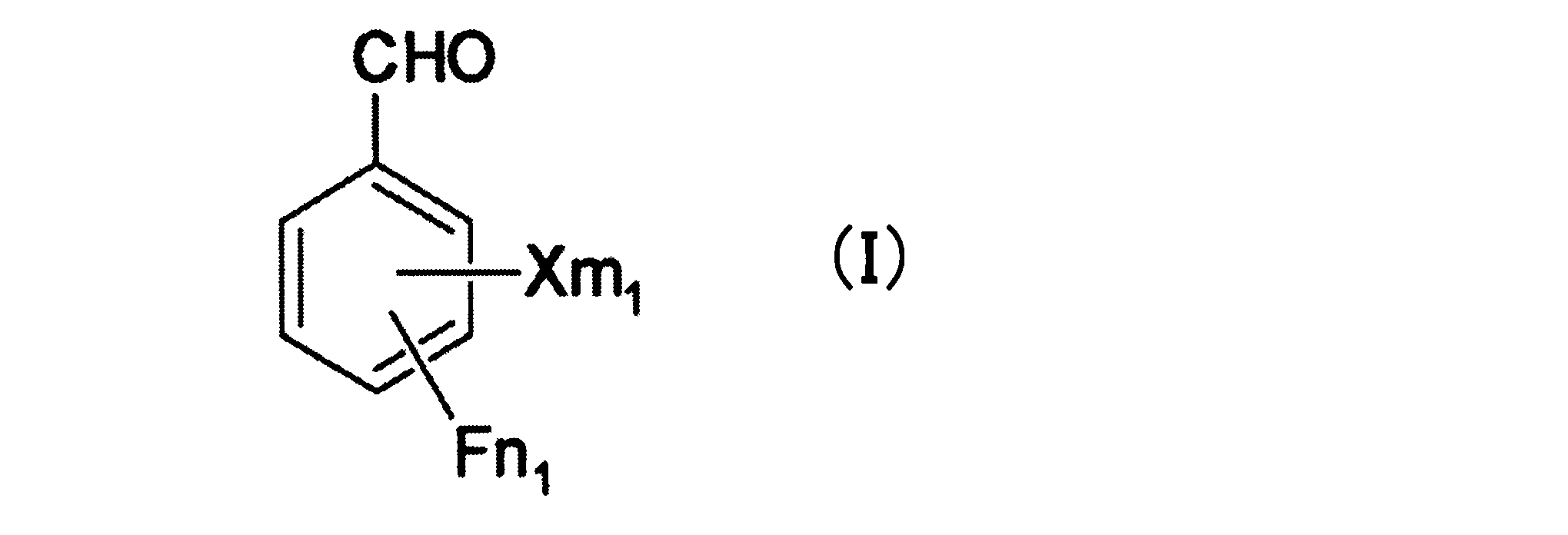
(式中のXは同一または異なる塩素原子、臭素原子、またはヨウ素原子、m1は1~5の整数、n1は0または1~4の整数で、m1+n1≦5である)
で表されるハロゲン化芳香族アルデヒドとアルカリ金属フッ化物とを加熱下で反応させ、
下記一般式(II)
で表されるハロゲン化芳香族アルデヒドとアルカリ金属フッ化物とを加熱下で反応させ、
下記一般式(II)
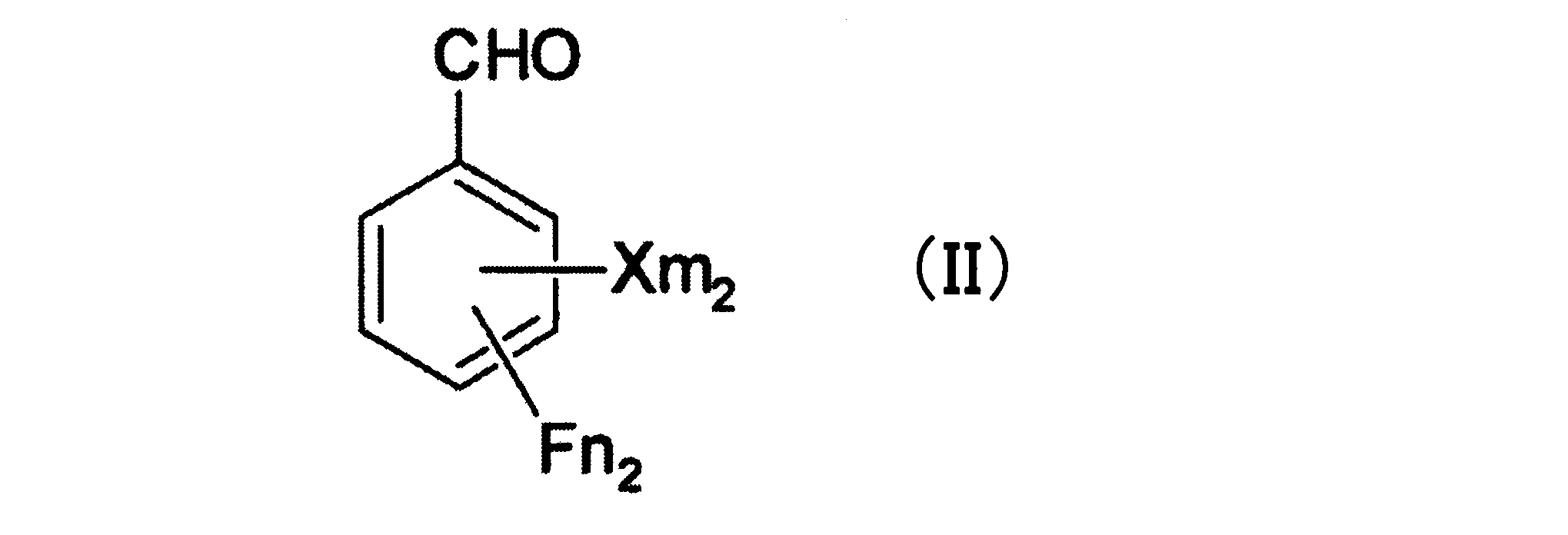
(式中のXは同一または異なる塩素原子、臭素原子、またはヨウ素原子、m2は0または1~4の整数、n2は1~5の整数で、m2+n2≦5、m1>m2、n1<n2である)
で表されるフッ素化芳香族アルデヒドを得る第1工程と、第1工程で得られたフッ素化芳香族アルデヒドと反応溶媒を含む反応液に水を加えることによって、フッ素化芳香族アルデヒドを含む有機層と反応溶媒および水を含む水層に分離する第2工程を含む、フッ素化芳香族アルデヒドの製造方法である。
で表されるフッ素化芳香族アルデヒドを得る第1工程と、第1工程で得られたフッ素化芳香族アルデヒドと反応溶媒を含む反応液に水を加えることによって、フッ素化芳香族アルデヒドを含む有機層と反応溶媒および水を含む水層に分離する第2工程を含む、フッ素化芳香族アルデヒドの製造方法である。
以下、製造方法の工程に使用する成分や条件について説明する。
本発明の第1工程は、触媒存在下、比誘電率が30以上である有機溶媒を反応溶媒に用い、前記一般式(I)で表されるハロゲン化芳香族アルデヒドとアルカリ金属フッ化物とを加熱下で反応させ、前記一般式(II)で表されるフッ素化芳香族アルデヒドを得る工程である。
第1工程で用いられるハロゲン化芳香族アルデヒドとしては、前記一般式(I)で表される構造を満たしていれば、いずれの化合物であっても良い。臭素化芳香族アルデヒドやヨウ素化芳香族アルデヒドは分子量が大きく、単位当りの製品を取得するために必要な原料の量が多くなり、製造コストが増加することや、臭素化芳香族アルデヒド中の臭素原子はラジカル化しやすく、臭素ラジカルとの反応に伴う不純物の副生が多くなる可能性があることから、前記一般式(I)の式中のXは、塩素原子であることが好ましい。
前記一般式(I)で表される化合物としては、具体的には、2-クロロベンズアルデヒド、3-クロロベンズアルデヒド、4-クロロベンズアルデヒド、2,3-ジクロロベンズアルデヒド、2,4-ジクロロベンズアルデヒド、2,6-ジクロロベンズアルデヒド、3,4-ジクロロベンズアルデヒド、3,5-ジクロロベンズアルデヒド、2-クロロ-4-フルオロベンズアルデヒド、2-クロロ-6-フルオロベンズアルデヒド、3-クロロ-4-フルオロベンズアルデヒド、2,3,4-トリクロロベンズアルデヒド、2,4,5-トリクロロベンズアルデヒド、2,4,6-トリクロロベンズアルデヒド、3,4,5-トリクロロベンズアルデヒド、2,3,4,6-テトラクロロベンズアルデヒド、2,3,4,5,6-ペンタクロロベンズアルデヒドなどの塩素化芳香族アルデヒド;2-ブロモベンズアルデヒド、3-ブロモベンズアルデヒド、4-ブロモベンズアルデヒド、2,3-ジブロモベンズアルデヒド、2,4-ジブロモベンズアルデヒド、2,6-ジブロモベンズアルデヒド、3,4-ジブロモベンズアルデヒド、3,5-ジブロモベンズアルデヒド、2-ブロモ-4-フルオロベンズアルデヒド、2-ブロモ-6-フルオロベンズアルデヒド、3-ブロモ-4-フルオロベンズアルデヒド、2,3,4-トリブロモベンズアルデヒド、2,4,5-トリブロモベンズアルデヒド、2,4,6-トリブロモベンズアルデヒド、3,4,5-トリブロモベンズアルデヒド、2,3,4,6-テトラブロモベンズアルデヒド、2,3,4,5,6-ペンタブロモベンズアルデヒドなどの臭素化芳香族アルデヒド;2-ヨードベンズアルデヒド、3-ヨードベンズアルデヒド、4-ヨードベンズアルデヒド、2,3-ジヨードベンズアルデヒド、2,4-ジヨードベンズアルデヒド、2,6-ジヨードベンズアルデヒド、3,4-ジヨードベンズアルデヒド、3,5-ジヨードベンズアルデヒド、2-ヨード-4-フルオロベンズアルデヒド、2-ヨード-6-フルオロベンズアルデヒド、3-ヨード-4-フルオロベンズアルデヒド、2,3,4-トリヨードベンズアルデヒド、2,4,5-トリヨードベンズアルデヒド、2,4,6-トリヨードベンズアルデヒド、3,4,5-トリヨードベンズアルデヒド、2,3,4,6-テトラヨードベンズアルデヒド、2,3,4,5,6-ペンタヨードベンズアルデヒドなどのヨウ素化芳香族アルデヒド等が挙げられる。好ましくは、2-クロロベンズアルデヒド、3-クロロベンズアルデヒド、4-クロロベンズアルデヒド、2,3-ジクロロベンズアルデヒド、2,4-ジクロロベンズアルデヒド、2,6-ジクロロベンズアルデヒド、3,4-ジクロロベンズアルデヒド、3,5-ジクロロベンズアルデヒド、2-クロロ-4-フルオロベンズアルデヒド、2-クロロ-6-フルオロベンズアルデヒド、3-クロロ-4-フルオロベンズアルデヒド、2,3,4-トリクロロベンズアルデヒド、2,4,5-トリクロロベンズアルデヒド、2,4,6-トリクロロベンズアルデヒド、3,4,5-トリクロロベンズアルデヒド、2,3,4,6-テトラクロロベンズアルデヒド、2,3,4,5,6-ペンタクロロベンズアルデヒドなどの塩素化芳香族アルデヒドであり、より好ましくは、2-クロロベンズアルデヒド、4-クロロベンズアルデヒド、2,4-ジクロロベンズアルデヒド、2,6-ジクロロベンズアルデヒド、3,4-ジクロロベンズアルデヒド、2-クロロ-4-フルオロベンズアルデヒド、2-クロロ-6-フルオロベンズアルデヒド、3-クロロ-4-フルオロベンズアルデヒド、2,3,4-トリクロロベンズアルデヒド、2,4,5-トリクロロベンズアルデヒド、2,3,4,6-テトラクロロベンズアルデヒドであり、さらに好ましくは、2-クロロベンズアルデヒド、4-クロロベンズアルデヒド、2,4-ジクロロベンズアルデヒド、2,6-ジクロロベンズアルデヒド、3,4-ジクロロベンズアルデヒド、2-クロロ-4-フルオロベンズアルデヒド、2-クロロ-6-フルオロベンズアルデヒド、3-クロロ-4-フルオロベンズアルデヒドが挙げられる。
第1工程で用いられる触媒としては、第四級アンモニウム塩、第四級ホスホニウム塩、クラウンエーテル、およびグリコールから選ばれた化合物が挙げられる。具体的には、テトラメチルアンモニウムクロリド、テトラメチルアンモニウムブロミド、テトラエチルアンモニウムクロリド、テトラエチルアンモニウムブロミド、テトラブチルアンモニウムクロリド、テトラブチルアンモニウムブロミド、ベンジルトリメチルアンモニウムクロリド、ベンジルトリメチルアンモニウムブロミドなどの第四級アンモニウム塩;テトラフェニルホスホニウムクロリド、テトラフェニルホスホニウムブロミド、ベンジルトリブチルホスホニウムクロリド、ベンジルトリフェニルホスホニウムクロリド、トリフェニルメチルホスホニウムクロリドなどの第四級ホスホニウム塩;18-クラウン-6、ジベンゾ-18-クラウン-6、ジシクロヘキサノ-18-クラウン-6、12-クラウン-4、15-クラウン-5、ジベンゾ-24-クラウン-8などのクラウンエーテル;ジエチレングリコール、トリエチレングリコール、テトラエチレングリコール、ポリエチレングリコールなどのアルキレングリコール;ジエチレングリコールジメチルエーテル、トリエチレングリコールジメチルエーテル、テトラエチレングリコールジメチルエーテル、ポリエチレングリコールジメチルエーテル、ポリエチレングリコールジブチルエーテルなどのアルキレングリコールエーテル等が挙げられる。本発明においてはこれらの化合物をそれぞれ単独で用いても良いし、2種以上を組み合わせて用いても良い。好ましくはテトラメチルアンモニウムクロリド、テトラメチルアンモニウムブロミド、テトラフェニルホスホニウムクロリド、テトラフェニルホスホニウムブロミド、18-クラウン-6、ポリエチレングリコール、トリエチレングリコールジメチルエーテル、テトラエチレングリコールジメチルエーテル、ポリエチレングリコールジメチルエーテルであり、より好ましくはテトラメチルアンモニウムクロリド、テトラメチルアンモニウムブロミド、テトラフェニルホスホニウムクロリドおよびテトラフェニルホスホニウムブロミドから選ばれた化合物が挙げられる。
また、前記触媒の使用量としては、一般式(I)で表されるハロゲン化芳香族アルデヒドに対して少なすぎると、反応が進行しない、あるいは著しく遅くなり、また多すぎると、副反応による不純物の副生が増加する。例えば、原料として2,6-ジクロロベンズアルデヒドを用い、2-クロロ-6-フルオロベンズアルデヒド、または2,6-ジフルオロベンズアルデヒドを製造する場合には、原料100mol%に対して5~50mol%が好ましく、より好ましくは10~40mol%であり、さらに好ましくは10~30mol%である。
第1工程で用いられる反応溶媒としては、水への溶解度が高く、反応液に水を添加すると水層側に分配させることができることから、比誘電率が30以上である有機溶媒を用いる必要がある。かかる具体例としては、好ましくはスルホラン、スルホキシド、スルホン、アミド、またはピロリドンがあげられる。より好ましくはジメチルスルホキシド(比誘電率:47.2)、ジメチルスルホン(比誘電率:47.4)、スルホラン(比誘電率:43.3)、ジメチルホルムアミド(比誘電率:38.3)、ジメチルアセトアミド(比誘電率:38.9)、またはN-メチルピロリドン(比誘電率:32.2)である。
なお、比誘電率とは、物体の誘電率と真空の誘電率との比のことであり、溶解度の指標となる。ここでは公益社団法人 日本化学会 編“化学便覧 基礎編 改訂6版”(2021、丸善株式会社)およびD.R.Lide, “CRC Handbook of Chemistry and Physics, 83rd ed.”, (2002)等に記載の数値を用いることとする。
また、後述の第2工程で得られた水層から反応溶媒を回収する方法としては通常蒸留を行うが、反応溶媒の沸点が高い場合、フッ素化反応で副生した不純物が回収した反応溶媒に残留し、第1工程に再利用した際に、反応収率の低下や不純物の蓄積が発生する。そのため、第1工程で用いられる反応溶媒としては、比誘電率が30以上であり、かつ沸点が250℃以下の有機溶媒が好ましい。そのような有機溶媒としては、具体的には、ジメチルスルホキシド(沸点189℃)、ジメチルスルホン(沸点238℃)、ジメチルホルムアミド(沸点153℃)、ジメチルアセトアミド(沸点165℃)、またはN-メチルピロリドン(沸点202℃)が挙げられる。
第1工程で用いられるアルカリ金属フッ化物は、原料、目的物および有機溶媒に難溶であり、かつ化学量論量以上必要とされる。そのため、反応溶媒が少なすぎると第1工程での反応液を十分に撹拌できず、反応が不均一になり、反応が進行しないか、著しく遅くなる場合があるため、反応溶媒は反応液を十分に撹拌できる量用いることが好ましい。例えば、原料として2,6-ジクロロベンズアルデヒドを用い、2-クロロ-6-フルオロベンズアルデヒド、または2,6-ジフルオロベンズアルデヒドを製造する場合、反応溶媒の使用量としては、使用するアルカリ金属フッ化物の重量に対し、0~5倍量が好ましく、特に好ましくは0.5~3倍量である。
第1工程で用いられるアルカリ金属フッ化物としては、フッ化ナトリウム、フッ化カリウム、フッ化セシウム、フッ化ルビジウムが挙げられ、好ましくはフッ化カリウムであり、特に好ましくはスプレー乾燥されたフッ化カリウムである。
また、前記アルカリ金属フッ化物の使用量としては、一般式(I)で表されるハロゲン化芳香族アルデヒド中のハロゲン原子の内、フッ素原子に置換するハロゲン原子の数に対して、0.75~1.5モル倍量となることが好ましく、より好ましくは0.75~1.25モル倍量である。例えば、原料として2,6-ジクロロベンズアルデヒドを用い、2-クロロ-6-フルオロベンズアルデヒドを製造する場合のアルカリ金属フッ化物の使用量は、2,6-ジクロロベンズアルデヒドに対して0.75~1.5モル倍量が好ましく、0.75~1.25モル倍量がより好ましい。また、原料として2,6-ジクロロベンズアルデヒドを用い、2,6-ジフルオロベンズアルデヒドを製造する場合のアルカリ金属フッ化物の使用量は、2,6-ジクロロベンズアルデヒドに対して1.5~3.0モル倍量が好ましく、1.5~2.5モル倍量がより好ましい。
本発明における第1工程では、ハロゲン化芳香族アルデヒドとアルカリ金属フッ化物を加熱反応させる必要がある。かかる加熱反応は、反応溶媒の沸点以下の温度で進行させることが好ましい。具体的には、100℃以上反応溶媒の沸点以下の温度が好ましく、特に好ましくは150℃以上反応溶媒の沸点以下の温度である。
本発明の第2工程は、第1工程で得られたフッ素化芳香族アルデヒドと反応溶媒を含む反応液に水を加えることによって、フッ素化芳香族アルデヒドを含む有機層と反応溶媒および水を含む水層に分離する工程である。
通常、フッ素化反応により得られたフッ素化芳香族アルデヒドを精製するためには蒸留が用いられるが、フッ素化反応で用いられる反応溶媒は、フッ素化芳香族アルデヒドや原料のハロゲン化芳香族アルデヒド、および副生する不純物と沸点が近いため、フッ素化反応液を直接蒸留すると、分離が不十分となる場合がある。そのため、蒸留によりフッ素化芳香族アルデヒドを精製する前に、本発明の第2工程において、第1工程により得られた反応液に水を添加することにより、フッ素化芳香族アルデヒドと反応溶媒を分離する。
第2工程における水の使用量としては、反応溶媒の全量を水とともに水層へ抽出できる量が含まれることが好ましい。加えて、未反応のアルカリ金属フッ化物、および反応で副生するアルカリ金属ハロゲン化物を全量溶解できる量を用いることが好ましい。水の使用量は、例えば、2,6-ジクロロベンズアルデヒドから、2-クロロ-6-フルオロベンズアルデヒド、または2,6-ジフルオロベンズアルデヒドを製造する場合には、使用した反応溶媒の重量に対して0.5~5.0倍量が好ましく、0.5~3.0倍量がより好ましい。
また、第2工程において、有機層と水層を分離する際、抽出溶媒をさらに加えてもよい。抽出溶媒としては、一般式(I)で表されるハロゲン化芳香族アルデヒド、および一般式(II)で表されるフッ素化芳香族アルデヒドを溶解させることができる疎水性有機溶媒であればいずれでも良い。具体的にはベンゼン、トルエン、キシレン、ヘキサン、シクロヘキサン、ジクロロベンゼン、ジクロロトルエンなどが好ましい。
本発明のフッ素化芳香族アルデヒドの製造方法は、前記第2工程で得られた有機層中のフッ素化芳香族アルデヒドを精製するとともに未反応の一般式(I)で表されるハロゲン化芳香族アルデヒドを回収する第3工程および/または前記第2工程で得られた水層から、反応溶媒を回収する第4工程をさらに含んでもよい。
第3工程は、前記第2工程で得られた有機層中のフッ素化芳香族アルデヒドを精製するとともに未反応のハロゲン化芳香族アルデヒド(一般式(I))を回収する工程である。このような工程には、蒸留が好ましく用いられる。蒸留は、単蒸留および多段蒸留のいずれでも良く、連続式およびバッチ式のいずれでも良いが、より効率的に分離するためには棚段塔または充填塔のいずれかを用いることが好ましい。また常圧での蒸留であっても、減圧での蒸留であっても良いが、高温で長時間かけて蒸留すると、芳香族アルデヒドが分解または二量化等の不純化を起こすため、減圧下、低温で蒸留することが好ましい。
蒸留における塔底の温度条件は、50℃以上250℃以下が好ましく、より好ましくは100℃以上220℃以下、さらに好ましくは100℃以上200℃以下である。蒸留における理論段数は10段以上が好ましく、より好ましくは20段以上、さらに好ましくは40段以上である。
第4工程は、前記第2工程で得られた水層から、反応溶媒を回収する工程である。このような工程には、蒸留が好ましく用いられる。蒸留は単蒸留および多段蒸留のいずれでも良く、連続式およびバッチ式のいずれでも良いが、より効率的に分離するためには、棚段塔または充填塔のいずれかを用いることが好ましい。また、常圧での蒸留であっても、減圧での蒸留であっても良い。
蒸留における温度条件は、50℃以上反応溶媒の沸点以下が好ましく、より好ましくは80℃以上反応溶媒の沸点以下、さらに好ましくは100℃以上反応溶媒の沸点以下である。蒸留における理論段数は5段以上が好ましく、より好ましくは10段以上である。
前記第3工程で回収された未反応のハロゲン化芳香族アルデヒド(一般式(I))、および/または第4工程で回収された反応溶媒は、原料として第1工程で再利用することができる。再利用する場合には、回収されたハロゲン化芳香族アルデヒドや反応溶媒を単独で使用しても良いし、新品のものと混合して使用しても良い。
以下、実施例に基づいて本発明をより詳細に説明するが、本発明はこれらの実施例により限定されるものではない。
実施例1
100mL4つ口フラスコにスプレードライフッ化カリウム3.2g(55mmol)、およびテトラメチルアンモニウムクロリド0.5g(5mmol)を加え、60℃に昇温した後、0.7kPaまで減圧し、1時間減圧脱水を行った。減圧脱水後、窒素雰囲気下にて、2,6-ジクロロベンズアルデヒド8.8g(50mmol)およびジメチルスルホキシド6.0g(77mmol)を仕込み、160℃まで昇温し、6時間反応を行った。反応6時間後の反応液を、ガスクロマトグラフィー(以下、GCと称する)にて分析したところ、収率48%で2-フルオロ-6-クロロベンズアルデヒドが生成し、収率14%で2,6-ジフルオロベンズアルデヒドが生成していた。また2,6-ジクロロベンズアルデヒドの転化率は68%であった。
100mL4つ口フラスコにスプレードライフッ化カリウム3.2g(55mmol)、およびテトラメチルアンモニウムクロリド0.5g(5mmol)を加え、60℃に昇温した後、0.7kPaまで減圧し、1時間減圧脱水を行った。減圧脱水後、窒素雰囲気下にて、2,6-ジクロロベンズアルデヒド8.8g(50mmol)およびジメチルスルホキシド6.0g(77mmol)を仕込み、160℃まで昇温し、6時間反応を行った。反応6時間後の反応液を、ガスクロマトグラフィー(以下、GCと称する)にて分析したところ、収率48%で2-フルオロ-6-クロロベンズアルデヒドが生成し、収率14%で2,6-ジフルオロベンズアルデヒドが生成していた。また2,6-ジクロロベンズアルデヒドの転化率は68%であった。
実施例2
実施例1で得られた反応液にイオン交換水20gを添加し、攪拌後、有機層と水層に分離した。有機層への2-フルオロ-6-クロロベンズアルデヒド、2,6-ジフルオロベンズアルデヒド、および2,6-ジクロロベンズアルデヒドの回収率はそれぞれ99%であった。また、水層へのジメチルスルホキシド回収率は99%であった。
実施例1で得られた反応液にイオン交換水20gを添加し、攪拌後、有機層と水層に分離した。有機層への2-フルオロ-6-クロロベンズアルデヒド、2,6-ジフルオロベンズアルデヒド、および2,6-ジクロロベンズアルデヒドの回収率はそれぞれ99%であった。また、水層へのジメチルスルホキシド回収率は99%であった。
実施例3
実施例1で得られた反応液にイオン交換水20gおよびトルエン20gを添加し、抽出を行い、有機層と水層に分離した。さらに分離した水層をトルエン20gで抽出する操作を2回繰り返した。有機層への2-フルオロ-6-クロロベンズアルデヒド、2,6-ジフルオロベンズアルデヒド、および2,6-ジクロロベンズアルデヒドの回収率はそれぞれ99%であった。また、水層へのジメチルスルホキシド回収率は99%であった。
実施例1で得られた反応液にイオン交換水20gおよびトルエン20gを添加し、抽出を行い、有機層と水層に分離した。さらに分離した水層をトルエン20gで抽出する操作を2回繰り返した。有機層への2-フルオロ-6-クロロベンズアルデヒド、2,6-ジフルオロベンズアルデヒド、および2,6-ジクロロベンズアルデヒドの回収率はそれぞれ99%であった。また、水層へのジメチルスルホキシド回収率は99%であった。
実施例4
スプレードライフッ化カリウムの使用量を4.4g(75mmol)、ジメチルスルホキシドの使用量を8.2g(105mmol)とした以外は実施例1と同等の操作を行った。反応6時間後の反応液を、ガスクロマトグラフィーにて分析したところ、収率43%で2-フルオロ-6-クロロベンズアルデヒドが生成し、収率36%で2,6-ジフルオロベンズアルデヒドが生成していた。また2,6-ジクロロベンズアルデヒドの転化率は89%であった。さらに得られた反応液にイオン交換水20gを添加し、攪拌後、有機層と水層に分離した。有機層への2-フルオロ-6-クロロベンズアルデヒド、2,6-ジフルオロベンズアルデヒド、および2,6-ジクロロベンズアルデヒドの回収率はそれぞれ99%であった。また、水層へのジメチルスルホキシド回収率は99%であった。
スプレードライフッ化カリウムの使用量を4.4g(75mmol)、ジメチルスルホキシドの使用量を8.2g(105mmol)とした以外は実施例1と同等の操作を行った。反応6時間後の反応液を、ガスクロマトグラフィーにて分析したところ、収率43%で2-フルオロ-6-クロロベンズアルデヒドが生成し、収率36%で2,6-ジフルオロベンズアルデヒドが生成していた。また2,6-ジクロロベンズアルデヒドの転化率は89%であった。さらに得られた反応液にイオン交換水20gを添加し、攪拌後、有機層と水層に分離した。有機層への2-フルオロ-6-クロロベンズアルデヒド、2,6-ジフルオロベンズアルデヒド、および2,6-ジクロロベンズアルデヒドの回収率はそれぞれ99%であった。また、水層へのジメチルスルホキシド回収率は99%であった。
実施例5
スプレードライフッ化カリウムの使用量を6.4g(110mmol)、ジメチルスルホキシドの使用量を12.6g(161mmol)とした以外は実施例1と同等の操作を行った。反応6時間後の反応液を、ガスクロマトグラフィーにて分析したところ、収率19%で2-フルオロ-6-クロロベンズアルデヒドが生成し、収率66%で2,6-ジフルオロベンズアルデヒドが生成していた。また2,6-ジクロロベンズアルデヒドの転化率は99%であった。さらに得られた反応液にイオン交換水40gを添加し、攪拌後、有機層と水層に分離した。有機層への2-フルオロ-6-クロロベンズアルデヒド、2,6-ジフルオロベンズアルデヒド、および2,6-ジクロロベンズアルデヒドの回収率はそれぞれ99%であった。また、水層へのジメチルスルホキシド回収率は99%であった。
スプレードライフッ化カリウムの使用量を6.4g(110mmol)、ジメチルスルホキシドの使用量を12.6g(161mmol)とした以外は実施例1と同等の操作を行った。反応6時間後の反応液を、ガスクロマトグラフィーにて分析したところ、収率19%で2-フルオロ-6-クロロベンズアルデヒドが生成し、収率66%で2,6-ジフルオロベンズアルデヒドが生成していた。また2,6-ジクロロベンズアルデヒドの転化率は99%であった。さらに得られた反応液にイオン交換水40gを添加し、攪拌後、有機層と水層に分離した。有機層への2-フルオロ-6-クロロベンズアルデヒド、2,6-ジフルオロベンズアルデヒド、および2,6-ジクロロベンズアルデヒドの回収率はそれぞれ99%であった。また、水層へのジメチルスルホキシド回収率は99%であった。
実施例6
185℃で4時間反応させた以外は実施例1と同等の操作を行った。反応6時間後の反応液を、ガスクロマトグラフィーにて分析したところ、収率48%で2-フルオロ-6-クロロベンズアルデヒドが生成し、収率16%で2,6-ジフルオロベンズアルデヒドが生成していた。また2,6-ジクロロベンズアルデヒドの転化率は70%であった。さらに得られた反応液にイオン交換水20gを添加し、攪拌後、有機層と水層に分離した。有機層への2-フルオロ-6-クロロベンズアルデヒド、2,6-ジフルオロベンズアルデヒド、および2,6-ジクロロベンズアルデヒドの回収率はそれぞれ99%であった。また、水層へのジメチルスルホキシド回収率は99%であった。
185℃で4時間反応させた以外は実施例1と同等の操作を行った。反応6時間後の反応液を、ガスクロマトグラフィーにて分析したところ、収率48%で2-フルオロ-6-クロロベンズアルデヒドが生成し、収率16%で2,6-ジフルオロベンズアルデヒドが生成していた。また2,6-ジクロロベンズアルデヒドの転化率は70%であった。さらに得られた反応液にイオン交換水20gを添加し、攪拌後、有機層と水層に分離した。有機層への2-フルオロ-6-クロロベンズアルデヒド、2,6-ジフルオロベンズアルデヒド、および2,6-ジクロロベンズアルデヒドの回収率はそれぞれ99%であった。また、水層へのジメチルスルホキシド回収率は99%であった。
実施例7
140℃で24時間反応させた以外は実施例1と同等の操作を行った。反応24時間後の反応液を、ガスクロマトグラフィーにて分析したところ、収率39%で2-フルオロ-6-クロロベンズアルデヒドが生成し、収率6%で2,6-ジフルオロベンズアルデヒドが生成していた。また2,6-ジクロロベンズアルデヒドの転化率は51%であった。さらに得られた反応液にイオン交換水20gを添加し、攪拌後、有機層と水層に分離した。有機層への2-フルオロ-6-クロロベンズアルデヒド、2,6-ジフルオロベンズアルデヒド、および2,6-ジクロロベンズアルデヒドの回収率はそれぞれ99%であった。また、水層へのジメチルスルホキシド回収率は99%であった。
140℃で24時間反応させた以外は実施例1と同等の操作を行った。反応24時間後の反応液を、ガスクロマトグラフィーにて分析したところ、収率39%で2-フルオロ-6-クロロベンズアルデヒドが生成し、収率6%で2,6-ジフルオロベンズアルデヒドが生成していた。また2,6-ジクロロベンズアルデヒドの転化率は51%であった。さらに得られた反応液にイオン交換水20gを添加し、攪拌後、有機層と水層に分離した。有機層への2-フルオロ-6-クロロベンズアルデヒド、2,6-ジフルオロベンズアルデヒド、および2,6-ジクロロベンズアルデヒドの回収率はそれぞれ99%であった。また、水層へのジメチルスルホキシド回収率は99%であった。
実施例8
ジメチルスルホキシドの代わりにスルホラン6.0g(50mmol)を用い、反応温度を220℃とした以外は実施例1と同等の操作を行った。反応6時間後の反応液を、ガスクロマトグラフィーにて分析したところ、収率45%で2-フルオロ-6-クロロベンズアルデヒドが生成し、収率17%で2,6-ジフルオロベンズアルデヒドが生成していた。また2,6-ジクロロベンズアルデヒドの転化率は77%であった。
ジメチルスルホキシドの代わりにスルホラン6.0g(50mmol)を用い、反応温度を220℃とした以外は実施例1と同等の操作を行った。反応6時間後の反応液を、ガスクロマトグラフィーにて分析したところ、収率45%で2-フルオロ-6-クロロベンズアルデヒドが生成し、収率17%で2,6-ジフルオロベンズアルデヒドが生成していた。また2,6-ジクロロベンズアルデヒドの転化率は77%であった。
実施例9
ジメチルスルホキシドの代わりにスルホラン12.6g(105mmol)を用い、反応温度を220℃とした以外は実施例1と同等の操作を行った。反応6時間後の反応液を、ガスクロマトグラフィーにて分析したところ、収率24%で2-フルオロ-6-クロロベンズアルデヒドが生成し、収率34%で2,6-ジフルオロベンズアルデヒドが生成していた。また2,6-ジクロロベンズアルデヒドの転化率は97%であった。
ジメチルスルホキシドの代わりにスルホラン12.6g(105mmol)を用い、反応温度を220℃とした以外は実施例1と同等の操作を行った。反応6時間後の反応液を、ガスクロマトグラフィーにて分析したところ、収率24%で2-フルオロ-6-クロロベンズアルデヒドが生成し、収率34%で2,6-ジフルオロベンズアルデヒドが生成していた。また2,6-ジクロロベンズアルデヒドの転化率は97%であった。
実施例10
500mL4つ口ナスフラスコにスプレードライフッ化カリウム32.0g(550mmol)、およびテトラメチルアンモニウムクロリド2.7g(25mmol)を加え、60℃に昇温した後、0.7kPaまで減圧し、1時間減圧脱水を行った。減圧脱水後、窒素雰囲気下にて、2,6-ジクロロベンズアルデヒド43.8g(250mmol)、ジメチルスルホキシド62.5g(800mmol)を仕込み、160℃まで昇温し、6時間反応を行った。反応6時間後の反応液を、ガスクロマトグラフィーにて分析したところ、収率10%で2-フルオロ-6-クロロベンズアルデヒドが生成し、収率81%で2,6-ジフルオロベンズアルデヒドが生成していた。また2,6-ジクロロベンズアルデヒドの転化率は99%であった。前記で得られた反応液にイオン交換水100gおよびトルエン100gを添加し、抽出を行い、有機層と水層に分離した。さらに分離した水層をトルエン100gで抽出する操作を2回繰り返した。前記操作で分離した水層250gをヘリパックNo.1を充填した蒸留塔(内径10mm、充填高さ100mm、理論段数5段)の塔底に仕込み、減圧蒸留した。減圧蒸留は、圧力5kPaの下で、塔底温度を90℃まで加熱し、水を留出させた後、徐々に0.6kPaまで減圧を行い、ジメチルスルホキシドを収率84%で回収した。回収したジメチルスルホキシド中の水分は0.1重量パーセントであり、GCにて分析したジメチルスルホキシドの面積%は99.9%であった。
500mL4つ口ナスフラスコにスプレードライフッ化カリウム32.0g(550mmol)、およびテトラメチルアンモニウムクロリド2.7g(25mmol)を加え、60℃に昇温した後、0.7kPaまで減圧し、1時間減圧脱水を行った。減圧脱水後、窒素雰囲気下にて、2,6-ジクロロベンズアルデヒド43.8g(250mmol)、ジメチルスルホキシド62.5g(800mmol)を仕込み、160℃まで昇温し、6時間反応を行った。反応6時間後の反応液を、ガスクロマトグラフィーにて分析したところ、収率10%で2-フルオロ-6-クロロベンズアルデヒドが生成し、収率81%で2,6-ジフルオロベンズアルデヒドが生成していた。また2,6-ジクロロベンズアルデヒドの転化率は99%であった。前記で得られた反応液にイオン交換水100gおよびトルエン100gを添加し、抽出を行い、有機層と水層に分離した。さらに分離した水層をトルエン100gで抽出する操作を2回繰り返した。前記操作で分離した水層250gをヘリパックNo.1を充填した蒸留塔(内径10mm、充填高さ100mm、理論段数5段)の塔底に仕込み、減圧蒸留した。減圧蒸留は、圧力5kPaの下で、塔底温度を90℃まで加熱し、水を留出させた後、徐々に0.6kPaまで減圧を行い、ジメチルスルホキシドを収率84%で回収した。回収したジメチルスルホキシド中の水分は0.1重量パーセントであり、GCにて分析したジメチルスルホキシドの面積%は99.9%であった。
実施例11
ジメチルスルホキシドとして実施例10で得られた回収ジメチルスルホキシドを用いた以外は実施例1と同等の操作を行った。反応6時間後の反応液を、ガスクロマトグラフィーにて分析したところ、収率47%で2-フルオロ-6-クロロベンズアルデヒドが生成し、収率17%で2,6-ジフルオロベンズアルデヒドが生成していた。また2,6-ジクロロベンズアルデヒドの転化率は73%であった。
ジメチルスルホキシドとして実施例10で得られた回収ジメチルスルホキシドを用いた以外は実施例1と同等の操作を行った。反応6時間後の反応液を、ガスクロマトグラフィーにて分析したところ、収率47%で2-フルオロ-6-クロロベンズアルデヒドが生成し、収率17%で2,6-ジフルオロベンズアルデヒドが生成していた。また2,6-ジクロロベンズアルデヒドの転化率は73%であった。
実施例12
ジメチルスルホキシドとして実施例10で得られた回収ジメチルスルホキシドを用いた以外は実施例5と同等の操作を行った。反応6時間後の反応液を、ガスクロマトグラフィーにて分析したところ、収率26%で2-フルオロ-6-クロロベンズアルデヒドが生成し、収率58%で2,6-ジフルオロベンズアルデヒドが生成していた。また2,6-ジクロロベンズアルデヒドの転化率は97%であった。
ジメチルスルホキシドとして実施例10で得られた回収ジメチルスルホキシドを用いた以外は実施例5と同等の操作を行った。反応6時間後の反応液を、ガスクロマトグラフィーにて分析したところ、収率26%で2-フルオロ-6-クロロベンズアルデヒドが生成し、収率58%で2,6-ジフルオロベンズアルデヒドが生成していた。また2,6-ジクロロベンズアルデヒドの転化率は97%であった。
実施例11、12と実施例1、5との対比から、本発明の方法により回収したジメチルスルホキシドを用いても、新品のジメチルスルホキシドを用いた場合と遜色ない反応を行うことができることが分かった。
実施例13
1000mL4つ口ナスフラスコにスプレードライフッ化カリウム95.9g(1650mmol)、およびテトラメチルアンモニウムクロリド16.4g(150mmol)を加え、60℃に昇温した後、0.7kPaまで減圧し、1時間減圧脱水を行った。減圧脱水後、窒素雰囲気下にて、2,6-ジクロロベンズアルデヒド262.5g(1500mmol)、ジメチルスルホキシド175.8g(2250mmol)を仕込み、160℃まで昇温し、6時間反応を行った。反応6時間後の反応液を、ガスクロマトグラフィーにて分析したところ、収率45%で2-フルオロ-6-クロロベンズアルデヒドが生成し、収率16%で2,6-ジフルオロベンズアルデヒドが生成していた。また2,6-ジクロロベンズアルデヒドの転化率は75%であった。前記で得られた反応液にイオン交換水560gを添加し、抽出を行い、有機層と水層に分離した。
1000mL4つ口ナスフラスコにスプレードライフッ化カリウム95.9g(1650mmol)、およびテトラメチルアンモニウムクロリド16.4g(150mmol)を加え、60℃に昇温した後、0.7kPaまで減圧し、1時間減圧脱水を行った。減圧脱水後、窒素雰囲気下にて、2,6-ジクロロベンズアルデヒド262.5g(1500mmol)、ジメチルスルホキシド175.8g(2250mmol)を仕込み、160℃まで昇温し、6時間反応を行った。反応6時間後の反応液を、ガスクロマトグラフィーにて分析したところ、収率45%で2-フルオロ-6-クロロベンズアルデヒドが生成し、収率16%で2,6-ジフルオロベンズアルデヒドが生成していた。また2,6-ジクロロベンズアルデヒドの転化率は75%であった。前記で得られた反応液にイオン交換水560gを添加し、抽出を行い、有機層と水層に分離した。
以上の操作を1バッチとし、5バッチ同様の操作を繰り返し、有機層を合計1180g取得した。得られた有機層1180gを、スルーザー社ラボパッキンEXを充填した蒸留塔(内径25mm、充填高さ1320mm、理論段数60段)の塔底に仕込み、減圧下で分別蒸留を行った。分別蒸留では、塔底圧力7.6kPaの下で、塔底温度を121℃まで加熱し、2-フルオロ-6-クロロベンズアルデヒド、および2,6-ジフルオロベンズアルデヒドをそれぞれ分別留去させた後、塔底温度を151℃まで加熱し、2,6-ジクロロベンズアルデヒド、およびスルホランをそれぞれ分別留去した。以上の分別蒸留により、GCにて分析した面積%が99.0%以上である2-フルオロ-6-クロロベンズアルデヒドの留分を収率90%で、2,6-ジフルオロベンズアルデヒドの留分を収率70%で得た。また、GCにて分析した面積%が99.0%以上である2,6-ジクロロベンズアルデヒドの留分を収率74%で回収した。
実施例14
2,6-ジクロロロベンズアルデヒドとして実施例13で得られた回収2,6-ジクロロロベンズアルデヒドを用いた以外は実施例1と同等の操作を行った。反応6時間後の反応液を、ガスクロマトグラフィーにて分析したところ、収率48%で2-フルオロ-6-クロロベンズアルデヒドが生成し、収率18%で2,6-ジフルオロベンズアルデヒドが生成していた。また2,6-ジクロロベンズアルデヒドの転化率は72%であった。
2,6-ジクロロロベンズアルデヒドとして実施例13で得られた回収2,6-ジクロロロベンズアルデヒドを用いた以外は実施例1と同等の操作を行った。反応6時間後の反応液を、ガスクロマトグラフィーにて分析したところ、収率48%で2-フルオロ-6-クロロベンズアルデヒドが生成し、収率18%で2,6-ジフルオロベンズアルデヒドが生成していた。また2,6-ジクロロベンズアルデヒドの転化率は72%であった。
実施例15
2,6-ジクロロロベンズアルデヒドとして実施例13で得られた回収2,6-ジクロロベンズアルデヒドを用いた以外は実施例5と同等の操作を行った。反応6時間後の反応液を、ガスクロマトグラフィーにて分析したところ、収率17%で2-フルオロ-6-クロロベンズアルデヒドが生成し、収率66%で2,6-ジフルオロベンズアルデヒドが生成していた。また2,6-ジクロロベンズアルデヒドの転化率は99%であった。
2,6-ジクロロロベンズアルデヒドとして実施例13で得られた回収2,6-ジクロロベンズアルデヒドを用いた以外は実施例5と同等の操作を行った。反応6時間後の反応液を、ガスクロマトグラフィーにて分析したところ、収率17%で2-フルオロ-6-クロロベンズアルデヒドが生成し、収率66%で2,6-ジフルオロベンズアルデヒドが生成していた。また2,6-ジクロロベンズアルデヒドの転化率は99%であった。
実施例14、15と実施例1、5との対比から、本発明の方法により回収した2,6-ジクロロベンズアルデヒドを用いても、新品の2,6-ジクロロベンズアルデヒドを用いた場合と遜色ない反応を行うことができることが分かった。
実施例16
1000mL4つ口ナスフラスコにスプレードライフッ化カリウム127.8g(2200mmol)、およびテトラメチルアンモニウムクロリド11.0g(100mmol)を加え、60℃に昇温した後、0.7kPaまで減圧し、1時間減圧脱水を行った。減圧脱水後、窒素雰囲気下にて、2,6-ジクロロベンズアルデヒド175.0g(1000mmol)、ジメチルスルホキシド250g(3200mmol)を仕込み、160℃まで昇温し、6時間反応を行った。反応6時間後の反応液を、ガスクロマトグラフィーにて分析したところ、収率12%で2-フルオロ-6-クロロベンズアルデヒドが生成し、収率64%で2,6-ジフルオロベンズアルデヒドが生成していた。また2,6-ジクロロベンズアルデヒドの転化率は99%であった。前記で得られた反応液にイオン交換水650gを添加し、抽出を行い、有機層と水層に分離した。以上の操作を1バッチとし、6バッチ同様の操作を繰り返し、有機層を合計825g取得した。得られた有機層740gを、スルーザー社ラボパッキンEXを充填した蒸留塔(内径25mm、充填高さ1320mm、理論段数60段)の塔底に仕込み、減圧下で分別蒸留を行った。分別蒸留では、塔底圧力8.8kPaの下で、塔底温度を125℃まで加熱し、2-フルオロ-6-クロロベンズアルデヒド、および2,6-ジフルオロベンズアルデヒドをそれぞれ分別留去させた後、塔底温度を170℃まで加熱し、2,6-ジクロロベンズアルデヒド、およびスルホランをそれぞれ分別留去した。以上の分別蒸留により、GCにて分析した面積%が99.0%以上である2-フルオロ-6-クロロベンズアルデヒドの留分を収率90%で、2,6-ジフルオロベンズアルデヒドの留分を収率30%で得た。
1000mL4つ口ナスフラスコにスプレードライフッ化カリウム127.8g(2200mmol)、およびテトラメチルアンモニウムクロリド11.0g(100mmol)を加え、60℃に昇温した後、0.7kPaまで減圧し、1時間減圧脱水を行った。減圧脱水後、窒素雰囲気下にて、2,6-ジクロロベンズアルデヒド175.0g(1000mmol)、ジメチルスルホキシド250g(3200mmol)を仕込み、160℃まで昇温し、6時間反応を行った。反応6時間後の反応液を、ガスクロマトグラフィーにて分析したところ、収率12%で2-フルオロ-6-クロロベンズアルデヒドが生成し、収率64%で2,6-ジフルオロベンズアルデヒドが生成していた。また2,6-ジクロロベンズアルデヒドの転化率は99%であった。前記で得られた反応液にイオン交換水650gを添加し、抽出を行い、有機層と水層に分離した。以上の操作を1バッチとし、6バッチ同様の操作を繰り返し、有機層を合計825g取得した。得られた有機層740gを、スルーザー社ラボパッキンEXを充填した蒸留塔(内径25mm、充填高さ1320mm、理論段数60段)の塔底に仕込み、減圧下で分別蒸留を行った。分別蒸留では、塔底圧力8.8kPaの下で、塔底温度を125℃まで加熱し、2-フルオロ-6-クロロベンズアルデヒド、および2,6-ジフルオロベンズアルデヒドをそれぞれ分別留去させた後、塔底温度を170℃まで加熱し、2,6-ジクロロベンズアルデヒド、およびスルホランをそれぞれ分別留去した。以上の分別蒸留により、GCにて分析した面積%が99.0%以上である2-フルオロ-6-クロロベンズアルデヒドの留分を収率90%で、2,6-ジフルオロベンズアルデヒドの留分を収率30%で得た。
比較例1
1000mL4つ口ナスフラスコにスプレードライフッ化カリウム70.3g(1210mmol)、およびテトラメチルアンモニウムクロリド12.1g(110mmol)を加え、60℃に昇温した後、0.7kPaまで減圧し、1時間減圧脱水を行った。減圧脱水後、窒素雰囲気下にて、2,6-ジクロロベンズアルデヒド192.5g(1100mmol)、スルホラン132.2g(1100mmol)を仕込み、220℃まで昇温し、6時間反応を行った。反応6時間後の反応液を、ガスクロマトグラフィーにて分析したところ、収率44%で2-フルオロ-6-クロロベンズアルデヒドが生成し、収率20%で2,6-ジフルオロベンズアルデヒドが生成していた。また2,6-ジクロロベンズアルデヒドの転化率は78%であった。前記で得られた反応液にトルエン150gを添加し、ろ過を行い、不溶分を濾別した。以上の操作を1バッチとし、4バッチ同様の操作を繰り返し、ろ液を合計1790g取得した。得られたろ液1790gを2000mLナスフラスコに加え、ナスフラスコ内温90℃、圧力3kPaで単蒸留し、トルエンを留去した。トルエン留去後のろ液1000mLを、スルーザー社ラボパッキンEXを充填した蒸留塔(内径25mm、充填高さ1320mm、理論段数60段)の塔底に仕込み、減圧下で分別蒸留を行った。分別蒸留では、塔底圧力0.9kPaの下で、塔底温度を128℃まで加熱し、2-フルオロ-6-クロロベンズアルデヒド、および2,6-ジフルオロベンズアルデヒドをそれぞれ分別留去させた後、塔底圧力を1.6kPaとし、塔底温度を152℃まで加熱し、2,6-ジクロロベンズアルデヒド、およびスルホランをそれぞれ分別留去した。以上の分別蒸留により、GCにて分析した面積%が99.0%以上である2-フルオロ-6-クロロベンズアルデヒドの留分を収率81%で、2,6-ジフルオロベンズアルデヒドの留分を収率67%で得た。また、GCにて分析した面積%が98.0%以上である2,6-ジクロロベンズアルデヒドの留分を収率77%で、GCにて分析した面積%が98.0%以上であるスルホランの留分を収率47%で回収した。
1000mL4つ口ナスフラスコにスプレードライフッ化カリウム70.3g(1210mmol)、およびテトラメチルアンモニウムクロリド12.1g(110mmol)を加え、60℃に昇温した後、0.7kPaまで減圧し、1時間減圧脱水を行った。減圧脱水後、窒素雰囲気下にて、2,6-ジクロロベンズアルデヒド192.5g(1100mmol)、スルホラン132.2g(1100mmol)を仕込み、220℃まで昇温し、6時間反応を行った。反応6時間後の反応液を、ガスクロマトグラフィーにて分析したところ、収率44%で2-フルオロ-6-クロロベンズアルデヒドが生成し、収率20%で2,6-ジフルオロベンズアルデヒドが生成していた。また2,6-ジクロロベンズアルデヒドの転化率は78%であった。前記で得られた反応液にトルエン150gを添加し、ろ過を行い、不溶分を濾別した。以上の操作を1バッチとし、4バッチ同様の操作を繰り返し、ろ液を合計1790g取得した。得られたろ液1790gを2000mLナスフラスコに加え、ナスフラスコ内温90℃、圧力3kPaで単蒸留し、トルエンを留去した。トルエン留去後のろ液1000mLを、スルーザー社ラボパッキンEXを充填した蒸留塔(内径25mm、充填高さ1320mm、理論段数60段)の塔底に仕込み、減圧下で分別蒸留を行った。分別蒸留では、塔底圧力0.9kPaの下で、塔底温度を128℃まで加熱し、2-フルオロ-6-クロロベンズアルデヒド、および2,6-ジフルオロベンズアルデヒドをそれぞれ分別留去させた後、塔底圧力を1.6kPaとし、塔底温度を152℃まで加熱し、2,6-ジクロロベンズアルデヒド、およびスルホランをそれぞれ分別留去した。以上の分別蒸留により、GCにて分析した面積%が99.0%以上である2-フルオロ-6-クロロベンズアルデヒドの留分を収率81%で、2,6-ジフルオロベンズアルデヒドの留分を収率67%で得た。また、GCにて分析した面積%が98.0%以上である2,6-ジクロロベンズアルデヒドの留分を収率77%で、GCにて分析した面積%が98.0%以上であるスルホランの留分を収率47%で回収した。
参考例1
比較例1で蒸留回収したスルホランを原料とした以外は、実施例8と同等の操作を行った。反応6時間後の反応液を、ガスクロマトグラフィーにて分析したところ、収率44%で2-フルオロ-6-クロロベンズアルデヒドが生成し、収率4%で2,6-ジフルオロベンズアルデヒドが生成していた。また2,6-ジクロロベンズアルデヒドの転化率は62%であった。比較例1で蒸留回収したスルホランには不純物が含まれるため、実施例8と比較して目的物の収率が低下したと考えられる。
比較例1で蒸留回収したスルホランを原料とした以外は、実施例8と同等の操作を行った。反応6時間後の反応液を、ガスクロマトグラフィーにて分析したところ、収率44%で2-フルオロ-6-クロロベンズアルデヒドが生成し、収率4%で2,6-ジフルオロベンズアルデヒドが生成していた。また2,6-ジクロロベンズアルデヒドの転化率は62%であった。比較例1で蒸留回収したスルホランには不純物が含まれるため、実施例8と比較して目的物の収率が低下したと考えられる。
本発明で製造されるフッ素化芳香族アルデヒドは、医薬、農薬の中間体として有用である。
Claims (8)
- 触媒存在下、比誘電率が30以上である有機溶媒を反応溶媒に用い、
下記一般式(I);

で表されるハロゲン化芳香族アルデヒドとアルカリ金属フッ化物を加熱下で反応させ、
下記一般式(II);

で表されるフッ素化芳香族アルデヒドを得る第1工程と、第1工程で得られたフッ素化芳香族アルデヒドと前記反応溶媒を含む反応液に水を加えることによって、フッ素化芳香族アルデヒドを含む有機層と反応溶媒および水を含む水層に抽出分離する第2工程を含む、フッ素化芳香族アルデヒドの製造方法。 - 前記第2工程で得られた有機層中のフッ素化芳香族アルデヒドを精製するとともに未反応の一般式(I)で表されるハロゲン化芳香族アルデヒドを回収する第3工程および/または前記第2工程で得られた水層から、反応溶媒を回収する第4工程を含む、請求項1に記載のフッ素化芳香族アルデヒドの製造方法。
- 前記第3工程で回収された未反応の一般式(I)で表されるハロゲン化芳香族アルデヒド、および/または第4工程で回収された反応溶媒を第1工程で再利用する、請求項2に記載のフッ素化芳香族アルデヒドの製造方法。
- 前記一般式(I)で表されるハロゲン化芳香族アルデヒドにおいて、式中のXが塩素原子である請求項1~3のいずれかに記載のフッ素化芳香族アルデヒドの製造方法。
- 前記第1工程で使用される触媒が、第四級アンモニウム塩、第四級ホスホニウム塩、クラウンエーテルおよびグリコールから選ばれた化合物を単独あるいは2種以上組み合わせたものである請求項1~4のいずれかに記載のフッ素化芳香族アルデヒドの製造方法。
- 前記第1工程で使用される比誘電率が30以上である有機溶媒がジメチルスルホキシド、ジメチルスルホン、スルホラン、ジメチルホルムアミド、ジメチルアセトアミド、またはN-メチルピロリドンである請求項1~5のいずれかに記載のフッ素化芳香族アルデヒドの製造方法。
- 前記第1工程で使用される比誘電率が30以上である有機溶媒の沸点が250℃以下である請求項1~6のいずれかに記載のフッ素化芳香族アルデヒドの製造方法。
- 前記第1工程で使用されるアルカリ金属フッ化物がフッ化カリウム、フッ化ナトリウム、フッ化セシウム、またはフッ化ルビジウムである請求項1~7のいずれかに記載のフッ素化芳香族アルデヒドの製造方法。
Priority Applications (1)
| Application Number | Priority Date | Filing Date | Title |
|---|---|---|---|
| JP2021559211A JPWO2022070992A1 (ja) | 2020-09-29 | 2021-09-17 |
Applications Claiming Priority (2)
| Application Number | Priority Date | Filing Date | Title |
|---|---|---|---|
| JP2020163116 | 2020-09-29 | ||
| JP2020-163116 | 2020-09-29 |
Publications (1)
| Publication Number | Publication Date |
|---|---|
| WO2022070992A1 true WO2022070992A1 (ja) | 2022-04-07 |
Family
ID=80951571
Family Applications (1)
| Application Number | Title | Priority Date | Filing Date |
|---|---|---|---|
| PCT/JP2021/034325 Ceased WO2022070992A1 (ja) | 2020-09-29 | 2021-09-17 | フッ素化芳香族アルデヒドの製造方法 |
Country Status (2)
| Country | Link |
|---|---|
| JP (1) | JPWO2022070992A1 (ja) |
| WO (1) | WO2022070992A1 (ja) |
Citations (7)
| Publication number | Priority date | Publication date | Assignee | Title |
|---|---|---|---|---|
| JPS63122643A (ja) * | 1986-10-31 | 1988-05-26 | ヘキスト・アクチエンゲゼルシヤフト | フルオルベンズアルデヒドの製法 |
| JPH05194303A (ja) * | 1992-01-23 | 1993-08-03 | Ihara Chem Ind Co Ltd | 芳香族フッ素化合物の製造方法 |
| JPH05213810A (ja) * | 1991-07-16 | 1993-08-24 | Hoechst Ag | ジフルオロベンズアルデヒドの製造方法 |
| JPH07188093A (ja) * | 1993-11-11 | 1995-07-25 | Bayer Ag | 4,5−ジフルオロベンズアルデヒド類の製造方法 |
| JPH0892148A (ja) * | 1994-09-26 | 1996-04-09 | Ihara Chem Ind Co Ltd | フッ素化ベンズアルデヒド類を製造する際の脱ハロゲン化防止方法 |
| JP2001514238A (ja) * | 1997-09-02 | 2001-09-11 | アヴェンティス・リサーチ・ウント・テクノロジーズ・ゲーエムベーハー・ウント・コー・カーゲー | フッ素含有化合物、特にフルオロベンズアルデヒドおよびフルオロベンゾニトリルの製造方法 |
| JP2002502690A (ja) * | 1998-02-10 | 2002-01-29 | アルベマール・コーポレーシヨン | ハロゲン交換反応用触媒の回収 |
-
2021
- 2021-09-17 JP JP2021559211A patent/JPWO2022070992A1/ja active Pending
- 2021-09-17 WO PCT/JP2021/034325 patent/WO2022070992A1/ja not_active Ceased
Patent Citations (7)
| Publication number | Priority date | Publication date | Assignee | Title |
|---|---|---|---|---|
| JPS63122643A (ja) * | 1986-10-31 | 1988-05-26 | ヘキスト・アクチエンゲゼルシヤフト | フルオルベンズアルデヒドの製法 |
| JPH05213810A (ja) * | 1991-07-16 | 1993-08-24 | Hoechst Ag | ジフルオロベンズアルデヒドの製造方法 |
| JPH05194303A (ja) * | 1992-01-23 | 1993-08-03 | Ihara Chem Ind Co Ltd | 芳香族フッ素化合物の製造方法 |
| JPH07188093A (ja) * | 1993-11-11 | 1995-07-25 | Bayer Ag | 4,5−ジフルオロベンズアルデヒド類の製造方法 |
| JPH0892148A (ja) * | 1994-09-26 | 1996-04-09 | Ihara Chem Ind Co Ltd | フッ素化ベンズアルデヒド類を製造する際の脱ハロゲン化防止方法 |
| JP2001514238A (ja) * | 1997-09-02 | 2001-09-11 | アヴェンティス・リサーチ・ウント・テクノロジーズ・ゲーエムベーハー・ウント・コー・カーゲー | フッ素含有化合物、特にフルオロベンズアルデヒドおよびフルオロベンゾニトリルの製造方法 |
| JP2002502690A (ja) * | 1998-02-10 | 2002-01-29 | アルベマール・コーポレーシヨン | ハロゲン交換反応用触媒の回収 |
Non-Patent Citations (1)
| Title |
|---|
| BANKS, R. ERIC ET AL.: "HALEX'' fluorination of chlorinated benzaldehydes and benzoyl chlorides", JOURNAL OF FLUORINE CHEMISTRY, vol. 46, no. 3, 1990, pages 529 - 537, XP026648087, DOI: 10.1016/S0022-1139(00)82936-X * |
Also Published As
| Publication number | Publication date |
|---|---|
| JPWO2022070992A1 (ja) | 2022-04-07 |
Similar Documents
| Publication | Publication Date | Title |
|---|---|---|
| US9567274B2 (en) | Process for the manufacture of 2-chloro-1,1,1,2-tetrafluoropropane by liquid phase fluorination of 2-chloro-3,3,3-trifluoropropene | |
| JP2021119113A (ja) | 四フッ化硫黄の製造方法 | |
| JP4520712B2 (ja) | フルオロハロゲンエーテル類の製造法 | |
| JP2009242270A (ja) | 4−パーフルオロイソプロピルアニリン類の製造方法 | |
| JPS59172451A (ja) | ポリイソシアナ−ト類の製造方法 | |
| JP2577567B2 (ja) | 芳香族フッ素化合物の製造方法 | |
| WO2022070992A1 (ja) | フッ素化芳香族アルデヒドの製造方法 | |
| EP1364938B1 (en) | Process for producing fluorine compound | |
| CN101296889B (zh) | 联苯衍生物的制备方法 | |
| JPWO2019151267A1 (ja) | 1,3−ジオキソラン化合物及びペルフルオロ(2,2−ジメチル−1,3−ジオキソール)の製造方法 | |
| US9809514B2 (en) | Method for producing (bromomethyl)cyclopropane and (bromomethyl)cyclobutane | |
| JP2008255100A (ja) | トリフルオロメタンスルホニルフルオリドの製造方法 | |
| JP4058142B2 (ja) | 弗化沃化エタンの製造方法 | |
| JP2002531536A (ja) | α−クロロ−α,α−ジフルオロ芳香族化合物の製造方法 | |
| JP5060098B2 (ja) | ビフェニル誘導体の製造方法 | |
| JP3850176B2 (ja) | クロロフルオロアセトン類の製造方法 | |
| JP5315710B2 (ja) | 1−ブロモ−3−フルオロ−5−ジフルオロメチルベンゼンの製造方法 | |
| JP4283174B2 (ja) | 含フッ素ベンザルクロリド類およびその製造方法 | |
| JP4283173B2 (ja) | 4−トリフルオロメチル−3−メチルフルオロベンゼンの製造方法 | |
| JP4051641B2 (ja) | モノフロロハロゲノアルカンの製造方法 | |
| CN121735728A (zh) | 一种氟法制备六氟-1,3-丁二烯的方法 | |
| WO2025159170A1 (ja) | 1,1,2,3,4-ペンタクロロ-1,2,3,4,4-ペンタフルオロブタンの製造方法及び1,2,3,4-テトラクロロ-1,1,2,3,4,4-ヘキサフルオロブタンの製造方法 | |
| JP6360084B2 (ja) | 2−クロロ−3,3,3−トリフルオロプロペンの液相フッ素化で2−クロロ−1,1,1,2−テトラフルオロプロペンを製造する方法 | |
| JPH10287598A (ja) | m−クロロベンゾトリフルオライドの製法 | |
| JP2005247818A (ja) | 置換アセチレンの製造方法 |
Legal Events
| Date | Code | Title | Description |
|---|---|---|---|
| ENP | Entry into the national phase |
Ref document number: 2021559211 Country of ref document: JP Kind code of ref document: A |
|
| 121 | Ep: the epo has been informed by wipo that ep was designated in this application |
Ref document number: 21875294 Country of ref document: EP Kind code of ref document: A1 |
|
| NENP | Non-entry into the national phase |
Ref country code: DE |
|
| 122 | Ep: pct application non-entry in european phase |
Ref document number: 21875294 Country of ref document: EP Kind code of ref document: A1 |