WO2022070684A1 - 急硬補修モルタル材料、急硬補修モルタル組成物及び硬化体 - Google Patents
急硬補修モルタル材料、急硬補修モルタル組成物及び硬化体 Download PDFInfo
- Publication number
- WO2022070684A1 WO2022070684A1 PCT/JP2021/031046 JP2021031046W WO2022070684A1 WO 2022070684 A1 WO2022070684 A1 WO 2022070684A1 JP 2021031046 W JP2021031046 W JP 2021031046W WO 2022070684 A1 WO2022070684 A1 WO 2022070684A1
- Authority
- WO
- WIPO (PCT)
- Prior art keywords
- mass
- repair mortar
- less
- hard
- hardening
- Prior art date
- Legal status (The legal status is an assumption and is not a legal conclusion. Google has not performed a legal analysis and makes no representation as to the accuracy of the status listed.)
- Ceased
Links
Classifications
-
- C—CHEMISTRY; METALLURGY
- C04—CEMENTS; CONCRETE; ARTIFICIAL STONE; CERAMICS; REFRACTORIES
- C04B—LIME, MAGNESIA; SLAG; CEMENTS; COMPOSITIONS THEREOF, e.g. MORTARS, CONCRETE OR LIKE BUILDING MATERIALS; ARTIFICIAL STONE; CERAMICS; REFRACTORIES; TREATMENT OF NATURAL STONE
- C04B16/00—Use of organic materials as fillers, e.g. pigments, for mortars, concrete or artificial stone; Treatment of organic materials specially adapted to enhance their filling properties in mortars, concrete or artificial stone
- C04B16/04—Macromolecular compounds
- C04B16/06—Macromolecular compounds fibrous
-
- C—CHEMISTRY; METALLURGY
- C04—CEMENTS; CONCRETE; ARTIFICIAL STONE; CERAMICS; REFRACTORIES
- C04B—LIME, MAGNESIA; SLAG; CEMENTS; COMPOSITIONS THEREOF, e.g. MORTARS, CONCRETE OR LIKE BUILDING MATERIALS; ARTIFICIAL STONE; CERAMICS; REFRACTORIES; TREATMENT OF NATURAL STONE
- C04B22/00—Use of inorganic materials as active ingredients for mortars, concrete or artificial stone, e.g. accelerators or shrinkage compensating agents
- C04B22/06—Oxides, Hydroxides
-
- C—CHEMISTRY; METALLURGY
- C04—CEMENTS; CONCRETE; ARTIFICIAL STONE; CERAMICS; REFRACTORIES
- C04B—LIME, MAGNESIA; SLAG; CEMENTS; COMPOSITIONS THEREOF, e.g. MORTARS, CONCRETE OR LIKE BUILDING MATERIALS; ARTIFICIAL STONE; CERAMICS; REFRACTORIES; TREATMENT OF NATURAL STONE
- C04B22/00—Use of inorganic materials as active ingredients for mortars, concrete or artificial stone, e.g. accelerators or shrinkage compensating agents
- C04B22/08—Acids or salts thereof
-
- C—CHEMISTRY; METALLURGY
- C04—CEMENTS; CONCRETE; ARTIFICIAL STONE; CERAMICS; REFRACTORIES
- C04B—LIME, MAGNESIA; SLAG; CEMENTS; COMPOSITIONS THEREOF, e.g. MORTARS, CONCRETE OR LIKE BUILDING MATERIALS; ARTIFICIAL STONE; CERAMICS; REFRACTORIES; TREATMENT OF NATURAL STONE
- C04B22/00—Use of inorganic materials as active ingredients for mortars, concrete or artificial stone, e.g. accelerators or shrinkage compensating agents
- C04B22/08—Acids or salts thereof
- C04B22/14—Acids or salts thereof containing sulfur in the anion, e.g. sulfides
-
- C—CHEMISTRY; METALLURGY
- C04—CEMENTS; CONCRETE; ARTIFICIAL STONE; CERAMICS; REFRACTORIES
- C04B—LIME, MAGNESIA; SLAG; CEMENTS; COMPOSITIONS THEREOF, e.g. MORTARS, CONCRETE OR LIKE BUILDING MATERIALS; ARTIFICIAL STONE; CERAMICS; REFRACTORIES; TREATMENT OF NATURAL STONE
- C04B24/00—Use of organic materials as active ingredients for mortars, concrete or artificial stone, e.g. plasticisers
- C04B24/24—Macromolecular compounds
- C04B24/26—Macromolecular compounds obtained by reactions only involving carbon-to-carbon unsaturated bonds
-
- C—CHEMISTRY; METALLURGY
- C04—CEMENTS; CONCRETE; ARTIFICIAL STONE; CERAMICS; REFRACTORIES
- C04B—LIME, MAGNESIA; SLAG; CEMENTS; COMPOSITIONS THEREOF, e.g. MORTARS, CONCRETE OR LIKE BUILDING MATERIALS; ARTIFICIAL STONE; CERAMICS; REFRACTORIES; TREATMENT OF NATURAL STONE
- C04B28/00—Compositions of mortars, concrete or artificial stone, containing inorganic binders or the reaction product of an inorganic and an organic binder, e.g. polycarboxylate cements
- C04B28/02—Compositions of mortars, concrete or artificial stone, containing inorganic binders or the reaction product of an inorganic and an organic binder, e.g. polycarboxylate cements containing hydraulic cements other than calcium sulfates
-
- E—FIXED CONSTRUCTIONS
- E04—BUILDING
- E04G—SCAFFOLDING; FORMS; SHUTTERING; BUILDING IMPLEMENTS OR AIDS, OR THEIR USE; HANDLING BUILDING MATERIALS ON THE SITE; REPAIRING, BREAKING-UP OR OTHER WORK ON EXISTING BUILDINGS
- E04G23/00—Working measures on existing buildings
- E04G23/02—Repairing, e.g. filling cracks; Restoring; Altering; Enlarging
-
- C—CHEMISTRY; METALLURGY
- C04—CEMENTS; CONCRETE; ARTIFICIAL STONE; CERAMICS; REFRACTORIES
- C04B—LIME, MAGNESIA; SLAG; CEMENTS; COMPOSITIONS THEREOF, e.g. MORTARS, CONCRETE OR LIKE BUILDING MATERIALS; ARTIFICIAL STONE; CERAMICS; REFRACTORIES; TREATMENT OF NATURAL STONE
- C04B2111/00—Mortars, concrete or artificial stone or mixtures to prepare them, characterised by specific function, property or use
- C04B2111/72—Repairing or restoring existing buildings or building materials
Definitions
- the present invention relates to a hard-hardening repair mortar material, a hard-hardening repair mortar composition, and a hardened body used in repair / reinforcement work of concrete structures in the fields of civil engineering and construction.
- Patent Documents 1 and 2 When repairing with a trowel, etc., a material with good workability such as rapid hardness of the mortar to be used, ease of kneading, and thickening is required. Therefore, as described in Patent Documents 1 and 2, a material containing inorganic fine powders such as fly ash and silica fume, and cellulose ethers are mixed for the purpose of imparting appropriate stickiness and anti-drip property to the mortar. (See, for example, Non-Patent Document 1 and Patent Documents 3 to 6). Cellulose ethers have high viscosity and good water retention, but due to the high resistance during kneading, the load on the mixer and workers is applied, and they adhere to the iron when plastering. There is a problem with thickening due to this.
- polymer cement mortar imparts durability by suppressing the permeability of carbon dioxide gas, chloride ions, and water by making the hardened structure dense by mixing with the polymer emulsion, but it does not completely block. Can not. In particular, it may shrink due to the dissipation of water from the stage where it does not cure, and cracks may occur at the initial stage and after several months.
- a drying shrinkage reducing agent is also added (see, for example, Patent Documents 7 and 8). However, since the drying shrinkage reducing agent is delayed in condensation, initial cracks may occur due to moisture dissipation at the stage where it does not cure, and the durability may be inferior. The delay in condensation is generally the same for cellulose ethers.
- Japanese Unexamined Patent Publication No. 2001-322858 Japanese Patent Application Laid-Open No. 2003-89565 Japanese Unexamined Patent Publication No. 11-349364 Japanese Unexamined Patent Publication No. 2000-103662 Japanese Unexamined Patent Publication No. 2000-128617 Japanese Unexamined Patent Publication No. 06-21807 Japanese Patent Application Laid-Open No. 2003-55018 Japanese Unexamined Patent Publication No. 10-324555
- the present invention contains a specific amount of chlorine, and by combining a specific material and a fine aggregate, it has high fluidity, low kneading resistance, neutralization resistance, adhesion strength with reinforcing bars, and reinforcing bars. It is an object of the present invention to provide a hard-hardening repair mortar material, a hard-hardening repair mortar composition, and a cured product capable of further increasing the rust prevention rate.
- the present invention has been made to solve the above-mentioned problems, and as a result of various efforts to solve the above-mentioned problems, the present inventions contain a specific amount of chlorine and have a specific material.
- Hard-hardening repair mortar material combined with fine aggregate has high fluidity, reduces kneading resistance, neutralization resistance, adhesion strength with reinforcing bars, rust prevention rate of reinforcing bars, and durability. It was found that it could be improved, and the present invention was completed.
- the gist of the present invention is as follows.
- a hard-hardening repair mortar material composed of cement, calcium aluminate, gypsum, polymer emulsion, fiber, and fine aggregate, wherein the amount of chlorine is 3 ppm or more and 1,800 ppm or less.
- Hard repair mortar material composed of cement, calcium aluminate, gypsum, polymer emulsion, fiber, and fine aggregate, wherein the amount of chlorine is 3 ppm or more and 1,800 ppm or less.
- the chemical composition of the fine aggregate has a K 2 O ratio of 40 ppm or more and 3,000 ppm or less, an SO 3 ratio of 40 ppm or more and 3,000 ppm or less, and a Fe 2 O 3 ratio of 0.1% by mass or more.
- the fluidity is high, the kneading resistance is low, the neutralization resistance and the adhesion strength with the reinforcing bar, It is possible to provide a hard-hardened repair mortar material, a hard-hardened repair mortar composition, and a hardened body capable of further increasing the rust prevention rate of the reinforcing bar.
- hard repair mortar composition is a general term for mortars containing pastes without coarse aggregate and fine aggregate.
- the hard-hardened repair mortar material of the present invention contains cement, calcium aluminate, gypsum, polymer emulsion, fiber, and fine aggregate, and the amount of chlorine is 3 ppm or more and 1,800 ppm or less. Focusing on the amount of chlorine contained in the hard-hardened repair mortar material in the present invention, it was found that the amount of chlorine affects the adhesion strength between the hard-hardened repair mortar material and the reinforcing bar. That is, if the amount of chlorine contained in the hard-hardening repair mortar material is less than 3 ppm, the adhesion strength with the reinforcing bar will be low.
- the amount of chlorine contained in the hard-hardening repair mortar material is preferably 30 ppm or more, more preferably 40 ppm or more, still more preferably 50 ppm or more, from the viewpoint of improving the adhesion strength with the reinforcing bar. It is more preferably 100 ppm or more, and particularly preferably 150 ppm or more. Further, the amount of chlorine contained in the hard-hardening repair mortar material is required to be 3 ppm or more and 1800 ppm or less from the viewpoint of enhancing the rust preventive effect of the reinforcing bar by neutralization and improving the durability. It is preferably 1,600 ppm or less, more preferably 1,500 ppm or less, and even more preferably 1,400 ppm or less.
- the amount of chlorine contained in the hard-hardened repair mortar material can be adjusted, for example, by adding an admixture containing chlorine when producing the hard-hardened repair mortar material.
- the amount of chlorine can be measured by the method described in Examples described later.
- the cement used in the present invention is not particularly limited, and various cements such as normal, early-strength, ultra-fast-strength, low-heat and moderate-heat, and blast furnace slag, fly ash, silica fume, etc. are mixed with these cements.
- the cement used in the present invention has a brain specific surface area value (hereinafter, also referred to as a brain value) of 2,500 cm 2 / g or more and 7,000 cm 2 / g or less from the viewpoint of manufacturing cost and strength development. It is more preferable, it is more preferably 2,750 cm 2 / g or more and 6,000 cm 2 / g or less, and further preferably 3,000 cm 2 / g or more and 4,500 cm 2 / g or less.
- the brain specific surface area value is determined in accordance with JIS R 5201 (physical test method for cement).
- Calcium aluminate (CA) used in the present invention is a general term for compounds containing CaO and Al2O3 as main components, and specific examples thereof include, for example , mainly CaO component and Al2O3 component.
- the CaO / Al2O 3 molar ratio of CA is preferably in the range of 0.75 to 3 , and more preferably in the range of 1 to 2.
- the CaO / Al2O 3 molar ratio is 0.75 or more, sufficient initial strength development can be obtained.
- the CaO / Al2O 3 molar ratio is 3 or less, sufficient fluidity and pot life can be obtained.
- the calcium aluminate is preferably amorphous, and there is a possibility that sufficient strength cannot be obtained in the crystalline form.
- Examples of the method for obtaining CA include a method in which a CaO raw material and an Al2O3 raw material are heat - treated with a rotary kiln, an electric furnace, or the like.
- Examples of the CaO raw material for producing CA include calcium carbonate such as limestone and shell, calcium hydroxide such as slaked lime, and calcium oxide such as quicklime.
- Examples of the Al 2 O 3 raw material include bauxite, industrial by-products called aluminum residual ash, and the like.
- impurities may be contained. Specific examples thereof include SiO 2 , Fe 2 O 3 , MgO, TiO 2 , MnO, Na 2 O, K 2 O, Li 2 O, S, P 2 O 5 , and F.
- the presence of these impurities does not pose a particular problem as long as the object of the present invention is not substantially impaired. Specifically, there is no particular problem when the total of these impurities is in the range of 10% or less.
- the particle size of the CA of the present invention is not particularly limited, but the brain value is usually preferably 3,000 to 9,000 cm 2 / g, more preferably 4,000 to 8,000 cm 2 / g.
- the brain value of CA is 3,000 cm 2 / g or more, the initial strength development can be sufficiently expressed. Further, when the brain value of CA is 9,000 cm 2 / g or less, it becomes easy to secure the fluidity and the pot life.
- the present invention it is preferable to use a CA having a loss on ignition of 1% or more, and it is more preferable to use a CA having a loss on ignition of 2% or more.
- the loss on ignition of CA is 1% or more, it becomes easy to secure fluidity and pot life, and it is possible to suppress the occurrence of "hanten".
- the method of reducing the ignition loss to 1% or more is not particularly limited, and examples thereof include a method of supplying water and moisture, a method of supplying carbon dioxide gas, and the like.
- the gypsum used in the present invention is a general term for each of anhydrous, semi-water, or dihydrate gypsum and is not particularly limited, but from the viewpoint of strength development, anhydrous gypsum or semi-hydrated gypsum may be used. Preferably, the use of anhydrous gypsum is more preferred.
- the particle size of the gypsum is not particularly limited, but the brain value is usually preferably 3,000 to 9,000 cm 2 / g, more preferably 4,000 to 8,000 cm 2 / g.
- the gypsum brain value is 3,000 cm 2 / g or more, the dimensional stability is good. Further, when the gypsum brain value is 9,000 cm 2 / g or less, it becomes easy to secure the fluidity.
- the mixing ratio of each of 100 parts by mass of the binder composed of cement, CA, and gypsum is preferably 50 to 98 parts by mass of cement, 1 to 25 parts by mass of CA, and 1 to 25 parts by mass of gypsum.
- the fast-hardening repair mortar material satisfying the effect of the present invention that is, the hard-hardening excellent in high fluidity, neutralization resistance, adhesion strength with reinforcing bars, and rust prevention. Repair mortar materials can be obtained.
- the mixing ratio of CA and gypsum is preferably 30 to 70 parts by mass of CA, 70 to 30 parts by mass of gypsum, and 60 to 60 parts by mass of CA in 100 parts by mass of the hardened component composed of CA and gypsum. 40 parts by mass is more preferable.
- CA is 30 parts by mass or more and gypsum is 70 parts by mass or less, the initial strength is sufficiently exhibited and the dimensional stability is good. Further, when CA is 70 parts by mass or less and gypsum is 30 parts by mass or more, it is easy to secure the pot life.
- the mixing ratio of the hardened component is preferably 2 to 50 parts by mass, more preferably 10 to 40 parts by mass with respect to 100 parts by mass of cement.
- the blending ratio of the hard-hardened component is less than 2 parts by mass, the initial strength development is equal to or higher, and the material separation resistance becomes good.
- the mixing ratio of the hard-hardening component is 50 parts by mass or less, a hard-hardening repair mortar material having excellent fluidity, low kneading resistance, neutralization resistance, adhesion strength with reinforcing bars, and rust prevention can be obtained. ..
- the polymer emulsion used in the present invention is not particularly limited, and is, for example, rubber latex such as acrylonitrile / butadiene rubber, styrene / butadiene rubber, chloroprene rubber, and natural rubber, an ethylene / vinyl acetate copolymer, and poly.
- rubber latex such as acrylonitrile / butadiene rubber, styrene / butadiene rubber, chloroprene rubber, and natural rubber
- an ethylene / vinyl acetate copolymer and poly.
- examples thereof include acrylic acid esters, styrene / acrylic acid ester copolymers, acrylic acid ester-based copolymers typified by acrylonitrile / acrylic acid ester, and resin emulsions such as vinyl acetate vinyl versatate-based copolymers.
- As the form of the polymer there are a re-emulsified powder type and a liquid type, which are used for
- the amount of the polymer emulsion used is usually preferably 1 to 15 parts by mass, more preferably 3 to 10 parts by mass, based on 100 parts by mass of cement.
- the amount of the polymer emulsion used is within the above range, the kneading resistance can be reduced, and the neutralization resistance and the adhesion strength can be improved.
- the fiber used in the present invention improves thickening property and crack resistance.
- the type of fiber is not particularly limited, but is, for example, polymer fibers such as vinylon fiber, propylene fiber, acrylic fiber, nylon fiber, and aramid fiber, steel fiber, glass fiber, carbon fiber, and genbu rock. Examples thereof include inorganic fibers such as fibers obtained by melt-spinning rocks such as.
- the amount of fiber used is preferably 0.02 to 1.5 parts by mass, more preferably 0.05 to 1.0 parts by mass with respect to 100 parts by mass of cement.
- the amount of the fiber used is 0.02 parts by mass or more, the effect of improving the sagging property can be sufficiently exhibited. Further, when the amount of the fiber used is 1.5 parts by mass or less, the kneading resistance can be improved.
- the length of the fiber is preferably 15 mm or less, more preferably 12 mm or less, and further preferably 10 mm or less from the viewpoint of the aesthetic appearance of the iron-finished surface.
- the chemical composition of the fine aggregate used in the present invention preferably has a CaO ratio of 85% by mass or more and a SiO 2 ratio of 0.2% by mass or more and 15% by mass or less.
- the ratio of CaO and the ratio of SiO 2 are within the above range, so that the hard-hardening repair mortar material is excellent in high fluidity, neutralization resistance, adhesion strength with reinforcing bars, and rust prevention. Is obtained.
- the proportion of CaO is preferably 87% by mass or more, more preferably 89% by mass or more, and further preferably 91% by mass or more.
- the upper limit of the ratio of CaO is not particularly limited, but is preferably 99% by mass or less, and more preferably 98.5% by mass or less.
- the ratio of SiO 2 is preferably 0.25% by mass or more and 13% by mass or less, more preferably 0.3% by mass or more and 11% by mass or less, and 0.4% by mass or more and 10% by mass or less. It is more preferable to have.
- siliceous sand, calcite, scapolite which is a metamorphic rock, quartz which is an igneous rock, potassium feldspar and the like are mixed and prepared.
- the chemical composition is adjusted by mixing each rock so as to fall within the scope of the present invention while confirming by fluorescent X-ray diffraction.
- the chemical composition of the fine aggregate used in the present invention is calculated in terms of oxide.
- the fine aggregate used in the present invention preferably contains K2O , SO3 , Fe2O3 , and Al2O3 as chemical components.
- K2O is preferably 40 ppm or more and 3,000 ppm or less, more preferably 50 ppm or more and 2,500 ppm or less, further preferably 60 ppm or more and 2,250 ppm or less, and 70 ppm or more and 2,000 ppm. The following is even more preferable.
- the proportion of SO 3 is preferably 40 ppm or more and 3,000 ppm or less, more preferably 50 ppm or more and 2,500 ppm or less, further preferably 60 ppm or more and 2,250 ppm or less, and 70 ppm or more and 2,000 ppm or less. Is even more preferable.
- the ratio of Fe 2 O 3 is preferably 0.1 or more and 3.0% by mass or less, more preferably 0.13 or more and 2.5% by mass or less, and 0.15 or more and 2.0% by mass or less.
- the ratio of Al 2 O 3 is preferably 0.1 or more and 3.0% by mass or less, more preferably 0.13 or more and 2.5% by mass or less, and 0.15 or more and 2.0% by mass or less. The following is more preferable.
- the fine aggregate used in the present invention preferably has a reduction in coarse grain ratio of 70% or more and 100% or less, preferably 75% or more and 99% or less, according to JIS A 1121 "Scraping test of coarse aggregate by Los Angeles testing machine". It is more preferably 80% or more and 98% or less, and even more preferably 85% or more and 97% or less.
- the decrease in the coarse grain ratio of the fine aggregate is at least the above lower limit value, the adhesive force with the reinforcing bar can be improved.
- the neutralization resistance can be improved, which contributes to the reduction of rusting of the reinforcing bar due to the neutralization.
- the "coarse grain ratio of fine aggregate” is a value obtained from the result of sieving, and refers to an index indicating an approximate value of the size of fine aggregate.
- “decrease in the coarse grain ratio of the fine aggregate” means that the coarse grain ratio before the test and the coarse grain ratio after the test of the scraping test of the coarse aggregate by the Los Angeles testing machine are compared and after the test. The rate at which the coarse grain ratio of the grain is reduced.
- siliceous sand, calcite, scapolite which is a metamorphic rock, quartz which is an igneous rock, potassium feldspar and the like are mixed and prepared.
- each rock is mixed and adjusted so that the decrease in the coarse grain ratio of the fine aggregate is within the scope of the present invention while being confirmed by the test of the scraping test of the coarse aggregate by the Los Angeles testing machine.
- the origin and origin of the fine aggregate are not particularly limited.
- the content ratio of the fine aggregate is preferably 40 parts by mass or more and 300 parts by mass or less, more preferably 75 parts by mass or more and 250 parts by mass or less, and 100 parts by mass or more and 200 parts by mass or less with respect to 100 parts by mass of cement. It is more preferably parts by mass or less.
- the content ratio of the fine aggregate is at least the above lower limit value, the calorific value can be reduced, shrinkage can be suppressed, and cracks can be suppressed. Further, when the content ratio of the fine aggregate is not more than the above upper limit value, it is possible to obtain a hard-hardened repair mortar material having excellent fluidity, salt damage resistance, adhesion strength with reinforcing bars, and rust prevention.
- the hard-hardening repair mortar material of the present invention together with cement, calcium aluminate, gypsum, polymer emulsion, fiber, and fine aggregate, has improved strength development, acid resistance, and dimensional stability in addition to ensuring pot life. From the viewpoint of improving the properties, it is possible to contain gypsum fine powder.
- siliceous fine powder examples include latent hydrohard substances such as blast furnace granulated slag fine powder, fly ash, and pozzolan substances such as silica fume, and silica fume is particularly preferable.
- the type of silica fume is not limited, but from the viewpoint of fluidity, it is more preferable to use silica fume containing 10% or less of ZrO 2 as an impurity or acidic silica fume.
- the acidic silica fume means that the pH of the supernatant liquid is 5.0 or less when 1 g of silica fume is put into 100 cc of pure water and stirred.
- the degree of powderiness of the siliceous fine powder is not particularly limited, but usually, the blast furnace granulated slag fine powder and fly ash have a brain value in the range of 3,000 cm 2 / g or more and 9,000 cm 2 / g or less.
- the silica fume has a BET specific surface area in the range of 20,000 cm 2 / g or more and 300,000 cm 2 / g or less.
- the content ratio of the siliceous fine powder is preferably 1 part by mass or more and 20 parts by mass or less, more preferably 2 parts by mass or more and 15 parts by mass or less, and further preferably 3 parts by mass or more and 10 parts by mass or less with respect to 100 parts by mass of cement. preferable.
- the content ratio of the siliceous fine powder is at least the above lower limit value, it is possible to improve the strength development, the acid resistance, the pot life, and the dimensional stability. Further, when the content ratio of the siliceous fine powder is not more than the above upper limit value, the fluidity can be improved, the adhesive force with the reinforcing bar, and the rust preventive effect can be improved.
- an antifoaming agent within a range that does not adversely affect the performance.
- the defoaming agent is used for the purpose of suppressing the amount of air entrained by kneading.
- the type of defoaming agent is not particularly limited as long as it does not significantly adversely affect the strength characteristics of the cured mortar, and either liquid or powder can be used. Examples thereof include a polyether defoaming agent, a polyhydric alcohol-based defoaming agent such as an esterified product of a polyhydric alcohol and an alkyl ether, an alkyl phosphate-based defoaming agent, and a silicone-based defoaming agent.
- the amount of the defoaming agent used is preferably 0.002 to 0.5 parts by mass, more preferably 0.01 to 0.4 parts by mass with respect to 100 parts by mass of cement.
- the amount of the defoaming agent used is not less than the above lower limit, the defoaming effect can be sufficiently exhibited. Further, when the amount of the defoaming agent used is not more than the above upper limit value, it is possible to suppress a decrease in the adhesion strength with the reinforcing bar.
- a condensation retarder can be used for the purpose of controlling the pot life.
- Types of setting retarders include oxycarboxylic acids such as citric acid, tartaric acid, gluconic acid, and malic acid, metal salts thereof, phosphates such as tripolyphosphate and primary sodium phosphate, and sugars such as citrus and fructose. , Borates such as sodium borate, silicates such as magnesium silicate, and the like. It is also possible to use one or more of these in combination. It is also possible to use a combination of these setting retarders with carbonate, sulfate, nitrate, nitrite and the like.
- the amount of the setting retarder used is preferably 0.05 to 2 parts by mass, more preferably 0.1 to 1 part by mass with respect to 100 parts by mass of cement.
- the amount of the condensation retarder used is at least the above lower limit, the condensation can be suitably delayed. Further, when the amount of the setting retarder used is not more than the above upper limit value, the inhibition of strength development can be suppressed.
- a gas foaming substance, a swelling material, a water reducing agent, an AE agent, a slag-proofing agent, a water-repellent agent, an antibacterial agent, a coloring agent, an antifreezing agent, a limestone fine powder, and blast furnace slow cooling are performed within a range that does not adversely affect the performance.
- Admixtures such as slag fine powder, sewage sludge incinerator ash and its molten slag, municipal waste incinerator ash and its molten slag, and pulp sludge incinerator ash, thickeners, and shrinkage reducing agents, polymers, bentonite, and clay minerals such as sepiolite.
- anion exchangers such as hydrotalcite can be used within a range that does not substantially impair the object of the present invention.
- each material is not particularly limited, and each material may be mixed at the time of construction, or a part or all of them may be mixed in advance. There is no problem.
- the mixing device any existing device such as a tilting mixer, an omni mixer, a Henschel mixer, a V-type mixer, and a Nauta mixer can be used.
- the hard-hardening repair mortar composition of the present invention contains the above-mentioned hard-hardening repair mortar material of the present invention and water.
- the amount of kneaded water in the hard-hardening repair mortar composition of the present invention varies depending on the purpose and application of use and the content ratio of each material, and is not particularly limited. It is preferably 10 parts by mass or more and 70 parts by mass or less, more preferably 14 parts by mass or more and 65 parts by mass or less, and further preferably 16 parts by mass or more and 60 parts by mass or less.
- the amount of kneaded water is at least the above lower limit value, it is possible to suppress a decrease in fluidity and suppress an extremely large calorific value. Further, when the amount of kneaded water is not more than the above upper limit value, the strength development can be ensured.
- the repair method using the rapid-hardening repair mortar composition of the present invention is a method of adding predetermined water, kneading and applying to the repaired part with a trowel, or in some cases, using a pump to the extent that the construction is not hindered.
- An example is a method in which the kneaded hard-hardened repair mortar composition is pumped and blown off with compressed air to the repaired part and finished with a trowel.
- the kneading method may be a method of putting the material into a container such as a pail and kneading with a hand mixer, or a method of kneading with a bread-type mixer or the like.
- the hard-hardened repair mortar composition of the present invention is kneaded and applied to form a cured product.
- a deteriorated concrete portion is removed with a water jet, and then a primer is applied.
- a trowel or by spraying.
- the repair thickness is about 30 mm, it can be applied once, so the surface may be finished with a trowel. If the repair thickness exceeds 30 mm, the repair is performed by dividing into a plurality of layers. At that time, the joint surface is not finished with a smooth iron, but is in a rough finished state so that the adhesive force can be secured.
- the timing of the jointing changes depending on the outside air temperature, etc., but it may be done at the stage where the mortar applied earlier is touched with a finger and the hardening has progressed to the extent that it does not dent.
- a trowel finish is performed so that the surface is smooth.
- Example 1 Prepared to contain 8 parts by mass of CA, 8 parts by mass of gypsum, 5 parts of polymer emulsion, 0.6 parts of fiber, 120 parts of fine aggregate, and 1 part of setting retarder for 100 parts by mass of cement, and repaired rapidly. Obtained mortar material. Next, a chlorine-containing admixture (material name: sodium chloride) was mixed to prepare a hard-hardening repair mortar material. 100 parts by mass of the obtained hard-hardening repair mortar material was kneaded with 23 parts by mass of water to prepare a hard-hardening repair mortar composition. The chlorine concentration, fluidity, kneading resistance, neutralization depth, adhesion strength, and rust rate of the reinforcing bar of the prepared hard-hardened repair mortar composition were measured. The results are also shown in Table 1.
- ⁇ Material used> -Cement Trial cement (various commercially available pure chemicals were used to adjust the compounding raw materials and chemical components of the cement factory, and pure gypsum anhydrous was used to adjust the amount of SO3) , chlorine content 1.5 ppm, Brain value 3,450 cm 2 / g CA: CaO / Al 2 O 3 molar ratio 1.70, ignition loss 1.0%, crystalline, main components CaO ⁇ Al 2 O 3 and 12 CaO ⁇ 7 Al 2 O 3 , brain value 5,000 cm 2 / g ⁇ Gypsum: Anhydrous gypsum, commercial product, brain value 4,000 cm 2 / g -Polymer emulsion: Polyacrylic acid ester re-emulsified resin, commercial product, moisture content 0.8%, density 0.5 g / mL -Fiber: Vinylon fiber, fiber length 6 mm, fineness 6.6 dtex, dry strength 1,850 N / mm 2 , dry elongation 6.0% -Condensation retard
- the chemical composition of the fine aggregate was measured by fluorescent X-ray diffraction.
- silica sand produced in Aichi Prefecture
- feldspar CaCO 3
- metamorphic rock scapolite (Na, Ca, K) 4 Al 4 Si 9 O 24 (Cl, CO 3 , SO 4 ))
- Quartz SiO 2
- potassium feldspar KALSi 3O 8
- accelerated neutralization was performed for 12 weeks in an environment of 30 ° C., relative humidity of 60%, and carbon dioxide concentration of 5%. After the accelerated neutralization, a 1% alcohol solution of phenolphthalein was sprayed on the cross section of the mortar, and the depth from the surface to the colored portion was measured to confirm the neutralization depth and evaluate the neutralization resistance.
- -Adhesion strength The adhesion strength with the reinforcing bar at the time of pulling out a round steel having a depth of 16 cm and a diameter of 19 mm was determined. The curing was a 20 ° C seal curing, and the test was carried out at a material age of 28 days.
- Rust rate of reinforcing bars A round steel with a depth of 18 cm and a diameter of 19 mm is covered with ultrafast hard mortar so that the thickness is 10 mm, and after being cured in water at 20 ° C until the age of 28 days, 30 ° C. Accelerated neutralization was performed for 12 weeks in an environment with a relative humidity of 60% and a carbon dioxide concentration of 5%. In addition, during the accelerated neutralization test, the test piece was taken out every 3 weeks and immersed in water for 1 day in an environment of 20 ° C. to carry out the accelerated neutralization test.
- Example 2 The same procedure as in Experimental Example 1 was carried out except that the hard-hardened repair mortar composition was prepared by blending the fine aggregates shown in Table 2. The results are also shown in Table 2.
- the scraping test of fine aggregate by the Los Angeles testing machine first, 5 kg of fine aggregate and 6 iron balls are put into the Los Angeles testing machine. The average diameter of the iron ball is about 46.8 mm, and the mass of one iron ball is 390 to 445 g. The Los Angeles tester was then rotated 500 rpm (30 rpm). Next, the fine aggregate collected from the Los Angeles testing machine was screened using a metal mesh sieve having mesh dimensions of 5 mm, 2.5 mm, 1.2 mm, 0.6 mm, 0.3 mm, and 0.15 mm. rice field.
- the coarse grain ratio (R 1 ) of the fine aggregate before being put into the Los Angeles testing machine is compared with the coarse grain ratio (R 2 ) of the fine aggregate after being put into the Los Angeles testing machine, and the coarse grain ratio after the test is reduced.
- R 1 coarse grain ratio
- R 2 coarse grain ratio
- Example 3 The same procedure as in Experimental Example 1 was carried out except that the hard-hardened repair mortar composition was prepared by blending the fine aggregates shown in Table 3. The results are also shown in Table 3.
- the hard-hardened repair mortar material of the present invention contains a specific amount of chlorine, and by using a specific fine aggregate, it has fluidity and workability that is easy to knead, as well as neutralization resistance and reinforcing bars. It is possible to provide a hard-hardening repair mortar material, a hard-hardening repair mortar composition, and a repair method thereof by further increasing the adhesion strength of the reinforcing bar and the rust prevention rate of the reinforcing bar. Therefore, it can be widely applied to civil engineering and construction fields such as water and sewage, agricultural water, railways, electric power, roads, repair methods for concrete structures used in construction, other gap filling, fixing with reinforcing reinforcing bars, and the like.
Landscapes
- Chemical & Material Sciences (AREA)
- Engineering & Computer Science (AREA)
- Ceramic Engineering (AREA)
- Structural Engineering (AREA)
- Organic Chemistry (AREA)
- Materials Engineering (AREA)
- Inorganic Chemistry (AREA)
- Chemical Kinetics & Catalysis (AREA)
- Architecture (AREA)
- Electrochemistry (AREA)
- Mechanical Engineering (AREA)
- Civil Engineering (AREA)
- Curing Cements, Concrete, And Artificial Stone (AREA)
- Working Measures On Existing Buildindgs (AREA)
Abstract
特定の塩素量を含有し、特定の材料と細骨材を組み合わせることで、流動性が高く、練り混ぜ抵抗性が低く、中性化抵抗性や鉄筋との付着強度、鉄筋の防錆率をより高めることができる急硬補修モルタル材料、急硬補修モルタル組成物及び硬化体を提供する。 セメント、カルシウムアルミネート、石膏、ポリマーエマルジョン、繊維、細骨材からなる急硬補修モルタル材料であって、塩素の量が3ppm以上1,800ppm以下である、急硬補修モルタル材料。
Description
本発明は、土木及び建築分野におけるコンクリート構造物の補修・補強工事で使用される急硬補修モルタル材料、急硬補修モルタル組成物及び硬化体に関する。
コンクリート構造物は、塩害、中性化、凍結融解、及び化学的腐食等の作用により劣化が進行し、表面にひび割れや浮き等が発生する恐れがある。その対策として、劣化した部分を打音検査等で確認し、電動ピック、エアピック、ウォータージェット等により取り除き、新たに補修部材で充填し補修する工事が行われている。
修復断面が小さい小規模な補修工事では、ポリマーセメントモルタルを練り混ぜてコテ塗りで断面修復を行う場合が多い(例えば、特許文献1、2参照)。
修復断面が小さい小規模な補修工事では、ポリマーセメントモルタルを練り混ぜてコテ塗りで断面修復を行う場合が多い(例えば、特許文献1、2参照)。
コテ塗り等で補修する場合には、使用するモルタルの急硬性、練り混ぜ易さ、厚付け性といった作業性がよい材料が求められる。そのため、モルタルに適度な粘りや抗ダレ性を付与することを目的に特許文献1、2に記載されているようにフライアッシュ、シリカフューム等の無機微粉末を配合した材料や、セルロースエーテル類を配合した材料が使用されている(例えば、非特許文献1、特許文献3~6参照)。セルロースエーテル類は、粘性が大きくなり保水性も良好になるが、練り混ぜ時の抵抗性が高くなることで、ミキサや作業員の負荷がかかり、さらに左官仕上げを行ったときにコテに付着してしまうことで厚付け性に課題がある。
また、ポリマーセメントモルタルは、ポリマーエマルジョンの混和により硬化組織が密実化することで炭酸ガス、塩化物イオン、水の透過性を抑制して耐久性を付与するものであるが、完全な遮断はできない。特に、硬化しない段階から水分の逸散によって収縮し、初期及び数ヶ月後にひび割れが発生する場合がある。これを解決するために、乾燥収縮低減剤を配合することも行われている(例えば、特許文献7、8参照)。しかしながら、乾燥収縮低減剤は、凝結が遅れるため硬化しない段階での水分逸散によって初期クラックが入り、耐久性に劣る場合がある。凝結が遅れるのは一般的にセルロースエーテル類も同様である。
さらに、流動性が低いといった課題や練混ぜ時に抵抗が高く、施工性に劣るといった課題や、中性化による鉄筋腐食よる硬化体のひび割れ発生や、構造体との付着性能が低下する危険性があった。そこで、流動性や練混ぜ抵抗性に優れ、より高い鉄筋との付着強度を有することで、構造物との一体性、耐久性を担保したいといった課題がある。
長友新治編集:新・水溶性ポリマーの応用と市場、株式会社シーエムシー発行、pp.173-192、1988
本発明は、特定の塩素量を含有し、特定の材料と細骨材を組み合わせることで、流動性が高く、練り混ぜ抵抗性が低く、中性化抵抗性や鉄筋との付着強度、鉄筋の防錆率をより高めることができる急硬補修モルタル材料、急硬補修モルタル組成物及び硬化体を提供することを目的とする。
本発明は、上記課題を解決するためになされたものであり、本発明者らは、上記課題を解決すべく、種々の努力を重ねた結果、特定の塩素量を含有し、特定の材料と細骨材を組み合わせた急硬補修モルタル材料が、流動性が高く、練り混ぜ抵抗性を低減し、中性化抵抗性、鉄筋との付着強度、鉄筋の防錆率をより高め、耐久性が向上できることを知見し、本発明を完成するに至った。本発明の要旨は、以下のとおりである。
[1]セメント、カルシウムアルミネート、石膏、ポリマーエマルジョン、繊維、細骨材からなる急硬補修モルタル材料であって、塩素の量が3ppm以上1,800ppm以下である、急硬補修モルタル材料。
[2]前記細骨材の化学成分は、CaOの割合が85質量%以上、SiO2の割合が0.2質量%以上15質量%以下である、[1]に記載の急硬補修モルタル材料。
[3]前記細骨材は、JIS A 1121「ロサンゼルス試験機による粗骨材のすりへり試験」による粗粒率の低下が70%以上100%以下である、[1]又は[2]に記載の急硬補修モルタル材料。
[4]前記細骨材の化学成分は、K2Oの割合が40ppm以上3,000ppm以下、SO3の割合が40ppm以上3,000ppm以下、Fe2O3の割合が0.1質量%以上3.0質量%以下、Al2O3の割合が0.1質量%以上3.0質量%以下である、[1]~[3]のいずれかに記載の急硬補修モルタル材料。
[5]前記細骨材の含有割合は、前記セメント100質量部に対して、40質量部以上300質量部以下である、[1]~[4]のいずれかに記載の急硬補修モルタル材料。
[6][1]~[5]のいずれかに記載の急硬補修モルタル材料と水とを含有する急硬補修モルタル組成物。
[7][6]に記載の急硬補修モルタル組成物を用いてなる硬化体。
[1]セメント、カルシウムアルミネート、石膏、ポリマーエマルジョン、繊維、細骨材からなる急硬補修モルタル材料であって、塩素の量が3ppm以上1,800ppm以下である、急硬補修モルタル材料。
[2]前記細骨材の化学成分は、CaOの割合が85質量%以上、SiO2の割合が0.2質量%以上15質量%以下である、[1]に記載の急硬補修モルタル材料。
[3]前記細骨材は、JIS A 1121「ロサンゼルス試験機による粗骨材のすりへり試験」による粗粒率の低下が70%以上100%以下である、[1]又は[2]に記載の急硬補修モルタル材料。
[4]前記細骨材の化学成分は、K2Oの割合が40ppm以上3,000ppm以下、SO3の割合が40ppm以上3,000ppm以下、Fe2O3の割合が0.1質量%以上3.0質量%以下、Al2O3の割合が0.1質量%以上3.0質量%以下である、[1]~[3]のいずれかに記載の急硬補修モルタル材料。
[5]前記細骨材の含有割合は、前記セメント100質量部に対して、40質量部以上300質量部以下である、[1]~[4]のいずれかに記載の急硬補修モルタル材料。
[6][1]~[5]のいずれかに記載の急硬補修モルタル材料と水とを含有する急硬補修モルタル組成物。
[7][6]に記載の急硬補修モルタル組成物を用いてなる硬化体。
本発明によれば、特定の塩素量を含有し、特定の材料と細骨材を組み合わせることで、流動性が高く、練り混ぜ抵抗性が低く、中性化抵抗性や鉄筋との付着強度、鉄筋の防錆率をより高めることができる急硬補修モルタル材料、急硬補修モルタル組成物及び硬化体を提供することができる。
以下、本発明を詳細に説明する。
なお、本明細書における部や%は特に規定しない限り質量基準である。
また、本明細書でいう急硬補修モルタル組成物とは、粗骨材のないペースト、細骨材を含有するモルタルを総称するものである。
なお、本明細書における部や%は特に規定しない限り質量基準である。
また、本明細書でいう急硬補修モルタル組成物とは、粗骨材のないペースト、細骨材を含有するモルタルを総称するものである。
本発明の急硬補修モルタル材料は、セメント、カルシウムアルミネート、石膏、ポリマーエマルジョン、繊維、細骨材を含有してなるものであり、塩素の量が3ppm以上1,800ppm以下である。
本発明における急硬補修モルタル材料は、含有する塩素の量に着目し、塩素の量が急硬補修モルタル材料と鉄筋との付着強度に影響することを突き止めた。すなわち、急硬補修モルタル材料に含まれる塩素の量が3ppm未満だと、鉄筋との付着強度が低くなってしまう。また、急硬補修モルタル材料に含まれる塩素の量が1,800ppmを超えると、防錆効果の低下をもたらしてしまう。
急硬補修モルタル材料に含まれる塩素の量は、鉄筋との付着強度を向上させる観点から、30ppm以上であることが好ましく、40ppm以上であることがより好ましく、50ppm以上であることがさらに好ましく、100ppm以上であることがよりさらに好ましく、150ppm以上であることが特に好ましい。また、急硬補修モルタル材料に含まれる塩素の量は、中性化による鉄筋の防錆効果を高め、耐久性を向上させる観点から、3ppm以上、1,800ppm以下であることが求められるが、1,600ppm以下であることが好ましく、1,500ppm以下であることがより好ましく、1,400ppm以下であることがさらに好ましい。
本発明における急硬補修モルタル材料は、含有する塩素の量に着目し、塩素の量が急硬補修モルタル材料と鉄筋との付着強度に影響することを突き止めた。すなわち、急硬補修モルタル材料に含まれる塩素の量が3ppm未満だと、鉄筋との付着強度が低くなってしまう。また、急硬補修モルタル材料に含まれる塩素の量が1,800ppmを超えると、防錆効果の低下をもたらしてしまう。
急硬補修モルタル材料に含まれる塩素の量は、鉄筋との付着強度を向上させる観点から、30ppm以上であることが好ましく、40ppm以上であることがより好ましく、50ppm以上であることがさらに好ましく、100ppm以上であることがよりさらに好ましく、150ppm以上であることが特に好ましい。また、急硬補修モルタル材料に含まれる塩素の量は、中性化による鉄筋の防錆効果を高め、耐久性を向上させる観点から、3ppm以上、1,800ppm以下であることが求められるが、1,600ppm以下であることが好ましく、1,500ppm以下であることがより好ましく、1,400ppm以下であることがさらに好ましい。
急硬補修モルタル材料に含まれる塩素の量は、例えば、急硬補修モルタル材料を作製する際に塩素を含有する混和剤を添加して調整することができる。また、塩素の量は後述の実施例に記載の方法で測定することができる。
本発明で使用するセメントとは、特に限定されるものではなく、普通、早強、超早強、低熱および中庸熱等の各種セメント、これらのセメントに、高炉スラグやフライアッシュやシリカフュームなどを混合した各種混合セメント、都市ゴミ焼却灰や下水汚泥焼却灰を原料として製造された環境調和型セメント(エコセメント)、市販されている微粒子セメントなどが挙げられ、各種セメントや各種混合セメントを微粉末化して使用することも可能である。また、通常セメントに使用されている成分(例えば石膏等)量を増減して調整されたものも使用可能である。
本発明では、高い流動性、中性化抵抗性や鉄筋との付着強度、防錆の観点から、普通ポルトランドセメントや早強ポルトランドセメントを選定することが好ましい。
本発明では、高い流動性、中性化抵抗性や鉄筋との付着強度、防錆の観点から、普通ポルトランドセメントや早強ポルトランドセメントを選定することが好ましい。
本発明で使用するセメントは、製造コストや強度発現性の観点から、セメントのブレーン比表面積値(以下、ブレーン値ともいう)は、2,500cm2/g以上7,000cm2/g以下であることが好ましく、2,750cm2/g以上6,000cm2/g以下であることがより好ましく、3,000cm2/g以上4,500cm2/g以下であることがさらに好ましい。
ブレーン比表面積値は、JIS R 5201(セメントの物理試験方法)に準拠して求められる。
ブレーン比表面積値は、JIS R 5201(セメントの物理試験方法)に準拠して求められる。
本発明で使用するカルシウムアルミネート(CA)は、CaOとAl2O3を主成分とする化合物を総称するものであり、その具体例としては、例えば、CaO成分とAl2O3成分を主成分とする非晶質の化合物や、CaO・2Al2O3、CaO・Al2O3、12CaO・7Al2O3、11CaO・7Al2O3・CaF2、及び3CaO・3Al2O3・CaF2などと表される結晶性のカルシウムアルミネートが挙げられる。
このうち、CAのCaO/Al2O3モル比は、0.75~3の範囲であることが好ましく、1~2の範囲であることがより好ましい。CaO/Al2O3モル比が0.75以上であることで、充分な初期強度発現性が得られる。また、CaO/Al2O3モル比が3以下であることで、充分な流動性や可使時間が得られる。
また、カルシウムアルミネートは、非晶質が好ましく、結晶質では充分な強度発現が得られなくなるおそれがある。
このうち、CAのCaO/Al2O3モル比は、0.75~3の範囲であることが好ましく、1~2の範囲であることがより好ましい。CaO/Al2O3モル比が0.75以上であることで、充分な初期強度発現性が得られる。また、CaO/Al2O3モル比が3以下であることで、充分な流動性や可使時間が得られる。
また、カルシウムアルミネートは、非晶質が好ましく、結晶質では充分な強度発現が得られなくなるおそれがある。
CAを得る方法としては、CaO原料とAl2O3原料等をロータリーキルンや電気炉等によって熱処理して得る方法が挙げられる。
CAを製造する際のCaO原料としては、例えば、石灰石や貝殻等の炭酸カルシウム、消石灰等の水酸化カルシウム、あるいは、生石灰等の酸化カルシウムを挙げることができる。
また、Al2O3原料としては、例えば、ボーキサイトやアルミ残灰と呼ばれる産業副産物等が挙げられる。
CAを製造する際のCaO原料としては、例えば、石灰石や貝殻等の炭酸カルシウム、消石灰等の水酸化カルシウム、あるいは、生石灰等の酸化カルシウムを挙げることができる。
また、Al2O3原料としては、例えば、ボーキサイトやアルミ残灰と呼ばれる産業副産物等が挙げられる。
CAを工業的に得る場合、不純物が含まれることがある。その具体例としては、例えば、SiO2、Fe2O3、MgO、TiO2、MnO、Na2O、K2O、Li2O、S、P2O5、及びFなどが挙げられるが、これらの不純物の存在は本発明の目的を実質的に阻害しない範囲では特に問題とはならない。具体的には、これらの不純物の合計が10%以下の範囲では特に問題とはならない。
本発明のCAの粒度は特に限定されるものではないが、通常、ブレーン値で3,000~9,000cm2/gが好ましく、4,000~8,000cm2/gがより好ましい。CAのブレーン値が3,000cm2/g以上であることで、初期強度発現性を充分に発現することができる。また、CAのブレーン値が9,000cm2/g以下であることで、流動性や可使時間の確保が容易となる。
本発明では、CAの強熱減量が1%以上のものを使用することが好ましく、強熱減量が2%以上のCAを使用することがより好ましい。CAの強熱減量が1%以上であることで、流動性や可使時間の確保が容易となり、“はんてん”の発生を抑制することができる。
強熱減量を1%以上とする方法は特に限定されるものではないが、水分や湿分を供給する方法や炭酸ガスを供給する方法等が挙げられる。
強熱減量を1%以上とする方法は特に限定されるものではないが、水分や湿分を供給する方法や炭酸ガスを供給する方法等が挙げられる。
本発明で使用する石膏は、無水、半水、又は二水の各石膏を総称するものであり特に限定されるものではないが、強度発現性の観点から、無水石膏又は半水石膏の使用が好ましく、無水石膏の使用がより好ましい。
石膏の粒度は特に限定されるものではないが、通常、ブレーン値で3,000~9,000cm2/gが好ましく、4,000~8,000cm2/gがより好ましい。石膏のブレーン値が3,000cm2/g以上であることで、寸法安定性が良好となる。また、石膏のブレーン値が9,000cm2/g以下であることで、流動性の確保が容易となる。
セメント、CA、及び石膏からなる結合材100質量部中の各々の配合割合は、セメント50~98質量部、CA1~25質量部、及び石膏1~25質量部が好ましい。各材料の配合割合が上記範囲内であることで、本発明の効果を満たす急硬補修モルタル材料、即ち、高い流動性、中性化抵抗性や鉄筋との付着強度、防錆に優れる急硬補修モルタル材料を得ることができる。
ここで、CAと石膏の配合割合は、CAと石膏からなる急硬成分100質量部中、CA30~70質量部で、石膏70~30質量部が好ましく、CA40~60質量部で、石膏60~40質量部がより好ましい。CAが30質量部以上であり、石膏が70質量部以下であると初期強度の発現性が充分となり、寸法安定性が良好となる。また、CAが70質量部以下であり、石膏が30質量部以上では可使時間の確保が容易となる。
急硬成分の配合割合は、セメント100質量部に対して、2~50質量部が好ましく、10~40質量部がより好ましい。急硬成分の配合割合が2質量部未満では初期強度発現性以上であることで、材料分離抵抗性が良好となる。急硬成分の配合割合が50質量部以下であることで、高い流動性、低い練り混ぜ抵抗性、中性化抵抗性や鉄筋との付着強度、防錆に優れる急硬補修モルタル材料が得られる。
本発明で使用するポリマーエマルジョンは、特に限定されるものではないが、例えば、アクリロニトリル・ブタジエンゴム、スチレン・ブタジエンゴム、クロロプレンゴム、天然ゴム等のゴムラテックスや、エチレン・酢酸ビニル共重合体、ポリアクリル酸エステル、スチレン・アクリル酸エステル共重合体やアクリロニトリル・アクリル酸エステルに代表されるアクリル酸エステル系共重合体、酢酸ビニルビニルバーサテート系共重合体等の樹脂エマルジョン等が挙げられる。
ポリマーの形態としては、再乳化型粉末タイプや液体タイプがあり、下地部分との付着性改善、さらに、モルタルの耐久性向上のために使用される。
ポリマーの形態としては、再乳化型粉末タイプや液体タイプがあり、下地部分との付着性改善、さらに、モルタルの耐久性向上のために使用される。
ポリマーエマルジョンの使用量は、通常、セメント100質量部に対して、固形分量で1~15質量部が好ましく、3~10質量部がより好ましい。ポリマーエマルジョンの使用量が上記範囲内であることで、練り混ぜ抵抗性を低減し、中性化抵抗性及び付着強度を向上させることができる。
本発明で使用する繊維は、厚付け性、ひび割れ抵抗性を改善するものである。
繊維の種類としては、特に限定されるものではないが、例えば、ビニロン繊維、プロピレン繊維、アクリル繊維、ナイロン繊維、アラミド繊維等の高分子繊維類や、鋼繊維、ガラス繊維、炭素繊維、及び玄武岩等の岩石を溶融紡糸した繊維等の無機繊維類が挙げられる。
繊維の種類としては、特に限定されるものではないが、例えば、ビニロン繊維、プロピレン繊維、アクリル繊維、ナイロン繊維、アラミド繊維等の高分子繊維類や、鋼繊維、ガラス繊維、炭素繊維、及び玄武岩等の岩石を溶融紡糸した繊維等の無機繊維類が挙げられる。
繊維の使用量は、セメント100質量部に対して、0.02~1.5質量部が好ましく、0.05~1.0質量部がより好ましい。繊維の使用量が0.02質量部以上であることで、ダレ性を改善する効果を十分に発揮することができる。また、繊維の使用量が1.5質量部以下であることで、練り混ぜ抵抗性を良好とすることができる。
繊維の長さは、コテ仕上げ面の美観の観点から、15mm以下であることが好ましく、12mm以下であることがより好ましく、10mm以下であることがさらに好ましい。
繊維の長さは、コテ仕上げ面の美観の観点から、15mm以下であることが好ましく、12mm以下であることがより好ましく、10mm以下であることがさらに好ましい。
本発明で使用する細骨材の化学成分は、CaOの割合が85質量%以上、SiO2の割合が0.2質量%以上15質量%以下であることが好ましい。細骨材の化学成分として、CaOの割合及びSiO2の割合が上記範囲内であることで、高い流動性、中性化抵抗性や鉄筋との付着強度、防錆に優れる急硬補修モルタル材料が得られる。
CaOの割合は、87質量%以上であることが好ましく、89質量%以上であることがより好ましく、91質量%以上であることがさらに好ましい。CaOの割合の上限は、特に限定されないが、99質量%以下であることが好ましく、98.5質量%以下であることがより好ましい。
SiO2の割合は、0.25質量%以上13質量%以下であることが好ましく、0.3質量%以上11質量%以下であることがより好ましく、0.4質量%以上10質量%以下であることがさらに好ましい。
細骨材の化学成分を上記範囲内及び後述範囲内にするために、珪砂、方解石、変成岩であるスカポライト、火成岩である石英、カリ長石等を混合させて調製する。化学成分は、本発明の範囲に入るよう、蛍光X線回折で確認しながら、各岩を混合し調整する。なお、本発明で使用する細骨材の化学成分は、酸化物換算で計算したものである。
CaOの割合は、87質量%以上であることが好ましく、89質量%以上であることがより好ましく、91質量%以上であることがさらに好ましい。CaOの割合の上限は、特に限定されないが、99質量%以下であることが好ましく、98.5質量%以下であることがより好ましい。
SiO2の割合は、0.25質量%以上13質量%以下であることが好ましく、0.3質量%以上11質量%以下であることがより好ましく、0.4質量%以上10質量%以下であることがさらに好ましい。
細骨材の化学成分を上記範囲内及び後述範囲内にするために、珪砂、方解石、変成岩であるスカポライト、火成岩である石英、カリ長石等を混合させて調製する。化学成分は、本発明の範囲に入るよう、蛍光X線回折で確認しながら、各岩を混合し調整する。なお、本発明で使用する細骨材の化学成分は、酸化物換算で計算したものである。
本発明で使用する細骨材は、化学成分として、K2O、SO3、Fe2O3、Al2O3を含有することが好ましい。細骨材がK2O、SO3、Fe2O3、Al2O3を含有することで、高い流動性、中性化抵抗性や鉄筋との付着強度、防錆に寄与することができる。
K2Oの割合は、40ppm以上3,000ppm以下であることが好ましく、50ppm以上2,500ppm以下であることがより好ましく、60ppm以上2,250ppm以下であることがさらに好ましく、70ppm以上2,000ppm以下であることがよりさらに好ましい。
SO3の割合は、40ppm以上3,000ppm以下であることが好ましく、50ppm以上2,500ppm以下であることがより好ましく、60ppm以上2,250ppm以下であることがさらに好ましく、70ppm以上2,000ppm以下であることがよりさらに好ましい。
Fe2O3の割合は、0.1以上3.0質量%以下であることが好ましく、0.13以上2.5質量%以下であることがより好ましく、0.15以上2.0質量%以下であることがさらに好ましい。
Al2O3の割合は、0.1以上3.0質量%以下であることが好ましく、0.13以上2.5質量%以下であることがより好ましく、0.15以上2.0質量%以下であることがさらに好ましい。
K2Oの割合は、40ppm以上3,000ppm以下であることが好ましく、50ppm以上2,500ppm以下であることがより好ましく、60ppm以上2,250ppm以下であることがさらに好ましく、70ppm以上2,000ppm以下であることがよりさらに好ましい。
SO3の割合は、40ppm以上3,000ppm以下であることが好ましく、50ppm以上2,500ppm以下であることがより好ましく、60ppm以上2,250ppm以下であることがさらに好ましく、70ppm以上2,000ppm以下であることがよりさらに好ましい。
Fe2O3の割合は、0.1以上3.0質量%以下であることが好ましく、0.13以上2.5質量%以下であることがより好ましく、0.15以上2.0質量%以下であることがさらに好ましい。
Al2O3の割合は、0.1以上3.0質量%以下であることが好ましく、0.13以上2.5質量%以下であることがより好ましく、0.15以上2.0質量%以下であることがさらに好ましい。
本発明で使用する細骨材は、JIS A 1121「ロサンゼルス試験機による粗骨材のすりへり試験」による粗粒率の低下が70%以上100%以下であることが好ましく、75%以上99%以下であることがより好ましく、80%以上98%以下であることがさらに好ましく、85%以上97%以下であることがよりさらに好ましい。細骨材の粗粒率の低下が上記下限値以上であることで、鉄筋との付着力を向上させることができる。また、細骨材の粗粒率の低下が上記上限値以下であることで、中性化抵抗性を向上させることができ、中性化による鉄筋の発錆の低減に寄与する。なお、本明細書において「細骨材の粗粒率」とは、ふるい分けを行った結果より求まる値であって、細骨材の大きさの概略値を示す指数をいう。また、本明細書において「細骨材の粗粒率の低下」とは、ロサンゼルス試験機による粗骨材のすりへり試験の試験前の粗粒率と試験後の粗粒率を対比し、試験後の粗粒率の低下した割合をいう。
細骨材の粗粒率の低下を上記範囲内にするために、珪砂、方解石、変成岩であるスカポライト、火成岩である石英、カリ長石等を混合させて調製する。細骨材の粗粒率の低下は、本発明の範囲に入るよう、ロサンゼルス試験機による粗骨材のすりへり試験の試験で確認しながら、各岩を混合し調整する。
細骨材の粗粒率の低下が上記範囲内であれば、細骨材の産地や原産は特に限定されるものではない。
細骨材の粗粒率の低下を上記範囲内にするために、珪砂、方解石、変成岩であるスカポライト、火成岩である石英、カリ長石等を混合させて調製する。細骨材の粗粒率の低下は、本発明の範囲に入るよう、ロサンゼルス試験機による粗骨材のすりへり試験の試験で確認しながら、各岩を混合し調整する。
細骨材の粗粒率の低下が上記範囲内であれば、細骨材の産地や原産は特に限定されるものではない。
細骨材の含有割合は、セメント100質量部に対して、40質量部以上300質量部以下であることが好ましく、75質量部以上250質量部以下であることがより好ましく、100質量部以上200質量部以下であることがさらに好ましい。細骨材の含有割合が上記下限値以上であることで、発熱量を低減することができ、収縮を抑制し、ひび割れを抑制することができる。また、細骨材の含有割合が上記上限値以下であることで、高い流動性、塩害抵抗性や鉄筋との付着強度、防錆に優れる急硬補修モルタル材料を得ることができる。
本発明の急硬補修モルタル材料は、セメント、カルシウムアルミネート、石膏、ポリマーエマルジョン、繊維、細骨材とともに、強度発現性の改善や耐酸性の向上、可使時間の確保に加えて、寸法安定性を良好にする観点から、シリカ質微粉末を含有させることが可能である。
シリカ質微粉末としては、高炉水砕スラグ微粉末等の潜在水硬性物質、フライアッシュや、シリカフュームなどのポゾラン物質を挙げることができ、中でも、シリカフュームが好ましい。
シリカフュームの種類は限定されるものではないが、流動性の観点から、不純物としてZrO2を10%以下含有するシリカフュームや、酸性シリカフュームの使用がより好ましい。酸性シリカフュームとは、シリカフューム1gを純水100ccに入れて攪拌した時の上澄み液のpHが5.0以下の酸性を示すものをいう。
シリカフュームの種類は限定されるものではないが、流動性の観点から、不純物としてZrO2を10%以下含有するシリカフュームや、酸性シリカフュームの使用がより好ましい。酸性シリカフュームとは、シリカフューム1gを純水100ccに入れて攪拌した時の上澄み液のpHが5.0以下の酸性を示すものをいう。
シリカ質微粉末の粉末度は特に限定されるものではないが、通常、高炉水砕スラグ微粉末とフライアッシュは、ブレーン値で3,000cm2/g以上9,000cm2/g以下の範囲にあり、シリカフュームは、BET比表面積で2万cm2/g以上30万cm2/g以下の範囲にある。
シリカ質微粉末の含有割合は、セメント100質量部に対して、1質量部以上20質量部以下が好ましく、2質量部以上15質量部以下がより好ましく、3質量部以上10質量部以下がさらに好ましい。シリカ質微粉末の含有割合が上記下限値以上であることで、強度発現性の改善、耐酸性の向上、可使時間の確保、及び寸法安定性を良好にすることができる。また、シリカ質微粉末の含有割合が上記上限値以下であることで、流動性を向上させ、鉄筋との付着力、防錆効果を向上させることができる。
本発明では、性能に悪影響を与えない範囲で消泡剤を使用することも可能である。消泡剤は、練り混ぜで巻き込む空気量を抑制する目的で使用するものである。
消泡剤の種類としては、硬化モルタルの強度特性に著しく悪影響を与えるものでない限り特に限定されるものではなく、液体状及び粉末状いずれも使用できる。例えば、ポリエーテル系消泡剤、多価アルコールのエステル化物やアルキルエーテル等の多価アルコール系消泡剤、アルキルホスフェート系消泡剤、シリコーン系消泡剤等が挙げられる。
消泡剤の種類としては、硬化モルタルの強度特性に著しく悪影響を与えるものでない限り特に限定されるものではなく、液体状及び粉末状いずれも使用できる。例えば、ポリエーテル系消泡剤、多価アルコールのエステル化物やアルキルエーテル等の多価アルコール系消泡剤、アルキルホスフェート系消泡剤、シリコーン系消泡剤等が挙げられる。
消泡剤の使用量は、セメント100質量部に対して、0.002~0.5質量部が好ましく、0.01~0.4質量部がより好ましい。消泡剤の使用量が上記下限値以上であることで、消泡効果を十分に発現することができる。また、消泡剤の使用量が上記上限値以下であることで、鉄筋との付着強度の低下を抑制することができる。
本発明では可使時間をコントロールする目的で凝結遅延剤を使用することができる。凝結遅延剤の種類としては、クエン酸、酒石酸、グルコン酸、リンゴ酸等のオキシカルボン酸類とこれらの金属塩類、トリポリリン酸塩、第一リン酸ナトリウム等のリン酸塩、蔗糖、果糖等の糖類、ホウ酸ナトリウム等のホウ酸塩、ケイフッ化マグネシウム等のケイフッ化物等が挙げられる。これらの1種又は2種以上の併用も可能である。
また、これらの凝結遅延剤に炭酸塩、硫酸塩、硝酸塩、亜硝酸塩等を組み合わせたものを使用することも可能である。
また、これらの凝結遅延剤に炭酸塩、硫酸塩、硝酸塩、亜硝酸塩等を組み合わせたものを使用することも可能である。
凝結遅延剤の使用量は、セメント100質量部に対して、0.05~2質量部が好ましく、0.1~1質量部がより好ましい。凝結遅延剤の使用量が上記下限値以上であることで、凝結を好適に遅延させることができる。また、凝結遅延剤の使用量が上記上限値以下であることで、強度発現性の阻害を抑制することができる。
本発明では、性能に悪影響を与えない範囲で、ガス発泡物質、膨張材、減水剤、AE剤、防錆剤、撥水剤、抗菌剤、着色剤、防凍剤、石灰石微粉末、高炉徐冷スラグ微粉末、下水汚泥焼却灰やその溶融スラグ、都市ゴミ焼却灰やその溶融スラグ、及びパルプスラッジ焼却灰等の混和材料、増粘剤、及び収縮低減剤、ポリマー、ベントナイト、セピオライトなどの粘土鉱物、並びに、ハイドロタルサイトなどのアニオン交換体等のうちの一種又は二種以上を、本発明の目的を実質的に阻害しない範囲で使用することが可能である。
本発明の急硬補修モルタル材料において、各材料の混合方法は特に限定されるものではなく、それぞれの材料を施工時に混合しても良いし、あらかじめ一部を、あるいは全部を混合しておいても差し支えない。
混合装置としては、既存のいかなる装置、例えば、傾胴ミキサ、オムニミキサ、ヘンシェルミキサ、V型ミキサ、及びナウタミキサなどの使用が可能である。
混合装置としては、既存のいかなる装置、例えば、傾胴ミキサ、オムニミキサ、ヘンシェルミキサ、V型ミキサ、及びナウタミキサなどの使用が可能である。
本発明の急硬補修モルタル組成物は、既述の本発明の急硬補修モルタル材料と水とを含有するものである。
本発明の急硬補修モルタル組成物の練り混ぜ水量は、使用する目的・用途や各材料の含有割合によって変化するため特に限定されるものではないが、急硬補修モルタル材料100質量部に対して、10質量部以上70質量部以下であることが好ましく、14質量部以上65質量部以下であることがより好ましく、16質量部以上60質量部以下であることがさらに好ましい。練り混ぜ水量が上記下限値以上であることで、流動性の低下を抑制し、発熱量が極めて大きくなることを抑制することができる。また、練り混ぜ水量が上記上限値以下であることで、強度発現性を確保することができる。
本発明の急硬補修モルタル組成物の練り混ぜ水量は、使用する目的・用途や各材料の含有割合によって変化するため特に限定されるものではないが、急硬補修モルタル材料100質量部に対して、10質量部以上70質量部以下であることが好ましく、14質量部以上65質量部以下であることがより好ましく、16質量部以上60質量部以下であることがさらに好ましい。練り混ぜ水量が上記下限値以上であることで、流動性の低下を抑制し、発熱量が極めて大きくなることを抑制することができる。また、練り混ぜ水量が上記上限値以下であることで、強度発現性を確保することができる。
本発明の急硬補修モルタル組成物を用いた補修方法は、所定の水を加え練り混ぜてコテを用いて補修箇所に塗り付ける方法や、場合によっては、施工に支障のない程度にポンプを用いて練り混ぜた急硬補修モルタル組成物を圧送し、補修箇所に圧縮空気を用いて吹き飛ばしコテで仕上げる方法が挙げられる。練混ぜ方法は、ペール缶等の容器に材料を投入しハンドミキサで練り混ぜる方法や、パン型ミキサ等を用いて練り混ぜる方法であればよい。本発明の急硬補修モルタル組成物は、練り混ぜられ、塗り付けられることで硬化体となる。
具体的な補修方法を例に挙げると、劣化したコンクリート部分をウォータージェットで除去後、プライマーを塗布する。次に、練り混ぜたモルタルをコテで塗り付けるか、吹付けによって塗り付ける。壁面や天井面の場合は、30mm程度の修復厚みであれば、1回で塗り付けられるので表面をコテによって仕上げればよい。30mmを超える修復厚みの場合は、複数層に分割して修復を行う。その際、打ち継ぎ面は平滑にコテ仕上げを行うのではなく、粗い仕上げ状態とし付着力を確保できるようにする。また、打ち継ぐときのタイミングは外気温等で変化するが、先に塗り付けたモルタルを指で触って、へこまない程度に硬化が進んだ段階で行えばよい。最後に、表面が平滑となるようにコテ仕上げを行う。より念入りな施工を行うには、養生シートや養生剤等を用いて乾燥防止対策を実施することが好ましい。
具体的な補修方法を例に挙げると、劣化したコンクリート部分をウォータージェットで除去後、プライマーを塗布する。次に、練り混ぜたモルタルをコテで塗り付けるか、吹付けによって塗り付ける。壁面や天井面の場合は、30mm程度の修復厚みであれば、1回で塗り付けられるので表面をコテによって仕上げればよい。30mmを超える修復厚みの場合は、複数層に分割して修復を行う。その際、打ち継ぎ面は平滑にコテ仕上げを行うのではなく、粗い仕上げ状態とし付着力を確保できるようにする。また、打ち継ぐときのタイミングは外気温等で変化するが、先に塗り付けたモルタルを指で触って、へこまない程度に硬化が進んだ段階で行えばよい。最後に、表面が平滑となるようにコテ仕上げを行う。より念入りな施工を行うには、養生シートや養生剤等を用いて乾燥防止対策を実施することが好ましい。
以下、本発明の実験例に基づいて、本発明をさらに説明するが、本発明はこれらに限定されるものではない。
[実験例1]
セメント100質量部に対して、CA8質量部、石膏8質量部、ポリマーエマルジョン5部、繊維0.6部、細骨材120部、凝結遅延剤1部を含有するように調製し、急硬補修モルタル材料を得た。次いで、塩素含有混和剤(材質名:塩化ナトリウム)を混合し、急硬補修モルタル材料を調製した。
得られた急硬補修モルタル材料100質量部に対して、水23質量部で混練し急硬補修モルタル組成物を調製した。
調製した急硬補修モルタル組成物の塩素濃度、流動性、練混ぜ抵抗性、中性化深さ、付着強度、鉄筋の発錆率を測定した。結果を表1に併記する
セメント100質量部に対して、CA8質量部、石膏8質量部、ポリマーエマルジョン5部、繊維0.6部、細骨材120部、凝結遅延剤1部を含有するように調製し、急硬補修モルタル材料を得た。次いで、塩素含有混和剤(材質名:塩化ナトリウム)を混合し、急硬補修モルタル材料を調製した。
得られた急硬補修モルタル材料100質量部に対して、水23質量部で混練し急硬補修モルタル組成物を調製した。
調製した急硬補修モルタル組成物の塩素濃度、流動性、練混ぜ抵抗性、中性化深さ、付着強度、鉄筋の発錆率を測定した。結果を表1に併記する
<使用材料>
・セメント:試製セメント(セメント工場の調合原料及び化学成分の調整に各種市販の純薬を用い、SO3量の調整には純薬の無水せっこうを用いた。)、塩素量1.5ppm、ブレーン値3,450cm2/g
・CA:CaO/Al2O3モル比1.70、強熱減量1.0%、結晶質、主成分CaO・Al2O3と12CaO・7Al2O3、ブレーン値5,000cm2/g
・石膏:無水石膏、市販品、ブレーン値4,000cm2/g
・ポリマーエマルジョン:ポリアクリル酸エステル再乳化樹脂、市販品、水分率0.8%、密度0.5g/mL
・繊維:ビニロン繊維、繊維長6mm、繊度6.6dtex、乾強度1,850N/mm2、乾伸度6.0%
・凝結遅延剤:試薬1級のクエン酸
・水:水道水
・細骨材:表1に示す細骨材の成分を用いて試験をした。細骨材の化学成分の測定は、蛍光X線回折で測定した。また、化学成分の調製のため、珪砂(愛知県産)、方解石(CaCO3)、変成岩であるスカポライト((Na,Ca,K)4Al4Si9O24(Cl,CO3,SO4))、火成岩である石英(SiO2)、カリ長石(KAlSi3O8)を混合して、化学成分を調製した。
・セメント:試製セメント(セメント工場の調合原料及び化学成分の調整に各種市販の純薬を用い、SO3量の調整には純薬の無水せっこうを用いた。)、塩素量1.5ppm、ブレーン値3,450cm2/g
・CA:CaO/Al2O3モル比1.70、強熱減量1.0%、結晶質、主成分CaO・Al2O3と12CaO・7Al2O3、ブレーン値5,000cm2/g
・石膏:無水石膏、市販品、ブレーン値4,000cm2/g
・ポリマーエマルジョン:ポリアクリル酸エステル再乳化樹脂、市販品、水分率0.8%、密度0.5g/mL
・繊維:ビニロン繊維、繊維長6mm、繊度6.6dtex、乾強度1,850N/mm2、乾伸度6.0%
・凝結遅延剤:試薬1級のクエン酸
・水:水道水
・細骨材:表1に示す細骨材の成分を用いて試験をした。細骨材の化学成分の測定は、蛍光X線回折で測定した。また、化学成分の調製のため、珪砂(愛知県産)、方解石(CaCO3)、変成岩であるスカポライト((Na,Ca,K)4Al4Si9O24(Cl,CO3,SO4))、火成岩である石英(SiO2)、カリ長石(KAlSi3O8)を混合して、化学成分を調製した。
<測定項目>
・塩素濃度:調製した急硬補修モルタル組成物について、JIS R 5202に準拠して塩素濃度を測定した。
・流動性:JIS R 5201に準拠し、20℃環境下でフロー値を測定した。
・練混ぜ抵抗性:20℃環境下でモルタル混和用ハンドミキサを用い、90秒間練り混ぜ、このときの電流値をクランプメーターで測定し、最大値を練混ぜ抵抗性の指標とした。
・中性化深さ:材齢28日まで20℃水中養生を施した後、30℃・相対湿度60%・炭酸ガス濃度5%の環境で12週間促進中性化を行った。促進中性化後、モルタル断面にフェノールフタレイン1%アルコール溶液を噴霧して表面から着色部までの深さを測定して中性化深さを確認し、中性化抵抗性を評価した。
・付着強度:埋め込み深さ16cmのφ19mmの丸鋼の引抜時の鉄筋との付着強度を求めた。養生は20℃封緘養生とし、材齢28日で試験した。
・鉄筋の発錆率:埋め込み深さ18cmのφ19mmの丸鋼をかぶり厚さが10mmとなるように超速硬モルタルを充填し、材齢28日まで20℃水中養生を施した後、30℃・相対湿度60%・炭酸ガス濃度5%の環境で12週間促進中性化を行った。また、促進中性化試験中、3週間毎に試験体を取り出し、20℃環境下で1日間、水中に浸漬し、促進中性化試験を実施した。試験終了後、丸鋼を取り出し、10%クエン酸2アンモニウム溶液で錆び落としを行って試験後の丸鋼の重量(m2)を測定し、試験前の丸鋼の重量(m1)との変化による鉄筋の発錆率を以下の式により算出した。
鉄筋の発錆率(%)=[(m1-m2)/m1]×100
・塩素濃度:調製した急硬補修モルタル組成物について、JIS R 5202に準拠して塩素濃度を測定した。
・流動性:JIS R 5201に準拠し、20℃環境下でフロー値を測定した。
・練混ぜ抵抗性:20℃環境下でモルタル混和用ハンドミキサを用い、90秒間練り混ぜ、このときの電流値をクランプメーターで測定し、最大値を練混ぜ抵抗性の指標とした。
・中性化深さ:材齢28日まで20℃水中養生を施した後、30℃・相対湿度60%・炭酸ガス濃度5%の環境で12週間促進中性化を行った。促進中性化後、モルタル断面にフェノールフタレイン1%アルコール溶液を噴霧して表面から着色部までの深さを測定して中性化深さを確認し、中性化抵抗性を評価した。
・付着強度:埋め込み深さ16cmのφ19mmの丸鋼の引抜時の鉄筋との付着強度を求めた。養生は20℃封緘養生とし、材齢28日で試験した。
・鉄筋の発錆率:埋め込み深さ18cmのφ19mmの丸鋼をかぶり厚さが10mmとなるように超速硬モルタルを充填し、材齢28日まで20℃水中養生を施した後、30℃・相対湿度60%・炭酸ガス濃度5%の環境で12週間促進中性化を行った。また、促進中性化試験中、3週間毎に試験体を取り出し、20℃環境下で1日間、水中に浸漬し、促進中性化試験を実施した。試験終了後、丸鋼を取り出し、10%クエン酸2アンモニウム溶液で錆び落としを行って試験後の丸鋼の重量(m2)を測定し、試験前の丸鋼の重量(m1)との変化による鉄筋の発錆率を以下の式により算出した。
鉄筋の発錆率(%)=[(m1-m2)/m1]×100

表1の結果より、特定の塩素量を含有し、特定の化学成分の細骨材を用いることで高い流動性、練混ぜ抵抗性、中性化抵抗性、鉄筋との付着強度、鉄筋の発錆率を抑えることができることを確認した。
[実験例2]
表2に示す細骨材を配合して急硬補修モルタル組成物を調製したこと以外は実験例1と同様に行った。結果を表2に併記する。
ロサンゼルス試験機による細骨材のすりへり試験は、まず、ロサンゼルス試験機に細骨材を5kgと鉄球6個を投入する。鉄球の平均直径は約46.8mmとし、1個の質量は390~445gとする。次いで、ロサンゼルス試験機を500回転(毎分30回転)させた。次いで、篩目の寸法が5mm、2.5mm、1.2mm、0.6mm、0.3mm、0.15mmの金属製網ふるいを用いて、ロサンゼルス試験機から採取した細骨材のふるい分けを行った。ロサンゼルス試験機へ投入前の細骨材の粗粒率(R1)と、ロサンゼルス試験機へ投入後の細骨材の粗粒率(R2)を対比し、試験後の粗粒率の低下を以下の式により算出した。
粗粒率の低下=R2/R1
表2に示す細骨材を配合して急硬補修モルタル組成物を調製したこと以外は実験例1と同様に行った。結果を表2に併記する。
ロサンゼルス試験機による細骨材のすりへり試験は、まず、ロサンゼルス試験機に細骨材を5kgと鉄球6個を投入する。鉄球の平均直径は約46.8mmとし、1個の質量は390~445gとする。次いで、ロサンゼルス試験機を500回転(毎分30回転)させた。次いで、篩目の寸法が5mm、2.5mm、1.2mm、0.6mm、0.3mm、0.15mmの金属製網ふるいを用いて、ロサンゼルス試験機から採取した細骨材のふるい分けを行った。ロサンゼルス試験機へ投入前の細骨材の粗粒率(R1)と、ロサンゼルス試験機へ投入後の細骨材の粗粒率(R2)を対比し、試験後の粗粒率の低下を以下の式により算出した。
粗粒率の低下=R2/R1
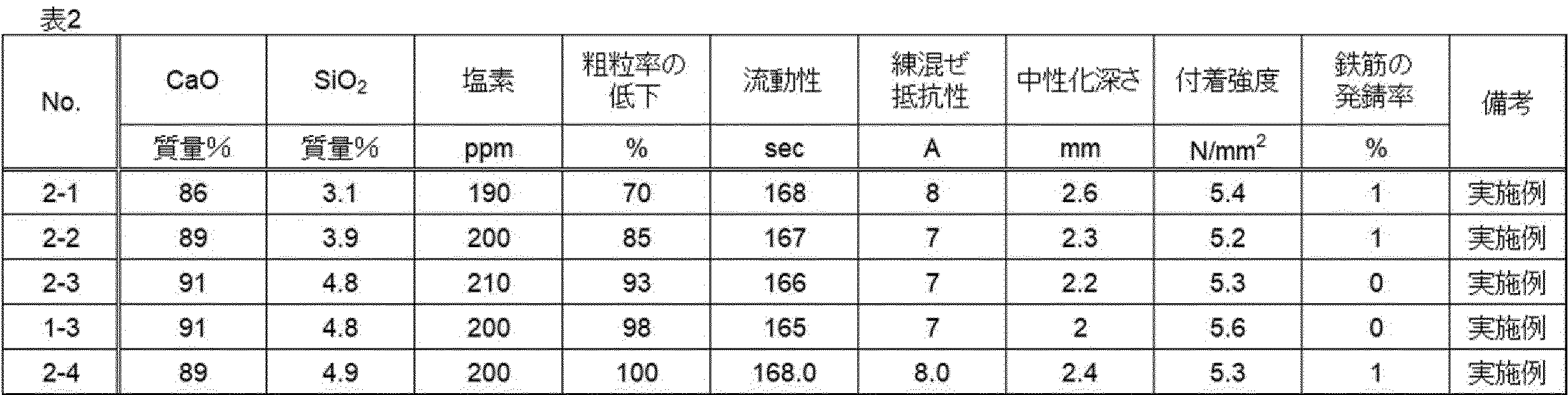
表2の結果より、特定の塩素量を含有し、特定の化学成分、粗粒率の低下が特定範囲である細骨材を用いることで高い流動性、練混ぜ抵抗性、中性化抵抗性、鉄筋との付着強度、鉄筋の発錆率を抑えることができることを確認した。
[実験例3]
表3に示す細骨材を配合して急硬補修モルタル組成物を調製したこと以外は実験例1と同様に行った。結果を表3に併記する。
表3に示す細骨材を配合して急硬補修モルタル組成物を調製したこと以外は実験例1と同様に行った。結果を表3に併記する。
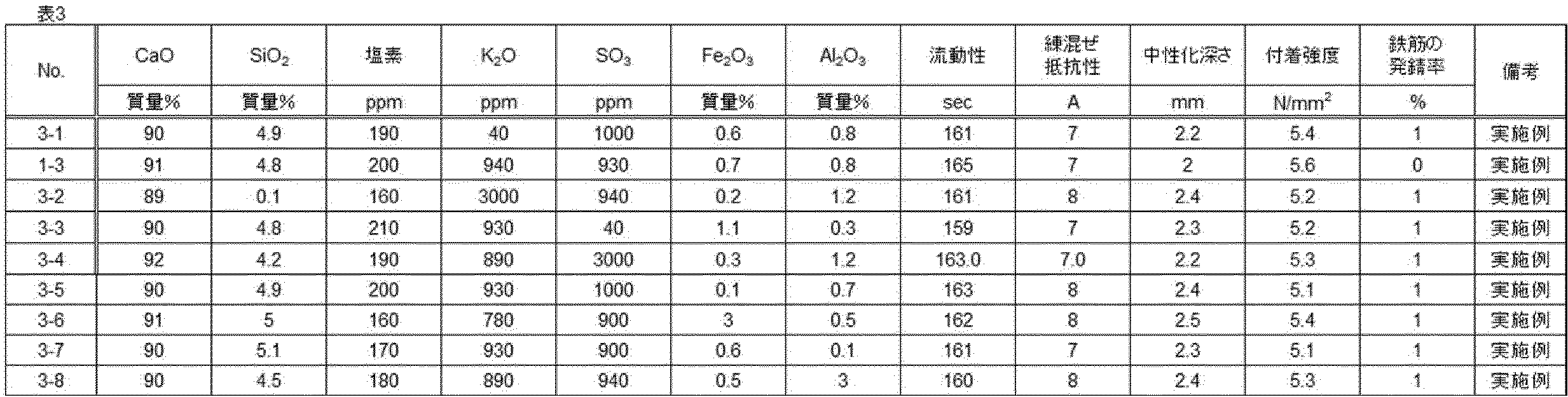
表3の結果より、特定の塩素量を含有し、特定の化学成分の細骨材を用いることで高い流動性、練混ぜ抵抗性、中性化抵抗性、鉄筋との付着強度、鉄筋の発錆率を抑えることができることを確認した。
本発明の急硬補修モルタル材料は、特定の塩素量を含有し、特定の細骨材を用いることで、流動性や練り混ぜ易さである作業性に加え、中性化抵抗性や鉄筋との付着強度、鉄筋の防錆率をより高め急硬補修モルタル材料、急硬補修モルタル組成物およびその補修方法を提供することが可能となる。そのため、上下水、農水、鉄道、電力、道路、建築などで使用されるコンクリート構造物の補修工法、その他の間隙充填、補強鉄筋との定着等、土木、建築分野に幅広く適用できる。
Claims (7)
- セメント、カルシウムアルミネート、石膏、ポリマーエマルジョン、繊維、細骨材からなる急硬補修モルタル材料であって、塩素の量が3ppm以上1,800ppm以下である、急硬補修モルタル材料。
- 前記細骨材の化学成分は、CaOの割合が85質量%以上、SiO2の割合が0.2質量%以上15質量%以下である、請求項1に記載の急硬補修モルタル材料。
- 前記細骨材は、JIS A 1121「ロサンゼルス試験機による粗骨材のすりへり試験」による粗粒率の低下が70%以上100%以下である、請求項1又は2に記載の急硬補修モルタル材料。
- 前記細骨材の化学成分は、K2Oの割合が40ppm以上3,000ppm以下、SO3の割合が40ppm以上3,000ppm以下、Fe2O3の割合が0.1質量%以上3.0質量%以下、Al2O3の割合が0.1質量%以上3.0質量%以下である、請求項1~3のいずれか1項に記載の超速硬急硬補修モルタル材料。
- 前記細骨材の含有割合は、前記セメント100質量部に対して、40質量部以上300質量部以下である、請求項1~4のいずれか1項に記載の急硬補修モルタル材料。
- 請求項1~5のいずれか1項に記載の急硬補修モルタル材料と水とを含有する急硬補修モルタル組成物。
- 請求項7に記載の急硬補修モルタル組成物を用いてなる硬化体。
Priority Applications (1)
| Application Number | Priority Date | Filing Date | Title |
|---|---|---|---|
| CN202180065677.1A CN116209645A (zh) | 2020-09-30 | 2021-08-24 | 快硬修补砂浆材料、快硬修补砂浆组合物及硬化体 |
Applications Claiming Priority (2)
| Application Number | Priority Date | Filing Date | Title |
|---|---|---|---|
| JP2020164838A JP7001784B1 (ja) | 2020-09-30 | 2020-09-30 | 急硬補修モルタル材料、急硬補修モルタル組成物及び硬化体 |
| JP2020-164838 | 2020-09-30 |
Publications (1)
| Publication Number | Publication Date |
|---|---|
| WO2022070684A1 true WO2022070684A1 (ja) | 2022-04-07 |
Family
ID=80815872
Family Applications (1)
| Application Number | Title | Priority Date | Filing Date |
|---|---|---|---|
| PCT/JP2021/031046 Ceased WO2022070684A1 (ja) | 2020-09-30 | 2021-08-24 | 急硬補修モルタル材料、急硬補修モルタル組成物及び硬化体 |
Country Status (3)
| Country | Link |
|---|---|
| JP (1) | JP7001784B1 (ja) |
| CN (1) | CN116209645A (ja) |
| WO (1) | WO2022070684A1 (ja) |
Citations (5)
| Publication number | Priority date | Publication date | Assignee | Title |
|---|---|---|---|---|
| JP2005082434A (ja) * | 2003-09-08 | 2005-03-31 | Denki Kagaku Kogyo Kk | 補修用モルタル |
| JP2008201643A (ja) * | 2007-02-22 | 2008-09-04 | Denki Kagaku Kogyo Kk | 急硬補修モルタル及びそれを用いた補修方法 |
| JP2010173891A (ja) * | 2009-01-29 | 2010-08-12 | Ube Ind Ltd | セメント組成物及びその製造方法並びにセメント組成物の強度管理方法 |
| JP2010202462A (ja) * | 2009-03-04 | 2010-09-16 | Taiheiyo Cement Corp | セメント組成物及びセメント質硬化体 |
| JP2011219341A (ja) * | 2010-03-24 | 2011-11-04 | Taiheiyo Cement Corp | 水硬性組成物 |
Family Cites Families (2)
| Publication number | Priority date | Publication date | Assignee | Title |
|---|---|---|---|---|
| JP6582599B2 (ja) * | 2015-06-22 | 2019-10-02 | 宇部興産株式会社 | 低炭素中性化抑制モルタル組成物及び低炭素中性化抑制モルタル硬化体の製造方法 |
| CN111153670A (zh) * | 2020-01-16 | 2020-05-15 | 西安建筑科技大学 | 一种水泥混凝土路面快速修补材料、砂浆及制备方法 |
-
2020
- 2020-09-30 JP JP2020164838A patent/JP7001784B1/ja active Active
-
2021
- 2021-08-24 CN CN202180065677.1A patent/CN116209645A/zh active Pending
- 2021-08-24 WO PCT/JP2021/031046 patent/WO2022070684A1/ja not_active Ceased
Patent Citations (5)
| Publication number | Priority date | Publication date | Assignee | Title |
|---|---|---|---|---|
| JP2005082434A (ja) * | 2003-09-08 | 2005-03-31 | Denki Kagaku Kogyo Kk | 補修用モルタル |
| JP2008201643A (ja) * | 2007-02-22 | 2008-09-04 | Denki Kagaku Kogyo Kk | 急硬補修モルタル及びそれを用いた補修方法 |
| JP2010173891A (ja) * | 2009-01-29 | 2010-08-12 | Ube Ind Ltd | セメント組成物及びその製造方法並びにセメント組成物の強度管理方法 |
| JP2010202462A (ja) * | 2009-03-04 | 2010-09-16 | Taiheiyo Cement Corp | セメント組成物及びセメント質硬化体 |
| JP2011219341A (ja) * | 2010-03-24 | 2011-11-04 | Taiheiyo Cement Corp | 水硬性組成物 |
Also Published As
| Publication number | Publication date |
|---|---|
| JP7001784B1 (ja) | 2022-02-04 |
| JP2022056863A (ja) | 2022-04-11 |
| CN116209645A (zh) | 2023-06-02 |
Similar Documents
| Publication | Publication Date | Title |
|---|---|---|
| JP7509867B2 (ja) | セメント混和材、膨張材、及びセメント組成物 | |
| KR20140043493A (ko) | 중성화 억제형 조강 시멘트 조성물 | |
| JP7085050B1 (ja) | セメント混和材、急硬モルタルコンクリート材料、急硬モルタルコンクリート組成物、及び硬化体 | |
| JP7755953B2 (ja) | 急硬性混和材及び急硬性セメント組成物 | |
| JP2004315303A (ja) | セメント組成物、コーティング材料、及びそれを用いた遮塩方法 | |
| JP7005719B1 (ja) | 補修モルタル材料、補修モルタル組成物及び硬化体 | |
| JP2005082440A (ja) | 急硬性セメント混和材、セメント組成物、及びモルタル組成物 | |
| JP2022139528A (ja) | セメント組成物、モルタル及び硬化体 | |
| JP7181355B1 (ja) | セメント混和材、セメント混和材の製造方法及びセメント組成物 | |
| JP4209381B2 (ja) | セメント組成物 | |
| WO2022230605A1 (ja) | グラウト材料、グラウトモルタル組成物及び硬化体 | |
| JP5010210B2 (ja) | セメント組成物及びそれを用いた補修方法 | |
| WO2022044890A1 (ja) | セメント組成物、製造方法、該セメント組成物を含有させる鉄筋コンクリートの中性化抑制方法及び該セメント組成物を含有させる鉄筋コンクリートの表面美観保持方法 | |
| JP6985548B1 (ja) | 補修モルタル材料、補修モルタル組成物及び硬化体 | |
| JP7001784B1 (ja) | 急硬補修モルタル材料、急硬補修モルタル組成物及び硬化体 | |
| JP7691310B2 (ja) | 防錆剤組成物及び防錆処理方法 | |
| JP7701210B2 (ja) | 防錆剤組成物及び防錆処理方法 | |
| JP7717537B2 (ja) | グラウト材料、グラウトモルタル組成物及び硬化体 | |
| JP3957672B2 (ja) | 吹付け工法 | |
| JP6735624B2 (ja) | コンクリートの表面改質材およびそれを用いたコンクリートの表層品質を改善する方法 | |
| JPWO2019142906A1 (ja) | コテ仕上げ剤及びその使用方法 | |
| JP2023028445A (ja) | 急硬性混和材及び急硬性セメント組成物 | |
| JP7803960B2 (ja) | セメント組成物、補修方法及びコンクリート構造物 | |
| JP7037878B2 (ja) | 二次製品用早強混和材および二次製品用早強コンクリート | |
| JP7777941B2 (ja) | 補修材料、補修モルタル組成物及び硬化体 |
Legal Events
| Date | Code | Title | Description |
|---|---|---|---|
| 121 | Ep: the epo has been informed by wipo that ep was designated in this application |
Ref document number: 21874987 Country of ref document: EP Kind code of ref document: A1 |
|
| NENP | Non-entry into the national phase |
Ref country code: DE |
|
| 122 | Ep: pct application non-entry in european phase |
Ref document number: 21874987 Country of ref document: EP Kind code of ref document: A1 |