WO2022070635A1 - 積層体、採光部材、及び農産用箱体 - Google Patents
積層体、採光部材、及び農産用箱体 Download PDFInfo
- Publication number
- WO2022070635A1 WO2022070635A1 PCT/JP2021/029932 JP2021029932W WO2022070635A1 WO 2022070635 A1 WO2022070635 A1 WO 2022070635A1 JP 2021029932 W JP2021029932 W JP 2021029932W WO 2022070635 A1 WO2022070635 A1 WO 2022070635A1
- Authority
- WO
- WIPO (PCT)
- Prior art keywords
- acid
- layer
- laminate
- surface layer
- cellulose acylate
- Prior art date
- Legal status (The legal status is an assumption and is not a legal conclusion. Google has not performed a legal analysis and makes no representation as to the accuracy of the status listed.)
- Ceased
Links
Images


Classifications
-
- A—HUMAN NECESSITIES
- A01—AGRICULTURE; FORESTRY; ANIMAL HUSBANDRY; HUNTING; TRAPPING; FISHING
- A01G—HORTICULTURE; CULTIVATION OF VEGETABLES, FLOWERS, RICE, FRUIT, VINES, HOPS OR SEAWEED; FORESTRY; WATERING
- A01G9/00—Cultivation in receptacles, forcing-frames or greenhouses; Edging for beds, lawn or the like
- A01G9/14—Greenhouses
-
- B—PERFORMING OPERATIONS; TRANSPORTING
- B32—LAYERED PRODUCTS
- B32B—LAYERED PRODUCTS, i.e. PRODUCTS BUILT-UP OF STRATA OF FLAT OR NON-FLAT, e.g. CELLULAR OR HONEYCOMB, FORM
- B32B23/00—Layered products comprising a layer of cellulosic plastic substances, i.e. substances obtained by chemical modification of cellulose, e.g. cellulose ethers, cellulose esters, viscose
- B32B23/20—Layered products comprising a layer of cellulosic plastic substances, i.e. substances obtained by chemical modification of cellulose, e.g. cellulose ethers, cellulose esters, viscose comprising esters
-
- B—PERFORMING OPERATIONS; TRANSPORTING
- B32—LAYERED PRODUCTS
- B32B—LAYERED PRODUCTS, i.e. PRODUCTS BUILT-UP OF STRATA OF FLAT OR NON-FLAT, e.g. CELLULAR OR HONEYCOMB, FORM
- B32B27/00—Layered products comprising a layer of synthetic resin
- B32B27/18—Layered products comprising a layer of synthetic resin characterised by the use of special additives
-
- C—CHEMISTRY; METALLURGY
- C09—DYES; PAINTS; POLISHES; NATURAL RESINS; ADHESIVES; COMPOSITIONS NOT OTHERWISE PROVIDED FOR; APPLICATIONS OF MATERIALS NOT OTHERWISE PROVIDED FOR
- C09D—COATING COMPOSITIONS, e.g. PAINTS, VARNISHES OR LACQUERS; FILLING PASTES; CHEMICAL PAINT OR INK REMOVERS; INKS; CORRECTING FLUIDS; WOODSTAINS; PASTES OR SOLIDS FOR COLOURING OR PRINTING; USE OF MATERIALS THEREFOR
- C09D201/00—Coating compositions based on unspecified macromolecular compounds
-
- C—CHEMISTRY; METALLURGY
- C09—DYES; PAINTS; POLISHES; NATURAL RESINS; ADHESIVES; COMPOSITIONS NOT OTHERWISE PROVIDED FOR; APPLICATIONS OF MATERIALS NOT OTHERWISE PROVIDED FOR
- C09D—COATING COMPOSITIONS, e.g. PAINTS, VARNISHES OR LACQUERS; FILLING PASTES; CHEMICAL PAINT OR INK REMOVERS; INKS; CORRECTING FLUIDS; WOODSTAINS; PASTES OR SOLIDS FOR COLOURING OR PRINTING; USE OF MATERIALS THEREFOR
- C09D7/00—Features of coating compositions, not provided for in group C09D5/00; Processes for incorporating ingredients in coating compositions
- C09D7/40—Additives
- C09D7/60—Additives non-macromolecular
- C09D7/61—Additives non-macromolecular inorganic
-
- C—CHEMISTRY; METALLURGY
- C09—DYES; PAINTS; POLISHES; NATURAL RESINS; ADHESIVES; COMPOSITIONS NOT OTHERWISE PROVIDED FOR; APPLICATIONS OF MATERIALS NOT OTHERWISE PROVIDED FOR
- C09D—COATING COMPOSITIONS, e.g. PAINTS, VARNISHES OR LACQUERS; FILLING PASTES; CHEMICAL PAINT OR INK REMOVERS; INKS; CORRECTING FLUIDS; WOODSTAINS; PASTES OR SOLIDS FOR COLOURING OR PRINTING; USE OF MATERIALS THEREFOR
- C09D7/00—Features of coating compositions, not provided for in group C09D5/00; Processes for incorporating ingredients in coating compositions
- C09D7/40—Additives
- C09D7/60—Additives non-macromolecular
- C09D7/63—Additives non-macromolecular organic
-
- Y—GENERAL TAGGING OF NEW TECHNOLOGICAL DEVELOPMENTS; GENERAL TAGGING OF CROSS-SECTIONAL TECHNOLOGIES SPANNING OVER SEVERAL SECTIONS OF THE IPC; TECHNICAL SUBJECTS COVERED BY FORMER USPC CROSS-REFERENCE ART COLLECTIONS [XRACs] AND DIGESTS
- Y02—TECHNOLOGIES OR APPLICATIONS FOR MITIGATION OR ADAPTATION AGAINST CLIMATE CHANGE
- Y02A—TECHNOLOGIES FOR ADAPTATION TO CLIMATE CHANGE
- Y02A40/00—Adaptation technologies in agriculture, forestry, livestock or agroalimentary production
- Y02A40/10—Adaptation technologies in agriculture, forestry, livestock or agroalimentary production in agriculture
- Y02A40/25—Greenhouse technology, e.g. cooling systems therefor
Definitions
- the present invention relates to a laminated body, a lighting member, and a box body for agricultural products.
- an agricultural house equipped with a transparent lighting member that separates the growing space for agricultural products from the outside world is widely known.
- the daylighting member is formed in a plate shape or a sheet shape, and is supported by being attached to a skeleton or the like. Then, the light from the light source (for example, the sun) is taken into the agricultural house through the daylighting member.
- various measures have been taken on the daylighting members. For example, in Patent Documents 1 and 2 below, there is an example in which anti-fog property and drip-proof property are improved by using a laminated body in which a hydrophilic surface layer containing silica and alumina particles is laminated on a base material layer. Have been described.
- Patent Documents 1 and 2 there is a problem that the durability of the surface layer is low (the bond between the base material layer and the inorganic particles is weak, and the inorganic particles are easily peeled off from the base material layer). It has also been desired to efficiently take in light in fine weather, rainy weather, and in the morning and evening and winter when dew condensation is likely to occur inside the box due to transpiration of plants.
- the present invention has been made in view of the above problems, and an object of the present invention is to provide a laminated body, a daylighting member, and an agricultural box body having a surface layer having high durability and daylighting property.
- the laminate of the present invention is a sheet-like laminate, which contains a substrate layer containing cellulose acylate and saponified cellulose obtained by saponifying cellulose acylate, and is provided on the surface of the substrate layer. It has a obtained intermediate layer and a surface layer containing inorganic particles and layered on the intermediate layer to form the outermost surface of the laminate. That is, it is a laminate having a substrate layer, an intermediate layer, and a surface layer in this order.
- the laminate is in the form of a sheet, the substrate layer contains cellulose acylate, and the intermediate layer saponifies cellulose acylate.
- It is a laminate containing the saponified cellulose and provided on the surface of the base material layer, and the surface layer contains inorganic particles and is provided on the surface of the intermediate layer to form the outermost surface of the laminate.
- the inorganic particles are preferably silica and / or alumina.
- the surface layer preferably contains voids.
- the surface layer preferably contains a silane coupling agent having a reactive group that binds to the base material layer.
- the daylighting member of the present invention has the above-mentioned laminated body, and the surface layer is provided on the light emitting surface side.
- the agricultural box body of the present invention includes the above-mentioned daylighting member and a skeleton that supports the daylighting member.
- the durability and daylighting property of the surface layer can be improved.
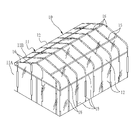
- the agricultural house (agricultural box body) 10 shown in FIG. 1 includes a skeleton 11 and a plate-shaped lighting member 12.
- the skeleton 11 is for supporting the lighting member 12, and is formed three-dimensionally (three-dimensionally) by assembling a plurality of aggregates 15.
- the aggregates 15 are formed in a long length, and these aggregates 15 are fixed to each other by, for example, a fastener for connecting and fixing (not shown).
- the skeleton 11 includes a rectangular main body portion 11A and a triangular mountain-shaped roof portion 11B provided on the main body portion 11A.
- the shape of the skeleton is not limited to this example.
- the roof portion 11B may have an arch-shaped so-called round roof, a horizontally flat shape, or an inclined shape whose height gradually decreases in one direction.
- the number of aggregates 15 in the skeleton 11, the direction of each aggregate 15, and the method of assembling are not particularly limited.
- a known material for agricultural houses can be used, but from the viewpoint of durability (strength), a metal material is preferable, and examples thereof include a solid steel material and a hollow steel pipe. In this example, it is a steel pipe.
- the daylighting member 12 is attached to and supported by the skeleton 11 to form a space partitioned from the outside world (a space for growing agricultural products).
- the daylighting member 12 receives light from the sun (light source) incident from the light incident surface on one side (the surface facing the outside of the agricultural house 10) and the light emitting surface on the opposite side (the surface facing the inside of the agricultural house 10).
- the light incident surface means a surface on which a light source such as sunlight or an LED is incident
- the light emitting surface is a surface on which a light source incident from the incident surface is emitted.
- the lighting member 12 may be attached to the inside or the outside of the skeleton 11, but in this example, it is attached to the outside. This is because the outside of the skeleton 11 is easier to attach than the inside. Further, the daylighting member 12 can be used for both the main body portion 11A and the roof portion 11B, and this is also the case in this example, but the daylighting member 12 is provided only on either the main body portion 11A or the roof portion 11B. You may use it. However, in this case, it is preferable to use it for the roof portion 11B. This is because the roof portion has a large lighting area as the lighting area of the agricultural house, and the lighting effect is larger when the altitude (elevation angle) of the sun is low such as in a high latitude area and / or in winter.
- the lighting member 12 is sandwiched between the aggregate 15 and the pressing member 16.
- the pressing member 16 is fixed to the aggregate 15 by, for example, a screw.
- the method for fixing the lighting member 12 is not limited to this example and can be appropriately selected. For example, it may be screwed directly to the aggregate 15 without using the holding member 16. Further, it may be adhered to the aggregate 15 by using an adhesive or an adhesive tape.
- the lighting member 12 is transparent and is a laminated body including a base material layer 20, an intermediate layer 22, and a surface layer 24.
- "transparency” means that the member (lighting member 12 in this example) has light transmission property, and the light transmission property is so high that the other side can be seen through the member.
- the base material layer 20 is provided on the light incident surface side (outside of the agricultural house 10) of the lighting member 12 with respect to the intermediate layer 22 and the surface layer 24.
- the base material layer 20 is formed by using a material containing cellulose acylate, and in this example, the base material layer 20 is formed of a cellulose acylate film obtained by forming a cellulose acylate into a film.
- Cellulose acylate has an acyl group because the hydroxy group of cellulose is esterified with a carboxylic acid.
- the cellulose acylate is not particularly limited, but the degree of acyl group substitution of the cellulose acylate is preferably in the range of 2.00 or more and 2.97 or less. As a result, the light loss into the agricultural house 10 can be kept small. The smaller the degree of acyl group substitution, the higher the amount of water absorbed, so deformation due to water absorption is likely to occur. However, it is preferable to set the degree of acyl group substitution of cellulose acylate to 2.00 or more because the deformation can be further suppressed.
- the theoretical upper limit of the degree of acyl group substitution is 3.00, but it is difficult to synthesize cellulose acylate having an acyl group substitution degree of more than 2.97. Therefore, the degree of acyl group substitution of cellulose acylate is 2.97 or less.
- the degree of acyl group substitution of cellulose acylate is more preferably in the range of 2.40 or more and 2.95 or less, and further preferably in the range of 2.70 or more and 2.95 or less.
- the degree of acyl group substitution is the rate at which the hydroxy group of cellulose is esterified with a carboxylic acid, that is, the degree of substitution of the acyl group.
- the acyl group of the cellulose acylate is not particularly limited, and may be an acetyl group having 1 carbon atom or an acyl group having 2 or more carbon atoms.
- the acyl group having 2 or more carbon atoms may be an aliphatic group or an aryl group, and examples thereof include an alkylcarbonyl ester of cellulose, an alkenylcarbonyl ester or an aromatic carbonyl ester, and an aromatic alkylcarbonyl ester. It may further have a substituted group.
- the acyl group of cellulose acylate may be only one kind or two or more kinds, but it is preferable that at least one kind is an acetyl group. Since the cellulose acylate having an acetyl group easily absorbs water, the effect of suppressing the change in humidity in the agricultural house 10 is further improved. Most preferably, it is a cellulose acylate in which all the acyl groups are acetyl groups, that is, it is more preferable that the cellulose acylate is cellulose acetate. In this example, TAC (cellulose triacetate) is used.
- the degree of acyl group substitution can be determined by a conventional method.
- the degree of acetylation degree of acetyl group substitution
- ASTM D-817-91
- It can also be measured by measuring the degree of acylation (degree of acyl group substitution) distribution by high performance liquid chromatography.
- the degree of acetylation of cellulose acetate is measured by dissolving a sample in methylene chloride and using a column Novapac phenyl (Waters) to measure the eluent of a mixture of methanol and water (methanol: water mass ratio).
- the degree of acetylation distribution was measured by linear gradient from 8: 1) to a mixed solution of dichloromethane and methanol (dioxide: methanol mass ratio of 9: 1), and compared with the calibration line using standard samples with different degrees of acetylation. Ask for. These measuring methods can be obtained by referring to the methods described in JP-A-2003-201301.
- the measurement of the degree of acetylation of the cellulose acylate is preferably performed by high performance liquid chromatography.
- the base material layer 20 may contain other components in addition to the cellulose acylate.
- the content of the components other than the cellulose acylate by mass is preferably 0 or more and 50 or less when the mass of the cellulose acylate is 100.
- Other components include, for example, additives. Examples of the additive include an ultraviolet absorber, a plasticizer, a matting agent and the like.
- plasticizer examples include ester derivatives of sugars and ester oligomers.
- the ester derivative of the sugar may be either a monosaccharide ester derivative or a polysaccharide ester derivative, or both.
- sugars include monosaccharides such as glucose, galactose, mannose, fructose, sucrose, and arabinose, lactose, sucrose, nistose, 1F-fructosyl nistose, stachyose, martitol, lactitol, lactulose, cellobiose, maltose, cellotriose, and maltotri.
- Polysaccharides such as aus, raffinose or kestose, gentiobiose, gentiotriose, gentiotetraose, xylotriose, galactosylsucrose can be mentioned.
- Glucose, fructose, sucrose, kestose, varnish, 1F-fructosyl varnish, stachyose and the like are preferable, and sucrose and glucose are more preferable.
- oligosaccharides can also be used as polysaccharides, and oligosaccharides are produced by reacting starch, sucrose and the like with enzymes such as amylase, and examples of oligosaccharides include maltooligosaccharides and iso. Examples thereof include malto-oligosaccharides, fructooligosaccharides, galactooligosaccharides and xylooligosaccharides.
- the monocarboxylic acid used to esterify all or part of the hydroxyl groups in the monosaccharide and polysaccharide structures is not particularly limited, and known aliphatic monocarboxylic acids, alicyclic monocarboxylic acids, and aromatics. Group monocarboxylic acids and the like can be used.
- the carboxylic acid used may be one kind or two or more kinds.
- Preferred aliphatic monocarboxylic acids include acetic acid, propionic acid, butyric acid, isobutyric acid, valeric acid, caproic acid, enanthic acid, capric acid, pelargonic acid, capric acid, 2-ethyl-hexanecarboxylic acid, undecyl acid and lauric acid.
- Tridecic acid myristic acid, pentadecic acid, palmitic acid, heptadecic acid, stearic acid, nonadecanoic acid, araquinic acid, behenic acid, lignoseric acid, cellotic acid, heptacosanoic acid, montanic acid, melicic acid, laxic acid and other saturated fatty acids, Unsaturated fatty acids such as undecylenic acid, oleic acid, sorbic acid, linoleic acid, linolenic acid, arachidonic acid and octenoic acid, alicyclic monocarboxylic acids such as cyclopentanecarboxylic acid, cyclohexanecarboxylic acid and cyclooctanecarboxylic acid. Can be mentioned.
- aromatic monocarboxylic acids examples include aromatic monocarboxylic acids having an alkyl group or an alkoxy group introduced into the benzene ring of benzoic acid such as benzoic acid and toluic acid, silicic acid, benzylic acid, biphenylcarboxylic acid and naphthalin.
- aromatic monocarboxylic acids having two or more benzene rings such as carboxylic acid and tetralincarboxylic acid, or derivatives thereof, and benzoic acid and naphthylic acid are particularly preferable.
- sugar ester examples include an ester derivative of sucrose, and more specifically, a benzoic acid ester (Monopet (registered trademark) SB manufactured by Dai-ichi Kogyo Seiyaku Co., Ltd.).
- the ester oligomer is a compound having a repeating unit containing an ester bond between a dicarboxylic acid and a diol and having several to 100 repeating units and a relatively low molecular weight, and is preferably an aliphatic ester oligomer. This is because the action of cellulose acylate as a plasticizer is more reliable than that of aromatic ester oligomers.
- the ester oligomer preferably has a molecular weight in the range of 500 or more and 10,000 or less.
- the molecular weight is 500 or more, the flexibility and heat sealability are improved as compared with the case where the molecular weight is less than 500, and when the molecular weight is 10,000 or less, the flexibility is improved as compared with the case where the molecular weight is larger than 10,000.
- the molecular weight of the ester oligomer is more preferably in the range of 700 or more and 5000 or less, and further preferably in the range of 900 or more and 3000 or less.
- the above molecular weight of the ester oligomer has a molecular weight distribution, the weight average molecular weight and the number average molecular weight by GPC (Gel Permeation Chromatography), the number average molecular weight measurement method by the terminal functional group weight measurement and the osmotic pressure measurement, and the viscosity. It can be obtained by measuring the viscosity average molecular weight or the like. In the present embodiment, it is obtained by a number average molecular weight measurement method by measuring a hydroxyl group or an acid group of an ester as a terminal functional group.
- the ester oligomer is more preferably a dicarboxylic acid having a carbon number of 2 or more and 10 or less as a dicarboxylic acid, and a diol having a carbon number of 2 or more and 10 or less as a diol.
- both the dicarboxylic acid and the diol are preferably aliphatic compounds. This is because the flexibility can be imparted by using the aliphatic dicarboxylic acid and the aliphatic diol, and the water content becomes more preferable.
- dicarboxylic acid As a dicarboxylic acid As an aromatic carboxylic acid, phthalic acid, terephthalic acid, isophthalic acid, etc., and as an aliphatic carboxylic acid, malonic acid, succinic acid, glutaric acid, adipic acid, sebacic acid, azelaic acid, cyclohexanedicarboxylic acid, maleic acid, etc. , Fumaric acid and the like.
- Examples of the aliphatic diol include ethanediol, 1,2-propanediol, 1,3-propanediol, 1,2-butanediol, 1,3-butanediol, 2-methyl-1,3-propanediol, and 1, 4-butanediol, 1,5-pentanediol, 2,2-dimethyl-1,3-propanediol (neopentyl glycol), 1,4-hexanediol, 1,4-cyclohexanediol, 1,4-cyclohexanedi Examples include methanol.
- ester oligomer it is also preferable to seal the terminal hydroxyl group or acid group of the ester oligomer with a monocarboxylic acid, monoalcohol or the like.
- a monocarboxylic acid monoalcohol or the like.
- an oligomer having an ester of adipic acid and ethylene glycol as a repeating unit an oligomer having an ester of succinic acid and ethylene glycol as a repeating unit, an ester of terephthalic acid and ethylene glycol, and phthalic acid and ethylene glycol.
- Oligomers having an ester as a repeating unit are preferable.
- the mass of the monosaccharide ester derivative is M1, the mass of the polysaccharide ester derivative is M2, the mass of the ester oligomer is M3, and the sum of the masses obtained by M1 + M2 + M3 (hereinafter referred to as mass sum) is MP.
- mass sum MP is in the range of 5 or more and 30 or less when the mass of the cellulose acylate is 100. Is preferable.
- the mass sum MP is 5 or more, the flexibility is better than when it is less than 5.
- the mass sum MP is 30 or less, the water content is more preferable than when it is larger than 30.
- the cellulose acylate film constituting the base material layer 20 can be produced by a well-known solution film forming method. Specifically, a dope in which cellulose acylate is dissolved in a solvent is cast on a long belt that moves continuously to form a cast film, and the cast film is dried and then peeled off, and further dried. By doing so, a cellulose acylate film can be produced.
- a cellulose acylate film may be produced by using a drum instead of the belt to dry the cast film on the drum and then peeling it off.
- melt film forming method As a method for producing a polymer film, a melt film forming method is known in addition to the above-mentioned solution film forming method.
- a polymer film is produced by extruding a polymer melted by heating onto a support using a T-die, casting the polymer, cooling the polymer, and then peeling the polymer film.
- a cellulose acylate film may be formed by using this melt film forming method.
- the intermediate layer 22 is a layer containing saponified cellulose provided on the light emitting surface side (inside of the agricultural house 10) of the lighting member 12 with respect to the base material layer 20, and in the present embodiment, the intermediate layer 22 is a base. It is formed by saponifying the surface of the material layer 20 (the surface on the light emitting surface side).
- the intermediate layer 22 thus formed contains saponified cellulose obtained by saponifying the cellulose acylate constituting the base material layer 20, and also contains cellulose acylate like the base material layer 20. Further, depending on the degree of saponification, the intermediate layer 22 may contain cellulose.
- the intermediate layer 22 is a cellulose acylate or cellulose layer having a degree of acyl group substitution smaller than that of the substrate layer 20.
- Cellulose acylate can be saponified by contacting it with an aqueous solution (saponification solution) such as sodium hydroxide and / or potassium hydroxide.
- the saponification solution preferably contains one or more selected from the group consisting of alcohols, ethers, amides, and sulfoxides as organic solvents.
- the intermediate layer 22 can be formed thickly on the cellulose acylate, and the equilibrium water content, the refractive index and the like can be continuously changed from the base material layer 20 to the intermediate layer 22.
- the light transmission can be improved by containing an organic solvent.
- alcohols having 2 or more and 8 or less carbon atoms are preferable.
- examples of alcohols having 2 or more and 8 or less carbon atoms include ethanol, isopropyl alcohol, 1-propanol, 1-butanol, hexanol, ethylene glycol, glycerin, propylene glycol, butylene glycol, pentaerythritol and the like.
- isopropyl alcohol is particularly preferable, and isopropyl alcohol is also used in this embodiment.
- ethers include diethyl ether, diethylene glycol, dipropylene glycol, ethylene glycol monomethyl ether, ethylene glycol monoethyl ether, diethylene glycol monomethyl ether, diethylene glycol monoethyl ether, propylene glycol monomethyl ether and the like.
- amides include N, N-dimethylformamide, dimethylacetamide and the like.
- sulfoxides include dimethyl sulfoxide and the like.
- the durability of the surface layer 24 can be improved. That is, in the intermediate layer 22, the number of hydroxyl groups chemically bonded to the hydrophilic group of the surface layer 24 is increased by saponification.
- the intermediate layer 22 is formed of cellulose, which has a high ratio of hydroxyl groups per repeating unit in the molecule and interacts with a hydrophilic layer containing inorganic particles. As a result, the surface layer 24 is less likely to be peeled off as compared with the case where the surface layer 24 is directly formed on the base material layer 20 without interposing the intermediate layer 22.
- the degree of saponification of the intermediate layer 22 is preferably a low degree of acyl group substitution from the viewpoint of durability of the surface layer.
- the degree of acyl group substitution of the intermediate layer 22 is preferably in the range of 1.0 or less, more preferably in the range of 0.5 or less, and further preferably in the range of 0.2 or less. ..
- the thickness of the intermediate layer 22 is preferably 0.01 ⁇ m or more, more preferably 0.05 ⁇ m or more, still more preferably 0.1 ⁇ m or more, from the viewpoint of durability of the surface layer. Further, from the viewpoint of suppressing deformation and wrinkles during water absorption, 20 ⁇ m or less is preferable, 15 ⁇ m or less is more preferable, and 12 ⁇ m or less is further preferable.
- the thickness of the intermediate layer 22 is obtained by the following method in the present embodiment. A sample sampled from a material composed of a base material layer 20 and an intermediate layer 22 obtained by saponifying the surface of the base material layer 20 is immersed in dichloromethane for 24 hours. The sample left undissolved by this immersion is dried, and the thickness of the dried sample is measured three times. The average of the three measured values is taken as the thickness of the intermediate layer 22.
- the surface layer 24 is provided further inside the agricultural house 10 than the intermediate layer 22, and constitutes the outermost surface of the lighting sheet 12 (the innermost surface of the agricultural house 10).
- the surface layer 24 is a hydrophilic layer containing inorganic particles.
- oxide particles such as metal are preferable.
- the metal or the like in the oxide particles such as the metal also includes a metalloid such as B, Si, Ge, As, Sb, and Te.
- Oxide particles such as metals include Be, Mg, Ca, Sr, Ba, Sc, Y, La, Ce, Gd, Tb, Dy, Yb, Lu, Ti, Zr, Hf, Nb, Mo, W and Zn.
- silica particles, titania particles, zirconia particles, alumina particles and the like are used, and silica particles and alumina particles are particularly preferably used.
- silica sol Simtex (registered trademark) AK: manufactured by Nissan Chemical Industries, Ltd.
- alumina sol alumina sol 520-A: manufactured by Nissan Chemical Industries, Ltd.
- the surface layer 24 is formed by applying the above-mentioned mixed solution of silica sol and alumina sol to the surface of the intermediate layer 22.
- silica particles known silica particles can be selected.
- the silica particles include fumed silica and silica sol.
- the alumina particles include alumina sol.
- Humed silica can be obtained by reacting a compound containing a silicon atom with oxygen and hydrogen in the gas phase.
- the silicon compound as a raw material include silicon halide (for example, silicon chloride).
- the silica sol and / or the alumina sol can be synthesized by a sol-gel method in which the raw material compound is hydrolyzed and condensed.
- Examples of the raw material compound of colloidal silica include alkoxysilicon (for example, tetraethoxysilane) and halogenated silane compound (for example, diphenyldichlorosilane).
- alkoxysilicon for example, tetraethoxysilane
- halogenated silane compound for example, diphenyldichlorosilane
- the inorganic oxide particles commercially available products on the market may be used.
- Commercially available silica particles include Evonik's AEROSIL® series, Nissan Chemical Industries, Ltd.'s Snowtex® series (for example, Snowtex OXS, Snowtex O-33, and Snowtex OL). ), Nalco (registered trademark) series of Nalco Chemical Co., Ltd. (for example, Nalco8699, etc.), Quartron PL series of Fuso Chemical Industries, Ltd. (for example, PL-1) and the like.
- Examples of commercially available alumina particles include Nissan Chemical Industries, Ltd.'s alumina sol series, Kawaken Fine Chemical's alumina sol series (for example, aluminum sol F-3000), and Taki Chemical's Bailal series (for example, AL-7). ..
- a silane coupling agent is added to a mixed solution of silica sol and alumina sol.
- a silane coupling agent having a reactive group that binds to the base material layer is preferable, and specifically, a reactive group that binds to inorganic particles (silica and alumina in this example) in the molecule.
- those having a reactive group that binds to the intermediate layer 22 are used, and in this example, tetraethoxysilane (TEOS) or ⁇ -glycidoxypropyltrimethylsilane (hereinafter referred to as ⁇ -glycidoxypropyltrimethylsilane) is used.
- TEOS tetraethoxysilane
- ⁇ -glycidoxypropyltrimethylsilane ⁇ -glycidoxypropyltrimethylsilane
- Glycydoxi is used.
- the silane coupling agent include tetramethoxysilane, tetraethoxysilane, methyltrimethoxysilane, methyltriethoxysilane, vinyltrichlorosilane, vinyltriethoxysilane, vinyltri (methoxyethoxy) silane, ⁇ -chloropropyltripropoxysilane, and ⁇ .
- a plurality of voids are formed in the surface layer 24.
- the voids are spatial portions in the surface layer 24 in which inorganic particles, additives, and the like do not exist, and are uniformly present over the entire surface layer 24, and are fine (nano) when the surface layer 24 is observed. Perceived as unevenness (of metric size) and / or through holes.
- the surface layer 24 has a higher light transmittance than the case where the voids do not exist due to the voids in which the inorganic particles and additives that hinder the transmission of light do not exist. Further, since the surface layer 24 is hydrophilic, a water film can be held on the light emitting surface, and dew condensation on the light emitting surface can be suppressed.
- the thickness of the surface layer 24 is preferably 0.01 ⁇ m or more, more preferably 0.02 ⁇ m or more, still more preferably 0.05 ⁇ m or more, from the viewpoint of water film forming property and light transmittance improving property in a dry state.
- the thickness of the surface layer 24 is preferably 1.0 ⁇ m or less, more preferably 0.5 ⁇ m or less, still more preferably 0.2 ⁇ m or less, from the viewpoint of suppressing haze and improving light transmittance.
- the thickness of the surface layer 24 is obtained by multiplying the amount of the coating liquid applied to the substrate in a liquid state by the solid content concentration of the coating liquid and converting the thickness by the specific gravity of the solid content of the coating liquid.
- the particle size of the inorganic particles constituting the surface layer 24 is preferably 3 nm or more, more preferably 5 nm or more, still more preferably 10 nm or more, from the viewpoint of improving the light transmittance in a dry state. Further, from the viewpoint of suppressing haze, the particle size of the inorganic particles constituting the surface layer 24 is preferably 1000 nm or less, more preferably 500 nm or less, further preferably 200 nm or less, and further preferably 100 nm or less. Is particularly preferable. By setting the particle size in a preferable range, light transmission can be improved and haze can be suppressed.
- the voids of the surface layer 24 can be controlled, and water can easily pass from the surface layer to the intermediate layer, thereby improving the retention of the water film.
- the inorganic particles constituting the surface layer 24 include Snowtex (registered trademark) AK (particle size 12 nm), AK-Y (particle size 45 nm), AK-YL (particle size 60 nm) manufactured by Nissan Chemical Industries, Ltd. Can be mentioned.
- the surface layer 24 can be provided by applying it on the intermediate layer. The coating is performed by applying a coating liquid containing the component of the surface layer 24 as a solid content to water or an organic solvent such as water and alcohol.
- Examples of the coating method of the coating liquid include a dipping method, a spray coating method, a die coating method, and a bar coating method.
- the coating liquid may be applied to a laminate having an intermediate layer or a lighting member, or may be applied by continuously transporting a base material.
- a polymer (resin) to the surface layer 24, and a water-soluble polymer is preferable as the polymer.
- a polymer (resin) By adding a polymer (resin), haze can be suppressed and water film retention can be imparted while maintaining the hydrophilicity of the surface layer 24.
- the polymer include celluloses such as cellulose, methyl cellulose, ethyl cellulose, hydroxyethyl cellulose (HEC), carboxymethyl cellulose (CMC), and hydroxypropyl cellulose (HPC); polyvinyl alcohol and polyvinyl acetate by partial saponification.
- Polyvinyl alcohols such as alcohols and polyvinyl acetate copolymers; acrylic polymers such as hydroxyethyl acrylate or hydroxyl group-containing acrylic polymers such as copolymers, polyacrylamide-based polymers, polyvinylpyrrolidone-based polymers and the like can be mentioned. Polyvinyl alcohols are preferable.
- the laminated body including the base material layer 20, the intermediate layer 22, and the surface layer 24 is used alone as the lighting member 12, but the present invention is not limited to this.
- a laminate provided with the base material layer 20, the intermediate layer 22, and the surface layer 24 is provided on the light emitting surface side of a transparent plate or sheet such as glass, PC (polycarbonate), acrylic, or TPU (thermoplastic polyurethane).
- the surface layer 24 may be attached to the inside of the agricultural house 10 in a state of facing the inside of the agricultural house 10 and used as a lighting member.
- the laminated body (lighting member) of the present invention is used for the agricultural house 10
- the laminate (lighting member) of the present invention is used for the daylighting window of the plant where the plant is cultivated, or in a plant factory of artificial light such as LED, for example, a partition from the cultivated part or the surrounding of the seedling. It is conceivable to use the laminate (lighting member) of the present invention for a so-called partition for raising seedlings, a box or a bag, etc., which are grown in an enclosed state.
- the configurations (layer configuration, material, thickness, etc. of each layer) of the daylighting members of each example of Examples, Comparative Examples, and Reference Examples are as shown in Table 1.
- the TAC (1) used in Examples and Comparative Examples is a repeating unit of an ester of adipic acid and ethylene glycol as an additive to cellulose acetate (acetyl group substitution degree: 2.86, viscosity average degree of polymerization: 320).
- TAC (2) is a sugar ester as an additive, specifically, a benzoic acid ester of sucrose (Monopet (registered trademark)). SB, manufactured by Daiichi Kogyo Seiyaku Co., Ltd.) is added. TAC was saponified by the dipping method.
- the saponification treatment was carried out under the following conditions. It was immersed in a NaOH aqueous solution having a concentration of 1.5 mol / L at a temperature of 50 ° C. and an immersion time of 180 seconds. Then, as the first washing step, it is immersed and washed with pure water at a temperature of 25 ° C. for 15 seconds, and in the neutralization step, it is neutralized at a temperature of 25 ° C. in an aqueous solution of sulfuric acid (H 2 SO 4 aq) having a concentration of 0.3 mol / L. The time was 15 seconds, the second washing step was immersion washing with pure water at a temperature of 25 ° C. for 15 seconds, and the drying step was drying at 140 ° C. for 60 seconds.
- a NaOH aqueous solution having a concentration of 1.5 mol / L at a temperature of 50 ° C. and an immersion time of 180 seconds.
- the first washing step it is immersed and washed with pure water at a temperature of 25
- Silica A is silica sol (Snowtex (registered trademark) AK: manufactured by Nissan Chemical Industries, Ltd.), and silica B is silica sol (Snowtex (registered trademark) AK-L, particle diameter 45 nm: manufactured by Nissan Chemical Industries, Ltd.). ), And silica C is a silica sol (Snowtex (registered trademark) AK-YL, particle diameter 60 nm: manufactured by Nissan Chemical Industries, Ltd.).
- Alumina A is an alumina sol (alumina sol 520-A: manufactured by Nissan Chemical Industries, Ltd.).
- Kuraray Poval (registered trademark) 3-88 partially saponified product, saponification degree 88%) was used.
- the surface layer was formed by applying a coating liquid containing the components shown in Table 1 and having a solid content concentration of 0.3% by bar coating and air-drying at room temperature. Further, the commercially available product used in the reference example is "Durable drop-free PO film, Diastar (registered trademark): manufactured by Mitsubishi Chemical Agridream Co., Ltd.”.
- the light transmittance (total light transmittance) and haze were measured for the daylighting members of each of the examples, comparative examples, and reference examples.
- the results are as shown in Table 2.
- a haze meter "SH7000" manufactured by Nippon Denshoku Co., Ltd. was used for the measurement.
- the measurement is performed by spraying water on the dry film (dry) state in which the light collecting member is dry and the surface (the surface of the surface layer 24 (inside the agricultural house 10)) by spraying water to form a water film. It was carried out in two states, a film (wet exit surface) state.
- the water film forming property of the lighting member was investigated. Further, in order to evaluate the durability, the daylighting member exposed to running water for 10 days is dried to measure the light transmittance (total light transmittance), and water is sprayed on the daylighting member to form a water film. I checked. The results are as shown in Table 3.
- the water film forming property a 5 cm ⁇ 30 cm laminate was placed on a hot water bath at 40 ° C. at an angle of 45 degrees and left for 10 minutes. When a water film is formed on the laminate, it looks transparent visually, and the non-formed portion looks cloudy. Then, based on the area ratio of the water film forming portion, the evaluation was made as follows.
- a water film is formed in an amount of 80% or more and 100% or less of the test area, and the whole appears transparent.
- B A water film is formed in an amount of 50% or more and less than 80% of the test area, and many parts appear transparent.
- C A water film is formed in an amount of 20% or more and less than 50% of the test area, and many parts appear opaque.
- D A water film is formed from 0% or more and less than 20% of the test area, and the whole looks opaque.
- “A" and "B” are acceptable as products, and "C” and "D” are rejected as products.
- the daylighting member of the example has better water film forming property in both the unused state and the used state as compared with the daylighting member of the comparative example and the reference example, and has excellent performance as a product. It was confirmed that the durability was high. Further, it was confirmed that the daylighting member of the example had a high light transmittance (93% or more) as compared with the daylighting member of the comparative example and the reference example, and had excellent performance as a product.
- Example A the daylighting member of Example 5 (see Table 1) described above is attached to a base material (plate glass).
- the composition (material, thickness) of the base material of Example A and Comparative Example A, the light transmittance (total light transmittance) in the dry state and the water film state, the haze, and the water film formability are as shown in Table 4. ..
- Example A the light transmittance is high for both the dry film and the water film (92.4% or more), the haze performance at the time of the water film is high (the haze value is small), and water. It was confirmed that the film forming property was also good and the film had excellent performance.
- Example A a plate glass to which the lighting member of Example 5 was attached
- Comparative Example A between the solar lamp 40 and the illuminance meter 42.
- One of the test bodies 60 single plate glass
- the light transmittance was measured while changing the angles of the placed test bodies 50 and 60.
- the light transmittance in the dry film state and the water film state was measured for one test piece (measurement was performed twice for each test piece).
- the results are as shown in Table 5.
- the angle formed by the light beam from the light source and the test piece corresponds to the angle (elevation angle) when the light source is looked up from the incident position of the light.
- the angle formed by the light ray from the light source and the test body is referred to as an elevation angle, and a reference numeral ⁇ is added to the description.
- the elevation angle ⁇ corresponds to "90 ° -incident angle (angle formed by the normal of the incident surface and the incident light)".
- Example A has a higher light transmittance than Comparative Example A and has excellent performance in any state (dry film state, water film state) and any elevation angle ⁇ . It could be confirmed. Further, as compared with Comparative Example A, Example A has less decrease in light transmittance even when the elevation angle ⁇ is smaller, and in particular, less decrease in light transmittance in the water film state, and has excellent performance. I was able to confirm that. Specifically, in an agricultural house (agricultural box body) using the laminated body of the present invention as a daylighting member, the light transmittance is large even in winter or morning and evening when the elevation angle ⁇ of sunlight with respect to the base material is small, and the house is further. It is possible to provide an agricultural house (agricultural box body) having a large light transmittance even in an environment where a water film is formed due to dew condensation inside.
Landscapes
- Chemical & Material Sciences (AREA)
- Life Sciences & Earth Sciences (AREA)
- Engineering & Computer Science (AREA)
- Materials Engineering (AREA)
- Wood Science & Technology (AREA)
- Organic Chemistry (AREA)
- Environmental Sciences (AREA)
- Inorganic Chemistry (AREA)
- Laminated Bodies (AREA)
- Greenhouses (AREA)
- Paints Or Removers (AREA)
Priority Applications (2)
| Application Number | Priority Date | Filing Date | Title |
|---|---|---|---|
| JP2022553524A JP7463541B2 (ja) | 2020-09-29 | 2021-08-16 | 積層体、採光部材、及び農産用箱体 |
| CN202180066687.7A CN116615333A (zh) | 2020-09-29 | 2021-08-16 | 层叠体、采光部件及农用箱体 |
Applications Claiming Priority (2)
| Application Number | Priority Date | Filing Date | Title |
|---|---|---|---|
| JP2020-163796 | 2020-09-29 | ||
| JP2020163796 | 2020-09-29 |
Publications (1)
| Publication Number | Publication Date |
|---|---|
| WO2022070635A1 true WO2022070635A1 (ja) | 2022-04-07 |
Family
ID=80949960
Family Applications (1)
| Application Number | Title | Priority Date | Filing Date |
|---|---|---|---|
| PCT/JP2021/029932 Ceased WO2022070635A1 (ja) | 2020-09-29 | 2021-08-16 | 積層体、採光部材、及び農産用箱体 |
Country Status (3)
| Country | Link |
|---|---|
| JP (1) | JP7463541B2 (https=) |
| CN (1) | CN116615333A (https=) |
| WO (1) | WO2022070635A1 (https=) |
Citations (7)
| Publication number | Priority date | Publication date | Assignee | Title |
|---|---|---|---|---|
| JP2000194272A (ja) * | 1998-12-25 | 2000-07-14 | Dainippon Printing Co Ltd | 防汚性を有する防眩フィルム |
| JP2004284355A (ja) * | 2003-03-05 | 2004-10-14 | Fuji Photo Film Co Ltd | セルロースアシレートフィルム及び溶液製膜方法 |
| JP2013167696A (ja) * | 2012-02-14 | 2013-08-29 | Dainippon Printing Co Ltd | 光学積層体、偏光板及び画像表示装置 |
| JP2016503189A (ja) * | 2012-12-20 | 2016-02-01 | 東友ファインケム株式会社Dongwoo Fine−Chem Co., Ltd. | ハードコーティングされた偏光板の製造方法 |
| WO2019139150A1 (ja) * | 2018-01-12 | 2019-07-18 | 大日本印刷株式会社 | 光学積層体、偏光板、ディスプレイパネル及び画像表示装置 |
| JP2020121530A (ja) * | 2019-01-31 | 2020-08-13 | 富士フイルム株式会社 | 積層体及びその製造方法 |
| JP2021037636A (ja) * | 2019-08-30 | 2021-03-11 | 富士フイルム株式会社 | 防曇性積層体、及び、防曇性積層体の製造方法 |
-
2021
- 2021-08-16 JP JP2022553524A patent/JP7463541B2/ja active Active
- 2021-08-16 WO PCT/JP2021/029932 patent/WO2022070635A1/ja not_active Ceased
- 2021-08-16 CN CN202180066687.7A patent/CN116615333A/zh active Pending
Patent Citations (7)
| Publication number | Priority date | Publication date | Assignee | Title |
|---|---|---|---|---|
| JP2000194272A (ja) * | 1998-12-25 | 2000-07-14 | Dainippon Printing Co Ltd | 防汚性を有する防眩フィルム |
| JP2004284355A (ja) * | 2003-03-05 | 2004-10-14 | Fuji Photo Film Co Ltd | セルロースアシレートフィルム及び溶液製膜方法 |
| JP2013167696A (ja) * | 2012-02-14 | 2013-08-29 | Dainippon Printing Co Ltd | 光学積層体、偏光板及び画像表示装置 |
| JP2016503189A (ja) * | 2012-12-20 | 2016-02-01 | 東友ファインケム株式会社Dongwoo Fine−Chem Co., Ltd. | ハードコーティングされた偏光板の製造方法 |
| WO2019139150A1 (ja) * | 2018-01-12 | 2019-07-18 | 大日本印刷株式会社 | 光学積層体、偏光板、ディスプレイパネル及び画像表示装置 |
| JP2020121530A (ja) * | 2019-01-31 | 2020-08-13 | 富士フイルム株式会社 | 積層体及びその製造方法 |
| JP2021037636A (ja) * | 2019-08-30 | 2021-03-11 | 富士フイルム株式会社 | 防曇性積層体、及び、防曇性積層体の製造方法 |
Also Published As
| Publication number | Publication date |
|---|---|
| JP7463541B2 (ja) | 2024-04-08 |
| CN116615333A (zh) | 2023-08-18 |
| JPWO2022070635A1 (https=) | 2022-04-07 |
Similar Documents
| Publication | Publication Date | Title |
|---|---|---|
| TWI615409B (zh) | 相位差薄膜、偏光板及液晶顯示裝置 | |
| JP7263556B2 (ja) | 農業用採光部材及び農産用箱体 | |
| JP2009527011A (ja) | ガラスプレートを被覆するための方法 | |
| JP5525464B2 (ja) | セルロースアシレートフィルム、偏光板および液晶表示装置 | |
| TWI572483B (zh) | Anti-fog film and anti-fog glass | |
| US20100055355A1 (en) | Cellulose Acylate Film, Optical Compensation Film, Polarizing Plate, and Liquid-Crystal Display Device | |
| JP2013037362A (ja) | 防眩性反射防止コーティング組成物、及びこれを用いた防眩性反射防止フィルム、偏光板並びに表示装置 | |
| JP2005314495A (ja) | 防曇塗料、防曇性フィルムおよびその製造方法 | |
| CN103857740B (zh) | 纤维素酰化物膜、偏振片以及液晶显示装置 | |
| WO2023054029A1 (ja) | カバーフィルム | |
| CN111989375A (zh) | 涂层剂、防雾膜、防雾膜的制造方法及层叠体 | |
| CN109789676B (zh) | 成型体 | |
| JP2014224213A (ja) | 防曇性セルロースエステルフィルム、該防曇性セルロースエステルフィルムを用いた防曇ガラス | |
| JP7463541B2 (ja) | 積層体、採光部材、及び農産用箱体 | |
| JP2012068611A (ja) | セルロースアシレートフィルム、その製造方法、偏光板および液晶表示装置 | |
| JP4787479B2 (ja) | 汚染防止塗料、汚染防止シートおよびその製造方法 | |
| KR20110114472A (ko) | 셀룰로오스아실레이트 필름, 편광판 및 액정 표시 장치 | |
| JP2013124208A (ja) | 防曇性物品 | |
| WO2015002178A1 (ja) | 防曇性フィルム、該防曇性フィルムを用いた透光性部材および電子機器、ならびに該防曇性フィルムの製造方法 | |
| JP5950781B2 (ja) | セルロースアシレートフィルム、偏光板および液晶表示装置 | |
| JP2006028469A (ja) | 帯電防止塗料、帯電防止シートおよびその製造方法 | |
| KR20130113916A (ko) | 편광판용 접착제 조성물 및 이를 이용한 편광판 | |
| JP2012066571A (ja) | セルロースアシレートフィルムおよびその製造方法、偏光板および液晶表示装置 | |
| JP2004294798A (ja) | 液晶表示素子用偏光子保護フィルム、液晶表示素子用偏光板、及び液晶表示素子 | |
| WO2023054074A1 (ja) | カバーフィルム |
Legal Events
| Date | Code | Title | Description |
|---|---|---|---|
| 121 | Ep: the epo has been informed by wipo that ep was designated in this application |
Ref document number: 21874938 Country of ref document: EP Kind code of ref document: A1 |
|
| ENP | Entry into the national phase |
Ref document number: 2022553524 Country of ref document: JP Kind code of ref document: A |
|
| WWE | Wipo information: entry into national phase |
Ref document number: 202180066687.7 Country of ref document: CN |
|
| NENP | Non-entry into the national phase |
Ref country code: DE |
|
| 122 | Ep: pct application non-entry in european phase |
Ref document number: 21874938 Country of ref document: EP Kind code of ref document: A1 |