WO2022069913A1 - 二次電池 - Google Patents
二次電池 Download PDFInfo
- Publication number
- WO2022069913A1 WO2022069913A1 PCT/IB2020/000823 IB2020000823W WO2022069913A1 WO 2022069913 A1 WO2022069913 A1 WO 2022069913A1 IB 2020000823 W IB2020000823 W IB 2020000823W WO 2022069913 A1 WO2022069913 A1 WO 2022069913A1
- Authority
- WO
- WIPO (PCT)
- Prior art keywords
- active material
- electrode active
- lithium
- positive electrode
- negative electrode
- Prior art date
- Legal status (The legal status is an assumption and is not a legal conclusion. Google has not performed a legal analysis and makes no representation as to the accuracy of the status listed.)
- Ceased
Links
Images

Classifications
-
- H—ELECTRICITY
- H01—ELECTRIC ELEMENTS
- H01M—PROCESSES OR MEANS, e.g. BATTERIES, FOR THE DIRECT CONVERSION OF CHEMICAL ENERGY INTO ELECTRICAL ENERGY
- H01M10/00—Secondary cells; Manufacture thereof
- H01M10/05—Accumulators with non-aqueous electrolyte
- H01M10/052—Li-accumulators
- H01M10/0525—Rocking-chair batteries, i.e. batteries with lithium insertion or intercalation in both electrodes; Lithium-ion batteries
-
- H—ELECTRICITY
- H01—ELECTRIC ELEMENTS
- H01M—PROCESSES OR MEANS, e.g. BATTERIES, FOR THE DIRECT CONVERSION OF CHEMICAL ENERGY INTO ELECTRICAL ENERGY
- H01M10/00—Secondary cells; Manufacture thereof
- H01M10/05—Accumulators with non-aqueous electrolyte
- H01M10/052—Li-accumulators
-
- H—ELECTRICITY
- H01—ELECTRIC ELEMENTS
- H01M—PROCESSES OR MEANS, e.g. BATTERIES, FOR THE DIRECT CONVERSION OF CHEMICAL ENERGY INTO ELECTRICAL ENERGY
- H01M10/00—Secondary cells; Manufacture thereof
- H01M10/05—Accumulators with non-aqueous electrolyte
- H01M10/056—Accumulators with non-aqueous electrolyte characterised by the materials used as electrolytes, e.g. mixed inorganic/organic electrolytes
- H01M10/0561—Accumulators with non-aqueous electrolyte characterised by the materials used as electrolytes, e.g. mixed inorganic/organic electrolytes the electrolyte being constituted of inorganic materials only
- H01M10/0562—Solid materials
-
- H—ELECTRICITY
- H01—ELECTRIC ELEMENTS
- H01M—PROCESSES OR MEANS, e.g. BATTERIES, FOR THE DIRECT CONVERSION OF CHEMICAL ENERGY INTO ELECTRICAL ENERGY
- H01M4/00—Electrodes
- H01M4/02—Electrodes composed of, or comprising, active material
- H01M4/13—Electrodes for accumulators with non-aqueous electrolyte, e.g. for lithium-accumulators; Processes of manufacture thereof
- H01M4/131—Electrodes based on mixed oxides or hydroxides, or on mixtures of oxides or hydroxides, e.g. LiCoOx
-
- H—ELECTRICITY
- H01—ELECTRIC ELEMENTS
- H01M—PROCESSES OR MEANS, e.g. BATTERIES, FOR THE DIRECT CONVERSION OF CHEMICAL ENERGY INTO ELECTRICAL ENERGY
- H01M4/00—Electrodes
- H01M4/02—Electrodes composed of, or comprising, active material
- H01M4/13—Electrodes for accumulators with non-aqueous electrolyte, e.g. for lithium-accumulators; Processes of manufacture thereof
- H01M4/139—Processes of manufacture
- H01M4/1391—Processes of manufacture of electrodes based on mixed oxides or hydroxides, or on mixtures of oxides or hydroxides, e.g. LiCoOx
-
- H—ELECTRICITY
- H01—ELECTRIC ELEMENTS
- H01M—PROCESSES OR MEANS, e.g. BATTERIES, FOR THE DIRECT CONVERSION OF CHEMICAL ENERGY INTO ELECTRICAL ENERGY
- H01M4/00—Electrodes
- H01M4/02—Electrodes composed of, or comprising, active material
- H01M4/36—Selection of substances as active materials, active masses, active liquids
-
- H—ELECTRICITY
- H01—ELECTRIC ELEMENTS
- H01M—PROCESSES OR MEANS, e.g. BATTERIES, FOR THE DIRECT CONVERSION OF CHEMICAL ENERGY INTO ELECTRICAL ENERGY
- H01M4/00—Electrodes
- H01M4/02—Electrodes composed of, or comprising, active material
- H01M4/36—Selection of substances as active materials, active masses, active liquids
- H01M4/362—Composites
- H01M4/364—Composites as mixtures
-
- H—ELECTRICITY
- H01—ELECTRIC ELEMENTS
- H01M—PROCESSES OR MEANS, e.g. BATTERIES, FOR THE DIRECT CONVERSION OF CHEMICAL ENERGY INTO ELECTRICAL ENERGY
- H01M4/00—Electrodes
- H01M4/02—Electrodes composed of, or comprising, active material
- H01M4/36—Selection of substances as active materials, active masses, active liquids
- H01M4/362—Composites
- H01M4/366—Composites as layered products
-
- H—ELECTRICITY
- H01—ELECTRIC ELEMENTS
- H01M—PROCESSES OR MEANS, e.g. BATTERIES, FOR THE DIRECT CONVERSION OF CHEMICAL ENERGY INTO ELECTRICAL ENERGY
- H01M4/00—Electrodes
- H01M4/02—Electrodes composed of, or comprising, active material
- H01M4/36—Selection of substances as active materials, active masses, active liquids
- H01M4/48—Selection of substances as active materials, active masses, active liquids of inorganic oxides or hydroxides
- H01M4/485—Selection of substances as active materials, active masses, active liquids of inorganic oxides or hydroxides of mixed oxides or hydroxides for inserting or intercalating light metals, e.g. LiTi2O4 or LiTi2OxFy
-
- H—ELECTRICITY
- H01—ELECTRIC ELEMENTS
- H01M—PROCESSES OR MEANS, e.g. BATTERIES, FOR THE DIRECT CONVERSION OF CHEMICAL ENERGY INTO ELECTRICAL ENERGY
- H01M4/00—Electrodes
- H01M4/02—Electrodes composed of, or comprising, active material
- H01M4/36—Selection of substances as active materials, active masses, active liquids
- H01M4/48—Selection of substances as active materials, active masses, active liquids of inorganic oxides or hydroxides
- H01M4/50—Selection of substances as active materials, active masses, active liquids of inorganic oxides or hydroxides of manganese
- H01M4/505—Selection of substances as active materials, active masses, active liquids of inorganic oxides or hydroxides of manganese of mixed oxides or hydroxides containing manganese for inserting or intercalating light metals, e.g. LiMn2O4 or LiMn2OxFy
-
- H—ELECTRICITY
- H01—ELECTRIC ELEMENTS
- H01M—PROCESSES OR MEANS, e.g. BATTERIES, FOR THE DIRECT CONVERSION OF CHEMICAL ENERGY INTO ELECTRICAL ENERGY
- H01M4/00—Electrodes
- H01M4/02—Electrodes composed of, or comprising, active material
- H01M4/36—Selection of substances as active materials, active masses, active liquids
- H01M4/48—Selection of substances as active materials, active masses, active liquids of inorganic oxides or hydroxides
- H01M4/52—Selection of substances as active materials, active masses, active liquids of inorganic oxides or hydroxides of nickel, cobalt or iron
- H01M4/525—Selection of substances as active materials, active masses, active liquids of inorganic oxides or hydroxides of nickel, cobalt or iron of mixed oxides or hydroxides containing iron, cobalt or nickel for inserting or intercalating light metals, e.g. LiNiO2, LiCoO2 or LiCoOxFy
-
- H—ELECTRICITY
- H01—ELECTRIC ELEMENTS
- H01M—PROCESSES OR MEANS, e.g. BATTERIES, FOR THE DIRECT CONVERSION OF CHEMICAL ENERGY INTO ELECTRICAL ENERGY
- H01M4/00—Electrodes
- H01M4/02—Electrodes composed of, or comprising, active material
- H01M4/62—Selection of inactive substances as ingredients for active masses, e.g. binders, fillers
-
- H—ELECTRICITY
- H01—ELECTRIC ELEMENTS
- H01M—PROCESSES OR MEANS, e.g. BATTERIES, FOR THE DIRECT CONVERSION OF CHEMICAL ENERGY INTO ELECTRICAL ENERGY
- H01M4/00—Electrodes
- H01M4/02—Electrodes composed of, or comprising, active material
- H01M2004/021—Physical characteristics, e.g. porosity, surface area
-
- H—ELECTRICITY
- H01—ELECTRIC ELEMENTS
- H01M—PROCESSES OR MEANS, e.g. BATTERIES, FOR THE DIRECT CONVERSION OF CHEMICAL ENERGY INTO ELECTRICAL ENERGY
- H01M4/00—Electrodes
- H01M4/02—Electrodes composed of, or comprising, active material
- H01M2004/026—Electrodes composed of, or comprising, active material characterised by the polarity
- H01M2004/028—Positive electrodes
-
- H—ELECTRICITY
- H01—ELECTRIC ELEMENTS
- H01M—PROCESSES OR MEANS, e.g. BATTERIES, FOR THE DIRECT CONVERSION OF CHEMICAL ENERGY INTO ELECTRICAL ENERGY
- H01M2300/00—Electrolytes
- H01M2300/0017—Non-aqueous electrolytes
- H01M2300/0065—Solid electrolytes
- H01M2300/0068—Solid electrolytes inorganic
-
- Y—GENERAL TAGGING OF NEW TECHNOLOGICAL DEVELOPMENTS; GENERAL TAGGING OF CROSS-SECTIONAL TECHNOLOGIES SPANNING OVER SEVERAL SECTIONS OF THE IPC; TECHNICAL SUBJECTS COVERED BY FORMER USPC CROSS-REFERENCE ART COLLECTIONS [XRACs] AND DIGESTS
- Y02—TECHNOLOGIES OR APPLICATIONS FOR MITIGATION OR ADAPTATION AGAINST CLIMATE CHANGE
- Y02E—REDUCTION OF GREENHOUSE GAS [GHG] EMISSIONS, RELATED TO ENERGY GENERATION, TRANSMISSION OR DISTRIBUTION
- Y02E60/00—Enabling technologies; Technologies with a potential or indirect contribution to GHG emissions mitigation
- Y02E60/10—Energy storage using batteries
Definitions
- the present invention relates to a secondary battery.
- the secondary battery for driving the motor is required to have extremely high output characteristics and high energy as compared with the consumer lithium ion secondary battery used for mobile phones, notebook computers, and the like. Therefore, lithium-ion secondary batteries, which have the highest theoretical energy among all realistic batteries, are attracting attention and are currently being rapidly developed.
- the lithium ion secondary battery currently widely used uses a flammable organic electrolytic solution as the electrolyte.
- a flammable organic electrolytic solution as the electrolyte.
- safety measures against liquid leakage, short circuit, overcharge, etc. are required more strictly than other batteries.
- the solid electrolyte is a material composed mainly of an ionic conductor capable of ionic conduction in a solid. Therefore, in the all-solid-state lithium-ion secondary battery, various problems caused by the flammable organic electrolytic solution do not occur in principle unlike the conventional liquid-based lithium-ion secondary battery. Further, in general, when a high potential / large capacity positive electrode material and a large capacity negative electrode material are used, the output density and energy density of the battery can be significantly improved.
- the battery of the all-solid-state battery is due to the low electron conductivity of the metal oxide. Problems such as increased resistance and decreased output characteristics may occur. Further, when a conductive material is added as a countermeasure to such a problem, there is also a problem that the energy density of the battery is lowered as a result of the relative decrease in the content of the positive electrode active material.
- Patent Document 1 For the purpose of suppressing the occurrence of such a problem, for example, in Patent Document 1, a reaction suppressing layer containing a carbonaceous substance and a lithium-containing oxide such as LiNbO 3 is formed on the surface of a positive electrode active material to form a composite positive electrode.
- a reaction suppressing layer containing a carbonaceous substance and a lithium-containing oxide such as LiNbO 3 is formed on the surface of a positive electrode active material to form a composite positive electrode.
- a technique for preventing a decrease in battery resistance of an all-solid-state battery and improving output characteristics by using an active material is disclosed.
- the present inventors have studied the use of a high nickel-based positive electrode active material, which is a high-capacity positive electrode active material, in a secondary battery using a sulfide solid electrolyte containing sulfur and phosphorus as an electrolyte layer. As a result, it was found that sufficient performance was not obtained in terms of initial capacity and cycle durability. Therefore, the present inventors have attempted to improve these performances by utilizing the technique described in the above-mentioned Patent Document 1.
- Patent Document 1 Even with the technique disclosed in Patent Document 1, it is still possible to sufficiently improve the initial capacity and cycle durability of a secondary battery using a sulfide solid electrolyte containing sulfur and phosphorus and a high nickel-based positive electrode active material. could not.
- an object of the present invention is to provide a means capable of sufficiently improving the initial capacity and cycle durability of a secondary battery using a sulfide solid electrolyte containing sulfur and phosphorus and a high nickel-based positive electrode active material.
- a predetermined element is introduced into the surface layer region of the particles of the lithium-containing composite oxide, and a sulfide containing sulfur and phosphorus is introduced into the positive electrode active material.
- a sulfide containing sulfur and phosphorus is introduced into the positive electrode active material.
- the composition of the central portion is the following chemical formula (1) :.
- Li 1 + q Ni x Coy Mn z M p O 2 (1)
- ⁇ 0.02 ⁇ q ⁇ 0.20, x + y + z + p 1, 0.5 ⁇ x ⁇ 1.0, 0 ⁇ y ⁇ 0.5, 0 ⁇ z ⁇ 0.5, 0 ⁇ p ⁇ 0. 1
- M is one or more elements selected from the group consisting of Ti, Zr, Nb, W, P, Al, Mg, V, Ca, Sr and Cr.
- a secondary battery is provided in which one or more additive elements selected from the above are present in a higher molar concentration than Ni.
- the initial capacity and cycle durability of a secondary battery using a sulfide solid electrolyte containing sulfur and phosphorus and a high nickel-based positive electrode active material can be sufficiently improved.
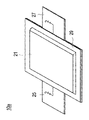
- FIG. 1 is a perspective view showing the appearance of a flat laminated all-solid-state lithium-ion secondary battery according to an embodiment of the lithium-ion secondary battery according to the present invention.
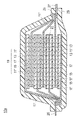
- FIG. 2 is a cross-sectional view taken along line 2-2 shown in FIG.
- FIG. 3 is a sectional view schematically showing a bipolar type (bipolar type) all-solid-state lithium ion secondary battery which is an embodiment of the lithium ion secondary battery according to the present invention.
- the composition of the central portion is the following chemical formula (1): Li 1 + q Ni x Coy Mn z M p O 2 (1)
- ⁇ 0.02 ⁇ q ⁇ 0.20, x + y + z + p 1, 0.5 ⁇ x ⁇ 1.0, 0 ⁇ y ⁇ 0.5, 0 ⁇ z ⁇ 0.5, 0 ⁇ p ⁇ 0. 1
- M is one or more elements selected from the group consisting of Ti, Zr, Nb, W, P, Al, Mg, V, Ca, Sr and Cr.
- a positive electrode containing a positive electrode active material made of a lithium-containing composite oxide represented by, a solid electrolyte layer containing a sulfide solid electrolyte containing sulfur and phosphorus, and a negative electrode containing a negative electrode active material are laminated in this order.
- FIG. 1 is a perspective view showing the appearance of a flat laminated all-solid-state lithium-ion secondary battery according to an embodiment of the lithium-ion secondary battery according to the present invention.
- FIG. 2 is a cross-sectional view taken along line 2-2 shown in FIG. By making it a laminated type, the battery can be made compact and has a high capacity.
- laminated battery hereinafter, also simply referred to as “laminated battery”
- the laminated battery 10a has a rectangular flat shape, and a negative electrode current collector plate 25 and a positive electrode current collector plate 27 for extracting electric power are pulled out from both sides thereof.
- the power generation element 21 is wrapped with a battery exterior material (laminated film 29) of the laminated battery 10a, and the periphery thereof is heat-sealed.
- the power generation element 21 has a negative electrode current collector plate 25 and a positive electrode current collector plate 27 external to the power generation element 21. It is sealed in the state of being pulled out.
- the lithium ion secondary battery according to this embodiment is not limited to a laminated flat battery.
- the wound lithium-ion secondary battery may have a cylindrical shape, or may be formed by deforming such a cylindrical shape into a rectangular flat shape.
- a laminated film may be used for the exterior material, or a conventional cylindrical can (metal can) may be used, and the present invention is not particularly limited.
- the power generation element is housed inside a laminated film containing aluminum. By this form, weight reduction can be achieved.
- the removal of the current collector plates (25, 27) shown in FIG. 1 is not particularly limited.
- the negative electrode current collector plate 25 and the positive electrode current collector plate 27 may be pulled out from the same side, or the negative electrode current collector plate 25 and the positive electrode current collector plate 27 may be divided into a plurality of parts and taken out from each side. It is not limited to what is shown in FIG. 1, such as good.
- the terminal in the winding type lithium ion battery, the terminal may be formed by using, for example, a cylindrical can (metal can) instead of the tab.
- the laminated battery 10a of the present embodiment has a structure in which a flat, substantially rectangular power generation element 21 in which a charge / discharge reaction actually proceeds is sealed inside a laminated film 29 which is a battery exterior material.
- the power generation element 21 has a configuration in which a positive electrode, a solid electrolyte layer 17, and a negative electrode are laminated.
- the positive electrode has a structure in which the positive electrode active material layer 15 containing the positive electrode active material is arranged on both sides of the positive electrode current collector 11 ′′.
- the negative electrode is a negative electrode containing the negative electrode active material on both sides of the negative electrode current collector 11 ′. It has a structure in which the active material layer 13 is arranged.
- one positive electrode active material layer 15 and the negative electrode active material layer 13 adjacent thereto are opposed to each other via the solid electrolyte layer 17.
- the positive electrode, the solid electrolyte layer, and the negative electrode are laminated in this order.
- the adjacent positive electrode, the solid electrolyte layer, and the negative electrode constitute one cell cell layer 19. Therefore, the laminated battery 10a shown in FIG. 1 is It can be said that a plurality of cell cell layers 19 are laminated so as to have a configuration in which they are electrically connected in parallel.
- the positive electrode active material layer 15 is arranged on only one side, but the active material layers are provided on both sides. May be done. That is, instead of using a current collector dedicated to the outermost layer having an active material layer on only one side, a current collector having active material layers on both sides may be used as it is as a current collector for the outermost layer. Further, in some cases, the negative electrode active material layer 13 and the positive electrode active material layer 15 may be used as the negative electrode and the positive electrode, respectively, without using the current collector (11', 11 ").
- the negative electrode current collector 11'and the positive electrode current collector 11' are attached with a negative electrode current collector plate (tab) 25 and a positive electrode current collector plate (tab) 27 that are conductive to each electrode (positive electrode and negative electrode), respectively, and the battery exterior. It has a structure that is led out to the outside of the laminated film 29 so as to be sandwiched between the ends of the laminated film 29, which is a material.
- the positive electrode current collector plate 27 and the negative electrode current collector plate 25 are positive electrodes, if necessary. It may be attached to the positive electrode current collector 11 "and the negative electrode current collector 11'of each electrode by ultrasonic welding, resistance welding, or the like via a lead and a negative electrode lead (not shown).
- the current collector has a function of mediating the movement of electrons from the electrode active material layer.
- the materials that make up the current collector There are no particular restrictions on the materials that make up the current collector.
- a constituent material of the current collector for example, a metal or a resin having conductivity can be adopted.
- examples of the metal include aluminum, nickel, iron, stainless steel, titanium, and copper.
- a clad material of nickel and aluminum, a clad material of copper and aluminum, and the like may be used.
- the foil may be a metal surface coated with aluminum.
- aluminum, stainless steel, copper, and nickel are preferable from the viewpoints of electron conductivity, battery operating potential, adhesion of the negative electrode active material by sputtering to the current collector, and the like.
- examples of the latter resin having conductivity include a resin in which a conductive filler is added to a non-conductive polymer material as needed.
- non-conductive polymer material examples include polyethylene (PE; high density polyethylene (HDPE), low density polyethylene (LDPE), etc.), polypropylene (PP), polyethylene terephthalate (PET), polyether nitrile (PEN), and polyimide.
- PE polyethylene
- HDPE high density polyethylene
- LDPE low density polyethylene
- PP polypropylene
- PET polyethylene terephthalate
- PEN polyether nitrile
- PI Polyimide
- PA Polyethylene
- PA Polytetrafluoroethylene
- SBR Styrene-butadiene rubber
- PAN Polyacrylonitrile
- PMA Polymethylacrylate
- PMMA Polymethylmethacrylate
- PVC Polyvinyl chloride
- PVdF polyvinylidene fluoride
- PS polystyrene
- Such non-conductive polymer materials may have excellent potential or solvent resistance.
- a conductive filler may be added to the above-mentioned conductive polymer material or non-conductive polymer material as needed.
- a conductive filler is inevitably indispensable in order to impart conductivity to the resin.
- the conductive filler can be used without particular limitation as long as it is a conductive substance.
- materials having excellent conductivity, potential resistance, or lithium ion blocking property include metals and conductive carbon.
- the metal is not particularly limited, and includes at least one metal selected from the group consisting of Ni, Ti, Al, Cu, Pt, Fe, Cr, Sn, Zn, In, and Sb, or at least one of these metals. It preferably contains an alloy or metal oxide.
- the conductive carbon is not particularly limited.
- acetylene black is selected from the group consisting of acetylene black, vulcan (registered trademark), black pearl (registered trademark), carbon nanofiber, Ketjen black (registered trademark), carbon nanotube, carbon nanohorn, carbon nanoballoon, and fullerene. It contains at least one species.
- the amount of the conductive filler added is not particularly limited as long as it can impart sufficient conductivity to the current collector, and is generally 5 to 80% by mass with respect to 100% by mass of the total mass of the current collector. Is.
- the current collector may have a single-layer structure made of a single material, or may have a laminated structure in which layers made of these materials are appropriately combined. From the viewpoint of reducing the weight of the current collector, it is preferable to include a conductive resin layer made of at least a conductive resin. Further, from the viewpoint of blocking the movement of lithium ions between the cells of the cell, a metal layer may be provided on a part of the current collector. Further, if the negative electrode active material layer and the positive electrode active material layer, which will be described later, have conductivity by themselves and can exhibit the current collecting function, a current collector as a member different from these electrode active material layers is used. It doesn't have to be. In such a form, the negative electrode active material layer described later constitutes the negative electrode as it is, and the positive electrode active material layer described later constitutes the positive electrode as it is.
- the negative electrode active material layer 13 contains a negative electrode active material.
- the type of the negative electrode active material is not particularly limited, and examples thereof include a carbon material, a metal oxide, and a metal active material.
- the carbon material include natural graphite, artificial graphite, mesocarbon microbeads (MCMB), highly oriented graphite (HOPG), hard carbon, soft carbon and the like.
- the metal oxide include Nb 2 O 5 and Li 4 Ti 5 O 12 .
- a silicon-based negative electrode active material or a tin-based negative electrode active material may be used.
- silicon and tin belong to Group 14 elements and are known to be negative electrode active materials that can greatly improve the capacity of a non-aqueous electrolyte secondary battery. Since these simple substances can occlude and release a large number of charge carriers (lithium ions, etc.) per unit volume (mass), they are high-capacity negative electrode active materials.
- Si alone as the silicon-based negative electrode active material.
- a silicon oxide such as SiO x (0.3 ⁇ x ⁇ 1.6) disproportionated into two phases, a Si phase and a silicon oxide phase.
- the range of x is more preferably 0.5 ⁇ x ⁇ 1.5, and further preferably 0.7 ⁇ x ⁇ 1.2.
- a silicon-containing alloy silicon-containing alloy-based negative electrode active material
- examples of the negative electrode active material containing a tin element include Sn alone, tin alloys (Cu—Sn alloys, Co—Sn alloys), amorphous tin oxides, tin silicon oxides and the like. Of these, SnB 0.4 P 0.6 O 3.1 is exemplified as the amorphous tin oxide. Further, SnSiO 3 is exemplified as the tin silicon oxide.
- a metal containing lithium may be used as the negative electrode active material.
- a negative electrode active material is not particularly limited as long as it is a lithium-containing active material, and examples thereof include metallic lithium and lithium-containing alloys.
- the lithium-containing alloy include alloys of Li and at least one of In, Al, Si and Sn.
- two or more kinds of negative electrode active materials may be used in combination.
- a negative electrode active material other than the above may be used.
- the negative electrode active material preferably contains metallic lithium, a silicon-based negative electrode active material, or a tin-based negative electrode active material, and particularly preferably contains metallic lithium.
- the shape of the negative electrode active material examples include particulate (spherical and fibrous) and thin film.
- its average particle size (D 50 ) is preferably in the range of, for example, 1 nm to 100 ⁇ m, more preferably in the range of 10 nm to 50 ⁇ m, and further preferably in the range of 100 nm. It is in the range of ⁇ 20 ⁇ m, and particularly preferably in the range of 1 to 20 ⁇ m.
- the value of the average particle size (D 50 ) of the active material can be measured by the laser diffraction / scattering method.
- the content of the negative electrode active material in the negative electrode active material layer is not particularly limited, but is preferably in the range of, for example, 40 to 99% by mass, and preferably in the range of 50 to 90% by mass. More preferred.
- the negative electrode active material layer preferably further contains a solid electrolyte. Since the negative electrode active material layer contains a solid electrolyte, the ionic conductivity of the negative electrode active material layer can be improved.
- the solid electrolyte include a sulfide solid electrolyte and an oxide solid electrolyte, and a sulfide solid electrolyte is preferable.
- Examples of the sulfide solid electrolyte include LiI-Li 2 S-SiS 2 , LiI-Li 2 S-P 2 O 5 , LiI-Li 3 PO 4 -P 2 S 5 , Li 2 S-P 2 S 5 , and Li 2 SP 2 S 5.
- the sulfide solid electrolyte may have, for example, a Li 3 PS 4 skeleton, a Li 4 P 2 S 7 skeleton, or a Li 4 P 2 S 6 skeleton. ..
- Examples of the sulfide solid electrolyte having a Li 3 PS 4 skeleton include LiI-Li 3 PS 4 , LiI-LiBr-Li 3 PS 4, and Li 3 PS 4 .
- Examples of the sulfide solid electrolyte having a Li 4 P 2 S 7 skeleton include a Li-PS-based solid electrolyte called LPS (for example, Li 7 P 3 S 11 ).
- the sulfide solid electrolyte for example, LGPS represented by Li (4-x) Ge (1-x) P x S 4 (x satisfies 0 ⁇ x ⁇ 1) may be used.
- the sulfide solid electrolyte contained in the active material layer is preferably a sulfide solid electrolyte containing P element, and the sulfide solid electrolyte is a material containing Li 2 SP 2 S 5 as a main component. It is more preferable to have.
- the sulfide solid electrolyte may contain halogen (F, Cl, Br, I).
- the sulfide solid electrolyte may be sulfide glass, crystallized sulfide glass, or a crystalline material obtained by the solid phase method.
- the sulfide glass can be obtained, for example, by performing mechanical milling (ball mill or the like) on the raw material composition.
- the crystallized sulfide glass can be obtained, for example, by heat-treating the sulfide glass at a temperature equal to or higher than the crystallization temperature.
- the ionic conductivity (for example, Li ionic conductivity) of the sulfide solid electrolyte at room temperature (25 ° C.) is preferably 1 ⁇ 10 -5 S / cm or more, for example, 1 ⁇ 10 -4 S / cm. It is more preferably cm or more.
- the value of the ionic conductivity of the solid electrolyte can be measured by the AC impedance method.
- Examples of the oxide solid electrolyte include compounds having a NASICON type structure and the like.
- a compound having a NASION type structure a compound (LAGP) represented by the general formula Li 1 + x Al x Ge 2-x (PO 4 ) 3 (0 ⁇ x ⁇ 2), a general formula Li 1 + x Al x Ti 2
- LAGP a compound represented by the general formula Li 1 + x Al x Ge 2-x (PO 4 ) 3 (0 ⁇ x ⁇ 2)
- a general formula Li 1 + x Al x Ti 2 examples thereof include a compound (LATP) represented by ⁇ x (PO 4 ) 3 (0 ⁇ x ⁇ 2).
- LiLaTIO for example, Li 0.34 La 0.51 TiO 3
- LiPON for example, Li 2.9 PO 3.3 N 0.46
- LiLaZrO for example, LiLaZrO
- the shape of the solid electrolyte examples include a particle shape such as a true spherical shape and an elliptical spherical shape, and a thin film shape.
- its average particle size (D 50 ) is not particularly limited, but is preferably 40 ⁇ m or less, more preferably 20 ⁇ m or less, still more preferably 10 ⁇ m or less.
- the average particle size (D 50 ) is preferably 0.01 ⁇ m or more, and more preferably 0.1 ⁇ m or more.
- the content of the solid electrolyte in the negative electrode active material layer is, for example, preferably in the range of 1 to 60% by mass, and more preferably in the range of 10 to 50% by mass.
- the negative electrode active material layer may further contain at least one of a conductive auxiliary agent and a binder in addition to the negative electrode active material and the solid electrolyte described above.
- the conductive auxiliary agent examples include metals such as aluminum, stainless steel (SUS), silver, gold, copper, and titanium, alloys or metal oxides containing these metals; carbon fiber (specifically, vapor-grown carbon fiber). (VGCF), polyacrylonitrile-based carbon fiber, pitch-based carbon fiber, rayon-based carbon fiber, activated carbon fiber, etc.), carbon nanotube (CNT), carbon black (specifically, acetylene black, Ketjen black (registered trademark)) , Furness black, channel black, thermal lamp black, etc.), but is not limited to these. Further, a particulate ceramic material or a resin material coated with the above metal material by plating or the like can also be used as a conductive auxiliary agent.
- metals such as aluminum, stainless steel (SUS), silver, gold, copper, and titanium, alloys or metal oxides containing these metals
- carbon fiber specifically, vapor-grown carbon fiber). (VGCF), polyacrylonitrile-based carbon fiber, pitch-based carbon fiber, rayon-based carbon fiber
- these conductive auxiliaries from the viewpoint of electrical stability, it is preferable to contain at least one selected from the group consisting of aluminum, stainless steel, silver, gold, copper, titanium, and carbon, and aluminum and stainless steel. It is more preferable to contain at least one selected from the group consisting of silver, gold, and carbon, and even more preferably to contain at least one carbon. Only one of these conductive aids may be used alone, or two or more thereof may be used in combination.
- the shape of the conductive auxiliary agent is preferably particulate or fibrous.
- the shape of the particles is not particularly limited, and may be any shape such as powder, sphere, rod, needle, plate, columnar, indefinite, fluffy, and spindle-shaped. It doesn't matter.
- the average particle size (primary particle size) when the conductive auxiliary agent is in the form of particles is not particularly limited, but is preferably 0.01 to 10 ⁇ m from the viewpoint of the electrical characteristics of the battery.
- the "particle diameter of the conductive auxiliary agent” means the maximum distance L among the distances between arbitrary two points on the contour line of the conductive auxiliary agent.
- the particle size of the particles observed in several to several tens of fields using an observation means such as a scanning electron microscope (SEM) or a transmission electron microscope (TEM). The value calculated as the average value of is adopted.
- the content of the conductive auxiliary agent in the negative electrode active material layer is not particularly limited, but is preferably 0 to 10% by mass with respect to the total mass of the negative electrode active material layer. , More preferably 2 to 8% by mass, still more preferably 4 to 7% by mass. Within such a range, it is possible to form a stronger electron conduction path in the negative electrode active material layer, and it is possible to effectively contribute to the improvement of battery characteristics.
- the binder is not particularly limited, and examples thereof include the following materials.
- Fluororesin such as ethylene / tetrafluoroethylene copolymer (ETFE), polychlorotrifluoroethylene (PCTFE), ethylene / chlorotrifluoroethylene copolymer (ECTFE), polyvinylfluorovinyl (PVF), vinylidene fluoride- Hexafluoropropylene-based fluororubber (VDF-HFP-based fluororubber), vinylidene fluoride-hexafluoropropylene-tetrafluoroethylene-based fluororubber (VDF-HFP-TFE-based fluororubber), vinylidene fluoride-pentafluoropropylene-based fluororubber (VDF-PFP-based fluorubber), vinylidene fluoride-pentafluoropropylene-tetrafluoroethylene-based fluororubber (VDF-PFP-TFE-based fluorubber), vinylidene fluoride-p
- the thickness of the negative electrode active material layer varies depending on the configuration of the target secondary battery, but is preferably in the range of 0.1 to 1000 ⁇ m, for example.
- the solid electrolyte layer is a layer interposed between the positive electrode active material layer and the negative electrode active material layer described above, and essentially contains a sulfide solid electrolyte containing sulfur and phosphorus. ..
- the specific form of the sulfide solid electrolyte contained in the solid electrolyte layer is not particularly limited, and the phosphorus-containing sulfide solid electrolyte exemplified in the column of the negative electrode active material layer can be similarly adopted.
- the sulfide solid electrolyte contained in the solid electrolyte layer is more preferably a material containing Li 2 SP 2 S 5 as a main component.
- a solid electrolyte other than the phosphorus-containing sulfide solid electrolyte described above may be used in combination.
- the ratio of the content of the above-mentioned predetermined sulfide solid electrolyte to 100% by mass of the total amount of the solid electrolyte is preferably 50% by mass or more, more preferably 70% by mass or more, still more preferably 80% by mass.
- the above is more preferably 90% by mass or more, particularly preferably 95% by mass or more, and most preferably 100% by mass.
- the solid electrolyte layer may further contain a binder in addition to the above-mentioned predetermined sulfide solid electrolyte.
- a binder in addition to the above-mentioned predetermined sulfide solid electrolyte.
- the binder that can be contained in the solid electrolyte layer the examples and preferred forms described in the column of the negative electrode active material layer can be similarly adopted.
- the thickness of the solid electrolyte layer varies depending on the configuration of the target lithium ion secondary battery, but is preferably 600 ⁇ m or less, more preferably 500 ⁇ m or less, from the viewpoint of improving the volumetric energy density of the battery. , More preferably 400 ⁇ m or less.
- the lower limit of the thickness of the solid electrolyte layer is not particularly limited, but is preferably 10 ⁇ m or more, more preferably 50 ⁇ m or more, and further preferably 100 ⁇ m or more.
- the positive electrode active material layer contains a so-called high nickel-based positive electrode active material.
- the positive electrode active material contained in the positive electrode active material layer of the secondary battery according to this embodiment has the following chemical formula (1): in the composition of the central portion. Li 1 + q Ni x Coy Mn z M p O 2 (1)
- ⁇ 0.02 ⁇ q ⁇ 0.20, x + y + z + p 1, 0.5 ⁇ x ⁇ 1.0, 0 ⁇ y ⁇ 0.5, 0 ⁇ z ⁇ 0.5, 0 ⁇ p ⁇ 0. 1
- M is one or more elements selected from the group consisting of Ti, Zr, Nb, W, P, Al, Mg, V, Ca, Sr and Cr. It is composed of a lithium-containing composite oxide represented by.
- Q in the general formula (1) is ⁇ 0.02 ⁇ q ⁇ 0.20.
- q is preferably 0 ⁇ q ⁇ 0.10.
- x in the general formula (1) is 0.50 ⁇ x ⁇ 1.0.
- x is preferably 0.50 ⁇ x ⁇ 1.0, more preferably 0.55 ⁇ x ⁇ 0.95, and further preferably 0.60 ⁇ x. ⁇ 0.90, and particularly preferably 0.70 ⁇ x ⁇ 0.85.
- y and z in the general formula (1) are 0 ⁇ (y, z) ⁇ 0.50.
- x / z is preferably more than 1, more preferably 1.2 or more, and even more preferably 1.5 to 99.
- the composition of the surface layer region of the particles of the lithium-containing composite oxide constituting the positive electrode active material is the composition of the central portion represented by the above-mentioned general formula (1). It is different from. Specifically, it consists of a group consisting of B, P, S and Si in the surface layer region within 100 nm in depth from the surface of the particles of the lithium-containing composite oxide having the composition of the central portion (general formula (1)) described above. It is characterized in that one or more selected additive elements are present at a higher molar concentration than Ni.
- At least one element of B, P, S and Si coexists in the surface layer region at a higher molar concentration than the Ni element.
- the elemental composition of the surface layer region within a depth of 100 nm from the surface of the lithium-containing composite oxide particles can be analyzed using X-ray photoelectron spectroscopy (XPS). Further, the composition of the central portion of the above-mentioned lithium-containing composite oxide can also be analyzed by XPS in the same manner. At the time of XPS measurement, as charge correction, correction is performed so as to shift the peak top of C1s to 284.6 [eV].
- the concentration (abundance) of the additive element in the surface layer region is not particularly limited, but the concentration of the additive element is preferably 1 to 30 mol%, more preferably 17 to 17 to the molar percentage of all the elements in the surface layer region. It is 30 mol%.
- the concentration of the additive element when the plurality of additive elements are present in the surface layer region is the total concentration of the plurality of additive elements.
- there is no particular limitation on the profile of the concentration change of the additive element in the depth direction in the surface layer region and for example, an inclined profile in which the concentration of the additive element gradually decreases from the surface toward the depth direction may be used.
- the profile may be such that the concentration of the additive element increases once from the surface toward the depth and then decreases, or the concentration of the additive element in the depth direction of the surface layer region is substantially uniform and is centered.
- the profile may be such that the concentration of the added element drops sharply on the way to the portion.
- the Ni element is also essential in the surface layer region in addition to the additive element described above, and when y> 0 or z> 0 in the general formula (1), the Mn element or The Co elements are also present in the same manner.
- the above-mentioned additive element is present by penetrating (doping) into the surface layer region of the lithium-containing composite oxide having the composition represented by the general formula (1).
- the positive electrode active material according to this embodiment means that the surface of the lithium-containing composite oxide is not simply coated with a substance containing an additive element.
- the concentration (abundance) of the Ni element in the surface layer region is also not particularly limited, but the concentration of the Ni element is preferably less than 10 mol%, more preferably as a molar percentage with respect to all the elements in the surface layer region. It is 2 to 7 mol%. Further, the value of the ratio (O / Ni) of the concentration of O (oxygen) to the concentration of Ni in the surface layer region is not particularly limited, but is preferably 20 from the viewpoint of further exhibiting the effects of the present invention. It is 0.0 or less, more preferably 2.9 to 20.0.
- the positive electrode active material used in the secondary battery according to this embodiment is a granular material of a lithium-containing composite oxide having the above-mentioned structure.
- the lithium-containing composite oxide according to this embodiment may be in the form of monodisperse primary particles or in the form of secondary particles formed by agglomeration of primary particles.
- the lithium-containing composite oxide according to the present embodiment is preferably in the form of primary particles.
- the average particle size of the lithium-containing composite oxide particles according to this embodiment is preferably 10 ⁇ m or less as a 50% cumulative diameter (D50) in terms of volume in the particle size distribution obtained by the laser diffraction / scattering method. Yes, more preferably 3.6 to 6.3 ⁇ m.
- Such a positive electrode active material (lithium-containing composite oxide) can be produced, for example, by the production method disclosed in JP-A-2020-35693 or a method obtained by appropriately modifying the production method.
- a method for producing the positive electrode active material (lithium-containing composite oxide) disclosed in the publication will be briefly described.
- a transition metal raw material aqueous solution containing one or more transition metal compounds and ammonium are used.
- An aqueous solution for nucleation containing an ion feeder is controlled to a predetermined pH, a predetermined ammonium ion concentration, and an oxygen concentration in a predetermined atmosphere and supplied to a crystallization reaction tank to generate nuclei (nuclear generation step). ..
- the nuclei generated in the nucleation step are grown into particles (particle growth step).
- a transition metal composite hydroxide which is a raw material for synthesizing the lithium-containing composite oxide, can be obtained.
- the transition metal composite hydroxide obtained above is heat-treated (heat treatment step).
- the heat-treated transition metal composite hydroxide and the lithium compound are mixed to form a lithium mixture (mixing step).
- the mixture formed in the mixing step is calcined (firing step).
- a lithium-containing composite oxide is obtained.
- the transition metal composite hydroxide obtained above is added as an additive element.
- a method of spray-drying a slurry in which a salt containing a transition metal composite hydroxide and an additive element is suspended and a method of mixing a salt containing a transition metal composite hydroxide and an additive element by a solid phase method are also disclosed.
- the additive elements (B, P, S, Si) according to the present invention are used in place of the additive elements disclosed in the above publication. Method can be adopted.
- the positive electrode active material according to the present embodiment is a so-called high nickel-based positive electrode active material, it has the composition of the surface layer region described above, and thus is a secondary battery using a sulfide solid electrolyte containing sulfur and phosphorus.
- the initial discharge capacity and cycle durability of the battery can be sufficiently improved.
- the mechanism by which such an effect is produced by the configuration of the present invention has not been completely clarified, the following mechanism has been presumed. That is, in the conventionally known high nickel-based positive electrode active material having the composition represented by the above-mentioned general formula (1), the concentration of the Ni element is as high as in the central portion in the surface layer region, and the Ni atom in the surface layer region.
- the oxygen atom form a metal-oxygen (Ni—O) bond. Unlike the covalent bond, this metal-oxygen bond becomes unstable during charging and therefore cleaves as the charging reaction progresses.
- the sulfide solid electrolyte containing sulfur and phosphorus tends to cause an oxidation (bonding with oxygen) reaction by contact with a high potential ( ⁇ 3V (against lithium)) positive electrode active material, and the metal in the above-mentioned positive electrode active material-
- the generation of active oxygen atoms by the cleavage of oxygen bonds accelerates the progress of this oxidation reaction.
- the concentrations of Ni element and O element in the composition of the surface layer region are relatively lowered by adding the additive element to the composition of the central portion.
- the above-mentioned additive elements B, P, S, Si
- the above-mentioned additive elements are electrochemically stable because they are covalently bonded to the O atom, which also suppresses the formation of active oxygen atoms. Work for.
- B (boron) is present in the surface layer region as the additive element from the viewpoint of further exhibiting the action and effect of the present invention.
- the atomic radius of B (boron) is smaller than that of other additive elements (P, S, Si), and as an additive element existing in the surface layer region, it most inhibits the occlusion and release of lithium ions in the lithium-containing composite oxide. This is because it is difficult. That is, when the additive element is B (boron), in addition to the action and effect of the present invention, the effect of improving the output characteristics accompanying the reduction of the battery resistance (reaction resistance) can be obtained.
- Patent Document 1 Patent Document 1
- this is due to the influence of expansion and contraction of the active material due to charging and discharging, and the peeling of the reaction suppression layer due to the application of shearing force during kneading in the slurry preparation step.
- coating the layer containing the lithium-containing oxide acts in the direction of increasing the resistance to the conduction of lithium ions and electrons.
- the manufacturing cost increases because a step of separately providing a reaction suppressing layer is required.
- a positive electrode active material other than the above-mentioned lithium-containing composite oxide may be used in combination.
- the ratio of the content of the predetermined lithium-containing composite oxide to 100% by mass of the total amount of the positive electrode active material is preferably 50% by mass or more, more preferably 70% by mass or more, and further preferably 80. It is by mass or more, more preferably 90% by mass or more, particularly preferably 95% by mass or more, and most preferably 100% by mass.
- the content of the positive electrode active material in the positive electrode active material layer is not particularly limited, but may be in the range of 55 to 95% by mass from the viewpoint of preventing a decrease in the energy density of the secondary battery. preferable.
- the positive electrode active material layer may further contain a conductive auxiliary agent and / or a binder, and as for the specific form and preferable form thereof, those described in the above-mentioned negative electrode active material layer column are similarly adopted. sell.
- the material constituting the current collector plates (25, 27) is not particularly limited, and known highly conductive materials conventionally used as current collector plates for secondary batteries can be used.
- As the constituent material of the current collector plate for example, metal materials such as aluminum, copper, titanium, nickel, stainless steel (SUS), and alloys thereof are preferable. From the viewpoint of light weight, corrosion resistance, and high conductivity, aluminum and copper are more preferable, and aluminum is particularly preferable.
- the same material may be used for the positive electrode current collector plate 27 and the negative electrode current collector plate 25, or different materials may be used.
- the current collector (11, 12) and the current collector plate (25, 27) may be electrically connected via a positive electrode lead or a negative electrode lead.
- a material used in a known lithium ion secondary battery can be similarly adopted.
- the part taken out from the exterior is heat-shrinkable with heat-resistant insulation so that it does not affect the product (for example, automobile parts, especially electronic devices) by contacting peripheral devices and wiring and causing electric leakage. It is preferable to cover with a tube or the like.
- Battery exterior material As the battery exterior material, a known metal can case can be used, and a bag-shaped case using a laminated film 29 containing aluminum, which can cover the power generation element as shown in FIGS. 1 and 2, is used. Can be done.
- the laminated film for example, a laminated film having a three-layer structure in which PP, aluminum, and nylon are laminated in this order can be used, but the laminated film is not limited thereto.
- a laminated film is desirable from the viewpoint of high output, excellent cooling performance, and suitable use for batteries for large equipment for EVs and HEVs. Further, since the group pressure applied to the power generation element from the outside can be easily adjusted, a laminated film containing aluminum is more preferable for the exterior body.
- the laminated battery according to this embodiment has a configuration in which a plurality of single battery layers are connected in parallel, so that it has a high capacity and excellent cycle durability. Therefore, the laminated battery according to this embodiment is suitably used as a driving power source for EVs and HEVs.
- the present invention is not limited to the configuration described in the above-described embodiment, and may be appropriately modified based on the description of the claims. It is possible.
- a positive electrode active material layer electrically bonded to one surface of the current collector and an electrical charge to the opposite surface of the current collector are used.
- a bipolar type battery including a bipolar type electrode having a negative electrode active material layer coupled to the above can also be mentioned.
- FIG. 3 is a cross section schematically showing a bipolar type (bipolar type) lithium ion secondary battery (hereinafter, also simply referred to as “bipolar type battery”) which is an embodiment of the lithium ion secondary battery according to the present invention. It is a figure.
- the bipolar battery 10b shown in FIG. 3 has a structure in which a substantially rectangular power generation element 21 in which a charge / discharge reaction actually proceeds is sealed inside a laminated film 29 which is a battery exterior.
- a positive electrode active material layer 15 electrically coupled to one surface of the current collector 11 is formed, and the opposite side of the current collector 11 is formed. It has a plurality of bipolar electrodes 23 having a negative electrode active material layer 13 electrically coupled to the surface of the surface. Each bipolar electrode 23 is laminated via a solid electrolyte layer 17 to form a power generation element 21.
- the solid electrolyte layer 17 has a structure in which the solid electrolyte is formed into a layer. As shown in FIG. 3, the solid electrolyte layer 17 is between the positive electrode active material layer 15 of the one bipolar electrode 23 and the negative electrode active material layer 13 of the other bipolar electrode 23 adjacent to the one bipolar electrode 23. Are sandwiched between them.
- the adjacent positive electrode active material layer 15, the solid electrolyte layer 17, and the negative electrode active material layer 13 constitute one single battery layer 19. Therefore, it can be said that the bipolar battery 10b has a configuration in which the single battery layers 19 are laminated.
- the positive electrode active material layer 15 is formed on only one side of the outermost layer current collector 11a on the positive electrode side located in the outermost layer of the power generation element 21.
- the negative electrode active material layer 13 is formed on only one side of the outermost layer current collector 11b on the negative electrode side located in the outermost layer of the power generation element 21.
- a positive electrode current collector plate (positive electrode tab) 25 is arranged adjacent to the outermost layer current collector 11a on the positive electrode side, and the positive electrode current collector plate (positive electrode tab) 25 is extended to form a laminated film which is a battery exterior body. It is derived from 29.
- the negative electrode current collector plate (negative electrode tab) 27 is arranged so as to be adjacent to the outermost layer current collector 11b on the negative electrode side, and is similarly extended and led out from the laminated film 29.
- the number of stacking of the cell layers 19 is adjusted according to the desired voltage. Further, in the bipolar battery 10b, the number of times the single battery layer 19 is laminated may be reduced as long as a sufficient output can be secured even if the thickness of the battery is made as thin as possible. Even in the bipolar battery 10b, in order to prevent external impact and environmental deterioration during use, the power generation element 21 is vacuum-enclosed in the laminated film 29 which is the battery exterior, and the positive electrode current collector plate 27 and the negative electrode current collector plate 27 are sealed. It is preferable to have a structure in which 25 is taken out from the laminated film 29.
- the secondary battery according to this embodiment does not have to be an all-solid-state type. That is, the solid electrolyte layer may further contain a conventionally known liquid electrolyte (electrolyte solution).
- the amount of the liquid electrolyte (electrolyte solution) that can be contained in the solid electrolyte layer is not particularly limited, but the shape of the solid electrolyte layer formed by the solid electrolyte is maintained and the liquid electrolyte (electrolyte solution) does not leak. Is preferably the amount of.
- the liquid electrolyte (electrolyte solution) that can be used has a form in which a lithium salt is dissolved in an organic solvent.
- organic solvent used include dimethyl carbonate (DMC), diethyl carbonate (DEC), dipropyl carbonate (DPC), ethyl methyl carbonate (EMC), methyl propionate (MP), methyl acetate (MA), and methyl formate.
- the organic solvent is preferably a chain carbonate, more preferably diethyl carbonate (DEC), ethyl methyl carbonate (EMC) and dimethyl carbonate (DMC) from the viewpoint of further improving the quick charge property and the output property. It is at least one selected from the group consisting of, and more preferably selected from ethyl methyl carbonate (EMC) and dimethyl carbonate (DMC).
- Lithium salts include Li (FSO 2 ) 2 N (lithium bis (fluorosulfonyl) imide; LiFSI), Li (C 2 F 5 SO 2 ) 2 N, LiPF 6 , LiBF 4 , LiClO 4 , LiAsF 6 , LiCF 3 SO 3 and the like can be mentioned.
- the lithium salt is preferably Li (FSO 2 ) 2N ( LiFSI) from the viewpoint of battery output and charge / discharge cycle characteristics.
- the liquid electrolyte may further contain additives other than the above-mentioned components.
- additives include, for example, ethylene carbonate, vinylene carbonate, methylvinylene carbonate, dimethylvinylene carbonate, phenylvinylene carbonate, diphenylvinylene carbonate, ethylvinylene carbonate, diethylvinylene carbonate, vinylethylene carbonate, 1,2-.
- An assembled battery is configured by connecting a plurality of batteries. More specifically, it is composed of serialization, parallelization, or both by using at least two or more. By serializing and parallelizing, it becomes possible to freely adjust the capacity and voltage.
- a small assembled battery that can be attached and detached by connecting multiple batteries in series or in parallel. Then, by connecting a plurality of small detachable batteries in series or in parallel, a large capacity and a large capacity suitable for a vehicle drive power source or an auxiliary power source that require a high volume energy density and a high volume output density. It is also possible to form an assembled battery having an output (battery module, battery pack, etc.). How many batteries are connected to make an assembled battery, and how many stages of small assembled batteries are stacked to make a large-capacity assembled battery depends on the battery capacity of the vehicle (electric vehicle) to be mounted. It may be decided according to the output.
- a battery or a combined battery consisting of a plurality of these can be mounted on a vehicle.
- a plug-in hybrid electric vehicle having a long EV mileage and an electric vehicle having a long one-charge mileage can be configured by mounting such a battery.
- hybrid vehicles, fuel cell vehicles, electric vehicles (all four-wheeled vehicles (passenger cars, trucks, commercial vehicles such as buses, light vehicles, etc.)) can be used as batteries or a combination of multiple batteries. This is because it becomes a highly reliable automobile with a long life by using it for two-wheeled vehicles (including motorcycles) and three-wheeled vehicles.
- the application is not limited to automobiles, and can be applied to various power sources of other vehicles, for example, moving objects such as trains, and power supplies for mounting such as uninterruptible power supplies. It is also possible to use it as.
- a lithium-containing composite oxide having a uniform composition of LiNi 0.8 Mn 0.1 Co 0.1 O 2 and having the form of secondary particles which are aggregates of primary particles was prepared.
- the average particle size (D50) of the lithium-containing composite oxide (secondary particles) was measured by a laser diffraction / scattering method and found to be 11.5 ⁇ m.
- the elemental composition of the surface layer region within a depth of 100 nm from the surface of the lithium-containing composite oxide particles prepared above was measured by X-ray photoelectron spectroscopy (XPS), Ni was 15 as a ratio to all the elements. Mol% and O were 57 mol%.
- the value of the ratio (O / Ni) of the concentration of O (oxygen) to the concentration of Ni in the surface layer region calculated from these values was 3.8.
- a correction was made so as to shift the peak top of C1s to 284.6 [eV].
- LPS Li 2 SP 2 S 5 (mixing ratio 80:20 (mol%)
- acetylene black was prepared as a conductive auxiliary agent.
- LPS Li 2 SP 2 S 5 (mixing ratio 80:20 (mol%)
- a solid electrolyte layer (a disk shape having a diameter of 10 mm and a thickness of 600 ⁇ m) was produced by powder molding at a molding pressure.
- the positive electrode mixture prepared above was placed on one surface of the solid electrolyte layer prepared above, and powder molding was performed at a molding pressure of 200 [MPa] to obtain a positive electrode active material layer (diameter 10 mm and thickness 70 ⁇ m). (Disc shape) was produced.
- a Li-In electrode made of a laminate of a lithium metal foil (thickness 100 ⁇ m) and an indium metal foil (thickness 100 ⁇ m) was prepared. Then, the Li-In electrode was arranged on the other surface of the solid electrolyte layer prepared above so that the indium metal leaf was located on the solid electrolyte layer side. Next, after fastening the jig with a restraining pressure of 100 [MPa], a lead for taking out a current was connected to each electrode to prepare a test cell of this comparative example.
- a lithium-containing composite oxide having a uniform composition of LiNi 0.8 Mn 0.1 Co 0.1 O 2 and having the form of secondary particles which are aggregates of primary particles was prepared.
- the average particle size (D50) of the lithium-containing composite oxide (secondary particles) was measured by a laser diffraction / scattering method and found to be 10.5 ⁇ m.
- Ni was 10 as a ratio to all the elements.
- Mol% and O were 56 mol%.
- the value of the ratio (O / Ni) of the concentration of O (oxygen) to the concentration of Ni in the surface layer region calculated from these values was 5.6.
- a test cell of this comparative example was prepared by the same method as in Comparative Example 1 described above, except that the lithium-containing composite oxide prepared above was used as the positive electrode active material.
- a lithium-containing composite oxide having a uniform composition of LiNi 0.8 Mn 0.1 Co 0.1 O 2 and having the form of secondary particles which are aggregates of primary particles was prepared.
- the average particle size (D50) of the lithium-containing composite oxide (secondary particles) was measured by a laser diffraction / scattering method and found to be 10.2 ⁇ m.
- Ni was 12 as a ratio to all the elements. Mol% and O were 55 mol%.
- the value of the ratio (O / Ni) of the concentration of O (oxygen) to the concentration of Ni in the surface layer region calculated from these values was 4.6.
- a test cell of this comparative example was prepared by the same method as in Comparative Example 1 described above, except that the lithium-containing composite oxide prepared above was used as the positive electrode active material.
- a lithium-containing composite oxide having a uniform composition of LiNi 0.8 Mn 0.1 Co 0.1 O 2 and having the form of primary particles was prepared.
- the average particle size (D50) of the lithium-containing composite oxide (primary particles) was measured by a laser diffraction / scattering method and found to be 4 or 5 ⁇ m.
- the elemental composition of the surface layer region within a depth of 100 nm from the surface of the lithium-containing composite oxide particles prepared above was measured by X-ray photoelectron spectroscopy (XPS), Ni was 13 as a ratio to all the elements. Mol% and O were 60 mol%. Further, the value of the ratio (O / Ni) of the concentration of O (oxygen) to the concentration of Ni in the surface layer region calculated from these values was 4.6.
- a test cell of this comparative example was prepared by the same method as in Comparative Example 1 described above, except that the lithium-containing composite oxide prepared above was used as the positive electrode active material.
- Example 1 As a positive electrode active material, a lithium-containing composite oxidation having a uniform composition of LiNi 0.8 Mn 0.1 Co 0.1 O 2 in the center, B (boron) in the surface layer region, and the form of primary particles.
- the average particle size (D50) of the lithium-containing composite oxide (primary particles) was measured by a laser diffraction / scattering method and found to be 3.6 ⁇ m.
- the elemental composition of the surface layer region within a depth of 100 nm from the surface of the lithium-containing composite oxide particles prepared above was measured by X-ray photoelectron spectroscopy (XPS), Ni was 5 as a ratio to all the elements. Mol%, O was 36 mol%, and B was 24 mol%. Further, the value of the ratio (O / Ni) of the concentration of O (oxygen) to the concentration of Ni in the surface layer region calculated from these values was 7.2.
- a test cell of this comparative example was prepared by the same method as in Comparative Example 1 described above, except that the lithium-containing composite oxide prepared above was used as the positive electrode active material.
- Example 2 As a positive electrode active material, a lithium-containing composite oxidation having a uniform composition of LiNi 0.8 Mn 0.1 Co 0.1 O 2 in the center, B (boron) in the surface layer region, and the form of primary particles. I prepared things. The average particle size (D50) of the lithium-containing composite oxide (primary particles) was measured by a laser diffraction / scattering method and found to be 3.6 ⁇ m. Further, when the elemental composition of the surface layer region within a depth of 100 nm from the surface of the lithium-containing composite oxide particles prepared above was measured by X-ray photoelectron spectroscopy (XPS), Ni was 7 as a ratio to all the elements. Mol%, O was 20 mol%, and B was 30 mol%. Further, the value of the ratio (O / Ni) of the concentration of O (oxygen) to the concentration of Ni in the surface layer region calculated from these values was 2.9.
- D50 average particle size of the lithium-containing composite oxide (primary particles) was measured
- a test cell of this comparative example was prepared by the same method as in Comparative Example 1 described above, except that the lithium-containing composite oxide prepared above was used as the positive electrode active material.
- Example 3 As a positive electrode active material, a lithium-containing composite oxidation having a uniform composition of LiNi 0.8 Mn 0.1 Co 0.1 O 2 in the center, B (boron) in the surface layer region, and the form of primary particles.
- the average particle size (D50) of the lithium-containing composite oxide (primary particles) was measured by a laser diffraction / scattering method and found to be 4.3 ⁇ m.
- the elemental composition of the surface layer region within a depth of 100 nm from the surface of the lithium-containing composite oxide particles prepared above was measured by X-ray photoelectron spectroscopy (XPS), Ni was 2 as a ratio to all the elements. Mol%, O was 40 mol%, and B was 17 mol%. Further, the value of the ratio (O / Ni) of the concentration of O (oxygen) to the concentration of Ni in the surface layer region calculated from these values was 20.0.
- a test cell of this comparative example was prepared by the same method as in Comparative Example 1 described above, except that the lithium-containing composite oxide prepared above was used as the positive electrode active material.
- Example 4 As a positive electrode active material, a lithium-containing composite oxidation having a uniform composition of LiNi 0.8 Mn 0.1 Co 0.1 O 2 in the center, B (boron) in the surface layer region, and the form of primary particles. I prepared things. The average particle size (D50) of the lithium-containing composite oxide (primary particles) was measured by a laser diffraction / scattering method and found to be 4.6 ⁇ m. Further, when the elemental composition of the surface layer region within a depth of 100 nm from the surface of the lithium-containing composite oxide particles prepared above was measured by X-ray photoelectron spectroscopy (XPS), Ni was 3 as a ratio to all the elements. Mol%, O was 40 mol%, and B was 17 mol%. Further, the value of the ratio (O / Ni) of the concentration of O (oxygen) to the concentration of Ni in the surface layer region calculated from these values was 13.3.
- a test cell of this comparative example was prepared by the same method as in Comparative Example 1 described above, except that the lithium-containing composite oxide prepared above was used as the positive electrode active material.
- Example 5 As a positive electrode active material, a lithium-containing composite oxidation having a uniform composition of LiNi 0.8 Mn 0.1 Co 0.1 O 2 in the center, B (boron) in the surface layer region, and the form of primary particles. I prepared things. The average particle size (D50) of this lithium-containing composite oxide (primary particles) was measured by a laser diffraction / scattering method and found to be 3.6 ⁇ m. Further, when the elemental composition of the surface layer region within a depth of 100 nm from the surface of the lithium-containing composite oxide particles prepared above was measured by X-ray photoelectron spectroscopy (XPS), Ni was 3 as a ratio to all the elements. Mol%, O was 57 mol%, and B was 17 mol%. Further, the value of the ratio (O / Ni) of the concentration of O (oxygen) to the concentration of Ni in the surface layer region calculated from these values was 19.0.
- XPS X-ray photoelectron spectroscopy
- a test cell of this comparative example was prepared by the same method as in Comparative Example 1 described above, except that the lithium-containing composite oxide prepared above was used as the positive electrode active material.
- test cell was sandwiched between stainless steel plates (two sheets) having a thickness of 5 mm, and pressure was applied using a flat plate press machine via a hydraulic jack so that the fastening pressure was 1000 kgf / cm 2 .
- the test cell was placed inside a constant temperature bath set at 25 ° C, connected to a charge / discharge device, and a charge / discharge test was performed to measure the charge / discharge capacity.
- a current corresponding to 0.05 C was applied, and CC-CV charging was performed with the upper limit voltage set to 3.6 V (vs. Li-In negative electrode). Further, this charging process was terminated when the current value dropped to a value corresponding to 0.01 C or when 40 hours had passed from the start of charging.
- the battery was left for 1 hour and then discharged.
- CC discharge was performed with a current value corresponding to 0.05 C and a lower limit voltage of 1.9 V (vs.
Landscapes
- Chemical & Material Sciences (AREA)
- General Chemical & Material Sciences (AREA)
- Chemical Kinetics & Catalysis (AREA)
- Electrochemistry (AREA)
- Engineering & Computer Science (AREA)
- Composite Materials (AREA)
- Manufacturing & Machinery (AREA)
- Inorganic Chemistry (AREA)
- Materials Engineering (AREA)
- Physics & Mathematics (AREA)
- Condensed Matter Physics & Semiconductors (AREA)
- General Physics & Mathematics (AREA)
- Battery Electrode And Active Subsutance (AREA)
- Secondary Cells (AREA)
Priority Applications (5)
| Application Number | Priority Date | Filing Date | Title |
|---|---|---|---|
| JP2022553223A JP7611261B2 (ja) | 2020-10-01 | 2020-10-01 | 二次電池 |
| CN202080105376.2A CN116195090B (zh) | 2020-10-01 | 2020-10-01 | 二次电池 |
| PCT/IB2020/000823 WO2022069913A1 (ja) | 2020-10-01 | 2020-10-01 | 二次電池 |
| US18/029,417 US20230282823A1 (en) | 2020-10-01 | 2020-10-01 | Secondary Battery |
| EP20956139.8A EP4224571A4 (en) | 2020-10-01 | 2020-10-01 | SECONDARY BATTERY |
Applications Claiming Priority (1)
| Application Number | Priority Date | Filing Date | Title |
|---|---|---|---|
| PCT/IB2020/000823 WO2022069913A1 (ja) | 2020-10-01 | 2020-10-01 | 二次電池 |
Publications (1)
| Publication Number | Publication Date |
|---|---|
| WO2022069913A1 true WO2022069913A1 (ja) | 2022-04-07 |
Family
ID=80949759
Family Applications (1)
| Application Number | Title | Priority Date | Filing Date |
|---|---|---|---|
| PCT/IB2020/000823 Ceased WO2022069913A1 (ja) | 2020-10-01 | 2020-10-01 | 二次電池 |
Country Status (5)
| Country | Link |
|---|---|
| US (1) | US20230282823A1 (https=) |
| EP (1) | EP4224571A4 (https=) |
| JP (1) | JP7611261B2 (https=) |
| CN (1) | CN116195090B (https=) |
| WO (1) | WO2022069913A1 (https=) |
Families Citing this family (1)
| Publication number | Priority date | Publication date | Assignee | Title |
|---|---|---|---|---|
| CN121839814A (zh) * | 2025-03-27 | 2026-04-10 | 珠海冠宇电池股份有限公司 | 锂离子二次电池 |
Citations (8)
| Publication number | Priority date | Publication date | Assignee | Title |
|---|---|---|---|---|
| JPH08138670A (ja) * | 1994-11-11 | 1996-05-31 | Toshiba Corp | 非水溶媒二次電池 |
| JP2006318815A (ja) * | 2005-05-13 | 2006-11-24 | Nissan Motor Co Ltd | 非水電解リチウムイオン電池用正極材料、これを用いた電池および非水電解リチウムイオン電池用正極材料の製造方法 |
| JP2008251434A (ja) * | 2007-03-30 | 2008-10-16 | Sony Corp | 正極活物質、正極および非水電解質電池 |
| WO2013022034A1 (ja) | 2011-08-09 | 2013-02-14 | トヨタ自動車株式会社 | 複合正極活物質、全固体電池、および複合正極活物質の製造方法 |
| WO2015050031A1 (ja) * | 2013-10-03 | 2015-04-09 | トヨタ自動車株式会社 | 被覆正極活物質およびリチウム固体電池 |
| JP2016006762A (ja) * | 2014-05-28 | 2016-01-14 | 日亜化学工業株式会社 | 非水系二次電池用正極活物質 |
| WO2019039566A1 (ja) * | 2017-08-25 | 2019-02-28 | 住友金属鉱山株式会社 | 非水系電解質二次電池用正極活物質とその製造方法、及び、非水系電解質二次電池とその製造方法 |
| JP2020035693A (ja) | 2018-08-31 | 2020-03-05 | 住友金属鉱山株式会社 | 遷移金属複合水酸化物、遷移金属複合水酸化物の製造方法、リチウム遷移金属複合酸化物活物質及びリチウムイオン二次電池 |
Family Cites Families (6)
| Publication number | Priority date | Publication date | Assignee | Title |
|---|---|---|---|---|
| CN109599555A (zh) | 2013-02-28 | 2019-04-09 | 日产自动车株式会社 | 正极活性物质、正极材料、正极及非水电解质二次电池 |
| KR101601917B1 (ko) * | 2014-02-11 | 2016-03-09 | 울산과학기술원 | 리튬 이차전지용 양극 활물질, 이들의 제조방법, 및 이를 포함하는 리튬 이차전지 |
| KR101555594B1 (ko) * | 2014-10-02 | 2015-10-06 | 주식회사 에코프로 | 리튬 이차 전지용 양극활물질 및 이를 포함하는 리튬 이차 전지 |
| JP6252524B2 (ja) * | 2015-03-12 | 2017-12-27 | トヨタ自動車株式会社 | 固体電池用正極活物質の製造方法 |
| JP2017033839A (ja) | 2015-08-04 | 2017-02-09 | 日立化成株式会社 | リチウム二次電池用正極、リチウム二次電池及びリチウムイオン二次電池用正極の製造方法 |
| KR102132878B1 (ko) | 2017-10-20 | 2020-07-10 | 주식회사 엘지화학 | 리튬 이차전지용 양극 활물질, 이의 제조방법, 이를 포함하는 리튬 이차전지용 양극 및 리튬 이차전지 |
-
2020
- 2020-10-01 WO PCT/IB2020/000823 patent/WO2022069913A1/ja not_active Ceased
- 2020-10-01 EP EP20956139.8A patent/EP4224571A4/en active Pending
- 2020-10-01 JP JP2022553223A patent/JP7611261B2/ja active Active
- 2020-10-01 US US18/029,417 patent/US20230282823A1/en active Pending
- 2020-10-01 CN CN202080105376.2A patent/CN116195090B/zh active Active
Patent Citations (8)
| Publication number | Priority date | Publication date | Assignee | Title |
|---|---|---|---|---|
| JPH08138670A (ja) * | 1994-11-11 | 1996-05-31 | Toshiba Corp | 非水溶媒二次電池 |
| JP2006318815A (ja) * | 2005-05-13 | 2006-11-24 | Nissan Motor Co Ltd | 非水電解リチウムイオン電池用正極材料、これを用いた電池および非水電解リチウムイオン電池用正極材料の製造方法 |
| JP2008251434A (ja) * | 2007-03-30 | 2008-10-16 | Sony Corp | 正極活物質、正極および非水電解質電池 |
| WO2013022034A1 (ja) | 2011-08-09 | 2013-02-14 | トヨタ自動車株式会社 | 複合正極活物質、全固体電池、および複合正極活物質の製造方法 |
| WO2015050031A1 (ja) * | 2013-10-03 | 2015-04-09 | トヨタ自動車株式会社 | 被覆正極活物質およびリチウム固体電池 |
| JP2016006762A (ja) * | 2014-05-28 | 2016-01-14 | 日亜化学工業株式会社 | 非水系二次電池用正極活物質 |
| WO2019039566A1 (ja) * | 2017-08-25 | 2019-02-28 | 住友金属鉱山株式会社 | 非水系電解質二次電池用正極活物質とその製造方法、及び、非水系電解質二次電池とその製造方法 |
| JP2020035693A (ja) | 2018-08-31 | 2020-03-05 | 住友金属鉱山株式会社 | 遷移金属複合水酸化物、遷移金属複合水酸化物の製造方法、リチウム遷移金属複合酸化物活物質及びリチウムイオン二次電池 |
Non-Patent Citations (1)
| Title |
|---|
| See also references of EP4224571A4 |
Also Published As
| Publication number | Publication date |
|---|---|
| CN116195090A (zh) | 2023-05-30 |
| JP7611261B2 (ja) | 2025-01-09 |
| US20230282823A1 (en) | 2023-09-07 |
| JPWO2022069913A1 (https=) | 2022-04-07 |
| CN116195090B (zh) | 2026-04-28 |
| EP4224571A4 (en) | 2024-10-09 |
| EP4224571A1 (en) | 2023-08-09 |
Similar Documents
| Publication | Publication Date | Title |
|---|---|---|
| JP7304014B2 (ja) | 全固体リチウムイオン二次電池用固体電解質層およびこれを用いた全固体リチウムイオン二次電池 | |
| WO2017006480A1 (ja) | 非水電解質二次電池 | |
| JP7488666B2 (ja) | リチウムイオン二次電池 | |
| JP7206798B2 (ja) | リチウムイオン伝導性固体電解質、およびこれを用いた電気化学デバイス | |
| JP7386046B2 (ja) | 全固体電池 | |
| JP7662988B2 (ja) | 電気デバイス用正極材料並びにこれを用いた電気デバイス用正極および電気デバイス | |
| JP2022082060A (ja) | 二次電池 | |
| JP7437995B2 (ja) | 非水電解質二次電池 | |
| JP2020198269A (ja) | 全固体リチウムイオン二次電池システム、並びに全固体リチウムイオン二次電池を充電するための装置および方法 | |
| JP2021099958A (ja) | 全固体リチウムイオン二次電池 | |
| JP2022170190A (ja) | 二次電池用正極 | |
| JP7641719B2 (ja) | 正極活物質層の内部抵抗低減剤、並びにこれを用いた二次電池用電極材料 | |
| JP7845818B2 (ja) | 二次電池 | |
| JP7493054B2 (ja) | 電気デバイス用正極材料並びにこれを用いた電気デバイス用正極および電気デバイス | |
| JP2023064496A (ja) | 正極材料およびこれを用いた二次電池 | |
| JP7611261B2 (ja) | 二次電池 | |
| JP7769290B2 (ja) | 電気デバイス用正極材料並びにこれを用いた電気デバイス用正極および電気デバイス | |
| JP7523533B2 (ja) | 二次電池用正極 | |
| JP7722002B2 (ja) | リチウムイオン二次電池用正極 | |
| JP7594884B2 (ja) | 正極活物質層の内部抵抗低減剤、並びにこれを用いた二次電池用正極材料 | |
| JP7695782B2 (ja) | 二次電池 | |
| JP7248136B2 (ja) | リチウムイオン二次電池用正極活物質 | |
| JP2020198268A (ja) | 全固体リチウムイオン二次電池システム、並びに全固体リチウムイオン二次電池を充電するための装置および方法 | |
| JP2022158172A (ja) | 非水電解質二次電池の製造方法 | |
| JP2022092896A (ja) | リチウム二次電池 |
Legal Events
| Date | Code | Title | Description |
|---|---|---|---|
| 121 | Ep: the epo has been informed by wipo that ep was designated in this application |
Ref document number: 20956139 Country of ref document: EP Kind code of ref document: A1 |
|
| ENP | Entry into the national phase |
Ref document number: 2022553223 Country of ref document: JP Kind code of ref document: A |
|
| NENP | Non-entry into the national phase |
Ref country code: DE |
|
| ENP | Entry into the national phase |
Ref document number: 2020956139 Country of ref document: EP Effective date: 20230502 |