WO2022059705A1 - 樹脂組成物、樹脂組成物の製造方法、及び樹脂 - Google Patents
樹脂組成物、樹脂組成物の製造方法、及び樹脂 Download PDFInfo
- Publication number
- WO2022059705A1 WO2022059705A1 PCT/JP2021/033937 JP2021033937W WO2022059705A1 WO 2022059705 A1 WO2022059705 A1 WO 2022059705A1 JP 2021033937 W JP2021033937 W JP 2021033937W WO 2022059705 A1 WO2022059705 A1 WO 2022059705A1
- Authority
- WO
- WIPO (PCT)
- Prior art keywords
- nanocellulose
- resin composition
- ethylenically unsaturated
- unsaturated monomer
- polymer
- Prior art date
- Legal status (The legal status is an assumption and is not a legal conclusion. Google has not performed a legal analysis and makes no representation as to the accuracy of the status listed.)
- Ceased
Links
Images
Classifications
-
- C—CHEMISTRY; METALLURGY
- C08—ORGANIC MACROMOLECULAR COMPOUNDS; THEIR PREPARATION OR CHEMICAL WORKING-UP; COMPOSITIONS BASED THEREON
- C08L—COMPOSITIONS OF MACROMOLECULAR COMPOUNDS
- C08L1/00—Compositions of cellulose, modified cellulose or cellulose derivatives
- C08L1/02—Cellulose; Modified cellulose
- C08L1/04—Oxycellulose; Hydrocellulose, e.g. microcrystalline cellulose
-
- C—CHEMISTRY; METALLURGY
- C08—ORGANIC MACROMOLECULAR COMPOUNDS; THEIR PREPARATION OR CHEMICAL WORKING-UP; COMPOSITIONS BASED THEREON
- C08B—POLYSACCHARIDES; DERIVATIVES THEREOF
- C08B15/00—Preparation of other cellulose derivatives or modified cellulose, e.g. complexes
- C08B15/02—Oxycellulose; Hydrocellulose; Cellulosehydrate, e.g. microcrystalline cellulose
-
- C—CHEMISTRY; METALLURGY
- C08—ORGANIC MACROMOLECULAR COMPOUNDS; THEIR PREPARATION OR CHEMICAL WORKING-UP; COMPOSITIONS BASED THEREON
- C08B—POLYSACCHARIDES; DERIVATIVES THEREOF
- C08B15/00—Preparation of other cellulose derivatives or modified cellulose, e.g. complexes
- C08B15/02—Oxycellulose; Hydrocellulose; Cellulosehydrate, e.g. microcrystalline cellulose
- C08B15/04—Carboxycellulose, e.g. prepared by oxidation with nitrogen dioxide
-
- C—CHEMISTRY; METALLURGY
- C08—ORGANIC MACROMOLECULAR COMPOUNDS; THEIR PREPARATION OR CHEMICAL WORKING-UP; COMPOSITIONS BASED THEREON
- C08F—MACROMOLECULAR COMPOUNDS OBTAINED BY REACTIONS ONLY INVOLVING CARBON-TO-CARBON UNSATURATED BONDS
- C08F2/00—Processes of polymerisation
- C08F2/12—Polymerisation in non-solvents
- C08F2/16—Aqueous medium
- C08F2/18—Suspension polymerisation
- C08F2/20—Suspension polymerisation with the aid of macromolecular dispersing agents
-
- C—CHEMISTRY; METALLURGY
- C08—ORGANIC MACROMOLECULAR COMPOUNDS; THEIR PREPARATION OR CHEMICAL WORKING-UP; COMPOSITIONS BASED THEREON
- C08F—MACROMOLECULAR COMPOUNDS OBTAINED BY REACTIONS ONLY INVOLVING CARBON-TO-CARBON UNSATURATED BONDS
- C08F2/00—Processes of polymerisation
- C08F2/44—Polymerisation in the presence of compounding ingredients, e.g. plasticisers, dyestuffs, fillers
-
- C—CHEMISTRY; METALLURGY
- C08—ORGANIC MACROMOLECULAR COMPOUNDS; THEIR PREPARATION OR CHEMICAL WORKING-UP; COMPOSITIONS BASED THEREON
- C08F—MACROMOLECULAR COMPOUNDS OBTAINED BY REACTIONS ONLY INVOLVING CARBON-TO-CARBON UNSATURATED BONDS
- C08F212/00—Copolymers of compounds having one or more unsaturated aliphatic radicals, each having only one carbon-to-carbon double bond, and at least one being terminated by an aromatic carbocyclic ring
- C08F212/02—Monomers containing only one unsaturated aliphatic radical
- C08F212/04—Monomers containing only one unsaturated aliphatic radical containing one ring
- C08F212/06—Hydrocarbons
- C08F212/08—Styrene
- C08F212/10—Styrene with nitriles
-
- C—CHEMISTRY; METALLURGY
- C08—ORGANIC MACROMOLECULAR COMPOUNDS; THEIR PREPARATION OR CHEMICAL WORKING-UP; COMPOSITIONS BASED THEREON
- C08F—MACROMOLECULAR COMPOUNDS OBTAINED BY REACTIONS ONLY INVOLVING CARBON-TO-CARBON UNSATURATED BONDS
- C08F279/00—Macromolecular compounds obtained by polymerising monomers on to polymers of monomers having two or more carbon-to-carbon double bonds as defined in group C08F36/00
- C08F279/02—Macromolecular compounds obtained by polymerising monomers on to polymers of monomers having two or more carbon-to-carbon double bonds as defined in group C08F36/00 on to polymers of conjugated dienes
- C08F279/04—Vinyl aromatic monomers and nitriles as the only monomers
-
- C—CHEMISTRY; METALLURGY
- C08—ORGANIC MACROMOLECULAR COMPOUNDS; THEIR PREPARATION OR CHEMICAL WORKING-UP; COMPOSITIONS BASED THEREON
- C08J—WORKING-UP; GENERAL PROCESSES OF COMPOUNDING; AFTER-TREATMENT NOT COVERED BY SUBCLASSES C08B, C08C, C08F, C08G or C08H
- C08J5/00—Manufacture of articles or shaped materials containing macromolecular substances
- C08J5/04—Reinforcing macromolecular compounds with loose or coherent fibrous material
- C08J5/045—Reinforcing macromolecular compounds with loose or coherent fibrous material with vegetable or animal fibrous material
-
- C—CHEMISTRY; METALLURGY
- C08—ORGANIC MACROMOLECULAR COMPOUNDS; THEIR PREPARATION OR CHEMICAL WORKING-UP; COMPOSITIONS BASED THEREON
- C08J—WORKING-UP; GENERAL PROCESSES OF COMPOUNDING; AFTER-TREATMENT NOT COVERED BY SUBCLASSES C08B, C08C, C08F, C08G or C08H
- C08J5/00—Manufacture of articles or shaped materials containing macromolecular substances
- C08J5/18—Manufacture of films or sheets
-
- C—CHEMISTRY; METALLURGY
- C08—ORGANIC MACROMOLECULAR COMPOUNDS; THEIR PREPARATION OR CHEMICAL WORKING-UP; COMPOSITIONS BASED THEREON
- C08K—Use of inorganic or non-macromolecular organic substances as compounding ingredients
- C08K7/00—Use of ingredients characterised by shape
- C08K7/02—Fibres or whiskers
-
- C—CHEMISTRY; METALLURGY
- C08—ORGANIC MACROMOLECULAR COMPOUNDS; THEIR PREPARATION OR CHEMICAL WORKING-UP; COMPOSITIONS BASED THEREON
- C08L—COMPOSITIONS OF MACROMOLECULAR COMPOUNDS
- C08L25/00—Compositions of, homopolymers or copolymers of compounds having one or more unsaturated aliphatic radicals, each having only one carbon-to-carbon double bond, and at least one being terminated by an aromatic carbocyclic ring; Compositions of derivatives of such polymers
- C08L25/02—Homopolymers or copolymers of hydrocarbons
- C08L25/04—Homopolymers or copolymers of styrene
- C08L25/08—Copolymers of styrene
- C08L25/12—Copolymers of styrene with unsaturated nitriles
-
- C—CHEMISTRY; METALLURGY
- C08—ORGANIC MACROMOLECULAR COMPOUNDS; THEIR PREPARATION OR CHEMICAL WORKING-UP; COMPOSITIONS BASED THEREON
- C08L—COMPOSITIONS OF MACROMOLECULAR COMPOUNDS
- C08L29/00—Compositions of homopolymers or copolymers of compounds having one or more unsaturated aliphatic radicals, each having only one carbon-to-carbon double bond, and at least one being terminated by an alcohol, ether, aldehydo, ketonic, acetal or ketal radical; Compositions of hydrolysed polymers of esters of unsaturated alcohols with saturated carboxylic acids; Compositions of derivatives of such polymers
- C08L29/02—Homopolymers or copolymers of unsaturated alcohols
- C08L29/04—Polyvinyl alcohol; Partially hydrolysed homopolymers or copolymers of esters of unsaturated alcohols with saturated carboxylic acids
-
- C—CHEMISTRY; METALLURGY
- C08—ORGANIC MACROMOLECULAR COMPOUNDS; THEIR PREPARATION OR CHEMICAL WORKING-UP; COMPOSITIONS BASED THEREON
- C08L—COMPOSITIONS OF MACROMOLECULAR COMPOUNDS
- C08L55/00—Compositions of homopolymers or copolymers, obtained by polymerisation reactions only involving carbon-to-carbon unsaturated bonds, not provided for in groups C08L23/00 - C08L53/00
- C08L55/02—ABS [Acrylonitrile-Butadiene-Styrene] polymers
-
- C—CHEMISTRY; METALLURGY
- C08—ORGANIC MACROMOLECULAR COMPOUNDS; THEIR PREPARATION OR CHEMICAL WORKING-UP; COMPOSITIONS BASED THEREON
- C08F—MACROMOLECULAR COMPOUNDS OBTAINED BY REACTIONS ONLY INVOLVING CARBON-TO-CARBON UNSATURATED BONDS
- C08F251/00—Macromolecular compounds obtained by polymerising monomers on to polysaccharides or derivatives thereof
- C08F251/02—Macromolecular compounds obtained by polymerising monomers on to polysaccharides or derivatives thereof on to cellulose or derivatives thereof
-
- C—CHEMISTRY; METALLURGY
- C08—ORGANIC MACROMOLECULAR COMPOUNDS; THEIR PREPARATION OR CHEMICAL WORKING-UP; COMPOSITIONS BASED THEREON
- C08J—WORKING-UP; GENERAL PROCESSES OF COMPOUNDING; AFTER-TREATMENT NOT COVERED BY SUBCLASSES C08B, C08C, C08F, C08G or C08H
- C08J2329/00—Characterised by the use of homopolymers or copolymers of compounds having one or more unsaturated aliphatic radicals, each having only one carbon-to-carbon double bond, and at least one being terminated by an alcohol, ether, aldehydo, ketonic, acetal, or ketal radical; Hydrolysed polymers of esters of unsaturated alcohols with saturated carboxylic acids; Derivatives of such polymer
- C08J2329/02—Homopolymers or copolymers of unsaturated alcohols
- C08J2329/04—Polyvinyl alcohol; Partially hydrolysed homopolymers or copolymers of esters of unsaturated alcohols with saturated carboxylic acids
-
- C—CHEMISTRY; METALLURGY
- C08—ORGANIC MACROMOLECULAR COMPOUNDS; THEIR PREPARATION OR CHEMICAL WORKING-UP; COMPOSITIONS BASED THEREON
- C08J—WORKING-UP; GENERAL PROCESSES OF COMPOUNDING; AFTER-TREATMENT NOT COVERED BY SUBCLASSES C08B, C08C, C08F, C08G or C08H
- C08J2401/00—Characterised by the use of cellulose, modified cellulose or cellulose derivatives
- C08J2401/02—Cellulose; Modified cellulose
- C08J2401/04—Oxycellulose; Hydrocellulose
-
- C—CHEMISTRY; METALLURGY
- C08—ORGANIC MACROMOLECULAR COMPOUNDS; THEIR PREPARATION OR CHEMICAL WORKING-UP; COMPOSITIONS BASED THEREON
- C08K—Use of inorganic or non-macromolecular organic substances as compounding ingredients
- C08K2201/00—Specific properties of additives
- C08K2201/002—Physical properties
- C08K2201/004—Additives being defined by their length
-
- C—CHEMISTRY; METALLURGY
- C08—ORGANIC MACROMOLECULAR COMPOUNDS; THEIR PREPARATION OR CHEMICAL WORKING-UP; COMPOSITIONS BASED THEREON
- C08K—Use of inorganic or non-macromolecular organic substances as compounding ingredients
- C08K2201/00—Specific properties of additives
- C08K2201/011—Nanostructured additives
-
- C—CHEMISTRY; METALLURGY
- C08—ORGANIC MACROMOLECULAR COMPOUNDS; THEIR PREPARATION OR CHEMICAL WORKING-UP; COMPOSITIONS BASED THEREON
- C08L—COMPOSITIONS OF MACROMOLECULAR COMPOUNDS
- C08L2201/00—Properties
- C08L2201/10—Transparent films; Clear coatings; Transparent materials
Definitions
- the present invention relates to a resin composition, a method for producing a resin composition, and a resin.
- a resin material containing a reinforcing material to increase its strength has been widely used.
- the reinforcing material carbon fiber, glass fiber and the like are generally used. However, both of them have a problem that they are not suitable for thermal recycling because they are hard to burn materials. It also has the problem that carbon fiber is expensive and glass fiber is heavy.
- Plant fibers are not artificially synthesized, but are used by loosening plant-derived fibers. Since the plant fiber hardly remains as ash during combustion, there are no problems such as ash treatment in the incinerator and landfill treatment. For this reason, in recent years, research on the use of plant fibers as a reinforcing material for resin has been advanced, and in particular, the use of cellulose nanofibers obtained by defibrating plant fibers to the nano level has been studied.
- Patent Document 1 describes a method of mixing cellulose nanofibers with a resin in a state where the cellulose nanofibers are present on the surface of the resin particles, instead of directly mixing the cellulose nanofibers with the resin. Has been proposed.
- the resin composition which is the resin modifier of Patent Document 1
- cellulose nanofibers are well dispersed in the resin to be modified, an excellent modification effect is exhibited, and the strength of the resin is enhanced. ..
- the resin composition is required to further increase the strength of the resin.
- the present invention has been made in view of the above circumstances, and a main object thereof is to provide a resin composition having excellent strength.
- the present invention provides the following means.
- the nanocellulose Contains oxides of cellulosic raw materials due to hypochlorous acid or its salts Substantially free of N-oxyl compounds The following (I) and / or (II); (I) Zeta potential is -30 mV or less; (II) The light transmittance in the mixed solution in which nanocellulose is mixed with water to have a solid content concentration of 0.1% by mass is 95% or more; A resin composition that meets the requirements. [2] The zeta potential of the nanocellulose is ⁇ 70 mV or higher. The resin composition according to [1].
- the amount of carboxy group of the nanocellulose is 0.30 mmol / g or more and less than 2.0 mmol / g.
- the nanocellulose is derived from oxidized cellulose, The degree of polymerization in the oxidized cellulose is 600 or less.
- the polymer of the ethylenically unsaturated monomer contains a rubber-modified styrene resin.
- the polymer of the ethylenically unsaturated monomer contains polyvinyl alcohol.
- the amount of the polymer of the ethylenically unsaturated monomer with respect to 100 parts by mass of the nanocellulose is 5 parts by mass or more and 1000 parts by mass or less.
- At least a portion of the nanocellulose has been modified with a metal soap, amine or quaternary ammonium.
- a method for producing a resin composition which comprises a step of polymerizing an ethylenically unsaturated monomer in the presence of nanocellulose.
- the nanocellulose It is an oxide of a cellulosic raw material due to hypochlorous acid or a salt thereof.
- Substantially free of N-oxyl compounds The following (I) and / or (II); (I) Zeta potential is -30 mV or less; (II) The light transmittance in the mixed solution in which nanocellulose is mixed with water to have a solid content concentration of 0.1% by mass is 95% or more; Meet, manufacturing method. [10] The method of polymerization is emulsion polymerization or suspension polymerization. [The manufacturing method according to 9. [11] A method for producing a resin composition containing a polymer of nanocellulose and an ethylenically unsaturated monomer.
- the method of polymerization is emulsion polymerization or suspension polymerization. The production method according to [11] or [12].
- the step comprising a step of obtaining a resin composition containing a polymer of nanocellulose and an ethylenically unsaturated monomer by stirring a first mixture containing a polymer of cellulose oxide and an ethylenically unsaturated monomer.
- a production method wherein the oxidized cellulose contains an oxide of a cellulosic raw material due to hypochlorous acid or a salt thereof.
- a step of obtaining a resin composition containing the polymer of the nanocellulose and the ethylenically unsaturated monomer by stirring the oxidized cellulose and continuously adding a polymer of the ethylenically unsaturated monomer is included.
- the oxidized cellulose is substantially free of N-oxyl compounds.
- the degree of polymerization of the oxidized cellulose is 600 or less.
- [18] Further comprising the step of precipitating the nanocellulose and the ethylenically unsaturated monomer by adding metal soap, amine or quaternary ammonium.
- the production method according to any one of [11] to [17].
- [19] A resin containing the resin composition according to any one of [1] to [8].
- [20] A polyvinyl alcohol film produced from the resin composition according to [6].
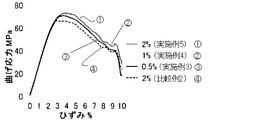
- FIG. 1 is a diagram showing the results of breaking strain and breaking stress.
- the present invention is not limited to the following embodiments.
- the components including element steps and the like are not essential unless otherwise specified.
- the term "process” includes, in addition to a process independent of other processes, the process as long as the purpose of the process is achieved even if it cannot be clearly distinguished from the other process. ..
- the numerical range indicated by using "-" includes the numerical values before and after "-" as the minimum value and the maximum value, respectively.
- each component may contain a plurality of applicable substances.
- the content or content of each component is the total content or content of the plurality of substances present in the composition unless otherwise specified. Means quantity.
- a plurality of types of particles corresponding to each component may be contained.
- the particle size of each component means a value for a mixture of the plurality of particles present in the composition unless otherwise specified.
- (meth) acrylic means at least one of acrylic and methacrylic
- (meth) acrylate means at least one of acrylate and methacrylate.
- the resin composition of the present invention contains nanocellulose and a polymer of ethylenically unsaturated monomers.
- the nanocellulose contains an oxide of a cellulosic raw material due to hypochlorous acid or a salt thereof, and substantially does not contain an N-oxyl compound. Further, the nanocellulose satisfies the following (I) and / or (II).
- Zeta potential is -30 mV or less;
- the light transmittance in the mixed solution in which nanocellulose is mixed with water to have a solid content concentration of 0.1% by mass is 95% or more;
- the resin composition of the present invention refers to a composition mainly containing a polymer of an ethylenically unsaturated monomer as a constituent resin.
- "mainly containing a polymer of an ethylenically unsaturated monomer as a constituent resin” means that the ratio of the polymer of an ethylenically unsaturated monomer to the total amount of the resin constituting the composition is usually 50% by mass. Refers to being an excess. The above ratio may be 60% by mass or more, 70% by mass or more, 80% by mass or more, 90% by mass or more, or 95% by mass or more. It may be 100% by mass.
- the form of the resin composition of the present invention is not particularly limited, and may be, for example, powdery, pelletized, or lumpy.
- the resin composition of the present invention may be used by molding powder, pellets, or lumps as they are. Further, the resin composition of the present invention may be used by mixing powder, pellets, or lumps with the resin composition to be blended with the target resin (hereinafter, also referred to as raw material resin).
- the resin composition is also referred to as a resin modification composition. That is, the resin composition of the present invention includes both an embodiment in which the resin itself is used as a resin and an embodiment of a composition for modifying a resin.
- the resin composition of the present invention contains an oxide of a cellulosic raw material due to hypochlorous acid or a salt thereof, is substantially free of N-oxyl compounds, and satisfies (I) and / or (II). including.
- such nanocellulose is obtained by oxidizing a cellulose-based raw material with hypochlorous acid or a salt thereof to oxidize cellulose (that is, the above-mentioned cellulose-based raw material). It is obtained by the method of obtaining a product) and defibrating this oxidized cellulose.
- the oxidized cellulose can exhibit easy defibration property, and this defibration operation sufficiently promotes defibration.
- the dispersibility of the obtained nanocellulose is enhanced.
- the polymer of nanocellulose and the ethylenically unsaturated monomer is composited by blending the above-mentioned oxidized cellulose with a resin or a raw material of the resin and appropriately defibrating and nano-izing it. It can also be obtained by doing.
- this nanocellulose is combined with a polymer of an ethylenically unsaturated monomer, a resin composition in which nanocellulose is uniformly dispersed in the polymer can be obtained.
- a resin having strength, specifically, strength such as bending elastic modulus and impact resistance can be obtained.
- the nanocellulose in the present invention is nano-sized cellulose oxide obtained by oxidizing a cellulosic raw material with hypochlorous acid or a salt thereof.
- the oxidized cellulose can also be said to be an oxide of a cellulosic raw material. Therefore, the nanocellulose in the present invention contains an oxide of a cellulosic raw material due to hypochlorous acid or a salt thereof.
- the main component of the plant is cellulose, and a bundle of cellulose molecules is called a cellulose microfibril. Cellulose in cellulosic raw materials is also contained in the form of cellulosic microfibrils.
- the nanocellulose in the present invention is a general term for nano-sized cellulose, and includes fine cellulose fibers, cellulose nanocrystals, and the like, and also includes modified products thereof (details of the modified products will be described later). Fine cellulose fibers are also referred to as cellulose nanofibers (also referred to as CNF).
- the nanocellulose in the present invention is required, for example, in a step of oxidizing a cellulosic raw material to produce oxidized cellulose using hypochlorous acid having an effective chlorine concentration of 7% by mass or more and 43% by mass or less or a salt thereof. Accordingly, it can be produced by a production method including a step of defibrating the oxidized cellulose to make it nano-sized.
- the nanocellulose in the present invention oxidizes a cellulosic raw material under the condition that the effective chlorine concentration of hypochlorous acid or a salt thereof in the reaction system is relatively high (for example, 14% by mass to 43% by mass). If necessary, it is preferably obtained by defibrating the oxidized cellulose.
- the resin composition of the present invention contains nanocellulose, it can also be produced by blending a resin composition obtained by defibrating and nano-izing the oxidized cellulose, and the resin composition is prepared using the oxidized cellulose as a raw material. It can also be produced by nanonizing the oxidized cellulose during preparation. Therefore, the nanocellulose in the resin composition is nano-sized at an appropriate time point.
- nanocellulose in the present invention an N-oxyl compound such as TEMPO is not used in the treatment of oxidizing a cellulosic raw material with hypochlorous acid or a salt thereof. Therefore, the nanocellulose or oxidized cellulose in the present invention does not substantially contain the N-oxyl compound. Therefore, nanocellulose is highly safe because the influence of the N-oxyl compound on the environment and the human body is sufficiently reduced.
- the term "nanocellulose or oxidized cellulose""substantially contains no N-oxyl compound” means that the N-oxyl compound is not used in producing the oxidized cellulose, or N-oxyl is not used.
- the content of the compound is 2.0 mass ppm or less with respect to the total amount of nanocellulose, and is preferably 1.0 mass ppm or less. Further, even when the content of the N-oxyl compound is preferably 2.0 mass ppm or less, more preferably 1.0 mass ppm or less as an increase from the cellulosic raw material, "N-oxyl compound is substantially contained. It means "not included”.
- the content of the N-oxyl compound can be measured by a known means. As a known means, a method using a trace total nitrogen analyzer can be mentioned.
- the nitrogen component derived from the N-oxyl compound in nanocellulose is measured as the amount of nitrogen using a trace total nitrogen analyzer (for example, manufactured by Mitsubishi Chemical Analytech Co., Ltd., device name: TN-2100H, etc.). be able to.
- a trace total nitrogen analyzer for example, manufactured by Mitsubishi Chemical Analytech Co., Ltd., device name: TN-2100H, etc.
- the above-mentioned oxidized cellulose is excellent in defibration.
- the above-mentioned oxidized cellulose can be uniformly finely divided even when the defibration treatment is performed under mild conditions, and is excellent in easy defibration.
- the slurry viscosity is stable over time and the handling property is excellent.
- the nanocellulose in the present invention can be produced by an oxidation reaction using hypochlorous acid or a salt thereof, as described in detail in [Method for producing nanocellulose] described later, and has the following zeta potential and light transmittance. Fulfill.
- the zeta potential and the light transmittance can be used as indicators of the nanocellulose.
- the nanocellulose in the present invention has a zeta potential of ⁇ 30 mV or less.
- the zeta potential is -30 mV or less (that is, the absolute value is 30 mV or more)
- sufficient repulsion between microfibrils is obtained, and nanocellulose having a high surface charge density is likely to be generated during mechanical defibration.
- the dispersion stability of nanocellulose is improved, and the viscosity stability and handleability of the slurry can be improved.
- the zeta potential is -100 mV or more (that is, the absolute value is 100 mV or less)
- oxidative cleavage in the fiber direction with the progress of oxidation tends to be suppressed, so that nanocellulose having a uniform size can be obtained.
- the nanocellulose is stable and the dispersibility is enhanced, and the obtained resin composition uniformly contains nanocellulose.
- the zeta potential of nanocellulose is preferably ⁇ 35 mV or less, more preferably ⁇ 40 mV or less, and even more preferably ⁇ 50 mV or less.
- the lower limit of the zeta potential -90 mV or more is preferable, -85 mV or more is more preferable, -80 mV or more is further preferable, -77 mV or more is further preferable, -70 mV or more is further preferable, and -65 mV or more is more preferable. More preferred.
- the zeta potential is a value measured under the conditions of pH 8.0 and 20 ° C. for a cellulose aqueous dispersion in which nanocellulose and water are mixed and the concentration of nanocellulose is 0.1% by mass. be. Specifically, the measurement can be performed according to the conditions described in Examples described later.
- the nanocellulose dispersion in which nanocellulose having a narrow fiber width and few aggregates is dispersed in a dispersion medium has less light scattering of cellulose fibers and can exhibit high light transmittance.
- the nanocellulose in the present invention has a light transmittance of 95% or more in a mixed solution having a solid content concentration of 0.1% by mass mixed with water.
- the light transmittance is more preferably 96% or more, still more preferably 97% or more.
- the light transmittance is a value measured by a spectrophotometer at a wavelength of 660 nm.
- the light transmittance can be measured using an aqueous dispersion containing nanocellulose. Specifically, the measurement can be performed according to the conditions described in Examples described later.
- the nanocellulose in the present invention is obtained by obtaining oxidized cellulose using hypochlorous acid or a salt thereof and then defibrating it.
- the degree of polymerization of the oxidized cellulose used in the present invention is preferably 600 or less.
- the degree of polymerization of cellulose oxide exceeds 600, defibration tends to require a large amount of energy, and sufficient defibration cannot be exhibited, resulting in a decrease in dispersibility and a decrease in resin strength. There is a tendency.
- the degree of polymerization of cellulose oxide exceeds 600, the amount of cellulose oxide that is insufficiently defibrated increases, and therefore, when the finely divided nanocellulose is dispersed in a dispersion medium, light scattering and the like increase. Transparency may decrease. Furthermore, the size of the obtained nanocellulose varies, and the quality tends to be non-uniform. Therefore, the viscosity of the slurry containing nanocellulose (hereinafter, also referred to as “nanocellulose-containing slurry”) may increase, and the handleability of the slurry may decrease. From the viewpoint of easy friability, the lower limit of the degree of polymerization of cellulose oxide is not particularly set.
- the degree of polymerization of the oxidized cellulose is less than 50, the proportion of particulate cellulose rather than fibrous is increased, and the reinforcing effect when added to the resin may be lowered.
- the degree of polymerization of cellulose oxide is preferably in the range of 50 or more and 600 or less.
- the degree of polymerization of cellulose oxide is more preferably 580 or less, further preferably 560 or less, still more preferably 550 or less, still more preferably 500 or less, still more preferably 450 or less, and further. More preferably, it is 400 or less.
- the lower limit of the degree of polymerization is more preferably 60 or more, further preferably 70 or more, still more preferably 80 or more, still more preferably 90 or more, from the viewpoint of improving the viscosity stability of the slurry. Yes, it is even more preferably 100 or more, even more preferably 110 or more, and particularly preferably 120 or more.
- the preferable range of the degree of polymerization can be determined by appropriately combining the above-mentioned upper limit and lower limit.
- the degree of polymerization of cellulose oxide is more preferably 60 to 600, still more preferably 70 to 600, still more preferably 80 to 600, still more preferably 80 to 550, and even more preferably 80 to 80. It is 500, more preferably 80 to 450, and particularly preferably 80 to 400.
- the degree of polymerization of cellulose oxide can be adjusted by changing the reaction time, reaction temperature, pH, and the effective chlorine concentration of hypochlorous acid or a salt thereof during the oxidation reaction. Specifically, since the degree of polymerization tends to decrease as the degree of oxidation increases, for example, a method of increasing the reaction time and / or the reaction temperature of oxidation can be mentioned in order to reduce the degree of polymerization. As another method, the degree of polymerization of cellulose oxide can be adjusted by the stirring conditions of the reaction system at the time of the oxidation reaction. For example, under conditions in which the reaction system is sufficiently homogenized using a stirring blade or the like, the oxidation reaction proceeds smoothly and the degree of polymerization tends to decrease.
- the degree of polymerization of cellulose oxide tends to vary depending on the selection of the raw material cellulose. Therefore, the degree of polymerization of oxidized cellulose can be adjusted by selecting a cellulosic raw material.
- the degree of polymerization of cellulose oxide is the average degree of polymerization (viscosity average degree of polymerization) measured by the viscosity method. For details, follow the method described in Examples described later.
- the amount of carboxy groups of nanocellulose and oxidized cellulose is preferably 0.30 mmol / g or more and less than 2.0 mmol / g.
- amount of the carboxy group is 0.30 mmol / g or more, sufficient defibability can be imparted to the oxidized cellulose.
- a nanocellulose-containing slurry having uniform quality can be obtained even when the defibration treatment is performed under mild conditions, and the viscosity stability and handleability of the slurry can be improved.
- the carboxy group amount of the oxidized cellulose is more preferably 0.35 mmol / g or more, further preferably 0.40 mmol / g or more, still more preferably 0.42 mmol / g or more, and further.
- the amount of carboxy group is more preferably 1.5 mmol / g or less, still more preferably 1.2 mmol / g, still more preferably 1.0 mmol / g or less, and even more preferably 0. It is 9 mmol / g.
- the preferable range of the amount of carboxy group can be determined by appropriately combining the above-mentioned upper limit and lower limit.
- the amount of the carboxy group of the present oxidized cellulose is more preferably 0.35 to 2.0 mmol / g, further preferably 0.35 to 1.5 mmol / g, still more preferably 0.40 to 1.5 mmol. / G, even more preferably 0.50 to 1.2 mmol / g, even more preferably over 0.50 to 1.2 mmol / g, and even more preferably 0.55 to 1.0 mmol / g. Is.
- the amount of carboxy group (mmol / g) is adjusted to pH 2.5 by adding a 0.1 M hydrochloric acid aqueous solution to an aqueous solution of cellulose oxide mixed with water, and then a 0.05 N sodium hydroxide aqueous solution is added dropwise to obtain a pH.
- the electric conductivity is measured until 11.0, and the value is calculated from the amount of sodium hydroxide (a) consumed in the neutralization step of the weak acid in which the change in the electric conductivity is moderate by using the following formula. For details, follow the method described in Examples described later.
- the above-mentioned oxidized cellulose preferably has a structure in which at least two of the hydroxyl groups of the glucopyranose ring constituting the cellulose are oxidized, and more specifically, the second and third positions of the glucopyranose ring. It is preferable to have a structure in which a hydroxyl group is oxidized and a carboxy group is introduced. Further, it is preferable that the hydroxyl group at the 6-position of the glucopyranose ring in the above-mentioned oxidized cellulose is not oxidized and remains as a hydroxyl group.
- the position of the carboxy group in the glucopyranose ring can be analyzed by comparing the solution NMR spectrum using rayon oxide as a model molecule and the solid 13 C-NMR spectrum of cellulose oxide.
- Rayon has the same chemical structure as cellulose, and its oxide (rayon oxide) is water-soluble.
- rayon oxide By dissolving rayon oxide in heavy water and performing one-dimensional 13 C-NMR measurement of the solution, a peak of carbon attributed to the carboxy group is observed at 165 to 185 ppm.
- the oxidized cellulose or nanocellulose used in the present invention obtained by oxidizing the raw material cellulose with hypochlorous acid or a salt thereof, two signals appear in this chemical shift range. Further, by solution two-dimensional NMR measurement, it can be determined that the carboxy group is introduced at the 2-position and the 3-position.
- the carboxy group is introduced at the 2-position and the 3-position by evaluating the spread of the peak appearing at 165 to 185 ppm. That is, two peak area values obtained by vertically dividing the area value at the peak top after obtaining the total area value by drawing a baseline on the peak in the range of 165 ppm to 185 ppm in the solid 13 C-NMR spectrum. A ratio (large area value / small area value) is obtained, and if the ratio of the peak area values is 1.2 or more, it can be said that the peak is broad.
- the presence or absence of the broad peak can be determined by the ratio of the baseline length L in the range of 165 ppm to 185 ppm and the perpendicular length L'from the peak top to the baseline. That is, if the ratio L'/ L is 0.1 or more, it can be determined that a broad peak exists.
- the ratio L'/ L may be 0.2 or more, 0.3 or more, 0.4 or more, or 0.5 or more.
- the upper limit of the ratio L'/ L is not particularly limited, but usually it may be 3.0 or less, 2.0 or less, or 1.0 or less.
- the structure of the glucopyranose ring can also be determined by analysis according to the method described in Sustainable Chem. Eng. 2020, 8, 48, 17800? 17806.
- Nanocellulose in the present invention is an aggregate of fibers in units of one.
- the nanocellulose in the present invention contains a carboxylated CNF, it suffices to contain at least one carboxylated CNF, and it is preferable that the carboxylated CNF is the main component.
- the main component of the carboxylated CNF is that the ratio of the carboxylated CNF to the total amount of CNF is more than 50% by mass, preferably more than 70% by mass, and more preferably more than 80% by mass. Point to that.
- the upper limit of the above ratio is 100% by mass, but it may be 98% by mass or 95% by mass.
- the average fiber length of nanocellulose in the present invention is preferably 100 nm or more and 700 nm or less.
- the average fiber width of nanocellulose in the present invention is preferably 1.0 nm or more and 5.0 nm or less.
- the average fiber length is more preferably in the range of 100 nm or more and 600 nm or less, and further preferably in the range of 100 nm or more and 400 nm or less.
- the average fiber length exceeds 700 nm, the slurry becomes violently thickened and handling becomes difficult. Further, when the average fiber length is smaller than 100 nm, it becomes difficult to develop the viscosity characteristic of nanocellulose.
- the average fiber width is more preferably in the range of 2.0 nm or more and 5.0 nm or less, further preferably in the range of 2.0 nm or more and 4.5 nm or less, and further preferably in the range of 2.5 nm or more and 4.0 nm or less. If the average fiber width is smaller than 1.0 nm, it becomes difficult to improve the strength of the resin containing nanocellulose. Further, when the average fiber width is larger than 5.0 nm, it becomes difficult to improve the strength due to stress concentration.
- the average fiber length and average fiber width are such that nanocellulose and water are mixed so that the concentration of nanocellulose is approximately 1 to 10 ppm, and a sufficiently diluted nanocellulose aqueous dispersion is naturally dried on a mica substrate.
- the range of the difference in values depending on the image processing conditions is preferably within the range of ⁇ 100 nm for the average fiber length.
- the range of the difference in values depending on the conditions is preferably within the range of ⁇ 10 nm for the average fiber width.
- the resin composition of the present invention may include a step of adding and precipitating metal soap, amine or quaternary ammonium as necessary in the production method thereof. This causes at least a portion of the nanocellulose to be modified with a metal soap, amine or quaternary ammonium. Further, by using nanocellulose that has been previously reacted with metal soap, amine or quaternary ammonium in the production of the resin composition of the present invention, at least a part of the nanocellulose is made of metal soap, amine or quaternary ammonium. It may be modified with quaternary ammonium. Therefore, one of the preferred embodiments of the resin composition of the present invention comprises nanocellulose in which at least a portion of the nanocellulose has been modified with a metal soap, amine or quaternary ammonium.
- the reaction of metal soap, amine or quaternary ammonium salt compound with the carboxy group on the surface of nanocellulose modifies the nanocellulose, improving the hydrophobicity of the nanocellulose and its affinity for ethylene unsaturated monomers and resins. Is expected to improve.
- the metal soap that modifies nanocellulose is not particularly limited, and is, for example, a metal salt of a long-chain fatty acid such as a magnesium salt of a long-chain fatty acid, a calcium salt of a long-chain fatty acid, or a zinc salt of a long-chain fatty acid; Examples thereof include a mixture of a calcium salt and a zinc salt of a long-chain fatty acid, and a lead-based metal soap, and among these, a metal salt of a long-chain fatty acid is preferable.
- the metal salt of the long-chain fatty acid is preferably a metal polyvalent salt of the long-chain fatty acid.
- long-chain fatty acids examples include butyric acid, valeric acid, caproic acid, enanthic acid, capric acid, pelargonic acid, capric acid, lauric acid, myristic acid, pentadecic acid, palmitic acid, isostearic acid, stearic acid, oleic acid, and linole.
- examples thereof include acid, ricinoleic acid, octyl acid, arachidic acid, arachidonic acid, behenic acid, lignoseric acid, montanic acid and the like.
- the metal soap magnesium stearate, a mixture of calcium stearate salt and zinc stearate salt, and lead-based thermometal soap are more preferable.
- metal soaps may be used alone or in combination of two or more.
- a commercially available product containing the above-mentioned metal soap may be used, and examples of the commercially available product include RZ-161, RZ-162, MDZ-CP-102, FTZ-111, and SCI-HSA manufactured by San Ace.
- the amine that modifies nanocellulose is not particularly limited and may be any of primary, secondary, and tertiary.
- the number of carbon atoms of the hydrocarbon group or aromatic group bonded to the nitrogen atom of the amine or quaternary ammonium salt compound (if two or more hydrocarbon groups or aromatic groups are bonded to the nitrogen atom, the total thereof)
- the number of carbon atoms) is not particularly limited, and may be selected from 1 to 100 carbon atoms.
- an amine having a polyalkylene oxide structure such as an ethylene oxide / propylene oxide (EO / PO) copolymer may be used. From the viewpoint of imparting sufficient hydrophobicity to nanocellulose, the number of carbon atoms is preferably 3 or more, and more preferably 5 or more.
- the quaternary ammonium salt compound that modifies nanocellulose is not particularly limited.
- a quaternary ammonium hydroxide such as tetrabutylammonium hydroxide
- a quaternary ammonium chloride such as tetrabutylammonium chloride
- a quaternary ammonium bromide such as tetrabutylammonium bromide
- Quaternary ammonium iodide such as quaternary ammonium bromide and tetrabutylammonium iodide can be considered.
- Nanocellulose reacted with a metal soap, amine or quaternary ammonium salt compound functions as a dispersant in the step of polymerizing an ethylene unsaturated monomer.
- Not using an emulsifier is advantageous in terms of workability because foaming does not occur when the obtained resin composition is dried.
- the nanocellulose in the present invention can be produced, for example, by a method including a step A of oxidizing a cellulosic raw material with hypochlorous acid or a salt thereof to obtain oxidized cellulose and a step B of defibrating the oxidized cellulose. ..
- the cellulosic raw material is not particularly limited as long as it is a material mainly composed of cellulose, and examples thereof include pulp, natural cellulose, regenerated cellulose, and fine cellulose depolymerized by mechanically treating cellulose.
- a commercially available product such as crystalline cellulose made from pulp can be used as it is.
- unused biomass containing a large amount of cellulose components such as okara and soybean skin may be used as a raw material.
- the cellulosic raw material may be treated with an alkali having an appropriate concentration in advance.
- hypochlorous acid or a salt thereof used for oxidation of cellulose-based raw materials examples include hypochlorous acid water, sodium hypochlorite, potassium hypochlorite, calcium hypochlorite, and ammonium hypochlorite. Can be mentioned. Of these, sodium hypochlorite is preferable from the viewpoint of ease of handling.
- Examples of the method for producing oxidized cellulose by oxidizing a cellulosic raw material include a method of mixing a cellulosic raw material with a reaction solution containing hypochlorous acid or a salt thereof.
- the solvent contained in the reaction solution is preferably water because it is easy to handle and side reactions are unlikely to occur.
- the effective chlorine concentration of hypochlorous acid or a salt thereof in the reaction solution is preferably 6 to 43% by mass, more preferably 7 to 43% by mass, and further preferably 10 to 43% by mass. , 14 to 43% by mass is more preferable.
- the effective chlorine concentration of the reaction solution is in the above range, the amount of carboxy groups in the cellulose oxide can be sufficiently increased, and the cellulose oxide can be easily defibrated when the nanocellulose is obtained.
- the effective chlorine concentration of the reaction solution is more preferably 15% by mass or more, further preferably 18% by mass or more, still more preferably 20% by mass or more. Is. Further, from the viewpoint of suppressing excessive decomposition of cellulose during defibration, the effective chlorine concentration of the reaction solution is more preferably 40% by mass or less, still more preferably 38% by mass or less.
- the range of the effective chlorine concentration of the reaction solution can be appropriately combined with the above-mentioned lower limit and upper limit.
- the range of the effective chlorine concentration is more preferably 16 to 43% by mass, still more preferably 18 to 40% by mass.
- hypochlorous acid is a weak acid that exists as an aqueous solution
- hypochlorite is a compound in which hydrogen of hypochlorous acid is replaced with another cation.
- sodium hypochlorite which is a hypochlorite
- the concentration is measured not as the concentration of sodium hypochlorite but as the amount of effective chlorine in the solution. ..
- sodium hypochlorite since the oxidizing power of the divalent oxygen atom generated by the decomposition of sodium hypochlorite corresponds to the diatomic equivalent of monovalent chlorine, sodium hypochlorite is used.
- the sample is precisely weighed, water, potassium iodide and acetic acid are added and left to stand, and the free iodine solution is titrated with a sodium thiosulfate solution using an aqueous starch solution as an indicator to measure the effective chlorine concentration. do.
- the oxidation reaction of the cellulosic raw material with hypochlorous acid or a salt thereof should be carried out while adjusting the pH in the range of 5.0 to 14.0. Within this range, the oxidation reaction of the cellulosic raw material can be sufficiently promoted, and the amount of carboxy groups in the oxidized cellulose can be sufficiently increased. This makes it possible to easily defibrate the oxidized cellulose.
- the pH of the reaction system is more preferably 7.0 or higher, still more preferably 8.0 or higher.
- the upper limit of the pH of the reaction system is more preferably 13.5 or less, still more preferably 13.0 or less.
- the pH range of the reaction system is more preferably 7.0 to 14.0, and even more preferably 8.0 to 13.5.
- hypochlorite sodium hypochlorite is used as hypochlorous acid or a salt thereof.
- the reaction solution is preferably an aqueous solution of sodium hypochlorite.
- a method of adjusting the effective chlorine concentration of the sodium hypochlorite aqueous solution to the target concentration for example, target concentration: 6% by mass to 43% by mass
- sodium hypochlorite having a lower effective chlorine concentration than the target concentration is used.
- a method of concentrating an aqueous solution, a method of diluting an aqueous solution of sodium hypochlorite having an effective chlorine concentration higher than the target concentration, and a method of diluting sodium hypochlorite crystals (for example, sodium hypochlorite pentahydrate) as a solvent for example, sodium hypochlorite pentahydrate
- Examples thereof include a method of dissolving.
- adjusting the concentration of effective chlorine as an oxidizing agent by diluting the aqueous sodium hypochlorite solution or dissolving the crystals of sodium hypochlorite in a solvent has less self-decomposition (that is,). It is preferable because the effective chlorine concentration does not decrease much) and the effective chlorine concentration can be easily adjusted.
- the method of mixing the cellulosic raw material and the sodium hypochlorite aqueous solution is not particularly limited, but from the viewpoint of ease of operation, it is preferable to add the cellulosic raw material to the sodium hypochlorite aqueous solution and mix them.
- the stirring method include a magnetic stirrer, a stirring rod, a stirring machine with a stirring blade (three-one motor), a homomixer, a dispenser type mixer, a homogenizer, and external circulation stirring.
- shear stirrers such as homomixers and homogenizers, stirrers with stirring blades, and stirrers with stirring blades are available because the oxidation reaction of the cellulosic raw material proceeds smoothly and the degree of polymerization of the oxidized cellulose can be easily adjusted to a predetermined value or less.
- a method using one or more of the disper type mixers is preferable, and a method using a stirrer with a stirring blade is particularly preferable.
- a stirrer with a stirrer blade a device equipped with a known stirrer blade such as a propeller blade, a paddle blade, and a turbine blade can be used as the stirrer.
- a stirrer with a stirring blade it is preferable to perform stirring at a rotation speed of 50 to 300 rpm.
- the reaction temperature in the oxidation reaction is preferably 15 ° C to 100 ° C, more preferably 20 ° C to 90 ° C.
- an alkaline agent for example, sodium hydroxide or the like
- an acid for example, hydrochloric acid or the like
- the reaction time of the oxidation reaction can be set according to the degree of progress of oxidation, but is preferably about 15 minutes to 50 hours.
- the pH of the reaction system is 10 or more, it is preferable to set the reaction temperature to 30 ° C. or higher and / or the reaction time to 30 minutes or longer.
- the zeta potential and light transmittance of nanocellulose can be adjusted to desired values by adjusting the reaction time, reaction temperature, stirring conditions, etc. of the oxidation reaction. Specifically, as the reaction time is lengthened and / or the reaction temperature is increased, oxidation of the cellulosic raw material to the surface of the cellulose microfibrils progresses, and electrostatic repulsion and osmotic pressure cause repulsion between the fibrils. By strengthening, the average fiber width tends to be smaller.
- the zeta potential is set by setting one or more of the reaction time, reaction temperature, and stirring conditions of oxidation (for example, lengthening the reaction time) on the side where oxidation is further promoted (that is, the side where the degree of oxidation is increased). It tends to be high.
- a known isolation treatment such as filtration is performed, and further purification is performed as necessary to obtain an oxide of the cellulosic raw material by hypochlorous acid or a salt thereof.
- Oxidized cellulose can be obtained as.
- the solution containing the oxidized cellulose obtained by the above reaction may be directly subjected to the defibration treatment.
- a base was added in order to improve the handleability when the solution was used for the subsequent defibration treatment.
- the pH may be 6.0 or higher, and at least a part of the carboxy group may be in the salt form (-COO - X + : X + refers to cations such as sodium, potassium and lithium).
- the solution containing cellulose oxide may be used as a composition containing cellulose oxide by substituting the solvent or the like.
- the pH is set to an alkaline condition of 10 or more, and at least a part of the carboxy group is a salt type (-COO - X + : X + indicates a cation such as sodium, potassium, lithium, etc.). Can be.
- the method for producing the oxidized cellulose may further include a step of mixing the obtained oxidized cellulose with a compound having a modifying group.
- the compound having a modifying group is not particularly limited as long as it is a compound having a modifying group capable of forming an ionic bond or a covalent bond with a carboxy group or a hydroxyl group of cellulose oxide, and the above-mentioned metal soap, amine, and quaternary are not particularly limited. Examples include ammonium salt compounds.
- the oxidized cellulose includes the salt type, the proton type, and the modified type by a modifying group.
- the nanocellulose obtained from the present oxidized cellulose also includes the salt type, the proton type, and the modified type by a modifying group.
- the nanocellulose in the present invention can be obtained by defibrating and nanonizing the oxidized cellulose obtained above.
- the method for defibrating cellulose oxide include a method by weak stirring using a magnetic stirrer and the like, a method by mechanical defibration, and the like.
- the defibration of cellulose oxide is preferably mechanical defibration in that the defibration of cellulose oxide can be sufficiently performed and the defibration time can be shortened.
- nanocellulose also referred to as nanocellulose
- nanocellulose is a general term for nano-sized cellulose, and includes cellulose nanofibers, cellulose nanocrystals, and the like.
- a screw type mixer for example, a screw type mixer, a paddle mixer, a disper type mixer, a turbine type mixer, a homomixer under high speed rotation, a high pressure homogenizer, an ultrahigh pressure homogenizer, a double cylindrical homogenizer, and an ultrasonic homogenizer are used.
- Water flow counter-collision type disperser beater, disc type refiner, conical type refiner, double disc type refiner, grinder, single-screw or multi-screw kneader, rotation / revolution stirrer, vibration type stirrer, etc.
- the method can be mentioned.
- a method using an ultra-high pressure homogenizer can be preferably used in that nanocellulose with more advanced defibration can be produced.
- the pressure during the defibration treatment is preferably 100 MPa or more, more preferably 120 MPa or more, still more preferably 150 MPa or more.
- the number of times of defibration treatment is not particularly limited, but is preferably 2 times or more, more preferably 3 times or more, from the viewpoint of sufficiently advancing defibration.
- the above-mentioned oxidized cellulose can be sufficiently defibrated by mild stirring with a rotation / revolution stirrer, a vibration type stirrer or the like.
- the vibration type agitator include a vortex mixer (touch mixer). That is, according to the above-mentioned oxidized cellulose, uniformized nanocellulose can be obtained even when the defibration treatment is performed under mild defibration conditions.
- the defibration treatment is preferably carried out in a state where the above-mentioned cellulose oxide is mixed with a dispersion medium.
- the dispersion medium is not particularly limited and may be appropriately selected depending on the intended purpose. Specific examples of the dispersion medium include water, alcohols, ethers, ketones, N, N-dimethylformamide, N, N-dimethylacetamide, dimethylsulfoxide and the like. As the solvent, one of these may be used alone, or two or more of them may be used in combination.
- alcohols include methanol, ethanol, isopropanol, isobutanol, sec-butyl alcohol, tert-butyl alcohol, methyl cellosolve, ethylene glycol, glycerin and the like.
- ethers include ethylene glycol dimethyl ether, 1,4-dioxane and tetrahydrofuran.
- ketone include acetone, methyl ethyl ketone and the like.
- an organic solvent as a dispersion medium during the defibration treatment, it becomes easy to isolate the oxidized cellulose and the nanocellulose obtained by defibrating the oxidized cellulose. Further, since nanocellulose dispersed in an organic solvent can be obtained, it becomes easy to mix with a resin that dissolves in the organic solvent, a resin raw material monomer, or the like.
- the nanocellulose dispersion obtained by dispersing the nanocellulose obtained by defibration in a dispersion medium of water and / or an organic solvent can be used for mixing with various components such as resin, rubber, and solid particles. ..
- the type of the ethylenically unsaturated monomer in the present invention is not particularly limited, and can be selected according to desired particle characteristics, the type of resin to be modified, and the like.
- the ethylenically unsaturated monomer is a compound having at least one ethylene group.
- the ethylenically unsaturated monomer may be used alone or in combination of two or more.
- the polymer of the ethylenically unsaturated monomer is a reaction product obtained by polymerizing the ethylenically unsaturated monomer.
- the ethylenically unsaturated monomer examples include (meth) acrylic acid, alkyl (meth) acrylate, alkylene glycol (meth) acrylate, (meth) acrylonitrile, vinyl halide, maleic acidimide, phenylmaleimide, and (meth). ) Acrylamide, styrene, ⁇ -methylstyrene, vinyl acetate and the like can be mentioned. Among these, at least one selected from the group consisting of alkyl (meth) acrylate and styrene is preferable.
- alkyl (meth) acrylate examples include those having an alkyl portion having 1 to 10 carbon atoms.
- the alkyl moiety may be linear, branched or cyclic, and may be unsubstituted or having a substituent.
- the ethylenically unsaturated monomer may have a functional group such as a carboxy group, a hydroxyl group, an epoxy group, an amino group, an amide group and a cyano group. Having these functional groups enhances the affinity for cellulose nanofibers.
- the proportion of the ethylenically unsaturated monomer having these functional groups is not particularly limited, but is an ethylenically unsaturated monomer. It may be 5 mol% or less, 3 mol% or less, or 1 mol% or less of the whole body.
- the polymer of the ethylenically unsaturated monomer in the present invention may have a functional group.
- the polymer having a functional group may introduce a functional group into the polymer by polymerizing the above-mentioned ethylenically unsaturated monomer having a functional group, such as an ethylenically unsaturated monomer such as vinyl acetate.
- the functional group may be introduced by inducing the polymer of the above to the functional group.
- the weight average molecular weight of the polymer of the ethylenically unsaturated monomer is not particularly limited. For example, it may be 50 to 3 million.
- the weight average molecular weight of the particle polymer is 5000 or more, the decrease in the strength of the resin is suppressed, and when the weight average molecular weight of the particles is 3 million or less, the particles tend to melt in the resin and a sufficient modification effect can be obtained. It is in.
- the weight average molecular weight (Mw) of the polymer of the ethylenically unsaturated monomer can be measured by the following method.
- the weight average molecular weight of the polymer of the ethylenically unsaturated monomer is measured using GPC (gel permeation chromatography, for example, HLC-8220, manufactured by Tosoh).
- GPC gel permeation chromatography, for example, HLC-8220, manufactured by Tosoh).
- an appropriate solvent is added to a resin composition containing nanocellulose and a polymer of an ethylene unsaturated monomer to dissolve the polymer. Then, the mixture is filtered using a 0.45 ⁇ m filter, and the obtained liquid is measured in terms of polystyrene.
- the ethylenically unsaturated monomer preferably contains a rubber component from the viewpoint of improving impact resistance, and examples thereof include a rubber-modified styrene resin.
- the rubber-modified styrene-based resin is usually a styrene-based monomer and a vinyl monomer copolymerizable with the styrene-based monomer in the presence of a rubber-like polymer (that is, a monomer other than the above-mentioned styrene-based monomer).
- the rubber-modified styrene resin includes a graft (co) polymer in which a (co) polymer containing a styrene monomer is grafted onto a rubber polymer, and a (co) polymer containing a styrene monomer. It may be any non-grafted (co) polymer that is not grafted on the rubbery polymer.
- the rubber-modified styrene resin include impact-resistant polystyrene, ABS resin (acrylonitrile-butadiene rubber-styrene copolymer), AAS resin (acrylonitrile-acrylic rubber-styrene copolymer), and MBS resin (methacryl).
- ABS resin acrylonitrile-butadiene rubber-styrene copolymer
- AAS resin acrylonitrile-acrylic rubber-styrene copolymer
- MBS resin methacryl
- AES resin acrylonitrile-ethylene propylene rubber-styrene copolymer
- the rubber-modified styrene resin 95 to 20% by mass of a monomer mixture of a styrene-based monomer and other copolymerizable vinyl-based monomer is grafted to 5 to 80% by mass of the rubbery polymer.
- the rubbery polymer is preferably a rubbery polymer having a glass transition temperature of 0 ° C. or lower.
- the rubbery polymer examples include polybutadiene, styrene-butadiene copolymer, acrylonitrile-butadiene copolymer, styrene-butadiene block copolymer, diene rubber such as butyl acrylate-butadiene copolymer, and polyacrylic.
- Acrylic rubber such as butyl acid, polyisoprene, ethylene-olefin copolymer, ethylene-unsaturated carboxylic acid ester copolymer, ethylene-fatty acid vinyl copolymer, ethylene-propylene-diene ternary copolymer, etc. Can be mentioned. These may be used alone or in combination of two or more. Among these, polybutadiene or a butadiene copolymer is preferable.
- Examples of the styrene-based monomer include styrene and styrene substituted with an alkyl group having 1 to 4 carbon atoms.
- Examples of the styrene-based monomer substituted with an alkyl group having 1 to 4 carbon atoms include ⁇ -methylstyrene, p-methylstyrene, m-methylstyrene, o-methylstyrene, p-ethylstyrene and m-ethyl. Examples thereof include styrene, o-ethyl styrene and t-butyl styrene.
- the rubber-modified styrene-based resin may contain a monomer other than the styrene-based monomer.
- a vinyl cyanide-based monomer is preferably used from the viewpoint of improving the impact resistance, chemical resistance, and plating property of the resin.
- a (meth) acrylic acid ester-based monomer is preferably used from the viewpoint of improving the toughness and color tone of the resin.
- the vinyl cyanide-based monomer include acrylonitrile, methacrylonitrile, etacrylonitrile, and the like, and among these, acrylonitrile is preferable.
- Examples of the (meth) acrylic acid ester-based monomer include methyl, ethyl, propyl, n-butyl, and isobutyl esterified products of acrylic acid and methacrylic acid, and among these, methyl methacrylate is preferable.
- other vinyl-based monomers for example, aromatic vinyl-based monomers other than styrene-based monomers such as vinyltoluene, and maleimide, N-methylmaleimide, and N-phenylmaleimide. It is also possible to use a maleimide-based monomer or the like.
- the monomer or monomer mixture used in the above-mentioned graft (co) polymer is preferably a styrene-based monomer in an amount of 5 to 90% by mass from the viewpoint of improving the impact resistance of the resin composition. More preferably, it is 10 to 80% by mass.
- the vinyl cyanide-based monomer is preferably 1 to 50% by mass, particularly 40% by weight or less, from the viewpoint of molding processability of the resin composition. Is more preferable.
- the catalyst adsorption capacity in the catalyst process during the plating process can be improved by setting the vinyl cyanide-based monomer in the range of 25 to 40% by mass. It is preferably used.
- the amount of the (meth) acrylic acid ester-based monomer is preferably 80% by mass or less, particularly 75, from the viewpoint of toughness and impact resistance. A mass% or less is preferably used.
- the total amount of the aromatic vinyl-based monomer, the cyanide vinyl-based monomer and the (meth) acrylic acid ester-based monomer in the monomer or the monomer mixture shall be 95 to 20% by mass. Is preferable, and more preferably 90 to 30% by mass.
- the mixing ratio of the rubbery polymer and the monomer mixture in obtaining the graft (co) polymer is as follows: from the viewpoint of impact resistance of the resin composition, rubber is contained in 100% by mass of the total graft (co) polymer.
- the content of the quality polymer is preferably 5% by mass or more, more preferably 10% by mass or more. Further, from the viewpoint of impact resistance of the resin composition and the appearance of the molded product, it is preferably 80% by mass or less, and more preferably 70% by mass or less.
- the mixing ratio of the monomer or the monomer mixture is preferably 95% by mass or less, more preferably 90% by mass or less, or 20% by mass or more, and more preferably 30% by mass. That is all.
- the graft (co) polymer can be obtained by a known polymerization method.
- it can be obtained by a method of continuously supplying a mixture of a monomer and a chain transfer agent and a solution of a radical generator dissolved in an emulsifier to a polymerization vessel in the presence of a rubbery polymer latex to carry out emulsion polymerization. ..
- the graft (co) polymer contains a non-grafted (co) polymer in addition to a graft (co) polymer having a structure in which a monomer or a monomer mixture is grafted to a rubbery polymer. May be.
- the graft ratio of the graft (co) polymer is not particularly limited, but is usually 20 to 80%, and may be in the range of 25 to 50%.
- the graft ratio is a value calculated by the following equation.
- Graft rate (%) [ ⁇ Amount of vinyl-based copolymer graft-polymerized on rubbery polymer> / ⁇ Rubber content of graft copolymer>] ⁇ 100
- the characteristics of the ungrafted (co) polymer are not particularly limited, but the ultimate viscosity [ ⁇ ] (measured at 30 ° C.) of the soluble content of methyl ethyl ketone is 0.25 to 1.00 dl / g, particularly 0.25 to.
- the range of 0.80 dl / g is a preferable condition for obtaining an excellent impact-resistant resin composition.
- a styrene-based copolymer obtained by copolymerizing a maleimide-based monomer that is, a maleimide-based modified styrene-based copolymer can be used by containing it in a polystyrene-based resin to improve the heat resistance of the resin composition. Further, since the flame retardancy can be specifically improved, it can be preferably used.
- the ratio of the styrene-based monomer which is a constituent component of the styrene-based (co) polymer, is preferably 5 to 90% by mass, more preferably 10 with respect to all the monomers. It is in the range of -80% by mass.
- the vinyl cyanide-based monomer is mixed, it is preferably 1 to 50% by mass, more preferably 40% by mass or less, from the viewpoint of impact resistance and fluidity.
- plating adhesion when plating adhesion is required, it is preferably used in the range of 25 to 40% by mass because the catalyst adsorption capacity in the catalyst step during the plating process can be improved.
- the (meth) acrylic acid ester-based monomer is mixed, it is preferably 80% by mass or less, more preferably 75% by mass or less, from the viewpoint of toughness and impact resistance. Further, when other vinyl-based monomers copolymerizable with these is mixed, it is preferably 60% by mass or less, and particularly preferably 50% by mass or less.
- the characteristics of the styrene-based (co) polymer are not limited, the ultimate viscosity [ ⁇ ] measured at 30 ° C. using a methyl ethyl ketone solvent is 0.25 to 5.00 dl / g, particularly 0.35 to 3.
- a resin composition in the range of .00 dl / g is preferable because a resin composition having excellent impact resistance and molding processability can be obtained.
- the method for producing a styrene-based (co) polymer is not particularly limited, and ordinary methods such as a bulk polymerization method, a suspension polymerization method, an emulsion polymerization method, a solution polymerization method, a bulk-suspension polymerization method, and a solution-lump polymerization method can be used.
- the method can be used.
- Polyvinyl alcohol can also be used as the polymer of the ethylenically unsaturated monomer in the present invention.
- the polyvinyl alcohol in the present specification is a polymer obtained by saponifying a polyvinyl ester obtained by polymerizing a vinyl ester which is an ethylenically unsaturated monomer.
- the vinyl ester include vinyl formate, vinyl acetate, vinyl propionate, vinyl valerate, vinyl laurate, vinyl stearate, vinyl benzoate, vinyl pivalate, vinyl versatic acid and the like. Of these, vinyl acetate is preferable.
- the vinyl ester When polymerizing the vinyl ester, if necessary, other copolymerizable monomers can be copolymerized within a range that does not impair the effects of the invention.
- the monomer copolymerizable with such a vinyl ester include olefins having 2 to 30 carbon atoms such as ethylene, propylene, 1-butene, and isobutene; acrylic acid and salts thereof; methyl acrylate, ethyl acrylate, and the like.
- Acrylic acid esters such as n-propyl acrylate, i-propyl acrylate, n-butyl acrylate, i-butyl acrylate, t-butyl acrylate, 2-ethylhexyl acrylate, dodecyl acrylate, octadecyl acrylate, etc.
- methacrylic acid and salts thereof methyl methacrylate, ethyl methacrylate, n-propyl methacrylate, i-propyl methacrylate, n-butyl methacrylate, i-butyl methacrylate, t-butyl methacrylate, 2-butyl methacrylate.
- Methacrylate esters such as ethylhexyl, dodecyl methacrylate, octadecyl methacrylate; acrylamide, N-methylacrylamide, N-ethylacrylamide, N, N-dimethylacrylamide, diacetoneacrylamide, acrylamidepropyldimethylamine and its salts, N.
- -Acrylamide derivatives such as methylolacrylamide and its derivatives; methacrylicamide derivatives such as methacrylamide, N-methylmethacrylate, N-ethylmethacrylate, methacrylamidepropyldimethylamine and its salts, N-methylolmethacrylate and its derivatives; methyl Vinyl ethers such as vinyl ether, ethyl vinyl ether, n-propyl vinyl ether, i-propyl vinyl ether, n-butyl vinyl ether, i-butyl vinyl ether, t-butyl vinyl ether, dodecyl vinyl ether, stearyl vinyl ether; nitriles such as acrylonitrile and methacrylonitrile; Vinyl halides such as vinyl chloride, vinylidene chloride, vinyl fluoride, vinylidene fluoride; allyl compounds such as allyl acetate and allyl chloride; maleic acid and its salts or esters thereof; it
- the copolymerization ratio of these copolymerizable monomers is preferably 15 mol% or less, and more preferably 10 mol% or less.
- the lower limit is preferably 0.01 mol% or more, and more preferably 0.05 mol% or more.
- the polyvinyl alcohol may be another modified product.
- the modified product of polyvinyl alcohol include polyvinyl acetal resin.
- the polyvinyl acetal resin is obtained by acetalizing polyvinyl alcohol.
- Specific examples of the polyvinyl acetal resin include polyvinyl formal, polyvinyl acetal, polyvinyl propyral, and polyvinyl butyral.
- the lower limit of the saponification degree of polyvinyl alcohol is preferably 70 mol%, more preferably 80 mol%.
- the upper limit of the saponification degree of polyvinyl alcohol may be 100 mol% or less, and may be 99.8 mol% or less.
- the lower limit of the degree of polymerization of polyvinyl alcohol is preferably 500, more preferably 1,000.
- the upper limit of the degree of polymerization of polyvinyl alcohol is preferably 8,000, more preferably 4,000.
- polyvinyl alcohol commercially available ones can be used.
- examples of commercially available polyvinyl alcohol include Kuraray Poval (registered trademark), Excelval (registered trademark), ELVANOL (registered trademark), Mobiflex (registered trademark), Mitsubishi Chemical's Gosenol (registered trademark), and Gosenex. (Registered trademark), Nichigo G polymer (registered trademark) and the like can be used.
- the polyvinyl acetal resin which is a modified product of polyvinyl alcohol for example, Sekisui Chemical Co., Ltd.'s Eslets (registered trademark), JNC Corporation's Vinilec (registered trademark), and the like can be used.
- polyvinyl alcohol is contained as the polymer of the ethylenically unsaturated monomer in the present invention
- various additives such as a plasticizer, a surfactant and a cross-linking agent can be blended.
- the plasticizer polyhydric alcohol is preferable, and examples thereof include ethylene glycol, glycerin, diglycerin, propylene glycol, diethylene glycol, triethylene glycol, tetraethylene glycol, trimethylolpropane, and the like. Seeds or a mixture of two or more can be used.
- the content of the plasticizer is not particularly limited and may be in the range of 1 to 30 parts by mass with respect to polyvinyl alcohol.
- the surfactant examples include anionic surfactants, nonionic surfactants, cationic surfactants, and amphoteric surfactants.
- anionic surfactant examples include a carboxylic acid type such as potassium laurate; a sulfate ester type such as octyl sulfate; a sulfonic acid type such as dodecylbenzene sulfonate and sodium alkylbenzene sulfonate; a polyoxyethylene lauryl ether phosphate ester mono.
- nonionic surfactant examples include an alkyl ether type such as polyoxyethylene oleyl ether and polyoxyethylene lauryl ether; an alkylphenyl ether type such as polyoxyethylene octylphenyl ether; and an alkyl ester type such as polyoxyethylene laurate.
- Alkylamine type such as polyoxyethylene laurylamino ether
- Alkylamide type such as polyoxyethylene lauric acid amide
- Polypropylene glycol ether type such as polyoxyethylene polyoxypropylene ether
- Alkanolamide type such as oleic acid diethanolamide
- Poly Examples thereof include allylphenyl ether types such as oxyalkylene allylphenyl ether.
- Examples of the cationic surfactant include amines such as laurylamine hydrochloride; quaternary ammonium salts such as lauryltrimethylammonium chloride; and pyridium salts such as laurylviridinium chloride. Further, examples of the amphoteric tenside include N-alkyl-N, N-dimethylammonium betaine and the like.
- the surfactant may be used alone or in combination of two or more.
- the content of the surfactant is preferably 0.01 to 7 parts by mass, more preferably 0.02 to 5 parts by mass with respect to PVA.
- the cross-linking agent is not particularly limited as long as it causes a cross-linking reaction with polyvinyl alcohol.
- boric acid calcium borate, cobalt borate, zinc borate, potassium aluminum borate, ammonium borate, cadmium borate.
- Potassium borate Copper borate, Lead borate, Nickel borate, Barium borate, Bismus borate, Magnesium borate, Manganese borate, Lithium borate, Hosand, Carnite, Inyoite, Kotoishi, Suiyan stone , Boric acid such as Zyberite; tripotassium citrate and the like.
- boron compounds are preferable, and boric acid and borax are more preferable.
- the content of the cross-linking agent is preferably 0.01 to 5 parts by mass, more preferably 0.1 to 3 parts by mass with respect to polyvinyl alcohol.
- the resin composition of the present invention can be produced, for example, by a production method including a step of polymerizing an ethylenically unsaturated monomer in the presence of nanocellulose.
- the nanocellulose used in this production method is an oxide of a cellulosic raw material made of hypochlorous acid or a salt thereof, and does not substantially contain an N-oxyl compound, and contains the following (I) and / or (II).
- the method for polymerizing the ethylenically unsaturated monomer in the presence of nanocellulose is not particularly limited. From the viewpoint of efficiently obtaining the resin composition, emulsion polymerization, suspension polymerization or pickering emulsion polymerization is preferable. Further, after the polymerization reaction, the polymer of nanocellulose and the ethylenically unsaturated monomer can be precipitated and recovered by adding metal soap, amine, quaternary ammonium or the like. Therefore, the production method of the present invention may include a step of adding a metal soap, an amine or a quaternary ammonium and precipitating after the polymerization reaction.
- the resin composition of the present invention may be produced by a production method including a step of polymerizing an ethylenically unsaturated monomer in the presence of nanocellulose previously reacted with a metal soap, amine or quaternary ammonium. can. These modify at least a portion of the nanocellulose with a metal soap, amine or quaternary ammonium.
- the cellulose nanofibers and the ethylenically unsaturated monomer are dispersed in a solvent such as water, and the polymerization is started.
- a solvent such as water
- the polymerization is started. Examples thereof include a method of heating with the agent added.
- a rubber-modified styrene resin is preferably contained, and an ABS resin is more preferable.
- ABS resin is a blending method in which a rubbery polymer and an AS resin are mechanically mixed, and is ethylenically unsaturated in the presence of the rubbery polymer. It can be produced by a graft method in which a monomer is polymerized, a graft-blend method in which a polymer obtained by the graft method and an AS resin are mixed, or the like.
- these methods can be applied. That is, in the production method of the present invention, for example, when a resin composition containing an ABS resin is produced, a rubbery polymer and a blending method in which nanocellulose and AS resin are mechanically mixed, and the presence of the rubbery polymer and nanocellulose. It can be produced by a graft method in which an ethylenically unsaturated monomer is polymerized underneath, a graft-blend method in which a polymer obtained by the graft method is mixed with nanocellulose and an AS resin, and the like.
- examples of the rubbery polymer include the same as those in the above-mentioned [polymer of ethylenically unsaturated monomer].
- the polymerization initiator used for the polymerization of the ethylenically unsaturated monomer a general polymerization initiator such as a persulfate, an organic peroxide, or an azo compound can be used, but the polymerization reaction rate and productivity can be used.
- Persulfate is preferable in terms of excellent water resistance, and ammonium persulfate is more preferable in that the obtained resin is excellent in water resistance.
- persulfate examples include ammonium persulfate, potassium persulfate, sodium persulfate and the like.
- organic peroxide examples include t-butyl hydroperoxide, cumene hydroperoxide, dicumyl peroxide, benzoyl peroxide, lauroyl peroxide, caproyl peroxide, di-i-propylperoxydicarbonato, and di-2-ethylhexylperoxydi.
- azo compound examples include 2,2'-azobis-2,4-dimethylvaleronitrile, 2,2'-azobis-i-butylnitrile, and 2,2'-azobis-4-methoxy-2,4-dimethyl. Valeronitrile and the like can be mentioned.
- the above-mentioned persulfate or peroxide may be used as a redox-based polymerization initiator in combination with sodium bisulfite or sodium ascorbate as a reducing agent.
- the reducing agent may be appropriately selected depending on the type of persulfate or peroxide, and glucose, pyrroline acid or the like may be used as the reducing agent.
- a chain transfer agent such as dodecanethiol may be used in the polymerization reaction.
- the temperature during the polymerization reaction is not particularly limited. For example, it is preferably in the range of 30 ° C to 180 ° C, and more preferably in the range of 50 ° C to 150 ° C.
- the ratio of nanocellulose to ethylenically unsaturated monomer when polymerizing the ethylenically unsaturated monomer in the presence of nanocellulose is not particularly limited.
- the amount of the ethylenically unsaturated monomer with respect to 100 parts by mass of nanocellulose may be 5 parts by mass to 1000 parts by mass, or 10 parts by mass to 100 parts by mass.
- the polymer and nanocellulose obtained by the polymerization reaction are recovered by appropriate post-treatment to obtain a resin composition.
- the method of post-treatment is not particularly limited as long as it can recover the resin composition.
- the polymer and the nanocellulose may be recovered by precipitating the nanocellulose and the ethylenically unsaturated monomer by adding a metal soap, an amine, a quaternary ammonium or the like.
- the solvent used in the polymerization reaction of the ethylenically unsaturated monomer may or may not be removed.
- the product obtained by the polymerization reaction may be filtered and washed to obtain a resin composition.
- the resin composition obtained by the above method may be used by being dispersed in another solvent after removing the solvent used in the polymerization reaction, and the solvent may be further removed by distillation, filtration or the like.
- the resin composition obtained by the above method may be used as it is or may be formed into a desired shape (powder, bead, pellet, etc.).
- the resin composition of the present invention is obtained by blending cellulose oxide obtained by oxidizing a cellulose-based raw material with hypochlorous acid or a salt thereof with a resin raw material, and appropriately defibrating and nanonizing the cellulose oxide. It can also be obtained by conjugating a polymer of cellulose and an ethylenically unsaturated monomer. Further, the resin composition of the present invention is used for producing a resin composition by appropriately defibrating and nanonizing the oxidized cellulose obtained by oxidizing a cellulose-based raw material with hypochlorous acid or a salt thereof by the user. Can be done. As described above, the resin composition of the present invention can be produced using oxidized cellulose obtained by oxidizing a cellulosic raw material with hypochlorous acid or a salt thereof.
- One of the production methods of the present invention is a method for producing a resin composition containing a polymer of nanocellulose and an ethylenically unsaturated monomer, wherein the first method comprises a cellulose oxide and an ethylenically unsaturated monomer.
- It is a production method including the above-mentioned step, and the said cellulose oxide contains an oxide of a cellulosic raw material by hypochlorous acid or a salt thereof.
- One of the production methods of the present invention is a method for producing a resin composition containing a polymer of nanocellulose and an ethylenically unsaturated monomer, in which the oxidized cellulose is stirred and the ethylenically unsaturated monomer is continuously used.
- the oxidation comprises a step of obtaining a mixture containing the nanocellulose and an ethylenically unsaturated monomer by adding a body, and a step of polymerizing the ethylenically unsaturated monomer using the mixture.
- a method for producing cellulose which comprises an oxide of a cellulosic raw material due to hypochlorous acid or a salt thereof.
- the polymerization method here is not particularly limited, but is preferably emulsion polymerization or suspension polymerization.
- the specific method, conditions, and the like of the polymerization are the same as those in the above-mentioned method for producing a resin composition using nanocellulose.
- One of the production methods of the present invention is a method for producing a resin composition containing a polymer of nanocellulose and an ethylenically unsaturated monomer, in which a polymer of oxidized cellulose and an ethylenically unsaturated monomer is used.
- a step of obtaining a resin composition containing a polymer of nanocellulose and an ethylenically unsaturated monomer by stirring the first mixture containing the cellulose oxide is a cellulosic based on hypochloric acid or a salt thereof. It is a manufacturing method including the oxide of the raw material.
- One of the production methods of the present invention is a method for producing a resin composition containing a polymer of nanocellulose and an ethylenically unsaturated monomer, in which the oxidized cellulose is stirred and the ethylenically unsaturated single amount is continuously used.
- a step of obtaining a resin composition containing a polymer of the nanocellulose and an ethylenically unsaturated monomer by adding a polymer of the body is included, and the oxidized cellulose is a cellulosic based on hypochlorous acid or a salt thereof. It is a manufacturing method including the oxide of the raw material.
- the cellulose oxide used in the production method of the present invention may be any of the embodiments of the oxidized cellulose described in the above [nanocellulose], but specifically, it is preferable that the N-oxyl compound is not substantially contained. Further, the degree of polymerization of the oxidized cellulose used in the production method of the present invention is preferably 600 or less. Here, the definition of "substantially free of N-oxyl compound", the definition of the degree of polymerization of oxidized cellulose, its preferred embodiment, and the like are as described in the above-mentioned [Nanocellulose].
- the nanocellulose in the resin composition obtained by the method for producing the resin composition of the present invention may be any embodiment of the nanocellulose described in the above [nanocellulose].
- continuous adding a polymer of an ethylenically unsaturated monomer or an ethylenically unsaturated monomer means that at least a part of the oxidized cellulose is refined by stirring and the compound is added. It means to do it in a series.
- Specific embodiments in which stirring and addition of the compound are carried out in a series include, for example, stirring and refining the oxidized cellulose and using a polymer of an ethylenically unsaturated monomer or an ethylenically unsaturated monomer.
- Examples thereof include a mode in which the addition is operated in one pot; a mode in which a polymer of an ethylenically unsaturated monomer or an ethylenically unsaturated monomer is added at the same time while stirring the oxidized cellulose; and the like.
- a mode in which the addition is operated in one pot a mode in which a polymer of an ethylenically unsaturated monomer or an ethylenically unsaturated monomer is added at the same time while stirring the oxidized cellulose; and the like.
- the embodiment of the ethylenically unsaturated monomer or its polymer used in the production method of the present invention is as described in the above-mentioned [Polymer of ethylenically unsaturated monomer].
- the resin composition of the present invention contains a rubber-modified styrene resin
- the above-mentioned blending method, grafting method, and graft-blending method can be applied to the production method using oxidized cellulose. That is, when producing a resin composition containing an ABS resin among rubber-modified styrene resins, for example, a blending method in which a rubber polymer and cellulose oxide and an AS resin are mechanically mixed; a rubber polymer, ethylenic.
- Graft method in which at least a part of cellulose oxide is defibrated and then polymerized by stirring a mixture of unsaturated monomer and cellulose oxide; the polymer obtained by the graft method, cellulose oxide, and AS resin are mixed. It can be produced by a graft-blend method; in which at least a part of the oxidized cellulose is defibrated and mixed by stirring.
- the operation is not particularly limited as long as it is an operation for dispersing the components constituting the nanocellulose-containing composition, and for example, it has an arbitrary strength. Velocity field and velocity fluctuation; collision with inclusions and obstacles; ultrasonic waves; pressure load; etc. can be utilized.
- a liquid disperser can be preferably used for such a dispersion operation. Therefore, in one aspect of the production method of the present invention, stirring is performed by a liquid disperser.
- the liquid disperser is not particularly limited, and for example, a homomixer, a magnetic stirrer, a stirring rod, a stirrer with a stirring blade, a disper type mixer, a homogenizer, an external circulation stirrer, a rotating revolution stirrer, a vibration type stirrer, and the like.
- a method using an ultrasonic disperser or the like can be mentioned.
- examples of the liquid disperser include a rotary shear type stirrer, a colloidal mill, a roll mill, a pressure homogenizer, a container-driven mill, and a medium stirrer mill. Further, a kneader can be used as the disperser in the liquid.
- the rotary shear type agitator is a device that disperses by passing an object to be agitated through the gap between the rotary blade and the outer cylinder, and disperses by the shear flow in the gap and the strong velocity fluctuation before and after.
- a colloid mill is a device that disperses by shear flow in the gap between a rotating disc and a fixed disc. The roll mill disperses by a shearing force and a compressive force utilizing the gap between a plurality of rotating rolls.
- the pressure homogenizer is used as a disperser for discharging a slurry or the like from a pore at a high pressure, and is also called a pressure injection disperser.
- the high-pressure homogenizer refers to a homogenizer having an ability to discharge a slurry at a pressure of, for example, 10 MPa or more, preferably 100 MPa or more.
- Examples of the high-pressure homogenizer include a counter-collision type high-pressure homogenizer such as a microfluidizer and a wet jet mill.
- the container-driven mill is a device that disperses due to collision and friction of a medium such as a ball in the container, and specifically, there are a rotary mill, a vibration mill, a planetary mill, and the like.
- the medium stirring mill is a device that uses a medium such as a ball or a bead and disperses by the impact force and the shearing force of the medium, and specifically, there are an attritor, a bead mill (sand mill) and the like.
- a kneader is a device that wets powder or the like with a liquid (also called kneading or kneading). Specifically, it is a double-armed kneader (biaxial in two semi-cylindrical containers).
- a device that disperses by a mixing blade a Banbury mixer (a closed system, a device that disperses under pressure); an extrusion type kneader such as a screw extruder, a conider, an extruder; These devices may be used alone or in combination of two or more.
- stirring may be performed until the constituent components of the nanocellulose-containing composition are homogenized or emulsified. Thereby, the nanocellulose is uniformly dispersed in the nanocellulose-containing composition, and the nanocellulose-containing composition can be obtained as an emulsion.
- a resin composition containing a polymer of nanocellulose and an ethylenically unsaturated monomer obtained by a production method using oxidized cellulose can be recovered by appropriate post-treatment to obtain a resin composition.
- the method of post-treatment is not particularly limited as long as it can recover the resin composition, and metal soap, amine, quaternary ammonium, or the like is added to the mixture of the polymer of nanocellulose and the ethylenically unsaturated monomer. It may be precipitated and recovered.
- the solvent used in the polymerization reaction of the ethylenically unsaturated monomer may or may not be removed. Further, the obtained product may be filtered and washed to obtain a resin composition.
- the resin of the present invention may be obtained by using the resin composition of the present invention as it is as a resin, or by mixing it with a target resin (also referred to as a raw material resin) to which the resin modifier is blended as a resin modifier. May be good.
- the resin of the present invention contains at least the resin composition of the present invention.
- the type of the raw material resin is not particularly limited, and examples thereof include moldable resins such as thermoplastic resins and thermoplastic elastomers.
- the thermoplastic resin include rubber-modified styrene resins, acrylic resins, polyolefins, polyesters, polyurethanes, polystyrenes, polyamides, polyvinyl chlorides, polycarbonates and the like.
- the rubber-modified styrene resin is the same as that described above.
- the thermoplastic elastomer include olefin-based elastomers, styrene-based elastomers, polyamide-based elastomers, polyester-based elastomers, and polyurethane-based elastomers.
- the raw material resin may contain the same components as the components contained in the resin modifier, or segments or functional groups having a good affinity with the resin modifier.
- the same component as the component contained in the resin modifier or a segment having a good affinity has a polymer alloy structure because effects such as shock absorption are imparted. If the affinity between the resin modifier and the resin to be mixed is poor, the dispersibility of the obtained resin may be deteriorated, the appearance of the resin may be deteriorated, or the breaking stress or breaking elongation may be lowered.
- the amount of the resin modifier contained in the resin of the present invention is not particularly limited.
- the amount of the resin modifier may be 0.1 parts by mass to 10 parts by mass with respect to 100 parts by mass of the resin.
- a polyvinyl alcohol film can be produced from the composition.
- the polyvinyl alcohol film of the present invention can also be referred to as a polyvinyl alcohol sheet.
- Films include packaging films, optical polarizing films, retardation films, agricultural material films (films for keeping vegetables warm and growing), water-soluble films (films for water transfer, pesticides, detergents, etc.). ), Oxygen barrier film.
- the thickness of the film may be adjusted according to the purpose and application, and is usually in the range of 5 to 1000 ⁇ m.
- the film uses a solution containing the resin composition of the present invention, a casting film forming method, a solution coating method, a wet film forming method (a method of discharging into a poor solvent), and a gel film forming method (PVA-based polymer). It can be obtained by a method of once cooling and gelling an aqueous solution and then extracting and removing a solvent), a method using a combination thereof, a melt extrusion film forming method in which a composition containing a plasticizer is melted, and the like. Among these, a film obtained by a casting film forming method, a solution coating method and a melt extrusion film forming method is preferable.
- the film thus obtained can be uniaxially or biaxially stretched before and after the drying step, if necessary. Stretching may be performed using a device such as a pressure press.
- the stretching conditions are preferably a temperature of 20 to 120 ° C. and a stretching ratio of 1.05 to 5 times, more preferably 1.1 to 3 times. Further, if necessary, the film can be thermally fixed after stretching to reduce the residual stress.
- the polyvinyl alcohol film of the present invention may be appropriately processed and formed into a desired shape.
- the residual nitrogen component derived from the N-oxyl compound in CNF was measured as the amount of nitrogen using a trace total nitrogen analyzer (manufactured by Mitsubishi Chemical Analytech Co., Ltd., device name: TN-2100H), and the increase from the raw material pulp was measured. As a result of calculation, it was 1 ppm or less.
- the effective chlorine concentration in the sodium hypochlorite aqueous solution was measured by the following method. (Measurement of effective chlorine concentration in sodium hypochlorite aqueous solution) Precisely weigh 0.582 g of an aqueous solution of sodium hypochlorite pentahydrate crystals in pure water, add 50 ml of pure water, add 2 g of potassium iodide and 10 ml of acetic acid, immediately seal and place in the dark for 15 minutes. I left it. After standing for 15 minutes, the free iodine was titrated with a 0.1 mol / L sodium thiosulfate solution (indicator starch test solution), and the titration amount was 34.55 ml.
- Table 1 shows the physical characteristics of the nanocellulose of Production Example 1, the nanocellulose of Production Example 2, and the CNF (Leocrysta (registered trademark) I-2SX, manufactured by Dai-ichi Kogyo Seiyaku Co., Ltd.) used in Comparative Example 1.
- the CNF of Comparative Example 1 is a CNF obtained by being refined by TEMPO oxidation.
- Example 1 Add 0.94 g of 0.5 M hydrochloric acid to 100.0 (nanocellulose concentration 1.3% by mass) g of the aqueous dispersion containing nanocellulose of Production Example 1 and stir to convert the carboxy group of nanocellulose into an acid type.
- Styrene also referred to as St
- acrylonitrile also referred to as AN
- MDA monododecylamine
- Example 2 To 100 g of the dispersion liquid containing nanocellulose of Production Example 2 (nanocellulose concentration 1.3% by mass), 3.93 g of styrene, 1.68 g of acrylonitrile, and 0.35 g of a 1% by mass ammonium persulfate aqueous solution were added. After dispersing this with ultrasonic waves, the atmosphere was changed to a nitrogen atmosphere, and the mixture was heated at 70 ° C. for 4 hours with stirring for polymerization.
- Example 1 The same procedure as in Example 1 was carried out except that CNF (Leocrysta (registered trademark) I-2SX, manufactured by Dai-ichi Kogyo Seiyaku Co., Ltd.) (nanocellulose concentration 2% by mass), which was a commercially available product, was used as the nanocellulose.
- CNF Leocrysta (registered trademark) I-2SX, manufactured by Dai-ichi Kogyo Seiyaku Co., Ltd.) (nanocellulose concentration 2% by mass), which was a commercially available product, was used as the nanocellulose.
- the pressure was 10 MPa for the first minute and 15 MPa for the next minute.
- a test piece having the shape of a No. 3 dumbbell (thickness 1 mm) specified in JIS K 6251: 2010 was prepared.
- a test piece was prepared using ABS resin to which no resin modifier was added.
- [3-point bending test] A three-point bending test was performed using the test piece. Specifically, a bending test (test speed: 5 mm / min, distance between fulcrums: 30 mm) specified in JIS K 7171: 2016 was performed using a test piece to obtain a flexural modulus (MPa) and a breaking stress (MPa). The breaking strain (%) was measured. The results of fracture strain and fracture stress are shown in FIG. In FIG. 1, resins having a resin modifier (amount of nanocellulose) of Example 1 of 0.5% by mass, 1.0% by mass, and 2% by mass are shown as Examples 3, 4, and 5, respectively. .. Further, the resin modifier of Comparative Example 1 (2.0% by mass in terms of nanocellulose) is shown as Comparative Example 2.
- Table 2 shows the evaluation results of flexural modulus and impact strength (Charpy impact).
- a system raw material 50 g of powdered pulp (VP-1) manufactured by TDI was added. After supplying the cellulosic raw material, the pH during the reaction was adjusted to 11 while keeping the temperature at 30 ° C. in the same constant temperature water tank while adding 48% by mass sodium hydroxide, and the mixture was stirred with a stirrer under the same conditions for 2 hours. Was done. After completion of the reaction, centrifugation (1000 G, 10 minutes), decantation, and addition of pure water in an amount corresponding to the removed liquid were repeated to recover cellulose oxide (solid content concentration 13%). Here, the solid content concentration was calculated from the mass of the dried product after drying the obtained cellulose oxide at 110 ° C. for 2 hours from the formula (mass of dried product / mass of cellulose oxide) ⁇ 100.
- Table 3 shows the physical characteristics of the oxidized cellulose of Production Example 3.
- Example 6 In addition to 15.6 g of oxidized cellulose (solid content 13%) of Production Example 3 and 800 g of water, 203.9 g was collected after defibration treatment at 10,000 rpm for 10 minutes using "TK Robomix" manufactured by Primix Corporation. Transferred to a flask. A part was taken out and it was confirmed by the above-mentioned measurement that the oxidized cellulose of Production Example 3 was defibrated to become nanocellulose. That is, the light transmittance of this nanocellulose was 95.03%, the zeta potential was ⁇ 42.3 mV, the average fiber length was 200 nm, and the average fiber width was 3 nm.
- reaction solution After completion of the polymerization, the reaction solution is cooled to room temperature, a solution of 0.33 g of monododecylamine and 30 g of methanol is added to precipitate the polymer and nanocellulose, filtered, washed with water and dried, and the nanocellulose and ABS resin are combined. Complex A-1 was obtained.
- Example 7 800 g of water was added to 15.6 g (solid content 13%) of the oxidized cellulose of Production Example 3, and after defibrating treatment at 10,000 rpm of "TK Robomix" manufactured by Primix Corporation for 10 minutes, 203.9 g of the nanocellulose dispersion was added. Collected. A part was taken out and it was confirmed by the above-mentioned measurement that the oxidized cellulose of Production Example 3 was defibrated to become nanocellulose. That is, the light transmittance of this nanocellulose was 95.03%, the zeta potential was ⁇ 42.3 mV, the average fiber length was 200 nm, and the average fiber width was 3 nm.
- Example 8 31.0 g (solid content 13%) of the oxidized cellulose of Production Example 3 was added to 784 g of water, and after stirring so as to be uniform, 206.5 g was collected and transferred to a flask. To this, 27.8 g of polybutadiene latex (concentration 54%), 67 g of styrene (St), 19 g of acrylonitrile (AN), 0.41 g of dodecane thiol, and 1.3 g of cumene hydroperoxide were added, and 5 g at 10,000 rpm using TK Robomix. It was distributed separately.
- the fact that the oxidized cellulose of Production Example 3 was defibrated to become nanocellulose means that 31.0 g (solid content 13%) of the oxidized cellulose of Production Example 3 was added to 784 g of water, and TK Robomix was used at 10,000 rpm. It was confirmed by dispersing in 5 minutes.
- the light transmittance of the nanocellulose was 95.03%, the zeta potential was ⁇ 42.3 mV, the average fiber length was 200 nm, and the average fiber width was 3 nm. Heat the container to 70 ° C.
- Example 9 The same procedure as in Example 8 was carried out according to Table 4 to obtain a complex D-1 of nanocellulose and ABS resin.
- an isopropanol solution of magnesium stearate was used instead of the methanol solution of monododecylamine.
- Example 10 The same procedure as in Example 8 was carried out according to Table 4 to obtain a complex E-1 of nanocellulose and ABS resin.
- the complexes A-1 to E-1 and the ABS resin F-1 were pressed at 180 ° C. for 2 minutes using a pressurizer to form a flat plate.
- the pressure was 10 MPa for the first minute and 15 MPa for the next minute.
- a test piece having a No. 3 dumbbell (thickness 1 mm) shape specified in JIS K6251: 2010 was prepared.
- a three-point bending test was performed according to the above method, and the flexural modulus (MPa) and the bending strength (MPa) were measured.
- the Charpy impact was measured according to the above-mentioned method. The results are shown in Table 4.
- Example 11 2.85 g (solid content: 13% by mass) of oxidized cellulose of Production Example 3 was added to 180 g of water, and the nanocellulose was dispersed at 10,000 rpm ⁇ 10 minutes using TK Robomix so as to be uniform, and 0.2% by mass of nanocellulose. An aqueous dispersion was prepared. A part was taken out and it was confirmed by the above-mentioned measurement that the oxidized cellulose of Production Example 3 was defibrated to become nanocellulose. The light transmittance of the nanocellulose was 95.03%, the zeta potential was ⁇ 42.3 mV, the average fiber length was 200 nm, and the average fiber width was 3 nm.
- This film-forming stock solution A was cast on a glass plate covered with a PET film at room temperature so that the thickness after drying was 200 ⁇ m to form a film. It was placed in a vacuum dryer and heated and dried under normal pressure at 40 ° C. for 1 day, then dried under reduced pressure at 0.1 kPa at 40 ° C. for 1 day, and then 1 MPa at 150 ° C. using a lithographic heating and pressurizing press. G -1 was obtained. The obtained flat plate-shaped PVA sheet was cut into a width of 5 mm and a length of 80 mm to prepare a test piece. When a tensile test was performed according to the above method and the tensile elastic modulus (MPa) was measured, it was 1050 MPa. In addition, the appearance was excellent in transparency with no visible turbidity or foreign matter. The results are shown in Table 5.
- Example 12 The amount of 0.2% by mass of the aqueous dispersion of nanocellulose used in Example 11 was changed to 5.05 g (0.0101 g as a solid content) so that 1% by mass of nanocellulose was contained in polyvinyl alcohol. H-1 of PVA sheet was obtained in the same manner except for the above. When a tensile test was performed according to the above method and the tensile elastic modulus (MPa) was measured, it was 320 MPa. In addition, the appearance was excellent in transparency with no visible turbidity or foreign matter. The results are shown in Table 5.
- Example 13 Polyvinyl butyral resin (Sekisui Chemical Co., Ltd., Eslek BM-1) was used instead of PVA28-98 manufactured by Kuraray, and the water used for its dissolution was isopronol, and a 5% by mass solution of polyvinyl butyral resin was used. A sheet was obtained in the same manner as in Example 11 except that the sheet was obtained. The sheet of Example 13 was excellent in transparency with no turbidity or foreign matter visually observed in the appearance.
- Example 5 1% by mass of nanocellulose was contained in polyvinyl alcohol in the same manner as in Example 12 except that CNF (Leocrysta (registered trademark) I-2SX, manufactured by Dai-ichi Kogyo Seiyaku Co., Ltd.), which is a commercially available product, was used as the nanocellulose. I-1 of the PVA sheet to be obtained was obtained. A tensile test was performed according to the above method, and the tensile elastic modulus (MPa) was measured and found to be 260 MPa. In addition, the appearance was excellent in transparency with no visible turbidity or foreign matter. The results are shown in Table 5.
- CNF Leocrysta (registered trademark) I-2SX, manufactured by Dai-ichi Kogyo Seiyaku Co., Ltd.
- Example 6 J-1 of PVA sheet was obtained in the same manner as in Example 12 except that nanocellulose was not added. A tensile test was performed according to the above method, and the tensile elastic modulus (MPa) was measured and found to be 185 MPa. In addition, the appearance was excellent in transparency with no visible turbidity or foreign matter. The results are shown in Table 5.
- Example 14 When dissolving PVA28-98 manufactured by Kuraray in water, the cellulose oxide of Production Example 3 was added and then dispersed in polyvinyl alcohol using TK Robomix at 10,000 rpm ⁇ 10 minutes in the same manner as in Example 12. A PVA sheet K-1 containing 1% by mass of nanocellulose was obtained. A tensile test was performed according to the above method, and the tensile elastic modulus (MPa) was measured and found to be 375 MPa. In addition, the appearance was excellent in transparency with no visible turbidity or foreign matter. The results are shown in Table 5.
- Example 15 A sheet was obtained in the same manner as in Example 11 except that the modified cellulose oxide of Production Example 4 was used.
- the sheet of Example 15 had excellent transparency with no turbidity or foreign matter visually observed in appearance.
- the composition of the present invention is excellent in elastic modulus and transparency when made into a sheet, and is particularly useful as a film material.
- a film in addition to optical films such as polarizing plates, water-soluble films for hydraulic transfer, liquid packaging such as liquid detergents, powder packaging for pesticides and chemicals, laundry bags for medical clothes, etc. and biodecomposition It can be applied as a film. Further, it can be made into a fiber, and can be applied to a paper processing agent, a fiber processing agent, a fiber paste, a paint, a coating agent, an adhesive and the like.
- the resin composition of the present invention can reinforce the resin and has industrial applicability in the field of reinforced resin.
Landscapes
- Chemical & Material Sciences (AREA)
- Polymers & Plastics (AREA)
- Organic Chemistry (AREA)
- Health & Medical Sciences (AREA)
- Chemical Kinetics & Catalysis (AREA)
- Medicinal Chemistry (AREA)
- Engineering & Computer Science (AREA)
- Materials Engineering (AREA)
- Manufacturing & Machinery (AREA)
- Life Sciences & Earth Sciences (AREA)
- Biochemistry (AREA)
- Polysaccharides And Polysaccharide Derivatives (AREA)
- Compositions Of Macromolecular Compounds (AREA)
- Polymerisation Methods In General (AREA)
Priority Applications (5)
| Application Number | Priority Date | Filing Date | Title |
|---|---|---|---|
| CN202180062286.4A CN116057072B (zh) | 2020-09-16 | 2021-09-15 | 树脂组合物、树脂组合物的制造方法和树脂 |
| JP2022550583A JP7723353B2 (ja) | 2020-09-16 | 2021-09-15 | 樹脂組成物、樹脂組成物の製造方法、及び樹脂 |
| US18/026,469 US20230407054A1 (en) | 2020-09-16 | 2021-09-15 | Resin composition, method of producing resin composition, and resin |
| EP21869391.9A EP4215550A4 (en) | 2020-09-16 | 2021-09-15 | RESIN COMPOSITION, RESIN COMPOSITION MANUFACTURING PROCESS AND RESIN |
| CN202410575375.4A CN118440405A (zh) | 2020-09-16 | 2021-09-15 | 树脂组合物、树脂组合物的制造方法和树脂 |
Applications Claiming Priority (6)
| Application Number | Priority Date | Filing Date | Title |
|---|---|---|---|
| JP2020155856 | 2020-09-16 | ||
| JP2020-155856 | 2020-09-16 | ||
| JP2021015845 | 2021-02-03 | ||
| JP2021-015845 | 2021-02-03 | ||
| JP2021073760 | 2021-04-26 | ||
| JP2021-073760 | 2021-04-26 |
Publications (1)
| Publication Number | Publication Date |
|---|---|
| WO2022059705A1 true WO2022059705A1 (ja) | 2022-03-24 |
Family
ID=80776708
Family Applications (1)
| Application Number | Title | Priority Date | Filing Date |
|---|---|---|---|
| PCT/JP2021/033937 Ceased WO2022059705A1 (ja) | 2020-09-16 | 2021-09-15 | 樹脂組成物、樹脂組成物の製造方法、及び樹脂 |
Country Status (5)
| Country | Link |
|---|---|
| US (1) | US20230407054A1 (https=) |
| EP (1) | EP4215550A4 (https=) |
| JP (1) | JP7723353B2 (https=) |
| CN (2) | CN118440405A (https=) |
| WO (1) | WO2022059705A1 (https=) |
Cited By (3)
| Publication number | Priority date | Publication date | Assignee | Title |
|---|---|---|---|---|
| JP2023143312A (ja) * | 2022-03-25 | 2023-10-06 | 花王株式会社 | ゴム粒子を含有する組成物 |
| WO2023219077A1 (ja) * | 2022-05-10 | 2023-11-16 | 東亞合成株式会社 | 中間体及び中間体の製造方法 |
| WO2023219076A1 (ja) * | 2022-05-10 | 2023-11-16 | 東亞合成株式会社 | ゴム組成物、及びその製造方法 |
Families Citing this family (1)
| Publication number | Priority date | Publication date | Assignee | Title |
|---|---|---|---|---|
| CN115916845B (zh) * | 2020-07-09 | 2024-09-06 | 东亚合成株式会社 | 纳米纤维素和其分散液 |
Citations (5)
| Publication number | Priority date | Publication date | Assignee | Title |
|---|---|---|---|---|
| JP2013014741A (ja) | 2011-06-07 | 2013-01-24 | Kao Corp | 樹脂改質用添加剤及びその製造方法 |
| WO2014192634A1 (ja) * | 2013-05-28 | 2014-12-04 | ハリマ化成株式会社 | セルロースナノファイバー材料およびセルロースフィルム |
| WO2020066537A1 (ja) * | 2018-09-26 | 2020-04-02 | 森 良平 | セルロースナノファイバー(cnf)およびそれを含む複合材料の製造方法 |
| WO2020184177A1 (ja) * | 2019-03-12 | 2020-09-17 | 東亞合成株式会社 | 樹脂改質剤の製造方法、樹脂改質剤及び複合材料 |
| JP2021109942A (ja) * | 2020-01-15 | 2021-08-02 | Gsアライアンス株式会社 | セルロースナノファイバー(cnf)を含む複合材料およびその製造方法 |
Family Cites Families (10)
| Publication number | Priority date | Publication date | Assignee | Title |
|---|---|---|---|---|
| JP2012525446A (ja) * | 2009-05-01 | 2012-10-22 | エフピーイノベイションズ | 可撓性虹色ナノ結晶セルロースフィルム、及び調製のための方法 |
| BR112018015468A2 (pt) * | 2016-01-28 | 2018-12-18 | Nano Green Biorefineries Inc | produção de celulose cristalina |
| JP6872396B2 (ja) * | 2016-04-13 | 2021-05-19 | 関東電化工業株式会社 | セルロースナノファイバーの分散液およびその製造方法 |
| CN106835345B (zh) * | 2016-09-30 | 2020-02-04 | 济南圣泉集团股份有限公司 | 一种纳米纤维素复合pva材料及其制备方法、应用 |
| WO2018123150A1 (ja) * | 2016-12-28 | 2018-07-05 | 旭化成株式会社 | セルロース含有樹脂組成物及びセルロース製剤 |
| US11390728B2 (en) * | 2016-12-28 | 2022-07-19 | Asahi Kasei Kabushiki Kaisha | Cellulose-containing resin composition and cellulosic ingredient |
| CA3060188A1 (en) * | 2017-06-16 | 2018-12-20 | Toagosei Co., Ltd. | Method for producing cellulose nanofibers |
| JP7208784B2 (ja) * | 2017-12-27 | 2023-01-19 | 花王株式会社 | 微細化疎水変性セルロース繊維の製造方法 |
| EP3831856A4 (en) * | 2018-08-03 | 2022-05-11 | Toagosei Co., Ltd. | OXIDIZED CELLULOSE, METHOD FOR PRODUCTION OF OXIDATED CELLULOSE AND NANOCELLULOSE, AND DISPERSION OF NANOCELLULOSE |
| CN109627345B (zh) * | 2018-12-06 | 2021-08-20 | 广西大学 | 一种甘蔗叶疏水改性纳米纤维素的制备方法及应用 |
-
2021
- 2021-09-15 US US18/026,469 patent/US20230407054A1/en active Pending
- 2021-09-15 CN CN202410575375.4A patent/CN118440405A/zh active Pending
- 2021-09-15 EP EP21869391.9A patent/EP4215550A4/en active Pending
- 2021-09-15 CN CN202180062286.4A patent/CN116057072B/zh active Active
- 2021-09-15 JP JP2022550583A patent/JP7723353B2/ja active Active
- 2021-09-15 WO PCT/JP2021/033937 patent/WO2022059705A1/ja not_active Ceased
Patent Citations (5)
| Publication number | Priority date | Publication date | Assignee | Title |
|---|---|---|---|---|
| JP2013014741A (ja) | 2011-06-07 | 2013-01-24 | Kao Corp | 樹脂改質用添加剤及びその製造方法 |
| WO2014192634A1 (ja) * | 2013-05-28 | 2014-12-04 | ハリマ化成株式会社 | セルロースナノファイバー材料およびセルロースフィルム |
| WO2020066537A1 (ja) * | 2018-09-26 | 2020-04-02 | 森 良平 | セルロースナノファイバー(cnf)およびそれを含む複合材料の製造方法 |
| WO2020184177A1 (ja) * | 2019-03-12 | 2020-09-17 | 東亞合成株式会社 | 樹脂改質剤の製造方法、樹脂改質剤及び複合材料 |
| JP2021109942A (ja) * | 2020-01-15 | 2021-08-02 | Gsアライアンス株式会社 | セルロースナノファイバー(cnf)を含む複合材料およびその製造方法 |
Non-Patent Citations (1)
| Title |
|---|
| CHEM. ENG., vol. 8, 4 August 2020 (2020-08-04), pages 17800 - 17806 |
Cited By (3)
| Publication number | Priority date | Publication date | Assignee | Title |
|---|---|---|---|---|
| JP2023143312A (ja) * | 2022-03-25 | 2023-10-06 | 花王株式会社 | ゴム粒子を含有する組成物 |
| WO2023219077A1 (ja) * | 2022-05-10 | 2023-11-16 | 東亞合成株式会社 | 中間体及び中間体の製造方法 |
| WO2023219076A1 (ja) * | 2022-05-10 | 2023-11-16 | 東亞合成株式会社 | ゴム組成物、及びその製造方法 |
Also Published As
| Publication number | Publication date |
|---|---|
| JPWO2022059705A1 (https=) | 2022-03-24 |
| CN116057072A (zh) | 2023-05-02 |
| CN118440405A (zh) | 2024-08-06 |
| JP7723353B2 (ja) | 2025-08-14 |
| EP4215550A1 (en) | 2023-07-26 |
| US20230407054A1 (en) | 2023-12-21 |
| EP4215550A4 (en) | 2024-11-13 |
| CN116057072B (zh) | 2024-04-23 |
Similar Documents
| Publication | Publication Date | Title |
|---|---|---|
| JP7723353B2 (ja) | 樹脂組成物、樹脂組成物の製造方法、及び樹脂 | |
| JP7343865B2 (ja) | 樹脂改質剤の製造方法、樹脂改質剤及び複合材料 | |
| Liu et al. | Effects of ultrasonication on the properties of maize starch/stearic acid/sodium carboxymethyl cellulose composite film | |
| Sakakibara et al. | Surface engineering of cellulose nanofiber by adsorption of diblock copolymer dispersant for green nanocomposite materials | |
| JP5834847B2 (ja) | セルロースの微細化方法、セルロースナノファイバー、マスタバッチ組成物及び樹脂組成物 | |
| JP4786658B2 (ja) | 分散装置および方法、分散体製造方法 | |
| CN102666591A (zh) | 改性微纤化纤维素及含有其的树脂复合材料 | |
| WO2013137449A1 (ja) | 植物繊維含有樹脂組成物の製造方法および成形物の粉砕物の製造方法、植物繊維含有樹脂組成物 | |
| TW202035531A (zh) | 木質纖維素纖維之製造方法、木質纖維素纖維及複合材料 | |
| CN116390983A (zh) | 含纳米纤维素的组合物的制造方法 | |
| JPWO2019159756A1 (ja) | 樹脂材料、その製造方法、及び水溶性フィルム | |
| JP2013018851A (ja) | セルロース繊維、セルロース繊維含有重合体、樹脂組成物及び成形体。 | |
| JP2021176930A (ja) | 組成物の製造方法 | |
| WO2022239761A1 (ja) | 繊維材料及び複合材料、並びにそれらの製造方法 | |
| JP7805952B2 (ja) | 塩化ビニル樹脂組成物及びその製造方法、並びに成形体 | |
| WO2022118888A1 (ja) | 樹脂組成物、樹脂組成物の製造方法、及び樹脂 | |
| WO2022138759A1 (ja) | 酸化セルロース及びナノセルロースの製造方法 | |
| US20250282932A1 (en) | Rubber composition and method for producing same | |
| JP2022041528A (ja) | 表面修飾セルロースナノファイバーを含む樹脂改質剤 | |
| CN120225603A (zh) | 橡胶组合物和橡胶 | |
| JP2023014761A (ja) | 繊維強化樹脂に適したマスターバッチ組成物および繊維強化樹脂の製造方法 | |
| TW202438590A (zh) | 橡膠組合物及橡膠 | |
| JP7522402B2 (ja) | 塩化ビニル系ポリマー粒子の製造方法 | |
| JP7746674B2 (ja) | 酸化セルロース及びナノセルロースの製造方法、並びに、酸化剤 | |
| JP2013116979A (ja) | 樹脂組成物、樹脂混練物及び成形体 |
Legal Events
| Date | Code | Title | Description |
|---|---|---|---|
| 121 | Ep: the epo has been informed by wipo that ep was designated in this application |
Ref document number: 21869391 Country of ref document: EP Kind code of ref document: A1 |
|
| ENP | Entry into the national phase |
Ref document number: 2022550583 Country of ref document: JP Kind code of ref document: A |
|
| NENP | Non-entry into the national phase |
Ref country code: DE |
|
| ENP | Entry into the national phase |
Ref document number: 2021869391 Country of ref document: EP Effective date: 20230417 |