WO2022045235A1 - フタロシアニンの組成物 - Google Patents
フタロシアニンの組成物 Download PDFInfo
- Publication number
- WO2022045235A1 WO2022045235A1 PCT/JP2021/031297 JP2021031297W WO2022045235A1 WO 2022045235 A1 WO2022045235 A1 WO 2022045235A1 JP 2021031297 W JP2021031297 W JP 2021031297W WO 2022045235 A1 WO2022045235 A1 WO 2022045235A1
- Authority
- WO
- WIPO (PCT)
- Prior art keywords
- composition
- compound
- preferable
- pigment
- composition according
- Prior art date
- Legal status (The legal status is an assumption and is not a legal conclusion. Google has not performed a legal analysis and makes no representation as to the accuracy of the status listed.)
- Ceased
Links
- 0 Cc1c(*)c(c(*)c(C2=*C(c(c(C3=*C(*45)=C67)c(c8c9*)O*)c(*)c8c(*)c(*)c9ONC)=*3S4(*3)*2C2=*C(c4c8c(*)c(*)c(*)c4*)=*3C8=*C5=C6C(O*)=C(*)C(*)=C7O)c2c2*)c2c(*)c1* Chemical compound Cc1c(*)c(c(*)c(C2=*C(c(c(C3=*C(*45)=C67)c(c8c9*)O*)c(*)c8c(*)c(*)c9ONC)=*3S4(*3)*2C2=*C(c4c8c(*)c(*)c(*)c4*)=*3C8=*C5=C6C(O*)=C(*)C(*)=C7O)c2c2*)c2c(*)c1* 0.000 description 24
- ZWPYBSNVGMAAJJ-UHFFFAOYSA-N CC(c1ccccc11)/N=C(/c(cc(cccc2)c2c2)c2C2=NC(c3ccccc33)=C4CC3=N3)\N2[Zn]42[n]4c3c(cccc3)c3c4N=C1N2 Chemical compound CC(c1ccccc11)/N=C(/c(cc(cccc2)c2c2)c2C2=NC(c3ccccc33)=C4CC3=N3)\N2[Zn]42[n]4c3c(cccc3)c3c4N=C1N2 ZWPYBSNVGMAAJJ-UHFFFAOYSA-N 0.000 description 1
- PZCWRMQIPYOMAB-QYEKGNEQSA-N CC/C=C(\CC)/C=C1\OCC(C(O2)=O)=C1C2=O Chemical compound CC/C=C(\CC)/C=C1\OCC(C(O2)=O)=C1C2=O PZCWRMQIPYOMAB-QYEKGNEQSA-N 0.000 description 1
- KREVAYKCNXFUGB-UHFFFAOYSA-N CCc1c(/C(/C=C2/N=C(/c3c4c(CC)ccc3CC)\N/C4=C3)=C(\C)/c([nH]4)c5c(CC)ccc(CC)c5c4/N=C4\N=C3c3c(CC)ccc(CC)c43)c2c(CC)cc1 Chemical compound CCc1c(/C(/C=C2/N=C(/c3c4c(CC)ccc3CC)\N/C4=C3)=C(\C)/c([nH]4)c5c(CC)ccc(CC)c5c4/N=C4\N=C3c3c(CC)ccc(CC)c43)c2c(CC)cc1 KREVAYKCNXFUGB-UHFFFAOYSA-N 0.000 description 1
- RFGIUXXINPJMPQ-HGCJDNRFSA-N Cc(cc1C(/C(/C)=C(/c2c3ccc(C)c2)\N/C3=N2)=N3)ccc1/C3=N/c([nH]1)c(ccc(N)c3)c3c1/N=C1/c3cc(C)ccc3C2=CC1 Chemical compound Cc(cc1C(/C(/C)=C(/c2c3ccc(C)c2)\N/C3=N2)=N3)ccc1/C3=N/c([nH]1)c(ccc(N)c3)c3c1/N=C1/c3cc(C)ccc3C2=CC1 RFGIUXXINPJMPQ-HGCJDNRFSA-N 0.000 description 1
- QIQSRWHXULWJHF-UHFFFAOYSA-N Cc1c(c(C(O2)=O)c3C2=O)[o]c3c1 Chemical compound Cc1c(c(C(O2)=O)c3C2=O)[o]c3c1 QIQSRWHXULWJHF-UHFFFAOYSA-N 0.000 description 1
Images



Classifications
-
- C—CHEMISTRY; METALLURGY
- C09—DYES; PAINTS; POLISHES; NATURAL RESINS; ADHESIVES; COMPOSITIONS NOT OTHERWISE PROVIDED FOR; APPLICATIONS OF MATERIALS NOT OTHERWISE PROVIDED FOR
- C09B—ORGANIC DYES OR CLOSELY-RELATED COMPOUNDS FOR PRODUCING DYES, e.g. PIGMENTS; MORDANTS; LAKES
- C09B47/00—Porphines; Azaporphines
- C09B47/04—Phthalocyanines abbreviation: Pc
-
- C—CHEMISTRY; METALLURGY
- C09—DYES; PAINTS; POLISHES; NATURAL RESINS; ADHESIVES; COMPOSITIONS NOT OTHERWISE PROVIDED FOR; APPLICATIONS OF MATERIALS NOT OTHERWISE PROVIDED FOR
- C09B—ORGANIC DYES OR CLOSELY-RELATED COMPOUNDS FOR PRODUCING DYES, e.g. PIGMENTS; MORDANTS; LAKES
- C09B67/00—Influencing the physical, e.g. the dyeing or printing properties of dyestuffs without chemical reactions, e.g. by treating with solvents grinding or grinding assistants, coating of pigments or dyes; Process features in the making of dyestuff preparations; Dyestuff preparations of a special physical nature, e.g. tablets, films
- C09B67/0033—Blends of pigments; Mixtured crystals; Solid solutions
-
- C—CHEMISTRY; METALLURGY
- C09—DYES; PAINTS; POLISHES; NATURAL RESINS; ADHESIVES; COMPOSITIONS NOT OTHERWISE PROVIDED FOR; APPLICATIONS OF MATERIALS NOT OTHERWISE PROVIDED FOR
- C09B—ORGANIC DYES OR CLOSELY-RELATED COMPOUNDS FOR PRODUCING DYES, e.g. PIGMENTS; MORDANTS; LAKES
- C09B67/00—Influencing the physical, e.g. the dyeing or printing properties of dyestuffs without chemical reactions, e.g. by treating with solvents grinding or grinding assistants, coating of pigments or dyes; Process features in the making of dyestuff preparations; Dyestuff preparations of a special physical nature, e.g. tablets, films
- C09B67/006—Preparation of organic pigments
-
- C—CHEMISTRY; METALLURGY
- C09—DYES; PAINTS; POLISHES; NATURAL RESINS; ADHESIVES; COMPOSITIONS NOT OTHERWISE PROVIDED FOR; APPLICATIONS OF MATERIALS NOT OTHERWISE PROVIDED FOR
- C09D—COATING COMPOSITIONS, e.g. PAINTS, VARNISHES OR LACQUERS; FILLING PASTES; CHEMICAL PAINT OR INK REMOVERS; INKS; CORRECTING FLUIDS; WOODSTAINS; PASTES OR SOLIDS FOR COLOURING OR PRINTING; USE OF MATERIALS THEREFOR
- C09D11/00—Inks
- C09D11/02—Printing inks
- C09D11/03—Printing inks characterised by features other than the chemical nature of the binder
- C09D11/037—Printing inks characterised by features other than the chemical nature of the binder characterised by the pigment
-
- C—CHEMISTRY; METALLURGY
- C09—DYES; PAINTS; POLISHES; NATURAL RESINS; ADHESIVES; COMPOSITIONS NOT OTHERWISE PROVIDED FOR; APPLICATIONS OF MATERIALS NOT OTHERWISE PROVIDED FOR
- C09D—COATING COMPOSITIONS, e.g. PAINTS, VARNISHES OR LACQUERS; FILLING PASTES; CHEMICAL PAINT OR INK REMOVERS; INKS; CORRECTING FLUIDS; WOODSTAINS; PASTES OR SOLIDS FOR COLOURING OR PRINTING; USE OF MATERIALS THEREFOR
- C09D201/00—Coating compositions based on unspecified macromolecular compounds
-
- C—CHEMISTRY; METALLURGY
- C09—DYES; PAINTS; POLISHES; NATURAL RESINS; ADHESIVES; COMPOSITIONS NOT OTHERWISE PROVIDED FOR; APPLICATIONS OF MATERIALS NOT OTHERWISE PROVIDED FOR
- C09D—COATING COMPOSITIONS, e.g. PAINTS, VARNISHES OR LACQUERS; FILLING PASTES; CHEMICAL PAINT OR INK REMOVERS; INKS; CORRECTING FLUIDS; WOODSTAINS; PASTES OR SOLIDS FOR COLOURING OR PRINTING; USE OF MATERIALS THEREFOR
- C09D7/00—Features of coating compositions, not provided for in group C09D5/00; Processes for incorporating ingredients in coating compositions
- C09D7/40—Additives
- C09D7/41—Organic pigments; Organic dyes
-
- G—PHYSICS
- G02—OPTICS
- G02B—OPTICAL ELEMENTS, SYSTEMS OR APPARATUS
- G02B5/00—Optical elements other than lenses
- G02B5/20—Filters
Definitions
- the present invention relates to a composition of phthalocyanine.
- Phthalocyanine has a hue of blue to green and is an excellent pigment with a wide range of uses.
- phthalocyanines are generally synthesized from phthalic anhydride, phthalic acid or phthalonitrile. Synthetic approaches using phthalimide or 1,3-diiminoisoindoline are also uncommon. Since the types of phthalocyanine derivatives that are the starting materials for phthalocyanine synthesis are limited, the method for derivatizing the final product, phthalocyanine, is also limited. Therefore, industrially, phthalocyanines having no functional group are generally produced.
- the functional group that binds to the phthalocyanine skeleton is very important because its hue can be finely adjusted by its electron donating property and electron attracting property. Furthermore, phthalocyanine having a functional group also acts as an additive for controlling crystal growth during pigment formation. Due to this importance, a method for directly introducing a functional group into phthalocyanine has been developed. Particularly successful examples are the halogenation, sulfonated and imidized phthalocyanines (Patent Documents 1, 2 and 3). However, these methods still have the problem that the number and position of functional groups cannot be controlled and the types of functional groups that can be used are very limited. Therefore, it is desired to develop a technique capable of introducing a new functional group by controlling the number and position of the functional group of phthalocyanine.
- the problem to be solved by the present invention is a high-performance phthalocyanine compound, a composition and a compound or composition thereof produced by a method capable of controlling the number and position of various kinds of functional groups and using a biomass raw material. It is an object of the present invention to provide a pigment composition, a pigment dispersion, a printing ink, a paint, a printed matter, a laminate of printed matter, a painted matter, a color filter and the like using a substance.
- the present invention includes the following.
- R 1 to R 4 independently represent a hydrogen atom, a linear or branched alkyl group having 1 to 12 carbon atoms, a fluorine atom, a chlorine atom, a bromine atom, an iodine atom, a cyclohexyl group, and a phenyl group.
- R 1 to R 4 have the same meaning as R 1 to R 4 independently of each other, and M has the same meaning as M.
- a composition containing a phthalocyanine derivative into which a functional group is introduced while controlling the number and position in the phthalocyanine skeleton and a phthalocyanine derivative thereof can be obtained as a final product.
- the compounds represented by the formulas (IA) to (IIE) contained in the composition obtained in the above step make it possible to control the pigment crystallization, the resin dispersibility and the hue, and the phthalocyanine composition is high. It also leads to higher performance.
- furan derivatives and maleic anhydride can be obtained from biomass, which makes it possible to provide biomass-derived phthalocyanine compounds and compositions, which can contribute to reducing the environmental burden.
- the phthalocyanine composition of the present invention contains one or more compounds selected from the compound group represented by the formulas (I) and (II), and is represented by the formulas (IA) to (IIE).
- the composition contains one or more compounds selected from the compound group, and contains 0.1 to 40% by weight of the compounds represented by the formulas (IA) to (IIE).
- R4 is preferably a hydrogen atom, a linear or branched alkyl group having 1 to 12 carbon atoms, a fluorine atom, a chlorine atom or a bromine atom, and a hydrogen atom, a linear or branched alkyl group having 1 to 12 carbon atoms.
- a chlorine atom and a bromine atom are more preferable, a hydrogen atom, a linear or branched alkyl group having 1 to 12 carbon atoms, and a bromine atom are more preferable, and a hydrogen atom and a bromine atom are particularly preferable.
- M is preferably Al, Si, Sc, Ti, V, Mg, Fe, Co, Ni, Cu, Zn, Ga, Ge, Y, Zr, Nb, In, Sn or Pb, and is preferably Al, Fe, Cu. , Zn is more preferable, and Cu and Zn are even more preferable.
- the compound selected from the compound group represented by (IA) to (IIE) is preferably a compound selected from the compound group represented by (IA) to (IID), and is preferably a compound selected from the compound group represented by (IA) to (IID). It is more preferably a compound selected from the compound group represented by IIC), and further preferably a compound selected from the compound group represented by (IA) and (IIA).
- the content of the compounds represented by (IA) to (IIE) is preferably 0.1 to 40% by weight, preferably 0.1 to 30% by weight, and 0.1 to 20% by weight. Is more preferably, 0.1 to 15% by weight is further preferable, and 0.1 to 10% by weight is particularly preferable.
- the lower limit is preferably 0.1% by weight or more, preferably 0.5% by weight or more, more preferably 1.0% by weight or more, and 1.5% by weight or more. Is more preferable, and 2.0% by weight or more is particularly preferable.
- the upper limit is preferably 40% by weight or less, preferably 30% by weight or less, more preferably 20% by weight or less, still more preferably 15% by weight or less, and 10% by weight or less. Is particularly preferable.
- the compounds represented by the following formulas (I-1) to (I-12) are preferable.
- RI has the same meaning as R1 to R4
- M has the same meaning as M.
- the compound represented by the formula (I) is not limited, and examples thereof include compounds represented by the following formulas (I-1) to (I-12-2).
- the compounds represented by the following formulas (II-1) to (II-12) are preferable.
- RI has the same meaning as R1 to R4
- M has the same meaning as M.
- the compound represented by the formula (II) is not limited, and examples thereof include compounds represented by the following formulas (II-1) to (II-12-2).
- the compound represented by the above formulas (II-1) to (II-12) is preferable.
- the compounds represented by the above formulas (IA-1-1) to (IE-1--4) include (IA-1-2), (IB-1-2), (IC-1-2), and (ID).
- the compounds represented by 1-2) and (IE-1-2) are preferable.
- As the compound, (IA-1-2) to (ID-1-2) are preferable, (IA-1-2) to (IC-1-2) are more preferable, and (IA-1-2) is further preferable. preferable.
- the compounds represented by the formulas (IIA), (IIB), (IIC), (IID) and (IIE) the compounds represented by the following formulas (IIA-1) to (IIE-1) are preferable.
- the compounds represented by the above formulas (IIA-1) to (IIE-1) are preferable, and the compounds represented by the following formulas (IIA-1) to (IIC-1) are preferable.
- the compound represented by 1) is more preferable, and the compound represented by (IIA-1) is further preferable.
- the compounds represented by the formulas (IA) to (IIE) can control pigment crystallization, resin dispersibility and hue, leading to higher performance of the phthalocyanine composition.
- R 1 to R 4 independently represent a hydrogen atom, a linear or branched alkyl group having 1 to 12 carbon atoms, a fluorine atom, a chlorine atom, a bromine atom, an iodine atom, a cyclohexyl group, and a phenyl group.
- the compound represented by the above formula (I) or (II) of the present invention can be obtained from the compound represented by the formula (PA-1).
- the compound represented by the formula (DA-1) is not limited, and examples thereof include the following compounds (DA-1-1) to (DA-1-17).
- the compound represented by the above formula (PA-1) is not limited, and examples thereof include the following compounds (PA-1-1) to (PA-1-17).
- the compound represented by the above formula (DA-1) may be any compound as long as it allows the reaction to proceed appropriately, but the following formula (FR-1) may be used.
- R 1 to R 4 in the formula have the same meaning as R 1 to R 4 above. It is preferable to obtain it by reacting the compound represented by (1) with maleic anhydride.
- the compound represented by the formula (FR-1) is not limited, and examples thereof include the following compounds (FR-1-1) to (FR-1-5).
- any compound can be used as long as the reaction can proceed appropriately, but a catalyst is used.
- the catalyst may be any one as long as it allows the reaction to proceed appropriately, but hydrochloric acid, sulfuric acid, p-toluenesulfonic acid, methanesulfonic acid, trifluoromethanesulfonic acid, polyphosphoric acid, diphosphate, trifluoroacetic acid, etc.
- X represents -OH, -ONa, -OK, -R 5
- R 5 has the same meaning as R 1 to R 4
- Y represents a sulfur atom or a phosphorus atom
- Z represents a hydrogen atom.
- -COR 6 , -COH or -CO-CF 3 is represented, and R 6 has the same meaning as R 1 to R 4 above. It is preferably a compound represented by.
- the amount of the catalyst is preferably 0.1 to 3000 mol%, preferably 0.5 to 2500 mol%, preferably 1 to 2000 mol%, and 5 to 1500 mol with respect to the compound represented by the above formula (DA-1). % Is preferred, 10 to 1000 mol% is preferred, 20 to 500 mol% is preferred, 50 to 500 mol% is preferred, 70 to 500 mol% is preferred, 100 to 500 mol% is preferred, 150 to 500 mol% is preferred, and 200 to 500 mol% is preferred. Is preferable, 250 to 500 mol% is preferable, and 300 to 500 mol% is preferable.
- the lower limit is preferably 0.1 mol% or more, preferably 0.5 mol% or more, preferably 1 mol% or more, preferably 5 mol% or more, preferably 10 mol% or more, preferably 20 mol% or more, preferably 50 mol% or more, and 70 mol. % Or more is preferable, 100 mol% or more is preferable, 150 mol% or more is preferable, 200 mol% or more is preferable, 250 mol% or more is preferable, and 300 mol% or more is preferable.
- the upper limit value is preferably 3000 mol% or less, preferably 2500 mol% or less, preferably 2000 mol% or less, preferably 1500 mol% or less, preferably 1000 mol% or less, and preferably 500 mol% or less. These upper and lower limit values are used in any combination.
- R 1 to R 4 represent hydrogen atoms.
- the maleic anhydride is preferably derived from biomass.
- the compound represented by the formula (FR-1) is preferably derived from biomass. It is more preferable that both maleic anhydride and the compound represented by the formula (FR-1) are derived from biomass.
- biomass refers to plants as a source of alternative energy.
- Biomass is mainly composed of two components, lignin and (hemi) cellulose. Both lignin and (hemi) cellulose are macromolecules, lignin is composed of aromatic monomers, and (hemi) cellulose is composed of sugars having 5 carbon atoms and sugars having 6 carbon atoms.
- both a raw material derived from lignin and a raw material derived from (hemi) cellulose can be used as raw materials.
- the biomass degree of the raw material used in the above production method is preferably 1% or more, preferably 5% or more, preferably 10% or more, preferably 15% or more, preferably 20% or more, preferably 25% or more, and 30% or more.
- 35% or more is preferable, 40% or more is preferable, 45% or more is preferable, 50% or more is preferable, 55% or more is preferable, 60% or more is preferable, 65% or more is preferable, and 70% or more is preferable. 75% or more is preferable, 80% or more is preferable, 85% or more is more preferable, 90% or more is further preferable, and 95% or more is particularly preferable.
- the degree of biomass referred to here refers to the carbon content (% by mass) of the biomass deadline in total carbon calculated by measurement according to ASTM-D6866-18.
- the biomass-derived maleic anhydride can be obtained, for example, by dehydrating and cyclizing maleic acid obtained by oxidizing FF or HMF obtained by the method described in Patent Document 4 or 5, or by directly oxidizing it. Can also be obtained.
- As the compound represented by the formula (FR-1) derived from biomass for example, a decarbonylation reaction, a reduction reaction, a dehydration reaction and the like are appropriately combined with FF and HMF obtained by the method described in Patent Document 4 or 5.
- Compound (DA-1) can be produced by subjecting compound (FR-1) and maleic anhydride to a Diels-Alder reaction.
- the reaction solvent may be any one as long as it allows the reaction to proceed suitably, but chloroform, dioxane, ethyl acetate, alkylbenzene, toluene, xylene and diethyl ether are preferable.
- the reaction temperature may be any as long as it allows the reaction to proceed suitably, but is preferably ⁇ 10 to 100 ° C., more preferably 0 ° C. to 80 ° C., still more preferably 10 ° C. to 70 ° C., and 15 ° C. to 50 ° C. Is particularly preferable.
- As the lower limit value ⁇ 10 ° C. or higher is preferable, 0 ° C. or higher is more preferable, 10 ° C. or higher is further preferable, and 15 ° C. or higher is particularly preferable.
- the upper limit is preferably 100 ° C. or lower, more preferably 80 ° C. or lower, further preferably 70 ° C. or lower, and particularly preferably 50 ° C. or lower.
- the reaction pressure may be any as long as it allows the reaction to proceed suitably, but is preferably 0.1 to 5 MPa, more preferably 0.1 to 3 MPa, still more preferably 0.1 to 1 MPa, and 0.1 to 0. 5.5 MPa is particularly preferable.
- the lower limit value is preferably 0.1 MPa or more, preferably 0.2 MPa or more, preferably 0.3 MPa or more, and preferably 0.4 MPa or more.
- the upper limit is preferably 5 MPa or less, preferably 3 MPa or less, preferably 1 MPa or less, preferably 0.9 MPa or less, preferably 0.8 MPa or less, preferably 0.7 MPa or less, preferably 0.6 MPa or less, and preferably 0.5 MPa.
- the following is preferable.
- reaction B The compound (PA-1) can be produced by subjecting the compound (DA-1) obtained in the reaction A to a ring-opening dehydration reaction.
- the reaction solvent may be any one as long as it allows the reaction to proceed suitably, but water, acetonitrile, toluene, xylene, alkylbenzene, or a mixed solvent of each, or no solvent is preferable.
- the reaction temperature may be any as long as it allows the reaction to proceed suitably, but is preferably 20 to 150 ° C, more preferably 30 to 120 ° C, and even more preferably 40 to 100 ° C.
- the lower limit value is preferably 20 ° C. or higher, preferably 25 ° C. or higher, preferably 30 ° C. or higher, preferably 35 ° C. or higher, and preferably 40 ° C. or higher.
- the upper limit value is preferably 150 ° C. or lower, preferably 140 ° C. or lower, preferably 130 ° C. or lower, preferably 120 ° C. or lower, preferably 110 ° C. or lower, and preferably 100 ° C. or lower.
- the catalyst may be any one as long as it allows the reaction to proceed appropriately, but hydrochloric acid, sulfuric acid, p-toluenesulfonic acid, methanesulfonic acid, trifluoromethanesulfonic acid, polyphosphoric acid, diphosphate, trifluoroacetic acid, etc. Or the following formula (AC)
- X represents -OH, -ONa, -OK, -R 5
- R 5 has the same meaning as R 1 to R 4
- Y represents a sulfur atom or a phosphorus atom
- Z represents a hydrogen atom.
- -COR 6 , -COH or -CO-CF 3 is represented, and R 6 has the same meaning as R 1 to R 4 above. It is preferably a compound represented by.
- the amount of the catalyst is preferably 0.1 to 3000 mol%, preferably 0.5 to 2500 mol%, preferably 1 to 2000 mol%, and 5 to 1500 mol with respect to the compound represented by the above formula (DA-1). % Is preferred, 10 to 1000 mol% is preferred, 20 to 500 mol% is preferred, 50 to 500 mol% is preferred, 70 to 500 mol% is preferred, 100 to 500 mol% is preferred, 150 to 500 mol% is preferred, and 200 to 500 mol% is preferred. Is preferable, 250 to 500 mol% is preferable, and 300 to 500 mol% is preferable.
- the lower limit is preferably 0.1 mol% or more, preferably 0.5 mol% or more, preferably 1 mol% or more, preferably 5 mol% or more, preferably 10 mol% or more, preferably 20 mol% or more, preferably 50 mol% or more, and 70 mol. % Or more is preferable, 100 mol% or more is preferable, 150 mol% or more is preferable, 200 mol% or more is preferable, 250 mol% or more is preferable, and 300 mol% or more is preferable.
- the upper limit value is preferably 3000 mol% or less, preferably 2500 mol% or less, preferably 2000 mol% or less, preferably 1500 mol% or less, preferably 1000 mol% or less, and preferably 500 mol% or less. These upper and lower limit values are used in any combination.
- Reaction C Compound (I) can be produced by reacting the compound (PA-1) obtained in Reaction B with urea and MX in the presence of a catalyst.
- the reaction solvent may be any one as long as it allows the reaction to proceed suitably, but solvent-free and alkylbenzene are preferable.
- the reaction temperature may be any as long as it allows the reaction to proceed suitably, but it is preferably 100 to 250 ° C, preferably 110 to 240 ° C, preferably 120 to 230 ° C, preferably 130 to 220 ° C, and 140 to 210.
- the temperature is preferably 150 to 200 ° C.
- the lower limit value is preferably 100 ° C. or higher, preferably 110 ° C. or higher, preferably 120 ° C. or higher, preferably 130 ° C. or higher, preferably 140 ° C. or higher, and preferably 150 ° C. or higher.
- the upper limit is preferably 250 ° C. or lower, preferably 240 ° C. or lower, preferably 230 ° C. or lower, preferably 220 ° C. or lower, preferably 210 ° C. or lower, and preferably 200 ° C. or lower.
- M represents a metal atom, it is preferably Al, Si, Sc, Ti, V, Mg, Fe, Co, Ni, Cu, Zn, Ga, Ge, Y, Zr, Nb, In, Sn or Pb. , Al, Fe, Cu, Zn, more preferably Cu, Zn.
- the catalyst may be any catalyst that allows the reaction to proceed suitably, but a molybdenum catalyst is preferable, and ammonium molybdenum (IV) acid tetrahydrate is more preferable.
- a molybdenum catalyst is preferable, and ammonium molybdenum (IV) acid tetrahydrate is more preferable.
- R1 to R4 in the formula have the same meanings as R1 to R4 in the formula (I) independently of each other.
- reaction D The compound (I) obtained in the reaction C can be produced by carrying out a demetallization reaction to produce the compound (II).
- the demetallization reaction may be any reaction as long as it proceeds favorably, and examples thereof include the method described in Chemcomm Communication, 2009, 1970-1971.
- the composition of the present invention can be further purified by a known and commonly used method to extract only the compound represented by the formula (I) or (II).
- the compound represented by the formula (I) or (II) taken out by the purification and the compound contained in the composition of the present invention can be further halogenated, sulfonated and imidized by a known and commonly used method.
- composition of the present invention particularly exhibits properties as an organic pigment, and may be used more preferably by finely dividing the pigment particles.
- Such treatment can be selected from, for example, an acid paste method, an acid slurry method, a dry milling method, a solvent method, a salt milling method, or the like, one or a plurality of combinations.
- composition of the present invention additional coloring materials such as organic pigments, organic dyes, and organic pigment derivatives may be used in combination for the purpose of toning and the like. These should be appropriately selected according to the above-mentioned uses, and depending on the use, the composition of the present invention may be used alone or in combination of two or more.
- any known pigment dye or the like may be used.
- the composition of the present invention can be applied to various uses. For example, it can be used as a pigment composition, and if necessary, mixed with other resins, rubbers, additives, pigments, dyes, etc., as a coating material or printing marker for cosmetics, pharmaceuticals or pesticides, stationery, writing tools, printing inks, inkjet inks. , Metal inks, paints, plastic colorants, color toners, color filters, organic semiconductor materials, and near-infrared absorbers for laser welding that make use of the strong absorption of near-infrared rays. The following is an example of the above application.
- composition of the present invention can be used as a cosmetic product.
- the cosmetics used are not particularly limited, and the compositions of the present invention can be used for various types of cosmetics.
- the cosmetics may be any type of cosmetics as long as they can effectively exhibit their functions.
- the cosmetic may be a lotion, cream gel, spray or the like.
- the cosmetics include skin care cosmetics such as face wash, makeup remover, lotion, beauty liquid, pack, protective milky lotion, protective cream, whitening cosmetics, UV protection cosmetics, foundation, white powder, makeup base, lipstick, eye makeup, etc.
- Makeup cosmetics such as cheek red and nail enamel, shampoo, hair rinse, hair treatment, hair conditioner, permanent wave agent, hair dye, hair restorer and other hair care cosmetics, body cleansing cosmetics, deodorant cosmetics, bathing agents and other body care Cosmetics and the like can be mentioned.
- the amount of the composition of the present invention used in the cosmetics can be appropriately set according to the type of cosmetics.
- the content in the cosmetics is usually in the range of 0.1 to 99% by mass, and generally preferably in the range of 0.1 to 10% by mass.
- the amount is preferably in the range of 5 to 80% by mass, more preferably in the range of 10 to 70% by mass, and most preferably in the range of 20 to 60% by mass. Is preferable.
- the amount of the composition of the present invention contained in the cosmetic is within the above range, the function such as colorability can be effectively exhibited, and the function required for the cosmetic can also be maintained.
- the cosmetics include carriers, pigments, oils, sterols, amino acids, moisturizers, powders, colorants, pH adjusters, and fragrances that are acceptable as cosmetic ingredients, depending on the type of cosmetics.
- Essential oils cosmetic active ingredients, vitamins, essential fatty acids, sphingolipids, self-tanning agents, excipients, fillers, emulsifiers, antioxidants, surfactants, chelating agents, gelling agents, thickeners, emollients, moisturizers Agents, moisturizers, minerals, viscosity regulators, flow regulators, keratolytic agents, retinoids, hormone compounds, alpha hydroxy acid, alpha ketoic acid, antimycobacterial agents, antifungal agents, antibacterial agents, antiviral agents, painkillers , Anti-allergic agents, anti-histamine agents, anti-inflammatory agents, anti-irritants, anti-tumor agents, immune system boosters, immune system suppressants, anti-acne
- the cosmetic product can be produced by mixing the composition of the present invention and other cosmetic ingredients.
- the cosmetics containing the composition of the present invention can be used in the same manner as ordinary cosmetics, depending on the type of the cosmetics and the like.
- the composition of the present invention can produce a low-viscosity ink having excellent fluidity, and is suitable as a pigment for gravure printing ink and flexographic printing ink.
- the ink consists of a binder resin, a solvent, a pigment, and various additives.
- Binder resins include, for example, nitrocellulose resin, polyamide resin, polyurethane resin, acrylic resin, and solvents include aromatic organic solvents such as toluene and xylene, methyl ethyl ketone, methyl isobutyl ketone, cyclohexanone, 2-heptanone, 3-.
- Ketone-based solvents such as heptanone, ester-based solvents such as ethyl acetate, n-propyl acetate, isopropyl acetate, and isobutyl acetate, alcohol-based solvents such as methanol, ethanol, n-propanol, isopropanol, n-butanol, isobutanol, and t-butanol.
- Glycol ether-based solvents, additives include anionic, nonionic, cationic, amphoteric and other surfactants, gum rosin, polymerized rosin, disproportionated rosin, hydrogenated rosin, maleated rosin, cured rosin, Rodins such as phthalic acid alkyd resin, pigment derivatives, dispersants, wetting agents, adhesive aids, leveling agents, defoaming agents, antistatic agents, trapping agents, antiblocking agents, wax components and the like can be used.
- the printing ink prepared as described above can be used for printing on paper, synthetic paper, thermoplastic resin film, plastic products, steel plates, etc., and is used for gravure printing using a gravure printing plate using an electronic engraving concave plate or the like. , Or as an ink for flexographic printing using a flexographic printing plate using a resin plate or the like.
- the printing ink is obtained by first adhering and transferring the printing ink to a printing plate or a printing pattern, then adhering only the ink to the substrate again, and drying it as necessary to obtain a printed matter.
- the printed matter can also be used as a component of a laminated body with another base material or the like.
- composition of the present invention When the composition of the present invention is used as a paint as a colorant, various resins used as the paint include acrylic resin, melamine resin, epoxy resin, polyester resin, polyurethane resin, polyamide resin, and phenol resin.
- the solvent used for the paint includes aromatic solvents such as toluene, xylene and methoxybenzene, acetate solvents such as ethyl acetate, butyl acetate, propylene glycol monomethyl ether acetate and propylene glycol monoethyl ether acetate, and ethoxyethyl pro.
- aromatic solvents such as toluene, xylene and methoxybenzene
- acetate solvents such as ethyl acetate, butyl acetate, propylene glycol monomethyl ether acetate and propylene glycol monoethyl ether acetate, and ethoxyethyl pro.
- Propionate solvent such as pionate, alcohol solvent such as methanol, ethanol, propanol, n-butanol, isobutanol, ether solvent such as butyl cellosolve, propylene glycol monomethyl ether, diethylene glycol ethyl ether, diethylene glycol dimethyl ether, methyl ethyl ketone, methyl isobutyl ketone.
- Ketone solvent such as cyclohexanone, aliphatic hydrocarbon solvent such as hexane, nitrogen compound solvent such as N, N-dimethylformamide, ⁇ -butyrolactam, N-methyl-2-pyrrolidone, aniline, pyridine, ⁇ -butyrolactone Etc., lactone-based solvents such as, carbamate esters such as a 48:52 mixture of methyl carbamate and ethyl carbamate, water and the like.
- a water-soluble polar solvent such as propionate-based, alcohol-based, ether-based, ketone-based, nitrogen compound-based, lactone-based, and water is particularly suitable.
- pigment additive and / or the pigment composition when the pigment additive and / or the pigment composition is dispersed or mixed in a liquid resin to obtain a resin composition for a paint, ordinary additives such as dispersants, fillers and paints are used. Auxiliary agents, desiccants, plasticizers and / or auxiliary pigments can be used. This is achieved by dispersing or mixing each component, either alone or in combination, collecting all the components, or adding them all at once.
- Dispersers that disperse the composition containing the composition of the present invention prepared as described above include a disper, a homomixer, a paint conditioner, a scandex, a bead mill, an attritor, a ball mill, and a double roll. Examples thereof include known dispersers such as three rolls and a pressurized kneader, but the present invention is not limited thereto.
- the pigment composition is dispersed by adding a resin and a solvent so as to have a viscosity that can be dispersed by these dispersers.
- the high-concentration paint base after dispersion has a solid content of 5 to 20%, and is further mixed with a resin and a solvent to be used as a paint.
- the composition of the present invention can be suitably used for inkjet inks, and in particular, can be suitably used for water-based inkjet inks as an aqueous pigment dispersion liquid dispersed using a pigment dispersant or the like.
- aqueous pigment dispersion a high-concentration water dispersion (pigment paste) of the condensed polycyclic organic pigment of the present invention is prepared, diluted with a water-soluble solvent and / or water, and other additions are made as necessary. It can be prepared by adding an agent.
- the method for obtaining a pigment paste by dispersing the composition of the present invention in the water-soluble solvent and / or water is not particularly limited, and it is preferable to use a known dispersion method.
- a known pigment dispersant may be used to disperse in water, or a surfactant may be used.
- Aqueous resins are preferable as the pigment dispersant, and preferred examples thereof include polyvinyl alcohols, polyvinylpyrrolidones, urethane resins having anionic or cationic groups, and radical copolymers having anionic or cationic groups. Examples include resin.
- radical copolymer resin having an anionic group or a cationic group examples include acrylic resins such as acrylic acid-acrylic acid ester copolymers, styrene-acrylic acid copolymers, and styrene-methacrylic acid copolymers.
- Styline-acrylic resin such as styrene-methacrylic acid-acrylic acid ester copolymer, styrene- ⁇ -methylstyrene-acrylic acid copolymer, styrene- ⁇ -methylstyrene-acrylic acid-acrylic acid ester copolymer, styrene- Examples thereof include a maleic acid copolymer, a styrene-maleic anhydride copolymer, a vinylnaphthalene-acrylic acid copolymer, and a salt of the aqueous resin.
- Examples of the compound for forming the salt of the copolymer include alkali metals hydroxides such as sodium hydroxide, potassium hydroxide and lithium hydroxide, and diethylamine, ammonia, ethylamine, triethylamine, propylamine, isopropylamine and di. Examples thereof include propylamine, butylamine, isobutylamine, triethanolamine, diethanolamine, aminomethylpropanol and morpholin.
- the amount of the compound used to form these salts is preferably equal to or more than the neutralization equivalent of the copolymer.
- the following (1) to (3) can be shown.
- (2) The pigment and the pigment dispersant are kneaded using a kneader such as a two-roll or mixer, the obtained kneaded product is added to an aqueous medium containing water, and the pigment is used with a stirring / dispersing device. How to prepare a paste.
- the kneading machine is not particularly limited, and examples thereof include a Henschel mixer, a pressurized kneader, a Banbury mixer, and a planetary mixer.
- the stirring / dispersing device is also not particularly limited, and examples thereof include an ultrasonic homogenizer, a high-pressure homogenizer, a paint shaker, a ball mill, a roll mill, a sand mill, a sand grinder, a dyno mill, a dispermat, an SC mill, and a nanomizer.
- One of these may be used alone, or two or more kinds of devices may be used in combination.
- the amount of the condensed polycyclic organic pigment in the pigment paste is preferably 5 to 60% by mass, more preferably 10 to 50% by mass.
- the amount of the pigment is less than 5% by mass, the water-based ink prepared from the pigment paste is not sufficiently colored, and a sufficient image density tends not to be obtained.
- the dispersion stability of the pigment tends to decrease in the pigment paste.
- an impurity removal step by ion exchange treatment or extra treatment may be performed, and then post-treatment may be performed.
- Ionic substances such as cations and anions (divalent metal ions, etc.) can be removed by ion exchange treatment, and impurity-dissolving substances (residual substances during pigment synthesis, excess components in the dispersion liquid composition) can be removed by extraneous treatment.
- Resin not adsorbed on organic pigments, foreign substances mixed in, etc. can be removed.
- a known ion exchange resin is used for the ion exchange treatment.
- the ultrafiltration may be performed using a known ultrafiltration membrane and may be either a normal type or a double capacity up type.
- aqueous pigment dispersion liquid After preparing the pigment paste, dilute it appropriately and add an additive if necessary to obtain an aqueous pigment dispersion liquid according to the purpose.
- a water-soluble solvent and / or water, an anionic group-containing organic polymer compound for the purpose of a binder, etc. are further added, and a wetting agent is added as necessary to obtain desired physical properties.
- a wetting agent is added as necessary to obtain desired physical properties.
- a centrifugation or filtration treatment step may be added.
- the physical characteristics of the ink are not particularly limited, but the viscosity is preferably 1 to 10 (mPa ⁇ s) and the surface tension is preferably 20 to 50 (mN / m) in consideration of the ejection property of the inkjet ink.
- the pigment concentration is preferably 1 to 10% by mass.
- the wetting agent is added for the purpose of preventing the ink from drying out.
- the content of the wetting agent for the purpose of preventing drying in the ink is preferably 3 to 50% by mass.
- the wetting agent used in the present invention is not particularly limited, but one that is miscible with water and has an effect of preventing clogging of the head of an inkjet printer is preferable.
- glycerin ethylene glycol, diethylene glycol, triethylene glycol, polyethylene glycol having a molecular weight of 2000 or less, propylene glycol, dipropylene glycol, tripropylene glycol, 1,3-propylene glycol, isopropylene glycol, isobutylene glycol, 1,4-butane.
- Examples thereof include diol, 1,3-butanediol, 1,5-pentanediol, 1,6-hexanediol, mesoerythritol, pentaerythritol and the like.
- the inclusion of propylene glycol and 1,3-butyl glycol has safety, and has excellent effects of ink drying property and ejection performance.
- the penetrant is added for the purpose of improving the permeability to the recording medium and adjusting the dot diameter on the recording medium.
- the penetrant include lower alcohols such as ethanol and isopropyl alcohol, ethylene oxide adducts of alkyl alcohols such as ethylene glycol hexyl ether and diethylene glycol butyl ether, and propylene oxide adducts of alkyl alcohols such as propylene glycol propyl ether.
- the surfactant is added to adjust ink characteristics such as surface tension.
- the surfactant that can be added for this purpose is not particularly limited, and examples thereof include various anionic surfactants, nonionic surfactants, cationic surfactants, and amphoteric surfactants. Of these, anionic surfactants and nonionic surfactants are preferable.
- anionic surfactant examples include alkylbenzene sulfonates, alkylphenylsulfonates, alkylnaphthalene sulfonates, higher fatty acid salts, sulfate ester salts of higher fatty acid esters, sulfonates of higher fatty acid esters, and higher alcohol ethers. Sulfate ester salts and sulfonates, higher alkyl sulfosuccinates, polyoxyethylene alkyl ether carboxylates, polyoxyethylene alkyl ether sulfates, alkyl phosphates, polyoxyethylene alkyl ether phosphates and the like.
- nonionic surfactant examples include polyoxyethylene alkyl ether, polyoxyethylene alkyl phenyl ether, polyoxyethylene fatty acid ester, sorbitan fatty acid ester, polyoxyethylene sorbitan fatty acid ester, polyoxyethylene sorbitol fatty acid ester, and glycerin fatty acid ester.
- Polyoxyethylene glycerin fatty acid ester Polyglycerin fatty acid ester, polyglycerin fatty acid ester, sucrose fatty acid ester, polyoxyethylene alkylamine, polyoxyethylene fatty acid amide, fatty acid alkylolamide, alkylalkanolamide, acetylene glycol, oxyethylene adduct of acetylene glycol, Examples thereof include polyethylene glycol polypropylene glycol block copolymers, among which polyoxyethylene nonylphenyl ether, polyoxyethylene octylphenyl ether, polyoxyethylene dodecylphenyl ether, polyoxyethylene alkyl ether, and polyoxyethylene fatty acid.
- Esters sorbitan fatty acid esters, polyoxyethylene sorbitan fatty acid esters, fatty acid alkyrrole amides, acetylene glycols, oxyethylene adducts of acetylene glycol, polyethylene glycol polypropylene glycol block copolymers are preferred.
- surfactants include silicone surfactants such as polysiloxane oxyethylene adducts; fluorosurfactants such as perfluoroalkyl carboxylates, perfluoroalkyl sulfonates and oxyethylene perfluoroalkyl ethers. Biosurfactants such as spicrysporic acid, ramnolipide, lysolecithin and the like can also be used.
- surfactants can be used alone or in combination of two or more.
- the amount of the surfactant added is preferably in the range of 0.001 to 2% by mass, more preferably 0.001 to 1.5% by mass, and 0. It is more preferably in the range of 01 to 1% by mass. If the amount of the surfactant added is less than 0.001% by mass, the effect of adding the surfactant tends not to be obtained, and if it is used in excess of 2% by mass, problems such as blurring of the image are likely to occur. ..
- the composition of the present invention can also be used for plastic coloring.
- a thermoplastic resin (plastic) for thermal molding such as injection molding or press molding such as polyolefin such as polyethylene and polypropylene and polyvinyl chloride resin is used.
- the composition can be used by kneading into these resins by a conventionally known method.
- the composition of the present invention can also be used for toner coloring.
- a thermoplastic resin having a solid film-forming property at room temperature such as a polyester resin, a polyamide resin, a styrene resin, and an acrylic resin, is used as the dispersion resin.
- the static charge image developing toner produced by using the composition of the present invention as a constituent component is a one-component color magnetic toner (color toner for magnetic one-component development) containing a magnetic substance in the toner, and a non-magnetic toner containing no magnetic substance. It can be used as a one-component color toner (non-magnetic one-component developing color toner) or a two-component color developing agent color toner mixed with a carrier (two-component developing color toner).
- the one-component color magnetic toner can be composed of, for example, a colorant, a binder resin, a magnetic powder, a charge control agent (CCA), and other additives typified by a mold release agent, in the same manner as those normally used.
- CCA charge control agent
- the amount of the composition of the present invention to be used in the toner for static charge image development is not particularly limited, but it is preferably used in a ratio of 0.5 to 25 parts by mass with respect to 100 parts by mass of the binder resin, and the colorant itself. It is more preferably 4 to 10 parts by mass with respect to 100 parts by mass of the binder resin from the viewpoint of making the charging performance of the binder more remarkable.
- thermoplastic resin any of the known and commonly used resins exemplified as the thermoplastic resin can be used, but synthetic resins and natural resins that exhibit adhesiveness under the application of heat or pressure, Natural rubber, synthetic rubber, synthetic wax, etc. can be used.
- the composition of the present invention can be used for forming a pattern of a green pixel portion of a color filter by a known method. Typically, it is possible to obtain a photosensitive composition for a green pixel portion of a color filter containing the composition of the present invention and a photosensitive resin as essential components.
- a photosensitive composition for a green pixel portion of a color filter for example, the composition of the present invention, a photosensitive resin, a photopolymerization initiator, and an organic solvent that dissolves the resin are mixed as essential components. ..
- a method of preparing a dispersion liquid by using the composition of the present invention, an organic solvent and a dispersant as necessary, and then adding a photosensitive resin or the like to the dispersion liquid is generally used.
- a yellow pigment can be used in the composition of the present invention used in the photosensitive composition for the green pixel portion of the color filter, if necessary.
- the dispersant used as needed include Disperbic (DISPERBYK registered trademark) 130, 161 and 162, 163, 170, LPN-6919 and LPN-21116 of Big Chemie. Further, a leveling agent, a coupling agent, a cationic surfactant and the like can also be used.
- organic solvent examples include aromatic solvents such as toluene, xylene and methoxybenzene, acetate solvents such as ethyl acetate, butyl acetate, propylene glycol monomethyl ether acetate and propylene glycol monoethyl ether acetate, and ethoxyethyl propionate.
- aromatic solvents such as toluene, xylene and methoxybenzene
- acetate solvents such as ethyl acetate, butyl acetate, propylene glycol monomethyl ether acetate and propylene glycol monoethyl ether acetate, and ethoxyethyl propionate.
- Propionate solvent alcohol solvent such as methanol and ethanol, ether solvent such as butyl cellosolve, propylene glycol monomethyl ether, diethylene glycol ethyl ether and diethylene glycol dimethyl ether, ketone solvent such as methyl ethyl ketone, methyl isobutyl ketone and cyclohexanone, fat such as hexane.
- alcohol solvent such as methanol and ethanol
- ether solvent such as butyl cellosolve
- propylene glycol monomethyl ether diethylene glycol ethyl ether and diethylene glycol dimethyl ether
- ketone solvent such as methyl ethyl ketone, methyl isobutyl ketone and cyclohexanone
- fat such as hexane.
- Group hydrocarbon solvents N, N-dimethylformamide, ⁇ -butyrolactam, N-methyl-2-pyrrolidone, aniline, pyridine and other nitrogen compound solvents, ⁇ -butyrolactone and other lactone solvents, methyl carbamate and carbamate
- carbamates water and the like, such as a 48:52 mixture of ethyls.
- organic solvent a water-soluble polar solvent such as propionate-based, alcohol-based, ether-based, ketone-based, nitrogen compound-based, lactone-based, or water is particularly suitable.
- thermoplastic resins such as urethane resin, acrylic resin, polyamic acid resin, polyimide resin, styrene maleic acid resin, and styrene anhydride maleic acid resin, and examples of 1,6.
- -Bifunctional monomers such as hexanediol diacrylate, ethylene glycol diacrylate, neopentyl glycol diacrylate, triethylene glycol diacrylate, bis (acryloxyethoxy) bisphenol A, 3-methylpentanediol diacrylate, etc., trimethylolpropane
- photopolymerizable monomers such as polyfunctional monomers such as triacrylate, pentaerythritol triacrylate, tris (2-hydroxyethyl) isocyanate, dipentaerythritol hexaacrylate, dipentaerythritol pentaacrylate and the like.
- photopolymerization initiator examples include acetophenone, benzophenone, benzyldimethylketal, benzoyl peroxide, 2-chlorothioxanthone, 1,3-bis (4'-azidobenzal) -2-propane, and 1,3-bis (4'-. Azidobenzal) -2-propane-2'-sulfonic acid, 4,4'-diazidostilbene-2,2'-disulfonic acid and the like.
- the photosensitive composition for the green pixel portion prepared in this way is formed into a color filter by subjecting the unexposed portion to a pattern exposure with ultraviolet rays via a photo mask and then washing the unexposed portion with an organic solvent, alkaline water, or the like. Can be done.
- Example 1 Synthesis of phthalocyanine composition (Pc-1) from a mixture of compound (DA-1-1) and compound (DA-2-1) A stirrer, a thermometer, a dropping funnel, and a cooling tube were provided. Acetic anhydride (21.0 g) and methanesulfonic acid (148.0 g) were added to the reaction vessel, and the mixture was ice-cooled with stirring. A mixture (10.0 g) of the compound (DA-1-1) and the compound (DA-2-1) obtained in Synthesis Example 1 was slowly added dropwise to the reaction mixture. After stirring at room temperature for 2 hours, the temperature was raised to 80 ° C. and the mixture was further stirred for 4 hours.
- Example 2 Synthesis of phthalocyanine composition (Pc-2) Phthalic anhydride (9.7 g), 2,3-naphthalenedicarboxylic acid anhydride in a reaction vessel equipped with a stirrer, a thermometer, a dropping funnel, and a cooling tube. (0.3 g), urea (12.98 g), copper chloride (1.67 g) and ammonium molybdenum (IV) acid ammonium tetrahydrate (0.04 g) were added and heated to 190 ° C. with stirring. After stirring for 2 hours, cool to room temperature, filter out the coarse material with a filter, wash in the order of water and acid, wash until neutral, and dry in an oven overnight to obtain Pc-2 (8.5 g). ) Was obtained.
- Pc-1 contains 94.6% of the compound represented by the above formula (I-1-2) and 2.8% of the compound represented by the above formula (IA-1-2). It was found to contain. Further, Pc-2 contains 86.3% of the compound represented by the above formula (I-1-2), 12.0% of the compound represented by the above formula (IA-1-2), and the above formula (IB-). It was found that the compound represented by 1-2) or (IC-1-2) was contained in 0.4%.
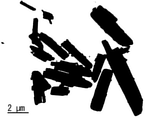
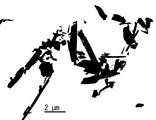
- the copper phthalocyanine composition of the example of the present invention can have a smaller particle size after pigmentation as compared with the copper phthalocyanine of the comparative example, and thus has a dispersibility in the resin. , Brightness could be improved, leading to higher performance.
- the furan used in Synthesis Example 1 is derived from biomass, and the composition of the examples of the present invention can improve the degree of biomass.
- by introducing a substituent into the furan of the raw material used in Synthesis Example 1 it is possible to produce a phthalocyanine compound and a composition while controlling the substitution position and number.
Landscapes
- Chemical & Material Sciences (AREA)
- Organic Chemistry (AREA)
- Chemical Kinetics & Catalysis (AREA)
- Life Sciences & Earth Sciences (AREA)
- Engineering & Computer Science (AREA)
- Materials Engineering (AREA)
- Wood Science & Technology (AREA)
- Physics & Mathematics (AREA)
- General Chemical & Material Sciences (AREA)
- General Physics & Mathematics (AREA)
- Optics & Photonics (AREA)
- Inks, Pencil-Leads, Or Crayons (AREA)
- Optical Filters (AREA)
- Paints Or Removers (AREA)
Priority Applications (2)
| Application Number | Priority Date | Filing Date | Title |
|---|---|---|---|
| JP2022538482A JP7205670B2 (ja) | 2020-08-27 | 2021-08-26 | フタロシアニンの組成物 |
| CN202180051801.9A CN115989284A (zh) | 2020-08-27 | 2021-08-26 | 酞菁的组合物 |
Applications Claiming Priority (2)
| Application Number | Priority Date | Filing Date | Title |
|---|---|---|---|
| JP2020-143409 | 2020-08-27 | ||
| JP2020143409 | 2020-08-27 |
Publications (1)
| Publication Number | Publication Date |
|---|---|
| WO2022045235A1 true WO2022045235A1 (ja) | 2022-03-03 |
Family
ID=80353355
Family Applications (1)
| Application Number | Title | Priority Date | Filing Date |
|---|---|---|---|
| PCT/JP2021/031297 Ceased WO2022045235A1 (ja) | 2020-08-27 | 2021-08-26 | フタロシアニンの組成物 |
Country Status (3)
| Country | Link |
|---|---|
| JP (1) | JP7205670B2 (https=) |
| CN (1) | CN115989284A (https=) |
| WO (1) | WO2022045235A1 (https=) |
Cited By (1)
| Publication number | Priority date | Publication date | Assignee | Title |
|---|---|---|---|---|
| JPWO2023243354A1 (https=) * | 2022-06-13 | 2023-12-21 |
Families Citing this family (2)
| Publication number | Priority date | Publication date | Assignee | Title |
|---|---|---|---|---|
| CN117222709A (zh) * | 2021-05-31 | 2023-12-12 | Dic株式会社 | 酞菁化合物 |
| CN120842877B (zh) * | 2025-09-19 | 2026-01-02 | 浙江材华科技有限公司 | 一种高溶解度光刻胶用绿色酞菁染料及其合成方法 |
Citations (3)
| Publication number | Priority date | Publication date | Assignee | Title |
|---|---|---|---|---|
| JP2009235354A (ja) * | 2008-03-28 | 2009-10-15 | Toyo Ink Mfg Co Ltd | 顔料組成物 |
| WO2013191029A1 (ja) * | 2012-06-18 | 2013-12-27 | 日本化薬株式会社 | ポルフィラジン色素及びその用途 |
| JP2017226820A (ja) * | 2016-06-21 | 2017-12-28 | 日本化薬株式会社 | ナフタロシアニンを含む青色着色樹脂組成物、カラーフィルター、固体撮像素子 |
Family Cites Families (4)
| Publication number | Priority date | Publication date | Assignee | Title |
|---|---|---|---|---|
| JPH01180388A (ja) * | 1988-01-11 | 1989-07-18 | Kao Corp | 光学的情報記録媒体 |
| JPH077019A (ja) * | 1993-03-12 | 1995-01-10 | Nippon Telegr & Teleph Corp <Ntt> | 有機薄膜及びその製造法 |
| US8202358B2 (en) | 2009-10-02 | 2012-06-19 | Hewlett-Packard Development Company, L.P. | Phthalocyanine, naphthalocyanine, and bridged phthalocyanine/naphthalocyanine dyes and inks containing the same |
| CN107526250A (zh) * | 2016-06-21 | 2017-12-29 | 日本化药株式会社 | 蓝色着色树脂组合物、彩色滤光片、固体摄像元件 |
-
2021
- 2021-08-26 CN CN202180051801.9A patent/CN115989284A/zh active Pending
- 2021-08-26 WO PCT/JP2021/031297 patent/WO2022045235A1/ja not_active Ceased
- 2021-08-26 JP JP2022538482A patent/JP7205670B2/ja active Active
Patent Citations (3)
| Publication number | Priority date | Publication date | Assignee | Title |
|---|---|---|---|---|
| JP2009235354A (ja) * | 2008-03-28 | 2009-10-15 | Toyo Ink Mfg Co Ltd | 顔料組成物 |
| WO2013191029A1 (ja) * | 2012-06-18 | 2013-12-27 | 日本化薬株式会社 | ポルフィラジン色素及びその用途 |
| JP2017226820A (ja) * | 2016-06-21 | 2017-12-28 | 日本化薬株式会社 | ナフタロシアニンを含む青色着色樹脂組成物、カラーフィルター、固体撮像素子 |
Cited By (5)
| Publication number | Priority date | Publication date | Assignee | Title |
|---|---|---|---|---|
| JPWO2023243354A1 (https=) * | 2022-06-13 | 2023-12-21 | ||
| WO2023243354A1 (ja) * | 2022-06-13 | 2023-12-21 | Dic株式会社 | イソインドリン化合物 |
| JP7552935B2 (ja) | 2022-06-13 | 2024-09-18 | Dic株式会社 | イソインドリン化合物 |
| JP2024164221A (ja) * | 2022-06-13 | 2024-11-26 | Dic株式会社 | イソインドリン化合物 |
| JP7800602B2 (ja) | 2022-06-13 | 2026-01-16 | Dic株式会社 | イソインドリン化合物 |
Also Published As
| Publication number | Publication date |
|---|---|
| JPWO2022045235A1 (https=) | 2022-03-03 |
| CN115989284A (zh) | 2023-04-18 |
| JP7205670B2 (ja) | 2023-01-17 |
Similar Documents
| Publication | Publication Date | Title |
|---|---|---|
| JP7168126B2 (ja) | フタロシアニンの製造方法 | |
| JP7205670B2 (ja) | フタロシアニンの組成物 | |
| EP1572809B2 (de) | Verfahren zur herstellung von phthalocyaninpigmentzubereitungen | |
| DE10242875B4 (de) | Verfahren zum Herstellen sulfonierter fester Teilchen | |
| JP5717230B2 (ja) | カラーフィルターにおいて使用するための2成分ジケトピロロピロール系顔料組成物 | |
| WO2007124803A1 (de) | Wasserbasierende pigmentpräparation | |
| WO2009132738A1 (de) | Pigmentdispergatoren und leicht dispergierbare feste pigmentzubereitungen | |
| US20240116953A1 (en) | Phthalocyanine compound | |
| JP2005506434A (ja) | カラーフィルターおよびlcdに有用な緑色顔料組成物の製造方法 | |
| DE69823614T2 (de) | Hochleistungstintenzusammensetzungen mit nicht auf Benzidin basierenden Farbmitteln | |
| JP2020033523A (ja) | 顔料組成物、着色組成物及びカラーフィルタ | |
| JP5490980B2 (ja) | 微細化顔料の製造方法および顔料着色剤 | |
| JP2020033522A (ja) | 顔料組成物、着色組成物及びカラーフィルタ | |
| JP2020033524A (ja) | 着色組成物及びカラーフィルタ | |
| JP6893277B1 (ja) | 顔料組成物、着色組成物、およびその用途 | |
| JP4694559B2 (ja) | フタロシアニン色素に基づいた色素調製物 | |
| WO2020218262A1 (ja) | イソインドリン化合物を含む着色組成物及びその利用 | |
| EP2486099A1 (de) | Leicht dispergierbare pigmentzubereitung auf basis von c.i. pigment yellow 155 | |
| JP2004292785A (ja) | カラーフィルター用黄色顔料組成物およびそれを着色画素部に含有してなるカラーフィルター | |
| KR101505671B1 (ko) | 안료 분산 조성물, 컬러 레지스트 및 이를 이용하여 제조된 컬러필터 | |
| JP4396210B2 (ja) | 顔料分散剤、顔料組成物、及び顔料分散体 | |
| JP7156770B2 (ja) | キサンテン化合物、及びこれを含んだ顔料組成物 | |
| WO2023276543A1 (ja) | 錯体化合物および該錯体化合物の製造方法 | |
| KR101627352B1 (ko) | 신규한 안료 첨가제, 이의 제조방법 및 이를 포함하는 안료 분산 조성물 | |
| KR101620843B1 (ko) | 신규한 안료 첨가제, 이의 제조방법 및 이를 포함하는 안료 분산 조성물 |
Legal Events
| Date | Code | Title | Description |
|---|---|---|---|
| 121 | Ep: the epo has been informed by wipo that ep was designated in this application |
Ref document number: 21861657 Country of ref document: EP Kind code of ref document: A1 |
|
| ENP | Entry into the national phase |
Ref document number: 2022538482 Country of ref document: JP Kind code of ref document: A |
|
| WWE | Wipo information: entry into national phase |
Ref document number: 202317009778 Country of ref document: IN |
|
| NENP | Non-entry into the national phase |
Ref country code: DE |
|
| 122 | Ep: pct application non-entry in european phase |
Ref document number: 21861657 Country of ref document: EP Kind code of ref document: A1 |