WO2022044867A1 - クラッディング用組成物、及び金属/樹脂接合部材の製造方法 - Google Patents
クラッディング用組成物、及び金属/樹脂接合部材の製造方法 Download PDFInfo
- Publication number
- WO2022044867A1 WO2022044867A1 PCT/JP2021/029896 JP2021029896W WO2022044867A1 WO 2022044867 A1 WO2022044867 A1 WO 2022044867A1 JP 2021029896 W JP2021029896 W JP 2021029896W WO 2022044867 A1 WO2022044867 A1 WO 2022044867A1
- Authority
- WO
- WIPO (PCT)
- Prior art keywords
- metal
- resin member
- cladding composition
- base material
- resin
- Prior art date
- Legal status (The legal status is an assumption and is not a legal conclusion. Google has not performed a legal analysis and makes no representation as to the accuracy of the status listed.)
- Ceased
Links
Images
Classifications
-
- B—PERFORMING OPERATIONS; TRANSPORTING
- B23—MACHINE TOOLS; METAL-WORKING NOT OTHERWISE PROVIDED FOR
- B23K—SOLDERING OR UNSOLDERING; WELDING; CLADDING OR PLATING BY SOLDERING OR WELDING; CUTTING BY APPLYING HEAT LOCALLY, e.g. FLAME CUTTING; WORKING BY LASER BEAM
- B23K35/00—Rods, electrodes, materials, or media, for use in soldering, welding, or cutting
- B23K35/22—Rods, electrodes, materials, or media, for use in soldering, welding, or cutting characterised by the composition or nature of the material
- B23K35/36—Selection of non-metallic compositions, e.g. coatings or fluxes; Selection of soldering or welding materials, conjoint with selection of non-metallic compositions, both selections being of interest
- B23K35/3601—Selection of non-metallic compositions, e.g. coatings or fluxes; Selection of soldering or welding materials, conjoint with selection of non-metallic compositions, both selections being of interest with inorganic compounds as principal constituents
-
- B—PERFORMING OPERATIONS; TRANSPORTING
- B29—WORKING OF PLASTICS; WORKING OF SUBSTANCES IN A PLASTIC STATE IN GENERAL
- B29C—SHAPING OR JOINING OF PLASTICS; SHAPING OF MATERIAL IN A PLASTIC STATE, NOT OTHERWISE PROVIDED FOR; AFTER-TREATMENT OF THE SHAPED PRODUCTS, e.g. REPAIRING
- B29C65/00—Joining or sealing of preformed parts, e.g. welding of plastics materials; Apparatus therefor
- B29C65/02—Joining or sealing of preformed parts, e.g. welding of plastics materials; Apparatus therefor by heating, with or without pressure
- B29C65/14—Joining or sealing of preformed parts, e.g. welding of plastics materials; Apparatus therefor by heating, with or without pressure using wave energy, i.e. electromagnetic radiation, or particle radiation
- B29C65/16—Laser beams
Definitions
- the present invention relates to a cladding composition and a method for manufacturing a metal / resin bonding member.
- Examples of the new material include those in which different materials are joined together.
- Adhesives are commonly used when joining dissimilar materials together.
- the use of an adhesive has a large environmental load, the adhesive itself deteriorates over time, and there is a problem in terms of bonding strength.
- Patent Document 1 a metal powder is adhered to one surface of a metal substrate and irradiated with a laser to form a superimposed fine particle structure alloyed with the metal substrate, and the superimposed fine particles are formed.
- a joining method for joining a metal base material and a resin member by pressing a resin member against a structure and irradiating the interface with a laser to heat the structure is disclosed.
- the present invention has been made in view of the above circumstances, and the bonding strength between the metal base material and the resin member is higher without using an adhesive, and the bonding strength deteriorates with time in a high temperature and high humidity environment. It is an object of the present invention to provide a method for manufacturing a metal / resin joint member in which the amount is suppressed. Another object of the present invention is to provide a cladding composition capable of stably bonding a metal base material and a resin member and suppressing deterioration of bonding strength over time in a high temperature and high humidity environment. do.
- the present invention has adopted the following configuration. That is, the first aspect of the present invention is a cladding composition comprising a metal powder, a binder, a water absorbing material, and an organic solvent.
- a second aspect of the present invention is a method for manufacturing a metal / resin bonding member in which a metal base material and a resin member are bonded, and a bracket of the first aspect of the present invention is applied to at least a part of the metal base material.
- the bonding strength between the metal base material and the resin member is higher without using an adhesive, and the bonding strength deteriorates with time in a high temperature and high humidity environment. It is possible to manufacture a metal / resin joint member in which the amount is suppressed. Further, according to the cladding composition of the present invention, the metal substrate and the resin member can be stably bonded, and the deterioration of the bonding strength between the metal substrate and the resin member over time in a high temperature and high humidity environment is suppressed. can do.
- the cladding composition of the present embodiment contains a metal powder, a binder, a water absorbing material, and an organic solvent.
- the "cladding composition” in the present invention refers to a material that melts and solidifies on the surface of a metal base material that is a base material to form beads (projections of an alloy).
- Metal powder examples include aluminum, nickel, chromium, iron, copper, titanium, silicon, stellite, vanadium, or alloys thereof.
- the metal powder one type may be used alone, or two or more types may be used in combination. By combining two or more kinds of metals, it becomes easy to form a porous structure on the bead surface, and for example, it becomes easy to increase the bonding strength between the metal base material and the resin member.
- the metal powder preferably contains at least one selected from the group consisting of aluminum powder and titanium powder, and examples thereof include those containing aluminum powder and titanium powder.
- the average particle size of the metal powder is, for example, about 10 ⁇ m or more and 100 ⁇ m or less.
- the "average particle size of powder" in the present invention means the value of the volume average particle size of powder measured by a known particle size distribution measuring device.
- the content of the metal powder is preferably 25 to 94% by mass, more preferably 30 to 85% by mass, still more preferably 35 to 75% by mass, based on the total amount (100% by mass) of the cladding composition. , 40-65% by mass is particularly preferable.
- the content of the metal powder is not less than the lower limit of the above-mentioned preferable range, for example, the bonding strength between the metal base material and the resin member is more likely to be increased, while when it is not more than the upper limit of the above-mentioned preferable range. , Easy to handle as a composition.
- the binder in the present embodiment acts as a dispersant for metal powders and also as a viscosity modifier in the cladding composition.
- An organic compound may be used or an inorganic compound may be used as the binder.
- Examples of the organic compound in the binder include polyvinyl acetal, cellulose compounds, polyacrylic acid and other acrylic compounds, polyvinyl alcohol, epoxy compounds and the like.
- Specific examples of the polyvinyl acetal include polyvinyl formal and polyvinyl butyral.
- Specific examples of the cellulose compound include hydroxypropyl cellulose and hydroxyethyl cellulose.
- Examples of the inorganic compound in the binder include clay minerals.
- Specific examples of clay minerals include bentonite, smectite, and montmorillonite.
- the binder may be used alone or in combination of two or more.
- the binder is preferably an organic compound, and among them, a binder containing polyvinyl acetal is preferable because it has strong adhesiveness to a metal and has good dispersibility with metal powder, and among them, a binder containing polyvinyl butyral is particularly preferable. preferable.
- a binder containing polyvinyl butyral for example, those having a mass average molecular weight (Mw) of 10,000 to 80,000, more preferably those having Mw of 20,000 to 60,000, and Mw are more preferable because the bonding strength between the metal base material and the resin member is likely to be increased. Is more preferably 30,000 to 50,000.
- the binder is more preferably one containing a cellulose compound because it is easy to adjust the viscosity of the composition.
- a cellulose compound hydroxypropyl cellulose is preferable.
- hydroxypropyl celluloses for example, those having a Mw of 100,000 to 800,000 are preferable, those having a Mw of 110,000 to 700,000, and those having a Mw of 120,000 to 650000 are preferable because the bonding strength between the metal base material and the resin member is likely to be increased. Is more preferable.
- the binder content is preferably 0.01 to 10% by mass, more preferably 0.05 to 7% by mass, and 0.1 to 5% by mass, based on the total amount (100% by mass) of the cladding composition. By mass% is more preferable, 0.2 to 5% by mass is particularly preferable, and 0.5 to 2% by mass is most preferable.
- the binder content is at least the lower limit of the above-mentioned preferable range, for example, the bonding strength between the metal base material and the resin member can be more easily increased, and the applicability of the composition to the metal base material can be improved. Improve more.
- it is not more than the upper limit of the above-mentioned preferable range it becomes easy to handle as a composition.
- the water-absorbing material in the present embodiment absorbs moisture that has penetrated into the bonding interface between the metal base material and the resin member over time. As a result, corrosion of the joint portion is prevented, and deterioration of the joint strength between the metal base material and the resin member with time is suppressed.
- the water absorbing material include zeolite compounds, alumina, silica, activated carbon, calcium oxide and the like.
- the zeolite compound any of synthetic zeolite, artificial zeolite, and natural zeolite can be used, and examples thereof include molecular sieve and high silica zeolite.
- the water absorbing material one type may be used alone, or two or more types may be used in combination.
- the water-absorbing material is preferably a zeolite compound, and more preferably one containing at least one selected from the group consisting of molecular sieves and high silica zeolites.
- the molecular sieve and high silica zeolite are preferably molded into powder or pellet form, and their average particle size is, for example, about 1 ⁇ m or more and 50 ⁇ m or less.
- the content of the water-absorbent material is preferably 5 to 40% by mass, more preferably 5 to 35% by mass, still more preferably 6 to 25% by mass, based on the total amount (100% by mass) of the cladding composition. , 6-15% by mass is particularly preferable.
- the content of the water-absorbing material is at least the lower limit of the above-mentioned preferable range, for example, deterioration of the bonding strength between the metal base material and the resin member in a high-temperature and high-humidity environment with time is likely to be suppressed.
- the bonding strength between the metal base material and the resin member can be further increased. In addition, it becomes easy to handle as a composition.
- the mixing ratio of the metal powder and the water absorbing material is preferably 90/10 to 50/50 as a mass ratio, and 90/10 to 60. It is more preferably / 40, and even more preferably 90/10 to 70/30.
- the mass ratio is at least the lower limit of the above-mentioned preferable range, the bonding strength between the metal base material and the resin member can be further increased.
- it is not more than the upper limit of the above-mentioned preferable range, it becomes easy to handle as a composition.
- organic solvent in the present embodiment examples include those that serve as a dispersion medium for the above-mentioned metal powder and binder.
- organic solvent methanol, ethanol, n-propyl alcohol, isopropyl alcohol, n-pentyl alcohol, s-pentyl alcohol, t-pentyl alcohol, isopentyl alcohol, 2-methyl-1-propanol, 2- Ethylbutanol, neopentyl alcohol, n-butanol, s-butanol, t-butanol, n-hexanol, 2-heptanol, 3-heptanol, 2-methyl-1-butanol, 2-methyl-2-butanol, 4-methyl -2-Pentanol, 1-butoxy-2-propanol, propylene glycol monopropyl ether, 5-methyl-1-hexanol, 6-methyl-2-heptanol, 1-oc
- polyhydric alcohols such as monoalkyl ethers such as butyl ether or compounds having an ether bond such as monophenyl ether [among these, propylene glycol monomethyl ether acetate (PGMEA) and propylene glycol monomethyl ether (PGME) are preferable].
- monoalkyl ethers such as butyl ether
- compounds having an ether bond such as monophenyl ether
- PGMEA propylene glycol monomethyl ether acetate
- PGME propylene glycol monomethyl ether
- Ring type like dioxane Ethers and esters such as methyl lactate, ethyl lactate (EL), methyl acetate, ethyl acetate, butyl acetate, methyl pyruvate, ethyl pyruvate, methyl methoxypropionate, ethyl ethoxypropionate; anisole, ethylbenzyl ether, Aromatic organic solvents such as cresylmethyl ether, diphenyl ether, dibenzyl ether, phenetol, butylphenyl ether, ethylbenzene, diethylbenzene, pentylbenzene, isopropylbenzene, toluene, xylene, simene, mesitylen, dimethylsulfoxide (DMSO) and the like can be mentioned. Be done.
- DMSO dimethylsulfoxide
- the organic solvent preferably contains a derivative of a polyhydric alcohol.
- the derivative of the polyhydric alcohol the polyhydric alcohol or the monoalkyl ether of the compound having an ester bond is preferable, and specifically, PGMEA and PGME are preferably mentioned.
- the content of the organic solvent is preferably 0.1 to 60% by mass, more preferably 10 to 50% by mass, and 15 to 40% by mass with respect to the total amount (100% by mass) of the cladding composition. More preferably, 20 to 30% by mass is particularly preferable.
- the cladding composition of the present embodiment may further contain other components other than the above-mentioned metal powder, binder, water absorbing material and organic solvent.
- other components include carbon powder, surfactant and the like.
- the cladding composition of the present embodiment further preferably contains carbon powder.
- the bead is easily formed by melting and solidifying on the surface of the metal base material which is the base material.
- the average particle size of the carbon powder is, for example, about 10 nm or more and 100 ⁇ m or less.
- the content of the carbon powder is preferably 0.1 to 40% by mass, more preferably 0.5 to 30% by mass, and 1 to 20% with respect to the total amount (100% by mass) of the cladding composition. % By mass is more preferred.
- the content of the carbon powder is not less than the lower limit of the above-mentioned preferable range, for example, the bonding strength between the metal base material and the resin member is more likely to be increased, while it is not more than the upper limit of the above-mentioned preferable range.
- the fluidity of the composition becomes better.
- the mixing ratio (mass ratio) of both is equal to or higher than the lower limit of the above-mentioned preferable range, for example, the bonding strength between the metal base material and the resin member can be more easily increased, while it is equal to or less than the upper limit of the above-mentioned preferable range. If so, the fluidity of the composition becomes better.
- the cladding composition of the present embodiment can be produced, for example, by a production method including a step of preparing a mixed solution of a binder and an organic solvent, and a step of mixing the mixed solution with a metal powder and a water absorbing material. can.
- the binder concentration is preferably 0.01 to 80% by mass, more preferably 0.1 to 40% by mass, and 1 to 15% by mass with respect to the mixed solution (100% by mass). % Is more preferable.
- the binder concentration is not less than the lower limit of the above-mentioned preferable range, the applicability of the composition to the metal substrate is further improved, while when it is not more than the upper limit of the above-mentioned preferable range, the composition is appropriately applied. It becomes easy to adjust the viscosity.
- a mixed powder in which the metal powder and the carbon powder are mixed may be mixed in advance.
- the metal powder and the water-absorbing material are preferably dispersed in a mixed solution of the binder and the organic solvent.
- the cladding composition of the embodiment include forms such as pastes, slurries, and suspensions, and pastes are preferable.
- paste as used herein means that the paste has fluidity and high viscosity, and the viscosity is in the range of 1000 cps (1 Pa ⁇ s) or more and 200,000 cps (200 Pa ⁇ s) or less.
- the viscosity of the paste indicates a value measured at 25 ° C. using an E-type viscometer.
- the cladding composition of the above-described embodiment contains a water-absorbing material, the moisture that has entered the bonding interface between the metal base material and the resin member is easily absorbed. Therefore, it is possible to prevent corrosion of the entire bead over time. As a result, deterioration of the bonding strength between the metal base material and the resin member over time is suppressed.
- the manufacturing method of the first embodiment is a method for manufacturing a metal / resin bonding member in which a metal base material and a resin member are bonded, and the above-mentioned cladding composition is applied to at least a part of the metal base material.
- examples of the metal base material as the base material include aluminum alloys, aluminum die casts, stainless steel, SPCC (cold rolled steel sheet) and the like.
- examples of the resin member include polyamide (nylon 6, nylon 6, 6, etc.), polycarbonate, polypropylene, polyphenylene sulfide (PPS), and the like.
- step (i) the above-mentioned cladding composition is applied to at least a part of the metal substrate.
- the method of applying the composition for cladding is not particularly limited, and examples thereof include screen application, dispenser, and spraying.
- the thickness of the coating film of the cladding composition applied to the metal substrate may be appropriately set according to the compounding components of the composition and the like, and is, for example, about 50 to 200 ⁇ m.
- the coated portion of the cladding composition on the metal substrate is irradiated with a laser.
- the laser that irradiates the coated portion may be any laser that can heat the metal powder, and examples thereof include a semiconductor laser, a fiber laser, an Nd: YAG laser, and a carbon dioxide gas laser.
- the coated part is irradiated with a laser and the metal powder melts.
- the metal in the molten state is alloyed with the metal base material to form beads (protrusions of the alloy, so-called overlay portions) on the surface of the metal base material.
- the binder and the like are burnt down by heating by laser irradiation.
- the bead preferably has a size (height with respect to the metal base material surface) of 1 ⁇ m or more and 200 ⁇ m or less.
- this bead has a superposed fine particle structure.
- the "superimposed fine particle structure” refers to a microstructure in which the fine concavo-convex shape structure is superposed on the fine concavo-convex shape surface.
- An anchor effect is exhibited by forming beads having a superposed fine particle structure on the surface of the metal substrate.
- the superimposed fine particle structure includes the case where an alloy layer made of any of eutectic, solid solution, and intermetallic compound is formed.
- the resin member is arranged on the laser irradiation portion of the metal substrate.
- a method of arranging the resin member on the laser irradiation part for example, a method of applying a resin composition which is a material of the resin member on the laser irradiation part to form a film, or a method of irradiating a molded body of the resin composition with a laser. There is a method of arranging it on the department. Further, when arranging the resin member on the laser irradiation portion, it is preferable that the resin member is in contact with and pressed against the metal base material.
- the optimum conditions may be selected in the pressure range of 0.1 to 3 MPa. As a result, the joint strength between the two is sufficiently increased.
- Step (iv) In the step (iv), the interface between the laser irradiation unit and the resin member is heated to bond the metal base material and the resin member to obtain a metal / resin bonding member.
- the method for heating the interface is not particularly limited, and examples thereof include heating by a heater and heating by laser irradiation.
- the method for heating the interface between the laser irradiation unit and the resin member is preferably heating by laser irradiation.
- the bead having a superposed fine particle structure formed on the surface of the metal substrate does not have transparency with respect to the wavelength of the laser. Therefore, in the case of heating by laser irradiation, the laser irradiated on the bead surface is converted into heat. The converted heat propagates to the surface of the resin member that is in contact and pressed, and melts the resin member. The molten resin member permeates the inside of the superimposed fine particle structure, and as a result, the metal base material and the resin member are firmly bonded to each other.
- the method of irradiating the laser from the resin member side is common.
- the metal is transmitted by irradiating the laser from the metal base material side, contrary to the general case.
- the interface between the metal base material and the resin member can be heated by heat.
- a bead having a superposed fine particle structure is formed on the surface of the metal substrate by using a cladding composition containing a binder and a water absorbing material together with the metal powder. .. Since the bead contains a water-absorbing material, the water that has entered the bonding interface between the metal base material and the resin member is absorbed by the water-absorbing material. This prevents corrosion of the joint portion and the like. Therefore, according to the manufacturing method of the first embodiment, it is possible to manufacture a metal / resin bonding member having a higher bonding strength between the metal base material and the resin member without using an adhesive.
- the bonding strength of the metal / resin bonding member produced by the production method of the first embodiment is, for example, 35 to 80 MPa.
- the cladding composition used exhibits appropriate viscosity by containing a binder and an organic solvent together with the metal powder, so that even when the metal base material is arranged on an inclined surface, it may be arranged on an inclined surface.
- the composition can be reliably applied to the planned joining site.
- the cladding composition used can be applied to the planned joining site in a less uniform amount and in a more uniform state than the metal powder. For this reason, the utilization efficiency of the cladding composition is particularly improved during laser irradiation.
- the cladding composition used can be uniformly applied even if the metal base material has a wider size than the metal powder. Therefore, the composition is useful for joining members having a wide size.
- the binder since the binder is contained together with the metal powder, it has an appropriate coarse and dense distribution, and beads with large irregularities are likely to be formed. Therefore, the bonding strength can be further increased, and the metal base material and the resin member can be stably bonded.
- the method for producing the cladding composition and the metal / resin bonding member according to the present invention is not limited to the above-described embodiment, and for example, the metal used for the cladding composition in the production method of the first embodiment.
- the powder it is preferable to use a mixed metal powder of one or more metals that are the same as the metal constituting the metal substrate and other metals.
- the cladding composition containing such a mixed metal powder the compatibility between the metal powder and the metal base material is enhanced. Therefore, beads having an appropriate coarse and dense distribution are likely to be formed on the surface of the metal substrate. As a result, the metal base material and the resin member can be joined more firmly and stably.
- other embodiments include, for example, use in cladding of a composition containing a metal powder, a binder, a water absorbing material, and an organic solvent.
- the metal base material and the resin member can be bonded more firmly without using an adhesive. Therefore, the manufacturing method to which the present invention is applied is useful as a method for manufacturing a new material that realizes weight reduction of the vehicle body.
- Metal base material A5052 aluminum plate with a length of 5 cm x width of 2 cm x thickness of 1 mm
- Resin member a sheet made of polyphenylene sulfide (PPS) with a length of 5 cm x width of 2 cm x thickness of 1 mm
- a laser for the laser irradiation here, a semiconductor laser having a wavelength of 970 nm, which was shaped into a spot beam having a diameter of 2 mm by using an optical system, was used.
- the scanning speed of the spot beam was set to 30 mm / s.
- the spot beam was scanned over a width of 20 mm to irradiate an area of 40 mm 2 or more.
- the irradiation conditions of the laser spot here were an average output of 150 W, a repetition frequency of 1000 Hz, a duty of 50%, and a scanning speed of 10 mm / s.
- Shear tensile strength test The shear tensile strength test in JIS K6850 was used as a reference. The shear tensile strength was calculated from the breaking force and the area of the clad layer for the joining member of the aluminum plate and the sheet made of PPS.
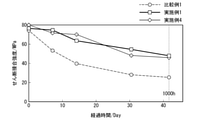
- FIG. 1 is a graph showing the results of measuring changes in bonding strength over time in the 85/85 test for bonding members manufactured using the cladding compositions of Example 1, Example 4, and Comparative Example 1. ..
- the vertical axis represents the shear joint strength (MPa) measured by the shear tensile strength test, and the horizontal axis represents the elapsed time (days).
- the bonding strength after one week of the 85/85 test was about the initial bonding strength. It is 90% or more, the bonding strength after 2 weeks is about 80% or more of the initial bonding strength, and the bonding strength is maintained at about 60% or more of the initial bonding strength even after 1000 hours have passed. You can confirm that you are there.
- the bonding strength after 1 week of the 85/85 test decreased to about 60% of the initial bonding strength, and the bonding strength after 2 weeks passed. Was reduced to about 50% of the initial bonding strength, and the bonding strength after 1000 hours was reduced to about one-third of the initial bonding strength.
- the bonding strength between the metal base material and the resin member is further enhanced, and the deterioration of the bonding strength over time in a high temperature and high humidity environment is suppressed. It was confirmed that the parts could be manufactured. Further, according to the cladding composition to which the present invention is applied, the metal substrate and the resin member can be stably bonded, and the bonding strength between the metal substrate and the resin member deteriorates with time in a high temperature and high humidity environment. It was confirmed that it was possible to suppress.
Landscapes
- Physics & Mathematics (AREA)
- Engineering & Computer Science (AREA)
- Mechanical Engineering (AREA)
- Optics & Photonics (AREA)
- Health & Medical Sciences (AREA)
- Electromagnetism (AREA)
- Toxicology (AREA)
- Chemical & Material Sciences (AREA)
- Inorganic Chemistry (AREA)
- Lining Or Joining Of Plastics Or The Like (AREA)
- Laminated Bodies (AREA)
Abstract
金属基材と樹脂部材との接合に、金属粉末とバインダと吸水材と有機溶媒とを含有するクラッディング用組成物を用いる。金属基材の少なくとも一部に、当該クラッディング用組成物を塗布する工程と、金属基材における当該クラッディング用組成物の塗布部に、レーザを照射する工程と、金属基材におけるレーザ照射部上に、樹脂部材を配置する工程と、レーザ照射部と樹脂部材との界面を加熱して、金属基材と樹脂部材とを接合する工程と、を有する金属/樹脂接合部材の製造方法を用いる。
Description
本発明は、クラッディング用組成物、及び金属/樹脂接合部材の製造方法に関する。本願は、2020年8月27日に日本に出願された特願2020-143896号に基づき優先権を主張し、その内容をここに援用する。
近年、環境負荷の点から、自動車においては、二酸化炭素(CO2)排出量の削減が当然に要求されている。
これに対し、燃料であるガソリンの消費を抑えたハイブリッド車や電気自動車が生産されている。また、燃費の向上を図るため、車体の軽量化が注目され、より軽量で丈夫な新材料を車体に適用する検討が進んでいる。
これに対し、燃料であるガソリンの消費を抑えたハイブリッド車や電気自動車が生産されている。また、燃費の向上を図るため、車体の軽量化が注目され、より軽量で丈夫な新材料を車体に適用する検討が進んでいる。
前記の新材料としては、異種の材料同士を接合したものが挙げられる。
異種の材料同士を接合する際、接着剤が一般に用いられる。しかしながら、接着剤の使用は、環境負荷が大きく、接着剤自体が経年劣化を生じ、また、接合強度の点でも問題となる。
異種の材料同士を接合する際、接着剤が一般に用いられる。しかしながら、接着剤の使用は、環境負荷が大きく、接着剤自体が経年劣化を生じ、また、接合強度の点でも問題となる。
かかる問題を解決する技術として、接着剤を用いないで異種の材料同士を接合する方法が提案されている。
例えば、特許文献1には、金属基材の一方の面に、金属粉末を付着させ、レーザを照射して当該金属基材と合金化した重畳的微細粒子構造を形成し、当該重畳的微細粒子構造に樹脂部材を押圧し、その界面にレーザを照射して加熱することにより、金属基材と樹脂部材とを接合する接合方法が開示されている。
例えば、特許文献1には、金属基材の一方の面に、金属粉末を付着させ、レーザを照射して当該金属基材と合金化した重畳的微細粒子構造を形成し、当該重畳的微細粒子構造に樹脂部材を押圧し、その界面にレーザを照射して加熱することにより、金属基材と樹脂部材とを接合する接合方法が開示されている。
しかしながら、特許文献1に記載の接合方法においては、金属基材に粉末状の金属を塗布することになるため、金属基材が傾斜面に配置されている場合、金属基材と樹脂部材とを安定に接合することが難しい。
また、金属基材と樹脂部材との接合強度が経時劣化するという問題がある。特に、高温高湿下の加速試験において、金属基材と樹脂部材との接合力が低下しやすく、両者間の接合強度を保つことが困難である。
さらに、接合を行う場所が振動するなど、粉末の使用に適さない環境では、従来、金属基材と樹脂部材との接合が難しいという問題もある。
また、金属基材と樹脂部材との接合強度が経時劣化するという問題がある。特に、高温高湿下の加速試験において、金属基材と樹脂部材との接合力が低下しやすく、両者間の接合強度を保つことが困難である。
さらに、接合を行う場所が振動するなど、粉末の使用に適さない環境では、従来、金属基材と樹脂部材との接合が難しいという問題もある。
本発明は、上記事情に鑑みてなされたものであり、接着剤を用いずに、金属基材と樹脂部材との接合強度がより高く、かつ、高温高湿環境下での接合強度の経時劣化が抑制された金属/樹脂接合部材を製造する方法を提供することを課題とする。また、本発明は、金属基材と樹脂部材とを安定に接合できると共に、高温高湿環境下での接合強度の経時劣化を抑制することができるクラッディング用組成物を提供することを課題とする。
上記の課題を解決するために、本発明は以下の構成を採用した。
すなわち、本発明の第1の態様は、金属粉末と、バインダと、吸水材と、有機溶媒とを含有することを特徴とする、クラッディング用組成物である。
すなわち、本発明の第1の態様は、金属粉末と、バインダと、吸水材と、有機溶媒とを含有することを特徴とする、クラッディング用組成物である。
本発明の第2の態様は、金属基材と樹脂部材とが接合した金属/樹脂接合部材の製造方法であって、前記金属基材の少なくとも一部に、本発明の第1の態様のクラッディング用組成物を塗布する工程(i)と、前記金属基材における前記クラッディング用組成物の塗布部に、レーザを照射する工程(ii)と、前記金属基材におけるレーザ照射部上に、前記樹脂部材を配置する工程(iii)と、前記レーザ照射部と前記樹脂部材との界面を加熱して、前記金属基材と前記樹脂部材とを接合する工程(iv)と、を有することを特徴とする、金属/樹脂接合部材の製造方法である。
本発明の金属/樹脂接合部材の製造方法によれば、接着剤を用いずに、金属基材と樹脂部材との接合強度がより高く、かつ、高温高湿環境下での接合強度の経時劣化が抑制された金属/樹脂接合部材を製造することができる。
また、本発明のクラッディング用組成物によれば、金属基材と樹脂部材とを安定に接合できると共に、高温高湿環境下での金属基材と樹脂部材との接合強度の経時劣化を抑制することができる。
また、本発明のクラッディング用組成物によれば、金属基材と樹脂部材とを安定に接合できると共に、高温高湿環境下での金属基材と樹脂部材との接合強度の経時劣化を抑制することができる。
(クラッディング用組成物)
本実施形態のクラッディング用組成物は、金属粉末と、バインダと、吸水材と、有機溶媒とを含有する。
本発明における「クラッディング用組成物」とは、母材である金属基材面で溶融凝固してビード(合金の突起物)を形成する材料をいう。
本実施形態のクラッディング用組成物は、金属粉末と、バインダと、吸水材と、有機溶媒とを含有する。
本発明における「クラッディング用組成物」とは、母材である金属基材面で溶融凝固してビード(合金の突起物)を形成する材料をいう。
<金属粉末>
本実施形態における金属粉末を構成する金属としては、例えば、アルミニウム、ニッケル、クロム、鉄、銅、チタン、シリコン、ステライト、バナジウム又はこれらの複数を合金化したものなどが挙げられる。
金属粉末は、一種を単独で用いてもよいし、二種以上を組み合わせて用いてもよい。二種以上の金属を組み合わせることで、ビード表面に多孔質構造が形成しやすくなり、例えば金属基材と樹脂部材との接合強度が高められやすくなる。
金属粉末は、アルミニウム粉末及びチタン粉末からなる群より選択される少なくとも一種を含むものが好ましく、例えばアルミニウム粉末とチタン粉末とを含むものが好適に挙げられる。
本実施形態における金属粉末を構成する金属としては、例えば、アルミニウム、ニッケル、クロム、鉄、銅、チタン、シリコン、ステライト、バナジウム又はこれらの複数を合金化したものなどが挙げられる。
金属粉末は、一種を単独で用いてもよいし、二種以上を組み合わせて用いてもよい。二種以上の金属を組み合わせることで、ビード表面に多孔質構造が形成しやすくなり、例えば金属基材と樹脂部材との接合強度が高められやすくなる。
金属粉末は、アルミニウム粉末及びチタン粉末からなる群より選択される少なくとも一種を含むものが好ましく、例えばアルミニウム粉末とチタン粉末とを含むものが好適に挙げられる。
金属粉末の平均粒子径は、例えば10μm以上100μm以下程度である。
本発明における「粉末の平均粒子径」は、公知の粒度分布測定装置により測定される粉末の体積平均粒子径の値をいう。
本発明における「粉末の平均粒子径」は、公知の粒度分布測定装置により測定される粉末の体積平均粒子径の値をいう。
金属粉末の含有量は、クラッディング用組成物の総量(100質量%)に対して25~94質量%であることが好ましく、30~85質量%がより好ましく、35~75質量%がさらに好ましく、40~65質量%が特に好ましい。
金属粉末の含有量が、前記の好ましい範囲の下限値以上であれば、例えば金属基材と樹脂部材との接合強度がより高められやすくなり、一方、前記の好ましい範囲の上限値以下であれば、組成物として取り扱いやすくなる。
金属粉末の含有量が、前記の好ましい範囲の下限値以上であれば、例えば金属基材と樹脂部材との接合強度がより高められやすくなり、一方、前記の好ましい範囲の上限値以下であれば、組成物として取り扱いやすくなる。
<バインダ>
本実施形態におけるバインダは、クラッディング用組成物において、金属粉末の分散剤として作用し、また、粘度調整剤としても作用する。
前記バインダには、有機化合物を用いることもできるし、無機化合物を用いることもできる。
本実施形態におけるバインダは、クラッディング用組成物において、金属粉末の分散剤として作用し、また、粘度調整剤としても作用する。
前記バインダには、有機化合物を用いることもできるし、無機化合物を用いることもできる。
前記バインダにおける有機化合物としては、例えば、ポリビニルアセタール、セルロース化合物、ポリアクリル酸その他のアクリル化合物、ポリビニルアルコール、エポキシ化合物等が挙げられる。
ポリビニルアセタールとして具体的には、ポリビニルホルマール、ポリビニルブチラールが挙げられる。
セルロース化合物として具体的には、ヒドロキシプロピルセルロース、ヒドロキシエチルセルロースが挙げられる。
ポリビニルアセタールとして具体的には、ポリビニルホルマール、ポリビニルブチラールが挙げられる。
セルロース化合物として具体的には、ヒドロキシプロピルセルロース、ヒドロキシエチルセルロースが挙げられる。
前記バインダにおける無機化合物としては、例えば粘土鉱物が挙げられる。粘土鉱物として具体的には、ベントナイト、スメクタイト、モンモリロナイトが挙げられる。
バインダは、一種を単独で用いてもよいし、二種以上を組み合わせて用いてもよい。
バインダは、有機化合物が好ましく、この中でも、金属との接着性が強く、また、金属粉との分散性が良好なことから、ポリビニルアセタールを含むものが好ましく、その中でもポリビニルブチラールを含むものが特に好ましい。ポリビニルブチラールの中でも、例えば金属基材と樹脂部材との接合強度が高められやすいことから、質量平均分子量(Mw)が10000~80000のものが好ましく、Mwが20000~60000のものがより好ましく、Mwが30000~50000のものがさらに好ましい。
また、バインダは、組成物の粘度を調整しやすいことから、セルロース化合物を含むものがより好ましい。セルロース化合物としては、ヒドロキシプロピルセルロースが好ましい。ヒドロキシプロピルセルロースの中でも、例えば金属基材と樹脂部材との接合強度が高められやすいことから、Mwが100000~800000のものが好ましく、Mwが110000~700000のものがより好ましく、Mwが120000~650000のものがさらに好ましい。
バインダの含有量は、クラッディング用組成物の総量(100質量%)に対して0.01~10質量%であることが好ましく、0.05~7質量%がより好ましく、0.1~5質量%がさらに好ましく、0.2~5質量%が特に好ましく、0.5~2質量%が最も好ましい。
バインダの含有量が、前記の好ましい範囲の下限値以上であれば、例えば金属基材と樹脂部材との接合強度がより高められやすくなり、また、金属基材への当該組成物の塗布性がより向上する。一方、前記の好ましい範囲の上限値以下であれば、組成物として取り扱いやすくなる。
バインダの含有量が、前記の好ましい範囲の下限値以上であれば、例えば金属基材と樹脂部材との接合強度がより高められやすくなり、また、金属基材への当該組成物の塗布性がより向上する。一方、前記の好ましい範囲の上限値以下であれば、組成物として取り扱いやすくなる。
<吸水材>
本実施形態における吸水材は、経時に伴い、金属基材と樹脂部材との接合界面に侵入した水分を吸収する。これにより、接合部の腐食等の防止が図られ、金属基材と樹脂部材との接合強度の経時劣化が抑制される。
吸水材としては、例えば、ゼオライト化合物、アルミナ、シリカ、活性炭、酸化カルシウム等が挙げられる。
ゼオライト化合物としては、合成ゼオライト、人工ゼオライト、天然ゼオライトのいずれも用いることができ、例えばモレキュラーシーブ、ハイシリカゼオライトが好適に挙げられる。
本実施形態における吸水材は、経時に伴い、金属基材と樹脂部材との接合界面に侵入した水分を吸収する。これにより、接合部の腐食等の防止が図られ、金属基材と樹脂部材との接合強度の経時劣化が抑制される。
吸水材としては、例えば、ゼオライト化合物、アルミナ、シリカ、活性炭、酸化カルシウム等が挙げられる。
ゼオライト化合物としては、合成ゼオライト、人工ゼオライト、天然ゼオライトのいずれも用いることができ、例えばモレキュラーシーブ、ハイシリカゼオライトが好適に挙げられる。
吸水材は、一種を単独で用いてもよいし、二種以上を組み合わせて用いてもよい。
吸水材は、ゼオライト化合物が好ましく、この中でも、モレキュラーシーブ及びハイシリカゼオライトからなる群より選択される少なくとも一種を含むものがより好ましい。
吸水材は、ゼオライト化合物が好ましく、この中でも、モレキュラーシーブ及びハイシリカゼオライトからなる群より選択される少なくとも一種を含むものがより好ましい。
モレキュラーシーブ、ハイシリカゼオライトは、粉末状又はペレット状に成型したものが好ましく、これらの平均粒子径は、例えば1μm以上50μm以下程度である。
吸水材の含有量は、クラッディング用組成物の総量(100質量%)に対して5~40質量%であることが好ましく、5~35質量%がより好ましく、6~25質量%がさらに好ましく、6~15質量%が特に好ましい。
吸水材の含有量が、前記の好ましい範囲の下限値以上であれば、例えば、高温高湿環境下での金属基材と樹脂部材との接合強度の経時劣化が抑制されやすくなる。一方、前記の好ましい範囲の上限値以下であれば、金属基材と樹脂部材との接合強度をより高められる。また、組成物として取り扱いやすくなる。
吸水材の含有量が、前記の好ましい範囲の下限値以上であれば、例えば、高温高湿環境下での金属基材と樹脂部材との接合強度の経時劣化が抑制されやすくなる。一方、前記の好ましい範囲の上限値以下であれば、金属基材と樹脂部材との接合強度をより高められる。また、組成物として取り扱いやすくなる。
本実施形態のクラッディング用組成物中、金属粉末と吸水材との混合比率は、質量比として、金属粉末/吸水材=90/10~50/50であることが好ましく、90/10~60/40であることがより好ましく、90/10~70/30であることがさらに好ましい。
かかる質量比が、前記の好ましい範囲の下限値以上であれば、金属基材と樹脂部材との接合強度をより高められる。一方、前記の好ましい範囲の上限値以下であれば、組成物として取り扱いやすくなる。
かかる質量比が、前記の好ましい範囲の下限値以上であれば、金属基材と樹脂部材との接合強度をより高められる。一方、前記の好ましい範囲の上限値以下であれば、組成物として取り扱いやすくなる。
<有機溶媒>
本実施形態における有機溶媒は、例えば、上記の金属粉末及びバインダの分散媒となるものが挙げられる。
かかる有機溶媒として具体的には、メタノール、エタノール、n-プロピルアルコール、イソプロピルアルコール、n-ペンチルアルコール、s-ペンチルアルコール、t-ペンチルアルコール、イソペンチルアルコール、2-メチル-1-プロパノール、2-エチルブタノール、ネオペンチルアルコール、n-ブタノール、s-ブタノール、t-ブタノール、n-ヘキサノール、2-ヘプタノール、3-ヘプタノール、2-メチル-1-ブタノール、2-メチル-2-ブタノール、4-メチル-2-ペンタノール、1-ブトキシ-2-プロパノール、プロピレングリコールモノプロピルエーテル、5-メチル-1-ヘキサノール、6-メチル-2-ヘプタノール、1-オクタノール、2-オクタノール、3-オクタノール、4-オクタノール、2-エチル-1-ヘキサノール、2-(2-ブトキシエトキシ)エタノール等の鎖状構造のアルコール;シクロペンタンメタノール、1-シクロペンチルエタノール、シクロヘキサノール、シクロヘキサンメタノール、シクロヘキサンエタノール、1,2,3,6-テトラヒドロベンジルアルコール、exo-ノルボルネオール、2-メチルシクロヘキサノール、シクロヘプタノール、3,5-ジメチルシクロヘキサノール、ベンジルアルコール、ターピオネール等の環状構造を有するアルコール;γ-ブチロラクトン等のラクトン類;アセトン、メチルエチルケトン、シクロヘキサノン、メチル-n-ペンチルケトン、メチルイソペンチルケトン、2-ヘプタノンなどのケトン類;エチレングリコール、ジエチレングリコール、プロピレングリコール、ジプロピレングリコール、グリセリンなどの多価アルコール類;エチレングリコールモノアセテート、ジエチレングリコールモノアセテート、プロピレングリコールモノアセテート、またはジプロピレングリコールモノアセテート等のエステル結合を有する化合物、前記多価アルコール類または前記エステル結合を有する化合物のモノメチルエーテル、モノエチルエーテル、モノプロピルエーテル、モノブチルエーテル等のモノアルキルエーテルまたはモノフェニルエーテル等のエーテル結合を有する化合物等の多価アルコール類の誘導体[これらの中では、プロピレングリコールモノメチルエーテルアセテート(PGMEA)、プロピレングリコールモノメチルエーテル(PGME)が好ましい];ジオキサンのような環式エーテル類や、乳酸メチル、乳酸エチル(EL)、酢酸メチル、酢酸エチル、酢酸ブチル、ピルビン酸メチル、ピルビン酸エチル、メトキシプロピオン酸メチル、エトキシプロピオン酸エチルなどのエステル類;アニソール、エチルベンジルエーテル、クレジルメチルエーテル、ジフェニルエーテル、ジベンジルエーテル、フェネトール、ブチルフェニルエーテル、エチルベンゼン、ジエチルベンゼン、ペンチルベンゼン、イソプロピルベンゼン、トルエン、キシレン、シメン、メシチレン等の芳香族系有機溶剤、ジメチルスルホキシド(DMSO)等が挙げられる。
本実施形態における有機溶媒は、例えば、上記の金属粉末及びバインダの分散媒となるものが挙げられる。
かかる有機溶媒として具体的には、メタノール、エタノール、n-プロピルアルコール、イソプロピルアルコール、n-ペンチルアルコール、s-ペンチルアルコール、t-ペンチルアルコール、イソペンチルアルコール、2-メチル-1-プロパノール、2-エチルブタノール、ネオペンチルアルコール、n-ブタノール、s-ブタノール、t-ブタノール、n-ヘキサノール、2-ヘプタノール、3-ヘプタノール、2-メチル-1-ブタノール、2-メチル-2-ブタノール、4-メチル-2-ペンタノール、1-ブトキシ-2-プロパノール、プロピレングリコールモノプロピルエーテル、5-メチル-1-ヘキサノール、6-メチル-2-ヘプタノール、1-オクタノール、2-オクタノール、3-オクタノール、4-オクタノール、2-エチル-1-ヘキサノール、2-(2-ブトキシエトキシ)エタノール等の鎖状構造のアルコール;シクロペンタンメタノール、1-シクロペンチルエタノール、シクロヘキサノール、シクロヘキサンメタノール、シクロヘキサンエタノール、1,2,3,6-テトラヒドロベンジルアルコール、exo-ノルボルネオール、2-メチルシクロヘキサノール、シクロヘプタノール、3,5-ジメチルシクロヘキサノール、ベンジルアルコール、ターピオネール等の環状構造を有するアルコール;γ-ブチロラクトン等のラクトン類;アセトン、メチルエチルケトン、シクロヘキサノン、メチル-n-ペンチルケトン、メチルイソペンチルケトン、2-ヘプタノンなどのケトン類;エチレングリコール、ジエチレングリコール、プロピレングリコール、ジプロピレングリコール、グリセリンなどの多価アルコール類;エチレングリコールモノアセテート、ジエチレングリコールモノアセテート、プロピレングリコールモノアセテート、またはジプロピレングリコールモノアセテート等のエステル結合を有する化合物、前記多価アルコール類または前記エステル結合を有する化合物のモノメチルエーテル、モノエチルエーテル、モノプロピルエーテル、モノブチルエーテル等のモノアルキルエーテルまたはモノフェニルエーテル等のエーテル結合を有する化合物等の多価アルコール類の誘導体[これらの中では、プロピレングリコールモノメチルエーテルアセテート(PGMEA)、プロピレングリコールモノメチルエーテル(PGME)が好ましい];ジオキサンのような環式エーテル類や、乳酸メチル、乳酸エチル(EL)、酢酸メチル、酢酸エチル、酢酸ブチル、ピルビン酸メチル、ピルビン酸エチル、メトキシプロピオン酸メチル、エトキシプロピオン酸エチルなどのエステル類;アニソール、エチルベンジルエーテル、クレジルメチルエーテル、ジフェニルエーテル、ジベンジルエーテル、フェネトール、ブチルフェニルエーテル、エチルベンゼン、ジエチルベンゼン、ペンチルベンゼン、イソプロピルベンゼン、トルエン、キシレン、シメン、メシチレン等の芳香族系有機溶剤、ジメチルスルホキシド(DMSO)等が挙げられる。
有機溶媒は、一種を単独で用いてもよいし、二種以上を組み合わせて用いてもよい。 有機溶媒は、多価アルコール類の誘導体を含むものが好ましい。
多価アルコール類の誘導体としては、多価アルコール類またはエステル結合を有する化合物のモノアルキルエーテルが好ましく、具体的にはPGMEA、PGMEが好適に挙げられる。
多価アルコール類の誘導体としては、多価アルコール類またはエステル結合を有する化合物のモノアルキルエーテルが好ましく、具体的にはPGMEA、PGMEが好適に挙げられる。
有機溶媒の含有量は、クラッディング用組成物の総量(100質量%)に対して0.1~60質量%であることが好ましく、10~50質量%がより好ましく、15~40質量%がさらに好ましく、20~30質量%が特に好ましい。
<その他成分>
本実施形態のクラッディング用組成物は、上述した金属粉末、バインダ、吸水材及び有機溶媒以外のその他成分をさらに含有してもよい。
その他成分としては、例えば、カーボンの粉末、界面活性剤等が挙げられる。
本実施形態のクラッディング用組成物は、上述した金属粉末、バインダ、吸水材及び有機溶媒以外のその他成分をさらに含有してもよい。
その他成分としては、例えば、カーボンの粉末、界面活性剤等が挙げられる。
本実施形態のクラッディング用組成物は、さらに、カーボンの粉末を含有することが好ましい。カーボンの粉末を併有することで、母材である金属基材面で溶融凝固してビードが容易に形成する。
カーボンの粉末の平均粒子径は、例えば10nm以上100μm以下程度である。
カーボンの粉末の含有量は、クラッディング用組成物の総量(100質量%)に対して0.1~40質量%であることが好ましく、0.5~30質量%がより好ましく、1~20質量%がさらに好ましい。
カーボンの粉末の含有量が、前記の好ましい範囲の下限値以上であれば、例えば金属基材と樹脂部材との接合強度がより高められやすくなり、一方、前記の好ましい範囲の上限値以下であれば、組成物の流動性がより良好となる。
カーボンの粉末の平均粒子径は、例えば10nm以上100μm以下程度である。
カーボンの粉末の含有量は、クラッディング用組成物の総量(100質量%)に対して0.1~40質量%であることが好ましく、0.5~30質量%がより好ましく、1~20質量%がさらに好ましい。
カーボンの粉末の含有量が、前記の好ましい範囲の下限値以上であれば、例えば金属基材と樹脂部材との接合強度がより高められやすくなり、一方、前記の好ましい範囲の上限値以下であれば、組成物の流動性がより良好となる。
本実施形態のクラッディング用組成物中、前記のカーボンの粉末と、前記金属粉末との混合比率(質量比)は、金属粉末/カーボンの粉末=1~30が好ましく、2~20がより好ましく、3~15がさらに好ましい。
両者の混合比率(質量比)が、前記の好ましい範囲の下限値以上であれば、例えば金属基材と樹脂部材との接合強度がより高められやすくなり、一方、前記の好ましい範囲の上限値以下であれば、組成物の流動性がより良好となる。
両者の混合比率(質量比)が、前記の好ましい範囲の下限値以上であれば、例えば金属基材と樹脂部材との接合強度がより高められやすくなり、一方、前記の好ましい範囲の上限値以下であれば、組成物の流動性がより良好となる。
クラッディング用組成物の製造方法:
本実施形態のクラッディング用組成物は、例えば、バインダと有機溶媒との混合液を調製する工程、及び前記混合液と金属粉末と吸水材とを混合する工程を有する製造方法により製造することができる。
本実施形態のクラッディング用組成物は、例えば、バインダと有機溶媒との混合液を調製する工程、及び前記混合液と金属粉末と吸水材とを混合する工程を有する製造方法により製造することができる。
バインダと有機溶媒との混合液中、バインダ濃度は、当該混合液(100質量%)に対して0.01~80質量%が好ましく、0.1~40質量%がより好ましく、1~15質量%がさらに好ましい。
バインダ濃度が、前記の好ましい範囲の下限値以上であれば、金属基材への当該組成物の塗布性がより向上し、一方、前記の好ましい範囲の上限値以下であれば、組成物を適度な粘度に調整しやすくなる。
バインダ濃度が、前記の好ましい範囲の下限値以上であれば、金属基材への当該組成物の塗布性がより向上し、一方、前記の好ましい範囲の上限値以下であれば、組成物を適度な粘度に調整しやすくなる。
前記混合液と前記金属粉末との混合比率(質量比)は、例えば、混合液/金属粉末=25/75~50/50程度である。
前記混合液と金属粉末とを混合する際、予め、金属粉末とカーボンの粉末とを混合した混合粉末を配合してもよい。
上述した実施形態のクラッディング用組成物は、好ましくは、前記バインダと前記有機溶媒との混合液に、前記金属粉末及び前記吸水材が分散している。
実施形態のクラッディング用組成物は、例えば、ペースト、スラリー、懸濁液などの形態が挙げられ、好ましくはペーストである。
ここでいう「ペースト」とは、流動性が有り、高い粘性を有する状態であり、粘度が1000cps(1Pa・s)以上20万cps(200Pa・s)以下の範囲内にあるものとする。ペーストの粘度は、E型粘度計を用いて25℃で測定される値を示す。
実施形態のクラッディング用組成物は、例えば、ペースト、スラリー、懸濁液などの形態が挙げられ、好ましくはペーストである。
ここでいう「ペースト」とは、流動性が有り、高い粘性を有する状態であり、粘度が1000cps(1Pa・s)以上20万cps(200Pa・s)以下の範囲内にあるものとする。ペーストの粘度は、E型粘度計を用いて25℃で測定される値を示す。
上述した実施形態のクラッディング用組成物は、吸水材を含有するため、金属基材と樹脂部材との接合界面に侵入した水分が吸収されやすい。このため、経時に伴うビード全体の腐食防止が図られる。これにより、金属基材と樹脂部材との接合強度の経時劣化が抑制される。
(金属/樹脂接合部材の製造方法)
第1の実施形態の製造方法は、金属基材と樹脂部材とが接合した金属/樹脂接合部材の製造方法であって、前記金属基材の少なくとも一部に、上述のクラッディング用組成物を塗布する工程(i)と、前記金属基材における前記クラッディング用組成物の塗布部に、レーザを照射する工程(ii)と、前記金属基材におけるレーザ照射部上に、前記樹脂部材を配置する工程(iii)と、前記レーザ照射部と前記樹脂部材との界面を加熱して、前記金属基材と前記樹脂部材とを接合する工程(iv)と、を有する。
第1の実施形態の製造方法は、金属基材と樹脂部材とが接合した金属/樹脂接合部材の製造方法であって、前記金属基材の少なくとも一部に、上述のクラッディング用組成物を塗布する工程(i)と、前記金属基材における前記クラッディング用組成物の塗布部に、レーザを照射する工程(ii)と、前記金属基材におけるレーザ照射部上に、前記樹脂部材を配置する工程(iii)と、前記レーザ照射部と前記樹脂部材との界面を加熱して、前記金属基材と前記樹脂部材とを接合する工程(iv)と、を有する。
本実施形態において、母材である金属基材としては、例えば、アルミニウム合金、アルミダイキャスト、ステンレススチール、SPCC(冷間圧延鋼板)等が挙げられる。
本実施形態において、樹脂部材としては、例えば、ポリアミド(ナイロン6、ナイロン6,6等)、ポリカーボネート、ポリプロピレン、ポリフェニレンスルファイド(PPS)等が挙げられる。
本実施形態において、樹脂部材としては、例えば、ポリアミド(ナイロン6、ナイロン6,6等)、ポリカーボネート、ポリプロピレン、ポリフェニレンスルファイド(PPS)等が挙げられる。
[工程(i)]
工程(i)では、金属基材の少なくとも一部に、上述のクラッディング用組成物を塗布する。
クラッディング用組成物の塗布方法は、特に限定されず、例えば、スクリーン塗布、ディスペンサー、吹き付け等による方法が挙げられる。
金属基材に塗布されるクラッディング用組成物の塗布膜の厚さは、当該組成物の配合成分等に応じて適宜設定すればよく、例えば50~200μm程度である。
工程(i)では、金属基材の少なくとも一部に、上述のクラッディング用組成物を塗布する。
クラッディング用組成物の塗布方法は、特に限定されず、例えば、スクリーン塗布、ディスペンサー、吹き付け等による方法が挙げられる。
金属基材に塗布されるクラッディング用組成物の塗布膜の厚さは、当該組成物の配合成分等に応じて適宜設定すればよく、例えば50~200μm程度である。
[工程(ii)]
工程(ii)では、金属基材における前記クラッディング用組成物の塗布部に、レーザを照射する。
前記塗布部を照射するレーザとしては、金属粉末を加熱できるものであればよく、例えば、半導体レーザ、ファイバーレーザ、Nd:YAGレーザ、炭酸ガスレーザ等が挙げられる。
工程(ii)では、金属基材における前記クラッディング用組成物の塗布部に、レーザを照射する。
前記塗布部を照射するレーザとしては、金属粉末を加熱できるものであればよく、例えば、半導体レーザ、ファイバーレーザ、Nd:YAGレーザ、炭酸ガスレーザ等が挙げられる。
前記塗布部にレーザが照射されて、金属粉末が溶融する。この溶融状態の金属は、金属基材と合金化し、金属基材面でビード(合金の突起物、いわゆる肉盛り部位)を形成する。また、レーザ照射による加熱で、バインダ等が焼失する。
このビードは、金属基材と樹脂部材との接合強度の点から、大きさ(金属基材面に対する高さ)が1μm以上200μm以下であることが好ましい。また、このビードは、重畳的微細粒子構造を有している。
本発明において、「重畳的微細粒子構造」とは、微細凹凸形状面に対し、さらに、微細凹凸形状の構造が重畳的に重なっている微細構造をいう。金属基材面に、重畳的微細粒子構造をもつビードが形成されることでアンカー効果を発揮する。
尚、当該重畳的微細粒子構造には、共晶、固溶体又は金属間化合物のいずれによる合金層を形成している場合も包含する。
尚、当該重畳的微細粒子構造には、共晶、固溶体又は金属間化合物のいずれによる合金層を形成している場合も包含する。
[工程(iii)]
工程(iii)では、前記金属基材におけるレーザ照射部上に、前記樹脂部材を配置する。
レーザ照射部上に樹脂部材を配置する方法としては、例えば、樹脂部材の材料である樹脂組成物をレーザ照射部上に塗布して成膜する方法、又は当該樹脂組成物の成形体をレーザ照射部上に配置する方法が挙げられる。
また、レーザ照射部上に樹脂部材を配置する際、前記樹脂部材を前記金属基材に当接し、かつ、押圧することが好ましい。
工程(iii)では、前記金属基材におけるレーザ照射部上に、前記樹脂部材を配置する。
レーザ照射部上に樹脂部材を配置する方法としては、例えば、樹脂部材の材料である樹脂組成物をレーザ照射部上に塗布して成膜する方法、又は当該樹脂組成物の成形体をレーザ照射部上に配置する方法が挙げられる。
また、レーザ照射部上に樹脂部材を配置する際、前記樹脂部材を前記金属基材に当接し、かつ、押圧することが好ましい。
前記金属基材に前記樹脂部材を押圧する際の押圧の程度は、一般的に、0.1~3MPaの圧力範囲で最適な条件を選択すればよい。これにより、両者の接合強度が充分に高められる。
[工程(iv)]
工程(iv)では、前記レーザ照射部と前記樹脂部材との界面を加熱して、前記金属基材と前記樹脂部材とを接合することにより金属/樹脂接合部材を得る。
界面を加熱する方法は、特に限定されず、例えば、ヒータによる加熱、レーザ照射による加熱が挙げられる。前記レーザ照射部と前記樹脂部材との界面を加熱する方法として好ましくは、レーザ照射による加熱である。
工程(iv)では、前記レーザ照射部と前記樹脂部材との界面を加熱して、前記金属基材と前記樹脂部材とを接合することにより金属/樹脂接合部材を得る。
界面を加熱する方法は、特に限定されず、例えば、ヒータによる加熱、レーザ照射による加熱が挙げられる。前記レーザ照射部と前記樹脂部材との界面を加熱する方法として好ましくは、レーザ照射による加熱である。
金属基材面に形成された重畳的微細粒子構造を持つビードは、前記レーザの波長に対して透過性を有しない。このため、レーザ照射による加熱の場合、ビード面に照射された当該レーザは熱に変換される。変換された熱は、当接し押圧された樹脂部材面に伝搬し、樹脂部材を溶融する。溶融した樹脂部材は、前記重畳的微細粒子構造の内部に浸透し、その結果、金属基材と樹脂部材とが強固に接合する。
また、レーザ照射による加熱の場合、樹脂部材側からレーザを照射する方法が一般的である。しかしながら、レーザが樹脂部材を透過しない場合であって、他方の金属基材が当該レーザを吸収する場合は、一般的な場合と逆に金属基材側からレーザを照射することで、金属の伝熱により金属基材と樹脂部材との界面を加熱することができる。
上述した第1の実施形態の製造方法においては、金属粉末と共にバインダと吸水材とを含有するクラッディング用組成物を用いて重畳的微細粒子構造を持つビードが金属基材面に形成されている。ビード中に吸水材が含まれていることで、金属基材と樹脂部材との接合界面に侵入した水分は吸水材に吸収される。これにより、接合部の腐食等の防止が図られる。このため、第1の実施形態の製造方法によれば、接着剤を用いずに、金属基材と樹脂部材との接合強度がより高められた金属/樹脂接合部材を製造することができる。第1の実施形態の製造方法により製造される金属/樹脂接合部材についての接合強度は、例えば35~80MPaである。
加えて、第1の実施形態の製造方法によれば、高温高湿下での金属基材と樹脂部材との接合強度の経時劣化が抑制された金属/樹脂接合部材を製造することができ、特に、高温高湿下の加速試験において長期に渡り、金属基材と樹脂部材との接合強度を保つことが可能な金属/樹脂接合部材を製造することができる。
加えて、第1の実施形態の製造方法によれば、高温高湿下での金属基材と樹脂部材との接合強度の経時劣化が抑制された金属/樹脂接合部材を製造することができ、特に、高温高湿下の加速試験において長期に渡り、金属基材と樹脂部材との接合強度を保つことが可能な金属/樹脂接合部材を製造することができる。
また、採用しているクラッディング用組成物は、金属粉末と共にバインダ及び有機溶媒を含有することで適度な粘性を発現するため、金属基材が傾斜面に配置されている場合であっても、接合予定部位に当該組成物を確実に塗布することができる。
また、採用しているクラッディング用組成物は、金属粉末に比べて、より少ない使用量で、かつ、金属をより均一な状態で接合予定部位に、塗布することができる。このため、特にレーザ照射時のクラッディング用組成物の利用効率が高められている。
また、採用しているクラッディング用組成物は、金属粉末に比べて、金属基材が幅広なサイズであっても、一様に塗布することができる。このため、当該組成物は、幅広なサイズの部材同士の接合に有用である。
採用しているクラッディング用組成物においては、金属粉末と共にバインダを含有するため、適度な粗密の分布を有し、凹凸の大きいビードが形成されやすい。このため、接合強度をより高めることができると共に、金属基材と樹脂部材とを安定に接合することができる。
<その他実施形態>
本発明に係るクラッディング用組成物、及び金属/樹脂接合部材の製造方法は、上述した実施形態に限定されず、例えば、第1の実施形態の製造方法において、クラッディング用組成物に用いる金属粉末として、前記金属基材を構成する金属と同一の金属一種以上と、これ以外の金属と、の混合金属粉末を用いることが好ましい。かかる混合金属粉末を含有するクラッディング用組成物を適用することで、金属粉末と金属基材との相溶性が高められる。このため、適度な粗密の分布を有するビードが金属基材面に形成されやすくなる。これによって、金属基材と樹脂部材とをより強固で安定に接合することができる。
また、その他の実施形態としては、例えば、金属粉末と、バインダと、吸水材と、有機溶媒とを含有する組成物のクラッディングへの使用が挙げられる。
本発明に係るクラッディング用組成物、及び金属/樹脂接合部材の製造方法は、上述した実施形態に限定されず、例えば、第1の実施形態の製造方法において、クラッディング用組成物に用いる金属粉末として、前記金属基材を構成する金属と同一の金属一種以上と、これ以外の金属と、の混合金属粉末を用いることが好ましい。かかる混合金属粉末を含有するクラッディング用組成物を適用することで、金属粉末と金属基材との相溶性が高められる。このため、適度な粗密の分布を有するビードが金属基材面に形成されやすくなる。これによって、金属基材と樹脂部材とをより強固で安定に接合することができる。
また、その他の実施形態としては、例えば、金属粉末と、バインダと、吸水材と、有機溶媒とを含有する組成物のクラッディングへの使用が挙げられる。
上述した実施形態の製造方法によれば、接着剤を用いずに、金属基材と樹脂部材とを、より強固に接合できる。したがって、本発明を適用した製造方法は、車体の軽量化を実現する新材料を製造するための方法として有用である。
以下、実施例により本発明をさらに詳細に説明するが、本発明はこれらの例によって限定されるものではない。
<クラッディング用組成物の調製>
(実施例1~6、比較例1)
表1に示す各成分を混合して、各例のクラッディング用組成物を調製した。各例のクラッディング用組成物の形態を併記した。
(実施例1~6、比較例1)
表1に示す各成分を混合して、各例のクラッディング用組成物を調製した。各例のクラッディング用組成物の形態を併記した。

表1中、各略号はそれぞれ以下の意味を有する。[ ]内の数値は、組成物中の含有量(組成物の総量(100質量%)に対する割合(質量%))である。
(M)-1:アルミニウム粉末、体積平均粒子径37μm
(M)-2:チタン粉末、体積平均粒子径28μm
(M)-1:アルミニウム粉末、体積平均粒子径37μm
(M)-2:チタン粉末、体積平均粒子径28μm
(B)-1:ポリビニルブチラール、Mw38000
(W)-1:モレキュラーシーブ、体積平均粒子径10μm
(W)-2:ハイシリカゼオライト、体積平均粒子径10μm
(W)-2:ハイシリカゼオライト、体積平均粒子径10μm
(S)-1:プロピレングリコールモノメチルエーテル
(C)-1:カーボン粉末、体積平均粒子径40nm
(C)-1:カーボン粉末、体積平均粒子径40nm
<金属/樹脂接合部材の製造>
以下に示す金属基材及び樹脂部材を用いて、金属/樹脂接合部材の製造を行った。
金属基材:縦5cm×横2cm×厚さ1mmのA5052アルミ板
樹脂部材:縦5cm×横2cm×厚さ1mmのポリフェニレンスルファイド(PPS)からなるシート
以下に示す金属基材及び樹脂部材を用いて、金属/樹脂接合部材の製造を行った。
金属基材:縦5cm×横2cm×厚さ1mmのA5052アルミ板
樹脂部材:縦5cm×横2cm×厚さ1mmのポリフェニレンスルファイド(PPS)からなるシート
工程(i):
金属基材である前記アルミ板に、上記の実施例1~6及び比較例1の各クラッディング用組成物をそれぞれ、厚さ100μmで幅方向2mm×長さ方向1.5cmのパターン状に塗布した。
金属基材である前記アルミ板に、上記の実施例1~6及び比較例1の各クラッディング用組成物をそれぞれ、厚さ100μmで幅方向2mm×長さ方向1.5cmのパターン状に塗布した。
工程(ii):
次いで、前記アルミ板におけるクラッディング用組成物の塗布部に、レーザを照射して、前記アルミ板面にビード(合金の突起物)を形成した。
ここでのレーザ照射は、光学系を用いて直径2mmのスポットビームに整形した、波長970nmの半導体レーザを用いた。スポットビームの走査速度を30mm/sとした。スポットビームを幅20mmに渡って走査し、40mm2以上の領域を照射した。
次いで、前記アルミ板におけるクラッディング用組成物の塗布部に、レーザを照射して、前記アルミ板面にビード(合金の突起物)を形成した。
ここでのレーザ照射は、光学系を用いて直径2mmのスポットビームに整形した、波長970nmの半導体レーザを用いた。スポットビームの走査速度を30mm/sとした。スポットビームを幅20mmに渡って走査し、40mm2以上の領域を照射した。
工程(iii):
次いで、前記アルミ板面に形成されたビード上に、樹脂部材であるPPSからなるシートを配置して押圧した。押圧は、金属基材側から金属製の裏当てプレートにより裏当てし、樹脂部材をガラス板(テンパックス、厚さ5mm)で挟み込み、油圧ポンプにてその表示上で1.4MPaの圧力を加えた。
次いで、前記アルミ板面に形成されたビード上に、樹脂部材であるPPSからなるシートを配置して押圧した。押圧は、金属基材側から金属製の裏当てプレートにより裏当てし、樹脂部材をガラス板(テンパックス、厚さ5mm)で挟み込み、油圧ポンプにてその表示上で1.4MPaの圧力を加えた。
工程(iv):
次いで、前記アルミ板面に形成されたビードと、前記のPPSからなるシートとの界面を、前記樹脂部材側から、スポット状に整形した半導体レーザのレーザスポットを照射して加熱し、アルミ板とPPSからなるシートとの接合部材を得た。
ここでのレーザスポットの照射条件は平均出力を150W、繰返し周波数を1000Hz、Dutyを50%、走査速度10mm/sとした。
次いで、前記アルミ板面に形成されたビードと、前記のPPSからなるシートとの界面を、前記樹脂部材側から、スポット状に整形した半導体レーザのレーザスポットを照射して加熱し、アルミ板とPPSからなるシートとの接合部材を得た。
ここでのレーザスポットの照射条件は平均出力を150W、繰返し周波数を1000Hz、Dutyを50%、走査速度10mm/sとした。
<評価(1)>
実施例1、実施例4、比較例1の各クラッディング用組成物を用いて製造した、アルミ板とPPSからなるシートとの接合部材について、製造直後の接合強度と、1週間に渡る85/85試験を行った後の接合強度とを、せん断引張強度試験により測定した。
また、前記の接合強度の測定値より、接合強度の比率、すなわち、(85/85試験後の接合強度)/製造直後の接合強度、を求めた。この比率が1に近いほど、接合強度の経時劣化が抑制されている(接合強度が保たれている)と言える。
これらの結果を表2に示した。
実施例1、実施例4、比較例1の各クラッディング用組成物を用いて製造した、アルミ板とPPSからなるシートとの接合部材について、製造直後の接合強度と、1週間に渡る85/85試験を行った後の接合強度とを、せん断引張強度試験により測定した。
また、前記の接合強度の測定値より、接合強度の比率、すなわち、(85/85試験後の接合強度)/製造直後の接合強度、を求めた。この比率が1に近いほど、接合強度の経時劣化が抑制されている(接合強度が保たれている)と言える。
これらの結果を表2に示した。
85/85試験について:ここでは、アルミ板とPPSからなるシートとの接合部材を、温度85℃、相対湿度85%の槽内に1週間保管する試験を行った。
せん断引張強度試験について:JIS K 6850における、せん断引張強度試験を参考にして行った。アルミ板とPPSからなるシートとの接合部材についての、破断力とクラッド層の面積とから、せん断引張強度を算出した。
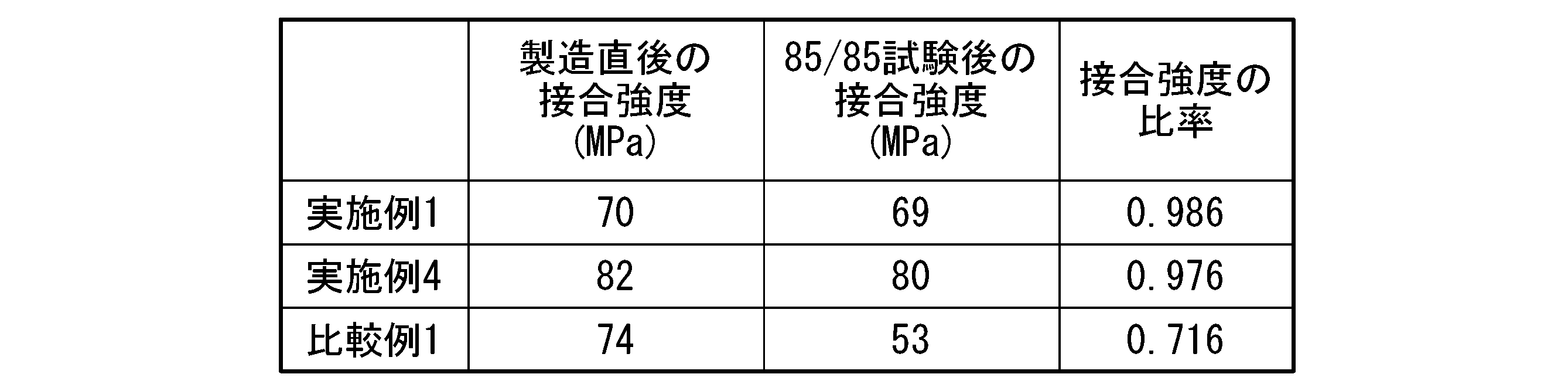
表2に示す結果から、本発明を適用した実施例1のクラッディング用組成物を用いた場合においては、比較例1のクラッディング用組成物を用いた場合と同様に、製造直後の接合強度が十分であることが確認できる。また、本発明を適用した実施例4のクラッディング用組成物を用いた場合においては、比較例1のクラッディング用組成物を用いた場合に比べて、製造直後の接合強度が高められていることが確認できる。
さらに、表2に示す結果から、本発明を適用した実施例1及び実施例2のクラッディング用組成物を用いた場合においては、比較例1のクラッディング用組成物を用いた場合に比べて、85/85試験後の接合強度の低下が格段に抑えられていること、が確認できる。
さらに、表2に示す結果から、本発明を適用した実施例1及び実施例2のクラッディング用組成物を用いた場合においては、比較例1のクラッディング用組成物を用いた場合に比べて、85/85試験後の接合強度の低下が格段に抑えられていること、が確認できる。
<評価(2)>
実施例1、実施例4、比較例1の各クラッディング用組成物を用いて製造した、アルミ板とPPSからなるシートとの接合部材について、さらに、1000時間に渡る85/85試験を、上記と同様にして行った。
製造直後、1週間経過後、2週間経過後、30日間経過後、1000時間経過後それぞれの接合強度を、せん断引張強度試験により測定した。この結果を図1に示した。
実施例1、実施例4、比較例1の各クラッディング用組成物を用いて製造した、アルミ板とPPSからなるシートとの接合部材について、さらに、1000時間に渡る85/85試験を、上記と同様にして行った。
製造直後、1週間経過後、2週間経過後、30日間経過後、1000時間経過後それぞれの接合強度を、せん断引張強度試験により測定した。この結果を図1に示した。
図1は、実施例1、実施例4、比較例1の各クラッディング用組成物を用いて製造した接合部材について、85/85試験における接合強度の経時変化を測定した結果を示すグラフである。縦軸は、せん断引張強度試験により測定されたせん断接合強度(MPa)を表し、横軸は経過時間(日数)を表している。
図1に示す結果から、本発明を適用した実施例1及び実施例4のクラッディング用組成物を用いた場合において、85/85試験の1週間経過後の接合強度は初期の接合強度の約90%以上であり、2週間経過後の接合強度は初期の接合強度の約80%以上であり、1000時間経過後であっても接合強度は初期の接合強度の約60%以上を保持していること、が確認できる。
一方、比較例1のクラッディング用組成物を用いた場合、85/85試験の1週間経過後の接合強度は初期の接合強度の約60%程度にまで低下し、2週間経過後の接合強度は初期の接合強度の約50%程度にまで低下し、1000時間後の接合強度は、初期の接合強度の約3分の1程度にまで低下していた。
一方、比較例1のクラッディング用組成物を用いた場合、85/85試験の1週間経過後の接合強度は初期の接合強度の約60%程度にまで低下し、2週間経過後の接合強度は初期の接合強度の約50%程度にまで低下し、1000時間後の接合強度は、初期の接合強度の約3分の1程度にまで低下していた。
<評価(3)>
上述の評価(1)と同様に、実施例2、実施例3、実施例5、実施例6の各クラッディング用組成物を用いて製造した、アルミ板とPPSからなるシートとの接合部材について、製造直後の接合強度と、1週間に渡る85/85試験を行った後の接合強度とを、せん断引張強度試験により測定した。
そして、前記の接合強度の測定値より、接合強度の比率、すなわち、(85/85試験後の接合強度)/製造直後の接合強度、を求めた。これらの結果を表3に示した。
上述の評価(1)と同様に、実施例2、実施例3、実施例5、実施例6の各クラッディング用組成物を用いて製造した、アルミ板とPPSからなるシートとの接合部材について、製造直後の接合強度と、1週間に渡る85/85試験を行った後の接合強度とを、せん断引張強度試験により測定した。
そして、前記の接合強度の測定値より、接合強度の比率、すなわち、(85/85試験後の接合強度)/製造直後の接合強度、を求めた。これらの結果を表3に示した。

表3に示す結果から、本発明を適用した実施例2、実施例3、実施例5、実施例6のクラッディング用組成物を用いた場合においては、比較例1のクラッディング用組成物を用いた場合に比べて、85/85試験後の接合強度の低下が格段に抑えられていること、が確認できる。
以上の結果から、本発明を適用することにより、金属基材と樹脂部材との接合強度がより高められ、かつ、高温高湿環境下での接合強度の経時劣化が抑制された金属/樹脂接合部材を製造できることが確認できた。
また、本発明を適用したクラッディング用組成物によれば、金属基材と樹脂部材とを安定に接合できると共に、高温高湿環境下での金属基材と樹脂部材との接合強度の経時劣化を抑制できることが確認できた。
また、本発明を適用したクラッディング用組成物によれば、金属基材と樹脂部材とを安定に接合できると共に、高温高湿環境下での金属基材と樹脂部材との接合強度の経時劣化を抑制できることが確認できた。
Claims (11)
- 金属粉末と、バインダと、吸水材と、有機溶媒とを含有する、クラッディング用組成物。
- 前記吸水材は、ゼオライト化合物を含む、請求項1に記載のクラッディング用組成物。
- 前記吸水材の含有量は、組成物の総量に対して5~40質量%である、請求項1又は2に記載のクラッディング用組成物。
- 前記バインダの含有量は、組成物の総量に対して0.01~10質量%である、請求項1~3のいずれか一項に記載のクラッディング用組成物。
- 前記金属粉末の含有量は、組成物の総量に対して25~94質量%である、請求項1~4のいずれか一項に記載のクラッディング用組成物。
- 前記バインダは、ポリビニルアセタールを含む、請求項1~5のいずれか一項に記載のクラッディング用組成物。
- 前記金属粉末は、アルミニウム粉末及びチタン粉末からなる群より選択される少なくとも一種を含む、請求項1~6のいずれか一項に記載のクラッディング用組成物。
- さらに、カーボンの粉末を含有する、請求項1~7のいずれか一項に記載のクラッディング用組成物。
- 金属基材と樹脂部材とが接合した金属/樹脂接合部材の製造方法であって、
前記金属基材の少なくとも一部に、請求項1~8のいずれか一項に記載のクラッディング用組成物を塗布する工程(i)と、
前記金属基材における前記クラッディング用組成物の塗布部に、レーザを照射する工程(ii)と、
前記金属基材におけるレーザ照射部上に、前記樹脂部材を配置する工程(iii)と、 前記レーザ照射部と前記樹脂部材との界面を加熱して、前記金属基材と前記樹脂部材とを接合する工程(iv)と、
を有する、金属/樹脂接合部材の製造方法。 - 前記工程(iv)において、前記レーザ照射部と前記樹脂部材との界面を、レーザを照射することにより加熱して、前記金属基材と前記樹脂部材とを接合する、請求項9に記載の金属/樹脂接合部材の製造方法。
- 前記金属粉末として、前記金属基材を構成する金属と同一の金属一種以上と、これ以外の金属との混合金属粉末を用いる、請求項9又は10に記載の金属/樹脂接合部材の製造方法。
Applications Claiming Priority (2)
| Application Number | Priority Date | Filing Date | Title |
|---|---|---|---|
| JP2020143896A JP2023169443A (ja) | 2020-08-27 | 2020-08-27 | クラッディング用組成物、及び金属/樹脂接合部材の製造方法 |
| JP2020-143896 | 2020-08-27 |
Publications (1)
| Publication Number | Publication Date |
|---|---|
| WO2022044867A1 true WO2022044867A1 (ja) | 2022-03-03 |
Family
ID=80354209
Family Applications (1)
| Application Number | Title | Priority Date | Filing Date |
|---|---|---|---|
| PCT/JP2021/029896 Ceased WO2022044867A1 (ja) | 2020-08-27 | 2021-08-16 | クラッディング用組成物、及び金属/樹脂接合部材の製造方法 |
Country Status (3)
| Country | Link |
|---|---|
| JP (1) | JP2023169443A (ja) |
| TW (1) | TW202222544A (ja) |
| WO (1) | WO2022044867A1 (ja) |
Cited By (1)
| Publication number | Priority date | Publication date | Assignee | Title |
|---|---|---|---|---|
| CN117226264A (zh) * | 2023-11-01 | 2023-12-15 | 江苏大学 | 一种粉末式铝合金激光焊接装置及方法 |
Citations (5)
| Publication number | Priority date | Publication date | Assignee | Title |
|---|---|---|---|---|
| JP2002524270A (ja) * | 1998-09-16 | 2002-08-06 | ローベルト ボツシユ ゲゼルシヤフト ミツト ベシユレンクテル ハフツング | セラミックと金属を溶接するためのペースト及び溶接結合を製造する方法 |
| JP2009255153A (ja) * | 2008-04-21 | 2009-11-05 | Nippon Genma:Kk | ソルダペースト |
| CN105710561A (zh) * | 2014-12-05 | 2016-06-29 | 陕西子竹电子有限公司 | 一种外绝缘高导电锡膏 |
| JP2018006084A (ja) * | 2016-06-29 | 2018-01-11 | 積水化学工業株式会社 | 導電材料、接続構造体及び接続構造体の製造方法 |
| WO2019198591A1 (ja) * | 2018-04-13 | 2019-10-17 | 東京応化工業株式会社 | クラッディング用組成物、及び金属/樹脂接合部材の製造方法 |
-
2020
- 2020-08-27 JP JP2020143896A patent/JP2023169443A/ja active Pending
-
2021
- 2021-08-16 TW TW110130072A patent/TW202222544A/zh unknown
- 2021-08-16 WO PCT/JP2021/029896 patent/WO2022044867A1/ja not_active Ceased
Patent Citations (5)
| Publication number | Priority date | Publication date | Assignee | Title |
|---|---|---|---|---|
| JP2002524270A (ja) * | 1998-09-16 | 2002-08-06 | ローベルト ボツシユ ゲゼルシヤフト ミツト ベシユレンクテル ハフツング | セラミックと金属を溶接するためのペースト及び溶接結合を製造する方法 |
| JP2009255153A (ja) * | 2008-04-21 | 2009-11-05 | Nippon Genma:Kk | ソルダペースト |
| CN105710561A (zh) * | 2014-12-05 | 2016-06-29 | 陕西子竹电子有限公司 | 一种外绝缘高导电锡膏 |
| JP2018006084A (ja) * | 2016-06-29 | 2018-01-11 | 積水化学工業株式会社 | 導電材料、接続構造体及び接続構造体の製造方法 |
| WO2019198591A1 (ja) * | 2018-04-13 | 2019-10-17 | 東京応化工業株式会社 | クラッディング用組成物、及び金属/樹脂接合部材の製造方法 |
Cited By (1)
| Publication number | Priority date | Publication date | Assignee | Title |
|---|---|---|---|---|
| CN117226264A (zh) * | 2023-11-01 | 2023-12-15 | 江苏大学 | 一种粉末式铝合金激光焊接装置及方法 |
Also Published As
| Publication number | Publication date |
|---|---|
| JP2023169443A (ja) | 2023-11-30 |
| TW202222544A (zh) | 2022-06-16 |
Similar Documents
| Publication | Publication Date | Title |
|---|---|---|
| JP7341984B2 (ja) | クラッディング用組成物、及び金属/樹脂接合部材の製造方法 | |
| EP2547480B1 (fr) | Procede d'assemblage de pieces en materiaux a base de sic par brasage non-reactif, composition de brasure, et assemblage obtenu par ce procede | |
| EP2547479B1 (fr) | Procede d'assemblage de pieces en materiaux a base de sic par brasage non-reactif avec ajout d'un renfort ; compositions de brasure ; assemblage obtenus par un tel procede | |
| CN1196744C (zh) | 室温稳定的一份式可固化环氧树脂粘合剂 | |
| EP2475487B1 (fr) | Procede d'assemblage de pieces en materiaux a base de sic par brasage non-reactif comprenant du silicium et du neodyme ; composition de brasure avec de tels elements | |
| JP6106244B2 (ja) | 異なった材料の一時的液相接合 | |
| FR2957543A1 (fr) | Procede d'assemblage de pieces en materiaux a base de sic par brasage non-reactif, compositions de brasure, et joint et assemblage obtenus par ce procede. | |
| WO2022044867A1 (ja) | クラッディング用組成物、及び金属/樹脂接合部材の製造方法 | |
| US7946467B2 (en) | Braze material and processes for making and using | |
| JP6512382B1 (ja) | 金属接合構造体および金属接合構造体の製造方法 | |
| CN106132624A (zh) | 接合金属制品 | |
| JP2016050224A (ja) | 粘接着剤組成物、粘接着シート、被着体の接着方法及び複合材 | |
| WO2022044868A1 (ja) | クラッディング用組成物、及び金属/樹脂接合部材の製造方法 | |
| JP2001164227A (ja) | 接着剤組成物 | |
| CN108060369A (zh) | 碳化硅陶瓷纤维/粒子强化金属基复合材料的制备方法 | |
| US5577655A (en) | Flexible metal-containing tapes or films and associated adhesives | |
| CN102189354B (zh) | 镁铝异种金属熔化胶焊专用胶粘剂及其制备方法 | |
| TW201834089A (zh) | 半導體裝置之製造方法 | |
| JP6742536B2 (ja) | ろう付接合体、ろう付方法、及び、ろう材 | |
| JPH1177372A (ja) | ブレイズ接合法、及びその方法に用いる粉末状ニッケルベースブレイズフィラー合金 | |
| Katarzyna et al. | Resistance of Adhesive Joints Made with Flame-Retardant Industrial Adhesives: Katarzyna, Beata, Damian, and Janusz | |
| JP2025124536A (ja) | ろう付け用ペースト状組成物 | |
| JP2023114474A (ja) | 接合方法、それに用いるペースト、および、接合体 | |
| FR3015318A1 (fr) | Procede d'assemblage de pieces dont les faces a assembler sont en carbure de silicium, joint de brasage obtenu par ledit procede, composition de brasure | |
| US20200406399A1 (en) | Process for producing aluminum member and aluminum member |
Legal Events
| Date | Code | Title | Description |
|---|---|---|---|
| 121 | Ep: the epo has been informed by wipo that ep was designated in this application |
Ref document number: 21861295 Country of ref document: EP Kind code of ref document: A1 |
|
| NENP | Non-entry into the national phase |
Ref country code: DE |
|
| 122 | Ep: pct application non-entry in european phase |
Ref document number: 21861295 Country of ref document: EP Kind code of ref document: A1 |
|
| NENP | Non-entry into the national phase |
Ref country code: JP |