WO2022044679A1 - 表面処理液、及び親水化処理方法 - Google Patents
表面処理液、及び親水化処理方法 Download PDFInfo
- Publication number
- WO2022044679A1 WO2022044679A1 PCT/JP2021/027980 JP2021027980W WO2022044679A1 WO 2022044679 A1 WO2022044679 A1 WO 2022044679A1 JP 2021027980 W JP2021027980 W JP 2021027980W WO 2022044679 A1 WO2022044679 A1 WO 2022044679A1
- Authority
- WO
- WIPO (PCT)
- Prior art keywords
- group
- surface treatment
- ring
- polymerizable compound
- treatment liquid
- Prior art date
- Legal status (The legal status is an assumption and is not a legal conclusion. Google has not performed a legal analysis and makes no representation as to the accuracy of the status listed.)
- Ceased
Links
Classifications
-
- C—CHEMISTRY; METALLURGY
- C09—DYES; PAINTS; POLISHES; NATURAL RESINS; ADHESIVES; COMPOSITIONS NOT OTHERWISE PROVIDED FOR; APPLICATIONS OF MATERIALS NOT OTHERWISE PROVIDED FOR
- C09D—COATING COMPOSITIONS, e.g. PAINTS, VARNISHES OR LACQUERS; FILLING PASTES; CHEMICAL PAINT OR INK REMOVERS; INKS; CORRECTING FLUIDS; WOODSTAINS; PASTES OR SOLIDS FOR COLOURING OR PRINTING; USE OF MATERIALS THEREFOR
- C09D4/00—Coating compositions, e.g. paints, varnishes or lacquers, based on organic non-macromolecular compounds having at least one polymerisable carbon-to-carbon unsaturated bond ; Coating compositions, based on monomers of macromolecular compounds of groups C09D183/00 - C09D183/16
-
- C—CHEMISTRY; METALLURGY
- C08—ORGANIC MACROMOLECULAR COMPOUNDS; THEIR PREPARATION OR CHEMICAL WORKING-UP; COMPOSITIONS BASED THEREON
- C08F—MACROMOLECULAR COMPOUNDS OBTAINED BY REACTIONS ONLY INVOLVING CARBON-TO-CARBON UNSATURATED BONDS
- C08F236/00—Copolymers of compounds having one or more unsaturated aliphatic radicals, at least one having two or more carbon-to-carbon double bonds
- C08F236/02—Copolymers of compounds having one or more unsaturated aliphatic radicals, at least one having two or more carbon-to-carbon double bonds the radical having only two carbon-to-carbon double bonds
- C08F236/20—Copolymers of compounds having one or more unsaturated aliphatic radicals, at least one having two or more carbon-to-carbon double bonds the radical having only two carbon-to-carbon double bonds unconjugated
-
- C—CHEMISTRY; METALLURGY
- C09—DYES; PAINTS; POLISHES; NATURAL RESINS; ADHESIVES; COMPOSITIONS NOT OTHERWISE PROVIDED FOR; APPLICATIONS OF MATERIALS NOT OTHERWISE PROVIDED FOR
- C09D—COATING COMPOSITIONS, e.g. PAINTS, VARNISHES OR LACQUERS; FILLING PASTES; CHEMICAL PAINT OR INK REMOVERS; INKS; CORRECTING FLUIDS; WOODSTAINS; PASTES OR SOLIDS FOR COLOURING OR PRINTING; USE OF MATERIALS THEREFOR
- C09D139/00—Coating compositions based on homopolymers or copolymers of compounds having one or more unsaturated aliphatic radicals, each having only one carbon-to-carbon double bond, and at least one being terminated by a single or double bond to nitrogen or by a heterocyclic ring containing nitrogen; Coating compositions based on derivatives of such polymers
- C09D139/04—Homopolymers or copolymers of monomers containing heterocyclic rings having nitrogen as ring member
-
- B—PERFORMING OPERATIONS; TRANSPORTING
- B05—SPRAYING OR ATOMISING IN GENERAL; APPLYING FLUENT MATERIALS TO SURFACES, IN GENERAL
- B05D—PROCESSES FOR APPLYING FLUENT MATERIALS TO SURFACES, IN GENERAL
- B05D5/00—Processes for applying liquids or other fluent materials to surfaces to obtain special surface effects, finishes or structures
-
- B—PERFORMING OPERATIONS; TRANSPORTING
- B05—SPRAYING OR ATOMISING IN GENERAL; APPLYING FLUENT MATERIALS TO SURFACES, IN GENERAL
- B05D—PROCESSES FOR APPLYING FLUENT MATERIALS TO SURFACES, IN GENERAL
- B05D5/00—Processes for applying liquids or other fluent materials to surfaces to obtain special surface effects, finishes or structures
- B05D5/08—Processes for applying liquids or other fluent materials to surfaces to obtain special surface effects, finishes or structures to obtain an anti-friction or anti-adhesive surface
-
- B—PERFORMING OPERATIONS; TRANSPORTING
- B05—SPRAYING OR ATOMISING IN GENERAL; APPLYING FLUENT MATERIALS TO SURFACES, IN GENERAL
- B05D—PROCESSES FOR APPLYING FLUENT MATERIALS TO SURFACES, IN GENERAL
- B05D7/00—Processes, other than flocking, specially adapted for applying liquids or other fluent materials to particular surfaces or for applying particular liquids or other fluent materials
- B05D7/24—Processes, other than flocking, specially adapted for applying liquids or other fluent materials to particular surfaces or for applying particular liquids or other fluent materials for applying particular liquids or other fluent materials
-
- C—CHEMISTRY; METALLURGY
- C08—ORGANIC MACROMOLECULAR COMPOUNDS; THEIR PREPARATION OR CHEMICAL WORKING-UP; COMPOSITIONS BASED THEREON
- C08F—MACROMOLECULAR COMPOUNDS OBTAINED BY REACTIONS ONLY INVOLVING CARBON-TO-CARBON UNSATURATED BONDS
- C08F220/00—Copolymers of compounds having one or more unsaturated aliphatic radicals, each having only one carbon-to-carbon double bond, and only one being terminated by only one carboxyl radical or a salt, anhydride ester, amide, imide or nitrile thereof
- C08F220/02—Monocarboxylic acids having less than ten carbon atoms; Derivatives thereof
- C08F220/10—Esters
- C08F220/34—Esters containing nitrogen, e.g. N,N-dimethylaminoethyl (meth)acrylate
-
- C—CHEMISTRY; METALLURGY
- C08—ORGANIC MACROMOLECULAR COMPOUNDS; THEIR PREPARATION OR CHEMICAL WORKING-UP; COMPOSITIONS BASED THEREON
- C08F—MACROMOLECULAR COMPOUNDS OBTAINED BY REACTIONS ONLY INVOLVING CARBON-TO-CARBON UNSATURATED BONDS
- C08F220/00—Copolymers of compounds having one or more unsaturated aliphatic radicals, each having only one carbon-to-carbon double bond, and only one being terminated by only one carboxyl radical or a salt, anhydride ester, amide, imide or nitrile thereof
- C08F220/02—Monocarboxylic acids having less than ten carbon atoms; Derivatives thereof
- C08F220/52—Amides or imides
- C08F220/54—Amides, e.g. N,N-dimethylacrylamide or N-isopropylacrylamide
- C08F220/56—Acrylamide; Methacrylamide
-
- C—CHEMISTRY; METALLURGY
- C08—ORGANIC MACROMOLECULAR COMPOUNDS; THEIR PREPARATION OR CHEMICAL WORKING-UP; COMPOSITIONS BASED THEREON
- C08F—MACROMOLECULAR COMPOUNDS OBTAINED BY REACTIONS ONLY INVOLVING CARBON-TO-CARBON UNSATURATED BONDS
- C08F226/00—Copolymers of compounds having one or more unsaturated aliphatic radicals, each having only one carbon-to-carbon double bond, and at least one being terminated by a single or double bond to nitrogen or by a heterocyclic ring containing nitrogen
- C08F226/02—Copolymers of compounds having one or more unsaturated aliphatic radicals, each having only one carbon-to-carbon double bond, and at least one being terminated by a single or double bond to nitrogen or by a heterocyclic ring containing nitrogen by a single or double bond to nitrogen
- C08F226/04—Diallylamine
-
- C—CHEMISTRY; METALLURGY
- C08—ORGANIC MACROMOLECULAR COMPOUNDS; THEIR PREPARATION OR CHEMICAL WORKING-UP; COMPOSITIONS BASED THEREON
- C08F—MACROMOLECULAR COMPOUNDS OBTAINED BY REACTIONS ONLY INVOLVING CARBON-TO-CARBON UNSATURATED BONDS
- C08F226/00—Copolymers of compounds having one or more unsaturated aliphatic radicals, each having only one carbon-to-carbon double bond, and at least one being terminated by a single or double bond to nitrogen or by a heterocyclic ring containing nitrogen
- C08F226/06—Copolymers of compounds having one or more unsaturated aliphatic radicals, each having only one carbon-to-carbon double bond, and at least one being terminated by a single or double bond to nitrogen or by a heterocyclic ring containing nitrogen by a heterocyclic ring containing nitrogen
-
- C—CHEMISTRY; METALLURGY
- C08—ORGANIC MACROMOLECULAR COMPOUNDS; THEIR PREPARATION OR CHEMICAL WORKING-UP; COMPOSITIONS BASED THEREON
- C08F—MACROMOLECULAR COMPOUNDS OBTAINED BY REACTIONS ONLY INVOLVING CARBON-TO-CARBON UNSATURATED BONDS
- C08F230/00—Copolymers of compounds having one or more unsaturated aliphatic radicals, each having only one carbon-to-carbon double bond, and containing phosphorus, selenium, tellurium or a metal
- C08F230/02—Copolymers of compounds having one or more unsaturated aliphatic radicals, each having only one carbon-to-carbon double bond, and containing phosphorus, selenium, tellurium or a metal containing phosphorus
-
- C—CHEMISTRY; METALLURGY
- C08—ORGANIC MACROMOLECULAR COMPOUNDS; THEIR PREPARATION OR CHEMICAL WORKING-UP; COMPOSITIONS BASED THEREON
- C08F—MACROMOLECULAR COMPOUNDS OBTAINED BY REACTIONS ONLY INVOLVING CARBON-TO-CARBON UNSATURATED BONDS
- C08F230/00—Copolymers of compounds having one or more unsaturated aliphatic radicals, each having only one carbon-to-carbon double bond, and containing phosphorus, selenium, tellurium or a metal
- C08F230/04—Copolymers of compounds having one or more unsaturated aliphatic radicals, each having only one carbon-to-carbon double bond, and containing phosphorus, selenium, tellurium or a metal containing a metal
- C08F230/08—Copolymers of compounds having one or more unsaturated aliphatic radicals, each having only one carbon-to-carbon double bond, and containing phosphorus, selenium, tellurium or a metal containing a metal containing silicon
-
- C—CHEMISTRY; METALLURGY
- C08—ORGANIC MACROMOLECULAR COMPOUNDS; THEIR PREPARATION OR CHEMICAL WORKING-UP; COMPOSITIONS BASED THEREON
- C08F—MACROMOLECULAR COMPOUNDS OBTAINED BY REACTIONS ONLY INVOLVING CARBON-TO-CARBON UNSATURATED BONDS
- C08F230/00—Copolymers of compounds having one or more unsaturated aliphatic radicals, each having only one carbon-to-carbon double bond, and containing phosphorus, selenium, tellurium or a metal
- C08F230/04—Copolymers of compounds having one or more unsaturated aliphatic radicals, each having only one carbon-to-carbon double bond, and containing phosphorus, selenium, tellurium or a metal containing a metal
- C08F230/08—Copolymers of compounds having one or more unsaturated aliphatic radicals, each having only one carbon-to-carbon double bond, and containing phosphorus, selenium, tellurium or a metal containing a metal containing silicon
- C08F230/085—Copolymers of compounds having one or more unsaturated aliphatic radicals, each having only one carbon-to-carbon double bond, and containing phosphorus, selenium, tellurium or a metal containing a metal containing silicon the monomer being a polymerisable silane, e.g. (meth)acryloyloxy trialkoxy silanes or vinyl trialkoxysilanes
-
- C—CHEMISTRY; METALLURGY
- C09—DYES; PAINTS; POLISHES; NATURAL RESINS; ADHESIVES; COMPOSITIONS NOT OTHERWISE PROVIDED FOR; APPLICATIONS OF MATERIALS NOT OTHERWISE PROVIDED FOR
- C09D—COATING COMPOSITIONS, e.g. PAINTS, VARNISHES OR LACQUERS; FILLING PASTES; CHEMICAL PAINT OR INK REMOVERS; INKS; CORRECTING FLUIDS; WOODSTAINS; PASTES OR SOLIDS FOR COLOURING OR PRINTING; USE OF MATERIALS THEREFOR
- C09D143/00—Coating compositions based on homopolymers or copolymers of compounds having one or more unsaturated aliphatic radicals, each having only one carbon-to-carbon double bond, and containing boron, silicon, phosphorus, selenium, tellurium, or a metal; Coating compositions based on derivatives of such polymers
- C09D143/04—Homopolymers or copolymers of monomers containing silicon
-
- C—CHEMISTRY; METALLURGY
- C09—DYES; PAINTS; POLISHES; NATURAL RESINS; ADHESIVES; COMPOSITIONS NOT OTHERWISE PROVIDED FOR; APPLICATIONS OF MATERIALS NOT OTHERWISE PROVIDED FOR
- C09D—COATING COMPOSITIONS, e.g. PAINTS, VARNISHES OR LACQUERS; FILLING PASTES; CHEMICAL PAINT OR INK REMOVERS; INKS; CORRECTING FLUIDS; WOODSTAINS; PASTES OR SOLIDS FOR COLOURING OR PRINTING; USE OF MATERIALS THEREFOR
- C09D147/00—Coating compositions based on homopolymers or copolymers of compounds having one or more unsaturated aliphatic radicals, at least one having two or more carbon-to-carbon double bonds; Coating compositions based on derivatives of such polymers
-
- C—CHEMISTRY; METALLURGY
- C09—DYES; PAINTS; POLISHES; NATURAL RESINS; ADHESIVES; COMPOSITIONS NOT OTHERWISE PROVIDED FOR; APPLICATIONS OF MATERIALS NOT OTHERWISE PROVIDED FOR
- C09D—COATING COMPOSITIONS, e.g. PAINTS, VARNISHES OR LACQUERS; FILLING PASTES; CHEMICAL PAINT OR INK REMOVERS; INKS; CORRECTING FLUIDS; WOODSTAINS; PASTES OR SOLIDS FOR COLOURING OR PRINTING; USE OF MATERIALS THEREFOR
- C09D157/00—Coating compositions based on unspecified polymers obtained by reactions only involving carbon-to-carbon unsaturated bonds
- C09D157/06—Homopolymers or copolymers containing elements other than carbon and hydrogen
- C09D157/12—Homopolymers or copolymers containing elements other than carbon and hydrogen containing nitrogen atoms
-
- C—CHEMISTRY; METALLURGY
- C09—DYES; PAINTS; POLISHES; NATURAL RESINS; ADHESIVES; COMPOSITIONS NOT OTHERWISE PROVIDED FOR; APPLICATIONS OF MATERIALS NOT OTHERWISE PROVIDED FOR
- C09K—MATERIALS FOR MISCELLANEOUS APPLICATIONS, NOT PROVIDED FOR ELSEWHERE
- C09K3/00—Materials not provided for elsewhere
Definitions
- the present invention relates to a surface treatment liquid and a hydrophilization treatment method using the surface treatment liquid.
- a hydrophilization treatment agent containing a copolymer of a monomer containing at least an acrylamide monomer and a mono (meth) acrylate monomer as a component for developing hydrophilicity a hydrophilization treatment agent.
- Patent Document 1 a block copolymer containing a polyvinyl alcohol resin block having a mercapto group and a polyanionic resin block, and a hydrophilization treatment agent containing polyacrylic acid (Patent Document 2) have been proposed.
- the polyanion resin block in Patent Document 2 is a block obtained by polymerizing a polymerizable monomer having at least one carboxy group and / or a sulfonic acid group in one molecule.
- the resin which is a hydrophilizing component contained in the conventional hydrophilization treatment agents described in Patent Document 1 and Patent Document 2 and the like does not always have sufficient adhesion to the surface of the object to be treated. As a result, it may be difficult to obtain a sufficient hydrophilization effect with the conventional hydrophilization treatment agents described in Patent Document 1 and Patent Document 2, or the resin is hydrophilized by peeling the resin from the surface of the object to be treated. There is a problem that the effect of is easily impaired.
- objects to be surface-treated may be exposed to chemicals such as detergents used during cleaning.
- windows and mirrors used around water are often exposed to acidic detergents used to remove scale and basic detergents used to remove mold.
- various detergents including soaps and shampoos include various ionic surfactants such as sodium fatty acid, sodium dodecyl sulfate (SDS), and sodium linear alkyl ether sulfonate. included.
- the cleaning agent may contain an organic acid or an organic base capable of producing an anion or cation having a hydrophobic moiety such as oleic acid, behenic acid, dimethylstearylamine, and dimethylcoconutamine.
- the present invention has been made in view of the above problems, and can form a hydrophilic resin film that adheres well to the surface of the object to be treated, and the surface-treated articles are various chemicals. It is an object of the present invention to provide a surface treatment liquid in which the effect of the surface treatment does not easily decrease with time even when exposed to the surface treatment liquid, and a hydrophilization treatment method using the surface treatment liquid.
- the present inventors include a polymerizable compound (A), a thermal polymerization initiator (B), and a solvent (S), and the resin (A) and the polymerizable compound (A) are ethylenically unsaturated.
- a polar polymerizable compound (a3) having a compound (a2) and / or a group having an ethylenically unsaturated double bond and a polar group selected from an amino group, a carboxy group, a mercapto group, a hydroxyl group, and a cyano group. It has been found that the above-mentioned problems can be solved by the surface treatment liquid containing and, and the present invention has been completed. More specifically, the present invention provides the following:
- the first aspect of the present invention comprises a polymerizable compound (A), a thermal polymerization initiator (B), and a solvent (S).
- the polymerizable compound (A) has a group having an ethylenically unsaturated double bond, a betaine monomer (a1) having a cationic group and an anionic group, and a group having an ethylenically unsaturated double bond. It is selected from an unsaturated group-containing silicon compound (a2) having a hydrolyzable silyl group, and / or a group having an ethylenically unsaturated double bond, and an amino group, a carboxy group, a mercapto group, a hydroxyl group, and a cyano group.
- the second aspect of the present invention is to apply the surface treatment liquid according to the first aspect to form a film on the surface of the object to be treated. Heating the film and It is a hydrophilization treatment method for hydrophilizing the surface of the object to be treated.
- a hydrophilic resin film that adheres well to the surface of the object to be treated which is the object to be surface-treated, can be formed, and even if the surface-treated article is exposed to various chemicals, the effect of the surface treatment is effective. It is possible to provide a surface treatment liquid that does not easily decrease with time and a hydrophilization treatment method using the surface treatment liquid.
- the surface treatment liquid contains a polymerizable compound (A), a thermal polymerization initiator (B), and a solvent (S).
- A polymerizable compound
- B thermal polymerization initiator
- S solvent
- Such a surface treatment liquid can hydrophilize the surface of the object to be treated, which is the object of surface treatment.
- arbitrary components, essential components, and the like will be described with respect to the surface treatment liquid.
- the polymerizable compound (A) is polymerized on the surface of the object to be treated by the action of the thermal polymerization initiator (B) to form a resin film that adheres well to the surface treatment of the object to be treated.
- the polymerizable compound (A) includes a group having an ethylenically unsaturated double bond, a betaine monomer (a1) having a cationic group and an anionic group, and a group having an ethylenically unsaturated double bond.
- a polar polymerizable compound (a3) having a polar group is not limited to the betaine monomer (a1), the unsaturated group-containing silicon compound (a2), and the polar polymerizable compound (a3) as long as the object of the present invention is not impaired. It may contain a functional monomer (a4) and another monomer (a5).
- the polymerizable compound (A) has an unsaturated group-containing silicon compound (a2) having a group having an ethylenically unsaturated double bond and a hydrolyzable silyl group, and / or having an ethylenically unsaturated double bond.
- a polar polymerizable compound (a3) having a group and a polar group selected from an amino group, a carboxy group, a mercapto group, a hydroxyl group, and a cyano group, these compounds are first treated at the time of surface treatment.
- the polymerization reaction of the polymerizable compound (A) proceeds in the vicinity of the surface of the object to be treated, starting from these compounds which are firmly bonded to the surface of the body and bonded to the surface of the object to be treated. In this way, it is considered that a thin film made of the polymer of the polymerizable compound (A) firmly bonded to the surface of the object to be treated is easily formed.
- the polymerizable compound (A) contains a betaine monomer having a cationic group, an anionic group, and a group having an ethylenically unsaturated double bond. Both cationic and anionic groups act as hydrophilic groups.
- the surface of the surface-treated object may come into contact with a cleaning solution containing a large amount of anions having hydrophobic groups and cations having hydrophobic groups.
- the resin in the surface treatment liquid has only anionic groups such as a carboxy group, a carboxylic acid base, a sulfonic acid group, and a sulfonic acid base as hydrophilic groups, these hydrophilic groups are cations having a hydrophobic group.
- the resin in the surface treatment liquid has only a cationic group such as a quaternary ammonium group as a hydrophilic group
- the cationic group acts as a hydrophilic group by interacting with an anion having a hydrophobic group. It may not be possible.
- the polymer of the polymerizable compound (A) containing the betaine monomer (a1) has both a cationic group and an anionic group as hydrophilic groups, the surface of the surface-treated body is hydrophobic.
- either the cationic group or the anionic group is a hydrophilic group.
- the hydrophilicity of the surface of the object to be treated does not easily decrease.
- the number of cationic groups and the number of anionic groups in the betaine monomer (a1) are not particularly limited. In the betaine monomer (a1), it is preferable that the number of cationic groups and the number of anionic groups are the same. Since the betaine monomer (a1) can be easily synthesized and obtained, the number of cationic groups and the number of anionic groups in the betaine monomer (a1) are preferably 1 respectively.
- betaine monomer (a1) for example, it is preferable that a group having an ethylenically unsaturated double bond, a cationic group and an anionic group are bonded in this order via a linking group, if necessary.
- the cationic group is preferably a cationic group which is a quaternary nitrogen cation.
- the anionic group is preferably a sulfonic acid anion group, a phosphonate anion group or a carboxylic acid anion group.
- Examples of the group having an ethylenically unsaturated double bond in the betaine monomer (a1) include a vinyl group, a 1-propenyl group, a 2-n-propenyl group (allyl group), a 1-n-butenyl group and a 2-n- group. Examples thereof include an alkenyl group such as a butenyl group and a 3-n-butenyl group. Among these groups, a vinyl group and a 2-n-propenyl group (allyl group) are preferable.
- the number of ethylenically unsaturated double bonds in the betaine monomer (a1) is not limited, but one or two is preferable.
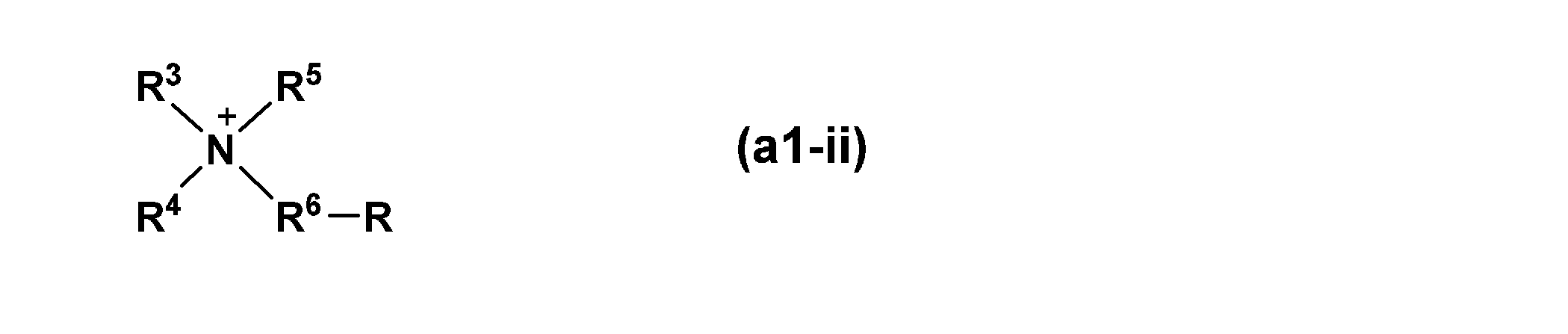
- betaine monomer (a1) for example, a compound represented by the following formula (a1-i) or formula (a1-ii) is preferable.
- the betaine monomer represented by the following formula (a1-i) or formula (a1-ii) contains a cationic group containing N + and an anionic group as R. Both cationic and anionic groups act as hydrophilic groups.
- R 1 is a hydrocarbon group containing an ethylenically unsaturated double bond.
- R2 is a divalent hydrocarbon group having 1 or more and 10 or less carbon atoms.
- R is an anionic group Ring A is a heterocycle.
- R3 , R4 , and R5 are each independently a hydrocarbon group having an ethylenically unsaturated double bond or a hydrocarbon group having 1 or more and 10 or less carbon atoms. can be, At least one of R 3 , R 4 , and R 5 is a hydrocarbon group with an ethylenically unsaturated double bond.
- R 6 is a divalent hydrocarbon group having 1 or more and 10 or less carbon atoms.
- R is an anionic group.
- the hydrocarbon group containing an ethylenically unsaturated double bond as R 1 includes a vinyl group, a 1-propenyl group, a 2-n-propenyl group (allyl group), and 1-n-.
- alkenyl groups such as a butenyl group, a 2-n-butenyl group and a 3-n-butenyl group.
- examples of the divalent hydrocarbon group as R 2 include an alkylene group, an arylene group, and a group in which an alkylene group and an arylene group are combined, and an alkylene group is preferable.
- Suitable specific examples of the alkylene group as R 2 include methylene group, ethane-1,2-diyl group, propane-1,3-diyl group, propane-1,2-diyl group, butane-1,4-.
- Diyl group pentane-1,5-diyl group, hexane-1,6-diyl group, heptane-1,7-diyl group, octane-1,8-diyl group, nonane-1,9-diyl group, and decane.
- Examples include the -1,10-diyl group.
- the heterocycle as the ring A may be an aromatic heterocycle or an aliphatic heterocycle.
- the aromatic heterocycle include nitrogen-containing aromatic heterocycles such as imidazole ring, pyrazole ring, 1,2,3-triazole ring, 1,2,4-triazole ring, pyridine ring, pyrimidine ring, pyridazine ring and pyrazine ring.
- nitrogen-containing aromatic heterocycles such as imidazole ring, pyrazole ring, 1,2,3-triazole ring, 1,2,4-triazole ring, pyridine ring, pyrimidine ring, pyridazine ring and pyrazine ring.
- Examples of the aliphatic heterocycle include a nitrogen-containing heterocycle such as a pyrrolidine ring, a piperidine ring, and a piperazine ring in which any one nitrogen atom in the nitrogen-containing heterocycle is quaternized.
- a nitrogen-containing heterocycle such as a pyrrolidine ring, a piperidine ring, and a piperazine ring in which any one nitrogen atom in the nitrogen-containing heterocycle is quaternized.
- the hydrocarbon group containing an ethylenically unsaturated double bond as R 3 to R 5 includes a vinyl group, a 1-propenyl group, a 2-n-propenyl group (allyl group), and 1 Examples thereof include alkenyl groups such as -n-butenyl group, 2-n-butenyl group and 3-n-butenyl group.
- examples of the hydrocarbon group as R 3 to R 5 include an alkyl group, an aryl group, an aralkyl group and the like, and an alkyl group is preferable.
- the hydrocarbon group as R 3 to R 5 may have a substituent.
- the substituents that the hydrocarbon groups as R 3 to R 5 may have are not particularly limited as long as they do not impair the object of the present invention.
- substituents examples include a halogen atom, a hydroxyl group, an alkoxy group having 1 or more and 4 or less carbon atoms, an acyl group having 2 or more and 4 or less carbon atoms, an acyloxy group having 2 or more and 4 or less carbon atoms, an amino group, and an amino group.
- substituents include an alkylamino group substituted with an alkyl group having 1 or 2 carbon atoms of 1 or more and 4 or less.
- alkyl group as R 3 to R 5 include a methyl group, an ethyl group, an n-propyl group, an isopropyl group, an n-butyl group, an isobutyl group, a sec-butyl group, a tert-butyl group and n.
- -Pentyl group, n-hexyl group, n-heptyl group, n-octyl group, 2-ethylhexyl group, n-nonyl group, and n-decyl group can be mentioned.
- examples of the divalent hydrocarbon group as R 6 include an alkylene group, an arylene group, and a group in which an alkylene group and an arylene group are combined, and an alkylene group is preferable.
- Suitable specific examples of the alkylene group as R 6 include methylene group, ethane-1,2-diyl group, propane-1,3-diyl group, propane-1,2-diyl group, butane-1,4-.
- Diyl group pentane-1,5-diyl group, hexane-1,6-diyl group, heptane-1,7-diyl group, octane-1,8-diyl group, nonane-1,9-diyl group, and decane.
- Examples include the -1,10-diyl group.
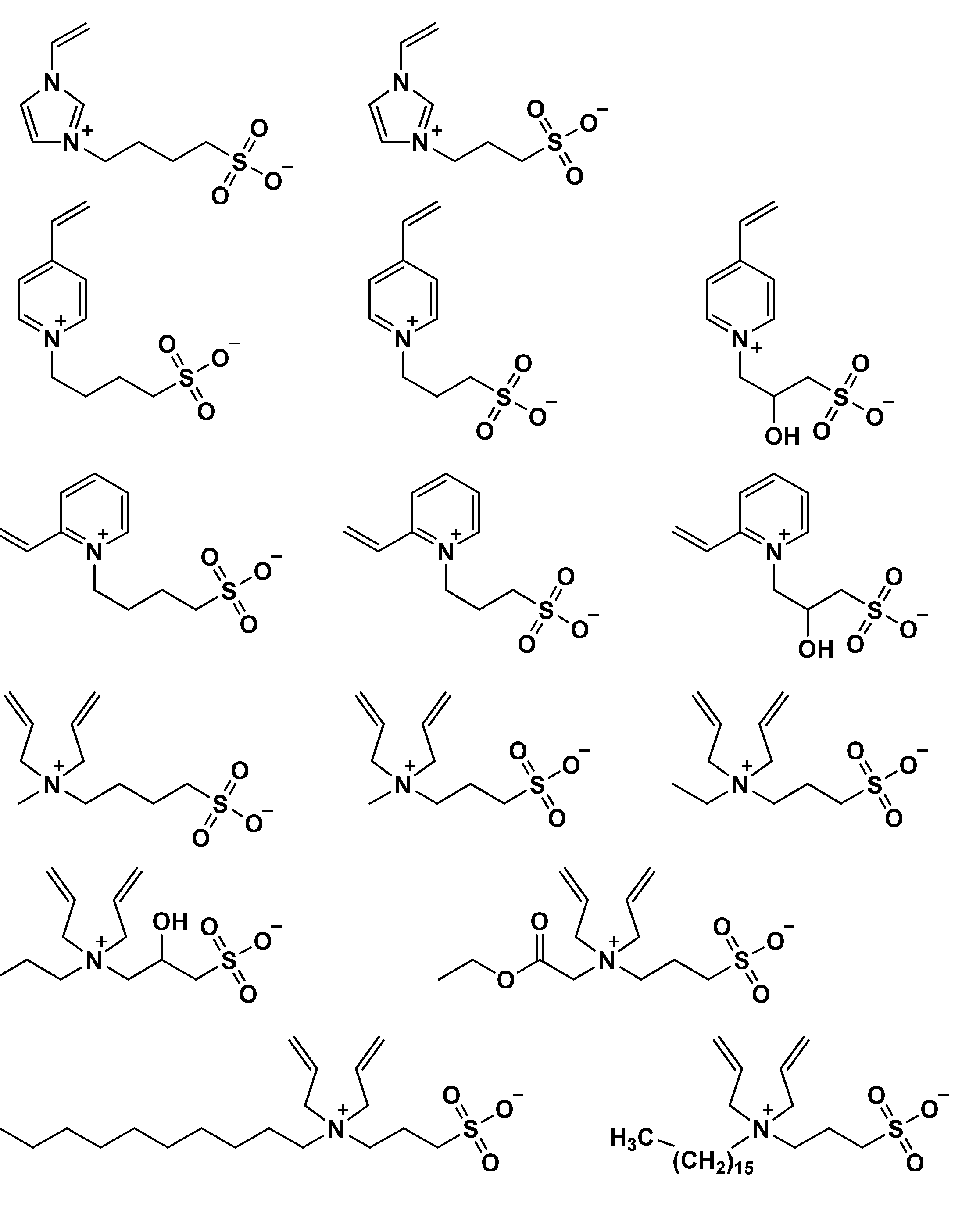
- a monomer represented by the following formula (a1-iii) or formula (a1-iv) is preferable because it is easy to synthesize and obtain.
- R1 , R2 , and ring A are the same as R1 , R2 , and ring A in formula (a1-i).
- R 3 , R 4 , R 5 , and R 6 are the same as R 3 , R 4 , R 5 , and R 6 in equation (a1-ii).
- Examples of the monomer represented by the above formula (a1-iii) or the formula (a1-iv) include the monomers represented by the following formulas (a1-v), (a1-vi) or (a1-vii).
- R2 is the same as R2 in the formula (a1 - iii)
- R5 and R6 are the formulas (a1).
- R 11 and R 12 are independent hydrogen atoms or methyl groups, respectively
- R 13 and R 14 are independent single bonds or carbon atoms, respectively. It is an alkylene group having a number of 1 or more and 4 or less.
- the alkylene groups having 1 or more and 4 or less carbon atoms as R 13 and R 14 are methylene groups and ethane-1,2-. Examples thereof include a diyl group, a propane-1,3-diyl group, a propane-1,2-diyl group, and a butane-1,4-diyl group.
- Examples of the betaine monomer in which the anionic group is a phosphonate anion group or a carboxylic acid anion group include a monomer represented by the above formula (a1-iii) or the above formula (a1-iv), and the above formulas (a1-v), (a1-v).
- the sulfonic acid anion group (-SO 3- ) is a phosphonate anion group ( - (PO 3 ) 2- ) or a carboxylic acid anion group (-). Examples include monomers that have replaced COO- ).
- the sulfonic acid anion group (-SO 3- ) in the compound of the following formula or the compound of the following formula is a phosphon.
- examples thereof include a monomer in which an acid anion group (-(PO 3 ) 2- ) and a carboxylic acid anion group (-COO- ) are replaced.
- the betaine monomer represented by the formula (a1-i) or the formula (a1-ii) can be synthesized by a known reaction. For example, it can be obtained by reacting a compound having an ethylenically unsaturated double bond with a group having a cationic group with a compound having an anionic group.
- the compound represented by the formula (a1-iii) can be obtained by reacting the following compound with sultone in a solvent.
- the sultone include sultone having a 4-membered ring or more and a 10-membered ring or less, and 1,3-propane sultone and 1,4-butane sultone are preferable.
- R 1 is the same as R 1 in (a1-i) above, and ring A is a heterocycle.
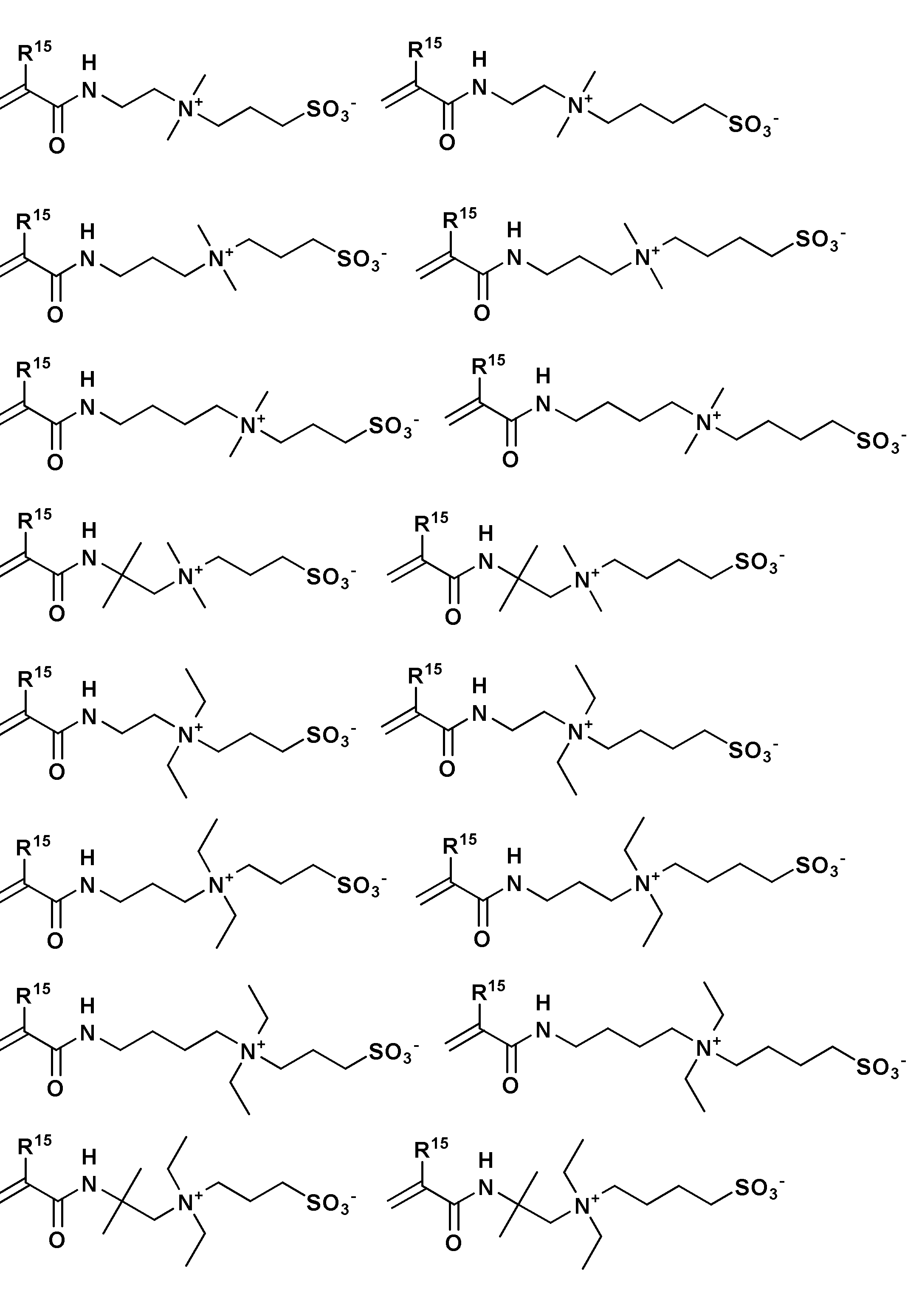
- the betaine monomer (a1) represented by the following formula (a1-viii) contains a cationic group containing N + and an anionic group as R20 . Both cationic and anionic groups act as hydrophilic groups.
- CH 2 CR 15 -CO-NH-R 16 -N + (R 17 ) (R 18 ) -R 19 -R 20 ...
- R 15 is a hydrogen atom or a methyl group
- R 16 and R 19 are independently divalent hydrocarbon groups having 1 or more and 10 or less carbon atoms
- R 17 And R 18 are hydrocarbon groups having 1 or more and 10 or less carbon atoms which may independently have a substituent
- R 20 is a sulfonic acid anion group (-SO 3- ) and a phosphonate anion group. (-(PO 3 ) 2- ) or carboxylate anion group (-COO- ) .)
- examples of the divalent hydrocarbon group as R 16 and R 19 include an alkylene group, an arylene group, and a group in which an alkylene group and an arylene group are combined, and an alkylene group is preferable.
- Suitable specific examples of the alkylene group as R 16 and R 19 include methylene group, ethane-1,2-diyl group, propane-1,3-diyl group, propane-1,2-diyl group and butane-1.
- examples of the hydrocarbon group as R 17 and R 18 include an alkyl group, an aryl group, an aralkyl group and the like, and an alkyl group is preferable.
- the hydrocarbon groups as R 17 and R 18 may have substituents.
- the substituents that the hydrocarbon groups as R 17 and R 18 may have are not particularly limited as long as they do not impair the object of the present invention.
- substituents examples include a halogen atom, a hydroxyl group, an alkoxy group having 1 or more and 4 or less carbon atoms, an acyl group having 2 or more and 4 or less carbon atoms, an acyloxy group having 2 or more and 4 or less carbon atoms, an amino group, and an amino group.
- substituents include an alkylamino group substituted with an alkyl group having 1 or 2 carbon atoms of 1 or more and 4 or less.
- Suitable specific examples of the alkyl group as R 17 and R 18 are methyl group, ethyl group, n-propyl group, isopropyl group, n-butyl group, isobutyl group, sec-butyl group, tert-butyl group, n. -Pentyl group, n-hexyl group, n-heptyl group, n-octyl group, 2-ethylhexyl group, n-nonyl group, and n-decyl group can be mentioned.
- R 20 is a sulfonic acid anion group (-SO 3- ) , a phosphonate anion group ( -PO 3-2- ), or a carboxylic acid anion group (-COO- ) , and is a sulfonic acid.
- Anionic groups (-SO 3- ) are preferred.
- N-substituted (meth) acrylamide represented by the formula (a1-viii) include compounds of the following formula.
- R15 is a hydrogen atom or a methyl group.
- the content of the betaine monomer (a1) in the polymerizable compound (A) is not particularly limited as long as it does not impair the object of the present invention.
- the number of moles of the betaine monomer (a1) is higher than the number of moles of the polymerizable compound (A).
- the ratio is preferably 50 mol% or more and 99 mol% or less, more preferably 60 mol% or more and 99 mol% or less, and further preferably 70 mol% or more and 99 mol% or less.
- the polymerizable compound (A) is an unsaturated group-containing silicon compound (a2) having a group having an ethylenically unsaturated double bond and a hydrolyzable silyl group, and / or, together with the above-mentioned betaine monomer (a1). It contains a polar polymerizable compound (a3) having a group having an ethylenically unsaturated double bond and a polar group selected from an amino group, a carboxy group, a mercapto group, a hydroxyl group and a cyano group.
- Both the unsaturated group-containing silicon compound (a2) and the polar polymerizable compound (a3) are structural units that impart adhesion to the surface of the untreated body to the resin film made of the polymer of the polymerizable compound (A). Is.
- the unsaturated group-containing silicon compound (a2) has a group having an ethylenically unsaturated double bond and a hydrolyzable silyl group.
- the group having an ethylenically unsaturated double bond is not particularly limited as long as the unsaturated group-containing silicon compound (a2) can be copolymerized with the betaine monomer (a1).
- Suitable specific examples of the group having an ethylenically unsaturated double bond include a vinyl group, a 1-propenyl group, a 2-n-propenyl group (allyl group), a 1-n-butenyl group and a 2-n-butenyl group.
- alkenyl groups such as 3-n-butenyl groups; N-vinylamino group, N-1-propenylamino group, N-allylamino group, N-1-n-butenylamino group, N-2-n-butenylamino group.
- alkenylamino groups such as N-3-n-butenylamino groups; N, N-divinylamino groups, N, N-di (1-propenyl) amino groups, N, N-diallylamino groups, N, Dialkenylamino groups such as N-di (1-n-butenyl) amino group, N, N-di (2-n-butenyl) amino group, N, N-di (3-n-butenyl) amino group; allyloxy Alkenyloxy groups such as groups, 2-n-butenyloxy groups, 3-n-butenyloxy groups; vinylaminocarbonyl groups, 1-propenylaminocarbonyl groups, allylaminocarbonyl groups, 1-n-butenylaminocarbonyl groups, Alkenylaminocarbonyl groups such as 2-n-butenylaminocarbonyl group, 3-n-butenylaminocarbonyl group; vinyloxycarbonyl group,
- an alkenyl group and a (meth) acryloyl group-containing group are preferable.
- the number of carbon atoms of the alkenyl group is, for example, preferably 2 or more and 6 or less, and more preferably 2 or 3.
- the hydrolyzable silyl group is a silyl group capable of producing a silanol group by hydrolysis.
- Preferable examples of the hydrolyzable silyl group include the group represented by -SiR 01 a R 02 3-a .
- R 01 is a group capable of producing a silanol group by hydrolysis of an alkoxy group, a halogen atom or the like.
- the alkoxy group an alkoxy group having 1 or more and 4 or less carbon atoms such as a methoxy group, an ethoxy group, an n-propyloxy group, an isopropyloxy group, and an n-butyloxy group is preferable.
- R 02 may be various organic groups that do not correspond to a group capable of producing a silanol group by hydrolysis as long as the object of the present invention is not impaired.
- a hydrocarbon group having 1 or more carbon atoms and 10 or less carbon atoms is preferable.
- the hydrocarbon group may be an aliphatic group or an aromatic group.
- the structure of the hydrocarbon group may be linear, branched, cyclic, or a combination thereof.
- Suitable specific examples of the hydrocarbon group having 1 or more and 10 or less carbon atoms include a methyl group, an ethyl group, an n-propyl group, an isopropyl group, an n-butyl group, an isobutyl group, a sec-butyl group and a tert-butyl group.
- N-pentyl group n-hexyl group, n-heptyl group, n-octyl group, n-nonyl group, n-decyl group, phenyl group, naphthalene-1-yl group, naphthalene-2-yl group, benzyl Groups, phenetyl groups and the like can be mentioned. Of these, a methyl group and an ethyl group are preferable.
- the hydrocarbon group described above may have a substituent such as an alkoxy group having 1 or more and 6 or less carbon atoms, a halogen atom, a hydroxyl group, and a cyano group.
- a 2 or 3 is preferable, and 3 is more preferable.
- a condensation reaction is likely to occur between the groups represented by ⁇ SiR 01 a R 02 3-a , which are adjacent to each other on the surface of the object to be treated.
- a network of siloxane bonds spreading along the surface of the object to be treated is formed in the film formed by using the surface treatment liquid, so that the polymer of the polymerizable compound (A) is transferred to the object to be treated. It is easy to bond to the surface especially firmly.
- Suitable specific examples of the hydrolyzable silyl group represented by -SiR 01 a R 02 3-a are a trimethoxysilyl group, a triethoxysilyl group, a methyldimethoxysilyl group, an ethyldimethoxysilyl group and a methyldiethoxysilyl group. Examples include a group and an ethyldiethoxysilyl group.
- the unsaturated group-containing silicon compound (a2) for example, a compound represented by the following formula (a2-1) is preferable.
- R 01 , R 02 , and a are as described above for the hydrolyzable silyl group.
- R 03 is an alkenyl group having 2 or more and 6 or less carbon atoms.
- R04 is -O- or -NH-.
- R 05 is a single bond, an alkylene group having 1 or more and 10 or less carbon atoms, an aromatic hydrocarbon group, or a nitrogen-containing heterocyclic group, respectively.
- b is 0 or 1.
- R 03 is an alkenyl group having 2 or more and 6 or less carbon atoms.
- the alkenyl group include a vinyl group, a 1-methylvinyl group, an allyl group, a 3-butenyl group, a 4-pentenyl group, and a 5-hexenyl group.
- R03 is preferably a vinyl group or a 1-methylvinyl group. That is, when b is 1, the group represented by R 03 -CO-R 04 -is preferably an acryloyloxy group, an acryloylamino group, a methacryloyloxy group, or a methacryloylamino group.
- Examples of the alkylene group as R 05 include a methylene group, an ethane-1,2-diyl group, a propane-1,3-diyl group, a butane-1,4-diyl group, a pentane-1,5-diyl group, and a hexane. Examples thereof include a -1,6-diyl group, a heptane-1,7-diyl group, an octane-1,8-diyl group, a nonan-1,9-diyl group, and a decane-1,10-yl group.
- aromatic hydrocarbon group as R05 p-phenylene group, m-phenylene group, o-phenylene group, naphthalene-2,6-diyl group, naphthalene-2,7-diyl group, biphenyl-4,4 Included are'-diyl groups, biphenyl-3.4'-diyl groups, and biphenyl-3,3'-diyl groups.
- R 05 nitrogen-containing heterocycle examples include the following groups obtained by removing two hydrogen atoms from the nitrogen-containing heterocycle.
- the nitrogen-containing heterocycle include a pyrrolidine ring, a pyrazolidine ring, an imidazoline ring, a triazolidine ring, a tetrazolidine ring, a pyrrolin ring, a pyrazoline ring, an imidazoline ring, a triazoline ring, a tetrizoline ring, a pyrrole ring, a pyrazole ring, an imidazole ring, and a triazole ring.
- a nitrogen-containing 5-membered ring such as a tetrazole ring; a piperidin ring, a piperidine ring, a piperazin ring, a triazine ring, a tetradinane ring, a pentadinane ring, a pyridine ring, a pyridazine ring, a pyrimidine ring, a pyrazine ring, a triazine ring, a tetrazine ring, and a pentazine ring.
- Nitrogen-containing 6-membered rings such as azepan ring, diazepan ring, triazepan ring, tetrazepan ring, azepine ring, diazepine ring, and triazepine ring; nitrogen-containing 7-membered ring; indole ring, indolenin ring, indolin ring, isoindole ring.
- Isowearnine ring isoindolin ring, benzoimidazole ring, indridin ring, purine ring, indrididine ring, benzodiazepine ring, quinoline ring, isoquinoline ring, quinolididin ring, quinoxalin ring, cinnoline ring, quinazoline ring, phthalazine ring, naphthylidine ring.
- nitrogen-containing condensed polycycles such as pteridine rings.
- silane compound represented by the formula (a2-1) are unsaturated group-containing silanes such as vinyltrimethoxysilane, vinyltriethoxysilane, allyltrimethoxysilane, and allyltriethoxysilane; 3-. Methacryloxypropyltrimethoxysilane, 3-methacryloxypropyltriethoxysilane, 3-methacryloxypropylmethyldimethoxysilane, 3-methacryloxypropylmethyldiethoxysilane, 3-acryloxypropyltrimethoxysilane, 3-acryloxypropyltri Examples thereof include (meth) acryloxy group-containing silanes such as ethoxysilane.
- the polar polymerizable compound (a3) has a group having an ethylenically unsaturated double bond and a polar group selected from an amino group, a carboxy group, a mercapto group, a hydroxyl group, and a cyano group.
- a compound represented by the following formula (a3-1) is preferable.
- CH 2 CR A1- ( RA2 ) c -CO-R A3 ... (a3-1)
- RA1 is a hydrogen atom or a methyl group
- RA2 is a divalent hydrocarbon group
- c is 0 or 1
- RA3 is -OH, -O-.
- RA4 or -NH- RA4 where RA4 is a hydrocarbon group substituted with one or more polar groups selected from the group consisting of an amino group, a carboxy group, a mercapto group, a hydroxyl group, and a cyano group. be.
- RA2 is a divalent hydrocarbon group.
- the number of carbon atoms of the divalent hydrocarbon group is not particularly limited as long as the object of the present invention is not impaired. Since the compound represented by the formula (a3-1) can be easily obtained and prepared, the number of carbon atoms of the divalent hydrocarbon group as RA2 is preferably 1 or more and 20 or less, preferably 1 or more and 12 or less. More preferably, 1 or more and 10 or less are particularly preferable, and 1 or more and 6 or less are most preferable.
- the divalent hydrocarbon group as RA2 may be an aliphatic group, an aromatic group, or a hydrocarbon group containing an aliphatic moiety and an aromatic moiety.
- the divalent hydrocarbon group is an aliphatic group
- the aliphatic group may be a saturated aliphatic group or an unsaturated aliphatic group.
- the structure of the aliphatic group may be linear, branched, cyclic, or a combination of these structures.
- Suitable specific examples of RA2 include methylene group, ethane-1,2-diyl group, ethane-1,1-diyl group, propane-1,3-diyl group, propane-1,1-diyl group and propane.
- RA3 is -OH, -OR A4 , or -NH-R A4 .
- RA4 is a hydrocarbon group substituted with one or more polar groups selected from the group consisting of an amino group, a carboxy group, a mercapto group, a hydroxyl group, and a cyano group.
- the hydrocarbon group constituting the main skeleton of the group of RA4 may be a linear, branched or cyclic aliphatic group, or may be an aromatic hydrocarbon group.
- the number of carbon atoms of the linear, branched, or cyclic aliphatic group is preferably 1 or more and 20 or less, and more preferably 1 or more and 12 or less.
- linear or branched aliphatic groups are methyl group, ethyl group, n-propyl group, isopropyl group, n-butyl group, isobutyl group, sec-butyl group and tert-butyl group.
- cyclic aliphatic group examples include cyclooctyl groups such as cyclopropyl group, cyclobutyl group, cyclopentyl group, cyclohexyl group, cycloheptyl group, and cyclooctyl group, and adamantan, norbornan, isobornan, tricyclodecane, and the like.
- examples thereof include a group obtained by removing one hydrogen atom from a polycycloalkane such as tetracyclododecan, and a group obtained by removing one hydrogen atom from a C1-C4 alkyl substituent of these polycycloalkanes.
- the aromatic hydrocarbon group include a phenyl group, a naphthyl group, an anthranyl group, a phenanthrenyl group, a biphenylyl group and the like.
- the aromatic hydrocarbon group may be substituted with a C1-C4 alkyl group such as a methyl group or an ethyl group.
- Preferred specific examples of the compound represented by the formula (a3-1) include the following compounds.
- R 1a is an organic group having one or more ethylenically unsaturated double bonds
- R 2a is a single bond or an alkylene group having 1 or more carbon atoms and 10 or less carbon atoms.
- R 3a is a hydrogen atom or a polar group selected from an amino group, a carboxy group, a mercapto group, a hydroxyl group, and a cyano group
- n is 1 or 2
- X is n + 1 valent nitrogen-containing.
- Ra1 is an organic group having one or more ethylenically unsaturated double bonds.
- the organic group having one or more ethylenically unsaturated double bonds include groups represented by the following formulas (a3-2i) to (a3-2vii).
- Ra01 is an alkenyl group having 1 or more and 10 or less carbon atoms
- Ra02 is a hydrocarbon group having 1 or more and 10 or less carbon atoms.
- the number of carbon atoms of the alkenyl group as R a01 is preferably 1 or more and 6 or less, and more preferably 1 or more and 4 or less.
- the alkenyl group as R a01 may be a linear alkenyl group or a branched chain alkenyl group.
- the hydrocarbon group as Ra02 may be an aliphatic group, an aromatic group, or a combination of an aliphatic group and an aromatic group.
- the number of carbon atoms of the hydrocarbon group as Ra02 is preferably 1 or more and 6 or less, more preferably 1 or more and 4 or less, and further preferably 1 or more and 3 or less.
- Suitable specific examples of the organic group having one or more ethylenically unsaturated double bonds as R a1 include a vinyl group, a 1-propenyl group, a 2-n-propenyl group (allyl group), and 1-n-.
- Alkenyl groups such as butenyl groups, 2-n-butenyl groups, and 3-n-butenyl groups; N-vinylamino group, N-1-propenylamino group, N-allylamino group, N-1-n-butenylamino group.
- N-2-n-butenylamino group and monoalkenylamino group such as N-3-n-butenylamino group
- N, N-divinylamino group N, N-di (1-propenyl) amino group, N, N -Diallylamino group, N, N-di (1-n-butenyl) amino group, N, N-di (2-n-butenyl) amino group, N, N-di (3-n-butenyl) amino group, etc.
- Dialkenylamino group alkenyloxy group such as allyloxy group, 2-n-butenyloxy group, 3-n-butenyloxy group; vinylaminocarbonyl group, 1-propenylaminocarbonyl group, allylaminocarbonyl group, 1-n-bu Alkenylaminocarbonyl groups such as tenylaminocarbonyl group, 2-n-butenylaminocarbonyl group, 3-n-butenylaminocarbonyl group; vinyloxycarbonyl group, 1-propenyloxycarbonyl group, allyloxycarbonyl group, 1- Alkenyloxycarbonyl groups such as n-butenyloxycarbonyl group, 2-n-butenyloxycarbonyl group, 3-n-butenyloxycarbonyl group; acryloyl group, methacryloyl group, acryloyloxy group, methacryloyloxy group, acryloylamino Examples thereof include (meth) acryl
- a vinyl group, an allyl group, an N, N-diallylamino group, an allyloxy group, an acryloyl group, a methacryloyl group, an acryloyloxy group, and a methacryloyloxy group are preferable, and an N, N-diallylamino group is more preferable. preferable.
- R 2a is a single bond or an alkylene group having 1 or more and 10 or less carbon atoms.
- the number of carbon atoms of the alkylene group is preferably 1 or more and 6 or less, more preferably 1 or more and 4 or less, and further preferably 1 or more and 3 or less.
- alkylene group having 1 or more and 10 or less carbon atoms include a methylene group, an ethane-1,2-diyl group, an ethane-1,1-diyl group, a propane-1,3-diyl group, and a propane-1, 1-diyl group, propane-2,2-diyl group, n-butane-1,4-diyl group, n-pentane-1,5-diyl group, n-hexane-1,6-diyl group, n-heptane -1,7-Diyl group, n-octane-1,8-diyl group, n-nonan-1,9-diyl group, and n-decane-1,10-diyl group can be mentioned.
- a methylene group, an ethane-1,2-diyl group and a propane-1,3-diyl group are preferable, and a methylene group and an ethane-1,2-diyl group are more preferable.
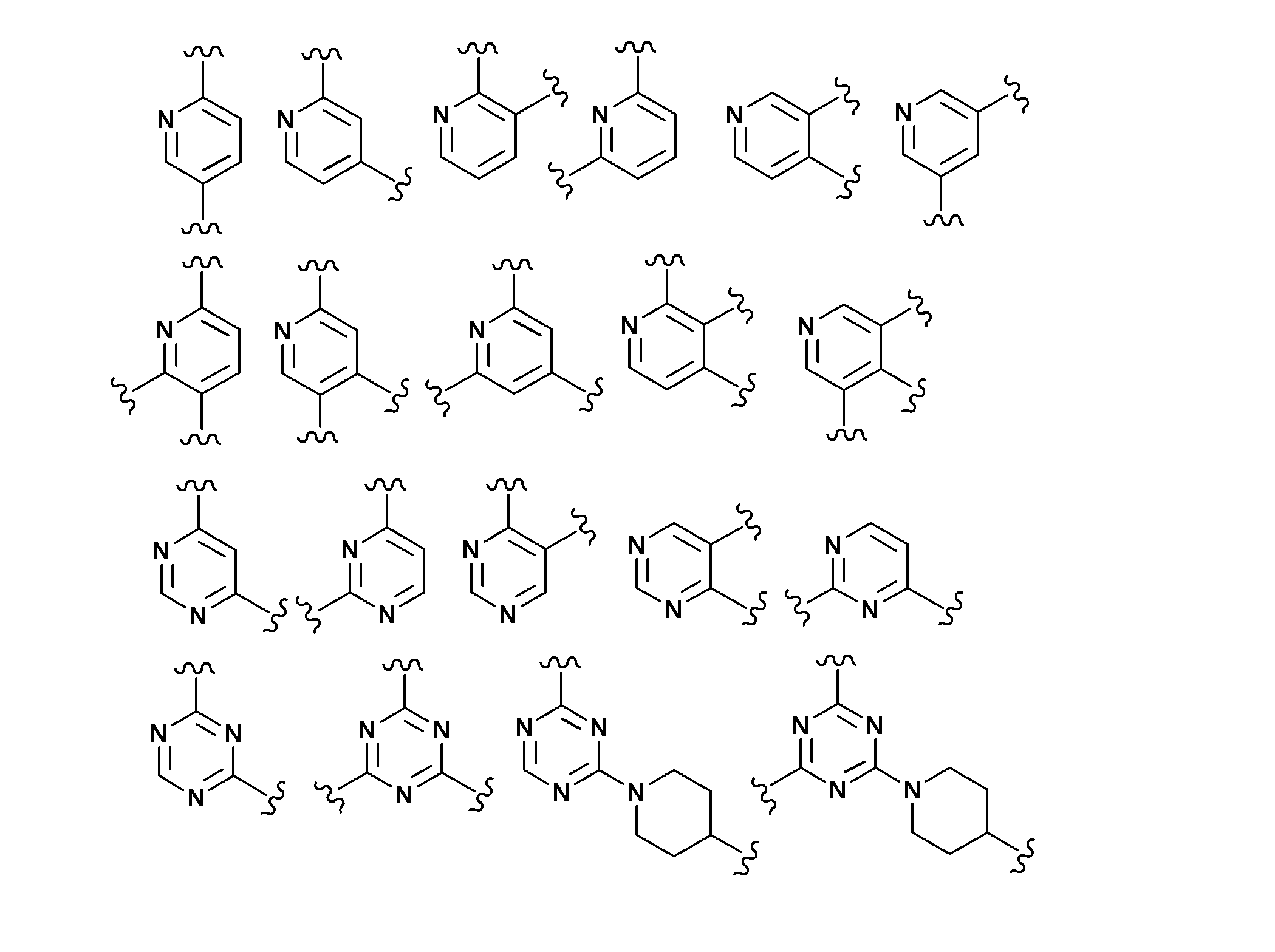
- X is an n + 1 valent nitrogen-containing heterocyclic group.
- n is 1 or 2.
- the nitrogen-containing heterocycle may be an aromatic group or an aliphatic group.
- the nitrogen-containing heterocycle is one or more single rings in which the monocyclic nitrogen-containing heterocycle is selected from the monocyclic aromatic hydrocarbon ring and the monocyclic nitrogen-containing heterocycle, even if it is a monocyclic ring. It may be a fused polycycle fused with a ring. Further, the nitrogen-containing heterocycle may be a ring in which two or more rings selected from a monocyclic nitrogen-containing heterocycle and a fused polycyclic nitrogen-containing heterocycle are bonded via a single bond.
- the group represented by R a1 and the group represented by R 3a -R 2a - are on the carbon atom as the ring-constituting atom of the nitrogen-containing heterocyclic group represented by X. It may be bonded or may be bonded on a nitrogen atom as a ring-constituting atom.
- nitrogen-containing heterocycle giving X examples include a pyrrolidine ring, a pyrazolidine ring, an imidazolidine ring, a triazolidine ring, a tetrazolidine ring, a pyrrolin ring, a pyrazoline ring, an imidazoline ring, a triazoline ring, a tetrizoline ring, a pyrrol ring, and a pyrazole ring.
- Nitrogen-containing 5-membered rings such as imidazole ring, triazole ring, and tetrazole ring; piperidin ring, piperidine ring, piperazine ring, triazine ring, tetradinane ring, pentadinane ring, pyridine ring, pyridazine ring, pyrimidine ring, pyrazine ring, triazine ring, A nitrogen-containing 6-membered ring such as a tetrazine ring and a benzidine ring; a nitrogen-containing 7-membered ring such as an azepan ring, a diazepan ring, a triazepan ring, a tetrazepan ring, an azepine ring, a diazepine ring, and a triazepine ring; Indolin ring, isoindole ring, isowearnine ring, isoin
- a phthalazine ring, a naphthylidine ring, and a nitrogen-containing fused polycycle such as a pteridine ring; a polycycle in which two or more rings selected from these nitrogen-containing heterocycles are bonded via a single bond can be mentioned.
- the X derived from these nitrogen-containing heterocycles is divalent or 3 containing a nitrogen-containing 6-membered ring because the polymer of the polymerizable compound (A) has good adhesion to the surface of the object to be treated.
- Valuable groups are preferred, divalent or trivalent groups containing triazine rings are more preferred, 1,3,5-triazine-2,4-diyl groups, and 1,3,5-triazine-2,4,6. -Triyl groups are more preferred.
- Suitable specific examples of the divalent or trivalent nitrogen-containing complex as X include the following groups.
- Preferred specific examples of the compound represented by the formula (a3-2) include the following compounds.
- the following compounds are preferable.
- the polyfunctional polar polymerizable compound (a3) has not only the action of a hydroxyl group but also the adhesion of the surface of the resin film to be treated, which is formed by polymerizing the polymerizable compound (A) by cross-linking the molecular chain. Can be improved.
- the ratio of the total number of moles of the unsaturated group-containing silicon compound (a2) to the number of moles of the polymerizable compound (A) and the number of moles of the polar polymerizable compound (a3) is particularly limited as long as it does not impair the object of the present invention. Not done.
- the unsaturated group-containing silicon compound (a2) with respect to the number of moles of the polymerizable compound (A) in terms of both the effect of good hydrophilization and the good adhesion of the formed resin film to the surface of the object to be treated.
- the ratio of the total number of moles of the resin (A) to the number of moles of the polar polymerizable compound (a3) is 1 mol in terms of both the adhesion of the resin (A) to the surface of the object to be treated and the effect of excellent hydrophilization.
- % Or more and 50 mol% or less is preferable, 1 mol% or more and 40 mol% or less is more preferable, and 1 mol% or more and 99 mol% or less is further preferable.
- the polymerizable compound (A) preferably contains a polyfunctional monomer (a4) other than the betaine monomer (a1), the unsaturated group-containing silicon compound (a2), and the polar polymerizable compound (a3).
- the polyfunctional monomer (a4) has two or more ethylenically unsaturated double bonds and does not correspond to the betaine monomer (a1), the unsaturated group-containing silicon compound (a2), and the polar polymerizable compound (a3). Is.
- the polyfunctional monomer (a4) crosslinks the molecular chain in the resin film formed by the polymerization of the polymerizable compound (A). Crosslinking improves the adhesion of the resin coating to the surface of the object to be treated.
- polyfunctional monomer (a4) examples include ethylene glycol di (meth) acrylate, diethylene glycol di (meth) acrylate, triethylene glycol di (meth) acrylate, tetraethylene glycol di (meth) acrylate, and pentaethylene glycol di (meth).
- the ratio of the number of moles of the polyfunctional monomer (a4) to the number of moles of the polymerizable compound (A) is not particularly limited as long as it does not impair the object of the present invention.
- the ratio of the polyfunctional monomer (a4) to the number of moles of the polymerizable compound (A) is preferably 0.5 mol% or more and 20 mol% or less in that the polymer of the polymerizable compound (A) is appropriately crosslinked. It is more preferably 1 mol% or more and 15 mol% or less, and more preferably 1 mol% or more and 10 mol% or less.
- the polymerizable compound (A) is other than the betaine monomer (a1), the unsaturated group-containing silicon compound (a2), the polar polymerizable compound (a3), and the polyfunctional monomer (a4) as long as the object of the present invention is not impaired.
- Other monomers (a5) may be contained.
- the other monomer (a5) has two or more ethylenically unsaturated double bonds, and is a betaine monomer (a1), an unsaturated group-containing silicon compound (a2), a polar polymerizable compound (a3), and a polyfunctional monomer. It is a compound that does not correspond to (a4).
- Examples of the other monomer (a5) include methyl (meth) acrylate, ethyl (meth) acrylate, isopropyl (meth) acrylate, -n-propyl (meth) acrylate, and -n- (meth) acrylate.
- the ratio of the number of moles of the polyfunctional monomer (a4) to the number of moles of the polymerizable compound (A) is such that the polymerizable compound (A) has the betaine monomer (a1), the unsaturated group-containing silicon compound (a2), and /.
- the content is not particularly limited as long as it contains a desired amount of the polar polymerizable compound (a3).
- the ratio of the mass of the polymerizable compound (A) to the mass of the surface treatment liquid is not particularly limited, but is preferably 1% by mass 40% by mass or less, more preferably 2% by mass or more and 20% by mass or less, and 2% by mass or more. It is more preferably 15% by mass or less.
- the surface treatment liquid contains a thermal polymerization initiator (B) as a component for polymerizing the polymerizable compound (A).
- the thermal polymerization initiator (B) is not particularly limited as long as it is a compound capable of polymerizing the polymerizable compound (A) having an ethylenically unsaturated double bond.
- thermal polymerization initiator (B) examples include an azo polymerization initiator.
- thermal polymerization initiator (B) examples include 2,2'-azobis (2-methylpropionamidine) dihydrochloride (dihydrochloride) and 2,2'-azobis [2- (phenylamidino) propane] dihydro.
- the amount of the thermal polymerization initiator (B) used is not particularly limited as long as the polymerization reaction can be carried out satisfactorily.
- the amount of the thermal polymerization initiator (B) used is preferably 0.1 mol% or more and 20 mol% or less, preferably 0.1 mol% or more and 15 mol% or less, based on the total number of moles of the polymerizable compound (A). More preferred.
- the surface treatment liquid includes a first liquid containing the polymerizable compound (A) and the solvent (S), a thermal polymerization initiator (B), and a solvent (S). ) And a second liquid may be used as a two-component surface treatment liquid.
- the two-component surface treatment liquid is mixed and used immediately before the surface treatment.
- the surface treatment liquid contains a solvent (S).
- the solvent (S) may be water, an organic solvent, or an aqueous solution of an organic solvent.
- water is preferable because of the solubility of the resin (A), the safety of the hydrophilization treatment work, the low cost, and the like.
- the organic solvent used as the solvent (S) include alcohol.
- the alcohol include aliphatic alcohols, and alcohols having 1 or more and 3 or less carbon atoms are preferable. Specific examples thereof include methanol, ethanol, n-propyl alcohol, and isopropyl alcohol (IPA), with methanol, ethanol, and isopropyl alcohol being preferred.
- the alcohol may be used alone or in combination of two or more.
- the content of water in the solvent (S) is preferably 50% by mass or more, more preferably 80% by mass or more, and particularly preferably 100% by mass.
- the surface treatment liquid may contain various additives as long as the object of the present invention is not impaired.
- additives include antioxidants, UV absorbers, colorants, defoamers, viscosity modifiers and the like.
- the content of these additives is appropriately determined in consideration of the normally used amount of these additives.
- the hydrophilization treatment method is By applying the above-mentioned surface treatment liquid to form a film on the surface of the object to be treated, Heating the film and including. However, as long as the surface of the object to be treated is hydrophilized to a desired degree, it is not necessary to apply a uniform surface treatment liquid to the entire surface of the surface of the object to be treated to be hydrophilized.
- the hydrophilization treatment method further preferably includes rinsing the surface of the object to be treated with a rinsing liquid after heating the coating film.
- the application of the surface treatment liquid to form a film on the surface of the object to be treated is also referred to as a “coating step”.
- Heating the coating is also referred to as “heating process”.
- Rinsing the surface of the object to be treated with a rinsing liquid after heating the coating film is also referred to as a “rinsing step”.
- the coating process, the heating process, and the rinsing process will be described in detail.
- the above-mentioned surface treatment liquid is applied to the surface of the object to be treated to form a film.
- the coating method is not particularly limited. Specific examples of the coating method include a spin coating method, a spray method, a roller coating method, a dipping method and the like.
- the spin coating method is preferable as the coating method because it is easy to form a film having a uniform film thickness on the surface of the substrate evenly.
- the material of the surface to which the surface treatment liquid of the object to be treated is applied is not particularly limited, and may be an organic material or an inorganic material.
- the organic material include polyester resins such as PET resin and PBT resin, various nylons, polyimide resins, polyamideimide resins, polyolefins such as polyethylene and polypropylene, polystyrenes, (meth) acrylic resins, cycloolefin polymers (COPs), and cycloolefin copolymers. (COC) and various resin materials such as silicone resin (for example, polyorganosiloxane such as polydimethylsiloxane (PDMS)) can be mentioned.
- polyester resins such as PET resin and PBT resin
- various nylons such as PET resin and PBT resin
- polyimide resins such as polyamideimide resins
- polyolefins such as polyethylene and polypropylene
- polystyrenes polystyrenes
- (meth) acrylic resins
- a photosensitive resin component contained in various resist materials and an alkali-soluble resin component are also preferable as the organic material.
- the inorganic material include glass, silicon, and various metals such as copper, aluminum, iron, and tungsten.
- the metal may be an alloy.
- the shape of the object to be processed is not particularly limited.
- the shape of the object to be processed may be a flat shape, for example, a three-dimensional shape such as a spherical shape or a columnar shape.
- the object to be treated may be exposed to chemicals such as detergents, and there is a concern that the hydrophilicity of the film formed on the object to be treated may decrease due to exposure to the chemicals.
- chemicals such as detergents
- the hydrophilicity of the film formed on the object to be treated may decrease due to exposure to the chemicals.
- the object to be treated which is often exposed to chemicals such as cleaning liquid, for example, a glass member provided in a window, a mirror, furniture, an optical device (for example, a device having a lens), or a translucent resin member is treated.
- the solvent (S) may be removed from the coating film composed of the surface treatment liquid by a well-known drying method, if necessary.
- the film thickness of the film formed in the coating process is not particularly limited.
- the thickness of the film formed in the coating step is, for example, preferably 1 ⁇ m or less, more preferably 300 nm or less, still more preferably 100 nm or less.
- the thickness of the film formed by the coating process can be adjusted by adjusting the solid content concentration of the surface treatment liquid, the coating conditions, and the like.
- the film formed in the coating step is heated.
- the polymerizable compound (A) contained in the film is polymerized by the action of the thermal polymerization initiator (B) to form a resin film that is firmly bonded to the surface of the untreated body.
- the heating conditions are not particularly limited as long as the polymerizable compound (A) is polymerized to a desired degree and the object to be treated is not deteriorated or deformed.
- the heating temperature is, for example, preferably 30 ° C. or higher and 300 ° C. or lower, and more preferably 40 ° C. or higher and 250 ° C. or lower.
- the heating time is, for example, preferably 1 minute or more and 6 hours or less, more preferably 3 minutes or more and 60 minutes or less, and further preferably 5 minutes or more and 30 minutes or less.
- rinse process> In the rinsing step, after heating the coating film, the surface of the object to be treated is rinsed with a rinsing solution. By rinsing, the film formed on the surface of the object to be treated can be thinned.
- the rinsing liquid is not particularly limited as long as it can form a film having a desired film thickness.
- As the rinsing liquid water, an organic solvent, and an aqueous solution of an organic solvent can be used. Water is preferable as the rinsing liquid.
- the method for rinsing the coating film is not particularly limited. Typically, rinsing is performed by bringing the rinsing liquid into contact with the coating film by the same method as the above-mentioned coating method.
- the film thickness obtained after rinsing is, for example, preferably 10 nm or less, more preferably 0.1 nm or more and 10 nm or less, further preferably 0.1 nm or more and 8 nm or less, still more preferably 0.5 nm or more and 5 nm or less, and 0. It is particularly preferably 5 nm or more and 3 nm or less.
- the thickness of the coating film can be adjusted by adjusting the solid content concentration of the surface treatment liquid, the coating conditions, the amount of the rinsing liquid used, the type of the rinsing liquid, the temperature of the rinsing liquid, and the like.
- the object to be treated After rinsing and, if necessary, drying the object to be treated, the object to be treated is suitably used for various purposes.
- Examples 1 to 9 and Comparative Examples 1 to 4 In the examples, the following amounts of A1-1 and A1-2 described in Table 1 were used as the above-mentioned betaine monomer (a1). In the examples, the following A2-1 in the amount shown in Table 1 was used as the unsaturated group silicon-containing compound (a2). In Examples and Comparative Examples, the following amounts of A3-1 and A3-2 shown in Table 1 were used as the polar polymerizable compound (a3). In the examples, the amount of nonaethylene glycol diacrylate (A4-1) shown in Table 1 was used as the polyfunctional monomer (a4). In the comparative example, the following A5-1, A5-2, and A5-3 were used as the other monomer (a5).
- Comparative Example 1 a copolymer of 99 mol% of the above A1-1 and 1 mol% of the above A2-1 was dissolved in water so as to have a solid content concentration of 10% by mass to prepare a surface treatment liquid. Obtained.
- ⁇ Water contact angle> The surface treatment liquids of the respective examples and comparative examples were spin-coated on the silicon wafer under the conditions of 1000 rpm and 60 seconds, and then the wafer was heated at 100 ° C. for 10 minutes. Next, the surface of the wafer was washed with water to form a film having a film thickness at the level of a monomolecular film made of a resin which is a copolymer of the above-mentioned polymerizable compound (A) on the wafer.
- a pure water droplet (2.0 ⁇ L) is dropped on the surface-treated surface of a silicon wafer, and the contact angle of water is measured as the contact angle 10 seconds after the drop. did.
- Table 1 shows the average value of the contact angles of water at three points on the silicon wafer. The contact angle of water on the untreated silicon wafer is 13.8 °.
- ⁇ Chemical resistance> The silicon wafer surface-treated by the same method as the measurement of the water contact angle was immersed in an aqueous solution of sodium dodecyl sulfate having a concentration of 1% by mass, which is an anionic chemical solution, for 1 minute. Then, the surface of the silicon wafer was shower-washed with pure water for 1 minute. The water contact angle of the surface-treated surface of the silicon wafer after washing was measured according to the above method. The measured contact angles of water are shown in Table 1.
- ⁇ S2s strength> The surface of the silicon wafer surface-treated by the same method as the measurement of the water contact angle is measured by X-ray photoelectron spectroscopy (XPS) to determine the sulfonic acid anion group contained in the resin or the S contained in the sulfonic acid group.
- XPS X-ray photoelectron spectroscopy
- the intensity of the derived S2s peak was measured. It can be said that the larger the value of the S2s peak intensity, the better the resin is bonded to the substrate.
- the intensity of the S2s peak was not measured in Comparative Example 2 and Comparative Example 4 in which the sulfonic acid anion group or the polymerizable compound having a sulfonic acid group was not used.
- a polymerizable compound containing the above-mentioned betaine monomer (a1) and an unsaturated group-containing silicon-containing compound (a2) and / or a polar polymerizable compound (a3) based on the measurement results of S2s intensity By applying a surface treatment liquid containing (A) and the thermal polymerization initiator (B) to the surface of the object to be treated and then heating the compound, the polymerizable compound (in a state of being in good adhesion to the surface of the object to be treated). It can be seen that a film made of the polymer of A) is formed.
Landscapes
- Chemical & Material Sciences (AREA)
- Organic Chemistry (AREA)
- Chemical Kinetics & Catalysis (AREA)
- Engineering & Computer Science (AREA)
- Health & Medical Sciences (AREA)
- Medicinal Chemistry (AREA)
- Polymers & Plastics (AREA)
- Life Sciences & Earth Sciences (AREA)
- Wood Science & Technology (AREA)
- Materials Engineering (AREA)
- Addition Polymer Or Copolymer, Post-Treatments, Or Chemical Modifications (AREA)
- Treatments Of Macromolecular Shaped Articles (AREA)
Abstract
Description
重合性化合物(A)が、エチレン性不飽和二重結合を有する基と、カチオン性基と、アニオン性基とを有するベタインモノマー(a1)と、エチレン性不飽和二重結合を有する基と、加水分解性シリル基とを有する不飽和基含有ケイ素化合物(a2)、及び/又はエチレン性不飽和二重結合を有する基と、アミノ基、カルボキシ基、メルカプト基、水酸基、及びシアノ基から選択される極性基とを有する極性重合性化合物(a3)とを含む、表面処理液である。
皮膜を加熱することと、
を含む、被処理体の表面を親水化させる親水化処理方法である。
表面処理液は、重合性化合物(A)と、熱重合開始剤(B)と、溶媒(S)とを含む。かかる表面処理液は、表面処理の対象物である被処理体の表面を親水化させることができる。
以下、表面処理液に関して、任意の成分、必須の成分等について説明する。
重合性化合物(A)は、被処理体の表面において熱重合開始剤(B)の作用により重合し被処理体の表面処理に良好に密着した樹脂被膜を形成する。
重合性化合物(A)は、エチレン性不飽和二重結合を有する基と、カチオン性基と、アニオン性基とを有するベタインモノマー(a1)と、エチレン性不飽和二重結合を有する基と、加水分解性シリル基とを有する不飽和基含有ケイ素化合物(a2)、及び/又はエチレン性不飽和二重結合を有する基と、アミノ基、カルボキシ基、メルカプト基、水酸基、及びシアノ基から選択される極性基とを有する極性重合性化合物(a3)とを含む。
また、重合性化合物(A)は、本発明の目的を阻害しない範囲で、上記のベタインモノマー(a1)、不飽和基含有ケイ素化合物(a2)、及び極性重合性化合物(a3)以外に、多官能性モノマー(a4)や他のモノマー(a5)を含んでいてもよい。
重合性化合物(A)が、エチレン性不飽和二重結合を有する基と、加水分解性シリル基とを有する不飽和基含有ケイ素化合物(a2)、及び/又はエチレン性不飽和二重結合を有する基と、アミノ基、カルボキシ基、メルカプト基、水酸基、及びシアノ基から選択される極性基とを有する極性重合性化合物(a3)とを含むことによって、表面処理時に、これらの化合物がまず被処理体の表面に強固に結合し、被処理体の表面に結合したこれらの化合物を起点として、被処理体の表面近傍において重合性化合物(A)の重合反応が進行すると思われる。このようにして、簡便に被処理体の表面に強固に結合した重合性化合物(A)の重合体からなる薄い被膜が形成されると考えられる。
重合性化合物(A)は、カチオン性基と、アニオン性基と、エチレン性不飽和二重結合を有する基とを有するベタインモノマーを含む。カチオン性基、及びアニオン性基のいずれも親水性基として作用する。
表面処理された被処理体の表面は、疎水性基を有するアニオンや疎水性基を有するカチオンを多量に含む洗浄液に接触する場合がある。表面処理液中の樹脂が、親水性基としてカルボキシ基、カルボン酸塩基、スルホン酸基、及びスルホン酸塩基等のアニオン性基のみを有する場合、これらの親水性基が疎水性基を有するカチオンとの相互作用により、親水性基として作用しなくなる場合がある。また、表面処理液中の樹脂が、親水性基として第四級アンモニウム基のようなカチオン性基のみを有する場合、カチオン性基が疎水性基を有するアニオンとの相互作用により親水性基として作用しなくなる場合がある。
しかし、ベタインモノマー(a1)を含む重合性化合物(A)の重合体が、親水性基としてカチオン性基及びアニオン性基の双方を有することにより、表面処理された被処理体の表面が、疎水性基を有するカチオンを豊富に含む洗浄剤と接触しても、疎水性基を有するアニオンを豊富に含む洗浄剤と接触しても、カチオン性基及びアニオン性基のいずれか一方は親水性基としての作用を維持でき、被処理体の表面の親水性が低下しにくい。
ベタインモノマー(a1)において、カチオン性基の数とアニオン性基の数とが同一であるのが好ましい。
ベタインモノマー(a1)の合成や入手が容易であることから、ベタインモノマー(a1)における、カチオン性基の数とアニオン性基の数とは、それぞれ1であるのが好ましい。
アニオン性基は、スルホン酸アニオン基、ホスホン酸アニオン基又はカルボン酸アニオン基であることが好ましい。
ベタインモノマー(a1)における、エチレン性不飽和二重結合の数は限定されないが、1つ又は2つが好ましい。

R1は、エチレン性不飽和二重結合を含む炭化水素基であり、
R2は、炭素原子数1以上10以下の2価の炭化水素基であり、
Rは、アニオン性基であり、
環Aは、複素環である。)
R3、R4、及びR5のうちの少なくとも1つは、エチレン性不飽和二重結合を有する炭化水素基であり、
R6は、炭素原子数1以上10以下の2価の炭化水素基であり、
Rは、アニオン性基である。)
R2としてのアルキレン基の好適な具体例としては、メチレン基、エタン-1,2-ジイル基、プロパン-1,3-ジイル基、プロパン-1,2-ジイル基、ブタン-1,4-ジイル基、ペンタン-1,5-ジイル基、ヘキサン-1,6-ジイル基、ヘプタン-1,7-ジイル基、オクタン-1,8-ジイル基、ノナン-1,9-ジイル基、及びデカン-1,10-ジイル基が挙げられる。
芳香族複素環としては、イミダゾール環、ピラゾール環、1,2,3-トリアゾール環、1,2,4-トリアゾール環、ピリジン環、ピリミジン環、ピリダジン環及びピラジン環等の含窒素芳香族複素環において、当該含窒素芳香族複素環中の任意の1つの窒素原子が四級化された環が挙げられる。
脂肪族複素環としては、ピロリジン環、ピペリジン環及びピペラジン環等の含窒素複素環において、当該含窒素複素環中の任意の1つの窒素原子が四級化された環が挙げられる。
R3~R5としての炭化水素基は置換基を有していてもよい。R3~R5としての炭化水素基が有していてもよい置換基は、本発明の目的を阻害しない範囲で特に限定されない。当該置換基の例としては、ハロゲン原子、水酸基、炭素原子数1以上4以下のアルコキシ基、炭素原子数2以上4以下のアシル基、炭素原子数2以上4以下のアシルオキシ基、アミノ基、及び1つ又は2つの炭素原子数1以上4以下のアルキル基で置換されたアルキルアミノ基等が挙げられる。
R3~R5としてのアルキル基の好適な具体例としては、メチル基、エチル基、n-プロピル基、イソプロピル基、n-ブチル基、イソブチル基、sec-ブチル基、tert-ブチル基、n-ペンチル基、n-ヘキシル基、n-ヘプチル基、n-オクチル基、2-エチルヘキシル基、n-ノニル基、及びn-デシル基が挙げられる。
R6としてのアルキレン基の好適な具体例としては、メチレン基、エタン-1,2-ジイル基、プロパン-1,3-ジイル基、プロパン-1,2-ジイル基、ブタン-1,4-ジイル基、ペンタン-1,5-ジイル基、ヘキサン-1,6-ジイル基、ヘプタン-1,7-ジイル基、オクタン-1,8-ジイル基、ノナン-1,9-ジイル基、及びデカン-1,10-ジイル基が挙げられる。



CH2=CR15-CO-NH-R16-N+(R17)(R18)-R19-R20・・・(a1-viii)
(式(a1-viii)中、R15は水素原子又はメチル基であり、R16及びR19は、それぞれ独立に、炭素原子数1以上10以下の2価の炭化水素基であり、R17及びR18は、それぞれ独立に、置換基を有してもよい炭素原子数1以上10以下の炭化水素基であり、R20は、スルホン酸アニオン基(-SO3 -)、ホスホン酸アニオン基(-(PO3)2-)、又はカルボン酸アニオン基(-COO-)である。)
R16及びR19としてのアルキレン基の好適な具体例としては、メチレン基、エタン-1,2-ジイル基、プロパン-1,3-ジイル基、プロパン-1,2-ジイル基、ブタン-1,4-ジイル基、ペンタン-1,5-ジイル基、ヘキサン-1,6-ジイル基、ヘプタン-1,7-ジイル基、オクタン-1,8-ジイル基、ノナン-1,9-ジイル基、及びデカン-1,10-ジイル基が挙げられる。
R17及びR18としての炭化水素基は置換基を有していてもよい。R17及びR18としての炭化水素基が有していてもよい置換基は、本発明の目的を阻害しない範囲で特に限定されない。当該置換基の例としては、ハロゲン原子、水酸基、炭素原子数1以上4以下のアルコキシ基、炭素原子数2以上4以下のアシル基、炭素原子数2以上4以下のアシルオキシ基、アミノ基、及び1つ又は2つの炭素原子数1以上4以下のアルキル基で置換されたアルキルアミノ基等が挙げられる。
R17及びR18としてのアルキル基の好適な具体例としては、メチル基、エチル基、n-プロピル基、イソプロピル基、n-ブチル基、イソブチル基、sec-ブチル基、tert-ブチル基、n-ペンチル基、n-ヘキシル基、n-ヘプチル基、n-オクチル基、2-エチルヘキシル基、n-ノニル基、及びn-デシル基が挙げられる。
重合性化合物(A)は、前述のベタインモノマー(a1)とともに、エチレン性不飽和二重結合を有する基と、加水分解性シリル基とを有する不飽和基含有ケイ素化合物(a2)、及び/又はエチレン性不飽和二重結合を有する基と、アミノ基、カルボキシ基、メルカプト基、水酸基、及びシアノ基から選択される極性基とを有する極性重合性化合物(a3)を含む。
不飽和基含有ケイ素化合物(a2)は、エチレン性不飽和二重結合を有する基と、加水分解性シリル基とを有する。
エチレン性不飽和二重結合を有する基の好適な具体例としては、ビニル基、1-プロペニル基、2-n-プロペニル基(アリル基)、1-n-ブテニル基、2-n-ブテニル基、及び3-n-ブテニル基等のアルケニル基;N-ビニルアミノ基、N-1-プロぺニルアミノ基、N-アリルアミノ基、N-1-n-ブテニルアミノ基、N-2-n-ブテニルアミノ基、及びN-3-n-ブテニルアミノ基等のモノアルケニルアミノ基;N,N-ジビニルアミノ基、N,N-ジ(1-プロぺニル)アミノ基、N,N-ジアリルアミノ基、N,N-ジ(1-n-ブテニル)アミノ基、N,N-ジ(2-n-ブテニル)アミノ基、N,N-ジ(3-n-ブテニル)アミノ基等のジアルケニルアミノ基;アリルオキシ基、2-n-ブテニルオキシ基、3-n-ブテニルオキシ基等のアルケニルオキシ基;ビニルアミノカルボニル基、1-プロぺニルアミノカルボニル基、アリルアミノカルボニル基、1-n-ブテニルアミノカルボニル基、2-n-ブテニルアミノカルボニル基、3-n-ブテニルアミノカルボニル基等のアルケニルアミノカルボニル基;ビニルオキシカルボニル基、1-プロぺニルオキシカルボニル基、アリルオキシカルボニル基、1-n-ブテニルオキシカルボニル基、2-n-ブテニルオキシカルボニル基、3-n-ブテニルオキシカルボニル基等のアルケニルオキシカルボニル基;アクリロイル基、メタクリロイル基、アクリロイルオキシ基、メタクリロイルオキシ基、アクリロイルアミノ基、及びメタクリロイルアミノ基等の(メタ)アクリロイル基含有基が挙げられる。
これらの基のなかでは、アルケニル基、及び(メタ)アクリロイル基含有基が好ましい。アルケニル基の炭素原子数は、例えば2以上6以下が好ましく、2又は3がより好ましい。
加水分解性シリル基の好適な例としては、-SiR01 aR02 3-aで表される基が挙げられる。ここで、R01は、アルコキシ基、及びハロゲン原子等の加水分解によりシラノール基を生成させ得る基である。アルコキシ基としては、メトキシ基、エトキシ基、n-プロピルオキシ基、イソプロピルオキシ基、及びn-ブチルオキシ基等の炭素原子数以下の1以上4以下のアルコキシ基が好ましい。ハロゲン原子としては、塩素原子、及び臭素原子が好ましく、塩素原子がより好ましい。
R02は、本発明の目的を阻害しない範囲で、加水分解によりシラノール基を生成させ得る基に該当しない種々の有機基であってよい。かかる有機基としては、炭素原子数1以上10以下の炭化水素基が好ましい。炭化水素基は、脂肪族基であっても、芳香族基であってもよい。炭化水素基の構造は、直鎖状であっても、分岐鎖状であっても、環状であってもこれらの組み合わせでもよい。炭素原子数1以上10以下の炭化水素基の好適な具体例としては、メチル基、エチル基、n-プロピル基、イソプロピル基、n-ブチル基、イソブチル基、sec-ブチル基、tert-ブチル基、n-ペンチル基、n-ヘキシル基、n-へプチル基、n-オクチル基、n-ノニル基、n-デシル基、フェニル基、ナフタレン-1-イル基、ナフタレン-2-イル基、ベンジル基、及びフェネチル基等が挙げられる。これらの中では、メチル基、及びエチル基が好ましい。
以上説明した炭化水素基は、炭素原子数1以上6以下のアルコキシ基、ハロゲン原子、水酸基、及びシアノ基等の置換基を有していてもよい。
aとしては2又は3が好ましく、3がより好ましい。また、aが2又は3の場合、被処理体表面において隣接して存在する-SiR01 aR02 3-aで表される基の間でも縮合反応が生じやすい。その結果、表面処理液を用いて形成される被膜中に、被処理体の表面に沿って広がるシロキサン結合のネットワークが形成されることにより、重合性化合物(A)の重合体を、被処理体表面に特に強固に結合させやすい。
R03-(-CO-R04-)b-R05-SiR01 aR02 3-a・・・(a2-1)
R05としての芳香族炭化水素基としては、p-フェニレン基、m-フェニレン基、o-フェニレン基、ナフタレン-2,6-ジイル基、ナフタレン-2,7-ジイル基、ビフェニル-4,4’-ジイル基、ビフェニル-3.4’-ジイル基、及びビフェニル-3,3’-ジイル基が挙げられる。
極性重合性化合物(a3)は、エチレン性不飽和二重結合を有する基と、アミノ基、カルボキシ基、メルカプト基、水酸基、及びシアノ基から選択される極性基とを有する。
CH2=CRA1-(RA2)c-CO-RA3・・・(a3-1)
(式(a3-1)中、RA1は水素原子又はメチル基であり、RA2は2価の炭化水素基であり、cは0又は1であり、RA3は、-OH、-O-RA4、又は-NH-RA4であり、RA4は、アミノ基、カルボキシ基、メルカプト基、水酸基、及びシアノ基からなる群より選択される1以上の極性基で置換された炭化水素基である。)
RA4の基の主骨格を構成する炭化水素基は、直鎖状、分岐鎖状、又は環状の脂肪族基であってもよく、芳香族炭化水素基であってもよい。
直鎖状、分岐鎖状、又は環状の脂肪族基の炭素原子数は1以上20以下が好ましく、1以上12以下がより好ましい。
直鎖状、又は分岐鎖状の脂肪族基の好適な例としては、メチル基、エチル基、n-プロピル基、イソプロピル基、n-ブチル基、イソブチル基、sec-ブチル基、tert-ブチル基、n-ペンチル基、イソペンチル基、ネオペンチル基、sec-ペンチル基、tert-ペンチル基、n-ヘキシル基、n-ヘプチル基、n-オクチル基、n-ノニル基、n-デシル基等が挙げられる。
環状の脂肪族基の好適な例としては、シクロプロピル基、シクロブチル基、シクロペンチル基、シクロヘキシル基、シクロヘプチル基、及びシクロオクチル基等のシクロオクチル基や、アダマンタン、ノルボルナン、イソボルナン、トリシクロデカン、及びテトラシクロドデカン等のポリシクロアルカンから1個の水素原子を除いた基や、これらのポリシクロアルカンのC1-C4アルキル置換体から1個の水素原子を除いた基が挙げられる。
芳香族炭化水素基の好適な例としては、フェニル基、ナフチル基、アントラニル基、フェナントレニル基、及びビフェニリル基等が挙げられる。芳香族炭化水素基は、メチル基、エチル基等のC1-C4アルキル基で置換されていてもよい。

(R3a-R2a)n-X-R1a・・・(a3-2)
(式(a3-2)中、R1aは、1以上のエチレン性不飽和二重結合を有する有機基であり、R2aは、単結合、又は炭素原子数1以上10以下のアルキレン基であり、R3aは、水素原子であるか、アミノ基、カルボキシ基、メルカプト基、水酸基、及びシアノ基から選択される極性基であり、nは1又は2であり、Xは、n+1価の含窒素複素環基であり、nが1である場合、Ra3は前述の極性基であり、nが2である場合、少なくとも一方のR3aが前述の極性基である。)
-Ra01・・・(a3-2i)
-NH-Ra01・・・(a3-2ii)
-N(Ra01)(Ra02)・・・(a3-2iii)
-N(Ra01)2・・・(a3-2iv)
-O-Ra01・・・(a3-2v)
-CO-NH-Ra01・・・(a3-2vi)
-CO-O-Ra01・・・(a3-2vii)
Ra02としての炭化水素基は、脂肪族基であっても、芳香族基であっても、脂肪族基と芳香族基との組み合わせであってもよい。Ra02としての炭化水素基の炭素原子数は、1以上6以下が好ましく、1以上4以下がより好ましく、1以上3以下がさらに好ましい。
これらの基の中では、ビニル基、アリル基、N,N-ジアリルアミノ基、アリルオキシ基、アクリロイル基、メタクリロイル基、アクリロイルオキシ基、及びメタクリロイルオキシ基が好ましく、N,N-ジアリルアミノ基がより好ましい。
これらのアルキレン基の中では、メチレン基、エタン-1,2-ジイル基、及びプロパン-1,3-ジイル基が好ましく、メチレン基、及びエタン-1,2-ジイル基がより好ましい。
含窒素複素環は、単環であっても、単環式の含窒素複素環が、単環式の芳香族炭化水素環、及び単環式の含窒素複素環から選択される1以上の単環と縮合した縮合多環であってもよい。
また、含窒素複素環は、単環式含窒素複素環、及び縮合多環式の含窒素複素環から選択される2以上の環が単結合を介して結合した環であってもよい。
これらの含窒素複素環に由来するXとしては、重合性化合物(A)の重合体の被処理体表面への密着性が良好である点等から、含窒素6員環を含む2価又は3価の基が好ましく、トリアジン環を含む2価又は3価の基がより好ましく、1,3,5-トリアジン-2,4-ジイル基、及び1,3,5-トリアジン-2,4,6-トリイル基がさらに好ましい。

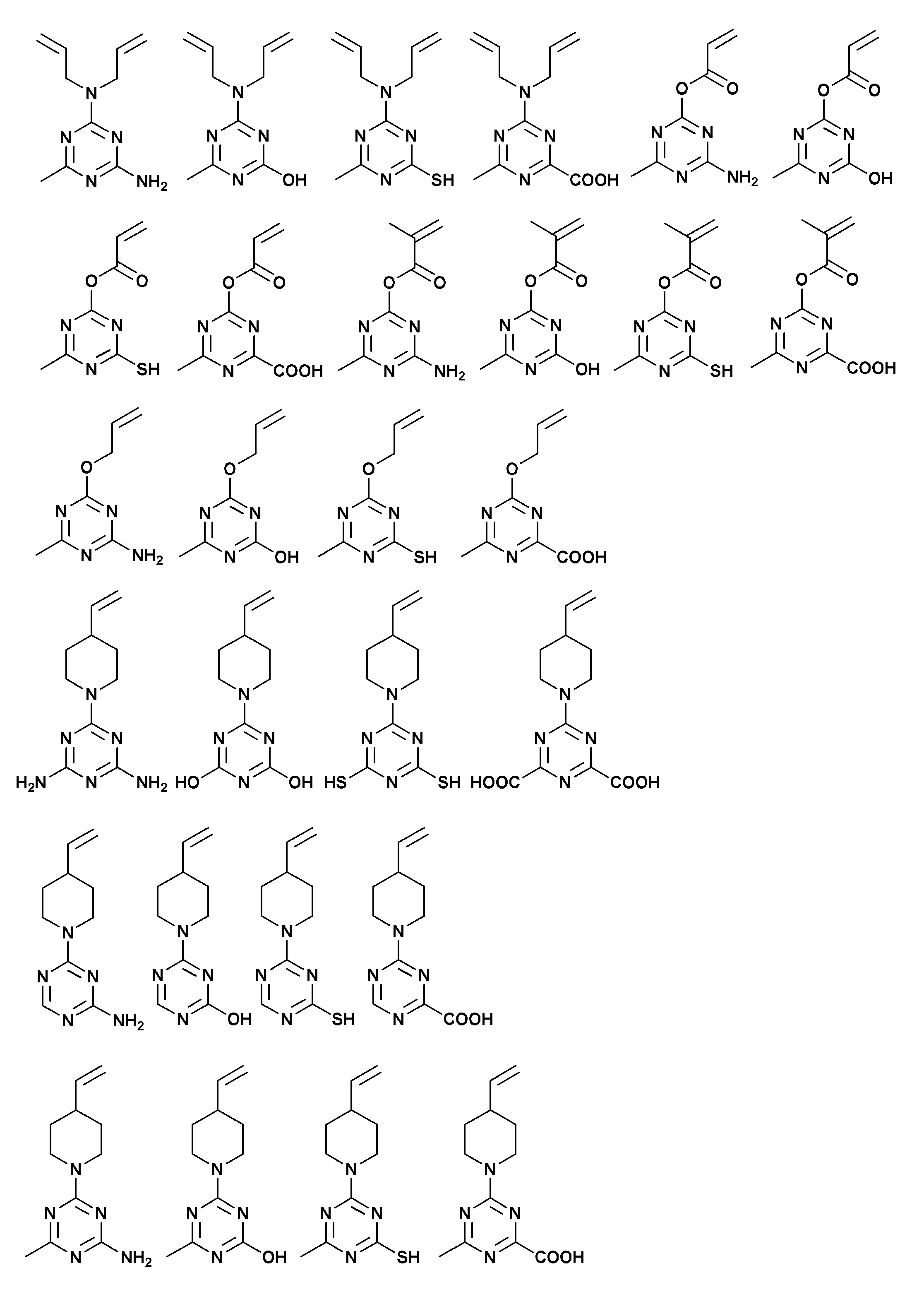
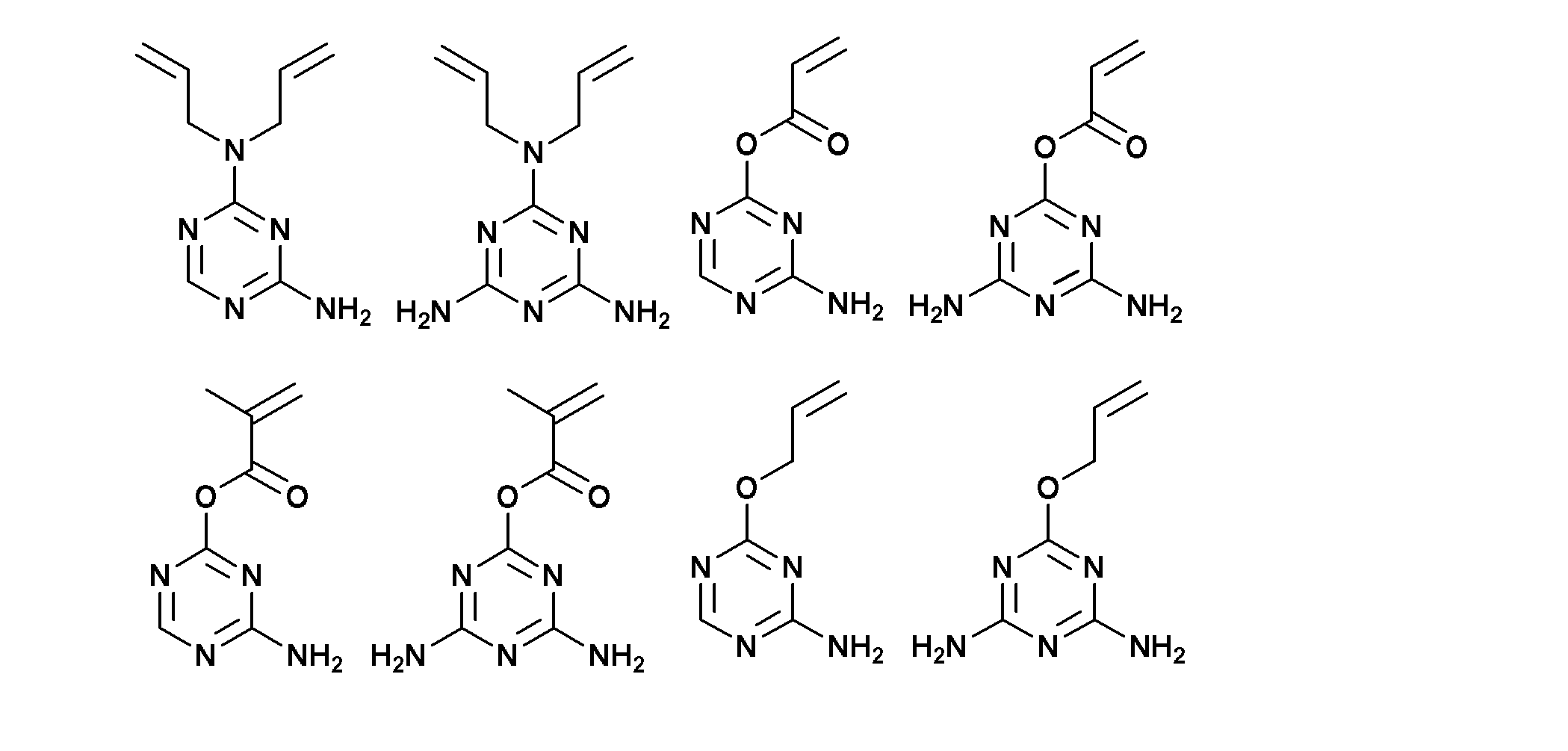
かかる多官能性の極性重合性化合物(a3)は、水酸基の作用のみならず、分子鎖の架橋によって、重合性化合物(A)が重合して形成される樹脂被膜の被処理体表面の密着性を向上させ得る。
重合性化合物(A)は、ベタインモノマー(a1)、不飽和基含有ケイ素化合物(a2)、及び極性重合性化合物(a3)以外の、多官能モノマー(a4)を含むのが好ましい。
多官能モノマー(a4)は、2以上のエチレン性不飽和二重結合を有し、ベタインモノマー(a1)、不飽和基含有ケイ素化合物(a2)、及び極性重合性化合物(a3)に該当しない化合物である。
多官能モノマー(a4)は、重合性化合物(A)が重合することにより形成される樹脂被膜において、分子鎖を架橋する。架橋により、樹脂被膜の被処理体表面への密着性が向上する。
重合性化合物(A)は、本発明の目的を阻害しない範囲で、ベタインモノマー(a1)、不飽和基含有ケイ素化合物(a2)、極性重合性化合物(a3)、及び多官能モノマー(a4)以外の他のモノマー(a5)を含んでいてもよい。
他のモノマー(a5)は、2以上のエチレン性不飽和二重結合を有し、ベタインモノマー(a1)、不飽和基含有ケイ素化合物(a2)、極性重合性化合物(a3)、及び多官能モノマー(a4)に該当しない化合物である。
表面処理液は、重合性化合物(A)を重合させる成分として熱重合開始剤(B)を含む。熱重合開始剤(B)としては、エチレン性不飽和二重結合を有する重合性化合物(A)を重合させ得る化合物であれば特に限定されない。
表面処理液は、溶媒(S)を含む。溶媒(S)は、水であっても、有機溶剤であっても、有機溶剤の水溶液であってもよい。溶媒(S)としては、樹脂(A)の溶解性、親水化処理の作業の安全性、及び低コストである点等から、水が好ましい。
溶媒(S)として使用される有機溶剤の好適な例としては、アルコールが挙げられる。該アルコールとしては、脂肪族アルコールが挙げられ、炭素原子数1以上3以下のアルコールが好ましい。具体的には、メタノール、エタノール、n-プロピルアルコール、及びイソプロピルアルコール(IPA)が挙げられ、メタノール、エタノール、イソプロピルアルコールが好ましい。該アルコールは1種又は2種以上を組み合わせて用いてもよい。
表面処理液は、本発明の目的を阻害しない範囲で、種々の添加剤を含んでいてもよい。かかる添加剤の例としては、酸化防止剤、紫外線吸収剤、着色剤、消泡剤、及び粘度調整剤等が挙げられる。これらの添加剤の含有量は、これらの添加剤の通常使用される量を勘案して、適宜決定される。
親水化処理方法は、
前述の表面処理液を塗布して、被処理体の表面に被膜を形成することと、
皮膜を加熱することと、
を含む。
ただし、被処理体の表面が所望する程度に親水化される限りにおいて、被処理体の親水化されるべき表面の全面に均一な表面処理液が塗布される必要はない。
親水化処理方法は、さらに、被膜の加熱後に、被処理体の表面をリンス液によりリンスすることを含むのが好ましい。
以下、塗布工程、加熱工程、及びリンス工程について詳細に説明する。
塗布工程では、前述の表面処理液を被処理体の表面に塗布して被膜を形成する。
塗布方法は特に限定されない。塗布方法の具体例としては、スピンコート法、スプレー法、ローラーコート法、浸漬法等が挙げられる。被処理体が基板である場合、基板の表面に、均一な膜厚の被膜をむらなく形成しやすいことから、塗布方法としてスピンコート法が好ましい。
有機材料としては、PET樹脂やPBT樹脂等のポリエステル樹脂、各種ナイロン、ポリイミド樹脂、ポリアミドイミド樹脂、ポリエチレンやポリプロピレン等のポリオレフィン、ポリスチレン、(メタ)アクリル樹脂、シクロオレフィンポリマー(COP)、シクロオレフィンコポリマー(COC)、及びシリコーン樹脂(例えば、ポリジメチルシロキサン(PDMS)等のポリオルガノシロキサン等)等、種々の樹脂材料が挙げられる。
また、種々のレジスト材料に含まれる感光性の樹脂成分や、アルカリ可溶性の樹脂成分も有機材料として好ましい。
無機材料としては、ガラス、シリコンや、銅、アルミニウム、鉄、タングステン等の種々の金属が挙げられる。金属は、合金であってもよい。
加熱工程では、塗布工程で形成された被膜が加熱される。加熱により、被膜に含まれる重合性化合物(A)が熱重合開始剤(B)の作用により重合し、非処理体の表面に強固に結合する樹脂被膜が形成される。
リンス工程では、被膜の加熱後に、被処理体の表面をリンス液によりリンスする。リンスによって、被処理体の表面に形成される被膜を薄膜化できる。
リンス液としては、所望の膜厚の被膜を形成できる限り特に限定されない。リンス液としては、水、有機溶剤、及び有機溶剤の水溶液を用いることがでる。リンス液としては水が好ましい。
被膜をリンスする方法としては、特に限定されない。典型的には、前述の塗布方法と同様の方法によって、リンス液を被膜に接触させることにより、リンスが行われる。
実施例において、前述のベタインモノマー(a1)として表1に記載の量の下記A1-1及び下記A1-2を用いた。実施例において、不飽和基含ケイ素化合物(a2)として表1に記載の量の下記A2-1を用いた。実施例、及び比較例において、極性重合性化合物(a3)として表1に記載の量の下記A3-1、及びA3-2を用いた。実施例において、多官能モノマー(a4)として、表1に記載の量のノナエチレングリコールジアクリレート(A4-1)を用いた。比較例において、他のモノマー(a5)として、下記A5-1、A5-2、及びA5-3を用いた。

シリコンウエハー上に各実施例、及び比較例の表面処理液を1000rpm、60秒の条件でスピンコートした後、ウエハーを100℃で10分間加熱した。次いで、ウエハー表面を水洗して、上記の重合性化合物(A)の共重合体である樹脂からなる単分子膜レベルの膜厚の被膜をウエハー上に形成した。
Dropmaster700(協和界面科学株式会社製)を用い、シリコンウエハーの表面処理された表面に純水液滴(2.0μL)を滴下して、滴下10秒後における接触角として、水の接触角を測定した。シリコンウエハー上の3点の水の接触角の平均値を、表1に記す。
なお、未処理のシリコンウエハーの水の接触角は13.8°である。
水接触角の形成にて形成した被膜の膜厚を、分光エリプソメトリーにより測定した
水接触角の測定と同様の方法で表面処理されたシリコンウエハーを、アニオン性の薬液である濃度1質量%のドデシル硫酸ナトリウム水溶液に1分間浸漬した。その後、シリコンウエハーの表面を純水で1分間シャワー洗浄した。洗浄後のシリコンウエハーの表面処理された表面の水接触角を上記の方法に従って測定した。測定された水の接触角を表1に記す。
水接触角の測定と同様の方法で表面処理されたシリコンウエハーの表面について、X線光電子分光法(XPS)により測定して、樹脂が有するスルホン酸アニオン基、又はスルホン酸基に含まれるSに由来する、S2sピークの強度を測定した。S2sピーク強度の値が大きいほど、樹脂が良好に基板に結合していると言える。
なお、スルホン酸アニオン基、又はスルホン酸基を有する重合性化合物を使用していない比較例2、及び比較例4についてはS2sピークの強度を測定しなかった。

また、実施例1~9の薬液耐性試験の結果から、ベタインモノマー(a1)を重合性化合物(A)として含む表面処理液を用いて表面処理すると、ドデシル硫酸ナトリウムのようなイオン性の薬液に表面処理された面を接触させても親水化の効果が損なわれにくいことが分かる。
他方、比較例1によれば、S2s強度の測定結果から、ベタインモノマー(a1)に由来する構成単位と、不飽和基含ケイ素化合物(a2)に由来する構成単位とを含む樹脂を含有する表面処理液を用いて表面処理を行っても、樹脂が被処理体の表面に良好に密着しにくいことが分かる。
また、比較例2~4によれば、ベタインモノマー(a1)を重合性化合物(A)として含まない表面処理液を用いて表面処理を行う場合、表面処理直後には被処理体の表面が良好に親水化されるものの、表面処理された被処理体の表面がドデシル硫酸ナトリウムのようなイオン性の薬液に接触することにより親水化の効果が著しく損なわれることが分かる。
Claims (11)
- 重合性化合物(A)と、熱重合開始剤(B)と、溶媒(S)とを含み、
前記重合性化合物(A)が、エチレン性不飽和二重結合を有する基と、カチオン性基と、アニオン性基とを有するベタインモノマー(a1)と、エチレン性不飽和二重結合を有する基と、加水分解性シリル基とを有する不飽和基含ケイ素化合物(a2)、及び/又はエチレン性不飽和二重結合を有する基と、アミノ基、カルボキシ基、メルカプト基、水酸基、及びシアノ基から選択される極性基とを有する極性重合性化合物(a3)とを含む、表面処理液。 - 前記カチオン性基が、第四級窒素カチオン基である、請求項1に記載の表面処理液。
- 前記アニオン性基が、スルホン酸アニオン基、ホスホン酸アニオン基、又はカルボン酸アニオン基である、請求項1又は2に記載の表面処理液。
- 重合性化合物(A)のモル数に対する、前記ベタインモノマー(a1)のモル数の比率が、50モル%以上99モル%以下である、請求項1~3のいずれか1項に記載の表面処理液。
- 前記不飽和基含有ケイ素化合物(a2)が、前記加水分解性シリル基で置換されたアルキル基を有する(メタ)アクリル酸エステルである、請求項1~4のいずれか1項に記載の表面処理液。
- 前記極性重合性化合物(a3)が、下記式(a-3)で表される化合物である、請求項1~5のいずれか1項に記載の表面処理液。
(R3a-R2a)n-X-R1a・・・(a-3)
(式(a-3)中、R1aは、1以上のエチレン性不飽和二重結合を有する有機基であり、R2aは、単結合、又は炭素原子数1以上10以下のアルキレン基であり、R3aは、水素原子、又はアミノ基、カルボキシ基、メルカプト基、水酸基、及びシアノ基から選択される極性基であり、nは1又は2であり、Xは、n+1価の含窒素複素環基であり、nが2である場合、少なくとも一方のR3aが前記極性基である。) - 前記重合性化合物が、前記ベタインモノマー(a1)、前記不飽和基含有ケイ素化合物(a2)、及び前記極性重合性化合物(a3)以外の、多官能モノマー(a4)を含む、請求項1~6のいずれか1項に記載の表面処理液。
- 前記表面処理液中の、前記重合性化合物(A)の含有量が、2質量%以上50質量%以下である、請求項1又は2に記載の表面処理液。
- 前記溶媒(S)が、水を含む、請求項1~8のいずれか1項に記載の表面処理液。
- 請求項1~9のいずれか1項に記載の表面処理液を塗布して、被処理体の表面に被膜を形成することと、
前記皮膜を加熱することと、
を含む、被処理体の表面を親水化させる親水化処理方法。 - さらに、前記被膜の加熱後に、前記被処理体の表面をリンス液によりリンスすることを含む、請求項10記載の親水化処理方法。
Priority Applications (4)
| Application Number | Priority Date | Filing Date | Title |
|---|---|---|---|
| JP2022545573A JPWO2022044679A1 (ja) | 2020-08-27 | 2021-07-28 | |
| CN202180051820.1A CN116157212A (zh) | 2020-08-27 | 2021-07-28 | 表面处理液及亲水化处理方法 |
| US18/042,843 US20230272143A1 (en) | 2020-08-27 | 2021-07-28 | Surface treatment liquid and hydrophilizing treatment method |
| KR1020237010343A KR20230054880A (ko) | 2020-08-27 | 2021-07-28 | 표면 처리액 및 친수화 처리 방법 |
Applications Claiming Priority (2)
| Application Number | Priority Date | Filing Date | Title |
|---|---|---|---|
| JP2020143885 | 2020-08-27 | ||
| JP2020-143885 | 2020-08-27 |
Publications (1)
| Publication Number | Publication Date |
|---|---|
| WO2022044679A1 true WO2022044679A1 (ja) | 2022-03-03 |
Family
ID=80353045
Family Applications (1)
| Application Number | Title | Priority Date | Filing Date |
|---|---|---|---|
| PCT/JP2021/027980 Ceased WO2022044679A1 (ja) | 2020-08-27 | 2021-07-28 | 表面処理液、及び親水化処理方法 |
Country Status (6)
| Country | Link |
|---|---|
| US (1) | US20230272143A1 (ja) |
| JP (1) | JPWO2022044679A1 (ja) |
| KR (1) | KR20230054880A (ja) |
| CN (1) | CN116157212A (ja) |
| TW (1) | TW202222968A (ja) |
| WO (1) | WO2022044679A1 (ja) |
Families Citing this family (1)
| Publication number | Priority date | Publication date | Assignee | Title |
|---|---|---|---|---|
| CN116789899A (zh) * | 2023-06-09 | 2023-09-22 | 北京马普新材料有限公司 | 共聚物、处理剂及斥水斥油产品 |
Citations (7)
| Publication number | Priority date | Publication date | Assignee | Title |
|---|---|---|---|---|
| JP2007039391A (ja) * | 2005-08-04 | 2007-02-15 | Kao Corp | 整髪用被膜形成樹脂 |
| JP2013235034A (ja) * | 2012-05-02 | 2013-11-21 | Menicon Co Ltd | 表面処理樹脂成形体の製造方法及び表面処理樹脂成形体 |
| JP2015502438A (ja) * | 2011-12-14 | 2015-01-22 | センプラス・バイオサイエンシーズ・コーポレイションSemprus Biosciences Corp. | コンタクトレンズ改質のための高イオン強度プロセス |
| JP2016043325A (ja) * | 2014-08-25 | 2016-04-04 | 関西ペイント株式会社 | 基材の被膜形成方法 |
| WO2016129374A1 (ja) * | 2015-02-13 | 2016-08-18 | 富士フイルム株式会社 | 平版印刷版原版、その製造方法、及びそれを用いる印刷方法 |
| WO2017018146A1 (ja) * | 2015-07-29 | 2017-02-02 | 富士フイルム株式会社 | 硬化性組成物、コーティングおよび積層体 |
| JP2017155188A (ja) * | 2016-03-04 | 2017-09-07 | 三菱マテリアル電子化成株式会社 | 防汚性膜形成用液組成物及びこの液組成物を用いて防汚性膜を形成する方法 |
Family Cites Families (14)
| Publication number | Priority date | Publication date | Assignee | Title |
|---|---|---|---|---|
| JPS5437523B2 (ja) | 1973-01-16 | 1979-11-15 | ||
| JP4464076B2 (ja) * | 2003-06-09 | 2010-05-19 | 日本ペイント株式会社 | 架橋性微粒子、親水処理剤、親水皮膜被覆方法及び親水皮膜 |
| JP2009126948A (ja) | 2007-11-22 | 2009-06-11 | Nippon Paint Co Ltd | 親水化処理剤 |
| JP2009235128A (ja) * | 2008-03-25 | 2009-10-15 | Fujifilm Corp | 親水性膜形成用組成物および親水性部材 |
| JP2009179797A (ja) * | 2009-01-26 | 2009-08-13 | Shiseido Co Ltd | 反応性シリル基含有共重合体を含有する組成物 |
| JP2012025820A (ja) * | 2010-07-21 | 2012-02-09 | Kansai Paint Co Ltd | 親水化処理剤組成物 |
| WO2014084219A1 (ja) * | 2012-11-29 | 2014-06-05 | 大阪有機化学工業株式会社 | 親水性コート剤 |
| EP3147336A4 (en) * | 2014-05-19 | 2017-12-20 | Mitsui Chemicals, Inc. | Hydrophilic single-layer film |
| JP6622479B2 (ja) * | 2015-03-31 | 2019-12-18 | 住友化学株式会社 | レジスト組成物及びレジストパターンの製造方法 |
| EP3553147B1 (en) * | 2016-12-14 | 2022-05-11 | Tokyo Ohka Kogyo Co., Ltd. | Surface treatment liquid and surface treatment method |
| CN111356750A (zh) * | 2017-11-22 | 2020-06-30 | 花王株式会社 | 亲水化处理剂 |
| US11066531B2 (en) * | 2018-07-10 | 2021-07-20 | Tokyo Ohka Kogyo Co., Ltd. | Surface treatment liquid and hydrophilic treatment method |
| CN114829537B (zh) * | 2019-12-24 | 2024-05-28 | 东京应化工业株式会社 | 表面处理液及亲水化处理方法 |
| CN116096505B (zh) * | 2020-08-27 | 2024-04-16 | 东京应化工业株式会社 | 表面处理液及表面处理方法 |
-
2021
- 2021-07-28 WO PCT/JP2021/027980 patent/WO2022044679A1/ja not_active Ceased
- 2021-07-28 US US18/042,843 patent/US20230272143A1/en active Pending
- 2021-07-28 JP JP2022545573A patent/JPWO2022044679A1/ja active Pending
- 2021-07-28 CN CN202180051820.1A patent/CN116157212A/zh active Pending
- 2021-07-28 KR KR1020237010343A patent/KR20230054880A/ko not_active Withdrawn
- 2021-08-06 TW TW110129074A patent/TW202222968A/zh unknown
Patent Citations (7)
| Publication number | Priority date | Publication date | Assignee | Title |
|---|---|---|---|---|
| JP2007039391A (ja) * | 2005-08-04 | 2007-02-15 | Kao Corp | 整髪用被膜形成樹脂 |
| JP2015502438A (ja) * | 2011-12-14 | 2015-01-22 | センプラス・バイオサイエンシーズ・コーポレイションSemprus Biosciences Corp. | コンタクトレンズ改質のための高イオン強度プロセス |
| JP2013235034A (ja) * | 2012-05-02 | 2013-11-21 | Menicon Co Ltd | 表面処理樹脂成形体の製造方法及び表面処理樹脂成形体 |
| JP2016043325A (ja) * | 2014-08-25 | 2016-04-04 | 関西ペイント株式会社 | 基材の被膜形成方法 |
| WO2016129374A1 (ja) * | 2015-02-13 | 2016-08-18 | 富士フイルム株式会社 | 平版印刷版原版、その製造方法、及びそれを用いる印刷方法 |
| WO2017018146A1 (ja) * | 2015-07-29 | 2017-02-02 | 富士フイルム株式会社 | 硬化性組成物、コーティングおよび積層体 |
| JP2017155188A (ja) * | 2016-03-04 | 2017-09-07 | 三菱マテリアル電子化成株式会社 | 防汚性膜形成用液組成物及びこの液組成物を用いて防汚性膜を形成する方法 |
Also Published As
| Publication number | Publication date |
|---|---|
| JPWO2022044679A1 (ja) | 2022-03-03 |
| KR20230054880A (ko) | 2023-04-25 |
| CN116157212A (zh) | 2023-05-23 |
| US20230272143A1 (en) | 2023-08-31 |
| TW202222968A (zh) | 2022-06-16 |
Similar Documents
| Publication | Publication Date | Title |
|---|---|---|
| JP7474340B2 (ja) | 表面処理液、及び表面処理方法 | |
| TWI912434B (zh) | 表面處理液,及親水化處理方法 | |
| JP7295726B2 (ja) | 表面処理液、及び親水化処理方法 | |
| CN114829537B (zh) | 表面处理液及亲水化处理方法 | |
| JP7715508B2 (ja) | 重合性組成物、及び親水化処理方法 | |
| WO2022044679A1 (ja) | 表面処理液、及び親水化処理方法 | |
| Medel et al. | Thermo‐and pH‐responsive gradient and block copolymers based on 2‐(2‐methoxyethoxy) ethyl methacrylate synthesized via atom transfer radical polymerization and the formation of thermoresponsive surfaces | |
| JP7458938B2 (ja) | 表面処理液、表面処理方法、樹脂、及び化合物 | |
| JP5892570B1 (ja) | ダブルネットワークゲル−固体物ハイブリッド構造体 | |
| TWI917552B (zh) | 聚合性組成物,及親水化處理方法 | |
| TW201809175A (zh) | 表面處理方法、抗靜電劑及親水化處理劑 | |
| JP2019206610A (ja) | 重合体塩および接着剤 | |
| JPS6221361B2 (ja) | ||
| JP4033463B2 (ja) | リン酸誘導体基及びスルホン酸(塩)基を有するアクリルアミド(共)重合体、それを用いた導電材及び導電性樹脂組成物、並びにそれらの製造方法 | |
| JP7319850B2 (ja) | 親水化処理方法、及び表面処理液 | |
| JP4105088B2 (ja) | リン系酸残基含有不飽和単量体単独重合物を含む溶液からなるコーティング剤の製造方法 | |
| WO2000052070A1 (en) | Process for producing aqueous solution of monoallylamine polymer | |
| JPH0236208A (ja) | 塩化ビニル系導電性樹脂 |
Legal Events
| Date | Code | Title | Description |
|---|---|---|---|
| 121 | Ep: the epo has been informed by wipo that ep was designated in this application |
Ref document number: 21861107 Country of ref document: EP Kind code of ref document: A1 |
|
| ENP | Entry into the national phase |
Ref document number: 2022545573 Country of ref document: JP Kind code of ref document: A |
|
| ENP | Entry into the national phase |
Ref document number: 20237010343 Country of ref document: KR Kind code of ref document: A |
|
| NENP | Non-entry into the national phase |
Ref country code: DE |
|
| 122 | Ep: pct application non-entry in european phase |
Ref document number: 21861107 Country of ref document: EP Kind code of ref document: A1 |