WO2022039005A1 - 光学系、光学機器、および光学系の製造方法 - Google Patents
光学系、光学機器、および光学系の製造方法 Download PDFInfo
- Publication number
- WO2022039005A1 WO2022039005A1 PCT/JP2021/028398 JP2021028398W WO2022039005A1 WO 2022039005 A1 WO2022039005 A1 WO 2022039005A1 JP 2021028398 W JP2021028398 W JP 2021028398W WO 2022039005 A1 WO2022039005 A1 WO 2022039005A1
- Authority
- WO
- WIPO (PCT)
- Prior art keywords
- lens group
- optical system
- focusing
- lens
- conditional expression
- Prior art date
- Legal status (The legal status is an assumption and is not a legal conclusion. Google has not performed a legal analysis and makes no representation as to the accuracy of the status listed.)
- Ceased
Links
Images









Classifications
-
- G—PHYSICS
- G02—OPTICS
- G02B—OPTICAL ELEMENTS, SYSTEMS OR APPARATUS
- G02B15/00—Optical objectives with means for varying the magnification
- G02B15/14—Optical objectives with means for varying the magnification by axial movement of one or more lenses or groups of lenses relative to the image plane for continuously varying the equivalent focal length of the objective
- G02B15/22—Optical objectives with means for varying the magnification by axial movement of one or more lenses or groups of lenses relative to the image plane for continuously varying the equivalent focal length of the objective with movable lens means specially adapted for focusing at close distances
- G02B15/24—Optical objectives with means for varying the magnification by axial movement of one or more lenses or groups of lenses relative to the image plane for continuously varying the equivalent focal length of the objective with movable lens means specially adapted for focusing at close distances having a front fixed lens or lens group and two movable lenses or lens groups in front of a fixed lens or lens group
-
- G—PHYSICS
- G02—OPTICS
- G02B—OPTICAL ELEMENTS, SYSTEMS OR APPARATUS
- G02B13/00—Optical objectives specially designed for the purposes specified below
-
- G—PHYSICS
- G02—OPTICS
- G02B—OPTICAL ELEMENTS, SYSTEMS OR APPARATUS
- G02B13/00—Optical objectives specially designed for the purposes specified below
- G02B13/001—Miniaturised objectives for electronic devices, e.g. portable telephones, webcams, PDAs, small digital cameras
- G02B13/0015—Miniaturised objectives for electronic devices, e.g. portable telephones, webcams, PDAs, small digital cameras characterised by the lens design
- G02B13/002—Miniaturised objectives for electronic devices, e.g. portable telephones, webcams, PDAs, small digital cameras characterised by the lens design having at least one aspherical surface
-
- G—PHYSICS
- G02—OPTICS
- G02B—OPTICAL ELEMENTS, SYSTEMS OR APPARATUS
- G02B13/00—Optical objectives specially designed for the purposes specified below
- G02B13/001—Miniaturised objectives for electronic devices, e.g. portable telephones, webcams, PDAs, small digital cameras
- G02B13/0055—Miniaturised objectives for electronic devices, e.g. portable telephones, webcams, PDAs, small digital cameras employing a special optical element
- G02B13/006—Miniaturised objectives for electronic devices, e.g. portable telephones, webcams, PDAs, small digital cameras employing a special optical element at least one element being a compound optical element, e.g. cemented elements
-
- G—PHYSICS
- G02—OPTICS
- G02B—OPTICAL ELEMENTS, SYSTEMS OR APPARATUS
- G02B15/00—Optical objectives with means for varying the magnification
- G02B15/14—Optical objectives with means for varying the magnification by axial movement of one or more lenses or groups of lenses relative to the image plane for continuously varying the equivalent focal length of the objective
- G02B15/16—Optical objectives with means for varying the magnification by axial movement of one or more lenses or groups of lenses relative to the image plane for continuously varying the equivalent focal length of the objective with interdependent non-linearly related movements between one lens or lens group, and another lens or lens group
- G02B15/20—Optical objectives with means for varying the magnification by axial movement of one or more lenses or groups of lenses relative to the image plane for continuously varying the equivalent focal length of the objective with interdependent non-linearly related movements between one lens or lens group, and another lens or lens group having an additional movable lens or lens group for varying the objective focal length
-
- G—PHYSICS
- G02—OPTICS
- G02B—OPTICAL ELEMENTS, SYSTEMS OR APPARATUS
- G02B9/00—Optical objectives characterised both by the number of the components and their arrangements according to their sign, i.e. + or -
- G02B9/64—Optical objectives characterised both by the number of the components and their arrangements according to their sign, i.e. + or - having more than six components
Definitions
- the present invention relates to an optical system, an optical device, and a method for manufacturing the optical system.
- the first optical system according to the present invention is composed of a front group, an aperture, and a rear group arranged in order from the object side along the optical axis, and the rear group is arranged on the most object side of the rear group. It has a first focusing lens group having a negative refractive power and a second focusing lens group having a negative refractive power arranged on the image plane side of the first focusing lens group, and is at infinity.
- the first focusing lens group and the second focusing lens group move toward the image plane along the optical axis with different trajectories.
- the second optical system includes a leading lens group having a positive refractive power, a first focusing lens group having a negative power, and a positive lens group arranged in order from the object side along the optical axis. It has a positive lens group having a refractive power, a second focusing lens group having a negative refractive power, and a final lens group, and when focusing from an infinity object to a short-range object, the first focusing is performed.
- the lens group and the second focusing lens group move toward the image plane along the optical axis with different trajectories.
- the optical device according to the present invention is configured to include the above optical system.
- the first method for manufacturing an optical system is a method for manufacturing an optical system including a front group, an aperture, and a rear group arranged in order from the object side along the optical axis, and the rear group.
- a first focusing lens group having a negative refractive force arranged on the most object side of the rear group and a second focusing lens group having a negative refractive force arranged on the image plane side of the first focusing lens group. It has a focusing lens group, and when focusing from an infinity object to a short-range object, the first focusing lens group and the second focusing lens group image along the optical axis with different trajectories.
- Each lens is arranged in the lens barrel so as to move to the surface side.
- the second method for manufacturing an optical system according to the present invention includes a preceding lens group having a positive refractive force and a first focusing lens group having a negative refractive force arranged in order from the object side along the optical axis.
- This is a method for manufacturing an optical system having a positive lens group having a positive refractive force, a second focusing lens group having a negative refractive force, and a final lens group, from an infinity object to a short-range object.
- each lens is arranged in the lens barrel so that the first focusing lens group and the second focusing lens group move toward the image plane along the optical axis with different trajectories. ..
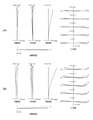
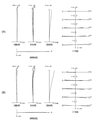
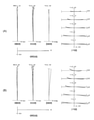
- FIG. 20 (A) and 20 (B) are aberration diagrams of infinity focusing and short-distance focusing in the wide-angle end state of the optical system according to the tenth embodiment, respectively.
- 21 (A) and 21 (B) are aberration diagrams of various aberrations at infinity focusing and short-distance focusing in the telephoto end state of the optical system according to the tenth embodiment, respectively.
- It is a flowchart which shows the manufacturing method of the optical system which concerns on 1st Embodiment.
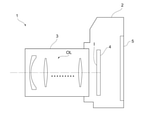
- the camera 1 includes a main body 2 and a photographing lens 3 mounted on the main body 2.
- the main body 2 includes an image sensor 4, a main body control unit (not shown) that controls the operation of a digital camera, and a liquid crystal screen 5.
- the photographing lens 3 includes an optical system OL composed of a plurality of lens groups and a lens position control mechanism (not shown) for controlling the position of each lens group.
- the lens position control mechanism includes a sensor that detects the position of the lens group, a motor that moves the lens group back and forth along the optical axis, a control circuit that drives the motor, and the like.
- the light from the subject is collected by the optical system OL of the photographing lens 3 and reaches the image plane I of the image pickup element 4.
- the light from the subject that has reached the image plane I is photoelectrically converted by the image pickup device 4 and recorded as digital image data in a memory (not shown).
- the digital image data recorded in the memory can be displayed on the liquid crystal screen 5 according to the operation of the user.
- This camera may be a mirrorless camera or a single-lens reflex type camera having a quick return mirror.
- the optical system OL shown in FIG. 22 schematically shows the optical system provided in the photographing lens 3, and the lens configuration of the optical system OL is not limited to this configuration.
- the optical system OL (1) as an example of the optical system OL according to the first embodiment has a front group GA and an aperture (aperture aperture) arranged in order from the object side along the optical axis. It is composed of S and the rear group GB.
- the rear group GB has a first focusing lens group GF1 having a negative refractive power arranged on the most object side of the rear group GB and a negative refractive power arranged on the image plane side of the first focusing lens group GF1.
- It has a second focusing lens group GF2 and the like.
- the first focusing lens group GF1 and the second focusing lens group GF2 move toward the image plane along the optical axis with different trajectories.
- each in-focus lens group can be made lighter, it is possible to obtain an optical system compatible with high-speed autofocus (AF). Since the drive mechanism of each in-focus lens group can be simplified, the sensitivity of optical performance to manufacturing errors can be suppressed.
- the optical system OL according to the first embodiment may be the variable magnification optical system OL (2) shown in FIG. 3, the optical system OL (3) shown in FIG. 5, or the optical system OL (4) shown in FIG. 7.
- the optical system OL (5) shown in FIG. 9 may be used.
- the optical system OL according to the first embodiment may be the variable magnification optical system OL (6) shown in FIG. 11, the optical system OL (7) shown in FIG. 13, and the optical system OL (10) shown in FIG. ) Is fine.
- the optical system OL according to the first embodiment satisfies the following conditional expression (1). 0.30 ⁇ STL / TL ⁇ 0.90 ... (1)
- STL the distance on the optical axis from the aperture S to the image plane I TL: the total length of the optical system OL.
- the conditional expression (1) defines an appropriate relationship between the distance on the optical axis from the aperture S to the image plane I and the total length of the optical system OL.
- the exit pupil position can be inferred, and an appropriate aperture position range can be defined.
- the total length of the optical system OL is the distance on the optical axis (air conversion distance) from the lens surface on the most object side of the optical system OL to the image plane I at the time of infinity focusing.
- the exit pupil becomes close to the image plane I, so that the tilt angle of the light beam incident on the image plane I becomes steep, and the angle of view changes due to a change in back focus due to a manufacturing error or the like. Fluctuations are likely to occur.
- the lower limit of the conditional expression (1) is set to 0.33, 0.35, 0.38, 0.40, 0.43, 0.45, 0.48, 0.50, and further 0.52. Therefore, the effect of this embodiment can be made more certain.
- the position of the aperture S is not appropriate, so that the ratio of the upper ray and the lower ray cut in the aperture S becomes unbalanced, resulting in a so-called one-sided aperture. Further, since the total length of the optical system OL is too short, it becomes difficult to correct the aberration.
- the upper limit of the conditional expression (1) to 0.88, 0.85, 0.83, 0.80, 0.78, and further 0.76, the effect of this embodiment is more reliable. Can be.
- the rear group GB has a positive lens group GP having a positive refractive power arranged between the first focusing lens group GF1 and the second focusing lens group GF2.
- the position of the positive lens group GP is fixed with respect to the image plane I. This makes it possible to satisfactorily correct spherical aberration, Petzval sum, and the like.
- the front group GA is composed of a leading lens group GA1 having a positive refractive power
- the rear group GB is a first focusing lens group GF1 and a second focusing lens group GF2.
- a positive lens group GP having a positive refractive power arranged between the lenses and a final lens group GE arranged on the image plane side of the second focusing lens group GF2.
- the optical system OL (1) as an example of the optical system OL according to the second embodiment is a preceding lens group GA1 having a positive refractive power arranged in order from the object side along the optical axis.
- each in-focus lens group can be made lighter, it is possible to obtain an optical system compatible with high-speed autofocus (AF). Since the drive mechanism of each in-focus lens group can be simplified, the sensitivity of optical performance to manufacturing errors can be suppressed.
- the optical system OL according to the second embodiment may be the variable magnification optical system OL (2) shown in FIG. 3, the optical system OL (3) shown in FIG. 5, or the optical system OL (4) shown in FIG. 7.
- the optical system OL (5) shown in FIG. 9 may be used.
- the optical system OL according to the second embodiment may be the variable magnification optical system OL (6) shown in FIG. 11, the optical system OL (7) shown in FIG. 13, and the optical system OL (8) shown in FIG. ), The optical system OL (9) shown in FIG. 17, or the optical system OL (10) shown in FIG.
- the aperture (aperture aperture) S is arranged between the preceding lens group GA1 and the first focusing lens group GF1.
- the light rays incident on the focusing lens group can be effectively narrowed down, and the focusing lens group can be made smaller and lighter.
- the optical system OL according to the second embodiment satisfies the above-mentioned conditional expression (1).
- the exit pupil position can be inferred and the range of the appropriate aperture position can be defined as in the first embodiment.
- the lower limit of the conditional expression (1) is set to 0.33, 0.35, 0.38, 0.40, 0.43, 0.45, 0.48, 0.50, and further 0.52. Therefore, the effect of this embodiment can be made more certain. Further, by setting the upper limit value of the conditional expression (1) to 0.88, 0.85, 0.83, 0.80, 0.78, and further 0.76, the effect of this embodiment is more reliable. Can be.
- the optical system OL according to the first embodiment and the second embodiment satisfies the following conditional expression (2). 0.50 ⁇ fA / f ⁇ 2.00 ... (2)
- fA focal length of the preceding lens group GA1
- f focal length of the optical system OL
- Conditional expression (2) defines an appropriate relationship between the focal length of the leading lens group GA1 and the focal length of the optical system OL.
- the lower limit of the conditional expression (2) is set to 0.55, 0.60, 0.65, 0.70, 0.75, 0.80, 0.85, 0.90, and further 0.95. Therefore, the effect of each embodiment can be made more certain.
- the upper limit of the conditional expression (2) is set to 1.90, 1.80, 1.75, 1.70, 1.65, 1.60, 1.55, 1.50, and further 1.45. By doing so, the effect of each embodiment can be made more certain.
- the optical system OL according to the first embodiment and the second embodiment satisfies the following conditional expression (3). 0.50 ⁇ fA / (-fF1) ⁇ 1.50 ... (3)
- fA focal length of the preceding lens group
- GA1 focal length of the first focusing lens group GF1.
- Conditional expression (3) defines an appropriate relationship between the focal length of the leading lens group GA1 and the focal length of the first focusing lens group GF1. By satisfying the conditional expression (3), it is possible to reduce aberration fluctuations and angle-of-view fluctuations during focusing.
- the lower limit of the conditional expression (3) is set to 0.53, 0.55, 0.58, 0.60, 0.63, 0.65, 0.58, 0.70, and further 0.73. Therefore, the effect of each embodiment can be made more certain. Further, by setting the upper limit value of the conditional expression (3) to 1.48, 1.45, 1.43, 1.40, 1.38, 1.35, and further 1.33, each embodiment can be set. The effect can be made more certain.
- the optical system OL according to the first embodiment and the second embodiment satisfies the following conditional expression (4). 0.35 ⁇ fB / (-fF1) ⁇ 1.50 ... (4)
- fB the combined focal length of the lens group arranged on the image plane side of the first in-focus lens group GF1
- fF1 the focal length of the first in-focus lens group GF1.
- Conditional expression (4) defines an appropriate relationship between the combined focal length of the lens group arranged on the image plane side of the first focusing lens group GF1 and the focal length of the first focusing lens group GF1. be.
- the lower limit of the conditional expression (4) is 0.38, 0.40, 0.43, 0.45, 0.48, 0.50, 0.53, 0.55, 0.58, and further 0.60. By setting to, the effect of each embodiment can be made more reliable. Further, the upper limit of the conditional expression (4) is set to 1.45, 1.40, 1.35, 1.30, 1.25, 1.20, 1.18, 1.20, 1.15, 1. 13. By further setting it to 1.10, the effect of each embodiment can be made more reliable.
- the optical system OL according to the first embodiment and the second embodiment satisfies the following conditional expression (5). -2.00 ⁇ (-fE) / f ⁇ 15.00 ... (5)
- fE focal length of the final lens group
- GE focal length of the optical system OL
- Conditional expression (5) defines an appropriate relationship between the focal length of the final lens group GE and the focal length of the optical system OL. By satisfying the conditional expression (5), shading can be suppressed and the total length of the optical system OL can be shortened.
- the lower limit of the conditional expression (5) is set to -1.80, -1.50, -1.00, -0.50, -0.10, 0.10, 0.50, 0.65, 0.80. Further, by setting it to 0.90, the effect of each embodiment can be further ensured. Further, the upper limit of the conditional expression (5) is set to 14.80, 12.00, 10.00, 8.50, 7.50, 6.00, 5.00, 4.50, and further 4.00. By doing so, the effect of each embodiment can be made more certain.
- the optical system OL according to the first embodiment and the second embodiment satisfies the following conditional expression (6). -1.00 ⁇ fP / (-fE) ⁇ 1.50 ... (6)
- fP focal length of the positive lens group
- GP focal length of the final lens group
- GE focal length of the final lens group
- Conditional expression (6) defines an appropriate relationship between the focal length of the positive lens group GP and the focal length of the final lens group GE.
- the lower limit of the conditional expression (6) is set to -0.80, -0.50, -0.25, -0.10, 0.01, 0.05, 0.12, and further 0.15. Therefore, the effect of each embodiment can be made more certain. Further, by setting the upper limit of the conditional expression (6) to 1.40, 1.25, 1.00, 0.85, 0.70, 0.65, 0.60, and further 0.55, The effect of each embodiment can be made more certain.
- the optical system OL according to the first embodiment and the second embodiment satisfies the following conditional expression (7). 1.10 ⁇ (-fF1) /fP ⁇ 3.20 ... (7)
- fF1 focal length of the first focusing lens group
- GF1 focal length of the positive lens group GP
- Conditional expression (7) defines an appropriate relationship between the focal length of the first focusing lens group GF1 and the focal length of the positive lens group GP.
- the lower limit of the conditional expression (7) is 1.15, 1.20, 1.25, 1.30, 1.33, 1.35, 1.38, 1.40, 1.43, and 1.45.
- the effect of each embodiment can be made more certain. Further, by setting the upper limit value of the conditional expression (7) to 3.15, 3.10, 3.05, and further 3.00, the effect of each embodiment can be further ensured.
- the optical system OL according to the first embodiment and the second embodiment satisfies the following conditional expression (8). 0.30 ⁇ fP / f ⁇ 1.00 ... (8)
- fP focal length of the positive lens group
- GP f focal length of the optical system OL
- Conditional expression (8) defines an appropriate relationship between the focal length of the positive lens group GP and the focal length of the optical system OL.
- conditional expression (8) If the corresponding value of the conditional expression (8) is out of the above range, it becomes difficult to correct spherical aberration, Petzval sum, and the like.
- the lower limit of the conditional expression (8) By setting the lower limit of the conditional expression (8) to 0.33, 0.35, 0.38, 0.40, and further 0.43, the effect of each embodiment can be further ensured. can.
- the upper limit value of the conditional expression (8) to 0.98, 0.95, 0.93, 0.90, and further 0.88, the effect of each embodiment is further ensured. be able to.
- the positive lens group GP is a negative lens, a first positive lens, and a second positive lens arranged in order from the object side along the optical axis. It is desirable to have. As a result, the optical system OL can be miniaturized, and the exit pupil can be made far from the image plane I. In addition, various aberrations such as spherical aberration can be satisfactorily corrected.
- the optical system OL according to the first embodiment and the second embodiment satisfies the following conditional expression (9). 0.10 ⁇ fF1 / fF2 ⁇ 2.00 ... (9)
- fF1 focal length of the first focusing lens group
- GF1 focal length of the second focusing lens group GF2
- Conditional expression (9) defines an appropriate relationship between the focal length of the first focusing lens group GF1 and the focal length of the second focusing lens group GF2. By satisfying the conditional expression (9), spherical aberration, curvature of field, and the like can be satisfactorily corrected.
- conditional expression (9) If the corresponding value of the conditional expression (9) is out of the above range, it becomes difficult to correct spherical aberration, curvature of field, and the like.
- the lower limit of the conditional expression (9) By setting the lower limit of the conditional expression (9) to 0.13, 0.15, 0.18, 0.20, 0.23, and further 0.25, the effect of each embodiment is more reliable.
- the upper limit of the conditional expression (9) is 1.98, 1.95, 1.93, 1.90, 1.75, 1.50, 1.40, 1.25, 1.10, and further 1. By setting it to .00, the effect of each embodiment can be made more reliable.
- the optical system OL according to the first embodiment and the second embodiment satisfies the following conditional expression (10). 0.50 ⁇ f / (-fF1) ⁇ 1.80 ... (10) However, f: focal length of the optical system OL fF1: focal length of the first focusing lens group GF1
- Conditional expression (10) defines an appropriate relationship between the focal length of the optical system OL and the focal length of the first focusing lens group GF1. By satisfying the conditional expression (10), chromatic aberration, curvature of field, and the like can be satisfactorily corrected.
- the lower limit of the conditional expression (10) is set to 0.53, 0.55, 0.58, 0.60, 0.63, 0.65, 0.68, 0.70, 0.73, and further 0.75. By setting to, the effect of each embodiment can be made more reliable. Further, by setting the upper limit value of the conditional expression (10) to 1.78, 1.75, 1.73, 1.70, 1.50, 1.40, and further 1.20, each embodiment can be set. The effect can be made more certain.
- the first focusing lens group GF1 is composed of one negative lens component.
- the first focusing lens group GF1 becomes lightweight, so that it is possible to focus from an infinity object to a short-distance object at high speed.
- the lens component indicates a single lens or a junction lens.
- the optical system OL according to the first embodiment and the second embodiment satisfies the following conditional expression (11). -2.50 ⁇ (rF12 + rF11) / (rF12-rF11) ⁇ 0.00 ... (11)
- rF11 the radius of curvature of the lens surface on the most object side in the first focusing lens group GF1
- rF12 the radius of curvature of the lens surface on the most image plane side in the first focusing lens group GF1.
- the conditional expression (11) defines an appropriate range for the shape factor of the lenses constituting the first focusing lens group GF1. By satisfying the conditional expression (11), spherical aberration, coma aberration and the like can be satisfactorily corrected.
- conditional expression (11) If the corresponding value of the conditional expression (11) is out of the above range, it becomes difficult to correct spherical aberration, coma aberration, and the like.
- the lower limit of the conditional expression (11) By setting the lower limit of the conditional expression (11) to -2.45, -2.40, -2.35, -2.30, -2.28, -2.25, and further -2.23. , The effect of each embodiment can be made more certain.
- the upper limit of the conditional expression (11) is set to -0.05, -0.10, -0.15, -0.20, -0.25, -0.30, -0.35, -0. By setting it to 40, ⁇ 0.45, ⁇ 0.50, and further ⁇ 0.55, the effect of each embodiment can be further ensured.
- the second focusing lens group GF2 is composed of one negative lens component.
- the second focusing lens group GF2 becomes lightweight, so that it is possible to focus from an infinity object to a short-distance object at high speed.
- the optical system OL according to the first embodiment and the second embodiment satisfies the following conditional expression (12). 0.05 ⁇ Bf / TL ⁇ 0.80 ... (12) However, Bf: back focus of the optical system OL TL: total length of the optical system OL
- Conditional expression (12) defines an appropriate relationship between the back focus of the optical system OL and the total length of the optical system OL. By satisfying the conditional expression (12), spherical aberration, coma aberration and the like can be satisfactorily corrected.
- the back focus of the optical system OL is the distance (air conversion distance) on the optical axis from the lens surface on the most image plane side of the optical system OL to the image plane I at the time of infinity focusing. ..
- the exit pupil becomes too close to the image plane I, so that light beam vignetting occurs on the image plane I. Attempting to avoid this may result in difficulty in correcting aberrations other than the axis, particularly coma, which is not preferable.
- the lower limit of the conditional expression (12) By setting the lower limit of the conditional expression (12) to 0.06 and further to 0.07, the effect of each embodiment can be further ensured.
- the corresponding value of the conditional expression (12) exceeds the upper limit value, the total length of the optical system OL is too short, and it becomes difficult to correct spherical aberration, coma aberration, and the like. Further, since the back focus of the optical system OL is too long, the optical system OL becomes large.
- Each implementation is carried out by setting the upper limit of the conditional expression (12) to 0.75, 0.70, 0.65, 0.50, 0.40, 0.35, 0.30, and further 0.25. The effect of the morphology can be made more certain.
- the optical system OL according to the first embodiment and the second embodiment satisfies the following conditional expression (13). -0.80 ⁇ (rR2 + rR1) / (rR2-rR1) ⁇ 2.50 ... (13)
- rR1 radius of curvature of the lens surface on the object side of the lens arranged on the most image plane side of the optical system OL
- rR2 curvature of the lens surface on the image plane side of the lens arranged on the most image plane side of the optical system OL. radius
- Conditional expression (13) defines an appropriate range for the shape factor of the lens arranged on the most image plane side of the optical system OL.
- the lower limit of the conditional expression (13) is set to -0.75, -0.70, -0.65, -0.60, -0.50, -0.30, 0.30, 0.50, 0. By setting it to 80 and further to 0.95, the effect of each embodiment can be further ensured. Further, by setting the upper limit value of the conditional expression (13) to 2.45, 2.35, 2.15, 2.00, 1.85, and further 1.70, the effect of each embodiment is more reliable. Can be.
- the optical system OL according to the first embodiment and the second embodiment satisfies the following conditional expression (14). 0.01 ⁇ 1 / ⁇ F1 ⁇ 0.60 ... (14) However, ⁇ F1: lateral magnification of the first focusing lens group GF1 when focusing on an infinity object.
- Conditional expression (14) defines an appropriate range for the lateral magnification of the first focusing lens group GF1 when focusing on an infinity object.
- various aberrations such as spherical aberration and curvature of field at the time of focusing on an infinity object can be satisfactorily corrected.
- conditional expression (14) If the corresponding value of the conditional expression (14) is out of the above range, it becomes difficult to correct various aberrations such as spherical aberration and curvature of field when focusing on an infinite object.
- the lower limit of the conditional expression (14) By setting the lower limit of the conditional expression (14) to 0.02, 0.05, and further 0.08, the effect of each embodiment can be further ensured.
- the upper limit value of the conditional expression (14) to 0.58, 0.55, 0.53, 0.50, 0.48, 0.45, and further 0.43, each embodiment can be set. The effect can be made more certain.
- the optical system OL according to the first embodiment and the second embodiment satisfies the following conditional expression (15). 0.50 ⁇ 1 / ⁇ F2 ⁇ 0.95 ... (15)
- ⁇ F2 lateral magnification of the second focusing lens group GF2 when focusing on an infinity object.
- Conditional expression (15) defines an appropriate range for the lateral magnification of the second focusing lens group GF2 when focusing on an infinity object.
- various aberrations such as spherical aberration and curvature of field at the time of focusing on an infinity object can be satisfactorily corrected.
- conditional expression (15) If the corresponding value of the conditional expression (15) is out of the above range, it becomes difficult to correct various aberrations such as spherical aberration and curvature of field at the time of focusing on an infinity object.
- the lower limit of the conditional expression (15) By setting the lower limit of the conditional expression (15) to 0.53, 0.55, 0.58, and further 0.60, the effect of each embodiment can be further ensured.
- the upper limit value of the conditional expression (15) to 0.94, 0.92, 0.90, and further 0.85, the effect of each embodiment can be further ensured.
- the optical system OL according to the first embodiment and the second embodiment satisfies the following conditional expression (16).
- ⁇ F1 lateral magnification of the first focusing lens group GF1 when focusing on an infinity object.
- Conditional expression (16) defines an appropriate range for the lateral magnification of the first focusing lens group GF1 when focusing on an infinity object.
- various aberrations such as spherical aberration and curvature of field at the time of focusing on an infinity object can be satisfactorily corrected.
- conditional expression (16) If the corresponding value of the conditional expression (16) is out of the above range, it becomes difficult to correct various aberrations such as spherical aberration and curvature of field at the time of focusing on an infinity object.
- the upper limit of the conditional expression (16) By setting the upper limit of the conditional expression (16) to 0.18, 0.16, 0.15, and further 0.14, the effect of each embodiment can be further ensured.
- the optical system OL according to the first embodiment and the second embodiment satisfies the following conditional expression (17).
- ⁇ F2 lateral magnification of the second focusing lens group GF2 when focusing on an infinity object.
- Conditional expression (17) defines an appropriate range for the lateral magnification of the second focusing lens group GF2 when focusing on an infinity object.
- various aberrations such as spherical aberration and curvature of field at the time of focusing on an infinity object can be satisfactorily corrected. If the corresponding value of the conditional expression (17) is out of the above range, it becomes difficult to correct various aberrations such as spherical aberration and curvature of field at the time of focusing on an infinity object.
- the optical system OL according to the first embodiment and the second embodiment satisfies the following conditional expression (18). 0.15 ⁇ MF1 / MF2 ⁇ 0.80 ... (18)
- MF1 absolute value of the amount of movement of the first focusing lens group GF1 when focusing from an infinite object to a short-distance object
- MF2 a second focusing lens when focusing from an infinite object to a short-distance object. Absolute value of movement of group GF2
- Conditional expression (18) defines an appropriate relationship between the amount of movement of the first focusing lens group GF1 and the amount of movement of the second focusing lens group GF2 when focusing from an infinite object to a short-range object. It is something to do.
- spherical aberration, coma aberration, curvature of field, and the like can be satisfactorily corrected.
- conditional expression (18) If the corresponding value of the conditional expression (18) is out of the above range, it becomes difficult to correct spherical aberration, coma aberration, curvature of field, and the like.
- the lower limit of the conditional expression (18) By setting the lower limit of the conditional expression (18) to 0.16, 0.18, 0.20, and further 0.22, the effect of each embodiment can be further ensured. Further, by setting the upper limit value of the conditional expression (18) to 0.78, 0.75, 0.73, 0.70, and further 0.68, the effect of each embodiment is further ensured. be able to.
- the optical system OL according to the first embodiment and the second embodiment satisfies the following conditional expression (19). 20.00 ° ⁇ 2 ⁇ ⁇ 40.00 ° ⁇ ⁇ ⁇ (19) However, 2 ⁇ : the total angle of view of the optical system OL
- Conditional expression (19) defines an appropriate range for the entire angle of view of the optical system OL. Satisfying the conditional expression (19) is preferable because an optical system having a wide angle of view can be obtained.
- the lower limit of the conditional expression (19) By setting the lower limit of the conditional expression (19) to 22.00 °, 24.00 °, 26.00 °, and further 27.00 °, the effect of each embodiment can be further ensured. can. Further, by setting the upper limit value of the conditional expression (19) to 38.00 °, 37.00 °, and further 36.00 °, the effect of each embodiment can be further ensured.
- the optical system OL according to the first embodiment and the second embodiment satisfies the following conditional expression (20). 0.08 ⁇ Bf / f ⁇ 1.20 ... (20) However, Bf: back focus of the optical system OL f: focal length of the optical system OL
- Conditional expression (20) defines an appropriate relationship between the back focus of the optical system OL and the focal length of the optical system OL. By satisfying the conditional expression (20), it is possible to obtain an optical system having a short back focus while satisfactorily suppressing the occurrence of various aberrations. By setting the lower limit of the conditional expression (20) to 0.09, 0.10, 0.11, and further 0.12, the effect of each embodiment can be further ensured. Further, by setting the upper limit value of the conditional expression (20) to 1.18, 1.15, 1.13, 1.10, 1.08, 1.05, and further 1.03, each embodiment can be set. The effect can be made more certain.
- the manufacturing method of the optical system OL according to the first embodiment will be outlined.
- the front group GA, the aperture (opening aperture) S, and the rear group GB are arranged in order from the object side along the optical axis (step ST1).
- the first focusing lens group GF1 having a negative refractive power is arranged on the most object side of the rear group GB, and has a negative refractive power on the image plane side of the first focusing lens group GF1 of the rear group GB.
- the second focusing lens group GF2 is arranged (step ST2).
- the first focusing lens group GF1 and the second focusing lens group GF2 move toward the image plane along the optical axis with different trajectories.
- Each lens is arranged in the lens barrel (step ST3). According to such a manufacturing method, it becomes possible to manufacture an optical system having less aberration fluctuation during focusing.
- the manufacturing method of the optical system OL according to the second embodiment will be outlined.
- the second focusing lens group GF2 having a negative refractive power and the final lens group GE are arranged (step ST11).
- the first focusing lens group GF1 and the second focusing lens group GF2 move toward the image plane along the optical axis with different trajectories.
- Each lens is arranged in the lens barrel (step ST12). According to such a manufacturing method, it becomes possible to manufacture an optical system having less aberration fluctuation during focusing.
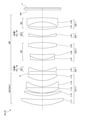
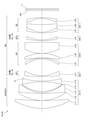
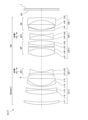
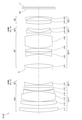
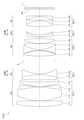
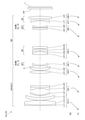
- FIG. 3 are optical systems OL ⁇ OL (1) to OL according to the first to tenth embodiments. It is sectional drawing which shows the structure of (10) ⁇ and the refractive power distribution.
- the moving direction along the optical axis of each lens group when focusing on a short-range object from infinity is indicated by an arrow. Shows.
- the moving direction along the optical axis of each lens group when scaling from the wide-angle end state (W) to the telephoto end state (T) is indicated by an arrow. Shows.
- each lens group is divided into each lens by a combination of the reference numerals G and numbers.
- the lens group and the like are represented by independently using combinations of the reference numerals and numbers for each embodiment. Therefore, even if the same combination of reference numerals and numbers is used between the examples, it does not mean that they have the same configuration.
- Tables 1 to 10 are shown below, of which Table 1 is the first embodiment, Table 2 is the second embodiment, Table 3 is the third embodiment, Table 4 is the fourth embodiment, and Table 5 is the first embodiment.
- Table 6 shows the 6th Example
- Table 7 shows the 7th Example
- Table 8 shows the 8th Example
- Table 9 shows the 9th Example
- Table 10 shows the specification data in the 10th Example. It is a table.
- f is the focal length of the entire lens system
- FNO is the F number
- 2 ⁇ is the angle of view (unit is ° (degrees)
- ⁇ is the half angle of view
- Y is the image height.
- TL indicates the distance from the frontmost surface of the lens to the final surface of the lens on the optical axis at infinity, plus Bf
- Bf is the image from the final surface of the lens on the optical axis at infinity.
- the distance to the surface I (back focus) is shown.
- TL (a) indicates the distance (air equivalent distance) on the optical axis from the lens surface on the most object side of the optical system to the image plane I at the time of focusing at infinity.
- Bf (a) indicates the distance (air equivalent distance) on the optical axis from the lens surface on the image plane side of the optical system to the image plane I at the time of infinity focusing.
- W wide-angle end
- M intermediate focal length
- T telephoto end
- fA indicates the focal length of the preceding lens group.
- fB indicates the combined focal length of the lens group arranged on the image plane side of the first focusing lens group.
- ⁇ F1 indicates the lateral magnification of the first focusing lens group at the time of focusing on an infinity object.
- ⁇ F2 indicates the lateral magnification of the second focusing lens group at the time of focusing on an infinity object.
- MF1 indicates the absolute value of the amount of movement of the first focusing lens group when focusing from an infinite object to a short-distance object.
- MF2 indicates the absolute value of the amount of movement of the second focusing lens group when focusing from an infinite object to a short-distance object.
- the plane numbers indicate the order of the optical planes from the object side along the traveling direction of the light beam
- R is the radius of curvature of each optical plane (the plane whose center of curvature is located on the image side).
- D is the distance on the optical axis from each optical surface to the next optical surface (or image surface)
- nd is the refractive index of the material of the optical member with respect to the d line
- ⁇ d is optical.
- the Abbe numbers based on the d-line of the material of the member are shown. “ ⁇ ” of the radius of curvature indicates a plane or an opening, and (aperture S) indicates an opening aperture S.
- the description of the refractive index nd of air 1.00000 is omitted.
- the table of [Variable spacing data] shows the surface spacing at the surface number i in which the surface spacing is (Di) in the table of [Lens specifications].
- f indicates the focal length of the entire lens system
- ⁇ indicates the photographing magnification.
- D0 indicates the distance from the object to the optical surface on the most object side in the optical system.
- [Variable Interval Data] table [lenses] corresponding to the wide-angle end (W), intermediate focal length (M), and telephoto end (T) magnification states.
- W wide-angle end
- M intermediate focal length
- T telephoto end
- the table of [lens group data] shows the starting surface (the surface closest to the object) and the focal length of each lens group.
- mm is generally used for the focal length f, the radius of curvature R, the plane spacing D, other lengths, etc., unless otherwise specified, but the optical system is expanded proportionally.
- the optical performance is not limited to this because the same optical performance can be obtained even if the proportional reduction is performed.
- FIG. 1 is a diagram showing a lens configuration of an optical system according to the first embodiment.
- the optical system OL (1) according to the first embodiment has a first lens group G1 having a positive refractive power and a second lens group G2 having a negative power, which are arranged in order from the object side along the optical axis. It is composed of a third lens group G3 having a positive refractive power, a fourth lens group G4 having a negative refractive power, and a fifth lens group G5 having a negative refractive power.
- the second lens group G2 and the fourth lens group G4 move toward the image side along the optical axis with different trajectories (movement amounts), and adjacent lenses move to the image side.
- the spacing of the groups changes.
- the positions of the first lens group G1, the third lens group G3, and the fifth lens group G5 are fixed with respect to the image plane I.
- the symbol (+) or ( ⁇ ) attached to each lens group symbol indicates the refractive power of each lens group, and this also applies to all the following examples.
- the aperture stop S is arranged between the first lens group G1 and the second lens group G2. At the time of focusing, the position of the aperture stop S is fixed with respect to the image plane I.
- the first lens group G1 constitutes the front group GA
- the second lens group G2 corresponds to the first in-focus lens group GF1
- the third lens group G3 corresponds to the positive lens group GP
- the fourth lens corresponds to the second in-focus lens group GF2
- the fifth lens group G5 corresponds to the final lens group GE.
- the first lens group G1 has a positive meniscus lens L11 having a convex surface facing the object side, a regular meniscus lens L12 having a convex surface facing the object side, and a convex surface toward the object side, which are arranged in order from the object side along the optical axis.
- the second lens group G2 is composed of a negative meniscus lens L21 having a convex surface facing the object side.
- the third lens group G3 includes a junction lens in which a biconcave negative lens L31 and a biconvex positive lens L32 are joined in order from the object side along the optical axis, and a biconvex positive lens L33. And a biconvex positive lens L34.
- the fourth lens group G4 is composed of a negative lens L41 having a biconcave shape.
- the fifth lens group G5 includes a bonded lens in which a biconvex positive lens L51 arranged in order from the object side along the optical axis and a negative meniscus lens L52 having a concave surface facing the object side are joined, and a bonded lens on the object side. It is composed of a negative meniscus lens L53 with a concave surface facing.
- the image plane I is arranged on the image side of the fifth lens group G5.
- a parallel flat plate PP is arranged between the fifth lens group G5 and the image plane I.
- Table 1 below lists the values of the specifications of the optical system according to the first embodiment.
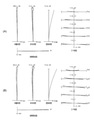
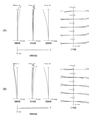
- FIG. 2A is a diagram of various aberrations of the optical system according to the first embodiment at the time of infinity focusing.
- FIG. 2B is a diagram of various aberrations of the optical system according to the first embodiment at the time of short-distance focusing.
- FNO indicates an F number
- Y indicates an image height.
- NA indicates the numerical aperture
- Y indicates the image height.
- the spherical aberration diagram shows the value of the F number or numerical aperture corresponding to the maximum aperture
- the astigmatism diagram and the distortion diagram show the maximum image height
- the coma aberration diagram shows the value of each image height. ..
- the solid line shows the sagittal image plane and the broken line shows the meridional image plane.
- the optical system according to the first embodiment has excellent imaging performance in which various aberrations are satisfactorily corrected in the entire range from infinity focusing to short-distance focusing. You can see that.
- FIG. 3 is a diagram showing a lens configuration of an optical system according to a second embodiment.
- the optical system OL (2) according to the second embodiment has a first lens group G1 having a positive refractive power and a second lens group G2 having a negative power, which are arranged in order from the object side along the optical axis. It is composed of a third lens group G3 having a positive refractive power, a fourth lens group G4 having a negative refractive power, and a fifth lens group G5 having a negative refractive power.
- the second lens group G2 and the fourth lens group G4 move toward the image side along the optical axis with different trajectories (movement amounts), and adjacent lenses move to the image side.
- the spacing of the groups changes.
- the positions of the first lens group G1, the third lens group G3, and the fifth lens group G5 are fixed with respect to the image plane I.
- the aperture stop S is arranged between the first lens group G1 and the second lens group G2. At the time of focusing, the position of the aperture stop S is fixed with respect to the image plane I.
- the first lens group G1 constitutes the front group GA
- the second lens group G2 corresponds to the first in-focus lens group GF1
- the third lens group G3 corresponds to the positive lens group GP
- the fourth lens corresponds to the second in-focus lens group GF2
- the fifth lens group G5 corresponds to the final lens group GE.
- the first lens group G1 has a positive meniscus lens L11 having a convex surface facing the object side, a regular meniscus lens L12 having a convex surface facing the object side, and a biconvex positive lens arranged in order from the object side along the optical axis. It is composed of a bonded lens in which a lens L13 and a biconcave negative lens L14 are bonded, and a positive meniscus lens L15 having a convex surface facing the object side.
- the second lens group G2 is composed of a negative meniscus lens L21 having a convex surface facing the object side.
- the third lens group G3 is a bonded lens in which a negative meniscus lens L31 having a convex surface facing the object side and a positive meniscus lens L32 having a convex surface facing the object side are joined in order from the object side along the optical axis.
- the fourth lens group G4 is composed of a negative meniscus lens L41 having a convex surface facing the object side.
- the fifth lens group G5 is composed of a positive meniscus lens L51 having a convex surface facing the object side and a negative meniscus lens L52 having a concave surface facing the object side, which are arranged in order from the object side along the optical axis.
- the image plane I is arranged on the image side of the fifth lens group G5.
- a parallel flat plate PP is arranged between the fifth lens group G5 and the image plane I.
- Table 2 below lists the values of the specifications of the optical system according to the second embodiment.
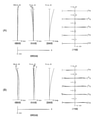
- FIG. 4A is a diagram of various aberrations of the optical system according to the second embodiment at infinity focusing.
- FIG. 4B is a diagram of various aberrations of the optical system according to the second embodiment at the time of short-distance focusing. From each aberration diagram, the optical system according to the second embodiment has excellent imaging performance in which various aberrations are satisfactorily corrected in the entire range from infinity focusing to short-distance focusing. You can see that.
- FIG. 5 is a diagram showing a lens configuration of an optical system according to a third embodiment.
- the optical system OL (3) according to the third embodiment has a first lens group G1 having a positive refractive power and a second lens group G2 having a negative power, which are arranged in order from the object side along the optical axis. It is composed of a third lens group G3 having a positive refractive power, a fourth lens group G4 having a negative refractive power, and a fifth lens group G5 having a negative refractive power.
- the second lens group G2 and the fourth lens group G4 move toward the image side along the optical axis with different trajectories (movement amounts), and adjacent lenses move to the image side.
- the spacing of the groups changes.
- the positions of the first lens group G1, the third lens group G3, and the fifth lens group G5 are fixed with respect to the image plane I.
- the aperture stop S is arranged between the first lens group G1 and the second lens group G2. At the time of focusing, the position of the aperture stop S is fixed with respect to the image plane I.
- the first lens group G1 constitutes the front group GA
- the second lens group G2, the third lens group G3, the fourth lens group G4, and the fifth lens group G5 form the rear group GB.
- the first lens group G1 corresponds to the preceding lens group GA1
- the second lens group G2 corresponds to the first in-focus lens group GF1
- the third lens group G3 corresponds to the positive lens group GP
- the fourth lens corresponds to the second in-focus lens group GF2
- the fifth lens group G5 corresponds to the final lens group GE.
- the first lens group G1 includes a positive meniscus lens L11 having a convex surface facing the object side, a regular meniscus lens L12 having a convex surface facing the object side, and a biconvex positive lens, which are arranged in order from the object side along the optical axis. It is composed of a bonded lens in which a lens L13 and a biconcave negative lens L14 are bonded.
- the second lens group G2 is composed of a negative meniscus lens L21 having a convex surface facing the object side.
- the third lens group G3 is composed of a biconvex positive lens L31.
- the fourth lens group G4 is composed of a negative meniscus lens L41 having a convex surface facing the object side.
- the fifth lens group G5 is composed of a positive meniscus lens L51 having a convex surface facing the object side and a negative meniscus lens L52 having a concave surface facing the object side, which are arranged in order from the object side along the optical axis.
- the image plane I is arranged on the image side of the fifth lens group G5.
- a parallel flat plate PP is arranged between the fifth lens group G5 and the image plane I.
- Table 3 below lists the values of the specifications of the optical system according to the third embodiment.
- FIG. 6A is a diagram of various aberrations of the optical system according to the third embodiment at the time of infinity focusing.
- FIG. 6B is a diagram of various aberrations of the optical system according to the third embodiment at the time of short-distance focusing. From each aberration diagram, the optical system according to the third embodiment has excellent imaging performance in which various aberrations are satisfactorily corrected in the entire range from infinity focusing to short-distance focusing. You can see that.
- FIG. 7 is a diagram showing a lens configuration of an optical system according to a fourth embodiment.
- the optical system OL (4) according to the fourth embodiment has a first lens group G1 having a positive refractive power and a second lens group G2 having a negative power, which are arranged in order from the object side along the optical axis. It is composed of a third lens group G3 having a positive refractive power, a fourth lens group G4 having a negative refractive power, and a fifth lens group G5 having a negative refractive power.
- the second lens group G2 and the fourth lens group G4 move toward the image side along the optical axis with different trajectories (movement amounts), and adjacent lenses move to the image side.
- the spacing of the groups changes.
- the positions of the first lens group G1, the third lens group G3, and the fifth lens group G5 are fixed with respect to the image plane I.
- the aperture stop S is arranged between the first lens group G1 and the second lens group G2. At the time of focusing, the position of the aperture stop S is fixed with respect to the image plane I.
- the first lens group G1 constitutes the front group GA
- the second lens group G2 corresponds to the first in-focus lens group GF1
- the third lens group G3 corresponds to the positive lens group GP
- the fourth lens corresponds to the second in-focus lens group GF2
- the fifth lens group G5 corresponds to the final lens group GE.
- the first lens group G1 includes a positive meniscus lens L11 having a convex surface facing the object side, a regular meniscus lens L12 having a convex surface facing the object side, and a convex surface facing the object side, which are arranged in order from the object side along the optical axis. It is composed of a bonded lens to which a negative meniscus lens L13 is bonded and a bonded lens to which a biconvex positive lens L14 and a biconcave negative lens L15 are bonded.
- the second lens group G2 is composed of a negative meniscus lens L21 having a convex surface facing the object side.
- the third lens group G3 includes a negative meniscus lens L31 having a concave surface facing the object side, a positive meniscus lens L32 having a concave surface facing the object side, and a biconvex positive lens arranged in order from the object side along the optical axis. It is composed of a lens L33.
- the fourth lens group G4 is composed of a negative meniscus lens L41 having a convex surface facing the object side.
- the fifth lens group G5 has a negative meniscus lens L51 having a convex surface facing the object side, a positive meniscus lens L52 having a convex surface facing the object side, and a concave surface facing the object side, arranged in order from the object side along the optical axis. It is composed of a negative meniscus lens L53 directed toward the object.
- the image plane I is arranged on the image side of the fifth lens group G5.
- a parallel flat plate PP is arranged between the fifth lens group G5 and the image plane I.
- Table 4 lists the values of the specifications of the optical system according to the fourth embodiment.
- FIG. 8A is a diagram of various aberrations of the optical system according to the fourth embodiment at the time of infinity focusing.
- FIG. 8B is a diagram of various aberrations of the optical system according to the fourth embodiment at the time of short-distance focusing. From each aberration diagram, the optical system according to the fourth embodiment has excellent imaging performance in which various aberrations are satisfactorily corrected in the entire range from infinity focusing to short-distance focusing. You can see that.
- FIG. 9 is a diagram showing a lens configuration of an optical system according to a fifth embodiment.
- the optical system OL (5) according to the fifth embodiment has a first lens group G1 having a positive refractive power and a second lens group G2 having a negative power, which are arranged in order from the object side along the optical axis. It is composed of a third lens group G3 having a positive refractive power, a fourth lens group G4 having a negative refractive power, and a fifth lens group G5 having a negative refractive power.
- the second lens group G2 and the fourth lens group G4 move toward the image side along the optical axis with different trajectories (movement amounts), and adjacent lenses move to the image side.
- the spacing of the groups changes.
- the positions of the first lens group G1, the third lens group G3, and the fifth lens group G5 are fixed with respect to the image plane I.
- the aperture stop S is arranged between the first lens group G1 and the second lens group G2. At the time of focusing, the position of the aperture stop S is fixed with respect to the image plane I.
- the first lens group G1 constitutes the front group GA
- the second lens group G2 corresponds to the first in-focus lens group GF1
- the third lens group G3 corresponds to the positive lens group GP
- the fourth lens corresponds to the second in-focus lens group GF2
- the fifth lens group G5 corresponds to the final lens group GE.
- a positive meniscus lens L11 having a convex surface facing the object side arranged in order from the object side along the optical axis, a biconvex positive lens L12, and a biconcave negative lens L13 are joined. It is composed of a bonded lens, and a bonded lens in which a negative meniscus lens L14 having a convex surface facing the object side and a positive meniscus lens L15 having a convex surface facing the object side are bonded.
- the second lens group G2 is composed of a bonded lens having a negative refractive power, in which a positive meniscus lens L21 having a concave surface facing the object side and a biconcave negative lens L22 are joined in order from the object side.
- the third lens group G3 is composed of a biconvex positive lens L31 arranged in order from the object side along the optical axis, and a negative meniscus lens L32 with a concave surface facing the object side.
- the fourth lens group G4 is composed of a bonded lens having a negative refractive power in which a biconvex positive lens L41 and a biconcave negative lens L42 are joined in order from the object side.
- the fifth lens group G5 includes a bonded lens in which a negative meniscus lens L51 having a convex surface facing the object side and a biconvex positive lens L52, which are arranged in order from the object side along the optical axis, and a bonded lens on the object side. It is composed of a negative meniscus lens L53 with a concave surface facing.
- the image plane I is arranged on the image side of the fifth lens group G5.
- a parallel flat plate PP is arranged between the fifth lens group G5 and the image plane I.
- Table 5 lists the values of the specifications of the optical system according to the fifth embodiment.
- FIG. 10A is a diagram of various aberrations of the optical system according to the fifth embodiment at the time of infinity focusing.
- FIG. 10B is a diagram of various aberrations of the optical system according to the fifth embodiment at the time of short-distance focusing. From each aberration diagram, the optical system according to the fifth embodiment has excellent imaging performance in which various aberrations are satisfactorily corrected in the entire range from infinity focusing to short-distance focusing. You can see that.
- FIG. 11 is a diagram showing a lens configuration of an optical system according to a sixth embodiment.
- the first lens group G1 having a positive refractive power and the second lens group G2 having a negative refractive power arranged in order from the object side along the optical axis. It is composed of a third lens group G3 having a positive refractive power, a fourth lens group G4 having a negative refractive power, and a fifth lens group G5 having a negative refractive power.
- the second lens group G2 and the fourth lens group G4 move toward the image side along the optical axis with different trajectories (movement amounts), and adjacent lenses move to the image side.
- the spacing of the groups changes.
- the positions of the first lens group G1, the third lens group G3, and the fifth lens group G5 are fixed with respect to the image plane I.
- the aperture stop S is arranged between the first lens group G1 and the second lens group G2. At the time of focusing, the position of the aperture stop S is fixed with respect to the image plane I.
- the first lens group G1 constitutes the front group GA
- the second lens group G2, the third lens group G3, the fourth lens group G4, and the fifth lens group G5 form the rear group GB.
- the first lens group G1 corresponds to the preceding lens group GA1
- the second lens group G2 corresponds to the first in-focus lens group GF1
- the third lens group G3 corresponds to the positive lens group GP
- the fourth lens corresponds to the second in-focus lens group GF2
- the fifth lens group G5 corresponds to the final lens group GE.
- the first lens group G1 has a positive meniscus lens L11 having a convex surface facing the object side, a regular meniscus lens L12 having a convex surface facing the object side, and a convex surface toward the object side, which are arranged in order from the object side along the optical axis.
- the second lens group G2 is composed of a bonded lens having a negative refractive power in which a negative meniscus lens L21 having a convex surface facing the object side and a negative meniscus lens L22 having a convex surface facing the object side are joined in order from the object side. Will be done.
- the third lens group G3 consists of a bonded lens in which a biconcave negative lens L31 and a biconvex positive lens L32 are joined in order from the object side along the optical axis, and a convex surface is directed toward the object side. It is composed of a positive meniscus lens L33 and a biconvex positive lens L34.
- the fourth lens group G4 is composed of a negative meniscus lens L41 having a convex surface facing the object side.
- the fifth lens group G5 includes a bonded lens in which a biconvex positive lens L51 arranged in order from the object side along the optical axis and a negative meniscus lens L52 having a concave surface facing the object side are joined, and a bonded lens on the object side. It is composed of a negative meniscus lens L53 with a concave surface facing.
- the image plane I is arranged on the image side of the fifth lens group G5.
- a parallel flat plate PP is arranged between the fifth lens group G5 and the image plane I.
- Table 6 lists the values of the specifications of the optical system according to the sixth embodiment.
- FIG. 12A is a diagram of various aberrations of the optical system according to the sixth embodiment at infinity focusing.
- FIG. 12B is a diagram of various aberrations of the optical system according to the sixth embodiment at the time of short-distance focusing. From each aberration diagram, the optical system according to the sixth embodiment has excellent imaging performance in which various aberrations are satisfactorily corrected in the entire range from infinity focusing to short-distance focusing. You can see that.
- FIG. 13 is a diagram showing a lens configuration of an optical system according to a seventh embodiment.
- the optical system OL (7) according to the seventh embodiment has a first lens group G1 having a positive refractive power and a second lens group G2 having a negative power, which are arranged in order from the object side along the optical axis. It is composed of a third lens group G3 having a positive refractive power, a fourth lens group G4 having a negative refractive power, and a fifth lens group G5 having a negative refractive power.
- the second lens group G2 and the fourth lens group G4 move toward the image side along the optical axis with different trajectories (movement amounts), and adjacent lenses move to the image side.
- the spacing of the groups changes.
- the positions of the first lens group G1, the third lens group G3, and the fifth lens group G5 are fixed with respect to the image plane I.
- the aperture stop S is arranged between the first lens group G1 and the second lens group G2. At the time of focusing, the position of the aperture stop S is fixed with respect to the image plane I.
- the first lens group G1 constitutes the front group GA
- the second lens group G2, the third lens group G3, the fourth lens group G4, and the fifth lens group G5 form the rear group GB.
- the first lens group G1 corresponds to the preceding lens group GA1
- the second lens group G2 corresponds to the first in-focus lens group GF1
- the third lens group G3 corresponds to the positive lens group GP
- the fourth lens corresponds to the second in-focus lens group GF2
- the fifth lens group G5 corresponds to the final lens group GE.
- a positive meniscus lens L11 having a convex surface facing the object side arranged in order from the object side along the optical axis, a biconvex positive lens L12, and a biconcave negative lens L13 are joined. It is composed of a bonded lens, and a bonded lens in which a negative meniscus lens L14 having a convex surface facing the object side and a positive meniscus lens L15 having a convex surface facing the object side are bonded.
- the second lens group G2 is composed of a bonded lens having a negative refractive power, in which a positive meniscus lens L21 having a concave surface facing the object side and a biconcave negative lens L22 are joined in order from the object side.
- the third lens group G3 is a bonded lens in which a biconvex positive lens L31 arranged in order from the object side along the optical axis and a negative meniscus lens having a concave surface facing the object side are joined, and a convex surface on the object side. It is composed of a bonded lens in which a negative meniscus lens L33 facing the lens and a biconvex positive lens L34 are bonded.
- the fourth lens group G4 is composed of a bonded lens having a negative refractive power, in which a positive meniscus lens L41 having a concave surface facing the object side and a biconcave negative lens L42 are bonded in order from the object side.
- the fifth lens group G5 includes a negative meniscus lens L51 having a convex surface facing the object side, a biconvex positive lens L52, and a negative meniscus having a concave surface facing the object side, arranged in order from the object side along the optical axis. It is composed of a lens L53.
- the image plane I is arranged on the image side of the fifth lens group G5.
- a parallel flat plate PP is arranged between the fifth lens group G5 and the image plane I.
- Table 7 lists the values of the specifications of the optical system according to the seventh embodiment.
- FIG. 14A is a diagram of various aberrations of the optical system according to the seventh embodiment at the time of infinity focusing.
- FIG. 14B is a diagram of various aberrations of the optical system according to the seventh embodiment during short-distance focusing. From each aberration diagram, the optical system according to the seventh embodiment has excellent imaging performance in which various aberrations are satisfactorily corrected in the entire range from infinity focusing to short-distance focusing. You can see that.
- FIG. 15 is a diagram showing a lens configuration of an optical system according to an eighth embodiment.
- the optical system OL (8) according to the eighth embodiment has a first lens group G1 having a positive refractive power and a second lens group G2 having a negative refractive power arranged in order from the object side along the optical axis. It is composed of a third lens group G3 having a positive refractive power, a fourth lens group G4 having a negative refractive power, and a fifth lens group G5 having a negative refractive power.
- the second lens group G2 and the fourth lens group G4 move toward the image side along the optical axis with different trajectories (movement amounts), and adjacent lenses move to the image side.
- the spacing of the groups changes.
- the positions of the first lens group G1, the third lens group G3, and the fifth lens group G5 are fixed with respect to the image plane I.
- the aperture stop S is arranged between the second lens group G2 and the third lens group G3. At the time of focusing, the position of the aperture stop S is fixed with respect to the image plane I.
- the first lens group G1 corresponds to the preceding lens group GA1
- the second lens group G2 corresponds to the first in-focus lens group GF1
- the third lens group G3 corresponds to the positive lens group GP.
- the fourth lens group G4 corresponds to the second in-focus lens group GF2
- the fifth lens group G5 corresponds to the final lens group GE.
- the first lens group G1 has a positive meniscus lens L11 having a convex surface facing the object side, a regular meniscus lens L12 having a convex surface facing the object side, and a biconvex positive lens arranged in order from the object side along the optical axis. It is composed of a bonded lens in which a lens L13 and a biconcave negative lens L14 are bonded, and a positive meniscus lens L15 having a convex surface facing the object side.
- the second lens group G2 is composed of a biconcave negative lens L21.
- the third lens group G3 includes a biconvex positive lens L31, a biconcave negative lens L32, a biconvex positive lens L33, and a biconvex positive lens L31 arranged in order from the object side along the optical axis. It is composed of a positive lens L34.
- the fourth lens group G4 is composed of a bonded lens having a negative refractive power in which a negative lens L41 having a concave shape and a positive meniscus lens L42 having a convex surface facing the object side are bonded in order from the object side.
- the fifth lens group G5 is composed of a positive meniscus lens L51 having a convex surface facing the object side and a negative meniscus lens L52 having a concave surface facing the object side, which are arranged in order from the object side along the optical axis.
- the image plane I is arranged on the image side of the fifth lens group G5.
- a parallel flat plate PP is arranged between the fifth lens group G5 and the image plane I.
- Table 8 lists the values of the specifications of the optical system according to the eighth embodiment.
- FIG. 16A is a diagram of various aberrations of the optical system according to the eighth embodiment when focusing at infinity.
- FIG. 16B is a diagram of various aberrations of the optical system according to the eighth embodiment at the time of short-distance focusing. From each aberration diagram, the optical system according to the eighth embodiment has excellent imaging performance in which various aberrations are satisfactorily corrected in the entire range from infinity focusing to short-distance focusing. You can see that.
- FIG. 17 is a diagram showing a lens configuration of an optical system according to a ninth embodiment.
- the optical system OL (9) according to the ninth embodiment has a first lens group G1 having a positive refractive power and a second lens group G2 having a negative power, which are arranged in order from the object side along the optical axis. It is composed of a third lens group G3 having a positive refractive power, a fourth lens group G4 having a negative refractive power, and a fifth lens group G5 having a negative refractive power.
- the second lens group G2 and the fourth lens group G4 move toward the image side along the optical axis with different trajectories (movement amounts), and adjacent lenses move to the image side.
- the spacing of the groups changes.
- the positions of the first lens group G1, the third lens group G3, and the fifth lens group G5 are fixed with respect to the image plane I.
- the aperture stop S is arranged between the second lens group G2 and the third lens group G3. At the time of focusing, the position of the aperture stop S is fixed with respect to the image plane I.
- the first lens group G1 corresponds to the preceding lens group GA1
- the second lens group G2 corresponds to the first in-focus lens group GF1
- the third lens group G3 corresponds to the positive lens group GP.
- the fourth lens group G4 corresponds to the second in-focus lens group GF2
- the fifth lens group G5 corresponds to the final lens group GE.
- the first lens group G1 is a bonded lens in which a biconvex positive lens L11, a biconvex positive lens L12, and a biconcave negative lens L13 are joined in order from the object side along the optical axis. And a positive meniscus lens L14 with a convex surface facing the object side.
- the second lens group G2 is composed of a bonded lens having a negative refractive power in which a biconvex positive lens L21 and a biconcave negative lens L22 are joined in order from the object side.
- the third lens group G3 is a bonded lens in which a biconvex positive lens L31, a biconcave negative lens L32, and a biconvex positive lens L33 are joined in order from the object side along the optical axis. And a biconvex positive lens L34.
- the fourth lens group G4 is composed of a bonded lens having a negative refractive power in which a negative meniscus lens L41 having a convex surface facing the object side and a positive meniscus lens L42 having a convex surface facing the object side are joined in order from the object side. Will be done.
- the fifth lens group G5 includes a bonded lens in which a biconvex positive lens L51 arranged in order from the object side along the optical axis and a negative meniscus lens L52 having a concave surface facing the object side are joined, and a bonded lens on the object side. It is composed of a negative meniscus lens L53 with a concave surface facing.
- the image plane I is arranged on the image side of the fifth lens group G5.
- a parallel flat plate PP is arranged between the fifth lens group G5 and the image plane I.
- Table 9 lists the values of the specifications of the optical system according to the ninth embodiment.
- FIG. 18A is a diagram of various aberrations of the optical system according to the ninth embodiment at infinity focusing.
- FIG. 18B is a diagram of various aberrations of the optical system according to the ninth embodiment at the time of short-distance focusing. From each aberration diagram, the optical system according to the ninth embodiment has excellent imaging performance in which various aberrations are satisfactorily corrected in the entire range from infinity focusing to short-distance focusing. You can see that.
- FIG. 19 is a diagram showing a lens configuration of an optical system according to a tenth embodiment.
- the optical system OL (10) according to the tenth embodiment has a first lens group G1 having a positive refractive power and a second lens group G2 having a negative refractive power arranged in order from the object side along the optical axis.
- the first lens group G1 to G8 move toward the object along the optical axis, and the distance between adjacent lens groups changes. do. Further, when focusing from an infinite object to a short-distance object, the fourth lens group G4 and the sixth lens group G6 move toward the image side along the optical axis with different trajectories (movement amounts).
- the first lens group G1, the second lens group G2, the third lens group G3, the fifth lens group G5, the seventh lens group G7, and the eighth lens group G8 refer to the image plane I. The position is fixed.
- the aperture stop S is arranged between the third lens group G3 and the fourth lens group G4. At the time of scaling, the aperture stop S moves along the optical axis together with the third lens group G3. Further, at the time of focusing, the position of the aperture stop S is fixed with respect to the image plane I together with the third lens group G3.
- the first lens group G1, the second lens group G2, and the third lens group G3 constitute the front group GA
- the fourth lens group G4 the fifth lens group G5, the sixth lens group G6, and the third lens group G3.
- the 7 lens group G7 and the 8th lens group G8 constitute the rear group GB. Further, the first lens group G1, the second lens group G2, and the third lens group G3 correspond to the preceding lens group GA1.
- the fourth lens group G4 corresponds to the first in-focus lens group GF1
- the fifth lens group G5 corresponds to the positive lens group GP
- the sixth lens group G6 corresponds to the second in-focus lens group GF2.
- the 7th lens group G7 and the 8th lens group G8 correspond to the final lens group GE.
- the value of the parameter corresponding to each of the above-mentioned conditional expressions (1) to (20) is the value of the parameter in the wide-angle end state.
- the focal length of the leading lens group GA1 is the focal length of the leading lens group GA1 in the wide-angle end state, that is, the combined focal length of the first lens group G1, the second lens group G2, and the third lens group G3 in the wide-angle end state. ..
- the focal length of the final lens group GE is the focal length of the final lens group GE in the wide-angle end state, that is, the combined focal length of the 7th lens group G7 and the 8th lens group G8 in the wide-angle end state.
- the first lens group G1 includes a bonded lens in which a negative meniscus lens L11 having a convex surface facing the object side and a biconvex positive lens L12, which are arranged in order from the object side along the optical axis, are bonded to the object side. It is composed of a positive meniscus lens L13 with a convex surface facing and a positive meniscus lens L13.
- the second lens group G2 includes a negative meniscus lens L21 having a convex surface facing the object side, a biconcave negative lens L22, and a positive meniscus lens having a convex surface facing the object side, arranged in order from the object side along the optical axis. It is composed of a bonded lens to which L23 is bonded and a bonded lens.
- the third lens group G3 is composed of a biconvex positive lens L31 arranged in order from the object side along the optical axis, and a positive meniscus lens L32 with a convex surface facing the object side.
- the fourth lens group G4 is composed of a negative meniscus lens L41 having a convex surface facing the object side.
- the fifth lens group G5 includes a bonded lens in which a biconvex positive lens L51 arranged in order from the object side along the optical axis and a negative meniscus lens L52 having a concave surface facing the object side are bonded to the object side. It is composed of a positive meniscus lens L53 with a concave surface and a biconvex positive lens L54.
- the sixth lens group G6 is composed of a positive meniscus lens L61 having a convex surface facing the object side and a negative meniscus lens L62 having a convex surface facing the object side, which are arranged in order from the object side along the optical axis.
- the 7th lens group G7 is composed of a biconcave negative lens L71.
- the eighth lens group G8 is composed of a biconvex positive lens L81.
- the image plane I is arranged on the image side of the eighth lens group G8.
- a parallel flat plate PP is arranged between the eighth lens group G8 and the image plane I.
- Table 10 lists the values of the specifications of the optical system according to the tenth embodiment.
- FIG. 20A is an aberration diagram at infinity focusing in the wide-angle end state of the optical system according to the tenth embodiment.
- FIG. 20B is a diagram of various aberrations at the time of short-distance focusing in the wide-angle end state of the optical system according to the tenth embodiment.
- FIG. 21 (A) is a diagram of various aberrations at the time of infinity focusing in the telephoto end state of the optical system according to the tenth embodiment.
- FIG. 21B is a diagram of various aberrations at the time of short-distance focusing in the telephoto end state of the optical system according to the tenth embodiment.
- the optical system according to the tenth embodiment satisfactorily corrects various aberrations not only in the wide-angle end state but also in the telephoto end state in the entire range from infinity focusing to short-distance focusing. It can be seen that it has excellent imaging performance.
- Conditional expression (1) 0.30 ⁇ STL / TL ⁇ 0.90
- Conditional expression (2) 0.50 ⁇ fA / f ⁇ 2.000
- Conditional expression (3) 0.50 ⁇ fA / (-fF1) ⁇ 1.50
- Conditional expression (4) 0.35 ⁇ fB / (-fF1) ⁇ 1.50
- Conditional expression (5) -2.00 ⁇ (-fE) / f ⁇ 15.00
- Conditional expression (6) -1.00 ⁇ fP / (-fE) ⁇ 1.50
- Conditional expression (7) 1.10 ⁇ (-fF1) /fP ⁇ 3.20
- Conditional expression (8) 0.30 ⁇ fP / f ⁇ 1.00
- Conditional expression (9) 0.10 ⁇ fF1 / fF2 ⁇ 2.000
- Conditional expression (10) 0.50 ⁇ f / (-fF1) ⁇
- a 5-group configuration and an 8-group configuration are shown, but the present application is not limited to this, and other group configurations (for example, 6-group, 9-group, etc.) are configured. You can also do it.
- a lens or a lens group may be added to the most object side or the most image plane side of the optical system of the present embodiment.
- the lens group refers to a portion having at least one lens separated by an air interval that changes at the time of focusing or scaling.
- the lens group or partial lens group is moved so as to have a component in the direction perpendicular to the optical axis, or is rotationally moved (swinged) in the in-plane direction including the optical axis to correct image blur caused by camera shake. It may be used as an anti-vibration lens group.
- the lens surface may be formed of a spherical surface or a flat surface, or may be formed of an aspherical surface.
- lens processing and assembly adjustment are facilitated, and deterioration of optical performance due to processing and assembly adjustment errors can be prevented, which is preferable. Further, even if the image plane is displaced, the deterioration of the depiction performance is small, which is preferable.
- the aspherical surface is an aspherical surface formed by grinding, a glass mold aspherical surface formed by forming glass into an aspherical surface shape, or a composite aspherical surface formed by forming resin on the glass surface into an aspherical surface shape. It doesn't matter which one. Further, the lens surface may be a diffraction surface, and the lens may be a refractive index distribution type lens (GRIN lens) or a plastic lens.
- GRIN lens refractive index distribution type lens
- the aperture diaphragm is arranged between the first lens group and the second lens group, between the second lens group and the third lens group, or between the third lens group and the fourth lens group.
- the role may be substituted by the frame of the lens without providing the member as the aperture diaphragm.
- Each lens surface may be provided with an antireflection film having high transmittance in a wide wavelength range in order to reduce flare and ghost and achieve high contrast optical performance.
- G1 1st lens group G2 2nd lens group G3 3rd lens group G4 4th lens group G5 5th lens group G6 6th lens group G7 7th lens group G8 8th lens group I image plane S aperture aperture
Landscapes
- Physics & Mathematics (AREA)
- General Physics & Mathematics (AREA)
- Optics & Photonics (AREA)
- Nonlinear Science (AREA)
- Lenses (AREA)
Priority Applications (5)
| Application Number | Priority Date | Filing Date | Title |
|---|---|---|---|
| JP2022543348A JPWO2022039005A1 (https=) | 2020-08-18 | 2021-07-30 | |
| US18/022,136 US20230324658A1 (en) | 2020-08-18 | 2021-07-30 | Optical system, optical apparatus and method for manufacturing the optical system |
| CN202180049687.6A CN115812171A (zh) | 2020-08-18 | 2021-07-30 | 光学系统、光学设备及光学系统的制造方法 |
| JP2024001588A JP2024024097A (ja) | 2020-08-18 | 2024-01-10 | 光学系および光学機器 |
| JP2025181530A JP2026003039A (ja) | 2020-08-18 | 2025-10-28 | 光学系および光学機器 |
Applications Claiming Priority (2)
| Application Number | Priority Date | Filing Date | Title |
|---|---|---|---|
| JP2020138020 | 2020-08-18 | ||
| JP2020-138020 | 2020-08-18 |
Publications (1)
| Publication Number | Publication Date |
|---|---|
| WO2022039005A1 true WO2022039005A1 (ja) | 2022-02-24 |
Family
ID=80322653
Family Applications (1)
| Application Number | Title | Priority Date | Filing Date |
|---|---|---|---|
| PCT/JP2021/028398 Ceased WO2022039005A1 (ja) | 2020-08-18 | 2021-07-30 | 光学系、光学機器、および光学系の製造方法 |
Country Status (4)
| Country | Link |
|---|---|
| US (1) | US20230324658A1 (https=) |
| JP (3) | JPWO2022039005A1 (https=) |
| CN (1) | CN115812171A (https=) |
| WO (1) | WO2022039005A1 (https=) |
Cited By (2)
| Publication number | Priority date | Publication date | Assignee | Title |
|---|---|---|---|---|
| JP2023134075A (ja) * | 2022-03-14 | 2023-09-27 | 株式会社タムロン | 光学系及び撮像装置 |
| JP2024024097A (ja) * | 2020-08-18 | 2024-02-21 | 株式会社ニコン | 光学系および光学機器 |
Families Citing this family (3)
| Publication number | Priority date | Publication date | Assignee | Title |
|---|---|---|---|---|
| CN115997151A (zh) * | 2020-07-09 | 2023-04-21 | 株式会社尼康 | 光学系统、光学设备以及光学系统的制造方法 |
| JP2022114767A (ja) * | 2021-01-27 | 2022-08-08 | キヤノン株式会社 | 光学系、撮像装置、車載システムおよび移動装置 |
| EP4345521A3 (en) * | 2022-09-30 | 2024-06-12 | Samsung Electro-Mechanics Co., Ltd. | Imaging lens system |
Citations (4)
| Publication number | Priority date | Publication date | Assignee | Title |
|---|---|---|---|---|
| JP2009169051A (ja) * | 2008-01-16 | 2009-07-30 | Canon Inc | ズームレンズ及びそれを有する撮像装置 |
| JP2016118770A (ja) * | 2014-12-22 | 2016-06-30 | パナソニックIpマネジメント株式会社 | レンズ系、交換レンズ装置及びカメラシステム |
| JP2019184968A (ja) * | 2018-04-17 | 2019-10-24 | オリンパス株式会社 | 結像光学系及びそれを備えた撮像装置 |
| JP2019191229A (ja) * | 2018-04-19 | 2019-10-31 | 株式会社シグマ | 結像光学系 |
Family Cites Families (4)
| Publication number | Priority date | Publication date | Assignee | Title |
|---|---|---|---|---|
| JPWO2014129187A1 (ja) * | 2013-02-22 | 2017-02-02 | パナソニックIpマネジメント株式会社 | ズームレンズ系、交換レンズ装置及びカメラシステム |
| JP6340923B2 (ja) * | 2014-06-02 | 2018-06-13 | コニカミノルタ株式会社 | ズームレンズ,撮像光学装置及びデジタル機器 |
| JP7134473B2 (ja) * | 2018-07-25 | 2022-09-12 | 株式会社シグマ | 結像光学系 |
| JPWO2022039005A1 (https=) * | 2020-08-18 | 2022-02-24 |
-
2021
- 2021-07-30 JP JP2022543348A patent/JPWO2022039005A1/ja active Pending
- 2021-07-30 WO PCT/JP2021/028398 patent/WO2022039005A1/ja not_active Ceased
- 2021-07-30 CN CN202180049687.6A patent/CN115812171A/zh active Pending
- 2021-07-30 US US18/022,136 patent/US20230324658A1/en active Pending
-
2024
- 2024-01-10 JP JP2024001588A patent/JP2024024097A/ja active Pending
-
2025
- 2025-10-28 JP JP2025181530A patent/JP2026003039A/ja active Pending
Patent Citations (4)
| Publication number | Priority date | Publication date | Assignee | Title |
|---|---|---|---|---|
| JP2009169051A (ja) * | 2008-01-16 | 2009-07-30 | Canon Inc | ズームレンズ及びそれを有する撮像装置 |
| JP2016118770A (ja) * | 2014-12-22 | 2016-06-30 | パナソニックIpマネジメント株式会社 | レンズ系、交換レンズ装置及びカメラシステム |
| JP2019184968A (ja) * | 2018-04-17 | 2019-10-24 | オリンパス株式会社 | 結像光学系及びそれを備えた撮像装置 |
| JP2019191229A (ja) * | 2018-04-19 | 2019-10-31 | 株式会社シグマ | 結像光学系 |
Cited By (3)
| Publication number | Priority date | Publication date | Assignee | Title |
|---|---|---|---|---|
| JP2024024097A (ja) * | 2020-08-18 | 2024-02-21 | 株式会社ニコン | 光学系および光学機器 |
| JP2023134075A (ja) * | 2022-03-14 | 2023-09-27 | 株式会社タムロン | 光学系及び撮像装置 |
| JP7821638B2 (ja) | 2022-03-14 | 2026-02-27 | 株式会社タムロン | 光学系及び撮像装置 |
Also Published As
| Publication number | Publication date |
|---|---|
| US20230324658A1 (en) | 2023-10-12 |
| CN115812171A (zh) | 2023-03-17 |
| JP2024024097A (ja) | 2024-02-21 |
| JPWO2022039005A1 (https=) | 2022-02-24 |
| JP2026003039A (ja) | 2026-01-08 |
Similar Documents
| Publication | Publication Date | Title |
|---|---|---|
| US11598940B2 (en) | Variable magnification optical system, optical apparatus, and method for producing variable magnification optical system | |
| US11061210B2 (en) | Variable magnification optical system, optical device, and manufacturing method for variable magnification optical system | |
| WO2022039005A1 (ja) | 光学系、光学機器、および光学系の製造方法 | |
| US20200278521A1 (en) | Variable power optical system, optical device and method for manufacturing variable power optical system | |
| JP5423656B2 (ja) | 撮影レンズ、及び、この撮影レンズを有する光学機器 | |
| JP2011017912A (ja) | 変倍光学系、この変倍光学系を備える光学機器、及び、変倍光学系の製造方法 | |
| WO2009139253A1 (ja) | 変倍光学系、この変倍光学系を備えた光学機器、及び、変倍光学系の製造方法 | |
| JP7491416B2 (ja) | 変倍光学系および光学機器 | |
| WO2018012624A1 (ja) | 変倍光学系、光学機器及び変倍光学系の製造方法 | |
| CN110520777A (zh) | 变倍光学系统、光学装置和制造变倍光学系统的方法 | |
| WO2017057662A1 (ja) | ズームレンズ、光学機器及びズームレンズの製造方法 | |
| JP7439839B2 (ja) | 変倍光学系および光学機器 | |
| JP2025143519A (ja) | 変倍光学系および光学機器 | |
| CN116324567B (zh) | 变倍光学系统、光学设备及变倍光学系统的制造方法 | |
| JP2017211496A (ja) | 大口径防振付きズームレンズ | |
| JP2022036249A (ja) | 変倍光学系及び光学機器 | |
| WO2021039697A1 (ja) | 変倍光学系、光学機器および変倍光学系の製造方法 | |
| CN114286960A (zh) | 变倍光学系统、光学设备及变倍光学系统的制造方法 | |
| JP2024009261A (ja) | 光学系および光学機器 | |
| JP7677621B2 (ja) | 変倍結像光学系 | |
| JP7324429B2 (ja) | 光学系、及び光学機器 | |
| WO2013111539A1 (ja) | ズームレンズ、光学機器及びズームレンズの製造方法 | |
| WO2022009588A1 (ja) | 光学系、光学機器、および光学系の製造方法 | |
| JP6281200B2 (ja) | 変倍光学系及び光学装置 | |
| US20220317424A1 (en) | Zoom optical system, optical apparatus and method for manufacturing the zoom optical system |
Legal Events
| Date | Code | Title | Description |
|---|---|---|---|
| 121 | Ep: the epo has been informed by wipo that ep was designated in this application |
Ref document number: 21858153 Country of ref document: EP Kind code of ref document: A1 |
|
| ENP | Entry into the national phase |
Ref document number: 2022543348 Country of ref document: JP Kind code of ref document: A |
|
| NENP | Non-entry into the national phase |
Ref country code: DE |
|
| 122 | Ep: pct application non-entry in european phase |
Ref document number: 21858153 Country of ref document: EP Kind code of ref document: A1 |