WO2022038899A1 - 積層フィルム - Google Patents
積層フィルム Download PDFInfo
- Publication number
- WO2022038899A1 WO2022038899A1 PCT/JP2021/024142 JP2021024142W WO2022038899A1 WO 2022038899 A1 WO2022038899 A1 WO 2022038899A1 JP 2021024142 W JP2021024142 W JP 2021024142W WO 2022038899 A1 WO2022038899 A1 WO 2022038899A1
- Authority
- WO
- WIPO (PCT)
- Prior art keywords
- coating layer
- resin
- film
- fine particles
- mass
- Prior art date
- Legal status (The legal status is an assumption and is not a legal conclusion. Google has not performed a legal analysis and makes no representation as to the accuracy of the status listed.)
- Ceased
Links
Classifications
-
- B—PERFORMING OPERATIONS; TRANSPORTING
- B32—LAYERED PRODUCTS
- B32B—LAYERED PRODUCTS, i.e. PRODUCTS BUILT-UP OF STRATA OF FLAT OR NON-FLAT, e.g. CELLULAR OR HONEYCOMB, FORM
- B32B27/00—Layered products comprising a layer of synthetic resin
- B32B27/18—Layered products comprising a layer of synthetic resin characterised by the use of special additives
- B32B27/20—Layered products comprising a layer of synthetic resin characterised by the use of special additives using fillers, pigments, thixotroping agents
-
- B—PERFORMING OPERATIONS; TRANSPORTING
- B32—LAYERED PRODUCTS
- B32B—LAYERED PRODUCTS, i.e. PRODUCTS BUILT-UP OF STRATA OF FLAT OR NON-FLAT, e.g. CELLULAR OR HONEYCOMB, FORM
- B32B27/00—Layered products comprising a layer of synthetic resin
- B32B27/36—Layered products comprising a layer of synthetic resin comprising polyesters
Definitions
- the present invention relates to a laminated film. More specifically, the present invention relates to a coated laminated film having water and oil repellency.
- Patent Document 1 there are known methods of using silica fine particles having voids and producing a film having excellent water and oil repellency by using fine particles having voids by forming an aggregate (for example, Patent Document 1). See ⁇ 2).
- Patent Document 1 there are known methods of using silica fine particles having voids and producing a film having excellent water and oil repellency by using fine particles having voids by forming an aggregate.
- Patent Document 2 the coating method for imparting water / oil repellency to the film surface has a problem that the adhesiveness to the base material is low and the coating layer easily falls off, so that sufficient water repellency / oil repellency is obtained. It was difficult to achieve both oil repellency and adhesion to the substrate.
- an object of the present invention is to provide a film that exhibits good physical properties in terms of both water repellency and oil repellency while maintaining adhesion to a resin base film.
- the present invention has the following configuration. 1.
- the laminated film according to the first aspect wherein the resin base film is a polyethylene terephthalate film or a polyethylene naphthalate film. 3. 3. The laminated film according to the first or second above, wherein the primary particle average diameter of the fine particles having a hydrophobic surface is 30 nm to 1 ⁇ m. 4. The laminated film according to any one of the above 1 to 3, wherein the binder resin is an acid-modified polyolefin resin or a polyester resin.
- the laminated film of the present invention exhibits high water repellency and oil repellency by omnipresenting a large number of hydrophobic fine particles on the surface side of the coating layer, and exhibits adhesion between the coating layer and the resin base film. ..
- the present invention provides a laminated film having excellent water and oil repellency on the surface of the coating layer and adhesion between the coating layer and the resin base film.
- the laminated film in the present invention has a resin base film.
- the material of this resin base film is not particularly limited, but the resin film is preferable from the viewpoint of handleability such as flexibility.
- the resin constituting the resin film include polyethylene, polypropylene, polyolefins such as polystyrene and diene polymers, polyesters such as polyethylene terephthalate, polypropylene terephthalate, polybutylene terephthalate, and polyethylene naphthalate, nylon 6, nylon 6,6.
- Polyamides such as Nylon 6, 10, Nylon 12, Polymethylmethacrylate, Polymethacrylic acid esters, Polymethylacrylate, Polyacrylic acid esters and other acrylate-based resins, Polyacrylic acid-based resins, Polymethacrylic acid-based resins, Polyurethane-based resin, cellulose-based resin such as cellulose acetate, ethyl cellulose, polyarylate, aramid, polycarbonate, polyphenylene sulfide, polyphenylene oxide, polysulfone, polyether sulfone, polyether ether ketone, polyetherimide, polyimide, polyamideimide, polybenzimidazole , Aromatic hydrocarbon polymers such as polybenzoxazole and polybenzthiazole, fluororesins such as polytetrafluoroethylene and polyvinylidenefluoride, epoxy resins, phenolic resins, novolak resins, benzoxazine resins and the like.
- Aromatic hydrocarbon polymers such
- polyester resin examples include polyethylene terephthalate, polypropylene terephthalate, polybutylene terephthalate, and polyethylene naphthalate.
- polyethylene terephthalate and polyethylene naphthalate are preferable from the viewpoint of physical properties, and polyethylene terephthalate is particularly preferable from the viewpoint of the balance between physical properties and cost.
- the resin base film may be a single layer, or two or more types of layers may be laminated. When two or more layers are laminated, the same or different films can be laminated. Further, the resin composition may be laminated on the resin base film. Further, various additives can be contained in the resin base film, if necessary, as long as the effect of the present invention is exhibited. Examples of the additive include antioxidants, lightfasteners, antigelling agents, organic wetting agents, antistatic agents, ultraviolet absorbers, surfactants and the like. When the resin base film is composed of two or more layers, additives may be contained depending on the function of each layer. In order to improve the handleability such as slipperiness and winding property of the resin base film, the resin base film may contain inert particles.
- the thickness of the resin base film is not particularly limited, but is preferably 5 ⁇ m or more and 300 ⁇ m or less. It is more preferably 10 ⁇ m or more and 280 ⁇ m or less, and further preferably 12 ⁇ m or more and 260 ⁇ m or less. If it is 5 ⁇ m or more, it is easy to apply when laminating the coating layer, and if it is 300 ⁇ m or less, it is advantageous in terms of cost.
- the surface of the resin base film may be used untreated, but surface treatments such as plasma treatment, corona treatment, and flame treatment, and those coated with a primer layer can also be used.
- the laminated film in the present invention has a coating layer directly on the resin base film or via another layer, and the coating layer contains fine particles having a hydrophobic surface.
- the type of fine particles is not particularly limited.
- silica silicon dioxide
- alumina aluminum oxide
- titania titanium oxide
- zirconia zirconia
- These may be synthesized via any compound, or known or commercially available ones may be used.
- silica (silicon dioxide) fine particles are preferable because the surface can be easily hydrophobized, which will be described later.
- the surface of the fine particles is hydrophobic, but the method of hydrophobicization is not particularly limited, and for example, hydrophilic oxide fine particles may be made hydrophobic by surface treatment. That is, it is possible to use a hydrophilic oxide fine particle that has been surface-treated with an arbitrary reagent such as a silane coupling agent and whose surface has been made hydrophobic.
- a method for hydrophobizing fine particles typified by silica fine particles surface treatment with various known reagents such as silicon oil, a silane coupling agent and silazane is preferably used.
- various known reagents such as silicon oil, a silane coupling agent and silazane
- 1H, 1H, 2H, 2H-perfluorooctyl group, 1H, 1H, 2H, 2H-perfluorodecyl group, 1H, 1H, 2H, 2H are exhibited on the surface.
- -Fluorofunctional groups typified by perfluorohexyl group, 3,3,3-trifluoropropyl group, methyl group, ethyl group, n-propyl group, isopropyl group, n-butyl group, isobutyl group, sec- It is more preferable to introduce an alkyl group typified by a butyl group, a tert-butyl group, an octyl group and the like, an alkenyl group, an alkynyl group, a vinyl group, a cyclohexyl group, a styryl group, a phenyl group, a trimethylsilyl group and the like.
- hydrophobic oxide fine particles having a trimethylsilyl group introduced are preferable, and hydrophobic silica having a trimethylsilyl group introduced is particularly preferable because it exhibits more excellent water and oil repellency.
- the primary particle diameter of the fine particles in the present invention is preferably 5 nm or more and 2 ⁇ m or less, more preferably 20 nm or more and 1.5 ⁇ m or less, and further preferably 30 nm or more and 1 ⁇ m or less.
- it is 5 nm or more, it is easy to form irregularities on the surface layer of the coating layer, and it is easy to increase the contact angle described later, which is preferable.
- it is 2 ⁇ m or less, it is preferable because fine particles are less likely to fall off from the coating layer, and it is also preferable because it is easy to maintain the transparency of the resin base film.
- the size of the average diameter of the primary particles can be determined as a result of morphological observation with a microscope using a scanning electron microscope, a transmission electron microscope, or the like. Specifically, the average diameter of 20 fine particles arbitrarily selected in these microscopic observations is defined as the average primary particle diameter.
- the average diameter of the primary particles of amorphous fine particles can be calculated as the equivalent diameter of a circle.
- the equivalent circle diameter is a value obtained by dividing the area of the observed fine particles by ⁇ , calculating the square root, and doubling it.
- the measurement result by the X-ray photoelectron spectrometer can be used as an index of the modification rate by the functional group having water repellency and oil repellency on the surface of the fine particles having a hydrophobic surface.
- the atomic composition ratio can be obtained for a depth region of about 10 nm, and the ratio of specific atoms constituting a functional group having water-repellent and oil-repellent properties, for example, a carbon atom can be compared.
- the ratio of carbon atoms is preferably 8 at% or more.
- the binder resin in the present invention is not particularly limited as long as it is a component that can be well adhered to the resin base film.
- a polyester resin an acid-modified polyolefin resin, a polyurethane resin, an epoxy resin, an acrylic resin, or the like.
- a polyester resin or an acid-modified polyolefin resin for the first coating layer, and from the viewpoint of preventing deterioration of water repellency and oil repellency, polyester is used for the second coating layer.
- polyester resin or an acid-modified polyolefin resin for the first coating layer, and from the viewpoint of preventing deterioration of water repellency and oil repellency, polyester is used for the second coating layer.
- polyester resin an acid-modified polyolefin resin, or an acrylic silicone resin.
- the acid-modified polyolefin resin preferably has at least a part of polyolefin or unsaturated carboxylic acid-modified polyolefin, more preferably unsaturated carboxylic acid-modified polypropylene and unsaturated carboxylic acid-modified polyethylene, and most preferably unsaturated carboxylic acid-modified polypropylene. ..
- unsaturated carboxylic acid maleic acid, fumaric acid, acrylic acid, methacrylic acid, and acid anhydrides thereof are preferable, and maleic anhydride and maleic acid are most preferable. From these, it can be said that a coating layer having high adhesion to the resin base film can be formed.
- the acid value of the acid-modified polyolefin resin is preferably 2 mgKOH / g or more and 35 mgKOH / g or less, more preferably 5 mgKOH / g or more and 35 mgKOH / g or less, and further preferably 5 mgKOH / g or more and 25 mgKOH / g or less.
- the acid value of the acid-modified polyolefin resin is 2 mgKOH / g or more, the adhesion to the resin or the resin base film is good, and when the acid value is 35 mgKOH / g or less, the water- and oil-repellent properties of the resin itself are the coating layer. It is preferable because it is utilized for the liquid repellency of.
- the polyester resin used as the binder resin for the coating layer is not particularly limited, but a polyester resin of the Byron (registered trademark) series manufactured by Toyobo Co., Ltd. is preferably used.
- the binder resin may be used by mixing and cross-linking a curing agent, and the curing agent to be used is preferably an isocyanate-based compound, an epoxy-based compound, a melamine-based compound, or a carboxylic acid, and more preferably an epoxy-based compound or a melamine-based compound. ..
- the curing agent to be used is preferably an isocyanate-based compound, an epoxy-based compound, a melamine-based compound, or a carboxylic acid, and more preferably an epoxy-based compound or a melamine-based compound. ..
- the coating layer in the present invention may contain components other than the fine particles.
- Specific examples thereof include a binder component, an antioxidant, a curing agent, a light resistant agent, an antioxidant, an organic wetting agent, an antistatic agent, an ultraviolet absorber, a surfactant, and the like, and these components may be used as required. Can be appropriately contained.
- the thickness of the coating layer is divided into 100 equal parts, the interface between the resin base film and the coating layer is 0, and the outermost surface of the coating layer is 100, the above surface is hydrophobicized only in 30 to 100 portions. It is preferable that the fine particles are unevenly distributed. It is more preferably 40 or more, and even more preferably 50 or more. When it is 30 or more, the adhesion between the coating layer and the resin base film is improved, which is preferable.
- a coating layer having no fine particles whose surface is hydrophobicized directly or via another layer (hereinafter referred to as a first coating layer) is provided on the resin base film, and further on the first coating layer.
- a coating layer (second coating layer) having fine particles having a hydrophobic surface is laminated on the surface, and the sum of the thicknesses of the other layers and the first coating layer is adjusted to be 30% or more of the total thickness of the coating layer.
- the upper limit of the 30 to 100 portions is, of course, 100, but the lower limit is preferably 90 or less, more preferably 80 or less, for the purpose of preventing the hydrophobized fine particles from falling off.
- the thickness of the entire coating layer is preferably 5 nm or more, more preferably 10 nm or more, still more preferably 30 nm or more, and particularly preferably 50 nm from the viewpoint of satisfying the adhesion between the coating layer and the resin base film. That is all.
- the thickness of the entire coating layer is preferably 3 ⁇ m or less, more preferably 2 ⁇ m or less, still more preferably 1.5 ⁇ m or less, particularly preferably 1.5 ⁇ m or less in consideration of water and oil repellency and economic efficiency of the surface of the coating layer. Is 1.2 ⁇ m or less.
- the solid content of the coating liquid is preferably 0.5% by mass or more and 20% by mass or less, more preferably 1% by mass or more and 15% by mass or less, and further preferably 3% by mass or more and 10% by mass or less. Within the above range, the unevenness of the fine particles is easily exposed on the surface layer of the coating, and the coatability is also good, which is preferable.
- the range of the mixing ratio of the fine particles to the binder resin is preferably 90:10 to 5:95, more preferably 70:30 to 5:95, and further preferably 50:50 to 5. : 95.
- unevenness of fine particles appears on the surface, but it is preferable because it can form a state in which it is unlikely to fall off from the binder.
- the solvent used for coating is not particularly limited, and for example, organic solvents such as water, alcohols, ketones, normal hexane, cyclohexane, toluene, butyl acetate and glycols are preferable, and toluene, cyclohexane, hexane and the like are preferable.
- organic solvent of hexane is more preferable, and toluene is most preferable.
- the binder resin has high solubility and a uniform coating liquid can be produced.
- Primary particle diameter of fine particles with hydrophobic surface It can be determined as a result of morphological observation with a microscope using a scanning electron microscope, a transmission electron microscope, or the like. Specifically, the average of the diameters of 20 particles arbitrarily selected in these microscopic observations is defined as the primary particle average diameter.
- the acid value (mgKOH / g-resin) in the present invention is the amount of KOH required to neutralize 1 g of the acid-modified polyolefin, and was measured according to the test method of JIS K0070 (1992). Specifically, after dissolving 1 g of acid-modified polyolefin in 100 g of xylene whose temperature has been adjusted to 100 ° C., a 0.1 mol / L potassium hydroxide ethanol solution using phenolphthalein as an indicator at the same temperature [trade name "0". .1 mol / L ethanolic potassium hydroxide solution ”, manufactured by Wako Pure Chemical Industries, Ltd.] was titrated. At this time, the acid value (mgKOH / g) was calculated by converting the amount of potassium hydroxide required for titration into mg.
- the water and oil repellency of the laminated film according to the present invention can be evaluated by a known method. Specifically, the water repellency can be evaluated by the contact angle measurement using water, and the oil repellency can be evaluated by the contact angle measurement using diiodomethane.
- the range of the preferable contact angle with water in the present invention is more preferably 120 degrees or more than 100 degrees or more. The larger the contact angle with water, the better, and the upper limit is not particularly limited, but in reality, the upper limit is about 170 degrees.
- a water contact angle of 100 degrees or more is preferable because it exhibits excellent water repellency, and a water contact angle of 120 degrees or more is equivalent to or higher than that of a conventional fluororesin sheet typified by polytetrafluoroethylene (PTFE). It is more preferable because it is water-based.
- the range of the preferred contact angle of diiodomethane in the present invention is 60 degrees or more, more preferably 90 degrees or more. The larger the contact angle of diiodomethane, the better, and the upper limit is not particularly limited, but in reality, the upper limit is about 160 degrees.
- the contact angle of diiodomethane is 60 degrees or more, it is preferable from the viewpoint of imparting oil repellency capable of suppressing oil stains, etc., and when it is 90 degrees or more, the oil repellency equal to or higher than that of the conventional fluorine-based resin sheet is obtained. It is more preferable because it is shown.
- the coating method is not particularly limited.
- it can be produced according to a known method such as roll coating, gravure coating, bar coating, doctor blade coating, spin coating, spray coating, and brush coating.
- the solvent used for coating by these methods is not particularly limited, and for example, organic solvents such as water, alcohols, ketones, normal hexane, cyclohexane, toluene, butyl acetate, and glycols are appropriately selected and used. can do. These solvents may be used alone or in combination of two or more.
- the content of the surface-hydrophobicized fine particles with respect to the solvent can be selected at any ratio at which a uniform dispersion can be obtained.
- the method of drying after coating may be either natural drying or heat drying, but from the viewpoint of industrial production, heat drying is more preferable.
- the drying temperature is not particularly limited as long as it does not affect the components contained in the resin base film or the coating layer, but is usually preferably 150 ° C. or lower, and more preferably 50 ° C. or higher and 140 ° C. or lower.
- the drying method is not particularly limited, and a known method for drying the film, such as a hot plate or a hot air oven, can be used.
- the drying time is appropriately selected depending on other conditions such as the drying temperature, but may be within a range that does not affect the components contained in the resin base film or the coating layer.
- the coating step may be a so-called offline coating method performed in a separate step after the resin base film is formed, or the coating liquid is applied to the unstretched sheet or the uniaxially stretched film in the resin base film manufacturing step. It may be a so-called in-line coating method in which the film is applied and stretched in at least one axial direction.
- the contact angle with respect to the solvent was measured on the surface of the coating layer of the produced laminated film.
- a contact angle meter CA-X manufactured by Kyowa Interface Science Co., Ltd. was used for the contact angle measurement. Pure water and diiodomethane were used as the measurement solvents.
- the contact angle of water (hereinafter, may be abbreviated as WCA) was measured after 10 seconds by dropping 1.8 ⁇ L of water droplets.
- the contact angle of diiodomethane (hereinafter, may be abbreviated as DCA) was measured after 10 seconds by dropping 0.9 ⁇ L of droplets of diiodomethane.
- Adhesion measurement The adhesiveness between the film and the coating layer was judged by a visual test using cellophane tape. A cellophane tape having a width of 24 mm was attached to the coated surface, and after strongly crimping with a finger, it was visually confirmed whether or not the coating layer was peeled off when it was vigorously peeled off.
- the average diameter of the primary particles of the fine particles having a hydrophobic surface was determined as a result of observation with a scanning electron microscope or a transmission electron microscope. Specifically, the average diameter of 20 fine particles arbitrarily selected in these microscopic observations was taken as the average diameter of the primary particles.
- the average diameter of the primary particles of amorphous fine particles can be calculated as the equivalent diameter of a circle.
- the equivalent circle diameter is a value obtained by dividing the area of the observed fine particles by ⁇ , calculating the square root, and doubling it.
- MS-001 (Sanwa Chemical Methylated Melamine Resin) ⁇ YD128 (Epoxy resin manufactured by Nittetsu Chemical & Materials) -TETRAD (registered trademark) -X (multifunctional epoxy resin manufactured by Mitsubishi Gas Chemical Company) -Millionate (registered trademark) MR-001 (Tosoh isocyanate-based cross-linking agent) ⁇ KS-1260 (butyl tin dilaurate manufactured by Sakai Chemical Industry Co., Ltd.)
- the obtained resin was dried under reduced pressure to obtain maleic anhydride-modified polypropylene (acid value 12.7 mgKOH / g, weight average molecular weight 60,000, Tm80 ° C.), which is an acid-modified polyolefin.
- polyester solution B-1 ⁇ Production example of polyester solution B-1> To a sample bottle, add 20 parts by mass of Byron (registered trademark) RV280 (Toyobo polyester resin), 90 parts by mass of toluene, and 90 parts by mass of methyl ethyl ketone, and stir at room temperature for 1 hour to make a polyester solution B-1 (solid content concentration 10% by mass). %) Was prepared.
- Byron registered trademark
- RV280 Toyobo polyester resin
- toluene 90 parts by mass of toluene
- methyl ethyl ketone 90 parts by mass of methyl ethyl ketone
- polyester solution B-2 To the sample bottle, add 23 parts by mass of polyester solution B-1, 27 parts by mass of toluene, 0.2 parts by mass of melamine resin MS-001 as a cross-linking agent, and 0.02 parts by mass of paratoluene sulfonic acid (PTS) as a cross-linking catalyst. , The polyester solution B-2 (solid content concentration 5% by mass) was prepared by stirring at room temperature for 5 minutes.
- silicone resin solution C-1 Add 100 parts by mass of Cymac (registered trademark) US-350, 100 parts by mass of toluene, and 100 parts by mass of methyl ethyl ketone to a sample bottle, and stir at room temperature for 1 hour to obtain a silicone resin solution C-1 (solid content concentration: 10% by mass). Made.
- silica fine particle dispersion D-1 modified with a trimethylsilyl group.
- 5 grams of the silica fine particle dispersion is measured in an aluminum cup (1.3 g) and heated in an oven at 150 ° C. for 24 hours or more to obtain ethanol as a residual solvent. And removed the water.
- the solid content in 5 g of the silica fine particle dispersion could be calculated to be 0.25 g, and the solid content concentration of the silica fine particle dispersion was confirmed to be 5% by mass. ..
- ethanol was removed from the silica fine particle dispersion liquid, and the same amount of toluene as the removed ethanol was added to carry out as a toluene dispersion liquid.
- C carbon atom
- silica fine particle dispersion D-2 modified with a trimethylsilyl group.
- 5 grams of the silica fine particle dispersion is measured in an aluminum cup (1.3 g) and heated in an oven at 150 ° C. for 24 hours or more to obtain ethanol as a residual solvent. And removed the water.
- the solid content in 5 g of the silica fine particle dispersion could be calculated to be 0.25 g, and the solid content concentration of the silica fine particle dispersion was confirmed to be 5% by mass. ..
- ethanol was removed from the silica fine particle dispersion liquid, and the same amount of toluene as the removed ethanol was added to carry out as a toluene dispersion liquid.
- C carbon atom
- coating liquid E-1 40 parts by mass of acid-modified polyolefin solution A-1 (solid content concentration 10% by mass), 40 parts by mass of silica fine particle dispersion D-1 (solid content concentration 5% by mass), 44 parts by mass of toluene, epoxy curing agent YD128 in a sample bottle.
- Coating liquid E-1 solid content concentration 5% by mass
- Coating liquid E-1 solid content concentration 5% by mass
- adding 0.2 part by mass solid content concentration 100% by mass
- 0.02 part by mass of catalyst TETRAD-X solid content concentration 100% by mass
- E-12 was prepared mainly from the coating liquid E-2 for the second coating layer in the same manner as the coating liquid E-1 except that each substance was blended as shown in Table 1.
- Table 1 shows the compositions of the coating liquids E-1 to E-12.
- Example 1 Polyester solution B using bar coater # 5 on the corona-treated surface of Toyobo ester (registered trademark) film (product number: E5100, thickness: 75 ⁇ m), which is a film of polyethylene terephthalate (hereinafter sometimes referred to as PET film).
- the first coating layer was prepared by drying at 120 ° C. for 10 minutes (the thickness of the first coating layer after drying was 0.6 ⁇ m).
- the coating liquid E-1 prepared by the method described in the above-mentioned production example of the coating liquid is coated with bar coater # 5, and then dried at 110 ° C. for 60 minutes to prepare a second coating layer. A coating film was obtained (the film thickness of the second coating layer after drying was 0.6 ⁇ m).
- Example 2 to 18 the coating films of Examples 2 to 18 were obtained by changing the coating liquids of the first coating layer and the second coating layer and the film thickness after drying of both coating layers as shown in Table 2.
- Example 19 The coating film of Example 19 was used in exactly the same manner as in Example 1 except that the resin base film used was changed to a Theonex (registered trademark) film (product number: Q51, thickness 38 ⁇ m) made of polyethylene naphthalate. Obtained.
- Theonex (registered trademark) film product number: Q51, thickness 38 ⁇ m
- Example 2 The coating liquid E-2 used in Example 2 was applied to the corona-treated surface of the PET film E5100 with a bar coater # 5, and then dried at 110 ° C. for 60 minutes to obtain a coating film.
- Example 3 A coating film was obtained in exactly the same manner as in Example 1 except that the film thicknesses of the first coating layer and the second coating layer after drying were changed as described in Table 2.
- Table 2 summarizes the evaluation results of each example and comparative example.
- the laminated film according to the present invention it is possible to provide a laminated film having excellent water and oil repellency and exhibiting antifouling property.
- the laminated film according to the present invention can be applied to applications such as packaging, coating, and mold release materials, and is useful.
Landscapes
- Laminated Bodies (AREA)
Abstract
【課題】樹脂基材フィルムとの密着性を保ったまま、撥水性・撥油性のいずれも良好な物性を示すフィルムを提供すること。 【解決手段】樹脂基材フィルム上にバインダー樹脂と表面が疎水化された微粒子を含有するコーティング層を有する積層フィルムであって、コーティング層の厚みを百等分し、樹脂基材フィルムとコーティング層の界面を0、コーティング層最表面を100とした場合に、30~100部分にのみ表面が疎水化された微粒子が偏在する積層フィルム。
Description
本発明は、積層フィルムに関する。更に詳しくは、撥水・撥油性を持つコーティング積層フィルムに関する。
表面において撥水・撥油性を示す材料は、防汚性が必要とされる分野において工業的に重要である。防汚性を達成するためには、汚染物質と材料表面の相互作用を低下させる必要があり、通常、材料表面の撥水化や撥油化により達成されることが一般的である。
従来、空隙を有するシリカ微粒子の使用や、集合体を形成することで空隙を有する微粒子を使用することにより撥水・撥油性に優れたフィルムを作製する方法が知られている(例えば特許文献1~2参照)。しかしながら、一般的に、フィルム表面に撥水・撥油性を付与するためのコーティング方法は基材との接着性が低く、容易にコーティング層が脱落してしまうという問題があり、十分な撥水・撥油性と基材との密着性の両立が困難であった。
本発明は、かかる従来技術の課題を背景になされたものである。すなわち、本発明の目的は、樹脂基材フィルムとの密着性を保ったまま、撥水性・撥油性のいずれも良好な物性を示すフィルムを提供することにある。
本発明者は、かかる目的を達成するために鋭意検討した結果、以下に示す手段により上記課題を解決できることを見出し、本発明に到達した。すなわち本発明は、以下の構成からなる。
1. 樹脂基材フィルム上にバインダー樹脂と表面が疎水化された微粒子を含有するコーティング層を有する積層フィルムであって、コーティング層の厚みを百等分し、樹脂基材フィルムとコーティング層の界面を0、コーティング層最表面を100とした場合に、30~100部分にのみ表面が疎水化された微粒子が偏在する積層フィルム。
2. 前記樹脂基材フィルムが、ポリエチレンテレフタレートフィルム又はポリエチレンナフタレートフィルムである上記第1に記載の積層フィルム。
3. 前記表面が疎水化された微粒子の1次粒子平均径が、30nm~1μmである上記第1又は第2に記載の積層フィルム。
4. 前記バインダー樹脂が、酸変性ポリオレフィン樹脂又はポリエステル樹脂である上記第1~第3のいずれかに記載の積層フィルム。
1. 樹脂基材フィルム上にバインダー樹脂と表面が疎水化された微粒子を含有するコーティング層を有する積層フィルムであって、コーティング層の厚みを百等分し、樹脂基材フィルムとコーティング層の界面を0、コーティング層最表面を100とした場合に、30~100部分にのみ表面が疎水化された微粒子が偏在する積層フィルム。
2. 前記樹脂基材フィルムが、ポリエチレンテレフタレートフィルム又はポリエチレンナフタレートフィルムである上記第1に記載の積層フィルム。
3. 前記表面が疎水化された微粒子の1次粒子平均径が、30nm~1μmである上記第1又は第2に記載の積層フィルム。
4. 前記バインダー樹脂が、酸変性ポリオレフィン樹脂又はポリエステル樹脂である上記第1~第3のいずれかに記載の積層フィルム。
本発明の積層フィルムは、コーティング層の表面の側に多く表面を疎水化した微粒子を遍在させたことにより、高い撥水撥油性を示し、コーティング層と樹脂基材フィルムとの密着性を示す。
以下、本発明を詳述する。本発明は、コーティング層表面の優れた撥水撥油性と、コーティング層と樹脂基材フィルムとの密着性を有する積層フィルムを提供するものである。
(樹脂基材フィルム)
本発明における積層フィルムは、樹脂基材フィルムを有する。この樹脂基材フィルムの材質は特に限定されないが、樹脂フィルムは可撓性など取り扱い性の観点から好ましい。樹脂フィルムを構成する樹脂としては、例えば、ポリエチレン、ポリプロピレン、ポリスチレンやジエン系ポリマーなどのポリオレフィン類、ポリエチレンテレフタレート、ポリプロピレンテレフタレート、ポリブチレンテレフタレート、ポリエチレンナフタレートなどのポリエステル類、ナイロン6、ナイロン6,6、ナイロン6、10、ナイロン12などのポリアミド類、ポリメチルメタクリレート、ポリメタクリル酸エステル類、ポリメチルアクリレート、ポリアクリル酸エステル類などのアクリレート系樹脂、ポリアクリル酸系樹脂、ポリメタクリル酸系樹脂、ポリウレタン系樹脂、酢酸セルロース、エチルセルロースなどのセルロース系樹脂、ポリアリレート、アラミド、ポリカーボネート、ポリフェニレンスルフィド、ポリフェニレンオキシド、ポリスルホン、ポリエーテルスルホン、ポリエーテルエーテルケトン、ポリエーテルイミド、ポリイミド、ポリアミドイミド、ポリベンズイミダゾール、ポリベンズオキサゾール、ポリベンズチアゾールなどの芳香族系炭化水素系ポリマー、ポリテトラフルオロエチレン、ポリビニリデンフルオリドなどのフッ素系樹脂、エポキシ樹脂、フェノール樹脂、ノボラック樹脂、ベンゾオキサジン樹脂などが挙げられる。これらのうち、透明性と寸法安定性の観点から、ポリエステル樹脂やアクリレート樹脂からなるフィルムであることが好ましい。ポリエステル樹脂としては、具体的には、ポリエチレンテレフタレート、ポリプロピレンテレフタレート、ポリブチレンテレフタレート、ポリエチレンナフタレートなどが挙げられる。これらのうち、物性の観点から、ポリエチレンテレフタレート、ポリエチレンナフタレートが好ましく、物性とコストのバランスという観点から、ポリエチレンテレフタレートが特に好ましい。
本発明における積層フィルムは、樹脂基材フィルムを有する。この樹脂基材フィルムの材質は特に限定されないが、樹脂フィルムは可撓性など取り扱い性の観点から好ましい。樹脂フィルムを構成する樹脂としては、例えば、ポリエチレン、ポリプロピレン、ポリスチレンやジエン系ポリマーなどのポリオレフィン類、ポリエチレンテレフタレート、ポリプロピレンテレフタレート、ポリブチレンテレフタレート、ポリエチレンナフタレートなどのポリエステル類、ナイロン6、ナイロン6,6、ナイロン6、10、ナイロン12などのポリアミド類、ポリメチルメタクリレート、ポリメタクリル酸エステル類、ポリメチルアクリレート、ポリアクリル酸エステル類などのアクリレート系樹脂、ポリアクリル酸系樹脂、ポリメタクリル酸系樹脂、ポリウレタン系樹脂、酢酸セルロース、エチルセルロースなどのセルロース系樹脂、ポリアリレート、アラミド、ポリカーボネート、ポリフェニレンスルフィド、ポリフェニレンオキシド、ポリスルホン、ポリエーテルスルホン、ポリエーテルエーテルケトン、ポリエーテルイミド、ポリイミド、ポリアミドイミド、ポリベンズイミダゾール、ポリベンズオキサゾール、ポリベンズチアゾールなどの芳香族系炭化水素系ポリマー、ポリテトラフルオロエチレン、ポリビニリデンフルオリドなどのフッ素系樹脂、エポキシ樹脂、フェノール樹脂、ノボラック樹脂、ベンゾオキサジン樹脂などが挙げられる。これらのうち、透明性と寸法安定性の観点から、ポリエステル樹脂やアクリレート樹脂からなるフィルムであることが好ましい。ポリエステル樹脂としては、具体的には、ポリエチレンテレフタレート、ポリプロピレンテレフタレート、ポリブチレンテレフタレート、ポリエチレンナフタレートなどが挙げられる。これらのうち、物性の観点から、ポリエチレンテレフタレート、ポリエチレンナフタレートが好ましく、物性とコストのバランスという観点から、ポリエチレンテレフタレートが特に好ましい。
樹脂基材フィルムは、単層であっても良く、二種以上の層が積層されていても良い。二種以上の層が積層される場合には、同種または異種のフィルムを積層することができる。また、樹脂基材フィルムに樹脂組成物を積層させてもよい。さらに、本発明の効果を奏する範囲内であれば、必要に応じて樹脂基材フィルム中に各種の添加剤を含有させることができる。添加剤としては、例えば、酸化防止剤、耐光剤、ゲル化防止剤、有機湿潤剤、帯電防止剤、紫外線吸収剤、界面活性剤などが挙げられる。樹脂基材フィルムが二種以上の層から構成される場合には、各層の機能に応じて添加物を含有させることもできる。樹脂基材フィルムの滑り性や巻き性などのハンドリング性を向上させるために、樹脂基材フィルム中に不活性粒子を含有させても良い。
本発明において、樹脂基材フィルムの厚さは特に限定されないが、5μm以上300μm以下であることが好ましい。10μm以上280μm以下であることがより好ましく、12μm以上260μm以下であることがさらに好ましい。5μm以上であるとコーティング層の積層時に塗工しやすく、300μm以下であるとコスト的に有利である。
樹脂基材フィルムの表面としては未処理で用いても良いが、プラズマ処理、コロナ処理、火炎処理などの表面処理や、プライマー層のコーティングを行ったものを用いることもできる。
(表面が疎水化された微粒子)
本発明における積層フィルムは、樹脂基材フィルム上に直接又は他の層を介してコーティング層を有し、前記コーティング層は、表面が疎水化された微粒子を含有する。微粒子の種類は特に限定されない。例えば、シリカ(二酸化ケイ素)、アルミナ、チタニア、ジルコニアなどの少なくとも1種類を用いることができる。これらは、任意の化合物を経由して合成したものであっても良く、公知または市販のものを使用しても良い。特にシリカ(二酸化ケイ素)微粒子は、後述の表面の疎水化が容易であり好ましい。
本発明における積層フィルムは、樹脂基材フィルム上に直接又は他の層を介してコーティング層を有し、前記コーティング層は、表面が疎水化された微粒子を含有する。微粒子の種類は特に限定されない。例えば、シリカ(二酸化ケイ素)、アルミナ、チタニア、ジルコニアなどの少なくとも1種類を用いることができる。これらは、任意の化合物を経由して合成したものであっても良く、公知または市販のものを使用しても良い。特にシリカ(二酸化ケイ素)微粒子は、後述の表面の疎水化が容易であり好ましい。
前記微粒子は、表面が疎水化されたものであるが、疎水化の方法は特に限定されず、例えば、親水性酸化物微粒子を表面処理によって疎水化したものであっても良い。すなわち、親水性酸化物微粒子に対してシランカップリング剤などの任意の試薬で表面処理を行い、その表面を疎水化したものを用いることができる。
シリカ微粒子に代表される微粒子の疎水化方法は、シリコンオイル、シランカップリング剤およびシラザンなど公知の各種試薬による表面処理が好適に用いられる。特に、優れた撥水・撥油性を示すという観点から、表面に1H,1H,2H,2H-パーフルオロオクチル基、1H,1H,2H,2H-パーフルオロデシル基、1H,1H,2H,2H-パーフルオロヘキシル基、3,3,3-トリフルオロプロピル基などに代表されるフッ素系官能基、メチル基、エチル基、n-プロピル基、イソプロピル基、n-ブチル基、イソブチル基、sec-ブチル基、tert-ブチル基、オクチル基などに代表されるアルキル基や、アルケニル基、アルキニル基、ビニル基、シクロヘキシル基、スチリル基、フェニル基、トリメチルシリル基などを導入することがより好ましい。この中でも、より優れた撥水・撥油性を示すことから、トリメチルシリル基を導入した疎水性酸化物微粒子が好ましく、トリメチルシリル基を導入した疎水性シリカが特に好ましい。
本発明における微粒子の一次粒子径は5nm以上2μm以下が好ましく、より好ましくは20nm以上1.5μm以下であり、さらに好ましくは30nm以上1μm以下である。5nm以上であるとコーティング層表層での凹凸形成が容易となり後述の接触角を高めやすく好ましい。一方、2μm以下であるとコーティング層からの微粒子の脱落が起こりにくくなるため好ましく、また樹脂基材フィルムの透明性を維持することも容易となるため好ましい。なお、本発明において、一次粒子平均径の大きさは、走査型電子顕微鏡や透過型電子顕微鏡などを用いた顕微鏡による形態観察の結果、決定することができる。具体的には、これらの顕微鏡観察において任意に選んだ20個分の微粒子の直径の平均を一次粒子平均径とする。不定形の微粒子の一次粒子平均径は円相当径として計算することができる。円相当径は、観察された微粒子の面積をπで除し、平方根を算出し2倍した値である。
本発明においては、表面が疎水化された微粒子表面における撥水・撥油性を有する官能基による修飾率の指標として、X線光電子分光装置(ESCA)による測定結果を利用することができる。具体的には、10nm程度の深さ領域について原子組成比率を求め、撥水・撥油性を有する官能基を構成する特定の原子、例えば炭素原子の比率について比較することができる。本発明において、優れた撥水・撥油性を示すという観点から、例えば、トリメチルシリル基を導入した疎水性シリカの場合には、炭素原子の比率は8at%以上であることが好ましい。
(バインダー樹脂)
本発明におけるバインダー樹脂は、樹脂基材フィルムとよく接着させることができる成分であれば、特に限定されない。例えば、ポリエステル樹脂、酸変性ポリオレフィン樹脂、ポリウレタン樹脂、エポキシ樹脂、アクリル樹脂などを用いることが好ましい。さらに、樹脂基材フィルムとの密着性の観点から、第1コーティング層にはポリエステル樹脂や酸変性ポリオレフィン樹脂を用いることが好ましく、撥水撥油性の低下を防ぐ観点から第2コーティング層にはポリエステル樹脂や酸変性ポリオレフィン樹脂、アクリルシリコーン樹脂を用いることが特に好ましい。
本発明におけるバインダー樹脂は、樹脂基材フィルムとよく接着させることができる成分であれば、特に限定されない。例えば、ポリエステル樹脂、酸変性ポリオレフィン樹脂、ポリウレタン樹脂、エポキシ樹脂、アクリル樹脂などを用いることが好ましい。さらに、樹脂基材フィルムとの密着性の観点から、第1コーティング層にはポリエステル樹脂や酸変性ポリオレフィン樹脂を用いることが好ましく、撥水撥油性の低下を防ぐ観点から第2コーティング層にはポリエステル樹脂や酸変性ポリオレフィン樹脂、アクリルシリコーン樹脂を用いることが特に好ましい。
酸変性ポリオレフィン樹脂としては少なくとも一部がポリオレフィンや不飽和カルボン酸変性ポリオレフィンであるものが好ましく、不飽和カルボン酸変性ポリプロピレン、不飽和カルボン酸変性ポリエチレンがより好ましく、不飽和カルボン酸変性ポリプロピレンが最も好ましい。
不飽和カルボン酸としてはマレイン酸、フマル酸、アクリル酸、メタクリル酸、これらの酸無水物が好ましく、無水マレイン酸、マレイン酸が最も好ましい。これらにより樹脂基材フィルムとの密着性が高いコーティング層が形成できるとすることができる。
酸変性ポリオレフィン樹脂の酸価は2mgKOH/g以上35mgKOH/g以下が好ましく、より好ましくは5mgKOH/g以上35mgKOH/g以下であり、さらに好ましくは5mgKOH/g以上25mgKOH/g以下である。酸変性ポリオレフィン樹脂の酸価が2mgKOH/g以上であると、樹脂や樹脂基材フィルムとの密着性が良く、酸価が35mgKOH/g以下であると、樹脂自体の撥水撥油性がコーティング層の撥液性に活かされるため好ましい。
コーティング層のバインダー樹脂として用いられるポリエステル樹脂に特に限定はないが、東洋紡(株)社製、バイロン(登録商標)シリーズのポリエステル樹脂等が好適に用いられる。
バインダー樹脂は硬化剤を混合し架橋して使用しても良く、使用する硬化剤としてはイソシアネート系化合物、エポキシ系化合物、メラミン系化合物、カルボン酸類が好ましく、エポキシ系化合物、メラミン系化合物がより好ましい。これらにより樹脂基材フィルムの透明性を維持したままシリカ微粒子を含むコーティング層を形成できるとすることができる。
(コーティング層中の他の成分)
本発明におけるコーティング層には、上記微粒子以外の成分を含んでいても良い。具体的には、バインダー成分、酸化防止剤、硬化剤、耐光剤、ゲル化防止剤、有機湿潤剤、帯電防止剤、紫外線吸収剤、界面活性剤などが挙げられ、これらの成分を必要に応じて適宜含有させることができる。
本発明におけるコーティング層には、上記微粒子以外の成分を含んでいても良い。具体的には、バインダー成分、酸化防止剤、硬化剤、耐光剤、ゲル化防止剤、有機湿潤剤、帯電防止剤、紫外線吸収剤、界面活性剤などが挙げられ、これらの成分を必要に応じて適宜含有させることができる。
(コーティング層の構造)
本発明において、コーティング層の厚みを百等分し、樹脂基材フィルムとコーティング層の界面を0、コーティング層最表面を100とした場合に、30~100部分にのみ上記の表面が疎水化された微粒子が偏在することが好ましい。より好ましくは40以上であり、さらに好ましくは50以上である。30以上であるとコーティング層と樹脂基材フィルムとの密着性が向上し好ましい。
本発明において、コーティング層の厚みを百等分し、樹脂基材フィルムとコーティング層の界面を0、コーティング層最表面を100とした場合に、30~100部分にのみ上記の表面が疎水化された微粒子が偏在することが好ましい。より好ましくは40以上であり、さらに好ましくは50以上である。30以上であるとコーティング層と樹脂基材フィルムとの密着性が向上し好ましい。
コーティング層の厚みを百等分し、樹脂基材フィルムとコーティング層の界面を0、コーティング層最表面を100とした場合に、30~100部分にのみ表面が疎水化された微粒子が偏在さえる方法は特に限定されないが、樹脂基材フィルム上に直接又は他の層を介して表面が疎水化された微粒子を有しないコーティング層(以下、第1コーティング層)を設け、更にその第1コーティング層上に表面が疎水化された微粒子を有するコーティング層(第2コーティング層)を積層し、前記の他の層と第1コーティング層の厚みの和がコーティング層全体厚みの30%以上となるように調節することが挙げられる。30~100部分の上限値はもちろん100であるが、下限値は、疎水化された微粒子の脱落を防ぐ目的から90以下であることが好ましく、80以下であることがより好ましい。
なお、コーティング層全体の厚みは、コーティング層と樹脂基材フィルムのとの密着性を満足させる観点から5nm以上であることが好ましく、より好ましくは10nm以上、更に好ましくは30nm以上、特に好ましくは50nm以上である。また、コーティング層全体の厚みは、コーティング層表面の撥水撥油性や経済性等を考慮して、3μm以下であることが好ましく、より好ましくは2μm以下、更に好ましくは1.5μm以下、特に好ましくは1.2μm以下である。
コーティング液の固形分は0.5質量%以上20質量%以下が好ましく、より好ましくは1質量%以上15質量%以下であり、さらに好ましくは3質量%以上10質量%以下である。上記範囲内であると、微粒子の凹凸がコーティング表層に表出しやすく、塗工性も良好であるという理由で好ましい。
バインダー樹脂への微粒子の混合比率(バインダー樹脂:微粒子)の範囲は好ましくは90:10~5:95であり、より好ましくは70:30~5:95であり、さらに好ましくは50:50~5:95である。上記範囲内であると、微粒子の凹凸が表面に発現するがバインダーからの脱落は起こりにくい状態を形成できる理由で好ましい。
(溶剤)
コーティングを行う際に使用する溶剤としては特に限定されず、例えば、水、アルコール類、ケトン類、ノルマルヘキサン、シクロヘキサン、トルエン、酢酸ブチル、グリコール類などの有機溶媒が好ましく、トルエン、シクロヘキサン、ヘキサンなどの有機溶媒がより好ましく、トルエンが最も好ましい。これらによりバインダー樹脂の溶解性が高く、均一なコーティング液を作製することができる。
コーティングを行う際に使用する溶剤としては特に限定されず、例えば、水、アルコール類、ケトン類、ノルマルヘキサン、シクロヘキサン、トルエン、酢酸ブチル、グリコール類などの有機溶媒が好ましく、トルエン、シクロヘキサン、ヘキサンなどの有機溶媒がより好ましく、トルエンが最も好ましい。これらによりバインダー樹脂の溶解性が高く、均一なコーティング液を作製することができる。
(表面が疎水化された微粒子の一次粒子径)
走査型電子顕微鏡や透過型電子顕微鏡などを用いた顕微鏡による形態観察の結果、決定することができる。具体的には、これらの顕微鏡観察において任意に選んだ20個分の粒子の直径の平均を一次粒子平均径とする。
走査型電子顕微鏡や透過型電子顕微鏡などを用いた顕微鏡による形態観察の結果、決定することができる。具体的には、これらの顕微鏡観察において任意に選んだ20個分の粒子の直径の平均を一次粒子平均径とする。
(酸価の測定方法)
本発明における酸価(mgKOH/g-resin)は、1gの酸変性ポリオレフィンを中和するのに必要とするKOH量のことであり、JIS K0070(1992)の試験方法に準じて、測定した。具体的には、100℃に温度調整したキシレン100gに、酸変性ポリオレフィン1gを溶解させた後、同温度でフェノールフタレインを指示薬として、0.1mol/L水酸化カリウムエタノール溶液[商品名「0.1mol/Lエタノール性水酸化カリウム溶液」、和光純薬(株)製]で滴定を行った。この際、滴定に要した水酸化カリウム量をmgに換算して酸価(mgKOH/g)を算出した。
本発明における酸価(mgKOH/g-resin)は、1gの酸変性ポリオレフィンを中和するのに必要とするKOH量のことであり、JIS K0070(1992)の試験方法に準じて、測定した。具体的には、100℃に温度調整したキシレン100gに、酸変性ポリオレフィン1gを溶解させた後、同温度でフェノールフタレインを指示薬として、0.1mol/L水酸化カリウムエタノール溶液[商品名「0.1mol/Lエタノール性水酸化カリウム溶液」、和光純薬(株)製]で滴定を行った。この際、滴定に要した水酸化カリウム量をmgに換算して酸価(mgKOH/g)を算出した。
(撥水・撥油性)
本発明による積層フィルムの撥水・撥油性は公知の方法で評価することができる。具体的には、撥水性は水を用いた接触角測定により評価することができ、また撥油性はジヨードメタンを用いた接触角測定により評価することができる。本発明における好ましい水に対する接触角の範囲は100度以上より好ましくは120度以上である。水に対する接触角は大きければ大きいほど良く、上限は特に制限されないが、現実的には170度程度が上限である。水の接触角が100度以上であると優れた撥水性を示すことから好ましく、120度以上であると、ポリテトラフルオロエチレン(PTFE)に代表される従来のフッ素系樹脂シートと同等以上の撥水性を示すことからより好ましい。また、本発明における好ましいジヨードメタンの接触角の範囲は60度以上、より好ましくは90度以上である。ジヨードメタンの接触角は大きければ大きいほど良く、上限は特に制限されないが、現実的には160度程度が上限である。ジヨードメタンの接触角が60度以上であると、油汚れ等を抑制することができる撥油性を付与できる観点から好ましく、90度以上であると、従来のフッ素系樹脂シートと同等以上の撥油性を示すことからより好ましい。
本発明による積層フィルムの撥水・撥油性は公知の方法で評価することができる。具体的には、撥水性は水を用いた接触角測定により評価することができ、また撥油性はジヨードメタンを用いた接触角測定により評価することができる。本発明における好ましい水に対する接触角の範囲は100度以上より好ましくは120度以上である。水に対する接触角は大きければ大きいほど良く、上限は特に制限されないが、現実的には170度程度が上限である。水の接触角が100度以上であると優れた撥水性を示すことから好ましく、120度以上であると、ポリテトラフルオロエチレン(PTFE)に代表される従来のフッ素系樹脂シートと同等以上の撥水性を示すことからより好ましい。また、本発明における好ましいジヨードメタンの接触角の範囲は60度以上、より好ましくは90度以上である。ジヨードメタンの接触角は大きければ大きいほど良く、上限は特に制限されないが、現実的には160度程度が上限である。ジヨードメタンの接触角が60度以上であると、油汚れ等を抑制することができる撥油性を付与できる観点から好ましく、90度以上であると、従来のフッ素系樹脂シートと同等以上の撥油性を示すことからより好ましい。
(積層フィルムの製造工程)
本発明の積層フィルムの製造において、コーティングの方法は特に制限されない。例えば、ロールコーティング、グラビアコーティング、バーコート、ドクターブレードコート、スピンコート、スプレーコート、刷毛塗工などの公知の方法に従って作製することができる。これらの方法でコーティングを行う際に使用する溶媒は特に限定されず、例えば、水、アルコール類、ケトン類、ノルマルヘキサン、シクロヘキサン、トルエン、酢酸ブチル、グリコール類などの有機溶媒を適宜選択して使用することができる。これらの溶媒は単独で用いても良く、複数を混合して用いても良い。溶媒に対する表面が疎水化された微粒子の含有量は、均一な分散液が得られる任意の割合で選択することができる。コーティング後に乾燥する方法は、自然乾燥または加熱乾燥のいずれであっても良いが、工業的な製造という観点からは、加熱乾燥がより好ましい。乾燥温度は、樹脂基材フィルムやコーティング層の含有成分に影響を与えない範囲であれば特に限定されないが、通常は150°C以下が好ましく、50°C以上140°C以下がより好ましい。乾燥方法は特に限定されず、ホットプレートや熱風オーブン等、フィルムを乾燥させる公知の方法を用いることができる。乾燥時間については、乾燥温度等の他の条件により適宜選択されるが、樹脂基材フィルムやコーティング層の含有成分に影響を与えない範囲であれば良い。また、コーティング工程は、樹脂基材フィルムの製膜後に別途の工程で行う所謂オフラインコート法であっても良いし、樹脂基材フィルムの製造工程内で未延伸シート又は一軸延伸フィルムに塗布液を塗工し少なくとも一軸方向に延伸する所謂インラインコート法であってもよい。
本発明の積層フィルムの製造において、コーティングの方法は特に制限されない。例えば、ロールコーティング、グラビアコーティング、バーコート、ドクターブレードコート、スピンコート、スプレーコート、刷毛塗工などの公知の方法に従って作製することができる。これらの方法でコーティングを行う際に使用する溶媒は特に限定されず、例えば、水、アルコール類、ケトン類、ノルマルヘキサン、シクロヘキサン、トルエン、酢酸ブチル、グリコール類などの有機溶媒を適宜選択して使用することができる。これらの溶媒は単独で用いても良く、複数を混合して用いても良い。溶媒に対する表面が疎水化された微粒子の含有量は、均一な分散液が得られる任意の割合で選択することができる。コーティング後に乾燥する方法は、自然乾燥または加熱乾燥のいずれであっても良いが、工業的な製造という観点からは、加熱乾燥がより好ましい。乾燥温度は、樹脂基材フィルムやコーティング層の含有成分に影響を与えない範囲であれば特に限定されないが、通常は150°C以下が好ましく、50°C以上140°C以下がより好ましい。乾燥方法は特に限定されず、ホットプレートや熱風オーブン等、フィルムを乾燥させる公知の方法を用いることができる。乾燥時間については、乾燥温度等の他の条件により適宜選択されるが、樹脂基材フィルムやコーティング層の含有成分に影響を与えない範囲であれば良い。また、コーティング工程は、樹脂基材フィルムの製膜後に別途の工程で行う所謂オフラインコート法であっても良いし、樹脂基材フィルムの製造工程内で未延伸シート又は一軸延伸フィルムに塗布液を塗工し少なくとも一軸方向に延伸する所謂インラインコート法であってもよい。
以下、具体的実施例を挙げて更に本発明を説明するが、本発明はこれら実施例の態様に限定されるものではない。まず、本発明において採用した評価方法を説明する。
(接触角測定)
作製した積層フィルムのコーティング層表面について、溶剤に対する接触角を測定した。接触角測定には、協和界面科学株式会社製の接触角計CA-Xを用いた。測定溶剤には純水とジヨードメタンを用いた。水の接触角(以下、WCAと省略する場合がある)は水滴を1.8μL滴下し、10秒後に測定した。ジヨードメタンの接触角(以下、DCAと省略する場合がある)はジヨードメタンの液滴を0.9μL滴下し、10秒後に測定した。
作製した積層フィルムのコーティング層表面について、溶剤に対する接触角を測定した。接触角測定には、協和界面科学株式会社製の接触角計CA-Xを用いた。測定溶剤には純水とジヨードメタンを用いた。水の接触角(以下、WCAと省略する場合がある)は水滴を1.8μL滴下し、10秒後に測定した。ジヨードメタンの接触角(以下、DCAと省略する場合がある)はジヨードメタンの液滴を0.9μL滴下し、10秒後に測定した。
(密着性測定)
フィルムとコーティング層の接着性はセロハンテープを用いた目視試験で判定した。幅24mmのセロハンテープをコーティング面に貼りつけ、指で強く圧着した後、勢いよく剥がした際のコーティング層の剥がれの有無を目視で確認した。
フィルムとコーティング層の接着性はセロハンテープを用いた目視試験で判定した。幅24mmのセロハンテープをコーティング面に貼りつけ、指で強く圧着した後、勢いよく剥がした際のコーティング層の剥がれの有無を目視で確認した。
(一次粒子平均径の測定)
表面が疎水化された微粒子の一次粒子平均径は、走査型電子顕微鏡または透過型電子顕微鏡による観察の結果、決定した。具体的には、これらの顕微鏡観察において任意に選んだ20個分の微粒子の直径の平均を一次粒子平均径とした。不定形の微粒子の一次粒子平均径は円相当径として計算することができる。円相当径は、観察された微粒子の面積をπで除し、平方根を算出し2倍した値である。
表面が疎水化された微粒子の一次粒子平均径は、走査型電子顕微鏡または透過型電子顕微鏡による観察の結果、決定した。具体的には、これらの顕微鏡観察において任意に選んだ20個分の微粒子の直径の平均を一次粒子平均径とした。不定形の微粒子の一次粒子平均径は円相当径として計算することができる。円相当径は、観察された微粒子の面積をπで除し、平方根を算出し2倍した値である。
(表面が疎水化された微粒子のESCA測定)
表面が疎水化された微粒子分散液を清浄なアルミホイル上に滴下、乾燥させ、アルミホイル上に表面が疎水化された微粒子の薄膜を形成させた。この時、極力表面汚染が生じないよう速やかに乾燥させ、直ちにサンプリングして表面組成分析に供した。
装置にはK-Alpha+(Thermo Fisher Scientific社製)を用いた。測定条件の詳細は以下に示した。なお、解析の際、バックグラウンドの除去はshirley法にて行った。また、表面組成比は、樹脂基材フィルムのAlが検出されない部位3箇所以上の測定結果の平均値とした。
・測定条件
励起X線 : モノクロ化AlKα線
X線出力: 12kV、6mA
光電子脱出角度 : 90度
スポットサイズ : 400μmΦ
パスエネルギー : 50eV
ステップ : 0.1eV
表面が疎水化された微粒子分散液を清浄なアルミホイル上に滴下、乾燥させ、アルミホイル上に表面が疎水化された微粒子の薄膜を形成させた。この時、極力表面汚染が生じないよう速やかに乾燥させ、直ちにサンプリングして表面組成分析に供した。
装置にはK-Alpha+(Thermo Fisher Scientific社製)を用いた。測定条件の詳細は以下に示した。なお、解析の際、バックグラウンドの除去はshirley法にて行った。また、表面組成比は、樹脂基材フィルムのAlが検出されない部位3箇所以上の測定結果の平均値とした。
・測定条件
励起X線 : モノクロ化AlKα線
X線出力: 12kV、6mA
光電子脱出角度 : 90度
スポットサイズ : 400μmΦ
パスエネルギー : 50eV
ステップ : 0.1eV
以下に、実施例検討時に使用した試薬類を挙げる。
・バイロン(登録商標)RV280(東洋紡製ポリエステル樹脂)
・サイマック(登録商標)US-350(東亜合成工業製 アクリルシリコーン樹脂 固形分濃度30質量%)
・MS-001(三和ケミカル性 メチル化メラミン樹脂)
・YD128 (日鉄ケミカル&マテリアル製 エポキシ樹脂)
・TETRAD(登録商標)-X(三菱瓦斯化学製 多官能エポキシ樹脂)
・ミリオネート(登録商標)MR-001(東ソー製 イソシアネート系架橋剤)
・KS-1260(堺化学工業製 ブチルスズジラウレート)
・バイロン(登録商標)RV280(東洋紡製ポリエステル樹脂)
・サイマック(登録商標)US-350(東亜合成工業製 アクリルシリコーン樹脂 固形分濃度30質量%)
・MS-001(三和ケミカル性 メチル化メラミン樹脂)
・YD128 (日鉄ケミカル&マテリアル製 エポキシ樹脂)
・TETRAD(登録商標)-X(三菱瓦斯化学製 多官能エポキシ樹脂)
・ミリオネート(登録商標)MR-001(東ソー製 イソシアネート系架橋剤)
・KS-1260(堺化学工業製 ブチルスズジラウレート)
<酸変性ポリオレフィンの製造例>
1Lオートクレーブに、ポリプロピレン100質量部、トルエン150質量部及び無水マレイン酸8.5質量部、ジ-tert-ブチルパーオキサイド4質量部を加え、140℃まで昇温した後、更に1時間撹拌した。反応終了後、反応液を大量のメチルエチルケトン中に投入し、樹脂を析出させた。この樹脂をさらにメチルエチルケトンで数回洗浄し、未反応の無水マレイン酸を除去した。得られた樹脂を減圧乾燥することにより、酸変性ポリオレフィンである無水マレイン酸変性ポリプロピレン(酸価12.7mgKOH/g、重量平均分子量60,000、Tm80℃)を得た。
1Lオートクレーブに、ポリプロピレン100質量部、トルエン150質量部及び無水マレイン酸8.5質量部、ジ-tert-ブチルパーオキサイド4質量部を加え、140℃まで昇温した後、更に1時間撹拌した。反応終了後、反応液を大量のメチルエチルケトン中に投入し、樹脂を析出させた。この樹脂をさらにメチルエチルケトンで数回洗浄し、未反応の無水マレイン酸を除去した。得られた樹脂を減圧乾燥することにより、酸変性ポリオレフィンである無水マレイン酸変性ポリプロピレン(酸価12.7mgKOH/g、重量平均分子量60,000、Tm80℃)を得た。
<酸変性ポリオレフィン溶液A-1の製造例>
反応容器に前記酸変性ポリオレフィンを10質量部量り取り、そこへトルエンを90質量部加え、1時間以上撹拌することで、固形分濃度が10質量%の酸変性ポリオレフィン溶液A-1を得た。
反応容器に前記酸変性ポリオレフィンを10質量部量り取り、そこへトルエンを90質量部加え、1時間以上撹拌することで、固形分濃度が10質量%の酸変性ポリオレフィン溶液A-1を得た。
<酸変性ポリオレフィン溶液A-2の製造例>
サンプル瓶に酸変性ポリオレフィン溶液A-1を23質量部、トルエン27質量部、架橋剤としてYD128を0.2質量部、架橋触媒としてTETRAD(登録商標)-Xを0.02質量部加え、室温で5分間撹拌することで、固形分濃度が5質量%の酸変性ポリオレフィン溶液A-2を得た。
サンプル瓶に酸変性ポリオレフィン溶液A-1を23質量部、トルエン27質量部、架橋剤としてYD128を0.2質量部、架橋触媒としてTETRAD(登録商標)-Xを0.02質量部加え、室温で5分間撹拌することで、固形分濃度が5質量%の酸変性ポリオレフィン溶液A-2を得た。
<ポリエステル溶液B―1の製造例>
サンプル瓶にバイロン(登録商標)RV280(東洋紡製ポリエステル樹脂)20質量部、トルエン90質量部、メチルエチルケトン90質量部を加え、室温で1時間攪拌することでポリエステル溶液B-1(固形分濃度10質量%)を作製した。
サンプル瓶にバイロン(登録商標)RV280(東洋紡製ポリエステル樹脂)20質量部、トルエン90質量部、メチルエチルケトン90質量部を加え、室温で1時間攪拌することでポリエステル溶液B-1(固形分濃度10質量%)を作製した。
<ポリエステル溶液B-2の製造例>
サンプル瓶にポリエステル溶液B―1を23質量部、トルエン27質量部、架橋剤としてメラミン樹脂MS-001を0.2質量部、架橋触媒としてパラトルエンスルホン酸(PTS)0.02質量部を加え、室温で5分間攪拌することで、ポリエステル溶液B-2(固形分濃度5質量%)を作製した。
サンプル瓶にポリエステル溶液B―1を23質量部、トルエン27質量部、架橋剤としてメラミン樹脂MS-001を0.2質量部、架橋触媒としてパラトルエンスルホン酸(PTS)0.02質量部を加え、室温で5分間攪拌することで、ポリエステル溶液B-2(固形分濃度5質量%)を作製した。
<シリコーン樹脂溶液C-1の製造例>
サンプル瓶にサイマック(登録商標)US-350を100量部、トルエン100質量部、メチルエチルケトン100質量部加え、室温で1時間攪拌することでシリコーン樹脂溶液C-1(固形分濃度10質量%)を作製した。
サンプル瓶にサイマック(登録商標)US-350を100量部、トルエン100質量部、メチルエチルケトン100質量部加え、室温で1時間攪拌することでシリコーン樹脂溶液C-1(固形分濃度10質量%)を作製した。
<シリカ微粒子分散液D-1の合成方法>
反応容器1にテトラエトキシシラン100質量部及びエタノール439質量部を混合した。反応容器2にエタノール179質量部、アンモニア水(25%)13質量部、脱イオン水26質量部を混合したのち、反応容器2の内容物を反応容器1へ滴下して移した。この際、急激な反応を防ぐために10分かけて滴下した。滴下終了後、反応溶液を20℃下で48時間放置した。その後、アンモニアと水を蒸留で留去し、シリカ微粒子分散液(平均一次粒子径35nm)を作製した。その後、ヘキサメチルジシラザン150質量部を添加し、65℃で2日間加熱することで、トリメチルシリル基で修飾されたシリカ微粒子分散液D-1を作製した。シリカ微粒子分散液の固形分濃度を確認するために、アルミニウムカップ(1.3グラム)にシリカ微粒子分散液5グラムを測り取り、150℃のオーブン中で24時間以上加熱することで残留溶媒のエタノールと水を除去した。除去後のアルミカップを計量すると1.55グラムであったため、シリカ微粒子分散液5グラム中の固形分は0.25グラムと計算でき、シリカ微粒子分散液の固形分濃度は5質量%と確認した。その後、コーティング液を作製する際には、シリカ微粒子分散液のエタノールを除去し除去したエタノールと同量のトルエンを追加し、トルエン分散液として実施した。なお、トリメチルシリル基で表面修飾されたシリカ微粒子のESCAによる分析の結果は、C(炭素原子)が8.5at%であった。
反応容器1にテトラエトキシシラン100質量部及びエタノール439質量部を混合した。反応容器2にエタノール179質量部、アンモニア水(25%)13質量部、脱イオン水26質量部を混合したのち、反応容器2の内容物を反応容器1へ滴下して移した。この際、急激な反応を防ぐために10分かけて滴下した。滴下終了後、反応溶液を20℃下で48時間放置した。その後、アンモニアと水を蒸留で留去し、シリカ微粒子分散液(平均一次粒子径35nm)を作製した。その後、ヘキサメチルジシラザン150質量部を添加し、65℃で2日間加熱することで、トリメチルシリル基で修飾されたシリカ微粒子分散液D-1を作製した。シリカ微粒子分散液の固形分濃度を確認するために、アルミニウムカップ(1.3グラム)にシリカ微粒子分散液5グラムを測り取り、150℃のオーブン中で24時間以上加熱することで残留溶媒のエタノールと水を除去した。除去後のアルミカップを計量すると1.55グラムであったため、シリカ微粒子分散液5グラム中の固形分は0.25グラムと計算でき、シリカ微粒子分散液の固形分濃度は5質量%と確認した。その後、コーティング液を作製する際には、シリカ微粒子分散液のエタノールを除去し除去したエタノールと同量のトルエンを追加し、トルエン分散液として実施した。なお、トリメチルシリル基で表面修飾されたシリカ微粒子のESCAによる分析の結果は、C(炭素原子)が8.5at%であった。
<微粒子分散液D-2の合成方法>
反応容器1にテトラエトキシシラン100質量部及びエタノール49質量部を混合した。反応容器2にエタノール60質量部、アンモニア水(25%)13質量部、脱イオン水536質量部を混合したのち、反応容器2の内容物を反応容器1へ滴下して移した。この際、急激な反応を防ぐために30分かけて滴下した。滴下終了後、反応溶液を20℃下で48時間放置した。その後、アンモニアと水を蒸留で留去し、シリカ微粒子分散液(平均一次粒子径800nm)を作製した。その後、ヘキサメチルジシラザン150質量部を添加し、65℃で2日間加熱することで、トリメチルシリル基で修飾されたシリカ微粒子分散液D-2を作製した。シリカ微粒子分散液の固形分濃度を確認するために、アルミニウムカップ(1.3グラム)にシリカ微粒子分散液5グラムを測り取り、150℃のオーブン中で24時間以上加熱することで残留溶媒のエタノールと水を除去した。除去後のアルミカップを計量すると1.55グラムであったため、シリカ微粒子分散液5グラム中の固形分は0.25グラムと計算でき、シリカ微粒子分散液の固形分濃度は5質量%と確認した。その後、コーティング液を作製する際には、シリカ微粒子分散液のエタノールを除去し除去したエタノールと同量のトルエンを追加し、トルエン分散液として実施した。なお、トリメチルシリル基で表面修飾されたシリカ微粒子のESCAによる分析の結果は、C(炭素原子)が9.0at%であった。
反応容器1にテトラエトキシシラン100質量部及びエタノール49質量部を混合した。反応容器2にエタノール60質量部、アンモニア水(25%)13質量部、脱イオン水536質量部を混合したのち、反応容器2の内容物を反応容器1へ滴下して移した。この際、急激な反応を防ぐために30分かけて滴下した。滴下終了後、反応溶液を20℃下で48時間放置した。その後、アンモニアと水を蒸留で留去し、シリカ微粒子分散液(平均一次粒子径800nm)を作製した。その後、ヘキサメチルジシラザン150質量部を添加し、65℃で2日間加熱することで、トリメチルシリル基で修飾されたシリカ微粒子分散液D-2を作製した。シリカ微粒子分散液の固形分濃度を確認するために、アルミニウムカップ(1.3グラム)にシリカ微粒子分散液5グラムを測り取り、150℃のオーブン中で24時間以上加熱することで残留溶媒のエタノールと水を除去した。除去後のアルミカップを計量すると1.55グラムであったため、シリカ微粒子分散液5グラム中の固形分は0.25グラムと計算でき、シリカ微粒子分散液の固形分濃度は5質量%と確認した。その後、コーティング液を作製する際には、シリカ微粒子分散液のエタノールを除去し除去したエタノールと同量のトルエンを追加し、トルエン分散液として実施した。なお、トリメチルシリル基で表面修飾されたシリカ微粒子のESCAによる分析の結果は、C(炭素原子)が9.0at%であった。
<コーティング液E-1の製造例>
サンプル瓶に酸変性ポリオレフィン溶液A-1(固形分濃度10質量%)40質量部、シリカ微粒子分散液D-1(固形分濃度5質量%)40質量部、トルエン44質量部、エポキシ硬化剤YD128(固形分濃度100質量%)0.2質量部、触媒TETRAD-X(固形分濃度100質量%)0.02質量部を加え混合することでコーティング液E-1(固形分濃度5質量%)を作製した。
サンプル瓶に酸変性ポリオレフィン溶液A-1(固形分濃度10質量%)40質量部、シリカ微粒子分散液D-1(固形分濃度5質量%)40質量部、トルエン44質量部、エポキシ硬化剤YD128(固形分濃度100質量%)0.2質量部、触媒TETRAD-X(固形分濃度100質量%)0.02質量部を加え混合することでコーティング液E-1(固形分濃度5質量%)を作製した。
以下、表1のように各物質を配合すること以外はコーティング液E-1と同様にして、主に第2コーティング層用のコーティング液E-2からE-12を作製した。表1にコーティング液E-1~E-12の組成を示す。

<コーティングフィルムの作製>
(実施例1)
ポリエチレンテレフタレート(以下、PETフィルムと記載する場合がある)のフィルムである東洋紡エステル(登録商標)フィルム(品番:E5100、厚み:75μm)のコロナ処理面に、バーコーター#5を用いてポリエステル溶液B-2を塗工した後、120℃で10分間乾燥させることで第1コーティング層を作製した(第1コーティング層の乾燥後膜厚は0.6μm)。その後、上記コーティング液の製造例で記載した方法で作製したコーティング液E-1をバーコーター#5で塗工した後、110℃で60分乾燥させることにより第2コーティング層を作製することで、コーティングフィルムを得た(第2コーティング層の乾燥後膜厚は0.6μm)。
(実施例1)
ポリエチレンテレフタレート(以下、PETフィルムと記載する場合がある)のフィルムである東洋紡エステル(登録商標)フィルム(品番:E5100、厚み:75μm)のコロナ処理面に、バーコーター#5を用いてポリエステル溶液B-2を塗工した後、120℃で10分間乾燥させることで第1コーティング層を作製した(第1コーティング層の乾燥後膜厚は0.6μm)。その後、上記コーティング液の製造例で記載した方法で作製したコーティング液E-1をバーコーター#5で塗工した後、110℃で60分乾燥させることにより第2コーティング層を作製することで、コーティングフィルムを得た(第2コーティング層の乾燥後膜厚は0.6μm)。
(実施例2~18)
以下、第1コーティング層、第2コーティング層のコーティング液や両コーティング層の乾燥後膜厚を表2のように変更することにより、実施例2~18のコーティングフィルムを得た。
以下、第1コーティング層、第2コーティング層のコーティング液や両コーティング層の乾燥後膜厚を表2のように変更することにより、実施例2~18のコーティングフィルムを得た。
(実施例19)
使用する樹脂基材フィルムをポリエチレンナフタレート製のフィルムであるテオネックス(登録商標)フィルム(品番:Q51、厚み38μm)に変更した以外は、全く実施例1と同様にして実施例19のコーティングフィルムを得た。
使用する樹脂基材フィルムをポリエチレンナフタレート製のフィルムであるテオネックス(登録商標)フィルム(品番:Q51、厚み38μm)に変更した以外は、全く実施例1と同様にして実施例19のコーティングフィルムを得た。
(比較例1)
PETフィルムE5100のコロナ処理面に酸変性ポリオレフィン溶液A-2をバーコーター#5を用いて塗布した後、120℃で1分間乾燥させることにより、コーティングフィルムを得た。
PETフィルムE5100のコロナ処理面に酸変性ポリオレフィン溶液A-2をバーコーター#5を用いて塗布した後、120℃で1分間乾燥させることにより、コーティングフィルムを得た。
(比較例2)
PETフィルムE5100のコロナ処理面に実施例2で使用したコーティング液E-2をバーコーター#5で塗工した後、110℃で60分乾燥させることによりコーティングフィルムを得た。
PETフィルムE5100のコロナ処理面に実施例2で使用したコーティング液E-2をバーコーター#5で塗工した後、110℃で60分乾燥させることによりコーティングフィルムを得た。
(比較例3)
第1コーティング層と第2コーティング層の乾燥後の膜厚を表2に記載に記載の通りに変更したこと以外は全く実施例1と同様にしてコーティングフィルムを得た。各実施例、比較例の評価結果を表2に整理する。
第1コーティング層と第2コーティング層の乾燥後の膜厚を表2に記載に記載の通りに変更したこと以外は全く実施例1と同様にしてコーティングフィルムを得た。各実施例、比較例の評価結果を表2に整理する。
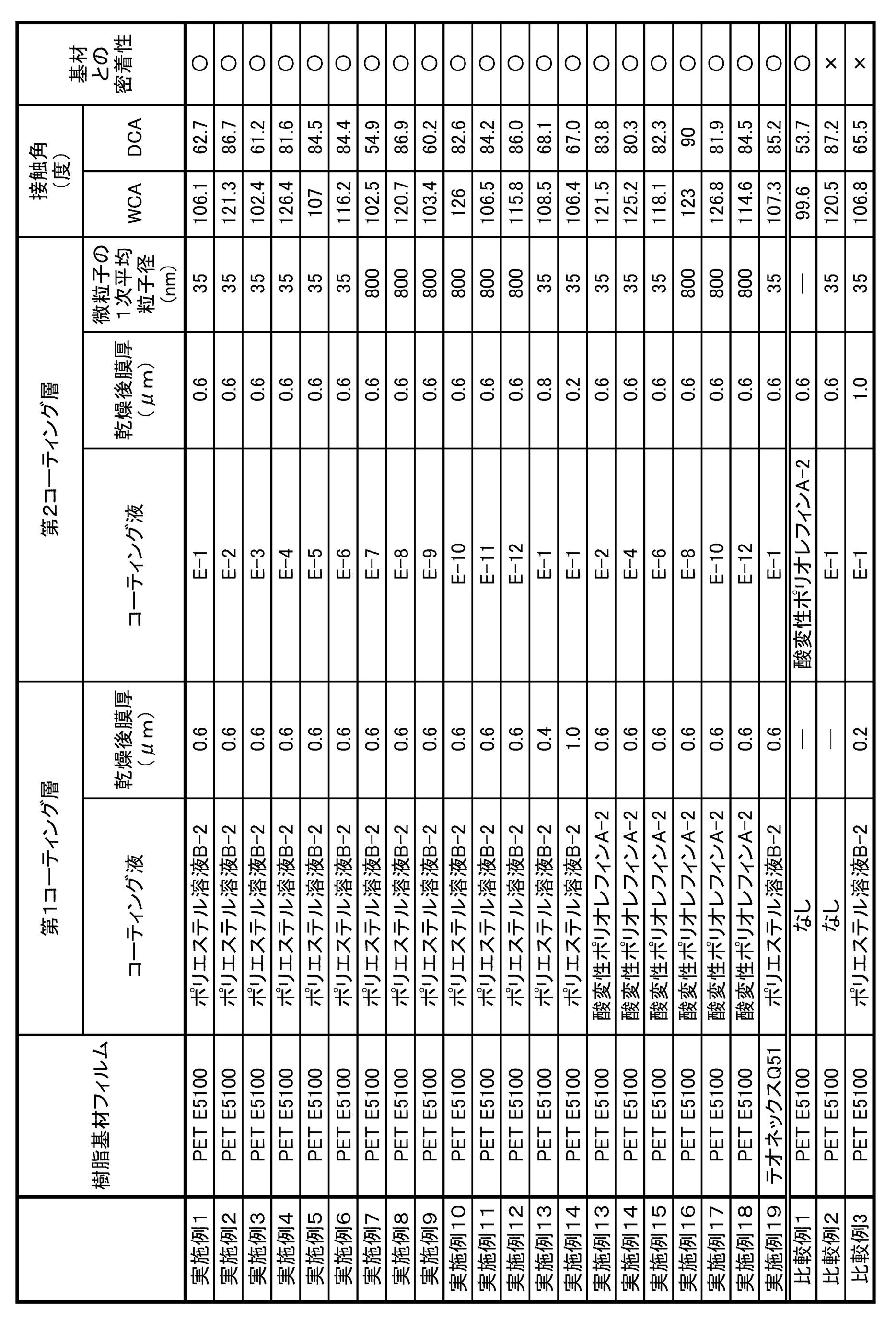
本発明により、優れた撥水・撥油性を有し、防汚性を示す積層フィルムを提供することができる。本発明による積層フィルムは、包装、被覆、離型素材などの用途への応用が可能であり、有用である。
Claims (4)
- 樹脂基材フィルム上にバインダー樹脂と表面が疎水化された微粒子を含有するコーティング層を有する積層フィルムであって、コーティング層の厚みを百等分し、樹脂基材フィルムとコーティング層の界面を0、コーティング層最表面を100とした場合に、30~100部分にのみ表面が疎水化された微粒子が偏在する積層フィルム。
- 前記樹脂基材フィルムが、ポリエチレンテレフタレートフィルム又はポリエチレンナフタレートフィルムである請求項1に記載の積層フィルム。
- 前記表面が疎水化された微粒子の1次粒子平均径が、30nm~1μmである請求項1又は2に記載の積層フィルム。
- 前記バインダー樹脂が、酸変性ポリオレフィン樹脂又はポリエステル樹脂である請求項1~3のいずれかに記載の積層フィルム。
Priority Applications (1)
| Application Number | Priority Date | Filing Date | Title |
|---|---|---|---|
| JP2021545797A JP7715043B2 (ja) | 2020-08-19 | 2021-06-25 | 積層フィルム |
Applications Claiming Priority (2)
| Application Number | Priority Date | Filing Date | Title |
|---|---|---|---|
| JP2020138535 | 2020-08-19 | ||
| JP2020-138535 | 2020-08-19 |
Publications (1)
| Publication Number | Publication Date |
|---|---|
| WO2022038899A1 true WO2022038899A1 (ja) | 2022-02-24 |
Family
ID=80350308
Family Applications (1)
| Application Number | Title | Priority Date | Filing Date |
|---|---|---|---|
| PCT/JP2021/024142 Ceased WO2022038899A1 (ja) | 2020-08-19 | 2021-06-25 | 積層フィルム |
Country Status (3)
| Country | Link |
|---|---|
| JP (1) | JP7715043B2 (ja) |
| TW (1) | TW202214786A (ja) |
| WO (1) | WO2022038899A1 (ja) |
Citations (8)
| Publication number | Priority date | Publication date | Assignee | Title |
|---|---|---|---|---|
| JP2011184082A (ja) * | 2010-03-10 | 2011-09-22 | Showa Denko Packaging Co Ltd | 内容物付着防止蓋材およびその製造方法 |
| JP2012020248A (ja) * | 2010-07-15 | 2012-02-02 | Nicca Chemical Co Ltd | 撥水性コーティング膜、その製造方法及びそれを備えた機能性材料 |
| CN103587185A (zh) * | 2012-08-14 | 2014-02-19 | 无锡市顺业科技有限公司 | 基于超疏水二氧化硅与树脂的超疏水涂层的制备方法 |
| WO2014038701A1 (ja) * | 2012-09-07 | 2014-03-13 | 凸版印刷株式会社 | 蓋材および包装容器 |
| JP2014156256A (ja) * | 2013-02-15 | 2014-08-28 | Toppan Printing Co Ltd | 蓋材とその製造方法 |
| JP2015183168A (ja) * | 2014-03-26 | 2015-10-22 | リンテック株式会社 | ハードコートフィルム、透明導電性フィルム、および静電容量タッチパネル |
| WO2020179412A1 (ja) * | 2019-03-07 | 2020-09-10 | 東洋紡株式会社 | 積層フィルム |
| WO2021145237A1 (ja) * | 2020-01-17 | 2021-07-22 | 東洋紡株式会社 | 積層フィルム |
-
2021
- 2021-06-25 JP JP2021545797A patent/JP7715043B2/ja active Active
- 2021-06-25 WO PCT/JP2021/024142 patent/WO2022038899A1/ja not_active Ceased
- 2021-08-17 TW TW110130223A patent/TW202214786A/zh unknown
Patent Citations (8)
| Publication number | Priority date | Publication date | Assignee | Title |
|---|---|---|---|---|
| JP2011184082A (ja) * | 2010-03-10 | 2011-09-22 | Showa Denko Packaging Co Ltd | 内容物付着防止蓋材およびその製造方法 |
| JP2012020248A (ja) * | 2010-07-15 | 2012-02-02 | Nicca Chemical Co Ltd | 撥水性コーティング膜、その製造方法及びそれを備えた機能性材料 |
| CN103587185A (zh) * | 2012-08-14 | 2014-02-19 | 无锡市顺业科技有限公司 | 基于超疏水二氧化硅与树脂的超疏水涂层的制备方法 |
| WO2014038701A1 (ja) * | 2012-09-07 | 2014-03-13 | 凸版印刷株式会社 | 蓋材および包装容器 |
| JP2014156256A (ja) * | 2013-02-15 | 2014-08-28 | Toppan Printing Co Ltd | 蓋材とその製造方法 |
| JP2015183168A (ja) * | 2014-03-26 | 2015-10-22 | リンテック株式会社 | ハードコートフィルム、透明導電性フィルム、および静電容量タッチパネル |
| WO2020179412A1 (ja) * | 2019-03-07 | 2020-09-10 | 東洋紡株式会社 | 積層フィルム |
| WO2021145237A1 (ja) * | 2020-01-17 | 2021-07-22 | 東洋紡株式会社 | 積層フィルム |
Also Published As
| Publication number | Publication date |
|---|---|
| TW202214786A (zh) | 2022-04-16 |
| JPWO2022038899A1 (ja) | 2022-02-24 |
| JP7715043B2 (ja) | 2025-07-30 |
Similar Documents
| Publication | Publication Date | Title |
|---|---|---|
| JP6391025B2 (ja) | ガスバリア性フィルム | |
| JP7563376B2 (ja) | 積層フィルム | |
| CN113543964B (zh) | 层叠膜 | |
| WO2022049900A1 (ja) | 積層フィルム | |
| JP2010199016A (ja) | 透明導電性シート及びその製造方法 | |
| JPWO2017010419A1 (ja) | 積層体およびその製造方法 | |
| CN107627700A (zh) | 一种用于柔性线路板的离型膜 | |
| JP7715043B2 (ja) | 積層フィルム | |
| JP7618985B2 (ja) | 積層フィルム | |
| JP2018052041A (ja) | 積層体 | |
| JP2008292655A (ja) | フォトマスク保護用粘着テープ | |
| WO2014179324A1 (en) | Release layer for subsequent manufacture of flexible substrates in microelectonic applications | |
| JP7775900B2 (ja) | 積層フィルムの製造方法 | |
| JP5929074B2 (ja) | 未処理の二軸延伸petフィルム或いはシートの品質管理方法 | |
| WO2019189880A1 (ja) | 膜形成用の塗布液および膜付基材の製造方法 | |
| JP7425642B2 (ja) | 工程フィルム及び工程フィルムの製造方法 | |
| JP7120236B2 (ja) | フィルムロールおよびフィルム束 | |
| KR20260029829A (ko) | 리사이클링 이형필름 및 이를 포함하는 소자 | |
| WO2024195690A1 (ja) | 積層体 | |
| JP2022155375A (ja) | 光学積層体、光学積層体の製造方法、光学部材、光学装置、光学部材の製造方法、及び光学装置の製造方法 |
Legal Events
| Date | Code | Title | Description |
|---|---|---|---|
| ENP | Entry into the national phase |
Ref document number: 2021545797 Country of ref document: JP Kind code of ref document: A |
|
| 121 | Ep: the epo has been informed by wipo that ep was designated in this application |
Ref document number: 21858049 Country of ref document: EP Kind code of ref document: A1 |
|
| NENP | Non-entry into the national phase |
Ref country code: DE |
|
| 122 | Ep: pct application non-entry in european phase |
Ref document number: 21858049 Country of ref document: EP Kind code of ref document: A1 |