WO2022024979A1 - ミロガバリンベシル酸塩を含有する口腔内崩壊錠 - Google Patents
ミロガバリンベシル酸塩を含有する口腔内崩壊錠 Download PDFInfo
- Publication number
- WO2022024979A1 WO2022024979A1 PCT/JP2021/027505 JP2021027505W WO2022024979A1 WO 2022024979 A1 WO2022024979 A1 WO 2022024979A1 JP 2021027505 W JP2021027505 W JP 2021027505W WO 2022024979 A1 WO2022024979 A1 WO 2022024979A1
- Authority
- WO
- WIPO (PCT)
- Prior art keywords
- orally disintegrating
- disintegrating tablet
- weight
- granules
- mirogavaline
- Prior art date
- Legal status (The legal status is an assumption and is not a legal conclusion. Google has not performed a legal analysis and makes no representation as to the accuracy of the status listed.)
- Ceased
Links
Classifications
-
- A—HUMAN NECESSITIES
- A61—MEDICAL OR VETERINARY SCIENCE; HYGIENE
- A61K—PREPARATIONS FOR MEDICAL, DENTAL OR TOILETRY PURPOSES
- A61K9/00—Medicinal preparations characterised by special physical form
- A61K9/20—Pills, tablets, discs, rods
- A61K9/2072—Pills, tablets, discs, rods characterised by shape, structure or size; Tablets with holes, special break lines or identification marks; Partially coated tablets; Disintegrating flat shaped forms
- A61K9/2077—Tablets comprising drug-containing microparticles in a substantial amount of supporting matrix; Multiparticulate tablets
-
- A—HUMAN NECESSITIES
- A61—MEDICAL OR VETERINARY SCIENCE; HYGIENE
- A61K—PREPARATIONS FOR MEDICAL, DENTAL OR TOILETRY PURPOSES
- A61K31/00—Medicinal preparations containing organic active ingredients
- A61K31/185—Acids; Anhydrides, halides or salts thereof, e.g. sulfur acids, imidic, hydrazonic or hydroximic acids
- A61K31/19—Carboxylic acids, e.g. valproic acid
- A61K31/195—Carboxylic acids, e.g. valproic acid having an amino group
- A61K31/197—Carboxylic acids, e.g. valproic acid having an amino group the amino and the carboxyl groups being attached to the same acyclic carbon chain, e.g. gamma-aminobutyric acid [GABA], beta-alanine, epsilon-aminocaproic acid or pantothenic acid
-
- A—HUMAN NECESSITIES
- A61—MEDICAL OR VETERINARY SCIENCE; HYGIENE
- A61K—PREPARATIONS FOR MEDICAL, DENTAL OR TOILETRY PURPOSES
- A61K47/00—Medicinal preparations characterised by the non-active ingredients used, e.g. carriers or inert additives; Targeting or modifying agents chemically bound to the active ingredient
- A61K47/06—Organic compounds, e.g. natural or synthetic hydrocarbons, polyolefins, mineral oil, petrolatum or ozokerite
- A61K47/08—Organic compounds, e.g. natural or synthetic hydrocarbons, polyolefins, mineral oil, petrolatum or ozokerite containing oxygen, e.g. ethers, acetals, ketones, quinones, aldehydes, peroxides
- A61K47/12—Carboxylic acids; Salts or anhydrides thereof
-
- A—HUMAN NECESSITIES
- A61—MEDICAL OR VETERINARY SCIENCE; HYGIENE
- A61K—PREPARATIONS FOR MEDICAL, DENTAL OR TOILETRY PURPOSES
- A61K47/00—Medicinal preparations characterised by the non-active ingredients used, e.g. carriers or inert additives; Targeting or modifying agents chemically bound to the active ingredient
- A61K47/06—Organic compounds, e.g. natural or synthetic hydrocarbons, polyolefins, mineral oil, petrolatum or ozokerite
- A61K47/22—Heterocyclic compounds, e.g. ascorbic acid, tocopherol or pyrrolidones
-
- A—HUMAN NECESSITIES
- A61—MEDICAL OR VETERINARY SCIENCE; HYGIENE
- A61K—PREPARATIONS FOR MEDICAL, DENTAL OR TOILETRY PURPOSES
- A61K47/00—Medicinal preparations characterised by the non-active ingredients used, e.g. carriers or inert additives; Targeting or modifying agents chemically bound to the active ingredient
- A61K47/06—Organic compounds, e.g. natural or synthetic hydrocarbons, polyolefins, mineral oil, petrolatum or ozokerite
- A61K47/26—Carbohydrates, e.g. sugar alcohols, amino sugars, nucleic acids, mono-, di- or oligo-saccharides; Derivatives thereof, e.g. polysorbates, sorbitan fatty acid esters or glycyrrhizin
-
- A—HUMAN NECESSITIES
- A61—MEDICAL OR VETERINARY SCIENCE; HYGIENE
- A61K—PREPARATIONS FOR MEDICAL, DENTAL OR TOILETRY PURPOSES
- A61K47/00—Medicinal preparations characterised by the non-active ingredients used, e.g. carriers or inert additives; Targeting or modifying agents chemically bound to the active ingredient
- A61K47/30—Macromolecular organic or inorganic compounds, e.g. inorganic polyphosphates
- A61K47/36—Polysaccharides; Derivatives thereof, e.g. gums, starch, alginate, dextrin, hyaluronic acid, chitosan, inulin, agar or pectin
-
- A—HUMAN NECESSITIES
- A61—MEDICAL OR VETERINARY SCIENCE; HYGIENE
- A61K—PREPARATIONS FOR MEDICAL, DENTAL OR TOILETRY PURPOSES
- A61K47/00—Medicinal preparations characterised by the non-active ingredients used, e.g. carriers or inert additives; Targeting or modifying agents chemically bound to the active ingredient
- A61K47/30—Macromolecular organic or inorganic compounds, e.g. inorganic polyphosphates
- A61K47/36—Polysaccharides; Derivatives thereof, e.g. gums, starch, alginate, dextrin, hyaluronic acid, chitosan, inulin, agar or pectin
- A61K47/38—Cellulose; Derivatives thereof
-
- A—HUMAN NECESSITIES
- A61—MEDICAL OR VETERINARY SCIENCE; HYGIENE
- A61K—PREPARATIONS FOR MEDICAL, DENTAL OR TOILETRY PURPOSES
- A61K9/00—Medicinal preparations characterised by special physical form
- A61K9/0012—Galenical forms characterised by the site of application
- A61K9/0053—Mouth and digestive tract, i.e. intraoral and peroral administration
- A61K9/0056—Mouth soluble or dispersible forms; Suckable, eatable, chewable coherent forms; Forms rapidly disintegrating in the mouth; Lozenges; Lollipops; Bite capsules; Baked products; Baits or other oral forms for animals
-
- A—HUMAN NECESSITIES
- A61—MEDICAL OR VETERINARY SCIENCE; HYGIENE
- A61K—PREPARATIONS FOR MEDICAL, DENTAL OR TOILETRY PURPOSES
- A61K9/00—Medicinal preparations characterised by special physical form
- A61K9/14—Particulate form, e.g. powders, Processes for size reducing of pure drugs or the resulting products, Pure drug nanoparticles
- A61K9/16—Agglomerates; Granulates; Microbeadlets ; Microspheres; Pellets; Solid products obtained by spray drying, spray freeze drying, spray congealing,(multiple) emulsion solvent evaporation or extraction
-
- A—HUMAN NECESSITIES
- A61—MEDICAL OR VETERINARY SCIENCE; HYGIENE
- A61K—PREPARATIONS FOR MEDICAL, DENTAL OR TOILETRY PURPOSES
- A61K9/00—Medicinal preparations characterised by special physical form
- A61K9/14—Particulate form, e.g. powders, Processes for size reducing of pure drugs or the resulting products, Pure drug nanoparticles
- A61K9/16—Agglomerates; Granulates; Microbeadlets ; Microspheres; Pellets; Solid products obtained by spray drying, spray freeze drying, spray congealing,(multiple) emulsion solvent evaporation or extraction
- A61K9/1605—Excipients; Inactive ingredients
- A61K9/1629—Organic macromolecular compounds
- A61K9/1652—Polysaccharides, e.g. alginate, cellulose derivatives; Cyclodextrin
-
- A—HUMAN NECESSITIES
- A61—MEDICAL OR VETERINARY SCIENCE; HYGIENE
- A61K—PREPARATIONS FOR MEDICAL, DENTAL OR TOILETRY PURPOSES
- A61K9/00—Medicinal preparations characterised by special physical form
- A61K9/20—Pills, tablets, discs, rods
-
- A—HUMAN NECESSITIES
- A61—MEDICAL OR VETERINARY SCIENCE; HYGIENE
- A61K—PREPARATIONS FOR MEDICAL, DENTAL OR TOILETRY PURPOSES
- A61K9/00—Medicinal preparations characterised by special physical form
- A61K9/20—Pills, tablets, discs, rods
- A61K9/2004—Excipients; Inactive ingredients
- A61K9/2013—Organic compounds, e.g. phospholipids, fats
-
- A—HUMAN NECESSITIES
- A61—MEDICAL OR VETERINARY SCIENCE; HYGIENE
- A61K—PREPARATIONS FOR MEDICAL, DENTAL OR TOILETRY PURPOSES
- A61K9/00—Medicinal preparations characterised by special physical form
- A61K9/20—Pills, tablets, discs, rods
- A61K9/2004—Excipients; Inactive ingredients
- A61K9/2013—Organic compounds, e.g. phospholipids, fats
- A61K9/2018—Sugars, or sugar alcohols, e.g. lactose, mannitol; Derivatives thereof, e.g. polysorbates
-
- A—HUMAN NECESSITIES
- A61—MEDICAL OR VETERINARY SCIENCE; HYGIENE
- A61K—PREPARATIONS FOR MEDICAL, DENTAL OR TOILETRY PURPOSES
- A61K9/00—Medicinal preparations characterised by special physical form
- A61K9/20—Pills, tablets, discs, rods
- A61K9/2004—Excipients; Inactive ingredients
- A61K9/2022—Organic macromolecular compounds
- A61K9/205—Polysaccharides, e.g. alginate, gums; Cyclodextrin
- A61K9/2054—Cellulose; Cellulose derivatives, e.g. hydroxypropyl methylcellulose
-
- A—HUMAN NECESSITIES
- A61—MEDICAL OR VETERINARY SCIENCE; HYGIENE
- A61K—PREPARATIONS FOR MEDICAL, DENTAL OR TOILETRY PURPOSES
- A61K9/00—Medicinal preparations characterised by special physical form
- A61K9/20—Pills, tablets, discs, rods
- A61K9/2004—Excipients; Inactive ingredients
- A61K9/2022—Organic macromolecular compounds
- A61K9/205—Polysaccharides, e.g. alginate, gums; Cyclodextrin
- A61K9/2059—Starch, including chemically or physically modified derivatives; Amylose; Amylopectin; Dextrin
-
- A—HUMAN NECESSITIES
- A61—MEDICAL OR VETERINARY SCIENCE; HYGIENE
- A61P—SPECIFIC THERAPEUTIC ACTIVITY OF CHEMICAL COMPOUNDS OR MEDICINAL PREPARATIONS
- A61P25/00—Drugs for disorders of the nervous system
- A61P25/02—Drugs for disorders of the nervous system for peripheral neuropathies
-
- A—HUMAN NECESSITIES
- A61—MEDICAL OR VETERINARY SCIENCE; HYGIENE
- A61P—SPECIFIC THERAPEUTIC ACTIVITY OF CHEMICAL COMPOUNDS OR MEDICINAL PREPARATIONS
- A61P25/00—Drugs for disorders of the nervous system
- A61P25/04—Centrally acting analgesics, e.g. opioids
-
- A—HUMAN NECESSITIES
- A61—MEDICAL OR VETERINARY SCIENCE; HYGIENE
- A61P—SPECIFIC THERAPEUTIC ACTIVITY OF CHEMICAL COMPOUNDS OR MEDICINAL PREPARATIONS
- A61P43/00—Drugs for specific purposes, not provided for in groups A61P1/00-A61P41/00
Definitions
- the present invention relates to an orally disintegrating tablet containing mirogavaline besilate and having excellent stability.
- the orally disintegrating tablet of the present invention is an orally disintegrating tablet that rapidly disintegrates when contained in the mouth or in water, but has sufficient hardness for normal production, transportation, and use. ..
- the present invention also relates to a manufacturing method thereof.
- Tablets, capsules, granules, powders, etc. are known as dosage forms of oral solid preparations in the fields of pharmaceuticals and foods, but as dosage forms that are easier to take for elderly people, children and patients who have difficulty swallowing. It is expected to develop an orally disintegrating tablet that rapidly disintegrates when it is contained in the mouth or in water.
- orally disintegrating tablets like ordinary tablets, they are required to have sufficient hardness to withstand physical impact when manufactured, transported, and used. There is. In addition, it is desirable from the viewpoint of medication compliance that an unpleasant taste and irritation are suppressed and a good mouthfeel is obtained when it is contained in the mouth.
- Patent Document 1 describes an orally disintegrating tablet containing a drug, crystalline cellulose having a bulk density of 0.23 g / cm 3 or less, sugar alcohol and pregelatinized starch.
- orally disintegrating tablets containing mirogavaline besylate there is no description in this document regarding orally disintegrating tablets containing mirogavaline besylate.
- Patent Document 2 describes a drug containing mirogavaline besylate, (i) D-mannitol, lactose, cornstarch, and one selected from the group consisting of crystalline cellulose, and (ii) carmellose calcium. Solid composition for use is described. However, there is no description in this document regarding orally disintegrating tablets containing mirogavaline besylate.
- Patent Document 4 one or more selected from the group consisting of (i) D-mannitol, lactose, cornstarch, and crystalline cellulose, (ii) carmellose calcium, (Iii) A solid composition for pharmaceutical use containing titanium oxide as a colorant and one or more other colorants is described. However, there is no description in this document regarding orally disintegrating tablets containing mirogavaline besylate.
- An object of the present invention is to provide an orally disintegrating tablet containing mirogavaline besylate and having excellent stability.
- the orally disintegrating tablet of the present invention is an orally disintegrating tablet that rapidly disintegrates when contained in the mouth or in water, but has sufficient hardness for normal production, transportation, and use. ..
- the present invention is also excellent in its manufacturing method.
- the average particle size of mirogabalin besilate contained in (A) is 60 ⁇ m or less, and the content of mirogabalin is 0.5-10% by weight per 100% by weight of the orally disintegrating tablet as mirogabalin, according to [1].
- the bulk density of the crystalline cellulose contained in (B) is 0.10-0.26 g / cm 3 , and the content thereof is 1.0-50% by weight per 100% by weight of the orally disintegrating tablet.
- the content of D-mannitol contained in (B) is 20-55% by weight per 100% by weight of the orally disintegrating tablet, and the content of pregelatinized starch contained in (B) is 100% by weight of the orally disintegrating tablet.
- the content of carmellose contained in (B) is 2.0-20% by weight per 100% by weight of the orally disintegrating tablet, and the content of acesulfame potassium contained in (B) is 1.0 per 100% by weight of the orally disintegrating tablet.
- a process of mixing D-mannitol and crystalline cellulose and spraying with an pregelatinized starch dispersion to produce granules The step of mixing the above two granules, crospovidone, and acesulfame potassium, and then mixing magnesium stearate to obtain a tableting mixture.
- the orally disintegrating tablet of the present invention is an orally disintegrating tablet in which the stability of mirogavaline besilate is particularly good because it contains citric acid hydrate and tocopherol.
- the orally disintegrating tablet of the present invention rapidly disintegrates when it is contained in the mouth or in water, exhibits excellent solubility, and has a good mouthfeel.
- the orally disintegrating tablet of the present invention is an orally disintegrating tablet having sufficient hardness in normal production, transportation and use, and excellent in storage stability.
- the orally disintegrating lock of the present invention can be produced by ordinary compression molding without requiring complicated steps or special equipment.
- the "orally disintegrating tablet” is a compression molded product having rapid disintegration and solubility when it is contained in the mouth or in water. Specifically, it means a tablet that disintegrates in usually 5-180 seconds, preferably 5-60 seconds, more preferably about 5-40 seconds in a disintegration test mainly by saliva in the oral cavity or a disintegration test by an apparatus. ..
- the orally disintegrating tablet of the present invention has sufficient hardness in the normal manufacturing, transportation, and use processes.
- it is an orally disintegrating tablet having a hardness of usually 2 kg or more, preferably 3 kg or more, and more preferably 5 kg or more.
- the orally disintegrating tablet of the present invention retains the elution property suitable for pharmaceutical products.
- an orally disintegrating tablet usually shows an average dissolution rate of 80% or more at 30 minutes, preferably 85% or more.
- the dissolution test is the 18th revised Japanese Pharmacopoeia 6.
- the dissolution test described in 6.10 Dissolution Test Method This test is conducted to determine whether the oral preparation complies with the dissolution test standard, but also aims to prevent significant biological inequality.
- the sample in this test corresponds to the minimum dose, which means 1 tablet for tablets, 1 capsule for capsules, and the specified amount for other formulations.
- the devices used in this test include a rotary basket method device, a paddle method device, and a flow-through cell method device. The details are described in the 18th revised Japanese Pharmacopoeia.
- the "mirogabalin” used in the present invention is the following formula (I).
- the "mirogabalin besylate” used in the present invention is a salt composed of mirogabalin and besilic acid, and has the following formula (Ia).
- Mirogabalin used in the present invention is considered to exert an analgesic effect by suppressing calcium current through binding to the ⁇ 2 ⁇ subunit, which plays an auxiliary role in the function of voltage-gated calcium channels in the nervous system. ing.
- the mirogavalin besylate used in the present invention has been approved for manufacture and sale as a therapeutic agent for peripheral neuropathic pain in clinical trials conducted in Japan and overseas, and is being marketed.
- the usual adult dosage of mirogabalin is 5 mg orally twice daily, followed by a single dose of 5 mg at intervals of 1 week or longer. , 15 mg orally twice daily.
- the dose may be adjusted according to the patient's age and symptoms in the range of 10 mg to 15 mg, and administered twice daily.
- Aspect A Orally disintegrating tablets obtained by compression molding of drug-free granules containing crystalline cellulose, D-mannitol, and pregelatinized starch having a bulk density of 0.26 g / cm 3 or less, and granules containing mirogavaline besylate. ..
- the drug-free granules function as a skeleton of a pharmaceutical product capable of imparting the desired disintegration property and moldability as an orally disintegrating tablet.
- the drug-free granules exhibit excellent disintegration and moldability even when only three components, crystalline cellulose, D-mannitol, and pregelatinized starch, having a bulk density of 0.26 g / cm 3 or less are blended.
- the orally disintegrating tablet in this embodiment exhibits excellent stability by adding citric acid hydrate and tocopherol to the granules containing mirogavaline besilate.
- the method for producing the orally disintegrating tablet according to the aspect A is as follows: (1) a step of producing drug-free granules, (2) a step of producing mirogavaline besylate-containing granules, and (3) drug-free granules. It includes a step of mixing and compression molding the granules containing mirogavaline besylate and other extragranular mixed powders.
- Drug-free granules can be produced by using the method of 1) or 2) below. 1) A method of wet-granulating a mixture containing crystalline cellulose having a bulk density of 0.26 g / cm 3 or less, D-mannitol, and pregelatinized starch with water. 2) A method of granulating a mixture containing crystalline cellulose having a bulk density of 0.26 g / cm 3 or less and D-mannitol with a solution in which pregelatinized starch is dissolved or dispersed in water or the like.
- a conventional extrusion granulation method a mixed stirring granulation method, a high-speed stirring granulation method, a fluidized bed granulation method, a rolling granulation method, or the like can be used.
- Alfarized starch exhibits a viscosity suitable for granulation when dissolved or dispersed in a liquid such as water.
- a method for granulating there are a method of mixing pregelatinized starch with other components in a powder state and granulating with water, and a method of granulating with a liquid in which pregelatinized starch is dissolved or dispersed in water. Both methods give tablets with the desired properties, preferably the latter method.
- the mixing ratio of crystalline cellulose having a bulk density of 0.26 g / cm 3 or less and D-mannitol in the drug-free granules is 1-3 parts by weight, preferably 1-2 parts by weight, of D-mannitol with respect to 1 crystalline cellulose. Is.
- the granules containing mirogavaline besilate can be mixed with the drug-free granules as they are on the powder or, if desired, in the form of granules.
- the mirogavaline besylate-containing granules can be produced, for example, by a conventional extrusion granulation method, a mixed stirring granulation method, a high-speed stirring granulation method, a fluidized bed granulation method, or a rolling granulation method.
- the mixed powder of magnesium aluminometasilicate may be granulated with a solution in which hydroxypropyl cellulose is dissolved or dispersed in water to obtain granules containing mirogavaline besilate.
- powdered or granular mirogavaline besylate, D-mannitol, carmellose, citric acid hydrate, tocopherol 10-fold powder (mixed with tocopherol and crystalline cellulose having a bulk density of 0.26 g / cm 3 or less).
- Magnesium aluminometasilicate, and hydroxypropyl cellulose may be granulated with water to obtain drug-containing granules.
- a powdered or granular mixed powder of mirogavaline besylate, D-mannitol, and citric acid hydrate is granulated with a solution in which low-molecular-weight hydroxypropyl cellulose is dissolved or dispersed in water.
- the mixed powder of powdered or granular mirogavaline besylate, D-mannitol, citric acid hydrate, and low molecular weight hydroxypropyl cellulose should be granulated with water to obtain drug-containing granules. You can also.
- the granules containing mirogavaline besylate can also be coated for unpleasant tastes such as bitterness and irritation, masking of odors, and control of elution. A coating agent and a plasticizer can be appropriately used for the coating.
- the coating method is performed by using, for example, a fluidized bed granulation / coating machine, a rolling fluidized bed granulation / coating machine, a centrifugal fluidized bed granulation / coating machine, and a Worster type fluidized bed granulation / coating machine.
- a fluidized bed granulation / coating machine a rolling fluidized bed granulation / coating machine, a centrifugal fluidized bed granulation / coating machine, and a Worster type fluidized bed granulation / coating machine.
- Drug-free granules and mirogavaline besilate-containing granules, and optionally disintegrate Agents, lubricants and other additives are mixed and compression molded to make an orally disintegrating tablet.
- Mixing is performed by using, for example, a tumble mixer or a convection mixer.
- the compression molding of the orally disintegrating tablet of the present invention can be performed using a normal locking machine.
- the molding pressure by the tableting machine may be about the same as that of a normal tablet, and is preferably about 2-20 kN, more preferably about 4-14 kN, although it depends on the shape and size of the tablet.
- the compounding ratio of the drug-free granules to the total weight of the tablet components may be 30-90%.
- the compounding ratio is 30-80%, preferably 45-70%.
- the compounding ratio is 30-80%, preferably 45-70%.
- the compounding weight ratio of the drug-free granules to the drug-containing granules is preferably 1.0-3.5 of the drug-free granules with respect to the drug-containing granules 1.
- Aspect B Drug-free mixed powder containing crystalline cellulose, D-mannitol and pregelatinized starch with a bulk density of 0.26 g / cm 3 or less, or other extragranular mixed powder, and granules containing mirogavaline besilate and compression molding.
- the drug-free mixed powder or other extragranular mixed powder provides the desired disintegration and moldability as an orally disintegrating tablet.
- the drug-free mixed powder exhibits excellent disintegration and moldability even when only three components, crystalline cellulose, D-mannitol, and pregelatinized starch, having a bulk density of 0.26 g / cm 3 or less are blended.
- Other additives may be added if necessary.
- other extragranular mixed powders exhibit excellent disintegration and moldability even when only three components of crystalline cellulose, carmellose, and acesulfame potassium are blended, but other additives may be added as necessary. May be blended.
- the method for producing an orally disintegrating tablet according to aspect B includes a step of producing granules containing mirogavaline besilate, a step of mixing the granules containing mirogavaline besilate, and other additives and compression-molding, if desired. included.
- the step of producing the granules containing mirogavaline besylate is the same as (2) of Aspect A.
- the step of mixing or compression molding is the same as (3) of Aspect A.
- the orally disintegrating tablet of the present invention obtained as described above is excellent in disintegration and solubility when placed in the oral cavity or in water, and is also excellent in physical and chemical stability.
- the disintegration or solubility of the orally disintegrating tablet of the present invention is the disintegration or dissolution time in the oral cavity (in the oral cavity of a healthy adult male, until the tablet is completely disintegrated or dissolved only by saliva without containing water in the mouth. Time) is usually 5-180 seconds, preferably 5-60 seconds, and more preferably about 5-40 seconds.
- the orally disintegrating tablet of the present invention gradually disintegrates or dissolves due to saliva when contained in the mouth, but pressure in the oral cavity, that is, pressure by the upper jaw and tongue, or rubbing by the tongue, that is, a "licking" action, etc. Disintegrates or dissolves in a shorter time. For people with dry mouth or low saliva, it may be disintegrated and dissolved in the oral cavity with water or hot water, or it may be taken with water as it is like a normal tablet. ..
- the hardness of the orally disintegrating tablet of the present invention is sufficient even after a stability test under constant temperature and humidity conditions (for example, temperature 25 ° C., humidity 75%, open system, 1 week). Have. Therefore, it has a hardness that does not collapse in the manufacturing process and distribution process of the pharmaceutical product, has a practical hardness even when stored under constant temperature and humidity conditions, and is excellent in storage stability and disintegration property.
- constant temperature and humidity conditions for example, temperature 25 ° C., humidity 75%, open system, 1 week.
- the orally disintegrating tablet of the present invention can be used for the treatment of diseases as a preparation that is easy to take even for elderly people, children and patients who have difficulty swallowing, and as a safe preparation for general adults.
- the average particle size of the "milogabaline besylate” used in the present invention is preferably 60 ⁇ m (more preferably 40 ⁇ m) or less.
- the "average particle size” of the present invention means the particle size at an integrated value of 50% in the particle size distribution obtained by the laser diffraction / scattering method.
- the mirogabalin besylate used in the present invention is, as mirogabalin, preferably 0.5-40% by weight, more preferably 0.5-25% by weight, per 100% by weight of the orally disintegrating tablet. Particularly preferred is 0.5-10% by weight.
- D-mannitol used in the present invention, those conforming to the pharmacopoeia of Japan, Europe and the United States can usually be used.
- the crystal form, particle size and specific surface area of D-mannitol to be blended are not particularly limited, but the crystal form may be ⁇ -type, ⁇ -type, ⁇ -type or amorphous, and the particle size is preferably 10 ⁇ m or more and 250 ⁇ m or less.
- the specific surface area is preferably 0.1 m 2 / g or more and 4 m 2 / g or less, more preferably 0.1 m 2 / g or more and 2 m 2 / g or less, and crystalline form.
- the particle size and the specific surface area can be measured by, for example, an X-ray diffraction method, a laser diffraction type particle size measuring method, and a BET type specific surface area measuring method (multipoint method). Examples of commercially available products include D-mannitol manufactured by Merck, Rocket, Towa Kasei, Kao and the like.
- D-mannitol When D-mannitol is used, it is usually 20-95% by weight, preferably 20-55% by weight, per 100% by weight of the orally disintegrating tablet.
- D-mannitol may be powdered and mixed with other components to form a tableting powder, which may be compression-molded, or granulated with an appropriate binder and then subjected to compression molding.
- the "carmellose” used in the present invention is usually 1-20% by weight, preferably 2-20% by weight, per 100% by weight of the orally disintegrating tablet.
- the "citric acid hydrate” used in the present invention is a citric acid hydrate that can be used as a pharmaceutical additive (for example, a product conforming to the Japanese Pharmacopoeia), and is usually a citric acid monohydrate. .. Further, citric acid anhydride can be used instead of citric acid hydrate.
- the "citric acid hydrate” and “tocopherol” used in the present invention have the function of a stabilizer.
- the content of the citric acid hydrate of the present invention is preferably 0.01-10% by weight, more preferably 0.1-5.0% by weight, and more preferably 0.1-5.0% by weight per 100% by weight of the orally disintegrating tablet. 0.2-1.0% by weight.
- the content of tocopherol of the present invention is preferably 0.01-10% by weight, more preferably 0.01-1.0% by weight, and more preferably 0.01-% per 100% by weight of the orally disintegrating tablet. 0.4% by weight.
- the "crystalline cellulose" used in the present invention is usually a grade with a bulk density of 0.10 to 0.46 g / cm 3 , preferably 0.10 to 0.42 g / cm 3 , and more preferably 0.10 to 0.26 g / cm 3 .
- Commercially available products include, for example, Theoras KG-1000 (bulk density 0.10-0.15 g / cm 3 ), Theoras KG-802 (bulk density 0.13-0.23 g / cm 3 ), and Theoras UF-711 (bulk density 0.20-0.26).
- g / cm 3 (above, manufactured by Asahi Kasei Chemicals).
- the blending amount of the crystalline cellulose is preferably 1.0-50% by weight per 100% by weight of the orally disintegrating tablet. If it exceeds 50% by weight, the fluidity may deteriorate and the manufacturability may decrease. A more preferable blending amount is 5.0-30% by weight.
- the blending ratio of the crystalline cellulose and D-mannitol is 1.0-10 parts by weight, preferably 1.0-8.5 parts by weight, and more preferably 1.0-3.0 parts by weight of D-mannitol with respect to 1 crystalline cellulose.
- the orally disintegrating tablet of the present invention can contain an inorganic excipient, and the inorganic excipients include synthetic hydrotalcite, precipitated calcium carbonate, hydrous silicon dioxide, light anhydrous silicic acid, and silicic acid.
- synthetic hydrotalcite precipitated calcium carbonate
- hydrous silicon dioxide hydrous silicon dioxide
- light anhydrous silicic acid and silicic acid.
- magnesium aluminate and magnesium hydroxide can be mentioned.
- hydroxypropyl cellulose used in the present invention is not limited as long as it maintains the desired properties (disintegration time, hardness, elution) as an orally disintegrating tablet.
- the content of hydroxypropyl cellulose in the orally disintegrating tablet of the present invention is usually 0.1-3.0% by weight per 100% by weight of the orally disintegrating tablet from the viewpoint of moldability and disintegration / suspension in water. %. If the content of hydroxypropyl cellulose is too high, the time required for suspension will be extended, and the suitability as an orally disintegrating tablet will decrease.
- the "small molecule hydroxypropyl cellulose" used in the present invention is hydroxypropyl cellulose having a molecular weight of 140,000 (GPS method) or less.
- the uncoated tablet containing low-molecular-weight hydroxypropyl cellulose has desirable properties for an orally disintegrating tablet, which has both suppression of the formation of related substances and suppression of disintegration time extension.
- the content of low molecular weight hydroxypropyl cellulose in the orally disintegrating tablet of the present invention is preferably 0.1-2.0% by weight per 100% by weight of the orally disintegrating tablet.
- the "related substance” used in the present invention means a lactamized product of mirogabalin and other related substances whose structure is undetermined.
- the orally disintegrating tablet in the present invention further contains crospovidone (for example, a product conforming to the Japanese Pharmacopoeia) and pregelatinized starch as a "disintegrant".
- crospovidone for example, a product conforming to the Japanese Pharmacopoeia
- pregelatinized starch as a "disintegrant”.
- the above pregelatinized starch is obtained by heat-treating starch to pregelatinize it, and also includes partially pregelatinized starch. Further, as the pregelatinized starch, those described in the Japanese Pharmaceutical Additive Standards can be used. The average degree of pregelatinization is preferably 90% or less, more preferably 70-80%. As a commercially available product, for example, pregelatinized starch SWELSTAR PD-1 (manufactured by Asahi Kasei Chemicals) can be used.
- the blending amount of the pregelatinized starch is usually 1.0-15% by weight, preferably 1.0-10% by weight, per 100% by weight of the orally disintegrating tablet.
- the pregelatinized starch may be powdered and mixed with other components to form a tableting powder, which may be compression-molded, or may be granulated together with other components and then subjected to compression molding.
- pregelatinized starch serves as a disintegrant, but on the other hand, in production, it becomes viscous when dissolved or dispersed in a liquid such as water, so that it is sprayed on a powdered raw material. Then, granulation proceeds and granules can be formed. Taking advantage of this property, a powdery mixture containing crystalline cellulose and D-mannitol having a bulk density of 0.26 g / cm 3 or less is sprayed with a solution or dispersion in which pregelatinized starch is dissolved or dispersed in water to flow.
- Granules are produced by layer granulation, and if necessary, they are mixed with other components and compression-molded to obtain tablets having good moldability and desired orally disintegrating property.
- Such a manufacturing advantage is a property peculiar to pregelatinized starch that can hardly be obtained when a conventional disintegrant such as low-degree-of-substitution hydroxypropyl cellulose or crospovidone is used.
- the blending amount of the above-mentioned crospovidone is usually 0.5-20% by weight, preferably 2.0-20% by weight, per 100% by weight of the orally disintegrating tablet.
- the orally disintegrating tablet of the present invention can contain various "additives" generally used in the production of tablets as long as the effects of the invention are not hindered.
- the additive examples include a binder, a lubricant, a coating agent, a plasticizer, a coloring agent, a flavoring agent, a sweetening agent, a flavoring agent, a fluidizing agent, a foaming agent, a surfactant and the like.
- Binding agent from, for example, gum arabic, sodium alginate, carboxyvinyl polymer, gelatin, dextrin, pectin, sodium polyacrylate, pullulan, methylcellulose, hydroxypropylcellulose, hydroxypropylmethylcellulose, polyvinyl alcohol, polyvinylpyrrolidone and macrogol as the "binding agent".
- binding agent selected from, for example, gum arabic, sodium alginate, carboxyvinyl polymer, gelatin, dextrin, pectin, sodium polyacrylate, pullulan, methylcellulose, hydroxypropylcellulose, hydroxypropylmethylcellulose, polyvinyl alcohol, polyvinylpyrrolidone and macrogol.
- the "lubricating agent” examples include magnesium stearate (for example, Japanese Pharmacopoeia compliant product), calcium stearate (for example, Japanese Pharmacopoeia compliant product), stearyl sodium fumarate (for example, pharmaceutical additive standard compliant product) and talc (for example, pharmaceutical additive standard compliant product).
- magnesium stearate for example, Japanese Pharmacopoeia compliant product
- calcium stearate for example, Japanese Pharmacopoeia compliant product
- stearyl sodium fumarate for example, pharmaceutical additive standard compliant product
- talc for example, pharmaceutical additive standard compliant product
- the blending amount of the lubricant is preferably 0.1-5.0% by weight per 100% by weight of the orally disintegrating tablet.
- the “coating agent” includes ethyl cellulose, aminoalkyl methacrylate copolymer E, methacrylic acid copolymer L, and dried methacrylic acid as a coating agent for coating the surface of powdered drug (surface of crystals) or the surface of granulated drug granules.
- copolymer LD methacrylic acid copolymer LD, methacrylic acid copolymer S, aminoalkylmethacrylate copolymer RS, aminoalkylmethacrylate copolymer RS, ethyl acrylate / methyl methacrylate copolymer, polyvinyl acetal / diethylaminoacetate and polyvinyl acetate resin.
- a combination of two or more can be mentioned.
- the "plasticizer” is usually used in combination with a coating agent and is one or more selected from diethyl sebacate, dibutyl sebacate, triethyl citrate, stearic acid, polyethylene glycol and triacetin. The combination of can be mentioned.
- the "colorant” is selected from edible pigments such as edible yellow No. 5, edible red No. 2, edible blue No. 2; edible lake pigment, yellow sesquioxide, iron sesquioxide, titanium oxide, ⁇ -carotene and riboflavin. One or a combination of two or more can be mentioned.
- flavoring agent examples include one or a combination of two or more selected from orange, lemon, strawberry, menthol, menthol, menthol micron and various fragrances.
- sweetener examples include one or a combination of two or more selected from saccharin sodium, saccharin, aspartame, acesulfame potassium, dipotassium glycyrrhizinate, sucralose stevia and thaumatin.
- flavoring agent examples include one or a combination of two or more selected from sodium chloride, magnesium chloride, disodium inosinate, sodium L-glutamate and honey.
- fluidizing agent examples include one or a combination of two or more selected from hydrous silicon dioxide, light anhydrous silicic acid and talc.
- examples of the “foaming agent” include tartaric acid and the like.
- surfactant examples include one or a combination of two or more selected from polyoxyl 40 stearate, sorbitan fatty acid ester, polyoxyethylene hydrogenated castor oil, polysorbate, glycerin monostearate and sodium lauryl sulfate. can.
- Example 1 Molecular weight of hydroxypropyl cellulose and stability of pharmaceutical product (1) Preparation of A granules Milogabaline besylate, D-mannitol, and citric acid hydrate are weighed in the blending ratio shown in Table 1 and PE. Using a bag, the mixture was mixed for 3 minutes and sieved at 1100 rpm using a combil (U-10, ⁇ 1.143 mm, QUADRO) to obtain a sieve powder.
- a combil U-10, ⁇ 1.143 mm, QUADRO
- the sieve powder was put into a fluidized bed granulator (FL-labo2L, FREUND), and a low-molecular-weight hydroxypropyl cellulose binder (7 wt / wt%, (Dissolved in purified water) was sprayed at about 8 g / min, and after the spray was completed, it was dried until the product temperature reached 50 ° C.
- Granules were sized at 1100 rpm using a combil (U-10, ⁇ 1.143 mm, QUADRO) to obtain A granules.
- the sieving powder is put into a fluidized bed granulator (FL-labo2L, FREUND), and the hydroxypropyl cellulose binding solution (7 wt / wt%, purified water) is adjusted to the compounding ratio shown in Table 1 at a supply air temperature of 80 ° C.
- the hydroxypropyl cellulose binding solution (7 wt / wt%, purified water) is adjusted to the compounding ratio shown in Table 1 at a supply air temperature of 80 ° C.
- Granules were sized at 1100 rpm using a combil (U-10, ⁇ 1.143 mm, QUADRO) to obtain A granules.
- Example 1 (Evaluation method and results) Molecular weight of hydroxypropyl cellulose and stability of pharmaceutical product
- the uncoated tablets of Example 1 and Comparative Example 1 were left in an aluminum bag for 1 month under the conditions of 40 ° C / 75% RH, and then the related substances were used.
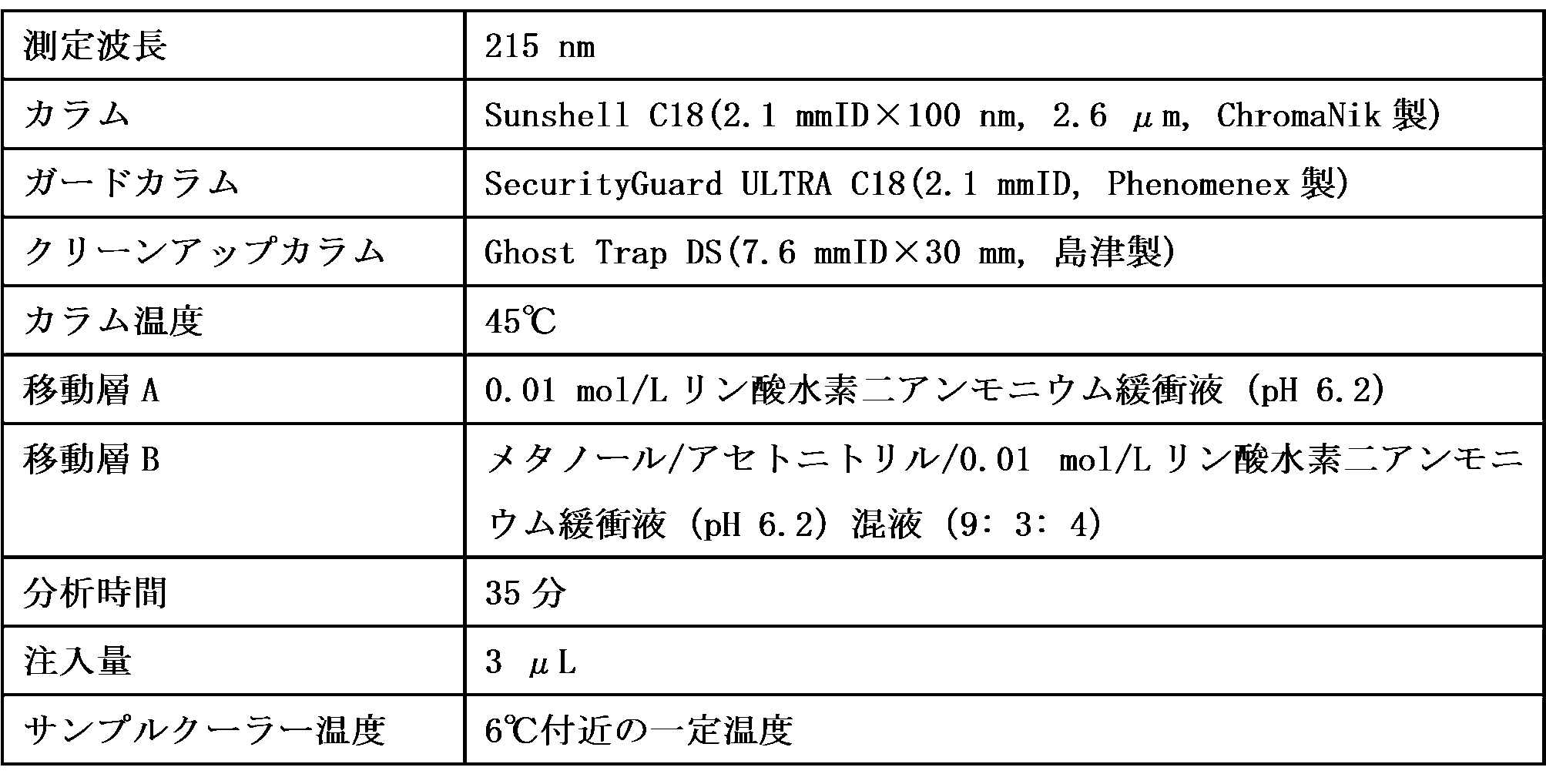
- the amount produced was measured using HPLC (Agilent infinity 1290) under the conditions shown in Table 2.
- the disintegration test was based on the disintegration test method of the 17th revised Japanese Pharmacopoeia, and evaluated the uncoated tablets after being left in an aluminum bag for 3 months under the conditions of the initial product and 40 ° C / 75% RH without an auxiliary board. .. Table 3 shows the results of the amount of related substances produced.
- Uncoated tablets using low-molecular-weight hydroxypropyl cellulose (molecular weight 140,000 (GPS method) or less) produce about 1 related substance compared to uncoated tablets using normal hydroxypropyl cellulose (molecular weight 1,000,000 (GPS method) or less). It became clear that it would be / 2.
- the results of the disintegration test are shown in Table 4. In the case of uncoated tablets using normal hydroxypropyl cellulose (molecular weight 1,000,000 (GPS method) or less), the disintegration time after leaving at 40 ° C / 75% RH for 3 months was extended by 38 seconds, but low molecular weight hydroxypropyl cellulose (molecular weight 140,000) (molecular weight 140,000).
- the extension of the disintegration time was as short as 12 seconds. From the above results, it was shown that the uncoated tablet containing low-molecular-weight hydroxypropyl cellulose has desirable properties for an orally disintegrating tablet, which has both suppression of the formation of related substances and suppression of disintegration time extension.
- Example 2 Formulation amount of crystalline cellulose and stability of preparation (1)
- Preparation of A granules Weigh tocopherol and crystalline cellulose at the blending ratio shown in Table 5, and use a high-speed stirring granulator (VG-50, POWREX). Using the mixture, the mixture was mixed at a blade rotation speed of 180 rpm and a chopper rotation speed of 3000 rpm for 15 minutes to obtain 10-fold dispersion of tocopherol.
- the mixture was mixed at a rotation speed of 27 rpm for 5 minutes and sieved at 600 rpm using a combil (QC-194S, ⁇ 1.143 mm, QUADRO) to obtain a sieve powder.
- the sieve powder is put into a fluidized bed granulator (FLO-5) and dissolved in a hydroxypropyl cellulose binding solution (7 wt / wt%, purified water) so that the blending ratio shown in Table 5 is obtained at an air supply temperature of 80 ° C. ) Was sprayed at about 40 g / min, and after the spraying was completed, it was dried until the product temperature reached 55 ° C.
- Granules were sized at 1400 rpm using a combil (QC-194S, ⁇ 1.143 mm, QUADRO) to obtain A granules.
- (2) Preparation of B granules D-mannitol and crystalline cellulose are weighed in the blending ratio shown in Table 5, put into a fluidized bed granulator (GPCG-15, POWREX), and shown in Table 5 at an air supply temperature of 85 ° C.
- the pregelatinized starch dispersion (8 wt / wt%, dissolved in purified water) was sprayed at about 140 g / min so as to have a mixing ratio, and after the spraying was completed, it was dried until the exhaust temperature reached 45 ° C.
- Granules were sized at 600 rpm using a combil (QC-194S, ⁇ 1.143 mm, QUADRO) to obtain B granules.
- (3) Preparation of granules for tableting Weigh A granules, B granules, crospovidone, and acesulfame potassium at the blending ratio shown in Table 5, and use a V-type mixer (10 L) at a rotation speed of 32 rpm for 5 minutes. The mixture was mixed and used as a mixed powder.
- magnesium stearate was weighed at the blending ratio shown in Table 5, added to the mixed powder, and mixed for 10 minutes at a rotation speed of 32 rpm using a V-type mixer (10 L) to obtain granules for tableting.
- V-type mixer 10 L
- the tablet mass was set to 300 mg and molded at a tableting pressure of 8 kN to obtain uncoated tablets ( ⁇ 10.0 mm).
- Comparative Example 2 Blending amount of crystalline cellulose and stability of preparation (1) Preparation of A granules Weigh tocopherol and crystalline cellulose at the blending ratio shown in Table 5, and use a high-speed stirring granulator (VG-50, POWREX). Using the mixture, the mixture was mixed at a blade rotation speed of 180 rpm and a chopper rotation speed of 3000 rpm for 15 minutes to obtain 10-fold dispersion of tocopherol. Weigh mirogavaline besylate, D-mannitol, carmellose, citric acid hydrate, tocopherol 10-fold powder, magnesium aluminometasilicate in the blending ratio shown in Table 5, and use a V-type mixer (30L).
- the mixture was mixed at a rotation speed of 27 rpm for 5 minutes and sieved at 600 rpm using a combil (QC-194S, ⁇ 1.143 mm, QUADRO) to obtain a sieve powder.
- the sieve powder is put into a fluidized bed granulator (FLO-5, FREUND), and the hydroxypropyl cellulose binding solution (7 wt / wt%, purified water) has a blending ratio shown in Table 5 at an air supply temperature of 80 ° C. Was sprayed at about 40 g / min, and after the spray was completed, it was dried until the product temperature reached 55 ° C.
- Granules were sized at 1400 rpm using a combil (QC-194S, ⁇ 1.143 mm, QUADRO) to obtain A granules.
- (2) Preparation of granules for tableting Weigh A granules, D-mannitol, crospovidone, and acesulfame potassium at the blending ratio shown in Table 5, and use a V-type mixer (10 L) at a rotation speed of 32 rpm. The mixture was mixed in minutes to obtain a mixed powder.
- magnesium stearate was weighed at the blending ratio shown in Table 5, added to the mixed powder, and mixed for 10 minutes at a rotation speed of 32 rpm using a V-type mixer (10 L) to obtain granules for tableting.
- V-type mixer 10 L
- the tablet mass was set to 300 mg and molded at a tableting pressure of 7 kN to obtain uncoated tablets ( ⁇ 9.5 mm).
- Example 3 Blending amount of crystalline cellulose, disintegration time, abrasion degree, and hardness of the drug (1) Preparation of tablets Using the tableting granules prepared in Example 2, a tableting machine (Virgo0524SS1AX, Kikusui Seisakusho) The tablet mass was set to 300 mg, and the tablet was molded at a tableting pressure of 6, 8 and 10 kN to obtain an uncoated tablet ( ⁇ 10.0 mm).
- Comparative Example 3 Blending amount of crystalline cellulose, disintegration time, abrasion degree, and hardness of the drug (1) Preparation of tablets Using the tableting granules prepared in Comparative Example 2, a tableting machine (Vela5, Kikusui Seisakusho) The tablet mass was set to 300 mg, and the tablet was molded at a tableting pressure of 6, 8 and 10 kN to obtain an uncoated tablet (9.5 mm).
- Tables 7 to 9 show the evaluation results of the manufactured uncoated tablets, including the blending amount of crystalline cellulose, the disintegration time of the formulation, the degree of abrasion, and the hardness.
- the hardness of the tablets was measured using a fully automatic tablet measuring device (Type WHT-2, PHARMA TEST APPRATEBAU GmbH).
- the disintegration test was evaluated in accordance with the 17th revised Japanese Pharmacopoeia disintegration test method without an auxiliary board.
- the abrasion degree test was measured using a tablet abrasion degree tester (SZ-03, Forestry Industry).
- Example 3 Although the hardness of Example 3 was lower than that of Comparative Example 3, the degree of abrasion was low, and it was shown that a good degree of abrasion was imparted. Furthermore, it was clarified that in Example 3, the disintegration time was shortened by about 1/2 as compared with Comparative Example 3 with the uncoated tablets having almost the same hardness. From the above results, it was shown that the uncoated tablet containing D-mannitol, crystalline cellulose and pregelatinized starch as B granules has a desirable property for an orally disintegrating tablet having a low abrasion degree and a short disintegration time.
- Example 4 Tocopherol and pharmaceutical stability (1) Preparation of A granules Weigh tocopherol and crystalline cellulose at the blending ratios shown in Table 10, and use a high-speed stirring granulator (VG-50, POWREX) to blade. The mixture was mixed at a rotation speed of 180 rpm and a chopper rotation speed of 3000 rpm for 15 minutes to obtain 10 times the tocopherol powder. Weigh mirogavaline besylate, D-mannitol, carmellose, citric acid hydrate, tocopherol 10-fold powder, magnesium aluminometasilicate in the blending ratio shown in Table 10, and use a V-type mixer (2L).
- V-type mixer 2L
- the mixture was mixed at a rotation speed of 39 rpm for 5 minutes and sieved at 2200 rpm using a combil (U-10, ⁇ 1.143 mm, QUADRO) to obtain a sieve powder.
- the sieve powder is put into a fluidized bed granulator (FLO-5) and dissolved in a hydroxypropyl cellulose binding solution (7 wt / wt%, purified water) so that the blending ratio shown in Table 10 is obtained at an air supply temperature of 78 ° C. ) Was sprayed at about 7 g / min, and after the spraying was completed, it was dried until the product temperature reached 55 ° C.
- Granules were sized at 2200 rpm using a combil (U-10, ⁇ 1.143 mm, QUADRO) to obtain A granules.
- (2) Preparation of B granules Weigh D-mannitol and crystalline cellulose in the blending ratio shown in Table 10, put them into a fluidized bed granulator (NFLO-5, FREEUND), and show in Table 10 at an air supply temperature of 85 ° C.
- the pregelatinized starch dispersion (8 wt / wt%, dissolved in purified water) was sprayed at about 45 g / min so as to have a mixing ratio, and after the spraying was completed, it was dried until the exhaust temperature reached 45 ° C.
- Granules were sized at 800 rpm using a combil (QC-197, ⁇ 1.143 mm, QUADRO) to obtain B granules.
- (3) Preparation of granules for tableting Weigh A granules, B granules, crospovidone, and acesulfame potassium at the blending ratio shown in Table 10, and use a V-type mixer (2L) at a rotation speed of 39 rpm for 5 minutes. The mixture was mixed and used as a mixed powder.
- magnesium stearate was weighed at the blending ratio shown in Table 10, added to the mixed powder, and mixed for 5 minutes at a rotation speed of 39 rpm using a V-type mixer (2 L) to obtain granules for tableting.
- the tablet mass was set to 300 mg and molded at a tableting pressure of 6 kN to obtain uncoated tablets (12.1 ⁇ 6.4 mm).
- the sieve powder is put into a fluidized bed granulator (NFLO-5, FREUND), and the hydroxypropyl cellulose binding solution (7 wt / wt%, purified water) has a blending ratio shown in Table 10 at an air supply temperature of 80 ° C.
- the hydroxypropyl cellulose binding solution (7 wt / wt%, purified water) has a blending ratio shown in Table 10 at an air supply temperature of 80 ° C.
- Granules were sized at 2200 rpm using a combil (QC-197, ⁇ 1.143 mm, QUADRO) to obtain A granules.
Landscapes
- Health & Medical Sciences (AREA)
- Chemical & Material Sciences (AREA)
- Life Sciences & Earth Sciences (AREA)
- Veterinary Medicine (AREA)
- Pharmacology & Pharmacy (AREA)
- Public Health (AREA)
- General Health & Medical Sciences (AREA)
- Medicinal Chemistry (AREA)
- Animal Behavior & Ethology (AREA)
- Epidemiology (AREA)
- Engineering & Computer Science (AREA)
- Bioinformatics & Cheminformatics (AREA)
- Chemical Kinetics & Catalysis (AREA)
- General Chemical & Material Sciences (AREA)
- Nuclear Medicine, Radiotherapy & Molecular Imaging (AREA)
- Organic Chemistry (AREA)
- Biomedical Technology (AREA)
- Neurosurgery (AREA)
- Neurology (AREA)
- Molecular Biology (AREA)
- Oil, Petroleum & Natural Gas (AREA)
- Biophysics (AREA)
- Pain & Pain Management (AREA)
- Inorganic Chemistry (AREA)
- Zoology (AREA)
- Nutrition Science (AREA)
- Physiology (AREA)
- Biochemistry (AREA)
- Medicinal Preparation (AREA)
- Pharmaceuticals Containing Other Organic And Inorganic Compounds (AREA)
Abstract
Description
本発明の口腔内崩壊錠は、口中に含んだ際、又は、水の中に入れた際に速やかに崩壊するが、通常の製造、輸送、使用に際して十分な硬度をもつ口腔内崩壊錠である。
また、本発明は、その製造方法に関する。
本発明の口腔内崩壊錠は、口中に含んだ際、又は、水の中に入れた際に速やかに崩壊するが、通常の製造、輸送、使用に際して十分な硬度をもつ口腔内崩壊錠である。
また、本発明は、その製造方法も優れている。
(A)ミロガバリンベシル酸塩含有顆粒と、(B)結晶セルロースを含有する薬物不含有顆粒、又は、結晶セルロースを含有する薬物不含有混合末と、を含有する口腔内崩壊錠。
[2]
(A)に含有するミロガバリンベシル酸塩の平均粒子径が60μm以下であり、その含有量がミロガバリンとして、口腔内崩壊錠100重量%当たり0.5-10重量%である、[1]に記載の口腔内崩壊錠。
[3]
(B)に含有する結晶セルロースのかさ密度が0.10-0.26g/cm3であり、その含有量が口腔内崩壊錠100重量%当たり1.0-50重量%である、[1]又は[2]に記載の口腔内崩壊錠。
[4]
(A)が、さらに、低分子ヒドロキシプロピルセルロースを含有するミロガバリンベシル酸塩含有顆粒である、[1]から[3]のいずれか一つに記載の口腔内崩壊錠。
[5]
(A)に含有する低分子ヒドロキシプロピルセルロースの含有量が、口腔内崩壊錠100重量%当たり0.1-2.0重量%である、[4]に記載の口腔内崩壊錠。
[6]
(A)が、さらに、クエン酸水和物及びトコフェロールを含有するミロガバリンベシル酸塩含有顆粒である、[1]から[3]のいずれか一つに記載の口腔内崩壊錠。
[7]
(A)に含有するクエン酸水和物の含有量が、口腔内崩壊錠100重量%当たり0.2-1.0重量%であり、(A)に含有するトコフェロールの含有量が、口腔内崩壊錠100重量%当たり0.01-0.4重量%である、[6]に記載の口腔内崩壊錠。
[8]
(A)が、さらに、D-マンニトール及びカルメロースを含有するミロガバリンベシル酸塩含有顆粒である、[3]に記載の口腔内崩壊錠。
[9]
(A)が、さらに、ヒドロキシプロピルセルロースを含有するミロガバリンベシル酸塩含有顆粒である、[6]から[8]のいずれか一つに記載の口腔内崩壊錠。
[10]
(A)に含有するヒドロキシプロピルセルロースの含有量が、口腔内崩壊錠100重量%当たり0.1-3.0重量%である、[9]に記載の口腔内崩壊錠。
[11]
(B)が、さらに、D-マンニトール及びアルファー化デンプンを含有する薬物不含有顆粒である、[6]から[10]のいずれか一つに記載の口腔内崩壊錠。
[12]
(B)に含有するD-マンニトールの含有量が、口腔内崩壊錠100重量%当たり20-55重量%であり、(B)に含有するアルファー化デンプンの含有量が、口腔内崩壊錠100重量%当たり1.0-10重量%である、[11]に記載の口腔内崩壊錠。
[13]
(B)が、さらに、カルメロース及びアセスルファムカリウムを含有する薬物不含有混合末である、[4]又は[5]に記載の口腔内崩壊錠。
[14]
(B)に含有するカルメロースの含有量が、口腔内崩壊錠100重量%当たり2.0-20重量%であり、(B)に含有するアセスルファムカリウムの含有量が、口腔内崩壊錠100重量%当たり1.0-5.0重量%である、[13]に記載の口腔内崩壊錠。
[15]
ミロガバリンベシル酸塩、D-マンニトール、クエン酸水和物を混合し、低分子ヒドロキシプロピルセルロース結合液で噴霧し顆粒を製造する工程、
A顆粒、結晶セルロース、カルメロース、アセスルファムカリウムを混合し、次いで、ステアリン酸マグネシウムを混合末に加え混合し、打錠用混合物とする工程、
打錠機を用いて錠剤を得る工程、
からなる口腔内崩壊錠の製造方法。
[16]
トコフェロールと結晶セルロースを混合し、トコフェロール倍散とする工程、
ミロガバリンベシル酸塩、D-マンニトール、カルメロース、クエン酸水和物、トコフェロール倍散、及びメタケイ酸アルミン酸マグネシウムを混合し、ヒドロキシプロピルセルロース結合液噴霧し顆粒を製造する工程、
D-マンニトールと結晶セルロースを混合し、アルファー化デンプン分散液で噴霧し顆粒を製造する工程、
上記2つの顆粒、クロスポビドン、及びアセスルファムカリウムを混合し、次いで、ステアリン酸マグネシウムを混合し、打錠用混合物とする工程、
打錠機を用いて錠剤を得る工程、
からなる口腔内崩壊錠の製造方法。
本発明の口腔内崩壊錠は、特に、クエン酸水和物及びトコフェロールを含有することによりミロガバリンベシル酸塩の安定性が良好な口腔内崩壊錠である。
本発明の口腔内崩壊錠は、口中に含んだ際、又は、水の中に入れた際に速やかに崩壊し、優れた溶解性を示し、口当たりが良好である。
本発明の口腔内崩壊錠は、通常の製造、輸送、使用に際して十分な硬度を有し、保存安定性に優れた口腔内崩壊錠である。
本発明の口腔内崩壊錠は、複雑な工程や特殊な設備を要することなく、通常の圧縮成形によって製造することができる。
溶出試験とは、第十八改正日本薬局方の6.製剤試験法 6.10 溶出試験法に記載の溶出試験である。本試験は、経口製剤について溶出試験規格に適合しているかどうかを判定するために行うものであるが、併せて著しい生物学的非同等を防ぐことを目的としている。本試験における試料とは、最小投与量に相当するもので、錠剤では1錠、カプセルでは1カプセル、その他の製剤では規定された量を意味する。本試験に使用する装置としては、回転バスケット法の装置、パドル法の装置、フロースルーセル法の装置がある。その詳細については、第十八改正日本薬局方に記載がある。


かさ密度が0.26g/cm3以下の結晶セルロース、D-マンニトール、及び、アルファー化デンプンを含有する薬物不含有顆粒と、ミロガバリンベシル酸塩含有顆粒を圧縮成形して得られる口腔内崩壊錠。
本態様において、薬物不含有顆粒は、口腔内崩壊錠として望ましい崩壊性と成形性を付与することができる製剤の骨格として機能する。薬物不含有顆粒は、かさ密度が0.26g/cm3以下の結晶セルロース、D-マンニトール、及び、アルファー化デンプンの3つの成分だけを配合することでも優れた崩壊性と成形性を発揮するが、必要に応じて他の添加剤を配合してもよい。
また、本態様における口腔内崩壊錠は、ミロガバリンベシル酸塩含有顆粒中に、クエン酸水和物、及び、トコフェロールを添加することにより、優れた安定性を発揮する。
態様Aの口腔内崩壊錠の製造方法は、(1)薬物不含有顆粒を製造する工程、(2)ミロガバリンベシル酸塩含有顆粒を製造する工程、及び、(3)薬物不含有顆粒、ミロガバリンベシル酸塩含有顆粒、及び他の顆粒外混合末を混合し、圧縮成形する工程が含まれる。
以下の1)、又は、2)の方法を用いて、薬物不含有顆粒を製造することができる。
1)かさ密度が0.26g/cm3以下の結晶セルロース、D-マンニトール、及び、アルファー化デンプンを含む混合物を水により湿式造粒する方法。
2)かさ密度が0.26g/cm3以下の結晶セルロース、及び、D-マンニトールを含む混合物を、アルファー化デンプンを水などに溶解又は分散させた液により造粒する方法。
ここで造粒には、慣用の押し出し造粒法、混合攪拌造粒法、高速攪拌造粒法、流動層造粒法、又は転動造粒法などを用いることができる。
アルファー化デンプンは、液体、例えば水に溶解又は分散させると、造粒に適した粘性を示す。造粒する方法には、アルファー化デンプンを粉末状態のまま他の成分と混合し、水により造粒する方法、及びアルファー化デンプンを水に溶解又は分散させた液により造粒する方法がある。いずれの方法も所望の性質をもつ錠剤を与えるが、好ましくは後者の方法が挙げられる。
また、アルファー化デンプンを溶解又は分散させた液を用いて造粒する場合、高速攪拌造粒法と流動層造粒法のいずれの方法も適用可能であるが、流動層造粒法にて顆粒を製造した場合に、より優れた口腔内崩壊錠を得ることができる。薬物不含有顆粒に、慣用の崩壊剤などの他の添加剤を配合する場合は、造粒前の混合物中に配合すればよい。
薬物不含有顆粒中の、かさ密度が0.26g/cm3以下の結晶セルロースとD-マンニトールの配合比率は、結晶セルロース1に対し、D-マンニトール1‐3重量部、好ましくは1-2重量部である。
ミロガバリンベシル酸塩は、粉末上のまま、あるいは所望により顆粒状にしてから、薬物不含有顆粒と混合することができる。ミロガバリンベシル酸塩含有顆粒は、例えば、慣用の押し出し造粒法、混合攪拌造粒法、高速攪拌造粒法、流動層造粒法、又は転動造粒法で製造できる。
例えば粉末状、又は、顆粒状のミロガバリンベシル酸塩、D-マンニトール、カルメロース、クエン酸水和物、トコフェロール10倍散(トコフェロールとかさ密度が0.26g/cm3以下の結晶セルロースを混合)、及び、メタケイ酸アルミン酸マグネシウムの混合末を、ヒドロキシプロピルセルロースを水に溶解、又は分散させた液により造粒してミロガバリンベシル酸塩含有顆粒とすることもできる。
また、粉末状、又は顆粒状のミロガバリンベシル酸塩、D-マンニトール、カルメロース、クエン酸水和物、トコフェロール10倍散(トコフェロールとかさ密度が0.26g/cm3以下の結晶セルロースを混合)、メタケイ酸アルミン酸マグネシウム、及び、ヒドロキシプロピルセルロースの混合末を、水により造粒して薬物含有顆粒とすることもできる。
例えば粉末状、又は、顆粒状のミロガバリンベシル酸塩、D-マンニトール、及び、クエン酸水和物の混合末を、低分子ヒドロキシプロピルセルロースを水に溶解、又は分散させた液により造粒してミロガバリンベシル酸塩含有顆粒とすることもできる。また、粉末状、又は顆粒状のミロガバリンベシル酸塩、D-マンニトール、クエン酸水和物、及び、低分子ヒドロキシプロピルセルロースの混合末を、水により造粒して薬物含有顆粒とすることもできる。
ミロガバリンベシル酸塩含有顆粒は、苦味や刺激性などの不快な味、においのマスキングや、溶出性の制御のためにコーティングを施すこともできる。コーティングには、コーティング剤、及び可塑剤を適宜用いることができる。コーティング方法は、例えば、流動層造粒・コーティング機、転動流動層造粒・コーティング機、遠心流動型造粒・コーティング機、ワースター型流動層造粒・コーティング機を用いることで行われる。
2種以上の薬物を使用する場合は、薬物同士の配合適性により、同一の顆粒内に含有させるか、別々の顆粒にそれぞれ含有させて、圧縮成形に供することができる。
薬物不含有顆粒とミロガバリンベシル酸塩含有顆粒、及び所望により崩壊剤、滑沢剤、その他の添加剤を混合し圧縮成形して口腔内崩壊錠とする。混合は、例えば、タンブルミキサー、対流式ミキサーを用いることで行われる。
本発明の口腔内崩壊錠の圧縮成形は、通常の打錠機を用いて行うことができる。打錠機による成形圧力は通常の錠剤と同程度で良く、錠剤の形状、大きさにもよるが、好ましくは、2‐20kN、より好ましくは4-14kN程度である。
かさ密度が0.26g/cm3以下の結晶セルロース、D-マンニトール及びアルファー化デンプンを含有する薬物不含有混合末、又は、他の顆粒外混合末と、ミロガバリンベシル酸塩含有顆粒と圧縮成形して得られる口腔内崩壊錠。
薬物不含有混合末は、かさ密度が0.26g/cm3以下の結晶セルロース、D-マンニトール、及び、アルファー化デンプンの3つの成分だけを配合することでも優れた崩壊性と成形性を発揮するが、必要に応じて他の添加剤を配合してもよい。
また、他の顆粒外混合末が、結晶セルロース、カルメロース、及び、アセスルファムカリウムの3つの成分だけを配合することでも優れた崩壊性と成形性を発揮するが、必要に応じて他の添加剤を配合してもよい。
本発明の口腔内崩壊錠は、口中に含む時、唾液により次第に崩壊もしくは溶解するものであるが、口腔内の圧迫、すなわち上アゴと舌による圧力、あるいは舌による摩擦、すなわち“なめる”動作等によって、より短時間で崩壊もしくは溶解する。口腔内の乾いた人、あるいは唾液の少ない人においては、水もしくはお湯を用いて口腔内で崩壊、溶解しても良く、又は、通常の錠剤と同様に水とともにそのまま服用しても何ら差し支えない。
従って、製剤の製造工程及び流通過程において崩れない硬度を有し、一定の温度、湿度の条件下での保存においても実用的な硬度を有し、保存安定性や崩壊性にも優れている。
本発明において用いられるミロガバリンベシル酸塩は、ミロガバリンとして、口腔内崩壊錠100重量%当たり、好適には、0.5-40重量%であり、さらに好適には、0.5-25重量%であり、特に好適には、0.5-10重量%である。
また、本発明のトコフェロールの含有量は、口腔内崩壊錠100重量%当たり、好適には、0.01-10重量%であり、さらに好適には、0.01-1.0重量%、より好適には、0.01-0.4重量%である。
本発明の口腔内崩壊錠中の低分子ヒドロキシプロピルセルロースの含有量は、口腔内崩壊錠100重量%当たり、好ましくは0.1-2.0重量%である。
滑沢剤の配合量は、口腔内崩壊錠100重量%当たり、好ましくは0.1-5.0重量%である。
(実施例1)ヒドロキシプロピルセルロースの分子量と製剤の安定性
(1)A顆粒の調製
ミロガバリンベシル酸塩、D-マンニトール、クエン酸水和物を表1に示す配合比率で量り取り、PE袋を用いて、3分混合し、コーミル(U-10、Φ1.143mm、QUADRO)を用いて1100 rpmで篩過し、篩過末とした。篩過末を流動層造粒機(FL-labo2L、FREUND)に投入し、給気温度77℃で表1に示す配合比率となるように低分子ヒドロキシプロピルセルロース結合液(7 wt/wt%、精製水で溶解)を約8 g/minで噴霧し、スプレー終了後、製品温度50℃となるまで乾燥した。
コーミル(U-10、Φ1.143mm、QUADRO)を用いて1100 rpmで整粒し、A顆粒とした。
(2)打錠用顆粒の調製
A顆粒、結晶セルロース、カルメロース、アセスルファムカリウムを表1で示す配合比率で量り取り、V型混合機(5L)を用いて、回転数34 rpmにて10分混合し、混合末とした。
次いで、ステアリン酸マグネシウムを表1で示す配合比率で量り取り、混合末に加え、V型混合機(5L)を用いて、回転数34 rpmにて10分混合し、打錠用顆粒とした。
(3)錠剤の調製
打錠機(Virgo0524SS1AX、菊水製作所)を用いて、錠剤質量を300 mgとし、打錠圧5.5 kNにて成形し、素錠を得た(12.1×6.4 mm)。
(1)A顆粒の調製
ミロガバリンベシル酸塩、D-マンニトール、クエン酸水和物を表1に示す配合比率で量り取り、PE袋を用いて、3分混合し、コーミル(U-10、Φ1.143mm、QUADRO)を用いて1100 rpmで篩過し、篩過末とした。篩過末を流動層造粒機(FL-labo2L、FREUND)に投入し、給気温度80℃で表1に示す配合比率となるようにヒドロキシプロピルセルロース結合液(7 wt/wt%、精製水で溶解)を約8 g/minで噴霧し、スプレー終了後、製品温度50℃となるまで乾燥した。
コーミル(U-10、Φ1.143mm、QUADRO)を用いて1100 rpmで整粒し、A顆粒とした。
(2)打錠用顆粒の調製
A顆粒、結晶セルロース、カルメロース、アセスルファムカリウムを表1で示す配合比率で量り取り、V型混合機(5L)を用いて、回転数34 rpmにて10分混合し、混合末とした。次いで、ステアリン酸マグネシウムを表1で示す配合比率で量り取り、混合末に加え、V型混合機(5L)を用いて、回転数34 rpmにて10分混合し、打錠用顆粒とした。
(3)錠剤の調製
打錠機(Virgo0524SS1AX、菊水製作所)を用いて、錠剤質量を300 mgとし、打錠圧6 kNにて成形し、素錠を得た(12.1×6.4 mm)。
実施例1及び比較例1の素錠を40℃/75%RHの条件で、アルミ袋中で1ヵ月放置した後、類縁物質の生成量をHPLC(Agilent infinity 1290)を用いて、表2に示す条件で測定した。また、崩壊試験は第17改正日本薬局方の崩壊試験法に準じ、補助盤なしで初期品及び40℃/75%RHの条件で、アルミ袋中で3ヵ月放置した後の素錠を評価した。
類縁物質の生成量の結果を表3に示す。低分子ヒドロキシプロピルセルロース(分子量140,000(GPS法)以下)を使用した素錠では、通常のヒドロキシプロピルセルロース(分子量1,000,000(GPS法)以下)を使用した素錠よりも類縁物質の生成量が約1/2となることが明らかとなった。
崩壊試験の結果を表4に示す。通常のヒドロキシプロピルセルロース(分子量1,000,000(GPS法)以下)を使用した素錠では、40℃/75%RH 3ヵ月放置後の崩壊時間が38秒延長したものの、低分子ヒドロキシプロピルセルロース(分子量140,000(GPS法)以下)を使用した素錠では、崩壊時間の延長は12秒と少なかった。
以上の結果から、低分子ヒドロキシプロピルセルロースを含有する素錠は類縁物質生成抑制及び崩壊時間延長抑制を併せ持つ、口腔内崩壊錠にとって望ましい性質を持つことが示された。



(1)A顆粒の調製
トコフェロールと結晶セルロースを表5に示す配合比率で量り取り、高速攪拌造粒機(VG-50、POWREX)を用いて、ブレード回転数180 rpm、チョッパー回転数3000 rpmで15分間混合し、トコフェロール10倍散とした。
ミロガバリンベシル酸塩、D-マンニトール、カルメロース、クエン酸水和物、トコフェロール10倍散、メタケイ酸アルミン酸マグネシウムを表5に示す配合比率で量り取り、V型混合機(30L)を用いて、回転数27 rpmにて5分混合し、コーミル(QC-194S、Φ1.143mm、QUADRO)を用いて600 rpmで篩過し、篩過末とした。篩過末を流動層造粒機(FLO-5)に投入し、給気温度80℃で表5に示す配合比率となるようにヒドロキシプロピルセルロース結合液(7 wt/wt%、精製水で溶解)を約40 g/minで噴霧し、スプレー終了後、製品温度55℃となるまで乾燥した。
コーミル(QC-194S、Φ1.143mm、QUADRO)を用いて1400 rpmで整粒し、A顆粒とした。
(2)B顆粒の調製
D-マンニトールと結晶セルロースを表5で示す配合比率で量り取り、流動層造粒機(GPCG-15、POWREX)に投入し、給気温度85℃で表5に示す配合比率となるようにアルファー化デンプン分散液(8 wt/wt%、精製水で溶解)を約140 g/minで噴霧し、スプレー終了後、排気温度45℃となるまで乾燥した。
コーミル(QC-194S、Φ1.143mm、QUADRO)を用いて600 rpmで整粒し、B顆粒とした。
(3)打錠用顆粒の調製
A顆粒、B顆粒、クロスポビドン、アセスルファムカリウムを表5で示す配合比率で量り取り、V型混合機(10L)を用いて、回転数32 rpmにて5分混合し、混合末とした。次いで、ステアリン酸マグネシウムを表5で示す配合比率で量り取り、混合末に加え、V型混合機(10L)を用いて、回転数32 rpmにて10分混合し、打錠用顆粒とした。
(4)錠剤の調製
打錠機(Virgo0524SS1AX、菊水製作所)を用いて、錠剤質量を300 mgとし、打錠圧8 kNにて成形し、素錠を得た(φ10.0 mm)。
(1)A顆粒の調製
トコフェロールと結晶セルロースを表5に示す配合比率で量り取り、高速攪拌造粒機(VG-50、POWREX)を用いて、ブレード回転数180 rpm、チョッパー回転数3000 rpmで15分間混合し、トコフェロール10倍散とした。
ミロガバリンベシル酸塩、D-マンニトール、カルメロース、クエン酸水和物、トコフェロール10倍散、メタケイ酸アルミン酸マグネシウムを表5に示す配合比率で量り取り、V型混合機(30L)を用いて、回転数27 rpmにて5分混合し、コーミル(QC-194S、Φ1.143mm、QUADRO)を用いて600 rpmで篩過し、篩過末とした。篩過末を流動層造粒機(FLO-5、FREUND)に投入し、給気温度80℃で表5に示す配合比率となるようにヒドロキシプロピルセルロース結合液(7 wt/wt%、精製水で溶解)を約40 g/minで噴霧し、スプレー終了後、製品温度55℃となるまで乾燥した。
コーミル(QC-194S、Φ1.143mm、QUADRO)を用いて1400 rpmで整粒し、A顆粒とした。
(2)打錠用顆粒の調製
A顆粒、D-マンニトール、クロスポビドン、アセスルファムカリウムを表5で示す配合比率で量り取り、V型混合機(10L)を用いて、回転数32 rpmにて5分混合し、混合末とした。次いで、ステアリン酸マグネシウムを表5で示す配合比率で量り取り、混合末に加え、V型混合機(10L)を用いて、回転数32 rpmにて10分混合し、打錠用顆粒とした。
(3)錠剤の調製
打錠機(Vela5、菊水製作所)を用いて、錠剤質量を300 mgとし、打錠圧7 kNにて成形し、素錠を得た(φ9.5 mm)。
実施例2及び比較例2の素錠を40℃/75%RHの条件で、プラスチックボトル中で6ヵ月放置した後、類縁物質の生成量をHPLC(Agilent infinity 1290)を用いて、表2に示す条件で測定した。
その結果を表6に示す。D-マンニトール、結晶セルロース及びアルファー化デンプンをB顆粒として使用した素錠(実施例2)では、B顆粒を使用せず、結晶セルロース及びアルファー化デンプンを使用していなかった素錠(比較例2)よりも総類縁物質の生成量が約1/3となることが明らかとなった。


(1)錠剤の調製
実施例2で調製した打錠用顆粒を用いて、打錠機(Virgo0524SS1AX、菊水製作所)にて、錠剤質量を300 mgとし、打錠圧6、8、10 kNにて成形し、素錠を得た(φ10.0 mm)。
(1)錠剤の調製
比較例2で調製した打錠用顆粒を用いて、打錠機(Vela5、菊水製作所)にて、錠剤質量を300 mgとし、打錠圧6、8、10 kNにて成形し、素錠を得た(9.5 mm)。
製造した素錠の評価結果を表7~9に示す。錠剤の硬度は、全自動錠剤測定装置(Type WHT-2、PHARMA TEST APPRATEBAU GmbH)を用いて測定した。また、崩壊試験は第17改正日本薬局方の崩壊試験法に準じ、補助盤なしで評価した。摩損度試験は、錠剤摩損度試験機(SZ-03、林間工業)を用いて測定した。
実施例3は比較例3よりも硬度が低いにも関わらず、摩損度が低くなり、良好な摩損度が付与されることが示された。さらに、実施例3は、ほぼ同じ硬度である素錠で比較例3よりも崩壊時間が約1/2に短縮されることが明らかとなった。
以上の結果から、D-マンニトール、結晶セルロース及びアルファー化デンプンをB顆粒として含有する素錠は低い摩損度及び短い崩壊時間を併せ持つ、口腔内崩壊錠にとって望ましい性質を持つことが示された。


(1)A顆粒の調製
トコフェロールと結晶セルロースを表10に示す配合比率で量り取り、高速攪拌造粒機(VG-50、POWREX)を用いて、ブレード回転数180 rpm、チョッパー回転数3000 rpmで15分間混合し、トコフェロール10倍散とした。
ミロガバリンベシル酸塩、D-マンニトール、カルメロース、クエン酸水和物、トコフェロール10倍散、メタケイ酸アルミン酸マグネシウムを表10に示す配合比率で量り取り、V型混合機(2L)を用いて、回転数39 rpmにて5分混合し、コーミル(U-10、Φ1.143mm、QUADRO)を用いて2200 rpmで篩過し、篩過末とした。篩過末を流動層造粒機(FLO-5)に投入し、給気温度78℃で表10に示す配合比率となるようにヒドロキシプロピルセルロース結合液(7 wt/wt%、精製水で溶解)を約7 g/minで噴霧し、スプレー終了後、製品温度55℃となるまで乾燥した。
コーミル(U-10、Φ1.143mm、QUADRO)を用いて2200 rpmで整粒し、A顆粒とした。
(2)B顆粒の調製
D-マンニトールと結晶セルロースを表10で示す配合比率で量り取り、流動層造粒機(NFLO-5、FREUND)に投入し、給気温度85℃で表10に示す配合比率となるようにアルファー化デンプン分散液(8 wt/wt%、精製水で溶解)を約45 g/minで噴霧し、スプレー終了後、排気温度45℃となるまで乾燥した。
コーミル(QC-197、Φ1.143mm、QUADRO)を用いて800 rpmで整粒し、B顆粒とした。
(3)打錠用顆粒の調製
A顆粒、B顆粒、クロスポビドン、アセスルファムカリウムを表10で示す配合比率で量り取り、V型混合機(2L)を用いて、回転数39 rpmにて5分混合し、混合末とした。次いで、ステアリン酸マグネシウムを表10で示す配合比率で量り取り、混合末に加え、V型混合機(2L)を用いて、回転数39 rpmにて5分混合し、打錠用顆粒とした。
(4)錠剤の調製
打錠機(Virgo0524SS1AX、菊水製作所)を用いて、錠剤質量を300 mgとし、打錠圧6 kNにて成形し、素錠を得た(12.1×6.4 mm)。
(1)A顆粒の調製
ミロガバリンベシル酸塩、D-マンニトール、カルメロース、クエン酸水和物、メタケイ酸アルミン酸マグネシウムを表10に示す配合比率で量り取り、V型混合機(5L)を用いて、回転数34 rpmにて5分混合し、コーミル(QC-197、Φ1.143mm、QUADRO)を用いて2200 rpmで篩過し、篩過末とした。篩過末を流動層造粒機(NFLO-5、FREUND)に投入し、給気温度80℃で表10に示す配合比率となるようにヒドロキシプロピルセルロース結合液(7 wt/wt%、精製水で溶解)を約7 g/minで噴霧し、スプレー終了後、製品温度55℃となるまで乾燥した。
コーミル(QC-197、Φ1.143mm、QUADRO)を用いて2200 rpmで整粒し、A顆粒とした。
(2)B顆粒の調製
D-マンニトールと結晶セルロースを表10で示す配合比率で量り取り、流動層造粒機(NFLO-5、FREUND)に投入し、給気温度85℃で表1に示す配合比率となるようにアルファー化デンプン分散液(8 wt/wt%、精製水で溶解)を約45 g/minで噴霧し、スプレー終了後、排気温度45℃となるまで乾燥した。
コーミル(QC-197、Φ1.143mm、QUADRO)を用いて800 rpmで整粒し、B顆粒とした。
(3)打錠用顆粒の調製
A顆粒、B顆粒、クロスポビドン、アセスルファムカリウムを表10で示す配合比率で量り取り、V型混合機(5L)を用いて、回転数34 rpmにて5分混合し、混合末とした。次いで、ステアリン酸マグネシウムを表10で示す配合比率で量り取り、混合末に加え、V型混合機(5L)を用いて、回転数34 rpmにて10分混合し、打錠用顆粒とした。
(4)錠剤の調製
打錠機(Virgo0524SS1AX、菊水製作所)を用いて、錠剤質量を300 mgとし、打錠圧6 kNにて成形し、素錠を得た(12.1×6.4 mm)。
実施例4及び比較例4の素錠を25℃/75%RHの条件で、無包装条件で放置した後、類縁物質の生成量をHPLC(Agilent infinity 1290)を用いて、表2に示す条件で測定した。
その結果を表11に示す。トコフェロールを使用した素錠では、トコフェロールを使用していなかった素錠よりも総類縁物質の生成量が約1/2となることが明らかとなった。


Claims (16)
- (A)ミロガバリンベシル酸塩含有顆粒と、(B)結晶セルロースを含有する薬物不含有顆粒、又は、結晶セルロースを含有する薬物不含有混合末と、を含有する口腔内崩壊錠。
- (A)に含有するミロガバリンベシル酸塩の平均粒子径が60μm以下であり、その含有量がミロガバリンとして、口腔内崩壊錠100重量%当たり0.5-10重量%である、請求項1に記載の口腔内崩壊錠。
- (B)に含有する結晶セルロースのかさ密度が0.10-0.26g/cm3であり、その含有量が口腔内崩壊錠100重量%当たり1.0-50重量%である、請求項1又は2に記載の口腔内崩壊錠。
- (A)が、さらに、低分子ヒドロキシプロピルセルロースを含有するミロガバリンベシル酸塩含有顆粒である、請求項1から3のいずれか一項に記載の口腔内崩壊錠。
- (A)に含有する低分子ヒドロキシプロピルセルロースの含有量が、口腔内崩壊錠100重量%当たり0.1-2.0重量%である、請求項4に記載の口腔内崩壊錠。
- (A)が、さらに、クエン酸水和物及びトコフェロールを含有するミロガバリンベシル酸塩含有顆粒である、請求項1から3のいずれか一項に記載の口腔内崩壊錠。
- (A)に含有するクエン酸水和物の含有量が、口腔内崩壊錠100重量%当たり0.2-1.0重量%であり、(A)に含有するトコフェロールの含有量が、口腔内崩壊錠100重量%当たり0.01-0.4重量%である、請求項6に記載の口腔内崩壊錠。
- (A)が、さらに、D-マンニトール及びカルメロースを含有するミロガバリンベシル酸塩含有顆粒である、請求項3に記載の口腔内崩壊錠。
- (A)が、さらに、ヒドロキシプロピルセルロースを含有するミロガバリンベシル酸塩含有顆粒である、請求項6から8のいずれか一項に記載の口腔内崩壊錠。
- (A)に含有するヒドロキシプロピルセルロースの含有量が、口腔内崩壊錠100重量%当たり0.1-3.0重量%である、請求項9に記載の口腔内崩壊錠。
- (B)が、さらに、D-マンニトール及びアルファー化デンプンを含有する薬物不含有顆粒である、請求項6から10のいずれか一項に記載の口腔内崩壊錠。
- (B)に含有するD-マンニトールの含有量が、口腔内崩壊錠100重量%当たり20-55重量%であり、(B)に含有するアルファー化デンプンの含有量が、口腔内崩壊錠100重量%当たり1.0-10重量%である、請求項11に記載の口腔内崩壊錠。
- (B)が、さらに、カルメロース及びアセスルファムカリウムを含有する薬物不含有混合末である、請求項4又は5に記載の口腔内崩壊錠。
- (B)に含有するカルメロースの含有量が、口腔内崩壊錠100重量%当たり2.0-20重量%であり、(B)に含有するアセスルファムカリウムの含有量が、口腔内崩壊錠100重量%当たり1.0-5.0重量%である、請求項13に記載の口腔内崩壊錠。
- ミロガバリンベシル酸塩、D-マンニトール、クエン酸水和物を混合し、低分子ヒドロキシプロピルセルロース結合液で噴霧し顆粒を製造する工程、
A顆粒、結晶セルロース、カルメロース、アセスルファムカリウムを混合し、次いで、ステアリン酸マグネシウムを混合末に加え混合し、打錠用混合物とする工程、
打錠機を用いて錠剤を得る工程、
からなる口腔内崩壊錠の製造方法。 - トコフェロールと結晶セルロースを混合し、トコフェロール倍散とする工程、
ミロガバリンベシル酸塩、D-マンニトール、カルメロース、クエン酸水和物、トコフェロール倍散、及びメタケイ酸アルミン酸マグネシウムを混合し、ヒドロキシプロピルセルロース結合液噴霧し顆粒を製造する工程、
D-マンニトールと結晶セルロースを混合し、アルファー化デンプン分散液で噴霧し顆粒を製造する工程、
上記2つの顆粒、クロスポビドン、及びアセスルファムカリウムを混合し、次いで、ステアリン酸マグネシウムを混合し、打錠用混合物とする工程、
打錠機を用いて錠剤を得る工程、
からなる口腔内崩壊錠の製造方法。
Priority Applications (4)
| Application Number | Priority Date | Filing Date | Title |
|---|---|---|---|
| KR1020227039166A KR20230044355A (ko) | 2020-07-27 | 2021-07-26 | 미로가발린베실산염을 함유하는 구강내 붕괴정 |
| BR112023000403A BR112023000403A2 (pt) | 2020-07-27 | 2021-07-26 | Comprimido de desintegração oral, e, método para produzir um comprimido de desintegração oral |
| CN202180049600.5A CN115803020A (zh) | 2020-07-27 | 2021-07-26 | 含有苯磺酸米洛巴林的口腔崩解片剂 |
| JP2022540284A JP7744908B2 (ja) | 2020-07-27 | 2021-07-26 | ミロガバリンベシル酸塩を含有する口腔内崩壊錠 |
Applications Claiming Priority (2)
| Application Number | Priority Date | Filing Date | Title |
|---|---|---|---|
| JP2020126311 | 2020-07-27 | ||
| JP2020-126311 | 2020-07-27 |
Publications (1)
| Publication Number | Publication Date |
|---|---|
| WO2022024979A1 true WO2022024979A1 (ja) | 2022-02-03 |
Family
ID=80036359
Family Applications (1)
| Application Number | Title | Priority Date | Filing Date |
|---|---|---|---|
| PCT/JP2021/027505 Ceased WO2022024979A1 (ja) | 2020-07-27 | 2021-07-26 | ミロガバリンベシル酸塩を含有する口腔内崩壊錠 |
Country Status (6)
| Country | Link |
|---|---|
| JP (1) | JP7744908B2 (ja) |
| KR (1) | KR20230044355A (ja) |
| CN (1) | CN115803020A (ja) |
| BR (1) | BR112023000403A2 (ja) |
| TW (1) | TWI883230B (ja) |
| WO (1) | WO2022024979A1 (ja) |
Cited By (2)
| Publication number | Priority date | Publication date | Assignee | Title |
|---|---|---|---|---|
| CN116966158A (zh) * | 2023-08-14 | 2023-10-31 | 四川制药制剂有限公司 | 一种富马酸丙酚替诺福韦片的制备方法 |
| WO2024248079A1 (ja) * | 2023-06-02 | 2024-12-05 | 第一三共株式会社 | ミロガバリンを含有する医薬組成物 |
Families Citing this family (3)
| Publication number | Priority date | Publication date | Assignee | Title |
|---|---|---|---|---|
| CN118948808B (zh) * | 2024-08-07 | 2025-11-25 | 山东大学 | 一种苯磺酸米洛巴林口溶膜剂及其制备方法 |
| CN120437109B (zh) * | 2025-07-09 | 2025-09-26 | 湖南一格制药有限公司 | 一种稳定性优异的苯磺酸美洛加巴林制剂组合物 |
| CN121221543A (zh) * | 2025-11-26 | 2025-12-30 | 华润双鹤利民药业(济南)有限公司 | 一种苯磺酸美洛加巴林口崩片制剂及其制备方法 |
Citations (9)
| Publication number | Priority date | Publication date | Assignee | Title |
|---|---|---|---|---|
| JP2007254461A (ja) * | 2006-02-21 | 2007-10-04 | Dai Ichi Seiyaku Co Ltd | レボフロキサシン含有錠剤 |
| WO2009102038A1 (ja) * | 2008-02-13 | 2009-08-20 | Dainippon Sumitomo Pharma Co., Ltd. | 口腔内崩壊錠 |
| WO2013161823A1 (ja) * | 2012-04-24 | 2013-10-31 | 第一三共株式会社 | 口腔内崩壊錠及びその製造方法 |
| WO2014163132A1 (ja) * | 2013-04-04 | 2014-10-09 | 第一三共株式会社 | アミノカルボン酸の塩の固形組成物 |
| WO2018101373A1 (ja) * | 2016-12-01 | 2018-06-07 | 第一三共株式会社 | ジアミン誘導体を含む口腔内崩壊錠 |
| WO2019021957A1 (ja) * | 2017-07-25 | 2019-01-31 | 第一三共株式会社 | 点鼻用乾燥粉末医薬組成物 |
| JP2019034935A (ja) * | 2017-08-17 | 2019-03-07 | 第一三共株式会社 | プラスグレルを含む口腔内崩壊錠 |
| CN110742868A (zh) * | 2019-11-20 | 2020-02-04 | 合肥拓锐生物科技有限公司 | 一种Mirogabalin Besilate口腔崩解片 |
| WO2020027019A1 (ja) * | 2018-07-30 | 2020-02-06 | 第一三共株式会社 | 安定化剤を含有する医薬品の固形製剤 |
Family Cites Families (8)
| Publication number | Priority date | Publication date | Assignee | Title |
|---|---|---|---|---|
| JP2003034655A (ja) * | 2001-05-15 | 2003-02-07 | Takeda Chem Ind Ltd | 速崩壊性固形製剤 |
| US7390503B1 (en) * | 2003-08-22 | 2008-06-24 | Barr Laboratories, Inc. | Ondansetron orally disintegrating tablets |
| JP5053865B2 (ja) * | 2005-12-28 | 2012-10-24 | 武田薬品工業株式会社 | 口腔内崩壊性固形製剤の製造法 |
| JP5308042B2 (ja) * | 2008-03-11 | 2013-10-09 | 新田ゼラチン株式会社 | マンゴー抽出物 |
| JP5031054B2 (ja) * | 2010-03-18 | 2012-09-19 | 信越化学工業株式会社 | 低置換度ヒドロキシプロピルセルロース及びこれを含む固形製剤 |
| US10603285B2 (en) | 2015-03-19 | 2020-03-31 | Daiichi Sankyo Company, Limited | Solid preparation including colorant |
| BR112017019918B1 (pt) | 2015-03-19 | 2023-11-07 | Daiichi Sankyo Company, Limited | Preparação sólida farmacêutica, e, método para produzir uma preparação sólida farmacêutica para estabilizar uma preparação sólida farmacêutica |
| JP7182356B2 (ja) * | 2017-07-05 | 2022-12-02 | 日本ケミファ株式会社 | 口腔内崩壊錠及びその製造方法 |
-
2021
- 2021-07-26 BR BR112023000403A patent/BR112023000403A2/pt unknown
- 2021-07-26 TW TW110127306A patent/TWI883230B/zh active
- 2021-07-26 JP JP2022540284A patent/JP7744908B2/ja active Active
- 2021-07-26 CN CN202180049600.5A patent/CN115803020A/zh active Pending
- 2021-07-26 WO PCT/JP2021/027505 patent/WO2022024979A1/ja not_active Ceased
- 2021-07-26 KR KR1020227039166A patent/KR20230044355A/ko active Pending
Patent Citations (9)
| Publication number | Priority date | Publication date | Assignee | Title |
|---|---|---|---|---|
| JP2007254461A (ja) * | 2006-02-21 | 2007-10-04 | Dai Ichi Seiyaku Co Ltd | レボフロキサシン含有錠剤 |
| WO2009102038A1 (ja) * | 2008-02-13 | 2009-08-20 | Dainippon Sumitomo Pharma Co., Ltd. | 口腔内崩壊錠 |
| WO2013161823A1 (ja) * | 2012-04-24 | 2013-10-31 | 第一三共株式会社 | 口腔内崩壊錠及びその製造方法 |
| WO2014163132A1 (ja) * | 2013-04-04 | 2014-10-09 | 第一三共株式会社 | アミノカルボン酸の塩の固形組成物 |
| WO2018101373A1 (ja) * | 2016-12-01 | 2018-06-07 | 第一三共株式会社 | ジアミン誘導体を含む口腔内崩壊錠 |
| WO2019021957A1 (ja) * | 2017-07-25 | 2019-01-31 | 第一三共株式会社 | 点鼻用乾燥粉末医薬組成物 |
| JP2019034935A (ja) * | 2017-08-17 | 2019-03-07 | 第一三共株式会社 | プラスグレルを含む口腔内崩壊錠 |
| WO2020027019A1 (ja) * | 2018-07-30 | 2020-02-06 | 第一三共株式会社 | 安定化剤を含有する医薬品の固形製剤 |
| CN110742868A (zh) * | 2019-11-20 | 2020-02-04 | 合肥拓锐生物科技有限公司 | 一种Mirogabalin Besilate口腔崩解片 |
Cited By (3)
| Publication number | Priority date | Publication date | Assignee | Title |
|---|---|---|---|---|
| WO2024248079A1 (ja) * | 2023-06-02 | 2024-12-05 | 第一三共株式会社 | ミロガバリンを含有する医薬組成物 |
| KR20260018020A (ko) | 2023-06-02 | 2026-02-06 | 다이이찌 산쿄 가부시키가이샤 | 미로가발린을 함유하는 의약 조성물 |
| CN116966158A (zh) * | 2023-08-14 | 2023-10-31 | 四川制药制剂有限公司 | 一种富马酸丙酚替诺福韦片的制备方法 |
Also Published As
| Publication number | Publication date |
|---|---|
| TWI883230B (zh) | 2025-05-11 |
| KR20230044355A (ko) | 2023-04-04 |
| BR112023000403A2 (pt) | 2023-02-07 |
| JP7744908B2 (ja) | 2025-09-26 |
| TW202220643A (zh) | 2022-06-01 |
| JPWO2022024979A1 (ja) | 2022-02-03 |
| CN115803020A (zh) | 2023-03-14 |
Similar Documents
| Publication | Publication Date | Title |
|---|---|---|
| JP6545839B2 (ja) | 口腔内崩壊錠及びその製造方法 | |
| JP7744908B2 (ja) | ミロガバリンベシル酸塩を含有する口腔内崩壊錠 | |
| JP6092936B2 (ja) | 口腔内崩壊錠の製造方法 | |
| JP7096164B2 (ja) | ジアミン誘導体を含む口腔内崩壊錠 | |
| JP5296456B2 (ja) | 溶出が良好なイルベサルタン含有医薬組成物および口腔内崩壊錠 | |
| US20100233278A1 (en) | Rapidly disintegrating solid preparation | |
| JP2025108517A (ja) | ピロールカルボキサミドを含む口腔内崩壊錠 | |
| JP2025179197A (ja) | イブプロフェンとトラネキサム酸を含有する錠剤及びその製造方法 | |
| JP7148319B2 (ja) | プラスグレルを含む口腔内崩壊錠 | |
| JP2017141299A (ja) | 溶出が良好なイルベサルタン含有医薬組成物および口腔内崩壊錠 | |
| JP6993765B2 (ja) | 滑らかな表面を有するフィルムコーティング錠 | |
| CN116421582A (zh) | 一种雷美替胺舌下膜剂及其制备方法 | |
| JP2022072050A (ja) | エドキサバンを含有する口腔内崩壊錠 | |
| HK40082826A (en) | Orally disintegrating tablet containing mirogabalin besilate | |
| WO2014171307A1 (ja) | 小児への投与に適した速崩壊錠とその簡便な製造方法 | |
| JP7813105B2 (ja) | 安定化方法 | |
| JP6853828B2 (ja) | メマンチンまたはその薬学上許容される塩を含有する医薬組成物 | |
| GB2644236A (en) | Orodispersible tablet composition containing carbidopa and levodopa | |
| JP6150564B2 (ja) | 口腔内速崩壊性錠剤 | |
| JP2019203031A (ja) | 溶出が良好なイルベサルタン含有医薬組成物および口腔内崩壊錠 | |
| WO2013137441A1 (ja) | 経口医薬組成物 |
Legal Events
| Date | Code | Title | Description |
|---|---|---|---|
| 121 | Ep: the epo has been informed by wipo that ep was designated in this application |
Ref document number: 21851560 Country of ref document: EP Kind code of ref document: A1 |
|
| ENP | Entry into the national phase |
Ref document number: 2022540284 Country of ref document: JP Kind code of ref document: A |
|
| REG | Reference to national code |
Ref country code: BR Ref legal event code: B01A Ref document number: 112023000403 Country of ref document: BR |
|
| ENP | Entry into the national phase |
Ref document number: 112023000403 Country of ref document: BR Kind code of ref document: A2 Effective date: 20230109 |
|
| NENP | Non-entry into the national phase |
Ref country code: DE |
|
| 122 | Ep: pct application non-entry in european phase |
Ref document number: 21851560 Country of ref document: EP Kind code of ref document: A1 |