WO2021241348A1 - 疲労推定システム、疲労推定方法、及び、プログラム - Google Patents
疲労推定システム、疲労推定方法、及び、プログラム Download PDFInfo
- Publication number
- WO2021241348A1 WO2021241348A1 PCT/JP2021/018946 JP2021018946W WO2021241348A1 WO 2021241348 A1 WO2021241348 A1 WO 2021241348A1 JP 2021018946 W JP2021018946 W JP 2021018946W WO 2021241348 A1 WO2021241348 A1 WO 2021241348A1
- Authority
- WO
- WIPO (PCT)
- Prior art keywords
- fatigue
- subject
- degree
- estimation
- information
- Prior art date
- Legal status (The legal status is an assumption and is not a legal conclusion. Google has not performed a legal analysis and makes no representation as to the accuracy of the status listed.)
- Ceased
Links
Images




Classifications
-
- A—HUMAN NECESSITIES
- A61—MEDICAL OR VETERINARY SCIENCE; HYGIENE
- A61B—DIAGNOSIS; SURGERY; IDENTIFICATION
- A61B5/00—Measuring for diagnostic purposes; Identification of persons
- A61B5/16—Devices for psychotechnics; Testing reaction times ; Devices for evaluating the psychological state
- A61B5/165—Evaluating the state of mind, e.g. depression, anxiety
-
- A—HUMAN NECESSITIES
- A61—MEDICAL OR VETERINARY SCIENCE; HYGIENE
- A61B—DIAGNOSIS; SURGERY; IDENTIFICATION
- A61B5/00—Measuring for diagnostic purposes; Identification of persons
- A61B5/103—Measuring devices for testing the shape, pattern, colour, size or movement of the body or parts thereof, for diagnostic purposes
- A61B5/11—Measuring movement of the entire body or parts thereof, e.g. head or hand tremor or mobility of a limb
- A61B5/1113—Local tracking of patients, e.g. in a hospital or private home
- A61B5/1114—Tracking parts of the body
-
- A—HUMAN NECESSITIES
- A61—MEDICAL OR VETERINARY SCIENCE; HYGIENE
- A61B—DIAGNOSIS; SURGERY; IDENTIFICATION
- A61B5/00—Measuring for diagnostic purposes; Identification of persons
- A61B5/103—Measuring devices for testing the shape, pattern, colour, size or movement of the body or parts thereof, for diagnostic purposes
- A61B5/11—Measuring movement of the entire body or parts thereof, e.g. head or hand tremor or mobility of a limb
- A61B5/1116—Determining posture transitions
-
- A—HUMAN NECESSITIES
- A61—MEDICAL OR VETERINARY SCIENCE; HYGIENE
- A61B—DIAGNOSIS; SURGERY; IDENTIFICATION
- A61B5/00—Measuring for diagnostic purposes; Identification of persons
- A61B5/72—Signal processing specially adapted for physiological signals or for diagnostic purposes
- A61B5/7271—Specific aspects of physiological measurement analysis
- A61B5/7278—Artificial waveform generation or derivation, e.g. synthesizing signals from measured signals
-
- A—HUMAN NECESSITIES
- A61—MEDICAL OR VETERINARY SCIENCE; HYGIENE
- A61B—DIAGNOSIS; SURGERY; IDENTIFICATION
- A61B2503/00—Evaluating a particular growth phase or type of persons or animals
- A61B2503/20—Workers
-
- A—HUMAN NECESSITIES
- A61—MEDICAL OR VETERINARY SCIENCE; HYGIENE
- A61B—DIAGNOSIS; SURGERY; IDENTIFICATION
- A61B5/00—Measuring for diagnostic purposes; Identification of persons
- A61B5/103—Measuring devices for testing the shape, pattern, colour, size or movement of the body or parts thereof, for diagnostic purposes
- A61B5/11—Measuring movement of the entire body or parts thereof, e.g. head or hand tremor or mobility of a limb
- A61B5/1126—Measuring movement of the entire body or parts thereof, e.g. head or hand tremor or mobility of a limb using a particular sensing technique
- A61B5/1128—Measuring movement of the entire body or parts thereof, e.g. head or hand tremor or mobility of a limb using a particular sensing technique using image analysis
-
- A—HUMAN NECESSITIES
- A61—MEDICAL OR VETERINARY SCIENCE; HYGIENE
- A61B—DIAGNOSIS; SURGERY; IDENTIFICATION
- A61B5/00—Measuring for diagnostic purposes; Identification of persons
- A61B5/16—Devices for psychotechnics; Testing reaction times ; Devices for evaluating the psychological state
- A61B5/18—Devices for psychotechnics; Testing reaction times ; Devices for evaluating the psychological state for vehicle drivers or machine operators
Definitions
- This disclosure relates to a fatigue estimation system, a fatigue estimation method, and a program for estimating the degree of fatigue of a subject.
- the present disclosure provides a fatigue estimation system or the like that more appropriately estimates the degree of fatigue of a subject.
- the fatigue estimation system accumulates fatigue based on an information output device that outputs information regarding the position of a body part of a subject and the information output from the information output device within a predetermined period. It is provided with an estimation device that estimates and outputs the degree of fatigue of the subject accumulated within the predetermined period by counting the number of specific movements that appear accordingly.
- the fatigue estimation method appears according to the fatigue accumulation within a predetermined period based on the acquisition step of acquiring information on the position of the body part of the subject and the output information. It includes an estimation step of estimating the degree of fatigue of the subject accumulated within the predetermined period by counting the number of specific actions.
- one aspect of the present disclosure can be realized as a program for causing a computer to execute the fatigue estimation method described above.
- the fatigue estimation system and the like according to one aspect of the present disclosure can more appropriately estimate the degree of fatigue of the subject.
- FIG. 1 is a schematic diagram illustrating an outline of a fatigue estimation system according to an embodiment.
- FIG. 2 is a block diagram showing a functional configuration of the fatigue estimation system according to the embodiment.
- FIG. 3 is a diagram for explaining a specific operation in the embodiment.
- FIG. 4 is a diagram for explaining personal fatigue information in the embodiment.
- FIG. 5 is a diagram for explaining a method of constructing personal fatigue information in the embodiment.
- FIG. 6 is a diagram for explaining the estimation of the degree of fatigue in the embodiment.
- FIG. 7 is a diagram for explaining a blank period in the embodiment.
- FIG. 8 is a diagram for explaining the correction of the degree of fatigue in the embodiment.
- FIG. 9 is a diagram illustrating information output from the fatigue estimation system according to the embodiment.
- FIG. 10 is a second diagram illustrating information output from the fatigue estimation system according to the embodiment.
- FIG. 11 is a flowchart showing the operation of the fatigue estimation system according to the embodiment.
- FIG. 1 is a schematic diagram illustrating an outline of a fatigue estimation system according to an embodiment.
- FIG. 1 shows how the fatigue degree of the subject 11 is estimated by using the fatigue estimation system 200.
- the subject 11 is sitting on a chair 12 and operating a computer 100a placed on a table 13.
- the fatigue estimation system 200 estimates the degree of fatigue of the subject 11 based on the image of the subject 11 captured by the image pickup apparatus 101.
- the image captured by the image pickup device 101 is transmitted to the estimation device 100 via a network such as the Internet.
- the estimation device 100 is, for example, a calculation processing device mounted on a server device such as a cloud server, and estimates the degree of fatigue of the subject 11 included in the image based on the image.
- the estimation result is transmitted to, for example, a computer 100a operated by the target person 11 via a network, displayed on the screen of the computer 100a, or stored in a storage device (such as a storage unit 24 described later).
- the subject 11 can confirm the estimation result displayed on the same computer 100a while working with the computer 100a.
- the estimation device 100 is realized by the server device as described above
- the configuration of the fatigue estimation system 200 is not limited to this.
- the estimation device 100 can be built in the computer 100a. That is, the computer 100a is an estimation device according to another embodiment.
- the computer 100a When the computer 100a is used as the estimation device, it is not necessary to provide a network and a server device, so that the fatigue estimation system 200 can be realized by a simple configuration of the image pickup device 101 and the computer 100a. Further, the computer 100a may be provided with a camera at a position where the subject 11 can be imaged, and by using the camera as the image pickup device 101, the fatigue estimation system 200 can be realized only by the computer 100a. It is possible.
- the estimation device 100 estimates the degree of fatigue of the subject 11 from the posture of the subject 11, the number of specific movements that appear according to the accumulation of fatigue of the subject 11 is counted during a predetermined period. By doing so, it is possible to estimate the degree of fatigue of the subject 11 accumulated during the predetermined period by a simple calculation process.
- the predetermined period is a period set by the user of the fatigue estimation system 200 such as the target person 11 or the administrator who manages the fatigue degree of the target person 11, and is 1 hour, 8 hours, 1 day, 3 days, 1 week, Any period such as one month can be set.
- the fatigue estimation system 200 for estimating the degree of fatigue accumulated in the subject 11 within a day with a predetermined period as one day will be described.
- the relationship between the number of such specific movements and the accumulated fatigue degree may differ for each subject 11, in the present embodiment, personal fatigue information preliminarily constructed for the subject 11. By using, it is possible to obtain an estimation result of the degree of fatigue suitable for the subject 11. From the above, the fatigue degree of the subject 11 can be estimated by a simple calculation process, and further, the estimation of the fatigue degree suitable for each subject 11 can be realized here.
- FIG. 2 is a block diagram showing a functional configuration of the fatigue estimation system according to the embodiment.
- the fatigue estimation system 200 includes an estimation device 100, an image pickup device 101, a reception device 102, an acquisition device 103, an external device 104, and a display device 105.
- the estimation device 100 is a processing device that estimates the degree of fatigue accumulated in the target person 11, and is implemented by being mounted on the server device.
- the estimation device 100 includes a first acquisition unit 21, a second acquisition unit 22, a third acquisition unit 23, a storage unit 24, a posture estimation unit 25, a determination unit 26, a fatigue estimation unit 27, and an output unit 28.
- the first acquisition unit 21 is a communication module that acquires an image captured by the subject 11.
- the first acquisition unit 21 acquires, for example, an image captured by the image pickup device 101 by communicating with the image pickup device 101 via a network.
- the image pickup device 101 is a device that outputs an image including the subject 11 by capturing an image, and is, for example, a camera installed in a facility such as a surveillance camera, a camera built in a computer 100a or a mobile terminal, and fatigue. It is realized by a dedicated camera or the like of the estimation system 200.
- the image output by the image pickup apparatus 101 and acquired by the first acquisition unit 21 is a so-called moving image continuously captured in chronological order.
- the first acquisition unit 21 acquires such a moving image in parallel with the image pickup by the image pickup apparatus 101.
- the first acquisition unit 21 outputs the acquired image to the posture estimation unit 25.
- the posture estimation unit 25 is a processing unit that estimates the posture of the target person 11 based on the image output from the first acquisition unit 21.
- the posture estimation unit 25 is realized by executing a predetermined program by a processor, a memory, or the like.
- the posture estimation unit 25 estimates the posture of the subject 11 for each of the frame images constituting the moving image.
- the posture estimation unit 25 outputs the estimated posture of the subject 11 over the entire period of the predetermined period in which the fatigue degree is estimated.
- the posture estimation unit 25 may stop estimating the posture of the subject 11.
- the posture estimation unit 25 specifies the joint position in the image of the subject 11 included in the image by performing image processing by a predetermined program. As a result of the posture estimation, the posture estimation unit 25 outputs a joint position model expressed by connecting two joints with a skeleton of a predetermined length according to the relative positions of the joints. Since the joint position model has a one-to-one correspondence with the relative positions of the skeletons connecting the joints, it may be read as a skeleton position model.
- the estimation device 100 estimates the degree of fatigue of the subject 11 by counting the number of specific movements that appear according to the accumulation of fatigue in the subject 11 based on the posture of the subject 11 output here. ..
- the storage unit 24 is a storage device realized by a semiconductor memory, a magnetic storage medium, an optical storage medium, or the like.
- the storage unit 24 stores various information used in the estimation device 100, including personal fatigue information.
- Each processing unit or the like of the estimation device 100 uses the necessary information by reading out the necessary information from the storage unit 24, and if necessary, newly writes the information generated by each processing unit or the like into the storage unit 24. ..
- the specific motion and personal fatigue information will be described later with reference to FIGS. 3 to 5.
- the count of the number of specific movements based on the posture of the target person 11 estimated by the posture estimation unit 25 is whether or not the movement of the target person 11 due to the estimated change in the posture of the target person 11 corresponds to the specific movement. It is done based on the judgment of. This determination is made by the determination unit 26.
- the determination unit 26 is a processing unit having the above functions, and is realized by executing a predetermined program by a processor, a memory, or the like. As described above, the determination unit 26 determines whether or not the specific motion has been performed by determining whether or not the motion based on the estimated posture of the target person 11 corresponds to the specific motion. When the determination unit 26 determines that the operation of the target person 11 corresponds to the specific operation, the determination unit 26 adds 1 to the number of times of the specific operation.
- the fatigue estimation unit 27 is a processing unit that estimates the fatigue level of the subject 11 according to the number of specific movements.
- the fatigue estimation unit 27 is realized by executing a predetermined program by a processor, a memory, or the like. The detailed operation of the fatigue estimation unit 27 will be described later.
- the fatigue estimation unit 27 estimates the fatigue degree more accurately by correcting the fatigue degree calculated according to the number of specific movements when estimating the fatigue degree of the subject 11.
- the second acquisition unit 22 and the third acquisition unit 23 are involved in the correction of the degree of fatigue.
- the second acquisition unit 22 is a communication module that acquires a feeling of fatigue based on the subjectivity of the subject 11 input by the subject 11.
- the second acquisition unit 22 acquires, for example, the fatigue feeling input by the subject 11 by communicating with the reception device 102 via the network.
- the reception device 102 is a device that receives input by the target person 11, and is realized by a device such as an interface device.
- the subject 11 is made to input how much the subjective feeling of fatigue is, and the calculated fatigue degree is corrected by using the input feeling of fatigue. The correction using the feeling of fatigue will be described later.
- the feeling of fatigue includes equivalent information comparable to the degree of fatigue.
- the third acquisition unit 23 is a communication module that acquires the personal information of the target person 11.
- the third acquisition unit 23 acquires, for example, the health diagnosis result including the personal information of the subject 11 by communicating with the acquisition device 103 via the network.
- the acquisition device 103 acquires, for example, a health diagnosis result including personal information of the subject 11 by communicating with an external device 104 or the like in which the health diagnosis result is stored via a network.
- the external device 104 here is, for example, a server of a facility such as a hospital that carries out a health diagnosis, a server of a trader that mediates the implementation of the health check, and an in-house store that stores the health check results of company employees including the target person 11. Server etc.
- the third acquisition unit 23 may simply acquire the personal information input by the target person 11 itself via the reception device 102 or the like.
- the personal information of the subject 11 is information including at least one of the age, sex, height, weight, muscle mass, stress level, body fat percentage, and proficiency level for exercise of the subject 11.
- the age of the subject 11 may be a specific numerical value, or may be an age range divided by 10 years, such as teens, 20s, and 30s, and may be 59 years old or younger or 60 years old or less. It may be in two age zones with a predetermined age as a boundary, such as over the age, or it may be in the other.
- the gender of the subject 11 is one that is appropriate for the subject 11, which is selected from two, male or female. Further, as the height and weight, the values of the height and weight of the subject 11 are obtained, respectively. Further, the muscle mass is acquired as the muscle composition ratio of the subject 11 measured by using a body composition analyzer or the like.
- the stress level is information determined by the subject 11's own selection from options such as high, moderate, and low as the degree of subjective stress felt by the subject 11.
- the proficiency level of the subject 11 for exercise may be quantified by the score when the subject 11 carries out a predetermined exercise program, or may be the situation of the exercise that the subject 11 usually engages in.
- it is quantified by the time required to perform the spine 10 times, the time required to run 50 m, the flight distance of long-distance casting, and the like.
- it is quantified by how many days of exercise or how many hours of exercise are performed in a week. Since personal information is used for the purpose of improving the accuracy of the estimated fatigue degree, if sufficient accuracy is ensured, the third acquisition unit 23, the acquisition device 103, and the external device 104
- the fatigue estimation system 200 may be realized without the above.
- the fatigue estimation unit 27 estimates the fatigue level finally output from the estimation device 100 by correcting the fatigue level calculated from the result of counting the number of specific operations based on the acquired personal information. ..
- the degree of fatigue is reduced as the age of the subject 11 is closer to the peak age of muscle development, and the degree of fatigue is increased as the age is farther from the peak age.
- peak age may be determined based on the gender of subject 11. Further, if the sex of the subject 11 is male, the degree of fatigue may be small, and if the sex of the subject 11 is female, the degree of fatigue may be increased. Further, the smaller the height and weight of the subject 11, the smaller the degree of fatigue, and the larger the height and weight, the larger the degree of fatigue.
- the degree of fatigue may be smaller as the composition ratio of the subject 11 is larger, and the degree of fatigue may be larger as the composition ratio of the subject 11 is smaller.
- the fatigue estimation unit 27 further corrects the fatigue degree according to the number of specific movements as described above, thereby estimating the fatigue degree more accurately for each subject 11.
- the fatigue estimation unit 27 outputs the fatigue level obtained by the estimation to the output unit 28.
- the output unit 28 is a processing unit that outputs the estimation result including the estimated fatigue level as presentation information for the target person 11.
- the output unit 28 is realized by executing a predetermined program by a processor, a memory, or the like.
- the output unit 28 generates image data, which is presentation information in which the fatigue degree of the subject 11 estimated by the fatigue estimation unit 27 is combined with other information, and transmits the image data to the display device 105 via the network. Further, the output unit 28 may generate voice data as presentation information, and in this case, the voice data is transmitted to a sound output device (not shown).
- the display device 105 is a device that displays received image data.
- the display device 105 is a display having a display module 105a (see FIG. 9 described later) such as a liquid crystal panel, and displays image data received from the output unit 28 by driving the display module 105a.
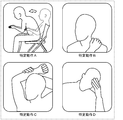
- FIG. 3 is a diagram for explaining a specific operation in the embodiment.
- FIG. 3 shows a schematic diagram of a person who performs a specific operation. Further, although FIG. 3 shows four types of specific movements, the number of types of specific movements used in the present embodiment is not particularly limited.
- the specific movement is a movement that a person can take when fatigue accumulates.
- an example of the specific motion shown as the specific motion A in the figure is an motion in which a person changes his / her posture from a backward leaning posture to a forward leaning posture.
- a person performs a specific motion A for changing the posture from the backward leaning posture to the forward leaning posture.
- an example of the specific motion shown as the specific motion B in the figure is a motion in which a person grabs the shoulder.
- the muscles become stiff, so-called stiff shoulders.
- a person performs a specific action B as an action of loosening the shoulder muscles.
- an example of the specific motion shown as the specific motion C in the figure is a motion in which a person stretches his / her back muscles by stretching his / her arm.
- the muscles of the back contract hard.
- a person performs a specific motion C of stretching an arm linked to the back muscles.
- an example of the specific motion shown as the specific motion D in the figure is a motion in which a person holds his / her head.
- a specific action D in which the person touches the painful head so as to hold it down.
- these specific movements are composed of equivalent information comparable to the joint position model for comparison with the posture of the subject 11 estimated by the posture estimation unit 25.
- a specific motion is defined by the continuous change of multiple postures, a comparison is made between the multiple joint position models and the postures estimated in both the changing order of the joint position models. Will be.
- the specific motion is provided with a permissible range in the time domain and the spatial domain in the posture determined to correspond to the specific motion. ..
- the specific movement corresponds to the movement that a general person takes when fatigue (or a load similar to fatigue on joints and muscles) accumulates.
- the specific motion is not limited to the four types of motion described above, and any motion that appears during fatigue accumulation may be applied.
- an operation peculiar to the target person 11 may be included. That is, although it is rare for a general person to appear as an action during fatigue accumulation, a motion that is frequently appearing as an action for the subject 11 during fatigue accumulation may be included as a specific action.
- the estimation of the degree of fatigue in the estimation device 100 can be made into a form specialized for the subject 11.
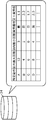
- FIG. 4 is a diagram for explaining personal fatigue information in the embodiment.
- FIG. 4 shows personal fatigue information stored in the storage unit 24.
- the personal fatigue information is associated with information corresponding to the subject 11 who is a predetermined individual for each of the specific actions. That is, when the estimation of the fatigue degree of a plurality of subjects 11 using the fatigue estimation system 200 is assumed, a plurality of personal fatigue information is prepared in a 1: 1 correspondence with the number of the plurality of subjects 11.
- the maximum number of times (maximum number of times in a day) and the minimum number of times (minimum number of times in a day) in a predetermined period are associated with each specific action. ..
- the maximum number of times in the day associated with the specific operation A is 12 times
- the minimum number of times in the day is 3 times.
- FIG. 5 is a diagram for explaining a method of constructing personal fatigue information in the embodiment.
- FIG. 5 shows a method of determining the maximum number of times during the day and the minimum number of times during the day when constructing personal fatigue information.
- the number of times the target person 11 performs a specific operation in one day is counted.
- the specific action A is counted as 3 times
- the specific action B is counted as 3 times
- the specific action C is counted as 2 times
- the specific action D is counted as 0 times.
- the specific action A is counted as 3 times
- the specific action B is counted as 3 times
- the specific action C is counted as 1 time
- the specific action D is counted as 1 time.
- the specific action A is counted as 3 times
- the specific action B is counted as 2 times
- the specific action C is counted as 1 time
- the specific action D is counted as 2 times.
- the number of days with the most specific actions and the number of days with the least specific actions are obtained. be able to.
- the number of days with the most specific movements and the number of days with the least number of specific actions obtained are determined as the maximum number of days and the minimum number of days, respectively.
- the accuracy and accuracy of the maximum number of times during the day and the minimum number of times during the day change depending on how many times (that is, how many days) the above-mentioned specific operation is counted over a predetermined period. Therefore, the user of the fatigue estimation system 200 can count the number of times the specific operation is performed as described above until the maximum number of times in the day and the minimum number of times in the day are obtained with desired accuracy and accuracy, and construct the personal fatigue information. good.
- the first fatigue degree accumulated every time the subject 11 performs the specific action A is calculated based on the maximum number of times in the day and the minimum number of times in the day determined as described above. .. More specifically, using the maximum number of times in the day and the minimum number of times in the day associated with each of the specific movements, the first fatigue in each of the specific movements is performed by the formula of 10 / ⁇ (maximum number of times in the day)-(minimum number of times in the day) ⁇ . The degree is calculated.
- the first fatigue degree is a value representing the magnitude of the fatigue degree accumulated each time a specific motion is counted, and is a value uniquely determined by the maximum number of times in the day and the minimum number of times in the day.
- the personal fatigue information includes information on the first fatigue degree and the first fatigue degree for determining the first fatigue degree (here, the maximum number of times in the day and the minimum number of times in the day).
- the first fatigue level is a value uniquely determined from the information related to the first fatigue level. Therefore, if the personal fatigue information includes the information related to the first fatigue level, the first fatigue level itself. May not be included.
- the above formula is a formula used in the present embodiment in which the degree of fatigue is scored at 10 points, and when scoring with other values, the numerical value of 10 of the numerator in the formula may be changed. good.
- the first fatigue degree of the specific operation A is 10 / (12-3) ⁇ 1.1
- the first fatigue degree of the specific operation B is 10 / (4-1) ⁇ 3.3
- the first fatigue degree of the specific operation C is 10 / (6-0) ⁇ 1.7
- the first fatigue degree of the specific motion A is 2.4
- the first fatigue degree of the specific motion B is 1.0
- these first fatigue degrees are specified.
- the first fatigue degree of the operation C is 5.0
- the first fatigue degree of the specific operation D is 3.3 (neither is shown). In this way, the degree of fatigue accumulated until the specific action is performed differs for each subject 11.
- by constructing personal fatigue information for each subject 11 it is possible to estimate the degree of fatigue that reflects the individual habits of the specific movement to be performed.
- the personal fatigue information in the present embodiment is a fatigue part that links the fatigue part, which is the body part of the subject 11 in which the first fatigue degree for each specific movement is accumulated, with the specific movement.
- the fatigue site information links the specific motion A with the waist, which is the fatigue site corresponding to the specific motion A. That is, when the subject 11 performs the specific motion A, the first fatigue degree of 1.1 is accumulated on the waist. Similarly, when the subject 11 performs the specific motion B, the first fatigue level of 3.3 is on the shoulder, and when the subject 11 performs the specific motion C, the first fatigue level of 1.7 on the back is the specific motion.
- D 2.5 first fatigue degrees are accumulated on the shoulders, respectively.
- the specific motion B and the specific motion D are associated with the same shoulder as a fatigued part.
- the fatigue level obtained by averaging the finally accumulated fatigue levels may be calculated, and the specific motion B and the specific motion D are weighted in advance.
- the integrated fatigue degree may be calculated at a ratio corresponding to the weighting coefficient.
- the weighting coefficient here is determined according to the frequency and number of times of each specific posture when constructing personal fatigue information.
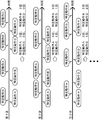
- FIG. 6 is a diagram for explaining the estimation of the degree of fatigue in the embodiment.
- the posture of the subject 11 and the timing of the specific operation from the middle of the predetermined period to the end of the predetermined period are shown in chronological order.
- the subject 11 performs the specific motion D after continuing the work in the forward leaning posture (hereinafter referred to as fatigue posture A) for 30 minutes, and returns to the fatigue posture A. ..
- the subject 11 performs the specific operation B after continuing the work in the fatigued posture A for 30 minutes, and a blank period of 2 minutes occurs due to the subject 11 moving away from the angle of view of the image pickup apparatus 101. ..
- the subject 11 continues the work in the backward leaning posture (hereinafter referred to as fatigue posture B) for 45 minutes, then performs the specific motion A, and returns to the fatigue posture A. Further, the subject 11 continues the work in the fatigued posture A for 30 minutes, and then the predetermined period ends.
- the specific operation C will be described as being performed five times.
- the determination unit 26 counts the specific operation A as 8 times, the specific operation B as 3 times, the specific operation C as 5 times, and the specific operation D as 6 times.
- the fatigue estimation unit 27 accumulates 6.6 fatigue levels on the shoulders from the specific motion B, 8.5 fatigue levels on the back from the specific motion C, and 5.0 on the shoulders from the specific motion D. It is calculated that the degree of fatigue is accumulated.
- the specific motion B and the specific motion D represent the degree of fatigue of the shoulder, which is the same fatigue portion, and the fatigue estimation unit 27 calculates the average value as the degree of fatigue of the shoulder. Specifically, here, the degree of shoulder fatigue is 5.8.
- FIG. 7 is a diagram for explaining a blank period in the embodiment.
- the fatigue estimation unit 27 integrates a predetermined supplementary fatigue degree according to the length of the blank period, and obtains the result of the integration. The above value is added to the previously calculated fatigue level.
- the subject 11 takes a break for 2 minutes, and the fatigue estimation unit 27 integrates, for example, -0.05 per minute as the supplementary fatigue degree. Therefore, the fatigue level of the subject 11 is partially recovered, and the fatigue level of 5.7 on the shoulder, the fatigue level of 8.4 on the back, and the fatigue level of 5.4 on the waist are accumulated. It is calculated. If another work is performed outside the angle of view of the image pickup apparatus 101 during the blank period, the compensation fatigue degree corresponding to the work is accumulated, and the fatigue degree of the subject 11 increases.
- the behavior schedule may be acquired from an external schedule management server or the like (not shown) and automatically determined, or the target person 11 himself / herself is a fatigue estimation system. You may input to 200.
- the fatigue estimation unit 27 makes a correction for considering the degree of fatigue accumulated by the fatigue posture A after the eighth specific operation A in FIG. Specifically, the posture of the subject 11 after a predetermined timing within a predetermined period and before the subject 11 performs a specific operation is stored in the storage unit 24 or the like together with the degree of fatigue accumulated per unit time. The fatigue estimation unit 27 uses this to estimate the degree of fatigue of the subject 11 since the last specific motion was performed.
- the predetermined timing is at the start of a predetermined period, immediately after a specific operation is performed, immediately after a blank period, or the like. In other words, the duration of one fatigued posture is sandwiched between the predetermined timing and the timing of the specific operation.
- the fatigue estimation unit 27 calculates the degree of fatigue accumulated per unit time by the fatigue posture sandwiched between the predetermined timing and the timing of the specific operation.
- the fatigue posture D is performed after the fatigue posture A before the sixth specific motion D is continued for 30 minutes. It is considered that the fatigue causing the specific motion D was caused by the fatigue posture A for 30 minutes. Therefore, the fatigue estimation unit 27 divides the first fatigue degree 2.5 of the specific operation D by 30 minutes, so that the fatigue degree accumulated per minute of the fatigue posture A (that is, the second fatigue degree) is 0. Calculated as .08. Since the fatigued portion of the specific motion D is set on the shoulder, the fatigued posture A here is also stored in the storage unit 24 on the assumption that a fatigue level of 0.08 per minute is accumulated on the shoulder. NS.
- the second fatigue degree accumulated on the shoulder due to the fatigue posture A is calculated, but there is a difference in the calculated values. Therefore, the fatigue estimation unit 27 determines that the fatigue posture A accumulates a fatigue level of 0.10 on the shoulder per minute by taking the average value of these, and stores the information stored in the storage unit 24. Update.
- the fatigue estimation unit 27 stores the second fatigue degree in the storage unit 24 by the same calculation for other fatigue postures.
- the fatigue estimation unit 27 stores in the storage unit 24 for a period during which the fatigue degree cannot be estimated using the specific movement, as in the fatigue posture A after the eighth specific movement A in FIG. 2
- the fatigue level of the subject 11 including the relevant period is estimated with reference to the fatigue level.
- the fatigue estimation unit 27 makes a correction based on the fatigue feeling so that the fatigue degree considering the subjective fatigue feeling of the subject 11 is estimated. Specifically, the fatigue estimation unit 27 receives input of information on the feeling of fatigue from the subject 11, and corrects the degree of fatigue based on the received information.
- the fatigue estimation system 200 displays a question such as "How tired do you feel?" To the subject 11 after the end of the predetermined period by the output unit 28 and the display device 105, and as an answer to the question. , Acquire a feeling of fatigue of the subject 11.
- the input by the target person 11 is received via the reception device 102 and is acquired by the second acquisition unit 22.
- the acquired fatigue feeling includes the fatigue feeling corresponding to the shoulders, back, and waist, respectively, and the fatigue estimation unit 27 estimates the fatigue degree by using the average value of the acquired fatigue degree and the calculated fatigue degree. Output as a value.
- the fatigue estimation unit 27 calculates the average value of the acquired fatigue feeling and the calculated fatigue degree.
- the fatigue estimation unit 27 outputs the estimation result to the output unit 28 assuming that the shoulder has a fatigue level of 7.9, the back has a fatigue level of 7.7, and the waist has a fatigue level of 5.7.
- FIG. 8 is a diagram for explaining the correction of the degree of fatigue in the embodiment.
- a graph is shown in which the accumulated data set is plotted by arranging the acquired fatigue feeling on the X-axis and the calculated fatigue degree on the Y-axis.
- the calculated fatigue level is higher than the acquired fatigue level. Therefore, for example, when the correlation function is obtained by regression analysis (see the broken line in the figure), the slope is 1 or less. It has become.
- FIG. 9 is a diagram illustrating information output from the fatigue estimation system according to the embodiment.
- FIG. 10 is a second diagram illustrating information output from the fatigue estimation system according to the embodiment.
- image data indicating the degree of fatigue of the subject 11 is displayed on the display module 105a of the display device 105 by the output from the output unit 28.
- the display device 105 a display provided in the computer 100a of the subject 11 is used, but other displays may be used.
- the display device 105 may be a dedicated display for the fatigue estimation system 200.
- the image data shows the degree of fatigue of the subject 11 separately for each body part.
- the image data includes a "stiff shoulder degree” indicating the degree of shoulder fatigue of the subject 11, a "back pain degree” indicating the degree of back fatigue, and a “backache degree” indicating the degree of back pain.
- the image data includes the position of each body part showing the degree of fatigue in the doll, the evaluation of the overall degree of fatigue, and the estimation result of the degree of fatigue. Explanations and advice are shown.
- advice may be given on a posture in which the degree of fatigue is relatively likely to accumulate.
- the fatigue posture A having the highest degree of second fatigue is taken up, and an image of the fatigue posture A is displayed together with a sentence indicating that the posture is particularly prone to accumulate fatigue.
- FIG. 11 is a flowchart showing the operation of the fatigue estimation system according to the embodiment.
- the fatigue estimation unit 27 reads out the personal fatigue information stored in the storage unit 24 (step S101).
- the personal fatigue information read out here is information in which the specific motion, the fatigued portion, and the information regarding the first fatigue degree are associated with each other.
- the image pickup device 101 has started operation in advance, and a plurality of images constituting a moving image are continuously output from the image pickup device 101.
- the first acquisition unit 21 starts acquiring the output image (acquisition step S102), and thereafter continuously acquires a plurality of images until the fatigue estimation system 200 is stopped.
- the posture estimation unit 25 estimates the posture of the target person 11 based on the acquired image (step S103).
- the determination unit 26 determines whether or not the movement of the target person 11 due to the change in the posture of the target person 11 estimated by the posture estimation unit 25 corresponds to the specific movement included in the personal fatigue information. It is determined whether or not the specific operation has been performed by step 11 (step S104). When a plurality of specific actions are included, it is sequentially determined whether or not the actions of the target person 11 correspond to each of the plurality of specific actions.
- step S104 When it is determined that the target person 11 is performing the specific operation (Yes in step S104), the determination unit 26 counts the number of specific operations by adding +1 to the number of specific operations (step S105). .. Then, the process proceeds to step S106. On the other hand, if it is not determined that the target person 11 is performing the specific operation (No in step S104), step S105 is skipped and the process proceeds to step S106.
- step S106 the determination unit 26 determines whether or not the predetermined period has elapsed. If it is determined that the predetermined period has not elapsed (No in step S106), the process returns to step S103, and the estimation of the posture of the subject 11 and the determination of the presence / absence of the specific motion are repeated. On the other hand, when it is determined that the predetermined period has elapsed (Yes in step S106), the fatigue estimation unit 27 estimates the fatigue degree of the subject 11 according to the number of counted specific movements (estimation step S107). .. After that, the estimation device 100 initializes the number of specific operations and ends the operation in preparation for the next estimation of the degree of fatigue.
- the fatigue level of the subject 11 can be estimated only by determining whether or not the specific operation has been performed. It is also possible to combine with a plurality of correction means for improving the accuracy of the estimated fatigue degree of the subject 11 and applying it to the individual subject 11, and the fatigue of the subject 11 or the subject 11 It is possible to easily construct a fatigue estimation system 200 according to the accuracy required by a manager or the like who manages the degree. In this way, the fatigue estimation system 200 in the present embodiment can more appropriately estimate the degree of fatigue of the subject 11.
- the fatigue estimation system 200 in the present embodiment is a fatigue estimation system 200 from an information output device (for example, an image pickup device 101) that outputs information regarding the position of a body part of the subject 11 and an information output device within a predetermined period. Based on the output information, the estimation device 100 that estimates and outputs the degree of fatigue of the subject 11 accumulated within a predetermined period by counting the number of specific actions that appear according to the fatigue accumulation. Be prepared.
- an information output device for example, an image pickup device 101
- the fatigue degree of the subject 11 can be estimated only by counting the number of such specific movements. This simplifies the calculation process for estimating the degree of fatigue of the subject 11. Therefore, in the fatigue estimation system 200 of the present embodiment, the fatigue degree of the subject 11 can be estimated more appropriately.
- the fatigue estimation system 200 is a reception device that receives an input of a fatigue feeling based on the subjectivity of the subject 11 accumulated within a predetermined period, which is a fatigue feeling corresponding to the fatigue degree of the subject 11.
- the estimation device 100 may include 102 and correct and output the fatigue level of the subject 11 based on the feeling of fatigue.
- the feeling of fatigue based on the subjectivity of the subject 11 can be reflected in the estimated value of the degree of fatigue, and the estimation of the degree of fatigue with reduced discomfort for the subject 11 can be realized. Therefore, in the fatigue estimation system 200 of the present embodiment, the fatigue degree of the subject 11 can be estimated more appropriately.
- the fatigue estimation system 200 further stores personal fatigue information including information on the first fatigue degree, which is the fatigue degree accumulated each time a specific motion is counted, of the subject 11.
- the estimation device 100 may estimate the fatigue degree of the subject 11 by including the storage unit 24) and integrating the first fatigue degree according to the number of specific operations.
- the fatigue degree of the subject 11 can be estimated more appropriately.
- the personal fatigue information may include fatigue part information that links the fatigue part, which is the body part of the subject 11 whose first fatigue degree is accumulated every time the specific movement is counted, with the specific movement.
- the estimation device 100 uses the posture of the subject 11 estimated based on the information as the fatigue posture after the predetermined timing within the predetermined period and before the specific motion of the subject 11 is counted.
- the first fatigue level is divided by the duration of the fatigued posture to calculate the second fatigue level, which is the first fatigue level accumulated by the fatigued posture per unit time, and the calculated second fatigue level is used by the subject.
- the degree of fatigue of 11 may be corrected and output.
- the estimation device 100 estimates the posture of the target person 11 based on the information output after the specific movement is last counted, and the target person estimated after the specific movement is last counted. It is determined whether the posture of 11 corresponds to the fatigue posture, and the calculated value obtained by integrating the second fatigue degree according to the duration of the posture corresponding to the fatigue posture is the fatigue of the subject 11. It may be added to the output.
- the estimation device 100 may output presentation information for presenting the fatigued posture to the subject 11.
- an acquisition device 103 for acquiring personal information including at least one of the age, gender, height, weight, muscle mass, stress level, body fat percentage, and exercise proficiency level of the subject 11.
- the estimation device 100 may correct and output the degree of fatigue of the subject 11 using the acquired personal information.
- the acquisition device 103 may acquire personal information by connecting to an external device 104 in which a health diagnosis result including personal information is stored.
- personal information can be acquired at once based on the results of health examinations in which a large amount of personal information is collectively managed. Therefore, by making corrections based on various personal information, more accurate estimation of the degree of fatigue can be easily realized, and the degree of fatigue of the subject 11 can be estimated more appropriately.
- the estimation device 100 is obtained by accumulating a preset compensation fatigue degree according to the length of the blank period in a blank period, which is a period within a predetermined period during which the information output device cannot output information.
- the fatigue degree of the subject 11 may be corrected and output using the calculated value.
- the complementation can be performed by the predetermined supplementary fatigue degree, and the images are more accurately accumulated within a predetermined period. It is possible to estimate the degree of fatigue. Therefore, it is possible to more appropriately estimate the degree of fatigue of the subject 11.
- the fatigue estimation method in the present embodiment is based on the acquisition step S102 for acquiring information on the position of the body part of the subject 11 and the specified information that appears according to the fatigue accumulation within a predetermined period based on the output information. It includes an estimation step S107 for estimating the degree of fatigue of the subject 11 accumulated within a predetermined period by counting the number of movements.
- this embodiment can also be realized as a program for causing a computer to execute the fatigue estimation method described above.
- another processing unit may execute the processing executed by the specific processing unit.
- the order of the plurality of processes may be changed, or the plurality of processes may be executed in parallel.
- the fatigue estimation system or the estimation device in the present disclosure may be realized by a plurality of devices having a part of each of the plurality of components, or may be realized by a single device having all of the plurality of components. good. Further, a part of the functions of the components may be realized as the functions of another component, and each function may be distributed to each component in any way. It is included in the present disclosure if it has a configuration having substantially all the functions that can realize the fatigue estimation system or the estimation device of the present disclosure.
- each component may be realized by executing a software program suitable for each component.
- Each component may be realized by a program execution unit such as a CPU or a processor reading and executing a software program recorded on a recording medium such as a hard disk or a semiconductor memory.
- each component may be realized by hardware.
- each component may be a circuit (or an integrated circuit). These circuits may form one circuit as a whole, or may be separate circuits from each other. Further, each of these circuits may be a general-purpose circuit or a dedicated circuit.
- the general or specific aspects of the present disclosure may be realized by a recording medium such as a system, an apparatus, a method, an integrated circuit, a computer program, or a computer-readable CD-ROM. Further, it may be realized by any combination of a system, an apparatus, a method, an integrated circuit, a computer program and a recording medium.
- the posture of the subject is estimated using a sensor module including a position sensor and a potential sensor.
- a sensor module including a position sensor and a potential sensor a plurality of sensor modules will be described as being mounted on the target person, but the number of sensor modules mounted on the target person is not particularly limited. Only one sensor module may be attached to the subject.
- the mounting style of the sensor module is not particularly limited, and any style may be used as long as the position of a predetermined body part of the subject can be measured. As an example, by wearing a costume to which a plurality of sensor modules are attached, these plurality of sensor modules are attached to the subject.
- the sensor module is a device that is attached to a predetermined body part of the subject and outputs information indicating the result of detection or measurement in conjunction with the predetermined body part.
- the sensor module has a position sensor that outputs position information regarding the spatial position of a predetermined body part of the subject, and a potential sensor that outputs potential information indicating a potential in the predetermined body part of the subject. ..
- a sensor module having both a position sensor and a potential sensor is shown, but if the sensor module has a position sensor, the potential sensor is not essential.
- the position sensor in such a sensor module is an example of an information output device that outputs position information as information regarding the position of a body part of a subject.
- the output information is position information, and is information including the relative or absolute position of a predetermined body part of the subject. Further, the output information may include, for example, potential information.
- the electric potential information is information including the electric potential value measured in a predetermined body part of the subject.
- the position sensor is a detector that detects the spatial relative position or the absolute position of the predetermined body part of the subject to which the sensor module is mounted and outputs the information regarding the spatial position of the predetermined body part which is the detection result. ..
- the information regarding the spatial position includes information that can specify the position of the body part in the space as described above and information that can specify the change in the position of the body part due to the body movement. Specifically, the information regarding the spatial position includes the position in the space of the joint and the skeleton and the information indicating the change of the position.
- the position sensor is composed of a combination of various sensors such as an acceleration sensor, an angular velocity sensor, a geomagnetic sensor, and a distance measuring sensor. Since the position information output by the position sensor can be approximated to the spatial position of the predetermined body part of the subject, the posture of the subject can be estimated from the spatial position of the predetermined body part.
- the potential sensor is a detector that measures the potential in a predetermined body part of the subject to which the sensor module is attached and outputs information indicating the potential of the predetermined body part as the measurement result.
- the potential sensor is a measuring instrument having a plurality of electrodes and measuring the potential generated between the plurality of electrodes by an electrometer.
- the potential information output by the potential sensor indicates the potential generated in the predetermined body part of the subject, and since the potential corresponds to the action potential of the muscle in the predetermined body part, the action potential of the predetermined body part It is possible to improve the estimation accuracy of the posture of the subject estimated from the above.
- the degree of fatigue of the subject is estimated using the posture of the subject estimated as described above. Since the processing after the estimation of the posture of the subject is the same as that of the above embodiment, the description thereof will be omitted.
- a ⁇ muscle load + b ⁇ joint load in which a, b, and c are coefficients (in other words, a weighting coefficient).
- a method of estimating the degree of fatigue of a subject from the posture of the subject based on the formula of amount + c ⁇ blood flow.
- the muscle load amount and the joint load amount here are non-unit index amounts normalized within the range of 0 to 1 when the amount having the Newton unit is 1 when the preset maximum value is 1. be.
- the blood flow rate here is a unitless index amount in the range of 0 to 1 obtained as a ratio of the measured value equal to or less than the initial value to the initial value.
- the above formula is an example of using three index quantities, but if at least one of the three index quantities is used, the degree of fatigue of the subject can be estimated.
- the fatigue degree of the subject is calculated as a value within the range of 0 to 1 in the same manner as described above.
- the degree of fatigue suitable for each individual is calculated a plurality of times by another method. Since the calculation result of these a plurality of times corresponds to one specific operation described above, the same degree of fatigue can be obtained. That is, by adjusting various parameters so that the calculation results of these multiple times all match, the parameters for which the fatigue degree suitable for each individual is estimated are determined even by other methods.
- the estimation device has a, b, and c as coefficients, and a ⁇ muscle load + b ⁇ joint load + c ⁇ blood flow.
- the fatigue degree of the subject is estimated based on the formula, the fatigue degree in the period corresponding to one specific operation is calculated multiple times based on the formula, and a, b, and c are referred to as the plurality of times. It can also be corrected based on the calculation result.
- the estimation result based on the formula of a ⁇ muscle load + b ⁇ joint load + c ⁇ blood flow rate as another means for estimating the degree of fatigue of the subject was described in the above embodiment.
- the coefficients of a, b, and c can be corrected so that the degree of fatigue suitable for each individual is estimated. That is, based on the fatigue degree calculated in the present embodiment, the other fatigue degree estimation methods can be corrected so as to be suitable for each individual, and the versatility of the other fatigue degree estimation methods can be improved. It can also be used to expand.
- the present disclosure may be realized as a fatigue estimation method executed by a fatigue estimation system or an estimation device.
- the present disclosure may be realized as a program for causing a computer to execute such a fatigue estimation method, or may be realized as a computer-readable non-temporary recording medium in which such a program is recorded. ..
- Target person 24 Storage unit (storage device) 100 Estimator 101 Imaging device (information output device) 102 Reception device 103 Acquisition device 104 External device 200 Fatigue estimation system
Landscapes
- Health & Medical Sciences (AREA)
- Life Sciences & Earth Sciences (AREA)
- Engineering & Computer Science (AREA)
- Veterinary Medicine (AREA)
- Molecular Biology (AREA)
- Public Health (AREA)
- General Health & Medical Sciences (AREA)
- Animal Behavior & Ethology (AREA)
- Physics & Mathematics (AREA)
- Surgery (AREA)
- Biophysics (AREA)
- Pathology (AREA)
- Biomedical Technology (AREA)
- Heart & Thoracic Surgery (AREA)
- Medical Informatics (AREA)
- Psychiatry (AREA)
- Physiology (AREA)
- Dentistry (AREA)
- Oral & Maxillofacial Surgery (AREA)
- Child & Adolescent Psychology (AREA)
- Social Psychology (AREA)
- Psychology (AREA)
- Hospice & Palliative Care (AREA)
- Educational Technology (AREA)
- Developmental Disabilities (AREA)
- Artificial Intelligence (AREA)
- Computer Vision & Pattern Recognition (AREA)
- Signal Processing (AREA)
- Measurement Of The Respiration, Hearing Ability, Form, And Blood Characteristics Of Living Organisms (AREA)
Priority Applications (3)
| Application Number | Priority Date | Filing Date | Title |
|---|---|---|---|
| CN202180033912.7A CN115551411B (zh) | 2020-05-28 | 2021-05-19 | 疲劳推测系统、疲劳推测方法及程序记录介质 |
| JP2022526926A JP7515077B2 (ja) | 2020-05-28 | 2021-05-19 | 疲労推定システム、疲労推定方法、及び、プログラム |
| US17/924,303 US20230181075A1 (en) | 2020-05-28 | 2021-05-19 | Fatigue estimation system, fatigue estimation method, and recording medium |
Applications Claiming Priority (2)
| Application Number | Priority Date | Filing Date | Title |
|---|---|---|---|
| JP2020093032 | 2020-05-28 | ||
| JP2020-093032 | 2020-05-28 |
Publications (1)
| Publication Number | Publication Date |
|---|---|
| WO2021241348A1 true WO2021241348A1 (ja) | 2021-12-02 |
Family
ID=78745109
Family Applications (1)
| Application Number | Title | Priority Date | Filing Date |
|---|---|---|---|
| PCT/JP2021/018946 Ceased WO2021241348A1 (ja) | 2020-05-28 | 2021-05-19 | 疲労推定システム、疲労推定方法、及び、プログラム |
Country Status (4)
| Country | Link |
|---|---|
| US (1) | US20230181075A1 (https=) |
| JP (1) | JP7515077B2 (https=) |
| CN (1) | CN115551411B (https=) |
| WO (1) | WO2021241348A1 (https=) |
Cited By (2)
| Publication number | Priority date | Publication date | Assignee | Title |
|---|---|---|---|---|
| CN115736902A (zh) * | 2022-12-01 | 2023-03-07 | 广州市汇源通信建设监理有限公司 | 一种基于智能穿戴设备的施工人员管理系统 |
| WO2023120064A1 (ja) * | 2021-12-24 | 2023-06-29 | パナソニックIpマネジメント株式会社 | 疲労推定装置、疲労推定システム、及び疲労推定方法 |
Families Citing this family (1)
| Publication number | Priority date | Publication date | Assignee | Title |
|---|---|---|---|---|
| US12279882B2 (en) * | 2021-07-23 | 2025-04-22 | Google Llc | Movement disorder diagnostics from video data using body landmark tracking |
Citations (6)
| Publication number | Priority date | Publication date | Assignee | Title |
|---|---|---|---|---|
| JPH0347207A (ja) * | 1989-07-14 | 1991-02-28 | Nissan Motor Co Ltd | シート |
| JP2003325489A (ja) * | 2002-05-13 | 2003-11-18 | Toyota Central Res & Dev Lab Inc | 腰筋肉疲労判定装置 |
| WO2006054542A1 (ja) * | 2004-11-16 | 2006-05-26 | Nihon University | 疲労判定システム及び疲労判定方法 |
| JP2015150150A (ja) * | 2014-02-13 | 2015-08-24 | 富士ゼロックス株式会社 | 情報提供装置及びプログラム |
| JP2017086524A (ja) * | 2015-11-11 | 2017-05-25 | セイコーエプソン株式会社 | 疲労度管理装置、疲労度管理システムおよび疲労度判定方法 |
| JP2017194772A (ja) * | 2016-04-19 | 2017-10-26 | トヨタ自動車株式会社 | 覚醒度判定装置 |
Family Cites Families (13)
| Publication number | Priority date | Publication date | Assignee | Title |
|---|---|---|---|---|
| JP2003070774A (ja) * | 2001-09-05 | 2003-03-11 | Tachi S Co Ltd | 車両用シートの着座姿勢判別方法、疲労判別方法、およびその姿勢/疲労警告装置 |
| JP4636861B2 (ja) * | 2004-11-25 | 2011-02-23 | 株式会社デルタツーリング | 快適感評価装置 |
| JP4832914B2 (ja) * | 2006-02-08 | 2011-12-07 | 株式会社デルタツーリング | 筋疲労評価装置 |
| WO2007138930A1 (ja) * | 2006-05-29 | 2007-12-06 | Sharp Kabushiki Kaisha | 疲労推定装置及びそれを搭載した電子機器 |
| JP2017221647A (ja) * | 2016-06-10 | 2017-12-21 | パナソニックIpマネジメント株式会社 | 筋肉疲労出力装置、筋肉疲労出力方法及びプログラム |
| KR101886108B1 (ko) * | 2016-12-13 | 2018-08-07 | 현대자동차 주식회사 | 피로도 측정 시스템 |
| JP6960654B2 (ja) * | 2017-03-30 | 2021-11-05 | 株式会社タニタ | 情報処理装置、情報処理方法及びプログラム |
| CN107697069B (zh) * | 2017-10-31 | 2020-07-28 | 上海汽车集团股份有限公司 | 汽车驾驶员疲劳驾驶智能控制方法 |
| CN108021875A (zh) * | 2017-11-27 | 2018-05-11 | 上海灵至科技有限公司 | 一种车辆驾驶员个性化疲劳监测及预警方法 |
| KR102279847B1 (ko) * | 2018-09-12 | 2021-07-21 | 왕옥란 | 사물인터넷 연동 방석 시스템 |
| CN110179460A (zh) * | 2019-04-04 | 2019-08-30 | 苏州国科视清医疗科技有限公司 | 基于眼电与头部姿态的脑疲劳检测及促醒装置 |
| CN110276273B (zh) * | 2019-05-30 | 2024-01-02 | 福建工程学院 | 融合面部特征与图像脉搏心率估计的驾驶员疲劳检测方法 |
| CN110755078B (zh) * | 2019-10-29 | 2022-08-09 | 福建农林大学 | 基于置信度加权的膝关节运动疲劳评估预测系统及方法 |
-
2021
- 2021-05-19 WO PCT/JP2021/018946 patent/WO2021241348A1/ja not_active Ceased
- 2021-05-19 US US17/924,303 patent/US20230181075A1/en active Pending
- 2021-05-19 JP JP2022526926A patent/JP7515077B2/ja active Active
- 2021-05-19 CN CN202180033912.7A patent/CN115551411B/zh active Active
Patent Citations (6)
| Publication number | Priority date | Publication date | Assignee | Title |
|---|---|---|---|---|
| JPH0347207A (ja) * | 1989-07-14 | 1991-02-28 | Nissan Motor Co Ltd | シート |
| JP2003325489A (ja) * | 2002-05-13 | 2003-11-18 | Toyota Central Res & Dev Lab Inc | 腰筋肉疲労判定装置 |
| WO2006054542A1 (ja) * | 2004-11-16 | 2006-05-26 | Nihon University | 疲労判定システム及び疲労判定方法 |
| JP2015150150A (ja) * | 2014-02-13 | 2015-08-24 | 富士ゼロックス株式会社 | 情報提供装置及びプログラム |
| JP2017086524A (ja) * | 2015-11-11 | 2017-05-25 | セイコーエプソン株式会社 | 疲労度管理装置、疲労度管理システムおよび疲労度判定方法 |
| JP2017194772A (ja) * | 2016-04-19 | 2017-10-26 | トヨタ自動車株式会社 | 覚醒度判定装置 |
Cited By (5)
| Publication number | Priority date | Publication date | Assignee | Title |
|---|---|---|---|---|
| WO2023120064A1 (ja) * | 2021-12-24 | 2023-06-29 | パナソニックIpマネジメント株式会社 | 疲労推定装置、疲労推定システム、及び疲労推定方法 |
| JPWO2023120064A1 (https=) * | 2021-12-24 | 2023-06-29 | ||
| JP7762887B2 (ja) | 2021-12-24 | 2025-10-31 | パナソニックIpマネジメント株式会社 | 疲労推定装置、疲労推定システム、及び疲労推定方法 |
| CN115736902A (zh) * | 2022-12-01 | 2023-03-07 | 广州市汇源通信建设监理有限公司 | 一种基于智能穿戴设备的施工人员管理系统 |
| CN115736902B (zh) * | 2022-12-01 | 2023-07-25 | 广州市汇源通信建设监理有限公司 | 一种基于智能穿戴设备的施工人员管理系统 |
Also Published As
| Publication number | Publication date |
|---|---|
| CN115551411A (zh) | 2022-12-30 |
| JPWO2021241348A1 (https=) | 2021-12-02 |
| US20230181075A1 (en) | 2023-06-15 |
| JP7515077B2 (ja) | 2024-07-12 |
| CN115551411B (zh) | 2026-01-23 |
Similar Documents
| Publication | Publication Date | Title |
|---|---|---|
| US11679300B2 (en) | Systems and methods for real-time data quantification, acquisition, analysis, and feedback | |
| JP7515077B2 (ja) | 疲労推定システム、疲労推定方法、及び、プログラム | |
| US9730583B2 (en) | Method for objective diagnostics of internuclear opthalmopligia, ocular lateral pulsion, progressive supernuclear palsy and glissades eye movements | |
| US10722165B1 (en) | Systems and methods for reaction measurement | |
| AU2017386412A1 (en) | Systems and methods for real-time data quantification, acquisition, analysis, and feedback | |
| CN111772577A (zh) | 一种基于云平台的膝关节康复评估系统及方法 | |
| JP6535778B1 (ja) | 運動能力評価システム | |
| US9795335B2 (en) | Data collection for vestibulogram construction | |
| JP2019067177A (ja) | 医療情報処理システム、歩行状態定量化方法およびプログラム | |
| JP2020017153A (ja) | 健康状態診断システム | |
| Kim et al. | Missing sample recovery for wireless inertial sensor-based human movement acquisition | |
| Madhushri et al. | A smartphone application suite for assessing mobility | |
| Benning et al. | Comparison of accuracy of activity measurements with wearable activity trackers in wheelchair users: a preliminary evaluation | |
| CN106725305A (zh) | 基于人体姿态角的疼痛程度评估方法及系统 | |
| Santos-Paz et al. | A novel virtual reality application for autonomous assessment of cervical range of motion: development and reliability study | |
| CN116725520B (zh) | 一种基于脊柱矢状面实时监测的驼背矫姿系统及方法 | |
| Walsh et al. | Marker-based monitoring of seated spinal posture using a calibrated single-variable threshold model | |
| Dalimi et al. | A novel device to improve sitting posture | |
| Sprint et al. | Designing wearable sensor-based analytics for quantitative mobility assessment | |
| CN117982153A (zh) | 一种基于眼动电位特征的康复训练匹配方法及装置 | |
| CN113314213B (zh) | 基于智能手表和vr眼镜结合的智能诊疗及训练控制系统 | |
| Liu et al. | Analysis of eye tracking of physiotherapist during walk rehabilitation | |
| CN117355254A (zh) | 身体功能估计系统、身体功能估计方法以及程序 | |
| TW202217847A (zh) | 神經肌肉疾病評估系統 | |
| JP2016220779A (ja) | 移動運動解析装置、方法及びプログラム |
Legal Events
| Date | Code | Title | Description |
|---|---|---|---|
| 121 | Ep: the epo has been informed by wipo that ep was designated in this application |
Ref document number: 21813415 Country of ref document: EP Kind code of ref document: A1 |
|
| ENP | Entry into the national phase |
Ref document number: 2022526926 Country of ref document: JP Kind code of ref document: A |
|
| NENP | Non-entry into the national phase |
Ref country code: DE |
|
| 122 | Ep: pct application non-entry in european phase |
Ref document number: 21813415 Country of ref document: EP Kind code of ref document: A1 |