WO2021221079A1 - 留め具 - Google Patents
留め具 Download PDFInfo
- Publication number
- WO2021221079A1 WO2021221079A1 PCT/JP2021/016863 JP2021016863W WO2021221079A1 WO 2021221079 A1 WO2021221079 A1 WO 2021221079A1 JP 2021016863 W JP2021016863 W JP 2021016863W WO 2021221079 A1 WO2021221079 A1 WO 2021221079A1
- Authority
- WO
- WIPO (PCT)
- Prior art keywords
- leg piece
- fastener
- boss
- component
- extending
- Prior art date
- Legal status (The legal status is an assumption and is not a legal conclusion. Google has not performed a legal analysis and makes no representation as to the accuracy of the status listed.)
- Ceased
Links
Images


Classifications
-
- F—MECHANICAL ENGINEERING; LIGHTING; HEATING; WEAPONS; BLASTING
- F16—ENGINEERING ELEMENTS AND UNITS; GENERAL MEASURES FOR PRODUCING AND MAINTAINING EFFECTIVE FUNCTIONING OF MACHINES OR INSTALLATIONS; THERMAL INSULATION IN GENERAL
- F16B—DEVICES FOR FASTENING OR SECURING CONSTRUCTIONAL ELEMENTS OR MACHINE PARTS TOGETHER, e.g. NAILS, BOLTS, CIRCLIPS, CLAMPS, CLIPS OR WEDGES; JOINTS OR JOINTING
- F16B21/00—Means for preventing relative axial movement of a pin, spigot, shaft or the like and a member surrounding it; Stud-and-socket releasable fastenings
- F16B21/06—Releasable fastening devices with snap-action
- F16B21/07—Releasable fastening devices with snap-action in which the socket has a resilient part
- F16B21/073—Releasable fastening devices with snap-action in which the socket has a resilient part the socket having a resilient part on its inside
- F16B21/075—Releasable fastening devices with snap-action in which the socket has a resilient part the socket having a resilient part on its inside the socket having resilient parts on its inside and outside
-
- F—MECHANICAL ENGINEERING; LIGHTING; HEATING; WEAPONS; BLASTING
- F16—ENGINEERING ELEMENTS AND UNITS; GENERAL MEASURES FOR PRODUCING AND MAINTAINING EFFECTIVE FUNCTIONING OF MACHINES OR INSTALLATIONS; THERMAL INSULATION IN GENERAL
- F16B—DEVICES FOR FASTENING OR SECURING CONSTRUCTIONAL ELEMENTS OR MACHINE PARTS TOGETHER, e.g. NAILS, BOLTS, CIRCLIPS, CLAMPS, CLIPS OR WEDGES; JOINTS OR JOINTING
- F16B19/00—Bolts without screw-thread; Pins, including deformable elements; Rivets
- F16B19/04—Rivets; Spigots or the like fastened by riveting
- F16B19/08—Hollow rivets; Multi-part rivets
- F16B19/10—Hollow rivets; Multi-part rivets fastened by expanding mechanically
-
- F—MECHANICAL ENGINEERING; LIGHTING; HEATING; WEAPONS; BLASTING
- F16—ENGINEERING ELEMENTS AND UNITS; GENERAL MEASURES FOR PRODUCING AND MAINTAINING EFFECTIVE FUNCTIONING OF MACHINES OR INSTALLATIONS; THERMAL INSULATION IN GENERAL
- F16B—DEVICES FOR FASTENING OR SECURING CONSTRUCTIONAL ELEMENTS OR MACHINE PARTS TOGETHER, e.g. NAILS, BOLTS, CIRCLIPS, CLAMPS, CLIPS OR WEDGES; JOINTS OR JOINTING
- F16B2/00—Friction-grip releasable fastenings
- F16B2/20—Clips, i.e. with gripping action effected solely by the inherent resistance to deformation of the material of the fastening
- F16B2/22—Clips, i.e. with gripping action effected solely by the inherent resistance to deformation of the material of the fastening of resilient material, e.g. rubbery material
- F16B2/24—Clips, i.e. with gripping action effected solely by the inherent resistance to deformation of the material of the fastening of resilient material, e.g. rubbery material of metal
- F16B2/241—Clips, i.e. with gripping action effected solely by the inherent resistance to deformation of the material of the fastening of resilient material, e.g. rubbery material of metal of sheet metal
- F16B2/243—Clips, i.e. with gripping action effected solely by the inherent resistance to deformation of the material of the fastening of resilient material, e.g. rubbery material of metal of sheet metal internal, i.e. with spreading action
Definitions
- the present invention relates to fasteners for attaching parts to mounting members.
- Patent Document 1 discloses a fastener for attaching an operation panel to the interior trim of a vehicle.
- the fastener comprises a pair of opposing leg pieces, a connecting portion that connects the pair of leg pieces, and a locking portion that locks to the component.
- the locking portion is formed in an L shape in a side view, and the tip portion of the locking portion is provided parallel to the opposite direction of the pair of leg pieces.
- the mounting portion is inserted between the pair of leg pieces, the tip of the locking portion hits the mounting portion and bends, and is inserted into the mounting hole of the mounting portion to lock.
- An object of the present invention is to provide a fastener that can be easily attached to a boss portion.
- one aspect of the present invention is a fastener made of a metal material for attaching a component to a mounting hole of a mounting member, the first leg piece and the second leg piece facing each other. And a connecting portion for connecting the base ends of the first leg piece and the second leg piece.
- the first leg piece has a locking portion that locks to the edge of the mounting hole and a claw portion that prevents the fastener from coming off the component.
- the claw portion extends from the tip end side of the first leg piece and is inserted into the hole portion formed in the boss portion of the component.
- the second leg piece is inserted into a hole formed in the boss portion of the component and does not have a claw portion in the component to prevent the fastener from coming off.
- FIG. 2A is a side view of the fastener
- FIG. 2B is a front view of the fastener.
- It is a perspective view of the boss part of a part.
- It is a side view of the fastener attached to a component and a mounting member.
- It is a figure for demonstrating attachment to a boss part of a fastener.
- It is a figure for demonstrating attachment to attachment member of a fastener.
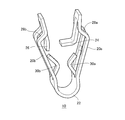
- FIG. 1 is a perspective view of the fastener 10.
- 2 (a) is a side view of the fastener 10
- FIG. 2 (b) is a front view of the fastener 10.
- the fastener 10 is used to attach the component to the mounting member.
- the parts may be in-vehicle parts such as an operation panel provided with a switch for opening and closing windows, and decorative parts having a design such as a cover.
- the mounting member may be a trim panel, a vehicle body panel, or the like.
- the fastener 10 is made of a metal material, and is formed by cutting and pressing a metal plate material. By forming it with a metal material, it is possible to have a higher extraction force than when it is formed with a resin material.
- the fastener 10 includes a first leg piece 20a, a second leg piece 20b, a connecting portion 22, a first holding portion 30a, and a second holding portion 30b.
- the first leg piece 20a and the second leg piece 20b face each other.
- the direction in which the first leg piece 20a and the second leg piece 20b (when these are not distinguished, they are referred to as "leg piece 20") face each other is referred to as an opposite direction.
- the first leg piece 20a and the second leg piece 20b can be bent in the opposite direction, and can be bent so as to approach and separate from each other.
- the tip 21a of the first leg piece 20a is a free end, and the base end 21b of the first leg piece 20a is connected to the connecting portion 22.
- the connecting portion 22 connects the base end 21b of the first leg piece 20a and the second leg piece 20b.
- the first leg piece 20a has a claw portion 24 and a first locking portion 28a, and the second leg piece 20b has a guide portion 26 and a second locking portion 28b.
- the first locking portion 28a is formed so as to bend outward in the opposite direction in the middle of the first leg piece 20a, and the second locking portion 28b faces outward in the opposite direction in the middle of the second leg piece 20b. It is formed so as to bend to.
- the first locking portion 28a and the second locking portion 28b have an inclined surface extending outward in the facing direction, and the inclined surface locks to the back edge of the mounting hole formed in the mounting member.
- the first holding portion 30a and the second holding portion 30b extend from the base end 21b side of the leg piece 20 toward the tip end 21a side, extend so as to approach each other, bend in the middle, and extend so as to separate from each other. Put out.
- the first holding portion 30a and the second holding portion 30b sandwich the boss portion of the component.
- the length of the first holding portion 30a is shorter than that of the second holding portion 30b in the extending direction.
- the first holding portion 30a and the second holding portion 30b may extend from the connecting portion 22 instead of from the leg piece 20.
- the claw portion 24 is formed as a cantilever piece extending from the tip end side of the first leg piece 20a and extending from the first leg piece 20a.
- the first leg piece 20a and the claw portion 24 bend in conjunction with each other.
- the claw portion 24 has a first extending portion 24a and a second extending portion 24b.
- the first extending portion 24a extends from the tip end 21a side of the first leg piece 20a toward the connecting portion 22.
- the second extension portion 24b bends from the first extension portion 24a and projects toward the second leg piece 20b.
- the second extending portion 24b is inclined with respect to the opposite direction of the leg piece 20 and extends toward the connecting portion 22, that is, toward the base end side. That is, the second extending portion 24b does not extend in parallel in the opposite direction, but extends so as to slightly hang down toward the connecting portion 22 side.
- the second leg piece 20b has a guide portion 26 that guides the insertion of the boss portion of the component.
- the guide portion 26 has a guide surface 26a extending from the tip end 21a side of the second leg piece 20b toward the base end 21b side.
- the guide surface 26a is flat and may extend uniformly from the tip 21a of the second leg piece 20b.
- the second extending portion 24b of the claw portion 24 projects toward the guide portion 26.
- the second extending portion 24b and the guide portion 26 have a region that overlaps in the direction from the tip end 21a to the base end 21b, and are provided so as to face each other.
- the claw portion 24 and the guide portion 26 are formed by hollowing out the first leg piece 20a and the second leg piece 20b.
- the gap between the first leg piece 20a and the second leg piece 20b serves as a path for inserting the boss portion of the component, and the boss portion passes through the shortest distance C between the tip portion of the second extension portion 24b and the guide portion 26. Is set to a possible length.
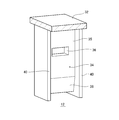
- FIG. 3 is a perspective view of the boss portion 34 of the component 12.
- the component 12 has a panel 32 and a boss portion 34.
- the panel 32 may be an operation panel exposed on the surface.
- a plurality of boss portions 34 are provided so as to hang down from the back surface of the panel 32.
- the boss portion 34 has a boss main body 35, a hole portion 36, a tapered portion 38, and a side wall portion 40.
- the boss body 35 is formed in a flat plate shape.
- the hole 36 is formed so as to penetrate the boss body 35 at a substantially central position.
- the tapered portion 38 is formed so as to make the tip of the boss body 35 thin.
- a pair of side wall portions 40 are formed on both sides of the boss body 35. The side wall 40 restricts the fastener 10 from moving in the width direction.
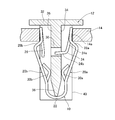
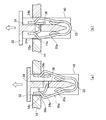
- FIG. 4 is a side view of the fastener 10 attached to the component 12 and the attachment member 14.
- the fastener 10 is attached to the boss portion 34 of the component 12, and then is attached to the attachment hole 14a of the attachment member 14.
- the fastener 10 is not removed from the boss portion 34, but can be pulled out from the mounting hole 14a when the panel 32 of the component 12 fails.
- the fastener 10 is pulled out from the mounting hole 14a without requiring an operation of bringing the pair of leg pieces 20 close to each other.
- the first holding portion 30a and the second holding portion 30b sandwich the boss body 35 of the boss portion 34.
- the attachment posture of the fastener 10 can be stabilized even when the fastener 10 is conveyed with the fastener 10 attached to the component 12.
- the second extending portion 24b of the claw portion 24 is inserted into the hole portion 36 to prevent the fastener 10 from coming off from the part 12.
- the tip of the claw portion 24 is located on the second leg piece 20b side from the center position of the hole portion 36, and the claw portion 24 sufficiently penetrates into the hole portion 36. As a result, the fastener 10 is attached so as not to come off from the boss portion 34.
- the first locking portion 28a and the second locking portion 28b are locked to the back edge of the mounting hole 14a of the mounting member 14. As a result, the fastener 10 is fixed to the mounting member 14. When the first leg piece 20a and the second leg piece 20b are bent so as to approach each other, the first locking portion 28a and the second locking portion 28b are released from the lock. Therefore, when replacing the component 12, the fastener 10 can be pulled out from the mounting hole 14a.
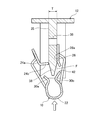
- FIG. 5 is a diagram for explaining attachment of the fastener 10 to the boss portion 34.
- FIG. 5 shows a state in which the fastener 10 is being attached to the boss portion 34.
- the operator aligns the tapered portion 38 of the boss portion 34 between the first leg piece 20a and the second leg piece 20b, and pushes the connecting portion 22.
- the boss portion 34 is inserted between the first leg piece 20a and the second leg piece 20b.
- the boss portion 34 hits the claw portion 24 and is brought closer to the guide portion 26 side to be guided to the guide surface 26a.
- the guide portion 26 brings the side surface of the boss body 35 into surface contact with the guide surface 26a.
- the claw portion 24 is formed on the first leg piece 20a, the claw portion is not formed on the second leg piece 20b.
- the boss portion 34 is inserted between the first leg piece 20a and the second leg piece 20b, it is possible to suppress an increase in the insertion force as compared with the case where the claw portions are provided on both sides. Further, since the guide portion 26 is formed on the second leg piece 20b, the boss portion 34 can be easily guided toward the connecting portion 22.
- the tip 42 of the second holding portion 30b is provided at a position away from the first leg piece 20a from the virtual line F extending the guide surface 26a in a side view, that is, at a position on the second leg piece 20b side. That is, the tip 42 of the second holding portion 30b is located at a position farther from the leg piece 20 (right side in the figure) than the virtual line F.
- the tip of the boss portion 34 can be configured so as not to be caught by the tip 42 of the second holding portion 30b at the time of insertion, and the boss portion 34 can be smoothly attached.
- the tip 42 of the second holding portion 30b is provided at a position closer to the second leg piece 20b than the virtual surface on which the guide surface 26a is extended.
- the shortest distance C between the second extending portion 24b and the guide portion 26 shown in FIG. 2A is set to a distance of 80% or more of the thickness T of the boss portion 34 and less than 100%.
- the thickness T of the boss portion 34 refers to the thickness of the plate of the portion excluding the tapered portion 38 on the tip side, and also refers to the plate thickness around the hole portion 36 including the side wall portion 40.
- the shortest distance C between the second extension portion 24b and the guide portion 26 refers to the distance in a free state in which no external force is applied to the first leg piece 20a and the second leg piece 20b.
- the claw portion 24 can be prevented from coming off because it does not pass through the boss body 35 unless at least the first leg piece 20a and the second leg piece 20b are bent. .. Further, by setting the shortest interval C to a distance of 80% or more of the thickness T, the insertion force into the boss portion 34 can be suppressed. In addition, in order to suppress the insertion force into the boss portion 34, the shortest interval C may be more preferably set to a distance of 90% or more of the thickness T.
- FIG. 6 is a diagram for explaining attachment of the fastener 10 to the attachment member 14.
- the fastener 10 is inserted into the mounting hole 14a of the mounting member 14 in a state of being mounted on the boss portion 34 of the component 12.
- the length of the fastener 10 is set so that the tip of the boss portion 34 hits the connecting portion 22 and the tip 21a of the leg piece 20 does not hit the back surface of the panel 32.
- the boss portion 34 and the fastener 10 are integrally pushed into the mounting hole 14a, so that the boss portion 34 and the fastener 10 are easily inserted.
- the pair of leg pieces 20 hit the inner surface of the mounting hole 14a and bend so as to approach each other.
- the second extending portion 24b is pushed into the hole portion 36, but the second extending portion 24b is provided so as not to come into contact with the hole portion 36. That is, the shape of the second extending portion 24b is set so that the tip of the second extending portion 24b does not come into contact with the hole portion 36 in a state where the tip of the boss portion 34 hits the connecting portion 22.
- the inner surface of the leg piece 20 is provided so as not to come into contact with the side surface of the boss body 35.
- the second extending portion 24b can be prevented from sliding on the inner surface of the hole portion 36 to generate friction against the approach of the leg pieces 20, and the legs can be prevented from being generated.
- the inner surface of the piece 20 abuts on the side surface of the boss body 35 so as not to restrict the approach of the pair of leg pieces 20, and the insertion force into the mounting hole 14a can be suppressed.
- FIG. 7 is a diagram for explaining pulling out of the fastener 10 from the mounting member 14.
- the tip of the second extending portion 24b shown in FIG. 7A comes into contact with the inner surface of the hole portion 36, and the second extending portion 24b is pulled out.
- the fastener 10 is pulled out together with the boss portion 34. Since the boss portion 34 is lifted, the tip of the boss portion 34 is separated from the connecting portion 22.
- the first locking portion 28a and the second locking portion 28b hit the back edge of the mounting hole 14a and receive an inward force in the opposite direction, and the first leg piece 20a and the second leg piece 20b are flexed so as to approach each other. nothing.
- the claw portion 24 moves so as to further enter the hole portion 36. In this way, even if the claw portion 24 is inserted into the hole portion 36 to prevent it from coming off, the claw portion 24 can move together with the first leg piece 20a.
- the second extending portion 24b slides on the inner surface of the hole portion 36, friction against the approach of the leg piece 20 can be generated, and a high pulling force can be obtained.
- the boss portion 34 When the boss portion 34 is further lifted upward, the inner surface of the hole portion 36 pushes up the tip of the second extending portion 24b upward, the tip of the second extending portion 24b is lifted, and the second extending portion 24b is lifted.
- the claw portion 24 is deformed so as to come into surface contact with the inner surface of the hole portion 36. This is because the second extending portion 24b is inclined with respect to the opposite direction of the leg piece 20 and hangs down so as to extend toward the base end side of the leg piece 20, so that the boss portion 34 can be pulled out. This is because it can be transformed in conjunction with it.
- the tip of the second extending portion 24b bites into the inner surface of the hole portion 36, the claw portion 24 cannot move, and the bending of the first leg piece 20a approaching the second leg piece 20b is restricted. It can be avoided. Therefore, it is possible to prevent the boss portion 34 and the claw portion 24 from being damaged by forcibly lifting the boss portion 34 in a state where the tip of the second extending portion 24b bites into the inner surface of the hole portion 36.
- the present invention relates to fasteners for attaching parts to mounting members.
Landscapes
- Engineering & Computer Science (AREA)
- General Engineering & Computer Science (AREA)
- Mechanical Engineering (AREA)
- Insertion Pins And Rivets (AREA)
- Connection Of Plates (AREA)
Priority Applications (4)
| Application Number | Priority Date | Filing Date | Title |
|---|---|---|---|
| CN202180031348.5A CN115461549B (zh) | 2020-04-28 | 2021-04-27 | 固定件 |
| JP2022518100A JP7348391B2 (ja) | 2020-04-28 | 2021-04-27 | 留め具 |
| US17/921,475 US12264694B2 (en) | 2020-04-28 | 2021-04-27 | Fastener |
| GB2215820.8A GB2610944B (en) | 2020-04-28 | 2021-04-27 | Fastener |
Applications Claiming Priority (2)
| Application Number | Priority Date | Filing Date | Title |
|---|---|---|---|
| JP2020-079860 | 2020-04-28 | ||
| JP2020079860 | 2020-04-28 |
Publications (1)
| Publication Number | Publication Date |
|---|---|
| WO2021221079A1 true WO2021221079A1 (ja) | 2021-11-04 |
Family
ID=78332119
Family Applications (1)
| Application Number | Title | Priority Date | Filing Date |
|---|---|---|---|
| PCT/JP2021/016863 Ceased WO2021221079A1 (ja) | 2020-04-28 | 2021-04-27 | 留め具 |
Country Status (5)
| Country | Link |
|---|---|
| US (1) | US12264694B2 (https=) |
| JP (1) | JP7348391B2 (https=) |
| CN (1) | CN115461549B (https=) |
| GB (1) | GB2610944B (https=) |
| WO (1) | WO2021221079A1 (https=) |
Families Citing this family (4)
| Publication number | Priority date | Publication date | Assignee | Title |
|---|---|---|---|---|
| US11994160B2 (en) * | 2022-04-20 | 2024-05-28 | Illinois Tool Works Inc. | Fastener |
| USD1065996S1 (en) * | 2022-07-08 | 2025-03-11 | Illinois Tool Works Inc. | Fastener |
| USD1049841S1 (en) * | 2022-08-24 | 2024-11-05 | Illinois Tool Works Inc. | Fastener |
| CN118793680A (zh) * | 2023-04-13 | 2024-10-18 | 伊利诺斯工具制品有限公司 | 紧固件 |
Citations (5)
| Publication number | Priority date | Publication date | Assignee | Title |
|---|---|---|---|---|
| JP2003130020A (ja) * | 2001-10-29 | 2003-05-08 | Nifco Inc | クリップ |
| JP2014506982A (ja) * | 2011-02-17 | 2014-03-20 | 株式会社ニフココリア | プラスチッククリップ |
| JP2016217377A (ja) * | 2015-05-15 | 2016-12-22 | 株式会社パイオラックス | 留め具 |
| US20190048911A1 (en) * | 2016-03-22 | 2019-02-14 | Illinois Tool Works Inc. | Fastening clip |
| JP2020193644A (ja) * | 2019-05-27 | 2020-12-03 | 株式会社パイオラックス | 部材取付構造 |
Family Cites Families (6)
| Publication number | Priority date | Publication date | Assignee | Title |
|---|---|---|---|---|
| JP4101920B2 (ja) * | 1998-03-05 | 2008-06-18 | 株式会社ニフコ | 二つの部材の連結具 |
| JP2002021823A (ja) * | 2000-07-04 | 2002-01-23 | Nifco Inc | 板材の取付構造 |
| US7461436B2 (en) * | 2004-10-26 | 2008-12-09 | Piolax, Inc. | Mounting structure of vehicle interior material |
| JP4685678B2 (ja) * | 2005-04-14 | 2011-05-18 | 株式会社パイオラックス | 止め具 |
| JP2014228112A (ja) * | 2013-05-24 | 2014-12-08 | 株式会社パイオラックス | 取付部材の取付構造 |
| US9657759B2 (en) * | 2014-09-10 | 2017-05-23 | Newfrey Llc | U-based fastener with improved rib attachment |
-
2021
- 2021-04-27 GB GB2215820.8A patent/GB2610944B/en active Active
- 2021-04-27 US US17/921,475 patent/US12264694B2/en active Active
- 2021-04-27 WO PCT/JP2021/016863 patent/WO2021221079A1/ja not_active Ceased
- 2021-04-27 JP JP2022518100A patent/JP7348391B2/ja active Active
- 2021-04-27 CN CN202180031348.5A patent/CN115461549B/zh active Active
Patent Citations (5)
| Publication number | Priority date | Publication date | Assignee | Title |
|---|---|---|---|---|
| JP2003130020A (ja) * | 2001-10-29 | 2003-05-08 | Nifco Inc | クリップ |
| JP2014506982A (ja) * | 2011-02-17 | 2014-03-20 | 株式会社ニフココリア | プラスチッククリップ |
| JP2016217377A (ja) * | 2015-05-15 | 2016-12-22 | 株式会社パイオラックス | 留め具 |
| US20190048911A1 (en) * | 2016-03-22 | 2019-02-14 | Illinois Tool Works Inc. | Fastening clip |
| JP2020193644A (ja) * | 2019-05-27 | 2020-12-03 | 株式会社パイオラックス | 部材取付構造 |
Also Published As
| Publication number | Publication date |
|---|---|
| JPWO2021221079A1 (https=) | 2021-11-04 |
| GB2610944A (en) | 2023-03-22 |
| CN115461549A (zh) | 2022-12-09 |
| GB2610944B (en) | 2024-05-01 |
| GB202215820D0 (en) | 2022-12-07 |
| US20230184280A1 (en) | 2023-06-15 |
| US12264694B2 (en) | 2025-04-01 |
| JP7348391B2 (ja) | 2023-09-20 |
| CN115461549B (zh) | 2025-09-23 |
Similar Documents
| Publication | Publication Date | Title |
|---|---|---|
| WO2021221079A1 (ja) | 留め具 | |
| EP2090475B1 (en) | Two stage high retention fastener | |
| KR100993644B1 (ko) | 역개방 슬라이드 파스너 | |
| KR101127807B1 (ko) | 캐리어 부품에 부착 부품을 고정하기 위한 고정 장치와 이 고정 장치를 포함하는 고정 어셈블리 | |
| US9844246B2 (en) | Slider for slide fastener | |
| JPH11101469A (ja) | 天井埋込形空気調和機 | |
| KR20190139055A (ko) | 클립 | |
| WO2014010090A1 (ja) | クランパ、スライダー及びスライドファスナー | |
| JP6196096B2 (ja) | 内装部品または外装部品のクリップ取付座 | |
| JP2010211943A (ja) | コネクタ組立体 | |
| CN110536622B (zh) | 拉链用拉头 | |
| KR20060112211A (ko) | 바인더 및 그 체결 부재 | |
| JP6132897B1 (ja) | エレベータのフェッシャープレート | |
| JP6499916B2 (ja) | 留め具 | |
| JP7484273B2 (ja) | 固定構造および機器 | |
| JPH09210030A (ja) | ヒンジカラー | |
| CN107249377A (zh) | 拉链用拉头 | |
| JP2017116001A (ja) | 留め具 | |
| JP6927743B2 (ja) | 留め具 | |
| JP7415959B2 (ja) | クリップ | |
| JP6358174B2 (ja) | 複合型クリップ | |
| JP2014169739A (ja) | 結合クリップ | |
| JP4245935B2 (ja) | アシストグリップの取付構造 | |
| JP3506654B2 (ja) | クランプ | |
| JP2022167100A (ja) | 留め具 |
Legal Events
| Date | Code | Title | Description |
|---|---|---|---|
| 121 | Ep: the epo has been informed by wipo that ep was designated in this application |
Ref document number: 21795457 Country of ref document: EP Kind code of ref document: A1 |
|
| ENP | Entry into the national phase |
Ref document number: 2022518100 Country of ref document: JP Kind code of ref document: A |
|
| ENP | Entry into the national phase |
Ref document number: 202215820 Country of ref document: GB Kind code of ref document: A Free format text: PCT FILING DATE = 20210427 |
|
| WWE | Wipo information: entry into national phase |
Ref document number: 2215820.8 Country of ref document: GB |
|
| NENP | Non-entry into the national phase |
Ref country code: DE |
|
| WWP | Wipo information: published in national office |
Ref document number: 2215820.8 Country of ref document: GB |
|
| 122 | Ep: pct application non-entry in european phase |
Ref document number: 21795457 Country of ref document: EP Kind code of ref document: A1 |
|
| WWG | Wipo information: grant in national office |
Ref document number: 2215820.8 Country of ref document: GB |
|
| WWG | Wipo information: grant in national office |
Ref document number: 17921475 Country of ref document: US |
|
| WWG | Wipo information: grant in national office |
Ref document number: 202180031348.5 Country of ref document: CN |