WO2021205831A1 - 置去り物監視装置およびこれを備えた置去り物監視システムならびに置去り物監視方法 - Google Patents
置去り物監視装置およびこれを備えた置去り物監視システムならびに置去り物監視方法 Download PDFInfo
- Publication number
- WO2021205831A1 WO2021205831A1 PCT/JP2021/010805 JP2021010805W WO2021205831A1 WO 2021205831 A1 WO2021205831 A1 WO 2021205831A1 JP 2021010805 W JP2021010805 W JP 2021010805W WO 2021205831 A1 WO2021205831 A1 WO 2021205831A1
- Authority
- WO
- WIPO (PCT)
- Prior art keywords
- leftover
- mask area
- detected
- area
- monitoring
- Prior art date
- Legal status (The legal status is an assumption and is not a legal conclusion. Google has not performed a legal analysis and makes no representation as to the accuracy of the status listed.)
- Ceased
Links
Images




Classifications
-
- G—PHYSICS
- G06—COMPUTING OR CALCULATING; COUNTING
- G06V—IMAGE OR VIDEO RECOGNITION OR UNDERSTANDING
- G06V20/00—Scenes; Scene-specific elements
- G06V20/50—Context or environment of the image
- G06V20/52—Surveillance or monitoring of activities, e.g. for recognising suspicious objects
-
- G—PHYSICS
- G06—COMPUTING OR CALCULATING; COUNTING
- G06T—IMAGE DATA PROCESSING OR GENERATION, IN GENERAL
- G06T7/00—Image analysis
- G06T7/20—Analysis of motion
- G06T7/254—Analysis of motion involving subtraction of images
-
- G—PHYSICS
- G06—COMPUTING OR CALCULATING; COUNTING
- G06V—IMAGE OR VIDEO RECOGNITION OR UNDERSTANDING
- G06V10/00—Arrangements for image or video recognition or understanding
- G06V10/20—Image preprocessing
- G06V10/25—Determination of region of interest [ROI] or a volume of interest [VOI]
-
- G—PHYSICS
- G06—COMPUTING OR CALCULATING; COUNTING
- G06V—IMAGE OR VIDEO RECOGNITION OR UNDERSTANDING
- G06V10/00—Arrangements for image or video recognition or understanding
- G06V10/20—Image preprocessing
- G06V10/26—Segmentation of patterns in the image field; Cutting or merging of image elements to establish the pattern region, e.g. clustering-based techniques; Detection of occlusion
-
- G—PHYSICS
- G06—COMPUTING OR CALCULATING; COUNTING
- G06V—IMAGE OR VIDEO RECOGNITION OR UNDERSTANDING
- G06V10/00—Arrangements for image or video recognition or understanding
- G06V10/40—Extraction of image or video features
- G06V10/62—Extraction of image or video features relating to a temporal dimension, e.g. time-based feature extraction; Pattern tracking
-
- G—PHYSICS
- G06—COMPUTING OR CALCULATING; COUNTING
- G06V—IMAGE OR VIDEO RECOGNITION OR UNDERSTANDING
- G06V20/00—Scenes; Scene-specific elements
- G06V20/60—Type of objects
-
- G—PHYSICS
- G08—SIGNALLING
- G08B—SIGNALLING SYSTEMS, e.g. PERSONAL CALLING SYSTEMS; ORDER TELEGRAPHS; ALARM SYSTEMS
- G08B21/00—Alarms responsive to a single specified undesired or abnormal condition and not otherwise provided for
-
- G—PHYSICS
- G08—SIGNALLING
- G08B—SIGNALLING SYSTEMS, e.g. PERSONAL CALLING SYSTEMS; ORDER TELEGRAPHS; ALARM SYSTEMS
- G08B25/00—Alarm systems in which the location of the alarm condition is signalled to a central station, e.g. fire or police telegraphic systems
-
- H—ELECTRICITY
- H04—ELECTRIC COMMUNICATION TECHNIQUE
- H04N—PICTORIAL COMMUNICATION, e.g. TELEVISION
- H04N7/00—Television systems
- H04N7/18—Closed-circuit television [CCTV] systems, i.e. systems in which the video signal is not broadcast
-
- G—PHYSICS
- G06—COMPUTING OR CALCULATING; COUNTING
- G06V—IMAGE OR VIDEO RECOGNITION OR UNDERSTANDING
- G06V2201/00—Indexing scheme relating to image or video recognition or understanding
- G06V2201/07—Target detection
Definitions
- the present disclosure detects leftover objects left behind in the monitoring area based on the captured image of the monitoring area captured by the imaging device, and issues an alarm when the leftover objects are detected.
- the present invention relates to a monitoring device, a leftover object monitoring system equipped with the monitoring device, and a leftover object monitoring method.
- Abandonment monitoring is generally performed by the observer monitoring the captured image of the monitoring area captured by the surveillance camera (imaging device), but in order to reduce the burden on the observer and improve the accuracy of the abandonment detection, It is required to automatically detect leftover objects based on the captured image of the monitoring area.
- Patent Document 1 various techniques for automatically detecting leftover objects based on the captured image of the monitoring area captured by the imaging device have been proposed (for example, Patent Document 1).
- a person image in the monitored area is cut out by finding the difference between the input image of the monitored area and the initial image of the monitored area, which are captured and input at a predetermined time interval, and this predetermined time.
- a person image that is sequentially obtained at intervals is compared with each other to detect an object image separated from the person image, and when the object image is detected, the leaving time of this object image is measured, and when a predetermined time elapses. I am trying to issue an alarm.
- the present disclosure has been devised in view of such problems of the prior art, and is a leftover object monitoring device capable of excluding leftover objects that do not require alarm issuance from the alarm issuance target.
- the main purpose is to provide a left-behind object monitoring system and a left-behind object monitoring method equipped with this.
- the leftover object monitoring device of the present disclosure detects a leftover object left behind in the monitoring area based on an image captured in the monitoring area captured by the imaging device, and when the leftover object is detected.
- It is a left-behind object monitoring device that issues an alarm, and includes a processor that performs a process of detecting the left-behind object.
- the processor detects an object that appears in the monitoring area from the captured image.
- Each detected object is tracked between the captured images, and based on the tracking result for each detected object, the object that does not displace beyond a predetermined time is detected and detected as the leftover object. It is determined whether or not the leftover object exists in the mask area set in advance in the monitoring area, and if it is determined that the detected leftover object exists in the mask area, it is determined. It is characterized in that the leftover object is excluded from the notification target of the alarm.
- FIG. Schematic configuration diagram of the leftover monitoring system according to the first embodiment of the present disclosure.
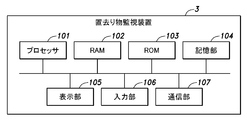
- Block diagram showing the schematic configuration of the leftover monitoring device of the leftover monitoring system
- the figure which shows the example of the judgment processing in the report target judgment part of the left-behind object monitoring device The figure which shows the example of the judgment processing in the report target judgment part of the left-behind object monitoring device.
- the first invention made to solve the above-mentioned problems detects an abandoned object left in the monitoring area based on an image captured in the monitoring area imaged by an imaging device, and the abandoned object causes the abandoned object.
- It is a left-behind object monitoring device that issues an alarm when it is detected, and includes a processor that performs a process of detecting the left-behind object, and the processor appears in the monitoring area from the captured image.
- An object is detected, each detected object is tracked between the captured images, and based on the tracking result for each detected object, the object that does not displace beyond a predetermined time is detected as the leftover object. Then, it is determined whether or not the detected leftover object exists in the mask area preset in the monitoring area, and it is determined that the detected leftover object exists in the mask area. In that case, the leftover object is excluded from the alarm issuance target.
- leftover objects determined to exist in the mask area set in advance in the monitoring area can be excluded from the alarm issuance target.
- the number of alarms to be issued can be suppressed, so that the burden on the observer can be reduced.
- the second invention is characterized in that, in the first invention, the processor generates a setting screen for setting the mask area in the monitoring area.
- the user can easily set the mask area with a simple operation.
- the processor determines the type of the detected leftover object.
- the mask area is set in association with the type of the leftover object, and in the processor, the detected leftover object is the mask area. If it is determined that it exists in the mask area, it is further determined whether or not the type of the leftover object is the type associated with the mask area, and the type of the leftover object is set in the mask area. It is characterized in that the leftover object is excluded from the alarm issuance target only when it is determined that the type is associated with the alarm.
- the leftovers are alerted. It can be excluded from the notification target. As a result, it is possible to exclude leftover objects that do not require an alarm from being issued as an alarm, so that the burden on the observer can be further reduced.
- the processor in the third invention or the fourth invention, the processor generates an image in which a frame image surrounding the mask area is superimposed on the captured image, and the display form of the frame image is changed.
- the feature is that it is determined according to the type of the leftover object associated with the mask area.
- the representative position of the leftover object determined to be of the type associated with the mask area is detected and detected. It is characterized in that the range of the mask area is changed based on the statistical data of the representative position created by accumulating the representative positions for a predetermined period.
- the mask area is set in association with a usage period indicating a period for which the mask area is used
- the processor is set in association with a usage period indicating a period for which the mask area is used. It is characterized in that it is determined whether or not the detected leftover object exists in the mask area only for the mask area for which the period of use is valid.
- the processor detects the detected representative position of the leftover object, and based on the detected representative position.
- the feature is to determine whether or not the leftover object is included in the mask area.
- the processor when the processor detects a plurality of the leftover objects in one mask area, the processor subsequently performs the subsequent invention.
- the determination process is characterized in that it is performed for each of the leftover objects.
- the tenth invention is issued by the left-behind object monitoring device according to any one of the first to ninth inventions, the imaging device for imaging the monitoring area, and the left-behind object monitoring device. It is a left-behind object monitoring system equipped with a notification device for notifying the user of the alarm that has been issued.
- the eleventh invention detects an abandoned object left in the monitoring area based on an image captured in the monitoring area captured by the imaging device, and issues an alarm when the abandoned object is detected. It is a method of monitoring leftover objects to be notified, in which a step of acquiring an image of the monitoring area captured by the imaging device and an object appearing in the monitoring area are detected from the captured image and detected. A step of tracking between the captured images for each object and a step of detecting the object that does not displace beyond a predetermined time based on the detected tracking result for each object as the leftover object are detected. A step of determining whether or not the leftover object exists in a mask area preset in the monitoring area, and when it is determined that the leftover object exists in the mask area, It is characterized by including a step of excluding the leftover object from the target of issuing an alarm.
- the left-behind object monitoring system 1 detects the left-behind object left behind in the monitoring area based on the captured image of the monitoring area imaged by the imaging device 2, and issues an alarm when the left-behind object is detected. It is a system for reporting, and can be applied to monitor the leaving of suspicious objects in spaces used by an unspecified number of people such as stations, airports, commercial facilities, shopping districts, and underground malls.
- the leftover object monitoring system 1 is applied to the monitoring of the abandoned object left behind in, for example, a commercial facility, a shopping district, an underground shopping mall, etc.
- a commercial facility a shopping district, an underground shopping mall, etc.
- abandoned items such as store signboards (store signboards) and cleaning signs that do not require an alarm, so such abandonment does not require an alarm.
- an object can be excluded from the alarm issuance target (hereinafter, simply referred to as "alarm target"), the burden on the observer can be reduced.
- FIG. 1 is a schematic configuration diagram of a leftover monitoring system 1 according to the first embodiment of the present disclosure.
- the left-behind object monitoring system 1 includes an image pickup device 2, a left-behind object monitoring device 3, and a display device 4.
- the display device serves as a notification device for notifying the observer of an alarm.
- the leftover object monitoring device 3 is connected to the image pickup device 2 and the display device 4 via wired or wireless communication (for example, Wi-Fi (registered trademark)) such as LAN (Local Area Network).
- Wi-Fi registered trademark
- LAN Local Area Network
- connection form between the left-behind object monitoring device 3 and the image pickup device 2 and the display device 4 is not particularly limited, and may be, for example, a connection via a network such as the Internet, or a general-purpose interface (for example, USB (Universal Serial Bus) interface) may be used to connect to each other with a communication cable.
- a network such as the Internet
- a general-purpose interface For example, USB (Universal Serial Bus) interface
- USB Universal Serial Bus
- the image pickup device 2 is a general image pickup device such as a CCD camera, and is installed on a wall, a ceiling, a pole, or the like in various places such as a commercial facility, a shopping district, or an underground mall, and a predetermined monitoring area can be used as a still image or a still image. Captured in chronological order as a moving image.
- the form, function, arrangement, quantity, and the like of the imaging device 2 are not particularly limited as long as the monitoring area can be imaged in time series, and various changes can be made.
- the image pickup device 2 may be a panoramic camera installed on a wall or the like and capable of photographing 180 degrees by one unit, or an omnidirectional camera installed on a ceiling or the like and capable of photographing 360 degrees by one unit.
- the captured images of the monitoring area captured in time series by the image pickup device 2 are input to the leftover object monitoring device 3.
- the display device 4 is a general display device such as a monitor (display) installed in a monitoring room or the like where an observer performs monitoring work, and is a broadcast image output from the left-behind object monitoring device 3 (see FIG. 9). Is displayed. The details of the broadcast image will be described later.
- the form, function, arrangement, quantity, and the like of the display device 4 are not particularly limited as long as the broadcast image can be displayed, and various changes can be made.
- the display device 4 may be a display screen of a mobile terminal carried by an observer when leaving the monitoring room due to patrol or the like.
- the left-behind object monitoring device 3 is a general computer device having a known configuration, detects left-behind objects left behind in the monitoring area based on the captured image input from the image pickup device 2, and leaves behind. When an object is detected, a notification image for issuing an alarm is generated and output to the display device 4. Further, the left-behind object monitoring device 3 outputs the captured image input from the image acquisition unit 13 to the display device 4 as it is until the left-behind object is detected.
- FIG. 2 is a block diagram showing a schematic configuration of the left-behind object monitoring device 3.
- the leftover object monitoring device 3 has a known hardware configuration, and is a processor 101 that comprehensively executes each process in the leftover object monitoring system 1 based on a predetermined control program (for example, a leftover object monitoring program).
- RAM 102 which is a volatile memory that functions as a work area of the processor 101
- ROM 103 which is a non-volatile memory that stores control programs and data executed by the processor 101, and programs necessary for the operation of the leftover monitoring device 3.
- a storage unit 104 having a storage for storing data, a display unit 105 having a monitor for displaying information necessary for the user, an input unit 106 having an input device such as a keyboard or a mouse that enables the user's input operation, via a network. It is provided with a communication unit 107 or the like having a communication module for executing the communication.
- Each function of the leftover monitoring device 3 can be realized by the processor 101 executing a predetermined control program in the hardware configuration shown in FIG.
- the leftover object monitoring device 3 is not limited to a computer device, and other information processing devices (servers, etc.) capable of performing the same function can also be used. Further, at least a part of the function of the leftover monitoring device may be replaced by processing by other known hardware.
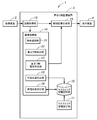
- the left-behind object monitoring device 3 includes a mask area information setting unit 11, a mask area information storage unit 12, an image acquisition unit 13, an image processing unit 14, and a broadcast image generation unit 15. Includes.
- the image processing unit 14 has an object tracking unit 21, a left-behind object detection unit 22, a left-behind object type determination unit 23, and a notification target determination unit 24. Each of the above units is controlled by a control unit (not shown).
- the mask area information setting unit 11 generates a mask area information setting screen for setting information about the mask area preset in the monitoring area (hereinafter referred to as “mask area information”), and is a left-behind object monitoring device. It is output and displayed on the display unit 105 (FIG. 2) of No. 3. The user of the left-behind object monitoring device 3 sets the mask area information by operating an input device such as a keyboard or a mouse and inputting various information on the mask area information setting screen.
- an input device such as a keyboard or a mouse
- the mask area information includes the name of the mask area, the range of the mask area, and the type of leftovers associated with the mask area (hereinafter referred to as "designated leftovers").
- the range of the mask area is an arbitrary area set in the monitoring area. In the present embodiment, the range of the mask area is set to a rectangle, but the range is not limited to this, and can be set to various other shapes.
- the mask area information includes the display form of the mask area frame image indicating the range of the mask area and the usage period of the mask area.
- the mask area frame image is a rectangular broken line image surrounding the mask area, and is colored according to the designated leftover object.
- the display form of the mask area frame image is not limited to the broken line image, and various other forms are possible.
- the mask area frame image may be a solid line image. Further, it is not essential to color the mask area frame image according to the designated leftover object, and it may not be performed if it is unnecessary.
- the usage period of the mask area is information indicating the period such as the time zone and the day of the week when the mask area is used.
- the mask area is set in association with the designated leftover object, so if the usage period of the mask area is further associated with the mask area, when the designated leftover object is actually used (when placed). ) Only, it is possible to use the mask area corresponding to the designated leftover object. As a result, the number of determination processes described later in the notification target determination unit can be suppressed, so that the load of the determination processing in the notification target determination unit can be reduced.
- the designated abandoned item is a store sign
- the store sign is only used during the corresponding store business hours and business days, so the mask area is set to the time zone and day of the week when the store sign is actually used. Only need to be used.
- the designated leftover object is a construction cone
- the construction cone is actually used in the mask area because the construction cone is used only when the corresponding construction or work is performed. It should be used only during the time and day of the week corresponding to the construction period.
- the mask area information can include various other information in addition to the above information.
- image data of a designated leftover object in the mask area may be further included.
- FIG. 3 is a diagram showing an example of the mask area information setting screen 31 generated by the mask area information setting unit 11.
- the mask area information setting screen 31 includes a mask area setting screen 32 displayed on the left side and a designated leftover setting screen 33 displayed on the right side. Further, on the lower side of the designated left-behind object setting screen 33, a screen switching button 34 for switching the designated left-behind object setting screen 33 to the usage period setting screen 36 described later is displayed.
- the captured image of the monitoring area captured by the imaging device 2 is displayed.
- a captured image of a predetermined monitoring area of the shopping district is displayed.
- a check box for designating the designated left-behind object corresponding to the mask area is displayed together with a color for coloring the mask area frame image according to the designated left-behind object.
- a store sign, a bulletin board, a cleaning sign, and a construction cone are shown as designated leftovers, the store sign is red, the bulletin board is blue, the cleaning sign is yellow, and the construction cone. Is associated with green as the color that colors the mask area frame image.
- the check box on the designated left-behind object setting screen 33 is operated. , Designate Specify the leftovers. In the example of FIG. 3, a store signboard is designated. Next, the range of the mask area is set by designating a desired area in the mask area setting screen 32 using a mouse or the like.
- the position where the store signboard is placed may change daily.
- the position of the store signboard may change due to contact with passers-by or the like. Therefore, the range of the mask area may be set wider than the range assumed as the position where the store signboard is placed so that the position of the store signboard can be changed.
- the mask area A1 is set on the lower right side of the mask area setting screen 32.
- the mask area A1 is shown by being surrounded by the mask area frame image 35. Since the store signboard is designated as the designated leftover object of the mask area A1 and the store signboard is associated with red, the mask area frame image 35 is colored in red. In this way, in the example of FIG. 3, the mask area A1 is set in association with the store signboard.
- the range of the mask area is set after setting the designated leftover object, but the range of the mask area and the order of setting the designated leftover object are not limited to this, and the mask is used.
- the designated leftover object may be set.
- the mask area frame image 35 is displayed in black or the like, and when the designated leftover object is set, the color of the mask area frame image 35 becomes the designated leftover object. It is preferable to change to the associated color.
- FIG. 4 shows a usage period setting screen 36 for setting the usage period of the mask area.
- the display of the usage period setting screen 36 can be switched from the designated left-behind object setting screen 33 by operating the screen switching button 34.
- a time zone and a day of the week are set as the usage period.
- the period of use is not limited to this, and may be, for example, a unit such as a day, a week, a month, or a year.
- the usage period may be set to a continuous period between the specified start date and time and the end date and time by specifying the start date and time and the end date and time.
- the usage period is a periodic usage period, it is preferable to set the time zone and the day of the week when the mask area function is ON to be repeated over a predetermined period.
- the time zone in which the mask area is used is set to "8:00 to 22:00", and the time zone in which the mask area is not used, That is, the time zone for turning off the mask area function is set to "22:00 to 8:00".
- the day of the week when the mask area is used is set to "Monday to Friday"
- the day of the week when the mask area is not used is turned off.
- the day of the week) is set to "Saturday, Sunday". This is because the business days of the stores corresponding to this store sign are from Monday to Friday, and the store sign is not displayed on Saturday and Sunday.
- the mask area information set by the mask area information setting unit 11 is stored in the mask area information storage unit 12.
- the range of the mask area is defined by the upper left coordinates of the rectangular frame of the mask area frame image and the lower right coordinates on the mask area setting screen 32.
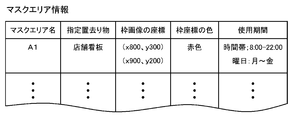
- FIG. 5 is a diagram showing an example of mask area information stored in the mask area information storage unit 12.
- the mask area information includes a "mask area name” indicating the name of the mask area, a "designated leftover object” indicating the designated leftover object of the mask area associated with the "mask area name”, and a mask.
- the "frame image coordinates” indicating the coordinates of the area frame image, the “frame coordinate color” indicating the color of the mask area frame image, and the "usage period” indicating the usage period of the mask area are included.
- FIG. 5 is a diagram showing an example of mask area information stored in the mask area information storage unit 12.
- the mask area information includes a "mask area name” indicating the name of the mask area, a "designated leftover object” indicating the designated leftover object of the mask area associated with the "mask area name”, and a mask.
- the image acquisition unit 13 is connected to the image pickup device 2 and acquires the captured image of the monitoring area from the image pickup device 2.
- the image acquisition unit 13 is connected to the image processing unit 14 and the broadcast image generation unit 15, and the captured image acquired by the image acquisition unit 13 from the image pickup device 2 is input to the image processing unit 14 and the broadcast image generation unit 15. NS.
- the image processing unit 14 acquires an captured image from the image acquisition unit 13. If the captured image is a still image captured at a predetermined time interval, it is acquired as the still image data, and if the captured image is a moving image, the still image data (image) extracted from the moving image at a predetermined time interval. Acquire as frame data).
- the captured image (still image data) acquired by the image processing unit 14 from the image acquisition unit 13 is processed by the object tracking unit 21, the leftover object detection unit 22, the leftover object type determination unit 23, and the alarm target determination unit 24. Will be done.
- the object tracking unit 21 detects an object appearing in the monitoring area (hereinafter referred to as “appearing object”) from the captured image, and tracks each detected appearing object between the captured images after the detection of the appearing object. ..
- the appearing object can be, for example, a paper bag, a store sign, a cleaning sign, a bag, or the like.
- the detection of the appearing object is performed by comparing the background image captured in advance with the captured image, or by comparing two captured images adjacent to each other in time series. Specifically, the degree of difference (difference or correlation value) in the pixel values (for example, luminance value) of the corresponding pixels between the captured images to be compared is obtained, and the obtained degree of difference exceeds a predetermined threshold value. Is extracted, and the area where the pixels extracted in close proximity are grouped together is detected as an appearing object. When a appearing object is detected from the captured image, an individual identification code is assigned to each detected appearing object, and the captured image is tracked after the detection of the appearing object.
- the leftover object detection unit 22 detects the leftover object based on the tracking result for each appearing object by the object tracking unit 21. Specifically, for each appearing object detected by the object tracking unit 21, the displacement of the appearing object over time in the captured image is obtained, and the appearing object that does not displace beyond a predetermined time, that is, a predetermined value. Appearing objects that have been stationary for more than the specified time are detected as leftover objects. When the leftover object is detected, a unique identification code is assigned to each detected leftover object, and the image is tracked between the captured images after the detection of the leftover object. When a leftover object is detected, the detection result is input to the broadcast image generation unit 15.
- the left-behind object type determination unit 23 determines the type of the left-behind object detected by the left-behind object detection unit 22.
- the type of leftover object can be determined by using a known image recognition technique such as a discriminator by deep learning. For example, it is preferable to use a classifier that identifies the type of the leftover object based on the shape feature and the texture feature of the leftover object detected from the captured image. In this case, prepare a database in which the correspondence between the shape feature and texture feature of the leftover object and the type of the leftover object is stored in advance.
- the method for identifying the type of leftover object is not particularly limited, and various conventionally known methods can be used.
- the type of the leftover object determined by the leftover object type determination unit 23 is input to the broadcast image generation unit 15.
- the alarm target determination unit 24 determines whether or not the abandoned object detected by the abandoned object detection unit 22 is the alarm target. When a plurality of leftover objects are detected by the leftover object detection unit 22, a determination process is performed for each of the leftover objects.
- the determination process in the alarm target determination unit 24 is performed with reference to the mask area information stored in the mask area information storage unit 12.
- the mask area information includes the range of the mask area (coordinates of the mask area frame image) and the designated leftover object of the mask area. Further, in this determination process, only the mask area for which the usage period is valid is used. If a plurality of mask areas are set in the monitoring area, the determination process is performed for each mask area.
- the leftover object detected by the leftover object detection unit 22 it is determined whether or not the leftover object detected by the leftover object detection unit 22 exists in the mask area. This determination can be made using a known image analysis technique. If it is determined that the detected leftover object does not exist in the mask area, the leftover object is determined to be subject to notification.
- the abandoned object is determined to be an abandoned object that does not require an alarm (hereinafter referred to as "non-reporting target"). do.
- the leftover object is determined to be subject to notification.
- the notification target determination unit 24 determines only the leftover objects that exist in the mask area and are determined to be the designated leftover objects in the mask area as non-reporting targets, and leave other objects. All items are judged as subject to notification.
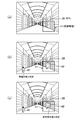
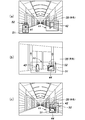
- FIG. 6 is a diagram showing an example of determination processing in the alarm target determination unit 24.
- the mask area A1 is preset on the lower right side of the monitoring area, and the designated leftover item of the mask area A1 is the store signboard. Since the store signboard is associated with red, the mask area frame image 35 is colored in red.
- the alarm target determination unit 24 determines whether or not the paper bag 41 and the store signboard 42 exist in the mask area A1. As described above, this determination process is performed for each leftover object. In the example of FIG. 6B, it is determined that the paper bag 41 does not exist in the mask area A1, and the store sign 42 is determined to exist in the mask area A1. Therefore, the paper bag 41 is determined to be the subject of notification.
- the notification target determination unit 24 further determines whether or not the store signboard 42 determined to exist in the mask area A1 is a designated leftover object in the mask area A1. Since the designated leftover item in the mask area A1 is the store signboard, the store signboard 42 is determined to be the designated leftover item. Therefore, the store signboard 42 is determined to be a non-reporting target (see FIG. 6C).
- FIG. 7 is a diagram showing an example of the determination process in that case.
- the mask area A2 is preset in the lower center of the monitoring area, and the designated leftover object in the mask area A2 is the cleaning signboard. Since the cleaning signboard is associated with yellow, the mask area frame image 35 is colored in yellow.
- the alarm target determination unit 24 determines whether or not the cleaning signboard 43 and the bag 44 exist in the mask area A2. As described above, this determination process is performed for each leftover object. In the example of FIG. 7B, it is determined that both the cleaning signboard 43 and the bag 44 are present in the mask area A2.
- the alarm target determination unit 24 further determines whether or not the cleaning signboard 43 and the bag 44 determined to exist in the mask area A2 are the designated leftover objects in the mask area A2. Since the designated leftover object in the mask area A2 is a cleaning signboard, the cleaning signboard 43 is determined to be a designated leftover object. Therefore, the cleaning signboard 43 is determined to be a non-reporting target. On the other hand, the bag 44 is determined not to be a designated leftover object. Therefore, the bag 44 is determined to be the subject of notification (see FIG. 7C).
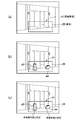
- FIG. 8 is a diagram showing an example of the determination process in that case. First, as shown in FIG. 8A, it is assumed that the mask area A1 is preset on the lower right side of the monitoring area, and the designated leftover item of the mask area A1 is the store signboard. Since the store signboard is associated with red, the mask area frame image 35 is colored in red.
- the notification target determination unit 24 determines whether or not the store signboard 42 and the bag 44 exist in the mask area A1. As described above, this determination process is performed for each leftover object.
- FIG. 8B In this example, it is determined that both the store signboard 42 and the bag 44 are present in the mask area A1.
- the notification target determination unit 24 further determines whether or not the store signboard 42 and the bag 44 determined to exist in the mask area A1 are the designated leftover items in the mask area A1. Since the designated leftover item in the mask area A1 is the store signboard, the store signboard 42 is determined to be the designated leftover item. Therefore, the store signboard 42 is determined to be non-reporting target. On the other hand, the bag 44 is determined not to be a designated leftover object. Therefore, the bag 44 is determined to be the subject of notification (see FIG. 8C).
- the leftovers detected by the leftovers detection unit 22 are given a unique identification code for each leftovers, a plurality of leftovers are detected overlapping each other. Even if this is the case, individual leftovers can be identified. Therefore, even when a plurality of leftovers are detected overlapping each other, it is necessary to determine whether or not each leftover is present in the mask area, and to determine the type of each leftover. Is possible.
- the determination result in the notification target determination unit 24 is input to the notification image generation unit 15.
- the notification image generation unit 15 generates a notification image for issuing an alarm about the notification target based on the determination result in the notification target determination unit 24. Non-alarm targets are excluded from alarm alert targets. Specifically, the broadcast image generation unit 15 adds a notification frame image surrounding the notification target, information indicating the type of leftover object, and a mask indicating a mask area to the captured image input from the image acquisition unit 13. The area frame image is superimposed to generate a notification image for issuing an alarm. It should be noted that the superimposition of the mask area frame image is not essential in the broadcast image, and the display and non-display of the mask area frame image may be selected and set.
- the alarm frame image 51 should have a conspicuous color such as red or yellow. Further, the alarm frame image 51 may be blinked, or characters or pictures indicating the alarm may be displayed in the vicinity of the frame image. In the present embodiment, characters indicating the type of the leftover object are used as the information indicating the type of the leftover object.
- the information indicating the type of the leftover object is not limited to this, and may be, for example, a picture or a symbol indicating the type of the leftover object.
- 9 (a) to 9 (c) are diagrams showing an example of the broadcast image generated by the broadcast image generation unit 15.
- FIG. 9A is a diagram showing an example corresponding to the determination process shown in FIG.
- a paper bag 41 and a store signboard 42 are detected as leftover objects
- the paper bag 41 is determined to be a notification target
- the store signboard 42 is determined to be a non-reporting target. Therefore, the notification image P1 is generated by superimposing the notification frame image 51 surrounding the paper bag 41, which is the notification target, on the captured image.
- the character 52 “paper bag” is further superimposed on the captured image as information indicating the type of the leftover object.
- the mask area frame image 35 showing the mask area A1 is further superimposed on the captured image. Since the store signboard is associated with red, the mask area frame image 35 is colored in red.
- FIG. 9B is a diagram showing an example corresponding to the determination process shown in FIG. 7.
- the cleaning signboard 43 and the bag 44 are detected as leftover objects
- the cleaning signboard 43 is determined to be a non-reporting target
- the bag 44 is determined to be a reporting target. Therefore, the notification image P2 is generated by superimposing the notification frame image 51 surrounding the bag 44, which is the notification target, on the captured image.
- the character 52 “bag” is further superimposed on the captured image as information indicating the type of the leftover object.
- the mask area frame image 35 showing the mask area A2 is further superimposed on the captured image. Since the cleaning signboard is associated with yellow, the mask area frame image 35 is colored in yellow.
- FIG. 9 (c) is a diagram showing an example corresponding to the determination process shown in FIG.
- the store signboard 42 and the bag 44 are detected as leftover objects, the store signboard 42 is determined to be non-reporting target, and the bag 44 is determined to be reporting target. Therefore, the notification image P3 is generated by superimposing the notification frame image 51 surrounding the bag 44, which is the notification target, on the captured image. Further, in the example of FIG. 9C, since the leftover object to be notified is the bag 44, the character 52 “bag” is further superimposed on the captured image as information indicating the type of the leftover object. In addition, in the example of FIG. 9C, the mask area frame image 35 showing the mask area A1 is further superimposed on the captured image. Since the store signboard is associated with red, the mask area frame image 35 is colored in red.
- the broadcast image generated by the broadcast image generation unit 15 is output to the display device 4. Further, the broadcast image generation unit 15 outputs the captured image input from the image acquisition unit 13 to the display device 4 as it is until the leftover object detection unit 22 detects the leftover object.
- the alarm is issued by the alarm voice or the blinking of the alarm lamp by using the voice output function of the display device or the alarm device linked with the display device. You may do so. This makes it possible to draw more attention to the watchman.
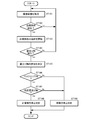
- the image acquisition unit 13 acquires an captured image from the image pickup device 2 and inputs it to the image processing unit 14 and the broadcast image generation unit 15 (step ST101). Subsequently, the object tracking unit 21 detects an appearing object that appears in the monitoring area from the captured image (step ST102). If the appearing object is detected (step ST102: Yes), the process proceeds to step ST103, and if the appearing object is not detected (step ST102: No), the process returns to step ST101.
- step ST103 the object tracking unit 21 starts tracking between the captured images after the detection of the appearing object for each detected appearing object.
- the abandoned object detection unit 22 detects an appearing object that does not displace beyond a predetermined time as an abandoned object based on the tracking result of each appearing object by the object tracking unit 21. If the leftover object is detected (step ST104: Yes), the process proceeds to step ST105, and if the leftover object is not detected (step ST104: No), the process returns to step ST101. When returning to step ST101, in the next step ST102, a newly detected appearing object other than the already detected appearing object is detected.
- step ST105 the left-behind object type determination unit 23 determines the type of left-behind object detected by the left-behind object detection unit 22. As described above, this determination process is performed for each leftover object. The same applies to the subsequent determination procedure.
- the alarm target determination unit 24 determines whether or not the leftover object detected by the leftover object detection unit 22 exists in the mask area preset in the monitoring area (). 6 (b), 7 (b), 8 (b)). As described above, in this determination process, only the mask area for which the usage period is valid is used. If a plurality of mask areas are set in the monitoring area, the determination process is performed for each mask area.
- step ST106: Yes When it is determined that the leftover object detected by the leftover object detection unit 22 exists in the mask area (step ST106: Yes), the process proceeds to step ST107, and when it is determined that the leftover object does not exist in the mask area (step ST106: Yes). Step ST106: No) proceeds to step ST109.
- step ST107 the alarm target determination unit 24 further determines whether or not the type of the leftover object is the designated leftover object in the mask area (FIGS. 6 (c), 7 (c), See FIG. 8 (c)).
- step ST107: Yes the process proceeds to step ST108, and when it is determined that the leftover object is not the designated leftover object (step ST107: Yes). No) proceeds to step ST109.
- step ST108 the leftover object is determined to be a non-reporting target, and then the process is terminated.
- step ST109 the leftover object is determined to be the target of notification, and then the process is terminated.
- the leftovers determined to exist in the mask area preset in the monitoring area can be excluded from the alarm issuance target.
- the number of alarms to be issued can be suppressed, so that the burden on the observer can be reduced.
- only when it is determined that the type of the leftover object determined to exist in the mask area is the type of the leftover object associated with the mask area.
- the leftovers can be excluded from the alarm issuance target. As a result, it is possible to exclude leftover objects that do not require an alarm from being issued as an alarm, so that the burden on the observer can be further reduced.
- the leftover monitoring system 1 according to the second embodiment of the present disclosure will be described with reference to FIGS. 11 to 13.
- This second embodiment is different from the first embodiment shown in FIG. 1 in that the image processing unit 14 of the left-behind object monitoring device 3 further has a representative position detecting unit 25. Since other points are the same as those of the first embodiment described above, the same reference numerals are given and the description thereof will be omitted.
- the representative position detection unit 25 detects the representative position of the leftover object by using a known image analysis technique.
- a representative position of the leftover object for example, the position of the center of gravity or the position of the center of the lower end can be used.
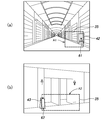
- FIG. 12 is a diagram showing an example of a representative position of an abandoned object
- FIG. 12 (a) shows an example of using the center of gravity as the representative position
- FIG. 12 (b) shows an example of using the center of the lower end as the representative position.
- the store signboard 42 is detected as an abandoned object
- the representative position detection unit 25 detects the center of gravity position 61 of the store signboard 42 as the representative position of the store signboard 42.
- the cleaning signboard 43 is detected as an abandoned object
- the representative position detection unit 25 detects the position 62 at the center of the lower end of the cleaning signboard 43 as the representative position of the cleaning signboard 43.
- the alarm target determination unit 24 determines whether or not the leftover object exists in the mask area based on the representative position of the leftover object. Specifically, when the representative position of the leftover object exists in the mask area, it is determined that the leftover object exists in the mask area.
- the representative position of the leftover object exists in the mask area.
- FIG. 12A a part of the right side of the store signboard 42 protrudes from the mask area A1, but the center of gravity position 61 of the store signboard 42 exists in the mask area A1, so that the store signboard 42 is , It is determined that it exists in the mask area A1.
- FIG. 12A a part of the right side of the store signboard 42 protrudes from the mask area A1, but the center of gravity position 61 of the store signboard 42 exists in the mask area A1, so that the store signboard 42 is , It is determined that it exists in the mask area A1.
- FIG. 12A a part of the right side of the store signboard 42 protrudes from the mask area A1, but the center of gravity position 61 of
- the representative position of the leftover object is not limited to the position of the center of gravity or the position of the center of the lower end. Various other positions such as the position of can be used. During the actual determination process, a part or the lower end of the leftover object may be hidden behind a passerby or another leftover object, and the position of the center of gravity or the center of the lower end of the leftover object may not be detected. .. In such a case, the position of the center of the upper end, the position of the upper left end, the position of the upper right end, and the like may be used as representative positions of the leftover object.
- the range of the mask area is changed based on the statistical data of the representative position of the designated leftover object in the mask area.
- the position of a signboard such as a store signboard 42 or a cleaning signboard 43 may change every day.
- the position of the signboard may change due to contact with passersby. Therefore, it is useful to change the range of the mask area according to the actual placement position of the designated leftover object.
- the data of the representative position of the designated leftover object detected by the leftover object detection unit 22 is accumulated for a predetermined period, and the statistical data of the representative position of the designated leftover object is created. Then, the created statistical data is analyzed using a known statistical analysis technique, and the range of the mask area is changed according to the actual placement position of the designated leftover object.
- the range of the mask area is changed by moving the position of the mask area. Specifically, the position of the mask area may be moved so that the representative position of the designated leftover object is located within a predetermined distance from the center position of the range of the mask area.
- the range of the mask area is defined by the upper left coordinates and the lower right coordinates of the rectangular frame of the mask area frame image, so that the center position (coordinates) of the mask area range is the mask area frame. It can be obtained based on the upper left coordinates and the lower right coordinates of the image.
- the predetermined distance from the center position of the range of the mask area may be set to a distance that can include the entire designated leftover object within the range of the mask area.
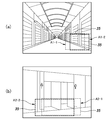
- FIG. 13 is a diagram showing an example in which the range of the mask area is changed.
- FIG. 13A shows an example in which the range of the mask area A1 is changed, A1-1 shows the mask area A1 before the change, and A1-2 shows the mask area A1 after the change. As shown in the figure, after the change, the position of the mask area A1 is slightly moved to the right.
- FIG. 13B shows an example in which the range of the mask area A2 is changed, A2-1 shows the mask area A2 before the change, and A2-2 shows the mask area A2 after the change. As shown in the figure, after the change, the position of the mask area A2 is slightly moved to the left.
- the range of the mask area was changed by moving the position of the mask area, but the change of the range of the mask area is not limited to this.
- the range of the mask area may be changed by changing the size of the mask area.
- the range of the mask area may be changed by increasing or decreasing the size of the mask area based on the statistical data of the representative position of the designated leftover object.
- the range of the mask area may be changed by changing the shape of the mask area. In this case, the range of the mask area is changed by changing the shape of the mask area from the initially set rectangle to various other shapes based on the statistical data of the representative position of the designated leftover object. It is good to do it.
- the range of the mask area is set more accurately according to the actual placement position of the designated leftover object. It becomes possible to do.
- the present disclosure has been described above based on specific embodiments, these embodiments are merely examples, and the present disclosure is not limited to these embodiments. It should be noted that not all of the components of the left-behind object monitoring device, the left-behind object monitoring system provided with the left-behind object monitoring device, and the left-behind object monitoring method according to the present embodiment shown in the above-described embodiment are not necessarily all essential, and at least all of the components of the present disclosure are disclosed. It is possible to select as appropriate as long as it does not deviate from the range.
- the leftovers monitoring device, the leftovers monitoring system equipped with the leftovers monitoring device, and the leftovers monitoring method according to the present disclosure can exclude leftovers that do not require an alarm from being issued as an alarm. It is useful as a left-behind object monitoring device, a left-behind object monitoring system equipped with the left-behind object monitoring device, a left-behind object monitoring method, and the like.
Landscapes
- Engineering & Computer Science (AREA)
- Physics & Mathematics (AREA)
- General Physics & Mathematics (AREA)
- Multimedia (AREA)
- Theoretical Computer Science (AREA)
- Emergency Management (AREA)
- Business, Economics & Management (AREA)
- Computer Vision & Pattern Recognition (AREA)
- Signal Processing (AREA)
- Closed-Circuit Television Systems (AREA)
- Image Analysis (AREA)
- Alarm Systems (AREA)
- Emergency Alarm Devices (AREA)
Priority Applications (2)
| Application Number | Priority Date | Filing Date | Title |
|---|---|---|---|
| US17/916,967 US12430917B2 (en) | 2020-04-06 | 2021-03-17 | Unattended object monitoring device, unattended object monitoring system equipped with same, and unattended object monitoring method |
| CN202180026915.8A CN115428440B (zh) | 2020-04-06 | 2021-03-17 | 无人看管物体监视装置、配备有该装置的无人看管物体监视系统和无人看管物体监视方法 |
Applications Claiming Priority (2)
| Application Number | Priority Date | Filing Date | Title |
|---|---|---|---|
| JP2020068193A JP7486117B2 (ja) | 2020-04-06 | 2020-04-06 | 置去り物監視装置およびこれを備えた置去り物監視システムならびに置去り物監視方法 |
| JP2020-068193 | 2020-04-06 |
Publications (1)
| Publication Number | Publication Date |
|---|---|
| WO2021205831A1 true WO2021205831A1 (ja) | 2021-10-14 |
Family
ID=78022248
Family Applications (1)
| Application Number | Title | Priority Date | Filing Date |
|---|---|---|---|
| PCT/JP2021/010805 Ceased WO2021205831A1 (ja) | 2020-04-06 | 2021-03-17 | 置去り物監視装置およびこれを備えた置去り物監視システムならびに置去り物監視方法 |
Country Status (4)
| Country | Link |
|---|---|
| US (1) | US12430917B2 (https=) |
| JP (1) | JP7486117B2 (https=) |
| CN (1) | CN115428440B (https=) |
| WO (1) | WO2021205831A1 (https=) |
Cited By (1)
| Publication number | Priority date | Publication date | Assignee | Title |
|---|---|---|---|---|
| GB2630320A (en) * | 2023-05-23 | 2024-11-27 | Uchu Group Ltd | Generating image data for a real-time situational awareness system |
Families Citing this family (1)
| Publication number | Priority date | Publication date | Assignee | Title |
|---|---|---|---|---|
| GB2600405B (en) * | 2020-10-23 | 2024-09-04 | Canon Kk | A computer implemented method, apparatus and computer program for privacy masking video surveillance data |
Citations (4)
| Publication number | Priority date | Publication date | Assignee | Title |
|---|---|---|---|---|
| JP2008181347A (ja) * | 2007-01-25 | 2008-08-07 | Meidensha Corp | 侵入監視システム |
| JP2013098797A (ja) * | 2011-11-01 | 2013-05-20 | Toshiba Corp | 情報出力装置、検知装置、プログラム及び情報出力方法 |
| JP2018042270A (ja) * | 2017-10-26 | 2018-03-15 | パナソニックIpマネジメント株式会社 | 置去り物監視装置およびこれを備えた置去り物監視システムならびに置去り物監視方法 |
| JP2019071578A (ja) * | 2017-10-11 | 2019-05-09 | パナソニックIpマネジメント株式会社 | 物体検知装置、物体検知システムおよび物体検知方法 |
Family Cites Families (12)
| Publication number | Priority date | Publication date | Assignee | Title |
|---|---|---|---|---|
| JPH01245395A (ja) | 1988-03-28 | 1989-09-29 | Toshiba Corp | 画像監視システム |
| US20060170769A1 (en) * | 2005-01-31 | 2006-08-03 | Jianpeng Zhou | Human and object recognition in digital video |
| JP5040258B2 (ja) * | 2006-10-23 | 2012-10-03 | 株式会社日立製作所 | 映像監視装置、映像監視システムおよび画像処理方法 |
| DE102008007199A1 (de) * | 2008-02-01 | 2009-08-06 | Robert Bosch Gmbh | Maskierungsmodul für ein Videoüberwachungssystem, Verfahren zur Maskierung von selektierten Objekten sowie Computerprogramm |
| JP5851261B2 (ja) * | 2012-01-30 | 2016-02-03 | 株式会社東芝 | 画像センサシステム、情報処理装置、情報処理方法及びプログラム |
| JP6253311B2 (ja) | 2013-08-28 | 2017-12-27 | キヤノン株式会社 | 画像処理装置、画像処理方法 |
| JP6241796B2 (ja) | 2015-12-25 | 2017-12-06 | パナソニックIpマネジメント株式会社 | 置去り物監視装置およびこれを備えた置去り物監視システムならびに置去り物監視方法 |
| JP6390860B2 (ja) * | 2016-01-25 | 2018-09-19 | パナソニックIpマネジメント株式会社 | 置去り物体監視装置およびこれを備えた置去り物体監視システムならびに置去り物体監視方法 |
| CN107221133B (zh) * | 2016-03-22 | 2018-12-11 | 杭州海康威视数字技术股份有限公司 | 一种区域监控报警系统及报警方法 |
| SG11201909105TA (en) | 2017-03-30 | 2019-11-28 | Nec Corp | Information processing apparatus, control method, and program |
| US11405680B2 (en) * | 2018-03-23 | 2022-08-02 | Rovi Guides, Inc. | Systems and methods for obscuring presentation of media objects during playback of video based on interactions with other media objects |
| JP2019176306A (ja) * | 2018-03-28 | 2019-10-10 | キヤノン株式会社 | 監視システム、監視システムの制御方法及びプログラム |
-
2020
- 2020-04-06 JP JP2020068193A patent/JP7486117B2/ja active Active
-
2021
- 2021-03-17 WO PCT/JP2021/010805 patent/WO2021205831A1/ja not_active Ceased
- 2021-03-17 US US17/916,967 patent/US12430917B2/en active Active
- 2021-03-17 CN CN202180026915.8A patent/CN115428440B/zh active Active
Patent Citations (4)
| Publication number | Priority date | Publication date | Assignee | Title |
|---|---|---|---|---|
| JP2008181347A (ja) * | 2007-01-25 | 2008-08-07 | Meidensha Corp | 侵入監視システム |
| JP2013098797A (ja) * | 2011-11-01 | 2013-05-20 | Toshiba Corp | 情報出力装置、検知装置、プログラム及び情報出力方法 |
| JP2019071578A (ja) * | 2017-10-11 | 2019-05-09 | パナソニックIpマネジメント株式会社 | 物体検知装置、物体検知システムおよび物体検知方法 |
| JP2018042270A (ja) * | 2017-10-26 | 2018-03-15 | パナソニックIpマネジメント株式会社 | 置去り物監視装置およびこれを備えた置去り物監視システムならびに置去り物監視方法 |
Cited By (1)
| Publication number | Priority date | Publication date | Assignee | Title |
|---|---|---|---|---|
| GB2630320A (en) * | 2023-05-23 | 2024-11-27 | Uchu Group Ltd | Generating image data for a real-time situational awareness system |
Also Published As
| Publication number | Publication date |
|---|---|
| JP2021166325A (ja) | 2021-10-14 |
| JP7486117B2 (ja) | 2024-05-17 |
| CN115428440B (zh) | 2025-07-25 |
| CN115428440A (zh) | 2022-12-02 |
| US20230169773A1 (en) | 2023-06-01 |
| US12430917B2 (en) | 2025-09-30 |
Similar Documents
| Publication | Publication Date | Title |
|---|---|---|
| JP6241796B2 (ja) | 置去り物監視装置およびこれを備えた置去り物監視システムならびに置去り物監視方法 | |
| US11328566B2 (en) | Video analytics system | |
| JP6390860B2 (ja) | 置去り物体監視装置およびこれを備えた置去り物体監視システムならびに置去り物体監視方法 | |
| US10043360B1 (en) | Behavioral theft detection and notification system | |
| CN103270536B (zh) | 停止物体探测 | |
| US8184154B2 (en) | Video surveillance correlating detected moving objects and RF signals | |
| JP6532043B2 (ja) | 置去り物監視装置およびこれを備えた置去り物監視システムならびに置去り物監視方法 | |
| JP2018085597A (ja) | 人物行動監視装置および人物行動監視システム | |
| US20130208123A1 (en) | Method and System for Collecting Evidence in a Security System | |
| US9615062B2 (en) | Multi-resolution image display | |
| CN106851209A (zh) | 监控方法、装置及电子设备 | |
| WO2017175484A1 (ja) | 施設内活動分析装置、施設内活動分析システムおよび施設内活動分析方法 | |
| CN105554440A (zh) | 监控方法和设备 | |
| US20150269440A1 (en) | Movable monitoring device, a method therein and a monitoring system comprising the movable monitoring device | |
| WO2021205831A1 (ja) | 置去り物監視装置およびこれを備えた置去り物監視システムならびに置去り物監視方法 | |
| CN108419045B (zh) | 一种基于红外热成像技术的监控方法及装置 | |
| JP2009159448A (ja) | 物体検出装置及び物体検出方法 | |
| JPH0844874A (ja) | 画像変化検出装置 | |
| EP4280187B1 (en) | Methods and systems for reducing redundant alarm notifications in a security system | |
| CN110244923B (zh) | 一种图像显示方法及装置 | |
| US20110304467A1 (en) | Image monitoring device and method | |
| JP2020074506A (ja) | 人物行動監視装置および人物行動監視システム | |
| EP1405279A1 (en) | Vision based method and apparatus for detecting an event requiring assistance or documentation | |
| JP4687850B2 (ja) | 監視カメラシステム | |
| US12175797B2 (en) | Erratic behavior detection in a video stream |
Legal Events
| Date | Code | Title | Description |
|---|---|---|---|
| 121 | Ep: the epo has been informed by wipo that ep was designated in this application |
Ref document number: 21784728 Country of ref document: EP Kind code of ref document: A1 |
|
| NENP | Non-entry into the national phase |
Ref country code: DE |
|
| 122 | Ep: pct application non-entry in european phase |
Ref document number: 21784728 Country of ref document: EP Kind code of ref document: A1 |
|
| WWG | Wipo information: grant in national office |
Ref document number: 202180026915.8 Country of ref document: CN |
|
| WWG | Wipo information: grant in national office |
Ref document number: 17916967 Country of ref document: US |