WO2021201154A1 - 回路部品及び回路部品の製造方法 - Google Patents
回路部品及び回路部品の製造方法 Download PDFInfo
- Publication number
- WO2021201154A1 WO2021201154A1 PCT/JP2021/013987 JP2021013987W WO2021201154A1 WO 2021201154 A1 WO2021201154 A1 WO 2021201154A1 JP 2021013987 W JP2021013987 W JP 2021013987W WO 2021201154 A1 WO2021201154 A1 WO 2021201154A1
- Authority
- WO
- WIPO (PCT)
- Prior art keywords
- circuit
- resin layer
- wiring
- insulating resin
- hole
- Prior art date
- Legal status (The legal status is an assumption and is not a legal conclusion. Google has not performed a legal analysis and makes no representation as to the accuracy of the status listed.)
- Ceased
Links
Images





Classifications
-
- H—ELECTRICITY
- H10—SEMICONDUCTOR DEVICES; ELECTRIC SOLID-STATE DEVICES NOT OTHERWISE PROVIDED FOR
- H10H—INORGANIC LIGHT-EMITTING SEMICONDUCTOR DEVICES HAVING POTENTIAL BARRIERS
- H10H20/00—Individual inorganic light-emitting semiconductor devices having potential barriers, e.g. light-emitting diodes [LED]
- H10H20/80—Constructional details
- H10H20/85—Packages
- H10H20/858—Means for heat extraction or cooling
- H10H20/8582—Means for heat extraction or cooling characterised by their shape
-
- C—CHEMISTRY; METALLURGY
- C23—COATING METALLIC MATERIAL; COATING MATERIAL WITH METALLIC MATERIAL; CHEMICAL SURFACE TREATMENT; DIFFUSION TREATMENT OF METALLIC MATERIAL; COATING BY VACUUM EVAPORATION, BY SPUTTERING, BY ION IMPLANTATION OR BY CHEMICAL VAPOUR DEPOSITION, IN GENERAL; INHIBITING CORROSION OF METALLIC MATERIAL OR INCRUSTATION IN GENERAL
- C23C—COATING METALLIC MATERIAL; COATING MATERIAL WITH METALLIC MATERIAL; SURFACE TREATMENT OF METALLIC MATERIAL BY DIFFUSION INTO THE SURFACE, BY CHEMICAL CONVERSION OR SUBSTITUTION; COATING BY VACUUM EVAPORATION, BY SPUTTERING, BY ION IMPLANTATION OR BY CHEMICAL VAPOUR DEPOSITION, IN GENERAL
- C23C18/00—Chemical coating by decomposition of either liquid compounds or solutions of the coating forming compounds, without leaving reaction products of surface material in the coating; Contact plating
- C23C18/16—Chemical coating by decomposition of either liquid compounds or solutions of the coating forming compounds, without leaving reaction products of surface material in the coating; Contact plating by reduction or substitution, e.g. electroless plating
- C23C18/1601—Process or apparatus
- C23C18/1603—Process or apparatus coating on selected surface areas
- C23C18/1607—Process or apparatus coating on selected surface areas by direct patterning
- C23C18/1608—Process or apparatus coating on selected surface areas by direct patterning from pretreatment step, i.e. selective pre-treatment
-
- C—CHEMISTRY; METALLURGY
- C23—COATING METALLIC MATERIAL; COATING MATERIAL WITH METALLIC MATERIAL; CHEMICAL SURFACE TREATMENT; DIFFUSION TREATMENT OF METALLIC MATERIAL; COATING BY VACUUM EVAPORATION, BY SPUTTERING, BY ION IMPLANTATION OR BY CHEMICAL VAPOUR DEPOSITION, IN GENERAL; INHIBITING CORROSION OF METALLIC MATERIAL OR INCRUSTATION IN GENERAL
- C23C—COATING METALLIC MATERIAL; COATING MATERIAL WITH METALLIC MATERIAL; SURFACE TREATMENT OF METALLIC MATERIAL BY DIFFUSION INTO THE SURFACE, BY CHEMICAL CONVERSION OR SUBSTITUTION; COATING BY VACUUM EVAPORATION, BY SPUTTERING, BY ION IMPLANTATION OR BY CHEMICAL VAPOUR DEPOSITION, IN GENERAL
- C23C18/00—Chemical coating by decomposition of either liquid compounds or solutions of the coating forming compounds, without leaving reaction products of surface material in the coating; Contact plating
- C23C18/16—Chemical coating by decomposition of either liquid compounds or solutions of the coating forming compounds, without leaving reaction products of surface material in the coating; Contact plating by reduction or substitution, e.g. electroless plating
- C23C18/1601—Process or apparatus
- C23C18/1633—Process of electroless plating
- C23C18/1646—Characteristics of the product obtained
- C23C18/165—Multilayered product
- C23C18/1653—Two or more layers with at least one layer obtained by electroless plating and one layer obtained by electroplating
-
- C—CHEMISTRY; METALLURGY
- C23—COATING METALLIC MATERIAL; COATING MATERIAL WITH METALLIC MATERIAL; CHEMICAL SURFACE TREATMENT; DIFFUSION TREATMENT OF METALLIC MATERIAL; COATING BY VACUUM EVAPORATION, BY SPUTTERING, BY ION IMPLANTATION OR BY CHEMICAL VAPOUR DEPOSITION, IN GENERAL; INHIBITING CORROSION OF METALLIC MATERIAL OR INCRUSTATION IN GENERAL
- C23C—COATING METALLIC MATERIAL; COATING MATERIAL WITH METALLIC MATERIAL; SURFACE TREATMENT OF METALLIC MATERIAL BY DIFFUSION INTO THE SURFACE, BY CHEMICAL CONVERSION OR SUBSTITUTION; COATING BY VACUUM EVAPORATION, BY SPUTTERING, BY ION IMPLANTATION OR BY CHEMICAL VAPOUR DEPOSITION, IN GENERAL
- C23C18/00—Chemical coating by decomposition of either liquid compounds or solutions of the coating forming compounds, without leaving reaction products of surface material in the coating; Contact plating
- C23C18/16—Chemical coating by decomposition of either liquid compounds or solutions of the coating forming compounds, without leaving reaction products of surface material in the coating; Contact plating by reduction or substitution, e.g. electroless plating
- C23C18/18—Pretreatment of the material to be coated
- C23C18/20—Pretreatment of the material to be coated of organic surfaces, e.g. resins
- C23C18/22—Roughening, e.g. by etching
-
- C—CHEMISTRY; METALLURGY
- C25—ELECTROLYTIC OR ELECTROPHORETIC PROCESSES; APPARATUS THEREFOR
- C25D—PROCESSES FOR THE ELECTROLYTIC OR ELECTROPHORETIC PRODUCTION OF COATINGS; ELECTROFORMING; APPARATUS THEREFOR
- C25D11/00—Electrolytic coating by surface reaction, i.e. forming conversion layers
- C25D11/02—Anodisation
- C25D11/04—Anodisation of aluminium or alloys based thereon
-
- C—CHEMISTRY; METALLURGY
- C25—ELECTROLYTIC OR ELECTROPHORETIC PROCESSES; APPARATUS THEREFOR
- C25D—PROCESSES FOR THE ELECTROLYTIC OR ELECTROPHORETIC PRODUCTION OF COATINGS; ELECTROFORMING; APPARATUS THEREFOR
- C25D7/00—Electroplating characterised by the article coated
-
- H—ELECTRICITY
- H05—ELECTRIC TECHNIQUES NOT OTHERWISE PROVIDED FOR
- H05K—PRINTED CIRCUITS; CASINGS OR CONSTRUCTIONAL DETAILS OF ELECTRIC APPARATUS; MANUFACTURE OF ASSEMBLAGES OF ELECTRICAL COMPONENTS
- H05K1/00—Printed circuits
- H05K1/02—Details
- H05K1/0201—Thermal arrangements, e.g. for cooling, heating or preventing overheating
- H05K1/0203—Cooling of mounted components
- H05K1/0209—External configuration of printed circuit board adapted for heat dissipation, e.g. lay-out of conductors, coatings
-
- H—ELECTRICITY
- H05—ELECTRIC TECHNIQUES NOT OTHERWISE PROVIDED FOR
- H05K—PRINTED CIRCUITS; CASINGS OR CONSTRUCTIONAL DETAILS OF ELECTRIC APPARATUS; MANUFACTURE OF ASSEMBLAGES OF ELECTRICAL COMPONENTS
- H05K1/00—Printed circuits
- H05K1/02—Details
- H05K1/03—Use of materials for the substrate
- H05K1/05—Insulated conductive substrates, e.g. insulated metal substrate
- H05K1/056—Insulated conductive substrates, e.g. insulated metal substrate the metal substrate being covered by an organic insulating layer
-
- H—ELECTRICITY
- H10—SEMICONDUCTOR DEVICES; ELECTRIC SOLID-STATE DEVICES NOT OTHERWISE PROVIDED FOR
- H10H—INORGANIC LIGHT-EMITTING SEMICONDUCTOR DEVICES HAVING POTENTIAL BARRIERS
- H10H20/00—Individual inorganic light-emitting semiconductor devices having potential barriers, e.g. light-emitting diodes [LED]
- H10H20/80—Constructional details
- H10H20/85—Packages
- H10H20/858—Means for heat extraction or cooling
- H10H20/8583—Means for heat extraction or cooling not being in contact with the bodies
-
- H—ELECTRICITY
- H05—ELECTRIC TECHNIQUES NOT OTHERWISE PROVIDED FOR
- H05K—PRINTED CIRCUITS; CASINGS OR CONSTRUCTIONAL DETAILS OF ELECTRIC APPARATUS; MANUFACTURE OF ASSEMBLAGES OF ELECTRICAL COMPONENTS
- H05K1/00—Printed circuits
- H05K1/02—Details
- H05K1/11—Printed elements for providing electric connections to or between printed circuits
- H05K1/111—Pads for surface mounting, e.g. lay-out
-
- H—ELECTRICITY
- H05—ELECTRIC TECHNIQUES NOT OTHERWISE PROVIDED FOR
- H05K—PRINTED CIRCUITS; CASINGS OR CONSTRUCTIONAL DETAILS OF ELECTRIC APPARATUS; MANUFACTURE OF ASSEMBLAGES OF ELECTRICAL COMPONENTS
- H05K2201/00—Indexing scheme relating to printed circuits covered by H05K1/00
- H05K2201/09—Shape and layout
- H05K2201/09209—Shape and layout details of conductors
- H05K2201/09372—Pads and lands
- H05K2201/09472—Recessed pad for surface mounting; Recessed electrode of component
-
- H—ELECTRICITY
- H05—ELECTRIC TECHNIQUES NOT OTHERWISE PROVIDED FOR
- H05K—PRINTED CIRCUITS; CASINGS OR CONSTRUCTIONAL DETAILS OF ELECTRIC APPARATUS; MANUFACTURE OF ASSEMBLAGES OF ELECTRICAL COMPONENTS
- H05K2201/00—Indexing scheme relating to printed circuits covered by H05K1/00
- H05K2201/10—Details of components or other objects attached to or integrated in a printed circuit board
- H05K2201/10007—Types of components
- H05K2201/10106—Light emitting diode [LED]
-
- H—ELECTRICITY
- H10—SEMICONDUCTOR DEVICES; ELECTRIC SOLID-STATE DEVICES NOT OTHERWISE PROVIDED FOR
- H10H—INORGANIC LIGHT-EMITTING SEMICONDUCTOR DEVICES HAVING POTENTIAL BARRIERS
- H10H20/00—Individual inorganic light-emitting semiconductor devices having potential barriers, e.g. light-emitting diodes [LED]
- H10H20/80—Constructional details
- H10H20/85—Packages
- H10H20/858—Means for heat extraction or cooling
- H10H20/8581—Means for heat extraction or cooling characterised by their material
Definitions
- the present invention relates to a circuit component and a method for manufacturing the circuit component.
- MID Mold Integrated Device
- the MID is a device in which a circuit is formed of a metal film on the surface of a resin molded product, and can contribute to weight reduction, thinning of the product, and reduction of the number of parts.
- Patent Document 1 proposes a composite component in which a MID and a metal heat-dissipating material are integrated. Further, in the MID of Patent Document 1, the circuit wiring is formed by the plating film.
- MID circuit component
- a circuit component that is, a metal member, an insulating resin layer formed on the metal member, and a plating film formed on the insulating resin layer.
- the circuit wiring is formed in the wiring region including the circuit wiring and the mounting component mounted on the circuit wiring and electrically connected to the circuit wiring, on the surface of the insulating resin layer.
- the surface roughness (Ra) of the wiring region other than the non-through hole may be 1/5 or less of the depth d of the non-through hole.
- the ratio P / D of the distance P between the non-through holes to the width D of the non-through holes may be 0.3 to 3.
- the thickness of the circuit wiring may be greater than 1/2 of the depth d of the non-through hole or greater than 1/2 of the width D.
- the width D of the non-through hole may be 10 to 200 ⁇ m.
- the thickness of the portion of the insulating resin layer sandwiched between the circuit wiring and the metal member and in which the non-through hole is not formed may be 30 to 200 ⁇ m.
- the distance from the bottom of the non-through hole to the surface of the insulating resin layer facing the metal member may be 5 to 100 ⁇ m.
- the non-through holes may be formed so as to be scattered so that the densities in the wiring region are averaged.
- the insulating resin layer may contain a thermosetting resin.
- the thermosetting resin may be an epoxy resin.
- the insulating resin layer may contain an insulating heat conductive filler.
- An inorganic oxide layer may be further provided between the metal member and the insulating resin layer.
- the mounting component may be arranged so that the surface on which the terminal is provided faces the circuit wiring, and the terminal and the circuit wiring may be electrically connected by soldering.
- the method for manufacturing a circuit component according to the first aspect is to prepare the metal member and to form the insulating resin layer on the metal member. Irradiating the wiring region of the insulating resin layer with laser light to form the plurality of non-through holes, forming the circuit wiring in the wiring region by electrolytic plating, and forming the circuit wiring on the circuit wiring.
- a method for manufacturing a circuit component including mounting the mounted component is provided.
- the circuit component of the present invention can achieve both high heat dissipation and high adhesion of circuit wiring.
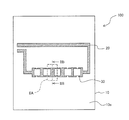
- FIG. 1 is a schematic top view of the circuit components of the embodiment.
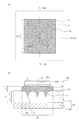
- FIG. 2A is an enlarged view of the IIA region shown in FIG. 1
- FIG. 2B is a schematic cross-sectional view taken along the line IIB-IIB of FIG.
- the mounting component is omitted.
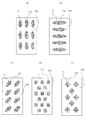
- 3 (a) to 3 (c) are schematic top views of a wiring region in which a non-through hole having an elliptical opening shape is formed
- FIGS. 3 (d) and 3 (e) have various shapes. It is a top view of the wiring region in which a non-through hole having an opening of is formed.
- FIG. 1 is a schematic top view of the circuit components of the embodiment.
- FIG. 2A is an enlarged view of the IIA region shown in FIG. 1
- FIG. 2B is a schematic cross-sectional view taken along the line IIB-IIB of FIG.
- the mounting component is omitted.
- 3 (a) to 3 (c) are schematic top views of a
- FIG. 4 (a) is a schematic top view of a wiring region in which non-through holes are formed at a substantially averaged density
- FIG. 4 (b) is a schematic view of a wiring region in which non-through holes are formed at a non-uniform density. It is a top view of the wiring area.
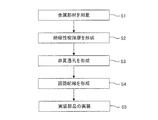
- FIG. 5 is a flowchart illustrating a method of manufacturing the circuit component of the embodiment.
- FIG. 6 is an example of a laser drawing pattern in which a non-through hole is formed by irradiation with laser light.
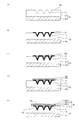
- 7 (a) to 7 (e) are views for explaining how a plating film is formed on a base material in an embodiment.
- FIG. 8 (a) to 8 (e) are views for explaining how a plating film is formed on a base material having non-through holes having a small ratio d / D.
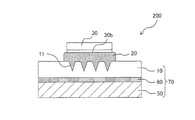
- FIG. 9 is a schematic cross-sectional view of a part of the circuit component of the modified example.
- 10 (a) is a schematic top view of the circuit component manufactured in the thirteenth embodiment
- FIG. 10 (b) is a schematic cross-sectional view taken along the line XB-XB of FIG. 10 (a).
- FIG. 11 is a cross-sectional photograph of the circuit component produced in Example 14.
- the circuit component 100 shown in FIGS. 1 and 2 (a) and 2 (b) will be described.
- the circuit component 100 includes a base material 70 including a metal member 50 and an insulating resin layer 10, a circuit wiring 20 including a plating film formed on the insulating resin layer 10 of the base material 70, and an insulating resin layer 10. It includes a mounting component 30 mounted above and electrically connected to the circuit wiring 20. The mounting component 30 is arranged and mounted on the circuit wiring 20. On the surface 10a of the insulating resin layer 10, a plurality of non-through holes 11 (recesses) filled with the plating film of the circuit wiring 20 are formed in the wiring region 10A where the circuit wiring 20 is formed.
- the metal member 50 dissipates heat generated by the mounting component 30 mounted on the insulating resin layer 10. Therefore, it is preferable to use a heat-dissipating metal for the metal member 50, and for example, iron, copper, aluminum, titanium, magnesium, stainless steel (SUS) and the like can be used. Above all, it is preferable to use magnesium and aluminum from the viewpoint of weight reduction, heat dissipation and cost. These metals may be used alone or in combination of two or more.
- the thermal conductivity of the metal member 50 is, for example, 80 to 300 W / m ⁇ K.
- the shape and size of the metal member 50 are not particularly limited, and can be arbitrarily designed according to the application of the circuit component 100.
- the shape of the metal member 50 may be a plate-like body (metal plate), a heat radiation fin, or a complicated shape formed by die casting.
- the insulating resin layer 10 has an insulating property because it insulates the circuit wiring 20 and the metal member 50 to prevent a short circuit.
- the degree of insulation of the insulating resin layer 10 depends on the application of the circuit component 100, but for example, the resistance between the circuit wiring 20 and the metal member 50 when a voltage of 16 V is applied is 1 M ⁇ or more. Is. If the resistance between the circuit wiring 20 and the metal member 50 is less than 1 M ⁇ , a minute current may flow from the circuit wiring 20 to the metal member 50, and the circuit wiring 20 may not function. Further, the insulating resin layer 10 has a certain degree of thermal conductivity in order to enhance the heat dissipation of the circuit component 100.
- the insulating resin layer 10 is an insulating heat-dissipating resin layer having both insulating properties and a certain degree of thermal conductivity.
- the thermal conductivity of the insulating resin layer 10 is, for example, 1 to 5 W / m ⁇ K.
- the insulating resin layer 10 contains a resin.
- the resin used for the insulating resin layer 10 is preferably a heat-resistant high melting point resin having solder reflow resistance.
- the melting point of the resin used for the insulating resin layer 10 is preferably 260 ° C. or higher, more preferably 290 ° C. or higher. This does not apply when low temperature solder is used for mounting the mounting component 30.
- thermosetting resin for example, a thermosetting resin, a thermoplastic resin, and an ultraviolet curable resin can be used.
- a thermosetting resin which is easy to mold thinly, has high molding accuracy, and has high heat resistance and high density after curing is preferable.
- thermosetting resin for example, a heat-resistant resin such as an epoxy resin, a silicone resin, or a polyimide resin can be used, and among them, an epoxy resin is preferable.
- photocurable resin for example, a polyimide resin, an epoxy resin, or the like can be used.
- thermoplastic resin examples include aromatic polyamides such as 6T nylon (6TPA), 9T nylon (9TPA), 10T nylon (10TPA), 12T nylon (12TPA), MXD6 nylon (MXDPA), their alloy materials, and polyphenylene sulfide.
- aromatic polyamides such as 6T nylon (6TPA), 9T nylon (9TPA), 10T nylon (10TPA), 12T nylon (12TPA), MXD6 nylon (MXDPA), their alloy materials, and polyphenylene sulfide.
- PPS liquid crystal polymer
- PEEK polyetheretherketone
- PEI polyetherimide
- PPSU polyphenylsulfone
- the insulating resin layer 10 may contain an insulating heat conductive filler.
- the insulating heat conductive filler can improve the heat conductivity while maintaining the insulating property of the insulating resin layer 10.
- the insulating heat conductive filler is a filler having a thermal conductivity of 1 W / m ⁇ K or more, and a conductive heat radiating material such as carbon is excluded.
- Examples of the insulating heat conductive filler include ceramic powders such as aluminum oxide, silicon oxide, magnesium oxide, magnesium hydroxide, boron nitride, and aluminum nitride, which are inorganic powders having high thermal conductivity.
- a rod-shaped filler such as wallastonite or a plate-shaped filler such as talc or boron nitride may be mixed.
- insulating heat conductive fillers may be used alone or in combination of two or more.
- the maximum diameter (maximum particle size) of the insulating heat conductive filler is preferably 30 ⁇ m to 100 ⁇ m, for example, when relatively inexpensive ceramic particles are used.
- the maximum diameter of the insulating heat conductive filler is preferably 10 ⁇ m to 60 ⁇ m.
- the insulating heat conductive filler is preferably contained in the insulating resin layer 10 in an amount of, for example, 10% by weight to 90% by weight and 30% by weight to 80% by weight.
- the circuit component 100 can obtain sufficient heat dissipation.
- the insulating resin layer 10 may further contain a rod-shaped or needle-shaped filler such as glass fiber or calcium titanate in order to control its strength. Further, the insulating resin layer 10 may contain various general-purpose additives added to the resin molded product, if necessary.
- a material containing all of the resin constituting the insulating resin layer 10, the insulating heat conductive filler, and the like may be referred to as "resin material”.
- the wiring region 10A on which the circuit wiring 20 is formed on the surface 10a of the insulating resin layer 10 is filled with a plating film of the circuit wiring 20.
- a through hole (recess) 11 is formed.
- the ratio d / D of the depth d of the non-through hole 11 to the width D of the non-through hole 11 is 0.5 to 5.
- the ratio d / D is preferably 0.8 to 3.0 ⁇ m, or 1.0 to 1.6 ⁇ m.
- the distance between the plating film of the circuit wiring 20 and the metal member 50 becomes short, so that the circuit wiring 20 and the mounting component 30 arranged on the circuit wiring 20 are placed.
- the generated heat can be easily released to the metal member 50.
- the heat dissipation of the circuit component 100 is improved.
- the non-through hole (recess) 11 having a ratio d / D within the above range in this way, the heat dissipation property of the circuit component 100 and the adhesion of the circuit wiring 20 are improved.
- the circuit wiring 20 formed on the wiring region 10A in which the non-through hole 11 having the ratio d / D within the above range is formed can obtain sufficient flatness (smoothness) of the surface 20a.
- both the heat dissipation of the circuit component 100 and the adhesion of the circuit wiring 20 cannot be achieved as described below. Further, sufficient flatness (smoothness) of the circuit wiring 20 cannot be obtained.
- the ratio d / D is less than the lower limit of the above range, the depth d is small (shallow) with respect to the width D, so that the circuit wiring 20 does not have sufficient adhesion and the circuit component 100 has heat dissipation. May also decrease. Further, since the width D is larger than the depth d, it is difficult to fill the non-through hole 11 with the plating film, and the flatness of the circuit wiring 20 may be lowered (FIGS.
- the width D of the non-through hole 11 means the diameter of the opening 11a of the non-through hole 11 on the surface 10a (wiring region 10A) when the shape is a perfect circle.
- the shape of the opening 11a of the non-through hole 11 is preferably circular from the viewpoint of improving the smoothness and adhesion of the plating film constituting the circuit wiring 20, but is not particularly limited. For example, it may be an ellipse as shown in FIGS. 3 (a) to 3 (c), or may have a shape as shown in FIGS. 3 (d) and 3 (e).
- the shape of the opening 11a is not a perfect circle, it means the diameter of a perfect circle having the same area as the area of the opening 11a.
- the depth d of the non-through hole 11 is the depth of the deepest portion (bottom 11b) of the non-through hole 11, that is, the distance (length) from the surface 10a to the bottom 11b of the non-through hole 11. ..
- the width D of the non-through hole 11 is not particularly limited as long as the ratio d / D satisfies the above range, but may be, for example, 10 to 200 ⁇ m, 20 to 150 ⁇ m, or 30 to 50 ⁇ m. If the width D is less than the lower limit of the above range, the adhesion of the circuit wiring 20 may not be sufficiently obtained. If the width D exceeds the upper limit of the above range, it may be difficult to keep the ratio d / D within the above-mentioned appropriate range.
- the depth d of the non-through hole 11 is not particularly limited as long as the ratio d / D satisfies the above range, but may be, for example, 20 to 200 ⁇ m, 30 to 150 ⁇ m, or 50 to 100 ⁇ m. If the depth d is less than the lower limit of the above range, the adhesion of the circuit wiring 20 may not be sufficiently obtained. If the depth d exceeds the upper limit of the above range, there is a risk that the circuit wiring 20 and the metal member 50 cannot be sufficiently insulated, or the heat dissipation is lowered because the insulating resin layer 10 is thickened to obtain insulation. There is a risk.
- the ratio P / D of the distance P between the non-through holes 11 to the width D of the non-through holes 11 is preferably 0.3 to 3, 0.5 to 2.5 or 1.0 to 1.5.
- the distance P between the non-through holes 11 is defined as the distance P between one non-through hole 11 and another non-through hole 11 adjacent thereto on the surface 10a (wiring region 10A) of the insulating resin layer 10. It is the shortest distance, which is the shortest distance from the edge of the opening 11a of one non-through hole 11 to the edge of the opening 11a of another non-through hole 11 adjacent thereto.
- the ratio P / D is less than the lower limit of the above range, the distance P between the non-through holes 11 is too short, so that the flatness of the circuit wiring 20 formed therein may be insufficient.
- the ratio P / D exceeds the upper limit of the above range, the distance P between the non-through holes 11 increases, so that the number of non-through holes 11 that can be arranged decreases, the heat dissipation of the circuit component 100, and the circuit wiring 20 There is a risk that the adhesion will be insufficient.
- the distance P between the non-through holes 11 is not particularly limited as long as the ratio P / D satisfies the above range, but may be, for example, 20 to 300 ⁇ m or 50 to 150 ⁇ m.
- the depth d and width D of the non-through holes 11 and the distance P between the non-through holes 11 are obtained as, for example, the average value of a plurality of non-through holes 11 existing in a predetermined range (measurement range). For example, as described below, it may be obtained from the height measurement of the wiring region 10A by an optical measurement method.
- the circuit wiring 20 is peeled off from the insulating resin layer 10 to expose the wiring region 10A.
- an optical measuring device such as a laser microscope, the surface roughness (Ra) of the entire predetermined range (measurement range) of the wiring region 10A is measured.
- a portion having a depth of twice or more the surface roughness (Ra) of the entire measurement range is determined to be a non-through hole (recess) 11, and the width D of each non-through hole 11 and the distance P between the non-through holes 11 Is measured and the average value is calculated.
- the depth d of the non-through hole 11 in order to eliminate noise in the optical measurement, it is preferable to measure 10 or more non-through holes 11 and obtain the average of them in consideration of the variation in the depth d. ..
- the depth d and the width D of the non-through hole 11 and the distance P between the non-through holes 11 may be obtained by the shape analysis method by X-ray CT described below.
- X-ray CT the shape analysis method by X-ray CT described below.
- the metal member 50 is made of aluminum and the circuit wiring 20 is made of copper
- a portion of the circuit component 100 including the circuit wiring 20 is cut out to a predetermined size and measured by X-ray CT.
- an X-ray CT image of only the circuit wiring 20 containing copper, which has lower X-ray transparency than aluminum, can be obtained.
- This X-ray CT image was extracted as slice data for each plane in the depth direction, and the slice depth at which the circuit wiring 20 became invisible was defined as the depth d of the non-through hole 11, and sliced on the surface 10a of the insulating resin layer 10. From the shape of the image, the values of the width D and the distance P of the non-through hole 11 are measured. The average value is obtained from the depth d, the width D, and the distance P of the individual non-through holes 11 thus obtained. In the shape analysis method using X-ray CT, it is preferable to cut out and measure a wiring portion having an area of 3 to 15 mm 2 from the viewpoint of ease of sampling and detection sensitivity.
- the depth d and the width D of the non-through hole 11 may be obtained by observing the cross section of the circuit wiring 20 of the circuit component 100. As shown in FIG. 2B, the cross-sectional observation needs to be performed in a cross section in which the depth d and the width D of the non-through hole 11 can be measured, and may be performed as follows, for example. First, the circuit component 100 is cut and the cross section of the non-through hole 11 is observed. Then, the cross section of 2 to 3 ⁇ m is polished and cut with sandpaper or the like, and the cross section is observed again.
- the depth of the non-through hole 11 obtained from the photograph is defined as the depth d.
- the shape of the non-through hole is conical as shown in FIG. 2B, the width D can be obtained at the same time from the cross-sectional photograph in which the depth d can be obtained. Considering the variation in the depth d and the width D, it is preferable to measure 10 or more non-through holes 11 by the same method and calculate the average of them.
- the structure of the non-through hole 11 is not particularly limited and may have any shape. As shown in FIGS. 2A and 2B, the shape of the non-through hole 11 of the present embodiment is a cone whose bottom surface is arranged on the surface 10a (wiring region 10A). Therefore, the shape of the opening 11a of the non-through hole 11 is a perfect circle. However, the shape of the non-through hole 11 is not limited to this, and may be, for example, a polygonal pyramid such as a triangular pyramid or a quadrangular pyramid, or a pyramid having a complicated bottom surface. Further, a cylinder, a polygonal prism, or a prism having a complicated bottom surface may be used, or a hemisphere may be used.
- the inside of the non-through hole 11 does not widen more than the opening 11a. That is, the area of the cross section parallel to the inner surface 10a of the non-through hole 11 is preferably equal to or less than the area of the opening 11a. Therefore, when the shape of the non-through hole 11 is a cone, a pillar, or a hemisphere, it is preferable to arrange the bottom surface of the non-through hole 11 on the surface 10a (wiring region 10A).
- the non-through hole 11 is formed in the wiring region 10A. Further, it is preferable that the non-through hole 11 is formed only in the wiring region 10A and not on the surface 10a other than the wiring region 10A. As a result, the time (machining time) for forming the non-through hole 11 is shortened, and the manufacturing efficiency of the circuit component 100 is improved. Further, the non-through holes 11 are preferably formed so as to be scattered so that the densities in the wiring region 10A are substantially averaged. As a result, the heat dissipation of the circuit component 100 and the adhesion of the circuit wiring 20 can be made uniform. For example, the densities of the non-through holes 11 in the entire wiring region 10A shown in FIGS. 4A and 4B are the same.
- the non-through holes 11 shown in FIG. 4A are scattered so that the densities in the wiring region 10A are substantially averaged, while the non-through holes 11 shown in FIG. 4B are formed. , The density is biased. In FIG. 4B, the density of the non-through hole 11 is high in the upper left portion, and the density of the non-through hole 11 is low in the lower right portion.
- the plating film of the circuit wiring 20 grows uniformly on the wiring region 10A shown in FIG. 4A.
- the non-through holes 11 in a scattered manner so that the densities in the wiring region 10A are substantially averaged, it is preferable to satisfy the following conditions. Difference between the maximum value and the minimum value of the distance P (the shortest distance from the edge of the opening 11a of one non-through hole 11 to the edge of the opening 11a of another non-through hole 11 adjacent thereto) in the wiring region 10A. However, it is preferably less than 50% of the average value of the distance P in the wiring region 10A.
- the difference between the density (pieces / mm 2 ) in the densest region of the non-through hole 11 and the density (pieces / mm 2 ) in the region with the lowest density is the non-thickness in the wiring region 10A. It is preferably less than 50% of the average density of the through holes 11 (pieces / mm 2).
- the thickness of the insulating resin layer 10 is not particularly limited, and can be arbitrarily designed according to the application of the circuit component 100.
- the thickness of the insulating resin layer 10 may be substantially constant or may vary depending on the location. Since the heat dissipation of the circuit component 100 tends to improve as the thickness of the insulating resin layer 10 becomes thinner, it is preferable that the thickness of the insulating resin layer 10 in the vicinity of the mounting component 30 that generates a large amount of heat is small. On the other hand, if the thickness of the insulating resin layer 10 is too small, the flow resistance of the resin increases in the molding of the insulating resin layer 10, and there is a possibility that molding defects (filling defects) may occur.
- the thickness B of the portion of the insulating resin layer 11 sandwiched between the circuit wiring 20 and the metal member 50 and the non-through hole 11 is not formed (the insulating resin layer 11 under the circuit wiring 20).
- the film thickness B) is preferably 30 to 200 ⁇ m and 50 to 150 ⁇ m.
- the thickness B varies from place to place, it is preferable that the smallest value (thickness of the thinnest portion) is within the above range.
- the thickness of the portion of the insulating resin layer 10 where the non-through hole 11 is formed that is, the distance from the bottom 11b of the non-through hole 11 to the surface 10b of the insulating resin layer 10 facing the metal member 50 (
- the shortest distance) C is preferably 5 to 100 ⁇ m, 20 to 80 ⁇ m, or 30 to 60 ⁇ m. If the distance C is smaller than the lower limit of the above range, the circuit wiring 20 and the metal member 50 may not be sufficiently insulated. Further, if the distance C is larger than the upper limit value in the above range, the heat dissipation property of the circuit member 100 may decrease.
- the surface roughness (Ra) of the wiring region 10A other than the non-through hole 11 is preferably 1/5 or less, or 1/10 or less of the depth d of the non-through hole 11.
- the adhesion of the circuit wiring 20 is improved by providing the non-through hole 11, sufficient adhesion can be maintained even if the surface roughness (Ra) of the wiring region 10A is reduced. Since the surface roughness (Ra) of the wiring region 10A other than the non-through hole 11 can be reduced, the flatness of the circuit wiring 20 formed therein is improved.
- the surface roughness (Ra) of the wiring region 10A is the surface roughness (Ra) of the surface 10a other than the wiring region 10A. It is preferably larger than Ra). Further, the surface roughness (Ra) of the wiring region 10A may be, for example, 1 to 30 ⁇ m, 3 to 20 ⁇ m, or 5 to 10 ⁇ m.
- the circuit wiring 20 is formed of a plating film in the wiring region 10A of the surface 10a of the insulating resin layer 10.
- the circuit wiring 20 is preferably composed of an electroless plating film 21 formed on the wiring region 10A and an electroplating film 22 formed on the electroless plating film 21 (see FIG. 7E).
- Examples of the electroless plating film 21 include an electroless nickel phosphorus plating film, an electroless copper plating film, and an electroless nickel plating film, and among them, an electroless nickel phosphorus plating film is preferable.
- Examples of the electrolytic plating film 22 include an electrolytic nickel phosphorus plating film, an electrolytic copper plating film, and an electrolytic nickel plating film. Further, in order to improve the wettability of the solder of the plating film, a plating film of gold, silver, tin or the like may be formed on the outermost surface of the circuit wiring 20.
- the thickness A of the circuit wiring 20 is preferably larger than the smaller of 1/2 of the depth d and 1/2 of the width D of the non-through hole 11. That is, the thickness A of the circuit wiring 20 is preferably larger than 1/2 of the depth d of the non-through hole 11 or 1/2 of the width D.
- the thickness A of the circuit wiring 20 is within the above range, the flatness of the plating film forming the circuit wiring 20 is further improved.
- the non-through hole 11 when the size of the non-through hole 11 is relatively small, the non-through hole 11 can be filled with the plating film even if the thickness A of the circuit wiring 20 is thinner than the above range, and the flatness of the circuit wiring 20 can be ensured.
- the size of the non-through hole 11 is relatively small, there is a concern that the heat dissipation property is lowered. For example, by reducing the thickness B of the insulating resin layer 10, the bottom 11b of the non-through hole 11 and the metal member 50 (By reducing the distance C), the heat dissipation of the circuit component 100 can be sufficiently ensured.
- the thickness A of the circuit wiring 20 means a thickness that does not include the portion filled in the non-through hole 11. That is, the thickness A of the circuit wiring 20 is the distance from the surface 10a of the insulating resin layer 10 to the surface 20a facing the mounting component 30 of the circuit wiring 20.
- the thickness A of the circuit wiring 20 may be, for example, 10 to 100 ⁇ m or 20 to 80 ⁇ m.
- the mounting component 30 is arranged so that the surface (bottom surface) 30b provided with the terminals faces the circuit wiring 20, and the terminals and the circuit wiring 20 are electrically connected by soldering.
- solder is not particularly limited, and general-purpose solder can be used.
- the mounting component 30 generates heat when energized and becomes a heat generation source. Any mounting component 30 can be used, and examples thereof include an LED (light emitting diode), a power module, an IC (integrated circuit), and a thermal resistance.
- the adhesion strength of the mounting component 30 to the circuit wiring 20 is increased, and the thermal conductivity from the mounting component 30 to the circuit wiring 20 is increased. Is improved. As a result, the heat dissipation of the circuit component 100 is further improved.
- the metal member 50 is prepared (step S1 in FIG. 5).
- the metal member 50 may be a commercially available metal plate (plate-like body), heat radiation fins, or the like, or may be formed into an arbitrary shape by die casting.
- the surface of the metal member 50 on which the insulating resin layer 10 is formed may be roughened in order to improve the adhesion with the insulating resin layer 10 laminated on the surface.
- chemical etching, nanomolding technology (NMT) disclosed in Japanese Patent Application Laid-Open No. 2009-6721, Japanese Patent No. 5681076, and the like may be used.
- laser roughening may be performed.
- the insulating resin layer 10 is formed on the metal member 50 (step S2 in FIG. 5).
- the insulating resin layer 10 may be formed by insert molding (integral molding). Specifically, the metal member 50 is first arranged in the mold, and the resin material is injected and filled in the empty portion of the mold. As a result, the metal member 50 and the insulating resin layer 10 are integrally molded.
- the insert molding injection molding, transfer molding and the like can be used.
- the insulating resin layer 10 and the metal member 50 may be an integrally molded body.
- the integrally molded body is not bonded or bonded (secondary bonding or mechanical bonding) between the metal member 50 and the insulating resin layer 10 separately produced, but is formed at the time of molding the insulating resin layer 10. It means a product manufactured by a process of joining with a metal member 50 (typically, insert molding).
- a plurality of non-through holes 11 are formed in the wiring region 10A of the insulating resin layer 10 (step S3 in FIG. 5).
- the method for forming the non-through hole 11 is not particularly limited, but for example, the surface 10a of the insulating resin layer 10 may be cut by irradiating a laser beam to form the non-through hole 11 (laser processing). Laser machining can efficiently form a plurality of non-through holes 11, and it is easy to adjust the size (width D, depth d) of the non-through holes 11.
- the entire wiring region 10A may be irradiated with laser light to roughen the wiring region 10A.
- the surface roughness (Ra) of the wiring region 10A other than the non-through hole 11 is 1/5 or less of the depth d of the non-through hole 11. Alternatively, it is preferably 1/10 or less.
- the type of laser light used for laser processing of the non-through hole 11 and the laser processing apparatus are not particularly limited, and can be appropriately selected and used in consideration of the type of the insulating resin layer 10 and the like.
- the non-through hole 11 is formed by laser processing, for example, as shown in FIG. 6, it is preferable to perform laser drawing of a pattern composed of discontinuous lines.
- the laser drawing shown in FIG. 6 will be described.
- a discontinuous line L1 extending in a predetermined direction (Y direction shown in FIG. 6) is drawn.
- the discontinuous line L1 is a pattern in which line segments (laser drawing unit) having a length N 1 are arranged at intervals (spaces) having a length N 2.
- the length N 3 is parallel moved in the predetermined direction perpendicular to the direction (X direction shown in FIG.
- the laser light is applied only to a line segment having a length N 1 , but since the laser light has a width called a spot diameter, the insulating resin layer 10 around the drawing pattern line is also cut. ..
- the line length N 1 is short, the width spread due to the spot diameter and the cutting depth are substantially the same, and the laser machining mark becomes the non-through hole 11 of the cone.
- non-through holes 11 can be easily formed by interspersing the non-through holes 11 in the wiring region 10A so that the densities are substantially averaged.
- a method of forming the plurality of non-through holes 11 by the laser light in addition to making the drawing pattern discontinuous, a method of irradiating the laser light with a pulse may be used.
- the circuit wiring 20 included in the plating film is formed in the wiring region 10A of the insulating resin layer 10.
- the method for forming the circuit wiring 20 is not particularly limited, and a general-purpose method can be used. For example, a method of forming a plating film on the entire surface 10a, patterning the plating film with a photoresist, and removing the plating film on a portion other than the circuit wiring by etching, or irradiating a laser beam on a portion where the circuit wiring is desired to be formed with a resin. Examples thereof include a method of roughening the layer and forming a plating film only on the laser beam irradiated portion.
- thermosetting resin such as an epoxy resin
- the adsorption of metal ions as a plating catalyst can be promoted by roughening the wiring region 10A with laser light, and only the wiring region 10A can be promoted. It becomes easy to form an electroless plating film.
- the circuit wiring 20 is formed by forming the electroless plating film 21 on the wiring region 10A (see FIG. 7A) and the electroless plating film 21. It may include forming the electroplating film 22 on the top (see FIGS. 7B to 7E).
- the method for forming the electroless plating film 21 is not particularly limited, and a general-purpose electroless plating method can be appropriately selected and used.
- electrolytic plating can be performed on the electroless plating film 21.
- the electroless plating film 21 is a base film for forming the electrolytic plating film 22.
- the method for forming the electrolytic plating film 22 is not particularly limited, and a general-purpose electrolytic plating method can be appropriately selected and used, but an electrolytic plating method having high uniform electrodeposition is preferable.
- electrolytic plating a large amount of current flows in the corners and protrusions of the plating film forming surface, and a small amount of current flows in the central part and recesses. Since the thickness of the electrolytic plating film tends to be proportional to the strength of the electric current, if the plating film forming surface is uneven, the film thickness of the electrolytic plating film is uneven. In the electrolytic plating method having high uniform electrodeposition, such unevenness in the film thickness of the electrolytic plating film can be suppressed. As a result, as shown in FIGS.
- the electrolytic plating films 22a, 22b, and 22c are not thickly formed at the edge (corner portion) of the opening 11a of the non-through hole 11. It grows from the inner wall and surface 10a of the through hole 11 with a substantially uniform film thickness. As a result, the non-through hole 11 can be easily filled, and the flatness of the surface of the electrolytic plating film 23c (the surface 20a of the circuit wiring 20) can be further improved.
- the ratio d / D of the depth d to the width D of the non-through hole 11 is 0.5 to 5. Since the ratio d / D of the non-through holes 11 is within the above range, the electrolytic plating film 22 can easily fill the non-through holes 11 and further improve the flatness (smoothness) of the surface 20a of the circuit wiring 20. .. On the other hand, when the ratio d / D is out of the above range, it is difficult to fill the non-through hole 11 with the plating film, and the flatness of the circuit wiring 20 cannot be improved. For example, in FIGS.
- the non-through hole 111 can be filled by forming a plating film having the same thickness as the depth d, but the end of the opening 111a of the non-through hole 111 is filled.
- the swelling of the plating film is formed, and the surface 20a of the circuit wiring 20 cannot be flattened.
- the mounting component 30 is mounted on the circuit wiring 20 (step S5 in FIG. 5). As a result, the circuit component 100 of the present embodiment is obtained.
- the mounting method of the mounting component 30 is not particularly limited, and a general-purpose method can be used. For example, a soldering reflow method in which the solder at room temperature and the mounting component 30 are arranged on the circuit wiring 20 and passed through a high-temperature reflow furnace.
- the mounting component 30 may be soldered to the insulating resin layer 10 by a laser soldering method (spot mounting) in which the interface between the insulating resin layer 10 and the mounting component 30 is irradiated with laser light to perform soldering. ..
- the circuit component 100 of the present embodiment described above by providing the non-through hole 11 in which the ratio d / D is within a specific range in the wiring region 10A, high heat dissipation and the insulating resin layer 10 of the circuit wiring 20 are provided. Achieves both high adhesion to plastic. Further, since the surface 20a of the circuit wiring 20 on which the mounting component 30 is mounted is flat, the adhesion strength of the mounting component 30 to the circuit wiring 20 is improved, and the thermal conductivity from the mounting component 30 to the circuit wiring 20 is improved. do. As a result, the heat dissipation of the circuit component 100 is further improved.
- the insulating resin layer 10 is formed directly on the metal member 50, but the present embodiment is not limited to this.
- the ceramic layer 60 may be formed between the metal member 50 and the insulating resin layer 10.
- the circuit unit 200 having the ceramic layer 60 shown in FIG. 9 will be described below.
- the configuration of the circuit unit 200 is the same as that of the circuit component 100 shown in FIGS. 2A and 2B described above, except that the circuit unit 200 has the ceramic layer 60. Therefore, in this modification, the description of the constituent requirements other than the ceramic layer 60 will be omitted.
- the ceramic layer 60 is formed on the metal member 50.
- the ceramic layer 60 is less likely to be cut by laser light than the insulating resin layer 10.
- the ceramic layer 60 has an insulating property because it insulates the circuit wiring 20 and the metal member 50 together with the insulating resin layer 10 to prevent a short circuit.
- the degree of this insulating property depends on the application of the circuit component 100, but for example, it is preferable to have a resistance of 5000 M ⁇ or more by applying a voltage of 500 V.
- the ceramic layer 60 preferably has a high thermal conductivity in order to enhance the heat dissipation of the circuit component 100.
- the ceramic layer 60 is preferably an insulating heat conductive layer (insulated heat radiating layer) having both insulating properties and high thermal conductivity.
- the thermal conductivity of the ceramic layer 60 is, for example, 5 to 150 W / m ⁇ K.
- the thermal conductivity of the ceramic layer 60 is lower than the thermal conductivity of the metal member 50, and the insulating resin layer 10 It is preferably higher than the thermal conductivity of.
- the ceramics contained in the ceramic layer include aluminum oxide (alumina), aluminum nitride, boron nitride, silicon nitride, beryllium oxide, silicon carbide, itria, zirconia, titanium dioxide, silicon dioxide, clay minerals, and the like. Itria and alumina, which are low in cost and easily form a dense thin film, are preferable. These ceramics may be used alone or in combination of two or more.
- the film thickness of the ceramic layer 60 may be, for example, 1 ⁇ m to 100 ⁇ m, 5 ⁇ m to 20 ⁇ m, or 5 ⁇ m to 10 ⁇ m.
- the metal member 50 is prepared.
- the method for forming the ceramic layer 60 is not particularly limited, and for example, a physical vapor deposition method (PVD) such as vacuum deposition and ion plating, a chemical vapor deposition method (CVD) such as plasma CVD, and an aerosol deposition (AD) method. Sputtering, vapor deposition, cold spraying, warm spraying and the like can be used.
- PVD physical vapor deposition method
- CVD chemical vapor deposition method
- AD aerosol deposition
- Sputtering, vapor deposition, cold spraying, warm spraying and the like can be used.
- a film of an alumite layer aluminum oxide (alumina) may be formed as the ceramic layer 60 by anodic oxidation.
- the alumite layer is formed only on a part of the metal member 50. It may be formed on the entire surface of the metal member 50, or the ceramic layer 60 made of a multilayer film may be formed by using the plurality of film forming methods described above to increase the film strength
- the insulating resin layer 10 is formed on the ceramic layer 60, a plurality of non-through holes 11 are formed in the wiring region 10A of the insulating resin layer 10, and the wiring region 10A of the insulating resin layer 10 is formed into a plating film.
- the circuit wiring 20 including the circuit wiring 20 is formed, and the mounting component 30 is mounted on the circuit wiring 20 to obtain the circuit component 200 of the present modification.
- the formation of the insulating resin layer 10, the formation of the plurality of non-through holes 11, the formation of the circuit wiring 20, and the mounting of the mounting component 30 can be carried out in the same manner as in the above-described manufacturing method of the circuit component 100.
- the circuit component 200 of this modification has the same effect as the circuit component 100 described above. Further, since the circuit component 200 has the ceramic layer 60, the circuit wiring 20 and the metal member 50 can be more reliably insulated.
- Example 1 In this embodiment, the circuit component 100 shown in FIG. 1 was manufactured. An LED (light emitting diode) was used as the mounting component 30.
- an aluminum plate (A1050, aluminum component: 99% or more, 8 cm ⁇ 12 cm) was prepared.
- the region (wiring region 10A) where the circuit wiring 20 is to be formed on the surface 10a of the insulating resin layer 10 was irradiated with laser light to process the wiring region 10A.
- Laser processing laser writing
- 3D laser marker was used (manufactured by KEYENCE, YVO 4 laser, MD-9920A, 13W) a.
- a laser beam was irradiated to roughen the region (wiring region 10A) where the circuit wiring 20 on the surface 10a of the insulating resin layer 10 was to be formed.
- a pattern of parallel lines arranged at intervals of 40 ⁇ m pitch was laser-drawn in the wiring region 10A (laser drawing conditions: linear speed 2000 mm / s, frequency 40 kHz, power 20%).
- the surface roughness (Ra) of the wiring region 10A became 13 ⁇ m.
- the shape of the formed non-through hole 11 was a cone whose bottom surface was arranged on the surface 10a (wiring region 10A) as shown in FIGS. 2A and 2B.
- the width D, depth d, and distance P between the non-through holes 11 of the formed through holes 11 were measured using a laser microscope (Keyence laser microscope VK-9700, objective lens 20 times).
- the depth d the depth distribution of one non-through hole 11 is calculated, and the range where the depth value is the largest and the cumulative frequency is less than 1% is ignored as optical noise, and the cumulative frequency is 1%.
- the value of S was calculated as the depth d of the one non-through hole.
- the width D the area of the opening 11a of one non-through hole 11 is calculated, and the diameter when the shape of the opening 11a is regarded as a perfect circle is set as the width D of one non-through hole 11. Calculated.
- the width D and the depth d were obtained for each of the non-through holes 11 existing in the measurement field of view by the same method, and the average values of the width D and the depth d were further obtained.
- the distance P between the non-through holes 11 first, the distance between the center of gravity of the opening 11a of one non-through hole 11 and the center of gravity of the opening 11a of the non-through hole 11 adjacent thereto was measured. For all the non-through holes 11 existing in the measurement field of view, the distances between the centers of gravity of the adjacent openings 11a were obtained by the same method, and the average value of the distances between these centers of gravity was obtained. Next, the value obtained by subtracting the average value of the width D obtained earlier from the average value of the distance between the centers of gravity was defined as the distance P between the non-through holes 11.
- the width D (average value) of the non-through holes 11 calculated as described above was 155 ⁇ m, the depth d (average value) was 178 ⁇ m, and the distance P between the non-through holes 11 was 128 ⁇ m. Therefore, the ratio d / D was 1.15.
- Table 4 shows the calculated values of the width D, the depth d, the distance P between the non-through holes 11, and the ratio d / D of the through holes 11.
- a circuit wiring 20 was formed by further laminating an electrolytic copper plating film 95 ⁇ m, an electroless nickel phosphorus plating film 4.0 ⁇ m, and an electroless gold plating film 0.1 ⁇ m on the nickel phosphorus film in this order.
- electrolytic copper plating an electrolytic plating method having high uniform electrodeposition was used.
- the electrolytic copper plating solution a mixed solution of solution A: Top Lucina 2000 manufactured by Okuno Pharmaceutical Co., Ltd. and solution B: manufactured by ROHM & Haas Electronic Materials Co., Ltd., Copper Gleam HS-200 was used.
- the circuit wiring 20 composed of the electroless plating film and the electrolytic plating film was formed in the wiring region 10A irradiated with the laser beam.
- mounting component 30 a surface-mounted high-brightness LED (manufactured by Nichia Corporation, NS2W123BT, 3.0 mm ⁇ 2.0 mm ⁇ height 0.7 mm) was used.
- a surface-mounted high-brightness LED manufactured by Nichia Corporation, NS2W123BT, 3.0 mm ⁇ 2.0 mm ⁇ height 0.7 mm
- five mounting components 30 were arranged on the circuit wiring 20 via solder at room temperature. The distance between the mounted components 30 was 0.5 mm.
- the base material on which the LED was placed was placed in a reflow oven (solder reflow). The base material was heated in the reflow oven, the maximum temperature of the base material reached 240 ° C. to 260 ° C., and the time required for the base material to reach the maximum temperature was about 1 minute.
- the mounting component 30 was mounted on the resin portion 10 by soldering, and the circuit component 100 of this embodiment shown in FIG. 1 was obtained.
- Example 2 to 12 In Examples 2 to 12, the thickness of the insulating resin layer 10, the laser drawing conditions, each size of the laser drawing pattern shown in FIG. 6 (N 1 to N 4 ), and the thickness of the circuit wiring (thickness of the plating film).
- the circuit component 100 was manufactured by the same method as in Example 1 except that the above was changed as shown in Tables 1, 2 and 4.
- Example 5-12 instead of the YVO 4 laser used in Example 1, UV laser was used (manufactured by Keyence, 3D laser marker, MD-U1000C, output 2.5 W) a.
- the width D, the depth d, and the distance P between the non-through holes 11 of the through holes 11 were calculated by the same method as in the first embodiment.
- Tables 4 and 5 show the calculated values of the width D, the depth d, the distance P between the non-through holes 11, and the ratio d / D of the through holes 11.
- Example 13 the circuit components 300 shown in FIGS. 10A and 10B are manufactured. As shown in FIG. 10B, the thickness of the resin layer 310 of the circuit component 300 is not constant. Other configurations are the same as those of the circuit component 100 shown in FIG.
- the thinnest film thickness X1 of the resin layer 310 is 75 ⁇ m, and the thickest film thickness X2 is 450 ⁇ m. Since the insulating resin 310 is mixed with a filler (alumina particles) having a maximum particle diameter of 35 ⁇ m, it is difficult to mold the entire insulating resin 310 with a thickness of 75 ⁇ m, but the thickness is partially set to 75 ⁇ m. By doing so, molding became possible. By partially providing a region having a thin film thickness (a region having a film thickness X1), the heat dissipation of the circuit component 300 is further improved. Further, it is preferable that the region where the film thickness is thin (the region where the film thickness is X1) is provided in the portion where the mounting component (LED) 30 which is a heat generating source is mounted.
- LED LED
- the thickness of the insulating resin layer 310, the laser drawing conditions, each size of the laser drawing pattern shown in FIG. 6 (N 1 to N 4 ), and the thickness of the circuit wiring (thickness of the plating film) are shown.
- the circuit component 300 was manufactured by the same method as in the first embodiment except that the modifications were made as shown in 2 and 5. In this example, the UV laser used in Example 5 was used to form the non-through hole 11.
- the width D, the depth d, and the distance P between the non-through holes 11 of the through holes 11 were calculated by the same method as in the first embodiment.
- Table 5 shows the calculated values of the width D, the depth d, the distance P between the non-through holes 11, and the ratio d / D of the through holes 11.
- the thickness of the resin layer 310 is not constant as in the circuit component 300 shown in FIGS. 10A and 10B, and the ceramic layer 60 is provided as in the circuit component 200 shown in FIG. Manufactured circuit parts.
- the circuit component manufactured in this embodiment has the same configuration as the circuit component 100 shown in FIG. 1 except that the thickness of the resin layer is not constant and the circuit component has a ceramic layer.
- the thinnest film thickness X1 of the resin layer was 65 ⁇ m
- the thickest film thickness X2 was 450 ⁇ m.
- Example 2 a metal member similar to that used in Example 1 was subjected to degreasing and chemical etching, and then hard anodized (Toa Denka, TAF-TR). As a result, an anodized film (alumite) was formed on the entire surface of the metal member.
- the film thickness of the anodic oxide film was 50 ⁇ m.
- the thickness of the insulating resin layer was changed as shown in Tables 2 and 5.
- the UV laser used in Example 5 was used to form the non-through hole.
- the width D, the depth d, and the distance P between the non-through holes 11 of the through holes 11 were calculated by the same method as in the first embodiment.
- Table 5 shows the calculated values of the width D, the depth d, the distance P between the non-through holes 11, and the ratio d / D of the through holes 11.
- Base Material A base material having an insulating resin layer formed on a metal member was produced by the same method as in Example 1 except that the thickness of the insulating resin layer was 150 ⁇ m.
- a lattice pattern was formed by laser processing under the laser drawing conditions shown in Table 3 in the area (wiring area) where the circuit wiring on the surface of the insulating resin layer is to be formed.
- the grid pattern was a grid pattern with a pitch of 200 ⁇ m.
- the depth of the groove forming the lattice pattern (maximum value of the depth of the laser-machined portion) was 130 ⁇ m.
- Circuit wiring was formed on a base material on which a lattice pattern was formed by the same method as in Example 1, and mounting components were mounted. As a result, the circuit components of this comparative example were obtained.
- the electrolytic plating was performed under the same conditions as in Example 2 (plating liquid composition, current density, time), and the average thickness of the circuit wiring was adjusted to be the same as in Example 2.
- the average thickness of the circuit wiring is shown in parentheses in Table 5.
- Comparative Examples 2 to 4 Similar to Comparative Example 1, Comparative Examples 2 to 4 also formed a lattice pattern composed of grooves (recesses) on the entire surface of the wiring region of the base material instead of the non-through holes 11.
- circuit components were subjected to the same method as in Comparative Example 1 except that the thickness of the insulating resin layer 10, the laser drawing conditions, and the average thickness of the circuit wiring were changed as shown in Tables 3 and 5.
- Manufactured In Comparative Examples 3 and 4, instead of the YVO 4 laser used in Comparative Example 1, UV laser (manufactured by Keyence, 3D laser marker, MD-U1000C, output 2.5 W) with a grid pattern of 80 ⁇ m pitch Laser drawn.
- a metal member similar to that used in Comparative Example 1 was subjected to degreasing and chemical etching, and then hard anodized (Toa Denka, TAF-TR). As a result, an anodized film (alumite) was formed on the entire surface of the metal member.
- the film thickness of the anodic oxide film was 50 ⁇ m.
- Comparative Example 1 The same method as in Comparative Example 1 except that the thickness of the insulating resin layer, the laser drawing conditions, and the average thickness of the circuit wiring were changed as shown in Tables 3 and 5 using the metal member having the anodic oxide film formed.
- the circuit parts of this comparative example were manufactured.
- the UV laser used in Comparative Example 3 was used instead of the YVO 4 laser used in Comparative Example 1.
- Comparative Examples 6 and 7 In Comparative Examples 6 and 7, a plurality of through holes 11 were formed in the region (wiring region 10A) where the circuit wiring 20 is to be formed on the surface 10a of the insulating resin layer 10.
- an insulating thickness of the resin layer 10 laser writing condition, the size (N 1 ⁇ N 4) of the laser drawing patterns shown in FIG. 6 and the thickness of the circuit wiring (thickness of the plating film)
- the circuit component 100 was manufactured by the same method as in Example 1 except that the above was changed as shown in Tables 3 and 5.
- the UV laser used in Comparative Example 3 was used instead of the YVO 4 laser used in Example 1.
- the width D, the depth d, and the distance P between the non-through holes 11 of the through holes 11 were calculated by the same method as in the first embodiment.
- Table 5 shows the calculated values of the width D, the depth d, the distance P between the non-through holes 11, and the ratio d / D of the through holes 11.
- the depth d of the non-through hole 11 of Comparative Example 7 was determined by observing the cross section.
- An electroless nickel phosphorus plating film of 1 ⁇ m was formed on a base material on which laser drawing was performed, and an electrolytic copper plating of 40 ⁇ m was further formed on the electroless nickel phosphorus plating film to prepare a sample for an adhesion test.
- the size of the plating film on the sample was 2 mm in width and 40 mm in length.
- the adhesion strength of the plating film of the measurement sample was measured by a vertical tensile test, and the adhesion of the circuit wiring (plating film) was evaluated according to the following evaluation criteria.
- Comparative Example 6 in which the ratio d / D of the non-through holes 11 was less than 0.5, the evaluation results of adhesion and heat dissipation were poor (evaluation result: E).
- Comparative Example 6 similar to the second and third factors of the decrease in heat dissipation of Comparative Examples 2 and 4 described above, the decrease in the adhesion between the plating film and the insulating resin layer, the plating film and the metal member It is presumed that the heat dissipation was lowered due to the increase in the thickness (distance C) of the insulating resin layer between the two.
- Comparative Example 7 in which the ratio d / D of the non-through holes 11 was 5 or more, the evaluation result of the insulating property was poor (evaluation result: E), and therefore the heat dissipation test was not performed.
- the cause of this is presumed as follows.
- the number of times of laser drawing was increased (the number of times of laser drawing: 10 times) in order to deepen the non-through hole 11.
- the thickness (distance C) of the insulating resin layer between the bottom of the non-through hole 11 and the metal member was 93 ⁇ m. It is presumed that the insulating resin layer between them became brittle. It is presumed that the plating solution permeates the brittle insulating resin layer and the plating film grows, which causes a short circuit between the circuit wiring (plating film) and the metal member.
- the circuit component of the present invention has high heat dissipation. Therefore, the circuit component of the present invention is suitable for a component on which a mounting component such as an LED is mounted, and can be applied to a component of a smartphone or an automobile.
Landscapes
- Chemical & Material Sciences (AREA)
- Engineering & Computer Science (AREA)
- Metallurgy (AREA)
- Chemical Kinetics & Catalysis (AREA)
- Materials Engineering (AREA)
- Organic Chemistry (AREA)
- Microelectronics & Electronic Packaging (AREA)
- General Chemical & Material Sciences (AREA)
- Mechanical Engineering (AREA)
- Electrochemistry (AREA)
- Structure Of Printed Boards (AREA)
- Chemically Coating (AREA)
- Electroplating Methods And Accessories (AREA)
- Manufacturing Of Printed Wiring (AREA)
- Led Device Packages (AREA)
Priority Applications (2)
| Application Number | Priority Date | Filing Date | Title |
|---|---|---|---|
| CN202180026135.3A CN115443349A (zh) | 2020-04-02 | 2021-03-31 | 电路部件以及电路部件的制造方法 |
| US17/912,309 US20230136337A1 (en) | 2020-04-02 | 2021-03-31 | Circuit part and method of manufacturing circuit part |
Applications Claiming Priority (2)
| Application Number | Priority Date | Filing Date | Title |
|---|---|---|---|
| JP2020-066410 | 2020-04-02 | ||
| JP2020066410A JP7554057B2 (ja) | 2020-04-02 | 2020-04-02 | 回路部品及び回路部品の製造方法 |
Publications (1)
| Publication Number | Publication Date |
|---|---|
| WO2021201154A1 true WO2021201154A1 (ja) | 2021-10-07 |
Family
ID=77927308
Family Applications (1)
| Application Number | Title | Priority Date | Filing Date |
|---|---|---|---|
| PCT/JP2021/013987 Ceased WO2021201154A1 (ja) | 2020-04-02 | 2021-03-31 | 回路部品及び回路部品の製造方法 |
Country Status (4)
| Country | Link |
|---|---|
| US (1) | US20230136337A1 (https=) |
| JP (1) | JP7554057B2 (https=) |
| CN (1) | CN115443349A (https=) |
| WO (1) | WO2021201154A1 (https=) |
Families Citing this family (2)
| Publication number | Priority date | Publication date | Assignee | Title |
|---|---|---|---|---|
| TW202318568A (zh) * | 2021-07-30 | 2023-05-01 | 日商尼康股份有限公司 | 金屬配線的製造方法、電晶體的製造方法及金屬配線 |
| WO2025095062A1 (ja) * | 2023-11-01 | 2025-05-08 | 住友ベークライト株式会社 | 構造体、インバータモジュール、モータ、および構造体の製造方法 |
Citations (4)
| Publication number | Priority date | Publication date | Assignee | Title |
|---|---|---|---|---|
| JPH07188935A (ja) * | 1993-12-28 | 1995-07-25 | Ibiden Co Ltd | アンカー特性に優れる接着剤、およびこの接着剤を用いたプリント配線板とその製造方法 |
| JP2006120840A (ja) * | 2004-10-21 | 2006-05-11 | Citizen Seimitsu Co Ltd | 樹脂のエッチング方法及びその方法を用いてエッチング処理を施した面を備えた樹脂製品 |
| US20170009974A1 (en) * | 2015-07-06 | 2017-01-12 | Lg Electronics Inc. | Light source module, fabrication method therefor, and lighting device including the same |
| WO2019172405A1 (ja) * | 2018-03-09 | 2019-09-12 | マクセルホールディングス株式会社 | 回路部品 |
Family Cites Families (5)
| Publication number | Priority date | Publication date | Assignee | Title |
|---|---|---|---|---|
| CN102574365B (zh) * | 2009-07-24 | 2015-11-25 | 三菱瓦斯化学株式会社 | 树脂复合电解铜箔、覆铜层压板和印刷线路板 |
| CN102598250A (zh) * | 2009-10-30 | 2012-07-18 | 三洋电机株式会社 | 元件搭载用基板及其制造方法、半导体组件以及便携设备 |
| JP5204908B1 (ja) * | 2012-03-26 | 2013-06-05 | Jx日鉱日石金属株式会社 | キャリア付銅箔、キャリア付銅箔の製造方法、プリント配線板用キャリア付銅箔及びプリント配線板 |
| JP6465386B2 (ja) * | 2014-11-17 | 2019-02-06 | 新光電気工業株式会社 | 配線基板及び電子部品装置と配線基板の製造方法及び電子部品装置の製造方法 |
| JP2017199803A (ja) * | 2016-04-27 | 2017-11-02 | 日立マクセル株式会社 | 三次元成形回路部品 |
-
2020
- 2020-04-02 JP JP2020066410A patent/JP7554057B2/ja active Active
-
2021
- 2021-03-31 US US17/912,309 patent/US20230136337A1/en not_active Abandoned
- 2021-03-31 WO PCT/JP2021/013987 patent/WO2021201154A1/ja not_active Ceased
- 2021-03-31 CN CN202180026135.3A patent/CN115443349A/zh active Pending
Patent Citations (4)
| Publication number | Priority date | Publication date | Assignee | Title |
|---|---|---|---|---|
| JPH07188935A (ja) * | 1993-12-28 | 1995-07-25 | Ibiden Co Ltd | アンカー特性に優れる接着剤、およびこの接着剤を用いたプリント配線板とその製造方法 |
| JP2006120840A (ja) * | 2004-10-21 | 2006-05-11 | Citizen Seimitsu Co Ltd | 樹脂のエッチング方法及びその方法を用いてエッチング処理を施した面を備えた樹脂製品 |
| US20170009974A1 (en) * | 2015-07-06 | 2017-01-12 | Lg Electronics Inc. | Light source module, fabrication method therefor, and lighting device including the same |
| WO2019172405A1 (ja) * | 2018-03-09 | 2019-09-12 | マクセルホールディングス株式会社 | 回路部品 |
Also Published As
| Publication number | Publication date |
|---|---|
| CN115443349A (zh) | 2022-12-06 |
| JP2021161516A (ja) | 2021-10-11 |
| US20230136337A1 (en) | 2023-05-04 |
| JP7554057B2 (ja) | 2024-09-19 |
Similar Documents
| Publication | Publication Date | Title |
|---|---|---|
| KR100917841B1 (ko) | 전자부품 모듈용 금속 기판과 이를 포함하는 전자부품 모듈및 전자부품 모듈용 금속 기판 제조방법 | |
| JP6126018B2 (ja) | 絶縁金属基板 | |
| KR100382631B1 (ko) | 금속기재다층회로기판과이를구비하는반도체모듈 | |
| TW201517335A (zh) | 熱處理電路材料、其製造方法及由其所形成的製品 | |
| JP4281363B2 (ja) | 配線板及び発光装置 | |
| WO2021201154A1 (ja) | 回路部品及び回路部品の製造方法 | |
| CN103931277A (zh) | 衬底中的嵌入的金属结构 | |
| JP7521388B2 (ja) | ヒートシンク一体型絶縁回路基板、および、ヒートシンク一体型絶縁回路基板の製造方法 | |
| JP2014527304A (ja) | 金属クラッド回路基板 | |
| JP4444309B2 (ja) | 放熱用基板及びその製造方法 | |
| JP2009194271A (ja) | 配線基板およびその製造方法 | |
| JP6609655B2 (ja) | 回路部品 | |
| TW200536068A (en) | Manufacturing method of pattern machined porosity object or non-weaving cloth and electrical circuit component | |
| Lee et al. | Heat dissipation performance of metal-core printed circuit board prepared by anodic oxidation and electroless deposition | |
| US20120267674A1 (en) | Mounting substrate, light emitting body, and method for manufacturing mounting substrate | |
| KR101125752B1 (ko) | 인쇄 회로 기판 및 그 제조 방법 | |
| JP2020163650A (ja) | 接合体、及び、絶縁回路基板 | |
| CN1997271B (zh) | 散热装置和其制作方法 | |
| EP4191660A1 (en) | Wiring board, package for mounting light-emitting element, and light-emitting device | |
| US20240282588A1 (en) | Three-dimensional circuit part and method of manufacturing three-dimensional circuit part | |
| JP2020102587A (ja) | 回路部品 | |
| JP2022126684A (ja) | 三次元成形回路部品 | |
| CN210247149U (zh) | 一种印制电路板散热结构及印制电路板 | |
| TW201933962A (zh) | 陶瓷電路板及其製法 | |
| JP2020025123A (ja) | 回路部品 |
Legal Events
| Date | Code | Title | Description |
|---|---|---|---|
| 121 | Ep: the epo has been informed by wipo that ep was designated in this application |
Ref document number: 21780249 Country of ref document: EP Kind code of ref document: A1 |
|
| NENP | Non-entry into the national phase |
Ref country code: DE |
|
| 122 | Ep: pct application non-entry in european phase |
Ref document number: 21780249 Country of ref document: EP Kind code of ref document: A1 |