WO2021187324A1 - ネガ型感光性樹脂組成物、パターン構造、及びパターン硬化膜の製造方法 - Google Patents
ネガ型感光性樹脂組成物、パターン構造、及びパターン硬化膜の製造方法 Download PDFInfo
- Publication number
- WO2021187324A1 WO2021187324A1 PCT/JP2021/009868 JP2021009868W WO2021187324A1 WO 2021187324 A1 WO2021187324 A1 WO 2021187324A1 JP 2021009868 W JP2021009868 W JP 2021009868W WO 2021187324 A1 WO2021187324 A1 WO 2021187324A1
- Authority
- WO
- WIPO (PCT)
- Prior art keywords
- group
- photosensitive resin
- general formula
- less
- resin composition
- Prior art date
- Legal status (The legal status is an assumption and is not a legal conclusion. Google has not performed a legal analysis and makes no representation as to the accuracy of the status listed.)
- Ceased
Links
Images

Classifications
-
- G—PHYSICS
- G03—PHOTOGRAPHY; CINEMATOGRAPHY; ANALOGOUS TECHNIQUES USING WAVES OTHER THAN OPTICAL WAVES; ELECTROGRAPHY; HOLOGRAPHY
- G03F—PHOTOMECHANICAL PRODUCTION OF TEXTURED OR PATTERNED SURFACES, e.g. FOR PRINTING, FOR PROCESSING OF SEMICONDUCTOR DEVICES; MATERIALS THEREFOR; ORIGINALS THEREFOR; APPARATUS SPECIALLY ADAPTED THEREFOR
- G03F7/00—Photomechanical, e.g. photolithographic, production of textured or patterned surfaces, e.g. printing surfaces; Materials therefor, e.g. comprising photoresists; Apparatus specially adapted therefor
- G03F7/004—Photosensitive materials
- G03F7/038—Macromolecular compounds which are rendered insoluble or differentially wettable
- G03F7/0382—Macromolecular compounds which are rendered insoluble or differentially wettable the macromolecular compound being present in a chemically amplified negative photoresist composition
-
- G—PHYSICS
- G03—PHOTOGRAPHY; CINEMATOGRAPHY; ANALOGOUS TECHNIQUES USING WAVES OTHER THAN OPTICAL WAVES; ELECTROGRAPHY; HOLOGRAPHY
- G03F—PHOTOMECHANICAL PRODUCTION OF TEXTURED OR PATTERNED SURFACES, e.g. FOR PRINTING, FOR PROCESSING OF SEMICONDUCTOR DEVICES; MATERIALS THEREFOR; ORIGINALS THEREFOR; APPARATUS SPECIALLY ADAPTED THEREFOR
- G03F7/00—Photomechanical, e.g. photolithographic, production of textured or patterned surfaces, e.g. printing surfaces; Materials therefor, e.g. comprising photoresists; Apparatus specially adapted therefor
- G03F7/004—Photosensitive materials
-
- C—CHEMISTRY; METALLURGY
- C08—ORGANIC MACROMOLECULAR COMPOUNDS; THEIR PREPARATION OR CHEMICAL WORKING-UP; COMPOSITIONS BASED THEREON
- C08G—MACROMOLECULAR COMPOUNDS OBTAINED OTHERWISE THAN BY REACTIONS ONLY INVOLVING UNSATURATED CARBON-TO-CARBON BONDS
- C08G77/00—Macromolecular compounds obtained by reactions forming a linkage containing silicon with or without sulfur, nitrogen, oxygen or carbon in the main chain of the macromolecule
- C08G77/04—Polysiloxanes
- C08G77/22—Polysiloxanes containing silicon bound to organic groups containing atoms other than carbon, hydrogen and oxygen
- C08G77/24—Polysiloxanes containing silicon bound to organic groups containing atoms other than carbon, hydrogen and oxygen halogen-containing groups
-
- G—PHYSICS
- G03—PHOTOGRAPHY; CINEMATOGRAPHY; ANALOGOUS TECHNIQUES USING WAVES OTHER THAN OPTICAL WAVES; ELECTROGRAPHY; HOLOGRAPHY
- G03F—PHOTOMECHANICAL PRODUCTION OF TEXTURED OR PATTERNED SURFACES, e.g. FOR PRINTING, FOR PROCESSING OF SEMICONDUCTOR DEVICES; MATERIALS THEREFOR; ORIGINALS THEREFOR; APPARATUS SPECIALLY ADAPTED THEREFOR
- G03F7/00—Photomechanical, e.g. photolithographic, production of textured or patterned surfaces, e.g. printing surfaces; Materials therefor, e.g. comprising photoresists; Apparatus specially adapted therefor
- G03F7/004—Photosensitive materials
- G03F7/0048—Photosensitive materials characterised by the solvents or agents facilitating spreading, e.g. tensio-active agents
-
- G—PHYSICS
- G03—PHOTOGRAPHY; CINEMATOGRAPHY; ANALOGOUS TECHNIQUES USING WAVES OTHER THAN OPTICAL WAVES; ELECTROGRAPHY; HOLOGRAPHY
- G03F—PHOTOMECHANICAL PRODUCTION OF TEXTURED OR PATTERNED SURFACES, e.g. FOR PRINTING, FOR PROCESSING OF SEMICONDUCTOR DEVICES; MATERIALS THEREFOR; ORIGINALS THEREFOR; APPARATUS SPECIALLY ADAPTED THEREFOR
- G03F7/00—Photomechanical, e.g. photolithographic, production of textured or patterned surfaces, e.g. printing surfaces; Materials therefor, e.g. comprising photoresists; Apparatus specially adapted therefor
- G03F7/004—Photosensitive materials
- G03F7/038—Macromolecular compounds which are rendered insoluble or differentially wettable
-
- G—PHYSICS
- G03—PHOTOGRAPHY; CINEMATOGRAPHY; ANALOGOUS TECHNIQUES USING WAVES OTHER THAN OPTICAL WAVES; ELECTROGRAPHY; HOLOGRAPHY
- G03F—PHOTOMECHANICAL PRODUCTION OF TEXTURED OR PATTERNED SURFACES, e.g. FOR PRINTING, FOR PROCESSING OF SEMICONDUCTOR DEVICES; MATERIALS THEREFOR; ORIGINALS THEREFOR; APPARATUS SPECIALLY ADAPTED THEREFOR
- G03F7/00—Photomechanical, e.g. photolithographic, production of textured or patterned surfaces, e.g. printing surfaces; Materials therefor, e.g. comprising photoresists; Apparatus specially adapted therefor
- G03F7/004—Photosensitive materials
- G03F7/075—Silicon-containing compounds
- G03F7/0757—Macromolecular compounds containing Si-O, Si-C or Si-N bonds
-
- G—PHYSICS
- G03—PHOTOGRAPHY; CINEMATOGRAPHY; ANALOGOUS TECHNIQUES USING WAVES OTHER THAN OPTICAL WAVES; ELECTROGRAPHY; HOLOGRAPHY
- G03F—PHOTOMECHANICAL PRODUCTION OF TEXTURED OR PATTERNED SURFACES, e.g. FOR PRINTING, FOR PROCESSING OF SEMICONDUCTOR DEVICES; MATERIALS THEREFOR; ORIGINALS THEREFOR; APPARATUS SPECIALLY ADAPTED THEREFOR
- G03F7/00—Photomechanical, e.g. photolithographic, production of textured or patterned surfaces, e.g. printing surfaces; Materials therefor, e.g. comprising photoresists; Apparatus specially adapted therefor
- G03F7/20—Exposure; Apparatus therefor
-
- G—PHYSICS
- G03—PHOTOGRAPHY; CINEMATOGRAPHY; ANALOGOUS TECHNIQUES USING WAVES OTHER THAN OPTICAL WAVES; ELECTROGRAPHY; HOLOGRAPHY
- G03F—PHOTOMECHANICAL PRODUCTION OF TEXTURED OR PATTERNED SURFACES, e.g. FOR PRINTING, FOR PROCESSING OF SEMICONDUCTOR DEVICES; MATERIALS THEREFOR; ORIGINALS THEREFOR; APPARATUS SPECIALLY ADAPTED THEREFOR
- G03F7/00—Photomechanical, e.g. photolithographic, production of textured or patterned surfaces, e.g. printing surfaces; Materials therefor, e.g. comprising photoresists; Apparatus specially adapted therefor
- G03F7/26—Processing photosensitive materials; Apparatus therefor
- G03F7/30—Imagewise removal using liquid means
- G03F7/32—Liquid compositions therefor, e.g. developers
-
- G—PHYSICS
- G03—PHOTOGRAPHY; CINEMATOGRAPHY; ANALOGOUS TECHNIQUES USING WAVES OTHER THAN OPTICAL WAVES; ELECTROGRAPHY; HOLOGRAPHY
- G03F—PHOTOMECHANICAL PRODUCTION OF TEXTURED OR PATTERNED SURFACES, e.g. FOR PRINTING, FOR PROCESSING OF SEMICONDUCTOR DEVICES; MATERIALS THEREFOR; ORIGINALS THEREFOR; APPARATUS SPECIALLY ADAPTED THEREFOR
- G03F7/00—Photomechanical, e.g. photolithographic, production of textured or patterned surfaces, e.g. printing surfaces; Materials therefor, e.g. comprising photoresists; Apparatus specially adapted therefor
- G03F7/26—Processing photosensitive materials; Apparatus therefor
- G03F7/30—Imagewise removal using liquid means
- G03F7/32—Liquid compositions therefor, e.g. developers
- G03F7/322—Aqueous alkaline compositions
-
- G—PHYSICS
- G03—PHOTOGRAPHY; CINEMATOGRAPHY; ANALOGOUS TECHNIQUES USING WAVES OTHER THAN OPTICAL WAVES; ELECTROGRAPHY; HOLOGRAPHY
- G03F—PHOTOMECHANICAL PRODUCTION OF TEXTURED OR PATTERNED SURFACES, e.g. FOR PRINTING, FOR PROCESSING OF SEMICONDUCTOR DEVICES; MATERIALS THEREFOR; ORIGINALS THEREFOR; APPARATUS SPECIALLY ADAPTED THEREFOR
- G03F7/00—Photomechanical, e.g. photolithographic, production of textured or patterned surfaces, e.g. printing surfaces; Materials therefor, e.g. comprising photoresists; Apparatus specially adapted therefor
- G03F7/26—Processing photosensitive materials; Apparatus therefor
- G03F7/38—Treatment before imagewise removal, e.g. prebaking
-
- G—PHYSICS
- G03—PHOTOGRAPHY; CINEMATOGRAPHY; ANALOGOUS TECHNIQUES USING WAVES OTHER THAN OPTICAL WAVES; ELECTROGRAPHY; HOLOGRAPHY
- G03F—PHOTOMECHANICAL PRODUCTION OF TEXTURED OR PATTERNED SURFACES, e.g. FOR PRINTING, FOR PROCESSING OF SEMICONDUCTOR DEVICES; MATERIALS THEREFOR; ORIGINALS THEREFOR; APPARATUS SPECIALLY ADAPTED THEREFOR
- G03F7/00—Photomechanical, e.g. photolithographic, production of textured or patterned surfaces, e.g. printing surfaces; Materials therefor, e.g. comprising photoresists; Apparatus specially adapted therefor
- G03F7/26—Processing photosensitive materials; Apparatus therefor
- G03F7/40—Treatment after imagewise removal, e.g. baking
Definitions
- the present disclosure relates to a negative photosensitive resin composition, a pattern structure composed of the negative photosensitive resin composition, and a method for producing a pattern cured film.
- Polymer compounds containing siloxane bonds take advantage of their high heat resistance and transparency, and are used as coating materials for liquid crystal displays and organic EL displays, coating materials for image sensors, and semiconductor fields. It is used as a sealing material in. It is also used as a hard mask material for multilayer resists because it has high oxygen plasma resistance.
- polysiloxane In order to use polysiloxane as a photosensitive material capable of patterning and forming, it is required to be soluble in an alkaline aqueous solution such as an alkaline developer.
- Examples of the means for making the solution soluble in the alkaline developer include the use of a silanol group in the polysiloxane and the introduction of an acidic group into the polysiloxane.
- Examples of such an acidic group include a phenol group, a carboxyl group, a fluorocarbinol group and the like.
- Patent Document 1 discloses a polysiloxane in which a silanol group is used as a soluble group in an alkaline developer.
- the polysiloxane having a phenol group is in Patent Document 2
- the polysiloxane having a carboxyl group is in Patent Document 3
- the hexafluoroisopropanol group (2-hydroxy-1,1,1,3,3,3-fluoroisopropyl group [2-hydroxy-1,1,1,3,3,3-fluoroisopropyl group [ -C (CF 3 ) 2 OH] is disclosed in Patent Document 4, respectively.
- These polysiloxanes can be combined with a photoacid generator or a photosensitive compound having a quinonediazide group to form a positive resist. Used as a composition.
- Patent Document 4 It comprises a hexafluoroisopropanol group (2-hydroxy-1,1,1,3,3,3-fluoroisopropyl group [-C (CF 3 ) 2 OH]] disclosed in Patent Document 4 relating to a positive resist composition.
- Polysiloxane has good transparency, heat resistance, and acid resistance, and the pattern structure based on the polysiloxane is promising as a permanent structure in various elements.
- An object of the present invention is to provide a new photosensitive resin composition based on the above polysiloxane, that is, a negative photosensitive resin composition.
- R 1 is a substitution selected from the group consisting of a hydrogen atom, an alkyl group having 1 to 3 carbon atoms, a phenyl group, a hydroxy group, an alkoxy group having 1 to 3 carbon atoms and a fluoroalkyl group having 1 to 3 carbon atoms.
- b is a number of 1 or more and 3 or less
- m is a number of 0 or more and less than 3
- n is a number of more than 0 and 3 or less
- b + m + n 4.
- Patent Document 4 discloses a positive photosensitive resin composition containing a polysiloxane compound component in which a hydroxyl group of a polysiloxane compound containing one structural unit is protected by an acid instability group and a photoacid generator as components. ..
- this negative photosensitive resin composition is a polysiloxane compound containing the first structural unit represented by the above (A) general formula (1) and (B) a photoinduced curing accelerator (photoacid generator). And a photobase generator, etc.), unlike Patent Document 4, a negative photosensitive resin composition can be realized.
- the pattern cured film obtained by this negative photosensitive resin composition is a material having excellent heat resistance and transparency.
- a negative photosensitive resin composition based on a polysiloxane compound is provided.
- the negative type photosensitive resin composition the pattern structure, and the method for producing the pattern cured film according to the embodiment of the present invention will be described.
- the embodiments of the present invention are not construed as being limited to the contents described in the embodiments and examples shown below.
- the notation "XY" in the description of the numerical range shall indicate X or more and Y or less unless otherwise specified.
- the negative photosensitive resin composition according to the embodiment of the present invention contains the following components (A) to (C).
- R x is a monovalent group represented by the following general formula (1a).
- R 1 is a substitution selected from the group consisting of a hydrogen atom, an alkyl group having 1 to 3 carbon atoms, a phenyl group, a hydroxy group, an alkoxy group having 1 to 3 carbon atoms and a fluoroalkyl group having 1 to 3 carbon atoms. It is a group.
- b is a number of 1 or more and 3 or less
- m is a number of 0 or more and less than 3
- n is a number of more than 0 and 3 or less
- b + m + n 4.
- X is a hydrogen atom
- a is a number of 1 or more and 5 or less
- a broken line represents a bond.
- a decimal number of 0 or more and 3 or less (where m ⁇ 3.0) and n may be a decimal number of 0 or more and 3 or less (where n ⁇ 0).
- the polysiloxane compound may contain a monomer, but it is shown that not all of the polysiloxane compound is a monomer.
- a is an integer of 1 or more and 5 or less as a theoretical value.
- the value obtained by the 29 Si NMR measurement may be a decimal number in which a is rounded to 1 or more and 5 or less.
- the polysiloxane compound (A) is a second structural unit represented by the following general formula (2) and / or a third structural unit represented by the following general formula (3). Is preferably included. [(R y ) c R 2 p SiO q / 2 ] (2) [(R W) t SiO u / 2] (3)
- Ry is a substituent selected from monovalent organic groups having 1 to 30 carbon atoms, including any of an epoxy group, an oxetane group, an acryloyl group, a methacryloyl group, or a lactone group.
- R 2 is substituted is selected from hydrogen atom, 1 or more to 3 carbon atoms an alkyl group, a phenyl group, hydroxy group, from the group consisting of fluoroalkyl group having 1 to 3 1 to 3 carbon an alkoxy group and carbon atoms It is a group.
- R W is a substituent selected from the group consisting of halogen, alkoxy and hydroxy groups.
- t is a number greater than or equal to 0 and less than 4
- u is a number greater than 0 and less than or equal to 4
- t + u 4.
- the polysiloxane compound containing the first structural unit represented by the general formula (1) has a hydroxyl group of hexafluoroisopropanol (HFIP) group.
- This negative photosensitive resin composition is exposed to a photomask after film formation to promote a silanol condensation reaction with an acid or base generated from a photoinduced curing accelerator, that is, a solgel polymerization reaction in the exposed part. Therefore, it is possible to reduce the dissolution rate in the alkaline developer, that is, to realize the resistance to the alkaline developer.
- the unexposed portion does not have the effect of promoting the polymerization reaction, and the effect of the HFIP group causes dissolution in the alkaline developer, resulting in the formation of a negative pattern.
- the epoxy group, oxetane group, acryloyl group, and methacryloyl group in the general formula (2) are also considered to contribute to the formation of a negative pattern by a cross-linking reaction in the exposed portion.
- n is 1, and formula (1-2).
- n is 1, it is located at the end of the polysiloxane chain in the polysiloxane compound.
- R x has the same meaning as R x in formula (1) in, R a, R b are each independently the general formula (1) in the R It is synonymous with x and R 1.
- the broken line represents a bond with another Si atom.
- R y has the same meaning as R y of formula (2)
- R a, R b are each independently R y of formula (2)
- the broken line represents a bond with another Si atom.
- the broken line represents a bond with another Si atom.
- O 4/2 in the above general formula (3) is generally called a Q4 unit, and shows a structure in which all four bonds of Si atoms form a siloxane bond.
- the general formula (3) may include a hydrolyzable / condensing group in the bond, such as the Q0, Q1, Q2, and Q3 units shown below. Further, the general formula (3) may have at least one selected from the group consisting of Q1 to Q4 units.
- Q0 unit A structure in which all four bonds of the Si atom are groups capable of hydrolyzing and polycondensing (groups capable of forming a siloxane bond, such as a halogen group, an alkoxy group, or a hydroxy group).
- Q1 unit A structure in which one of the four bonds of the Si atom forms a siloxane bond and the remaining three are all hydrolyzable / polycondensable groups.
- Q2 unit A structure in which two of the four bonds of the Si atom form a siloxane bond, and the remaining two are all hydrolyzable / polycondensable groups.
- Q3 unit A structure in which three of the four bonds of the Si atom form a siloxane bond and the remaining one is a group capable of hydrolyzing and polycondensing.
- R x is a monovalent group represented by the following general formula (1a).
- X is a hydrogen atom
- a is a number of 1 or more and 5 or less
- a broken line represents a bond
- R 1 a hydrogen atom, a methyl group, an ethyl group, a 3,3,3-trifluoropropyl group, and a phenyl group can be specifically exemplified.
- b is preferably an integer of 1 or 2.
- m is preferably an integer of 0 or more and 2 or less, and more preferably an integer of 0 or 1.
- n is preferably an integer of 1 or more and 3 or less, and more preferably an integer of 2 or 3.
- a is preferably 1 or 2.
- b is preferably a number of 1 or more and 2 or less.
- m is preferably a number of 0 or more and 2 or less, and more preferably 0 or more and 1 or less.
- n is preferably a number of 1 or more and 3 or less, and more preferably 2 or more and 3 or less.
- the number of HFIP group-containing aryl groups represented by the general formula (1a) in the general formula (1) is preferably one. That is, the structural unit in which b is 1, is an example of a particularly preferable structural unit of the general formula (1).
- any of the groups represented by the general formulas (1aa) to (1ad) is particularly preferable.
- the first structural unit represented by the general formula (1) preferably comprises a single structural unit.
- “consisting of a single structural unit” means the number of a, the number of b, the substituent species of R 1 (excluding hydroxy groups and alkoxy groups) and their numbers in the general formula (1). It means that it is composed of a structural unit in which m (however, excluding the number of hydroxy groups and alkoxy groups in m) is aligned.
- the weight average molecular weight (Mw 1 ) of the negative photosensitive resin composition and the negative photosensitive resin composition are applied to a base material, and 560 mJ / The molecular weight represented by (Mw 2- Mw 1 ) / Mw 1 with the weight average molecular weight (Mw 2 ) of the film obtained by exposing to cm 2 with light of 365 nm and heating at 100 ° C. for 1 minute to cure.
- the rate of increase is preferably 0.50 or more.
- the upper limit is not particularly limited, but may be, for example, 70 or less.
- a large weight average molecular weight is preferable because chemical resistance and heat resistance can be improved.
- Ry is a substituent selected from monovalent organic groups having 1 to 30 carbon atoms, including any of an epoxy group, an oxetane group, an acryloyl group, a methacryloyl group, or a lactone group.
- R 2 is substituted is selected from hydrogen atom, 1 or more carbon atoms of 3 or less alkyl group, a phenyl group, hydroxy group, from the group consisting of fluoroalkyl group having 1 to 3 1 to 3 carbon an alkoxy group and carbon atoms It is a group.
- c is a number of 1 or more and 3 or less
- p is a number of 0 or more and less than 3
- q is a number of more than 0 and 3 or less
- c + p + q 4.
- p is preferably an integer of 0 or more and 2 or less, and more preferably an integer of 0 or 1.
- q is preferably an integer of 1 or more and 3 or less, and more preferably an integer of 2 or 3.
- the value of c is particularly preferably 1.
- the structural unit in which c is 1, p is 0, and q is 3, is an example of a particularly preferable structural unit of the general formula (2).
- R 2 include a hydrogen atom, a methyl group, an ethyl group, a phenyl group, a methoxy group, an ethoxy group, and a propoxy group.
- c is preferably a number of 1 or more and 2 or less, and more preferably 1.
- p is preferably a number of 0 or more and 2 or less, and more preferably 0 or more and 1 or less.
- q is preferably a number of 1 or more and 3 or less, and more preferably 2 or more and 3 or less.
- the Ry group of the second structural unit represented by the general formula (2) is a substituent having any of an epoxy group, an oxetane group, or a lactone group, a pattern obtained from the negative photosensitive resin composition. It is possible to impart good adhesion to various base materials having silicon, glass, resin or the like on the contact surface of the cured film.
- the Ry group is a substituent having an acryloyl group or a methacryloyl group, a highly curable film can be obtained and good solvent resistance can be obtained.
- the negative photosensitive resin composition has a photoacid generator and / or a photobase generator, the heating temperature is relatively low in the heat treatment (fourth step described later) for obtaining the pattern cured film.
- the Ry group is a substituent having any one of an epoxy group, an acryloyl group, or a methacryloyl group
- the above temperature can be lowered (for example, 200 ° C. or lower), which is preferable.
- the Ry group is a substituent containing an epoxy group and an oxetane group
- the Ry group is preferably a group represented by the following general formulas (2a), (2b) and (2c).
- R g , R h and R i each independently represent a divalent linking group.
- the dashed line represents the bond.
- examples of the divalent linking group include an alkylene group having 1 to 20 carbon atoms, forming an ether bond. It may contain one or more sites. When the number of carbon atoms is 3 or more, the alkylene group may be branched, or distant carbon atoms may be connected to form a ring. When there are two or more alkylene groups, oxygen may be inserted between carbon atoms to form one or more ether bond sites, and the divalent linking group may contain one or more. These are preferred examples.
- a particularly preferable one is represented by alkoxysilane as a raw material, 3-glycidoxypropyltrimethoxysilane (manufactured by Shin-Etsu Chemical Industry Co., Ltd., product).
- KBM-403 3-glycidoxypropyltriethoxysilane (same, product name: KBE-403), 3-glycidoxypropylmethyldiethoxysilane (same, product name: KBE-402), 3- Glycydoxypropylmethyldimethoxysilane (same as above, product name: KBM-402), 2- (3,4-epoxycyclohexyl) ethyltrimethoxysilane (same as above, product name: KBM-303), 2- (3,4- (Epylcyclohexyl) ethyltriethoxysilane, 8-glycidoxyoctyltrimethoxysilane (same product name: KBM-4803), [(3-ethyl-3-oxetanyl) methoxy] propyltrimethoxysilane, [(3-ethyl) -3-oxetanyl) methoxy] propyl
- the Ry group is a substituent having an acryloyl group or a methacryloyl group, it is preferably a group selected from the following general formula (3a) or (4a).
- R j and R k each independently represent a divalent linking group.
- the dashed line represents the bond.
- R j and R k are divalent linking groups include those listed as preferred groups in R g , R h , Ri , R j and R k again.
- a particularly preferable one is exemplified by the raw material alkoxysilane, 3-methacryloxypropyltrimethoxysilane (manufactured by Shin-Etsu Chemical Industry Co., Ltd., product name: KBM-503), 3-methacryloxypropyltriethoxysilane (same as above, product name: KBE-503), 3-methacryloxypropylmethyldimethoxysilane (same as above, product name: KBM-502), 3-methacryloxypropylmethyldi Ethoxysilane (same product name: KBE-502), 3-acryloxypropyltrimethoxysilane (same product name: KBM-5103), 8-methacryloxyoctyltrimethoxysilane (same product name: KBM-5803) And so on.
- the negative photosensitive resin composition containing an acrylate-modified product or a methacrylate-modified product in which the Ry group is a substituent having an acryloyl group or a methacryloyl group is heated in the fourth step described later.
- the treatment it was found that a good cured film can be obtained even by heat treatment at a relatively low temperature of about 150 ° C. to 160 ° C. From the above points, when treatment at a low temperature is desired, a negative photosensitive resin composition in which the Ry group has an acryloyl group or a methacryloyl group can be preferably used.
- the "low temperature” may be, for example, a temperature of 200 ° C. or lower, preferably 180 ° C. or lower, and more preferably 160 ° C. or lower.
- R y groups when the substituent group having a lactone group, if expressed in the structure of R y -Si, the following equation (5-1) to (5-20), the formula (6-1) to ( It is preferably a group selected from 6-7), formulas (7-1) to (7-28), or formulas (8-1) to (8-12).
- R W is a substituent selected from the group consisting of halogen, alkoxy and hydroxy groups.
- t is a number greater than or equal to 0 and less than 4
- u is a number greater than 0 and less than or equal to 4
- t + u 4.
- t is preferably a number of 0 or more and 3 or less.
- u is preferably a number of 1 or more and 4 or less.
- Au / 2 in the general formula (3) may have at least one selected from the group consisting of Q1 to Q4 units. It may also include a Q0 unit.
- Q0 unit A structure in which all four bonds of the Si atom are groups capable of hydrolyzing and polycondensing (groups capable of forming a siloxane bond, such as a halogen group, an alkoxy group, or a hydroxy group).
- Q1 unit A structure in which one of the four bonds of the Si atom forms a siloxane bond and the remaining three are all hydrolyzable / polycondensable groups.
- Q2 unit A structure in which two of the four bonds of the Si atom form a siloxane bond, and the remaining two are all hydrolyzable / polycondensable groups.
- Q3 unit A structure in which three of the four bonds of the Si atom form a siloxane bond and the remaining one is a group capable of hydrolyzing and polycondensing.
- Q4 unit A structure in which all four bonds of Si atoms form a siloxane bond.
- the pattern cured film obtained from the negative photosensitive resin composition has chemical heat resistance and chemical heat resistance. Transparency and organic solvent resistance can be imparted.
- the third structural unit represented by the general formula (3) is tetraalkoxysilane, tetrahalosilane (for example, tetrachlorosilane, tetramethoxysilane, tetraethoxysilane, tetra-n-propoxysilane, tetraisopropoxysilane, etc.), or It can be obtained by using these oligomers as raw materials, hydrolyzing them, and then polymerizing them (see “Polymerization Method" described later).
- tetraalkoxysilane for example, tetrachlorosilane, tetramethoxysilane, tetraethoxysilane, tetra-n-propoxysilane, tetraisopropoxysilane, etc.
- silicate 40 (average pentameric, manufactured by Tama Chemical Industry Co., Ltd.), ethyl silicate 40 (average pentameric, manufactured by Corcote Co., Ltd.), silicate 45 (average heptameric, manufactured by Tama Chemical Industry Co., Ltd.) , M silicate 51 (average tetramer, manufactured by Tama Chemical Industry Co., Ltd.), methyl silicate 51 (average tetramer, manufactured by Corcote Co., Ltd.), methyl silicate 53A (average heptameric, manufactured by Corcote Co., Ltd.), ethyl silicate Examples thereof include silicate compounds such as 48 (average decader, manufactured by Corcote Co., Ltd.) and EMS-485 (mixture of ethyl silicate and methyl silicate, manufactured by Corcote Co., Ltd.). From the viewpoint of ease of handling, silicate compounds are preferably used.
- the ratio of the first structural unit in the Si atom is preferably 1 to 100 mol%. Further, it may be more preferably 1 to 80 mol%, further preferably 2 to 60 mol%, and particularly preferably 5 to 50 mol%.
- the ratio of each structural unit in Si atoms is 0 to 80 mol% for the second structural unit, respectively. It is preferable that the three constituent units are in the range of 0 to 90 mol% (however, the second constituent unit and the third constituent unit are 1 to 90 mol% in total).
- the second structural unit may be more preferably 2 to 70 mol%, still more preferably 5 to 40 mol%.
- the third structural unit may be more preferably in the range of 5 to 70 mol%, still more preferably in the range of 5 to 40 mol%.
- the total of the second structural unit and the third structural unit may be more preferably in the range of 2 to 70 mol%, still more preferably in the range of 5 to 60 mol%.
- the Si atoms of the first structural unit, the second structural unit and the third structural unit may be contained in a total of 1 to 100 mol%. It may be preferably 2 to 80 mol%, more preferably 5 to 60 mol%.
- the molar% of Si atoms can be determined, for example, from the peak area ratio in 29 Si-NMR.
- the (A) polysiloxane compound contains Si atoms for the purpose of adjusting (C) solubility in a solvent, heat resistance when a pattern cured film is formed, transparency, and the like. (Hereinafter, it may be referred to as “arbitrary component”).
- the optional component include chlorosilane and alkoxysilane. Chlorosilane and alkoxysilane may be referred to as "other Si monomers”.
- chlorosilane examples include dimethyldichlorosilane, diethyldichlorosilane, dipropyldichlorosilane, diphenyldichlorosilane, bis (3,3,3-trifluoropropyl) dichlorosilane, and methyl (3,3,3-tri).
- alkoxysilane examples include dimethyldimethoxysilane, dimethyldiethoxysilane, dimethyldipropoxysilane, dimethyldiphenoxysilane, diethyldimethoxysilane, diethyldiethoxysilane, diethyldipropoxysilane, diethyldiphenoxysilane, and dipropyl.
- phenyltrimethoxysilane, phenyltriethoxysilane, methylphenyldimethoxysilane, and methylphenyldiethoxysilane are preferable for the purpose of enhancing the heat resistance and transparency of the obtained pattern-cured film, and the flexibility of the obtained pattern-cured film is preferable.
- Dimethyldimethoxysilane and dimethyldiethoxysilane are preferable for the purpose of increasing the amount of dimethyldimethoxysilane and preventing cracks and the like.
- the ratio of Si atoms contained in any component when the total Si atoms of the polysiloxane compound (A) is 100 mol% is not particularly limited, but is, for example, 0 to 99 mol%, preferably 0. It may be up to 95% mol, more preferably 10 to 85 mol%.
- the molecular weight of the polysiloxane compound (A) may be 500 to 50,000 by weight average, preferably 800 to 40,000, and more preferably 1,000 to 30,000.
- the molecular weight can be set within a desired range by adjusting the amount of the catalyst and the temperature of the polymerization reaction.
- X x is a halogen atom
- R 21 is an alkyl group
- a is 1 to 5
- b is 1 to 3
- m is 0 to 2
- This hydrolysis polycondensation reaction can be carried out by a general method in the hydrolysis and condensation reaction of halosilanes (preferably chlorosilane) and alkoxysilane.
- halosilanes and alkoxysilanes are placed in a reaction vessel at room temperature (particularly, the ambient temperature without heating or cooling, usually about 15 ° C. or higher and about 30 ° C. or lower. The same applies hereinafter).
- room temperature particularly, the ambient temperature without heating or cooling, usually about 15 ° C. or higher and about 30 ° C. or lower.
- the order of adding the reaction materials at this time is not limited to this, and the reaction materials can be added in any order to prepare the reaction solution.
- other Si monomers may be added to the reaction vessel in the same manner as the halosilanes and alkoxysilanes.
- the (A) polysiloxane compound can be obtained by advancing the hydrolysis and condensation reaction at a predetermined temperature for a predetermined time while stirring the reaction solution.
- the time required for hydrolysis condensation depends on the type of catalyst, but is usually 3 hours or more and 24 hours or less, and the reaction temperature is room temperature (for example, 25 ° C.) or more and 200 ° C. or less.
- the reaction vessel should be closed or reflux such as a condenser to prevent unreacted raw materials, water, reaction solvent and / or catalyst in the reaction system from being distilled out of the reaction system. It is preferable to attach a device to reflux the reaction system.
- the reaction from the viewpoint of handling the (A) polysiloxane compound, it is preferable to remove the water remaining in the reaction system, the alcohol produced, and the catalyst.
- Water, alcohol, and the catalyst may be removed by an extraction operation, or a solvent such as toluene that does not adversely affect the reaction may be added to the reaction system and azeotropically removed with a Dean-Stark tube.
- the amount of water used in the hydrolysis and condensation reactions is not particularly limited. From the viewpoint of reaction efficiency, the total number of moles of hydrolyzable groups (alkoxy groups and halogen atomic groups) contained in the raw materials alkoxysilane and halosilanes should be 0.5 times or more and 5 times or less. preferable.
- the catalyst for advancing the polycondensation reaction is not particularly limited, but an acid catalyst and a base catalyst are preferably used.
- acid catalysts include hydrochloric acid, nitrate, sulfuric acid, hydrofluoric acid, phosphoric acid, acetic acid, oxalic acid, trifluoroacetic acid, methanesulfonic acid, trifluoromethanesulfonic acid, camphorsulfonic acid, benzenesulfonic acid, tosylic acid, formic acid, Examples thereof include polyvalent carboxylic acids such as maleic acid, malonic acid, and succinic acid, or anhydrides thereof.
- the base catalyst include triethylamine, tripropylamine, tributylamine, trypentylamine, trihexylamine, triheptylamine, trioctylamine, diethylamine, triethanolamine, diethanolamine, sodium hydroxide, potassium hydroxide, and carbonic acid. Examples thereof include sodium and tetramethylammonium hydroxide.
- the amount of the catalyst used is 1.0 ⁇ 10-5 times or more the total number of moles of hydrolyzable groups (alkoxy groups and halogen atomic groups) contained in the raw materials alkoxysilane and halosilanes. It is preferably 0 ⁇ 10 -1 times or less.
- reaction solvent In the hydrolysis and condensation reaction, it is not always necessary to use a reaction solvent, and the raw material compound, water, and the catalyst can be mixed and hydrolyzed and condensed.
- a reaction solvent the type is not particularly limited. Among them, a polar solvent is preferable, and an alcohol solvent is more preferable, from the viewpoint of solubility in a raw material compound, water, and a catalyst. Specific examples thereof include methanol, ethanol, 1-propanol, 2-propanol, 1-butanol, 2-butanol, diacetone alcohol, propylene glycol monomethyl ether and the like.
- the amount to be used when the reaction solvent is used an arbitrary amount necessary for the hydrolysis condensation reaction to proceed in a uniform system can be used. Further, the solvent (C) described later may be used as the reaction solvent.
- the negative photosensitive resin composition can be made into a photosensitive resin composition by containing (B) a photo-induced curing accelerator.
- a photo-induced curing accelerator it is preferable to use a photoacid generator and / or a photosensitizer selected from photobase generators.
- the photosensitive resin composition has a photoacid generator and / or a photobase generator, the polycondensation reaction can be promoted by heating after exposure, and the weight average molecular weight is increased. be able to.
- a pattern cured film having good chemical resistance can be obtained even at a low temperature of 200 ° C. or lower.
- the photoacid generator and the photobase generator will be described in this order.
- the photoacid generator is a compound that generates an acid by irradiation with light, and the acid generated at the exposed site promotes the silanol condensation reaction, that is, the solgel polymerization reaction, and the dissolution rate by the alkaline developer is significantly reduced, that is, alkaline development. Resistance to liquids can be achieved. Further, when the polysiloxane compound (A) has an epoxy group or an oxetane group, it is preferable because each of them can accelerate the curing reaction. On the other hand, the unexposed portion does not cause this action and is dissolved by the alkaline developer, and a pattern corresponding to the shape of the exposed portion is formed.
- photoacid generator examples include sulfonium salt, iodonium salt, sulfonyldiazomethane, N-sulfonyloxyimide or oxime-O-sulfonate. These photoacid generators may be used alone or in combination of two or more. Specific examples of commercially available products include trade names: Irgacure 290, Irgacure PAG121, Irgacure PAG103, Irgacure CGI1380, Irgacure CGI725 (all manufactured by BASF in the United States), and product names: PAI-101, PAI-106, NAI-105.
- the amount of the photoacid generator as the (B) photo-induced curing accelerator in the negative photosensitive resin composition is not necessarily limited, but when the (A) polysiloxane compound is 100 parts by mass. In addition, for example, 0.01 part by mass or more and 10 parts by mass or less is preferable, and 0.05 part by mass or more and 5 parts by mass or less is more preferable. By using an appropriate amount of the photoacid generator, it is easy to achieve both sufficient patterning performance and storage stability of the composition.
- a photobase generator is a compound that generates a base (anion) by irradiation with light, and the base generated at the exposed site promotes the sol-gel reaction, and the dissolution rate by the alkaline developer is significantly reduced, that is, the alkaline developer. It is possible to realize resistance to. On the other hand, the unexposed portion does not cause this action and is dissolved by the alkaline developer, and a pattern corresponding to the shape of the exposed portion is formed.
- photobase generators include amides and amine salts.
- Specific examples of commercially available products include trade names: WPBG-165, WPBG-018, WPBG-140, WPBG-027, WPBG-266, WPBG-300, WPBG-345 (all manufactured by Fujifilm Wako Pure Chemical Industries, Ltd.).
- photoacid generators and photobase generators may be used alone or in combination of two or more, or in combination with other compounds.
- combination with other compounds include 4,4'-bis (dimethylamino) benzophenone, 4,4'-bis (diethylamino) benzophenone, diethanolmethylamine, dimethylethanolamine, triethanolamine, and ethyl.
- Combinations with amines such as -4-dimethylaminobenzoate and 2-ethylhexyl-4-dimethylaminobenzoate, further combined with iodonium salts such as diphenyliodonium chloride, and dyes such as methylene blue and those combined with amines, etc. Can be mentioned.
- the amount of the photobase generator as the (B) photoinduced curing accelerator in the negative photosensitive resin composition is not necessarily limited, but 100 parts by mass of the polysiloxane compound as the component (A) is added. For example, 0.01 parts by mass or more and 10 parts by mass or less is preferable, and 0.05 parts by mass or more and 5 parts by mass or less is a more preferable embodiment.
- the photobase generator in the amount shown here, the balance between the chemical resistance of the obtained pattern cured film and the storage stability of the composition can be further improved.
- the solvent (C) is not particularly limited as long as the (A) polysiloxane compound and (B) photoinduced curing accelerator can be dissolved.
- the solvent (C) is not particularly limited as long as the (A) polysiloxane compound and (B) photoinduced curing accelerator can be dissolved.
- glycol, glycol ether, and glycol ether ester include Celtor (registered trademark) manufactured by Daicel Co., Ltd. and Highsolve (registered trademark) manufactured by Toho Chemical Industry Co., Ltd. Specifically, cyclohexanol acetate, dipropylene glycol dimethyl ether, propylene glycol diacetate, dipropylene glycol methyl-n-propyl ether, dipropylene glycol methyl ether acetate, 1,4-butanediol diacetate, 1,3-butylene.
- the amount of the solvent (C) contained in the negative photosensitive resin composition is preferably 40% by mass or more and 95% by mass or less, and more preferably 50% by mass or more and 90% by mass or less. By setting the solvent content within the above range, it becomes easy to apply and form a uniform resin film with an appropriate film thickness. Further, as the solvent (C), two or more of the above solvents may be used in combination.
- the negative photosensitive resin composition may contain the following components as additives as long as the excellent properties of the negative photosensitive resin composition are not significantly impaired.
- an additive such as a surfactant may be contained for the purpose of improving coatability, leveling property, film forming property, storage stability, defoaming property and the like.
- a surfactant such as a surfactant may be contained for the purpose of improving coatability, leveling property, film forming property, storage stability, defoaming property and the like.
- commercially available surfactants trade name Megafuck manufactured by DIC Co., Ltd., product number F142D, F172, F173 or F183, product name Florard manufactured by Sumitomo 3M Co., Ltd., product number, FC-135, FC-170C, FC-430 or FC-431, trade name Surflon manufactured by AGC Seimi Chemical Co., Ltd., product numbers S-112, S-113, S-131, S-141 or S-145, or Toray Dow Corning Silicone Examples thereof include product names manufactured by SH-28PA, SH-190, SH-193, SZ-6032 or SF-8428 manufactured by Co., Ltd.
- the blending amount thereof is preferably 0.001 part by mass or more and 10 parts by mass or less with respect to 100 parts by mass of the polysiloxane compound which is the component (A).
- Megafuck is the trade name of DIC Co., Ltd.'s fluorine-based additive (surfactant / surface modifier)
- Florard is the trade name of the fluorine-based surfactant manufactured by Sumitomo 3M Co., Ltd.
- Surflon is AGC Seimi Chemical Co., Ltd. It is a trade name of the company's fluorine-based surfactant, and each is registered as a trademark.
- a curing agent can be added for the purpose of improving the chemical resistance of the obtained pattern curing film.
- the curing agent include a melamine curing agent, a urea resin curing agent, a polybasic acid curing agent, an isocyanate curing agent, and an epoxy curing agent. It is considered that the curing agent mainly reacts with "-OH" of each structural unit of the polysiloxane compound which is the component (A) to form a crosslinked structure.
- isocyanates such as isophorone diisocyanate, hexamethylene diisocyanate, tolylene diisocyanate or diphenylmethane diisocyanate, and melamine resins such as alkylated melamine, methylol melamine and imino melamine or urea such as isocyanurate, blocked isocyanate or buret compound thereof.
- melamine resins such as alkylated melamine, methylol melamine and imino melamine or urea such as isocyanurate, blocked isocyanate or buret compound thereof.
- An example of an epoxy curing agent having two or more epoxy groups obtained by reacting an amino compound such as a resin or a polyvalent phenol such as bisphenol A with epichlorohydrin can be exemplified.
- a curing agent having a structure represented by the formula (8) is more preferable, and specifically, a melamine derivative or a urea derivative represented by the formulas (8a) to (8d) (trade name, Sanwa Chemical Co., Ltd.) (Made by a company) can be mentioned (in addition, in the formula (8), the broken line means the combiner).
- the blending amount thereof is preferably 0.001 part by mass or more and 10 parts by mass or less with respect to 100 parts by mass of the (A) polysiloxane compound.
- the negative photosensitive resin composition may further contain a sensitizer.
- a sensitizer By containing the sensitizer, the reaction of the (B) photo-induced curing accelerator is promoted in the exposure treatment, and the sensitivity and the pattern resolution are improved.
- the sensitizer is not particularly limited, but preferably a sensitizer that vaporizes by heat treatment or a sensitizer that fades by light irradiation is used.
- This sensitizer needs to have light absorption for exposure wavelengths (for example, 365 nm (i line), 405 nm (h line), 436 nm (g line)) in the exposure process, but the pattern cured film as it is. If it remains in the visible light region, the transparency will decrease due to the presence of absorption in the visible light region. Therefore, in order to prevent the decrease in transparency due to the sensitizer, the sensitizer used is preferably a compound that vaporizes by heat treatment such as thermosetting, or a compound that fades by light irradiation such as bleaching exposure described later.
- the blending amount thereof is preferably 0.001 part by mass or more and 10 parts by mass or less with respect to 100 parts by mass of the (A) polysiloxane compound.
- FIG. 1 is a schematic view illustrating a method for manufacturing a pattern cured film 100 according to an embodiment of the present invention.
- pattern cured film in the present specification is a cured film obtained by developing a pattern after an exposure process and curing the obtained pattern. This will be described below.
- the method for producing the pattern cured film 100 can include the following first to fourth steps.
- First step A step of applying the present negative photosensitive resin composition onto the base material 101 and drying it to form the photosensitive resin film 103.
- Second step A step of exposing the photosensitive resin film 103 via the photomask 105.
- Third step A step of developing the photosensitive resin film 103 after exposure to form the pattern resin film 107.
- Fourth step A step of heating the pattern resin film 107 and thereby curing the pattern resin film 107 to obtain the pattern cured film 111.
- the base material 101 is prepared (step S1-1).
- the base material 101 to which the negative photosensitive resin composition is applied is selected from silicon wafers, metals, glass, ceramics, and plastic base materials according to the use of the pattern cured film to be formed.
- examples of the base material used for semiconductors, displays and the like include silicon, silicon nitride, glass, polyimide (Kapton), polyethylene terephthalate, polycarbonate, polyethylene naphthalate and the like.
- the base material 101 may have an arbitrary layer of silicon, metal, glass, ceramic, resin or the like on the surface, and "on the base material" may be on the surface of the base material or via the layer. It should be good.
- a coating method on the base material 101 a known coating method such as spin coating, dip coating, spray coating, bar coating, applicator, inkjet or roll coater can be used without particular limitation.
- the photosensitive resin film 103 can be obtained by drying the base material 101 coated with the negative photosensitive resin composition (step S1-2).
- the drying treatment may be carried out as long as the solvent can be removed to the extent that the obtained photosensitive resin film 103 does not easily flow or deform.
- the solvent may be heated at 80 to 120 ° C. for 30 seconds or more and 5 minutes or less.
- the photosensitive resin film 103 obtained in the first step is light-shielded by a light-shielding plate (photomask) 105 having a desired shape for forming a desired pattern, and exposed to light-shielded light-sensitive resin film 103 after exposure.
- a photosensitive resin film 103 is obtained (step S2).
- the photosensitive resin film 103 after exposure includes an exposed portion 103a, which is an exposed portion, and an unexposed portion.
- a known method can be used for the exposure treatment.
- the light source light rays having a light source wavelength in the range of 1 nm to 600 nm can be used.
- the exposure amount can be adjusted according to the type and amount of the photo-induced curing accelerator to be used, the manufacturing process, etc., and is not particularly limited, but is about 1 to 10000 mJ / cm 2 , preferably about 10 to. It may be about 5000 mJ / cm 2.
- this negative photosensitive resin composition when used, by heating the photosensitive resin film 103 after exposure before the developing step, the condensation and curing reactions can be further promoted, and the weight average molecular weight can be increased.
- the resistance of the exposed portion to the alkaline solution can be improved, and the contrast between the exposed portion and the unexposed portion can be improved, which is preferable.
- heating only the exposed part may be heated, but it is more convenient to heat the exposed part and the unexposed part. In that case, if the temperature of the post-exposure heating is 60 ° C. to 180 ° C. and the post-exposure heating time is 30 seconds to 10 minutes, the condensation and curing reaction of the exposed portion is promoted to improve the resistance to the alkaline solution.
- the temperature of post-exposure heating may be more preferably 60 ° C. to 170 ° C.
- the heating temperature before the developing step is set to the heating temperature or lower in the fourth step.
- the heating temperature before the developing step may be preferably the heating temperature of ⁇ 10 ° C. or lower in the fourth step.
- step S3 by developing the photosensitive resin film 103 after exposure obtained in the second step, all but the exposed portion 103a is removed, and a film having a pattern of a desired shape (hereinafter referred to as "pattern resin film"). 107 (sometimes called) can be formed (step S3).
- Development is the formation of a pattern by using an alkaline solution as a developer to dissolve, wash and remove unexposed areas.
- the developer to be used is not particularly limited as long as it can remove the photosensitive resin film in the unexposed portion by a predetermined developing method.
- Specific examples thereof include an inorganic alkali, a primary amine, a secondary amine, a tertiary amine, an alcohol amine, a quaternary ammonium salt, and an alkaline aqueous solution using a mixture thereof.
- alkaline aqueous solutions such as potassium hydroxide, sodium hydroxide, ammonia, ethylamine, diethylamine, triethylamine, triethanolamine, and tetramethylammonium hydroxide (abbreviation: TMAH) can be mentioned.
- TMAH tetramethylammonium hydroxide
- it is preferable to use a TMAH aqueous solution and in particular, it is preferable to use a TMAH aqueous solution of 0.1% by mass or more and 5% by mass or less, more preferably 2% by mass or more and 3% by mass or less.
- the developing method a known method such as a dipping method, a paddle method, or a spraying method can be used, and the developing time may be 0.1 minutes or more and 3 minutes or less. Further, it is preferably 0.5 minutes or more and 2 minutes or less. After that, washing, rinsing, drying, etc. are performed as necessary to form the desired pattern resin film 107 on the base material 101.
- the purpose is to improve the transparency of the finally obtained pattern curing film 111 by photodecomposing the photoinduced curing accelerator remaining in the pattern resin film 107.
- the same exposure processing as in the second step can be performed.
- the pattern resin film (including the bleached exposed pattern resin film) 107 obtained in the third step is heat-treated to obtain the final pattern cured film 111 (step S4).
- the heat treatment makes it possible to condense the alkoxy group and silanol group remaining as unreactive groups in the (A) polysiloxane compound. Further, if the photo-induced curing accelerator remains, it can be removed by thermal decomposition.
- the heating temperature at this time is preferably 80 ° C. or higher and 400 ° C. or lower, and more preferably 100 ° C. or higher and 350 ° C. or lower.
- the heat treatment time may be 1 minute or more and 90 minutes or less, and preferably 5 minutes or more and 60 minutes or less.
- heat treatment at a low temperature is possible.
- the heating temperature may be preferably 200 ° C. or lower, more preferably 180 ° C. or lower, and even more preferably 160 ° C. or lower.
- the lower limit may be, for example, 80 ° C. or higher, preferably 100 ° C. or higher.
- the heat of the condensation, curing reaction, and photoinduced curing accelerator can be set by keeping the heating temperature within the above range. Decomposition is easy to proceed, and desired chemical resistance, heat resistance, and transparency can be obtained. In addition, it is possible to suppress thermal decomposition of the polysiloxane compound and cracks in the formed film, and it is possible to obtain a film having good adhesion to the substrate. By this heat treatment, the desired pattern cured film 111 can be formed on the base material 101.
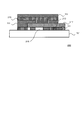
- FIG. 2 is a schematic view of the pattern structure 200 according to the embodiment of the present invention.
- the pattern structure 200 includes a polysiloxane compound formed on the base material 101 and containing (A) a first structural unit represented by the following general formula (1A), and (B) a modified product of a photoinduced curing accelerator. It is composed of a first structure 111 containing the above, and a second structure 213 and / or a void 215 containing a component different from the first structure. [(R x1 ) b1 R 11 m1 SiO n1 / 2 ] (1A)
- R x1 is a monovalent group represented by the following general formula (1Aa).
- R 11 is a substitution selected from the group consisting of a hydrogen atom, an alkyl group having 1 to 3 carbon atoms, a phenyl group, a hydroxy group, an alkoxy group having 1 to 3 carbon atoms and a fluoroalkyl group having 1 to 3 carbon atoms. It is a group.
- b1 is a number of 1 or more and 3 or less
- m1 is a number of 0 or more and less than 3
- n1 is a number of more than 0 and 3 or less
- b1 + m1 + n1 4.
- X1 is a hydrogen atom or a binding site with Si or C contained in a structural unit different from the first structural unit represented by the general formula (1A), and a1 is 1 or more and 5 or less.
- the broken line represents the binding site.
- b1 is preferably a number of 1 or more and 2 or less.
- m1 is preferably a number of 0 or more and 2 or less, and more preferably 0 or more and 1 or less.
- n1 is preferably a number of 1 or more and 3 or less, and more preferably 2 or more and 3 or less.
- the polysiloxane compound (A) contained in the first structure 111 is a second structural unit represented by the following general formula (2A) and / or a third structural unit represented by the following general formula (3A). Is preferably included. [(R y1 ) c1 R 21 p1 SiO q1 / 2 ] (2A) [( RW1 ) t1 SiO u1 / 2 ] (3A)
- R y1 is open as a substituent selected from a monovalent organic group having 1 to 30 carbon atoms, including any of an epoxy group, an oxetane group, an acryloyl group, a methacryloyl group or a lactone group. It is a ring or a polymerized group. Further, the number of carbon atoms including any of unreacted substituents (that is, epoxy group, oxetane group, acryloyl group, methacryloyl group or lactone group) is 1 as long as the transparency of the obtained pattern cured film is not significantly impaired. Substituents selected from more than 30 monovalent organic groups) may be included.
- c1 is preferably a number of 1 or more and 2 or less, and more preferably 1.
- p1 is preferably a number of 0 or more and 2 or less, and more preferably 0 or more and 1 or less.
- q1 is preferably a number of 1 or more and 3 or less, and more preferably 2 or more and 3 or less.
- RW1 is a substituent selected from the group consisting of a halogen group, an alkoxy group, and a hydroxy group.
- t1 is a number greater than or equal to 0 and less than 4
- u1 is a number greater than 0 and less than or equal to 4
- t1 + u1 4.
- t1 is preferably a number of 0 or more and 3 or less.
- u1 is preferably a number of 1 or more and 4 or less.
- R x1 , R 11 , X1, R y1 , and R 21 refer to the above-described configurations of R x , R 1 , X, R y , and R 2 , but the first structure 111 is the negative. This is different from the negative photosensitive resin composition because the type photosensitive resin composition is a film cured by light exposure.
- the amount of change was found with respect to any of the chemical solutions. It turned out to be few. This indicates that dissolution in the chemical solution and swelling due to the chemical solution can be suppressed, and deformation of the pattern and dimensional change can be suppressed, and cracks, defects, etc. can be caused when the above-mentioned second structure 213 and / or void 215 is laminated. It is preferable as the first structure 111 constituting the pattern structure 200 because it is easy to suppress the occurrence of defects.
- the first structure 111 may preferably satisfy at least one selected from the group consisting of the following (a), (b), and (c). Further, more preferably, all of (a), (b), and (c) may be satisfied.
- A When the pattern cured film is immersed in an organic solvent at 40 ° C. for 7 minutes, the rate of change of the film thickness after immersion with respect to the original film thickness is ⁇ 5% or less.
- B When the pattern cured film is immersed in an acidic solution for 1 minute in a room temperature environment, the rate of change of the film thickness after immersion with respect to the original film thickness is ⁇ 5% or less.
- C When the pattern cured film is immersed in a basic solution in a room temperature environment for 1 minute, the rate of change of the film thickness after immersion with respect to the original film thickness is ⁇ 5% or less.
- organic solvent is not particularly limited as long as it is a general solvent used for film formation, but for example, N-methyl-2-pyrrolidone (NMP), PGMEA, PGME, MEK, acetone, etc. Cyclohexanone, ⁇ -butyrolactone and the like can be mentioned.
- acidic solution is not particularly limited, and examples thereof include chemical solutions used for etching metal members obtained by spatter film formation and the like, and specific examples thereof include sulfuric acid, nitric acid, hydrochloric acid, and the like. Examples thereof include phosphoric acid, acetic acid, hydrobromic acid, and aqueous solutions thereof.
- basic solution is not particularly limited, and examples thereof include general chemicals for removing resist, and specific examples thereof include monoethanolamine, N-methylaminoethanol, and isopropanolamine.
- examples thereof include organic amine compounds, glucol ether compounds such as ethylene glycol monobutyl ether, diethylene glycol monobutyl ether, and triethylene glycol monobutyl ether, dimethylsulfoxide, isopropanol, and aqueous solutions thereof.
- the first structure 111 is a negative-type pattern-cured film as described above, and the negative-type pattern-cured film may be used as a permanent film. Therefore, it is preferable that the first structure 111 has high adhesion to the substrate. Is.
- the first structure 111 is preferably visually peeled off at the portion to which the test is applied after the cross-cut test performed by a method conforming to JIS K 5600-5-6 (cross-cut method). It may not be. More preferably, the first structure 111 may satisfy the following (d) and / or (e).
- the first structure 111 may preferably satisfy at least one selected from the group consisting of the above (a) to (e), and more preferably satisfy all of (a) to (e). May be good.
- the weight average molecular weight of the (A1) polysiloxane compound of the first structure 111 may be 750 to 500,000.
- the second structure 213 shown in FIG. 2 can contain a component different from that of the first structure.
- Examples of the second structure 213 include electrodes such as copper, aluminum, and solder, and optical waveguides in which various fillers such as silica and titanium oxide are contained to adjust the refractive index.
- the void 215 can be exemplified.
- the first structure 111 and the second structure 213 may be in direct contact with each other, or may be arranged via an arbitrary layer 217, a gap 215, or the like. Further, the arrangement on the base material 101 may be appropriately determined according to the intended use, and is not particularly limited. Specifically, even if the second structure 213 is arranged between the base material 101 and the first structure 111, the first structure 111 is arranged between the base material 101 and the second structure 213. Alternatively, the first structure 111 and the second structure 213 may be arranged side by side when viewed from the base material 101, or a plurality of the first structure 111 and the second structure 213 may be laminated.
- a Negative Photosensitive Resin Composition Containing (A1) Component, (A2) Component, (B) Photoinduced Curing Accelerator, and (C) Solvent "Another Embodiment” of the present invention. Is a resin composition containing the following components (A1), (A2), (B) a photoinduced curing accelerator, and (C) a solvent.
- Component (A1) A polymer containing the structural unit represented by the general formula (1), but not containing any of the structural unit of the general formula (2) and the structural unit of the general formula (3).
- Component (A2) Containing at least one of the structural unit represented by the general formula (2) and the structural unit represented by the general formula (3), but the structural unit represented by the formula (1). Polymer that does not contain.
- the structural unit of the general formula (1) is a polymer called the component (A1)
- the structural unit of the general formula (2) or the general formula (3) is (A2).
- Ingredients, which form a separate polymer are a known substance according to Patent Document 4, and can be synthesized according to the polymerization method described in Patent Document 4 or the above-mentioned polymerization method.
- the polymer of the component (A2) can also be synthesized according to a known method by hydrolysis polycondensation or the above-mentioned polymerization method.
- the negative photosensitive resin composition having such a structure is a blend (mixture) of different kinds of polymers in the state of the "negative photosensitive resin composition”.
- the "negative-type photosensitive resin composition containing (A1) component, (A2) component, (B) photo-induced curing accelerator, and (C) solvent” is applied onto the base material.
- a reaction between silanol groups of different molecules formation of a siloxane bond
- a curing reaction of an epoxy group, an oxetane group, an acryloyl group, and a methacryloyl group occur, and pattern curing occurs.
- a film is formed.
- the final pattern cured film is "at least a structural unit represented by the general formula (1A), a structural unit represented by the general formula (2A), and a structural unit represented by the general formula (3A). It is a resin containing one of the constituent units.
- the "negative photosensitive resin composition containing (A1) component, (A2) component, (B) photoinduced curing accelerator, and (C) solvent” is the same as the above-mentioned "(A) component".
- (B) A negative photosensitive resin composition containing a photoinduced curing accelerator and (C) a solvent ” has an advantage that adjustment for obtaining desired performance is easy. Specifically, by simply adjusting the blending ratio of the component (A1) and the component (A2) according to the desired performance, it is not necessary to carry out new polymerization or the like, and the film physical properties, alkali developability, and other physical properties Can be easily adjusted.
- the molecular weight of the polysiloxane compound as the component (A1) is a weight average molecular weight of 700 to 100,000, preferably 800 to 10000, and more preferably 1000 to 6000.
- the molecular weight can be basically controlled by adjusting the amount of the catalyst and the temperature of the polymerization reaction.
- the range of the molecular weight of the polysiloxane compound as the component (A2) is preferably the same range as the molecular weight of the component (A1).
- the alkoxysilanes represented by the formula (10) which are polymerization raw materials for giving the structural unit of the formula (1) among the components (A) and (A1), and ,
- the halosilanes represented by the formula (9) are known compounds according to Patent Documents 4 and 5 and International Publication 2019/1677770, and may be synthesized according to the description of these documents.
- Ph-Si Phenyltriethoxysilane TMAH: Tetramethylammonium hydroxide KBM-303: Shin-Etsu Chemical Co., Ltd., 2- (3,4-epoxycyclohexyl) ethyltrimethoxysilane KBM-5103: Shin-Etsu Chemical Co., Ltd. , 3-Acryloxypropyltrimethoxysilane PGMEA: Propylglycol monomethyl ether acetate KBM-503: Shin-Etsu Chemical Co., Ltd., 3-Methyloxypropyltrimethoxysilane
- HFA-Si Compound represented by the following chemical formula
- GPC Global Permeation Chromatography
- GC Gas chromatography
- HFA-Si / Ph-Si / KBM-303 / KBM-5103 1/7/1/1 composition
- HFA-Si / Ph-Si / KBM-303 / KBM-503 1/7/1/1 composition
- ⁇ Development test> The photosensitive resin compositions obtained in Examples 1 to 5 and Comparative Examples 1 and 2 were applied by spin coating (rotation speed 500 rpm) on a silicon wafer manufactured by SUMCO Corporation and having a diameter of 4 inches and a thickness of 525 ⁇ m. Then, the silicon wafer was heat-treated on a hot plate at 100 ° C. for 3 minutes to obtain a photosensitive resin film having a film thickness of 2 to 10 ⁇ m.
- the obtained photosensitive resin film was irradiated with light from a high-pressure mercury lamp of 108 mJ / cm 2 (wavelength 365 nm) through a photomask using an exposure apparatus. Then, it was heat-treated on a hot plate at 100 ° C. for 1 minute. After that, it was immersed in a 2.38 mass% TMAH aqueous solution for 1 minute for development, and then immersed in pure water for 30 seconds for washing. After washing, it was fired in an oven at 230 ° C. for 1 hour in the air to obtain a pattern-cured film.
- the photosensitive resin compositions obtained in Examples 6 and 7 were applied onto the same silicon wafer by spin coating (rotation speed 400 rpm). Then, the silicon wafer was heat-treated on a hot plate at 100 ° C. for 1 minute to obtain a photosensitive resin film having a film thickness of 20 ⁇ m.
- the obtained photosensitive resin film was irradiated with light from a high-pressure mercury lamp of 112.5 mJ / cm 2 (wavelength 365 nm) through a photomask using an exposure apparatus. Then, it was heat-treated on a hot plate at 100 ° C. for 30 seconds. After that, it was immersed in a 2.38 mass% TMAH aqueous solution for 80 seconds for development, and then immersed in pure water for 60 seconds for washing. After washing, bleaching exposure was performed at 560 mJ / cm 2 without using a photomask. After the bleaching exposure, the film was fired on a hot plate at 150 ° C. for 5 minutes in the atmosphere to obtain a pattern-cured film having a film thickness of 20 ⁇ m.
- the photosensitive resin compositions of Examples 1 to 7 were negative type pattern cured films, but the photosensitive resin compositions of Comparative Examples 1 and 2 were positive. It was a mold pattern cured film.
- cured film a cured film without a pattern (hereinafter, simply referred to as “cured film”) was prepared and various measurements were performed.
- ⁇ Comparative example 3> 2 g of the polysiloxane compound 3 (HFA-Si / Ph-Si / KBM-303 1/8/1 composition) obtained in Synthesis Example 4, 4 g of PGMEA, and a naphthoquinone diazide compound (TKF-515; Sanpo Kagaku) which is a photosensitive compound. (Manufactured by Co., Ltd.) 0.5 g was added to prepare a 33 wt% photosensitive resin composition.
- the obtained photosensitive resin film was irradiated with light from a high-pressure mercury lamp of 500 mJ / cm 2 (wavelength 365 nm) using an exposure apparatus. Then, it was fired in an oven at 230 ° C. for 1 hour in the air to obtain a cured film having a film thickness of 2 to 3 ⁇ m (cured film 1 from Example 2 and cured film 2 from Comparative Example 3).
- the photosensitive resin composition obtained in Example 5 was applied onto a glass substrate (soda lime glass) having a diameter of 4 inches by spin coating (rotation speed 500 rpm). Then, the glass substrate was heat-treated on a hot plate at 100 ° C. for 30 seconds to obtain a photosensitive resin film having a film thickness of 8 ⁇ m.
- the obtained photosensitive resin film was irradiated with light from a high-pressure mercury lamp of 70 mJ / cm 2 (wavelength 365 nm) using an exposure apparatus. Then, it was heat-treated on a hot plate at 100 ° C. for 30 seconds. After that, it was immersed in a 2.38 mass% TMAH aqueous solution for 60 seconds, and then immersed in pure water for 60 seconds for washing. After washing, bleaching exposure was performed at 560 mJ / cm 2 without using a photomask. After the bleaching exposure, the film was fired in an oven at 230 ° C. for 1 hour in the air to obtain a cured film 3 having a film thickness of 8 ⁇ m.
- the photosensitive resin composition obtained in Example 7 was applied onto a glass substrate (soda lime glass) having a diameter of 4 inches by spin coating (rotation speed 400 rpm). Then, the glass substrate was heat-treated on a hot plate at 100 ° C. for 1 minute to obtain a photosensitive resin film having a film thickness of 19 ⁇ m.
- the obtained photosensitive resin film was irradiated with light from a high-pressure mercury lamp of 112.5 mJ / cm 2 (wavelength 365 nm) using an exposure apparatus. Then, it was heat-treated on a hot plate at 100 ° C. for 30 seconds. After that, it was immersed in a 2.38 mass% TMAH aqueous solution for 80 seconds, and then immersed in pure water for 60 seconds for washing. After washing, bleaching exposure was performed at 560 mJ / cm 2 without using a photomask. After the bleaching exposure, the film was fired on a hot plate at 150 ° C. for 5 minutes in the atmosphere to obtain a cured film 4 having a film thickness of 19 ⁇ m.
- a film before firing is formed by the same method as the cured film 4, and after the bleaching exposure, the film is fired in an oven at 230 ° C. for 1 hour in the air to obtain a cured film having a thickness of 19 ⁇ m. I got 5.
- the light transmittance (400 nm, 350 nm, 2 ⁇ m conversion) of the obtained cured films 1 to 5 was measured, and the obtained results are shown in Table 1.
- Table 1 the cured films 1 and 3 to 5 obtained by using the photosensitive resin compositions of Examples 2, 5 and 7 at any wavelength used the photosensitive resin composition of Comparative Example 3. It was found that the transparency was higher than that of the cured film 2 obtained.
- the cured films 1, 3 and 5 obtained by using the photosensitive resin compositions of Examples 2, 5 and 7 have less decrease in transmittance due to heating and are more heat resistant than the cured films 2 of Comparative Example 3. It was an excellent cured film.
- Table 3 shows the results of measuring the film thickness before and after heating. As shown in Table 3, the film thickness of the cured film 2 obtained by using the photosensitive resin composition of Comparative Example 3 was reduced by heating as compared with the cured film 1 obtained by using the photosensitive resin composition of Example 2. Was big.
- the cured film obtained by using the photosensitive resin composition of Example 2 was a cured film having less film thickness decrease due to heating and excellent heat resistance.
- the obtained photosensitive resin film was irradiated with light from a high-pressure mercury lamp of 560 mJ / cm 2 (wavelength 365 nm) using an exposure apparatus. Then, it was heat-treated on a hot plate at 100 ° C. for 1 minute. After that, the membrane was dissolved in tetrahydrofuran and measured by GPC. As a result, the weight average molecular weight Mw was 2600. The rate of increase in molecular weight with respect to the original photosensitive resin composition was 0.73.
- the obtained photosensitive resin film was irradiated with light from a high-pressure mercury lamp of 560 mJ / cm 2 (wavelength 365 nm) using an exposure apparatus. Then, it was heat-treated on a hot plate at 100 ° C. for 1 minute. After that, the membrane was dissolved in tetrahydrofuran and measured by GPC. As a result, the weight average molecular weight Mw was 14,000. The rate of increase in molecular weight with respect to the original photosensitive resin composition was 7.7.
- Example 10 The photosensitive resin composition obtained in Example 6 was coated on a silicon wafer having a diameter of 4 inches by spin coating (rotation speed 400 rpm). Then, the silicon wafer was heat-treated on a hot plate at 100 ° C. for 1 minute to obtain a photosensitive resin film having a film thickness of 18 ⁇ m.
- the obtained photosensitive resin film was irradiated with light from a high-pressure mercury lamp of 112.5 mJ / cm 2 (wavelength 365 nm) using an exposure apparatus. Then, it was heat-treated on a hot plate at 100 ° C. for 30 seconds. After that, it was immersed in a 2.38 mass% TMAH aqueous solution for 80 seconds, and then immersed in pure water for 60 seconds for washing. After washing, bleaching exposure was performed at 560 mJ / cm 2 without using a photomask. After the bleaching exposure, the film was fired on a hot plate at 150 ° C. for 5 minutes in the atmosphere to obtain a cured film 6 having a film thickness of 18 ⁇ m.
- Example 2 on each substrate (silicon wafer with a diameter of 4 inches, silicon nitride substrate, glass substrate, polyimide (Kapton) substrate, polyethylene terephthalate substrate, polycarbonate substrate, polyethylene naphthalate substrate) by spin coating (rotation speed 500 rpm).
- the photosensitive resin composition obtained in 5 and 7 was applied.
- each of the above substrates was heat-treated on a hot plate at 100 ° C. for 3 minutes to obtain a photosensitive resin film having a film thickness of 1 to 19 ⁇ m.
- the obtained photosensitive resin film was irradiated with light from a high-pressure mercury lamp of 500 mJ / cm 2 (wavelength 365 nm) using an exposure apparatus. Then, it was fired in an oven at 230 ° C. for 1 hour in the atmosphere to obtain each cured film having a film thickness of 1 to 19 ⁇ m (similar to the cured films 1, 3 and 4 described above).
- the adhesion of the cured film to each substrate was evaluated according to JIS K 5600-5-6 (cross-cut method).
- Test 1 Specifically, 25 squares of 1 mm square were formed on the cured film with a cutter knife, and then held in an environment of 85 ° C. and 85% relative humidity for 7 days. Cellophane tape was attached to the lattice portion of the obtained cured film, and then peeled off for visual confirmation. As a result, it was found that no peeling was observed on all the substrates (classification 0), and good adhesion was exhibited.
- Test 2 Further, the adhesion was evaluated by the following method in accordance with JIS K 5600-5-6 (cross-cut method) in the same manner as described above.
- the negative photosensitive resin composition is useful as a photosensitive material capable of forming a negative patterning.
- the obtained photosensitive resin film is soluble in an alkaline developing solution and has patterning performance, and the cured film is excellent in heat resistance and transparency. Therefore, a protective film for semiconductors, a flattening material, a microlens material, and a touch panel It can be used as an insulating protective film, a liquid crystal display TFT flattening material, a core or clad forming material for an optical waveguide, an electron beam resist, a multilayer resist intermediate film, an underlayer film, an antireflection film and the like. Further, when used for an optical member such as a display or an image sensor, a known refractive index adjusting agent may be mixed.
- a pattern cured film can be obtained by heat treatment at a low temperature of 200 ° C. or lower, so that a plastic substrate or a resin film can be obtained. It can be used as various optical members and constituent members such as flexible displays using the above, organic semiconductors containing organic materials in the constituent members, organic solar cells, and the like.
Landscapes
- Physics & Mathematics (AREA)
- General Physics & Mathematics (AREA)
- Spectroscopy & Molecular Physics (AREA)
- Chemical & Material Sciences (AREA)
- Health & Medical Sciences (AREA)
- Chemical Kinetics & Catalysis (AREA)
- Medicinal Chemistry (AREA)
- Polymers & Plastics (AREA)
- Organic Chemistry (AREA)
- Materials For Photolithography (AREA)
- Silicon Polymers (AREA)
- Exposure And Positioning Against Photoresist Photosensitive Materials (AREA)
Priority Applications (4)
| Application Number | Priority Date | Filing Date | Title |
|---|---|---|---|
| JP2022508292A JPWO2021187324A1 (https=) | 2020-03-16 | 2021-03-11 | |
| CN202180018686.5A CN115244465A (zh) | 2020-03-16 | 2021-03-11 | 负型感光性树脂组合物、图案结构和图案固化膜的制造方法 |
| KR1020227034943A KR102924439B1 (ko) | 2020-03-16 | 2021-03-11 | 네거티브형 감광성 수지 조성물, 패턴 구조, 및 패턴 경화막의 제조 방법 |
| US17/945,742 US20230037301A1 (en) | 2020-03-16 | 2022-09-15 | Negative photosensitive resin composition, pattern structure and method for producing patterned cured film |
Applications Claiming Priority (4)
| Application Number | Priority Date | Filing Date | Title |
|---|---|---|---|
| JP2020045832 | 2020-03-16 | ||
| JP2020-045832 | 2020-03-16 | ||
| JP2020076296 | 2020-04-22 | ||
| JP2020-076296 | 2022-04-22 |
Related Child Applications (1)
| Application Number | Title | Priority Date | Filing Date |
|---|---|---|---|
| US17/945,742 Continuation US20230037301A1 (en) | 2020-03-16 | 2022-09-15 | Negative photosensitive resin composition, pattern structure and method for producing patterned cured film |
Publications (1)
| Publication Number | Publication Date |
|---|---|
| WO2021187324A1 true WO2021187324A1 (ja) | 2021-09-23 |
Family
ID=77772066
Family Applications (1)
| Application Number | Title | Priority Date | Filing Date |
|---|---|---|---|
| PCT/JP2021/009868 Ceased WO2021187324A1 (ja) | 2020-03-16 | 2021-03-11 | ネガ型感光性樹脂組成物、パターン構造、及びパターン硬化膜の製造方法 |
Country Status (6)
| Country | Link |
|---|---|
| US (1) | US20230037301A1 (https=) |
| JP (1) | JPWO2021187324A1 (https=) |
| KR (1) | KR102924439B1 (https=) |
| CN (1) | CN115244465A (https=) |
| TW (1) | TWI871442B (https=) |
| WO (1) | WO2021187324A1 (https=) |
Families Citing this family (2)
| Publication number | Priority date | Publication date | Assignee | Title |
|---|---|---|---|---|
| CN117111405B (zh) * | 2023-08-04 | 2024-09-24 | 西南科技大学 | 线性聚硅氧烷低介电损耗光敏树脂的制备及光刻图案化的应用 |
| KR20260018439A (ko) * | 2024-07-31 | 2026-02-09 | 주식회사 헤라켐테크놀러지 | 감광성 수지 조성물 및 이를 이용하여 패턴을 형성하는 방법 |
Citations (3)
| Publication number | Priority date | Publication date | Assignee | Title |
|---|---|---|---|---|
| JP2008203612A (ja) * | 2007-02-21 | 2008-09-04 | Tokyo Ohka Kogyo Co Ltd | ネガ型レジスト組成物およびレジストパターン形成方法 |
| JP2014156461A (ja) * | 2013-01-21 | 2014-08-28 | Central Glass Co Ltd | ヘキサフルオロイソプロパノール基を含む珪素化合物およびその製造方法、並びにそれが重合してなる高分子化合物 |
| JP2015129908A (ja) * | 2013-11-01 | 2015-07-16 | セントラル硝子株式会社 | ポジ型感光性樹脂組成物、それを用いた膜の製造方法および電子部品 |
Family Cites Families (9)
| Publication number | Priority date | Publication date | Assignee | Title |
|---|---|---|---|---|
| US4743529A (en) * | 1986-11-21 | 1988-05-10 | Eastman Kodak Company | Negative working photoresists responsive to shorter visible wavelengths and novel coated articles |
| JP2567984B2 (ja) | 1990-09-21 | 1996-12-25 | 東京応化工業株式会社 | ポジ型レジスト組成物 |
| JP2005330488A (ja) | 2005-05-19 | 2005-12-02 | Tokyo Ohka Kogyo Co Ltd | アルカリ可溶性ポリシロキサン樹脂 |
| CN101296999A (zh) * | 2005-10-28 | 2008-10-29 | 东丽株式会社 | 硅氧烷树脂组合物及其制造方法 |
| JP4600679B2 (ja) * | 2006-02-13 | 2010-12-15 | 信越化学工業株式会社 | レジスト組成物並びにこれを用いたパターン形成方法 |
| JP5726632B2 (ja) * | 2011-05-19 | 2015-06-03 | メルクパフォーマンスマテリアルズIp合同会社 | 感光性シロキサン樹脂組成物 |
| US20150293449A1 (en) * | 2013-08-13 | 2015-10-15 | Chi Mei Corporation | Photosensitive polysiloxane composition and uses thereof |
| JP7189453B2 (ja) * | 2018-02-28 | 2022-12-14 | セントラル硝子株式会社 | ヘキサフルオロイソプロパノール基を含む珪素化合物、およびその製造方法 |
| KR20210052431A (ko) * | 2018-08-31 | 2021-05-10 | 도레이 카부시키가이샤 | 수지 조성물, 그의 경화막 |
-
2021
- 2021-03-11 WO PCT/JP2021/009868 patent/WO2021187324A1/ja not_active Ceased
- 2021-03-11 CN CN202180018686.5A patent/CN115244465A/zh active Pending
- 2021-03-11 JP JP2022508292A patent/JPWO2021187324A1/ja active Pending
- 2021-03-11 KR KR1020227034943A patent/KR102924439B1/ko active Active
- 2021-03-12 TW TW110108949A patent/TWI871442B/zh active
-
2022
- 2022-09-15 US US17/945,742 patent/US20230037301A1/en not_active Abandoned
Patent Citations (3)
| Publication number | Priority date | Publication date | Assignee | Title |
|---|---|---|---|---|
| JP2008203612A (ja) * | 2007-02-21 | 2008-09-04 | Tokyo Ohka Kogyo Co Ltd | ネガ型レジスト組成物およびレジストパターン形成方法 |
| JP2014156461A (ja) * | 2013-01-21 | 2014-08-28 | Central Glass Co Ltd | ヘキサフルオロイソプロパノール基を含む珪素化合物およびその製造方法、並びにそれが重合してなる高分子化合物 |
| JP2015129908A (ja) * | 2013-11-01 | 2015-07-16 | セントラル硝子株式会社 | ポジ型感光性樹脂組成物、それを用いた膜の製造方法および電子部品 |
Also Published As
| Publication number | Publication date |
|---|---|
| TW202141192A (zh) | 2021-11-01 |
| CN115244465A (zh) | 2022-10-25 |
| TWI871442B (zh) | 2025-02-01 |
| JPWO2021187324A1 (https=) | 2021-09-23 |
| KR102924439B1 (ko) | 2026-02-09 |
| US20230037301A1 (en) | 2023-02-09 |
| KR20220155321A (ko) | 2022-11-22 |
Similar Documents
| Publication | Publication Date | Title |
|---|---|---|
| TWI877121B (zh) | 樹脂組合物、感光性樹脂組合物、硬化膜、硬化膜之製造方法、圖案硬化膜及圖案硬化膜之製作方法 | |
| TWI393746B (zh) | 矽氧烷樹脂組成物及其製法 | |
| WO2008065944A1 (en) | Photosensitive siloxane composition, hardened film formed therefrom and device having the hardened film | |
| JP2008208342A (ja) | 樹脂組成物、硬化膜、および硬化膜を有するカラーフィルタ | |
| JP5929679B2 (ja) | シラン系組成物およびその硬化膜、並びにそれを用いたネガ型レジストパターンの形成方法 | |
| US20230037301A1 (en) | Negative photosensitive resin composition, pattern structure and method for producing patterned cured film | |
| JP2007226214A (ja) | 感光性シロキサン組成物、それから形成された硬化膜、および硬化膜を有する素子 | |
| US20230244145A1 (en) | Silicon-containing monomer mixture, polysiloxane, resin composition, photosensitive resin composition, cured film, production method for cured film, patterned cured film, and production method for patterned cured film | |
| JPWO2021187324A5 (https=) | ||
| JPWO2022059506A5 (https=) | ||
| US20230333468A1 (en) | Resin composition, cured film, method for manufacturing cured film, substrate having multilayer film, method for producing patterned substrate, photosensitive resin composition, method for producing pattern cured film, method for producing polymer, and method for producing resin composition | |
| JP7620218B2 (ja) | ケイ素化合物、反応性材料、樹脂組成物、感光性樹脂組成物、硬化膜、硬化膜の製造方法、パターン硬化膜およびパターン硬化膜の製造方法 | |
| JPWO2022131277A5 (https=) | ||
| KR101631075B1 (ko) | 실록산 폴리머 조성물 | |
| KR100725143B1 (ko) | 감광성 조성물 및 그 제조 방법 | |
| WO2022131278A1 (ja) | 光学部材用の塗布液、重合体、硬化膜、感光性塗布液、パターン硬化膜、光学部材、固体撮像素子、表示装置、ポリシロキサン化合物、塗布液に用いる安定化剤、硬化膜の製造方法、パターン硬化膜の製造方法、及び重合体の製造方法 | |
| WO2023181812A1 (ja) | ポジ型感光性樹脂組成物、その硬化物およびそれを具備する表示装置 |
Legal Events
| Date | Code | Title | Description |
|---|---|---|---|
| 121 | Ep: the epo has been informed by wipo that ep was designated in this application |
Ref document number: 21772537 Country of ref document: EP Kind code of ref document: A1 |
|
| ENP | Entry into the national phase |
Ref document number: 2022508292 Country of ref document: JP Kind code of ref document: A |
|
| ENP | Entry into the national phase |
Ref document number: 20227034943 Country of ref document: KR Kind code of ref document: A |
|
| NENP | Non-entry into the national phase |
Ref country code: DE |
|
| 122 | Ep: pct application non-entry in european phase |
Ref document number: 21772537 Country of ref document: EP Kind code of ref document: A1 |