WO2021187211A1 - インクジェット記録装置 - Google Patents
インクジェット記録装置 Download PDFInfo
- Publication number
- WO2021187211A1 WO2021187211A1 PCT/JP2021/009105 JP2021009105W WO2021187211A1 WO 2021187211 A1 WO2021187211 A1 WO 2021187211A1 JP 2021009105 W JP2021009105 W JP 2021009105W WO 2021187211 A1 WO2021187211 A1 WO 2021187211A1
- Authority
- WO
- WIPO (PCT)
- Prior art keywords
- pixel
- ink
- control unit
- recording
- pixels
- Prior art date
- Legal status (The legal status is an assumption and is not a legal conclusion. Google has not performed a legal analysis and makes no representation as to the accuracy of the status listed.)
- Ceased
Links
Images







Classifications
-
- B—PERFORMING OPERATIONS; TRANSPORTING
- B41—PRINTING; LINING MACHINES; TYPEWRITERS; STAMPS
- B41J—TYPEWRITERS; SELECTIVE PRINTING MECHANISMS, i.e. MECHANISMS PRINTING OTHERWISE THAN FROM A FORME; CORRECTION OF TYPOGRAPHICAL ERRORS
- B41J2/00—Typewriters or selective printing mechanisms characterised by the printing or marking process for which they are designed
- B41J2/005—Typewriters or selective printing mechanisms characterised by the printing or marking process for which they are designed characterised by bringing liquid or particles selectively into contact with a printing material
- B41J2/01—Ink jet
Definitions
- the present invention relates to an inkjet recording device.
- the inkjet recording apparatus is, for example, a fixed recording head (line head type) having a plurality of ink ejection nozzles arranged along the main scanning direction, or a recording head that scans on a recording medium such as paper along the main scanning direction.
- line head type fixed recording head
- recording head that scans on a recording medium such as paper along the main scanning direction.
- ink is ejected onto a recording medium conveyed in the sub-scanning direction, and an image is recorded.
- a conventional technique aimed at realizing high-quality image recording has been proposed.
- the predetermined transport amount of the recording medium in the sub-scanning direction is set to be larger than the ideal transport amount.
- the ink that lands first with respect to the ink that lands first in the sub-scanning direction lands away from the ideal position in the sub-scanning direction. That is, even if the ink that landed first is not dried, it is possible to prevent the ink that landed first from being attracted to the ink that landed first. Therefore, the recording quality can be improved.
- the present invention has been made in view of the above points, and an object of the present invention is to provide an inkjet recording apparatus capable of realizing high-quality image recording without lowering the productivity of recording.
- the inkjet recording apparatus of the present invention includes a recording head, a drive unit, and a control unit.
- the recording head ejects ink onto the recording medium.
- the drive unit moves at least one of the recording medium and the recording head.
- the control unit controls the relative movement of the recording medium and the recording head to perform recording on the recording medium. Further, the control unit changes the landing timing of the ink droplets ejected to the two adjacent pixel regions along the direction of the relative movement of the recording head with respect to the recording medium with respect to the recording medium, so that the ink droplets are recorded. Change the distance between two pixels.
- the configuration of the present invention it is possible to change the distance between two adjacent pixels along the direction of relative movement of the recording head with respect to the recording medium without changing the transport speed of the recording medium. This makes it possible to record high-quality images without reducing the productivity of recording.
- FIG. 1 It is sectional drawing which shows the schematic structure of the inkjet recording apparatus of embodiment of this invention. It is a top view of the recording part of the inkjet recording apparatus of FIG. It is a block diagram which shows the schematic structure of the inkjet recording apparatus of FIG. It is explanatory drawing which shows the timing chart and the state of the pixel which concerns on the transmission of the ink ejection control signal of the inkjet recording apparatus of FIG. It is explanatory drawing which shows the timing chart and the state of a pixel which concerns on the transmission of an ink ejection control signal, and is the figure which shows the case where the landing timing is changed. It is explanatory drawing which shows the relationship between the normal ink ejection position and the ink drop position on a paper surface.
- FIG. 1 is a cross-sectional view showing a schematic configuration of the inkjet recording apparatus 1 of the embodiment.
- FIG. 2 is a plan view of the recording unit 5 of the inkjet recording apparatus 1 of FIG.
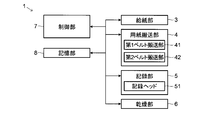
- FIG. 3 is a block diagram showing a schematic configuration of the inkjet recording apparatus 1 of FIG.
- the inkjet recording device 1 is, for example, an inkjet recording type printer. As shown in FIGS. 1, 2 and 3, the inkjet recording device 1 includes a device main body 2, a paper supply unit 3, a paper transport unit 4, a recording unit 5, a drying unit 6, and a control unit 7.
- the paper supply unit 3 accommodates a plurality of sheets of paper (recording medium) S, and separates and sends out the paper S one by one at the time of recording.
- the paper transport unit 4 transports the paper S fed from the paper supply unit 3 to the recording unit 5 and the drying unit 6, and further discharges the recorded and dried paper S to the paper ejection unit 21.
- the paper transport unit 4 distributes the paper S after recording and drying on the first side to the reverse transport unit 44 by the branch portion 43, and further switches the transport direction to reverse the front and back of the paper S. It is conveyed to the recording unit 5 and the drying unit 6 again.
- the paper transport unit 4 has a first belt transport unit 41 and a second belt transport unit 42.
- the first belt transport unit 41 and the second belt transport unit 42 attract and hold the paper S on the upper surface of the endless belt and transport the paper S. That is, the paper transport unit 4 is a drive unit that moves the paper (recording medium) S with respect to the recording unit 5.
- the recording unit 5 faces the paper S that is attracted and held on the upper surface of the first belt transport unit 41 and is transported, and is arranged above the first belt transport unit 41 at a predetermined interval.
- the recording unit 5 has a line-type inkjet recording head 51.
- the recording head 51 includes recording heads 51B, 51C, 51M, and 51Y corresponding to each of the four colors of black, cyan, magenta, and yellow.
- a plurality (for example, three) of the recording heads 51 of each color are arranged in a staggered pattern along the paper width direction Dw orthogonal to the paper transport direction Dc.
- the recording head 51 is provided with a plurality of ink ejection nozzles 52 at the bottom thereof.
- the plurality of ink ejection nozzles 52 are arranged side by side along the paper width direction Dw, and can eject ink over the entire recording area on the paper S. That is, the recording head 51 ejects ink on the paper S.
- the recording unit 5 sequentially ejects ink from the four-color recording heads 51B, 51C, 51M, and 51Y toward the paper S conveyed by the first belt conveying unit 41, and records a full-color image or a monochrome image on the paper S. ..
- the drying section 6 is arranged on the downstream side of the recording section 5 in the paper transport direction, and the second belt transport section 42 is provided.
- the paper S on which the ink image is recorded by the recording unit 5 is sucked and held by the second belt transport unit 42 in the drying unit 6 and conveyed, and the ink is dried.
- the control unit 7 includes a CPU (not shown), other electronic circuits, and electronic components.
- the CPU controls the operation of each component provided in the inkjet recording device 1 based on the control program and data stored in the storage unit 8 to perform processing related to the function of the inkjet recording device 1.
- Each of the paper supply unit 3, the paper transport unit 4, the recording unit 5, and the drying unit 6 receives a command individually from the control unit 7 and records on the paper S in conjunction with each other.
- the storage unit 8 is composed of a combination of a non-volatile storage device such as a program ROM (Read Only Memory) and a data ROM (not shown) and a volatile storage device such as a RAM (Random Access Memory).
- a non-volatile storage device such as a program ROM (Read Only Memory) and a data ROM (not shown)
- a volatile storage device such as a RAM (Random Access Memory).
- control unit 7 controls the relative movement of the paper S and the recording head 51 to record on the paper S.
- the direction of relative movement of the recording head 51 with respect to the paper S is the paper transport direction Dc.
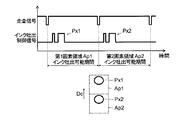
- FIG. 4 is an explanatory diagram showing a timing chart and a pixel state related to transmission of the ink ejection control signal of the inkjet recording device 1 of FIG.
- FIG. 5 is an explanatory diagram showing a timing chart related to transmission of an ink ejection control signal and a state of pixels, and is a diagram showing a case where the landing timing is changed.
- the first pixel Px1 and the second pixel Px2 are individually provided for each of the first pixel region Ap1 and the second pixel region Ap2 that are adjacent to each other along the paper transport direction Dc. It will be recorded in.
- the pixel area means a virtual area in which the image recording area of the paper S is divided by the resolution.
- the pixel area is represented by a broken line rectangle, but such a broken line rectangle is not recorded on the actual paper S.
- the control unit 7 transmits an ink ejection control signal to the recording head 51 each time the paper S moves along the paper transport direction Dc by the resolution. As a result, the recording head 51 ejects ink toward the pixel region on the paper S.
- a pixel is an image element recorded by ink droplets ejected corresponding to each image region, and is a component of the smallest unit of an image.
- the ink ejectable period for the first pixel region Ap1 and the ink ejectable period for the second pixel region Ap2 shown in FIG. 4 are periods during which the paper S moves by the resolution along the paper transport direction Dc, that is, one pixel. It is a cycle of relative movement of the recording head 51 with respect to each sheet S formed, and is controlled by a scanning signal.
- the control unit 7 transmits an ink ejection control signal to the recording head 51 within each ink ejection possible period.
- the recording head 51 individually ejects ink toward the first pixel region Ap1 and the second pixel region Ap2 on the paper S, and the first pixel Px1 and the second pixel Px2 are recorded on the paper S. ..
- control unit 7 changes the landing timing of the ink droplets ejected into the adjacent first pixel region Ap1 and the second pixel region Ap2 along the paper transport direction Dc with respect to the paper S. be able to.
- the control unit 7 delays the landing timing of the ink droplet corresponding to the first pixel Px1 by transmitting the ink ejection control signal in the latter half of the ink ejection possible period for the first pixel region Ap1. Control. Further, the control unit 7 transmits an ink ejection control signal to the second pixel region Ap2 in the first half of the ink ejection possible period, thereby controlling the landing timing of the ink droplet corresponding to the second pixel Px2 earlier. As a result, as shown in FIG. 5, the distance between the first pixel Px1 and the second pixel Px2 recorded by the ink droplets becomes shorter in the paper transport direction Dc.
- the landing timing of the ink droplet corresponding to the first pixel Px1 and the landing timing of the ink droplet corresponding to the second pixel Px2 are the same in each ink ejection possible period, so that the first pixel The distance between Px1 and the second pixel Px2 becomes longer in the paper transport direction Dc.
- control unit 7 changes the landing timing of the ink droplets ejected to the two adjacent pixel regions along the direction of relative movement of the recording head 51 with respect to the paper S (paper transport direction Dc) with respect to the paper S. By doing so, the distance between the two pixels recorded by the ink droplets is changed. According to this configuration, it is possible to change the distance between two adjacent pixels along the direction of relative movement of the recording head 51 with respect to the paper S (paper transport direction Dc) without changing the transport speed of the paper S. Is. Therefore, it is possible to realize high-quality image recording without reducing the productivity of recording.
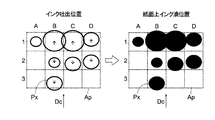
- FIG. 6 is an explanatory diagram showing the relationship between the normal ink ejection position and the ink droplet position on the paper surface. Specifically, FIG. 6 shows the normal ink ejection position and the ink on the paper surface when eight pixel Px are recorded in the twelve pixel area Ap from the first row A column to the third row D column. It is explanatory drawing which shows the relationship with the drop position.
- the paper transport direction Dc is a direction from the bottom to the top of FIG. 6, the lower side of FIG. 6 is the upstream side of the paper transport direction Dc, and the upper side is the downstream side of the paper transport direction Dc. This also applies to FIGS. 7 and 8 described later.
- the ink ejection position and the ink droplet size for the plurality of pixel regions Ap shown on the left side of FIG. 6 are determined based on the image recorded on the paper S.
- a large drop size ink is ejected to the pixel region Ap in the first row, column B and column C.
- medium drop size ink is ejected to the pixel region Ap of the first row D column, the second row C column and the D column, and the third row B column.
- a small drop size ink is ejected to the pixel region Ap in the first row A column and the second row B column.
- the density of the pixel Px is determined by the size of the ink droplet (pixel). That is, the pixel Px recorded by the large drop size ink droplet has the highest density, and the density decreases in the order of the medium drop size and the small drop size. As the density of the pixel Px, there is also a state where there are no ink droplets. Therefore, the density of the pixel Px is recorded in four stages including the state where there are no ink droplets. Further, the size (density) of the ink droplet (pixel) is not limited to three stages, and may be set to a plurality of other stages such as five stages.
- the pixel Px When ink is ejected based on the ink ejection position and the ink droplet size with respect to the plurality of pixel regions Ap determined as described above, the pixel Px actually becomes as shown on the right side of FIG. 6 as the ink droplet position on the paper surface. Recorded. According to FIG. 6, the small drop size pixel Px in the second row and B column and the medium drop size pixel Px in the second row and C column are the large drop size pixel Px in the first row and B column and C column. It can be seen that it is recorded closer to.
- pixels Px may be recorded on the paper S as described above.
- the inkjet recording device 1 has, for example, an ink attraction reduction mode and an operation mode related to image recording, which is a smoothing mode.
- FIG. 7 is an explanatory diagram showing the relationship between the ink ejection position and the ink droplet position on the paper surface in the ink attraction reduction mode.
- the control unit 7 changes the landing timing of ink droplets with respect to the ink ejection positions (see the left side of FIG. 6) with respect to a plurality of pixel regions Ap determined in advance based on the image recorded on the paper S. do.
- control unit 7 changes the landing timing of the ink droplets of the two pixels Px so that the two adjacent pixels Px are separated from each other along the paper transport direction Dc.
- the control unit 7 has the pixel Px in the first row C column and the D column and the pixel Px in the second row C column and the D column in the paper transport direction. Change the landing timing of the ink droplets so that they are separated from the Dc.
- the control unit 7 transmits an ink ejection control signal to each pixel region Ap at an early stage of the ink ejection possible period for the ink droplets to be the pixels Px in the first row C column and the D column, thereby landing the ink droplets. Control the timing early. As a result, as shown on the right side of FIG. 7, the pixels Px in the first row C column and the D column recorded by the ink droplets are recorded on the downstream side of the paper transport direction Dc with respect to the respective pixel area Ap. ..
- control unit 7 transmits an ink ejection control signal to the pixel Px in the second row C column and the D column at a later stage of the ink ejection possible period for each pixel region Ap, thereby causing the ink droplets to be ejected. Control the landing timing of the ink later.
- the pixels Px in the second row C column and the D column recorded by the ink droplets are recorded on the upstream side of the paper transport direction Dc with respect to the respective pixel area Ap. ..
- control unit 7 changes the landing timing of the ink droplets that become the three pixel Px so that the three adjacent pixel Px along the paper transport direction Dc are also separated from each other.
- control unit 7 changes the landing timing of ink droplets on the three pixels Px in row B so that they are separated from each other in the paper transport direction Dc.
- the control unit 7 controls the landing timing of the ink droplets that are the pixels Px in the first row and B column earlier, and sets the pixel Px in the first row and B column to the downstream side of the paper transport direction Dc with respect to the pixel area Ap. Have them record. Further, the control unit 7 controls the landing timing of the ink droplets that are the pixels Px in the third row and B column to be delayed, and the pixels Px in the third row and B column are set in the paper transport direction Dc with respect to the pixel region Ap. Record on the upstream side.
- the control unit 7 has the pixels (first pixel) Px in the first row and B column adjacent to each other along the paper transport direction Dc, the pixels (second pixel) Px in the second row and B column, and the third row.
- the second row B The landing timing of the ink droplets that become the pixels Px in the second row and B column is changed so that the pixel Px in the column approaches the pixel Px in the third row and B column. That is, the control unit 7 ejects ink droplets that are pixels Px in the second row and B column to the upstream side of the paper transport direction Dc with respect to the pixel region Ap.
- FIG. 8 is an explanatory diagram showing the relationship between the ink ejection position and the ink droplet position on the paper surface in the smoothing mode.
- the control unit 7 changes the landing timing of the ink droplets with respect to the ink ejection positions (see the left side of FIG. 6) with respect to the plurality of pixel regions Ap determined in advance based on the image recorded on the paper S.
- control unit 7 changes the landing timing of the ink droplets of the two pixels so that the two adjacent pixels Px approach each other along the paper transport direction Dc.
- the control unit 7 has the pixel Px in the first row C column and the D column and the pixel Px in the second row C column and the D column in the paper transport direction.
- the landing timing of the ink droplets is changed so as to approach Dc.
- the control unit 7 transmits an ink ejection control signal to the pixel Px of the first row C column and the D column at a later stage of the ink ejection possible period for each pixel region Ap, thereby landing the ink droplet. Control the timing late.
- the pixels Px in the first row C column and the D column recorded by the ink droplets are recorded on the upstream side of the paper transport direction Dc with respect to the respective pixel area Ap. ..
- control unit 7 transmits an ink ejection control signal to the pixel Px in the second row C column and the D column at an early stage of the ink ejection possible period for each pixel region Ap, thereby causing the ink droplets to be ejected. Control the landing timing of the ink early.
- the pixels Px in the second row C column and the D column recorded by the ink droplets are recorded on the downstream side of the paper transport direction Dc with respect to the respective pixel area Ap. ..
- the inks which are two pixels Px adjacent to each other along the paper transport direction Dc, attract each other as shown on the right side of FIG.
- two adjacent pixels Px can be brought into contact with each other along the paper transport direction Dc and can be connected as one. Therefore, it is possible to realize high-resolution image recording.
- control unit 7 changes the landing timing of the ink droplets of the three pixels Px so as to be suitably connected to the three adjacent pixels Px along the paper transport direction Dc.
- control unit 7 changes the landing timing of the ink droplets so that the three pixels Px in row B are preferably in contact with and connected to the paper transport direction Dc.
- the control unit 7 controls the landing timing of the ink droplets that are the pixels Px in the first row and B column later, and sets the pixel Px in the first row and B column on the upstream side of the paper transport direction Dc with respect to the pixel area Ap. To record.
- the control unit 7 has the pixels (first pixel) Px in the first row and B column adjacent to each other along the paper transport direction Dc, the pixels (second pixel) Px in the second row and B column, and the third row.
- the second row The landing timing of the ink droplets that become the pixels Px in the second row and B column is changed so that the pixel Px in column B approaches the pixels in the first row and column B. That is, the control unit 7 ejects the ink droplets that are the pixels Px in the second row and the B column to the downstream side of the paper transport direction Dc with respect to the pixel region Ap.
- the landing timing may be changed for the ink droplets that are the pixels Px in the third row and B column, aiming at recording a higher resolution image.
- the control unit 7 controls the landing timing of the ink droplets that are the pixels Px in the third row and B column to be delayed, and controls the pixel Px in the third row and B column in the paper transport direction Dc with respect to the pixel region Ap. Record on the upstream side.
- the pixels Px in the third row and B column can be separated from the pixels Px in the first row and B column and the second row and B column that are integrally connected.
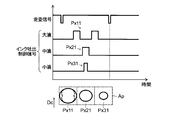
- FIG. 9 is an explanatory diagram showing a timing chart related to transmission of an ink ejection control signal and a state of pixels, and is a diagram showing a case where the size of ink droplets is changed.
- the ink ejection control signal related to the large drop size pixel Px11 is composed of two pulses in the ink ejection possible period for one pixel region Ap. That is, the large-drop size pixel Px11 is composed of two ink droplets spread out. The position of the large-drop size pixel Px11 is approximately the center of the landing position of the two ink droplets.
- the medium-drop size pixel Px21 and the small-drop size pixel Px31 are each composed of one ink drop, and the size is changed according to the pulse width.
- the medium drop size pixel Px21 and the small drop size pixel Px31 eject ink so as to be at the same position as the large drop size pixel Px11 in the paper transport direction Dc.
- the pulse timing of the control signal is set at the center of the pulse relating to the two large ink droplets.
- the ink ejection control signal is adjusted so that the ejection speed of each ink droplet is almost the same.
- the pulse timing ejection timing
- the pulse timing may be shifted so that the landing position becomes the same in consideration of the difference between the distance to the paper S and the ejection speed.
- the first pulse ejects ink droplets having a slightly slower ejection speed
- the second pulse ejects ink droplets having a slightly faster ejection speed
- It may be integrated during flight to form ink droplets having the same speed as medium droplets or small droplets and land on the paper S.
- control unit 7 forms one large-drop size pixel Px11 by, for example, two ink droplets having different landing timings. According to the configuration of the present embodiment, even when one pixel is formed by a plurality of ink droplets, two pixels adjacent to each other along the paper transport direction Dc are used without changing the transport speed of the paper S. The distance can be easily changed.
- FIG. 10 is an explanatory diagram showing a timing chart related to transmission of an ink ejection control signal and a state of pixels, and is a diagram showing a case where the ink ejection timing is changed.
- the ink ejection control signal related to the small droplet size pixels Px32 and Px33 can arbitrarily change the pulse timing (ejection timing) in the ink ejection possible period for one pixel region Ap. ..
- the pulse of the ink ejection control signal related to the small droplet size pixel Px32 is transmitted in the first half of the ink ejection possible period for one pixel area Ap.
- the small drop size pixel Px32 is recorded on the downstream side of the paper transport direction Dc of the corresponding pixel region Ap by changing the landing timing.
- the pulse of the ink ejection control signal related to the small droplet size pixel Px33 is transmitted in the latter half of the ink ejection possible period for one pixel region Ap.
- the small drop size pixel Px33 is recorded on the upstream side of the paper transport direction Dc of the corresponding pixel region Ap by changing the landing timing.
- control unit 7 changes the landing timing of the ink droplets by changing the ink ejection timing.
- the distance between the two pixels recorded by the ink droplets can be easily changed. That is, the distance between two adjacent pixels along the paper transport direction Dc can be easily brought close to each other or separated from each other.
- the ink ejection timing is changed for the small drop size pixels Px32 and Px33 to change the landing timing, but the same applies to the medium drop size pixel Px22 and the large drop size pixel.
- the landing timing can be changed by changing the ink ejection timing.
- FIG. 11 is an explanatory diagram showing a timing chart related to transmission of an ink ejection control signal and a state of pixels, and is a diagram showing a case where the ink ejection speed is changed. Specifically, FIG. 11 is an explanatory diagram showing a state in which the ink ejection speed is changed and the ink droplet landing timing is changed for three droplet-sized pixels Px34, Px35, and Px36 having the same size. Is.
- the pulses of the ink ejection control signals related to the three droplet-sized pixels Px34, Px35, and Px36 are all transmitted at substantially the center of the ink ejection possible period for each pixel region Ap.
- the ink droplets related to the three droplet-sized pixels Px34, Px35, and Px36 have different pulse shapes of the ink ejection control signal, the pressure applied to the ink ejection nozzle 52 is adjusted, and the ejection speed differs.
- the small drop size pixel Px34 is formed at a normal ink ejection speed.
- the droplet-sized pixel Px34 is recorded in the center of the paper transport direction Dc of the corresponding pixel region Ap.
- the droplet-sized pixel Px35 is formed at an ink ejection speed that is faster than usual.
- the droplet-sized pixel Px35 is recorded on the downstream side of the corresponding pixel region Ap in the paper transport direction Dc.
- the droplet-sized pixel Px36 is formed at an ink ejection speed that is slower than usual.
- the droplet-sized pixels Px36 are recorded on the upstream side of the corresponding pixel region Ap in the paper transport direction Dc.
- control unit 7 changes the landing timing of the ink droplets by changing the ejection speed of the ink droplets.
- the distance between the two pixels recorded by the ink droplets can be easily changed. That is, the distance between two adjacent pixels along the paper transport direction Dc can be easily brought close to each other or separated from each other.
- the ink droplet ejection speed is changed to change the landing timing for the small droplet size pixels Px34, Px35, and Px36.
- the landing timing can be changed by changing the ejection speed of the ink droplet.
- the two ink droplets that form one large-drop size pixel can be combined during flight by increasing the ejection speed of the ink droplets that are ejected later.
- the flight speed of the ink droplets after coalescence is determined by combining the ejection speeds of the two ink droplets. Even for such a large-drop size pixel, the landing timing of the ink droplet can be predicted and adjusted.
- the degree of freedom of the recording position in the paper transport direction Dc within the corresponding pixel region can be increased as compared with the medium drop size pixel and the large drop size pixel. Therefore, when the droplet-sized pixels are used, it is easy to bring the two adjacent pixels closer to each other or apart from each other along the paper transport direction Dc, and it is possible to improve the image quality.
- the ink ejection enable period for one pixel area (see, for example, FIG. 4), that is, the cycle of relative movement of the recording head 51 with respect to the paper S for each formation of one pixel can be arbitrarily changed.
- the control unit 7 can change the range in which the ink droplet landing timing can be changed according to the cycle of the relative movement of the recording head 51 with respect to the paper S each time one pixel is formed.
- the control unit 7 makes a change to narrow the changeable range of the ink droplet landing timing.
- the range in which the ink droplet landing timing can be changed can be arbitrarily changed accordingly.
- the distance between the two pixels recorded by the ink droplets can be easily changed, and high-quality image recording can be realized.
- control unit 7 can change the range in which the ink droplet landing timing can be changed according to the ease with which the ink permeates the paper S.
- the control unit 7 makes a change to widen the changeable range of the ink droplet landing timing.
- the control unit 7 makes a change to widen the changeable range of the ink droplet landing timing.
- the ease of penetration of the ink into the paper S represents a relative state, and includes a case where the paper S itself has a property of easily penetrating and a case where the ink itself has a property of easily penetrating.
- control unit 7 may change the landing timing of the ink droplets on the paper S when the colors of the ink droplets ejected to the two adjacent pixel regions along the paper transport direction Dc are different. As a result, it is possible to make it difficult to mix colors, and it is possible to realize high-quality image recording.
- the present invention can be used in an inkjet recording device.
Landscapes
- Ink Jet (AREA)
Priority Applications (1)
| Application Number | Priority Date | Filing Date | Title |
|---|---|---|---|
| JP2022508232A JP7343039B2 (ja) | 2020-03-17 | 2021-03-09 | インクジェット記録装置 |
Applications Claiming Priority (2)
| Application Number | Priority Date | Filing Date | Title |
|---|---|---|---|
| JP2020-046777 | 2020-03-17 | ||
| JP2020046777 | 2020-03-17 |
Publications (1)
| Publication Number | Publication Date |
|---|---|
| WO2021187211A1 true WO2021187211A1 (ja) | 2021-09-23 |
Family
ID=77771214
Family Applications (1)
| Application Number | Title | Priority Date | Filing Date |
|---|---|---|---|
| PCT/JP2021/009105 Ceased WO2021187211A1 (ja) | 2020-03-17 | 2021-03-09 | インクジェット記録装置 |
Country Status (2)
| Country | Link |
|---|---|
| JP (1) | JP7343039B2 (https=) |
| WO (1) | WO2021187211A1 (https=) |
Citations (5)
| Publication number | Priority date | Publication date | Assignee | Title |
|---|---|---|---|---|
| JP2005289053A (ja) * | 2004-03-08 | 2005-10-20 | Fuji Photo Film Co Ltd | 液吐出装置及び打滴制御方法 |
| US20110242169A1 (en) * | 2010-04-01 | 2011-10-06 | Robert Link | Continuous printer with actuator activation waveform |
| JP2012232560A (ja) * | 2011-05-09 | 2012-11-29 | Fujifilm Corp | インクジェット記録装置及び画像形成方法 |
| JP2016010941A (ja) * | 2014-06-30 | 2016-01-21 | 株式会社リコー | 画像形成装置及びヘッド駆動制御方法 |
| US20200079102A1 (en) * | 2018-09-12 | 2020-03-12 | Canon Kabushiki Kaisha | Image processing apparatus, image processing method and storage medium |
-
2021
- 2021-03-09 WO PCT/JP2021/009105 patent/WO2021187211A1/ja not_active Ceased
- 2021-03-09 JP JP2022508232A patent/JP7343039B2/ja active Active
Patent Citations (5)
| Publication number | Priority date | Publication date | Assignee | Title |
|---|---|---|---|---|
| JP2005289053A (ja) * | 2004-03-08 | 2005-10-20 | Fuji Photo Film Co Ltd | 液吐出装置及び打滴制御方法 |
| US20110242169A1 (en) * | 2010-04-01 | 2011-10-06 | Robert Link | Continuous printer with actuator activation waveform |
| JP2012232560A (ja) * | 2011-05-09 | 2012-11-29 | Fujifilm Corp | インクジェット記録装置及び画像形成方法 |
| JP2016010941A (ja) * | 2014-06-30 | 2016-01-21 | 株式会社リコー | 画像形成装置及びヘッド駆動制御方法 |
| US20200079102A1 (en) * | 2018-09-12 | 2020-03-12 | Canon Kabushiki Kaisha | Image processing apparatus, image processing method and storage medium |
Also Published As
| Publication number | Publication date |
|---|---|
| JPWO2021187211A1 (https=) | 2021-09-23 |
| JP7343039B2 (ja) | 2023-09-12 |
Similar Documents
| Publication | Publication Date | Title |
|---|---|---|
| JP6401980B2 (ja) | 印刷装置および印刷物の製造方法 | |
| JP6049348B2 (ja) | インクジェット記録装置及びインクジェット記録方法 | |
| US8287091B2 (en) | Inkjet printing apparatus and inkjet printing method | |
| JP2004268565A (ja) | マルチカラーインクジェット印刷方法およびプリンタ | |
| JP4763886B2 (ja) | インクジェット記録方法およびインクジェット記録装置 | |
| US6827424B2 (en) | Print apparatus and print method | |
| CN109203696A (zh) | 一种喷墨打印装置及打印方法 | |
| WO2000030857A1 (fr) | Imprimante a points possedant une synchronisation reglable | |
| JP2003326750A (ja) | インクジェット記録装置及びインクジェット記録方法 | |
| US5900891A (en) | Ink jet recording method and ink jet recording apparatus | |
| JP6514261B2 (ja) | インクジェットプリンタ及び印刷方法 | |
| JP3880257B2 (ja) | プリント装置及びプリント方法 | |
| JP4689353B2 (ja) | インクジェット記録装置、及び記録方法 | |
| JP4345046B2 (ja) | インクジェットプリンタ及び画像記録方法 | |
| US9463619B2 (en) | Inkjet printer and image recording method | |
| JP7343039B2 (ja) | インクジェット記録装置 | |
| JP3497455B2 (ja) | インクジェット画像形成装置及びインクジェット画像形成方法 | |
| US7896466B2 (en) | Printing apparatus and printing method | |
| JP3645776B2 (ja) | インクジェットプリンタ | |
| JP4455038B2 (ja) | インクジェット記録方法およびインクジェット記録装置 | |
| JP4055361B2 (ja) | 千鳥配列を有する印刷ヘッドを用いた印刷 | |
| JP2022120966A (ja) | 液体吐出装置、その制御方法及びプログラム | |
| US9884481B2 (en) | Printing apparatus and printing method | |
| JP3645777B2 (ja) | インクジェットプリンタ | |
| JP4958997B2 (ja) | インクジェット記録方法およびインクジェット記録装置 |
Legal Events
| Date | Code | Title | Description |
|---|---|---|---|
| 121 | Ep: the epo has been informed by wipo that ep was designated in this application |
Ref document number: 21771628 Country of ref document: EP Kind code of ref document: A1 |
|
| ENP | Entry into the national phase |
Ref document number: 2022508232 Country of ref document: JP Kind code of ref document: A |
|
| NENP | Non-entry into the national phase |
Ref country code: DE |
|
| 122 | Ep: pct application non-entry in european phase |
Ref document number: 21771628 Country of ref document: EP Kind code of ref document: A1 |