WO2021186491A1 - 熱交換器、空気調和機及び熱交換器の製造方法 - Google Patents
熱交換器、空気調和機及び熱交換器の製造方法 Download PDFInfo
- Publication number
- WO2021186491A1 WO2021186491A1 PCT/JP2020/011358 JP2020011358W WO2021186491A1 WO 2021186491 A1 WO2021186491 A1 WO 2021186491A1 JP 2020011358 W JP2020011358 W JP 2020011358W WO 2021186491 A1 WO2021186491 A1 WO 2021186491A1
- Authority
- WO
- WIPO (PCT)
- Prior art keywords
- heat transfer
- transfer tube
- heat exchanger
- copper
- alloy
- Prior art date
- Legal status (The legal status is an assumption and is not a legal conclusion. Google has not performed a legal analysis and makes no representation as to the accuracy of the status listed.)
- Ceased
Links
Images



Classifications
-
- F—MECHANICAL ENGINEERING; LIGHTING; HEATING; WEAPONS; BLASTING
- F28—HEAT EXCHANGE IN GENERAL
- F28F—DETAILS OF HEAT-EXCHANGE AND HEAT-TRANSFER APPARATUS, OF GENERAL APPLICATION
- F28F19/00—Preventing the formation of deposits or corrosion, e.g. by using filters or scrapers
- F28F19/02—Preventing the formation of deposits or corrosion, e.g. by using filters or scrapers by using coatings, e.g. vitreous or enamel coatings
- F28F19/06—Preventing the formation of deposits or corrosion, e.g. by using filters or scrapers by using coatings, e.g. vitreous or enamel coatings of metal
Definitions
- the present disclosure relates to a method for manufacturing a heat exchanger, an air conditioner, and a heat exchanger having a heat transfer tube and fins.
- a heat exchanger equipped with a heat transfer tube and fins is known.
- the heat exchanger is provided in, for example, the outdoor unit and the indoor unit of the air conditioner. Since the heat exchanger installed in the outdoor unit is used outdoors, water may adhere to it due to rainfall or the like, and the metal material constituting the heat transfer tube of the heat exchanger may corrode, resulting in performance deterioration and malfunction. There is.
- the heat exchanger installed in the indoor unit may be exposed to dew when the air conditioner is in cooling operation, so the metal material that constitutes the heat transfer tube of the heat exchanger corrodes and the performance deteriorates. And dysfunction may occur. Therefore, an anticorrosion function may be added to the heat transfer tube of the heat exchanger.
- a technique in which a material having a lower redox potential than the material of the heat transfer tube is sprayed or coated on the surface of the heat transfer tube can be mentioned.
- a technique in which a material having a low redox potential is used can be mentioned.
- Patent Document 1 discloses a parallel flow type heat exchanger in which the refrigerant inside a plurality of flat tubes flows in parallel.
- the heat exchanger of Patent Document 1 includes a flat pipe through which a refrigerant flows, a header to which the flat pipe is connected and a refrigerant flows inside, and fins provided between the flat pipe and the flat pipe.
- the flat tube and fins are brazed, and the flat tube and header are brazed to manufacture a heat exchanger.
- Patent Document 2 discloses an aluminum alloy tube for a heat exchanger in which a coating film for brazing composed of a powder of copper or an organic copper compound, Si powder, a Zn-containing flux and a binder is formed on the surface thereof.
- the redox potential becomes noble by forming an alloy layer containing copper in the brazed portion between the flat tube and the fin.
- Patent Document 2 attempts to suppress local corrosion of the brazed portion between the flat tube and the fin.
- Patent Document 2 suppresses corrosion of the brazed portion, and does not provide corrosion protection at a desired position as in Patent Document 1.
- the present disclosure has been made to solve the above-mentioned problems, and provides a method for manufacturing a heat exchanger, an air conditioner, and a heat exchanger that provide corrosion protection at a desired position of a heat transfer tube.
- the heat exchanger according to the present disclosure includes an aluminum heat transfer tube through which a refrigerant flows inside and fins for transferring the heat of the refrigerant flowing through the heat transfer tube, and an alloy of aluminum and copper is provided at the end of the heat transfer tube. A part is provided.
- an alloy portion of aluminum and copper is provided at the end of the heat transfer tube. Therefore, the redox potential at the end of the heat transfer tube becomes noble. In this way, anticorrosion can be applied to the end portion of the heat transfer tube, which is a desired position of the heat transfer tube.
- the compressor 6, the flow path switching device 7, the heat exchanger 8, the expansion unit 10, and the indoor heat exchanger 11 are connected by the refrigerant pipe 5 to form the refrigerant circuit 4.
- the compressor 6 sucks in the refrigerant in a low temperature and low pressure state, compresses the sucked refrigerant into a refrigerant in a high temperature and high pressure state, and discharges the refrigerant.
- the compressor 6 is, for example, an inverter compressor whose capacity can be controlled.
- the flow path switching device 7 switches the direction in which the refrigerant flows in the refrigerant circuit 4, and is, for example, a four-way valve.
- the heat exchanger 8 exchanges heat between, for example, outdoor air and a refrigerant.
- cooling operation Next, the operation mode of the air conditioner 1 will be described.
- the cooling operation In the cooling operation, the refrigerant sucked into the compressor 6 is compressed by the compressor 6 and discharged in a high temperature and high pressure gas state.
- the high-temperature and high-pressure gas-state refrigerant discharged from the compressor 6 passes through the flow path switching device 7 and flows into the heat exchanger 8 acting as a condenser, and in the heat exchanger 8, the outdoor blower 9 It exchanges heat with the sent outdoor air and condenses and liquefies.
- the condensed liquid refrigerant flows into the expansion section 10 and is expanded and depressurized in the expansion section 10 to become a low-temperature and low-pressure gas-liquid two-phase state refrigerant. Then, the refrigerant in the gas-liquid two-phase state flows into the indoor heat exchanger 11 that acts as an evaporator, and in the indoor heat exchanger 11, heat is exchanged with the indoor air sent by the indoor blower 12 to evaporate and gasify. do. At this time, the indoor air is cooled, and cooling is performed indoors. The evaporated low-temperature and low-pressure gas-like refrigerant passes through the flow path switching device 7 and is sucked into the compressor 6.
- the air conditioner 1 does not have to have the flow path switching device 7.
- the air conditioner 1 is a dedicated cooling machine or a dedicated heating machine.
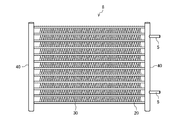
- the fin 30 is a member that transfers the heat of the refrigerant flowing through the heat transfer tube 20, and is, for example, a corrugated fin that is bent and arranged between the heat transfer tube 20 and the heat transfer tube 20.
- the fin 30 is made of, for example, aluminum.
- the fin 30 may be a plate fin.
- the header 40 is made of, for example, aluminum, in which a refrigerant flows inside and the refrigerant is divided into a plurality of connected heat transfer tubes 20.
- the fin 30 may be made of the same material as the heat transfer tube 20, or may be made of a different material.
- the header 40 has a header 40 that connects one end of the plurality of heat transfer tubes 20 and a header 40 that connects the other ends of the plurality of heat transfer tubes 20.
- the inside of the header 40 may be configured so that the flow path through which the refrigerant flows is partitioned by one or a plurality of partitions.
- a refrigerant pipe 5 is connected to the upper part of the header 40, and the header 40 is connected to the flow path switching device 7 by the refrigerant pipe 5.
- a refrigerant pipe 5 is connected to the lower part of the header 40, and the header 40 is connected to the expansion portion 10 by the refrigerant pipe 5.
- the header 40 may be made of the same material as the heat transfer tube 20.
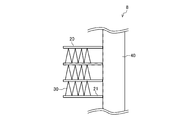
- the end 21 of the heat transfer tube 20 which is the connection point between the heat transfer tube 20 and the header 40, is not provided with the fins 30, a substance that induces corrosion such as salt or metal powder is deposited. easy. Therefore, the end 21 of the heat transfer tube 20 is inferior in corrosion resistance.
- a technique for the purpose of suppressing corrosion of the heat transfer tube 20, a technique is known in which a metal having a lower redox potential than the material of the heat transfer tube 20 is used for the fin 30 and the header 40.
- the fin 30 and the header 40 are intentionally promoted to be corroded, and the portion of the flat tube existing near the fin 30 and the header 40 is prevented from corroding.
- the end 21 of the heat transfer tube 20, which is the connection point between the heat transfer tube 20 and the header 40 is inferior in corrosion resistance because there is a distance between the fin 30 and the header 40.
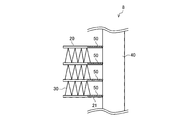
- FIG. 4 is a front view showing the alloy portion 50 according to the first embodiment.
- the first embodiment as shown in FIG. 4, aluminum and copper formed by the eutectic reaction are formed on the surface of one side of the end 21 of the heat transfer tube 20 which is the connection point between the heat transfer tube 20 and the header 40.
- the alloy portion 50 of the above is provided. Since the alloy portion 50 is provided at the end 21 of the heat transfer tube 20 which is the connection point between the heat transfer tube 20 and the header 40, the corrosion resistance can be improved even if the heat transfer tube 20 and the header 40 are separated from each other. Therefore, the corrosion resistance of the heat exchanger 8 can be improved. Further, the wall thickness of the end portion of the alloy portion 50 may be thicker than the wall thickness of the central portion of the alloy portion 50. As a result, even if the anticorrosion property is lowered from the central portion to the end portion of the alloy portion 50, the anticorrosion property of the end portion of the alloy portion 50 can be supplemented.
- FIG. 5 is a graph showing the mechanism of the alloy portion 50 according to the first embodiment. Next, the mechanism by which the corrosion resistance is improved by the alloy portion 50 will be described. The range in which the eutectic reaction occurs and the effect on corrosion were investigated using a sample obtained by adhering copper powder, which is a fine copper powder, to an aluminum alloy material, which is an alloy of aluminum and zinc, and brazing.
- the horizontal axis represents the distance from the position where the copper powder is attached
- the vertical axis represents the atomic number% ratio of Cu / Al.
- the concentration of copper with respect to aluminum decreases substantially linearly from the position where the copper powder is attached.
- FIG. 6 is a schematic view showing before the corrosion acceleration test of the alloy portion 50 according to the first embodiment
- FIG. 7 is a schematic view showing after the corrosion acceleration test of the alloy portion 50 according to the first embodiment.
- a corrosion acceleration test was conducted to investigate the effect of the alloy portion 50 on corrosion.
- FIG. 6 is a schematic view of the aluminum alloy material 60 before the corrosion acceleration test (0 h).
- the aluminum alloy material 60 has a copper powder adhering portion 61 before brazing, and after brazing, the eutectic range of aluminum and copper is developed around the copper powder adhering portion 61.
- 168 hours after the start of the corrosion acceleration test as shown in FIG. 7, the corroded portion 62 is not generated at the position where the copper powder adhering portion 61 is adhered, but the copper powder adhering portion 61 is adhered.
- a corroded portion 62 was generated at a place away from the provided position.
- FIG. 8 is a schematic view showing the mechanism of the alloy portion 50 according to the first embodiment.
- the redox potential is the most noble at the position where the copper powder is placed. Then, as the copper powder is concentrically separated from the position where the copper powder is placed, the concentration of copper decreases, so that the redox potential becomes low.
- the redox potential of the aluminum material is small, the redox potential at the position where the copper powder is placed is noble, and the redox potential becomes medium and large as the distance from the position where the copper powder is placed increases. It becomes base.
- the alloy portion 50 of aluminum and copper also has a redox potential higher than that of aluminum. Therefore, the heat transfer tube 20, the fins 30, or the header 40, which is not provided with the alloy portion 50 of aluminum and copper, sacrifices and protects the alloy portion 50 of aluminum and copper.
- sacrificial anticorrosion means to corrode by itself in order to protect a specific part from corroding.
- the alloy portion 50 is provided at the end portion 21 of the heat transfer tube 20 which is the connection portion between the heat transfer tube 20 and the header 40, that portion can be protected from corrosion.
- the redox potentials of the header 40 and the fins 30 are the lowest, the redox potentials of the alloy portion 50 are the most precious, and the redox potentials of the heat transfer tubes 20 other than the alloy portion 50 are the redox potentials of the header 40 and the fins. It is a redox potential between 30 and the alloy portion 50. As a result, it is possible to prevent corrosion of parts other than the alloy portion 50 of the heat transfer tube 20. Further, the portion outside the alloy portion 50 of the heat transfer tube 20 may be locally thickened. In this case, since a large corrosion margin is taken in the portion other than the alloy portion 50 of the heat transfer tube 20, the corrosion resistance can be improved.
- the alloy portion 50 is an alloy portion 50 of aluminum and copper formed at the end portion 21 of the heat transfer tube 20 by a eutectic reaction. In order to alloy aluminum and copper by the eutectic reaction, a high temperature of about 600 ° C. is required.
- the entire heat exchanger 8 in which the heat transfer tube 20, the fins 30, the header 40, and the like are assembled is supplied into the brazing furnace. Since the heat exchanger 8 assembled before brazing in the furnace is not brazed, the heat transfer tube 20, the fins 30, and the header 40 are not metallically joined. However, since the position where corrosion protection is desired, such as the portion between the fin 30 and the header 40 in the heat transfer tube 20, is fixed, it is preferable to form the alloy portion 50 before brazing.
- a copper or copper alloy of a predetermined size is placed at a position on the heat transfer tube 20 where corrosion protection is desired.
- the copper alloy is, for example, brass.
- the shape of copper or copper alloy is not limited, and examples thereof include copper powder, copper foil, and copper tape.
- the copper tape can be attached as it is.
- a method of dispersing fine copper powder in the flux and applying the flux containing the copper powder is also conceivable.
- a method of dispersing fine copper powder in a binder or the like and applying a binder containing the copper powder is also conceivable.
- the method of supplying copper or a copper alloy is not limited to the above method, and it is sufficient that the copper or the copper alloy can be supplied to the heat exchanger 8 assembled by the heat transfer tube 20, the fins 30, the header 40, and the like.
- the method of manufacturing the heat exchanger 8 includes a step of placing copper on the end of the heat transfer tube 20, a step of assembling the heat transfer tube 20 and the fin 30, and the assembled heat transfer tube 20 and the fin 30. It consists of steps to supply into the brazing furnace.
- the size, amount, or dispersion of copper or copper alloy will be described.
- a copper powder of a predetermined size is supplied, an alloy portion 50 of aluminum and copper is formed by a eutectic reaction between the supplied copper powder and the aluminum constituting the heat transfer tube 20. Therefore, when the amount of copper with respect to aluminum is excessive, the entire circumferential direction of the heat transfer tube 20 may become the alloy portion 50.
- the melting point of the alloy portion 50 is lower than the melting point of aluminum alone, so that the alloy portion 50 may be completely melted and the heat transfer tube 20 itself may be melted or damaged.
- the supply amount of copper or copper alloy is required to be an appropriate amount.
- the manufacturing conditions of the alloy portion 50 will be described.
- the state in the depth direction and the state in the horizontal direction of the alloy portion 50 were clarified.
- the volume V per grain of copper is preferably 0.0035 t 3 [mm 3 ] ⁇ V ⁇ 0.436 t 3 [mm 3 ]. all right.
- the weight W of copper is preferably 0.027 t [g / cm 2 ] ⁇ W ⁇ 0.135 t [g / cm 2], where t is the wall thickness of the heat transfer tube 20.
- an alloy portion 50 of aluminum and copper is provided at the end portion 21 of the heat transfer tube 20. Therefore, the redox potential at the end 21 of the heat transfer tube 20 becomes noble. In this way, the end 21 of the heat transfer tube 20, which is a desired position of the heat transfer tube 20, can be protected from corrosion.
- the first embodiment further includes a header 40 in which a refrigerant flows inside and distributes the refrigerant to a plurality of connected heat transfer tubes 20, and the alloy portion 50 is provided between the fins 30 and the header 40 in the heat transfer tubes 20. It is provided in. Since the alloy portion 50 is provided between the fin 30 and the header 40 in the end portion 21 of the heat transfer tube 20, anticorrosion is provided at a position of the heat transfer tube 20 away from the fin 30 and the header 40. be able to.
- the alloy portion 50 of aluminum and copper formed by the eutectic reaction is provided at the end portion 21 of the heat transfer tube 20. Therefore, zinc and copper do not compete with each other. Therefore, it is possible to suppress a decrease in corrosion resistance at a position where anticorrosion needs to be applied.
- the alloy portion 50 of aluminum and copper formed by the eutectic reaction is formed on the surface of one side of the end portion 21 of the heat transfer tube 20 which is the connection point between the heat transfer tube 20 and the header 40.
- the case where it is provided is illustrated.
- the alloy portion 50 may be provided on both sides or the side surface of the heat transfer tube 20. Further, the alloy portion 50 may be partially provided in the end portion 21 of the heat transfer tube 20 instead of the entire region between the fin 30 and the header 40.
- the eutectic reaction is exemplified in the case where it is caused by brazing in a furnace, the eutectic reaction may be caused by brazing using a burner, for example.
- copper may be supplied to the heat transfer tube 20 before the heat exchanger 8 is assembled.
- the alloy portion 50 does not have to be provided at all positions between the fin 30 and the header 40 in the end portion 21 of the heat transfer tube 20, and may be provided only at a position where the corrosion resistance is inferior.
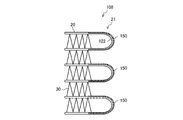
- FIG. 9 is a front view showing a bent portion 122 of the heat transfer tube 20 according to the second embodiment.
- the portion where the alloy portion 150 is provided is different from the first embodiment.
- the parts common to the first embodiment are designated by the same reference numerals, the description thereof will be omitted, and the differences from the first embodiment will be mainly described.
- the end 21 of the heat transfer tube 20 is not provided with the header 40, and is a U-shaped hairpin-shaped bent portion 122. Since the end 21 of the heat transfer tube 20, which is the folded-back portion of the heat transfer tube 20, is not provided with the fins 30, a substance that induces corrosion such as salt or metal powder is likely to be deposited. Therefore, the end 21 of the heat transfer tube 20 is inferior in corrosion resistance.
- FIG. 10 is a front view showing the alloy portion 150 according to the second embodiment.
- an alloy portion of aluminum and copper formed by a eutectic reaction on the surface of one side of an end portion 21 of the heat transfer tube 20 which is a bent portion 122 of the heat transfer tube 20. 150 is provided. Since the alloy portion 150 is provided at the end portion 21 of the heat transfer tube 20 which is the bent portion 122 of the heat transfer tube 20, the corrosion resistance can be improved even if the heat transfer tube 20 is separated from the fin 30. Therefore, the corrosion resistance of the heat exchanger 108 can be improved.
- the bent portion 122 of the heat transfer tube 20 is not easy to fix copper as compared with the portion of the heat transfer tube 20 other than the bent portion 122.
- a easily bendable copper foil or copper tape it is preferable to use a easily bendable copper foil or copper tape. Further, a copper powder dispersed in a flux or a binder may be used. If it is copper powder, it is preferable to fix it using a jig having a shape along the bent portion 122 or to embed it in the bent portion 122 by applying pressure.
- the alloy portion 150 is provided in the portion of the heat transfer tube 20 located between the fin 30 and the header 40 and in the bent portion 122 of the heat transfer tube 20.
- the present invention is not limited to these.
- the alloy portion 150 may be provided in a portion of the heat transfer tube 20 that is thinner than the refrigerant pipe 5 connected to the header 40 due to product design restrictions.
- the alloy portion 150 may be provided at a portion where the heat transfer tube 20 and the fin 30 are brazed. As described above, the alloy portion 150 is arbitrarily provided at a position where there is a concern about corrosion resistance.
- the alloy portion 150 is illustrated in the case where it is formed in the heat exchanger 108 provided in the outdoor unit 2, it may be formed in the indoor heat exchanger 11 provided in the indoor unit 3. In this case, even if dew is formed while the indoor unit 3 is in the cooling operation, corrosion can be prevented by the alloy portion 150.
Landscapes
- Engineering & Computer Science (AREA)
- Physics & Mathematics (AREA)
- Thermal Sciences (AREA)
- Mechanical Engineering (AREA)
- General Engineering & Computer Science (AREA)
- Heat-Exchange Devices With Radiators And Conduit Assemblies (AREA)
Priority Applications (2)
| Application Number | Priority Date | Filing Date | Title |
|---|---|---|---|
| JP2022508610A JPWO2021186491A1 (https=) | 2020-03-16 | 2020-03-16 | |
| PCT/JP2020/011358 WO2021186491A1 (ja) | 2020-03-16 | 2020-03-16 | 熱交換器、空気調和機及び熱交換器の製造方法 |
Applications Claiming Priority (1)
| Application Number | Priority Date | Filing Date | Title |
|---|---|---|---|
| PCT/JP2020/011358 WO2021186491A1 (ja) | 2020-03-16 | 2020-03-16 | 熱交換器、空気調和機及び熱交換器の製造方法 |
Publications (1)
| Publication Number | Publication Date |
|---|---|
| WO2021186491A1 true WO2021186491A1 (ja) | 2021-09-23 |
Family
ID=77770750
Family Applications (1)
| Application Number | Title | Priority Date | Filing Date |
|---|---|---|---|
| PCT/JP2020/011358 Ceased WO2021186491A1 (ja) | 2020-03-16 | 2020-03-16 | 熱交換器、空気調和機及び熱交換器の製造方法 |
Country Status (2)
| Country | Link |
|---|---|
| JP (1) | JPWO2021186491A1 (https=) |
| WO (1) | WO2021186491A1 (https=) |
Cited By (1)
| Publication number | Priority date | Publication date | Assignee | Title |
|---|---|---|---|---|
| WO2025257955A1 (ja) * | 2024-06-12 | 2025-12-18 | 三菱電機株式会社 | 熱交換器及び空気調和機 |
Citations (4)
| Publication number | Priority date | Publication date | Assignee | Title |
|---|---|---|---|---|
| JPH0240420B2 (ja) * | 1982-12-24 | 1990-09-11 | Showa Aluminium Co Ltd | Aruminiumuzainohyomennitakoshitsusookeiseisuruhoho |
| JPH11183075A (ja) * | 1997-12-17 | 1999-07-06 | Showa Alum Corp | 熱交換器 |
| KR20080095628A (ko) * | 2007-04-25 | 2008-10-29 | 엘지전자 주식회사 | 공기조화기 |
| JP2013155892A (ja) * | 2012-01-27 | 2013-08-15 | Mitsubishi Electric Corp | 熱交換器及びこれを備えた空気調和機 |
Family Cites Families (6)
| Publication number | Priority date | Publication date | Assignee | Title |
|---|---|---|---|---|
| JPH0240420A (ja) * | 1988-07-28 | 1990-02-09 | Matsushita Seiko Co Ltd | 電気ストーブ |
| JP3627876B2 (ja) * | 1995-09-05 | 2005-03-09 | 日本軽金属株式会社 | アルミニウム製熱交換器の製造方法 |
| JPH0979766A (ja) * | 1995-09-12 | 1997-03-28 | Nippon Light Metal Co Ltd | 熱交換器及びその製造方法 |
| WO2017018438A1 (ja) * | 2015-07-30 | 2017-02-02 | 株式会社デンソー | 熱交換器およびその製造方法 |
| WO2019102915A1 (ja) * | 2017-11-24 | 2019-05-31 | 三菱アルミニウム株式会社 | ろう付け処理後の親水性に優れるアルミニウムフィン及び熱交換器とその製造方法 |
| WO2020039497A1 (ja) * | 2018-08-21 | 2020-02-27 | ハリマ化成株式会社 | ろう付け材、ろう付け部材、熱交換器、および、ろう付け部材の製造方法 |
-
2020
- 2020-03-16 WO PCT/JP2020/011358 patent/WO2021186491A1/ja not_active Ceased
- 2020-03-16 JP JP2022508610A patent/JPWO2021186491A1/ja active Pending
Patent Citations (4)
| Publication number | Priority date | Publication date | Assignee | Title |
|---|---|---|---|---|
| JPH0240420B2 (ja) * | 1982-12-24 | 1990-09-11 | Showa Aluminium Co Ltd | Aruminiumuzainohyomennitakoshitsusookeiseisuruhoho |
| JPH11183075A (ja) * | 1997-12-17 | 1999-07-06 | Showa Alum Corp | 熱交換器 |
| KR20080095628A (ko) * | 2007-04-25 | 2008-10-29 | 엘지전자 주식회사 | 공기조화기 |
| JP2013155892A (ja) * | 2012-01-27 | 2013-08-15 | Mitsubishi Electric Corp | 熱交換器及びこれを備えた空気調和機 |
Cited By (1)
| Publication number | Priority date | Publication date | Assignee | Title |
|---|---|---|---|---|
| WO2025257955A1 (ja) * | 2024-06-12 | 2025-12-18 | 三菱電機株式会社 | 熱交換器及び空気調和機 |
Also Published As
| Publication number | Publication date |
|---|---|
| JPWO2021186491A1 (https=) | 2021-09-23 |
Similar Documents
| Publication | Publication Date | Title |
|---|---|---|
| US8708034B2 (en) | Air conditioner | |
| CN103026165B (zh) | 空气调节器用螺旋热交换器 | |
| EP3023728B1 (en) | Corrosion resistance life diagnosis component, heat exchanger, and refrigeration and air conditioning device | |
| JP2010532859A (ja) | 熱交換器を有する熱交換装置、および熱交換装置の製造方法 | |
| US12607417B2 (en) | Heat exchanger and air conditioner having same | |
| US11002489B2 (en) | Heat exchanger and air conditioning apparatus | |
| WO2014196569A1 (ja) | 空気調和装置の室外機 | |
| US20020078566A1 (en) | Heat exchanger made of aluminum alloy | |
| JP6074648B2 (ja) | 管部材の接合体、及び冷凍サイクル装置の熱交換器 | |
| EP4411288B1 (en) | Air conditioner | |
| JP6318371B2 (ja) | 室外ユニットおよびそれを用いた冷凍サイクル装置 | |
| WO2021186491A1 (ja) | 熱交換器、空気調和機及び熱交換器の製造方法 | |
| JPH08247678A (ja) | アルミニウム製熱交換器 | |
| JP2001124481A (ja) | 熱交換器 | |
| KR20170004845A (ko) | 열 교환기 및 이를 포함하는 공기조화기 | |
| WO2020012549A1 (ja) | 熱交換器、熱交換装置、熱交換器ユニット及び冷凍サイクル装置 | |
| EP4345407B1 (en) | Heat exchanger | |
| JP7286015B2 (ja) | 積層体、熱交換器及び空気調和機 | |
| JP6873252B2 (ja) | 熱交換器、空気調和装置の室外機及び空気調和装置 | |
| JP2023050602A (ja) | 熱交換器および空気調和装置 | |
| JP3242016U (ja) | 空気調和機及び熱交換器 | |
| JP7802901B2 (ja) | 熱交換器及び冷凍サイクル装置 | |
| JP7588769B1 (ja) | 腐食評価部品、熱交換器および空気調和器 | |
| CN218270354U (zh) | 空调器 | |
| JP7086278B2 (ja) | 熱交換器及び空気調和機 |
Legal Events
| Date | Code | Title | Description |
|---|---|---|---|
| 121 | Ep: the epo has been informed by wipo that ep was designated in this application |
Ref document number: 20925721 Country of ref document: EP Kind code of ref document: A1 |
|
| ENP | Entry into the national phase |
Ref document number: 2022508610 Country of ref document: JP Kind code of ref document: A |
|
| NENP | Non-entry into the national phase |
Ref country code: DE |
|
| 122 | Ep: pct application non-entry in european phase |
Ref document number: 20925721 Country of ref document: EP Kind code of ref document: A1 |