WO2021182539A1 - 接着剤組成物、ゴム-有機繊維コード複合体、及びタイヤ - Google Patents
接着剤組成物、ゴム-有機繊維コード複合体、及びタイヤ Download PDFInfo
- Publication number
- WO2021182539A1 WO2021182539A1 PCT/JP2021/009649 JP2021009649W WO2021182539A1 WO 2021182539 A1 WO2021182539 A1 WO 2021182539A1 JP 2021009649 W JP2021009649 W JP 2021009649W WO 2021182539 A1 WO2021182539 A1 WO 2021182539A1
- Authority
- WO
- WIPO (PCT)
- Prior art keywords
- rubber
- adhesive composition
- fiber cord
- organic fiber
- aldehydes
- Prior art date
- Legal status (The legal status is an assumption and is not a legal conclusion. Google has not performed a legal analysis and makes no representation as to the accuracy of the status listed.)
- Ceased
Links
Classifications
-
- B—PERFORMING OPERATIONS; TRANSPORTING
- B60—VEHICLES IN GENERAL
- B60C—VEHICLE TYRES; TYRE INFLATION; TYRE CHANGING; CONNECTING VALVES TO INFLATABLE ELASTIC BODIES IN GENERAL; DEVICES OR ARRANGEMENTS RELATED TO TYRES
- B60C1/00—Tyres characterised by the chemical composition or the physical arrangement or mixture of the composition
-
- B—PERFORMING OPERATIONS; TRANSPORTING
- B60—VEHICLES IN GENERAL
- B60C—VEHICLE TYRES; TYRE INFLATION; TYRE CHANGING; CONNECTING VALVES TO INFLATABLE ELASTIC BODIES IN GENERAL; DEVICES OR ARRANGEMENTS RELATED TO TYRES
- B60C9/00—Reinforcements or ply arrangement of pneumatic tyres
-
- C—CHEMISTRY; METALLURGY
- C09—DYES; PAINTS; POLISHES; NATURAL RESINS; ADHESIVES; COMPOSITIONS NOT OTHERWISE PROVIDED FOR; APPLICATIONS OF MATERIALS NOT OTHERWISE PROVIDED FOR
- C09J—ADHESIVES; NON-MECHANICAL ASPECTS OF ADHESIVE PROCESSES IN GENERAL; ADHESIVE PROCESSES NOT PROVIDED FOR ELSEWHERE; USE OF MATERIALS AS ADHESIVES
- C09J107/00—Adhesives based on natural rubber
- C09J107/02—Latex
-
- C—CHEMISTRY; METALLURGY
- C09—DYES; PAINTS; POLISHES; NATURAL RESINS; ADHESIVES; COMPOSITIONS NOT OTHERWISE PROVIDED FOR; APPLICATIONS OF MATERIALS NOT OTHERWISE PROVIDED FOR
- C09J—ADHESIVES; NON-MECHANICAL ASPECTS OF ADHESIVE PROCESSES IN GENERAL; ADHESIVE PROCESSES NOT PROVIDED FOR ELSEWHERE; USE OF MATERIALS AS ADHESIVES
- C09J11/00—Features of adhesives not provided for in group C09J9/00, e.g. additives
- C09J11/08—Macromolecular additives
-
- C—CHEMISTRY; METALLURGY
- C09—DYES; PAINTS; POLISHES; NATURAL RESINS; ADHESIVES; COMPOSITIONS NOT OTHERWISE PROVIDED FOR; APPLICATIONS OF MATERIALS NOT OTHERWISE PROVIDED FOR
- C09J—ADHESIVES; NON-MECHANICAL ASPECTS OF ADHESIVE PROCESSES IN GENERAL; ADHESIVE PROCESSES NOT PROVIDED FOR ELSEWHERE; USE OF MATERIALS AS ADHESIVES
- C09J161/00—Adhesives based on condensation polymers of aldehydes or ketones; Adhesives based on derivatives of such polymers
- C09J161/04—Condensation polymers of aldehydes or ketones with phenols only
- C09J161/06—Condensation polymers of aldehydes or ketones with phenols only of aldehydes with phenols
- C09J161/12—Condensation polymers of aldehydes or ketones with phenols only of aldehydes with phenols with polyhydric phenols
-
- D—TEXTILES; PAPER
- D06—TREATMENT OF TEXTILES OR THE LIKE; LAUNDERING; FLEXIBLE MATERIALS NOT OTHERWISE PROVIDED FOR
- D06M—TREATMENT, NOT PROVIDED FOR ELSEWHERE IN CLASS D06, OF FIBRES, THREADS, YARNS, FABRICS, FEATHERS OR FIBROUS GOODS MADE FROM SUCH MATERIALS
- D06M15/00—Treating fibres, threads, yarns, fabrics, or fibrous goods made from such materials, with macromolecular compounds; Such treatment combined with mechanical treatment
- D06M15/19—Treating fibres, threads, yarns, fabrics, or fibrous goods made from such materials, with macromolecular compounds; Such treatment combined with mechanical treatment with synthetic macromolecular compounds
- D06M15/37—Macromolecular compounds obtained otherwise than by reactions only involving carbon-to-carbon unsaturated bonds
- D06M15/39—Aldehyde resins; Ketone resins; Polyacetals
- D06M15/41—Phenol-aldehyde or phenol-ketone resins
-
- D—TEXTILES; PAPER
- D06—TREATMENT OF TEXTILES OR THE LIKE; LAUNDERING; FLEXIBLE MATERIALS NOT OTHERWISE PROVIDED FOR
- D06M—TREATMENT, NOT PROVIDED FOR ELSEWHERE IN CLASS D06, OF FIBRES, THREADS, YARNS, FABRICS, FEATHERS OR FIBROUS GOODS MADE FROM SUCH MATERIALS
- D06M15/00—Treating fibres, threads, yarns, fabrics, or fibrous goods made from such materials, with macromolecular compounds; Such treatment combined with mechanical treatment
- D06M15/693—Treating fibres, threads, yarns, fabrics, or fibrous goods made from such materials, with macromolecular compounds; Such treatment combined with mechanical treatment with natural or synthetic rubber, or derivatives thereof
Definitions
- the present invention relates to an adhesive composition, a rubber-organic fiber cord composite, and a tire.
- organic fibers such as polyester fibers have a high initial elastic modulus and excellent thermal dimensional stability, they are in the form of filaments, cords, cables, cord fabrics, canvas, etc., and therefore tires, belts, air springs, hoses, etc. It is often used as a reinforcing material in rubber articles such as. Then, various adhesive compositions have been proposed for adhering these organic fibers and rubber (rubber member).
- Examples of such an adhesive composition include RFL (resorcin formalin latex) adhesives containing resorcin, formalin, rubber latex and the like, and it is known that adhesiveness can be exhibited by thermally curing the RFL adhesive. (For example, Patent Documents 1 to 3).
- formalin an aqueous solution of formaldehyde
- formalin an aqueous solution of formaldehyde
- a reduction in the amount used has been required in consideration of the working environment.
- the amount of resorcin used is also required to be reduced from the viewpoint of the environment. Therefore, some adhesive compositions and bonding methods that are environmentally friendly without using resorcin and formalin have been proposed (for example, Patent Document 6).
- the conventional composition containing no resorcin and formalin requires a long time to cure, so that there is a problem of improving productivity, and further improvement in adhesiveness is required.
- the composition containing no resorcin and formalin tended to have insufficient adhesive performance between polyethylene terephthalate (PET) fiber and rubber.
- PET polyethylene terephthalate
- the polyester fiber material which is a linear polymer having an ester bond in the main chain such as PET, is structurally dense, and the polyester fiber material having few functional groups is water-soluble with latex.
- the adhesive composition (RFL or the like) obtained by mixing the raw material for cross-linking the sex phenol hardly exhibits adhesiveness.
- Examples of such a one-bath treatment technique include a method of promoting adhesion by further adding an isocyanate compound to a composition containing rubber latex (for example, Patent Document 7).
- Patent Document 7 a technique that further considers the environment, such as not using resorcin and formalin, and obtains adhesiveness between rubber and an organic fiber material has not yet been proposed.
- the present invention provides an adhesive composition which has a small burden on the environment and can firmly bond rubber and organic fibers. Further, the present invention provides a rubber-organic fiber cord composite having a small environmental load and a rubber and an organic fiber cord firmly adhered to each other, and a tire using the composite and having high reinforcing properties. That is the issue.
- the gist structure of the present invention that solves the above problems is as follows.
- the adhesive composition of the present invention contains polyphenols and aldehydes, and contains The proportion of raw materials derived from renewable resources in the total solid content is 35% by mass or more.
- the rubber-organic fiber cord composite of the present invention is a rubber-organic fiber cord composite comprising a rubber member and an organic fiber cord. The surface of at least a part of the organic fiber cord is coated with the above-mentioned adhesive composition.
- the tire of the present invention is characterized by using the rubber-organic fiber cord composite described above.
- an adhesive composition that has a small impact on the environment and can firmly bond rubber and organic fibers.
- a rubber-organic fiber cord composite having a small environmental load and a rubber and an organic fiber cord firmly adhered to each other, and a tire using the composite and having high reinforcing properties are provided. Can be provided.
- the adhesive composition of one embodiment of the present invention (hereinafter, may be referred to as "adhesive composition of the present embodiment") is characterized by containing at least polyphenols and aldehydes. ..
- the adhesive composition of the present embodiment may appropriately contain a rubber component, a solvent, other components and the like, if necessary.
- the rubber and the organic fiber can be firmly adhered to each other.
- the adhesive composition of the present embodiment is also characterized in that the ratio of the raw material derived from the renewable resource to the total solid content is 35% by mass or more.
- solid content means a dry solid content.
- Polyphenols refer to a group of compounds having a structure in which a plurality of hydroxyl groups (phenolic hydroxyl groups) are bonded to an aromatic ring, and are resin components capable of enhancing adhesiveness in the adhesive composition of the present embodiment.
- the number of aromatic rings and the number of hydroxyl groups in polyphenols are not particularly limited and can be appropriately selected depending on the intended purpose.
- the polyphenols used in this embodiment may be one kind alone or a combination of two or more kinds.
- the polyphenols used in the present embodiment are preferably water-soluble from the viewpoint of being dissolved in a solvent such as water to obtain a uniformly dispersed adhesive composition.
- the polyphenols used in the present embodiment are preferably polyphenols other than resorcin (resorcinol) from the viewpoint of giving sufficient consideration to reducing the environmental load.
- the adhesive composition of the present embodiment substantially does not contain resorcin (resorcinol).
- “substantially not contained” means that the ratio in the adhesive composition is less than 0.5% by mass.
- water-soluble does not necessarily mean only completely water-soluble, but also includes being partially water-soluble or not phase-separated in a solvent containing water. And.
- the bonding positions of a plurality of hydroxyl groups in the aromatic ring are not particularly limited, and for example, the hydroxyl groups of each other may have a positional relationship of the ortho position, the meta position, or the para position.
- the above polyphenols may have a plurality of aromatic rings. In this case, it is preferable that a plurality of hydroxyl groups are bonded to all the aromatic rings.
- the polyphenols preferably have three or more hydroxyl groups. This is because such polyphenols are generally water-soluble, so that they can be uniformly distributed in the adhesive composition and can exhibit better adhesiveness.
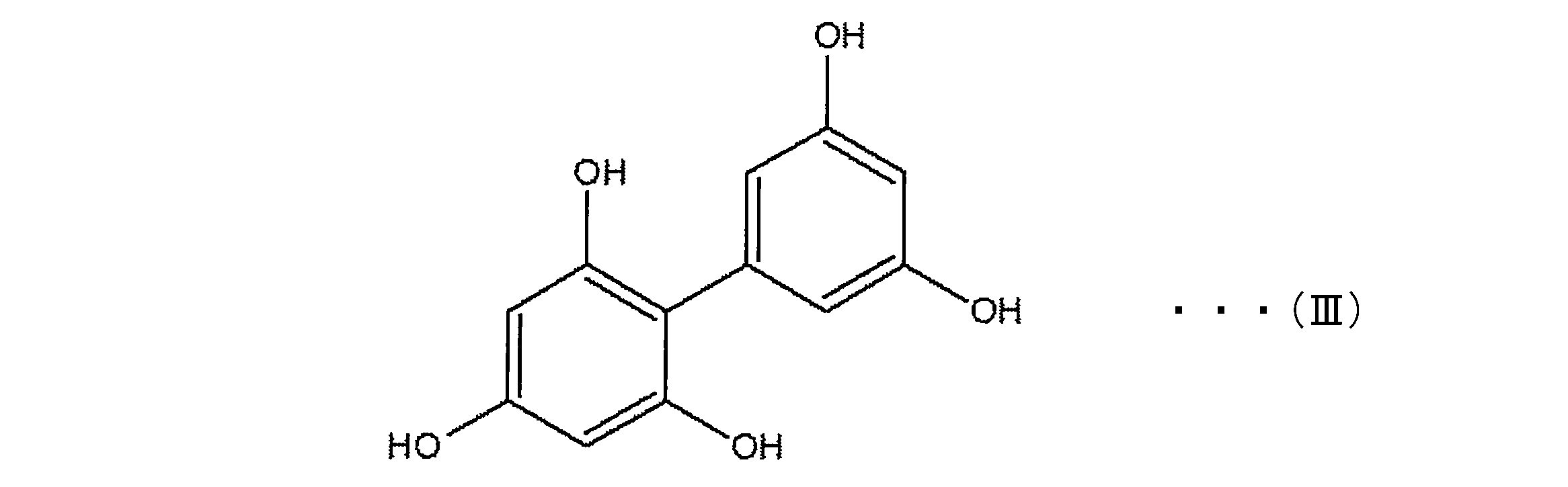
- polyphenols having three or more hydroxyl groups examples include phloroglucinol represented by the following formula (I) and morin represented by the following formula (II) (also known as: 2', 4', 3, 5, 7-Pentahydroxyflavone), phloroglucinol represented by the following formula (III) (also known as 2,4,6,3', 5'-biphenylpentol), and any mixture of two or more of these, etc. Can be mentioned.
- the adhesive composition of the present embodiment preferably contains at least phloroglucinol as polyphenols from the viewpoint of further improving the adhesiveness.
- the content of polyphenols in the total solid content is preferably 1.0% by mass or more, preferably 2.5. It is more preferably mass% or more. Further, in the adhesive composition of the present embodiment, from the viewpoint of reliably dissolving aldehydes and ensuring good workability, the content of polyphenols in the total solid content is 10% by mass or less. It is preferably present, and more preferably 9% by mass or less.
- Aldehydes refer to a group of compounds having an aldehyde group, and are components that can enhance adhesiveness in the adhesive composition of the present embodiment in combination with the above-mentioned polyphenols.
- the number of aldehyde groups in the aldehydes is not particularly limited and can be appropriately selected depending on the intended purpose. Further, the aldehydes used in the present embodiment may be one kind alone or a combination of two or more kinds.
- the aldehydes used in this embodiment are preferably aldehydes other than formaldehyde from the viewpoint of sufficiently considering the reduction of environmental load.
- the adhesive composition of the present embodiment preferably contains substantially no formaldehyde.
- the aldehydes preferably contain aldehydes having an aromatic ring. This is because aldehydes having an aromatic ring have a smaller environmental load than formaldehyde, and can contribute to improving performance such as adhesiveness, mechanical strength, electrical insulation, acid resistance, water resistance, and heat resistance.
- the aldehydes having the aromatic ring preferably have two or more aldehyde groups.
- the degree of cross-linking at the time of cross-linking and condensation is increased, and as a result, the adhesiveness can be further enhanced.
- the aldehydes having the aromatic ring have two or more aldehyde groups on one aromatic ring.
- the bonding positions of the two or more aldehyde groups in the aromatic ring are not particularly limited, and for example, the aldehyde groups of each other are in the positional relationship of the ortho-position, the meta-position, or the para-position. You may.
- the adhesive composition of the present embodiment preferably contains at least 1,4-benzenedicarbaldehyde as aldehydes from the viewpoint of further improving the adhesiveness.
- aldehydes having an aromatic ring include not only those having a benzene ring but also heteroaromatic compounds.
- aldehydes that are heteroaromatic compounds include the following general formula (IV): Examples include aldehydes having a furan ring represented by [where X is O; R is -H, -CHO or methylol]. More specifically, the above-mentioned aldehydes having a furan ring include five compounds represented by the following formulas.
- the above polyphenols and the above aldehydes may be present in a condensed state.
- the mass ratio of the aldehydes to the polyphenols is preferably 0.1 or more, and 3 The following is preferable. In this case, the hardness and adhesiveness of the product of the condensation reaction of polyphenols and aldehydes become more suitable. From the same viewpoint, the mass ratio of the aldehydes to the polyphenols (aldehyde content / polyphenol content) is more preferably 0.25 or more, and more preferably 2.5 or less. Is more preferable, and 2 or less is further preferable.
- the total content of polyphenols and aldehydes in the total solid content is preferably 3% by mass or more and 30% by mass or less. In this case, better adhesiveness can be ensured without deteriorating workability. From the same viewpoint, the total content of polyphenols and aldehydes in the total solid content is more preferably 5% by mass or more, and more preferably 25% by mass or less.
- the adhesive composition of the present embodiment preferably further contains a rubber component in addition to the above-mentioned polyphenols and aldehydes. In this case, the rubber and the organic fiber cord can be adhered more firmly. Further, since the adhesive composition of the present embodiment contains a rubber component, it can take advantage of being relatively flexible and flexible, and can satisfactorily follow the deformation of the organic fiber cord.
- the rubber component is not particularly limited, and for example, in addition to natural rubber (NR), modified natural rubber (epoxidized natural rubber, hydride natural rubber, etc.), isoprene rubber (IR), styrene-butadiene rubber (SBR). ), Butadiene rubber (BR), ethylene-propylene-diene rubber (EPDM), chloroprene rubber (CR), butyl halide rubber, acryloni little-butadiene rubber (NBR), vinylpyridine-styrene-butadiene copolymer rubber (Vp) Synthetic rubber such as, etc. can be used. These rubber components may be used alone or in combination of two or more.
- the rubber component can usually be contained in the adhesive composition by blending a rubber latex.
- the adhesive composition of the present embodiment contains natural rubber (NR) and the ratio of the natural rubber (NR) to the total solid content is 30% by mass or more.
- the load on the environment can be further reduced while maintaining good adhesiveness between the rubber and the organic fiber.
- the ratio of the natural rubber (NR) to the total solid content of the adhesive composition of the present embodiment is more preferably 35% by mass or more, and further preferably 40% by mass or more. preferable.
- the content of the rubber component in the total solid content is preferably 40% by mass or more, preferably 70% by mass or more. More preferably. Further, in the adhesive composition of the present embodiment, in order to sufficiently secure the coagulation-resistant fracture resistance, the content of the rubber component in the total solid content is preferably 99% by mass or less, preferably 95% by mass. More preferably, it is less than%.
- the adhesive composition of the present embodiment may further contain a solvent.
- a basic solvent such as water or a sodium hydroxide solution is preferable from the viewpoint of reliably dissolving the above polyphenols and uniformly dispersing them.
- a basic solvent such as aqueous ammonia is preferable from the viewpoint of sufficiently dissolving the above aldehydes. From the same viewpoint, it is preferable to use water and sodium hydroxide solution in combination as the solvent, and it is more preferable to use water, sodium hydroxide solution and ammonia water in combination.
- the adhesive composition of the present embodiment may contain other components other than those described above as long as it does not deviate from the object of the present invention.
- other components include isocyanate compounds, epoxy compounds, carbodiimide compounds, and oxazoline compounds.
- the proportion of raw materials derived from renewable resources in the total solid content is 35% by mass or more. In this way, by using a certain percentage or more of the raw materials of the adhesive composition as raw materials derived from renewable resources, it is possible to reduce the burden on the environment and prepare for the future decrease in oil supply. can. From the same viewpoint, in the adhesive composition of the present embodiment, the proportion of the raw material derived from the renewable resource in the total solid content is preferably 40% by mass or more, preferably 50% by mass or more. More preferred.
- the "raw material derived from renewable resources” refers to a raw material derived from resources other than petroleum. Then, in the adhesive composition of the present embodiment, at least a part of the above-mentioned materials, that is, essential polyphenols and aldehydes, and optional rubber components, solvents and other components are used as renewable resources. It is a raw material from which it is derived, and the solid content as a whole is 35% by mass or more.
- the adhesive composition of the present embodiment is in the form of a solution at 25 ° C., and the proportion of raw materials derived from renewable resources in the entire solution is preferably 65% by mass or more. In this case, the burden on the environment can be further reduced, and it is possible to prepare for a future decrease in oil supply.
- the proportion of the raw material derived from the renewable resource in the whole solution is preferably 70% by mass or more, and more preferably 75% by mass or more. preferable.
- “solution form” also includes colloidal form.
- phloroglucinol described above as polyphenols can be obtained by biosynthesis by plants, bacteria, or the like.
- Such phloroglucinol can be used as a raw material derived from renewable resources (see, for example, WO2019 / 002798A1, WO2019 / 00299A1, etc.).
- aldehydes having a furan ring described above as aldehydes can be obtained from resources other than petroleum such as wood and corn. Aldehydes having such a furan ring can be used as a raw material derived from renewable resources.
- natural rubber (NR) and modified natural rubber are raw materials derived from renewable resources.
- styrene-based monomers and butadiene monomers which are the raw materials for styrene-butadiene rubber (SBR)
- SBR styrene-butadiene rubber
- water as a solvent and water for diluting various components are not included in the solid content, but are raw materials derived from renewable resources.
- the sodium hydroxide in the sodium hydroxide solution described above as a solvent can be obtained from a resource other than petroleum, and is immobilized in the dry solid content.
- Such sodium hydroxide can be used as a raw material derived from renewable resources.
- ammonia in the ammonia water described above as a solvent can be obtained from a resource other than petroleum, and is immobilized in the dry solid content.
- ammonia can be used as a raw material derived from renewable resources.
- the method for producing the adhesive composition of the present embodiment is not particularly limited, but for example, by preparing the raw materials so that the ratio of the raw materials derived from the renewable resources becomes a predetermined value or more and dissolving them in a solvent, the adhesive composition is produced.
- the adhesive composition of the present embodiment in the form of a solution can be obtained.
- polyphenols are dissolved in water as a solvent to obtain a solution, then a basic solvent is added to the above solution if necessary, and then aldehydes are added to the above solution. It is preferable to produce by dissolving. As a result, the solubility and dispersibility can be enhanced while avoiding gelation, and the adhesive composition of the present embodiment can be stably and efficiently produced.
- the temperature of water as the solvent is preferably 40 ° C. or higher, more preferably 60 ° C. or higher, from the viewpoint of more reliably dissolving polyphenols and aldehydes.
- Examples of the basic solvent include sodium hydroxide solution, aqueous ammonia and the like.
- the aldehydes are gradually added to the solution containing the polyphenols and dissolved.
- the temperature during stirring and aging is preferably 20 ° C. or higher, more preferably 40 ° C. or higher, and suppresses the increase in viscosity due to evaporation of the solvent, from the viewpoint of further enhancing the adhesiveness. Therefore, it is preferably 80 ° C. or lower, and more preferably 60 ° C. or lower.
- the stirring and aging time is preferably 30 minutes or more, more preferably 1 hour or more, and 6 hours or less from the viewpoint of suppressing a decrease in productivity, from the viewpoint of further enhancing the adhesiveness. It is preferably 4 hours or less.
- the adhesive composition contains a rubber component
- the latex can be more reliably solidified, the ease of handling of the adhesive composition can be improved, and the adhesiveness can be improved.
- aging after adding latex refers to an operation in which a certain period of time elapses for the purpose of improving the characteristics of latex.
- the aging conditions are not particularly limited, and for example, aging can be carried out at about 25 ° C. for 1 hour to 1 week.
- the latex can be added as described above, and after aging, the isocyanate compound can be added.
- the rubber-organic fiber cord composite of one embodiment of the present invention (hereinafter, may be referred to as “composite of the present embodiment”) is a rubber-organic fiber cord composite comprising a rubber member and an organic fiber cord. It is a body, characterized in that at least a part of the surface of the organic fiber cord is coated with the above-mentioned adhesive composition.
- the composite of the present embodiment has a structure in which the rubber member and the organic fiber cord are bonded by the adhesive composition described above. Since the composite of the present embodiment uses the adhesive composition of the present embodiment described above, the load on the environment is small, and the rubber and the organic fiber cord are firmly adhered to each other.
- the entire surface of the organic fiber cord is coated with the adhesive composition of the present embodiment.
- the material of the organic fiber cord is not particularly limited, and for example, polyethylene terephthalate (PET), polyethylene naphthalate (PEN), aliphatic polyamide such as nylon, aromatic polyamide such as polyketone and aramid, and polyparaphenylene benzobisoxazole. , Rayon, lyocell, etc.
- the organic fiber cord in the composite of the present embodiment is preferably a polyethylene terephthalate (PET) fiber cord.
- PET polyethylene terephthalate
- the organic fiber cord is not particularly limited, and an organic fiber cord made by twisting a plurality of single fiber filaments can be used.
- the average diameter of the single fiber filament is preferably 2 ⁇ m or more, more preferably 15 ⁇ m or more, and preferably 50 ⁇ m or less from the viewpoint of providing sufficiently high reinforcing property to the rubber article. ..
- the rubber component constituting the rubber member is not particularly limited, and the rubber member can be produced using the rubber component usually used in the rubber industry.
- the rubber member contains various compounding agents such as carbon black, silica, a filler such as aluminum hydroxide, a vulcanizing agent such as sulfur, a vulcanization accelerator, an antiaging agent, and a softening agent, which are usually used in the rubber industry. It can be contained as appropriate. Further, the rubber member can be a vulcanized product in the composite of the present embodiment.
- the method for producing the composite of the present embodiment is not particularly limited, but for example, the surface of the organic fiber cord is coated with the above-mentioned adhesive composition, and then the coated adhesive composition and the unvulcanized rubber member are used.
- the composite of the present embodiment can be obtained by contacting with and then vulcanizing while arbitrarily pressurizing.
- the method of coating the surface of the organic fiber cord with the above-mentioned adhesive composition is not particularly limited, and examples thereof include dipping, coating, and spraying.
- the above-mentioned adhesive composition contains a solvent
- the solvent may be removed by a drying treatment after coating. Further, after drying, heat treatment may be performed in order to develop adhesiveness more effectively.
- the surface of the organic fiber cord Before coating the surface of the organic fiber cord with the adhesive composition described above, the surface of the organic fiber cord may be coated with a predetermined pretreatment composition.
- a pretreatment composition include a composition containing an epoxy compound and an isocyanate compound.
- the coating amount of the adhesive composition in the organic fiber cord is preferably 0.2 parts by mass or more and 6.0 parts by mass or less with respect to 100 parts by mass of the uncoated organic fiber cord.
- the use of the complex of this embodiment is not particularly limited.
- the composite of the present embodiment can be used for rubber articles such as tires, belts, air springs, and hoses.
- the tire of one embodiment of the present invention (hereinafter, may be referred to as “tire of the present embodiment”) is characterized in that the above-mentioned rubber-organic fiber cord composite is used.
- the tire of this embodiment includes the rubber-organic fiber cord composite described above. Since the tire of the present embodiment uses the composite of the present embodiment described above, it has a low impact on the environment and has high reinforcing properties.
- the above-mentioned composite can be used as, for example, a carcass ply, a belt layer, a belt reinforcing layer, a belt peripheral reinforcing layer such as a flipper, and the like.
- the tire of the present embodiment is not particularly limited except that the above-mentioned composite is used, and can be manufactured according to a conventional method. Further, as the gas to be filled in the tire of the present embodiment, an inert gas such as nitrogen, argon or helium can be used in addition to normal or adjusted oxygen partial pressure.
- an inert gas such as nitrogen, argon or helium can be used in addition to normal or adjusted oxygen partial pressure.
- Epoxy compound manufactured by Nagase Chemtech Co., Ltd., "Denacol EX614B" is 1% by mass
- isocyanate compound manufactured by Daiichi Kogyo Seiyaku Co., Ltd., "Elastron BN77”
- Isovan manufactured by Clare Co., Ltd.
- the composition for pretreatment was prepared by diluting with water so as to be 6% by mass.
- Phloroglucinol manufactured by Fuji Film Wako Pure Chemical Industries, Ltd., 10% by mass aqueous solution
- a polyphenol was dissolved in water at 40 ° C. or higher so as to have a concentration of 10% by mass to obtain a solution.
- a sodium hydroxide solution manufactured by Kanto Chemical Co., Inc., 4% by mass aqueous solution
- water, and aqueous ammonia were added in this order.
- 1,4-benzenedicarbaldehyde manufactured by Tokyo Chemical Industry Co., Ltd., 98% by mass purity
- aldehydes was gradually added to the above solution.
- the above addition was carried out while keeping the solution at 40 to 60 ° C. and constantly stirring the solution.
- stirring was continued, and the mixture was aged at an atmospheric temperature of 25 ⁇ 1 ° C. and for 2 hours.
- composition of the obtained adhesive composition (composition of solid content and composition of solution) is shown in Table 1.
- the above-mentioned adhesive composition has a high proportion of raw materials derived from renewable resources in the total solid content of 35% by mass or more, and the raw materials derived from renewable resources in the entire solution. Since the ratio is as high as 65% by mass or more, it can be seen that the burden on the environment is reduced.
- a polyethylene terephthalate (PET) fiber cord having a cord fineness of 1670 dtex / 2, a lower twist number of 39 times / 10 cm, and an upper twist number of 39 times / 10 cm was first immersed in the above-mentioned pretreatment composition under stirring.
- a drying treatment at 160 ° C. for 80 seconds was performed, and a heat treatment at 205 ° C. for 60 seconds was further performed. In this way, the entire surface of the PET fiber cord was coated with the pretreatment composition.
- the PET fiber cord was immersed in the above-mentioned solution-like adhesive composition.
- a drying treatment of 160 ° C. ⁇ 80 seconds was performed, and further, in order to effectively develop the adhesiveness, a heat treatment of 245 ° C. ⁇ 60 seconds was performed. In this way, the entire surface of the PET fiber cord was further coated with the adhesive composition.
- a rubber composition (precursor of a rubber member) in an unvulcanized state was prepared by blending natural rubber, styrene-butadiene rubber, carbon black, a vulcanizing agent and the like.
- the above-mentioned coated PET fiber cord is embedded in this rubber composition, vulcanized at 160 ° C. for 20 minutes under a pressure of 20 kgf / cm 2 , and then cooled to 23 ° C. to obtain a rubber-organic fiber cord composite ( Vulcanized product) was obtained.
- the adhesiveness when digging up the PET fiber cord from the obtained rubber-organic fiber cord composite (vulcanized product) was evaluated. More specifically, the drag force when the PET fiber cord was peeled from the vulcanized product at a rate of 30 cm / min under an atmospheric temperature of 23 ⁇ 1 ° C. was measured. As a result, the drag force was 21.4 N / cord, and it was confirmed that sufficient adhesiveness was exhibited.
- an adhesive composition that has a small impact on the environment and can firmly bond rubber and organic fibers.
- a rubber-organic fiber cord composite having a small environmental load and a rubber and an organic fiber cord firmly adhered to each other, and a tire using the composite and having high reinforcing properties are provided. Can be provided.
Landscapes
- Chemical & Material Sciences (AREA)
- Engineering & Computer Science (AREA)
- Organic Chemistry (AREA)
- Mechanical Engineering (AREA)
- Textile Engineering (AREA)
- Chemical Kinetics & Catalysis (AREA)
- Adhesives Or Adhesive Processes (AREA)
- Treatments For Attaching Organic Compounds To Fibrous Goods (AREA)
- Tires In General (AREA)
Abstract
環境への負荷が少なく、且つ、ゴムと有機繊維とを強固に接着させることが可能な接着剤組成物を提供する。接着性組成物は、ポリフェノール類と、アルデヒド類とを含有し、固形分全体のうち、再生可能資源に由来する原材料の割合が35質量%以上である、ことを特徴とする。
Description
本発明は、接着剤組成物、ゴム-有機繊維コード複合体、及びタイヤに関するものである。
ポリエステル繊維等の有機繊維は、高い初期弾性率や、優れた熱寸法安定性を有しているため、フィラメント、コード、ケーブル、コード織物、帆布等の形態で、タイヤ、ベルト、空気バネ、ホース等のゴム物品における補強材として多用されている。そして、これらの有機繊維とゴム(ゴム部材)とを接着させるため、種々の接着剤組成物が提案されている。
かかる接着剤組成物として、例えば、レゾルシン、ホルマリン及びゴムラテックス等を含むRFL(レゾルシン・ホルマリン・ラテックス)接着剤が挙げられ、該RFL接着剤を熱硬化させることにより、接着性を発現できることが知られている(例えば、特許文献1~3)。
また、上述したもののほか、レゾルシンとホルマリンとを初期縮合させたレゾルシンホルマリン樹脂を用いる技術(例えば、特許文献4、5)や、エポキシ樹脂でポリエステル繊維等からなるタイヤコードを前処理することにより、接着力の向上を図る技術が知られている。
ここで、上述したホルマリン(ホルムアルデヒドの水溶液)は、レゾルシンを架橋させるための重要な原材料であるものの、近年、作業環境を考慮して使用量の削減が求められている。更に、レゾルシンについても同様に、環境面の観点から、使用量の削減が求められている。そのため、レゾルシン及びホルマリンを用いず、環境への配慮がされた接着剤組成物や、接着方法がいくつか提案されている(例えば、特許文献6)。
しかしながら、従来のレゾルシン及びホルマリンを含有しない組成物は、硬化に時間を要するため、生産性の向上という課題があり、更に、接着性の点での一層の改善が求められている。
また、レゾルシン及びホルマリンを含有しない組成物は、特にポリエチレンテレフタレート(PET)繊維とゴムとの接着性能が十分に得られない傾向にあった。その理由として、PETをはじめとした主鎖中にエステル結合を有する線状高分子であるポリエステル繊維材料は、構造的に緻密であること、また、官能基が少ないポリエステル繊維材料は、ラテックスと水溶性フェノールを架橋する原材料とを混合させて得られる接着剤組成物(RFL等)ではほとんど接着性が発現しないこと、などが考えられる。
このような状況の下、ポリエステルやアラミド等の不活性な繊維コードへの接着剤処理として、エポキシ等によって前処理を施し、次いで、レゾルシン・ホルムアルデヒド・ラテックス(RFL)に浸漬する処理(二浴処理)が用いられてきた。しかしながら、この二浴処理は、十分な接着力が得られるものの、加工費の増大や設備的な制約により全体コストが高くなる傾向にある。そのため、一浴処理で高い接着性が得られる技術の開発が望まれている。
このような一浴処理の技術としては、ゴムラテックスを含む組成物に、イソシアネート化合物を更に含ませることにより、接着を促進させる方法が挙げられる(例えば、特許文献7)。しかしながら、レゾルシン及びホルマリンを用いないなど、環境に一層配慮し、ゴムと有機繊維材料との接着性が得られる技術については、未だ提案されていない。
そこで、本発明は、環境への負荷が少なく、且つ、ゴムと有機繊維とを強固に接着させることが可能な接着剤組成物を提供することを課題とする。
また、本発明は、環境への負荷が少なく、且つ、ゴムと有機繊維コードとが強固に接着したゴム-有機繊維コード複合体、及び当該複合体を用いた高い補強性を有するタイヤを提供することを課題とする。
また、本発明は、環境への負荷が少なく、且つ、ゴムと有機繊維コードとが強固に接着したゴム-有機繊維コード複合体、及び当該複合体を用いた高い補強性を有するタイヤを提供することを課題とする。
上記課題を解決する本発明の要旨構成は、以下の通りである。
本発明の接着剤組成物は、ポリフェノール類と、アルデヒド類とを含有し、
固形分全体のうち、再生可能資源に由来する原材料の割合が35質量%以上である、ことを特徴とする。
固形分全体のうち、再生可能資源に由来する原材料の割合が35質量%以上である、ことを特徴とする。
本発明のゴム-有機繊維コード複合体は、ゴム部材と、有機繊維コードとを備えるゴム-有機繊維コード複合体であって、
前記有機繊維コードの少なくとも一部の表面が、上述した接着剤組成物で被覆されている、ことを特徴とする。
前記有機繊維コードの少なくとも一部の表面が、上述した接着剤組成物で被覆されている、ことを特徴とする。
本発明のタイヤは、上述したゴム-有機繊維コード複合体を用いたことを特徴とする。
本発明によれば、環境への負荷が少なく、且つ、ゴムと有機繊維とを強固に接着させることが可能な接着剤組成物を提供することができる。
また、本発明によれば、環境への負荷が少なく、且つ、ゴムと有機繊維コードとが強固に接着したゴム-有機繊維コード複合体、及び当該複合体を用いた高い補強性を有するタイヤを提供することができる。
また、本発明によれば、環境への負荷が少なく、且つ、ゴムと有機繊維コードとが強固に接着したゴム-有機繊維コード複合体、及び当該複合体を用いた高い補強性を有するタイヤを提供することができる。
以下に、本発明の接着剤組成物、ゴム-有機繊維コード複合体、及びタイヤを、その実施形態に基づき、詳細に例示説明する。
<接着剤組成物>
本発明の一実施形態の接着剤組成物(以下、「本実施形態の接着剤組成物」と称することがある。)は、ポリフェノール類と、アルデヒド類とを少なくとも含有することを一特徴とする。また、本実施形態の接着剤組成物は、必要に応じて、ゴム成分、溶媒、その他の成分等を適宜含有することができる。本実施形態の接着剤組成物を用いれば、ゴムと有機繊維とを強固に接着させることができる。
更に、本実施形態の接着剤組成物は、固形分全体のうち、再生可能資源に由来する原材料の割合が35質量%以上である、ことも一特徴とする。
なお、本明細書において「固形分」とは、乾燥固形分を指すものとする。
本発明の一実施形態の接着剤組成物(以下、「本実施形態の接着剤組成物」と称することがある。)は、ポリフェノール類と、アルデヒド類とを少なくとも含有することを一特徴とする。また、本実施形態の接着剤組成物は、必要に応じて、ゴム成分、溶媒、その他の成分等を適宜含有することができる。本実施形態の接着剤組成物を用いれば、ゴムと有機繊維とを強固に接着させることができる。
更に、本実施形態の接着剤組成物は、固形分全体のうち、再生可能資源に由来する原材料の割合が35質量%以上である、ことも一特徴とする。
なお、本明細書において「固形分」とは、乾燥固形分を指すものとする。
(ポリフェノール類)
ポリフェノール類は、芳香族環に複数の水酸基(フェノール性水酸基)が結合した構造を有する化合物群を指し、本実施形態の接着剤組成物において接着性を高め得る樹脂成分である。ポリフェノール類における芳香族環の数、水酸基の数は、特に限定されず、目的に応じて適宜選択することができる。また、本実施形態で用いるポリフェノール類は、1種単独であってもよく、2種以上の組み合わせであってもよい。
ポリフェノール類は、芳香族環に複数の水酸基(フェノール性水酸基)が結合した構造を有する化合物群を指し、本実施形態の接着剤組成物において接着性を高め得る樹脂成分である。ポリフェノール類における芳香族環の数、水酸基の数は、特に限定されず、目的に応じて適宜選択することができる。また、本実施形態で用いるポリフェノール類は、1種単独であってもよく、2種以上の組み合わせであってもよい。
本実施形態で用いるポリフェノール類は、水等の溶媒に溶解して均一に分散した接着剤組成物を得る観点から、水溶性であることが好ましい。更に、本実施形態で用いるポリフェノール類は、環境負荷低減に十分に配慮する観点から、レゾルシン(レゾルシノール)以外のポリフェノール類であることが好ましい。換言すると、本実施形態の接着剤組成物は、レゾルシン(レゾルシノール)を実質的に含有しないことが好ましい。
なお、本明細書において「実質的に含有しない」とは、接着剤組成物中の割合が0.5質量%未満であることを指すものとする。
また、本明細書において「水溶性」とは、必ずしも完全な水溶性のみを意味するのではなく、部分的に水溶性であること、或いは水を含む溶媒中で相分離しないことも包含するものとする。
なお、本明細書において「実質的に含有しない」とは、接着剤組成物中の割合が0.5質量%未満であることを指すものとする。
また、本明細書において「水溶性」とは、必ずしも完全な水溶性のみを意味するのではなく、部分的に水溶性であること、或いは水を含む溶媒中で相分離しないことも包含するものとする。
上記ポリフェノール類において、芳香族環における複数の水酸基の結合位置は、特に限定されず、例えば、互いの水酸基が、オルト位、メタ位、又はパラ位の位置関係にあってもよい。
上記ポリフェノール類は、複数の芳香族環を有してもよい。この場合、全ての芳香族環にそれぞれ、複数の水酸基が結合していることが好ましい。
上記ポリフェノール類は、3つ以上の水酸基を有することが好ましい。かかるポリフェノール類は、一般に水溶性であるため、接着剤組成物中で均一に分布することができ、より優れた接着性を発現し得るからである。
3つ以上の水酸基を有するポリフェノール類としては、例えば、下記式(I)で表されるフロログルシノール、下記式(II)で表されるモリン(別名:2’,4’,3,5,7-ペンタヒドロキシフラボン)、下記式(III)で表されるフロログルシド(別名:2,4,6,3’,5’-ビフェニルペントール)、並びにこれらのうち任意の2種以上の混合物、等が挙げられる。


特に、本実施形態の接着剤組成物は、接着性をより向上させる観点から、ポリフェノール類としてフロログルシノールを少なくとも含有することが好ましい。
本実施形態の接着剤組成物においては、より優れた接着性を確保する観点から、固形分全体のうちのポリフェノール類の含有量が、1.0質量%以上であることが好ましく、2.5質量%以上であることがより好ましい。また、本実施形態の接着剤組成物においては、アルデヒド類を確実に溶解させるとともに、良好な作業性を確保する観点から、固形分全体のうちのポリフェノール類の含有量が、10質量%以下であることが好ましく、9質量%以下であることがより好ましい。
(アルデヒド類)
アルデヒド類は、アルデヒド基を有する化合物群を指し、本実施形態の接着剤組成物において、上述したポリフェノール類との併用により接着性を高め得る成分である。アルデヒド類におけるアルデヒド基の数は、特に限定されず、目的に応じて適宜選択することができる。また、本実施形態で用いるアルデヒド類は、1種単独であってもよく、2種以上の組み合わせであってもよい。
アルデヒド類は、アルデヒド基を有する化合物群を指し、本実施形態の接着剤組成物において、上述したポリフェノール類との併用により接着性を高め得る成分である。アルデヒド類におけるアルデヒド基の数は、特に限定されず、目的に応じて適宜選択することができる。また、本実施形態で用いるアルデヒド類は、1種単独であってもよく、2種以上の組み合わせであってもよい。
本実施形態で用いるアルデヒド類は、環境負荷低減に十分配慮する観点から、ホルムアルデヒド以外のアルデヒド類であることが好ましい。換言すると、本実施形態の接着剤組成物は、ホルムアルデヒドを実質的に含有しないことが好ましい。
上記アルデヒド類は、芳香族環を有するアルデヒド類を含むことが好ましい。芳香族環を有するアルデヒド類は、ホルムアルデヒドよりも環境負荷が少ない上、接着性、機械的強度、電気絶縁性、耐酸性、耐水性、耐熱性等の性能の向上に寄与し得るからである。
また、上記芳香族環を有するアルデヒド類は、2つ以上のアルデヒド基を有することが好ましい。2つ以上のアルデヒド基を有することで、架橋及び縮合の際の架橋度が高くなる結果、接着性をより高めることができる。更に、上記芳香族環を有するアルデヒド類は、1つの芳香族環上に2つ以上のアルデヒド基が存在することがより好ましい。この場合のアルデヒド類において、芳香族環における上記2つ以上のアルデヒド基の結合位置は、特に限定されず、例えば、互いのアルデヒド基が、オルト位、メタ位、又はパラ位の位置関係にあってもよい。
このようなアルデヒド類としては、例えば、1,2-ベンゼンジカルボキサルデヒド、1,3-ベンゼンジカルボキサルデヒド、1,4-ベンゼンジカルボアルデヒド、及び2-ヒドロキシベンゼン-1,3,5-トリカルボアルデヒド、並びにこれらのうち任意の2種以上の混合物、等が挙げられる。特に、本実施形態の接着剤組成物は、接着性をより向上させる観点から、アルデヒド類として1,4-ベンゼンジカルボアルデヒドを少なくとも含有することが好ましい。
なお、芳香族環を有するアルデヒド類には、ベンゼン環を有するものだけでなく、複素芳香族化合物も含まれる。複素芳香族化合物であるアルデヒド類としては、例えば、下記一般式(IV):

[式中、Xは、Oであり;Rは、-H、-CHO又はメチロールを示す]で表されるフラン環を有するアルデヒド類が挙げられる。上記のフラン環を有するアルデヒド類として、より具体的には、下記式でそれぞれ表される5つの化合物が挙げられる。

なお、本実施形態の接着剤組成物においては、上記ポリフェノール類と上記アルデヒド類とが縮合された状態で存在していてもよい。また、本実施形態の接着剤組成物において、上記ポリフェノール類に対する上記アルデヒド類の質量比(アルデヒド類の含有量/ポリフェノール類の含有量)は、0.1以上であることが好ましく、また、3以下であることが好ましい。この場合、ポリフェノール類及びアルデヒド類の縮合反応の生成物の硬度及び接着性がより適したものとなる。同様の観点から、上記ポリフェノール類に対する上記アルデヒド類の質量比(アルデヒド類の含有量/ポリフェノール類の含有量)は、0.25以上であることがより好ましく、また、2.5以下であることがより好ましく、2以下であることが更に好ましい。
本実施形態の接着剤組成物においては、固形分全体のうちのポリフェノール類及びアルデヒド類の合計含有量が、3質量%以上30質量%以下であることが好ましい。この場合、作業性を悪化させることなく、より優れた接着性を確保することができる。同様の観点から、固形分全体のうちのポリフェノール類及びアルデヒド類の合計含有量は、5質量%以上であることがより好ましく、また、25質量%以下であることがより好ましい。
(ゴム成分)
本実施形態の接着剤組成物は、上述したポリフェノール類及びアルデヒド類に加え、ゴム成分を更に含有することが好ましい。この場合、ゴムと有機繊維コードとをより強固に接着することができる。また、本実施形態の接着剤組成物がゴム成分を含有することで、比較的柔軟で且つ可撓性である利点を生かし、有機繊維コードの変形にも良好に追随することができる。
本実施形態の接着剤組成物は、上述したポリフェノール類及びアルデヒド類に加え、ゴム成分を更に含有することが好ましい。この場合、ゴムと有機繊維コードとをより強固に接着することができる。また、本実施形態の接着剤組成物がゴム成分を含有することで、比較的柔軟で且つ可撓性である利点を生かし、有機繊維コードの変形にも良好に追随することができる。
上記ゴム成分としては、特に限定されず、例えば、天然ゴム(NR)の他、改質天然ゴム(エポキシ化天然ゴム、水素化天然ゴムなど)、イソプレンゴム(IR)、スチレン-ブタジエンゴム(SBR)、ブタジエンゴム(BR)、エチレン-プロピレン-ジエンゴム(EPDM)、クロロプレンゴム(CR)、ハロゲン化ブチルゴム、アクリロニリトル-ブタジエンゴム(NBR)、ビニルピリジン-スチレン-ブタジエン共重合体ゴム(Vp)等の合成ゴムを用いることができる。これらゴム成分は、1種単独であってもよく、2種以上の組み合わせであってもよい。かかるゴム成分を用いることで、有機繊維との接着対象であるゴム部材との相互作用及び共加硫が図られ、ゴム部材と有機繊維との接着性をより向上させることができる。なお、上記ゴム成分は、通常、ゴムラテックスを配合することで接着剤組成物中に含有させることができる。
本実施形態の接着剤組成物は、天然ゴム(NR)を含有するとともに、固形分全体のうちの当該天然ゴム(NR)の割合が30質量%以上であることが好ましい。この場合、ゴムと有機繊維との良好な接着性を維持しつつ、環境への負荷を一層低減することができる。同様の観点から、本実施形態の接着剤組成物の固形分全体のうちの当該天然ゴム(NR)の割合は、35質量%以上であることがより好ましく、40質量%以上であることが更に好ましい。
本実施形態の接着剤組成物においては、より優れた接着性を確保する観点から、固形分全体のうちのゴム成分の含有量が、40質量%以上であることが好ましく、70質量%以上であることがより好ましい。また、本実施形態の接着剤組成物においては、耐凝集破壊抗力を十分に確保するために、固形分全体のうちのゴム成分の含有量が、99質量%以下であることが好ましく、95質量%以下であることがより好ましい。
(溶媒)
本実施形態の接着剤組成物は、溶媒を更に含有してもよい。溶媒としては、上記ポリフェノール類を確実に溶解させて均一に分散させる観点からは、水、水酸化ナトリウム溶液等の塩基性溶媒が好ましい。また、溶媒としては、上記アルデヒド類を十分に溶解させる観点からは、アンモニア水等の塩基性溶媒が好ましい。そして、同様の観点から、溶媒としては、水及び水酸化ナトリウム溶液を併用することが好ましく、水、水酸化ナトリウム溶液及びアンモニア水を併用することがより好ましい。
本実施形態の接着剤組成物は、溶媒を更に含有してもよい。溶媒としては、上記ポリフェノール類を確実に溶解させて均一に分散させる観点からは、水、水酸化ナトリウム溶液等の塩基性溶媒が好ましい。また、溶媒としては、上記アルデヒド類を十分に溶解させる観点からは、アンモニア水等の塩基性溶媒が好ましい。そして、同様の観点から、溶媒としては、水及び水酸化ナトリウム溶液を併用することが好ましく、水、水酸化ナトリウム溶液及びアンモニア水を併用することがより好ましい。
(その他の成分)
本実施形態の接着剤組成物は、本発明の目的を逸脱しない範囲において、上述したもの以外のその他の成分を含有することができる。その他の成分としては、例えば、イソシアネート化合物、エポキシ化合物、カルボジイミド化合物、オキサゾリン化合物等が挙げられる。
本実施形態の接着剤組成物は、本発明の目的を逸脱しない範囲において、上述したもの以外のその他の成分を含有することができる。その他の成分としては、例えば、イソシアネート化合物、エポキシ化合物、カルボジイミド化合物、オキサゾリン化合物等が挙げられる。
(再生可能資源に由来する原材料)
本実施形態の接着剤組成物は、固形分全体のうち、再生可能資源に由来する原材料の割合が35質量%以上である。このように、接着剤組成物の原材料のうち一定以上の割合を再生可能資源に由来する原材料とすることで、環境への負荷を低減し、また、将来の石油供給量の減少に備えることもできる。同様の観点から、本実施形態の接着剤組成物において、固形分全体のうちの再生可能資源に由来する原材料の割合は、40質量%以上であることが好ましく、50質量%以上であることがより好ましい。
本実施形態の接着剤組成物は、固形分全体のうち、再生可能資源に由来する原材料の割合が35質量%以上である。このように、接着剤組成物の原材料のうち一定以上の割合を再生可能資源に由来する原材料とすることで、環境への負荷を低減し、また、将来の石油供給量の減少に備えることもできる。同様の観点から、本実施形態の接着剤組成物において、固形分全体のうちの再生可能資源に由来する原材料の割合は、40質量%以上であることが好ましく、50質量%以上であることがより好ましい。
なお、本実施形態において「再生可能資源に由来する原材料」とは、石油以外の資源に由来する原材料を指すものとする。そして、本実施形態の接着剤組成物においては、上述した材料、即ち、必須であるポリフェノール類及びアルデヒド類、並びに任意であるゴム成分、溶媒及びその他の成分の少なくとも一部を、再生可能資源に由来する原材料とし、且つ、固形分全体として35質量%以上とするものである。
また、本実施形態の接着剤組成物は、25℃で溶液状であり、該溶液全体のうち、再生可能資源に由来する原材料の割合が65質量%以上であることが好ましい。この場合、環境への負荷を一層低減し、また、将来の石油供給量の減少に備えることもできる。同様の観点から、本実施形態の接着剤組成物において、溶液全体のうちの再生可能資源に由来する原材料の割合は、70質量%以上であることが好ましく、75質量%以上であることがより好ましい。
なお、本明細書において「溶液状」は、コロイド状も包含するものとする。
なお、本明細書において「溶液状」は、コロイド状も包含するものとする。
以下、再生可能資源に由来する原材料となり得るものについて、例示説明する。
例えば、ポリフェノール類として既述したフロログルシノールは、植物又は細菌等による生合成によって得ることができる。そのようなフロログルシノールは、再生可能資源に由来する原材料として用いることができる(例えば、WO2019/002798A1、WO2019/002799A1等を参照)。
例えば、アルデヒド類として既述したフラン環を有するアルデヒド類は、木材やトウモロコシ等の石油以外の資源から得ることができる。そのようなフラン環を有するアルデヒド類は、再生可能資源に由来する原材料として用いることができる。
例えば、既述したゴム成分のうち、天然ゴム(NR)及び改質天然ゴムは、再生可能資源に由来する原材料である。また、スチレン-ブタジエンゴム(SBR)の原料であるスチレン系モノマー及びブタジエンモノマーについてはいずれも、石油以外の資源から得る手法が開発されており、再生可能資源に由来する原材料として用いられる可能性がある。
例えば、溶媒としての水や、各種成分の希釈用の水分は、固形分には含まれないが、再生可能資源に由来する原材料である。
例えば、溶媒として既述した水酸化ナトリウム溶液中の水酸化ナトリウムは、石油以外の資源から得ることができ、また、乾燥固形分中に固定化される。そのような水酸化ナトリウムは、再生可能資源に由来する原材料として用いることができる。また、例えば、溶媒として既述したアンモニア水中のアンモニアは、石油以外の資源から得ることができ、また、乾燥固形分中に固定化される。そのようなアンモニアは、再生可能資源に由来する原材料として用いることができる。
(接着剤組成物の製造)
本実施形態の接着剤組成物の製造方法は、特に限定されないが、例えば、再生可能資源に由来する原材料の割合が所定以上となるように原材料を準備し、これらを溶媒に溶解させることで、溶液状の本実施形態の接着剤組成物を得ることができる。
本実施形態の接着剤組成物の製造方法は、特に限定されないが、例えば、再生可能資源に由来する原材料の割合が所定以上となるように原材料を準備し、これらを溶媒に溶解させることで、溶液状の本実施形態の接着剤組成物を得ることができる。
特に、本実施形態の接着剤組成物は、溶媒としての水にポリフェノール類を溶解させて溶液を得、次いで、必要に応じて上記溶液に塩基性溶媒を追加し、次いで、上記溶液にアルデヒド類を溶解させる、ことにより製造することが好ましい。これにより、ゲル化を回避しつつ、溶解性及び分散性を高めることができ、安定的且つ効率的に本実施形態の接着剤組成物を製造することができる。
上記溶媒としての水の温度は、ポリフェノール類及びアルデヒド類をより確実に溶解させる観点から、40℃以上であることが好ましく、60℃以上であることがより好ましい。
塩基性溶媒としては、例えば、水酸化ナトリウム溶液、アンモニア水等が挙げられる。
また、アルデヒド類をより確実に溶解させつつ、生産性の低下を抑える観点から、上記アルデヒド類は、ポリフェノール類を含有する溶液に漸次的に加えて溶解させることが好ましい。
アルデヒド類を溶解させる際には、撹拌及び熟成を行うことが好ましい。上記撹拌及び熟成時の温度は、接着性をより高める観点から、20℃以上であることが好ましく、40℃以上であることがより好ましく、また、溶媒の蒸発に伴う高粘度化を抑制する観点から、80℃以下であることが好ましく、60℃以下であることがより好ましい。
上記撹拌及び熟成の時間は、接着性をより高める観点から、30分間以上であることが好ましく、1時間以上であることがより好ましく、また、生産性の低下を抑制する観点から、6時間以下であることが好ましく、4時間以下であることがより好ましい。
また、接着剤組成物にゴム成分を含有させる場合には、上述の通りにして得られたポリフェノール類及びアルデヒド類の溶液にラテックスを添加し、その後、熟成することが好ましい。このように熟成を行うことで、より確実にラテックスを凝固させ、接着剤組成物の取り扱い易さを向上できるとともに、接着性の向上を図ることもできる。
なお、ラテックス添加後の熟成とは、ラテックスの特性を向上させることを目的として、一定時間経過させる操作を指す。熟成の条件については特に限定されず、例えば、25℃程度で、1時間~1週間経過させて熟成することができる。
また、接着剤組成物にイソシアネート化合物を含有させる場合には、上述の通りにしてラテックスを添加し、熟成した後に、当該イソシアネート化合物を添加することができる。
<ゴム-有機繊維コード複合体>
本発明の一実施形態のゴム-有機繊維コード複合体(以下、「本実施形態の複合体」と称することがある。)は、ゴム部材と、有機繊維コードとを備えるゴム-有機繊維コード複合体であって、前記有機繊維コードの少なくとも一部の表面が、上述した接着剤組成物で被覆されている、ことを特徴とする。本実施形態の複合体においては、上記ゴム部材と上記有機繊維コードとが、上述した接着剤組成物により接着された構造となっている。本実施形態の複合体は、上述した本実施形態の接着剤組成物が用いられているため、環境への負荷が少なく、また、ゴムと有機繊維コードとが強固に接着している。
本発明の一実施形態のゴム-有機繊維コード複合体(以下、「本実施形態の複合体」と称することがある。)は、ゴム部材と、有機繊維コードとを備えるゴム-有機繊維コード複合体であって、前記有機繊維コードの少なくとも一部の表面が、上述した接着剤組成物で被覆されている、ことを特徴とする。本実施形態の複合体においては、上記ゴム部材と上記有機繊維コードとが、上述した接着剤組成物により接着された構造となっている。本実施形態の複合体は、上述した本実施形態の接着剤組成物が用いられているため、環境への負荷が少なく、また、ゴムと有機繊維コードとが強固に接着している。
なお、本実施形態の複合体は、有機繊維コードの少なくとも一部の表面が本実施形態の接着剤組成物で被覆されていればよいが、ゴムと有機繊維コードとの強固な接着が実現できることから、有機繊維コードの全表面が本実施形態の接着剤組成物で被覆されていることが好ましい。
有機繊維コードの素材としては、特に限定されず、例えば、ポリエチレンテレフタレート(PET)、ポリエチレンナフタレート(PEN)、ナイロン等の脂肪族ポリアミド、ポリケトン、アラミド等の芳香族ポリアミド、ポリパラフェニレンベンゾビスオキサゾール、レーヨン、リヨセル等が挙げられる。特に、本実施形態の複合体における有機繊維コードは、ポリエチレンテレフタレート(PET)繊維コードであることが好ましい。通常、PET繊維コードは、ゴム部材との高い接着性が得られ難い傾向にあるが、上記の接着剤組成物を用いることで、ゴムとPET繊維コードとが強固に接着した複合体とすることができる。
有機繊維コードとしては、特に限定されず、複数の単繊維フィラメントを撚り合わせてなる有機繊維コードを用いることができる。この場合の単繊維フィラメントの平均径は、ゴム物品に十分に高い補強性をもたらす観点から、2μm以上であることが好ましく、15μm以上であることがより好ましく、また、50μm以下であることが好ましい。
ゴム部材を構成するゴム成分としては、特に限定されず、ゴム業界で通常的に用いられるゴム成分を用いてゴム部材を作製することができる。また、上記ゴム部材は、通常ゴム業界で用いられるカーボンブラック、シリカ、水酸化アルミニウム等の充填剤、硫黄等の加硫剤、加硫促進剤、老化防止剤、軟化剤等の各種配合剤を適宜含有することができる。更に、上記ゴム部材は、本実施形態の複合体においては、加硫物とすることができる。
本実施形態の複合体の製造方法は、特に限定されないが、例えば、有機繊維コードの表面を上述した接着剤組成物で被覆し、次いで、被覆した接着剤組成物と未加硫状態のゴム部材とを接触させ、次いで、任意に加圧しながら加硫することで、本実施形態の複合体を得ることができる。
有機繊維コードの表面を上述した接着剤組成物で被覆する方法としては、特に限定されず、例えば、浸漬、塗布、吹き付け等が挙げられる。また、上述した接着剤組成物が溶媒を含有する場合には、被覆後、乾燥処理により当該溶媒を除去してもよい。更に、乾燥後には、接着性をより効果的に発現させるために加熱処理を行ってもよい。
なお、有機繊維コードの表面を上述した接着剤組成物で被覆する前に、該有機繊維コードの表面を所定の前処理用組成物で被覆してもよい。この場合には、いわゆる二浴処理により、有機繊維コードの表面に2つの被覆層を形成することとなる。かかる前処理用組成物としては、例えば、エポキシ化合物及びイソシアネート化合物を含む組成物が挙げられる。
有機繊維コードにおける上記接着剤組成物の被覆量は、例えば、未被覆の有機繊維コード100質量部に対して0.2質量部以上6.0質量部以下であることが好ましい。
本実施形態の複合体の用途は、特に限定はされない。例えば、本実施形態の複合体を、タイヤ、ベルト、空気バネ、ホース等のゴム物品に用いることができる。
<タイヤ>
本発明の一実施形態のタイヤ(以下、「本実施形態のタイヤ」と称することがある。)は、上述したゴム-有機繊維コード複合体を用いたことを特徴とする。換言すると、本実施形態のタイヤは、上述したゴム-有機繊維コード複合体を備える。本実施形態のタイヤは、上述した本実施形態の複合体が用いられているため、環境への負荷が少なく、また、高い補強性を有する。
本実施形態のタイヤにおいては、上述した複合体を、例えば、カーカスプライ、ベルト層、ベルト補強層、フリッパー等のベルト周り補強層等として用いることができる。
本発明の一実施形態のタイヤ(以下、「本実施形態のタイヤ」と称することがある。)は、上述したゴム-有機繊維コード複合体を用いたことを特徴とする。換言すると、本実施形態のタイヤは、上述したゴム-有機繊維コード複合体を備える。本実施形態のタイヤは、上述した本実施形態の複合体が用いられているため、環境への負荷が少なく、また、高い補強性を有する。
本実施形態のタイヤにおいては、上述した複合体を、例えば、カーカスプライ、ベルト層、ベルト補強層、フリッパー等のベルト周り補強層等として用いることができる。
なお、本実施形態のタイヤは、上述した複合体を用いること以外特に制限はなく、常法に従って製造することができる。また、本実施形態のタイヤに充填する気体としては、通常の或いは酸素分圧を調整した空気の他、窒素、アルゴン、ヘリウム等の不活性ガスを用いることができる。
以下に、実施例を挙げて本発明を更に詳しく説明するが、本発明は下記の実施例に何ら限定されるものではない。
(前処理用組成物の調製)
エポキシ化合物(ナガセケムテック株式会社製、「デナコール EX614B」)が1質量%、イソシアネート化合物(第一工業製薬株式会社製、「エラストロン BN77」)が3質量%、及びイソバン(株式会社クラレ製)が6質量%となるように水で希釈し、前処理用組成物を調製した。
エポキシ化合物(ナガセケムテック株式会社製、「デナコール EX614B」)が1質量%、イソシアネート化合物(第一工業製薬株式会社製、「エラストロン BN77」)が3質量%、及びイソバン(株式会社クラレ製)が6質量%となるように水で希釈し、前処理用組成物を調製した。
(接着剤組成物の調製)
40℃以上の水に対し、ポリフェノール類としてのフロログルシノール(富士フィルム和光純薬株式会社製、10質量%水溶液)を、濃度が10質量%となるように溶解させて、溶液を得た。この溶液に、溶媒としての水酸化ナトリウム溶液(関東化学株式会社製、4質量%水溶液)、水、及びアンモニア水(関東化学株式会社製、25質量%水溶液)を、この順序で追加した。次いで、上記溶液に、アルデヒド類としての1,4-ベンゼンジカルボアルデヒド(東京化成工業株式会社製、98質量%純度)を漸次的に添加した。なお、上記の添加は、溶液を40~60℃に保持し、常時撹拌しながら行った。フロログルシノール及び1,4-ベンゼンジカルボアルデヒドが溶解した後も撹拌を継続し、25±1℃の雰囲気温度、2時間の条件で、熟成した。
40℃以上の水に対し、ポリフェノール類としてのフロログルシノール(富士フィルム和光純薬株式会社製、10質量%水溶液)を、濃度が10質量%となるように溶解させて、溶液を得た。この溶液に、溶媒としての水酸化ナトリウム溶液(関東化学株式会社製、4質量%水溶液)、水、及びアンモニア水(関東化学株式会社製、25質量%水溶液)を、この順序で追加した。次いで、上記溶液に、アルデヒド類としての1,4-ベンゼンジカルボアルデヒド(東京化成工業株式会社製、98質量%純度)を漸次的に添加した。なお、上記の添加は、溶液を40~60℃に保持し、常時撹拌しながら行った。フロログルシノール及び1,4-ベンゼンジカルボアルデヒドが溶解した後も撹拌を継続し、25±1℃の雰囲気温度、2時間の条件で、熟成した。
次いで、上記溶液を27±1℃で撹拌しながら、該溶液に、天然ゴム(NR)のラテックス(Sime Darby社製、「HYTEX HA」)、スチレン-ブタジエンゴム(SBR)のラテックス(JSR株式会社製、「SBRラテックス2108」)、及びビニルピリジン-スチレン-ブタジエン共重合体ゴム(Vp)のラテックス(日本エイアンドエル株式会社製、「PYRATEX」)を添加し、27±1℃で24時間の熟成を行った。このようにして、溶液状の接着剤組成物を得た。
なお、得られた接着剤組成物の組成(固形分の組成、及び溶液の組成)を、表1に示す。

表1より、上記の接着剤組成物は、固形分全体のうちの再生可能資源に由来する原材料の割合が35質量%以上と高く、また、溶液全体のうちの再生可能資源に由来する原材料の割合が65質量%以上と高いため、環境への負荷が低減されていることが分かる。
(ゴム-有機繊維コード複合体の製造)
コード繊度1670dtex/2、下撚り数39回/10cm、上撚り数39回/10cmのポリエチレンテレフタレート(PET)繊維コードを、まず、撹拌下の上述の前処理用組成物に浸漬させた。次いで、前処理用組成物中の溶媒を除去するため、160℃×80秒間の乾燥処理を行い、更に、205℃×60秒間の加熱処理を行った。このようにして、PET繊維コードの全表面を、前処理用組成物で被覆した。
コード繊度1670dtex/2、下撚り数39回/10cm、上撚り数39回/10cmのポリエチレンテレフタレート(PET)繊維コードを、まず、撹拌下の上述の前処理用組成物に浸漬させた。次いで、前処理用組成物中の溶媒を除去するため、160℃×80秒間の乾燥処理を行い、更に、205℃×60秒間の加熱処理を行った。このようにして、PET繊維コードの全表面を、前処理用組成物で被覆した。
その後、PET繊維コードを、上述の溶液状の接着剤組成物に浸漬させた。次いで、接着剤組成物中の溶媒を除去するため、160℃×80秒間の乾燥処理を行い、更に、接着性を効果的に発現させるため、245℃×60秒間の加熱処理を行った。このようにして、PET繊維コードの全表面を、接着剤組成物で更に被覆した。
一方、天然ゴム、スチレン-ブタジエンゴム、カーボンブラック、及び加硫剤等を配合し、未加硫状態のゴム組成物(ゴム部材の前駆体)を調製した。このゴム組成物に、上述の被覆済PET繊維コードを埋め込み、160℃で20分間、20kgf/cm2の加圧下で加硫し、次いで23℃まで冷却して、ゴム-有機繊維コード複合体(加硫物)を得た。
(接着性の評価)
得られたゴム-有機繊維コード複合体(加硫物)からPET繊維コードを掘り起こす際の接着性を評価した。より具体的に、23±1℃の雰囲気温度下で、PET繊維コードを加硫物から30cm/分の速度で剥離する時の抗力を測定した。その結果、抗力は21.4N/コードであり、十分な接着性が発現していることが確認できた。
得られたゴム-有機繊維コード複合体(加硫物)からPET繊維コードを掘り起こす際の接着性を評価した。より具体的に、23±1℃の雰囲気温度下で、PET繊維コードを加硫物から30cm/分の速度で剥離する時の抗力を測定した。その結果、抗力は21.4N/コードであり、十分な接着性が発現していることが確認できた。
本発明によれば、環境への負荷が少なく、且つ、ゴムと有機繊維とを強固に接着させることが可能な接着剤組成物を提供することができる。
また、本発明によれば、環境への負荷が少なく、且つ、ゴムと有機繊維コードとが強固に接着したゴム-有機繊維コード複合体、及び当該複合体を用いた高い補強性を有するタイヤを提供することができる。
また、本発明によれば、環境への負荷が少なく、且つ、ゴムと有機繊維コードとが強固に接着したゴム-有機繊維コード複合体、及び当該複合体を用いた高い補強性を有するタイヤを提供することができる。
Claims (11)
- ポリフェノール類と、アルデヒド類とを含有し、
固形分全体のうち、再生可能資源に由来する原材料の割合が35質量%以上である、ことを特徴とする、接着剤組成物。 - 25℃で溶液状であり、該溶液全体のうち、再生可能資源に由来する原材料の割合が65質量%以上である、請求項1に記載の接着剤組成物。
- 前記アルデヒド類が、芳香族環を有するアルデヒド類を含む、請求項1又は2に記載の接着剤組成物。
- 前記芳香族環を有するアルデヒド類が、2つ以上のアルデヒド基を有する、請求項3に記載の接着剤組成物。
- 前記ポリフェノール類が、3つ以上の水酸基を有する、請求項1~4のいずれかに記載の接着剤組成物。
- ゴム成分を更に含有する、請求項1~5のいずれかに記載の接着剤組成物。
- 前記ゴム成分が、天然ゴム(NR)、改質天然ゴム、イソプレンゴム(IR)、スチレン-ブタジエンゴム(SBR)、ブタジエンゴム(BR)、エチレン-プロピレン-ジエンゴム(EPDM)、クロロプレンゴム(CR)、ハロゲン化ブチルゴム、アクリロニリトル-ブタジエンゴム(NBR)及びビニルピリジン-スチレン-ブタジエン共重合体ゴム(Vp)からなる群より選択される少なくとも一種である、請求項6に記載の接着剤組成物。
- 天然ゴム(NR)を更に含有し、
固形分全体のうち、前記天然ゴム(NR)の割合が35質量%以上である、請求項6又は7に記載の接着剤組成物。 - ゴム部材と、有機繊維コードとを備えるゴム-有機繊維コード複合体であって、
前記有機繊維コードの少なくとも一部の表面が、請求項1~8のいずれかに記載の接着剤組成物で被覆されている、ことを特徴とする、ゴム-有機繊維コード複合体。 - 前記有機繊維コードが、ポリエチレンテレフタレート(PET)繊維コードである、請求項9に記載のゴム-有機繊維コード複合体。
- 請求項9又は10に記載のゴム-有機繊維コード複合体を用いたことを特徴とする、タイヤ。
Applications Claiming Priority (2)
| Application Number | Priority Date | Filing Date | Title |
|---|---|---|---|
| JP2020-042253 | 2020-03-11 | ||
| JP2020042253A JP7518638B2 (ja) | 2020-03-11 | 2020-03-11 | 接着剤組成物、ゴム-有機繊維コード複合体、及びタイヤ |
Publications (1)
| Publication Number | Publication Date |
|---|---|
| WO2021182539A1 true WO2021182539A1 (ja) | 2021-09-16 |
Family
ID=77670646
Family Applications (1)
| Application Number | Title | Priority Date | Filing Date |
|---|---|---|---|
| PCT/JP2021/009649 Ceased WO2021182539A1 (ja) | 2020-03-11 | 2021-03-10 | 接着剤組成物、ゴム-有機繊維コード複合体、及びタイヤ |
Country Status (2)
| Country | Link |
|---|---|
| JP (1) | JP7518638B2 (ja) |
| WO (1) | WO2021182539A1 (ja) |
Citations (4)
| Publication number | Priority date | Publication date | Assignee | Title |
|---|---|---|---|---|
| JPH06299134A (ja) * | 1993-04-20 | 1994-10-25 | Bridgestone Corp | ポリエステル繊維用接着剤組成物 |
| JPH10140123A (ja) * | 1996-11-08 | 1998-05-26 | Bridgestone Corp | タイヤ補強有機繊維用接着剤組成物 |
| JP2014528970A (ja) * | 2011-08-04 | 2014-10-30 | コンパニー ゼネラール デ エタブリッスマン ミシュラン | ポリアルデヒドとフロログルシノールをベースとする水性接着剤組成物 |
| JP2016528337A (ja) * | 2013-07-16 | 2016-09-15 | カンパニー ジェネラレ デ エスタブリシュメンツ ミシュラン | バイオ系由来のアルデヒドとポリフェノールの主成分を含む水性接着剤組成物 |
Family Cites Families (3)
| Publication number | Priority date | Publication date | Assignee | Title |
|---|---|---|---|---|
| JPH06306344A (ja) * | 1993-04-27 | 1994-11-01 | Bridgestone Corp | ゴム補強繊維用接着剤組成物 |
| KR101340580B1 (ko) * | 2004-10-12 | 2013-12-11 | 보드 오브 트러스티즈 오브 미시건 스테이트 유니버시티 | 플로로글루시놀의 생합성 및 이로부터1,3-디하이드록시벤젠의 합성 |
| JP2013170086A (ja) * | 2012-02-17 | 2013-09-02 | Mitsubishi Heavy Ind Ltd | 肥料製造システム及び方法 |
-
2020
- 2020-03-11 JP JP2020042253A patent/JP7518638B2/ja active Active
-
2021
- 2021-03-10 WO PCT/JP2021/009649 patent/WO2021182539A1/ja not_active Ceased
Patent Citations (4)
| Publication number | Priority date | Publication date | Assignee | Title |
|---|---|---|---|---|
| JPH06299134A (ja) * | 1993-04-20 | 1994-10-25 | Bridgestone Corp | ポリエステル繊維用接着剤組成物 |
| JPH10140123A (ja) * | 1996-11-08 | 1998-05-26 | Bridgestone Corp | タイヤ補強有機繊維用接着剤組成物 |
| JP2014528970A (ja) * | 2011-08-04 | 2014-10-30 | コンパニー ゼネラール デ エタブリッスマン ミシュラン | ポリアルデヒドとフロログルシノールをベースとする水性接着剤組成物 |
| JP2016528337A (ja) * | 2013-07-16 | 2016-09-15 | カンパニー ジェネラレ デ エスタブリシュメンツ ミシュラン | バイオ系由来のアルデヒドとポリフェノールの主成分を含む水性接着剤組成物 |
Also Published As
| Publication number | Publication date |
|---|---|
| JP2021143265A (ja) | 2021-09-24 |
| JP7518638B2 (ja) | 2024-07-18 |
Similar Documents
| Publication | Publication Date | Title |
|---|---|---|
| WO2021182541A1 (ja) | ゴム-有機繊維コード複合体、及びタイヤ | |
| JP5677942B2 (ja) | 有機繊維コード用接着剤組成物、並びにそれを用いたゴム補強材、タイヤおよび接着方法 | |
| CN103717697B (zh) | 基于多醛和多酚的水性粘合剂组合物 | |
| JP5746939B2 (ja) | 有機繊維コード用接着剤組成物及びそれを用いた接着方法、並びにゴム補強材及びタイヤ | |
| JPH0530378B2 (ja) | ||
| JP2010189492A (ja) | 有機繊維コード用接着剤組成物、並びにそれを用いたゴム補強材、タイヤおよび接着方法 | |
| JP2019518109A (ja) | タイヤ用の補強プライ用の接着剤配合物 | |
| CN108431328A (zh) | 聚酯纤维及其制备方法,以及包含所述聚酯纤维的轮胎帘线 | |
| JP2009174105A (ja) | 有機繊維コード用接着剤組成物の製造方法、有機繊維コード用接着剤組成物及びゴム製品の製造方法 | |
| JP2021143436A (ja) | 接着剤被覆繊維コード、ゴム−繊維コード複合体、及びタイヤ | |
| JPH0912997A (ja) | 接着剤組成物 | |
| JP7737902B2 (ja) | 接着剤組成物 | |
| CN1938475A (zh) | 软线覆盖用组合物、使用该组合物的橡胶加强用软线以及使用该软线的橡胶制品 | |
| JP7518638B2 (ja) | 接着剤組成物、ゴム-有機繊維コード複合体、及びタイヤ | |
| JP7590225B2 (ja) | 接着剤組成物、有機繊維コード‐ゴム複合体及びタイヤ | |
| JP4506339B2 (ja) | アラミド繊維コードとゴム組成物との接着方法及び該接着方法により得られる複合体 | |
| CN1304682C (zh) | 橡胶补强用玻璃纤维处理剂、使用其的橡胶补强用线绳和橡胶制品 | |
| JP7623297B2 (ja) | 接着剤組成物、ゴム-有機繊維コード複合体及びタイヤ | |
| JP7704734B2 (ja) | 接着剤組成物、ゴム-有機繊維コード複合体及びタイヤ | |
| JP2010047868A (ja) | ゴム補強用コード | |
| JP7701272B2 (ja) | 接着剤組成物の製造方法、ゴム-有機繊維コード複合体及びタイヤ | |
| JP6089676B2 (ja) | ポリフェニレンサルファイド繊維 | |
| JP2013010909A (ja) | 接着剤組成物の製造方法、接着剤組成物およびそれを用いたゴム補強用コード | |
| JP2022554170A (ja) | テキスタイル材料のための接着促進用組成物および関連する強化テキスタイル材料 | |
| WO2021182540A1 (ja) | 接着剤被覆繊維コード、ゴム-繊維コード複合体、及びタイヤ |
Legal Events
| Date | Code | Title | Description |
|---|---|---|---|
| 121 | Ep: the epo has been informed by wipo that ep was designated in this application |
Ref document number: 21768498 Country of ref document: EP Kind code of ref document: A1 |
|
| NENP | Non-entry into the national phase |
Ref country code: DE |
|
| 122 | Ep: pct application non-entry in european phase |
Ref document number: 21768498 Country of ref document: EP Kind code of ref document: A1 |