WO2021177123A1 - 人工核酸 - Google Patents
人工核酸 Download PDFInfo
- Publication number
- WO2021177123A1 WO2021177123A1 PCT/JP2021/006992 JP2021006992W WO2021177123A1 WO 2021177123 A1 WO2021177123 A1 WO 2021177123A1 JP 2021006992 W JP2021006992 W JP 2021006992W WO 2021177123 A1 WO2021177123 A1 WO 2021177123A1
- Authority
- WO
- WIPO (PCT)
- Prior art keywords
- group
- compound
- substituent
- formula
- skeleton
- Prior art date
- Legal status (The legal status is an assumption and is not a legal conclusion. Google has not performed a legal analysis and makes no representation as to the accuracy of the status listed.)
- Ceased
Links
Images






Classifications
-
- C—CHEMISTRY; METALLURGY
- C07—ORGANIC CHEMISTRY
- C07B—GENERAL METHODS OF ORGANIC CHEMISTRY; APPARATUS THEREFOR
- C07B61/00—Other general methods
-
- C—CHEMISTRY; METALLURGY
- C07—ORGANIC CHEMISTRY
- C07D—HETEROCYCLIC COMPOUNDS
- C07D405/00—Heterocyclic compounds containing both one or more hetero rings having oxygen atoms as the only ring hetero atoms, and one or more rings having nitrogen as the only ring hetero atom
- C07D405/02—Heterocyclic compounds containing both one or more hetero rings having oxygen atoms as the only ring hetero atoms, and one or more rings having nitrogen as the only ring hetero atom containing two hetero rings
- C07D405/06—Heterocyclic compounds containing both one or more hetero rings having oxygen atoms as the only ring hetero atoms, and one or more rings having nitrogen as the only ring hetero atom containing two hetero rings linked by a carbon chain containing only aliphatic carbon atoms
-
- C—CHEMISTRY; METALLURGY
- C07—ORGANIC CHEMISTRY
- C07F—ACYCLIC, CARBOCYCLIC OR HETEROCYCLIC COMPOUNDS CONTAINING ELEMENTS OTHER THAN CARBON, HYDROGEN, HALOGEN, OXYGEN, NITROGEN, SULFUR, SELENIUM OR TELLURIUM
- C07F7/00—Compounds containing elements of Groups 4 or 14 of the Periodic Table
- C07F7/02—Silicon compounds
- C07F7/08—Compounds having one or more C—Si linkages
- C07F7/18—Compounds having one or more C—Si linkages as well as one or more C—O—Si linkages
-
- C—CHEMISTRY; METALLURGY
- C07—ORGANIC CHEMISTRY
- C07F—ACYCLIC, CARBOCYCLIC OR HETEROCYCLIC COMPOUNDS CONTAINING ELEMENTS OTHER THAN CARBON, HYDROGEN, HALOGEN, OXYGEN, NITROGEN, SULFUR, SELENIUM OR TELLURIUM
- C07F9/00—Compounds containing elements of Groups 5 or 15 of the Periodic Table
- C07F9/02—Phosphorus compounds
- C07F9/547—Heterocyclic compounds, e.g. containing phosphorus as a ring hetero atom
- C07F9/6558—Heterocyclic compounds, e.g. containing phosphorus as a ring hetero atom containing at least two different or differently substituted hetero rings neither condensed among themselves nor condensed with a common carbocyclic ring or ring system
Definitions
- the present invention relates to novel compounds and the like.
- Non-Patent Document 1 Non-Patent Document 2
- Non-Patent Document 2 Non-Patent Document 2. See Document 3 and Non-Patent Document 4).
- An object of the present invention is to provide a novel compound or the like.
- the artificial DNA has physicochemical properties such as a basic skeleton and double chain melting temperature (Tm value) as compared with natural nucleic acids such as naturally occurring DNA (natural DNA) or RNA (natural RNA). It is very similar in terms of molecular structure such as hydrogen bond and double helix structure, and it is possible not only to form a double helix structure between artificial DNAs but also to form a double helix structure with natural DNA.
- Tm value basic skeleton and double chain melting temperature
- the above-mentioned artificial DNA has almost the same affinity for nucleic acid as that of natural nucleic acid, or has lower affinity than natural nucleic acid. Therefore, when natural nucleic acids form a double helix structure, even if heat treatment is performed, the artificial DNA replaces the natural nucleic acid having a sequence corresponding to the artificial DNA in one of the double strands. In addition, it was difficult to form a double helix structure with a natural nucleic acid having a sequence complementary to artificial DNA, which is the other of the double strands.
- the present inventor can obtain a novel compound in which the sugar skeleton is bonded to a specific structure via a carbon-carbon triple bond. Further, when a polymer was formed using such a novel compound, it was surprisingly found that it could have a high affinity with other nucleic acids such as natural DNA, and the present invention was completed. I arrived.
- X is a heteroaromatic ring group ⁇ or a group having an aromatic heterocyclic skeleton [for example, a group having only an aromatic heterocyclic skeleton (aromatic heterocyclic skeleton, an aromatic heterocycle which may have a substituent).
- X is a pyridine ring group [for example, a pyridine skeleton (a pyridine skeleton that may have a substituent)], a pyrimidine ring group [for example, a pyrimidine skeleton (a pyrimidine skeleton that may have a substituent)].
- the compound according to the above [1] or [2], which is a purine ring group [for example, a purine skeleton (a purine skeleton that may have a substituent)].
- R 1 and R 3 are hydroxy groups and R 2 is a hydrogen atom.
- a novel compound can be obtained.
- Such a novel compound can be suitably used as a raw material for a polymer, for example.
- a polymer containing a novel compound as a polymerization component can be obtained.
- Such polymers have an affinity for, for example, nucleic acids (such as natural nucleic acids) and are often capable of forming base pairs.
- such a polymer can efficiently form base pairs with high affinity for nucleic acids (and thus excellent thermal stability).
- Such a polymer can be suitably used as a nucleic acid detection material because, for example, nucleic acid can be easily and easily detected.
- the above-mentioned polymer or base pair can be suitably used as a nucleic acid medicine.
- FIG. 1A is a diagram showing UV-vis spectrum measurement results using compounds 5 and 7 obtained in Examples.
- FIG. 1B is a diagram showing the results of CD spectrum measurement using compounds 5 and 7.
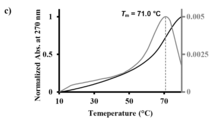
- FIG. 1C is a diagram showing the measurement results of the double chain melting temperature using compounds 5 and 7.
- FIG. 2A is a diagram showing UV-vis spectrum measurement results using the compounds 5 and 13 obtained in the examples.
- FIG. 2B is a diagram showing the results of CD spectrum measurement using compounds 5 and 13.
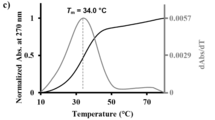
- FIG. 2C is a diagram showing the measurement results of the double chain melting temperature using the compounds 5 and 13.
- FIG. 3A is a diagram showing the results of UV-vis spectrum measurement using the compounds 5 and 6 obtained in the examples.
- FIG. 3B is a diagram showing the results of CD spectrum measurement using compounds 5 and 6.
- FIG. 3C is a diagram showing the measurement results of the double chain melting temperature using the compounds 5 and 6.
- X is an aromatic ring group
- R 1 is -OR 1a (in the formula, R 1a represents a hydrogen atom or a substituent) or a phosphoramidite group
- R 2 is a hydrogen atom or a substituent and is
- R 3 is a halogen atom or ⁇ OR 3a (in the formula, R 3a represents a hydrogen atom or a substituent).
- the aromatic ring group represented by X in the above formula (A) may be a group having an aromatic ring skeleton whose ring structure exhibits aromaticity, and may have an aromatic ring skeleton (even if it has a substituent). It may be one having only a good aromatic ring skeleton (aromatic ring skeleton (aromatic ring skeleton which may have a substituent)].
- the aromatic ring skeleton may be a single ring or a ring containing a plurality of rings (for example, a condensed ring).
- aromatic ring skeleton examples include an aromatic hydrocarbon ring skeleton and an aromatic heterocyclic ring skeleton.
- the number of ring members of these aromatic ring skeletons may be, for example, 5 to 20, preferably 5 to 15, and more preferably 6 to 14.
- aromatic hydrocarbon ring skeleton examples include benzene, naphthalene, anthracene, and tetracene.
- the aromatic heterocyclic skeleton may have an aromatic heterocyclic skeleton containing at least one heteroatom other than a carbon atom on the ring structure, and the heteroatom may be, for example, an oxygen atom. Examples include a sulfur atom and a nitrogen atom. A nitrogen atom is preferable because it facilitates the formation of hydrogen bonds.
- the aromatic heterocyclic skeleton may have one or more heteroatoms. When having two or more heteroatoms, the heteroatoms may be the same or different. When the aromatic heterocyclic skeleton contains a plurality of rings, the hetero atom may have at least one ring, and all the rings may have a hetero atom.
- aromatic heterocyclic skeleton examples include an aromatic heterocyclic skeleton containing an oxygen atom (for example, furan, benzofuran, isobenzofuran, etc.) and an aromatic heterocyclic skeleton containing a sulfur atom (for example, thiophene, benzothiophene).
- an aromatic heterocyclic skeleton containing an oxygen atom for example, furan, benzofuran, isobenzofuran, etc.
- an aromatic heterocyclic skeleton containing a sulfur atom for example, thiophene, benzothiophene
- Aromatic heterocyclic skeleton containing nitrogen atoms ⁇ eg, aromatic heterocyclic skeletons containing only nitrogen atoms (eg, pyrrole, indol, isoindole, pyridine, quinoline, isoquinolin, imidazole, benzoimidazole, pyrazole, etc.) Indazole, pyrazine, pyrimidine, pyridazine, quinoxalin, quinazoline, cinnoline, 1,2,3-triazine, 1,2,4-triazine, 1,3,5-triazine, purine, etc.), nitrogen atoms and other heteroatoms.
- nitrogen atoms and other heteroatoms eg, pyrrole, indol, isoindole, pyridine, quinoline, isoquinolin, imidazole, benzoimidazole, pyrazole, etc.
- Indazole pyrazine, pyrimidine
- Aromatic heterocyclic skeletons containing [eg, aromatic heterocyclic skeletons containing oxygen and nitrogen atoms (eg, oxazole, benzoxazole, etc.), aromatic heterocyclic skeletons containing sulfur and nitrogen atoms (eg, thiazole). , Benzothiazole, etc.), etc.], etc. ⁇ and the like.
- a pyridine skeleton, a pyrimidine skeleton, a purine skeleton, a pyrazine skeleton or a pyridazine skeleton is preferable, and a pyridine skeleton, a pyrimidine skeleton or a purine skeleton is more preferable.
- the aromatic ring skeleton may have a substituent.
- substituents include a halogen atom (for example, a fluorine atom, a chlorine atom, a bromine atom, an iodine atom, etc.), a hydroxy group, an amino group, a nitro group, a cyano group, a phosphoric acid group (-H 2 PO 3 ), and phosphorus.
- a halogen atom for example, a fluorine atom, a chlorine atom, a bromine atom, an iodine atom, etc.
- a hydroxy group for example, an amino group, a nitro group, a cyano group, a phosphoric acid group (-H 2 PO 3 ), and phosphorus.
- examples thereof include an acid ester group, an oxo group, a mercapto group (thiol group), a thioether group, a thiocarbonyl group, a sulfo
- the phosphate group which at least partially is ionized (e.g., -HPO 3 -, -PO 3 2-, etc.).
- the organic group may be a monovalent organic group or a divalent organic group.
- the substituent for example, hydroxy group, amino group, oxo group, organic group (for example, alkyl group), etc.] is a nucleic acid base as the group X (for example, adenin, guanine, amino group of cytosine, guanine, uracil, etc. It may constitute a skeleton (such as cytosine, an oxo group of timine, a methyl group of timine, etc.).
- the compound having an oxo group as a substituent may be an isomer (keto-enol isomer) of a compound having a hydroxy group as a substituent depending on the substitution position and the like. Therefore, in the present specification, the compound having an oxo group (or hydroxy group) as a substituent is assumed to contain the isomer.
- the aromatic ring skeleton may have the above substituents alone or in combination of two or more.
- the organic group is not particularly limited as long as it has at least one carbon atom, and may have a bond containing a hetero atom.
- a hetero atom include an oxygen atom, a sulfur atom, a nitrogen atom, a phosphorus atom, a silicon atom and the like.
- the bond containing the hetero atom for example, -O -, - CO -, - COO -, - S -, - NR 4 - (R 4 is a hydrogen atom or a monovalent organic group), - PR 5 - (R 5 is a hydrogen atom or a monovalent organic group), - SiR 6 R 7 - (R 6 and R 7 are hydrogen atom or a monovalent organic group).
- the bond containing the heteroatom may be present alone or in combination of two or more.
- the bond containing the heteroatom may be included in the monovalent organic group, and may be present at the bond end of the monovalent organic group, for example, and the bonds containing a plurality of heteroatoms are bonded to each other. May be adjacent to each other.
- Examples of the monovalent organic group represented by R 4 to R 7 include those similar to the monovalent organic group that the aromatic ring group represented by X may have. Be done.
- the monovalent organic group represented by R 4 to R 7 may be, for example, a monovalent organic group having 1 to 30 carbon atoms, or a monovalent organic group having 1 to 20 carbon atoms. May be good.
- organic groups include, for example, a hydrocarbon group [for example, an alkyl group (for example, a methyl group, an ethyl group, a 1-propyl group, a 2-propyl group, an n-butyl group, etc.), an alkenyl group (for example, vinyl).
- a hydrocarbon group for example, an alkyl group (for example, a methyl group, an ethyl group, a 1-propyl group, a 2-propyl group, an n-butyl group, etc.), an alkenyl group (for example, vinyl).
- alkynyl group eg, propargyl group, etc.
- cycloalkyl group eg, cyclohexyl group, etc.
- cycloalkenyl group eg, cyclobutenyl group, cyclopentenyl group, etc.
- aryl group eg, phenyl group
- Etc. e.g., Etc.
- aralkyl group eg, benzyl group, etc.
- substituted hydroxy group eg, alkoxy group (eg, methoxy group, ethoxy group, phenoxy group, etc.), silyloxy group (eg, tert-butyldimethylsilyloxy group, etc.), etc.
- Trialkylsilyloxy group, etc. alkoxysilyl group (eg, methoxysilyl group, ethoxysilyl group, triisopropylsiloxymethyl (TOM) group, etc.)], acyl group (eg, acetyl group, benzoyl group, phenoxyacetyl group, etc.) ), Formyl group, carboxy group, ester group (eg, alkoxycarbonyl group such as methoxycarbonyl group, ethoxycarbonyl group), substituted mercapto group [eg, thioalkoxy group (eg, methylthio group)], thioacyl group (eg, eg, methylthio group).
- alkoxysilyl group eg, methoxysilyl group, ethoxysilyl group, triisopropylsiloxymethyl (TOM) group, etc.
- acyl group eg, acetyl group, benzoyl
- alkylamino group eg, methylamino group, dimethylamino group, etc.
- aralkylamino group eg, benzylamino, etc.
- acylamino group eg, benzylamino group
- a substituted phosphate group for example, a phosphate ester group (for example, a group in which a hydrogen atom constituting the phosphate group is replaced with an alkyl group, etc.)
- the substituent is a protected (protected by a protecting group (leaving group)) functional group (for example, a hydroxy group, an amino group, a thio group, a phosphate group (-H 2 PO 3 ), a carboxyl group, etc.). May be good.
- the protecting group may usually be a leaving group (a group that can be removed).
- group-OC 2,2,2-trichloroacetimideyloxy group
- NH) -CCl 3 NH
- N-phenyl trifluoroacetimideyloxy group
- carbonate group or carbonate ester group, for example 2,2) , 2-Trichloroethoxydicarbonyloxy group, etc.
- Typical substituents include, for example, halogen atoms (eg, fluorine atom, chlorine atom, bromine atom, iodine atom, etc.), nitro group, cyano group, oxo group, and optionally substituted hydroxy group [eg, hydroxy group.
- halogen atoms eg, fluorine atom, chlorine atom, bromine atom, iodine atom, etc.
- nitro group eg, cyano group, oxo group
- optionally substituted hydroxy group eg, hydroxy group.
- the substitution site (substitution position with respect to the aromatic ring skeleton) of the substituent is not particularly limited and may be a carbon atom on the aromatic ring skeleton.
- the aromatic ring skeleton is an aromatic heterocyclic skeleton
- the aromatic heterocycle may be used. It may be a heteroatom on the ring skeleton (eg, a nitrogen atom, etc.) or both.
- aromatic ring skeleton or aromatic ring group
- structures represented by the following formulas (X-1) to (X-5).
- R c is a substituent independently of each other.
- R d is a hydrogen atom or a substituent and is m1 is an integer from 0 to 5 and m2 is an integer from 0 to 4 and m3 is an integer of 0 to 3.
- Examples of the substituents represented by R c and R d include the same groups as those exemplified as the substituents that the aromatic ring group (aromatic ring skeleton) represented by X may have. ..
- the R d is preferably an alkyl group having 1 to 5 carbon atoms, an amino group, or a protecting group for an amino group.
- the bonding position of the aromatic ring group is not particularly limited, and for example, the position excluding one hydrogen atom constituting the aromatic ring group (aromatic ring group or aromatic). Any carbon atom or the like constituting the ring skeleton may be used.
- the aromatic ring group the pyridine skeleton, the pyrimidine skeleton and the purine skeleton have the following formulas (X-1-1) to (X-1-2), (X-2-1) to (X-2-4). ), (X-3-1) to (X-3-2) may be the structure (skeleton, group).
- R c and R d are synonymous with the above formulas (X-1) to (X-3).
- Re and R f are hydrogen atoms or substituents and are m4 is an integer from 0 to 4 and m5 is an integer from 0 to 3 and m6 and m7 are independently integers of 0 to 2.
- the substituents represented by Re and R f are the same as the monovalent groups among the groups exemplified as the substituents that the aromatic ring group (aromatic ring skeleton) represented by X may have. Can be mentioned.
- the bond position (substitution or bond position with respect to the acetylene group, -C ⁇ C-) of the aromatic ring group is not particularly limited, and for example, constitutes a ring of the aromatic ring skeleton. It may be either a carbon atom, a hetero atom constituting the ring of the aromatic heterocyclic skeleton among the aromatic ring skeletons, or a substituent having the aromatic ring skeleton, but typically constitutes the ring of the aromatic ring skeleton.
- the carbon atoms or the aromatic ring skeleton may be a hetero atom constituting the ring of the aromatic heterocyclic skeleton, particularly a carbon atom constituting the ring of the aromatic ring skeleton.
- the aromatic ring skeleton is a pyridine skeleton, it is preferably bonded at the carbon atom at the 3- or 5-position of the skeleton, and is bonded at the carbon atom at the 5-position of the skeleton. Is more preferable.
- the aromatic ring skeleton is a pyrimidine skeleton, it is preferably bonded at the carbon atom at the 5-position of the skeleton.
- Examples of the aromatic ring group represented by X include an aromatic heterocyclic skeleton containing a nitrogen atom (an aromatic heterocyclic skeleton in which the nitrogen atom is a heteroatom constituting the ring of the aromatic ring skeleton).
- an aromatic heterocyclic skeleton in which the nitrogen atom is a heteroatom constituting the ring of the aromatic ring skeleton.
- a pyridine skeleton pyridine skeleton which may have a substituent
- pyrimidine skeleton pyrimidine skeleton which may have a substituent
- purine skeleton purine skeleton which may have a substituent
- Pyrazine skeleton (pyrazine skeleton which may have a substituent) or pyridazine skeleton (pyridazine skeleton which may have a substituent), and pyridine skeleton, pyrimidine skeleton or purine skeleton is preferable.
- Examples of the substituent represented by R 1a include the same groups as those exemplified as the substituents that the aromatic ring group represented by X may have.
- a group having at least one phosphoric acid group for example, monophosphoric acid, diphosphoric acid, triphosphate, etc. is preferable.
- the R 1 is preferably a hydroxy group or a phosphoramidite group.
- Examples of the halogen atom represented by R 3 include a fluorine atom, a chlorine atom, a bromine atom, and an iodine atom.
- substituents represented by R 2 and R 3a include the same groups as those exemplified as the substituents that the aromatic ring group represented by X may have.
- the substituents represented by R 2 and R 3a may be the same or different.
- the substituent represented by R 2 and R 3a is preferably a protecting group of a hydroxy group bonded to the 2-position and / or 5-position of the sugar skeleton, and the protecting group of the hydroxy group is unnecessary. When it becomes, it is preferable that it is a group that can be deprotected.
- hydroxy group protective group examples include an acyl group (for example, an acetyl group, a benzoyl group, etc.), an aralkyl group (for example, a benzyl group, etc.), a trialkylsilyl group (for example, a trimethylsilyl group, a triethylsilyl group, a TBS group, etc.). ), A group having a trityl group and the like.
- Examples of the substituent (protective group) represented by R 2 and R 3a include a trityl group and a silyl group (for example, a trimethylsilyl group, a triethylsilyl group and a tert-butyldimethylsilyl) which may have a substituent. (TBS) group, etc.), acyl group (eg, acetyl group, benzoyl group, phenoxyacetyl group, etc.), alkoxysilyl group (eg, methoxysilyl group, ethoxysilyl group, triisopropylsiloxymethyl (TOM) group, etc.), etc. Can be mentioned.
- R 2 As the substituent (protecting group) represented by R 2 , a trityl group which may have a substituent is preferable.
- an alkoxy group having 1 to 5 carbon atoms is preferable, and a methoxy group is more preferable.
- R 3a As the substituent (protecting group) represented by R 3a , a silyl group and an alkoxysilyl group are preferable, and a TBS group and a TOM group are more preferable.
- the phosphoramidite group has a structure represented by the following formula (I).
- R 1b , R 1c and R 1d are independently hydrogen atoms or substituents. * Indicates the binding site with the sugar skeleton in the above formula (A). )
- R 1b , R 1c and R 1d examples include the same groups as those exemplified as the substituent that X of the above formula (A) may have.
- the R 1b is preferably a protecting group for the hydroxy group of phosphoric acid, and the protecting group is preferably a group that can be deprotected when it is no longer needed.
- R 1b As the substituent (protecting group) represented by R 1b , a hydrocarbon group having 1 to 5 carbon atoms substituted with a cyano group is preferable.
- a hydrocarbon group having 1 to 10 carbon atoms which may be substituted is preferable, and a hydrocarbon group having 1 to 5 carbon atoms which may be substituted is more preferable.
- an alkyl group having 1 to 5 carbon atoms which may be substituted is more preferable, and a 2-propyl group is particularly preferable.
- the compound represented by the above formula (A) can be prepared, for example, using the compound represented by the following formula (II) as a raw material.
- the compound represented by the following formula (II) a commercially available product may be used as long as it is available, or a synthesized (manufactured) compound may be used.
- R 1 ' is -OR 1a' (wherein, R 1a 'is a hydrogen atom or a substituent.) Or a phosphoramidite group, R 2a is a hydrogen atom or a substituent and is R 3 'is a halogen atom or -OR 3a' (wherein, R 3a 'is a hydrogen atom or a substituent.) It is. ]
- the ratio of the compound represented by the following formula (III) to be used is, for example, 0.3 mol or more (for example, 0.4 to 0.4 to 1 mol) of the compound represented by the above formula (II). It may be 10 mol) or more, preferably 0.5 mol or more (for example, 0.6 to 5 mol), and more preferably 0.6 mol or more (for example, 0.7 to 3 mol).
- the coupling reaction may be carried out in the presence of a catalyst.
- a catalyst include palladium (for example, palladium chloride (PdCl 2 ), dichlorobis (triphenylphosphine) palladium (II) (PdCl 2 (PPh 3 ) 2 ), palladium acetate (Pd (OAc) 2 ), tetrakis (triphenyl).
- the catalyst may be used alone or in combination of two or more. As the catalyst, palladium, copper and a combination thereof are preferable, and a combination of palladium and copper is more preferable.
- the coupling reaction may be carried out in the presence of a base.
- a base examples include amines (eg, methylamine, dimethylamine, trimethylamine, ethylamine, diethylamine, triethylamine, etc.), carbonates (eg, alkali metal carbonates such as sodium carbonate, potassium carbonate, cesium carbonate, etc.), silver oxide, and the like.
- amines eg, methylamine, dimethylamine, trimethylamine, ethylamine, diethylamine, triethylamine, etc.
- carbonates eg, alkali metal carbonates such as sodium carbonate, potassium carbonate, cesium carbonate, etc.
- silver oxide and the like.
- pyridines pyridine, picolin, etc.
- the above bases may be used alone or in combination of two or more.
- amine is preferable, and diethylamine and triethylamine are more preferable from the viewpoint that they can also be used as a solvent
- the coupling reaction may be carried out in a solvent.
- the solvent is not particularly limited as long as it does not inhibit the coupling reaction, and is, for example, hydrocarbons [for example, aliphatic hydrocarbons (for example, hexane, heptane, cyclohexane, etc.), aromatic hydrocarbons (for example, for example).
- Benzene, toluene, xylene, etc.] halogenated hydrocarbons eg, methylene chloride, dichloromethane, chloroform, etc.
- ethers eg, chain ethers (eg, diethyl ether, etc.), cyclic ethers (eg, eg, diethyl ether, etc.) , Tetrahydrofuran, dioxane, etc.], esters (eg, ethyl acetate, etc.), amides [eg, N-substituted amides (N-alkylalkaneamides, such as N, N-dimethylformamide), etc.], alcohols (eg, N-alkylalkaneamides, etc.) , Alkanels such as methanol, ethanol and isopropanol), aprotonic polar solvents (eg, acetonitrile, acetone and the like) and the like.
- the reaction may be carried out at room temperature (or room temperature), cooling, or heating. Further, the reaction may be carried out in air or in an inert atmosphere (noble gas such as nitrogen or argon).
- the reaction time is not particularly limited, but is, for example, 1 minute or more (for example, 2 minutes to 48 hours), preferably 3 minutes or more (for example, 4 minutes or more to 24 hours), and more preferably 5 minutes or more (for example, 10 minutes). It may be about minutes to 12 hours).
- the progress of the reaction may be confirmed by using a conventional method such as thin layer chromatography (TLC).
- aromatic ring group represented by X' the same group as the aromatic ring group represented by X in the above formula (A) can be mentioned.
- a halogen atom is preferable because it is easy to adjust the binding site in X.
- the compound represented by the above formula (III) is not particularly limited as long as the above A is a group that can be eliminated during the coupling reaction, and the convenience of preparing the compound represented by the above formula (III) or It can be appropriately set from the viewpoint of detachability.
- the bond site is preferably bonded to a carbon atom constituting the aromatic ring skeleton in the aromatic ring group represented by X', and in particular, when the aromatic ring group is a pyridine ring group or a pyrimidine ring group. , It is preferable that it is bonded to the carbon atom at the 5-position of these aromatic ring skeletons.
- the compound represented by the above formula (IV) can be obtained.
- the reaction mixture (mixture containing the compound represented by the formula (IV)) may be subjected to the reaction described later as it is without separation (or recovery), or may be separated (or recovered).
- the above formula (A) is carried out by yet another reaction (for example, deprotection reaction, phosphoramidite conversion reaction, etc.).
- the compound represented by may be prepared.
- the deprotection reaction is not particularly limited as long as it can deprotect the substituents at the 2-position and / or the 6-position of the sugar skeleton of the compound represented by the above formula (IV).
- the 2- and 6-position substituents of the sugar skeleton may be deprotected in a single reaction, and one of the substituents may be removed. After protection, the remaining substituents may be deprotected.
- the aromatic ring group represented by X in the above formula (A) has a substituent (protecting group of amino group)
- the above substituent (protecting group of amino group) is further deprotected. It may have a reaction to the effect.
- the compound represented by the following formula (V) is prepared by deprotecting the substituents at the 2- and / or 6-positions of the sugar skeleton of the compound represented by the above formula (IV). ..
- the aromatic ring group represented by X has a substituent (protecting group)
- the compound represented by the following formula (V) can be obtained by further deprotecting the substituent (protecting group). It may be prepared.
- R 3b is a halogen atom or a hydroxy group.
- the deprotection reaction can be carried out using acid and / or fluoride ions (or by reacting with acid and / or fluoride ions).
- Acids include organic acids [eg, carboxylic acids (eg acetic acid, citric acid, oxalic acid, tartaric acid, trichloroacetic acid, trifluoroacetic acid, etc.)], inorganic acids [eg, hydrogen halide (eg, hydrochloric acid, hydrogen fluoride). Acids, etc.), sulfuric acid, nitric acid, phosphoric acid, chromium acid, boric acid, sulfonic acid, etc.] and the like.
- the acid may be used alone or in combination of two or more.
- a carboxylic acid is preferable, and trichloroacetic acid or trifluoroacetic acid is more preferable.
- fluoride ion examples include tetra-n-butylammonium fluoride (TBAF), hydrofluoric acid, cesium fluoride and the like. Fluoride ions may be used alone or in combination of two or more. In particular, TBAF is preferable as the fluoride ion.
- TBAF tetra-n-butylammonium fluoride
- the deprotection reaction is carried out using (or reacting with) a base. Can be done.
- the base examples include a base having a small degree of ionization (weak base) such as ammonia, a base having a large degree of ionization (strong base) such as sodium hydroxide, calcium hydroxide and barium hydroxide.
- the bases may be used alone or in combination of two or more.
- a base having a small degree of ionization (weak base) is preferable, and ammonia (ammonia water) is more preferable.
- the deprotection reaction may be carried out in a solvent.
- the solvent is not particularly limited as long as it does not inhibit the deprotection reaction, and examples thereof include the same solvents as those exemplified in the coupling reaction.
- the reaction may be carried out at room temperature (or room temperature), cooling, or heating. Further, the reaction may be carried out in air or in an inert atmosphere (noble gas such as nitrogen or argon).
- the reaction time is not particularly limited, but is, for example, 1 minute or more (for example, 2 minutes to 48 hours), preferably 3 minutes or more (for example, 4 minutes or more to 24 hours), and more preferably 5 minutes or more (for example, 10 minutes). It may be about minutes to 12 hours).
- the progress of the reaction may be confirmed by using a conventional method such as thin layer chromatography (TLC).
- the reaction mixture (mixture containing the compound represented by the formula (IV)) may be subjected to another deprotection reaction as it is without separation (or recovery).
- Conventional methods eg, filtration, extraction, concentration, washing, adsorption, membrane separation, chromatography, etc.
- separation or purification
- the phosphoramidite-forming reaction is not particularly limited as long as it can phosphoramidite the hydroxy group at the 3-position of the sugar skeleton of the compound represented by the above formula (IV).
- a compound represented by the following formula (VI) is prepared by reacting a compound represented by the above formula (IV) with a phosphoramidite agent.
- the phosphoramidite agent is not particularly limited as long as it can change the hydroxy group at the 2-position of the sugar skeleton of the compound represented by the above formula (IV) to a phosphoramidite group.
- Examples of the phosphoramidite agent include compounds in which a cyanoethoxy group and a dialkylamino group are bonded (for example, i-Pr 2 NP (Cl) O (CH 2 ) 2 CN, etc.).
- the ratio of the phosphoramidite agent used is preferably 0.8 mol or more (for example, 1 to 10 mol) with respect to 1 mol of the compound represented by the above formula (IV). May be 1 mol or more (for example, 1.2 to 7 mol), more preferably 1.5 mol or more (for example, 1.6 to 5 mol).
- the phosphoramidite formation reaction may be carried out in a solvent.
- the solvent is not particularly limited as long as it does not inhibit the phosphoramidite formation reaction, and examples thereof include the same solvents as those exemplified in the coupling reaction.
- the reaction may be carried out at room temperature (or room temperature), cooling, or heating. Further, the reaction may be carried out in air or in an inert atmosphere (noble gas such as nitrogen or argon).
- the reaction time is not particularly limited, but is, for example, 1 minute or more (for example, 2 minutes to 48 hours), preferably 3 minutes or more (for example, 4 minutes or more to 24 hours), and more preferably 5 minutes or more (for example, 10 minutes). It may be about minutes to 12 hours).
- the progress of the reaction may be confirmed by using a conventional method such as thin layer chromatography (TLC).
- the reaction mixture (mixture containing the compound represented by the formula (IV)) may be subjected to another deprotection reaction as it is without separation (or recovery).
- Conventional methods eg, filtration, extraction, concentration, washing, adsorption, membrane separation, chromatography, etc.
- separation or purification
- the compound represented by the above formula (VI) obtained by the phosphoramidite reaction may be a mixture containing optical isomers (for example, diastereomers, enantiomers, etc.). Even in such a mixture, the asymmetric atom is eliminated when a polymer is formed via a phosphodiester bond.
- ⁇ Polymer> Another aspect of the present invention includes a polymer of the above compounds.
- the polymer may be a polymer containing a plurality of compounds represented by the above formula (A) as a polymerization component, and examples of the bonds between the polymerization components include phosphodiester bonds and phosphorothioate bonds. .. Further, the polymer may be one capable of forming a base pair with nucleic acid.
- the "nucleic acid” may be a naturally occurring DNA or RNA in a living body or the like, or may be an artificially synthesized natural nucleic acid such as a naturally occurring DNA or RNA. As long as it is a nucleic acid-like substance having a structure capable of forming a base pair with a naturally occurring nucleic acid, the above-mentioned nucleic acid-like substance may be artificially synthesized.
- the polymer has a high affinity for natural nucleic acids is not limited to the following speculation, but the sugar skeleton in the above formula (A) and the specific structure represented by X are carbon. -By being linked via a carbon triple bond, the conformation of the acetylene group (-C ⁇ C-) and the sugar skeleton is similar to the conformation of sugar in natural nucleic acids (particularly natural DNA). Therefore, it is presumed that the affinity (the force of interaction) with the natural nucleic acid (particularly, the natural DNA) is high.
- Examples of such a polymer include those having a structural unit represented by the following formula (B).
- X is an aromatic ring group
- A is an oxygen atom or a sulfur atom
- R a is -OR b (R b indicates a hydrogen atom or a substituent).
- R 3 is a halogen atom or ⁇ OR 3a (in the formula, R 3a represents a hydrogen atom or a substituent).
- n is 2 or more.
- a plurality of X, R a and R 3 may be be the same or different.
- aromatic ring group examples include those similar to X in the above formula (A).
- the above A is preferably an oxygen atom from the viewpoint of structural unity. Further, the above-mentioned A is preferably a sulfur atom from the viewpoint of excellent resistance to RNA nuclease.
- the -OR b is what is ionized - may be a (-O).
- Examples of the substituent represented by R b include the groups exemplified as the substituent represented by R 1a in the above formula (A).
- n is preferably 10 or more, more preferably 15 or more, and even more preferably 20 or more from the viewpoint of forming a double helix structure.
- the upper limit of n is not particularly limited, but may be 100, for example.
- the method for forming the polymer from the compound represented by the above formula (A) is not particularly limited as long as the compound represented by the above formula (A) can form a crosslinked structure, and is a nucleic acid synthesis method.
- a known method for example, a phosphoramidite method, a synthetic method via phosphorochloridate, a phosphite triester method, etc. may be used. From the viewpoint of enhancing reactivity, those using the phosphoramidite method are preferable.
- the phosphoramidite method may be a solid phase synthesis or a liquid phase synthesis. From the viewpoint of enhancing reactivity, it is preferable to carry out solid phase synthesis.
- solid-phase synthesis it is preferable to use a solid-phase carrier from the viewpoint of simplification of washing operations and the like.
- Solid-phase synthesis by the phosphoramidite method can be performed by, for example, the following steps.
- the solid-phase synthesis by the phosphoramidite method may be performed manually or by using an apparatus for automatic synthesis under computer control.
- a step of introducing a compound into a solid phase carrier (2) a step of deprotecting a substituent (protecting group) at the 5'position of the sugar skeleton, (3) a cup at the hydroxy group at the 5'position and the 3'position. It includes a ringing step, (4) a step of capping the hydroxy group at the 5'position of the unreacted sugar skeleton, (5) a step of oxidizing or sulfurizing, and (6) a step of deprotecting and cutting out from the solid phase carrier.
- Step of introducing the compound into the solid phase carrier (1) In the step of introducing the compound into the solid phase carrier, the compound represented by the formula (A) located on the 3'side is introduced into the solid phase carrier.
- the solid-phase carrier can be appropriately changed depending on the arrangement of the polymer to be prepared, the degree of polymerization, the concentration of the compound represented by the above formula (A) to be used, and the like.
- the above step (2) can be performed in the same manner as the above deprotection reaction.
- the above step (3) may be carried out in the presence of an activator.
- the activator include compounds having a tetrazole ring (for example, 1H-tetrazole, 2-ethylthiotetrazole, 2-benzylthiotetrazole, etc.).
- the ratio of the compound to be bonded to 1 mol of the compound (or polymer) bonded to the solid phase carrier is not particularly limited as long as the reaction proceeds sufficiently, and is, for example, 1.5. It may be up to 100 mol, preferably 2 to 80 mol, more preferably 3 to 50 mol.
- the ratio of the activator to 1 mol of the compound (or polymer) bonded to the solid phase carrier is not particularly limited as long as the reaction proceeds sufficiently, and is, for example, 0.5 to 0.5. It may be 30 mol, preferably 0.8 to 25 mol, more preferably 1 to 20 mol.
- Step of capping the hydroxy group at the 5'position of the unreacted sugar skeleton is the sugar skeleton of the unreacted compound (or polymer) among the compounds (or polymers) bonded to the solid phase carrier. Anything can be used as long as it can cap the hydroxy group at the 5'position of the above so that the polymer does not extend any more.
- the reaction may be carried out in the presence of an acylating agent.
- the acylating agent may be any as long as it can acylate the hydroxy group at the 5'position of the sugar skeleton in the unreacted compound (or polymer), and for example, acyl halide (for example, acetyl chloride), etc. Examples thereof include carboxylic acid anhydrides (for example, acetic anhydride, propionic anhydride, etc.).
- Step of oxidizing or sulfurizing is a step of converting the phosphite ester bond formed in the above step (3) into a phosphate ester by oxidation or a thiophosphate ester bond by sulphurizing.
- the reaction may be carried out in the presence of an oxidizing agent or a sulfurizing agent.
- the oxidizing agent is not particularly limited as long as it can convert a phosphite bond into a phosphate ester bond, and is, for example, halogen (for example, chlorine (Cl 2 ), fluorine (F 2 ), iodine). (I 2 ), etc.) and the like.
- halogen for example, chlorine (Cl 2 ), fluorine (F 2 ), iodine). (I 2 ), etc.
- the sulfide agent is not particularly limited as long as it can convert a phosphite ester bond into a thiophosphate ester bond, and is, for example, ((dimethylaminomethylidene) amino) -3H-1,2,4. - dithiazoline-3-thione (DTTT), 5-phenyl-3H-1,2,4-dithiazole-3-one, molecular sulfur (S 8), phenylacetyl disulfide, Beaucage reagent and the like.
- DTTT dithiazoline-3-thione
- S 8 molecular sulfur
- S 8 phenylacetyl disulfide
- Beaucage reagent Beaucage reagent and the like.
- the above steps (2) to (5) can be repeated until a polymer having a desired degree of polymerization is obtained.
- sulfurization is carried out in the above step (5), the above steps (4) and the above (5) may be interchanged to carry out the reaction.
- step (6) can be performed in the same manner as the above deprotection reaction, for example.
- all the protecting groups may be deprotected in the step (6), or some protecting groups may remain.
- the base pair may be any one as long as at least one of the double strands constituting the base pair is the polymer in the present invention, and the other of the double strands is a natural nucleic acid such as DNA or RNA that may exist in nature. , It may be a nucleic acid such as an artificially synthesized nucleic acid-like substance, or it may be a polymer in the present invention.
- the above base pair may have a double chain formed over the entire length, or a double chain may be formed in a part of the entire length.
- the polymer of at least one of the double chains in the base pair may have, for example, 50% or more, preferably 60% or more, and 70% or more, as complementarity to the other of the double chains. It is more preferable to have, more preferably 80% or more, and particularly preferably 90% or more.
- the upper limit of the complementarity is, for example, 100%.
- Complementarity means that one polymer of a double chain and the other of the double chains have at least two hydrogen bond modes (relationship between a hydrogen bond donor (D) and an acceptor (A)) per base. Those having a complementary relationship. It may have two hydrogen bonds per base, or it may have three hydrogen bonds.
- the hydrogen bonding modes of the commonly known nucleobases adenine, guanine, cytosine, thymine, and uracil are DA, DDA, AAD, AD, and AD, respectively, and the other of the double chains is a natural nucleic acid. If this is the case, it suffices to have complementarity to these hydrogen bond modes so that two or more hydrogen bonds can be formed per base.
- the other of the double chains is an artificially synthesized nucleic acid-like substance and has a hydrogen bonding mode (for example, DAD, ADA, etc.) that does not exist in nature, the weight of one of the double chains is heavy.
- the coalescence may have a complementary hydrogen bond mode.
- the polymer of at least one of the double chains in the above base pair has a hydrophobic property that can form a hydrophobic interaction with the other of the double chains.
- one polymer of the double chain may be a single polymer forming a base pair.
- the base pair When the other of the double chains is a natural nucleic acid, the base pair preferably has a higher double chain melting temperature (Tm value) than the base pair formed by the natural nucleic acids. ..
- Tm value double chain melting temperature
- the base pair when a base pair is formed between nucleic acids having the same length, the Tm value of the base pair formed by the natural DNA and the polymer is higher than that of the base pair formed by the natural DNAs. Is preferable.
- the base pair When the other of the double chains is a natural nucleic acid, the base pair preferably has a higher Tm value than the base pair formed by the polymers.
- the base pair formed by natural DNA and the polymer is compared with the base pair formed by the polymers because it is easy to handle. It is preferable that the T m value of is high.
- the T m value can be measured by, for example, a conventional method.
- the measurement can be performed under the following measurement conditions.
- Measurement conditions A 1: 1 buffer solution of artificial or natural nucleic acid oligomer (2 ⁇ M duplexes, 10 mM HEPES (pH 7.0), 10 mM MgCl 2 , 100 mM NaCl) was prepared, and a double chain melting experiment was performed while monitoring the absorbance at 270 nm. (Temperature range: 10 to 80 ° C., temperature change: 1 ° C./1 minute).
- Equipment used V-560 UV / vis spectrophotometer (manufactured by JASCO Corporation)
- the T m value may be appropriately calculated according to conditions such as the length of the nucleic acid, the base sequence, and the measurement solution.
- T m values base pairs having the above natural DNA and polymer, and T m values having base pairs of the native DNA with each other, the measurement conditions (the length of the nucleic acid, the hydrogen bonding pattern of the base sequence, the sample solution and the like) when performing a measurement in the same, for example, preferably T m values having base pairs of the native DNA and the polymer is higher, the difference between the two in T m values, even 10 ° C. or higher It is often preferably 15 ° C. or higher, and more preferably 20 ° C. or higher.
- the upper limit of the difference between the T m values of the above two base pairs is not particularly limited, but may be, for example, 50 ° C. or lower, preferably 45 ° C. or lower.
- the above base pair may form a double helix structure.
- the fact that the base pairs form a double helix structure can be confirmed by a conventional method such as circular dichroism (CD) spectrum measurement.
- the measurement can be performed under the following measurement conditions. Measurement conditions: Prepare a 1: 1 buffer solution of artificial or natural nucleic acid oligomer (2 ⁇ M duplexes, 10 mM HEPES (pH 7.0), 10 mM MgCl 2 , 100 mM NaCl), and prepare 10, 20, 30, 40, 50, 60, 70. , 80 ° C. for circular dichroism (CD) spectrum measurements.
- Equipment used J-720WI spectroscopy (manufactured by JASCO Corporation)
- nucleic acid detection material containing the above polymer.
- nucleic acid medicine includes a nucleic acid drug containing the polymer or base pair.
- DMTr represents a dimethoxytrityl group.
- TBS represents a tert-butyldimethylsilyl group.
- i-Pr 2 represents a diisopropyl group.
- Example 1 1 buffer solution of Compound 5 and Compound 7 (2 ⁇ M duplexes, 10 mM HEPES (pH 7.0), 10 mM MgCl 2 , 100 mM NaCl) was prepared. The results of UV-vis spectrum measurement of the solution at 10 ° C. and 80 ° C. are shown in FIG. 1A.
- a V-560 UV / vis spectrophotometer manufactured by JASCO Corporation was used for the measurement of the UV-vis spectrum measurement. According to FIG. 1A, temperature-dependent and irreversible dark color effect and light color effect could be observed as in the case of natural nucleic acid.
- FIG. 1B results of circular dichroism (CD) spectrum measurements at 10, 20, 30, 40, 50, 60, 70, and 80 ° C. using the J-720WI spectrum spectrometer (manufactured by JASCO Corporation) are shown in FIG. 1B. Indicated. Further, the melting temperature curve was measured by monitoring the change in absorbance at 270 nm when the temperature was raised from 10 ° C. to 1.0 ° C. per minute. A V-560 UV / vis spectrophotometer (manufactured by JASCO Corporation) was used for the measurement of the melting temperature curve. The double chain melting temperature (Tm value) was calculated from the maximum value obtained by first-derivating the melting temperature curve, and the result is shown in FIG. 1C. The T m value was 71.0 ° C.
- Example 2 The results of UV-vis spectrum measurement are shown in FIG. 2A and the results of CD spectrum measurement are shown in FIG. 2B in the same manner as in Example 1 except that compound 7 was changed to compound 13. Also, except for changing the compound 7 to compound 13, in the same manner as in Example, the results of the measurement of the melting temperature curve shown in FIG. 2C, was subjected to calculation in T m value, T m value It was 34.0 ° C.
- Example 3 The results of UV-vis spectrum measurement are shown in FIG. 3A and the results of CD spectrum measurement are shown in FIG. 3B in the same manner as in Example 1 except that compound 7 was changed to compound 6. Also, except for changing the compound 7 to compound 6, in the same manner as in Example, the results of the measurement of the melting temperature curve shown in FIG. 3C, was subjected to calculation in T m value, T m value It was 55.0 ° C.
- the polymer according to the present invention Since the polymer according to the present invention has an excellent affinity with natural DNA, even when the natural DNA forms a double chain, it forms a complementary hydrogen bond with one of the natural DNAs. It can form a base pair specifically with the polymer. For example, if it can be specifically bound to natural DNA or natural RNA related to a disease, it is expected to be applied to nucleic acid drugs such as antigene, antisense, and diagnostic agents.
- the polymer according to the present invention can form a base pair with the polymer according to the present invention or other artificially synthesized nucleic acid.
- the base pair interaction is particularly excellent in thermal stability when it is a base pair of the polymer and natural nucleic acid (natural DNA) according to the present invention.
- PNA Peptide Nucleic Acid
- LNA Locked Nucleic Acid
- BNA Bridged Nucleic Acid
Landscapes
- Chemical & Material Sciences (AREA)
- Organic Chemistry (AREA)
- Health & Medical Sciences (AREA)
- Life Sciences & Earth Sciences (AREA)
- Biochemistry (AREA)
- General Health & Medical Sciences (AREA)
- Molecular Biology (AREA)
- Saccharide Compounds (AREA)
Priority Applications (1)
| Application Number | Priority Date | Filing Date | Title |
|---|---|---|---|
| JP2022505151A JPWO2021177123A1 (https=) | 2020-03-03 | 2021-02-25 |
Applications Claiming Priority (2)
| Application Number | Priority Date | Filing Date | Title |
|---|---|---|---|
| JP2020-036320 | 2020-03-03 | ||
| JP2020036320 | 2020-03-03 |
Publications (1)
| Publication Number | Publication Date |
|---|---|
| WO2021177123A1 true WO2021177123A1 (ja) | 2021-09-10 |
Family
ID=77614260
Family Applications (1)
| Application Number | Title | Priority Date | Filing Date |
|---|---|---|---|
| PCT/JP2021/006992 Ceased WO2021177123A1 (ja) | 2020-03-03 | 2021-02-25 | 人工核酸 |
Country Status (2)
| Country | Link |
|---|---|
| JP (1) | JPWO2021177123A1 (https=) |
| WO (1) | WO2021177123A1 (https=) |
Citations (3)
| Publication number | Priority date | Publication date | Assignee | Title |
|---|---|---|---|---|
| CN101200467A (zh) * | 2006-12-15 | 2008-06-18 | 徐州师范大学 | 一种链霉菌产生的新化合物及其制备方法 |
| WO2017104836A1 (ja) * | 2015-12-16 | 2017-06-22 | 味の素株式会社 | オリゴヌクレオチドの製造方法、およびヌクレオシド、ヌクレオチドまたはオリゴヌクレオチド |
| WO2019079261A1 (en) * | 2017-10-16 | 2019-04-25 | Bristol-Myers Squibb Company | CYCLIC DINUCLEOTIDES AS ANTICANCER AGENTS |
-
2021
- 2021-02-25 JP JP2022505151A patent/JPWO2021177123A1/ja active Pending
- 2021-02-25 WO PCT/JP2021/006992 patent/WO2021177123A1/ja not_active Ceased
Patent Citations (3)
| Publication number | Priority date | Publication date | Assignee | Title |
|---|---|---|---|---|
| CN101200467A (zh) * | 2006-12-15 | 2008-06-18 | 徐州师范大学 | 一种链霉菌产生的新化合物及其制备方法 |
| WO2017104836A1 (ja) * | 2015-12-16 | 2017-06-22 | 味の素株式会社 | オリゴヌクレオチドの製造方法、およびヌクレオシド、ヌクレオチドまたはオリゴヌクレオチド |
| WO2019079261A1 (en) * | 2017-10-16 | 2019-04-25 | Bristol-Myers Squibb Company | CYCLIC DINUCLEOTIDES AS ANTICANCER AGENTS |
Non-Patent Citations (1)
| Title |
|---|
| DOI YASUHIRO, CHIBA JUNYA, MORIKAWA TOMOYUKI, INOUYE MASAHIKO: "Artificial DNA Made Exclusively of Nonnatural C-Nucleosides with Four Types of Nonnatural Bases.", JOURNAL OF THE AMERICAN CHEMICAL SOCIETY, vol. 130, no. 27, 2008, pages 8762 - 8768, XP055852701, DOI: 10.1021/ja801058h * |
Also Published As
| Publication number | Publication date |
|---|---|
| JPWO2021177123A1 (https=) | 2021-09-10 |
Similar Documents
| Publication | Publication Date | Title |
|---|---|---|
| CN112533892B (zh) | 烷氧基苯基衍生物、核苷保护体和核苷酸保护体、寡核苷酸制造方法以及取代基除去方法 | |
| CN101048423B (zh) | 亚磷酰胺化合物及低聚核糖核酸的制备方法 | |
| US5719273A (en) | Palladium catalyzed nucleoside modifications methods using nucleophiles and carbon monoxide | |
| JP6673211B2 (ja) | モルフォリノオリゴヌクレオチドの製造方法 | |
| EP1995253B1 (en) | Method for detaching protecting group on nucleic acid | |
| JP2003238586A (ja) | 立体規則性の高いジヌクレオシドホスホロチオエートの製造法 | |
| TW202115097A (zh) | 核酸化合物的製造方法及核酸化合物 | |
| Hari et al. | Synthesis and properties of thymidines with six-membered amide bridge | |
| JP7045669B2 (ja) | リボ核酸h-ホスホネートモノマーの合成方法および本モノマーを用いたオリゴヌクレオチド合成 | |
| WO2021177123A1 (ja) | 人工核酸 | |
| JP7298866B2 (ja) | 核酸合成用固相担体及びそれを用いた核酸の製造方法 | |
| JP2013531665A (ja) | オリゴヌクレオチド合成のためにn−チオ化合物を用いる新規な方法 | |
| EP2053054B1 (en) | Method for introducing nucleic-acid-protecting group | |
| KR100474629B1 (ko) | 5′―보호된 티미딘의 정제 방법 및 그의 신규 유도체 | |
| CN115038790A (zh) | 3’-rna寡核苷酸的合成 | |
| JP4424900B2 (ja) | 5’−o−置換チミジンの精製法 | |
| JPWO2010079813A1 (ja) | イノシン誘導体の製造方法 | |
| JP7776154B2 (ja) | ホスホロチオエート及びボラノホスフェートを含むキメラ型核酸オリゴマー、及びその製造方法 | |
| JP2013159574A (ja) | デアザプリンヌクレオシド誘導体、デアザプリンヌクレオチド誘導体及びポリヌクレオチド誘導体 | |
| JP2009256335A (ja) | 2’位にアルキル型保護基を有するリボ核酸の製造法 | |
| Seio et al. | Short-RNA selective binding of oligonucleotides modified using adenosine and guanosine derivatives that possess cyclohexyl phosphates as substituents | |
| JP4071991B2 (ja) | 5’−保護化チミジン類の精製法と新規誘導体 | |
| JPWO2009107692A1 (ja) | 2’−水酸基が保護されたリボヌクレオシド誘導体およびその製造方法 | |
| JP2021020883A (ja) | 光応答性ヌクレオチドアナログ | |
| JP2003073395A (ja) | N−アシル化プリンヌクレオシド誘導体の単離精製法 |
Legal Events
| Date | Code | Title | Description |
|---|---|---|---|
| 121 | Ep: the epo has been informed by wipo that ep was designated in this application |
Ref document number: 21764601 Country of ref document: EP Kind code of ref document: A1 |
|
| ENP | Entry into the national phase |
Ref document number: 2022505151 Country of ref document: JP Kind code of ref document: A |
|
| NENP | Non-entry into the national phase |
Ref country code: DE |
|
| 122 | Ep: pct application non-entry in european phase |
Ref document number: 21764601 Country of ref document: EP Kind code of ref document: A1 |