WO2021166287A1 - 車両運用支援装置、及び車両運用支援方法 - Google Patents
車両運用支援装置、及び車両運用支援方法 Download PDFInfo
- Publication number
- WO2021166287A1 WO2021166287A1 PCT/JP2020/032181 JP2020032181W WO2021166287A1 WO 2021166287 A1 WO2021166287 A1 WO 2021166287A1 JP 2020032181 W JP2020032181 W JP 2020032181W WO 2021166287 A1 WO2021166287 A1 WO 2021166287A1
- Authority
- WO
- WIPO (PCT)
- Prior art keywords
- information
- evaluation
- vehicle operation
- similarity
- support device
- Prior art date
- Legal status (The legal status is an assumption and is not a legal conclusion. Google has not performed a legal analysis and makes no representation as to the accuracy of the status listed.)
- Ceased
Links
Images


Classifications
-
- G—PHYSICS
- G01—MEASURING; TESTING
- G01C—MEASURING DISTANCES, LEVELS OR BEARINGS; SURVEYING; NAVIGATION; GYROSCOPIC INSTRUMENTS; PHOTOGRAMMETRY OR VIDEOGRAMMETRY
- G01C21/00—Navigation; Navigational instruments not provided for in groups G01C1/00 - G01C19/00
- G01C21/26—Navigation; Navigational instruments not provided for in groups G01C1/00 - G01C19/00 specially adapted for navigation in a road network
- G01C21/34—Route searching; Route guidance
- G01C21/3453—Special cost functions, i.e. other than distance or default speed limit of road segments
-
- G—PHYSICS
- G01—MEASURING; TESTING
- G01C—MEASURING DISTANCES, LEVELS OR BEARINGS; SURVEYING; NAVIGATION; GYROSCOPIC INSTRUMENTS; PHOTOGRAMMETRY OR VIDEOGRAMMETRY
- G01C21/00—Navigation; Navigational instruments not provided for in groups G01C1/00 - G01C19/00
- G01C21/20—Instruments for performing navigational calculations
-
- B—PERFORMING OPERATIONS; TRANSPORTING
- B61—RAILWAYS
- B61L—GUIDING RAILWAY TRAFFIC; ENSURING THE SAFETY OF RAILWAY TRAFFIC
- B61L27/00—Central railway traffic control systems; Trackside control; Communication systems specially adapted therefor
-
- B—PERFORMING OPERATIONS; TRANSPORTING
- B61—RAILWAYS
- B61L—GUIDING RAILWAY TRAFFIC; ENSURING THE SAFETY OF RAILWAY TRAFFIC
- B61L27/00—Central railway traffic control systems; Trackside control; Communication systems specially adapted therefor
- B61L27/10—Operations, e.g. scheduling or time tables
-
- B—PERFORMING OPERATIONS; TRANSPORTING
- B61—RAILWAYS
- B61L—GUIDING RAILWAY TRAFFIC; ENSURING THE SAFETY OF RAILWAY TRAFFIC
- B61L27/00—Central railway traffic control systems; Trackside control; Communication systems specially adapted therefor
- B61L27/10—Operations, e.g. scheduling or time tables
- B61L27/12—Preparing schedules
-
- B—PERFORMING OPERATIONS; TRANSPORTING
- B61—RAILWAYS
- B61L—GUIDING RAILWAY TRAFFIC; ENSURING THE SAFETY OF RAILWAY TRAFFIC
- B61L27/00—Central railway traffic control systems; Trackside control; Communication systems specially adapted therefor
- B61L27/10—Operations, e.g. scheduling or time tables
- B61L27/14—Following schedules
-
- B—PERFORMING OPERATIONS; TRANSPORTING
- B61—RAILWAYS
- B61L—GUIDING RAILWAY TRAFFIC; ENSURING THE SAFETY OF RAILWAY TRAFFIC
- B61L27/00—Central railway traffic control systems; Trackside control; Communication systems specially adapted therefor
- B61L27/10—Operations, e.g. scheduling or time tables
- B61L27/16—Trackside optimisation of vehicle or train operation
-
- G—PHYSICS
- G06—COMPUTING OR CALCULATING; COUNTING
- G06Q—INFORMATION AND COMMUNICATION TECHNOLOGY [ICT] SPECIALLY ADAPTED FOR ADMINISTRATIVE, COMMERCIAL, FINANCIAL, MANAGERIAL OR SUPERVISORY PURPOSES; SYSTEMS OR METHODS SPECIALLY ADAPTED FOR ADMINISTRATIVE, COMMERCIAL, FINANCIAL, MANAGERIAL OR SUPERVISORY PURPOSES, NOT OTHERWISE PROVIDED FOR
- G06Q50/00—Information and communication technology [ICT] specially adapted for implementation of business processes of specific business sectors, e.g. utilities or tourism
- G06Q50/10—Services
-
- G—PHYSICS
- G06—COMPUTING OR CALCULATING; COUNTING
- G06Q—INFORMATION AND COMMUNICATION TECHNOLOGY [ICT] SPECIALLY ADAPTED FOR ADMINISTRATIVE, COMMERCIAL, FINANCIAL, MANAGERIAL OR SUPERVISORY PURPOSES; SYSTEMS OR METHODS SPECIALLY ADAPTED FOR ADMINISTRATIVE, COMMERCIAL, FINANCIAL, MANAGERIAL OR SUPERVISORY PURPOSES, NOT OTHERWISE PROVIDED FOR
- G06Q50/00—Information and communication technology [ICT] specially adapted for implementation of business processes of specific business sectors, e.g. utilities or tourism
- G06Q50/40—Business processes related to the transportation industry
Definitions
- the present invention relates to a vehicle operation support device and a vehicle operation support method.
- Patent Document 1 describes a timetable correction plan generation system configured for the purpose of suppressing personality regarding pre-evaluation of train timetables and correction work based on them, and efficiently generating timetable correction plans with good quality. ing.
- the timetable correction plan generation system executes a train operation simulation based on the current train operation information, collates the data included in the execution result of the simulation with a predetermined standard, identifies the evaluation score related to the train operation, and achieves the evaluation score. If the evaluation score does not meet the achievement condition after collating with the conditions, select one of the correction contents corresponding to the correction policy from the correction pattern table, correct the diamond information with the corresponding correction contents, and the timetable correction proposal candidate.
- a train operation simulation is executed with the train operation information composed of diamond correction proposal candidates, each process of specifying the evaluation score and collating the evaluation score with the achievement condition is executed, and the evaluation score is the achievement condition.
- the timetable correction plan candidate is transmitted to the management device or the like as a timetable correction plan.
- the planned train schedule is assigned to the trains of the vehicles that actually operate.
- train operation is reorganized due to a vehicle breakdown, accident, disaster, etc., while comprehensively considering the vehicle operation plan from the next day onward, the need for regular inspections, the existence of surplus vehicles in the vehicle ward, etc.
- a vehicle operation plan is formulated so that the train can be operated according to the adjusted train schedule.
- changes to train schedules and rolling stock operation plans are made at any time for the purpose of responding to changes in the business environment, such as an increase in mutual direct operation and an increase in depots.
- the changed vehicle operation plan is pre-evaluated based on the preset evaluation index, but the calculation method of the evaluation index of the changed vehicle operation plan can be customized. If it becomes necessary to set a new evaluation index, enormous labor and cost will be required to repair the system.
- Patent Document 1 after evaluating the delay probability, the boarding rate, the fare income, the vehicle maintenance cost, the crew personnel cost, etc. in advance, the vehicle operation plan, the crew operation plan, and the train schedule amendment plan are generated.
- the technology for easily changing and adding the items of the evaluation index and the calculation method according to the request of the operation operator who is the user is not particularly disclosed.
- the present invention has been made in view of such a background, and an object of the present invention is to provide a vehicle operation support device and a vehicle operation support method that support work related to setting an evaluation index of a vehicle operation plan.
- One of the present inventions for achieving the above object is a vehicle operation support device, which is configured by using an information processing device and manages one or more evaluation information including information on evaluation of a vehicle operation plan.
- Information management unit setting target information acquisition unit that acquires setting target information that is information related to evaluation that the user intends to set for the vehicle operation plan, similarity that obtains the degree of similarity between the setting target information and each of the evaluation information.
- the degree calculation unit the similarity evaluation information extraction unit that extracts the evaluation information based on the similarity, and the information related to the evaluation of the vehicle operation plan while presenting the extracted similarity evaluation information that is the evaluation information to the user. It is provided with an evaluation information generation unit that receives settings from the user and generates evaluation information based on the received contents.
- FIG. 1 It is a figure which shows the schematic structure of the operation management system. It is a block diagram which shows an example of an information processing apparatus which constitutes an operation management system. It is a figure which shows the main function which a support device (vehicle operation support device) has. This is an example of a vehicle operation planning screen. This is an example of the evaluation index setting screen. This is an example of registered evaluation information TBL. It is a flowchart explaining the similar evaluation index extraction process. This is an example of the similarity calculation weighted TBL.
- the same or similar configurations may be designated by the same reference numerals and duplicate description may be omitted.
- the "table” may be referred to as "TBL”.
- the user interface may be referred to as "UI”.
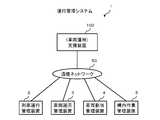
- FIG. 1 shows a schematic configuration of an information processing system (hereinafter, referred to as “operation management system 1”) described as an embodiment.
- the operation management system 1 includes a train operation management device 2, a vehicle operation management device 3, a vehicle allocation management device 4, a premises work management device 5, and a vehicle operation support device (hereinafter, "support device 100"). ) Includes. All of these are configured using an information processing device (computer). Further, these devices are communicably connected via the communication network 50.
- the communication network 50 is a wired or wireless communication means, for example, a LAN (Local Area Network), a WAN (Wide Area Network), the Internet, a dedicated line, a public communication network, or the like.
- the train operation management device 2 provides information on planning (creating) and managing train schedules, automatic course control according to train schedules, train tracking, transportation plan management, etc., in order to efficiently operate trains existing in the line section. Perform processing.
- As the above information processing for example, there are planning of a train timetable plan, simulation of the drafted train timetable plan, and the like.
- the train operation management device 2 appropriately cooperates with a centralized traffic control device (CTC: Centralized Traffic Control) and a train operation management system (PTC: Programmed Traffic Control) when executing the above information processing. Further, the train operation management device 2 performs information processing related to an operation arrangement function, operation information provision, etc. in order to ensure the accuracy of the operation command work and improve the passenger service.
- CTC Centralized Traffic Control
- PTC Programmed Traffic Control
- the vehicle operation management device 3 uses the train schedule planned by the train operation management device 2 as a route (work) (combination of a series of trains operated by the same train or crew) and a police box (each train or crew is on the route). Information processing related to the setting of (assignment order) is performed.
- the information processing includes, for example, drafting of a vehicle operation plan, simulation of the drafted vehicle operation plan, and the like.
- the vehicle allocation management device 4 performs information processing regarding the allocation (allocation) of vehicles (physical vehicles, physical formations) to the route set by the vehicle operation management device 30.
- the information processing includes, for example, drafting of a vehicle allocation plan, simulation of the drafted vehicle allocation plan, and the like.
- the premises work management device 5 relates to planning and management of premises work (track shunting, extension / disconnection, locomotive towing train rotation, vehicle inspection, vehicle cleaning, etc. in station premises and depot premises). Information processing.
- the information processing is, for example, drafting a premises work plan, simulating a drafted premises work plan, and the like.
- the support device 100 performs information processing to support the user's work related to the setting of information for evaluating the vehicle operation plan (hereinafter referred to as "evaluation information") when drafting the vehicle operation plan.
- the above-mentioned evaluation information includes, for example, information on an index used for evaluation (hereinafter, referred to as "evaluation index"), a calculation method of the evaluation index, and the like.
- one evaluation information includes information of one evaluation index.
- KPI Key Performance Indicator
- the evaluation index is obtained based on the information obtained by executing a simulation of at least one of the train schedule plan, the vehicle operation plan, the vehicle allocation plan, and the premises work plan, for example.
- the support device 100 provides the user with an editing support function for a registered evaluation index (hereinafter referred to as "registered evaluation information"), a registration support function for a new evaluation index using the registered evaluation information, and the like. ..
- registered evaluation information a registered evaluation index
- the support device 100 performs the above information processing while appropriately cooperating with other information processing devices (train operation management device 2, vehicle operation management device 3, vehicle allocation management device 4, premises work management device 5).
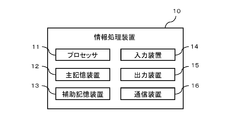
- FIG. 2 shows an example of an information processing device 10 (computer) used for each configuration of the train operation management device 2, the vehicle operation management device 3, the vehicle allocation management device 4, the premises work management device 5, and the support device 100.
- the illustrated information processing device 10 includes a processor 11, a main storage device 12, an auxiliary storage device 13, an input device 14, an output device 15, and a communication device 16. These are connected so as to be able to communicate via a communication means such as a bus.
- the information processing device 10 is, for example, a personal computer, an office server, a mainframe, or the like.
- the information processing device 10 is realized by using virtual information processing resources provided by using virtualization technology, process space separation technology, or the like, for example, a virtual server provided by a cloud system. May be good. All or part of the functions provided by the information processing device 10 may be realized by, for example, a service provided by a cloud system via an API (Application Programming Interface) or the like.
- Software such as an operating system, a file system, and a DBMS (DataBase Management System) (relational database, NoSQL, etc.) may be installed in the information processing device 10.
- DBMS DataBase Management System
- the processor 11 includes, for example, a CPU (Central Processing Unit), an MPU (Micro Processing Unit), a GPU (Graphics Processing Unit), an AI (Artificial Intelligence) chip, an FPGA (Field Programmable Gate Array), an ASIC (Application Specific Integrated Circuit), or the like. Is configured using.
- a CPU Central Processing Unit
- MPU Micro Processing Unit
- GPU Graphics Processing Unit
- AI Artificial Intelligence
- FPGA Field Programmable Gate Array
- ASIC Application Specific Integrated Circuit
- the main storage device 12 is a device that stores programs and data, and is, for example, a ROM (Read Only Memory), a RAM (Random Access Memory), a non-volatile memory (NVRAM (Non Volatile RAM)), or the like.
- ROM Read Only Memory
- RAM Random Access Memory
- NVRAM Non Volatile RAM
- the auxiliary storage device 13 includes, for example, an SSD (Solid State Drive), a hard disk drive, an optical storage device (CD (Compact Disc), DVD (Digital Versatile Disc), etc.), a storage system, an IC card, an SD card, or an optical recording device.
- a reading / writing device for a recording medium such as a medium, a storage area for a virtual server, and the like.
- the auxiliary storage device 13 can write / read programs and data via the reading device of the recording medium and the communication device 16. Programs and data stored (stored) in the auxiliary storage device 13 are read out to the main storage device 12 at any time.
- the input device 14 is an interface that accepts input from the outside, and is, for example, a keyboard, a mouse, a touch panel, a card reader, a voice input device, and the like.
- the output device 15 is an interface that outputs various information such as processing progress and processing results.
- the output device 15 is, for example, a display device (liquid crystal monitor, LCD (Liquid Crystal Display), projector, etc.) that visualizes the above-mentioned various information, and a device (audio output device (speaker, etc.)) that visualizes the above-mentioned various information. , A device (printing device, etc.) that converts the above-mentioned various information into characters.
- a display device liquid crystal monitor, LCD (Liquid Crystal Display), projector, etc.
- a device audio output device (speaker, etc.)
- a device printing device, etc.
- the input device 14 and the output device 15 form a user interface.
- the information processing device 10 may be configured to input / output information to / from another device (smartphone, tablet, notebook computer, various personal digital assistants, etc.) via the communication device 16.
- the communication device 16 realizes communication with other devices.
- the communication device 16 is a wireless or wired communication interface that realizes communication with another device via the communication network 50, and is, for example, a NIC (Network Interface Card), a wireless communication module, or a USB (Universal Serial). Bus) Module etc.
- NIC Network Interface Card
- USB Universal Serial. Bus
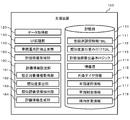
- FIG. 3 shows the main functions of the support device 100.
- the support device 100 includes functions of a storage unit 110, a data acquisition unit 120, a UI processing unit 130, a vehicle operation planning unit 140, an evaluation information management unit 150, and an evaluation information setting unit 160.
- the evaluation information setting unit 160 includes a setting target information acquisition unit 161, a similarity calculation unit 162, a similarity evaluation information extraction unit 163, and an evaluation information generation unit 164.
- Each function shown in the figure is performed by the processor 11 of the information processing device 10 constituting the support device 100 reading and executing a program stored in the main storage device 12 of the information processing device 10 or by information processing. It is realized by the hardware (FPGA, ASIC, AI chip, etc.) included in the device 10.
- the storage unit 110 includes registered evaluation information TBL 111, similarity calculation weighted TBL 112, evaluation index calculation basic logic 113, information source 114, train timetable information 115, vehicle operation information 116, vehicle allocation information 117, and premises work information 118.
- Store information (data) The storage unit 110 stores each data as, for example, a database table provided by the DBMS or a file provided by the file system.
- Registered evaluation information TBL111 includes information on registered evaluation information (hereinafter referred to as "registered evaluation information").
- the similarity calculation weighting TBL112 includes information regarding the weight used in the calculation of the similarity calculated when searching for a registered evaluation index similar to the evaluation index newly registered by the user.
- the evaluation index calculation basic logic 113 includes information (hereinafter, referred to as “basic logic”) regarding the basic logic used when setting the evaluation index calculation method.
- the basic logic is expressed as, for example, a flowchart, a mathematical formula, an algorithm (program), or the like.
- the information source 114 includes information on the substance of various information used when setting the calculation method of the evaluation index and the location of the various information (which information processing device constituting the operation management system 1 is managed, etc.). ..
- the train timetable information 115 includes information related to the train timetable acquired from the train operation management device 2.
- the vehicle operation information 116 includes information related to vehicle operation acquired from the vehicle operation management device 3.
- the vehicle allocation information 117 includes information regarding the allocation of vehicles to the route, which is acquired from the vehicle allocation management device 4.
- the premises work information 118 includes information on planning and management related to the premises shunting work acquired from the premises work management device 5.
- the data acquisition unit 120 shown in FIG. 3 receives train timetable information 115 from the train operation management device 2, vehicle operation information 116 from the vehicle operation management device 3, and vehicle from the vehicle allocation management device 4 via the communication network 50.
- the allocation information 117 and the premises work information 118 are acquired (received) from the premises work management device 5, respectively.
- the UI processing unit 130 provides a user interface that realizes interactive processing with the user by controlling the input device 14 and the output device 15.
- the UI processing unit 130 performs information processing such as output of various information and reception of information from the user.
- the vehicle operation plan planning unit 140 processes information related to the drafting of the vehicle operation plan.
- the vehicle operation plan planning unit 140 provides the user with an editing environment for the vehicle operation plan via, for example, the UI processing unit 130.
- the vehicle operation plan planning unit 140 collects various information (train schedule, vehicle operation plan, vehicle allocation plan, shunting plan, etc.) managed by the operation management system 1 based on the contents of the drafted vehicle operation plan. Update.
- the evaluation information management unit 150 manages the evaluation information set in the past in the registered evaluation information TBL111.
- the evaluation information setting unit 160 performs information processing regarding the setting of evaluation information (new registration, editing, etc.).
- the setting target information acquisition unit 161 acquires the setting target information which is the information related to the evaluation index to be set by the user via the UI processing unit 130.
- the similarity calculation unit 162 obtains the similarity between the set target information and the evaluation information managed by the registered evaluation information TBL111. In this embodiment, the larger the similarity value, the higher the similarity.
- the similarity evaluation information extraction unit 163 extracts evaluation information (hereinafter, referred to as “similar evaluation information”) whose similarity is equal to or higher than a preset threshold value from the registered evaluation information TBL111.
- the above threshold value is set by the user, for example, via the UI processing unit 130.
- the evaluation information generation unit 164 receives the settings related to the evaluation index to be set by the user while presenting the extracted evaluation information to the user via the UI processing unit 130, and generates (evaluation) the evaluation information based on the received contents. Generate new information or update existing evaluation information).
- FIG. 4 is an example of a screen (hereinafter, referred to as “vehicle operation plan planning screen 400”) presented to the user when the vehicle operation plan planning unit 140 of the support device 100 plans the vehicle operation plan.
- the vehicle operation plan planning screen 400 includes an area related to vehicle operation plan setting (hereinafter referred to as “planning area 410”) provided in the upper part of the screen and a user provided in the lower part of the screen. It includes an area (hereinafter, referred to as “evaluation area 420”) in which settings and evaluation results related to the evaluation of the drafted vehicle operation plan are displayed.
- the planning area 410 includes a vehicle operation plan creation button 411, a display content switching button 412, a confirmation button 413, and an operation plan display column 414.
- the evaluation area 420 includes an evaluation information setting button 421 and an evaluation result display field 422.
- the vehicle operation plan planning unit 140 displays a screen (not shown) for setting the vehicle operation plan.
- the vehicle operation plan planning unit 140 displays the set contents (train schedule in the figure) in the operation plan display column 414.
- the display content switching button 412 By operating the display content switching button 412, the user can switch the display content of the operation plan display field 414 to either the current vehicle operation plan or the newly set vehicle operation plan.
- evaluation area 420 information on the evaluation of the vehicle operation plan set by the user in the planning area 410 (information on the value of the evaluation index before and after the change of the vehicle operation plan, the deviation (difference) of the evaluation index before and after the change, etc.) is stored. It is displayed for each evaluation index (evaluation information). The user can set the evaluation information (new registration, edit, etc.) by operating the evaluation information setting button 421 of the area.
- FIG. 5 is an example of a screen (hereinafter, referred to as “evaluation index setting screen 500”) displayed by the support device 100 when the user operates the evaluation information setting button 421.
- the evaluation index setting screen 500 includes a setting target information input field 510, a similar evaluation information list 520, an evaluation information setting field 530, an information source selection field 540, and a basic logic selection field 550.
- the setting target information input field 510 is provided with an evaluation index name setting field 511, a category setting field 512, a time designation field 513, a location designation field 514, and an extraction execution button 515.
- the setting target information acquisition unit 161 acquires the setting target information from the user via the setting target information input field 510.
- evaluation index name setting column 511 the name of the evaluation index (“number of trains”, “cumulative mileage of all vehicles”, “base track occupancy rate”, etc., hereinafter referred to as “evaluation index name”) is set. Will be done.
- category setting column 512 the name of the category (“transportation service”, “vehicle maintenance”, etc.) to which the evaluation index belongs (hereinafter, referred to as “category name”) is set.
- the user sets the time for the evaluation index to be evaluated via the time designation field 513.
- the user can set the time directly in the time designation field 513 or can set the period.
- the user sets a place to be evaluated by the evaluation index via the place designation field 514.
- the user can set a specific place in the place designation field 514, or can set a range (area).
- the similarity calculation unit 162 displays the setting target information (evaluation index name, category name, time, place) set in the setting target information input field 510 and the registered evaluation information TBL111. Find the degree of similarity with each managed evaluation information. Subsequently, the similarity evaluation information extraction unit 163 extracts evaluation information (similarity evaluation information) whose similarity is equal to or higher than a preset threshold value from the registered evaluation information TBL111, and extracts the extracted similarity evaluation information in the similarity evaluation information list 520. List in. The details of the calculation method of the similarity will be described later.
- similar evaluation index name the name of the similarity evaluation index of the similarity evaluation information (hereinafter referred to as "similar evaluation index name”) and the calculated similarity degree of the similarity evaluation information are displayed.
- the user selects the similarity evaluation information to be used when setting the evaluation information while referring to the displayed similarity degree.
- the evaluation information generation unit 164 acquires a similar evaluation index selected by the user from the similar evaluation information list 520 from the registered evaluation information TBL 111, and displays the acquired contents in the evaluation information setting field 530.
- the evaluation information setting field 530 is provided with a display field 531 for similar evaluation index names, an edit field 532 for evaluation methods, a duplicate new button 533, and an update button 534.
- the similarity evaluation index name of the similarity evaluation index of the similarity evaluation information selected by the user in the similarity evaluation information list 520 is displayed.
- the evaluation method edit column 532 the calculation method of the evaluation index included in the similar evaluation information selected by the user is displayed as a default. The user can efficiently edit the calculation method of the evaluation index by the visual editing environment using the editing column 532 of the evaluation method.
- the user selects one of the information sources (image or character string corresponding to each information source) from the information source selection field 540 and drags and drops it into the edit field 532 of the evaluation method to select the selected information source.
- the information source selection field 540 "train timetable before change”, “train timetable after change”, “vehicle reference plan before change”, “vehicle operation plan after change”, “before change”
- Information sources of "Vehicle management information”, “Vehicle management information after change”, “Shunting plan before change", and “Shunting plan after change” are displayed.
- the information source to be selectably displayed in the information source selection field 540 can be set by the user via, for example, the UI processing unit 130 or the like. Further, the above information source may be acquired from another information processing device constituting the operation management system 1.
- the user evaluates the selected basic logic by selecting the basic logic (image or character string corresponding to each basic logic) from the basic logic selection field 550 and dragging and dropping it into the edit field 532 of the evaluation method. It can be easily used as a component for defining the index calculation method. In the case of this example, "Kilometer travel calculation”, “Stop time calculation”, “Train number count”, “Basic logic such as deviation calculation” can be dragged and dropped into the basic logic selection field 550. ..
- the basic logic to be selectably displayed in the basic logic selection field 550 can be set by the user via, for example, the UI processing unit 130 or the like.
- the information sources of "pre-change premises shunting plan” and “changed premises shunting plan” are individually input into the basic logic "stop time calculation" in the edit column 532 of the evaluation method. Then, a method of calculating the evaluation index is set in which the processing result of each basic logic is input to yet another basic logic “deviation calculation” to obtain the value of the evaluation index "base track occupancy rate”.
- the evaluation information generation unit 164 sets the evaluation index name as the evaluation index name set in the evaluation index name setting field 511.
- the evaluation information of the content set in the edit column 532 of the evaluation method is newly generated, and the generated evaluation information is registered in the registered evaluation information TBL111.
- the evaluation information generation unit 164 displays the similarity evaluation information of the similar evaluation index set in the display field 531 of the similar evaluation index name. , The registered evaluation information TBL111 is updated so that the content is set in the edit field 532 of the evaluation method.
- the user can efficiently set new evaluation information by using the evaluation information of the evaluation index already registered.
- the user can intuitively and efficiently newly register the evaluation information and edit the already registered evaluation information by using the visual editing environment via the editing column 532 of the evaluation method.
- FIG. 6 shows an example of the registered evaluation information TBL111.
- the registered evaluation information TBL111 is one or more having each item of the evaluation index name 611, the category name 612, the information used for calculating the evaluation index (hereinafter referred to as "evaluation index calculation information 613"), and the basic logic 614. Includes entries (records) for.
- the evaluation index name is set in the evaluation index name 611.
- “the number of trains”, “cumulative mileage of all vehicles”, and “base track occupancy rate” are set.
- the category name to which the evaluation index belongs is set in the category name 612. In this example, "transportation service” and “vehicle maintenance” are set.
- Information used for calculating the evaluation index is set in the evaluation index calculation information 613.
- the information used in calculating the evaluation index can be set from the viewpoints of the target (What) 6131, the time (When) 6132, and the place (Where) 6133.
- the viewpoint of the target (What) 6131 "train timetable before change”, “train timetable after change”, “vehicle management information before change”, “vehicle management information after change”, “premises before change” "Replacement plan” and "changed premises replacement plan” are set.
- a "user-specified range” is set from the viewpoint of the time (When) 6132.
- a viewpoint of the place (Where) 6133 "all stations" and “all premises number lines” are designated.
- the basic logic 614 information for specifying the basic logic and link information to the substance of the basic logic managed as the evaluation index calculation basic logic 113 are set.
- “deviation calculation”, "train number count”, “vehicle number count”, “traveling kilometer calculation”, and “stop time calculation” are set as information for specifying the basic logic.
- FIG. 7 shows a process performed by the evaluation information setting unit 160 when the user operates the extraction execution button 515 of the setting target information input field 510 on the evaluation index setting screen 500 shown in FIG. 5 (hereinafter, “similar evaluation index”). It is a flowchart explaining (referred to as an extraction process S700 ”). Hereinafter, the similar evaluation index extraction process S700 will be described with reference to the figure. At the start of the similar evaluation index extraction process S700, it is assumed that the registered evaluation information TBL111 contains one or more evaluation information.
- the setting target information acquisition unit 161 acquires the setting target information (evaluation index name, category name, time (When), place (Where)) set by the user for the setting target information input field 510 (S711).
- the similar evaluation information extraction unit 163 selects one entry (evaluation index) from the registered evaluation information TBL111 (S712).
- the similarity calculation unit 162 acquires the setting target information (evaluation index name, category name, time (When), place (Where)) acquired in S711 and the selected evaluation information (hereinafter, “selected evaluation information”). (S713).
- the similarity calculation unit 162 obtains the similarity by applying the following algorithms (1) to (5) under the “or condition”.
- the selected evaluation index includes a word synonymous with the word included in the evaluation index name of the information to be set, the number of words having the same meaning is added to the similarity.
- the selected evaluation index includes a word having the same meaning as the word included in the target (What) of the setting target information, the number of words having the same meaning is added to the degree of similarity.
- the category to which the selected evaluation index belongs matches the category of the set target information, 1 is added to the similarity.
- the time (When) of the selected evaluation index matches the time (When) of the information to be set, 1 is added to the similarity.
- the location (Where) of the selected evaluation index matches the location (Where) of the information to be set, 1 is added to the similarity.
- the number of words of "synonymous words” is added to the degree of similarity, but the range of "synonymous” can be adjusted by the user via the UI processing unit 130. good.
- the category, time (When), and place (Where) are determined as "whether or not they match", and the user adjusts the degree of matching via the UI processing unit 130. You may be able to do it.
- the similarity calculation unit 162 may obtain the similarity after setting the weight according to the characteristics of the route that is the target of the vehicle operation plan, for example.
- the similarity calculation unit 162 acquires the above weight from the similarity calculation weight TBL112.
- the similarity calculation unit 162 acquires the characteristics of the route that is the target of the vehicle operation plan from, for example, another information processing device that is a component of the operation management system 1 such as the vehicle operation management device 3.
- the similarity calculation unit 162 calculates the similarity in consideration of the weight according to the characteristics of the route, so that the evaluation information used for the evaluation of the vehicle operation plan of the route having similar characteristics is evaluated in a similar manner. It can be selected as information, and more appropriate similar evaluation information can be presented to the user as information to be used for setting the evaluation information.
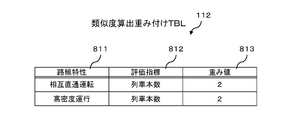
- FIG. 8 shows an example of the similarity calculation weighting TBL112.
- the illustrated similarity calculation weighting TBL112 includes one or more entries (records) having each item of the route characteristic 811, the evaluation index 812, and the weight value 813.
- information indicating the characteristics of the route is set in the route characteristic 811.
- An evaluation index name to be weighted is set in the evaluation index 812.
- a weight value corresponding to the characteristics of the route is set in the weight value 83.
- the content of the similarity calculation weighting TBL 112 is set by the user, for example, via the UI processing unit 130.
- the similarity evaluation information extraction unit 163 subsequently determines whether or not the similarity obtained in S713 is equal to or greater than the above-mentioned threshold value (S714).
- the similarity evaluation information extraction unit 163 extracts and stores the selected evaluation information as the similarity evaluation information (for example, stores it in the main storage device 12 or a temporary file) (for example, it is stored in the main storage device 12 or a temporary file). S715). After that, the process proceeds to S716.
- the similarity is less than the threshold value (S714: NO)
- the process proceeds to S716.
- the similarity evaluation information extraction unit 163 determines whether or not all the evaluation information of the registered evaluation information TBL111 has been selected in S712. If all the evaluation information has not been selected (S716: NO), the process returns to S712. If all the evaluation information has been selected (S716: YES), the similarity evaluation index extraction process S700 ends.
- the support device 100 of the present embodiment extracts from the registered evaluation information TBL111 based on the setting target information received from the user, and presents the extracted similar evaluation information to the user to obtain the evaluation information. Receives settings from the user and generates evaluation information based on the received contents. Therefore, the user can efficiently set the evaluation information. In particular, when the evaluation information is not registered, the user can efficiently set the evaluation information having appropriate contents by using the similar evaluation information presented by the support device 100.
- the present invention is not limited to the above-described embodiments, and includes various modifications.
- the above-described embodiment describes the configuration in detail in order to explain the present invention in an easy-to-understand manner, and is not necessarily limited to the one including all the described configurations.
- a part of the configuration of each embodiment can be added, deleted, or replaced with another configuration.
- each of the above configurations, functions, processing units, processing means, etc. may be realized by hardware by designing a part or all of them by, for example, an integrated circuit. It can also be realized by the program code of the software that realizes each function shown in the embodiment.
- a storage medium in which the program code is recorded is provided to the information processing device (computer), and the processor included in the information processing device reads the program code stored in the storage medium.
- the program code itself read from the storage medium realizes the functions of the above embodiments, and the program code itself and the storage medium storing the program code itself constitute the present invention.
- Examples of the storage medium for supplying such a program code include a hard disk, SSD (Solid State Drive), optical disk, magneto-optical disk, CD-R, flexible disk, CD-ROM, DVD-ROM, magnetic tape, and the like.
- SSD Solid State Drive
- Non-volatile memory cards, ROMs, etc. are used.
- control lines and information lines indicate those that are considered necessary for explanation, and do not necessarily indicate all the control lines and information lines in the product. All configurations may be interconnected. In the above, various types of information are illustrated in a table format, but these information may be managed in a format other than the table.
- the vehicle is assumed to be a railway vehicle, but the present invention is also applied to an operation management system for vehicles other than railway vehicles, which has a configuration similar to that of the operation management system 1 of the present embodiment. Can be done.
- 1 Operation management system 2 Train operation management device, 3 Vehicle operation management device, 4 Vehicle allocation management device, 5 On-site work management device, 50 Communication network, 110 Storage unit, 111 Registered evaluation information TBL, 112 Similarity calculation weighted TBL , 113 Evaluation index calculation basic logic, 114 information source, 115 train schedule information, 116 vehicle operation information, 117 vehicle allocation information, 118 premises work information, 120 data acquisition unit, 130 UI processing unit, 140 vehicle operation planning department, 150 Evaluation information management unit, 160 evaluation information setting unit, 161 setting target information acquisition unit, 162 similarity calculation unit, 163 similarity evaluation information extraction unit, 164 evaluation information generation unit, 400 vehicle operation planning screen, 500 evaluation index setting screen, S700 Similar evaluation index extraction process
Landscapes
- Engineering & Computer Science (AREA)
- Radar, Positioning & Navigation (AREA)
- Remote Sensing (AREA)
- Mechanical Engineering (AREA)
- Physics & Mathematics (AREA)
- General Physics & Mathematics (AREA)
- Business, Economics & Management (AREA)
- Automation & Control Theory (AREA)
- Tourism & Hospitality (AREA)
- Economics (AREA)
- Health & Medical Sciences (AREA)
- General Health & Medical Sciences (AREA)
- Human Resources & Organizations (AREA)
- Marketing (AREA)
- Primary Health Care (AREA)
- Strategic Management (AREA)
- General Business, Economics & Management (AREA)
- Theoretical Computer Science (AREA)
- Train Traffic Observation, Control, And Security (AREA)
- Management, Administration, Business Operations System, And Electronic Commerce (AREA)
Priority Applications (2)
| Application Number | Priority Date | Filing Date | Title |
|---|---|---|---|
| US17/641,543 US12203761B2 (en) | 2020-02-20 | 2020-08-26 | Vehicle operation assistance device and vehicle operation assistance method |
| EP20919664.1A EP4108541A4 (en) | 2020-02-20 | 2020-08-26 | DEVICE AND METHOD FOR ASSISTING THE OPERATION OF A VEHICLE |
Applications Claiming Priority (2)
| Application Number | Priority Date | Filing Date | Title |
|---|---|---|---|
| JP2020-026992 | 2020-02-20 | ||
| JP2020026992A JP7227934B2 (ja) | 2020-02-20 | 2020-02-20 | 車両運用支援装置、及び車両運用支援方法 |
Publications (1)
| Publication Number | Publication Date |
|---|---|
| WO2021166287A1 true WO2021166287A1 (ja) | 2021-08-26 |
Family
ID=77391912
Family Applications (1)
| Application Number | Title | Priority Date | Filing Date |
|---|---|---|---|
| PCT/JP2020/032181 Ceased WO2021166287A1 (ja) | 2020-02-20 | 2020-08-26 | 車両運用支援装置、及び車両運用支援方法 |
Country Status (4)
| Country | Link |
|---|---|
| US (1) | US12203761B2 (https=) |
| EP (1) | EP4108541A4 (https=) |
| JP (1) | JP7227934B2 (https=) |
| WO (1) | WO2021166287A1 (https=) |
Families Citing this family (3)
| Publication number | Priority date | Publication date | Assignee | Title |
|---|---|---|---|---|
| JP7565960B2 (ja) * | 2022-02-04 | 2024-10-11 | 三菱電機株式会社 | 車両充当計画システム、車両充当計画方法、および車両充当計画プログラム |
| JP7842055B2 (ja) * | 2023-03-13 | 2026-04-07 | 株式会社日立製作所 | 構内入換支援システム、構内入換支援方法、および車両運用管理支援システム |
| EP4604047A1 (en) * | 2024-02-13 | 2025-08-20 | HaCon Ingenieurgesellschaft mbH | Computer-implemented method of modifying a rail vehicle path |
Citations (6)
| Publication number | Priority date | Publication date | Assignee | Title |
|---|---|---|---|---|
| JPH0692237A (ja) * | 1992-07-24 | 1994-04-05 | Hitachi Ltd | 問題解決方法及びシステム |
| JP2011005881A (ja) * | 2009-06-23 | 2011-01-13 | Hitachi Ltd | 列車運行情報を用いた列車遅延予測システム |
| JP2014210530A (ja) | 2013-04-19 | 2014-11-13 | 株式会社日立製作所 | ダイヤ修正案生成システム、ダイヤ修正案生成方法、およびダイヤ修正案生成プログラム |
| WO2015068231A1 (ja) * | 2013-11-07 | 2015-05-14 | 株式会社 日立製作所 | 計画連携システムおよび計画連携方法 |
| WO2017119094A1 (ja) * | 2016-01-07 | 2017-07-13 | 株式会社日立製作所 | サービス連携システムおよびサービス連携方法 |
| JP2020026992A (ja) | 2018-08-10 | 2020-02-20 | Jfeエンジニアリング株式会社 | 応力評価方法 |
Family Cites Families (10)
| Publication number | Priority date | Publication date | Assignee | Title |
|---|---|---|---|---|
| CA2373568C (en) * | 2001-04-26 | 2008-06-17 | Hitachi, Ltd. | Method of searching similar document, system for performing the same and program for processing the same |
| JP2010213749A (ja) * | 2009-03-13 | 2010-09-30 | Omron Corp | 車両動作制御装置および方法、並びにプログラム |
| WO2016147260A1 (ja) * | 2015-03-13 | 2016-09-22 | 株式会社日立製作所 | 画像検索装置、及び画像を検索する方法 |
| DE112015006585B4 (de) * | 2015-06-04 | 2019-05-16 | Mitsubishi Electric Corporation | Fahr-Assistenzvorrichtung, Fahr-Assistenzserver und Fahr-Assistenzsystem |
| JP6605929B2 (ja) | 2015-11-20 | 2019-11-13 | 株式会社日立製作所 | 資源運用計画支援装置および資源運用計画支援方法 |
| JP2018096861A (ja) * | 2016-12-14 | 2018-06-21 | セイコーエプソン株式会社 | ランキングシステム、サーバー、ランキング方法、ランキングプログラム、記録媒体、及び電子機器 |
| WO2019180947A1 (ja) * | 2018-03-23 | 2019-09-26 | 本田技研工業株式会社 | 情報生成装置およびその制御方法 |
| JP7057199B2 (ja) * | 2018-04-16 | 2022-04-19 | 株式会社日立製作所 | ダイヤ分析支援装置及び方法 |
| US10962371B2 (en) * | 2019-04-02 | 2021-03-30 | GM Global Technology Operations LLC | Method and apparatus of parallel tracking and localization via multi-mode slam fusion process |
| JP7399627B2 (ja) | 2019-04-25 | 2023-12-18 | 株式会社日立製作所 | ダイヤ作成装置、ダイヤ作成方法、及び自動車両制御システム |
-
2020
- 2020-02-20 JP JP2020026992A patent/JP7227934B2/ja active Active
- 2020-08-26 US US17/641,543 patent/US12203761B2/en active Active
- 2020-08-26 EP EP20919664.1A patent/EP4108541A4/en active Pending
- 2020-08-26 WO PCT/JP2020/032181 patent/WO2021166287A1/ja not_active Ceased
Patent Citations (6)
| Publication number | Priority date | Publication date | Assignee | Title |
|---|---|---|---|---|
| JPH0692237A (ja) * | 1992-07-24 | 1994-04-05 | Hitachi Ltd | 問題解決方法及びシステム |
| JP2011005881A (ja) * | 2009-06-23 | 2011-01-13 | Hitachi Ltd | 列車運行情報を用いた列車遅延予測システム |
| JP2014210530A (ja) | 2013-04-19 | 2014-11-13 | 株式会社日立製作所 | ダイヤ修正案生成システム、ダイヤ修正案生成方法、およびダイヤ修正案生成プログラム |
| WO2015068231A1 (ja) * | 2013-11-07 | 2015-05-14 | 株式会社 日立製作所 | 計画連携システムおよび計画連携方法 |
| WO2017119094A1 (ja) * | 2016-01-07 | 2017-07-13 | 株式会社日立製作所 | サービス連携システムおよびサービス連携方法 |
| JP2020026992A (ja) | 2018-08-10 | 2020-02-20 | Jfeエンジニアリング株式会社 | 応力評価方法 |
Non-Patent Citations (1)
| Title |
|---|
| See also references of EP4108541A4 |
Also Published As
| Publication number | Publication date |
|---|---|
| US12203761B2 (en) | 2025-01-21 |
| JP7227934B2 (ja) | 2023-02-22 |
| US20220326026A1 (en) | 2022-10-13 |
| EP4108541A1 (en) | 2022-12-28 |
| EP4108541A4 (en) | 2024-03-20 |
| JP2021130399A (ja) | 2021-09-09 |
Similar Documents
| Publication | Publication Date | Title |
|---|---|---|
| US20210174270A1 (en) | Rideshare vehicle demand forecasting device, method for forecasting rideshare vehicle demand, and storage medium | |
| WO2021166287A1 (ja) | 車両運用支援装置、及び車両運用支援方法 | |
| US9870596B2 (en) | Predicting community development trends | |
| CN111161566B (zh) | 航班延误预警方法、系统、电子设备和介质 | |
| WO2022054585A1 (ja) | 運行計画変更支援装置、判断モデル作成装置、判断モデル作成プログラム、及び列車運行管理システム | |
| Rizopoulos et al. | Generic approaches for the rescheduling of public transport services: D. Rizopoulos, GKD Saharidis | |
| JP6903536B2 (ja) | 運行情報処理装置およびその処理方法 | |
| US11836657B2 (en) | Resource management planning support device, resource management planning support method, and programs | |
| JP6649121B2 (ja) | 乗務員運用管理システムおよび乗務員運用管理方法 | |
| JP7022983B2 (ja) | 情報処理システム、情報処理プログラムおよび情報処理方法 | |
| JP7449192B2 (ja) | ダイヤ情報管理システム、ダイヤ情報管理方法および運行案内システム | |
| Kok et al. | Strategic Management: The Case of Malaysian Airports Holdings Berhad (MAHB) | |
| Silva et al. | SmartRail-Optimized Train Management System for Sri Lanka Railways | |
| CN114881271A (zh) | 酒店预订方法、系统、设备及存储介质 | |
| Kato et al. | Automatic Generation Method for Crew Scheduling After a Large‐Scale Natural Disaster | |
| US20240383514A1 (en) | Timetable plan creation system, timetable plan creation method, timetable plan creation program, and transportation plan system | |
| JP7416680B2 (ja) | 運行計画変更支援装置、運行計画変更支援方法、および運行計画変更支援プログラム | |
| JP7717362B2 (ja) | 情報処理システム、情報処理プログラムおよび情報処理方法 | |
| JP2025101086A (ja) | 鉄道業務情報変更システム、鉄道業務情報管理システム、および鉄道業務情報変更方法 | |
| Bills | The great transformation: the future of the data-driven transportation workforce | |
| JP2024171416A (ja) | 異常申請データ判定方法および異常申請データ判定プログラム | |
| JP2022051211A (ja) | 情報提供システムおよび情報提供方法 | |
| JP2025187831A (ja) | 情報処理システム、情報処理プログラムおよび情報処理方法 | |
| Gooch et al. | Safety Data Visualization: MassDOT's IMPACT Tool and Promoting Safety Planning in Massachusetts | |
| JP2024081295A (ja) | 情報処理装置、情報処理方法、情報処理プログラム、および学習モデル |
Legal Events
| Date | Code | Title | Description |
|---|---|---|---|
| 121 | Ep: the epo has been informed by wipo that ep was designated in this application |
Ref document number: 20919664 Country of ref document: EP Kind code of ref document: A1 |
|
| NENP | Non-entry into the national phase |
Ref country code: DE |
|
| ENP | Entry into the national phase |
Ref document number: 2020919664 Country of ref document: EP Effective date: 20220920 |