WO2021145349A1 - 光学フィルム、光学フィルム付き偏光板及び表示装置 - Google Patents
光学フィルム、光学フィルム付き偏光板及び表示装置 Download PDFInfo
- Publication number
- WO2021145349A1 WO2021145349A1 PCT/JP2021/000923 JP2021000923W WO2021145349A1 WO 2021145349 A1 WO2021145349 A1 WO 2021145349A1 JP 2021000923 W JP2021000923 W JP 2021000923W WO 2021145349 A1 WO2021145349 A1 WO 2021145349A1
- Authority
- WO
- WIPO (PCT)
- Prior art keywords
- refractive index
- optical film
- lens
- index layer
- distance
- Prior art date
- Legal status (The legal status is an assumption and is not a legal conclusion. Google has not performed a legal analysis and makes no representation as to the accuracy of the status listed.)
- Ceased
Links
Images


Classifications
-
- G—PHYSICS
- G02—OPTICS
- G02F—OPTICAL DEVICES OR ARRANGEMENTS FOR THE CONTROL OF LIGHT BY MODIFICATION OF THE OPTICAL PROPERTIES OF THE MEDIA OF THE ELEMENTS INVOLVED THEREIN; NON-LINEAR OPTICS; FREQUENCY-CHANGING OF LIGHT; OPTICAL LOGIC ELEMENTS; OPTICAL ANALOGUE/DIGITAL CONVERTERS
- G02F1/00—Devices or arrangements for the control of the intensity, colour, phase, polarisation or direction of light arriving from an independent light source, e.g. switching, gating or modulating; Non-linear optics
- G02F1/01—Devices or arrangements for the control of the intensity, colour, phase, polarisation or direction of light arriving from an independent light source, e.g. switching, gating or modulating; Non-linear optics for the control of the intensity, phase, polarisation or colour
- G02F1/13—Devices or arrangements for the control of the intensity, colour, phase, polarisation or direction of light arriving from an independent light source, e.g. switching, gating or modulating; Non-linear optics for the control of the intensity, phase, polarisation or colour based on liquid crystals, e.g. single liquid crystal display cells
- G02F1/133—Constructional arrangements; Operation of liquid crystal cells; Circuit arrangements
- G02F1/1333—Constructional arrangements; Manufacturing methods
- G02F1/1335—Structural association of cells with optical devices, e.g. polarisers or reflectors
- G02F1/133504—Diffusing, scattering, diffracting elements
-
- G—PHYSICS
- G02—OPTICS
- G02B—OPTICAL ELEMENTS, SYSTEMS OR APPARATUS
- G02B5/00—Optical elements other than lenses
- G02B5/30—Polarising elements
-
- G—PHYSICS
- G02—OPTICS
- G02B—OPTICAL ELEMENTS, SYSTEMS OR APPARATUS
- G02B5/00—Optical elements other than lenses
-
- G—PHYSICS
- G02—OPTICS
- G02F—OPTICAL DEVICES OR ARRANGEMENTS FOR THE CONTROL OF LIGHT BY MODIFICATION OF THE OPTICAL PROPERTIES OF THE MEDIA OF THE ELEMENTS INVOLVED THEREIN; NON-LINEAR OPTICS; FREQUENCY-CHANGING OF LIGHT; OPTICAL LOGIC ELEMENTS; OPTICAL ANALOGUE/DIGITAL CONVERTERS
- G02F1/00—Devices or arrangements for the control of the intensity, colour, phase, polarisation or direction of light arriving from an independent light source, e.g. switching, gating or modulating; Non-linear optics
- G02F1/01—Devices or arrangements for the control of the intensity, colour, phase, polarisation or direction of light arriving from an independent light source, e.g. switching, gating or modulating; Non-linear optics for the control of the intensity, phase, polarisation or colour
- G02F1/13—Devices or arrangements for the control of the intensity, colour, phase, polarisation or direction of light arriving from an independent light source, e.g. switching, gating or modulating; Non-linear optics for the control of the intensity, phase, polarisation or colour based on liquid crystals, e.g. single liquid crystal display cells
- G02F1/133—Constructional arrangements; Operation of liquid crystal cells; Circuit arrangements
- G02F1/1333—Constructional arrangements; Manufacturing methods
- G02F1/1335—Structural association of cells with optical devices, e.g. polarisers or reflectors
-
- G—PHYSICS
- G02—OPTICS
- G02F—OPTICAL DEVICES OR ARRANGEMENTS FOR THE CONTROL OF LIGHT BY MODIFICATION OF THE OPTICAL PROPERTIES OF THE MEDIA OF THE ELEMENTS INVOLVED THEREIN; NON-LINEAR OPTICS; FREQUENCY-CHANGING OF LIGHT; OPTICAL LOGIC ELEMENTS; OPTICAL ANALOGUE/DIGITAL CONVERTERS
- G02F1/00—Devices or arrangements for the control of the intensity, colour, phase, polarisation or direction of light arriving from an independent light source, e.g. switching, gating or modulating; Non-linear optics
- G02F1/01—Devices or arrangements for the control of the intensity, colour, phase, polarisation or direction of light arriving from an independent light source, e.g. switching, gating or modulating; Non-linear optics for the control of the intensity, phase, polarisation or colour
- G02F1/13—Devices or arrangements for the control of the intensity, colour, phase, polarisation or direction of light arriving from an independent light source, e.g. switching, gating or modulating; Non-linear optics for the control of the intensity, phase, polarisation or colour based on liquid crystals, e.g. single liquid crystal display cells
- G02F1/133—Constructional arrangements; Operation of liquid crystal cells; Circuit arrangements
- G02F1/1333—Constructional arrangements; Manufacturing methods
- G02F1/1335—Structural association of cells with optical devices, e.g. polarisers or reflectors
- G02F1/133526—Lenses, e.g. microlenses or Fresnel lenses
-
- G—PHYSICS
- G02—OPTICS
- G02F—OPTICAL DEVICES OR ARRANGEMENTS FOR THE CONTROL OF LIGHT BY MODIFICATION OF THE OPTICAL PROPERTIES OF THE MEDIA OF THE ELEMENTS INVOLVED THEREIN; NON-LINEAR OPTICS; FREQUENCY-CHANGING OF LIGHT; OPTICAL LOGIC ELEMENTS; OPTICAL ANALOGUE/DIGITAL CONVERTERS
- G02F1/00—Devices or arrangements for the control of the intensity, colour, phase, polarisation or direction of light arriving from an independent light source, e.g. switching, gating or modulating; Non-linear optics
- G02F1/01—Devices or arrangements for the control of the intensity, colour, phase, polarisation or direction of light arriving from an independent light source, e.g. switching, gating or modulating; Non-linear optics for the control of the intensity, phase, polarisation or colour
- G02F1/13—Devices or arrangements for the control of the intensity, colour, phase, polarisation or direction of light arriving from an independent light source, e.g. switching, gating or modulating; Non-linear optics for the control of the intensity, phase, polarisation or colour based on liquid crystals, e.g. single liquid crystal display cells
- G02F1/133—Constructional arrangements; Operation of liquid crystal cells; Circuit arrangements
- G02F1/1333—Constructional arrangements; Manufacturing methods
- G02F1/1335—Structural association of cells with optical devices, e.g. polarisers or reflectors
- G02F1/133528—Polarisers
-
- G—PHYSICS
- G09—EDUCATION; CRYPTOGRAPHY; DISPLAY; ADVERTISING; SEALS
- G09F—DISPLAYING; ADVERTISING; SIGNS; LABELS OR NAME-PLATES; SEALS
- G09F9/00—Indicating arrangements for variable information in which the information is built-up on a support by selection or combination of individual elements
-
- H—ELECTRICITY
- H05—ELECTRIC TECHNIQUES NOT OTHERWISE PROVIDED FOR
- H05B—ELECTRIC HEATING; ELECTRIC LIGHT SOURCES NOT OTHERWISE PROVIDED FOR; CIRCUIT ARRANGEMENTS FOR ELECTRIC LIGHT SOURCES, IN GENERAL
- H05B33/00—Electroluminescent light sources
- H05B33/02—Details
-
- H—ELECTRICITY
- H10—SEMICONDUCTOR DEVICES; ELECTRIC SOLID-STATE DEVICES NOT OTHERWISE PROVIDED FOR
- H10K—ORGANIC ELECTRIC SOLID-STATE DEVICES
- H10K50/00—Organic light-emitting devices
- H10K50/80—Constructional details
- H10K50/85—Arrangements for extracting light from the devices
- H10K50/858—Arrangements for extracting light from the devices comprising refractive means, e.g. lenses
-
- H—ELECTRICITY
- H10—SEMICONDUCTOR DEVICES; ELECTRIC SOLID-STATE DEVICES NOT OTHERWISE PROVIDED FOR
- H10K—ORGANIC ELECTRIC SOLID-STATE DEVICES
- H10K50/00—Organic light-emitting devices
- H10K50/80—Constructional details
- H10K50/868—Arrangements for polarized light emission
-
- H—ELECTRICITY
- H10—SEMICONDUCTOR DEVICES; ELECTRIC SOLID-STATE DEVICES NOT OTHERWISE PROVIDED FOR
- H10K—ORGANIC ELECTRIC SOLID-STATE DEVICES
- H10K59/00—Integrated devices, or assemblies of multiple devices, comprising at least one organic light-emitting element covered by group H10K50/00
- H10K59/80—Constructional details
- H10K59/8791—Arrangements for improving contrast, e.g. preventing reflection of ambient light
-
- H—ELECTRICITY
- H10—SEMICONDUCTOR DEVICES; ELECTRIC SOLID-STATE DEVICES NOT OTHERWISE PROVIDED FOR
- H10K—ORGANIC ELECTRIC SOLID-STATE DEVICES
- H10K59/00—Integrated devices, or assemblies of multiple devices, comprising at least one organic light-emitting element covered by group H10K50/00
- H10K59/80—Constructional details
- H10K59/875—Arrangements for extracting light from the devices
- H10K59/876—Arrangements for extracting light from the devices comprising a resonant cavity structure, e.g. Bragg reflector pair
-
- H—ELECTRICITY
- H10—SEMICONDUCTOR DEVICES; ELECTRIC SOLID-STATE DEVICES NOT OTHERWISE PROVIDED FOR
- H10K—ORGANIC ELECTRIC SOLID-STATE DEVICES
- H10K59/00—Integrated devices, or assemblies of multiple devices, comprising at least one organic light-emitting element covered by group H10K50/00
- H10K59/80—Constructional details
- H10K59/875—Arrangements for extracting light from the devices
- H10K59/879—Arrangements for extracting light from the devices comprising refractive means, e.g. lenses
Definitions
- the present disclosure relates to an optical film that exerts an optical action on the light emitted from the display surface of the display device.
- the present disclosure also relates to a polarizing plate with an optical film and a display device provided with the optical film.
- a liquid crystal display device which is an example of a display device, is used in various fields. Recently, organic LED (Organic Light Emitting Diode) display devices are also becoming widespread.
- organic LED Organic Light Emitting Diode
- the color of an image within the viewing angle may change significantly due to a change in light intensity according to a viewing angle, light leakage in an oblique direction, or the like.
- Blueshift is a phenomenon in which an image viewed in an oblique direction becomes bluer than an image viewed in a front view. That is, even in the image displayed by the organic LED display device, the color tone within the viewing angle may change significantly due to, for example, such a blue shift.
- the blue shift is particularly likely to appear in an organic LED display device that employs a microcavity structure.
- the color change within the viewing angle as described above is a factor that can deteriorate the display quality of the image.
- Other factors that affect the display quality include, for example, variations in contrast within the viewing angle.
- Various techniques for improving the display quality of images have been conventionally proposed.
- JPH07-43704A, JP3272833A, JP3621959A, JP2016-126350A, JP2012-145944A, JP2011-118393A and US95007059B disclose optical films provided on the display surface of a display device in order to improve the display quality of images.
- a conventional optical film In a conventional optical film, light is diffused by reflecting and / or refracting light from a liquid crystal panel, for example, at the interface between two layers having a difference in refractive index.
- Such a conventional optical film generally has a long lens portion extending between both ends of the film, and in this configuration, for example, die cutting and the like are facilitated, so that the optical film can be easily produced. ..
- the effect of improving the display quality within the viewing angle appears effectively in the direction orthogonal to the longitudinal direction of the lens portion, it cannot be said that it appears significantly in the longitudinal direction of the lens portion. Therefore, it is not always good when it is used for, for example, a smartphone having an image rotation function.
- US95007059B proposes an optical film having a plurality of columnar lens portions arranged two-dimensionally. With this configuration, improvement in display quality can be expected in two directions, for example, the left-right direction and the up-down direction.
- the optical film of US9507059B since the lens portion is small and the slope is steep, a situation may occur in which light is not sufficiently diffused over a wide angle range. Further, since the valley portion and the tip between the lens portions are rounded and the light parallel to the front view direction can be diffused undesirably, the display quality in the front view, for example, the brightness level is undesirably impaired. There is also a risk of being affected.
- the present disclosure has been made in consideration of the above-mentioned circumstances, and is an optical film capable of effectively suppressing a color change within a viewing angle while maintaining good display quality in a front view of a display device. It is an object of the present invention to provide a polarizing plate with an optical film and a display device provided.
- the optical film according to the present disclosure is An optical film comprising a low refractive index layer including a plurality of lens portions and a high refractive index layer provided so as to fill the space between the plurality of lens portions and having a refractive index higher than that of the low refractive index layer.
- the lens portion has a columnar shape that is tapered toward the high refractive index layer side, and has a flat portion at the tip of the high refractive index layer side that is parallel to the film surface of the optical film.
- the plurality of lens portions are two-dimensionally arranged in a first direction parallel to the film surface and a second direction orthogonal to the first direction.
- the distance in the first direction between the flat portions of the lens portions adjacent to each other in the first direction is defined as A IN .
- a distance in the first direction between the end portion opposite to the flat portion of the lens unit adjacent in the first direction, and A EX is the distance in the first direction between the midpoint of the first direction of the lens unit adjacent in the first direction, and P A, The distance in the second direction between the flat portion of the lens unit adjacent in the second direction, and B IN, The distance in the second direction between the end portion opposite to the flat portion of the lens unit adjacent in the second direction, and B EX,
- the second-direction pitch which is the distance in the second direction between the midpoint of the second direction of the lens unit adjacent in the second direction, and the P B, ((P A - ((A IN + A EX) / 2)) ⁇ (P B - ((B IN + B EX) / 2))) / (P A ⁇ P B) is 0.42 to 0.70
- Each of H / ((A IN + A EX ) / 2) and H / ((B IN + B EX ) / 2) may be 1.40 or more and 3.00 or less.
- the optical film according to the present disclosure is An optical film comprising a low refractive index layer including a plurality of lens portions and a high refractive index layer provided so as to fill the space between the plurality of lens portions and having a refractive index higher than that of the low refractive index layer.
- the lens portion has a columnar shape that is tapered toward the high refractive index layer side, and has a flat portion at the tip of the high refractive index layer side that is parallel to the film surface of the optical film.
- the plurality of lens portions are two-dimensionally arranged in a first direction parallel to the film surface and a second direction orthogonal to the first direction.
- the distance in the first direction between the flat portions of the lens portions adjacent to each other in the first direction is defined as A IN, and the end of the lens portions adjacent to each other in the first direction on the opposite side to the flat portion.
- a distance in the first direction between the parts, and a EX the distance in the second direction between the flat portion of the lens unit adjacent in the second direction, and B iN, the second When the distance in the second direction between the ends of the lens portions adjacent to each other in the direction opposite to the flat portion is defined as BEX and the height of the lens portions is set to H.
- An optical film in which each of H / ((A IN + A EX ) / 2) and H / ((B IN + B EX ) / 2) is 1.40 or more and 3.00 or less.
- optical film according to the present disclosure may be arranged so that the flat portion of the lens faces the display panel side.
- the plurality of lens portions are arranged in a matrix, and the high refractive index layer may include a grid-shaped portion.
- the lens portion has a quadrangular pyramid shape, and the flat portion may be square.
- the lens portion has a quadrangular pyramid shape, and the flat portion may be rectangular.
- the side surface of the lens portion may be a curved surface that is convex toward the high refractive index layer side.
- the optical film according to the present disclosure is An optical film comprising a low refractive index layer including a plurality of lens portions and a high refractive index layer provided so as to fill the space between the plurality of lens portions and having a refractive index higher than that of the low refractive index layer.
- the lens portion has a columnar shape that is tapered on one side in the normal direction of the film surface of the optical film, and has a flat portion parallel to the film surface at the tip of the one side.
- the plurality of lens portions are two-dimensionally arranged in a first direction parallel to the film surface and a second direction orthogonal to the first direction. The distance in the first direction between the flat portions of the lens portions adjacent to each other in the first direction is defined as A IN .
- the first direction pitch is the distance in the first direction between the midpoint of the first direction of the lens unit adjacent in the first direction, and P A, The distance in the second direction between the flat portion of the lens unit adjacent in the second direction, and B IN, The distance in the second direction between the end portion opposite to the flat portion of the lens unit adjacent in the second direction, and B EX,
- the second-direction pitch which is the distance in the second direction between the midpoint of the second direction of the lens unit adjacent in the second direction, and the P B, ((P A - ((A IN + A EX) / 2)) ⁇ (P B - ((B IN + B EX) / 2))) / (P A ⁇ P B) is 0.42 to 0.70
- the following is an optical film. With this optical film When the height of the lens portion is H, Each of H / ((A IN + A EX ) / 2) and H / (
- the optical film according to the present disclosure is An optical film comprising a low refractive index layer including a plurality of lens portions and a high refractive index layer provided so as to fill the space between the plurality of lens portions and having a refractive index higher than that of the low refractive index layer.
- the lens portion has a columnar shape that is tapered on one side in the normal direction of the film surface of the optical film, and has a flat portion parallel to the film surface at the tip of the one side.
- the plurality of lens portions are two-dimensionally arranged in a first direction parallel to the film surface and a second direction orthogonal to the first direction.
- the distance in the first direction between the flat portions of the lens portions adjacent to each other in the first direction is defined as A IN, and the end of the lens portions adjacent to each other in the first direction on the opposite side to the flat portion.
- a distance in the first direction between the parts, and a EX the distance in the second direction between the flat portion of the lens unit adjacent in the second direction, and B iN, the second When the distance in the second direction between the ends of the lens portions adjacent to each other in the direction opposite to the flat portion is defined as BEX and the height of the lens portions is set to H.
- An optical film in which each of H / ((A IN + A EX ) / 2) and H / ((B IN + B EX ) / 2) is 1.40 or more and 3.00 or less.
- the display device is With the above optical film An organic LED panel on which the optical film is provided on a display surface is provided.
- the display device is With the above optical film A liquid crystal panel on which the optical film is provided on a display surface is provided.
- the polarizing plate with an optical film according to the present disclosure is With the above optical film A polarizing plate bonded to the optical film is provided.
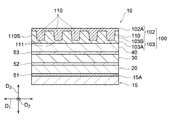
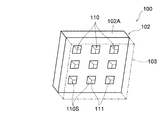
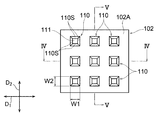
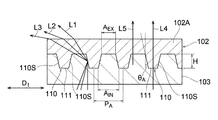
- FIG. 1 It is a figure which shows typically the structure of the display device provided with the optical film which concerns on 1st Embodiment of this disclosure. It is a partial perspective view of the optical film provided in the display device shown in FIG. It is a figure which shows schematic arrangement of the lens part of the low refractive index layer of the optical film shown in FIG. It is sectional drawing when the optical film is cut in the direction along the IV-IV line of FIG. It is sectional drawing when the optical film is cut in the direction along the VV line of FIG. It is a figure which shows one modification of the optical film shown in FIG. It is a figure which shows one modification of the optical film shown in FIG. It is a figure which shows one modification of the optical film shown in FIG. It is a figure which shows one modification of the optical film shown in FIG.
- FIG. 1 It is a figure which shows one modification of the display device shown in FIG. It is a figure which shows typically the structure of the display device provided with the optical film which concerns on the 2nd Embodiment of this disclosure. It is a figure which shows the graph explaining the relationship between the shape of the optical film which concerns on Example and the comparative example, and the brightness and color change.
- a “sheet” is a concept that includes a member that can also be called a film or a plate.
- the “sheet surface (plate surface, film surface)” refers to the plane direction (plane direction) of the target sheet-like member when the target sheet-like member is viewed as a whole and in a broad view. ) Refers to the surface that matches.
- the "sheet surface (plate surface, film surface)” may be referred to as a main surface.
- the normal direction of the sheet-shaped member refers to the normal direction of the target sheet-shaped member to the seat surface.
- FIG. 1 is a diagram schematically showing the configuration of a display device 10 including the optical film 100 according to the first embodiment.
- the display device 10 is configured by laminating an organic LED (Organic Light Emitting Diode) panel 15, a circular polarizing plate 20, a touch panel 30, a cover glass 40, and an optical film 100 in this order.
- the display device 10 according to the present embodiment is configured as a smartphone as an example.
- the display device 10 may be a tablet terminal, a television, a computer display, a car navigation system, or the like.
- the display surface (front surface) 15A of the organic LED panel 15 and the back surface of the circularly polarizing plate 20 are bonded by a first adhesive layer 51.
- the front surface of the circularly polarizing plate 20 and the back surface of the touch panel 30 are bonded by a second adhesive layer 52.
- the front surface of the touch panel 30 and the back surface of the cover glass 40 are bonded by a third adhesive layer 53.
- Each of the adhesive layers 51 to 53 is a so-called OCA (Optical Clear Adhesive) and has a high light transmittance.
- the optical film 100 is arranged on the surface of the cover glass 40.
- the optical film 100 and the cover glass 40 are not bonded by the adhesive layer, but the optical film 100 and the cover glass 40 may be bonded by the adhesive layer.
- reference numeral D 1 indicates the first direction is a direction parallel to the film surface of the optical film 100.
- Code D 2 is a direction parallel to the film plane of the optical film 100, showing a second direction orthogonal to the first direction D 1.
- reference numeral D 3 indicates a third direction orthogonal to both the first direction D 1 and the second direction D 2.
- the organic LED panel 15 includes an organic LED panel that employs a microcavity structure, but other types may be used.
- a blue shift is likely to occur in an image visually recognized from an angle. Such a blue shift is particularly likely to appear in an organic LED panel that employs a microcavity structure. Therefore, in the display device 10, the optical film 100 is used to suppress the color change within the viewing angle.
- the circularly polarizing plate 20, the touch panel 30, and the cover glass 40 are arranged between the organic LED panel 15 and the optical film 100.
- the circularly polarizing plate 20 has a polarizer and a retardation plate, the retardation plate is arranged on the organic LED panel 15 side, and the polarizer is a surface of the retardation plate on the side opposite to the organic LED panel 15 side. It is joined to.
- the polarizer is a linear polarizer
- the retardation plate is a ⁇ / 4 retardation plate.
- the touch panel 30 includes a transparent glass plate. It is desirable that the touch panel 30 adopts a capacitance method.
- the cover glass 40 has a protective function. However, the cover glass 40 may have other functions such as an antireflection function.
- the optical film 100 includes a low refractive index layer 102 and a high refractive index layer 103 that are bonded to each other.
- the base material is not arranged on the side of the low refractive index layer 102 opposite to the high refractive index layer 103 side, a base material may be contained.
- FIG. 2 is a partial perspective view of the optical film 100.
- the high refractive index layer 103 is shown by an alternate long and short dash line for convenience of explanation.
- Figure 3 is a view of a low refractive index layer 102 in the normal direction, as viewed in other words the third direction D 3.
- FIG. 3 schematically shows an arrangement of the lens unit 110 described later included in the low refractive index layer 102.
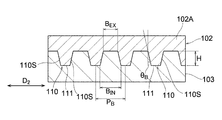
- FIG. 4 is a cross-sectional view when the optical film 100 is cut in the direction along the IV-IV line of FIG.
- FIG. 5 is a cross-sectional view when the optical film 100 is cut in the direction along the VV line of FIG.
- the low refractive index layer 102 is a film-like layer body 102A having a front surface and a back surface, and a plurality of lens portions two-dimensionally arranged on the back surface of the layer body 102A in the first direction D 1 and the second direction D 2. 110 and is integrally provided.
- the high refractive index layer 103 is laminated on the low refractive index layer 102 so as to cover the lens portion 110 and fill the space between the plurality of lens portions 110.
- the interface between the low refractive index layer 102 and the high refractive index layer 103 forms an uneven shape.
- the high refractive index layer 103 has a film shape having a plurality of holes for accommodating the plurality of lens portions 110, and more specifically, has a grid shape or a grid shape.
- the high refractive index layer 103 has a film-like layer body 103A having a front surface and a back surface, and a grid-shaped portion 103B.
- the grid-shaped portion 103B is integrated with the surface of the layer body 103A facing the low refractive index layer 102 side.
- Pound shaped portion 103B when viewed in the third direction D 3, curb shape (grid shape, hash shape, etc.) forms a.
- the low refractive index layer 102 may be composed of a set of a plurality of lens units 110 without having the layer body 102A. Further, the high refractive index layer 103 may also be composed of only the girder-shaped portion 103B without having the layer body 103A.
- the lens portions 110 are two-dimensionally arranged in a matrix. Specifically, a row formed by a plurality of lens portions 110 arranged at equal intervals in the first direction D 1 is formed in the second direction D. They are lined up in 2 at equal intervals. In this example, the plurality of lens portions 110 all have the same shape.
- the second direction D lens portion 110 adjacent in the 2, without deviating in the first direction D 1, are facing in the second direction D 2.
- the lens portion 110 has a column shape that is tapered to the lower side in FIG. 1, which is one side in the normal direction of the film surface of the optical film 100. Then, the lens unit 110 is located at the tip of the high refractive index layer 103 side, which is one side in the normal direction, along the surface direction of the low refractive index layer 102 and the high refractive index layer 103, that is, along the film surface of the optical film 100.
- Has a flat portion 111 extending Specifically, the lens portion 110 has a quadrangular pyramid shape, more specifically, a regular quadrangular pyramid shape, and the flat portion 111 has a rectangular shape, and more specifically, a square shape.
- the lens portion 110 has four side surfaces 110S located between the flat portion 111 and the layer body 102A and connected so as to form a rectangular shape.
- two side surfaces 110S facing in the first direction D 1 across the flat portion 111 has a tapered high refractive index layer 103 side. As shown in FIG. 5, it has a tapered two sides 110S also high refractive index layer 103 side facing in the second direction D 2 across the flat portion 111. Further, each of the four side surfaces 110S has a curved surface that is convex toward the high refractive index layer 103 side.
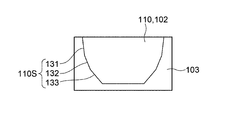
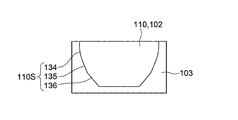
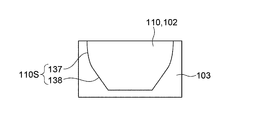
- the side surface 110S may be a curved surface that is convex toward the high refractive index layer 103 that forms an arc in cross-sectional view, or may be a curved surface that is convex toward the high refractive index layer 103 that forms an elliptical arc. Further, the side surface 110S may be a bent surface that is convex toward the high refractive index layer 103 side. Further, the side surface 110S may be a curved surface or a bent surface that is concave on the low refractive index layer 102 side, or may be a flat surface.
- the optical film 100 in the present embodiment is arranged so that the high refractive index layer 103 faces the organic LED panel 15 side.
- the optical film 100 is arranged so that the flat portion 111 of the lens portion 110 faces the organic LED panel 15 side. Therefore, the high refractive index layer 103 is located on the incident side of the light from the organic LED panel 15, and the low refractive index layer 102 is located on the light emitting side.
- Code A IN, code A EX, code P A shown in FIG. 4 means less.
- ⁇ A IN first first direction high refractive index side entrance width is the distance in the direction D 1 of the between the flat portion 111 of the lens portion 110 adjacent in the first direction D 1.
- ⁇ A EX first first direction high refractive index side emitting width is the distance in the direction D 1 of the between the end portion opposite to the flat portion 111 of the lens portion 110 adjacent in the first direction D 1.
- ⁇ P A: first direction pitch is the distance in the first direction D 1 of the between the midpoint in the first direction D 1 of the lens portion 110 adjacent in the first direction D 1.
- Reference numeral B IN, reference numeral B EX , and reference numeral P B shown in FIG. 5 mean the following.
- ⁇ B IN second direction the high refractive index side entrance width is the distance in the second direction D 2 between the second direction D flat portion 111 of the lens portion 110 adjacent in 2.
- ⁇ B EX second direction the high refractive index side emitting width is the distance in the second direction D 2 between the end opposite to the flat portion 111 of the lens portion 110 adjacent in the second direction D 2.
- ⁇ P B second-direction pitch which is the distance in the second direction D 2 between the midpoint in the second direction D 2 of the lens portion 110 adjacent in the second direction D 2.
- reference numeral H in FIGS. 4 and 5 indicates the height of the lens unit 110.
- the optical film 100 satisfies the following conditions (1) and (2).
- Condition (1) ((P A - ((A IN + A EX) / 2)) ⁇ (P B - ((B IN + B EX) / 2))) is / (P A ⁇ P B) , 0 It becomes .42 or more and 0.70 or less.
- -Condition (2): H / ((A IN + A EX ) / 2) and H / ((B IN + B EX ) / 2) are each 1.40 or more and 3.00 or less.
- the present inventor can effectively suppress color change within the viewing angle while maintaining good display quality in the front view of the display device 10 when the above conditions (1) or (2) are satisfied. I found. The present inventor has further found that when the conditions (1) and (2) are satisfied at the same time, the effect can be further enhanced.
- the optical film 100 totally reflects the light L1 to L3 from the organic LED panel 15 as shown in FIG. 4, for example, on the side surface 110S of the lens unit 110, and diffuses the totally reflected light over a wide angle range on the high angle side. do.
- the lens portion 110 is small, the amount of light that can be totally reflected by the side surface 110S can be reduced.
- the lens portion 110 is small and the side surface 110S has a steep slope, it may not be possible to diffuse light over a wide range.
- the side surface 110S has a steep slope and the tip of the lens portion 110 is sharp or rounded, light parallel to the front view direction may be undesirably diffused.
- the present inventor has found the above conditions (1) and (2).
- v' was calculated, it was found that the color change ⁇ u'v'in the presence of the optical film 100 can be expected to be 75% or less of the color change in the absence of the optical film 100.
- the light emitted from the organic LED panel 15 to the outside through the optical film 100 is directed to the front view direction of the display device 10 parallel to the third direction D 3, and the front view direction and the second direction D 2 .
- the color change ⁇ u'v'of the light emitted in the direction forming 45 degrees with respect to the color of the light emitted in the front view direction Observing from the direction forming 45 degrees with respect to the front view direction on the including plane, the color change ⁇ u'v'of the light emitted in the direction forming 45 degrees with respect to the color of the light emitted in the front view direction.
- the color change ⁇ u'v'in the presence of the optical film 100 can be expected to be 75% or less of the color change in the absence of the optical film 100.
- the color change ⁇ u'v' indicates a color difference, and in the present embodiment, the smaller the value, the smaller the color difference with respect to the light emitted in the front view direction.
- the color change ⁇ u'v' is calculated from the colors defined by u'and v'in the uniform color space.
- the value of ⁇ u'v'at an angle ⁇ in a certain viewing angle is expressed by the following equation (1). By substituting a value of 45 degrees for ⁇ in the equation (1), it is possible to obtain a color change when the viewing angle is 45 degrees.
- x and y are the color coordinates defined by the CIE 1931 color space (CIE xyY color space).
- the straight line passing through the high refractive index layer 103 side of the end point of the side surface 110S and its opposite end points indicates the angle towards the acute angle between the third direction D 3.
- code theta B in FIG. 5 the straight line passing through the high refractive index layer 103 side of the end point of the side surface 110S and its opposite end points indicates the angle towards the acute angle between the third direction D 3.
- Both of these angles ⁇ A and ⁇ B are defined in a range larger than 0 degrees and 15 degrees or less under the conditions in which the above conditions (1) and (2) are satisfied.
- the angles ⁇ A and ⁇ B are preferably larger than 0 degrees and 10 degrees or less, and more preferably 5 degrees or more and 10 degrees or less.
- the angles ⁇ A and ⁇ B correspond to the “average slope angle” shown in Table 1 and the like described later.
- the incident width A IN on the high refractive index side in the first direction and the emission width A EX on the high refractive index side in the first direction are set to ((A IN ⁇ A EX )).
- ⁇ 2) / P a is in the case of 0.2 or more and 0.5 or less (percentage, it is preferably formed so as to satisfy the relationship that 20% or more 50% or less).
- the incident width B IN on the high refractive index side in the second direction and the emission width B EX on the high refractive index side in the second direction have ((B IN ⁇ B EX ) ⁇ 2) / P B of 0.2 or more and 0.5.
- the relationship is as follows (in the case of a percentage, 20% or more and 50% or less).
- ((A IN -A EX) ⁇ 2) / P A, or, ((B IN -B EX) ⁇ 2) / P B is less than 0.2, the effect of suppressing the color change is effectively There is a risk that it will not be obtained.
- ((A IN -A EX) ⁇ 2) / P A, or, ((B IN -B EX) ⁇ 2) / P B becomes larger than 0.5, the possibility that the front luminance decreases be.
- the low refractive index layer 102 is such that the difference between the refractive index of the low refractive index layer 102 and the refractive index of the high refractive index layer 103 is in the range of 0.05 or more and 0.60 or less.
- the high index of refraction layer 103 is selected.
- the difference between the refractive index of the low refractive index layer 102 and the refractive index of the high refractive index layer 103 is preferably 0.05 or more and 0.50 or less when the optical film 100 is combined with the organic LED panel 15. , 0.10 or more and 0.20 or less is more preferable.
- the difference between the refractive index of the low refractive index layer 102 and the refractive index of the high refractive index layer 103 is 0.05 or more and 0.50. It is preferably 0.10 or more and 0.20 or less, more preferably 0.10 or more.
- the refractive index of the low refractive index layer 102 is, for example, 1.40 or more and 1.55 or less, and the refractive index of the high refractive index layer 103 is, for example, 1.55 or more and 1.90 or less, and the low refractive index layer 102. Is greater than the refractive index of.
- the high refractive index layer 103 is arranged on the incident side of the light from the organic LED panel 15, and the low refractive index layer 102 is arranged on the light emitting side.
- the high refractive index layer 103 faces the side surface 110S of the lens portion 110 which is a part of the low refractive index layer 102, and the side surface 110S Aim to secure a large amount of light that is totally reflected.
- the low refractive index layer 102 is located on the incident side of the light from the organic LED panel 15 and the portion corresponding to the lens portion 110 is formed on the high refractive index layer 103, the light to be totally reflected It becomes difficult to secure a large amount. Therefore, in the optical film 100, the high refractive index layer 103 is arranged on the organic LED panel 15 side.
- the present inventor has found that useful optical performance can be obtained when the low refractive index layer 102 is located on the incident side of the light from the organic LED panel 15 and the low refractive index layer 102 has the lens portion 110. I'm checking.
- the low refractive index layer 102 may be formed by, for example, curing an ultraviolet curable resin, an electron beam curable resin, or a thermosetting resin.
- the ultraviolet curable resin may contain an acrylic resin or an epoxy resin.
- the high refractive index layer 103 may be formed by curing, for example, an ultraviolet curable resin, an electron beam curable resin, or a thermosetting resin.
- the ultraviolet curable resin may contain an acrylic resin or an epoxy resin.
- the high refractive index layer 103 may be formed from an acrylic resin pressure-sensitive adhesive.
- the thickness in the third direction D 3 of the layer body 102A in the low refractive index layer 102 is, for example, 0.5 ⁇ m or more 30 ⁇ m or less.
- the height of the lens unit 110 is, for example, 1.0 ⁇ m or more and 30 ⁇ m or less.
- the thickness of the high refractive index layer 103 is 5 ⁇ m or more and 100 ⁇ m or less.
- the thickness of the high refractive index layer 103 is the distance from the end point on the low refractive index layer 102 side of the girder shape portion 103B to the surface of the layer body 103A on the side opposite to the low refractive index layer 102 side.
- the light passes through the circularly polarizing plate 20, the touch panel 30, and the cover glass 40 and is incident on the optical film 100.
- the light directed toward the flat portion of the layer body 102A between the flat portion 111 or the adjacent lens portions 110 along the front view direction travels as shown by reference numerals L4 and L5 in FIG. It is emitted from the low refractive index layer 102 with little or no change in the angle of direction, and contributes to image formation in front view.
- the light directed toward the side surface 110S of the lens unit 110 along the front view direction or in a direction inclined by a relatively small angle with respect to the front view direction is totally reflected by the side surface 110S.
- the traveling direction is changed to the high angle side, and the light is emitted from the low refractive index layer 102. That is, the light in the direction inclined by a relatively small angle with respect to the front view direction is totally reflected by the side surface 110S and then travels to a higher angle side than the initial one.
- the optical film 100 is formed so as to satisfy the above conditions (1) and (2), so that the lens portion 110 has an elongated shape in the height direction and the area of the side surface 110S is increased.
- the flat portion 111 is provided at the tip of the lens portion 110, it is possible to prevent undesirably diffusing of the light traveling in the front view direction, so that the deterioration of the image quality in the front view is suppressed. Will be done.
- the lens unit 110 is a column-shaped tapered in the high refractive index layer 103 side, the direction is inclined with respect to a front viewing direction in the plane containing the front view direction and the first direction D 1, and, viewed from the front direction And in the plane including the second direction D 2 , it is possible to suppress the color change in both the directions inclined with respect to the front view direction.
- the side surface 110S is a bent surface, and has the first element surface 131, the second element surface 132, and the third element surface 133, which are three element surfaces configured as planes, respectively. ..
- the side surface 110S includes a curved surface 134 and a bent surface having two element surfaces 135 and 136 configured as a flat surface.
- the side surface 110S includes a curved surface 137 and a flat surface 138.
- the display device 10' is configured by laminating an organic LED panel 15, an optical film 100, a circularly polarizing plate 20, a touch panel 30, and a cover glass 40 in this order. ..
- the optical film 100 is arranged on the display surface (surface) 15A of the organic LED panel 15.
- the front surface of the optical film 100 and the back surface of the circularly polarizing plate 20 are bonded by an adhesive layer 510.
- the front surface of the circularly polarizing plate 20 and the back surface of the touch panel 30 are bonded by an adhesive layer 520.
- the front surface of the touch panel 30 and the back surface of the cover glass 40 are bonded by an adhesive layer 530.
- Each of the adhesive layers 510 and 520.530 is a so-called OCA (Optical Clear Adhesive) and has a high light transmittance.
- OCA Optical Clear Adhesive
- the organic LED panel 15 and the optical film 100 are not bonded by an adhesive layer, but the organic LED panel 15 and the optical film 100 may be bonded by an adhesive layer.
- the circularly polarizing plate 20 is arranged on the outside light incident side (cover glass 40 side) of the optical film 100.
- the circularly polarizing plate 20 makes it difficult for the external light to enter the optical film 100, and multiple reflections in the optical film 100 are suppressed. obtain.
- the occurrence of visibility obstruction events such as rainbow unevenness and interference fringes is suppressed, and good visibility of the image can be ensured.
- the lens portion 110 in the low refractive index layer 102 has a quadrangular pyramid shape, but it may be a conical shape, a hexagonal pyramid shape, or an octagonal pyramid shape. Further, the arrangement of the lens portions 110 is not limited to the matrix shape, and may be, for example, a houndstooth shape.
- the flat portion 111 and the proximal end portion are square in the above-described embodiment. That is, as shown in FIG. 3, when the lens portion 110 is viewed in the normal direction of the low refractive index layer 102, the aspect ratio (first maximum width W1: first) of the lens portion 110 (flat portion 111 and base end portion) is The second maximum width W2) in the direction orthogonal to the direction in which the 1 maximum width W is defined is 1: 1.
- W1: W2 may be about 1: 3 to 3: 1.
- Direction defining a direction or a second maximum width W2 defining a first maximum width W1 is parallel to the first direction D 1. If the difference between the first maximum width W1 and the second maximum width W2 is larger than three times, the productivity is lowered due to the difficulty in die cutting, and the risk of collapse of the lens portion 110 is high.
- the display devices 10 and 10'described above include a combination of the organic LED panel 15 and the optical film 100 in which the lens portions 110 are arranged in a two-dimensional manner. May be combined.
- a polarizing plate with an optical film in which the optical film 100 and the circularly polarizing plate 20 are integrated may be produced in advance.
- the low refractive index layer 102 of the optical film 100 and the retardation plate of the circularly polarizing plate 20 are bonded together.
- FIG. 10 is a diagram schematically showing the configuration of a display device 10 ′′ including the optical film 200 according to the second embodiment.
- the same constituent parts as those of the first embodiment are designated by the same reference numerals, and the description thereof will be omitted.
- the orientation of the low refractive index layer 102 and the high refractive index layer 103 is the low refractive index layer 102 of the optical film 100 according to the first embodiment. And the opposite with respect to the high refractive index layer 103.
- Other configurations are the same as in the first embodiment.
- the low refractive index layer 102 is located on the incident side of the light from the organic LED panel 15, and the low refractive index layer 102 is the lens portion 110. Has.
- Condition (1) ((P A - ((A IN + A EX) / 2)) ⁇ (P B - ((B IN + B EX) / 2))) is / (P A ⁇ P B) , 0 It becomes .42 or more and 0.70 or less.
- the optical films according to Examples 1 to 4 have the same shape as that described in the first embodiment described above, and are 8.6 ⁇ m in both the first direction D 1 and the second direction D 2. It has quadrangular pyramid-shaped lens portions 110 arranged in a matrix at equal pitches.
- the lens portion 110 has a regular quadrangular pyramid shape, and the flat portion 111 has a square shape.
- the low refractive index layer 102 is made of a resin having a refractive index of 1.48
- the high refractive index layer 103 is made of a resin having a refractive index of 1.65.
- the optical film according to Examples 1-4, described above ((P A - ((A IN + A EX) / 2)) ⁇ (P B - ((B IN + B EX) / 2))) / (
- the slope ratio determined by P A x P B ) is 0.42 or more and 0.70 or less, and the average aspect in the first-direction cross-sectional view determined by H / ((A IN + A EX) / 2) and , H / ((B IN + B EX ) / 2) are formed so that the average aspect in the second direction cross-sectional view is 1.40 or more and 3.00 or less, respectively.
- the average aspect in the first-direction cross-sectional view and the average aspect in the second-direction cross-sectional view are the same values.
- average aspect when the term "average aspect” is simply used, it means both the average aspect in the first-direction cross-sectional view and the average aspect in the second-direction cross-sectional view.
- the optical film according to the fifth embodiment has the same shape as that described in the second embodiment described above, and has an equal pitch of 8.6 ⁇ m in both the first direction D 1 and the second direction D 2. It has a quadrangular pyramid-shaped lens portion 110 arranged in a matrix.
- the lens portion 110 has a regular quadrangular pyramid shape, and the flat portion 111 has a square shape.
- the low refractive index layer 102 is made of a resin having a refractive index of 1.48
- the high refractive index layer 103 is made of a resin having a refractive index of 1.65.
- Example 5 The difference between Examples 5 and 1 to 4 is that in Examples 1 to 4, the high refractive index layer 103 is located on the light source (display panel) side, whereas in Example 5, the low refractive index is low. This is a point where the layer 102 is located on the light source (display panel) side.
- optical film according to Example 5 has a slope ratio of 0.42 or more and 0.70 or less, but the average aspect is out of 1.40 or more and 3.00 or less.
- Comparative Examples 1 to 4 have a regular quadrangular pyramid-shaped lens portion, and the lens portions are arranged in a matrix in both the first direction D 1 and the second direction D 2 at an equal pitch of 8.6 ⁇ m.
- the slope ratio deviates from 0.42 or more and 0.70 or less
- the average aspect deviates from 1.40 or more and 3.00 or less.
- the forming material is the same as in the examples. That is, the basic shapes of Comparative Examples 1 to 4 are the same as those of Examples 1 to 4, but the slope ratio deviates from 0.42 or more and 0.70 or less, and the average aspect is 1.40 or more and 3 It is out of the range of 0.00 or less.
- Comparative Examples 5 and 6 have a regular quadrangular pyramid-shaped lens portion, and are arranged in a matrix in both the first direction D 1 and the second direction D 2 at an equal pitch of 8.6 ⁇ m.
- the slope ratio deviates from 0.42 or more and 0.70 or less, and the average aspect deviates from 1.40 or more and 3.00 or less.
- the arrangement positions of the low refractive index layer and the high refractive index layer are opposite to those of Examples 1 to 4.
- the low refractive index layer has a lens portion.
- Comparative Examples 5 and 6 have a configuration in which these are arranged in the order of the low refractive index layer and the high refractive index layer from the light source side (“L low and high” in Table 1 shown below is a light source. It means that these are arranged in the order of low refractive index layer and high refractive index layer from the side).
- the forming material is the same as in Examples 1 to 5.
- Comparative Examples 5 and 6 have the same basic shape as that of Example 5, but the slope ratio is 0.42 or more and 0.70 or less, and the average aspect is 1.40 or more. It is out of 00 or less.
- Examples and Comparative Examples were performed from the viewpoint of brightness and color change.
- the brightness is evaluated by the brightness in the front view direction (front brightness) of the image displayed by the organic LED display panel with the optical film attached and the front brightness of the same image displayed by the organic LED display panel without the optical film attached. was compared and the ratio of the former to the latter was calculated.
- the evaluation of the color change is based on the color change ⁇ u'v'when the image displayed by the organic LED display panel without the optical film is viewed from a direction inclined by 45 degrees with respect to the front view direction, and the optical film is attached.
- the same image displayed by the organic LED display panel was compared with the color change ⁇ u'v'when viewed from a direction inclined by 45 degrees with respect to the front view direction.
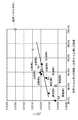
- FIG. 11 is a graph showing the ratio of the front luminance with and without the optical film and the value of the color change, the horizontal axis showing the percentage of the front luminance and the vertical axis showing the value of the color change. .. Further, the "high refractive index side emission width" in the table relating to Example 5 corresponds to the symbol A IN ( BIN ) in FIG.
- the color change ⁇ u'v'when viewed from a direction inclined by 45 degrees with respect to the front view direction is changed to the color change when there is no optical film.
- it can be suppressed to 75% or less.
- the brightness at this time is 90% or more of the brightness when there is no optical film, and the decrease in the brightness in the front view is suppressed.
- Example 5 the color change ⁇ u'v'when viewed from a direction inclined by 45 degrees with respect to the front view direction can be suppressed to 75% or less with respect to the color change when there is no optical film.
- the slope ratio in Example 5 is 0.51
- the average aspect of Example 5 is 1.22, which deviates from 1.40 or more and 3.00 or less, but when it is in the range of 1.40 or more and 3.00 or less, the area of the side surface 110S is increased. It is presumed that the effect of suppressing the color change and suppressing the decrease in front luminance can be improved by ensuring that the lens portion 110 is not too sharp.
- the straight line L in FIG. 11 is a straight line showing the tendency of the optical film according to Comparative Examples 5 and 6 in the order of the low refractive index layer and the high refractive index layer from the light source side.
- Examples 1 to 4 are located below the straight line L, and are in the order of the low refractive index layer and the high refractive index layer from the light source side, from the optical films of Example 5, Comparative Example 5, and Comparative Example 6. Can also suppress color change. From this result, when the high refractive index layer 103 is located on the light source (display panel) side, a higher color change suppressing effect can be obtained than when the low refractive index layer 102 is located on the light source (display panel) side. Was inferred.
- Simulation Comparative Example X is an optical film in which a lens portion is provided on a high refractive index layer facing the light source side, and the low refractive index layer laminated on the lens portion has a grid shape.
- the following dimensional conditions were set in the lens unit 110 of the optical film 100 of the first embodiment to be simulated.
- the high refractive index side emission width and the high refractive index side incident width have the same values in both the first direction D 1 and the second direction D 2.
- the lens part has a regular quadrangular pyramid shape.
- -Pitch 8.6 ⁇ m (both first direction D 1 and second direction D 2)
- ⁇ Average slope angle 12.1 (°) ⁇ Slope radius of curvature: 15 ( ⁇ m)
- the following dimensional conditions were set in the lens portion of the simulation comparative example X.
- the high refractive index side emission width and the high refractive index side incident width have the same values in both the first direction D 1 and the second direction D 2.
- the lens part has a regular quadrangular pyramid shape.
- the “high refractive index side incident width side” of the simulation comparative example X is a lens unit adjacent to each other in the first direction D 1 (second direction D 2) according to the definition described in the first embodiment described above. It is calculated by the distance in the first direction D 1 (second direction D 2 ) between the ends of the 110 opposite to the flat portion 111.
- the degree of color change is smaller than that of Simulation Comparative Example X at any viewing angle, and the color change can be effectively suppressed.
- the color of the grid-shaped portion 103B of the high refractive index layer 103 and the lens portion 110 of the low refractive index layer 102 which are directed toward the light source side, changes even when the lens portions are arranged on the high refractive index layer. It was confirmed to be effective for suppression.
Landscapes
- Physics & Mathematics (AREA)
- Nonlinear Science (AREA)
- Optics & Photonics (AREA)
- General Physics & Mathematics (AREA)
- Crystallography & Structural Chemistry (AREA)
- Chemical & Material Sciences (AREA)
- Mathematical Physics (AREA)
- Engineering & Computer Science (AREA)
- Theoretical Computer Science (AREA)
- Devices For Indicating Variable Information By Combining Individual Elements (AREA)
- Optical Elements Other Than Lenses (AREA)
- Electroluminescent Light Sources (AREA)
- Liquid Crystal (AREA)
- Polarising Elements (AREA)
Priority Applications (5)
| Application Number | Priority Date | Filing Date | Title |
|---|---|---|---|
| CN202180008845.3A CN114930200B (zh) | 2020-01-16 | 2021-01-13 | 光学膜、带光学膜的偏光板以及显示装置 |
| JP2021571212A JP7057910B2 (ja) | 2020-01-16 | 2021-01-13 | 光学フィルム、光学フィルム付き偏光板及び表示装置 |
| US17/758,582 US12197066B2 (en) | 2020-01-16 | 2021-01-13 | Optical film, optical-film-provided polarizing plate, and display device |
| KR1020227027650A KR102901067B1 (ko) | 2020-01-16 | 2021-01-13 | 광학 필름, 광학 필름을 갖는 편광판 및 표시 장치 |
| JP2022064750A JP2022092002A (ja) | 2020-01-16 | 2022-04-08 | 光学フィルム、光学フィルム付き偏光板及び表示装置 |
Applications Claiming Priority (2)
| Application Number | Priority Date | Filing Date | Title |
|---|---|---|---|
| JP2020005356 | 2020-01-16 | ||
| JP2020-005356 | 2020-12-11 |
Publications (1)
| Publication Number | Publication Date |
|---|---|
| WO2021145349A1 true WO2021145349A1 (ja) | 2021-07-22 |
Family
ID=76863797
Family Applications (1)
| Application Number | Title | Priority Date | Filing Date |
|---|---|---|---|
| PCT/JP2021/000923 Ceased WO2021145349A1 (ja) | 2020-01-16 | 2021-01-13 | 光学フィルム、光学フィルム付き偏光板及び表示装置 |
Country Status (6)
| Country | Link |
|---|---|
| US (1) | US12197066B2 (https=) |
| JP (2) | JP7057910B2 (https=) |
| KR (1) | KR102901067B1 (https=) |
| CN (1) | CN114930200B (https=) |
| TW (1) | TWI843930B (https=) |
| WO (1) | WO2021145349A1 (https=) |
Cited By (1)
| Publication number | Priority date | Publication date | Assignee | Title |
|---|---|---|---|---|
| JP2023070589A (ja) * | 2021-11-09 | 2023-05-19 | 大日本印刷株式会社 | 光学フィルム及び表示装置 |
Families Citing this family (1)
| Publication number | Priority date | Publication date | Assignee | Title |
|---|---|---|---|---|
| KR20260045893A (ko) * | 2023-08-15 | 2026-04-03 | 다이니폰 인사츠 가부시키가이샤 | 광학 필름 및 그 제조 방법, 표시 장치, 및 입자 응집도의 평가 방법 |
Citations (4)
| Publication number | Priority date | Publication date | Assignee | Title |
|---|---|---|---|---|
| JP2014123568A (ja) * | 2012-12-21 | 2014-07-03 | Samsung Electronics Co Ltd | 光学フィルム及びこれを含む有機発光表示装置 |
| JP2015156275A (ja) * | 2014-02-20 | 2015-08-27 | 大日本印刷株式会社 | エレクトロルミネッセンス発光ユニット、表示装置、光学シート及びエレクトロルミネッセンス発光ユニットの製造方法 |
| US20180045876A1 (en) * | 2015-04-29 | 2018-02-15 | Samsung Sdi Co., Ltd. | Optical film for improving contrast ratio, polarizing plate including same, and liquid crystal display device including same |
| JP2018205414A (ja) * | 2017-05-31 | 2018-12-27 | 大日本印刷株式会社 | 光学構造体、表示装置 |
Family Cites Families (26)
| Publication number | Priority date | Publication date | Assignee | Title |
|---|---|---|---|---|
| JP3272833B2 (ja) | 1992-10-21 | 2002-04-08 | 大日本印刷株式会社 | 透過型スクリーン |
| JPH0743704A (ja) | 1993-07-29 | 1995-02-14 | Toray Ind Inc | 液晶ディスプレイの視野角拡大方法 |
| JP3621959B2 (ja) | 1995-12-06 | 2005-02-23 | 三菱レイヨン株式会社 | 液晶表示装置 |
| US8698985B2 (en) | 2009-11-30 | 2014-04-15 | Samsung Corning Precision Materials Co., Ltd. | Optical film for reducing color shift and LCD device having the same |
| KR101874649B1 (ko) | 2010-04-22 | 2018-07-04 | 이데미쓰 고산 가부시키가이샤 | 유기 일렉트로 루미네선스 소자 및 조명 장치 |
| KR101208021B1 (ko) | 2011-01-13 | 2012-12-04 | 삼성코닝정밀소재 주식회사 | 액정 디스플레이 장치용 컬러시프트 저감 광학필름 및 이를 구비하는 액정 디스플레이 장치 |
| KR101585148B1 (ko) * | 2012-12-21 | 2016-01-22 | 제일모직주식회사 | 색 변화 저감용 광학 필름 및 이를 채용한 유기 발광 표시 장치 |
| KR102107563B1 (ko) | 2013-08-08 | 2020-05-08 | 삼성디스플레이 주식회사 | 광학 필름, 이를 포함하는 표시 장치 및 광학 필름의 제조 방법 |
| KR20150059494A (ko) | 2013-11-22 | 2015-06-01 | 삼성전자주식회사 | 색변화 저감용 광학 필름의 제조방법, 색변화 저감용 광학필름이 적용된 유기발광 표시장치 및 이의 제조방법 |
| JP2015176132A (ja) * | 2014-03-18 | 2015-10-05 | 大日本印刷株式会社 | 光学シート、有機エレクトロルミネッセンス発光ユニット、及び表示装置 |
| JPWO2016047045A1 (ja) | 2014-09-25 | 2017-04-27 | パナソニックIpマネジメント株式会社 | 有機エレクトロルミネッセンス素子、基材及び発光装置 |
| JP6159385B2 (ja) | 2014-12-31 | 2017-07-05 | 三星エスディアイ株式会社SAMSUNG SDI Co., LTD. | 液晶表示装置用モジュール及びこれを含む液晶表示装置 |
| JP7152129B2 (ja) | 2015-02-27 | 2022-10-12 | 三星エスディアイ株式会社 | 偏光板及びこれを含む液晶表示装置 |
| KR101871573B1 (ko) * | 2016-04-27 | 2018-06-27 | 삼성에스디아이 주식회사 | 명암비 개선 광학필름, 이를 포함하는 편광판 및 이를 포함하는 액정표시장치 |
| US10948734B2 (en) | 2016-10-28 | 2021-03-16 | 3M Innovative Properties Company | Light control film with varied viewing angle |
| KR101982386B1 (ko) | 2016-10-31 | 2019-05-27 | 삼성에스디아이 주식회사 | 편광판 및 이를 포함하는 액정표시장치 |
| KR101963006B1 (ko) * | 2016-11-16 | 2019-03-27 | 삼성에스디아이 주식회사 | 명암비 개선 광학필름, 이를 포함하는 편광판 및 이를 포함하는 액정표시장치 |
| KR102004031B1 (ko) | 2017-01-09 | 2019-07-25 | 삼성에스디아이 주식회사 | 편광판 및 이를 포함하는 액정표시장치 |
| KR20220133327A (ko) | 2017-04-19 | 2022-10-04 | 다이니폰 인사츠 가부시키가이샤 | 광학 구조체 및 표시 장치 |
| KR102063201B1 (ko) | 2017-05-18 | 2020-01-07 | 삼성에스디아이 주식회사 | 편광판 및 이를 포함하는 광학표시장치 |
| KR102063202B1 (ko) | 2017-06-01 | 2020-02-11 | 삼성에스디아이 주식회사 | 편광판 및 이를 포함하는 액정표시장치 |
| US10901130B2 (en) | 2017-11-01 | 2021-01-26 | Samsung Sdi Co., Ltd. | Optical film, polarizing plate including the optical film, and liquid crystal display apparatus including the polarizing plate |
| KR102194872B1 (ko) | 2017-12-19 | 2020-12-23 | 삼성에스디아이 주식회사 | 명암비 개선 광학 필름, 이를 포함하는 편광판 및 이를 포함하는 액정표시장치 |
| KR102264926B1 (ko) * | 2018-03-28 | 2021-06-14 | 삼성에스디아이 주식회사 | 시인성 개선 광학 필름, 이를 포함하는 편광판 및 이를 포함하는 플렉시블 광학표시장치 |
| KR102393270B1 (ko) | 2018-07-10 | 2022-05-02 | 삼성에스디아이 주식회사 | 편광판 및 이를 포함하는 광학표시장치 |
| JP2020016881A (ja) | 2018-07-17 | 2020-01-30 | 大日本印刷株式会社 | 光学構造体、光学構造体付き偏光板及び表示装置 |
-
2021
- 2021-01-13 WO PCT/JP2021/000923 patent/WO2021145349A1/ja not_active Ceased
- 2021-01-13 KR KR1020227027650A patent/KR102901067B1/ko active Active
- 2021-01-13 CN CN202180008845.3A patent/CN114930200B/zh active Active
- 2021-01-13 US US17/758,582 patent/US12197066B2/en active Active
- 2021-01-13 JP JP2021571212A patent/JP7057910B2/ja active Active
- 2021-01-15 TW TW110101567A patent/TWI843930B/zh active
-
2022
- 2022-04-08 JP JP2022064750A patent/JP2022092002A/ja active Pending
Patent Citations (4)
| Publication number | Priority date | Publication date | Assignee | Title |
|---|---|---|---|---|
| JP2014123568A (ja) * | 2012-12-21 | 2014-07-03 | Samsung Electronics Co Ltd | 光学フィルム及びこれを含む有機発光表示装置 |
| JP2015156275A (ja) * | 2014-02-20 | 2015-08-27 | 大日本印刷株式会社 | エレクトロルミネッセンス発光ユニット、表示装置、光学シート及びエレクトロルミネッセンス発光ユニットの製造方法 |
| US20180045876A1 (en) * | 2015-04-29 | 2018-02-15 | Samsung Sdi Co., Ltd. | Optical film for improving contrast ratio, polarizing plate including same, and liquid crystal display device including same |
| JP2018205414A (ja) * | 2017-05-31 | 2018-12-27 | 大日本印刷株式会社 | 光学構造体、表示装置 |
Cited By (2)
| Publication number | Priority date | Publication date | Assignee | Title |
|---|---|---|---|---|
| JP2023070589A (ja) * | 2021-11-09 | 2023-05-19 | 大日本印刷株式会社 | 光学フィルム及び表示装置 |
| JP7808270B2 (ja) | 2021-11-09 | 2026-01-29 | 大日本印刷株式会社 | 光学フィルム及び表示装置 |
Also Published As
| Publication number | Publication date |
|---|---|
| KR20220120701A (ko) | 2022-08-30 |
| TW202134703A (zh) | 2021-09-16 |
| US12197066B2 (en) | 2025-01-14 |
| JPWO2021145349A1 (https=) | 2021-07-22 |
| KR102901067B1 (ko) | 2025-12-17 |
| JP7057910B2 (ja) | 2022-04-21 |
| CN114930200B (zh) | 2025-03-25 |
| JP2022092002A (ja) | 2022-06-21 |
| TWI843930B (zh) | 2024-06-01 |
| US20230046640A1 (en) | 2023-02-16 |
| CN114930200A (zh) | 2022-08-19 |
Similar Documents
| Publication | Publication Date | Title |
|---|---|---|
| TWI662303B (zh) | 背光模組 | |
| JP2021508383A (ja) | マルチビーム素子ベースのヘッドアップディスプレイ、システム、および方法 | |
| JP7700894B2 (ja) | 光学フィルム及び表示装置 | |
| JP2004062084A (ja) | 視認性向上シートおよびこれを用いたディスプレイ | |
| JP2018205414A (ja) | 光学構造体、表示装置 | |
| JP7057910B2 (ja) | 光学フィルム、光学フィルム付き偏光板及び表示装置 | |
| CN111796349A (zh) | 一种视角扩散膜片及显示面板 | |
| WO2019041911A1 (zh) | 光学元件、使用其的反射型液晶显示系统 | |
| JP2017084559A (ja) | プリズムシートおよび面状照明装置 | |
| JP2013003266A (ja) | 光拡散部材、偏光板、及び液晶表示装置 | |
| EP4051958A1 (en) | Multibeam backlight, multiview display, and method having shaped-edge multibeam elements | |
| JP5939107B2 (ja) | 面光源装置及び透過型表示装置 | |
| JP2015191686A (ja) | 導光体、エッジライト型照明装置および画像表示装置 | |
| JP7045655B2 (ja) | 表示装置及び光学フィルムの製造方法 | |
| JP2016212191A (ja) | プリズムシート、面光源装置、映像源ユニット、及び液晶表示装置 | |
| JP2013210494A (ja) | 光拡散フィルム、偏光板、及び液晶表示装置 | |
| WO2022059469A1 (ja) | 導光板、照明装置、表示装置 | |
| KR102887668B1 (ko) | 표시 장치 및 광학 필름의 제조 방법 | |
| JP5716295B2 (ja) | 隠蔽構造体を備えた照明ユニット、照明装置、表示装置 | |
| JP7240635B2 (ja) | 光学部材及び光学部材付き表示装置 | |
| JP6046335B2 (ja) | 液晶表示装置用回折構造体、偏光板、及び液晶表示装置 | |
| JP2007305437A (ja) | 液晶バックライト装置用プリズムシート | |
| JP2012093631A (ja) | 3次元映像表示装置 | |
| JP2018084741A (ja) | 表示装置 |
Legal Events
| Date | Code | Title | Description |
|---|---|---|---|
| 121 | Ep: the epo has been informed by wipo that ep was designated in this application |
Ref document number: 21740847 Country of ref document: EP Kind code of ref document: A1 |
|
| ENP | Entry into the national phase |
Ref document number: 2021571212 Country of ref document: JP Kind code of ref document: A |
|
| ENP | Entry into the national phase |
Ref document number: 20227027650 Country of ref document: KR Kind code of ref document: A |
|
| NENP | Non-entry into the national phase |
Ref country code: DE |
|
| 122 | Ep: pct application non-entry in european phase |
Ref document number: 21740847 Country of ref document: EP Kind code of ref document: A1 |
|
| WWG | Wipo information: grant in national office |
Ref document number: 202180008845.3 Country of ref document: CN |