WO2021144929A1 - 積層型蓄電素子 - Google Patents
積層型蓄電素子 Download PDFInfo
- Publication number
- WO2021144929A1 WO2021144929A1 PCT/JP2020/001341 JP2020001341W WO2021144929A1 WO 2021144929 A1 WO2021144929 A1 WO 2021144929A1 JP 2020001341 W JP2020001341 W JP 2020001341W WO 2021144929 A1 WO2021144929 A1 WO 2021144929A1
- Authority
- WO
- WIPO (PCT)
- Prior art keywords
- positive electrode
- negative electrode
- power storage
- storage element
- side terminal
- Prior art date
- Legal status (The legal status is an assumption and is not a legal conclusion. Google has not performed a legal analysis and makes no representation as to the accuracy of the status listed.)
- Ceased
Links
Images


Classifications
-
- H—ELECTRICITY
- H01—ELECTRIC ELEMENTS
- H01G—CAPACITORS; CAPACITORS, RECTIFIERS, DETECTORS, SWITCHING DEVICES, LIGHT-SENSITIVE OR TEMPERATURE-SENSITIVE DEVICES OF THE ELECTROLYTIC TYPE
- H01G11/00—Hybrid capacitors, i.e. capacitors having different positive and negative electrodes; Electric double-layer [EDL] capacitors; Processes for the manufacture thereof or of parts thereof
- H01G11/22—Electrodes
- H01G11/26—Electrodes characterised by their structure, e.g. multi-layered, porosity or surface features
- H01G11/28—Electrodes characterised by their structure, e.g. multi-layered, porosity or surface features arranged or disposed on a current collector; Layers or phases between electrodes and current collectors, e.g. adhesives
-
- H—ELECTRICITY
- H01—ELECTRIC ELEMENTS
- H01G—CAPACITORS; CAPACITORS, RECTIFIERS, DETECTORS, SWITCHING DEVICES, LIGHT-SENSITIVE OR TEMPERATURE-SENSITIVE DEVICES OF THE ELECTROLYTIC TYPE
- H01G11/00—Hybrid capacitors, i.e. capacitors having different positive and negative electrodes; Electric double-layer [EDL] capacitors; Processes for the manufacture thereof or of parts thereof
- H01G11/74—Terminals, e.g. extensions of current collectors
-
- Y—GENERAL TAGGING OF NEW TECHNOLOGICAL DEVELOPMENTS; GENERAL TAGGING OF CROSS-SECTIONAL TECHNOLOGIES SPANNING OVER SEVERAL SECTIONS OF THE IPC; TECHNICAL SUBJECTS COVERED BY FORMER USPC CROSS-REFERENCE ART COLLECTIONS [XRACs] AND DIGESTS
- Y02—TECHNOLOGIES OR APPLICATIONS FOR MITIGATION OR ADAPTATION AGAINST CLIMATE CHANGE
- Y02E—REDUCTION OF GREENHOUSE GAS [GHG] EMISSIONS, RELATED TO ENERGY GENERATION, TRANSMISSION OR DISTRIBUTION
- Y02E60/00—Enabling technologies; Technologies with a potential or indirect contribution to GHG emissions mitigation
- Y02E60/10—Energy storage using batteries
-
- Y—GENERAL TAGGING OF NEW TECHNOLOGICAL DEVELOPMENTS; GENERAL TAGGING OF CROSS-SECTIONAL TECHNOLOGIES SPANNING OVER SEVERAL SECTIONS OF THE IPC; TECHNICAL SUBJECTS COVERED BY FORMER USPC CROSS-REFERENCE ART COLLECTIONS [XRACs] AND DIGESTS
- Y02—TECHNOLOGIES OR APPLICATIONS FOR MITIGATION OR ADAPTATION AGAINST CLIMATE CHANGE
- Y02P—CLIMATE CHANGE MITIGATION TECHNOLOGIES IN THE PRODUCTION OR PROCESSING OF GOODS
- Y02P70/00—Climate change mitigation technologies in the production process for final industrial or consumer products
- Y02P70/50—Manufacturing or production processes characterised by the final manufactured product
Definitions
- the present invention relates to a laminated power storage element having a laminated electrode body.
- Patent Document 1 discloses a device including a laminated electrode body in which a large number of sheet-shaped positive electrode bodies and negative electrode bodies are laminated via a separator.
- a current collector is connected to each of a large number of sheet-shaped positive electrode bodies (negative electrode bodies).
- a structure is adopted in which a large number of these current collectors are connected to the positive electrode side terminal (negative electrode side terminal) at one place by welding or the like in a state where they are stacked together.
- An object of the present invention is to provide a laminated power storage element in which a temperature rise is suppressed in order to solve the above problems.
- the laminated power storage element according to the present invention is used.
- An electrode body formed by stacking a plurality of sheet-shaped positive electrode bodies and a plurality of negative electrode bodies arranged so as to face each other, and a separator interposed between each positive electrode body and each negative electrode body.
- connection points between the positive and / or negative electrode current collectors and the terminals are dispersed, so that current concentration at the connection points is avoided.
- it is possible to prevent the temperature rise due to the concentration of the current flowing through the local portion having high electric resistance, which is the connection point inside the device, and to suppress the temperature rise transmitted from the current collector to the entire device. can.
- This stacked power storage element may be, for example, an element configured as a capacitor including an electrode on which an electric double layer is formed. According to this configuration, a large amount of current can be instantaneously passed as compared with a chemical battery. Even in this case, the influence of heat generation can be suppressed by the above-described configuration, and a relatively large current can be easily passed.
- connection points to which the current collectors are connected are arranged so as to be spatially dispersed, so that a larger heat generation suppressing effect can be obtained. preferable.
- the laminated body is formed of an insulating resin material and is bonded to form the outer body of the battery covering the electrode body, the positive electrode current collector, and the negative electrode current collector.
- the positive electrode side terminal and the negative electrode side terminal are each covered with the bonding material and exposed from the bonding material and a covering portion to which the positive electrode current collector and the negative electrode current collector are connected.
- Each connection portion at the at least one terminal may be dispersed in a direction perpendicular to the stacking direction of the electrode body.
- connection points may be dispersed in the take-out direction in which the covering portion and the exposed portion are lined up. According to this configuration, it is possible to suppress heat generation of the positive electrode side terminal and the negative electrode side terminal in the taking-out direction.
- the at least one terminal has a width direction perpendicular to the take-out direction and the thickness direction as compared with the take-out direction dimension in which the cover portion and the exposed portion are lined up.
- the dimensions are large, and the connection points may be dispersed in the width direction. According to this configuration, it is possible to suppress heat generation at the connection location while avoiding an increase in dimensions in the take-out direction.
- At least one of the positive electrode current collector and the negative electrode current collector has a base connected to the electrode body and projects from the base portion. It has a positive electrode side terminal or a protruding portion connected to the negative electrode side terminal, and at least a portion of the protruding portion adjacent to the base portion is perpendicular to the protruding portion and the thickness direction of the protruding portion as the distance from the base portion increases. It may be formed so that the dimension in the width direction becomes smaller and smaller. According to this configuration, the concentration of current is suppressed at the corner of the connecting portion from the base portion to the protruding portion of the current collector, so that heat generation at this portion can be suppressed.
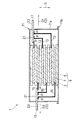
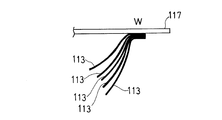
- FIG. 1 is a vertical sectional view which shows the schematic structure of the laminated type power storage element which concerns on one Embodiment of this invention. It is a figure for demonstrating the effect of the laminated type power storage element of FIG. 1, and is the schematic diagram which shows the connection structure of the comparative example. It is a figure for demonstrating the effect of the laminated type power storage element of FIG. 1, and is the schematic diagram which shows the connection structure of an Example. It is a top view which shows one modification of the power storage element of FIG.
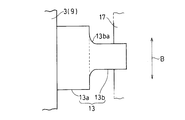
- FIG. 3 is an enlarged plan view showing a positive electrode current collector of the power storage element of FIG. 1.
- FIG. 1 is a cross-sectional view schematically showing the structure of a stacked power storage element (hereinafter, simply referred to as “power storage element”) 1 according to an embodiment of the present invention.
- a material active carbon in this example
- lithium ions can be occluded and desorbed by a chemical reaction (a material that can be occluded and desorbed by a chemical reaction).
- a chemical reaction a material that can be occluded and desorbed by a chemical reaction.
- it is configured as a lithium ion capacitor in which graphite) is the main negative electrode active material and a non-aqueous solution is the electrolytic solution.
- the power storage element 1 is a sheet interposed between a plurality of sheet-shaped positive electrode bodies 3 and a plurality of sheet-shaped negative electrode bodies 5 arranged so as to face each other, and between each positive electrode body 3 and each negative electrode body 5. It has an electrode body 9 formed by laminating the shape separator 7. Specifically, in the present embodiment, a plurality of separators are arranged side by side in the stacking direction, and positive electrode bodies and negative electrode bodies are arranged alternately in the stacking direction between these separators. Each sheet of the separator, the positive electrode body, and the negative electrode body is formed in a rectangular shape when viewed from the stacking direction.
- lithium ions are occluded in the negative electrode active material coated on the negative electrode body at the negative electrode, and anions in the electrolytic solution are occluded by the positive electrode active material coated on the positive electrode body at the positive electrode.
- lithium ions are desorbed from the negative electrode active material at the negative electrode and released into the electrolytic solution, and anions are desorbed from the positive electrode active material at the positive electrode and released into the electrolytic solution.
- the electrode body 9 is housed in the exterior body 11 together with the electrolytic solution.
- the exterior body 11 is formed of an insulating resin material, and is composed of bonding materials 11a and 11b that cover the positive electrode current collector 13 and the negative electrode current collector 15, which will be described later. More specifically, the laminating materials 11a and 11b are formed from an aluminum laminated film formed by laminating synthetic resin films on both sides of an aluminum foil.
- the positive electrode body 3 is formed in a sheet shape by applying the above-mentioned positive electrode active material to a substrate made of a metal foil containing aluminum as a main component.
- the negative electrode body 5 is formed in a sheet shape by applying the above-mentioned negative electrode active material to a substrate made of a metal foil containing copper as a main component.
- One positive electrode current collector 13 is electrically connected to each of the plurality of positive electrode bodies 3. In other words, the positive electrode current collector 13 is provided for each positive electrode body 3.
- one negative electrode current collector 15 is electrically connected to each of the plurality of negative electrode bodies 5. In other words, the negative electrode current collector 15 is provided for each negative electrode body 5.
- the positive electrode current collector 13 is connected to the substrate of the positive electrode body 3, and the negative electrode current collector 15 is connected to the substrate of the negative electrode body 5.
- the positive electrode current collector 13 is connected to a side edge portion forming a rectangular side of the positive electrode body 3.
- the positive electrode current collector 13 is provided so as to project in a direction substantially parallel to the substrate to which the positive electrode current collector 13 is connected and substantially orthogonal to the side edge portion to which the positive electrode current collector 13 is connected. There is. Further, the plurality of positive electrode current collectors 13 are arranged at substantially equal intervals along the side edges to which the positive electrode current collectors 13 are connected.
- the negative electrode current collector 15 is connected to a side edge portion that forms one side of a rectangle of the negative electrode body 5 and is located on the opposite side in a plan view from the side edge portion to which the positive electrode current collector 13 is connected.
- the negative electrode current collector 15 is provided so as to project in a direction substantially parallel to the substrate to which the negative electrode current collector 15 is connected and substantially orthogonal to the side edge portion to which the negative electrode current collector 15 is connected. There is. Further, the plurality of negative electrode type current collectors are arranged at substantially equal intervals along the side edge portion to which the negative electrode current collector 15 is connected. The entire positive electrode current collector 13 and negative electrode current collector 15 formed in this way are housed inside the exterior body 11.
- the plurality of positive electrode current collectors 13 are electrically connected to a common positive electrode side terminal 17.
- the plurality of negative electrode current collectors 15 are electrically connected to a common negative electrode side terminal 19.
- the connection between each positive electrode current collector 13 and the positive electrode side terminal 17 and the connection between each negative electrode current collector 15 and the negative electrode side terminal 19 are performed by, for example, ultrasonic welding.
- the current collectors 13 and 15 may be connected to the terminals 17 and 19 by other methods such as laser welding and spot welding.
- the positive electrode side terminal 17 is connected to a plurality of positive electrode current collectors 13 inside the exterior body 11 (hereinafter, may be simply referred to as “inside the element”).
- the positive electrode side terminal 17 extends from the connection portion P with each positive electrode current collector 13 to the outside of the exterior body 11 (hereinafter, may be simply referred to as “outside the element”).
- the negative electrode side terminal 19 is connected to a plurality of negative electrode current collectors 15 inside the element.
- the negative electrode side terminal 19 extends from the connection portion P with each negative electrode side current collector to the outside of the element.
- the positive electrode side terminal 17 and the negative electrode side terminal 19 are exposed from the bonding material and the covering portion 21 which is covered with the bonding material and to which the positive electrode current collector 13 and the negative electrode current collector 15 are connected, respectively. It has an exposed portion 23.
- the direction in which the covered portion 21 and the exposed portion 23 are aligned that is, the direction in which the positive electrode side terminal 17 and the negative electrode side terminal 19 extend from the inside of the element to the outside of the element and are taken out is referred to as “take-out direction D”. ..
- first take-out direction D1 the take-out directions D on the positive electrode side and the negative electrode side
- second take-out direction D2 the take-out directions D on the positive electrode side and the negative electrode side
- the take-out direction D is the same as the protruding direction of the current collectors 13 and 15 described above. Therefore, in the present embodiment, the first take-out direction D1 and the second take-out direction D2 are in opposite directions from the side edges located on the opposite sides of the rectangular electrode body.
- connection structure between the positive electrode side terminal 17 and the plurality of positive electrode current collectors 13 and the connection structure between the negative electrode side terminal 19 and the plurality of negative electrode current collectors 15 will be described.
- connection structure between the terminal and the current collector is almost the same on the positive electrode side and the negative electrode side
- connection structure on the positive electrode side will be mainly described below as a representative.
- each connection point P to which the plurality of positive electrode current collectors 13 are connected is arranged so as to be spatially dispersed.
- a plurality of positive electrode current collectors 13 are connected to the positive electrode side terminals 17 in an arrangement in which all the positive electrode current collectors 13 do not overlap at one place.
- each connection point P is dispersed in a direction perpendicular to the stacking direction S of the electrode body 9.
- connection points P are dispersed in the take-out direction D.
- the plurality of positive electrode current collectors 13 are formed so that the dimension in the take-out direction D becomes longer in the order of the positive electrode current collector 13 located closer to the positive electrode side terminal 17 and the positive electrode current collector 13 located farther from the positive electrode side terminal 17. Has been done.
- Each of the positive electrode current collectors 13 thus formed is connected to the positive electrode side terminal 17 at each dispersed portion P along the take-out direction D.
- connection point P By joining the positive electrode current collectors 13 to the positive electrode side terminals 17 at different positions, it is possible to prevent poor joining as compared with the case where a plurality of current collectors 13 are joined at one place. As a result, the electrical resistance of the connection point P can be further reduced.
- connection points P are dispersed on both the positive electrode side and the negative electrode side. With such a configuration, it is possible to prevent current concentration at both the connection points P on the positive electrode side and the negative electrode side, and further prevent the temperature from rising.
- each connection portion P is dispersed in the direction perpendicular to the stacking direction S of the electrode body 9 in the above example.
- each connection portion P may be dispersed in the width direction W of the positive electrode side terminal 17.
- the "width direction B" of the positive electrode side terminal 17 refers to a direction perpendicular to the take-out direction D and the stacking direction S.
- the dimension of the positive electrode side terminal 17 in the width direction B is set to be larger than the dimension in the take-out direction D.
- each of the plurality of positive electrode current collectors 13 is formed at a position deviated in the width direction B, in other words, at a position deviated so that the positions B in the width direction do not overlap.
- Each positive electrode current collector 13 is connected at each position dispersed along the width direction B of the positive electrode side terminal 17 formed as described above. According to this configuration, it is possible to suppress heat generation at the connection point P while avoiding an increase in the dimension of the stacking type power storage element 1 in the take-out direction D due to the positive electrode side terminal 17 extending in the take-out direction.
- the positive electrode current collector 13 has a base portion 13a connected to the electrode body 9 and a protruding portion 13b protruding from the base portion 13a and connected to the positive electrode side terminal 17.
- the portion of the protruding portion 13b adjacent to the base portion 13a is formed so that the dimension of the protruding portion 13b in the width direction B gradually decreases as the distance from the base portion 13a increases. More specifically, the width method dimension of the protruding portion 13b is smaller than the width direction dimension of the base portion 13a, and the corner portion 13ba extending from the base portion 13a to the protruding portion 13b is formed in an R shape.
- the shape in which the widthwise dimension of the protruding portion 13b gradually decreases as the distance from the base portion 13a increases may be formed at least in a portion adjacent to the base portion 13a of the protruding portion 13b. It may have such a shape. Further, such a shape is preferably provided on at least one of the positive electrode current collector 13 and the negative electrode current collector 15, and more preferably provided on both.
- the shape of the portion of the protruding portion 13b adjacent to the base portion 13a is not limited to the R shape illustrated here, and may be, for example, an inclined shape or a parabolic shape.
- the configuration in which the first take-out direction D1 of the positive electrode side terminal 17 and the second take-out direction D2 of the negative electrode side terminal 19 are different is shown.
- the first take-out direction D1 and the second take-out direction D2 may be the same direction. That is, the positive electrode current collector 13 and the negative electrode current collector 15 are provided on the same side edge portion of the rectangular electrode body 9 at positions deviated from each other along the side edge portion, and then the positive electrode side terminal 17 is provided.
- the negative electrode side terminal 19 may be projected in each take-out direction D1 and D2 at a position corresponding to each of the current collectors 13 and 15.
- connection point P may be dispersed only on either the positive electrode side or the negative electrode side.
- connection structure of the present embodiment can be obtained. That is, for example, even when four current collectors are distributed to two connection points by two and connected to the terminals, when all four current collectors are connected to the terminals at one connection point. Compared with this, heat generation can be suppressed.
- the power storage element 1 is a lithium ion capacitor
- the power storage element to which the configuration of the present embodiment is applied stores a charge by using an electric double layer electrode other than the lithium ion capacitor. It may be a capacitor or a chemical battery (for example, a lithium ion secondary battery).
- the exterior body 11 of the power storage element 1 is an aluminum laminated film. According to this configuration, in the so-called laminated type power storage element 1 suitable for a thin structure, the temperature rise inside the element can be effectively suppressed.
- the exterior body 11 of the power storage element 1 is not limited to this, and may be, for example, a metal can.
- the plurality of connection points P between the positive electrode and / or negative electrode current collectors 13 and 15 and the terminals 17 and 19 are dispersed. , The concentration of current at the connection point P is avoided. As a result, it is possible to prevent the temperature rise due to the concentration of the current flowing through the local portion having high electric resistance, which is the connection point inside the element, and the temperature rise transmitted from the current collectors 13 and 15 to the entire power storage element 1. Can be suppressed. Further, by suppressing the temperature rise inside the power storage element 1 in this way, it is possible to suppress the deterioration of the output performance and the life of the power storage element 1.
- the stacked power storage element according to this embodiment is used for mobile devices, electric vehicles, and the like.
- it is suitably used for electrical equipment that requires a relatively large instantaneous current.
- an electric device that requires an instantaneous current it is suitably used as a power source for a saddle-type vehicle or a small gliding boat that performs relatively large acceleration / deceleration traveling.
- a so-called drone which is a multicopter whose flight is controlled by individually controlling a plurality of rotor motors.
- the application of the stacked power storage element according to the present embodiment is not limited to these.
Landscapes
- Engineering & Computer Science (AREA)
- Power Engineering (AREA)
- Microelectronics & Electronic Packaging (AREA)
- Connection Of Batteries Or Terminals (AREA)
- Electric Double-Layer Capacitors Or The Like (AREA)
Priority Applications (3)
| Application Number | Priority Date | Filing Date | Title |
|---|---|---|---|
| PCT/JP2020/001341 WO2021144929A1 (ja) | 2020-01-16 | 2020-01-16 | 積層型蓄電素子 |
| JP2021570575A JPWO2021144929A1 (https=) | 2020-01-16 | 2020-01-16 | |
| US17/863,750 US20220351917A1 (en) | 2020-01-16 | 2022-07-13 | Laminated power storage element |
Applications Claiming Priority (1)
| Application Number | Priority Date | Filing Date | Title |
|---|---|---|---|
| PCT/JP2020/001341 WO2021144929A1 (ja) | 2020-01-16 | 2020-01-16 | 積層型蓄電素子 |
Related Child Applications (1)
| Application Number | Title | Priority Date | Filing Date |
|---|---|---|---|
| US17/863,750 Continuation US20220351917A1 (en) | 2020-01-16 | 2022-07-13 | Laminated power storage element |
Publications (1)
| Publication Number | Publication Date |
|---|---|
| WO2021144929A1 true WO2021144929A1 (ja) | 2021-07-22 |
Family
ID=76864570
Family Applications (1)
| Application Number | Title | Priority Date | Filing Date |
|---|---|---|---|
| PCT/JP2020/001341 Ceased WO2021144929A1 (ja) | 2020-01-16 | 2020-01-16 | 積層型蓄電素子 |
Country Status (3)
| Country | Link |
|---|---|
| US (1) | US20220351917A1 (https=) |
| JP (1) | JPWO2021144929A1 (https=) |
| WO (1) | WO2021144929A1 (https=) |
Families Citing this family (1)
| Publication number | Priority date | Publication date | Assignee | Title |
|---|---|---|---|---|
| EP4661143A1 (en) * | 2024-06-05 | 2025-12-10 | Renata AG | A battery comprising a stack of electrodes with superposed tabs |
Citations (5)
| Publication number | Priority date | Publication date | Assignee | Title |
|---|---|---|---|---|
| JPS60201621A (ja) * | 1984-03-27 | 1985-10-12 | ソニー株式会社 | 固体電解コンデンサブロツクの製造方法 |
| JP2007157811A (ja) * | 2005-12-01 | 2007-06-21 | Matsushita Electric Ind Co Ltd | 巻回形電気二重層コンデンサ |
| JP2008293717A (ja) * | 2007-05-22 | 2008-12-04 | Nissan Motor Co Ltd | 二次電池およびこれを搭載した車両 |
| JP2015230745A (ja) * | 2014-06-03 | 2015-12-21 | 株式会社豊田自動織機 | 蓄電装置、及び蓄電装置の製造方法 |
| WO2018016653A1 (ja) * | 2016-07-22 | 2018-01-25 | Necエナジーデバイス株式会社 | 電気化学デバイス |
Family Cites Families (7)
| Publication number | Priority date | Publication date | Assignee | Title |
|---|---|---|---|---|
| JP3836123B2 (ja) * | 2006-03-30 | 2006-10-18 | 株式会社パワーシステム | 積層型電気二重層コンデンサ用の電極積層体 |
| JP5114036B2 (ja) * | 2006-09-08 | 2013-01-09 | Necエナジーデバイス株式会社 | 積層型電池の製造方法 |
| JP2009187675A (ja) * | 2008-02-01 | 2009-08-20 | Sharp Corp | 積層型二次電池およびその製造方法 |
| US8334071B2 (en) * | 2008-09-29 | 2012-12-18 | Kabushiki Kaisha Toshiba | Non-aqueous electrolyte secondary battery, electrode used for secondary battery, and method of manufacturing electrode |
| JP2015005553A (ja) * | 2013-06-19 | 2015-01-08 | Jmエナジー株式会社 | 蓄電デバイス |
| JP2015060626A (ja) * | 2013-09-17 | 2015-03-30 | 日立マクセル株式会社 | リチウムイオン二次電池 |
| JP2019053917A (ja) * | 2017-09-15 | 2019-04-04 | マクセルホールディングス株式会社 | 電気化学素子 |
-
2020
- 2020-01-16 JP JP2021570575A patent/JPWO2021144929A1/ja active Pending
- 2020-01-16 WO PCT/JP2020/001341 patent/WO2021144929A1/ja not_active Ceased
-
2022
- 2022-07-13 US US17/863,750 patent/US20220351917A1/en not_active Abandoned
Patent Citations (5)
| Publication number | Priority date | Publication date | Assignee | Title |
|---|---|---|---|---|
| JPS60201621A (ja) * | 1984-03-27 | 1985-10-12 | ソニー株式会社 | 固体電解コンデンサブロツクの製造方法 |
| JP2007157811A (ja) * | 2005-12-01 | 2007-06-21 | Matsushita Electric Ind Co Ltd | 巻回形電気二重層コンデンサ |
| JP2008293717A (ja) * | 2007-05-22 | 2008-12-04 | Nissan Motor Co Ltd | 二次電池およびこれを搭載した車両 |
| JP2015230745A (ja) * | 2014-06-03 | 2015-12-21 | 株式会社豊田自動織機 | 蓄電装置、及び蓄電装置の製造方法 |
| WO2018016653A1 (ja) * | 2016-07-22 | 2018-01-25 | Necエナジーデバイス株式会社 | 電気化学デバイス |
Also Published As
| Publication number | Publication date |
|---|---|
| JPWO2021144929A1 (https=) | 2021-07-22 |
| US20220351917A1 (en) | 2022-11-03 |
Similar Documents
| Publication | Publication Date | Title |
|---|---|---|
| JP5618010B2 (ja) | 多方向性リード−タブ構造を有するリチウム二次電池 | |
| JP2014523629A (ja) | 段差を有する電極組立体、それを含む電池セル、電池パック及びデバイス | |
| JP2004134210A (ja) | 積層型電池、組電池および車両 | |
| JPWO2017038042A1 (ja) | 積層型電池 | |
| CN109301378B (zh) | 用于软包电池的接片冷却 | |
| JP2004139775A (ja) | 積層型電池、組電池および車両 | |
| JP2018133201A (ja) | 蓄電モジュール | |
| JP2020532082A (ja) | バッテリ端子のためのリードタブ | |
| US20210265703A1 (en) | Electrode Assembly | |
| KR101286910B1 (ko) | 적층형 전지 | |
| KR20170104826A (ko) | 전극조립체 및 이를 포함하는 이차전지 | |
| JP2018517268A (ja) | 向上した冷却構造を有するバッテリーモジュール | |
| JP2019194946A (ja) | 積層型電池および積層型電池の製造方法 | |
| JPH0982305A (ja) | 二次電池及びその製造方法 | |
| JP7810095B2 (ja) | 蓄電モジュール | |
| JP2020035653A (ja) | 蓄電装置 | |
| WO2021144929A1 (ja) | 積層型蓄電素子 | |
| CN118591914A (zh) | 蓄电模块 | |
| KR20180060763A (ko) | 셀 리드의 고정구조가 개선된 배터리 팩 | |
| JP7827098B2 (ja) | 電池および電池モジュール | |
| JP6726398B2 (ja) | 蓄電素子 | |
| JP2019212440A (ja) | 蓄電装置 | |
| KR102398572B1 (ko) | 압전 소자 및 열전 소자를 포함하는 원통형 이차 전지 | |
| US11600844B2 (en) | Solid-state battery cell and solid-state battery module | |
| KR20230089275A (ko) | 전극 조립체 및 이를 포함하는 원통형 이차전지 |
Legal Events
| Date | Code | Title | Description |
|---|---|---|---|
| 121 | Ep: the epo has been informed by wipo that ep was designated in this application |
Ref document number: 20913093 Country of ref document: EP Kind code of ref document: A1 |
|
| ENP | Entry into the national phase |
Ref document number: 2021570575 Country of ref document: JP Kind code of ref document: A |
|
| NENP | Non-entry into the national phase |
Ref country code: DE |
|
| 122 | Ep: pct application non-entry in european phase |
Ref document number: 20913093 Country of ref document: EP Kind code of ref document: A1 |