WO2021107133A1 - メイタンシノールの酵素的生産方法 - Google Patents
メイタンシノールの酵素的生産方法 Download PDFInfo
- Publication number
- WO2021107133A1 WO2021107133A1 PCT/JP2020/044347 JP2020044347W WO2021107133A1 WO 2021107133 A1 WO2021107133 A1 WO 2021107133A1 JP 2020044347 W JP2020044347 W JP 2020044347W WO 2021107133 A1 WO2021107133 A1 WO 2021107133A1
- Authority
- WO
- WIPO (PCT)
- Prior art keywords
- amino acid
- place
- acid sequence
- seq
- protein
- Prior art date
- Legal status (The legal status is an assumption and is not a legal conclusion. Google has not performed a legal analysis and makes no representation as to the accuracy of the status listed.)
- Ceased
Links
Images




Classifications
-
- C—CHEMISTRY; METALLURGY
- C12—BIOCHEMISTRY; BEER; SPIRITS; WINE; VINEGAR; MICROBIOLOGY; ENZYMOLOGY; MUTATION OR GENETIC ENGINEERING
- C12P—FERMENTATION OR ENZYME-USING PROCESSES TO SYNTHESISE A DESIRED CHEMICAL COMPOUND OR COMPOSITION OR TO SEPARATE OPTICAL ISOMERS FROM A RACEMIC MIXTURE
- C12P17/00—Preparation of heterocyclic carbon compounds with only O, N, S, Se or Te as ring hetero atoms
- C12P17/18—Preparation of heterocyclic carbon compounds with only O, N, S, Se or Te as ring hetero atoms containing at least two hetero rings condensed among themselves or condensed with a common carbocyclic ring system, e.g. rifamycin
- C12P17/188—Heterocyclic compound containing in the condensed system at least one hetero ring having nitrogen atoms and oxygen atoms as the only ring heteroatoms
-
- C—CHEMISTRY; METALLURGY
- C12—BIOCHEMISTRY; BEER; SPIRITS; WINE; VINEGAR; MICROBIOLOGY; ENZYMOLOGY; MUTATION OR GENETIC ENGINEERING
- C12N—MICROORGANISMS OR ENZYMES; COMPOSITIONS THEREOF; PROPAGATING, PRESERVING, OR MAINTAINING MICROORGANISMS; MUTATION OR GENETIC ENGINEERING; CULTURE MEDIA
- C12N15/00—Mutation or genetic engineering; DNA or RNA concerning genetic engineering, vectors, e.g. plasmids, or their isolation, preparation or purification; Use of hosts therefor
- C12N15/09—Recombinant DNA-technology
- C12N15/63—Introduction of foreign genetic material using vectors; Vectors; Use of hosts therefor; Regulation of expression
- C12N15/70—Vectors or expression systems specially adapted for E. coli
-
- C—CHEMISTRY; METALLURGY
- C12—BIOCHEMISTRY; BEER; SPIRITS; WINE; VINEGAR; MICROBIOLOGY; ENZYMOLOGY; MUTATION OR GENETIC ENGINEERING
- C12N—MICROORGANISMS OR ENZYMES; COMPOSITIONS THEREOF; PROPAGATING, PRESERVING, OR MAINTAINING MICROORGANISMS; MUTATION OR GENETIC ENGINEERING; CULTURE MEDIA
- C12N9/00—Enzymes; Proenzymes; Compositions thereof; Processes for preparing, activating, inhibiting, separating or purifying enzymes
- C12N9/14—Hydrolases (3)
- C12N9/16—Hydrolases (3) acting on ester bonds (3.1)
- C12N9/18—Carboxylic ester hydrolases (3.1.1)
-
- C—CHEMISTRY; METALLURGY
- C12—BIOCHEMISTRY; BEER; SPIRITS; WINE; VINEGAR; MICROBIOLOGY; ENZYMOLOGY; MUTATION OR GENETIC ENGINEERING
- C12Y—ENZYMES
- C12Y301/00—Hydrolases acting on ester bonds (3.1)
- C12Y301/01—Carboxylic ester hydrolases (3.1.1)
-
- C—CHEMISTRY; METALLURGY
- C12—BIOCHEMISTRY; BEER; SPIRITS; WINE; VINEGAR; MICROBIOLOGY; ENZYMOLOGY; MUTATION OR GENETIC ENGINEERING
- C12Y—ENZYMES
- C12Y301/00—Hydrolases acting on ester bonds (3.1)
- C12Y301/01—Carboxylic ester hydrolases (3.1.1)
- C12Y301/01001—Carboxylesterase (3.1.1.1)
-
- C—CHEMISTRY; METALLURGY
- C12—BIOCHEMISTRY; BEER; SPIRITS; WINE; VINEGAR; MICROBIOLOGY; ENZYMOLOGY; MUTATION OR GENETIC ENGINEERING
- C12R—INDEXING SCHEME ASSOCIATED WITH SUBCLASSES C12C - C12Q, RELATING TO MICROORGANISMS
- C12R2001/00—Microorganisms ; Processes using microorganisms
- C12R2001/01—Bacteria or Actinomycetales ; using bacteria or Actinomycetales
- C12R2001/07—Bacillus
- C12R2001/125—Bacillus subtilis ; Hay bacillus; Grass bacillus
Definitions
- the present invention relates to an enzymatic production method of Maytancinol.
- Maitansinol is an important intermediate used in the production of mertansine-based substances such as emtansine used in the drug portion of antibody-drug conjugates, and ansamatecin P3 (AP3) produced by microorganisms such as Actinosynnema pretiosum. It is obtained by hydrolyzing the isobutyl ester at the 3-position of.
- a chemical conversion method and a microbial conversion method are known.
- the chemical conversion method for example, reductive cleavage of ansamitocin compounds obtained by fermentation with lithium tri-methoxyaluminum hydride (LATH) or other alkali metal (alkali) alkoxyaluminum hydride.
- LATH lithium tri-methoxyaluminum hydride
- alkali alkali metal alkoxyaluminum hydride
- a culture of a microorganism belonging to the genus Streptomyces which has the ability to convert the acyloxy group at the 8-position into a hydroxyl group in metanacin, maytansinol propionate, or ansamitecin group antibiotics, or a processed product thereof.
- a method for producing Maytansinol Patent Document 4
- Patent Document 4 is characterized by bringing the cells into contact with each other.
- the above chemical conversion method is not necessarily a satisfactory technology for industrialization because LATH and its derivatives used are flammable. Further, in the above-mentioned microbial conversion method, the enzyme responsible for the reaction is not specified, and it is not clear what kind of enzyme contributes.
- An object of the present invention is to provide a technique relating to a method for enzymatically producing maytancinol from an ansamatecin species such as AP3.
- the present invention provides: [1] Production of Maytancinol, which comprises the step of enzymatically producing Maytancinol from ansamitosine species by any one of the following proteins (A)-(F) and (AA)-(CC).
- Method: (A) A protein consisting of the amino acid sequence shown in SEQ ID NO: 9; (B) The amino acid sequence set forth in SEQ ID NO: 9 consists of an amino acid sequence in which one or more amino acids are substituted, deleted, inserted, and / or added.
- the 66-68th place is DLL or AGA
- the 139-141th place is GPF
- the 146-148th place is LSS or LSP
- the 247-249th place is LHT
- the 323rd place is 323th.
- HSX or ASX where X is Q, K, E, or M
- the equivalent of 374-376 is QSX (where X is H, R, D, or Q).
- the equivalent of positions 443-445 is GNP, and a protein that has the activity of catalyzing the reaction that produces maytansinol from ansamitecin species;
- C Consists of an amino acid sequence having at least 50% identity with the amino acid sequence set forth in SEQ ID NO: 9.
- the 66-68th place is DLL or AGA
- the 139-141th place is GPF
- the 146-148th place is LSS or LSP
- the 247-249th place is LHT
- the 323rd place is 323th.
- HSX or ASX where X is Q, K, E, or M
- the equivalent of 374-376 is QSX (where X is H, R, D, or Q).
- positions 443-445 is GNP, and a protein that has the activity of catalyzing the reaction that produces maytansinol from ansamitecin species;
- D A protein consisting of the amino acid sequence shown in SEQ ID NO: 12;
- E Consists of an amino acid sequence in which one or more amino acids are substituted, deleted, inserted, and / or added in the amino acid sequence shown in SEQ ID NO: 12.
- the 66-68th place is DLL or AGA
- the 139-141th place is GPF
- the 146-148th place is LSS or LSP
- the 247-249th place is LHT
- 323rd place is 323th.
- HSX or ASX where X is Q, K, E, or M
- QSX where X is H, R, D, or Q
- the equivalent of positions 443-445 is GNP, and a protein that has the activity of catalyzing the reaction that produces maytansinol from ansamitecin species
- the 66-68th place is DLL or AGA
- the 139-141th place is GPF
- the 146-148th place is LSS or LSP
- the 247-249th place is LHT
- the 323rd place is 323th.
- HSX or ASX where X is Q, K, E, or M
- QSX where X is H, R, D, or Q
- the equivalent of positions 443-445 is GNP, and a protein that has the activity of catalyzing the reaction that produces maytansinol from ansamitecin species
- AA A protein consisting of the amino acid sequence set forth in any one of SEQ ID NOs: 18-21
- BB The amino acid sequence set forth in any one of SEQ ID NOs: 18-21 consists of an amino acid sequence in which one or more amino acids are substituted, deleted, inserted, and / or added, and maytansinol from an ansamitosine species.
- a protein that has the activity of catalyzing the reaction that produces (CC) A protein consisting of an amino acid sequence having at least 80% identity with the amino acid sequence set forth in any one of SEQ ID NOs: 18-21 and having an activity of catalyzing a reaction for producing mayanthinol from an anamitecin species. .. [2] The production method according to 1, wherein the ansamitecin species is ansamitecin P2 (AP2), ansamitecin P3 (AP3), or ansamitecin P4 (AP4). [3] The production method according to 1 or 2, wherein the ansamitecin species is AP3.
- the 66-68th place is DLL or AGA
- the 139-141th place is GPF
- the 146-148th place is LSS or LSP
- the 247-249th place is LHT
- the 323rd place is 323th.
- HSX or ASX where X is Q, K, E, or M
- QSX where X is H, R, D, or Q
- the equivalent of positions 443-445 is GNP, and a protein that has the activity of catalyzing the reaction that produces maytansinol from ansamitecin species
- the 66-68th place is DLL or AGA
- the 139-141th place is GPF
- the 146-148th place is LSS or LSP
- the 247-249th place is LHT
- the 323rd place is 323th.
- HSX or ASX where X is Q, K, E, or M
- QSX where X is H, R, D, or Q
- the equivalent of positions 443-445 is GNP, and a protein that has the activity of catalyzing the reaction that produces maytansinol from ansamitecin species
- AA A protein consisting of the amino acid sequence set forth in any one of SEQ ID NOs: 18-21
- BB The amino acid sequence set forth in any one of SEQ ID NOs: 18-21 consists of an amino acid sequence in which one or more amino acids are substituted, deleted, inserted, and / or added, and maytansinol from an ansamitosine species.
- a protein that has the activity of catalyzing the reaction that produces (CC) A protein consisting of an amino acid sequence having at least 80% identity with the amino acid sequence set forth in any one of SEQ ID NOs: 18-21 and having an activity of catalyzing a reaction for producing mayanthinol from an anamitecin species. .. [5] A polynucleotide encoding the protein described in 4. [6] A polynucleotide consisting of the nucleotide sequence of SEQ ID NO: 10 or 11. [7] A fungus transformed with a vector containing the polynucleotide according to 5 or 6.
- a protein consisting of the amino acid sequence shown in SEQ ID NO: 9;
- B The amino acid sequence set forth in SEQ ID NO: 9 consists of an amino acid sequence in which one or more amino acids are substituted, deleted, inserted, and / or added.
- the 66-68th place is DLL or AGA
- the 139-141th place is GPF
- the 146-148th place is LSS or LSP
- the 247-249th place is LHT
- 323rd place is 323th.
- HSX or ASX where X is Q, K, E, or M
- QSX where X is H, R, D, or Q
- the equivalent of positions 443-445 is GNP, and a protein that has the activity of catalyzing the reaction that produces maytansinol from ansamitecin species
- C Consists of an amino acid sequence having at least 50% identity with the amino acid sequence set forth in SEQ ID NO: 9.
- the 66-68th place is DLL or AGA
- the 139-141th place is GPF
- the 146-148th place is LSS or LSP
- the 247-249th place is LHT
- the 323rd place is 323th.
- HSX or ASX where X is Q, K, E, or M
- QSX where X is H, R, D, or Q
- the equivalent of positions 443-445 is GNP, and a protein that has the activity of catalyzing the reaction that produces maytansinol from ansamitecin species
- D A protein consisting of the amino acid sequence shown in SEQ ID NO: 12
- E Consists of an amino acid sequence in which one or more amino acids are substituted, deleted, inserted, and / or added in the amino acid sequence shown in SEQ ID NO: 12.
- the 66-68th place is DLL or AGA
- the 139-141th place is GPF
- the 146-148th place is LSS or LSP
- the 247-249th place is LHT
- the 323rd place is 323th.
- HSX or ASX where X is Q, K, E, or M
- the equivalent of 374-376 is QSX (where X is H, R, D, or Q).
- the equivalent of positions 443-445 is GNP, and a protein that has the activity of catalyzing the reaction that produces maytansinol from ansamitecin species;
- (F) Consists of an amino acid sequence having at least 50% identity with the amino acid sequence set forth in SEQ ID NO: 12.
- the 66-68th place is DLL or AGA
- the 139-141th place is GPF
- the 146-148th place is LSS or LSP
- the 247-249th place is LHT
- the 323rd place is 323th.
- HSX or ASX where X is Q, K, E, or M
- the equivalent of 374-376 is QSX (where X is H, R, D, or Q).
- positions 443-445 is GNP, and a protein that has the activity of catalyzing the reaction that produces maytansinol from ansamitecin species;
- BB The amino acid sequence set forth in any one of SEQ ID NOs: 18-21 consists of an amino acid sequence in which one or more amino acids are substituted, deleted, inserted, and / or added, and maytansinol from an ansamitosine species.
- a protein that has the activity of catalyzing the reaction that produces (CC) A protein consisting of an amino acid sequence having at least 80% identity with the amino acid sequence set forth in any one of SEQ ID NOs: 18-21 and having an activity of catalyzing a reaction for producing mayanthinol from an anamitecin species. ..
- the 66-68th place is DLL or AGA
- the 139-141th place is GPF
- the 146-148th place is LSS or LSP
- the 247-249th place is LHT
- the 323rd place is 323th.
- the 66-68th place is DLL or AGA
- the 139-141th place is GPF
- the 146-148th place is LSS or LSP
- the 247-249th place is LHT
- the 323rd place is 323th.
- HSX or ASX where X is Q, K, E, or M
- the equivalent of 374-376 is QSX (where X is H, R, D, or Q).
- positions 443-445 is GNP, and a polynucleotide encoding a protein that has the activity of catalyzing the reaction that produces maytansinol from ansamitecin species;
- D A polynucleotide encoding a protein consisting of the amino acid sequence set forth in SEQ ID NO: 12;
- E Consists of an amino acid sequence in which one or more amino acids are substituted, deleted, inserted, and / or added in the amino acid sequence shown in SEQ ID NO: 12.
- the 66-68th place is DLL or AGA
- the 139-141th place is GPF
- the 146-148th place is LSS or LSP
- the 247-249th place is LHT
- the 323rd place is 323th.
- HSX or ASX where X is Q, K, E, or M
- the equivalent of 374-376 is QSX (where X is H, R, D, or Q).
- positions 443-445 is GNP, and a polynucleotide encoding a protein that has the activity of catalyzing the reaction that produces maytansinol from ansamitecin species;
- F Consists of an amino acid sequence having at least 50% identity with the amino acid sequence set forth in SEQ ID NO: 12.
- the 66-68th place is DLL or AGA
- the 139-141th place is GPF
- the 146-148th place is LSS or LSP
- the 247-249th place is LHT
- the 323rd place is 323th.
- HSX or ASX where X is Q, K, E, or M
- QSX where X is H, R, D, or Q
- the equivalent of positions 443-445 is GNP, and a polynucleotide encoding a protein that has the activity of catalyzing the reaction that produces maytansinol from ansamitecin species
- G A polynucleotide consisting of the nucleotide sequence shown in SEQ ID NO: 1 or 2
- H Encodes a protein consisting of a nucleotide sequence having at least 50% identity with the nucleotide sequence set forth in SEQ ID NO: 1 or 2 and having an activity of catalyzing a reaction for producing mayanthinol from ansamitosine species.
- Polynucleotide (I) A polynucleotide encoding a protein that hybridizes with the nucleotide sequence set forth in SEQ ID NO: 1 or 2 under stringent conditions and has an activity of catalyzing a reaction for producing maytansinol from ansamitosine species; (J) A polynucleotide consisting of the nucleotide sequence set forth in SEQ ID NO: 10 or 11; (K) Consists of a nucleotide sequence having at least 50% identity with the nucleotide sequence set forth in SEQ ID NO: 10 or 11, where position 320 is G and catalyzes the reaction to produce mayanthinol from ansamitecin species.
- the amino acid sequence set forth in any one of SEQ ID NOs: 18-21 consists of an amino acid sequence in which one or more amino acids are substituted, deleted, inserted, and / or added, and maytansinol from an ansamitosine species.
- a polynucleotide encoding a protein that has the activity of catalyzing the reaction that produces (Cc) A protein consisting of an amino acid sequence having at least 80% identity with the amino acid sequence set forth in any one of SEQ ID NOs: 18-21 and having an activity of catalyzing a reaction for producing mayanthinol from an anamitecin species.
- the polynucleotide that encodes [10] The bacterium according to 9, wherein the polynucleotide is derived from Bacillus subtilis.
- the present invention also provides: [1] A method for producing Maytancinol, which comprises a step of enzymatically producing Maytancinol from ansamitosine species using any one of the following proteins (A)-(F): (A) A protein consisting of the amino acid sequence shown in SEQ ID NO: 9; (B) A reaction in which one or more amino acids in the amino acid sequence shown in SEQ ID NO: 9 consist of an amino acid sequence substituted, deleted, inserted, and / or added, and a reaction for producing mayanthinol from an ansamitecin species is carried out.
- Proteins with catalytic activity (C) A protein consisting of an amino acid sequence having at least 90% identity with the amino acid sequence set forth in SEQ ID NO: 9 and having an activity of catalyzing a reaction for producing mayanthinol from an ansamitecin species; (D) A protein consisting of the amino acid sequence shown in SEQ ID NO: 12; (E) Consists of an amino acid sequence in which one or more amino acids are substituted, deleted, inserted, and / or added in the amino acid sequence shown in SEQ ID NO: 12, but at position 107 is G and from an ansamytocin species.
- a protein that has the activity of catalyzing the reaction that produces Maytansinol (F) Consists of an amino acid sequence having at least 90% identity with the amino acid sequence set forth in SEQ ID NO: 12, where position 107 is G and the activity of catalyzing the reaction to produce maytansinol from ansamitecin species. Protein with.
- the ansamitecin species is ansamitecin P2 (AP2), ansamitecin P3 (AP3), or ansamitecin P4 (AP4).
- AP4 ansamitecin P4
- any one of the following proteins (D)-(F) (D) A protein consisting of the amino acid sequence shown in SEQ ID NO: 12; (E) Consists of an amino acid sequence in which one or more amino acids are substituted, deleted, inserted, and / or added in the amino acid sequence shown in SEQ ID NO: 12, but at position 107 is G and from an ansamytocin species. A protein that has the activity of catalyzing the reaction that produces Maytansinol; (F) Consists of an amino acid sequence having at least 90% identity with the amino acid sequence set forth in SEQ ID NO: 12, where position 107 is G and the activity of catalyzing the reaction to produce maytansinol from ansamitecin species. Protein with.
- Proteins with catalytic activity (C) A protein consisting of an amino acid sequence having at least 90% identity with the amino acid sequence set forth in SEQ ID NO: 9 and having an activity of catalyzing a reaction for producing mayanthinol from an ansamitecin species; (D) A protein consisting of the amino acid sequence shown in SEQ ID NO: 12; (E) Consists of an amino acid sequence in which one or more amino acids are substituted, deleted, inserted, and / or added in the amino acid sequence shown in SEQ ID NO: 12, but at position 107 is G and from an ansamytocin species.
- a protein that has the activity of catalyzing the reaction that produces Maytansinol (F) Consists of an amino acid sequence having at least 90% identity with the amino acid sequence set forth in SEQ ID NO: 12, where position 107 is G and the activity of catalyzing the reaction to produce maytansinol from ansamitecin species. Protein with.
- A A polynucleotide encoding a protein consisting of the amino acid sequence set forth in SEQ ID NO: 9
- B A reaction consisting of an amino acid sequence in which one or more amino acids are substituted, deleted, inserted, and / or added in the amino acid sequence shown in SEQ ID NO: 9 and producing mayanthinol from an ansamitecin species.
- a polynucleotide encoding a protein with catalytic activity (C) A polynucleotide consisting of an amino acid sequence having at least 90% identity with the amino acid sequence set forth in SEQ ID NO: 9 and encoding a protein having an activity of catalyzing a reaction for producing mayanthinol from an ansamytocin species.
- (G) A polynucleotide consisting of the nucleotide sequence shown in SEQ ID NO: 1 or 2;
- (H) Encodes a protein consisting of a nucleotide sequence having at least 90% identity with the nucleotide sequence set forth in SEQ ID NO: 1 or 2 and having an activity of catalyzing a reaction for producing mayanthinol from ansamitosine species.
- Polynucleotide (I) A polynucleotide encoding a protein that hybridizes with the nucleotide sequence set forth in SEQ ID NO: 1 or 2 under stringent conditions and has an activity of catalyzing a reaction for producing maytansinol from ansamitosine species; (J) A polynucleotide consisting of the nucleotide sequence set forth in SEQ ID NO: 10 or 11; (K) Consists of a nucleotide sequence having at least 90% identity with the nucleotide sequence set forth in SEQ ID NO: 10 or 11, where position 320 is G and catalyzes the reaction to produce mayanthinol from ansamitosine species.
- Subtilis str168 (SEQ ID NO: 9) Nucleotide sequence encoding A107G mutant enzyme (SEQ ID NO: 10).
- c at position 320 is replaced with g and t at position 321 is replaced with n.
- n represents t, a, g or c.
- Nucleotide sequence encoding A107G mutant enzyme (E. coli type) (SEQ ID NO: 11).
- C at position 320 is replaced with G and T at position 321 is replaced with N.
- N represents T, A, G or C.
- Amino acid sequence of A107G mutant enzyme (SEQ ID NO: 12) Amino acid sequence of mutant enzyme A3N3 (SEQ ID NO: 18), amino acid sequence of mutant enzyme AN4 (SEQ ID NO: 19), amino acid sequence of mutant enzyme FC15A2 (SEQ ID NO: 20), amino acid sequence of mutant enzyme AN1 (SEQ ID NO: 20) ID NO: 21) and the amino acid sequence of the mutant enzyme 3rdD_EPLA7lib_anc13 (SEQ ID NO: 22)
- the present invention relates to a method for producing maytancinol, which comprises a step of enzymatically producing maytansinol from ansamitosine species.
- Ansamitecin species are represented by the following formulas having different ester substituents at the 3-position, and R is other than H (P0 in which R is H is maytansinol).
- the production method of the present invention is suitable for the production of ansamitecin C3 ester among the ansamitecin species, and is particularly suitable for the production of ansamitecin P3 (AP3) among the ansamitecin C3 esters.
- AP3 is a compound represented by the following formula.
- the ansatomycin species can be microbiologically produced by the method of the prior art. In addition, it can be synthesized from Maytansinol by a method similar to that of WO2014 / 052537 (Japanese Patent Publication No. 2016-500657, Japanese Patent No. 6517693). AP3 is commercially available as a reagent.
- the present invention may be described by exemplifying a case where Maytansinol is produced from AP3 among ansamitecin species, but those skilled in the art will explain the description to other ansatomycin species. It can be understood by applying it as appropriate when producing Maytansinol from.
- the step of producing maytancinol from ansamitecin species can be performed using any one of the following enzyme proteins (A)-(F).
- A A protein consisting of the amino acid sequence shown in SEQ ID NO: 9;
- B A reaction in which one or more amino acids in the amino acid sequence shown in SEQ ID NO: 9 consist of an amino acid sequence substituted, deleted, inserted, and / or added, and a reaction for producing mayanthinol from an ansamitecin species is carried out.
- Proteins with catalytic activity (C) A protein consisting of an amino acid sequence having at least 90% identity with the amino acid sequence set forth in SEQ ID NO: 9 and having an activity of catalyzing a reaction for producing mayanthinol from an ansamitecin species; (D) A protein consisting of the amino acid sequence shown in SEQ ID NO: 12; (E) Consists of an amino acid sequence in which one or more amino acids are substituted, deleted, inserted, and / or added in the amino acid sequence shown in SEQ ID NO: 12, but at position 107 is G and from an ansamytocin species.
- a protein that has the activity of catalyzing the reaction that produces Maytansinol (F) Consists of an amino acid sequence having at least 90% identity with the amino acid sequence set forth in SEQ ID NO: 12, where position 107 is G and the activity of catalyzing the reaction to produce maytansinol from ansamitecin species. Protein with.
- the activity that catalyzes the reaction that produces maytansinol from ansamitosine species is preferably the activity that catalyzes the reaction that produces maytansinol from AP3, and more preferably the activity that hydrolyzes AP3 to produce maytancinol.
- the activity that catalyzes the reaction that produces. The presence or absence of such activity can be confirmed by analyzing the presence or absence of maytancinol produced by the reaction or the amount thereof by HPLC or the like.
- the protein when a protein has the activity of catalyzing the reaction to produce maytancinol from ansamitecin species, unless otherwise stated, the protein should be at least 100 ⁇ g / mL of AP3 under suitable conditions. When acted on, it means that Maytansinol of 1.0 ⁇ g / mL or more (preferably 2.0 ⁇ g / mL or more, more preferably 3.0 ⁇ g / mL or more, still more preferably 4.0 ⁇ g / mL or more) can be produced.
- suitable conditions is to react with a sufficient amount of enzyme at 20-30 ° C., pH 3.0-8.0 for 48 hours or longer.
- the enzyme protein used can be from the genus Bacillus, more specifically from Bacillus subtilis, and more specifically from Bacillus subtilis subsp. Subtilis str168.
- SEQ ID NOs: 1 and 2 The base sequences of the enzymes identified by the present inventors and used in the examples of the present specification are shown in SEQ ID NOs: 1 and 2 in the sequence listing, and the amino acid sequences corresponding to them are shown in SEQ ID NO: 9.
- the sequence of SEQ ID NO: 1 is the nucleotide sequence of para-nitrobenzyl esterase (bspnbA) derived from Bacillus subtilis subsp. Subtilis str168, and the sequence obtained by codon-optimizing this for E. coli expression is the sequence of SEQ ID NO: 2. Is.
- the sequence identity between SEQ ID NO: 1 and SEQ ID NO: 2 is 76%.
- the protein consisting of the amino acid sequence of SEQ ID NO: 9 encoded by the nucleotide sequence of SEQ ID NO: 1 is related to para-nitrobenzyl esterase (bspnbA) derived from Bacillus subtilis subsp. Subtilis str168.
- bspnbA para-nitrobenzyl esterase
- the ability of this enzyme to convert ansamitecin species to maytansinol has been previously unknown.
- there is no report of finding a specific enzyme that converts ansamitecin species to maytansinol and there is no structural information by co-crystal with a similar structure. From the amino acid sequence and three-dimensional structure information of bspnbA, it is extremely difficult to predict the activity of converting ansamitecin species to maytansinol.
- the bspnbA used in the examples belongs to the Carboxylesterase family and has an ⁇ / ⁇ hydrolase fold. If the sequence is shown, motif analysis can be performed by a person skilled in the art using a public website, for example, Pfam on GenomeNet (http://www.genome.jp/). Whether or not a protein has an activity of catalyzing a reaction for producing maytansinol using an anamitecin species as a substrate can be appropriately evaluated by those skilled in the art with reference to the description of the present specification. can do.
- the equivalent of positions 66-68 is DLL or AGA
- the equivalent of positions 139-141 is GPF
- the equivalent of positions 146-148 is LSS.
- LSP, 247-249 is LHT
- 323 is HSX or ASX (where X is Q, K, E, or M)
- 374-376 is QSX. (At this time, X is H, R, D, or Q.) It is important that the equivalent of positions 443-445 is GNP in order to maintain the activity.
- the amino acid sequence of the other part has the necessary level of enzymatic activity if the identity with the amino acid sequence of SEQ ID NO: 9 is at least 50%, and maytansinol is produced from the ansamitecin species. Can be done.
- identity with the amino acid sequence of SEQ ID NO: 9 is at least 50%, and maytansinol is produced from the ansamitecin species.
- maytansinol is produced from the ansamitecin species.
- See Table 2 of the Examples section of this specification The% identity of each mutant enzyme with the sequence of SEQ ID NO: 9 is also listed in the same table.
- the amino acid sequences of A3N3, AN4, FC15A2, AN1, and 3rdD_EPLA7lib_anc13 are shown in SEQ ID NO: 18-21 in order.
- the step of producing maytancinol from the ansamitecin species of the present invention can be carried out using any one of the following enzyme proteins (B)-(F) and (AA)-(CC). it can.
- (B) The amino acid sequence set forth in SEQ ID NO: 9 consists of an amino acid sequence in which one or more amino acids are substituted, deleted, inserted, and / or added.
- the 66-68th place is DLL or AGA
- the 139-141th place is GPF
- the 146-148th place is LSS or LSP
- the 247-249th place is LHT
- the 323rd place is 323th.
- HSX or ASX where X is Q, K, E, or M
- QSX where X is H, R, D, or Q
- the equivalent of positions 443-445 is GNP, and a protein that has the activity of catalyzing the reaction that produces maytansinol from ansamitecin species
- C Consists of an amino acid sequence having at least 50% identity with the amino acid sequence set forth in SEQ ID NO: 9.
- the 66-68th place is DLL or AGA
- the 139-141th place is GPF
- the 146-148th place is LSS or LSP
- the 247-249th place is LHT
- the 323rd place is 323th.
- HSX or ASX where X is Q, K, E, or M
- QSX where X is H, R, D, or Q
- the equivalent of positions 443-445 is GNP, and a protein that has the activity of catalyzing the reaction that produces maytansinol from ansamitecin species
- D A protein consisting of the amino acid sequence shown in SEQ ID NO: 12
- E Consists of an amino acid sequence in which one or more amino acids are substituted, deleted, inserted, and / or added in the amino acid sequence shown in SEQ ID NO: 12.
- the 66-68th place is DLL or AGA
- the 139-141th place is GPF
- the 146-148th place is LSS or LSP
- the 247-249th place is LHT
- the 323rd place is 323th.
- HSX or ASX where X is Q, K, E, or M
- the equivalent of 374-376 is QSX (where X is H, R, D, or Q).
- the equivalent of positions 443-445 is GNP, and a protein that has the activity of catalyzing the reaction that produces maytansinol from ansamitecin species;
- (F) Consists of an amino acid sequence having at least 50% identity with the amino acid sequence set forth in SEQ ID NO: 12.
- the 66-68th place is DLL or AGA
- the 139-141th place is GPF
- the 146-148th place is LSS or LSP
- the 247-249th place is LHT
- the 323rd place is 323th.
- HSX or ASX where X is Q, K, E, or M
- the equivalent of 374-376 is QSX (where X is H, R, D, or Q).
- positions 443-445 is GNP, and a protein that has the activity of catalyzing the reaction that produces maytansinol from ansamitecin species;
- BB The amino acid sequence set forth in any one of SEQ ID NOs: 18-21 consists of an amino acid sequence in which one or more amino acids are substituted, deleted, inserted, and / or added, and maytansinol from an ansamitosine species.
- a protein that has the activity of catalyzing the reaction that produces (CC) A protein consisting of an amino acid sequence having at least 80% identity with the amino acid sequence set forth in any one of SEQ ID NOs: 18-21 and having an activity of catalyzing a reaction for producing mayanthinol from an anamitecin species. ..
- the activity of the enzyme having the amino acid sequence of SEQ ID NO: 9 regarding the mutant enzyme was 0.3 as a result of performing a conversion reaction at an AP3 concentration of 100 ⁇ g / mL and performing HPLC analysis under the conditions of Example 3 of the present specification.
- a Maytansinol area value equivalent to ⁇ g / mL or more it can be determined that the activity is sufficient (for example, A), and it can be determined separately from other cases (for example, B).
- the enzyme used in the method for producing Maytancinol of the present invention can be produced from a bacterium having an expressible polynucleotide encoding the enzyme protein.
- a bacterium may be obtained by transformation as described later.
- mutant bspnbA is used.
- An example of the mutant bspnbA is the protein consisting of the amino acid sequence of SEQ ID NO: 12, which is used in the examples herein.
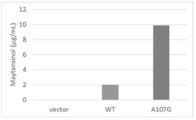
- the amino acid sequence of the mutant bspnbA of SEQ ID NO: 12 differs from the amino acid sequence of bspnbA (wild type, WT) of SEQ ID NO: 9 by one amino acid (out of 489 amino acids).
- Such a mutant bspnbA is a novel protein. Therefore, the present invention also provides any one of the following proteins (D)-(F).
- D A protein consisting of the amino acid sequence shown in SEQ ID NO: 12;
- E Consists of an amino acid sequence in which one or more amino acids are substituted, deleted, inserted, and / or added in the amino acid sequence shown in SEQ ID NO: 12, but at position 107 is G and from an ansamytocin species.
- a protein that has the activity of catalyzing the reaction that produces Maytansinol (F) Consists of an amino acid sequence having at least 90% identity with the amino acid sequence set forth in SEQ ID NO: 12, where position 107 is G and the activity of catalyzing the reaction to produce maytansinol from ansamitecin species. Protein with.
- the present invention also provides an enzyme protein of any one of (E)-(F) and (AA)-(CC) below.
- E Consists of an amino acid sequence in which one or more amino acids are substituted, deleted, inserted, and / or added in the amino acid sequence shown in SEQ ID NO: 12.
- the 66-68th place is DLL or AGA
- the 139-141th place is GPF
- the 146-148th place is LSS or LSP
- the 247-249th place is LHT
- the 323rd place is 323th.
- HSX or ASX where X is Q, K, E, or M
- the equivalent of 374-376 is QSX (where X is H, R, D, or Q).
- positions 443-445 is GNP, and a protein that has the activity of catalyzing the reaction that produces maytansinol from ansamitecin species;
- F Consists of an amino acid sequence having at least 50% identity with the amino acid sequence set forth in SEQ ID NO: 12.
- the 66-68th place is DLL or AGA
- the 139-141th place is GPF
- the 146-148th place is LSS or LSP
- the 247-249th place is LHT
- the 323rd place is 323th.
- HSX or ASX where X is Q, K, E, or M
- the equivalent of 374-376 is QSX (where X is H, R, D, or Q).
- positions 443-445 is GNP, and a protein that has the activity of catalyzing the reaction that produces maytansinol from ansamitecin species;
- BB The amino acid sequence set forth in any one of SEQ ID NOs: 18-21 consists of an amino acid sequence in which one or more amino acids are substituted, deleted, inserted, and / or added, and maytansinol from an ansamitosine species.
- a protein that has the activity of catalyzing the reaction that produces (CC) A protein consisting of an amino acid sequence having at least 80% identity with the amino acid sequence set forth in any one of SEQ ID NOs: 18-21 and having an activity of catalyzing a reaction for producing mayanthinol from an anamitecin species. ..
- the target amino acid sequence when the Y-position equivalent is a specific amino acid, the target amino acid sequence is referred to as SEQ ID NO: X. It means that the amino acid corresponding to the amino acid at position Y in the described amino acid sequence is a specific amino acid.
- the corresponding amino acid is the amino acid in the target amino acid sequence corresponding to the amino acid at position Y of the amino acid sequence of SEQ ID NO: X when the amino acid sequence of SEQ ID NO: X and the target amino acid sequence are aligned so as to have the most coincidences. Points to.
- the present invention is characterized by a polynucleotide encoding the above protein, a polynucleotide encoding mutant bspnbA (SEQ ID NO: 12) (SEQ ID NOs: 10 and 11), and a vector containing any of these polynucleotides. It also provides the converted fungus.
- the enzyme used in the method for producing maytancinol from the ansamitecin species of the present invention can be produced from a bacterium having an expressible polynucleotide encoding the enzyme protein.
- the present invention also provides a genetically modified bacterium that produces the enzyme.
- Such a recombinant bacterium is a bacterium transformed with a vector containing any one of the following polynucleotides (a)-(l):
- A A polynucleotide encoding a protein consisting of the amino acid sequence set forth in SEQ ID NO: 9;
- B Consists of an amino acid sequence in which one or more amino acids are substituted, deleted, inserted, and / or added in the amino acid sequence shown in SEQ ID NO: 9.
- the 66-68th place is DLL or AGA
- the 139-141th place is GPF
- the 146-148th place is LSS or LSP
- the 247-249th place is LHT
- the 323rd place is 323th.
- HSX or ASX where X is Q, K, E, or M
- the equivalent of 374-376 is QSX (where X is H, R, D, or Q).
- positions 443-445 is GNP, and a polynucleotide encoding a protein that has the activity of catalyzing the reaction that produces maytansinol from ansamitecin species;
- C Consists of an amino acid sequence having at least 50% identity with the amino acid sequence set forth in SEQ ID NO: 9.
- the 66-68th place is DLL or AGA
- the 139-141th place is GPF
- the 146-148th place is LSS or LSP
- the 247-249th place is LHT
- the 323rd place is 323th.
- HSX or ASX where X is Q, K, E, or M
- QSX where X is H, R, D, or Q
- the equivalent of positions 443-445 is GNP, and a polynucleotide encoding a protein that has the activity of catalyzing the reaction that produces maytansinol from ansamitecin species
- D A polynucleotide encoding a protein consisting of the amino acid sequence set forth in SEQ ID NO: 12
- E Consists of an amino acid sequence in which one or more amino acids are substituted, deleted, inserted, and / or added in the amino acid sequence shown in SEQ ID NO: 12.
- the 66-68th place is DLL or AGA
- the 139-141th place is GPF
- the 146-148th place is LSS or LSP
- the 247-249th place is LHT
- the 323rd place is 323th.
- HSX or ASX where X is Q, K, E, or M
- the equivalent of 374-376 is QSX (where X is H, R, D, or Q).
- positions 443-445 is GNP, and a polynucleotide encoding a protein that has the activity of catalyzing the reaction that produces maytansinol from ansamitecin species;
- F Consists of an amino acid sequence having at least 50% identity with the amino acid sequence set forth in SEQ ID NO: 12.
- the 66-68th place is DLL or AGA
- the 139-141th place is GPF
- the 146-148th place is LSS or LSP
- the 247-249th place is LHT
- the 323rd place is 323th.
- HSX or ASX where X is Q, K, E, or M
- QSX where X is H, R, D, or Q
- the equivalent of positions 443-445 is GNP, and a polynucleotide encoding a protein that has the activity of catalyzing the reaction that produces maytansinol from ansamitecin species
- G A polynucleotide consisting of the nucleotide sequence shown in SEQ ID NO: 1 or 2
- H Encodes a protein consisting of a nucleotide sequence having at least 50% identity with the nucleotide sequence set forth in SEQ ID NO: 1 or 2 and having an activity of catalyzing a reaction for producing mayanthinol from ansamitosine species.
- Polynucleotide (I) A polynucleotide encoding a protein that hybridizes with the nucleotide sequence set forth in SEQ ID NO: 1 or 2 under stringent conditions and has an activity of catalyzing a reaction for producing maytansinol from ansamitosine species; (J) A polynucleotide consisting of the nucleotide sequence set forth in SEQ ID NO: 10 or 11; (K) Consists of a nucleotide sequence having at least 50% identity with the nucleotide sequence set forth in SEQ ID NO: 10 or 11, where position 320 is G and catalyzes the reaction to produce mayanthinol from ansamitecin species.
- the amino acid sequence set forth in any one of SEQ ID NOs: 18-21 consists of an amino acid sequence in which one or more amino acids are substituted, deleted, inserted, and / or added, and maytansinol from an ansamitosine species.
- a polynucleotide encoding a protein that has the activity of catalyzing the reaction that produces (Cc)
- a protein consisting of an amino acid sequence having at least 80% identity with the amino acid sequence set forth in any one of SEQ ID NOs: 18-21 and having an activity of catalyzing a reaction for producing mayanthinol from an anamitecin species.
- the polynucleotide that encodes is not limited to:
- One of the preferred examples of the above polynucleotide is from Bacillus subtilis.
- the transformed bacterium can be used without particular limitation as long as it is a microorganism capable of incorporating the target DNA and producing the target enzyme protein.
- Bacteria to be transformed include bacteria belonging to the phylum Proteobacteria (sometimes simply referred to as Proteobacteria).
- Proteobacteria include bacteria belonging to the Alphaproteobacteria, beta Proteobacteria, gamma Proteobacteria, Delta Proteobacteria, Epsilon Proteobacteria, and Zeta Proteobacteria. Bacteria to which it belongs and bacteria belonging to the family Proteobacteria are included.
- one of the examples to which the present invention is preferably applied is a bacterium belonging to the class Gammaproteobacteria (sometimes simply referred to as gammaproteobacteria), and more specifically, Escherichia coli. ..
- the present invention can be applied to various strains belonging to Escherichia coli.
- Preferred strains include, for example, Escherichia coli BL21 (DE3) strain.
- the means for incorporating and expressing a foreign polynucleotide in the host is not particularly limited, but for example, Molecular Cloning. A Laboratory Manual. 2nd ed, Current Protocols in Molecular Biology (edited by Frederick M. Ausubel et al., 1987). ) Etc. can be used.
- the host / plasmid-vector system is not particularly limited as long as the target polynucleotide can be stably retained and expressed in the host.
- the plasmid may contain an autonomous replication sequence, a promoter sequence, a terminator sequence, a drug resistance gene, etc., and the type of plasmid is not limited to the autonomous replication plasmid, but is planned to be used. It may be an integrated plasmid having a sequence homologous to a certain region of the genome of the host.
- the site for incorporating the polynucleotide of interest may be either on a plasmid or on the genome of the host microorganism.
- pUC19, pRSFDuet-1, etc. as the autonomous replication vector
- lac, T7, etc. as the promoter sequence
- lacZ terminator, T7 terminator, etc. as the terminator sequence
- ampicillin as the drug resistance gene.
- a resistance gene, a kanamycin resistance gene, and the like can be mentioned respectively.
- the conditions for producing the enzyme by the transformant can be appropriately designed by those skilled in the art according to the bacteria to be used.
- Escherichia coli is used as the host, if necessary, a general-purpose medium containing an antibiotic as a selection marker is inoculated with an appropriate amount of microorganisms and at 20 ° C-40 ° C for 6 hours-72 hours, preferably 9 hours-.
- the cells can be grown by culturing for 60 hours, more preferably 12 hours-48 hours, and if necessary, at 100-400 rpm with stirring or shaking.
- a suitable inducer eg, isopropylthio- ⁇ -galactoside (IPTG)
- IPTG isopropylthio- ⁇ -galactoside
- transformed Escherichia coli is provided.
- a preferred example of transformed E. coli is one capable of producing 1 ⁇ g or more of Maytansinol per 1 mL of culture medium.
- a 6-fold SSC solution (the composition of the 1-fold SSC solution consists of 150 mM sodium chloride and 15 mM sodium citrate) and 5% formamide.
- a 4-fold concentration of SSC solution may be used, and the conditions for washing the filter at 49 ° C. may be used.
- hybridization was performed at 40 ° C. in the presence of a 2-fold concentration SSC solution and 50% formamide, and then a 0.1-fold concentration SSC solution was used at 57 ° C.
- the condition for cleaning the filter may be used.
- hybridization was performed at 45 ° C. in the presence of a 2-fold concentration SSC solution and 50% formamide, and then a 0.1-fold concentration SSC solution was used at 62 ° C.
- the condition for cleaning the filter may be used.
- amino acid sequence in which one or more amino acids are substituted, deleted, inserted, and / or added is particularly described. Except for, any protein is not particularly limited as long as the protein consisting of the amino acid sequence has a desired function, but 1-250, 1-200, 1-150, 1-100, 1-50. 1-40, 1-30, 1-20, 1-15, 1-9 or 1-4, or even more if replaced with amino acids with similar properties There may be replacement of the number of. Means for preparing polynucleotides or proteins relating to such amino acid sequences are well known to those of skill in the art.
- amino acids or amino acid residues are A for alanine, C for cysteine, D for aspartic acid, E for glutamic acid, F for phenylalanine, G for glycine, and H for H.
- Histidine I is isoleucine, K is lysine, L is leucine, M is methionine, N is aspartic acid, P is proline, Q is glutamine, R is arginine, S is serine, T is threonine, U is selenocysteine (3), V stands for valine, W stands for tryptophan, and Y stands for tyrosine.
- identity when the term "identity" is used with respect to a base sequence (sometimes referred to as a nucleotide sequence) or an amino acid sequence, unless otherwise specified, two sequences are optimal for any base sequence or amino acid sequence.
- such an algorithm is incorporated in the NBLAST and XBLAST programs described in Altschul et al., J. Mol. Biol. 215 (1990) 403-410.
- a search / analysis regarding the identity of a base sequence or an amino acid sequence can be performed by an algorithm or program known to those skilled in the art (for example, BLASTN, BLASTP, BLASTX, ClustalW).
- the parameters when using the program can be appropriately set by those skilled in the art, and the default parameters of each program may be used. Specific methods of these analysis methods are also well known to those skilled in the art.
- Gene information processing software GENETIX registered trademark
- GENETIX Gene information processing software
- the target sequence for which% identity is to be obtained has an additional sequence such as a tag sequence at the end that does not exist in the sequence to be compared, the additional sequence portion is not included in the calculation of% identity.
- the base sequence or amino acid sequence is referred to as identity, at least 50%, for example, 60% or more, 70% or more, preferably 80% or more, more preferably, in any case, unless otherwise specified. Refers to 85% or more, more preferably 90% or more, still more preferably 95% or more, still more preferably 97.5% or more, still more preferably 99% or more sequence identity.
- polynucleotide or gene and protein or enzyme used in the present invention can be prepared by those skilled in the art using conventional techniques.
- Example 1 Cloning of AP3 esterase
- SEQ ID NO: 1 the nucleotide sequence of para-nitrobenzyl esterase (bspnbA) derived from Bacillus subtilis subsp. Subtilis str168 was artificially synthesized with a codon-optimized sequence for E. coli expression (genscript). ) (SEQ ID NO: 2), these sequences were amplified by PCR using primers FCapA-BspnbA and RCapA-BspnbA (SEQ ID NO: 3 and SEQ ID NO: 4). Similarly, the pCDF-capA vector (Fig.
- E. coli JM109 (TAKARA) was transformed with the obtained In-Fusion solution and incubated overnight at 37 ° C.
- the obtained colony was subjected to colony PCR to search for a plasmid in which the insert was inserted, and plasmid preparation was performed.
- the obtained plasmid was designated as pCDF-capA-bspnbA.
- Example 2 BspnbA activity evaluation test Obtained by transforming E. coli BL21 (DE3) (Nippon Gene) with pRSF-bspnbA (the sequence of SEQ ID NO: 2 cloned to the multicloning site of pRSFDuet-1) and pCDF-capA-bspnbA.
- M9seed liquid medium 0.68% Na 2 HPO 4 , 0.3% KH 2 PO 4 , 0.1% NH 4 Cl, 0.05% NaCl
- canamycin sulfate 25 ⁇ g / mL
- streptomycin sulfate 10 ⁇ g / mL
- This culture medium was mixed with M9 main medium (0.68% Na 2 HPO 4 , 0.3% KH 2 PO 4 , 0.1% NH 4 Cl, 0.05% NaCl) containing kanamycin sulfate (25 ⁇ g / mL) and Overnight Express AutoInduction Systems (Merck). After addition to 1.0% Casamino acid, 0.002% Thymine, 0.1 mM CaCl 2 ), the cells were cultured with shaking at 28 ° C. for 6 hours at 220 pm. Then, IPTG having a final concentration of 1 mM was added, and the cells were cultured with shaking at 28 ° C. for about 16 hours at 220 pm.
- Example 3 HPLC analysis
- Analytical instrument SHIMAZDU Nexera XR Column used: Imtakt Unison UK-C8 (50 x 3 mm) Eluent A: 5 mM HCOONH 4 (0.02% HCOOH) Eluent B: MeCN (0.02% HCOOH) Separation conditions: 0-9 min (3% -90% B), 9-9.50 min (90% B), 9.51-12 min (3% B), 12.01 min (stop) Flow velocity: 0.7 mL / min Injection volume: 10 ⁇ L Column temperature: 40 ° C
- Fig. 1 and Fig. 2 The HPLC and LC / MS charts are shown in Fig. 1 and Fig. 2.
- the empty vector pCDF-Duet1 (Fig. 3) did not produce Maytansinol, whereas pCDF-capA-bspnbA detected a peak at the same retention time as Maytansinol (Fig. 1).
- the LC / MS results showed that this product was consistent with the positive MS of maytansinol (Fig. 2), concluding that pnb esterase is an enzyme that catalyzes the reaction that converts AP3 to maytancinol. ..
- pnb esterase acts on AP4 (isobutyl ester) in the same manner as AP2 (ethyl ester) and AP3 (isopropyl ester). Therefore, pnb esterase is an enzyme that catalyzes the reaction of converting various ansamitecin species to maytansinol.
- Example 4 High activation screening by introduction of site-specific saturation mutation
- M9 seed liquid medium containing streptomycin sulfate (10 ⁇ g / mL) added to a 96 deep well plate.
- the cells were cultured with shaking at 800 rpm at 30 ° C. for 20 hours.
- This culture medium was mixed with M9 main medium (0.68% Na 2 HPO 4 , 0.3% KH 2 PO 4 , 0.1% NH 4 Cl, 0.05% NaCl) containing streptomycin sulfate (10 ⁇ g / mL) and Overnight Express AutoInducton Systems (Merck).
- Example 5 Screening result
- Example 6 Evaluation of design enzyme
- the design enzyme A3N3 gene was artificially synthesized with a codon-optimized sequence for E. coli expression (GENEWIZ), and primers A3N3_Fw and A3N3_Rv (SEQ ID NO: s: 13, 14) were used. It was amplified by PCR.
- the pRSFDuet-1 vector (SEQ ID NO: 15) was amplified by PCR using primers pRSF_Fw and pRSF_Rv (SEQ ID NO: s: 16, 17). The two fragments obtained were cloned using TAKARA's In-Fusion kit. Other mutant enzymes were created in the same way.
- the obtained In-Fusion solution was introduced into E. coli BL21 (DE3), and the obtained clone was inoculated into 2 mL (14-mL test tube) of M9 seed medium. , 28 ° C., 220 rpm, pre-cultured overnight. 10 mL of M9 main medium (0.68% Na 2 HPO 4 , 0.3% KH 2 PO 4 , 0.1% NH 4 Cl) containing canamycin hydrochloride (25 ⁇ g / mL) and Overnight Express AutoInducton System 1 (Merck). , 0.05% NaCl, 1.0% Casamino acid, 0.002% Thymine, 0.1 mM CaCl2), followed by shaking culture at 28 ° C.
- SEQ ID NO: 1 Bacillus subtilis subsp. Subtilis str168 Nucleotide sequence of pnbA SEQ ID NO: 2 pnbA E. coli base sequence SEQ ID NO: 3 PCR primer, FCapA-BspnbA SEQ ID NO: 4 PCR primer, RCapA-BspnbA SEQ ID NO: 5 PCR primer, FCapApCDFXhoI SEQ ID NO: 6 PCR primer, RCapApCDFNdeI SEQ ID NO: 7 PCR primer, FpnbA A107X SEQ ID NO: 8 PCR primer, RpnbA A107 SEQ ID NO: 9 pnbA amino acid sequence SEQ ID NO: 10 A107G Nucleotide sequence of mutant enzyme SEQ ID NO: 11 Nucleotide sequence of A107G mutant enzyme (E.
Landscapes
- Chemical & Material Sciences (AREA)
- Organic Chemistry (AREA)
- Life Sciences & Earth Sciences (AREA)
- Health & Medical Sciences (AREA)
- Engineering & Computer Science (AREA)
- Wood Science & Technology (AREA)
- Zoology (AREA)
- Genetics & Genomics (AREA)
- Bioinformatics & Cheminformatics (AREA)
- General Engineering & Computer Science (AREA)
- General Health & Medical Sciences (AREA)
- Biochemistry (AREA)
- Biotechnology (AREA)
- Microbiology (AREA)
- Biomedical Technology (AREA)
- Molecular Biology (AREA)
- Chemical Kinetics & Catalysis (AREA)
- General Chemical & Material Sciences (AREA)
- Medicinal Chemistry (AREA)
- Plant Pathology (AREA)
- Biophysics (AREA)
- Physics & Mathematics (AREA)
- Preparation Of Compounds By Using Micro-Organisms (AREA)
- Enzymes And Modification Thereof (AREA)
- Pharmaceuticals Containing Other Organic And Inorganic Compounds (AREA)
Priority Applications (3)
| Application Number | Priority Date | Filing Date | Title |
|---|---|---|---|
| EP20893404.2A EP4067497A4 (en) | 2019-11-29 | 2020-11-27 | Method for enzymatically producing maytansinol |
| JP2021561569A JP7772363B2 (ja) | 2019-11-29 | 2020-11-27 | メイタンシノールの酵素的生産方法 |
| US17/779,967 US12473579B2 (en) | 2019-11-29 | 2020-11-27 | Method for enzymatically producing maytansinol |
Applications Claiming Priority (2)
| Application Number | Priority Date | Filing Date | Title |
|---|---|---|---|
| JP2019217460 | 2019-11-29 | ||
| JP2019-217460 | 2019-11-29 |
Publications (2)
| Publication Number | Publication Date |
|---|---|
| WO2021107133A1 true WO2021107133A1 (ja) | 2021-06-03 |
| WO2021107133A8 WO2021107133A8 (ja) | 2021-09-30 |
Family
ID=76129659
Family Applications (1)
| Application Number | Title | Priority Date | Filing Date |
|---|---|---|---|
| PCT/JP2020/044347 Ceased WO2021107133A1 (ja) | 2019-11-29 | 2020-11-27 | メイタンシノールの酵素的生産方法 |
Country Status (4)
| Country | Link |
|---|---|
| US (1) | US12473579B2 (https=) |
| EP (1) | EP4067497A4 (https=) |
| JP (1) | JP7772363B2 (https=) |
| WO (1) | WO2021107133A1 (https=) |
Citations (8)
| Publication number | Priority date | Publication date | Assignee | Title |
|---|---|---|---|---|
| JPS5529972A (en) | 1978-08-24 | 1980-03-03 | Takeda Chem Ind Ltd | Preparation of maytansinol |
| JPH0217693B2 (https=) | 1984-11-19 | 1990-04-23 | Mazda Motor | |
| US6333410B1 (en) | 2000-08-18 | 2001-12-25 | Immunogen, Inc. | Process for the preparation and purification of thiol-containing maytansinoids |
| JP2004526734A (ja) | 2001-03-16 | 2004-09-02 | スミスクライン・ビーチャム・コーポレイション | メイタンシノールの製造方法 |
| JP2009514978A (ja) | 2005-11-08 | 2009-04-09 | イミュノジェン・インコーポレーテッド | メイタンシノールの調製法 |
| WO2011102388A1 (ja) * | 2010-02-16 | 2011-08-25 | 株式会社エーピーアイ コーポレーション | 1-アミノ-1-アルコキシカルボニル-2-ビニルシクロプロパンの製造方法 |
| WO2012029819A1 (ja) * | 2010-08-31 | 2012-03-08 | 株式会社エーピーアイ コーポレーション | 新規加水分解酵素タンパク質 |
| WO2014052537A1 (en) | 2012-09-26 | 2014-04-03 | Immunogen, Inc. | Improved methods for the acylation of maytansinol |
Family Cites Families (1)
| Publication number | Priority date | Publication date | Assignee | Title |
|---|---|---|---|---|
| ES2327480B1 (es) | 2007-06-15 | 2010-08-10 | Bioiberica, S.A. | "disacaridos para el tratamiento de tendones, ligamentos y huesos". |
-
2020
- 2020-11-27 JP JP2021561569A patent/JP7772363B2/ja active Active
- 2020-11-27 WO PCT/JP2020/044347 patent/WO2021107133A1/ja not_active Ceased
- 2020-11-27 US US17/779,967 patent/US12473579B2/en active Active
- 2020-11-27 EP EP20893404.2A patent/EP4067497A4/en active Pending
Patent Citations (8)
| Publication number | Priority date | Publication date | Assignee | Title |
|---|---|---|---|---|
| JPS5529972A (en) | 1978-08-24 | 1980-03-03 | Takeda Chem Ind Ltd | Preparation of maytansinol |
| JPH0217693B2 (https=) | 1984-11-19 | 1990-04-23 | Mazda Motor | |
| US6333410B1 (en) | 2000-08-18 | 2001-12-25 | Immunogen, Inc. | Process for the preparation and purification of thiol-containing maytansinoids |
| JP2004526734A (ja) | 2001-03-16 | 2004-09-02 | スミスクライン・ビーチャム・コーポレイション | メイタンシノールの製造方法 |
| JP2009514978A (ja) | 2005-11-08 | 2009-04-09 | イミュノジェン・インコーポレーテッド | メイタンシノールの調製法 |
| WO2011102388A1 (ja) * | 2010-02-16 | 2011-08-25 | 株式会社エーピーアイ コーポレーション | 1-アミノ-1-アルコキシカルボニル-2-ビニルシクロプロパンの製造方法 |
| WO2012029819A1 (ja) * | 2010-08-31 | 2012-03-08 | 株式会社エーピーアイ コーポレーション | 新規加水分解酵素タンパク質 |
| WO2014052537A1 (en) | 2012-09-26 | 2014-04-03 | Immunogen, Inc. | Improved methods for the acylation of maytansinol |
Non-Patent Citations (7)
Also Published As
| Publication number | Publication date |
|---|---|
| JPWO2021107133A1 (https=) | 2021-06-03 |
| EP4067497A1 (en) | 2022-10-05 |
| US20230030526A1 (en) | 2023-02-02 |
| EP4067497A4 (en) | 2024-03-13 |
| JP7772363B2 (ja) | 2025-11-18 |
| US12473579B2 (en) | 2025-11-18 |
| WO2021107133A8 (ja) | 2021-09-30 |
Similar Documents
| Publication | Publication Date | Title |
|---|---|---|
| JP7491588B2 (ja) | 操作されたパントテン酸キナーゼ改変体酵素 | |
| JP7493248B2 (ja) | 操作されたホスホペントムターゼ改変体酵素 | |
| US6413750B1 (en) | (R)-specific alcohol dehydrogenases from lactobacillus with improved catalytic activity using an NAD+ substrate | |
| JP7678580B2 (ja) | 操作されたスクロースホスホリラーゼバリアント酵素 | |
| CN111057686B (zh) | 一种醇脱氢酶突变体及应用 | |
| RU2730602C2 (ru) | Новая полифосфат-зависимая глюкокиназа и способ получения глюкозо-6-фосфата с ее использованием | |
| JP7772363B2 (ja) | メイタンシノールの酵素的生産方法 | |
| US20050158818A1 (en) | Cephalosporin C acylases | |
| JPWO2013129427A1 (ja) | cyclicdi−GMPの実践的酵素合成法 | |
| JP2018102282A (ja) | トリプトファンシンターゼβサブユニット遺伝子が導入された形質転換体及びその処理物、形質転換体の処理物の製造方法、並びに形質転換体の処理物を用いたL−カルボシステインの製造方法 | |
| JP2022547523A (ja) | 10-アセチル-3,7-ジヒドロキシフェノキサジンに対するペルオキシダーゼ活性 | |
| CN106795511B (zh) | 氧化酶、编码该酶的多核苷酸、以及它们的应用 | |
| CN110607335A (zh) | 一种烟酰胺腺嘌呤二核苷酸类化合物生物合成方法 | |
| KR101764840B1 (ko) | 내열성 균주 유래의 효소를 이용한 알로스의 제조방법 | |
| KR102405289B1 (ko) | 세팔로스포린 c 아실라제 활성을 가지는 폴리펩타이드 및 이의 용도 | |
| WO2013066264A1 (en) | Enzymatic synthesis of cyclic and linear diadenosine monophosphate | |
| KR102424603B1 (ko) | 알코올 탈수소효소 변이체, 및 이를 이용한 알데히드 화합물의 생산 방법 | |
| JP5703455B2 (ja) | キヌクリジノン還元酵素及びそれを用いた光学活性3−キヌクリジノールの製造方法 | |
| JP5367272B2 (ja) | ポリアミノ酸合成酵素とそれをコードする遺伝子 | |
| CN112055751B (zh) | 修饰型酯酶和其用途 | |
| US7135318B2 (en) | Modified reductase and its gene | |
| KR100809445B1 (ko) | 신규한 호열성 l-리보오스 이성화효소 및 그의 용도 | |
| US20020119506A1 (en) | Genes encoding UMP kinase, methods for purifying UMP kinase and methods of characterizing UMP kinase | |
| CN111094571A (zh) | 龙涎香醇的有效制备方法 | |
| JP2008263868A (ja) | ポリアミノ酸合成酵素とそれをコードする遺伝子 |
Legal Events
| Date | Code | Title | Description |
|---|---|---|---|
| 121 | Ep: the epo has been informed by wipo that ep was designated in this application |
Ref document number: 20893404 Country of ref document: EP Kind code of ref document: A1 |
|
| ENP | Entry into the national phase |
Ref document number: 2021561569 Country of ref document: JP Kind code of ref document: A |
|
| ENP | Entry into the national phase |
Ref document number: 2020893404 Country of ref document: EP Effective date: 20220629 |
|
| WWG | Wipo information: grant in national office |
Ref document number: 17779967 Country of ref document: US |