WO2021100510A1 - 車両用灯具システム、配光制御装置および配光制御方法 - Google Patents
車両用灯具システム、配光制御装置および配光制御方法 Download PDFInfo
- Publication number
- WO2021100510A1 WO2021100510A1 PCT/JP2020/041678 JP2020041678W WO2021100510A1 WO 2021100510 A1 WO2021100510 A1 WO 2021100510A1 JP 2020041678 W JP2020041678 W JP 2020041678W WO 2021100510 A1 WO2021100510 A1 WO 2021100510A1
- Authority
- WO
- WIPO (PCT)
- Prior art keywords
- luminous intensity
- light distribution
- light
- lamp
- distribution control
- Prior art date
- Legal status (The legal status is an assumption and is not a legal conclusion. Google has not performed a legal analysis and makes no representation as to the accuracy of the status listed.)
- Ceased
Links
Images


Classifications
-
- B—PERFORMING OPERATIONS; TRANSPORTING
- B60—VEHICLES IN GENERAL
- B60Q—ARRANGEMENT OF SIGNALLING OR LIGHTING DEVICES, THE MOUNTING OR SUPPORTING THEREOF OR CIRCUITS THEREFOR, FOR VEHICLES IN GENERAL
- B60Q1/00—Arrangement of optical signalling or lighting devices, the mounting or supporting thereof or circuits therefor
- B60Q1/02—Arrangement of optical signalling or lighting devices, the mounting or supporting thereof or circuits therefor the devices being primarily intended to illuminate the way ahead or to illuminate other areas of way or environments
- B60Q1/04—Arrangement of optical signalling or lighting devices, the mounting or supporting thereof or circuits therefor the devices being primarily intended to illuminate the way ahead or to illuminate other areas of way or environments the devices being headlights
-
- B—PERFORMING OPERATIONS; TRANSPORTING
- B60—VEHICLES IN GENERAL
- B60Q—ARRANGEMENT OF SIGNALLING OR LIGHTING DEVICES, THE MOUNTING OR SUPPORTING THEREOF OR CIRCUITS THEREFOR, FOR VEHICLES IN GENERAL
- B60Q1/00—Arrangement of optical signalling or lighting devices, the mounting or supporting thereof or circuits therefor
- B60Q1/02—Arrangement of optical signalling or lighting devices, the mounting or supporting thereof or circuits therefor the devices being primarily intended to illuminate the way ahead or to illuminate other areas of way or environments
- B60Q1/04—Arrangement of optical signalling or lighting devices, the mounting or supporting thereof or circuits therefor the devices being primarily intended to illuminate the way ahead or to illuminate other areas of way or environments the devices being headlights
- B60Q1/14—Arrangement of optical signalling or lighting devices, the mounting or supporting thereof or circuits therefor the devices being primarily intended to illuminate the way ahead or to illuminate other areas of way or environments the devices being headlights having dimming means
Definitions
- the present invention relates to a vehicle lamp system, a light distribution control device, and a light distribution control method.
- Patent Document 1 discloses a technique for performing ADB control using an LED array.
- the ADB control detects the presence or absence of a light-shielding target located in front of the vehicle to avoid high-intensity light irradiation with a camera, and dims or turns off the area corresponding to the light-shielding target. Therefore, according to the ADB control, it is possible to improve the visibility of the driver of the own vehicle while avoiding glare to the vehicle in front such as the preceding vehicle and the oncoming vehicle.
- the front area of the vehicle is divided into a plurality of individual areas, and each individual area is subjected to two gradations (two steps) of light irradiation and non-irradiation, or at most one step of dimming irradiation.
- the brightness of each individual area was controlled by the added three gradations.
- the luminosity of the light irradiating each individual region can be controlled with more multi-gradation, it becomes possible to irradiate various targets having different reflectances with light having a luminosity suitable for each target.
- the visibility of the driver is further improved.
- the driver becomes aware (visually visible) of the uneven brightness of the light distribution pattern. Brightness unevenness can hinder the improvement of driver's visibility.
- the present invention has been made in view of such a situation, and one of the objects thereof is to provide a technique for improving the visibility of the driver.
- one aspect of the present invention is a vehicle lamp system.
- This system includes a light distribution variable lamp that can independently adjust the luminous intensity of light irradiating each of a plurality of individual regions arranged in front of the vehicle, and a light distribution control device that controls the light distribution variable lamp.
- the light distribution control device has a luminous intensity setting unit that determines the luminous intensity of the light irradiating each individual region with a gradation of 10 bits or more.
- This device is a light distribution control device that controls a light distribution variable lamp that can independently adjust the luminous intensity of the light irradiating each of a plurality of individual regions lined up in front of the vehicle, and the luminous intensity of the light irradiating each individual region. It is provided with a luminous intensity setting unit for determining a gradation of 10 bits or more.
- Another aspect of the present invention is a light distribution control method.
- This method is a light distribution control method for controlling a light distribution variable lamp that can independently adjust the luminous intensity of light irradiating each of a plurality of individual regions lined up in front of the vehicle, and is a light distribution control method for irradiating each individual region. Includes determining with a gradation of 10 bits or more.
- the visibility of the driver can be improved.
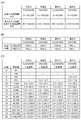
- FIG. 2A is a diagram showing the relationship between the combination conditions of the lamp functions, the luminous intensity range required for the lamp under each condition, and the luminous intensity range required to suppress brightness unevenness under each condition.
- FIG. 2B is a diagram showing the number of bits required to suppress brightness unevenness under each condition.
- FIG. 2C is a diagram showing the relationship between the number of bits and the gamma value of gamma correction, which is necessary for suppressing brightness unevenness under each condition.
- 3A to 3C are diagrams showing the luminous intensity contrast at a predetermined luminous intensity when the luminous intensity is set with a predetermined number of bits.
- FIG. 1 is a block diagram of a vehicle lighting system according to the embodiment.
- a part of the components of the vehicle lighting system 1 is drawn as a functional block.
- These functional blocks are realized by elements and circuits such as a computer CPU and memory as a hardware configuration, and are realized by a computer program or the like as a software configuration. Those skilled in the art will understand that these functional blocks can be realized in various ways by combining hardware and software.
- the vehicle lighting system 1 includes a light distribution variable lamp 2, a light distribution control device 4, and a lamp power supply 6. All of these may be built in the same housing, or some members may be provided on the outside of the housing, in other words, on the vehicle 100 side.
- the light distribution variable lamp 2 can independently adjust the luminous intensity of the light irradiating each of the plurality of individual areas R arranged in front of the own vehicle. That is, the variable light distribution lamp 2 can irradiate the front region of the vehicle 100 with the visible light beam L1 having a variable intensity distribution.
- the variable light distribution lamp 2 receives data indicating the light distribution pattern PTN from the light distribution control device 4, and emits a visible light beam L1 having an intensity distribution according to the light distribution pattern PTN. As a result, the light distribution pattern PTN is formed in front of the vehicle.
- the light distribution pattern PTN is grasped as a two-dimensional illuminance distribution of the irradiation pattern 902 formed by the light distribution variable lamp 2 on the virtual vertical screen 900 in front of the own vehicle.
- the variable light distribution lamp 2 includes, for example, a plurality of light sources arranged in a matrix and a lighting circuit that independently drives and lights each light source.
- Preferred examples of the light source include semiconductor light sources such as LED (light emitting diode), LD (laser diode), and organic or inorganic EL (electroluminescence).
- LED light emitting diode
- LD laser diode
- organic or inorganic EL electroluminescence
- the light distribution variable lamp 2 uses a matrix-type pattern forming device such as a DMD (Digital Mirror Device) or a liquid crystal device, or a light source light in front of the vehicle. It may include a scanning optical pattern forming device that scans the light source.
- the resolution of the variable light distribution lamp 2 is, for example, 10 to 1.3 million pixels.
- the light distribution control device 4 is a light source driver that controls the light distribution variable lamp 2.
- the light distribution control device 4 can be configured by a digital processor, for example, it may be configured by a combination of a microcomputer including a CPU and a software program, or by an FPGA (Field Programmable Gate Array), an ASIC (Application Specified IC), or the like. It may be configured.
- the light distribution control device 4 receives an instruction signal from the vehicle ECU 102 mounted on the vehicle 100 and executes control of the light distribution variable lamp 2. Further, the vehicle ECU 102 acquires various information from the visible light camera 104 mounted on the vehicle 100 and other sensors, and sends the acquired information to the light distribution control device 4.
- the light distribution control device 4 When the light distribution control device 4 receives the instruction signal and various information from the vehicle ECU 102, it determines the light distribution pattern PTN to be formed and sends the control signal instructing the light distribution pattern PTN to the light distribution variable lamp 2. Further, the light distribution control device 4 transmits a drive signal to the lamp power supply 6. When the lamp power source 6 receives the drive signal, it supplies electric power to each light source via the lighting circuit of the light distribution variable lamp 2.
- the light distribution control device 4 has a luminous intensity setting unit 8 and a correction unit 10. Each part operates by executing a program held in a memory by an integrated circuit constituting itself.
- the luminous intensity setting unit 8 determines the luminous intensity of the light to irradiate each individual region R. That is, the luminous intensity setting unit 8 has a drawing function for determining the light distribution pattern PTN.
- the luminous intensity setting unit 8 determines the luminous intensity of the light irradiating each individual region R with a gradation of 10 bits or more. That is, the luminous intensity setting unit 8 has a gradation resolution of 10 bits or more. As a result, it becomes easy to add a plurality of lamp functions to one variable light distribution lamp 2 and suppress brightness unevenness in a light distribution pattern corresponding to each function.
- FIG. 2A is a diagram showing the relationship between the combination conditions of the lamp functions, the luminous intensity range required for the lamp under each condition, and the luminous intensity range required to suppress brightness unevenness under each condition.
- FIG. 2B is a diagram showing the number of bits required to suppress brightness unevenness under each condition.
- FIG. 2C is a diagram showing the relationship between the number of bits and the gamma value of gamma correction, which is necessary for suppressing brightness unevenness under each condition.
- the lamps that meet the condition A include a lamp function (low beam function: Lo) that forms a low beam light distribution pattern and an overhead sign (OHS) pattern, and a lamp function (high beam function: Hi) that forms a high beam light distribution pattern. , It also has a lamp function (ADB function: ADB) for forming a light distribution pattern for ADB.
- the ADB light distribution pattern is a light distribution pattern based on the high beam light distribution pattern, in which the luminous intensity of the portion corresponding to the target in front of the vehicle is changed.
- the lamp corresponding to the condition A has a high beam function of irradiating light having a luminous intensity higher than the maximum luminous intensity of the high beam stipulated by law.
- the minimum required luminous intensity at the maximum luminous intensity point of the high beam specified in the regulations is 40,500 cd, but the maximum luminous intensity of the high beam under the condition A is set to 100,000 cd, which is much higher. Therefore, the luminous intensity range required for the lamp under the condition A is 0 cd or more and 100,000 cd or less.
- the lamp corresponding to the condition A is required to form an OHS pattern having a lower luminous intensity than the low beam light distribution pattern.
- the luminosity range of the OHS pattern is generally 50 cd or more and 625 cd or less. Therefore, the luminous intensity range in which the suppression of brightness unevenness is required under the condition A (hereinafter, appropriately referred to as a target luminous intensity range) is set to 50 cd or more and 100,000 cd or less.
- the lamp that meets condition B has both a high beam function and an ADB function.
- the maximum luminous intensity of the high beam is set to 100,000 cd, which is the same as the condition A. Therefore, the luminous intensity range required for the lamp under the condition B is 0 cd or more and 100,000 cd or less.
- the formation of an OHS pattern is not required.
- the luminous intensity of the minimum luminous intensity point of the high beam stipulated by law is 5,100 cd.
- the minimum luminous intensity in the region excluding the light-shielding portion is 5,100 cd. Therefore, the target luminous intensity range under the condition B is set to 5,100 cd or more and 100,000 cd or less.
- the lamp corresponding to the condition C has a low beam function, a high beam function, and an ADB function.
- the maximum luminous intensity of the high beam is set to 40,500 cd specified by law. Therefore, the luminous intensity range required for the lamp under the condition C is 0 cd or more and 40,500 cd or less. Further, the lamp corresponding to the condition C is required to form an OHS pattern. Therefore, the target luminous intensity range under the condition C is set to 50 cd or more and 40,500 cd or less.
- the lamp corresponding to condition D has both a high beam function and an ADB function.
- the maximum luminous intensity of the high beam is set to 40,500 cd, which is the same as the condition C. Therefore, the luminous intensity range required for the lamp under the condition D is 0 cd or more and 40,500 cd or less.
- the formation of the OHS pattern is not required as in the condition B. Therefore, the target luminous intensity range under the condition D is set to 5,100 cd or more and 40,500 cd or less.
- condition A having the low beam function, the high luminous intensity high beam function and the ADB function and the condition C having the low beam function, the low luminous intensity high beam function and the ADB function are more than the condition B and the condition D not having the low luminous intensity function. This is a condition that is desired to be achieved. Further, the condition A having a high luminous intensity high beam function is a condition that is further desired to be achieved as compared with the condition C having a low brightness high beam function.
- the luminance contrast is calculated based on the following equation (1).
- C is the luminance contrast
- Bt is the luminance of the visual object
- Bb is the luminance of the background.
- C
- the brightness contrast threshold value is about 0.032. That is, if the luminance contrast is 0.032 or less, the human cannot visually recognize the luminance unevenness.
- the visual object size of 0.30 degrees is a value equivalent to the angular resolution of 0.25 degrees of a typical optical system currently used.
- the adaptation brightness of 1.0 cd / m 2 is a general value as the adaptation brightness during night driving.
- the luminance contrast is replaced with the luminous intensity contrast.
- the luminous intensity contrast is calculated based on the equation (1') in which the background luminance Bb in the above equation (1) is replaced with the luminous intensity corresponding to the gradation value n and the visual target luminance Bt is replaced with the luminous intensity corresponding to the gradation value n + 1. Will be done. Therefore, in the case of the light distribution pattern, if the luminous intensity contrast is 0.032 or less, the driver cannot visually recognize the uneven brightness of the light distribution pattern.
- the luminance contrast it is necessary to define the reflection characteristics of the object irradiated with light and the positional relationship between the object and the viewer.
- the luminous intensity contrast it is possible to omit the definition of the reflection characteristic and the positional relationship on the assumption that the same sufficiently large object (virtual vertical screen 900) is irradiated with the light distribution pattern.
- the luminous intensity contrast changes according to the luminous intensity corresponding to the gradation value n. Further, when gamma correction (brightness correction) is performed, the amount of light intensity per gradation also changes according to the gradation value n. Therefore, it was decided to set an arbitrary luminous intensity and calculate the luminous intensity contrast based on this luminous intensity.
- Luminous intensity b (gradation value n + 1 / gradation number -1) ⁇ correction value ⁇ 100,000 cd
- FIG. 3 (A) shows a calculation result when gamma correction is applied with a gamma value of 1.0 (in this case, the same result as when gamma correction is not applied), and FIG. 3 (B) shows. It is a calculation result when gamma correction is performed with a gamma value of 2.2, and FIG. 3 (C) is a calculation result when gamma correction is performed with a gamma value of 4.4.
- the shaded area is a region where the luminous intensity contrast is 0.032 or less.
- the luminous intensity contrast of 0.032 or less was not satisfied at any luminous intensity in the target luminous intensity range of 50 to 100,000 cd at any bit number.
- the luminous intensity range satisfying the luminous intensity contrast of 0.032 or less expanded, and in 12 bits, the luminous intensity contrast of 0.032 or less was achieved in the entire target luminous intensity range. ..
- the luminous intensity range satisfying the luminous intensity contrast of 0.032 or less is further expanded, and the luminous intensity contrast of 0.032 over the entire target luminous intensity range at 10 bits and 12 bits. The following was achieved.
- the number of bits and the gamma value that can achieve a luminous intensity contrast of 0.032 or less over the entire target luminous intensity range were verified.
- the number of bits to be verified was 6 to 20.
- the number of bits is 10 or more when gamma correction is performed, and the number of bits is 16 or more when gamma correction is not performed, over the entire target luminous intensity range.
- the luminosity contrast was 0.032 or less.
- the luminous intensity contrast was 0.032 or less in the entire target luminous intensity range when the bit number was 10 or more when the gamma correction was performed and when the bit number was 15 or more when the gamma correction was not performed.
- the luminous intensity setting unit 8 at least sets the luminous intensity of the light to irradiate each individual region R. It is necessary to determine the gradation of 10 bits or more. In other words, by setting the gradation resolution of the luminous intensity setting unit 8 to 10 bits or more, it is possible to easily realize both an increase in the lamp function and suppression of brightness unevenness.
- the luminous intensity setting unit 8 determines the luminous intensity with a gradation of 15 bits or more. As a result, it is possible to suppress the occurrence of brightness unevenness under condition C without performing gamma correction. Further, it is more preferable that the luminous intensity setting unit 8 determines the luminous intensity with a gradation of 16 bits or more. As a result, it is possible to suppress the occurrence of brightness unevenness under condition A without performing gamma correction.
- the luminous intensity contrast was 0.032 or less over the entire target luminous intensity range when the number of bits was 9 or more when gamma correction was performed and the number of bits was 10 or more when gamma correction was not performed. Further, under condition D, the luminous intensity contrast was 0.032 or less over the entire target luminous intensity range when the bit number was 8 or more regardless of the presence or absence of gamma correction.
- the light distribution control device 4 of the present embodiment has a correction unit 10 that gamma-corrects the luminous intensity data defined by the luminous intensity setting unit 8.
- the correction unit 10 performs gamma correction using a gamma curve having a predetermined gamma value.
- the number of bits required for suppressing brightness unevenness can be reduced.
- the load on the light distribution control device 4 can be reduced, and the control speed can be increased.
- the luminous intensity setting unit 8 determines the luminous intensity with a gradation of 10 bits, and the correction unit 10 performs gamma correction using a gamma value of 2.7 or more and 24.5 or less.
- the luminous intensity setting unit 8 determines the luminous intensity with a gradation of 10 bits, and the correction unit 10 performs gamma correction using a gamma value of 3.4 or more and 23.2 or less.
- the luminous intensity setting unit 8 determines the luminous intensity with a gradation of 10 bits, and the correction unit 10 performs gamma correction using a gamma value of 3.4 or more and 23.2 or less.
- the luminous intensity setting unit 8 determines the luminous intensity of the light to be applied to each individual region R and determines the luminous intensity pattern PTN
- the luminous intensity setting unit 8 converts the luminous intensity data of the light distribution pattern PTN into a control signal of the light distribution variable lamp 2 and distributes the light. It transmits to the variable lamp 2.
- the lighting circuit of the light distribution variable lamp 2 receives the control signal, it lights the light source so as to emit the visible light beam L1 having an intensity distribution corresponding to the light distribution pattern PTN.
- the light distribution pattern PTN is formed in the front region of the vehicle 100.
- the light distribution control device 4 detects a target existing in the front region of the vehicle 100 based on the image obtained from the visible light camera 104, and dynamically and adaptively controls the light distribution pattern PTN according to the target. ADB control may be performed.
- the target vehicle includes a vehicle in front including a preceding vehicle and an oncoming vehicle, a pedestrian, an obstacle that hinders the running of the own vehicle, a road sign, a road marking, a road shape, and the like.
- the luminous intensity setting unit 8 performs image analysis on the image obtained from the visible light camera 104 by using a known method including algorithm recognition, deep learning, and the like, and detects a target existing in the front region of the vehicle 100. Then, the light distribution variable lamp 2 is controlled by determining the light distribution pattern PTN in which the portion corresponding to the target is shaded, dimmed or brightened.
- the vehicle lighting system 1 includes a light distribution variable lamp 2 that can independently adjust the luminous intensity of the light irradiating each of the plurality of individual regions R arranged in front of the own vehicle.
- a light distribution control device 4 for controlling the light variable lamp 2 is provided.
- the light distribution control device 4 has a luminous intensity setting unit 8 that determines the luminous intensity of the light irradiating each individual region R with a gradation of 10 bits or more. That is, the light distribution control device 4 controls the brightness of each optical element of the light distribution variable lamp 2 associated with each individual region R with a gradation of 10 bits or more.
- the luminous intensity setting unit 8 determines the luminous intensity with a gradation of 15 bits or more.
- the low beam function, the low light intensity high beam function, and the ADB function are integrated without performing gamma correction on the light intensity data determined by the light intensity setting unit 8, and the brightness unevenness in the light distribution pattern formed by each function is affected. It is possible to achieve both suppression. Further, if the gamma correction becomes unnecessary, the correction unit 10 can be omitted, so that the configuration of the vehicle lamp system 1 or the formation control of the light distribution pattern PTN can be simplified.
- the luminous intensity setting unit 8 determines the luminous intensity with a gradation of 16 bits or more.
- the low beam function, the high light intensity high beam function, and the ADB function are integrated without performing gamma correction on the light intensity data determined by the light intensity setting unit 8, and the brightness unevenness in the light distribution pattern formed by each function is affected. It is possible to achieve both suppression. Further, it is possible to simplify the configuration of the vehicle lighting system 1 or the formation control of the light distribution pattern PTN.
- the light distribution control device 4 has a correction unit 10 that performs gamma correction on the luminous intensity data determined by the luminous intensity setting unit 8.
- the gradation resolution (number of bits) of the luminous intensity setting unit 8 required for suppressing the brightness unevenness of the light distribution pattern can be reduced. That is, for condition C, it is possible to suppress the occurrence of brightness unevenness even if it is less than 15 bits, and for condition A, it is possible to suppress the occurrence of brightness unevenness even if it is less than 16 bits. Therefore, the amount of data handled by the light distribution control device 4 when forming the light distribution pattern PTN can be reduced, and the control load of the light distribution control device 4 can be reduced. Further, since the processing speed of the light distribution control device 4 can be increased, it is possible to more easily form a light distribution pattern suitable for various traffic scenes.
- the luminous intensity setting unit 8 determines the luminous intensity with a gradation of 10 bits, and the correction unit 10 performs gamma correction using a gamma value of 2.7 or more and 24.5 or less.
- the correction unit 10 performs gamma correction using a gamma value of 2.7 or more and 24.5 or less.
- the luminous intensity setting unit 8 determines the luminous intensity with a gradation of 10 bits, and the correction unit 10 performs gamma correction using a gamma value of 3.4 or more and 23.2 or less.
- the correction unit 10 performs gamma correction using a gamma value of 3.4 or more and 23.2 or less.
- the correction unit 10 is provided in the light distribution control device 4, but the configuration is not particularly limited to this.
- the correction unit 10 may be provided in the lighting circuit of the light distribution variable lamp 2.
- a light distribution control device (4) that controls a light distribution variable lamp (2) that can independently adjust the luminous intensity of light irradiating each of a plurality of individual regions (R) arranged in front of the vehicle.
- a light distribution control device (4) including a luminous intensity setting unit (8) that determines the luminous intensity of the light irradiating each individual region (R) with a gradation of 10 bits or more.
- (Item 2) It is a light distribution control method that controls a light distribution variable lamp (2) that can independently adjust the luminous intensity of the light irradiating each of a plurality of individual regions (R) arranged in front of the vehicle.
- a light distribution control method including determining the luminous intensity of light irradiating each individual region (R) with a gradation of 10 bits or more.
- the present invention can be used in a vehicle lamp system, a light distribution control device, and a light distribution control method.
Landscapes
- Engineering & Computer Science (AREA)
- Mechanical Engineering (AREA)
- Lighting Device Outwards From Vehicle And Optical Signal (AREA)
Priority Applications (1)
| Application Number | Priority Date | Filing Date | Title |
|---|---|---|---|
| JP2021558297A JPWO2021100510A1 (https=) | 2019-11-19 | 2020-11-09 |
Applications Claiming Priority (2)
| Application Number | Priority Date | Filing Date | Title |
|---|---|---|---|
| JP2019208557 | 2019-11-19 | ||
| JP2019-208557 | 2019-11-19 |
Publications (1)
| Publication Number | Publication Date |
|---|---|
| WO2021100510A1 true WO2021100510A1 (ja) | 2021-05-27 |
Family
ID=75981230
Family Applications (1)
| Application Number | Title | Priority Date | Filing Date |
|---|---|---|---|
| PCT/JP2020/041678 Ceased WO2021100510A1 (ja) | 2019-11-19 | 2020-11-09 | 車両用灯具システム、配光制御装置および配光制御方法 |
Country Status (2)
| Country | Link |
|---|---|
| JP (1) | JPWO2021100510A1 (https=) |
| WO (1) | WO2021100510A1 (https=) |
Citations (6)
| Publication number | Priority date | Publication date | Assignee | Title |
|---|---|---|---|---|
| JP2004210125A (ja) * | 2002-12-27 | 2004-07-29 | Ichikoh Ind Ltd | 車両用デジタル照明装置およびその制御装置ならびに制御プログラム |
| JP2009259598A (ja) * | 2008-04-16 | 2009-11-05 | Shozo Toyohisa | Led調光照明システム |
| JP2009542497A (ja) * | 2006-06-28 | 2009-12-03 | コーニンクレッカ フィリップス エレクトロニクス エヌ ヴィ | 照明装置の光放射を調整する方法及び装置 |
| JP2016149753A (ja) * | 2015-02-10 | 2016-08-18 | 株式会社Jvcケンウッド | 表示システム、処理装置、表示装置、表示方法、及びプログラム |
| JP2017532583A (ja) * | 2014-07-31 | 2017-11-02 | エムティティ イノベーション インコーポレイテッドMtt Innovation Incorporated | フリーフォームレンジングのための数値的アプローチ、エリアパラメータ化フリーフォームレンジング |
| WO2019003887A1 (ja) * | 2017-06-27 | 2019-01-03 | 株式会社小糸製作所 | 車両用灯具システム、車両用灯具の制御装置及び車両用灯具の制御方法 |
-
2020
- 2020-11-09 JP JP2021558297A patent/JPWO2021100510A1/ja active Pending
- 2020-11-09 WO PCT/JP2020/041678 patent/WO2021100510A1/ja not_active Ceased
Patent Citations (6)
| Publication number | Priority date | Publication date | Assignee | Title |
|---|---|---|---|---|
| JP2004210125A (ja) * | 2002-12-27 | 2004-07-29 | Ichikoh Ind Ltd | 車両用デジタル照明装置およびその制御装置ならびに制御プログラム |
| JP2009542497A (ja) * | 2006-06-28 | 2009-12-03 | コーニンクレッカ フィリップス エレクトロニクス エヌ ヴィ | 照明装置の光放射を調整する方法及び装置 |
| JP2009259598A (ja) * | 2008-04-16 | 2009-11-05 | Shozo Toyohisa | Led調光照明システム |
| JP2017532583A (ja) * | 2014-07-31 | 2017-11-02 | エムティティ イノベーション インコーポレイテッドMtt Innovation Incorporated | フリーフォームレンジングのための数値的アプローチ、エリアパラメータ化フリーフォームレンジング |
| JP2016149753A (ja) * | 2015-02-10 | 2016-08-18 | 株式会社Jvcケンウッド | 表示システム、処理装置、表示装置、表示方法、及びプログラム |
| WO2019003887A1 (ja) * | 2017-06-27 | 2019-01-03 | 株式会社小糸製作所 | 車両用灯具システム、車両用灯具の制御装置及び車両用灯具の制御方法 |
Also Published As
| Publication number | Publication date |
|---|---|
| JPWO2021100510A1 (https=) | 2021-05-27 |
Similar Documents
| Publication | Publication Date | Title |
|---|---|---|
| US11338723B2 (en) | Automotive lamp | |
| JP7133073B2 (ja) | 車両用灯具の制御装置 | |
| US11001194B2 (en) | Vehicular lamp system, vehicular lamp control device, and vehicular lamp control method | |
| US12330550B2 (en) | Lighting device for a motor vehicle, motor vehicle and method for operating a lighting device | |
| JP6659436B2 (ja) | 車両用照明方法および車両用灯具 | |
| JP2017212340A (ja) | 発光ダイオード装置 | |
| JP2024045508A (ja) | 配光制御装置、車両用灯具システムおよび配光制御方法 | |
| US12427911B2 (en) | Light distribution control device, vehicle light system, and light distribution control method | |
| JP7595091B2 (ja) | 配光制御装置、車両用灯具システムおよび配光制御方法 | |
| WO2021100510A1 (ja) | 車両用灯具システム、配光制御装置および配光制御方法 | |
| KR102842013B1 (ko) | 적응형 자동차 헤드라이트의 제어 방법 | |
| US11994266B2 (en) | Light distribution control device, vehicular lamp system, and light distribution control method | |
| EP4497633A1 (en) | Vehicular lamp system, light distribution control device, and light distribution control method | |
| WO2022085683A1 (ja) | 車両用灯具システム、配光制御装置および配光制御方法 | |
| WO2023234388A1 (ja) | 配光制御装置、車両用灯具システムおよび配光制御方法 | |
| WO2024009934A1 (ja) | 物標検出装置、配光制御装置および物標検出方法 | |
| JP7534410B2 (ja) | 配光制御装置、車両用灯具システムおよび配光制御方法 | |
| WO2023176460A1 (ja) | 配光制御装置、車両用灯具システムおよび配光制御方法 | |
| CN112240529B (zh) | 配光控制装置以及车辆用灯具系统 | |
| CN116710323A (zh) | 配光控制装置、车辆用灯具系统及配光控制方法 | |
| WO2025057800A1 (ja) | 配光制御装置、車両用灯具システムおよびコンピュータプログラム | |
| KR20260050042A (ko) | 차량용 램프를 위한 제어 방법 및 장치 | |
| WO2023181816A1 (ja) | 配光制御装置、車両用灯具システムおよび配光制御方法 | |
| WO2023106257A1 (ja) | 車両用灯具の制御装置、車両用灯具の制御方法、車両用灯具システム |
Legal Events
| Date | Code | Title | Description |
|---|---|---|---|
| 121 | Ep: the epo has been informed by wipo that ep was designated in this application |
Ref document number: 20889778 Country of ref document: EP Kind code of ref document: A1 |
|
| ENP | Entry into the national phase |
Ref document number: 2021558297 Country of ref document: JP Kind code of ref document: A |
|
| NENP | Non-entry into the national phase |
Ref country code: DE |
|
| 122 | Ep: pct application non-entry in european phase |
Ref document number: 20889778 Country of ref document: EP Kind code of ref document: A1 |