WO2021085472A1 - ポリアミド樹脂組成物 - Google Patents
ポリアミド樹脂組成物 Download PDFInfo
- Publication number
- WO2021085472A1 WO2021085472A1 PCT/JP2020/040426 JP2020040426W WO2021085472A1 WO 2021085472 A1 WO2021085472 A1 WO 2021085472A1 JP 2020040426 W JP2020040426 W JP 2020040426W WO 2021085472 A1 WO2021085472 A1 WO 2021085472A1
- Authority
- WO
- WIPO (PCT)
- Prior art keywords
- polyamide
- polyamide resin
- mass
- acid
- resin composition
- Prior art date
- Legal status (The legal status is an assumption and is not a legal conclusion. Google has not performed a legal analysis and makes no representation as to the accuracy of the status listed.)
- Ceased
Links
Images
Classifications
-
- C—CHEMISTRY; METALLURGY
- C08—ORGANIC MACROMOLECULAR COMPOUNDS; THEIR PREPARATION OR CHEMICAL WORKING-UP; COMPOSITIONS BASED THEREON
- C08L—COMPOSITIONS OF MACROMOLECULAR COMPOUNDS
- C08L77/00—Compositions of polyamides obtained by reactions forming a carboxylic amide link in the main chain; Compositions of derivatives of such polymers
- C08L77/06—Polyamides derived from polyamines and polycarboxylic acids
-
- C—CHEMISTRY; METALLURGY
- C08—ORGANIC MACROMOLECULAR COMPOUNDS; THEIR PREPARATION OR CHEMICAL WORKING-UP; COMPOSITIONS BASED THEREON
- C08L—COMPOSITIONS OF MACROMOLECULAR COMPOUNDS
- C08L77/00—Compositions of polyamides obtained by reactions forming a carboxylic amide link in the main chain; Compositions of derivatives of such polymers
-
- C—CHEMISTRY; METALLURGY
- C08—ORGANIC MACROMOLECULAR COMPOUNDS; THEIR PREPARATION OR CHEMICAL WORKING-UP; COMPOSITIONS BASED THEREON
- C08J—WORKING-UP; GENERAL PROCESSES OF COMPOUNDING; AFTER-TREATMENT NOT COVERED BY SUBCLASSES C08B, C08C, C08F, C08G or C08H
- C08J5/00—Manufacture of articles or shaped materials containing macromolecular substances
- C08J5/18—Manufacture of films or sheets
-
- C—CHEMISTRY; METALLURGY
- C08—ORGANIC MACROMOLECULAR COMPOUNDS; THEIR PREPARATION OR CHEMICAL WORKING-UP; COMPOSITIONS BASED THEREON
- C08L—COMPOSITIONS OF MACROMOLECULAR COMPOUNDS
- C08L101/00—Compositions of unspecified macromolecular compounds
-
- C—CHEMISTRY; METALLURGY
- C08—ORGANIC MACROMOLECULAR COMPOUNDS; THEIR PREPARATION OR CHEMICAL WORKING-UP; COMPOSITIONS BASED THEREON
- C08L—COMPOSITIONS OF MACROMOLECULAR COMPOUNDS
- C08L21/00—Compositions of unspecified rubbers
-
- C—CHEMISTRY; METALLURGY
- C08—ORGANIC MACROMOLECULAR COMPOUNDS; THEIR PREPARATION OR CHEMICAL WORKING-UP; COMPOSITIONS BASED THEREON
- C08L—COMPOSITIONS OF MACROMOLECULAR COMPOUNDS
- C08L23/00—Compositions of homopolymers or copolymers of unsaturated aliphatic hydrocarbons having only one carbon-to-carbon double bond; Compositions of derivatives of such polymers
- C08L23/02—Compositions of homopolymers or copolymers of unsaturated aliphatic hydrocarbons having only one carbon-to-carbon double bond; Compositions of derivatives of such polymers not modified by chemical after-treatment
- C08L23/04—Homopolymers or copolymers of ethene
- C08L23/08—Copolymers of ethene
- C08L23/0846—Copolymers of ethene with unsaturated hydrocarbons containing atoms other than carbon or hydrogen
- C08L23/0869—Copolymers of ethene with unsaturated hydrocarbons containing atoms other than carbon or hydrogen with unsaturated acids, e.g. [meth]acrylic acid; with unsaturated esters, e.g. [meth]acrylic acid esters
- C08L23/0876—Salts thereof, i.e. ionomers
-
- C—CHEMISTRY; METALLURGY
- C08—ORGANIC MACROMOLECULAR COMPOUNDS; THEIR PREPARATION OR CHEMICAL WORKING-UP; COMPOSITIONS BASED THEREON
- C08L—COMPOSITIONS OF MACROMOLECULAR COMPOUNDS
- C08L23/00—Compositions of homopolymers or copolymers of unsaturated aliphatic hydrocarbons having only one carbon-to-carbon double bond; Compositions of derivatives of such polymers
- C08L23/26—Compositions of homopolymers or copolymers of unsaturated aliphatic hydrocarbons having only one carbon-to-carbon double bond; Compositions of derivatives of such polymers modified by chemical after-treatment
-
- B—PERFORMING OPERATIONS; TRANSPORTING
- B29—WORKING OF PLASTICS; WORKING OF SUBSTANCES IN A PLASTIC STATE IN GENERAL
- B29C—SHAPING OR JOINING OF PLASTICS; SHAPING OF MATERIAL IN A PLASTIC STATE, NOT OTHERWISE PROVIDED FOR; AFTER-TREATMENT OF THE SHAPED PRODUCTS, e.g. REPAIRING
- B29C49/00—Blow-moulding, i.e. blowing a preform or parison to a desired shape within a mould; Apparatus therefor
- B29C49/0005—Blow-moulding, i.e. blowing a preform or parison to a desired shape within a mould; Apparatus therefor characterised by the material
-
- B—PERFORMING OPERATIONS; TRANSPORTING
- B29—WORKING OF PLASTICS; WORKING OF SUBSTANCES IN A PLASTIC STATE IN GENERAL
- B29K—INDEXING SCHEME ASSOCIATED WITH SUBCLASSES B29B, B29C OR B29D, RELATING TO MOULDING MATERIALS OR TO MATERIALS FOR MOULDS, REINFORCEMENTS, FILLERS OR PREFORMED PARTS, e.g. INSERTS
- B29K2077/00—Use of PA, i.e. polyamides, e.g. polyesteramides or derivatives thereof, as moulding material
-
- C—CHEMISTRY; METALLURGY
- C08—ORGANIC MACROMOLECULAR COMPOUNDS; THEIR PREPARATION OR CHEMICAL WORKING-UP; COMPOSITIONS BASED THEREON
- C08J—WORKING-UP; GENERAL PROCESSES OF COMPOUNDING; AFTER-TREATMENT NOT COVERED BY SUBCLASSES C08B, C08C, C08F, C08G or C08H
- C08J2377/00—Characterised by the use of polyamides obtained by reactions forming a carboxylic amide link in the main chain; Derivatives of such polymers
- C08J2377/06—Polyamides derived from polyamines and polycarboxylic acids
-
- C—CHEMISTRY; METALLURGY
- C08—ORGANIC MACROMOLECULAR COMPOUNDS; THEIR PREPARATION OR CHEMICAL WORKING-UP; COMPOSITIONS BASED THEREON
- C08J—WORKING-UP; GENERAL PROCESSES OF COMPOUNDING; AFTER-TREATMENT NOT COVERED BY SUBCLASSES C08B, C08C, C08F, C08G or C08H
- C08J2415/00—Characterised by the use of rubber derivatives
-
- C—CHEMISTRY; METALLURGY
- C08—ORGANIC MACROMOLECULAR COMPOUNDS; THEIR PREPARATION OR CHEMICAL WORKING-UP; COMPOSITIONS BASED THEREON
- C08J—WORKING-UP; GENERAL PROCESSES OF COMPOUNDING; AFTER-TREATMENT NOT COVERED BY SUBCLASSES C08B, C08C, C08F, C08G or C08H
- C08J2423/00—Characterised by the use of homopolymers or copolymers of unsaturated aliphatic hydrocarbons having only one carbon-to-carbon double bond; Derivatives of such polymers
- C08J2423/02—Characterised by the use of homopolymers or copolymers of unsaturated aliphatic hydrocarbons having only one carbon-to-carbon double bond; Derivatives of such polymers not modified by chemical after treatment
- C08J2423/04—Homopolymers or copolymers of ethene
- C08J2423/08—Copolymers of ethene
-
- C—CHEMISTRY; METALLURGY
- C08—ORGANIC MACROMOLECULAR COMPOUNDS; THEIR PREPARATION OR CHEMICAL WORKING-UP; COMPOSITIONS BASED THEREON
- C08L—COMPOSITIONS OF MACROMOLECULAR COMPOUNDS
- C08L2201/00—Properties
- C08L2201/08—Stabilised against heat, light or radiation or oxydation
-
- C—CHEMISTRY; METALLURGY
- C08—ORGANIC MACROMOLECULAR COMPOUNDS; THEIR PREPARATION OR CHEMICAL WORKING-UP; COMPOSITIONS BASED THEREON
- C08L—COMPOSITIONS OF MACROMOLECULAR COMPOUNDS
- C08L2203/00—Applications
- C08L2203/16—Applications used for films
-
- C—CHEMISTRY; METALLURGY
- C08—ORGANIC MACROMOLECULAR COMPOUNDS; THEIR PREPARATION OR CHEMICAL WORKING-UP; COMPOSITIONS BASED THEREON
- C08L—COMPOSITIONS OF MACROMOLECULAR COMPOUNDS
- C08L2203/00—Applications
- C08L2203/18—Applications used for pipes
-
- C—CHEMISTRY; METALLURGY
- C08—ORGANIC MACROMOLECULAR COMPOUNDS; THEIR PREPARATION OR CHEMICAL WORKING-UP; COMPOSITIONS BASED THEREON
- C08L—COMPOSITIONS OF MACROMOLECULAR COMPOUNDS
- C08L2205/00—Polymer mixtures characterised by other features
- C08L2205/02—Polymer mixtures characterised by other features containing two or more polymers of the same C08L -group
- C08L2205/025—Polymer mixtures characterised by other features containing two or more polymers of the same C08L -group containing two or more polymers of the same hierarchy C08L, and differing only in parameters such as density, comonomer content, molecular weight, structure
-
- C—CHEMISTRY; METALLURGY
- C08—ORGANIC MACROMOLECULAR COMPOUNDS; THEIR PREPARATION OR CHEMICAL WORKING-UP; COMPOSITIONS BASED THEREON
- C08L—COMPOSITIONS OF MACROMOLECULAR COMPOUNDS
- C08L2205/00—Polymer mixtures characterised by other features
- C08L2205/03—Polymer mixtures characterised by other features containing three or more polymers in a blend
Definitions
- the present invention relates to a polyamide resin composition.
- Polyamide resin has excellent mechanical properties, heat resistance, and chemical resistance, so it has been developed as engineering plastics for various purposes and is used by various molding methods. Among them, the use as a blow molded product by blow molding is also advancing.
- FCVs fuel cell vehicles
- FCVs fuel cell vehicles
- a polyamide resin composition obtained by adding a polyphenylene sulfide resin, an ethylene ionomer resin and an olefin elastomer resin to a polyamide resin is excellent in blow moldability, low temperature toughness and barrier property (see, for example, Patent Document 1). .. Further, it is known that a polyamide resin composition composed of 6-66 copolymerized nylon and modified polyolefin is excellent in flexibility, gas barrier property, and blow moldability (see, for example, Patent Document 2).
- the present invention has low temperature toughness in blow molded products, blow moldability (drawdown property, mold transferability of blow molded products, suppression of burning, suppression of inner surface unevenness and dimensional stability), and blister resistance.
- the task is to make them stand side by side.
- the present invention is, for example, the following [1] to [7].
- [1] In 100% by mass of the polyamide resin composition, 60 to 85% by mass of the polyamide resin (A), 5 to 20% by mass of the olefin ionomer (B), and 5 to 20% by mass of the impact resistant material (C).
- the polyamide resin composition of [1] further containing 0.1 to 3% by mass of the heat resistant agent (D).
- the polyamide resin composition of the present invention has blow-moldability (draw-down property, mold transferability of blow-molded product, suppression of burning, suppression of surface unevenness and dimensional stability), low-temperature toughness, and blister resistance. Can stand side by side.
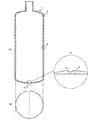
- FIG. 1 shows a cylindrical 3 liter bottle which is a blow-molded product
- FIG. 1 (a) is a vertical sectional view of the whole
- FIG. 1 (b) is a top view of the bottom
- FIG. 1 (c) is a bottom. It is a partial enlarged view of a welded part and its vicinity.
- the present invention 60 to 85% by mass of the polyamide resin (A), 5 to 20% by mass of the olefin-based ionomer (B), and 5 to 20% by mass of the impact resistant material (C) in 100% by mass of the polyamide resin composition.
- the present invention relates to a polyamide resin composition containing 20% by mass or more of the aliphatic copolymerized polyamide (A-1) in 100% by mass of the polyamide resin (A).
- the polyamide resin composition contains a polyamide resin (A).
- the polyamide resin (A) contained in the polyamide resin composition contains 20% by mass or more, preferably 40% by mass or more of the aliphatic copolymerized polyamide (A-1) in 100% by mass of the polyamide resin (A). It more preferably contains 60% by mass or more, more preferably 80% by mass or more, and most preferably contains only the aliphatic copolymerized polyamide (A-1).
- the molding temperature can be lowered, and the blow-molded product is excellent in burning suppression and dimensional stability.
- the polyamide resin (A) includes an aromatic copolymerized polyamide (A-2), an aliphatic homopolyamide (A-3), and an aromatic homopolyamide (A-4). It may contain at least one selected from the group consisting of. Of these, aliphatic homopolyamides are preferable.
- the aliphatic copolymerized polyamide (A-1) is a polyamide resin composed of two or more kinds of aliphatic constituent units.
- the aliphatic copolymerized polyamide (A-1) is a copolymer of a monomer selected from the group consisting of a combination of a diamine and a dicarboxylic acid, lactam and an aminocarboxylic acid.
- the combination of diamine and dicarboxylic acid is regarded as one kind of monomer by the combination of one kind of diamine and one kind of dicarboxylic acid.
- Diamines include ethylenediamine, tetramethylenediamine, pentamethylenediamine, hexamethylenediamine, peptidemethylenediamine, octamethylenediamine, nonamethylenediamine, decamethylenediamine, undecamethylenediamine, dodecamethylenediamine, tridecanediamine, and tetradecanediamine.
- 1,3- / 1,4-cyclohexamethylenediamine bis (4-aminocyclohexyl) methane, bis (4-aminocyclohexyl) propane, bis (3-methyl-4-aminocyclohexyl) methane, (3 -Methyl-4-aminocyclohexamethylene) propane, 1,3- / 1,4-bisaminomethylcyclohexane, 5-amino-2,2,4-trimethyl-1-cyclopentanemethylamine, 5-amino-1,3 , 3-trimethylcyclohexanemethylamine, bis (aminopropyl) piperazine, bis (aminoethyl) piperazine, alicyclic diamines such as norbornandimethylenediamine and the like can be mentioned.
- At least one selected from the group consisting of aliphatic diamines is preferable, at least one selected from the group consisting of linear aliphatic diamines is more preferable, and hexamethylenediamine is more preferable. More preferred.
- One of these diamines may be used alone, or two or more of these diamines may be used in combination as appropriate.
- Dicarboxylic acids include oxalic acid, malonic acid, succinic acid, glutaric acid, adipic acid, pimeric acid, suberic acid, azelaic acid, sebacic acid, undecandioic acid, dodecandioic acid, tridecandic acid, tetradecandioic acid, pentadecane Aliphatic dicarboxylic acids such as dionic acid, hexadecandionic acid, octadecandionic acid, and eicosandionic acid; 1,3- / 1,4-cyclohexanedicarboxylic acid, dicyclohexanemethane-4,4'-dicarboxylic acid, norbornandicarboxylic acid Such as alicyclic dicarboxylic acid and the like. These dicarboxylic acids may be used alone or in combination of two or more.
- lactam examples include ⁇ -caprolactam, enantractam, undecane lactam, dodecane lactam, ⁇ -pyrrolidone, ⁇ -piperidone, laurolactam and the like.
- at least one selected from the group consisting of ⁇ -caprolactam, undecane lactam, dodecane lactam and laurolactam is preferable from the viewpoint of polymerization production.
- lactams may be used alone or in combination of two or more.
- aminocarboxylic acid examples include 6-aminocaproic acid, 7-aminoheptanoic acid, 9-aminononanoic acid, 11-aminoundecanoic acid and 12-aminododecanoic acid.
- at least one selected from the group consisting of 6-aminocaproic acid, 11-aminoundecanoic acid, and 12-aminododecanoic acid is preferable from the viewpoint of polymerization production.
- These aminocarboxylic acids may be used alone or in combination of two or more.
- aliphatic copolymerized polyamide (A-1) a caprolactam / hexamethylene diaminoadiponic acid copolymer (polyamide 6/66), a caprolactam / hexamethylene diaminoazeline acid copolymer (polyamide 6/69), Caprolactam / hexamethylene diaminosevacinic acid copolymer (polyamide 6/610), caprolactam / hexamethylene diaminoundecanoic acid copolymer (polyamide 6/611), caprolactam / hexamethylene diaminododecanoic acid copolymer (polyamide 6/612) , Caprolactam / aminoundecanoic acid copolymer (polyamide 6/11), caprolactam / laurolactam copolymer (polyamide 6/12), caprolactam / hexamethylenediaminoadipic acid / laurol
- the melting point is preferably 240 ° C. or lower, more preferably 200 ° C. or lower, as measured by raising the temperature at 20 ° C./min in a nitrogen atmosphere according to ISO11357-3 with a differential scanning calorimeter (DSC).
- DSC differential scanning calorimeter
- polyamide 6/66 polyamide 6/12 and polyamide 6/66/12
- polyamide 6/66 and polyamide 6/66/12 are preferable.
- At least one selected from the group consisting of is more preferable, and polyamide 6/66 is particularly preferable.
- the copolymer containing polyamide 6 preferably has a polyamide 6 ratio of 60 to 95%.
- These aliphatic copolymerized polyamides (A-1) can be used alone or as a mixture of two or more kinds. When used as a mixture of two or more, it is preferable to use polyamide 6/66 as one of them from the viewpoint of blow moldability and blister resistance.
- the equipment for producing the aliphatic copolymerized polyamide (A-1) includes a batch type reaction kettle, a single-tank or multi-tank continuous reaction device, a tubular continuous reaction device, a uniaxial kneading extruder, and a twin-screw kneading extruder.
- Examples thereof include known polyamide manufacturing apparatus such as a kneading reaction extruder such as.
- a polymerization method a known method such as melt polymerization, solution polymerization or solid phase polymerization can be used, and polymerization can be carried out by repeating normal pressure, reduced pressure and pressurization operations. These polymerization methods can be used alone or in combination as appropriate.
- the relative viscosity of the aliphatic copolymerized polyamide (A-1) was measured at 25 ° C. in accordance with JIS K 6920 by dissolving 1 g of the aliphatic copolymerized polyamide in 100 ml of 96% concentrated sulfuric acid from the viewpoint of molding processability.
- the relative viscosity is preferably 3.0 or more, more preferably 3.5 or more and 5.0 or less.
- the terminal amino group concentration of the aliphatic copolymerized polyamide (A-1) is determined by neutralization titration after dissolving it in a mixed solvent of phenol and methanol.
- the terminal amino group concentration of the aliphatic copolymerized polyamide (A-1) is preferably 30 ⁇ mol / g or more, more preferably 30 ⁇ mol / g or more and 50 ⁇ mol / g or less.
- Aromatic polyamide is an aromatic polyamide resin containing at least one aromatic monomer component, and is, for example, an aliphatic dicarboxylic acid and an aromatic diamine, and an aromatic dicarboxylic acid and a fat. It is a polyamide resin obtained by using a group diamine or an aromatic dicarboxylic acid and an aromatic diamine as raw materials and polycondensing them.
- the aromatic copolymerized polyamide (A-2) is a polyamide resin composed of two or more kinds of constituent units among the above aromatic polyamide resins.
- the combination of diamine and dicarboxylic acid is regarded as one kind of monomer by the combination of one kind of diamine and one kind of dicarboxylic acid.
- Examples of the raw material aliphatic diamine and aliphatic dicarboxylic acid include those similar to those exemplified in the above description of the aliphatic copolymerized polyamide, and also include those exemplified as alicyclic diamine and alicyclic dicarboxylic acid. Is done.
- Examples of the aromatic diamine include metaxylylenediamine and paraxylylenediamine
- examples of the aromatic dicarboxylic acid include naphthalenedicarboxylic acid, terephthalic acid, isophthalic acid and phthalic acid. These aromatic diamines and aromatic dicarboxylic acids may be used alone or in combination of two or more.
- the aromatic copolymerized polyamide resin may contain a structural unit derived from lactam and aminocarboxylic acid, and the lactam and aminocarboxylic acid are the same as those exemplified as the raw materials of the above-mentioned aliphatic homopolyamide resin. Things can be mentioned. These lactams and aminocarboxylic acids may be used alone or in combination of two or more.
- aromatic copolymerized polyamide (A-2) examples include (polyamide 66 / 6T), polyhexamethylene terephthalamide / polycaproamide copolymer (polyamide 6T / 6), and polyhexamethylene adipamide / poly.
- Hexamethylene isophthalamide copolymer (polyamide 66 / 6I), polyhexamethylene isophthalamide / polycaproamide copolymer (polyamide 6I / 6), polydodecamide / polyhexamethylene terephthalamide copolymer (polyamide 12 / 6T), polyhexamethylene adipa Mid / polyhexamethylene terephthalamide / polyhexamethylene isophthalamide copolymer (polyamide 66 / 6T / 6I), polyhexamethylene adipamide / polycaproamide / polyhexamethylene isophthalamide copolymer (polyamide 66/6 / 6I), poly Hexamethylene terephthalamide / polyhexamethylene isophthalamide copolymer (polyamide 6T / 6I), polyhexamethylene terephthalamide / poly (2-methylpentamethylene terephthalamide) copolymer (polyamide 6T / M5
- Examples of the apparatus and polymerization method for producing the aromatic copolymerized polyamide (A-2) are the same as those exemplified in the section of the aliphatic copolymerized polyamide (A-1).
- the degree of polymerization of the aromatic copolymerized polyamide (A-2) in the present invention is not particularly limited, but according to JIS K6920, the concentration in sulfuric acid is 98%, and the resin temperature of the (A-2) aromatic copolymerized polyamide is 25.
- the relative viscosity measured at ° C. is preferably 1.5 to 4.0, more preferably 1.8 to 3.0.
- the terminal amino group concentration of the aromatic copolymerized polyamide (A-2) is determined by neutralization titration after dissolving it in a mixed solvent of phenol and methanol.
- the terminal amino group concentration of the aromatic copolymerized polyamide (A-2) is preferably 2.00 ⁇ 10-5 eq / g or more and 6.00 ⁇ 10-5 eq / g or less.
- the content of the aromatic copolymerized polyamide (A-2) contained in 100% by mass of the polyamide resin (A) is the mechanical property. From the viewpoint of moldability, 1 to 30% by mass is preferable, and 3 to 20% by mass is more preferable.
- the aliphatic homopolyamide (A-3) is a polyamide resin composed of one kind of aliphatic constituent unit.
- the aliphatic homopolyamide (A-3) may be composed of at least one of one kind of lactam and aminocarboxylic acid which is a hydrolyzate of the lactam, and one kind of diamine and one kind of dicarboxylic acid. It may consist of a combination of.
- the combination of diamine and dicarboxylic acid is regarded as one kind of monomer by the combination of one kind of diamine and one kind of dicarboxylic acid.
- lactam examples include those similar to those exemplified as the raw material of the aliphatic copolymerized polyamide (A-1). Among these, one selected from the group consisting of ⁇ -caprolactam, undecane lactam, dodecane lactam and laurolactam is preferable from the viewpoint of polymerization production.
- aminocarboxylic acid examples include those similar to those exemplified as the raw material of the aliphatic copolymerized polyamide (A-1). Among these, one selected from the group consisting of 6-aminocaproic acid, 11-aminoundecanoic acid, and 12-aminododecanoic acid is preferable from the viewpoint of polymerization production.
- diamine examples include those similar to those exemplified as the raw material of the aliphatic copolymerized polyamide (A-1). Among these, an aliphatic diamine is preferable, and a hexamethylenediamine is more preferable, from the viewpoint of polymerization productivity.
- dicarboxylic acid examples include those similar to those exemplified as the raw material of the aliphatic copolymerized polyamide (A-1). Among these, an aliphatic dicarboxylic acid is preferable, one selected from the group consisting of adipic acid, sebacic acid and dodecandioic acid is more preferable, and sebacic acid or dodecandioic acid is further preferable.
- polyamide 6 polycaprolactam
- polyenantractum polyamide 7
- polyundecanelactam polyamide 11
- polylaurolactam polyamide 12
- polyhexamethylene azimuth Pamide polyamide 66
- polytetramethylene dodecamide polyamide 412
- polypentamethylene azelamide polyamide 59
- polypentamethylene sebacamide polyamide 510
- polypentamethylene dodecamide polyamide 512
- polyhexa Methylene azelamide polyamide 69
- polyhexamethylene sebacamide polyhexamethylene dodecamide
- polyamide 612 polynonamethylene adipamide
- polyamide 99 Polynonamethylene sebacamide
- polyamide 910 polynonamethylene dodecamide
- the aliphatic homopolyamide (A-3) is preferably at least one selected from the group consisting of polyamide 6, polyamide 11, polyamide 12, polyamide 66, polyamide 610 and polyamide 612 from the viewpoint of polymerization productivity, and polyamide is preferable. 6. Polyamide 11, polyamide 12, polyamide 610 and polyamide 612 are more preferred, and polyamide 6 is even more preferred.
- Examples of the apparatus for producing the aliphatic homopolyamide (A-3) and the polymerization method are the same as those exemplified in the section of the aliphatic copolymerized polyamide (A-1).
- the relative viscosity of the aliphatic homopolyamide (A-3) is measured at 25 ° C. in accordance with JIS K 6920 by dissolving 1 g of the aliphatic homopolyamide in 100 ml of 96% concentrated sulfuric acid.
- the relative viscosity of the aliphatic homopolyamide is preferably 2.7 or more, and more preferably 2.7 or more and 5.0 or less. Further, from the viewpoint of improving the effect of the present invention, 2.7 or more and less than 4.5 is more preferable.
- the melt viscosity of the polyamide composition is not too low, so that the parison shape retention is particularly good during blow molding, and when it is 5.0 or less, the melt viscosity of the polyamide composition is high. It is not too much, and a uniform wall thickness of the molten resin can be obtained during blow molding.
- the terminal amino group concentration of the aliphatic homopolyamide (A-3) is determined by neutralization titration after dissolving it in a mixed solvent of phenol and methanol.
- the terminal amino group concentration of the aliphatic homopolyamide (A-3) is preferably 30 ⁇ mol / g or more, more preferably 30 ⁇ mol / g or more and 50 ⁇ mol / g or less.
- the content of the aliphatic homopolyamide (A-3) contained in 100% by mass of the polyamide resin (A) is preferably less than 75% by mass, more preferably less than 70% by mass, from the viewpoint of mechanical properties and blow moldability. Less than 60% by mass is particularly preferable, and when the aliphatic homopolyamide (A-3) is contained in the polyamide resin (A), 0.1% by mass or more is preferable.
- the aromatic homopolyamide (A-4) is an aromatic polyamide resin composed of one kind of constituent unit derived from an aromatic monomer component, and is, for example, an aliphatic dicarboxylic acid and an aromatic. It is a polyamide resin obtained by polycondensing group diamine, aromatic dicarboxylic acid and aliphatic diamine, or aromatic dicarboxylic acid and aromatic diamine as raw materials.
- the combination of diamine and dicarboxylic acid is regarded as one kind of monomer by the combination of one kind of diamine and one kind of dicarboxylic acid.
- Examples of the raw material aliphatic diamine and aliphatic dicarboxylic acid include the same as those of the above-mentioned aliphatic polyamide, and include those exemplified as alicyclic diamine and alicyclic dicarboxylic acid.
- Examples of the aromatic diamine include metaxylylenediamine and paraxylylenediamine, and examples of the aromatic dicarboxylic acid include naphthalenedicarboxylic acid, terephthalic acid, isophthalic acid and phthalic acid.
- aromatic homopolyamide (A-4) examples include polynonane methylene terephthalamide (polyamide 9T), polyhexamethylene terephthalamide (polyamide 6T), polyhexamethylene isophthalamide (polyamide 6I), and polyxylylene. Examples thereof include adipamide (polyamide MXD6).
- the aromatic homopolyamide (A-4) may be used alone or as a mixture of two or more.
- Examples of the apparatus for producing the aromatic homopolyamide (A-4) and the polymerization method are the same as those exemplified in the section of the aliphatic copolymerized polyamide (A-1).
- the degree of polymerization of the (A-4) aromatic homopolyamide resin in the present invention is not particularly limited, but according to JIS K6920, the concentration in sulfuric acid is 98%, the concentration in sulfuric acid is 1%, and the resin temperature of the (A-4) aromatic copolymerized polyamide is 25.
- the relative viscosity measured at ° C. is preferably 1.5 to 4.0, more preferably 1.8 to 3.0.
- the content of the aromatic homopolyamide (A-4) contained in 100% by mass of the polyamide resin (A) is mechanical properties and moldability. From the viewpoint of the above, 1 to 30% by mass is preferable, and 3 to 20% by mass is more preferable.
- the polyamide resin (A) conforms to JIS K-6920, and 1 g of the polyamide resin is dissolved in 100 ml of 96% concentrated sulfuric acid, and the relative viscosity measured at 25 ° C. is 2.7 or more, and 2.7 or more. It is preferably 0 or less. Further, from the viewpoint of improving the effect of the present invention, 2.7 or more and less than 4.5 is more preferable. When it is 2.7 or more, the melt viscosity of the polyamide composition is not too low, so that the parison shape retention during blow molding is particularly good. Further, when it is 5.0 or less, a uniform wall thickness of the molten resin can be obtained at the time of blow molding without the melt viscosity of the polyamide composition being too high.
- the polyamide resin (A) contains two or more types of polyamide resins having different relative viscosities (for example, at least one type of aliphatic homopolyamide (A-3) and at least one type of aliphatic copolymerized polyamide (A-1)).
- the relative viscosity of the polyamide resin (A) is preferably measured as described above, but when the relative viscosity of each polyamide resin and its mixing ratio are known, the mixing ratio is added to each relative viscosity.
- the average value calculated by summing the values multiplied by may be the relative viscosity of the polyamide resin (A).
- the terminal amino group concentration of the polyamide resin (A) is 30 ⁇ mol / g or more as the terminal amino group concentration determined by neutralization titration by dissolving in a mixed solvent of phenol and methanol.
- the range is preferable, the range of 30 ⁇ mol / g or more and 110 ⁇ mol / g or less is more preferable, and the range of 30 ⁇ mol / g or more and 70 ⁇ mol / g or less is further preferable.
- the reactivity with the impact resistant material (C) is good, and the melt viscosity and the impact resistance can be sufficiently obtained. Further, at 110 ⁇ mol / g or less, the melt viscosity is not too high and the molding processability is good.
- the polyamide resin (A) is composed of two or more types of polyamide resins having different terminal amino group concentrations (for example, at least one type of aliphatic homopolyamide (A-3) and at least one type of aliphatic copolymerized polyamide (A-1)). ) Is included, the terminal amino group concentration in the polyamide resin (A) is preferably measured by the above neutralization pruning, but when the terminal amino group concentration of each polyamide resin and its mixing ratio are known. The average value calculated by multiplying the respective terminal amino group concentrations by the mixing ratio thereof may be used as the terminal amino group concentration of the polyamide resin (A).
- the polyamide resin (A) is contained in an amount of 60 to 85% by mass, preferably 70 to 85% by mass, and more preferably 73 to 80% by mass in 100% by mass of the polyamide resin composition.
- the content ratio of the polyamide resin (A) is within the above range, the mechanical properties and heat resistance are good, and the low temperature physical properties and blow moldability are good.
- the polyamide resin composition contains an olefin-based ionomer (B).
- the olefin ionomer refers to a copolymer of an olefin and an ⁇ , ⁇ -unsaturated carboxylic acid and / or an ⁇ , ⁇ -unsaturated carboxylic acid ester neutralized with a metal or a metal ion.
- Examples of the resin of the olefin ionomer (B) include (ethylene and / or propylene) / ( ⁇ , ⁇ -unsaturated carboxylic acid and / or ⁇ , ⁇ -unsaturated carboxylic acid ester) copolymer. These may be used alone or in combination of two or more.
- the (ethylene and / or propylene) / ( ⁇ , ⁇ -unsaturated carboxylic acid and / or ⁇ , ⁇ -unsaturated carboxylic acid ester) polymer is ethylene and / or propylene and ⁇ , ⁇ -unsaturated carboxylic acid.
- ⁇ , ⁇ -unsaturated carboxylic acid ester monomer examples include acrylic acid and methacrylic acid.
- examples of the ⁇ , ⁇ -unsaturated carboxylic acid ester monomer include methyl ester, ethyl ester, propyl ester, butyl ester, pentyl ester, hexyl ester, heptyl ester, octyl ester, and nonyl of these ⁇ , ⁇ -unsaturated carboxylic acids.
- esters and decyl esters These may be used individually by 1 type or in combination of 2 or more type.
- Examples of the metal and the metal ion used in the ionomer include Na, K, Cu, Mg, Ca, Ba, Zn, Cd, Al, Fe, Co and Ni, and their ions. These may be used alone or in combination of two or more, but preferably contain at least Zn (also referred to as "zinc" in the present specification). Of these, the ethylene-methacrylic acid copolymer ionomer is preferable. Examples of commercially available olefin ionomers include the Hymilan (registered trademark) series manufactured by Mitsui Dow Polychemical Co., Ltd.
- the olefin ionomer (B) has a melting point of 75 to 100 ° C., which is measured by raising the temperature at 20 ° C./min in a nitrogen atmosphere according to ISO11357-3 with a differential scanning calorimeter (DSC). It is preferably 80 to 95 ° C., more preferably 80 to 95 ° C.
- the density of the olefin ionomer (B) measured by JIS K7112 is preferably 940 to 980 kg / m 3 , and more preferably 950 to 970 kg / m 3 .
- the metal ion contained in the olefin-based ionomer (B) preferably contains at least zinc, and the amount of zinc element compounded by the high frequency inductively coupled plasma emission spectroscopic analysis ICP-AES measurement is more preferably 3% or more.
- the melting point, density and zinc amount are in the above ranges, it is preferable from the viewpoint of compatibility with polyamide and wall thickness stability by suppressing swell expansion during blow molding.
- the MFR measured at 190 ° C. and a load of 2.16 kg in accordance with JIS K7210 (1999) of an olefin ionomer (B) is preferably 2 g / 10 minutes or less, and preferably 1 g / 10 minutes or less. More preferred.
- the MFR of the olefin ionomer (B) is in the above range, it is preferable from the viewpoint of drawdown property and dimensional stability.
- the olefin-based ionomer (B) is contained in an amount of 5 to 20% by mass, preferably 8 to 17% by mass, and more preferably 10 to 15% by mass in 100% by mass of the polyamide resin composition.
- the content ratio of the olefin ionomer (B) is in the above range, the low temperature characteristics and the parison characteristics in blow molding are improved.
- the polyamide resin composition contains an impact-resistant material (C).
- the impact resistant material include rubber-like polymers.
- the impact-resistant material preferably has a flexural modulus of 500 MPa or less as measured in accordance with ASTM D-790.
- the impact resistant material (C) does not contain the olefin ionomer (B).
- the impact resistant material (C) (ethylene and / or propylene) / ⁇ -olefin copolymer, (ethylene and / or propylene) / ( ⁇ , ⁇ -unsaturated carboxylic acid and / or ⁇ , ⁇ -Unsaturated carboxylic acid ester) -based copolymers and the like can be mentioned. These can be used alone or in combination of two or more.
- the impact resistant material (C) is preferably an ethylene / ⁇ -olefin copolymer.
- the (ethylene and / or propylene) / ⁇ -olefin-based copolymer is a copolymer obtained by copolymerizing ethylene and / or propylene with an ⁇ -olefin having 3 or more or 4 or more carbon atoms.
- Examples of ⁇ -olefins having 3 or more carbon atoms include propylene, 1-butene, 1-pentene, 1-hexene, 1-hexene, 1-octene, 1-nonene, 1-decene, 1-undecene, 1-dodecene, 1 -Tridecene, 1-tetradecene, 1-pentadecene, 1-hexadecene, 1-hexene, 1-octadecene, 1-nonadecene, 1-eicosene, 3-methyl-1-butene, 3-methyl-1-pentene, 3-ethyl -1-Pentene, 4-Methyl-1-pentene, 4-Methyl-1-hexene, 4,4-dimethyl-1-hexene, 4,4-dimethyl-1-pentene, 4-ethyl-1-hexene, 3 -Ethyl-1-hexene, 9-methyl-1-de
- the copolymer may be a copolymer of a polyene such as a non-conjugated diene.
- Non-conjugated diene includes 1,4-pentadiene, 1,4-hexadien, 1,5-hexadien, 1,4-octadien, 1,5-octadien, 1,6-octadien, 1,7-octadien, 2- Methyl-1,5-hexadien, 6-methyl-1,5-heptadiene, 7-methyl-1,6-octadien, 4-ethylidene-8-methyl-1,7-norbornene, 4,8-dimethyl-1, 4,8-Decatriene (DMDT), dicyclopentadiene, cyclohexadiene, cyclooctadien, 5-vinylnorbornene, 5-ethylidene-2-norbornene, 5-methylene-2-norbornene, 5-
- the (ethylene and / or propylene) / ( ⁇ , ⁇ -unsaturated carboxylic acid and / or ⁇ , ⁇ -unsaturated carboxylic acid ester) polymer is ethylene and / or propylene and ⁇ , ⁇ -unsaturated carboxylic acid. And / or a polymer copolymerized with an ⁇ , ⁇ -unsaturated carboxylic acid ester monomer.
- the ⁇ , ⁇ -unsaturated carboxylic acid monomer include acrylic acid and methacrylic acid.
- Examples of the ⁇ , ⁇ -unsaturated carboxylic acid ester monomer include methyl ester, ethyl ester, propyl ester, butyl ester, pentyl ester, hexyl ester, heptyl ester, octyl ester, and nonyl of these ⁇ , ⁇ -unsaturated carboxylic acids.
- Examples include esters and decyl esters. These may be used individually by 1 type or in combination of 2 or more type.
- the impact resistant material (C) contains a functional group having an affinity for the polyamide resin (A) in its molecule.
- the (ethylene and / or propylene) / ⁇ -olefin copolymer is modified with a carboxylic acid and / or a derivative thereof, and / or an unsaturated carboxylic acid and / or a derivative thereof to form a polyamide resin (A).
- a functional group having an affinity for the molecule can be contained in the molecule.
- the (ethylene and / or propylene) / ( ⁇ , ⁇ -unsaturated carboxylic acid and / or ⁇ , ⁇ -unsaturated carboxylic acid ester) -based copolymer has a carboxyl group and / or a carboxylic acid ester group, polyamide.
- a functional group having an affinity for the resin (A) is contained in the molecule, but may be further modified with a carboxylic acid and / or a derivative thereof, and / or an unsaturated carboxylic acid and / or a derivative thereof.
- Examples of the functional group having an affinity for the polyamide resin (A) include a carboxy group, an acid anhydride group, a carboxylic acid ester group, a carboxylic acid metal salt, a carboxylic acid imide group, a carboxylic acid amide group, and an epoxy group. Be done.
- Examples of compounds containing these functional groups are acrylic acid, methacrylic acid, maleic acid, fumaric acid, itaconic acid, crotonic acid, mesaconic acid, citraconic acid, glutaconic acid, cis-4-cyclohexene-1,2-dicarboxylic acid.
- Examples of the method for introducing these functional groups into the resin include (i) a method of copolymerizing a copolymerizable monomer having a functional group at the time of polymerization of the resin, (ii) a polymerization initiator, a chain transfer agent and the like. Examples thereof include a method of introducing a functional group into the molecular chain or the molecular terminal of the resin, and (iii) a method of grafting a compound (graft compound) having a functional group and a functional group capable of grafting onto the resin. These introduction methods can be used alone or in combination as appropriate.
- the (ethylene and / or propylene) / ⁇ -olefin-based copolymer used as the impact-resistant material (C) is a polymer acid-modified with an unsaturated carboxylic acid or an acid anhydride thereof.
- the (ethylene and / or propylene) / ( ⁇ , ⁇ -unsaturated carboxylic acid and / or ⁇ , ⁇ -unsaturated carboxylic acid ester) -based copolymer is further unsaturated in addition to the pre-existing functional groups. It is preferably a polymer acid-modified with a carboxylic acid or an acid anhydride thereof.
- the content of the acid anhydride group in the impact resistant material (C) is preferably more than 25 ⁇ mol / g and less than 100 ⁇ mol / g, and 35 ⁇ mol / g or more and less than 95 ⁇ mol. More preferably, it is more preferably 40 ⁇ mol / g or more and 90 ⁇ mol / g or less.
- the content exceeds 25 ⁇ mol / g, a composition having a high melt viscosity can be obtained, and a target wall thickness dimension can be obtained in blow molding.
- the content of the acid anhydride group of the impact resistant material (C) is neutralized and titrated with a sample solution prepared using toluene and ethanol, using phenolphthalein as an indicator, and a KOH ethanol solution specified in 0.1. Measured at.
- the acid anhydride group content in the impact-resistant material (C) is determined by using toluene or ethanol. It is preferable to use the prepared sample solution and measure by neutralization titration with a 0.1N KOH ethanol solution using phenolphthaline as an indicator, but the content of the acid anhydride group of each impact resistant material and When the mixing ratio is known, the average value calculated by multiplying the content of each acid anhydride group by the mixing ratio is also used as the acid anhydride amount of the impact resistant material (C). Good.
- the impact resistant material (C) preferably has an MFR of 2 g / 10 minutes or less measured at a temperature of 190 ° C. and a load of 2.16 kg in accordance with ASTM D1238. Is suppressed from becoming unstable, and the thickness of the molded product tends to be more uniform. In addition, the drawdown of the parison does not become too large, and good blow moldability tends to be obtained.
- the impact resistant material (C) is contained in an amount of 5 to 20% by mass, preferably 5 to 15% by mass, based on 100% by mass of the polyamide resin composition. When the content ratio of the impact resistant material (C) is within the above range, the burning suppression, the low temperature physical properties, and the wall thickness uniformity of the blow molded product are good.
- the polyamide resin composition By containing both the olefin ionomer (B) and the impact resistant material (C), the polyamide resin composition has both suppression of burning and blister resistance, and is excellent in dimensional stability.
- the polyamide resin composition preferably contains the heat resistant agent (D).
- the heat resistant agent one that can improve the heat resistance of the polyamide resin can be used, and an organic or inorganic heat resistant agent can be used according to the purpose.
- the polyamide resin composition more preferably contains at least one organic antioxidant as a heat resistance agent.
- an organic antioxidant By containing an organic antioxidant, it is possible to further improve the heat weldability while maintaining the usual heat aging property, physical properties, melt viscosity and the like even when the interval time is long during blow molding. It is considered that this is because, for example, the addition of an organic antioxidant suppresses gelation due to thermal deterioration of the impact resistant agent, thereby suppressing the nucleation action.
- organic antioxidant examples include phenolic antioxidants, phosphorus-based antioxidants, sulfur-based antioxidants and the like.
- the hindered phenol refers to a compound having a substituent at the ortho position (hereinafter, also referred to as “o position”) of the hydroxyl group of phenol.
- the substituent at the o-position is not particularly limited, and examples thereof include an alkyl group, an alkoxy group, an amino group, and a halogen.
- alkyl groups such as methyl group, ethyl group, n-propyl group, i-propyl group, n-butyl group, sec-butyl group, i-butyl group and t-butyl group are preferable, and bulky i-.
- a propyl group, a sec-butyl group, an i-butyl group, and a t-butyl group are more preferable, and a t-butyl group is most preferable.
- the o-position it is preferable that both of the two o-positions with respect to the hydroxyl group of phenol have a substituent.
- the hindered phenol having a t-butyl group at the o-position is specifically N, N'-hexamethylenebis (3,5-di-t-butyl-4-hydroxy-hydrocinnamamide, pentaerythritol-.
- a phosphite ester compound of hindered phenol and a hypophosphorous acid ester compound of hinderedphenol are preferable, and a phosphite ester compound of hinderedphenol having a t-butyl group at the o-position, o.
- a hypophosphorous acid ester compound of hindered phenol having a t-butyl group at the position is more preferable, and a phosphite ester compound of hindered phenol having a t-butyl group at the o-position is further preferable.
- the phosphite ester compound of hindered phenol having a t-butyl group at the o-position include tris (2,4-di-t-butylphenyl) phosphite and bis (2,6-di-t).
- -Butyl-4-methylphenyl) pentaelthritol diphosphite can be mentioned.
- the hypophosphorous acid ester compound of hindered phenol having a t-butyl group at the o-position is p, p, p', p'-tetrakis (2,4-di-t-butylphenoxy)-.
- Examples thereof include reaction products of biphenyl containing 4,4'-biphenyldiphosphine as a main component, phosphorus trichloride and 2,4-di-t-butylphenol.
- Examples of commercially available products of these heat resistant agents include "Irgafos (registered trademark) 168" (BASF) and "Hostanox (registered trademark) P-EPQ (registered trademark)” (Clariant Chemicals). These may be used alone or in combination of two or more.
- sulfur-based antioxidant examples include distearyl-3,3-thiodipropionate, pentaerythrityl tetrakis (3-laurylthiopropionate), and didodecyl (3,3'-thiodipropionate). Can be done. These may be used alone or in combination of two or more. These organic antioxidants may be used alone or in combination of two or more.
- inorganic heat resistant agent Types of inorganic heat-resistant agents for heat-resistant agents include copper compounds and potassium halides, and copper compounds include cuprous iodide, cupric bromide, cupric bromide, and cupric acetate. .. Copper iodide is preferable from the viewpoint of heat resistance and suppression of metal corrosion.
- Examples of potassium halide include potassium iodide, potassium bromide, potassium chloride and the like. Potassium iodide and / or potassium bromide is preferable from the viewpoint of heat resistance and suppression of metal corrosion. These may be used alone or in combination of two or more.
- the polyamide resin composition preferably contains at least one phenolic antioxidant, and contains at least one phenolic antioxidant and at least one phosphorus antioxidant. It is more preferable to contain a hindered phenol having a t-butyl group at the o-position and a subphosphate ester compound of the hindered phenol having a t-butyl group at the o-position or a hinder having a t-butyl group at the o-position.
- hypophosphate ester compound of dophenol it is more preferable to contain a hypophosphate ester compound of dophenol, and further preferably contains a hindered phenol having a t-butyl group at the o-position and a subphosphate ester compound of a hindered phenol having a t-butyl group at the o-position. Is particularly preferred.
- the heat resistant agent (D) is preferably contained in an amount of 0.1 to 3% by mass, more preferably 0.5 to 2% by mass, based on 100% by mass of the polyamide resin composition.
- the content ratio of the heat resistant agent (D) is within the above range, it is possible to suppress burning of the appearance of the molded product, uneven wall thickness of the inner surface, and yellowing of the entire molded product, and the appearance can be improved.
- the polyamide resin composition has dyes, pigments, fibrous reinforcing materials, particulate reinforcing materials, plasticizers, antioxidants (excluding component (D)), and foaming as optional components, depending on the purpose and the like.
- a functionalizing agent such as an agent, a weather resistant agent, a crystal nucleating agent, a crystallization accelerator, a mold release agent, a lubricant, an antistatic agent, a flame retardant, a flame retardant aid, and a colorant may be appropriately contained.
- the polyamide resin composition preferably contains an antioxidant.
- the optional additive (E) is preferably contained in an amount of 0.01 to 1% by mass, more preferably 0.05 to 0.5% by mass, based on 100% by mass of the polyamide resin composition.
- the polyamide resin composition may contain a resin other than the polyamide resin (A), the olefin ionomer (B) and the impact resistant material (C).
- the resin other than the polyamide resin (A), the olefin ionomer (B) and the impact resistant material (C) is preferably 2% by mass or less in 100% by mass of the polyamide resin composition from the viewpoint of suppressing burning, and is 0.1. It is more preferably less than% by mass, and even more preferably not contained.
- the method for producing the polyamide resin composition is not particularly limited, and for example, the following method can be applied.
- a single-screw or twin-screw extruder is used.
- melt-kneaders such as a Banbury mixer, a kneader, and a mixing roll are used.
- a method of blending all raw materials and then melt-kneading using a twin-screw extruder a method of blending some raw materials, then melt-kneading, and then blending the remaining raw materials and then melt-kneading, or a part of them.
- Any method may be used, such as a method of mixing the remaining raw materials using a side feeder during melt-kneading after blending the raw materials of.
- the polyamide resin composition has a low melt viscosity, it has a parison holding ability and is excellent in surface appearance of a molded product even when it stays during molding. Therefore, it is suitably used for producing a blow molded product by blow molding. be able to. Further, it can be suitably used for manufacturing an extrusion-molded product by extrusion molding, an injection-molded product by injection molding, and a rotary-molded product by rotary molding.
- the method for producing a blow-molded product from the polyamide resin composition by blow molding is not particularly limited, and a known method can be used.
- blow molding may be performed after forming a parison using a normal blow molding machine.
- the preferable resin temperature at the time of forming the parison is preferably in a temperature range of 10 ° C. to 70 ° C. higher than the melting point of the polyamide resin composition.
- the blow-molded product obtained by blow-molding from the polyamide resin composition has excellent thickness stability and excellent dimensional stability.
- the blow-molded product made of the polyamide resin composition has the standard deviation of the thickness of each of the shoulder portion 1, the R portion 2, the body portion 3, the welded portion vicinity 4, and the welded portion 5. Is preferably 1.00 or less, more preferably 0.90 or less, and even more preferably 0.80 or less.
- the blow-molded product obtained by blow-molding from the polyamide resin composition is prevented from having a thin welded portion.
- the thickness of the welded portion 5 is divided by the average thickness of the shoulder portion 1, the R portion 2, the body portion 3, the vicinity of the welded portion 4, and the welded portion 5.
- the value (thickness of the welded portion / average thickness) is preferably 0.50 or more, more preferably 0.55 or more, and further preferably 0.60 or more.
- the method for producing an extrusion-molded product from the polyamide resin composition by extrusion molding is not particularly limited, and a known method can be used. It is also possible to obtain a multilayer structure by co-extruding with a polyolefin such as polyethylene or another thermoplastic resin and then performing blow molding. In that case, it is also possible to provide an adhesive layer between the polyamide resin composition layer and another thermoplastic resin layer such as polyolefin. In the case of a multilayer structure, the polyamide resin composition of the present invention can be used for both the outer layer and the inner layer.
- the method for producing an injection-molded product by injection molding from the polyamide resin composition is not particularly limited, and a known method can be used. For example, a method compliant with ISO 294-1 is taken into consideration.
- the method for producing a rotary molded product by rotary molding from the polyamide resin composition is not particularly limited, and a known method can be used.
- a known method can be used.
- the method described in International Publication 2019/054109 is referred to.
- Blow-molded products by blow molding, extrusion-molded products by extrusion molding, injection-molded products by injection molding, and rotary-molded products by rotary molding are not particularly limited, but are not particularly limited, but are not particularly limited, but are spoilers, air intake ducts, intake manifolds, resonators, fuel tanks, and gas tanks. , Hydraulic oil tanks, fuel filler tubes, fuel delivery pipes, other automobile parts such as hoses, tubes, tanks, electric tool housings, mechanical parts such as pipes, electrical / electronic parts, household / office supplies, building materials Various uses such as related parts and furniture parts are preferably mentioned.
- the molded product of the polyamide resin composition of the present invention is excellent in blow moldability and impact resistance, which can be applied to large molded products, and therefore, it is preferably used in large tanks, especially high-pressure gas tanks. it can.
- the polyamide resin composition has excellent gas barrier properties, it is suitably used for molded products that come into contact with high-pressure gas, for example, tanks, tubes, hoses, films, etc. that come into contact with high-pressure gas.
- the type of the gas is not particularly limited, and examples thereof include hydrogen, nitrogen, oxygen, helium, methane, butane, and propane. Gases having a small polarity are preferable, and hydrogen, nitrogen, and methane are particularly preferable.
- blow moldability The blow moldability was evaluated in (1) to (5). Blow moldability was confirmed using a blow molding machine DA-50 type with an accumulator head manufactured by PLACO Co., Ltd. The measurement conditions were a cylinder temperature of 240 ° C., a screw rotation speed of 40 rpm, a die diameter of 50 mm, a cylindrical 3-liter bottle mold, and a mold temperature of 60 ° C. to obtain a molded product. The obtained molded product was used for the evaluation of (2) to (5). Moreover, the evaluation of (1) was performed under this condition.
- Draw-down property The draw-down property was evaluated by injecting 1 m of parison with a constant thickness and measuring the amount of sagging after 2 seconds. The smaller the amount of sagging, the better the draw-down property. Specifically, when the amount of sagging is 15 cm or less, the drawdown property is excellent.
- the wall thickness of the blow-molded product is the thickness of each of the shoulder portion 1, the R portion 2, the body portion 3, the vicinity of the welded portion 4, and the welded portion 5.
- the thickness of the welded portion 5 is divided by the average thickness of the shoulder portion 1, the R portion 2, the body portion 3, the welded portion vicinity 4 and the welded portion 5 (welding). Part thickness / average thickness) was determined. If this value is small, the welded portion will be thinner than the whole. Therefore, when this value is 0.50 or more, it is suppressed that only the welded portion is remarkably thin.
- Blister resistance A test piece was prepared using an injection molding machine SE100D-C160S manufactured by Sumitomo Heavy Industries, Ltd. in accordance with ISO 294-1. The acquired test piece was used for data acquisition of mechanical properties. High-pressure hydrogen gas at 85 ° C. was sealed in an autoclave from 2 MPa to 87.5 MPa over 30 minutes, a test piece was placed, and after holding for 10 minutes, the pressure was reduced to 2 MPa at a decompression rate of 0.5 minutes. After repeating the cycle four times, removal was performed. The presence or absence of water swelling-like appearance abnormality was visually determined on the test piece. ⁇ : No water swelling (blister) on the surface of the test piece ⁇ : Water swelling (blister) on the surface of the test piece
- the value of tensile fracture nominal strain at -60 ° C is 20% or more
- Charpy impact strength at -40 ° C is 20 kJ / m 2 or more
- the evaluation based on the above criteria is ⁇ , Satisfy all of.
- X Due to the draw-down property, the amount of sagging after 2 seconds is 15 cm or less.
- the evaluation based on the above criteria is 2 or 3
- the evaluation based on the above criteria is ⁇
- the transferability of the outer mold the evaluation based on the above criteria is ⁇
- the standard deviation is 1.00 or less and the thickness of the welded part / average thickness is 0.
- Examples 1 to 9, Comparative Examples 1 to 5 Each component shown in Table 1 is melt-kneaded with a twin-screw kneader TEX44HCT, a cylinder diameter of 44 mm L / D35 at a cylinder temperature of 250 ° C., a screw rotation of 160 rpm, and a discharge rate of 50 kg / hrs, and the desired polyamide resin composition pellets are obtained.
- the unit of the composition in the table is mass%, and the entire resin composition is 100% by mass.
- the obtained pellets were used for molded articles and test pieces used for the above physical property evaluation. The results obtained are shown in Table 1.
- the polyamide resin composition of the present invention has low temperature toughness, blow moldability such as mold transferability of blow molded product, suppression of burning, suppression of surface unevenness, drawdown property and dimensional stability, and blister resistance. It can be seen that both sex and sex are compatible. Comparing Example and Comparative Examples 1 and 4, if the amount of the aliphatic copolymerized polyamide is less than 20% by mass in the polyamide, the dimensional stability may be inferior and the mold transferability may be inferior, and the dimensional stability may be inferior. Among the sexes, it can be seen that the thickness of the welded portion is particularly thin.
- Comparing Example and Comparative Example 2 when the polyamide resin composition does not contain an impact resistant material and contains more than 20% by mass of ionomer, the dimensional stability and the blister resistance are inferior. Comparing Example and Comparative Example 3, if the polyamide resin composition does not contain ionomers and contains more than 20% by mass of an impact resistant material, the burning of the inner surface of the molded product is not suppressed and the dimensional stability is inferior. Comparing Example and Comparative Example 5, if the polyamide resin composition does not contain an impact resistant material and an ionomer, blow molding itself becomes impossible and the low temperature toughness is also inferior.
- PA6 Polyamide 6, Relative viscosity: 4.08
- PA6 / 66 (1): Polyamide 6/66, Relative viscosity: 4.05, PA6 80 mol%, PA66 20 mol%
- PA6 / 66/12 Polyamide 6/66/12, Relative viscosity: 4.05, PA6 80 mol%, PA66 10 mol%, PA12 10 mol%
- the relative viscosity of the above-mentioned polyamide resin is a value measured at 25 ° C. in accordance with JIS K 6920 by dissolving 1 g of the polyamide resin in 100 ml of 96% concentrated sulfuric acid.
- Zn-EM Ionomer Density 960 kg / m 3 , melting point 88 ° C, measured according to JIS K7210 (1999) at 190 ° C, with a load of 2.16 kg, MFR 0.9 g / 10 minutes, zinc content 3.4 mass %, Ethylene-methacrylic acid copolymer, metal ion: zinc, product name "Himilan (registered trademark) 1706" manufactured by Mitsui Dow Polychemical Co., Ltd.
- MAH-EBR Maleic anhydride-modified ethylene-butene copolymer, product name "Toughmer (registered trademark) MH5020” manufactured by Mitsui Kagaku Co., Ltd., measured at 190 ° C. under a load of 2.16 kg according to ASTM D1238. 0.6g / 10 minutes
- Phenolic 1 Phenolic antioxidant (3,9-bis [2- [3- (3-t-butyl-4-hydroxy-5-methylphenyl) propionyloxy] -1,1-dimethylethyl] -2 , 4,8,10-Tetraoxaspiro [5.5] Undecane), Product name "Butylizer (registered trademark) GA-80"
- Phenol-based 2 Phenolic antioxidant (pentaerytritor tetrakis [3-]] manufactured by Sumitomo Chemical Co., Ltd.
Landscapes
- Chemical & Material Sciences (AREA)
- Health & Medical Sciences (AREA)
- Chemical Kinetics & Catalysis (AREA)
- Medicinal Chemistry (AREA)
- Polymers & Plastics (AREA)
- Organic Chemistry (AREA)
- Engineering & Computer Science (AREA)
- Manufacturing & Machinery (AREA)
- General Chemical & Material Sciences (AREA)
- Materials Engineering (AREA)
- Compositions Of Macromolecular Compounds (AREA)
- Blow-Moulding Or Thermoforming Of Plastics Or The Like (AREA)
Priority Applications (5)
| Application Number | Priority Date | Filing Date | Title |
|---|---|---|---|
| KR1020227011248A KR20220094192A (ko) | 2019-10-30 | 2020-10-28 | 폴리아미드 수지 조성물 |
| CN202080076440.9A CN114729152B (zh) | 2019-10-30 | 2020-10-28 | 聚酰胺树脂组合物 |
| JP2021553652A JP7647563B2 (ja) | 2019-10-30 | 2020-10-28 | ポリアミド樹脂組成物 |
| US17/773,280 US20230131836A1 (en) | 2019-10-30 | 2020-10-28 | Polyamide resin composition |
| EP20883137.0A EP4053199A4 (en) | 2019-10-30 | 2020-10-28 | Polyamide resin composition |
Applications Claiming Priority (2)
| Application Number | Priority Date | Filing Date | Title |
|---|---|---|---|
| JP2019197098 | 2019-10-30 | ||
| JP2019-197098 | 2019-10-30 |
Publications (1)
| Publication Number | Publication Date |
|---|---|
| WO2021085472A1 true WO2021085472A1 (ja) | 2021-05-06 |
Family
ID=75716015
Family Applications (1)
| Application Number | Title | Priority Date | Filing Date |
|---|---|---|---|
| PCT/JP2020/040426 Ceased WO2021085472A1 (ja) | 2019-10-30 | 2020-10-28 | ポリアミド樹脂組成物 |
Country Status (6)
| Country | Link |
|---|---|
| US (1) | US20230131836A1 (https=) |
| EP (1) | EP4053199A4 (https=) |
| JP (1) | JP7647563B2 (https=) |
| KR (1) | KR20220094192A (https=) |
| CN (1) | CN114729152B (https=) |
| WO (1) | WO2021085472A1 (https=) |
Cited By (2)
| Publication number | Priority date | Publication date | Assignee | Title |
|---|---|---|---|---|
| WO2022149430A1 (ja) * | 2021-01-08 | 2022-07-14 | 宇部興産株式会社 | 高圧ガスに触れる成形品用材料 |
| WO2025198029A1 (ja) * | 2024-03-22 | 2025-09-25 | Ube株式会社 | ポリアミド樹脂組成物 |
Families Citing this family (1)
| Publication number | Priority date | Publication date | Assignee | Title |
|---|---|---|---|---|
| JP7652086B2 (ja) | 2020-02-05 | 2025-03-27 | Ube株式会社 | ポリアミド樹脂組成物 |
Citations (12)
| Publication number | Priority date | Publication date | Assignee | Title |
|---|---|---|---|---|
| JPH11245927A (ja) | 1998-03-05 | 1999-09-14 | Kanebo Ltd | 中空成形品 |
| JP2001011305A (ja) * | 1999-04-27 | 2001-01-16 | Toray Ind Inc | 吹込成形用ポリアミド樹脂組成物および吹込成形品 |
| JP2007204674A (ja) * | 2006-02-03 | 2007-08-16 | Toray Ind Inc | ブロー成形用組成物 |
| JP2007204675A (ja) | 2006-02-03 | 2007-08-16 | Toray Ind Inc | ブロー中空成形用ポリアミド樹脂組成物 |
| JP2008503631A (ja) * | 2004-06-22 | 2008-02-07 | アルケマ フランス | 特定の表面状態を得るためのマイクロ結晶性ポリアミドの使用 |
| JP2012092290A (ja) * | 2010-09-29 | 2012-05-17 | Nippon Synthetic Chem Ind Co Ltd:The | 樹脂組成物およびそれを用いた多層構造体 |
| JP2013203869A (ja) * | 2012-03-28 | 2013-10-07 | Unitika Ltd | ポリアミド樹脂組成物 |
| JP2013249363A (ja) * | 2012-05-31 | 2013-12-12 | Toray Ind Inc | ポリアミド樹脂組成物および樹脂金属複合体 |
| WO2019054109A1 (ja) | 2017-09-12 | 2019-03-21 | 宇部興産株式会社 | ポリアミド樹脂組成物、並びにそれを用いた回転成形用ポリアミド樹脂組成物及び回転成形品 |
| WO2019117072A1 (ja) * | 2017-12-11 | 2019-06-20 | 宇部興産株式会社 | ポリアミド樹脂組成物 |
| JP2020041132A (ja) * | 2018-09-07 | 2020-03-19 | 宇部興産株式会社 | ポリアミド樹脂組成物 |
| JP2020117637A (ja) * | 2019-01-25 | 2020-08-06 | 東レ株式会社 | 高圧水素に触れる成形品用のポリアミド樹脂組成物およびそれを用いた成形品 |
Family Cites Families (1)
| Publication number | Priority date | Publication date | Assignee | Title |
|---|---|---|---|---|
| EP3034577A1 (en) * | 2014-12-19 | 2016-06-22 | The Goodyear Tire & Rubber Company | Tire with thermoplastic innerliner |
-
2020
- 2020-10-28 CN CN202080076440.9A patent/CN114729152B/zh active Active
- 2020-10-28 KR KR1020227011248A patent/KR20220094192A/ko not_active Ceased
- 2020-10-28 EP EP20883137.0A patent/EP4053199A4/en active Pending
- 2020-10-28 US US17/773,280 patent/US20230131836A1/en active Pending
- 2020-10-28 JP JP2021553652A patent/JP7647563B2/ja active Active
- 2020-10-28 WO PCT/JP2020/040426 patent/WO2021085472A1/ja not_active Ceased
Patent Citations (12)
| Publication number | Priority date | Publication date | Assignee | Title |
|---|---|---|---|---|
| JPH11245927A (ja) | 1998-03-05 | 1999-09-14 | Kanebo Ltd | 中空成形品 |
| JP2001011305A (ja) * | 1999-04-27 | 2001-01-16 | Toray Ind Inc | 吹込成形用ポリアミド樹脂組成物および吹込成形品 |
| JP2008503631A (ja) * | 2004-06-22 | 2008-02-07 | アルケマ フランス | 特定の表面状態を得るためのマイクロ結晶性ポリアミドの使用 |
| JP2007204674A (ja) * | 2006-02-03 | 2007-08-16 | Toray Ind Inc | ブロー成形用組成物 |
| JP2007204675A (ja) | 2006-02-03 | 2007-08-16 | Toray Ind Inc | ブロー中空成形用ポリアミド樹脂組成物 |
| JP2012092290A (ja) * | 2010-09-29 | 2012-05-17 | Nippon Synthetic Chem Ind Co Ltd:The | 樹脂組成物およびそれを用いた多層構造体 |
| JP2013203869A (ja) * | 2012-03-28 | 2013-10-07 | Unitika Ltd | ポリアミド樹脂組成物 |
| JP2013249363A (ja) * | 2012-05-31 | 2013-12-12 | Toray Ind Inc | ポリアミド樹脂組成物および樹脂金属複合体 |
| WO2019054109A1 (ja) | 2017-09-12 | 2019-03-21 | 宇部興産株式会社 | ポリアミド樹脂組成物、並びにそれを用いた回転成形用ポリアミド樹脂組成物及び回転成形品 |
| WO2019117072A1 (ja) * | 2017-12-11 | 2019-06-20 | 宇部興産株式会社 | ポリアミド樹脂組成物 |
| JP2020041132A (ja) * | 2018-09-07 | 2020-03-19 | 宇部興産株式会社 | ポリアミド樹脂組成物 |
| JP2020117637A (ja) * | 2019-01-25 | 2020-08-06 | 東レ株式会社 | 高圧水素に触れる成形品用のポリアミド樹脂組成物およびそれを用いた成形品 |
Non-Patent Citations (1)
| Title |
|---|
| See also references of EP4053199A4 |
Cited By (2)
| Publication number | Priority date | Publication date | Assignee | Title |
|---|---|---|---|---|
| WO2022149430A1 (ja) * | 2021-01-08 | 2022-07-14 | 宇部興産株式会社 | 高圧ガスに触れる成形品用材料 |
| WO2025198029A1 (ja) * | 2024-03-22 | 2025-09-25 | Ube株式会社 | ポリアミド樹脂組成物 |
Also Published As
| Publication number | Publication date |
|---|---|
| CN114729152B (zh) | 2024-08-27 |
| JP7647563B2 (ja) | 2025-03-18 |
| EP4053199A1 (en) | 2022-09-07 |
| JPWO2021085472A1 (https=) | 2021-05-06 |
| US20230131836A1 (en) | 2023-04-27 |
| CN114729152A (zh) | 2022-07-08 |
| EP4053199A4 (en) | 2023-11-08 |
| KR20220094192A (ko) | 2022-07-05 |
Similar Documents
| Publication | Publication Date | Title |
|---|---|---|
| US11814518B2 (en) | Polyamide resin composition | |
| CA2918146C (en) | Multilayer structure | |
| JP7328894B2 (ja) | ポリアミド樹脂組成物 | |
| JP6939572B2 (ja) | ポリアミド樹脂組成物 | |
| JP7647563B2 (ja) | ポリアミド樹脂組成物 | |
| JP6759706B2 (ja) | ポリアミド樹脂組成物 | |
| JP7803276B2 (ja) | ポリアミド樹脂組成物 | |
| JP7409875B2 (ja) | 水素タンクの継ぎ目レス長尺ライナーのブロー成形用ポリアミド樹脂組成物及び水素タンク用継ぎ目レス長尺ライナー | |
| WO2022039169A1 (ja) | ポリアミド樹脂組成物 | |
| JP7468189B2 (ja) | ポリアミド樹脂組成物 | |
| JP7310942B2 (ja) | ポリアミド樹脂組成物 | |
| JP7409876B2 (ja) | 水素タンクの継ぎ目レス長尺ライナーのブロー成形用ポリアミド樹脂組成物及び水素タンク用継ぎ目レス長尺ライナー | |
| WO2025198029A1 (ja) | ポリアミド樹脂組成物 | |
| JP7404774B2 (ja) | ポリアミド樹脂組成物 | |
| JP2021195424A (ja) | ポリアミド樹脂組成物 |
Legal Events
| Date | Code | Title | Description |
|---|---|---|---|
| 121 | Ep: the epo has been informed by wipo that ep was designated in this application |
Ref document number: 20883137 Country of ref document: EP Kind code of ref document: A1 |
|
| ENP | Entry into the national phase |
Ref document number: 2021553652 Country of ref document: JP Kind code of ref document: A |
|
| NENP | Non-entry into the national phase |
Ref country code: DE |
|
| ENP | Entry into the national phase |
Ref document number: 2020883137 Country of ref document: EP Effective date: 20220530 |